EP3354773A1 - Conducting polymer fiber and preparation method and use thereof - Google Patents
Conducting polymer fiber and preparation method and use thereof Download PDFInfo
- Publication number
- EP3354773A1 EP3354773A1 EP16847712.3A EP16847712A EP3354773A1 EP 3354773 A1 EP3354773 A1 EP 3354773A1 EP 16847712 A EP16847712 A EP 16847712A EP 3354773 A1 EP3354773 A1 EP 3354773A1
- Authority
- EP
- European Patent Office
- Prior art keywords
- electroconductive
- fiber
- dopant
- polymer fiber
- less
- Prior art date
- Legal status (The legal status is an assumption and is not a legal conclusion. Google has not performed a legal analysis and makes no representation as to the accuracy of the status listed.)
- Granted
Links
Classifications
-
- D—TEXTILES; PAPER
- D01—NATURAL OR MAN-MADE THREADS OR FIBRES; SPINNING
- D01F—CHEMICAL FEATURES IN THE MANUFACTURE OF ARTIFICIAL FILAMENTS, THREADS, FIBRES, BRISTLES OR RIBBONS; APPARATUS SPECIALLY ADAPTED FOR THE MANUFACTURE OF CARBON FILAMENTS
- D01F1/00—General methods for the manufacture of artificial filaments or the like
- D01F1/02—Addition of substances to the spinning solution or to the melt
- D01F1/09—Addition of substances to the spinning solution or to the melt for making electroconductive or anti-static filaments
-
- D—TEXTILES; PAPER
- D01—NATURAL OR MAN-MADE THREADS OR FIBRES; SPINNING
- D01F—CHEMICAL FEATURES IN THE MANUFACTURE OF ARTIFICIAL FILAMENTS, THREADS, FIBRES, BRISTLES OR RIBBONS; APPARATUS SPECIALLY ADAPTED FOR THE MANUFACTURE OF CARBON FILAMENTS
- D01F6/00—Monocomponent artificial filaments or the like of synthetic polymers; Manufacture thereof
- D01F6/02—Monocomponent artificial filaments or the like of synthetic polymers; Manufacture thereof from homopolymers obtained by reactions only involving carbon-to-carbon unsaturated bonds
- D01F6/24—Monocomponent artificial filaments or the like of synthetic polymers; Manufacture thereof from homopolymers obtained by reactions only involving carbon-to-carbon unsaturated bonds from polymers of aliphatic compounds with more than one carbon-to-carbon double bond
-
- D—TEXTILES; PAPER
- D01—NATURAL OR MAN-MADE THREADS OR FIBRES; SPINNING
- D01F—CHEMICAL FEATURES IN THE MANUFACTURE OF ARTIFICIAL FILAMENTS, THREADS, FIBRES, BRISTLES OR RIBBONS; APPARATUS SPECIALLY ADAPTED FOR THE MANUFACTURE OF CARBON FILAMENTS
- D01F11/00—Chemical after-treatment of artificial filaments or the like during manufacture
- D01F11/04—Chemical after-treatment of artificial filaments or the like during manufacture of synthetic polymers
- D01F11/06—Chemical after-treatment of artificial filaments or the like during manufacture of synthetic polymers of macromolecular compounds obtained by reactions only involving carbon-to-carbon unsaturated bonds
-
- D—TEXTILES; PAPER
- D06—TREATMENT OF TEXTILES OR THE LIKE; LAUNDERING; FLEXIBLE MATERIALS NOT OTHERWISE PROVIDED FOR
- D06M—TREATMENT, NOT PROVIDED FOR ELSEWHERE IN CLASS D06, OF FIBRES, THREADS, YARNS, FABRICS, FEATHERS OR FIBROUS GOODS MADE FROM SUCH MATERIALS
- D06M11/00—Treating fibres, threads, yarns, fabrics or fibrous goods made from such materials, with inorganic substances or complexes thereof; Such treatment combined with mechanical treatment, e.g. mercerising
- D06M11/07—Treating fibres, threads, yarns, fabrics or fibrous goods made from such materials, with inorganic substances or complexes thereof; Such treatment combined with mechanical treatment, e.g. mercerising with halogens; with halogen acids or salts thereof; with oxides or oxyacids of halogens or salts thereof
- D06M11/09—Treating fibres, threads, yarns, fabrics or fibrous goods made from such materials, with inorganic substances or complexes thereof; Such treatment combined with mechanical treatment, e.g. mercerising with halogens; with halogen acids or salts thereof; with oxides or oxyacids of halogens or salts thereof with free halogens or interhalogen compounds
-
- D—TEXTILES; PAPER
- D06—TREATMENT OF TEXTILES OR THE LIKE; LAUNDERING; FLEXIBLE MATERIALS NOT OTHERWISE PROVIDED FOR
- D06M—TREATMENT, NOT PROVIDED FOR ELSEWHERE IN CLASS D06, OF FIBRES, THREADS, YARNS, FABRICS, FEATHERS OR FIBROUS GOODS MADE FROM SUCH MATERIALS
- D06M11/00—Treating fibres, threads, yarns, fabrics or fibrous goods made from such materials, with inorganic substances or complexes thereof; Such treatment combined with mechanical treatment, e.g. mercerising
- D06M11/07—Treating fibres, threads, yarns, fabrics or fibrous goods made from such materials, with inorganic substances or complexes thereof; Such treatment combined with mechanical treatment, e.g. mercerising with halogens; with halogen acids or salts thereof; with oxides or oxyacids of halogens or salts thereof
- D06M11/11—Treating fibres, threads, yarns, fabrics or fibrous goods made from such materials, with inorganic substances or complexes thereof; Such treatment combined with mechanical treatment, e.g. mercerising with halogens; with halogen acids or salts thereof; with oxides or oxyacids of halogens or salts thereof with halogen acids or salts thereof
-
- D—TEXTILES; PAPER
- D06—TREATMENT OF TEXTILES OR THE LIKE; LAUNDERING; FLEXIBLE MATERIALS NOT OTHERWISE PROVIDED FOR
- D06M—TREATMENT, NOT PROVIDED FOR ELSEWHERE IN CLASS D06, OF FIBRES, THREADS, YARNS, FABRICS, FEATHERS OR FIBROUS GOODS MADE FROM SUCH MATERIALS
- D06M11/00—Treating fibres, threads, yarns, fabrics or fibrous goods made from such materials, with inorganic substances or complexes thereof; Such treatment combined with mechanical treatment, e.g. mercerising
- D06M11/83—Treating fibres, threads, yarns, fabrics or fibrous goods made from such materials, with inorganic substances or complexes thereof; Such treatment combined with mechanical treatment, e.g. mercerising with metals; with metal-generating compounds, e.g. metal carbonyls; Reduction of metal compounds on textiles
-
- D—TEXTILES; PAPER
- D06—TREATMENT OF TEXTILES OR THE LIKE; LAUNDERING; FLEXIBLE MATERIALS NOT OTHERWISE PROVIDED FOR
- D06M—TREATMENT, NOT PROVIDED FOR ELSEWHERE IN CLASS D06, OF FIBRES, THREADS, YARNS, FABRICS, FEATHERS OR FIBROUS GOODS MADE FROM SUCH MATERIALS
- D06M2101/00—Chemical constitution of the fibres, threads, yarns, fabrics or fibrous goods made from such materials, to be treated
- D06M2101/16—Synthetic fibres, other than mineral fibres
- D06M2101/18—Synthetic fibres consisting of macromolecular compounds obtained by reactions only involving carbon-to-carbon unsaturated bonds
- D06M2101/20—Polyalkenes, polymers or copolymers of compounds with alkenyl groups bonded to aromatic groups
-
- D—TEXTILES; PAPER
- D06—TREATMENT OF TEXTILES OR THE LIKE; LAUNDERING; FLEXIBLE MATERIALS NOT OTHERWISE PROVIDED FOR
- D06M—TREATMENT, NOT PROVIDED FOR ELSEWHERE IN CLASS D06, OF FIBRES, THREADS, YARNS, FABRICS, FEATHERS OR FIBROUS GOODS MADE FROM SUCH MATERIALS
- D06M23/00—Treatment of fibres, threads, yarns, fabrics or fibrous goods made from such materials, characterised by the process
- D06M23/10—Processes in which the treating agent is dissolved or dispersed in organic solvents; Processes for the recovery of organic solvents thereof
-
- D—TEXTILES; PAPER
- D10—INDEXING SCHEME ASSOCIATED WITH SUBLASSES OF SECTION D, RELATING TO TEXTILES
- D10B—INDEXING SCHEME ASSOCIATED WITH SUBLASSES OF SECTION D, RELATING TO TEXTILES
- D10B2321/00—Fibres made from polymers obtained by reactions only involving carbon-to-carbon unsaturated bonds
-
- D—TEXTILES; PAPER
- D10—INDEXING SCHEME ASSOCIATED WITH SUBLASSES OF SECTION D, RELATING TO TEXTILES
- D10B—INDEXING SCHEME ASSOCIATED WITH SUBLASSES OF SECTION D, RELATING TO TEXTILES
- D10B2401/00—Physical properties
- D10B2401/16—Physical properties antistatic; conductive
Definitions
- the present invention relates to the field of polymer fibers, in particular to an electroconductive polymer fiber, a method for preparing an electroconductive polymer fiber, an electroconductive polymer fiber prepared by the method, a fabric comprising the electroconductive polymer fiber and the use of the electroconductive polymer fiber in the manufacture of antistatic products, electromagnetic shielding materials or stealth materials.
- synthetic fibers are cheap and have low density and low moisture absorption, and are widely used in daily life, for example in textile and clothing, bags and the like.
- synthetic fibers have good electrical insulation and high resistivity, but are apt to produce static electricity, which are harmful for the industrial production and the people's lives.
- Static electricity and dusts adsorbed by static electricity are one of direct reasons for causing the malfunction, short circuit, signal loss, error code, and low yield in the modern electronic equipment.
- the electroconductive polymer material was found in the mid-1970s and has been widely followed with interest.
- the electroconductive polymer materials can be generally divided into intrinsically electroconductive polymer materials and filling-type electroconductive polymer materials.
- the intrinsically electroconductive polymer material refers to a polymer material that has electrical conductivity
- the filling-type electroconductive polymer material refers to a polymer material, in which an electrically conductive material is added so that the resulting material is electroconductive.
- the intrinsically electroconductive polymer material has a permanent electrical conductivity and antistatic ability.
- the intrinsically electroconductive polymer material generally has conjugated double bonds in the repeating units in the molecular chains, and therefore is also referred as a conjugated polymer.
- Known intrinsically electroconductive polymers generally include polyaniline, polyacetylene, polythiophene, polypyrrole, polyphenylene ethylene and the like.
- the intrinsically electroconductive polymer material has a wide and important application in solar cells, sensor, display and the other.
- the intrinsically electroconductive polymer due to its characteristics of being insoluble and refractory, the intrinsically electroconductive polymer usually cannot be directly processed into fiber material. It is usually necessary to coat the intrinsically electroconductive polymer on the surface of other polymer fibers to obtain an electrical conductive fiber material, and it is impossible to obtain a whole fiber material formed from the same intrinsically electroconductive polymer. Therefore, its application is greatly limited.
- the layer of the intrinsically electroconductive polymer may come off with the long-term use of the resulting fabric, and the bending and the scratching in use, which results in that the electrical conductive fiber loses its electrical conductivity.
- a sheath-core composite fiber comprising a thermoplastic polymer containing conductive carbon black fine particles as a sheath component
- the electrical conductivity is achieved by filling carbon black fine particles in the sheath of the fiber.
- the fine carbon black particles are hard to be uniformly distributed in the sheath of the fiber, adversely affecting the electrical conductivity of the fiber.
- the carbon black particles in the sheath may come off with the long-term use of the resulting fabric, and the bending and the scratching in use, which results in that the fiber loses its electrical conductivity.
- the falling carbon black fine particles scatter in the working environment and seriously affect the production of electronic products.
- the present inventors conducted intensive studies and found that, by treating a core layer formed from a polymer having at least one double bond in its repeating units and having no conjugated double bond with a dopant, an integrated electroconductive layer can be formed on the core layer, and an electroconductive polymer fiber can be produced.
- the electroconductive polymer fiber has excellent permanent electrical conductivity and antistatic ability.
- the electroconductive layer hardly comes off.
- the electroconductive polymer fiber of the present invention can be easily and efficiently produced.
- the present invention provides an electroconductive polymer fiber, characterized in that the fiber has an integrated electroconductive layer on at least a part of the surface thereof.
- the present invention also provides a method for preparing an electroconductive polymer fiber, which comprises a step of converting at least a part of the surface of an initial fiber made from a base polymer into an electroconductive layer by treating with a dopant.
- the present invention also provides a fabric comprising the electroconductive polymer fiber of the present invention or the electroconductive polymer fiber produced by the method of the present invention.
- the present invention also provides use of the electroconductive polymer fiber of the present invention or the electroconductive polymer fiber made by the method of the present invention in the manufacture of antistatic products, electromagnetic shielding materials or stealth materials.
- the electroconductive polymer fiber of the present invention is a fiber having an integrated fiber electroconductive layer on at least a part of the surface of the fiber, whereby the electroconductive layer on the fiber hardly comes off, and even after repeated bending and scratching, it maintains excellent electrical conductivity and antistatic ability.
- the electroconductive polymer fiber can be manufactured more efficiently, conveniently and inexpensively, and furthermore, the apparatus for manufacturing the electroconductive polymer fiber can also be miniaturized.
- the fabric made from the electroconductive polymer fiber of the present invention has excellent electrical conductivity and antistatic property, and the electrical conductivity is maintained even after it is worn for a long time or washed repeatedly.
- the electroconductive polymer fiber of the present invention an integrated electroconductive layer is provided on at least a part of the surface of the fiber.
- the electroconductive polymer fiber of the present invention includes a non-electroconductive core layer and an electroconductive layer integrally formed on the core layer.
- integrated or “integrally formed” means that the electroconductive layer is formed in situ on the surface of the fiber, that is, a portion of the fiber itself is directly converted into an electroconductive layer, rather than the core and the electroconductive layer are separately set.
- the electroconductive layer may be formed on the surface of the fiber in the form of a dot, a spot, an island, a line, a strip, or the like. It is preferable to have an integrated electroconductive layer on the entire surface of the fiber.
- the electroconductive polymer fiber has a radial diameter d of 0.001mm or more and 3mm or less, preferably 0.005mm or more and 2mm or less, more preferably 0.01mm or more and 1mm or less, further more preferably 0.02mm or more and 0.5mm or less, particularly preferably 0.03mm or more and 0.05mm or less.
- the fiber diameter means, for example, when the cross section of the fiber is in form of circle, the diameter of the circle; when the cross section of the fiber is in form of rectangle, the length of the short side of the rectangle; and when the cross section of the fiber is in form of ellipse, the length of the minor axis.
- the fiber diameter is measured with well-known methods and devices, for example, the fiber diameter is measured with a XGD-1C type fiber diameter measurement and composition analyzer (manufactured by Shanghai New Fiber Instrument Co., Ltd.).
- the thickness of the electroconductive layer integrally formed on the surface of the fiber is 0.001d or more and less than d, preferably 0.002d or more and 0.9d or less, further preferably 0.01d or more and 0.8d or less; further more preferably 0.05d or more and 0.7d or less. From the viewpoint of excellent bending resistance and good electrical conductivity maintenance, the thickness of the electroconductive layer is particularly preferably 0.1d or more and 0.5d or less.
- the thickness of the electroconductive layer refers to a value obtained by subtracting the diameter of the non-electroconductive core layer from the fiber diameter.
- the diameter of the non-electroconductive core layer can be measured with well-known methods and devices, for example, the diameter of the non-electroconductive core layer is measured with a XGD-1C type fiber diameter measurement and composition analyzer (manufactured by Shanghai New Fiber Instrument Co., Ltd.). The diameter of the non-electroconductive core layer is then subtracted from the fiber diameter to obtain a result, which is the thickness of the electroconductive layer.
- the diameter of the non-electroconductive core layer is the fiber diameter, and the thickness of the electroconductive layer is zero.
- the diameter of the non-electroconductive core layer is zero, and the thickness of the electroconductive layer is the fiber diameter.
- the polymer forming the non-electroconductive core layer of the present invention (hereinafter, sometimes referred to as "the polymer of the non-electroconductive core layer") is not particularly limited as long as it is a polymer that can form a conjugated polymer after treated with electron acceptor dopant and/or electron donor dopant. In one embodiment of the present invention, at least one double bond is present and no conjugated double bond is present in the repeat units of the polymer of the non-electroconductive core layer.
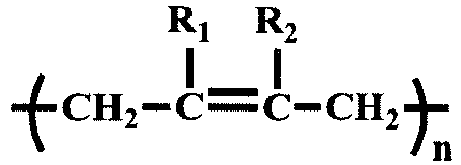
- the repeating units of the polymer of the non-electroconductive core layer are as follows, wherein, R 1 and R 2 are each independently hydrogen, halogen, C 1 -C 20 alkyl or phenyl, preferably are each independently H, Cl, Br, I, CH 3 , CH 2 CH 3 , CH 2 CH 2 CH 3 or C 6 H 5 .
- the polymer of the non-electroconductive core layer is at least one selected from the group consisting of trans-1,4-polyisoprene, cis-1,4-polyisoprene, trans-1,4-polybutadiene, cis-1,4-polybutadiene and 2,3-dimethyl-1,4-polybutadiene. From the viewpoint of excellent bending resistance and good electrical conductivity maintenance, it is preferably trans-1,4-polyisoprene.
- the dopant is an electron acceptor and/or electron donor dopant.
- said electron acceptor dopant is at least one selected from the group consisting of Cl 2 , Br 2 , I 2 , ICl, ICl3, IBr, IF 5 , PF 5 , AsF 5 , SbF 5 , BF 5 , BCl 3 , BBr 3 , SO 3 , NbF 5 , TaF 5 , MoF 5 , WF 5 , RuF 5 , PtCl 4 , TiCl 4 , AgClO 4 , AgBF 4 , HPtCl 6 , HIrCl 6 , TCNE, TCNQ, DDO, HF, HCl, HNO 3 , H 2 SO 4 , HClO 4 , FSO 3 H, O 2 , XeOF 4 , XeF 4 , NOSbCl 6 and NOPF 6 .
- said electron donor dopant is at least one selected
- an integrated electroconductive layer can be formed on the surface of the core layer.
- a non-electroconductive core layer is placed in a dopant-containing vapor or impregnated in a dopant-containing solution to form an integrated electroconductive layer.
- the kind of the solvent for the dopant-containing solution is not particularly limited as long as it can dissolve the dopant but not the core fiber and the finally obtained electroconductive layer.
- the concentration of the dopant-containing solution can be kind of routine choice in the art.
- the repeating unit of the polymer of the electroconductive layer contains conjugated double bonds doped with a dopant.
- the inventors speculate that the mechanism is that when the non-electroconductive core layer of the present invention is treated with a dopant, the dopant first undergoes addition reaction with the polymer and then undergoes elimination reaction to produce a polymer containing a segment of conjugated double bond, furthermore the dopant obtain electron(s) from the conjugated double bond (or loses electron(s) itself) to convert into an ionic form and correspondingly the conjugated double bond loses electron(s) (or obtains electron(s)) to convert into a doped state structure, which is different from the original structure.
- This structure itself has a charge and the charge can freely move on the polymer chain, thus exhibiting the electrical conductivity.
- an electroconductive layer that is, an electroconductive polymer layer can be obtained.
- the electroconductive polymer fiber of the present invention has a volume resistivity of less than 10 9 ⁇ m, preferably less than 10 8 ⁇ m, further preferably less than 10 7 ⁇ m, still further preferably less than 10 6 ⁇ m, particularly preferably less than 10 5 ⁇ m, most preferably less than 10 4 ⁇ m.
- the electroconductive polymer fiber of the present invention can be produced by the following steps:
- the base polymer of the present invention the above-described polymer of the non-electroconductive core layer of the present invention can be used.
- the base polymer may be at least one selected from the group consisting of trans-1,4-polyisoprene, cis-1,4-polyisoprene, trans-1,4-polybutadiene, cis-1,4-polybutadiene and 2,3-dimethyl-1,4-polybutadiene. From the viewpoint of excellent bending resistance and good electrical conductivity maintenance, trans-1,4-polyisoprene is preferable.
- the above-described dopant of the present invention is used.
- the treatment with a dopant is not particularly limited as long as the method of the present invention can be performed.
- the initial fiber is placed in a dopant-containing vapor and the initial fiber is treated.
- the initial fiber is impregnated in a dopant-containing solution and the initial fiber is treated.
- the time for the treatment with the dopant is not particularly limited, and may be 0.5 hour or more and 70 hours or less, preferably 1 hour or more and 65 hours or less, more preferably 4 hours or more and 60 hours or less, particularly preferably 8 hours or more and 48 hours or less.
- the thickness of the electroconductive layer can be adjusted, and therefore the electrical conductivity of the electroconductive polymer fiber can be adjusted.
- the shorter the treatment time is the thinner the electroconductive layer formed on the polymer core layer is, the lower the electrical conductivity is; the longer the treatment time is, the thicker the formed electroconductive layer is and the higher the electrical conductivity is.
- the ratio of the thickness of the electroconductive layer to the fiber diameter affects the bending resistance of the fiber, thereby affecting the electrical conductivity maintenance of the electroconductive polymer fiber.
- the ratio is too high or too low, the bending resistance of the conductive fiber is poor.
- the treatment time is too long, the core layer is not present in the electroconductive polymer fiber, that is, when the whole fiber is converted into the electroconductive polymer fiber, the bendability of the fibers is the worst.
- At least a part of the surface of the initial fiber is converted to an electroconductive layer by treating with a dopant while forming the initial fiber from the base polymer.
- the formation of the initial fiber and the treatment with the dopant are performed simultaneously, and the production efficiency of the electroconductive polymer fiber can be greatly improved.
- the base polymer is made into the initial fiber by melt spinning.
- the melt spinning may be the screw melt extrusion spinning.
- the melt spinning can be done with the equipment and conditions well known in the art.
- the initial fiber is longitudinally stretched prior to treating the initial fiber with a dopant.
- the electroconductive polymer fiber having more excellent electrical conductivity can be obtained by stretching the initial fiber longitudinally followed by the treatment with a dopant.
- the freshly stretched initial fiber is treated with a dopant to convert at least a part of the surface of the initial fiber into an electroconductive layer.
- the production efficiency of the electroconductive polymer fiber can be greatly improved.
- the rate of longitudinal stretching is not particularly limited as long as the resulting fiber does not break and the desired diameter can be achieved.
- the rate of longitudinal stretching is 0.01mm/min or more and 20mm/min or less, preferably 0.05mm/min or more and 10mm/min or less, more preferably 0.1mm/min or more and 5mm/min or less, particularly preferably 0.3mm/min or more and 1mm/min or less.
- the longitudinally stretched initial fiber has a diameter of 0.001mm or more and 3mm or less, preferably 0.005mm or more and 2mm or less, more preferably 0.01mm or more and 1mm or less, further more preferably 0.02mm or more and 0.5mm or less, particularly preferably 0.03mm or more and 0.05mm or less.
- the temperature for longitudinal stretching is not particularly limited as long as it is below the melting point of the initial fiber, and it is preferable to conduct the longitudinal stretching at room temperature (20-40°C).
- the stretching is held at the stretching temperature for a certain period of time after the longitudinal stretching so that the polymer can be sufficiently oriented, wherein the holding time is not particularly limited and may be an arbitrary time. From the viewpoint of saving the manufacturing process and improving the work efficiency, the holding time is preferably 30 minutes or less, and more preferably 20 minutes or less.
- auxiliaries such as antioxidants, plasticizers, lubricants, pigments and other processing aids may be added to the base polymer to the extent that the effects of the present invention are not impaired.
- the amount of these auxiliaries can be any conventional amount in the art, and can be adjusted according to the actual requirement.
- the fabric of the present invention is made from the electroconductive polymer fiber of the present invention.
- the fabric of the present invention may include conventional fibers such as polyester fibers, polyurethane fibers, polyether ester fibers, and the like.
- the content of the electroconductive polymer fiber in the fabric is 0.1 wt% or more, preferably 1wt% or more, and more preferably 3wt% or more.
- the content of electroconductive polymer fiber in the fabric is 80wt% or less, preferably 70wt% or less, more preferably 50wt% or more, more preferably 40wt% or less, still more preferably 30wt% or less.
- electroconductive polymer fiber of the present invention is useful in the manufacture of antistatic products, electromagnetic shielding materials or stealth materials.
- the fiber diameter is measured with a XGD-1C type fiber diameter measurement and composition analyzer (manufactured by Shanghai New Fiber Instrument Co., Ltd.).
- the diameter of the non-electroconductive core layer of the fiber is measured using a XGD-1C type fiber diameter measurement and composition analyzer (manufactured by Shanghai New Fiber Instrument Co., Ltd.).
- the volume resistance R v of the electroconductive polymer fiber is measured using a Keithley 6517B high resistance meter (manufactured by Keithley).
- a sample of the electroconductive polymer fiber having a length of 4cm is measured for its volume resistivity, denoted as R i .
- the sample of the electroconductive polymer fiber is fixed at its middle point; two arms are tightly pulled and bent toward the same direction until the angle between two arms is less than 60 degrees, and then two arms are bent toward the opposite direction until the angle between two arms is less than 60 degrees, which is a cycle of operation. After 100 cycles of operation, the test is completed.
- This example is used to illustrate the electroconductive polymer fiber provided by the present invention and the preparation method thereof.
- the resulting polymer fiber was stretched with an INSTRON 3366-type stretcher to produce fibers having a diameter of 0.3mm. After the complete of stretching, the stretching force was held for 30 mins so that the polymer was sufficiently oriented.
- the stretched polymer fiber was placed in an iodine vapor atmosphere to react for 48 hours to produce an electroconductive polymer fiber, comprising a non-electroconductive polymeric core layer and an electroconductive layer formed on the core layer, wherein the thickness of the electroconductive layer was 0.15mm.
- the test results for the volume resistivity and the variation of volume resistivity of the electroconductive polymer fiber are shown in Table 1.
- This example is used to illustrate the electroconductive polymer fiber provided by the present invention and the preparation method thereof.
- the electroconductive polymer fiber was prepared according to the method of Example 1, except that the polymer fiber having a diameter of 0.7mm obtained by extrusion in Example 1 was directly placed without stretching in an iodine vapor atmosphere to react for 48 hours to produce an electroconductive polymer fiber, comprising a non-electroconductive polymeric core layer and an electroconductive layer formed on the core layer, wherein the thickness of the electroconductive layer was 0.35mm.
- the test results for the volume resistivity and the variation of volume resistivity of the electroconductive polymer fiber are shown in Table 1.
- This example is used to illustrate the electroconductive polymer fiber provided by the present invention and the preparation method thereof.
- the resulting polymer fiber was stretched with an INSTRON 3366-type stretcher to produce fibers having a diameter of 0.7mm. After the complete of stretching, the stretching force was held for 30 mins so that the polymer was sufficiently oriented.
- the stretched polymer fiber was placed in an iodine vapor atmosphere to react for 48 hours to produce an electroconductive polymer fiber, comprising a non-electroconductive polymeric core layer and an electroconductive layer formed on the core layer, wherein the thickness of the electroconductive layer was 0.35mm.
- the test results for the volume resistivity and the variation of volume resistivity of the electroconductive polymer fiber are shown in Table 1.
- This example is used to illustrate the electroconductive polymer fiber provided by the present invention and the preparation method thereof.
- the electroconductive polymer fiber was prepared according to the method of Example 3, except that the polymer fiber having a diameter of 1.2mm obtained by extrusion in Example 3 was directly placed without stretching in an iodine vapor atmosphere to react for 48 hours to produce an electroconductive polymer fiber, comprising a non-electroconductive polymeric core layer and an electroconductive layer formed on the core layer, wherein the thickness of the electroconductive layer was 0.6mm.
- the test results for the volume resistivity and the variation of volume resistivity of the electroconductive polymer fiber are shown in Table 1.
- This example is used to illustrate the electroconductive polymer fiber provided by the present invention and the preparation method thereof.
- the resulting polymer fiber was stretched with an INSTRON 3366-type stretcher to produce fibers having a diameter of 1.2mm. After the complete of stretching, the stretching force was held for 30 mins so that the polymer was sufficiently oriented.
- the stretched polymer fiber was placed in an iodine vapor atmosphere to react for 48 hours to produce an electroconductive polymer fiber, comprising a non-electroconductive polymeric core layer and an electroconductive layer formed on the core layer, wherein the thickness of the electroconductive layer was 0.6mm.
- the test results for the volume resistivity and the variation of volume resistivity of the electroconductive polymer fiber are shown in Table 1.
- This example is used to illustrate the electroconductive polymer fiber provided by the present invention and the preparation method thereof.
- the electroconductive polymer fiber was prepared according to the method of Example 5, except that the polymer fiber having a diameter of 1.7mm obtained by extrusion in Example 5 was directly placed without stretching in an iodine vapor atmosphere to react for 48 hours to produce an electroconductive polymer fiber, comprising a non-electroconductive polymeric core layer and an electroconductive layer formed on the core layer, wherein the thickness of the electroconductive layer was 0.85mm.
- the test results for the volume resistivity and the variation of volume resistivity of the electroconductive polymer fiber are shown in Table 1.
- This example is used to illustrate the electroconductive polymer fiber provided by the present invention and the preparation method thereof.
- the resulting polymer fiber was stretched with an INSTRON 3366-type stretcher to produce fibers having a diameter of 1.7mm. After the complete of stretching, the stretching force was held for 30 mins so that the polymer was sufficiently oriented.
- the stretched polymer fiber was placed in an iodine vapor atmosphere to react for 48 hours to produce an electroconductive polymer fiber, comprising a non-electroconductive polymeric core layer and an electroconductive layer formed on the core layer, wherein the thickness of the electroconductive layer was 0.85mm.
- the test results for the volume resistivity and the variation of volume resistivity of the electroconductive polymer fiber are shown in Table 1.
- This example is used to illustrate the electroconductive polymer fiber provided by the present invention and the preparation method thereof.
- the electroconductive polymer fiber was prepared according to the method of Example 7, except that the polymer fiber having a diameter of 2.2mm obtained by extrusion in Example 7 was directly placed without stretching in an iodine vapor atmosphere to react for 48 hours to produce an electroconductive polymer fiber, comprising a non-electroconductive polymeric core layer and an electroconductive layer formed on the core layer, wherein the thickness of the electroconductive layer was 1.1mm.
- the test results for the volume resistivity and the variation of volume resistivity of the electroconductive polymer fiber are shown in Table 1.
- This example is used to illustrate the electroconductive polymer fiber provided by the present invention and the preparation method thereof.
- the resulting polymer fiber was stretched with an INSTRON 3366-type stretcher to produce fibers having a diameter of 2.2mm. After the complete of stretching, the stretching force was held for 30 mins so that the polymer was sufficiently oriented.
- the stretched polymer fiber was placed in an iodine vapor atmosphere to react for 48 hours to produce an electroconductive polymer fiber, comprising a non-electroconductive polymeric core layer and an electroconductive layer formed on the core layer, wherein the thickness of the electroconductive layer was 1.1mm.
- the test results for the volume resistivity and the variation of volume resistivity of the electroconductive polymer fiber are shown in Table 1.
- This example is used to illustrate the electroconductive polymer fiber provided by the present invention and the preparation method thereof.
- the electroconductive polymer fiber was prepared according to the method of Example 9, except that the polymer fiber having a diameter of 3.2mm obtained by extrusion in Example 9 was directly placed without stretching in an iodine vapor atmosphere to react for 48 hours to produce an electroconductive polymer fiber, comprising a non-electroconductive polymeric core layer and an electroconductive layer formed on the core layer, wherein the thickness of the electroconductive layer was 1.6mm.
- the test results for the volume resistivity and the variation of volume resistivity of the electroconductive polymer fiber are shown in Table 1.
- This example is used to illustrate the electroconductive polymer fiber provided by the present invention and the preparation method thereof.
- Example 2 This example was the same as in Example 1, except that the reaction time for placing the stretched polymer fiber in an iodine vapor atmosphere was changed to 1 hour to produce an electroconductive polymer fiber, comprising a non-electroconductive polymeric core layer and an electroconductive layer formed on the core layer, wherein the thickness of the electroconductive layer was 0.003mm.
- the test results for the volume resistivity and the variation of volume resistivity of the electroconductive polymer fiber are shown in Table 1.
- This example is used to illustrate the electroconductive polymer fiber provided by the present invention and the preparation method thereof.
- Example 2 This example was the same as in Example 1, except that the reaction time for placing the stretched polymer fiber in an iodine vapor atmosphere was changed to 2 hours to produce an electroconductive polymer fiber, comprising a non-electroconductive polymeric core layer and an electroconductive layer formed on the core layer, wherein the thickness of the electroconductive layer was 0.006mm.
- the test results for the volume resistivity and the variation of volume resistivity of the electroconductive polymer fiber are shown in Table 1.
- This example is used to illustrate the electroconductive polymer fiber provided by the present invention and the preparation method thereof.
- Example 2 This example was the same as in Example 1, except that the reaction time for placing the stretched polymer fiber in an iodine vapor atmosphere was changed to 4 hours to produce an electroconductive polymer fiber, comprising a non-electroconductive polymeric core layer and an electroconductive layer formed on the core layer, wherein the thickness of the electroconductive layer was 0.012mm.
- the test results for the volume resistivity and the variation of volume resistivity of the electroconductive polymer fiber are shown in Table 1.
- This example is used to illustrate the electroconductive polymer fiber provided by the present invention and the preparation method thereof.
- Example 2 This example was the same as in Example 1, except that the reaction time for placing the stretched polymer fiber in an iodine vapor atmosphere was changed to 6 hours to produce an electroconductive polymer fiber, comprising a non-electroconductive polymeric core layer and an electroconductive layer formed on the core layer, wherein the thickness of the electroconductive layer was 0.02mm.
- the test results for the volume resistivity and the variation of volume resistivity of the electroconductive polymer fiber are shown in Table 1.
- This example is used to illustrate the electroconductive polymer fiber provided by the present invention and the preparation method thereof.
- Example 2 This example was the same as in Example 1, except that the reaction time for placing the stretched polymer fiber in an iodine vapor atmosphere was changed to 8 hours to produce an electroconductive polymer fiber, comprising a non-electroconductive polymeric core layer and an electroconductive layer formed on the core layer, wherein the thickness of the electroconductive layer was 0.025mm.
- the test results for the volume resistivity and the variation of volume resistivity of the electroconductive polymer fiber are shown in Table 1.
- This example is used to illustrate the electroconductive polymer fiber provided by the present invention and the preparation method thereof.
- Example 2 This example was the same as in Example 1, except that the reaction time for placing the stretched polymer fiber in an iodine vapor atmosphere was changed to 24 hours to produce an electroconductive polymer fiber, comprising a non-electroconductive polymeric core layer and an electroconductive layer formed on the core layer, wherein the thickness of the electroconductive layer was 0.075mm.
- the test results for the volume resistivity and the variation of volume resistivity of the electroconductive polymer fiber are shown in Table 1.
- This example is used to illustrate the electroconductive polymer fiber provided by the present invention and the preparation method thereof.
- Example 2 This example was the same as in Example 1, except that the reaction time for placing the stretched polymer fiber in an iodine vapor atmosphere was changed to 54 hours to produce an electroconductive polymer fiber, comprising a non-electroconductive polymeric core layer and an electroconductive layer formed on the core layer, wherein the thickness of the electroconductive layer was 0.18mm.
- the test results for the volume resistivity and the variation of volume resistivity of the electroconductive polymer fiber are shown in Table 1.
- This example is used to illustrate the electroconductive polymer fiber provided by the present invention and the preparation method thereof.
- Example 2 This example was the same as in Example 1, except that the reaction time for placing the stretched polymer fiber in an iodine vapor atmosphere was changed to 60 hours to produce an electroconductive polymer fiber, comprising a non-electroconductive polymeric core layer and an electroconductive layer formed on the core layer, wherein the thickness of the electroconductive layer was 0.21mm.
- the test results for the volume resistivity and the variation of volume resistivity of the electroconductive polymer fiber are shown in Table 1.
- This example is used to illustrate the electroconductive polymer fiber provided by the present invention and the preparation method thereof.
- Example 2 This example was the same as in Example 1, except that the reaction time for placing the stretched polymer fiber in an iodine vapor atmosphere was changed to 64 hours to produce an electroconductive polymer fiber, comprising a non-electroconductive polymeric core layer and an electroconductive layer formed on the core layer, wherein the thickness of the electroconductive layer was 0.24mm.
- the test results for the volume resistivity and the variation of volume resistivity of the electroconductive polymer fiber are shown in Table 1.
- This example is used to illustrate the electroconductive polymer fiber provided by the present invention and the preparation method thereof.
- the polymer fiber having a diameter of 0.1mm was stretched with an INSTRON 3366-type stretcher to a diameter of 0.05mm. After the complete of stretching, the stretching force was held for 30 mins so that the polymer was sufficiently oriented. At the room temperature of 25°C, the resulting polymer fiber having a diameter of 0.05mm was placed in an iodine vapor atmosphere to react for 48 hours to produce an electroconductive polymer fiber, comprising a non-electroconductive polymeric core layer and an electroconductive layer formed on the core layer, wherein the thickness of the electroconductive layer was 0.025mm. The volume resistivity of the electroconductive polymer fiber is measured to be 1 ⁇ m.
- This example is used to illustrate the electroconductive polymer fiber provided by the present invention and the preparation method thereof.
- the polymer fiber having a diameter of 0.1mm was stretched with an INSTRON 3366-type stretcher to a diameter of 0.05mm. After the complete of stretching, the stretching force was held for 30 mins so that the polymer was sufficiently oriented. At the room temperature of 25°C, the resulting polymer fiber having a diameter of 0.05mm was placed in aniodine vapor atmosphere to react for 48 hours to produce an electroconductive polymer fiber, comprising a non-electroconductive polymeric core layer and an electroconductive layer formed on the core layer, wherein the thickness of the electroconductive layer was 0.025mm. The volume resistivity of the electroconductive polymer fiber is measured to be 1 ⁇ m.
- This example is used to illustrate the electroconductive polymer fiber provided by the present invention and the preparation method thereof.
- the polymer fiber having a diameter of 0.7mm obtained by extrusion and stretching in Example 2 was placed in a solution of iodine in ethanol (0.2mol/L) to react for 48 hours, then taken out and dried to produce an electroconductive polymer fiber, comprising a non-electroconductive polymeric core layer and an electroconductive layer formed on the core layer, wherein the thickness of the electroconductive layer was 0.35mm.
- the test results for the volume resistivity and the variation of volume resistivity of the electroconductive polymer fiber are shown in Table 1.
- This example is used to illustrate the electroconductive polymer fiber provided by the present invention and the preparation method thereof.
- the electroconductive polymer fiber was prepared according to the method of Example 1, except for replacing trans-1,4-polyisoprene with cis-1,4-polybutadiene and replacing the iodine vapor with a sodium vapor to produce an electroconductive polymer fiber, comprising a non-electroconductive polymeric core layer and an electroconductive layer formed on the core layer, wherein the thickness of the electroconductive layer was 0.15mm.
- the test results for the volume resistivity and the variation of volume resistivity of the electroconductive polymer fiber are shown in Table 1.
- This comparative example is used to illustrate the reference polymer fibers and the preparation method thereof.
- This comparative example was the same as in Example 1, except that the reaction time for placing the stretched polymer fiber in an iodine vapor atmosphere was changed to 0 h to obtain a polymer fiber comprising only a non-electroconductive polymer core layer.
- the test results for the volume resistivity and the variation of volume resistivity of the electroconductive polymer fiber are shown in Table 1.
- This example is used to illustrate the electroconductive polymer fiber provided by the present invention and the preparation method thereof.
- This comparative example was the same as in Example 1, except that the reaction time for placing the stretched polymer fiber in an iodine vapor atmosphere was changed to 72 hours to obtain an electroconductive polymer fiber in which the entire electroconductive polymer fiber is formed from an electroconductive polymer, i.e., the thickness of the electroconductive layer was 0.3 mm.
- the test results for the volume resistivity and the variation of volume resistivity of the electroconductive polymer fiber are shown in Table 1.
- Example 1 Diameter and the corresponding volume resistivity of electroconductive polymer fiber
- Example 2 Diameter of electroconductive polymer fiber(mm)
- Electroconductive layer thickness (mm) Volume resistivity of electroconductive polymer fiber( ⁇ m)
- Example 1 0.3 0.15 3.0 ⁇ 10 2 0.5 10%
- Example 2 0.7 0.35 3.0 ⁇ 10 4
- Example 3 0.7 0.35 6.0 ⁇ 10 2
- Example 4 1.2 0.6 1.0 ⁇ 10 5 0.5 10%
- Example 5 1.2 0.6 1.0 ⁇ 10 3 0.5 10%
- Example 6 1.7 0.85 3.0 ⁇ 10 5 0.5 10%
- Example 7 1.7 0.85 2.0 ⁇ 10 3
- Example 8 2.2 1.1 6.0 ⁇ 10 5 0.5 10%
- Example 9 2.2 1.1 5.0 ⁇ 10 3 0.5 10%
- Example 10 3.2 1.6 8.0 ⁇ 10 5 0.5 10%
- Example 11 0.3 0.003 6.0 ⁇ 10 7 0.01 30%
- the electroconductive polymer fibers obtained by the method of the present invention have a low volume resistivity, indicating that the electroconductive polymer fibers of the present invention exhibit excellent conductivity and antistatic properties.
- the initial fibers when the initial fibers are longitudinally stretched prior to the doping treatment, the initial fibers can be oriented to obtain electroconductive polymer fibers having a lower volume resistivity.
- the resulting electroconductive polymer fiber has excellent bending resistance by adjusting the thickness of the electroconductive layer. That is to say, the volume resistivity of the electroconductive polymer fiber of the present invention has a small change in the bending resistance test.
- the comparative example when the entire fiber was converted into the electroconductive polymer fiber, although the electrical conductivity of the fiber was improved, the bending resistance of the fiber was poor, and in the bending resistance test, the electroconductive polymer fiber broke.
- the electroconductive polymer fiber of the present invention is obtained by integrally forming an electroconductive layer on a core layer of a fiber.
- the electroconductive polymer fiber of the present invention has excellent electrical conductivity and exhibits excellent bending resistance.
- the fabric made from the electroconductive polymer fiber of the present invention retains the electrical conductivity even after repeated washing and bending.
Landscapes
- Engineering & Computer Science (AREA)
- Textile Engineering (AREA)
- Chemical & Material Sciences (AREA)
- Chemical Kinetics & Catalysis (AREA)
- General Chemical & Material Sciences (AREA)
- Manufacturing & Machinery (AREA)
- Artificial Filaments (AREA)
- Multicomponent Fibers (AREA)
- Chemical Or Physical Treatment Of Fibers (AREA)
- Non-Insulated Conductors (AREA)
Abstract
Description
- The present invention relates to the field of polymer fibers, in particular to an electroconductive polymer fiber, a method for preparing an electroconductive polymer fiber, an electroconductive polymer fiber prepared by the method, a fabric comprising the electroconductive polymer fiber and the use of the electroconductive polymer fiber in the manufacture of antistatic products, electromagnetic shielding materials or stealth materials.
- Compared with natural fibers, synthetic fibers are cheap and have low density and low moisture absorption, and are widely used in daily life, for example in textile and clothing, bags and the like. However, synthetic fibers have good electrical insulation and high resistivity, but are apt to produce static electricity, which are harmful for the industrial production and the people's lives. Static electricity and dusts adsorbed by static electricity are one of direct reasons for causing the malfunction, short circuit, signal loss, error code, and low yield in the modern electronic equipment. There are special requirements for the protection of static electricity in the industry of petroleum, chemical engineering, precision machinery, colliery, food, medicine and the other. Therefore, it is a very urgent issue to develop fibers having excellent electrical conductivity properties so as to reduce the harm caused by static electricity.
- The electroconductive polymer material was found in the mid-1970s and has been widely followed with interest. The electroconductive polymer materials can be generally divided into intrinsically electroconductive polymer materials and filling-type electroconductive polymer materials. The intrinsically electroconductive polymer material refers to a polymer material that has electrical conductivity, and the filling-type electroconductive polymer material refers to a polymer material, in which an electrically conductive material is added so that the resulting material is electroconductive. In contrast, the intrinsically electroconductive polymer material has a permanent electrical conductivity and antistatic ability. In structure, the intrinsically electroconductive polymer material generally has conjugated double bonds in the repeating units in the molecular chains, and therefore is also referred as a conjugated polymer. Known intrinsically electroconductive polymers generally include polyaniline, polyacetylene, polythiophene, polypyrrole, polyphenylene ethylene and the like.
- The intrinsically electroconductive polymer material has a wide and important application in solar cells, sensor, display and the other. However due to its characteristics of being insoluble and refractory, the intrinsically electroconductive polymer usually cannot be directly processed into fiber material. It is usually necessary to coat the intrinsically electroconductive polymer on the surface of other polymer fibers to obtain an electrical conductive fiber material, and it is impossible to obtain a whole fiber material formed from the same intrinsically electroconductive polymer. Therefore, its application is greatly limited. Furthermore, in the case of using the fibers coated with the intrinsically electroconductive polymer to make the fabric, the layer of the intrinsically electroconductive polymer may come off with the long-term use of the resulting fabric, and the bending and the scratching in use, which results in that the electrical conductive fiber loses its electrical conductivity.
- In addition, as the filling-type electroconductive polymer material, a sheath-core composite fiber comprising a thermoplastic polymer containing conductive carbon black fine particles as a sheath component has also been proposed, that is, the electrical conductivity is achieved by filling carbon black fine particles in the sheath of the fiber. However, in the actual manufacturing process, the fine carbon black particles are hard to be uniformly distributed in the sheath of the fiber, adversely affecting the electrical conductivity of the fiber. In addition, when the fabric is made from such a sheath-core type composite fiber, the carbon black particles in the sheath may come off with the long-term use of the resulting fabric, and the bending and the scratching in use, which results in that the fiber loses its electrical conductivity. In addition, in the application field such as the electronics industry that has severe restrictions on static electricity, the falling carbon black fine particles scatter in the working environment and seriously affect the production of electronic products.
- To sum up, due to the wide use of and the wide market for the electroconductive polymer fiber, there is an urgent need for such an electroconductive polymer fiber, which is cheap and easy to prepare and has excellent permanent electrical conductivity and antistatic ability and whose electroconductive layer hardly comes off.
- In view of the above-described problems in the prior art, the present inventors conducted intensive studies and found that, by treating a core layer formed from a polymer having at least one double bond in its repeating units and having no conjugated double bond with a dopant, an integrated electroconductive layer can be formed on the core layer, and an electroconductive polymer fiber can be produced. The electroconductive polymer fiber has excellent permanent electrical conductivity and antistatic ability. The electroconductive layer hardly comes off. The electroconductive polymer fiber of the present invention can be easily and efficiently produced.
- The present invention provides an electroconductive polymer fiber, characterized in that the fiber has an integrated electroconductive layer on at least a part of the surface thereof. The present invention also provides a method for preparing an electroconductive polymer fiber, which comprises a step of converting at least a part of the surface of an initial fiber made from a base polymer into an electroconductive layer by treating with a dopant.
- The present invention also provides a fabric comprising the electroconductive polymer fiber of the present invention or the electroconductive polymer fiber produced by the method of the present invention.
- The present invention also provides use of the electroconductive polymer fiber of the present invention or the electroconductive polymer fiber made by the method of the present invention in the manufacture of antistatic products, electromagnetic shielding materials or stealth materials.
- The electroconductive polymer fiber of the present invention is a fiber having an integrated fiber electroconductive layer on at least a part of the surface of the fiber, whereby the electroconductive layer on the fiber hardly comes off, and even after repeated bending and scratching, it maintains excellent electrical conductivity and antistatic ability. In addition, according to the method for producing an electroconductive polymer fiber of the present invention, the electroconductive polymer fiber can be manufactured more efficiently, conveniently and inexpensively, and furthermore, the apparatus for manufacturing the electroconductive polymer fiber can also be miniaturized. Further, the fabric made from the electroconductive polymer fiber of the present invention has excellent electrical conductivity and antistatic property, and the electrical conductivity is maintained even after it is worn for a long time or washed repeatedly.
- Hereinafter, the specific embodiments of the present invention will be described in detail. It should be understood that, the specific embodiments described herein are only used for describing and explaining the present invention, and are not intended to limit the present invention.
- In the electroconductive polymer fiber of the present invention, an integrated electroconductive layer is provided on at least a part of the surface of the fiber. Specifically, the electroconductive polymer fiber of the present invention includes a non-electroconductive core layer and an electroconductive layer integrally formed on the core layer.
- In the present invention, "integrated" or "integrally formed" means that the electroconductive layer is formed in situ on the surface of the fiber, that is, a portion of the fiber itself is directly converted into an electroconductive layer, rather than the core and the electroconductive layer are separately set.
- The electroconductive layer may be formed on the surface of the fiber in the form of a dot, a spot, an island, a line, a strip, or the like. It is preferable to have an integrated electroconductive layer on the entire surface of the fiber.
- In the present invention, the electroconductive polymer fiber has a radial diameter d of 0.001mm or more and 3mm or less, preferably 0.005mm or more and 2mm or less, more preferably 0.01mm or more and 1mm or less, further more preferably 0.02mm or more and 0.5mm or less, particularly preferably 0.03mm or more and 0.05mm or less. In the present invention, the fiber diameter means, for example, when the cross section of the fiber is in form of circle, the diameter of the circle; when the cross section of the fiber is in form of rectangle, the length of the short side of the rectangle; and when the cross section of the fiber is in form of ellipse, the length of the minor axis. The fiber diameter is measured with well-known methods and devices, for example, the fiber diameter is measured with a XGD-1C type fiber diameter measurement and composition analyzer (manufactured by Shanghai New Fiber Instrument Co., Ltd.).
- The thickness of the electroconductive layer integrally formed on the surface of the fiber is 0.001d or more and less than d, preferably 0.002d or more and 0.9d or less, further preferably 0.01d or more and 0.8d or less; further more preferably 0.05d or more and 0.7d or less. From the viewpoint of excellent bending resistance and good electrical conductivity maintenance, the thickness of the electroconductive layer is particularly preferably 0.1d or more and 0.5d or less.
- In the present invention, the thickness of the electroconductive layer refers to a value obtained by subtracting the diameter of the non-electroconductive core layer from the fiber diameter. The diameter of the non-electroconductive core layer can be measured with well-known methods and devices, for example, the diameter of the non-electroconductive core layer is measured with a XGD-1C type fiber diameter measurement and composition analyzer (manufactured by Shanghai New Fiber Instrument Co., Ltd.). The diameter of the non-electroconductive core layer is then subtracted from the fiber diameter to obtain a result, which is the thickness of the electroconductive layer. For example, when no electroconductive layer is formed on the surface of the fiber, the diameter of the non-electroconductive core layer is the fiber diameter, and the thickness of the electroconductive layer is zero. When the whole core layer is converted into an electrical conductive fiber, the diameter of the non-electroconductive core layer is zero, and the thickness of the electroconductive layer is the fiber diameter.
- The polymer forming the non-electroconductive core layer of the present invention (hereinafter, sometimes referred to as "the polymer of the non-electroconductive core layer") is not particularly limited as long as it is a polymer that can form a conjugated polymer after treated with electron acceptor dopant and/or electron donor dopant. In one embodiment of the present invention, at least one double bond is present and no conjugated double bond is present in the repeat units of the polymer of the non-electroconductive core layer.
- In one embodiment of the present invention, the repeating units of the polymer of the non-electroconductive core layer are as follows,
- In one embodiment of the present invention, the polymer of the non-electroconductive core layer is at least one selected from the group consisting of trans-1,4-polyisoprene, cis-1,4-polyisoprene, trans-1,4-polybutadiene, cis-1,4-polybutadiene and 2,3-dimethyl-1,4-polybutadiene. From the viewpoint of excellent bending resistance and good electrical conductivity maintenance, it is preferably trans-1,4-polyisoprene.
- In the present invention, the dopant is an electron acceptor and/or electron donor dopant. Preferably, said electron acceptor dopant is at least one selected from the group consisting of Cl2, Br2, I2, ICl, ICl3, IBr, IF5, PF5, AsF5, SbF5, BF5, BCl3, BBr3, SO3, NbF5, TaF5, MoF5, WF5, RuF5, PtCl4, TiCl4, AgClO4, AgBF4, HPtCl6, HIrCl6, TCNE, TCNQ, DDO, HF, HCl, HNO3, H2SO4, HClO4, FSO3H, O2, XeOF4, XeF4, NOSbCl6 and NOPF6. Preferably, said electron donor dopant is at least one selected from the group consisting of Li, Na and K.
- By treating the non-electroconductive core layer of the present invention with a dopant, an integrated electroconductive layer can be formed on the surface of the core layer. In one embodiment of the present invention, a non-electroconductive core layer is placed in a dopant-containing vapor or impregnated in a dopant-containing solution to form an integrated electroconductive layer. The kind of the solvent for the dopant-containing solution is not particularly limited as long as it can dissolve the dopant but not the core fiber and the finally obtained electroconductive layer. In addition, the concentration of the dopant-containing solution can be kind of routine choice in the art.
- By the treatment of the non-electroconductive core layer of the present invention with a dopant, the repeating unit of the polymer of the electroconductive layer contains conjugated double bonds doped with a dopant.
- Without limiting the mechanism of the present invention, the inventors speculate that the mechanism is that when the non-electroconductive core layer of the present invention is treated with a dopant, the dopant first undergoes addition reaction with the polymer and then undergoes elimination reaction to produce a polymer containing a segment of conjugated double bond, furthermore the dopant obtain electron(s) from the conjugated double bond (or loses electron(s) itself) to convert into an ionic form and correspondingly the conjugated double bond loses electron(s) (or obtains electron(s)) to convert into a doped state structure, which is different from the original structure. This structure itself has a charge and the charge can freely move on the polymer chain, thus exhibiting the electrical conductivity. Thus, an electroconductive layer, that is, an electroconductive polymer layer can be obtained.
- The electroconductive polymer fiber of the present invention has a volume resistivity of less than 109 Ω·m, preferably less than 108 Ω·m, further preferably less than 107 Ω·m, still further preferably less than 106 Ω·m, particularly preferably less than 105 Ω·m, most preferably less than 104 Ω·m.
- The electroconductive polymer fiber of the present invention can be produced by the following steps:
- A base polymer is prepared into initial fiber; and
- The initial fiber is treated with a dopant so that at least a part of the surface of the initial fiber is converted into an electroconductive layer.
- As the base polymer of the present invention, the above-described polymer of the non-electroconductive core layer of the present invention can be used. Likewise, the base polymer may be at least one selected from the group consisting of trans-1,4-polyisoprene, cis-1,4-polyisoprene, trans-1,4-polybutadiene, cis-1,4-polybutadiene and 2,3-dimethyl-1,4-polybutadiene. From the viewpoint of excellent bending resistance and good electrical conductivity maintenance, trans-1,4-polyisoprene is preferable.
- As the dopant, the above-described dopant of the present invention is used. The treatment with a dopant is not particularly limited as long as the method of the present invention can be performed. In one embodiment of the present invention, the initial fiber is placed in a dopant-containing vapor and the initial fiber is treated. In one embodiment of the present invention, the initial fiber is impregnated in a dopant-containing solution and the initial fiber is treated.
- The time for the treatment with the dopant is not particularly limited, and may be 0.5 hour or more and 70 hours or less, preferably 1 hour or more and 65 hours or less, more preferably 4 hours or more and 60 hours or less, particularly preferably 8 hours or more and 48 hours or less. By adjusting the treatment time, the thickness of the electroconductive layer can be adjusted, and therefore the electrical conductivity of the electroconductive polymer fiber can be adjusted. In general, the shorter the treatment time is, the thinner the electroconductive layer formed on the polymer core layer is, the lower the electrical conductivity is; the longer the treatment time is, the thicker the formed electroconductive layer is and the higher the electrical conductivity is. On the other hand, the ratio of the thickness of the electroconductive layer to the fiber diameter affects the bending resistance of the fiber, thereby affecting the electrical conductivity maintenance of the electroconductive polymer fiber. When the ratio is too high or too low, the bending resistance of the conductive fiber is poor. When the treatment time is too long, the core layer is not present in the electroconductive polymer fiber, that is, when the whole fiber is converted into the electroconductive polymer fiber, the bendability of the fibers is the worst.
- In one embodiment of the present invention, at least a part of the surface of the initial fiber is converted to an electroconductive layer by treating with a dopant while forming the initial fiber from the base polymer. Thus, the formation of the initial fiber and the treatment with the dopant are performed simultaneously, and the production efficiency of the electroconductive polymer fiber can be greatly improved. In addition, it is also possible to miniaturize the equipment for manufacturing the electroconductive polymer fiber.
- In one embodiment of the present invention, the base polymer is made into the initial fiber by melt spinning. Preferably, the melt spinning may be the screw melt extrusion spinning. The melt spinning can be done with the equipment and conditions well known in the art. In one embodiment of the present invention, the initial fiber is longitudinally stretched prior to treating the initial fiber with a dopant. The electroconductive polymer fiber having more excellent electrical conductivity can be obtained by stretching the initial fiber longitudinally followed by the treatment with a dopant.
- In one embodiment of the present invention, while the original fiber is longitudinally stretched, the freshly stretched initial fiber is treated with a dopant to convert at least a part of the surface of the initial fiber into an electroconductive layer. Thereby, the production efficiency of the electroconductive polymer fiber can be greatly improved. In addition, it is also possible to miniaturize equipment for manufacturing electroconductive polymer fiber.
- In the longitudinal stretching of the initial fiber, the rate of longitudinal stretching is not particularly limited as long as the resulting fiber does not break and the desired diameter can be achieved. The rate of longitudinal stretching is 0.01mm/min or more and 20mm/min or less, preferably 0.05mm/min or more and 10mm/min or less, more preferably 0.1mm/min or more and 5mm/min or less, particularly preferably 0.3mm/min or more and 1mm/min or less.
- In one embodiment of the present invention, the longitudinally stretched initial fiber has a diameter of 0.001mm or more and 3mm or less, preferably 0.005mm or more and 2mm or less, more preferably 0.01mm or more and 1mm or less, further more preferably 0.02mm or more and 0.5mm or less, particularly preferably 0.03mm or more and 0.05mm or less. The temperature for longitudinal stretching is not particularly limited as long as it is below the melting point of the initial fiber, and it is preferable to conduct the longitudinal stretching at room temperature (20-40°C).
- It is preferable that the stretching is held at the stretching temperature for a certain period of time after the longitudinal stretching so that the polymer can be sufficiently oriented, wherein the holding time is not particularly limited and may be an arbitrary time. From the viewpoint of saving the manufacturing process and improving the work efficiency, the holding time is preferably 30 minutes or less, and more preferably 20 minutes or less.
- In production of the initial fiber, various conventional auxiliaries such as antioxidants, plasticizers, lubricants, pigments and other processing aids may be added to the base polymer to the extent that the effects of the present invention are not impaired. The amount of these auxiliaries can be any conventional amount in the art, and can be adjusted according to the actual requirement.
- The fabric of the present invention is made from the electroconductive polymer fiber of the present invention.
- In addition to the electroconductive polymer fiber of the present invention, the fabric of the present invention may include conventional fibers such as polyester fibers, polyurethane fibers, polyether ester fibers, and the like. From the viewpoint of producing a fabric having excellent conductivity, the content of the electroconductive polymer fiber in the fabric is 0.1 wt% or more, preferably 1wt% or more, and more preferably 3wt% or more. In addition, from the viewpoint of hand-feel and wearing comfort of the fabric, the content of electroconductive polymer fiber in the fabric is 80wt% or less, preferably 70wt% or less, more preferably 50wt% or more, more preferably 40wt% or less, still more preferably 30wt% or less.
- In addition, the electroconductive polymer fiber of the present invention is useful in the manufacture of antistatic products, electromagnetic shielding materials or stealth materials.
- The present invention will be further illustrated by the following examples, but the present invention is not limited to these examples in any way.
- The fiber diameter is measured with a XGD-1C type fiber diameter measurement and composition analyzer (manufactured by Shanghai New Fiber Instrument Co., Ltd.).
- The diameter of the non-electroconductive core layer of the fiber is measured using a XGD-1C type fiber diameter measurement and composition analyzer (manufactured by Shanghai New Fiber Instrument Co., Ltd.). The thickness of the electroconductive layer is expressed as

- The volume resistance Rv of the electroconductive polymer fiber is measured using a Keithley 6517B high resistance meter (manufactured by Keithley).
- The volume resistivity ρv of the fiber is calculated according to the following formula:

- A sample of the electroconductive polymer fiber having a length of 4cm is measured for its volume resistivity, denoted as Ri. The sample of the electroconductive polymer fiber is fixed at its middle point; two arms are tightly pulled and bent toward the same direction until the angle between two arms is less than 60 degrees, and then two arms are bent toward the opposite direction until the angle between two arms is less than 60 degrees, which is a cycle of operation. After 100 cycles of operation, the test is completed. The volume resistivity of the electroconductive polymer fiber after the completion of the test is measured and recorded as Ry. Variation of volume resistivity is calculated by the following formula.

- The smaller the variation of volume resistivity is, the more excellent the bending resistance of the fiber is.
- This example is used to illustrate the electroconductive polymer fiber provided by the present invention and the preparation method thereof.
- Trans-1,4-polyisoprene (Mooney viscosity=84) was extruded in an extruder (Haake MiniLab),wherein the processing temperature was 120°C, the outlet diameter of the extruder's die was 0.5mm, and the fiber diameter obtained by extrusion was 0.7mm. At the room temperature of 25°C, the resulting polymer fiber was stretched with an INSTRON 3366-type stretcher to produce fibers having a diameter of 0.3mm. After the complete of stretching, the stretching force was held for 30 mins so that the polymer was sufficiently oriented. The stretched polymer fiber was placed in an iodine vapor atmosphere to react for 48 hours to produce an electroconductive polymer fiber, comprising a non-electroconductive polymeric core layer and an electroconductive layer formed on the core layer, wherein the thickness of the electroconductive layer was 0.15mm. The test results for the volume resistivity and the variation of volume resistivity of the electroconductive polymer fiber are shown in Table 1.
- This example is used to illustrate the electroconductive polymer fiber provided by the present invention and the preparation method thereof.
- The electroconductive polymer fiber was prepared according to the method of Example 1, except that the polymer fiber having a diameter of 0.7mm obtained by extrusion in Example 1 was directly placed without stretching in an iodine vapor atmosphere to react for 48 hours to produce an electroconductive polymer fiber, comprising a non-electroconductive polymeric core layer and an electroconductive layer formed on the core layer, wherein the thickness of the electroconductive layer was 0.35mm. The test results for the volume resistivity and the variation of volume resistivity of the electroconductive polymer fiber are shown in Table 1.
- This example is used to illustrate the electroconductive polymer fiber provided by the present invention and the preparation method thereof.
- Trans-1,4-polyisoprene (Mooney viscosity=84) was extruded in an extruder (Haake MiniLab), wherein the processing temperature was 120°C, the outlet diameter of the extruder's die was 1.0mm, and the fiber diameter obtained by extrusion was 1.2mm. At the room temperature of 25°C, the resulting polymer fiber was stretched with an INSTRON 3366-type stretcher to produce fibers having a diameter of 0.7mm. After the complete of stretching, the stretching force was held for 30 mins so that the polymer was sufficiently oriented. The stretched polymer fiber was placed in an iodine vapor atmosphere to react for 48 hours to produce an electroconductive polymer fiber, comprising a non-electroconductive polymeric core layer and an electroconductive layer formed on the core layer, wherein the thickness of the electroconductive layer was 0.35mm. The test results for the volume resistivity and the variation of volume resistivity of the electroconductive polymer fiber are shown in Table 1.
- This example is used to illustrate the electroconductive polymer fiber provided by the present invention and the preparation method thereof.
- The electroconductive polymer fiber was prepared according to the method of Example 3, except that the polymer fiber having a diameter of 1.2mm obtained by extrusion in Example 3 was directly placed without stretching in an iodine vapor atmosphere to react for 48 hours to produce an electroconductive polymer fiber, comprising a non-electroconductive polymeric core layer and an electroconductive layer formed on the core layer, wherein the thickness of the electroconductive layer was 0.6mm. The test results for the volume resistivity and the variation of volume resistivity of the electroconductive polymer fiber are shown in Table 1.
- This example is used to illustrate the electroconductive polymer fiber provided by the present invention and the preparation method thereof.
- Trans-1,4-polyisoprene (Mooney viscosity=84) was extruded in an extruder (Haake MiniLab),wherein the processing temperature was 120°C, the outlet diameter of the extruder's die was 1.5mm, and the fiber diameter obtained by extrusion was 1.7mm. At the room temperature of 25°C, the resulting polymer fiber was stretched with an INSTRON 3366-type stretcher to produce fibers having a diameter of 1.2mm. After the complete of stretching, the stretching force was held for 30 mins so that the polymer was sufficiently oriented. The stretched polymer fiber was placed in an iodine vapor atmosphere to react for 48 hours to produce an electroconductive polymer fiber, comprising a non-electroconductive polymeric core layer and an electroconductive layer formed on the core layer, wherein the thickness of the electroconductive layer was 0.6mm. The test results for the volume resistivity and the variation of volume resistivity of the electroconductive polymer fiber are shown in Table 1.
- This example is used to illustrate the electroconductive polymer fiber provided by the present invention and the preparation method thereof.
- The electroconductive polymer fiber was prepared according to the method of Example 5, except that the polymer fiber having a diameter of 1.7mm obtained by extrusion in Example 5 was directly placed without stretching in an iodine vapor atmosphere to react for 48 hours to produce an electroconductive polymer fiber, comprising a non-electroconductive polymeric core layer and an electroconductive layer formed on the core layer, wherein the thickness of the electroconductive layer was 0.85mm. The test results for the volume resistivity and the variation of volume resistivity of the electroconductive polymer fiber are shown in Table 1.
- This example is used to illustrate the electroconductive polymer fiber provided by the present invention and the preparation method thereof.
- Trans-1,4-polyisoprene (Mooney viscosity=84) was extruded in an extruder (Haake MiniLab), wherein the processing temperature was 120°C, the outlet diameter of the extruder's die was 2.0mm, and the fiber diameter obtained by extrusion was 2.2mm. At the room temperature of 25°C, the resulting polymer fiber was stretched with an INSTRON 3366-type stretcher to produce fibers having a diameter of 1.7mm. After the complete of stretching, the stretching force was held for 30 mins so that the polymer was sufficiently oriented. The stretched polymer fiber was placed in an iodine vapor atmosphere to react for 48 hours to produce an electroconductive polymer fiber, comprising a non-electroconductive polymeric core layer and an electroconductive layer formed on the core layer, wherein the thickness of the electroconductive layer was 0.85mm. The test results for the volume resistivity and the variation of volume resistivity of the electroconductive polymer fiber are shown in Table 1.
- This example is used to illustrate the electroconductive polymer fiber provided by the present invention and the preparation method thereof.
- The electroconductive polymer fiber was prepared according to the method of Example 7, except that the polymer fiber having a diameter of 2.2mm obtained by extrusion in Example 7 was directly placed without stretching in an iodine vapor atmosphere to react for 48 hours to produce an electroconductive polymer fiber, comprising a non-electroconductive polymeric core layer and an electroconductive layer formed on the core layer, wherein the thickness of the electroconductive layer was 1.1mm. The test results for the volume resistivity and the variation of volume resistivity of the electroconductive polymer fiber are shown in Table 1.
- This example is used to illustrate the electroconductive polymer fiber provided by the present invention and the preparation method thereof.
- Trans-1,4-polyisoprene (Mooney viscosity=84) was extruded in an extruder (Haake MiniLab),wherein the processing temperature was 120°C, the outlet diameter of the extruder's die was 3.0mm, and the fiber diameter obtained by extrusion was 3.2mm. At the room temperature of 25°C, the resulting polymer fiber was stretched with an INSTRON 3366-type stretcher to produce fibers having a diameter of 2.2mm. After the complete of stretching, the stretching force was held for 30 mins so that the polymer was sufficiently oriented. The stretched polymer fiber was placed in an iodine vapor atmosphere to react for 48 hours to produce an electroconductive polymer fiber, comprising a non-electroconductive polymeric core layer and an electroconductive layer formed on the core layer, wherein the thickness of the electroconductive layer was 1.1mm. The test results for the volume resistivity and the variation of volume resistivity of the electroconductive polymer fiber are shown in Table 1.
- This example is used to illustrate the electroconductive polymer fiber provided by the present invention and the preparation method thereof.
- The electroconductive polymer fiber was prepared according to the method of Example 9, except that the polymer fiber having a diameter of 3.2mm obtained by extrusion in Example 9 was directly placed without stretching in an iodine vapor atmosphere to react for 48 hours to produce an electroconductive polymer fiber, comprising a non-electroconductive polymeric core layer and an electroconductive layer formed on the core layer, wherein the thickness of the electroconductive layer was 1.6mm. The test results for the volume resistivity and the variation of volume resistivity of the electroconductive polymer fiber are shown in Table 1.
- This example is used to illustrate the electroconductive polymer fiber provided by the present invention and the preparation method thereof.
- This example was the same as in Example 1, except that the reaction time for placing the stretched polymer fiber in an iodine vapor atmosphere was changed to 1 hour to produce an electroconductive polymer fiber, comprising a non-electroconductive polymeric core layer and an electroconductive layer formed on the core layer, wherein the thickness of the electroconductive layer was 0.003mm. The test results for the volume resistivity and the variation of volume resistivity of the electroconductive polymer fiber are shown in Table 1.
- This example is used to illustrate the electroconductive polymer fiber provided by the present invention and the preparation method thereof.
- This example was the same as in Example 1, except that the reaction time for placing the stretched polymer fiber in an iodine vapor atmosphere was changed to 2 hours to produce an electroconductive polymer fiber, comprising a non-electroconductive polymeric core layer and an electroconductive layer formed on the core layer, wherein the thickness of the electroconductive layer was 0.006mm. The test results for the volume resistivity and the variation of volume resistivity of the electroconductive polymer fiber are shown in Table 1.
- This example is used to illustrate the electroconductive polymer fiber provided by the present invention and the preparation method thereof.
- This example was the same as in Example 1, except that the reaction time for placing the stretched polymer fiber in an iodine vapor atmosphere was changed to 4 hours to produce an electroconductive polymer fiber, comprising a non-electroconductive polymeric core layer and an electroconductive layer formed on the core layer, wherein the thickness of the electroconductive layer was 0.012mm. The test results for the volume resistivity and the variation of volume resistivity of the electroconductive polymer fiber are shown in Table 1.
- This example is used to illustrate the electroconductive polymer fiber provided by the present invention and the preparation method thereof.
- This example was the same as in Example 1, except that the reaction time for placing the stretched polymer fiber in an iodine vapor atmosphere was changed to 6 hours to produce an electroconductive polymer fiber, comprising a non-electroconductive polymeric core layer and an electroconductive layer formed on the core layer, wherein the thickness of the electroconductive layer was 0.02mm. The test results for the volume resistivity and the variation of volume resistivity of the electroconductive polymer fiber are shown in Table 1.
- This example is used to illustrate the electroconductive polymer fiber provided by the present invention and the preparation method thereof.
- This example was the same as in Example 1, except that the reaction time for placing the stretched polymer fiber in an iodine vapor atmosphere was changed to 8 hours to produce an electroconductive polymer fiber, comprising a non-electroconductive polymeric core layer and an electroconductive layer formed on the core layer, wherein the thickness of the electroconductive layer was 0.025mm. The test results for the volume resistivity and the variation of volume resistivity of the electroconductive polymer fiber are shown in Table 1.
- This example is used to illustrate the electroconductive polymer fiber provided by the present invention and the preparation method thereof.
- This example was the same as in Example 1, except that the reaction time for placing the stretched polymer fiber in an iodine vapor atmosphere was changed to 24 hours to produce an electroconductive polymer fiber, comprising a non-electroconductive polymeric core layer and an electroconductive layer formed on the core layer, wherein the thickness of the electroconductive layer was 0.075mm. The test results for the volume resistivity and the variation of volume resistivity of the electroconductive polymer fiber are shown in Table 1.
- This example is used to illustrate the electroconductive polymer fiber provided by the present invention and the preparation method thereof.
- This example was the same as in Example 1, except that the reaction time for placing the stretched polymer fiber in an iodine vapor atmosphere was changed to 54 hours to produce an electroconductive polymer fiber, comprising a non-electroconductive polymeric core layer and an electroconductive layer formed on the core layer, wherein the thickness of the electroconductive layer was 0.18mm. The test results for the volume resistivity and the variation of volume resistivity of the electroconductive polymer fiber are shown in Table 1.
- This example is used to illustrate the electroconductive polymer fiber provided by the present invention and the preparation method thereof.
- This example was the same as in Example 1, except that the reaction time for placing the stretched polymer fiber in an iodine vapor atmosphere was changed to 60 hours to produce an electroconductive polymer fiber, comprising a non-electroconductive polymeric core layer and an electroconductive layer formed on the core layer, wherein the thickness of the electroconductive layer was 0.21mm. The test results for the volume resistivity and the variation of volume resistivity of the electroconductive polymer fiber are shown in Table 1.
- This example is used to illustrate the electroconductive polymer fiber provided by the present invention and the preparation method thereof.
- This example was the same as in Example 1, except that the reaction time for placing the stretched polymer fiber in an iodine vapor atmosphere was changed to 64 hours to produce an electroconductive polymer fiber, comprising a non-electroconductive polymeric core layer and an electroconductive layer formed on the core layer, wherein the thickness of the electroconductive layer was 0.24mm. The test results for the volume resistivity and the variation of volume resistivity of the electroconductive polymer fiber are shown in Table 1.
- This example is used to illustrate the electroconductive polymer fiber provided by the present invention and the preparation method thereof.
- Trans-1,4-polyisoprene (Mooney viscosity=54.2) was extruded in an extruder (Haake MiniLab), wherein the processing temperature was 140°C, the outlet diameter of the extruder's die was 0.5mm, and winded with a cylinder having a diameter of 2cm at a speed of 600 rpm to produce a polymer fiber having a diameter of 0.1mm.
- The polymer fiber having a diameter of 0.1mm was stretched with an INSTRON 3366-type stretcher to a diameter of 0.05mm. After the complete of stretching, the stretching force was held for 30 mins so that the polymer was sufficiently oriented. At the room temperature of 25°C, the resulting polymer fiber having a diameter of 0.05mm was placed in an iodine vapor atmosphere to react for 48 hours to produce an electroconductive polymer fiber, comprising a non-electroconductive polymeric core layer and an electroconductive layer formed on the core layer, wherein the thickness of the electroconductive layer was 0.025mm. The volume resistivity of the electroconductive polymer fiber is measured to be 1Ω·m.
- This example is used to illustrate the electroconductive polymer fiber provided by the present invention and the preparation method thereof.
- Trans-1,4-polyisoprene (Mooney viscosity=44.8) was extruded in an extruder (Haake MiniLab), wherein the processing temperature was 135°C, the outlet diameter of the extruder's die was 0.5mm, and winded with a cylinder having a diameter of 2cm at a speed of 600 rpm to produce a polymer fiber having a diameter of 0.1mm.
- The polymer fiber having a diameter of 0.1mm was stretched with an INSTRON 3366-type stretcher to a diameter of 0.05mm. After the complete of stretching, the stretching force was held for 30 mins so that the polymer was sufficiently oriented. At the room temperature of 25°C, the resulting polymer fiber having a diameter of 0.05mm was placed in aniodine vapor atmosphere to react for 48 hours to produce an electroconductive polymer fiber, comprising a non-electroconductive polymeric core layer and an electroconductive layer formed on the core layer, wherein the thickness of the electroconductive layer was 0.025mm. The volume resistivity of the electroconductive polymer fiber is measured to be 1Ω·m.
- This example is used to illustrate the electroconductive polymer fiber provided by the present invention and the preparation method thereof.
- The polymer fiber having a diameter of 0.7mm obtained by extrusion and stretching in Example 2 was placed in a solution of iodine in ethanol (0.2mol/L) to react for 48 hours, then taken out and dried to produce an electroconductive polymer fiber, comprising a non-electroconductive polymeric core layer and an electroconductive layer formed on the core layer, wherein the thickness of the electroconductive layer was 0.35mm. The test results for the volume resistivity and the variation of volume resistivity of the electroconductive polymer fiber are shown in Table 1.
- This example is used to illustrate the electroconductive polymer fiber provided by the present invention and the preparation method thereof.
- The electroconductive polymer fiber was prepared according to the method of Example 1, except for replacing trans-1,4-polyisoprene with cis-1,4-polybutadiene and replacing the iodine vapor with a sodium vapor to produce an electroconductive polymer fiber, comprising a non-electroconductive polymeric core layer and an electroconductive layer formed on the core layer, wherein the thickness of the electroconductive layer was 0.15mm. The test results for the volume resistivity and the variation of volume resistivity of the electroconductive polymer fiber are shown in Table 1.
- This comparative example is used to illustrate the reference polymer fibers and the preparation method thereof.
- This comparative example was the same as in Example 1, except that the reaction time for placing the stretched polymer fiber in an iodine vapor atmosphere was changed to 0 h to obtain a polymer fiber comprising only a non-electroconductive polymer core layer. The test results for the volume resistivity and the variation of volume resistivity of the electroconductive polymer fiber are shown in Table 1.
- This example is used to illustrate the electroconductive polymer fiber provided by the present invention and the preparation method thereof.
- This comparative example was the same as in Example 1, except that the reaction time for placing the stretched polymer fiber in an iodine vapor atmosphere was changed to 72 hours to obtain an electroconductive polymer fiber in which the entire electroconductive polymer fiber is formed from an electroconductive polymer, i.e., the thickness of the electroconductive layer was 0.3 mm. The test results for the volume resistivity and the variation of volume resistivity of the electroconductive polymer fiber are shown in Table 1.
Table 1 Diameter and the corresponding volume resistivity of electroconductive polymer fiber Example Diameter of electroconductive polymer fiber(mm) Electroconductive layer thickness (mm) Volume resistivity of electroconductive polymer fiber(Ω·m) Electroconductive layer thickness/Diameter of electroconductive polymer fiber Variation of volume resistivity Example 1 0.3 0.15 3.0 × 10² 0.5 10% Example 2 0.7 0.35 3.0 × 10⁴ 0.5 10% Example 3 0.7 0.35 6.0 × 10² 0.5 10% Example 4 1.2 0.6 1.0 × 10⁵ 0.5 10% Example 5 1.2 0.6 1.0 × 10³ 0.5 10% Example 6 1.7 0.85 3.0 × 10⁵ 0.5 10% Example 7 1.7 0.85 2.0 × 10³ 0.5 10% Example 8 2.2 1.1 6.0 × 10⁵ 0.5 10% Example 9 2.2 1.1 5.0 × 10³ 0.5 10% Example 10 3.2 1.6 8.0 × 10⁵ 0.5 10% Example 11 0.3 0.003 6.0 × 10⁷ 0.01 30% Example 12 0.3 0.006 1.2 × 10⁶ 0.02 28% Example 13 0.3 0.012 1.2 × 10⁵ 0.04 24% Example 14 0.3 0.02 6.0 × 10⁴ 0.066 20% Example 15 0.3 0.025 1.2 × 10⁴ 0.083 18% Example 16 0.3 0.075 8.0 × 10³ 0.25 15% Example 17 0.3 0.18 7.0 × 10³ 0.6 15% Example 18 0.3 0.21 6.0 × 10³ 0.7 18% Example 19 0.3 0.24 5.0 × 10³ 0.8 20% Example 20 0.05 0.025 1 0.5 10% Example 21 0.05 0.025 1 0.5 10% Example 22 0.7 0.35 2.0 × 10⁴ 0.5 10% Example 23 0.3 0.15 3.0 × 10⁵ 0.5 24% Comparative Example 1 0.3 - - - - Comparative Example 2 0.3 0.3 3.1 × 10³ 1 Fibers broken, not measurable - From the above results, it can be seen that the electroconductive polymer fibers obtained by the method of the present invention have a low volume resistivity, indicating that the electroconductive polymer fibers of the present invention exhibit excellent conductivity and antistatic properties. In addition, when the initial fibers are longitudinally stretched prior to the doping treatment, the initial fibers can be oriented to obtain electroconductive polymer fibers having a lower volume resistivity.
- In the present invention, the resulting electroconductive polymer fiber has excellent bending resistance by adjusting the thickness of the electroconductive layer. That is to say, the volume resistivity of the electroconductive polymer fiber of the present invention has a small change in the bending resistance test. On the contrary, as shown in the comparative example, when the entire fiber was converted into the electroconductive polymer fiber, although the electrical conductivity of the fiber was improved, the bending resistance of the fiber was poor, and in the bending resistance test, the electroconductive polymer fiber broke.
- The preferred embodiments of the present invention are described in detail hereinabove. However, the present invention is not limited to the specific details of the above embodiments. Various simple modifications may be made to the technical solutions of the present invention within the scope of the technical concept of the present invention. All belong to the protection scope of the present invention.
- In addition, it should be noted that each specific technical feature described in the foregoing specific embodiments may be combined in any suitable manner without contradiction. In order to avoid unnecessary repetition, the present invention does not describe the various possible combinations.
- In addition, any combination of various embodiments of the present invention may also be adopted as long as it does not violate the spirit of the present invention, and it should be also regarded as the disclosure of the present invention.
- The electroconductive polymer fiber of the present invention is obtained by integrally forming an electroconductive layer on a core layer of a fiber. The electroconductive polymer fiber of the present invention has excellent electrical conductivity and exhibits excellent bending resistance. The fabric made from the electroconductive polymer fiber of the present invention retains the electrical conductivity even after repeated washing and bending.
Claims (25)
- An electroconductive polymer fiber, wherein said fibers have an integrated electroconductive layer on at least a part of its surface, preferably an integrated electroconductive layer on the entire surface of the fibers.
- The electroconductive polymer fiber according to claim 1, wherein based on the diameter (d) of the fiber, the thickness of the electroconductive layer is 0.001d or more and less than d, preferably 0.002d or more and 0.9d or less, further preferably 0.01d or more and 0.8d or less; further more preferably 0.05d or more and 0.7d or less, particularly preferably 0.1d or more and 0.5d or less; the diameter (d) of the fiber is 0.001mm or more and 3mm or less, preferably 0.005mm or more and 2mm or less, more preferably 0.01mm or more and 1mm or less, further more preferably 0.02mm or more and 0.5mm or less, particularly preferably 0.03mm or more and 0.05mm or less.
- The electroconductive polymer fiber according to claim 1 or 2, wherein said fiber comprises a non-electroconductive core layer and an electroconductive layer that is integrally formed on the core layer.
- The electroconductive polymer fiber according to claim 3, wherein the non-electroconductive core layer is formed from a polymer capable of forming a conjugated polymer by treatment with an electron acceptor and/or electron donor dopant.
- The electroconductive polymer fiber according to claim 4, wherein the repeating unit of the polymer which forms the non-electroconductive core layer contains at least one double bond without conjugated double bonds.
- The electroconductive polymer fiber according to claim 3 or 4, wherein the repeating unit of the polymer which forms the non-electroconductive core layer is as shown below:

- The electroconductive polymer fiber according to any of claim 1-6, wherein the polymer of the non-electroconductive core layer is at least one selected from the group consisting of trans-1,4-polyisoprene, cis-1,4-polyisoprene, trans-1,4-polybutadiene, cis-1,4-polybutadiene and 2,3-dimethyl-1,4-polybutadiene, preferably trans-1,4-polyisoprene.
- The electroconductive polymer fiber according to any of claim 1-7, wherein the repeating unit of the polymer which forms the electroconductive layer contains conjugated double bonds doped with a dopant.
- The electroconductive polymer fiber according to any of claims 1-8, wherein the electroconductive layer is obtained by the treatment of a non-electroconductive core layer with a dopant.
- The electroconductive polymer fiber according to any of claims 1-8, wherein said electroconductive layer is obtained by placing a non-electroconductive core layer in a dopant-containing vapor, or by impregnating a non-electroconductive core layer in a dopant-containing solution.
- The electroconductive polymer fiber according to any one of claim 1-10, wherein the dopant is an electron acceptor and/or electron donor dopant; preferably, the electron acceptor dopant is at least one selected from the group consisting of Cl2, Br2, I2, ICl, ICl3, IBr, IF5, PF5, AsF5, SbF5, BF5, BCl3, BBr3, SO3, TaF5, MoF5, WF5, RuF5, PtCl4, TiCl4, AgClO4, AgBF4, HPtCl6, HIrCl6, TCNE, TCNQ, DDO, HF, HCl, HNO3, H2SO4, HClO4, FSO3H, O2, XeOF4, XeF4, NOSbCl6 and NOPF6; preferably, the electron donor dopant is at least one selected from the group consisting of Li, Na, and K.
- A method for preparing electroconductive polymer fiber, wherein the method comprises a step of converting at least a part of the surface of the initial fiber made from the base polymer to an electroconductive layer by the treatment with a dopant, preferably converting at least a part of the surface of the initial fiber to an electroconductive layer by the treatment with a dopant, while preparing the initial fiber from the base polymer.
- The method of claim 12, wherein the treatment with the dopant is to place the initial fiber in a dopant-containing vapor or impregnate the initial fiber in a dopant-containing solution.
- The method according to claim 12 or 13, wherein the dopant is an electron acceptor and/or electron donor dopant; preferably, the electron acceptor dopant is at least one selected from the group consisting of Cl2, Br2, I2, ICl, ICl3, IBr, IF5, PF5, AsF5, SbF5, BF5, BCl3, BBr3, SO3, TaF5, MoF5, WF5, RuF5, PtCl4, TiCl4, AgClO4, AgBF4, HPtCl6, HIrCl6, TCNE, TCNQ, DDO, HF, HCl, HNO3, H2SO4, HClO4, FSO3H, O2, XeOF4, XeF4, NOSbCl6 and NOPF6; preferably, the electron donor dopant is at least one selected from the group consisting of Li, Na, and K.
- The method according to any of claims 12-14, wherein the treatment with the dopant is performed for 0.5 hour or more and 70 hours or less, preferably 1 hour or more and 65 hours or less, more preferably 4 hours or more and 60 hours or less, particularly preferably 8 hours or more and 48 hours or less.
- The method according to any of claims 12-15, wherein the base polymer is a polymer capable of forming a conjugated polymer by treatment with an electron acceptor and/or electron donor dopant.
- The method according to any of claims 12-16, wherein the repeating unit of said base polymer contains at least one double bond without conjugated double bonds.
- The method according to any of claims 12-17, wherein the repeating unit of the base polymer is as shown below,

- The method according to any of claims 12-18, wherein said base polymer is at least one selected from the group consisting of trans-1,4-polyisoprene, cis-1,4-polyisoprene, trans-1,4-polybutadiene, cis-1,4-polybutadiene and 2,3-dimethyl-1,4-polybutadiene, preferably trans-1,4-polyisoprene.
- The method according to any of claims 12-19, wherein the repeating unit of the polymer which forms the electroconductive layer contains conjugated double bonds doped with a dopant.
- The method according to any of claims 12-20, wherein the method further comprises a step of longitudinally stretching the initial fiber prior to treating with a dopant.
- The method according to any of claims 12-20, wherein while the initial fibers are longitudinally stretched, the freshly stretched initial fibers are treated with a dopant so that at least a part of the surface of the initial fibers is converted to an electroconductive layer.
- The method according to any of claims 12 to 20, wherein the initial fibers after being longitudinally stretched have a diameter of 0.001mm or more and 3mm or less, preferably 0.005mm or more and 2mm or less, more preferably 0.01mm or more and 1mm or less, further more preferably 0.02mm or more and 0.5mm or less, particularly preferably 0.03mm or more and 0.05mm or less; preferably, the rate of the longitudinal stretching is 0.01mm/min or more and 20mm/min or less, preferably 0.05mm/min or more and 10mm/min or less, more preferably 0.1mm/min or more and 5mm/min or less, particularly preferably 0.3mm/min or more and 1mm/min or less.
- A fabric comprising the electroconductive polymer fiber according to any of claim 1-11 or the electroconductive polymer fiber prepared with the method according to any of claims 12-23.
- Use of the electroconductive polymer fiber according to any of claim 1-11 or the electroconductive polymer fiber prepared with the method according to any of claims 12-23 in the manufacture antistatic products, electromagnetic shielding materials or stealth materials.
Applications Claiming Priority (2)
| Application Number | Priority Date | Filing Date | Title |
|---|---|---|---|
| CN201510622066.9A CN106555242B (en) | 2015-09-25 | 2015-09-25 | A kind of conductive polymer fiber and its preparation method and application |
| PCT/CN2016/000543 WO2017049814A1 (en) | 2015-09-25 | 2016-09-26 | Conducting polymer fiber and preparation method and use thereof |
Publications (3)
| Publication Number | Publication Date |
|---|---|
| EP3354773A1 true EP3354773A1 (en) | 2018-08-01 |
| EP3354773A4 EP3354773A4 (en) | 2019-05-01 |
| EP3354773B1 EP3354773B1 (en) | 2026-07-15 |
Family
ID=58385804
Family Applications (1)
| Application Number | Title | Priority Date | Filing Date |
|---|---|---|---|
| EP16847712.3A Active EP3354773B1 (en) | 2015-09-25 | 2016-09-26 | Conducting polymer fiber and preparation method and use thereof |
Country Status (5)
| Country | Link |
|---|---|
| US (1) | US12168840B2 (en) |
| EP (1) | EP3354773B1 (en) |
| JP (1) | JP6827039B2 (en) |
| CN (1) | CN106555242B (en) |
| WO (1) | WO2017049814A1 (en) |
Families Citing this family (2)
| Publication number | Priority date | Publication date | Assignee | Title |
|---|---|---|---|---|
| CN110965151B (en) * | 2018-09-28 | 2022-07-12 | 中国石油化工股份有限公司 | Photothermal conversion composite fiber and preparation method and application thereof |
| CN112382794B (en) * | 2020-08-03 | 2021-10-15 | 万向一二三股份公司 | Preparation method of graphite cathode lithium ion battery |
Family Cites Families (20)
| Publication number | Priority date | Publication date | Assignee | Title |
|---|---|---|---|---|
| US2867552A (en) * | 1954-06-01 | 1959-01-06 | Ohio Commw Eng Co | Metallized filamentary materials |
| JPS5345347A (en) * | 1976-10-07 | 1978-04-24 | Ube Ind Ltd | Production of fiber-reinforced rubber composite |
| JPS5742972A (en) * | 1980-08-25 | 1982-03-10 | Kanebo Ltd | Electroconductive fiber |
| US4765928A (en) | 1985-08-19 | 1988-08-23 | Mrinal Thakur | Intrinsically conductive doped polymers of enhanced stability |
| JPS6433140A (en) * | 1986-09-18 | 1989-02-03 | Agency Ind Science Techn | Stretched electroconductive conjugated polymer molding composition |
| CN87104346A (en) * | 1987-06-18 | 1988-02-24 | 江苏省纺织研究所 | Manufacturing method of durable conductive fiber |
| US5177187A (en) | 1989-02-03 | 1993-01-05 | Trustees Of The University Of Pennsylvania | Processable, high molecular weight polyaniline and fibers made therefrom |
| JP3081057B2 (en) * | 1992-03-12 | 2000-08-28 | 株式会社巴川製紙所 | Conductive composition |
| US5391432A (en) * | 1993-04-28 | 1995-02-21 | Mitchnick; Mark | Antistatic fibers |
| KR960011594B1 (en) * | 1994-06-09 | 1996-08-24 | 주식회사 한일합섬 | A process for manufacturing an electricity conductive acrylic fiber |
| WO1997045842A1 (en) * | 1996-05-31 | 1997-12-04 | The Regents Of The University Of California | Stable, concentrated solutions of high molecular weight polyaniline and articles therefrom |
| JP2006328610A (en) * | 2005-05-30 | 2006-12-07 | Gunze Ltd | Conductive fiber and method for producing the same |
| CN100360725C (en) * | 2005-06-13 | 2008-01-09 | 中国科学院化学研究所 | Superhydrophobic conductive polymer nanofiber and its preparation method and use |
| CN101481833B (en) * | 2009-02-09 | 2012-08-08 | 桂林电子科技大学 | High temperature resistant conductive fibre and preparation thereof |
| US8377172B2 (en) * | 2009-06-11 | 2013-02-19 | Georgia Tech Research Corporation | Fiber sorbents |
| CN102409433B (en) * | 2011-08-01 | 2013-04-17 | 复旦大学 | Core shell structure composite fiber based on carbon nano tube and preparation method and application thereof |
| CN102634868B (en) * | 2012-05-04 | 2013-09-11 | 中国人民解放军国防科学技术大学 | Preparation method of silicon carbide fiber with boron nitride structure surface layer |
| JP2014109086A (en) * | 2012-12-03 | 2014-06-12 | Suminoe Textile Co Ltd | Elastic conductive fiber, and method for producing the same |
| CN104164707B (en) * | 2014-07-24 | 2016-07-06 | 桐乡市中辰化纤有限公司 | Graphene conductive polyester fiber and preparation method thereof |
| CN104278360B (en) * | 2014-09-28 | 2016-12-07 | 南京悠谷知识产权服务有限公司 | A kind of preparation method of the electrically conductive composite fibre of doped graphene |
-
2015
- 2015-09-25 CN CN201510622066.9A patent/CN106555242B/en active Active
-
2016
- 2016-09-26 EP EP16847712.3A patent/EP3354773B1/en active Active
- 2016-09-26 JP JP2018515536A patent/JP6827039B2/en active Active
- 2016-09-26 US US15/763,013 patent/US12168840B2/en active Active
- 2016-09-26 WO PCT/CN2016/000543 patent/WO2017049814A1/en not_active Ceased
Also Published As
| Publication number | Publication date |
|---|---|
| WO2017049814A1 (en) | 2017-03-30 |
| CN106555242A (en) | 2017-04-05 |
| EP3354773B1 (en) | 2026-07-15 |
| JP6827039B2 (en) | 2021-02-10 |
| US12168840B2 (en) | 2024-12-17 |
| US20180291531A1 (en) | 2018-10-11 |
| EP3354773A4 (en) | 2019-05-01 |
| JP2018535330A (en) | 2018-11-29 |
| CN106555242B (en) | 2019-02-19 |
Similar Documents
| Publication | Publication Date | Title |
|---|---|---|
| Wang et al. | Sensors based on conductive polymers and their composites: a review | |
| Yeon et al. | Highly conductive PEDOT: PSS treated by sodium dodecyl sulfate for stretchable fabric heaters | |
| Wang et al. | Effect of PEDOT: PSS content on structure and properties of PEDOT: PSS/poly (vinyl alcohol) composite fiber | |
| Devarayan et al. | Flexible transparent electrode based on PANi nanowire/nylon nanofiber reinforced cellulose acetate thin film as supercapacitor | |
| Alamer | A simple method for fabricating highly electrically conductive cotton fabric without metals or nanoparticles, using PEDOT: PSS | |
| Lay et al. | High electrical and electrochemical properties in bacterial cellulose/polypyrrole membranes | |
| US4737557A (en) | 3-N-higher alkylthiophene polymer and composition thereof | |
| Dhibar et al. | Fabrication of transition‐metal‐doped polypyrrole/multiwalled carbon nanotubes nanocomposites for supercapacitor applications | |
| Qavamnia et al. | Conductive polyacrylonitrile/polyaniline nanofibers prepared by electrospinning process | |
| Gao et al. | Polyaniline/silver nanowire cotton fiber: A flexible electrode material for supercapacitor | |
| CN107964246B (en) | Long-acting antistatic silicone rubber/ionic liquid composite material and preparation method thereof | |
| Maiti et al. | Flexible non-metallic electro-conductive textiles | |
| US20190043638A1 (en) | Electrically conductive paste and electrically conductive film formed by using same | |
| Parvez et al. | Electrochemical characterization and joule heating performance of polyaniline incorporated cotton fabric | |
| Nia et al. | One-step electrodeposition of polypyrrole-copper nano particles for H2O2 detection | |
| Tian et al. | Copolymer-enabled stretchable conductive polymer fibers | |
| CN113113238A (en) | Supermolecule ionic liquid gel electrolyte and preparation method and application thereof | |
| EP1749301B1 (en) | Electrically conductive elastomers, methods for making the same and articles incorporating the same | |
| US12168840B2 (en) | Electroconductive polymer fiber and its preparation method and application | |
| Finkenstadt et al. | Electroactive materials composed of starch | |
| White et al. | Investigation of vapour-grown conductive polymer/heteropolyacid electrodes | |
| Zhou et al. | Double regulation of conductivity by adhesive hydrogel based on catechol‐modified sodium alginate/acrylamide hydrogel with silver ions | |
| EP1876607A1 (en) | Conductive material and conductive film and process for producing them | |
| Ratuchne et al. | Enhanced Stability and Conductivity of (polyaniline/chitosan) Composites | |
| Rybicki et al. | EMI shielding textile materials based on conducting polymers |
Legal Events
| Date | Code | Title | Description |
|---|---|---|---|
| STAA | Information on the status of an ep patent application or granted ep patent |
Free format text: STATUS: THE INTERNATIONAL PUBLICATION HAS BEEN MADE |
|
| PUAI | Public reference made under article 153(3) epc to a published international application that has entered the european phase |
Free format text: ORIGINAL CODE: 0009012 |
|
| STAA | Information on the status of an ep patent application or granted ep patent |
Free format text: STATUS: REQUEST FOR EXAMINATION WAS MADE |
|
| 17P | Request for examination filed |
Effective date: 20180410 |
|
| AK | Designated contracting states |
Kind code of ref document: A1 Designated state(s): AL AT BE BG CH CY CZ DE DK EE ES FI FR GB GR HR HU IE IS IT LI LT LU LV MC MK MT NL NO PL PT RO RS SE SI SK SM TR |
|
| AX | Request for extension of the european patent |
Extension state: BA ME |
|
| DAV | Request for validation of the european patent (deleted) | ||
| DAX | Request for extension of the european patent (deleted) | ||
| A4 | Supplementary search report drawn up and despatched |
Effective date: 20190329 |
|
| RIC1 | Information provided on ipc code assigned before grant |
Ipc: D01F 11/06 20060101AFI20190325BHEP Ipc: D06M 11/11 20060101ALI20190325BHEP Ipc: D01F 6/24 20060101ALI20190325BHEP Ipc: D06M 11/09 20060101ALI20190325BHEP |
|
| STAA | Information on the status of an ep patent application or granted ep patent |
Free format text: STATUS: EXAMINATION IS IN PROGRESS |
|
| 17Q | First examination report despatched |
Effective date: 20200403 |
|
| GRAP | Despatch of communication of intention to grant a patent |
Free format text: ORIGINAL CODE: EPIDOSNIGR1 |
|
| STAA | Information on the status of an ep patent application or granted ep patent |
Free format text: STATUS: GRANT OF PATENT IS INTENDED |
|
| INTG | Intention to grant announced |
Effective date: 20260126 |
|
| GRAJ | Information related to disapproval of communication of intention to grant by the applicant or resumption of examination proceedings by the epo deleted |
Free format text: ORIGINAL CODE: EPIDOSDIGR1 |
|
| STAA | Information on the status of an ep patent application or granted ep patent |
Free format text: STATUS: EXAMINATION IS IN PROGRESS |
|
| GRAP | Despatch of communication of intention to grant a patent |
Free format text: ORIGINAL CODE: EPIDOSNIGR1 |
|
| STAA | Information on the status of an ep patent application or granted ep patent |
Free format text: STATUS: GRANT OF PATENT IS INTENDED |
|
| INTC | Intention to grant announced (deleted) | ||
| INTG | Intention to grant announced |
Effective date: 20260323 |
|
| GRAS | Grant fee paid |
Free format text: ORIGINAL CODE: EPIDOSNIGR3 |
|
| GRAA | (expected) grant |
Free format text: ORIGINAL CODE: 0009210 |
|
| STAA | Information on the status of an ep patent application or granted ep patent |
Free format text: STATUS: THE PATENT HAS BEEN GRANTED |
|
| AK | Designated contracting states |
Kind code of ref document: B1 Designated state(s): AL AT BE BG CH CY CZ DE DK EE ES FI FR GB GR HR HU IE IS IT LI LT LU LV MC MK MT NL NO PL PT RO RS SE SI SK SM TR |
|
| P01 | Opt-out of the competence of the unified patent court (upc) registered |
Free format text: CASE NUMBER: UPC_APP_0017807_3354773/2026 Effective date: 20260609 |
|
| REG | Reference to a national code |
Ref country code: CH Ref legal event code: F10 Free format text: ST27 STATUS EVENT CODE: U-0-0-F10-F00 (AS PROVIDED BY THE NATIONAL OFFICE) Effective date: 20260715 Ref country code: GB Ref legal event code: FG4D |
|
| REG | Reference to a national code |
Ref country code: DE Ref legal event code: R096 Ref document number: 602016095789 Country of ref document: DE |
|
| REG | Reference to a national code |
Ref country code: IE Ref legal event code: FG4D |