EP3351051B1 - A base station and a method for managing the distribution of a plurality of files to a user equipment - Google Patents
A base station and a method for managing the distribution of a plurality of files to a user equipment Download PDFInfo
- Publication number
- EP3351051B1 EP3351051B1 EP15780826.2A EP15780826A EP3351051B1 EP 3351051 B1 EP3351051 B1 EP 3351051B1 EP 15780826 A EP15780826 A EP 15780826A EP 3351051 B1 EP3351051 B1 EP 3351051B1
- Authority
- EP
- European Patent Office
- Prior art keywords
- file
- base station
- micro base
- files
- fragments
- Prior art date
- Legal status (The legal status is an assumption and is not a legal conclusion. Google has not performed a legal analysis and makes no representation as to the accuracy of the status listed.)
- Active
Links
Images





Classifications
-
- H—ELECTRICITY
- H04—ELECTRIC COMMUNICATION TECHNIQUE
- H04L—TRANSMISSION OF DIGITAL INFORMATION, e.g. TELEGRAPHIC COMMUNICATION
- H04L65/00—Network arrangements, protocols or services for supporting real-time applications in data packet communication
- H04L65/40—Support for services or applications
- H04L65/402—Support for services or applications wherein the services involve a main real-time session and one or more additional parallel non-real time sessions, e.g. downloading a file in a parallel FTP session, initiating an email or combinational services
- H04L65/4025—Support for services or applications wherein the services involve a main real-time session and one or more additional parallel non-real time sessions, e.g. downloading a file in a parallel FTP session, initiating an email or combinational services where none of the additional parallel sessions is real time or time sensitive, e.g. downloading a file in a parallel FTP session, initiating an email or combinational services
-
- H—ELECTRICITY
- H04—ELECTRIC COMMUNICATION TECHNIQUE
- H04L—TRANSMISSION OF DIGITAL INFORMATION, e.g. TELEGRAPHIC COMMUNICATION
- H04L67/00—Network arrangements or protocols for supporting network services or applications
- H04L67/50—Network services
- H04L67/56—Provisioning of proxy services
- H04L67/568—Storing data temporarily at an intermediate stage, e.g. caching
-
- H—ELECTRICITY
- H04—ELECTRIC COMMUNICATION TECHNIQUE
- H04L—TRANSMISSION OF DIGITAL INFORMATION, e.g. TELEGRAPHIC COMMUNICATION
- H04L67/00—Network arrangements or protocols for supporting network services or applications
- H04L67/01—Protocols
- H04L67/06—Protocols specially adapted for file transfer, e.g. file transfer protocol [FTP]
-
- H—ELECTRICITY
- H04—ELECTRIC COMMUNICATION TECHNIQUE
- H04W—WIRELESS COMMUNICATION NETWORKS
- H04W8/00—Network data management
- H04W8/02—Processing of mobility data, e.g. registration information at HLR [Home Location Register] or VLR [Visitor Location Register]; Transfer of mobility data, e.g. between HLR, VLR or external networks
- H04W8/04—Registration at HLR or HSS [Home Subscriber Server]
-
- H—ELECTRICITY
- H04—ELECTRIC COMMUNICATION TECHNIQUE
- H04W—WIRELESS COMMUNICATION NETWORKS
- H04W84/00—Network topologies
- H04W84/02—Hierarchically pre-organised networks, e.g. paging networks, cellular networks, WLAN [Wireless Local Area Network] or WLL [Wireless Local Loop]
- H04W84/04—Large scale networks; Deep hierarchical networks
- H04W84/042—Public Land Mobile systems, e.g. cellular systems
- H04W84/045—Public Land Mobile systems, e.g. cellular systems using private Base Stations, e.g. femto Base Stations, home Node B
Definitions
- the present invention relates to wireless communications. More specifically, the present invention relates to a base station configured to manage the distribution of a plurality of files to an user equipment located within the service area of the base station and to a method of managing the distribution of a plurality of files to an user equipment located within the service area of a base station.
- edge caching has been discussed in the literature, e.g. the idea of using the mobility of users in the network to increase caching gains, or the possibility of exploiting the storage capabilities of mobile phones via caching content directly on the users' devices
- N. Golrezaei, A.G. Dimakis, and A. F. Molisch “Wireless device-to-device communications with distributed caching", in IEEE International Symposium on Information Theory (ISIT), Cambridge, U.S.A., July 2012 ).
- an improved base station configured to manage the distribution of a plurality of files to at least one user equipment as well as an improved method of managing the distribution of a plurality of files to at least one user equipment located within the service area of a base station.
- US 2014/0342748 A1 discloses a method of scheduling communications for a user equipment in a co-channel heterogeneous network having a macro cell base station and a small cell base station.
- US 2010/0265874 A1 discloses pre-communications for relay base stations in wireless communication.
- US 2002/075824 A1 discloses a system including a server that distributes files to a plurality of receivers within a wireless communication system.
- the invention is related to a base station according to claim 1, a method according to claim 11 and a computer program according to claim 13. Further embodiments of the invention are defined by the dependent claims.
- a disclosure in connection with a described method may also hold true for a corresponding device or system configured to perform the method and vice versa.
- a corresponding device may include a unit to perform the described method step, even if such unit is not explicitly described or illustrated in the figures.
- the features of the various exemplary aspects described herein may be combined with each other, unless specifically noted otherwise.
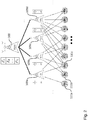
- FIGS 1 , 2 and 3 show schematic diagrams of a base station 100 (also referred to as macro base station (MBS) or macro-cell base station 100 herein) according to embodiments of the invention.
- the base station 100 is part of a wireless communication network for communicating with a plurality of micro base stations 109a-d (also referred to as micro-cell or small-cell base stations 109a-d herein) as well as a plurality of user equipments or mobile stations 111a-c located within the service area 100a of the base station 100.
- the plurality of micro base stations 109a-d are configured to communicate with one or more user equipments of the plurality of user equipments 111a-c located within the service area of a respective micro base station.
- the micro base stations 109a and 109d are configured to communicate with the user equipment 111a
- the micro base station 109b is configured to communicate with the user equipment 111b
- the micro base station 109c is configured to communicate with the user equipment 111c.
- the plurality of micro base stations are densely deployed within the service area 100a of the base station 100, i.e. cover overlapping areas of the service area 100a. A corresponding embodiment will be described further below in the context of figure 5 .
- a user equipment of the plurality of user equipments 111a-c could be, for instance, a mobile phone, a smart phone, a tablet computer, a communication module of a vehicle, a M2M module or any other type of mobile wireless communication device configured to download files over a wireless communication network.
- a user equipment can include hardware components, such as an antenna, a transceiver, an LTE module, a WiFi module, a processor and/or the like to communicate over the wireless communication network.
- the wireless communication network used for communication between the macro base station 100 and the plurality of micro base stations 109a-d and the plurality of user equipments 111a-c could be a cellular wireless communication network, for instance, an LTE network, an LTE-A network or a future evolution thereof, such as 5G, or a WiFi network.
- the base station 100 is configured to manage the distribution of a plurality of files to the plurality of user equipments 111a-c via the wireless communication network, wherein each file of the plurality of files can be decomposed into a plurality of file fragments.
- these N files F i can be provided by a file library or a server in the core network or a backend system and cause traffic when provided to the base station 100.
- the file F i can be decomposed or fragmented into n file fragments F i 1 , F i 2 ... F i n .
- the plurality of file fragments F i 1 , F i 2 ... F i n can have the same size.
- the macro base station 100 comprises a selector 101 configured to select for each micro base station 109a-d and for each file F i of the plurality of files F 1 to F N a subset of the plurality of file fragments F i 1 , F i 2 ... F i n of the file.
- the macro base station 100 comprises a distributor 103 configured to distribute to each micro base station 109a-d for each file F i of the plurality of files F 1 to F N the selected subset of the plurality of file fragments F i 1 , F i 2 ... F i n such that the selected subset of the plurality of file fragments F i 1 , F i 2 ... F i n can be cached at the respective micro base station 109a-d for being available for download by the user equipment 111a-d.
- the base station 100 further comprises a memory 105 for storing the plurality of file fragments F i 1 , F i 2 ... F i n for each file F i for direct download by the user equipment 111a-c.
- the macro base station 100 can act as a backup in case any file fragment is not available from the micro base stations 109a-d serving an user equipment 111a.
- the base station 100 further comprises a decomposer 107 configured to decompose each file F i of the plurality of files F 1 to F N into the plurality of file fragments F i 1 , F i 2 ... F i n .
- the base station 100 can by means of the decomposer 107 decompose any file F i provided by the backend system into a plurality of file fragments F i 1 , F i 2 ... F i n for distributing a selection thereof to the plurality of micro base stations 109a-d.
- file fragments F i 1 , F i 2 ... F i n can be provided to the base station 100 by the backend system.
- the selector 101 is configured to select the file fragments constituting the subset of file fragments randomly from the plurality of file fragments F i 1 , F i 2 ... F i n for each file F i and for each micro base station 109a-d. Such a random selection from the plurality of file fragments F i 1 , F i 2 ... F i n makes it probable that neighboring micro base stations 109a-d with overlapping service areas can provide different file fragments of a file F i to the user equipment 111a-c.
- the selector 101 is configured to select the same number of file fragments for each micro base station 109a-d.
- having the same number of file fragments for a given file simplifies the file fragment selection process.
- the selector 101 is configured to select for each micro base station 109a-d and for each file F i a subset of the plurality of file fragments F i 1 , F i 2 ... F i n of the file F i by selecting for each micro base station 109a-d the same number of file fragments of the plurality of file fragments F i 1 , F i 2 ... F i n , wherein the number of file fragments m i for a given file F i depends on the demand of the file F i .
- the selector 101 is configured to select a number of file fragments m 1 for a file F 1 and a number of file fragments m 2 for a file F 2 , wherein m 1 is larger than m 2 , in case the file F 1 is more in demand, i.e. more popular, than the file F 2 .
- m 1 is larger than m 2
- the file F 1 is more in demand, i.e. more popular, than the file F 2 .
- the selector 101 and the distributor 103 of the base station 100 are configured to periodically adapt the selection and distribution of file fragments F i 1 , F i 2 ... F i n for each file F i to the plurality of micro base stations 109a-d on the basis of a changing demand of the plurality of files.
- a dynamic adaption can advantageously react to a changing file demand.
- the selector 101 is configured to select for each micro base station 109a-d and for each file F i a subset of the plurality of file fragments F i 1 , F i 2 ... F i n of the file by minimizing the average backhaul rate, the time delay and/or the energy consumption.
- the optimization can be done in an application specific manner with respect to the backhaul traffic, the time delay and/or the energy consumption of the file transfers.
- each micro base station 109a-d has a cache or memory for storing file fragments, wherein the cache has a size M (in number of files) being smaller than the number of files N.
- the N files F 1 to F N can be assumed to have the same size.
- the number of file fragments selected by the selector 101 from the plurality of file fragments F i 1 , F i 2 ... F i n of the file F i is denoted as m i .
- Each file F i is associated with a file demand or file popularity measure, which is denoted as p i .
- the present invention is not limited to the case of Zipf popularity distributions.
- Each micro base station 109a-d can cover a smaller area, but the service or coverage areas of the micro base stations preferably overlap, dividing the service area 100a into K sub-regions where a user equipment 111a-c can be served by more than one micro base station.
- R k i denotes the k-th sub-region having a size A k i , where the subscript i denotes the number of micro base stations 109a-d that can serve this sub-region.
- ⁇ k denotes the density of user equipments 111a-c in the sub-region R k i .
- each micro base station 109a-d receives m j randomly drawn different fragments of the file F j to be stored in its cache with 0 ⁇ m j ⁇ n.
- Finding an optimal distribution scheme is equivalent to finding the optimal number of fragments m j for each file F j to be stored in the micro base stations 109a-d in order to minimize the average backhaul rate experienced by a user equipment inside the service area 100a of the base station 100, which is herein defined as the average fraction of a file that needs to be downloaded from the base station 100 (and possibly consequently from the core network) in the case of a file request.
- This problem can be recast as a tractable convex optimization problem.
- a file distribution scheme implemented in the base station 100 can be considered to consist of two phases, namely a file fragment distribution phase and a file delivery phase.
- the caches of the micro base stations 109a-d are filled by the base station 100 on the basis of the file fragment distribution schemes described above.
- the distributor 103 of the base station 100 is configured to distribute to each micro base station of the plurality of micro base stations 109a-d for each file F i of the plurality of files the selected subset of the plurality of file fragments at times, when the network traffic is below a certain threshold.
- this allows to distribute the file fragments at times of low network traffic, e.g. at night, thereby putting less pressure on the network.
- the user equipments 111a-c requesting files are initially served by the micro base stations 109a-d covering their locations. If fragments of the requested files are not present in the caches of the micro base stations 109a-d, these file fragments have to be delivered through the backhaul from the base station 100.
- Figure 4 shows a schematic diagram illustrating steps of a method 400 of managing the distribution of a plurality of files to an user equipment located within the service area of a base station, for instance, the base station 100 shown in figures 1 to 3 , wherein each file of the plurality of files can be decomposed into a plurality of file fragments, the method 400 comprises a first step 401 of selecting for each micro base station of a plurality of micro base stations located within the service area of the base station and for each file of the plurality of files a subset of the plurality of file fragments of this file and a second step 403 of distributing to each micro base station of the plurality of micro base stations for each file of the plurality of files the selected subset of the plurality of file fragments for caching the selected subset of the plurality of file fragments at the respective base station for being available for download by the user equipment.
- figure 5 shows a schematic diagram illustrating a base station 100 configured to manage the distribution of a plurality of files to a plurality of user equipments according to an embodiment implemented in the context of an exemplary HetNet topology (Heterogeneous Network topology).
- d 60 meters between each micro base station.
- each micro base station has a service area of radius r such that d / ⁇ 2 ⁇ r ⁇ d, which means that the respective service areas of the micro base stations are overlapping as can be taken, for instance, from the highlighted square shown in figure 5 .
- the coefficients A k i can be theoretically approximated using simple geometrical calculations.
- ⁇ 0.05 (user equipments)/m 2 .
- the exemplary parameters chosen above correspond to an exemplary total of 316 micro base stations covering an exemplary total of 31415 user equipments.
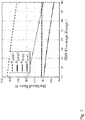
- figure 6 shows the backhaul rates based on the theoretical results presented herein and the backhaul rates obtained from actually simulating the file distribution for the four distribution schemes described above as a function of the cache size M of each micro base station.
- the lines depict the theoretical backhaul rates, while the markers depict the simulated distribution scheme procedure.
- figure 6 shows the backhaul rates as a function of the cache size M of the micro base stations.
- the backhaul rates are decreasing when the storage capacity M of the micro base stations increases and the optimal distribution scheme provided by embodiments of the invention outperforms the three other distribution schemes.
- the difference between the backhaul rate R (opt) provided by the optimal distribution scheme according to an embodiment of the invention and the backhaul rates provided by the other distribution schemes increases as the cache size M increases.
- the "most popular" distribution scheme C pop
- the rather small difference in terms of backhaul rates is due to a rather small overlap of service areas of neighboring micro base stations for the exemplary geometric configuration chosen for figure 6 and becomes larger for a different choice of parameters.
- Figure 7 which shows a schematic diagram illustrating the backhaul rate as a function of the micro base station coverage radius r for the four different file distribution schemes described above, confirms the previous results from figure 6 that the optimal distribution scheme provided by embodiments of the invention outperforms the three other distribution schemes.
- a striking behavior for the C (pop) distribution scheme can be identified in figure 7 , as its backhaul rate does not depend on the micro base station coverage radius, i.e. is constant. This behavior is due to the most popular files being stored at the micro base stations for this scheme: being served by more micro base stations does not increase the probability of having access to new files since the same files are stored in every micro base station.
- the performance of the other distribution schemes increases as the micro base station coverage area increases, and noticeably the optimal scheme provided by embodiments of the invention significantly outperforms the other two schemes for larger radii, which can be illustrated by the following example.
- Figure 8 shows a schematic diagram illustrating the backhaul rate as a function of the Zipf parameter for the four different file distribution schemes described above.
- the smaller the value of the Zipf parameter ⁇ is, the more "uniform" the request probability distribution or file popularity is. This fact explains why for the smallest value of ⁇ 0.5 in figure 8 , all schemes exhibit a comparable performance.
- the uniform distribution scheme C (unif) does not exploit the statistics of the request distribution, the backhaul rate performance of this scheme does not improve as ⁇ grows larger in contrast to the other schemes.
- Figure 9 shows a schematic diagram illustrating the backhaul rate as a function of the number of files N for the four different file distribution schemes described above, while keeping the cache size M of the micro base stations constant.
- the "most popular" distribution scheme C (pop) is outperformed by the other distribution schemes, as a spreading of the file fragments over the micro base station caches is more efficient than only storing a few number of complete files.
- the performance of the "most popular" distribution scheme C (pop) becomes better in comparison to the other distribution schemes.
- Embodiments of the invention provide for a significant reduction of the backhaul load, which is usually the bottleneck in current wireless communication networks.
- Embodiments of the present invention allow exploiting the characteristics of future wireless networks, such as HetNets, 5G, and the like, namely the spatial redundancy provided by overlapping service areas of micro base stations and cheap storage capabilities at the edge of the wireless communications network.
- Embodiments of the invention significantly outperform current file distribution or content caching schemes with respect to latency reduction and backhaul offloading.
- Embodiments of the invention inherently support user mobility (in fact mobility enhances performance).
- Embodiments of the invention can be efficiently implemented for various network topologies and can be further improved by optimizing the deployment of micro base stations.
Landscapes
- Engineering & Computer Science (AREA)
- Computer Networks & Wireless Communication (AREA)
- Signal Processing (AREA)
- Multimedia (AREA)
- Databases & Information Systems (AREA)
- Mobile Radio Communication Systems (AREA)
Description
- Generally, the present invention relates to wireless communications. More specifically, the present invention relates to a base station configured to manage the distribution of a plurality of files to an user equipment located within the service area of the base station and to a method of managing the distribution of a plurality of files to an user equipment located within the service area of a base station.
- Content caching in future wireless networks, e.g. 5G networks, has been proposed as a technique for increasing the network performance by offloading the backhaul and thus reducing the latency of content delivery to end users (X. Wang, M. Chen, T. Taleb, A. Ksentini, and V. C. M. Leung, "Cache in the air: Exploiting content caching and delivery techniques for 5G systems", IEEE Communications Magazine, vol. 52, no. 2, pp. 131-139, February 2014). The idea of bringing content as close as possible to the user by caching at the wireless edge has been proposed recently (E. Bastug, M. Bennis, and M. Debbah, "Living on the edge: The role of proactive caching in 5G wireless networks," IEEE Communications Magazine, vol. 52, no. 8, pp. 82-89, August 2014). In particular, distributed caching is adapted to the heterogeneous structure of future multi-tier networks (J. G. Andrews, "Seven ways that HetNets are a cellular paradigm shift," IEEE Communications Magazine, vol. 51, no. 3, pp. 136-144, March 2013), where densely deployed micro-cell or small-cell base stations (SBS) equipped with storage capabilities are expected to serve mobile users in addition to the macro-cell base station (MBS) traditionally present in current cellular networks.
- The idea of caching content at the edge of the network, in order to deal with the increasing data traffic in future wireless networks, has recently been investigated from numerous perspectives. In the literature, models for measuring the performance of caching in cache-enabled SBSs in terms of outage probability have been proposed (E. Bastug, M. Bennis, and M. Debbah, "Cache-enabled small cell networks: Modeling and tradeoffs", in IEEE International Symposium on Wireless Communications Systems (ISWCS), Barcelona, Spain, August 2014). Moreover, caching has been investigated from an information-theoretical perspective, where caching metrics are defined and analyzed for large networks (U. Niesen, D. Shah, and G. W. Wornell, "Caching in wireless networks", IEEE Transactions on Information Theory, vol. 58, no. 10, pp. 6524-6540, October 2012). It has been shown that caching at the edge of a wireless network provides significant gains in terms of energy efficiency, which is considered a fundamental metric for future wireless networks (B. Perabathini, E. Bastug, M. Kountouris, M. Debbah, and A. Contey, "Caching at the edge: a green perspective for 5G networks", in IEEE International Conference on Communications (ICC), London, United Kingdom, June 2015).
- Another interesting approach in recent works stems from the idea of using network coding techniques to place and deliver content to the caches at the wireless edge, in order to improve the theoretical performance limits of uncoded caching (K. Poularakis, V. Sourlas, P. Flegkas, and L. Tassiulas, "On exploiting network coding in cache-capable small-cell networks", in IEEE Symposium on Computers and Communications (ISCC), Funchal, Portugal, June 2014).
- Other aspects of edge caching have been discussed in the literature, e.g. the idea of using the mobility of users in the network to increase caching gains, or the possibility of exploiting the storage capabilities of mobile phones via caching content directly on the users' devices (N. Golrezaei, A.G. Dimakis, and A. F. Molisch, "Wireless device-to-device communications with distributed caching", in IEEE International Symposium on Information Theory (ISIT), Cambridge, U.S.A., July 2012). K. Shanmugam, N. Golrezaei, A.G. Dimakis, A. F. Molisch, and G. Caire, "Femtocaching: Wireless content delivery through distributed caching helpers," IEEE Transactions on Information Theory, vol. 59, no. 12, pp. 8402-8413, December 2013 assume knowledge of the connectivity graph, which leads to an NP-complete problem. Also, M. Ji, A. M. Tulino, J. Llorca and G. Caire "On the Average Performance of Caching and Coded Multicasting with Random Demands" IEEE International Symposium on Wireless Communications Systems (ISWCS), Barcelona, Spain, Aug. 2014 assume knowledge of the connectivity graph, which leads to an NP-complete problem, and describe the use of network coding. A. Sengupta et al. "Learning distributed caching strategies in small cell networks", IEEE International Symposium on Wireless Communications Systems (ISWCS), Barcelona, Spain, Aug. 2014 discloses a complex caching scheme also assuming knowledge of the full connectivity graph.
- Although some of the content caching attempts described above already lead to an improved network performance, there is still a need for further improvements. Thus, there is a need for an improved base station configured to manage the distribution of a plurality of files to at least one user equipment as well as an improved method of managing the distribution of a plurality of files to at least one user equipment located within the service area of a base station.
-
US 2014/0342748 A1 discloses a method of scheduling communications for a user equipment in a co-channel heterogeneous network having a macro cell base station and a small cell base station.US 2010/0265874 A1 discloses pre-communications for relay base stations in wireless communication.US 2002/075824 A1 discloses a system including a server that distributes files to a plurality of receivers within a wireless communication system. - The invention is related to a base station according to
claim 1, a method according to claim 11 and a computer program according toclaim 13. Further embodiments of the invention are defined by the dependent claims. - Further embodiments of the invention will be described with respect to the following figures, in which:
-
Fig. 1 shows a schematic diagram illustrating a base station configured to manage the distribution of a plurality of files to a plurality of user equipments according to an embodiment; -
Fig. 2 shows a schematic diagram illustrating a base station configured to manage the distribution of a plurality of files to a plurality of user equipments according to an embodiment; -
Fig. 3 shows a schematic diagram illustrating a base station configured to manage the distribution of a plurality of files to a plurality of user equipments according to an embodiment; -
Fig. 4 shows a schematic diagram illustrating steps of a method of managing the distribution of a plurality of files to a plurality of user equipments according to an embodiment; -
Fig. 5 shows a schematic diagram illustrating a base station configured to manage the distribution of a plurality of files to a plurality of user equipments according to an embodiment; -
Fig. 6 shows a schematic diagram illustrating a backhaul rate as a function of the cache size for four different file distribution schemes, including a file distribution scheme implemented in a base station according to an embodiment; -
Fig. 7 shows a schematic diagram illustrating a backhaul rate as a function of the micro base station coverage radius for four different file distribution schemes, including a file distribution scheme implemented in a base station according to an embodiment; -
Fig. 8 shows a schematic diagram illustrating a backhaul rate as a function of the Zipf parameter for four different file distribution schemes, including a file distribution scheme implemented in a base station according to an embodiment; and -
Fig. 9 shows a schematic diagram illustrating a backhaul rate as a function of the number of files for four different file distribution schemes, including a file distribution scheme implemented in a base station according to an embodiment. - In the following detailed description, reference is made to the accompanying drawings, which form a part of the disclosure, and in which are shown, by way of illustration, specific aspects in which the present invention may be practiced. It is understood that other aspects may be utilized and structural or logical changes may be made without departing from the scope of the present invention, which is defined by the claims. The following detailed description, therefore, is not to be taken in a limiting sense, as the scope of the present invention is defined by the appended claims.
- For instance, it is understood that a disclosure in connection with a described method may also hold true for a corresponding device or system configured to perform the method and vice versa. For example, if a specific method step is described, a corresponding device may include a unit to perform the described method step, even if such unit is not explicitly described or illustrated in the figures. Further, it is understood that the features of the various exemplary aspects described herein may be combined with each other, unless specifically noted otherwise.
-
Figures 1 ,2 and3 show schematic diagrams of a base station 100 (also referred to as macro base station (MBS) ormacro-cell base station 100 herein) according to embodiments of the invention. Thebase station 100 is part of a wireless communication network for communicating with a plurality ofmicro base stations 109a-d (also referred to as micro-cell or small-cell base stations 109a-d herein) as well as a plurality of user equipments ormobile stations 111a-c located within theservice area 100a of thebase station 100. The plurality ofmicro base stations 109a-d, in turn, are configured to communicate with one or more user equipments of the plurality ofuser equipments 111a-c located within the service area of a respective micro base station. By way of example, in the embodiment shown infigure 1 themicro base stations user equipment 111a, themicro base station 109b is configured to communicate with theuser equipment 111b and themicro base station 109c is configured to communicate with theuser equipment 111c. The person skilled in the art will appreciate that, although for the sake of simplicityfigure 1 shows by way of example only four micro base stations and three user equipments, embodiments of the present invention can be advantageously employed also in scenarios with a different, in particular larger number of micro base stations and/or user equipments. Preferably, the plurality of micro base stations are densely deployed within theservice area 100a of thebase station 100, i.e. cover overlapping areas of theservice area 100a. A corresponding embodiment will be described further below in the context offigure 5 . - A user equipment of the plurality of
user equipments 111a-c could be, for instance, a mobile phone, a smart phone, a tablet computer, a communication module of a vehicle, a M2M module or any other type of mobile wireless communication device configured to download files over a wireless communication network. As is well known to the person skilled in the art, such a user equipment can include hardware components, such as an antenna, a transceiver, an LTE module, a WiFi module, a processor and/or the like to communicate over the wireless communication network. The wireless communication network used for communication between themacro base station 100 and the plurality ofmicro base stations 109a-d and the plurality ofuser equipments 111a-c could be a cellular wireless communication network, for instance, an LTE network, an LTE-A network or a future evolution thereof, such as 5G, or a WiFi network. - The
base station 100 is configured to manage the distribution of a plurality of files to the plurality ofuser equipments 111a-c via the wireless communication network, wherein each file of the plurality of files can be decomposed into a plurality of file fragments. By way of example, for the following discussion it is assumed that thebase station 100 supports a library of N files F¡, i=1,2,...,N, for distribution to the plurality ofuser equipments 111a-c. As illustrated infigure 3 , in an embodiment these N files Fi can be provided by a file library or a server in the core network or a backend system and cause traffic when provided to thebase station 100. As further illustrated infigure 3 , the file Fi, for instance, can be decomposed or fragmented into n file fragments
fragments 
- As can be taken from the enlarged view shown in
figure 1 , themacro base station 100 comprises aselector 101 configured to select for eachmicro base station 109a-d and for each file Fi of the plurality of files F1 to FN a subset of the plurality of filefragments 
- Moreover, the
macro base station 100 comprises adistributor 103 configured to distribute to eachmicro base station 109a-d for each file Fi of the plurality of files F1 to FN the selected subset of the plurality of filefragments 
fragments 
micro base station 109a-d for being available for download by theuser equipment 111a-d. - In an embodiment, the
base station 100 further comprises amemory 105 for storing the plurality of filefragments 
macro base station 100 can act as a backup in case any file fragment is not available from themicro base stations 109a-d serving anuser equipment 111a. - In an embodiment, the
base station 100 further comprises adecomposer 107 configured to decompose each file Fi of the plurality of files F1 to FN into the plurality of filefragments 
base station 100 can by means of thedecomposer 107 decompose any file Fi provided by the backend system into a plurality of filefragments 
micro base stations 109a-d. Alternatively or additionally, file fragments
base station 100 by the backend system. - In an embodiment, the
selector 101 is configured to select the file fragments constituting the subset of file fragments randomly from the plurality of filefragments 
micro base station 109a-d. Such a random selection from the plurality of filefragments 
micro base stations 109a-d with overlapping service areas can provide different file fragments of a file Fi to theuser equipment 111a-c. - In an embodiment, the
selector 101 is configured to select the same number of file fragments for eachmicro base station 109a-d. Advantageously, having the same number of file fragments for a given file simplifies the file fragment selection process. - In an embodiment, the
selector 101 is configured to select for eachmicro base station 109a-d and for each file Fi a subset of the plurality of filefragments 
micro base station 109a-d the same number of file fragments of the plurality of filefragments 
selector 101 is configured to select a number of file fragments m1 for a file F1 and a number of file fragments m2 for a file F2, wherein m1 is larger than m2, in case the file F1 is more in demand, i.e. more popular, than the file F2. Thus, advantageously, for files being more popular more file fragments can be locally cached at the micro base stations than for files being less popular. - In an embodiment, the
selector 101 and thedistributor 103 of thebase station 100 are configured to periodically adapt the selection and distribution of filefragments 
micro base stations 109a-d on the basis of a changing demand of the plurality of files. A dynamic adaption can advantageously react to a changing file demand. - In an embodiment, the
selector 101 is configured to select for eachmicro base station 109a-d and for each file Fi a subset of the plurality of filefragments 
- In the below an embodiment will be described, where the
selector 101 is configured to select for eachmicro base station 109a-d and for each file Fi a subset of the plurality of filefragments 
micro base station 109a-d has a cache or memory for storing file fragments, wherein the cache has a size M (in number of files) being smaller than the number of files N. In an embodiment, the N files F1 to FN can be assumed to have the same size. - As already mentioned above, the number of file fragments selected by the
selector 101 from the plurality of filefragments 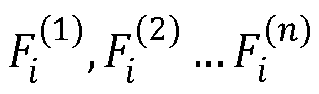

- The
service area 100a covered by thebase station 100 has a size A = πD2 for an embodiment where theservice area 100a is circular and the transmission range of the base station is D. Eachmicro base station 109a-d can cover a smaller area, but the service or coverage areas of the micro base stations preferably overlap, dividing theservice area 100a into K sub-regions where auser equipment 111a-c can be served by more than one micro base station. Herein Rk i denotes the k-th sub-region having a size Ak i, where the subscript i denotes the number ofmicro base stations 109a-d that can serve this sub-region. In general two sub-regions Rk i and Rk' ¡ may not have the same size even if they are covered by the same number i ofmicro base stations 109a-d, since the present invention is not restricted to uniformly distributed micro base stations. Herein ρk denotes the density ofuser equipments 111a-c in the sub-region Rk i. As a consequence, the probability ai that auser equipment 111a-c is in a sub-region served by imicro base stations 109a-d can be computed using the following equation: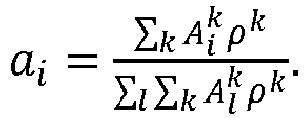
- As already described above, each
micro base station 109a-d receives mj randomly drawn different fragments of the file Fj to be stored in its cache with 0 ≤ mj ≤ n. Finding an optimal distribution scheme is equivalent to finding the optimal number of fragments mj for each file Fj to be stored in themicro base stations 109a-d in order to minimize the average backhaul rate experienced by a user equipment inside theservice area 100a of thebase station 100, which is herein defined as the average fraction of a file that needs to be downloaded from the base station 100 (and possibly consequently from the core network) in the case of a file request. This problem can be recast as a tractable convex optimization problem. Using qi=mj/n, i.e. the normalized version of mi given by qi=mi/n, the optimal number of fragments mj for each file Fj to be stored in themicro base stations 109a-d in order to minimize the average backhaul rate experienced by a user equipment inside theservice area 100a of thebase station 100 can be determined by solving the following equation (given the constraint

micro base stations 109a-d within theservice area 100a of thebase station 100. As the person skilled in the art will appreciate, an improved distribution scheme might already be provided by a set of values q¡, for which the above equation is not a minimum, but smaller than a predefined threshold. The convex optimization problem defined by the equation above can be solved in a straightforward manner using standard convex optimization methods (see e.g. "Convex Optimization", S. Boyd, Cambridge University Press 2004). - As already described above, a file distribution scheme implemented in the
base station 100 according to an embodiment can be considered to consist of two phases, namely a file fragment distribution phase and a file delivery phase. - During the file fragment distribution phase the caches of the
micro base stations 109a-d are filled by thebase station 100 on the basis of the file fragment distribution schemes described above. In an embodiment, thedistributor 103 of thebase station 100 is configured to distribute to each micro base station of the plurality ofmicro base stations 109a-d for each file Fi of the plurality of files the selected subset of the plurality of file fragments at times, when the network traffic is below a certain threshold. Advantageously, this allows to distribute the file fragments at times of low network traffic, e.g. at night, thereby putting less pressure on the network. - During the delivery phase, the
user equipments 111a-c requesting files are initially served by themicro base stations 109a-d covering their locations. If fragments of the requested files are not present in the caches of themicro base stations 109a-d, these file fragments have to be delivered through the backhaul from thebase station 100. -
Figure 4 shows a schematic diagram illustrating steps of amethod 400 of managing the distribution of a plurality of files to an user equipment located within the service area of a base station, for instance, thebase station 100 shown infigures 1 to 3 , wherein each file of the plurality of files can be decomposed into a plurality of file fragments, themethod 400 comprises afirst step 401 of selecting for each micro base station of a plurality of micro base stations located within the service area of the base station and for each file of the plurality of files a subset of the plurality of file fragments of this file and asecond step 403 of distributing to each micro base station of the plurality of micro base stations for each file of the plurality of files the selected subset of the plurality of file fragments for caching the selected subset of the plurality of file fragments at the respective base station for being available for download by the user equipment. - By way of example,
figure 5 shows a schematic diagram illustrating abase station 100 configured to manage the distribution of a plurality of files to a plurality of user equipments according to an embodiment implemented in the context of an exemplary HetNet topology (Heterogeneous Network topology). By way of example, the plurality of micro base stations are deployed according to a regular grid with a distance d = 60 meters between each micro base station. For the sake of clarity only four exemplary micro base stations are referenced infigure 5 , namely themicro base stations 109a-d. By way of example, theservice area 100a of thebase station 100, which is assumed to be circular, has a coverage radius of D = 500 meters. In order to reach any user equipment in theservice area 100a of thebase station 100, each micro base station has a service area of radius r such that d / √2 ≤ r ≤ d, which means that the respective service areas of the micro base stations are overlapping as can be taken, for instance, from the highlighted square shown infigure 5 . For this exemplary arrangement the coefficients A k i can be theoretically approximated using simple geometrical calculations. By way of example, the plurality of user equipments are assumed to be uniformly distributed within theservice area 100a of thebase station 100 with a density ρ = 0.05 (user equipments)/m2. For the sake of clarity only three exemplary user equipments are referenced infigure 5 , namely theuser equipments 111a-c. The exemplary parameters chosen above correspond to an exemplary total of 316 micro base stations covering an exemplary total of 31415 user equipments. - In order to evaluate the performance gain from optimally distributing file fragments from the
base station 100 to the plurality of micro base stations according to embodiments of the invention, in the below the achievable backhaul rate R(opt) obtained by the optimal file fragments distribution scheme C(opt) provided by embodiments of the invention is compared with three other distribution schemes, namely: - 1) uniform distribution scheme C(unif): the file fragments are placed uniformly at each micro base station, i.e. each micro base station stores Mn/N fragments of each file. The achievable backhaul rate using this scheme is denoted as R(unif);
- 2) "most popular" distribution scheme C(pop): each micro base station stores entirely the M most popular files, i.e., all the fragments of the files F1, ..., FM are stored in all the micro base stations. The achievable backhaul rate using this scheme is denoted as R(pop);
- 3) proportional distribution scheme C(prop): for each file Fj, the number of fragments mj stored at the micro base stations is proportional to its popularity pj while satisfying the storage constraints. The achievable backhaul rate using this scheme is denoted as R(prop).
- The validity of the theoretical results presented herein can be taken from
figure 6 , which shows the backhaul rates based on the theoretical results presented herein and the backhaul rates obtained from actually simulating the file distribution for the four distribution schemes described above as a function of the cache size M of each micro base station. By way of example, user equipment file requests are assumed to be randomly drawn according to a Zipf law of parameter α = 0.7. Infigure 6 the lines depict the theoretical backhaul rates, while the markers depict the simulated distribution scheme procedure. As there is an excellent matching between the average theoretical backhaul rates and the simulated backhaul rates, in the below only the theoretical backhaul rates will be discussed in more detail for the four different distribution schemes defined above. - As already mentioned above,
figure 6 shows the backhaul rates as a function of the cache size M of the micro base stations. As expected, the backhaul rates are decreasing when the storage capacity M of the micro base stations increases and the optimal distribution scheme provided by embodiments of the invention outperforms the three other distribution schemes. Furthermore, one observes that the difference between the backhaul rate R(opt) provided by the optimal distribution scheme according to an embodiment of the invention and the backhaul rates provided by the other distribution schemes increases as the cache size M increases. Finally, one can notice that the "most popular" distribution scheme C(pop) performs the closest to the optimal distribution scheme according to an embodiment of the invention. However, the rather small difference in terms of backhaul rates is due to a rather small overlap of service areas of neighboring micro base stations for the exemplary geometric configuration chosen forfigure 6 and becomes larger for a different choice of parameters. -
Figure 7 , which shows a schematic diagram illustrating the backhaul rate as a function of the micro base station coverage radius r for the four different file distribution schemes described above, confirms the previous results fromfigure 6 that the optimal distribution scheme provided by embodiments of the invention outperforms the three other distribution schemes. A striking behavior for the C(pop) distribution scheme can be identified infigure 7 , as its backhaul rate does not depend on the micro base station coverage radius, i.e. is constant. This behavior is due to the most popular files being stored at the micro base stations for this scheme: being served by more micro base stations does not increase the probability of having access to new files since the same files are stored in every micro base station. In contrast to the C(pop) distribution scheme, the performance of the other distribution schemes increases as the micro base station coverage area increases, and noticeably the optimal scheme provided by embodiments of the invention significantly outperforms the other two schemes for larger radii, which can be illustrated by the following example. For a scenario, where there are 200 files each of size 100Mbits, e.g. video files, the difference between the optimal backhaul rate R(opt) provided by embodiments of the present invention and the second best backhaul rate R(prop) is 0.07 for r = 60. This represents a difference of backhaul load of 7Mbits/s if there is 1 file demand per second in the macro cell defined by thebase station 100, which is a considerable gain for today's maximal backhaul capacities. -
Figure 8 shows a schematic diagram illustrating the backhaul rate as a function of the Zipf parameter for the four different file distribution schemes described above. As already described above, the smaller the value of the Zipf parameter α is, the more "uniform" the request probability distribution or file popularity is. This fact explains why for the smallest value of α = 0.5 infigure 8 , all schemes exhibit a comparable performance. However, since the uniform distribution scheme C(unif) does not exploit the statistics of the request distribution, the backhaul rate performance of this scheme does not improve as α grows larger in contrast to the other schemes. Since a micro base station coverage radius of r = 60 meters has been assumed for deriving the results shown infigure 8 , one can observe, for the reasons already explained in the context offigure 7 , that the proportional distribution scheme C(prop) outperforms the "most popular" distribution scheme C(pop). For both these distribution schemes, i.e. C(prop) and C(pop), the achievable backhaul rates are substantially larger than the backhaul rate of the optimal distribution scheme provided by embodiments of the invention. -
Figure 9 shows a schematic diagram illustrating the backhaul rate as a function of the number of files N for the four different file distribution schemes described above, while keeping the cache size M of the micro base stations constant. For small library sizes, i.e. small numbers of files N, the "most popular" distribution scheme C(pop) is outperformed by the other distribution schemes, as a spreading of the file fragments over the micro base station caches is more efficient than only storing a few number of complete files. On the other hand, as the library size N increases, the performance of the "most popular" distribution scheme C(pop) becomes better in comparison to the other distribution schemes. The C(pop) distribution scheme, however, is still outperformed by the C(prop) distribution scheme, since for this example a micro base station coverage radius of r = 60 meters has been assumed, which is unfavorable for the C(pop) distribution scheme. Also this figure clearly shows how the optimal file fragments distribution scheme C(opt) provided by embodiments of the invention outperforms the three other distribution schemes, in particular for a large number of files N. - Embodiments of the invention provide for a significant reduction of the backhaul load, which is usually the bottleneck in current wireless communication networks. Embodiments of the present invention allow exploiting the characteristics of future wireless networks, such as HetNets, 5G, and the like, namely the spatial redundancy provided by overlapping service areas of micro base stations and cheap storage capabilities at the edge of the wireless communications network. Embodiments of the invention significantly outperform current file distribution or content caching schemes with respect to latency reduction and backhaul offloading. Embodiments of the invention inherently support user mobility (in fact mobility enhances performance). Embodiments of the invention can be efficiently implemented for various network topologies and can be further improved by optimizing the deployment of micro base stations.
- While a particular feature or aspect of the disclosure may have been disclosed with respect to only one of several implementations or embodiments, such feature or aspect may be combined with one or more other features or aspects of the other implementations or embodiments as may be desired and advantageous for any given or particular application. Furthermore, to the extent that the terms "include", "have", "with", or other variants thereof are used in either the detailed description or the claims, such terms are intended to be inclusive in a manner similar to the term "comprise". Also, the terms "exemplary", "for example" and "e.g." are merely meant as an example, rather than the best or optimal. The terms "coupled" and "connected", along with derivatives may have been used. It should be understood that these terms may have been used to indicate that two elements cooperate or interact with each other regardless whether they are in direct physical or electrical contact, or they are not in direct contact with each other.
- Although specific aspects have been illustrated and described herein, it will be appreciated by those of ordinary skill in the art that a variety of alternate and/or equivalent implementations may be substituted for the specific aspects shown and described without departing from the scope of the present disclosure. This application is intended to cover any adaptations or variations of the specific aspects discussed herein.
- Although the elements in the following claims are recited in a particular sequence with corresponding labeling, unless the claim recitations otherwise imply a particular sequence for implementing some or all of those elements, those elements are not necessarily intended to be limited to being implemented in that particular sequence.
- Z r Although the invention has been explained in relation to its preferred embodiment(s) as mentioned above, it is to be understood that many other possible modifications and variations can be made without departing from the scope of the present invention, which is defined by the claims.
Claims (13)
- A base station (100) configured to manage the distribution of a plurality of files to an user equipment (111a-c) located within the service area (100a) of the base station (100), wherein each file of the plurality of files can be decomposed into a plurality of file fragments, the base station (100) comprising:a selector (101) configured to select for each micro base station of a plurality of micro base stations (109a-d) located within the service area (100a) of the base station (100) and for each file of the plurality of files a subset of the plurality of file fragments of the file; anda distributor (103) configured to distribute to each micro base station of the plurality of micro base stations (109a-d) for each file of the plurality of files the selected subset of the plurality of file fragments for caching the selected subset of the plurality of file fragments at the respective micro base station (109a-d) for being available for download by the user equipment (111a-c), wherein the base station (100) further comprises a memory (105) for storing the plurality of file fragments for each file for download by the user equipment (111a-c), and wherein the base station (100) further comprises a decomposer (107) configured to decompose each file of the plurality of files into the plurality of file fragments.
- The base station (100) of any one of the preceding claims, wherein the selector (101) is configured to select for each micro base station (109a-d) and for each file a subset of the plurality of file fragments of the file by selecting for each micro base station (109a-d) and for each file the file fragments of the plurality of file fragments randomly.
- The base station (100) of any one of the preceding claims, wherein the selector (101) is configured to select for each micro base station (109a-d) and for each file a subset of the plurality of file fragments of the file by selecting for each micro base station (109a-d) the same number of file fragments of the plurality of file fragments.
- The base station (100) of any one of the preceding claims, wherein the selector (101) is configured to select for each micro base station (109a-d) and for each file a subset of the plurality of file fragments of the file by selecting for each micro base station (109a-d) the same number of file fragments of the plurality of file fragments, wherein the number of file fragments for a given file depend on the demand of the given file.
- The base station (100) of claim 4, wherein the selector (101) and the distributor (103) are configured to periodically adapt the selection and distribution of file fragments to the plurality of micro base stations (109a-d) on the basis of a changing demand of the plurality of files.
- The base station (100) of any one of the preceding claims, wherein the selector (101) is configured to select for each micro base station (109a-d) and for each file a subset of the plurality of file fragments of the file by minimizing an average backhaul rate, a time delay and/or an energy consumption.
- The base station (100) of any one of the preceding claims, wherein the selector (101) is configured to select for each micro base station (109a-d) and for each file a subset of the plurality of file fragments of the file by determining the normalized numbers of file fragments qj with 0 ≤ qj ≤ 1 for all j from 1 to N for which the following equation is smaller than a predefined threshold, in particular a minimum:


- The base station (100) of any one of the preceding claims, wherein the distributor (103) is configured to distribute to each micro base station of the plurality of micro base stations (109a-d) for each file of the plurality of files the selected subset of the plurality of file fragments at times, when a network traffic is below a certain threshold.
- The base station (100) of any one of the preceding claims, wherein the file fragments have the same size.
- A micro base station (109a-d) configured to cache, for each file of a plurality of files distributed by a base station according to any of the preceding claims, a respective subset of file fragments for being available for download by a user equipment (111a-c).
- A method (400) of managing the distribution of a plurality of files to an user equipment (111a-c) located within the service area (100a) of a base station (100), wherein each file of the plurality of files can be decomposed into a plurality of file fragments, the method (400) comprising the steps of:selecting (401) for each micro base station of a plurality of micro base stations (109a-d) located within the service area (100a) of the base station (100) and for each file of the plurality of files a subset of the plurality of file fragments of the file; anddistributing (403) to each micro base station of the plurality of micro base stations (109a-d) for each file of the plurality of files the selected subset of the plurality of file fragments for caching the selected subset of the plurality of file fragments at the respective micro base station (109a-d) for being available for download by the user equipment (111a-c), and further comprising storing the plurality of file fragments for each file for download by the user equipment, and decomposing, by a decomposer comprised by the base station, each file of the plurality of files into the plurality of file fragments.
- The method (400) of claim 11, wherein the step (401) of selecting a subset of the plurality of file fragments of the file comprises the further step of determining the normalized numbers of file fragments qj with 0 ≤ qj ≤ 1 for all j from 1 to N for which the following equation is smaller than a predefined threshold, in particular a minimum:


- A computer program comprising program code for performing the method (200) of claim 11 or 12 when executed on a computer.
Applications Claiming Priority (1)
| Application Number | Priority Date | Filing Date | Title |
|---|---|---|---|
| PCT/EP2015/073618 WO2017063670A1 (en) | 2015-10-13 | 2015-10-13 | A base station and a method for managing the distribution of a plurality of files to a user equipment |
Publications (2)
| Publication Number | Publication Date |
|---|---|
| EP3351051A1 EP3351051A1 (en) | 2018-07-25 |
| EP3351051B1 true EP3351051B1 (en) | 2021-04-07 |
Family
ID=54324960
Family Applications (1)
| Application Number | Title | Priority Date | Filing Date |
|---|---|---|---|
| EP15780826.2A Active EP3351051B1 (en) | 2015-10-13 | 2015-10-13 | A base station and a method for managing the distribution of a plurality of files to a user equipment |
Country Status (4)
| Country | Link |
|---|---|
| US (1) | US20180234286A1 (en) |
| EP (1) | EP3351051B1 (en) |
| CN (1) | CN108432337B (en) |
| WO (1) | WO2017063670A1 (en) |
Families Citing this family (15)
| Publication number | Priority date | Publication date | Assignee | Title |
|---|---|---|---|---|
| US10594771B2 (en) | 2017-02-09 | 2020-03-17 | International Business Machines Corporation | Distributed file transfer with high performance |
| EP3499846B1 (en) * | 2017-09-12 | 2021-04-14 | Wangsu Science & Technology Co., Ltd. | File distribution method, file download method, distribution server, client, and system |
| CN107801173B (en) * | 2017-10-19 | 2019-08-30 | 电子科技大学 | A Link Scheduling Method Based on Segmentation |
| CN109511137A (en) * | 2018-11-29 | 2019-03-22 | 哈尔滨工程大学 | A kind of big flow communication information interaction processing method based on D2D caching |
| US11343350B2 (en) | 2018-12-31 | 2022-05-24 | Havelsan Hava Elektronik Sanayi Ve Ticaret Anonim Sirketi | Use frequency-based cooperative caching method for multi-layer network structures (e.g. 5G) |
| CN110446211B (en) * | 2019-07-16 | 2022-07-26 | 广州大学 | Small cell cooperative edge caching method and system |
| CN111241052B (en) * | 2020-01-15 | 2022-02-11 | 北京航空航天大学 | A Distributed File System Data Placement Method Based on Convex Optimization |
| CN111432418B (en) * | 2020-03-27 | 2022-04-01 | 武汉大学 | Content caching method and system based on D2D communication in 5G network |
| CN112671847A (en) * | 2020-12-11 | 2021-04-16 | 周口师范学院 | Content storage and transmission joint planning method based on heterogeneous wireless cellular network |
| CN112671880B (en) * | 2020-12-18 | 2022-08-16 | 中国科学院上海高等研究院 | Distributed content caching and addressing method, system, medium, macro base station and micro base station |
| CN113783933B (en) * | 2021-08-10 | 2022-05-24 | 中山大学 | Method, device and medium for double-layer network communication based on code cache |
| CN114710449B (en) * | 2022-04-01 | 2024-04-30 | 中国建设银行股份有限公司 | Flow control method and device for terminal file interaction and computer equipment |
| CN117425147B (en) * | 2023-09-08 | 2024-08-27 | 重庆数智融合创新科技有限公司 | Terminal data distribution system and method for production line |
| CN117440364B (en) * | 2023-09-08 | 2024-08-27 | 重庆数智融合创新科技有限公司 | Heterogeneous network-based production line terminal data distribution system and method |
| CN117440363B (en) * | 2023-09-08 | 2024-08-27 | 重庆数智融合创新科技有限公司 | Production line terminal data self-adaptive distribution method and system based on 5G technology |
Citations (1)
| Publication number | Priority date | Publication date | Assignee | Title |
|---|---|---|---|---|
| US20020075824A1 (en) * | 2000-12-14 | 2002-06-20 | Willekes Tom J. | System and method for distributing files in a wireless network infrastructure |
Family Cites Families (5)
| Publication number | Priority date | Publication date | Assignee | Title |
|---|---|---|---|---|
| US9154352B2 (en) * | 2009-04-21 | 2015-10-06 | Qualcomm Incorporated | Pre-communication for relay base stations in wireless communication |
| CN102244900B (en) * | 2011-07-15 | 2014-01-22 | 上海华为技术有限公司 | Synchronization method, distributed cache method, device and system for caching data heat value |
| US9370020B2 (en) * | 2013-05-16 | 2016-06-14 | Alcatel Lucent | Methods and systems for scheduling communications in a co-channel network |
| US9264934B2 (en) * | 2013-08-15 | 2016-02-16 | Telefonaktiebolaget L M Ericsson (Publ) | Method and apparatus for controlling the transmission of streaming content in a wireless communication network |
| KR101725367B1 (en) * | 2015-04-24 | 2017-04-11 | (주)씨맥스와이어리스 | Method for handling uplink transmission harq in distributed radio base station |
-
2015
- 2015-10-13 CN CN201580083681.5A patent/CN108432337B/en active Active
- 2015-10-13 WO PCT/EP2015/073618 patent/WO2017063670A1/en not_active Ceased
- 2015-10-13 EP EP15780826.2A patent/EP3351051B1/en active Active
-
2018
- 2018-04-12 US US15/952,076 patent/US20180234286A1/en not_active Abandoned
Patent Citations (1)
| Publication number | Priority date | Publication date | Assignee | Title |
|---|---|---|---|---|
| US20020075824A1 (en) * | 2000-12-14 | 2002-06-20 | Willekes Tom J. | System and method for distributing files in a wireless network infrastructure |
Also Published As
| Publication number | Publication date |
|---|---|
| EP3351051A1 (en) | 2018-07-25 |
| CN108432337A (en) | 2018-08-21 |
| CN108432337B (en) | 2021-05-07 |
| WO2017063670A1 (en) | 2017-04-20 |
| US20180234286A1 (en) | 2018-08-16 |
Similar Documents
| Publication | Publication Date | Title |
|---|---|---|
| US20180234286A1 (en) | Base station and a method for managing the distribution of a plurality of files to a user equipment | |
| Bioglio et al. | Optimizing MDS codes for caching at the edge | |
| Serbetci et al. | On optimal geographical caching in heterogeneous cellular networks | |
| US11088741B1 (en) | Apparatus and methods for uplink MIMO enhancement in wireless systems | |
| Cui et al. | Optimal caching and user association in cache-enabled heterogeneous wireless networks | |
| Ozfatura et al. | Mobility-aware coded storage and delivery | |
| Kumar et al. | On the tradeoff between energy harvesting and caching in wireless networks | |
| US10182352B2 (en) | Small cell resource allocation | |
| Tran et al. | Mobee: Mobility-aware energy-efficient coded caching in cloud radio access networks | |
| US9635528B2 (en) | Server, data caching method, and communication system | |
| CN110505696A (en) | A kind of beam allocation method, apparatus, equipment and computer storage medium | |
| Juan et al. | Data-centric clustering for data gathering in machine-to-machine wireless networks | |
| CN109348454A (en) | A kind of D2D Cache Communication content sharing method | |
| Naghshineh et al. | Design and control of micro-cellular networks with QOS provisioning for real-time traffic | |
| Javedankherad et al. | Content placement in cache networks using graph coloring | |
| Ghadi et al. | Cache-enabled fluid antenna systems: Modeling and performance | |
| Keshavarzian et al. | A clustered caching placement in heterogeneous small cell networks with user mobility | |
| Wang et al. | Collaborative d2d cache system based on sdn network | |
| CN105208126B (en) | A kind of interference management method based on user terminal storage | |
| Yao et al. | Joint caching in fronthaul and backhaul constrained C-RAN | |
| US9392622B2 (en) | System and method for configuring a radio access network | |
| US20240204979A1 (en) | Systems and methods for dynamic use of time division duplexing | |
| Chen et al. | Performance gain of precaching at users in small cell networks | |
| KR20190027023A (en) | Method and apparatus of transmitting by using wireless caching for multi-hop device-to-device networks | |
| Jaafar et al. | Caching optimization for D2D-assisted heterogeneous wireless networks |
Legal Events
| Date | Code | Title | Description |
|---|---|---|---|
| STAA | Information on the status of an ep patent application or granted ep patent |
Free format text: STATUS: THE INTERNATIONAL PUBLICATION HAS BEEN MADE |
|
| PUAI | Public reference made under article 153(3) epc to a published international application that has entered the european phase |
Free format text: ORIGINAL CODE: 0009012 |
|
| STAA | Information on the status of an ep patent application or granted ep patent |
Free format text: STATUS: REQUEST FOR EXAMINATION WAS MADE |
|
| 17P | Request for examination filed |
Effective date: 20180420 |
|
| AK | Designated contracting states |
Kind code of ref document: A1 Designated state(s): AL AT BE BG CH CY CZ DE DK EE ES FI FR GB GR HR HU IE IS IT LI LT LU LV MC MK MT NL NO PL PT RO RS SE SI SK SM TR |
|
| AX | Request for extension of the european patent |
Extension state: BA ME |
|
| DAV | Request for validation of the european patent (deleted) | ||
| DAX | Request for extension of the european patent (deleted) | ||
| STAA | Information on the status of an ep patent application or granted ep patent |
Free format text: STATUS: EXAMINATION IS IN PROGRESS |
|
| 17Q | First examination report despatched |
Effective date: 20191122 |
|
| GRAP | Despatch of communication of intention to grant a patent |
Free format text: ORIGINAL CODE: EPIDOSNIGR1 |
|
| STAA | Information on the status of an ep patent application or granted ep patent |
Free format text: STATUS: GRANT OF PATENT IS INTENDED |
|
| INTG | Intention to grant announced |
Effective date: 20201117 |
|
| GRAS | Grant fee paid |
Free format text: ORIGINAL CODE: EPIDOSNIGR3 |
|
| GRAA | (expected) grant |
Free format text: ORIGINAL CODE: 0009210 |
|
| STAA | Information on the status of an ep patent application or granted ep patent |
Free format text: STATUS: THE PATENT HAS BEEN GRANTED |
|
| AK | Designated contracting states |
Kind code of ref document: B1 Designated state(s): AL AT BE BG CH CY CZ DE DK EE ES FI FR GB GR HR HU IE IS IT LI LT LU LV MC MK MT NL NO PL PT RO RS SE SI SK SM TR |
|
| REG | Reference to a national code |
Ref country code: GB Ref legal event code: FG4D |
|
| REG | Reference to a national code |
Ref country code: AT Ref legal event code: REF Ref document number: 1381358 Country of ref document: AT Kind code of ref document: T Effective date: 20210415 Ref country code: CH Ref legal event code: EP |
|
| REG | Reference to a national code |
Ref country code: DE Ref legal event code: R096 Ref document number: 602015067817 Country of ref document: DE |
|
| REG | Reference to a national code |
Ref country code: IE Ref legal event code: FG4D |
|
| REG | Reference to a national code |
Ref country code: LT Ref legal event code: MG9D |
|
| REG | Reference to a national code |
Ref country code: NL Ref legal event code: MP Effective date: 20210407 Ref country code: AT Ref legal event code: MK05 Ref document number: 1381358 Country of ref document: AT Kind code of ref document: T Effective date: 20210407 |
|
| PG25 | Lapsed in a contracting state [announced via postgrant information from national office to epo] |
Ref country code: FI Free format text: LAPSE BECAUSE OF FAILURE TO SUBMIT A TRANSLATION OF THE DESCRIPTION OR TO PAY THE FEE WITHIN THE PRESCRIBED TIME-LIMIT Effective date: 20210407 Ref country code: LT Free format text: LAPSE BECAUSE OF FAILURE TO SUBMIT A TRANSLATION OF THE DESCRIPTION OR TO PAY THE FEE WITHIN THE PRESCRIBED TIME-LIMIT Effective date: 20210407 Ref country code: NL Free format text: LAPSE BECAUSE OF FAILURE TO SUBMIT A TRANSLATION OF THE DESCRIPTION OR TO PAY THE FEE WITHIN THE PRESCRIBED TIME-LIMIT Effective date: 20210407 Ref country code: BG Free format text: LAPSE BECAUSE OF FAILURE TO SUBMIT A TRANSLATION OF THE DESCRIPTION OR TO PAY THE FEE WITHIN THE PRESCRIBED TIME-LIMIT Effective date: 20210707 Ref country code: AT Free format text: LAPSE BECAUSE OF FAILURE TO SUBMIT A TRANSLATION OF THE DESCRIPTION OR TO PAY THE FEE WITHIN THE PRESCRIBED TIME-LIMIT Effective date: 20210407 Ref country code: HR Free format text: LAPSE BECAUSE OF FAILURE TO SUBMIT A TRANSLATION OF THE DESCRIPTION OR TO PAY THE FEE WITHIN THE PRESCRIBED TIME-LIMIT Effective date: 20210407 |
|
| PG25 | Lapsed in a contracting state [announced via postgrant information from national office to epo] |
Ref country code: LV Free format text: LAPSE BECAUSE OF FAILURE TO SUBMIT A TRANSLATION OF THE DESCRIPTION OR TO PAY THE FEE WITHIN THE PRESCRIBED TIME-LIMIT Effective date: 20210407 Ref country code: GR Free format text: LAPSE BECAUSE OF FAILURE TO SUBMIT A TRANSLATION OF THE DESCRIPTION OR TO PAY THE FEE WITHIN THE PRESCRIBED TIME-LIMIT Effective date: 20210708 Ref country code: IS Free format text: LAPSE BECAUSE OF FAILURE TO SUBMIT A TRANSLATION OF THE DESCRIPTION OR TO PAY THE FEE WITHIN THE PRESCRIBED TIME-LIMIT Effective date: 20210807 Ref country code: NO Free format text: LAPSE BECAUSE OF FAILURE TO SUBMIT A TRANSLATION OF THE DESCRIPTION OR TO PAY THE FEE WITHIN THE PRESCRIBED TIME-LIMIT Effective date: 20210707 Ref country code: PT Free format text: LAPSE BECAUSE OF FAILURE TO SUBMIT A TRANSLATION OF THE DESCRIPTION OR TO PAY THE FEE WITHIN THE PRESCRIBED TIME-LIMIT Effective date: 20210809 Ref country code: PL Free format text: LAPSE BECAUSE OF FAILURE TO SUBMIT A TRANSLATION OF THE DESCRIPTION OR TO PAY THE FEE WITHIN THE PRESCRIBED TIME-LIMIT Effective date: 20210407 Ref country code: RS Free format text: LAPSE BECAUSE OF FAILURE TO SUBMIT A TRANSLATION OF THE DESCRIPTION OR TO PAY THE FEE WITHIN THE PRESCRIBED TIME-LIMIT Effective date: 20210407 Ref country code: SE Free format text: LAPSE BECAUSE OF FAILURE TO SUBMIT A TRANSLATION OF THE DESCRIPTION OR TO PAY THE FEE WITHIN THE PRESCRIBED TIME-LIMIT Effective date: 20210407 |
|
| REG | Reference to a national code |
Ref country code: DE Ref legal event code: R097 Ref document number: 602015067817 Country of ref document: DE |
|
| PG25 | Lapsed in a contracting state [announced via postgrant information from national office to epo] |
Ref country code: EE Free format text: LAPSE BECAUSE OF FAILURE TO SUBMIT A TRANSLATION OF THE DESCRIPTION OR TO PAY THE FEE WITHIN THE PRESCRIBED TIME-LIMIT Effective date: 20210407 Ref country code: CZ Free format text: LAPSE BECAUSE OF FAILURE TO SUBMIT A TRANSLATION OF THE DESCRIPTION OR TO PAY THE FEE WITHIN THE PRESCRIBED TIME-LIMIT Effective date: 20210407 Ref country code: DK Free format text: LAPSE BECAUSE OF FAILURE TO SUBMIT A TRANSLATION OF THE DESCRIPTION OR TO PAY THE FEE WITHIN THE PRESCRIBED TIME-LIMIT Effective date: 20210407 Ref country code: SM Free format text: LAPSE BECAUSE OF FAILURE TO SUBMIT A TRANSLATION OF THE DESCRIPTION OR TO PAY THE FEE WITHIN THE PRESCRIBED TIME-LIMIT Effective date: 20210407 Ref country code: SK Free format text: LAPSE BECAUSE OF FAILURE TO SUBMIT A TRANSLATION OF THE DESCRIPTION OR TO PAY THE FEE WITHIN THE PRESCRIBED TIME-LIMIT Effective date: 20210407 Ref country code: RO Free format text: LAPSE BECAUSE OF FAILURE TO SUBMIT A TRANSLATION OF THE DESCRIPTION OR TO PAY THE FEE WITHIN THE PRESCRIBED TIME-LIMIT Effective date: 20210407 Ref country code: ES Free format text: LAPSE BECAUSE OF FAILURE TO SUBMIT A TRANSLATION OF THE DESCRIPTION OR TO PAY THE FEE WITHIN THE PRESCRIBED TIME-LIMIT Effective date: 20210407 |
|
| PLBE | No opposition filed within time limit |
Free format text: ORIGINAL CODE: 0009261 |
|
| STAA | Information on the status of an ep patent application or granted ep patent |
Free format text: STATUS: NO OPPOSITION FILED WITHIN TIME LIMIT |
|
| 26N | No opposition filed |
Effective date: 20220110 |
|
| REG | Reference to a national code |
Ref country code: CH Ref legal event code: PL |
|
| PG25 | Lapsed in a contracting state [announced via postgrant information from national office to epo] |
Ref country code: IS Free format text: LAPSE BECAUSE OF FAILURE TO SUBMIT A TRANSLATION OF THE DESCRIPTION OR TO PAY THE FEE WITHIN THE PRESCRIBED TIME-LIMIT Effective date: 20210807 Ref country code: AL Free format text: LAPSE BECAUSE OF FAILURE TO SUBMIT A TRANSLATION OF THE DESCRIPTION OR TO PAY THE FEE WITHIN THE PRESCRIBED TIME-LIMIT Effective date: 20210407 |
|
| REG | Reference to a national code |
Ref country code: BE Ref legal event code: MM Effective date: 20211031 |
|
| PG25 | Lapsed in a contracting state [announced via postgrant information from national office to epo] |
Ref country code: MC Free format text: LAPSE BECAUSE OF FAILURE TO SUBMIT A TRANSLATION OF THE DESCRIPTION OR TO PAY THE FEE WITHIN THE PRESCRIBED TIME-LIMIT Effective date: 20210407 |
|
| PG25 | Lapsed in a contracting state [announced via postgrant information from national office to epo] |
Ref country code: LU Free format text: LAPSE BECAUSE OF NON-PAYMENT OF DUE FEES Effective date: 20211013 Ref country code: IT Free format text: LAPSE BECAUSE OF FAILURE TO SUBMIT A TRANSLATION OF THE DESCRIPTION OR TO PAY THE FEE WITHIN THE PRESCRIBED TIME-LIMIT Effective date: 20210407 Ref country code: BE Free format text: LAPSE BECAUSE OF NON-PAYMENT OF DUE FEES Effective date: 20211031 |
|
| PG25 | Lapsed in a contracting state [announced via postgrant information from national office to epo] |
Ref country code: LI Free format text: LAPSE BECAUSE OF NON-PAYMENT OF DUE FEES Effective date: 20211031 Ref country code: CH Free format text: LAPSE BECAUSE OF NON-PAYMENT OF DUE FEES Effective date: 20211031 |
|
| PG25 | Lapsed in a contracting state [announced via postgrant information from national office to epo] |
Ref country code: FR Free format text: LAPSE BECAUSE OF NON-PAYMENT OF DUE FEES Effective date: 20211031 |
|
| PG25 | Lapsed in a contracting state [announced via postgrant information from national office to epo] |
Ref country code: IE Free format text: LAPSE BECAUSE OF NON-PAYMENT OF DUE FEES Effective date: 20211013 |
|
| PG25 | Lapsed in a contracting state [announced via postgrant information from national office to epo] |
Ref country code: HU Free format text: LAPSE BECAUSE OF FAILURE TO SUBMIT A TRANSLATION OF THE DESCRIPTION OR TO PAY THE FEE WITHIN THE PRESCRIBED TIME-LIMIT; INVALID AB INITIO Effective date: 20151013 |
|
| PG25 | Lapsed in a contracting state [announced via postgrant information from national office to epo] |
Ref country code: CY Free format text: LAPSE BECAUSE OF FAILURE TO SUBMIT A TRANSLATION OF THE DESCRIPTION OR TO PAY THE FEE WITHIN THE PRESCRIBED TIME-LIMIT Effective date: 20210407 |
|
| PG25 | Lapsed in a contracting state [announced via postgrant information from national office to epo] |
Ref country code: MK Free format text: LAPSE BECAUSE OF FAILURE TO SUBMIT A TRANSLATION OF THE DESCRIPTION OR TO PAY THE FEE WITHIN THE PRESCRIBED TIME-LIMIT Effective date: 20210407 |
|
| PG25 | Lapsed in a contracting state [announced via postgrant information from national office to epo] |
Ref country code: TR Free format text: LAPSE BECAUSE OF FAILURE TO SUBMIT A TRANSLATION OF THE DESCRIPTION OR TO PAY THE FEE WITHIN THE PRESCRIBED TIME-LIMIT Effective date: 20210407 |
|
| PG25 | Lapsed in a contracting state [announced via postgrant information from national office to epo] |
Ref country code: MT Free format text: LAPSE BECAUSE OF FAILURE TO SUBMIT A TRANSLATION OF THE DESCRIPTION OR TO PAY THE FEE WITHIN THE PRESCRIBED TIME-LIMIT Effective date: 20210407 |
|
| PGFP | Annual fee paid to national office [announced via postgrant information from national office to epo] |
Ref country code: GB Payment date: 20250904 Year of fee payment: 11 |
|
| PGFP | Annual fee paid to national office [announced via postgrant information from national office to epo] |
Ref country code: DE Payment date: 20250902 Year of fee payment: 11 |