EP3350176B1 - Novel oxazole derivatives that inhibit syk - Google Patents
Novel oxazole derivatives that inhibit syk Download PDFInfo
- Publication number
- EP3350176B1 EP3350176B1 EP16769948.7A EP16769948A EP3350176B1 EP 3350176 B1 EP3350176 B1 EP 3350176B1 EP 16769948 A EP16769948 A EP 16769948A EP 3350176 B1 EP3350176 B1 EP 3350176B1
- Authority
- EP
- European Patent Office
- Prior art keywords
- piperazin
- oxazol
- pyrimidin
- phenyl
- ylamino
- Prior art date
- Legal status (The legal status is an assumption and is not a legal conclusion. Google has not performed a legal analysis and makes no representation as to the accuracy of the status listed.)
- Active
Links
- 0 *C(*)(C(NCC1)=O)N1c1ncc(-c2c(*)c(Nc3ncc(*)c(*)n3)c(*)c(*)c2*)[o]1 Chemical compound *C(*)(C(NCC1)=O)N1c1ncc(-c2c(*)c(Nc3ncc(*)c(*)n3)c(*)c(*)c2*)[o]1 0.000 description 4
- CBYRREDAWLWCRT-UHFFFAOYSA-N CC(C(NCC1)=O)N1c1ncc(-c2cc(Nc3nccc(C#N)n3)ccc2)[o]1 Chemical compound CC(C(NCC1)=O)N1c1ncc(-c2cc(Nc3nccc(C#N)n3)ccc2)[o]1 CBYRREDAWLWCRT-UHFFFAOYSA-N 0.000 description 1
- LKROZINZPPKVIR-UHFFFAOYSA-N CCCc1cnc(Nc2cccc(-c3cnc(N(CCN4)C(C)C4=O)[o]3)c2)nc1 Chemical compound CCCc1cnc(Nc2cccc(-c3cnc(N(CCN4)C(C)C4=O)[o]3)c2)nc1 LKROZINZPPKVIR-UHFFFAOYSA-N 0.000 description 1
- UCETVKFSSLDTDC-UHFFFAOYSA-N Cc1nc(Nc2cccc(-c3cnc(N(CCN4)C(CCO)C4=O)[o]3)c2)ncc1 Chemical compound Cc1nc(Nc2cccc(-c3cnc(N(CCN4)C(CCO)C4=O)[o]3)c2)ncc1 UCETVKFSSLDTDC-UHFFFAOYSA-N 0.000 description 1
Classifications
-
- C—CHEMISTRY; METALLURGY
- C07—ORGANIC CHEMISTRY
- C07D—HETEROCYCLIC COMPOUNDS
- C07D413/00—Heterocyclic compounds containing two or more hetero rings, at least one ring having nitrogen and oxygen atoms as the only ring hetero atoms
- C07D413/14—Heterocyclic compounds containing two or more hetero rings, at least one ring having nitrogen and oxygen atoms as the only ring hetero atoms containing three or more hetero rings
-
- A—HUMAN NECESSITIES
- A61—MEDICAL OR VETERINARY SCIENCE; HYGIENE
- A61K—PREPARATIONS FOR MEDICAL, DENTAL OR TOILETRY PURPOSES
- A61K31/00—Medicinal preparations containing organic active ingredients
- A61K31/33—Heterocyclic compounds
- A61K31/395—Heterocyclic compounds having nitrogen as a ring hetero atom, e.g. guanethidine or rifamycins
- A61K31/495—Heterocyclic compounds having nitrogen as a ring hetero atom, e.g. guanethidine or rifamycins having six-membered rings with two or more nitrogen atoms as the only ring heteroatoms, e.g. piperazine or tetrazines
- A61K31/505—Pyrimidines; Hydrogenated pyrimidines, e.g. trimethoprim
- A61K31/506—Pyrimidines; Hydrogenated pyrimidines, e.g. trimethoprim not condensed and containing further heterocyclic rings
-
- A—HUMAN NECESSITIES
- A61—MEDICAL OR VETERINARY SCIENCE; HYGIENE
- A61K—PREPARATIONS FOR MEDICAL, DENTAL OR TOILETRY PURPOSES
- A61K31/00—Medicinal preparations containing organic active ingredients
- A61K31/33—Heterocyclic compounds
- A61K31/395—Heterocyclic compounds having nitrogen as a ring hetero atom, e.g. guanethidine or rifamycins
- A61K31/495—Heterocyclic compounds having nitrogen as a ring hetero atom, e.g. guanethidine or rifamycins having six-membered rings with two or more nitrogen atoms as the only ring heteroatoms, e.g. piperazine or tetrazines
- A61K31/505—Pyrimidines; Hydrogenated pyrimidines, e.g. trimethoprim
- A61K31/513—Pyrimidines; Hydrogenated pyrimidines, e.g. trimethoprim having oxo groups directly attached to the heterocyclic ring, e.g. cytosine
-
- A—HUMAN NECESSITIES
- A61—MEDICAL OR VETERINARY SCIENCE; HYGIENE
- A61K—PREPARATIONS FOR MEDICAL, DENTAL OR TOILETRY PURPOSES
- A61K31/00—Medicinal preparations containing organic active ingredients
- A61K31/33—Heterocyclic compounds
- A61K31/395—Heterocyclic compounds having nitrogen as a ring hetero atom, e.g. guanethidine or rifamycins
- A61K31/535—Heterocyclic compounds having nitrogen as a ring hetero atom, e.g. guanethidine or rifamycins having six-membered rings with at least one nitrogen and one oxygen as the ring hetero atoms, e.g. 1,2-oxazines
- A61K31/5375—1,4-Oxazines, e.g. morpholine
- A61K31/5377—1,4-Oxazines, e.g. morpholine not condensed and containing further heterocyclic rings, e.g. timolol
-
- A—HUMAN NECESSITIES
- A61—MEDICAL OR VETERINARY SCIENCE; HYGIENE
- A61P—SPECIFIC THERAPEUTIC ACTIVITY OF CHEMICAL COMPOUNDS OR MEDICINAL PREPARATIONS
- A61P35/00—Antineoplastic agents
-
- A—HUMAN NECESSITIES
- A61—MEDICAL OR VETERINARY SCIENCE; HYGIENE
- A61P—SPECIFIC THERAPEUTIC ACTIVITY OF CHEMICAL COMPOUNDS OR MEDICINAL PREPARATIONS
- A61P37/00—Drugs for immunological or allergic disorders
Definitions
- the present invention relates to substituted oxazole derivatives that selectively modulate, regulate, and/or inhibit signal transduction mediated by certain native and/or mutant protein kinases implicated in a variety of human and animal diseases such as cell proliferative, metabolic, autoimmune, allergic, hematological, inflammatory and degenerative disorders.
- these compounds are potent and selective spleen tyrosine kinase (Syk) inhibitors.
- Syk potent and selective spleen tyrosine kinase
- the present invention further relates to a process for the manufacturing of the compounds of the invention.
- Protein Kinases are receptor type or non-receptor type proteins, which transfer the terminal phosphate of ATP to aminoacid residues, such as tyrosine, threonine, serine residues, of proteins, thereby activating or inactivating signal transduction pathways. These proteins are known to be involved in many cellular mechanisms, which in case of disruption, lead to disorders such as abnormal cell proliferation and migration as well as inflammation.
- Protein kinases include the well-known Abl, Akt1, Akt2, Akt3, ALK, Alk5, A-Raf, Axl, B-Raf, Brk, Btk, Cdk2, Cdk4, Cdk5, Cdk6, CHK1, c-Raf-1, Csk, EGFR, EphA1, EphA2, EphB2, EphB4, Erk2, Fak, Fes, Fer, FGFR1, FGFR2, FGFR3, FGFR4, Flt-3, Fms, Frk, Fyn, Gsk3 ⁇ , Gsk3 ⁇ , HCK, Her2/Erbb2, Her4/Erbb4, IGF1R, IKK beta, Irak4, Itk, Jak1, Jak2, Jak3, Jnk1, Jnk2, Jnk3, KDR, Kit, Lck, Lyn, MAP2K1, MAP2K2, MAP4K4, MAPKAPK2, Met, Mer,
- Spleen tyrosine kinase an intracellular protein tyrosine kinase
- Syk is a key mediator of immunoreceptor signalling in a host of inflammatory cells including B cells, mast cells, macrophages, and neutrophils ( Wong Br et al (2004), Expert Opin. Investig. Drugs, 13, 743-762 ).
- Syk is also widely expressed in nonhematopoietic cells like fibroblasts, breast cancer cells, colonic carcinoma cells, hepatocytes, neuronal cells, and vascular endothelial cells ( Okamura S et al (1999), Oncol. Res. 11, 281-285 ).
- Syk was thought to function primarily in signaling of immunoreceptors such as Fc receptor (FcR) and B cell receptor (BCR).
- FcR Fc receptor
- BCR B cell receptor
- recent studies demonstrated the crucial role of Syk in the cell signaling of diverse cellular stimuli including IL-1, tumor necrosis factor- ⁇ (TNF ⁇ ), lipopolysaccharide, and ⁇ 1-integrin ( Yamada T et al (2001), J. Immunol., 167, 283-288 ).
- TNF ⁇ tumor necrosis factor- ⁇
- ⁇ 1-integrin Yamada T et al (2001), J. Immunol., 167, 283-288 .
- Syk can be activated by TNF ⁇ , resulting in MAPK phosphorylation and NF- ⁇ B translocation in hematopoietic cell lines ( Takada Y and Aggarwal BB (2004), J. Immunol., 173, 1066-1077 ).
- IL-1-induced chemokine production in fibroblasts of nasal polyps is also mediated by Syk activation ( Yamada T et al (2001), J. Immunol., 167, 283-288 ). Syk has emerged as a potential therapeutic target for treatment of allergic and autoimmune disorders.
- WO2011/086085 discloses thiazole and oxazole compounds that are potent and selective Flt-3 inhibitors or/and Syk inhibitors.
- Existing compounds active on protein kinases are not always endowed with satisfactory properties such as potency, selectivity, stability and solubility. Additionally, existing compounds active on protein kinases are not always endowed with satisfactory in vivo bioavailability.
- the present invention discloses compounds that display potent and selective inhibitory activity on wild type and/or mutated protein kinase, in particular wild type and/or mutated tyrosine kinase, and more particularly Syk.
- the present invention discloses compounds for selectively modulating, regulating, and/or inhibiting signal transduction mediated by certain native and/or mutant protein kinase, and in particular tyrosine kinases implicated in a variety of human and animal diseases such as cell proliferative, metabolic, autoimmune, allergic, hematological, inflammatory and degenerative disorders.
- compounds of the invention are potent and selective Syk inhibitors. More in particular, the Applicant evidenced that compounds displaying specific substitutions in oxazole derivatives are potent and selective inhibitors of Syk tyrosine kinase.
- the present invention also discloses compounds that are especially stable. More particularly, compounds of the invention are stable over time and/or temperature. More particularly, compounds of the invention display in vivo stability.
- the present invention further discloses compounds that are soluble in conventional excipients and/or carriers. More particularly, compounds of the invention are water-soluble.
- halogen means fluoro, chloro, bromo, or iodo.
- alkyl or “alkyl group” means a saturated straight chain or branched non-cyclic hydrocarbon. Unless otherwise indicated, alkyl groups may have from 1 to 10, such as from 1 to 6, or from 1 to 4 carbon atoms, for example from 1 to 3 carbon atoms.
- saturated straight chain alkyls include methyl, ethyl, n-propyl, n-butyl, n-pentyl, n-hexyl, n-heptyl, n-octyl, n-nonyl and n-decyl; while saturated branched alkyls include isopropyl, sec-butyl, isobutyl, tert-butyl, isopentyl, 2-methylbutyl, 3-methylbutyl, 2-methylpentyl, 3-methylpentyl, 4-methylpentyl, 2-methylhexyl, 3-methylhexyl, 4-methylhexyl, 5-methylhexyl, 2,3-dimethylbutyl, 2,3-dimethylpentyl, 2,4-dimethylpentyl, 2,3-dimethylhexyl, 2,4-dimethylhexyl, 2,5-dimethylhexyl, 2,2-dimethylp
- haloalkyl refers to any alkyl group substituted by one or more halogen atom.
- haloalkyl groups are CF 3 , CHF 2 and CH 2 F.
- aryl or "aryl group” means a monocyclic or polycyclic-aromatic hydrocarbon radical. Unless otherwise indicated, aryl groups may have from 6 to 14 carbon atoms. Examples of suitable aryl groups include phenyl, tolyl, anthracenyl, fluorenyl, indenyl, azulenyl, and naphthyl, as well as benzo-fused carbocyclic moieties such as 5,6,7,8-tetrahydronaphthyl.
- cycloalkyl or "cycloalkyl group” means a saturated or partially unsaturated, monocyclic, fused bicyclic or bridged polycyclic ring assembly.
- cycloalkyl group may be a C3-C10 cycloalkyl group, such as C3 or C4 cycloalkyl group, such as a cyclopropyl, cyclobutyl, cyclopentyl, cyclohexyl, cycloheptyl or cyclooctyl group.
- alkoxy refers to an alkyl group as defined above which is attached to another moiety by an oxygen atom.
- alkoxy groups include methoxy, isopropoxy, ethoxy, tert-butoxy.
- heterocycle refers collectively to “heterocycloalkyl groups” and “heteroaryl groups”.
- heterocycloalkyl or “heterocycloalkyl group” means a monocyclic or polycyclic group having at least one (for example from one to five, such as one or two or three or four) heteroatom selected from O, N or S, and which may be saturated or unsaturated, but is not aromatic.
- a heterocycloalkyl may have from 2 to 11 carbon atoms.
- heterocycloalkyl groups including: piperidinyl, piperazinyl, N-methylpiperazinyl, 2-oxopiperazinyl, 2-oxopiperidinyl, 2-oxopyrrolidinyl, 4-piperidonyl, pyrrolidinyl, hydantoinyl, valerolactamyl, oxiranyl, oxetanyl, tetrahydropyranyl, tetrahydrothiopyranyl, tetrahydropyrindinyl, tetrahydropyrimidinyl, tetrahydrothiopyranyl sulfone, tetrahydrothiopyranyl sulfoxide, morpholinyl, thiomorpholinyl, thiomorpholinyl sulfoxide, thiomorpholinyl sulfone, 1,3-dioxolane, tetrahydrofuranyl, dihydrofuranyl-2
- monocyclic heterocycloalkyl groups have 3 to 7 ring atoms.
- Preferred 3 to 7 membered monocyclic heterocycloalkyl groups have 5 or 6 ring atoms.
- a heteroatom may be substituted with a protecting group known to those of ordinary skill in the art, for example, the hydrogen on a nitrogen may be substituted with a tert-butoxycarbonyl group.
- heteroaryl or “heteroaryl group” means a monocyclic or polycyclic heteroaromatic ring comprising carbon atom ring members and one or more heteroatom ring members (such as, for example, oxygen, sulfur or nitrogen).
- heteroaryl groups may have from 5 to 14, such as from 5 to 8 ring members.
- a heteroaryl group has from 1 to 5, such as one or two or three or four, heteroatom ring members.
- heteroaryl groups include pyridyl, 1-oxo-pyridyl, furanyl, thiophenyl, benzo[1,3]dioxolyl, benzo[1,4]dioxinyl, thienyl, pyrrolyl, oxazolyl, imidazolyl, thiazolyl, isoxazolyl, quinolinyl, pyrazolyl, isothiazolyl, pyridazinyl, pyrimidinyl, pyrazinyl, triazinyl, triazolyl, thiadiazolyl, isoquinolinyl, indazolyl, benzoxazolyl, benzofuryl, indolizinyl, imidazopyridyl, tetrazolyl, benzimidazolyl, benzothiazolyl, benzothiadiazolyl, benzoxadiazolyl, indolyl, tetrahydroin
- a heteroatom may be substituted with a protecting group known to those of ordinary skill in the art, for example, the hydrogen on nitrogen may be substituted with a tert-butoxycarbonyl group.
- nitrogen or sulfur heteroatom ring members may be oxidized.
- the heteroaromatic ring may be a 5-8 membered monocyclic heteroaryl ring.
- the point of attachment of a heteroaromatic or heteroaryl ring to another group may be at either a carbon atom or a heteroatom of the heteroaromatic or heteroaryl rings.
- substituted means that a hydrogen radical on a compound or group is replaced with any desired group that is substantially stable to reaction conditions in an unprotected form or when protected using a protecting group.
- substituents are those found in the exemplary compounds and embodiments disclosed herein, as well as halogen, alkyl or aryl groups as defined above, hydroxyl, alkoxy as defined above, nitro, thiol, heterocycloalkyl groups, heteroaryl groups, cyano, cycloalkyl groups as defined above, as well as a solubilising group, -NRR', -NR-CO-R', -CONRR', -SO 2 NRR' group wherein R and R' are each independently hydrogen or alkyl as defined above.
- substituents are halogen, C1-C10 unsubstituted alkyl, C6-C14 unsubstituted aryl, hydroxyl, C1-C10 unsubstituted alkoxy, nitro, thiol, unsubstituted 3-7 membered heterocycloalkyl, unsubstituted 3-7 membered heteroaryl, cyano, C1-C10 unsubstituted cycloalkyl, a solubilising group, -NRR', -NR-CO-R', -CONRR', -SO 2 NRR' group wherein R and R' are each independently hydrogen or C1-C10 unsubstituted alkyl.
- the term "solubilising group” or “water-solubilising group” means a group which has a hydrophilic character sufficient to improve or increase the water-solubility of the compound in which it is included, as compared to an analogue compound that does not include the group.
- the hydrophilic character can be achieved by any means, such as by the inclusion of functional groups that ionize under the conditions of use to form charged moieties (e.g., carboxylic acids, sulfonic acids, phosphoric acids, amines, etc.); groups that include permanent charges (e.g., quaternary ammonium groups); and/or heteroatoms or heteroatomic groups.
- heteroatomic groups are N-(CH 2 ) z R", N-(CH 2 ) z -C(O)R", N-(CH 2 ) z -C(O)OR", N-(CH 2 ) z -S(O) a R", N-(CH 2 ) z -S(O) 2 OR", N-(CH 2 ) z -C(O)NR"R''', wherein z is an integer ranging from 0 to 6, such as 0 or 1 or 2 or 3 or 4 or 5 or 6, and R" and R''' are each independently selected from the group consisting of: hydrogen; a C1-C10 alkyl group which is optionally substituted by one or more hetereoatom such as halogen (selected from F, Cl, Br or I), oxygen and nitrogen; a C1-C10 alkoxy group; an unsubstituted aryl, and an unsubstituted heteroaryl group.
- halogen selected from F, Cl,
- the solubilising group may also be a moiety having one of the following structures (a)-(k): wherein
- the "solubilising group” or “water-solubilising group” is selected from carboxylic acid, sulfonic acid, phosphoric acid, amine, quaternary ammonium group, heteroatom, heteroatomic groups as defined above, and structures (a)-(k) defined above.
- solubilising groups are morpholinyl, piperidinyl, pyrrolidinyl, N-(C1-C6)alkyl piperidinyl, in particular N-methyl piperidinyl and N-ethyl piperidinyl, N-(4-piperidinyl)piperidinyl, 4-(1-piperidinyl)piperidinyl, 1-pyrrolidinylpiperidinyl, 4-morpholinopiperidinyl, 4-(N-methyl-1-piperazinyl)piperidinyl, piperazinyl, N-(C1-C6)alkylpiperazinyl, in particular N-methyl piperazinyl and N-ethyl piperazinyl, N-(C3-C6)cycloalkyl piperazinyl, in particular N-cyclohexyl piperazinyl, pyrrolidinyl, N-(C1-C6)alkyl pyrrolidinyl, in particular N-methyl
- the compounds of formula (I) may be used in the form of salts derived from pharmaceutically acceptable inorganic or organic acids.
- pharmaceutically acceptable salt refers to a salt prepared by combining a compound of formula (I) with an acid whose anion, or a base whose cation, is generally considered suitable for human consumption.
- Pharmaceutically acceptable salts are particularly useful as products of the methods of the present invention because of their greater aqueous solubility relative to the parent compound.
- the salts of the compounds of this invention are non-toxic "pharmaceutically acceptable salts”.
- Salts encompassed within the term "pharmaceutically acceptable salts" refer to non-toxic salts of the compounds of this invention which are generally prepared by reacting the free base with a suitable organic or inorganic acid.
- suitable pharmaceutically acceptable acid addition salts of the compounds of the present invention when possible include those derived from inorganic acids, such as hydrochloric, hydrobromic, hydrofluoric, boric, fluoroboric, phosphoric, metaphosphoric, nitric, carbonic, sulfonic, and sulfuric acids, and organic acids such as acetic, benzenesulfonic, benzoic, citric, ethanesulfonic, fumaric, gluconic, glycolic, isothionic, lactic, lactobionic, maleic, malic, methanesulfonic, trifluoromethanesulfonic, succinic, toluenesulfonic, tartaric, and trifluoroacetic acids.
- Suitable organic acids generally include, for example, aliphatic, cycloaliphatic, aromatic, araliphatic, heterocyclic, carboxylic, and sulfonic classes of organic acids.
- suitable organic acids include acetate, trifluoroacetate, formate, propionate, succinate, glycolate, gluconate, digluconate, lactate, malate, tartaric acid, citrate, ascorbate, glucuronate, maleate, fumarate, pyruvate, aspartate, glutamate, benzoate, anthranilic acid, stearate, salicylate, p-hydroxybenzoate, phenylacetate, mandelate, embonate (pamoate), methanesulfonate, ethanesulfonate, benzenesulfonate, pantothenate, toluenesulfonate, 2-hydroxyethanesulfonate, sufanilate, cyclohexylaminosul
- suitable pharmaceutically acceptable salts thereof may include alkali metal salts, i.e., sodium or potassium salts; alkaline earth metal salts, e.g., calcium or magnesium salts; and salts formed with suitable organic ligands, e.g., quaternary ammonium salts.
- base salts are formed from bases which form non-toxic salts, including aluminum, arginine, benzathine, choline, diethylamine, diolamine, glycine, lysine, meglumine, olamine, tromethamine and zinc salts.
- Organic salts may be made from secondary, tertiary or quaternary amine salts, such as tromethamine, diethylamine, N,N' -dibenzylethylenediamine, chloroprocaine, choline, diethanolamine, ethylenediamine, meglumine ( N -methylglucamine), and procaine.
- secondary, tertiary or quaternary amine salts such as tromethamine, diethylamine, N,N' -dibenzylethylenediamine, chloroprocaine, choline, diethanolamine, ethylenediamine, meglumine ( N -methylglucamine), and procaine.
- Basic nitrogen-containing groups may be quaternized with agents such as lower alkyl (CrCe) halides (e.g., methyl, ethyl, propyl, and butyl chlorides, bromides, and iodides), dialkyl sulfates (i.e., dimethyl, diethyl, dibutyl, and diamyl sulfates), long chain halides (e.g., decyl, lauryl, myristyl, and stearyl chlorides, bromides, and iodides), arylalkyl halides (e.g., benzyl and phenethyl bromides), and others.
- Hemisalts of acids and bases may also be formed, for example, hemisulfate and hemicalcium salts.
- the language “compounds of formula (I)” includes all forms of the compound of the invention, including hydrates, solvates, crystalline and non-crystalline forms, isomorphs, and polymorphs thereof.
- the compounds of formula (I), or pharmaceutically acceptable salts thereof may exist in unsolvated and solvated forms.
- the solvent or water When the solvent or water is tightly bound, the complex will have a well-defined stoichiometry independent of humidity.
- the solvent or water is weakly bound, as in channel solvates and hygroscopic compounds, the water/solvent content will be dependent on humidity and drying conditions. In such cases, non-stoichiometry will be the norm.
- Stereoisomers of the compounds of formula (I) include cis and trans isomers, optical isomers such as R and S enantiomers, diastereomers, geometric isomers, rotational isomers, conformational isomers, and tautomers of the compounds of the invention, including compounds exhibiting more than one type of isomerism; and mixtures thereof (such as racemates and diastereomeric pairs).
- the language "compounds of formula (I)” include the tautomeric forms of compounds. Where structural isomers are interconvertible via a low energy barrier, tautomeric isomerism ('tautomerism') can occur.
- the various ratios of the tautomers in solid and liquid form is dependent on the various substituents on the molecule as well as the particular crystallization technique used to isolate a compound.
- the present invention relates to compounds of formula (I): or a pharmaceutically acceptable salt thereof, wherein:
- R 1 , R 2 , R 3 and R 4 are each independently selected from the group consisting of hydrogen, halogen, an alkyl group optionally substituted with a heterocycle or -NRR', an alkoxy group optionally substituted with a heterocycle and a solubilising group; wherein R and R' are each independently selected from hydrogen and alkyl group.
- R 1 , R 2 , R 3 and R 4 are hydrogen atoms.
- R 1 , R 3 and R 4 are hydrogen atoms.
- R 1 , R 2 , R 3 and R 4 are all fourth hydrogen atoms.
- R 3 and R 4 are hydrogen, one of R 1 and R 2 is hydrogen and the other is selected from the group consisting of hydrogen, halogen, an alkyl group optionally substituted with a heterocycle or NRR' and an alkoxy group optionally substituted with a heterocycle.
- R 2 is selected from hydrogen, halogen, alkyl group optionally substituted with a group selected from heterocycle and -NRR'; alkoxy group optionally substituted with a group selected from an heterocycle and NRR'.
- R 2 is selected from hydrogen, and alkyl group optionally substituted with a group selected from heterocycle and -NRR'; more preferably R 2 is selected from hydrogen, morpholin-4-ylmethyl, pyrrolidin-1-ylmethyl, dimethylaminomethyl.
- R 5 is selected from alkyl group optionally substituted with hydroxyl.
- R 5 is selected from methyl, ethyl, isopropyl, 2-hydroxyethyl. More preferably, R 5 is selected from methyl, ethyl, isopropyl.
- R 6 is selected from hydrogen and alkyl group. Preferably, R 6 is selected from hydrogen and methyl.
- R 5 is an optionally substituted alkyl group and R 6 is a hydrogen atom.
- W is pyrimidin-2-yl. According to a preferred embodiment, W is 4-substituted pyrimidin-2-yl.
- each of the one or two substituents of W is independently selected from the group consisting of: cyano, CF 3 , halogen, an alkyl group optionally substituted with a heterocycle, a cycloalkyl group, an alkoxy group optionally substitutd with a heterocycle, an aryl group, a heteroaryl group, a heterocycloalkyl group optionally substituted with an alkyl group, and -NRR', wherein R and R' are each independently selected from hydrogen and alkyl group.
- each of the substituents of W may be independently selected from the group consisting of cyano, CF 3 , halogen, an alkyl group optionally substituted with a heterocycle (such as an unsubstituted C1-C3 alkyl, for example methyl, ethyl, propyl), a cycloalkyl group (such as cyclopropyl), an alkoxy group optionally substituted with an heterocycle (such as methoxy), an aryl group (for example phenyl), an heteroaryl group (for example thiophene or pyridine), and an heterocycloalkyl group (for example morpholine, pyrrolidine or N -methylpiperazine).
- a heterocycle such as an unsubstituted C1-C3 alkyl, for example methyl, ethyl, propyl
- a cycloalkyl group such as cyclopropyl
- an alkoxy group optionally substituted with an heterocycle such as me
- compounds of the invention of formula (I) are of formula (II): or a pharmaceutically acceptable salt thereof;
- R 1 to R 4 are hydrogen atoms, preferably each of R 1 to R 4 are hydrogen atoms.
- R 5 is an optionally substituted alkyl group and R 6 is hydrogen.
- R 7 is selected from cyano, CF 3 , an alkyl group, a cycloalkyl group, an alkoxy group, a heteroaryl group and a heterocycloalkyl group optionally substituted with an alkyl group.
- R 7 is selected from cyano, CF 3 , methyl, ethyl, isopropyl, cyclopropyl, methoxy, thiophenyl, morpholinyl, methylpiperazinyl, pyrrolidinyl.
- R 8 is selected from hydrogen, and alkyl group.
- R 8 is selected from hydrogen, methyl, ethyl, propyl, more preferably R 8 is a hydrogen atom.
- compounds of the invention of formula (I) are of formula (III): or a pharmaceutically acceptable salt thereof, wherein R 2 , R 5 , R 6 and R 7 are as defined above.
- R 2 is an hydrogen or an alkyl group optionally substituted with an heterocycle.
- R 2 is an hydrogen.
- R 2 is an alkyl group substituted by: wherein L is selected from the group consisting of CH and N; and M is selected from the group consisting of -O- and -S- (for example morpholin-4-ylmethyl).
- R 5 is an alkyl group such as an unsubstituted C1-C3 alkyl (for example methyl, ethyl or isopropyl). According to a more specific embodiment, R 5 is methyl, ethyl or isopropyl group. According to a preferred embodiment, R 5 is methyl group. According to another preferred embodiment, R 5 is ethyl group. According to another preferred embodiment, R 5 is isopropyl group.
- R 6 is an hydrogen or an alkyl group such as methyl. According to a more specific embodiment, R 6 is an hydrogen. According to another more specific embodiment, R 6 is methyl group.
- R 7 is:
- R 7 is methyl, ethyl or isopropyl group.
- R 7 is methyl group.
- compounds of the invention are selected from:
- the present invention further relates to processes of manufacturing of the compounds of the invention.
- the process of the invention comprises reacting a compound of formula (A): with a compound of formula W-X; wherein R 1 , R 2 , R 3 , R 4 , R 5 , R 6 , and W are as defined above and X represents a halogen atom; to afford a compound of formula (I) according to the invention, or a pharmaceutically acceptable salt thereof.
- the process of the invention comprises reacting a compound of formula (B): with a compound of formula (C): wherein R 1 , R 2 , R 3 , R 4 , R 5 , R 6 , and W are as defined above; to afford a compound of formula (I) according to the invention, or a pharmaceutically acceptable salt thereof.
- compounds of the invention can be prepared by several methods including methods outlined in Schemes 1-4 below, wherein the substituents are as defined in formula (I) above, except where further noted.
- the synthetic methods described below are merely exemplary, and the compounds of the invention may be synthesized by alternate routes as appreciated by persons of ordinary skill in the art.
- the piperazinones (2) may alternatively be prepared via N -Nosyaziridine (4) according to the protocol outlined in scheme 2.
- N -Nosyaziridine intermediate (4) is prepared from 2-chloroethylamine hydrochloride by first reacting with p-nitrosulfonyl chloride to give the N -Nosylamine (3) which is subsequently cyclised with potassium hydroxide to afford (4).
- Ring-opening with an amino acid methyl ester hydrochloride (5) gives the acyclic aminoester (6) which is cyclised in 2 steps : N-deprotection with thiophenol then heating to afford piperazinones (2).
- Aromatic aldehydes (7) (Scheme 3 below) were reacted with p -toluenesulfonylmethyl isocyanide (TosMIC) to prepare the corresponding 5-arylsubstitued oxazoles (8) using the method of Van Leusen et. al. (Tetrahedron Lett., (1972), 23, 2369 ).
- the non-commercial aldehydes (7) were prepared using literature methods. Deprotonation of the oxazole moiety (8) by a suitable organic base such as lithium hexamethyldisilazane (LiHMDS) and subsequent electrophilic chlorination was used to prepare the 2-chlorooxazole compounds (9).
- LiHMDS lithium hexamethyldisilazane
- Compounds (11) were used to prepare further analogues (12) of formula (1) by a direct nucleophilic displacement reaction in the presence of a suitable solvent such as alcohol and with heating in elevated temperature, where X of W-X can be F, I, Br or Cl. Presence of an acid such as HCl may or may not be necessary to drive the reaction to completion or to obtain improved yields. In certain cases compounds (12) can be obtained by using known metal-catalysed N-arylation protocols with a suitable combination of ligand and inorganic base.
- the present invention also relates to a pharmaceutical composition comprising a compound as described above. Accordingly, the present invention relates to a pharmaceutical composition comprising at least one compound of the invention, or a pharmaceutically acceptable salt thereof, and at least one pharmaceutically acceptable excipient and/or carrier.
- the invention relates to a pharmaceutical composition
- a pharmaceutical composition comprising a compound of formula (I) as defined above, such as a compound of formula (II) or (III), or a pharmaceutically acceptable salt thereof, and at least one pharmaceutically acceptable excipient and/or carrier.
- a compound of formula (I) may be the sole pharmaceutically active ingredient or it may be combined with one or more distinct pharmaceutically active ingredients.
- the pharmaceutical composition of the invention comprises a compound according to the invention, or a pharmaceutically acceptable salt thereof, as sole active pharmaceutical ingredient or in combination with another active pharmaceutical ingredient.
- the pharmaceutical composition of the invention comprises one compound of formula (I) as sole pharmaceutically active ingredient.
- the pharmaceutical composition of the invention comprises a compound of formula (I) in combination with one or more distinct pharmaceutically active ingredients.
- Suitable carriers and excipients are widely known in the art and are commonly used for example to facilitate the processing of the active compounds into preparations which can be used pharmaceutically. Further details on techniques for formulation and administration may be found in the latest edition of Remington's Pharmaceutical Sciences (Maack Publishing Co., Easton, Pa .).
- compositions of the invention are suitable to be administered in various forms, for example in an injectable, pulverizable or ingestible form, for example via the intramuscular, intravenous, subcutaneous, intradermal, oral, topical, rectal, vaginal, ophthalmic, nasal, transdermal or parenteral route.
- composition presently disclosed may be intended for oral administration.
- the composition may be formulated as tablets, pills, dragees, capsules, liquids, gels, syrups, slurries, suspensions, and the like, for ingestion by the patient.
- compositions presently disclosed may be a pharmaceutical or cosmetic composition. They may be intended for topical administration. Such compositions may be presented in the form of a gel, paste, ointment, cream, lotion, liquid suspension, aqueous-alcoholic or oily solutions, or dispersions of the lotion or serum type, or anhydrous or lipophilic gels, or emulsions of liquid or semi-solid consistency of the milk type, obtained by dispersing a fatty phase in an aqueous phase or vice versa, or of suspensions or emulsions of soft, semi-solid consistency of the cream or gel type, or alternatively of microemulsions, of microcapsules, of microparticles or of vesicular dispersions to the ionic and/or nonionic type. These compositions may be prepared according to standard methods.
- compositions presently defined may comprise any ingredient commonly used in dermatology and cosmetics. It may comprise at least one ingredient selected from hydrophilic or lipophilic gelling agents, hydrophilic or lipophilic active agents, preservatives, emollients, viscosity enhancing polymers, humectants, surfactants, preservatives, antioxidants, solvents, perfumes, fillers, screening agents, bactericides, odor absorbers and coloring matter.
- oils which can be used in the invention mineral oils (liquid paraffin), vegetable oils (liquid fraction of shea butter, sunflower oil), animal oils, synthetic oils, silicone oils (cyclomethicone) and fluorinated oils may be mentioned.
- Fatty alcohols, fatty acids (stearic acid) and waxes (paraffin, carnauba, beeswax) may also be used as fatty substances.
- Emulsifiers which can be used in the invention include, for example, glycerol stearate, polysorbate 60 and the PEG-6/PEG-32/glycol stearate mixture.
- Hydrophilic gelling agents which can be used in the invention include, for example, carboxyvinyl polymers (carbomer), acrylic copolymers such as acrylate/alkylacrylate copolymers, polyacrylamides, polysaccharides such as hydroxypropylcellulose, clays and natural gums.
- Lipophilic gelling agents which can be used in the invention include, for example modified clays such as bentones, metal salts of fatty acids such as aluminum stearates and hydrophobic silica, or alternatively ethylcellulose and polyethylene.
- hydrophilic active agents proteins or protein hydrolysates, amino acids, polyols, urea, allantoin, sugars and sugar derivatives, vitamins, starch and plant extracts, in particular those of Aloe Vera may be used.
- lipophilic active agents, retinol (vitamin A) and its derivatives, tocopherol (vitamin E) and its derivatives, essential fatty acids, ceramides and essential oils may be used. These agents add extra moisturizing or skin softening features when utilized.
- a surfactant can be included in the composition so as to provide deeper penetration of the compound capable of depleting mast cells, such as a tyrosine kinase inhibitor.
- penetration enhancing agents selected for example from the group consisting of mineral oil, water, ethanol, triacetin, glycerin and propylene glycol; cohesion agents selected for example from the group consisting of polyisobutylene, polyvinyl acetate and polyvinyl alcohol, and thickening agents.
- cohesion agents selected for example from the group consisting of polyisobutylene, polyvinyl acetate and polyvinyl alcohol, and thickening agents.
- chemical methods of enhancing topical absorption of drugs are well known in the art.
- compounds with penetration enhancing properties include sodium lauryl sulfate ( Dugard, P. H. and Sheuplein, R. J., "Effects of Ionic Surfactants on the Permeability of Human Epidermis: An Electrometric Study", J. Ivest.
- compositions presently disclosed can also be intended for administration with aerosolized formulation to target areas of a patient's respiratory tract.
- Devices and methodologies for delivering aerosolized bursts of a formulation of a drug is disclosed in US 5,906,202 .
- Formulations are preferably solutions, e.g. aqueous solutions, ethanolic solutions, aqueous/ethanolic solutions, saline solutions, colloidal suspensions and microcrystalline suspensions.
- aerosolized particles comprise the active ingredient mentioned above and a carrier, (e.g., a pharmaceutically active respiratory drug and carrier) which are formed upon forcing the formulation through a nozzle which nozzle is preferably in the form of a flexible porous membrane.
- the particles have a size which is sufficiently small such that when the particles are formed they remain suspended in the air for a sufficient amount of time such that the patient can inhale the particles into the patient's lungs.
- Suitable devices for the administration of the present compounds to a patient's respiratory tract are discussed for example in US 5,556,611 :
- the pharmaceutical composition presently disclosed is made in that the active substance is dissolved or dispersed in a suitable nontoxic medium and said solution or dispersion atomized to an aerosol, i.e. distributed extremely finely in a carrier gas.
- compositions presently disclosed can also be intended for intranasal administration.
- pharmaceutically acceptable carriers for administering the compound to the nasal mucosal surfaces will be readily appreciated by the ordinary artisan. These carriers are described in the "Remington's Pharmaceutical Sciences” 16 th edition, (1980), Ed. By Arthur Osol.
- the composition can be formulated into a solution, e.g., water or isotonic saline, buffered or unbuffered, or as a suspension, for intranasal administration as drops or as a spray.
- solutions or suspensions are isotonic relative to nasal secretions and of about the same pH, ranging e.g., from about pH 4.0 to about pH 7.4 or, from pH 6.0 to pH 7.0.
- Buffers should be physiologically compatible and include, simply by way of example, phosphate buffers.
- a representative nasal decongestant is described as being buffered to a pH of about 6.2 (Remington's, Id. at page 1445).
- intranasal carriers include nasal gels, creams, pastes or ointments with a viscosity of, e.g., from about 10 to about 3000 cps, or from about 2500 to 6500 cps, or greater, may also be used to provide a more sustained contact with the nasal mucosal surfaces.
- carrier viscous formulations may be based upon, simply by way of example, alkylcelluloses and/or other biocompatible carriers of high viscosity well known to the art (see e.g., Remington's, cited supra.
- a preferred alkylcellulose is, e.g., methylcellulose in a concentration ranging from about 5 to about 1000 or more mg per 100ml of carrier. A more preferred concentration of methyl cellulose is, simply by way of example, from about 25 to about 150mg per 100ml of carrier.
- Other ingredients such as known preservatives, colorants, lubricating or viscous mineral or vegetable oils, perfumes, natural or synthetic plant extracts such as aromatic oils, and humectants and viscosity enhancers such as, e.g., glycerol, can also be included to provide additional viscosity, moisture retention and a pleasant texture and odor for the formulation.
- various devices are available in the art for the generation of drops, droplets and sprays.
- a premeasured unit dosage dispenser including a dropper or spray device containing a solution or suspension for delivery as drops or as a spray is prepared containing one or more doses of the drug to be administered. Also disclosed is a kit containing one or more unit dehydrated doses of a compound of formula (I) as presently disclosed, together with any required salts and/or buffer agents, preservatives, colorants and the like, ready for preparation of a solution or suspension by the addition of a suitable amount of water.
- the present invention further relates to the use of a compounds according to the invention as a medicament.
- the invention relates to a compound according to the invention, or a pharmaceutically acceptable salt thereof, for use as a medicament.
- the present invention is directed to a compound of formula (I) as defined above, such as a compound of formula (II) or (III), or a pharmaceutically acceptable salt thereof, for use as a medicament.
- the compounds of formula (I) or pharmaceutically salts thereof as presently disclosed are endowed with Syk tyrosine kinase inhibiting activity. In particular, they may inhibit (thereby regulating) the signal transduction mediated by Syk.
- the present invention discloses a method for treating a disease or disorder associated with unregulated tyrosine kinase activity, especially unregulated Syk activity, said method comprising administering an effective amount of a compound of formula (I) to a subject (such as a human or animal subject) in need of such treatment.
- the invention relates to a compound of the invention, or a pharmaceutically acceptable salt thereof, for use in treating a disease or disorder associated with unregulated tyrosine kinase activity, especially, unregulated Syk activity.
- the invention relates to the use of a compound of the invention, or a pharmaceutically acceptable salt thereof, for the manufacturing of a medicament for treating a disease or disorder associated with unregulated tyrosine kinase activity, especially, unregulated Syk activity.
- Effective amounts of the compounds of formula (I) are generally comprised between 0.1 mg and 2 g of the compound per day and per kilogram of body weight.
- the present invention discloses a method for modulating, regulating, and/or inhibiting, in cells, the signal transduction mediated by Syk protein kinase.
- Said method comprises administering to cells at least one compound of formula (I) as defined above, such as a compound of formula (II) or (III), or a pharmaceutically acceptable salt thereof.
- the present invention discloses the use of at least one compound of formula (I) or a pharmaceutically acceptable salt thereof, for the in vitro or in vivo selective inhibition of Syk.
- the methods presently disclosed may be for treating a hematological, an inflammatory, an autoimmune, a proliferative, a metabolic, an allergic and/or degenerative disease or disorder in a patient.
- said subject or patient has been diagnosed as having hematological disorders, allergic disorders, metabolic disorders, inflammatory disorders, autoimmune disorders, degenerative disease and/or proliferative disorders.
- Syk Diseases and disorders known to be associated with unregulated signal transduction mediated by Syk are, for example:
- Hematological malignancies may be non-Hodgkin lymphoma (NHL) including B-CLL/SLL, DLBCL, FL, MCL and WM, peripheral T-cell lymphoma and myelodysplastic syndromes (MDS).
- NDL non-Hodgkin lymphoma
- B-CLL/SLL B-CLL/SLL
- DLBCL DLBCL
- FL FL
- MCL MCL
- MDS myelodysplastic syndromes
- Proliferative disorder may be cancer.
- Autoimmune disorders may be multiple sclerosis, psoriasis, intestine inflammatory disease, ulcerative colitis, Crohn's disease, rheumatoid arthritis and polyarthritis, local and systemic scleroderma, systemic lupus erythematosus, discoid lupus erythematosus, cutaneous lupus, dermatomyositis, polymyositis, Sjogren's syndrome, nodular panarteritis, autoimmune enteropathy, atopic dermatitis and/or proliferative glomerulonephritis.
- Metabolic diseases may be diabetes mellitus and its chronic complications, obesity, diabetes type II, hyperlipidemias and dyslipidemias, atherosclerosis; hypertension and cardiovascular disease.
- Inflammatory diseases may be rheumatoid arthritis, conjunctivitis, rheumatoid spondylitis, osteoarthritis, gouty arthritis and other arthritic conditions.
- Allergic diseases may be asthma, allergic rhinitis, allergic sinusitis, anaphylactic syndrome, urticaria, angioedema, atopic dermatitis, allergic contact dermatitis, erythema nodosum, erythema multiforme, cutaneous necrotizing venulitis and insect bite skin inflammation and/or blood sucking parasitic infestation.
- Neurologic diseases may be Huntington's disease, schizophrenia, Parkinson's disease and/or Alzheimer's disease.
- the invention also relates to a compound of the invention, or a pharmaceutically acceptable salt thereof, for use in the treatment of a disease or disorder selected from the group consisting of hematological disorders, proliferative disorders, autoimmune disorders, metabolic disorders, inflammatory diseases, allergic diseases and/or neurological diseases.
- a compound of formula (I), such as a compound of formula (II) or (III), or a pharmaceutically acceptable salt thereof may be used for treating a disease or disorder disclosed above such as hematological disorders, proliferative disorders, autoimmune disorders, metabolic disorders, inflammatory disorders, allergic diseases and/or neurological diseases.
- the invention also relates to the use of a compound of the invention, or a pharmaceutically acceptable salt thereof, for the manufacturing of a medicament for treating a disease or disorder selected from the group consisting of hematological disorders, proliferative disorders, autoimmune disorders, metabolic disorders, inflammatory diseases, allergic diseases and/or neurological diseases.
- the compound of formula (I) or a pharmaceutically acceptable salt thereof may be used as sole active pharmaceutical ingredient or in combination with another active pharmaceutical ingredient.
- the present invention discloses a method for preventing or treating a disease or disorder selected form hematological disorders, proliferative disorders, metabolic disorders, inflammatory disorders, autoimmune disorders, allergic diseases and neurological diseases, that method comprising simultaneously or sequentially administering to a human or animal subject in need thereof at least one compound of formula (I) or a pharmaceutically acceptable salt thereof in combination with another active pharmaceutical ingredient, in sufficient amounts to provide a therapeutic effect.
- the invention relates to a pharmaceutical composition as described above, comprising a compound according to the invention, or a pharmaceutically acceptable salt thereof, and another active pharmaceutical ingredient as a combined preparation for sequential, simultaneous or separate use in the treatment of a disease or disorder selected from the group consisting of hematological disorders, proliferative disorders, autoimmune disorders, metabolic disorders, inflammatory diseases, allergic diseases and neurological diseases.
- a disease or disorder selected from the group consisting of hematological disorders, proliferative disorders, autoimmune disorders, metabolic disorders, inflammatory diseases, allergic diseases and neurological diseases.
- the present invention discloses a pharmaceutical composition
- a pharmaceutical composition comprising a compound of formula (I) such as a compound of formula (II) or (III), or a pharmaceutically acceptable salt thereof, and another active pharmaceutical agent as a combined preparation for sequential, simultaneous or separate use in the treatment of a disease or disorder selected from the group consisting of hematological disorders, proliferative disorders, autoimmune disorders, inflammatory disorders, allergic diseases and/or neurological diseases.
- the present invention discloses the use of a compound of formula (I) such as a compound of formula (II) or (III), or a pharmaceutically acceptable salt thereof optionally in combination with another pharmaceutically active agent, for the manufacture of a medicament for the treatment of a a disease or disorder selected from the group consisting of a hematological disorder, a proliferative disorder, a metabolic disorder, an autoimmune disorder, an inflammatory disorder, an allergic disorder and a neurological disease.
- a a disease or disorder selected from the group consisting of a hematological disorder, a proliferative disorder, a metabolic disorder, an autoimmune disorder, an inflammatory disorder, an allergic disorder and a neurological disease.
- Enantiomeric purity of chiral compounds (expressed as a % enantiomeric excess, % e.e.) was determined by isocratic UPLC on a Chiralpak IC chiral column 5 ⁇ m, 4.6 x 250mm eluting with 1:1 heptane / ethanol (vol/vol) at a flow rate of 0.8ml/min.
- IIId (R)-3-isopropyl-piperazin-2-one (IIId) (200mg, 1.41mmol) and intermediate Id (200mg, 0.698mmol) was heated to 140°C. After 30 mins further IIId was added (96mg, 0.661mmol) and heating continued for a further 45mins. The cooled mixture was taken up in EtOH and DCM and washed with NaHCO 3 sat aq soln. The organics were dried (MgSO 4 ), filtered and evaporated and the residue purified by column chromatography (SiO 2 , 10% EtOH in DCM) to afford IIId as a beige solid (229mg, 84%).
- Non-commercially available 2-chloro-4-alkylpyrimidines intermediates which were used to prepare compounds listed in table 1, were prepared according to the method of Jorgensen et al (J. Am. Chem. Soc., (2011), 15686 ).
- Non-commercially available 2-Chloro-4-cyanopyrimidine (IVd) intermediates which was used to prepare compounds listed in table 1, were prepared according to the method described in WO2005/075468 .
- SYK kinase was purified as a full length protein in a baculovirus system near homogeneity. All kinase assays were performed with the Kinase TK (tyrosine kinase) HTRF (Homogeneous Time Resolved Fluorescence) assay developed by Cisbio international.
- Kinase TK tyrosine kinase
- HTRF Homogeneous Time Resolved Fluorescence
- Table 2 in vitro inhibitions of various compounds against Syk IC 50 (microM) Compounds IC 50 ⁇ 0.1 001, 002, 003, 004, 005, 007, 008, 009, 010, 011, 012, 013, 015, 017, 018, 019, 020, 021, 023, 025, 026, 036, 037, 038, 040, 041, 042, 043 0.1 ⁇ IC 50 ⁇ 1 014, 024, 027, 028, 030, 039, 044, 045 1 ⁇ IC 50 ⁇ 10 006, 016, 022, 029, 031, 032, 033, 034, 035 IC50: Concentration inhibiting 50% of protein kinase.
Landscapes
- Health & Medical Sciences (AREA)
- Chemical & Material Sciences (AREA)
- Organic Chemistry (AREA)
- Life Sciences & Earth Sciences (AREA)
- General Health & Medical Sciences (AREA)
- Veterinary Medicine (AREA)
- Public Health (AREA)
- Pharmacology & Pharmacy (AREA)
- Medicinal Chemistry (AREA)
- Animal Behavior & Ethology (AREA)
- Epidemiology (AREA)
- Chemical Kinetics & Catalysis (AREA)
- General Chemical & Material Sciences (AREA)
- Nuclear Medicine, Radiotherapy & Molecular Imaging (AREA)
- Engineering & Computer Science (AREA)
- Bioinformatics & Cheminformatics (AREA)
- Immunology (AREA)
- Pharmaceuticals Containing Other Organic And Inorganic Compounds (AREA)
Description
- The present invention relates to substituted oxazole derivatives that selectively modulate, regulate, and/or inhibit signal transduction mediated by certain native and/or mutant protein kinases implicated in a variety of human and animal diseases such as cell proliferative, metabolic, autoimmune, allergic, hematological, inflammatory and degenerative disorders. In particular, these compounds are potent and selective spleen tyrosine kinase (Syk) inhibitors. The present invention further relates to a process for the manufacturing of the compounds of the invention.
- Protein Kinases are receptor type or non-receptor type proteins, which transfer the terminal phosphate of ATP to aminoacid residues, such as tyrosine, threonine, serine residues, of proteins, thereby activating or inactivating signal transduction pathways. These proteins are known to be involved in many cellular mechanisms, which in case of disruption, lead to disorders such as abnormal cell proliferation and migration as well as inflammation.
- As of today, there are over 500 known Protein kinases. Included are the well-known Abl, Akt1, Akt2, Akt3, ALK, Alk5, A-Raf, Axl, B-Raf, Brk, Btk, Cdk2, Cdk4, Cdk5, Cdk6, CHK1, c-Raf-1, Csk, EGFR, EphA1, EphA2, EphB2, EphB4, Erk2, Fak, Fes, Fer, FGFR1, FGFR2, FGFR3, FGFR4, Flt-3, Fms, Frk, Fyn, Gsk3α, Gsk3β, HCK, Her2/Erbb2, Her4/Erbb4, IGF1R, IKK beta, Irak4, Itk, Jak1, Jak2, Jak3, Jnk1, Jnk2, Jnk3, KDR, Kit, Lck, Lyn, MAP2K1, MAP2K2, MAP4K4, MAPKAPK2, Met, Mer, MNK1, MLK1, mTOR, p38, PDGFRα, PDGFR β, PDPK1, PI3Kα, PI3Kβ, PI3Kδ, PI3Kγ, Pim1, Pim2, Pim3, PKC alpha, PKC beta, PKC theta, Plk1, Pyk2, Ret, ROCK1, ROCK2, RON, Src, Stk6, Syk, TEC, Tie2, TrkA, TrkB, Tyk2, VEGFR1/Flt-1, VEGFR2/Kdr, VEGFR3/Flt-4, Yes, and Zap70.
- Spleen tyrosine kinase (Syk), an intracellular protein tyrosine kinase, is a key mediator of immunoreceptor signalling in a host of inflammatory cells including B cells, mast cells, macrophages, and neutrophils (Wong Br et al (2004), Expert Opin. Investig. Drugs, 13, 743-762). Syk is also widely expressed in nonhematopoietic cells like fibroblasts, breast cancer cells, colonic carcinoma cells, hepatocytes, neuronal cells, and vascular endothelial cells (Okamura S et al (1999), Oncol. Res. 11, 281-285). Originally, Syk was thought to function primarily in signaling of immunoreceptors such as Fc receptor (FcR) and B cell receptor (BCR). However, recent studies demonstrated the crucial role of Syk in the cell signaling of diverse cellular stimuli including IL-1, tumor necrosis factor-α (TNFα), lipopolysaccharide, and β1-integrin (Yamada T et al (2001), J. Immunol., 167, 283-288). For instance, Syk can be activated by TNFα, resulting in MAPK phosphorylation and NF-κB translocation in hematopoietic cell lines (Takada Y and Aggarwal BB (2004), J. Immunol., 173, 1066-1077). IL-1-induced chemokine production in fibroblasts of nasal polyps is also mediated by Syk activation (Yamada T et al (2001), J. Immunol., 167, 283-288). Syk has emerged as a potential therapeutic target for treatment of allergic and autoimmune disorders.
-
WO2011/086085 discloses thiazole and oxazole compounds that are potent and selective Flt-3 inhibitors or/and Syk inhibitors. Existing compounds active on protein kinases are not always endowed with satisfactory properties such as potency, selectivity, stability and solubility. Additionally, existing compounds active on protein kinases are not always endowed with satisfactory in vivo bioavailability. - The present invention discloses compounds that display potent and selective inhibitory activity on wild type and/or mutated protein kinase, in particular wild type and/or mutated tyrosine kinase, and more particularly Syk. In particular, the present invention discloses compounds for selectively modulating, regulating, and/or inhibiting signal transduction mediated by certain native and/or mutant protein kinase, and in particular tyrosine kinases implicated in a variety of human and animal diseases such as cell proliferative, metabolic, autoimmune, allergic, hematological, inflammatory and degenerative disorders. More particularly, compounds of the invention are potent and selective Syk inhibitors. More in particular, the Applicant evidenced that compounds displaying specific substitutions in oxazole derivatives are potent and selective inhibitors of Syk tyrosine kinase.
- The present invention also discloses compounds that are especially stable. More particularly, compounds of the invention are stable over time and/or temperature. More particularly, compounds of the invention display in vivo stability.
- The present invention further discloses compounds that are soluble in conventional excipients and/or carriers. More particularly, compounds of the invention are water-soluble.
- Unless otherwise specified, the terms below used herein are defined as follows:
The term "halogen" means fluoro, chloro, bromo, or iodo. - As used herein, the term "alkyl" or "alkyl group" means a saturated straight chain or branched non-cyclic hydrocarbon. Unless otherwise indicated, alkyl groups may have from 1 to 10, such as from 1 to 6, or from 1 to 4 carbon atoms, for example from 1 to 3 carbon atoms. Representative saturated straight chain alkyls include methyl, ethyl, n-propyl, n-butyl, n-pentyl, n-hexyl, n-heptyl, n-octyl, n-nonyl and n-decyl; while saturated branched alkyls include isopropyl, sec-butyl, isobutyl, tert-butyl, isopentyl, 2-methylbutyl, 3-methylbutyl, 2-methylpentyl, 3-methylpentyl, 4-methylpentyl, 2-methylhexyl, 3-methylhexyl, 4-methylhexyl, 5-methylhexyl, 2,3-dimethylbutyl, 2,3-dimethylpentyl, 2,4-dimethylpentyl, 2,3-dimethylhexyl, 2,4-dimethylhexyl, 2,5-dimethylhexyl, 2,2-dimethylpentyl, 2,2-dimethylhexyl, 3,3-dimtheylpentyl, 3,3-dimethylhexyl, 4,4-dimethylhexyl, 2-ethylpentyl, 3-ethylpentyl, 2-ethylhexyl, 3-ethylhexyl, 4-ethylhexyl, 2-methyl-2-ethylpentyl, 2-methyl-3-ethylpentyl, 2-methyl-4-ethylpentyl, 2-methyl-2-ethylhexyl, 2-methyl-3-ethylhexyl, 2-methyl-4-ethylhexyl, 2,2-diethylpentyl, 3,3-diethylhexyl, 2,2-diethylhexyl and 3,3-diethylhexyl.
- As used herein, the term "haloalkyl" refers to any alkyl group substituted by one or more halogen atom. Examples of preferred haloalkyl groups are CF3, CHF2 and CH2F.
- As used herein, the term "aryl" or "aryl group" means a monocyclic or polycyclic-aromatic hydrocarbon radical. Unless otherwise indicated, aryl groups may have from 6 to 14 carbon atoms. Examples of suitable aryl groups include phenyl, tolyl, anthracenyl, fluorenyl, indenyl, azulenyl, and naphthyl, as well as benzo-fused carbocyclic moieties such as 5,6,7,8-tetrahydronaphthyl.
- The term "cycloalkyl" or "cycloalkyl group" means a saturated or partially unsaturated, monocyclic, fused bicyclic or bridged polycyclic ring assembly. For example, cycloalkyl group may be a C3-C10 cycloalkyl group, such as C3 or C4 cycloalkyl group, such as a cyclopropyl, cyclobutyl, cyclopentyl, cyclohexyl, cycloheptyl or cyclooctyl group.
- As used herein, the term "alkoxy" or "alkoxy group" refers to an alkyl group as defined above which is attached to another moiety by an oxygen atom. Examples of alkoxy groups include methoxy, isopropoxy, ethoxy, tert-butoxy.
- As used herein, the term "heterocycle" refers collectively to "heterocycloalkyl groups" and "heteroaryl groups".
- As used herein, the term "heterocycloalkyl" or "heterocycloalkyl group" means a monocyclic or polycyclic group having at least one (for example from one to five, such as one or two or three or four) heteroatom selected from O, N or S, and which may be saturated or unsaturated, but is not aromatic. A heterocycloalkyl may have from 2 to 11 carbon atoms. Examples of heterocycloalkyl groups including: piperidinyl, piperazinyl, N-methylpiperazinyl, 2-oxopiperazinyl, 2-oxopiperidinyl, 2-oxopyrrolidinyl, 4-piperidonyl, pyrrolidinyl, hydantoinyl, valerolactamyl, oxiranyl, oxetanyl, tetrahydropyranyl, tetrahydrothiopyranyl, tetrahydropyrindinyl, tetrahydropyrimidinyl, tetrahydrothiopyranyl sulfone, tetrahydrothiopyranyl sulfoxide, morpholinyl, thiomorpholinyl, thiomorpholinyl sulfoxide, thiomorpholinyl sulfone, 1,3-dioxolane, tetrahydrofuranyl, dihydrofuranyl-2-one, tetrahydrothienyl, and tetrahydro-1,1-dioxothienyl. Typically, monocyclic heterocycloalkyl groups have 3 to 7 ring atoms. Preferred 3 to 7 membered monocyclic heterocycloalkyl groups have 5 or 6 ring atoms. A heteroatom may be substituted with a protecting group known to those of ordinary skill in the art, for example, the hydrogen on a nitrogen may be substituted with a tert-butoxycarbonyl group.
- As used herein, the term "heteroaryl" or "heteroaryl group" means a monocyclic or polycyclic heteroaromatic ring comprising carbon atom ring members and one or more heteroatom ring members (such as, for example, oxygen, sulfur or nitrogen). Typically, heteroaryl groups may have from 5 to 14, such as from 5 to 8 ring members. Typically, a heteroaryl group has from 1 to 5, such as one or two or three or four, heteroatom ring members. Typically may have from 1 to about 14 carbon atom ring members. Representative heteroaryl groups include pyridyl, 1-oxo-pyridyl, furanyl, thiophenyl, benzo[1,3]dioxolyl, benzo[1,4]dioxinyl, thienyl, pyrrolyl, oxazolyl, imidazolyl, thiazolyl, isoxazolyl, quinolinyl, pyrazolyl, isothiazolyl, pyridazinyl, pyrimidinyl, pyrazinyl, triazinyl, triazolyl, thiadiazolyl, isoquinolinyl, indazolyl, benzoxazolyl, benzofuryl, indolizinyl, imidazopyridyl, tetrazolyl, benzimidazolyl, benzothiazolyl, benzothiadiazolyl, benzoxadiazolyl, indolyl, tetrahydroindolyl, azaindolyl, imidazopyridyl, quinazolinyl, purinyl, pyrrolo[2,3]pyrimidinyl, pyrazolo[3,4]pyrimidinyl, imidazo[1,2-a]pyridyl, and benzo(b)thienyl. A heteroatom may be substituted with a protecting group known to those of ordinary skill in the art, for example, the hydrogen on nitrogen may be substituted with a tert-butoxycarbonyl group. In addition, nitrogen or sulfur heteroatom ring members may be oxidized. The heteroaromatic ring may be a 5-8 membered monocyclic heteroaryl ring. The point of attachment of a heteroaromatic or heteroaryl ring to another group may be at either a carbon atom or a heteroatom of the heteroaromatic or heteroaryl rings.
- As used herein the term "substituent" or "substituted" means that a hydrogen radical on a compound or group is replaced with any desired group that is substantially stable to reaction conditions in an unprotected form or when protected using a protecting group. Examples of substituents are those found in the exemplary compounds and embodiments disclosed herein, as well as halogen, alkyl or aryl groups as defined above, hydroxyl, alkoxy as defined above, nitro, thiol, heterocycloalkyl groups, heteroaryl groups, cyano, cycloalkyl groups as defined above, as well as a solubilising group, -NRR', -NR-CO-R', -CONRR', -SO2NRR' group wherein R and R' are each independently hydrogen or alkyl as defined above. Examples of substituents are halogen, C1-C10 unsubstituted alkyl, C6-C14 unsubstituted aryl, hydroxyl, C1-C10 unsubstituted alkoxy, nitro, thiol, unsubstituted 3-7 membered heterocycloalkyl, unsubstituted 3-7 membered heteroaryl, cyano, C1-C10 unsubstituted cycloalkyl, a solubilising group, -NRR', -NR-CO-R', -CONRR', -SO2NRR' group wherein R and R' are each independently hydrogen or C1-C10 unsubstituted alkyl. As used herein, the term "solubilising group" or "water-solubilising group" means a group which has a hydrophilic character sufficient to improve or increase the water-solubility of the compound in which it is included, as compared to an analogue compound that does not include the group. The hydrophilic character can be achieved by any means, such as by the inclusion of functional groups that ionize under the conditions of use to form charged moieties (e.g., carboxylic acids, sulfonic acids, phosphoric acids, amines, etc.); groups that include permanent charges (e.g., quaternary ammonium groups); and/or heteroatoms or heteroatomic groups.
- Examples of "heteroatomic groups" are N-(CH2)zR", N-(CH2)z-C(O)R", N-(CH2)z-C(O)OR", N-(CH2)z-S(O)aR", N-(CH2)z-S(O)2OR", N-(CH2)z-C(O)NR"R''', wherein z is an integer ranging from 0 to 6, such as 0 or 1 or 2 or 3 or 4 or 5 or 6, and
R" and R''' are each independently selected from the group consisting of: hydrogen; a C1-C10 alkyl group which is optionally substituted by one or more hetereoatom such as halogen (selected from F, Cl, Br or I), oxygen and nitrogen; a C1-C10 alkoxy group; an unsubstituted aryl, and an unsubstituted heteroaryl group. - The solubilising group may also be a moiety having one of the following structures (a)-(k):


- L is selected from the group consisting of CH and N;
- M is selected from the group consisting of -CH(R")-, -CH2-, -O-, -S-, -NH-, -N(-(CH2)z-R")-, -N(-(CH2)z-C(O)R")-, -N(-(CH2)z-C(O)OR")-, -N(-(CH2)z-S(O)2R")-, -N(-(CH2)z-S(O)2OR")- and -N(-(CH2)z-C(O)NR"R''')-, wherein z is an integer ranging from 0 to 6;
- R" and R''' are each independently selected from: hydrogen; a C1-C10 alkyl group which is optionally substituted with one or more hetereoatoms such as halogen (selected from F, Cl, Br or I), oxygen, and nitrogen; a C1-C10 alkoxy group; an unsubstituted aryl, and an unsubstituted heteroaryl;
- According to one embodiment, the "solubilising group" or "water-solubilising group" is selected from carboxylic acid, sulfonic acid, phosphoric acid, amine, quaternary ammonium group, heteroatom, heteroatomic groups as defined above, and structures (a)-(k) defined above.
- Examples of solubilising groups are morpholinyl, piperidinyl, pyrrolidinyl, N-(C1-C6)alkyl piperidinyl, in particular N-methyl piperidinyl and N-ethyl piperidinyl, N-(4-piperidinyl)piperidinyl, 4-(1-piperidinyl)piperidinyl, 1-pyrrolidinylpiperidinyl, 4-morpholinopiperidinyl, 4-(N-methyl-1-piperazinyl)piperidinyl, piperazinyl, N-(C1-C6)alkylpiperazinyl, in particular N-methyl piperazinyl and N-ethyl piperazinyl, N-(C3-C6)cycloalkyl piperazinyl, in particular N-cyclohexyl piperazinyl, pyrrolidinyl, N-(C1-C6)alkyl pyrrolidinyl, in particular N-methyl pyrrolidinyl and N-ethyl pyrrolidinyl, diazepinyl, N-(C1-C6)alkyl azepinyl, in particular N-methyl azepinyl and N-ethyl azepinyl, homopiperazinyl, N-methyl homopiperazinyl, N-ethyl homopiperazinyl, imidazolyl.
- The compounds of formula (I) may be used in the form of salts derived from pharmaceutically acceptable inorganic or organic acids. Unless otherwise indicated, "pharmaceutically acceptable salt" refers to a salt prepared by combining a compound of formula (I) with an acid whose anion, or a base whose cation, is generally considered suitable for human consumption. Pharmaceutically acceptable salts are particularly useful as products of the methods of the present invention because of their greater aqueous solubility relative to the parent compound. For use in medicine, the salts of the compounds of this invention are non-toxic "pharmaceutically acceptable salts". Salts encompassed within the term "pharmaceutically acceptable salts" refer to non-toxic salts of the compounds of this invention which are generally prepared by reacting the free base with a suitable organic or inorganic acid. Suitable pharmaceutically acceptable acid addition salts of the compounds of the present invention when possible include those derived from inorganic acids, such as hydrochloric, hydrobromic, hydrofluoric, boric, fluoroboric, phosphoric, metaphosphoric, nitric, carbonic, sulfonic, and sulfuric acids, and organic acids such as acetic, benzenesulfonic, benzoic, citric, ethanesulfonic, fumaric, gluconic, glycolic, isothionic, lactic, lactobionic, maleic, malic, methanesulfonic, trifluoromethanesulfonic, succinic, toluenesulfonic, tartaric, and trifluoroacetic acids. Suitable organic acids generally include, for example, aliphatic, cycloaliphatic, aromatic, araliphatic, heterocyclic, carboxylic, and sulfonic classes of organic acids. Specific examples of suitable organic acids include acetate, trifluoroacetate, formate, propionate, succinate, glycolate, gluconate, digluconate, lactate, malate, tartaric acid, citrate, ascorbate, glucuronate, maleate, fumarate, pyruvate, aspartate, glutamate, benzoate, anthranilic acid, stearate, salicylate, p-hydroxybenzoate, phenylacetate, mandelate, embonate (pamoate), methanesulfonate, ethanesulfonate, benzenesulfonate, pantothenate, toluenesulfonate, 2-hydroxyethanesulfonate, sufanilate, cyclohexylaminosulfonate, β-hydroxybutyrate, galactarate, galacturonate, adipate, alginate, butyrate, camphorate, camphorsulfonate, cyclopentanepropionate, dodecylsulfate, glycoheptanoate, glycerophosphate, heptanoate, hexanoate, nicotinate, 2-naphthalesulfonate, oxalate, palmoate, pectinate, 3-phenylpropionate, picrate, pivalate, thiocyanate, and undecanoate. Furthermore, where the compounds of the invention carry an acidic moiety, suitable pharmaceutically acceptable salts thereof may include alkali metal salts, i.e., sodium or potassium salts; alkaline earth metal salts, e.g., calcium or magnesium salts; and salts formed with suitable organic ligands, e.g., quaternary ammonium salts. In another embodiment, base salts are formed from bases which form non-toxic salts, including aluminum, arginine, benzathine, choline, diethylamine, diolamine, glycine, lysine, meglumine, olamine, tromethamine and zinc salts. Organic salts may be made from secondary, tertiary or quaternary amine salts, such as tromethamine, diethylamine, N,N'-dibenzylethylenediamine, chloroprocaine, choline, diethanolamine, ethylenediamine, meglumine (N-methylglucamine), and procaine. Basic nitrogen-containing groups may be quaternized with agents such as lower alkyl (CrCe) halides (e.g., methyl, ethyl, propyl, and butyl chlorides, bromides, and iodides), dialkyl sulfates (i.e., dimethyl, diethyl, dibutyl, and diamyl sulfates), long chain halides (e.g., decyl, lauryl, myristyl, and stearyl chlorides, bromides, and iodides), arylalkyl halides (e.g., benzyl and phenethyl bromides), and others. Hemisalts of acids and bases may also be formed, for example, hemisulfate and hemicalcium salts.
- Unless otherwise indicated, the language "compounds of formula (I)" includes all forms of the compound of the invention, including hydrates, solvates, crystalline and non-crystalline forms, isomorphs, and polymorphs thereof. For example, the compounds of formula (I), or pharmaceutically acceptable salts thereof, may exist in unsolvated and solvated forms. When the solvent or water is tightly bound, the complex will have a well-defined stoichiometry independent of humidity. When, however, the solvent or water is weakly bound, as in channel solvates and hygroscopic compounds, the water/solvent content will be dependent on humidity and drying conditions. In such cases, non-stoichiometry will be the norm. Stereoisomers of the compounds of formula (I) include cis and trans isomers, optical isomers such as R and S enantiomers, diastereomers, geometric isomers, rotational isomers, conformational isomers, and tautomers of the compounds of the invention, including compounds exhibiting more than one type of isomerism; and mixtures thereof (such as racemates and diastereomeric pairs). Unless otherwise indicated, the language "compounds of formula (I)" include the tautomeric forms of compounds. Where structural isomers are interconvertible via a low energy barrier, tautomeric isomerism ('tautomerism') can occur. This can take the form of proton tautomerism in compounds of the invention containing, for example, an imino, keto, or oxime group, or so-called valence tautomerism in compounds which contain an aromatic moiety. It follows that a single compound may exhibit more than one type of isomerism. The various ratios of the tautomers in solid and liquid form is dependent on the various substituents on the molecule as well as the particular crystallization technique used to isolate a compound.
- The present invention relates to compounds of formula (I):

- R1, R2, R3 and R4 are each independently selected from: hydrogen; cyano; haloalkyl (preferably CF3); halogen (preferably F, Cl, Br or I); alkyl group optionally substituted with a group selected from an heterocycle and -NRR'; alkoxy group optionally substituted with a group selected from an heterocycle and -NRR'; water-solubilising group; heterocycle; -CO-NRR'; -SO2-NRR'; -NRR'; -NR-CO-R'; and -NR-SO2R' group; wherein R and R' are each independently selected from hydrogen and alkyl group;
- R5 is an alkyl group optionally substituted with a group selected from heterocycle, hydroxyl, cyano, amino and alkoxy;
- R6 is selected from hydrogen, alkyl group and cycloalkyl group;
- W is a pyrimidinyl group, the pyrimidinyl group being monosubstituted or disubstituted by one or two substituents selected from: cyano; haloalkyl (preferably CF3); halogen (preferably F, Cl, Br or 1); an alkyl group optionally substituted with an heterocycle; a cycloalkyl group; an alkoxy group optionally substituted with an heterocycle; an aryl group; a heteroaryl group; a heterocycloalkyl group optionally substituted with an alkyl group; a water-solubilising group; -CO-NRR'; -SO2-NRR'; - NRR'; -NR-CO-R'; and -NR-SO2R' group; wherein R and R' are each independently selected from hydrogen and alkyl group.
- According to one embodiment, R1, R2, R3 and R4 are each independently selected from the group consisting of hydrogen, halogen, an alkyl group optionally substituted with a heterocycle or -NRR', an alkoxy group optionally substituted with a heterocycle and a solubilising group; wherein R and R' are each independently selected from hydrogen and alkyl group.
- According to one embodiment, at least three of R1, R2, R3 and R4 are hydrogen atoms. According to a specific embodiment, R1, R3 and R4 are hydrogen atoms. According to another specific embodiment, R1, R2, R3 and R4 are all fourth hydrogen atoms. According to another specific embodiment, R3 and R4 are hydrogen, one of R1 and R2 is hydrogen and the other is selected from the group consisting of hydrogen, halogen, an alkyl group optionally substituted with a heterocycle or NRR' and an alkoxy group optionally substituted with a heterocycle.
- According to a specific embodiment, R2 is selected from hydrogen, halogen, alkyl group optionally substituted with a group selected from heterocycle and -NRR'; alkoxy group optionally substituted with a group selected from an heterocycle and NRR'. Preferably R2 is selected from hydrogen, and alkyl group optionally substituted with a group selected from heterocycle and -NRR'; more preferably R2 is selected from hydrogen, morpholin-4-ylmethyl, pyrrolidin-1-ylmethyl, dimethylaminomethyl.
- According to a specific embodiment, R5 is selected from alkyl group optionally substituted with hydroxyl. Preferably, R5 is selected from methyl, ethyl, isopropyl, 2-hydroxyethyl. More preferably, R5 is selected from methyl, ethyl, isopropyl. According to a specific embodiment, R6 is selected from hydrogen and alkyl group. Preferably, R6 is selected from hydrogen and methyl.
- According to a specific embodiment, R5 is an optionally substituted alkyl group and R6 is a hydrogen atom.
- According to a preferred embodiment, W is pyrimidin-2-yl. According to a preferred embodiment, W is 4-substituted pyrimidin-2-yl.
- According to a specific embodiment, each of the one or two substituents of W is independently selected from the group consisting of: cyano, CF3, halogen, an alkyl group optionally substituted with a heterocycle, a cycloalkyl group, an alkoxy group optionally substitutd with a heterocycle, an aryl group, a heteroaryl group, a heterocycloalkyl group optionally substituted with an alkyl group, and -NRR', wherein R and R' are each independently selected from hydrogen and alkyl group.
- The present invention discloses compounds wherein each of the substituents of W may be independently selected from the group consisting of cyano, CF3, halogen, an alkyl group optionally substituted with a heterocycle (such as an unsubstituted C1-C3 alkyl, for example methyl, ethyl, propyl), a cycloalkyl group (such as cyclopropyl), an alkoxy group optionally substituted with an heterocycle (such as methoxy), an aryl group (for example phenyl), an heteroaryl group (for example thiophene or pyridine), and an heterocycloalkyl group (for example morpholine, pyrrolidine or N-methylpiperazine).
- In one embodiment, compounds of the invention of formula (I) are of formula (II):

- wherein R1, R2, R3, R4, R5 and R6 are as defined above, and
- R7 and R8 are each independently selected from: hydrogen; cyano; CF3; halogen (preferably F, Cl, Br or I); an alkyl group optionally substituted with an heterocycle; a cycloalkyl group; an alkoxy group optionally substituted with an heterocycle; an aryl group; a heteroaryl group; a heterocycloalkyl group optionally substituted with an alkyl group; a water-solubilising group; and -NRR'; wherein R and R' are each independently selected from hydrogen and alkyl group.
- According to one embodiment, in formula (II) at least three of R1 to R4 are hydrogen atoms, preferably each of R1 to R4 are hydrogen atoms. According to one embodiment, in formula (II), R5 is an optionally substituted alkyl group and R6 is hydrogen.
- According to a specific embodiment, R7 is selected from cyano, CF3, an alkyl group, a cycloalkyl group, an alkoxy group, a heteroaryl group and a heterocycloalkyl group optionally substituted with an alkyl group. Preferably R7 is selected from cyano, CF3, methyl, ethyl, isopropyl, cyclopropyl, methoxy, thiophenyl, morpholinyl, methylpiperazinyl, pyrrolidinyl.
- According to a specific embodiment, R8 is selected from hydrogen, and alkyl group. Preferably, R8 is selected from hydrogen, methyl, ethyl, propyl, more preferably R8 is a hydrogen atom.
- In one embodiment, compounds of the invention of formula (I) are of formula (III):

- According to a specific embodiment, in compounds of formula (III), R2 is an hydrogen or an alkyl group optionally substituted with an heterocycle. According to a more specific embodiment, R2 is an hydrogen. According to another more specific embodiment, R2 is an alkyl group substituted by:

- According to a specific embodiment, in compounds of formula (III), R5 is an alkyl group such as an unsubstituted C1-C3 alkyl (for example methyl, ethyl or isopropyl). According to a more specific embodiment, R5 is methyl, ethyl or isopropyl group. According to a preferred embodiment, R5 is methyl group. According to another preferred embodiment, R5 is ethyl group. According to another preferred embodiment, R5 is isopropyl group.
- According to a specific embodiment, in compounds of formula (III), R6 is an hydrogen or an alkyl group such as methyl. According to a more specific embodiment, R6 is an hydrogen. According to another more specific embodiment, R6 is methyl group.
- According to a specific embodiment, in compounds of formula (III), R7 is:
- cyano;
- CF3 ;
- an alkyl group, such as an unsubstituted C1-C3 alkyl (for example methyl, ethyl or isopropyl);
- a cycloalkyl group, such as an unsubstituted C3-C6 cycloalkyl (for example cyclopropyl);
- an alkoxy group, such as an unsubstituted C1-C3 alkoxy (for example methoxy); or a heteroaryl group, such as an unsubstituted C3-C6 heteroaryl (for example thiophenyl).
- According to a more specific embodiment, R7 is methyl, ethyl or isopropyl group.
- According to a preferred embodiment, R7 is methyl group.
- According to one embodiment, compounds of the invention are selected from:
- 3-Methyl-4-{5-[3-(4-methyl-pyrimidin-2-ylamino)-phenyl]-oxazol-2-yl}-piperazin-2-one;
- 3,3-Dimethyl-4-{5-[3-(4-methyl-pyrimidin-2-ylamino)-phenyl]-oxazol-2-yl}-piperaziii-2-one;
- 3-Isopropyl-4-{5-[3-(4-methyl-pyrimidin-2-ylamino)-phenyl]-oxazol-2-yl}-piperazin-2-one;
- 4-{5-[3-(4-Ethyl-pyrimidin-2-ylamino)-phenyl]-oxazol-2-yl}-3-methyl-piperazin-2-one; 3,3-Dimethyl-4-{5-[3-(4-methyl-pyrimidin-2-ylamino)-5-morpholin-4-ylmethyl-phenyl]-oxazol-2-yl}-piperazin-2-one;
- 3-Methyl-4-{5-[3-(5-propyl-pyrimidin-2-ylamino)-phenyl]-oxazol-2-yl}-piperazin-2-one;
- (R)-3-Methyl-4-{5-[3-(4-methyl-pyrimidin-2-ylamino)-phenyl]-oxazol-2-yl}-piperazin-2-one;
- 2-{3-[2-(2-Methyl-3-oxo-piperazin-1-yl)-oxazol-5-yl]-5-(morpholin-4-ylmethyl)-phenylamino } -pyrimidine-4-carbonitrile;
- 3-Methyl-4-{5-[3-((4-trifluoromethyl)-pyrimidin-2-ylamino)-phenyl]-oxazol-2-yl}-piperazin-2-one;
- 3-Methyl-4-{5-[3-(4-thiophen-2-yl-pyrimidin-2-ylamino)-phenyl]-oxazol-2-yl}-piperazin-2-one;
- 3-Ethyl-4-{5-[3-((4-trifluoromethyl)-pyrimidin-2-ylamino)-phenyl]-oxazol-2-yl}-piperazin-2-one;
- 3-Isopropyl-4-{5-[3-((4-trifluoromethyl)-pyrimidin-2-ylamino)-phenyl]-oxazol-2-yl}-piperazin-2-one;
- 4-{5-[3-(4-Methoxy-pyrimidin-2-ylamino)-phenyl]-oxazol-2-yl}-3-methyl-piperazin-2-one;
- 3-Methyl-4-{5-[3-(4-methyl-pyrimidin-2-ylamino)-5-morpholin-4-ylmethyl-phenyl]-oxazol-2-yl} -piperazin-2-one;
- 3-Methyl-4-{5-[3-morpholin-4-ylmethyl-5-((4-trifluoromethyl)-pyrimidin-2-ylamino)-phenyl]-oxazol-2-yl}-piperazin-2-one;
- 4-{5-[3-(5-Ethyl-pyrimidin-2-ylamino)-phenyl]-oxazol-2-yl}-3-methyl-piperazin-2-one; 2-{3-[2-(2-Methyl-3-oxo-piperazin-1-yl)-oxazol-5-yl]-phenylamino}-pyrimidine-4-carbonitrile;
- 3,3-Dimethyl-4-{5-[3-((4-trifluoromethyl)-pyrimidin-2-ylamino)-phenyl]-oxazol-2-yl}-piperazin-2-one;
- (S)-3-Methyl-4-{5-[3-(4-methyl-pyrimidin-2-ylamino)-phenyl]-oxazol-2-yl}-piperazin-2-one;
- 3-Ethyl-4-{5-[3-(4-methyl-pyrimidin-2-ylamino)-phenyl]-oxazol-2-yl}-piperazin-2-one; 4-{5-[3-(4-Isopropyl-pyrimidin-2-ylamino)-phenyl]-oxazol-2-yl}-3-methyl-piperazin-2-one;
- 4-{5-[3-(4,5-Dimethyl-pyrimidin-2-ylamino)-phenyl]-oxazol-2-yl}-3,3-dimethyl-piperazin-2-one;
- 4-{5-[3-(4-Isopropyl-pyrimidin-2-ylamino)-phenyl]-oxazol-2-yl}-3,3-dimethyl-piperazin-2-one;
- 3-(2-Hydroxy-ethyl)-4-{5-[3-(4-methyl-pyrimidin-2-ylamino)-phenyl]-oxazol-2-yl}-piperazin-2-one;
- 3-Ethyl-4-{5-[3-(4-isopropyl-pyrimidin-2-ylamino)-phenyl]-oxazol-2-yl}-piperazin-2-one;
- 4-{5-[3-(4-Methoxy-pyrimidin-2-ylamino)-phenyl]-oxazol-2-yl}-3,3-dimethyl-piperazin-2-one;
- 3-Methyl-4-{5-[3-(4-morpholin-4-yl-pyrimidin-2-ylamino)-phenyl]-oxazol-2-yl}-piperazin-2-one;
- 3-Methyl-4-{5-[3-(4-pyrrolidin-1-yl-pyrimidin-2-ylamino)-phenyl]-oxazol-2-yl}-piperazin-2-one;
- 3-Methyl-4-(5-{3-[4-(4-methyl-piperazin-1-yl)-pyrimidin-2-ylamino]-phenyl}-oxazol-2-yl)-piperazin-2-one;
- 3,3-Dimethyl-4-{5-[3-(4-morpholin-4-yl-pyrimidin-2-ylamino)-phenyl]-oxazol-2-yl}-piperazin-2-one;
- 3,3-Dimethyl-4-(5-{3-[4-(4-methyl-piperazin-1-yl)-pyrimidin-2-ylamino]-phenyl}-oxazol-2-yl)-piperazin-2-one;
- 3,3-Dimethyl-4-{5-[3-(4-pyrrolidin-1-yl-pyrimidin-2-ylamino)-phenyl]-oxazol-2-yl}-piperazin-2-one;
- 3-Isopropyl-4-{5-[3-(4-morpholin-4-yl-pyrimidin-2-ylamino)-phenyl]-oxazol-2-yl}-piperazin-2-one;
- 3-Isopropyl-4-{5-[3-(4-pyrrolidin-1-yl-pyrimidin-2-ylamino)-phenyl]-oxazol-2-yl}-piperazin-2-one;
- 3-Isopropyl-4-(5-{3-[4-(4-methyl-piperazin-1-yl)-pyrimidin-2-ylamino]-phenyl}-oxazol-2-yl)-piperazin-2-one;
- 3-Isopropyl-4-{5-[3-(4-isopropyl-pyrimidin-2-ylamino)-phenyl]-oxazol-2-yl}-piperazin-2-one;
- 4-{5-[3-(4-Ethyl-pyrimidin-2-ylamino)-phenyl]-oxazol-2-yl}-3,3-dimethyl-piperazin-2-one;
- 4-{5-[3-(4-Ethyl-pyrimidin-2-ylamino)-phenyl]-oxazol-2-yl}-3-isopropyl-piperazin-2-one;
- (S)-3-Isopropyl-4-{5-[3-(4-methyl-pyrimidin-2-ylamino)-phenyl]-oxazol-2-yl}-piperazin-2-one;
- (R)-3-Isopropyl-4-{5-[3-(4-methyl-pyrimidin-2-ylamino)-phenyl]-oxazol-2-yl}-piperazin-2-one;
- 4-{5-[3-(4-Cyclopropyl-pyrimidin-2-ylamino)-phenyl]-oxazol-2-yl}-3-methyl-piperazin-2-one;
- 4-{5-[3-(4-Cyclopropyl-pyrimidin-2-ylamino)-phenyl]-oxazol-2-yl}-3,3-dimethyl-piperazin-2-one;
- 4-{5-[3-(4-Cyclopropyl-pyrimidin-2-ylamino)-phenyl]-oxazol-2-yl}-3-isopropyl-piperazin-2-one;
- 4-{5-[3-Dimethyl aminomethyl-5-(4-methyl-pyrimidin-2-ylamino)-phenyl]-oxazol-2-yl}-3,3-dimethyl-piperazin-2-one;
- 3,3-Dimethyl-4-{5-[3-(4-methyl-pyrimidin-2-ylamino)-5-pyrrolidin-1-ylmethyl-phenyl]-oxazol-2-yl}-piperazin-2-one;
- The present invention further relates to processes of manufacturing of the compounds of the invention.
- According to a first embodiment, the process of the invention comprises reacting a compound of formula (A):

- According to a second embodiment, the process of the invention comprises reacting a compound of formula (B):

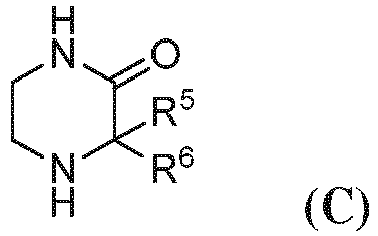
- Especially, compounds of the invention can be prepared by several methods including methods outlined in Schemes 1-4 below, wherein the substituents are as defined in formula (I) above, except where further noted. The synthetic methods described below are merely exemplary, and the compounds of the invention may be synthesized by alternate routes as appreciated by persons of ordinary skill in the art.
- The non-commercial substituted piperazinones of formula (2) (Scheme 1) were prepared by reacting ethylene diamine with 2-bromo ester (1) using the method described by A. Benjahad et al (Tetrahedron Lett., (1994), 35(51), 9545).

- The piperazinones (2) may alternatively be prepared via N-Nosyaziridine (4) according to the protocol outlined in scheme 2. N-Nosyaziridine intermediate (4) is prepared from 2-chloroethylamine hydrochloride by first reacting with p-nitrosulfonyl chloride to give the N-Nosylamine (3) which is subsequently cyclised with potassium hydroxide to afford (4). Ring-opening with an amino acid methyl ester hydrochloride (5) gives the acyclic aminoester (6) which is cyclised in 2 steps : N-deprotection with thiophenol then heating to afford piperazinones (2).

- Aromatic aldehydes (7) (Scheme 3 below) were reacted with p-toluenesulfonylmethyl isocyanide (TosMIC) to prepare the corresponding 5-arylsubstitued oxazoles (8) using the method of Van Leusen et. al. (Tetrahedron Lett., (1972), 23, 2369). The non-commercial aldehydes (7) were prepared using literature methods. Deprotonation of the oxazole moiety (8) by a suitable organic base such as lithium hexamethyldisilazane (LiHMDS) and subsequent electrophilic chlorination was used to prepare the 2-chlorooxazole compounds (9). This allowed access to compounds (10) by substitution of the chlorine by substituted piperazinones (2). This substitution was performed either by heating in the presence of solvent such as isopropanol or under neat conditions. In certain cases and in the presence of solvent, compounds (10) can be obtained by using an acid such as HCl. Nitro compound (10) is reduced to form the corresponding aniline (11) (Intermediate (A)). Preferably, the reduction reaction is performed in the presence of hydrogen with a catalyst, such as a palladium on carbon 10 wt. %. Compounds (11) were used to prepare further analogues (12) of formula (1) by a direct nucleophilic displacement reaction in the presence of a suitable solvent such as alcohol and with heating in elevated temperature, where X of W-X can be F, I, Br or Cl. Presence of an acid such as HCl may or may not be necessary to drive the reaction to completion or to obtain improved yields. In certain cases compounds (12) can be obtained by using known metal-catalysed N-arylation protocols with a suitable combination of ligand and inorganic base.

- Following reaction scheme depicted in Scheme 4 below, compounds (12) of formula (I) were obtained by using the same protocols described above.

- The present invention also relates to a pharmaceutical composition comprising a compound as described above. Accordingly, the present invention relates to a pharmaceutical composition comprising at least one compound of the invention, or a pharmaceutically acceptable salt thereof, and at least one pharmaceutically acceptable excipient and/or carrier.
- According to one embodiment, the invention relates to a pharmaceutical composition comprising a compound of formula (I) as defined above, such as a compound of formula (II) or (III), or a pharmaceutically acceptable salt thereof, and at least one pharmaceutically acceptable excipient and/or carrier.
- In the pharmaceutical composition of the invention, a compound of formula (I) may be the sole pharmaceutically active ingredient or it may be combined with one or more distinct pharmaceutically active ingredients. According to one embodiment, the pharmaceutical composition of the invention comprises a compound according to the invention, or a pharmaceutically acceptable salt thereof, as sole active pharmaceutical ingredient or in combination with another active pharmaceutical ingredient. According to one embodiment, the pharmaceutical composition of the invention comprises one compound of formula (I) as sole pharmaceutically active ingredient. According to another embodiment, the pharmaceutical composition of the invention comprises a compound of formula (I) in combination with one or more distinct pharmaceutically active ingredients.
- Suitable carriers and excipients are widely known in the art and are commonly used for example to facilitate the processing of the active compounds into preparations which can be used pharmaceutically. Further details on techniques for formulation and administration may be found in the latest edition of Remington's Pharmaceutical Sciences (Maack Publishing Co., Easton, Pa.).
- Various forms of excipients can be used depending on the desired mode of administration and some of them can improve or tailor the effectiveness of the active compound, e.g. by promoting a release profile rendering this active compound overall more effective for the treatment desired. The pharmaceutical compositions of the invention are suitable to be administered in various forms, for example in an injectable, pulverizable or ingestible form, for example via the intramuscular, intravenous, subcutaneous, intradermal, oral, topical, rectal, vaginal, ophthalmic, nasal, transdermal or parenteral route.
- The pharmaceutical composition presently disclosed may be intended for oral administration. In this case, the composition may be formulated as tablets, pills, dragees, capsules, liquids, gels, syrups, slurries, suspensions, and the like, for ingestion by the patient.
- The compositions presently disclosed may be a pharmaceutical or cosmetic composition. They may be intended for topical administration. Such compositions may be presented in the form of a gel, paste, ointment, cream, lotion, liquid suspension, aqueous-alcoholic or oily solutions, or dispersions of the lotion or serum type, or anhydrous or lipophilic gels, or emulsions of liquid or semi-solid consistency of the milk type, obtained by dispersing a fatty phase in an aqueous phase or vice versa, or of suspensions or emulsions of soft, semi-solid consistency of the cream or gel type, or alternatively of microemulsions, of microcapsules, of microparticles or of vesicular dispersions to the ionic and/or nonionic type. These compositions may be prepared according to standard methods.
- The compositions presently defined may comprise any ingredient commonly used in dermatology and cosmetics. It may comprise at least one ingredient selected from hydrophilic or lipophilic gelling agents, hydrophilic or lipophilic active agents, preservatives, emollients, viscosity enhancing polymers, humectants, surfactants, preservatives, antioxidants, solvents, perfumes, fillers, screening agents, bactericides, odor absorbers and coloring matter. As oils which can be used in the invention, mineral oils (liquid paraffin), vegetable oils (liquid fraction of shea butter, sunflower oil), animal oils, synthetic oils, silicone oils (cyclomethicone) and fluorinated oils may be mentioned. Fatty alcohols, fatty acids (stearic acid) and waxes (paraffin, carnauba, beeswax) may also be used as fatty substances. Emulsifiers which can be used in the invention include, for example, glycerol stearate, polysorbate 60 and the PEG-6/PEG-32/glycol stearate mixture. Hydrophilic gelling agents which can be used in the invention include, for example, carboxyvinyl polymers (carbomer), acrylic copolymers such as acrylate/alkylacrylate copolymers, polyacrylamides, polysaccharides such as hydroxypropylcellulose, clays and natural gums., Lipophilic gelling agents which can be used in the invention include, for example modified clays such as bentones, metal salts of fatty acids such as aluminum stearates and hydrophobic silica, or alternatively ethylcellulose and polyethylene. As hydrophilic active agents, proteins or protein hydrolysates, amino acids, polyols, urea, allantoin, sugars and sugar derivatives, vitamins, starch and plant extracts, in particular those of Aloe Vera may be used. As lipophilic active, agents, retinol (vitamin A) and its derivatives, tocopherol (vitamin E) and its derivatives, essential fatty acids, ceramides and essential oils may be used. These agents add extra moisturizing or skin softening features when utilized. In addition, a surfactant can be included in the composition so as to provide deeper penetration of the compound capable of depleting mast cells, such as a tyrosine kinase inhibitor. Among the contemplated ingredients, one may chose penetration enhancing agents selected for example from the group consisting of mineral oil, water, ethanol, triacetin, glycerin and propylene glycol; cohesion agents selected for example from the group consisting of polyisobutylene, polyvinyl acetate and polyvinyl alcohol, and thickening agents. Chemical methods of enhancing topical absorption of drugs are well known in the art. For example, compounds with penetration enhancing properties include sodium lauryl sulfate (Dugard, P. H. and Sheuplein, R. J., "Effects of Ionic Surfactants on the Permeability of Human Epidermis: An Electrometric Study", J. Ivest. Dermatol., V.60, (1973), pp. 263-69), lauryl amine oxide (
Johnson et al, US 4,411,893 ), azone (Rajadhyaksha,US 4,405,616 and3,989,816 ) and decylmethyl sulfoxide (Sekura, D. L. and Scala, J., "The Percutaneous Absorption of Alkylmethyl Sulfides", Pharmacology of the Skin, Advances In Biology of Skin, (Appleton-Century Craft) V. 12, (1972), pp. 257-69). It has been observed that increasing the polarity of the head group in amphoteric molecules increases their penetration-enhancing properties but at the expense of increasing their skin irritating properties (Cooper, E. R. and Berner, B., "Interaction of Surfactants with Epidermal Tissues: Physiochemical Aspects", Surfactant Science Series, V. 16, Reiger, M. M. ed. (Marcel Dekker, Inc.), (1987), pp. 195-210). Chemical enhancers may also be co-solvents. These materials are absorbed topically relatively easily, and, by a variety of mechanisms, achieve permeation enhancement for some drugs. Ethanol (Gale et al, US Pat. No. 4,615,699 andCampbell et al., US Pat. Nos. 4,460,372 and4,379,454 ), dimethyl sulfoxide (US 3,740,420 andUS 3,743,727 , andUS 4,575,515 ), and glycerin derivatives (US 4,322,433 ) are a few examples of compounds which have shown an ability to enhance the absorption of various compounds. - The pharmaceutical compositions presently disclosed can also be intended for administration with aerosolized formulation to target areas of a patient's respiratory tract. Devices and methodologies for delivering aerosolized bursts of a formulation of a drug is disclosed in
US 5,906,202 . Formulations are preferably solutions, e.g. aqueous solutions, ethanolic solutions, aqueous/ethanolic solutions, saline solutions, colloidal suspensions and microcrystalline suspensions. For example, aerosolized particles comprise the active ingredient mentioned above and a carrier, (e.g., a pharmaceutically active respiratory drug and carrier) which are formed upon forcing the formulation through a nozzle which nozzle is preferably in the form of a flexible porous membrane. The particles have a size which is sufficiently small such that when the particles are formed they remain suspended in the air for a sufficient amount of time such that the patient can inhale the particles into the patient's lungs. Suitable devices for the administration of the present compounds to a patient's respiratory tract are discussed for example inUS 5,556,611 : - liquid gas systems (a liquefied gas is used as propellant gas e.g. low-boiling FCHC or propane, butane in a pressure container);
- suspension aerosol (the active substance particles are suspended in solid form in the liquid propellant phase);
- pressurized gas system (a compressed gas such as nitrogen, carbon dioxide, dinitrogen monoxide, or air is used.
- Thus, the pharmaceutical composition presently disclosed is made in that the active substance is dissolved or dispersed in a suitable nontoxic medium and said solution or dispersion atomized to an aerosol, i.e. distributed extremely finely in a carrier gas. This is technically possible for example in the form of aerosol propellant gas packs, pump aerosols or other devices known per se for liquid misting and solid atomizing which in particular permit an exact individual dosage. Therefore, to the present invention also discloses aerosol devices comprising a compound as defined above and such a formulation, preferably with metered dose valves.
- The pharmaceutical compositions presently disclosed can also be intended for intranasal administration. In this regard, pharmaceutically acceptable carriers for administering the compound to the nasal mucosal surfaces will be readily appreciated by the ordinary artisan. These carriers are described in the "Remington's Pharmaceutical Sciences" 16th edition, (1980), Ed. By Arthur Osol.
- For administration via the upper respiratory tract, the composition can be formulated into a solution, e.g., water or isotonic saline, buffered or unbuffered, or as a suspension, for intranasal administration as drops or as a spray. Preferably, such solutions or suspensions are isotonic relative to nasal secretions and of about the same pH, ranging e.g., from about pH 4.0 to about pH 7.4 or, from pH 6.0 to pH 7.0. Buffers should be physiologically compatible and include, simply by way of example, phosphate buffers. For example, a representative nasal decongestant is described as being buffered to a pH of about 6.2 (Remington's, Id. at page 1445). Of course, the ordinary artisan can readily determine a suitable saline content and pH for an innocuous aqueous carrier for nasal and/or upper respiratory administration. Common intranasal carriers include nasal gels, creams, pastes or ointments with a viscosity of, e.g., from about 10 to about 3000 cps, or from about 2500 to 6500 cps, or greater, may also be used to provide a more sustained contact with the nasal mucosal surfaces. Such carrier viscous formulations may be based upon, simply by way of example, alkylcelluloses and/or other biocompatible carriers of high viscosity well known to the art (see e.g., Remington's, cited supra. A preferred alkylcellulose is, e.g., methylcellulose in a concentration ranging from about 5 to about 1000 or more mg per 100ml of carrier. A more preferred concentration of methyl cellulose is, simply by way of example, from about 25 to about 150mg per 100ml of carrier. Other ingredients, such as known preservatives, colorants, lubricating or viscous mineral or vegetable oils, perfumes, natural or synthetic plant extracts such as aromatic oils, and humectants and viscosity enhancers such as, e.g., glycerol, can also be included to provide additional viscosity, moisture retention and a pleasant texture and odor for the formulation. For nasal administration of solutions or suspensions, various devices are available in the art for the generation of drops, droplets and sprays.
- A premeasured unit dosage dispenser including a dropper or spray device containing a solution or suspension for delivery as drops or as a spray is prepared containing one or more doses of the drug to be administered. Also disclosed is a kit containing one or more unit dehydrated doses of a compound of formula (I) as presently disclosed, together with any required salts and/or buffer agents, preservatives, colorants and the like, ready for preparation of a solution or suspension by the addition of a suitable amount of water.
- The present invention further relates to the use of a compounds according to the invention as a medicament. According to one embodiment, the invention relates to a compound according to the invention, or a pharmaceutically acceptable salt thereof, for use as a medicament. Especially, the present invention is directed to a compound of formula (I) as defined above, such as a compound of formula (II) or (III), or a pharmaceutically acceptable salt thereof, for use as a medicament.
- The compounds of formula (I) or pharmaceutically salts thereof as presently disclosed (also jointly referred to as "compounds of formula (I)") are endowed with Syk tyrosine kinase inhibiting activity. In particular, they may inhibit (thereby regulating) the signal transduction mediated by Syk.
- Accordingly, in one aspect the present invention discloses a method for treating a disease or disorder associated with unregulated tyrosine kinase activity, especially unregulated Syk activity, said method comprising administering an effective amount of a compound of formula (I) to a subject (such as a human or animal subject) in need of such treatment.
- According to one embodiment, the invention relates to a compound of the invention, or a pharmaceutically acceptable salt thereof, for use in treating a disease or disorder associated with unregulated tyrosine kinase activity, especially, unregulated Syk activity.
- According to one embodiment, the invention relates to the use of a compound of the invention, or a pharmaceutically acceptable salt thereof, for the manufacturing of a medicament for treating a disease or disorder associated with unregulated tyrosine kinase activity, especially, unregulated Syk activity.
- Effective amounts of the compounds of formula (I) are generally comprised between 0.1 mg and 2 g of the compound per day and per kilogram of body weight.
- In another aspect, the present invention discloses a method for modulating, regulating, and/or inhibiting, in cells, the signal transduction mediated by Syk protein kinase. Said method comprises administering to cells at least one compound of formula (I) as defined above, such as a compound of formula (II) or (III), or a pharmaceutically acceptable salt thereof.
- The present invention discloses the use of at least one compound of formula (I) or a pharmaceutically acceptable salt thereof, for the in vitro or in vivo selective inhibition of Syk.
- The methods presently disclosed may be for treating a hematological, an inflammatory, an autoimmune, a proliferative, a metabolic, an allergic and/or degenerative disease or disorder in a patient.
- In one embodiment, said subject or patient has been diagnosed as having hematological disorders, allergic disorders, metabolic disorders, inflammatory disorders, autoimmune disorders, degenerative disease and/or proliferative disorders.
- Diseases and disorders known to be associated with unregulated signal transduction mediated by Syk are, for example:
- hematological disorders such as Non-Hodgkin Lymphoma and leukemia including Diffuse large B-cell lymphoma (DLBCL) Follicular lymphoma (FL), Mantle cell lymphoma (MCL), B-cell chronic lymphocytic leukemia (B-CLL)/small lymphocytic lymphoma (SLL), Waldenstrom's macroglbulinemia (WM), Marginal zone lymphoma (MZL), Burkitt lymphoma and peripheral T-cell lymphomas (PTCL), as well as multiple myeloma (MM), myelodysplatic syndrome (MDS), myelodysplasia with myelofibrosis;
- proliferative disorders or neoplastic diseases such as mastocytosis, solid tumours including head and neck cancer, hepatocellular carcinoma, and human gastrointestinal disorders;
- metabolic diseases such diabetes mellitus and its chronic complications, obesity, diabetes type II, hyperlipidemias and dyslipidemias, atherosclerosis; hypertension and cardiovascular disease;
- allergic diseases such as asthma, allergic rhinitis, allergic sinusitis, anaphylactic syndrome, urticaria, angioedema, atopic dermatitis, allergic contact dermatitis, erythema nodosum, erythema multiforme, cutaneous necrotizing venulitis and insect bite skin inflammation and blood sucking parasitic infestation;
- bone resorption (osteoporosis);
- angiogenesis;
- inflammatory diseases such as rheumatoid arthritis, conjunctivitis, rheumatoid spondylitis, osteoarthritis, gouty arthritis and other arthritic conditions;
- autoimmune diseases such as multiple sclerosis, psoriasis, intestine inflammatory disease, ulcerative colitis, Crohn's disease, rheumatoid arthritis and polyarthritis, local and systemic scleroderma, systemic lupus erythematosus, discoid lupus erythematosus, cutaneous lupus, dermatomyositis, polymyositis, Sjogren's syndrome, nodular panarteritis, autoimmune enteropathy, as well as proliferative glomerulonephritis and T-cell mediated autoimmune diabetes;
- graft-versus-host disease or graft rejection for allogeneic hematopoietic cell transplantation for the treatment of leukemia and lymphoma, cardiac allograft and in any organ transplantation such as kidney, pancreas, liver, and lung;
- Other autoimmune diseases embraced by the invention include active chronic hepatitis and chronic fatigue syndrome;
- vasculitis;
- viral infection;
- fungal infection;
- bacterial infection;
- CNS disorders such as Nasu-Hakola disease, psychiatric disorders, migraine, pain, memory loss and nerve cells degeneracy. More particularly, the method according to the invention is useful for the treatment of the following disorders: depression including dysthymic disorder, cyclothymic disorder, bipolar depression, severe or "melancholic" depression, atypical depression, refractory depression, seasonal depression, anorexia, bulimia, premenstrual syndrome, post-menopause syndrome, other syndromes such as mental slowing and loss of concentration, pessimistic worry, agitation, self-deprecation, decreased libido, pain including, acute pain, postoperative pain, chronic pain, nociceptive pain, cancer pain, neuropathic pain, psychogenic pain syndromes, anxiety disorders including anxiety associated with hyperventilation and cardiac arrhythmias, phobic disorders, obsessive-compulsive disorder, post-traumatic stress disorder, acute stress disorder, generalized anxiety disorder, psychiatric emergencies such as panic attacks, including psychosis, delusional disorders, conversion disorders, phobias, mania, delirium, dissociative episodes including dissociative amnesia, dissociative fugue and dissociative identity disorder, depersonalization, catatonia, seizures, severe psychiatric emergencies including suicidal behaviour, self-neglect, violent or aggressive behaviour, trauma, borderline personality, and acute psychosis, schizophrenia including paranoid schizophrenia, disorganized schizophrenia, catatonic schizophrenia, and undifferentiated schizophrenia;
- neurodegenerative diseases including Alzheimer's disease, Parkinson's disease, Huntington's disease, the prion diseases, Motor Neurone Disease (MND), and Amyotrophic Lateral Sclerosis (ALS);
- Cerebral ischemia;
- Retinal ischemia;
- Ischemic stroke;
- Fibrosis.
- Hematological malignancies may be non-Hodgkin lymphoma (NHL) including B-CLL/SLL, DLBCL, FL, MCL and WM, peripheral T-cell lymphoma and myelodysplastic syndromes (MDS). Proliferative disorder may be cancer. Autoimmune disorders may be multiple sclerosis, psoriasis, intestine inflammatory disease, ulcerative colitis, Crohn's disease, rheumatoid arthritis and polyarthritis, local and systemic scleroderma, systemic lupus erythematosus, discoid lupus erythematosus, cutaneous lupus, dermatomyositis, polymyositis, Sjogren's syndrome, nodular panarteritis, autoimmune enteropathy, atopic dermatitis and/or proliferative glomerulonephritis. Metabolic diseases may be diabetes mellitus and its chronic complications, obesity, diabetes type II, hyperlipidemias and dyslipidemias, atherosclerosis; hypertension and cardiovascular disease. Inflammatory diseases may be rheumatoid arthritis, conjunctivitis, rheumatoid spondylitis, osteoarthritis, gouty arthritis and other arthritic conditions. Allergic diseases may be asthma, allergic rhinitis, allergic sinusitis, anaphylactic syndrome, urticaria, angioedema, atopic dermatitis, allergic contact dermatitis, erythema nodosum, erythema multiforme, cutaneous necrotizing venulitis and insect bite skin inflammation and/or blood sucking parasitic infestation. Neurologic diseases may be Huntington's disease, schizophrenia, Parkinson's disease and/or Alzheimer's disease.
- Accordingly, the invention also relates to a compound of the invention, or a pharmaceutically acceptable salt thereof, for use in the treatment of a disease or disorder selected from the group consisting of hematological disorders, proliferative disorders, autoimmune disorders, metabolic disorders, inflammatory diseases, allergic diseases and/or neurological diseases. Especially, a compound of formula (I), such as a compound of formula (II) or (III), or a pharmaceutically acceptable salt thereof may be used for treating a disease or disorder disclosed above such as hematological disorders, proliferative disorders, autoimmune disorders, metabolic disorders, inflammatory disorders, allergic diseases and/or neurological diseases.
- According to one embodiment, the invention also relates to the use of a compound of the invention, or a pharmaceutically acceptable salt thereof, for the manufacturing of a medicament for treating a disease or disorder selected from the group consisting of hematological disorders, proliferative disorders, autoimmune disorders, metabolic disorders, inflammatory diseases, allergic diseases and/or neurological diseases.
- In the methods presently disclosed, the compound of formula (I) or a pharmaceutically acceptable salt thereof, may be used as sole active pharmaceutical ingredient or in combination with another active pharmaceutical ingredient.
- The present invention discloses a method for preventing or treating a disease or disorder selected form hematological disorders, proliferative disorders, metabolic disorders, inflammatory disorders, autoimmune disorders, allergic diseases and neurological diseases, that method comprising simultaneously or sequentially administering to a human or animal subject in need thereof at least one compound of formula (I) or a pharmaceutically acceptable salt thereof in combination with another active pharmaceutical ingredient, in sufficient amounts to provide a therapeutic effect.
- According to one embodiment, the invention relates to a pharmaceutical composition as described above, comprising a compound according to the invention, or a pharmaceutically acceptable salt thereof, and another active pharmaceutical ingredient as a combined preparation for sequential, simultaneous or separate use in the treatment of a disease or disorder selected from the group consisting of hematological disorders, proliferative disorders, autoimmune disorders, metabolic disorders, inflammatory diseases, allergic diseases and neurological diseases.
- The present invention discloses a pharmaceutical composition comprising a compound of formula (I) such as a compound of formula (II) or (III), or a pharmaceutically acceptable salt thereof, and another active pharmaceutical agent as a combined preparation for sequential, simultaneous or separate use in the treatment of a disease or disorder selected from the group consisting of hematological disorders, proliferative disorders, autoimmune disorders, inflammatory disorders, allergic diseases and/or neurological diseases.
- The present invention discloses the use of a compound of formula (I) such as a compound of formula (II) or (III), or a pharmaceutically acceptable salt thereof optionally in combination with another pharmaceutically active agent, for the manufacture of a medicament for the treatment of a a disease or disorder selected from the group consisting of a hematological disorder, a proliferative disorder, a metabolic disorder, an autoimmune disorder, an inflammatory disorder, an allergic disorder and a neurological disease.
- Although methods and uses disclosed above refer to a compound of formula (I), such as a compound of formula (II) or (III), or a pharmaceutically acceptable salt thereof, whenever technically compatible they are to be understood to equally refer to pharmaceutical compositions including the same compounds.
- The invention is now illustrated by Examples which represent currently preferred embodiments which make up a part of the invention, but which in no way are to be used to limit the scope of it.
- The invention will be more fully understood by reference to the following preparative examples, but they should not be construed as limiting the scope of the invention.
- All chemicals used were commercial reagent grade products. Solvents were of anhydrous commercial grade and were used without further purification. THF was freshly distilled under a stream of argon before use. The progress of the reactions was monitored by thin layer chromatography using precoated silica gel 60F 254, Merck TLC plates, which were visualized under UV light. Multiplicities in 1H NMR spectra are indicated as singlet (s), broad singlet (br s), doublet (d), triplet (t), quadruplet (q), and multiplet (m) and the NMR spectrum were performed either on a Bruker 300 or 400 MHz spectrometer. Enantiomeric purity of chiral compounds (expressed as a % enantiomeric excess, % e.e.) was determined by isocratic UPLC on a Chiralpak IC chiral column 5µm, 4.6 x 250mm eluting with 1:1 heptane / ethanol (vol/vol) at a flow rate of 0.8ml/min.
-
- CDCl3
- Deuterochloroform;
- Conc. HCl
- Concentrated hydrochloric acid (37%);
- DCM
- Dichloromethane;
- DMSO-d6
- Hexadeuterodimethyl sulfoxide;
- EtOAc
- Ethyl acetate;
- EtOH
- Ethanol;
- Fe(acac)3
- Tris(acetylacetonato) iron(III);
- h
- Hour(s);
- LiHMDS
- Lithium bis(trimethylsilyl)amide;
- Mins
- Minutes;
- Pd(PPh3)4
- Tetrakis(triphenylphosphine)palladium(0);
- RT
- Room temperature;
- SiO2
- Silica gel;
- TosMIC
- p-Toluenesulfonylmethyl isocyanide;
- THF
- Tetrahydrofuran;
- r.t.
- Retention time.
-

- A solution of 3-nitrobenzaldehyde (15.0g, 99.3mmol) in methanol (400ml) was treated with TosMIC (21.3g, 109mmol) and K2CO3 (16.5g, 119mmol) and heated to reflux for 30mins. The cooled solution was concentrated and treated with water (400ml) to form copious precipitate and was filtered. The filter cake was washed with water, then the solid was taken up in EtOAc and dried over MgSO4. The solution was filtered and evaporated and the resultant solid was dried under vacuum to give the title compound as a beige solid (18.0g, 95%). 1H NMR (400 MHz, DMSO-d6) δ 8.56 (s, 1H), 8.50 (t, J = 1.9 Hz, 1H), 8.21 (ddd, J = 8.2, 2.3, 1.0 Hz, 1H), 8.17 (ddd, J = 7.8, 1.6, 1.0 Hz, 1H), 7.99 (s, 1H), 7.78 (t, J = 8.0 Hz, 1H).
- A solution of intermediate Ia (3.52g, 18.5mmol) in absolute ethanol (210ml) was treated with water (21ml) then SnCl2.2H2O (20.9g, 92.6mmol) and conc. HCl (15ml, 180mmol). After stirring at room temperature overnight, the solution was taken to pH 8 with 10% aqueous NaOH solution and extracted repeatedly with EtOAc. The organics were dried (MgSO4), filtered and evaporated to afford the title compound as a pale orange powder (2.74g, 93%). 1H NMR (400 MHz, DMSO-d6) δ 8.37 (s, 1H), 7.49 (s, 1H), 7.10 (t, J = 7.8 Hz, 1H), 6.90 (t, J = 1.8 Hz, 1H), 6.86 (d, J = 7.6 Hz, 1H), 6.59 - 6.54 (m, 1H), 5.25 (s, 2H).
- A solution of intermediate Ib (1.00g, 6.24mmol) in 2-propanol (50ml) was treated with 2-chloro-4-methylpyrimidine (800mg, 6.24mmol) and 1.25M HCl solution in ethanol (7.5ml, 9.38mmol) and heated to reflux overnight. The solvent was evaporated and the residue treated with water and extracted with EtOAc. The organics were dried (MgSO4), filtered and evaporated to afford the title compound as a beige solid (1.04g, 66%). 1H NMR (400 MHz, DMSO-d6) δ 9.71 (s, 1H), 8.45 (s, 1H), 8.37 (d, J = 4.9 Hz, 1H), 8.23 (s, 1H), 7.76 (d, J = 7.9 Hz, 1H), 7.60 (s, 1H), 7.37 (t, J = 7.8 Hz, 1H), 7.30 (d, J = 7.5 Hz, 1H), 6.77 (d, J = 4.9 Hz, 1H), 2.38 (s, 3H).
- A solution of intermediate Ic (1.23g, 4.88mmol) in dry THF (60ml) under argon at -78°C was treated with 1M LiHMDS solution in THF (7.20mmol, 7.20mmol) dropwise. After 45 mins at -78°C, hexachloroethane (1.39g, 5.87mmol) was added in one portion and stirring continued for a further 40 mins before warming to RT. The solution was then cooled to -78°C once more, treated with 1M LiHMDS (7.20ml, 7.20mmol) dropwise and immediately allowed to warm to room temperature. The solution was treated with water and extracted with EtOAc. The combined organics were washed with brine, dried (MgSO4), filtered and evaporated. The residue was purified by column chromatography (SiO2, 20% to 30% EtOAc in cyclohexane) to afford the title compound as a pale yellow solid (1.17g, 84%). 1H NMR (400 MHz, DMSO-d6) δ 9.74 (s, 1H), 8.37 (d, J = 5.0 Hz, 1H), 8.19 (t, J = 1.8 Hz, 1H), 7.79 (dd, J = 8.0, 1.8 Hz, 1H), 7.70 (s, 1H), 7.38 (t, J = 7.9 Hz, 1H), 7.27 (d, J = 7.7 Hz, 1H), 6.78 (d, J = 5.0 Hz, 1H), 2.38 (s, 3H).
- A mixture of intermediate Id (500mg, 1.74mmol) and 3-methyl-2-piperazinone (500mg, 4.35mmol) was heated to 140°C for 30 mins. The cooled solid residue was taken up ina little hot ethanol, treated with NaHCO3 solution (sat aqu) and extracted with EtOAc. The combined organics were dried (MgSO4), filtered and evaporated to afford a yellow semi-solid consisting of the product with significant impurities. The solid was washed with EtOAc to afford the title compound as a white solid (265mg, 42%). Further precipitate was isolated by filtration of the aqueous phase to afford a second crop (160mg, 25%). 1H NMR (400 MHz, DMSO-d6) δ 9.56 (s, 1H), 8.34 (d, J = 5.0 Hz, 1H), 8.10 (t, J = 1.8 Hz, 1H), 8.07 (d, J = 2.5 Hz, 1H), 7.63 (dd, J = 8.1, 1.2 Hz, 1H), 7.26 (dd, J = 13.0, 5.0 Hz, 2H), 7.13 (d, J = 7.9 Hz, 1H), 6.75 (d, J = 5.0 Hz, 1H), 4.40 (q, J = 6.9 Hz, 1H), 3.94 (dt, J = 13.0, 3.6 Hz, 1H), 3.56 - 3.48 (m, 1H), 3.40 (tdd, J = 9.8, 4.0, 1.0 Hz, 1H), 3.30 - 3.23 (m, 1H), 2.38 (s, 3H), 1.44 (d, J = 7.0 Hz, 3H).
-

- A solution of ethylenediamine (25.6ml, 383mmol) in toluene (40ml) was treated with a solution of ethyl 2-bromoisobutyrate (9.54ml, 65.1mmol) in toluene (40ml) dropwise over 3h. The mixture was then heated to reflux for 4h, and once cooled, treated with a solution of KOH (3.46g, mmol) in ethanol (45ml). Once around 50% of the solvent had been removed under vacuum, a white inorganic precipitate was removed by filtration and the filtrate evaporated thoroughly to give an orange solid. This solid was recrystallised from a minimum of acetone after standing at 4°C to afford the title compound as a white crystalline solid (3.86g, 46%). 1H NMR (400 MHz, DMSO-d6) δ 7.35 (s, 1H), 3.11 (td, J = 5.5, 2.4 Hz, 2H), 2.80 (t, J = 5.3 Hz, 2H), 2.26 (s, 1H), 1.15 (d, J = 4.5 Hz, 6H).
- Prepared as for Intermediate Id above from Intermediate Ia followed by purification by column chromatography (SiO2, 20% EtOAc in cyclohexane) to afford the title compound as a pale yellow solid (4.54g, 77%).1H NMR (400 MHz, CDCl3) δ 8.45 - 8.43 (m, 1H), 8.21 (ddd, J = 8.2, 2.2, 0.9 Hz, 1H), 7.91 (ddd, J = 7.8, 1.5, 1.0 Hz, 1H), 7.64 (t, J = 8.0 Hz, 1H), 7.46 (s, 1H).
- A mixture of Intermediate IIa (500mg, 3.90mmol) and Intermediate IIb (900mg, 4.01mmol) was heated to 145°C. After 1.5h, a further portion of IIa was added (100mg, 0.780mmol), then again after a further 2h (200mg, 1.56mmol) with a final portion 2h later (200mg, 1.56mmol). The mixture was heated for 2h then cooled and partially dissolved in EtOH and EtOAc. The insoluble solid was recovered by filtration and the separated organic portion washed with water. The organics were dried (MgSO4), filtered and evaporated to give a yellow solid which was combined with the solid recovered previously for purification by column chromatography (SiO2, 5% EtOH in DCM) to afford the title compound as a yellow solid (538mg, 65%). 1H NMR (400 MHz, DMSO-d6) δ 8.32 (t, J = 1.8 Hz, 1H), 8.19 (s, 1H), 8.06 (dd, J = 8.1, 2.1 Hz, 1H), 7.99 (d, J = 7.9 Hz, 1H), 7.73 - 7.67 (m, 2H), 3.85 - 3.70 (m, 2H), 3.34 - 3.26 (m, 2H), 1.67 (s, 6H).
- A mixture of Intermediate IIc (900mg, 2.84mmol) and 10% Pd-C (100mg) in THF (100ml) and methanol (100ml) was stirred under an atmosphere of H2 at RT and ambient pressure for 4h. The catalyst was removed by filtration and the solvent removed under vacuum to afford the title compound as an off-white solid (810mg, 99%). 1H NMR (400 MHz, DMSO-d6) δ 11.35 - 11.32 (m, 1H), 8.17 - 8.01 (m, 1H), 7.16 (s, 1H), 7.03 (t, J = 7.7 Hz, 1H), 6.74 (s, 1H), 6.71 (d, J = 7.6 Hz, 1H), 6.45 (d, J = 8.0 Hz, 1H), 5.16 (s, 2H), 3.72 - 3.67 (m, 2H), 3.33 - 3.26 (m, 2H), 1.64 (s, 6H).
- A solution of Intermediate IIc (60mg, 0.210mmol) and 2-chloro-4-methylpyrimidine (40mg, 0.31mmol) in 2-propanol (3ml) was heated to reflux for 40h. The cooled mixture was treated with NaHCO3 solution (sat. aqu) and extracted with EtOAc. The combined organics were dried (MgSO4), filtered and then carefully concentrated under vacuum to provoke precipitation. The precipitate was collected by filtration, washed with ether and dried to afford the title compound as a beige solid (42mg, 53%).1H NMR (400 MHz, DMSO-d6) δ 9.63 (s, 1H), 8.34 (d, J = 5.0 Hz, 1H), 8.16 - 8.14 (m, 1H), 8.12 (s, 1H), 7.61 (dd, J = 8.1, 1.3 Hz, 1H), 7.30 - 7.25 (m, 2H), 7.13 (d, J = 7.7 Hz, 1H), 6.75 (d, J = 5.0 Hz, 1H), 3.75 - 3.70 (m, 2H), 3.35 - 3.31 (m, 2H), 2.37 (s, 3H), 1.67 (s, 6H).
-

- A stirred solution of 2-chloroethylamine hydrochloride (1.00g, 8.62mmol) and triethylamine (3.60ml, 25.9mmol) in dry DCM (25ml) at 0°C was treated with a solution of nosyl chloride (1.91g, 8.62mmol) in dry DCM (25ml) dropwise. On complete addition, the solution was warmed to ambient temperature and stirred overnight. The solution was evaporated and the residue purified by column chromatography (SiO2, 20% EtOAc in cyclohexane to 30% EtOAc in cyclohexane) to afford the title compound as a white solid (2.03g, 89%). 1H NMR (400 MHz, DMSO-d6) δ 8.45 - 8.38 (m, 3H), 8.09 - 8.04 (m, 2H), 3.59 (t, J = 6.0 Hz, 2H), 3.17 (s, 2H).
- Intermediate IIIb was prepared according to the method of Iwaki et al, Bioorg. Med. Chem. Lett., (2012), 2798. A stirred slurry of IIIa (2.00g, 7.56mmol) in toluene was treated with a solution of KOH (2.54g, 45.3mmol) in water (12mml) in one portion then stirred at ambient temperature for 1h. The solution was diluted with EtOAc and the organics separated, washed with brine, dried (MgSO4), filtered and evaporated to afford the title compound as a pale yellow solid (1.41g, 82%). 1H NMR (400 MHz, CDCl3) δ 8.47 - 8.26 (m, 1H), 8.24 - 8.10 (m, 1H), 2.48 (s, 2H).
- A mixture of IIIb (2.00g, 8.76mmol), D-valine methyl ester hydrochloride (1.47g, 8.76mmol) and Na2CO3 (929mg, 8.76mmol), dry acetonitrile (50ml) was heated to relux for 2h. The mixture was cooled, filtered and evaporated. The residue was purified by column chromatography (SiO2, 5% acetone in DCM to 10% acetone in DCM) to afford the title compound as a golden oil (2.44g, 90%). 1H NMR (400 MHz, DMSO-d6) δ 8.44 - 8.40 (m, 2H), 8.07 - 8.03 (m, 2H), 7.96 (s, 1H), 3.60 (s, J = 3.6 Hz, 3H), 2.90 - 2.83 (m, 3H), 2.58 - 2.51 (m, 1H), 2.39 - 2.31 (m, 1H), 1.99 (s, 1H), 1.75 (dq, J = 13.4, 6.7 Hz, 1H), 0.82 (dd, J = 8.7, 6.8 Hz, 6H).
- Intermediate IIId was prepared largely according to the method of Maligres et al (Tetrahedron Letters, (1997), 5253). A solution of 13 (2.44g, 6.79mmol) in dry acetonitrile (100ml) was treated with K2CO3 (3.75g, mmol) and thiophenol (2.08ml, mmol) and stirred at 50°C overnight. The mixture was evaporated under vacuum and the residue purified by column chromatography (SiO2, 10:90:1 EtOH:DCM:NH4OH v/v) to afford an off-white solid (909mg). This solid was taken up in toluene and heated to reflux overnight. The cooled mixture was evaporated and the residue purified by column chromatography (SiO2, 10:90:1 EtOH:DCM:NH4OH (v/v) to afford IIId as a beige solid (432mg, 45%).1H NMR (400 MHz, DMSO-d6) δ 7.54 (s, 1H), 3.12 (td, J = 11.0, 4.3 Hz, 1H), 3.05 (d, J= 3.1 Hz, 1H), 3.04 - 2.98 (m, 1H), 2.97 - 2.91 (m, 1H), 2.73 - 2.65 (m, 1H), 2.30 - 2.20 (m, 2H), 0.91 (d, J = 7.1 Hz, 3H), 0.80 (d, J = 6.8 Hz, 3H).
- A mixture of (R)-3-isopropyl-piperazin-2-one (IIId) (200mg, 1.41mmol) and intermediate Id (200mg, 0.698mmol) was heated to 140°C. After 30 mins further IIId was added (96mg, 0.661mmol) and heating continued for a further 45mins. The cooled mixture was taken up in EtOH and DCM and washed with NaHCO3 sat aq soln. The organics were dried (MgSO4), filtered and evaporated and the residue purified by column chromatography (SiO2, 10% EtOH in DCM) to afford IIId as a beige solid (229mg, 84%). 1H NMR (400 MHz, DMSO-d6) δ 9.58 (s, 1H), 8.33 (d, J = 5.0 Hz, 1H), 8.07 (s, 2H), 7.63 (d, J = 7.6 Hz, 1H), 7.27 (t, J = 8.4 Hz, 1H), 7.24 (s, 1H), 7.12 (d, J = 7.7 Hz, 1H), 6.75 (d, J = 5.0 Hz, 1H), 4.21 (d, J = 6.0 Hz, 1H), 3.98 (dt, J = 12.8, 4.2 Hz, 1H), 3.52 (ddd, J = 13.1, 8.9, 4.1 Hz, 1H), 3.43 - 3.35 (m, 1H), 3.30 - 3.14 (m, 1H), 2.41 - 2.33 (m, 4H), 1.06 (d, J = 6.8 Hz, 3H), 0.99 (d, J = 6.8 Hz, 3H). Chiral UPLC : r.t. = 10.1 mins, 99% e.e.
- Non-commercially available 2-chloro-4-alkylpyrimidines intermediates which were used to prepare compounds listed in table 1, were prepared according to the method of Jorgensen et al (J. Am. Chem. Soc., (2011), 15686).
- A mixture of 2,4-dichloropyrimidine (2.00g, 13.4mmol) and Fe(acac)3 (954mg, 2.70mmol) in dry THF (24ml) at -78°C under argon was treated with a solution of ethylmagnesium bromide (1m in THF, 16.2ml, 16.2mmol) dropwise. After stirring at - 78°C for 30 mins, the mixture was warmed to ambient temperature and stirred for a further hour. The mixture was again cooled to -78°C and treated with ethylmagnesium bromide solution (10ml, 10mmol) and warmed to RT. The mixture was diluted with water, extracted with EtOAc and the organics dried (MgSO4), filtered and evaporated. The residue was purified by column chromatography (SiO2, 20% EtOAc in cyclohexane) to afford the title compound as a clear liquid (642mg, 34%). 1H NMR (400 MHz, DMSO-d6) δ 8.64 (d, J = 5.1 Hz, 1H), 7.47 (d, J = 5.1 Hz, 1H), 2.76 (q, J = 7.6 Hz, 2H), 1.21 (t, J = 7.6 Hz, 3H).
- The 2-chloro-4-aryl-2-ylpyrimidine and 2-chloro-4-heteroaryl-2-ylpyrimidine intermediates which were used to prepare compounds listed in table 1, were prepared by Suzuki coupling methods (See for example, N. Miyaura and A. Suzuki (Chemical Reviews, (1995), 2457)).
- A mixture of 2,4-dichloropyrimidine (1.00g, 6.71mmol), 2-thiopheneboronic acid (430mg, 3.36mmol), Na2CO3 (0.4M solution in water, 20ml, 8.06mmol) and Pd(PPh3)4 (78mg, 0.067mmol) in THF (20ml) was heated to 90°C overnight. The cooled mixture was diluted with water, extracted with DCM and the organics dried (MgSO4), filtered and evaporated. The residue was purified by column chromatography (SiO2, 20% EtOAc in cyclohexane) to afford the title compound as a white solid (591mg, 89%). 1H NMR (400 MHz, DMSO-d6) δ 8.73 (d, J = 5.3 Hz, 1H), 8.16 (dd, J = 3.8, 1.1 Hz, 1H), 8.04 (d, J = 5.3 Hz, 1H), 7.95 (dd, J = 5.0, 1.1 Hz, 1H), 7.29 (dd, J = 5.0, 3.8 Hz, 1H).
- 4-Amino-2-chloro-pyrimidine intermediates, which were used to prepare compounds listed in table 1, were prepared according to the method below largely based on that described in
US 2006/199804 . - A stirred solution of 2,4-dichloropyrimidine (5.00g, 36.5mmol) and diisopropylethylamine (14.0ml, 80.4mmol) in EtOH (60ml) at 0°C was treated with morpholine (3.18ml, 36.5mmol) and allowed to warm to ambient temperature overnight. The solution was poured into brine and extracted with DCM. The organics were dried (MgSO4), filtered and evaporated. The residue was purified by column chromatography (SiO2, 5% EtOH in DCM) to afford the title compound IVc as a white solid (1.3g, 36%). 1H NMR (300 MHz, DMSO-d6) δ 8.10 (d, J = 6.2 Hz, 1H), 6.83 (d, J = 6.2 Hz, 1H), 3.72 - 3.49 (m, 8H).
- Non-commercially available 2-Chloro-4-cyanopyrimidine (IVd) intermediates which was used to prepare compounds listed in table 1, were prepared according to the method described in
WO2005/075468 . - A solution of 4-methyl-1H-pyrimidin-2-one hydrochloride (14.7g, 100mmol) in 50% aqueous acetic acid (100ml) at 15°C was treated with sodium nitrite in one portion (10.4g, 150mmol) with vigorous stirring causing an exothermic reaction (40°C). A yellow precipitate was filtered off, washed with cold water and dried in a vacuum dessicator to afford the 2-hydroxy-pyrimidine-4-carbaldehyde oxime intermediate as a pale yellow solid (13.1g, 94%) 1H NMR (400 MHz, DMSO-d6 ) δ 12.44 (s, 1H), 11.87 (br s, 1H), 7.92 (d, J = 6.3 Hz, 1H), 7.77 (d, J = 0.4 Hz, 1H), 6.66 (dd, J = 6.4, 0.9 Hz, 1H). The oxime was treated with phosphorus oxychloride (20ml) and warmed slowly to 45°C. Warming was stopped as the temperature rose suddenly to 70°C and the mixture stirred for 3h. Diisopropylethylamine (2ml) was added and the mixture refluxed for 30 mins before pouring into ice and extraction with DCM. The organics were washed with water then NaHCO3 (sat aqu) then again with water, dried (MgSO4), filtered and evaporated to afford Intermediate IVd as a yellow oil which crystallized on standing (1.51g, 30%). 1H NMR (400 MHz, DMSO-d6) δ 9.15 (d, J = 4.9 Hz, 1H), 8.25 (d, J = 4.9 Hz, 1H).
- By repeating the methods described above using the appropriate starting materials and conditions, the following additional analogues in table 1 were prepared and characterized.
Table 1: Ex # Chemical structure Name 1H NMR/LCMS 001 
3-Methyl-4-{5-[3-(4-methyl-pyrimidin-2-ylamino)-phenyl]-oxazol-2-yl}-piperazin-2-one 1H NMR (400 MHz, DMSO-d6 ) δ 9.56 (s, 1H), 8.34 (d, J = 5.0 Hz, 1H), 8.10 (t, J = 1.8 Hz, 1H), 8.07 (d, J = 2.5 Hz, 1H), 7.63 (dd, J = 8.1, 1.2 Hz, 1H), 7.26 (dd, J = 13.0, 5.0 Hz, 2H), 7.13 (d, J = 7.9 Hz, 1H), 6.75 (d, J = 5.0 Hz, 1H), 4.40 (q, J = 6.9 Hz, 1H), 3.94 (dt, J = 13.0, 3.6 Hz, 1H), 3.56 - 3.48 (m, 1H), 3.40 (tdd, J = 9.8, 4.0, 1.0 Hz, 1H), 3.30 - 3.23 (m, 1H), 2.38 (s, 3H), 1.44 (d, J = 7.0 Hz, 3H) 002 
3,3-Dimethyl-4-{5-[3-(4-methyl-pyrimidin-2-ylamino)-phenyl]-oxazol-2-yl}-piperazin-2-one 1H NMR (400 MHz, DMSO-d6 ) δ 9.63 (s, 1H), 8.34 (d, J = 5.0 Hz, 1H), 8.16 - 8.14 (m, 1H), 8.12 (s, 1H), 7.61 (dd, J = 8.1, 1.3 Hz, 1H), 7.30 - 7.25 (m, 2H), 7.13 (d, J = 7.7 Hz, 1H), 6.75 (d, J = 5.0 Hz, 1H), 3.75 - 3.70 (m, 2H), 3.35 - 3.31 (m, 2H), 2.37 (s, 3H), 1.67 (s, 6H) 003 
3-Isopropyl-4-{5-[3-(4-methyl-pyrimidin-2-ylamino)-phenyl]-oxazol-2-yl}-piperazin-2-one 1H NMR (400 MHz, DMSO-d6 ) δ 9.59 (s, 1H), 8.34 (d, J = 5.0 Hz, 1H), 8.14 - 8.03 (m, 2H), 7.63 (dd, J = 8.1, 1.3 Hz, 1H), 7.30 - 7.23 (m, 2H), 7.15 - 7.10 (m, 1H), 6.76 (d, J = 5.0 Hz, 1H), 4.21 (d, J = 6.0 Hz, 1H), 3.99 (dt, J = 13.1, 4.4 Hz, 1H), 3.52 (ddd, J = 12.8, 8.9, 4.1 Hz, 1H), 3.43 - 3.36 (m, 1H), 3.30 - 3.26 (m, 1H), 2.42 - 2.35 (m, 4H), 1.03 (dd, J = 26.2, 6.8 Hz, 6H). 004 
4-{5-[3-(4-Ethyl-pyrimidin-2-ylamino)-phenyl]-oxazol-2-yl}-3-methyl-piperazin-2-one 1H NMR (400 MHz, DMSO-d6 ) δ 9.59 (s, 1H), 8.37 (d, J = 5.0 Hz, 1H), 8.16 (s, 1H), 8.11 (d, J = 3.2 Hz, 1H), 7.58 (d, J = 8.5 Hz, 1H), 7.31 - 7.23 (m, 2H), 7.14 (d, J = 7.8 Hz, 1H), 6.76 (d, J = 5.0 Hz, 1H), 4.40 (q, J = 7.0 Hz, 1H), 3.94 (dt, J = 12.7, 3.5 Hz, 1H), 3.57 - 3.47 (m, 1H), 3.44 - 3.38 (m, 1H), 3.26 - 3.20 (m, 1H), 2.66 (q, J = 7.6 Hz, 2H), 1.43 (d, J = 7.0 Hz, 3H), 1.26 (t, J = 7.6 Hz, 3H). 005 
3,3-Dimethyl-4-{5-[3-(4-methyl-pyrimidin-2-ylamino)-5-morpholin-4-ylmethyl-phenyl]-oxazol-2-yl}-piperazin-2-one 1H NMR (400 MHz, DMSO-d6 ) δ 9.60 (s, 1H), 8.34 (d, J = 5.0 Hz, 1H), 8.14 (s, 1H), 8.07 (s, 1H), 7.57 (s, 1H), 7.28 (s, 1H), 7.08 (s, 1H), 6.76 (d, J = 4.9 Hz, 1H), 3.78 - 3.65 (m, 2H), 3.65 - 3.51 (m, 4H), 3.44 (s, 2H), 3.35 - 3.32 (m, 2H), 2.45 - 2.29 (m, 7H), 1.68 (s, 6H). 006 
3-Methyl-4-{5-[3-(5-propyl-pyrimidin-2-ylamino)-phenyl]-oxazol-2-yl}-piperazin-2-one 1H NMR (400 MHz, DMSO-d6 ) δ 9.51 (s, 1H), 8.36 (s, 2H), 8.08 (d, J = 2.4 Hz, 1H), 7.93 (s, 1H), 7.68 (dd, J = 8.2, 1.5 Hz, 1H), 7.27 (t, J = 8.0 Hz, 1H), 7.24 (s, 1H), 7.12 (d, J = 7.9 Hz, 1H), 4.40 (q, J = 7.0 Hz, 1H), 3.93 (dt, J = 13.1, 3.5 Hz, 1H), 3.56 - 3.48 (m, 1H), 3.45 - 3.36 (m, 1H), 3.30 - 3.23 (m, 1H), 2.45 (t, J = 7.5 Hz, 2H), 1.64 - 1.51 (m, 2H), 1.44 (d, J = 7.0 Hz, 3H), 0.90 (t, J = 7.3 Hz, 3H). 007 
(R)-3-Methyl-4-{5-[3-(4-methyl-pyrimidin-2-ylamino)-phenyl]-oxazol-2-yl}-piperazin-2-one 1H NMR (400 MHz, DMSO-d6 ) δ 9.59 (s, 1H), 8.35 (d, J = 5.0 Hz, 1H), 8.10 (s, 2H), 7.63 (d, J = 7.4 Hz, 1H), 7.30 - 7.24 (m, 2H), 7.13 (d, J = 7.7 Hz, 1H), 6.76 (d, J = 5.0 Hz, 1H), 4.40 (q, J = 7.0 Hz, 1H), 3.94 (dt, J = 12.3, 3.1 Hz, 1H), 3.56 - 3.41 (m, 1H), 3.44 - 3.35 (m, 1H), 3.30 - 3.22 (m, 1H), 2.38 (s, 3H), 1.44 (d, J = 7.0 Hz, 3H). Chiral UPLC : r.t. = 10.2 mins, 93% e.e. 008 
2-{3-[2-(2-Methyl-3-oxo-piperazin-1-yl)-oxazol-5-yl]-5-(morpholin-4-ylmethyl)-phenylamino}-pyrimidine-4-carbonitrile 1H NMR (400 MHz, DMSO-d6 ) δ 10.18 (s, 1H), 8.79 (d, J = 4.8 Hz, 1H), 8.08 (s, 1H), 7.89 (s, 1H), 7.54 (s, 1H), 7.41 (d, J = 4.7 Hz, 1H), 7.30 (s, 1H), 7.18 (s, 1H), 4.41 (q, J = 7.0 Hz, 1H), 4.00 - 3.92 (m, 1H), 3.63 - 3.60 (m, 4H), 3.59 - 3.50 (m, 1H), 3.47 (s, 2H), 3.46 - 3.36 (m, 1H), 3.30 - 3.23 (m, 1H), 2.44 - 2.37 (m, 4H), 1.45 (d, J = 7.0 Hz, 3H). 009 
3-Methyl-4-{5-[3-((4-trifluoromethyl)-pyrimidin-2-ylamino)-phenyl]-oxazol-2-yl}-piperazin-2-one 1H NMR (400 MHz, DMSO-d6 ) δ 10.27 (s, 1H), 8.84 (d, J = 4.8 Hz, 1H), 8.11 (s, 2H), 7.54 (d, J = 8.0 Hz, 1H), 7.38 - 7.21 (m, 4H), 4.41 (q, J = 6.9 Hz, 1H), 3.95 (dt, J = 7.0, 3.8 Hz, 1H), 3.58 - 3.47 (m, 1H), 3.43 - 3.37 (m, 1H), 3.29 - 3.23 (m, 1H), 1.44 (d, J = 7.0 Hz, 3H). 010 
3-Methyl-4-{5-[3-(4-thiophen-2-yl-pyrimidin-2-ylamino)-phenyl]-oxazol-2-yl}-piperazin-2-one 1H NMR (400 MHz, DMSO-d6 ) δ 9.68 (s, 1H), 8.50 (d, J = 5.1 Hz, 1H), 8.12 (s, 1H), 8.07 (s, 1H), 8.01 (d, J = 3.7 Hz, 1H), 7.85 (d, J = 5.0 Hz, 1H), 7.64 (d, J = 8.3 Hz, 1H), 7.39 - 7.28 (m, 3H), 7.25 (t, J = 4.4 Hz, 1H), 7.18 (d, J = 7.7 Hz, 1H), 4.42 (d, J = 7.1 Hz, 1H), 3.95 (d, J = 13.0 Hz, 1H), 3.55 - 3.47 (m, 1H), 3.43 - 3.34 (m, 1H), 3.28 - 3.20 (m, 1H), 1.43 (d, J = 7.0 Hz, 3H). 011 
3-Ethyl-4-{5-[3-((4-trifluoromethyl)-pyrimidin-2-ylamino)-phenyl]-oxazol-2-yl}-piperazin-2-one 1H NMR (400 MHz, DMSO-d6 ) δ 10.27 (s, 1H), 8.83 (d, J = 4.9 Hz, 1H), 8.10 - 8.05 (m, 2H), 7.55 (dd, J = 7.7, 0.7 Hz, 1H), 7.33 (t, J = 7.9 Hz, 1H), 7.29 (d, J = 4.9 Hz, 1H), 7.27 (s, 1H), 7.23 (d, J = 7.8 Hz, 1H), 4.30 (dd, J = 8.2, 4.9 Hz, 1H), 3.96 (dt, J = 13.3, 3.5 Hz, 1H), 3.52 (ddd, J = 13.4, 9.9, 3.8 Hz, 1H), 3.44 - 3.36 (m, 1H), 3.28 - 3.21 (m, 1H), 2.03 - 1.94 (m, 1H), 1.92 - 1.83 (m, 1H), 0.95 (t, J = 7.4 Hz, 3H). 012 
3-Isopropyl-4-{5-[3-((4-trifluoromethyl)-pyrimidin-2-ylamino)-phenyl]-oxazol-2-yl}-piperazin-2-one 1H NMR (400 MHz, DMSO-d6 ) δ 10.26 (s, 1H), 8.82 (d, J = 4.9 Hz, 1H), 8.05 (d, J = 12.1 Hz, 2H), 7.56 (dd, J = 8.3, 1.5 Hz, 1H), 7.33 (t, J = 7.9 Hz, 1H), 7.28 (d, J = 5.0 Hz, 1H), 7.26 (s, 1H), 7.22 (d, J = 7.7 Hz, 1H), 4.21 (d, J = 6.3 Hz, 1H), 3.99 (dt, J = 12.9, 4.2 Hz, 1H), 3.52 (ddd, J = 13.3, 8.7, 4.2 Hz, 1H), 3.38 (s, 1H), 3.30 - 3.25 (m, 1H), 2.42 - 2.34 (m, 1H), 1.05 (d, J = 6.8 Hz, 3H), 0.99 (d, J = 6.8 Hz, 3H). 013 
4-{5-[3-(4-Methoxy-pyrimidin-2-ylamino)-phenyl]-oxazol-2-yl}-3-methyl-piperazin-2-one 1H NMR (400 MHz, DMSO-d 6) δ 9.60 (s, 1H), 8.21 (d, J = 5.3 Hz, 1H), 8.10 (d, J = 2.1 Hz, 1H), 8.06 (s, 1H), 7.58 (d, J = 7.8 Hz, 1H), 7.31 - 7.25 (m, 2H), 7.16 (d, J = 7.7 Hz, 1H), 6.30 (d, J = 5.3 Hz, 1H), 4.38 (q, J = 6.9 Hz, 1H), 3.95 (s, 3H), 3.92 - 3.88 (m, 1H), 3.55 - 3.46 (m, 1H), 3.43 - 3.36 (m, 1H), 3.30 - 3.22 (m, 1H), 1.43 (d, J = 7.0 Hz, 3H). 014 
3-Methyl-4-{5-[3-(4-methyl-pyrimidin-2-ylamino)-5-morpholin-4-ylmethyl-phenyl]-oxazol-2-yl}-piperazin-2-one 1H NMR (400 MHz, DMSO-d 6) δ 9.52 (s, 1H), 8.35 (d, J = 5.0 Hz, 1H), 8.08 (s, 1H), 8.02 (s, 1H), 7.59 (s, 1H), 7.25 (s, 1H), 7.07 (s, 1H), 6.75 (d, J = 4.9 Hz, 1H), 4.40 (q, J = 6.9 Hz, 1H), 3.94 (dt, J = 12.7, 3.4 Hz, 1H), 3.60 (t, J = 4.4 Hz, 4H), 3.56 - 3.49 (m, 1H), 3.44 (s, 2H), 3.41 - 3.35 (m, 1H), 3.29 - 3.25 (m, 1H), 2.43 - 2.34 (m, 7H), 1.45 (d, J = 7.0 Hz, 3H). 015 
3-Methyl-4-{5-[3-morpholin-4-ylmethyl-5-((4-trifluoromethyl)-pyrimidin-2-ylamino)-phenyl]-oxazol-2-yl}-piperazin-2-one 1H NMR (400 MHz, DMSO-d 6) δ 10.21 (s, 1H), 8.83 (d, J = 4.8 Hz, 1H), 8.08 (s, 1H), 7.99 (s, 1H), 7.54 (s, 1H), 7.28 (d, J = 5.6 Hz, 2H), 7.17 (s, 1H), 4.41 (q, J = 7.1 Hz, 1H), 3.95 (d, J = 12.8 Hz, 1H), 3.64 - 3.56 (m, 4H), 3.56 - 3.49 (m, 1H), 3.46 (s, 2H), 3.43 - 3.36 (m, 1H), 3.29 - 3.23 (m, 1H), 2.39 (s, 4H), 1.44 (d, J = 7.0 Hz, 3H). 016 
4-{5-[3-(5-Ethyl-pyrimidin-2-ylamino)-phenyl]-oxazol-2-yl}-3-methyl-piperazin-2-one 1H NMR (400 MHz, DMSO-d 6) δ 9.51 (s, 1H), 8.38 (s, 2H), 8.08 (d, J = 1.7 Hz, 1H), 7.93 (t, J = 1.8 Hz, 1H), 7.68 (dd, J = 7.8, 1.6 Hz, 1H), 7.27 (t, J = 8.0 Hz, 1H), 7.24 (s, 1H), 7.16 - 7.08 (m, 1H), 4.40 (q, J = 7.0 Hz, 1H), 3.93 (dt, J = 13.5, 3.6 Hz, 1H), 3.56 - 3.47 (m, 1H), 3.44 - 3.35 (m, 1H), 3.30 - 3.23 (m, 1H), 2.54 - 2.51 (m, 2H), 1.44 (d, J = 7.0 Hz, 3H), 1.18 (t, J = 7.6 Hz, 3H). 017 
2-{3-[2-(2-Methyl-3-oxo-piperazin-1-yl)-oxazol-5-yl]-phenylamino}-pyrimidine-4-carbonitrile 1H NMR (400 MHz, DMSO-d 6) δ 10.22 (s, 1H), 8.79 (d, J = 4.7 Hz, 1H), 8.07 (s, 1H), 7.98 (s, 1H), 7.55 (d, J = 8.0 Hz, 1H), 7.41 (d, J = 4.6 Hz, 1H), 7.35 (t, J = 7.8 Hz, 1H), 7.30 (s, 1H), 7.25 (d, J = 7.6 Hz, 1H), 4.40 (q, J = 7.1 Hz, 1H), 3.96 (dt, J = 7.0, 4.1 Hz, 1H), 3.57 - 3.50 (m, 1H), 3.40 (td, J = 11.1, 4.2 Hz, 1H), 3.29 - 3.23 (m, 1H), 1.45 (d, J = 7.1 Hz, 3H). 018 
3,3-Dimethyl-4-{5-[3-((4-trifluoromethyl)-pyrimidin-2-ylamino)-phenyl]-oxazol-2-yl}-piperazin-2-one 1H NMR (400 MHz, DMSO-d 6) δ 10.30 (s, 1H), 8.83 (d, J = 4.8 Hz, 1H), 8.22 - 8.02 (m, 2H), 7.59 (d, J = 8.1 Hz, 1H), 7.43 - 7.17 (m, 4H), 3.83 - 3.65 (m, 2H), 3.38 - 3.32 (m, 2H), 1.68 (s, 6H). 019 
(S)-3-Methyl-4-{5-[3-(4-methyl-pyrimidin-2-ylamino)-phenyl]-oxazol-2-yl}-piperazin-2-one 1H NMR (400 MHz, DMSO-d 6) δ 9.59 (s, 1H), 8.35 (s, 1H), 8.10 (s, 2H), 7.63 (d, J = 8.1 Hz, 1H), 7.34 - 7.20 (m, 2H), 7.13 (d, J = 7.6 Hz, 1H), 6.76 (s, 1H), 4.40 (dd, J = 14.1, 7.0 Hz, 1H), 3.93 (d, J = 11.1 Hz, 1H), 3.58 - 3.45 (m, 1H), 3.45 - 3.37 (m, 1H), 3.29 - 3.20 (m, 1H), 2.37 (s, 3H), 1.44 (d, J = 6.6 Hz, 3H). Chiral UPLC : r.t. = 11.8 mins, 87% e.e. 020 
3-Ethyl-4-{5-[3-(4-methyl-pyrimidin-2-ylamino)-phenyl]-oxazol-2-yl}-piperazin-2-one 1H NMR (400 MHz, DMSO-d 6) δ 9.56 (s, 1H), 8.34 (d, J = 5.0 Hz, 1H), 8.08 (s, 1H), 8.05 (s, 1H), 7.63 (dd, J = 8.1, 1.3 Hz, 1H), 7.27 (t, J = 7.9 Hz, 1H), 7.24 (s, 1H), 7.13 (d, J = 7.8 Hz, 1H), 6.75 (d, J = 5.0 Hz, 1H), 4.30 (dd, J = 8.1, 5.0 Hz, 1H), 3.96 (dt, J = 13.2, 3.7 Hz, 1H), 3.52 (ddd, J = 13.4, 9.8, 3.8 Hz, 1H), 3.45 - 3.33 (m, 1H), 3.29 - 3.21 (m, 1H), 2.37 (s, 3H), 2.07 - 1.94 (m, 1H), 1.89 (d, J = 7.6 Hz, 1H), 0.96 (t, J = 7.4 Hz, 3H). 021 
4-{5-[3-(4-Isopropyl-pyrimidin-2-ylamino)-phenyl]-oxazol-2-yl}-3-methyl-piperazin-2-one 1H NMR (400 MHz, DMSO-d 6) δ 9.54 (s, 1H), 8.38 (d, J = 5.0 Hz, 1H), 8.20 (s, 1H), 8.06 (s, 1H), 7.55 (d, J = 8.2 Hz, 1H), 7.27 (t, J = 8.0 Hz, 1H), 7.24 (s, 1H), 7.14 (d, J = 7.1 Hz, 1H), 6.77 (d, J = 5.0 Hz, 1H), 4.41 (q, J = 7.0 Hz, 1H), 3.94 (dt, J = 12.8, 2.8 Hz, 1H), 3.55 - 3.47 (m, 1H), 3.45 - 3.38 (m, 1H), 3.28 - 3.20 (m, 1H), 2.98 - 2.82 (m, 1H), 1.43 (d, J = 7.1 Hz, 3H), 1.27 (d, J = 6.9 Hz, 6H). 022 
4-{5-[3-(4,5-Dimethyl-pyrimidin-2-ylamino)-phenyl]-oxazol-2-yl}-3,3-dimethyl-piperazin-2-one 1H NMR (400 MHz, DMSO-d 6) δ 9.50 (s, 1H), 8.18 - 8.13 (m, 3H), 7.59 (dd, J = 8.1, 1.2 Hz, 1H), 7.29 - 7.23 (m, 2H), 7.10 (d, J = 7.7 Hz, 1H), 3.74 - 3.69 (m, 2H), 3.33 - 3.26 (m, 2H), 2.35 (s, 3H), 2.12 (s, 3H), 1.67 (s, 6H). 023 
4-{5-[3-(4-Isopropyl-pyrimidin-2-ylamino)-phenyl]-oxazol-2-yl}-3,3-dimethyl-piperazin-2-one 1H NMR (400 MHz, DMSO-d 6) δ 9.64 (s, 1H), 8.38 (d, J = 5.1 Hz, 1H), 8.15 (s, 2H), 7.62 (d, J = 8.3 Hz, 1H), 7.32 - 7.25 (m, 2H), 7.13 (d, J = 7.8 Hz, 1H), 6.78 (d, J = 5.1 Hz, 1H), 3.74 - 3.70 (m, 2H), 3.33 - 3.27 (m, 2H), 2.89 (dt, J = 13.8, 6.8 Hz, 1H), 1.67 (s, 6H), 1.25 (d, J = 6.9 Hz, 6H). 024 
3-(2-Hydroxy-ethyl)-4-{5-[3-(4-methyl-pyrimidin-2-ylamino)-phenyl]-oxazol-2-yl}-piperazin-2-one 1H NMR (400 MHz, DMSO-d 6) δ 9.55 (s, 1H), 8.34 (d, J = 5.0 Hz, 1H), 8.08 (t, J = 1.8 Hz, 1H), 8.04 (d, J = 3.1 Hz, 1H), 7.62 (ddd, J = 8.1, 2.0, 0.9 Hz, 1H), 7.27 (t, J = 7.9 Hz, 1H), 7.2 4 (s, 1H), 7.15 - 7.12 (m, 1H), 6.75 (d, J = 5.0 Hz, 1H), 4.59 (t, J = 5.3 Hz, 1H), 4.47 (dd, J = 8.2, 4.9 Hz, 1H), 3.97 (dt, J = 13.3, 3.8 Hz, 1H), 3.57 - 3.48 (m, 3H), 3.43 - 3.36 (m, 1H), 3.27 - 3.22 (m, 1H), 2.38 (s, 3H), 2.12 - 1.93 (m, 2H). 025 
3-Ethyl-4-{5-[3-(4-isopropyl-pyrimidin-2-ylamino)-phenyl]-oxazol-2-yl}-piperazin-2-one 1H NMR (400 MHz, DMSO-d 6) δ 9.56 (s, 1H), 8.38 (d, J = 5.0 Hz, 1H), 8.18 (s, 1H), 8.05 (s, 1H), 7.58 (dd, J = 8.2, 1.2 Hz, 1H), 7.28 (t, J = 7.9 Hz, 1H), 7.24 (s, 1H), 7.14 (d, J = 7.9 Hz, 1H), 6.78 (d, J = 5.1 Hz, 1H), 4.32 (dd, J = 8.1, 5.0 Hz, 1H), 3.97 (dt, J = 13.4, 3.8 Hz, 1H), 3.53 (ddd, J = 13.4, 9.9, 3.8 Hz, 1H), 3.44 - 3.35 (m, 1H), 3.29 - 3.23 (m, 1H), 2.90 (dt, J = 13.8, 6.9 Hz, 1H), 2.05 - 1.94 (m, 1H), 1.94 - 1.84 (m, 1H), 1.27 (dd, J = 6.9, 1.2 Hz, 6H), 0.96 (t, J = 7.4 Hz, 3H). 026 
4-{5-[3-(4-Methoxy-pyrimidin-2-ylamino)-phenyl]-oxazol-2-yl}-3,3-dimethyl-piperazin-2-one 1H NMR (400 MHz, DMSO-d 6) δ 9.61 (s, 1H), 8.21 (d, J = 5.6 Hz, 1H), 8.12 (s, 1H), 8.05 (t, J = 1.6 Hz, 1H), 7.63 (dd, J = 8.2, 1.3 Hz, 1H), 7.30 (t, J = 8.0 Hz, 1H), 7.27 (s, 1H), 7.15 (d, J = 7.8 Hz, 1H), 6.30 (d, J = 5.7 Hz, 1H), 3.94 (s, 3H), 3.73 - 3.69 (m, 2H), 3.36 - 3.32 (m, 2H), 1.66 (s, 6H). 027 
3-Methyl-4-{ 5-[3-(4-morpholin-4-yl-pyrimidin-2-ylamino)-phenyl] -oxazol-2-yl } - piperazin-2-one 1H NMR (400 MHz, DMSO-d 6) δ 9.10 (s, 1H), 8.07 (d, J = 2.4 Hz, 1H), 8.01 (d, J = 6.0 Hz, 1H), 7.91 (d, J = 1.6 Hz, 1H), 7.59 (dd, J = 8.1, 1.0 Hz, 1H), 7.25 (t, J = 7.9 Hz, 1H), 7.20 (s, 1H), 7.09 (d, J = 7.7 Hz, 1H), 6.28 (d, J = 6.1 Hz, 1H), 4.39 (q, J = 7.1 Hz, 1H), 3.93 (dt, J = 13.7, 3.6 Hz, 1H), 3.70 - 3.65 (m, 4H), 3.59 (d, J = 4.8 Hz, 4H), 3.55 - 3.47 (m, 1H), 3.44 - 3.35 (m, 1H), 3.29 - 3.21 (m, 1H), 1.43 (d, J = 7.0 Hz, 3H). 028 
3-Methyl-4-{5-[3-(4-pyrrolidin-1-yl-pyrimidin-2-ylamino)-phenyl]-oxazol-2-yl}-piperazin-2-one 1H NMR (400 MHz, DMSO-d 6) δ 9.03 (s, 1H), 8.13 - 8.11 (m, 1H), 8.07 (d, J = 2.6 Hz, 1H), 7.92 (d, J = 5.9 Hz, 1H), 7.59 (dd, J = 8.1, 1.1 Hz, 1H), 7.23 (t, J = 7.9 Hz, 1H), 7.19 (s, 1H), 7.07 (d, J = 7.9 Hz, 1H), 5.95 (d, J = 5.9 Hz, 1H), 4.39 (q, J = 7.0 Hz, 1H), 3.92 (dt, J = 6.8, 3.7 Hz, 1H), 3.57 - 3.35 (m, 6H), 3.29 - 3.19 (m, 1H), 1.95 (s, 4H), 1.43 (d, J = 7.0 Hz, 3H). 029 
3-Methyl-4-(5-{3-[4-(4-methyl-piperazin-1-yl)-pyrimidin-2-ylamino]-phenyl}-oxazol-2-yl)-piperazin-2-one 1H NMR (400 MHz, DMSO-d 6) δ 9.07 (s, 1H), 8.07 (d, J = 2.4 Hz, 1H), 7.97 (d, J = 6.1 Hz, 1H), 7.95 (t, J = 1.7 Hz, 1H), 7.55 (dd, J = 8.2, 1.1 Hz, 1H), 7.24 (t, J = 7.9 Hz, 1H), 7.19 (s, 1H), 7.09 (d, J = 7.8 Hz, 1H), 6.28 (d, J = 6.1 Hz, 1H), 4.39 (q, J = 6.9 Hz, 1H), 3.93 (dt, J = 12.6, 3.5 Hz, 1H), 3.63 - 3.57 (m, 4H), 3.55 - 3.47 (m, 1H), 3.43 - 3.34 (m, 1H), 3.28 - 3.22 (m, 1H), 2.37 (t, J = 4.9 Hz, 4H), 2.21 (s, 3H), 1.43 (d, J = 7.0 Hz, 3H). 030 
3,3-Dimethyl-4-{5-[3-(4-morpholin-4-yl-pyrimidin-2-ylamino)-phenyl]-oxazol-2-yl}-piperazin-2-one 1H NMR (400 MHz, DMSO-d 6) δ 9.17 (s, 1H), 8.14 (t, J = 2.5 Hz, 1H), 8.01 (d, J = 6.0 Hz, 1H), 7.95 (t, J = 1.7 Hz, 1H), 7.62 (dd, J = 8.2, 1.3 Hz, 1H), 7.27 (t, J = 7.9 Hz, 1H), 7.23 (s, 1H), 7.09 (d, J = 8.1 Hz, 1H), 6.29 (d, J = 6.1 Hz, 1H), 3.74 - 3.66 (m, 6H), 3.61 - 3.57 (m, 4H), 3.32 - 3.28 (m, 2H), 1.67 (s, 6H). 031 
3,3-Dimethyl-4-(5-{3-[4-(4-methyl-piperazin-1-yl)-pyrimidin-2-ylamino]-phenyl}-oxazol-2-yl)-piperazin-2-one 1H NMR (400 MHz, DMSO-d 6) δ 9.12 (s, 1H), 8.12 (s, 1H), 8.01 - 7.95 (m, 2H), 7.60 (d, J = 7.8 Hz, 1H), 7.26 (t, J = 7.9 Hz, 1H), 7.21 (s, 1H), 7.09 (d, J = 7.4 Hz, 1H), 6.29 (d, J = 6.0 Hz, 1H), 3.74 - 3.69 (m, 2H), 3.65 - 3.58 (m, 4H), 2.50 - 2.42 (m, 2H), 2.39 - 2.35 (m, 4H), 2.22 (s, 3H), 1.67 (s, 6H). 032 
3,3-Dimethyl-4-{5-[3-(4-pyrrolidin-1-yl-pyrimidin-2-ylamino)-phenyl]-oxazol-2-yl}-piperazin-2-one 1H NMR (400 MHz, DMSO-d 6) δ 9.09 (s, 1H), 8.13 (s, 1H), 8.08 (s, 1H), 7.92 (dd, J = 5.9, 0.6 Hz, 1H), 7.67 (d, J = 8.1 Hz, 1H), 7.25 (t, J = 7.9 Hz, 1H), 7.21 (s, 1H), 7.07 (d, J = 7.6 Hz, 1H), 5.96 (d, J = 5.8 Hz, 1H), 3.74 - 3.69 (m, 2H), 3.60 - 3.38 (m, 4H), 3.28 - 3.17 (m, 2H), 1.95 (s, 4H), 1.66 (s, 6H). 033 
3-Isopropyl-4-{5-[3-(4-morpholin-4-yl-pyrimidin-2-ylamino)-phenyl]-oxazol-2-yl}-piperazin-2-one 1H NMR (400 MHz, DMSO-d 6) δ 9.12 (s, 1H), 8.08 (s, 1H), 8.01 (d, J = 6.0 Hz, 1H), 7.93 - 7.91 (m, 1H), 7.59 (dd, J = 8.2, 1.2 Hz, 1H), 7.25 (t, J = 7.9 Hz, 1H), 7.20 (s, 1H), 7.09 (d, J = 7.8 Hz, 1H), 6.2 9 (d, J = 6.1 Hz, 1H), 4.21 (d, J = 6.0 Hz, 1H), 3.98 (dt, J = 13.4, 4.3 Hz, 1H), 3.70 - 3.67 (m, 4H), 3.61 - 3.57 (m, 4H), 3.52 (ddd, J = 13.1, 8.8, 4.1 Hz, 1H), 3.42 - 3.38 (m, 1H), 3.30 - 3.26 (m, 1H), 2.37 (dt, J = 13.1, 6.5 Hz, 1H), 1.06 (d, J = 6.8 Hz, 3H), 1.00 (d, J = 6.9 Hz, 3H). 034 
3-Isopropyl-4-{5-[3-(4-pyrrolidin-1-yl-pyrimidin-2-ylamino)-phenyl]-oxazol-2-yl}-piperazin-2-one 1H NMR (400 MHz, DMSO-d 6) δ 9.04 (s, 1H), 8.11 - 8.06 (m, 2H), 7.92 (d, J = 5.9 Hz, 1H), 7.62 (dd, J = 7.9, 1.3 Hz, 1H), 7.24 (t, J = 7.9 Hz, 1H), 7.19 (s, 1H), 7.07 (d, J = 7.8 Hz, 1H), 5.96 (d, J = 5.9 Hz, 1H), 4.21 (d, J = 6.0 Hz, 1H), 3.97 (dt, J = 12.9, 4.2 Hz, 1H), 3.56 - 3.49 (m, 1H), 3.42 - 3.34 (m, 3H), 3.30 - 3.24 (m, 3H), 2.42 - 2.33 (m, 1H), 1.96 (s, 4H), 1.05 (d, J = 6.8 Hz, 3H), 0.99 (d, J = 6.9 Hz, 3H). 035 
3-Isopropyl-4-(5-{3-[4-(4-methyl-piperazin-1-yl)-pyrimidin-2-ylamino]-phenyl}-oxazol-2-yl)-piperazin-2-one 1H NMR (400 MHz, DMSO-d 6) δ 9.08 (s, 1H), 8.07 (s, 1H), 7.98 (d, J = 6.1 Hz, 1H), 7.96 (t, J = 1.7 Hz, 1H), 7.56 (dd, J = 8.2, 1.3 Hz, 1H), 7.25 (t, J = 7.9 Hz, 1H), 7.18 (s, 1H), 7.08 (d, J = 7.9 Hz, 1H), 6.29 (d, J = 6.1 Hz, 1H), 4.2 1 (d, J = 6.0 Hz, 1H), 3.98 (dt, J = 13.3, 4.4 Hz, 1H), 3.63 - 3.58 (m, 4H), 3.52 (ddd, J = 13.2, 8.9, 4.2 Hz, 1H), 3.42 - 3.33 (m, 1H), 3.30 - 3.25 (m, 1H), 2.39 - 2.36 (m, 1H), 2.22 (s, 3H), 1.05 (d, J = 6.8 Hz, 3H), 1.00 (d, J = 6.8 Hz, 3H). 036 
3-Isopropyl-4-{5-[3-(4-isopropyl-pyrimidin-2-ylamino)-phenyl]-oxazol-2-yl}-piperazin-2-one 1H NMR (400 MHz, DMSO-d 6) δ 9.57 (s, 1H), 8.37 (d, J = 5.0 Hz, 1H), 8.14 (s, 1H), 8.07 (s, 1H), 7.59 (d, J = 7.5 Hz, 1H), 7.27 (t, J = 8.0 Hz, 1H), 7.23 (s, 1H), 7.13 (d, J = 8.0 Hz, 1H), 6.77 (d, J = 5.1 Hz, 1H), 4.22 (d, J = 6.0 Hz, 1H), 3.99 (dt, J = 13.0, 4.3 Hz, 1H), 3.52 (ddd, J = 13.1, 8.8, 4.2 Hz, 1H), 3.42 - 3.33 (m, 1H), 3.29 - 3.25 (m, 1H), 2.89 (dt, J = 13.9, 7.0 Hz, 1H), 2.38 (td, J = 13.3, 6.6 Hz, 1H), 1.26 (d, J = 6.8 Hz, 6H), 1.05 (d, J = 6.8 Hz, 3H), 0.99 (d, J = 6.9 Hz, 3H). 037 
4-{5-[3-(4-Ethyl-pyrimidin-2-ylamino)-phenyl]-oxazol-2-yl}-3,3-dimethyl-piperazin-2-one 1H NMR (400 MHz, DMSO-d 6) δ 9.63 (s, 1H), 8.37 (d, J = 5.0 Hz, 1H), 8.16 - 8.15 (m, 1H), 8.14 (s, 1H), 7.62 (dd, J = 7.9, 1.6 Hz, 1H), 7.31 - 7.27 (m, 2H), 7.14 (d, J = 7.8 Hz, 1H), 6.77 (d, J = 5.0 Hz, 1H), 3.75 - 3.71 (m, 2H), 3.17 (d, J = 5.2 Hz, 2H), 2.66 (q, J = 7.6 Hz, 2H), 1.68 (s, 6H), 1.25 (t, J = 7.6 Hz, 3H). 038 
4-{5-[3-(4-Ethyl-pyrimidin-2-ylamino)-phenyl]-oxazol-2-yl}-3-isopropyl-piperazin-2-one 1H NMR (400 MHz, DMSO-d 6) δ 9.58 (s, 1H), 8.36 (d, J = 5.0 Hz, 1H), 8.11 (s, 1H), 8.07 (s, 1H), 7.61 (dd, J = 7.8, 1.5 Hz, 1H), 7.27 (t, J = 7.9 Hz, 1H), 7.23 (s, 1H), 7.12 (d, J = 7.7 Hz, 1H), 6.76 (d, J = 5.0 Hz, 1H), 4.21 (d, J = 6.0 Hz, 1H), 3.98 (dt, J = 8.8, 4.1 Hz, 1H), 3.52 (ddd, J = 13.2, 9.1, 4.4 Hz, 1H), 3.42 - 3.34 (m, 1H), 3.30 - 3.24 (m, 1H), 2.66 (q, J = 7.6 Hz, 2H), 2.37 (dt, J = 14.5, 7.4 Hz, 1H), 1.26 (t, J = 7.6 Hz, 3H), 1.05 (d, J = 6.8 Hz, 3H), 0.99 (d, J = 6.8 Hz, 3H). 039 
(S)-3-Isopropyl-4-{5-[3-(4-methyl-pyrimidin-2-ylamino)-phenyl]-oxazol-2-yl}-piperazin-2-one 1H NMR (400 MHz, DMSO-d 6) δ 9.58 (s, 1H), 8.34 (d, J = 5.0 Hz, 1H), 8.07 (s, 2H), 7.63 (d, J = 8.0 Hz, 1H), 7.27 (t, J = 7.9 Hz, 1H), 7.24 (s, 1H), 7.12 (d, J = 7.5 Hz, 1H), 6.75 (d, J = 5.0 Hz, 1H), 4.20 (d, J = 5.9 Hz, 1H), 3.98 (dt, J = 13.1, 4.2 Hz, 1H), 3.57 - 3.47 (m, 1H), 3.42 - 3.33 (m, 1H), 3.28 - 3.24 (m, 1H), 2.44 - 2.29 (m, 4H), 1.03 (dd, J = 26.0, 6.8 Hz, 6H). Chiral UPLC = 12.3 mins, 100% e.e. 040 
(R)-3-Isopropyl-4-{5-[3-(4-methyl-pyrimidin-2-ylamino)-phenyl]-oxazol-2-yl}-piperazin-2-one 1H NMR (400 MHz, DMSO) δ 9.58 (s, 1H), 8.33 (d, J = 5.0 Hz, 1H), 8.07 (s, 2H), 7.63 (d, J = 7.6 Hz, 1H), 7.27 (t, J = 8.4 Hz, 1H), 7.24 (s, 1H), 7.12 (d, J = 7.7 Hz, 1H), 6.75 (d, J = 5.0 Hz, 1H), 4.21 (d, J = 6.0 Hz, 1H), 3.98 (dt, J = 12.8, 4.2 Hz, 1H), 3.52 (ddd, J = 13.1, 8.9, 4.1 Hz, 1H), 3.43 - 3.35 (m, 1H), 3.30 - 3.14 (m, 1H), 2.41 - 2.33 (m, 4H), 1.06 (d, J = 6.8 Hz, 3H), 0.99 (d, J = 6.8 Hz, 3H). Chiral UPLC: r.t. = 10.1 mins, 99% e.e. 041 
4-{5-[3-(4-Cyclopropyl-pyrimidin-2-ylamino)-phenyl] -oxazol-2-yl } - 3-methyl-piperazin-2-one 1H NMR (400 MHz, DMSO-d 6) δ 9.45 (s, 1H), 8.26 (d, J = 5.0 Hz, 1H), 8.12 (t, J = 1.8 Hz, 1H), 8.07 (d, J = 2.7 Hz, 1H), 7.46 (dd, J = 8.2, 1.2 Hz, 1H), 7.28 - 7.23 (m, 2H), 7.14 - 7.11 (m, 1H), 6.82 (d, J = 5.1 Hz, 1H), 4.44 (q, J = 6.9 Hz, 1H), 3.97 (dt, J = 13.5, 3.7 Hz, 1H), 3.56 - 3.48 (m, 1H), 3.44 - 3.36 (m, 1H), 3.28 - 3.24 (m, 1H), 2.04 (tt, J = 7.6, 4.9 Hz, 1H), 1.44 (d, J = 7.0 Hz, 3H), 1.17 - 0.99 (m, 4H). 042 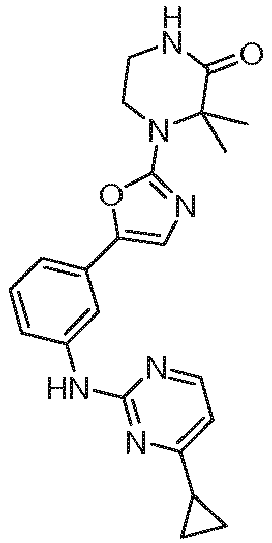
4-{5-[3-(4-Cyclopropyl-pyrimidin-2-ylamino)-phenyl]-oxazol-2-yl}-3,3-dimethyl-piperazin-2-one 1H NMR (400 MHz, DMSO-d 6) δ 9.50 (s, 1H), 8.26 (d, J = 5.1 Hz, 1H), 8.12 (t, J = 2.8 Hz, 1H), 8.08 (t, J = 1.8 Hz, 1H), 7.54 (dd, J = 8.1, 1.3 Hz, 1H), 7.31 - 7.22 (m, 2H), 7.17 - 7.06 (m, 1H), 6.81 (d, J = 5.1 Hz, 1H), 3.74 (dd, J = 5.9, 4.3 Hz, 2H), 3.35 - 3.31 (m, 2H), 2.03 (tt, J = 7.9, 5.2 Hz, 1H), 1.67 (s, 6H), 1.10 - 1.02 (m, 4H). 043 
4-{5-[3-(4-Cyclopropyl-pyrimidin-2-ylamino)-phenyl]-oxazol-2-yl}-3-isopropyl-piperazin-2-one 1H NMR (400 MHz, DMSO-d 6) δ 9.46 (s, 1H), 8.26 (d, J = 5.0 Hz, 1H), 8.07 (s, 2H), 7.50 (d, J = 8.0 Hz, 1H), 7.26 (t, J = 8.0 Hz, 1H), 7.23 (s, 1H), 7.11 (d, J = 7.7 Hz, 1H), 6.81 (d, J = 5.1 Hz, 1H), 4.23 (d, J = 6.0 Hz, 1H), 4.01 (dt, J = 8.7, 4.1 Hz, 1H), 3.53 (ddd, J = 13.0, 9.0, 4.2 Hz, 1H), 3.42 - 3.34 (m, 1H), 3.30 - 3.24 (m, 1H), 2.37 (td, J = 13.4, 6.5 Hz, 1H), 2.12 - 1.92 (m, 1H), 1.09 - 0.96 (m, 10H). 044 
4-{5-[3-Dimethyl aminomethyl-5-(4-methyl-pyrimidin-2-ylamino)-phenyl]-oxazol-2-yl}-3,3-dimethyl-piperazin-2-one 1H NMR (400 MHz, DMSO-d6) δ 9.59 (s, 1H), 8.33 (d, J = 5.0 Hz, 1H), 8.13 (s, 1H), 8.09 (t, J = 1.8 Hz, 1H), 7.51 (t, J = 1.8 Hz, 1H), 7.27 (s, 1H), 7.06 (d, J = 1.6 Hz, 1H), 6.75 (d, J = 5.0 Hz, 1H), 3.74 - 3.68 (m, 2H), 3.34 - 3.31 (m, 2H), 3.31 (s, 2H), 2.37 (s, 3H), 2.16 (s, 6H), 1.67 (s, 6H). 045 
3,3-Dimethyl-4-{5-[3-(4-methyl-pyrimidin-2-ylamino)-5-pyrrolidin-1-ylmethyl-phenyl]-oxazol-2-yl}-piperazin-2-one 1H NMR (300 MHz, DMSO-d6) δ 9.60 (s, 1H), 8.33 (d, J = 5.0 Hz, 1H), 8.16 (s, 1H), 8.07 (t, J = 1.8 Hz, 1H), 7.53 (t, J = 1.7 Hz, 1H), 7.28 (s, 1H), 7.07 (t, J = 1.5 Hz, 1H), 6.74 (d, J = 5.0 Hz, 1H), 3.72 (dd, J = 6.5, 3.7 Hz, 2H), 3.53 (s, 2H), 3.33 - 3.28 (m, 2H), 2.49 - 2.41 (m, 4H), 2.36 (s, 3H), 1.70 (t, J = 3.4 Hz, 4H), 1.67 (s, 6H). - Protocol inhibition assays. SYK kinase was purified as a full length protein in a baculovirus system near homogeneity. All kinase assays were performed with the Kinase TK (tyrosine kinase) HTRF (Homogeneous Time Resolved Fluorescence) assay developed by Cisbio international. These assays were carried out at room temperature in 96-wells half-area white plates in a final volume of 25µl of kinase buffer (10mM MgCl2; 2mM MnCl2; 50mM Sodium-HEPES pH 7.8; BRIJ-35 0,01%, 1µM substrate) containing ATP at a concentration of at least twice the Km for each enzyme and an appropriate amount of recombinant enzyme to ensure a linear reaction rate. Reactions were initiated upon introduction of the enzyme and terminated with the addition of one reaction volume (25µl) of HTRF detection buffer. Plates were incubated for one hour at room temperature and the time resolved Fluorescence resonance energy transfer signal was measured in a Pherastar FS microplate reader (BMG Labtech). All data are the average of triplicate results with a standard deviation < 10%.
- Experimental results. The experimental results for various compounds according to the invention using above-described protocols are set forth in table 2.
Table 2: in vitro inhibitions of various compounds against Syk IC50 (microM) Compounds IC50 ≤ 0.1 001, 002, 003, 004, 005, 007, 008, 009, 010, 011, 012, 013, 015, 017, 018, 019, 020, 021, 023, 025, 026, 036, 037, 038, 040, 041, 042, 043 0.1 <IC50 < 1 014, 024, 027, 028, 030, 039, 044, 045 1 <IC50 < 10 006, 016, 022, 029, 031, 032, 033, 034, 035 IC50: Concentration inhibiting 50% of protein kinase. - Comments on the experiments and results. A very effective inhibition of Syk is observed by the class of compounds of formula (I) as herein disclosed. The listed compounds in table 1 are well representing the class of compounds of formula (I).
Claims (13)
- A compound of formula (I):
 R1 , R2, R3 and R4 are each independently selected from:hydrogen;cyano;haloalkyl;halogen;alkyl group optionally substituted with a group selected from an heterocycle and -NRR';alkoxy group optionally substituted with a group selected from an heterocycle and -NRR';water-solubilising group;heterocycle;-CO-NRR';-SO2-NRR';-NRR';-NR-CO-R' and-NR-SO2R' group;
wherein R and R' are each independently selected from hydrogen and alkyl group;R5 is an alkyl group optionally substituted with a group selected from heterocycle, hydroxyl, cyano, amino and alkoxy;R6 is selected from hydrogen, alkyl group and cycloalkyl group;W is a pyrimidinyl group, the pyrimidinyl group being monosubstituted or disubstituted by one or two substituents selected from:cyano;haloalkyl;halogen;an alkyl group optionally substituted with an heterocycle;a cycloalkyl group;an alkoxy group optionally substituted with an heterocycle;an aryl group;a heteroaryl group;a heterocycloalkyl group optionally substituted with an alkyl group;a water-solubilising group;-CO-NRR';-SO2-NRR';-NRR';-NR-CO-R' and-NR-SO2R' group;wherein the water-solubilizing group is selected from:
wherein R and R' are each independently selected from hydrogen and alkyl group,N-(CH2)zR";N-(CH2)z-C(O)R";N-(CH2)z-C(O)OR";N-(CH2)z-S(O)2R";N-(CH2)z-S(O)2OR";N-(CH2)z-C(O)NR"R'" andthe following structures (a)-(k):

 L is selected from CH and N;M is selected from -CH(R")-, -CH2-, -O-, -S-, -NH-, -N(-(CH2)z-R")-, -N(-(CH2)z-C(O)R")-, -N(-(CH2)z-C(O)OR")-, -N(-(CH2)z-S(O)2R")-, -N(-(CH2)z-S(O)2OR")- and -N(-(CH2)z-C(O)NR"R'")-, with the proviso that L and M are not both simultaneously CH and CH2, respectively;z is an integer ranging from 0 to 6;R" and R'" are each independently selected from hydrogen; a C1-C10 alkyl group optionally substituted with one or more heteroatoms selected from F, Cl, Br, I, O and N; a C1-C10 alkoxy group; an unsubstituted aryl and an unsubstituted heteroaryl.
 - The compound according to claim 1, or a pharmaceutically acceptable salt thereof, wherein at least three of R1 , R2, R3 and R4 are hydrogen.
- The compound according to claim 1 or claim 2, of formula (II);
 wherein R1 , R2, R3, R4, R5 and R6 are as defined in claim 1 or claim 2, andR7 and R8 are each independently selected from:hydrogen;cyano;CF3;halogen;an alkyl group optionally substituted with an heterocycle;a cycloalkyl group;an alkoxy group optionally substituted with an heterocycle;an aryl group;a heteroaryl group;a heterocycloalkyl group optionally substituted with an alkyl group;a water-solubilising group as defined in claim 1, and-NRR';
wherein R and R' are each independently selected from hydrogen and alkyl group. - The compound according to claim 3, of formula (III);

- The compound according to claim 1, selected from the group consisting of:3-Methyl-4-{5-[3-(4-methyl-pyrimidin-2-ylamino)-phenyl]-oxazol-2-yl}-piperazin-2-one;3,3-Dimethyl-4-{5-[3-(4-methyl-pyrimidin-2-ylamino)-phenyl]-oxazol-2-yl}-piperazin-2-one;3-Isopropyl-4-{5-[3-(4-methyl-pyrimidin-2-ylamino)-phenyl]-oxazol-2-yl}-piperazin-2-one;4-{5-[3-(4-Ethyl-pyrimidin-2-ylamino)-phenyl]-oxazol-2-yl}-3-methyl-piperazin-2-one;3,3-Dimethyl-4-{5-[3-(4-methyl-pyrimidin-2-ylamino)-5-morpholin-4-ylmethyl-phenyl]-oxazol-2-yl}-piperazin-2-one;3-Methyl-4-{5-[3-(5-propyl-pyrimidin-2-ylamino)-phenyl]-oxazol-2-yl}-piperazin-2-one;(R)-3-Methyl-4-{5-[3-(4-methyl-pyrimidin-2-ylamino)-phenyl]-oxazol-2-yl}-piperazin-2-one;2-{3-[2-(2-Methyl-3-oxo-piperazin-1-yl)-oxazol-5-yl]-5-(morpholin-4-ylmethyl)-phenylamino}-pyrimidine-4-carbonitrile;3-Methyl-4-{5-[3-((4-trifluoromethyl)-pyrimidin-2-ylamino)-phenyl]-oxazol-2-yl}-piperazin-2-one;3-Methyl-4-{5-[3-(4-thiophen-2-yl-pyrimidin-2-ylamino)-phenyl]-oxazol-2-yl}-piperazin-2-one;3-Ethyl-4-{5-[3-((4-trifluoromethyl)-pyrimidin-2-ylamino)-phenyl]-oxazol-2-yl}-piperazin-2-one;3-Isopropyl-4-{5-[3-((4-trifluoromethyl)-pyrimidin-2-ylamino)-phenyl]-oxazol-2-yl}-piperazin-2-one;4-{5-[3-(4-Methoxy-pyrimidin-2-ylamino)-phenyl]-oxazol-2-yl}-3-methyl-piperazin-2-one;3-Methyl-4-{5-[3-(4-methyl-pyrimidin-2-ylamino)-5-morpholin-4-ylmethyl-phenyl]-oxazol-2-yl}-piperazin-2-one;3-Methyl-4-{5-[3-morpholin-4-ylmethyl-5-((4-trifluoromethyl)-pyrimidin-2-ylamino)-phenyl]-oxazol-2-yl}-piperazin-2-one;4-{5-[3-(5-Ethyl-pyrimidin-2-ylamino)-phenyl]-oxazol-2-yl}-3-methyl-piperazin-2-one;2-{3-[2-(2-Methyl-3-oxo-piperazin-1-yl)-oxazol-5-yl]-phenylamino}-pyrimidine-4-carbonitrile;3,3-Dimethyl-4-{5-[3-((4-trifluoromethyl)-pyrimidin-2-ylamino)-phenyl]-oxazol-2-yl}-piperazin-2-one;(S)-3-Methyl-4-{5-[3-(4-methyl-pyrimidin-2-ylamino)-phenyl]-oxazol-2-yl}-piperazin-2-one;3-Ethyl-4-{5-[3-(4-methyl-pyrimidin-2-ylamino)-phenyl]-oxazol-2-yl}-piperazin-2-one;4-{5-[3-(4-Isopropyl-pyrimidin-2-ylamino)-phenyl]-oxazol-2-yl}-3-methyl-piperazin-2-one;4-{5-[3-(4,5-Dimethyl-pyrimidin-2-ylamino)-phenyl]-oxazol-2-yl}-3,3-dimethyl-piperazin-2-one;4-{5-[3-(4-Isopropyl-pyrimidin-2-ylamino)-phenyl]-oxazol-2-yl}-3,3-dimethyl-piperazin-2-one;3-(2-Hydroxy-ethyl)-4-{5-[3-(4-methyl-pyrimidin-2-ylamino)-phenyl]-oxazol-2-yl}-piperazin-2-one;3-Ethyl-4-{5-[3-(4-isopropyl-pyrimidin-2-ylamino)-phenyl]-oxazol-2-yl}-piperazin-2-one;4-{5-[3-(4-Methoxy-pyrimidin-2-ylamino)-phenyl]-oxazol-2-yl}-3,3-dimethyl-piperazin-2-one;3-Methyl-4-{5-[3-(4-morpholin-4-yl-pyrimidin-2-ylamino)-phenyl]-oxazol-2-yl}-piperazin-2-one;3-Methyl-4-{5-[3-(4-pyrrolidin-1-yl-pyrimidin-2-ylamino)-phenyl]-oxazol-2-yl}-piperazin-2-one;3-Methyl-4-(5-{3-[4-(4-methyl-piperazin-1-yl)-pyrimidin-2-ylamino]-phenyl}-oxazol-2-yl)-piperazin-2-one;3,3-Dimethyl-4-{5-[3-(4-morpholin-4-yl-pyrimidin-2-ylamino)-phenyl]-oxazol-2-yl}-piperazin-2-one;3,3-Dimethyl-4-(5-{3-[4-(4-methyl-piperazin-1-yl)-pyrimidin-2-ylamino]-phenyl}-oxazol-2-yl)-piperazin-2-one;3,3-Dimethyl-4-{5-[3-(4-pyrrolidin-1-yl-pyrimidin-2-ylamino)-phenyl]-oxazol-2-yl}-piperazin-2-one;3-Isopropyl-4-{5-[3-(4-morpholin-4-yl-pyrimidin-2-ylamino)-phenyl]-oxazol-2-yl}-piperazin-2-one;3-Isopropyl-4-{5-[3-(4-pyrrolidin-1-yl-pyrimidin-2-ylamino)-phenyl]-oxazol-2-yl}-piperazin-2-one;3-Isopropyl-4-(5-{3-[4-(4-methyl-piperazin-1-yl)-pyrimidin-2-ylamino]-phenyl}-oxazol-2-yl)-piperazin-2-one;3-Isopropyl-4-{5-[3-(4-isopropyl-pyrimidin-2-ylamino)-phenyl]-oxazol-2-yl}-piperazin-2-one;4-{5-[3-(4-Ethyl-pyrimidin-2-ylamino)-phenyl]-oxazol-2-yl}-3,3-dimethyl-piperazin-2-one;4-{5-[3-(4-Ethyl-pyrimidin-2-ylamino)-phenyl]-oxazol-2-yl}-3-isopropyl-piperazin-2-one;(S)-3-Isopropyl-4-{5-[3-(4-methyl-pyrimidin-2-ylamino)-phenyl]-oxazol-2-yl}-piperazin-2-one;(R)-3-Isopropyl-4-{5-[3-(4-methyl-pyrimidin-2-ylamino)-phenyl]-oxazol-2-yl}-piperazin-2-one;4-{5-[3-(4-Cyclopropyl-pyrimidin-2-ylamino)-phenyl]-oxazol-2-yl}-3-methyl-piperazin-2-one;4-{5-[3-(4-Cyclopropyl-pyrimidin-2-ylamino)-phenyl]-oxazol-2-yl}-3,3-dimethyl-piperazin-2-one;4-{5-[3-(4-Cyclopropyl-pyrimidin-2-ylamino)-phenyl]-oxazol-2-yl}-3-isopropyl-piperazin-2-one;4-{5-[3-Dimethyl aminomethyl-5-(4-methyl-pyrimidin-2-ylamino)-phenyl]-oxazol-2-yl} -3,3 -dimethyl-piperazin-2-one;3,3-Dimethyl-4-{5-[3-(4-methyl-pyrimidin-2-ylamino)-5-pyrrolidin-1-ylmethyl-phenyl]-oxazol-2-yl}-piperazin-2-one;and a pharmaceutically acceptable salt thereof.
- A pharmaceutical composition comprising a compound according to any one of claims 1 to 5, and at least one pharmaceutically acceptable excipient and/or carrier.
- The pharmaceutical composition according to claim 6, comprising a compound according to any one of claims 1 to 5, as sole active pharmaceutical ingredient or in combination with another active pharmaceutical ingredient.
- A compound according to any one of claims 1 to 5, for use as a medicament.
- A compound according to any one of claims 1 to 5, for use in treating a disease or disorder associated with unregulated tyrosine kinase activity.
- The compound for use according to claim 9, wherein the disease or disorder associated with unregulated tyrosine kinase activity is selected from the group consisting of hematological disorders, proliferative disorders, autoimmune disorders, metabolic disorders, inflammatory diseases, allergic diseases and neurological diseases.
- The pharmaceutical composition according to claim 7, comprising a compound according to any one of claims 1 to 5, and another active pharmaceutical ingredient as a combined preparation for sequential, simultaneous or separate use in the treatment of a disease or disorder selected from the group consisting of hematological disorders, proliferative disorders, autoimmune disorders, metabolic disorders, inflammatory diseases, allergic diseases and neurological diseases.
- A process for the manufacturing of a compound according to any one of claims 1 to 5, said process comprising a step of reacting a compound of formula (A)

wherein R1, R2, R3, R4, R5, R6, and W are as defined in any one of claims 1 to 5, and X represents a halogen atom. - A process for the manufacturing of a compound according to any one of claims 1 to 5, said process comprising a step of reacting a compound of formula (B)


Applications Claiming Priority (2)
| Application Number | Priority Date | Filing Date | Title |
|---|---|---|---|
| EP15185910.5A EP3144307A1 (en) | 2015-09-18 | 2015-09-18 | Novel oxazole derivatives that inhibit syk |
| PCT/EP2016/071930 WO2017046302A1 (en) | 2015-09-18 | 2016-09-16 | Novel oxazole derivatives that inhibit syk |
Publications (2)
| Publication Number | Publication Date |
|---|---|
| EP3350176A1 EP3350176A1 (en) | 2018-07-25 |
| EP3350176B1 true EP3350176B1 (en) | 2021-04-28 |
Family
ID=54150338
Family Applications (2)
| Application Number | Title | Priority Date | Filing Date |
|---|---|---|---|
| EP15185910.5A Withdrawn EP3144307A1 (en) | 2015-09-18 | 2015-09-18 | Novel oxazole derivatives that inhibit syk |
| EP16769948.7A Active EP3350176B1 (en) | 2015-09-18 | 2016-09-16 | Novel oxazole derivatives that inhibit syk |
Family Applications Before (1)
| Application Number | Title | Priority Date | Filing Date |
|---|---|---|---|
| EP15185910.5A Withdrawn EP3144307A1 (en) | 2015-09-18 | 2015-09-18 | Novel oxazole derivatives that inhibit syk |
Country Status (3)
| Country | Link |
|---|---|
| US (1) | US10392373B2 (en) |
| EP (2) | EP3144307A1 (en) |
| WO (1) | WO2017046302A1 (en) |
Families Citing this family (6)
| Publication number | Priority date | Publication date | Assignee | Title |
|---|---|---|---|---|
| ES2796276T3 (en) * | 2015-02-05 | 2020-11-26 | Ab Science | Compounds with antitumor activity |
| CN108129404B (en) * | 2018-01-30 | 2020-05-01 | 凯瑞斯德生化(苏州)有限公司 | Synthesis method of chiral piperazinone derivative |
| CN110396067B (en) * | 2018-04-25 | 2022-07-08 | 复旦大学 | 1, 4-disubstituted-2-piperazinone compound and pharmaceutical application thereof |
| EP3942045A1 (en) | 2019-03-21 | 2022-01-26 | Onxeo | A dbait molecule in combination with kinase inhibitor for the treatment of cancer |
| EP4054579A1 (en) | 2019-11-08 | 2022-09-14 | Institut National de la Santé et de la Recherche Médicale (INSERM) | Methods for the treatment of cancers that have acquired resistance to kinase inhibitors |
| WO2021148581A1 (en) | 2020-01-22 | 2021-07-29 | Onxeo | Novel dbait molecule and its use |
Family Cites Families (16)
| Publication number | Priority date | Publication date | Assignee | Title |
|---|---|---|---|---|
| US3740420A (en) | 1967-11-28 | 1973-06-19 | Crown Zellerbach Corp | Pharmaceutical compositions with dimethyl sulfoxide |
| US3743727A (en) | 1970-11-16 | 1973-07-03 | Crown Zellerbach Corp | Enhancing tissue penetration of certain antimicrobial agents with dimethyl sulfoxide |
| US3989816A (en) | 1975-06-19 | 1976-11-02 | Nelson Research & Development Company | Vehicle composition containing 1-substituted azacycloheptan-2-ones |
| US4405616A (en) | 1975-06-19 | 1983-09-20 | Nelson Research & Development Company | Penetration enhancers for transdermal drug delivery of systemic agents |
| CA1163561A (en) | 1979-11-06 | 1984-03-13 | Cyril Boroda | Preparation containing nitroglycerine and optionally other medicaments and preparation thereof |
| US4460372A (en) | 1981-02-17 | 1984-07-17 | Alza Corporation | Percutaneous absorption enhancer dispenser for use in coadministering drug and percutaneous absorption enhancer |
| US4379454A (en) | 1981-02-17 | 1983-04-12 | Alza Corporation | Dosage for coadministering drug and percutaneous absorption enhancer |
| US4411893A (en) | 1981-08-14 | 1983-10-25 | Minnesota Mining And Manufacturing Company | Topical medicament preparations |
| CA1236029A (en) | 1984-05-14 | 1988-05-03 | Edmund Sandborn | Pharmaceutical solutions comprising dimethyl sulfoxide |
| US4615699A (en) | 1985-05-03 | 1986-10-07 | Alza Corporation | Transdermal delivery system for delivering nitroglycerin at high transdermal fluxes |
| DE3815221C2 (en) | 1988-05-04 | 1995-06-29 | Gradinger F Hermes Pharma | Use of a retinol and / or retinoic acid ester-containing pharmaceutical preparation for inhalation for acting on the mucous membranes of the tracheo-bronchial tract, including the lung alveoli |
| US5906202A (en) | 1996-11-21 | 1999-05-25 | Aradigm Corporation | Device and method for directing aerosolized mist to a specific area of the respiratory tract |
| GB0402653D0 (en) | 2004-02-06 | 2004-03-10 | Cyclacel Ltd | Compounds |
| GB0503962D0 (en) | 2005-02-25 | 2005-04-06 | Kudos Pharm Ltd | Compounds |
| EP2512246B1 (en) * | 2009-12-17 | 2015-09-30 | Merck Sharp & Dohme Corp. | Aminopyrimidines as syk inhibitors |
| TWI523852B (en) * | 2010-01-12 | 2016-03-01 | Ab科學公司 | Substituted azole derivatives, compositions comprising the same and uses thereof |
-
2015
- 2015-09-18 EP EP15185910.5A patent/EP3144307A1/en not_active Withdrawn
-
2016
- 2016-09-16 EP EP16769948.7A patent/EP3350176B1/en active Active
- 2016-09-16 WO PCT/EP2016/071930 patent/WO2017046302A1/en not_active Ceased
- 2016-09-16 US US15/760,362 patent/US10392373B2/en active Active
Non-Patent Citations (1)
| Title |
|---|
| None * |
Also Published As
| Publication number | Publication date |
|---|---|
| EP3350176A1 (en) | 2018-07-25 |
| US20190055230A1 (en) | 2019-02-21 |
| EP3144307A1 (en) | 2017-03-22 |
| WO2017046302A1 (en) | 2017-03-23 |
| US10392373B2 (en) | 2019-08-27 |
Similar Documents
| Publication | Publication Date | Title |
|---|---|---|
| ES2539170T3 (en) | Oxazole Kinase Inhibitors | |
| US10392373B2 (en) | Oxazole derivatives that inhibit Syk | |
| US9896435B2 (en) | N-pyrrolidinyl,N′-pyrazolyl-urea, thiourea, guanidine and cyanoguanidine compounds as TrkA kinase inhibitors | |
| KR101924247B1 (en) | Oxazole and thiazole derivatives as selective protein kinase inhibitors (C-KIT) | |
| TW201336825A (en) | Bicyclic aryl and heteroaryl sodium channel inhibitors | |
| AU2016214283B2 (en) | Compounds with anti-tumoral activity | |
| EP3122744B1 (en) | Diazaspiroalkaneone-substituted oxazole derivatives as spleen tyrosine kinase inhibitors | |
| HK1177205B (en) | Oxazole kinase inhibitors | |
| HK1225031A1 (en) | Compounds with anti-tumoral activity |
Legal Events
| Date | Code | Title | Description |
|---|---|---|---|
| STAA | Information on the status of an ep patent application or granted ep patent |
Free format text: STATUS: THE INTERNATIONAL PUBLICATION HAS BEEN MADE |
|
| PUAI | Public reference made under article 153(3) epc to a published international application that has entered the european phase |
Free format text: ORIGINAL CODE: 0009012 |
|
| STAA | Information on the status of an ep patent application or granted ep patent |
Free format text: STATUS: REQUEST FOR EXAMINATION WAS MADE |
|
| 17P | Request for examination filed |
Effective date: 20180418 |
|
| AK | Designated contracting states |
Kind code of ref document: A1 Designated state(s): AL AT BE BG CH CY CZ DE DK EE ES FI FR GB GR HR HU IE IS IT LI LT LU LV MC MK MT NL NO PL PT RO RS SE SI SK SM TR |
|
| AX | Request for extension of the european patent |
Extension state: BA ME |
|
| RIN1 | Information on inventor provided before grant (corrected) |
Inventor name: MARTIN, JASON Inventor name: SCHALON, CLAIRE Inventor name: PEZ, DIDIER Inventor name: PICOUL, WILLY Inventor name: SANDRINELLI, FRANCK Inventor name: CHEVENIER, EMMANUEL Inventor name: MOUSSY, ALAIN Inventor name: BENJAHAD, ABDELLAH |
|
| DAV | Request for validation of the european patent (deleted) | ||
| DAX | Request for extension of the european patent (deleted) | ||
| STAA | Information on the status of an ep patent application or granted ep patent |
Free format text: STATUS: EXAMINATION IS IN PROGRESS |
|
| 17Q | First examination report despatched |
Effective date: 20200103 |
|
| GRAP | Despatch of communication of intention to grant a patent |
Free format text: ORIGINAL CODE: EPIDOSNIGR1 |
|
| STAA | Information on the status of an ep patent application or granted ep patent |
Free format text: STATUS: GRANT OF PATENT IS INTENDED |
|
| INTG | Intention to grant announced |
Effective date: 20201124 |
|
| GRAS | Grant fee paid |
Free format text: ORIGINAL CODE: EPIDOSNIGR3 |
|
| GRAA | (expected) grant |
Free format text: ORIGINAL CODE: 0009210 |
|
| STAA | Information on the status of an ep patent application or granted ep patent |
Free format text: STATUS: THE PATENT HAS BEEN GRANTED |
|
| AK | Designated contracting states |
Kind code of ref document: B1 Designated state(s): AL AT BE BG CH CY CZ DE DK EE ES FI FR GB GR HR HU IE IS IT LI LT LU LV MC MK MT NL NO PL PT RO RS SE SI SK SM TR |
|
| REG | Reference to a national code |
Ref country code: GB Ref legal event code: FG4D |
|
| RIN1 | Information on inventor provided before grant (corrected) |
Inventor name: MOUSSY, ALAIN Inventor name: BENJAHAD, ABDELLAH Inventor name: PEZ, DIDIER Inventor name: SCHALON, CLAIRE Inventor name: SANDRINELLI, FRANCK Inventor name: MARTIN, JASON Inventor name: PICOUL, WILLY Inventor name: CHEVENIER, EMMANUEL |
|
| REG | Reference to a national code |
Ref country code: CH Ref legal event code: EP |
|
| REG | Reference to a national code |
Ref country code: AT Ref legal event code: REF Ref document number: 1386931 Country of ref document: AT Kind code of ref document: T Effective date: 20210515 |
|
| REG | Reference to a national code |
Ref country code: DE Ref legal event code: R096 Ref document number: 602016056956 Country of ref document: DE |
|
| REG | Reference to a national code |
Ref country code: IE Ref legal event code: FG4D |
|
| REG | Reference to a national code |
Ref country code: LT Ref legal event code: MG9D |
|
| REG | Reference to a national code |
Ref country code: AT Ref legal event code: MK05 Ref document number: 1386931 Country of ref document: AT Kind code of ref document: T Effective date: 20210428 |
|
| PG25 | Lapsed in a contracting state [announced via postgrant information from national office to epo] |
Ref country code: FI Free format text: LAPSE BECAUSE OF FAILURE TO SUBMIT A TRANSLATION OF THE DESCRIPTION OR TO PAY THE FEE WITHIN THE PRESCRIBED TIME-LIMIT Effective date: 20210428 Ref country code: NL Free format text: LAPSE BECAUSE OF FAILURE TO SUBMIT A TRANSLATION OF THE DESCRIPTION OR TO PAY THE FEE WITHIN THE PRESCRIBED TIME-LIMIT Effective date: 20210428 Ref country code: LT Free format text: LAPSE BECAUSE OF FAILURE TO SUBMIT A TRANSLATION OF THE DESCRIPTION OR TO PAY THE FEE WITHIN THE PRESCRIBED TIME-LIMIT Effective date: 20210428 Ref country code: AT Free format text: LAPSE BECAUSE OF FAILURE TO SUBMIT A TRANSLATION OF THE DESCRIPTION OR TO PAY THE FEE WITHIN THE PRESCRIBED TIME-LIMIT Effective date: 20210428 Ref country code: BG Free format text: LAPSE BECAUSE OF FAILURE TO SUBMIT A TRANSLATION OF THE DESCRIPTION OR TO PAY THE FEE WITHIN THE PRESCRIBED TIME-LIMIT Effective date: 20210728 Ref country code: HR Free format text: LAPSE BECAUSE OF FAILURE TO SUBMIT A TRANSLATION OF THE DESCRIPTION OR TO PAY THE FEE WITHIN THE PRESCRIBED TIME-LIMIT Effective date: 20210428 |
|
| PG25 | Lapsed in a contracting state [announced via postgrant information from national office to epo] |
Ref country code: LV Free format text: LAPSE BECAUSE OF FAILURE TO SUBMIT A TRANSLATION OF THE DESCRIPTION OR TO PAY THE FEE WITHIN THE PRESCRIBED TIME-LIMIT Effective date: 20210428 Ref country code: IS Free format text: LAPSE BECAUSE OF FAILURE TO SUBMIT A TRANSLATION OF THE DESCRIPTION OR TO PAY THE FEE WITHIN THE PRESCRIBED TIME-LIMIT Effective date: 20210828 Ref country code: GR Free format text: LAPSE BECAUSE OF FAILURE TO SUBMIT A TRANSLATION OF THE DESCRIPTION OR TO PAY THE FEE WITHIN THE PRESCRIBED TIME-LIMIT Effective date: 20210729 Ref country code: PL Free format text: LAPSE BECAUSE OF FAILURE TO SUBMIT A TRANSLATION OF THE DESCRIPTION OR TO PAY THE FEE WITHIN THE PRESCRIBED TIME-LIMIT Effective date: 20210428 Ref country code: PT Free format text: LAPSE BECAUSE OF FAILURE TO SUBMIT A TRANSLATION OF THE DESCRIPTION OR TO PAY THE FEE WITHIN THE PRESCRIBED TIME-LIMIT Effective date: 20210830 Ref country code: NO Free format text: LAPSE BECAUSE OF FAILURE TO SUBMIT A TRANSLATION OF THE DESCRIPTION OR TO PAY THE FEE WITHIN THE PRESCRIBED TIME-LIMIT Effective date: 20210728 Ref country code: RS Free format text: LAPSE BECAUSE OF FAILURE TO SUBMIT A TRANSLATION OF THE DESCRIPTION OR TO PAY THE FEE WITHIN THE PRESCRIBED TIME-LIMIT Effective date: 20210428 Ref country code: SE Free format text: LAPSE BECAUSE OF FAILURE TO SUBMIT A TRANSLATION OF THE DESCRIPTION OR TO PAY THE FEE WITHIN THE PRESCRIBED TIME-LIMIT Effective date: 20210428 |
|
| REG | Reference to a national code |
Ref country code: NL Ref legal event code: MP Effective date: 20210428 |
|
| PG25 | Lapsed in a contracting state [announced via postgrant information from national office to epo] |
Ref country code: DK Free format text: LAPSE BECAUSE OF FAILURE TO SUBMIT A TRANSLATION OF THE DESCRIPTION OR TO PAY THE FEE WITHIN THE PRESCRIBED TIME-LIMIT Effective date: 20210428 Ref country code: CZ Free format text: LAPSE BECAUSE OF FAILURE TO SUBMIT A TRANSLATION OF THE DESCRIPTION OR TO PAY THE FEE WITHIN THE PRESCRIBED TIME-LIMIT Effective date: 20210428 Ref country code: EE Free format text: LAPSE BECAUSE OF FAILURE TO SUBMIT A TRANSLATION OF THE DESCRIPTION OR TO PAY THE FEE WITHIN THE PRESCRIBED TIME-LIMIT Effective date: 20210428 Ref country code: SK Free format text: LAPSE BECAUSE OF FAILURE TO SUBMIT A TRANSLATION OF THE DESCRIPTION OR TO PAY THE FEE WITHIN THE PRESCRIBED TIME-LIMIT Effective date: 20210428 Ref country code: SM Free format text: LAPSE BECAUSE OF FAILURE TO SUBMIT A TRANSLATION OF THE DESCRIPTION OR TO PAY THE FEE WITHIN THE PRESCRIBED TIME-LIMIT Effective date: 20210428 Ref country code: RO Free format text: LAPSE BECAUSE OF FAILURE TO SUBMIT A TRANSLATION OF THE DESCRIPTION OR TO PAY THE FEE WITHIN THE PRESCRIBED TIME-LIMIT Effective date: 20210428 Ref country code: ES Free format text: LAPSE BECAUSE OF FAILURE TO SUBMIT A TRANSLATION OF THE DESCRIPTION OR TO PAY THE FEE WITHIN THE PRESCRIBED TIME-LIMIT Effective date: 20210428 |
|
| REG | Reference to a national code |
Ref country code: DE Ref legal event code: R097 Ref document number: 602016056956 Country of ref document: DE |
|
| PLBE | No opposition filed within time limit |
Free format text: ORIGINAL CODE: 0009261 |
|
| STAA | Information on the status of an ep patent application or granted ep patent |
Free format text: STATUS: NO OPPOSITION FILED WITHIN TIME LIMIT |
|
| 26N | No opposition filed |
Effective date: 20220131 |
|
| REG | Reference to a national code |
Ref country code: CH Ref legal event code: PL |
|
| REG | Reference to a national code |
Ref country code: BE Ref legal event code: MM Effective date: 20210930 |
|
| PG25 | Lapsed in a contracting state [announced via postgrant information from national office to epo] |
Ref country code: IS Free format text: LAPSE BECAUSE OF FAILURE TO SUBMIT A TRANSLATION OF THE DESCRIPTION OR TO PAY THE FEE WITHIN THE PRESCRIBED TIME-LIMIT Effective date: 20210828 Ref country code: MC Free format text: LAPSE BECAUSE OF FAILURE TO SUBMIT A TRANSLATION OF THE DESCRIPTION OR TO PAY THE FEE WITHIN THE PRESCRIBED TIME-LIMIT Effective date: 20210428 Ref country code: AL Free format text: LAPSE BECAUSE OF FAILURE TO SUBMIT A TRANSLATION OF THE DESCRIPTION OR TO PAY THE FEE WITHIN THE PRESCRIBED TIME-LIMIT Effective date: 20210428 |
|
| PG25 | Lapsed in a contracting state [announced via postgrant information from national office to epo] |
Ref country code: LU Free format text: LAPSE BECAUSE OF NON-PAYMENT OF DUE FEES Effective date: 20210916 Ref country code: IT Free format text: LAPSE BECAUSE OF FAILURE TO SUBMIT A TRANSLATION OF THE DESCRIPTION OR TO PAY THE FEE WITHIN THE PRESCRIBED TIME-LIMIT Effective date: 20210428 Ref country code: IE Free format text: LAPSE BECAUSE OF NON-PAYMENT OF DUE FEES Effective date: 20210916 Ref country code: BE Free format text: LAPSE BECAUSE OF NON-PAYMENT OF DUE FEES Effective date: 20210930 |
|
| PG25 | Lapsed in a contracting state [announced via postgrant information from national office to epo] |
Ref country code: LI Free format text: LAPSE BECAUSE OF NON-PAYMENT OF DUE FEES Effective date: 20210930 Ref country code: CH Free format text: LAPSE BECAUSE OF NON-PAYMENT OF DUE FEES Effective date: 20210930 |
|
| PG25 | Lapsed in a contracting state [announced via postgrant information from national office to epo] |
Ref country code: HU Free format text: LAPSE BECAUSE OF FAILURE TO SUBMIT A TRANSLATION OF THE DESCRIPTION OR TO PAY THE FEE WITHIN THE PRESCRIBED TIME-LIMIT; INVALID AB INITIO Effective date: 20160916 |
|
| P01 | Opt-out of the competence of the unified patent court (upc) registered |
Effective date: 20230509 |
|
| PG25 | Lapsed in a contracting state [announced via postgrant information from national office to epo] |
Ref country code: CY Free format text: LAPSE BECAUSE OF FAILURE TO SUBMIT A TRANSLATION OF THE DESCRIPTION OR TO PAY THE FEE WITHIN THE PRESCRIBED TIME-LIMIT Effective date: 20210428 |
|
| PG25 | Lapsed in a contracting state [announced via postgrant information from national office to epo] |
Ref country code: MK Free format text: LAPSE BECAUSE OF FAILURE TO SUBMIT A TRANSLATION OF THE DESCRIPTION OR TO PAY THE FEE WITHIN THE PRESCRIBED TIME-LIMIT Effective date: 20210428 |
|
| PG25 | Lapsed in a contracting state [announced via postgrant information from national office to epo] |
Ref country code: TR Free format text: LAPSE BECAUSE OF FAILURE TO SUBMIT A TRANSLATION OF THE DESCRIPTION OR TO PAY THE FEE WITHIN THE PRESCRIBED TIME-LIMIT Effective date: 20210428 |
|
| PG25 | Lapsed in a contracting state [announced via postgrant information from national office to epo] |
Ref country code: MT Free format text: LAPSE BECAUSE OF FAILURE TO SUBMIT A TRANSLATION OF THE DESCRIPTION OR TO PAY THE FEE WITHIN THE PRESCRIBED TIME-LIMIT Effective date: 20210428 |
|
| PGFP | Annual fee paid to national office [announced via postgrant information from national office to epo] |
Ref country code: DE Payment date: 20250919 Year of fee payment: 10 |
|
| PGFP | Annual fee paid to national office [announced via postgrant information from national office to epo] |
Ref country code: GB Payment date: 20250919 Year of fee payment: 10 |
|
| PGFP | Annual fee paid to national office [announced via postgrant information from national office to epo] |
Ref country code: FR Payment date: 20250922 Year of fee payment: 10 |