EP3349165A1 - Recognition method and apparatus for user relationship, storage medium, and server - Google Patents
Recognition method and apparatus for user relationship, storage medium, and server Download PDFInfo
- Publication number
- EP3349165A1 EP3349165A1 EP15905253.9A EP15905253A EP3349165A1 EP 3349165 A1 EP3349165 A1 EP 3349165A1 EP 15905253 A EP15905253 A EP 15905253A EP 3349165 A1 EP3349165 A1 EP 3349165A1
- Authority
- EP
- European Patent Office
- Prior art keywords
- wireless network
- network address
- set position
- users
- cluster
- Prior art date
- Legal status (The legal status is an assumption and is not a legal conclusion. Google has not performed a legal analysis and makes no representation as to the accuracy of the status listed.)
- Ceased
Links
Images
Classifications
-
- G—PHYSICS
- G06—COMPUTING OR CALCULATING; COUNTING
- G06Q—INFORMATION AND COMMUNICATION TECHNOLOGY [ICT] SPECIALLY ADAPTED FOR ADMINISTRATIVE, COMMERCIAL, FINANCIAL, MANAGERIAL OR SUPERVISORY PURPOSES; SYSTEMS OR METHODS SPECIALLY ADAPTED FOR ADMINISTRATIVE, COMMERCIAL, FINANCIAL, MANAGERIAL OR SUPERVISORY PURPOSES, NOT OTHERWISE PROVIDED FOR
- G06Q30/00—Commerce
- G06Q30/02—Marketing; Price estimation or determination; Fundraising
- G06Q30/0201—Market modelling; Market analysis; Collecting market data
-
- G—PHYSICS
- G01—MEASURING; TESTING
- G01S—RADIO DIRECTION-FINDING; RADIO NAVIGATION; DETERMINING DISTANCE OR VELOCITY BY USE OF RADIO WAVES; LOCATING OR PRESENCE-DETECTING BY USE OF THE REFLECTION OR RERADIATION OF RADIO WAVES; ANALOGOUS ARRANGEMENTS USING OTHER WAVES
- G01S19/00—Satellite radio beacon positioning systems; Determining position, velocity or attitude using signals transmitted by such systems
- G01S19/38—Determining a navigation solution using signals transmitted by a satellite radio beacon positioning system
- G01S19/39—Determining a navigation solution using signals transmitted by a satellite radio beacon positioning system the satellite radio beacon positioning system transmitting time-stamped messages, e.g. GPS [Global Positioning System], GLONASS [Global Orbiting Navigation Satellite System] or GALILEO
- G01S19/42—Determining position
-
- G—PHYSICS
- G01—MEASURING; TESTING
- G01S—RADIO DIRECTION-FINDING; RADIO NAVIGATION; DETERMINING DISTANCE OR VELOCITY BY USE OF RADIO WAVES; LOCATING OR PRESENCE-DETECTING BY USE OF THE REFLECTION OR RERADIATION OF RADIO WAVES; ANALOGOUS ARRANGEMENTS USING OTHER WAVES
- G01S19/00—Satellite radio beacon positioning systems; Determining position, velocity or attitude using signals transmitted by such systems
- G01S19/38—Determining a navigation solution using signals transmitted by a satellite radio beacon positioning system
- G01S19/39—Determining a navigation solution using signals transmitted by a satellite radio beacon positioning system the satellite radio beacon positioning system transmitting time-stamped messages, e.g. GPS [Global Positioning System], GLONASS [Global Orbiting Navigation Satellite System] or GALILEO
- G01S19/42—Determining position
- G01S19/51—Relative positioning
-
- G—PHYSICS
- G06—COMPUTING OR CALCULATING; COUNTING
- G06F—ELECTRIC DIGITAL DATA PROCESSING
- G06F16/00—Information retrieval; Database structures therefor; File system structures therefor
- G06F16/90—Details of database functions independent of the retrieved data types
- G06F16/901—Indexing; Data structures therefor; Storage structures
-
- G—PHYSICS
- G06—COMPUTING OR CALCULATING; COUNTING
- G06F—ELECTRIC DIGITAL DATA PROCESSING
- G06F18/00—Pattern recognition
- G06F18/20—Analysing
- G06F18/23—Clustering techniques
-
- G—PHYSICS
- G06—COMPUTING OR CALCULATING; COUNTING
- G06F—ELECTRIC DIGITAL DATA PROCESSING
- G06F18/00—Pattern recognition
- G06F18/20—Analysing
- G06F18/24—Classification techniques
- G06F18/241—Classification techniques relating to the classification model, e.g. parametric or non-parametric approaches
- G06F18/2411—Classification techniques relating to the classification model, e.g. parametric or non-parametric approaches based on the proximity to a decision surface, e.g. support vector machines
-
- G—PHYSICS
- G06—COMPUTING OR CALCULATING; COUNTING
- G06F—ELECTRIC DIGITAL DATA PROCESSING
- G06F18/00—Pattern recognition
- G06F18/20—Analysing
- G06F18/24—Classification techniques
- G06F18/241—Classification techniques relating to the classification model, e.g. parametric or non-parametric approaches
- G06F18/2413—Classification techniques relating to the classification model, e.g. parametric or non-parametric approaches based on distances to training or reference patterns
- G06F18/24147—Distances to closest patterns, e.g. nearest neighbour classification
-
- G—PHYSICS
- G06—COMPUTING OR CALCULATING; COUNTING
- G06F—ELECTRIC DIGITAL DATA PROCESSING
- G06F18/00—Pattern recognition
- G06F18/20—Analysing
- G06F18/24—Classification techniques
- G06F18/243—Classification techniques relating to the number of classes
- G06F18/24323—Tree-organised classifiers
-
- G—PHYSICS
- G06—COMPUTING OR CALCULATING; COUNTING
- G06N—COMPUTING ARRANGEMENTS BASED ON SPECIFIC COMPUTATIONAL MODELS
- G06N5/00—Computing arrangements using knowledge-based models
-
- G—PHYSICS
- G06—COMPUTING OR CALCULATING; COUNTING
- G06N—COMPUTING ARRANGEMENTS BASED ON SPECIFIC COMPUTATIONAL MODELS
- G06N7/00—Computing arrangements based on specific mathematical models
- G06N7/02—Computing arrangements based on specific mathematical models using fuzzy logic
- G06N7/023—Learning or tuning the parameters of a fuzzy system
-
- G—PHYSICS
- G06—COMPUTING OR CALCULATING; COUNTING
- G06Q—INFORMATION AND COMMUNICATION TECHNOLOGY [ICT] SPECIALLY ADAPTED FOR ADMINISTRATIVE, COMMERCIAL, FINANCIAL, MANAGERIAL OR SUPERVISORY PURPOSES; SYSTEMS OR METHODS SPECIALLY ADAPTED FOR ADMINISTRATIVE, COMMERCIAL, FINANCIAL, MANAGERIAL OR SUPERVISORY PURPOSES, NOT OTHERWISE PROVIDED FOR
- G06Q10/00—Administration; Management
- G06Q10/06—Resources, workflows, human or project management; Enterprise or organisation planning; Enterprise or organisation modelling
- G06Q10/063—Operations research, analysis or management
- G06Q10/0635—Risk analysis of enterprise or organisation activities
-
- G—PHYSICS
- G06—COMPUTING OR CALCULATING; COUNTING
- G06Q—INFORMATION AND COMMUNICATION TECHNOLOGY [ICT] SPECIALLY ADAPTED FOR ADMINISTRATIVE, COMMERCIAL, FINANCIAL, MANAGERIAL OR SUPERVISORY PURPOSES; SYSTEMS OR METHODS SPECIALLY ADAPTED FOR ADMINISTRATIVE, COMMERCIAL, FINANCIAL, MANAGERIAL OR SUPERVISORY PURPOSES, NOT OTHERWISE PROVIDED FOR
- G06Q10/00—Administration; Management
- G06Q10/40—Business processes related to social networking or social networking services
-
- G—PHYSICS
- G06—COMPUTING OR CALCULATING; COUNTING
- G06Q—INFORMATION AND COMMUNICATION TECHNOLOGY [ICT] SPECIALLY ADAPTED FOR ADMINISTRATIVE, COMMERCIAL, FINANCIAL, MANAGERIAL OR SUPERVISORY PURPOSES; SYSTEMS OR METHODS SPECIALLY ADAPTED FOR ADMINISTRATIVE, COMMERCIAL, FINANCIAL, MANAGERIAL OR SUPERVISORY PURPOSES, NOT OTHERWISE PROVIDED FOR
- G06Q10/00—Administration; Management
- G06Q10/40—Business processes related to social networking or social networking services
- G06Q10/42—Determination of affinities or common interests between users
-
- G—PHYSICS
- G06—COMPUTING OR CALCULATING; COUNTING
- G06Q—INFORMATION AND COMMUNICATION TECHNOLOGY [ICT] SPECIALLY ADAPTED FOR ADMINISTRATIVE, COMMERCIAL, FINANCIAL, MANAGERIAL OR SUPERVISORY PURPOSES; SYSTEMS OR METHODS SPECIALLY ADAPTED FOR ADMINISTRATIVE, COMMERCIAL, FINANCIAL, MANAGERIAL OR SUPERVISORY PURPOSES, NOT OTHERWISE PROVIDED FOR
- G06Q30/00—Commerce
- G06Q30/02—Marketing; Price estimation or determination; Fundraising
-
- G—PHYSICS
- G06—COMPUTING OR CALCULATING; COUNTING
- G06Q—INFORMATION AND COMMUNICATION TECHNOLOGY [ICT] SPECIALLY ADAPTED FOR ADMINISTRATIVE, COMMERCIAL, FINANCIAL, MANAGERIAL OR SUPERVISORY PURPOSES; SYSTEMS OR METHODS SPECIALLY ADAPTED FOR ADMINISTRATIVE, COMMERCIAL, FINANCIAL, MANAGERIAL OR SUPERVISORY PURPOSES, NOT OTHERWISE PROVIDED FOR
- G06Q30/00—Commerce
- G06Q30/02—Marketing; Price estimation or determination; Fundraising
- G06Q30/0207—Discounts or incentives, e.g. coupons or rebates
- G06Q30/0214—Referral reward systems
-
- G—PHYSICS
- G06—COMPUTING OR CALCULATING; COUNTING
- G06Q—INFORMATION AND COMMUNICATION TECHNOLOGY [ICT] SPECIALLY ADAPTED FOR ADMINISTRATIVE, COMMERCIAL, FINANCIAL, MANAGERIAL OR SUPERVISORY PURPOSES; SYSTEMS OR METHODS SPECIALLY ADAPTED FOR ADMINISTRATIVE, COMMERCIAL, FINANCIAL, MANAGERIAL OR SUPERVISORY PURPOSES, NOT OTHERWISE PROVIDED FOR
- G06Q30/00—Commerce
- G06Q30/02—Marketing; Price estimation or determination; Fundraising
- G06Q30/0207—Discounts or incentives, e.g. coupons or rebates
- G06Q30/0222—During e-commerce, i.e. online transactions
-
- G—PHYSICS
- G06—COMPUTING OR CALCULATING; COUNTING
- G06Q—INFORMATION AND COMMUNICATION TECHNOLOGY [ICT] SPECIALLY ADAPTED FOR ADMINISTRATIVE, COMMERCIAL, FINANCIAL, MANAGERIAL OR SUPERVISORY PURPOSES; SYSTEMS OR METHODS SPECIALLY ADAPTED FOR ADMINISTRATIVE, COMMERCIAL, FINANCIAL, MANAGERIAL OR SUPERVISORY PURPOSES, NOT OTHERWISE PROVIDED FOR
- G06Q30/00—Commerce
- G06Q30/02—Marketing; Price estimation or determination; Fundraising
- G06Q30/0207—Discounts or incentives, e.g. coupons or rebates
- G06Q30/0225—Avoiding frauds
-
- H—ELECTRICITY
- H04—ELECTRIC COMMUNICATION TECHNIQUE
- H04L—TRANSMISSION OF DIGITAL INFORMATION, e.g. TELEGRAPHIC COMMUNICATION
- H04L67/00—Network arrangements or protocols for supporting network services or applications
- H04L67/50—Network services
- H04L67/535—Tracking the activity of the user
-
- H—ELECTRICITY
- H04—ELECTRIC COMMUNICATION TECHNIQUE
- H04W—WIRELESS COMMUNICATION NETWORKS
- H04W4/00—Services specially adapted for wireless communication networks; Facilities therefor
- H04W4/02—Services making use of location information
-
- H—ELECTRICITY
- H04—ELECTRIC COMMUNICATION TECHNIQUE
- H04W—WIRELESS COMMUNICATION NETWORKS
- H04W4/00—Services specially adapted for wireless communication networks; Facilities therefor
- H04W4/02—Services making use of location information
- H04W4/023—Services making use of location information using mutual or relative location information between multiple location based services [LBS] targets or of distance thresholds
-
- H—ELECTRICITY
- H04—ELECTRIC COMMUNICATION TECHNIQUE
- H04W—WIRELESS COMMUNICATION NETWORKS
- H04W64/00—Locating users or terminals or network equipment for network management purposes, e.g. mobility management
-
- H—ELECTRICITY
- H04—ELECTRIC COMMUNICATION TECHNIQUE
- H04W—WIRELESS COMMUNICATION NETWORKS
- H04W8/00—Network data management
- H04W8/22—Processing or transfer of terminal data, e.g. status or physical capabilities
-
- H—ELECTRICITY
- H04—ELECTRIC COMMUNICATION TECHNIQUE
- H04W—WIRELESS COMMUNICATION NETWORKS
- H04W8/00—Network data management
- H04W8/26—Network addressing or numbering for mobility support
Definitions
- Embodiments of the present disclosure relate to computer technologies, and more particularly, to a method and an apparatus for recognizing a user relationship, a storage medium and a server.
- Embodiments of the present disclosure provide a method and an apparatus for recognizing a user relationship, a storage medium and a server to solve the problem that in the Internet promotion activities, acquaintances collaboratively cheat to acquire illegal economic incomes.
- an embodiment of the present disclosure provides a method for recognizing a user relationship, comprising:
- an embodiment of the present disclosure further provides an apparatus for recognizing a user relationship, comprising:
- an embodiment of the present disclosure further provides one or more storage media containing a computer-executable instruction, when being executed by a computer processor, the computer-executable instruction is configured to perform a method for recognizing a user relationship, characterized in that the method comprises:
- an embodiment of the present disclosure provides a server, comprising:
- the storage medium and the server provided by the embodiments of the present disclosure, after a wireless network address and coordinate information of each user terminal are acquired, a position-setting classifier is trained based on the wireless network address and the coordinate information of each known user, a set position wireless network address of each unknown user is determined based on the position-setting classifier, and a relationship of at least two users is marked based on a common relationship of the set position wireless network address.
- set position wireless network addresses of unknown users are determined by means of training classifiers and data mining technologies to mark relationships among users. In this way, relationships among the users, such as families, friends or colleagues, may be precisely distinguished.
- the relationships among the users may be precisely marked without extracting user terminal address books. Therefore, the problem that acquaintances collaboratively cheat to acquire illegal economic incomes in commercial promotion activities of the mobile Internet thereby causing the loss of promotion activity cost is solved, and the effect of Internet promotion activities is enhanced.
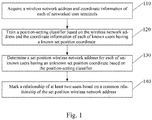
- FIG.1 is a flowchart of a method for recognizing a user relationship according to a first embodiment of the present disclosure.
- the technical solution of this embodiment may be applicable to a case in which set positional information such as user families and work sites is mined based on wireless network information of user terminals, and also may be applicable to a case in which a relationship among users is recognized.
- the method may be performed by an apparatus for recognizing a user relationship and configured in a server.
- the method for recognizing a user relationship specifically comprises following steps.
- S110 acquiring a wireless network address and coordinate information of each user terminal.
- the wireless network preferably is a common WiFi (Wireless Fidelity) wireless local area network, and the wireless network address is an MAC address of a WiFi router, hereinafter referred to as a WiFi MAC address.
- WiFi MAC address is global unique and may be used as an identifier for identifying a router in the wireless network.
- the method for recognizing a user relationship is described by taking an example in which the wireless network address is the WiFi MAC address.
- the apparatus for recognizing a user relationship may acquire wireless network addresses of the terminal users and coordinate information of the networked positions. Therefore, the user is a user, among the terminal users, that is allowed to acquire the coordinate information.
- the apparatus for recognizing a user relationship may acquire the coordinate information of the user by means of a positioning system such as GPS of the terminal.
- the wireless network address and the coordinate information may be acquired for the user by means of an application program used by the user on the terminal, and a corresponding relationship of the wireless network address and the coordinate information is stored in the server.
- the server may be an application server, in which the wireless network address and the coordinate information used for networking each user terminal and using the application program is stored.
- the server also may be a server of the apparatus for recognizing a user relationship or a storage server, in which the wireless network address and the coordinate information of each user terminal is stored.
- S120 training a position-setting classifier based on the wireless network address and the coordinate information of each known users having the known set position coordinate.
- the set position may be a family position.
- family coordinates of this type of users are known.
- a family classifier may be trained based on the wireless network address and the coordinate information of this type of user terminals.
- the set position may be a work site.
- work site coordinates of this type of users are known.
- a work site classifier may be trained based on the wireless network address and the coordinate information of this type of user terminals.
- the set positions also may be other positions required for training a classifier or at least two positions, etc.
- a user having the known set position coordinate is a known user
- a user having an unknown set position coordinate is an unknown user
- the set position coordinate of the unknown user may be determined by means of the position-setting classifier.
- the apparatus for recognizing a user relationship may acquire the family and/or the work site from the terminal for the known user, but the apparatus for recognizing a user relationship may be unable to acquire the family or the work site from the terminal for the unknown user.
- the family classifier and the work site classifier whose set positions are the family and the work site respectively may be trained based on the wireless network address and the coordinate information of each known user stored in the server.
- S130 determining a set position wireless network address of each unknown users having an unknown set position coordinate is unknown based on the position-setting classifier.
- a position-setting classifier may be trained based on the wireless network address and the coordinate information of each known user stored in the server.
- the family classifier for data such as the wireless network address and the coordinate information of the unknown user, the data of the unknown user are classified by means of the family classifier based on data mining technologies, so that family data of the unknown user may be classified and mined.
- the family wireless network address may be determined based on the family data of the unknown user.
- the set position wireless network address of each unknown users having an unknown set position coordinate is determined based on the position-setting classifier.
- the family coordinate of the unknown user may be determined based on the mined family data of the unknown user.
- the set position wireless network address and the set position coordinate of the unknown user may be determined, based on the data mining technologies, based on the position-setting classifier and the wireless network address and the coordinate information of the unknown user.
- the set position is a family or work site
- the family or work site of the unknown user and the WiFi MAC address of the family router or the WiFi MAC address of the work site router are mined in the above operations S110 ⁇ S130. Therefore, according to the technical solution, the set position wireless network address and the set position information such as the family or work site of the unknown user are mined based on the networked information of the user terminal.
- S140 marking a relationship of at least two users based on a common relationship of the set position wireless network address.
- the set position wireless network address and the set position information such as the family or work site of the unknown user are determined via data mining technologies based on the wireless network address and the coordinate information of the user terminal.
- the set position information being a family and a work site is taken as an example, for at least two users sharing the same family wireless network address, the relationship of at least two users is marked as a family or friend relationship, that is, the at least two users sharing the same family router are of a family or friend relationship. For at least two users sharing the same work site wireless network address, the relationship of the at least two users is marked as a colleague relationship, that is, the at least two users sharing the same work site router are of a colleague relationship.
- the relationship of the at least two users is marked as a friend relationship.
- relationships among the users may be marked based on different set positions or other cases. For example, at least two users neither sharing the WiFi MAC address of the same family router nor sharing the WiFi MAC address of the same work site router are marked as a stranger relationship.
- This embodiment provides a method for recognizing a user relationship. After a wireless network address and coordinate information of each user terminal are acquired, a position-setting classifier is trained based on the wireless network address and the coordinate information of each known user, and the position-setting classifier determines a set position wireless network address of each unknown user. In this way, a relationship of at least two users is marked based on a common relationship of the set position wireless network address. According to the technical solution, based on networked information of user terminals, set position wireless network addresses of unknown users are determined by means of training classifiers and data mining technologies to mark relationships among users. In this way, relationships among the users, such as families, friends or colleagues, may be precisely distinguished.
- the relationships among the users may be precisely marked without extracting user terminal address books. Therefore, the problem that acquaintances collaboratively cheat to acquire illegal economic incomes in commercial promotion activities of the mobile Internet thereby causing the loss of promotion activity cost is solved, and the effect of Internet promotion activities is enhanced.
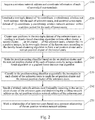
- FIG. 2 is a flowchart of a method for recognizing a user relationship according to a second embodiment of the present disclosure.
- the technical solution of this embodiment may be applicable to a case in which set positional information such as user families and work sites is mined based on wireless network information of user terminals, and also may be applicable to a case in which a relationship among users is recognized.
- the method may be performed by an apparatus for recognizing a user relationship and configured in a server.
- the method for recognizing a user relationship specifically comprises following steps.
- S210 acquiring a wireless network address and coordinate information of each user terminal.
- the wireless network preferably is a common WiFi, and the wireless network address is an MAC address of a WiFi router, hereinafter referred to as a WiFi MAC address.
- the user is a user, among the terminal users, that is allowed to acquire the coordinate information.
- the method for recognizing a user relationship is described by taking an example in which the wireless network address is the WiFi MAC address of the router.
- a corresponding relationship between the wireless network address and the coordinate information is stored in the server.
- networked time information of each user terminal also may be acquired, and the corresponding relationship among the wireless network address, the coordinate information and the time information needs to be stored in the server.
- S220 constructing a two-tuple dataset of ⁇ (x-coordinate, y-coordinate), wireless network address> for each unknown user, and constructing a two-tuple dataset of ⁇ (x-coordinate, y-coordinate), wireless network address> within a set time period for each known user.
- a user having the known set position coordinate is a known user
- a user having an unknown set position coordinate is unknown
- the set time period may be set as two months, or three months, or the third quarter of 2015.
- all user two-tuples ⁇ (x-coordinate, y-coordinate), wireless network address> of the unknown user are constituted based on the corresponding relationship of the wireless network address and the coordinate information of the unknown user in the server.
- the set of all the user two-tuples of the unknown user is constructed as a two-tuple dataset thereof.
- all the wireless network addresses and the coordinate information, of the known user, within the set time period are constructed as a dataset.
- the two-tuples dataset of user ⁇ (x-coordinate, y-coordinate), wireless network address> of the known user is constructed based on the corresponding relationship between the wireless network address and the coordinate information of the known user within the set time period in the server.
- S230 clustering user positions, in the two-tuple dataset, of the unknown user according to a density-based clustering algorithm to form a first cluster, a second cluster, ..., an i th cluster, ...of the unknown user, wherein the i is a positive integer; and clustering user positions, in the two-tuple dataset, of the known user according to the density-based clustering algorithm to form a set position cluster and a non-set position cluster of the known user.
- the density-based clustering algorithm is a density-based spatial clustering algorithm, in which, a region having enough density is divided into clusters, and clusters of arbitrary shapes are found in a spatial database having noise, wherein a cluster is defined as a maximizing set of density-connected points.
- user positions in the two-tuple dataset of the unknown user and the known user may be clustered using other clustering algorithms such as a hierarchical-based clustering algorithm.
- the user positions in the two-tuple dataset of the unknown user are clustered according to the density-based clustering algorithm, wherein the user positions refer to coordinate information in the dataset.
- the first cluster, the second cluster, ..., the i th cluster, ...of the unknown user is formed, wherein the i is a positive integer, and markings of the clusters of the unknown user are unknown.
- the number of the clusters of different unknown users may likely be different.
- At least two clusters of the known user may be formed by clustering the user positions, in the two-tuple dataset, of the known user according to the density-based clustering algorithm, wherein clusters containing the known set position coordinates are the set position clusters of the known user, and the remaining clusters not containing the known set position coordinates are the non-set position clusters.
- the set positions are families and work sites and the clusters formed for the known user by clustering comprise the first cluster, the second cluster, the third cluster and the fourth cluster, the clusters containing family coordinates are marked as home, the clusters containing work site coordinates are marked as company, and the other two clusters are marked as nouse1 and nouse2.
- the known user comprises one family cluster and three non-family clusters, or comprises one work site cluster and three non-work site clusters.
- S240 training the position-setting classifier based on the set position cluster and the non-set position cluster of each known user using a random forest algorithm or a gradient boost decision tree (GBDT) algorithm.
- GBDT gradient boost decision tree
- the classifier is trained based on the set position cluster and the non-set position cluster of each known user using a random forest algorithm or a gradient boost decision tree (GBDT) algorithm to construct the position-setting classifier.
- the set positions are work sites and families
- the total number of the family clusters of the known user is 10
- the total number of the work site clusters is 6
- the total number of the other clusters is 24,
- the family classifier and the work site classifier need to be trained, that is, the family classifier is trained based on the 10 family clusters and (6+24) non-family clusters
- the work site classifier is trained based on the 6 work site clusters and (10+24) non-work site clusters.
- the random forest algorithm and the GBDT algorithm are two classification algorithms common in the data mining technology.
- the classifier also may be trained by means of a k-nearest neighbours algorithm (KNN), or a support vector machine or other classification algorithms.
- KNN k-nearest neighbours algorithm
- Data in the clusters of the known user are user two-tuples, the corresponding relationship among the wireless network address of the user, the coordinate information and the time information is stored in the server, and the training attribute of a corresponding position-setting classifier comprises at least one of: training the family classifier is taken as an example, for any one known user, a ratio of a number of days for occurrences of each wireless network address in the set position cluster (family cluster) of the known user to the set time period, for example, when a WiFi MAC address A occurred on the first day, the sixth day and the seventh day within the set time period (60 days), the ratio is 3/60; a ratio of a number of occurrence, at day, of each wireless network address in the set position cluster (family cluster) of the known user to a number of occurrences at night; a ratio of a number of occurrence, in one time period, of each wireless network address in the set position cluster (family cluster) of the known user to a number of occurrences in another one of at least two time periods in a
- the classifier may be trained for clusters marked as nouse, that is, a nouse classifier is formed, wherein the nouse classifier is configured to classify and mark the non-set position clusters of the unknown user.
- S250 classifying, in the position-setting classifier sequentially, the two-tuples in each cluster of the unknown user to mark the set position cluster and the non-set position cluster of the unknown user.
- the two-tuples in each cluster of the unknown user are classified sequentially in the position-setting classifier based on the trained position-setting classifier such as the family classifier or the work site classifier to mark the set position cluster and the non-set position cluster of the unknown user.
- the clusters of the unknown user comprise the first cluster, the second cluster,..., the i th cluster,..., after the clusters of the unknown user are classified and marked, the family clusters and the work site clusters of the unknown user may be marked, that is, the set position clusters of the unknown user are marked based on the position-setting classifier.
- the non-set position clusters of the unknown user may be marked based on the non-position-setting classifier, for example, the nouse cluster of the unknown user is marked based on the nouse classifier.
- S260 searching the wireless network address most frequently occurring in the set position cluster of the unknown user and determining the same as the set position wireless network address of the unknown user.
- the wireless network address most frequently occurring in the family cluster is determined as a family wireless network address of the unknown user
- the wireless network address most frequently occurring in the work site cluster is determined as a work site wireless network address of the unknown user.
- the wireless network address most frequently occurring in the set position cluster of the unknown user is searched and determined as the set position wireless network address of the unknown user.
- the identical coordinate information most frequently occurring in the family cluster of the unknown user or a central coordinate of the family cluster may be determined as the family position of the unknown user, and the identical coordinate information most frequently occurring in the work site cluster of the unknown user or a central coordinate of the work site cluster may be determined as a work site position of the unknown user.
- the set position of the unknown user also may be determined based on other data in the cluster. For example, a limited range of the family cluster of the unknown user may be determined as a family position range of the unknown user, and a limited range of the work site cluster of the unknown user may be determined as a work site position range of the unknown user.
- S270 marking a relationship of at least two users based on a common relationship of the set position wireless network address.
- At least two users sharing the same family wireless network address may be marked as a family relationship or a friend relationship, that is, at least two users sharing the same family router are of the family or friend relationship.
- at least two users sharing the same work site wireless network address may be marked as a colleague relationship or the friend relationship, that is, at least two users sharing the same work site router are of the colleague relationship.
- At least two users neither sharing the same family wireless network address nor sharing the same work site wireless network address may be marked as a stranger relationship.
- the operation of constructing a two-tuple dataset of an unknown user in S220 and the operation of clustering user positions, in the two-tuple dataset, of the unknown user according to a density-based clustering algorithm to form a cluster of the unknown user in S230 also may be executed after S240.
- a two-tuple dataset of each unknown user and a two-tuple dataset of each known user are constructed based on a wireless network address and coordinate information of each user terminal, a cluster of each unknown user and a set position cluster of each known user are formed according to a density-based clustering algorithm, a position-setting classifier is trained according to a cluster of each known user using data mining technologies such as GBDT to mark a set position cluster of each unknown user, a set position wireless network address is determined from the set position cluster of each unknown user, and a relationship of at least two users is marked.
- set position wireless network addresses of unknown users are determined by means of training classifiers and data mining technologies to mark relationships among users.
- relationships among the users such as families, friends or colleagues, may be precisely distinguished.
- the relationships among the users may be precisely marked without extracting user terminal address books. Therefore, the problem that acquaintances collaboratively cheat to acquire illegal economic incomes in commercial promotion activities of the mobile Internet thereby causing the loss of promotion activity cost is solved, and the effect of Internet promotion activities is enhanced.
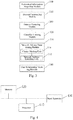
- FIG. 3 is a schematic diagram of an apparatus for recognizing a user relationship according to the third embodiment of the present disclosure.
- the technical solution of this embodiment may be applicable to a case in which set positional information such as user families and work sites is mined based on wireless network information of user terminals, and also may be applicable to a case in which a relationship among users is recognized.
- the apparatus may perform the method for recognizing a user relationship and may be configured in a server.
- the apparatus for recognizing a user relationship comprises: a networked information acquiring module 310, a classifier training module 320, a network address determining module 330 and a user relationship marking module 340.
- the networked information acquiring module 310 is configured to acquire a wireless network address and coordinate information of each user terminal.
- the classifier training module 320 is configured to train a position-setting classifier based on the wireless network address and the coordinate information of each known user having the known set position coordinate.
- the network address determining module 330 is configured to determine a set position wireless network address of each unknown users having an unknown set position coordinate is unknown based on the position-setting classifier.
- the user relationship marking module 340 is configured to mark a relationship of at least two users based on a common relationship of the set position wireless network address.
- the apparatus for recognizing a user relationship further comprises: a dataset constructing module 350 and a dataset clustering module 360.
- the dataset constructing module 350 is configured to construct, after acquiring the wireless network address and the coordinate information of each user terminal, a two-tuple dataset of ⁇ (x-coordinate, y-coordinate), wireless network address> for each unknown user, and construct a two-tuple dataset of ⁇ (x-coordinate, y-coordinate), wireless network address> within a set time period for each known user.
- the dataset clustering module 360 is configured to cluster user positions, in the two-tuple dataset, of the unknown user according to a density-based clustering algorithm to form a first cluster, a second cluster, ..., an i th cluster, ...of the unknown user, wherein the i is a positive integer, and cluster user positions, in the two-tuple dataset, of the known user according to the density-based clustering algorithm to form a set position cluster and a non-set position cluster of the known user.
- the classifier training module 320 specifically comprises: training the position-setting classifier based on the set position cluster and the non-set position cluster of each known user using a random forest algorithm or a gradient boost decision tree (GBDT) algorithm.
- GBDT gradient boost decision tree
- the networked information acquiring module 310 further comprises: acquiring time information for networking of each user terminal.
- a training attribute of the position-setting classifier comprises at least one of:
- the network address determining module 330 comprises: a cluster marking unit 331 and a network address searching unit 332.
- the cluster marking unit 331 is configured to classify, in the position-setting classifier sequentially, the two-tuples in each cluster of the unknown user to mark a set position cluster and a non-set position cluster of the unknown user.
- the network address searching unit 332 is configured to search the wireless network address most frequently occurring in the set position cluster of the unknown user and determine the same as the set position wireless network address of the unknown user.
- set position wireless network addresses of unknown users are determined by means of training classifiers and data mining technologies to mark relationships among users.
- the relationships among the users such as families, friends or colleagues, may be precisely distinguished.
- the relationships among the users may be precisely marked without extracting user terminal address books. Therefore, the problem that acquaintances collaboratively cheat to acquire illegal economic incomes in commercial promotion activities of the mobile Internet thereby causing the loss of promotion activity cost is solved, and the effect of Internet promotion activities is enhanced.
- This embodiment of the present disclosure provides a storage medium containing a computer-executable instruction, when being executed by a computer processor, the computer-executable instruction is configured to perform a method for recognizing a user relationship, characterized in that the method comprises:
- the method may further comprise:
- the training a position-setting classifier based on the wireless network address and the coordinate information of each known users having the known set position coordinate may further specifically comprise: training the position-setting classifier based on the set position cluster and the non-set position cluster of the each known user using a random forest algorithm or a gradient boost decision tree (GBDT) algorithm.
- GBDT gradient boost decision tree
- the method further comprises: acquiring networking time information of each user terminal.
- a training attribute of the position-setting classifier comprises at least one of:
- the determining a set position wireless network address of each unknown users having an unknown set position coordinate based on the position-setting classifier may further specifically comprise:
- FIG. 4 is a schematic diagram illustrating hardware structure of a server for executing a method for recognizing a user relationship according to the fifth embodiment of the present disclosure.
- the server comprises:
- the server may further comprise: an input apparatus 430.
- the processor 410, the memory 420 and the input apparatus 430 in the server may be connected by means of a bus or in other ways, in FIG. 4 connecting by means of a bus is taken as an example.
- the memory 420 may be configured to store software programs, computer-executable instructions and modules, such as program instructions/modules (for example, the networked information acquiring module 310, the classifier training module 320, the network address determining module 330 and the user relationship marking module 340 in the apparatus for recognizing a user relationship as shown in FIG. 3 ) corresponding to the method for recognizing a user relationship in the embodiments of the present disclosure.
- the processor 410 may execute various function applications and data processing of a server, namely implement the method for recognizing a user relationship in the foregoing method embodiments by running the software programs, instructions and modules stored in the memory 420.
- the memory 420 may comprise a program storage area and a data storage area, where the program storage area may store an operating system, application programs required for at least one function; and the data storage area may store data created according to the use of the server.
- the memory 420 may include a high speed random access memory, or further include a non-volatile memory, for example, at least one magnetic disk storage device, a flash memory, or other non-volatile solid-state storage devices.
- the memory 420 may further include some memories disposed remotely relative to the processor 410, and these remote memories may be connected to the server through the network. Instances of the foregoing networks include but are not limited to the Internet, the Intranet, a local area network (LAN), a mobile communication network and a combination thereof.
- LAN local area network
- the input apparatus 430 may be configured to receive inputted wireless network address and coordinate information.
- the one or more modules are stored in the memory 420, and when being executed by the one or more processors 410, the one or more modules are caused to:
- the method further comprises:
- the training a position-setting classifier based on the wireless network address and the coordinate information of each known users having the known set position coordinate comprises: training the position-setting classifier based on the set position cluster and the non-set position cluster of the each known user using a random forest algorithm or a gradient boost decision tree (GBDT) algorithm.
- GBDT gradient boost decision tree
- a training attribute of the position-setting classifier comprises at least one of:
- determining a set position wireless network address of each unknown users having an unknown set position coordinate based on the position-setting classifier comprises:
- each included unit and module are divided only according to functional logic, but the present disclosure is not limited to the division, as long as corresponding functions can be implemented.
- specific names of functional units are merely provided for the purpose of distinguishing the units from one another, but are not intended to limit the protection scope of the present disclosure.
Landscapes
- Engineering & Computer Science (AREA)
- Business, Economics & Management (AREA)
- Theoretical Computer Science (AREA)
- Strategic Management (AREA)
- Physics & Mathematics (AREA)
- General Physics & Mathematics (AREA)
- Development Economics (AREA)
- Finance (AREA)
- Accounting & Taxation (AREA)
- Entrepreneurship & Innovation (AREA)
- Data Mining & Analysis (AREA)
- Economics (AREA)
- General Business, Economics & Management (AREA)
- Marketing (AREA)
- Computer Networks & Wireless Communication (AREA)
- Game Theory and Decision Science (AREA)
- General Engineering & Computer Science (AREA)
- Signal Processing (AREA)
- Human Resources & Organizations (AREA)
- Databases & Information Systems (AREA)
- Remote Sensing (AREA)
- Radar, Positioning & Navigation (AREA)
- Software Systems (AREA)
- Evolutionary Computation (AREA)
- Artificial Intelligence (AREA)
- Life Sciences & Earth Sciences (AREA)
- Quality & Reliability (AREA)
- Tourism & Hospitality (AREA)
- Operations Research (AREA)
- Bioinformatics & Cheminformatics (AREA)
- Bioinformatics & Computational Biology (AREA)
- Computer Vision & Pattern Recognition (AREA)
- Evolutionary Biology (AREA)
- Computing Systems (AREA)
- Automation & Control Theory (AREA)
- Mathematical Physics (AREA)
- Fuzzy Systems (AREA)
- Biomedical Technology (AREA)
- Mathematical Optimization (AREA)
- Health & Medical Sciences (AREA)
Abstract
Description
- This patent application claims the priority to Chinese Patent Application No.
201510639155.4, filed on Sep. 30, 2015 - Embodiments of the present disclosure relate to computer technologies, and more particularly, to a method and an apparatus for recognizing a user relationship, a storage medium and a server.
- With the development of mobile Internet technologies, there are more and more commercial promotion activities on the mobile Internet, such as Didi, Kuaidi, China Auto Rental, 51 Car Sharing, Tiantian Car Sharing and other ride sharing, tailored taxis services and taxi calling services provided by Internet enterprises. Various taxi-hailing APPs are intended to provide the most convenient and fast services to users based on mobile Internet resources and technologies in a completely new approach.
- Those companies choose promotions adopting high allowances in their application programs in the commercial promotion activities on the mobile Internet. In actual life, acquaintances may collaboratively cheat for scalping to wangle allowance and obtain illegal economic benefit, thus causing loss to the companies in promotion activity cost. To prevent this problem, the existing Internet application programs generally extract the users' acquaintance relationships by using the address books in the users' mobile phones.
- However, this approach needs to acquire the address books of the users. In most cases, most of the users are unwilling to provide their own address books. If the application programs actively read the users' address books, this may result in users' aversion, and loss of the users. In addition, extracting the users' acquaintance relationships using the address books in the mobile phones only can distinguish whether two persons know each other, but cannot precisely distinguish their acquaintance relationships such as families, friends or colleagues. Therefore, the existing technologies cannot solve the problem fundamentally.
- Embodiments of the present disclosure provide a method and an apparatus for recognizing a user relationship, a storage medium and a server to solve the problem that in the Internet promotion activities, acquaintances collaboratively cheat to acquire illegal economic incomes.
- In a first aspect, an embodiment of the present disclosure provides a method for recognizing a user relationship, comprising:
- acquiring a wireless network address and coordinate information of each of networked user terminals;
- training a position-setting classifier based on the wireless network address and the coordinate information of each of known users having a known set position coordinate ;
- determining a set position wireless network address for each of unknown users having an unknown set position coordinate based on the position-setting classifier; and
- marking a relationship of at least two users based on a common relationship of the set position wireless network address.
- In a second aspect, an embodiment of the present disclosure further provides an apparatus for recognizing a user relationship, comprising:
- a networked information acquiring module, configured to acquire a wireless network address and coordinate information of each of networked user terminals;
- a classifier training module, configured to train a position-setting classifier based on the wireless network address and the coordinate information of each of known users having a known set position coordinate;
- a network address determining module, configured to determine a set position wireless network address for each of unknown users having an unknown set position coordinate based on the position-setting classifier; and
- a user relationship marking module, configured to mark a relationship of at least two users based on a common relationship of the set position wireless network address.
- In a third aspect, an embodiment of the present disclosure further provides one or more storage media containing a computer-executable instruction, when being executed by a computer processor, the computer-executable instruction is configured to perform a method for recognizing a user relationship, characterized in that the method comprises:
- acquiring a wireless network address and coordinate information of each of networked user terminals;
- training a position-setting classifier based on the wireless network address and the coordinate information of each of known users having a known set position coordinate ;
- determining a set position wireless network address for each of unknown users having an unknown set position coordinate based on the position-setting classifier; and
- marking a relationship of at least two users based on a common relationship of the set position wireless network address.
- In a fourth aspect, an embodiment of the present disclosure provides a server, comprising:
- one or more processors;
- a memory; and
- one or more modules, the one or more modules being stored in the memory, and when being executed by the one or more processors, the one or more modules being caused to:
- acquire a wireless network address and coordinate information of each of networked user terminals;
- train a position-setting classifier based on the wireless network address and the coordinate information of each of known users having a known set position coordinate ;
- determine a set position wireless network address for each of unknown users having an unknown set position coordinate based on the position-setting classifier; and
- mark a relationship of at least two users based on a common relationship of the set position wireless network address.
- According to the method and the apparatus for recognizing a user relationship, the storage medium and the server provided by the embodiments of the present disclosure, after a wireless network address and coordinate information of each user terminal are acquired, a position-setting classifier is trained based on the wireless network address and the coordinate information of each known user, a set position wireless network address of each unknown user is determined based on the position-setting classifier, and a relationship of at least two users is marked based on a common relationship of the set position wireless network address. According to the technical solution, based on networked information of user terminals, set position wireless network addresses of unknown users are determined by means of training classifiers and data mining technologies to mark relationships among users. In this way, relationships among the users, such as families, friends or colleagues, may be precisely distinguished. By utilizing the technical solution, the relationships among the users may be precisely marked without extracting user terminal address books. Therefore, the problem that acquaintances collaboratively cheat to acquire illegal economic incomes in commercial promotion activities of the mobile Internet thereby causing the loss of promotion activity cost is solved, and the effect of Internet promotion activities is enhanced.
- To describe the technical solutions in the embodiments of the present disclosure more clearly, the following will briefly introduce accompanying drawings required for describing the embodiments. Apparently, the accompanying drawings in the following description show merely some embodiments of the present disclosure, and persons of ordinary skill in the art may further modify and substitute these accompanying drawings without creative efforts.
-
FIG.1 is a flowchart of a method for recognizing a user relationship according to a first embodiment of the present disclosure; -
FIG. 2 is a flowchart of a method for recognizing a user relationship according to a second embodiment of the present disclosure; -
FIG. 3 is a schematic diagram of an apparatus for recognizing a user relationship according to a third embodiment of the present disclosure; and -
FIG. 4 is a schematic diagram illustrating hardware structure of a server for executing a method for recognizing a user relationship according to a fifth embodiment of the present disclosure. - To make the objectives, technical solutions, and advantages of the present disclosure clearer, the following will clearly and completely describe the technical solutions of the present disclosure with reference to the accompanying drawings in the embodiments of the present disclosure. Apparently, the described embodiments are some but not all of the embodiments of the present disclosure. All other embodiments obtained by persons of ordinary skill in the art based on the embodiments of the present disclosure without creative efforts shall fall within the protection scope of the present disclosure.
- As shown in
FIG.1 , which is a flowchart of a method for recognizing a user relationship according to a first embodiment of the present disclosure. The technical solution of this embodiment may be applicable to a case in which set positional information such as user families and work sites is mined based on wireless network information of user terminals, and also may be applicable to a case in which a relationship among users is recognized. The method may be performed by an apparatus for recognizing a user relationship and configured in a server. - The method for recognizing a user relationship provided by this embodiment specifically comprises following steps.
- S110: acquiring a wireless network address and coordinate information of each user terminal.
- Herein, the wireless network preferably is a common WiFi (Wireless Fidelity) wireless local area network, and the wireless network address is an MAC address of a WiFi router, hereinafter referred to as a WiFi MAC address. The reason for preferably selecting WiFi resides in that the WiFi MAC address is global unique and may be used as an identifier for identifying a router in the wireless network. In this embodiment, the method for recognizing a user relationship is described by taking an example in which the wireless network address is the WiFi MAC address.
- After different terminals are connected to the WiFi router via the same WiFi, when terminal users conduct terminal networking via the wireless network and inputs, onto the terminals, instructions allowing to acquire positional information, the apparatus for recognizing a user relationship may acquire wireless network addresses of the terminal users and coordinate information of the networked positions. Therefore, the user is a user, among the terminal users, that is allowed to acquire the coordinate information. Herein the apparatus for recognizing a user relationship may acquire the coordinate information of the user by means of a positioning system such as GPS of the terminal.
- Specifically, the wireless network address and the coordinate information may be acquired for the user by means of an application program used by the user on the terminal, and a corresponding relationship of the wireless network address and the coordinate information is stored in the server. The server may be an application server, in which the wireless network address and the coordinate information used for networking each user terminal and using the application program is stored. The server also may be a server of the apparatus for recognizing a user relationship or a storage server, in which the wireless network address and the coordinate information of each user terminal is stored.
- S120: training a position-setting classifier based on the wireless network address and the coordinate information of each known users having the known set position coordinate.
- In the above operation, the set position may be a family position. When the family positions of a part of users are known, family coordinates of this type of users are known. Correspondingly, for each users having the known set position coordinate, a family classifier may be trained based on the wireless network address and the coordinate information of this type of user terminals. The set position may be a work site. When the work sites of a part of users are known, work site coordinates of this type of users are known. Correspondingly, for each users having the known set position coordinate, a work site classifier may be trained based on the wireless network address and the coordinate information of this type of user terminals. The set positions also may be other positions required for training a classifier or at least two positions, etc.
- Thus it can be known that a user having the known set position coordinate is a known user, and a user having an unknown set position coordinate is an unknown user. The set position coordinate of the unknown user may be determined by means of the position-setting classifier. In addition, when the set position preferably is a family or work site, the apparatus for recognizing a user relationship may acquire the family and/or the work site from the terminal for the known user, but the apparatus for recognizing a user relationship may be unable to acquire the family or the work site from the terminal for the unknown user. As thus, the family classifier and the work site classifier whose set positions are the family and the work site respectively may be trained based on the wireless network address and the coordinate information of each known user stored in the server.
- S130: determining a set position wireless network address of each unknown users having an unknown set position coordinate is unknown based on the position-setting classifier.
- In the above operation, a position-setting classifier may be trained based on the wireless network address and the coordinate information of each known user stored in the server. Taking the family classifier as an example, for data such as the wireless network address and the coordinate information of the unknown user, the data of the unknown user are classified by means of the family classifier based on data mining technologies, so that family data of the unknown user may be classified and mined. The family wireless network address may be determined based on the family data of the unknown user. Thus the set position wireless network address of each unknown users having an unknown set position coordinate is determined based on the position-setting classifier. In addition, the family coordinate of the unknown user may be determined based on the mined family data of the unknown user.
- In the above operation, the set position wireless network address and the set position coordinate of the unknown user may be determined, based on the data mining technologies, based on the position-setting classifier and the wireless network address and the coordinate information of the unknown user. When the set position is a family or work site, the family or work site of the unknown user and the WiFi MAC address of the family router or the WiFi MAC address of the work site router are mined in the above operations S110∼S130. Therefore, according to the technical solution, the set position wireless network address and the set position information such as the family or work site of the unknown user are mined based on the networked information of the user terminal.
- S140: marking a relationship of at least two users based on a common relationship of the set position wireless network address.
- In the above operation, the set position wireless network address and the set position information such as the family or work site of the unknown user are determined via data mining technologies based on the wireless network address and the coordinate information of the user terminal. The set position information being a family and a work site is taken as an example, for at least two users sharing the same family wireless network address, the relationship of at least two users is marked as a family or friend relationship, that is, the at least two users sharing the same family router are of a family or friend relationship. For at least two users sharing the same work site wireless network address, the relationship of the at least two users is marked as a colleague relationship, that is, the at least two users sharing the same work site router are of a colleague relationship. For at least two users sharing the same family wireless network address and the same work site wireless network address, the relationship of the at least two users is marked as a friend relationship. Herein, relationships among the users may be marked based on different set positions or other cases. For example, at least two users neither sharing the WiFi MAC address of the same family router nor sharing the WiFi MAC address of the same work site router are marked as a stranger relationship.
- This embodiment provides a method for recognizing a user relationship. After a wireless network address and coordinate information of each user terminal are acquired, a position-setting classifier is trained based on the wireless network address and the coordinate information of each known user, and the position-setting classifier determines a set position wireless network address of each unknown user. In this way, a relationship of at least two users is marked based on a common relationship of the set position wireless network address. According to the technical solution, based on networked information of user terminals, set position wireless network addresses of unknown users are determined by means of training classifiers and data mining technologies to mark relationships among users. In this way, relationships among the users, such as families, friends or colleagues, may be precisely distinguished. By utilizing the technical solution, the relationships among the users may be precisely marked without extracting user terminal address books. Therefore, the problem that acquaintances collaboratively cheat to acquire illegal economic incomes in commercial promotion activities of the mobile Internet thereby causing the loss of promotion activity cost is solved, and the effect of Internet promotion activities is enhanced.
- As shown in
FIG. 2 , which is a flowchart of a method for recognizing a user relationship according to a second embodiment of the present disclosure. The technical solution of this embodiment may be applicable to a case in which set positional information such as user families and work sites is mined based on wireless network information of user terminals, and also may be applicable to a case in which a relationship among users is recognized. The method may be performed by an apparatus for recognizing a user relationship and configured in a server. - The method for recognizing a user relationship provided by this embodiment specifically comprises following steps.
- S210: acquiring a wireless network address and coordinate information of each user terminal.
- In the above operation, the wireless network preferably is a common WiFi, and the wireless network address is an MAC address of a WiFi router, hereinafter referred to as a WiFi MAC address. The user is a user, among the terminal users, that is allowed to acquire the coordinate information. In this embodiment, the method for recognizing a user relationship is described by taking an example in which the wireless network address is the WiFi MAC address of the router.
- After the wireless network address and the coordinate information of the user are acquired, a corresponding relationship between the wireless network address and the coordinate information is stored in the server. Optionally, networked time information of each user terminal also may be acquired, and the corresponding relationship among the wireless network address, the coordinate information and the time information needs to be stored in the server.
- S220: constructing a two-tuple dataset of <(x-coordinate, y-coordinate), wireless network address> for each unknown user, and constructing a two-tuple dataset of <(x-coordinate, y-coordinate), wireless network address> within a set time period for each known user.
- In the above operation, a user having the known set position coordinate is a known user, and a user having an unknown set position coordinate is unknown is an unknown user. Optionally, the set time period may be set as two months, or three months, or the third quarter of 2015.
- For any one unknown user, all user two-tuples <(x-coordinate, y-coordinate), wireless network address> of the unknown user are constituted based on the corresponding relationship of the wireless network address and the coordinate information of the unknown user in the server. The set of all the user two-tuples of the unknown user is constructed as a two-tuple dataset thereof.
- For any one known user, all the wireless network addresses and the coordinate information, of the known user, within the set time period are constructed as a dataset. The two-tuples dataset of user <(x-coordinate, y-coordinate), wireless network address> of the known user is constructed based on the corresponding relationship between the wireless network address and the coordinate information of the known user within the set time period in the server.
- S230: clustering user positions, in the two-tuple dataset, of the unknown user according to a density-based clustering algorithm to form a first cluster, a second cluster, ..., an ith cluster, ...of the unknown user, wherein the i is a positive integer; and clustering user positions, in the two-tuple dataset, of the known user according to the density-based clustering algorithm to form a set position cluster and a non-set position cluster of the known user.
- The density-based clustering algorithm is a density-based spatial clustering algorithm, in which, a region having enough density is divided into clusters, and clusters of arbitrary shapes are found in a spatial database having noise, wherein a cluster is defined as a maximizing set of density-connected points. Herein, user positions in the two-tuple dataset of the unknown user and the known user may be clustered using other clustering algorithms such as a hierarchical-based clustering algorithm.
- In the above operation, for any one unknown user, the user positions in the two-tuple dataset of the unknown user are clustered according to the density-based clustering algorithm, wherein the user positions refer to coordinate information in the dataset. In this way, the first cluster, the second cluster, ..., the ith cluster, ...of the unknown user is formed, wherein the i is a positive integer, and markings of the clusters of the unknown user are unknown. The number of the clusters of different unknown users may likely be different.
- For any one known user, at least two clusters of the known user may be formed by clustering the user positions, in the two-tuple dataset, of the known user according to the density-based clustering algorithm, wherein clusters containing the known set position coordinates are the set position clusters of the known user, and the remaining clusters not containing the known set position coordinates are the non-set position clusters. When the set positions are families and work sites and the clusters formed for the known user by clustering comprise the first cluster, the second cluster, the third cluster and the fourth cluster, the clusters containing family coordinates are marked as home, the clusters containing work site coordinates are marked as company, and the other two clusters are marked as nouse1 and nouse2. In this case, the known user comprises one family cluster and three non-family clusters, or comprises one work site cluster and three non-work site clusters.
- S240: training the position-setting classifier based on the set position cluster and the non-set position cluster of each known user using a random forest algorithm or a gradient boost decision tree (GBDT) algorithm.
- In the above operation, the classifier is trained based on the set position cluster and the non-set position cluster of each known user using a random forest algorithm or a gradient boost decision tree (GBDT) algorithm to construct the position-setting classifier. When the set positions are work sites and families, the total number of the family clusters of the known user is 10, the total number of the work site clusters is 6 and the total number of the other clusters is 24, the family classifier and the work site classifier need to be trained, that is, the family classifier is trained based on the 10 family clusters and (6+24) non-family clusters, and the work site classifier is trained based on the 6 work site clusters and (10+24) non-work site clusters. Those skilled in the art may know that the random forest algorithm and the GBDT algorithm are two classification algorithms common in the data mining technology. Based on the data mining technology, herein the classifier also may be trained by means of a k-nearest neighbours algorithm (KNN), or a support vector machine or other classification algorithms.
- Data in the clusters of the known user are user two-tuples, the corresponding relationship among the wireless network address of the user, the coordinate information and the time information is stored in the server, and the training attribute of a corresponding position-setting classifier comprises at least one of: training the family classifier is taken as an example, for any one known user, a ratio of a number of days for occurrences of each wireless network address in the set position cluster (family cluster) of the known user to the set time period, for example, when a WiFi MAC address A occurred on the first day, the sixth day and the seventh day within the set time period (60 days), the ratio is 3/60; a ratio of a number of occurrence, at day, of each wireless network address in the set position cluster (family cluster) of the known user to a number of occurrences at night; a ratio of a number of occurrence, in one time period, of each wireless network address in the set position cluster (family cluster) of the known user to a number of occurrences in another one of at least two time periods in a day; and a wireless network address entropy calculated based on a probability of occurrences of each wireless network address in the set position cluster (family cluster) of each known user. Those skilled in the art may know that the training attribute of the family classifier may further comprise other attributes, and the training attributes of different classifiers may be different, which is not described in detail herein.
- It is to be noted that in addition to the set position, the classifier may be trained for clusters marked as nouse, that is, a nouse classifier is formed, wherein the nouse classifier is configured to classify and mark the non-set position clusters of the unknown user.
- S250: classifying, in the position-setting classifier sequentially, the two-tuples in each cluster of the unknown user to mark the set position cluster and the non-set position cluster of the unknown user.
- In the above operation, the two-tuples in each cluster of the unknown user are classified sequentially in the position-setting classifier based on the trained position-setting classifier such as the family classifier or the work site classifier to mark the set position cluster and the non-set position cluster of the unknown user. The clusters of the unknown user comprise the first cluster, the second cluster,..., the ith cluster,..., after the clusters of the unknown user are classified and marked, the family clusters and the work site clusters of the unknown user may be marked, that is, the set position clusters of the unknown user are marked based on the position-setting classifier. Herein, the non-set position clusters of the unknown user may be marked based on the non-position-setting classifier, for example, the nouse cluster of the unknown user is marked based on the nouse classifier.
- S260: searching the wireless network address most frequently occurring in the set position cluster of the unknown user and determining the same as the set position wireless network address of the unknown user.
- In the above operation, after each cluster of each unknown user is marked, for any one user, a family cluster, a work site cluster and other clusters are taken as examples, the wireless network address most frequently occurring in the family cluster is determined as a family wireless network address of the unknown user, and the wireless network address most frequently occurring in the work site cluster is determined as a work site wireless network address of the unknown user. Thus, the wireless network address most frequently occurring in the set position cluster of the unknown user is searched and determined as the set position wireless network address of the unknown user.
- In addition, the identical coordinate information most frequently occurring in the family cluster of the unknown user or a central coordinate of the family cluster may be determined as the family position of the unknown user, and the identical coordinate information most frequently occurring in the work site cluster of the unknown user or a central coordinate of the work site cluster may be determined as a work site position of the unknown user. Those skilled in the art may know that the set position of the unknown user also may be determined based on other data in the cluster. For example, a limited range of the family cluster of the unknown user may be determined as a family position range of the unknown user, and a limited range of the work site cluster of the unknown user may be determined as a work site position range of the unknown user.
- S270: marking a relationship of at least two users based on a common relationship of the set position wireless network address.
- In the above operation, for marking of user relationships, at least two users sharing the same family wireless network address may be marked as a family relationship or a friend relationship, that is, at least two users sharing the same family router are of the family or friend relationship. For example, at least two users sharing the same work site wireless network address may be marked as a colleague relationship or the friend relationship, that is, at least two users sharing the same work site router are of the colleague relationship. At least two users neither sharing the same family wireless network address nor sharing the same work site wireless network address may be marked as a stranger relationship.
- It is to be noted that the operation of constructing a two-tuple dataset of an unknown user in S220 and the operation of clustering user positions, in the two-tuple dataset, of the unknown user according to a density-based clustering algorithm to form a cluster of the unknown user in S230 also may be executed after S240.
- Using the method for recognizing a user relationship provided by this embodiment, a two-tuple dataset of each unknown user and a two-tuple dataset of each known user are constructed based on a wireless network address and coordinate information of each user terminal, a cluster of each unknown user and a set position cluster of each known user are formed according to a density-based clustering algorithm, a position-setting classifier is trained according to a cluster of each known user using data mining technologies such as GBDT to mark a set position cluster of each unknown user, a set position wireless network address is determined from the set position cluster of each unknown user, and a relationship of at least two users is marked. According to the technical solution, based on networked information of user terminals, set position wireless network addresses of unknown users are determined by means of training classifiers and data mining technologies to mark relationships among users. In this way, relationships among the users, such as families, friends or colleagues, may be precisely distinguished. By utilizing the technical solution, the relationships among the users may be precisely marked without extracting user terminal address books. Therefore, the problem that acquaintances collaboratively cheat to acquire illegal economic incomes in commercial promotion activities of the mobile Internet thereby causing the loss of promotion activity cost is solved, and the effect of Internet promotion activities is enhanced.
- As shown in
FIG. 3 , which is a schematic diagram of an apparatus for recognizing a user relationship according to the third embodiment of the present disclosure. The technical solution of this embodiment may be applicable to a case in which set positional information such as user families and work sites is mined based on wireless network information of user terminals, and also may be applicable to a case in which a relationship among users is recognized. The apparatus may perform the method for recognizing a user relationship and may be configured in a server. - The apparatus for recognizing a user relationship provided by this embodiment comprises: a networked
information acquiring module 310, aclassifier training module 320, a networkaddress determining module 330 and a user relationship marking module 340. - The networked
information acquiring module 310 is configured to acquire a wireless network address and coordinate information of each user terminal. Theclassifier training module 320 is configured to train a position-setting classifier based on the wireless network address and the coordinate information of each known user having the known set position coordinate. The networkaddress determining module 330 is configured to determine a set position wireless network address of each unknown users having an unknown set position coordinate is unknown based on the position-setting classifier. The user relationship marking module 340 is configured to mark a relationship of at least two users based on a common relationship of the set position wireless network address. - Optionally, the apparatus for recognizing a user relationship further comprises: a
dataset constructing module 350 and adataset clustering module 360. - The
dataset constructing module 350 is configured to construct, after acquiring the wireless network address and the coordinate information of each user terminal, a two-tuple dataset of <(x-coordinate, y-coordinate), wireless network address> for each unknown user, and construct a two-tuple dataset of <(x-coordinate, y-coordinate), wireless network address> within a set time period for each known user. Thedataset clustering module 360 is configured to cluster user positions, in the two-tuple dataset, of the unknown user according to a density-based clustering algorithm to form a first cluster, a second cluster, ..., an ith cluster, ...of the unknown user, wherein the i is a positive integer, and cluster user positions, in the two-tuple dataset, of the known user according to the density-based clustering algorithm to form a set position cluster and a non-set position cluster of the known user. - Optionally, the
classifier training module 320 specifically comprises: training the position-setting classifier based on the set position cluster and the non-set position cluster of each known user using a random forest algorithm or a gradient boost decision tree (GBDT) algorithm. - Optionally, the networked
information acquiring module 310 further comprises: acquiring time information for networking of each user terminal. Correspondingly, a training attribute of the position-setting classifier comprises at least one of: - a ratio of a number of days for occurrences of each wireless network address in the set position cluster of the known user to the set time period; a ratio of a number of occurrence, at day, of each wireless network address in the set position cluster of the known user to a number of occurrences at night;
- a ratio a of number of occurrences, in one time period, of each wireless network address in the set position cluster of the known user to a number of occurrences in another one of at least two time periods in a day; and a wireless network address entropy calculated based on a probability of occurrences of each wireless network address in the set position cluster of the known user.
- Optionally, the network
address determining module 330 comprises: acluster marking unit 331 and a networkaddress searching unit 332. - The
cluster marking unit 331 is configured to classify, in the position-setting classifier sequentially, the two-tuples in each cluster of the unknown user to mark a set position cluster and a non-set position cluster of the unknown user. The networkaddress searching unit 332 is configured to search the wireless network address most frequently occurring in the set position cluster of the unknown user and determine the same as the set position wireless network address of the unknown user. - According to the apparatus for recognizing a user relationship provided by this embodiment, based on networked information of user terminals, set position wireless network addresses of unknown users are determined by means of training classifiers and data mining technologies to mark relationships among users. In this way, the relationships among the users, such as families, friends or colleagues, may be precisely distinguished. By utilizing the technical solution, the relationships among the users may be precisely marked without extracting user terminal address books. Therefore, the problem that acquaintances collaboratively cheat to acquire illegal economic incomes in commercial promotion activities of the mobile Internet thereby causing the loss of promotion activity cost is solved, and the effect of Internet promotion activities is enhanced.
- This embodiment of the present disclosure provides a storage medium containing a computer-executable instruction, when being executed by a computer processor, the computer-executable instruction is configured to perform a method for recognizing a user relationship, characterized in that the method comprises:
- acquiring a wireless network address and coordinate information of each user terminal;
- training a position-setting classifier based on the wireless network address and the coordinate information of each known users having the known set position coordinate;
- determining a set position wireless network address of each unknown users having an unknown set position coordinate based on the position-setting classifier; and
- marking a relationship of at least two users based on a common relationship of the set position wireless network address.
- When the storage medium performs the method, after acquiring a wireless network address and coordinate information of each user terminal, the method may further comprise:
- constructing a two-tuple dataset of <(x-coordinate, y-coordinate), wireless network address> for the each unknown user, and constructing a two-tuple dataset of <(x-coordinate, y-coordinate), wireless network address> within a set time period for the each known user;
- clustering user positions, in the two-tuple dataset, of the unknown user according to a density-based clustering algorithm to form a first cluster, a second cluster, ..., an ith cluster, ...of the unknown user, wherein, the i is a positive integer; and
- clustering user positions, in the two-tuple dataset, of the known user according to the density-based clustering algorithm to form a set position cluster and a non-set position cluster of the known user.
- When the storage medium performs the method, the training a position-setting classifier based on the wireless network address and the coordinate information of each known users having the known set position coordinate may further specifically comprise:
training the position-setting classifier based on the set position cluster and the non-set position cluster of the each known user using a random forest algorithm or a gradient boost decision tree (GBDT) algorithm. - When the storage medium performs the method, the method further comprises: acquiring networking time information of each user terminal. Correspondingly, a training attribute of the position-setting classifier comprises at least one of:
- a ratio of a number of days for occurrences of each wireless network address in the set position cluster of the known user to the set time period;
- a ratio of a number of occurrences, at day, of each wireless network address in the set position cluster of the known user to a number of occurrences at night;
- a ratio of a number of occurrences, in one time period, of each wireless network address in the set position cluster of the known user to a number of occurrences in another one of at least two time periods in a day; and
- a wireless network address entropy calculated based on a probability of occurrences of each wireless network address in the set position cluster of the known user.
- When the storage medium performs the method, the determining a set position wireless network address of each unknown users having an unknown set position coordinate based on the position-setting classifier may further specifically comprise:
- classifying, in the position-setting classifier sequentially, the two-tuples in each cluster of the unknown user to mark a set position cluster and a non-set position cluster of the unknown user; and
- searching the wireless network address most frequently occurring in the set position cluster of the unknown user and determining the same as the set position wireless network address of the unknown user.
-
FIG. 4 is a schematic diagram illustrating hardware structure of a server for executing a method for recognizing a user relationship according to the fifth embodiment of the present disclosure. Referring toFIG. 4 , the server comprises: - one or
more processors 410, inFIG. 4 oneprocessor 410 being taken as an example; - a
memory 420; and - one or more modules.
- The server may further comprise: an
input apparatus 430. Theprocessor 410, thememory 420 and theinput apparatus 430 in the server may be connected by means of a bus or in other ways, inFIG. 4 connecting by means of a bus is taken as an example. - As a computer readable storage medium, the
memory 420 may be configured to store software programs, computer-executable instructions and modules, such as program instructions/modules (for example, the networkedinformation acquiring module 310, theclassifier training module 320, the networkaddress determining module 330 and the user relationship marking module 340 in the apparatus for recognizing a user relationship as shown inFIG. 3 ) corresponding to the method for recognizing a user relationship in the embodiments of the present disclosure. Theprocessor 410 may execute various function applications and data processing of a server, namely implement the method for recognizing a user relationship in the foregoing method embodiments by running the software programs, instructions and modules stored in thememory 420. - The
memory 420 may comprise a program storage area and a data storage area, where the program storage area may store an operating system, application programs required for at least one function; and the data storage area may store data created according to the use of the server. Besides, thememory 420 may include a high speed random access memory, or further include a non-volatile memory, for example, at least one magnetic disk storage device, a flash memory, or other non-volatile solid-state storage devices. In some embodiments, thememory 420 may further include some memories disposed remotely relative to theprocessor 410, and these remote memories may be connected to the server through the network. Instances of the foregoing networks include but are not limited to the Internet, the Intranet, a local area network (LAN), a mobile communication network and a combination thereof. - The
input apparatus 430 may be configured to receive inputted wireless network address and coordinate information. - The one or more modules are stored in the
memory 420, and when being executed by the one ormore processors 410, the one or more modules are caused to: - acquire a wireless network address and coordinate information of each user terminal;
- train a position-setting classifier based on the wireless network address and the coordinate information of each known users having the known set position coordinate;
- determine a set position wireless network address of each unknown users having an unknown set position coordinate based on the position-setting classifier; and
- mark a relationship of at least two users based on a common relationship of the set position wireless network address.
- Further, after acquiring a wireless network address and coordinate information of each user terminal, the method further comprises:
- constructing a two-tuple dataset of <(x-coordinate, y-coordinate), wireless network address> for the each unknown user, and constructing a two-tuple dataset of <(x-coordinate, y-coordinate), wireless network address> within a set time period for the each known user;
- clustering user positions, in the two-tuple dataset, of the unknown user according to a density-based clustering algorithm to form a first cluster, a second cluster, ..., an ith cluster, ...of the unknown user, wherein, the i is a positive integer; and
- clustering user positions, in the two-tuple dataset, of the known user according to the density-based clustering algorithm to form a set position cluster and a non-set position cluster of the known user.
- Further, the training a position-setting classifier based on the wireless network address and the coordinate information of each known users having the known set position coordinate comprises:
training the position-setting classifier based on the set position cluster and the non-set position cluster of the each known user using a random forest algorithm or a gradient boost decision tree (GBDT) algorithm. - Further, the method further comprises: acquiring networking time information of each user terminal. Correspondingly, a training attribute of the position-setting classifier comprises at least one of:
- a ratio of a number of days for occurrences of each wireless network address in the set position cluster of the known user to the set time period;
- a ratio of a number of occurrences, at day, of each wireless network address in the set position cluster of the known user to a number of occurrences at night;
- a ratio of a number of occurrences, in one time period, of each wireless network address in the set position cluster of the known user to a number of occurrences in another one of at least two time periods in a day; and
- a wireless network address entropy calculated based on a probability of occurrences of each wireless network address in the set position cluster of the known user.
- Further, determining a set position wireless network address of each unknown users having an unknown set position coordinate based on the position-setting classifier comprises:
- classifying, in the position-setting classifier sequentially, the two-tuples in each cluster of the unknown user to mark a set position cluster and a non-set position cluster of the unknown user; and
- searching the wireless network address most frequently occurring in the set position cluster of the unknown user and determining the same as the set position wireless network address of the unknown user.
- Through the description of the foregoing implementations, a person skilled in the art may clearly know that the present disclosure may be implemented by means of software and necessary general hardware or of course by means of hardware, but in most cases the former is the better implementation manner. Based on such an understanding, the technical solutions of the present disclosure in essence or that part of contribution to the prior art may be embodied in the form of software products, which may be stored in computer-readable storage media, such as floppy disk, read-only memory (ROM), random access memory (RAM), flash, hard disk or optical disk of a computer, including some instructions so that a computer device (a personal computer, a server, or a network device, etc.) is caused to perform the methods as recited in each embodiment of the present disclosure.
- It should be noted that in the foregoing embodiments of the apparatus for recognizing a user relationship, each included unit and module are divided only according to functional logic, but the present disclosure is not limited to the division, as long as corresponding functions can be implemented. In addition, specific names of functional units are merely provided for the purpose of distinguishing the units from one another, but are not intended to limit the protection scope of the present disclosure.
- It is to be noted that the foregoing embodiments are merely preferred embodiments of the present disclosure and technical principles used thereby. Persons skilled in the art may understand that the present disclosure is not limited to the specific embodiments described herein, and persons skilled in the art may make various obvious changes, readjustments and substitutions without departing from the scope of protection of the present disclosure. Therefore, although reference is made to the present disclosure in more detail in the foregoing embodiments, the present disclosure is not merely limited to the foregoing embodiments, other more equivalent embodiments may be further included without departing from the conception of the present disclosure, and the scope of the present disclosure depends on the scope of the appended claims.
Claims (12)
- A method for recognizing a user relationship, characterized in that the method comprises:acquiring a wireless network address and coordinate information of each of networked user terminals;training a position-setting classifier based on the wireless network address and the coordinate information of each of known users having a known set position coordinate;determining a set position wireless network address for each of unknown users having an unknown set position coordinate based on the position-setting classifier; andmarking a relationship of at least two users based on a common relationship of the set position wireless network address.
- The method according to claim 1, characterized in that after acquiring the wireless network address and the coordinate information of the each of networked user terminals, the method further comprises:constructing a two-tuple dataset of <(x-coordinate, y-coordinate), wireless network address> for the each of unknown users, and constructing a two-tuple dataset of <(x-coordinate, y-coordinate), wireless network address> within a set time period for the each of known users;clustering user positions in the two-tuple dataset of the unknown users according to a density-based clustering algorithm to form a first cluster, a second cluster, ..., an ith cluster, ...of the unknown users, wherein the i is a positive integer; andclustering user positions in the two-tuple dataset of the known users according to the density-based clustering algorithm to form a set position cluster and a non-set position cluster of the known users.
- The method according to claim 2, characterized in that the training the position-setting classifier based on the wireless network address and the coordinate information of the each of known users having the known set position coordinate comprises:
training the position-setting classifier based on the set position cluster and the non-set position cluster of the each of known users by using a random forest algorithm or a gradient boost decision tree algorithm. - The method according to claim 3, characterized in that the method further comprises: acquiring networking time information of the each of the user terminals; correspondingly, a training attribute of the position-setting classifier comprising at least one of:a ratio of a number of days for each wireless network address occurring in the set position cluster of the known users to the set time period;a ratio of a number of occurrences, at day, of each wireless network address in the set position cluster of the known users to a number of occurrences at night;a ratio of a number of occurrences, in one time period, of each wireless network address in the set position cluster of the known users to a number of occurrences in another one of at least two time periods in a day; anda wireless network address entropy calculated based on a probability of occurrences of each wireless network address in the set position cluster of the known users.
- The method according to claim 2, characterized in that the determining the set position wireless network address for each of unknown users having the unknown set position coordinate based on the position-setting classifier comprises:classifying in the position-setting classifier sequentially the two-tuples in each cluster of the unknown users to mark the set position cluster and the non-set position cluster of the unknown users; andsearching a wireless network address most frequently occurring in the set position cluster of the unknown users and determining the wireless network address as the set position wireless network address of the unknown user.
- An apparatus for recognizing a user relationship, characterized in that the apparatus comprises:a networked information acquiring module, configured to acquire a wireless network address and coordinate information of each of networked user terminals;a classifier training module, configured to train a position-setting classifier based on the wireless network address and the coordinate information of each of known users having a known set position coordinate;a network address determining module, configured to determine a set position wireless network address for each of unknown users having an unknown set position coordinate based on the position-setting classifier; anda user relationship marking module, configured to mark a relationship of at least two users based on a common relationship of the set position wireless network address.
- The recognizing apparatus according to claim 6, further comprising:a dataset constructing module, configured to construct, after acquiring the wireless network address and the coordinate information of the each of networked user terminals, a two-tuple dataset of <(x-coordinate, y-coordinate), wireless network address> for the each of unknown users, and construct a two-tuple dataset of <(x-coordinate, y-coordinate), wireless network address> within a set time period for the each of known users;a dataset clustering module, configured to cluster user positions in the two-tuple dataset of the unknown users according to a density-based clustering algorithm to form a first cluster, a second cluster, ..., an ith cluster, ...of the unknown users, wherein the i is a positive integer, in the two-tuple dataset of the known users according to the density-based clustering algorithm to form a set position cluster and a non-set position cluster of the known users.
- The recognizing apparatus according to claim 7, characterized in that the classifier training module specifically comprises: training the position-setting classifier based on the set position cluster and the non-set position cluster of the each of known users by using a random forest algorithm or a gradient boost decision tree algorithm.
- The recognizing apparatus according to claim 8, characterized in that the networked information acquiring module further comprises: acquiring networking time information of the each of the user terminals; and correspondingly,
a training attribute of the position-setting classifier comprises at least one of:a ratio of a number of days for each wireless network address occurring in the set position cluster of the known users to the set time period;a ratio of a number of occurrences, at day, of each wireless network address in the set position cluster of the known users to a number of occurrences at night;a ratio of a number of occurrences, in one time period, of each wireless network address in the set position cluster of the known users to a number of occurrences in another one of at least two time periods in a day; anda wireless network address entropy calculated based on a probability of occurrences of each wireless network address in the set position cluster of the known users. - The recognizing apparatus according to claim 7, characterized in that the network address determining module comprises:a cluster marking unit, configured to classify in the position-setting classifier sequentially the two-tuples in each cluster of the unknown users to mark the set position cluster and the non-set position cluster of the unknown users; anda network address searching unit, configured to search a wireless network address most frequently occurring in the set position cluster of the unknown users and determining the wireless network address as the set position wireless network address of the unknown user.
- A storage medium containing a computer-executable instruction, when being executed by a computer processor, the computer-executable instruction being configured to perform a method for recognizing a user relationship, characterized in that the method comprises:acquiring a wireless network address and coordinate information of each of networked user terminals;training a position-setting classifier based on the wireless network address and the coordinate information of each of known users having a known set position coordinate ;determining a set position wireless network address for each of unknown users having an unknown set position coordinate based on the position-setting classifier; andmarking a relationship of at least two users based on a common relationship of the set position wireless network address.
- A server, comprising:one or more processors;a memory; andone or more modules, the one or more modules being stored in the memory, and when being executed by the one or more processors, the one or more modules being caused to:acquire a wireless network address and coordinate information of each of networked user terminals;train a position-setting classifier based on the wireless network address and the coordinate information of each of known users having a known set position coordinate ;determine a set position wireless network address for each of unknown users having an unknown set position coordinate based on the position-setting classifier; andmark a relationship of at least two users based on a common relationship of the set position wireless network address.
Applications Claiming Priority (2)
| Application Number | Priority Date | Filing Date | Title |
|---|---|---|---|
| CN201510639155.4A CN106557942B (en) | 2015-09-30 | 2015-09-30 | User relationship identification method and device |
| PCT/CN2015/099010 WO2017054343A1 (en) | 2015-09-30 | 2015-12-25 | Recognition method and apparatus for user relationship, storage medium, and server |
Publications (2)
| Publication Number | Publication Date |
|---|---|
| EP3349165A1 true EP3349165A1 (en) | 2018-07-18 |
| EP3349165A4 EP3349165A4 (en) | 2018-09-05 |
Family
ID=58417530
Family Applications (1)
| Application Number | Title | Priority Date | Filing Date |
|---|---|---|---|
| EP15905253.9A Ceased EP3349165A4 (en) | 2015-09-30 | 2015-12-25 | Recognition method and apparatus for user relationship, storage medium, and server |
Country Status (6)
| Country | Link |
|---|---|
| US (1) | US10827012B2 (en) |
| EP (1) | EP3349165A4 (en) |
| JP (1) | JP6499377B2 (en) |
| KR (1) | KR102089026B1 (en) |
| CN (1) | CN106557942B (en) |
| WO (1) | WO2017054343A1 (en) |
Families Citing this family (23)
| Publication number | Priority date | Publication date | Assignee | Title |
|---|---|---|---|---|
| JP6662934B2 (en) * | 2018-03-07 | 2020-03-11 | 本田技研工業株式会社 | Judgment device, judgment system and judgment method |
| CN108627798B (en) * | 2018-04-04 | 2022-03-11 | 北京工业大学 | WLAN indoor positioning algorithm based on linear discriminant analysis and gradient lifting tree |
| CN110166344B (en) * | 2018-04-25 | 2021-08-24 | 腾讯科技(深圳)有限公司 | An identity identification method, device and related equipment |
| CN110598122B (en) * | 2018-06-13 | 2022-04-01 | 百度在线网络技术(北京)有限公司 | Social group mining method, device, equipment and storage medium |
| CN110677446A (en) * | 2018-07-03 | 2020-01-10 | 中移(杭州)信息技术有限公司 | Method and device for identifying family group users |
| CN109446276B (en) * | 2018-09-19 | 2024-02-02 | 平安科技(深圳)有限公司 | Order interception method, device, equipment and medium based on relational data model |
| CN111126653B (en) * | 2018-11-01 | 2022-06-17 | 百度在线网络技术(北京)有限公司 | User position prediction method, device and storage medium |
| CN111263300A (en) * | 2018-11-30 | 2020-06-09 | 北京嘀嘀无限科技发展有限公司 | Method and device for determining category of wireless network, electronic equipment and storage medium |
| CN111291914A (en) * | 2018-12-06 | 2020-06-16 | 北京嘀嘀无限科技发展有限公司 | Method, device, equipment and storage medium for predicting group aggregation scene |
| CN111314102A (en) * | 2018-12-11 | 2020-06-19 | 北京嘀嘀无限科技发展有限公司 | Group identification method and device, electronic equipment and computer readable storage medium |
| CN109829485A (en) * | 2019-01-08 | 2019-05-31 | 科大国创软件股份有限公司 | A kind of user relationship mining method and system based on mobile data |
| CN109978704A (en) * | 2019-02-26 | 2019-07-05 | 上海晶赞企业管理咨询有限公司 | The method for building up and device of human relation network, storage medium, terminal |
| CN110266756B (en) * | 2019-05-10 | 2021-12-28 | 秒针信息技术有限公司 | Information push method and device |
| CN110533500A (en) * | 2019-07-30 | 2019-12-03 | 平安科技(深圳)有限公司 | User identification method, device, computer equipment and storage medium |
| CN111182474B (en) * | 2019-08-08 | 2021-08-13 | 腾讯科技(深圳)有限公司 | A method for determining social relationship and related device |
| CN111198972B (en) * | 2019-12-30 | 2023-05-09 | 中国联合网络通信集团有限公司 | Method, device, control device, and storage medium for identifying user's occupation and residence |
| CN113378073B (en) * | 2020-03-10 | 2023-04-07 | 中国移动通信集团湖南有限公司 | User relationship identification method and device |
| CN111814067B (en) * | 2020-06-30 | 2024-03-15 | 北京百度网讯科技有限公司 | Friend recommendation method, device, equipment and storage medium |
| CN112566093B (en) * | 2020-11-13 | 2022-02-01 | 腾讯科技(深圳)有限公司 | Terminal relation identification method and device, computer equipment and storage medium |
| CN112989221B (en) * | 2021-02-18 | 2022-09-23 | 支付宝(杭州)信息技术有限公司 | Position-based family relation analysis method and device |
| CN115348544B (en) * | 2021-05-14 | 2024-10-29 | 中国移动通信集团浙江有限公司 | Method for locating users on different networks, terminal equipment and storage medium |
| CN115760227B (en) * | 2022-10-24 | 2025-11-21 | 上海赛可出行科技服务有限公司 | User relationship identification method based on taxi taking history |
| CN117573951B (en) * | 2024-01-16 | 2024-04-12 | 每日互动股份有限公司 | A method, device, medium and equipment for screening target users |
Family Cites Families (42)
| Publication number | Priority date | Publication date | Assignee | Title |
|---|---|---|---|---|
| US9392406B2 (en) * | 2005-02-03 | 2016-07-12 | Trueposition, Inc. | Method and system for location-based monitoring of a mobile device |
| US20140230030A1 (en) * | 2006-11-22 | 2014-08-14 | Raj Abhyanker | Method and apparatus for geo-spatial and social relationship analysis |
| JP2009129338A (en) | 2007-11-27 | 2009-06-11 | Sony Corp | Interpersonal relationship evaluation device, interpersonal relationship evaluation method, interpersonal relationship evaluation system, terminal device |
| US20090307263A1 (en) * | 2008-06-06 | 2009-12-10 | Sense Networks, Inc. | System And Method Of Performing Location Analytics |
| US8509734B1 (en) * | 2008-06-26 | 2013-08-13 | Amazon Technologies, Inc. | Location aware transaction authorization |
| WO2010001483A1 (en) * | 2008-07-04 | 2010-01-07 | パイオニア株式会社 | Relationship estimation device and method |
| JP5129187B2 (en) * | 2009-03-30 | 2013-01-23 | 株式会社ゼンリンデータコム | Attribute identification system and attribute identification method |
| US8750850B2 (en) * | 2010-01-18 | 2014-06-10 | Qualcomm Incorporated | Context-aware mobile incorporating presence of other mobiles into context |
| US8521131B1 (en) * | 2010-03-23 | 2013-08-27 | Amazon Technologies, Inc. | Mobile device security |
| BR112012029719B1 (en) * | 2010-05-25 | 2021-03-16 | Headwater Research Llc | method to reduce congestion on a wireless cellular network |
| CN102541886B (en) * | 2010-12-20 | 2015-04-01 | 郝敬涛 | System and method for identifying relationship among user group and users |
| US9576284B2 (en) * | 2011-09-29 | 2017-02-21 | Paypal, Inc. | Social proximity payments |
| CN104488304B (en) * | 2012-08-09 | 2018-07-06 | 塔塔咨询服务有限公司 | The system and method for measuring the crowding of certain vicinal population |
| JP2014082580A (en) * | 2012-10-15 | 2014-05-08 | Hitachi Solutions Ltd | Guide information distribution system |
| US20140136333A1 (en) * | 2012-11-15 | 2014-05-15 | Microsoft Corporation | Cross Device Identity Generator |
| US9589280B2 (en) * | 2013-07-17 | 2017-03-07 | PlaceIQ, Inc. | Matching anonymized user identifiers across differently anonymized data sets |
| US20150149091A1 (en) * | 2013-11-25 | 2015-05-28 | PlaceIQ, Inc. | Apparatus and Method for Determining the Quality or Accuracy of Reported Locations |
| JP6077349B2 (en) * | 2013-03-19 | 2017-02-08 | 国立大学法人 東京大学 | Classifier construction device, classification device, classifier construction method, classification method, and program |
| US9635116B2 (en) * | 2013-04-26 | 2017-04-25 | Linkedin Corporation | Techniques for inferring a location |
| US10419317B2 (en) * | 2013-09-16 | 2019-09-17 | Microsoft Technology Licensing, Llc | Identifying and targeting devices based on network service subscriptions |
| CN104636382B (en) | 2013-11-13 | 2018-03-06 | 华为技术有限公司 | The method and device of reasoning social relationships |
| JP6008882B2 (en) | 2014-01-14 | 2016-10-19 | 三菱電機株式会社 | Person relation analysis system, person relation analysis method, and program |
| WO2015127312A1 (en) | 2014-02-21 | 2015-08-27 | Open Garden Inc. | Passive social networking using location |
| CN104602183A (en) * | 2014-04-22 | 2015-05-06 | 腾讯科技(深圳)有限公司 | Group positioning method and system |
| CN104615608B (en) * | 2014-04-28 | 2018-05-15 | 腾讯科技(深圳)有限公司 | A kind of data mining processing system and method |
| CN104636439B (en) * | 2015-01-04 | 2018-07-03 | 中国联合网络通信集团有限公司 | A kind of method and device for analyzing user's social relationships |
| US10036638B2 (en) * | 2016-06-07 | 2018-07-31 | NinthDecimal, Inc. | Systems and methods of tracking locations visited by mobile devices residing within a predetermined activity area to quantify a change |
| US10327094B2 (en) * | 2016-06-07 | 2019-06-18 | NinthDecimal, Inc. | Systems and methods to track locations visited by mobile devices and determine neighbors of and distances among locations |
| CN104869638B (en) * | 2015-05-28 | 2018-04-13 | 北京嘀嘀无限科技发展有限公司 | The detection method and device of gps coordinate cheating |
| US10037374B2 (en) * | 2015-01-30 | 2018-07-31 | Qualcomm Incorporated | Measuring semantic and syntactic similarity between grammars according to distance metrics for clustered data |
| CN104933157A (en) * | 2015-06-26 | 2015-09-23 | 百度在线网络技术(北京)有限公司 | Method and device used for obtaining user attribute information, and server |
| US20170111364A1 (en) * | 2015-10-14 | 2017-04-20 | Uber Technologies, Inc. | Determining fraudulent user accounts using contact information |
| US10455363B2 (en) * | 2015-11-04 | 2019-10-22 | xAd, Inc. | Systems and methods for using geo-blocks and geo-fences to discover lookalike mobile devices |
| US9948733B2 (en) * | 2016-05-09 | 2018-04-17 | Dstillery, Inc. | Evaluating authenticity of geographic data associated with media requests |
| US9788158B1 (en) * | 2016-09-08 | 2017-10-10 | NinthDecimal, Inc. | Systems and methods to measure the population of mobile devices in a predefined geographical region |
| GB2576454B (en) * | 2017-05-19 | 2022-08-24 | Live Nation Entertainment Inc | Systems and methods for objective-based scoring using machine learning techniques |
| US10834600B2 (en) * | 2017-05-22 | 2020-11-10 | Apple Inc. | Managing moving wireless access points in wireless network positioning system |
| US10510014B2 (en) * | 2017-05-31 | 2019-12-17 | Microsoft Technology Licensing, Llc | Escalation-compatible processing flows for anti-abuse infrastructures |
| US10181032B1 (en) * | 2017-07-17 | 2019-01-15 | Sift Science, Inc. | System and methods for digital account threat detection |
| EP3477906B1 (en) * | 2017-10-26 | 2021-03-31 | Accenture Global Solutions Limited | Systems and methods for identifying and mitigating outlier network activity |
| US20190132352A1 (en) * | 2017-10-31 | 2019-05-02 | Microsoft Technology Licensing, Llc | Nearline clustering and propagation of entity attributes in anti-abuse infrastructures |
| US11574204B2 (en) * | 2017-12-06 | 2023-02-07 | Accenture Global Solutions Limited | Integrity evaluation of unstructured processes using artificial intelligence (AI) techniques |
-
2015
- 2015-09-30 CN CN201510639155.4A patent/CN106557942B/en active Active
- 2015-12-25 JP JP2018516680A patent/JP6499377B2/en not_active Expired - Fee Related
- 2015-12-25 KR KR1020187010502A patent/KR102089026B1/en not_active Expired - Fee Related
- 2015-12-25 US US15/765,216 patent/US10827012B2/en not_active Expired - Fee Related
- 2015-12-25 EP EP15905253.9A patent/EP3349165A4/en not_active Ceased
- 2015-12-25 WO PCT/CN2015/099010 patent/WO2017054343A1/en not_active Ceased
Also Published As
| Publication number | Publication date |
|---|---|
| US10827012B2 (en) | 2020-11-03 |
| WO2017054343A1 (en) | 2017-04-06 |
| JP6499377B2 (en) | 2019-04-10 |
| US20180278702A1 (en) | 2018-09-27 |
| KR102089026B1 (en) | 2020-03-16 |
| CN106557942A (en) | 2017-04-05 |
| KR20180054706A (en) | 2018-05-24 |
| JP2018535475A (en) | 2018-11-29 |
| CN106557942B (en) | 2020-07-10 |
| EP3349165A4 (en) | 2018-09-05 |
Similar Documents
| Publication | Publication Date | Title |
|---|---|---|
| US10827012B2 (en) | Method and apparatus for recognizing user relationship, storage medium and server | |
| US10142351B1 (en) | Retrieving contact information based on image recognition searches | |
| US10936952B2 (en) | Detecting content items in violation of an online system policy using templates based on semantic vectors representing content items | |
| US11863602B2 (en) | Inter-application data interchange via a group-based communication system that triggers user intervention | |
| WO2019223313A1 (en) | Personnel file establishment method and apparatus | |
| US20190073592A1 (en) | Detecting content items in violation of an online system policy using semantic vectors | |
| WO2017202281A1 (en) | Method and device for processing notification bar message | |
| CN114039794A (en) | Abnormal flow detection model training method and device based on semi-supervised learning | |
| KR20120078701A (en) | Shared face training data | |
| WO2019218459A1 (en) | Photo storage method, storage medium, server, and apparatus | |
| US12517965B2 (en) | Systems and methods for identifying interests based on social media activity | |
| US10846310B2 (en) | Method and system for mapping notable entities to their social profiles | |
| Gu et al. | Fusing text and frienships for location inference in online social networks | |
| US11562004B2 (en) | Classifying and filtering platform data via k-means clustering | |
| Cerezo-Costas et al. | Discovering geo-dependent stories by combining density-based clustering and thread-based aggregation techniques | |
| CN106682146A (en) | Method and system for retrieving evaluation of scenic spot according to keyword | |
| CN114742691B (en) | A graph data sampling method and system | |
| US11153292B2 (en) | Authentication apparatus and method for clustering and authenticating users | |
| US20230281564A1 (en) | System and method for managing data in a platform | |
| US20230029312A1 (en) | Similarity-based search for fraud prevention | |
| CN113746648A (en) | Information processing method, device and storage medium | |
| WO2014172827A1 (en) | A method and apparatus for acquaintance management and privacy protection | |
| CN115098686B (en) | Method, device and computer equipment for determining classification information | |
| CN106961373A (en) | Mobile terminal method for picture sharing and device | |
| CN117009657B (en) | Information recommendation methods, devices, electronic equipment and storage media |
Legal Events
| Date | Code | Title | Description |
|---|---|---|---|
| STAA | Information on the status of an ep patent application or granted ep patent |
Free format text: STATUS: THE INTERNATIONAL PUBLICATION HAS BEEN MADE |
|
| PUAI | Public reference made under article 153(3) epc to a published international application that has entered the european phase |
Free format text: ORIGINAL CODE: 0009012 |
|
| STAA | Information on the status of an ep patent application or granted ep patent |
Free format text: STATUS: REQUEST FOR EXAMINATION WAS MADE |
|
| 17P | Request for examination filed |
Effective date: 20180411 |
|
| AK | Designated contracting states |
Kind code of ref document: A1 Designated state(s): AL AT BE BG CH CY CZ DE DK EE ES FI FR GB GR HR HU IE IS IT LI LT LU LV MC MK MT NL NO PL PT RO RS SE SI SK SM TR |
|
| AX | Request for extension of the european patent |
Extension state: BA ME |
|
| A4 | Supplementary search report drawn up and despatched |
Effective date: 20180803 |
|
| RIC1 | Information provided on ipc code assigned before grant |
Ipc: G06Q 50/00 20120101ALI20180730BHEP Ipc: G06Q 30/02 20120101AFI20180730BHEP |
|
| DAV | Request for validation of the european patent (deleted) | ||
| DAX | Request for extension of the european patent (deleted) | ||
| STAA | Information on the status of an ep patent application or granted ep patent |
Free format text: STATUS: EXAMINATION IS IN PROGRESS |
|
| 17Q | First examination report despatched |
Effective date: 20200226 |
|
| REG | Reference to a national code |
Ref country code: DE Ref legal event code: R003 |
|
| STAA | Information on the status of an ep patent application or granted ep patent |
Free format text: STATUS: THE APPLICATION HAS BEEN REFUSED |
|
| 18R | Application refused |
Effective date: 20210402 |