EP3349088A1 - Systems and method for turn angle constrained aerial path planning - Google Patents
Systems and method for turn angle constrained aerial path planning Download PDFInfo
- Publication number
- EP3349088A1 EP3349088A1 EP18150249.3A EP18150249A EP3349088A1 EP 3349088 A1 EP3349088 A1 EP 3349088A1 EP 18150249 A EP18150249 A EP 18150249A EP 3349088 A1 EP3349088 A1 EP 3349088A1
- Authority
- EP
- European Patent Office
- Prior art keywords
- node
- potential neighbor
- parent
- neighbor node
- current
- Prior art date
- Legal status (The legal status is an assumption and is not a legal conclusion. Google has not performed a legal analysis and makes no representation as to the accuracy of the status listed.)
- Granted
Links
Images




Classifications
-
- G—PHYSICS
- G08—SIGNALLING
- G08G—TRAFFIC CONTROL SYSTEMS
- G08G5/00—Traffic control systems for aircraft
- G08G5/30—Flight plan management
- G08G5/32—Flight plan management for flight plan preparation
-
- G—PHYSICS
- G01—MEASURING; TESTING
- G01C—MEASURING DISTANCES, LEVELS OR BEARINGS; SURVEYING; NAVIGATION; GYROSCOPIC INSTRUMENTS; PHOTOGRAMMETRY OR VIDEOGRAMMETRY
- G01C11/00—Photogrammetry or videogrammetry, e.g. stereogrammetry; Photographic surveying
- G01C11/02—Picture taking arrangements specially adapted for photogrammetry or photographic surveying, e.g. controlling overlapping of pictures
-
- G—PHYSICS
- G05—CONTROLLING; REGULATING
- G05D—SYSTEMS FOR CONTROLLING OR REGULATING NON-ELECTRIC VARIABLES
- G05D1/00—Control of position, course, altitude or attitude of land, water, air or space vehicles, e.g. using automatic pilots
- G05D1/0005—Control of position, course, altitude or attitude of land, water, air or space vehicles, e.g. using automatic pilots with arrangements to save energy
Definitions
- the embodiments herein generally relate to aerial path planning, and more particularly to systems and methods for turn angle constrained aerial path planning implementable even in presence of coverage holes.
- UAVs unmanned aerial vehicles
- Installations for critical utility infrastructures generally have a characteristic of being long and linear and are mostly vast in terms of size and length probably running into hundreds of kilometers. Maintenance, both preventive and breakdown, is typically a costly legal responsibility towards public safety. Hence it entails usage of fixed-wing vehicles such as drones, which are constrained with restricted angular movement.
- radio connectivity of any nature is at best intermittent, due to presence of many coverage holes. Such connectivity badly hampers the transmission of captured video data, which cannot be stored on-board due to its sheer size.
- Conventional methods require a lot of preprocessing for turn constraint. Also, the methods do not address coverage holes through which passage is restrained but not forbidden, thereby resulting in loss of captured data during the passage of the drones through coverage holes. Also, distance cost needs to be minimized in view of obstacles that may be entailed along the path
- Embodiments of the present disclosure present technological improvements as solutions to one or more of the above-mentioned technical problems recognized by the inventors in conventional systems.
- a processor implemented method comprising: discretizing a 3-Dimensional (3D) Euclidean navigation space of an aerial vehicle for tractability; identifying a current node, a grandparent node and a parent node associated with the current node, in a partial path traversed by the aerial vehicle in the 3-D Euclidean navigation space; and iteratively, identifying a neighbor node for the current node to augment the partial path, until a destination is reached, by: identifying at least one potential neighbor node of the current node satisfying a line of sight condition with the parent node; using triangle inequality to augment the partial path offline, up to the at least one potential neighbor node by turning at a location corresponding to the parent node; evaluating a maximum turn angle constraint consistency for the at least one potential neighbor node with respect to the grandparent node and further evaluating with respect to the parent node in the event that the evaluation with respect to the grandparent node fails, to identify one of the at least one potential neighbor node as the neighbor
- a system comprising: one or more data storage devices operatively coupled to the one or more processors and configured to store instructions configured for execution by the one or more processors to: discretize a 3-Dimensional (3D) Euclidean navigation space of an aerial vehicle for tractability; identify a current node, a grandparent node and a parent node associated with the current node, in a partial path traversed by the aerial vehicle in the 3-D Euclidean navigation space; and iteratively, identify a neighbor node for the current node to augment the partial path, until a destination is reached, by: identifying at least one potential neighbor node of the current node satisfying a line of sight condition with the parent node; using triangle inequality to augment the partial path offline, up to the at least one potential neighbor node by turning at a location corresponding to the parent node; evaluating a maximum turn angle constraint consistency for the at least one potential neighbor node with respect to the grandparent node and further evaluating with respect to the parent node in
- a computer program product comprising a non-transitory computer readable medium having a computer readable program embodied therein, wherein the computer readable program, when executed on a computing device, causes the computing device to: discretize a 3-Dimensional (3D) Euclidean navigation space of an aerial vehicle for tractability; identify a current node, a grandparent node and a parent node associated with the current node, in a partial path traversed by the aerial vehicle in the 3-D Euclidean navigation space; and iteratively, identify a neighbor node for the current node to augment the partial path, until a destination is reached, by: identifying at least one potential neighbor node of the current node satisfying a line of sight condition with the parent node; using triangle inequality to augment the partial path offline, up to the at least one potential neighbor node by turning at a location corresponding to the parent node; evaluating a maximum turn angle constraint consistency for the at least one potential neighbor node with respect to the grandparent
- the one or more hardware processors are further configured to discretize the 3D Euclidean navigation space by imposing a grid of a plurality of unit cells, on the 3D Euclidean navigation space.
- the grid is either a patterned grid or an irregular grid.
- the one or more hardware processors are further configured to evaluate a maximum turn angle constraint for the at least one potential neighbor node: with respect to the grandparent node comprises: identifying one of the at least one potential neighbor node as the neighbor node if the angle subtended by (a) a line between the grandparent node and the parent node and b) a line between the parent node and the potential neighbor node is within a pre-determined maximum turning angle of the aerial vehicle; and with respect to the parent node comprises: identifying one of the at least one potential neighbor node as the neighbor node if the angle subtended by (a) a line between the parent node and the current node and b) a line between the current node and the potential neighbor node is within the predetermined maximum turning angle of the aerial vehicle.
- backtracking to the at least one prior node comprises backtracking one or more cells from the plurality of cells and is agnostic of boundaries of the one or more cells.
- the one or more hardware processors are further configured to backtrack by successively stepping back to the at least one prior node, a unit cell away from the current node which satisfies the triangle inequality with respect to the current node, until a potential neighbor node of the prior node satisfying the maximum turn angle constraint is obtained as the backtracked node; the unit cell being part of the plurality of unit cells on the 3D Euclidean navigation space.
- any block diagram herein represent conceptual views of illustrative systems embodying the principles of the present subject matter.
- any flow charts, flow diagrams, state transition diagrams, pseudo code, and the like represent various processes which may be substantially represented in computer readable medium and so executed by a computing device or processor, whether or not such computing device or processor is explicitly shown.
- the present disclosure provides systems and methods that ensure transmission continuity of data from aerial vehicles even in presence of radio coverage holes by turn angle constrained path planning.
- Technical problems faced in employing conventional methods include challenges in storing captured data, particularly video data on board due to the size of the data; transmitting the captured data resulted in loss of data when the aerial vehicle passes through coverage holes.
- a lot of preprocessing was involved for turn constraint in the conventional methods.
- Methods of the present disclosure involve less processing time while having approximation error well within bound.
- the methods of the present disclosure use a minimal greedy backtracking strategy to satisfy the turn angle constraint.
- the technical problem is treated as a discrete optimization problem that works over discretized version of navigation space which is Euclidean.
- FIGS. 1 through 6 where similar reference characters denote corresponding features consistently throughout the figures, there are shown preferred embodiments and these embodiments are described in the context of the following exemplary system and method.
- FIG.1 illustrates an exemplary block diagram of a system 100 for turn angle-constrained aerial path planning, in accordance with an embodiment of the present disclosure.
- the system 100 includes one or more processors 104, communication interface device(s) or input/output (I/O) interface(s) 106, and one or more data storage devices or memory 102 operatively coupled to the one or more processors 104.
- the one or more processors 104 that are hardware processors can be implemented as one or more microprocessors, microcomputers, microcontrollers, digital signal processors, central processing units, state machines, graphics controllers, logic circuitries, and/or any devices that manipulate signals based on operational instructions.
- the processor(s) are configured to fetch and execute computer-readable instructions stored in the memory.
- the system 100 can be implemented in a variety of computing systems, such as laptop computers, notebooks, hand-held devices, workstations, mainframe computers, servers, a network cloud and the like.
- the I/O interface device(s) 106 can include a variety of software and hardware interfaces, for example, a web interface, a graphical user interface, and the like and can facilitate multiple communications within a wide variety of networks N/W and protocol types, including wired networks, for example, LAN, cable, etc., and wireless networks, such as WLAN, cellular, or satellite.
- the I/O interface device(s) can include one or more ports for connecting a number of devices to one another or to another server.
- the memory 102 may include any computer-readable medium known in the art including, for example, volatile memory, such as static random access memory (SRAM) and dynamic random access memory (DRAM), and/or non-volatile memory, such as read only memory (ROM), erasable programmable ROM, flash memories, hard disks, optical disks, and magnetic tapes.
- volatile memory such as static random access memory (SRAM) and dynamic random access memory (DRAM)
- non-volatile memory such as read only memory (ROM), erasable programmable ROM, flash memories, hard disks, optical disks, and magnetic tapes.
- ROM read only memory
- erasable programmable ROM erasable programmable ROM
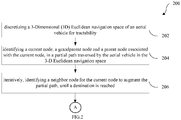
- FIG.2 is an exemplary flow diagram illustrating a computer implemented method 200 for turn angle-constrained aerial path planning, in accordance with an embodiment of the present disclosure.
- the system 100 comprises one or more data storage devices or memory 102 operatively coupled to the one or more processors 104 and is configured to store instructions configured for execution of steps of the method 200 by the one or more processors 104.
- the expression “aerial vehicle” may refer to any fixed-wing vehicle such as unmanned aerial vehicles (UAVs) or drones, gliders, airplanes, and the like.
- UAVs unmanned aerial vehicles
- UAVs unmanned aerial vehicles
- drones gliders, airplanes, and the like.
- Formal specification of any optimization problem entails specification of decision variables, the cost/objective as a function of the variables, and constraints wherever applicable.
- decision variables there is only one set involved, the 3D instantaneous location of the UAV: ⁇ x,y,z>. If the altitude is held/assumed constant, then the location is a 2-tuple, formed by latitude and longitude.
- constraint the present disclosure focusses on an additional critical constraint, viz., turn angle constraint arising out of communication and aerodynamics requirements.
- the turn angle constraint forces a generated path to make a turning maneuver, less than or equal to a predetermined maximum turning angle. This constraint avoids possibility of an aerodynamic stall during motion of a fixed wing vehicle.
- Distance cost is a mandatory cost component in all path planning algorithms that have arisen till date. It represents the length, in Euclidean space, of an optimal path undertaken by the aerial vehicle. This cost directly correlates to the limited battery power of the aerial vehicle, which is not fuel-driven. At a certain speed of the aerial vehicle, against an assumed constant wind speed, the energy of a charged battery may last only a certain distance. To try to maximize the mission, given that application required tens of kilometers to be remotely surveyed, the distance cost has to be minimized. In a discrete graph model of the navigation space, this reduces to finding the shortest path in Euclidean space (Euclidean shortest path).
- A* search algorithm Due to its simplicity and optimality guarantee under admissibility criterion, A* search algorithm, has been till recently, the search method of choice in real applications.
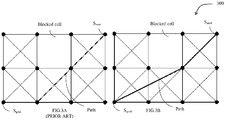
- a shortest path found using A* on any discretized graph as illustrated in FIG.3A is not equivalent to an actual shortest path in a continuous environment as illustrated in FIG.3B .
- S start and S goal generally represent start vertex and goal vertex of a search path and all cells other than those specifically indicated as blocked cells are unblocked cells.
- Theta* is a variant of A* that does not constrain the path being evolved to stick to grid edges.
- the key difference between Theta* and A* is that Theta* allows the parent of a vertex to be any vertex, unlike A* where the parent must be a visible neighbor.
- the one or more processors 104 are configured to discretize a 3-Dimensional (3D) Euclidean navigation space of an aerial vehicle for tractability.
- a grid of a plurality of unit cells is imposed on the 3D Euclidean navigation space, wherein the grid may be either a patterned grid or an irregular grid.
- the underlying set of grid points is not convex.
- the path optimization problem is NP (Non-deterministic Polynomial) hard.
- NP Non-deterministic Polynomial
- Theta* algorithm which is a basic approximation algorithm improves upon the approximation error while using A*, by trading off minimally with computational complexity. Hence Theta* algorithm has been used in the present disclosure.
- FIG.4 illustrates node nomenclature for a shortest path algorithm, in accordance with an embodiment of the present disclosure.
- the one or more processors 104 are configured to identify a current node, a grandparent node and a parent node associated with the current node, in a partial path traversed by the aerial vehicle in the 3-D Euclidean navigation space.
- the present disclosure also relies on a theorem (stated here without proof) -
- a greedy Theta* shortest path algorithm the direction formed by ⁇ grandparent, parent> and the direction formed by ⁇ parent, current> are not same. Accordingly, the nodes grandparent, parent and current are not collinear.
- the one or more processors 104 are configured to iteratively, identify a neighbor node for the current node to augment the partial path, until a destination is reached. This step involves several sub-steps as explained hereinafter.
- the one or more processors 104 are configured to identify at least one potential neighbor node of the current node satisfying a line of sight condition with the parent node. If a line of sight exists, then at step 206b, using triangle inequality the partial path is augmented offline, up to the at least one potential neighbor node by turning at a location corresponding to the parent node.
- a maximum turn angle constraint consistency is evaluated for the at least one potential neighbor node with respect to the grandparent node and further with respect to the parent node in the event that the evaluation with respect to the grandparent node fails.
- a maximum turn angle constraint for the at least one potential neighbor node is evaluated with respect to the grandparent node by checking if the angle subtended by (a) a line between the grandparent node and the parent node and b) a line between the parent node and the potential neighbor node is within a pre-determined maximum turning angle of the aerial vehicle identifying one of the at least one potential neighbor node as the neighbor node. If the turn angle is 0 degree, then the constraint is trivially true.
- the maximum turn angle constraint for the at least one potential neighbor node is then evaluated with respect to the parent node by checking if the angle subtended by (a) a line between the parent node and the current node and b) a line between the current node and the potential neighbor node is within the pre-determined maximum turning angle of the aerial vehicle.
- the line between parent node and the current node due to nature of Theta* algorithm, need not be aligned at all with any grid dimension or grid diagonals. Hence the possibility of success at this step is also on the higher side, than the possibility considering pure A*.
- FIG.5 illustrates turn angle consideration in the aerial path planning, in accordance with an embodiment of the present disclosure.
- the path is diminished in a minimal way.
- backtrack it is not necessary to backtrack all the way to the parent node of the current node.
- Theta* it is possible that the parent node is actually a node very far away from the current node, not necessarily at a distance of unit cell. It is imperative that the farther the path is backtracked and a detour approach is adopted, the higher the approximation error becomes.
- via a modification to Theta* which prior node participated in the triangle inequality for the current node is tracked.
- the path is backtracked to at least one prior node along the partial path augmented until a previous iteration, in the event that the maximum turn angle constraint consistency fails for each of the at least one potential neighbor nodes.
- backtracking to the at least one prior node comprises backtracking one or more unit cells from the plurality of unit cells and is agnostic (independent) of boundaries of the one or more cells.
- the step of backtracking further comprises optimizing the backtracking by successively stepping back to the at least one prior node, a unit cell away from the current node which satisfies the triangle inequality with respect to the current node, until a potential neighbor node of the prior node satisfying the maximum turn angle constraint is obtained as the backtracked node; the unit cell being part of the plurality of unit cells on the 3D Euclidean navigation space.
- Theta* is heuristic, just like in presence of obstacles, Theta* augmentation is a greedy heuristics.
- the one or more processors 104 are configured to identify a backtracked node from the at least one prior node on a backtracked path as the current node for augmenting the partial path.
- FIG.6 illustrates a graphical representation of backtracking to a prior node, in accordance with an embodiment of the present disclosure.
- systems and methods described herein above overcome the aforementioned limitations of conventional methods by discretizing the navigation space for tractability and providing a greedy heuristic algorithm to keep discretization error in control with robust average-case performance (in terms of approximation error with respect to best path). Limited backtracking, when absolutely needed is performed which decreases process time and works effectively in presence of coverage holes. Furthermore, the present disclosure provides methods that may be scaled to 3D space in a straightforward manner.
- the hardware device can be any kind of device which can be programmed including e.g. any kind of computer like a server or a personal computer, or the like, or any combination thereof.
- the device may also include means which could be e.g. hardware means like e.g. an application-specific integrated circuit (ASIC), a field-programmable gate array (FPGA), or a combination of hardware and software means, e.g.
- ASIC application-specific integrated circuit
- FPGA field-programmable gate array
- the means can include both hardware means and software means.
- the method embodiments described herein could be implemented in hardware and software.
- the device may also include software means.
- the embodiments of the present disclosure may be implemented on different hardware devices, e.g. using a plurality of CPUs.
- the embodiments herein can comprise hardware and software elements.
- the embodiments that are implemented in software include but are not limited to, firmware, resident software, microcode, etc.
- the functions performed by various modules comprising the system of the present disclosure and described herein may be implemented in other modules or combinations of other modules.
- a computer-usable or computer readable medium can be any apparatus that can comprise, store, communicate, propagate, or transport the program for use by or in connection with the instruction execution system, apparatus, or device.
- the various modules described herein may be implemented as software and/or hardware modules and may be stored in any type of non-transitory computer readable medium or other storage device.
- Some non-limiting examples of non-transitory computer-readable media include CDs, DVDs, BLU-RAY, flash memory, and hard disk drives.
Landscapes
- Engineering & Computer Science (AREA)
- Physics & Mathematics (AREA)
- General Physics & Mathematics (AREA)
- Radar, Positioning & Navigation (AREA)
- Remote Sensing (AREA)
- Aviation & Aerospace Engineering (AREA)
- Multimedia (AREA)
- Automation & Control Theory (AREA)
- Navigation (AREA)
Abstract

Description
- This patent application claims priority to India Patent Application
201721001481, filed on January 13, 2017 - The embodiments herein generally relate to aerial path planning, and more particularly to systems and methods for turn angle constrained aerial path planning implementable even in presence of coverage holes.
- Usage of aerial vehicles such as unmanned aerial vehicles (UAVs) for maintenance inspections of critical utility infrastructures, is rapidly emerging as a popular option. Installations for critical utility infrastructures generally have a characteristic of being long and linear and are mostly vast in terms of size and length probably running into hundreds of kilometers. Maintenance, both preventive and breakdown, is typically a costly legal responsibility towards public safety. Hence it entails usage of fixed-wing vehicles such as drones, which are constrained with restricted angular movement. Further, due to non-urban terrain, radio connectivity of any nature is at best intermittent, due to presence of many coverage holes. Such connectivity badly hampers the transmission of captured video data, which cannot be stored on-board due to its sheer size. Conventional methods require a lot of preprocessing for turn constraint. Also, the methods do not address coverage holes through which passage is restrained but not forbidden, thereby resulting in loss of captured data during the passage of the drones through coverage holes. Also, distance cost needs to be minimized in view of obstacles that may be entailed along the path
- Embodiments of the present disclosure present technological improvements as solutions to one or more of the above-mentioned technical problems recognized by the inventors in conventional systems.
- In an aspect, there is provided a processor implemented method comprising: discretizing a 3-Dimensional (3D) Euclidean navigation space of an aerial vehicle for tractability; identifying a current node, a grandparent node and a parent node associated with the current node, in a partial path traversed by the aerial vehicle in the 3-D Euclidean navigation space; and iteratively, identifying a neighbor node for the current node to augment the partial path, until a destination is reached, by: identifying at least one potential neighbor node of the current node satisfying a line of sight condition with the parent node; using triangle inequality to augment the partial path offline, up to the at least one potential neighbor node by turning at a location corresponding to the parent node; evaluating a maximum turn angle constraint consistency for the at least one potential neighbor node with respect to the grandparent node and further evaluating with respect to the parent node in the event that the evaluation with respect to the grandparent node fails, to identify one of the at least one potential neighbor node as the neighbor node for augmenting the partial path; backtracking to at least one prior node along the partial path augmented until a previous iteration, in the event that the maximum turn angle constraint consistency fails for each of the at least one potential neighbor nodes; and identifying a backtracked node from the at least one prior node on a backtracked path as the current node for augmenting the partial path.
- In another aspect, there is provided a system comprising: one or more data storage devices operatively coupled to the one or more processors and configured to store instructions configured for execution by the one or more processors to: discretize a 3-Dimensional (3D) Euclidean navigation space of an aerial vehicle for tractability; identify a current node, a grandparent node and a parent node associated with the current node, in a partial path traversed by the aerial vehicle in the 3-D Euclidean navigation space; and iteratively, identify a neighbor node for the current node to augment the partial path, until a destination is reached, by: identifying at least one potential neighbor node of the current node satisfying a line of sight condition with the parent node; using triangle inequality to augment the partial path offline, up to the at least one potential neighbor node by turning at a location corresponding to the parent node; evaluating a maximum turn angle constraint consistency for the at least one potential neighbor node with respect to the grandparent node and further evaluating with respect to the parent node in the event that the evaluation with respect to the grandparent node fails, to identify one of the at least one potential neighbor node as the neighbor node for augmenting the partial path; backtracking to at least one prior node along the partial path augmented until a previous iteration, in the event that the maximum turn angle constraint consistency fails for each of the at least one potential neighbor nodes; and identifying a backtracked node from the at least one prior node on a backtracked path as the current node for augmenting the partial path.
- In yet another aspect, there is provided a computer program product comprising a non-transitory computer readable medium having a computer readable program embodied therein, wherein the computer readable program, when executed on a computing device, causes the computing device to: discretize a 3-Dimensional (3D) Euclidean navigation space of an aerial vehicle for tractability; identify a current node, a grandparent node and a parent node associated with the current node, in a partial path traversed by the aerial vehicle in the 3-D Euclidean navigation space; and iteratively, identify a neighbor node for the current node to augment the partial path, until a destination is reached, by: identifying at least one potential neighbor node of the current node satisfying a line of sight condition with the parent node; using triangle inequality to augment the partial path offline, up to the at least one potential neighbor node by turning at a location corresponding to the parent node; evaluating a maximum turn angle constraint consistency for the at least one potential neighbor node with respect to the grandparent node and further evaluating with respect to the parent node in the event that the evaluation with respect to the grandparent node fails, to identify one of the at least one potential neighbor node as the neighbor node for augmenting the partial path; backtracking to at least one prior node along the partial path augmented until a previous iteration, in the event that the maximum turn angle constraint consistency fails for each of the at least one potential neighbor nodes; and identifying a backtracked node from the at least one prior node on a backtracked path as the current node for augmenting the partial path.
- In an embodiment of the present disclosure, the one or more hardware processors are further configured to discretize the 3D Euclidean navigation space by imposing a grid of a plurality of unit cells, on the 3D Euclidean navigation space.
- In an embodiment of the present disclosure, the grid is either a patterned grid or an irregular grid.
- In an embodiment of the present disclosure, the one or more hardware processors are further configured to evaluate a maximum turn angle constraint for the at least one potential neighbor node: with respect to the grandparent node comprises: identifying one of the at least one potential neighbor node as the neighbor node if the angle subtended by (a) a line between the grandparent node and the parent node and b) a line between the parent node and the potential neighbor node is within a pre-determined maximum turning angle of the aerial vehicle; and with respect to the parent node comprises: identifying one of the at least one potential neighbor node as the neighbor node if the angle subtended by (a) a line between the parent node and the current node and b) a line between the current node and the potential neighbor node is within the predetermined maximum turning angle of the aerial vehicle.
- In an embodiment of the present disclosure, backtracking to the at least one prior node comprises backtracking one or more cells from the plurality of cells and is agnostic of boundaries of the one or more cells.
- In an embodiment of the present disclosure, the one or more hardware processors are further configured to backtrack by successively stepping back to the at least one prior node, a unit cell away from the current node which satisfies the triangle inequality with respect to the current node, until a potential neighbor node of the prior node satisfying the maximum turn angle constraint is obtained as the backtracked node; the unit cell being part of the plurality of unit cells on the 3D Euclidean navigation space.
- It is to be understood that both the foregoing general description and the following detailed description are exemplary and explanatory only and are not restrictive of the embodiments of the present disclosure, as claimed.
- The embodiments herein will be better understood from the following detailed description with reference to the drawings, in which:
-
FIG.1 illustrates an exemplary block diagram of a system for turn angle-constrained aerial path planning, in accordance with an embodiment of the present disclosure; -
FIG.2 is an exemplary flow diagram illustrating a computer implemented method for turn angle-constrained aerial path planning, in accordance with an embodiment of the present disclosure; -
FIG.3A and FIG.3B provide an illustrative comparison between a discrete shortest path using square grid as known in the art and an actual continuous shortest path; -
FIG.4 illustrates node nomenclature for a shortest path algorithm, in accordance with an embodiment of the present disclosure; -
FIG.5 illustrates turn angle consideration in the aerial path planning, in accordance with an embodiment of the present disclosure; and -
FIG.6 illustrates a graphical representation of backtracking to a prior node, in accordance with an embodiment of the present disclosure. - It should be appreciated by those skilled in the art that any block diagram herein represent conceptual views of illustrative systems embodying the principles of the present subject matter. Similarly, it will be appreciated that any flow charts, flow diagrams, state transition diagrams, pseudo code, and the like represent various processes which may be substantially represented in computer readable medium and so executed by a computing device or processor, whether or not such computing device or processor is explicitly shown.
- The embodiments herein and the various features and advantageous details thereof are explained more fully with reference to the non-limiting embodiments that are illustrated in the accompanying drawings and detailed in the following description. The examples used herein are intended merely to facilitate an understanding of ways in which the embodiments herein may be practiced and to further enable those skilled in the art to practice the embodiments herein. Accordingly, the examples should not be construed as limiting the scope of the embodiments herein.
- The words "comprising," "having," "containing," and "including," and other forms thereof, are intended to be equivalent in meaning and be open ended in that an item or items following any one of these words is not meant to be an exhaustive listing of such item or items, or meant to be limited to only the listed item or items.
- It must also be noted that as used herein and in the appended claims, the singular forms "a," "an," and "the" include plural references unless the context clearly dictates otherwise. Although any systems and methods similar or equivalent to those described herein can be used in the practice or testing of embodiments of the present disclosure, the preferred, systems and methods are now described.
- Some embodiments of this disclosure, illustrating all its features, will now be discussed in detail. The disclosed embodiments are merely exemplary of the disclosure, which may be embodied in various forms.
- Before setting forth the detailed explanation, it is noted that all of the discussion below, regardless of the particular implementation being described, is exemplary in nature, rather than limiting.
- The present disclosure provides systems and methods that ensure transmission continuity of data from aerial vehicles even in presence of radio coverage holes by turn angle constrained path planning. Technical problems faced in employing conventional methods include challenges in storing captured data, particularly video data on board due to the size of the data; transmitting the captured data resulted in loss of data when the aerial vehicle passes through coverage holes. Furthermore, a lot of preprocessing was involved for turn constraint in the conventional methods. Methods of the present disclosure involve less processing time while having approximation error well within bound. The methods of the present disclosure use a minimal greedy backtracking strategy to satisfy the turn angle constraint. The technical problem is treated as a discrete optimization problem that works over discretized version of navigation space which is Euclidean. It is based on modifications carried out to the Theta* algorithm (originally designed for computer games domain) to incorporate the turn constraint. If during path evolution, turn constraint gets violated even after considering all the neighboring nodes of a current node, then the path evolution is backtracked. It may be noted by persons skilled in the art that conventional greedy algorithms do not backtrack.
- Referring now to the drawings, and more particularly to
FIGS. 1 through 6 , where similar reference characters denote corresponding features consistently throughout the figures, there are shown preferred embodiments and these embodiments are described in the context of the following exemplary system and method. -
FIG.1 illustrates an exemplary block diagram of asystem 100 for turn angle-constrained aerial path planning, in accordance with an embodiment of the present disclosure. In an embodiment, thesystem 100 includes one ormore processors 104, communication interface device(s) or input/output (I/O) interface(s) 106, and one or more data storage devices ormemory 102 operatively coupled to the one ormore processors 104. The one ormore processors 104 that are hardware processors can be implemented as one or more microprocessors, microcomputers, microcontrollers, digital signal processors, central processing units, state machines, graphics controllers, logic circuitries, and/or any devices that manipulate signals based on operational instructions. Among other capabilities, the processor(s) are configured to fetch and execute computer-readable instructions stored in the memory. In an embodiment, thesystem 100 can be implemented in a variety of computing systems, such as laptop computers, notebooks, hand-held devices, workstations, mainframe computers, servers, a network cloud and the like. - The I/O interface device(s) 106 can include a variety of software and hardware interfaces, for example, a web interface, a graphical user interface, and the like and can facilitate multiple communications within a wide variety of networks N/W and protocol types, including wired networks, for example, LAN, cable, etc., and wireless networks, such as WLAN, cellular, or satellite. In an embodiment, the I/O interface device(s) can include one or more ports for connecting a number of devices to one another or to another server.
- The
memory 102 may include any computer-readable medium known in the art including, for example, volatile memory, such as static random access memory (SRAM) and dynamic random access memory (DRAM), and/or non-volatile memory, such as read only memory (ROM), erasable programmable ROM, flash memories, hard disks, optical disks, and magnetic tapes. In an embodiment, one or more modules (not shown) of thesystem 100 can be stored in thememory 102. -
FIG.2 is an exemplary flow diagram illustrating a computer implementedmethod 200 for turn angle-constrained aerial path planning, in accordance with an embodiment of the present disclosure. In an embodiment, thesystem 100 comprises one or more data storage devices ormemory 102 operatively coupled to the one ormore processors 104 and is configured to store instructions configured for execution of steps of themethod 200 by the one ormore processors 104. - In the context of the present disclosure, the expression "aerial vehicle" may refer to any fixed-wing vehicle such as unmanned aerial vehicles (UAVs) or drones, gliders, airplanes, and the like.
- Formal specification of any optimization problem entails specification of decision variables, the cost/objective as a function of the variables, and constraints wherever applicable. In terms of the decision variables, there is only one set involved, the 3D instantaneous location of the UAV: <x,y,z>. If the altitude is held/assumed constant, then the location is a 2-tuple, formed by latitude and longitude. In terms of constraint, the present disclosure focusses on an additional critical constraint, viz., turn angle constraint arising out of communication and aerodynamics requirements. The turn angle constraint forces a generated path to make a turning maneuver, less than or equal to a predetermined maximum turning angle. This constraint avoids possibility of an aerodynamic stall during motion of a fixed wing vehicle.
- Distance cost is a mandatory cost component in all path planning algorithms that have arisen till date. It represents the length, in Euclidean space, of an optimal path undertaken by the aerial vehicle. This cost directly correlates to the limited battery power of the aerial vehicle, which is not fuel-driven. At a certain speed of the aerial vehicle, against an assumed constant wind speed, the energy of a charged battery may last only a certain distance. To try to maximize the mission, given that application required tens of kilometers to be remotely surveyed, the distance cost has to be minimized. In a discrete graph model of the navigation space, this reduces to finding the shortest path in Euclidean space (Euclidean shortest path).
- For any path in discrete grid, piecewise-linear path assumption is a valid assumption also because of the shortest length, Lmin constraint. In such a case, insertion of additional variables to denote turning points of the aerial vehicle and sum of Euclidean distances between such successive turning points, is a direct measure of such cost. Let PTi; i ∈ 1, ..., T be the coordinate tuple of each turning point along a path in a coordinate system such as say, world coordinate system (WCS). Then,

- Due to its simplicity and optimality guarantee under admissibility criterion, A* search algorithm, has been till recently, the search method of choice in real applications. However, in geographical applications in which the environment is continuous, a shortest path found using A* on any discretized graph as illustrated in
FIG.3A is not equivalent to an actual shortest path in a continuous environment as illustrated inFIG.3B . InFIG.3A and FIG.3B , Sstart and Sgoal generally represent start vertex and goal vertex of a search path and all cells other than those specifically indicated as blocked cells are unblocked cells. Subsequently, a technique which smoothens the path as it is being greedily evolved, thus reducing the gap (between the shortest path using square grid and continuous shorted path) extensively, was developed in the form of Theta* algorithm. Theta* is a variant of A* that does not constrain the path being evolved to stick to grid edges. The key difference between Theta* and A* is that Theta* allows the parent of a vertex to be any vertex, unlike A* where the parent must be a visible neighbor. To have such extended, transitive parental relation, Theta* updates the g-value (length of the shortest path from a start vertex to vertex s found so far) and parent of an unexpanded visible neighbor s' of vertex s by considering an alternative extension. To allow for any-angle paths, in each iteration, Theta* additionally considers the grandfatherly extension from parent(s) to neighbor s' in a straight line [cost = c(parent(s), s')], resulting in a new length of g(parent(s)) + c(parent(s),s') if s' has line-of-sight to parent(s). The idea behind considering this alternative is that in case of Euclidean shortest path problems, this alternative is never longer than previous default path, due to the triangle inequality, if s' has line-of-sight to parent(s). If line of sight is not present, then the extension in current iteration happens in the normal A* way, along the grid. - To reduce computational complexity, in an embodiment, at
step 202, the one ormore processors 104 are configured to discretize a 3-Dimensional (3D) Euclidean navigation space of an aerial vehicle for tractability. A grid of a plurality of unit cells is imposed on the 3D Euclidean navigation space, wherein the grid may be either a patterned grid or an irregular grid. In a discrete 3D Euclidean navigation space with obstacles, it is known that the underlying set of grid points is not convex. Also, for spaces ofdimension 3 and above, the path optimization problem is NP (Non-deterministic Polynomial) hard. Hence algorithms, typically inspired by shortest path algorithms in a convex domain, e.g. Dijkstra, have been researched for design for approximately optimal solutions/paths. The Theta* algorithm, which is a basic approximation algorithm improves upon the approximation error while using A*, by trading off minimally with computational complexity. Hence Theta* algorithm has been used in the present disclosure. - In accordance with the present disclosure, in a greedy approach, turn is necessarily detected at each path augmentation step, to ensure that the angle constraint is continuously satisfied.
FIG.4 illustrates node nomenclature for a shortest path algorithm, in accordance with an embodiment of the present disclosure. In an embodiment, atstep 204, the one ormore processors 104 are configured to identify a current node, a grandparent node and a parent node associated with the current node, in a partial path traversed by the aerial vehicle in the 3-D Euclidean navigation space. The present disclosure also relies on a theorem (stated here without proof) - In a greedy Theta* shortest path algorithm, the direction formed by <grandparent, parent> and the direction formed by <parent, current> are not same. Accordingly, the nodes grandparent, parent and current are not collinear. - In an embodiment, at
step 206, the one ormore processors 104 are configured to iteratively, identify a neighbor node for the current node to augment the partial path, until a destination is reached. This step involves several sub-steps as explained hereinafter. - In an embodiment, at
step 206a, the one ormore processors 104 are configured to identify at least one potential neighbor node of the current node satisfying a line of sight condition with the parent node. If a line of sight exists, then atstep 206b, using triangle inequality the partial path is augmented offline, up to the at least one potential neighbor node by turning at a location corresponding to the parent node. - To identify one of the at least one potential neighbor node as the neighbor node for augmenting the partial path, at
step 206c, a maximum turn angle constraint consistency is evaluated for the at least one potential neighbor node with respect to the grandparent node and further with respect to the parent node in the event that the evaluation with respect to the grandparent node fails. - In an embodiment, a maximum turn angle constraint for the at least one potential neighbor node is evaluated with respect to the grandparent node by checking if the angle subtended by (a) a line between the grandparent node and the parent node and b) a line between the parent node and the potential neighbor node is within a pre-determined maximum turning angle of the aerial vehicle identifying one of the at least one potential neighbor node as the neighbor node. If the turn angle is 0 degree, then the constraint is trivially true.
- If the evaluation with respect to the grandparent node fails, the maximum turn angle constraint for the at least one potential neighbor node is then evaluated with respect to the parent node by checking if the angle subtended by (a) a line between the parent node and the current node and b) a line between the current node and the potential neighbor node is within the pre-determined maximum turning angle of the aerial vehicle. In accordance with the present disclosure, the line between parent node and the current node, due to nature of Theta* algorithm, need not be aligned at all with any grid dimension or grid diagonals. Hence the possibility of success at this step is also on the higher side, than the possibility considering pure A*. Once again, if the turn angle is 0 degree, then the constraint is trivially true.
- If in both cases explained herein above, the potential neighbor node fails the maximum turn angle constraint, and is not found suitable to qualify as a neighbor node for augmenting the path, then the neighbor node under consideration may be dropped from consideration and another neighbor node of the current node may be evaluated for compatible turn angle constrained path augmentation.
FIG.5 illustrates turn angle consideration in the aerial path planning, in accordance with an embodiment of the present disclosure. - There are typical scenarios in square grids where plain angle checking involving grandparent and parent, all neighbor nodes of current node fails, especially around obstacles. In such case, the
method 200 backtracks along the partial path augmented so far, and tries to approach the obstacle using some other neighbor of a prior node on the backtracked path. This leads to a possibility whereby the angle of approach towards an obstacle known/discovered becomes lesser/acute. - Other than obstacles, conventional methods that only consider neighbors, can also fail to augment a partial path through a coverage hole, which behaves like a porous obstacle. Due to lack of sharp turns, a path that is getting augmented within a coverage hole can only take a longer detour, before exiting the coverage hole. This can also lead to additional distance cost. If the path augmented so far is backtracked, it is possible to re-enter the coverage hole from a point and an angle of entry so that the sub-path within the coverage hole is more close to its boundary, than earlier.
- In accordance with the present disclosure, for circumnavigation around an obstacle greedily the path is diminished in a minimal way. Hence, to backtrack, it is not necessary to backtrack all the way to the parent node of the current node. In Theta*, it is possible that the parent node is actually a node very far away from the current node, not necessarily at a distance of unit cell. It is imperative that the farther the path is backtracked and a detour approach is adopted, the higher the approximation error becomes. Hence in accordance with the present disclosure, via a modification to Theta*, which prior node participated in the triangle inequality for the current node is tracked. Accordingly, in an embodiment, at
step 206d, the path is backtracked to at least one prior node along the partial path augmented until a previous iteration, in the event that the maximum turn angle constraint consistency fails for each of the at least one potential neighbor nodes. In an embodiment, backtracking to the at least one prior node comprises backtracking one or more unit cells from the plurality of unit cells and is agnostic (independent) of boundaries of the one or more cells. The step of backtracking further comprises optimizing the backtracking by successively stepping back to the at least one prior node, a unit cell away from the current node which satisfies the triangle inequality with respect to the current node, until a potential neighbor node of the prior node satisfying the maximum turn angle constraint is obtained as the backtracked node; the unit cell being part of the plurality of unit cells on the 3D Euclidean navigation space. It may be noted that the variation to Theta*is heuristic, just like in presence of obstacles, Theta* augmentation is a greedy heuristics. - In an embodiment, at
step 206e, the one ormore processors 104 are configured to identify a backtracked node from the at least one prior node on a backtracked path as the current node for augmenting the partial path.FIG.6 illustrates a graphical representation of backtracking to a prior node, in accordance with an embodiment of the present disclosure. - Thus in accordance with the present disclosure, systems and methods described herein above overcome the aforementioned limitations of conventional methods by discretizing the navigation space for tractability and providing a greedy heuristic algorithm to keep discretization error in control with robust average-case performance (in terms of approximation error with respect to best path). Limited backtracking, when absolutely needed is performed which decreases process time and works effectively in presence of coverage holes. Furthermore, the present disclosure provides methods that may be scaled to 3D space in a straightforward manner.
- The written description describes the subject matter herein to enable any person skilled in the art to make and use the embodiments of the present disclosure. The scope of the subject matter embodiments defined here may include other modifications that occur to those skilled in the art. Such other modifications are intended to be within the scope if they have similar elements that do not differ from the literal language of the claims or if they include equivalent elements with insubstantial differences from the literal language.
- The scope of the subject matter embodiments defined here may include other modifications that occur to those skilled in the art. Such other modifications are intended to be within the scope if they have similar elements that do not differ from the literal language of the claims or if they include equivalent elements with insubstantial differences from the literal language.
- It is, however to be understood that the scope of the protection is extended to such a program and in addition to a computer-readable means having a message therein; such computer-readable storage means contain program-code means for implementation of one or more steps of the method, when the program runs on a server or mobile device or any suitable programmable device. The hardware device can be any kind of device which can be programmed including e.g. any kind of computer like a server or a personal computer, or the like, or any combination thereof. The device may also include means which could be e.g. hardware means like e.g. an application-specific integrated circuit (ASIC), a field-programmable gate array (FPGA), or a combination of hardware and software means, e.g. an ASIC and an FPGA, or at least one microprocessor and at least one memory with software modules located therein. Thus, the means can include both hardware means and software means. The method embodiments described herein could be implemented in hardware and software. The device may also include software means. Alternatively, the embodiments of the present disclosure may be implemented on different hardware devices, e.g. using a plurality of CPUs.
- The embodiments herein can comprise hardware and software elements. The embodiments that are implemented in software include but are not limited to, firmware, resident software, microcode, etc. The functions performed by various modules comprising the system of the present disclosure and described herein may be implemented in other modules or combinations of other modules. For the purposes of this description, a computer-usable or computer readable medium can be any apparatus that can comprise, store, communicate, propagate, or transport the program for use by or in connection with the instruction execution system, apparatus, or device. The various modules described herein may be implemented as software and/or hardware modules and may be stored in any type of non-transitory computer readable medium or other storage device. Some non-limiting examples of non-transitory computer-readable media include CDs, DVDs, BLU-RAY, flash memory, and hard disk drives.
- Further, although process steps, method steps, techniques or the like may be described in a sequential order, such processes, methods and techniques may be configured to work in alternate orders. In other words, any sequence or order of steps that may be described does not necessarily indicate a requirement that the steps be performed in that order. The steps of processes described herein may be performed in any order practical. Further, some steps may be performed simultaneously.
- The preceding description has been presented with reference to various embodiments. Persons having ordinary skill in the art and technology to which this application pertains will appreciate that alterations and changes in the described structures and methods of operation can be practiced without meaningfully departing from the principle, spirit and scope.
Claims (13)
- A processor implemented method (200) comprising:discretizing a 3-Dimensional (3D) Euclidean navigation space of an aerial vehicle for tractability (202);identifying a current node, a grandparent node and a parent node associated with the current node, in a partial path traversed by the aerial vehicle in the 3-D Euclidean navigation space (204); anditeratively, identifying a neighbor node for the current node to augment the partial path, until a destination is reached (206), by:identifying at least one potential neighbor node of the current node satisfying a line of sight condition with the parent node (206a);using triangle inequality to augment the partial path offline, up to the at least one potential neighbor node by turning at a location corresponding to the parent node (206b);evaluating a maximum turn angle constraint consistency for the at least one potential neighbor node with respect to the grandparent node and further evaluating with respect to the parent node in the event that the evaluation with respect to the grandparent node fails, to identify one of the at least one potential neighbor node as the neighbor node for augmenting the partial path (206c);backtracking to at least one prior node along the partial path augmented until a previous iteration, in the event that the maximum turn angle constraint consistency fails for each of the at least one potential neighbor nodes (206d); andidentifying a backtracked node from the at least one prior node on a backtracked path as the current node for augmenting the partial path (206e).
- The processor implemented method of claim 1, wherein the step of discretizing comprises imposing a grid of a plurality of unit cells, on the 3D Euclidean navigation space.
- The processor implemented method of claim 2, wherein the grid is either a patterned grid or an irregular grid.
- The processor implemented method of claim 2, wherein evaluating a maximum turn angle constraint for the at least one potential neighbor node:with respect to the grandparent node comprises: identifying one of the at least one potential neighbor node as the neighbor node if the angle subtended by (a) a line between the grandparent node and the parent node and b) a line between the parent node and the potential neighbor node is within a pre-determined maximum turning angle of the aerial vehicle; andwith respect to the parent node comprises: identifying one of the at least one potential neighbor node as the neighbor node if the angle subtended by (a) a line between the parent node and the current node and b) a line between the current node and the potential neighbor node is within the pre-determined maximum turning angle of the aerial vehicle.
- The processor implemented method of claim 4, wherein backtracking to the at least one prior node comprises backtracking one or more unit cells from the plurality of unit cells.
- The processor implemented method of claim 5, wherein the step of backtracking further comprises optimizing the backtracking by successively stepping back to the at least one prior node, a unit cell away from the current node which satisfies the triangle inequality with respect to the current node, until a potential neighbor node of the prior node satisfying the maximum turn angle constraint is obtained as the backtracked node; the unit cell being part of the plurality of unit cells on the 3D Euclidean navigation space.
- A system (100) comprising:one or more data storage devices (102) operatively coupled to one or more hardware processors (104) and configured to store instructions configured for execution by the one or more hardware processors to:discretize a 3-Dimensional (3D) Euclidean navigation space of an aerial vehicle for tractability;identify a current node, a grandparent node and a parent node associated with the current node, in a partial path traversed by the aerial vehicle in the 3-D Euclidean navigation space; anditeratively, identify a neighbor node for the current node to augment the partial path, until a destination is reached, by:identifying at least one potential neighbor node of the current node satisfying a line of sight condition with the parent node;using triangle inequality to augment the partial path offline, up to the at least one potential neighbor node by turning at a location corresponding to the parent node;evaluating a maximum turn angle constraint consistency for the at least one potential neighbor node with respect to the grandparent node and further evaluating with respect to the parent node in the event that the evaluation with respect to the grandparent node fails, to identify one of the at least one potential neighbor node as the neighbor node for augmenting the partial path;backtracking to at least one prior node along the partial path augmented until a previous iteration, in the event that the maximum turn angle constraint consistency fails for each of the at least one potential neighbor nodes; andidentifying a backtracked node from the at least one prior node on a backtracked path as the current node for augmenting the partial path.
- The system of claim 7, wherein the one or more hardware processors are further configured to: discretize the 3D Euclidean navigation space by imposing a grid of a plurality of unit cells, on the 3D Euclidean navigation space.
- The system of claim 8, wherein the grid is either a patterned grid or an irregular grid.
- The system of claim 8, wherein the one or more hardware processors are further configured to evaluate a maximum turn angle constraint for the at least one potential neighbor node:with respect to the grandparent node comprises: identifying one of the at least one potential neighbor node as the neighbor node if the angle subtended by (a) a line between the grandparent node and the parent node and b) a line between the parent node and the potential neighbor node is within a pre-determined maximum turning angle of the aerial vehicle; andwith respect to the parent node comprises: identifying one of the at least one potential neighbor node as the neighbor node if the angle subtended by (a) a line between the parent node and the current node and b) a line between the current node and the potential neighbor node is within the pre-determined maximum turning angle of the aerial vehicle.
- The system of claim 10, wherein backtracking to the at least one prior node comprises backtracking one or more cells from the plurality of cells.
- The system of claim 11, wherein the one or more hardware processors are further configured to backtrack by successively stepping back to the at least one prior node, a unit cell away from the current node which satisfies the triangle inequality with respect to the current node, until a potential neighbor node of the prior node satisfying the maximum turn angle constraint is obtained as the backtracked node; the unit cell being part of the plurality of unit cells on the 3D Euclidean navigation space.
- One or more non-transitory machine readable information storage mediums comprising one or more instructions which when executed by one or more hardware processors causes the one or more hardware processor to perform a method for turn angle constrained aerial path planning implementable even in presence of coverage holes comprising of:discretizing a 3-Dimensional (3D) Euclidean navigation space of an aerial vehicle for tractability (202);identifying a current node, a grandparent node and a parent node associated with the current node, in a partial path traversed by the aerial vehicle in the 3-D Euclidean navigation space (204); anditeratively, identifying a neighbor node for the current node to augment the partial path, until a destination is reached (206), by:identifying at least one potential neighbor node of the current node satisfying a line of sight condition with the parent node (206a);using triangle inequality to augment the partial path offline, up to the at least one potential neighbor node by turning at a location corresponding to the parent node (206b);evaluating a maximum turn angle constraint consistency for the at least one potential neighbor node with respect to the grandparent node and further evaluating with respect to the parent node in the event that the evaluation with respect to the grandparent node fails, to identify one of the at least one potential neighbor node as the neighbor node for augmenting the partial path (206c);backtracking to at least one prior node along the partial path augmented until a previous iteration, in the event that the maximum turn angle constraint consistency fails for each of the at least one potential neighbor nodes (206d); andidentifying a backtracked node from the at least one prior node on a backtracked path as the current node for augmenting the partial path (206e).
Applications Claiming Priority (1)
| Application Number | Priority Date | Filing Date | Title |
|---|---|---|---|
| IN201721001481 | 2017-01-13 |
Publications (2)
| Publication Number | Publication Date |
|---|---|
| EP3349088A1 true EP3349088A1 (en) | 2018-07-18 |
| EP3349088B1 EP3349088B1 (en) | 2022-09-07 |
Family
ID=60971989
Family Applications (1)
| Application Number | Title | Priority Date | Filing Date |
|---|---|---|---|
| EP18150249.3A Active EP3349088B1 (en) | 2017-01-13 | 2018-01-04 | Systems and method for turn angle constrained aerial path planning |
Country Status (1)
| Country | Link |
|---|---|
| EP (1) | EP3349088B1 (en) |
Cited By (13)
| Publication number | Priority date | Publication date | Assignee | Title |
|---|---|---|---|---|
| CN109341699A (en) * | 2018-11-30 | 2019-02-15 | 四川九洲电器集团有限责任公司 | A kind of Intelligent unattended platform path planing method based on avoidance turning quality estimating |
| CN109459052A (en) * | 2018-12-28 | 2019-03-12 | 上海大学 | A kind of sweeper complete coverage path planning method |
| CN110986958A (en) * | 2019-12-24 | 2020-04-10 | 北京工业大学 | Multi-unmanned aerial vehicle collaborative path planning method based on multi-population collaborative drosophila optimization |
| CN111039231A (en) * | 2019-12-31 | 2020-04-21 | 芜湖哈特机器人产业技术研究院有限公司 | Intelligent forklift turning path planning method |
| CN111158366A (en) * | 2019-12-31 | 2020-05-15 | 湖南大学 | Path Planning Method Based on Graph Search and Geometric Curve Fusion |
| CN111928838A (en) * | 2020-07-06 | 2020-11-13 | 西安羚控电子科技有限公司 | Path planning method based on ship-borne unmanned aerial vehicle front wheel turning technology |
| CN112729308A (en) * | 2020-12-24 | 2021-04-30 | 西安理工大学 | Rapid unmanned aerial vehicle track planning method under multi-constraint condition |
| CN112817331A (en) * | 2021-01-05 | 2021-05-18 | 北京林业大学 | Intelligent forestry information monitoring system based on multi-machine cooperation |
| CN113157001A (en) * | 2021-05-25 | 2021-07-23 | 北京航空航天大学 | Unmanned aerial vehicle path planning method based on second-order cone optimization |
| CN114526750A (en) * | 2022-01-10 | 2022-05-24 | 深圳市灵星雨科技开发有限公司 | Path optimization method and device |
| CN114721366A (en) * | 2020-12-22 | 2022-07-08 | 百度(美国)有限责任公司 | Indoor autonomous navigation based on natural language |
| CN116772841A (en) * | 2023-03-27 | 2023-09-19 | 西北工业大学 | Fire-extinguishing aircraft three-dimensional route planning method based on improved A-algorithm |
| CN118548872A (en) * | 2024-05-15 | 2024-08-27 | 河海大学 | Path planning method and device, equipment and medium |
-
2018
- 2018-01-04 EP EP18150249.3A patent/EP3349088B1/en active Active
Non-Patent Citations (6)
| Title |
|---|
| ALEX NASH ET AL: "Incremental Phi: Incremental Any-Angle Path Planning on Grids", 31 December 2009 (2009-12-31), XP055454258, Retrieved from the Internet <URL:http://idm-lab.org/bib/abstracts/papers/ijcai09d.pdf> [retrieved on 20180226] * |
| HRISHIKESH SHARMA ET AL: "An Efficient Approach to Communication-aware Path Planning for Long-range Surveillance Missions undertaken by UAVs", ARXIV.ORG, CORNELL UNIVERSITY LIBRARY, 201 OLIN LIBRARY CORNELL UNIVERSITY ITHACA, NY 14853, 14 July 2017 (2017-07-14), XP080776836 * |
| KONSTANTIN YAKOVLEV ET AL: "Resolving Spatial-Time Conflicts In A Set Of Any-angle Or Angle-constrained Grid Paths", ARXIV.ORG, CORNELL UNIVERSITY LIBRARY, 201 OLIN LIBRARY CORNELL UNIVERSITY ITHACA, NY 14853, 9 August 2016 (2016-08-09), XP080719105 * |
| LUCA DE FILIPPIS ET AL: "Path Planning Strategies for UAVS in 3D Environments", JOURNAL OF INTELLIGENT AND ROBOTIC SYSTEMS ; THEORY AND APPLICATIONS - (INCORPORATING MECHATRONIC SYSTEMS ENGINEERING), KLUWER ACADEMIC PUBLISHERS, DO, vol. 65, no. 1 - 4, 16 August 2011 (2011-08-16), pages 247 - 264, XP019989896, ISSN: 1573-0409, DOI: 10.1007/S10846-011-9568-2 * |
| SHARMA HRISHIKESH ET AL: "An efficient backtracking-based approach to turn-constrained path planning for aerial mobile robots", 2017 EUROPEAN CONFERENCE ON MOBILE ROBOTS (ECMR), IEEE, 6 September 2017 (2017-09-06), pages 1 - 8, XP033251324, DOI: 10.1109/ECMR.2017.8098712 * |
| YAKOVLEV KONSTANTIN ET AL: "Grid-Based Angle-Constrained Path Planning", 3 November 2015, ECCV 2016 CONFERENCE; [LECTURE NOTES IN COMPUTER SCIENCE; LECT.NOTES COMPUTER], SPRINGER INTERNATIONAL PUBLISHING, CHAM, PAGE(S) 208 - 221, ISBN: 978-3-642-33485-6, ISSN: 0302-9743, XP047413814 * |
Cited By (18)
| Publication number | Priority date | Publication date | Assignee | Title |
|---|---|---|---|---|
| CN109341699A (en) * | 2018-11-30 | 2019-02-15 | 四川九洲电器集团有限责任公司 | A kind of Intelligent unattended platform path planing method based on avoidance turning quality estimating |
| CN109459052A (en) * | 2018-12-28 | 2019-03-12 | 上海大学 | A kind of sweeper complete coverage path planning method |
| CN110986958A (en) * | 2019-12-24 | 2020-04-10 | 北京工业大学 | Multi-unmanned aerial vehicle collaborative path planning method based on multi-population collaborative drosophila optimization |
| CN110986958B (en) * | 2019-12-24 | 2021-11-26 | 北京工业大学 | Multi-unmanned aerial vehicle collaborative path planning method based on multi-population collaborative drosophila optimization |
| CN111039231A (en) * | 2019-12-31 | 2020-04-21 | 芜湖哈特机器人产业技术研究院有限公司 | Intelligent forklift turning path planning method |
| CN111158366A (en) * | 2019-12-31 | 2020-05-15 | 湖南大学 | Path Planning Method Based on Graph Search and Geometric Curve Fusion |
| CN111039231B (en) * | 2019-12-31 | 2021-04-16 | 芜湖哈特机器人产业技术研究院有限公司 | Intelligent forklift turning path planning method |
| CN111928838A (en) * | 2020-07-06 | 2020-11-13 | 西安羚控电子科技有限公司 | Path planning method based on ship-borne unmanned aerial vehicle front wheel turning technology |
| CN114721366A (en) * | 2020-12-22 | 2022-07-08 | 百度(美国)有限责任公司 | Indoor autonomous navigation based on natural language |
| CN112729308A (en) * | 2020-12-24 | 2021-04-30 | 西安理工大学 | Rapid unmanned aerial vehicle track planning method under multi-constraint condition |
| CN112729308B (en) * | 2020-12-24 | 2024-05-03 | 广州融赋数智技术服务有限公司 | Unmanned aerial vehicle rapid track planning method under multi-constraint condition |
| CN112817331A (en) * | 2021-01-05 | 2021-05-18 | 北京林业大学 | Intelligent forestry information monitoring system based on multi-machine cooperation |
| CN113157001B (en) * | 2021-05-25 | 2022-06-03 | 北京航空航天大学 | Unmanned aerial vehicle path planning method based on second-order cone optimization |
| CN113157001A (en) * | 2021-05-25 | 2021-07-23 | 北京航空航天大学 | Unmanned aerial vehicle path planning method based on second-order cone optimization |
| CN114526750A (en) * | 2022-01-10 | 2022-05-24 | 深圳市灵星雨科技开发有限公司 | Path optimization method and device |
| CN114526750B (en) * | 2022-01-10 | 2024-02-27 | 深圳市灵星雨科技开发有限公司 | Path optimization method and device |
| CN116772841A (en) * | 2023-03-27 | 2023-09-19 | 西北工业大学 | Fire-extinguishing aircraft three-dimensional route planning method based on improved A-algorithm |
| CN118548872A (en) * | 2024-05-15 | 2024-08-27 | 河海大学 | Path planning method and device, equipment and medium |
Also Published As
| Publication number | Publication date |
|---|---|
| EP3349088B1 (en) | 2022-09-07 |
Similar Documents
| Publication | Publication Date | Title |
|---|---|---|
| EP3349088B1 (en) | Systems and method for turn angle constrained aerial path planning | |
| US10692385B2 (en) | Distance and communication costs based aerial path planning | |
| US11880188B2 (en) | Intelligent distribution of data for robotic and autonomous systems | |
| US10140875B1 (en) | Method and apparatus for joint optimization of multi-UAV task assignment and path planning | |
| US10185321B2 (en) | Unmanned vehicle, system and method for determining a planned path for unmanned vehicles | |
| Kingston et al. | Automated UAV tasks for search and surveillance | |
| US10573187B2 (en) | Automated vehicle control | |
| Wubben et al. | FFP: A Force Field Protocol for the tactical management of UAV conflicts | |
| Gregory et al. | An investigation of goal assignment for a heterogeneous robotic team to enable resilient disaster-site exploration | |
| Scerri et al. | Transitioning multiagent technology to UAV applications. | |
| Tousi et al. | Optimal hybrid fault recovery in a team of unmanned aerial vehicles | |
| Alkouz et al. | Failure-sentient composition for swarm-based drone services | |
| Ball et al. | A swarm-intelligence approach to oil spill mapping using unmanned aerial vehicles | |
| EP4276561B1 (en) | Autonomous aerial imaging and environmental sensing of a datacenter | |
| EP4148706B1 (en) | Fast path planning for dynamic avoidance in partially known environments | |
| Scerri et al. | A decentralized approach to space deconfliction | |
| Darko et al. | Proactive Distributed Emergency Response With Heterogeneous Tasks Allocation | |
| US20240096073A1 (en) | Systems and methods for probabilistic consensus on feature distribution for multi-robot systems with markovian exploration dynamics | |
| Moldovan et al. | Safety, risk awareness and exploration in reinforcement learning | |
| US12386368B2 (en) | Methods and systems for optimized assignment of traversal tasks under imperfect sensing of autonomous vehicles | |
| Kumari et al. | Reliability Analysis of Petri Nets For Unmanned Aerial Vehicles | |
| US20200111243A1 (en) | Map declutter | |
| Dubeň et al. | Information gathering planning with hermite spline motion primitives for aerial vehicles with limited time of flight | |
| US20250265142A1 (en) | Machine to machine capability sharing | |
| Ru et al. | A model of mission planning for cooperative UAVs |
Legal Events
| Date | Code | Title | Description |
|---|---|---|---|
| PUAI | Public reference made under article 153(3) epc to a published international application that has entered the european phase |
Free format text: ORIGINAL CODE: 0009012 |
|
| STAA | Information on the status of an ep patent application or granted ep patent |
Free format text: STATUS: THE APPLICATION HAS BEEN PUBLISHED |
|
| AK | Designated contracting states |
Kind code of ref document: A1 Designated state(s): AL AT BE BG CH CY CZ DE DK EE ES FI FR GB GR HR HU IE IS IT LI LT LU LV MC MK MT NL NO PL PT RO RS SE SI SK SM TR |
|
| AX | Request for extension of the european patent |
Extension state: BA ME |
|
| STAA | Information on the status of an ep patent application or granted ep patent |
Free format text: STATUS: REQUEST FOR EXAMINATION WAS MADE |
|
| 17P | Request for examination filed |
Effective date: 20190117 |
|
| RBV | Designated contracting states (corrected) |
Designated state(s): AL AT BE BG CH CY CZ DE DK EE ES FI FR GB GR HR HU IE IS IT LI LT LU LV MC MK MT NL NO PL PT RO RS SE SI SK SM TR |
|
| STAA | Information on the status of an ep patent application or granted ep patent |
Free format text: STATUS: EXAMINATION IS IN PROGRESS |
|
| 17Q | First examination report despatched |
Effective date: 20190410 |
|
| GRAP | Despatch of communication of intention to grant a patent |
Free format text: ORIGINAL CODE: EPIDOSNIGR1 |
|
| STAA | Information on the status of an ep patent application or granted ep patent |
Free format text: STATUS: GRANT OF PATENT IS INTENDED |
|
| INTG | Intention to grant announced |
Effective date: 20220315 |
|
| GRAS | Grant fee paid |
Free format text: ORIGINAL CODE: EPIDOSNIGR3 |
|
| GRAA | (expected) grant |
Free format text: ORIGINAL CODE: 0009210 |
|
| STAA | Information on the status of an ep patent application or granted ep patent |
Free format text: STATUS: THE PATENT HAS BEEN GRANTED |
|
| AK | Designated contracting states |
Kind code of ref document: B1 Designated state(s): AL AT BE BG CH CY CZ DE DK EE ES FI FR GB GR HR HU IE IS IT LI LT LU LV MC MK MT NL NO PL PT RO RS SE SI SK SM TR |
|
| REG | Reference to a national code |
Ref country code: GB Ref legal event code: FG4D |
|
| REG | Reference to a national code |
Ref country code: CH Ref legal event code: EP Ref country code: AT Ref legal event code: REF Ref document number: 1517590 Country of ref document: AT Kind code of ref document: T Effective date: 20220915 |
|
| REG | Reference to a national code |
Ref country code: DE Ref legal event code: R096 Ref document number: 602018040214 Country of ref document: DE |
|
| REG | Reference to a national code |
Ref country code: IE Ref legal event code: FG4D |
|
| REG | Reference to a national code |
Ref country code: NL Ref legal event code: FP |
|
| REG | Reference to a national code |
Ref country code: LT Ref legal event code: MG9D |
|
| PG25 | Lapsed in a contracting state [announced via postgrant information from national office to epo] |
Ref country code: SE Free format text: LAPSE BECAUSE OF FAILURE TO SUBMIT A TRANSLATION OF THE DESCRIPTION OR TO PAY THE FEE WITHIN THE PRESCRIBED TIME-LIMIT Effective date: 20220907 Ref country code: RS Free format text: LAPSE BECAUSE OF FAILURE TO SUBMIT A TRANSLATION OF THE DESCRIPTION OR TO PAY THE FEE WITHIN THE PRESCRIBED TIME-LIMIT Effective date: 20220907 Ref country code: NO Free format text: LAPSE BECAUSE OF FAILURE TO SUBMIT A TRANSLATION OF THE DESCRIPTION OR TO PAY THE FEE WITHIN THE PRESCRIBED TIME-LIMIT Effective date: 20221207 Ref country code: LV Free format text: LAPSE BECAUSE OF FAILURE TO SUBMIT A TRANSLATION OF THE DESCRIPTION OR TO PAY THE FEE WITHIN THE PRESCRIBED TIME-LIMIT Effective date: 20220907 Ref country code: LT Free format text: LAPSE BECAUSE OF FAILURE TO SUBMIT A TRANSLATION OF THE DESCRIPTION OR TO PAY THE FEE WITHIN THE PRESCRIBED TIME-LIMIT Effective date: 20220907 Ref country code: FI Free format text: LAPSE BECAUSE OF FAILURE TO SUBMIT A TRANSLATION OF THE DESCRIPTION OR TO PAY THE FEE WITHIN THE PRESCRIBED TIME-LIMIT Effective date: 20220907 |
|
| REG | Reference to a national code |
Ref country code: AT Ref legal event code: MK05 Ref document number: 1517590 Country of ref document: AT Kind code of ref document: T Effective date: 20220907 |
|
| PG25 | Lapsed in a contracting state [announced via postgrant information from national office to epo] |
Ref country code: HR Free format text: LAPSE BECAUSE OF FAILURE TO SUBMIT A TRANSLATION OF THE DESCRIPTION OR TO PAY THE FEE WITHIN THE PRESCRIBED TIME-LIMIT Effective date: 20220907 Ref country code: GR Free format text: LAPSE BECAUSE OF FAILURE TO SUBMIT A TRANSLATION OF THE DESCRIPTION OR TO PAY THE FEE WITHIN THE PRESCRIBED TIME-LIMIT Effective date: 20221208 |
|
| PG25 | Lapsed in a contracting state [announced via postgrant information from national office to epo] |
Ref country code: SM Free format text: LAPSE BECAUSE OF FAILURE TO SUBMIT A TRANSLATION OF THE DESCRIPTION OR TO PAY THE FEE WITHIN THE PRESCRIBED TIME-LIMIT Effective date: 20220907 Ref country code: RO Free format text: LAPSE BECAUSE OF FAILURE TO SUBMIT A TRANSLATION OF THE DESCRIPTION OR TO PAY THE FEE WITHIN THE PRESCRIBED TIME-LIMIT Effective date: 20220907 Ref country code: PT Free format text: LAPSE BECAUSE OF FAILURE TO SUBMIT A TRANSLATION OF THE DESCRIPTION OR TO PAY THE FEE WITHIN THE PRESCRIBED TIME-LIMIT Effective date: 20230109 Ref country code: ES Free format text: LAPSE BECAUSE OF FAILURE TO SUBMIT A TRANSLATION OF THE DESCRIPTION OR TO PAY THE FEE WITHIN THE PRESCRIBED TIME-LIMIT Effective date: 20220907 Ref country code: CZ Free format text: LAPSE BECAUSE OF FAILURE TO SUBMIT A TRANSLATION OF THE DESCRIPTION OR TO PAY THE FEE WITHIN THE PRESCRIBED TIME-LIMIT Effective date: 20220907 Ref country code: AT Free format text: LAPSE BECAUSE OF FAILURE TO SUBMIT A TRANSLATION OF THE DESCRIPTION OR TO PAY THE FEE WITHIN THE PRESCRIBED TIME-LIMIT Effective date: 20220907 |
|
| PG25 | Lapsed in a contracting state [announced via postgrant information from national office to epo] |
Ref country code: SK Free format text: LAPSE BECAUSE OF FAILURE TO SUBMIT A TRANSLATION OF THE DESCRIPTION OR TO PAY THE FEE WITHIN THE PRESCRIBED TIME-LIMIT Effective date: 20220907 Ref country code: PL Free format text: LAPSE BECAUSE OF FAILURE TO SUBMIT A TRANSLATION OF THE DESCRIPTION OR TO PAY THE FEE WITHIN THE PRESCRIBED TIME-LIMIT Effective date: 20220907 Ref country code: IS Free format text: LAPSE BECAUSE OF FAILURE TO SUBMIT A TRANSLATION OF THE DESCRIPTION OR TO PAY THE FEE WITHIN THE PRESCRIBED TIME-LIMIT Effective date: 20230107 Ref country code: EE Free format text: LAPSE BECAUSE OF FAILURE TO SUBMIT A TRANSLATION OF THE DESCRIPTION OR TO PAY THE FEE WITHIN THE PRESCRIBED TIME-LIMIT Effective date: 20220907 |
|
| REG | Reference to a national code |
Ref country code: DE Ref legal event code: R097 Ref document number: 602018040214 Country of ref document: DE |
|
| PG25 | Lapsed in a contracting state [announced via postgrant information from national office to epo] |
Ref country code: AL Free format text: LAPSE BECAUSE OF FAILURE TO SUBMIT A TRANSLATION OF THE DESCRIPTION OR TO PAY THE FEE WITHIN THE PRESCRIBED TIME-LIMIT Effective date: 20220907 |
|
| P01 | Opt-out of the competence of the unified patent court (upc) registered |
Effective date: 20230526 |
|
| PLBE | No opposition filed within time limit |
Free format text: ORIGINAL CODE: 0009261 |
|
| STAA | Information on the status of an ep patent application or granted ep patent |
Free format text: STATUS: NO OPPOSITION FILED WITHIN TIME LIMIT |
|
| PG25 | Lapsed in a contracting state [announced via postgrant information from national office to epo] |
Ref country code: DK Free format text: LAPSE BECAUSE OF FAILURE TO SUBMIT A TRANSLATION OF THE DESCRIPTION OR TO PAY THE FEE WITHIN THE PRESCRIBED TIME-LIMIT Effective date: 20220907 |
|
| 26N | No opposition filed |
Effective date: 20230608 |
|
| PG25 | Lapsed in a contracting state [announced via postgrant information from national office to epo] |
Ref country code: SI Free format text: LAPSE BECAUSE OF FAILURE TO SUBMIT A TRANSLATION OF THE DESCRIPTION OR TO PAY THE FEE WITHIN THE PRESCRIBED TIME-LIMIT Effective date: 20220907 |
|
| PG25 | Lapsed in a contracting state [announced via postgrant information from national office to epo] |
Ref country code: LU Free format text: LAPSE BECAUSE OF NON-PAYMENT OF DUE FEES Effective date: 20230104 |
|
| REG | Reference to a national code |
Ref country code: BE Ref legal event code: MM Effective date: 20230131 |
|
| REG | Reference to a national code |
Ref country code: DE Ref legal event code: R079 Ref document number: 602018040214 Country of ref document: DE Free format text: PREVIOUS MAIN CLASS: G05D0001100000 Ipc: G05D0001460000 |
|
| PG25 | Lapsed in a contracting state [announced via postgrant information from national office to epo] |
Ref country code: BE Free format text: LAPSE BECAUSE OF NON-PAYMENT OF DUE FEES Effective date: 20230131 |
|
| PG25 | Lapsed in a contracting state [announced via postgrant information from national office to epo] |
Ref country code: IE Free format text: LAPSE BECAUSE OF NON-PAYMENT OF DUE FEES Effective date: 20230104 |
|
| PG25 | Lapsed in a contracting state [announced via postgrant information from national office to epo] |
Ref country code: IT Free format text: LAPSE BECAUSE OF FAILURE TO SUBMIT A TRANSLATION OF THE DESCRIPTION OR TO PAY THE FEE WITHIN THE PRESCRIBED TIME-LIMIT Effective date: 20220907 |
|
| PG25 | Lapsed in a contracting state [announced via postgrant information from national office to epo] |
Ref country code: MC Free format text: LAPSE BECAUSE OF FAILURE TO SUBMIT A TRANSLATION OF THE DESCRIPTION OR TO PAY THE FEE WITHIN THE PRESCRIBED TIME-LIMIT Effective date: 20220907 |
|
| PG25 | Lapsed in a contracting state [announced via postgrant information from national office to epo] |
Ref country code: MC Free format text: LAPSE BECAUSE OF FAILURE TO SUBMIT A TRANSLATION OF THE DESCRIPTION OR TO PAY THE FEE WITHIN THE PRESCRIBED TIME-LIMIT Effective date: 20220907 |
|
| PG25 | Lapsed in a contracting state [announced via postgrant information from national office to epo] |
Ref country code: BG Free format text: LAPSE BECAUSE OF FAILURE TO SUBMIT A TRANSLATION OF THE DESCRIPTION OR TO PAY THE FEE WITHIN THE PRESCRIBED TIME-LIMIT Effective date: 20220907 |
|
| PG25 | Lapsed in a contracting state [announced via postgrant information from national office to epo] |
Ref country code: BG Free format text: LAPSE BECAUSE OF FAILURE TO SUBMIT A TRANSLATION OF THE DESCRIPTION OR TO PAY THE FEE WITHIN THE PRESCRIBED TIME-LIMIT Effective date: 20220907 |
|
| PG25 | Lapsed in a contracting state [announced via postgrant information from national office to epo] |
Ref country code: CY Free format text: LAPSE BECAUSE OF FAILURE TO SUBMIT A TRANSLATION OF THE DESCRIPTION OR TO PAY THE FEE WITHIN THE PRESCRIBED TIME-LIMIT; INVALID AB INITIO Effective date: 20180104 |
|
| PG25 | Lapsed in a contracting state [announced via postgrant information from national office to epo] |
Ref country code: HU Free format text: LAPSE BECAUSE OF FAILURE TO SUBMIT A TRANSLATION OF THE DESCRIPTION OR TO PAY THE FEE WITHIN THE PRESCRIBED TIME-LIMIT; INVALID AB INITIO Effective date: 20180104 |
|
| PG25 | Lapsed in a contracting state [announced via postgrant information from national office to epo] |
Ref country code: TR Free format text: LAPSE BECAUSE OF FAILURE TO SUBMIT A TRANSLATION OF THE DESCRIPTION OR TO PAY THE FEE WITHIN THE PRESCRIBED TIME-LIMIT Effective date: 20220907 |
|
| REG | Reference to a national code |
Ref country code: CH Ref legal event code: U11 Free format text: ST27 STATUS EVENT CODE: U-0-0-U10-U11 (AS PROVIDED BY THE NATIONAL OFFICE) Effective date: 20260201 |
|
| PGFP | Annual fee paid to national office [announced via postgrant information from national office to epo] |
Ref country code: NL Payment date: 20260122 Year of fee payment: 9 |
|
| PGFP | Annual fee paid to national office [announced via postgrant information from national office to epo] |
Ref country code: GB Payment date: 20260126 Year of fee payment: 9 |
|
| PGFP | Annual fee paid to national office [announced via postgrant information from national office to epo] |
Ref country code: DE Payment date: 20260127 Year of fee payment: 9 |
|
| PGFP | Annual fee paid to national office [announced via postgrant information from national office to epo] |
Ref country code: FR Payment date: 20260126 Year of fee payment: 9 |
|
| PGFP | Annual fee paid to national office [announced via postgrant information from national office to epo] |
Ref country code: CH Payment date: 20260201 Year of fee payment: 9 |