EP3348667A1 - Chemical vapor deposition feedstock comprising organic ruthenium compound and chemical vapor deposition method using said chemical vapor deposition feedstock - Google Patents
Chemical vapor deposition feedstock comprising organic ruthenium compound and chemical vapor deposition method using said chemical vapor deposition feedstock Download PDFInfo
- Publication number
- EP3348667A1 EP3348667A1 EP16844481.8A EP16844481A EP3348667A1 EP 3348667 A1 EP3348667 A1 EP 3348667A1 EP 16844481 A EP16844481 A EP 16844481A EP 3348667 A1 EP3348667 A1 EP 3348667A1
- Authority
- EP
- European Patent Office
- Prior art keywords
- ruthenium
- substituents
- raw material
- chemical vapor
- vapor deposition
- Prior art date
- Legal status (The legal status is an assumption and is not a legal conclusion. Google has not performed a legal analysis and makes no representation as to the accuracy of the status listed.)
- Withdrawn
Links
Images


Classifications
-
- C—CHEMISTRY; METALLURGY
- C23—COATING METALLIC MATERIAL; COATING MATERIAL WITH METALLIC MATERIAL; CHEMICAL SURFACE TREATMENT; DIFFUSION TREATMENT OF METALLIC MATERIAL; COATING BY VACUUM EVAPORATION, BY SPUTTERING, BY ION IMPLANTATION OR BY CHEMICAL VAPOUR DEPOSITION, IN GENERAL; INHIBITING CORROSION OF METALLIC MATERIAL OR INCRUSTATION IN GENERAL
- C23C—COATING METALLIC MATERIAL; COATING MATERIAL WITH METALLIC MATERIAL; SURFACE TREATMENT OF METALLIC MATERIAL BY DIFFUSION INTO THE SURFACE, BY CHEMICAL CONVERSION OR SUBSTITUTION; COATING BY VACUUM EVAPORATION, BY SPUTTERING, BY ION IMPLANTATION OR BY CHEMICAL VAPOUR DEPOSITION, IN GENERAL
- C23C16/00—Chemical coating by decomposition of gaseous compounds, without leaving reaction products of surface material in the coating, i.e. chemical vapour deposition [CVD] processes
- C23C16/06—Chemical coating by decomposition of gaseous compounds, without leaving reaction products of surface material in the coating, i.e. chemical vapour deposition [CVD] processes characterised by the deposition of metallic material
- C23C16/18—Chemical coating by decomposition of gaseous compounds, without leaving reaction products of surface material in the coating, i.e. chemical vapour deposition [CVD] processes characterised by the deposition of metallic material from metallo-organic compounds
-
- C—CHEMISTRY; METALLURGY
- C07—ORGANIC CHEMISTRY
- C07C—ACYCLIC OR CARBOCYCLIC COMPOUNDS
- C07C251/00—Compounds containing nitrogen atoms doubly-bound to a carbon skeleton
- C07C251/02—Compounds containing nitrogen atoms doubly-bound to a carbon skeleton containing imino groups
- C07C251/04—Compounds containing nitrogen atoms doubly-bound to a carbon skeleton containing imino groups having carbon atoms of imino groups bound to hydrogen atoms or to acyclic carbon atoms
- C07C251/06—Compounds containing nitrogen atoms doubly-bound to a carbon skeleton containing imino groups having carbon atoms of imino groups bound to hydrogen atoms or to acyclic carbon atoms to carbon atoms of a saturated carbon skeleton
- C07C251/08—Compounds containing nitrogen atoms doubly-bound to a carbon skeleton containing imino groups having carbon atoms of imino groups bound to hydrogen atoms or to acyclic carbon atoms to carbon atoms of a saturated carbon skeleton being acyclic
-
- C—CHEMISTRY; METALLURGY
- C07—ORGANIC CHEMISTRY
- C07F—ACYCLIC, CARBOCYCLIC OR HETEROCYCLIC COMPOUNDS CONTAINING ELEMENTS OTHER THAN CARBON, HYDROGEN, HALOGEN, OXYGEN, NITROGEN, SULFUR, SELENIUM OR TELLURIUM
- C07F15/00—Compounds containing elements of Groups 8, 9, 10 or 18 of the Periodic Table
- C07F15/0006—Compounds containing elements of Groups 8, 9, 10 or 18 of the Periodic Table compounds of the platinum group
- C07F15/0046—Ruthenium compounds
-
- C—CHEMISTRY; METALLURGY
- C23—COATING METALLIC MATERIAL; COATING MATERIAL WITH METALLIC MATERIAL; CHEMICAL SURFACE TREATMENT; DIFFUSION TREATMENT OF METALLIC MATERIAL; COATING BY VACUUM EVAPORATION, BY SPUTTERING, BY ION IMPLANTATION OR BY CHEMICAL VAPOUR DEPOSITION, IN GENERAL; INHIBITING CORROSION OF METALLIC MATERIAL OR INCRUSTATION IN GENERAL
- C23C—COATING METALLIC MATERIAL; COATING MATERIAL WITH METALLIC MATERIAL; SURFACE TREATMENT OF METALLIC MATERIAL BY DIFFUSION INTO THE SURFACE, BY CHEMICAL CONVERSION OR SUBSTITUTION; COATING BY VACUUM EVAPORATION, BY SPUTTERING, BY ION IMPLANTATION OR BY CHEMICAL VAPOUR DEPOSITION, IN GENERAL
- C23C16/00—Chemical coating by decomposition of gaseous compounds, without leaving reaction products of surface material in the coating, i.e. chemical vapour deposition [CVD] processes
- C23C16/44—Chemical coating by decomposition of gaseous compounds, without leaving reaction products of surface material in the coating, i.e. chemical vapour deposition [CVD] processes characterised by the method of coating
-
- H—ELECTRICITY
- H10—SEMICONDUCTOR DEVICES; ELECTRIC SOLID-STATE DEVICES NOT OTHERWISE PROVIDED FOR
- H10P—GENERIC PROCESSES OR APPARATUS FOR THE MANUFACTURE OR TREATMENT OF DEVICES COVERED BY CLASS H10
- H10P14/00—Formation of materials, e.g. in the shape of layers or pillars
- H10P14/40—Formation of materials, e.g. in the shape of layers or pillars of conductive or resistive materials
- H10P14/42—Formation of materials, e.g. in the shape of layers or pillars of conductive or resistive materials using a gas or vapour
- H10P14/43—Chemical deposition, e.g. chemical vapour deposition [CVD]
Definitions
- the present invention relates to a chemical vapor deposition raw material including an organoruthenium compound, which is used for producing a ruthenium thin film or a ruthenium compound thin film by a chemical deposition method (chemical vapor deposition method (CVD method) or an atomic layer deposition method (ALD method)).
- CVD method chemical vapor deposition method
- ALD method atomic layer deposition method
- the present invention relates to a chemical vapor deposition raw material having a low decomposition temperature and moderate thermal stability.
- ruthenium or a ruthenium compound is used as a thin film electrode material of a semiconductor device such as DRAM or FERAM.
- a chemical deposition method such as a CVD method (chemical vapor deposition method) or an ALD method (atomic layer deposition method) is applied.
- CVD method chemical vapor deposition method
- ALD method atomic layer deposition method
- raw material compounds that are used in such a chemical deposition method many compounds including an organoruthenium compound have been heretofore known.
- Patent Document 1 discloses bis(ethylcyclopentadienyl)ruthenium (II) of Chemical Formula 1 in which a cyclopentadienyl group being cyclic dienyl is coordinated.
- Patent Document 2 discloses bis(2,4-dimethylpentadienyl)ruthenium (II) of Chemical Formula 2 in which a pentadienyl group being chain dienyl is coordinated.
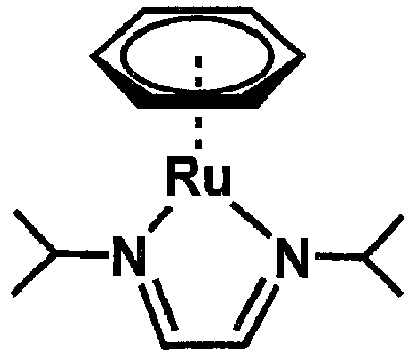
- Patent Document 3 discloses benzene(glyoxal-bis-isopropylamine)ruthenium (II) of Chemical Formula 3 in which a benzene ring and a diazadiene group are coordinated to ruthenium.
- Patent Document 4 discloses carbonyl-bis(tetramethylheptanedionato)ruthenium of Chemical Formula 4 in which tetramethylheptanedionato and carbonyl are coordinated.
- tris(acetylacetonato)ruthenium of Chemical Formula 5 in which three acetylacetonatos are coordinated as a ⁇ -diketonato ligand.
- Main properties required for organoruthenium compounds for chemical deposition used to be fundamental properties such as possibility and efficiency in formation of a ruthenium thin film, and handling property.
- a raw material compound is vaporized into a raw material gas, and the raw material gas is transported to a substrate.
- a compound having a high vapor pressure is considered suitable for efficiently forming a thin film.
- a compound which has high thermal stability and is not easily decomposed is considered preferable.
- the organoruthenium compound of Chemical Formula 1 has a high vapor pressure and high thermal stability, and is therefore a suitable organoruthenium compound from a traditional viewpoint. Further, the organoruthenium compound is liquid at normal temperature, which also contributes to high usefulness of the organoruthenium compound. However, since the organoruthenium compound has a high decomposition temperature of 350°C, the deposition temperature cannot be set low.
- the organoruthenium compound has the problem that ruthenium cannot be precipitated unless oxygen is introduced as a reaction gas.
- Use of an oxygen gas may cause oxidation of a substrate composed of silicon or the like, so that concerns remain that device properties may be affected.
- the organoruthenium compound of Chemical Formula 2 is also a suitable compound from the viewpoint of a vapor pressure although it is solid at normal temperature.
- the organoruthenium compound has a problem in practical use because it has poor thermal stability, and is easily decomposed when heated at about 80°C. Further, the organoruthenium compound also requires oxygen as a reaction gas.
- the organoruthenium compound of Chemical Formula 3 has no problem with a reaction gas because a ruthenium thin film can be formed with hydrogen as a reaction gas.
- this compound has a disadvantage that it has a low vapor pressure, leading to poor basic properties as a chemical vapor deposition raw material.
- the vapor pressure level is property related to deposition efficiency, and is a condition prerequisite from the viewpoint of industrial utilization of a chemical deposition method.
- the organoruthenium compounds of Chemical Formulae 4 and 5 are highly appreciated in that the hydrogen can be applied as a reaction gas, but it is apprehended that the structure of the ligand contains an oxygen atom.
- the organoruthenium compounds containing an oxygen atom there is not a problem in the effect of the substrate by the reaction gas, but ingress of the oxygen atom of the ligand into a ruthenium thin film may occur.
- Oxygen in the ruthenium thin film is considered to affect electrode properties.
- ingress of oxygen in the thin film is mentioned, and it is shown that a ruthenium thin film produced from the compound of Chemical Formula 4 contains oxygen in an amount of about 3%.
- the organoruthenium compound of Chemical Formula 4 is also a compound which can hardly be used for low-temperature deposition, so that it is required to set a considerably high deposition temperature of 400°C or higher.
- organoruthenium compounds which have been heretofore applicable as chemical vapor deposition raw materials may have both advantages and disadvantages with respect to diversified required properties.
- the present invention provides an organoruthenium compound which is usable for low-temperature deposition while having basic properties as a chemical vapor deposition raw material.
- the present invention also provides an organoruthenium compound which is capable of forming a ruthenium thin film without use of an oxygen gas, so that a substrate and the resulting ruthenium thin film are hardly affected.
- deposition can be performed at 250°C or lower.
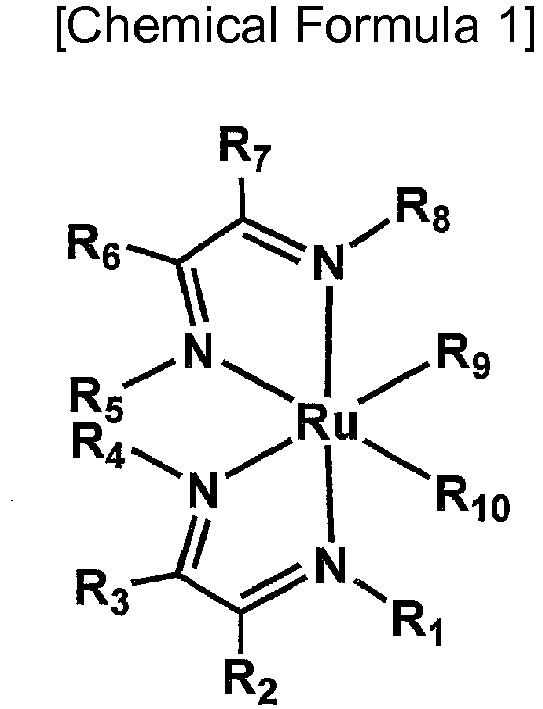
- the present invention for solving the above-described problems provides a chemical vapor deposition raw material for producing a ruthenium thin film or a ruthenium compound thin film by a chemical deposition method, including an organoruthenium compound in which two diazadiene ligands and two alkyl ligands are coordinated to ruthenium, the organoruthenium being represented by the following formula: in which each of substituents R 1 to R 8 of the diazadiene ligand is hydrogen, or a hydrocarbon group with a carbon number of 1 or more and 4 or less; two or more substituents selected from substituents R 1 to R 4 may be bonded together to form a cyclic structure with a carbon atom or a nitrogen atom to which the substituents are directly bonded; two or more substituents selected from substituents R 5 to R 8 may be bonded together to form a cyclic structure with a carbon atom or a nitrogen atom to which the substituents are directly bonded; and each of substituents R 9
- the chemical vapor deposition raw material of the present invention includes an organoruthenium compound having both a diazadiene ligand and an alkyl ligand.
- Application of these ligands is intended for making it possible to perform low-temperature deposition under a hydrogen atmosphere with thermal stability set in an appropriate range in consideration of the strength of the bond of each ligand to ruthenium. That is, a diazadiene-ruthenium bond with a strong bonding force and an alkyl-ruthenium bond with a relatively weak bonding force are introduced into the structure of the organoruthenium compound to control the physical properties of the compound as a whole.
- the organoruthenium compound includes a diazadiene ligand composed of nitrogen, carbon and hydrogen, an alkyl ligand composed of carbon and hydrogen, and ruthenium, and does not contain an oxygen atom. Therefore, the resulting ruthenium thin film does not contain oxygen derived from a raw material, and will not oxidize a substrate.
- the organoruthenium compound which is applied in the present invention has an appropriately high vapor pressure that is basic property required as a chemical vapor deposition raw material. This is ascribable to the fact that each of substituents R 9 and R 10 as alkyl ligands is limited to a relatively short-chain alkyl group with a carbon number of 1 or more and 3 or less while each of substituents R 1 to R 8 in the diazadiene ligand is a hydrocarbon group with a carbon number of 1 or more and 4 or less.
- each of substituents R 1 to R 8 in the diazadiene ligand is hydrogen, or a hydrocarbon group with a carbon number of 1 or more and 4 or less. All of substituents R 1 to R 8 may be hydrogen, and at least any one of substituents R 1 to R 8 may be a hydrocarbon group.
- the hydrocarbon group is a substituent composed of hydrogen and carbon.
- each of substituents R 1 to R 8 in the diazadiene ligand is limited to one with a carbon number of 1 or more and 4 or less is that the carbon chains of the substituents R 1 to R 8 may affect the vapor pressure of the organoruthenium compound. When the carbon number is excessively large, the vapor pressure may decrease.
- substituents R 1 to R 8 When each of substituents R 1 to R 8 is a hydrocarbon group, examples of the substituents include linear or branched alkyl groups, vinyl groups and allyl groups. When each of substituents R 1 to R 8 is a hydrocarbon group, these substituents may be independent substituents, or may be bonded together. That is, two or more substituents selected from substituents R 1 to R 4 may be bonded together to form a cyclic structure with a carbon atom or a nitrogen atom to which the substituents are directly bonded. Similarly, two or more substituents selected from substituents R 5 to R 8 may be bonded together to form a cyclic structure with a carbon atom or a nitrogen atom to which the substituents are directly bonded.
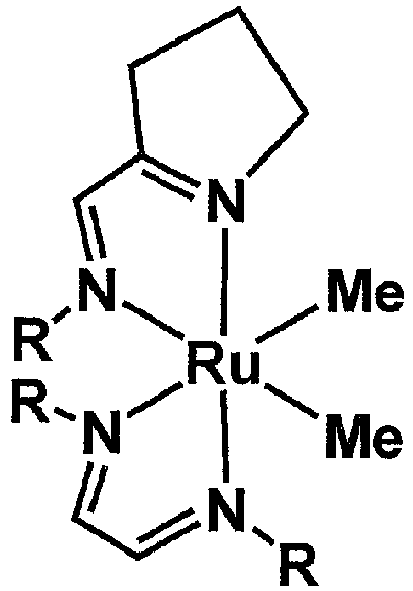
- the scope of the present invention also includes an organoruthenium compound in which a diazadiene ligand having a cyclic substituent is coordinated as shown below.
- a more preferable configuration of the organoruthenium compound according to the present invention is one in which at least any of substituents R 1 , R 4 , R 5 and R 8 is an alkyl group, and at least any of the alkyl groups is a linear or branched alkyl group with a carbon number of 1 or more and 4 or less. All of substituents R 1 , R 4 , R 5 and R 8 may be alkyl groups with a carbon number of 1 or more and 4 or less, or some of substituents R 1 , R 4 , R 5 and R 8 may be alkyl groups with a carbon number of 1 or more and 4 or less, with the other substituents being hydrogen or other alkyl groups.
- linear or branched alkyl group examples include a methyl group, an ethyl group, a n-propyl group, an iso-propyl group, a n-butyl group, an iso-butyl group, a sec-butyl group and a tert-butyl group.
- substituents R 2 , R 3 , R 6 and R 7 when at least any of substituents R 2 , R 3 , R 6 and R 7 is an alkyl group, at least any of the alkyl groups is preferably a methyl group. All of substituents R 2 , R 3 , R 6 and R 7 may be methyl groups, or some of substituents R 2 , R 3 , R 6 and R 7 may be methyl groups, with the other substituents being hydrogen or other alkyl groups.
- each of alkyl ligands R 9 and R 10 as other ligands is an alkyl group with a carbon number of 1 or more and 3 or less (methyl group, ethyl group, n-propyl group or iso-propyl group)
- the length of the carbon chain of the alkyl ligand affects the level of the vapor pressure of the organoruthenium compound. By limiting the ligand to a short-chain alkyl group, a suitable vapor pressure can be secured.
- a chemical deposition method of a ruthenium thin film or a ruthenium compound thin film in which the chemical deposition raw material according to the present invention is applied will now be described.
- a raw material including an organoruthenium compound as described above is vaporized by heating to generate a raw material gas, the raw material gas is transported onto a substrate surface, and the organoruthenium compound is thermally decomposed to form a ruthenium thin film.
- the organoruthenium compound that is applied in the present invention may be solid at normal temperature, but has a high vapor pressure, and thus can be easily vaporized by a sublimation method. Therefore, the organoruthenium compound as a raw material can be heated as it is.
- a raw material gas can also be obtained by solving the raw material in an appropriate solvent, and heating the solution.
- the raw material heating temperature is preferably 50°C or higher and 150°C or lower.
- the vaporized raw material joins with a carrier gas, and is transported onto the substrate.
- the organoruthenium compound according to the present invention enables ruthenium to be deposited with an inert gas (argon, nitrogen or the like) as a carrier gas even when a reaction gas is not used.
- a reaction gas can be set as necessary.
- the chemical vapor deposition raw material according to the present invention can be deposited even when oxygen is not used.
- a reducing gas species such as hydrogen, ammonia, hydrazine or formic acid can be applied as a reaction gas.
- oxygen as a reaction gas is not excluded.
- an oxygen gas can be applied as a reaction gas.
- Such a reaction gas can also serve as a carrier gas.
- the deposition temperature during deposition is preferably 150°C or higher and 500°C or lower.
- the deposition temperature is lower than 150°C, a deposition reaction hardly proceeds, so that efficient deposition cannot be performed.
- the deposition temperature is excessively high, there is the problem that uniform deposition is difficult, the substrate may be damaged, or the like.
- the deposition temperature is adjusted by the substrate heating temperature.
- the decomposition temperature is more preferably 150°C or higher and 400°C or lower, still more preferably 150°C or higher and 300°C or lower.
- the organoruthenium compound that forms the chemical vapor deposition raw material according to the present invention has thermal stability with a degree required for the chemical vapor deposition raw material thanks to selection of a ligand to be coordinated to ruthenium.
- the organoruthenium compound according to the present invention has stability midway between the stability of the compound of Chemical Formula 2 and the stability of the compound of Chemical Formula 3 (Chemical Formula 3 > compound of the present application > Chemical Formula 2).
- the organoruthenium compound has moderate stability for handling the compound as a chemical vapor deposition raw material.
- the organoruthenium compound has a suitable vapor pressure as a result of adjusting ligands and substituents thereof.
- the chemical vapor deposition raw material according to the present invention enables a ruthenium thin film to be deposited by applying a reaction gas other than oxygen, e.g. applying hydrogen.
- a reaction gas other than oxygen e.g. applying hydrogen.
- the constituent elements do not include an oxygen atom. Therefore, ingress of oxygen atoms into the produced ruthenium thin film does not occur, and there is no concern of oxidation damage to the substrate.
- the chemical vapor deposition raw material according to the present invention is useful for formation of highly miniaturized semiconductor devices of recent years.
- the reaction product was concentrated to obtain a muddy reaction mixture.
- the resulting muddy reaction mixture was subjected to extraction operation with hexane, and the extract liquid was concentrated to obtain a reddish-violet solid.
- the solid was purified by a sublimation method to obtain 2.25 g (5.5 mmol) of an organoruthenium compound as a specified substance to be produced (yield: 65%).
- the organoruthenium compound was definitely confirmed to be cis-dimethyl-bis(N,N'-diisopropyl-1,4-diaza-1,3-butadiene)ruthenium (II) from 1 H-NMR analysis ( 1 H NMR(benzene-d 6 ): 8.11(2H, s), 7.80(2H, s), 5.13-5.07(2H, m), 3.79-3.73(2H, m), 1.39(6H, d), 1.36(6H, d), 1.11 (6H, d), 0.65(6H, d), 0.57(6H, s)).
- TG-DTA2000SA manufactured by BRUKER Corporation
- the organoruthenium compound (sample weight: 5 mg) was packed in an aluminum cell, and a change in weight was observed over a measurement temperature range, i.e. from room temperature to 500°C, at a temperature elevation rate of 5°C/min.
- the TG-DTA measurement was performed under a reduced pressure (pressure: 5 torr). The results are shown in Fig. 1 .
- the TG measurement result in Fig. 1 shows that vaporization of cis-dimethyl-bis(N,N'-diisopropyl-1,4-diaza-1,3-butadiene)ruthenium (II) as the organoruthenium compound produced in this embodiment starts at a temperature just above 110°C and ends at a temperature below 200°C.
- an endothermic peak at a temperature of about 150°C may result from vaporization, and rapid vaporization may occur at this temperature. It was confirmed that after the TG-DTA analysis, residues did not remain on the cell, and the organoruthenium compound had favorable vaporization property as a chemical vapor deposition raw material.
- the TG-DTA analysis was also performed under an atmospheric pressure condition in accordance with the same method as described above, and consequently, a result as shown in Fig. 2 (only a result of TG) was obtained.
- the organoruthenium compound produced in this embodiment was confirmed to be decomposed at a relatively low temperature even under an atmospheric pressure.
- a ruthenium thin film was formed by a CVD apparatus (hot wall-type CVD deposition apparatus) by use of the organoruthenium compound according to the present invention as a raw material. Deposition conditions are as described below.
- a ruthenium thin film was deposited while the deposition temperature and the reaction gas were changed, and the thickness and the oxygen concentration in the thin film were measured.
- the thickness of the ruthenium thin film was determined by measuring thicknesses at a plurality of spots in a result of observation with a SEM (scanning electron microscope), and calculating an average of the measured thicknesses.
- the oxygen concentration was measured by SIMS (secondary-ion mass spectrometry: ADEPT-1010 manufactured by ULVAC-PHI, Inc.). The results are shown in Table 1. [Table 1] Test No. Deposition temperature Reaction gas Thickness/nm Oxygen concentration/ppm 1 250°C Hydrogen 8.9 ND 2 Argon 9.9 ND 3 300°C Hydrogen 17.9 ND 4 Argon 40.7 ND ND: Not Detected
- the specific resistance was measured for each of the thin films obtained by low-temperature deposition in tests No. 1 and No. 2, and the result showed that the specific resistance was 50 ⁇ •cm, and thus satisfactory electrical property was exhibited.
- Comparative example As a conventional art, a ruthenium thin film was produced with the tris(acetylacetonato)ruthenium of Chemical Formula 5 as a raw material. Conditions were set as described below. In the comparative example, deposition was also performed at 400°C and 500°C because it was predicted that deposition would not be achieved at 300°C or lower. The results of the deposition test are shown in Table 2.
- Cis-diethyl-bis(N,N'-diisopropyl-1,4-diaza-1,3-butadiene)ruthenium (II) (each of substituents R 1 , R 4 , R 5 and R 8 is an isopropyl group, and each of substituents R 9 and R 10 is an ethyl group) was produced as an organoruthenium compound.
- the reaction product was concentrated to obtain a muddy reaction mixture.
- the resulting muddy reaction mixture was subjected to extraction operation with hexane, and the extract liquid was concentrated to obtain a reddish-violet solid.
- the solid was purified by a sublimation method to obtain 0.19 g (2.87 mmol) of an organoruthenium compound as a specified substance to be produced (yield: 43%).
- the organoruthenium compound was confirmed to be cis-diethyl-bis(N,N'-diisopropyl-1,4-diaza-1,3-butadiene)ruthenium (II) from 1 H-NMR analysis ( 1 H NMR(benzene-d 6 ): 8.05(2H, s), 7.80(2H, s), 5.11-5.04(2H, m), 3.86-3.80(2H, m), 2.10-2.01(2H, m), 1.43(6H, d), 1.41-1.36(8H, overlap), 1.17(6H, d), 0.94(6H, t), 0.41(6H, d)).
- a change in weight was measured under an atmospheric pressure by TG-DTA analysis. Analysis conditions were the same as in the first embodiment. The results are shown in Fig. 5 . In Fig. 5 , the change in weight is also shown for comparison with the compound in the first embodiment. From Fig. 5 , it can be confirmed that the organoruthenium compound in the second embodiment is smoothly decomposed in the air.
- cis-diethyl-bis(N,N'-diisopropyl-1,4-diaza-1,3-butadiene)ruthenium (II) as the organoruthenium compound in this embodiment is a compound capable of being decomposed at a lower temperature as compared to cis-dimethyl-bis(N,N'-diisopropyl-1,4-diaza-1,3-butadiene)ruthenium (II) as the organoruthenium compound produced in the first embodiment.
- the organoruthenium compound can be expected for use in deposition at a further low temperature.
- the chemical vapor deposition raw material according to the present invention includes an organoruthenium compound having high thermal stability, has a moderate vapor pressure, and is excellent in deposition property at a low temperature. Ruthenium can be deposited even with hydrogen or the like as a reaction gas.
- the present inventive raw material is suitably used as a thin film electrode material of a semiconductor device such as DRAM or FERAM.
Landscapes
- Chemical & Material Sciences (AREA)
- Organic Chemistry (AREA)
- General Chemical & Material Sciences (AREA)
- Chemical Kinetics & Catalysis (AREA)
- Engineering & Computer Science (AREA)
- Materials Engineering (AREA)
- Mechanical Engineering (AREA)
- Metallurgy (AREA)
- Chemical Vapour Deposition (AREA)
- Electrodes Of Semiconductors (AREA)
- Organic Low-Molecular-Weight Compounds And Preparation Thereof (AREA)
Abstract
Description
- The present invention relates to a chemical vapor deposition raw material including an organoruthenium compound, which is used for producing a ruthenium thin film or a ruthenium compound thin film by a chemical deposition method (chemical vapor deposition method (CVD method) or an atomic layer deposition method (ALD method)). Specifically, the present invention relates to a chemical vapor deposition raw material having a low decomposition temperature and moderate thermal stability.
- As a thin film electrode material of a semiconductor device such as DRAM or FERAM, ruthenium or a ruthenium compound is used. As a method for producing such a thin film, a chemical deposition method such as a CVD method (chemical vapor deposition method) or an ALD method (atomic layer deposition method) is applied. As raw material compounds that are used in such a chemical deposition method, many compounds including an organoruthenium compound have been heretofore known.
- As an organoruthenium compound as a chemical vapor deposition raw material, for example, Patent Document 1 discloses bis(ethylcyclopentadienyl)ruthenium (II) of Chemical Formula 1 in which a cyclopentadienyl group being cyclic dienyl is coordinated. Patent Document 2 discloses bis(2,4-dimethylpentadienyl)ruthenium (II) of Chemical Formula 2 in which a pentadienyl group being chain dienyl is coordinated.


- In addition, Patent Document 3 discloses benzene(glyoxal-bis-isopropylamine)ruthenium (II) of Chemical Formula 3 in which a benzene ring and a diazadiene group are coordinated to ruthenium.

- Further, as a ligand that is coordinated to ruthenium, mention is also made of an organoruthenium compound in which a β-diketonato ligand containing an oxygen atom in its structure. For example, Patent Document 4 discloses carbonyl-bis(tetramethylheptanedionato)ruthenium of Chemical Formula 4 in which tetramethylheptanedionato and carbonyl are coordinated. In addition, mention is also made of tris(acetylacetonato)ruthenium of Chemical Formula 5 in which three acetylacetonatos are coordinated as a β-diketonato ligand.


-
- Patent Document 1:
JP 2000-281694 A - Patent Document 2:
JP 2010-215982 A - Patent Document 3:
WO 2013/117955 A1 - Patent Document 4:
US 6303809 B1 - Main properties required for organoruthenium compounds for chemical deposition used to be fundamental properties such as possibility and efficiency in formation of a ruthenium thin film, and handling property. In a chemical deposition method, a raw material compound is vaporized into a raw material gas, and the raw material gas is transported to a substrate. A compound having a high vapor pressure is considered suitable for efficiently forming a thin film. In addition, with consideration given to the handling property of the raw material, a compound which has high thermal stability and is not easily decomposed is considered preferable.
- However, there is no end to requirements for miniaturization and performance improvement of semiconductor devices, and those that are more advanced before are constantly being developed. For keeping up with this trend, characteristics demanded for organoruthenium compounds as chemical vapor deposition raw materials have been changed. As such novel demand characteristics, mention is made of problems with a requirement for decreasing a deposition temperature and selection of a reaction gas. All of these problems are related to damage to a substrate in formation of a ruthenium thin film, and quality of a thin film.
- The organoruthenium compound of Chemical Formula 1 has a high vapor pressure and high thermal stability, and is therefore a suitable organoruthenium compound from a traditional viewpoint. Further, the organoruthenium compound is liquid at normal temperature, which also contributes to high usefulness of the organoruthenium compound. However, since the organoruthenium compound has a high decomposition temperature of 350°C, the deposition temperature cannot be set low.
- In addition, the organoruthenium compound has the problem that ruthenium cannot be precipitated unless oxygen is introduced as a reaction gas. Use of an oxygen gas may cause oxidation of a substrate composed of silicon or the like, so that concerns remain that device properties may be affected.
- The organoruthenium compound of Chemical Formula 2 is also a suitable compound from the viewpoint of a vapor pressure although it is solid at normal temperature. However, the organoruthenium compound has a problem in practical use because it has poor thermal stability, and is easily decomposed when heated at about 80°C. Further, the organoruthenium compound also requires oxygen as a reaction gas.
- In contrast to the above-mentioned organoruthenium compounds, the organoruthenium compound of Chemical Formula 3 has no problem with a reaction gas because a ruthenium thin film can be formed with hydrogen as a reaction gas. However, this compound has a disadvantage that it has a low vapor pressure, leading to poor basic properties as a chemical vapor deposition raw material. The vapor pressure level is property related to deposition efficiency, and is a condition prerequisite from the viewpoint of industrial utilization of a chemical deposition method.
- The organoruthenium compounds of Chemical Formulae 4 and 5 are highly appreciated in that the hydrogen can be applied as a reaction gas, but it is apprehended that the structure of the ligand contains an oxygen atom. In the case of the organoruthenium compounds containing an oxygen atom, there is not a problem in the effect of the substrate by the reaction gas, but ingress of the oxygen atom of the ligand into a ruthenium thin film may occur. Oxygen in the ruthenium thin film is considered to affect electrode properties. In Patent Document 4, ingress of oxygen in the thin film is mentioned, and it is shown that a ruthenium thin film produced from the compound of Chemical Formula 4 contains oxygen in an amount of about 3%. The organoruthenium compound of Chemical Formula 4 is also a compound which can hardly be used for low-temperature deposition, so that it is required to set a considerably high deposition temperature of 400°C or higher.
- As described above, organoruthenium compounds which have been heretofore applicable as chemical vapor deposition raw materials may have both advantages and disadvantages with respect to diversified required properties. Thus, the present invention provides an organoruthenium compound which is usable for low-temperature deposition while having basic properties as a chemical vapor deposition raw material. The present invention also provides an organoruthenium compound which is capable of forming a ruthenium thin film without use of an oxygen gas, so that a substrate and the resulting ruthenium thin film are hardly affected. As a specific guideline for low-temperature deposition in the present invention, deposition can be performed at 250°C or lower.
- The present invention for solving the above-described problems provides a chemical vapor deposition raw material for producing a ruthenium thin film or a ruthenium compound thin film by a chemical deposition method, including an organoruthenium compound in which two diazadiene ligands and two alkyl ligands are coordinated to ruthenium, the organoruthenium being represented by the following formula:

- The chemical vapor deposition raw material of the present invention includes an organoruthenium compound having both a diazadiene ligand and an alkyl ligand. Application of these ligands is intended for making it possible to perform low-temperature deposition under a hydrogen atmosphere with thermal stability set in an appropriate range in consideration of the strength of the bond of each ligand to ruthenium. That is, a diazadiene-ruthenium bond with a strong bonding force and an alkyl-ruthenium bond with a relatively weak bonding force are introduced into the structure of the organoruthenium compound to control the physical properties of the compound as a whole.
- The organoruthenium compound includes a diazadiene ligand composed of nitrogen, carbon and hydrogen, an alkyl ligand composed of carbon and hydrogen, and ruthenium, and does not contain an oxygen atom. Therefore, the resulting ruthenium thin film does not contain oxygen derived from a raw material, and will not oxidize a substrate.
- The organoruthenium compound which is applied in the present invention has an appropriately high vapor pressure that is basic property required as a chemical vapor deposition raw material. This is ascribable to the fact that each of substituents R9 and R10 as alkyl ligands is limited to a relatively short-chain alkyl group with a carbon number of 1 or more and 3 or less while each of substituents R1 to R8 in the diazadiene ligand is a hydrocarbon group with a carbon number of 1 or more and 4 or less.
- The configurations of the chemical vapor deposition raw materials according to the present invention, which have the above-mentioned advantages, will be described in detail below.
- In the organoruthenium compound that is applied in the present invention, two diazadiene ligands are coordinated. Each of substituents R1 to R8 in the diazadiene ligand is hydrogen, or a hydrocarbon group with a carbon number of 1 or more and 4 or less. All of substituents R1 to R8 may be hydrogen, and at least any one of substituents R1 to R8 may be a hydrocarbon group. The hydrocarbon group is a substituent composed of hydrogen and carbon.
- The reason why each of substituents R1 to R8 in the diazadiene ligand is limited to one with a carbon number of 1 or more and 4 or less is that the carbon chains of the substituents R1 to R8 may affect the vapor pressure of the organoruthenium compound. When the carbon number is excessively large, the vapor pressure may decrease.
- When each of substituents R1 to R8 is a hydrocarbon group, examples of the substituents include linear or branched alkyl groups, vinyl groups and allyl groups. When each of substituents R1 to R8 is a hydrocarbon group, these substituents may be independent substituents, or may be bonded together. That is, two or more substituents selected from substituents R1 to R4 may be bonded together to form a cyclic structure with a carbon atom or a nitrogen atom to which the substituents are directly bonded. Similarly, two or more substituents selected from substituents R5 to R8 may be bonded together to form a cyclic structure with a carbon atom or a nitrogen atom to which the substituents are directly bonded. For example, the scope of the present invention also includes an organoruthenium compound in which a diazadiene ligand having a cyclic substituent is coordinated as shown below.

- A more preferable configuration of the organoruthenium compound according to the present invention is one in which at least any of substituents R1, R4, R5 and R8 is an alkyl group, and at least any of the alkyl groups is a linear or branched alkyl group with a carbon number of 1 or more and 4 or less. All of substituents R1, R4, R5 and R8 may be alkyl groups with a carbon number of 1 or more and 4 or less, or some of substituents R1, R4, R5 and R8 may be alkyl groups with a carbon number of 1 or more and 4 or less, with the other substituents being hydrogen or other alkyl groups. Examples of the linear or branched alkyl group include a methyl group, an ethyl group, a n-propyl group, an iso-propyl group, a n-butyl group, an iso-butyl group, a sec-butyl group and a tert-butyl group.
- Further, when at least any of substituents R2, R3, R6 and R7 is an alkyl group, at least any of the alkyl groups is preferably a methyl group. All of substituents R2, R3, R6 and R7 may be methyl groups, or some of substituents R2, R3, R6 and R7 may be methyl groups, with the other substituents being hydrogen or other alkyl groups.
- In the organoruthenium compound according to the present invention, each of alkyl ligands R9 and R10 as other ligands is an alkyl group with a carbon number of 1 or more and 3 or less (methyl group, ethyl group, n-propyl group or iso-propyl group) The length of the carbon chain of the alkyl ligand affects the level of the vapor pressure of the organoruthenium compound. By limiting the ligand to a short-chain alkyl group, a suitable vapor pressure can be secured.
- A chemical deposition method of a ruthenium thin film or a ruthenium compound thin film in which the chemical deposition raw material according to the present invention is applied will now be described. In the present chemical deposition method, a raw material including an organoruthenium compound as described above is vaporized by heating to generate a raw material gas, the raw material gas is transported onto a substrate surface, and the organoruthenium compound is thermally decomposed to form a ruthenium thin film.
- With regard to the form of the raw material in the chemical deposition method, the organoruthenium compound that is applied in the present invention may be solid at normal temperature, but has a high vapor pressure, and thus can be easily vaporized by a sublimation method. Therefore, the organoruthenium compound as a raw material can be heated as it is. In addition, a raw material gas can also be obtained by solving the raw material in an appropriate solvent, and heating the solution. The raw material heating temperature is preferably 50°C or higher and 150°C or lower.
- Normally, the vaporized raw material joins with a carrier gas, and is transported onto the substrate. The organoruthenium compound according to the present invention enables ruthenium to be deposited with an inert gas (argon, nitrogen or the like) as a carrier gas even when a reaction gas is not used.
- In addition, a reaction gas can be set as necessary. In production of a thin film including ruthenium, the chemical vapor deposition raw material according to the present invention can be deposited even when oxygen is not used. Here, a reducing gas species such as hydrogen, ammonia, hydrazine or formic acid can be applied as a reaction gas. However, application of oxygen as a reaction gas is not excluded. In deposition of a ruthenium compound thin film of ruthenium oxide or the like, an oxygen gas can be applied as a reaction gas. Such a reaction gas can also serve as a carrier gas.
- The deposition temperature during deposition is preferably 150°C or higher and 500°C or lower. When the deposition temperature is lower than 150°C, a deposition reaction hardly proceeds, so that efficient deposition cannot be performed. In contrast, when the deposition temperature is excessively high, there is the problem that uniform deposition is difficult, the substrate may be damaged, or the like. Normally, the deposition temperature is adjusted by the substrate heating temperature. Of course, when consideration is given to attainment of low-temperature decomposition which is an object of the present invention, the decomposition temperature is more preferably 150°C or higher and 400°C or lower, still more preferably 150°C or higher and 300°C or lower.
- As described above, the organoruthenium compound that forms the chemical vapor deposition raw material according to the present invention has thermal stability with a degree required for the chemical vapor deposition raw material thanks to selection of a ligand to be coordinated to ruthenium. For the thermal stability, the organoruthenium compound according to the present invention has stability midway between the stability of the compound of Chemical Formula 2 and the stability of the compound of Chemical Formula 3 (Chemical Formula 3 > compound of the present application > Chemical Formula 2). Thus, the organoruthenium compound has moderate stability for handling the compound as a chemical vapor deposition raw material. In addition, the organoruthenium compound has a suitable vapor pressure as a result of adjusting ligands and substituents thereof.
- Further, the chemical vapor deposition raw material according to the present invention enables a ruthenium thin film to be deposited by applying a reaction gas other than oxygen, e.g. applying hydrogen. In addition, the constituent elements do not include an oxygen atom. Therefore, ingress of oxygen atoms into the produced ruthenium thin film does not occur, and there is no concern of oxidation damage to the substrate.
- Thus, the chemical vapor deposition raw material according to the present invention is useful for formation of highly miniaturized semiconductor devices of recent years.
-
-
Fig. 1 illustrates results of TG-DTA measurement of a compound in a first embodiment (under reduced pressure). -
Fig. 2 illustrates results of TG-DTA measurement of a compound in the first embodiment (under atmospheric pressure only in TG). -
Fig. 3 shows a SEM photograph of a ruthenium thin film (gas: hydrogen) deposited at a deposition temperature of 250°C. -
Fig. 4 shows a SEM photograph of a ruthenium thin film (gas: argon) deposited at a deposition temperature of 250°C. -
Fig. 5 illustrates a result of TG-DTA measurement of a compound in the second embodiment (under atmospheric pressure only in TG). - First embodiment: Hereinafter, the best embodiments in the present invention will be described. In this embodiment, cis-dimethyl-bis(N,N'-diisopropyl-1,4-diaza-1,3-butadiene)ruthenium (II) (each of substituents R1, R4, R5 and R8 is an isopropyl group, and each of substituents R9 and R10 is a methyl group) was produced as an organoruthenium compound.


- 3.80 g (8.4 mmol) of cis-dichloro-bis(N,N'-diisopropyl-1,4-diaza-1,3-butadiene)ruthenium (II) was added in a flask containing 150 mL of tetrahydrofuran, and dissolved, and the solution was cooled with ice. 33 mL of a methylmagnesium iodide/diethyl ether solution (35 mmol; concentration: 1.06 M) was added to the ice-cooled solution. The mixed solution was stirred at room temperature for 1 hour to be reacted. The reaction formula here is as described below.

- After completion of the reaction, the reaction product was concentrated to obtain a muddy reaction mixture. The resulting muddy reaction mixture was subjected to extraction operation with hexane, and the extract liquid was concentrated to obtain a reddish-violet solid. The solid was purified by a sublimation method to obtain 2.25 g (5.5 mmol) of an organoruthenium compound as a specified substance to be produced (yield: 65%). The organoruthenium compound was definitely confirmed to be cis-dimethyl-bis(N,N'-diisopropyl-1,4-diaza-1,3-butadiene)ruthenium (II) from 1H-NMR analysis (1H NMR(benzene-d6): 8.11(2H, s), 7.80(2H, s), 5.13-5.07(2H, m), 3.79-3.73(2H, m), 1.39(6H, d), 1.36(6H, d), 1.11 (6H, d), 0.65(6H, d), 0.57(6H, s)).
- For the organoruthenium compound produced as described above, physical properties were evaluated, and a deposition test was conducted.
- Differential thermal analysis-thermogravimetry: In TG-DTA2000SA manufactured by BRUKER Corporation, the organoruthenium compound (sample weight: 5 mg) was packed in an aluminum cell, and a change in weight was observed over a measurement temperature range, i.e. from room temperature to 500°C, at a temperature elevation rate of 5°C/min. The TG-DTA measurement was performed under a reduced pressure (pressure: 5 torr). The results are shown in
Fig. 1 . - The TG measurement result in
Fig. 1 shows that vaporization of cis-dimethyl-bis(N,N'-diisopropyl-1,4-diaza-1,3-butadiene)ruthenium (II) as the organoruthenium compound produced in this embodiment starts at a temperature just above 110°C and ends at a temperature below 200°C. In addition, from the DTA measurement result, an endothermic peak at a temperature of about 150°C may result from vaporization, and rapid vaporization may occur at this temperature. It was confirmed that after the TG-DTA analysis, residues did not remain on the cell, and the organoruthenium compound had favorable vaporization property as a chemical vapor deposition raw material. - The TG-DTA analysis was also performed under an atmospheric pressure condition in accordance with the same method as described above, and consequently, a result as shown in
Fig. 2 (only a result of TG) was obtained. The organoruthenium compound produced in this embodiment was confirmed to be decomposed at a relatively low temperature even under an atmospheric pressure. - Decomposition test: A ruthenium thin film was formed by a CVD apparatus (hot wall-type CVD deposition apparatus) by use of the organoruthenium compound according to the present invention as a raw material. Deposition conditions are as described below.
-
- Substrate: Ta/TH-Ox/Si (thermally oxidized Si + Ta)
- Deposition temperature: 250°C and 300°C
- Sample temperature (vaporization temperature): 95°C
- Pressure: 5 Torr
- Gas: hydrogen or argon gas
- Gas flow rate: 20 sccm
- Deposition time: 60 min
- As described above, a ruthenium thin film was deposited while the deposition temperature and the reaction gas were changed, and the thickness and the oxygen concentration in the thin film were measured. The thickness of the ruthenium thin film was determined by measuring thicknesses at a plurality of spots in a result of observation with a SEM (scanning electron microscope), and calculating an average of the measured thicknesses. In addition, the oxygen concentration was measured by SIMS (secondary-ion mass spectrometry: ADEPT-1010 manufactured by ULVAC-PHI, Inc.). The results are shown in Table 1.
[Table 1] Test No. Deposition temperature Reaction gas Thickness/nm Oxygen concentration/ppm 1 250°C Hydrogen 8.9 ND 2 Argon 9.9 ND 3 300°C Hydrogen 17.9 ND 4 Argon 40.7 ND ND: Not Detected - From the results of tests No. 1 and No. 2, it was confirmed that a ruthenium thin film was deposited even when the deposition temperature was set to a low temperature of 250°C. In addition, it is apparent that a ruthenium thin film can be deposited even when hydrogen is used as a reaction gas, and can be deposited even with argon. As in tests No. 3 and No. 4, oxygen was not detected in the ruthenium thin film even when the ruthenium thin film was deposited at a relatively high temperature of 300°C.
Figs. 3 and 4 each show a SEM photograph of a ruthenium thin film deposited at a deposition temperature of 250°C. - The specific resistance was measured for each of the thin films obtained by low-temperature deposition in tests No. 1 and No. 2, and the result showed that the specific resistance was 50 µΩ•cm, and thus satisfactory electrical property was exhibited.
- Comparative example: As a conventional art, a ruthenium thin film was produced with the tris(acetylacetonato)ruthenium of
Chemical Formula 5 as a raw material. Conditions were set as described below. In the comparative example, deposition was also performed at 400°C and 500°C because it was predicted that deposition would not be achieved at 300°C or lower. The results of the deposition test are shown in Table 2. -
- Substrate: Ta/TH-Ox/Si (thermally oxidized Si)
- Deposition temperature: 250°C, 300°C, 400°C and 500°C
- Sample temperature (vaporization temperature): 140°C
- Pressure: 5 Torr
- Reaction gas: hydrogen
- Reaction gas flow rate: 20 sccm
- Deposition time: 15 min
- In the case of the organoruthenium compound of the comparative example, when the deposition temperature was low (250°C), ruthenium was not precipitated, and thus it was unable to obtain a thin film (test No. 5). Further, even when the deposition temperature was increased to 300°C, it was unable to deposit ruthenium (test No. 6). These results showed that it was unable to perform low-temperature deposition with the conventional organoruthenium compound of
Chemical Formula 5. On the other hand, when the deposition temperature is set to 400°C and 500°C, a ruthenium thin film can be deposited (tests No. 7 and No. 8). However, the oxygen concentration in the thin film was high. This would be ascribable to ingress of oxygen atoms that form the organoruthenium compound as a raw material. - Second embodiment: Cis-diethyl-bis(N,N'-diisopropyl-1,4-diaza-1,3-butadiene)ruthenium (II) (each of substituents R1, R4, R5 and R8 is an isopropyl group, and each of substituents R9 and R10 is an ethyl group) was produced as an organoruthenium compound.


- 0.56 g (1.3 mmol) of cis-dichloro-bis(N,N'-diisopropyl-1,4-diaza-1,3-butadiene)ruthenium (II) was added in a flask containing 20 mL of tetrahydrofuran, and dissolved, and the solution was cooled with ice. 5 mL of an ethylmagnesium bromide/tetrahydrofuran solution (5 mmol; concentration: 1.0 M) was added to the ice-cooled solution. The mixed solution was stirred at room temperature for 1 hour to be reacted. The reaction formula here is as described below.

- After completion of the reaction, the reaction product was concentrated to obtain a muddy reaction mixture. The resulting muddy reaction mixture was subjected to extraction operation with hexane, and the extract liquid was concentrated to obtain a reddish-violet solid. The solid was purified by a sublimation method to obtain 0.19 g (2.87 mmol) of an organoruthenium compound as a specified substance to be produced (yield: 43%). The organoruthenium compound was confirmed to be cis-diethyl-bis(N,N'-diisopropyl-1,4-diaza-1,3-butadiene)ruthenium (II) from 1H-NMR analysis (1H NMR(benzene-d6): 8.05(2H, s), 7.80(2H, s), 5.11-5.04(2H, m), 3.86-3.80(2H, m), 2.10-2.01(2H, m), 1.43(6H, d), 1.41-1.36(8H, overlap), 1.17(6H, d), 0.94(6H, t), 0.41(6H, d)).
- For the organoruthenium compound produced in the second embodiment, a change in weight was measured under an atmospheric pressure by TG-DTA analysis. Analysis conditions were the same as in the first embodiment. The results are shown in
Fig. 5 . InFig. 5 , the change in weight is also shown for comparison with the compound in the first embodiment. FromFig. 5 , it can be confirmed that the organoruthenium compound in the second embodiment is smoothly decomposed in the air. - It is recognizable that cis-diethyl-bis(N,N'-diisopropyl-1,4-diaza-1,3-butadiene)ruthenium (II) as the organoruthenium compound in this embodiment is a compound capable of being decomposed at a lower temperature as compared to cis-dimethyl-bis(N,N'-diisopropyl-1,4-diaza-1,3-butadiene)ruthenium (II) as the organoruthenium compound produced in the first embodiment. The organoruthenium compound can be expected for use in deposition at a further low temperature.
- The chemical vapor deposition raw material according to the present invention includes an organoruthenium compound having high thermal stability, has a moderate vapor pressure, and is excellent in deposition property at a low temperature. Ruthenium can be deposited even with hydrogen or the like as a reaction gas. The present inventive raw material is suitably used as a thin film electrode material of a semiconductor device such as DRAM or FERAM.
| Test No. | Deposition temperature | Reaction gas | Ru thickness/nm | Oxygen concentration/% |
| 5 | 250°C | Hydrogen | - | - |
| 6 | 300°C | - | - | |
| 7 | 400°C | 12.2 | 10 | |
| 8 | 500°C | 11.7 | 10 |
| -: Unmeasurable because deposition was not achieved. |
Claims (4)
- A chemical vapor deposition raw material for producing a ruthenium thin film or a ruthenium compound thin film by a chemical deposition method, comprising an organoruthenium compound in which two diazadiene ligands and two alkyl ligands are coordinated to ruthenium, the organoruthenium being represented by the following formula:

- The chemical vapor deposition raw material according to claim 1, wherein at least any of substituents R1, R4, R5 and R8 is an alkyl group, and at least any of the alkyl groups is a linear or branched alkyl group with a carbon number of 1 or more and 4 or less.
- The chemical vapor deposition raw material according to claim 1 or 2, wherein at least any of substituents R2, R3, R6 and R7 is an alkyl group, and at least any of the alkyl groups is a methyl group.
- A chemical deposition method of a ruthenium thin film or a ruthenium compound thin film, comprising preparing a raw material gas by vaporizing a raw material including an organoruthenium compound, and heating the raw material gas while introducing the raw material gas to a substrate surface,
Wherein the method uses the chemical vapor deposition raw material defined in any of claims 1 to 3 as the raw material.
Applications Claiming Priority (2)
| Application Number | Priority Date | Filing Date | Title |
|---|---|---|---|
| JP2015180101A JP6043851B1 (en) | 2015-09-11 | 2015-09-11 | Chemical vapor deposition material comprising organic ruthenium compound and chemical vapor deposition method using the chemical vapor deposition material |
| PCT/JP2016/076585 WO2017043620A1 (en) | 2015-09-11 | 2016-09-09 | Chemical vapor deposition feedstock comprising organic ruthenium compound and chemical vapor deposition method using said chemical vapor deposition feedstock |
Publications (2)
| Publication Number | Publication Date |
|---|---|
| EP3348667A1 true EP3348667A1 (en) | 2018-07-18 |
| EP3348667A4 EP3348667A4 (en) | 2018-08-08 |
Family
ID=57543956
Family Applications (1)
| Application Number | Title | Priority Date | Filing Date |
|---|---|---|---|
| EP16844481.8A Withdrawn EP3348667A4 (en) | 2015-09-11 | 2016-09-09 | Chemical vapor deposition feedstock comprising organic ruthenium compound and chemical vapor deposition method using said chemical vapor deposition feedstock |
Country Status (6)
| Country | Link |
|---|---|
| US (1) | US20180258526A1 (en) |
| EP (1) | EP3348667A4 (en) |
| JP (1) | JP6043851B1 (en) |
| KR (1) | KR102123451B1 (en) |
| TW (1) | TWI611038B (en) |
| WO (1) | WO2017043620A1 (en) |
Families Citing this family (9)
| Publication number | Priority date | Publication date | Assignee | Title |
|---|---|---|---|---|
| JP6912913B2 (en) * | 2017-03-29 | 2021-08-04 | 株式会社Adeka | Method for producing yttrium oxide-containing thin film by atomic layer deposition |
| CN110945157B (en) * | 2017-07-18 | 2023-04-04 | 株式会社高纯度化学研究所 | Atomic layer deposition method of metal film |
| EP3599240A1 (en) * | 2018-07-27 | 2020-01-29 | Umicore Ag & Co. Kg | Metal organic compounds |
| JP7148377B2 (en) * | 2018-12-03 | 2022-10-05 | 田中貴金属工業株式会社 | Raw material for chemical vapor deposition comprising a ruthenium complex and chemical vapor deposition method using said raw material for chemical vapor deposition |
| JP7372353B2 (en) * | 2020-01-31 | 2023-10-31 | 田中貴金属工業株式会社 | A chemical vapor deposition raw material comprising an organic ruthenium compound and a chemical vapor deposition method using the chemical vapor deposition raw material |
| KR102519909B1 (en) | 2020-10-08 | 2023-04-11 | (주)원익머트리얼즈 | A new ruthenium precursors, preparation method thereof, raw material containing the ruthenium precursors, and process for the formation of high purity thin ruthenium films using thereof |
| JP7075518B1 (en) * | 2021-03-10 | 2022-05-25 | 田中貴金属工業株式会社 | Raw materials for chemical vapor deposition containing organic ruthenium compounds and chemical vapor deposition methods for ruthenium thin films or ruthenium compound thin films. |
| WO2023008248A1 (en) * | 2021-07-29 | 2023-02-02 | 株式会社Adeka | Reactive material and thin film production method |
| CN118786240A (en) * | 2022-02-03 | 2024-10-15 | 恩特格里斯公司 | Method for selectively depositing highly conductive metal films |
Family Cites Families (8)
| Publication number | Priority date | Publication date | Assignee | Title |
|---|---|---|---|---|
| US6281124B1 (en) * | 1998-09-02 | 2001-08-28 | Micron Technology, Inc. | Methods and systems for forming metal-containing films on substrates |
| JP2000281694A (en) | 1999-03-29 | 2000-10-10 | Tanaka Kikinzoku Kogyo Kk | Organometallic compounds for metalorganic vapor phase epitaxy |
| US6303809B1 (en) | 1999-12-10 | 2001-10-16 | Yun Chi | Organometallic ruthenium and osmium source reagents for chemical vapor deposition |
| US20090205968A1 (en) * | 2008-01-24 | 2009-08-20 | Thompson David M | Organometallic compounds, processes for the preparation thereof and methods of use thereof |
| JP2010215982A (en) | 2009-03-18 | 2010-09-30 | Tosoh Corp | Method for producing ruthenium-containing film using ruthenium complex organic solvent solution, and ruthenium-containing film |
| WO2012027357A2 (en) * | 2010-08-24 | 2012-03-01 | Wayne State University | Thermally stable volatile precursors |
| WO2013117955A1 (en) * | 2012-02-07 | 2013-08-15 | L'air Liquide, Societe Anonyme Pour L'etude Et L'exploitation Des Procedes Georges Claude | Method for the deposition of a ruthenium containing film using arene diazadiene ruthenium(0) precursors |
| KR102314653B1 (en) * | 2013-06-28 | 2021-10-21 | 웨인 스테이트 유니버시티 | Bis(trimethylsilyl) six-membered ring systems and related compounds as reducing agents for forming layers on a substrate |
-
2015
- 2015-09-11 JP JP2015180101A patent/JP6043851B1/en active Active
-
2016
- 2016-09-06 TW TW105128797A patent/TWI611038B/en active
- 2016-09-09 EP EP16844481.8A patent/EP3348667A4/en not_active Withdrawn
- 2016-09-09 WO PCT/JP2016/076585 patent/WO2017043620A1/en not_active Ceased
- 2016-09-09 KR KR1020187007309A patent/KR102123451B1/en active Active
- 2016-09-09 US US15/754,740 patent/US20180258526A1/en not_active Abandoned
Also Published As
| Publication number | Publication date |
|---|---|
| WO2017043620A1 (en) | 2017-03-16 |
| JP6043851B1 (en) | 2016-12-14 |
| EP3348667A4 (en) | 2018-08-08 |
| TW201723209A (en) | 2017-07-01 |
| JP2017053019A (en) | 2017-03-16 |
| TWI611038B (en) | 2018-01-11 |
| US20180258526A1 (en) | 2018-09-13 |
| KR20180040673A (en) | 2018-04-20 |
| KR102123451B1 (en) | 2020-06-16 |
Similar Documents
| Publication | Publication Date | Title |
|---|---|---|
| EP3348667A1 (en) | Chemical vapor deposition feedstock comprising organic ruthenium compound and chemical vapor deposition method using said chemical vapor deposition feedstock | |
| JP6596737B2 (en) | Metal complexes containing amidoimine ligands | |
| EP2734533B1 (en) | Heteroleptic pyrrolecarbaldimine precursors | |
| US10752992B2 (en) | Atomic layer deposition method of metal-containing thin film | |
| WO2020116364A1 (en) | Raw material for chemical vapor deposition comprising ruthenium complex and chemical vapor deposition method using said raw material for chemical vapor deposition | |
| US9034761B2 (en) | Heteroleptic (allyl)(pyrroles-2-aldiminate) metal-containing precursors, their synthesis and vapor deposition thereof to deposit metal-containing films | |
| WO2016181918A1 (en) | Chemical vapor deposition starting material comprising heterogeneous polynuclear complex, and chemical vapor deposition method using said chemical vapor deposition starting material | |
| JP2017505858A (en) | Method for producing inorganic thin film | |
| KR102504310B1 (en) | Cobalt compounds, precursor composition including the same, and preparing method of thin film using the same | |
| US11401290B2 (en) | Cobalt precursor, method of preparing same and method of manufacturing thin film using same | |
| JP5892668B1 (en) | Chemical vapor deposition material comprising organic ruthenium compound and chemical vapor deposition method using the chemical vapor deposition material | |
| US11084837B2 (en) | Chemical deposition raw material including iridium complex and chemical deposition method using the chemical deposition raw material | |
| KR20210058370A (en) | Tungsten Compound, Method for Preparation of the Same, and Tungsten-Containing Thin Film, Method of Manufacturing the Same | |
| US20240218005A1 (en) | Novel compound, precursor composition comprising same, and method for preparing thin film using same | |
| WO2018042871A1 (en) | Diazadienyl compound, raw material for forming thin film, and method for producing thin film | |
| KR102211654B1 (en) | A tungsten precursor compound and tungsten containing thin film prepared by using the same | |
| KR101428443B1 (en) | Heteroleptic pyrrolecarbaldimine precursors | |
| KR20050121506A (en) | Organocobalt compounds and solution composition for cobalt containing thin film and method of cobalt thin film | |
| KR20220014653A (en) | Organometallic compounds, precursor composition including the same, and preparing method of thin film using the same | |
| EP3299490A1 (en) | Chemical vapor deposition starting material comprising organic platinum compound, and chemical vapor deposition method using said chemical vapor deposition starting material | |
| KR20160062675A (en) | Nickel Bis beta-ketoiminate precusor and the method for nickel containing film deposition |
Legal Events
| Date | Code | Title | Description |
|---|---|---|---|
| PUAI | Public reference made under article 153(3) epc to a published international application that has entered the european phase |
Free format text: ORIGINAL CODE: 0009012 |
|
| 17P | Request for examination filed |
Effective date: 20180405 |
|
| AK | Designated contracting states |
Kind code of ref document: A1 Designated state(s): AL AT BE BG CH CY CZ DE DK EE ES FI FR GB GR HR HU IE IS IT LI LT LU LV MC MK MT NL NO PL PT RO RS SE SI SK SM TR |
|
| AX | Request for extension of the european patent |
Extension state: BA ME |
|
| A4 | Supplementary search report drawn up and despatched |
Effective date: 20180710 |
|
| RIC1 | Information provided on ipc code assigned before grant |
Ipc: C23C 16/18 20060101AFI20180704BHEP Ipc: H01L 21/285 20060101ALI20180704BHEP Ipc: C07C 251/08 20060101ALI20180704BHEP Ipc: C07F 15/00 20060101ALI20180704BHEP |
|
| DAV | Request for validation of the european patent (deleted) | ||
| DAX | Request for extension of the european patent (deleted) | ||
| STAA | Information on the status of an ep patent application or granted ep patent |
Free format text: STATUS: THE APPLICATION HAS BEEN WITHDRAWN |
|
| 18W | Application withdrawn |
Effective date: 20190221 |