EP3348554A1 - Method for producing triazole compound - Google Patents
Method for producing triazole compound Download PDFInfo
- Publication number
- EP3348554A1 EP3348554A1 EP16844205.1A EP16844205A EP3348554A1 EP 3348554 A1 EP3348554 A1 EP 3348554A1 EP 16844205 A EP16844205 A EP 16844205A EP 3348554 A1 EP3348554 A1 EP 3348554A1
- Authority
- EP
- European Patent Office
- Prior art keywords
- compound
- mixture
- reaction
- hours
- water
- Prior art date
- Legal status (The legal status is an assumption and is not a legal conclusion. Google has not performed a legal analysis and makes no representation as to the accuracy of the status listed.)
- Granted
Links
- WPMGEBXTWFLWDX-UHFFFAOYSA-N CCC(C(c1ccc(-[n]2ncnc2)nc1C(O)=O)=O)=O Chemical compound CCC(C(c1ccc(-[n]2ncnc2)nc1C(O)=O)=O)=O WPMGEBXTWFLWDX-UHFFFAOYSA-N 0.000 description 1
Images
Classifications
-
- C—CHEMISTRY; METALLURGY
- C07—ORGANIC CHEMISTRY
- C07D—HETEROCYCLIC COMPOUNDS
- C07D401/00—Heterocyclic compounds containing two or more hetero rings, having nitrogen atoms as the only ring hetero atoms, at least one ring being a six-membered ring with only one nitrogen atom
- C07D401/02—Heterocyclic compounds containing two or more hetero rings, having nitrogen atoms as the only ring hetero atoms, at least one ring being a six-membered ring with only one nitrogen atom containing two hetero rings
- C07D401/04—Heterocyclic compounds containing two or more hetero rings, having nitrogen atoms as the only ring hetero atoms, at least one ring being a six-membered ring with only one nitrogen atom containing two hetero rings directly linked by a ring-member-to-ring-member bond
-
- A—HUMAN NECESSITIES
- A61—MEDICAL OR VETERINARY SCIENCE; HYGIENE
- A61P—SPECIFIC THERAPEUTIC ACTIVITY OF CHEMICAL COMPOUNDS OR MEDICINAL PREPARATIONS
- A61P33/00—Antiparasitic agents
- A61P33/14—Ectoparasiticides, e.g. scabicides
-
- A—HUMAN NECESSITIES
- A61—MEDICAL OR VETERINARY SCIENCE; HYGIENE
- A61P—SPECIFIC THERAPEUTIC ACTIVITY OF CHEMICAL COMPOUNDS OR MEDICINAL PREPARATIONS
- A61P43/00—Drugs for specific purposes, not provided for in groups A61P1/00-A61P41/00
-
- C—CHEMISTRY; METALLURGY
- C07—ORGANIC CHEMISTRY
- C07D—HETEROCYCLIC COMPOUNDS
- C07D401/00—Heterocyclic compounds containing two or more hetero rings, having nitrogen atoms as the only ring hetero atoms, at least one ring being a six-membered ring with only one nitrogen atom
- C07D401/14—Heterocyclic compounds containing two or more hetero rings, having nitrogen atoms as the only ring hetero atoms, at least one ring being a six-membered ring with only one nitrogen atom containing three or more hetero rings
-
- C—CHEMISTRY; METALLURGY
- C07—ORGANIC CHEMISTRY
- C07D—HETEROCYCLIC COMPOUNDS
- C07D471/00—Heterocyclic compounds containing nitrogen atoms as the only ring hetero atoms in the condensed system, at least one ring being a six-membered ring with one nitrogen atom, not provided for by groups C07D451/00 - C07D463/00
- C07D471/02—Heterocyclic compounds containing nitrogen atoms as the only ring hetero atoms in the condensed system, at least one ring being a six-membered ring with one nitrogen atom, not provided for by groups C07D451/00 - C07D463/00 in which the condensed system contains two hetero rings
- C07D471/04—Ortho-condensed systems
Definitions
- the present invention relates to a method for producing a triazole compound etc.
- WO2013/018928 describes compounds having control efficacies against pests.
- the present invention provides a production intermediate of a compound represented by formula (6): (hereinafter referred to as compound (6)) having excellent control efficacies against pests and a method for producing the compound (6).
- the compound (6) has excellent control efficacies against pests, and a compound represented by formula (5): (hereinafter referred to as compound (5)) is useful as a production intermediate in producing the compound (6) and can be produced by the following method according to the present invention.
- the compound (5) can be produced by
- the compound (6) can be produced by
- the compound (3) can be produced by
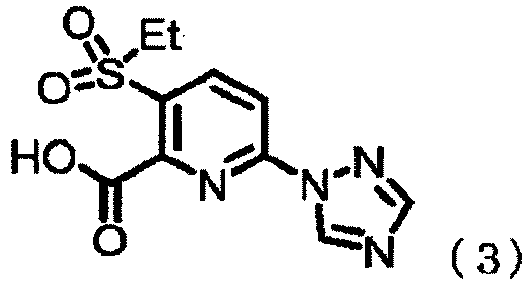
- the present invention provides the compound (3) as a production intermediate of the compound (6).
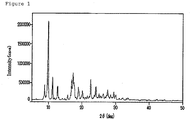
- Figure 1 shows powder X-ray diffraction of the compound (6) in Example 7.
- Step (A) is described.
- Step (A) the compound (4) and phosphorus oxychloride are simultaneously and separately added to the compound (3) to produce the compound (5).
- step (A) means that addition of the compound (4) and phosphorus oxychloride is carried out with adjusting the conditions such as addition rate (for example drop rate) so that the molar ratio of the compound (4) and phosphorus oxychloride can be maintained within the range of about 1:1, specifically 1:0.5 to 1:2, and preferably 1:0.8 to 1:1.3 in the reaction system (namely a composition obtained by dropping the compound (4) and phosphorus oxychloride to the compound (3)) of Step (A).
- addition rate for example drop rate
- “Simultaneous and separate addition of the compound (4) and phosphorus oxychloride to the compound (3)" can be carried out by, for example, adding the compound (4) and phosphorus oxychloride from separate addition ports to the compound (3) in a container.
- the compound (3) is usually mixed with a solvent and used as a liquid composition.
- the solvent is an inert solvent
- examples of the solvent include ethers such as 1,4-dioxane, diethyl ether, tetrahydrofuran (THF), tert-butyl methyl ether, cyclohexyl methyl ether, ethylene glycol dimethyl ether, and diethylene glycol dimethyl ether; halogenated hydrocarbons such as dichloromethane, chloroform, carbon tetrachloride, 1,2-dichloroethane, and chlorobenzene; aromatic hydrocarbons such as toluene, benzene, xylene, and ethylbenzene; nitriles such as acetonitrile; aprotic polar solvents such as N,N-dimethylformamide (DMF), N,N-dimethylacetamide, N-methyl-2-pyrrolidone (NMP), 1,3-dimethyl-2-imidazolidinone, sulfolane, and
- the compound (4) When the compound (4) is added to the compound (3), the compound (4) is usually mixed with a solvent and used as a solution. Examples of the solvent are the same as described above.
- the solvent is an inert solvent, and examples of the solvent include ethers such as 1,4-dioxane, diethyl ether, THF, tert-butyl methyl ether, cyclohexyl methyl ether, ethylene glycol dimethyl ether, and diethylene glycol dimethyl ether; halogenated hydrocarbons such as dichloromethane, chloroform, carbon tetrachloride, 1,2-dichloroethane, and chlorobenzene; aromatic hydrocarbons such as toluene, benzene, xylene, and ethylbenzene; nitriles such as acetonitrile ; and mixtures thereof.
- ethers such as 1,4-dioxane, diethyl ether, THF, tert-butyl methyl ether, cyclohexyl methyl ether, ethylene glycol dimethyl ether, and diethylene glycol dimethyl ether
- Step (A) is preferably carried out with the addition of a base.
- the base is usually preliminarily added to a solution of the compound (4).
- Examples of the base include tertiary amines such as triethylamine and N,N-diisopropylethylamine; and nitrogen-containing aromatic compounds such as pyridine and 4-dimethylaminopyridine.
- tertiary amines such as triethylamine and N,N-diisopropylethylamine
- nitrogen-containing aromatic compounds such as pyridine and 4-dimethylaminopyridine.
- the reaction temperature is usually within the range of -10 to 80°C, preferably 0 to 60°C.
- the reaction time is usually within the range of 0.1 to 24 hours, preferably 1 to 20 hours.
- the reaction mixture is subjected to work-up, for example, mixed with water, then extracted with organic solvent(s), and the obtained organic layer is dried or concentrated to isolate the compound (5).
- the isolated compound (5) may be further purified by chromatography, recrystallization, or the like.
- reaction mixture comprising the compound (5) may be directly subjected to the next reaction to produce the compound (6).
- Step (B) is described.
- Step (B) The reaction of Step (B) is usually carried out in a solvent.
- the solvent examples include alcohols such as 2-butanol, ethylene glycol (ethane-1,2-diol), propylene glycol (1,2-propanediol), dipropylene glycol (a mixture of 4-oxa-2,6-heptanediol, 2-(2-hydroxy-propoxy)-propan-1-ol, and 2-(2-hydroxy-1-methyl-ethoxy)-propan-1-ol), 1,3-butanediol, glycerin (propane-1,2,3-triol), and polyethylene glycol (having, for example, average molecular weight 200 to 400); ketones such as methyl isobutyl ketone; ethers such as 1,4-dioxane and diethylene glycol dimethyl ether (i.e.
- halogenated hydrocarbons such as chlorobenzene
- aromatic hydrocarbons such as toluene, benzene, xylene, and ethylbenzene
- nitriles such as propionitrile
- aprotic polar solvents such as DMF, NMP, N,N-dimethylacetamide, 1,3-dimethyl-2-imidazolidinone, and DMSO; and mixtures thereof.
- Examples of the acid used in the reaction include sulfonic acids such as p-toluenesulfonic acid; carboxylic acids such as acetic acid and lactic acid; and sulfuric acid, phosphoric acid, and polyphosphoric acid.
- reaction mixture obtained in the Step (A) is mixed with water in the work-up of the Step (A)
- phosphoric acid is produced in the reaction system by the reaction of phosphorus oxychloride with water and may be used as the acid in the Step (B).
- the acid when the acid is a liquid such as lactic acid and acetic acid in the reaction, the acid may be used as a solvent, and the amount thereof to be used is usually 1 to 5 parts by weight per one part by weight of the compound (5) .
- the reaction temperature is usually within the range of 100 to 200°C.
- the reaction time is usually within the range of 0.1 to 48 hours.
- the reaction mixture is mixed with water, and then extracted with organic solvent(s), and the obtained organic layer is concentrated; the reaction mixture is mixed with water, and the obtained solids are collected by filtration; or solids produced in the reaction mixture are collected by filtration, to isolate the compound (6).
- the isolated compound (6) may be further purified by recrystallization, chromatography, or the like.
- Step (C) is described.
- Step (C) The reaction of Step (C) is usually carried out in a solvent.
- the solvent examples include water; ethers such as 1,4-dioxane, diethyl ether, THF, and tert-butyl methyl ether; halogenated hydrocarbons such as dichloromethane, chloroform, carbon tetrachloride, 1,2-dichloroethane, and chlorobenzene; aromatic hydrocarbons such as toluene, benzene, xylene, and ethylbenzene; esters such as ethyl acetate and butyl acetate; nitriles such as acetonitrile; aprotic polar solvents such as DMF, N,N-dimethylacetamide, NMP, 1,3-dimethyl-2-imidazolidinone, and DMSO; nitrogen-containing aromatic compounds such as pyridine and quinoline; and mixtures thereof.
- ethers such as 1,4-dioxane, diethyl ether, THF, and tert-
- Examples of the inorganic base include alkali metal hydrides such as sodium hydride and potassium hydride; alkali metal carbonates such as sodium carbonate and potassium carbonate; and alkali metal hydroxides such as potassium hydroxide and sodium hydroxide.
- the reaction temperature is usually within the range of 0 to 120°C.
- the reaction time is usually within the range of 0.1 to 24 hours.
- the obtained reaction mixture is mixed with an acid.
- the amount of the acid to be used is usually 2 to 8 moles per one mole of the compound (1).
- the obtained solids are collected by filtration to isolate the compound (3).
- the mixture is extracted with organic solvent(s), and the obtained organic layer is, for example, concentrated to isolate the compound (3).
- the isolated compound (3) may be further purified by recrystallization, chromatography, or the like.
- Examples of the acid to be used include hydrochloric acid and sulfuric acid.
- the compound (3) may also be produced according to the following scheme.
- the compound represented by formula (ii) (hereinafter referred to as compound (ii)) can be produced by reacting the compound represented by formula (i) (hereinafter referred to as compound (i)) with ethanethiol in the presence of a base.
- the reaction is usually carried out in a solvent.
- the solvent examples include ethers such as THF, ethylene glycol dimethyl ether, tert-butyl methyl ether, and 1,4-dioxane; aromatic hydrocarbons such as toluene and xylene; nitriles such as acetonitrile; aprotic polar solvents such as DMF, NMP, and DMSO; water; and mixtures thereof.
- ethers such as THF, ethylene glycol dimethyl ether, tert-butyl methyl ether, and 1,4-dioxane
- aromatic hydrocarbons such as toluene and xylene
- nitriles such as acetonitrile
- aprotic polar solvents such as DMF, NMP, and DMSO
- water and mixtures thereof.
- Examples of the base include alkali metal carbonates such as sodium carbonate and potassium carbonate; alkali metal hydrides such as sodium hydride; and alkali metal hydroxides such as sodium hydroxide and potassium hydroxide.
- the reaction temperature is usually within the range of 0 to 100°C.
- the reaction time is usually within the range of 0.5 to 24 hours.
- the reaction mixture is subjected to work-up, for example, extracted with organic solvent(s), and the organic layer is dried or concentrated to isolate the compound (ii).
- the isolated compound (ii) may be further purified by chromatography, recrystallization, or the like.
- reaction mixture comprising the compound (ii) may be directly used in the next reaction.
- the compound represented by formula (iii) (hereinafter referred to as compound (iii)) can be produced by reacting the compound (ii) with an oxidizing agent.
- the reaction is usually carried out in a solvent.
- the solvent examples include aliphatic halogenated hydrocarbons such as dichloromethane and chloroform; alcohols such as methanol and ethanol; acetic acid; water; and mixtures thereof.
- oxidizing agent examples include m-chloroperbenzoic acid and hydrogen peroxide solution.
- the reaction may be carried out in the presence of a catalyst.
- a catalyst examples include sodium tungstate.
- a catalyst When a catalyst is used in the reaction, 2 to 5 moles of the oxidizing agent are usually used and 0.01 to 0.5 moles of the catalyst are usually used per one mole of the compound (ii), and preferably, 2 to 3 moles of the oxidizing agent are used per one mole of the compound (ii).
- the reaction temperature is usually within the range of 0 to 120°C.
- the reaction time is usually within the range of 0.1 to 12 hours.
- the reaction mixture is subjected to work-up, for example, extracted with organic solvent(s), and if necessary, the organic layer is washed with an aqueous solution of a reducing agent (such as sodium sulfite and sodium thiosulfate) and then an aqueous solution of a base (such as sodium hydrogen carbonate), dried, and concentrated to isolate the compound (iii).
- a reducing agent such as sodium sulfite and sodium thiosulfate
- a base such as sodium hydrogen carbonate
- the compound represented by formula (iv) (hereinafter referred to as compound (iv)) can be produced by reacting the compound (iii) with 1H-1,2,4-triazole in the presence of a base.
- the reaction is usually carried out in a solvent.
- the solvent examples include ethers such as 1,4-dioxane, diethyl ether, THF, and tert-butyl methyl ether; halogenated hydrocarbons such as dichloromethane, chloroform, carbon tetrachloride, 1,2-dichloroethane, and chlorobenzene; aromatic hydrocarbons such as toluene, benzene, and xylene; esters such as ethyl acetate and butyl acetate; nitriles such as acetonitrile; aprotic polar solvents such as DMF, NMP, 1,3-dimethyl-2-imidazolidinone, and DMSO; and mixtures thereof.
- ethers such as 1,4-dioxane, diethyl ether, THF, and tert-butyl methyl ether
- halogenated hydrocarbons such as dichloromethane, chloroform, carbon tetrachloride,
- Examples of the base include alkali metal hydrides such as sodium hydride and potassium hydride; alkali metal carbonates such as sodium carbonate and potassium carbonate; and alkali metal hydroxides such as sodium hydroxide and potassium hydroxide.
- the reaction temperature is usually within the range of 0 to 120°C.
- the reaction time is usually within the range of 0.1 to 24 hours.
- the reaction mixture is added to water, then extracted with organic solvent(s), and the obtained organic layer is concentrated to isolate the compound (iv).
- the isolated compound (iv) may be further purified by recrystallization, chromatography, or the like.
- reaction mixture comprising the compound (iv) may be directly used in the next reaction.
- the compound (3) can be produced by hydrolyzing the compound (iv) under a basic condition.
- Examples of the base include lithium hydroxide, sodium hydroxide, and potassium hydroxide.
- the reaction temperature is usually within the range of 0 to 120°C.
- the reaction time is usually within the range of 0.1 to 24 hours.
- the reaction mixture is neutralized with an acid such as hydrochloric acid and sulfuric acid, and then, for example, (a) added to water and then extracted with organic solvent(s), and the obtained organic layer is concentrated; (b) added to water and the produced solids are collected by filtration; or (c) solids produced in the reaction mixture are collected by filtration, to isolate the compound (3).
- the isolated compound (3) may be further purified by recrystallization, chromatography, or the like.
- the compound (4) (3.59 g, 18.8 mmol), NMP (5.11 g), and triethylamine (1.99 g) were mixed at room temperature.
- Each of the total amount of the resulting mixture and phosphorus oxychloride (2.74 g, 17.9 mmol) was simultaneously and separately added dropwise to a mixture of the compound (3) (5.12 g) and NMP (10.25 g) at 25°C over 7 hours, and each addition was simultaneously completed. Subsequently, the mixture was stirred at 25°C for 2 hours.
- the compound (4) (3.59 g, 18.8 mmol), NMP (5.11 g), and triethylamine (1.99 g) were mixed at room temperature.
- Each of the total amount of the resulting mixture and phosphorus oxychloride (2.98 g, 19.4 mmol) was simultaneously and separately added dropwise to a mixture of the compound (3) (5.12 g) and NMP (10.22 g) at 25°C over 20 hours, and each addition was simultaneously completed. Subsequently, the mixture was stirred at 25°C for 2 hours.
- the compound (4) (29.9 g, 156 mmol), NMP (46.3 g), and triethylamine (16.8 g) were mixed at room temperature. Each of the total amount of the resulting mixture and phosphorus oxychloride (24.7 g, 161 mmol) was simultaneously and separately added dropwise to a mixture of the compound (3) (46.3 g, 164 mmol) and NMP (92.6 g) at 5°C over 5 hours, and each addition was simultaneously completed.
- each drop rate of the compound (4) and phosphorus oxychloride was adjusted so that any one of them was not inappropriately excessively added, each addition of the compound (4) and phosphorus oxychloride was simultaneously started, roughly constant drop rate was kept, and each addition was simultaneously completed. Subsequently, the mixture was stirred at 5°C for 2 hours, then cooled to 0°C, and stirred for 13 hours. The resulting mixture was analyzed by high performance liquid chromatography using isopropyl benzoate as internal standard material (High performance liquid chromatography analysis conditions 1) to confirm that the yield of the compound (5) was 94.7%.
- the compound (5) (0.20 g), concentrated sulfuric acid (45 mg), water (0.20 g), and DMF (0.40 g) were mixed at room temperature, and the mixture was warmed to 120°C and stirred for 9 hours. To the resulting mixture was added water, and the precipitated solids were filtered, washed with water, and then dried under reduced pressure. The solids were analyzed by high performance liquid chromatography using biphenyl as internal standard material (High performance liquid chromatography analysis conditions 2) to confirm that the compound (6) was obtained as white solids (yield 86.4%).
- the compound (4) 14.63 g
- NMP 35.01 g
- triethylamine 8.53 g
- Each of the total amount of the resulting mixture and phosphorus oxychloride (12.92 g) was simultaneously and separately added dropwise to a mixture of the compound (3) (20.01 g) and NMP (45.02 g) at 25°C over 7 hours, and each addition was simultaneously completed. Subsequently, the mixture was stirred at 25°C for 2 hours.
- Powder X-ray diffraction chart of solid of the resulting compound (6) is shown in Figure 1 .
- the measurement conditions of X-ray diffraction are as follows.
- a potassium 6-chloro-3-(ethanesulfonyl)-2-pyridinecarboxylate aqueous solution (content: 38.9%) (150.10 g) and 1H-1,2,4-triazole (28.27 g) were mixed at room temperature, and the mixture was warmed to 85°C.
- To the resulting mixture was added dropwise a 48% potassium hydroxide aqueous solution (33.26 g) at 85°C over 3.5 hours, and then the mixture was stirred at 85°C for 5 hours, and then cooled to 55°C.
- the resulting mixture was added dropwise to a mixture of water (145.8 g) and concentrated sulfuric acid (44.61 g) kept at 55°C over 4 hours.
- the compound (3) (5.12 g), the compound (4) (3.59 g), NMP (15.41 g), and triethylamine (2.01 g) were mixed at room temperature.
- To the mixture was added dropwise phosphorus oxychloride (3.02 g) at 25°C over 20 hours, and then the mixture was stirred at 25°C for 2 hours.
- the resulting mixture was analyzed by high performance liquid chromatography using isopropyl benzoate as internal standard material (High performance liquid chromatography analysis conditions 1) to confirm that the yield of the compound (5) was 78.3%.
- the present invention provides a production intermediate of the compound (6) having control efficacies against pests and a method for producing the compound.
Landscapes
- Organic Chemistry (AREA)
- Chemical & Material Sciences (AREA)
- Health & Medical Sciences (AREA)
- Veterinary Medicine (AREA)
- Life Sciences & Earth Sciences (AREA)
- Public Health (AREA)
- Medicinal Chemistry (AREA)
- Nuclear Medicine, Radiotherapy & Molecular Imaging (AREA)
- Chemical Kinetics & Catalysis (AREA)
- Pharmacology & Pharmacy (AREA)
- General Chemical & Material Sciences (AREA)
- Animal Behavior & Ethology (AREA)
- General Health & Medical Sciences (AREA)
- Engineering & Computer Science (AREA)
- Bioinformatics & Cheminformatics (AREA)
- Tropical Medicine & Parasitology (AREA)
- Pharmaceuticals Containing Other Organic And Inorganic Compounds (AREA)
- Agricultural Chemicals And Associated Chemicals (AREA)
- Plural Heterocyclic Compounds (AREA)
- Nitrogen Condensed Heterocyclic Rings (AREA)
- Low-Molecular Organic Synthesis Reactions Using Catalysts (AREA)
Abstract

Step (A): adding a compound represented by formula (4)

Description
- The present invention relates to a method for producing a triazole compound etc.
-
WO2013/018928 describes compounds having control efficacies against pests. - The present invention provides a production intermediate of a compound represented by formula (6):

- The compound (6) has excellent control efficacies against pests, and a compound represented by formula (5):

is useful as a production intermediate in producing the compound (6) and can be produced by the following method according to the present invention. - Namely, the compound (5) can be produced by
- Step (A): adding a compound represented by formula (4)

and phosphorus oxychloride simultaneously and separately to a compound represented by formula (3)
to produce the compound (5). - The compound (6) can be produced by
- Step (A); and
- Step (B) : subjecting the compound (5) to intramolecular condensation in the presence of an acid to produce the compound (6).
- Also, the compound (3) can be produced by
- Step (C): reacting a compound represented by formula (1)


- Further, the present invention provides the compound (3) as a production intermediate of the compound (6).
-
Figure 1 shows powder X-ray diffraction of the compound (6) in Example 7. - First, Step (A) is described.
- In Step (A), the compound (4) and phosphorus oxychloride are simultaneously and separately added to the compound (3) to produce the compound (5).
- In the step, "simultaneous and separate addition of the compound (4) and phosphorus oxychloride to the compound (3)" means that addition of the compound (4) and phosphorus oxychloride is carried out with adjusting the conditions such as addition rate (for example drop rate) so that the molar ratio of the compound (4) and phosphorus oxychloride can be maintained within the range of about 1:1, specifically 1:0.5 to 1:2, and preferably 1:0.8 to 1:1.3 in the reaction system (namely a composition obtained by dropping the compound (4) and phosphorus oxychloride to the compound (3)) of Step (A).
- "Simultaneous and separate addition of the compound (4) and phosphorus oxychloride to the compound (3)" can be carried out by, for example, adding the compound (4) and phosphorus oxychloride from separate addition ports to the compound (3) in a container.
- The compound (3) is usually mixed with a solvent and used as a liquid composition.
- The solvent is an inert solvent, and examples of the solvent include ethers such as 1,4-dioxane, diethyl ether, tetrahydrofuran (THF), tert-butyl methyl ether, cyclohexyl methyl ether, ethylene glycol dimethyl ether, and diethylene glycol dimethyl ether; halogenated hydrocarbons such as dichloromethane, chloroform, carbon tetrachloride, 1,2-dichloroethane, and chlorobenzene; aromatic hydrocarbons such as toluene, benzene, xylene, and ethylbenzene; nitriles such as acetonitrile; aprotic polar solvents such as N,N-dimethylformamide (DMF), N,N-dimethylacetamide, N-methyl-2-pyrrolidone (NMP), 1,3-dimethyl-2-imidazolidinone, sulfolane, and dimethyl sulfoxide (DMSO); nitrogen-containing aromatic compounds such as pyridine and quinoline; and mixtures thereof.
- When the compound (4) is added to the compound (3), the compound (4) is usually mixed with a solvent and used as a solution. Examples of the solvent are the same as described above.
- When phosphorus oxychloride is used, it may be diluted with a solvent. The solvent is an inert solvent, and examples of the solvent include ethers such as 1,4-dioxane, diethyl ether, THF, tert-butyl methyl ether, cyclohexyl methyl ether, ethylene glycol dimethyl ether, and diethylene glycol dimethyl ether; halogenated hydrocarbons such as dichloromethane, chloroform, carbon tetrachloride, 1,2-dichloroethane, and chlorobenzene; aromatic hydrocarbons such as toluene, benzene, xylene, and ethylbenzene; nitriles such as acetonitrile ; and mixtures thereof.
- The reaction of Step (A) is preferably carried out with the addition of a base. The base is usually preliminarily added to a solution of the compound (4).
- Examples of the base include tertiary amines such as triethylamine and N,N-diisopropylethylamine; and nitrogen-containing aromatic compounds such as pyridine and 4-dimethylaminopyridine.
- In the reaction, 0.5 to 2 moles, preferably 0.8 to 1.5 moles of the compound (4) are usually used per one mole of the compound (3).
- In the reaction, 0.5 to 2 moles, preferably 0.8 to 1.5 moles of phosphorus oxychloride are usually used per one mole of the compound (3).
- When a base is used in the reaction, 0.5 to 5 moles, preferably 0.8 to 3 moles of the base are usually used per one mole of the compound (3).
- The reaction temperature is usually within the range of -10 to 80°C, preferably 0 to 60°C.
- The reaction time is usually within the range of 0.1 to 24 hours, preferably 1 to 20 hours.
- When the reaction is completed, the reaction mixture is subjected to work-up, for example, mixed with water, then extracted with organic solvent(s), and the obtained organic layer is dried or concentrated to isolate the compound (5). The isolated compound (5) may be further purified by chromatography, recrystallization, or the like.
- The reaction mixture comprising the compound (5) may be directly subjected to the next reaction to produce the compound (6).
- Next, Step (B) is described.
- The reaction of Step (B) is usually carried out in a solvent.
- Examples of the solvent include alcohols such as 2-butanol, ethylene glycol (ethane-1,2-diol), propylene glycol (1,2-propanediol), dipropylene glycol (a mixture of 4-oxa-2,6-heptanediol, 2-(2-hydroxy-propoxy)-propan-1-ol, and 2-(2-hydroxy-1-methyl-ethoxy)-propan-1-ol), 1,3-butanediol, glycerin (propane-1,2,3-triol), and polyethylene glycol (having, for example, average molecular weight 200 to 400); ketones such as methyl isobutyl ketone; ethers such as 1,4-dioxane and diethylene glycol dimethyl ether (i.e. diglyme); halogenated hydrocarbons such as chlorobenzene; aromatic hydrocarbons such as toluene, benzene, xylene, and ethylbenzene; nitriles such as propionitrile; aprotic polar solvents such as DMF, NMP, N,N-dimethylacetamide, 1,3-dimethyl-2-imidazolidinone, and DMSO; and mixtures thereof.
- Examples of the acid used in the reaction include sulfonic acids such as p-toluenesulfonic acid; carboxylic acids such as acetic acid and lactic acid; and sulfuric acid, phosphoric acid, and polyphosphoric acid.
- Also, when the reaction mixture obtained in the Step (A) is mixed with water in the work-up of the Step (A), phosphoric acid is produced in the reaction system by the reaction of phosphorus oxychloride with water and may be used as the acid in the Step (B).
- In the reaction, 0.1 to 5 moles of the acid are usually used per one mole of the compound (5).
- When the acid is a liquid such as lactic acid and acetic acid in the reaction, the acid may be used as a solvent, and the amount thereof to be used is usually 1 to 5 parts by weight per one part by weight of the compound (5) .
- The reaction temperature is usually within the range of 100 to 200°C. The reaction time is usually within the range of 0.1 to 48 hours.
- When the reaction is completed, for example, the reaction mixture is mixed with water, and then extracted with organic solvent(s), and the obtained organic layer is concentrated; the reaction mixture is mixed with water, and the obtained solids are collected by filtration; or solids produced in the reaction mixture are collected by filtration, to isolate the compound (6). The isolated compound (6) may be further purified by recrystallization, chromatography, or the like.
- Next, Step (C) is described.
- The reaction of Step (C) is usually carried out in a solvent.
- Examples of the solvent include water; ethers such as 1,4-dioxane, diethyl ether, THF, and tert-butyl methyl ether; halogenated hydrocarbons such as dichloromethane, chloroform, carbon tetrachloride, 1,2-dichloroethane, and chlorobenzene; aromatic hydrocarbons such as toluene, benzene, xylene, and ethylbenzene; esters such as ethyl acetate and butyl acetate; nitriles such as acetonitrile; aprotic polar solvents such as DMF, N,N-dimethylacetamide, NMP, 1,3-dimethyl-2-imidazolidinone, and DMSO; nitrogen-containing aromatic compounds such as pyridine and quinoline; and mixtures thereof.
- Examples of the inorganic base include alkali metal hydrides such as sodium hydride and potassium hydride; alkali metal carbonates such as sodium carbonate and potassium carbonate; and alkali metal hydroxides such as potassium hydroxide and sodium hydroxide.
- In the reaction, 1 to 2 moles of 1H-1,2,4-triazole are usually used, and 1 to 5 moles of the base are usually used, per one mole of the compound (1).
- The reaction temperature is usually within the range of 0 to 120°C. The reaction time is usually within the range of 0.1 to 24 hours.
- After the compound (1) is reacted with 1H-1,2,4-triazole, the obtained reaction mixture is mixed with an acid. The amount of the acid to be used is usually 2 to 8 moles per one mole of the compound (1).
- When solids are produced by mixing the reaction mixture with the acid, the obtained solids are collected by filtration to isolate the compound (3). When a solid is not produced by mixing the reaction mixture with the acid, the mixture is extracted with organic solvent(s), and the obtained organic layer is, for example, concentrated to isolate the compound (3). The isolated compound (3) may be further purified by recrystallization, chromatography, or the like.
- Examples of the acid to be used include hydrochloric acid and sulfuric acid.
- The compound (3) may also be produced according to the following scheme.

- The compound represented by formula (ii) (hereinafter referred to as compound (ii)) can be produced by reacting the compound represented by formula (i) (hereinafter referred to as compound (i)) with ethanethiol in the presence of a base.
- The reaction is usually carried out in a solvent.
- Examples of the solvent include ethers such as THF, ethylene glycol dimethyl ether, tert-butyl methyl ether, and 1,4-dioxane; aromatic hydrocarbons such as toluene and xylene; nitriles such as acetonitrile; aprotic polar solvents such as DMF, NMP, and DMSO; water; and mixtures thereof.
- Examples of the base include alkali metal carbonates such as sodium carbonate and potassium carbonate; alkali metal hydrides such as sodium hydride; and alkali metal hydroxides such as sodium hydroxide and potassium hydroxide.
- In the reaction, 1 to 10 moles of ethanethiol are usually used, and 1 to 10 moles of the base are usually used, per one mole of the compound (i).
- The reaction temperature is usually within the range of 0 to 100°C. The reaction time is usually within the range of 0.5 to 24 hours.
- When the reaction is completed, the reaction mixture is subjected to work-up, for example, extracted with organic solvent(s), and the organic layer is dried or concentrated to isolate the compound (ii). The isolated compound (ii) may be further purified by chromatography, recrystallization, or the like.
- The reaction mixture comprising the compound (ii) may be directly used in the next reaction.
- The compound represented by formula (iii) (hereinafter referred to as compound (iii)) can be produced by reacting the compound (ii) with an oxidizing agent.
- The reaction is usually carried out in a solvent.
- Examples of the solvent include aliphatic halogenated hydrocarbons such as dichloromethane and chloroform; alcohols such as methanol and ethanol; acetic acid; water; and mixtures thereof.
- Examples of the oxidizing agent include m-chloroperbenzoic acid and hydrogen peroxide solution.
- The reaction may be carried out in the presence of a catalyst. Examples of the catalyst include sodium tungstate.
- When a catalyst is used in the reaction, 2 to 5 moles of the oxidizing agent are usually used and 0.01 to 0.5 moles of the catalyst are usually used per one mole of the compound (ii), and preferably, 2 to 3 moles of the oxidizing agent are used per one mole of the compound (ii).
- When a catalyst is not used in the reaction, 6 to 8 moles of the oxidizing agent are usually used per one mole of the compound (ii).
- The reaction temperature is usually within the range of 0 to 120°C. The reaction time is usually within the range of 0.1 to 12 hours.
- When the reaction is completed, the reaction mixture is subjected to work-up, for example, extracted with organic solvent(s), and if necessary, the organic layer is washed with an aqueous solution of a reducing agent (such as sodium sulfite and sodium thiosulfate) and then an aqueous solution of a base (such as sodium hydrogen carbonate), dried, and concentrated to isolate the compound (iii). The isolated compound (iii) may be further purified by chromatography, recrystallization, or the like.
- The compound represented by formula (iv) (hereinafter referred to as compound (iv)) can be produced by reacting the compound (iii) with 1H-1,2,4-triazole in the presence of a base.
- The reaction is usually carried out in a solvent.
- Examples of the solvent include ethers such as 1,4-dioxane, diethyl ether, THF, and tert-butyl methyl ether; halogenated hydrocarbons such as dichloromethane, chloroform, carbon tetrachloride, 1,2-dichloroethane, and chlorobenzene; aromatic hydrocarbons such as toluene, benzene, and xylene; esters such as ethyl acetate and butyl acetate; nitriles such as acetonitrile; aprotic polar solvents such as DMF, NMP, 1,3-dimethyl-2-imidazolidinone, and DMSO; and mixtures thereof.
- Examples of the base include alkali metal hydrides such as sodium hydride and potassium hydride; alkali metal carbonates such as sodium carbonate and potassium carbonate; and alkali metal hydroxides such as sodium hydroxide and potassium hydroxide.
- In the reaction, 1 to 2 moles of 1H-1,2,4-triazole are usually used, and 1 to 5 moles of the base are usually used, per one mole of the compound (iii).
- The reaction temperature is usually within the range of 0 to 120°C. The reaction time is usually within the range of 0.1 to 24 hours.
- When the reaction is completed, the reaction mixture is added to water, then extracted with organic solvent(s), and the obtained organic layer is concentrated to isolate the compound (iv). The isolated compound (iv) may be further purified by recrystallization, chromatography, or the like.
- The reaction mixture comprising the compound (iv) may be directly used in the next reaction.
- The compound (3) can be produced by hydrolyzing the compound (iv) under a basic condition.
- Examples of the base include lithium hydroxide, sodium hydroxide, and potassium hydroxide.
- The reaction temperature is usually within the range of 0 to 120°C. The reaction time is usually within the range of 0.1 to 24 hours.
- When the reaction is completed, the reaction mixture is neutralized with an acid such as hydrochloric acid and sulfuric acid, and then, for example, (a) added to water and then extracted with organic solvent(s), and the obtained organic layer is concentrated; (b) added to water and the produced solids are collected by filtration; or (c) solids produced in the reaction mixture are collected by filtration, to isolate the compound (3). The isolated compound (3) may be further purified by recrystallization, chromatography, or the like.
- Hereinafter, the present invention is described more in detail by way of Examples, but the present invention is not limited to them. In the following Examples etc., "%" means "% by weight" unless otherwise specified.
- In the following Examples, quantitative analysis was carried out by using high performance liquid chromatography unless otherwise specified. The analysis conditions are as follows.
- High performance liquid chromatography analysis conditions 1
- Internal standard material: isopropyl benzoate
- Mobile phase: Solution A: 0.1% phosphoric acid aqueous solution, Solution B: acetonitrile
- Solution A / Solution B = 65/35 (v/v)
- Column: SUMIPAX (registered trademark) ODS Z-CLUE, Particle size 3 µm, 4.6 mm I.D. × 100 mm
- UV measurement wavelength: 254 nm
- Flow rate: 1.0 mL/min
- Column oven: 40°C
- Injection volume: 10 µL
- High performance liquid chromatography analysis conditions 2
- Internal standard material: biphenyl
- Mobile phase: Solution A: 0.1% phosphoric acid aqueous solution, Solution B: acetonitrile
- Gradient conditions: following Table 1
- Column: SUMIPAX (registered trademark) ODS Z-CLUE, Particle size 3 µm, 3.0 mm I.D. × 100 mm
- UV measurement wavelength: 254 nm
- Flow rate: 1.0 mL/min
- Column oven: 40°C
- Injection volume: 10 µL
-
[Table 1] Time (min) Solution B in mobile phase (%) 0.00 10 30.00 90 35.00 90 35.01 10 40.00 Stop - High performance liquid chromatography analysis conditions 3
- Mobile phase: Solution A: 0.05% trifluoroacetic acid aqueous solution, Solution B: acetonitrile
- Gradient conditions: following Table 2
- Column: SUMIPAX (registered trademark) ODS Z-CLUE, Particle size 3 µm, 4.6 mm I.D. × 100 mm
- UV measurement wavelength: 260 nm
- Flow rate: 1.0 mL/min
- Column oven: 40°C
- Injection volume: 10 µL
-
[Table 2] Time (min) Solution B in mobile phase (%) 0 5 5 5 45 80 45.01 5 60 Stop - Under nitrogen atmosphere, the compound (4) (3.59 g, 18.8 mmol), NMP (5.11 g), and triethylamine (1.99 g) were mixed at room temperature. Each of the total amount of the resulting mixture and phosphorus oxychloride (2.74 g, 17.9 mmol) was simultaneously and separately added dropwise to a mixture of the compound (3) (5.12 g) and NMP (10.25 g) at 25°C over 7 hours, and each addition was simultaneously completed. Subsequently, the mixture was stirred at 25°C for 2 hours. Each drop rate of the compound (4) and phosphorus oxychloride was adjusted so that any one of them was not inappropriately excessively added, each addition of the compound (4) and phosphorus oxychloride was simultaneously started, roughly constant drop rate was kept, and each addition was simultaneously completed. The resulting mixture was analyzed by high performance liquid chromatography using isopropyl benzoate as internal standard material (High performance liquid chromatography analysis conditions 1) to confirm that the yield of the compound (5) was 93.2%.
- To the resulting mixture was added water (36.1 g) at 25°C, and then the resulting solids were filtered. The filtered solids were washed with water (25.1 g), and then dried under reduced pressure to obtain the compound (5) as white solids (yield 82.4%).
1H-NMR (DMSO-D6) δ: 10.46 (1H, br s), 9.84 (1H, s), 8.68 (1H, d, J = 8.6 Hz), 8.48 (1H, s), 8.38-8.37 (1H, br m), 8.25 (1H, d, J = 8.6 Hz), 7.93 (1H, d, J = 2.3 Hz), 6.66-6.64 (1H, br m), 3.72 (2H, q, J = 7.4 Hz), 2.95 (3H, d, J = 4.8 Hz), 1.22 (3H, t, J = 7.4 Hz) - Under nitrogen atmosphere, the compound (4) (3.59 g, 18.8 mmol), NMP (5.11 g), and triethylamine (1.99 g) were mixed at room temperature. Each of the total amount of the resulting mixture and phosphorus oxychloride (2.98 g, 19.4 mmol) was simultaneously and separately added dropwise to a mixture of the compound (3) (5.12 g) and NMP (10.22 g) at 25°C over 20 hours, and each addition was simultaneously completed. Subsequently, the mixture was stirred at 25°C for 2 hours. Each drop rate of the compound (4) and phosphorus oxychloride was adjusted so that any one of them was not inappropriately excessively added, each addition of the compound (4) and phosphorus oxychloride was simultaneously started, roughly constant drop rate was kept, and each addition was simultaneously completed. The resulting mixture was analyzed by high performance liquid chromatography using isopropyl benzoate as internal standard material (High performance liquid chromatography analysis conditions 1) to confirm that the yield of the compound (5) was 96.2%.
- To the resulting mixture was added water (36.1 g) at 25°C, and then the resulting solids were filtered. The solids were washed with water (25.1 g), and then dried under reduced pressure to obtain the compound (5) as white solids (yield 86.8%).
- Under nitrogen atmosphere, the compound (4) (29.9 g, 156 mmol), NMP (46.3 g), and triethylamine (16.8 g) were mixed at room temperature. Each of the total amount of the resulting mixture and phosphorus oxychloride (24.7 g, 161 mmol) was simultaneously and separately added dropwise to a mixture of the compound (3) (46.3 g, 164 mmol) and NMP (92.6 g) at 5°C over 5 hours, and each addition was simultaneously completed. Each drop rate of the compound (4) and phosphorus oxychloride was adjusted so that any one of them was not inappropriately excessively added, each addition of the compound (4) and phosphorus oxychloride was simultaneously started, roughly constant drop rate was kept, and each addition was simultaneously completed. Subsequently, the mixture was stirred at 5°C for 2 hours, then cooled to 0°C, and stirred for 13 hours. The resulting mixture was analyzed by high performance liquid chromatography using isopropyl benzoate as internal standard material (High performance liquid chromatography analysis conditions 1) to confirm that the yield of the compound (5) was 94.7%.
- Each of the resulting mixture and a 48% potassium hydroxide aqueous solution was separately added dropwise to water (248.4 g) of 50°C over 3 hours. In the addition, drop rate was adjusted so that the pH of the slurry in the flask was kept between 6 and 7. The resulting slurry was cooled to 25°C over 2 hours, and then solids were filtered. The solids were washed twice with water (134.4 g), and then dried under reduced pressure to obtain the compound (5) as white solids (71.6 g, content 91.8%, yield 92.3%).
- Under nitrogen atmosphere, the compound (5) (0.20 g), concentrated sulfuric acid (45 mg), water (0.20 g), and DMF (0.40 g) were mixed at room temperature, and the mixture was warmed to 120°C and stirred for 9 hours. To the resulting mixture was added water, and the precipitated solids were filtered, washed with water, and then dried under reduced pressure. The solids were analyzed by high performance liquid chromatography using biphenyl as internal standard material (High performance liquid chromatography analysis conditions 2) to confirm that the compound (6) was obtained as white solids (yield 86.4%).
1H-NMR (CDCl3 ) δ: 9.16 (1H, s), 8.81 (1H, br s), 8.72 (1H, d), 8.36 (1H, br s), 8.31 (1H, d), 8.21 (1H, s), 3.93 (3H, s), 3.82 (2H, q), 1.39 (3H, t) - Under nitrogen atmosphere, the compound (4) (14.63 g), NMP (35.01 g), and triethylamine (8.53 g) were mixed at room temperature. Each of the total amount of the resulting mixture and phosphorus oxychloride (12.92 g) was simultaneously and separately added dropwise to a mixture of the compound (3) (20.01 g) and NMP (45.02 g) at 25°C over 7 hours, and each addition was simultaneously completed. Subsequently, the mixture was stirred at 25°C for 2 hours. Each drop rate of the compound (4) and phosphorus oxychloride was adjusted so that any one of them was not inappropriately excessively added, each addition of the compound (4) and phosphorus oxychloride was simultaneously started, roughly constant drop rate was kept, and each addition was simultaneously completed.
- To the resulting mixture was added water (5.01 g) at 25°C, and the mixture was warmed to 40°C, stirred for 2 hours, then warmed to 130°C, and stirred for 21 hours. The resulting mixture was added dropwise to a 9.4% sodium hydrogen carbonate aqueous solution (260.12 g) kept at 60°C over 4 hours to precipitate solids. Subsequently, the resulting mixture was cooled to 25°C. The precipitated solids were filtered, the solids were washed twice with water (90 g), and then dried under reduced pressure to obtain the compound (6) as white solids (yield 86.0% based on compound (3)). The yield was measured by High performance liquid chromatography analysis conditions 1 using isopropyl benzoate as internal standard material.
- A mixture of the compound (5) (1.83 g), a 90% lactic acid aqueous solution (1.00 g), and propylene glycol (4.00 g) was warmed to 120°C, and stirred at 120°C for 12 hours. The resulting reaction mixture was cooled to 85°C, and water (5.00 g) was added thereto, and the mixture was stirred for 30 minutes. The mixture was cooled to room temperature, and the precipitated solids were filtered, washed with water (5.00 g), and dried under reduced pressure to obtain the compound (6) (1.78 g, content 92.6%, yield 93.8%: measured by High performance liquid chromatography analysis conditions 2 using biphenyl as internal standard material.).
- A mixture of a mixture of the compound (5) and water (water content 61.6%) (76.12 g), a 90% lactic acid aqueous solution (15.58 g), and propylene glycol (85.58 g) was heated in a bath at 135°C, dehydrated until the internal temperature became 120°C, and stirred for 11 hours. The resulting reaction mixture was cooled to 75°C, and water (142.46 g) was added thereto, and the mixture was stirred for 30 minutes. The mixture was cooled to 40°C, and the resulting solids were filtered, washed twice with water (143 g), and dried under reduced pressure to obtain the compound (6) (24.54 g, content 98.53%, yield 86.9%: measured by High performance liquid chromatography analysis conditions 1 using isopropyl benzoate as internal standard material.).
- Powder X-ray diffraction chart of solid of the resulting compound (6) is shown in
Figure 1 . - The measurement conditions of X-ray diffraction are as follows.
- Powder X-ray diffraction device: SmartLab (manufactured by Rigaku Corporation)
- X-ray output: CuKα, 45 kV, 200 mA
- Sampling width: 0.02°
- Scan range: 5° to 50°
- A mixture of the compound (5) (1.83 g) and a 90% lactic acid aqueous solution (4.00 g) was warmed to 120°C, and stirred at 120°C for 10 hours. The resulting reaction mixture was cooled to 85°C, and water (5.00 g) was added thereto, and the mixture was stirred for 30 minutes. The reaction mixture was cooled to room temperature, and the precipitated solids were filtered, washed with water (5.00 g), and dried under reduced pressure to obtain the compound (6) (1.80 g, content 87.8%, yield 89.5%: measured by High performance liquid chromatography analysis conditions 2 using biphenyl as internal standard material.).
- A mixture of the compound (5) (1.83 g), a 90% lactic acid aqueous solution (1.00 g), and xylene (4.00 g) was warmed to 150°C, and stirred at 150°C for 10 hours. The resulting reaction mixture was concentrated, and to the residues was added water (5.00 g), and the mixture was stirred for 30 minutes. The precipitated solids were filtered, washed with water (5.00 g), and dried under reduced pressure to obtain the compound (6) (1.68 g, content 89.3%, yield 85.2%: measured by High performance liquid chromatography analysis conditions 2 using biphenyl as internal standard material.).
- A mixture of the compound (5) (1.83 g), a 90% lactic acid aqueous solution (1.00 g), and methyl isobutyl ketone (4.00 g) was warmed to 120°C, and stirred at 120°C for 43 hours. The resulting reaction mixture was concentrated, and to the residues was added water (5.00 g), and the mixture was stirred for 30 minutes. The precipitated solids were filtered, washed with water (5.00 g), and dried under reduced pressure to obtain the compound (6) (1.65 g, content 84.6%, yield 79.5%: measured by High performance liquid chromatography analysis conditions 2 using biphenyl as internal standard material.).
-

- Under nitrogen atmosphere, a potassium 6-chloro-3-(ethanesulfonyl)-2-pyridinecarboxylate aqueous solution (content: 38.9%) (200.00 g), 1H-1,2,4-triazole (37.70 g), and potassium hydroxide (21.26 g) were mixed at room temperature, and the mixture was stirred at 85°C for 9 hours. The resulting mixture was cooled to 55°C, and then water (194.35 g) was added thereto, and then concentrated sulfuric acid (59.48 g) was added dropwise thereto over 6 hours. The mixture was cooled to 20°C, and the resulting solids were filtered, and washed with water (116.6 g). Subsequently, the solids were dried under reduced pressure to obtain the compound (3) as white solids (yield 96.1%). The yield was measured by absolute calibration curve method using High performance liquid chromatography analysis conditions 3.
- Under nitrogen atmosphere, a potassium 6-chloro-3-(ethanesulfonyl)-2-pyridinecarboxylate aqueous solution (content: 38.9%) (150.10 g) and 1H-1,2,4-triazole (28.27 g) were mixed at room temperature, and the mixture was warmed to 85°C. To the resulting mixture was added dropwise a 48% potassium hydroxide aqueous solution (33.26 g) at 85°C over 3.5 hours, and then the mixture was stirred at 85°C for 5 hours, and then cooled to 55°C. The resulting mixture was added dropwise to a mixture of water (145.8 g) and concentrated sulfuric acid (44.61 g) kept at 55°C over 4 hours. The resulting mixture was cooled to 20°C, and the resulting solids were filtered, and washed with water (87.5 g). Subsequently, the solids were dried under reduced pressure to obtain the compound (3) as white solids (yield 96.9%). The yield was measured by absolute calibration curve method using High performance liquid chromatography analysis conditions 3.
- Under nitrogen atmosphere, the compound (3) (5.12 g), the compound (4) (3.59 g), NMP (15.41 g), and triethylamine (2.01 g) were mixed at room temperature. To the mixture was added dropwise phosphorus oxychloride (3.02 g) at 25°C over 20 hours, and then the mixture was stirred at 25°C for 2 hours. The resulting mixture was analyzed by high performance liquid chromatography using isopropyl benzoate as internal standard material (High performance liquid chromatography analysis conditions 1) to confirm that the yield of the compound (5) was 78.3%.
- To the resulting mixture was added water (25.1 g) at 25°C, and the precipitated solids were filtered, washed with water (25.3 g), and then dried under reduced pressure to obtain the compound (5) as white solids (yield 71.4%). The yield was measured by High performance liquid chromatography analysis conditions 1 using isopropyl benzoate as internal standard material.
-
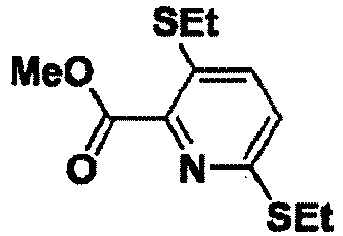
- (1) To a mixture of methyl=3,6-dichloropyridine-2-carboxylate (3.0 g), ethanethiol (2.27 mL), and THF (29 mL) was added sodium hydride (1.28 g) under ice-cooling. The mixture was stirred at room temperature for 1 hour, and then to the mixture was added a saturated ammonium chloride aqueous solution, and then the mixture was extracted with ethyl acetate. The organic layer was dried over sodium sulfate, and then concentrated. The residues were subjected to silica gel column chromatography to obtain methyl=3,6-bis(ethylsulfanyl)pyridine-2-carboxylate (2.80 g).
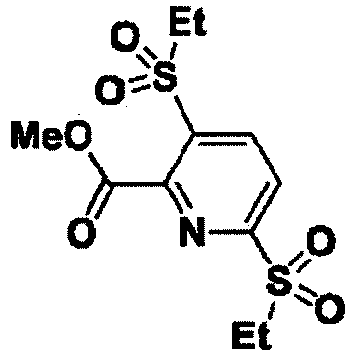
- (2) To a mixture of methyl=3,6-bis(ethylsulfanyl)pyridine-2-carboxylate (2.80 g) and chloroform (36 mL) was added m-chloroperbenzoic acid (10.28 g) under ice-cooling. The mixture was stirred at room temperature for 8 hours, and then a saturated sodium thiosulfate aqueous solution and saturated sodium bicarbonate water were sequentially added thereto, and the mixture was extracted with ethyl acetate. The organic layer was dried over sodium sulfate, and then concentrated to obtain methyl=3,6-bis(ethanesulfonyl)pyridine-2-carboxylate (3.43 g).
- (3) To a mixture of methyl=3,6-bis-ethanesulfonyl-2-pyridinecarboxylate (1.0 g) and DMF (10 mL) were added 1H-1,2,4-triazole (237 mg) and potassium carbonate (473 mg) at room temperature. The mixture was stirred at room temperature for 5 hours, and then to the mixture was added a saturated ammonium chloride aqueous solution, and the mixture was extracted with ethyl acetate. The organic layer was dried over sodium sulfate, and then concentrated to obtain methyl=3-(ethanesulfonyl)-6-(1H-1,2,4-triazol-1-yl)pyridine-2-carboxylate (790 mg).

- (4)

- To a mixture of methyl=3-(ethanesulfonyl)-6-(1H-1,2,4-triazol-1-yl)pyridine-2-carboxylate (790 mg), water (6 mL), and THF (10 mL) was added lithium hydroxide (128 mg) at room temperature. The mixture was stirred at room temperature for 3 hours, and then 1N hydrochloric acid was added thereto, and then the mixture was extracted with ethyl acetate. The organic layer was dried over sodium sulfate, and then concentrated to obtain the compound (3) (473 mg).
1H-NMR (CDCl3) δ: 9.42 (1H, s), 8.56 (1H, d, J = 8.6 Hz), 8.23 (1H, s), 8.18 (1H, d, J = 8.6 Hz), 3.62 (2H, q, J = 7.5 Hz), 1.36 (3H, t, J = 7.5 Hz). -

- Under nitrogen atmosphere, to a mixture of tetrabutylammonium bromide (1.68 g), sodium hydroxide (4.60 g, purity 95%), water (10 g), and toluene (10 g) was added dropwise ethyl mercaptan (6.80 g) at room temperature over 10 minutes, and the mixture was stirred at the same temperature for 1 hour. To the reaction mixture was added dropwise a solution of 3,6-dichloropyridine-2-carboxylic acid chloride in toluene (20.00 g comprising 10.96 g of pure 3,6-dichloropyridine-2-carboxylic acid chloride) at 20°C over 30 minutes, and the mixture was stirred at the same temperature for 5 hours. The mixture was separated, and then the aqueous layer was removed, and the organic layer was washed with water (10 g). The organic layer was concentrated under reduced pressure to obtain S-ethyl 6-chloro-3-(ethylthio)pyridine-2-thiocarboxylate (13.59 g, content 85.82%). The content of S-ethyl 3-chloro-6-(ethylthio)pyridine-2-thiocarboxylate was 4.3%, and the content of S-ethyl 3,6-di(ethylthio)pyridine-2-thiocarboxylate was 1.8% (measured by absolute calibration curve method using High performance liquid chromatography analysis conditions 3).
1H-NMR (DMSO-d6) δ: 1.22-1.29 (6H, m), 2.89-2.94 (2H, q), 2.99-3.05 (2H, q), 7.72-7.74 (1H, m), 7.98-8.00 (1H, m)

- To a mixture of S-ethyl 6-chloro-3-(ethylthio)pyridine-2-thiocarboxylate (111.69 g, purity 89.53%), sodium tungstate dihydrate (2.52 g), ethylenediaminetetraacetic acid disodium salt dihydrate (2.84 g), 96% sulfuric acid (3.06 g), toluene (25.0 g), and water (10.0 g) was added dropwise a 60.0% hydrogen peroxide solution (125.6 g) at 50°C over 8 hours, and the mixture was stirred at the same temperature for 1 hour. Subsequently, a 22% sodium sulfite aqueous solution (33.1 g) was added thereto at room temperature, and a 48% sodium hydroxide aqueous solution was added thereto to adjust the pH of the reaction mixture to 0.6, and the mixture was extracted with methyl isobutyl ketone. To the resulting organic layer was added a potassium hydroxide aqueous solution until the pH of the aqueous layer became 5.5, and the mixture was stirred at room temperature for 30 minutes, and then separated to obtain an aqueous solution (260.4 g) comprising potassium 6-chloro-3-(ethylsulfonyl)pyridine-2-carboxylate (96.4 g).
1H-NMR (DMSO-d6) δ: 1.05-1.09 (3H, t), 3.69-3.75 (2H, q), 7.51-7.53 (1H, d), 8.09-8.11 (1H, d) -

- To a 1 L autoclave were added 2-chloro-5-trifluoromethylpyridine (168.2 g) and acetonitrile (50.5 g), and a 40% methyl amine aqueous solution (215.9 g) was pressed into the mixture over 6 hours at 85°C under sealed conditions, and the mixture was stirred at the same temperature for 8 hours. Subsequently, to the mixture was added acetonitrile (34.0 g), and added seed crystals of N-methyl-(5-trifluoromethyl-pyridin-2-yl)amine (0.17 g) at 53°C, and the mixture was incubated for 2 hours. The mixture was cooled to 30°C at the rate of 5°C/hour, and then water (336.0 g) was added dropwise thereto over 2 hours, and the mixture was cooled to 5°C at the rate of 10°C/hour, and stirred at the same temperature overnight. The precipitates were filtered, then washed with water (168.0 g), and then dried at 40°C under reduced pressure to obtain N-methyl-(5-trifluoromethyl-pyridin-2-yl)amine (159.8 g, content 99.5%, yield 97.4%).

- To a mixture of N-methyl-(5-trifluoromethyl-pyridin-2-yl)amine (135.3 g, content 99.5%), sulfolane (135.2 g), silica gel (4.1 g), and 98% sulfuric acid (338.3 g) was added dropwise 98% nitric acid (103.7 g) at 50°C over 12 hours, and then the mixture was stirred at the same temperature for 48 hours. The resulting reaction mixture was poured into water (270.6 g) at 45°C over 4 hours, and then a 48% sodium hydroxide aqueous solution (281.7 g) was added dropwise thereto at the same temperature over 6 hours. Xylene (257.1 g) was added thereto, and the mixture was stirred for 1 hour, then allowed to stand, and separated to remove the aqueous layer. Water (135.3 g) was added thereto, and then a 48% sodium hydroxide aqueous solution was added thereto until the pH of the aqueous layer became 10.3. The mixture was stirred for 45 minutes, then allowed to stand, separated, and the aqueous layer was removed to obtain a xylene solution of N-methyl-(3-nitro-5-trifluoromethyl-pyridin-2-yl)amine (407.1 g). The solution was analyzed using high performance liquid chromatography to confirm that the content of N-methyl-(3-nitro-5-trifluoromethyl-pyridin-2-yl)amine was 29.6% (yield 71.2%).

- To a 1 L autoclave were added the xylene solution of N-methyl-(3-nitro-5-trifluoromethyl-pyridin-2-yl) amine (387.8 g) obtained in (2), xylene (95.2 g), and 3% platinum carbon (wetted with 50% water) (4.0 g), and the mixture was stirred at 40 to 45°C for 6 hours under hydrogen atmosphere of about 0.5 atm. The reaction mixture was filtered through Celite (registered trademark), and the residues were washed with xylene. The resulting filtrate and wash liquids were mixed, and the mixture was concentrated under reduced pressure until the content of N2-methyl-5-trifluoromethylpyridine-2,3-diamine (compound (4)) became 40%. Subsequently, seed crystals of the compound (4) (0.11 g) were added at 52°C, and the mixture was incubated for 2 hours. Heptane (148.5 g) was added dropwise thereto at the same temperature over 3 hours, and the mixture was cooled to 5°C at the rate of 7°C/hour, and stirred at the same temperature overnight. The precipitates were filtered, then washed with heptane (80.3 g), and then dried at 40°C under reduced pressure to obtain the compound (4) (99.4 g, content 90.8%, yield 91.0%).
- The present invention provides a production intermediate of the compound (6) having control efficacies against pests and a method for producing the compound.
Claims (4)
- A method for producing a compound represented by formula (5)

Step (A): adding a compound represented by formula (4)

- A method for producing a compound represented by formula (6)
 Step (A) according to claim 1; andStep (B) : subjecting said compound represented by formula (5) to intramolecular condensation in the presence of an acid to produce said compound represented by formula (6).
 - The method according to claim 1 or 2, the method comprisingStep (C): reacting a compound represented by formula (1)

- A compound represented by formula (3):

Applications Claiming Priority (2)
| Application Number | Priority Date | Filing Date | Title |
|---|---|---|---|
| JP2015176948 | 2015-09-08 | ||
| PCT/JP2016/075025 WO2017043342A1 (en) | 2015-09-08 | 2016-08-26 | Method for producing triazole compound |
Publications (3)
| Publication Number | Publication Date |
|---|---|
| EP3348554A1 true EP3348554A1 (en) | 2018-07-18 |
| EP3348554A4 EP3348554A4 (en) | 2019-05-08 |
| EP3348554B1 EP3348554B1 (en) | 2020-05-06 |
Family
ID=58239533
Family Applications (1)
| Application Number | Title | Priority Date | Filing Date |
|---|---|---|---|
| EP16844205.1A Active EP3348554B1 (en) | 2015-09-08 | 2016-08-26 | Method for producing triazole compound |
Country Status (5)
| Country | Link |
|---|---|
| EP (1) | EP3348554B1 (en) |
| JP (1) | JP6705458B2 (en) |
| CN (1) | CN108026071A (en) |
| IL (1) | IL257631B (en) |
| WO (1) | WO2017043342A1 (en) |
Cited By (2)
| Publication number | Priority date | Publication date | Assignee | Title |
|---|---|---|---|---|
| US10562885B2 (en) | 2017-03-06 | 2020-02-18 | Sumitomo Chemical Company, Limited | Method for producing triazole compound |
| US11203590B2 (en) | 2017-07-13 | 2021-12-21 | Sumitomo Chemical Company, Limited | Heterocyclic compound and harmful-arthropod control agent containing same |
Families Citing this family (1)
| Publication number | Priority date | Publication date | Assignee | Title |
|---|---|---|---|---|
| UA130471C2 (en) | 2018-06-06 | 2026-02-25 | Сінгента Кроп Протекшн Аг | Pesticide-active heterocyclic derivatives with substituents containing sulfoximine |
Family Cites Families (8)
| Publication number | Priority date | Publication date | Assignee | Title |
|---|---|---|---|---|
| US7951829B2 (en) * | 2006-05-03 | 2011-05-31 | Janssen Pharmaceutica Nv | Benzimidazole modulators of VR1 |
| TW201016676A (en) * | 2008-10-03 | 2010-05-01 | Astrazeneca Ab | Heterocyclic derivatives and methods of use thereof |
| US9085562B2 (en) * | 2011-03-03 | 2015-07-21 | Vanderbilt University | 6-alkyl-N-(pyridin-2-yl)-4-aryloxypicolinamide analogs as mGluR5 negative allosteric modulators and methods of making and using the same |
| TWI545119B (en) * | 2011-08-04 | 2016-08-11 | 住友化學股份有限公司 | Fused heterocyclic compounds and their use in pest control |
| WO2013187423A1 (en) * | 2012-06-15 | 2013-12-19 | 住友化学株式会社 | Pest control composition for harmful arthropods, and pest control method for harmful arthropods |
| TWI614242B (en) * | 2013-01-31 | 2018-02-11 | 住友化學股份有限公司 | Composition and method for controlling pests |
| US9723835B2 (en) * | 2013-01-31 | 2017-08-08 | Sumitomo Chemical Company, Limited | Pest control composition and method for controlling pest |
| AR099677A1 (en) * | 2014-03-07 | 2016-08-10 | Sumitomo Chemical Co | FUSION HETEROCYCLIC COMPOUND AND ITS USE FOR PEST CONTROL |
-
2016
- 2016-08-26 EP EP16844205.1A patent/EP3348554B1/en active Active
- 2016-08-26 CN CN201680051561.1A patent/CN108026071A/en active Pending
- 2016-08-26 WO PCT/JP2016/075025 patent/WO2017043342A1/en not_active Ceased
- 2016-08-26 JP JP2017539115A patent/JP6705458B2/en not_active Expired - Fee Related
-
2018
- 2018-02-20 IL IL257631A patent/IL257631B/en active IP Right Grant
Cited By (2)
| Publication number | Priority date | Publication date | Assignee | Title |
|---|---|---|---|---|
| US10562885B2 (en) | 2017-03-06 | 2020-02-18 | Sumitomo Chemical Company, Limited | Method for producing triazole compound |
| US11203590B2 (en) | 2017-07-13 | 2021-12-21 | Sumitomo Chemical Company, Limited | Heterocyclic compound and harmful-arthropod control agent containing same |
Also Published As
| Publication number | Publication date |
|---|---|
| EP3348554A4 (en) | 2019-05-08 |
| CN108026071A (en) | 2018-05-11 |
| JPWO2017043342A1 (en) | 2018-06-28 |
| EP3348554B1 (en) | 2020-05-06 |
| WO2017043342A1 (en) | 2017-03-16 |
| JP6705458B2 (en) | 2020-06-03 |
| IL257631A (en) | 2018-04-30 |
| IL257631B (en) | 2020-04-30 |
Similar Documents
| Publication | Publication Date | Title |
|---|---|---|
| US10822305B2 (en) | Process for the preparation of 4-(4-amino-3-fluorophenoxy)-N-methylpyyridine-2-carboxamide | |
| CA2935601C (en) | 5-fluoro-4-imino-3-(alkyl/substituted alkyl)-1-(arylsulfonyl)-3,4-dihydropyrimidin-2(1h)-one and processes for their preparation | |
| CA2581835C (en) | Process for the preparation of 4-{4-[({[4-chloro-3-(trifluoromethyl)phenyl]amino}carbonyl)amino]phenoxy}-n-methylpyridine-2-carboxamide | |
| EP2408739B1 (en) | A process for the preparation of 6-(7-((1-aminocyclopropyl)methoxy)-6-methoxyquinolin-4-yloxy)-n-methyl-1-naphthamide and synthetic intermediates thereof | |
| EP3348554B1 (en) | Method for producing triazole compound | |
| US20210087059A1 (en) | Production method for lithium sulfamate, and novel lithium sulfamate | |
| EP4506334A1 (en) | Trifluoromethane sulfonylation agent composition and method for producing trifluoromethanesulfonyloxy compound or trifluoromethane sulfonyl compound | |
| US20230018429A1 (en) | Process for synthesis of (3-chloro-2-pyridyl)hydrazine | |
| KR100470862B1 (en) | Process for preparing asymmetric 4,6-bis (aryloxy) pyrimidine compound | |
| CN112851730B (en) | Synthesis method of NMN intermediate NR chloride | |
| WO2018163818A1 (en) | Method for producing triazole compound | |
| CN113286783B (en) | Method for producing chlorobenzene compounds | |
| US11760724B2 (en) | Pyridone compound production method | |
| JP6705111B2 (en) | Triazinone compound | |
| EP3584241B1 (en) | Method for producing indazole compound, and indazole compound | |
| CN119546579A (en) | A pyridyl-substituted thiohydantoin pharmaceutical intermediate and its preparation method and use | |
| US20060217554A1 (en) | Processes for producing pyrazoloacridone derivative and synthetic intermediate thereof | |
| KR20150050914A (en) | Development of a New Synthetic Method for Quinazolinones via Aerobic Oxidation in dimethylsulfoxide | |
| HK40057090A (en) | Processes for their preparation of 5-fluoro-4-imino-3-(alkyl/substituted alkyl)-1-(arylsulfonyl)- 3,4-dihydropyrimidin-2(1h)-one | |
| HK40057089A (en) | Processes for the preparation of 5-fluoro-4-imino-3-(alkyl/substituted alkyl)-1-(arylsulfonyl)- 3,4-dihydropyrimidin-2(1h)-one |
Legal Events
| Date | Code | Title | Description |
|---|---|---|---|
| STAA | Information on the status of an ep patent application or granted ep patent |
Free format text: STATUS: THE INTERNATIONAL PUBLICATION HAS BEEN MADE |
|
| PUAI | Public reference made under article 153(3) epc to a published international application that has entered the european phase |
Free format text: ORIGINAL CODE: 0009012 |
|
| STAA | Information on the status of an ep patent application or granted ep patent |
Free format text: STATUS: REQUEST FOR EXAMINATION WAS MADE |
|
| 17P | Request for examination filed |
Effective date: 20180301 |
|
| AK | Designated contracting states |
Kind code of ref document: A1 Designated state(s): AL AT BE BG CH CY CZ DE DK EE ES FI FR GB GR HR HU IE IS IT LI LT LU LV MC MK MT NL NO PL PT RO RS SE SI SK SM TR |
|
| AX | Request for extension of the european patent |
Extension state: BA ME |
|
| DAV | Request for validation of the european patent (deleted) | ||
| DAX | Request for extension of the european patent (deleted) | ||
| A4 | Supplementary search report drawn up and despatched |
Effective date: 20190408 |
|
| RIC1 | Information provided on ipc code assigned before grant |
Ipc: C07D 401/14 20060101AFI20190402BHEP Ipc: C07D 471/04 20060101ALI20190402BHEP Ipc: C07D 401/04 20060101ALI20190402BHEP |
|
| GRAP | Despatch of communication of intention to grant a patent |
Free format text: ORIGINAL CODE: EPIDOSNIGR1 |
|
| STAA | Information on the status of an ep patent application or granted ep patent |
Free format text: STATUS: GRANT OF PATENT IS INTENDED |
|
| INTG | Intention to grant announced |
Effective date: 20200124 |
|
| RAP1 | Party data changed (applicant data changed or rights of an application transferred) |
Owner name: SUMITOMO CHEMICAL COMPANY, LIMITED |
|
| GRAS | Grant fee paid |
Free format text: ORIGINAL CODE: EPIDOSNIGR3 |
|
| GRAA | (expected) grant |
Free format text: ORIGINAL CODE: 0009210 |
|
| STAA | Information on the status of an ep patent application or granted ep patent |
Free format text: STATUS: THE PATENT HAS BEEN GRANTED |
|
| AK | Designated contracting states |
Kind code of ref document: B1 Designated state(s): AL AT BE BG CH CY CZ DE DK EE ES FI FR GB GR HR HU IE IS IT LI LT LU LV MC MK MT NL NO PL PT RO RS SE SI SK SM TR |
|
| REG | Reference to a national code |
Ref country code: GB Ref legal event code: FG4D |
|
| REG | Reference to a national code |
Ref country code: CH Ref legal event code: EP Ref country code: AT Ref legal event code: REF Ref document number: 1266530 Country of ref document: AT Kind code of ref document: T Effective date: 20200515 |
|
| REG | Reference to a national code |
Ref country code: IE Ref legal event code: FG4D |
|
| REG | Reference to a national code |
Ref country code: DE Ref legal event code: R096 Ref document number: 602016036113 Country of ref document: DE |
|
| REG | Reference to a national code |
Ref country code: LT Ref legal event code: MG4D |
|
| REG | Reference to a national code |
Ref country code: NL Ref legal event code: MP Effective date: 20200506 |
|
| PG25 | Lapsed in a contracting state [announced via postgrant information from national office to epo] |
Ref country code: SE Free format text: LAPSE BECAUSE OF FAILURE TO SUBMIT A TRANSLATION OF THE DESCRIPTION OR TO PAY THE FEE WITHIN THE PRESCRIBED TIME-LIMIT Effective date: 20200506 Ref country code: LT Free format text: LAPSE BECAUSE OF FAILURE TO SUBMIT A TRANSLATION OF THE DESCRIPTION OR TO PAY THE FEE WITHIN THE PRESCRIBED TIME-LIMIT Effective date: 20200506 Ref country code: PT Free format text: LAPSE BECAUSE OF FAILURE TO SUBMIT A TRANSLATION OF THE DESCRIPTION OR TO PAY THE FEE WITHIN THE PRESCRIBED TIME-LIMIT Effective date: 20200907 Ref country code: IS Free format text: LAPSE BECAUSE OF FAILURE TO SUBMIT A TRANSLATION OF THE DESCRIPTION OR TO PAY THE FEE WITHIN THE PRESCRIBED TIME-LIMIT Effective date: 20200906 Ref country code: FI Free format text: LAPSE BECAUSE OF FAILURE TO SUBMIT A TRANSLATION OF THE DESCRIPTION OR TO PAY THE FEE WITHIN THE PRESCRIBED TIME-LIMIT Effective date: 20200506 Ref country code: NO Free format text: LAPSE BECAUSE OF FAILURE TO SUBMIT A TRANSLATION OF THE DESCRIPTION OR TO PAY THE FEE WITHIN THE PRESCRIBED TIME-LIMIT Effective date: 20200806 Ref country code: GR Free format text: LAPSE BECAUSE OF FAILURE TO SUBMIT A TRANSLATION OF THE DESCRIPTION OR TO PAY THE FEE WITHIN THE PRESCRIBED TIME-LIMIT Effective date: 20200807 |
|
| PGFP | Annual fee paid to national office [announced via postgrant information from national office to epo] |
Ref country code: DE Payment date: 20200827 Year of fee payment: 5 |
|
| PG25 | Lapsed in a contracting state [announced via postgrant information from national office to epo] |
Ref country code: LV Free format text: LAPSE BECAUSE OF FAILURE TO SUBMIT A TRANSLATION OF THE DESCRIPTION OR TO PAY THE FEE WITHIN THE PRESCRIBED TIME-LIMIT Effective date: 20200506 Ref country code: RS Free format text: LAPSE BECAUSE OF FAILURE TO SUBMIT A TRANSLATION OF THE DESCRIPTION OR TO PAY THE FEE WITHIN THE PRESCRIBED TIME-LIMIT Effective date: 20200506 Ref country code: BG Free format text: LAPSE BECAUSE OF FAILURE TO SUBMIT A TRANSLATION OF THE DESCRIPTION OR TO PAY THE FEE WITHIN THE PRESCRIBED TIME-LIMIT Effective date: 20200806 Ref country code: HR Free format text: LAPSE BECAUSE OF FAILURE TO SUBMIT A TRANSLATION OF THE DESCRIPTION OR TO PAY THE FEE WITHIN THE PRESCRIBED TIME-LIMIT Effective date: 20200506 |
|
| REG | Reference to a national code |
Ref country code: AT Ref legal event code: MK05 Ref document number: 1266530 Country of ref document: AT Kind code of ref document: T Effective date: 20200506 |
|
| PG25 | Lapsed in a contracting state [announced via postgrant information from national office to epo] |
Ref country code: NL Free format text: LAPSE BECAUSE OF FAILURE TO SUBMIT A TRANSLATION OF THE DESCRIPTION OR TO PAY THE FEE WITHIN THE PRESCRIBED TIME-LIMIT Effective date: 20200506 Ref country code: AL Free format text: LAPSE BECAUSE OF FAILURE TO SUBMIT A TRANSLATION OF THE DESCRIPTION OR TO PAY THE FEE WITHIN THE PRESCRIBED TIME-LIMIT Effective date: 20200506 |
|
| PG25 | Lapsed in a contracting state [announced via postgrant information from national office to epo] |
Ref country code: CZ Free format text: LAPSE BECAUSE OF FAILURE TO SUBMIT A TRANSLATION OF THE DESCRIPTION OR TO PAY THE FEE WITHIN THE PRESCRIBED TIME-LIMIT Effective date: 20200506 Ref country code: RO Free format text: LAPSE BECAUSE OF FAILURE TO SUBMIT A TRANSLATION OF THE DESCRIPTION OR TO PAY THE FEE WITHIN THE PRESCRIBED TIME-LIMIT Effective date: 20200506 Ref country code: IT Free format text: LAPSE BECAUSE OF FAILURE TO SUBMIT A TRANSLATION OF THE DESCRIPTION OR TO PAY THE FEE WITHIN THE PRESCRIBED TIME-LIMIT Effective date: 20200506 Ref country code: EE Free format text: LAPSE BECAUSE OF FAILURE TO SUBMIT A TRANSLATION OF THE DESCRIPTION OR TO PAY THE FEE WITHIN THE PRESCRIBED TIME-LIMIT Effective date: 20200506 Ref country code: SM Free format text: LAPSE BECAUSE OF FAILURE TO SUBMIT A TRANSLATION OF THE DESCRIPTION OR TO PAY THE FEE WITHIN THE PRESCRIBED TIME-LIMIT Effective date: 20200506 Ref country code: AT Free format text: LAPSE BECAUSE OF FAILURE TO SUBMIT A TRANSLATION OF THE DESCRIPTION OR TO PAY THE FEE WITHIN THE PRESCRIBED TIME-LIMIT Effective date: 20200506 Ref country code: ES Free format text: LAPSE BECAUSE OF FAILURE TO SUBMIT A TRANSLATION OF THE DESCRIPTION OR TO PAY THE FEE WITHIN THE PRESCRIBED TIME-LIMIT Effective date: 20200506 Ref country code: DK Free format text: LAPSE BECAUSE OF FAILURE TO SUBMIT A TRANSLATION OF THE DESCRIPTION OR TO PAY THE FEE WITHIN THE PRESCRIBED TIME-LIMIT Effective date: 20200506 |
|
| REG | Reference to a national code |
Ref country code: DE Ref legal event code: R097 Ref document number: 602016036113 Country of ref document: DE |
|
| PG25 | Lapsed in a contracting state [announced via postgrant information from national office to epo] |
Ref country code: SK Free format text: LAPSE BECAUSE OF FAILURE TO SUBMIT A TRANSLATION OF THE DESCRIPTION OR TO PAY THE FEE WITHIN THE PRESCRIBED TIME-LIMIT Effective date: 20200506 Ref country code: PL Free format text: LAPSE BECAUSE OF FAILURE TO SUBMIT A TRANSLATION OF THE DESCRIPTION OR TO PAY THE FEE WITHIN THE PRESCRIBED TIME-LIMIT Effective date: 20200506 |
|
| PLBE | No opposition filed within time limit |
Free format text: ORIGINAL CODE: 0009261 |
|
| STAA | Information on the status of an ep patent application or granted ep patent |
Free format text: STATUS: NO OPPOSITION FILED WITHIN TIME LIMIT |
|
| PG25 | Lapsed in a contracting state [announced via postgrant information from national office to epo] |
Ref country code: MC Free format text: LAPSE BECAUSE OF FAILURE TO SUBMIT A TRANSLATION OF THE DESCRIPTION OR TO PAY THE FEE WITHIN THE PRESCRIBED TIME-LIMIT Effective date: 20200506 |
|
| REG | Reference to a national code |
Ref country code: CH Ref legal event code: PL |
|
| 26N | No opposition filed |
Effective date: 20210209 |
|
| GBPC | Gb: european patent ceased through non-payment of renewal fee |
Effective date: 20200826 |
|
| PG25 | Lapsed in a contracting state [announced via postgrant information from national office to epo] |
Ref country code: LU Free format text: LAPSE BECAUSE OF NON-PAYMENT OF DUE FEES Effective date: 20200826 Ref country code: LI Free format text: LAPSE BECAUSE OF NON-PAYMENT OF DUE FEES Effective date: 20200831 Ref country code: CH Free format text: LAPSE BECAUSE OF NON-PAYMENT OF DUE FEES Effective date: 20200831 |
|
| REG | Reference to a national code |
Ref country code: BE Ref legal event code: MM Effective date: 20200831 |
|
| PG25 | Lapsed in a contracting state [announced via postgrant information from national office to epo] |
Ref country code: SI Free format text: LAPSE BECAUSE OF FAILURE TO SUBMIT A TRANSLATION OF THE DESCRIPTION OR TO PAY THE FEE WITHIN THE PRESCRIBED TIME-LIMIT Effective date: 20200506 |
|
| PG25 | Lapsed in a contracting state [announced via postgrant information from national office to epo] |
Ref country code: FR Free format text: LAPSE BECAUSE OF NON-PAYMENT OF DUE FEES Effective date: 20200831 |
|
| PG25 | Lapsed in a contracting state [announced via postgrant information from national office to epo] |
Ref country code: BE Free format text: LAPSE BECAUSE OF NON-PAYMENT OF DUE FEES Effective date: 20200831 Ref country code: IE Free format text: LAPSE BECAUSE OF NON-PAYMENT OF DUE FEES Effective date: 20200826 Ref country code: GB Free format text: LAPSE BECAUSE OF NON-PAYMENT OF DUE FEES Effective date: 20200826 |
|
| REG | Reference to a national code |
Ref country code: DE Ref legal event code: R119 Ref document number: 602016036113 Country of ref document: DE |
|
| PG25 | Lapsed in a contracting state [announced via postgrant information from national office to epo] |
Ref country code: TR Free format text: LAPSE BECAUSE OF FAILURE TO SUBMIT A TRANSLATION OF THE DESCRIPTION OR TO PAY THE FEE WITHIN THE PRESCRIBED TIME-LIMIT Effective date: 20200506 Ref country code: MT Free format text: LAPSE BECAUSE OF FAILURE TO SUBMIT A TRANSLATION OF THE DESCRIPTION OR TO PAY THE FEE WITHIN THE PRESCRIBED TIME-LIMIT Effective date: 20200506 Ref country code: CY Free format text: LAPSE BECAUSE OF FAILURE TO SUBMIT A TRANSLATION OF THE DESCRIPTION OR TO PAY THE FEE WITHIN THE PRESCRIBED TIME-LIMIT Effective date: 20200506 |
|
| PG25 | Lapsed in a contracting state [announced via postgrant information from national office to epo] |
Ref country code: MK Free format text: LAPSE BECAUSE OF FAILURE TO SUBMIT A TRANSLATION OF THE DESCRIPTION OR TO PAY THE FEE WITHIN THE PRESCRIBED TIME-LIMIT Effective date: 20200506 |
|
| PG25 | Lapsed in a contracting state [announced via postgrant information from national office to epo] |
Ref country code: DE Free format text: LAPSE BECAUSE OF NON-PAYMENT OF DUE FEES Effective date: 20220301 |