EP3348387A1 - Apparatus for repairing composite material using solvation process - Google Patents
Apparatus for repairing composite material using solvation process Download PDFInfo
- Publication number
- EP3348387A1 EP3348387A1 EP18150793.0A EP18150793A EP3348387A1 EP 3348387 A1 EP3348387 A1 EP 3348387A1 EP 18150793 A EP18150793 A EP 18150793A EP 3348387 A1 EP3348387 A1 EP 3348387A1
- Authority
- EP
- European Patent Office
- Prior art keywords
- depolymerization
- solution
- depolymerization solution
- composite material
- lio
- Prior art date
- Legal status (The legal status is an assumption and is not a legal conclusion. Google has not performed a legal analysis and makes no representation as to the accuracy of the status listed.)
- Granted
Links
Images




Classifications
-
- B—PERFORMING OPERATIONS; TRANSPORTING
- B29—WORKING OF PLASTICS; WORKING OF SUBSTANCES IN A PLASTIC STATE IN GENERAL
- B29C—SHAPING OR JOINING OF PLASTICS; SHAPING OF MATERIAL IN A PLASTIC STATE, NOT OTHERWISE PROVIDED FOR; AFTER-TREATMENT OF THE SHAPED PRODUCTS, e.g. REPAIRING
- B29C73/00—Repairing of articles made from plastics or substances in a plastic state, e.g. of articles shaped or produced by using techniques covered by this subclass or subclass B29D
- B29C73/24—Apparatus or accessories not otherwise provided for
-
- B—PERFORMING OPERATIONS; TRANSPORTING
- B29—WORKING OF PLASTICS; WORKING OF SUBSTANCES IN A PLASTIC STATE IN GENERAL
- B29C—SHAPING OR JOINING OF PLASTICS; SHAPING OF MATERIAL IN A PLASTIC STATE, NOT OTHERWISE PROVIDED FOR; AFTER-TREATMENT OF THE SHAPED PRODUCTS, e.g. REPAIRING
- B29C73/00—Repairing of articles made from plastics or substances in a plastic state, e.g. of articles shaped or produced by using techniques covered by this subclass or subclass B29D
- B29C73/02—Repairing of articles made from plastics or substances in a plastic state, e.g. of articles shaped or produced by using techniques covered by this subclass or subclass B29D using liquid or paste-like material
-
- B—PERFORMING OPERATIONS; TRANSPORTING
- B05—SPRAYING OR ATOMISING IN GENERAL; APPLYING FLUENT MATERIALS TO SURFACES, IN GENERAL
- B05B—SPRAYING APPARATUS; ATOMISING APPARATUS; NOZZLES
- B05B1/00—Nozzles, spray heads or other outlets, with or without auxiliary devices such as valves, heating means
- B05B1/02—Nozzles, spray heads or other outlets, with or without auxiliary devices such as valves, heating means designed to produce a jet, spray, or other discharge of particular shape or nature, e.g. in single drops, or having an outlet of particular shape
-
- B—PERFORMING OPERATIONS; TRANSPORTING
- B05—SPRAYING OR ATOMISING IN GENERAL; APPLYING FLUENT MATERIALS TO SURFACES, IN GENERAL
- B05C—APPARATUS FOR APPLYING FLUENT MATERIALS TO SURFACES, IN GENERAL
- B05C3/00—Apparatus in which the work is brought into contact with a bulk quantity of liquid or other fluent material
- B05C3/005—Apparatus in which the work is brought into contact with a bulk quantity of liquid or other fluent material incorporating means for heating or cooling the liquid or other fluent material
-
- B—PERFORMING OPERATIONS; TRANSPORTING
- B05—SPRAYING OR ATOMISING IN GENERAL; APPLYING FLUENT MATERIALS TO SURFACES, IN GENERAL
- B05C—APPARATUS FOR APPLYING FLUENT MATERIALS TO SURFACES, IN GENERAL
- B05C3/00—Apparatus in which the work is brought into contact with a bulk quantity of liquid or other fluent material
- B05C3/18—Apparatus in which the work is brought into contact with a bulk quantity of liquid or other fluent material only one side of the work coming into contact with the liquid or other fluent material
-
- B—PERFORMING OPERATIONS; TRANSPORTING
- B05—SPRAYING OR ATOMISING IN GENERAL; APPLYING FLUENT MATERIALS TO SURFACES, IN GENERAL
- B05C—APPARATUS FOR APPLYING FLUENT MATERIALS TO SURFACES, IN GENERAL
- B05C3/00—Apparatus in which the work is brought into contact with a bulk quantity of liquid or other fluent material
- B05C3/20—Apparatus in which the work is brought into contact with a bulk quantity of liquid or other fluent material for applying liquid or other fluent material only at particular parts of the work
-
- B—PERFORMING OPERATIONS; TRANSPORTING
- B05—SPRAYING OR ATOMISING IN GENERAL; APPLYING FLUENT MATERIALS TO SURFACES, IN GENERAL
- B05C—APPARATUS FOR APPLYING FLUENT MATERIALS TO SURFACES, IN GENERAL
- B05C9/00—Apparatus or plant for applying liquid or other fluent material to surfaces by means not covered by any preceding group, or in which the means of applying the liquid or other fluent material is not important
- B05C9/08—Apparatus or plant for applying liquid or other fluent material to surfaces by means not covered by any preceding group, or in which the means of applying the liquid or other fluent material is not important for applying liquid or other fluent material and performing an auxiliary operation
- B05C9/14—Apparatus or plant for applying liquid or other fluent material to surfaces by means not covered by any preceding group, or in which the means of applying the liquid or other fluent material is not important for applying liquid or other fluent material and performing an auxiliary operation the auxiliary operation involving heating or cooling
-
- B—PERFORMING OPERATIONS; TRANSPORTING
- B05—SPRAYING OR ATOMISING IN GENERAL; APPLYING FLUENT MATERIALS TO SURFACES, IN GENERAL
- B05D—PROCESSES FOR APPLYING FLUENT MATERIALS TO SURFACES, IN GENERAL
- B05D1/00—Processes for applying liquids or other fluent materials
- B05D1/02—Processes for applying liquids or other fluent materials performed by spraying
-
- B—PERFORMING OPERATIONS; TRANSPORTING
- B05—SPRAYING OR ATOMISING IN GENERAL; APPLYING FLUENT MATERIALS TO SURFACES, IN GENERAL
- B05D—PROCESSES FOR APPLYING FLUENT MATERIALS TO SURFACES, IN GENERAL
- B05D3/00—Pretreatment of surfaces to which liquids or other fluent materials are to be applied; After-treatment of applied coatings, e.g. intermediate treating of an applied coating preparatory to subsequent applications of liquids or other fluent materials
- B05D3/002—Pretreatement
-
- B—PERFORMING OPERATIONS; TRANSPORTING
- B29—WORKING OF PLASTICS; WORKING OF SUBSTANCES IN A PLASTIC STATE IN GENERAL
- B29C—SHAPING OR JOINING OF PLASTICS; SHAPING OF MATERIAL IN A PLASTIC STATE, NOT OTHERWISE PROVIDED FOR; AFTER-TREATMENT OF THE SHAPED PRODUCTS, e.g. REPAIRING
- B29C73/00—Repairing of articles made from plastics or substances in a plastic state, e.g. of articles shaped or produced by using techniques covered by this subclass or subclass B29D
- B29C73/24—Apparatus or accessories not otherwise provided for
- B29C73/245—Apparatus or accessories not otherwise provided for for removing the element having caused the damage
-
- B—PERFORMING OPERATIONS; TRANSPORTING
- B65—CONVEYING; PACKING; STORING; HANDLING THIN OR FILAMENTARY MATERIAL
- B65D—CONTAINERS FOR STORAGE OR TRANSPORT OF ARTICLES OR MATERIALS, e.g. BAGS, BARRELS, BOTTLES, BOXES, CANS, CARTONS, CRATES, DRUMS, JARS, TANKS, HOPPERS, FORWARDING CONTAINERS; ACCESSORIES, CLOSURES, OR FITTINGS THEREFOR; PACKAGING ELEMENTS; PACKAGES
- B65D88/00—Large containers
- B65D88/74—Large containers having means for heating, cooling, aerating or other conditioning of contents
- B65D88/744—Large containers having means for heating, cooling, aerating or other conditioning of contents heating or cooling through the walls or internal parts of the container, e.g. circulation of fluid inside the walls
-
- C—CHEMISTRY; METALLURGY
- C08—ORGANIC MACROMOLECULAR COMPOUNDS; THEIR PREPARATION OR CHEMICAL WORKING-UP; COMPOSITIONS BASED THEREON
- C08F—MACROMOLECULAR COMPOUNDS OBTAINED BY REACTIONS ONLY INVOLVING CARBON-TO-CARBON UNSATURATED BONDS
- C08F8/00—Chemical modification by after-treatment
- C08F8/50—Partial depolymerisation
-
- C—CHEMISTRY; METALLURGY
- C08—ORGANIC MACROMOLECULAR COMPOUNDS; THEIR PREPARATION OR CHEMICAL WORKING-UP; COMPOSITIONS BASED THEREON
- C08J—WORKING-UP; GENERAL PROCESSES OF COMPOUNDING; AFTER-TREATMENT NOT COVERED BY SUBCLASSES C08B, C08C, C08F, C08G or C08H
- C08J11/00—Recovery or working-up of waste materials
- C08J11/04—Recovery or working-up of waste materials of polymers
- C08J11/10—Recovery or working-up of waste materials of polymers by chemically breaking down the molecular chains of polymers or breaking of crosslinks, e.g. devulcanisation
- C08J11/14—Recovery or working-up of waste materials of polymers by chemically breaking down the molecular chains of polymers or breaking of crosslinks, e.g. devulcanisation by treatment with steam or water
-
- C—CHEMISTRY; METALLURGY
- C08—ORGANIC MACROMOLECULAR COMPOUNDS; THEIR PREPARATION OR CHEMICAL WORKING-UP; COMPOSITIONS BASED THEREON
- C08J—WORKING-UP; GENERAL PROCESSES OF COMPOUNDING; AFTER-TREATMENT NOT COVERED BY SUBCLASSES C08B, C08C, C08F, C08G or C08H
- C08J11/00—Recovery or working-up of waste materials
- C08J11/04—Recovery or working-up of waste materials of polymers
- C08J11/10—Recovery or working-up of waste materials of polymers by chemically breaking down the molecular chains of polymers or breaking of crosslinks, e.g. devulcanisation
- C08J11/16—Recovery or working-up of waste materials of polymers by chemically breaking down the molecular chains of polymers or breaking of crosslinks, e.g. devulcanisation by treatment with inorganic material
-
- C—CHEMISTRY; METALLURGY
- C08—ORGANIC MACROMOLECULAR COMPOUNDS; THEIR PREPARATION OR CHEMICAL WORKING-UP; COMPOSITIONS BASED THEREON
- C08J—WORKING-UP; GENERAL PROCESSES OF COMPOUNDING; AFTER-TREATMENT NOT COVERED BY SUBCLASSES C08B, C08C, C08F, C08G or C08H
- C08J5/00—Manufacture of articles or shaped materials containing macromolecular substances
- C08J5/04—Reinforcing macromolecular compounds with loose or coherent fibrous material
- C08J5/0405—Reinforcing macromolecular compounds with loose or coherent fibrous material with inorganic fibres
- C08J5/042—Reinforcing macromolecular compounds with loose or coherent fibrous material with inorganic fibres with carbon fibres
-
- B—PERFORMING OPERATIONS; TRANSPORTING
- B05—SPRAYING OR ATOMISING IN GENERAL; APPLYING FLUENT MATERIALS TO SURFACES, IN GENERAL
- B05D—PROCESSES FOR APPLYING FLUENT MATERIALS TO SURFACES, IN GENERAL
- B05D2201/00—Polymeric substrate or laminate
- B05D2201/02—Polymeric substrate
-
- B—PERFORMING OPERATIONS; TRANSPORTING
- B05—SPRAYING OR ATOMISING IN GENERAL; APPLYING FLUENT MATERIALS TO SURFACES, IN GENERAL
- B05D—PROCESSES FOR APPLYING FLUENT MATERIALS TO SURFACES, IN GENERAL
- B05D2401/00—Form of the coating product, e.g. solution, water dispersion, powders or the like
- B05D2401/20—Aqueous dispersion or solution
Definitions
- the present disclosure relates to a method and an apparatus for repairing composite materials such as automobiles, aircraft, etc. using a solvation process.
- CFRP carbon fiber reinforced plastic
- thermosetting resins such as an epoxy resin or a polyurethane resin.
- composite materials using a thermosetting resin have a drawback that it is difficult to repair them when a part or a large portion thereof is damaged.
- the technology of repairing FRP using a conventional physical removal method breaks the continuity of the filler (for example, fiber skeleton) in FRP due to the physical removal. Moreover, because the technology does not involve a process for reconnecting the fiber skeleton with disrupted continuity, it has a drawback that the physical properties, etc. of the FRP after repair are noticeably lower than those of the FRP before breakage or damage.
- An aspect of example embodiments of the present invention is to provide a method and an apparatus for repairing composite materials using a solvation process, in which only a matrix material, that is, a thermosetting resin of a broken or damaged portion in a composite material such as fiber reinforced plastic (FRP) is removed by solvation with a solution so that only the internal filler fiber skeleton remains, thus allowing to secure the continuity between fibers even after the repair, and in which a matrix material is reimpregnated, thus enabling to obtain a strength similar to that of the original composite material even after the repair.
- a matrix material that is, a thermosetting resin of a broken or damaged portion in a composite material such as fiber reinforced plastic (FRP)
- Another aspect of example embodiments of the present invention is to provide a method and an apparatus for repairing composite materials using a solvation process, in which a part or all of the thermosetting resin as a matrix material is removed from a composite material such as fiber reinforced plastic (FRP) while leaving only the internal filler fiber skeleton, thus allowing very easy repair.
- FRP fiber reinforced plastic
- Yet another aspect of example embodiments of the present invention is to provide a method and an apparatus for repairing composite materials using a solvation process, which enable to minimize damage to internal filler fibers during the repair of composite materials such as fiber reinforced plastic (FRP), etc. and which also do not cause damage such as cracks, etc. to the structure portions other than the portion to be repaired.
- FRP fiber reinforced plastic
- a method for repairing composite materials comprising a matrix resin and a filler fiber, comprising: providing a solution capable of depolymerizing the matrix resin to a portion to be repaired of the composite material to depolymerize the matrix resin.
- the method further comprises re-impregnating the matrix resin into a fiber skeleton structure remaining after the depolymerization of the matrix resin.
- the method further comprises pretreating the composite material with an acidic material prior to depolymerization.
- the method further comprises patching and sewing fibers to a part of the fiber skeleton remaining after depolymerization.
- the composite material is a fiber reinforced plastic (FRP) where a thermosetting resin is the matrix resin.
- FRP fiber reinforced plastic
- the depolymerization solution comprises a compound represented by the chemical formula XOmYn wherein X is hydrogen or an alkali metal or an alkaline earth metal, Y is halogen, m satisfies 1 ⁇ m ⁇ 8, and n satisfies 1 ⁇ n ⁇ 6; and a reaction solvent, and in the reaction solvent, X can be dissociated from XOmYn and Y radical can be provided; or the depolymerization solution comprises a transition metal salt comprising a transition metal; and a reaction solvent, wherein in the reaction solvent, the transition metal salt can be dissociated and an oxidation reaction of a cured epoxy resin mediated by a transition metal can occur.
- the reaction solvent is a H 2 O-based reaction solvent comprising H 2 O and having a dielectric constant of 65 or more, 70 or more, 75 or more, or 80 or more.
- reaction solvent is water alone.
- the compound is one or more selected from the group consisting of HOF, HOCI, HOBr, HOI, NaOF, NaOCl, NaOBr, NaOI, LiOF, LiOCl, LiOBr, LiOI, KOF, KOCl, KOBr, KOI, HO 2 F, HO 2 Cl, HO 2 Br, HO 2 I, NaO 2 F, NaO 2 Cl, NaO 2 Br, NaO 2 I, LiO 2 F, LiO 2 Cl, LiO 2 Br, LiO 2 I, KO 2 F, KO 2 Cl, KO 2 Br, KO 2 I, Ca(OF) 2 , Ca(OCl) 2 , Ca(OBr) 2 , Ca(OI) 2 , HO 3 F, HO 3 Cl, HO 3 Br, HO 3 I, NaO 3 F, NaO 3 Cl, NaO 3 Br, NaO 3 I, LiO 3 F, LiO 3 Cl, LiO 3 Br, LiO 3 I,
- the transition metal salt is one or more selected from the group consisting of KMnO 4 , MnO 2 , K 2 MnO 4 , MnSO 4 , CrO 3 , Na 2 Cr 2 O 7 , K 2 Cr 2 O 7 , ZnCr 2 O 7 , H 2 CrO 4 , pyridinium chlorochromate, pyridinium dichromate, V 2 O 5 , RuCl 3 , RuO 2 , tetrapropylammonium perruthenate, MoO 3 , K 3 [Fe(CN) 6 ], FeCl 3 , Fe(NO 3 ) 3 nonahydrate, MeReO 3 , CuCl, Cu(ClO 4 ) 2 , Cu(HCO 2 ) 2 Ni(HCO 2 ) 2 , Cu(OAc) 2 , OsO 4 , and (NH 4 ) 2 Ce(NO 3 ) 6 .
- an apparatus for repairing composite materials comprising a matrix resin and a filler fiber using a solvation process, comprising: a depolymerization solution supply device for providing a depolymerization solution capable of depolymerizing the matrix resin to a portion to be repaired of the composite material.
- the apparatus comprises a depolymerization solution storage device for storing a solution capable of depolymerizing the resin; and the depolymerization solution supply device for receiving a depolymerization solution from the depolymerization solution storage device and supplying it to the portion to be repaired of the composite material.
- the apparatus further comprises a heater for heating a depolymerization solution.
- the apparatus further comprises:
- the apparatus further comprises:
- the apparatus further comprises:
- the deolymerization solution contact devices further comprise a vacuum absorber.
- the depolymerization solution contact devices further comprise a spray nozzle for spraying a depolymerization solution; and a recovery pipe for recovering the depolymerization solution after contact with the portion to be repaired.
- the heater heats a depolymerization solution to 20-200 °C or 20-100 °C.
- the apparatus further comprises a pretreatment apparatus, and the pretreatment apparatus comprises a pretreatment solution storage device for storing a pretreatment solution for depolymerization; and a pretreatment discharge device capable of discharging a pretreatment solution.
- the pretreatment solution is acetic acid
- the storage device comprises a sealed container for preventing volatilization of acetic acid and a carrier for carrying acetic acid within the container.
- the pretreatment apparatus is in the shape of a pen.
- the apparatus further comprises a resin supply device for providing a matrix resin to the fiber skeleton obtained after depolymerization.
- the apparatus further comprises a sewing device for further reinforcing the fiber skeleton obtained after depolymerization with fiber.
- Example embodiments are described more fully hereinafter.
- the present invention may, however, be embodied in many different forms and should not be construed as limited to the example embodiments set forth herein. Rather, these example embodiments are provided so that this disclosure will be thorough and complete, and will fully convey the scope of the invention to those skilled in the art. In the description, details of features and techniques may be omitted to more clearly disclose example embodiments.
- composite material refers to a composite material comprising a resin as a matrix material and a filled material such as a fiber.
- composite material may include, for example, fiber reinforced plastic (FRP) structures, particularly carbon fiber reinforced plastic (CFRP).
- FRP fiber reinforced plastic
- CFRP carbon fiber reinforced plastic
- the term 'fiber reinforced plastic (FRP) structure' refers to a structure obtained by applying plastic reinforced by fiber such as a carbon fiber or a glass fiber, etc. It may include, for example, a main body of automobiles or aircraft, etc., and in particular, in the case of aircraft, a nose cone of aircraft.
- the expression 'portion to be repaired' refers to a portion to be repaired in a composite material. In particular, it may refer to a portion in the thickness direction of a composite material such as a fiber reinforced plastic structure, etc.
- epoxy resin prepolymer covers not only cured epoxy resin but also partially cured epoxy resin or intermediate produced during curing (so-called epoxy resin prepolymer or prepreg).
- the epoxy resin is produced by a curing reaction between an epoxy compound having two or more epoxy groups within the molecule and a curing agent.
- the epoxy compound and the curing agent are not particularly limited.
- the epoxy compound may include, for example, a polyfunctional epoxy compound, etc.
- the curing agent may include, for example, those having an aromatic group or an aliphatic group.
- the curing agent may be a curing agent having one or more groups selected from amine groups, acid anhydride groups, imidazole groups, and mercaptan groups within the molecule.
- the term 'organic solvent reaction system' refers to a reaction system using an organic solvent as a main solvent of the depolymerization reaction of a thermosetting resin.
- the term 'H 2 O reaction system' refers to a reaction system using H 2 O as a main solvent of the depolymerization reaction of a thermosetting resin.
- This system which is in contrast to the organic solvent reaction system, uses a H 2 O-based reaction solvent in depolymerization reaction.
- the H 2 O-based reaction solvent may include another solvent in addition to H 2 O (that is, it may be a mixed solvent), but even when the solvent is a mixed one, the solvent must have a dielectric constant of at least 65 or more, preferably 70 or more, 75 or more, or 80 or more.
- the H 2 O-based reaction solvent consists of H 2 O alone (water has a dielectric constant of about 80.2).
- the term 'depolymerization time' refers to a depolymerization reaction time required for decomposing all the thermosetting resins such as an epoxy resin provided in a depolymerization reaction.
- decomposing all means that the carbon fiber skeleton exists and there is substantially no thermosetting resin (solid matter) such as an epoxy resin (residual rate of a thermosetting resin is 5% or less).
- the thermosetting resin residual rate is calculated as 100% - decomposition rate.
- the dielectric constant may be measured by using a dielectric constant meter.
- oxidation reaction mediated by a transition metal salt comprising a transition metal refers to an oxidation reaction in which a part of the electrons constituting a chemical bond, for example, a carbon-carbon bond of an organic compound, for example, a cured epoxy resin transfer to a transition metal with a change in the oxidation number of the transition metal, resulting in oxidation.
- a method for repairing composite materials for example, composite materials comprising a matrix resin and a filler fiber using a solvation process, comprising: providing a solution capable of depolymerizing the matrix resin to a portion to be repaired of the composite material to depolymerize the matrix resin.
- the method may further comprise reimpregnating a matrix resin into the fiber skeleton structure remaining after the depolymerization of the matrix resin.
- FIG. 1 is a schematic diagram showing a flow of the process for repairing broken or damaged fiber reinforced plastic (hereinafter this may be referred to as "FRP") by means of solvation of the fiber reinforced plastic structure according to an example embodiment of the present invention.
- FRP broken or damaged fiber reinforced plastic
- a repair is performed by partially dissolving the matrix resin (a thermosetting resin such as epoxy resin or urethane resin, etc. or a thermoplastic resin) of the broken part to maintain only the fiber skeleton structure as it is, and then re-impregnating it with a matrix resin material.
- a matrix resin a thermosetting resin such as epoxy resin or urethane resin, etc. or a thermoplastic resin
- the method may further comprise pretreating the composite material with an acidic material prior to depolymerization.
- the pretreatment can facilitate the progress of the subsequent depolymerization.
- acetic acid may be used as a pretreatment solution for depolymerization.
- a pretreatment solution discharge apparatus capable of effectively carrying a pretreatment solution such as acetic acid, etc. and discharging the pretreatment solution such as acetic acid locally to a portion to be repaired may be used.
- a material for carrying a pretreatment solution such as acetic acid in the pretreatment solution discharge apparatus may include hydrogels, fibrous materials, polymer carriers, porous materials, etc. Further, in the pretreatment solution discharge apparatus, the pretreatment solution such as acetic acid, etc. may be contained in a container so as to prevent volatilization.
- the pretreatment solution discharge apparatus may have a pen-like shape.
- the pretreatment solution discharge apparatus must be able to fixate a portion to be repaired during the pretreatment time after contacted with the portion to be repaired.
- the pretreatment time (1, 2, 4, 6, 12 hours, etc.) may be varied depending on the degree of damage.
- the method may further comprise patching and sewing fibers to a part of the fiber skeleton, in case where the breakage or damage of the fiber skeleton is serious.
- an apparatus for repairing composite materials for example, materials comprising a matrix resin and a filler fiber, comprising: a depolymerization solution supply device for providing a depolymerization solution capable of depolymerizing the matrix resin to a portion to be repaired of the composite material.
- the apparatus may comprise a depolymerization solution storage device for storing a solution capable of depolymerizing the matrix resin; and a depolymerization solution supply device for receiving a depolymerization solution from the depolymerization solution storage device and supplying it to the portion to be repaired of the composite material.
- the apparatus may comprise a depolymerization solution storage tank as the depolymerization solution storage device; and a depolymerization solution contact device for receiving a depolymerization solution from the depolymerization solution storage tank and providing it such that the solution contacts the portion to be repaired of the fiber reinforced plastic.
- the apparatus may further comprise a heater tank for accommodating and heating the depolymerization solution whose temperature becomes lowered after the contact with the portion to be repaired; and a pump for circulating a depolymerization solution between the depolymerization solution storage tank and the heater tank.
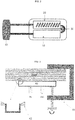
- FIGS. 2 , 4 , 6 to 8 are schematic diagrams showing the apparatuses for repairing a fiber reinforced plastic structure according to example embodiments of the present invention.
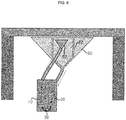
- FIGS. 3 and 5 are schematic diagrams showing particularly the solution contact device in an apparatus for repairing a fiber reinforced plastic structure according to an example embodiment of the present invention.
- the apparatus for partially solvating a fiber reinforced plastic structure comprises a depolymerization solution storage tank (10) for storing a solution capable of depolymerizing the thermosetting resin of the fiber reinforced plastic structure, a depolymerization solution contact device (40, 50, 60) for receiving a depolymerization solution from the depolymerization solution storage tank (10) and providing it such that the solution contacts the portion to be repaired of the fiber reinforced plastic, a heater (20) for accommodating and heating the depolymerization solution whose temperature becomes lowered after the contact with the portion to be repaired which is equipped with a heating means, and a pump (30) for circulating a depolymerization solution between the depolymerization solution storage tank (10) and the solution contact device (40, 50, 60).
- the pump (30) may comprise a pump driving device (31) for driving it.
- the depolymerization storage tank (10) may store a solution capable of depolymerizing fiber reinforced plastic and provide it to the depolymerization contact device (40, 50, 60).
- the depolymerization solution is not limited as long as it is a solution capable of depolymerizing fiber reinforced plastic. However, preferably, the solution is a solution capable of rapid depolymerization under mild conditions at a low temperature.
- thermosetting resin constituting the fiber reinforced plastic is an epoxy resin
- the depolymerization solution examples 1 and 2 are preferable in that they are allowed to obtain only the fiber skeleton while leaving no residue of a thermosetting resin and enable to minimize damage to the fiber skeleton or the portions other than the portion to be repaired.
- an epoxy resin depolymerization solution comprising a compound represented by chemical formula XOmYn, wherein X is hydrogen or an alkali metal or an alkaline earth metal, Y is halogen, m is a number satisfying 1 ⁇ m ⁇ 8, and n is a number satisfying 1 ⁇ n ⁇ 6, and a reaction solvent, wherein in the reaction solvent, X can be dissociated from XOmYn and Y radical can be provided.
- X is dissociated in advance in the reaction solvent (especially H 2 O-based reaction solvent) and finally Y radical, which has a noncovalent unpaired electron, that is, ⁇ Y is produced.
- Y radical ⁇ Y
- the dielectric constant of the reaction solvent must be controlled at a predetermined value or higher in order to perform with low energy the dissociation of X, the production of Y radical and the depolymerization reaction of the Y radical to the cured epoxy resin.
- the reaction solvent is selected so as to be capable of dissociating X from XOmYn linked by an ionic bond and in which Y radicals can be effectively generated after dissociation of X.
- the reaction solvent is preferably an H 2 O-based reaction solvent.
- the dielectric constant of the H 2 O-based reaction solvent used together affects the efficiency of the depolymerization reaction of the epoxy resin.
- the dielectric constant of the H 2 O-based reaction solvent must be at least 65 or more, or 70 or more, 75 or more, or 80 or more. When the dielectric constant is 65 or more, the reaction efficiency starts to increase sharply.
- the H 2 O-based reaction solvent consists of H 2 O alone (water has a dielectric constant of about 80.2).
- H 2O -based reaction solvent is H 2 O alone, the efficiency of the decomposition of the cured epoxy resin starts to increase drastically.
- organic solvent solvates epoxy resin directly using the organic solvent as the main solvent.
- XOmYn is added to the organic solvent, X cannot be dissociated and a Y radical to be used for depolymerization of a cured epoxy resin cannot be produced.
- NMP has a dielectric constant of 32 and does not solvate XOmYn.
- X in the XOmYn represents hydrogen or an alkali metal such as lithium, potassium, sodium, etc. or an alkaline earth metal such as calcium, magnesium, etc.
- Y in the XOmYn represents a halogen element such as F, Cl, Br, I, etc.
- m and n may be a natural number within the above range. However, they are not limited to a natural number, and may be a decimal fraction, for example, in the case of forming a complex.
- the compound may be one or more selected from the group consisting of HOF, HOCI, HOBr, HOI, NaOF, NaOCl, NaOBr, NaOl, LiOF, LiOCl, LiOBr, LiOI, KOF, KOCI, KOBr, KOI, HO 2 F, HO 2 Cl, HO 2 Br, HO 2 I, NaO 2 F, NaO 2 Cl, NaO 2 Br, NaO 2 I, LiO 2 F, LiO 2 Cl, LiO 2 Br, LiO 2 I, KO 2 F, KO 2 Cl, KO 2 Br, KO 2 I, Ca(OF) 2 , Ca(OCl) 2 , Ca(OBr) 2 , Ca(OI) 2 , HO 3 F, HO 3 Cl, HO 3 Br, HO 3 I, NaO 3 F, NaO 3 Cl, NaO 3 Br, NaO 3 I, LiO 3 F, LiO 3 Cl, LiO 3 Br, LiO
- the H 2 O-based solvent is water alone.
- the depolymerization reaction temperature may be, for example, less than 250 °C (e.g., not less than 20 °C and less than 250 °C), not more than 200 °C (e.g., 20-200 °C) or not more than 100 °C (e.g., 20-100 °C or 20-70 °C). Therefore, the heating temperature of the heater tank (20) can be adjusted so as to maintain these temperatures.
- the compound of XOmYn may be present in an amount of 0.001-99 % by weight based on 100 % by weight of the total composition (reaction solvent + compound of XOmYn).
- reaction solvent is, for example, an aqueous solution
- the compound of XOmYn may be comprised in an amount of 0.001-99 % by weight based on the total aqueous solution comprising the compound of XOmYn.
- a cured epoxy resin may be present in an amount of 1-90 parts by weight based on 100 parts by weight of the depolymerization composition (reaction solvent + compound of XOmYn).
- reaction solvent is an aqueous solution
- a cured epoxy resin e.g., CFRP
- CFRP a cured epoxy resin
- the depolymerization solution it is preferable to use a depolymerization solution comprising a transition metal salt or transition metal oxide comprising a transition metal (a metal element belonging to Groups 3 to 12 of the periodic table) and a reaction solvent.
- an oxidation reaction mediated by a transition metal element that is, an oxidation reaction of a cured epoxy resin through the change of the oxidation number of a transition metal element occurs in a reaction solvent.
- the chemical bond, for example, the carbon-carbon bond, of the cured epoxy resin breaks through such oxidation reaction, resulting the depolymerization of the cured epoxy resin.
- transition metals can have two or more oxidation states (oxidation numbers), and an oxidation reaction occurs due to a change in the two or more oxidation states (that is, decrease of the oxidation number) during the reaction.
- manganese in potassium permanganate which is a transition metal salt, has three oxidation states: oxidation number of +7 (potassium permanganate), oxidation number of +6 (potassium manganate) and oxidation number of +4 (manganese dioxide).
- an oxidation reaction takes place in which electrons are withdrawn from the chemical bond, for example, the carbon-carbon bond of a cured epoxy resin, which is an organic compound.
- the dielectric constant of the reaction solvent must be controlled at a predetermined value or higher in order to perform the oxidation reaction with low energy. Therefore, in order to increase the reaction efficiency, the dielectric constant of the reaction solvent must be 65 or more, 70 or more, 75 or more, or 80 or more.
- the reaction solvent is preferably a H 2 O-based reaction solvent, particularly preferably water alone.
- the dielectric constant of the H 2 O-based reaction solvent used together affects the efficiency of the depolymerization reaction of the cured epoxy resin.
- the H 2 O-based reaction solvent can accelerate the solvation and/or ion dissociation of the transition metal salt or the transition metal oxide, and because it is involved in the oxidation reaction of the chemical bond, for example, the carbon-carbon bond in the epoxy resin mediated by a transition metal element, thereby contributing to the depolymerization reaction efficiency of the epoxy resin.
- the dielectric constant of the H 2 O-based reaction solvent must be at least 65 or more, or 70 or more, 75 or more, or 80 or more.
- the H 2 O-based reaction solvent consists of H 2 O alone (water has a dielectric constant of about 80.2).
- H 2 O-based reaction solvent H 2 O alone
- organic solvent solvates epoxy resin directly using the organic solvent as the main solvent.
- a transition metal salt is added to an organic solvent, it cannot contribute to depolymerization of the epoxy resin because the solubility and the degree of ion dissociation are low.
- NMP has a dielectric constant of 32 and does not solvate a transition metal salt.
- the depolymerization reaction temperature may be, for example, less than 250 °C (e.g., 20-250 °C), not more than 200 °C (e.g., 20-200 °C) or not more than 100 °C (e.g., 20-100 °C or 20-70 °C). Therefore, as with the depolymerization solution 1, the heating temperature of the heater tank (20) can be adjusted so as to maintain these temperatures.
- the transition metal salt or transition metal oxide comprising a transition metal may be, for example, KMnO 4 , MnO 2 , K 2 MnO 4 , MnSO 4 , CrO 3 , Na 2 Cr 2 O 7 , K 2 Cr 2 O 7 , ZnCr 2 O 7 , H 2 CrO 4 , pyridinium chlorochromate, pyridinium dichromate, V 2 O 5 , RuCl 3 , RuO 2 , tetrapropylammonium perruthenate, MoO 3 , K 3 [Fe(CN) 6 ], FeCl 3 , Fe(NO 3 ) 3 nonahydrate, MeReO 3 , CuCl, Cu(ClO 4 ) 2 , Cu(HCO 2 ) 2 Ni(HCO 2 ) 2 , Cu(OAc) 2 , OsO 4 , (NH 4 ) 2 Ce(NO 3 ) 6 , etc.
- the transition metal salt or transition metal oxide may be present in an amount of 0.001-99 % by weight based on the weight of the total composition (H 2 O-based reaction solvent + transition metal salt or transition metal oxide).
- the H 2 O reaction solvent is, for example, an aqueous solution
- the transition metal salt or the transition metal oxide may be comprised in an amount of 0.001-99%, or for example 0.001-50%, by weight based on the total aqueous solution comprising the transition metal salt or the transition metal oxide.
- a cured epoxy resin may be present in amount of 1-90 parts by weight based on 100 parts by weight of the depolymerization composition (H 2 O reaction solvent + transition metal salt or transition metal oxide).
- the H 2 O reaction solvent is an aqueous solution
- a cured epoxy resin may be present in amount of 1-90 parts by weight based on 100 parts by weight of the aqueous solution comprising the transition metal salt or the transition metal oxide.
- the depolymerization solution contact device (40, 50, 60) allows the depolymerization solution supplied from the depolymerization solution storage tank (10) to contact the portion to be repaired.
- the contact device (40) of FIG. 2 may comprise an impregnation device capable of impregnating the portion to be repaired. Further, in another example, it may comprise an elastic absorbent that absorbs and retains the depolymerization solution. The absorbent contacts the portion to be repaired while holding a depolymerization solution, thus capable of continuously supplying the solution supplied from the depolymerization storage tank (10) to the portion to be repaired.
- FIG. 3 shows the contact device (40) of the apparatus for repair according to yet another example embodiment of the present invention.
- the contact device (40) may further comprise a device (41) for tightly mounting and fixating the contact device (40) to FRP to allow the solution to contact only the portion to be repaired while preventing the solution from leaking outside the portion to be repaired.
- the contact device (40) may further comprise a side wing (42) comprised of a flexible material to allow the contact device (40) to be in close contact with FRP and thereby to prevent the solution from leaking.
- the contact device (50) of FIG. 4 may further comprise a vacuum absorber (51) for tightly mounting and fixating the contact device (50) to FRP by vacuum to allow the solution to contact only the portion to be repaired while preventing the solution from leaking outside the portion to be repaired.
- FIG. 4 may also further comprise, although not illustrated therein, an air outlet (52) for extracting air as in FIG. 5 explained below.
- FIG. 5 shows the contact device (50) of the apparatus for repair according to yet another example embodiment of the present invention.
- the contact device (50) may comprise a vacuum absorber (51) for tightly mounting and fixating the contact device (50) to FRP by vacuum to allow the solution to contact only the portion to be repaired while preventing the solution from leaking outside the portion to be repaired and an air outlet (52) for extracting air to form vacuum.
- the contact device (50) may also comprise a side wing (42) of a flexible material to allow a close contact with FRP and thereby to prevent the solution from leaking.
- FIGS. 6 to 8 are schematic diagrams showing the apparatus for repairing a fiber reinforced plastic structure according to yet other example embodiments of the present invention.
- the contact device (60) of FIGS. 6 to 8 comprises a spray nozzle (61) for allowing the depolymerization solution supplied from the depolymerization solution storage tank (10) to contact with the FRP to be repaired, and a recovery pipe (62) for recovering the sprayed solution.
- the spray nozzle may be installed so as to move over the portion to be repaired of fiber reinforced plastic.
- the contact device (60) itself is in the form of a housing accommodating FRP, within which the spray nozzle (61) and the recovery pipe (62) are located.
- the above apparatus and process is only an example, and the order or installment manner of the solution storage tank (10), the heater (20), the pump (30), and the contact device (40, 50, 60) may be varied.
- a depolymerization solution is supplied to the contact device (60) from the depolymerization solution storage tank (10) through the pump (30), and the heater (20) may be a heater attached to a side of a container comprising the depolymerization solution storage tank (10), by which the temperature of the entire depolymerization solution storage tank (10) can be maintained at a predetermined temperature or higher.
- the solution recovered from the recovery pipe (62) may directly enter the depolymerization solution storage tank (10).
- FIG. 7 further illustrates the driving portion (31) for driving the pump (30)
- a depolymerization solution is supplied to the contact device (60) from the depolymerization solution storage tank (10) through the pump (30), and the heater (20) may be a heater installed in the depolymerization solution transfer pipe located between the depolymerization solution storage tank (10) and the contact device (60). This is to provide a depolymerization solution to the contact device (60) while maintaining the solution at a constant temperature.
- the solution recovered from the recovery pipe (62) may directly enter the depolymerization solution storage tank (10).
- the apparatus for repair may perform a repair comprising depolymerizing the portion to be repaired as described above, providing a thermosetting resin thereto and curing it.
- thermosetting resin if there is a breakage in the fiber skeleton obtained after a part or all of the resin is removed by the apparatus for repair, facilitating the continuity of the fiber skeleton by means of a sewing process to patch a part of the fiber skeleton and then providing and curing a thermosetting resin may be further performed.
- the fiber skeleton remaining after partial solvation of the matrix portion of the damaged area may be subjected to the following methods depending on the degree of the breakage.
- a matrix material may be reimpregnated after aligning the fiber skeleton of the solvated portion such that it can maintain a structure like that of the fiber skeleton of the not solvated portion.
- a matrix material may be reimpregnated after improving the continuity of the fiber skeleton by using a sewing machine, etc.
- a matrix material may be reimpregnated after recovering the skeleton by patching a structure having the same structure as the original fiber skeleton constituting the FRP and by connecting it with the existing skeleton by using a sewing machine, etc.
- the portion to be repaired may be a part in the thickness direction of the structure.
- FIG. 9 shows an example of the portion to be repaired of an aircraft nose cone, which is an example of the cured fiber reinforced resin according to an example embodiment of the present invention.
- a repair may be performed on a part (t) in the thickness (T) direction of a structure such as a nose cone by means of the apparatus and method for repair according to example embodiments of the present invention.
- conventional FRP manufacturing processes such as conventional hand lay-up, RTM (resin transfer molding), filament winding, laminate, resin spray transfer, etc. may be used for re-impregnation of a matrix material.
- the cured epoxy resin to be repaired used in Example 1 is carbon fiber reinforced plastic (CFRP).
- CFRP carbon fiber reinforced plastic
- the waste CFRP is composed of a carbon fiber and a cured epoxy resin obtained by using an epoxy compound in the form of a diglycidyl ether of bisphenol A and an aromatic curing agent comprising an aromatic amine group. It is known that in general, it is very difficult to decompose the CFRP because it uses an aromatic curing agent.
- Acetic acid gel is attached to the portion where epoxy resin is to be partially solvated of the in-house produced CFRP to be repaired and pretreatment is performed for 1, 2, 4, 6 and 12 hours.
- FIGS. 10A and 10B are a photograph showing the sample of Example 1 before ( FIG. 10A ) and after ( FIG. 10B ) the 12-hour partial solvation treatment.
- the cured epoxy resin used in Example 2 is carbon fiber reinforced plastic (CFRP).
- CFRP carbon fiber reinforced plastic
- the waste CFRP is composed of a carbon fiber and a cured epoxy resin obtained by using an epoxy compound in the form of a diglycidyl ether of bisphenol A and an aromatic curing agent comprising an aromatic amine group.
- a cotton ball dampened with acetic acid is attached to the portion where epoxy resin is to be partially solvated of the in-house produced CFRP to be repaired and pretreatment is performed for 1, 2, 4, 6 and 12 hours.
- a matrix resin only in the broken or damaged portion of a composite material such as fiber reinforced plastic (FRP) are removed by solvation with a solution while leaving internal filler fibers (fiber skeleton), thus allowing to secure continuity between the fibers even after the repair. Accordingly, it is possible to obtain a similar strength to the original composite material even after the repair, by reimpregnating a matrix material.
- FRP fiber reinforced plastic
- example embodiments of the present invention may allow very easy repair and enable to minimize damage to internal filler fibers (fiber skeleton) during the repair of a composite material. Also, it is possible not to cause damage such as cracks, etc. to the structure portions other than the portion to be repaired.
Landscapes
- Chemical & Material Sciences (AREA)
- Engineering & Computer Science (AREA)
- Organic Chemistry (AREA)
- Health & Medical Sciences (AREA)
- Chemical Kinetics & Catalysis (AREA)
- Medicinal Chemistry (AREA)
- Polymers & Plastics (AREA)
- Mechanical Engineering (AREA)
- Sustainable Development (AREA)
- Life Sciences & Earth Sciences (AREA)
- General Chemical & Material Sciences (AREA)
- Inorganic Chemistry (AREA)
- Manufacturing & Machinery (AREA)
- Materials Engineering (AREA)
- Separation, Recovery Or Treatment Of Waste Materials Containing Plastics (AREA)
Abstract
Description
- The present disclosure relates to a method and an apparatus for repairing composite materials such as automobiles, aircraft, etc. using a solvation process.
- Since composite materials such as fiber reinforced plastic (hereinafter this may be abbreviated as "FRP") obtained by mixing a fiber such as a carbon fiber or glass fiber with plastic, particularly carbon fiber reinforced plastic (hereinafter may be abbreviated as CFRP) are lightweight and exhibit excellent physical properties and durability, they are widely used as key materials in the field of automobiles, aerospace planes, or new energy.
- Typical matrix polymer resins used for these composite materials are thermosetting resins such as an epoxy resin or a polyurethane resin. However, due to the characteristic of thermosetting resins, composite materials using a thermosetting resin have a drawback that it is difficult to repair them when a part or a large portion thereof is damaged.
- Thus, the repair of composite materials such as FRP, etc. could be an important prerequisite for application of FRP in the market of automobiles and aircraft, etc. in the future.
- Meanwhile, various methods are currently being carried out to repair damaged composite materials such as FRP, etc. For example, the repair technology of physically removing the damaged portion of aircraft with a laser, a grinder, etc. and filling new FRP is being actively studied at the initiative of aerospace companies such as Aerospatiale Societe Nationale Industrielle, McDonnell Douglas Corporation, The Boeing Company, Airbus Operations GmbH, etc.
- However, according to the observation of the present inventors, the technology of repairing FRP using a conventional physical removal method breaks the continuity of the filler (for example, fiber skeleton) in FRP due to the physical removal. Moreover, because the technology does not involve a process for reconnecting the fiber skeleton with disrupted continuity, it has a drawback that the physical properties, etc. of the FRP after repair are noticeably lower than those of the FRP before breakage or damage.
- An aspect of example embodiments of the present invention is to provide a method and an apparatus for repairing composite materials using a solvation process, in which only a matrix material, that is, a thermosetting resin of a broken or damaged portion in a composite material such as fiber reinforced plastic (FRP) is removed by solvation with a solution so that only the internal filler fiber skeleton remains, thus allowing to secure the continuity between fibers even after the repair, and in which a matrix material is reimpregnated, thus enabling to obtain a strength similar to that of the original composite material even after the repair.
- To this end, it is possible to solve the problem that cannot be avoided in the conventional repair technology of physically removing all the broken or damaged portions of a composite material such as fiber reinforced plastic (FRP) by using a grinder, etc. and filling the grooved portion after the removal with new FRP, that is, the problem that the continuity between the filler fiber skeleton of the non-damaged portion and the filler fiber skeleton of the newly filled portion cannot be secured.
- Another aspect of example embodiments of the present invention is to provide a method and an apparatus for repairing composite materials using a solvation process, in which a part or all of the thermosetting resin as a matrix material is removed from a composite material such as fiber reinforced plastic (FRP) while leaving only the internal filler fiber skeleton, thus allowing very easy repair.
- Yet another aspect of example embodiments of the present invention is to provide a method and an apparatus for repairing composite materials using a solvation process, which enable to minimize damage to internal filler fibers during the repair of composite materials such as fiber reinforced plastic (FRP), etc. and which also do not cause damage such as cracks, etc. to the structure portions other than the portion to be repaired.
- In example embodiments of the present invention, provided is a method for repairing composite materials comprising a matrix resin and a filler fiber, comprising: providing a solution capable of depolymerizing the matrix resin to a portion to be repaired of the composite material to depolymerize the matrix resin.
- In an example embodiment, the method further comprises re-impregnating the matrix resin into a fiber skeleton structure remaining after the depolymerization of the matrix resin.
- In an example embodiment, the method further comprises pretreating the composite material with an acidic material prior to depolymerization.
- In an example embodiment, the method further comprises patching and sewing fibers to a part of the fiber skeleton remaining after depolymerization.
- In an example embodiment, in the method, the composite material is a fiber reinforced plastic (FRP) where a thermosetting resin is the matrix resin.
- In an example embodiment, in the method, the depolymerization solution comprises a compound represented by the chemical formula XOmYn wherein X is hydrogen or an alkali metal or an alkaline earth metal, Y is halogen, m satisfies 1 ≤ m ≤ 8, and n satisfies 1 ≤ n ≤ 6; and a reaction solvent, and in the reaction solvent, X can be dissociated from XOmYn and Y radical can be provided; or the depolymerization solution comprises a transition metal salt comprising a transition metal; and a reaction solvent, wherein in the reaction solvent, the transition metal salt can be dissociated and an oxidation reaction of a cured epoxy resin mediated by a transition metal can occur.
- In an example embodiment, the reaction solvent is a H2O-based reaction solvent comprising H2O and having a dielectric constant of 65 or more, 70 or more, 75 or more, or 80 or more.
- In an example embodiment, the reaction solvent is water alone.
- In an example embodiment, the compound is one or more selected from the group consisting of HOF, HOCI, HOBr, HOI, NaOF, NaOCl, NaOBr, NaOI, LiOF, LiOCl, LiOBr, LiOI, KOF, KOCl, KOBr, KOI, HO2F, HO2Cl, HO2Br, HO2I, NaO2F, NaO2Cl, NaO2Br, NaO2I, LiO2F, LiO2Cl, LiO2Br, LiO2I, KO2F, KO2Cl, KO2Br, KO2I, Ca(OF)2, Ca(OCl)2, Ca(OBr)2, Ca(OI)2, HO3F, HO3Cl, HO3Br, HO3I, NaO3F, NaO3Cl, NaO3Br, NaO3I, LiO3F, LiO3Cl, LiO3Br, LiO3I, KO3F, KO3Cl, KO3Br, KO3I, HO4F, HO4Cl, HO4Br, HO4I, NaO4F, NaO4Cl, NaO4Br, NaO4I, LiO4F, LiO4Cl, LiO4Br, LiO4I, KO4F, KO4Cl, KO4Br, KO4I, NaOCl6, MgO6F2, MgO6Cl2, MgO6Br2, MgO6I2, CaO6F2, CaO6Cl2, CaO6Br2, CaO6I2, SrO6F2, SrO6Cl2, SrO6Br2, SrO6I2, BaO6F2, BaO6Cl2, BaO6Br2, BaO6I2, NaOCl3, NaOCl4, MgO8Cl2, CaO8Cl2, SrO8Cl2, and BaO8Cl2.
- In an example embodiment, the transition metal salt is one or more selected from the group consisting of KMnO4, MnO2, K2MnO4, MnSO4, CrO3, Na2Cr2O7, K2Cr2O7, ZnCr2O7, H2CrO4, pyridinium chlorochromate, pyridinium dichromate, V2O5, RuCl3, RuO2, tetrapropylammonium perruthenate, MoO3, K3[Fe(CN)6], FeCl3, Fe(NO3)3 nonahydrate, MeReO3, CuCl, Cu(ClO4)2, Cu(HCO2)2Ni(HCO2)2, Cu(OAc)2, OsO4, and (NH4)2Ce(NO3)6.
- In example embodiments of the present invention, provided is an apparatus for repairing composite materials comprising a matrix resin and a filler fiber using a solvation process, comprising: a depolymerization solution supply device for providing a depolymerization solution capable of depolymerizing the matrix resin to a portion to be repaired of the composite material.
- In an example embodiment, the apparatus comprises a depolymerization solution storage device for storing a solution capable of depolymerizing the resin; and the depolymerization solution supply device for receiving a depolymerization solution from the depolymerization solution storage device and supplying it to the portion to be repaired of the composite material.
- In an example embodiment, the apparatus further comprises a heater for heating a depolymerization solution.
- In an example embodiment, the apparatus further comprises:
- as for the depolymerization solution storage device, a depolymerization solution storage tank;
- as for the depolymerization solution supply device, a depolymerization solution contact device for receiving a depolymerization solution from the depolymerization solution storage tank and providing it such that the solution contacts the portion to be repaired of fiber reinforced plastic;
- as for the heater, a heater tank for accommodating and heating the depolymerization solution whose temperature becomes lowered after the contact with the portion to be repaired; and
- a pump for circulating a depolymerization solution between the depolymerization solution storage tank and the heater tank.
- In an example embodiment, the apparatus further comprises:
- as for the depolymerization solution storage device, a depolymerization solution storage tank;
- as for the depolymerization solution supply device, a depolymerization solution contact device for receiving a depolymerization solution from the depolymerization solution storage tank and providing it such that the solution contacts the portion to be repaired of fiber reinforced plastic;
- as for the heater a heater for heating the depolymerization solution storage tank; and
- a pump for circulating a depolymerization solution from the depolymerization solution storage tank to the depolymerization solution contact device.
- In an example embodiment, the apparatus further comprises:
- as for the depolymerization solution storage device, a depolymerization solution storage tank;
- as for the depolymerization solution supply device, a depolymerization solution contact device for receiving a depolymerization solution from the depolymerization solution storage tank and providing it such that the solution contacts the portion to be repaired of fiber reinforced plastic;
- as for the heater, a heater for heating a depolymerization solution transfer pipe located between the depolymerization solution storage tank and the depolymerization solution contact device; and
- a pump for circulating a depolymerization solution from the depolymerization solution storage tank to the depolymerization solution contact device.
- In an example embodiment, the deolymerization solution contact devices further comprise a vacuum absorber.
- In an example embodiment, the depolymerization solution contact devices further comprise a spray nozzle for spraying a depolymerization solution; and a recovery pipe for recovering the depolymerization solution after contact with the portion to be repaired.
- In an example embodiment, the heater heats a depolymerization solution to 20-200 °C or 20-100 °C.
- In an example embodiment, the apparatus further comprises a pretreatment apparatus, and the pretreatment apparatus comprises a pretreatment solution storage device for storing a pretreatment solution for depolymerization; and a pretreatment discharge device capable of discharging a pretreatment solution.
- In an example embodiment, the pretreatment solution is acetic acid, and the storage device comprises a sealed container for preventing volatilization of acetic acid and a carrier for carrying acetic acid within the container.
- In an example embodiment, the pretreatment apparatus is in the shape of a pen.
- In an example embodiment, the apparatus further comprises a resin supply device for providing a matrix resin to the fiber skeleton obtained after depolymerization.
- In an example embodiment, the apparatus further comprises a sewing device for further reinforcing the fiber skeleton obtained after depolymerization with fiber.
- The above and other aspects, features and advantages of the disclosed example embodiments will be more apparent from the following detailed description taken in conjunction with the accompanying drawings in which:
-
FIG. 1 is a schematic diagram showing a flow of the process for repairing a broken or damaged fiber reinforced plastic by means of solvation of the fiber reinforced plastic structure according to an example embodiment of the present invention. -
FIG. 2 is a schematic diagram showing an apparatus for repairing a fiber reinforced plastic structure according to an example embodiment of the present invention. -
FIG. 3 is a schematic diagram showing a solution contact device in an apparatus for repairing a fiber reinforced plastic structure according to an example embodiment of the present invention. -
FIG. 4 is a schematic diagram showing an apparatus for repairing a fiber reinforced plastic structure according to another example embodiment of the present invention. -
FIG. 5 is a schematic diagram showing a solution contact device using vacuum in an apparatus for repairing a fiber reinforced plastic structure according to yet another example embodiment of the present invention. -
FIG. 6 is a schematic diagram showing an apparatus for repairing a fiber reinforced plastic structure according to yet another example embodiment of the present invention. -
FIG. 7 is a schematic diagram showing an apparatus for repairing a fiber reinforced plastic structure according to yet another example embodiment of the present invention. -
FIG. 8 is a schematic diagram showing an apparatus for repairing a fiber reinforced plastic structure according to yet another example embodiment of the present invention. -
FIG. 9 is a schematic diagram showing the portion to be repaired of an aircraft nose cone in an example embodiment of the present invention. -
FIG. 10A is a photograph showing the sample of Example 1 of the present invention before 12-hour partial solvation treatment. -
FIG. 10B is a photograph showing the sample of Example 1 of the present invention after 12-hour partial solvation treatment. - Example embodiments are described more fully hereinafter. The present invention may, however, be embodied in many different forms and should not be construed as limited to the example embodiments set forth herein. Rather, these example embodiments are provided so that this disclosure will be thorough and complete, and will fully convey the scope of the invention to those skilled in the art. In the description, details of features and techniques may be omitted to more clearly disclose example embodiments.
- In the present disclosure, the term 'composite material' refers to a composite material comprising a resin as a matrix material and a filled material such as a fiber. These composite material may include, for example, fiber reinforced plastic (FRP) structures, particularly carbon fiber reinforced plastic (CFRP).
- In the present disclosure, the term 'fiber reinforced plastic (FRP) structure' refers to a structure obtained by applying plastic reinforced by fiber such as a carbon fiber or a glass fiber, etc. It may include, for example, a main body of automobiles or aircraft, etc., and in particular, in the case of aircraft, a nose cone of aircraft.
- In the present disclosure, the expression 'portion to be repaired' refers to a portion to be repaired in a composite material. In particular, it may refer to a portion in the thickness direction of a composite material such as a fiber reinforced plastic structure, etc.
- In the present disclosure, the term 'epoxy resin' covers not only cured epoxy resin but also partially cured epoxy resin or intermediate produced during curing (so-called epoxy resin prepolymer or prepreg).
- The epoxy resin is produced by a curing reaction between an epoxy compound having two or more epoxy groups within the molecule and a curing agent. The epoxy compound and the curing agent are not particularly limited. The epoxy compound may include, for example, a polyfunctional epoxy compound, etc. The curing agent may include, for example, those having an aromatic group or an aliphatic group. Also, the curing agent may be a curing agent having one or more groups selected from amine groups, acid anhydride groups, imidazole groups, and mercaptan groups within the molecule.
- In the present disclosure, the term 'organic solvent reaction system' refers to a reaction system using an organic solvent as a main solvent of the depolymerization reaction of a thermosetting resin.
- In the present disclosure, the term 'H2O reaction system' refers to a reaction system using H2O as a main solvent of the depolymerization reaction of a thermosetting resin. This system, which is in contrast to the organic solvent reaction system, uses a H2O-based reaction solvent in depolymerization reaction. The H2O-based reaction solvent may include another solvent in addition to H2O (that is, it may be a mixed solvent), but even when the solvent is a mixed one, the solvent must have a dielectric constant of at least 65 or more, preferably 70 or more, 75 or more, or 80 or more. Particularly preferably, the H2O-based reaction solvent consists of H2O alone (water has a dielectric constant of about 80.2).
- In the present disclosure, the term 'depolymerization time' refers to a depolymerization reaction time required for decomposing all the thermosetting resins such as an epoxy resin provided in a depolymerization reaction. Here, "decomposing all" means that the carbon fiber skeleton exists and there is substantially no thermosetting resin (solid matter) such as an epoxy resin (residual rate of a thermosetting resin is 5% or less). For reference, the decomposition rate (%) of the thermosetting resin can be calculated as follows: Decomposition rate (%) = [(amount of the thermosetting resin in CFRP - residue amount of the thermosetting resin after decomposition) / (amount of the thermosetting resin in CFRP)] x 100. The thermosetting resin residual rate is calculated as 100% - decomposition rate.
- In the present disclosure, the dielectric constant may be measured by using a dielectric constant meter.
- In the present disclosure, the term "Y (Y = halogen) radical" refers to ·Y having a noncovalent unpaired electron, for example, ·F, ·Cl, ·Br and ·I.
- In the present disclosure, the expression "oxidation reaction mediated by a transition metal salt comprising a transition metal" refers to an oxidation reaction in which a part of the electrons constituting a chemical bond, for example, a carbon-carbon bond of an organic compound, for example, a cured epoxy resin transfer to a transition metal with a change in the oxidation number of the transition metal, resulting in oxidation.
- Hereinafter, example embodiments of the present invention will be described in detail.
- In example embodiments, provided is a method for repairing composite materials, for example, composite materials comprising a matrix resin and a filler fiber using a solvation process, comprising: providing a solution capable of depolymerizing the matrix resin to a portion to be repaired of the composite material to depolymerize the matrix resin.
- In this way, a part or all of the resin constituting a composite material such as fiber reinforced plastic is removed by solvation (depolymerization) with a solvent while leaving only the internal filler fibers (fiber skeleton), thus securing the continuity of the fiber skeleton, allowing easy repair, and minimizing damage to the fiber skeleton.
- In an example embodiment, the method may further comprise reimpregnating a matrix resin into the fiber skeleton structure remaining after the depolymerization of the matrix resin.
-
FIG. 1 is a schematic diagram showing a flow of the process for repairing broken or damaged fiber reinforced plastic (hereinafter this may be referred to as "FRP") by means of solvation of the fiber reinforced plastic structure according to an example embodiment of the present invention. - As illustrated in
FIG. 1 , for example, when FRP is partially damaged, a repair is performed by partially dissolving the matrix resin (a thermosetting resin such as epoxy resin or urethane resin, etc. or a thermoplastic resin) of the broken part to maintain only the fiber skeleton structure as it is, and then re-impregnating it with a matrix resin material. - In an example embodiment, the method may further comprise pretreating the composite material with an acidic material prior to depolymerization. The pretreatment can facilitate the progress of the subsequent depolymerization.
- In a non-limiting example, for example, acetic acid may be used as a pretreatment solution for depolymerization. In addition, a pretreatment solution discharge apparatus capable of effectively carrying a pretreatment solution such as acetic acid, etc. and discharging the pretreatment solution such as acetic acid locally to a portion to be repaired may be used.
- A material for carrying a pretreatment solution such as acetic acid in the pretreatment solution discharge apparatus may include hydrogels, fibrous materials, polymer carriers, porous materials, etc. Further, in the pretreatment solution discharge apparatus, the pretreatment solution such as acetic acid, etc. may be contained in a container so as to prevent volatilization.
- In addition, the pretreatment solution discharge apparatus may have a pen-like shape. The pretreatment solution discharge apparatus must be able to fixate a portion to be repaired during the pretreatment time after contacted with the portion to be repaired. The pretreatment time (1, 2, 4, 6, 12 hours, etc.) may be varied depending on the degree of damage.
- In an example embodiment, the method may further comprise patching and sewing fibers to a part of the fiber skeleton, in case where the breakage or damage of the fiber skeleton is serious.
- In example embodiments of the present invention, there is provided an apparatus for repairing composite materials, for example, materials comprising a matrix resin and a filler fiber, comprising: a depolymerization solution supply device for providing a depolymerization solution capable of depolymerizing the matrix resin to a portion to be repaired of the composite material.
- In an example embodiment, the apparatus may comprise a depolymerization solution storage device for storing a solution capable of depolymerizing the matrix resin; and a depolymerization solution supply device for receiving a depolymerization solution from the depolymerization solution storage device and supplying it to the portion to be repaired of the composite material.
- In an example embodiment, the apparatus may comprise a depolymerization solution storage tank as the depolymerization solution storage device; and a depolymerization solution contact device for receiving a depolymerization solution from the depolymerization solution storage tank and providing it such that the solution contacts the portion to be repaired of the fiber reinforced plastic. In addition, the apparatus may further comprise a heater tank for accommodating and heating the depolymerization solution whose temperature becomes lowered after the contact with the portion to be repaired; and a pump for circulating a depolymerization solution between the depolymerization solution storage tank and the heater tank.
-
FIGS. 2 ,4 ,6 to 8 are schematic diagrams showing the apparatuses for repairing a fiber reinforced plastic structure according to example embodiments of the present invention. -
FIGS. 3 and5 are schematic diagrams showing particularly the solution contact device in an apparatus for repairing a fiber reinforced plastic structure according to an example embodiment of the present invention. - As commonly illustrated in
FIGS. 2 ,4 , and6 , the apparatus for partially solvating a fiber reinforced plastic structure according to example embodiments comprises a depolymerization solution storage tank (10) for storing a solution capable of depolymerizing the thermosetting resin of the fiber reinforced plastic structure, a depolymerization solution contact device (40, 50, 60) for receiving a depolymerization solution from the depolymerization solution storage tank (10) and providing it such that the solution contacts the portion to be repaired of the fiber reinforced plastic, a heater (20) for accommodating and heating the depolymerization solution whose temperature becomes lowered after the contact with the portion to be repaired which is equipped with a heating means, and a pump (30) for circulating a depolymerization solution between the depolymerization solution storage tank (10) and the solution contact device (40, 50, 60). The pump (30) may comprise a pump driving device (31) for driving it. - The depolymerization storage tank (10) may store a solution capable of depolymerizing fiber reinforced plastic and provide it to the depolymerization contact device (40, 50, 60).
- The depolymerization solution is not limited as long as it is a solution capable of depolymerizing fiber reinforced plastic. However, preferably, the solution is a solution capable of rapid depolymerization under mild conditions at a low temperature.
- In a non-limiting example, for example, when the thermosetting resin constituting the fiber reinforced plastic is an epoxy resin, it is preferable to use the depolymerization solution examples 1 and 2 as described below. The depolymerization solutions examples 1 and 2 below are preferable in that they are allowed to obtain only the fiber skeleton while leaving no residue of a thermosetting resin and enable to minimize damage to the fiber skeleton or the portions other than the portion to be repaired.
- As for the depolymerization solution, it is preferable to use an epoxy resin depolymerization solution comprising a compound represented by chemical formula XOmYn, wherein X is hydrogen or an alkali metal or an alkaline earth metal, Y is halogen, m is a number satisfying 1 ≤ m ≤ 8, and n is a number satisfying 1 ≤ n ≤ 6, and a reaction solvent, wherein in the reaction solvent, X can be dissociated from XOmYn and Y radical can be provided.
- It is believed that in depolymerization, X is dissociated in advance in the reaction solvent (especially H2O-based reaction solvent) and finally Y radical, which has a noncovalent unpaired electron, that is, ·Y is produced. Also, it is believed that the Y radical (·Y) is bonded to C of a cured epoxy resin to form C-Y, resulting in depolymerization of the cured epoxy resin. The dielectric constant of the reaction solvent must be controlled at a predetermined value or higher in order to perform with low energy the dissociation of X, the production of Y radical and the depolymerization reaction of the Y radical to the cured epoxy resin.
- Therefore, the reaction solvent is selected so as to be capable of dissociating X from XOmYn linked by an ionic bond and in which Y radicals can be effectively generated after dissociation of X. The reaction solvent is preferably an H2O-based reaction solvent. In the depolymerization of an epoxy resin by using the compound represented by the chemical formula XOmYn, the dielectric constant of the H2O-based reaction solvent used together affects the efficiency of the depolymerization reaction of the epoxy resin. The dielectric constant of the H2O-based reaction solvent must be at least 65 or more, or 70 or more, 75 or more, or 80 or more. When the dielectric constant is 65 or more, the reaction efficiency starts to increase sharply. Particularly preferably, the H2O-based reaction solvent consists of H2O alone (water has a dielectric constant of about 80.2). When the H2O-based reaction solvent is H2O alone, the efficiency of the decomposition of the cured epoxy resin starts to increase drastically. In contrast, in an organic solvent-based reaction system, organic solvent solvates epoxy resin directly using the organic solvent as the main solvent. When XOmYn is added to the organic solvent, X cannot be dissociated and a Y radical to be used for depolymerization of a cured epoxy resin cannot be produced. For example, NMP has a dielectric constant of 32 and does not solvate XOmYn.
- In a non-limiting example, X in the XOmYn represents hydrogen or an alkali metal such as lithium, potassium, sodium, etc. or an alkaline earth metal such as calcium, magnesium, etc. In an example embodiment, Y in the XOmYn represents a halogen element such as F, Cl, Br, I, etc.
- In a non-limiting example, m and n may be a natural number within the above range. However, they are not limited to a natural number, and may be a decimal fraction, for example, in the case of forming a complex.
- In a non-limiting example, the compound may be one or more selected from the group consisting of HOF, HOCI, HOBr, HOI, NaOF, NaOCl, NaOBr, NaOl, LiOF, LiOCl, LiOBr, LiOI, KOF, KOCI, KOBr, KOI, HO2F, HO2Cl, HO2Br, HO2I, NaO2F, NaO2Cl, NaO2Br, NaO2I, LiO2F, LiO2Cl, LiO2Br, LiO2I, KO2F, KO2Cl, KO2Br, KO2I, Ca(OF)2, Ca(OCl)2, Ca(OBr)2, Ca(OI)2, HO3F, HO3Cl, HO3Br, HO3I, NaO3F, NaO3Cl, NaO3Br, NaO3I, LiO3F, LiO3Cl, LiO3Br, LiO3I, KO3F, KO3Cl, KO3Br, KO3I, HO4F, HO4Cl, HO4Br, HO4I, NaO4F, NaO4Cl, NaO4Br, NaO4I, LiO4F, LiO4Cl, LiO4Br, LiO4I, KO4F, KO4Cl, KO4Br, KO4I, NaOCl6, MgO6F2, MgO6Cl2, MgO6Br2, MgO6I2, CaO6F2, CaO6Cl2, CaO6Br2, CaO6I2, SrO6F2, SrO6Cl2, SrO6Br2, SrO6I2, BaO6F2, BaO6Cl2, BaO6Br2, BaO6I2, NaOCl3, NaOCl4, MgO8Cl2, CaO8Cl2, SrO8Cl2, and BaO8Cl2.
- In a non-limiting example, particularly preferably, the H2O-based solvent is water alone.
- In a non-limiting example, the depolymerization reaction temperature may be, for example, less than 250 °C (e.g., not less than 20 °C and less than 250 °C), not more than 200 °C (e.g., 20-200 °C) or not more than 100 °C (e.g., 20-100 °C or 20-70 °C). Therefore, the heating temperature of the heater tank (20) can be adjusted so as to maintain these temperatures.
- In a non-limiting example, the compound of XOmYn may be present in an amount of 0.001-99 % by weight based on 100 % by weight of the total composition (reaction solvent + compound of XOmYn). In a non-limiting example, when the reaction solvent is, for example, an aqueous solution, the compound of XOmYn may be comprised in an amount of 0.001-99 % by weight based on the total aqueous solution comprising the compound of XOmYn.
- In a non-limiting example, a cured epoxy resin may be present in an amount of 1-90 parts by weight based on 100 parts by weight of the depolymerization composition (reaction solvent + compound of XOmYn). In a non-limiting example, when the reaction solvent is an aqueous solution, a cured epoxy resin (e.g., CFRP) may be present in an amount of 1-90 parts by weight based on 100 parts by weight of the aqueous solution comprising the compound of XOmYn.
- As for the depolymerization solution, it is preferable to use a depolymerization solution comprising a transition metal salt or transition metal oxide comprising a transition metal (a metal element belonging to Groups 3 to 12 of the periodic table) and a reaction solvent.
- To be more particular, it is believed that in depolymerization, an oxidation reaction mediated by a transition metal element, that is, an oxidation reaction of a cured epoxy resin through the change of the oxidation number of a transition metal element occurs in a reaction solvent. It is also believed that the chemical bond, for example, the carbon-carbon bond, of the cured epoxy resin breaks through such oxidation reaction, resulting the depolymerization of the cured epoxy resin. That is to say, unlike alkali metals having an oxidation number of +1 and alkaline earth metals having an oxidation number of +2, transition metals can have two or more oxidation states (oxidation numbers), and an oxidation reaction occurs due to a change in the two or more oxidation states (that is, decrease of the oxidation number) during the reaction. For example, manganese in potassium permanganate, which is a transition metal salt, has three oxidation states: oxidation number of +7 (potassium permanganate), oxidation number of +6 (potassium manganate) and oxidation number of +4 (manganese dioxide). In order for the relatively unstable oxidation state with an oxidation number of +7 to change to the stable one with an oxidation number of +4 during the reaction, an oxidation reaction takes place in which electrons are withdrawn from the chemical bond, for example, the carbon-carbon bond of a cured epoxy resin, which is an organic compound.
- Meanwhile, the dielectric constant of the reaction solvent must be controlled at a predetermined value or higher in order to perform the oxidation reaction with low energy. Therefore, in order to increase the reaction efficiency, the dielectric constant of the reaction solvent must be 65 or more, 70 or more, 75 or more, or 80 or more.
- The reaction solvent is preferably a H2O-based reaction solvent, particularly preferably water alone. In the depolymerization of a cured epoxy resin by using composition comprising a transition metal salt or transition metal oxide comprising a transition metal, the dielectric constant of the H2O-based reaction solvent used together affects the efficiency of the depolymerization reaction of the cured epoxy resin. It is believed that this is because unlike an organic solvent in an organic solvent reaction system, the H2O-based reaction solvent can accelerate the solvation and/or ion dissociation of the transition metal salt or the transition metal oxide, and because it is involved in the oxidation reaction of the chemical bond, for example, the carbon-carbon bond in the epoxy resin mediated by a transition metal element, thereby contributing to the depolymerization reaction efficiency of the epoxy resin. The dielectric constant of the H2O-based reaction solvent must be at least 65 or more, or 70 or more, 75 or more, or 80 or more. Particularly preferably, the H2O-based reaction solvent consists of H2O alone (water has a dielectric constant of about 80.2). When the H2O-based reaction solvent is H2O alone, the efficiency of the decomposition of a cured epoxy resin starts to increase drastically. In contrast, in an organic solvent-based reaction system, organic solvent solvates epoxy resin directly using the organic solvent as the main solvent. Even when a transition metal salt is added to an organic solvent, it cannot contribute to depolymerization of the epoxy resin because the solubility and the degree of ion dissociation are low. For example, NMP has a dielectric constant of 32 and does not solvate a transition metal salt.
- In a non-limiting example, the depolymerization reaction temperature may be, for example, less than 250 °C (e.g., 20-250 °C), not more than 200 °C (e.g., 20-200 °C) or not more than 100 °C (e.g., 20-100 °C or 20-70 °C). Therefore, as with the depolymerization solution 1, the heating temperature of the heater tank (20) can be adjusted so as to maintain these temperatures.
- In a non-limiting example, the transition metal salt or transition metal oxide comprising a transition metal may be, for example, KMnO4, MnO2, K2MnO4, MnSO4, CrO3, Na2Cr2O7, K2Cr2O7, ZnCr2O7, H2CrO4, pyridinium chlorochromate, pyridinium dichromate, V2O5, RuCl3, RuO2, tetrapropylammonium perruthenate, MoO3, K3[Fe(CN)6], FeCl3, Fe(NO3)3 nonahydrate, MeReO3, CuCl, Cu(ClO4)2, Cu(HCO2)2Ni(HCO2)2, Cu(OAc)2, OsO4, (NH4)2Ce(NO3)6, etc.
- In a non-limiting example, the transition metal salt or transition metal oxide may be present in an amount of 0.001-99 % by weight based on the weight of the total composition (H2O-based reaction solvent + transition metal salt or transition metal oxide). In a non-limiting example, when the H2O reaction solvent is, for example, an aqueous solution, the transition metal salt or the transition metal oxide may be comprised in an amount of 0.001-99%, or for example 0.001-50%, by weight based on the total aqueous solution comprising the transition metal salt or the transition metal oxide.
- In a non-limiting example, a cured epoxy resin may be present in amount of 1-90 parts by weight based on 100 parts by weight of the depolymerization composition (H2O reaction solvent + transition metal salt or transition metal oxide). In a non-limiting example, when the H2O reaction solvent is an aqueous solution, a cured epoxy resin may be present in amount of 1-90 parts by weight based on 100 parts by weight of the aqueous solution comprising the transition metal salt or the transition metal oxide.
- Next, the depolymerization solution contact device (40, 50, 60) will be explained.
- The depolymerization solution contact device (40, 50, 60) allows the depolymerization solution supplied from the depolymerization solution storage tank (10) to contact the portion to be repaired.
- For example, the contact device (40) of
FIG. 2 may comprise an impregnation device capable of impregnating the portion to be repaired. Further, in another example, it may comprise an elastic absorbent that absorbs and retains the depolymerization solution. The absorbent contacts the portion to be repaired while holding a depolymerization solution, thus capable of continuously supplying the solution supplied from the depolymerization storage tank (10) to the portion to be repaired. -
FIG. 3 shows the contact device (40) of the apparatus for repair according to yet another example embodiment of the present invention. - As illustrated in
FIG. 3 , the contact device (40) may further comprise a device (41) for tightly mounting and fixating the contact device (40) to FRP to allow the solution to contact only the portion to be repaired while preventing the solution from leaking outside the portion to be repaired. Further, for example, the contact device (40) may further comprise a side wing (42) comprised of a flexible material to allow the contact device (40) to be in close contact with FRP and thereby to prevent the solution from leaking. - The contact device (50) of
FIG. 4 may further comprise a vacuum absorber (51) for tightly mounting and fixating the contact device (50) to FRP by vacuum to allow the solution to contact only the portion to be repaired while preventing the solution from leaking outside the portion to be repaired.FIG. 4 may also further comprise, although not illustrated therein, an air outlet (52) for extracting air as inFIG. 5 explained below. -
FIG. 5 shows the contact device (50) of the apparatus for repair according to yet another example embodiment of the present invention. - As illustrated in
FIG. 5 , the contact device (50) may comprise a vacuum absorber (51) for tightly mounting and fixating the contact device (50) to FRP by vacuum to allow the solution to contact only the portion to be repaired while preventing the solution from leaking outside the portion to be repaired and an air outlet (52) for extracting air to form vacuum. Here, the contact device (50) may also comprise a side wing (42) of a flexible material to allow a close contact with FRP and thereby to prevent the solution from leaking. -
FIGS. 6 to 8 are schematic diagrams showing the apparatus for repairing a fiber reinforced plastic structure according to yet other example embodiments of the present invention. - As commonly illustrated in
FIGS. 6 to 8 , the contact device (60) ofFIGS. 6 to 8 comprises a spray nozzle (61) for allowing the depolymerization solution supplied from the depolymerization solution storage tank (10) to contact with the FRP to be repaired, and a recovery pipe (62) for recovering the sprayed solution. InFIGS. 6 and7 , the spray nozzle may be installed so as to move over the portion to be repaired of fiber reinforced plastic. InFIG. 8 , the contact device (60) itself is in the form of a housing accommodating FRP, within which the spray nozzle (61) and the recovery pipe (62) are located. - As illustrated in
FIGS. 2 ,4 and6 , the temperature of the depolymerization solution which has passed through the contact device (40, 50 and 60) as described above drops after depolymerization. Accordingly, the solution is transferred back to a heater (20) equipped with a heating means, and at the heater (20), the temperature is raised to a temperature capable of depolymerization. Then, the heated depolymerization solution is sent back to the depolymerization solution storage tank (10) through the pump (30). - The above apparatus and process is only an example, and the order or installment manner of the solution storage tank (10), the heater (20), the pump (30), and the contact device (40, 50, 60) may be varied.
- For example, in
FIG. 7 of another example embodiment, a depolymerization solution is supplied to the contact device (60) from the depolymerization solution storage tank (10) through the pump (30), and the heater (20) may be a heater attached to a side of a container comprising the depolymerization solution storage tank (10), by which the temperature of the entire depolymerization solution storage tank (10) can be maintained at a predetermined temperature or higher. The solution recovered from the recovery pipe (62) may directly enter the depolymerization solution storage tank (10).FIG. 7 further illustrates the driving portion (31) for driving the pump (30) - On the other hand, in
FIG. 8 of yet another example embodiment, a depolymerization solution is supplied to the contact device (60) from the depolymerization solution storage tank (10) through the pump (30), and the heater (20) may be a heater installed in the depolymerization solution transfer pipe located between the depolymerization solution storage tank (10) and the contact device (60). This is to provide a depolymerization solution to the contact device (60) while maintaining the solution at a constant temperature. The solution recovered from the recovery pipe (62) may directly enter the depolymerization solution storage tank (10). - In example embodiments, the apparatus for repair may perform a repair comprising depolymerizing the portion to be repaired as described above, providing a thermosetting resin thereto and curing it.
- In an example embodiment, if there is a breakage in the fiber skeleton obtained after a part or all of the resin is removed by the apparatus for repair, facilitating the continuity of the fiber skeleton by means of a sewing process to patch a part of the fiber skeleton and then providing and curing a thermosetting resin may be further performed.
- The fiber skeleton remaining after partial solvation of the matrix portion of the damaged area may be subjected to the following methods depending on the degree of the breakage.
- That is, when there is almost no breakage of the fiber skeleton, a matrix material may be reimpregnated after aligning the fiber skeleton of the solvated portion such that it can maintain a structure like that of the fiber skeleton of the not solvated portion.
- When the fiber skeleton is broken but the breakage is not serious, a matrix material may be reimpregnated after improving the continuity of the fiber skeleton by using a sewing machine, etc.
- On the other hand, when the breakage of the fiber skeleton is serious, a matrix material may be reimpregnated after recovering the skeleton by patching a structure having the same structure as the original fiber skeleton constituting the FRP and by connecting it with the existing skeleton by using a sewing machine, etc.
- In an example embodiment, the portion to be repaired may be a part in the thickness direction of the structure.
-
FIG. 9 shows an example of the portion to be repaired of an aircraft nose cone, which is an example of the cured fiber reinforced resin according to an example embodiment of the present invention. - As shown in
FIG. 9 , a repair may be performed on a part (t) in the thickness (T) direction of a structure such as a nose cone by means of the apparatus and method for repair according to example embodiments of the present invention. - In an example embodiment, conventional FRP manufacturing processes such as conventional hand lay-up, RTM (resin transfer molding), filament winding, laminate, resin spray transfer, etc. may be used for re-impregnation of a matrix material.
- Hereinafter, specific examples according to example embodiments of the present invention will be described in more detail. It should be understood, however, that the invention is not limited to the examples described below, but that various forms of examples may be implemented within the scope of the appended claims. It will be understood that the examples below are to make the disclosure perfect and to make those skilled in the art carry out the invention easily.
- The cured epoxy resin to be repaired used in Example 1 is carbon fiber reinforced plastic (CFRP). The waste CFRP is composed of a carbon fiber and a cured epoxy resin obtained by using an epoxy compound in the form of a diglycidyl ether of bisphenol A and an aromatic curing agent comprising an aromatic amine group. It is known that in general, it is very difficult to decompose the CFRP because it uses an aromatic curing agent.
- Acetic acid gel is attached to the portion where epoxy resin is to be partially solvated of the in-house produced CFRP to be repaired and pretreatment is performed for 1, 2, 4, 6 and 12 hours.
- Meanwhile, 500 ml of a 10% sodium hypochlorite and 1.5 liters of water are put into the apparatus shown in
FIG. 7 and heated to 80 °C. Then, spraying is performed onto the pretreated portion at a discharge rate of 10 liters/min for 12 hours. -
FIGS. 10A and 10B are a photograph showing the sample of Example 1 before (FIG. 10A ) and after (FIG. 10B ) the 12-hour partial solvation treatment. - As can be seen from
FIGS. 10A and 10B , only the middle portion is partially solvated, and both sides other than the middle portion remain in their original shape. Further, it can be seen that the partially solvated portion maintains the fiber skeleton and secures continuity with the fiber skeleton of the portion not solvated. - The cured epoxy resin used in Example 2 is carbon fiber reinforced plastic (CFRP). The waste CFRP is composed of a carbon fiber and a cured epoxy resin obtained by using an epoxy compound in the form of a diglycidyl ether of bisphenol A and an aromatic curing agent comprising an aromatic amine group.
- A cotton ball dampened with acetic acid is attached to the portion where epoxy resin is to be partially solvated of the in-house produced CFRP to be repaired and pretreatment is performed for 1, 2, 4, 6 and 12 hours.
- 57 mol/l of potassium permanganate and 2 liters of water are put into the apparatus of
FIG. 2 and heated to 80 °C. Then, the contact device is connected to the pretreated portion and the solution is circulated at a discharge rate of 10 liters/min for 12 hours. The result shows that an epoxy resin only in the portion on which water was circulated is solvated. - According to example embodiments of the present invention, a matrix resin only in the broken or damaged portion of a composite material such as fiber reinforced plastic (FRP) are removed by solvation with a solution while leaving internal filler fibers (fiber skeleton), thus allowing to secure continuity between the fibers even after the repair. Accordingly, it is possible to obtain a similar strength to the original composite material even after the repair, by reimpregnating a matrix material. Thus, it is possible to solve the problem that cannot be avoided in the conventional repair technology of physically removing the broken or damaged portion of a composite material such as fiber reinforced plastic (FRP) and filling the grooved portion after the removal with new FRP, that is, the problem that the continuity between the filler fibers of the nonbroken portion and the filler fibers of the newly filled portion cannot be secured.
- Further, example embodiments of the present invention may allow very easy repair and enable to minimize damage to internal filler fibers (fiber skeleton) during the repair of a composite material. Also, it is possible not to cause damage such as cracks, etc. to the structure portions other than the portion to be repaired.
Claims (15)
- An apparatus for repairing composite material comprising a matrix resin and a filler fiber using a solvation process, comprising: a depolymerization solution supply device for providing a depolymerization solution capable of depolymerizing the matrix resin to a portion to be repaired of the composite material.
- The apparatus for repairing composite material using a solvation process according to claim 1, wherein the depolymerization solution comprises a compound represented by the chemical formula XOmYn wherein X is hydrogen or an alkali metal or an alkaline earth metal, Y is halogen, m satisfies 1 ≤ m ≤ 8, and n satisfies 1 ≤ n ≤ 6; and a reaction solvent, and in the reaction solvent, X can be dissociated from XOmYn and Y radical can be provided; or
the depolymerization solution comprises a transition metal salt comprising a transition metal; and a reaction solvent, wherein in the reaction solvent, the transition metal salt can be dissociated and an oxidation reaction of a cured epoxy resin mediated by a transition metal can occur. - The apparatus for repairing composite material using a solvation process according to claim 2, wherein the reaction solvent is a H2O-based reaction solvent comprising H2O and having a dielectric constant of 65 or more, 70 or more, 75 or more, or 80 or more.
- The apparatus for repairing composite material using a solvation process according to claim 2, wherein the reaction solvent is water alone.
- The apparatus for repairing composite material using a solvation process according to any of claims 2 to 4, wherein the compound is one or more selected from the group consisting of HOF, HOCI, HOBr, HOI, NaOF, NaOCl, NaOBr, NaOl, LiOF, LiOCl, LiOBr, LiOI, KOF, KOCI, KOBr, KOI, HO2F, HO2Cl, HO2Br, HO2I, NaO2F, NaO2Cl, NaO2Br, NaO2I, LiO2F, LiO2Cl, LiO2Br, LiO2I, KO2F, KO2Cl, KO2Br, KO2I, Ca(OF)2, Ca(OCl)2, Ca(OBr)2, Ca(OI)2, HO3F, HO3Cl, HO3Br, HO3I, NaO3F, NaO3Cl, NaO3Br, NaO3I, LiO3F, LiO3Cl, LiO3Br, LiO3I, KO3F, KO3Cl, KO3Br, KO3I, HO4F, HO4Cl, HO4Br, HO4I, NaO4F, Na4Cl, NaO4Br, NaO4I, LiO4F, LiO4Cl, LiO4Br, LiO4I, KO4F, KO4Cl, KO4Br, KO4I, NaOCl6, MgO6F2, MgO6Cl2, MgO6Br2, MgO6I2, CaO6F2, CaO6Cl2, CaO6Br2, CaO6I2, SrO6F2, SrO6Cl2, SrO6Br2, SrO6I2, BaO6F2, BaO6Cl2, BaO6Br2, BaO6I2, NaOCl3,NaOCl4, MgO8Cl2, CaO8Cl2, SrO8Cl2, and BaO8Cl2.; and/or
wherein the transition metal salt is one or more selected from the group consisting of KMnO4, MnO2, K2MnO4, MnSO4, CrO3, Na2Cr2O7, K2Cr2O7, ZnCr2O7, H2CrO4, pyridinium chlorochromate, pyridinium dichromate, V2O5, RuCl3, RuO2, tetrapropylammonium perruthenate, MoO3, K3[Fe(CN)6], FeCl3, Fe(NO3)3 nonahydrate, MeReO3, CuCl, Cu(ClO4)2, Cu(HCO2)2Ni(HCO2)2, Cu(OAc)2, OsO4, and (NH4)2Ce(NO3)6. - The apparatus for repairing composite material using a solvation process according to any of claims 2 to 5, wherein the apparatus comprises a depolymerization solution storage device for storing a solution capable of depolymerizing the resin; and
the depolymerization solution supply device for receiving a depolymerization solution from the depolymerization solution storage device and supplying it to the portion to be repaired of the composite material. - The apparatus for repairing composite material using a solvation process according to claim 6, wherein the apparatus further comprises a heater for heating a depolymerization solution; and optionally, the heater heats a depolymerization solution to 20-200 °C or 20-100 °C.
- The apparatus for repairing composite material using a solvation process according to claim 7, wherein the apparatus further comprises:as for the depolymerization solution storage device, a depolymerization solution storage tank;as for the depolymerization solution supply device, a depolymerization solution contact device for receiving a depolymerization solution from the depolymerization solution storage tank and providing it such that the solution contacts the portion to be repaired of fiber reinforced plastic;as for the heater, a heater tank for accommodating and heating the depolymerization solution whose temperature becomes lowered after the contact with the portion to be repaired; anda pump for circulating a depolymerization solution between the depolymerization solution storage tank and the heater tank.
- The apparatus for repairing composite material using a solvation process according to claim 7, wherein the apparatus further comprises:as for the depolymerization solution storage device, a depolymerization solution storage tank;as for the depolymerization solution supply device, a depolymerization solution contact device for receiving a depolymerization solution from the depolymerization solution storage tank and providing it such that the solution contacts the portion to be repaired of fiber reinforced plastic;as for the heater a heater for heating the depolymerization solution storage tank; anddepolymerization solution storage tank to the depolymerization solution contact device.
- The apparatus for repairing composite material using a solvation process according to claim 7, wherein the apparatus further comprises:as for the depolymerization solution storage device, a depolymerization solution storage tank;as for the depolymerization solution supply device, a depolymerization solution contact device for receiving a depolymerization solution from the depolymerization solution storage tank and providing it such that the solution contacts the portion to be repaired of fiber reinforced plastic;as for the heater, a heater for heating a depolymerization solution transfer pipe located between the depolymerization solution storage tank and the depolymerization solution contact device; anda pump for circulating a depolymerization solution from the depolymerization solution storage tank to the depolymerization solution contact device.
- The apparatus for repairing composite material using a solvation process according to any of claims 8 to 10, wherein the deolymerization solution contact device further comprises a vacuum absorber.
- The apparatus for repairing composite material using a solvation process according to any of claims 8 to 11, wherein the depolymerization solution contact device further comprises a spray nozzle for spraying a depolymerization solution; and a recovery pipe for recovering the depolymerization solution after contact with the portion to be repaired.
- The apparatus for repairing composite material using a solvation process according to any of claims 1 to 12, wherein the apparatus further comprises a pretreatment apparatus, and the pretreatment apparatus comprises a pretreatment solution storage device for storing a pretreatment solution for depolymerization; and a pretreatment discharge device capable of discharging a pretreatment solution; and optionally,
wherein the pretreatment solution is acetic acid, and the storage device comprises a sealed container for preventing volatilization of acetic acid and a carrier for carrying acetic acid within the container. - The apparatus for repairing composite materials using a solvation process according to claim 13, wherein the pretreatment apparatus is in the shape of a pen.
- The apparatus for repairing composite materials using a solvation process according to any of claims 1 to 14, wherein the apparatus further comprises a resin supply device for providing a matrix resin to a fiber skeleton obtained after depolymerization; and optionally, . wherein the apparatus further comprises a sewing device for further reinforcing a fiber skeleton obtained after depolymerization with fiber.
Applications Claiming Priority (1)
| Application Number | Priority Date | Filing Date | Title |
|---|---|---|---|
| KR1020170005589A KR101863276B1 (en) | 2017-01-12 | 2017-01-12 | Method and Apparatus For Repairing Compsoite Material Using Solvation Process |
Publications (2)
| Publication Number | Publication Date |
|---|---|
| EP3348387A1 true EP3348387A1 (en) | 2018-07-18 |
| EP3348387B1 EP3348387B1 (en) | 2025-10-01 |
Family
ID=60942943
Family Applications (1)
| Application Number | Title | Priority Date | Filing Date |
|---|---|---|---|
| EP18150793.0A Active EP3348387B1 (en) | 2017-01-12 | 2018-01-09 | Method and apparatus for repairing composite material using solvation process |
Country Status (3)
| Country | Link |
|---|---|
| US (1) | US20180194918A1 (en) |
| EP (1) | EP3348387B1 (en) |
| KR (1) | KR101863276B1 (en) |
Cited By (1)
| Publication number | Priority date | Publication date | Assignee | Title |
|---|---|---|---|---|
| WO2024160328A1 (en) * | 2023-01-31 | 2024-08-08 | Vestas Wind Systems A/S | Method of reconditioning a composite body |
Families Citing this family (3)
| Publication number | Priority date | Publication date | Assignee | Title |
|---|---|---|---|---|
| JP6611213B1 (en) * | 2018-07-22 | 2019-11-27 | 有限会社 コスモテクニカル | Water tank paint repair method |
| JP6781230B2 (en) * | 2018-10-24 | 2020-11-04 | 有限会社 コスモテクニカル | Water tank paint repair method |
| PL4177045T3 (en) * | 2021-11-08 | 2024-08-05 | Siemens Gamesa Renewable Energy A/S | Method of repairing a wind turbine blade and respectively repaired wind turbine blade |
Citations (3)
| Publication number | Priority date | Publication date | Assignee | Title |
|---|---|---|---|---|
| US20130276256A1 (en) * | 2012-04-20 | 2013-10-24 | Honore GARCIA | Device for cleaning aeronautical parts |
| DE102013112933A1 (en) * | 2013-11-22 | 2015-05-28 | Technische Universität Dresden | Process for repairing fiber-plastic composites |
| US20150151498A1 (en) * | 2013-12-04 | 2015-06-04 | Airbus Operations Gmbh | Method and apparatus for repairing composite components |
Family Cites Families (18)
| Publication number | Priority date | Publication date | Assignee | Title |
|---|---|---|---|---|
| US3049302A (en) * | 1960-03-18 | 1962-08-14 | Homestead Valve Mfg Co | Dual phase spray generator |
| US3261330A (en) * | 1962-11-07 | 1966-07-19 | Clayton Manufacturing Co | Interlocked water and fuel system for steam cleaners and the like |
| US4552162A (en) * | 1983-05-26 | 1985-11-12 | Sioux Steam Cleaner Corporation | Electric combination cleaner |
| FR2763882B1 (en) | 1997-05-29 | 1999-08-20 | Aerospatiale | ON-SITE REPAIR TOOLS OF A COMPOSITE STRUCTURE HAVING A DAMAGED AREA AND CORRESPONDING METHOD |
| US6938838B2 (en) * | 1999-12-10 | 2005-09-06 | Sanyo Rayjac Co., Ltd. | Nozzle and aspirator with nozzle |
| CA2396362A1 (en) * | 2000-01-05 | 2001-07-12 | Saint-Gobain Technical Fabrics Of America, Inc. | Smooth reinforced cementitious boards and methods of making same |
| JP2001252985A (en) * | 2000-03-13 | 2001-09-18 | Akira Todoroki | Composite material connecting joint and method for connecting and repairing |
| JP2003055498A (en) * | 2001-08-20 | 2003-02-26 | Chubu Electric Power Co Inc | Decomposition method of thermosetting resin |
| TW561102B (en) * | 2001-10-22 | 2003-11-11 | Hrl Lab Llc | Preparing composites by using resins |
| CN100519638C (en) | 2004-03-26 | 2009-07-29 | 松下电工株式会社 | Method for decomposing plastic |
| US20090117213A1 (en) * | 2007-11-06 | 2009-05-07 | Clermont Beaulieu | Stable solutions having antiviral, antibacterial and hemostatic properties and methods of making thereof |
| JP2010168560A (en) * | 2008-12-22 | 2010-08-05 | Panasonic Electric Works Co Ltd | Method for decomposing composite material |
| GB2475352B8 (en) * | 2009-12-14 | 2012-10-03 | Gurit Ltd | Repair of composite materials. |
| US8844108B2 (en) | 2011-07-12 | 2014-09-30 | The Boeing Company | Large area repair of composite aircraft |
| FR2993896B1 (en) * | 2012-07-26 | 2014-08-22 | Snecma | METHOD FOR BONDING AND BONDING BETWEEN TWO PIECES USING CHARGE ADHESIVE |
| FR3007412B1 (en) * | 2013-06-20 | 2015-07-17 | Centre Nat Rech Scient | PROCESS FOR RECOVERING ORGANIC FIBERS FROM A COMPOSITE MATERIAL |
| HUE055483T2 (en) * | 2015-03-03 | 2021-11-29 | Epro Development Ltd | An electrically conductive textile element and method of producing same |
| JP6825531B2 (en) * | 2017-10-02 | 2021-02-03 | トヨタ自動車株式会社 | Carbon fiber recovery method |
-
2017
- 2017-01-12 KR KR1020170005589A patent/KR101863276B1/en not_active Expired - Fee Related
-
2018
- 2018-01-09 US US15/865,261 patent/US20180194918A1/en not_active Abandoned
- 2018-01-09 EP EP18150793.0A patent/EP3348387B1/en active Active
Patent Citations (3)
| Publication number | Priority date | Publication date | Assignee | Title |
|---|---|---|---|---|
| US20130276256A1 (en) * | 2012-04-20 | 2013-10-24 | Honore GARCIA | Device for cleaning aeronautical parts |
| DE102013112933A1 (en) * | 2013-11-22 | 2015-05-28 | Technische Universität Dresden | Process for repairing fiber-plastic composites |
| US20150151498A1 (en) * | 2013-12-04 | 2015-06-04 | Airbus Operations Gmbh | Method and apparatus for repairing composite components |
Cited By (1)
| Publication number | Priority date | Publication date | Assignee | Title |
|---|---|---|---|---|
| WO2024160328A1 (en) * | 2023-01-31 | 2024-08-08 | Vestas Wind Systems A/S | Method of reconditioning a composite body |
Also Published As
| Publication number | Publication date |
|---|---|
| US20180194918A1 (en) | 2018-07-12 |
| KR101863276B1 (en) | 2018-05-31 |
| EP3348387B1 (en) | 2025-10-01 |
Similar Documents
| Publication | Publication Date | Title |
|---|---|---|
| EP3348387B1 (en) | Method and apparatus for repairing composite material using solvation process | |
| CN114539613B (en) | Carbon fiber recycling methods | |
| CN113912906B (en) | How to recycle carbon fiber | |
| AU2018243576B2 (en) | Method for recovering carbon fibers from composite waste | |
| KR102775931B1 (en) | Method of recycling carbon fiber | |
| US20170157801A1 (en) | Method and apparatus for recovering reinforcement fibers from fiber-reinforced part | |
| US8530773B2 (en) | Gas insulated apparatus | |
| KR20170069560A (en) | Method and apparatus for recovering fiber assembly from thermosetting resin composite materials and recovered fiber assembly | |
| JP6491257B2 (en) | Method and composition for depolymerization of cured epoxy resin using transition metal salt or transition metal oxide | |
| CN116635465A (en) | Manufacturing method of regenerated reinforcing fiber | |
| EP3181623B1 (en) | Use of a composition and method for depolymerization of cured epoxy resin materials using transition metal salts | |
| JP2021157887A (en) | Electrochemical element and method for manufacturing electrochemical element | |
| CN101283215B (en) | Gas tank and method for producing same | |
| CN108779284A (en) | The recovery method of the decomposition product of thermosetting resin cured matter and the manufacturing method of regrown material | |
| EP3981581B1 (en) | Method for producing composite material conjugate | |
| JP2025120390A (en) | How to recycle reinforced fibers | |
| CN117537254B (en) | Tank and method for recycling reinforcing fibers | |
| US20200109298A1 (en) | Ultraviolet protective coating for fabricating epoxy-based components | |
| EP3984725A1 (en) | Bonding pretreatment method for composite material | |
| Faisal et al. | Effects of sulphuric acid concentrations during solvolysis process on the mechanical properties of recycled carbon fiber | |
| WO2024160328A1 (en) | Method of reconditioning a composite body |
Legal Events
| Date | Code | Title | Description |
|---|---|---|---|
| PUAI | Public reference made under article 153(3) epc to a published international application that has entered the european phase |
Free format text: ORIGINAL CODE: 0009012 |
|
| STAA | Information on the status of an ep patent application or granted ep patent |
Free format text: STATUS: REQUEST FOR EXAMINATION WAS MADE |
|
| 17P | Request for examination filed |
Effective date: 20180129 |
|
| AK | Designated contracting states |
Kind code of ref document: A1 Designated state(s): AL AT BE BG CH CY CZ DE DK EE ES FI FR GB GR HR HU IE IS IT LI LT LU LV MC MK MT NL NO PL PT RO RS SE SI SK SM TR |
|
| AX | Request for extension of the european patent |
Extension state: BA ME |
|
| STAA | Information on the status of an ep patent application or granted ep patent |
Free format text: STATUS: EXAMINATION IS IN PROGRESS |
|
| 17Q | First examination report despatched |
Effective date: 20220201 |
|
| GRAP | Despatch of communication of intention to grant a patent |
Free format text: ORIGINAL CODE: EPIDOSNIGR1 |
|
| STAA | Information on the status of an ep patent application or granted ep patent |
Free format text: STATUS: GRANT OF PATENT IS INTENDED |
|
| RIC1 | Information provided on ipc code assigned before grant |
Ipc: B64F 5/40 20170101ALN20250424BHEP Ipc: B29C 73/02 20060101ALN20250424BHEP Ipc: B29C 73/24 20060101AFI20250424BHEP |
|
| INTG | Intention to grant announced |
Effective date: 20250507 |
|
| GRAS | Grant fee paid |
Free format text: ORIGINAL CODE: EPIDOSNIGR3 |
|
| GRAA | (expected) grant |
Free format text: ORIGINAL CODE: 0009210 |
|
| STAA | Information on the status of an ep patent application or granted ep patent |
Free format text: STATUS: THE PATENT HAS BEEN GRANTED |
|
| AK | Designated contracting states |
Kind code of ref document: B1 Designated state(s): AL AT BE BG CH CY CZ DE DK EE ES FI FR GB GR HR HU IE IS IT LI LT LU LV MC MK MT NL NO PL PT RO RS SE SI SK SM TR |
|
| REG | Reference to a national code |
Ref country code: GB Ref legal event code: FG4D Ref country code: CH Ref legal event code: F10 Free format text: ST27 STATUS EVENT CODE: U-0-0-F10-F00 (AS PROVIDED BY THE NATIONAL OFFICE) Effective date: 20251001 |
|
| REG | Reference to a national code |
Ref country code: IE Ref legal event code: FG4D |
|
| REG | Reference to a national code |
Ref country code: DE Ref legal event code: R096 Ref document number: 602018085960 Country of ref document: DE |
|
| P01 | Opt-out of the competence of the unified patent court (upc) registered |
Free format text: CASE NUMBER: UPC_APP_0010773_3348387/2025 Effective date: 20251022 |
|
| REG | Reference to a national code |
Ref country code: NL Ref legal event code: MP Effective date: 20251001 |
|
| REG | Reference to a national code |
Ref country code: AT Ref legal event code: MK05 Ref document number: 1842122 Country of ref document: AT Kind code of ref document: T Effective date: 20251001 |
|
| PG25 | Lapsed in a contracting state [announced via postgrant information from national office to epo] |
Ref country code: NL Free format text: LAPSE BECAUSE OF FAILURE TO SUBMIT A TRANSLATION OF THE DESCRIPTION OR TO PAY THE FEE WITHIN THE PRESCRIBED TIME-LIMIT Effective date: 20251001 |
|
| PGFP | Annual fee paid to national office [announced via postgrant information from national office to epo] |
Ref country code: GB Payment date: 20260122 Year of fee payment: 9 |
|
| PG25 | Lapsed in a contracting state [announced via postgrant information from national office to epo] |
Ref country code: ES Free format text: LAPSE BECAUSE OF FAILURE TO SUBMIT A TRANSLATION OF THE DESCRIPTION OR TO PAY THE FEE WITHIN THE PRESCRIBED TIME-LIMIT Effective date: 20251001 |
|
| REG | Reference to a national code |
Ref country code: LT Ref legal event code: MG9D |
|
| PG25 | Lapsed in a contracting state [announced via postgrant information from national office to epo] |
Ref country code: NO Free format text: LAPSE BECAUSE OF FAILURE TO SUBMIT A TRANSLATION OF THE DESCRIPTION OR TO PAY THE FEE WITHIN THE PRESCRIBED TIME-LIMIT Effective date: 20260101 |
|
| PGFP | Annual fee paid to national office [announced via postgrant information from national office to epo] |
Ref country code: DE Payment date: 20260316 Year of fee payment: 9 |
|
| PG25 | Lapsed in a contracting state [announced via postgrant information from national office to epo] |
Ref country code: AT Free format text: LAPSE BECAUSE OF FAILURE TO SUBMIT A TRANSLATION OF THE DESCRIPTION OR TO PAY THE FEE WITHIN THE PRESCRIBED TIME-LIMIT Effective date: 20251001 Ref country code: FI Free format text: LAPSE BECAUSE OF FAILURE TO SUBMIT A TRANSLATION OF THE DESCRIPTION OR TO PAY THE FEE WITHIN THE PRESCRIBED TIME-LIMIT Effective date: 20251001 Ref country code: HR Free format text: LAPSE BECAUSE OF FAILURE TO SUBMIT A TRANSLATION OF THE DESCRIPTION OR TO PAY THE FEE WITHIN THE PRESCRIBED TIME-LIMIT Effective date: 20251001 |
|
| PG25 | Lapsed in a contracting state [announced via postgrant information from national office to epo] |
Ref country code: RS Free format text: LAPSE BECAUSE OF FAILURE TO SUBMIT A TRANSLATION OF THE DESCRIPTION OR TO PAY THE FEE WITHIN THE PRESCRIBED TIME-LIMIT Effective date: 20260101 |
|
| PG25 | Lapsed in a contracting state [announced via postgrant information from national office to epo] |
Ref country code: IS Free format text: LAPSE BECAUSE OF FAILURE TO SUBMIT A TRANSLATION OF THE DESCRIPTION OR TO PAY THE FEE WITHIN THE PRESCRIBED TIME-LIMIT Effective date: 20260201 |
|
| PGFP | Annual fee paid to national office [announced via postgrant information from national office to epo] |
Ref country code: FR Payment date: 20260128 Year of fee payment: 9 |
|
| PG25 | Lapsed in a contracting state [announced via postgrant information from national office to epo] |
Ref country code: CZ Free format text: LAPSE BECAUSE OF FAILURE TO SUBMIT A TRANSLATION OF THE DESCRIPTION OR TO PAY THE FEE WITHIN THE PRESCRIBED TIME-LIMIT Effective date: 20251001 Ref country code: PT Free format text: LAPSE BECAUSE OF FAILURE TO SUBMIT A TRANSLATION OF THE DESCRIPTION OR TO PAY THE FEE WITHIN THE PRESCRIBED TIME-LIMIT Effective date: 20260202 |
|
| PG25 | Lapsed in a contracting state [announced via postgrant information from national office to epo] |
Ref country code: PL Free format text: LAPSE BECAUSE OF FAILURE TO SUBMIT A TRANSLATION OF THE DESCRIPTION OR TO PAY THE FEE WITHIN THE PRESCRIBED TIME-LIMIT Effective date: 20251001 |
|
| PG25 | Lapsed in a contracting state [announced via postgrant information from national office to epo] |
Ref country code: LV Free format text: LAPSE BECAUSE OF FAILURE TO SUBMIT A TRANSLATION OF THE DESCRIPTION OR TO PAY THE FEE WITHIN THE PRESCRIBED TIME-LIMIT Effective date: 20251001 |
|
| PG25 | Lapsed in a contracting state [announced via postgrant information from national office to epo] |
Ref country code: BG Free format text: LAPSE BECAUSE OF FAILURE TO SUBMIT A TRANSLATION OF THE DESCRIPTION OR TO PAY THE FEE WITHIN THE PRESCRIBED TIME-LIMIT Effective date: 20251001 |