EP3348325A1 - Catalyst for synthesis of hydrogen peroxide - Google Patents
Catalyst for synthesis of hydrogen peroxide Download PDFInfo
- Publication number
- EP3348325A1 EP3348325A1 EP17195201.3A EP17195201A EP3348325A1 EP 3348325 A1 EP3348325 A1 EP 3348325A1 EP 17195201 A EP17195201 A EP 17195201A EP 3348325 A1 EP3348325 A1 EP 3348325A1
- Authority
- EP
- European Patent Office
- Prior art keywords
- catalyst
- hydrogen peroxide
- mmol
- chemical formula
- atoms
- Prior art date
- Legal status (The legal status is an assumption and is not a legal conclusion. Google has not performed a legal analysis and makes no representation as to the accuracy of the status listed.)
- Granted
Links
Images

Classifications
-
- B—PERFORMING OPERATIONS; TRANSPORTING
- B01—PHYSICAL OR CHEMICAL PROCESSES OR APPARATUS IN GENERAL
- B01J—CHEMICAL OR PHYSICAL PROCESSES, e.g. CATALYSIS OR COLLOID CHEMISTRY; THEIR RELEVANT APPARATUS
- B01J23/00—Catalysts comprising metals or metal oxides or hydroxides, not provided for in group B01J21/00
- B01J23/38—Catalysts comprising metals or metal oxides or hydroxides, not provided for in group B01J21/00 of noble metals
- B01J23/40—Catalysts comprising metals or metal oxides or hydroxides, not provided for in group B01J21/00 of noble metals of the platinum group metals
- B01J23/46—Ruthenium, rhodium, osmium or iridium
- B01J23/464—Rhodium
-
- B—PERFORMING OPERATIONS; TRANSPORTING
- B01—PHYSICAL OR CHEMICAL PROCESSES OR APPARATUS IN GENERAL
- B01J—CHEMICAL OR PHYSICAL PROCESSES, e.g. CATALYSIS OR COLLOID CHEMISTRY; THEIR RELEVANT APPARATUS
- B01J23/00—Catalysts comprising metals or metal oxides or hydroxides, not provided for in group B01J21/00
- B01J23/38—Catalysts comprising metals or metal oxides or hydroxides, not provided for in group B01J21/00 of noble metals
- B01J23/48—Silver or gold
- B01J23/50—Silver
-
- B—PERFORMING OPERATIONS; TRANSPORTING
- B01—PHYSICAL OR CHEMICAL PROCESSES OR APPARATUS IN GENERAL
- B01J—CHEMICAL OR PHYSICAL PROCESSES, e.g. CATALYSIS OR COLLOID CHEMISTRY; THEIR RELEVANT APPARATUS
- B01J37/00—Processes, in general, for preparing catalysts; Processes, in general, for activation of catalysts
- B01J37/06—Washing
-
- B—PERFORMING OPERATIONS; TRANSPORTING
- B01—PHYSICAL OR CHEMICAL PROCESSES OR APPARATUS IN GENERAL
- B01J—CHEMICAL OR PHYSICAL PROCESSES, e.g. CATALYSIS OR COLLOID CHEMISTRY; THEIR RELEVANT APPARATUS
- B01J37/00—Processes, in general, for preparing catalysts; Processes, in general, for activation of catalysts
- B01J37/08—Heat treatment
-
- B—PERFORMING OPERATIONS; TRANSPORTING
- B01—PHYSICAL OR CHEMICAL PROCESSES OR APPARATUS IN GENERAL
- B01J—CHEMICAL OR PHYSICAL PROCESSES, e.g. CATALYSIS OR COLLOID CHEMISTRY; THEIR RELEVANT APPARATUS
- B01J37/00—Processes, in general, for preparing catalysts; Processes, in general, for activation of catalysts
- B01J37/16—Reducing
-
- C—CHEMISTRY; METALLURGY
- C01—INORGANIC CHEMISTRY
- C01B—NON-METALLIC ELEMENTS; COMPOUNDS THEREOF; METALLOIDS OR COMPOUNDS THEREOF NOT COVERED BY SUBCLASS C01C
- C01B15/00—Peroxides; Peroxyhydrates; Peroxyacids or salts thereof; Superoxides; Ozonides
- C01B15/01—Hydrogen peroxide
-
- C—CHEMISTRY; METALLURGY
- C01—INORGANIC CHEMISTRY
- C01B—NON-METALLIC ELEMENTS; COMPOUNDS THEREOF; METALLOIDS OR COMPOUNDS THEREOF NOT COVERED BY SUBCLASS C01C
- C01B15/00—Peroxides; Peroxyhydrates; Peroxyacids or salts thereof; Superoxides; Ozonides
- C01B15/01—Hydrogen peroxide
- C01B15/029—Preparation from hydrogen and oxygen
Definitions
- the present invention relates to a catalyst for synthesizing hydrogen peroxide and a method for synthesizing hydrogen peroxide using the same. More particularly, the present invention relates to a catalyst for synthesizing hydrogen peroxide, the catalyst having an excellent catalytic activity while being capable of replacing a palladium (Pd)-based catalyst; and a method for synthesizing hydrogen peroxide using the same.
- Hydrogen peroxide (H 2 O 2 ) is a general-purpose chemical used in various fields such as polishing products, disinfectants, medical products, rocket propellants, eco-friendly oxidizers, etc., the demand of which is continuously increasing.
- DuPont developed a catalyst for the direct synthesis of hydrogen peroxide by depositing Pd-Pt metals on carbon, silica, alumina, an ion-exchange resin, etc., and studied the effects of halogen ions in a water-soluble solvent on the production of hydrogen peroxide, the effects of a phosphoric acid-based additive on hydrogen peroxide stability, etc.
- Headwaters Inc. developed a technique for increasing selectivity for hydrogen peroxide production by controlling the particle size and adsorption coordination number of Pd-based active metal using various metals as enhancers for the active metal and a technique for improving selectivity for hydrogen peroxide production and enhancing productivity of hydrogen peroxide by adding a halide to a solvent being used, as disclosed in US Patent Nos. 6,168,775 , 6,576,214 , 7,144,565 , 7,011,807 , etc.
- US Patent No. 5,292,496 assigned to Mitsubishi Gas Chemical Company, Inc. discloses a technique involving using a catalyst having a cerium-containing composite metal oxide as a catalyst carrier to directly synthesize hydrogen peroxide at a high concentration in a reaction medium not containing a halogen ion.
- the productivity of hydrogen peroxide is very low, with no more than 0.5 wt% being produced, and thus improvement is still required.
- the present invention is directed to providing a novel catalyst with high activity and high efficiency and a method for synthesizing hydrogen peroxide using the same in a direct hydrogen peroxide synthesis process.
- the present invention provides a catalyst for synthesizing hydrogen peroxide, the catalyst represented by the following Chemical Formula 1: [Chemical Formula 1] Rh x Ag (1-x) , where 0 ⁇ x ⁇ 1.
- the catalyst represented by Chemical Formula 1 may be in the form of a solid solution alloy in which solid rhodium (Rh) and solid silver (Ag) are mixed together or a core-shell consisting of solid Rh and solid Ag.
- the ratio of the number of Rh atoms with respect to 100% of the total number of atoms in Chemical Formula 1 may be 2 to 50%.
- the ratio of the number of Rh atoms with respect to 100% of the total number of atoms in Chemical Formula 1 may be 2 to 7%.
- the present invention provides a catalyst represented by Chemical Formula 1 for synthesizing hydrogen peroxide, wherein the catalyst is in the form of a nanocomposite containing Rh and Ag that are mixed together without forming a solid solution alloy and are distributed as a mixture on the surface of the nanocomposite.
- Chemical Formula 1 Rh x Ag (1-x) , where 0 ⁇ x ⁇ 1.
- the ratio of the number of Rh atoms with respect to 100% of the total number of atoms in Chemical Formula 1 may be 2 to 35%.
- the catalyst according to the present invention is advantageous in that it exhibits high catalytic activity and can maintain a high hydrogen peroxide yield when used for a reaction for synthesizing hydrogen peroxide directly from hydrogen and oxygen.
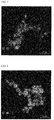
- FIG. 4 is an electron microscopic image of a nanocomposite according to Example 17 before heat treatment.
- a catalyst for synthesizing hydrogen peroxide according to one embodiment of the present invention is a compound represented by the following Chemical Formula 1: [Chemical Formula 1] Rh x Ag (1-x) , where 0 ⁇ x ⁇ 1.
- the Rh x Ag (1-x) represented by Chemical Formula 1 may be in the form of a solid solution alloy in which solid rhodium (Rh) and solid silver (Ag) are mixed together or a core-shell consisting of solid Rh and solid Ag.
- Rh and Ag which are elements adjacent to palladium (Pd) in the periodic table and do not adsorb to hydrogen by themselves, attain the ability to adsorb to hydrogen when made into a solid solution alloy together due to the similarity between the solid solution alloy and Pd in terms of electron structure, chemical properties, and physical properties.
- the present invention can provide cost-effective catalysts for hydrogen peroxide comparable to a conventional Pd-based catalyst by using a mixture of Rh and Ag instead of on Pd.
- FIG. 1 is a scanning transmission electron microscopy-energy-dispersive X-ray spectroscopy (STEM-EDX) image of Rh 0.5 Ag 0.5 according to one embodiment of the present invention.
- STEM-EDX scanning transmission electron microscopy-energy-dispersive X-ray spectroscopy
- FIG. 2 which is a STEM-EDX image of Rh 0.03 Ag 0.97 according to another embodiment of the present invention, a solid solution state is identified also when the two types of particles are mixed in another mixing ratio.
- the catalyst according to the present invention as represented by Chemical Formula 1 may contain Rh at 2 to 50% and preferably contains Rh at 2 to 7% in terms of the number of Rh atoms with respect to 100% of the total number of atoms in the chemical formula.
- Rh content is within this range, excellent hydrogen peroxide synthesis efficiency can be achieved.
- a catalyst for synthesizing hydrogen peroxide according to another embodiment of the present invention is a material represented by the following Chemical Formula 1 and is in the form of a nanocomposite containing a mixture of Rh domain and Ag domain not in a solid solution state on the surface thereof.
- the nanocomposite refers to a structure having a surface on which surfaces of both Rh and Ag are exposed, forming an interface with each other.
- [Chemical Formula 1] Rh x Ag (1-x) where 0 ⁇ x ⁇ 1.
- the catalyst for synthesizing hydrogen peroxide may be formed as a result of Rh and Ag agglomerating together, in which case, both Rh and Ag may be exposed on the surface of the resulting cluster forming Rh-Ag interface.
- the catalyst should function to effectively dissociate hydrogen molecules while preventing dissociation and promoting adsorption of oxygen molecules, and the expensive Pd-based catalyst is known to be most effective by successfully performing both roles.
- Rh capable of effectively dissociating hydrogen molecules and Ag capable of preventing dissociation and promoting adsorption of oxygen molecules are synthesized together into a nanocomposite that can function as a catalyst for synthesizing hydrogen peroxide.
- the synthesis of hydrogen peroxide takes place at an interface between Rh and Ag, and the performance thereof depends on the amount of interface, the rate at which the hydrogen molecules dissociate into hydrogen atoms, the rate at which the hydrogen atoms are transferred to the interface, the rate at which the adsorbed oxygen molecules are transferred to the interface, etc.
- Maximum performance may be achieved by adjusting the mixing ratio of Rh and Ag and the size of Rh and Ag domains.
- the catalyst according to the present invention as represented by Chemical Formula 1 contains Rh in the range of 2 to 35% in terms of the number Rh atoms with respect to 100% of the total number of atoms in the chemical formula for the reasons described above.
- Rh content exceeding 35% results in difficulty in supplying oxygen molecules and Rh content lower than 2% leads to difficulty in maintaining an adequate supply of hydrogen atoms, and in both cases the performance of the synthesis of hydrogen peroxide degrades.
- the Rh content is within the aforementioned range, excellent efficiency of hydrogen peroxide synthesis can be achieved.
- Hydrogen peroxide was synthesized in the same manner as in Example 9 except that the catalyst produced according to Example 2 was used.
- Hydrogen peroxide was synthesized in the same manner as in Example 9 except that the catalyst produced according to Example 3 was used.
- Hydrogen peroxide was synthesized in the same manner as in Example 9 except that the catalyst produced according to Example 4 was used.
- Hydrogen peroxide was synthesized in the same manner as in Example 9 except that the catalyst produced according to Example 5 was used.
- Hydrogen peroxide was synthesized in the same manner as in Example 9 except that the catalyst produced according to Example 6 was used.
- Hydrogen peroxide was synthesized in the same manner as in Example 9 except that the catalyst produced according to Example 7 was used.
- Hydrogen peroxide was synthesized in the same manner as in Example 9 except that the catalyst produced according to Example 8 was used.
- Hydrogen peroxide was synthesized in the same manner as in Example 9 except that Ag was used as a catalyst.
- Hydrogen peroxide was synthesized in the same manner as in Example 9 except that Rh was used as a catalyst.
- Hydrogen peroxide was synthesized in the same manner as in Example 9 except that a 1:1 physical mixture of Rh and Ag was used instead of a specially produced catalyst.
- Hydrogen peroxide was synthesized in the same manner as in Example 9 except that the catalyst produced according to Comparative Example 1 was used.
- Hydrogen peroxide was synthesized in the same manner as in Example 9 except that the catalyst produced according to Comparative Example 2 was used.
- Table 1 shows the amount of hydrogen peroxide synthesized according to each of Examples 9 to 16 and Comparative Examples 4 to 8 during 30 minutes of reaction time.
- Hydrogen peroxide is not synthesized at all when only Rh is used as a catalyst such as in the case of Comparative Example 5, and a very low yield of hydrogen peroxide results when only Ag is used as a catalyst such as in the case of Comparative Example 4.
- Rh content in a catalyst is greater than 50% or less than 2% with respect to 100% of the total number of atoms in the catalyst such as in the case of Comparative Examples 7, 8, and 9, a much lower yield of hydrogen peroxide is obtained.
- a catalyst according to the present invention containing Ag, which is less expensive than Rh at 50 to 98% with respect to 100% of the total number of atoms is used in addition to Rh, a significantly high yield of hydrogen peroxide is obtained compared to when only the expensive Rh is used as a catalyst. Therefore, the use of a catalyst according to the present invention for synthesizing hydrogen peroxide can reduce production cost, and commercial mass production can be expected accordingly.
- the RhAg nanoparticles thus synthesized were subjected to centrifugation at 10000 rpm for 20 minutes using acetone (1.5 vol%) and then were washed with ethanol and hexane (10000 rpm, 20 minutes).
- RhAg nanoparticles thus washed were dispersed in 5 mL of ethylene glycol, a temperature of the mixture was raised to 170 °C, and the mixture was heat treated for one hour while stirring. In this case, a nanocomposite can be obtained even when the heat treatment process is omitted.
- Table 3 provided below shows the amount of hydrogen peroxide synthesized during 60 minutes of reaction time.
- FIG. 3 which is an electron microscopic image of a nanocomposite according to Example 17, shows that Rh and Ag together make up a nanocomposite particle not in a solid solution state, thus having surfaces exposed on the surface of the particle and forming an interface with each another.
- FIG. 4 which is an electron microscopic image of a nanocomposite according to Example 17 before heat treatment, shows that Rh and Ag form an interface with each other in the nanocomposite and do not form a solid solution alloy together, even before heat treatment.
Landscapes
- Chemical & Material Sciences (AREA)
- Organic Chemistry (AREA)
- Engineering & Computer Science (AREA)
- Materials Engineering (AREA)
- Chemical Kinetics & Catalysis (AREA)
- Inorganic Chemistry (AREA)
- Physics & Mathematics (AREA)
- Thermal Sciences (AREA)
- Catalysts (AREA)
- Dispersion Chemistry (AREA)
Abstract
Description
- This application claims priority to and the benefit of Korean Patent Application No.
2017-0004341, filed on January 11, 2017 2017-0103644, filed on August 16, 2017 - The present invention relates to a catalyst for synthesizing hydrogen peroxide and a method for synthesizing hydrogen peroxide using the same. More particularly, the present invention relates to a catalyst for synthesizing hydrogen peroxide, the catalyst having an excellent catalytic activity while being capable of replacing a palladium (Pd)-based catalyst; and a method for synthesizing hydrogen peroxide using the same.
- Hydrogen peroxide (H2O2) is a general-purpose chemical used in various fields such as polishing products, disinfectants, medical products, rocket propellants, eco-friendly oxidizers, etc., the demand of which is continuously increasing.
- Since being proposed for the first time by Hankel and Weber through
US Patent No. 1,108,752 in 1914 , a method of synthesizing hydrogen peroxide directly from hydrogen and oxygen has been variously researched by a number of companies for the purpose of reaction simplification and cost reduction. Representative companies among them include DuPont, Evonik Industries, Headwaters Inc., and the Dow Chemical Company, which have developed catalysts and reaction systems mainly based on palladium (Pd). - As disclosed in
US Patent Nos. 4,681,751 ,4,772,458 ,5,352,645 , etc., DuPont developed a catalyst for the direct synthesis of hydrogen peroxide by depositing Pd-Pt metals on carbon, silica, alumina, an ion-exchange resin, etc., and studied the effects of halogen ions in a water-soluble solvent on the production of hydrogen peroxide, the effects of a phosphoric acid-based additive on hydrogen peroxide stability, etc. - Headwaters Inc. developed a technique for increasing selectivity for hydrogen peroxide production by controlling the particle size and adsorption coordination number of Pd-based active metal using various metals as enhancers for the active metal and a technique for improving selectivity for hydrogen peroxide production and enhancing productivity of hydrogen peroxide by adding a halide to a solvent being used, as disclosed in
US Patent Nos. 6,168,775 ,6,576,214 ,7,144,565 ,7,011,807 , etc. Also, a method capable of improving selectivity for hydrogen peroxide production and obtaining a hydrogen peroxide yield of 81% by maintaining a stoichiometric hydrogen/oxygen ratio in a reactor through the stepwise adjustment of the amount of hydrogen fed into the reactor is disclosed inUS Patent No. 7,105,143 . However, such a high hydrogen/oxygen ratio is a reaction condition that is not preferred in an aspect of reaction stability. - In addition,
US Patent No. 5,292,496 assigned to Mitsubishi Gas Chemical Company, Inc. discloses a technique involving using a catalyst having a cerium-containing composite metal oxide as a catalyst carrier to directly synthesize hydrogen peroxide at a high concentration in a reaction medium not containing a halogen ion. However, in this case, the productivity of hydrogen peroxide is very low, with no more than 0.5 wt% being produced, and thus improvement is still required. - The present invention is directed to providing a novel catalyst with high activity and high efficiency and a method for synthesizing hydrogen peroxide using the same in a direct hydrogen peroxide synthesis process.
- According to one embodiment, the present invention provides a catalyst for synthesizing hydrogen peroxide, the catalyst represented by the following Chemical Formula 1:
[Chemical Formula 1] RhxAg(1-x),
where 0 < x < 1. - According to another embodiment, the catalyst represented by Chemical Formula 1 may be in the form of a solid solution alloy in which solid rhodium (Rh) and solid silver (Ag) are mixed together or a core-shell consisting of solid Rh and solid Ag.
- According to still another embodiment, the ratio of the number of Rh atoms with respect to 100% of the total number of atoms in Chemical Formula 1 may be 2 to 50%.
- According to yet another embodiment, the ratio of the number of Rh atoms with respect to 100% of the total number of atoms in Chemical Formula 1 may be 2 to 7%.
- According to an additional embodiment, the present invention provides a catalyst represented by Chemical Formula 1 for synthesizing hydrogen peroxide, wherein the catalyst is in the form of a nanocomposite containing Rh and Ag that are mixed together without forming a solid solution alloy and are distributed as a mixture on the surface of the nanocomposite.
[Chemical Formula 1] RhxAg(1-x),
where 0 < x < 1. - According to an another additional embodiment, the ratio of the number of Rh atoms with respect to 100% of the total number of atoms in Chemical Formula 1 may be 2 to 35%.
- The catalyst according to the present invention is advantageous in that it exhibits high catalytic activity and can maintain a high hydrogen peroxide yield when used for a reaction for synthesizing hydrogen peroxide directly from hydrogen and oxygen.
- The above and other objects, features, and advantages of the present invention will become more apparent to those of ordinary skill in the art by describing in detail exemplary embodiments thereof with reference to the accompanying drawings, in which:
-
FIG. 1 is a scanning transmission electron microscopy-energy-dispersive X-ray spectroscopy (STEM-EDX) image of Rh0.5Ag0.5 according to one embodiment of the present invention; -
FIG. 2 is a STEM-EDX image of Ph0.03Ag0.97 according to another embodiment of the present invention; -
FIG. 3 is an electron microscopic image of a nanocomposite according to -
FIG. 4 is an electron microscopic image of a nanocomposite according to Example 17 before heat treatment. - Hereinafter, the present invention will be described in detail. The terms or words used in the present specification and claims should not be interpreted according to their ordinary or dictionary meaning, and, based on the principle that the inventor can appropriately define concepts of terms for describing his/her invention in the best way, should be interpreted to have the meaning and concept that are consistent with the technical spirit of the present invention. Since the embodiments described herein and the configurations illustrated in the drawings are among the most preferred embodiments of the present invention and do not represent the entire technical spirit of the present invention, it should be understood that the present invention covers various equivalents and modifications at the time of filing of this application.
- A catalyst for synthesizing hydrogen peroxide according to one embodiment of the present invention is a compound represented by the following Chemical Formula 1:
[Chemical Formula 1] RhxAg(1-x),
where 0 < x < 1. - In this case, the RhxAg(1-x), represented by Chemical Formula 1 may be in the form of a solid solution alloy in which solid rhodium (Rh) and solid silver (Ag) are mixed together or a core-shell consisting of solid Rh and solid Ag. This is because Rh and Ag, which are elements adjacent to palladium (Pd) in the periodic table and do not adsorb to hydrogen by themselves, attain the ability to adsorb to hydrogen when made into a solid solution alloy together due to the similarity between the solid solution alloy and Pd in terms of electron structure, chemical properties, and physical properties.
- Therefore, the present invention can provide cost-effective catalysts for hydrogen peroxide comparable to a conventional Pd-based catalyst by using a mixture of Rh and Ag instead of on Pd.
-
FIG. 1 is a scanning transmission electron microscopy-energy-dispersive X-ray spectroscopy (STEM-EDX) image of Rh0.5Ag0.5 according to one embodiment of the present invention. - In
FIG. 1 , in which Ag appears as green particles and Rh appears as red particles, a solid solution state in which the two types of particles are dispersed can be identified. - In addition, as seen in
FIG. 2 , which is a STEM-EDX image of Rh0.03Ag0.97 according to another embodiment of the present invention, a solid solution state is identified also when the two types of particles are mixed in another mixing ratio. - In this case, the catalyst according to the present invention as represented by Chemical Formula 1 may contain Rh at 2 to 50% and preferably contains Rh at 2 to 7% in terms of the number of Rh atoms with respect to 100% of the total number of atoms in the chemical formula. When the Rh content is within this range, excellent hydrogen peroxide synthesis efficiency can be achieved.
- A catalyst for synthesizing hydrogen peroxide according to another embodiment of the present invention is a material represented by the following Chemical Formula 1 and is in the form of a nanocomposite containing a mixture of Rh domain and Ag domain not in a solid solution state on the surface thereof. In this case, the nanocomposite refers to a structure having a surface on which surfaces of both Rh and Ag are exposed, forming an interface with each other.
[Chemical Formula 1] RhxAg(1-x),
where 0 < x < 1. - In addition, the catalyst for synthesizing hydrogen peroxide may be formed as a result of Rh and Ag agglomerating together, in which case, both Rh and Ag may be exposed on the surface of the resulting cluster forming Rh-Ag interface. To synthesize hydrogen peroxide, the catalyst should function to effectively dissociate hydrogen molecules while preventing dissociation and promoting adsorption of oxygen molecules, and the expensive Pd-based catalyst is known to be most effective by successfully performing both roles. In the present invention, Rh capable of effectively dissociating hydrogen molecules and Ag capable of preventing dissociation and promoting adsorption of oxygen molecules are synthesized together into a nanocomposite that can function as a catalyst for synthesizing hydrogen peroxide. The synthesis of hydrogen peroxide takes place at an interface between Rh and Ag, and the performance thereof depends on the amount of interface, the rate at which the hydrogen molecules dissociate into hydrogen atoms, the rate at which the hydrogen atoms are transferred to the interface, the rate at which the adsorbed oxygen molecules are transferred to the interface, etc. Maximum performance may be achieved by adjusting the mixing ratio of Rh and Ag and the size of Rh and Ag domains.
- The use of a catalyst based on a mixture of Rh and Ag instead of a Pd-based catalyst in the present invention leads to the performance of the direct synthesis of hydrogen peroxide that is comparable to that of a conventional Pd-based catalyst.
- In this case, it is preferable that the catalyst according to the present invention as represented by Chemical Formula 1 contains Rh in the range of 2 to 35% in terms of the number Rh atoms with respect to 100% of the total number of atoms in the chemical formula for the reasons described above. Rh content exceeding 35% results in difficulty in supplying oxygen molecules and Rh content lower than 2% leads to difficulty in maintaining an adequate supply of hydrogen atoms, and in both cases the performance of the synthesis of hydrogen peroxide degrades. When the Rh content is within the aforementioned range, excellent efficiency of hydrogen peroxide synthesis can be achieved.
- Hereinafter, the present invention will be described in greater detail with reference to exemplary embodiments. However, the following embodiments of the present invention may be modified into various other forms and should not be construed as limiting the scope of the present invention thereto. The embodiments of the present invention are provided so that this disclosure will be more thoroughly and completely explained to those of ordinary skill in the art.
- 1.526 g of poly(N-vinyl-2-pyrrolidone) (PVP; MW = 55000) was dissolved in 200 mL of ethylene glycol, the solution was subjected to magnetic stirring at 500 rpm, and the temperature thereof was raised to 170 °C in an air atmosphere. 8.4 mg of 0.05 mmol AgNO3 and 14.1 mg of 0.05 mmol rhodium acetate (Rh(CH3COO)3) were dissolved in 20 mL of DI water, the solution was added to the 170 °C PVP-ethylene glycol solution, and the mixture was allowed to react and be reduced to produce Rh50Ag50.
- A catalyst for synthesizing hydrogen peroxide was produced in the same manner as in Example 1 except that 0.763 g of PVP (MW = 55000), 5.88 mg of AgNO3 (0.035 mmol), 4.23 mg of Rh(CH3COO)3 (0.015 mmol), 100 mL of ethylene glycol, and 10 mL of DI water were used.
- A catalyst for synthesizing hydrogen peroxide was produced in the same manner as in Example 1 except that 0.763 g of PVP (MW = 55000), 7.56 mg of AgNO3 (0.045 mmol), 1.41 mg of Rh(CH3COO)3 (0.005 mmol), 100 mL of ethylene glycol, and 10 mL of DI water were used.
- A catalyst for synthesizing hydrogen peroxide was produced in the same manner as in Example 1 except that 0.763 g of PVP (MW = 55000), 7.812 mg of AgNO3 (0.0465 mmol), 0.987 mg of Rh(CH3COO)3 (0.0035 mmol), 100 mL of ethylene glycol, and 10 mL of DI water were used.
- A catalyst for synthesizing hydrogen peroxide was produced in the same manner as in Example 1 except that 0.763 g of PVP (MW = 55000), 7.98 mg of AgNO3 (0.0475 mmol), 0.705 mg of Rh(CH3COO)3 (0.0025 mmol), 100 mL of ethylene glycol, and 10 mL of DI water were used.
- A catalyst for synthesizing hydrogen peroxide was produced in the same manner as in Example 1 except that 0.763 g of PVP (MW = 55000), 8.064 mg of AgNO3 (0.048 mmol), 0.564 mg of Rh(CH3COO)3 (0.002 mmol), 100 mL of ethylene glycol, and 10 mL of DI water were used.
- A catalyst for synthesizing hydrogen peroxide was produced in the same manner as in Example 1 except that 0.763 g of PVP (MW = 55000), 8.148 mg of AgNO3 (0.0485 mmol), 0.423 mg of Rh(CH3COO)3 (0.0015 mmol), 100 mL of ethylene glycol, and 10 mL of DI water were used.
- A catalyst for synthesizing hydrogen peroxide was produced in the same manner as in Example 1 except that 0.763 g of PVP (MW = 55000), 8.232 mg of AgNO3 (0.049 mmol), 0.282 mg of Rh(CH3COO)3 (0.001 mmol), 100 mL of ethylene glycol, and 10 mL of DI water were used.
- A catalyst for synthesizing hydrogen peroxide was produced in the same manner as in Example 1 except that 0.763 g of PVP (MW = 55000), 0.84 mg of AgNO3 (0.005 mmol), 12.69 mg of Rh(CH3COO)3 (0.045 mmol), 100 mL of ethylene glycol, and 10 mL of DI water were used.
- A catalyst for synthesizing hydrogen peroxide was produced in the same manner as in Example 1 except that 0.763 g of PVP (MW = 55000), 2.52 mg of AgNO3 (0.015 mmol), 9.87 mg of Rh(CH3COO)3 (0.035 mmol), 100 mL of ethylene glycol, and 10 mL of DI water were used.
- A catalyst for synthesizing hydrogen peroxide was produced in the same manner as in Example 1 except that 0.763 g of PVP (MW = 55000), 8.316 mg of AgNO3 (0.0495 mmol), 0.141 mg of Rh(CH3COO)3 (0.0005 mmol), 100 mL of ethylene glycol, and 10 mL of DI water were used.
- Hydrogen peroxide was synthesized using 0.158 mg of the catalyst produced according to Example 1, 2 mL of a DI water-ethanol mixture (20%), 0.02 M H3PO4, and 0.9 mM NaBr at a total gas flow rate of 22 mL/min (volume ratio of oxygen to hydrogen = 10:1).
- Hydrogen peroxide was synthesized in the same manner as in Example 9 except that the catalyst produced according to Example 2 was used.
- Hydrogen peroxide was synthesized in the same manner as in Example 9 except that the catalyst produced according to Example 3 was used.
- Hydrogen peroxide was synthesized in the same manner as in Example 9 except that the catalyst produced according to Example 4 was used.
- Hydrogen peroxide was synthesized in the same manner as in Example 9 except that the catalyst produced according to Example 5 was used.
- Hydrogen peroxide was synthesized in the same manner as in Example 9 except that the catalyst produced according to Example 6 was used.
- Hydrogen peroxide was synthesized in the same manner as in Example 9 except that the catalyst produced according to Example 7 was used.
- Hydrogen peroxide was synthesized in the same manner as in Example 9 except that the catalyst produced according to Example 8 was used.
- Hydrogen peroxide was synthesized in the same manner as in Example 9 except that Ag was used as a catalyst.
- Hydrogen peroxide was synthesized in the same manner as in Example 9 except that Rh was used as a catalyst.
- Hydrogen peroxide was synthesized in the same manner as in Example 9 except that a 1:1 physical mixture of Rh and Ag was used instead of a specially produced catalyst.
- Hydrogen peroxide was synthesized in the same manner as in Example 9 except that the catalyst produced according to Comparative Example 1 was used.
- Hydrogen peroxide was synthesized in the same manner as in Example 9 except that the catalyst produced according to Comparative Example 2 was used.
- Hydrogen peroxide was synthesized in the same manner as in Example 9 except that the catalyst produced according to Comparative Example 3 was used.
[Table 1] Embodiment Catalyst Hydrogen peroxide concentration (30 min) Comparative Example 4 Ag 0.5 ppm Comparative Example 5 Rh 0 Comparative Example 6 Rh + Ag 0.5 ppm Comparative Example 7 Comparative Example 1 - Rh90Ag10 2 ppm Comparative Example 8 Comparative Example 2 - Rh70Ag30 2 ppm Example 9 Example 1 - Rh50Ag50 5 ppm Example 10 Example 2 - Rh30Ag7O 5 ppm Example 11 Example 3 - Rh10Ag90 5 ppm Example 12 Example 4 - Rh7Ag93 5-10 ppm Example 13 Example 5 - Rh5Ag95 5-10 ppm Example 14 Example 6 - Rh4Ag96 5-10 ppm Example 15 Example 7 - Rh3Ag97 5-10 ppm Example 16 Example 8 - Rh2Ag98 5-10 ppm Comparative Example 9 Comparative Example 3 - Rh1Ag99 2 ppm - Table 1 provided above shows the amount of hydrogen peroxide synthesized according to each of Examples 9 to 16 and Comparative Examples 4 to 8 during 30 minutes of reaction time.
- Hydrogen peroxide is not synthesized at all when only Rh is used as a catalyst such as in the case of Comparative Example 5, and a very low yield of hydrogen peroxide results when only Ag is used as a catalyst such as in the case of Comparative Example 4.
- In addition, when the Rh content in a catalyst is greater than 50% or less than 2% with respect to 100% of the total number of atoms in the catalyst such as in the case of Comparative Examples 7, 8, and 9, a much lower yield of hydrogen peroxide is obtained.
- Furthermore, when a catalyst according to the present invention containing Ag, which is less expensive than Rh, at 50 to 98% with respect to 100% of the total number of atoms is used in addition to Rh, a significantly high yield of hydrogen peroxide is obtained compared to when only the expensive Rh is used as a catalyst. Therefore, the use of a catalyst according to the present invention for synthesizing hydrogen peroxide can reduce production cost, and commercial mass production can be expected accordingly.
- A solution prepared by dissolving 0.153 g of PVP (MW = 55000) and 0.012 g of NaBH4 in 15 mL of DI water in a round flask, followed by magnetically stirring at 1000 rpm in an ice bath; and each of solutions prepared by dissolving AgNO3 and Rh(CH3COO)3 in 5 mL of DI water according to the compositions shown in the following Table 2 were mixed together to prepare RhAg catalysts with varying composition. The RhAg nanoparticles thus synthesized were subjected to centrifugation at 10000 rpm for 20 minutes using acetone (1.5 vol%) and then were washed with ethanol and hexane (10000 rpm, 20 minutes). The RhAg nanoparticles thus washed were dispersed in 5 mL of ethylene glycol, a temperature of the mixture was raised to 170 °C, and the mixture was heat treated for one hour while stirring. In this case, a nanocomposite can be obtained even when the heat treatment process is omitted.
[Table 2] Embodiment Product PVP NaBH4 4 AgNO3 Rh(CH3COO)3 Comparative Example 10 Rh 0.153 g 0.012g - 2.820 mg (0.010 mmol) Comparative Example 11 Rh93Ag7 0.168 mg (0.001 mmol) 2.538 mg (0.009 mmol) Comparative Example 12 Rh88Ag12 0.504 mg (0.003 mmol) 1.974 mg (0.007 mmol) Comparative Example 13 Rh57Ag43 0.840 mg (0.005 mmol) 1.410 mg (0.005 mmol) Example 17 Rh35Ag65 1.176 mg (0.007 mmol) 0.846 mg (0.003 mmol) Example 18 RH12Ag88 1.512 mg (0.009 mmol) 0.282 mg (0.001 mmol) Example 19 Rh7Ag93 1.562 mg (0.0093 mmol) 0.197 mg (0.0007 mmol) Example 20 Rh4Ag96 1.613 mg (0.0096 mmol) 0.113 mg (0.0004 mmol) Example 21 Rh3Ag97 1.630 mg (0.0097 mmol) 0.085 mg (0.0003 mmol) Example 22 Rh2Ag98 1.638 mg (0.00975 mmol) 0.070 mg (0.00025 mmol) Comparative Example 14 Rh1Ag99 1.646 mg (0.0098 mmol) 0.056 mg (0.0002 mmol) Comparative Example 15 Ag 1.680 mg (0.010 mmol) - - Hydrogen peroxide was synthesized using 0.158 mg of each of the RhxAg(1-x), catalysts prepared according to examples and comparative examples described above, 2 mL of a DI water-ethanol mixture (20%), 0.02 M H3PO4, and 0.9 mM NaBr at a total gas flow rate of 70 mL/min (volume ratio of oxygen to hydrogen = 10:1). Table 3 provided below shows the amount of hydrogen peroxide synthesized during 60 minutes of reaction time.
[Table 3] Catalyst Hydrogen peroxide concentration (60 min) Comparative Example 10 - Rh 0.5 ppm Comparative Example 15 - Ag 0 Rh + Ag 0.5 ppm Comparative Example 11 - Rh93Ag7 2 ppm Comparative Example 12 - Rh88Ag12 2∼5 ppm Comparative Example 13 - Rh57Ag43 5∼10 ppm Example 17 - Rh35Ag65 10 ppm Example 18 - Rh12Ag88 10 ppm Example 19 - Rh7Ag93 5∼10 ppm Example 20 - Rh4Ag96 5∼10 ppm Example 21 - Rh3Ag97 2∼5 ppm Example 22 - Ph2Ag98 2∼5 ppm Comparative Example 14 - Rh1Ag99 0.5∼2 ppm - As seen in Table 3, hydrogen peroxide is not synthesized at all when only Ag is used as a catalyst such as in the case of Comparative Example 15, and the use of only Rh as a catalyst such as in the case of Comparative Example 10 results in a very low yield of hydrogen peroxide.
- In addition, when a catalyst according to the present invention containing Ag, which is less expensive than Rh, at 65 to 98% with respect to 100% of the total number of atoms is used in addition to Rh, a significantly high yield of hydrogen peroxide is obtained compared to when only the expensive Rh is used as a catalyst. Therefore, the use of a catalyst according to the present invention for synthesizing hydrogen peroxide can reduce production cost, and commercial mass production can be expected accordingly.
-
FIG. 3 , which is an electron microscopic image of a nanocomposite according to Example 17, shows that Rh and Ag together make up a nanocomposite particle not in a solid solution state, thus having surfaces exposed on the surface of the particle and forming an interface with each another. - Also,
FIG. 4 , which is an electron microscopic image of a nanocomposite according to Example 17 before heat treatment, shows that Rh and Ag form an interface with each other in the nanocomposite and do not form a solid solution alloy together, even before heat treatment. - While the present invention has been described with reference to particular exemplary embodiments and drawings, the embodiments and drawings do not limit the present invention thereto and may be variously changed and modified without departing from the technical spirit of the invention and the scope of the appended claims as to be understood by those skilled in the art.
Claims (6)
- A catalyst for synthesizing hydrogen peroxide, the catalyst represented by Chemical Formula 1 provided below:
[Chemical Formula 1] RhxAg(1-x),
where 0 < x < 1. - The catalyst according to claim 1, the catalyst represented by Chemical Formula 1 and in a form of a solid solution alloy in which solid rhodium (Rh) and solid silver (Ag) are mixed together or a core-shell consisting of solid Rh and solid Ag.
- The catalyst according to claim 1 or 2, the catalyst containing Rh at 2 to 50% in terms of a ratio of the number of Rh atoms with respect to 100% of a total number of atoms in Chemical Formula 1.
- The catalyst according to one of claims 1 to 3, the catalyst containing Rh at 2 to 7% in terms of a ratio of the number of Rh atoms with respect to 100% of a total number of atoms in Chemical Formula 1.
- A catalyst for synthesizing hydrogen peroxide, the catalyst represented by Chemical Formula 1 provided below and in a form of a composite containing Rh and Ag, wherein the Rh and the Ag are mixed together without forming a solid solution alloy and form an interface with each other:
[Chemical Formula 1] RhxAg(1-x),
where 0 < x < 1. - The catalyst according to claim 5, the catalyst containing Rh at 2 to 35% in terms of a ratio of the number of Rh atoms with respect to 100% of a total number of atoms in Chemical Formula 1.
Applications Claiming Priority (2)
| Application Number | Priority Date | Filing Date | Title |
|---|---|---|---|
| KR1020170004341A KR102228934B1 (en) | 2017-01-11 | 2017-01-11 | A catalyst for synthesis of hydrogen reroxide and the synthesis of hydrogen reroxide using them |
| KR1020170103644A KR102044382B1 (en) | 2017-08-16 | 2017-08-16 | A catalyst for synthesis of hydrogen peroxide and the synthesis of hydrogen peroxide using them |
Publications (2)
| Publication Number | Publication Date |
|---|---|
| EP3348325A1 true EP3348325A1 (en) | 2018-07-18 |
| EP3348325B1 EP3348325B1 (en) | 2023-11-29 |
Family
ID=60182336
Family Applications (1)
| Application Number | Title | Priority Date | Filing Date |
|---|---|---|---|
| EP17195201.3A Active EP3348325B1 (en) | 2017-01-11 | 2017-10-06 | Use of a catalyst for synthesis of hydrogen peroxide |
Country Status (2)
| Country | Link |
|---|---|
| US (1) | US10265682B2 (en) |
| EP (1) | EP3348325B1 (en) |
Citations (10)
| Publication number | Priority date | Publication date | Assignee | Title |
|---|---|---|---|---|
| US1108752A (en) | 1913-06-16 | 1914-08-25 | Henkel & Cie Gmbh | Manufacture of hydrogen peroxid. |
| US4681751A (en) | 1983-06-22 | 1987-07-21 | E. I. Du Pont De Nemours And Company | Catalytic process for making H2 O2 from hydrogen and oxygen |
| US4772458A (en) | 1986-11-19 | 1988-09-20 | E. I. Du Pont De Nemours And Company | Catalytic process for making hydrogen peroxide from hydrogen and oxygen employing a bromide promoter |
| US5292496A (en) | 1991-10-31 | 1994-03-08 | Mitsubishi Gas Chemical Company, Inc. | Process for the preparation of hydrogen peroxide |
| US5352645A (en) | 1989-04-14 | 1994-10-04 | E. I. Du Pont De Nemours And Company | Silica microspheres, method of improving attrition resistance and use |
| US6168775B1 (en) | 1998-08-26 | 2001-01-02 | Hydrocarbon Technologies, Inc. | Catalyst and process for direct catalystic production of hydrogen peroxide, (H2O2) |
| US6576214B2 (en) | 2000-12-08 | 2003-06-10 | Hydrocarbon Technologies, Inc. | Catalytic direct production of hydrogen peroxide from hydrogen and oxygen feeds |
| US7011807B2 (en) | 2003-07-14 | 2006-03-14 | Headwaters Nanokinetix, Inc. | Supported catalysts having a controlled coordination structure and methods for preparing such catalysts |
| US7105143B2 (en) | 2003-03-28 | 2006-09-12 | Headwaters Nanokinetix, Inc. | Direct hydrogen peroxide production using staged hydrogen addition |
| US7144565B2 (en) | 2003-07-29 | 2006-12-05 | Headwaters Nanokinetix, Inc. | Process for direct catalytic hydrogen peroxide production |
Family Cites Families (3)
| Publication number | Priority date | Publication date | Assignee | Title |
|---|---|---|---|---|
| EP2682206A4 (en) * | 2011-03-04 | 2014-09-17 | Toyota Motor Co Ltd | METALLIC PARTICLES, CATALYST FOR EXHAUST GAS PURIFICATION CONTAINING SAME, AND PRODUCTION METHOD THEREFOR |
| WO2013027677A1 (en) * | 2011-08-23 | 2013-02-28 | トヨタ自動車株式会社 | Exhaust gas purification catalyst, and method for producing same |
| KR102228934B1 (en) | 2017-01-11 | 2021-03-17 | 한국과학기술연구원 | A catalyst for synthesis of hydrogen reroxide and the synthesis of hydrogen reroxide using them |
-
2017
- 2017-10-06 EP EP17195201.3A patent/EP3348325B1/en active Active
- 2017-10-06 US US15/726,841 patent/US10265682B2/en active Active
Patent Citations (10)
| Publication number | Priority date | Publication date | Assignee | Title |
|---|---|---|---|---|
| US1108752A (en) | 1913-06-16 | 1914-08-25 | Henkel & Cie Gmbh | Manufacture of hydrogen peroxid. |
| US4681751A (en) | 1983-06-22 | 1987-07-21 | E. I. Du Pont De Nemours And Company | Catalytic process for making H2 O2 from hydrogen and oxygen |
| US4772458A (en) | 1986-11-19 | 1988-09-20 | E. I. Du Pont De Nemours And Company | Catalytic process for making hydrogen peroxide from hydrogen and oxygen employing a bromide promoter |
| US5352645A (en) | 1989-04-14 | 1994-10-04 | E. I. Du Pont De Nemours And Company | Silica microspheres, method of improving attrition resistance and use |
| US5292496A (en) | 1991-10-31 | 1994-03-08 | Mitsubishi Gas Chemical Company, Inc. | Process for the preparation of hydrogen peroxide |
| US6168775B1 (en) | 1998-08-26 | 2001-01-02 | Hydrocarbon Technologies, Inc. | Catalyst and process for direct catalystic production of hydrogen peroxide, (H2O2) |
| US6576214B2 (en) | 2000-12-08 | 2003-06-10 | Hydrocarbon Technologies, Inc. | Catalytic direct production of hydrogen peroxide from hydrogen and oxygen feeds |
| US7105143B2 (en) | 2003-03-28 | 2006-09-12 | Headwaters Nanokinetix, Inc. | Direct hydrogen peroxide production using staged hydrogen addition |
| US7011807B2 (en) | 2003-07-14 | 2006-03-14 | Headwaters Nanokinetix, Inc. | Supported catalysts having a controlled coordination structure and methods for preparing such catalysts |
| US7144565B2 (en) | 2003-07-29 | 2006-12-05 | Headwaters Nanokinetix, Inc. | Process for direct catalytic hydrogen peroxide production |
Non-Patent Citations (2)
| Title |
|---|
| ANINDITA ROY: "Enhanced Catalytic Activity of Ag/Rh Bimetallic Nanomaterial:Evidence of an Ensemble Effect", vol. 120, no. 10, 1 January 2016 (2016-01-01), pages 5457 - 5467, XP009505196, ISSN: 0022-3654, Retrieved from the Internet <URL:http://pubs.acs.org/doi/abs/10.1021/acs.jpcc.5b11018> DOI: 10.1021/ACS.JPCC.5B11018 * |
| STEPHANY GARCIA: "Microwave synthesis of classically immiscible Rhodium-Silver and Rhodium-Gold alloy nanoparticles: highly active hydrogenation catalysts", vol. 8, no. 11, 1 January 2014 (2014-01-01), pages 11512 - 11521, XP009505197, ISSN: 1936-0851, Retrieved from the Internet <URL:http://pubs.acs.org/doi/10.1021/nn504746u> [retrieved on 20141110], DOI: 10.1021/NN504746U * |
Also Published As
| Publication number | Publication date |
|---|---|
| EP3348325B1 (en) | 2023-11-29 |
| US20180193821A1 (en) | 2018-07-12 |
| US10265682B2 (en) | 2019-04-23 |
Similar Documents
| Publication | Publication Date | Title |
|---|---|---|
| US6919065B2 (en) | Supported noble metal, phase-controlled catalyst and methods for making and using the catalyst | |
| JP5070138B2 (en) | Method for producing metal nanoparticles | |
| CN105036289B (en) | Method for degrading high-concentration unsym-dimethylhydrazine wastewater | |
| JPS6111130A (en) | Novel minute aggregate of metal being not noble metal and its production | |
| EP2682206A1 (en) | Metal particles, catalyst for exhaust gas purification containing same, and production method therefor | |
| WO2020176575A1 (en) | Cu/cu2o interface nanostructures for electrochemical co2 reduction | |
| US11717809B2 (en) | Metal-semiconductor hybrid structures, syntheses thereof, and uses thereof | |
| US20080105085A1 (en) | Method Of Production Of High Purity Silver Particles | |
| Silva et al. | The catalytic evaluation of bimetallic Pd-based nanocatalysts supported on ion exchange resin in nitro and alkyne reduction reactions | |
| EP2952252B1 (en) | Selective hydrogenation catalyst, production method for selective hydrogenation catalyst, and selective hydrogenation method | |
| KR101329081B1 (en) | Method for manufacturing metal nanoparticle of core-shell structure having excellent oxidation stability | |
| JP2011017071A (en) | Method for producing nanoparticle of binary metal | |
| EP3348325B1 (en) | Use of a catalyst for synthesis of hydrogen peroxide | |
| KR101955236B1 (en) | Catalyst for reducing carbon dioxide and process of preparing the same | |
| EP2944609A1 (en) | Method for preparing superoxide-generating composition, and superoxide-generating composition prepared by method | |
| KR102044382B1 (en) | A catalyst for synthesis of hydrogen peroxide and the synthesis of hydrogen peroxide using them | |
| KR102055389B1 (en) | Method for Preparing Catalyst Having Pt-Pd Deposited Polymer Electrolyte Multi-layer Treated with Sulfuric Acid | |
| KR102228934B1 (en) | A catalyst for synthesis of hydrogen reroxide and the synthesis of hydrogen reroxide using them | |
| CN117654491A (en) | A catalyst for preparing 4-nitro-o-phenylenediamine or 1,2,4-triaminobenzene and its preparation method | |
| Kushch et al. | Preparation of platinum-containing hydrogenation catalysts supported on thermally reduced graphite oxide | |
| WO2019138536A1 (en) | Methanol steam reforming catalyst, methanol steam reforming device, and hydrogen production method | |
| CN117861708B (en) | High-coordination iron monoatomic catalyst for high-selectivity generation of singlet oxygen by electro-Fenton, preparation method and application thereof | |
| CN118458880B (en) | Chemical detoxification method of p-nitrophenol | |
| CN106140160A (en) | A kind of preparation method of the copper catalyst for direct synthesis methylchlorosilane | |
| KR101793010B1 (en) | Bimetallic catalyst for nitrate reduction |
Legal Events
| Date | Code | Title | Description |
|---|---|---|---|
| PUAI | Public reference made under article 153(3) epc to a published international application that has entered the european phase |
Free format text: ORIGINAL CODE: 0009012 |
|
| STAA | Information on the status of an ep patent application or granted ep patent |
Free format text: STATUS: REQUEST FOR EXAMINATION WAS MADE |
|
| 17P | Request for examination filed |
Effective date: 20171027 |
|
| AK | Designated contracting states |
Kind code of ref document: A1 Designated state(s): AL AT BE BG CH CY CZ DE DK EE ES FI FR GB GR HR HU IE IS IT LI LT LU LV MC MK MT NL NO PL PT RO RS SE SI SK SM TR |
|
| AX | Request for extension of the european patent |
Extension state: BA ME |
|
| RBV | Designated contracting states (corrected) |
Designated state(s): AL AT BE BG CH CY CZ DE DK EE ES FI FR GB GR HR HU IE IS IT LI LT LU LV MC MK MT NL NO PL PT RO RS SE SI SK SM TR |
|
| STAA | Information on the status of an ep patent application or granted ep patent |
Free format text: STATUS: EXAMINATION IS IN PROGRESS |
|
| 17Q | First examination report despatched |
Effective date: 20190517 |
|
| GRAP | Despatch of communication of intention to grant a patent |
Free format text: ORIGINAL CODE: EPIDOSNIGR1 |
|
| STAA | Information on the status of an ep patent application or granted ep patent |
Free format text: STATUS: GRANT OF PATENT IS INTENDED |
|
| INTG | Intention to grant announced |
Effective date: 20230519 |
|
| GRAS | Grant fee paid |
Free format text: ORIGINAL CODE: EPIDOSNIGR3 |
|
| GRAA | (expected) grant |
Free format text: ORIGINAL CODE: 0009210 |
|
| STAA | Information on the status of an ep patent application or granted ep patent |
Free format text: STATUS: THE PATENT HAS BEEN GRANTED |
|
| AK | Designated contracting states |
Kind code of ref document: B1 Designated state(s): AL AT BE BG CH CY CZ DE DK EE ES FI FR GB GR HR HU IE IS IT LI LT LU LV MC MK MT NL NO PL PT RO RS SE SI SK SM TR |
|
| REG | Reference to a national code |
Ref country code: GB Ref legal event code: FG4D |
|
| REG | Reference to a national code |
Ref country code: CH Ref legal event code: EP |
|
| REG | Reference to a national code |
Ref country code: DE Ref legal event code: R096 Ref document number: 602017076936 Country of ref document: DE |
|
| REG | Reference to a national code |
Ref country code: IE Ref legal event code: FG4D |
|
| REG | Reference to a national code |
Ref country code: LT Ref legal event code: MG9D |
|
| REG | Reference to a national code |
Ref country code: NL Ref legal event code: MP Effective date: 20231129 |
|
| PG25 | Lapsed in a contracting state [announced via postgrant information from national office to epo] |
Ref country code: GR Free format text: LAPSE BECAUSE OF FAILURE TO SUBMIT A TRANSLATION OF THE DESCRIPTION OR TO PAY THE FEE WITHIN THE PRESCRIBED TIME-LIMIT Effective date: 20240301 |
|
| PG25 | Lapsed in a contracting state [announced via postgrant information from national office to epo] |
Ref country code: IS Free format text: LAPSE BECAUSE OF FAILURE TO SUBMIT A TRANSLATION OF THE DESCRIPTION OR TO PAY THE FEE WITHIN THE PRESCRIBED TIME-LIMIT Effective date: 20240329 |
|
| PG25 | Lapsed in a contracting state [announced via postgrant information from national office to epo] |
Ref country code: LT Free format text: LAPSE BECAUSE OF FAILURE TO SUBMIT A TRANSLATION OF THE DESCRIPTION OR TO PAY THE FEE WITHIN THE PRESCRIBED TIME-LIMIT Effective date: 20231129 |
|
| PG25 | Lapsed in a contracting state [announced via postgrant information from national office to epo] |
Ref country code: ES Free format text: LAPSE BECAUSE OF FAILURE TO SUBMIT A TRANSLATION OF THE DESCRIPTION OR TO PAY THE FEE WITHIN THE PRESCRIBED TIME-LIMIT Effective date: 20231129 |
|
| PG25 | Lapsed in a contracting state [announced via postgrant information from national office to epo] |
Ref country code: LT Free format text: LAPSE BECAUSE OF FAILURE TO SUBMIT A TRANSLATION OF THE DESCRIPTION OR TO PAY THE FEE WITHIN THE PRESCRIBED TIME-LIMIT Effective date: 20231129 Ref country code: IS Free format text: LAPSE BECAUSE OF FAILURE TO SUBMIT A TRANSLATION OF THE DESCRIPTION OR TO PAY THE FEE WITHIN THE PRESCRIBED TIME-LIMIT Effective date: 20240329 Ref country code: GR Free format text: LAPSE BECAUSE OF FAILURE TO SUBMIT A TRANSLATION OF THE DESCRIPTION OR TO PAY THE FEE WITHIN THE PRESCRIBED TIME-LIMIT Effective date: 20240301 Ref country code: ES Free format text: LAPSE BECAUSE OF FAILURE TO SUBMIT A TRANSLATION OF THE DESCRIPTION OR TO PAY THE FEE WITHIN THE PRESCRIBED TIME-LIMIT Effective date: 20231129 Ref country code: BG Free format text: LAPSE BECAUSE OF FAILURE TO SUBMIT A TRANSLATION OF THE DESCRIPTION OR TO PAY THE FEE WITHIN THE PRESCRIBED TIME-LIMIT Effective date: 20240229 |
|
| REG | Reference to a national code |
Ref country code: AT Ref legal event code: MK05 Ref document number: 1635559 Country of ref document: AT Kind code of ref document: T Effective date: 20231129 |
|
| PG25 | Lapsed in a contracting state [announced via postgrant information from national office to epo] |
Ref country code: NL Free format text: LAPSE BECAUSE OF FAILURE TO SUBMIT A TRANSLATION OF THE DESCRIPTION OR TO PAY THE FEE WITHIN THE PRESCRIBED TIME-LIMIT Effective date: 20231129 |
|
| PG25 | Lapsed in a contracting state [announced via postgrant information from national office to epo] |
Ref country code: SE Free format text: LAPSE BECAUSE OF FAILURE TO SUBMIT A TRANSLATION OF THE DESCRIPTION OR TO PAY THE FEE WITHIN THE PRESCRIBED TIME-LIMIT Effective date: 20231129 Ref country code: RS Free format text: LAPSE BECAUSE OF FAILURE TO SUBMIT A TRANSLATION OF THE DESCRIPTION OR TO PAY THE FEE WITHIN THE PRESCRIBED TIME-LIMIT Effective date: 20231129 Ref country code: PL Free format text: LAPSE BECAUSE OF FAILURE TO SUBMIT A TRANSLATION OF THE DESCRIPTION OR TO PAY THE FEE WITHIN THE PRESCRIBED TIME-LIMIT Effective date: 20231129 Ref country code: NO Free format text: LAPSE BECAUSE OF FAILURE TO SUBMIT A TRANSLATION OF THE DESCRIPTION OR TO PAY THE FEE WITHIN THE PRESCRIBED TIME-LIMIT Effective date: 20240229 Ref country code: NL Free format text: LAPSE BECAUSE OF FAILURE TO SUBMIT A TRANSLATION OF THE DESCRIPTION OR TO PAY THE FEE WITHIN THE PRESCRIBED TIME-LIMIT Effective date: 20231129 Ref country code: LV Free format text: LAPSE BECAUSE OF FAILURE TO SUBMIT A TRANSLATION OF THE DESCRIPTION OR TO PAY THE FEE WITHIN THE PRESCRIBED TIME-LIMIT Effective date: 20231129 Ref country code: HR Free format text: LAPSE BECAUSE OF FAILURE TO SUBMIT A TRANSLATION OF THE DESCRIPTION OR TO PAY THE FEE WITHIN THE PRESCRIBED TIME-LIMIT Effective date: 20231129 |
|
| PG25 | Lapsed in a contracting state [announced via postgrant information from national office to epo] |
Ref country code: DK Free format text: LAPSE BECAUSE OF FAILURE TO SUBMIT A TRANSLATION OF THE DESCRIPTION OR TO PAY THE FEE WITHIN THE PRESCRIBED TIME-LIMIT Effective date: 20231129 |
|
| PG25 | Lapsed in a contracting state [announced via postgrant information from national office to epo] |
Ref country code: CZ Free format text: LAPSE BECAUSE OF FAILURE TO SUBMIT A TRANSLATION OF THE DESCRIPTION OR TO PAY THE FEE WITHIN THE PRESCRIBED TIME-LIMIT Effective date: 20231129 Ref country code: AT Free format text: LAPSE BECAUSE OF FAILURE TO SUBMIT A TRANSLATION OF THE DESCRIPTION OR TO PAY THE FEE WITHIN THE PRESCRIBED TIME-LIMIT Effective date: 20231129 |
|
| PG25 | Lapsed in a contracting state [announced via postgrant information from national office to epo] |
Ref country code: SK Free format text: LAPSE BECAUSE OF FAILURE TO SUBMIT A TRANSLATION OF THE DESCRIPTION OR TO PAY THE FEE WITHIN THE PRESCRIBED TIME-LIMIT Effective date: 20231129 |
|
| PG25 | Lapsed in a contracting state [announced via postgrant information from national office to epo] |
Ref country code: SM Free format text: LAPSE BECAUSE OF FAILURE TO SUBMIT A TRANSLATION OF THE DESCRIPTION OR TO PAY THE FEE WITHIN THE PRESCRIBED TIME-LIMIT Effective date: 20231129 Ref country code: SK Free format text: LAPSE BECAUSE OF FAILURE TO SUBMIT A TRANSLATION OF THE DESCRIPTION OR TO PAY THE FEE WITHIN THE PRESCRIBED TIME-LIMIT Effective date: 20231129 Ref country code: RO Free format text: LAPSE BECAUSE OF FAILURE TO SUBMIT A TRANSLATION OF THE DESCRIPTION OR TO PAY THE FEE WITHIN THE PRESCRIBED TIME-LIMIT Effective date: 20231129 Ref country code: IT Free format text: LAPSE BECAUSE OF FAILURE TO SUBMIT A TRANSLATION OF THE DESCRIPTION OR TO PAY THE FEE WITHIN THE PRESCRIBED TIME-LIMIT Effective date: 20231129 Ref country code: EE Free format text: LAPSE BECAUSE OF FAILURE TO SUBMIT A TRANSLATION OF THE DESCRIPTION OR TO PAY THE FEE WITHIN THE PRESCRIBED TIME-LIMIT Effective date: 20231129 Ref country code: DK Free format text: LAPSE BECAUSE OF FAILURE TO SUBMIT A TRANSLATION OF THE DESCRIPTION OR TO PAY THE FEE WITHIN THE PRESCRIBED TIME-LIMIT Effective date: 20231129 Ref country code: CZ Free format text: LAPSE BECAUSE OF FAILURE TO SUBMIT A TRANSLATION OF THE DESCRIPTION OR TO PAY THE FEE WITHIN THE PRESCRIBED TIME-LIMIT Effective date: 20231129 Ref country code: AT Free format text: LAPSE BECAUSE OF FAILURE TO SUBMIT A TRANSLATION OF THE DESCRIPTION OR TO PAY THE FEE WITHIN THE PRESCRIBED TIME-LIMIT Effective date: 20231129 |
|
| PG25 | Lapsed in a contracting state [announced via postgrant information from national office to epo] |
Ref country code: PT Free format text: LAPSE BECAUSE OF FAILURE TO SUBMIT A TRANSLATION OF THE DESCRIPTION OR TO PAY THE FEE WITHIN THE PRESCRIBED TIME-LIMIT Effective date: 20240401 |
|
| PG25 | Lapsed in a contracting state [announced via postgrant information from national office to epo] |
Ref country code: PT Free format text: LAPSE BECAUSE OF FAILURE TO SUBMIT A TRANSLATION OF THE DESCRIPTION OR TO PAY THE FEE WITHIN THE PRESCRIBED TIME-LIMIT Effective date: 20240401 |
|
| REG | Reference to a national code |
Ref country code: DE Ref legal event code: R097 Ref document number: 602017076936 Country of ref document: DE |
|
| PLBE | No opposition filed within time limit |
Free format text: ORIGINAL CODE: 0009261 |
|
| STAA | Information on the status of an ep patent application or granted ep patent |
Free format text: STATUS: NO OPPOSITION FILED WITHIN TIME LIMIT |
|
| PGFP | Annual fee paid to national office [announced via postgrant information from national office to epo] |
Ref country code: GB Payment date: 20240920 Year of fee payment: 8 |
|
| PGFP | Annual fee paid to national office [announced via postgrant information from national office to epo] |
Ref country code: FR Payment date: 20240925 Year of fee payment: 8 |
|
| PG25 | Lapsed in a contracting state [announced via postgrant information from national office to epo] |
Ref country code: SI Free format text: LAPSE BECAUSE OF FAILURE TO SUBMIT A TRANSLATION OF THE DESCRIPTION OR TO PAY THE FEE WITHIN THE PRESCRIBED TIME-LIMIT Effective date: 20231129 |
|
| PG25 | Lapsed in a contracting state [announced via postgrant information from national office to epo] |
Ref country code: SI Free format text: LAPSE BECAUSE OF FAILURE TO SUBMIT A TRANSLATION OF THE DESCRIPTION OR TO PAY THE FEE WITHIN THE PRESCRIBED TIME-LIMIT Effective date: 20231129 |
|
| 26N | No opposition filed |
Effective date: 20240830 |
|
| PGFP | Annual fee paid to national office [announced via postgrant information from national office to epo] |
Ref country code: DE Payment date: 20240920 Year of fee payment: 8 |
|
| REG | Reference to a national code |
Ref country code: CH Ref legal event code: PL |
|
| PG25 | Lapsed in a contracting state [announced via postgrant information from national office to epo] |
Ref country code: MC Free format text: LAPSE BECAUSE OF FAILURE TO SUBMIT A TRANSLATION OF THE DESCRIPTION OR TO PAY THE FEE WITHIN THE PRESCRIBED TIME-LIMIT Effective date: 20231129 |
|
| PG25 | Lapsed in a contracting state [announced via postgrant information from national office to epo] |
Ref country code: LU Free format text: LAPSE BECAUSE OF NON-PAYMENT OF DUE FEES Effective date: 20241006 Ref country code: BE Free format text: LAPSE BECAUSE OF NON-PAYMENT OF DUE FEES Effective date: 20241031 |
|
| PG25 | Lapsed in a contracting state [announced via postgrant information from national office to epo] |
Ref country code: CH Free format text: LAPSE BECAUSE OF NON-PAYMENT OF DUE FEES Effective date: 20241031 |
|
| REG | Reference to a national code |
Ref country code: BE Ref legal event code: MM Effective date: 20241031 |
|
| PG25 | Lapsed in a contracting state [announced via postgrant information from national office to epo] |
Ref country code: FI Free format text: LAPSE BECAUSE OF FAILURE TO SUBMIT A TRANSLATION OF THE DESCRIPTION OR TO PAY THE FEE WITHIN THE PRESCRIBED TIME-LIMIT Effective date: 20231129 |
|
| PG25 | Lapsed in a contracting state [announced via postgrant information from national office to epo] |
Ref country code: IE Free format text: LAPSE BECAUSE OF NON-PAYMENT OF DUE FEES Effective date: 20241006 |
|
| PG25 | Lapsed in a contracting state [announced via postgrant information from national office to epo] |
Ref country code: CY Free format text: LAPSE BECAUSE OF FAILURE TO SUBMIT A TRANSLATION OF THE DESCRIPTION OR TO PAY THE FEE WITHIN THE PRESCRIBED TIME-LIMIT; INVALID AB INITIO Effective date: 20171006 |
|
| PG25 | Lapsed in a contracting state [announced via postgrant information from national office to epo] |
Ref country code: HU Free format text: LAPSE BECAUSE OF FAILURE TO SUBMIT A TRANSLATION OF THE DESCRIPTION OR TO PAY THE FEE WITHIN THE PRESCRIBED TIME-LIMIT; INVALID AB INITIO Effective date: 20171006 |