EP3346463A1 - Identity verification method and apparatus based on voiceprint - Google Patents
Identity verification method and apparatus based on voiceprint Download PDFInfo
- Publication number
- EP3346463A1 EP3346463A1 EP18150722.9A EP18150722A EP3346463A1 EP 3346463 A1 EP3346463 A1 EP 3346463A1 EP 18150722 A EP18150722 A EP 18150722A EP 3346463 A1 EP3346463 A1 EP 3346463A1
- Authority
- EP
- European Patent Office
- Prior art keywords
- voiceprint
- neural network
- identity verification
- extractor
- extracted
- Prior art date
- Legal status (The legal status is an assumption and is not a legal conclusion. Google has not performed a legal analysis and makes no representation as to the accuracy of the status listed.)
- Granted
Links
Images



Classifications
-
- G—PHYSICS
- G10—MUSICAL INSTRUMENTS; ACOUSTICS
- G10L—SPEECH ANALYSIS TECHNIQUES OR SPEECH SYNTHESIS; SPEECH RECOGNITION; SPEECH OR VOICE PROCESSING TECHNIQUES; SPEECH OR AUDIO CODING OR DECODING
- G10L17/00—Speaker identification or verification techniques
- G10L17/18—Artificial neural networks; Connectionist approaches
-
- G—PHYSICS
- G06—COMPUTING OR CALCULATING; COUNTING
- G06F—ELECTRIC DIGITAL DATA PROCESSING
- G06F17/00—Digital computing or data processing equipment or methods, specially adapted for specific functions
- G06F17/10—Complex mathematical operations
- G06F17/17—Function evaluation by approximation methods, e.g. inter- or extrapolation, smoothing, least mean square method
-
- G—PHYSICS
- G10—MUSICAL INSTRUMENTS; ACOUSTICS
- G10L—SPEECH ANALYSIS TECHNIQUES OR SPEECH SYNTHESIS; SPEECH RECOGNITION; SPEECH OR VOICE PROCESSING TECHNIQUES; SPEECH OR AUDIO CODING OR DECODING
- G10L25/00—Speech or voice analysis techniques not restricted to a single one of groups G10L15/00 - G10L21/00
- G10L25/27—Speech or voice analysis techniques not restricted to a single one of groups G10L15/00 - G10L21/00 characterised by the analysis technique
- G10L25/30—Speech or voice analysis techniques not restricted to a single one of groups G10L15/00 - G10L21/00 characterised by the analysis technique using neural networks
-
- G—PHYSICS
- G10—MUSICAL INSTRUMENTS; ACOUSTICS
- G10L—SPEECH ANALYSIS TECHNIQUES OR SPEECH SYNTHESIS; SPEECH RECOGNITION; SPEECH OR VOICE PROCESSING TECHNIQUES; SPEECH OR AUDIO CODING OR DECODING
- G10L17/00—Speaker identification or verification techniques
- G10L17/04—Training, enrolment or model building
-
- G—PHYSICS
- G10—MUSICAL INSTRUMENTS; ACOUSTICS
- G10L—SPEECH ANALYSIS TECHNIQUES OR SPEECH SYNTHESIS; SPEECH RECOGNITION; SPEECH OR VOICE PROCESSING TECHNIQUES; SPEECH OR AUDIO CODING OR DECODING
- G10L17/00—Speaker identification or verification techniques
- G10L17/06—Decision making techniques; Pattern matching strategies
Definitions
- the disclosure relates to the technical field of voice processing, and in particular to an identity verification method and an identity verification apparatus based on a voiceprint.
- Voiceprints are widely used in various fields such as user interfaces, homeland security and telephone banking.
- a voice segment is mapped into a certain space through joint factor analysis to obtain an i-vector as the voiceprint.
- this method has the following two defects. Firstl, a long voice segment (20 to 30 seconds) is required for extracting the i-vector, in order to acquire a satisfactory performance. Second, it is impossible or difficult to add other information of the speaker, such at the age, gender, and language of the speaker which facilitates identity verification, into the existing frame.
- It is an object of the present disclosure to provide an identity verification method based on a voiceprint which includes: receiving an unknown voice; extracting a voiceprint of the unknown voice using a neural network-based voiceprint extractor which is obtained through pre-training; concatenating the extracted voiceprint with a pre-stored voiceprint to acquire a concatenated voiceprint; and performing judgment on the concatenated voiceprint using a pre-trained classification model, to verify whether the extracted voiceprint and the pre-stored voiceprint are from a same person.
- an identity verification apparatus based on a voiceprint, which includes: a voice reception unit configured to receive an unknown voice; a voiceprint extraction unit configured to extract a voiceprint of the unknown voice using a neural network-based voiceprint extractor which is obtained through pre-training; a voiceprint concatenation unit configured to concatenate the extracted voiceprint with a pre-stored voiceprint to obtain a concatenated voiceprint; and an identity verification unit configured to perform judgment on the concatenated voiceprint using a pre-trained classification model, to verify whether the extracted voiceprint and the pre-stored voiceprint are from a same person
- a computer program product in at least a form of computer readable medium is further provided according to the embodiments of the present disclosure, where computer program codes for implementing the above method are recorded in the computer program product.
- an identity verification method based on a voiceprint is provided according to the present disclosure.
- the identity information of the speaker as well as other information including a voice channel, a phoneme sequence, gender, age, a language, a living area, emotion and the like of the speaker can be extracted from a short voice segment (for example, 3 to 5 seconds).
- the identity information in combination with other information including a voice channel, a phoneme sequence, gender, age, a language, a living area, emotion and the like of the speaker constitute a holographic voiceprint.
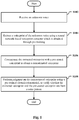
- Figure 1 illustrates a flow chart of an exemplary procedure of an identity verification method 100 based on a voiceprint according to an embodiment of the present disclosure.
- step S102 an unknown voice is received.
- step S104 a voiceprint of the unknown voice is extracted using a neural network-based voiceprint extractor which is obtained through pre-training.
- Figure 2 illustrates a flow chart of an exemplary procedure of acquiring a neural network-based voiceprint extractor through training.
- step S1042 voices from different speakers are collected.
- step S1044 the voices are labeled by using auxiliary information of the speakers as grouping labels of a neural network, and the labeled voices are inputted into the neural network as training samples.
- the voices may include information of the identity (ID), the language, the phoneme sequence, the voice channel, the emotion, the age, the living area, and the gender of the speaker.
- ID information of the identity
- the phoneme sequence the voice channel
- the emotion the age, the living area, and the gender of the speaker.
- the extracted voiceprint contains the above information such that the identity verification method according to the present disclosure is more robust.
- the labeled voices are inputted into the neural network as training samples.
- the collected voice data is processed using the following method.
- the labeled voice data is segmented into signals with a frame length of 25 milliseconds and a frame shift of 10 milliseconds.
- 13 dimensional Mel-frequency cepstral coefficients MFCCs
- MFCCs Mel-frequency cepstral coefficients
- 39 dimensional coefficients including the 13 dimensional Mel-frequency cepstral coefficients as well as the first order difference and the second order difference of the 13 dimensional Mel-frequency cepstral coefficients are used as the feature.
- 39 fames including the current frame, 25 frames on the left side of the current frame and 13 frames on the right side of the frame
- the final feature which includes 1521 (39 ⁇ 39) dimensions.
- voice data may be processed using other methods known in the art, which are not described herein.
- the auxiliary information of the speakers includes one or more of: a language, a phoneme sequence, a voice channel, emotion, age, a living area, and gender of the speaker.
- step S1046 deep learning is performed to obtain the neural network-based voiceprint extractor.
- two neural networks including a hierarchical neural network and a flat neural network
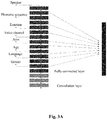
- Figure 3A illustrates a hierarchical neural network for extracting a voiceprint
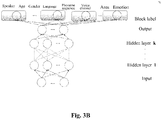
- Figure 3B illustrates a flat neural network for extracting a voiceprint.
- the two neural networks differ in positions at which grouping labels are placed.
- Figure 3A in the hierarchical neural network, different grouping labels are placed on different layers of the neural network for performing deep learning, so as to obtain the hierarchical network extractor for extracting a voiceprint.
- the flat neural network all grouping labels are placed on an output layer of the neural network for performing deep learning, so as to obtain the flat network extractor for extracting a voiceprint.
- the 39 ⁇ 39 dimensional voice feature obtained in step S2042 is inputted into the two neural networks.
- Output neurons of the neural network are divided into several blocks, each of which is associated with one type of information of the speaker. For example, a first block is associated with an ID of the speaker, and a second block is associated with the age.
- the number of neurons in each block equals to the number of speakers, an age range, the number of genders, the number of languages, the number of types of text, the number of types of channels (mobile phone and landline telephone), the number of types of emotions, or the like.
- the outputted label is a one-hot vector, in which none-zero elements correspond to the identity, gender, age and the like of the speaker.
- the extracting the voiceprint of the unknown voice using the neural network-based voiceprint extractor which is obtained through pre-training in step S104 includes: extracting voiceprints of the unknown voice using the hierarchical network extractor and the flat network extract respectively; and concatenating the voiceprint extracted using the hierarchical network extractor and the voiceprint extracted using the flat network extractor together as the extracted voiceprint of the unknown voice.
- the grouping label is placed at a more preceding position in the neural network in a case that information contained in the grouping label is simpler.
- the number of neurons associated with the gender is 2, and the gender label is placed on a preceding layer of the hierarchical neural network.
- the numbers of neurons included in the blocks associated with the phoneme sequence and the emotion are greater, thus the phoneme sequence label and the emotion label are placed on posterior layers of the hierarchical neural network.
- w t is a weight
- ⁇ t w t - ⁇ t ⁇ f ( w t )
- ⁇ t is a learning rate
- ⁇ f ( w t ) is a gradient of a loss function f
- a 0 1
- a t + 1 1 + 1 + a t 2 / 2.
- step S106 the extracted voiceprint is concatenated with a pre-stored voiceprint to obtain a concatenated voiceprint.
- voiceprints of valid users of the device are pre-stored.
- identity verification is performed, the voiceprint extracted from the unknown voice is concatenated with the pre-stored voiceprint, and the following judgment is performed.
- step S108 judgment is performed on the concatenated voiceprint using a pre-trained classification model, to verify whether the extracted voiceprint and the pre-stored voiceprint are from a same person.
- two Gaussian mixture model respectively corresponding to two cases are trained, where a first Gaussian mixture model corresponds to a case that the two voiceprints belong to a same person, and a second Gaussian mixture model corresponds to a case that the two voiceprints belong to different persons.
- a first probability of the concatenated voiceprint on the first Gaussian mixture model and a second probability of the concatenated voiceprint on the second Gaussian mixture model are calculated. It is determined that the extracted voiceprint and the pre-stored voiceprint are from a same person if the first probability is greater than the second probability. Otherwise, it is determined that the extracted voiceprint and the pre-stored voiceprint are from different persons.
- whether the extracted voiceprint and the pre-stored voiceprint are from a same person may be judged using a judgment model.
- a judgment model For example, a support vector machine or a neural network is used to construct a surface for distinguishing whether the voiceprints are from a same person.
- the voiceprint extracted from the voice using the neural network-based voiceprint extractor obtained using the training method according to the present disclosure contains the auxiliary information of the speaker.
- the present disclosure has the following advantages.
- Figure 4 is a block diagram illustrating an exemplary configuration of an identity verification apparatus 400 based on a voiceprint according to another embodiment of the present disclosure.
- the identity verification apparatus 400 based on a voiceprint includes a voice reception unit 402, a voiceprint extraction unit 404, a voiceprint concatenation unit 406 and an identity verification unit 408.
- the voice reception unit 402 is configured to receive an unknown voice.
- the voiceprint extraction unit 404 is configured to extract a voiceprint of the unknown voice using a neural network-based voiceprint extractor which is obtained through training using a voiceprint extractor training apparatus.
- the voiceprint concatenation unit 406 is configured to concatenate the extracted voiceprint with a pre-stored voiceprint to obtain a concatenated voiceprint.
- the identity verification unit 408 is configured to perform judgment on the concatenated voiceprint using a pre-trained classification model, to verify whether the extracted voiceprint and the pre-stored voiceprint are from a same person.
- FIG. 5 is a block diagram illustrating an exemplary configuration of a voiceprint extractor training apparatus 500 for training a voiceprint extractor.
- the voiceprint extractor training apparatus 500 includes a voice collection unit 502, a labeling unit 504 and a training unit 506.
- the voice collection unit 502 is configured to collect voices from different speakers.
- the labeling unit 504 is configured to label the voices by using auxiliary information of the speakers as grouping labels of a neural network, and input the labeled voices into the neural network as training samples.
- the training unit 506 is configured to perform deep learning to obtain the neural network-based voiceprint extractor.
- the auxiliary information of the speakers includes one or more of: a language, a phoneme sequence, a voice channel, emotion, age, a living area, and gender of the speaker.
- the training unit is further configured to perform deep learning using a hierarchical neural network by placing different grouping labels on different layers of the hierarchical neural network respectively, to obtain a hierarchical network extractor; and perform deep learning using a flat neural network by placing all grouping labels on an output layer of the flat neural network, to obtain a flat network extractor.
- the voiceprint extraction unit is further configured to extract voiceprints of the unknown voice using the hierarchical network extractor and the flat network extractor respectively; and concatenate the voiceprint extracted using the hierarchical network extractor and the voiceprint extracted using the flat network extractor together as the extracted voiceprint of the unknown voice.
- the grouping label is placed at a more preceding position in the hierarchical neural network in a case that information contained in the grouping label is simpler.
- w t is a weight
- ⁇ t w t - ⁇ t ⁇ f ( w t )
- ⁇ t is a learning rate
- ⁇ f ( w t ) is a gradient of a loss function f
- a 0 1
- a t + 1 1 + 1 + a t 2 / 2.
- the identity verification unit is further configured to train a first Gaussian mixture model and a second Gaussian mixture model, where the first Gaussian mixture model corresponds to a case that the two voiceprints belong to a same person, and the second Gaussian mixture model corresponds to a case that the two voiceprints belong to different persons; calculate a first probability of the concatenated voiceprint on the first Gaussian mixture model and a second probability of the concatenated voiceprint on the second Gaussian mixture model; and determine the extracted voiceprint and the pre-stored voiceprint to be from a same person if the first probability is greater than the second probability, and determine the extracted voiceprint and the pre-stored voiceprint to be from different persons if the first probability is not greater than the second probability.
- the extracted voiceprint of the unknown voice contains the auxiliary information of the speaker.
- An identity verification method based on a voiceprint and an identity verification apparatus based on a voiceprint are provided according to the present disclosure, with which a holographic voiceprint of the speaker can be extracted from a short voice segment (for example 3 to 5 seconds), so that the identity verification method according to the present disclosure is more robust.
- the object of the present disclosure may be also implemented by running a program or a group of programs on any computing device.
- the computing device may be a known general device.
- the object of the present disclosure may be also implemented by only providing a program product containing program codes for implementing the method and the apparatus. That is to say, the present disclosure may be also constructed by such program product, and may be also constructed by a storage medium in which such program product is stored.
- the storage medium may be any known storage medium or any storage medium to be developed in the future.
- a program constituting the software is installed in a computer with a dedicated hardware structure such as the general computer 600 shown in Figure 6 from a storage medium or network.
- the computer is capable of implementing various functions when installed with various programs.
- a central processing unit (CPU) 601 executes various processing according to a program stored in a read-only memory (ROM) 602 or a program loaded to a random access memory (RAM) 603 from a memory section 608.
- the data needed for the various processing of the CPU 601 may be stored in the RAM 603 as needed.
- the CPU 601, the ROM 602 and the RAM 603 are linked with each other via a bus 604.
- An input/output interface 605 is also linked to the bus 604.
- the following components are linked to the input/output interface 605: an input section 606 (including keyboard, mouse and the like), an output section 607 (including displays such as a cathode ray tube (CRT), a liquid crystal display (LCD), a loudspeaker and the like), a memory section 608 (including hard disc and the like), and a communication section 609 (including a network interface card such as a LAN card, a modem and the like).
- the communication section 609 performs communication processing via a network such as the Internet.
- a driver 610 may also be linked to the input/output interface 605, if needed. If needed, a removable medium 611 such as a magnetic disc, an optical disc, a magnetic optical disc and a semiconductor memory may be installed in the driver 610, so that the computer program read therefrom is installed in the memory section 608 as appropriate.
- programs constituting the software are installed from a network such as the Internet or a storage medium such as the removable medium 611.
- the memory medium is not limited to the removable medium 611 shown in Figure 6 , which has program stored therein and is distributed separately from the apparatus so as to provide the programs to users.
- the removable medium 611 may be, for example, a magnetic disc (including floppy disc (registered trademark)), a compact disc (including compact disc read-only memory (CD-ROM) and digital versatile disc (DVD), a magneto optical disc (including mini disc (MD)(registered trademark)), and a semiconductor memory.
- the memory medium may be the hard discs included in ROM 602 and the memory section 608 in which programs are stored, and can be distributed to users along with the device in which they are incorporated.
- a program product storing machine readable instruction codes is further provided according to the present disclosure.
- the instruction codes can perform the method according to the embodiments of the present disclosure when being read and executed by a machine.
- the storage medium includes but is not limited to floppy, optical disc, magnetic optical disc, memory card, memory stick and the like.
- the steps of the above method and the modules and/or units of the above device may be implemented by software, firmware, hardware or a combination thereof, and serve as a portion of an apparatus.
- the modules and/or units of the above device are configured by software, firmware, hardware or a combination thereof, an available means or approach may be well known by those skilled in the art and is not described hereinafter.
- a program constituting the software is installed in a computer with a dedicated hardware structure (such as the general computer 600 shown in Figure 6 ) from a storage medium or network.
- the computer is capable of implementing various functions when installed with various programs.
- the method according to the present disclosure are not limited to be executed in the time sequencing described in the specification, and may be executed sequentially, in parallel or independently. Therefore, the execution order of the method described in the specification is not intended to limit the technical scope of the present disclosure.
Landscapes
- Engineering & Computer Science (AREA)
- Physics & Mathematics (AREA)
- Health & Medical Sciences (AREA)
- Audiology, Speech & Language Pathology (AREA)
- Human Computer Interaction (AREA)
- Acoustics & Sound (AREA)
- Multimedia (AREA)
- Artificial Intelligence (AREA)
- Evolutionary Computation (AREA)
- General Physics & Mathematics (AREA)
- Mathematical Optimization (AREA)
- Data Mining & Analysis (AREA)
- Theoretical Computer Science (AREA)
- Mathematical Analysis (AREA)
- Computational Mathematics (AREA)
- Pure & Applied Mathematics (AREA)
- Mathematical Physics (AREA)
- Databases & Information Systems (AREA)
- Algebra (AREA)
- Computational Linguistics (AREA)
- Software Systems (AREA)
- General Engineering & Computer Science (AREA)
- Signal Processing (AREA)
- Information Retrieval, Db Structures And Fs Structures Therefor (AREA)
- Collating Specific Patterns (AREA)
- Image Analysis (AREA)
- Business, Economics & Management (AREA)
- Computer Vision & Pattern Recognition (AREA)
- Game Theory and Decision Science (AREA)
- Telephonic Communication Services (AREA)
Abstract
Description
- The disclosure relates to the technical field of voice processing, and in particular to an identity verification method and an identity verification apparatus based on a voiceprint.
- Voiceprints are widely used in various fields such as user interfaces, homeland security and telephone banking. In a conventional method, a voice segment is mapped into a certain space through joint factor analysis to obtain an i-vector as the voiceprint. However, this method has the following two defects. Firstl, a long voice segment (20 to 30 seconds) is required for extracting the i-vector, in order to acquire a satisfactory performance. Second, it is impossible or difficult to add other information of the speaker, such at the age, gender, and language of the speaker which facilitates identity verification, into the existing frame.
- Therefore, it is desirable to provide a method and an apparatus for performing identity verification based on a voiceprint of a speaker which is short and contains various information of the speaker.
- In the following, an overview of the present disclosure is given simply to provide basic understanding to some aspects of the present disclosure. It should be understood that this overview is not an exhaustive overview of the present disclosure. It is neither intended to determine a critical part or an important part of the present disclosure, nor to limit the scope of the present disclosure. An object of the overview is only to give some concepts in a simplified manner, which serves as a preface of a more detailed description described later.
- It is an object of the present disclosure to provide an identity verification method based on a voiceprint, which includes: receiving an unknown voice; extracting a voiceprint of the unknown voice using a neural network-based voiceprint extractor which is obtained through pre-training; concatenating the extracted voiceprint with a pre-stored voiceprint to acquire a concatenated voiceprint; and performing judgment on the concatenated voiceprint using a pre-trained classification model, to verify whether the extracted voiceprint and the pre-stored voiceprint are from a same person.
- According to another aspect of the present disclosure, it is provided an identity verification apparatus based on a voiceprint, which includes: a voice reception unit configured to receive an unknown voice; a voiceprint extraction unit configured to extract a voiceprint of the unknown voice using a neural network-based voiceprint extractor which is obtained through pre-training; a voiceprint concatenation unit configured to concatenate the extracted voiceprint with a pre-stored voiceprint to obtain a concatenated voiceprint; and an identity verification unit configured to perform judgment on the concatenated voiceprint using a pre-trained classification model, to verify whether the extracted voiceprint and the pre-stored voiceprint are from a same person
- In addition, a computer program for implementing the above method is further provided according to the embodiments of the present disclosure.
- Besides, a computer program product in at least a form of computer readable medium is further provided according to the embodiments of the present disclosure, where computer program codes for implementing the above method are recorded in the computer program product.
- These and other advantages of the present disclosure may become more apparent by describing preferred embodiments of the present disclosure in detail in conjunction with the drawings below.
- The above and other objectives, features and advantages of the present disclosure can be understood more easily with reference to the description of the embodiments of the present disclosure in conjunction with the drawings below. The components in the drawings are only for illustrating the principle of the present disclosure. In the drawings, the same or similar technical features or components are represented with the same or similar reference numerals.
-
Figure 1 illustrates a flow chart of an exemplary procedure of an identity verification method 100 based on a voiceprint according to an embodiment of the present disclosure; -
Figure 2 illustrates a flow chart of an exemplary procedure of acquiring a neural network-based voiceprint extractor through training; -
Figure 3A illustrates a hierarchical neural network for extracting a voiceprint; -
Figure 3B illustrates a flat neural network for extracting a voiceprint; -
Figure 4 is a block diagram illustrating an exemplary configuration of anidentity verification apparatus 400 based on a voiceprint according to another embodiment of the present disclosure; -
Figure 5 is a block diagram illustrating an exemplary configuration of a voiceprintextractor training apparatus 500 for training a voiceprint extractor; and -
Figure 6 is a schematic diagram illustrating an exemplary structure of a computing device for implementing the identity verification method based on a voiceprint and the identity verification apparatus based on a voiceprint according to the present disclosure. - An exemplary embodiment of the present disclosure will be described hereinafter in conjunction with the drawings. For conciseness and clarity, not all features of an embodiment are described in this specification. However, it should be understood that multiple decisions specific to the embodiment have to be made in a process of developing any such embodiment to realize a particular object of a developer, for example, conforming to those constraints related to a system and a business, and these constraints may change as the embodiments differs. Furthermore, it should also be understood that although the development work may be very complicated and time-consuming, for those skilled in the art benefiting from the present disclosure, such development work is only a routine task.
- Here, it should also be noted that in order to avoid obscuring the present disclosure due to unnecessary details, only a device structure and/or processing steps closely related to the solution according to the present disclosure are illustrated in the accompanying drawing, and other details having little relationship to the present disclosure are omitted.
- An identity verification method based on a voiceprint is provided according to the present disclosure. With the identity verification method, the identity information of the speaker as well as other information including a voice channel, a phoneme sequence, gender, age, a language, a living area, emotion and the like of the speaker can be extracted from a short voice segment (for example, 3 to 5 seconds). The identity information in combination with other information including a voice channel, a phoneme sequence, gender, age, a language, a living area, emotion and the like of the speaker constitute a holographic voiceprint.
- Hereinafter, an identity verification method based on a voiceprint and an identity verification apparatus based on a voiceprint according to the embodiments of the present disclosure are described in detail in conjunction with the drawings. The descriptions below are in the following order:
- 1. Identity verification method based on voiceprint;
- 2. Identity verification apparatus based on voiceprint; and
- 3. Computing device for implementing the method and the apparatus according to the present disclosure.
-
Figure 1 illustrates a flow chart of an exemplary procedure of an identity verification method 100 based on a voiceprint according to an embodiment of the present disclosure. - First, in step S102, an unknown voice is received.
- Then, in step S104, a voiceprint of the unknown voice is extracted using a neural network-based voiceprint extractor which is obtained through pre-training.
-
Figure 2 illustrates a flow chart of an exemplary procedure of acquiring a neural network-based voiceprint extractor through training. - As shown in
Figure 2 , in step S1042, voices from different speakers are collected. - Then, in step S1044, the voices are labeled by using auxiliary information of the speakers as grouping labels of a neural network, and the labeled voices are inputted into the neural network as training samples.
- Specifically, a large amount of voices form different speakers are collected and labeled. The voices may include information of the identity (ID), the language, the phoneme sequence, the voice channel, the emotion, the age, the living area, and the gender of the speaker. In the present disclosure, the extracted voiceprint contains the above information such that the identity verification method according to the present disclosure is more robust. The labeled voices are inputted into the neural network as training samples.
- The collected voice data is processed using the following method. The labeled voice data is segmented into signals with a frame length of 25 milliseconds and a frame shift of 10 milliseconds. 13 dimensional Mel-frequency cepstral coefficients (MFCCs) are extracted, and a total of 39 dimensional coefficients including the 13 dimensional Mel-frequency cepstral coefficients as well as the first order difference and the second order difference of the 13 dimensional Mel-frequency cepstral coefficients are used as the feature. The same processing is performed on 39 fames (including the current frame, 25 frames on the left side of the current frame and 13 frames on the right side of the frame) to obtain the final feature, which includes 1521 (39×39) dimensions.
- It should be understood by those skilled in the art that, the voice data may be processed using other methods known in the art, which are not described herein.
- The auxiliary information of the speakers includes one or more of: a language, a phoneme sequence, a voice channel, emotion, age, a living area, and gender of the speaker.
- Finally, in step S1046, deep learning is performed to obtain the neural network-based voiceprint extractor.
- In the present disclosure, two neural networks, including a hierarchical neural network and a flat neural network, are used to perform the deep learning.
Figure 3A illustrates a hierarchical neural network for extracting a voiceprint, andFigure 3B illustrates a flat neural network for extracting a voiceprint. The two neural networks differ in positions at which grouping labels are placed. As shown inFigure 3A , in the hierarchical neural network, different grouping labels are placed on different layers of the neural network for performing deep learning, so as to obtain the hierarchical network extractor for extracting a voiceprint. As shown inFigure 3B , in the flat neural network, all grouping labels are placed on an output layer of the neural network for performing deep learning, so as to obtain the flat network extractor for extracting a voiceprint. - The 39×39 dimensional voice feature obtained in step S2042 is inputted into the two neural networks. Output neurons of the neural network are divided into several blocks, each of which is associated with one type of information of the speaker. For example, a first block is associated with an ID of the speaker, and a second block is associated with the age. The number of neurons in each block equals to the number of speakers, an age range, the number of genders, the number of languages, the number of types of text, the number of types of channels (mobile phone and landline telephone), the number of types of emotions, or the like. The outputted label is a one-hot vector, in which none-zero elements correspond to the identity, gender, age and the like of the speaker.
- The extracting the voiceprint of the unknown voice using the neural network-based voiceprint extractor which is obtained through pre-training in step S104 includes: extracting voiceprints of the unknown voice using the hierarchical network extractor and the flat network extract respectively; and concatenating the voiceprint extracted using the hierarchical network extractor and the voiceprint extracted using the flat network extractor together as the extracted voiceprint of the unknown voice.
- Preferably, in the hierarchical neural network, the grouping label is placed at a more preceding position in the neural network in a case that information contained in the grouping label is simpler.
- For example, the number of neurons associated with the gender is 2, and the gender label is placed on a preceding layer of the hierarchical neural network. The numbers of neurons included in the blocks associated with the phoneme sequence and the emotion are greater, thus the phoneme sequence label and the emotion label are placed on posterior layers of the hierarchical neural network.
- In an example, the deep learning is performed on the above two neural networks using a stochastic gradient descent method, in which a weight of the neural network is calculated using the following equation:

- In the above equation, wt is a weight, θ t = wt - εt∇f(wt ), εt is a learning rate, ∇f(wt ) is a gradient of a loss function f, a0=1, and
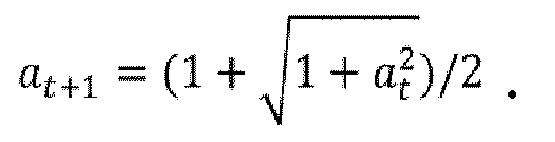
- Using the above equation to calculate weights of the neural network, a faster convergence of the stochastic gradient descent can be achieved.
- Next, in step S106, the extracted voiceprint is concatenated with a pre-stored voiceprint to obtain a concatenated voiceprint.
- In a device requiring identity verification, voiceprints of valid users of the device are pre-stored. When identity verification is performed, the voiceprint extracted from the unknown voice is concatenated with the pre-stored voiceprint, and the following judgment is performed.
- Finally, in step S108, judgment is performed on the concatenated voiceprint using a pre-trained classification model, to verify whether the extracted voiceprint and the pre-stored voiceprint are from a same person.
- Specifically, two Gaussian mixture model respectively corresponding to two cases are trained, where a first Gaussian mixture model corresponds to a case that the two voiceprints belong to a same person, and a second Gaussian mixture model corresponds to a case that the two voiceprints belong to different persons.
- When the judgment is performed, a first probability of the concatenated voiceprint on the first Gaussian mixture model and a second probability of the concatenated voiceprint on the second Gaussian mixture model are calculated. It is determined that the extracted voiceprint and the pre-stored voiceprint are from a same person if the first probability is greater than the second probability. Otherwise, it is determined that the extracted voiceprint and the pre-stored voiceprint are from different persons.
- In addition, whether the extracted voiceprint and the pre-stored voiceprint are from a same person may be judged using a judgment model. For example, a support vector machine or a neural network is used to construct a surface for distinguishing whether the voiceprints are from a same person.
- The voiceprint extracted from the voice using the neural network-based voiceprint extractor obtained using the training method according to the present disclosure contains the auxiliary information of the speaker.
- The present disclosure has the following advantages.
- 1) As compared with the conventional technology, the voiceprint of the speaker can be extracted from a short voice segment (for example 3 to 5 seconds).
- 2) Two neural networks for extracting the voiceprint (including the hierarchical neural network and the flat neural network) are designed, with which a holographic voiceprint of the speaker can be extracted, such that the identity verification method according to the present disclosure is more robust.
- 3) A new method for training the neural network is adopted, with which a faster convergence can be achieved.
- 4) Two voiceprint confirmation methods are disclosed.
-
Figure 4 is a block diagram illustrating an exemplary configuration of anidentity verification apparatus 400 based on a voiceprint according to another embodiment of the present disclosure. - As shown in
Figure 4 , theidentity verification apparatus 400 based on a voiceprint includes avoice reception unit 402, avoiceprint extraction unit 404, avoiceprint concatenation unit 406 and anidentity verification unit 408. - The
voice reception unit 402 is configured to receive an unknown voice. Thevoiceprint extraction unit 404 is configured to extract a voiceprint of the unknown voice using a neural network-based voiceprint extractor which is obtained through training using a voiceprint extractor training apparatus. Thevoiceprint concatenation unit 406 is configured to concatenate the extracted voiceprint with a pre-stored voiceprint to obtain a concatenated voiceprint. Theidentity verification unit 408 is configured to perform judgment on the concatenated voiceprint using a pre-trained classification model, to verify whether the extracted voiceprint and the pre-stored voiceprint are from a same person. -
Figure 5 is a block diagram illustrating an exemplary configuration of a voiceprintextractor training apparatus 500 for training a voiceprint extractor. As shown inFigure 5 , the voiceprintextractor training apparatus 500 includes avoice collection unit 502, alabeling unit 504 and atraining unit 506. - The
voice collection unit 502 is configured to collect voices from different speakers. Thelabeling unit 504 is configured to label the voices by using auxiliary information of the speakers as grouping labels of a neural network, and input the labeled voices into the neural network as training samples. Thetraining unit 506 is configured to perform deep learning to obtain the neural network-based voiceprint extractor. - The auxiliary information of the speakers includes one or more of: a language, a phoneme sequence, a voice channel, emotion, age, a living area, and gender of the speaker.
- The training unit is further configured to perform deep learning using a hierarchical neural network by placing different grouping labels on different layers of the hierarchical neural network respectively, to obtain a hierarchical network extractor; and perform deep learning using a flat neural network by placing all grouping labels on an output layer of the flat neural network, to obtain a flat network extractor.
- The voiceprint extraction unit is further configured to extract voiceprints of the unknown voice using the hierarchical network extractor and the flat network extractor respectively; and concatenate the voiceprint extracted using the hierarchical network extractor and the voiceprint extracted using the flat network extractor together as the extracted voiceprint of the unknown voice.
- The grouping label is placed at a more preceding position in the hierarchical neural network in a case that information contained in the grouping label is simpler.
- The deep learning may be performed using a stochastic gradient descent method, in which a weight of the neural network is calculated using the following equation:

- In the above equation, wt is a weight, θ t = wt - εt∇f(wt ), εt is a learning rate, ∇f(wt ) is a gradient of a loss function f, a0=1, and

- The identity verification unit is further configured to train a first Gaussian mixture model and a second Gaussian mixture model, where the first Gaussian mixture model corresponds to a case that the two voiceprints belong to a same person, and the second Gaussian mixture model corresponds to a case that the two voiceprints belong to different persons; calculate a first probability of the concatenated voiceprint on the first Gaussian mixture model and a second probability of the concatenated voiceprint on the second Gaussian mixture model; and determine the extracted voiceprint and the pre-stored voiceprint to be from a same person if the first probability is greater than the second probability, and determine the extracted voiceprint and the pre-stored voiceprint to be from different persons if the first probability is not greater than the second probability.
- The extracted voiceprint of the unknown voice contains the auxiliary information of the speaker.
- One refer to the embodiment of the identity verification method based on a voiceprint described in conjunction with
Figures 1 to 3 for detailed descriptions of the operations and functions of various components of theidentity verification apparatus 400 based on a voiceprint and the voiceprintextractor training apparatus 500, which are not described herein. - It should be noted that, structures of the
identity verification apparatus 400 based on a voiceprint and the voiceprintextractor training apparatus 500 and components of theidentity verification apparatus 400 based on a voiceprint and the voiceprintextractor training apparatus 500 shown inFigure 4 andFigure 5 are only exemplary, and the block diagrams illustrating the structures shown inFigure 4 andFigure 5 can be modified by those skilled in the art as needed. - An identity verification method based on a voiceprint and an identity verification apparatus based on a voiceprint are provided according to the present disclosure, with which a holographic voiceprint of the speaker can be extracted from a short voice segment (for example 3 to 5 seconds), so that the identity verification method according to the present disclosure is more robust.
- The basic principles of the present disclosure have been described above in conjunction with specific embodiments. However, it should be noted that, it can be understood by those skilled in the art that all or any of the steps or components of the methods and the apparatuses according to the present disclosure may be implemented in forms of hardware, firmware, software, or a combination thereof, in any computing device (including a processor, a memory medium and the like) or in a network of computing device, which can be implemented by those skilled in the art by means of basic programming skills upon reading the description of the present disclosure.
- Therefore, the object of the present disclosure may be also implemented by running a program or a group of programs on any computing device. The computing device may be a known general device. In this case, the object of the present disclosure may be also implemented by only providing a program product containing program codes for implementing the method and the apparatus. That is to say, the present disclosure may be also constructed by such program product, and may be also constructed by a storage medium in which such program product is stored. Apparently, the storage medium may be any known storage medium or any storage medium to be developed in the future.
- In the case where the present disclosure is realized by software and/or firmware, a program constituting the software is installed in a computer with a dedicated hardware structure such as the
general computer 600 shown inFigure 6 from a storage medium or network. The computer is capable of implementing various functions when installed with various programs. - In
Figure 6 , a central processing unit (CPU) 601 executes various processing according to a program stored in a read-only memory (ROM) 602 or a program loaded to a random access memory (RAM) 603 from amemory section 608. The data needed for the various processing of theCPU 601 may be stored in theRAM 603 as needed. TheCPU 601, theROM 602 and theRAM 603 are linked with each other via abus 604. An input/output interface 605 is also linked to thebus 604. - The following components are linked to the input/output interface 605: an input section 606 (including keyboard, mouse and the like), an output section 607 (including displays such as a cathode ray tube (CRT), a liquid crystal display (LCD), a loudspeaker and the like), a memory section 608 (including hard disc and the like), and a communication section 609 (including a network interface card such as a LAN card, a modem and the like). The
communication section 609 performs communication processing via a network such as the Internet. Adriver 610 may also be linked to the input/output interface 605, if needed. If needed, aremovable medium 611 such as a magnetic disc, an optical disc, a magnetic optical disc and a semiconductor memory may be installed in thedriver 610, so that the computer program read therefrom is installed in thememory section 608 as appropriate. - In the case where the foregoing series of processing is achieved with software, programs constituting the software are installed from a network such as the Internet or a storage medium such as the
removable medium 611. - It should be appreciated by those skilled in the art that the memory medium is not limited to the
removable medium 611 shown inFigure 6 , which has program stored therein and is distributed separately from the apparatus so as to provide the programs to users. Theremovable medium 611 may be, for example, a magnetic disc (including floppy disc (registered trademark)), a compact disc (including compact disc read-only memory (CD-ROM) and digital versatile disc (DVD), a magneto optical disc (including mini disc (MD)(registered trademark)), and a semiconductor memory. Alternatively, the memory medium may be the hard discs included inROM 602 and thememory section 608 in which programs are stored, and can be distributed to users along with the device in which they are incorporated. - A program product storing machine readable instruction codes is further provided according to the present disclosure. The instruction codes can perform the method according to the embodiments of the present disclosure when being read and executed by a machine.
- Accordingly, a storage medium for carrying the program product in which machine-readable instruction codes are stored is also covered in the present disclosure. The storage medium includes but is not limited to floppy, optical disc, magnetic optical disc, memory card, memory stick and the like.
- It should be understood by those skilled in the art that, what are listed herein are exemplary, and the present disclosure is not limited thereto.
- In the specification, representations such as "first", "second" and "n-th" are used for distinguishing the described features literally, to clearly describe the present disclosure and should not be construed as limiting.
- As an example, the steps of the above method and the modules and/or units of the above device may be implemented by software, firmware, hardware or a combination thereof, and serve as a portion of an apparatus. In the case that the modules and/or units of the above device are configured by software, firmware, hardware or a combination thereof, an available means or approach may be well known by those skilled in the art and is not described hereinafter.
- As an example, in the case where the present disclosure is realized by software or firmware, a program constituting the software is installed in a computer with a dedicated hardware structure (such as the
general computer 600 shown inFigure 6 ) from a storage medium or network. The computer is capable of implementing various functions when installed with various programs. - In the above description of the embodiments of the present disclosure, features that are described and/or illustrated with respect to one embodiment may be used in the same way or in a similar way in one or more other embodiments, in combination with or instead of the features of the other embodiments.
- It should be emphasized that the term "comprising/including" when used in this specification is taken to specify the presence of features, elements, steps or components, but does not preclude the presence or addition of one or more other features, elements, steps or components.
- In addition, the method according to the present disclosure are not limited to be executed in the time sequencing described in the specification, and may be executed sequentially, in parallel or independently. Therefore, the execution order of the method described in the specification is not intended to limit the technical scope of the present disclosure.
- The present disclosure and its advantages are described in the above. However, it should be understood that, various changes, replacements and transformations can be made to the present disclosure without departing from the spirit and scope defined by the appended claims. In addition, the present disclosure is not limited to the processes, devices, means, methods and steps in the embodiments described in the specification. It is easily understood by those skilled in the art from the present disclosure that, existing processes, devices, means, methods or steps and processes, devices, means, methods or steps to be developed in the future, which have the substantially same functions as the embodiments herein or can achieve a substantially same result as the embodiments herein may be used or performed according to the present disclosure. Therefore, the appended claims are intended to include these processes, devices, means, methods or steps within the scope thereof.
- As can be seen from the above description, at least the following technical solutions are disclosed according to the present disclosure.
- 1. An identity verification method based on a voiceprint, comprising:
- receiving an unknown voice;
- extracting a voiceprint of the unknown voice using a neural network-based voiceprint extractor which is obtained through pre-training;
- concatenating the extracted voiceprint with a pre-stored voiceprint to acquire a concatenated voiceprint; and
- performing judgment on the concatenated voiceprint using a pre-trained classification model, to verify whether the extracted voiceprint and the pre-stored voiceprint are from a same person.
- 2. The identity verification method according to
Appendix 1, where the neural network-based voiceprint extractor is obtained through training by:- collecting voices from different speakers;
- labeling the voices by using auxiliary information of the speakers as grouping labels of a neural network, and inputting the labeled voices into the neural network as training samples; and
- performing deep learning to obtain the neural network-based voiceprint extractor.
- 3. The identity verification method according to Appendix 2, where the auxiliary information of the speakers comprises one or more of: a language, a phoneme sequence, a voice channel, emotion, age, a living area, and gender of the speaker.
- 4. The identity verification method according to Appendix 2, where the performing deep learning to obtain the neural network-based voiceprint extractor comprises:
- performing deep learning using a hierarchical neural network by placing different grouping labels on different layers of the hierarchical neural network respectively, to obtain a hierarchical network extractor; and
- performing deep learning using a flat neural network by placing all grouping labels on an output layer of the flat neural network, to obtain a flat network extractor.
- 5. The identity verification method according to Appendix 4, where the extracting the voiceprint of the unknown voice using the neural network-based voiceprint extractor which is obtained through pre-training comprises:
- extracting voiceprints of the unknown voice using the hierarchical network extractor and the flat network extract respectively; and
- concatenating the voiceprint extracted using the hierarchical network extractor and the voiceprint extracted using the flat network extractor together as the extracted voiceprint of the unknown voice.
- 6. The identity verification method according to Appendix 4, where the grouping label is placed at a more preceding position in the hierarchical neural network in a case that information contained in the grouping label is simpler.
- 7. The identity verification method according to Appendix 2, where the deep learning is performed using a stochastic gradient descent method, in which a weight of the neural network is calculated using the following equation:


- 8. The identity verification method according to
Appendix 1, where the performing judgment on the concatenated voiceprint using the pre-trained classification model, to verify whether the extracted voiceprint and the pre-stored voiceprint are from a same person comprises:- training a first Gaussian mixture model and a second Gaussian mixture model, where the first Gaussian mixture model corresponds to a case that two voiceprints belong to a same person, and the second Gaussian mixture model corresponds to a case that the two voiceprints belong to different persons;
- calculating a first probability of the concatenated voiceprint on the first Gaussian mixture model and a second probability of the concatenated voiceprint on the second Gaussian mixture model; and
- determining the extracted voiceprint and the pre-stored voiceprint to be from a same person if the first probability is greater than the second probability, and determine the extracted voiceprint and the pre-stored voiceprint to be from different persons if the first probability is not greater than the second probability.
- 9. The identity verification method according to Appendix 2, where the extracted voiceprint of the unknown voice contains the auxiliary information of the speaker.
- 10. An identity verification apparatus based on a voiceprint, comprising:
- a voice reception unit configured to receive an unknown voice;
- a voiceprint extraction unit configured to extract a voiceprint of the unknown voice using a neural network-based voiceprint extractor which is obtained through training using a voiceprint extractor training apparatus;
- a voiceprint concatenation unit configured to concatenate the extracted voiceprint with a pre-stored voiceprint to obtain a concatenated voiceprint; and
- an identity verification unit configured to perform judgment on the concatenated voiceprint using a pre-trained classification model, to verify whether the extracted voiceprint and the pre-stored voiceprint are from a same person.
- 11. The identity verification apparatus according to Appendix 10, where the voiceprint extractor training apparatus comprises:
- a voice collection unit configured to collect voices from different speakers;
- a labeling unit configured to label the voices by using auxiliary information of the speakers as grouping labels of a neural network, and input the labeled voices into the neural network as training samples; and
- a training unit configured to perform deep learning to obtain the neural network-based voiceprint extractor.
- 12. The identity verification apparatus according to Appendix 11, where the auxiliary information of the speakers comprises one or more of: a language, a phoneme sequence, a voice channel, emotion, age, a living area, and gender of the speaker.
- 13. The identity verification apparatus according to Appendix 11, where the training unit is further configured to:
- perform deep learning using a hierarchical neural network by placing different grouping labels on different layers of the hierarchical neural network respectively, to obtain a hierarchical network extractor; and
- perform deep learning using a flat neural network by placing all grouping labels on an output layer of the flat neural network, to obtain a flat network extractor.
- 14. The identity verification apparatus according to Appendix 13, where voiceprint extraction unit is further configured to:
- extract voiceprints of the unknown voice using the hierarchical network extractor and the flat network extract respectively; and
- concatenate the voiceprint extracted using the hierarchical network extractor and the voiceprint extracted using the flat network extractor together as the extracted voiceprint of the unknown voice.
- 15. The identity verification apparatus according to Appendix 13, where the grouping label is placed at a more preceding position in the hierarchical neural network in a case that information contained in the grouping label is simpler.
- 16. The identity verification apparatus according to Appendix 11, where the deep learning is performed using a stochastic gradient descent method, in which a weight of the neural network is calculated using the following equation:


- 17. The identity verification apparatus according to Appendix 10, where identity verification unit is further configured to:
- train a first Gaussian mixture model and a second Gaussian mixture model, where the first Gaussian mixture model corresponds to a case that two voiceprints belong to a same person, and the second Gaussian mixture model corresponds to a case that the two voiceprints belong to different persons;
- calculate a first probability of the concatenated voiceprint on the first Gaussian mixture model and a second probability of the concatenated voiceprint on the second Gaussian mixture model; and
- determine the extracted voiceprint and the pre-stored voiceprint to be from a same person if the first probability is greater than the second probability, and determine the extracted voiceprint and the pre-stored voiceprint to be from different persons if the first probability is not greater than the second probability.
- 18. The identity verification apparatus according to Appendix 11, where the extracted voiceprint of the unknown voice contains the auxiliary information of the speaker.
Claims (15)
- An identity verification method based on a voiceprint, comprising:receiving an unknown voice;extracting a voiceprint of the unknown voice using a neural network-based voiceprint extractor which is obtained through pre-training;concatenating the extracted voiceprint with a pre-stored voiceprint to obtain a concatenated voiceprint; andperforming judgment on the concatenated voiceprint using a pre-trained classification model, to verify whether the extracted voiceprint and the pre-stored voiceprint are from a same person.
- The identity verification method according to claim 1, wherein the neural network-based voiceprint extractor is obtained through training by:collecting voices from different speakers;labeling the voices by using auxiliary information of the speakers as grouping labels of a neural network, and inputting the labeled voices into the neural network as training samples; andperforming deep learning to obtain the neural network-based voiceprint extractor.
- The identity verification method according to claim 2, wherein the auxiliary information of the speakers comprises one or more of: a language, a phoneme sequence, a voice channel, emotion, age, a living area, and gender of the speaker.
- The identity verification method according to claim 2, wherein the performing deep learning to obtain the neural network-based voiceprint extractor comprises:performing deep learning using a hierarchical neural network by placing different grouping labels on different layers of the hierarchical neural network respectively, to obtain a hierarchical network extractor; andperforming deep learning using a flat neural network by placing all grouping labels on an output layer of the flat neural network, to obtain a flat network extractor.
- The identity verification method according to claim 4, wherein the extracting the voiceprint of the unknown voice using the neural network-based voiceprint extractor which is obtained through pre-training comprises:extracting voiceprints of the unknown voice using the hierarchical network extractor and the flat network extract respectively; andconcatenating the voiceprint extracted using the hierarchical network extractor and the voiceprint extracted using the flat network extractor together as the extracted voiceprint of the unknown voice.
- The identity verification method according to claim 4, wherein the grouping label is placed at a more preceding position in the hierarchical neural network in a case that information contained in the grouping label is simpler.
- The identity verification method according to claim 2, wherein the deep learning is performed using a stochastic gradient descent method, wherein a weight of the neural network is calculated using the following equation:

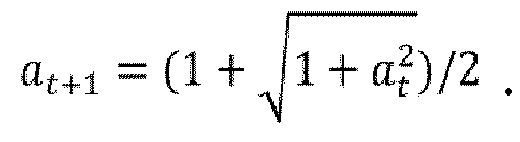
- The identity verification method according to claim 1, wherein the performing judgment on the concatenated voiceprint using the pre-trained classification model, to verify whether the extracted voiceprint and the pre-stored voiceprint are from a same person comprises:training a first Gaussian mixture model and a second Gaussian mixture model, wherein the first Gaussian mixture model corresponds to a case that two voiceprints belong to a same person, and the second Gaussian mixture model corresponds to a case that the two voiceprints belong to different persons;calculating a first probability of the concatenated voiceprint on the first Gaussian mixture model and a second probability of the concatenated voiceprint on the second Gaussian mixture model; anddetermining the extracted voiceprint and the pre-stored voiceprint to be from a same person if the first probability is greater than the second probability, and determining the extracted voiceprint and the pre-stored voiceprint to be from different persons if the first probability is not greater than the second probability.
- The identity verification method according to claim 2, wherein the extracted voiceprint of the unknown voice contains the auxiliary information of the speaker.
- An identity verification apparatus based on a voiceprint, comprising:a voice reception unit configured to receive an unknown voice;a voiceprint extraction unit configured to extract a voiceprint of the unknown voice using a neural network-based voiceprint extractor which is obtained through pre-training;a voiceprint concatenation unit configured to concatenate the extracted voiceprint with a pre-stored voiceprint to obtain a concatenated voiceprint; andan identity verification unit configured to perform judgment on the concatenated voiceprint using a pre-trained classification model, to verify whether the extracted voiceprint and the pre-stored voiceprint are from a same person.
- The identity verification apparatus according to claim 10, wherein the voiceprint extractor training apparatus comprises:a voice collection unit configured to collect voices from different speakers;a labeling unit configured to label the voices by using auxiliary information of the speakers as grouping labels of a neural network, and input the labeled voices into the neural network as training samples; anda training unit configured to perform deep learning to obtain the neural network-based voiceprint extractor.
- The identity verification apparatus according to claim 11, wherein the auxiliary information of the speakers comprises one or more of: a language, a phoneme sequence, a voice channel, emotion, age, a living area, and gender of the speaker.
- The identity verification apparatus according to claim 11, wherein the training unit is further configured to:perform deep learning using a hierarchical neural network by placing different grouping labels on different layers of the hierarchical neural network respectively, to obtain a hierarchical network extractor; andperform deep learning using a flat neural network by placing all grouping labels on an output layer of the flat neural network, to obtain a flat network extractor.
- The identity verification apparatus according to claim 13, wherein voiceprint extraction unit is further configured to:extract voiceprints of the unknown voice using the hierarchical network extractor and the flat network extract respectively; andconcatenate the voiceprint extracted using the hierarchical network extractor and the voiceprint extracted using the flat network extractor together as the extracted voiceprint of the unknown voice.
- The identity verification apparatus according to claim 13, wherein the grouping label is placed at a more preceding position in the hierarchical neural network in a case that information contained in the grouping label is simpler.
Applications Claiming Priority (1)
| Application Number | Priority Date | Filing Date | Title |
|---|---|---|---|
| CN201710019531.9A CN108288470B (en) | 2017-01-10 | 2017-01-10 | Voiceprint-based identity verification method and device |
Publications (2)
| Publication Number | Publication Date |
|---|---|
| EP3346463A1 true EP3346463A1 (en) | 2018-07-11 |
| EP3346463B1 EP3346463B1 (en) | 2019-09-04 |
Family
ID=60990643
Family Applications (1)
| Application Number | Title | Priority Date | Filing Date |
|---|---|---|---|
| EP18150722.9A Active EP3346463B1 (en) | 2017-01-10 | 2018-01-09 | Identity verification method and apparatus based on voiceprint |
Country Status (4)
| Country | Link |
|---|---|
| US (1) | US10657969B2 (en) |
| EP (1) | EP3346463B1 (en) |
| JP (1) | JP7000865B2 (en) |
| CN (1) | CN108288470B (en) |
Cited By (3)
| Publication number | Priority date | Publication date | Assignee | Title |
|---|---|---|---|---|
| KR20200043725A (en) * | 2018-10-18 | 2020-04-28 | 한국과학기술원 | Hierarchical classification-based incremental class learning method and computing device for digital storytelling |
| CN111951809A (en) * | 2019-05-14 | 2020-11-17 | 深圳子丸科技有限公司 | Multi-person voiceprint identification method and system |
| CN115148213A (en) * | 2021-03-30 | 2022-10-04 | 阿里巴巴新加坡控股有限公司 | Identification method, device and terminal device |
Families Citing this family (32)
| Publication number | Priority date | Publication date | Assignee | Title |
|---|---|---|---|---|
| CN108564688A (en) * | 2018-03-21 | 2018-09-21 | 阿里巴巴集团控股有限公司 | The method and device and electronic equipment of authentication |
| CN108877812B (en) * | 2018-08-16 | 2021-04-02 | 桂林电子科技大学 | Voiceprint recognition method and device and storage medium |
| WO2020071739A1 (en) | 2018-10-02 | 2020-04-09 | Samsung Electronics Co., Ltd. | Washing machine |
| CN110289003B (en) * | 2018-10-10 | 2021-10-29 | 腾讯科技(深圳)有限公司 | A voiceprint recognition method, model training method and server |
| CN109377983A (en) * | 2018-10-18 | 2019-02-22 | 深圳壹账通智能科技有限公司 | A kind of harassing call hold-up interception method and relevant device based on interactive voice |
| CN109243467B (en) * | 2018-11-14 | 2019-11-05 | 龙马智声(珠海)科技有限公司 | Sound-groove model construction method, method for recognizing sound-groove and system |
| CN109377984B (en) * | 2018-11-22 | 2022-05-03 | 北京中科智加科技有限公司 | ArcFace-based voice recognition method and device |
| CN109410956B (en) * | 2018-12-24 | 2021-10-08 | 科大讯飞股份有限公司 | Object recognition method, device, device and storage medium for audio data |
| CN109378006B (en) | 2018-12-28 | 2022-09-16 | 三星电子(中国)研发中心 | Cross-device voiceprint recognition method and system |
| CN111798857A (en) * | 2019-04-08 | 2020-10-20 | 北京嘀嘀无限科技发展有限公司 | Information identification method and device, electronic equipment and storage medium |
| KR20200126675A (en) * | 2019-04-30 | 2020-11-09 | 삼성전자주식회사 | Electronic device and Method for controlling the electronic device thereof |
| CN110689895B (en) * | 2019-09-06 | 2021-04-02 | 北京捷通华声科技股份有限公司 | Voice verification method and device, electronic equipment and readable storage medium |
| SG11202010803VA (en) | 2019-10-31 | 2020-11-27 | Alipay Hangzhou Inf Tech Co Ltd | System and method for determining voice characteristics |
| CN110956966B (en) * | 2019-11-01 | 2023-09-19 | 平安科技(深圳)有限公司 | Voiceprint authentication method, device, media and electronic equipment |
| CN110708600A (en) * | 2019-11-26 | 2020-01-17 | 三星电子(中国)研发中心 | Method and apparatus for identifying effective viewers of television |
| CN111009238B (en) * | 2020-01-02 | 2023-06-23 | 厦门快商通科技股份有限公司 | Method, device and equipment for recognizing spliced voice |
| JP2023511104A (en) * | 2020-01-27 | 2023-03-16 | ピンドロップ セキュリティー、インコーポレイテッド | A Robust Spoofing Detection System Using Deep Residual Neural Networks |
| CN111508503B (en) * | 2020-06-16 | 2020-10-20 | 北京爱数智慧科技有限公司 | Method and device for identifying same speaker |
| CN111949965B (en) * | 2020-08-12 | 2024-06-14 | 腾讯科技(深圳)有限公司 | Identity verification method and device based on artificial intelligence, medium and electronic equipment |
| CN112037800B (en) * | 2020-09-22 | 2024-07-12 | 平安科技(深圳)有限公司 | Voiceprint core-body model training method and device, medium and electronic equipment |
| CN112423063A (en) * | 2020-11-03 | 2021-02-26 | 深圳Tcl新技术有限公司 | Automatic setting method and device for smart television and storage medium |
| US11522994B2 (en) | 2020-11-23 | 2022-12-06 | Bank Of America Corporation | Voice analysis platform for voiceprint tracking and anomaly detection |
| CN114596867A (en) * | 2020-12-03 | 2022-06-07 | 中移互联网有限公司 | Application login method and device based on voice assistant |
| CN112397075B (en) * | 2020-12-10 | 2024-05-28 | 北京猿力未来科技有限公司 | A human voice audio recognition model training method, audio classification method and system |
| CN113035202B (en) * | 2021-01-28 | 2023-02-28 | 北京达佳互联信息技术有限公司 | Identity recognition method and device |
| CN112992174A (en) * | 2021-02-03 | 2021-06-18 | 深圳壹秘科技有限公司 | Voice analysis method and voice recording device thereof |
| US11798562B2 (en) * | 2021-05-16 | 2023-10-24 | Google Llc | Attentive scoring function for speaker identification |
| CN114141256A (en) * | 2021-12-08 | 2022-03-04 | 国家电网有限公司 | Voiceprint feature extraction model construction method and system based on wavelet neural network |
| CN114360551B (en) * | 2022-01-07 | 2025-04-11 | 浙江大学 | A speaker recognition method and system based on gender and language |
| US12573378B2 (en) * | 2022-05-18 | 2026-03-10 | Lemon Inc. | Speech tendency classification |
| CN115223568A (en) * | 2022-06-29 | 2022-10-21 | 厦门快商通科技股份有限公司 | Identity verification method, device, system and storage medium based on voiceprint recognition |
| CN115547343A (en) * | 2022-09-29 | 2022-12-30 | 中国电信股份有限公司 | Voiceprint recognition method and device, edge device and voiceprint recognition system |
Citations (4)
| Publication number | Priority date | Publication date | Assignee | Title |
|---|---|---|---|---|
| US20150127342A1 (en) * | 2013-11-04 | 2015-05-07 | Google Inc. | Speaker identification |
| CN105513597A (en) * | 2015-12-30 | 2016-04-20 | 百度在线网络技术(北京)有限公司 | Voiceprint authentication processing method and apparatus |
| US9401148B2 (en) * | 2013-11-04 | 2016-07-26 | Google Inc. | Speaker verification using neural networks |
| US20160293167A1 (en) * | 2013-10-10 | 2016-10-06 | Google Inc. | Speaker recognition using neural networks |
Family Cites Families (28)
| Publication number | Priority date | Publication date | Assignee | Title |
|---|---|---|---|---|
| US5671328A (en) * | 1992-12-30 | 1997-09-23 | International Business Machines Corporation | Method and apparatus for automatic creation of a voice recognition template entry |
| US8645137B2 (en) * | 2000-03-16 | 2014-02-04 | Apple Inc. | Fast, language-independent method for user authentication by voice |
| US8812319B2 (en) * | 2001-01-31 | 2014-08-19 | Ibiometrics, Inc. | Dynamic pass phrase security system (DPSS) |
| US20030113002A1 (en) * | 2001-12-18 | 2003-06-19 | Koninklijke Philips Electronics N.V. | Identification of people using video and audio eigen features |
| CN1327406C (en) * | 2003-08-29 | 2007-07-18 | 摩托罗拉公司 | Open vocabulary speech recognition method |
| US7206390B2 (en) * | 2004-05-13 | 2007-04-17 | Extended Data Solutions, Inc. | Simulated voice message by concatenating voice files |
| US20070239444A1 (en) * | 2006-03-29 | 2007-10-11 | Motorola, Inc. | Voice signal perturbation for speech recognition |
| WO2007110553A1 (en) * | 2006-03-29 | 2007-10-04 | France Telecom | System for providing consistency of pronunciations |
| TWI412941B (en) * | 2008-11-25 | 2013-10-21 | Inst Information Industry | Apparatus and method for generating and verifying a voice signature of a message and computer program product thereof |
| FR2940498B1 (en) * | 2008-12-23 | 2011-04-15 | Thales Sa | METHOD AND SYSTEM FOR AUTHENTICATING A USER AND / OR CRYPTOGRAPHIC DATA |
| US8326625B2 (en) * | 2009-11-10 | 2012-12-04 | Research In Motion Limited | System and method for low overhead time domain voice authentication |
| US8321209B2 (en) * | 2009-11-10 | 2012-11-27 | Research In Motion Limited | System and method for low overhead frequency domain voice authentication |
| US9767807B2 (en) * | 2011-03-30 | 2017-09-19 | Ack3 Bionetics Pte Limited | Digital voice signature of transactions |
| US9251792B2 (en) * | 2012-06-15 | 2016-02-02 | Sri International | Multi-sample conversational voice verification |
| CN103971690A (en) * | 2013-01-28 | 2014-08-06 | 腾讯科技(深圳)有限公司 | Voiceprint recognition method and device |
| US9502038B2 (en) * | 2013-01-28 | 2016-11-22 | Tencent Technology (Shenzhen) Company Limited | Method and device for voiceprint recognition |
| US20170103488A1 (en) * | 2013-04-12 | 2017-04-13 | Inspirit Group, Llc | Secure and anonymous messaging system and method |
| US9633669B2 (en) * | 2013-09-03 | 2017-04-25 | Amazon Technologies, Inc. | Smart circular audio buffer |
| US9286897B2 (en) * | 2013-09-27 | 2016-03-15 | Amazon Technologies, Inc. | Speech recognizer with multi-directional decoding |
| US20150142446A1 (en) * | 2013-11-21 | 2015-05-21 | Global Analytics, Inc. | Credit Risk Decision Management System And Method Using Voice Analytics |
| US9858919B2 (en) * | 2013-11-27 | 2018-01-02 | International Business Machines Corporation | Speaker adaptation of neural network acoustic models using I-vectors |
| JP6246636B2 (en) * | 2014-03-20 | 2017-12-13 | 株式会社東芝 | PATTERN IDENTIFICATION DEVICE, PATTERN IDENTIFICATION METHOD, AND PROGRAM |
| TWI522519B (en) * | 2014-03-28 | 2016-02-21 | 國立虎尾科技大學 | Voiceprint anti-theft system and method thereof |
| US9542948B2 (en) * | 2014-04-09 | 2017-01-10 | Google Inc. | Text-dependent speaker identification |
| US10719115B2 (en) * | 2014-12-30 | 2020-07-21 | Avago Technologies International Sales Pte. Limited | Isolated word training and detection using generated phoneme concatenation models of audio inputs |
| US10146923B2 (en) * | 2015-03-20 | 2018-12-04 | Aplcomp Oy | Audiovisual associative authentication method, related system and device |
| CN104835498B (en) * | 2015-05-25 | 2018-12-18 | 重庆大学 | Method for recognizing sound-groove based on polymorphic type assemblage characteristic parameter |
| CN105681920B (en) * | 2015-12-30 | 2017-03-15 | 深圳市鹰硕音频科技有限公司 | A kind of Network teaching method and system with speech identifying function |
-
2017
- 2017-01-10 CN CN201710019531.9A patent/CN108288470B/en not_active Expired - Fee Related
-
2018
- 2018-01-09 EP EP18150722.9A patent/EP3346463B1/en active Active
- 2018-01-09 US US15/866,079 patent/US10657969B2/en not_active Expired - Fee Related
- 2018-01-09 JP JP2018000918A patent/JP7000865B2/en not_active Expired - Fee Related
Patent Citations (4)
| Publication number | Priority date | Publication date | Assignee | Title |
|---|---|---|---|---|
| US20160293167A1 (en) * | 2013-10-10 | 2016-10-06 | Google Inc. | Speaker recognition using neural networks |
| US20150127342A1 (en) * | 2013-11-04 | 2015-05-07 | Google Inc. | Speaker identification |
| US9401148B2 (en) * | 2013-11-04 | 2016-07-26 | Google Inc. | Speaker verification using neural networks |
| CN105513597A (en) * | 2015-12-30 | 2016-04-20 | 百度在线网络技术(北京)有限公司 | Voiceprint authentication processing method and apparatus |
Cited By (3)
| Publication number | Priority date | Publication date | Assignee | Title |
|---|---|---|---|---|
| KR20200043725A (en) * | 2018-10-18 | 2020-04-28 | 한국과학기술원 | Hierarchical classification-based incremental class learning method and computing device for digital storytelling |
| CN111951809A (en) * | 2019-05-14 | 2020-11-17 | 深圳子丸科技有限公司 | Multi-person voiceprint identification method and system |
| CN115148213A (en) * | 2021-03-30 | 2022-10-04 | 阿里巴巴新加坡控股有限公司 | Identification method, device and terminal device |
Also Published As
| Publication number | Publication date |
|---|---|
| CN108288470B (en) | 2021-12-21 |
| JP7000865B2 (en) | 2022-01-19 |
| CN108288470A (en) | 2018-07-17 |
| US20180197547A1 (en) | 2018-07-12 |
| EP3346463B1 (en) | 2019-09-04 |
| US10657969B2 (en) | 2020-05-19 |
| JP2018112740A (en) | 2018-07-19 |
Similar Documents
| Publication | Publication Date | Title |
|---|---|---|
| EP3346463B1 (en) | Identity verification method and apparatus based on voiceprint | |
| US20200118571A1 (en) | Voiceprint Recognition Method, Device, Terminal Apparatus and Storage Medium | |
| CN112804400A (en) | Customer service call voice quality inspection method and device, electronic equipment and storage medium | |
| CN111402862B (en) | Speech recognition method, device, storage medium and equipment | |
| Weinberger et al. | The Speech Accent Archive: towards a typology of English accents. | |
| CN109346088A (en) | Personal identification method, device, medium and electronic equipment | |
| CN118035711B (en) | Evaluation method and system for large model content security capability | |
| CN110148400A (en) | The pronunciation recognition methods of type, the training method of model, device and equipment | |
| CN110111778B (en) | Voice processing method and device, storage medium and electronic equipment | |
| Chittaragi et al. | Automatic text-independent Kannada dialect identification system | |
| CN112599114B (en) | Voice recognition method and device | |
| Kopparapu | Non-linguistic analysis of call center conversations | |
| CN110797032A (en) | Voiceprint database establishing method and voiceprint identification method | |
| CN109872714A (en) | A kind of method, electronic equipment and storage medium improving accuracy of speech recognition | |
| CN115641836B (en) | Adversarial sample generation methods, devices, electronic equipment and storage media | |
| CN110782902A (en) | Audio data determination method, apparatus, device and medium | |
| CN110647613A (en) | Courseware construction method, courseware construction device, courseware construction server and storage medium | |
| CN114357164A (en) | Emotion-cause pair extraction method, apparatus, device, and readable storage medium | |
| CN109817223A (en) | Phoneme marking method and device based on audio fingerprints | |
| Gomes et al. | Person identification based on voice recognition | |
| Sengupta et al. | Speaker recognition using occurrence pattern of speech signal | |
| CN116935889B (en) | Audio category determining method and device, electronic equipment and storage medium | |
| CN115599883B (en) | Emotion detection methods, devices, terminal equipment and readable storage media | |
| CN116186529B (en) | Training method and device for semantic understanding model | |
| CN117174094A (en) | Voiceprint recognition method and related device |
Legal Events
| Date | Code | Title | Description |
|---|---|---|---|
| PUAI | Public reference made under article 153(3) epc to a published international application that has entered the european phase |
Free format text: ORIGINAL CODE: 0009012 |
|
| STAA | Information on the status of an ep patent application or granted ep patent |
Free format text: STATUS: THE APPLICATION HAS BEEN PUBLISHED |
|
| AK | Designated contracting states |
Kind code of ref document: A1 Designated state(s): AL AT BE BG CH CY CZ DE DK EE ES FI FR GB GR HR HU IE IS IT LI LT LU LV MC MK MT NL NO PL PT RO RS SE SI SK SM TR |
|
| AX | Request for extension of the european patent |
Extension state: BA ME |
|
| STAA | Information on the status of an ep patent application or granted ep patent |
Free format text: STATUS: REQUEST FOR EXAMINATION WAS MADE |
|
| 17P | Request for examination filed |
Effective date: 20181211 |
|
| RBV | Designated contracting states (corrected) |
Designated state(s): AL AT BE BG CH CY CZ DE DK EE ES FI FR GB GR HR HU IE IS IT LI LT LU LV MC MK MT NL NO PL PT RO RS SE SI SK SM TR |
|
| GRAP | Despatch of communication of intention to grant a patent |
Free format text: ORIGINAL CODE: EPIDOSNIGR1 |
|
| STAA | Information on the status of an ep patent application or granted ep patent |
Free format text: STATUS: GRANT OF PATENT IS INTENDED |
|
| RIC1 | Information provided on ipc code assigned before grant |
Ipc: G10L 17/06 20130101ALN20190226BHEP Ipc: G10L 17/18 20130101AFI20190226BHEP Ipc: G10L 17/04 20130101ALN20190226BHEP |
|
| INTG | Intention to grant announced |
Effective date: 20190318 |
|
| GRAS | Grant fee paid |
Free format text: ORIGINAL CODE: EPIDOSNIGR3 |
|
| GRAA | (expected) grant |
Free format text: ORIGINAL CODE: 0009210 |
|
| STAA | Information on the status of an ep patent application or granted ep patent |
Free format text: STATUS: THE PATENT HAS BEEN GRANTED |
|
| AK | Designated contracting states |
Kind code of ref document: B1 Designated state(s): AL AT BE BG CH CY CZ DE DK EE ES FI FR GB GR HR HU IE IS IT LI LT LU LV MC MK MT NL NO PL PT RO RS SE SI SK SM TR |
|
| REG | Reference to a national code |
Ref country code: GB Ref legal event code: FG4D |
|
| REG | Reference to a national code |
Ref country code: CH Ref legal event code: EP |
|
| REG | Reference to a national code |
Ref country code: AT Ref legal event code: REF Ref document number: 1176487 Country of ref document: AT Kind code of ref document: T Effective date: 20190915 |
|
| REG | Reference to a national code |
Ref country code: DE Ref legal event code: R096 Ref document number: 602018000524 Country of ref document: DE Ref country code: IE Ref legal event code: FG4D |
|
| REG | Reference to a national code |
Ref country code: NL Ref legal event code: MP Effective date: 20190904 |
|
| REG | Reference to a national code |
Ref country code: LT Ref legal event code: MG4D |
|
| PG25 | Lapsed in a contracting state [announced via postgrant information from national office to epo] |
Ref country code: HR Free format text: LAPSE BECAUSE OF FAILURE TO SUBMIT A TRANSLATION OF THE DESCRIPTION OR TO PAY THE FEE WITHIN THE PRESCRIBED TIME-LIMIT Effective date: 20190904 Ref country code: SE Free format text: LAPSE BECAUSE OF FAILURE TO SUBMIT A TRANSLATION OF THE DESCRIPTION OR TO PAY THE FEE WITHIN THE PRESCRIBED TIME-LIMIT Effective date: 20190904 Ref country code: LT Free format text: LAPSE BECAUSE OF FAILURE TO SUBMIT A TRANSLATION OF THE DESCRIPTION OR TO PAY THE FEE WITHIN THE PRESCRIBED TIME-LIMIT Effective date: 20190904 Ref country code: BG Free format text: LAPSE BECAUSE OF FAILURE TO SUBMIT A TRANSLATION OF THE DESCRIPTION OR TO PAY THE FEE WITHIN THE PRESCRIBED TIME-LIMIT Effective date: 20191204 Ref country code: FI Free format text: LAPSE BECAUSE OF FAILURE TO SUBMIT A TRANSLATION OF THE DESCRIPTION OR TO PAY THE FEE WITHIN THE PRESCRIBED TIME-LIMIT Effective date: 20190904 Ref country code: NO Free format text: LAPSE BECAUSE OF FAILURE TO SUBMIT A TRANSLATION OF THE DESCRIPTION OR TO PAY THE FEE WITHIN THE PRESCRIBED TIME-LIMIT Effective date: 20191204 |
|
| PG25 | Lapsed in a contracting state [announced via postgrant information from national office to epo] |
Ref country code: GR Free format text: LAPSE BECAUSE OF FAILURE TO SUBMIT A TRANSLATION OF THE DESCRIPTION OR TO PAY THE FEE WITHIN THE PRESCRIBED TIME-LIMIT Effective date: 20191205 Ref country code: LV Free format text: LAPSE BECAUSE OF FAILURE TO SUBMIT A TRANSLATION OF THE DESCRIPTION OR TO PAY THE FEE WITHIN THE PRESCRIBED TIME-LIMIT Effective date: 20190904 Ref country code: AL Free format text: LAPSE BECAUSE OF FAILURE TO SUBMIT A TRANSLATION OF THE DESCRIPTION OR TO PAY THE FEE WITHIN THE PRESCRIBED TIME-LIMIT Effective date: 20190904 Ref country code: RS Free format text: LAPSE BECAUSE OF FAILURE TO SUBMIT A TRANSLATION OF THE DESCRIPTION OR TO PAY THE FEE WITHIN THE PRESCRIBED TIME-LIMIT Effective date: 20190904 Ref country code: ES Free format text: LAPSE BECAUSE OF FAILURE TO SUBMIT A TRANSLATION OF THE DESCRIPTION OR TO PAY THE FEE WITHIN THE PRESCRIBED TIME-LIMIT Effective date: 20190904 |
|
| REG | Reference to a national code |
Ref country code: AT Ref legal event code: MK05 Ref document number: 1176487 Country of ref document: AT Kind code of ref document: T Effective date: 20190904 |
|
| PG25 | Lapsed in a contracting state [announced via postgrant information from national office to epo] |
Ref country code: IT Free format text: LAPSE BECAUSE OF FAILURE TO SUBMIT A TRANSLATION OF THE DESCRIPTION OR TO PAY THE FEE WITHIN THE PRESCRIBED TIME-LIMIT Effective date: 20190904 Ref country code: AT Free format text: LAPSE BECAUSE OF FAILURE TO SUBMIT A TRANSLATION OF THE DESCRIPTION OR TO PAY THE FEE WITHIN THE PRESCRIBED TIME-LIMIT Effective date: 20190904 Ref country code: EE Free format text: LAPSE BECAUSE OF FAILURE TO SUBMIT A TRANSLATION OF THE DESCRIPTION OR TO PAY THE FEE WITHIN THE PRESCRIBED TIME-LIMIT Effective date: 20190904 Ref country code: NL Free format text: LAPSE BECAUSE OF FAILURE TO SUBMIT A TRANSLATION OF THE DESCRIPTION OR TO PAY THE FEE WITHIN THE PRESCRIBED TIME-LIMIT Effective date: 20190904 Ref country code: RO Free format text: LAPSE BECAUSE OF FAILURE TO SUBMIT A TRANSLATION OF THE DESCRIPTION OR TO PAY THE FEE WITHIN THE PRESCRIBED TIME-LIMIT Effective date: 20190904 Ref country code: PT Free format text: LAPSE BECAUSE OF FAILURE TO SUBMIT A TRANSLATION OF THE DESCRIPTION OR TO PAY THE FEE WITHIN THE PRESCRIBED TIME-LIMIT Effective date: 20200106 Ref country code: PL Free format text: LAPSE BECAUSE OF FAILURE TO SUBMIT A TRANSLATION OF THE DESCRIPTION OR TO PAY THE FEE WITHIN THE PRESCRIBED TIME-LIMIT Effective date: 20190904 |
|
| PG25 | Lapsed in a contracting state [announced via postgrant information from national office to epo] |
Ref country code: SK Free format text: LAPSE BECAUSE OF FAILURE TO SUBMIT A TRANSLATION OF THE DESCRIPTION OR TO PAY THE FEE WITHIN THE PRESCRIBED TIME-LIMIT Effective date: 20190904 Ref country code: IS Free format text: LAPSE BECAUSE OF FAILURE TO SUBMIT A TRANSLATION OF THE DESCRIPTION OR TO PAY THE FEE WITHIN THE PRESCRIBED TIME-LIMIT Effective date: 20200224 Ref country code: SM Free format text: LAPSE BECAUSE OF FAILURE TO SUBMIT A TRANSLATION OF THE DESCRIPTION OR TO PAY THE FEE WITHIN THE PRESCRIBED TIME-LIMIT Effective date: 20190904 Ref country code: CZ Free format text: LAPSE BECAUSE OF FAILURE TO SUBMIT A TRANSLATION OF THE DESCRIPTION OR TO PAY THE FEE WITHIN THE PRESCRIBED TIME-LIMIT Effective date: 20190904 |
|
| REG | Reference to a national code |
Ref country code: DE Ref legal event code: R097 Ref document number: 602018000524 Country of ref document: DE |
|
| PLBE | No opposition filed within time limit |
Free format text: ORIGINAL CODE: 0009261 |
|
| STAA | Information on the status of an ep patent application or granted ep patent |
Free format text: STATUS: NO OPPOSITION FILED WITHIN TIME LIMIT |
|
| PG2D | Information on lapse in contracting state deleted |
Ref country code: IS |
|
| PG25 | Lapsed in a contracting state [announced via postgrant information from national office to epo] |
Ref country code: DK Free format text: LAPSE BECAUSE OF FAILURE TO SUBMIT A TRANSLATION OF THE DESCRIPTION OR TO PAY THE FEE WITHIN THE PRESCRIBED TIME-LIMIT Effective date: 20190904 Ref country code: IS Free format text: LAPSE BECAUSE OF FAILURE TO SUBMIT A TRANSLATION OF THE DESCRIPTION OR TO PAY THE FEE WITHIN THE PRESCRIBED TIME-LIMIT Effective date: 20200105 |
|
| 26N | No opposition filed |
Effective date: 20200605 |
|
| PG25 | Lapsed in a contracting state [announced via postgrant information from national office to epo] |
Ref country code: MC Free format text: LAPSE BECAUSE OF FAILURE TO SUBMIT A TRANSLATION OF THE DESCRIPTION OR TO PAY THE FEE WITHIN THE PRESCRIBED TIME-LIMIT Effective date: 20190904 Ref country code: SI Free format text: LAPSE BECAUSE OF FAILURE TO SUBMIT A TRANSLATION OF THE DESCRIPTION OR TO PAY THE FEE WITHIN THE PRESCRIBED TIME-LIMIT Effective date: 20190904 |
|
| REG | Reference to a national code |
Ref country code: BE Ref legal event code: MM Effective date: 20200131 |
|
| PG25 | Lapsed in a contracting state [announced via postgrant information from national office to epo] |
Ref country code: LU Free format text: LAPSE BECAUSE OF NON-PAYMENT OF DUE FEES Effective date: 20200109 |
|
| PG25 | Lapsed in a contracting state [announced via postgrant information from national office to epo] |
Ref country code: BE Free format text: LAPSE BECAUSE OF NON-PAYMENT OF DUE FEES Effective date: 20200131 |
|
| PG25 | Lapsed in a contracting state [announced via postgrant information from national office to epo] |
Ref country code: IE Free format text: LAPSE BECAUSE OF NON-PAYMENT OF DUE FEES Effective date: 20200109 |
|
| REG | Reference to a national code |
Ref country code: CH Ref legal event code: PL |
|
| PG25 | Lapsed in a contracting state [announced via postgrant information from national office to epo] |
Ref country code: LI Free format text: LAPSE BECAUSE OF NON-PAYMENT OF DUE FEES Effective date: 20210131 Ref country code: CH Free format text: LAPSE BECAUSE OF NON-PAYMENT OF DUE FEES Effective date: 20210131 |
|
| PG25 | Lapsed in a contracting state [announced via postgrant information from national office to epo] |
Ref country code: TR Free format text: LAPSE BECAUSE OF FAILURE TO SUBMIT A TRANSLATION OF THE DESCRIPTION OR TO PAY THE FEE WITHIN THE PRESCRIBED TIME-LIMIT Effective date: 20190904 Ref country code: MT Free format text: LAPSE BECAUSE OF FAILURE TO SUBMIT A TRANSLATION OF THE DESCRIPTION OR TO PAY THE FEE WITHIN THE PRESCRIBED TIME-LIMIT Effective date: 20190904 Ref country code: CY Free format text: LAPSE BECAUSE OF FAILURE TO SUBMIT A TRANSLATION OF THE DESCRIPTION OR TO PAY THE FEE WITHIN THE PRESCRIBED TIME-LIMIT Effective date: 20190904 |
|
| PG25 | Lapsed in a contracting state [announced via postgrant information from national office to epo] |
Ref country code: MK Free format text: LAPSE BECAUSE OF FAILURE TO SUBMIT A TRANSLATION OF THE DESCRIPTION OR TO PAY THE FEE WITHIN THE PRESCRIBED TIME-LIMIT Effective date: 20190904 |
|
| PGFP | Annual fee paid to national office [announced via postgrant information from national office to epo] |
Ref country code: GB Payment date: 20221201 Year of fee payment: 6 Ref country code: FR Payment date: 20221208 Year of fee payment: 6 |
|
| PGFP | Annual fee paid to national office [announced via postgrant information from national office to epo] |
Ref country code: DE Payment date: 20221130 Year of fee payment: 6 |
|
| REG | Reference to a national code |
Ref country code: DE Ref legal event code: R119 Ref document number: 602018000524 Country of ref document: DE |
|
| GBPC | Gb: european patent ceased through non-payment of renewal fee |
Effective date: 20240109 |
|
| PG25 | Lapsed in a contracting state [announced via postgrant information from national office to epo] |
Ref country code: DE Free format text: LAPSE BECAUSE OF NON-PAYMENT OF DUE FEES Effective date: 20240801 |
|
| PG25 | Lapsed in a contracting state [announced via postgrant information from national office to epo] |
Ref country code: GB Free format text: LAPSE BECAUSE OF NON-PAYMENT OF DUE FEES Effective date: 20240109 |
|
| PG25 | Lapsed in a contracting state [announced via postgrant information from national office to epo] |
Ref country code: FR Free format text: LAPSE BECAUSE OF NON-PAYMENT OF DUE FEES Effective date: 20240131 |
|
| PG25 | Lapsed in a contracting state [announced via postgrant information from national office to epo] |
Ref country code: GB Free format text: LAPSE BECAUSE OF NON-PAYMENT OF DUE FEES Effective date: 20240109 Ref country code: FR Free format text: LAPSE BECAUSE OF NON-PAYMENT OF DUE FEES Effective date: 20240131 Ref country code: DE Free format text: LAPSE BECAUSE OF NON-PAYMENT OF DUE FEES Effective date: 20240801 |