EP3346382A1 - Forming neighborhood groups from disperse cloud providers - Google Patents
Forming neighborhood groups from disperse cloud providers Download PDFInfo
- Publication number
- EP3346382A1 EP3346382A1 EP18150277.4A EP18150277A EP3346382A1 EP 3346382 A1 EP3346382 A1 EP 3346382A1 EP 18150277 A EP18150277 A EP 18150277A EP 3346382 A1 EP3346382 A1 EP 3346382A1
- Authority
- EP
- European Patent Office
- Prior art keywords
- cloud
- provider
- disperse
- data
- providers
- Prior art date
- Legal status (The legal status is an assumption and is not a legal conclusion. Google has not performed a legal analysis and makes no representation as to the accuracy of the status listed.)
- Ceased
Links
Images




Classifications
-
- H—ELECTRICITY
- H04—ELECTRIC COMMUNICATION TECHNIQUE
- H04L—TRANSMISSION OF DIGITAL INFORMATION, e.g. TELEGRAPHIC COMMUNICATION
- H04L67/00—Network arrangements or protocols for supporting network services or applications
- H04L67/01—Protocols
- H04L67/10—Protocols in which an application is distributed across nodes in the network
- H04L67/1001—Protocols in which an application is distributed across nodes in the network for accessing one among a plurality of replicated servers
-
- G—PHYSICS
- G06—COMPUTING OR CALCULATING; COUNTING
- G06F—ELECTRIC DIGITAL DATA PROCESSING
- G06F9/00—Arrangements for program control, e.g. control units
- G06F9/06—Arrangements for program control, e.g. control units using stored programs, i.e. using an internal store of processing equipment to receive or retain programs
- G06F9/46—Multiprogramming arrangements
- G06F9/50—Allocation of resources, e.g. of the central processing unit [CPU]
- G06F9/5061—Partitioning or combining of resources
- G06F9/5072—Grid computing
-
- H—ELECTRICITY
- H04—ELECTRIC COMMUNICATION TECHNIQUE
- H04L—TRANSMISSION OF DIGITAL INFORMATION, e.g. TELEGRAPHIC COMMUNICATION
- H04L67/00—Network arrangements or protocols for supporting network services or applications
- H04L67/01—Protocols
- H04L67/10—Protocols in which an application is distributed across nodes in the network
-
- H—ELECTRICITY
- H04—ELECTRIC COMMUNICATION TECHNIQUE
- H04W—WIRELESS COMMUNICATION NETWORKS
- H04W4/00—Services specially adapted for wireless communication networks; Facilities therefor
- H04W4/06—Selective distribution of broadcast services, e.g. multimedia broadcast multicast service [MBMS]; Services to user groups; One-way selective calling services
- H04W4/08—User group management
Definitions
- the disclosed technology relates to delivery of computing as a service.
- example embodiments relate to partitioning and operating a portion of computing resources not traditionally used in a cloud fashion as resources available as a service.
- Wasted resources include CPU, RAM, Storage, and Network Bandwidth.
- Cloud computing refers to a model for enabling ubiquitous, convenient, on-demand network access to a shared pool of configurable computing resources (e.g., networks, servers, storage, applications, and services) that may be rapidly provisioned and released with minimal management effort or service provider interaction.
- the cloud computing model is characterized by on-demand self-service, broad network access, resource pooling, rapid elasticity, and measured service.
- Cloud computing service models include software as a service (SaaS), platform as a service (PaaS), and infrastructure as a service (IaaS).
- Cloud computing deployment models include public clouds, private clouds, community clouds, and hybrid combinations thereof. The cloud model can allow end users to reduce capital expenditures and burdensome operating costs associated with maintaining substantial information technology expertise and operating staff in house.
- Typical cloud computing and storage solutions provide users and enterprises with various capabilities to store and process their data in third-party data centers that may be located far from the user-ranging in distance from across a city to across the world.
- Cloud computing relies on sharing of resources to achieve coherence and economy of scale, similar to a utility (like the electricity grid) over an electricity network.
- the subject disclosure provides systems and methods for forming neighborhood groups from disperse cloud providers.
- a cloud manager receives provider data relating to a plurality of disperse cloud providers for a plurality of data subcategories classified under N-number main categories.
- the cloud manager generates a respective vector to represent each of the plurality of disperse cloud providers based on the provider data to yield vectors.
- the cloud manager generates an N-number axis space comprising the vectors.
- the cloud manager groups the plurality of disperse cloud providers in the N-number axis space into at least one cloud provider group, based on the vectors and a clustering algorithm.
- the subject disclosure provides techniques for forming neighborhood groups from disperse cloud providers, in accordance with the subject technology.
- Various aspects of the present technology are described with reference to the drawings.
- numerous specific details are set forth in order to provide a thorough understanding of one or more aspects. It can be evident, however, that the present technology can be practiced without these specific details.
- well-known structures and devices are shown in block diagram form in order to facilitate describing these aspects.
- the word "exemplary" is used herein to mean “serving as an example, instance, or illustration.” Any embodiment described herein as "exemplary” is not necessarily to be construed as preferred or advantageous over other embodiments.
- the power of traditional end user environments is exploding. Some estimate that the compute power of the equivalent of a personal computer, such as found in the typical home environment, in 2049 may be equal to all computing power created through 2012. Further, the ability of home environments to offer services and products (south-to-north, south-to-west, and south-to-east traffic) may expand. This is similar to how some people offer home-generated electrical power to public utilities. This trend opens the door for "utility computing," where the consumer can share the excess of his home cloud or IT infrastructure with peers, Internet Service Providers (ISPs), application providers, or third parties.
- ISPs Internet Service Providers
- This capability effectively may transform the consumer of goods and services into a market resident who owns a home infrastructure and allocates part of it to create a cloud and offer services and products to peers, ISPs, application providers, or third parties. In some embodiments, it allows customers to become entrepreneurs and de-facto application providers and/or crowd-sourced public cloud providers.
- fog computing can provide data, compute, storage, and application services to end-users.
- Fog computing or fog networking is an architecture that uses one or more collaborative multitude of end-user clients or near-user edge devices to carry out a substantial amount of storage (rather than stored primarily in cloud data centers), communication (rather than routed over the internet backbone), control, configuration, measurement and management (rather than controlled primarily by network gateways such as those in the LTE core network).
- Computing resources of each of a plurality of first parties can be logically partitioned into a first party end user partition and a first party crowd sourced cloud partition.
- ISP Internet Service Provider
- These entities can provide one or more devices or appliances (i.e., "computing resources") that can provide compute, network, or storage capacity in a context of space, power, and cooling.
- each server, system, and device shown in the architecture is represented by one instance of the server, system, or device, multiple instances of each can be used.
- multiple instances of each can be used.
- the subject disclosure provides a cloud manager that receives provider data for multiple disperse cloud providers.
- the cloud manager analyzes the provider data and groups the disperse cloud providers into one or more cloud provider groups. By placing certain cloud providers together into particular cloud provider groups, the cloud providers can pool computing resources more effectively to better serve cloud end users.
- Micro-service architecture is a method of developing software applications as a suite of independently deployable, small, modular services in which each service runs a unique process and communicates through a well-defined, lightweight mechanism.
- FIG. 1 illustrates a block diagram of an example network topology 100 for forming neighborhood groups from disperse cloud providers 150.
- the example network topology 100 shows an example arrangement of various network elements of a network 101. It should be noted that the example network topology 100 is merely an example arrangement for demonstration and does not describe all possible types of network configurations for use with the claimed invention.
- the network 101 can include a wide area network (WAN) such as the Internet, or a local area network (LAN).
- the network 101 can include an intranet, a storage area network (SAN), a personal area network (PAN), a metropolitan area network (MAN), a wireless local area network (WLAN), a virtual private network (VPN), a cellular or other mobile communication network, a BLUETOOTH ® wireless technology connection, a near field communication (NFC) connection, any combination thereof, and any other appropriate architecture or system that facilitates the communication of signals, data, and/or messages.
- WAN wide area network
- PAN personal area network
- MAN metropolitan area network
- WLAN wireless local area network
- VPN virtual private network
- BLUETOOTH ® wireless technology connection a near field communication (NFC) connection
- NFC near field communication
- a cloud manager 130, diverse cloud providers 150, and cloud end users 160 are connected to the network 101.
- the network 101 is the Internet
- the diverse cloud providers 150 and the cloud end users 160 can connect to the network 101 through one or more Internet Service Providers (ISPs) 110A-C.
- ISPs 110A, 110B, 110C are shown in Fig. 1 for illustration.
- An ISP is an organization that provides services for accessing and using the Internet.
- Internet Service Providers may be organized in various forms, such as commercial, community-owned, non-profit, or otherwise privately owned.
- Internet services typically provided by ISPs include Internet access, Internet transit, domain name registration, web hosting, Usenet service, and colocation.
- Each ISP typically serves large groups of Internet users in a geographic area.
- the network computing devices such as the cloud manager 130, the diverse cloud providers 150, the cloud end users 160, and any other computing machines associated with the technology presented herein, may be any type of computing machine such as, but not limited to, those discussed in more detail with respect to FIG. 6 .
- any functions, applications, or modules associated with any of these computing machines, such as those described herein or any others (for example scripts, web content, software, firmware, or hardware) associated with the technology presented herein may by any of the modules discussed in more detail with respect to FIG. 6 .
- the computing machines discussed herein may communicate with one another as well as other computer machines or communication systems over one or more networks, such as network 101.
- the network 101 may include any type of data or communications network, including any of the network technology discussed with respect to FIG. 6 .
- the diverse cloud providers 150 can be located in various geographic locations. For example, one or more diverse cloud providers 150 may be located in each single zip code 140. For example, zip code 140A, zip code 140B, and zip code 140C are shown in Fig. 1 for illustration. It is possible, but not necessary for all diverse cloud providers 150 located in a single zip code 140B to also be serviced by a single ISP B110B. In contrast, diverse cloud providers 150 in zip code 140A are served by ISP 110B and 110C.
- the cloud manager 130 can include any computing or processing device, such as for example, one or more computer servers.
- the cloud manager 130 can be a single device, multiple devices in one location, or multiple devices in multiple locations.
- the cloud manager 130 can be combined with or include the network computing devices for one or more of the diverse cloud providers 150 or the cloud end users 160.
- Each of the diverse cloud providers 150 can include one or more computing devices of various configurations.
- FIG. 2 describes in more detail example cloud provider configurations.
- FIG. 2 illustrates provider data 200 for example disperse cloud providers 210-260.
- the example disperse cloud providers 210-260 are provided merely for demonstration and does not describe all possible types of computing device configurations for use with the claimed invention.
- the diverse cloud providers 210-260 may be any type of computing machine such as, but not limited to, those discussed in more detail with respect to FIG. 6 .
- the diverse cloud providers 210-260 are each described by provider data in various categories, such as but not limited to, those described below.
- Each disperse cloud provider 210-260 is located at particular a geographic address and offers a certain amount of computing resources to a cloud provider group.
- One or more physical computer servers can be located at the geographic address and include the computing resources offered.
- the computing resources can be measured by any of a variety of performance metrics for system sources and computational resources.
- System resources include physical or virtual entities of limited availability (e.g., memory, processing capacity, and network speed).
- Computational resources include resources used for solving a computational problem (e.g ., computation speed, memory space).
- Computing resources from one or more computer servers, can include, but are not limited to, CPUs, processing power - often measured in flops/second, memory such as random access memory (RAM), storage such as hard disk drives and/or solid state drives, and network connectivity - often measured in megabits/second (mbps) of data transmission speed and latency.
- FLoating-point Operations Per Second flops is a measure of computer performance, useful in fields of scientific calculations that make heavy use of floating-point calculations.
- IP address is a numerical label assigned to each device (e.g., computer, printer) participating in a computer network that uses the Internet Protocol for communication.
- IP address serves two principal functions: host or network interface identification and location addressing. Its role has been characterized as follows: "A name indicates what we seek. An address indicates where it is. A route indicates how to get there.”
- IP addresses were initially defined as a 32-bit number and this system, known as Internet Protocol Version 4 (IPv4), is still in use today. However, because of the growth of the Internet and the predicted depletion of available addresses, a new version of IP (IPv6), using 128 bits for the address, was developed in 1995.
- IPv4 Internet Protocol Version 4
- IPv6 IP version 6
- Provider data for each disperse cloud provider 210-260 can include the type of service level agreements (SLAs).
- SLA is an official commitment that prevails between a service provider and the customer. Particular aspects of the service, such as quality, availability, responsibilities, are agreed between the service provider and the service user.
- the most common component of SLA is that the services should be provided to the customer as agreed upon in the contract.
- Internet service providers and telecommunications companies will commonly include SLAs within the terms of their contracts with customers to define the level(s) of service being sold in plain language terms.
- the SLA will typically have a technical definition in terms of mean time between failures (MTBF), mean time to repair or mean time to recovery (MTTR) (i.e. identifying which party is responsible for reporting faults or paying fees), responsibility for various data rates, throughput, jitter, or similar measurable details.
- MTBF mean time between failures
- MTTR mean time to repair or mean time to recovery
- Provider data for each disperse cloud provider 210-260 can include a resource allocation type.
- the allocation type can be a split ratio 1:1 type or a best effort type of allocation. If the allocation type is the best effort type, then the provider data may include an addon resource limit for additional CPU, RAM, and/or storage use.
- the provider data for each disperse cloud provider 210-260 can also include the types of software that each server is running, such as the operating system (OS) type and/or version, cloud software, etc.
- OS operating system
- the disperse cloud provider 210 represents Resident 1 located at 123 ABC Lane, San Jose, USA.
- the disperse cloud provider 210 offers two servers including a total of two central processing units (CPUs) and one teraflop/second (T-flops/s) of processing power.
- the disperse cloud provider 210 includes four gigabytes (gb) of RAM, 20 gb of storage, and two mbps of Internet connection speed.
- the disperse cloud provider 210 connects to the Internet with the ISP provider AT&T and has the IP address 10.1.1.1 for a first server and 10.1.1.2 for a second server.
- the disperse cloud provider 210 has a SLA that provides for 50% availability of the computing resources on the two servers for cloud use.
- the SLA also provides a dedicated resources allocation policy per server.
- the disperse cloud provider 210 allocates resources into a split ratio 1:1 type with no addon resource flexibility.
- the two servers both run the Linux OS.
- the provider data for the disperse cloud providers 210-260 can include data relating to: cost model, allocation model, percentage of SLAs met, user ratings, resources used, machine learning data for user usage patterns, and/or cloud size, etc.
- the provider data for cost model can include a price per unit of storage or processing power that a disperse cloud provider will charge.
- the provider data for the allocation model can include whether addon resource for the disperse cloud provider is flexible or fixed.
- the provider data for the percentage of SLAs met can include data for the amount of compliance with SLAs.
- the provider data for the user ratings can include a user satisfaction score from one to ten.
- the provider data for the resources uses can include data for the total amount computing resources provided by the disperse cloud provider.
- the provider data for the cloud side can include whether the disperse cloud provider is a small, medium, or large provider ( e.g , based on number of servers offered or amount of computing resources offered).
- the provider data for disperse cloud providers 220-260 provide similar information describing residents 2-6.
- FIG. 3 illustrates an example characteristic scoring tree 300 for generating vectors to represent disperse cloud providers.
- the provider data for a single disperse cloud provider as described in the examples shown in FIG. 2 , can be categorized under a number of main categories.
- the provider data can be further categorized under a number subcategories under the main categories. Each subcategory can be unique to one of the main categories or can exist under multiple main categories.
- the example characteristic scoring tree 300 includes three main categories: feasibility (Z) 310, offering similarity (X) 320, and provider credibility (Y) 330.
- Each of the main categories includes four subcategories.
- the feasibility (Z) main category 310 includes the subcategories: ISP provider 312, cloud provider location 314, network type 316, and computing type 318.
- the offering similarity main category 320 can include the subcategories: SLAs 322, cost model 324, allocation model 326, and addon resource 328.
- the provider credibility main category 330 can include the subcategories: percentage of SLAs met 332, user ratings 334, resources used 336, and cloud size 338.
- the example characteristic scoring tree 300 shown in FIG. 3 includes three main categories, more or less than three main categories can be applied to the subject disclosure.
- characteristic scoring tree 300 is merely an example categorical arrangement for demonstration and does not describe all possible types of arrangements for use with the claimed invention.
- the provider data for each subcategory is a numerical value.
- Each of the subcategories in a main category can be summed into a single numerical value to represent the X, Y, or Z.
- numerical values for the ISP provider 312, the cloud provider location 314, the network type 316, and the computing type 318 can be summed into a value for the feasibility main category (Z) 310.
- Numerical values for the SLAs 322, the cost model 324, the allocation model 326, and the addon resource 328 can be summed into a value for the offering similarity main category (X) 320.
- numerical values for the percentage of SLAs met 332, the user ratings 334, the resources used 336, and the cloud size 338 can be combined into a value for the provider credibility main category (Z) 330.
- the values in the trees are representative. Other values can also be used as well as any mixture of values or parameters.
- the combination of the values of X, Y, and Z for the three main categories can be used to generate a three element vector such as (x, y, z) for the disperse cloud provider.
- the cloud manager generates a three element vector for each of the respective disperse cloud providers.
- the number of elements in the generated vectors can match the number of main categories provided by the provider data.
- the vector can also include one element, two elements or more than three elements.
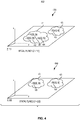
- FIG. 4 illustrates an example three-axis space 400 for grouping disperse cloud providers 401-406.
- the space 400 has three-axis to match the number of elements in each vector for the disperse cloud providers 401-406.
- more (e.g., four or more) or less (e.g , one or two) axis spaces can be used.
- a N-number axis space is also used.
- Different coordinate systems besides a Cartesian coordinate system could be used as well.
- the three-axis space 400 includes a respective vector corresponding to each disperse cloud provider 401-406.
- the cloud manager groups the disperse cloud providers together into different cloud groups, based on their vector values in the three-axis space.
- the cloud manager only groups together vectors on the same axis plane (e.g., the Z axis shown in FIG. 4 ).
- the cloud manager does not require vectors in the same cloud group to be on any single plane. Even though FIG.
- FIG. 4 shows a three-axis space, one-axis, two-axis, or four or more axis can also be applied to the subject disclosure. In other implementations, more (e.g., four or more) or less ( e.g , one or two) axis spaces can be used. Different coordinate systems besides a Cartesian coordinate system could be used as well.
- the cloud manager uses a clustering algorithm to group the vectors for the disperse cloud providers into different cloud groups.
- the cloud manager can use a KMeans clustering algorithm.
- KMeans is only one of many possible clustering algorithms for use by the cloud manager.
- KMeans clustering is a method of vector quantization, originally from signal processing, that is popular for cluster analysis in data mining. KMeans clustering aims to partition n observations into k clusters in which each observation belongs to the cluster with the nearest mean, serving as a prototype of the cluster. This results in a partitioning of the data space into Voronoi cells.
- Voronoi diagram is a partitioning of a plane into regions based on distance to points in a specific subset of the plane. That set of points (called seeds, sites, or generators) is specified beforehand, and for each seed there is a corresponding region consisting of all points closer to that seed than to any other. These regions are called Voronoi cells.
- the most common KMeans algorithm uses an iterative refinement technique. Given an initial set of devisvations, the KMeans algorithm proceeds by alternating between two steps, an assignment step and an update step.
- the assignment step assign each observation to the cluster whose mean yields the least within-cluster sum of squares (WCSS). Since the sum of squares is the squared Euclidean distance, this is intuitively the "nearest" mean.
- the update step calculate the new means to be the centroids of the observations in the new clusters. The algorithm has converged when the assignments no longer change. Since both steps optimize the WCSS objective, and there only exists a finite number of such partitioning, the algorithm must converge to a local optimum.
- the algorithm is often presented as assigning objects to the nearest cluster by distance. The standard algorithm aims at minimizing the WCSS objective, and thus assigns by "least sum of squares", which is exactly equivalent to assigning by the smallest Euclidean distance.
- the clustering algorithm is a suggested and supervised KMeans (SS-KMeans) clustering algorithm, and where each grouping of one of the plurality of disperse cloud providers reinforces the SS-KMeans clustering algorithm.
- SS-KMeans suggested and supervised KMeans
- FIG. 4 illustrates an example KMeans clustering algorithm applied to a six vectors 401-406 corresponding to six respective disperse cloud providers.
- the vectors 401-406 are each possessed sequentially.
- the vectors can be processed in any order based on any number of factors.
- the cloud manger plots R1 401 with vector (30, 25, 111) on plane 1 400A. Since R1 401 is first, R1 401 is placed into cloud group (i.e., "cluster") 421. The cloud manager plots R2 with vector (20, 20, 111) on plane 1 400A. Since the cloud group 421 is the only available cluster, R2 will get the cloud group 421 as a "suggested" grouping to choose from. The cloud manager places R2 402 with R1 401 into the cloud group 421. When R2 402 joins R1 401 in the cloud group 421, this is called supervised clustering. When a disperse cloud provider joins an existing cloud group, the training set of the supervised clustering is reinforced. The cloud manager generates a KMeans value for R1 401 and R2 402 in cloud group 421.
- the cloud manager plots R4 (20, 30, 111) 404 on plane 1 400A.
- Now plane 1 has two clusters 421, 422.
- R4 404 selects to be part of cluster 421.
- the total number of clusters remains at two.
- Cluster 421 receives a new KMean.
- Now cluster 421 includes R1 401, R2 402, and R4 404 and cluster 422 includes R3 403.
- a separate KMeans is applied to plane 2 400B.
- the cloud manager plots R5 (30, 30, 222) 405 on plane 2 400B, since vector R5 405 has a Z value of 222.
- Vector R5 405 is placed into cluster 424.
- the cloud manager plots R6 (30, 40, 222) 406 to plan 2 400B.
- R6 406 is placed into cluster 425.
- FIG. 5 illustrates an example methodology 500 for tracking usage of virtual machines.
- the cloud manager receives provider data relating to a plurality of disperse cloud providers for a plurality of data subcategories classified under N-number main categories.
- the cloud manager determines a respective numerical value to represent each of the plurality of data subcategories for each of the plurality of disperse cloud providers.
- the N-number main categories can include at least one of a feasibility decision score, offering similarity score, or provider credibility score.
- the plurality of data subcategories can include at least one of internet service provider, provider location, network type, computing type, service level agreement (SLA), cost model, allocation model, resource flexibility, percentage SLA met, user ratings, resource used, or cloud size.
- SLA service level agreement
- the cloud manager generates a respective vector to represent each of the plurality of disperse cloud providers based on the provider data to yield vectors.
- Each respective element of the vector can be based on the provider data for one of the N-number main categories.
- the cloud manager generates an N-number axis space including the vectors.
- the cloud manager groups the plurality of disperse cloud providers in the N-number axis space into at least one cloud provider group, based on the vectors and a clustering algorithm.
- grouping the plurality of disperse cloud providers includes grouping each respective vector in the N-number axis space into one of the at least one cloud provider group, based on the clustering algorithm.
- the clustering algorithm can be a KMeans clustering algorithm that groups the data points in the N-number axis space into k-number clusters.
- the clustering algorithm is a suggested and supervised KMeans (SS-KMeans) clustering algorithm, and where each grouping of one of the plurality of disperse cloud providers reinforces the SS-KMeans clustering algorithm.
- the clustering algorithm can be an agglomerative hierarchical clustering algorithm or a divisive hierarchical clustering algorithm.
- the cloud manager monitors for a change in the provider data for a disperse cloud provider.
- the cloud manager When there is a change in the provider data for a disperse cloud provider, the cloud manager generates an updated vector for the disperse cloud provider, and regroups the disperse cloud provider.
- FIG. 6 illustrates a block diagram of an example processing system 600.
- the processing system 600 can include a processor 640, a network interface 650, a management controller 680, a memory 620, a storage 630, a Basic Input/Output System (BIOS) 610, and a northbridge 660, and a southbridge 670.
- BIOS Basic Input/Output System
- the processing system 600 can be, for example, a server (e.g., one of many rack servers in a data center) or a personal computer.
- the processor e.g., central processing unit (CPU)
- CPU central processing unit
- the processor 640 can be a chip on a motherboard that can retrieve and execute programming instructions stored in the memory 620.
- the processor 640 can be a single CPU with a single processing core, a single CPU with multiple processing cores, or multiple CPUs.
- One or more buses can transmit instructions and application data between various computer components such as the processor 640, memory 620, storage 630, and networking interface 650.
- the memory 620 can include any physical device used to temporarily or permanently store data or programs, such as various forms of random-access memory (RAM).
- the storage 630 can include any physical device for non-volatile data storage such as a HDD or a flash drive.
- the storage 630 can have a greater capacity than the memory 620 and can be more economical per unit of storage, but can also have slower transfer rates.
- the BIOS 610 can include a Basic Input/Output System or its successors or equivalents, such as an Extensible Firmware Interface (EFI) or Unified Extensible Firmware Interface (UEFI).
- the BIOS 610 can include a BIOS chip located on a motherboard of the processing system 600 storing a BIOS software program.
- the BIOS 610 can store firmware executed when the computer system is first powered on along with a set of configurations specified for the BIOS 610.
- the BIOS firmware and BIOS configurations can be stored in a non-volatile memory (e.g., NVRAM) 612 or a ROM such as flash memory. Flash memory is a non-volatile computer storage medium that can be electronically erased and reprogrammed.
- the BIOS 610 can be loaded and executed as a sequence program each time the processing system 600 is started.
- the BIOS 610 can recognize, initialize, and test hardware present in a given computing system based on the set of configurations.
- the BIOS 610 can perform self-test, such as a Power-on-Self-Test (POST), on the processing system 600. This self-test can test functionality of various hardware components such as hard disk drives, optical reading devices, cooling devices, memory modules, expansion cards and the like.
- POST Power-on-Self-Test
- the BIOS can address and allocate an area in the memory 620 in to store an operating system.
- the BIOS 610 can then give control of the computer system to the OS.
- the BIOS 610 of the processing system 600 can include a BIOS configuration that defines how the BIOS 610 controls various hardware components in the processing system 600.
- the BIOS configuration can determine the order in which the various hardware components in the processing system 600 are started.
- the BIOS 610 can provide an interface (e.g., BIOS setup utility) that allows a variety of different parameters to be set, which can be different from parameters in a BIOS default configuration.
- BIOS setup utility e.g., BIOS setup utility
- a user e.g., an administrator
- the management controller 680 can be a specialized microcontroller embedded on the motherboard of the computer system.
- the management controller 680 can be a BMC or a RMC.
- the management controller 680 can manage the interface between system management software and platform hardware. Different types of sensors built into the computer system can report to the management controller 680 on parameters such as temperature, cooling fan speeds, power status, operating system status, etc.
- the management controller 680 can monitor the sensors and have the ability to send alerts to an administrator via the network interface 650 if any of the parameters do not stay within preset limits, indicating a potential failure of the system.
- the administrator can also remotely communicate with the management controller 680 to take some corrective action such as resetting or power cycling the system to restore functionality.
- the northbridge 660 can be a chip on the motherboard that can be directly connected to the processor 640 or can be integrated into the processor 640. In some instances, the northbridge 660 and the southbridge 670 can be combined into a single die. The northbridge 660 and the southbridge 670, manage communications between the processor 640 and other parts of the motherboard. The northbridge 660 can manage tasks that require higher performance than the southbridge 670. The northbridge 660 can manage communications between the processor 640, the memory 620, and video controllers (not shown). In some instances, the northbridge 660 can include a video controller.
- the southbridge 670 can be a chip on the motherboard connected to the northbridge 660, but unlike the northbridge 660, is not directly connected to the processor 640.
- the southbridge 670 can manage input/output functions (e.g., audio functions, BIOS, Universal Serial Bus (USB), Serial Advanced Technology Attachment (SATA), Peripheral Component Interconnect (PCI) bus, PCI extended (PCI-X) bus, PCI Express bus, Industry Standard Architecture (ISA) bus, Serial Peripheral Interface (SPI) bus, Enhanced Serial Peripheral Interface (eSPI) bus, System Management Bus (SMBus), etc.) of the processing system 600.
- the southbridge 670 can be connected to or can include within the southbridge 670 the management controller 670, Direct Memory Access (DMAs) controllers, Programmable Interrupt Controllers (PICs), and a real-time clock.
- DMAs Direct Memory Access
- PICs Programmable Interrupt Controllers
- the input device 602 can be at least one of a game controller, a joystick, a mouse, a keyboard, a touchscreen, a trackpad, or other similar control device.
- the input device 602 allows a user to provide input data to the processing system 600.
- the display device 604 can be at least one of a monitor, a light-emitting display (LED) screen, a liquid crystal display (LCD) screen, a head mounted display (HMD), a virtual reality (VR) display, a augmented reality (AR) display, or other such output device.
- the display device 604 allows the processing system 600 to output visual information to a user.
- DSP digital signal processor
- ASIC application specific integrated circuit
- FPGA field programmable gate array
- a general-purpose processor can be a microprocessor, but in the alternative, the processor can be any conventional processor, controller, microcontroller, or state machine.
- a processor can also be implemented as a combination of computing devices, e.g., a combination of a DSP and a microprocessor, a plurality of microprocessors, one or more microprocessors in conjunction with a DSP core, or any other such configuration.
- a software module can reside in RAM memory, flash memory, ROM memory, EPROM memory, EEPROM memory, registers, hard disk, a removable disk, a CD-ROM, or any other form of storage medium known in the art.
- An exemplary storage medium is coupled to the processor such that the processor can read information from, and write information to, the storage medium.
- the storage medium can be integral to the processor.
- the processor and the storage medium can reside in an ASIC.
- the ASIC can reside in a user terminal.
- the processor and the storage medium can reside as discrete components in a user terminal.
- Non-transitory computer-readable media includes both computer storage media and communication media including any medium that facilitates transfer of a computer program from one place to another.
- a storage media can be any available media that can be accessed by a general purpose or special purpose computer.
- Such computer-readable media can include RAM, ROM, EEPROM, CD-ROM or other optical disk storage, magnetic disk storage or other magnetic storage devices, or any other medium that can be used to carry or store desired program code means in the form of instructions or data structures and that can be accessed by a general-purpose or special-purpose computer, or a general-purpose or special-purpose processor.
- Disk and disc includes compact disc (CD), laser disc, optical disc, digital versatile disc (DVD), floppy disk and blue ray disc where disks usually reproduce data magnetically, while discs reproduce data optically with lasers. Combinations of the above should also be included within the scope of non-transitory computer-readable media.
- a computer-readable medium storing instructions which, when executed by a processor, cause the processor to perform any of the methods described herein.
Landscapes
- Engineering & Computer Science (AREA)
- Computer Networks & Wireless Communication (AREA)
- Signal Processing (AREA)
- Physics & Mathematics (AREA)
- Software Systems (AREA)
- Theoretical Computer Science (AREA)
- Multimedia (AREA)
- Mathematical Physics (AREA)
- General Engineering & Computer Science (AREA)
- General Physics & Mathematics (AREA)
- Management, Administration, Business Operations System, And Electronic Commerce (AREA)
Abstract
A cloud manager, for forming neighborhood groups from disperse cloud providers, receives provider data relating to a plurality of disperse cloud providers for a plurality of data subcategories classified under N-number main categories. The cloud manager generates a respective vector to represent each of the plurality of disperse cloud providers based on the provider data. The cloud manager generates an N-number axis space comprising the vectors. The cloud manager groups the plurality of disperse cloud providers in the N-number axis space into at least one cloud provider group, based on the vectors and a clustering algorithm.
Description
- The disclosed technology relates to delivery of computing as a service. In particular, example embodiments relate to partitioning and operating a portion of computing resources not traditionally used in a cloud fashion as resources available as a service.
- Traditional data centers tend to run a single operating system instance and a single business application on one physical server. This "one server, one appliance" model leads to extremely poor resource utilization. Wasted resources include CPU, RAM, Storage, and Network Bandwidth.
- "Cloud computing" refers to a model for enabling ubiquitous, convenient, on-demand network access to a shared pool of configurable computing resources (e.g., networks, servers, storage, applications, and services) that may be rapidly provisioned and released with minimal management effort or service provider interaction. The cloud computing model is characterized by on-demand self-service, broad network access, resource pooling, rapid elasticity, and measured service. Cloud computing service models include software as a service (SaaS), platform as a service (PaaS), and infrastructure as a service (IaaS). Cloud computing deployment models include public clouds, private clouds, community clouds, and hybrid combinations thereof. The cloud model can allow end users to reduce capital expenditures and burdensome operating costs associated with maintaining substantial information technology expertise and operating staff in house.
- Typical cloud computing and storage solutions provide users and enterprises with various capabilities to store and process their data in third-party data centers that may be located far from the user-ranging in distance from across a city to across the world. Cloud computing relies on sharing of resources to achieve coherence and economy of scale, similar to a utility (like the electricity grid) over an electricity network.
- These and other sample aspects of the present technology will be described in the detailed description and the appended claims that follow, and in the accompanying drawings, wherein:
-
FIG. 1 illustrates a block diagram of an example network topology for forming neighborhood groups from disperse cloud providers; -
FIG. 2 illustrates provider data for example disperse cloud providers; -
FIG. 3 illustrates an example characteristic scoring tree for generating vectors to represent disperse cloud providers; -
FIG. 4 illustrates an example three-axis space for grouping disperse cloud providers; -
FIG. 5 illustrates an example methodology for tracking usage of virtual machines; and -
FIG. 6 illustrates a block diagram of an example computer system. - The following presents a simplified summary of one or more embodiments in order to provide a basic understanding of present technology. This summary is not an extensive overview of all contemplated embodiments of the present technology, and is intended to neither identify key or critical elements of all examples nor delineate the scope of any or all aspects of the present technology. Its sole purpose is to present some concepts of one or more examples in a simplified form as a prelude to the more detailed description that is presented later. In accordance with one or more aspects of the examples described herein, systems and methods are provided for tracking usage of distributed software for virtual machines.
- The subject disclosure provides systems and methods for forming neighborhood groups from disperse cloud providers. A cloud manager receives provider data relating to a plurality of disperse cloud providers for a plurality of data subcategories classified under N-number main categories. The cloud manager generates a respective vector to represent each of the plurality of disperse cloud providers based on the provider data to yield vectors. The cloud manager generates an N-number axis space comprising the vectors. The cloud manager groups the plurality of disperse cloud providers in the N-number axis space into at least one cloud provider group, based on the vectors and a clustering algorithm.
- The subject disclosure provides techniques for forming neighborhood groups from disperse cloud providers, in accordance with the subject technology. Various aspects of the present technology are described with reference to the drawings. In the following description, for purposes of explanation, numerous specific details are set forth in order to provide a thorough understanding of one or more aspects. It can be evident, however, that the present technology can be practiced without these specific details. In other instances, well-known structures and devices are shown in block diagram form in order to facilitate describing these aspects. The word "exemplary" is used herein to mean "serving as an example, instance, or illustration." Any embodiment described herein as "exemplary" is not necessarily to be construed as preferred or advantageous over other embodiments.
- The power of traditional end user environments is exploding. Some estimate that the compute power of the equivalent of a personal computer, such as found in the typical home environment, in 2049 may be equal to all computing power created through 2012. Further, the ability of home environments to offer services and products (south-to-north, south-to-west, and south-to-east traffic) may expand. This is similar to how some people offer home-generated electrical power to public utilities. This trend opens the door for "utility computing," where the consumer can share the excess of his home cloud or IT infrastructure with peers, Internet Service Providers (ISPs), application providers, or third parties. This capability effectively may transform the consumer of goods and services into a market resident who owns a home infrastructure and allocates part of it to create a cloud and offer services and products to peers, ISPs, application providers, or third parties. In some embodiments, it allows customers to become entrepreneurs and de-facto application providers and/or crowd-sourced public cloud providers.
- Similar to cloud computing, fog computing can provide data, compute, storage, and application services to end-users. Fog computing or fog networking, is an architecture that uses one or more collaborative multitude of end-user clients or near-user edge devices to carry out a substantial amount of storage (rather than stored primarily in cloud data centers), communication (rather than routed over the internet backbone), control, configuration, measurement and management (rather than controlled primarily by network gateways such as those in the LTE core network).
- Computing resources of each of a plurality of first parties, such as residential subscribers to an Internet Service Provider (ISP), can be logically partitioned into a first party end user partition and a first party crowd sourced cloud partition. Home, businesses, schools, and universities, could all participate in a crowd sourced cloud as providers of services, capacity, or both. These entities can provide one or more devices or appliances (i.e., "computing resources") that can provide compute, network, or storage capacity in a context of space, power, and cooling.
- In example architectures for the technology, while each server, system, and device shown in the architecture is represented by one instance of the server, system, or device, multiple instances of each can be used. Further, while certain aspects of operation of the technology are presented in examples related to the figures to facilitate enablement of the disclosed concepts, additional features of the technology, also facilitating enablement of the concepts, are disclosed elsewhere herein.
- The subject disclosure provides a cloud manager that receives provider data for multiple disperse cloud providers. The cloud manager analyzes the provider data and groups the disperse cloud providers into one or more cloud provider groups. By placing certain cloud providers together into particular cloud provider groups, the cloud providers can pool computing resources more effectively to better serve cloud end users.
- Given that many of the disperse cloud providers are expected to be from home environments, the end-user apps can be based upon a micro-services application architecture. In the micro-services application architecture, applications can be moved to another home-cloud infrastructure without impacting consumer experience. Micro-service architecture is a method of developing software applications as a suite of independently deployable, small, modular services in which each service runs a unique process and communicates through a well-defined, lightweight mechanism.
-
FIG. 1 illustrates a block diagram of anexample network topology 100 for forming neighborhood groups fromdisperse cloud providers 150. Theexample network topology 100 shows an example arrangement of various network elements of anetwork 101. It should be noted that theexample network topology 100 is merely an example arrangement for demonstration and does not describe all possible types of network configurations for use with the claimed invention. - The
network 101 can include a wide area network (WAN) such as the Internet, or a local area network (LAN). Thenetwork 101 can include an intranet, a storage area network (SAN), a personal area network (PAN), a metropolitan area network (MAN), a wireless local area network (WLAN), a virtual private network (VPN), a cellular or other mobile communication network, a BLUETOOTH ® wireless technology connection, a near field communication (NFC) connection, any combination thereof, and any other appropriate architecture or system that facilitates the communication of signals, data, and/or messages. Throughout the discussion of example embodiments, it should be understood that the terms "data" and "information" are used interchangeably herein to refer to text, images, audio, video, or any other form of information that can exist in a computer-based environment. - A
cloud manager 130,diverse cloud providers 150, andcloud end users 160 are connected to thenetwork 101. For example, if thenetwork 101 is the Internet, thediverse cloud providers 150 and thecloud end users 160 can connect to thenetwork 101 through one or more Internet Service Providers (ISPs) 110A-C. For example,ISPs Fig. 1 for illustration. An ISP is an organization that provides services for accessing and using the Internet. Internet Service Providers may be organized in various forms, such as commercial, community-owned, non-profit, or otherwise privately owned. Internet services typically provided by ISPs include Internet access, Internet transit, domain name registration, web hosting, Usenet service, and colocation. Each ISP typically serves large groups of Internet users in a geographic area. - The network computing devices, such as the
cloud manager 130, thediverse cloud providers 150, thecloud end users 160, and any other computing machines associated with the technology presented herein, may be any type of computing machine such as, but not limited to, those discussed in more detail with respect toFIG. 6 . Furthermore, any functions, applications, or modules associated with any of these computing machines, such as those described herein or any others (for example scripts, web content, software, firmware, or hardware) associated with the technology presented herein may by any of the modules discussed in more detail with respect toFIG. 6 . The computing machines discussed herein may communicate with one another as well as other computer machines or communication systems over one or more networks, such asnetwork 101. Thenetwork 101 may include any type of data or communications network, including any of the network technology discussed with respect toFIG. 6 . - The
diverse cloud providers 150 can be located in various geographic locations. For example, one or morediverse cloud providers 150 may be located in each single zip code 140. For example,zip code 140A,zip code 140B, and zip code 140C are shown inFig. 1 for illustration. It is possible, but not necessary for alldiverse cloud providers 150 located in asingle zip code 140B to also be serviced by a single ISP B110B. In contrast,diverse cloud providers 150 inzip code 140A are served byISP - The
cloud manager 130 can include any computing or processing device, such as for example, one or more computer servers. Thecloud manager 130 can be a single device, multiple devices in one location, or multiple devices in multiple locations. In some implementations, thecloud manager 130 can be combined with or include the network computing devices for one or more of thediverse cloud providers 150 or thecloud end users 160. - Each of the
diverse cloud providers 150 can include one or more computing devices of various configurations.FIG. 2 describes in more detail example cloud provider configurations. -
FIG. 2 illustratesprovider data 200 for example disperse cloud providers 210-260. It should be noted that the example disperse cloud providers 210-260 are provided merely for demonstration and does not describe all possible types of computing device configurations for use with the claimed invention. The diverse cloud providers 210-260 may be any type of computing machine such as, but not limited to, those discussed in more detail with respect toFIG. 6 . The diverse cloud providers 210-260 are each described by provider data in various categories, such as but not limited to, those described below. - Each disperse cloud provider 210-260 is located at particular a geographic address and offers a certain amount of computing resources to a cloud provider group. One or more physical computer servers can be located at the geographic address and include the computing resources offered.
- The computing resources can be measured by any of a variety of performance metrics for system sources and computational resources. System resources include physical or virtual entities of limited availability (e.g., memory, processing capacity, and network speed). Computational resources include resources used for solving a computational problem (e.g., computation speed, memory space).
- Computing resources, from one or more computer servers, can include, but are not limited to, CPUs, processing power - often measured in flops/second, memory such as random access memory (RAM), storage such as hard disk drives and/or solid state drives, and network connectivity - often measured in megabits/second (mbps) of data transmission speed and latency. The FLoating-point Operations Per Second (flops) is a measure of computer performance, useful in fields of scientific calculations that make heavy use of floating-point calculations.
- Provider data for each disperse cloud provider 210-260 can include internet protocol (IP) addresses of the computer servers, internet service provider (ISP) identification and router IP address. An Internet Protocol address (IP address) is a numerical label assigned to each device (e.g., computer, printer) participating in a computer network that uses the Internet Protocol for communication. An IP address serves two principal functions: host or network interface identification and location addressing. Its role has been characterized as follows: "A name indicates what we seek. An address indicates where it is. A route indicates how to get there."
- IP addresses were initially defined as a 32-bit number and this system, known as Internet Protocol Version 4 (IPv4), is still in use today. However, because of the growth of the Internet and the predicted depletion of available addresses, a new version of IP (IPv6), using 128 bits for the address, was developed in 1995.
- Provider data for each disperse cloud provider 210-260 can include the type of service level agreements (SLAs). The SLA is an official commitment that prevails between a service provider and the customer. Particular aspects of the service, such as quality, availability, responsibilities, are agreed between the service provider and the service user. The most common component of SLA is that the services should be provided to the customer as agreed upon in the contract. As an example, Internet service providers and telecommunications companies will commonly include SLAs within the terms of their contracts with customers to define the level(s) of service being sold in plain language terms. For example, the SLA will typically have a technical definition in terms of mean time between failures (MTBF), mean time to repair or mean time to recovery (MTTR) (i.e. identifying which party is responsible for reporting faults or paying fees), responsibility for various data rates, throughput, jitter, or similar measurable details.
- Provider data for each disperse cloud provider 210-260 can include a resource allocation type. For example, the allocation type can be a split ratio 1:1 type or a best effort type of allocation. If the allocation type is the best effort type, then the provider data may include an addon resource limit for additional CPU, RAM, and/or storage use.
- The provider data for each disperse cloud provider 210-260 can also include the types of software that each server is running, such as the operating system (OS) type and/or version, cloud software, etc.
- The disperse
cloud provider 210 representsResident 1 located at 123 ABC Lane, San Jose, USA. The dispersecloud provider 210 offers two servers including a total of two central processing units (CPUs) and one teraflop/second (T-flops/s) of processing power. The dispersecloud provider 210 includes four gigabytes (gb) of RAM, 20 gb of storage, and two mbps of Internet connection speed. The dispersecloud provider 210 connects to the Internet with the ISP provider AT&T and has the IP address 10.1.1.1 for a first server and 10.1.1.2 for a second server. - The disperse
cloud provider 210 has a SLA that provides for 50% availability of the computing resources on the two servers for cloud use. The SLA also provides a dedicated resources allocation policy per server. The dispersecloud provider 210 allocates resources into a split ratio 1:1 type with no addon resource flexibility. In addition, the two servers both run the Linux OS. - While not shown in
FIG. 2 , the provider data for the disperse cloud providers 210-260 can include data relating to: cost model, allocation model, percentage of SLAs met, user ratings, resources used, machine learning data for user usage patterns, and/or cloud size, etc. For example, the provider data for cost model can include a price per unit of storage or processing power that a disperse cloud provider will charge. The provider data for the allocation model can include whether addon resource for the disperse cloud provider is flexible or fixed. The provider data for the percentage of SLAs met can include data for the amount of compliance with SLAs. The provider data for the user ratings can include a user satisfaction score from one to ten. The provider data for the resources uses can include data for the total amount computing resources provided by the disperse cloud provider. The provider data for the cloud side can include whether the disperse cloud provider is a small, medium, or large provider (e.g, based on number of servers offered or amount of computing resources offered). - As shown in
FIG. 2 , the provider data for disperse cloud providers 220-260 provide similar information describing Residents 2-6. -
FIG. 3 illustrates an examplecharacteristic scoring tree 300 for generating vectors to represent disperse cloud providers. The provider data for a single disperse cloud provider, as described in the examples shown inFIG. 2 , can be categorized under a number of main categories. In addition, the provider data can be further categorized under a number subcategories under the main categories. Each subcategory can be unique to one of the main categories or can exist under multiple main categories. - The example
characteristic scoring tree 300 includes three main categories: feasibility (Z) 310, offering similarity (X) 320, and provider credibility (Y) 330. Each of the main categories includes four subcategories. For example, the feasibility (Z)main category 310 includes the subcategories:ISP provider 312,cloud provider location 314,network type 316, andcomputing type 318. The offering similaritymain category 320 can include the subcategories: SLAs 322,cost model 324,allocation model 326, andaddon resource 328. The provider credibilitymain category 330 can include the subcategories: percentage of SLAs met 332,user ratings 334, resources used 336, andcloud size 338. Even though the examplecharacteristic scoring tree 300 shown inFIG. 3 includes three main categories, more or less than three main categories can be applied to the subject disclosure. - It should be noted that the
characteristic scoring tree 300 is merely an example categorical arrangement for demonstration and does not describe all possible types of arrangements for use with the claimed invention. - In some implementations, the provider data for each subcategory is a numerical value. Each of the subcategories in a main category can be summed into a single numerical value to represent the X, Y, or Z. For example, numerical values for the
ISP provider 312, thecloud provider location 314, thenetwork type 316, and thecomputing type 318 can be summed into a value for the feasibility main category (Z) 310. Numerical values for theSLAs 322, thecost model 324, theallocation model 326, and theaddon resource 328 can be summed into a value for the offering similarity main category (X) 320. Likewise, numerical values for the percentage of SLAs met 332, theuser ratings 334, the resources used 336, and thecloud size 338 can be combined into a value for the provider credibility main category (Z) 330. Of course, the values in the trees are representative. Other values can also be used as well as any mixture of values or parameters. - The combination of the values of X, Y, and Z for the three main categories can be used to generate a three element vector such as (x, y, z) for the disperse cloud provider. In this manner, the cloud manager generates a three element vector for each of the respective disperse cloud providers. In some implementations, the number of elements in the generated vectors can match the number of main categories provided by the provider data. The vector can also include one element, two elements or more than three elements.
-
FIG. 4 illustrates an example three-axis space 400 for grouping disperse cloud providers 401-406. Thespace 400 has three-axis to match the number of elements in each vector for the disperse cloud providers 401-406. In other implementations, more (e.g., four or more) or less (e.g, one or two) axis spaces can be used. For example, if there are N-number of main categories and a corresponding N-number of elements in each vector, a N-number axis space is also used. Different coordinate systems besides a Cartesian coordinate system could be used as well. - The three-
axis space 400 includes a respective vector corresponding to each disperse cloud provider 401-406. The cloud manager groups the disperse cloud providers together into different cloud groups, based on their vector values in the three-axis space. -
FIG. 4 illustrates the three-axis space plane 1 400A to show only a first X-Y plane of the three-axis space 400 at a first Z value (e.g., Z = 111 here). Similarly the three-axis space plane 2 400B illustrates only a second X-Y plane of the three-axis space 400 at a second Z value (e.g., Z = 222 here). In some implementations, the cloud manager only groups together vectors on the same axis plane (e.g., the Z axis shown inFIG. 4 ). In some other implementations, the cloud manager does not require vectors in the same cloud group to be on any single plane. Even thoughFIG. 4 shows a three-axis space, one-axis, two-axis, or four or more axis can also be applied to the subject disclosure. In other implementations, more (e.g., four or more) or less (e.g, one or two) axis spaces can be used. Different coordinate systems besides a Cartesian coordinate system could be used as well. - In some implementations, the cloud manager uses a clustering algorithm to group the vectors for the disperse cloud providers into different cloud groups. For example, the cloud manager can use a KMeans clustering algorithm. However, KMeans is only one of many possible clustering algorithms for use by the cloud manager.
- KMeans clustering is a method of vector quantization, originally from signal processing, that is popular for cluster analysis in data mining. KMeans clustering aims to partition n observations into k clusters in which each observation belongs to the cluster with the nearest mean, serving as a prototype of the cluster. This results in a partitioning of the data space into Voronoi cells.
- A Voronoi diagram is a partitioning of a plane into regions based on distance to points in a specific subset of the plane. That set of points (called seeds, sites, or generators) is specified beforehand, and for each seed there is a corresponding region consisting of all points closer to that seed than to any other. These regions are called Voronoi cells.
- The most common KMeans algorithm uses an iterative refinement technique. Given an initial set of obervations, the KMeans algorithm proceeds by alternating between two steps, an assignment step and an update step. In the assignment step, assign each observation to the cluster whose mean yields the least within-cluster sum of squares (WCSS). Since the sum of squares is the squared Euclidean distance, this is intuitively the "nearest" mean. In the update step, calculate the new means to be the centroids of the observations in the new clusters. The algorithm has converged when the assignments no longer change. Since both steps optimize the WCSS objective, and there only exists a finite number of such partitioning, the algorithm must converge to a local optimum. The algorithm is often presented as assigning objects to the nearest cluster by distance. The standard algorithm aims at minimizing the WCSS objective, and thus assigns by "least sum of squares", which is exactly equivalent to assigning by the smallest Euclidean distance.
- In some implementations, the clustering algorithm is a suggested and supervised KMeans (SS-KMeans) clustering algorithm, and where each grouping of one of the plurality of disperse cloud providers reinforces the SS-KMeans clustering algorithm.
-
FIG. 4 illustrates an example KMeans clustering algorithm applied to a six vectors 401-406 corresponding to six respective disperse cloud providers. The vectors 401-406 are each possessed sequentially. The vectors can be processed in any order based on any number of factors. - The cloud manger plots
R1 401 with vector (30, 25, 111) onplane 1 400A. SinceR1 401 is first,R1 401 is placed into cloud group (i.e., "cluster") 421. The cloud manager plots R2 with vector (20, 20, 111) onplane 1 400A. Since thecloud group 421 is the only available cluster, R2 will get thecloud group 421 as a "suggested" grouping to choose from. The cloud manager placesR2 402 withR1 401 into thecloud group 421. WhenR2 402 joinsR1 401 in thecloud group 421, this is called supervised clustering. When a disperse cloud provider joins an existing cloud group, the training set of the supervised clustering is reinforced. The cloud manager generates a KMeans value forR1 401 andR2 402 incloud group 421. - The cloud manager plots R3 403 (40, 40, 111) on
plane 1 400A. Sinceplane 1 400A has onecluster 421 includingR1 401 andR2 402,R3 403 will get a "suggested" grouping based on a mean proximity ofcluster 421 to R3. In this case,R3 403 selects to be inseparate cluster 422. Now there are two clusters or cloud groups (i.e., k= 2). One KMean is based oncluster 421 includingR1 401 andR2 402 and the other Kmean is based just based oncluster 422 includingR3 403. - The cloud manager plots R4 (20, 30, 111) 404 on
plane 1 400A. Nowplane 1 has twoclusters R4 404 selects to be part ofcluster 421. The total number of clusters remains at two.Cluster 421 receives a new KMean. Nowcluster 421 includesR1 401,R2 402, andR4 404 andcluster 422 includesR3 403. - In the example shown in
FIG. 4 , a separate KMeans is applied toplane 2 400B. The cloud manager plots R5 (30, 30, 222) 405 onplane 2 400B, sincevector R5 405 has a Z value of 222.Vector R5 405 is placed intocluster 424. The cloud manager plots R6 (30, 40, 222) 406 to plan 2 400B.R6 406 is placed intocluster 425. -
FIG. 5 illustrates anexample methodology 500 for tracking usage of virtual machines. Atstep 510, the cloud manager receives provider data relating to a plurality of disperse cloud providers for a plurality of data subcategories classified under N-number main categories. - In some implementations, the cloud manager determines a respective numerical value to represent each of the plurality of data subcategories for each of the plurality of disperse cloud providers. The N-number main categories can include at least one of a feasibility decision score, offering similarity score, or provider credibility score. The plurality of data subcategories can include at least one of internet service provider, provider location, network type, computing type, service level agreement (SLA), cost model, allocation model, resource flexibility, percentage SLA met, user ratings, resource used, or cloud size.
- At
step 520, the cloud manager generates a respective vector to represent each of the plurality of disperse cloud providers based on the provider data to yield vectors. Each respective element of the vector can be based on the provider data for one of the N-number main categories. - At
step 530, the cloud manager generates an N-number axis space including the vectors. - At
step 540, the cloud manager groups the plurality of disperse cloud providers in the N-number axis space into at least one cloud provider group, based on the vectors and a clustering algorithm. - In some implementations, grouping the plurality of disperse cloud providers includes grouping each respective vector in the N-number axis space into one of the at least one cloud provider group, based on the clustering algorithm. The clustering algorithm can be a KMeans clustering algorithm that groups the data points in the N-number axis space into k-number clusters.
- In some implementations, the clustering algorithm is a suggested and supervised KMeans (SS-KMeans) clustering algorithm, and where each grouping of one of the plurality of disperse cloud providers reinforces the SS-KMeans clustering algorithm. The clustering algorithm can be an agglomerative hierarchical clustering algorithm or a divisive hierarchical clustering algorithm.
- In some implementations, the cloud manager monitors for a change in the provider data for a disperse cloud provider. When there is a change in the provider data for a disperse cloud provider, the cloud manager generates an updated vector for the disperse cloud provider, and regroups the disperse cloud provider.
-
FIG. 6 illustrates a block diagram of anexample processing system 600. Theprocessing system 600 can include aprocessor 640, anetwork interface 650, amanagement controller 680, amemory 620, astorage 630, a Basic Input/Output System (BIOS) 610, and anorthbridge 660, and asouthbridge 670. - The
processing system 600 can be, for example, a server (e.g., one of many rack servers in a data center) or a personal computer. The processor (e.g., central processing unit (CPU)) 640 can be a chip on a motherboard that can retrieve and execute programming instructions stored in thememory 620. Theprocessor 640 can be a single CPU with a single processing core, a single CPU with multiple processing cores, or multiple CPUs. One or more buses (not shown) can transmit instructions and application data between various computer components such as theprocessor 640,memory 620,storage 630, andnetworking interface 650. - The
memory 620 can include any physical device used to temporarily or permanently store data or programs, such as various forms of random-access memory (RAM). Thestorage 630 can include any physical device for non-volatile data storage such as a HDD or a flash drive. Thestorage 630 can have a greater capacity than thememory 620 and can be more economical per unit of storage, but can also have slower transfer rates. - The
BIOS 610 can include a Basic Input/Output System or its successors or equivalents, such as an Extensible Firmware Interface (EFI) or Unified Extensible Firmware Interface (UEFI). TheBIOS 610 can include a BIOS chip located on a motherboard of theprocessing system 600 storing a BIOS software program. TheBIOS 610 can store firmware executed when the computer system is first powered on along with a set of configurations specified for theBIOS 610. The BIOS firmware and BIOS configurations can be stored in a non-volatile memory (e.g., NVRAM) 612 or a ROM such as flash memory. Flash memory is a non-volatile computer storage medium that can be electronically erased and reprogrammed. - The
BIOS 610 can be loaded and executed as a sequence program each time theprocessing system 600 is started. TheBIOS 610 can recognize, initialize, and test hardware present in a given computing system based on the set of configurations. TheBIOS 610 can perform self-test, such as a Power-on-Self-Test (POST), on theprocessing system 600. This self-test can test functionality of various hardware components such as hard disk drives, optical reading devices, cooling devices, memory modules, expansion cards and the like. The BIOS can address and allocate an area in thememory 620 in to store an operating system. TheBIOS 610 can then give control of the computer system to the OS. - The
BIOS 610 of theprocessing system 600 can include a BIOS configuration that defines how theBIOS 610 controls various hardware components in theprocessing system 600. The BIOS configuration can determine the order in which the various hardware components in theprocessing system 600 are started. TheBIOS 610 can provide an interface (e.g., BIOS setup utility) that allows a variety of different parameters to be set, which can be different from parameters in a BIOS default configuration. For example, a user (e.g., an administrator) can use theBIOS 610 to specify clock and bus speeds, specify what peripherals are attached to the computer system, specify monitoring of health (e.g., fan speeds and CPU temperature limits), and specify a variety of other parameters that affect overall performance and power usage of the computer system. - The
management controller 680 can be a specialized microcontroller embedded on the motherboard of the computer system. For example, themanagement controller 680 can be a BMC or a RMC. Themanagement controller 680 can manage the interface between system management software and platform hardware. Different types of sensors built into the computer system can report to themanagement controller 680 on parameters such as temperature, cooling fan speeds, power status, operating system status, etc. Themanagement controller 680 can monitor the sensors and have the ability to send alerts to an administrator via thenetwork interface 650 if any of the parameters do not stay within preset limits, indicating a potential failure of the system. The administrator can also remotely communicate with themanagement controller 680 to take some corrective action such as resetting or power cycling the system to restore functionality. - The
northbridge 660 can be a chip on the motherboard that can be directly connected to theprocessor 640 or can be integrated into theprocessor 640. In some instances, thenorthbridge 660 and thesouthbridge 670 can be combined into a single die. Thenorthbridge 660 and thesouthbridge 670, manage communications between theprocessor 640 and other parts of the motherboard. Thenorthbridge 660 can manage tasks that require higher performance than thesouthbridge 670. Thenorthbridge 660 can manage communications between theprocessor 640, thememory 620, and video controllers (not shown). In some instances, thenorthbridge 660 can include a video controller. - The
southbridge 670 can be a chip on the motherboard connected to thenorthbridge 660, but unlike thenorthbridge 660, is not directly connected to theprocessor 640. Thesouthbridge 670 can manage input/output functions (e.g., audio functions, BIOS, Universal Serial Bus (USB), Serial Advanced Technology Attachment (SATA), Peripheral Component Interconnect (PCI) bus, PCI extended (PCI-X) bus, PCI Express bus, Industry Standard Architecture (ISA) bus, Serial Peripheral Interface (SPI) bus, Enhanced Serial Peripheral Interface (eSPI) bus, System Management Bus (SMBus), etc.) of theprocessing system 600. Thesouthbridge 670 can be connected to or can include within thesouthbridge 670 themanagement controller 670, Direct Memory Access (DMAs) controllers, Programmable Interrupt Controllers (PICs), and a real-time clock. - The
input device 602 can be at least one of a game controller, a joystick, a mouse, a keyboard, a touchscreen, a trackpad, or other similar control device. Theinput device 602 allows a user to provide input data to theprocessing system 600. - The display device 604 can be at least one of a monitor, a light-emitting display (LED) screen, a liquid crystal display (LCD) screen, a head mounted display (HMD), a virtual reality (VR) display, a augmented reality (AR) display, or other such output device. The display device 604 allows the
processing system 600 to output visual information to a user. - The various illustrative logical blocks, modules, and circuits described in connection with the disclosure herein can be implemented or performed with a general-purpose processor, a digital signal processor (DSP), an application specific integrated circuit (ASIC), a field programmable gate array (FPGA) or other programmable logic device, discrete gate or transistor logic, discrete hardware components, or any combination thereof designed to perform the functions described herein. A general-purpose processor can be a microprocessor, but in the alternative, the processor can be any conventional processor, controller, microcontroller, or state machine. A processor can also be implemented as a combination of computing devices, e.g., a combination of a DSP and a microprocessor, a plurality of microprocessors, one or more microprocessors in conjunction with a DSP core, or any other such configuration.
- The operations of a method or algorithm described in connection with the disclosure herein can be embodied directly in hardware, in a software module executed by a processor, or in a combination of the two. A software module can reside in RAM memory, flash memory, ROM memory, EPROM memory, EEPROM memory, registers, hard disk, a removable disk, a CD-ROM, or any other form of storage medium known in the art. An exemplary storage medium is coupled to the processor such that the processor can read information from, and write information to, the storage medium. In the alternative, the storage medium can be integral to the processor. The processor and the storage medium can reside in an ASIC. The ASIC can reside in a user terminal. In the alternative, the processor and the storage medium can reside as discrete components in a user terminal.
- In one or more exemplary designs, the functions described can be implemented in hardware, software, firmware, or any combination thereof. If implemented in software, the functions can be stored on or transmitted over as one or more instructions or code on a non-transitory computer-readable medium. Non-transitory computer-readable media includes both computer storage media and communication media including any medium that facilitates transfer of a computer program from one place to another. A storage media can be any available media that can be accessed by a general purpose or special purpose computer. By way of example, and not limitation, such computer-readable media can include RAM, ROM, EEPROM, CD-ROM or other optical disk storage, magnetic disk storage or other magnetic storage devices, or any other medium that can be used to carry or store desired program code means in the form of instructions or data structures and that can be accessed by a general-purpose or special-purpose computer, or a general-purpose or special-purpose processor. Disk and disc, as used herein, includes compact disc (CD), laser disc, optical disc, digital versatile disc (DVD), floppy disk and blue ray disc where disks usually reproduce data magnetically, while discs reproduce data optically with lasers. Combinations of the above should also be included within the scope of non-transitory computer-readable media. There is provided a computer-readable medium storing instructions which, when executed by a processor, cause the processor to perform any of the methods described herein.
- The previous description of the disclosure is provided to enable any person skilled in the art to make or use the disclosure. Various modifications to the disclosure will be readily apparent to those skilled in the art, and the generic principles defined herein can be applied to other variations without departing from the scope of the disclosure. Thus, the disclosure is not intended to be limited to the examples and designs described herein, but is to be accorded the widest scope consistent with the principles and novel features disclosed herein.
Claims (14)
- A method for forming neighborhood groups from disperse cloud providers, by a cloud manager, the method comprising:receiving provider data relating to a plurality of disperse cloud providers for a plurality of data subcategories classified under N-number main categories;generating a respective vector to represent each of the plurality of disperse cloud providers based on the provider data to yield vectors;generating an N-number axis space comprising the vectors; andgrouping the plurality of disperse cloud providers in the N-number axis space into at least one cloud provider group, based on the vectors and a clustering algorithm.
- A method of claim 1, further comprising scoring a respective numerical value to represent each of the plurality of data subcategories for each of the plurality of disperse cloud providers.
- The method of claim 2, further comprising summing the numerical values for the subcategories under a main category to form a vector element that represents the main category.
- A method of any preceding claim, wherein each respective element of the respective vector is based on the provider data for one of the N-number main categories.
- A method of any preceding claim, wherein grouping the plurality of disperse cloud providers comprises grouping each respective vector in the N-number axis space into one of the at least one cloud provider group, based on the clustering algorithm.
- The method of any preceding claim, wherein the N-number main categories comprise at least one of a feasibility decision score, offering similarity score, or provider credibility score.
- The method of any preceding claim, wherein the plurality of data subcategories comprise at least one of internet service provider, provider location, network type, computing type, service level agreement (SLA), cost model, allocation model, resource flexibility, percentage SLA met, user ratings, resource used, or cloud size.
- The method of any preceding claim, wherein the clustering algorithm is a KMeans clustering algorithm that groups the data points in the N-number axis space into k-number clusters.
- The method of any preceding claim, further comprising monitoring for a change in the provider data for a disperse cloud provider.
- The method of claim 9, further comprising in response to the change in the provider data for a disperse cloud provider, generating an updated vector for the disperse cloud provider, and regrouping the disperse cloud provider.
- The method of any preceding claim, wherein the clustering algorithm is a suggested and supervised KMeans (SS-KMeans) clustering algorithm, and wherein each grouping of one of the plurality of disperse cloud providers reinforces the SS-KMeans clustering algorithm.
- The method of any preceding claim, wherein grouping first separates the data points on a single plane of the N-number axis space representing a corresponding main category, before applying the clustering algorithm.
- An apparatus or system arranged to perform the method of any preceding claim.
- A computer-readable medium storing instructions which, when executed by a processor, cause the processor to perform the method of any of claims 1 to 12.
Applications Claiming Priority (1)
| Application Number | Priority Date | Filing Date | Title |
|---|---|---|---|
| US15/403,074 US10334029B2 (en) | 2017-01-10 | 2017-01-10 | Forming neighborhood groups from disperse cloud providers |
Publications (1)
| Publication Number | Publication Date |
|---|---|
| EP3346382A1 true EP3346382A1 (en) | 2018-07-11 |
Family
ID=60990628
Family Applications (1)
| Application Number | Title | Priority Date | Filing Date |
|---|---|---|---|
| EP18150277.4A Ceased EP3346382A1 (en) | 2017-01-10 | 2018-01-04 | Forming neighborhood groups from disperse cloud providers |
Country Status (2)
| Country | Link |
|---|---|
| US (1) | US10334029B2 (en) |
| EP (1) | EP3346382A1 (en) |
Families Citing this family (6)
| Publication number | Priority date | Publication date | Assignee | Title |
|---|---|---|---|---|
| CN117714527A (en) * | 2017-07-28 | 2024-03-15 | 西门子股份公司 | Leveraging microservices for edge devices and associated networks |
| CN110138687B (en) * | 2019-05-14 | 2022-03-22 | 合肥工业大学 | A cloud manufacturing resource matching method considering trust degree |
| US11032396B2 (en) * | 2019-05-17 | 2021-06-08 | Citrix Systems, Inc. | Systems and methods for managing client requests to access services provided by a data center |
| US11558459B2 (en) * | 2020-03-27 | 2023-01-17 | International Business Machines Corporation | User-defined custom storage classes for hybrid-cloud and multicloud data management |
| US12039319B1 (en) * | 2022-03-31 | 2024-07-16 | Amazon Technologies, Inc. | Automatic deployment of updates for edge device software components based on edge usage limits |
| US12561165B2 (en) * | 2022-08-01 | 2026-02-24 | Visa International Service Association | System and method for performing zonal scaling operations |
Citations (4)
| Publication number | Priority date | Publication date | Assignee | Title |
|---|---|---|---|---|
| US20120303618A1 (en) * | 2011-05-23 | 2012-11-29 | Cisco Technology, Inc. | Clustering-Based Resource Aggregation within a Data Center |
| US20150288569A1 (en) * | 2013-11-10 | 2015-10-08 | Cloudweaver, Inc. | Methods and system for automated or user-assisted grouping and management of groups in cloud infrastructure and network |
| US20160080477A1 (en) * | 2014-09-11 | 2016-03-17 | Cisco Technology, Inc. | Crowd-sourced cloud computing |
| US20160359680A1 (en) * | 2015-06-05 | 2016-12-08 | Cisco Technology, Inc. | Cluster discovery via multi-domain fusion for application dependency mapping |
Family Cites Families (420)
| Publication number | Priority date | Publication date | Assignee | Title |
|---|---|---|---|---|
| US5889896A (en) | 1994-02-09 | 1999-03-30 | Meshinsky; John | System for performing multiple processes on images of scanned documents |
| US5812773A (en) | 1996-07-12 | 1998-09-22 | Microsoft Corporation | System and method for the distribution of hierarchically structured data |
| US6108782A (en) | 1996-12-13 | 2000-08-22 | 3Com Corporation | Distributed remote monitoring (dRMON) for networks |
| US6091705A (en) | 1996-12-20 | 2000-07-18 | Sebring Systems, Inc. | Method and apparatus for a fault tolerant, software transparent and high data integrity extension to a backplane bus or interconnect |
| US6178453B1 (en) | 1997-02-18 | 2001-01-23 | Netspeak Corporation | Virtual circuit switching architecture |
| US6298153B1 (en) | 1998-01-16 | 2001-10-02 | Canon Kabushiki Kaisha | Digital signature method and information communication system and apparatus using such method |
| US6735631B1 (en) | 1998-02-10 | 2004-05-11 | Sprint Communications Company, L.P. | Method and system for networking redirecting |
| US20020004900A1 (en) | 1998-09-04 | 2002-01-10 | Baiju V. Patel | Method for secure anonymous communication |
| US6643260B1 (en) | 1998-12-18 | 2003-11-04 | Cisco Technology, Inc. | Method and apparatus for implementing a quality of service policy in a data communications network |
| US20040095237A1 (en) | 1999-01-09 | 2004-05-20 | Chen Kimball C. | Electronic message delivery system utilizable in the monitoring and control of remote equipment and method of same |
| EP1096360B1 (en) | 1999-10-25 | 2004-09-22 | Texas Instruments Incorporated | Intelligent power management for distributed processing systems |
| US6707794B1 (en) | 1999-11-15 | 2004-03-16 | Networks Associates Technology, Inc. | Method, system and computer program product for physical link layer handshake protocol analysis |
| US6343290B1 (en) | 1999-12-22 | 2002-01-29 | Celeritas Technologies, L.L.C. | Geographic network management system |
| US6683873B1 (en) | 1999-12-27 | 2004-01-27 | Cisco Technology, Inc. | Methods and apparatus for redirecting network traffic |
| JP4162347B2 (en) | 2000-01-31 | 2008-10-08 | 富士通株式会社 | Network system |
| US7058706B1 (en) | 2000-03-31 | 2006-06-06 | Akamai Technologies, Inc. | Method and apparatus for determining latency between multiple servers and a client |
| US6721804B1 (en) | 2000-04-07 | 2004-04-13 | Danger, Inc. | Portal system for converting requested data into a bytecode format based on portal device's graphical capabilities |
| US20030228585A1 (en) | 2000-06-01 | 2003-12-11 | Hidetoshi Inoko | Kit and method for determining hla type |
| US7917647B2 (en) | 2000-06-16 | 2011-03-29 | Mcafee, Inc. | Method and apparatus for rate limiting |
| US7062571B1 (en) | 2000-06-30 | 2006-06-13 | Cisco Technology, Inc. | Efficient IP load-balancing traffic distribution using ternary CAMs |
| US7051078B1 (en) | 2000-07-10 | 2006-05-23 | Cisco Technology, Inc. | Hierarchical associative memory-based classification system |
| WO2002019642A1 (en) | 2000-08-30 | 2002-03-07 | Citibank, N.A. | Method and system for internet hosting and security |
| US7596784B2 (en) | 2000-09-12 | 2009-09-29 | Symantec Operating Corporation | Method system and apparatus for providing pay-per-use distributed computing resources |
| US6996615B1 (en) | 2000-09-29 | 2006-02-07 | Cisco Technology, Inc. | Highly scalable least connections load balancing |
| US7054930B1 (en) | 2000-10-26 | 2006-05-30 | Cisco Technology, Inc. | System and method for propagating filters |
| US20020143928A1 (en) | 2000-12-07 | 2002-10-03 | Maltz David A. | Method and system for collection and storage of traffic data in a computer network |
| US7065482B2 (en) | 2001-05-17 | 2006-06-20 | International Business Machines Corporation | Internet traffic analysis tool |
| US7002965B1 (en) | 2001-05-21 | 2006-02-21 | Cisco Technology, Inc. | Method and apparatus for using ternary and binary content-addressable memory stages to classify packets |
| IL159264A0 (en) | 2001-06-11 | 2004-06-01 | Bluefire Security Technology | Packet filtering system and methods |
| US7212490B1 (en) | 2001-07-06 | 2007-05-01 | Cisco Technology, Inc. | Dynamic load balancing for dual ring topology networks |
| US7028098B2 (en) | 2001-07-20 | 2006-04-11 | Nokia, Inc. | Selective routing of data flows using a TCAM |
| JP2003345612A (en) | 2002-05-28 | 2003-12-05 | Sony Corp | Arithmetic processing system, task control method on computer system, and computer program |
| US8103755B2 (en) | 2002-07-02 | 2012-01-24 | Arbor Networks, Inc. | Apparatus and method for managing a provider network |
| US7313667B1 (en) | 2002-08-05 | 2007-12-25 | Cisco Technology, Inc. | Methods and apparatus for mapping fields of entries into new values and combining these mapped values into mapped entries for use in lookup operations such as for packet processing |
| US20040131059A1 (en) | 2002-09-19 | 2004-07-08 | Ram Ayyakad | Single-pass packet scan |
| US7076397B2 (en) | 2002-10-17 | 2006-07-11 | Bmc Software, Inc. | System and method for statistical performance monitoring |
| US7536476B1 (en) | 2002-12-20 | 2009-05-19 | Cisco Technology, Inc. | Method for performing tree based ACL lookups |
| US6733449B1 (en) | 2003-03-20 | 2004-05-11 | Siemens Medical Solutions Usa, Inc. | System and method for real-time streaming of ultrasound data to a diagnostic medical ultrasound streaming application |
| US7567504B2 (en) | 2003-06-30 | 2009-07-28 | Microsoft Corporation | Network load balancing with traffic routing |
| US20050060418A1 (en) | 2003-09-17 | 2005-03-17 | Gennady Sorokopud | Packet classification |
| US7474653B2 (en) | 2003-12-05 | 2009-01-06 | Hewlett-Packard Development Company, L.P. | Decision cache using multi-key lookup |
| US7496661B1 (en) | 2004-03-29 | 2009-02-24 | Packeteer, Inc. | Adaptive, application-aware selection of differentiated network services |
| JP2008503966A (en) | 2004-06-25 | 2008-02-07 | コーニンクレッカ フィリップス エレクトロニクス エヌ ヴィ | Anonymous certificate for anonymous certificate presentation |
| US7379846B1 (en) | 2004-06-29 | 2008-05-27 | Sun Microsystems, Inc. | System and method for automated problem diagnosis |
| US7684322B2 (en) | 2004-07-01 | 2010-03-23 | Nortel Networks Limited | Flow admission control in an IP network |
| US20060059558A1 (en) | 2004-09-15 | 2006-03-16 | John Selep | Proactive containment of network security attacks |
| US7881957B1 (en) | 2004-11-16 | 2011-02-01 | Amazon Technologies, Inc. | Identifying tasks for task performers based on task subscriptions |
| US20060168338A1 (en) | 2004-11-23 | 2006-07-27 | Bruegl Aaron R | Methods and systems for providing data across a network |
| US7711158B2 (en) * | 2004-12-04 | 2010-05-04 | Electronics And Telecommunications Research Institute | Method and apparatus for classifying fingerprint image quality, and fingerprint image recognition system using the same |
| US7548562B2 (en) | 2004-12-14 | 2009-06-16 | Agilent Technologies, Inc. | High speed acquisition system that allows capture from a packet network and streams the data to a storage medium |
| US20060146825A1 (en) | 2004-12-30 | 2006-07-06 | Padcom, Inc. | Network based quality of service |
| US7808897B1 (en) | 2005-03-01 | 2010-10-05 | International Business Machines Corporation | Fast network security utilizing intrusion prevention systems |
| US8631130B2 (en) | 2005-03-16 | 2014-01-14 | Adaptive Computing Enterprises, Inc. | Reserving resources in an on-demand compute environment from a local compute environment |
| US9015324B2 (en) | 2005-03-16 | 2015-04-21 | Adaptive Computing Enterprises, Inc. | System and method of brokering cloud computing resources |
| US20110016214A1 (en) | 2009-07-15 | 2011-01-20 | Cluster Resources, Inc. | System and method of brokering cloud computing resources |
| US7480672B2 (en) | 2005-03-31 | 2009-01-20 | Sap Ag | Multiple log queues in a database management system |
| US7606147B2 (en) | 2005-04-13 | 2009-10-20 | Zeugma Systems Inc. | Application aware traffic shaping service node positioned between the access and core networks |
| US9065727B1 (en) | 2012-08-31 | 2015-06-23 | Google Inc. | Device identifier similarity models derived from online event signals |
| US7464303B2 (en) | 2005-06-09 | 2008-12-09 | International Business Machines Corporation | Autonomically adjusting configuration parameters for a server when a different server fails |
| US7716335B2 (en) | 2005-06-27 | 2010-05-11 | Oracle America, Inc. | System and method for automated workload characterization of an application server |
| US7607043B2 (en) | 2006-01-04 | 2009-10-20 | International Business Machines Corporation | Analysis of mutually exclusive conflicts among redundant devices |
| US7613955B2 (en) | 2006-01-06 | 2009-11-03 | Microsoft Corporation | Collecting debug data from a wireless device |
| US8028071B1 (en) | 2006-02-15 | 2011-09-27 | Vmware, Inc. | TCP/IP offload engine virtualization system and methods |
| US8040895B2 (en) | 2006-03-22 | 2011-10-18 | Cisco Technology, Inc. | Method and system for removing dead access control entries (ACEs) |
| US7778183B2 (en) | 2006-03-31 | 2010-08-17 | International Business Machines Corporation | Data replica selector |
| US20090019367A1 (en) | 2006-05-12 | 2009-01-15 | Convenos, Llc | Apparatus, system, method, and computer program product for collaboration via one or more networks |
| US7761596B2 (en) | 2006-06-30 | 2010-07-20 | Telefonaktiebolaget L M Ericsson (Publ) | Router and method for server load balancing |
| US8533687B1 (en) | 2009-11-30 | 2013-09-10 | dynaTrade Software GmbH | Methods and system for global real-time transaction tracing |
| US8194664B2 (en) | 2006-10-10 | 2012-06-05 | Cisco Technology, Inc. | Two-level load-balancing of network traffic over an MPLS network |
| JP4333736B2 (en) | 2006-12-19 | 2009-09-16 | 村田機械株式会社 | Relay server and client terminal |
| US7653063B2 (en) | 2007-01-05 | 2010-01-26 | Cisco Technology, Inc. | Source address binding check |
| US8103773B2 (en) | 2007-01-19 | 2012-01-24 | Cisco Technology, Inc. | Transactional application processing in a distributed environment |
| US20080201455A1 (en) | 2007-02-15 | 2008-08-21 | Husain Syed M Amir | Moving Execution of a Virtual Machine Across Different Virtualization Platforms |
| US8406141B1 (en) | 2007-03-12 | 2013-03-26 | Cybertap, Llc | Network search methods and systems |
| US7853998B2 (en) | 2007-03-22 | 2010-12-14 | Mocana Corporation | Firewall propagation |
| US7773510B2 (en) | 2007-05-25 | 2010-08-10 | Zeugma Systems Inc. | Application routing in a distributed compute environment |
| US9477572B2 (en) | 2007-06-22 | 2016-10-25 | Red Hat, Inc. | Performing predictive modeling of virtual machine relationships |
| US9678803B2 (en) | 2007-06-22 | 2017-06-13 | Red Hat, Inc. | Migration of network entities to a cloud infrastructure |
| US8301740B2 (en) | 2007-06-27 | 2012-10-30 | Ca, Inc. | Autonomic control of a distributed computing system using dynamically assembled resource chains |
| US20090010277A1 (en) | 2007-07-03 | 2009-01-08 | Eran Halbraich | Method and system for selecting a recording route in a multi-media recording environment |
| US8205208B2 (en) | 2007-07-24 | 2012-06-19 | Internaitonal Business Machines Corporation | Scheduling grid jobs using dynamic grid scheduling policy |
| US8423470B2 (en) | 2007-09-21 | 2013-04-16 | Microsoft Corporation | Distributed secure anonymous conferencing |
| US8284664B1 (en) | 2007-09-28 | 2012-10-09 | Juniper Networks, Inc. | Redirecting data units to service modules based on service tags and a redirection table |
| US8121117B1 (en) | 2007-10-01 | 2012-02-21 | F5 Networks, Inc. | Application layer network traffic prioritization |
| US8862765B2 (en) | 2007-10-18 | 2014-10-14 | Arris Solutions, Inc. | Fair bandwidth redistribution algorithm |
| US8583797B2 (en) | 2008-01-07 | 2013-11-12 | Ca, Inc. | Interdependent capacity levels of resources in a distributed computing system |
| US20090178058A1 (en) | 2008-01-09 | 2009-07-09 | Microsoft Corporation | Application Aware Networking |
| US8291474B2 (en) | 2008-04-16 | 2012-10-16 | Oracle America, Inc. | Using opaque groups in a federated identity management environment |
| US8935692B2 (en) | 2008-05-22 | 2015-01-13 | Red Hat, Inc. | Self-management of virtual machines in cloud-based networks |
| US8943497B2 (en) | 2008-05-29 | 2015-01-27 | Red Hat, Inc. | Managing subscriptions for cloud-based virtual machines |
| US8171415B2 (en) | 2008-06-11 | 2012-05-01 | International Business Machines Corporation | Outage management portal leveraging back-end resources to create a role and user tailored front-end interface for coordinating outage responses |
| US8429675B1 (en) | 2008-06-13 | 2013-04-23 | Netapp, Inc. | Virtual machine communication |
| WO2009155574A1 (en) | 2008-06-19 | 2009-12-23 | Servicemesh, Inc. | Cloud computing gateway, cloud computing hypervisor, and methods for implementing same |
| US9069599B2 (en) | 2008-06-19 | 2015-06-30 | Servicemesh, Inc. | System and method for a cloud computing abstraction layer with security zone facilities |
| US10411975B2 (en) * | 2013-03-15 | 2019-09-10 | Csc Agility Platform, Inc. | System and method for a cloud computing abstraction with multi-tier deployment policy |
| US8175103B2 (en) | 2008-06-26 | 2012-05-08 | Rockstar Bidco, LP | Dynamic networking of virtual machines |
| US8479192B2 (en) | 2008-06-27 | 2013-07-02 | Xerox Corporation | Dynamic XPS filter |
| US8250215B2 (en) | 2008-08-12 | 2012-08-21 | Sap Ag | Method and system for intelligently leveraging cloud computing resources |
| US8706878B1 (en) | 2008-08-21 | 2014-04-22 | United Services Automobile Association | Preferential loading in data centers |
| US8234522B2 (en) | 2008-09-04 | 2012-07-31 | Telcordia Technologies, Inc. | Computing diagnostic explanations of network faults from monitoring data |
| US8238256B2 (en) | 2008-09-08 | 2012-08-07 | Nugent Raymond M | System and method for cloud computing |
| US8041714B2 (en) | 2008-09-15 | 2011-10-18 | Palantir Technologies, Inc. | Filter chains with associated views for exploring large data sets |
| CN101394360B (en) | 2008-11-10 | 2011-07-20 | 北京星网锐捷网络技术有限公司 | Processing method, access device and communication system for address resolution protocol |
| US9621341B2 (en) | 2008-11-26 | 2017-04-11 | Microsoft Technology Licensing, Llc | Anonymous verifiable public key certificates |
| EP2211502A1 (en) | 2009-01-22 | 2010-07-28 | IBBT vzw | Management system and method for configuring a network for transferring media data |
| US8566362B2 (en) | 2009-01-23 | 2013-10-22 | Nasuni Corporation | Method and system for versioned file system using structured data representations |
| US20120005724A1 (en) | 2009-02-09 | 2012-01-05 | Imera Systems, Inc. | Method and system for protecting private enterprise resources in a cloud computing environment |
| US8510735B2 (en) | 2009-02-11 | 2013-08-13 | International Business Machines Corporation | Runtime environment for virtualizing information technology appliances |
| US8341427B2 (en) | 2009-02-16 | 2012-12-25 | Microsoft Corporation | Trusted cloud computing and services framework |
| US8432919B2 (en) | 2009-02-25 | 2013-04-30 | Cisco Technology, Inc. | Data stream classification |
| US9473555B2 (en) | 2012-12-31 | 2016-10-18 | The Nielsen Company (Us), Llc | Apparatus, system and methods for portable device tracking using temporary privileged access |
| EP2228719A1 (en) | 2009-03-11 | 2010-09-15 | Zimory GmbH | Method of executing a virtual machine, computing system and computer program |
| US8271615B2 (en) | 2009-03-31 | 2012-09-18 | Cloud Connex, Llc | Centrally managing and monitoring software as a service (SaaS) applications |
| US8560639B2 (en) | 2009-04-24 | 2013-10-15 | Microsoft Corporation | Dynamic placement of replica data |
| US8516106B2 (en) | 2009-05-18 | 2013-08-20 | International Business Machines Corporation | Use tag clouds to visualize components related to an event |
| TW201112006A (en) | 2009-05-29 | 2011-04-01 | Ibm | Computer system, method and program product |
| US8639787B2 (en) | 2009-06-01 | 2014-01-28 | Oracle International Corporation | System and method for creating or reconfiguring a virtual server image for cloud deployment |
| JP5400482B2 (en) | 2009-06-04 | 2014-01-29 | 株式会社日立製作所 | Management computer, resource management method, resource management program, recording medium, and information processing system |
| US8284776B2 (en) | 2009-06-10 | 2012-10-09 | Broadcom Corporation | Recursive packet header processing |
| US20100318609A1 (en) | 2009-06-15 | 2010-12-16 | Microsoft Corporation | Bridging enterprise networks into cloud |
| KR101626117B1 (en) | 2009-06-22 | 2016-05-31 | 삼성전자주식회사 | Client, brokerage sever and method for providing cloud storage |
| US9077590B2 (en) | 2009-06-22 | 2015-07-07 | Citrix Systems, Inc. | Systems and methods for providing link management in a multi-core system |
| US8281149B2 (en) | 2009-06-23 | 2012-10-02 | Google Inc. | Privacy-preserving flexible anonymous-pseudonymous access |
| US8244559B2 (en) | 2009-06-26 | 2012-08-14 | Microsoft Corporation | Cloud computing resource broker |
| US8285681B2 (en) | 2009-06-30 | 2012-10-09 | Commvault Systems, Inc. | Data object store and server for a cloud storage environment, including data deduplication and data management across multiple cloud storage sites |
| US8234377B2 (en) | 2009-07-22 | 2012-07-31 | Amazon Technologies, Inc. | Dynamically migrating computer networks |
| US8966475B2 (en) | 2009-08-10 | 2015-02-24 | Novell, Inc. | Workload management for heterogeneous hosts in a computing system environment |
| US8862720B2 (en) | 2009-08-31 | 2014-10-14 | Red Hat, Inc. | Flexible cloud management including external clouds |
| US8510469B2 (en) | 2009-08-31 | 2013-08-13 | Cisco Technology, Inc. | Measuring attributes of client-server applications |
| US8271653B2 (en) | 2009-08-31 | 2012-09-18 | Red Hat, Inc. | Methods and systems for cloud management using multiple cloud management schemes to allow communication between independently controlled clouds |
| US20110072489A1 (en) | 2009-09-23 | 2011-03-24 | Gilad Parann-Nissany | Methods, devices, and media for securely utilizing a non-secured, distributed, virtualized network resource with applications to cloud-computing security and management |
| JP2011076292A (en) | 2009-09-30 | 2011-04-14 | Hitachi Ltd | Method for designing failure cause analysis rule in accordance with available device information, and computer |
| US8532108B2 (en) | 2009-09-30 | 2013-09-10 | Alcatel Lucent | Layer 2 seamless site extension of enterprises in cloud computing |
| US8880682B2 (en) | 2009-10-06 | 2014-11-04 | Emc Corporation | Integrated forensics platform for analyzing IT resources consumed to derive operational and architectural recommendations |
| US20110110382A1 (en) | 2009-11-10 | 2011-05-12 | Cisco Technology, Inc., A Corporation Of California | Distribution of Packets Among PortChannel Groups of PortChannel Links |
| US8611356B2 (en) | 2009-11-13 | 2013-12-17 | Exalt Communications Incorporated | Apparatus for ethernet traffic aggregation of radio links |
| US20110126197A1 (en) | 2009-11-25 | 2011-05-26 | Novell, Inc. | System and method for controlling cloud and virtualized data centers in an intelligent workload management system |
| CN101719930A (en) | 2009-11-27 | 2010-06-02 | 南京邮电大学 | Cloud money-based hierarchical cloud computing system excitation method |
| GB2475897A (en) | 2009-12-04 | 2011-06-08 | Creme Software Ltd | Resource allocation using estimated time to complete jobs in a grid or cloud computing environment |
| US8037187B2 (en) | 2009-12-11 | 2011-10-11 | International Business Machines Corporation | Resource exchange management within a cloud computing environment |
| US20130117337A1 (en) | 2009-12-23 | 2013-05-09 | Gary M. Dunham | Locally Connected Cloud Storage Device |
| US9959147B2 (en) | 2010-01-13 | 2018-05-01 | Vmware, Inc. | Cluster configuration through host ranking |
| US9883008B2 (en) | 2010-01-15 | 2018-01-30 | Endurance International Group, Inc. | Virtualization of multiple distinct website hosting architectures |
| WO2011091056A1 (en) * | 2010-01-19 | 2011-07-28 | Servicemesh, Inc. | System and method for a cloud computing abstraction layer |
| US8301746B2 (en) | 2010-01-26 | 2012-10-30 | International Business Machines Corporation | Method and system for abstracting non-functional requirements based deployment of virtual machines |
| US8797866B2 (en) | 2010-02-12 | 2014-08-05 | Cisco Technology, Inc. | Automatic adjusting of reputation thresholds in order to change the processing of certain packets |
| US20110213687A1 (en) | 2010-02-26 | 2011-09-01 | James Michael Ferris | Systems and methods for or a usage manager for cross-cloud appliances |
| US8898457B2 (en) | 2010-02-26 | 2014-11-25 | Red Hat, Inc. | Automatically generating a certificate operation request |
| US9129086B2 (en) | 2010-03-04 | 2015-09-08 | International Business Machines Corporation | Providing security services within a cloud computing environment |
| US20110252327A1 (en) | 2010-03-26 | 2011-10-13 | Actiance, Inc. | Methods, systems, and user interfaces for graphical summaries of network activities |
| US20110239039A1 (en) | 2010-03-26 | 2011-09-29 | Dieffenbach Devon C | Cloud computing enabled robust initialization and recovery of it services |
| US8886806B2 (en) | 2010-04-07 | 2014-11-11 | Accenture Global Services Limited | Generic control layer in a cloud environment |
| US8243598B2 (en) | 2010-04-26 | 2012-08-14 | International Business Machines Corporation | Load-balancing via modulus distribution and TCP flow redirection due to server overload |
| US8345692B2 (en) | 2010-04-27 | 2013-01-01 | Cisco Technology, Inc. | Virtual switching overlay for cloud computing |
| US8719804B2 (en) | 2010-05-05 | 2014-05-06 | Microsoft Corporation | Managing runtime execution of applications on cloud computing systems |
| US8547974B1 (en) | 2010-05-05 | 2013-10-01 | Mu Dynamics | Generating communication protocol test cases based on network traffic |
| US8688792B2 (en) | 2010-05-06 | 2014-04-01 | Nec Laboratories America, Inc. | Methods and systems for discovering configuration data |
| US8910278B2 (en) | 2010-05-18 | 2014-12-09 | Cloudnexa | Managing services in a cloud computing environment |
| CN102255933B (en) | 2010-05-20 | 2016-03-30 | 中兴通讯股份有限公司 | Cloud service intermediary, cloud computing method and cloud system |
| US8954564B2 (en) | 2010-05-28 | 2015-02-10 | Red Hat, Inc. | Cross-cloud vendor mapping service in cloud marketplace |
| US8477610B2 (en) | 2010-05-31 | 2013-07-02 | Microsoft Corporation | Applying policies to schedule network bandwidth among virtual machines |
| US8909928B2 (en) | 2010-06-02 | 2014-12-09 | Vmware, Inc. | Securing customer virtual machines in a multi-tenant cloud |
| US8352415B2 (en) | 2010-06-15 | 2013-01-08 | International Business Machines Corporation | Converting images in virtual environments |
| US8705395B2 (en) | 2010-06-15 | 2014-04-22 | Jds Uniphase Corporation | Method for time aware inline remote mirroring |
| US8135979B2 (en) | 2010-06-24 | 2012-03-13 | Hewlett-Packard Development Company, L.P. | Collecting network-level packets into a data structure in response to an abnormal condition |
| US9201701B2 (en) | 2010-07-16 | 2015-12-01 | Nokia Technologies Oy | Method and apparatus for distributing computation closures |
| US8843832B2 (en) | 2010-07-23 | 2014-09-23 | Reh Hat, Inc. | Architecture, system and method for a real-time collaboration interface |
| TWM394537U (en) | 2010-08-17 | 2010-12-11 | Chunghwa Telecom Co Ltd | A system for providing web cloud integrated services |
| US8473557B2 (en) | 2010-08-24 | 2013-06-25 | At&T Intellectual Property I, L.P. | Methods and apparatus to migrate virtual machines between distributive computing networks across a wide area network |
| US8656023B1 (en) | 2010-08-26 | 2014-02-18 | Adobe Systems Incorporated | Optimization scheduler for deploying applications on a cloud |
| US9311158B2 (en) | 2010-09-03 | 2016-04-12 | Adobe Systems Incorporated | Determining a work distribution model between a client device and a cloud for an application deployed on the cloud |
| US8539597B2 (en) | 2010-09-16 | 2013-09-17 | International Business Machines Corporation | Securing sensitive data for cloud computing |
| US8572241B2 (en) | 2010-09-17 | 2013-10-29 | Microsoft Corporation | Integrating external and cluster heat map data |
| US8413145B2 (en) | 2010-09-30 | 2013-04-02 | Avaya Inc. | Method and apparatus for efficient memory replication for high availability (HA) protection of a virtual machine (VM) |
| US9128626B2 (en) | 2010-10-01 | 2015-09-08 | Peter Chacko | Distributed virtual storage cloud architecture and a method thereof |
| US9110727B2 (en) | 2010-10-05 | 2015-08-18 | Unisys Corporation | Automatic replication of virtual machines |
| EP2439637A1 (en) | 2010-10-07 | 2012-04-11 | Deutsche Telekom AG | Method and system of providing access to a virtual machine distributed in a hybrid cloud network |
| US8797867B1 (en) | 2010-10-18 | 2014-08-05 | Juniper Networks, Inc. | Generating and enforcing a holistic quality of service policy in a network |
| CN102457583B (en) | 2010-10-19 | 2014-09-10 | 中兴通讯股份有限公司 | Realization method of mobility of virtual machine and system thereof |
| US8909744B2 (en) | 2010-10-20 | 2014-12-09 | Hcl Technologies Limited | System and method for transitioning to cloud computing environment |
| US9075661B2 (en) | 2010-10-20 | 2015-07-07 | Microsoft Technology Licensing, Llc | Placing objects on hosts using hard and soft constraints |
| US8407413B1 (en) | 2010-11-05 | 2013-03-26 | Netapp, Inc | Hardware flow classification for data storage services |
| US8612615B2 (en) | 2010-11-23 | 2013-12-17 | Red Hat, Inc. | Systems and methods for identifying usage histories for producing optimized cloud utilization |
| US8924539B2 (en) * | 2010-11-24 | 2014-12-30 | Red Hat, Inc. | Combinatorial optimization of multiple resources across a set of cloud-based networks |
| JP5725812B2 (en) | 2010-11-25 | 2015-05-27 | キヤノン株式会社 | Document processing apparatus, document processing method, and program |
| US8560792B2 (en) | 2010-12-16 | 2013-10-15 | International Business Machines Corporation | Synchronous extent migration protocol for paired storage |
| US10176018B2 (en) | 2010-12-21 | 2019-01-08 | Intel Corporation | Virtual core abstraction for cloud computing |
| US8612688B2 (en) | 2010-12-30 | 2013-12-17 | Facebook, Inc. | Distributed cache for graph data |
| US8935383B2 (en) | 2010-12-31 | 2015-01-13 | Verisign, Inc. | Systems, apparatus, and methods for network data analysis |
| US8495356B2 (en) | 2010-12-31 | 2013-07-23 | International Business Machines Corporation | System for securing virtual machine disks on a remote shared storage subsystem |
| US20120179909A1 (en) | 2011-01-06 | 2012-07-12 | Pitney Bowes Inc. | Systems and methods for providing individual electronic document secure storage, retrieval and use |
| US8448171B2 (en) | 2011-01-07 | 2013-05-21 | International Business Machines Corporation | Communications between virtual machines that have been migrated |
| US8495252B2 (en) | 2011-01-17 | 2013-07-23 | International Business Machines Corporation | Implementing PCI-express memory domains for single root virtualized devices |
| US20120182891A1 (en) | 2011-01-19 | 2012-07-19 | Youngseok Lee | Packet analysis system and method using hadoop based parallel computation |
| US9225554B2 (en) | 2011-01-26 | 2015-12-29 | Cisco Technology, Inc. | Device-health-based dynamic configuration of network management systems suited for network operations |
| US8619568B2 (en) | 2011-02-04 | 2013-12-31 | Cisco Technology, Inc. | Reassignment of distributed packet flows |
| US9009697B2 (en) | 2011-02-08 | 2015-04-14 | International Business Machines Corporation | Hybrid cloud integrator |
| US9063789B2 (en) | 2011-02-08 | 2015-06-23 | International Business Machines Corporation | Hybrid cloud integrator plug-in components |
| US20120204187A1 (en) | 2011-02-08 | 2012-08-09 | International Business Machines Corporation | Hybrid Cloud Workload Management |
| US8805951B1 (en) | 2011-02-08 | 2014-08-12 | Emc Corporation | Virtual machines and cloud storage caching for cloud computing applications |
| SG192897A1 (en) | 2011-02-22 | 2013-09-30 | Fedex Corporate Services Inc | Systems and methods for geo-staging of sensor data through distributed global (cloud) architecture |
| US9053580B2 (en) | 2011-02-25 | 2015-06-09 | International Business Machines Corporation | Data processing environment integration control interface |
| US8832818B2 (en) | 2011-02-28 | 2014-09-09 | Rackspace Us, Inc. | Automated hybrid connections between multiple environments in a data center |
| US20120236716A1 (en) | 2011-03-14 | 2012-09-20 | Atheros Communications, Inc. | Profile-based quality of service for wireless communication systems |
| KR101544482B1 (en) | 2011-03-15 | 2015-08-21 | 주식회사 케이티 | Cloud center controlling apparatus and cloud center selecting method of the same |
| JP5757324B2 (en) | 2011-03-31 | 2015-07-29 | 日本電気株式会社 | Computer system and communication method |
| US8839363B2 (en) | 2011-04-18 | 2014-09-16 | Bank Of America Corporation | Trusted hardware for attesting to authenticity in a cloud environment |
| KR101544485B1 (en) | 2011-04-25 | 2015-08-17 | 주식회사 케이티 | Method and apparatus for selecting a node to place a replica in cloud storage system |
| US8869244B1 (en) | 2011-05-03 | 2014-10-21 | Symantec Corporation | Techniques for providing role-based access control using dynamic shared accounts |
| US8806015B2 (en) | 2011-05-04 | 2014-08-12 | International Business Machines Corporation | Workload-aware placement in private heterogeneous clouds |
| US9253159B2 (en) | 2011-05-06 | 2016-02-02 | Citrix Systems, Inc. | Systems and methods for cloud bridging between public and private clouds |
| US9253252B2 (en) | 2011-05-06 | 2016-02-02 | Citrix Systems, Inc. | Systems and methods for cloud bridging between intranet resources and cloud resources |
| US8977754B2 (en) | 2011-05-09 | 2015-03-10 | Metacloud Inc. | Composite public cloud, method and system |
| US8590050B2 (en) | 2011-05-11 | 2013-11-19 | International Business Machines Corporation | Security compliant data storage management |
| CN102164091B (en) | 2011-05-13 | 2015-01-21 | 北京星网锐捷网络技术有限公司 | Method for building MAC (Media Access Control) address table and provider edge device |
| US8719627B2 (en) | 2011-05-20 | 2014-05-06 | Microsoft Corporation | Cross-cloud computing for capacity management and disaster recovery |
| US9244751B2 (en) | 2011-05-31 | 2016-01-26 | Hewlett Packard Enterprise Development Lp | Estimating a performance parameter of a job having map and reduce tasks after a failure |
| US8984104B2 (en) | 2011-05-31 | 2015-03-17 | Red Hat, Inc. | Self-moving operating system installation in cloud-based network |
| US9104460B2 (en) | 2011-05-31 | 2015-08-11 | Red Hat, Inc. | Inter-cloud live migration of virtualization systems |
| US8959526B2 (en) | 2011-06-09 | 2015-02-17 | Microsoft Corporation | Scheduling execution of complementary jobs based on resource usage |
| US8806003B2 (en) | 2011-06-14 | 2014-08-12 | International Business Machines Corporation | Forecasting capacity available for processing workloads in a networked computing environment |
| US8547975B2 (en) | 2011-06-28 | 2013-10-01 | Verisign, Inc. | Parallel processing for multiple instance real-time monitoring |
| US8589543B2 (en) | 2011-07-01 | 2013-11-19 | Cisco Technology, Inc. | Virtual data center monitoring |
| US8959003B2 (en) | 2011-07-07 | 2015-02-17 | International Business Machines Corporation | Interactive data visualization for trend analysis |
| US20130036213A1 (en) | 2011-08-02 | 2013-02-07 | Masum Hasan | Virtual private clouds |
| CN107071088B (en) | 2011-08-17 | 2020-06-05 | Nicira股份有限公司 | Logical L3 routing |
| WO2013028211A1 (en) | 2011-08-19 | 2013-02-28 | Hewlett-Packard Development Company, L.P. | Providing a simulation service by a cloud-based infrastructure |
| US8630291B2 (en) | 2011-08-22 | 2014-01-14 | Cisco Technology, Inc. | Dynamic multi-path forwarding for shared-media communication networks |
| US9021077B2 (en) | 2011-09-26 | 2015-04-28 | Hitachi, Ltd. | Management computer and method for root cause analysis |
| US9225772B2 (en) | 2011-09-26 | 2015-12-29 | Knoa Software, Inc. | Method, system and program product for allocation and/or prioritization of electronic resources |
| CN103023762A (en) | 2011-09-27 | 2013-04-03 | 阿尔卡特朗讯公司 | Cloud computing access gateway and method for providing access to cloud provider for user terminal |
| US8560663B2 (en) | 2011-09-30 | 2013-10-15 | Telefonaktiebolaget L M Ericsson (Publ) | Using MPLS for virtual private cloud network isolation in openflow-enabled cloud computing |
| US9250941B2 (en) | 2011-09-30 | 2016-02-02 | Telefonaktiebolaget L M Ericsson (Publ) | Apparatus and method for segregating tenant specific data when using MPLS in openflow-enabled cloud computing |
| US9009316B2 (en) * | 2011-10-06 | 2015-04-14 | Telefonaktiebolaget L M Ericsson (Publ) | On-demand integrated capacity and reliability service level agreement licensing |
| US20130091557A1 (en) | 2011-10-11 | 2013-04-11 | Wheel Innovationz, Inc. | System and method for providing cloud-based cross-platform application stores for mobile computing devices |
| DE102012217202B4 (en) | 2011-10-12 | 2020-06-18 | International Business Machines Corporation | Method and system for optimizing the placement of virtual machines in cloud computing environments |
| US9201690B2 (en) | 2011-10-21 | 2015-12-01 | International Business Machines Corporation | Resource aware scheduling in a distributed computing environment |
| US9104748B2 (en) * | 2011-10-21 | 2015-08-11 | Microsoft Technology Licensing, Llc | Providing a search service including updating aspects of a document using a configurable schema |
| US8789179B2 (en) | 2011-10-28 | 2014-07-22 | Novell, Inc. | Cloud protection techniques |
| US9311160B2 (en) | 2011-11-10 | 2016-04-12 | Verizon Patent And Licensing Inc. | Elastic cloud networking |
| US8832249B2 (en) | 2011-11-30 | 2014-09-09 | At&T Intellectual Property I, L.P. | Methods and apparatus to adjust resource allocation in a distributive computing network |
| US9916184B2 (en) | 2011-12-02 | 2018-03-13 | International Business Machines Corporation | Data relocation in global storage cloud environments |
| US20130152076A1 (en) | 2011-12-07 | 2013-06-13 | Cisco Technology, Inc. | Network Access Control Policy for Virtual Machine Migration |
| US9113376B2 (en) | 2011-12-09 | 2015-08-18 | Cisco Technology, Inc. | Multi-interface mobility |
| US8694995B2 (en) | 2011-12-14 | 2014-04-08 | International Business Machines Corporation | Application initiated negotiations for resources meeting a performance parameter in a virtualized computing environment |
| US8832262B2 (en) | 2011-12-15 | 2014-09-09 | Cisco Technology, Inc. | Normalizing network performance indexes |
| US10134056B2 (en) | 2011-12-16 | 2018-11-20 | Ebay Inc. | Systems and methods for providing information based on location |
| US8860777B2 (en) | 2011-12-22 | 2014-10-14 | Verizon Patent And Licensing Inc. | Multi-enterprise video conference service |
| US8547379B2 (en) | 2011-12-29 | 2013-10-01 | Joyent, Inc. | Systems, methods, and media for generating multidimensional heat maps |
| US8555339B2 (en) | 2012-01-06 | 2013-10-08 | International Business Machines Corporation | Identifying guests in web meetings |
| US8732291B2 (en) | 2012-01-13 | 2014-05-20 | Accenture Global Services Limited | Performance interference model for managing consolidated workloads in QOS-aware clouds |
| US8908698B2 (en) | 2012-01-13 | 2014-12-09 | Cisco Technology, Inc. | System and method for managing site-to-site VPNs of a cloud managed network |
| US9336061B2 (en) | 2012-01-14 | 2016-05-10 | International Business Machines Corporation | Integrated metering of service usage for hybrid clouds |
| US9529348B2 (en) | 2012-01-24 | 2016-12-27 | Emerson Process Management Power & Water Solutions, Inc. | Method and apparatus for deploying industrial plant simulators using cloud computing technologies |
| US9900231B2 (en) | 2012-01-27 | 2018-02-20 | Microsoft Technology Licensing, Llc | Managing data transfers over network connections based on priority and a data usage plan |
| US9967159B2 (en) | 2012-01-31 | 2018-05-08 | Infosys Limited | Systems and methods for providing decision time brokerage in a hybrid cloud ecosystem |
| US8660129B1 (en) | 2012-02-02 | 2014-02-25 | Cisco Technology, Inc. | Fully distributed routing over a user-configured on-demand virtual network for infrastructure-as-a-service (IaaS) on hybrid cloud networks |
| US9451303B2 (en) | 2012-02-27 | 2016-09-20 | The Nielsen Company (Us), Llc | Method and system for gathering and computing an audience's neurologically-based reactions in a distributed framework involving remote storage and computing |
| US10097406B2 (en) | 2012-03-19 | 2018-10-09 | Level 3 Communications, Llc | Systems and methods for data mobility with a cloud architecture |
| US10130872B2 (en) * | 2012-03-21 | 2018-11-20 | Sony Interactive Entertainment LLC | Apparatus and method for matching groups to users for online communities and computer simulations |
| US9350671B2 (en) | 2012-03-22 | 2016-05-24 | Futurewei Technologies, Inc. | Supporting software defined networking with application layer traffic optimization |
| US20130254415A1 (en) | 2012-03-26 | 2013-09-26 | F. Brian Fullen | Routing requests over a network |
| FR2988943A1 (en) | 2012-03-29 | 2013-10-04 | France Telecom | SYSTEM FOR SUPERVISING THE SAFETY OF AN ARCHITECTURE |
| EP2645257A3 (en) | 2012-03-29 | 2014-06-18 | Prelert Ltd. | System and method for visualisation of behaviour within computer infrastructure |
| US8930747B2 (en) | 2012-03-30 | 2015-01-06 | Sungard Availability Services, Lp | Private cloud replication and recovery |
| US9164795B1 (en) | 2012-03-30 | 2015-10-20 | Amazon Technologies, Inc. | Secure tunnel infrastructure between hosts in a hybrid network environment |
| US8856339B2 (en) | 2012-04-04 | 2014-10-07 | Cisco Technology, Inc. | Automatically scaled network overlay with heuristic monitoring in a hybrid cloud environment |
| US9313048B2 (en) | 2012-04-04 | 2016-04-12 | Cisco Technology, Inc. | Location aware virtual service provisioning in a hybrid cloud environment |
| US9201704B2 (en) | 2012-04-05 | 2015-12-01 | Cisco Technology, Inc. | System and method for migrating application virtual machines in a network environment |
| US8775576B2 (en) | 2012-04-17 | 2014-07-08 | Nimbix, Inc. | Reconfigurable cloud computing |
| US9203784B2 (en) | 2012-04-24 | 2015-12-01 | Cisco Technology, Inc. | Distributed virtual switch architecture for a hybrid cloud |
| US8918510B2 (en) | 2012-04-27 | 2014-12-23 | Hewlett-Packard Development Company, L. P. | Evaluation of cloud computing services |
| US9223634B2 (en) | 2012-05-02 | 2015-12-29 | Cisco Technology, Inc. | System and method for simulating virtual machine migration in a network environment |
| US8909780B1 (en) | 2012-05-24 | 2014-12-09 | Amazon Technologies, Inc. | Connection following during network reconfiguration |
| US20150120914A1 (en) | 2012-06-13 | 2015-04-30 | Hitachi, Ltd. | Service monitoring system and service monitoring method |
| US9183031B2 (en) | 2012-06-19 | 2015-11-10 | Bank Of America Corporation | Provisioning of a virtual machine by using a secured zone of a cloud environment |
| US8938775B1 (en) | 2012-06-27 | 2015-01-20 | Amazon Technologies, Inc. | Dynamic data loss prevention in a multi-tenant environment |
| US8909857B2 (en) | 2012-06-29 | 2014-12-09 | Broadcom Corporation | Efficient storage of ACL frequent ranges in a ternary memory |
| US20140006585A1 (en) | 2012-06-29 | 2014-01-02 | Futurewei Technologies, Inc. | Providing Mobility in Overlay Networks |
| US9215131B2 (en) | 2012-06-29 | 2015-12-15 | Cisco Technology, Inc. | Methods for exchanging network management messages using UDP over HTTP protocol |
| US20140052877A1 (en) | 2012-08-16 | 2014-02-20 | Wenbo Mao | Method and apparatus for tenant programmable logical network for multi-tenancy cloud datacenters |
| US9167050B2 (en) | 2012-08-16 | 2015-10-20 | Futurewei Technologies, Inc. | Control pool based enterprise policy enabler for controlled cloud access |
| US9582221B2 (en) | 2012-08-24 | 2017-02-28 | Vmware, Inc. | Virtualization-aware data locality in distributed data processing |
| US9047181B2 (en) | 2012-09-07 | 2015-06-02 | Splunk Inc. | Visualization of data from clusters |
| US9069979B2 (en) | 2012-09-07 | 2015-06-30 | Oracle International Corporation | LDAP-based multi-tenant in-cloud identity management system |
| US10097378B2 (en) | 2012-09-07 | 2018-10-09 | Cisco Technology, Inc. | Efficient TCAM resource sharing |
| US9634922B2 (en) | 2012-09-11 | 2017-04-25 | Board Of Regents Of The Nevada System Of Higher Education, On Behalf Of The University Of Nevada, Reno | Apparatus, system, and method for cloud-assisted routing |
| US9383900B2 (en) | 2012-09-12 | 2016-07-05 | International Business Machines Corporation | Enabling real-time operational environment conformity to an enterprise model |
| US8924720B2 (en) | 2012-09-27 | 2014-12-30 | Intel Corporation | Method and system to securely migrate and provision virtual machine images and content |
| US8850182B1 (en) | 2012-09-28 | 2014-09-30 | Shoretel, Inc. | Data capture for secure protocols |
| US9301205B2 (en) | 2012-10-04 | 2016-03-29 | Benu Networks, Inc. | Application and content awareness for self optimizing networks |
| US9369371B2 (en) | 2012-10-05 | 2016-06-14 | Cisco Technologies, Inc. | Method and system for path monitoring using segment routing |
| WO2014058900A1 (en) | 2012-10-08 | 2014-04-17 | Fisher-Rosemount Systems, Inc. | Dynamically reusable classes |
| US9424437B1 (en) | 2012-10-12 | 2016-08-23 | Egnyte, Inc. | Systems and methods for providing file access in a hybrid cloud storage system |
| US9361192B2 (en) | 2012-10-19 | 2016-06-07 | Oracle International Corporation | Method and apparatus for restoring an instance of a storage server |
| US9264478B2 (en) | 2012-10-30 | 2016-02-16 | Microsoft Technology Licensing, Llc | Home cloud with virtualized input and output roaming over network |
| US9424228B2 (en) | 2012-11-01 | 2016-08-23 | Ezchip Technologies Ltd. | High performance, scalable multi chip interconnect |
| US10096053B2 (en) * | 2012-11-05 | 2018-10-09 | Cox Communications, Inc. | Cloud solutions for organizations |
| US9442954B2 (en) | 2012-11-12 | 2016-09-13 | Datawise Systems | Method and apparatus for achieving optimal resource allocation dynamically in a distributed computing environment |
| US20140140211A1 (en) | 2012-11-16 | 2014-05-22 | Cisco Technology, Inc. | Classification of traffic for application aware policies in a wireless network |
| US9398436B2 (en) | 2012-11-21 | 2016-07-19 | Acer Incorporated | Cloud service for making social connections |
| US9338101B2 (en) | 2012-12-06 | 2016-05-10 | At&T Intellectual Property I, L.P. | Advertising network layer reachability information specifying a quality of service for an identified network flow |
| US9049115B2 (en) | 2012-12-13 | 2015-06-02 | Cisco Technology, Inc. | Enabling virtual workloads using overlay technologies to interoperate with physical network services |
| US9344521B2 (en) * | 2012-12-13 | 2016-05-17 | Red Hat, Inc. | Pluggable infrastructure for cloud provider selection |
| US20150070516A1 (en) | 2012-12-14 | 2015-03-12 | Biscotti Inc. | Automatic Content Filtering |
| US9268808B2 (en) | 2012-12-31 | 2016-02-23 | Facebook, Inc. | Placement policy |
| US9122510B2 (en) | 2013-01-02 | 2015-09-01 | International Business Machines Corporation | Querying and managing computing resources in a networked computing environment |
| CN105144652A (en) | 2013-01-24 | 2015-12-09 | 惠普发展公司,有限责任合伙企业 | Address resolution in software-defined networks |
| US20140215471A1 (en) | 2013-01-28 | 2014-07-31 | Hewlett-Packard Development Company, L.P. | Creating a model relating to execution of a job on platforms |
| US9274818B2 (en) | 2013-02-06 | 2016-03-01 | International Business Machines Corporation | Reliable and scalable image transfer for data centers with low connectivity using redundancy detection |
| US9525564B2 (en) | 2013-02-26 | 2016-12-20 | Zentera Systems, Inc. | Secure virtual network platform for enterprise hybrid cloud computing environments |
| US9183016B2 (en) | 2013-02-27 | 2015-11-10 | Vmware, Inc. | Adaptive task scheduling of Hadoop in a virtualized environment |
| US9251115B2 (en) | 2013-03-07 | 2016-02-02 | Citrix Systems, Inc. | Dynamic configuration in cloud computing environments |
| US20140280805A1 (en) | 2013-03-14 | 2014-09-18 | Rackspace Us, Inc. | Two-Sided Declarative Configuration for Cloud Deployment |
| US9244775B2 (en) | 2013-03-14 | 2016-01-26 | International Business Machines Corporation | Reducing reading of database logs by persisting long-running transaction data |
| US9043439B2 (en) | 2013-03-14 | 2015-05-26 | Cisco Technology, Inc. | Method for streaming packet captures from network access devices to a cloud server over HTTP |
| US9027087B2 (en) | 2013-03-14 | 2015-05-05 | Rackspace Us, Inc. | Method and system for identity-based authentication of virtual machines |
| US8954992B2 (en) | 2013-03-15 | 2015-02-10 | Lenovo Enterprise Solutions (Singapore) Pte. Ltd. | Distributed and scaled-out network switch and packet processing |
| US20140280964A1 (en) | 2013-03-15 | 2014-09-18 | Gravitant, Inc. | Systems, methods and computer readable mediums for implementing cloud service brokerage platform functionalities |
| US9716634B2 (en) | 2013-03-15 | 2017-07-25 | International Business Machines Corporation | Fulfillment of cloud service orders |
| US20140282669A1 (en) | 2013-03-15 | 2014-09-18 | F. Gavin McMillan | Methods and apparatus to identify companion media interaction |
| JP5983484B2 (en) | 2013-03-21 | 2016-08-31 | 富士通株式会社 | Information processing system, control program for controlling information processing apparatus, and control method for information processing system |
| US9438495B2 (en) | 2013-04-02 | 2016-09-06 | Amazon Technologies, Inc. | Visualization of resources in a data center |
| WO2014165601A1 (en) | 2013-04-02 | 2014-10-09 | Orbis Technologies, Inc. | Data center analytics and dashboard |
| US9397929B2 (en) | 2013-04-22 | 2016-07-19 | Ciena Corporation | Forwarding multicast packets over different layer-2 segments |
| US9973375B2 (en) | 2013-04-22 | 2018-05-15 | Cisco Technology, Inc. | App store portal providing point-and-click deployment of third-party virtualized network functions |
| US9407540B2 (en) | 2013-09-06 | 2016-08-02 | Cisco Technology, Inc. | Distributed service chaining in a network environment |
| CN105144627B (en) | 2013-04-30 | 2019-03-29 | 瑞典爱立信有限公司 | Techniques for operating network nodes for load balancing |
| US20140366155A1 (en) | 2013-06-11 | 2014-12-11 | Cisco Technology, Inc. | Method and system of providing storage services in multiple public clouds |
| US9621642B2 (en) | 2013-06-17 | 2017-04-11 | Telefonaktiebolaget Lm Ericsson (Publ) | Methods of forwarding data packets using transient tables and related load balancers |
| US9535970B2 (en) | 2013-06-28 | 2017-01-03 | Sap Se | Metric catalog system |
| US9632858B2 (en) | 2013-07-28 | 2017-04-25 | OpsClarity Inc. | Organizing network performance metrics into historical anomaly dependency data |
| US9426060B2 (en) | 2013-08-07 | 2016-08-23 | International Business Machines Corporation | Software defined network (SDN) switch clusters having layer-3 distributed router functionality |
| US9401860B2 (en) | 2013-08-09 | 2016-07-26 | Citrix Systems, Inc. | High performance quality-of-service packet scheduling for multiple packet processing engines |
| US9311140B2 (en) | 2013-08-13 | 2016-04-12 | Vmware, Inc. | Method and apparatus for extending local area networks between clouds and migrating virtual machines using static network addresses |
| US9338223B2 (en) | 2013-08-14 | 2016-05-10 | Verizon Patent And Licensing Inc. | Private cloud topology management system |
| US9104334B2 (en) | 2013-08-20 | 2015-08-11 | Avago Technologies General Ip (Singapore) Pte. Ltd | Performance improvements in input/output operations between a host system and an adapter-coupled cache |
| US9686154B2 (en) | 2013-08-21 | 2017-06-20 | International Business Machines Corporation | Generating a service-catalog entry from discovered attributes of provisioned virtual machines |
| US9043576B2 (en) | 2013-08-21 | 2015-05-26 | Simplivity Corporation | System and method for virtual machine conversion |
| US10402194B2 (en) | 2013-09-20 | 2019-09-03 | Infosys Limited | Systems and methods for extracting cross language dependencies and estimating code change impact in software |
| US9304804B2 (en) | 2013-10-14 | 2016-04-05 | Vmware, Inc. | Replicating virtual machines across different virtualization platforms |
| US20150106805A1 (en) | 2013-10-15 | 2015-04-16 | Cisco Technology, Inc. | Accelerated instantiation of cloud resource |
| US9264362B2 (en) | 2013-10-17 | 2016-02-16 | Cisco Technology, Inc. | Proxy address resolution protocol on a controller device |
| US9634944B2 (en) | 2013-10-24 | 2017-04-25 | Dell Products, Lp | Multi-level iSCSI QoS for target differentiated data in DCB networks |
| WO2015061706A1 (en) | 2013-10-24 | 2015-04-30 | University Of Houston System | Location-based network routing |
| WO2015081307A1 (en) | 2013-11-26 | 2015-06-04 | Anunta Technology Management Services Ltd. | Management of cloud-based application delivery |
| KR20150070676A (en) | 2013-12-17 | 2015-06-25 | 소프팅스 주식회사 | Personal Home Cloud Computer System |
| US10915449B2 (en) | 2013-12-19 | 2021-02-09 | Hewlett Packard Enterprise Development Lp | Prioritizing data requests based on quality of service |
| WO2015100656A1 (en) | 2013-12-31 | 2015-07-09 | 华为技术有限公司 | Method and device for implementing virtual machine communication |
| US20150200903A1 (en) * | 2014-01-10 | 2015-07-16 | International Business Machines Corporation | Automatic email address input process |
| US9992103B2 (en) | 2014-01-24 | 2018-06-05 | Cisco Technology, Inc. | Method for providing sticky load balancing |
| US9529657B2 (en) | 2014-02-07 | 2016-12-27 | Oracle International Corporation | Techniques for generating diagnostic identifiers to trace events and identifying related diagnostic information |
| US9678731B2 (en) | 2014-02-26 | 2017-06-13 | Vmware, Inc. | Methods and apparatus to generate a customized application blueprint |
| US20150249709A1 (en) | 2014-02-28 | 2015-09-03 | Vmware, Inc. | Extending cloud storage with private devices |
| US9253204B2 (en) | 2014-03-19 | 2016-02-02 | International Business Machines Corporation | Generating accurate preemptive security device policy tuning recommendations |
| US9591064B2 (en) | 2014-03-31 | 2017-03-07 | Verizon Patent And Licensing Inc. | Method and apparatus for dynamic provisioning of communication services |
| US9722945B2 (en) | 2014-03-31 | 2017-08-01 | Microsoft Technology Licensing, Llc | Dynamically identifying target capacity when scaling cloud resources |
| US9755858B2 (en) | 2014-04-15 | 2017-09-05 | Cisco Technology, Inc. | Programmable infrastructure gateway for enabling hybrid cloud services in a network environment |
| US20150309908A1 (en) | 2014-04-29 | 2015-10-29 | Hewlett-Packard Development Company, L.P. | Generating an interactive visualization of metrics collected for functional entities |
| US20150319063A1 (en) | 2014-04-30 | 2015-11-05 | Jive Communications, Inc. | Dynamically associating a datacenter with a network device |
| US9473365B2 (en) | 2014-05-08 | 2016-10-18 | Cisco Technology, Inc. | Collaborative inter-service scheduling of logical resources in cloud platforms |
| US9483378B2 (en) | 2014-05-21 | 2016-11-01 | Dynatrace Llc | Method and system for resource monitoring of large-scale, orchestrated, multi process job execution environments |
| US9582254B2 (en) | 2014-05-22 | 2017-02-28 | Oracle International Corporation | Generating runtime components |
| US9426221B2 (en) | 2014-06-18 | 2016-08-23 | International Business Machines Corporation | Dynamic proximity based networked storage |
| US10375024B2 (en) | 2014-06-20 | 2019-08-06 | Zscaler, Inc. | Cloud-based virtual private access systems and methods |
| US9613078B2 (en) | 2014-06-26 | 2017-04-04 | Amazon Technologies, Inc. | Multi-database log with multi-item transaction support |
| US20160013990A1 (en) | 2014-07-09 | 2016-01-14 | Cisco Technology, Inc. | Network traffic management using heat maps with actual and planned /estimated metrics |
| US10122605B2 (en) | 2014-07-09 | 2018-11-06 | Cisco Technology, Inc | Annotation of network activity through different phases of execution |
| CN105446793B (en) | 2014-08-28 | 2018-08-28 | 国际商业机器公司 | The method and apparatus for migrating fictitious assets |
| US9825878B2 (en) | 2014-09-26 | 2017-11-21 | Cisco Technology, Inc. | Distributed application framework for prioritizing network traffic using application priority awareness |
| US9634928B2 (en) | 2014-09-29 | 2017-04-25 | Juniper Networks, Inc. | Mesh network of simple nodes with centralized control |
| US9600337B2 (en) | 2014-09-30 | 2017-03-21 | Nimble Storage, Inc. | Congestion avoidance in network storage device using dynamic weights |
| US10467036B2 (en) * | 2014-09-30 | 2019-11-05 | International Business Machines Corporation | Dynamic metering adjustment for service management of computing platform |
| US10171371B2 (en) * | 2014-09-30 | 2019-01-01 | International Business Machines Corporation | Scalable metering for cloud service management based on cost-awareness |
| US10135737B2 (en) | 2014-09-30 | 2018-11-20 | Nicira, Inc. | Distributed load balancing systems |
| US10834450B2 (en) | 2014-09-30 | 2020-11-10 | Nbcuniversal Media, Llc | Digital content audience matching and targeting system and method |
| US20160099847A1 (en) | 2014-10-02 | 2016-04-07 | Cisco Technology, Inc. | Method for non-disruptive cloud infrastructure software component deployment |
| US11087263B2 (en) | 2014-10-09 | 2021-08-10 | Splunk Inc. | System monitoring with key performance indicators from shared base search of machine data |
| US10592093B2 (en) | 2014-10-09 | 2020-03-17 | Splunk Inc. | Anomaly detection |
| US10757170B2 (en) | 2014-10-13 | 2020-08-25 | Vmware, Inc. | Cross-cloud namespace management for multi-tenant environments |
| US9558078B2 (en) | 2014-10-28 | 2017-01-31 | Microsoft Technology Licensing, Llc | Point in time database restore from storage snapshots |
| CN104320342B (en) | 2014-10-29 | 2017-10-27 | 新华三技术有限公司 | Message forwarding method and device in a kind of transparent interconnection of lots of links internet |
| US9871745B2 (en) | 2014-11-12 | 2018-01-16 | International Business Machines Corporation | Automatic scaling of at least one user application to external clouds |
| KR102255216B1 (en) | 2014-11-20 | 2021-05-24 | 삼성전자주식회사 | Pci device and pci system including the same |
| US9602544B2 (en) | 2014-12-05 | 2017-03-21 | Viasat, Inc. | Methods and apparatus for providing a secure overlay network between clouds |
| US9792245B2 (en) | 2014-12-09 | 2017-10-17 | Avago Technologies General Ip (Singapore) Pte. Ltd. | Peripheral component interconnect express (PCIe) devices with efficient memory mapping by remapping a plurality of base address registers (BARs) |
| US9747249B2 (en) | 2014-12-29 | 2017-08-29 | Nicira, Inc. | Methods and systems to achieve multi-tenancy in RDMA over converged Ethernet |
| US9075649B1 (en) | 2015-01-26 | 2015-07-07 | Storagecraft Technology Corporation | Exposing a proprietary image backup to a hypervisor as a disk file that is bootable by the hypervisor |
| US10050862B2 (en) | 2015-02-09 | 2018-08-14 | Cisco Technology, Inc. | Distributed application framework that uses network and application awareness for placing data |
| US9736063B2 (en) | 2015-02-17 | 2017-08-15 | Huawei Technologies Co., Ltd. | Service chaining using source routing |
| WO2016134182A1 (en) | 2015-02-18 | 2016-08-25 | Unravel Data Systems, Inc. | System and method for analyzing big data activities |
| US10708342B2 (en) | 2015-02-27 | 2020-07-07 | Cisco Technology, Inc. | Dynamic troubleshooting workspaces for cloud and network management systems |
| US10037617B2 (en) | 2015-02-27 | 2018-07-31 | Cisco Technology, Inc. | Enhanced user interface systems including dynamic context selection for cloud-based networks |
| US9928377B2 (en) | 2015-03-19 | 2018-03-27 | Netskope, Inc. | Systems and methods of monitoring and controlling enterprise information stored on a cloud computing service (CCS) |
| US9432294B1 (en) | 2015-03-21 | 2016-08-30 | Cisco Technology, Inc. | Utilizing user-specified access control lists in conjunction with redirection and load-balancing on a port |
| US9954783B1 (en) | 2015-03-31 | 2018-04-24 | Cisco Technology, Inc. | System and method for minimizing disruption from failed service nodes |
| US9444744B1 (en) | 2015-04-04 | 2016-09-13 | Cisco Technology, Inc. | Line-rate selective load balancing of permitted network traffic |
| US9727359B2 (en) | 2015-04-27 | 2017-08-08 | Red Hat Israel, Ltd. | Virtual machine function based sub-page base address register access for peripheral component interconnect device assignment |
| US10554620B2 (en) | 2015-05-29 | 2020-02-04 | Cisco Technology, Inc. | Default gateway extension |
| US9542115B1 (en) | 2015-06-23 | 2017-01-10 | Netapp, Inc. | Methods and systems for trouble shooting performance issues in networked storage systems |
| US20170024260A1 (en) | 2015-07-21 | 2017-01-26 | Cisco Technology, Inc. | Workload migration across cloud providers and data centers |
| US20170026470A1 (en) | 2015-07-22 | 2017-01-26 | Cisco Technology, Inc. | Intercloud audience and content analytics |
| US9705909B2 (en) | 2015-07-29 | 2017-07-11 | Verizon Digital Media Services Inc. | Automatic detection and mitigation of security weaknesses with a self-configuring firewall |
| US9667657B2 (en) | 2015-08-04 | 2017-05-30 | AO Kaspersky Lab | System and method of utilizing a dedicated computer security service |
| US9781209B2 (en) | 2015-08-20 | 2017-10-03 | Intel Corporation | Techniques for routing packets between virtual machines |
| US10547540B2 (en) | 2015-08-29 | 2020-01-28 | Vmware, Inc. | Routing optimization for inter-cloud connectivity |
| US11005682B2 (en) | 2015-10-06 | 2021-05-11 | Cisco Technology, Inc. | Policy-driven switch overlay bypass in a hybrid cloud network environment |
| US10067780B2 (en) | 2015-10-06 | 2018-09-04 | Cisco Technology, Inc. | Performance-based public cloud selection for a hybrid cloud environment |
| US10462136B2 (en) | 2015-10-13 | 2019-10-29 | Cisco Technology, Inc. | Hybrid cloud security groups |
| US9804988B1 (en) | 2015-10-30 | 2017-10-31 | Amazon Technologies, Inc. | Device full memory access through standard PCI express bus |
| US20170126583A1 (en) * | 2015-11-03 | 2017-05-04 | Le Holdings (Beijing) Co., Ltd. | Method and electronic device for bandwidth allocation based on online media services |
| US9912614B2 (en) | 2015-12-07 | 2018-03-06 | Brocade Communications Systems LLC | Interconnection of switches based on hierarchical overlay tunneling |
| US10142293B2 (en) | 2015-12-15 | 2018-11-27 | International Business Machines Corporation | Dynamically defined virtual private network tunnels in hybrid cloud environments |
| CN105740084B (en) | 2016-01-27 | 2018-08-24 | 北京航空航天大学 | Consider the cloud computing system Reliability Modeling of common cause fault |
| US11245593B2 (en) | 2016-04-25 | 2022-02-08 | Vmware, Inc. | Frequency-domain analysis of data-center operational and performance metrics |
| US10237187B2 (en) | 2016-04-29 | 2019-03-19 | Citrix Systems, Inc. | System and method for service chain load balancing |
| US10129177B2 (en) | 2016-05-23 | 2018-11-13 | Cisco Technology, Inc. | Inter-cloud broker for hybrid cloud networks |
| EP3291120B1 (en) | 2016-09-06 | 2021-04-21 | Accenture Global Solutions Limited | Graph database analysis for network anomaly detection systems |
| US10346762B2 (en) | 2016-12-21 | 2019-07-09 | Ca, Inc. | Collaborative data analytics application |
| US10409367B2 (en) | 2016-12-21 | 2019-09-10 | Ca, Inc. | Predictive graph selection |
-
2017
- 2017-01-10 US US15/403,074 patent/US10334029B2/en not_active Expired - Fee Related
-
2018
- 2018-01-04 EP EP18150277.4A patent/EP3346382A1/en not_active Ceased
Patent Citations (4)
| Publication number | Priority date | Publication date | Assignee | Title |
|---|---|---|---|---|
| US20120303618A1 (en) * | 2011-05-23 | 2012-11-29 | Cisco Technology, Inc. | Clustering-Based Resource Aggregation within a Data Center |
| US20150288569A1 (en) * | 2013-11-10 | 2015-10-08 | Cloudweaver, Inc. | Methods and system for automated or user-assisted grouping and management of groups in cloud infrastructure and network |
| US20160080477A1 (en) * | 2014-09-11 | 2016-03-17 | Cisco Technology, Inc. | Crowd-sourced cloud computing |
| US20160359680A1 (en) * | 2015-06-05 | 2016-12-08 | Cisco Technology, Inc. | Cluster discovery via multi-domain fusion for application dependency mapping |
Non-Patent Citations (1)
| Title |
|---|
| MICHAEL COHEN ET AL: "Dimensionality Reduction for k-Means Clustering and Low Rank Approximation", PROCEEDINGS OF THE FORTY-SEVENTH ANNUAL ACM ON SYMPOSIUM ON THEORY OF COMPUTING, STOC '15, 14 June 2015 (2015-06-14), New York, New York, USA, pages 163 - 172, XP055693026, ISBN: 978-1-4503-3536-2, DOI: 10.1145/2746539.2746569 * |
Also Published As
| Publication number | Publication date |
|---|---|
| US10334029B2 (en) | 2019-06-25 |
| US20180198852A1 (en) | 2018-07-12 |
Similar Documents
| Publication | Publication Date | Title |
|---|---|---|
| EP3346382A1 (en) | Forming neighborhood groups from disperse cloud providers | |
| US11044154B2 (en) | Configuration and usage pattern of a cloud environment based on iterative learning | |
| US10417431B2 (en) | Security domains for aware placement of workloads within converged infrastructure information handling systems | |
| US10241841B2 (en) | Controlling virtual machine density and placement distribution in a converged infrastructure resource pool | |
| US10243879B2 (en) | Intelligent placement within a data center | |
| US20150113529A1 (en) | Method, System and Apparatus for Creating Virtual Machine | |
| US10623474B2 (en) | Topology graph of a network infrastructure and selected services status on selected hubs and nodes | |
| CN115917510A (en) | Streamline Virtual Machine Deployment in Cloud Computing Environments | |
| US11082485B2 (en) | Swapping non-virtualizing and self-virtualizing devices | |
| US20220413931A1 (en) | Intelligent resource management | |
| CN106027593A (en) | Method and system for dynamically maintaining data structures | |
| US11586480B2 (en) | Edge computing workload balancing | |
| Hbaieb et al. | A survey and taxonomy on virtual data center embedding: A. Hbaieb et al. | |
| US10846125B2 (en) | Memory access optimization in a processor complex | |
| US20210373925A1 (en) | Schedule virtual machines | |
| CN104065547B (en) | A kind of system of selection for calculating central interior physical host | |
| US10129082B2 (en) | System and method for determining a master remote access controller in an information handling system | |
| CN105190568B (en) | user defined pool | |
| Fareh et al. | An agent-based approach for resource allocation in the cloud computing environment | |
| US11870705B1 (en) | De-scheduler filtering system to minimize service disruptions within a network | |
| US11647105B1 (en) | Generating multi-layer configuration templates for deployment across multiple infrastructure stack layers | |
| Zhao et al. | Distance-aware virtual cluster performance optimization: A hadoop case study | |
| US11838149B2 (en) | Time division control of virtual local area network (vlan) to accommodate multiple virtual applications | |
| Mohamed et al. | Software-Defined Networks for Resource Allocation in Cloud Computing: A Survey | |
| Musa et al. | A Converged Service Plane for Virtual Infrastructure Containers |
Legal Events
| Date | Code | Title | Description |
|---|---|---|---|
| PUAI | Public reference made under article 153(3) epc to a published international application that has entered the european phase |
Free format text: ORIGINAL CODE: 0009012 |
|
| 17P | Request for examination filed |
Effective date: 20180104 |
|
| AK | Designated contracting states |
Kind code of ref document: A1 Designated state(s): AL AT BE BG CH CY CZ DE DK EE ES FI FR GB GR HR HU IE IS IT LI LT LU LV MC MK MT NL NO PL PT RO RS SE SI SK SM TR |
|
| AX | Request for extension of the european patent |
Extension state: BA ME |
|
| 17Q | First examination report despatched |
Effective date: 20190910 |
|
| STAA | Information on the status of an ep patent application or granted ep patent |
Free format text: STATUS: THE APPLICATION HAS BEEN REFUSED |
|
| 18R | Application refused |
Effective date: 20201210 |