EP3346301A1 - Image data processing method, device and security inspection system based on virtual reality or augmented reality - Google Patents
Image data processing method, device and security inspection system based on virtual reality or augmented reality Download PDFInfo
- Publication number
- EP3346301A1 EP3346301A1 EP17211108.0A EP17211108A EP3346301A1 EP 3346301 A1 EP3346301 A1 EP 3346301A1 EP 17211108 A EP17211108 A EP 17211108A EP 3346301 A1 EP3346301 A1 EP 3346301A1
- Authority
- EP
- European Patent Office
- Prior art keywords
- data processing
- image
- user
- information
- image data
- Prior art date
- Legal status (The legal status is an assumption and is not a legal conclusion. Google has not performed a legal analysis and makes no representation as to the accuracy of the status listed.)
- Granted
Links
Images


Classifications
-
- G—PHYSICS
- G06—COMPUTING OR CALCULATING; COUNTING
- G06F—ELECTRIC DIGITAL DATA PROCESSING
- G06F3/00—Input arrangements for transferring data to be processed into a form capable of being handled by the computer; Output arrangements for transferring data from processing unit to output unit, e.g. interface arrangements
- G06F3/01—Input arrangements or combined input and output arrangements for interaction between user and computer
- G06F3/011—Arrangements for interaction with the human body, e.g. for user immersion in virtual reality
-
- G—PHYSICS
- G01—MEASURING; TESTING
- G01V—GEOPHYSICS; GRAVITATIONAL MEASUREMENTS; DETECTING MASSES OR OBJECTS; TAGS
- G01V5/00—Prospecting or detecting by the use of ionising radiation, e.g. of natural or induced radioactivity
- G01V5/20—Detecting prohibited goods, e.g. weapons, explosives, hazardous substances, contraband or smuggled objects
- G01V5/22—Active interrogation, i.e. by irradiating objects or goods using external radiation sources, e.g. using gamma rays or cosmic rays
- G01V5/228—Active interrogation, i.e. by irradiating objects or goods using external radiation sources, e.g. using gamma rays or cosmic rays using stereoscopic means
-
- G—PHYSICS
- G06—COMPUTING OR CALCULATING; COUNTING
- G06T—IMAGE DATA PROCESSING OR GENERATION, IN GENERAL
- G06T7/00—Image analysis
- G06T7/0002—Inspection of images, e.g. flaw detection
- G06T7/0004—Industrial image inspection
-
- G—PHYSICS
- G01—MEASURING; TESTING
- G01N—INVESTIGATING OR ANALYSING MATERIALS BY DETERMINING THEIR CHEMICAL OR PHYSICAL PROPERTIES
- G01N23/00—Investigating or analysing materials by the use of wave or particle radiation, e.g. X-rays or neutrons, not covered by groups G01N3/00 – G01N17/00, G01N21/00 or G01N22/00
- G01N23/02—Investigating or analysing materials by the use of wave or particle radiation, e.g. X-rays or neutrons, not covered by groups G01N3/00 – G01N17/00, G01N21/00 or G01N22/00 by transmitting the radiation through the material
- G01N23/04—Investigating or analysing materials by the use of wave or particle radiation, e.g. X-rays or neutrons, not covered by groups G01N3/00 – G01N17/00, G01N21/00 or G01N22/00 by transmitting the radiation through the material and forming images of the material
- G01N23/046—Investigating or analysing materials by the use of wave or particle radiation, e.g. X-rays or neutrons, not covered by groups G01N3/00 – G01N17/00, G01N21/00 or G01N22/00 by transmitting the radiation through the material and forming images of the material using tomography, e.g. computed tomography [CT]
-
- G—PHYSICS
- G01—MEASURING; TESTING
- G01P—MEASURING LINEAR OR ANGULAR SPEED, ACCELERATION, DECELERATION, OR SHOCK; INDICATING PRESENCE, ABSENCE, OR DIRECTION, OF MOVEMENT
- G01P13/00—Indicating or recording presence, absence, or direction, of movement
-
- G—PHYSICS
- G01—MEASURING; TESTING
- G01T—MEASUREMENT OF NUCLEAR OR X-RADIATION
- G01T1/00—Measuring X-radiation, gamma radiation, corpuscular radiation, or cosmic radiation
-
- G—PHYSICS
- G06—COMPUTING OR CALCULATING; COUNTING
- G06F—ELECTRIC DIGITAL DATA PROCESSING
- G06F3/00—Input arrangements for transferring data to be processed into a form capable of being handled by the computer; Output arrangements for transferring data from processing unit to output unit, e.g. interface arrangements
- G06F3/01—Input arrangements or combined input and output arrangements for interaction between user and computer
- G06F3/016—Input arrangements with force or tactile feedback as computer generated output to the user
-
- G—PHYSICS
- G06—COMPUTING OR CALCULATING; COUNTING
- G06T—IMAGE DATA PROCESSING OR GENERATION, IN GENERAL
- G06T15/00—Three-dimensional [3D] image rendering
-
- G—PHYSICS
- G06—COMPUTING OR CALCULATING; COUNTING
- G06T—IMAGE DATA PROCESSING OR GENERATION, IN GENERAL
- G06T15/00—Three-dimensional [3D] image rendering
- G06T15/08—Volume rendering
-
- G—PHYSICS
- G06—COMPUTING OR CALCULATING; COUNTING
- G06T—IMAGE DATA PROCESSING OR GENERATION, IN GENERAL
- G06T7/00—Image analysis
- G06T7/70—Determining position or orientation of objects or cameras
- G06T7/73—Determining position or orientation of objects or cameras using feature-based methods
- G06T7/74—Determining position or orientation of objects or cameras using feature-based methods involving reference images or patches
-
- G—PHYSICS
- G06—COMPUTING OR CALCULATING; COUNTING
- G06Q—INFORMATION AND COMMUNICATION TECHNOLOGY [ICT] SPECIALLY ADAPTED FOR ADMINISTRATIVE, COMMERCIAL, FINANCIAL, MANAGERIAL OR SUPERVISORY PURPOSES; SYSTEMS OR METHODS SPECIALLY ADAPTED FOR ADMINISTRATIVE, COMMERCIAL, FINANCIAL, MANAGERIAL OR SUPERVISORY PURPOSES, NOT OTHERWISE PROVIDED FOR
- G06Q50/00—Information and communication technology [ICT] specially adapted for implementation of business processes of specific business sectors, e.g. utilities or tourism
- G06Q50/40—Business processes related to the transportation industry
-
- G—PHYSICS
- G06—COMPUTING OR CALCULATING; COUNTING
- G06T—IMAGE DATA PROCESSING OR GENERATION, IN GENERAL
- G06T2207/00—Indexing scheme for image analysis or image enhancement
- G06T2207/10—Image acquisition modality
- G06T2207/10004—Still image; Photographic image
- G06T2207/10012—Stereo images
-
- G—PHYSICS
- G06—COMPUTING OR CALCULATING; COUNTING
- G06T—IMAGE DATA PROCESSING OR GENERATION, IN GENERAL
- G06T2207/00—Indexing scheme for image analysis or image enhancement
- G06T2207/10—Image acquisition modality
- G06T2207/10072—Tomographic images
- G06T2207/10081—Computed x-ray tomography [CT]
-
- G—PHYSICS
- G06—COMPUTING OR CALCULATING; COUNTING
- G06T—IMAGE DATA PROCESSING OR GENERATION, IN GENERAL
- G06T2207/00—Indexing scheme for image analysis or image enhancement
- G06T2207/30—Subject of image; Context of image processing
- G06T2207/30232—Surveillance
Definitions
- the present disclosure relates to the security inspection field, and in particular, to an image data processing device and a security inspection system based on virtual reality (VR) or augmented reality (AR).
- VR virtual reality
- AR augmented reality
- the goods in the containers are arranged closely, and there are difficulties in reassembling them after their unpacking inspection.
- procedures of the unpacking inspection are complex and time-consuming, extending the shipping time.
- a direct on-site unpacking inspection for the containers in which the dangerous goods are concealed also threatens personal safety of inspectors.
- Objects of the present disclosure consist, at least in part, in providing a method, a device and a security system for image data processing based on virtual reality (VR) or augmented reality (AR).
- VR virtual reality
- AR augmented reality
- an image data processing method including: reconstructing, based on three-dimensional (3D) scanned data of a containing apparatus in which objects are contained, a 3D image of the containing apparatus and the objects contained in the containing apparatus; stereoscopically displaying the reconstructed 3D image; determining manipulation information for at least one of the objects in the containing apparatus based on positioning information and action information of a user; re-reconstructing at least a 3D image of the at least one object based on the determined manipulation information; and presenting the at least one re-reconstructed object on the displayed 3D image.
- 3D three-dimensional
- an image data processing device including: a communication interface, configured to receive 3D scanned data of a containing apparatus in which objects are contained; and a processor, configured to reconstruct, based on the received 3D scanned data, a 3D image of the containing apparatus and the objects contained in the containing apparatus for display; wherein the communication interface is further configured to receive positioning information and action information of a user, and wherein the processor is further configured to determine manipulation information for at least one of the objects in the containing apparatus based on the received positioning information and action information, and re-reconstruct at least a 3D image of the at least one object based on the determined manipulation information.
- a security inspection system including: a 3D scanning device, configured to 3D scan a containing apparatus in which objects are contained to generate 3D scanned data; a location tracking device, configured to position a location of a user for providing positioning information of the user; a motion tracking device, configured to determine a motion of the user for providing action information of the user; an image data processing device as previously described; and a stereoscopic display, configured to display a reconstructed 3D image.
- a computer readable recording medium having executable instructions stored thereon, which when executed by one or more processors, cause the one or more processors to perform operations of: reconstructing, based on 3D scanned data of a containing apparatus in which objects are contained, a 3D image of the containing apparatus and the objects contained in the containing apparatus; stereoscopically displaying the reconstructed 3D images; determining manipulation information for at least one of the objects in the containing apparatus based on positioning information and action information of a user; re-reconstructing at least a 3D image of the at least one object based on the determined manipulation information; and presenting the at least one re-reconstructed object on the displayed 3D image.
- the 3D scanned data include at least one of X-ray Computerized Tomography (X-CT) scanned data and multi-view X-ray scanned data.
- X-CT X-ray Computerized Tomography
- multi-view X-ray scanned data may be obtained by, for example, a 3D scanning device, such as an X-CT scanning device or a multi-view X-ray scanning device.
- At least one of structural and material properties of the at least one object may be determined based on the 3D scanned data.
- the determined at least one of the structural and material properties of the at least one object may be displayed around the at least one object.
- the display for displaying the 3D image and various other information may be a stereoscopic display, such as a stereoscopic display of a helmet type, a glasses type, a desktop type, a projection type, a hand-held type or an auto-stereoscopic display type.
- a stereoscopic display such as a stereoscopic display of a helmet type, a glasses type, a desktop type, a projection type, a hand-held type or an auto-stereoscopic display type.
- Feedback information may be determined based on the manipulation information and/or the determined at least one of the structural and material properties.
- the user may be provided with force/tactile feedback based on the feedback information.
- the user may be provided with the force/tactile feedback by a force/tactile feedback device worn by the user.
- the scanning device may be controlled to further scan an area where the at least one object is located based on the determined manipulation information.
- the (3D) image of articles within the containing apparatus may be generated by the 3D scanning device (e.g., the X-CT or the multi-view X-ray scanning device).
- a VR or AR space may be created by stereoscopically displaying the generated image.
- An inspector may be equipped with a VR or AR enabled auxiliary device to enter the VR or AR space, and may rummage and inspect suspected areas. The inspector's actions may be reflected into the virtual space in real time, and the rummage inspection process may be displayed simultaneously.
- the inspector can have a sense of reality of coming to the inspection spot in person by interaction with the articles within the containing apparatus in a digitalized environment using the VR or AR enabled device.
- the techniques of the present disclosure may be implemented in forms of hardware and/or software (including firmware, microcode, etc.).
- the techniques of the present disclosure may be embodied in a form of a computer program product on a computer readable medium storing instructions.
- the computer program product may be used by an instruction execution system or in conjunction with an instruction execution system.
- the computer readable medium may be any medium capable of containing, storing, transmitting, propagating, or transmitting instructions.
- the computer readable media may include, but not limited to, electrical, magnetic, optical, electromagnetic, infrared or semiconductor systems, apparatuses, devices, or propagation media.
- the computer readable media may include a magnetic storage device, such as a magnetic tape or a hard drive disk (HDD); an optical storage device, such as an optical disk (CD-ROM); a memory, such as a random access memory (RAM) or a flash memory; and/or a wired/wireless communication link.
- a magnetic storage device such as a magnetic tape or a hard drive disk (HDD)
- an optical storage device such as an optical disk (CD-ROM)
- a memory such as a random access memory (RAM) or a flash memory
- RAM random access memory
- FIG. 1 is a block diagram schematically showing a security inspection system according to an embodiment of the present disclosure.
- a security inspection system 100 may include an image data processing device 110, a three dimensional (3D) scanning device 120 and a stereoscopic display device 160.
- a security inspection system 100 may be applied to places, such as stations, airports, customs etc., where articles need to be inspected to prevent entry of contraband.
- the 3D scanning device 120 may perform 3D scanning on a target, e.g., a containing apparatus (e.g., a container) 200 in which objects are contained, so as to generate 3D scanned data.
- a target e.g., a containing apparatus (e.g., a container) 200 in which objects are contained
- the "3D scanned data” refers to data, based on which a 3D profile of the scanned target can be reconstructed to obtain a 3D image of the scanned target.
- the 3D scanning device 120 may include an X-ray Computerized Tomography (X-CT) scanning device, a multi-view X-ray scanning device, etc.
- X-CT X-ray Computerized Tomography
- a security inspection channel may be arranged, and a radiation source (e.g., an X-ray generator) and corresponding detector(s) may be deployed around the security inspection channel.
- the target to be scanned may pass through the security inspection channel (e.g., by a transfer device, a transport vehicle, etc.).
- radiation emitted by the radiation source may irradiate the target, and transmitted (and/or scattered) by the target to be detected by the detector(s). According to the detected radiation, information inside the target may be learned.
- a cross-section of the target may be reconstructed according to the detected radiation, and the 3D profile of the target may be generated based on a plurality of such reconstructed cross-sections.
- the dual-energy scanning technology may be used.
- the target may be scanned using high-energy and low-energy X-rays.
- material properties, such as an equivalent atomic coefficient, density, etc., of the target may be obtained in a better way.
- the dual-energy scanning is not definitely necessary, e.g., in a case that single-energy scanning is sufficient to determine desired material information.
- a speed of the scanning may be controlled to get a certain amount of scanned data.
- the amount of the scanned data is sufficient, on one hand, to generate a clear image, and on the other hand, may not be too much, in order to reduce storage and processing burdens.
- a containing apparatus for accommodating the objects such as a container
- the present disclosure is not limited to this.
- the technology of the present disclosure is suitable for various security inspection scenarios.
- the image data processing device 110 may reconstruct a 3D image of the target, e.g., the container and the object(s) accommodated therein, based on the 3D scanned data generated by the 3D scanning apparatus 120. For example, the image data processing device 110 may detect edges of each object from the 3D scanned data by using edge detection technology, and may match the edges of the same object at different viewing angles, so as to reconstruct the cross-section of the object. By connecting a plurality of cross-sections of the same object (and possibly interpolating between the cross-sections), the 3D profile of the object may be obtained. On the other hand, the material properties, such as the equivalent atomic coefficient, the density value etc., of the object may be calculated based on the reconstructed cross-section.
- the stereoscopic display device 160 may stereoscopically display the 3D image reconstructed by the image data processing device 110.
- an image space i.e., a virtual reality (VR) or augmented reality (AR) space 400 (hereinafter referred to as "a virtual space"
- a virtual space does not necessarily be a physical space in the real world, but may be a space that can be perceived by the user 300's vision.
- the eyes of the user 300 may receive light signals from the display device, so as to perceive as if he was exposed to a certain space (in this example, the internal space of the target to be inspected).
- the stereoscopic display device 160 for displaying the 3D image (in real time) may be of a helmet type, a glasses type, a desktop type, a projection type, a hand-held type or an auto-stereoscopic display type etc.
- the user may wear the helmet-type or glasses-type display device; while in a case of multiple users, the desktop-type, the projection-type, the hand-held type or the auto-stereoscopic display-type display device may be used.
- the detected object may be compared with a list of items (e.g., a declaration of customs) based on the structure (e.g., 3D profile) and/or material properties of the object. If the detected object matches an object listed in the list of items, relevant information (e.g., an item name, a manufacturer, etc.) in the list of items may be displayed (e.g., in a form of text) around the corresponding object. If there is no item in the list of items matched with some detected object, the user is alerted.
- a list of items e.g., a declaration of customs
- relevant information e.g., an item name, a manufacturer, etc.
- the determined structural and/or material properties may also be displayed (e.g., in the form of text) around the respective objects for facilitating the user to view.
- the security inspection system 100 may further include various sensing devices, such as a location tracking device 130 and a motion tracking device 140, for sensing location and motion of the user, in order to determine which one of the objects and how the user desires to manipulate.
- sensing devices may be wearable, so as to be worn by the user on his/her body; or may be provided separately from the user.
- the location tracking device 130 may position the location of the user to provide positioning information of the user.
- the image data processing device 110 may map the positioning information of the user determined by the location tracking device 130 into the image space or the virtual space. For example, an initial location of the user may be mapped to an entrance of the container, and the location of the user in the virtual space may be changed accordingly based on the user's movement determined by the positioning information. For example, when it is determined based on the positioning information that the user moves leftward/rightward/forward/backward by a certain distance, the location of the user in the virtual space may be moved leftward/rightward/forward/backward relative to the initial location by a corresponding distance, which may be identical with an actual moving distance of the user, or scaled by a certain factor.
- the location tracking device 130 may include a Global Positioning System (GPS) device carried by the user, an ultrasound positioning device carried by the user and co-located with an ultrasonic transceiver arranged around the user, or a video device.
- GPS Global Positioning System
- the user's movement may be determined by image recognition.
- the location tracking device 130 may include a plurality of location sensors provided at different parts of the user's body.
- the image data processing device 110 may respectively map the different parts of the user into the virtual space according to the sensed data of the plurality of location sensors, so as to more accurately locate the location of the user in the virtual space.
- the motion tracking device 140 may determine the user's motion in order to provide action information of the user. For example, the motion tracking device 140 may track certain key points (e.g., joints, hands, etc.) of the user, and capture motion data of the user. For example, the motion tracking device 140 may include data clothing.
- the image data processing device 110 may map these motion data onto a (pre-stored) human body model, and may generate a continuous process of body motion by motion control.
- the image data processing apparatus 110 may determine manipulation information for at least one of the objects based on the positioning information and the action information of the user. For example, when it is determined based on the positioning information that the user is located besides some object, and it is determined based on the action information that the user makes an action, such as moving, turning over, etc., the image data processing device 110 may determine the manipulation information for the object (translation/rotation, a translation distance, a rotation angle, etc.). The translation distance and the rotation angle may be determined according to a magnitude of the action.
- the display in the virtual space may be updated accordingly.
- the image data processing apparatus 110 may at least partially reconstruct the 3D image (e.g., reconstructing a 3D image of the manipulated object, and, optionally, reconstructing a 3D image of a region around the manipulated object, and, of course, reconstructing the entire 3D image), based on the manipulation information.
- the manipulation information indicates a translation manipulation
- the 3D image of the object may be reconstructed to a location to which the object is translated, and the object may be removed from its original location.
- the manipulation information indicates a rotation manipulation
- the object is reconstructed from different angles of view depending on its rotating angle. As such, it appears to the user as if he is really manipulating the object.
- the user may operate on the object which is alerted to possibly be contraband, in order to inspect the object more carefully.
- the structural and/or material properties of the object may be displayed around the object for user's reference.
- the image data processing device 110 may send an instruction to the 3D scanning device 120 to further scan the area where the object is located, e.g., to scan the area with a higher intensity and/or at denser scanning intervals, for clearer details.
- the image data processing device 110 may re-reconstruct the image of the area based on re-scanned data, and update the display of the area.
- the security inspection system 100 may also include a force/tactile feedback device 150.
- the force/ tactile feedback device 150 may reflect physical characteristics, such as texture, material, and state (such as a liquid state, a solid state, a gel state, etc.), and movement changes of the object in the virtual space to the user through tactile sensing.
- the force/tactile feedback device 150 may give a certain stimulus to the user, so that the user may obtain some sense of perception.
- the force/tactile feedback device 150 may include data glove(s), within which some contacts that may be vibrated are mounted to simulate tactile sensation.
- the image data processing device 110 may determine feedback information based at least in part on the manipulation information and/or at least one of the structural and material properties of the object. For example, when the user is manipulating the object, he may feel some reaction force. Therefore, the force received by the user may be determined based on the manipulation information, and the user may be given the feeling of such a reaction force by the force/tactile feedback device 150. For example, when the user is moving an object with both his hands, he may feel a weight of the object. The force/tactile feedback device 150 may enable the user to have such a feeling by applying a downward force to the user. The amount of the force applied may be determined based on a volume, a density value or the like of the object.
- concave-convex or texture on a surface of the object there may be some concave-convex or texture on a surface of the object. Such concave-convex or texture on the surface may be determined according to the structural/material properties.
- the force/tactile feedback device 150 may give the user a feeling of concave-convex or texture by adjusting the contacts.
- the different material of the object will give different tactile sensations, such as smooth or rough. Such a tactile sensation may be given to the user by the force/tactile feedback device 150.
- the force/tactile feedback device 150 may also analyze the user's motion parameters, such as a direction, a velocity, an acceleration, etc.
- a position sensor, a bending sensor and a distortion sensor etc. may be installed at fingers of the data glove, and a curvature sensor, a radian sensor etc. may be installed at a palm portion of the data glove.
- motion data such as locations, orientations of hands and joints, finger's states (close together or open, upturned or bent down), may be determined.
- the image data processing device 110 may determine manipulations, such as fetching, moving, assembling, or controlling, on the object in the virtual space, based on these motion data (in conjunction with the data of the motion tracking device 140).
- This motion-sensing function may be incorporated into the motion tracking device 140.
- the motion sensing and tactile feedback are provided in the hand part, they are integrated in the same device, i.e., the data glove.
- the image data processing device 110 in a centralized form has been described, but the present disclosure is not limited thereto.
- the image data processing device 110 may be implemented in a distributed manner, including a plurality of processing devices connected by wired and/or wireless links. These processing devices cooperate to accomplish the functions of the image data processing device 110 as described above.
- the image data processing device 110 may include an image processor for image reconstruction and a data processing device for processing other information (e.g., sensor information, manipulation information, feedback information, etc.).
- the image processor may undertake the image reconstruction with a heavier load, and may have a higher configuration for a faster processing speed (e.g., updating the 3D image in real time to provide the user with a realistic feeling).
- the data processing device is responsible for other information processing with a lighter load, and may have a lower configuration, e.g., implemented by a general-purpose computing platform, such as a personal computer (PC), a notebook computer, a tablet computer etc.
- a general-purpose computing platform such as a personal computer (PC), a notebook computer, a tablet computer etc.
- FIG. 2 is a flowchart schematically illustrating an image data processing method according to an embodiment of the present disclosure.
- the image data processing method 1000 includes generating a 3D image based on 3D scanned data at operation 1100.
- the 3D scanned data may be obtained by scanning an inspected target (e.g., a containing apparatus which contains objects) by a 3D scanning device at operation 2100.
- the generated 3D image may be displayed stereoscopically, so as to create an image space, i.e., a virtual space (VR or AR space).
- an image space i.e., a virtual space (VR or AR space).
- the structural and/or the material properties of the objects may be determined based on the 3D scanned data, and the determined structural and/or material properties may be displayed around the respective objects at operation 1600.
- manipulation information for at least one of the objects may be determined based on positioning information and action information of the user.
- the positioning information and the action information of the user may be determined by a location tracking device, a motion tracking device (and optionally, a force/tactile feedback device) at operation 3100.
- the 3D scanning device may be instructed based on the manipulation information to further scan an area around the manipulated object.
- the 3D image may be re-generated at least partially based on the determined manipulation information.
- the manipulated object may be reconstructed, the area around the object may be reconstructed, or even the entire 3D image may be reconstructed. For example, a location, an orientation, etc. of the object in the virtual space may be changed according to the user's manipulation.
- the 3D image may be updated so as to present the re-generated portion.
- feedback information may be determined based on at least one of the manipulation information, the structural property, and the material property.
- the feedback information may be transmitted to the force/tactile feedback device so as to provide the user with a tactile feedback.
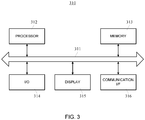
- FIG. 3 is a block diagram schematically illustrating an image data processing device according to an embodiment of the present disclosure.
- the image data processing device 310 may include a bus 311, a processor 312, a memory 313, an input/output (I/O) interface 314, a display 315 and a communication interface 316.
- I/O input/output
- the above elements may be omitted, or other elements may be added to the processing device 310.
- the bus 311 may connect the above components 312 to 316 to each other, and communicate (e.g., control messages and/or data) between the above components.
- the processor 312 may include, for example, a central processing unit (CPU), an application processor (AP) or a communication processor (CP), etc.
- the processor 312 may perform data processing or operations related to communication and/or control of at least one other component of the processing device 310.
- the memory 313 may include a volatile memory and/or a non-volatile memory.
- the memory 313 may store instructions or data related to at least one other component in the processing devices 310.
- the memory 313 may store software and/or programs.
- the processor 312 may perform corresponding operations, such as those described above in connection with FIG. 2 , by executing the software and/or programs stored in memory 313.
- the I/O interface 314 may be used to communicate instructions or data input from the user or other external devices to other components of the processing device 310.
- the I/O interface 314 may output instructions or data received from other components of the processing device 310 to the user or the other external devices.
- the display 315 may include, for example, a liquid crystal display (LCD), a light emitting diode (LED) display, an organic light emitting diode (OLED) display, etc.
- the display 315 may present various contents (e.g., text, images, video, etc.) to e.g. the user.
- the display 315 may include a touch screen and may receive a touch input.
- the communication interface 316 may communicate between the processing device 310 and other devices (e.g., the scanning device 120, the location tracking device 130, the motion tracking device 140, the force/tactile feedback device 150, the stereoscopic display device 160).
- the communication interface 316 may be connected to a network, such as a computer network (e.g., a local area network (LAN), a wide area network (WAN), the Internet), via wireless communication or wired communication to communicate with other devices.
- a computer network e.g., a local area network (LAN), a wide area network (WAN), the Internet
- Wireless communication may use cellular communication protocols, such as Long Term Evolution (LTE), Code Division Multiple Access (CDMA), Wideband CDMA (WCDMA) or Global System for Mobile communications (GSM) etc.
- Wireless communications may include, for example, short range communications, such as Wi-Fi, Bluetooth, Near Field Communication (NFC), etc.
- Wired communications may include Universal Serial Bus (USB) etc.
- a high-speed private network or the Internet may be used for communications in real time.
Landscapes
- Engineering & Computer Science (AREA)
- Physics & Mathematics (AREA)
- General Physics & Mathematics (AREA)
- Theoretical Computer Science (AREA)
- General Engineering & Computer Science (AREA)
- Life Sciences & Earth Sciences (AREA)
- Health & Medical Sciences (AREA)
- High Energy & Nuclear Physics (AREA)
- Computer Vision & Pattern Recognition (AREA)
- Human Computer Interaction (AREA)
- Computer Graphics (AREA)
- Geophysics (AREA)
- General Life Sciences & Earth Sciences (AREA)
- Spectroscopy & Molecular Physics (AREA)
- Molecular Biology (AREA)
- Quality & Reliability (AREA)
- Analytical Chemistry (AREA)
- Chemical & Material Sciences (AREA)
- Radiology & Medical Imaging (AREA)
- Biochemistry (AREA)
- General Health & Medical Sciences (AREA)
- Immunology (AREA)
- Pathology (AREA)
- Pulmonology (AREA)
- Nuclear Medicine, Radiotherapy & Molecular Imaging (AREA)
- Processing Or Creating Images (AREA)
- User Interface Of Digital Computer (AREA)
Abstract
Description
- The present disclosure relates to the security inspection field, and in particular, to an image data processing device and a security inspection system based on virtual reality (VR) or augmented reality (AR).
- With rapid development of container transportation business, more and more goods are contained and transported via containers. Due to the hidden nature of the goods in the container, it brings opportunities to shippers to conceal dangerous goods and smuggled goods. Although inspection means like X-ray transmission systems have brought great convenience to safe transportation of the containers, image viewers who take charge of watching monitors to obtain goods information only by their experience have a great burden, and thus are easily tired. On the other hand, there is still a certain percentage of the containers required for unpacking inspection in actual practices, but there are many difficulties in the unpacking inspection of the containers. For example, the containers are often used for transporting large objects, and carrying them out of the containers is complex and dangerous. In another example, the goods in the containers are arranged closely, and there are difficulties in reassembling them after their unpacking inspection. In yet another example, procedures of the unpacking inspection are complex and time-consuming, extending the shipping time. In addition, a direct on-site unpacking inspection for the containers in which the dangerous goods are concealed also threatens personal safety of inspectors.
- Objects of the present disclosure consist, at least in part, in providing a method, a device and a security system for image data processing based on virtual reality (VR) or augmented reality (AR).
- According to an aspect of the present disclosure, there is provided an image data processing method, including: reconstructing, based on three-dimensional (3D) scanned data of a containing apparatus in which objects are contained, a 3D image of the containing apparatus and the objects contained in the containing apparatus; stereoscopically displaying the reconstructed 3D image; determining manipulation information for at least one of the objects in the containing apparatus based on positioning information and action information of a user; re-reconstructing at least a 3D image of the at least one object based on the determined manipulation information; and presenting the at least one re-reconstructed object on the displayed 3D image.
- According to another aspect of the present disclosure, there is provided an image data processing device, including: a communication interface, configured to receive 3D scanned data of a containing apparatus in which objects are contained; and a processor, configured to reconstruct, based on the received 3D scanned data, a 3D image of the containing apparatus and the objects contained in the containing apparatus for display; wherein the communication interface is further configured to receive positioning information and action information of a user, and wherein the processor is further configured to determine manipulation information for at least one of the objects in the containing apparatus based on the received positioning information and action information, and re-reconstruct at least a 3D image of the at least one object based on the determined manipulation information.
- According to yet another aspect of the present disclosure, there is provided a security inspection system is provided, including: a 3D scanning device, configured to 3D scan a containing apparatus in which objects are contained to generate 3D scanned data; a location tracking device, configured to position a location of a user for providing positioning information of the user; a motion tracking device, configured to determine a motion of the user for providing action information of the user; an image data processing device as previously described; and a stereoscopic display, configured to display a reconstructed 3D image.
- According to yet another aspect of the present disclosure, a computer readable recording medium having executable instructions stored thereon, which when executed by one or more processors, cause the one or more processors to perform operations of: reconstructing, based on 3D scanned data of a containing apparatus in which objects are contained, a 3D image of the containing apparatus and the objects contained in the containing apparatus; stereoscopically displaying the reconstructed 3D images; determining manipulation information for at least one of the objects in the containing apparatus based on positioning information and action information of a user; re-reconstructing at least a 3D image of the at least one object based on the determined manipulation information; and presenting the at least one re-reconstructed object on the displayed 3D image.
- For example, the 3D scanned data include at least one of X-ray Computerized Tomography (X-CT) scanned data and multi-view X-ray scanned data. These data may be obtained by, for example, a 3D scanning device, such as an X-CT scanning device or a multi-view X-ray scanning device.
- At least one of structural and material properties of the at least one object may be determined based on the 3D scanned data. The determined at least one of the structural and material properties of the at least one object may be displayed around the at least one object.
- The display for displaying the 3D image and various other information may be a stereoscopic display, such as a stereoscopic display of a helmet type, a glasses type, a desktop type, a projection type, a hand-held type or an auto-stereoscopic display type.
- Feedback information may be determined based on the manipulation information and/or the determined at least one of the structural and material properties. The user may be provided with force/tactile feedback based on the feedback information. For example, the user may be provided with the force/tactile feedback by a force/tactile feedback device worn by the user.
- The scanning device may be controlled to further scan an area where the at least one object is located based on the determined manipulation information.
- According to embodiments of the present disclosure, the (3D) image of articles within the containing apparatus (e.g., the container) may be generated by the 3D scanning device (e.g., the X-CT or the multi-view X-ray scanning device). A VR or AR space may be created by stereoscopically displaying the generated image. An inspector may be equipped with a VR or AR enabled auxiliary device to enter the VR or AR space, and may rummage and inspect suspected areas. The inspector's actions may be reflected into the virtual space in real time, and the rummage inspection process may be displayed simultaneously. Thus, the inspector can have a sense of reality of coming to the inspection spot in person by interaction with the articles within the containing apparatus in a digitalized environment using the VR or AR enabled device. Compared with the unpacking inspection on site, such a simulated inspection way vividly and simply shows the conditions of the goods in the container and the process of unpacking inspection, saving manpower, material resources and time consumed by the inspection and improving efficiency and security of operations of the container inspection.
- The above and other objects, features and advantages of the present disclosure will be more apparent from the following preferred embodiments illustrated with reference to the figures, in which:
-
FIG. 1 is a block diagram schematically showing a security inspection system according to an embodiment of the present disclosure; -
FIG. 2 is a flowchart schematically illustrating an image data processing method according to an embodiment of the present disclosure; and -
FIG. 3 is a block diagram schematically showing an image data processing device according to an embodiment of the present disclosure. - Throughout the drawings, like or similar reference numbers indicate like or similar parts.
- Hereinafter, embodiments of the present disclosure will be described with reference to the accompanying drawings. It is to be understood that such descriptions are illustrative only, but are not intended to limit the scope of the present disclosure. In addition, in the following, descriptions of well-known structures and techniques are omitted to avoid unnecessarily obscuring the concepts of the present disclosure.
- Terms used herein are for the purpose of describing particular embodiments only, but are not intended to limit the present disclosure. Words "a", "an" and "the" as used herein should also cover the meanings of "a plurality of", "a variety of", unless the context clearly indicates otherwise. In addition, terms "comprising", "including", "containing" and the like as used herein indicate the presence of features, steps, operations and/or components, but do not exclude the presence or addition of one or more other features, steps, operations or components.
- All terms (including technical and scientific terms) used herein have the same meanings as commonly understood by the skilled in the art, unless defined otherwise. It should be noted that the terms used herein should be construed to have the same meanings as the context of the present specification and should not be interpreted in an idealized or overly formal manner.
- Some block diagrams and/or flowcharts are shown in the accompanying drawings. It should be understood that some of blocks or combinations thereof in the block diagrams and/or flowcharts may be implemented by computer program instructions. The computer program instructions may be provided to a general purpose computer, a dedicated computer, or processors of other programmable data processing apparatuses, so that the instructions, when being executed by the processor, may create means for implementing functions/operations as described in the block diagrams and/or flowcharts.
- Thus, the techniques of the present disclosure may be implemented in forms of hardware and/or software (including firmware, microcode, etc.). In addition, the techniques of the present disclosure may be embodied in a form of a computer program product on a computer readable medium storing instructions. The computer program product may be used by an instruction execution system or in conjunction with an instruction execution system. In the context of the present disclosure, the computer readable medium may be any medium capable of containing, storing, transmitting, propagating, or transmitting instructions. For example, the computer readable media may include, but not limited to, electrical, magnetic, optical, electromagnetic, infrared or semiconductor systems, apparatuses, devices, or propagation media. Particular examples of the computer readable media may include a magnetic storage device, such as a magnetic tape or a hard drive disk (HDD); an optical storage device, such as an optical disk (CD-ROM); a memory, such as a random access memory (RAM) or a flash memory; and/or a wired/wireless communication link.
-
FIG. 1 is a block diagram schematically showing a security inspection system according to an embodiment of the present disclosure. - As shown in
FIG. 1 , asecurity inspection system 100 according to this embodiment may include an imagedata processing device 110, a three dimensional (3D)scanning device 120 and astereoscopic display device 160. Such asecurity inspection system 100 may be applied to places, such as stations, airports, customs etc., where articles need to be inspected to prevent entry of contraband. - The
3D scanning device 120 may perform 3D scanning on a target, e.g., a containing apparatus (e.g., a container) 200 in which objects are contained, so as to generate 3D scanned data. Here, the "3D scanned data" refers to data, based on which a 3D profile of the scanned target can be reconstructed to obtain a 3D image of the scanned target. For example, the3D scanning device 120 may include an X-ray Computerized Tomography (X-CT) scanning device, a multi-view X-ray scanning device, etc. - In an example, a security inspection channel may be arranged, and a radiation source (e.g., an X-ray generator) and corresponding detector(s) may be deployed around the security inspection channel. The target to be scanned may pass through the security inspection channel (e.g., by a transfer device, a transport vehicle, etc.). When the target passes through the security inspection channel, radiation emitted by the radiation source may irradiate the target, and transmitted (and/or scattered) by the target to be detected by the detector(s). According to the detected radiation, information inside the target may be learned. For example, in the scanning device, such as the X-CT scanning device or the multi-view X-ray scanning device, a cross-section of the target may be reconstructed according to the detected radiation, and the 3D profile of the target may be generated based on a plurality of such reconstructed cross-sections.
- In addition, the dual-energy scanning technology may be used. For example, the target may be scanned using high-energy and low-energy X-rays. Using the dual-energy scanning technology, material properties, such as an equivalent atomic coefficient, density, etc., of the target may be obtained in a better way. However, the dual-energy scanning is not definitely necessary, e.g., in a case that single-energy scanning is sufficient to determine desired material information.
- A speed of the scanning may be controlled to get a certain amount of scanned data. The amount of the scanned data is sufficient, on one hand, to generate a clear image, and on the other hand, may not be too much, in order to reduce storage and processing burdens.
- Here, a containing apparatus for accommodating the objects, such as a container, may be described as an example, but the present disclosure is not limited to this. The technology of the present disclosure is suitable for various security inspection scenarios.
- The image
data processing device 110 may reconstruct a 3D image of the target, e.g., the container and the object(s) accommodated therein, based on the 3D scanned data generated by the3D scanning apparatus 120. For example, the imagedata processing device 110 may detect edges of each object from the 3D scanned data by using edge detection technology, and may match the edges of the same object at different viewing angles, so as to reconstruct the cross-section of the object. By connecting a plurality of cross-sections of the same object (and possibly interpolating between the cross-sections), the 3D profile of the object may be obtained. On the other hand, the material properties, such as the equivalent atomic coefficient, the density value etc., of the object may be calculated based on the reconstructed cross-section. - The
stereoscopic display device 160 may stereoscopically display the 3D image reconstructed by the imagedata processing device 110. In this way, an image space, i.e., a virtual reality (VR) or augmented reality (AR) space 400 (hereinafter referred to as "a virtual space") is created. Such a virtual space does not necessarily be a physical space in the real world, but may be a space that can be perceived by theuser 300's vision. For example, the eyes of theuser 300 may receive light signals from the display device, so as to perceive as if he was exposed to a certain space (in this example, the internal space of the target to be inspected). - The
stereoscopic display device 160 for displaying the 3D image (in real time) may be of a helmet type, a glasses type, a desktop type, a projection type, a hand-held type or an auto-stereoscopic display type etc. For example, in a case of a single user, the user may wear the helmet-type or glasses-type display device; while in a case of multiple users, the desktop-type, the projection-type, the hand-held type or the auto-stereoscopic display-type display device may be used. - According to an embodiment of the present disclosure, it may be determined whether there is contraband such as explosive, weapons or the like based on the material properties, such as the equivalent atomic number and the density value. For example, the atomic numbers and the densities in the plurality of cross-sections may be averaged. If the resultant average value falls within a contraband area in a contraband database, it may be determined that there is contraband; if the average value falls into other areas than the contraband area, it may be determined as a safety product. Objects that are determined to be contraband may be highlighted to alert the user.
- According to an embodiment of the present disclosure, the detected object may be compared with a list of items (e.g., a declaration of customs) based on the structure (e.g., 3D profile) and/or material properties of the object. If the detected object matches an object listed in the list of items, relevant information (e.g., an item name, a manufacturer, etc.) in the list of items may be displayed (e.g., in a form of text) around the corresponding object. If there is no item in the list of items matched with some detected object, the user is alerted.
- In addition, the determined structural and/or material properties may also be displayed (e.g., in the form of text) around the respective objects for facilitating the user to view.
- The
security inspection system 100 may further include various sensing devices, such as alocation tracking device 130 and amotion tracking device 140, for sensing location and motion of the user, in order to determine which one of the objects and how the user desires to manipulate. These sensing devices may be wearable, so as to be worn by the user on his/her body; or may be provided separately from the user. - The
location tracking device 130 may position the location of the user to provide positioning information of the user. The imagedata processing device 110 may map the positioning information of the user determined by thelocation tracking device 130 into the image space or the virtual space. For example, an initial location of the user may be mapped to an entrance of the container, and the location of the user in the virtual space may be changed accordingly based on the user's movement determined by the positioning information. For example, when it is determined based on the positioning information that the user moves leftward/rightward/forward/backward by a certain distance, the location of the user in the virtual space may be moved leftward/rightward/forward/backward relative to the initial location by a corresponding distance, which may be identical with an actual moving distance of the user, or scaled by a certain factor. - For example, the
location tracking device 130 may include a Global Positioning System (GPS) device carried by the user, an ultrasound positioning device carried by the user and co-located with an ultrasonic transceiver arranged around the user, or a video device. In a case of the video device, the user's movement may be determined by image recognition. - The
location tracking device 130 may include a plurality of location sensors provided at different parts of the user's body. The imagedata processing device 110 may respectively map the different parts of the user into the virtual space according to the sensed data of the plurality of location sensors, so as to more accurately locate the location of the user in the virtual space. - The
motion tracking device 140 may determine the user's motion in order to provide action information of the user. For example, themotion tracking device 140 may track certain key points (e.g., joints, hands, etc.) of the user, and capture motion data of the user. For example, themotion tracking device 140 may include data clothing. The imagedata processing device 110 may map these motion data onto a (pre-stored) human body model, and may generate a continuous process of body motion by motion control. - The image
data processing apparatus 110 may determine manipulation information for at least one of the objects based on the positioning information and the action information of the user. For example, when it is determined based on the positioning information that the user is located besides some object, and it is determined based on the action information that the user makes an action, such as moving, turning over, etc., the imagedata processing device 110 may determine the manipulation information for the object (translation/rotation, a translation distance, a rotation angle, etc.). The translation distance and the rotation angle may be determined according to a magnitude of the action. - When the user manipulates the object in the virtual space, the display in the virtual space may be updated accordingly. For example, the image
data processing apparatus 110 may at least partially reconstruct the 3D image (e.g., reconstructing a 3D image of the manipulated object, and, optionally, reconstructing a 3D image of a region around the manipulated object, and, of course, reconstructing the entire 3D image), based on the manipulation information. For example, when the manipulation information indicates a translation manipulation, the 3D image of the object may be reconstructed to a location to which the object is translated, and the object may be removed from its original location. In another example, when the manipulation information indicates a rotation manipulation, the object is reconstructed from different angles of view depending on its rotating angle. As such, it appears to the user as if he is really manipulating the object. - As described above, the user may operate on the object which is alerted to possibly be contraband, in order to inspect the object more carefully. After an object is determined to be a manipulation target, the structural and/or material properties of the object may be displayed around the object for user's reference.
- According to an embodiment of the present disclosure, after an object is determined to be a manipulation target, the image
data processing device 110 may send an instruction to the3D scanning device 120 to further scan the area where the object is located, e.g., to scan the area with a higher intensity and/or at denser scanning intervals, for clearer details. The imagedata processing device 110 may re-reconstruct the image of the area based on re-scanned data, and update the display of the area. - According to an embodiment of the present disclosure, it is also possible to provide a perceptive feedback to the user in order to provide the user with more realistic feeling. To this end, the
security inspection system 100 may also include a force/tactile feedback device 150. The force/tactile feedback device 150 may reflect physical characteristics, such as texture, material, and state (such as a liquid state, a solid state, a gel state, etc.), and movement changes of the object in the virtual space to the user through tactile sensing. For example, the force/tactile feedback device 150 may give a certain stimulus to the user, so that the user may obtain some sense of perception. For example, the force/tactile feedback device 150 may include data glove(s), within which some contacts that may be vibrated are mounted to simulate tactile sensation. - The image
data processing device 110 may determine feedback information based at least in part on the manipulation information and/or at least one of the structural and material properties of the object. For example, when the user is manipulating the object, he may feel some reaction force. Therefore, the force received by the user may be determined based on the manipulation information, and the user may be given the feeling of such a reaction force by the force/tactile feedback device 150. For example, when the user is moving an object with both his hands, he may feel a weight of the object. The force/tactile feedback device 150 may enable the user to have such a feeling by applying a downward force to the user. The amount of the force applied may be determined based on a volume, a density value or the like of the object. In addition, there may be some concave-convex or texture on a surface of the object. Such concave-convex or texture on the surface may be determined according to the structural/material properties. The force/tactile feedback device 150 may give the user a feeling of concave-convex or texture by adjusting the contacts. In addition, the different material of the object will give different tactile sensations, such as smooth or rough. Such a tactile sensation may be given to the user by the force/tactile feedback device 150. - On the other hand, the force/
tactile feedback device 150 may also analyze the user's motion parameters, such as a direction, a velocity, an acceleration, etc. For example, a position sensor, a bending sensor and a distortion sensor etc. may be installed at fingers of the data glove, and a curvature sensor, a radian sensor etc. may be installed at a palm portion of the data glove. With such a data glove, motion data, such as locations, orientations of hands and joints, finger's states (close together or open, upturned or bent down), may be determined. The imagedata processing device 110 may determine manipulations, such as fetching, moving, assembling, or controlling, on the object in the virtual space, based on these motion data (in conjunction with the data of the motion tracking device 140). This motion-sensing function may be incorporated into themotion tracking device 140. However, e.g., in the case of the data glove, since both the motion sensing and tactile feedback are provided in the hand part, they are integrated in the same device, i.e., the data glove. - In the above examples, the image
data processing device 110 in a centralized form has been described, but the present disclosure is not limited thereto. For example, the imagedata processing device 110 may be implemented in a distributed manner, including a plurality of processing devices connected by wired and/or wireless links. These processing devices cooperate to accomplish the functions of the imagedata processing device 110 as described above. In one example, the imagedata processing device 110 may include an image processor for image reconstruction and a data processing device for processing other information (e.g., sensor information, manipulation information, feedback information, etc.). The image processor may undertake the image reconstruction with a heavier load, and may have a higher configuration for a faster processing speed (e.g., updating the 3D image in real time to provide the user with a realistic feeling). On the other hand, the data processing device is responsible for other information processing with a lighter load, and may have a lower configuration, e.g., implemented by a general-purpose computing platform, such as a personal computer (PC), a notebook computer, a tablet computer etc. -
FIG. 2 is a flowchart schematically illustrating an image data processing method according to an embodiment of the present disclosure. - As shown in
FIG. 2 , the imagedata processing method 1000 according to this embodiment includes generating a 3D image based on 3D scanned data atoperation 1100. As described above, the 3D scanned data may be obtained by scanning an inspected target (e.g., a containing apparatus which contains objects) by a 3D scanning device atoperation 2100. - At
operation 1200, the generated 3D image may be displayed stereoscopically, so as to create an image space, i.e., a virtual space (VR or AR space). As described above, the structural and/or the material properties of the objects may be determined based on the 3D scanned data, and the determined structural and/or material properties may be displayed around the respective objects atoperation 1600. - At
operation 1300, manipulation information for at least one of the objects may be determined based on positioning information and action information of the user. For example, the positioning information and the action information of the user may be determined by a location tracking device, a motion tracking device (and optionally, a force/tactile feedback device) atoperation 3100. As described above, the 3D scanning device may be instructed based on the manipulation information to further scan an area around the manipulated object. - At
operation 1400, the 3D image may be re-generated at least partially based on the determined manipulation information. As described above, the manipulated object may be reconstructed, the area around the object may be reconstructed, or even the entire 3D image may be reconstructed. For example, a location, an orientation, etc. of the object in the virtual space may be changed according to the user's manipulation. - At
operation 1500, the 3D image may be updated so as to present the re-generated portion. - Additionally, at
operation 1700, feedback information may be determined based on at least one of the manipulation information, the structural property, and the material property. The feedback information may be transmitted to the force/tactile feedback device so as to provide the user with a tactile feedback. -
FIG. 3 is a block diagram schematically illustrating an image data processing device according to an embodiment of the present disclosure. - As shown in
FIG. 3 , the image data processing device 310 (e.g., the imagedata processing device 110 as described above) according to this embodiment may include abus 311, aprocessor 312, amemory 313, an input/output (I/O)interface 314, adisplay 315 and acommunication interface 316. In various embodiments of the present disclosure, at least one of the above elements may be omitted, or other elements may be added to theprocessing device 310. - The
bus 311 may connect theabove components 312 to 316 to each other, and communicate (e.g., control messages and/or data) between the above components. - The
processor 312 may include, for example, a central processing unit (CPU), an application processor (AP) or a communication processor (CP), etc. Theprocessor 312 may perform data processing or operations related to communication and/or control of at least one other component of theprocessing device 310. - The
memory 313 may include a volatile memory and/or a non-volatile memory. Thememory 313 may store instructions or data related to at least one other component in theprocessing devices 310. According to the embodiments of the present disclosure, thememory 313 may store software and/or programs. Theprocessor 312 may perform corresponding operations, such as those described above in connection withFIG. 2 , by executing the software and/or programs stored inmemory 313. - The I/
O interface 314 may be used to communicate instructions or data input from the user or other external devices to other components of theprocessing device 310. In addition, the I/O interface 314 may output instructions or data received from other components of theprocessing device 310 to the user or the other external devices. - The
display 315 may include, for example, a liquid crystal display (LCD), a light emitting diode (LED) display, an organic light emitting diode (OLED) display, etc. Thedisplay 315 may present various contents (e.g., text, images, video, etc.) to e.g. the user. Thedisplay 315 may include a touch screen and may receive a touch input. - The
communication interface 316 may communicate between theprocessing device 310 and other devices (e.g., thescanning device 120, thelocation tracking device 130, themotion tracking device 140, the force/tactile feedback device 150, the stereoscopic display device 160). For example, thecommunication interface 316 may be connected to a network, such as a computer network (e.g., a local area network (LAN), a wide area network (WAN), the Internet), via wireless communication or wired communication to communicate with other devices. - Wireless communication may use cellular communication protocols, such as Long Term Evolution (LTE), Code Division Multiple Access (CDMA), Wideband CDMA (WCDMA) or Global System for Mobile communications (GSM) etc. Wireless communications may include, for example, short range communications, such as Wi-Fi, Bluetooth, Near Field Communication (NFC), etc. Wired communications may include Universal Serial Bus (USB) etc. A high-speed private network or the Internet may be used for communications in real time.
- The embodiments of the present disclosure have been described above. However, these embodiments are for illustrative purposes only, but are not intended to limit the scope of the present disclosure. Although the respective embodiments have been described above separately, it does not mean that the measures in the various embodiments cannot be advantageously used in combination. The scope of the present disclosure is defined by the appended claims and their equivalents. Various alternatives and modifications may be made by the skilled in the art without departing from the scope of the present disclosure, and such alternatives and modifications should fall into the scope of the present disclosure.
Claims (15)
- An image data processing method, comprising:reconstructing, based on three-dimensional (3D) scanned data of a containing apparatus in which objects are contained, a 3D image of the containing apparatus and the objects contained in the containing apparatus;stereoscopically displaying the reconstructed 3D image;determining manipulation information for at least one of the objects in the containing apparatus based on positioning information and action information of a user;re-reconstructing at least a 3D image of the at least one object based on the determined manipulation information; andpresenting the at least one re-reconstructed object on the displayed 3D image.
- The image data processing method of claim 1, wherein the 3D scanned data comprise at least one of X-ray Computerized Tomography (X-CT) scanned data and multi-view X-ray scanned data.
- The image data processing method of claim 1, further comprising:determining at least one of structural and material properties of the at least one object, based on the 3D scanned data.
- The image data processing method of claim 3, further comprising:displaying the determined at least one of the structural and material properties of the at least one object around the at least one object.
- The image data processing method of claim 3 or 4, further comprising:determining feedback information based on the manipulation information and/or the determined at least one of the structural and material properties of the at least one object; andproviding the user with a perceptive feedback based on the feedback information.
- The image data processing method of claim 1, further comprising:controlling a scanning device which generates the 3D scanned data to further scan an area where the at least one object is located, based on the determined manipulation information.
- An image data processing device, comprising:a communication interface, configured to receive three-dimensional (3D) scanned data of a containing apparatus in which objects are contained; anda processor, configured to reconstruct, based on the received 3D scanned data, a 3D image of the containing apparatus and the objects contained in the containing apparatus for display,wherein the communication interface is further configured to receive positioning information and action information of a user, andwherein the processor is further configured to determine manipulation information for at least one of the objects in the containing apparatus based on the received positioning information and action information, and re-reconstruct at least a 3D image of the at least one object based on the determined manipulation information.
- The image data processing device of claim 7, wherein the 3D scanned data comprise at least one of X-ray Computerized Tomography (X-CT) scanned data and multi-view X-ray scanned data.
- The image data processing device of claim 7, wherein the processor is further configured to determine at least one of structural and a material properties of the at least one object based on the 3D scanned data.
- The image data processing device of claim 9, wherein the communication interface is configured to transmit the determined at least one of the structural and the material properties to a display to be displayed around the at least one object.
- The image data processing device of claim 9 or 10, wherein the processor is further configured to determine feedback information based on the manipulation information and/or the determined at least one of the structural and material properties of the at least one object, and provide the determined feedback information to a force/tactile feedback device worn by the user via the communication interface.
- The image data processing device of claim 7, wherein the processor is further configured to generate, based on the determined manipulation information, a control instruction to further scan an area where the at least one object is located by a scanning device which generates the 3D scanned data, and transmit the generated control instruction to the scanning device via the communication interface.
- A security inspection system, comprising:a three-dimensional (3D) scanning device, configured to 3D scan a containing apparatus in which objects are contained to generate 3D scanned data;a location tracking device, configured to position a location of a user for providing positioning information of the user;a motion tracking device, configured to determine a motion of the user for providing action information of the user;an image data processing device according to any one of claims 7 to 12; anda stereoscopic display, configured to display a reconstructed 3D image.
- The security inspection system of claim 13, wherein the 3D scanning device comprises at least one of an X-ray Computerized Tomography (X-CT) scanning device and a multi-view X-ray scanning device.
- The security inspection system of claim 14, further comprising:a wearable force/tactile feedback device, configured to provide a force /tactile feedback to the user.
Applications Claiming Priority (1)
| Application Number | Priority Date | Filing Date | Title |
|---|---|---|---|
| CN201611255796.0A CN108268120B (en) | 2016-12-29 | 2016-12-29 | Image data processing method and device based on VR or AR and security inspection system |
Publications (2)
| Publication Number | Publication Date |
|---|---|
| EP3346301A1 true EP3346301A1 (en) | 2018-07-11 |
| EP3346301B1 EP3346301B1 (en) | 2022-08-31 |
Family
ID=61002804
Family Applications (1)
| Application Number | Title | Priority Date | Filing Date |
|---|---|---|---|
| EP17211108.0A Active EP3346301B1 (en) | 2016-12-29 | 2017-12-29 | Image data processing method, device and security inspection system based on virtual reality or augmented reality |
Country Status (4)
| Country | Link |
|---|---|
| US (1) | US11699223B2 (en) |
| EP (1) | EP3346301B1 (en) |
| CN (1) | CN108268120B (en) |
| PL (1) | PL3346301T3 (en) |
Families Citing this family (7)
| Publication number | Priority date | Publication date | Assignee | Title |
|---|---|---|---|---|
| CN109785446B (en) * | 2019-02-28 | 2024-02-02 | 清华大学 | Image recognition system and method |
| CN110031909B (en) * | 2019-04-18 | 2024-08-16 | 西安天和防务技术股份有限公司 | Security inspection system and security inspection method |
| CN112730468B (en) * | 2019-10-28 | 2022-07-01 | 同方威视技术股份有限公司 | Article detection device and method for detecting article |
| CN112784622B (en) | 2019-11-01 | 2023-07-25 | 抖音视界有限公司 | Image processing method and device, electronic equipment and storage medium |
| CN114202707B (en) * | 2020-08-31 | 2025-09-23 | 宇龙计算机通信科技(深圳)有限公司 | Parts installation method, device, storage medium and AR glasses |
| CN115598715B (en) * | 2021-07-07 | 2024-10-15 | 同方威视技术股份有限公司 | Inspection system and method |
| CN120214944A (en) * | 2025-04-02 | 2025-06-27 | 中国标准化研究院 | An X-ray equipment control system based on intelligent security inspection |
Citations (3)
| Publication number | Priority date | Publication date | Assignee | Title |
|---|---|---|---|---|
| WO2006134362A2 (en) * | 2005-06-15 | 2006-12-21 | Stereo Scan Systems Limited | X-ray screening apparatus with independently moveable source and detector |
| US20160163105A1 (en) * | 2013-08-26 | 2016-06-09 | Koh Young Technology Inc. | Method of operating a surgical navigation system and a system using the same |
| US20160209335A1 (en) * | 2015-01-20 | 2016-07-21 | Sandia Corporation | Material identification system |
Family Cites Families (18)
| Publication number | Priority date | Publication date | Assignee | Title |
|---|---|---|---|---|
| CN101071111B (en) * | 2006-05-08 | 2011-05-11 | 清华大学 | Multi-vision aviation container safety inspection system and method |
| EP2135197A4 (en) * | 2007-03-02 | 2012-11-14 | Organic Motion | System and method for tracking three dimensional objects |
| US8311791B1 (en) * | 2009-10-19 | 2012-11-13 | Surgical Theater LLC | Method and system for simulating surgical procedures |
| WO2012106706A2 (en) * | 2011-02-04 | 2012-08-09 | University Of Pittsburgh - Of The Commonwealth System Of Higher Education | Hybrid physical-virtual reality simulation for clinical training capable of providing feedback to a physical anatomic model |
| CN102359971A (en) * | 2011-09-14 | 2012-02-22 | 上海英迈吉东影图像设备有限公司 | Method for realizing single-source and multi-view security inspection, and system thereof |
| KR101800189B1 (en) * | 2012-04-30 | 2017-11-23 | 삼성전자주식회사 | Apparatus and method for controlling power of surgical robot |
| US10884493B2 (en) * | 2013-06-20 | 2021-01-05 | Uday Parshionikar | Gesture based user interfaces, apparatuses and systems using eye tracking, head tracking, hand tracking, facial expressions and other user actions |
| US20160147308A1 (en) * | 2013-07-10 | 2016-05-26 | Real View Imaging Ltd. | Three dimensional user interface |
| JP6635929B2 (en) * | 2014-02-21 | 2020-01-29 | トリスペラ デンタル インコーポレイテッド | Augmented reality dental design method and system |
| US9696795B2 (en) * | 2015-02-13 | 2017-07-04 | Leap Motion, Inc. | Systems and methods of creating a realistic grab experience in virtual reality/augmented reality environments |
| US20170131775A1 (en) * | 2015-11-10 | 2017-05-11 | Castar, Inc. | System and method of haptic feedback by referral of sensation |
| US9861446B2 (en) * | 2016-03-12 | 2018-01-09 | Philipp K. Lang | Devices and methods for surgery |
| CN109069208B (en) * | 2016-03-14 | 2023-02-28 | 穆罕默德·R·马赫福兹 | Ultra-Wideband Positioning for Wireless Ultrasound Tracking and Communication |
| EP3443735B1 (en) * | 2016-04-12 | 2024-09-18 | Quidient, LLC | Quotidian scene reconstruction engine |
| US10194990B2 (en) * | 2016-04-27 | 2019-02-05 | Arthrology Consulting, Llc | Method for augmenting a surgical field with virtual guidance content |
| WO2018085797A1 (en) * | 2016-11-04 | 2018-05-11 | Aquifi, Inc. | System and method for portable active 3d scanning |
| US10754416B2 (en) * | 2016-11-14 | 2020-08-25 | Logitech Europe S.A. | Systems and methods for a peripheral-centric augmented/virtual reality environment |
| US10271043B2 (en) * | 2016-11-18 | 2019-04-23 | Zspace, Inc. | 3D user interface—360-degree visualization of 2D webpage content |
-
2016
- 2016-12-29 CN CN201611255796.0A patent/CN108268120B/en active Active
-
2017
- 2017-12-29 EP EP17211108.0A patent/EP3346301B1/en active Active
- 2017-12-29 US US15/858,868 patent/US11699223B2/en active Active
- 2017-12-29 PL PL17211108.0T patent/PL3346301T3/en unknown
Patent Citations (3)
| Publication number | Priority date | Publication date | Assignee | Title |
|---|---|---|---|---|
| WO2006134362A2 (en) * | 2005-06-15 | 2006-12-21 | Stereo Scan Systems Limited | X-ray screening apparatus with independently moveable source and detector |
| US20160163105A1 (en) * | 2013-08-26 | 2016-06-09 | Koh Young Technology Inc. | Method of operating a surgical navigation system and a system using the same |
| US20160209335A1 (en) * | 2015-01-20 | 2016-07-21 | Sandia Corporation | Material identification system |
Non-Patent Citations (1)
| Title |
|---|
| BENJAMIN AVERY: "X-Ray Vision for Mobile Outdoor Augmented Reality", 31 May 2009 (2009-05-31), pages I - XIX,1, XP002716488, Retrieved from the Internet <URL:http://search.ror.unisa.edu.au/record/UNISA_ALMA2164004640001831/media/digital/open/9915951885301831/12146717960001831/13146717590001831/pdf> [retrieved on 20131114] * |
Also Published As
| Publication number | Publication date |
|---|---|
| EP3346301B1 (en) | 2022-08-31 |
| CN108268120B (en) | 2020-07-28 |
| US20180189945A1 (en) | 2018-07-05 |
| PL3346301T3 (en) | 2023-01-30 |
| US11699223B2 (en) | 2023-07-11 |
| CN108268120A (en) | 2018-07-10 |
Similar Documents
| Publication | Publication Date | Title |
|---|---|---|
| EP3346301B1 (en) | Image data processing method, device and security inspection system based on virtual reality or augmented reality | |
| US12106416B2 (en) | Artificial reality system architecture for concurrent application execution and collaborative 3D scene rendering | |
| EP3304252B1 (en) | Shared tactile interaction and user safety in shared space multi-person immersive virtual reality | |
| EP3824370B1 (en) | Selectively alerting users of real objects in a virtual environment | |
| Teixeira et al. | Teleoperation using google glass and ar, drone for structural inspection | |
| WO2019139783A1 (en) | Providing body-anchored mixed-reality experiences | |
| JP6478360B2 (en) | Content browsing | |
| Irlitti et al. | Conveying spatial awareness cues in xR collaborations | |
| EP3994552B1 (en) | Preview animation | |
| CN107949802A (en) | Holographic architecture information renewal | |
| CN102930753A (en) | Gas station virtual training system and application | |
| CN107230248A (en) | Viewpoint selection in virtual 3D environment | |
| Nguyen et al. | Mixed reality system for nondestructive evaluation training | |
| Xiao et al. | A three-dimensional mapping and virtual reality-based human–robot interaction for collaborative space exploration | |
| Martini et al. | Obstacle avoidance and interaction in extended reality: An approach based on 3d object detection | |
| CN112346579A (en) | Pointing and interaction control device for large-scale desktop model | |
| US20180330532A1 (en) | Selective display in an environment defined by a data set | |
| Akhmetov | Industrial Safety Using Augmented Reality and Artificial Intelligence | |
| Nguyen et al. | Collaborative exploration in a multi-scale shared virtual environment | |
| Ruffaldi et al. | Co-located haptic interaction for virtual USG exploration | |
| Rehmann et al. | Towards relevant human-vehicle interaction data for perceptive machine learning | |
| US20260112279A1 (en) | Systems and methods for a universal interactive extended reality detector sweep trainer | |
| Hein et al. | Beyond Boundaries: Exploring Augmented Reality Barrier-Bypassing Display Modalities | |
| Jacke et al. | VR-based interface enabling ad-hoc individualization of information layer presentation | |
| Muff | Specific Requirements for Metamodeling for Extended Reality |
Legal Events
| Date | Code | Title | Description |
|---|---|---|---|
| PUAI | Public reference made under article 153(3) epc to a published international application that has entered the european phase |
Free format text: ORIGINAL CODE: 0009012 |
|
| STAA | Information on the status of an ep patent application or granted ep patent |
Free format text: STATUS: REQUEST FOR EXAMINATION WAS MADE |
|
| 17P | Request for examination filed |
Effective date: 20171229 |
|
| AK | Designated contracting states |
Kind code of ref document: A1 Designated state(s): AL AT BE BG CH CY CZ DE DK EE ES FI FR GB GR HR HU IE IS IT LI LT LU LV MC MK MT NL NO PL PT RO RS SE SI SK SM TR |
|
| AX | Request for extension of the european patent |
Extension state: BA ME |
|
| STAA | Information on the status of an ep patent application or granted ep patent |
Free format text: STATUS: EXAMINATION IS IN PROGRESS |
|
| 17Q | First examination report despatched |
Effective date: 20200128 |
|
| GRAP | Despatch of communication of intention to grant a patent |
Free format text: ORIGINAL CODE: EPIDOSNIGR1 |
|
| STAA | Information on the status of an ep patent application or granted ep patent |
Free format text: STATUS: GRANT OF PATENT IS INTENDED |
|
| INTG | Intention to grant announced |
Effective date: 20220408 |
|
| GRAS | Grant fee paid |
Free format text: ORIGINAL CODE: EPIDOSNIGR3 |
|
| GRAA | (expected) grant |
Free format text: ORIGINAL CODE: 0009210 |
|
| STAA | Information on the status of an ep patent application or granted ep patent |
Free format text: STATUS: THE PATENT HAS BEEN GRANTED |
|
| AK | Designated contracting states |
Kind code of ref document: B1 Designated state(s): AL AT BE BG CH CY CZ DE DK EE ES FI FR GB GR HR HU IE IS IT LI LT LU LV MC MK MT NL NO PL PT RO RS SE SI SK SM TR |
|
| REG | Reference to a national code |
Ref country code: CH Ref legal event code: EP Ref country code: GB Ref legal event code: FG4D |
|
| REG | Reference to a national code |
Ref country code: AT Ref legal event code: REF Ref document number: 1515699 Country of ref document: AT Kind code of ref document: T Effective date: 20220915 Ref country code: DE Ref legal event code: R096 Ref document number: 602017061194 Country of ref document: DE |
|
| REG | Reference to a national code |
Ref country code: IE Ref legal event code: FG4D |
|
| REG | Reference to a national code |
Ref country code: NL Ref legal event code: FP |
|
| REG | Reference to a national code |
Ref country code: LT Ref legal event code: MG9D |
|
| PG25 | Lapsed in a contracting state [announced via postgrant information from national office to epo] |
Ref country code: SE Free format text: LAPSE BECAUSE OF FAILURE TO SUBMIT A TRANSLATION OF THE DESCRIPTION OR TO PAY THE FEE WITHIN THE PRESCRIBED TIME-LIMIT Effective date: 20220831 Ref country code: RS Free format text: LAPSE BECAUSE OF FAILURE TO SUBMIT A TRANSLATION OF THE DESCRIPTION OR TO PAY THE FEE WITHIN THE PRESCRIBED TIME-LIMIT Effective date: 20220831 Ref country code: NO Free format text: LAPSE BECAUSE OF FAILURE TO SUBMIT A TRANSLATION OF THE DESCRIPTION OR TO PAY THE FEE WITHIN THE PRESCRIBED TIME-LIMIT Effective date: 20221130 Ref country code: LV Free format text: LAPSE BECAUSE OF FAILURE TO SUBMIT A TRANSLATION OF THE DESCRIPTION OR TO PAY THE FEE WITHIN THE PRESCRIBED TIME-LIMIT Effective date: 20220831 Ref country code: LT Free format text: LAPSE BECAUSE OF FAILURE TO SUBMIT A TRANSLATION OF THE DESCRIPTION OR TO PAY THE FEE WITHIN THE PRESCRIBED TIME-LIMIT Effective date: 20220831 Ref country code: FI Free format text: LAPSE BECAUSE OF FAILURE TO SUBMIT A TRANSLATION OF THE DESCRIPTION OR TO PAY THE FEE WITHIN THE PRESCRIBED TIME-LIMIT Effective date: 20220831 |
|
| REG | Reference to a national code |
Ref country code: AT Ref legal event code: MK05 Ref document number: 1515699 Country of ref document: AT Kind code of ref document: T Effective date: 20220831 |
|
| PG25 | Lapsed in a contracting state [announced via postgrant information from national office to epo] |
Ref country code: IS Free format text: LAPSE BECAUSE OF FAILURE TO SUBMIT A TRANSLATION OF THE DESCRIPTION OR TO PAY THE FEE WITHIN THE PRESCRIBED TIME-LIMIT Effective date: 20221231 Ref country code: HR Free format text: LAPSE BECAUSE OF FAILURE TO SUBMIT A TRANSLATION OF THE DESCRIPTION OR TO PAY THE FEE WITHIN THE PRESCRIBED TIME-LIMIT Effective date: 20220831 Ref country code: GR Free format text: LAPSE BECAUSE OF FAILURE TO SUBMIT A TRANSLATION OF THE DESCRIPTION OR TO PAY THE FEE WITHIN THE PRESCRIBED TIME-LIMIT Effective date: 20221201 |
|
| PG25 | Lapsed in a contracting state [announced via postgrant information from national office to epo] |
Ref country code: SM Free format text: LAPSE BECAUSE OF FAILURE TO SUBMIT A TRANSLATION OF THE DESCRIPTION OR TO PAY THE FEE WITHIN THE PRESCRIBED TIME-LIMIT Effective date: 20220831 Ref country code: RO Free format text: LAPSE BECAUSE OF FAILURE TO SUBMIT A TRANSLATION OF THE DESCRIPTION OR TO PAY THE FEE WITHIN THE PRESCRIBED TIME-LIMIT Effective date: 20220831 Ref country code: PT Free format text: LAPSE BECAUSE OF FAILURE TO SUBMIT A TRANSLATION OF THE DESCRIPTION OR TO PAY THE FEE WITHIN THE PRESCRIBED TIME-LIMIT Effective date: 20230102 Ref country code: ES Free format text: LAPSE BECAUSE OF FAILURE TO SUBMIT A TRANSLATION OF THE DESCRIPTION OR TO PAY THE FEE WITHIN THE PRESCRIBED TIME-LIMIT Effective date: 20220831 Ref country code: DK Free format text: LAPSE BECAUSE OF FAILURE TO SUBMIT A TRANSLATION OF THE DESCRIPTION OR TO PAY THE FEE WITHIN THE PRESCRIBED TIME-LIMIT Effective date: 20220831 Ref country code: CZ Free format text: LAPSE BECAUSE OF FAILURE TO SUBMIT A TRANSLATION OF THE DESCRIPTION OR TO PAY THE FEE WITHIN THE PRESCRIBED TIME-LIMIT Effective date: 20220831 Ref country code: AT Free format text: LAPSE BECAUSE OF FAILURE TO SUBMIT A TRANSLATION OF THE DESCRIPTION OR TO PAY THE FEE WITHIN THE PRESCRIBED TIME-LIMIT Effective date: 20220831 |
|
| PG25 | Lapsed in a contracting state [announced via postgrant information from national office to epo] |
Ref country code: SK Free format text: LAPSE BECAUSE OF FAILURE TO SUBMIT A TRANSLATION OF THE DESCRIPTION OR TO PAY THE FEE WITHIN THE PRESCRIBED TIME-LIMIT Effective date: 20220831 Ref country code: EE Free format text: LAPSE BECAUSE OF FAILURE TO SUBMIT A TRANSLATION OF THE DESCRIPTION OR TO PAY THE FEE WITHIN THE PRESCRIBED TIME-LIMIT Effective date: 20220831 |
|
| REG | Reference to a national code |
Ref country code: DE Ref legal event code: R097 Ref document number: 602017061194 Country of ref document: DE |
|
| PG25 | Lapsed in a contracting state [announced via postgrant information from national office to epo] |
Ref country code: AL Free format text: LAPSE BECAUSE OF FAILURE TO SUBMIT A TRANSLATION OF THE DESCRIPTION OR TO PAY THE FEE WITHIN THE PRESCRIBED TIME-LIMIT Effective date: 20220831 |
|
| REG | Reference to a national code |
Ref country code: DE Ref legal event code: R119 Ref document number: 602017061194 Country of ref document: DE |
|
| PLBE | No opposition filed within time limit |
Free format text: ORIGINAL CODE: 0009261 |
|
| STAA | Information on the status of an ep patent application or granted ep patent |
Free format text: STATUS: NO OPPOSITION FILED WITHIN TIME LIMIT |
|
| P01 | Opt-out of the competence of the unified patent court (upc) registered |
Effective date: 20230528 |
|
| REG | Reference to a national code |
Ref country code: CH Ref legal event code: PL |
|
| 26N | No opposition filed |
Effective date: 20230601 |
|
| GBPC | Gb: european patent ceased through non-payment of renewal fee |
Effective date: 20221229 |
|
| REG | Reference to a national code |
Ref country code: BE Ref legal event code: MM Effective date: 20221231 |
|
| PG25 | Lapsed in a contracting state [announced via postgrant information from national office to epo] |
Ref country code: SI Free format text: LAPSE BECAUSE OF FAILURE TO SUBMIT A TRANSLATION OF THE DESCRIPTION OR TO PAY THE FEE WITHIN THE PRESCRIBED TIME-LIMIT Effective date: 20220831 Ref country code: LU Free format text: LAPSE BECAUSE OF NON-PAYMENT OF DUE FEES Effective date: 20221229 |
|
| PG25 | Lapsed in a contracting state [announced via postgrant information from national office to epo] |
Ref country code: LI Free format text: LAPSE BECAUSE OF NON-PAYMENT OF DUE FEES Effective date: 20221231 Ref country code: IE Free format text: LAPSE BECAUSE OF NON-PAYMENT OF DUE FEES Effective date: 20221229 Ref country code: GB Free format text: LAPSE BECAUSE OF NON-PAYMENT OF DUE FEES Effective date: 20221229 Ref country code: DE Free format text: LAPSE BECAUSE OF NON-PAYMENT OF DUE FEES Effective date: 20230701 Ref country code: CH Free format text: LAPSE BECAUSE OF NON-PAYMENT OF DUE FEES Effective date: 20221231 |
|
| PG25 | Lapsed in a contracting state [announced via postgrant information from national office to epo] |
Ref country code: FR Free format text: LAPSE BECAUSE OF NON-PAYMENT OF DUE FEES Effective date: 20221231 Ref country code: BE Free format text: LAPSE BECAUSE OF NON-PAYMENT OF DUE FEES Effective date: 20221231 |
|
| PG25 | Lapsed in a contracting state [announced via postgrant information from national office to epo] |
Ref country code: HU Free format text: LAPSE BECAUSE OF FAILURE TO SUBMIT A TRANSLATION OF THE DESCRIPTION OR TO PAY THE FEE WITHIN THE PRESCRIBED TIME-LIMIT; INVALID AB INITIO Effective date: 20171229 |
|
| PG25 | Lapsed in a contracting state [announced via postgrant information from national office to epo] |
Ref country code: CY Free format text: LAPSE BECAUSE OF FAILURE TO SUBMIT A TRANSLATION OF THE DESCRIPTION OR TO PAY THE FEE WITHIN THE PRESCRIBED TIME-LIMIT Effective date: 20220831 |
|
| PG25 | Lapsed in a contracting state [announced via postgrant information from national office to epo] |
Ref country code: MK Free format text: LAPSE BECAUSE OF FAILURE TO SUBMIT A TRANSLATION OF THE DESCRIPTION OR TO PAY THE FEE WITHIN THE PRESCRIBED TIME-LIMIT Effective date: 20220831 Ref country code: IT Free format text: LAPSE BECAUSE OF FAILURE TO SUBMIT A TRANSLATION OF THE DESCRIPTION OR TO PAY THE FEE WITHIN THE PRESCRIBED TIME-LIMIT Effective date: 20220831 |
|
| PG25 | Lapsed in a contracting state [announced via postgrant information from national office to epo] |
Ref country code: MC Free format text: LAPSE BECAUSE OF FAILURE TO SUBMIT A TRANSLATION OF THE DESCRIPTION OR TO PAY THE FEE WITHIN THE PRESCRIBED TIME-LIMIT Effective date: 20220831 |
|
| PG25 | Lapsed in a contracting state [announced via postgrant information from national office to epo] |
Ref country code: MC Free format text: LAPSE BECAUSE OF FAILURE TO SUBMIT A TRANSLATION OF THE DESCRIPTION OR TO PAY THE FEE WITHIN THE PRESCRIBED TIME-LIMIT Effective date: 20220831 |
|
| PG25 | Lapsed in a contracting state [announced via postgrant information from national office to epo] |
Ref country code: BG Free format text: LAPSE BECAUSE OF FAILURE TO SUBMIT A TRANSLATION OF THE DESCRIPTION OR TO PAY THE FEE WITHIN THE PRESCRIBED TIME-LIMIT Effective date: 20220831 |
|
| PG25 | Lapsed in a contracting state [announced via postgrant information from national office to epo] |
Ref country code: MT Free format text: LAPSE BECAUSE OF FAILURE TO SUBMIT A TRANSLATION OF THE DESCRIPTION OR TO PAY THE FEE WITHIN THE PRESCRIBED TIME-LIMIT Effective date: 20220831 |
|
| PG25 | Lapsed in a contracting state [announced via postgrant information from national office to epo] |
Ref country code: TR Free format text: LAPSE BECAUSE OF FAILURE TO SUBMIT A TRANSLATION OF THE DESCRIPTION OR TO PAY THE FEE WITHIN THE PRESCRIBED TIME-LIMIT Effective date: 20220831 |
|
| PGFP | Annual fee paid to national office [announced via postgrant information from national office to epo] |
Ref country code: NL Payment date: 20251126 Year of fee payment: 9 |
|
| PGFP | Annual fee paid to national office [announced via postgrant information from national office to epo] |
Ref country code: PL Payment date: 20251222 Year of fee payment: 9 |