EP3345492A1 - Method for preparing meju soybean paste and meju soybean paste prepared thereby - Google Patents
Method for preparing meju soybean paste and meju soybean paste prepared thereby Download PDFInfo
- Publication number
- EP3345492A1 EP3345492A1 EP16842251.7A EP16842251A EP3345492A1 EP 3345492 A1 EP3345492 A1 EP 3345492A1 EP 16842251 A EP16842251 A EP 16842251A EP 3345492 A1 EP3345492 A1 EP 3345492A1
- Authority
- EP
- European Patent Office
- Prior art keywords
- soybean paste
- fermented soybean
- aging
- mixed
- korean
- Prior art date
- Legal status (The legal status is an assumption and is not a legal conclusion. Google has not performed a legal analysis and makes no representation as to the accuracy of the status listed.)
- Granted
Links
Images
Classifications
-
- A—HUMAN NECESSITIES
- A23—FOODS OR FOODSTUFFS; TREATMENT THEREOF, NOT COVERED BY OTHER CLASSES
- A23L—FOODS, FOODSTUFFS OR NON-ALCOHOLIC BEVERAGES, NOT OTHERWISE PROVIDED FOR; PREPARATION OR TREATMENT THEREOF
- A23L11/00—Pulses, i.e. fruits of leguminous plants, for production of food; Products from legumes; Preparation or treatment thereof
- A23L11/05—Mashed or comminuted pulses or legumes; Products made therefrom
- A23L11/07—Soya beans, e.g. oil-extracted soya bean flakes
-
- A—HUMAN NECESSITIES
- A23—FOODS OR FOODSTUFFS; TREATMENT THEREOF, NOT COVERED BY OTHER CLASSES
- A23L—FOODS, FOODSTUFFS OR NON-ALCOHOLIC BEVERAGES, NOT OTHERWISE PROVIDED FOR; PREPARATION OR TREATMENT THEREOF
- A23L11/00—Pulses, i.e. fruits of leguminous plants, for production of food; Products from legumes; Preparation or treatment thereof
- A23L11/10—Rapid cooking pulses
-
- A—HUMAN NECESSITIES
- A23—FOODS OR FOODSTUFFS; TREATMENT THEREOF, NOT COVERED BY OTHER CLASSES
- A23L—FOODS, FOODSTUFFS OR NON-ALCOHOLIC BEVERAGES, NOT OTHERWISE PROVIDED FOR; PREPARATION OR TREATMENT THEREOF
- A23L11/00—Pulses, i.e. fruits of leguminous plants, for production of food; Products from legumes; Preparation or treatment thereof
- A23L11/50—Fermented pulses or legumes; Fermentation of pulses or legumes based on the addition of microorganisms
-
- A—HUMAN NECESSITIES
- A23—FOODS OR FOODSTUFFS; TREATMENT THEREOF, NOT COVERED BY OTHER CLASSES
- A23L—FOODS, FOODSTUFFS OR NON-ALCOHOLIC BEVERAGES, NOT OTHERWISE PROVIDED FOR; PREPARATION OR TREATMENT THEREOF
- A23L27/00—Spices; Flavouring agents or condiments; Artificial sweetening agents; Table salts; Dietetic salt substitutes; Preparation or treatment thereof
- A23L27/50—Soya sauce
-
- A—HUMAN NECESSITIES
- A23—FOODS OR FOODSTUFFS; TREATMENT THEREOF, NOT COVERED BY OTHER CLASSES
- A23V—INDEXING SCHEME RELATING TO FOODS, FOODSTUFFS OR NON-ALCOHOLIC BEVERAGES AND LACTIC OR PROPIONIC ACID BACTERIA USED IN FOODSTUFFS OR FOOD PREPARATION
- A23V2002/00—Food compositions, function of food ingredients or processes for food or foodstuffs
-
- A—HUMAN NECESSITIES
- A23—FOODS OR FOODSTUFFS; TREATMENT THEREOF, NOT COVERED BY OTHER CLASSES
- A23V—INDEXING SCHEME RELATING TO FOODS, FOODSTUFFS OR NON-ALCOHOLIC BEVERAGES AND LACTIC OR PROPIONIC ACID BACTERIA USED IN FOODSTUFFS OR FOOD PREPARATION
- A23V2300/00—Processes
- A23V2300/38—Multiple-step
Definitions
- the present disclosure relates to a method for preparing a fermented soybean paste and a fermented soybean paste prepared by the preparation method. More specifically, the present disclosure relates to a method for preparing a fermented soybean paste and a fermented soybean paste prepared by the preparation method, which method includes mixing a traditional Korean fermented soybean paste and a modified Korean fermented soybean paste to prepare a mixed fermented soybean paste and conducting a first aging at room temperature and then a second aging at low temperature, so it maintains a deep savory taste peculiar to the Korean fermented soybean paste, uses the high enzymatic activities of protease in the modified Korean fermented soybean paste to raise the proteolysis rate, shorten the aging time and enhance a savory called "umami", and prevents browning during the process by conducting the second aging at low temperature, thereby producing a fermented soybean paste with high acceptability.
- the fermented soybean paste products are classified into a traditional Korean fermented soybean paste and a modified fermented soybean paste.
- the preparation method makes a significant difference in taste and flavor.
- the traditional Korean fermented soybean paste is a fermented soybean paste called "doenjang" prepared by a traditional method that has long been adopted as a domestic preparation method for fermented soybean paste in Korea.
- soy sauce is infused from the soaked meju bricks, and the remaining meju chunks are mashed and aged with additional salt in another crock. Through the active proteolysis, the meju chunks tend to give off lots of ammonia and a strong pungent smell.
- the modified Korean fermented soybean paste is prepared by implanting microorganisms capable of breaking down proteins and starch into a starch material like rice or barley to prepare Kokja (i.e., Korean Koji), mixing the Kokja with boiled soybeans and salt, aging the mixture, and grinding the aged mixture.
- Kokja i.e., Korean Koji
- traditional Korean fermented soybean paste is prepared by making meju from crushed soybeans, shaping it into rectangular blocks or balls, naturally fermenting the meju blocks or balls, soaking the fermented meju in brine for 6 to 12 months of aging, separating soy sauce from the solid portion, and aging the remaining solid portion.
- a method for preparing a fermented soybean paste that includes: mixing a Traditional Korean fermented soybean paste and a modified Korean fermented soybean paste to prepare a mixed fermented soybean paste; conducting a first aging for the mixed fermented soybean paste at room temperature; and conducting a second aging for the mixed fermented soybean paste at low temperature after completion of the first aging.
- fermented soybean paste prepared by the preparation method for fermented soybean paste.
- the method for preparing a fermented soybean paste and the fermented soybean paste prepared by the preparation method according to the present disclosure involve mixing a traditional Korean fermented soybean paste and a modified Korean fermented soybean paste to maintain a deep savory taste due to the multiple-step fermentation as characteristic to the traditional Korean fermented soybean paste and to use the high enzymatic activities of protease in the modified fermented soybean paste, raising the proteolysis rate, shortening the aging time and increasing a savory called "umami".
- the method for preparing a fermented soybean paste according to the present disclosure involves a second aging for the mixed fermented soybean paste at low temperature after completion of the first aging, to prevent browning during the process and produce a fermented soybean paste with high acceptability. Further, it allows the production of a fermented soybean paste with high quality in large quantities by realizing a relatively short production time while maintaining a savory taste peculiar to the Korean fermented soybean paste.
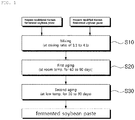
- FIG. 1 is a flow chart showing the process of the preparation method for fermented soybean paste according to the present disclosure.
- FIG. 1 is a flow chart showing the process of the preparation method for fermented soybean paste according to the present disclosure.
- the method for preparing a fermented soybean paste includes: a mixing step S10 for mixing a traditional Korean fermented soybean paste and a modified Korean fermented soybean paste to prepare a mixed fermented soybean paste; a first aging step S20 for conducting a first aging for the mixed fermented soybean paste at room temperature; and a second aging step S30 for conducting a second aging for the mixed fermented soybean paste at low temperature after completion of the first aging.
- the mixing step S10 includes mixing a traditional Korean fermented soybean paste and a modified Korean fermented soybean paste to prepare a mixed fermented soybean paste.
- the mixing method may be any one of the mixing methods known to those skilled in the art, specifically using a mixing machine to mix the traditional Korean fermented soybean paste and the modified Korean fermented soybean paste well together.
- the mixing step it is possible to provide a method for preparing a fermented soybean paste that maintains a deep savory taste peculiar to the traditional Korean fermented soybean paste and uses the high enzymatic activities of protease in the modified Korean fermented soybean paste to raise the proteolysis rate, shorten the aging time, and prevent browning, thereby producing a fermented soybean paste with high acceptability.
- the traditional Korean fermented soybean paste of the present disclosure may include a Korean-style meju, which is prepared by steaming and cooling down soybeans, shaping the soybeans into rectangular blocks with or without a fermentation starter, Aspergillus oryzae, added in an amount of 0.1 to 1.0 wt.% with respect to the weight of grains, and fermenting the blocks of soybeans.
- the Korean-style meju thus obtained is soaked in brine, aged for 6 to 12 months, and removed of soy sauce.
- the remaining solid portion of meju is crushed, mixed with more salts, and then aged in another crock.
- the preparation method of the traditional Korean fermented soybean paste is not limited to those procedures stated above.
- the modified Korean fermented soybean paste of the present disclosure may include a modified meju, which is prepared by steaming and cooling down soybeans, adding a fermentation starter, in an amount of 0.1 to 2.0 wt.%, and conducting fermentation, and the fermented soybeans keep their small ball shape.
- the modified meju may further be prepared by mixing steamed soybeans with salt, aging the steamed soybeans, and crushing the aged soybeans, after the fermentation step.
- the preparation method of the modified Korean fermented soybean paste is not limited to those procedures stated above.
- the fermentation starter used in the preparation of the modified Korean fermented soybean paste may be Aspergillus oryzae.
- the conventional modified Korean fermented soybean paste developed to impose the flavor of the traditional Korean fermented soybean paste is generally prepared by inoculating two or three strains of microorganisms for multiple-step or step-by-step aging. Such a method is hard to use due to its complicated process and inadequate in the aspect of food stability with the use of strains in the aging process, many of which are not registered in the ingredient database of the Korean Food & Drug Administration ( http://fse.foodnara.go.kr/origin/dbindex.jsp ).
- the present disclosure uses a common fermentation starter, Aspergillus oryzae, in the preparation of a modified fermented soybean paste. This is more preferable in the aspect of food stability.
- the traditional Korean fermented soybean paste and the modified Korean fermented soybean paste may be mixed at a mixing ratio of 0.8:1 to 4:1, specifically 1:1 to 3:1, more specifically 2:1.
- the mixing ratio of the traditional Korean fermented soybean paste to the modified Korean fermented soybean paste is out of the range of 0.8:1 to 4:1, it may eliminate a savory taste unique to the traditional Korean fermented soybean paste and reduce the enzymatic activities of protease to decrease the proteolysis and prolong the aging time.
- the first aging step S20 includes conducting a first aging process for the mixed fermented soybean paste prepared from the Traditional Korean fermented soybean paste and the modified Korean fermented soybean paste at room temperature.
- the first aging step S20 may involve an aging process conducted by a method widely known to those skilled in the art, preferably a constant-temperature aging method. With the first aging step, it is possible to achieve a further fermentation for the mixed fermented soybean paste of the Traditional Korean fermented soybean paste and the modified fermented soybean paste, which are fermented.
- the mixed fermented soybean paste may be subjected to a first aging at 20 to 30 °C for 30 to 100 days, more specifically at 25 °C for 60 to 90 days.
- the aging temperature for the mixed fermented soybean paste is out of the defined temperature range, it may retard the aging process or cause no occurrence of aging.
- the aging period is out of the defined period range, it may cause no occurrence of optimal aging or incur browning on the surface of the meju or an abnormal fermentation to create stale taste and unpleasant smell, so it may not be adequate to produce the fermented soybean paste in large quantities due to a long-term aging.
- the second aging step S30 includes conducting a second aging for the mixed fermented soybean paste at low temperature after completion of the first aging.
- the second aging step S30 may involve an aging process conducted by a method widely known to those skilled in the art, preferably an aging process in a cold storage chamber. With the second aging step, it is possible to achieve a further fermentation for the mixed fermented soybean paste of the first aging step and to prevent browning on the surface of the mixed fermented soybean paste, avoiding occurrence of stale taste and unpleasant smell, thereby providing a fermented soybean paste excellent in the aspect of outer appearance and flavor.
- the mixed fermented soybean paste after the first aging step may be subjected to a second aging at a lower temperature than the aging temperature of the first aging step for 60 to 180 days, preferably 10 to 15 °C for 60 to 100 days.
- the mixed fermented soybean paste is aged at the same temperature of the first aging step or above, it may cause browning or abnormal fermentation on the surface of the mixed fermented soybean paste to create stale taste and unpleasant smell and deteriorate the flavor of the fermented soybean paste.
- the aging period of the second aging step is out of the range of 60 to 180 days, it may cause no occurrence of optimal aging or may not be adequate to produce the fermented soybean paste in large quantities due to a long-term aging.
- the present disclosure may provide a fermented soybean paste produced by the preparation method.
- the fermented soybean paste prepared by the preparation method of the present disclosure uses a mixture of the Traditional Korean fermented soybean paste and the modified fermented soybean paste, so the present disclosure can maintain a deep savory taste peculiar to the Traditional Korean fermented soybean paste and use the high enzymatic activities of protease in the modified Korean fermented soybean paste to raise the proteolysis rate and shorten the aging time, making it adequate to achieve the production of the fermented soybean paste in large quantities.
- the second aging for the mixed fermented soybean paste conducted at low temperature after completion of the first aging can prevent browning during the process and provide a fermented soybean paste with high taste qualities and high acceptability.
- soybeans as used herein may include at least one selected from the group consisting of soybean, subaktae, yutae, jinjoori, cheongtae, black bean, huktae, seoritae, yellow bean, kidney bean, dongbu, pea, horse bean, broad bean, and black soybean.
- the Korean-style meju was fermented at 10 to 40 °C for 1 to 3 months, soaked in brine having a salinity of 18 to 25 % and a weight 1.8 to 2.5 times the weight of the meju for 10 to 50 days, and then separated from the brine to produce a Korean fermented soybean paste.
- soybeans as used herein may include at least one selected from the group consisting of soybean, subaktae, yutae, jinjoori, cheongtae, black bean, huktae, seoritae, yellow bean, kidney bean, dongbu, pea, horse bean, broad bean, and black soybean.
- the modified meju was fermented at 20 to 40 °C for 2 to 7 days and mixed with salt to have a salinity of 8 to 12 %. Then, water was added to make a moisture content of 48 to 58 %, thereby producing a modified fermented soybean paste.
- the Traditional Korean fermented soybean paste and the modified Korean fermented soybean paste prepared in the above-described manner were mixed together at a mixing ratio of 1:1, 2:1, or 3:1 to prepare a mixed fermented soybean paste.
- Example 1 was the mixed fermented soybean paste prepared by mixing the traditional Korean fermented soybean paste and the modified Korean fermented soybean paste at a mixing ratio of 1:1 and then conducting a first aging at 25 °C.
- Example 2 was the mixed fermented soybean paste prepared by mixing the traditional Korean fermented soybean paste and the modified Korean fermented soybean paste at a mixing ratio of 2:1 and then conducting a first aging at 25 °C.
- Example 3 was the mixed fermented soybean paste prepared by mixing the traditional Korean fermented soybean paste and the modified Korean fermented soybean paste at a mixing ratio of 3:1 and then conducting a first aging at 25 °C.
- Example 4 was the mixed fermented soybean paste prepared by mixing the traditional Korean fermented soybean paste and the modified Korean fermented soybean paste at a mixing ratio of 2:1 and then conducting a first aging at 20 °C.
- Comparative Example 1 was the traditional Korean fermented soybean paste aged at 25 °C.
- Comparative Example 2 was the modified Korean fermented soybean paste aged at 25 °C.
- Comparative Example 3 was the mixed fermented soybean paste prepared by mixing the Comparative Examples 1 and 2 at a mixing ratio of 1:1.
- Comparative Example 4 was the mixed fermented soybean paste prepared by mixing the Comparative Examples 1 and 2 at a mixing ratio of 2:1.
- Comparative Example 5 was the mixed fermented soybean paste prepared by mixing the Comparative Examples 1 and 2 at a mixing ratio of 3:1.
- Examples 1 to 4 subjected to the first aging according to the present disclosure and Comparative Examples 1 to 5 were measured in regards to amino nitrogen content (proteolysis rate) and pH value.
- the amino nitrogen content is an indicator showing the savory taste of the soybean paste during the aging process
- the pH value is an index of abnormal fermentation and sourness.
- the measurements are presented in Table 1. Generally, a fermented soybean paste is considered to have a higher quality when it displays a higher amino nitrogen content and a higher pH value.
- [Table 1] Div. Mixing ratio (Korean-style to modified) Aging Temp.
- the mixed fermented soybean paste of Example 2 was about twice as high as the traditional Korean fermented soybean paste of Comparative Example 1, equivalent to the modified Korean fermented soybean paste of Comparative Example 2, and 147 % higher than the mixed fermented soybean paste of Comparative Example 4, where Example 2 and Comparative Examples 1 and 2 were subjected to a first aging step at the same temperature of 25 °C.
- the mixed fermented soybean paste of Example 2 was equal to the modified Korean fermented soybean paste of Comparative Example 2 and higher than the traditional Korean fermented soybean paste of Comparative Example 1 by 0.2 or above.
- the mixed fermented soybean paste of Example 4 aged at 20 °C was 129 % higher than the mixed fermented soybean paste of Comparative Example 4.
- the mixed fermented soybean paste of Example 1 was higher in the amino nitrogen content than the traditional Korean fermented soybean paste of Comparative Example 1 and the modified Korean fermented soybean paste of Comparative Example 2 as well and 135 % higher than the mixed fermented soybean paste of Comparative Example 3. Concerning the pH value, the mixed fermented soybean paste of Example 1 was lower than the modified Korean fermented soybean paste of Comparative Example 2 and higher than the traditional Korean fermented soybean paste of Comparative Example 1.
- the mixed fermented soybean paste of the traditional Korean fermented soybean paste and the modified Korean fermented soybean paste aged after the mixing is more favorable than the traditional Korean fermented soybean paste and the modified Korean fermented soybean paste separately aged and then mixed together.
- the mixed fermented soybean paste after completion of the first aging in Example 2 was aged at low temperature of 10 to 15 °C for 60 days to prepare a fermented soybean paste of Example 5.
- Example 2 Further, the mixed fermented soybean paste after completion of the first aging in Example 2 was aged under the same conditions of the first aging (25 °C) for 60 days to prepare a fermented soybean paste of Comparative Example 6.
- the fermented soybean paste of Example 5 according to the present disclosure and the test group of Comparative Example 6 aged at the room temperature were measured in regards to amino nitrogen content (mg%), pH value, and lightness (L). The measurements are presented in Table 2. Generally, a fermented soybean paste is considered to have a higher quality when it displays the higher amino nitrogen content and the higher lightness (L) in consideration of the long-term distribution and storage.
- the fermented soybean paste of Comparative Example 6 showed an increase in the amino nitrogen content, a decrease in the pH value, and the darker color, and gave off a stale taste and an unpleasant smell with the occurrence of browning.
- the fermented soybean paste of Example 5 subjected to a second aging at low temperature had a decrease in the proteolysis rate, a more slight increase in the amino nitrogen content, and an increase in the pH value, and showed less browning. It is therefore considered that the second aging at low temperature is more favorable in the aspect of appearance and flavor.
- a sensory evaluation on the fermented soybean paste of Example 5 was performed in order to determine the difference in the sensory properties between the fermented soybean paste of the present disclosure and the Korean fermented soybean paste.
- Korean fermented soybean paste Fermented soybean paste of Example 5 p-value Taste quality Whole acceptability 3.49 3.75 0.02 Color 3.57 3.80 0.02 Flavor 3.46 3.69 0.03 Taste 3.49 3.75 0.02
- the fermented soybean paste of the present disclosure in comparison to the traditional Korean fermented soybean paste was mostly highly evaluated with significance in the entire qualities including the whole acceptability. In particular, it was highly rated with significance in regards to the deep savor, flavor, or aftertaste quality characteristic to the fermented soybean paste (doenjang). It was also considered to have the higher emotional/image qualities relating to "deep-tasted, strong-flavored, or traditional" characteristics.
- the preparation method of the present disclosure may contribute to the efficiency of the preparation method for fermented soybean paste and the enhancement of the taste qualities of the traditional fermented soybean paste as well.
Landscapes
- Life Sciences & Earth Sciences (AREA)
- Engineering & Computer Science (AREA)
- Food Science & Technology (AREA)
- Health & Medical Sciences (AREA)
- Nutrition Science (AREA)
- Chemical & Material Sciences (AREA)
- Polymers & Plastics (AREA)
- Agronomy & Crop Science (AREA)
- Botany (AREA)
- Microbiology (AREA)
- Biotechnology (AREA)
- Beans For Foods Or Fodder (AREA)
- Preparation Of Fruits And Vegetables (AREA)
- Seeds, Soups, And Other Foods (AREA)
- Soy Sauces And Products Related Thereto (AREA)
Abstract
Description
- The present disclosure relates to a method for preparing a fermented soybean paste and a fermented soybean paste prepared by the preparation method. More specifically, the present disclosure relates to a method for preparing a fermented soybean paste and a fermented soybean paste prepared by the preparation method, which method includes mixing a traditional Korean fermented soybean paste and a modified Korean fermented soybean paste to prepare a mixed fermented soybean paste and conducting a first aging at room temperature and then a second aging at low temperature, so it maintains a deep savory taste peculiar to the Korean fermented soybean paste, uses the high enzymatic activities of protease in the modified Korean fermented soybean paste to raise the proteolysis rate, shorten the aging time and enhance a savory called "umami", and prevents browning during the process by conducting the second aging at low temperature, thereby producing a fermented soybean paste with high acceptability.
- Depending on the preparation method, the fermented soybean paste products are classified into a traditional Korean fermented soybean paste and a modified fermented soybean paste. The preparation method makes a significant difference in taste and flavor. The traditional Korean fermented soybean paste is a fermented soybean paste called "doenjang" prepared by a traditional method that has long been adopted as a domestic preparation method for fermented soybean paste in Korea. In the traditional preparation method for doenjang, soy sauce is infused from the soaked meju bricks, and the remaining meju chunks are mashed and aged with additional salt in another crock. Through the active proteolysis, the meju chunks tend to give off lots of ammonia and a strong pungent smell. On the contrary, the modified Korean fermented soybean paste, first invented in Japan, is prepared by implanting microorganisms capable of breaking down proteins and starch into a starch material like rice or barley to prepare Kokja (i.e., Korean Koji), mixing the Kokja with boiled soybeans and salt, aging the mixture, and grinding the aged mixture.
- More specifically, traditional Korean fermented soybean paste is prepared by making meju from crushed soybeans, shaping it into rectangular blocks or balls, naturally fermenting the meju blocks or balls, soaking the fermented meju in brine for 6 to 12 months of aging, separating soy sauce from the solid portion, and aging the remaining solid portion. Generally, it takes one or two years to complete a traditional Korean fermented soybean paste in this method; hence, the traditional Korean fermented soybean paste is not adequate to produce in large quantities.
- During the preparation of the traditional Korean fermented soybean paste, such a prolonged aging process conducted at room temperature may incur browning on the surface of the fermented soybean paste and create stale taste and unpleasant smell in the brown portions of the fermented soybean paste to deteriorate the whole taste qualities of the fermented soybean paste.
- In the preparation method of a modified Korean fermented soybean paste for imposing the flavor of the traditional Korean fermented soybean paste, it is general to inoculate two or three strains of microorganisms for multiple-step or step-by-step aging. Such a method is, however, hard to use due to its complicated production process and inadequate in the aspect of food stability with the use of strains in the aging process, many of which are not registered in the ingredient database of the Korean Food & Drug Administration (http://fse.foodnara.go.kr/origin/dbindex.jsp).
- (Patent Reference 1)
KR 10-2014-0055617 (laid-open on May 9, 2014 - For solving the above-described problems with the prior art, it is an object of the present disclosure to provide a method for preparing a fermented soybean paste that maintains a deep savory taste peculiar to the traditional Korean fermented soybean paste and uses the high enzymatic activities of protease in the modified Korean fermented soybean paste to raise the proteolysis rate, shorten the aging time, and prevent browning, thereby producing a fermented soybean paste with high acceptability.
- It is another object of the present disclosure to provide a fermented soybean paste prepared by the preparation method for fermented soybean paste.
- To achieve the objects of the present disclosure, there is provided a method for preparing a fermented soybean paste that includes: mixing a Traditional Korean fermented soybean paste and a modified Korean fermented soybean paste to prepare a mixed fermented soybean paste; conducting a first aging for the mixed fermented soybean paste at room temperature; and conducting a second aging for the mixed fermented soybean paste at low temperature after completion of the first aging.
- There is also provided a fermented soybean paste prepared by the preparation method for fermented soybean paste.
- The method for preparing a fermented soybean paste and the fermented soybean paste prepared by the preparation method according to the present disclosure involve mixing a traditional Korean fermented soybean paste and a modified Korean fermented soybean paste to maintain a deep savory taste due to the multiple-step fermentation as characteristic to the traditional Korean fermented soybean paste and to use the high enzymatic activities of protease in the modified fermented soybean paste, raising the proteolysis rate, shortening the aging time and increasing a savory called "umami".
- In addition, the method for preparing a fermented soybean paste according to the present disclosure involves a second aging for the mixed fermented soybean paste at low temperature after completion of the first aging, to prevent browning during the process and produce a fermented soybean paste with high acceptability. Further, it allows the production of a fermented soybean paste with high quality in large quantities by realizing a relatively short production time while maintaining a savory taste peculiar to the Korean fermented soybean paste.
-
FIG. 1 is a flow chart showing the process of the preparation method for fermented soybean paste according to the present disclosure. - Hereinafter, the present disclosure will be described in detail with reference to the accompanying drawing.
-
FIG. 1 is a flow chart showing the process of the preparation method for fermented soybean paste according to the present disclosure. The method for preparing a fermented soybean paste includes: a mixing step S10 for mixing a traditional Korean fermented soybean paste and a modified Korean fermented soybean paste to prepare a mixed fermented soybean paste; a first aging step S20 for conducting a first aging for the mixed fermented soybean paste at room temperature; and a second aging step S30 for conducting a second aging for the mixed fermented soybean paste at low temperature after completion of the first aging. - In the present disclosure, the mixing step S10 includes mixing a traditional Korean fermented soybean paste and a modified Korean fermented soybean paste to prepare a mixed fermented soybean paste. In the first mixing step S10, the mixing method may be any one of the mixing methods known to those skilled in the art, specifically using a mixing machine to mix the traditional Korean fermented soybean paste and the modified Korean fermented soybean paste well together. Through the mixing step, it is possible to provide a method for preparing a fermented soybean paste that maintains a deep savory taste peculiar to the traditional Korean fermented soybean paste and uses the high enzymatic activities of protease in the modified Korean fermented soybean paste to raise the proteolysis rate, shorten the aging time, and prevent browning, thereby producing a fermented soybean paste with high acceptability.
- The traditional Korean fermented soybean paste of the present disclosure may include a Korean-style meju, which is prepared by steaming and cooling down soybeans, shaping the soybeans into rectangular blocks with or without a fermentation starter, Aspergillus oryzae, added in an amount of 0.1 to 1.0 wt.% with respect to the weight of grains, and fermenting the blocks of soybeans. The Korean-style meju thus obtained is soaked in brine, aged for 6 to 12 months, and removed of soy sauce. The remaining solid portion of meju is crushed, mixed with more salts, and then aged in another crock. The preparation method of the traditional Korean fermented soybean pasteis not limited to those procedures stated above.
- The modified Korean fermented soybean paste of the present disclosure may include a modified meju, which is prepared by steaming and cooling down soybeans, adding a fermentation starter, in an amount of 0.1 to 2.0 wt.%, and conducting fermentation, and the fermented soybeans keep their small ball shape. The modified meju may further be prepared by mixing steamed soybeans with salt, aging the steamed soybeans, and crushing the aged soybeans, after the fermentation step. The preparation method of the modified Korean fermented soybean paste is not limited to those procedures stated above.
- The fermentation starter used in the preparation of the modified Korean fermented soybean paste may be Aspergillus oryzae. The conventional modified Korean fermented soybean paste developed to impose the flavor of the traditional Korean fermented soybean paste is generally prepared by inoculating two or three strains of microorganisms for multiple-step or step-by-step aging. Such a method is hard to use due to its complicated process and inadequate in the aspect of food stability with the use of strains in the aging process, many of which are not registered in the ingredient database of the Korean Food & Drug Administration (http://fse.foodnara.go.kr/origin/dbindex.jsp). In contrast, the present disclosure uses a common fermentation starter, Aspergillus oryzae, in the preparation of a modified fermented soybean paste. This is more preferable in the aspect of food stability.
- In the present disclosure, the traditional Korean fermented soybean paste and the modified Korean fermented soybean paste may be mixed at a mixing ratio of 0.8:1 to 4:1, specifically 1:1 to 3:1, more specifically 2:1. When the mixing ratio of the traditional Korean fermented soybean paste to the modified Korean fermented soybean paste is out of the range of 0.8:1 to 4:1, it may eliminate a savory taste unique to the traditional Korean fermented soybean paste and reduce the enzymatic activities of protease to decrease the proteolysis and prolong the aging time.
- The first aging step S20 includes conducting a first aging process for the mixed fermented soybean paste prepared from the Traditional Korean fermented soybean paste and the modified Korean fermented soybean paste at room temperature. The first aging step S20 may involve an aging process conducted by a method widely known to those skilled in the art, preferably a constant-temperature aging method. With the first aging step, it is possible to achieve a further fermentation for the mixed fermented soybean paste of the Traditional Korean fermented soybean paste and the modified fermented soybean paste, which are fermented.
- In the first aging step of the present disclosure, the mixed fermented soybean paste may be subjected to a first aging at 20 to 30 °C for 30 to 100 days, more specifically at 25 °C for 60 to 90 days. When the aging temperature for the mixed fermented soybean paste is out of the defined temperature range, it may retard the aging process or cause no occurrence of aging. When the aging period is out of the defined period range, it may cause no occurrence of optimal aging or incur browning on the surface of the meju or an abnormal fermentation to create stale taste and unpleasant smell, so it may not be adequate to produce the fermented soybean paste in large quantities due to a long-term aging.
- The second aging step S30 includes conducting a second aging for the mixed fermented soybean paste at low temperature after completion of the first aging. The second aging step S30 may involve an aging process conducted by a method widely known to those skilled in the art, preferably an aging process in a cold storage chamber. With the second aging step, it is possible to achieve a further fermentation for the mixed fermented soybean paste of the first aging step and to prevent browning on the surface of the mixed fermented soybean paste, avoiding occurrence of stale taste and unpleasant smell, thereby providing a fermented soybean paste excellent in the aspect of outer appearance and flavor.
- In the second aging step of the present disclosure, the mixed fermented soybean paste after the first aging step may be subjected to a second aging at a lower temperature than the aging temperature of the first aging step for 60 to 180 days, preferably 10 to 15 °C for 60 to 100 days. When the mixed fermented soybean paste is aged at the same temperature of the first aging step or above, it may cause browning or abnormal fermentation on the surface of the mixed fermented soybean paste to create stale taste and unpleasant smell and deteriorate the flavor of the fermented soybean paste. When the aging period of the second aging step is out of the range of 60 to 180 days, it may cause no occurrence of optimal aging or may not be adequate to produce the fermented soybean paste in large quantities due to a long-term aging.
- In addition, the present disclosure may provide a fermented soybean paste produced by the preparation method. The fermented soybean paste prepared by the preparation method of the present disclosure uses a mixture of the Traditional Korean fermented soybean paste and the modified fermented soybean paste, so the present disclosure can maintain a deep savory taste peculiar to the Traditional Korean fermented soybean paste and use the high enzymatic activities of protease in the modified Korean fermented soybean paste to raise the proteolysis rate and shorten the aging time, making it adequate to achieve the production of the fermented soybean paste in large quantities. Further, the second aging for the mixed fermented soybean paste conducted at low temperature after completion of the first aging can prevent browning during the process and provide a fermented soybean paste with high taste qualities and high acceptability.
- Hereinafter, the present disclosure will be described in detail with reference to the following examples, which are given for the illustrations of the present disclosure only and not construed to limit the scope of the present disclosure.
- The preparation procedures for a Traditional Korean fermented soybean paste were performed as follows.
- Selected soybeans were washed, steamed and cooled down to 20 to 50 °C. The cooled soybeans were crushed and shaped into a rectangular block to prepare a Korean-style meju. Then, a fermentation starter, Aspergillus oryzae, available by a known method was added in an amount of 0.1 to 1.0 wt.% with respect to the weight of grains. The soybeans as used herein may include at least one selected from the group consisting of soybean, subaktae, yutae, jinjoori, cheongtae, black bean, huktae, seoritae, yellow bean, kidney bean, dongbu, pea, horse bean, broad bean, and black soybean. The Korean-style meju was fermented at 10 to 40 °C for 1 to 3 months, soaked in brine having a salinity of 18 to 25 % and a weight 1.8 to 2.5 times the weight of the meju for 10 to 50 days, and then separated from the brine to produce a Korean fermented soybean paste.
- The preparation procedures for a modified Korean fermented soybean paste were performed as follows.
- Selected soybeans were washed, steamed and cooled down to 20 to 50 °C. The cooled soybeans were made into a modified meju formed in the shape of small balls. Then, a fermentation starter, Aspergillus oryzae, available by a known method was added in an amount of 0.1 to 1.0 wt.% respect to the weight of grains. The soybeans as used herein may include at least one selected from the group consisting of soybean, subaktae, yutae, jinjoori, cheongtae, black bean, huktae, seoritae, yellow bean, kidney bean, dongbu, pea, horse bean, broad bean, and black soybean. The modified meju was fermented at 20 to 40 °C for 2 to 7 days and mixed with salt to have a salinity of 8 to 12 %. Then, water was added to make a moisture content of 48 to 58 %, thereby producing a modified fermented soybean paste.
- The Traditional Korean fermented soybean paste and the modified Korean fermented soybean paste prepared in the above-described manner were mixed together at a mixing ratio of 1:1, 2:1, or 3:1 to prepare a mixed fermented soybean paste.
- The mixed fermented soybean paste was aged at room temperature for 90 days. Example 1 was the mixed fermented soybean paste prepared by mixing the traditional Korean fermented soybean paste and the modified Korean fermented soybean paste at a mixing ratio of 1:1 and then conducting a first aging at 25 °C. Example 2 was the mixed fermented soybean paste prepared by mixing the traditional Korean fermented soybean paste and the modified Korean fermented soybean paste at a mixing ratio of 2:1 and then conducting a first aging at 25 °C. Example 3 was the mixed fermented soybean paste prepared by mixing the traditional Korean fermented soybean paste and the modified Korean fermented soybean paste at a mixing ratio of 3:1 and then conducting a first aging at 25 °C. Example 4 was the mixed fermented soybean paste prepared by mixing the traditional Korean fermented soybean paste and the modified Korean fermented soybean paste at a mixing ratio of 2:1 and then conducting a first aging at 20 °C.
- Comparative Example 1 was the traditional Korean fermented soybean paste aged at 25 °C. Comparative Example 2 was the modified Korean fermented soybean paste aged at 25 °C. Comparative Example 3 was the mixed fermented soybean paste prepared by mixing the Comparative Examples 1 and 2 at a mixing ratio of 1:1. Comparative Example 4 was the mixed fermented soybean paste prepared by mixing the Comparative Examples 1 and 2 at a mixing ratio of 2:1. Comparative Example 5 was the mixed fermented soybean paste prepared by mixing the Comparative Examples 1 and 2 at a mixing ratio of 3:1.
- Examples 1 to 4 subjected to the first aging according to the present disclosure and Comparative Examples 1 to 5 were measured in regards to amino nitrogen content (proteolysis rate) and pH value. The amino nitrogen content is an indicator showing the savory taste of the soybean paste during the aging process, and the pH value is an index of abnormal fermentation and sourness. The measurements are presented in Table 1. Generally, a fermented soybean paste is considered to have a higher quality when it displays a higher amino nitrogen content and a higher pH value.
[Table 1] Div. Mixing ratio (Korean-style to modified) Aging Temp. (°C) Amino nitrogen content (mg%) pH Comparative Example 1 Traditional Korean fermented soybean paste after first aging 25°C 357 4.79 2 Modified Korean fermented soybean paste after first aging 691 5.05 3 Mixed fermented soybean paste of Comparative Examples 1 and 2 (1:1) 524 - 4 Mixed fermented soybean paste of Comparative Examples 1 and 2 (2:1) 468 - 5 Mixed fermented soybean paste of Comparative Examples 1 and 2 (3:1) 441 - Example 1 Mixing at 1:1 and first aging 25°C 710 4.84 2 Mixing at 2:1 and first aging 689 5.03 3 Mixing at 3:1 and first aging 663 5.05 4 Mixing at 2:1 and first aging 20°C 608 4.98 - In regards to the amino nitrogen content, the mixed fermented soybean paste of Example 2 according to the present disclosure was about twice as high as the traditional Korean fermented soybean paste of Comparative Example 1, equivalent to the modified Korean fermented soybean paste of Comparative Example 2, and 147 % higher than the mixed fermented soybean paste of Comparative Example 4, where Example 2 and Comparative Examples 1 and 2 were subjected to a first aging step at the same temperature of 25 °C. As for the pH value, the mixed fermented soybean paste of Example 2 was equal to the modified Korean fermented soybean paste of Comparative Example 2 and higher than the traditional Korean fermented soybean paste of Comparative Example 1 by 0.2 or above. In terms of the amino nitrogen content, the mixed fermented soybean paste of Example 4 aged at 20 °C was 129 % higher than the mixed fermented soybean paste of Comparative Example 4.
- The mixed fermented soybean paste of Example 1 was higher in the amino nitrogen content than the traditional Korean fermented soybean paste of Comparative Example 1 and the modified Korean fermented soybean paste of Comparative Example 2 as well and 135 % higher than the mixed fermented soybean paste of Comparative Example 3. Concerning the pH value, the mixed fermented soybean paste of Example 1 was lower than the modified Korean fermented soybean paste of Comparative Example 2 and higher than the traditional Korean fermented soybean paste of Comparative Example 1.
- As a result, in terms of the proteolysis rate and quality of the soybean paste, the mixed fermented soybean paste of the traditional Korean fermented soybean paste and the modified Korean fermented soybean paste aged after the mixing is more favorable than the traditional Korean fermented soybean paste and the modified Korean fermented soybean paste separately aged and then mixed together.
- The mixed fermented soybean paste after completion of the first aging in Example 2 was aged at low temperature of 10 to 15 °C for 60 days to prepare a fermented soybean paste of Example 5.
- Further, the mixed fermented soybean paste after completion of the first aging in Example 2 was aged under the same conditions of the first aging (25 °C) for 60 days to prepare a fermented soybean paste of Comparative Example 6.
- During the second aging process, the taste quality of the mixed soybean pastes was to improve with an increase of the amino nitrogen content and a harmony of tastes. The fermented soybean paste of Example 5 according to the present disclosure and the test group of Comparative Example 6 aged at the room temperature were measured in regards to amino nitrogen content (mg%), pH value, and lightness (L). The measurements are presented in Table 2. Generally, a fermented soybean paste is considered to have a higher quality when it displays the higher amino nitrogen content and the higher lightness (L) in consideration of the long-term distribution and storage.
[Table 2] Amino Nitrogen Content (mg%), pH, and Lightness (L) of Fermented soybean pastes of Example 5 and Comparative Example 6 Div. Amino nitrogen content (mg%) pH Lightness (L) Comparative Example 6 741 5.09 39.7 Example 5 707 5.12 43.9 - The fermented soybean paste of Comparative Example 6 showed an increase in the amino nitrogen content, a decrease in the pH value, and the darker color, and gave off a stale taste and an unpleasant smell with the occurrence of browning. In contrast, the fermented soybean paste of Example 5 subjected to a second aging at low temperature had a decrease in the proteolysis rate, a more slight increase in the amino nitrogen content, and an increase in the pH value, and showed less browning. It is therefore considered that the second aging at low temperature is more favorable in the aspect of appearance and flavor.
- A sensory evaluation on the fermented soybean paste of Example 5 was performed in order to determine the difference in the sensory properties between the fermented soybean paste of the present disclosure and the Korean fermented soybean paste.
- 81
female homemakers 30 to 49 years old living in the Seoul/Kyeonggi-do districts participated in the experiment; that is, they cooked a soybean (doenjang) soup and a soybean (doenjang) stew with a portion of the same soybean paste and a same recipe and tasted them for sensory evaluation. The taste quality and the sensory profile were evaluated. In the evaluation, the individual soybean pastes were scored on a five-point scale in terms of the representative taste properties and emotional/image qualities of doenjang. The evaluation results are presented in Table 3.[Table 3] Sensory Evaluation on Fermented soybean paste of Example 5 and Korean Fermented soybean paste Div. Korean fermented soybean paste Fermented soybean paste of Example 5 p-value Taste quality Whole acceptability 3.49 3.75 0.02 Color 3.57 3.80 0.02 Flavor 3.46 3.69 0.03 Taste 3.49 3.75 0.02 Aftertaste 3.31 3.55 0.05 Deep savor 3.45 3.70 0.02 Saltiness 3.23 3.27 0.73 Sweetness 3.33 3.44 0.23 Umami 3.33 3.67 0.00 Emotional/image evaluation Healthy 3.21 3.38 0.18 Exclusive 2.98 3.12 0.33 Deep-tasted 2.97 3.34 0.01 Simple 3.22 3.23 0.92 Strong-flavored 2.94 3.52 0.00 Novel 2.95 2.95 1.00 Reliable 3.07 3.27 0.13 Fresh 3.11 3.09 0.85 Artificial 2.08 2.75 0.56 Traditional 2.91 3.25 0.02 Elaborate 3.14 3.33 0.15 - The fermented soybean paste of the present disclosure in comparison to the traditional Korean fermented soybean paste was mostly highly evaluated with significance in the entire qualities including the whole acceptability. In particular, it was highly rated with significance in regards to the deep savor, flavor, or aftertaste quality characteristic to the fermented soybean paste (doenjang). It was also considered to have the higher emotional/image qualities relating to "deep-tasted, strong-flavored, or traditional" characteristics. In conclusion, the preparation method of the present disclosure may contribute to the efficiency of the preparation method for fermented soybean paste and the enhancement of the taste qualities of the traditional fermented soybean paste as well.
-
- S10 : Mixing
- S20 : First aging
- S30 : Second aging
Claims (11)
- A method for preparing a fermented soybean paste that includes:(A) mixing a traditional Korean fermented soybean paste and a modified Korean fermented soybean paste to prepare a mixed fermented soybean paste;(B) conducting a first aging for the mixed fermented soybean paste at room temperature; and(C) conducting a second aging for the mixed fermented soybean paste at low temperature after completion of the first aging.
- The method as claimed in claim 1, wherein the traditional Korean fermented soybean paste is prepared from a Korean-style meju prepared by steaming and cooling down soybeans, adding Aspergillus oryzae as a fermentation starter in an amount of 0.1 to 1.0 wt.% with respect to the weight of grains, shaping into a rectangular block, and conducting a fermentation.
- The method as claimed in claim 1, wherein the modified Korean fermented soybean paste is prepared from a modified meju prepared by steaming and cooling down soybeans, adding a fermentation starter in an amount of 0.1 to 2.0 wt.% with respect to the weight of grains, and conducting a fermentation, and wherein the fermented soybeans keep their small ball shape.
- The method as claimed in claim 3, wherein the fermentation starter is Aspergillus oryzae.
- The method as claimed in claim 1, wherein the traditional Korean fermented soybean paste and the modified Korean fermented soybean paste are mixed at a mixing ratio of 0.8:1 to 4:1.
- The method as claimed in claim 1, wherein the traditional Korean fermented soybean paste and the modified Korean fermented soybean paste are mixed at a mixing ratio of 1:1 to 3:1.
- The method as claimed in claim 1, wherein in the first aging step, the mixed fermented soybean paste is subjected to a first aging at 20 to 30 °C for 30 to 100 days.
- The method as claimed in claim 1, wherein in the first aging step, the mixed fermented soybean paste is subjected to a first aging at 25 °C for 60 to 90 days.
- The method as claimed in claim 1, wherein in the second aging step, the mixed fermented soybean paste after completion of the first aging is aged at a lower temperature than the aging temperature of the first aging for 60 to 180 days.
- The method as claimed in claim 1, wherein in the second aging step, the mixed fermented soybean paste after completion of the first aging is aged at a temperature of 10 to 15 °C for 60 to 100 days.
- A fermented soybean paste prepared by the preparation method as claimed in any one of claims 1 to 10.
Applications Claiming Priority (2)
| Application Number | Priority Date | Filing Date | Title |
|---|---|---|---|
| KR1020150123021A KR101923163B1 (en) | 2015-08-31 | 2015-08-31 | Manufacturing method of the Soybeans Doenjang and Soybeans Doenjang thereof |
| PCT/KR2016/009658 WO2017039285A1 (en) | 2015-08-31 | 2016-08-30 | Method for preparing meju soybean paste and meju soybean paste prepared thereby |
Publications (3)
| Publication Number | Publication Date |
|---|---|
| EP3345492A1 true EP3345492A1 (en) | 2018-07-11 |
| EP3345492A4 EP3345492A4 (en) | 2019-03-20 |
| EP3345492B1 EP3345492B1 (en) | 2020-12-02 |
Family
ID=58189018
Family Applications (1)
| Application Number | Title | Priority Date | Filing Date |
|---|---|---|---|
| EP16842251.7A Active EP3345492B1 (en) | 2015-08-31 | 2016-08-30 | Method for preparing fermented soybean paste and fermented soybean paste prepared thereby |
Country Status (6)
| Country | Link |
|---|---|
| US (1) | US11259550B2 (en) |
| EP (1) | EP3345492B1 (en) |
| JP (1) | JP6549783B2 (en) |
| KR (1) | KR101923163B1 (en) |
| CN (1) | CN107920566A (en) |
| WO (1) | WO2017039285A1 (en) |
Families Citing this family (2)
| Publication number | Priority date | Publication date | Assignee | Title |
|---|---|---|---|---|
| KR102326949B1 (en) | 2020-10-19 | 2021-11-15 | 임순희 | Medicinal low-salt soybean paste and soybean paste tablet |
| KR102953245B1 (en) * | 2022-12-28 | 2026-04-20 | 중앙대학교 산학협력단 | Korean traditional Meju and Doenjang with reduced aflatoxin and uniform quality using Seed Meju, and manufacturing method thereof |
Family Cites Families (19)
| Publication number | Priority date | Publication date | Assignee | Title |
|---|---|---|---|---|
| CN1165186A (en) * | 1996-03-18 | 1997-11-19 | 第一制糖株式会社 | Miso jade koji capable of large-scale industrial production |
| KR100369218B1 (en) * | 2000-06-09 | 2003-01-24 | 해마식품 주식회사 | Method for the Rapid making of Traditional Soybean Paste by Mixed Fermentation Process |
| KR100497656B1 (en) * | 2003-03-12 | 2005-07-01 | (주)만포장식품 | A Plus soybean paste and manufacturing method for the plus soybean paste |
| EP1582103A1 (en) * | 2004-03-31 | 2005-10-05 | Ajinomoto Co., Inc. | Novel food and production method thereof |
| KR100568236B1 (en) * | 2004-07-28 | 2006-04-07 | 삼성전자주식회사 | Playback management system and method of multimedia files |
| KR100747787B1 (en) * | 2006-02-23 | 2007-08-08 | 안영환 | Manufacturing method of Doenjang containing Matsutake mushroom |
| CN101438811A (en) | 2007-11-21 | 2009-05-27 | 天津市鸿禄食品有限公司 | Nourishing soybean sauce |
| KR100917004B1 (en) * | 2008-02-15 | 2009-09-14 | 김영배 | Cheonggukjang Doenjang |
| CN101283772B (en) * | 2008-04-28 | 2012-04-11 | 天津科技大学 | A method for rapidly preparing low-salt fermented bean curd by fermentation method |
| CN101810314A (en) | 2009-02-20 | 2010-08-25 | 曲忠义 | Production process of northeast soybean paste |
| KR20110062398A (en) * | 2009-12-03 | 2011-06-10 | 대상 주식회사 | Method of manufacturing Doenjang using Hwang Kuk-Kyun Cozy |
| KR101056546B1 (en) * | 2010-07-13 | 2011-08-11 | 영남대학교 산학협력단 | Soy sauce with traditional Korean flavor using soybean meal and its preparation method |
| KR101247951B1 (en) * | 2010-08-11 | 2013-03-26 | 편범주 | Preparation method of soybean paste using chung guk jang and fermented barley |
| KR101349242B1 (en) * | 2011-12-12 | 2014-01-10 | 주식회사 웰빙엘에스 | making method of soybean paste using microorganism |
| KR101500809B1 (en) | 2012-10-31 | 2015-03-09 | 씨제이제일제당 (주) | Manufacturing method of juebjang using traditional korean meju |
| KR101518106B1 (en) * | 2012-10-31 | 2015-05-07 | 씨제이제일제당 (주) | Manufacturing method of the korea traditional meju-deonjang by using a novel strains, bacillus amyloliquefaciens cj 3-27 and aspergillus oryzae cj kg |
| KR20150003936A (en) * | 2013-07-01 | 2015-01-12 | 한국전자통신연구원 | System and method for producing stereoscopic using external camera |
| KR101541758B1 (en) * | 2013-10-02 | 2015-08-05 | 경상북도(농업기술원) | Rapid soybean paste having korean traditional flavor produced by fermenting mixture of each fermented soybean lump using bacteria and fungi and its manufacturing method |
| CN103719822A (en) * | 2014-01-20 | 2014-04-16 | 哈尔滨正阳河调味食品有限公司 | Method for making soybean paste |
-
2015
- 2015-08-31 KR KR1020150123021A patent/KR101923163B1/en active Active
-
2016
- 2016-08-30 EP EP16842251.7A patent/EP3345492B1/en active Active
- 2016-08-30 JP JP2018508767A patent/JP6549783B2/en active Active
- 2016-08-30 CN CN201680049831.5A patent/CN107920566A/en active Pending
- 2016-08-30 US US15/756,077 patent/US11259550B2/en active Active
- 2016-08-30 WO PCT/KR2016/009658 patent/WO2017039285A1/en not_active Ceased
Also Published As
| Publication number | Publication date |
|---|---|
| US20180310598A1 (en) | 2018-11-01 |
| CN107920566A (en) | 2018-04-17 |
| EP3345492B1 (en) | 2020-12-02 |
| KR20170025908A (en) | 2017-03-08 |
| KR101923163B1 (en) | 2018-11-29 |
| EP3345492A4 (en) | 2019-03-20 |
| JP2018523482A (en) | 2018-08-23 |
| US11259550B2 (en) | 2022-03-01 |
| WO2017039285A1 (en) | 2017-03-09 |
| JP6549783B2 (en) | 2019-07-24 |
Similar Documents
| Publication | Publication Date | Title |
|---|---|---|
| KR101848127B1 (en) | Method of manufacturing functionality seasoning source utilizing a shiitake extract and aged soybean paste | |
| KR101541758B1 (en) | Rapid soybean paste having korean traditional flavor produced by fermenting mixture of each fermented soybean lump using bacteria and fungi and its manufacturing method | |
| EP3345492B1 (en) | Method for preparing fermented soybean paste and fermented soybean paste prepared thereby | |
| KR20160033940A (en) | Method for manufacturing soybean paste including bean and soybean paste thereof | |
| KR20120021352A (en) | A manufacturing method of soybean paste and soybean souce | |
| KR20160129648A (en) | Manufacturing method of toenjang and soy source included rice bran | |
| KR100994690B1 (en) | Fermentation mixture for manufacturing raw rice wine | |
| KR101567320B1 (en) | Method of Manufacturing Kimchi for Kimchi Powder | |
| KR20240101532A (en) | DIY method of making soybean paste and composition of soybean paste that can be easily manufactured | |
| KR101663943B1 (en) | Subsaline Low Salinity Ice Toenjang And Manufacturing Method thereof | |
| EP3207808B1 (en) | Low-ph soy sauce | |
| KR101090628B1 (en) | How to make doenjang with improved flavor | |
| KR102166827B1 (en) | Composition for Red Bean Doenjang of Salt Reduction and Shelf Life Extension and Manufacturing Method Thereof | |
| KR20150109314A (en) | Manufachuring method of low salty soybean paste | |
| KR101317944B1 (en) | The novel manufacturing method of low salted soybean paste | |
| KR101584360B1 (en) | Preparation method of quick salt-fermented fish and shelfish | |
| KR101416109B1 (en) | Method for producing Gochujang using thermal waters and Gochujang produced by same method | |
| KR20220101831A (en) | The method for manufacturing functional soybean paste and functional soybean paste prepared by the same | |
| KR101181617B1 (en) | Making method for doenjang using lotus leaves tea | |
| CN110521940A (en) | A kind of preparation method of light color broad bean paste | |
| KR102959777B1 (en) | Method for manufacturing barley soybean paste | |
| KR102960194B1 (en) | Manufacturing method of kimchi sauce to reduce spiciness using shrimp | |
| KR101135097B1 (en) | Manufacturing method of pepper sauce using theunripe pepper and pepper sauce thereof | |
| KR101721044B1 (en) | Method of preparing hot bean paste containing red ginseng | |
| KR20160066573A (en) | A standardized method for preparing Walleye pollock sikhe products with high quality using by response surface analysis |
Legal Events
| Date | Code | Title | Description |
|---|---|---|---|
| STAA | Information on the status of an ep patent application or granted ep patent |
Free format text: STATUS: THE INTERNATIONAL PUBLICATION HAS BEEN MADE |
|
| PUAI | Public reference made under article 153(3) epc to a published international application that has entered the european phase |
Free format text: ORIGINAL CODE: 0009012 |
|
| STAA | Information on the status of an ep patent application or granted ep patent |
Free format text: STATUS: REQUEST FOR EXAMINATION WAS MADE |
|
| 17P | Request for examination filed |
Effective date: 20180228 |
|
| AK | Designated contracting states |
Kind code of ref document: A1 Designated state(s): AL AT BE BG CH CY CZ DE DK EE ES FI FR GB GR HR HU IE IS IT LI LT LU LV MC MK MT NL NO PL PT RO RS SE SI SK SM TR |
|
| AX | Request for extension of the european patent |
Extension state: BA ME |
|
| DAV | Request for validation of the european patent (deleted) | ||
| DAX | Request for extension of the european patent (deleted) | ||
| A4 | Supplementary search report drawn up and despatched |
Effective date: 20190215 |
|
| RIC1 | Information provided on ipc code assigned before grant |
Ipc: A23L 11/00 20160101ALI20190211BHEP Ipc: A23L 11/20 20160101AFI20190211BHEP Ipc: A23L 11/10 20160101ALI20190211BHEP |
|
| GRAP | Despatch of communication of intention to grant a patent |
Free format text: ORIGINAL CODE: EPIDOSNIGR1 |
|
| STAA | Information on the status of an ep patent application or granted ep patent |
Free format text: STATUS: GRANT OF PATENT IS INTENDED |
|
| INTG | Intention to grant announced |
Effective date: 20200313 |
|
| GRAJ | Information related to disapproval of communication of intention to grant by the applicant or resumption of examination proceedings by the epo deleted |
Free format text: ORIGINAL CODE: EPIDOSDIGR1 |
|
| STAA | Information on the status of an ep patent application or granted ep patent |
Free format text: STATUS: REQUEST FOR EXAMINATION WAS MADE |
|
| INTC | Intention to grant announced (deleted) | ||
| GRAS | Grant fee paid |
Free format text: ORIGINAL CODE: EPIDOSNIGR3 |
|
| STAA | Information on the status of an ep patent application or granted ep patent |
Free format text: STATUS: GRANT OF PATENT IS INTENDED |
|
| GRAP | Despatch of communication of intention to grant a patent |
Free format text: ORIGINAL CODE: EPIDOSNIGR1 |
|
| INTG | Intention to grant announced |
Effective date: 20200921 |
|
| GRAA | (expected) grant |
Free format text: ORIGINAL CODE: 0009210 |
|
| STAA | Information on the status of an ep patent application or granted ep patent |
Free format text: STATUS: THE PATENT HAS BEEN GRANTED |
|
| REG | Reference to a national code |
Ref country code: DE Ref legal event code: R079 Ref document number: 602016049179 Country of ref document: DE Free format text: PREVIOUS MAIN CLASS: A23L0011200000 Ipc: A23L0011700000 |
|
| AK | Designated contracting states |
Kind code of ref document: B1 Designated state(s): AL AT BE BG CH CY CZ DE DK EE ES FI FR GB GR HR HU IE IS IT LI LT LU LV MC MK MT NL NO PL PT RO RS SE SI SK SM TR |
|
| REG | Reference to a national code |
Ref country code: GB Ref legal event code: FG4D |
|
| REG | Reference to a national code |
Ref country code: AT Ref legal event code: REF Ref document number: 1339890 Country of ref document: AT Kind code of ref document: T Effective date: 20201215 Ref country code: CH Ref legal event code: EP |
|
| REG | Reference to a national code |
Ref country code: IE Ref legal event code: FG4D |
|
| REG | Reference to a national code |
Ref country code: DE Ref legal event code: R096 Ref document number: 602016049179 Country of ref document: DE |
|
| REG | Reference to a national code |
Ref country code: NL Ref legal event code: FP |
|
| PG25 | Lapsed in a contracting state [announced via postgrant information from national office to epo] |
Ref country code: GR Free format text: LAPSE BECAUSE OF FAILURE TO SUBMIT A TRANSLATION OF THE DESCRIPTION OR TO PAY THE FEE WITHIN THE PRESCRIBED TIME-LIMIT Effective date: 20210303 Ref country code: FI Free format text: LAPSE BECAUSE OF FAILURE TO SUBMIT A TRANSLATION OF THE DESCRIPTION OR TO PAY THE FEE WITHIN THE PRESCRIBED TIME-LIMIT Effective date: 20201202 Ref country code: NO Free format text: LAPSE BECAUSE OF FAILURE TO SUBMIT A TRANSLATION OF THE DESCRIPTION OR TO PAY THE FEE WITHIN THE PRESCRIBED TIME-LIMIT Effective date: 20210302 Ref country code: RS Free format text: LAPSE BECAUSE OF FAILURE TO SUBMIT A TRANSLATION OF THE DESCRIPTION OR TO PAY THE FEE WITHIN THE PRESCRIBED TIME-LIMIT Effective date: 20201202 |
|
| PG25 | Lapsed in a contracting state [announced via postgrant information from national office to epo] |
Ref country code: SE Free format text: LAPSE BECAUSE OF FAILURE TO SUBMIT A TRANSLATION OF THE DESCRIPTION OR TO PAY THE FEE WITHIN THE PRESCRIBED TIME-LIMIT Effective date: 20201202 Ref country code: BG Free format text: LAPSE BECAUSE OF FAILURE TO SUBMIT A TRANSLATION OF THE DESCRIPTION OR TO PAY THE FEE WITHIN THE PRESCRIBED TIME-LIMIT Effective date: 20210302 Ref country code: PL Free format text: LAPSE BECAUSE OF FAILURE TO SUBMIT A TRANSLATION OF THE DESCRIPTION OR TO PAY THE FEE WITHIN THE PRESCRIBED TIME-LIMIT Effective date: 20201202 Ref country code: LV Free format text: LAPSE BECAUSE OF FAILURE TO SUBMIT A TRANSLATION OF THE DESCRIPTION OR TO PAY THE FEE WITHIN THE PRESCRIBED TIME-LIMIT Effective date: 20201202 |
|
| PG25 | Lapsed in a contracting state [announced via postgrant information from national office to epo] |
Ref country code: HR Free format text: LAPSE BECAUSE OF FAILURE TO SUBMIT A TRANSLATION OF THE DESCRIPTION OR TO PAY THE FEE WITHIN THE PRESCRIBED TIME-LIMIT Effective date: 20201202 |
|
| REG | Reference to a national code |
Ref country code: LT Ref legal event code: MG9D |
|
| PG25 | Lapsed in a contracting state [announced via postgrant information from national office to epo] |
Ref country code: SM Free format text: LAPSE BECAUSE OF FAILURE TO SUBMIT A TRANSLATION OF THE DESCRIPTION OR TO PAY THE FEE WITHIN THE PRESCRIBED TIME-LIMIT Effective date: 20201202 Ref country code: LT Free format text: LAPSE BECAUSE OF FAILURE TO SUBMIT A TRANSLATION OF THE DESCRIPTION OR TO PAY THE FEE WITHIN THE PRESCRIBED TIME-LIMIT Effective date: 20201202 Ref country code: CZ Free format text: LAPSE BECAUSE OF FAILURE TO SUBMIT A TRANSLATION OF THE DESCRIPTION OR TO PAY THE FEE WITHIN THE PRESCRIBED TIME-LIMIT Effective date: 20201202 Ref country code: EE Free format text: LAPSE BECAUSE OF FAILURE TO SUBMIT A TRANSLATION OF THE DESCRIPTION OR TO PAY THE FEE WITHIN THE PRESCRIBED TIME-LIMIT Effective date: 20201202 Ref country code: RO Free format text: LAPSE BECAUSE OF FAILURE TO SUBMIT A TRANSLATION OF THE DESCRIPTION OR TO PAY THE FEE WITHIN THE PRESCRIBED TIME-LIMIT Effective date: 20201202 Ref country code: PT Free format text: LAPSE BECAUSE OF FAILURE TO SUBMIT A TRANSLATION OF THE DESCRIPTION OR TO PAY THE FEE WITHIN THE PRESCRIBED TIME-LIMIT Effective date: 20210405 Ref country code: SK Free format text: LAPSE BECAUSE OF FAILURE TO SUBMIT A TRANSLATION OF THE DESCRIPTION OR TO PAY THE FEE WITHIN THE PRESCRIBED TIME-LIMIT Effective date: 20201202 |
|
| REG | Reference to a national code |
Ref country code: DE Ref legal event code: R097 Ref document number: 602016049179 Country of ref document: DE |
|
| PG25 | Lapsed in a contracting state [announced via postgrant information from national office to epo] |
Ref country code: IS Free format text: LAPSE BECAUSE OF FAILURE TO SUBMIT A TRANSLATION OF THE DESCRIPTION OR TO PAY THE FEE WITHIN THE PRESCRIBED TIME-LIMIT Effective date: 20210402 |
|
| PLBE | No opposition filed within time limit |
Free format text: ORIGINAL CODE: 0009261 |
|
| STAA | Information on the status of an ep patent application or granted ep patent |
Free format text: STATUS: NO OPPOSITION FILED WITHIN TIME LIMIT |
|
| PG25 | Lapsed in a contracting state [announced via postgrant information from national office to epo] |
Ref country code: AL Free format text: LAPSE BECAUSE OF FAILURE TO SUBMIT A TRANSLATION OF THE DESCRIPTION OR TO PAY THE FEE WITHIN THE PRESCRIBED TIME-LIMIT Effective date: 20201202 |
|
| 26N | No opposition filed |
Effective date: 20210903 |
|
| PG25 | Lapsed in a contracting state [announced via postgrant information from national office to epo] |
Ref country code: DK Free format text: LAPSE BECAUSE OF FAILURE TO SUBMIT A TRANSLATION OF THE DESCRIPTION OR TO PAY THE FEE WITHIN THE PRESCRIBED TIME-LIMIT Effective date: 20201202 Ref country code: SI Free format text: LAPSE BECAUSE OF FAILURE TO SUBMIT A TRANSLATION OF THE DESCRIPTION OR TO PAY THE FEE WITHIN THE PRESCRIBED TIME-LIMIT Effective date: 20201202 |
|
| PG25 | Lapsed in a contracting state [announced via postgrant information from national office to epo] |
Ref country code: ES Free format text: LAPSE BECAUSE OF FAILURE TO SUBMIT A TRANSLATION OF THE DESCRIPTION OR TO PAY THE FEE WITHIN THE PRESCRIBED TIME-LIMIT Effective date: 20201202 |
|
| REG | Reference to a national code |
Ref country code: CH Ref legal event code: PL |
|
| PG25 | Lapsed in a contracting state [announced via postgrant information from national office to epo] |
Ref country code: MC Free format text: LAPSE BECAUSE OF FAILURE TO SUBMIT A TRANSLATION OF THE DESCRIPTION OR TO PAY THE FEE WITHIN THE PRESCRIBED TIME-LIMIT Effective date: 20201202 |
|
| REG | Reference to a national code |
Ref country code: BE Ref legal event code: MM Effective date: 20210831 |
|
| PG25 | Lapsed in a contracting state [announced via postgrant information from national office to epo] |
Ref country code: LI Free format text: LAPSE BECAUSE OF NON-PAYMENT OF DUE FEES Effective date: 20210831 Ref country code: CH Free format text: LAPSE BECAUSE OF NON-PAYMENT OF DUE FEES Effective date: 20210831 |
|
| PG25 | Lapsed in a contracting state [announced via postgrant information from national office to epo] |
Ref country code: IS Free format text: LAPSE BECAUSE OF FAILURE TO SUBMIT A TRANSLATION OF THE DESCRIPTION OR TO PAY THE FEE WITHIN THE PRESCRIBED TIME-LIMIT Effective date: 20210402 Ref country code: LU Free format text: LAPSE BECAUSE OF NON-PAYMENT OF DUE FEES Effective date: 20210830 |
|
| PG25 | Lapsed in a contracting state [announced via postgrant information from national office to epo] |
Ref country code: IE Free format text: LAPSE BECAUSE OF NON-PAYMENT OF DUE FEES Effective date: 20210830 Ref country code: BE Free format text: LAPSE BECAUSE OF NON-PAYMENT OF DUE FEES Effective date: 20210831 |
|
| PG25 | Lapsed in a contracting state [announced via postgrant information from national office to epo] |
Ref country code: HU Free format text: LAPSE BECAUSE OF FAILURE TO SUBMIT A TRANSLATION OF THE DESCRIPTION OR TO PAY THE FEE WITHIN THE PRESCRIBED TIME-LIMIT; INVALID AB INITIO Effective date: 20160830 |
|
| PG25 | Lapsed in a contracting state [announced via postgrant information from national office to epo] |
Ref country code: CY Free format text: LAPSE BECAUSE OF FAILURE TO SUBMIT A TRANSLATION OF THE DESCRIPTION OR TO PAY THE FEE WITHIN THE PRESCRIBED TIME-LIMIT Effective date: 20201202 |
|
| P01 | Opt-out of the competence of the unified patent court (upc) registered |
Effective date: 20230606 |
|
| PG25 | Lapsed in a contracting state [announced via postgrant information from national office to epo] |
Ref country code: MK Free format text: LAPSE BECAUSE OF FAILURE TO SUBMIT A TRANSLATION OF THE DESCRIPTION OR TO PAY THE FEE WITHIN THE PRESCRIBED TIME-LIMIT Effective date: 20201202 |
|
| PG25 | Lapsed in a contracting state [announced via postgrant information from national office to epo] |
Ref country code: TR Free format text: LAPSE BECAUSE OF FAILURE TO SUBMIT A TRANSLATION OF THE DESCRIPTION OR TO PAY THE FEE WITHIN THE PRESCRIBED TIME-LIMIT Effective date: 20201202 |
|
| PG25 | Lapsed in a contracting state [announced via postgrant information from national office to epo] |
Ref country code: MT Free format text: LAPSE BECAUSE OF FAILURE TO SUBMIT A TRANSLATION OF THE DESCRIPTION OR TO PAY THE FEE WITHIN THE PRESCRIBED TIME-LIMIT Effective date: 20201202 |
|
| PGFP | Annual fee paid to national office [announced via postgrant information from national office to epo] |
Ref country code: NL Payment date: 20250520 Year of fee payment: 10 |
|
| PGFP | Annual fee paid to national office [announced via postgrant information from national office to epo] |
Ref country code: GB Payment date: 20250610 Year of fee payment: 10 |
|
| PGFP | Annual fee paid to national office [announced via postgrant information from national office to epo] |
Ref country code: IT Payment date: 20250523 Year of fee payment: 10 |
|
| PGFP | Annual fee paid to national office [announced via postgrant information from national office to epo] |
Ref country code: FR Payment date: 20250521 Year of fee payment: 10 |
|
| PGFP | Annual fee paid to national office [announced via postgrant information from national office to epo] |
Ref country code: DE Payment date: 20250520 Year of fee payment: 10 |
|
| PGFP | Annual fee paid to national office [announced via postgrant information from national office to epo] |
Ref country code: AT Payment date: 20250610 Year of fee payment: 10 |