EP3344450B1 - Laminated film with stretched layer - Google Patents
Laminated film with stretched layer Download PDFInfo
- Publication number
- EP3344450B1 EP3344450B1 EP16842422.4A EP16842422A EP3344450B1 EP 3344450 B1 EP3344450 B1 EP 3344450B1 EP 16842422 A EP16842422 A EP 16842422A EP 3344450 B1 EP3344450 B1 EP 3344450B1
- Authority
- EP
- European Patent Office
- Prior art keywords
- film
- stretched
- film layer
- layer
- layers
- Prior art date
- Legal status (The legal status is an assumption and is not a legal conclusion. Google has not performed a legal analysis and makes no representation as to the accuracy of the status listed.)
- Active
Links
Images



Classifications
-
- B—PERFORMING OPERATIONS; TRANSPORTING
- B32—LAYERED PRODUCTS
- B32B—LAYERED PRODUCTS, i.e. PRODUCTS BUILT-UP OF STRATA OF FLAT OR NON-FLAT, e.g. CELLULAR OR HONEYCOMB, FORM
- B32B27/00—Layered products comprising a layer of synthetic resin
- B32B27/06—Layered products comprising a layer of synthetic resin as the main or only constituent of a layer, which is next to another layer of the same or of a different material
- B32B27/08—Layered products comprising a layer of synthetic resin as the main or only constituent of a layer, which is next to another layer of the same or of a different material of synthetic resin
-
- B—PERFORMING OPERATIONS; TRANSPORTING
- B32—LAYERED PRODUCTS
- B32B—LAYERED PRODUCTS, i.e. PRODUCTS BUILT-UP OF STRATA OF FLAT OR NON-FLAT, e.g. CELLULAR OR HONEYCOMB, FORM
- B32B27/00—Layered products comprising a layer of synthetic resin
- B32B27/12—Layered products comprising a layer of synthetic resin next to a fibrous or filamentary layer
-
- B—PERFORMING OPERATIONS; TRANSPORTING
- B32—LAYERED PRODUCTS
- B32B—LAYERED PRODUCTS, i.e. PRODUCTS BUILT-UP OF STRATA OF FLAT OR NON-FLAT, e.g. CELLULAR OR HONEYCOMB, FORM
- B32B27/00—Layered products comprising a layer of synthetic resin
- B32B27/32—Layered products comprising a layer of synthetic resin comprising polyolefins
-
- B—PERFORMING OPERATIONS; TRANSPORTING
- B32—LAYERED PRODUCTS
- B32B—LAYERED PRODUCTS, i.e. PRODUCTS BUILT-UP OF STRATA OF FLAT OR NON-FLAT, e.g. CELLULAR OR HONEYCOMB, FORM
- B32B37/00—Methods or apparatus for laminating, e.g. by curing or by ultrasonic bonding
- B32B37/0046—Methods or apparatus for laminating, e.g. by curing or by ultrasonic bonding characterised by constructional aspects of the apparatus
- B32B37/0053—Constructional details of laminating machines comprising rollers; Constructional features of the rollers
-
- B—PERFORMING OPERATIONS; TRANSPORTING
- B32—LAYERED PRODUCTS
- B32B—LAYERED PRODUCTS, i.e. PRODUCTS BUILT-UP OF STRATA OF FLAT OR NON-FLAT, e.g. CELLULAR OR HONEYCOMB, FORM
- B32B38/00—Ancillary operations in connection with laminating processes
- B32B38/0012—Mechanical treatment, e.g. roughening, deforming, stretching
-
- B—PERFORMING OPERATIONS; TRANSPORTING
- B32—LAYERED PRODUCTS
- B32B—LAYERED PRODUCTS, i.e. PRODUCTS BUILT-UP OF STRATA OF FLAT OR NON-FLAT, e.g. CELLULAR OR HONEYCOMB, FORM
- B32B5/00—Layered products characterised by the non- homogeneity or physical structure, i.e. comprising a fibrous, filamentary, particulate or foam layer; Layered products characterised by having a layer differing constitutionally or physically in different parts
- B32B5/02—Layered products characterised by the non- homogeneity or physical structure, i.e. comprising a fibrous, filamentary, particulate or foam layer; Layered products characterised by having a layer differing constitutionally or physically in different parts characterised by structural features of a fibrous or filamentary layer
- B32B5/024—Woven fabric
-
- B—PERFORMING OPERATIONS; TRANSPORTING
- B32—LAYERED PRODUCTS
- B32B—LAYERED PRODUCTS, i.e. PRODUCTS BUILT-UP OF STRATA OF FLAT OR NON-FLAT, e.g. CELLULAR OR HONEYCOMB, FORM
- B32B7/00—Layered products characterised by the relation between layers; Layered products characterised by the relative orientation of features between layers, or by the relative values of a measurable parameter between layers, i.e. products comprising layers having different physical, chemical or physicochemical properties; Layered products characterised by the interconnection of layers
- B32B7/02—Physical, chemical or physicochemical properties
- B32B7/022—Mechanical properties
-
- B—PERFORMING OPERATIONS; TRANSPORTING
- B32—LAYERED PRODUCTS
- B32B—LAYERED PRODUCTS, i.e. PRODUCTS BUILT-UP OF STRATA OF FLAT OR NON-FLAT, e.g. CELLULAR OR HONEYCOMB, FORM
- B32B7/00—Layered products characterised by the relation between layers; Layered products characterised by the relative orientation of features between layers, or by the relative values of a measurable parameter between layers, i.e. products comprising layers having different physical, chemical or physicochemical properties; Layered products characterised by the interconnection of layers
- B32B7/03—Layered products characterised by the relation between layers; Layered products characterised by the relative orientation of features between layers, or by the relative values of a measurable parameter between layers, i.e. products comprising layers having different physical, chemical or physicochemical properties; Layered products characterised by the interconnection of layers with respect to the orientation of features
- B32B7/035—Layered products characterised by the relation between layers; Layered products characterised by the relative orientation of features between layers, or by the relative values of a measurable parameter between layers, i.e. products comprising layers having different physical, chemical or physicochemical properties; Layered products characterised by the interconnection of layers with respect to the orientation of features using arrangements of stretched films, e.g. of mono-axially stretched films arranged alternately
-
- B—PERFORMING OPERATIONS; TRANSPORTING
- B32—LAYERED PRODUCTS
- B32B—LAYERED PRODUCTS, i.e. PRODUCTS BUILT-UP OF STRATA OF FLAT OR NON-FLAT, e.g. CELLULAR OR HONEYCOMB, FORM
- B32B7/00—Layered products characterised by the relation between layers; Layered products characterised by the relative orientation of features between layers, or by the relative values of a measurable parameter between layers, i.e. products comprising layers having different physical, chemical or physicochemical properties; Layered products characterised by the interconnection of layers
- B32B7/04—Interconnection of layers
- B32B7/12—Interconnection of layers using interposed adhesives or interposed materials with bonding properties
-
- B—PERFORMING OPERATIONS; TRANSPORTING
- B65—CONVEYING; PACKING; STORING; HANDLING THIN OR FILAMENTARY MATERIAL
- B65D—CONTAINERS FOR STORAGE OR TRANSPORT OF ARTICLES OR MATERIALS, e.g. BAGS, BARRELS, BOTTLES, BOXES, CANS, CARTONS, CRATES, DRUMS, JARS, TANKS, HOPPERS, FORWARDING CONTAINERS; ACCESSORIES, CLOSURES, OR FITTINGS THEREFOR; PACKAGING ELEMENTS; PACKAGES
- B65D65/00—Wrappers or flexible covers; Packaging materials of special type or form
- B65D65/02—Wrappers or flexible covers
-
- B—PERFORMING OPERATIONS; TRANSPORTING
- B65—CONVEYING; PACKING; STORING; HANDLING THIN OR FILAMENTARY MATERIAL
- B65D—CONTAINERS FOR STORAGE OR TRANSPORT OF ARTICLES OR MATERIALS, e.g. BAGS, BARRELS, BOTTLES, BOXES, CANS, CARTONS, CRATES, DRUMS, JARS, TANKS, HOPPERS, FORWARDING CONTAINERS; ACCESSORIES, CLOSURES, OR FITTINGS THEREFOR; PACKAGING ELEMENTS; PACKAGES
- B65D65/00—Wrappers or flexible covers; Packaging materials of special type or form
- B65D65/38—Packaging materials of special type or form
- B65D65/40—Applications of laminates for particular packaging purposes
-
- B—PERFORMING OPERATIONS; TRANSPORTING
- B65—CONVEYING; PACKING; STORING; HANDLING THIN OR FILAMENTARY MATERIAL
- B65D—CONTAINERS FOR STORAGE OR TRANSPORT OF ARTICLES OR MATERIALS, e.g. BAGS, BARRELS, BOTTLES, BOXES, CANS, CARTONS, CRATES, DRUMS, JARS, TANKS, HOPPERS, FORWARDING CONTAINERS; ACCESSORIES, CLOSURES, OR FITTINGS THEREFOR; PACKAGING ELEMENTS; PACKAGES
- B65D85/00—Containers, packaging elements or packages, specially adapted for particular articles or materials
- B65D85/02—Containers, packaging elements or packages, specially adapted for particular articles or materials for annular articles
- B65D85/04—Containers, packaging elements or packages, specially adapted for particular articles or materials for annular articles for coils of wire, rope or hose
-
- B—PERFORMING OPERATIONS; TRANSPORTING
- B32—LAYERED PRODUCTS
- B32B—LAYERED PRODUCTS, i.e. PRODUCTS BUILT-UP OF STRATA OF FLAT OR NON-FLAT, e.g. CELLULAR OR HONEYCOMB, FORM
- B32B38/00—Ancillary operations in connection with laminating processes
- B32B38/0012—Mechanical treatment, e.g. roughening, deforming, stretching
- B32B2038/0028—Stretching, elongating
-
- B—PERFORMING OPERATIONS; TRANSPORTING
- B32—LAYERED PRODUCTS
- B32B—LAYERED PRODUCTS, i.e. PRODUCTS BUILT-UP OF STRATA OF FLAT OR NON-FLAT, e.g. CELLULAR OR HONEYCOMB, FORM
- B32B2250/00—Layers arrangement
- B32B2250/03—3 layers
-
- B—PERFORMING OPERATIONS; TRANSPORTING
- B32—LAYERED PRODUCTS
- B32B—LAYERED PRODUCTS, i.e. PRODUCTS BUILT-UP OF STRATA OF FLAT OR NON-FLAT, e.g. CELLULAR OR HONEYCOMB, FORM
- B32B2250/00—Layers arrangement
- B32B2250/24—All layers being polymeric
-
- B—PERFORMING OPERATIONS; TRANSPORTING
- B32—LAYERED PRODUCTS
- B32B—LAYERED PRODUCTS, i.e. PRODUCTS BUILT-UP OF STRATA OF FLAT OR NON-FLAT, e.g. CELLULAR OR HONEYCOMB, FORM
- B32B2250/00—Layers arrangement
- B32B2250/24—All layers being polymeric
- B32B2250/242—All polymers belonging to those covered by group B32B27/32
-
- B—PERFORMING OPERATIONS; TRANSPORTING
- B32—LAYERED PRODUCTS
- B32B—LAYERED PRODUCTS, i.e. PRODUCTS BUILT-UP OF STRATA OF FLAT OR NON-FLAT, e.g. CELLULAR OR HONEYCOMB, FORM
- B32B2250/00—Layers arrangement
- B32B2250/40—Symmetrical or sandwich layers, e.g. ABA, ABCBA, ABCCBA
-
- B—PERFORMING OPERATIONS; TRANSPORTING
- B32—LAYERED PRODUCTS
- B32B—LAYERED PRODUCTS, i.e. PRODUCTS BUILT-UP OF STRATA OF FLAT OR NON-FLAT, e.g. CELLULAR OR HONEYCOMB, FORM
- B32B2262/00—Composition or structural features of fibres which form a fibrous or filamentary layer or are present as additives
- B32B2262/02—Synthetic macromolecular fibres
- B32B2262/0253—Polyolefin fibres
-
- B—PERFORMING OPERATIONS; TRANSPORTING
- B32—LAYERED PRODUCTS
- B32B—LAYERED PRODUCTS, i.e. PRODUCTS BUILT-UP OF STRATA OF FLAT OR NON-FLAT, e.g. CELLULAR OR HONEYCOMB, FORM
- B32B2274/00—Thermoplastic elastomer material
-
- B—PERFORMING OPERATIONS; TRANSPORTING
- B32—LAYERED PRODUCTS
- B32B—LAYERED PRODUCTS, i.e. PRODUCTS BUILT-UP OF STRATA OF FLAT OR NON-FLAT, e.g. CELLULAR OR HONEYCOMB, FORM
- B32B2307/00—Properties of the layers or laminate
- B32B2307/50—Properties of the layers or laminate having particular mechanical properties
- B32B2307/51—Elastic
-
- B—PERFORMING OPERATIONS; TRANSPORTING
- B32—LAYERED PRODUCTS
- B32B—LAYERED PRODUCTS, i.e. PRODUCTS BUILT-UP OF STRATA OF FLAT OR NON-FLAT, e.g. CELLULAR OR HONEYCOMB, FORM
- B32B2307/00—Properties of the layers or laminate
- B32B2307/50—Properties of the layers or laminate having particular mechanical properties
- B32B2307/514—Oriented
- B32B2307/516—Oriented mono-axially
-
- B—PERFORMING OPERATIONS; TRANSPORTING
- B32—LAYERED PRODUCTS
- B32B—LAYERED PRODUCTS, i.e. PRODUCTS BUILT-UP OF STRATA OF FLAT OR NON-FLAT, e.g. CELLULAR OR HONEYCOMB, FORM
- B32B2307/00—Properties of the layers or laminate
- B32B2307/50—Properties of the layers or laminate having particular mechanical properties
- B32B2307/554—Wear resistance
-
- B—PERFORMING OPERATIONS; TRANSPORTING
- B32—LAYERED PRODUCTS
- B32B—LAYERED PRODUCTS, i.e. PRODUCTS BUILT-UP OF STRATA OF FLAT OR NON-FLAT, e.g. CELLULAR OR HONEYCOMB, FORM
- B32B2307/00—Properties of the layers or laminate
- B32B2307/50—Properties of the layers or laminate having particular mechanical properties
- B32B2307/584—Scratch resistance
-
- B—PERFORMING OPERATIONS; TRANSPORTING
- B32—LAYERED PRODUCTS
- B32B—LAYERED PRODUCTS, i.e. PRODUCTS BUILT-UP OF STRATA OF FLAT OR NON-FLAT, e.g. CELLULAR OR HONEYCOMB, FORM
- B32B2307/00—Properties of the layers or laminate
- B32B2307/70—Other properties
- B32B2307/712—Weather resistant
-
- B—PERFORMING OPERATIONS; TRANSPORTING
- B32—LAYERED PRODUCTS
- B32B—LAYERED PRODUCTS, i.e. PRODUCTS BUILT-UP OF STRATA OF FLAT OR NON-FLAT, e.g. CELLULAR OR HONEYCOMB, FORM
- B32B2309/00—Parameters for the laminating or treatment process; Apparatus details
- B32B2309/14—Velocity, e.g. feed speeds
-
- B—PERFORMING OPERATIONS; TRANSPORTING
- B32—LAYERED PRODUCTS
- B32B—LAYERED PRODUCTS, i.e. PRODUCTS BUILT-UP OF STRATA OF FLAT OR NON-FLAT, e.g. CELLULAR OR HONEYCOMB, FORM
- B32B2323/00—Polyalkenes
- B32B2323/04—Polyethylene
- B32B2323/046—LDPE, i.e. low density polyethylene
-
- B—PERFORMING OPERATIONS; TRANSPORTING
- B32—LAYERED PRODUCTS
- B32B—LAYERED PRODUCTS, i.e. PRODUCTS BUILT-UP OF STRATA OF FLAT OR NON-FLAT, e.g. CELLULAR OR HONEYCOMB, FORM
- B32B2439/00—Containers; Receptacles
-
- B—PERFORMING OPERATIONS; TRANSPORTING
- B32—LAYERED PRODUCTS
- B32B—LAYERED PRODUCTS, i.e. PRODUCTS BUILT-UP OF STRATA OF FLAT OR NON-FLAT, e.g. CELLULAR OR HONEYCOMB, FORM
- B32B2553/00—Packaging equipment or accessories not otherwise provided for
Definitions
- the present invention relates generally to a film for the wrapping of objects, particularly for wrapping steel coils.
- Laminated films comprising polymeric tapes are known, such as disclosed in EP2799237 .
- US 2012/064282 discloses a stretchable multi-layer wrap in which two or four layers, which are provided on both sides of a plurality of ribs that are co-aligned with a longitudinal axis of the wrap.
- An object of the present invention is to overcome at least some of the problems outlined above.
- a film for the wrapping of objects is provided, particularly for steel coils.
- the film comprises a first film layer made from an elastic material, a second film layer made from a durable material, wherein the second film layer comprises a woven plastic material and is not stretched, or wherein the second film layer is pre-stretched made of polypropylene or high density or low density polyethylene, and a third layer also made from an elastic material.
- the first and third film layers are stretched only in a longitudinal direction, with respect to a direction the film is being fed during manufacture, wherein the first and third film layers are stretched such that they strive to go back to an un-stretched state and are stretched by 10%-50%.
- the second layer is disposed between the first film layer and the third film layer.
- a method for manufacturing a film for the wrapping of objects comprising the steps of providing and stretching a first film layer comprising an elastic material, providing a second film layer comprising a durable material, wherein the second film layer comprises a woven plastic material and is not stretched, or wherein the second film layer is pre-stretched made of polypropylene or high density or low density polyethylene, and providing and stretching a third film layer comprising an elastic material, wherein the second film layer is provided between the first film layer and the third film layer.
- the method further comprises laminating the layers together to form a laminated film.
- the stretching is performed only in the longitudinal direction, with respect to a direction the film is being fed during manufacture, wherein the first and third film layers are stretched such that they strive to go back to an un-stretched state and wherein the elastic material is stretched by 10%-50%.
- the solution relates to a film for the wrapping of objects, as well as a method for the wrapping of objects.
- the solution is primarily intended to be used for wrapping steel coils and other similar materials, but it should be understood that the solution may be applicable to other types of materials as well.
- the solution is intended to achieve a film that protects the wrapped object from external forces, such as moisture, air and scraping, and that tightly wraps around the object it is intended to protect.
- FIG. 1 shows a film 10 according to the present disclosure comprising two layers, a first layer 12 and a second layer 14.
- the first layers 12 is stretched, such that it strives to go back to its original un-stretched state. This entails that the film will wrap more tightly around an object than if no layers were stretched.
- the second layer 14 is not stretched, which entails that a sturdier and more rigid material may be used, which provides better mechanical protection than materials that are adapted to be stretched.
- the first layer 12 typically comprises an elastomer, such a low density polyethylene.
- the material of the first layer 12 is intended to be flexible while still providing a good protection against external factors, such as e.g. moisture in the air.
- the first layer 12 of the film is stretched. Typically this is done during the manufacturing of the film, which will be described in more detail later in this disclosure.
- the film is typically only stretched in one direction, which is the same direction as the film is being fed during manufacture, which in a completed film would be seen as the longitudinal direction.
- the second layer 14 typically comprises a woven plastic material.
- the second layer 14 is intended to provide mechanical protection, and therefore it is sturdier, stronger and more rigid than the first layer 12. Also, unlike the first layer 12, the second layer 14 is not stretched, which enables the previously mentioned use of a material that is sturdier, stronger and more rigid.
- the second layer may in some embodiments be made of polypropylene.
- the second layer may be made from polyethylene, both high density and low density, that has been pre-stretched, which results in it being much less elastic, more durable and provides a better mechanical protection than polyethylene that has not been pre-stretched.
- the polypropylene may also be pre-stretched.
- the first layer 12 and the middle layer 14 are laminated together to form one film comprising two layers.
- Such a film will have the mechanical protection provided by the second layer 14, comprising a sturdy and durable material, while still wrapping very tightly around the object to be wrapped due to the first layer 12 being stretched, which makes it strive to go back to its un-stretched state.
- the sturdy material may for instance be a woven plastic material.
- the elastic material is typically an elastomer, such as low density polyethylene. It should be understood that the examples used herein are not to be limiting, it is possible to use other materials that have similar properties as the examples above.
- the film according to the present disclosure is typically intended for the wrapping of steel coils.
- Steel coils have very sharp edges, and the weight entails that the contact pressure is very high when they are lifted, which requires a film that is both durable and flexible, which may be achieved as disclosed herein.
- the film 10 comprises three layers instead of two. This is shown in Fig. 2 .
- the film comprises two outer layers 12 made from an elastic material, and a middle layer 14 made from a sturdy material.
- the advantageous properties of the film are further enhanced, such that it gives a better protection and wraps tighter around the objects intended to be wrapped.
- FIG. 3 shows a system 20 comprising a first roller 22 and a second roller 24.
- the first 22 and second 24 rollers are positioned at a first position in the production cycle, which is upstream from a second position where laminating rollers 28 are positioned.
- the laminating rollers 28 are adapted to laminate the layers of film together into one film comprising two or more layer. This may be done e.g. through pressing the materials together extremely tightly, using adhesive agents and/or heat, and other similar laminating technologies aimed at joining multiple layers of materials together.
- the first roller 22 is adapted to feed a first film layer comprising an elastic material
- the second roller 24 is adapted to feed a second film layer comprising a sturdy material.
- the first roller 22 is adapted to run at a speed v1.
- the second roller 24 is adapted to run at a speed higher than that of the first roller 22, shown as v2.
- the laminating rollers 28 are also adapted to run at the second speed v2.
- the speed with which the materials are fed towards the laminating rollers 28 is constant for each material, even though the speed of individual rollers may differ.
- the speed with which the films is fed by the laminating rollers 28 is also constant. Depending on the exact structure of the system, this may entail slight variations in how rollers are configured. If the rollers comprise a stack of material which is wound around an axis and the unwound as the material is fed, the rotational speed of the roller would have to continuously increase slightly to maintain a constant feeding speed, as the diameter of the wound material decreases due to the material being fed towards the laminating rollers 28.
- the first layer of the film will be stretched but second layer will not be. Since the first roller 22 feeds its material towards the laminating rollers 28 at a first speed v1, while the laminating rollers 28 feeds the film in the feeding direction at a second speed v2, wherein v2 is higher than v1, the elastic material will be stretched. This is due to the difference in speeds that occurs at the second position, i.e. at the laminating rollers 28. Since the feeding speed of the laminating rollers 28 is higher than the feeding speed of the first roller 22, the material will be stretched at the second position. As for the second roller 24, the sturdy material being fed by the second roller 24 is not stretched, since the feeding speed of the second roller 24 is the same as the feeding speed of the laminating rollers 28, i.e. v2.
- the system is adapted such that the elastic material is stretched by an additional 10-50% as compared to its original state, but in some embodiments it may be higher, such as up to 300%.
- the system 20 may also comprise a coil 30 onto which the film may be wound.
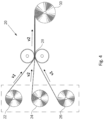
- the system 20 comprises three rollers instead of two. This is shown in Fig. 4 .
- the system further comprises a third roller 26.
- the third roller 26 is positioned such that the second roller 24 is disposed between the first roller 22 and the third roller 26.
- the third roller 26 is, like the first roller 22, adapted to feed a film layer comprising an elastic material.
- the third roller 26 runs at a speed v1, same as the first roller 22, which results in that the film layer fed by the third roller 26 is stretched in the same way that the film layer fed by the first roller 22 is.
- the layers that are stretched are typically stretched in the same direction as the film is being fed, which is the longitudinal direction of the resulting film.
- the first step S100 comprises providing and stretching a first film layer, typically comprising an elastomeric material such as low density polyethylene. By stretching the material, it strives to go back to its un-stretched state, which results in the material wrapping very tightly around the object around which it is wrapped.
- a first film layer typically comprising an elastomeric material such as low density polyethylene.
- the second step S110 comprises providing a second film layer, the second film layer comprising a sturdy material such as woven plastic material.
- the final step S130 of the method comprises laminating the layers together to form one film comprising two layers, wherein the first layers is stretched and the second layer is not.
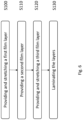
- the method further comprises a step S120 of providing and stretching a third film layer, the third film layer also comprising an elastic material. This step may be seen in Fig. 6 .
- the second film layer is typically provided between the first film layer and the third film layer, and the step of laminating the layers comprises laminating three layers instead of two.
Landscapes
- Engineering & Computer Science (AREA)
- Mechanical Engineering (AREA)
- Textile Engineering (AREA)
- Laminated Bodies (AREA)
- Wrappers (AREA)
- Shaping By String And By Release Of Stress In Plastics And The Like (AREA)
Description
- The present invention relates generally to a film for the wrapping of objects, particularly for wrapping steel coils.
- In prior art there is known to use various kinds of films to wrap objects of various kinds. Depending on the intended application area, there are different restrictions and requirements placed on the films that are to be used. Laminated films comprising polymeric tapes are known, such as disclosed in
EP2799237 . - However, there are still problems with known solutions, for instance it could for some application areas be beneficial to achieve a film that provides a tighter sealing around an object, such as for the application area of wrapping steel coils.
- It would be desirable if a film could be achieved which provides a good mechanical protection and is durable, while still wrapping tightly around the object around which it is wrapped.
-
GB 2080732 -
US 4587 175 discloses laminate sheet of at least three layers including a perforated sheet layer. Two of the layers are uniaxially molecule-oriented films. The molecular orientation may be effected in anyone of the longitudinal, lateral and oblique directions, yet it is advantageous that the axes of molecular orientation of the two films laminated on both sides of the perforated sheet are laminated to each other at angles of 30° or more. -
US 2012/064282 discloses a stretchable multi-layer wrap in which two or four layers, which are provided on both sides of a plurality of ribs that are co-aligned with a longitudinal axis of the wrap. - An object of the present invention is to overcome at least some of the problems outlined above.
- According to a first aspect, a film for the wrapping of objects is provided, particularly for steel coils. The film comprises a first film layer made from an elastic material, a second film layer made from a durable material, wherein the second film layer comprises a woven plastic material and is not stretched, or wherein the second film layer is pre-stretched made of polypropylene or high density or low density polyethylene, and a third layer also made from an elastic material. The first and third film layers are stretched only in a longitudinal direction, with respect to a direction the film is being fed during manufacture, wherein the first and third film layers are stretched such that they strive to go back to an un-stretched state and are stretched by 10%-50%. The second layer is disposed between the first film layer and the third film layer. By having such a film with one un-stretched or pre-stretched layer with a durable material and two elastic layers that are stretched, a film is achieved that provides a good protection, while still wrapping very tightly to the object around which it is wrapped, due to the stretched material striving to go back to its un-stretched state.
- According to a third aspect, there is provided a method for manufacturing a film for the wrapping of objects, comprising the steps of providing and stretching a first film layer comprising an elastic material, providing a second film layer comprising a durable material, wherein the second film layer comprises a woven plastic material and is not stretched, or wherein the second film layer is pre-stretched made of polypropylene or high density or low density polyethylene, and providing and stretching a third film layer comprising an elastic material, wherein the second film layer is provided between the first film layer and the third film layer. The method further comprises laminating the layers together to form a laminated film. The stretching is performed only in the longitudinal direction, with respect to a direction the film is being fed during manufacture, wherein the first and third film layers are stretched such that they strive to go back to an un-stretched state and wherein the elastic material is stretched by 10%-50%.
- By using a film, or method as disclosed herein, it is possible to achieve a film for the wrapping of objects that provides a good protection, both mechanically and against external factors such as air and moisture, while still wrapping very tightly around the object to be wrapped.
- The invention is now described, by way of example, with reference to the accompanying drawings, in which:
-
Fig. 1 shows a sectional view of a first embodiment of a film according to the present disclosure. -
Fig. 2 shows a sectional view of a second embodiment of a film according to the present disclosure. -
Fig. 3 shows a schematic view of a first embodiment of a system according to the present disclosure. -
Fig. 4 shows a schematic view of a second embodiment of a system according to the present disclosure. -
Fig. 5 shows the steps of a first embodiment of a method according to the present disclosure. -
Fig. 6 shows the steps of a second embodiment of a method according to the present disclosure. - In the following, a detailed description of the different embodiments of the solution is disclosed with reference to the accompanying drawings. All examples herein should be seen as part of the general description and are therefore possible to combine in any way in general terms. Individual features of the various embodiments and methods may be combined or exchanged unless such combination or exchange is clearly contradictory to the overall function of the implementation.
- Briefly described, the solution relates to a film for the wrapping of objects, as well as a method for the wrapping of objects. The solution is primarily intended to be used for wrapping steel coils and other similar materials, but it should be understood that the solution may be applicable to other types of materials as well.
- The solution is intended to achieve a film that protects the wrapped object from external forces, such as moisture, air and scraping, and that tightly wraps around the object it is intended to protect.
- This is achieved by having a film comprising at least three layers, wherein one layer is stretched (or pre-stretched) while the other two layers are not. By stretching one layer and not the other, it is possible to use more rigid, sturdy and durable materials for the protective layer that provide a better mechanical protection and reinforcing properties than materials that are adapted for being stretched. Further, by stretching one of the layers, it is possible to achieve a film that strives to go back to un-stretched state, which makes the film wrap more tightly around the object it is intended to protect. This disclosure also relates to a method for manufacturing such a film as well. The solution will now be described in further detail with reference to the accompanying drawings.
Fig. 1 shows afilm 10 according to the present disclosure comprising two layers, afirst layer 12 and asecond layer 14. Thefirst layers 12 is stretched, such that it strives to go back to its original un-stretched state. This entails that the film will wrap more tightly around an object than if no layers were stretched. Meanwhile, thesecond layer 14 is not stretched, which entails that a sturdier and more rigid material may be used, which provides better mechanical protection than materials that are adapted to be stretched. - The
first layer 12 typically comprises an elastomer, such a low density polyethylene. The material of thefirst layer 12 is intended to be flexible while still providing a good protection against external factors, such as e.g. moisture in the air. As mentioned, thefirst layer 12 of the film is stretched. Typically this is done during the manufacturing of the film, which will be described in more detail later in this disclosure. The film is typically only stretched in one direction, which is the same direction as the film is being fed during manufacture, which in a completed film would be seen as the longitudinal direction. - The
second layer 14 typically comprises a woven plastic material. Thesecond layer 14 is intended to provide mechanical protection, and therefore it is sturdier, stronger and more rigid than thefirst layer 12. Also, unlike thefirst layer 12, thesecond layer 14 is not stretched, which enables the previously mentioned use of a material that is sturdier, stronger and more rigid. - The second layer may in some embodiments be made of polypropylene. In other embodiments, the second layer may be made from polyethylene, both high density and low density, that has been pre-stretched, which results in it being much less elastic, more durable and provides a better mechanical protection than polyethylene that has not been pre-stretched. In embodiments wherein the second layer comprises polypropylene, the polypropylene may also be pre-stretched.
- The
first layer 12 and themiddle layer 14 are laminated together to form one film comprising two layers. Such a film will have the mechanical protection provided by thesecond layer 14, comprising a sturdy and durable material, while still wrapping very tightly around the object to be wrapped due to thefirst layer 12 being stretched, which makes it strive to go back to its un-stretched state. The sturdy material may for instance be a woven plastic material. The elastic material is typically an elastomer, such as low density polyethylene. It should be understood that the examples used herein are not to be limiting, it is possible to use other materials that have similar properties as the examples above. - The film according to the present disclosure is typically intended for the wrapping of steel coils. Steel coils have very sharp edges, and the weight entails that the contact pressure is very high when they are lifted, which requires a film that is both durable and flexible, which may be achieved as disclosed herein.
- In some embodiments, the
film 10 comprises three layers instead of two. This is shown inFig. 2 . In this embodiment, the film comprises twoouter layers 12 made from an elastic material, and amiddle layer 14 made from a sturdy material. By using one elastic layer on each side of the sturdy layer, the advantageous properties of the film are further enhanced, such that it gives a better protection and wraps tighter around the objects intended to be wrapped. - Looking now at
Fig. 3 , a system for manufacturing a film will now be described.Fig. 3 shows a system 20 comprising afirst roller 22 and asecond roller 24. The first 22 and second 24 rollers are positioned at a first position in the production cycle, which is upstream from a second position wherelaminating rollers 28 are positioned. Thelaminating rollers 28 are adapted to laminate the layers of film together into one film comprising two or more layer. This may be done e.g. through pressing the materials together extremely tightly, using adhesive agents and/or heat, and other similar laminating technologies aimed at joining multiple layers of materials together. - The
first roller 22 is adapted to feed a first film layer comprising an elastic material, and thesecond roller 24 is adapted to feed a second film layer comprising a sturdy material. Thefirst roller 22 is adapted to run at a speed v1. Thesecond roller 24 is adapted to run at a speed higher than that of thefirst roller 22, shown as v2. Thelaminating rollers 28 are also adapted to run at the second speed v2. - The speed with which the materials are fed towards the laminating
rollers 28 is constant for each material, even though the speed of individual rollers may differ. The speed with which the films is fed by thelaminating rollers 28 is also constant. Depending on the exact structure of the system, this may entail slight variations in how rollers are configured. If the rollers comprise a stack of material which is wound around an axis and the unwound as the material is fed, the rotational speed of the roller would have to continuously increase slightly to maintain a constant feeding speed, as the diameter of the wound material decreases due to the material being fed towards the laminatingrollers 28. - Due to the speed of the rollers differing, the first layer of the film will be stretched but second layer will not be. Since the
first roller 22 feeds its material towards the laminatingrollers 28 at a first speed v1, while thelaminating rollers 28 feeds the film in the feeding direction at a second speed v2, wherein v2 is higher than v1, the elastic material will be stretched. This is due to the difference in speeds that occurs at the second position, i.e. at thelaminating rollers 28. Since the feeding speed of thelaminating rollers 28 is higher than the feeding speed of thefirst roller 22, the material will be stretched at the second position. As for thesecond roller 24, the sturdy material being fed by thesecond roller 24 is not stretched, since the feeding speed of thesecond roller 24 is the same as the feeding speed of thelaminating rollers 28, i.e. v2. - The
second roller 24, however, operates at the same speed as thelaminating rollers 28, which entails that the sturdy layer of the film, which is the one fed by thesecond roller 24, is not stretched during the manufacturing process. Typically, the system is adapted such that the elastic material is stretched by an additional 10-50% as compared to its original state, but in some embodiments it may be higher, such as up to 300%. Optionally, the system 20 may also comprise a coil 30 onto which the film may be wound. - In some embodiments, the system 20 comprises three rollers instead of two. This is shown in
Fig. 4 . In this embodiment, the system further comprises athird roller 26. Typically, thethird roller 26 is positioned such that thesecond roller 24 is disposed between thefirst roller 22 and thethird roller 26. Thethird roller 26 is, like thefirst roller 22, adapted to feed a film layer comprising an elastic material. Thethird roller 26 runs at a speed v1, same as thefirst roller 22, which results in that the film layer fed by thethird roller 26 is stretched in the same way that the film layer fed by thefirst roller 22 is. This results in a film comprising three layers, wherein the two outer layers are stretched and comprise an elastic material, while the middle layer comprises a sturdy material. The layers that are stretched are typically stretched in the same direction as the film is being fed, which is the longitudinal direction of the resulting film. - Looking now at
Fig. 5 , the method according to the present disclosure will be described. The first step S100 comprises providing and stretching a first film layer, typically comprising an elastomeric material such as low density polyethylene. By stretching the material, it strives to go back to its un-stretched state, which results in the material wrapping very tightly around the object around which it is wrapped. - The second step S110 comprises providing a second film layer, the second film layer comprising a sturdy material such as woven plastic material.
- The final step S130 of the method comprises laminating the layers together to form one film comprising two layers, wherein the first layers is stretched and the second layer is not.
- In some embodiments, the method further comprises a step S120 of providing and stretching a third film layer, the third film layer also comprising an elastic material. This step may be seen in
Fig. 6 . In this embodiment, the second film layer is typically provided between the first film layer and the third film layer, and the step of laminating the layers comprises laminating three layers instead of two. - Although the description above contains a plurality of specificities, these should not be construed as limiting the scope of the concept described herein but as merely providing illustrations of some exemplifying embodiments of the described concept. Reference to an element in the singular is not intended to mean "one and only one" unless explicitly so stated, but rather "one or more".
Claims (3)
- A film (10) for the wrapping of objects, comprising:a first film layer (12) made from an elastic material;a second film layer (14) made from a durable material, wherein the second film layer (14) comprises a woven plastic material and is not stretched, or wherein the second film layer (14) is pre-stretched made of polypropylene or high density or low density polyethylene;a third film layer (12) made from an elastic material, wherein the second film layer (14) is disposed between the first film layer (12) and the third film layer (12), wherein the first film layer (12) and the third film layer (12) are stretched only in a longitudinal direction, with respect to a direction the film is being fed during manufacture, wherein the first and third layers are stretched such that they strive to go back to an un-stretched state and are stretched by 10%-50%.
- The film according to claims 1, wherein the first and third film layers are made from low density polyethylene.
- A method for manufacturing a film for the wrapping of objects comprising the steps of:providing and stretching (S100) a first film layer comprising an elastic material;providing (S110) a second film layer comprising a durable material, wherein the second film layer (14) comprises a woven plastic material and is not stretched, or wherein the second film layer (14) is pre-stretched made of polypropylene or high density or low density polyethylene;providing and stretching (S120) a third film layer comprising an elastic material, wherein the second film layer is provided between the first film layer and the third film layer,laminating (S130) the layers together to form a laminated film, andwherein the stretching of the first and third film layers is performed only in a longitudinal direction, with respect to a direction the film is being fed during manufacture, wherein the first and third film layers are stretched such that they strive to go back to an un-stretched state and wherein the elastic material is stretched by 10%-50%.
Applications Claiming Priority (2)
| Application Number | Priority Date | Filing Date | Title |
|---|---|---|---|
| SE1551134A SE540294C2 (en) | 2015-09-04 | 2015-09-04 | Laminated film with stretched layers and method of manufacturing such film |
| PCT/SE2016/050827 WO2017039524A1 (en) | 2015-09-04 | 2016-09-02 | Laminated film with stretched layer |
Publications (4)
| Publication Number | Publication Date |
|---|---|
| EP3344450A1 EP3344450A1 (en) | 2018-07-11 |
| EP3344450A4 EP3344450A4 (en) | 2019-02-06 |
| EP3344450B1 true EP3344450B1 (en) | 2025-03-05 |
| EP3344450C0 EP3344450C0 (en) | 2025-03-05 |
Family
ID=58188047
Family Applications (1)
| Application Number | Title | Priority Date | Filing Date |
|---|---|---|---|
| EP16842422.4A Active EP3344450B1 (en) | 2015-09-04 | 2016-09-02 | Laminated film with stretched layer |
Country Status (7)
| Country | Link |
|---|---|
| US (2) | US20180186118A1 (en) |
| EP (1) | EP3344450B1 (en) |
| JP (1) | JP7206110B2 (en) |
| KR (1) | KR102546000B1 (en) |
| PL (1) | PL3344450T3 (en) |
| SE (1) | SE540294C2 (en) |
| WO (1) | WO2017039524A1 (en) |
Families Citing this family (3)
| Publication number | Priority date | Publication date | Assignee | Title |
|---|---|---|---|---|
| DE102018111118B4 (en) * | 2018-05-09 | 2020-01-16 | Karatzis S.A. Industrial & Hotelier Enterprises | Packaging material and process for its manufacture |
| CA3135395C (en) | 2020-10-23 | 2023-10-03 | Western Plastics, Inc. | Multi-layer packaging pad |
| KR102627361B1 (en) * | 2021-12-31 | 2024-01-23 | 충북대학교 산학협력단 | Recyclable solar panel antifouling film and method of manufacturing solar panel antifouling film |
Family Cites Families (17)
| Publication number | Priority date | Publication date | Assignee | Title |
|---|---|---|---|---|
| JPS576754A (en) | 1980-06-17 | 1982-01-13 | Fuji Photo Film Co Ltd | Packing material |
| JPS5892532A (en) * | 1981-11-30 | 1983-06-01 | Showa Denko Kk | Forming method of heat shrinkable film |
| JPH0633107B2 (en) | 1983-12-28 | 1994-05-02 | 富士写真フイルム株式会社 | Packaging material |
| JPS6190985A (en) * | 1984-10-11 | 1986-05-09 | 株式会社日立ビルシステムサービス | Compensator for elongation of rope for hydraulic elevator |
| US4929303A (en) * | 1987-03-11 | 1990-05-29 | Exxon Chemical Patents Inc. | Composite breathable housewrap films |
| DE4035873A1 (en) * | 1990-11-12 | 1992-05-14 | Hoechst Ag | DEVICE AND METHOD FOR PRODUCING A MULTILAYER FILM COMPOSITE |
| US5328743A (en) * | 1992-08-21 | 1994-07-12 | Reef Industries, Inc. | Reinforced shrink wrap |
| JPH09164577A (en) * | 1995-12-15 | 1997-06-24 | Kureha Chem Ind Co Ltd | Laminated resin molding having wavy fold cross-section structure and method of manufacturing the same |
| JP2005169705A (en) * | 2003-12-09 | 2005-06-30 | Nippon Petrochemicals Co Ltd | Laminated sheet and method for producing the same |
| US20060148358A1 (en) | 2004-12-30 | 2006-07-06 | Hall Gregory K | Elastic laminate and process therefor |
| CA2534943C (en) * | 2006-02-01 | 2012-01-31 | Thomas F. Clarke | Multi-layer wrap |
| CN101925459B (en) * | 2008-01-30 | 2014-06-25 | 优势创造实业有限责任公司 | Elastic laminate and method of making |
| US20090317650A1 (en) * | 2008-06-23 | 2009-12-24 | Inteplast Group, Ltd. | Cross-laminated elastic film |
| JP5452903B2 (en) * | 2008-10-15 | 2014-03-26 | ユニ・チャーム株式会社 | Composite sheet manufacturing method, absorbent article manufacturing method using composite sheet, and composite sheet manufacturing apparatus |
| KR20120135510A (en) * | 2010-02-19 | 2012-12-14 | 바데이 인코포레이티드 | Use of machine direction oriented films in ballistic articles |
| US8604129B2 (en) * | 2010-12-30 | 2013-12-10 | Kimberly-Clark Worldwide, Inc. | Sheet materials containing S-B-S and S-I/B-S copolymers |
| EP2799237B1 (en) | 2013-05-03 | 2015-09-30 | Mondi Gronau GmbH | Method of making an elastic laminate |
-
2015
- 2015-09-04 SE SE1551134A patent/SE540294C2/en unknown
-
2016
- 2016-09-02 WO PCT/SE2016/050827 patent/WO2017039524A1/en not_active Ceased
- 2016-09-02 KR KR1020177023340A patent/KR102546000B1/en active Active
- 2016-09-02 PL PL16842422.4T patent/PL3344450T3/en unknown
- 2016-09-02 JP JP2018504743A patent/JP7206110B2/en active Active
- 2016-09-02 EP EP16842422.4A patent/EP3344450B1/en active Active
-
2018
- 2018-02-28 US US15/907,341 patent/US20180186118A1/en not_active Abandoned
-
2022
- 2022-02-04 US US17/592,609 patent/US12415337B2/en active Active
Also Published As
| Publication number | Publication date |
|---|---|
| SE1551134A1 (en) | 2017-03-05 |
| PL3344450T3 (en) | 2025-06-09 |
| SE540294C2 (en) | 2018-05-22 |
| JP2018532609A (en) | 2018-11-08 |
| KR102546000B1 (en) | 2023-06-20 |
| US12415337B2 (en) | 2025-09-16 |
| WO2017039524A1 (en) | 2017-03-09 |
| JP7206110B2 (en) | 2023-01-17 |
| US20220152978A1 (en) | 2022-05-19 |
| US20180186118A1 (en) | 2018-07-05 |
| EP3344450C0 (en) | 2025-03-05 |
| EP3344450A4 (en) | 2019-02-06 |
| EP3344450A1 (en) | 2018-07-11 |
| KR20180048442A (en) | 2018-05-10 |
Similar Documents
| Publication | Publication Date | Title |
|---|---|---|
| US12415337B2 (en) | Laminated film with stretched layer | |
| US11505392B2 (en) | Edge protector and method of manufacturing same | |
| US10730210B2 (en) | Flexibility-controlled composite material and method of manufacture | |
| JP6115380B2 (en) | Strip electrode manufacturing method and strip electrode cutting apparatus | |
| KR20180095497A (en) | Glass roll and manufacturing method thereof | |
| JP2023177088A (en) | winding roll | |
| JP2023177089A (en) | winding roll | |
| US10105935B2 (en) | Reinforced stretch film and its method of production | |
| HUE071519T2 (en) | Film winding system, composite comprising a film stretching system and such a film winding system and use of such a composite for the production of thin film films and membranes | |
| CN114347487A (en) | Aluminum plastic film production equipment and process | |
| KR20160099474A (en) | Method for peeling off laminate film and method for manufacturing functional film | |
| CA3005056A1 (en) | Packaging material and method for producing a packaging material | |
| US20140048202A1 (en) | Spiral cut liquid adhesive laminated film | |
| KR102493787B1 (en) | Method for manufacturing roll type adhesive film | |
| US20110121119A1 (en) | Stretch film and method of fabrication therefor | |
| US11873126B2 (en) | Segmented wrapping films and related methods | |
| JP7006217B2 (en) | Composite pipe | |
| KR20160015453A (en) | Roller for preventing a step coverage of optical film | |
| KR101804600B1 (en) | Jelly-roll type electrode assembly and manufacturing method thereof | |
| JPS6230895B2 (en) | ||
| KR20200043029A (en) | Wrapping paper and manufacturing method for the same | |
| US20140220307A1 (en) | Method for manufacturing laminated film and laminated film | |
| JP7007921B2 (en) | Barrier paper cup | |
| JP7217115B2 (en) | Porous material package and method for manufacturing porous material package | |
| JP6431693B2 (en) | Laminating equipment |
Legal Events
| Date | Code | Title | Description |
|---|---|---|---|
| STAA | Information on the status of an ep patent application or granted ep patent |
Free format text: STATUS: THE INTERNATIONAL PUBLICATION HAS BEEN MADE |
|
| PUAI | Public reference made under article 153(3) epc to a published international application that has entered the european phase |
Free format text: ORIGINAL CODE: 0009012 |
|
| STAA | Information on the status of an ep patent application or granted ep patent |
Free format text: STATUS: REQUEST FOR EXAMINATION WAS MADE |
|
| 17P | Request for examination filed |
Effective date: 20180404 |
|
| AK | Designated contracting states |
Kind code of ref document: A1 Designated state(s): AL AT BE BG CH CY CZ DE DK EE ES FI FR GB GR HR HU IE IS IT LI LT LU LV MC MK MT NL NO PL PT RO RS SE SI SK SM TR |
|
| AX | Request for extension of the european patent |
Extension state: BA ME |
|
| DAV | Request for validation of the european patent (deleted) | ||
| DAX | Request for extension of the european patent (deleted) | ||
| A4 | Supplementary search report drawn up and despatched |
Effective date: 20190108 |
|
| RIC1 | Information provided on ipc code assigned before grant |
Ipc: B32B 27/12 20060101ALI20190102BHEP Ipc: B65D 65/02 20060101ALI20190102BHEP Ipc: B32B 7/02 20190101AFI20190102BHEP Ipc: B32B 27/32 20060101ALI20190102BHEP Ipc: B32B 27/08 20060101ALI20190102BHEP |
|
| STAA | Information on the status of an ep patent application or granted ep patent |
Free format text: STATUS: EXAMINATION IS IN PROGRESS |
|
| 17Q | First examination report despatched |
Effective date: 20200624 |
|
| GRAP | Despatch of communication of intention to grant a patent |
Free format text: ORIGINAL CODE: EPIDOSNIGR1 |
|
| STAA | Information on the status of an ep patent application or granted ep patent |
Free format text: STATUS: GRANT OF PATENT IS INTENDED |
|
| RIC1 | Information provided on ipc code assigned before grant |
Ipc: B32B 27/32 20060101ALI20240910BHEP Ipc: B65D 65/02 20060101ALI20240910BHEP Ipc: B32B 27/12 20060101ALI20240910BHEP Ipc: B32B 27/08 20060101ALI20240910BHEP Ipc: B32B 7/02 20060101AFI20240910BHEP |
|
| INTG | Intention to grant announced |
Effective date: 20241001 |
|
| GRAS | Grant fee paid |
Free format text: ORIGINAL CODE: EPIDOSNIGR3 |
|
| GRAA | (expected) grant |
Free format text: ORIGINAL CODE: 0009210 |
|
| STAA | Information on the status of an ep patent application or granted ep patent |
Free format text: STATUS: THE PATENT HAS BEEN GRANTED |
|
| AK | Designated contracting states |
Kind code of ref document: B1 Designated state(s): AL AT BE BG CH CY CZ DE DK EE ES FI FR GB GR HR HU IE IS IT LI LT LU LV MC MK MT NL NO PL PT RO RS SE SI SK SM TR |
|
| REG | Reference to a national code |
Ref country code: GB Ref legal event code: FG4D |
|
| REG | Reference to a national code |
Ref country code: CH Ref legal event code: EP |
|
| REG | Reference to a national code |
Ref country code: DE Ref legal event code: R096 Ref document number: 602016091467 Country of ref document: DE |
|
| REG | Reference to a national code |
Ref country code: IE Ref legal event code: FG4D |
|
| U01 | Request for unitary effect filed |
Effective date: 20250328 |
|
| U07 | Unitary effect registered |
Designated state(s): AT BE BG DE DK EE FI FR IT LT LU LV MT NL PT RO SE SI Effective date: 20250403 |
|
| REG | Reference to a national code |
Ref country code: SK Ref legal event code: T3 Ref document number: E 46198 Country of ref document: SK |
|
| PG25 | Lapsed in a contracting state [announced via postgrant information from national office to epo] |
Ref country code: RS Free format text: LAPSE BECAUSE OF FAILURE TO SUBMIT A TRANSLATION OF THE DESCRIPTION OR TO PAY THE FEE WITHIN THE PRESCRIBED TIME-LIMIT Effective date: 20250605 |
|
| PG25 | Lapsed in a contracting state [announced via postgrant information from national office to epo] |
Ref country code: ES Free format text: LAPSE BECAUSE OF FAILURE TO SUBMIT A TRANSLATION OF THE DESCRIPTION OR TO PAY THE FEE WITHIN THE PRESCRIBED TIME-LIMIT Effective date: 20250305 |
|
| PG25 | Lapsed in a contracting state [announced via postgrant information from national office to epo] |
Ref country code: NO Free format text: LAPSE BECAUSE OF FAILURE TO SUBMIT A TRANSLATION OF THE DESCRIPTION OR TO PAY THE FEE WITHIN THE PRESCRIBED TIME-LIMIT Effective date: 20250605 |
|
| PG25 | Lapsed in a contracting state [announced via postgrant information from national office to epo] |
Ref country code: HR Free format text: LAPSE BECAUSE OF FAILURE TO SUBMIT A TRANSLATION OF THE DESCRIPTION OR TO PAY THE FEE WITHIN THE PRESCRIBED TIME-LIMIT Effective date: 20250305 |
|
| PG25 | Lapsed in a contracting state [announced via postgrant information from national office to epo] |
Ref country code: GR Free format text: LAPSE BECAUSE OF FAILURE TO SUBMIT A TRANSLATION OF THE DESCRIPTION OR TO PAY THE FEE WITHIN THE PRESCRIBED TIME-LIMIT Effective date: 20250606 |
|
| PG25 | Lapsed in a contracting state [announced via postgrant information from national office to epo] |
Ref country code: SM Free format text: LAPSE BECAUSE OF FAILURE TO SUBMIT A TRANSLATION OF THE DESCRIPTION OR TO PAY THE FEE WITHIN THE PRESCRIBED TIME-LIMIT Effective date: 20250305 |
|
| PGFP | Annual fee paid to national office [announced via postgrant information from national office to epo] |
Ref country code: TR Payment date: 20250812 Year of fee payment: 10 Ref country code: PL Payment date: 20250806 Year of fee payment: 10 |
|
| PGFP | Annual fee paid to national office [announced via postgrant information from national office to epo] |
Ref country code: GB Payment date: 20250916 Year of fee payment: 10 |
|
| PG25 | Lapsed in a contracting state [announced via postgrant information from national office to epo] |
Ref country code: CZ Free format text: LAPSE BECAUSE OF FAILURE TO SUBMIT A TRANSLATION OF THE DESCRIPTION OR TO PAY THE FEE WITHIN THE PRESCRIBED TIME-LIMIT Effective date: 20250305 |
|
| U20 | Renewal fee for the european patent with unitary effect paid |
Year of fee payment: 10 Effective date: 20250916 |
|
| PGFP | Annual fee paid to national office [announced via postgrant information from national office to epo] |
Ref country code: SK Payment date: 20250819 Year of fee payment: 10 |
|
| PG25 | Lapsed in a contracting state [announced via postgrant information from national office to epo] |
Ref country code: IS Free format text: LAPSE BECAUSE OF FAILURE TO SUBMIT A TRANSLATION OF THE DESCRIPTION OR TO PAY THE FEE WITHIN THE PRESCRIBED TIME-LIMIT Effective date: 20250705 |
|
| PLBE | No opposition filed within time limit |
Free format text: ORIGINAL CODE: 0009261 |
|
| STAA | Information on the status of an ep patent application or granted ep patent |
Free format text: STATUS: NO OPPOSITION FILED WITHIN TIME LIMIT |
|
| REG | Reference to a national code |
Ref country code: CH Ref legal event code: L10 Free format text: ST27 STATUS EVENT CODE: U-0-0-L10-L00 (AS PROVIDED BY THE NATIONAL OFFICE) Effective date: 20260114 |
|
| 26N | No opposition filed |
Effective date: 20251208 |
|
| REG | Reference to a national code |
Ref country code: CH Ref legal event code: H13 Free format text: ST27 STATUS EVENT CODE: U-0-0-H10-H13 (AS PROVIDED BY THE NATIONAL OFFICE) Effective date: 20260504 |
|
| PG25 | Lapsed in a contracting state [announced via postgrant information from national office to epo] |
Ref country code: MC Free format text: LAPSE BECAUSE OF FAILURE TO SUBMIT A TRANSLATION OF THE DESCRIPTION OR TO PAY THE FEE WITHIN THE PRESCRIBED TIME-LIMIT Effective date: 20250305 |
|
| PG25 | Lapsed in a contracting state [announced via postgrant information from national office to epo] |
Ref country code: IE Free format text: LAPSE BECAUSE OF NON-PAYMENT OF DUE FEES Effective date: 20250902 Ref country code: CH Free format text: LAPSE BECAUSE OF NON-PAYMENT OF DUE FEES Effective date: 20250930 |