EP3341193B1 - Mineral wool insulation - Google Patents
Mineral wool insulation Download PDFInfo
- Publication number
- EP3341193B1 EP3341193B1 EP17754698.3A EP17754698A EP3341193B1 EP 3341193 B1 EP3341193 B1 EP 3341193B1 EP 17754698 A EP17754698 A EP 17754698A EP 3341193 B1 EP3341193 B1 EP 3341193B1
- Authority
- EP
- European Patent Office
- Prior art keywords
- fibres
- mineral wool
- woven veil
- veil
- woven
- Prior art date
- Legal status (The legal status is an assumption and is not a legal conclusion. Google has not performed a legal analysis and makes no representation as to the accuracy of the status listed.)
- Revoked
Links
Images


Classifications
-
- B—PERFORMING OPERATIONS; TRANSPORTING
- B32—LAYERED PRODUCTS
- B32B—LAYERED PRODUCTS, i.e. PRODUCTS BUILT-UP OF STRATA OF FLAT OR NON-FLAT, e.g. CELLULAR OR HONEYCOMB, FORM
- B32B7/00—Layered products characterised by the relation between layers; Layered products characterised by the relative orientation of features between layers, or by the relative values of a measurable parameter between layers, i.e. products comprising layers having different physical, chemical or physicochemical properties; Layered products characterised by the interconnection of layers
- B32B7/02—Physical, chemical or physicochemical properties
-
- B—PERFORMING OPERATIONS; TRANSPORTING
- B32—LAYERED PRODUCTS
- B32B—LAYERED PRODUCTS, i.e. PRODUCTS BUILT-UP OF STRATA OF FLAT OR NON-FLAT, e.g. CELLULAR OR HONEYCOMB, FORM
- B32B19/00—Layered products comprising a layer of natural mineral fibres or particles, e.g. asbestos, mica
- B32B19/04—Layered products comprising a layer of natural mineral fibres or particles, e.g. asbestos, mica next to another layer of the same or of a different material
-
- B—PERFORMING OPERATIONS; TRANSPORTING
- B32—LAYERED PRODUCTS
- B32B—LAYERED PRODUCTS, i.e. PRODUCTS BUILT-UP OF STRATA OF FLAT OR NON-FLAT, e.g. CELLULAR OR HONEYCOMB, FORM
- B32B19/00—Layered products comprising a layer of natural mineral fibres or particles, e.g. asbestos, mica
- B32B19/06—Layered products comprising a layer of natural mineral fibres or particles, e.g. asbestos, mica next to a fibrous or filamentary layer
-
- B—PERFORMING OPERATIONS; TRANSPORTING
- B32—LAYERED PRODUCTS
- B32B—LAYERED PRODUCTS, i.e. PRODUCTS BUILT-UP OF STRATA OF FLAT OR NON-FLAT, e.g. CELLULAR OR HONEYCOMB, FORM
- B32B25/00—Layered products comprising a layer of natural or synthetic rubber
- B32B25/10—Layered products comprising a layer of natural or synthetic rubber next to a fibrous or filamentary layer
-
- B—PERFORMING OPERATIONS; TRANSPORTING
- B32—LAYERED PRODUCTS
- B32B—LAYERED PRODUCTS, i.e. PRODUCTS BUILT-UP OF STRATA OF FLAT OR NON-FLAT, e.g. CELLULAR OR HONEYCOMB, FORM
- B32B27/00—Layered products comprising a layer of synthetic resin
- B32B27/12—Layered products comprising a layer of synthetic resin next to a fibrous or filamentary layer
-
- B—PERFORMING OPERATIONS; TRANSPORTING
- B32—LAYERED PRODUCTS
- B32B—LAYERED PRODUCTS, i.e. PRODUCTS BUILT-UP OF STRATA OF FLAT OR NON-FLAT, e.g. CELLULAR OR HONEYCOMB, FORM
- B32B3/00—Layered products comprising a layer with external or internal discontinuities or unevennesses, or a layer of non-planar shape; Layered products comprising a layer having particular features of form
- B32B3/02—Layered products comprising a layer with external or internal discontinuities or unevennesses, or a layer of non-planar shape; Layered products comprising a layer having particular features of form characterised by features of form at particular places, e.g. in edge regions
-
- B—PERFORMING OPERATIONS; TRANSPORTING
- B32—LAYERED PRODUCTS
- B32B—LAYERED PRODUCTS, i.e. PRODUCTS BUILT-UP OF STRATA OF FLAT OR NON-FLAT, e.g. CELLULAR OR HONEYCOMB, FORM
- B32B3/00—Layered products comprising a layer with external or internal discontinuities or unevennesses, or a layer of non-planar shape; Layered products comprising a layer having particular features of form
- B32B3/26—Layered products comprising a layer with external or internal discontinuities or unevennesses, or a layer of non-planar shape; Layered products comprising a layer having particular features of form characterised by a particular shape of the outline of the cross-section of a continuous layer; characterised by a layer with cavities or internal voids ; characterised by an apertured layer
-
- B—PERFORMING OPERATIONS; TRANSPORTING
- B32—LAYERED PRODUCTS
- B32B—LAYERED PRODUCTS, i.e. PRODUCTS BUILT-UP OF STRATA OF FLAT OR NON-FLAT, e.g. CELLULAR OR HONEYCOMB, FORM
- B32B3/00—Layered products comprising a layer with external or internal discontinuities or unevennesses, or a layer of non-planar shape; Layered products comprising a layer having particular features of form
- B32B3/26—Layered products comprising a layer with external or internal discontinuities or unevennesses, or a layer of non-planar shape; Layered products comprising a layer having particular features of form characterised by a particular shape of the outline of the cross-section of a continuous layer; characterised by a layer with cavities or internal voids ; characterised by an apertured layer
- B32B3/30—Layered products comprising a layer with external or internal discontinuities or unevennesses, or a layer of non-planar shape; Layered products comprising a layer having particular features of form characterised by a particular shape of the outline of the cross-section of a continuous layer; characterised by a layer with cavities or internal voids ; characterised by an apertured layer characterised by a layer formed with recesses or projections, e.g. hollows, grooves, protuberances, ribs
-
- B—PERFORMING OPERATIONS; TRANSPORTING
- B32—LAYERED PRODUCTS
- B32B—LAYERED PRODUCTS, i.e. PRODUCTS BUILT-UP OF STRATA OF FLAT OR NON-FLAT, e.g. CELLULAR OR HONEYCOMB, FORM
- B32B5/00—Layered products characterised by the non- homogeneity or physical structure, i.e. comprising a fibrous, filamentary, particulate or foam layer; Layered products characterised by having a layer differing constitutionally or physically in different parts
- B32B5/02—Layered products characterised by the non- homogeneity or physical structure, i.e. comprising a fibrous, filamentary, particulate or foam layer; Layered products characterised by having a layer differing constitutionally or physically in different parts characterised by structural features of a fibrous or filamentary layer
-
- B—PERFORMING OPERATIONS; TRANSPORTING
- B32—LAYERED PRODUCTS
- B32B—LAYERED PRODUCTS, i.e. PRODUCTS BUILT-UP OF STRATA OF FLAT OR NON-FLAT, e.g. CELLULAR OR HONEYCOMB, FORM
- B32B5/00—Layered products characterised by the non- homogeneity or physical structure, i.e. comprising a fibrous, filamentary, particulate or foam layer; Layered products characterised by having a layer differing constitutionally or physically in different parts
- B32B5/02—Layered products characterised by the non- homogeneity or physical structure, i.e. comprising a fibrous, filamentary, particulate or foam layer; Layered products characterised by having a layer differing constitutionally or physically in different parts characterised by structural features of a fibrous or filamentary layer
- B32B5/022—Non-woven fabric
-
- B—PERFORMING OPERATIONS; TRANSPORTING
- B32—LAYERED PRODUCTS
- B32B—LAYERED PRODUCTS, i.e. PRODUCTS BUILT-UP OF STRATA OF FLAT OR NON-FLAT, e.g. CELLULAR OR HONEYCOMB, FORM
- B32B5/00—Layered products characterised by the non- homogeneity or physical structure, i.e. comprising a fibrous, filamentary, particulate or foam layer; Layered products characterised by having a layer differing constitutionally or physically in different parts
- B32B5/14—Layered products characterised by the non- homogeneity or physical structure, i.e. comprising a fibrous, filamentary, particulate or foam layer; Layered products characterised by having a layer differing constitutionally or physically in different parts characterised by a layer differing constitutionally or physically in different parts, e.g. denser near its faces
- B32B5/145—Variation across the thickness of the layer
-
- B—PERFORMING OPERATIONS; TRANSPORTING
- B32—LAYERED PRODUCTS
- B32B—LAYERED PRODUCTS, i.e. PRODUCTS BUILT-UP OF STRATA OF FLAT OR NON-FLAT, e.g. CELLULAR OR HONEYCOMB, FORM
- B32B5/00—Layered products characterised by the non- homogeneity or physical structure, i.e. comprising a fibrous, filamentary, particulate or foam layer; Layered products characterised by having a layer differing constitutionally or physically in different parts
- B32B5/22—Layered products characterised by the non- homogeneity or physical structure, i.e. comprising a fibrous, filamentary, particulate or foam layer; Layered products characterised by having a layer differing constitutionally or physically in different parts characterised by the presence of two or more layers which are next to each other and are fibrous, filamentary, formed of particles or foamed
-
- B—PERFORMING OPERATIONS; TRANSPORTING
- B32—LAYERED PRODUCTS
- B32B—LAYERED PRODUCTS, i.e. PRODUCTS BUILT-UP OF STRATA OF FLAT OR NON-FLAT, e.g. CELLULAR OR HONEYCOMB, FORM
- B32B5/00—Layered products characterised by the non- homogeneity or physical structure, i.e. comprising a fibrous, filamentary, particulate or foam layer; Layered products characterised by having a layer differing constitutionally or physically in different parts
- B32B5/22—Layered products characterised by the non- homogeneity or physical structure, i.e. comprising a fibrous, filamentary, particulate or foam layer; Layered products characterised by having a layer differing constitutionally or physically in different parts characterised by the presence of two or more layers which are next to each other and are fibrous, filamentary, formed of particles or foamed
- B32B5/24—Layered products characterised by the non- homogeneity or physical structure, i.e. comprising a fibrous, filamentary, particulate or foam layer; Layered products characterised by having a layer differing constitutionally or physically in different parts characterised by the presence of two or more layers which are next to each other and are fibrous, filamentary, formed of particles or foamed one layer being a fibrous or filamentary layer
- B32B5/26—Layered products characterised by the non- homogeneity or physical structure, i.e. comprising a fibrous, filamentary, particulate or foam layer; Layered products characterised by having a layer differing constitutionally or physically in different parts characterised by the presence of two or more layers which are next to each other and are fibrous, filamentary, formed of particles or foamed one layer being a fibrous or filamentary layer another layer next to it also being fibrous or filamentary
-
- B—PERFORMING OPERATIONS; TRANSPORTING
- B32—LAYERED PRODUCTS
- B32B—LAYERED PRODUCTS, i.e. PRODUCTS BUILT-UP OF STRATA OF FLAT OR NON-FLAT, e.g. CELLULAR OR HONEYCOMB, FORM
- B32B7/00—Layered products characterised by the relation between layers; Layered products characterised by the relative orientation of features between layers, or by the relative values of a measurable parameter between layers, i.e. products comprising layers having different physical, chemical or physicochemical properties; Layered products characterised by the interconnection of layers
- B32B7/04—Interconnection of layers
-
- B—PERFORMING OPERATIONS; TRANSPORTING
- B32—LAYERED PRODUCTS
- B32B—LAYERED PRODUCTS, i.e. PRODUCTS BUILT-UP OF STRATA OF FLAT OR NON-FLAT, e.g. CELLULAR OR HONEYCOMB, FORM
- B32B7/00—Layered products characterised by the relation between layers; Layered products characterised by the relative orientation of features between layers, or by the relative values of a measurable parameter between layers, i.e. products comprising layers having different physical, chemical or physicochemical properties; Layered products characterised by the interconnection of layers
- B32B7/04—Interconnection of layers
- B32B7/10—Interconnection of layers at least one layer having inter-reactive properties
-
- B—PERFORMING OPERATIONS; TRANSPORTING
- B32—LAYERED PRODUCTS
- B32B—LAYERED PRODUCTS, i.e. PRODUCTS BUILT-UP OF STRATA OF FLAT OR NON-FLAT, e.g. CELLULAR OR HONEYCOMB, FORM
- B32B7/00—Layered products characterised by the relation between layers; Layered products characterised by the relative orientation of features between layers, or by the relative values of a measurable parameter between layers, i.e. products comprising layers having different physical, chemical or physicochemical properties; Layered products characterised by the interconnection of layers
- B32B7/04—Interconnection of layers
- B32B7/12—Interconnection of layers using interposed adhesives or interposed materials with bonding properties
-
- E—FIXED CONSTRUCTIONS
- E04—BUILDING
- E04B—GENERAL BUILDING CONSTRUCTIONS; WALLS, e.g. PARTITIONS; ROOFS; FLOORS; CEILINGS; INSULATION OR OTHER PROTECTION OF BUILDINGS
- E04B7/00—Roofs; Roof construction with regard to insulation
- E04B7/20—Roofs consisting of self-supporting slabs, e.g. able to be loaded
- E04B7/22—Roofs consisting of self-supporting slabs, e.g. able to be loaded the slabs having insulating properties, e.g. laminated with layers of insulating material
-
- E—FIXED CONSTRUCTIONS
- E04—BUILDING
- E04D—ROOF COVERINGS; SKY-LIGHTS; GUTTERS; ROOF-WORKING TOOLS
- E04D13/00—Special arrangements or devices in connection with roof coverings; Protection against birds; Roof drainage ; Sky-lights
- E04D13/16—Insulating devices or arrangements in so far as the roof covering is concerned, e.g. characterised by the material or composition of the roof insulating material or its integration in the roof structure
-
- E—FIXED CONSTRUCTIONS
- E04—BUILDING
- E04D—ROOF COVERINGS; SKY-LIGHTS; GUTTERS; ROOF-WORKING TOOLS
- E04D13/00—Special arrangements or devices in connection with roof coverings; Protection against birds; Roof drainage ; Sky-lights
- E04D13/16—Insulating devices or arrangements in so far as the roof covering is concerned, e.g. characterised by the material or composition of the roof insulating material or its integration in the roof structure
- E04D13/1606—Insulation of the roof covering characterised by its integration in the roof structure
- E04D13/1643—Insulation of the roof covering characterised by its integration in the roof structure the roof structure being formed by load bearing corrugated sheets, e.g. profiled sheet metal roofs
- E04D13/165—Double skin roofs
-
- E—FIXED CONSTRUCTIONS
- E04—BUILDING
- E04D—ROOF COVERINGS; SKY-LIGHTS; GUTTERS; ROOF-WORKING TOOLS
- E04D3/00—Roof covering by making use of flat or curved slabs or stiff sheets
- E04D3/35—Roofing slabs or stiff sheets comprising two or more layers, e.g. for insulation
- E04D3/351—Roofing slabs or stiff sheets comprising two or more layers, e.g. for insulation at least one of the layers being composed of insulating material, e.g. fibre or foam material
-
- B—PERFORMING OPERATIONS; TRANSPORTING
- B32—LAYERED PRODUCTS
- B32B—LAYERED PRODUCTS, i.e. PRODUCTS BUILT-UP OF STRATA OF FLAT OR NON-FLAT, e.g. CELLULAR OR HONEYCOMB, FORM
- B32B2250/00—Layers arrangement
-
- B—PERFORMING OPERATIONS; TRANSPORTING
- B32—LAYERED PRODUCTS
- B32B—LAYERED PRODUCTS, i.e. PRODUCTS BUILT-UP OF STRATA OF FLAT OR NON-FLAT, e.g. CELLULAR OR HONEYCOMB, FORM
- B32B2262/00—Composition or structural features of fibres which form a fibrous or filamentary layer or are present as additives
- B32B2262/02—Synthetic macromolecular fibres
- B32B2262/0253—Polyolefin fibres
-
- B—PERFORMING OPERATIONS; TRANSPORTING
- B32—LAYERED PRODUCTS
- B32B—LAYERED PRODUCTS, i.e. PRODUCTS BUILT-UP OF STRATA OF FLAT OR NON-FLAT, e.g. CELLULAR OR HONEYCOMB, FORM
- B32B2262/00—Composition or structural features of fibres which form a fibrous or filamentary layer or are present as additives
- B32B2262/10—Inorganic fibres
-
- B—PERFORMING OPERATIONS; TRANSPORTING
- B32—LAYERED PRODUCTS
- B32B—LAYERED PRODUCTS, i.e. PRODUCTS BUILT-UP OF STRATA OF FLAT OR NON-FLAT, e.g. CELLULAR OR HONEYCOMB, FORM
- B32B2262/00—Composition or structural features of fibres which form a fibrous or filamentary layer or are present as additives
- B32B2262/10—Inorganic fibres
- B32B2262/101—Glass fibres
-
- B—PERFORMING OPERATIONS; TRANSPORTING
- B32—LAYERED PRODUCTS
- B32B—LAYERED PRODUCTS, i.e. PRODUCTS BUILT-UP OF STRATA OF FLAT OR NON-FLAT, e.g. CELLULAR OR HONEYCOMB, FORM
- B32B2262/00—Composition or structural features of fibres which form a fibrous or filamentary layer or are present as additives
- B32B2262/10—Inorganic fibres
- B32B2262/108—Rockwool fibres
-
- B—PERFORMING OPERATIONS; TRANSPORTING
- B32—LAYERED PRODUCTS
- B32B—LAYERED PRODUCTS, i.e. PRODUCTS BUILT-UP OF STRATA OF FLAT OR NON-FLAT, e.g. CELLULAR OR HONEYCOMB, FORM
- B32B2262/00—Composition or structural features of fibres which form a fibrous or filamentary layer or are present as additives
- B32B2262/14—Mixture of at least two fibres made of different materials
-
- B—PERFORMING OPERATIONS; TRANSPORTING
- B32—LAYERED PRODUCTS
- B32B—LAYERED PRODUCTS, i.e. PRODUCTS BUILT-UP OF STRATA OF FLAT OR NON-FLAT, e.g. CELLULAR OR HONEYCOMB, FORM
- B32B2264/00—Composition or properties of particles which form a particulate layer or are present as additives
-
- B—PERFORMING OPERATIONS; TRANSPORTING
- B32—LAYERED PRODUCTS
- B32B—LAYERED PRODUCTS, i.e. PRODUCTS BUILT-UP OF STRATA OF FLAT OR NON-FLAT, e.g. CELLULAR OR HONEYCOMB, FORM
- B32B2264/00—Composition or properties of particles which form a particulate layer or are present as additives
- B32B2264/10—Inorganic particles
-
- B—PERFORMING OPERATIONS; TRANSPORTING
- B32—LAYERED PRODUCTS
- B32B—LAYERED PRODUCTS, i.e. PRODUCTS BUILT-UP OF STRATA OF FLAT OR NON-FLAT, e.g. CELLULAR OR HONEYCOMB, FORM
- B32B2264/00—Composition or properties of particles which form a particulate layer or are present as additives
- B32B2264/10—Inorganic particles
- B32B2264/102—Oxide or hydroxide
-
- B—PERFORMING OPERATIONS; TRANSPORTING
- B32—LAYERED PRODUCTS
- B32B—LAYERED PRODUCTS, i.e. PRODUCTS BUILT-UP OF STRATA OF FLAT OR NON-FLAT, e.g. CELLULAR OR HONEYCOMB, FORM
- B32B2305/00—Condition, form or state of the layers or laminate
- B32B2305/07—Parts immersed or impregnated in a matrix
- B32B2305/073—Parts immersed or impregnated in a matrix partially
-
- B—PERFORMING OPERATIONS; TRANSPORTING
- B32—LAYERED PRODUCTS
- B32B—LAYERED PRODUCTS, i.e. PRODUCTS BUILT-UP OF STRATA OF FLAT OR NON-FLAT, e.g. CELLULAR OR HONEYCOMB, FORM
- B32B2305/00—Condition, form or state of the layers or laminate
- B32B2305/10—Fibres of continuous length
- B32B2305/20—Fibres of continuous length in the form of a non-woven mat
-
- B—PERFORMING OPERATIONS; TRANSPORTING
- B32—LAYERED PRODUCTS
- B32B—LAYERED PRODUCTS, i.e. PRODUCTS BUILT-UP OF STRATA OF FLAT OR NON-FLAT, e.g. CELLULAR OR HONEYCOMB, FORM
- B32B2307/00—Properties of the layers or laminate
- B32B2307/30—Properties of the layers or laminate having particular thermal properties
- B32B2307/304—Insulating
-
- B—PERFORMING OPERATIONS; TRANSPORTING
- B32—LAYERED PRODUCTS
- B32B—LAYERED PRODUCTS, i.e. PRODUCTS BUILT-UP OF STRATA OF FLAT OR NON-FLAT, e.g. CELLULAR OR HONEYCOMB, FORM
- B32B2307/00—Properties of the layers or laminate
- B32B2307/70—Other properties
- B32B2307/712—Weather resistant
-
- B—PERFORMING OPERATIONS; TRANSPORTING
- B32—LAYERED PRODUCTS
- B32B—LAYERED PRODUCTS, i.e. PRODUCTS BUILT-UP OF STRATA OF FLAT OR NON-FLAT, e.g. CELLULAR OR HONEYCOMB, FORM
- B32B2307/00—Properties of the layers or laminate
- B32B2307/70—Other properties
- B32B2307/718—Weight, e.g. weight per square meter
-
- B—PERFORMING OPERATIONS; TRANSPORTING
- B32—LAYERED PRODUCTS
- B32B—LAYERED PRODUCTS, i.e. PRODUCTS BUILT-UP OF STRATA OF FLAT OR NON-FLAT, e.g. CELLULAR OR HONEYCOMB, FORM
- B32B2307/00—Properties of the layers or laminate
- B32B2307/70—Other properties
- B32B2307/72—Density
-
- B—PERFORMING OPERATIONS; TRANSPORTING
- B32—LAYERED PRODUCTS
- B32B—LAYERED PRODUCTS, i.e. PRODUCTS BUILT-UP OF STRATA OF FLAT OR NON-FLAT, e.g. CELLULAR OR HONEYCOMB, FORM
- B32B2307/00—Properties of the layers or laminate
- B32B2307/70—Other properties
- B32B2307/726—Permeability to liquids, absorption
- B32B2307/7265—Non-permeable
-
- B—PERFORMING OPERATIONS; TRANSPORTING
- B32—LAYERED PRODUCTS
- B32B—LAYERED PRODUCTS, i.e. PRODUCTS BUILT-UP OF STRATA OF FLAT OR NON-FLAT, e.g. CELLULAR OR HONEYCOMB, FORM
- B32B2307/00—Properties of the layers or laminate
- B32B2307/70—Other properties
- B32B2307/732—Dimensional properties
-
- B—PERFORMING OPERATIONS; TRANSPORTING
- B32—LAYERED PRODUCTS
- B32B—LAYERED PRODUCTS, i.e. PRODUCTS BUILT-UP OF STRATA OF FLAT OR NON-FLAT, e.g. CELLULAR OR HONEYCOMB, FORM
- B32B2419/00—Buildings or parts thereof
- B32B2419/06—Roofs, roof membranes
Definitions
- This invention relates to a mineral wool insulation panel particularly for flat or inclined roofs.
- a common type of insulated roof system comprises, in sequence, a support structure, a layer of mineral wool insulation and an overlying weatherproof membrane which seals the roofing system against ingress of water.
- This is sometime referred to as a "warm roof” as the insulation is arranged above the structural deck which is thus kept warm.
- the weatherproof membrane may be retained by mechanical fixing, by adhesion or by overlying ballast.
- WO 98/31895 describes a roofing system comprising, in sequence, a mineral fibre insulating panel, a woven glass fabric having openings preferably in the range 1.0 to 1.5 mm and an overlying moisture/water impermeable sheet joined to the mineral fibre insulating panel by adhesive which penetrates through the woven fabric and into the mineral fibre panel. This is said to provide improved peel strength.
- WO 2013/034376A1 attempts to overcome disadvantages of WO 98/31895 and teaches a system comprising, in sequence, a mineral fibre insulating panel, a glass fibre fleece impregnated with a filler and an overlying moisture/water impermeable sheet.
- WO 98/31895 teaches that its glass fibre fleece must prevent penetration of the adhesive which is used to secure the moisture/water impermeable sheet so that this adhesive does not penetrate or contact the underlying mineral wool panel. Additional disclosures are found in: GB2312695A which discloses a composite roof system; US 2005/0166539 A1 which discloses a building element and US 2009/0208714 A1 which discloses a pre-coated non-woven mat-faced gypsum panel.
- One aim of the present invention is to provide a mineral wool panel for a roof system which provides an advantageous combination of ease of manufacturing, suitability for use with a plurality of building systems, particularly roof systems, and peel strength for an overlying weatherproof membrane when adhered thereto.
- the present invention provides a roof system as defined in claim 1. Additional aspects of the invention are defined in independent claims. The dependent claims define preferred and/or alternative embodiments.
- the present invention provides a roof system comprising, preferably in sequence from the inside to the outside of a building structure: a support structure; a mineral wool insulation panel comprising mineral fibres and a non-woven veil secured to its upper surface by a binder; and an overlying weatherproof membrane secured to the mineral wool insulation panel by an adhesive, in which the adhesive penetrates through securing portions of the non-woven veil to provide an adhesive connection between the mineral fibres of the insulating panel and the weatherproof membrane.
- the support structure may comprise a timber deck, a metal deck or a concrete deck.
- a vapour control layer for example a polymer sheet, polyethylene sheet, reinforced polyethylene sheet, bitumen layer or bitumen bonded felt, may be provided between the support structure and the mineral wool insulation panel.
- the roof system may be a warm roof, for example, a warm roof with a built-up felt or asphalt roof covering, a warm roof with a single ply membrane or an inverted/protected membrane/green roof.
- the mineral wool insulation panel preferably comprises stone wool fibres. It may have:
- the mineral wool insulation panel may comprise a mineral wool binder which serves to hold its individual fibres together, notably an organic, thermoset binder.
- the mineral wool binder may make up ⁇ 2 wt%, ⁇ 2.5 wt% or ⁇ 3 wt% and/or ⁇ 7 wt% or ⁇ 6 wt% or ⁇ 5 wt% of the mineral wool insulation panel.
- the binder content may be determined by LOI (loss on ignition).
- the mineral wool binder and the mineral wool insulation panel are formaldehyde free.
- the mineral wool binder is preferably not a phenol formaldehyde binder.
- the mineral wool insulation panel (comprising the mineral wool binder) preferably comprises less than 5 ppm or less than detectable limits of free formaldehyde and/or consist of materials which together comprise less than these amounts of free formaldehyde and/or releases levels of formaldehyde in standardised tests adapted to simulate ordinary use which allows it to be classified as having no or undetectable levels of formaldehyde release.
- such products release less than 10 ⁇ g/m 3 , more preferably less than 5 ⁇ g/m 3 of formaldehyde during the period of 24-48 hours from the start of testing in accordance with ISO 16000.
- the mineral wool binder may be a sugar based binder, that is to say a binder which is the reaction product(s) of a binder solution whose solid content comprises at least 50 wt% sugar(s).
- the mineral wool binder may be the reaction product(s) of a binder solution whose solid content comprises at least 70 wt% reducing sugar(s), preferably in combination with a source of nitrogen to form a Maillard reaction product, notably in combination with preferably at least 10 wt% of i) amine(s) and/or ii) carboxylic acid(s).
- the fibres of the mineral wool insulation panel may be orientated substantially perpendicular to the panel's major surfaces; they may be crimped.
- the mineral wool insulation panel may have a crimp factor which is ⁇ 1.1, ⁇ 1.2, ⁇ 1.3 ⁇ 1.5 or ⁇ 2 and/or ⁇ 4 or ⁇ 3.5.
- the crimp factor provides an indication of the degree of crimping and thus of fibre re-orientation; it may be assessed by comparing i) the manufacturing line speed of the mineral wool prior to crimping, notably the line speed of the secondary blanket in the case of stone wool insulation with ii) the manufacturing line speed of the mineral wool panel after crimping, notably the line speed of the mineral wool blanket through the curing oven.
- a crimp factor of 3 indicates a line speed after curing of 1/3 of the line speed prior to crimping.
- the mineral wool insulation panel preferably has a compressive strength which is ⁇ 30 kPa, ⁇ 40 kPa or ⁇ 55 kPa, notably ⁇ 58 kPa. Compression strength and other properties of the mineral wool insulation panel should be measured in accordance with EN13162 and the specific standards referred to therein.
- the mineral wool insulation panel preferably has a fire classification of Euroclass A1 or A2 as determined under EN 13501-1.
- the non-woven veil is preferably secured to the upper surface of the mineral wool insulation panel by the same binder as that present in the mineral wool insulation panel.
- the non-woven veil is applied to the upper surface of a mineral wool batt as the batt moves along a manufacturing line, preferably without applying additional binder, and binder present in the batt secures the veil and the batt together during passage through a curing oven to cure the binder.
- the securing portions of the veil (which will subsequently allow passage of adhesive) facilitate curing of the batt by facilitating passage of heated air though the veil covered batt.
- the non-woven veil may not be passed through a curing oven; it may be secured to the upper surface of the mineral wool insulation panel after the mineral wool has passed through a curing oven.
- the binder by which the non-woven veil is secured to the upper surface of the mineral wool insulation panel may be a hot melt binder, a thermoset binder, an organic binder, an inorganic binder, a poly(vinyl acetate) binder, a polyurethane binder or a water glass binder. It may be a binder as described above in relation to mineral wool binders, notably a binder that is formaldehyde free and which is not a phenol formaldehyde binder.
- the binder by which the non-woven veil is secured to the upper surface of the mineral wool insulation panel may be present in an amount which is ⁇ 5 g/m 2 , ⁇ 10 g/m 2 or ⁇ 15 g/m 2 and/or ⁇ 50 g/m 2 , ⁇ 40 g/m 2 or ⁇ 30 g/m 2 .
- a veil which is a non-woven, particularly a non-woven veil which comprises a filler facilitates provision of a plurality of passages through the veil having a spread distribution of opening sizes; the larger openings permit passage of air through the veil during manufacture and the passage of adhesive through the veil to secure the membrane whilst the smaller openings block passage of the adhesive whilst still contributing during manufacture to passage of air.
- This allows an optimisation which is not possible with the woven veils of WO 98/31895 in respect of which all openings will be substantially the same size.
- the securing portions may make up a portion of the surface area of the non-woven veil which is ⁇ 5%, ⁇ 10%, ⁇ 15%, ⁇ 20%, ⁇ 25%, ⁇ 30%, ⁇ 35%, ⁇ 40% or ⁇ 45% and/or ⁇ 95%, ⁇ 90%, ⁇ 85%, ⁇ 80%, ⁇ 75% or ⁇ 70%.
- the fibres of the non-woven veil are held together by a veil binder; this may be a thermoset binder.
- the veil binder may comprise a PVC binder or a PVC based binder.
- the veil binder may be a binder as described above in relation to mineral wool binders; it may comprise ⁇ 5 wt% or ⁇ 8 wt% and/or ⁇ 30 wt% or ⁇ 28 wt% of the non-woven veil.
- the veil may comprise a flame retardant, for example comprising a phosphate, borate, hydroxide or aluminium hydroxide.
- the non-woven veil preferably comprises a filler, notably an inorganic filler, for example comprising calcium oxide, calcium hydroxide, aluminium hydroxide, clay, talc, magnesium silicate, hydrated magnesium silicate or mixtures thereof.
- the filler, or the combination of filler and flame retardant may comprise ⁇ 10 wt%, or ⁇ 15 wt% or ⁇ 20 wt% or ⁇ 25 wt% and/or ⁇ 80 wt%, or ⁇ 70 wt%, or ⁇ 60 wt% of the non-woven veil.
- the non-woven veil may be formed by applying the filler to a non-woven veil having a weight which is ⁇ 30 g/m 2 or ⁇ 40 g/m 2 or ⁇ 45 g/m 2 and/or ⁇ 100g/m 2 , or ⁇ 80g/m 2 , or ⁇ 70g/m 2 .
- the veil, including the filler may have a weight which is ⁇ 100 g/m 2 or ⁇ 150 g/m 2 or ⁇ 200 g/m 2 or ⁇ 250 g/m 2 or ⁇ 300 g/m 2 and/or ⁇ 500 g/m 2 , or ⁇ 450 g/m 2 or ⁇ 400 g/m 2 .
- the veil (including any filler and coating) may have a weight which is ⁇ 200 g/m 2 or ⁇ 250 g/m 2 and/or ⁇ 350 g/m 2 or ⁇ 400 g/m 2 .
- the non-woven veil may comprise a water repellent or hydrophobic agent, for example a fluorocarbon, which may comprise ⁇ 0.5 wt% or ⁇ 1 wt% and/or ⁇ 2 wt% or ⁇ 1.5 wt% of the non-woven veil; this may form part of the veil binder.
- the filler comprises talc
- this may provide hydrophobic characteristics to the veil.
- the filler comprises Al 2 O 3 , this may provide fire resistant characteristics to the veil.
- the veil may be coated on only one of its major surfaces or it may be coated on each of its two major surfaces; the coating may comprise a filler and/or a flame retardant and/or a water repellent or hydrophobic agent, notably as described above.
- the fibres of the non-woven veil may be selected such that at least 80% of the fibres by weight have a diameter which is: AA 0.8-1-2 ⁇ m; A 1.2-2.5 ⁇ m; B 2.5-3.8 ⁇ m; C3.8-5.0 ⁇ m; D 5.0-6.4 ⁇ m; E6.4-7.6 ⁇ m; F 7.6-9.0 ⁇ m; G 9.0-10.2 ⁇ m; H 10.2-11.4 ⁇ m or J 11.4-12.7 ⁇ m.
- the veil may have a width which is ⁇ 1.5 m or ⁇ 1.8 m and/or ⁇ 2.6 m or ⁇ 2.4 m.
- the veil may be supplied in the form of a roll; this facilitates application to the mineral wool insulation panel.
- Such a roll may have: an external diameter which is ⁇ 0.5 m or ⁇ 0.8m and/or ⁇ 1.6 m or ⁇ 1.4 m; it may comprise a continuous length of veil which is ⁇ 800 m or ⁇ 1000 and/or ⁇ 2000 m or ⁇ 1800 m.
- the weatherproof membrane may be a single ply membrane. It may be selected from a bitumen membrane, a fully bonded built-up bitumen membrane, mastic asphalt, a polymer membrane, a PVC membrane; an EPDM (ethylene propylene diene terpolymer) membrane; a membrane applied in liquid form.
- the adhesive may be a "hot melt" adhesive, for example a bitumen or bitumen based adhesive.
- the hot melt adhesive may be applied in liquid form, for example poured on to or spread over the mineral wool insulation panel prior to application of the membrane.
- the adhesive may be contained within the membrane and released by heating the membrane, for example by torching a bituminous membrane.
- the adhesive may be a cold adhesive; it may be a polymer adhesive.
- the adhesive may be a polyurethane adhesive, a polyacrylic adhesive, a rubber adhesive or a rubber contact adhesive.
- the adhesive may be applied at a viscosity in the range 750 to 6000 cps; the quantity of adhesive may be ⁇ 50 g/m 2 , or ⁇ 100 g/m 2 or ⁇ 150 g/m 2 and/or ⁇ 800g/m 2 , or ⁇ 600g/m 2 , or ⁇ 500g/m 2 , or ⁇ 350 g/m 2 .
- the side of the mineral wool insulation panel to which the non-woven veil is secured may have a point load resistance (measured in accordance with EN12430) which is ⁇ 650 N, ⁇ 750 N, ⁇ 800 N or ⁇ 900 N.
- the roofing system may comprise anchors, notably mechanical fixations, to secure the weatherproof membrane, for example to secure the weatherproof membrane to the mineral wool insulation panel and/or to the support structure.
- anchors notably mechanical fixations
- no such anchors are used, the adhesion between the weatherproof membrane and the mineral wool insulation panel providing sufficient peel strength.
- between one and four such anchors are used per mineral wool insulation panel; common know comparable roof systems require a greater number of anchors.
- Non-woven veils used in accordance with the present invention provide a valuable combination of advantages, notably:
- the warm deck, single ply roof system 10 of Fig 1 comprises (in sequence from the interior to the exterior of a building) a support structure 11 provided by a metal deck, an optional vapour control layer 12, a mineral wool insulation panel 13, and a overlying weatherproof membrane 14, in this case a single ply membrane, secured to the mineral wool panel 13 by an adhesive (not shown).
- the insulation panel 13 comprises a core 22 of mineral wool fibres provided on its upper surface with a non-woven veil 23.
- the non-woven veil 23 is manufactured by applying an inorganic filler comprising talc to a glass veil having a weight of about 50 g/m 2 and comprising glass fibres (diameter AA: 0.8 to 1.2 ⁇ m) retained together by a veil binder.
- the combination of the veil weight, fibre diameter and amount of filler is selected to provide the non-woven veil with securing portions, that is to say, portions of the non-woven veil through which there is penetration of the adhesive which secures the overlying weatherproof membrane 14 to the mineral wool panel 13.
- bituminous weatherproof membrane 14 was heated up on a steel plate, a layer of non-woven veil 23 was laid on top of the heated bituminous weatherproof membrane 14, a portion of an un-faced mineral wool panel 22 was laid over the non-woven veil 23 and the sample was left to cool. Once cool, the bitumen membrane 14 adhered strongly to the mineral wool panel; this demonstrates that the bitumen adhesive had penetrated through securing portions of the non-woven veil to provide an adhesive connection. The sample was subsequently pulled apart and Figs 3 , 4 and 5 show photographs of this disassembled sample.
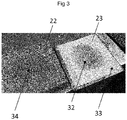
- Fig 3 shows the underside of the non-woven veil 23 having a central portion 32 corresponding to the portion at which the bituminous membrane was present and an edge portion 33 at which the bituminous membrane was not present.
- the bitumen adhesive penetrated through part but not all of the non-woven veil.
- Corresponding portions of bitumen adhesive were also present at part but not all of the central portion 34 of the mineral wool slab 22.
- Fig 4 shows a microscope photograph of the underside of the non-woven veil i.e. the portion of the non-woven veil that was in contact with the mineral wool slab 22.
- securing portions 41 of the non-woven veil Penetration of the bitumen adhesive can be seen at securing portions 41 of the non-woven veil, these securing portions are present at part but not all of the surface area of the veil.
- Fig 5 shows a magnified photograph through a cross section of the non-woven veil. Again penetration of the bitumen adhesive is seen at securing portions 41 of the veil but not at other portions.
- the dark colour of the bitumen adhesive of the warm roof bituminous weatherproof membrane facilitated visualisation of the securing portions of the non-woven veil.
Landscapes
- Engineering & Computer Science (AREA)
- Architecture (AREA)
- Civil Engineering (AREA)
- Structural Engineering (AREA)
- Textile Engineering (AREA)
- Physics & Mathematics (AREA)
- Electromagnetism (AREA)
- Building Environments (AREA)
- Roof Covering Using Slabs Or Stiff Sheets (AREA)
- Glass Compositions (AREA)
- Inorganic Insulating Materials (AREA)
- Laminated Bodies (AREA)
Description
- This invention relates to a mineral wool insulation panel particularly for flat or inclined roofs.
- A common type of insulated roof system comprises, in sequence, a support structure, a layer of mineral wool insulation and an overlying weatherproof membrane which seals the roofing system against ingress of water. This is sometime referred to as a "warm roof" as the insulation is arranged above the structural deck which is thus kept warm. The weatherproof membrane may be retained by mechanical fixing, by adhesion or by overlying ballast. One problem associated with design of mineral wool insulation, notably for such systems, is to provide insulation panels which are easily incorporated in a number of different configurations of roofing system.
-
WO 98/31895 WO 2013/034376A1 attempts to overcome disadvantages ofWO 98/31895 WO 98/31895 GB2312695A US 2005/0166539 A1 which discloses a building element andUS 2009/0208714 A1 which discloses a pre-coated non-woven mat-faced gypsum panel. - One aim of the present invention is to provide a mineral wool panel for a roof system which provides an advantageous combination of ease of manufacturing, suitability for use with a plurality of building systems, particularly roof systems, and peel strength for an overlying weatherproof membrane when adhered thereto.
- In accordance with one of its aspects, the present invention provides a roof system as defined in claim 1. Additional aspects of the invention are defined in independent claims. The dependent claims define preferred and/or alternative embodiments.
- In accordance with a further aspect, the present invention provides a roof system comprising, preferably in sequence from the inside to the outside of a building structure: a support structure; a mineral wool insulation panel comprising mineral fibres and a non-woven veil secured to its upper surface by a binder; and an overlying weatherproof membrane secured to the mineral wool insulation panel by an adhesive, in which the adhesive penetrates through securing portions of the non-woven veil to provide an adhesive connection between the mineral fibres of the insulating panel and the weatherproof membrane.
- The support structure may comprise a timber deck, a metal deck or a concrete deck. A vapour control layer, for example a polymer sheet, polyethylene sheet, reinforced polyethylene sheet, bitumen layer or bitumen bonded felt, may be provided between the support structure and the mineral wool insulation panel.
- The roof system may be a warm roof, for example, a warm roof with a built-up felt or asphalt roof covering, a warm roof with a single ply membrane or an inverted/protected membrane/green roof.
- The mineral wool insulation panel preferably comprises stone wool fibres. It may have:
- a density which is ≥80 kg/m3 or ≥ 90 kg/m3 and/or which is ≤ 220 kg/m3 or ≤ 200 kg/m3; and/or
- a thermal conductivity which is ≤ 40 mW/m.K or ≤ 39 mW/m.K and/or ≥ 30 mW/m.K.
- The mineral wool insulation panel may comprise a mineral wool binder which serves to hold its individual fibres together, notably an organic, thermoset binder. The mineral wool binder may make up ≥ 2 wt%, ≥ 2.5 wt% or ≥ 3 wt% and/or ≤ 7 wt% or ≤ 6 wt% or ≤ 5 wt% of the mineral wool insulation panel. The binder content may be determined by LOI (loss on ignition). Preferably, the mineral wool binder and the mineral wool insulation panel are formaldehyde free. In particular, the mineral wool binder is preferably not a phenol formaldehyde binder. The mineral wool insulation panel (comprising the mineral wool binder) preferably comprises less than 5 ppm or less than detectable limits of free formaldehyde and/or consist of materials which together comprise less than these amounts of free formaldehyde and/or releases levels of formaldehyde in standardised tests adapted to simulate ordinary use which allows it to be classified as having no or undetectable levels of formaldehyde release. Preferably, such products release less than 10µg/m3, more preferably less than 5 µg/m3 of formaldehyde during the period of 24-48 hours from the start of testing in accordance with ISO 16000. The mineral wool binder may be a sugar based binder, that is to say a binder which is the reaction product(s) of a binder solution whose solid content comprises at least 50 wt% sugar(s). The mineral wool binder may be the reaction product(s) of a binder solution whose solid content comprises at least 70 wt% reducing sugar(s), preferably in combination with a source of nitrogen to form a Maillard reaction product, notably in combination with preferably at least 10 wt% of i) amine(s) and/or ii) carboxylic acid(s).
- The fibres of the mineral wool insulation panel may be orientated substantially perpendicular to the panel's major surfaces; they may be crimped. The mineral wool insulation panel may have a crimp factor which is ≥ 1.1, ≥ 1.2, ≥ 1.3 ≥ 1.5 or ≥ 2 and/or ≤ 4 or ≤ 3.5. The crimp factor provides an indication of the degree of crimping and thus of fibre re-orientation; it may be assessed by comparing i) the manufacturing line speed of the mineral wool prior to crimping, notably the line speed of the secondary blanket in the case of stone wool insulation with ii) the manufacturing line speed of the mineral wool panel after crimping, notably the line speed of the mineral wool blanket through the curing oven. A crimp factor of 3 indicates a line speed after curing of 1/3 of the line speed prior to crimping. The mineral wool insulation panel preferably has a compressive strength which is ≥ 30 kPa, ≥ 40 kPa or ≥ 55 kPa, notably ≥ 58 kPa. Compression strength and other properties of the mineral wool insulation panel should be measured in accordance with EN13162 and the specific standards referred to therein.
- The mineral wool insulation panel preferably has a fire classification of Euroclass A1 or A2 as determined under EN 13501-1.
- The non-woven veil is preferably secured to the upper surface of the mineral wool insulation panel by the same binder as that present in the mineral wool insulation panel. In a preferred manufacturing method, the non-woven veil is applied to the upper surface of a mineral wool batt as the batt moves along a manufacturing line, preferably without applying additional binder, and binder present in the batt secures the veil and the batt together during passage through a curing oven to cure the binder. In such a method, the securing portions of the veil (which will subsequently allow passage of adhesive) facilitate curing of the batt by facilitating passage of heated air though the veil covered batt. Alternatively, the non-woven veil may not be passed through a curing oven; it may be secured to the upper surface of the mineral wool insulation panel after the mineral wool has passed through a curing oven. The binder by which the non-woven veil is secured to the upper surface of the mineral wool insulation panel may be a hot melt binder, a thermoset binder, an organic binder, an inorganic binder, a poly(vinyl acetate) binder, a polyurethane binder or a water glass binder. It may be a binder as described above in relation to mineral wool binders, notably a binder that is formaldehyde free and which is not a phenol formaldehyde binder. The binder by which the non-woven veil is secured to the upper surface of the mineral wool insulation panel may be present in an amount which is ≥ 5 g/m2, ≥ 10 g/m2 or ≥ 15 g/m2 and/or ≤ 50 g/m2, ≤ 40 g/m2 or ≤ 30 g/m2.
- Whilst not wishing to be bound by theory, it is believed that the use of a veil which is a non-woven, particularly a non-woven veil which comprises a filler, facilitates provision of a plurality of passages through the veil having a spread distribution of opening sizes; the larger openings permit passage of air through the veil during manufacture and the passage of adhesive through the veil to secure the membrane whilst the smaller openings block passage of the adhesive whilst still contributing during manufacture to passage of air. This allows an optimisation which is not possible with the woven veils of
WO 98/31895 - The fibres of the non-woven veil are held together by a veil binder; this may be a thermoset binder. The veil binder may comprise a PVC binder or a PVC based binder. The veil binder may be a binder as described above in relation to mineral wool binders; it may comprise ≥ 5 wt% or ≥ 8 wt% and/or ≤ 30 wt% or ≤ 28 wt% of the non-woven veil. The veil may comprise a flame retardant, for example comprising a phosphate, borate, hydroxide or aluminium hydroxide. The non-woven veil preferably comprises a filler, notably an inorganic filler, for example comprising calcium oxide, calcium hydroxide, aluminium hydroxide, clay, talc, magnesium silicate, hydrated magnesium silicate or mixtures thereof. The filler, or the combination of filler and flame retardant, may comprise ≥ 10 wt%, or ≥ 15 wt% or ≥ 20 wt% or ≥ 25 wt% and/or ≤ 80 wt%, or ≤ 70 wt%, or ≤ 60 wt% of the non-woven veil. The non-woven veil may be formed by applying the filler to a non-woven veil having a weight which is ≥ 30 g/m2 or ≥ 40 g/m2 or ≥ 45 g/m2 and/or ≤ 100g/m2, or ≤ 80g/m2, or ≤ 70g/m2. The veil, including the filler, may have a weight which is ≥ 100 g/m2 or ≥ 150 g/m2 or ≥ 200 g/m2 or ≥ 250 g/m2 or ≥ 300 g/m2 and/or ≤ 500 g/m2, or ≤ 450 g/m2 or ≤ 400 g/m2. For example, the veil (including any filler and coating) may have a weight which is ≥ 200 g/m2 or ≥ 250 g/m2 and/or ≤ 350 g/m2 or ≤ 400 g/m2. The non-woven veil may comprise a water repellent or hydrophobic agent, for example a fluorocarbon, which may comprise ≥ 0.5 wt% or ≥ 1 wt% and/or ≤ 2 wt% or ≤ 1.5 wt% of the non-woven veil; this may form part of the veil binder. Where the filler comprises talc, this may provide hydrophobic characteristics to the veil. Where the filler comprises Al2O3, this may provide fire resistant characteristics to the veil. The veil may be coated on only one of its major surfaces or it may be coated on each of its two major surfaces; the coating may comprise a filler and/or a flame retardant and/or a water repellent or hydrophobic agent, notably as described above. The fibres of the non-woven veil may be selected such that at least 80% of the fibres by weight have a diameter which is: AA 0.8-1-2µm; A 1.2-2.5µm; B 2.5-3.8 µm; C3.8-5.0 µm; D 5.0-6.4 µm; E6.4-7.6 µm; F 7.6-9.0 µm; G 9.0-10.2 µm; H 10.2-11.4 µm or J 11.4-12.7 µm. The veil may have a width which is ≥ 1.5 m or ≥ 1.8 m and/or ≤ 2.6 m or ≤ 2.4 m. The veil may be supplied in the form of a roll; this facilitates application to the mineral wool insulation panel. Such a roll may have: an external diameter which is ≥ 0.5 m or ≥ 0.8m and/or ≤ 1.6 m or ≤ 1.4 m; it may comprise a continuous length of veil which is ≥ 800 m or ≥ 1000 and/or ≤ 2000 m or ≤ 1800 m.
- The weatherproof membrane may be a single ply membrane. It may be selected from a bitumen membrane, a fully bonded built-up bitumen membrane, mastic asphalt, a polymer membrane, a PVC membrane; an EPDM (ethylene propylene diene terpolymer) membrane; a membrane applied in liquid form. The adhesive may be a "hot melt" adhesive, for example a bitumen or bitumen based adhesive. The hot melt adhesive may be applied in liquid form, for example poured on to or spread over the mineral wool insulation panel prior to application of the membrane. Alternatively, the adhesive may be contained within the membrane and released by heating the membrane, for example by torching a bituminous membrane. The adhesive may be a cold adhesive; it may be a polymer adhesive. The adhesive may be a polyurethane adhesive, a polyacrylic adhesive, a rubber adhesive or a rubber contact adhesive. The adhesive may be applied at a viscosity in the range 750 to 6000 cps; the quantity of adhesive may be ≥ 50 g/m2, or ≥ 100 g/m2 or ≥ 150 g/m2 and/or ≤ 800g/m2, or ≤ 600g/m2, or ≤ 500g/m2, or ≤ 350 g/m2.
- The side of the mineral wool insulation panel to which the non-woven veil is secured may have a point load resistance (measured in accordance with EN12430) which is ≥ 650 N, ≥ 750 N, ≥ 800 N or ≥ 900 N.
- In addition to adhesion between the weatherproof membrane and the mineral wool insulation panel, the roofing system may comprise anchors, notably mechanical fixations, to secure the weatherproof membrane, for example to secure the weatherproof membrane to the mineral wool insulation panel and/or to the support structure. In preferred embodiments, no such anchors are used, the adhesion between the weatherproof membrane and the mineral wool insulation panel providing sufficient peel strength. In other embodiments, between one and four such anchors are used per mineral wool insulation panel; common know comparable roof systems require a greater number of anchors.
- Non-woven veils used in accordance with the present invention, particularly in their preferred forms, provide a valuable combination of advantages, notably:
- on-site protection of the mineral panel prior to completion of the building structure, the exposed non-woven veil reducing water ingress into the mineral wool insulating panel and/or providing UV protection;
- mechanical properties, notably a high resistance of the mineral wool insulating panels to point loads before and/or after placement of an overlying weatherproof membrane;
- resistance to torching, for example when applying a bituminous weatherproof membrane;
- a pre-determined amount of adhesive penetration through the non-woven veil and in to the mineral wool providing high peel strength for an adhered weatherproof membrane without excessive use of adhesive for both hot and cold adhesives;
- particularly good adhesion and/or peel strength for cold gluing, notably from the combination of a substantially dust free surface and a pre-determined amount of adhesive penetration.
- An embodiment of the invention will now be described, by way of example only, with reference to the accompanying drawings of which:
-
Fig 1 is a schematic side view of a warm roof system; -
Fig 2 is a schematic, partially cut away perspective view of an insulation panel; -
Fig 3 is a photograph of a disassembled insulating panel; -
Fig 4 is a photograph of the underside of the veil of the disassembled insulating panel; and -
Fig 5 is a cross-sectional photograph of the veil of the disassembled insulating panel. - The warm deck, single
ply roof system 10 ofFig 1 comprises (in sequence from the interior to the exterior of a building) asupport structure 11 provided by a metal deck, an optionalvapour control layer 12, a mineralwool insulation panel 13, and a overlyingweatherproof membrane 14, in this case a single ply membrane, secured to themineral wool panel 13 by an adhesive (not shown). - As shown in
Fig 2 , theinsulation panel 13 comprises acore 22 of mineral wool fibres provided on its upper surface with anon-woven veil 23. Thenon-woven veil 23 is manufactured by applying an inorganic filler comprising talc to a glass veil having a weight of about 50 g/m2 and comprising glass fibres (diameter AA: 0.8 to 1.2µm) retained together by a veil binder. The combination of the veil weight, fibre diameter and amount of filler is selected to provide the non-woven veil with securing portions, that is to say, portions of the non-woven veil through which there is penetration of the adhesive which secures the overlyingweatherproof membrane 14 to themineral wool panel 13. - To evaluate penetration of the adhesive through the non-woven veil a portion of bituminous
weatherproof membrane 14 was heated up on a steel plate, a layer ofnon-woven veil 23 was laid on top of the heated bituminousweatherproof membrane 14, a portion of an un-facedmineral wool panel 22 was laid over thenon-woven veil 23 and the sample was left to cool. Once cool, thebitumen membrane 14 adhered strongly to the mineral wool panel; this demonstrates that the bitumen adhesive had penetrated through securing portions of the non-woven veil to provide an adhesive connection. The sample was subsequently pulled apart andFigs 3 ,4 and 5 show photographs of this disassembled sample.Fig 3 shows the underside of thenon-woven veil 23 having acentral portion 32 corresponding to the portion at which the bituminous membrane was present and anedge portion 33 at which the bituminous membrane was not present. At thecentral portion 32, the bitumen adhesive penetrated through part but not all of the non-woven veil. Corresponding portions of bitumen adhesive were also present at part but not all of thecentral portion 34 of themineral wool slab 22.Fig 4 shows a microscope photograph of the underside of the non-woven veil i.e. the portion of the non-woven veil that was in contact with themineral wool slab 22. Penetration of the bitumen adhesive can be seen at securingportions 41 of the non-woven veil, these securing portions are present at part but not all of the surface area of the veil.Fig 5 shows a magnified photograph through a cross section of the non-woven veil. Again penetration of the bitumen adhesive is seen at securingportions 41 of the veil but not at other portions. - The dark colour of the bitumen adhesive of the warm roof bituminous weatherproof membrane facilitated visualisation of the securing portions of the non-woven veil. The effect of penetration of the membrane adhesive occurs in the same way with other warm roof membrane adhesives and adhering techniques. Determination of the area of the securing portions as a % of the surface area of the non-woven veil may be carried out by image processing, for example image processing of a photograph of the type illustrated in
Fig 3 orFig 5 .
Claims (10)
- A roof system comprising, in sequence: a support structure; a mineral wool insulation panel comprising mineral fibres and a non-woven veil secured to its upper surface by a binder; and an overlying weatherproof membrane secured to the mineral wool insulation panel by an adhesive, characterised in that the adhesive penetrates through securing portions of the non-woven veil to provide an adhesive connection between the mineral fibres of the insulating panel and the weatherproof membrane, and in which the securing portions make up between 5% and 95% of the surface area of the non-woven veil, notably in which the securing portions make up between 15% and 85% of the surface area of the non-woven veil.
- A roofing system in accordance with claim 1, in which the securing portions make up between 20% and 80% of the surface area of the non-woven veil.
- A roofing system in accordance with claim 1 or claim 2, in which the non-woven veil comprises a filler, notably selected from calcium oxide, calcium hydroxide, aluminium hydroxide, clay, talc, magnesium silicate, hydrated magnesium silicate and mixtures thereof.
- A roofing system in accordance with claim 3, in which weight of the veil, including the filler, is ≥ 100 g/m2 and ≤ 500 g/m2, notably ≥ 250 g/m2 and ≤ 400 g/m2.
- A roofing system in accordance with any preceding claim, in which the fibres of the non-woven veil consist of glass fibres.
- A roofing system in accordance with any of claims 1 to 4, in which the fibres of the non-woven veil comprises glass fibres and polymer fibres, notable PE fibres, notably in which the collection of fibres comprises between 70 wt% and 90 wt% glass fibres and between 30 wt% and 10 wt% polymer fibres.
- A roofing system in accordance with any preceding claim, in which the fibres of the non-woven veil consist of a collection of fibres selected from i) a collection of fibres in respect of which at least 80% of the fibres have a diameter in the range 0.8µm to 1.2µm and ii) a collection of fibres in respect of which the at least 80% of the fibres have a diameter in the range 1.2µm to 2.5µm.
- A roofing system in accordance with any preceding claim, in which the mineral wool insulation panel comprises a dual density insulation panel comprising i) a high density surface layer of mineral wool fibres to which the non-woven veil is secured, notably having a thickness in the range 5mm to 40 mm and a density in the range 130 kg/m3 to ≤ 250 Kg/m3, and ii) a lower density underlying layer of mineral wool fibres, notably having a thickness in the range 45mm to 400 mm and a density in the range 100 kg/m3 to 185 kg/m3.
- A mineral wool insulation panel for use in a roofing system in accordance with any of claims 1 to 8, the mineral wool insulation panel comprising mineral fibres and a non-woven veil secured to its upper surface by a binder characterised in that the non-woven veil comprises securing portions which make up between 5% and 90%, preferably between 15% and 85%, more preferably between 20% and 80%, of the surface area of the non-woven veil, the securing portion being configured to allow penetration through the non-woven veil of an adhesive used to secure a weatherproof membrane.
- Use of a non-woven veil comprises securing portions which make up between 5% and 90%, preferably between 15% and 85%, more preferably between 20% and 80% of the surface area of the non-woven veil as an upper surface of a mineral wool insulating panel to allow penetration through the securing portions of the non-woven veil of an adhesive used to secure a weatherproof membrane.
Priority Applications (2)
| Application Number | Priority Date | Filing Date | Title |
|---|---|---|---|
| SI201730586T SI3341193T1 (en) | 2016-08-17 | 2017-08-16 | Mineral wool insulation |
| HRP20210033TT HRP20210033T1 (en) | 2016-08-17 | 2017-08-16 | Mineral wool insulation |
Applications Claiming Priority (2)
| Application Number | Priority Date | Filing Date | Title |
|---|---|---|---|
| GB1614101.2A GB2552985B (en) | 2016-08-17 | 2016-08-17 | Mineral wool insulation |
| PCT/EP2017/070725 WO2018033558A1 (en) | 2016-08-17 | 2017-08-16 | Mineral wool insulation |
Publications (2)
| Publication Number | Publication Date |
|---|---|
| EP3341193A1 EP3341193A1 (en) | 2018-07-04 |
| EP3341193B1 true EP3341193B1 (en) | 2020-10-14 |
Family
ID=56985841
Family Applications (1)
| Application Number | Title | Priority Date | Filing Date |
|---|---|---|---|
| EP17754698.3A Revoked EP3341193B1 (en) | 2016-08-17 | 2017-08-16 | Mineral wool insulation |
Country Status (5)
| Country | Link |
|---|---|
| EP (1) | EP3341193B1 (en) |
| GB (1) | GB2552985B (en) |
| HR (1) | HRP20210033T1 (en) |
| SI (1) | SI3341193T1 (en) |
| WO (1) | WO2018033558A1 (en) |
Cited By (1)
| Publication number | Priority date | Publication date | Assignee | Title |
|---|---|---|---|---|
| WO2025155459A1 (en) * | 2024-01-19 | 2025-07-24 | Owens Corning Intellectual Capital, Llc | Composite reinforced rockwool board and production equipment thereof |
Families Citing this family (5)
| Publication number | Priority date | Publication date | Assignee | Title |
|---|---|---|---|---|
| GB201820462D0 (en) * | 2018-12-14 | 2019-01-30 | Knauf Insulation Doo Skofja Loka | Mineral wool insulation |
| WO2020263527A1 (en) * | 2019-06-28 | 2020-12-30 | Owens Corning Intellectual Capital, Llc | Mineral wool insulation |
| GB202003684D0 (en) * | 2020-03-13 | 2020-04-29 | Euro Polymers Consult Ltd | Roof assembly |
| GB2615535A (en) * | 2022-02-09 | 2023-08-16 | Knauf Insulation Srl | Underfloor heating system |
| GB202407826D0 (en) | 2024-06-03 | 2024-07-17 | Knauf Insulation D O O Skofja Loka | Mineral wool insulation |
Citations (5)
| Publication number | Priority date | Publication date | Assignee | Title |
|---|---|---|---|---|
| GB1587270A (en) | 1976-10-29 | 1981-04-01 | Rockwool Lapinus Bv | Insulating board of mineral wood |
| GB2223248A (en) | 1988-09-09 | 1990-04-04 | Rockwool Int | Insulation board for roofing |
| WO1998031895A1 (en) | 1997-01-20 | 1998-07-23 | Rockwool Limited | Composite roof system |
| WO2013034376A1 (en) | 2011-09-06 | 2013-03-14 | Rockwool International A/S | Insulation element for a flat roof or a flat inclined roof, roofing system for a flat roof or a flat inclined roof and method for producing an insulation element |
| US20150330072A1 (en) | 2014-05-16 | 2015-11-19 | Armstrong World Industries, Inc. | Acoustic ceiling board with improved aesthetics |
Family Cites Families (3)
| Publication number | Priority date | Publication date | Assignee | Title |
|---|---|---|---|---|
| GB9701092D0 (en) * | 1997-01-20 | 1997-03-12 | Rockwool Ltd | Composite roof system |
| DE10146755C1 (en) * | 2001-09-22 | 2003-04-30 | Rockwool Mineralwolle | building element |
| US20090208714A1 (en) * | 2008-02-18 | 2009-08-20 | Georgia-Pacific Gypsum Llc | Pre-coated non-woven mat-faced gypsum panel |
-
2016
- 2016-08-17 GB GB1614101.2A patent/GB2552985B/en active Active
-
2017
- 2017-08-16 EP EP17754698.3A patent/EP3341193B1/en not_active Revoked
- 2017-08-16 HR HRP20210033TT patent/HRP20210033T1/en unknown
- 2017-08-16 WO PCT/EP2017/070725 patent/WO2018033558A1/en not_active Ceased
- 2017-08-16 SI SI201730586T patent/SI3341193T1/en unknown
Patent Citations (5)
| Publication number | Priority date | Publication date | Assignee | Title |
|---|---|---|---|---|
| GB1587270A (en) | 1976-10-29 | 1981-04-01 | Rockwool Lapinus Bv | Insulating board of mineral wood |
| GB2223248A (en) | 1988-09-09 | 1990-04-04 | Rockwool Int | Insulation board for roofing |
| WO1998031895A1 (en) | 1997-01-20 | 1998-07-23 | Rockwool Limited | Composite roof system |
| WO2013034376A1 (en) | 2011-09-06 | 2013-03-14 | Rockwool International A/S | Insulation element for a flat roof or a flat inclined roof, roofing system for a flat roof or a flat inclined roof and method for producing an insulation element |
| US20150330072A1 (en) | 2014-05-16 | 2015-11-19 | Armstrong World Industries, Inc. | Acoustic ceiling board with improved aesthetics |
Non-Patent Citations (8)
| Title |
|---|
| "Inorganic mineral materials for insulation in buildings", 2010, WOODHEAD PUBLISHING LIMITED, article GELLERT R.: "Chapter 8", pages: 193 - 227, XP055837922 |
| ANONYMOUS: "BONDROCK An Innovative Product For Flat Roof Thermal Insulation", ROCKWOOL COMPANY, 1 March 2015 (2015-03-01), XP055936210 |
| ANONYMOUS: "Dachdämmplatte Bondrock® MV", BONDROCK® MV, 1 July 2014 (2014-07-01), pages 1 - 2, XP055837932, [retrieved on 20210906] |
| ANONYMOUS: "Dachdämmplatte Bondrock® MV", BONDROCK® MV, July 2014 (2014-07-01), pages 1 - 2, XP055837932 |
| ANONYMOUS: "Flat Roof Thermal Insulation Catalog Album on Design and Installation of the ROCKROOF Roof System", ROCKWOOL COMPANY, 1 June 2015 (2015-06-01), pages 13, 24, 26, XP055936214 |
| ANONYMOUS: "Produktkatalog Flachdach, Metalldach und Kassettenwand", ROCKWOOL HANDELSGESELLSCHAFT MBH.,, 1 July 2014 (2014-07-01), ÖSTERREICH, pages 9, XP055936227 |
| DR. HEATH HIMSTEDT, SIMENSON JOHN, MANVILLE JOHNS: "Overview of Filtration Media Classes, Their Properties, and Applications in Which They Excel", NEXT GENERATION FILTER MEDIA CONFERENCE AMERICAN FILTRATION AND SEPARATIONS SOCIETY, 15 October 2014 (2014-10-15), pages 24pp, XP055936233 |
| M. BIENS ET AL.,: "Recommandations Professionnelles de la CSFE Pour la conception de l’isolation thermique des toitures-terrasses et toitures inclinées avec étanchéité", CSFE CHAMBRE SYNDICALE FRANÇAISE DE L’ÉTANCHÉITÉ, 1 May 2012 (2012-05-01), pages 3 - 23, XP055936221 |
Cited By (1)
| Publication number | Priority date | Publication date | Assignee | Title |
|---|---|---|---|---|
| WO2025155459A1 (en) * | 2024-01-19 | 2025-07-24 | Owens Corning Intellectual Capital, Llc | Composite reinforced rockwool board and production equipment thereof |
Also Published As
| Publication number | Publication date |
|---|---|
| WO2018033558A1 (en) | 2018-02-22 |
| GB2552985A (en) | 2018-02-21 |
| GB201614101D0 (en) | 2016-09-28 |
| EP3341193A1 (en) | 2018-07-04 |
| GB2552985B (en) | 2018-09-26 |
| HRP20210033T1 (en) | 2021-05-14 |
| SI3341193T1 (en) | 2021-02-26 |
Similar Documents
| Publication | Publication Date | Title |
|---|---|---|
| WO2018033558A1 (en) | Mineral wool insulation | |
| US20200256053A1 (en) | Insulated sheathing panel and methods for use and manufacture thereof | |
| US7786028B2 (en) | Nonwoven polymeric fiber mat composites and method | |
| US9032690B2 (en) | Insulation element for a flat roof or a flat inclined roof, roofing system for a flat roof or a flat inclined roof and method for producing an insulation element | |
| US8546278B2 (en) | Composite board containing glass fiber mat | |
| EP2670924B1 (en) | Insulation system for covering a facade of a building | |
| NO339212B1 (en) | Insulation panel equipped with airtight and rainproof coating and a waterproof cover. | |
| WO2012098040A1 (en) | Composite thermal insulation system | |
| US20200384735A1 (en) | Building Panels, Assemblies, and Associated Methods | |
| US4948655A (en) | Composite panel and method of manufacturing waterproof roofings | |
| US9624663B2 (en) | Thermal barrier in building structures | |
| EP3666989A1 (en) | Mineral wool insulation | |
| US20220168994A1 (en) | Insulation element for thermal and/or acoustic insulation of a flat or flat inclined roof and method for producing an insulation element | |
| US12152390B2 (en) | Thermal and/or acoustic insulation system as waterproofing for a flat or a flat inclined roof of a building and method for producing a thermal and/or acoustic insulation system as waterproofing | |
| WO2025252531A1 (en) | Mineral wool insulation | |
| KR101039239B1 (en) | Adhesive Insulation Waterproof Sheet | |
| EP2053178A2 (en) | Insulator element | |
| EP4239251B1 (en) | Underfloor heating system | |
| EP1990478B1 (en) | A building roof structure | |
| RS1752U1 (en) | Multilayer waterproofing roof tile underlay | |
| MXPA97006590A (en) | Roofing members who have improved dimensional stability and related methods | |
| MXPA97006591A (en) | Composite roofing members, which have improved dimensional stability and related methods |
Legal Events
| Date | Code | Title | Description |
|---|---|---|---|
| STAA | Information on the status of an ep patent application or granted ep patent |
Free format text: STATUS: UNKNOWN |
|
| STAA | Information on the status of an ep patent application or granted ep patent |
Free format text: STATUS: THE INTERNATIONAL PUBLICATION HAS BEEN MADE |
|
| PUAI | Public reference made under article 153(3) epc to a published international application that has entered the european phase |
Free format text: ORIGINAL CODE: 0009012 |
|
| STAA | Information on the status of an ep patent application or granted ep patent |
Free format text: STATUS: REQUEST FOR EXAMINATION WAS MADE |
|
| 17P | Request for examination filed |
Effective date: 20180330 |
|
| AK | Designated contracting states |
Kind code of ref document: A1 Designated state(s): AL AT BE BG CH CY CZ DE DK EE ES FI FR GB GR HR HU IE IS IT LI LT LU LV MC MK MT NL NO PL PT RO RS SE SI SK SM TR |
|
| AX | Request for extension of the european patent |
Extension state: BA ME |
|
| STAA | Information on the status of an ep patent application or granted ep patent |
Free format text: STATUS: EXAMINATION IS IN PROGRESS |
|
| 17Q | First examination report despatched |
Effective date: 20181009 |
|
| DAV | Request for validation of the european patent (deleted) | ||
| DAX | Request for extension of the european patent (deleted) | ||
| GRAP | Despatch of communication of intention to grant a patent |
Free format text: ORIGINAL CODE: EPIDOSNIGR1 |
|
| STAA | Information on the status of an ep patent application or granted ep patent |
Free format text: STATUS: GRANT OF PATENT IS INTENDED |
|
| INTG | Intention to grant announced |
Effective date: 20200528 |
|
| GRAS | Grant fee paid |
Free format text: ORIGINAL CODE: EPIDOSNIGR3 |
|
| GRAA | (expected) grant |
Free format text: ORIGINAL CODE: 0009210 |
|
| STAA | Information on the status of an ep patent application or granted ep patent |
Free format text: STATUS: THE PATENT HAS BEEN GRANTED |
|
| AK | Designated contracting states |
Kind code of ref document: B1 Designated state(s): AL AT BE BG CH CY CZ DE DK EE ES FI FR GB GR HR HU IE IS IT LI LT LU LV MC MK MT NL NO PL PT RO RS SE SI SK SM TR |
|
| REG | Reference to a national code |
Ref country code: GB Ref legal event code: FG4D |
|
| REG | Reference to a national code |
Ref country code: AT Ref legal event code: REF Ref document number: 1323169 Country of ref document: AT Kind code of ref document: T Effective date: 20201015 Ref country code: CH Ref legal event code: EP |
|
| REG | Reference to a national code |
Ref country code: DE Ref legal event code: R096 Ref document number: 602017025524 Country of ref document: DE |
|
| REG | Reference to a national code |
Ref country code: IE Ref legal event code: FG4D |
|
| REG | Reference to a national code |
Ref country code: HR Ref legal event code: TUEP Ref document number: P20210033T Country of ref document: HR |
|
| REG | Reference to a national code |
Ref country code: NL Ref legal event code: FP |
|
| REG | Reference to a national code |
Ref country code: SK Ref legal event code: T3 Ref document number: E 36151 Country of ref document: SK |
|
| PG25 | Lapsed in a contracting state [announced via postgrant information from national office to epo] |
Ref country code: NO Free format text: LAPSE BECAUSE OF FAILURE TO SUBMIT A TRANSLATION OF THE DESCRIPTION OR TO PAY THE FEE WITHIN THE PRESCRIBED TIME-LIMIT Effective date: 20210114 Ref country code: PT Free format text: LAPSE BECAUSE OF FAILURE TO SUBMIT A TRANSLATION OF THE DESCRIPTION OR TO PAY THE FEE WITHIN THE PRESCRIBED TIME-LIMIT Effective date: 20210215 Ref country code: RS Free format text: LAPSE BECAUSE OF FAILURE TO SUBMIT A TRANSLATION OF THE DESCRIPTION OR TO PAY THE FEE WITHIN THE PRESCRIBED TIME-LIMIT Effective date: 20201014 Ref country code: GR Free format text: LAPSE BECAUSE OF FAILURE TO SUBMIT A TRANSLATION OF THE DESCRIPTION OR TO PAY THE FEE WITHIN THE PRESCRIBED TIME-LIMIT Effective date: 20210115 Ref country code: FI Free format text: LAPSE BECAUSE OF FAILURE TO SUBMIT A TRANSLATION OF THE DESCRIPTION OR TO PAY THE FEE WITHIN THE PRESCRIBED TIME-LIMIT Effective date: 20201014 |
|
| REG | Reference to a national code |
Ref country code: LT Ref legal event code: MG4D |
|
| REG | Reference to a national code |
Ref country code: HR Ref legal event code: T1PR Ref document number: P20210033 Country of ref document: HR |
|
| PG25 | Lapsed in a contracting state [announced via postgrant information from national office to epo] |
Ref country code: IS Free format text: LAPSE BECAUSE OF FAILURE TO SUBMIT A TRANSLATION OF THE DESCRIPTION OR TO PAY THE FEE WITHIN THE PRESCRIBED TIME-LIMIT Effective date: 20210214 Ref country code: PL Free format text: LAPSE BECAUSE OF FAILURE TO SUBMIT A TRANSLATION OF THE DESCRIPTION OR TO PAY THE FEE WITHIN THE PRESCRIBED TIME-LIMIT Effective date: 20201014 Ref country code: LV Free format text: LAPSE BECAUSE OF FAILURE TO SUBMIT A TRANSLATION OF THE DESCRIPTION OR TO PAY THE FEE WITHIN THE PRESCRIBED TIME-LIMIT Effective date: 20201014 Ref country code: SE Free format text: LAPSE BECAUSE OF FAILURE TO SUBMIT A TRANSLATION OF THE DESCRIPTION OR TO PAY THE FEE WITHIN THE PRESCRIBED TIME-LIMIT Effective date: 20201014 Ref country code: BG Free format text: LAPSE BECAUSE OF FAILURE TO SUBMIT A TRANSLATION OF THE DESCRIPTION OR TO PAY THE FEE WITHIN THE PRESCRIBED TIME-LIMIT Effective date: 20210114 Ref country code: ES Free format text: LAPSE BECAUSE OF FAILURE TO SUBMIT A TRANSLATION OF THE DESCRIPTION OR TO PAY THE FEE WITHIN THE PRESCRIBED TIME-LIMIT Effective date: 20201014 |
|
| REG | Reference to a national code |
Ref country code: DE Ref legal event code: R026 Ref document number: 602017025524 Country of ref document: DE |
|
| PLBI | Opposition filed |
Free format text: ORIGINAL CODE: 0009260 |
|
| PLAX | Notice of opposition and request to file observation + time limit sent |
Free format text: ORIGINAL CODE: EPIDOSNOBS2 |
|
| PG25 | Lapsed in a contracting state [announced via postgrant information from national office to epo] |
Ref country code: RO Free format text: LAPSE BECAUSE OF FAILURE TO SUBMIT A TRANSLATION OF THE DESCRIPTION OR TO PAY THE FEE WITHIN THE PRESCRIBED TIME-LIMIT Effective date: 20201014 Ref country code: LT Free format text: LAPSE BECAUSE OF FAILURE TO SUBMIT A TRANSLATION OF THE DESCRIPTION OR TO PAY THE FEE WITHIN THE PRESCRIBED TIME-LIMIT Effective date: 20201014 Ref country code: EE Free format text: LAPSE BECAUSE OF FAILURE TO SUBMIT A TRANSLATION OF THE DESCRIPTION OR TO PAY THE FEE WITHIN THE PRESCRIBED TIME-LIMIT Effective date: 20201014 Ref country code: SM Free format text: LAPSE BECAUSE OF FAILURE TO SUBMIT A TRANSLATION OF THE DESCRIPTION OR TO PAY THE FEE WITHIN THE PRESCRIBED TIME-LIMIT Effective date: 20201014 |
|
| PLAB | Opposition data, opponent's data or that of the opponent's representative modified |
Free format text: ORIGINAL CODE: 0009299OPPO |
|
| 26 | Opposition filed |
Opponent name: ROCKWOOL INTERNATIONAL A/S Effective date: 20210714 Opponent name: SAINT-GOBAIN ISOVER Effective date: 20210713 |
|
| PG25 | Lapsed in a contracting state [announced via postgrant information from national office to epo] |
Ref country code: DK Free format text: LAPSE BECAUSE OF FAILURE TO SUBMIT A TRANSLATION OF THE DESCRIPTION OR TO PAY THE FEE WITHIN THE PRESCRIBED TIME-LIMIT Effective date: 20201014 |
|
| R26 | Opposition filed (corrected) |
Opponent name: ROCKWOOL INTERNATIONAL A/S Effective date: 20210714 |
|
| REG | Reference to a national code |
Ref country code: HR Ref legal event code: ODRP Ref document number: P20210033 Country of ref document: HR Payment date: 20210803 Year of fee payment: 5 |
|
| PG25 | Lapsed in a contracting state [announced via postgrant information from national office to epo] |
Ref country code: AL Free format text: LAPSE BECAUSE OF FAILURE TO SUBMIT A TRANSLATION OF THE DESCRIPTION OR TO PAY THE FEE WITHIN THE PRESCRIBED TIME-LIMIT Effective date: 20201014 |
|
| PLBB | Reply of patent proprietor to notice(s) of opposition received |
Free format text: ORIGINAL CODE: EPIDOSNOBS3 |
|
| PLAF | Information modified related to communication of a notice of opposition and request to file observations + time limit |
Free format text: ORIGINAL CODE: EPIDOSCOBS2 |
|
| PLAS | Information related to reply of patent proprietor to notice(s) of opposition deleted |
Free format text: ORIGINAL CODE: EPIDOSDOBS3 |
|
| PLAF | Information modified related to communication of a notice of opposition and request to file observations + time limit |
Free format text: ORIGINAL CODE: EPIDOSCOBS2 |
|
| PG25 | Lapsed in a contracting state [announced via postgrant information from national office to epo] |
Ref country code: MC Free format text: LAPSE BECAUSE OF FAILURE TO SUBMIT A TRANSLATION OF THE DESCRIPTION OR TO PAY THE FEE WITHIN THE PRESCRIBED TIME-LIMIT Effective date: 20201014 |
|
| PLBB | Reply of patent proprietor to notice(s) of opposition received |
Free format text: ORIGINAL CODE: EPIDOSNOBS3 |
|
| PG25 | Lapsed in a contracting state [announced via postgrant information from national office to epo] |
Ref country code: IE Free format text: LAPSE BECAUSE OF NON-PAYMENT OF DUE FEES Effective date: 20210816 |
|
| REG | Reference to a national code |
Ref country code: HR Ref legal event code: ODRP Ref document number: P20210033 Country of ref document: HR Payment date: 20220802 Year of fee payment: 6 |
|
| PG25 | Lapsed in a contracting state [announced via postgrant information from national office to epo] |
Ref country code: HU Free format text: LAPSE BECAUSE OF FAILURE TO SUBMIT A TRANSLATION OF THE DESCRIPTION OR TO PAY THE FEE WITHIN THE PRESCRIBED TIME-LIMIT; INVALID AB INITIO Effective date: 20170816 |
|
| P01 | Opt-out of the competence of the unified patent court (upc) registered |
Effective date: 20230421 |
|
| PG25 | Lapsed in a contracting state [announced via postgrant information from national office to epo] |
Ref country code: CY Free format text: LAPSE BECAUSE OF FAILURE TO SUBMIT A TRANSLATION OF THE DESCRIPTION OR TO PAY THE FEE WITHIN THE PRESCRIBED TIME-LIMIT Effective date: 20201014 |
|
| REG | Reference to a national code |
Ref country code: HR Ref legal event code: ODRP Ref document number: P20210033 Country of ref document: HR Payment date: 20230802 Year of fee payment: 7 |
|
| APAH | Appeal reference modified |
Free format text: ORIGINAL CODE: EPIDOSCREFNO |
|
| APBM | Appeal reference recorded |
Free format text: ORIGINAL CODE: EPIDOSNREFNO |
|
| APBP | Date of receipt of notice of appeal recorded |
Free format text: ORIGINAL CODE: EPIDOSNNOA2O |
|
| APBQ | Date of receipt of statement of grounds of appeal recorded |
Free format text: ORIGINAL CODE: EPIDOSNNOA3O |
|
| APAH | Appeal reference modified |
Free format text: ORIGINAL CODE: EPIDOSCREFNO |
|
| PG25 | Lapsed in a contracting state [announced via postgrant information from national office to epo] |
Ref country code: MK Free format text: LAPSE BECAUSE OF FAILURE TO SUBMIT A TRANSLATION OF THE DESCRIPTION OR TO PAY THE FEE WITHIN THE PRESCRIBED TIME-LIMIT Effective date: 20201014 |
|
| REG | Reference to a national code |
Ref country code: HR Ref legal event code: ODRP Ref document number: P20210033 Country of ref document: HR Payment date: 20240731 Year of fee payment: 8 |
|
| PG25 | Lapsed in a contracting state [announced via postgrant information from national office to epo] |
Ref country code: MT Free format text: LAPSE BECAUSE OF FAILURE TO SUBMIT A TRANSLATION OF THE DESCRIPTION OR TO PAY THE FEE WITHIN THE PRESCRIBED TIME-LIMIT Effective date: 20201014 |
|
| PLAB | Opposition data, opponent's data or that of the opponent's representative modified |
Free format text: ORIGINAL CODE: 0009299OPPO |
|
| R26 | Opposition filed (corrected) |
Opponent name: SAINT-GOBAIN ISOVER Effective date: 20210713 |
|
| REG | Reference to a national code |
Ref country code: AT Ref legal event code: UEP Ref document number: 1323169 Country of ref document: AT Kind code of ref document: T Effective date: 20201014 |
|
| REG | Reference to a national code |
Ref country code: HR Ref legal event code: ODRP Ref document number: P20210033 Country of ref document: HR Payment date: 20250804 Year of fee payment: 9 |
|
| PGFP | Annual fee paid to national office [announced via postgrant information from national office to epo] |
Ref country code: LU Payment date: 20250827 Year of fee payment: 9 Ref country code: NL Payment date: 20250826 Year of fee payment: 9 |
|
| REG | Reference to a national code |
Ref country code: DE Ref legal event code: R064 Ref document number: 602017025524 Country of ref document: DE Ref country code: DE Ref legal event code: R103 Ref document number: 602017025524 Country of ref document: DE |
|
| APBU | Appeal procedure closed |
Free format text: ORIGINAL CODE: EPIDOSNNOA9O |
|
| PGFP | Annual fee paid to national office [announced via postgrant information from national office to epo] |
Ref country code: DE Payment date: 20250827 Year of fee payment: 9 |
|
| PGFP | Annual fee paid to national office [announced via postgrant information from national office to epo] |
Ref country code: IT Payment date: 20250820 Year of fee payment: 9 |
|
| PGFP | Annual fee paid to national office [announced via postgrant information from national office to epo] |
Ref country code: GB Payment date: 20250827 Year of fee payment: 9 Ref country code: BE Payment date: 20250827 Year of fee payment: 9 |
|
| PGFP | Annual fee paid to national office [announced via postgrant information from national office to epo] |
Ref country code: HR Payment date: 20250804 Year of fee payment: 9 |
|
| PGFP | Annual fee paid to national office [announced via postgrant information from national office to epo] |
Ref country code: FR Payment date: 20250825 Year of fee payment: 9 Ref country code: AT Payment date: 20250827 Year of fee payment: 9 |
|
| PGFP | Annual fee paid to national office [announced via postgrant information from national office to epo] |
Ref country code: CH Payment date: 20250901 Year of fee payment: 9 |
|
| PGFP | Annual fee paid to national office [announced via postgrant information from national office to epo] |
Ref country code: CZ Payment date: 20250801 Year of fee payment: 9 |
|
| PGFP | Annual fee paid to national office [announced via postgrant information from national office to epo] |
Ref country code: SK Payment date: 20250731 Year of fee payment: 9 |
|
| PGFP | Annual fee paid to national office [announced via postgrant information from national office to epo] |
Ref country code: SI Payment date: 20250730 Year of fee payment: 9 |
|
| RDAF | Communication despatched that patent is revoked |
Free format text: ORIGINAL CODE: EPIDOSNREV1 |
|
| STAA | Information on the status of an ep patent application or granted ep patent |
Free format text: STATUS: PATENT REVOKED |
|
| RDAG | Patent revoked |
Free format text: ORIGINAL CODE: 0009271 |
|
| REG | Reference to a national code |
Ref country code: CH Ref legal event code: N12 Free format text: ST27 STATUS EVENT CODE: U-0-0-N10-N12 (AS PROVIDED BY THE NATIONAL OFFICE) Effective date: 20251119 |
|
| PG25 | Lapsed in a contracting state [announced via postgrant information from national office to epo] |
Ref country code: TR Free format text: LAPSE BECAUSE OF FAILURE TO SUBMIT A TRANSLATION OF THE DESCRIPTION OR TO PAY THE FEE WITHIN THE PRESCRIBED TIME-LIMIT Effective date: 20201014 |
|
| 27W | Patent revoked |
Effective date: 20251001 |
|
| GBPR | Gb: patent revoked under art. 102 of the ep convention designating the uk as contracting state |
Effective date: 20251001 |
|
| REG | Reference to a national code |
Ref country code: SK Ref legal event code: MC4A Ref document number: E 36151 Country of ref document: SK Effective date: 20251001 |
|
| REG | Reference to a national code |
Ref country code: HR Ref legal event code: PNEV Ref document number: P20210033 Country of ref document: HR |