EP3340789B1 - Viscoelastic fluid compositions, oil flowable compositions and oil dispersion compositions - Google Patents
Viscoelastic fluid compositions, oil flowable compositions and oil dispersion compositions Download PDFInfo
- Publication number
- EP3340789B1 EP3340789B1 EP16754058.2A EP16754058A EP3340789B1 EP 3340789 B1 EP3340789 B1 EP 3340789B1 EP 16754058 A EP16754058 A EP 16754058A EP 3340789 B1 EP3340789 B1 EP 3340789B1
- Authority
- EP
- European Patent Office
- Prior art keywords
- composition
- hydrocarbon fluid
- fluid
- weight
- relative
- Prior art date
- Legal status (The legal status is an assumption and is not a legal conclusion. Google has not performed a legal analysis and makes no representation as to the accuracy of the status listed.)
- Active
Links
- 239000012530 fluid Substances 0.000 title claims description 322
- 239000000203 mixture Substances 0.000 title claims description 231
- 230000009969 flowable effect Effects 0.000 title claims description 45
- 239000004533 oil dispersion Substances 0.000 title claims description 45
- 229930195733 hydrocarbon Natural products 0.000 claims description 163
- 150000002430 hydrocarbons Chemical class 0.000 claims description 161
- 239000004215 Carbon black (E152) Substances 0.000 claims description 158
- 239000002562 thickening agent Substances 0.000 claims description 91
- 239000002245 particle Substances 0.000 claims description 52
- 238000009835 boiling Methods 0.000 claims description 48
- 239000004480 active ingredient Substances 0.000 claims description 42
- 125000003118 aryl group Chemical group 0.000 claims description 36
- 229920001400 block copolymer Polymers 0.000 claims description 29
- 239000000575 pesticide Substances 0.000 claims description 29
- 238000005553 drilling Methods 0.000 claims description 26
- XLYOFNOQVPJJNP-UHFFFAOYSA-N water Substances O XLYOFNOQVPJJNP-UHFFFAOYSA-N 0.000 claims description 21
- 239000004094 surface-active agent Substances 0.000 claims description 20
- 229920000642 polymer Polymers 0.000 claims description 19
- 239000007787 solid Substances 0.000 claims description 19
- 229920001577 copolymer Polymers 0.000 claims description 18
- KAKZBPTYRLMSJV-UHFFFAOYSA-N Butadiene Chemical compound C=CC=C KAKZBPTYRLMSJV-UHFFFAOYSA-N 0.000 claims description 13
- 125000001931 aliphatic group Chemical group 0.000 claims description 10
- 239000012188 paraffin wax Substances 0.000 claims description 10
- -1 polyethylene Polymers 0.000 claims description 10
- 239000004793 Polystyrene Substances 0.000 claims description 9
- 229920002223 polystyrene Polymers 0.000 claims description 9
- 229920002367 Polyisobutene Polymers 0.000 claims description 6
- 239000003795 chemical substances by application Substances 0.000 claims description 5
- VGGSQFUCUMXWEO-UHFFFAOYSA-N Ethene Chemical compound C=C VGGSQFUCUMXWEO-UHFFFAOYSA-N 0.000 claims description 4
- 239000005977 Ethylene Substances 0.000 claims description 4
- HQQADJVZYDDRJT-UHFFFAOYSA-N ethene;prop-1-ene Chemical group C=C.CC=C HQQADJVZYDDRJT-UHFFFAOYSA-N 0.000 claims description 4
- 239000000178 monomer Substances 0.000 claims description 4
- 239000005062 Polybutadiene Substances 0.000 claims description 3
- 229920002857 polybutadiene Polymers 0.000 claims description 3
- 229920001195 polyisoprene Polymers 0.000 claims description 3
- 239000004698 Polyethylene Substances 0.000 claims 1
- 239000004743 Polypropylene Substances 0.000 claims 1
- 229920001748 polybutylene Polymers 0.000 claims 1
- 229920000573 polyethylene Polymers 0.000 claims 1
- 229920001155 polypropylene Polymers 0.000 claims 1
- 239000003921 oil Substances 0.000 description 55
- 238000002156 mixing Methods 0.000 description 46
- 229920002633 Kraton (polymer) Polymers 0.000 description 34
- 230000035882 stress Effects 0.000 description 30
- 239000000725 suspension Substances 0.000 description 21
- 238000000034 method Methods 0.000 description 19
- 239000000126 substance Substances 0.000 description 17
- 238000012360 testing method Methods 0.000 description 13
- 238000005259 measurement Methods 0.000 description 10
- 229920013639 polyalphaolefin Polymers 0.000 description 10
- 238000009472 formulation Methods 0.000 description 8
- 239000000654 additive Substances 0.000 description 7
- 239000013078 crystal Substances 0.000 description 7
- PPBRXRYQALVLMV-UHFFFAOYSA-N Styrene Chemical compound C=CC1=CC=CC=C1 PPBRXRYQALVLMV-UHFFFAOYSA-N 0.000 description 6
- 229910052799 carbon Inorganic materials 0.000 description 6
- 239000007789 gas Substances 0.000 description 6
- 239000000463 material Substances 0.000 description 6
- 231100000419 toxicity Toxicity 0.000 description 6
- 230000001988 toxicity Effects 0.000 description 6
- 229920005987 OPPANOL® Polymers 0.000 description 5
- 230000000694 effects Effects 0.000 description 5
- 239000000243 solution Substances 0.000 description 5
- RRHGJUQNOFWUDK-UHFFFAOYSA-N Isoprene Chemical compound CC(=C)C=C RRHGJUQNOFWUDK-UHFFFAOYSA-N 0.000 description 4
- 229920002460 Oppanol® B 50 Polymers 0.000 description 4
- 238000013459 approach Methods 0.000 description 4
- 150000001875 compounds Chemical class 0.000 description 4
- 238000005520 cutting process Methods 0.000 description 4
- BXOUVIIITJXIKB-UHFFFAOYSA-N ethene;styrene Chemical group C=C.C=CC1=CC=CC=C1 BXOUVIIITJXIKB-UHFFFAOYSA-N 0.000 description 4
- 239000004615 ingredient Substances 0.000 description 4
- 238000002372 labelling Methods 0.000 description 4
- 238000003860 storage Methods 0.000 description 4
- 230000032683 aging Effects 0.000 description 3
- 150000001298 alcohols Chemical class 0.000 description 3
- 231100000831 aspiration hazard Toxicity 0.000 description 3
- 239000012141 concentrate Substances 0.000 description 3
- 229910000336 copper(I) sulfate Inorganic materials 0.000 description 3
- WIVXEZIMDUGYRW-UHFFFAOYSA-L copper(i) sulfate Chemical compound [Cu+].[Cu+].[O-]S([O-])(=O)=O WIVXEZIMDUGYRW-UHFFFAOYSA-L 0.000 description 3
- 238000004821 distillation Methods 0.000 description 3
- 238000009826 distribution Methods 0.000 description 3
- 238000010438 heat treatment Methods 0.000 description 3
- 239000002917 insecticide Substances 0.000 description 3
- 239000007788 liquid Substances 0.000 description 3
- 238000005086 pumping Methods 0.000 description 3
- 230000008719 thickening Effects 0.000 description 3
- 230000000996 additive effect Effects 0.000 description 2
- 239000002671 adjuvant Substances 0.000 description 2
- 239000003905 agrochemical Substances 0.000 description 2
- 238000004458 analytical method Methods 0.000 description 2
- 230000009286 beneficial effect Effects 0.000 description 2
- 238000012512 characterization method Methods 0.000 description 2
- 230000007423 decrease Effects 0.000 description 2
- 239000002270 dispersing agent Substances 0.000 description 2
- 239000000839 emulsion Substances 0.000 description 2
- 238000001914 filtration Methods 0.000 description 2
- 239000000417 fungicide Substances 0.000 description 2
- 238000005227 gel permeation chromatography Methods 0.000 description 2
- 239000004009 herbicide Substances 0.000 description 2
- 230000008569 process Effects 0.000 description 2
- 239000000047 product Substances 0.000 description 2
- 239000002904 solvent Substances 0.000 description 2
- 238000005507 spraying Methods 0.000 description 2
- 238000003756 stirring Methods 0.000 description 2
- 150000003467 sulfuric acid derivatives Chemical class 0.000 description 2
- 238000003878 thermal aging Methods 0.000 description 2
- 229930195735 unsaturated hydrocarbon Natural products 0.000 description 2
- 239000011800 void material Substances 0.000 description 2
- JNYAEWCLZODPBN-JGWLITMVSA-N (2r,3r,4s)-2-[(1r)-1,2-dihydroxyethyl]oxolane-3,4-diol Chemical class OC[C@@H](O)[C@H]1OC[C@H](O)[C@H]1O JNYAEWCLZODPBN-JGWLITMVSA-N 0.000 description 1
- KJQMOGOKAYDMOR-UHFFFAOYSA-N CC(=C)C=C.CC(=C)C=C Chemical compound CC(=C)C=C.CC(=C)C=C KJQMOGOKAYDMOR-UHFFFAOYSA-N 0.000 description 1
- OKTJSMMVPCPJKN-UHFFFAOYSA-N Carbon Chemical compound [C] OKTJSMMVPCPJKN-UHFFFAOYSA-N 0.000 description 1
- 235000008733 Citrus aurantifolia Nutrition 0.000 description 1
- SNRUBQQJIBEYMU-UHFFFAOYSA-N Dodecane Natural products CCCCCCCCCCCC SNRUBQQJIBEYMU-UHFFFAOYSA-N 0.000 description 1
- 229920005682 EO-PO block copolymer Polymers 0.000 description 1
- 229920002943 EPDM rubber Polymers 0.000 description 1
- UFHFLCQGNIYNRP-UHFFFAOYSA-N Hydrogen Chemical compound [H][H] UFHFLCQGNIYNRP-UHFFFAOYSA-N 0.000 description 1
- 208000004852 Lung Injury Diseases 0.000 description 1
- 241001465754 Metazoa Species 0.000 description 1
- 239000004534 Oil miscible flowable concentrate Substances 0.000 description 1
- 206010035664 Pneumonia Diseases 0.000 description 1
- 229920013623 Solprene Polymers 0.000 description 1
- ULUAUXLGCMPNKK-UHFFFAOYSA-N Sulfobutanedioic acid Chemical class OC(=O)CC(C(O)=O)S(O)(=O)=O ULUAUXLGCMPNKK-UHFFFAOYSA-N 0.000 description 1
- 235000011941 Tilia x europaea Nutrition 0.000 description 1
- 206010047700 Vomiting Diseases 0.000 description 1
- 238000002835 absorbance Methods 0.000 description 1
- 230000002745 absorbent Effects 0.000 description 1
- 239000002250 absorbent Substances 0.000 description 1
- 239000000642 acaricide Substances 0.000 description 1
- 230000001154 acute effect Effects 0.000 description 1
- 239000003619 algicide Substances 0.000 description 1
- 150000001338 aliphatic hydrocarbons Chemical class 0.000 description 1
- 150000001336 alkenes Chemical class 0.000 description 1
- 150000001345 alkine derivatives Chemical class 0.000 description 1
- 150000008055 alkyl aryl sulfonates Chemical class 0.000 description 1
- 150000001408 amides Chemical class 0.000 description 1
- 150000001412 amines Chemical class 0.000 description 1
- 230000015572 biosynthetic process Effects 0.000 description 1
- 239000012267 brine Substances 0.000 description 1
- FACXGONDLDSNOE-UHFFFAOYSA-N buta-1,3-diene;styrene Chemical compound C=CC=C.C=CC1=CC=CC=C1.C=CC1=CC=CC=C1 FACXGONDLDSNOE-UHFFFAOYSA-N 0.000 description 1
- 239000001913 cellulose Substances 0.000 description 1
- 229920002678 cellulose Polymers 0.000 description 1
- 238000000576 coating method Methods 0.000 description 1
- 239000003086 colorant Substances 0.000 description 1
- 238000004590 computer program Methods 0.000 description 1
- 239000010949 copper Substances 0.000 description 1
- 229910000365 copper sulfate Inorganic materials 0.000 description 1
- ARUVKPQLZAKDPS-UHFFFAOYSA-L copper(II) sulfate Chemical compound [Cu+2].[O-][S+2]([O-])([O-])[O-] ARUVKPQLZAKDPS-UHFFFAOYSA-L 0.000 description 1
- 230000003247 decreasing effect Effects 0.000 description 1
- 230000002939 deleterious effect Effects 0.000 description 1
- 230000001419 dependent effect Effects 0.000 description 1
- 150000001993 dienes Chemical class 0.000 description 1
- 235000014113 dietary fatty acids Nutrition 0.000 description 1
- 238000010790 dilution Methods 0.000 description 1
- 239000012895 dilution Substances 0.000 description 1
- 239000006185 dispersion Substances 0.000 description 1
- 125000003438 dodecyl group Chemical group [H]C([H])([H])C([H])([H])C([H])([H])C([H])([H])C([H])([H])C([H])([H])C([H])([H])C([H])([H])C([H])([H])C([H])([H])C([H])([H])C([H])([H])* 0.000 description 1
- 239000000975 dye Substances 0.000 description 1
- 235000013399 edible fruits Nutrition 0.000 description 1
- 229920001971 elastomer Polymers 0.000 description 1
- 239000004495 emulsifiable concentrate Substances 0.000 description 1
- 239000000194 fatty acid Substances 0.000 description 1
- 229930195729 fatty acid Natural products 0.000 description 1
- 150000004665 fatty acids Chemical class 0.000 description 1
- 230000002349 favourable effect Effects 0.000 description 1
- 239000012065 filter cake Substances 0.000 description 1
- 239000013020 final formulation Substances 0.000 description 1
- 239000003205 fragrance Substances 0.000 description 1
- 230000000855 fungicidal effect Effects 0.000 description 1
- 150000002314 glycerols Chemical class 0.000 description 1
- 210000003128 head Anatomy 0.000 description 1
- 230000002363 herbicidal effect Effects 0.000 description 1
- 239000008240 homogeneous mixture Substances 0.000 description 1
- 229910052739 hydrogen Inorganic materials 0.000 description 1
- 239000001257 hydrogen Substances 0.000 description 1
- 230000002706 hydrostatic effect Effects 0.000 description 1
- 238000003703 image analysis method Methods 0.000 description 1
- 230000006872 improvement Effects 0.000 description 1
- 230000003993 interaction Effects 0.000 description 1
- 239000004571 lime Substances 0.000 description 1
- 230000007774 longterm Effects 0.000 description 1
- 231100000053 low toxicity Toxicity 0.000 description 1
- 238000012423 maintenance Methods 0.000 description 1
- FPYJFEHAWHCUMM-UHFFFAOYSA-N maleic anhydride Chemical compound O=C1OC(=O)C=C1 FPYJFEHAWHCUMM-UHFFFAOYSA-N 0.000 description 1
- 238000004519 manufacturing process Methods 0.000 description 1
- 230000007246 mechanism Effects 0.000 description 1
- 238000002844 melting Methods 0.000 description 1
- 230000008018 melting Effects 0.000 description 1
- 239000003750 molluscacide Substances 0.000 description 1
- 230000002013 molluscicidal effect Effects 0.000 description 1
- 210000000214 mouth Anatomy 0.000 description 1
- 210000003928 nasal cavity Anatomy 0.000 description 1
- 230000001069 nematicidal effect Effects 0.000 description 1
- 239000005645 nematicide Substances 0.000 description 1
- 238000000399 optical microscopy Methods 0.000 description 1
- 239000002304 perfume Substances 0.000 description 1
- 239000003090 pesticide formulation Substances 0.000 description 1
- 239000003209 petroleum derivative Substances 0.000 description 1
- 150000002989 phenols Chemical class 0.000 description 1
- 150000003014 phosphoric acid esters Chemical class 0.000 description 1
- 231100000208 phytotoxic Toxicity 0.000 description 1
- 230000000885 phytotoxic effect Effects 0.000 description 1
- 239000000049 pigment Substances 0.000 description 1
- 239000005648 plant growth regulator Substances 0.000 description 1
- QQONPFPTGQHPMA-UHFFFAOYSA-N propylene Natural products CC=C QQONPFPTGQHPMA-UHFFFAOYSA-N 0.000 description 1
- 230000009467 reduction Effects 0.000 description 1
- 210000002345 respiratory system Anatomy 0.000 description 1
- 230000000630 rising effect Effects 0.000 description 1
- 239000005060 rubber Substances 0.000 description 1
- 229930195734 saturated hydrocarbon Natural products 0.000 description 1
- 239000000344 soap Substances 0.000 description 1
- HPALAKNZSZLMCH-UHFFFAOYSA-M sodium;chloride;hydrate Chemical compound O.[Na+].[Cl-] HPALAKNZSZLMCH-UHFFFAOYSA-M 0.000 description 1
- 238000013112 stability test Methods 0.000 description 1
- 238000012430 stability testing Methods 0.000 description 1
- 239000003381 stabilizer Substances 0.000 description 1
- 229920003048 styrene butadiene rubber Polymers 0.000 description 1
- 229920000468 styrene butadiene styrene block copolymer Polymers 0.000 description 1
- 150000003871 sulfonates Chemical class 0.000 description 1
- 239000004546 suspension concentrate Substances 0.000 description 1
- 125000000383 tetramethylene group Chemical group [H]C([H])([*:1])C([H])([H])C([H])([H])C([H])([H])[*:2] 0.000 description 1
- 210000003437 trachea Anatomy 0.000 description 1
- 229920000428 triblock copolymer Polymers 0.000 description 1
- MCVUKOYZUCWLQQ-UHFFFAOYSA-N tridecylbenzene Chemical class CCCCCCCCCCCCCC1=CC=CC=C1 MCVUKOYZUCWLQQ-UHFFFAOYSA-N 0.000 description 1
- 238000012795 verification Methods 0.000 description 1
- 125000000391 vinyl group Chemical group [H]C([*])=C([H])[H] 0.000 description 1
- 229920002554 vinyl polymer Polymers 0.000 description 1
- 230000008673 vomiting Effects 0.000 description 1
Images



Classifications
-
- C—CHEMISTRY; METALLURGY
- C09—DYES; PAINTS; POLISHES; NATURAL RESINS; ADHESIVES; COMPOSITIONS NOT OTHERWISE PROVIDED FOR; APPLICATIONS OF MATERIALS NOT OTHERWISE PROVIDED FOR
- C09K—MATERIALS FOR MISCELLANEOUS APPLICATIONS, NOT PROVIDED FOR ELSEWHERE
- C09K8/00—Compositions for drilling of boreholes or wells; Compositions for treating boreholes or wells, e.g. for completion or for remedial operations
- C09K8/02—Well-drilling compositions
- C09K8/03—Specific additives for general use in well-drilling compositions
- C09K8/035—Organic additives
-
- A—HUMAN NECESSITIES
- A01—AGRICULTURE; FORESTRY; ANIMAL HUSBANDRY; HUNTING; TRAPPING; FISHING
- A01N—PRESERVATION OF BODIES OF HUMANS OR ANIMALS OR PLANTS OR PARTS THEREOF; BIOCIDES, e.g. AS DISINFECTANTS, AS PESTICIDES OR AS HERBICIDES; PEST REPELLANTS OR ATTRACTANTS; PLANT GROWTH REGULATORS
- A01N25/00—Biocides, pest repellants or attractants, or plant growth regulators, characterised by their forms, or by their non-active ingredients or by their methods of application, e.g. seed treatment or sequential application; Substances for reducing the noxious effect of the active ingredients to organisms other than pests
- A01N25/02—Biocides, pest repellants or attractants, or plant growth regulators, characterised by their forms, or by their non-active ingredients or by their methods of application, e.g. seed treatment or sequential application; Substances for reducing the noxious effect of the active ingredients to organisms other than pests containing liquids as carriers, diluents or solvents
-
- A—HUMAN NECESSITIES
- A01—AGRICULTURE; FORESTRY; ANIMAL HUSBANDRY; HUNTING; TRAPPING; FISHING
- A01N—PRESERVATION OF BODIES OF HUMANS OR ANIMALS OR PLANTS OR PARTS THEREOF; BIOCIDES, e.g. AS DISINFECTANTS, AS PESTICIDES OR AS HERBICIDES; PEST REPELLANTS OR ATTRACTANTS; PLANT GROWTH REGULATORS
- A01N25/00—Biocides, pest repellants or attractants, or plant growth regulators, characterised by their forms, or by their non-active ingredients or by their methods of application, e.g. seed treatment or sequential application; Substances for reducing the noxious effect of the active ingredients to organisms other than pests
- A01N25/02—Biocides, pest repellants or attractants, or plant growth regulators, characterised by their forms, or by their non-active ingredients or by their methods of application, e.g. seed treatment or sequential application; Substances for reducing the noxious effect of the active ingredients to organisms other than pests containing liquids as carriers, diluents or solvents
- A01N25/04—Dispersions, emulsions, suspoemulsions, suspension concentrates or gels
-
- A—HUMAN NECESSITIES
- A01—AGRICULTURE; FORESTRY; ANIMAL HUSBANDRY; HUNTING; TRAPPING; FISHING
- A01N—PRESERVATION OF BODIES OF HUMANS OR ANIMALS OR PLANTS OR PARTS THEREOF; BIOCIDES, e.g. AS DISINFECTANTS, AS PESTICIDES OR AS HERBICIDES; PEST REPELLANTS OR ATTRACTANTS; PLANT GROWTH REGULATORS
- A01N25/00—Biocides, pest repellants or attractants, or plant growth regulators, characterised by their forms, or by their non-active ingredients or by their methods of application, e.g. seed treatment or sequential application; Substances for reducing the noxious effect of the active ingredients to organisms other than pests
- A01N25/08—Biocides, pest repellants or attractants, or plant growth regulators, characterised by their forms, or by their non-active ingredients or by their methods of application, e.g. seed treatment or sequential application; Substances for reducing the noxious effect of the active ingredients to organisms other than pests containing solids as carriers or diluents
- A01N25/10—Macromolecular compounds
-
- A—HUMAN NECESSITIES
- A01—AGRICULTURE; FORESTRY; ANIMAL HUSBANDRY; HUNTING; TRAPPING; FISHING
- A01N—PRESERVATION OF BODIES OF HUMANS OR ANIMALS OR PLANTS OR PARTS THEREOF; BIOCIDES, e.g. AS DISINFECTANTS, AS PESTICIDES OR AS HERBICIDES; PEST REPELLANTS OR ATTRACTANTS; PLANT GROWTH REGULATORS
- A01N25/00—Biocides, pest repellants or attractants, or plant growth regulators, characterised by their forms, or by their non-active ingredients or by their methods of application, e.g. seed treatment or sequential application; Substances for reducing the noxious effect of the active ingredients to organisms other than pests
- A01N25/30—Biocides, pest repellants or attractants, or plant growth regulators, characterised by their forms, or by their non-active ingredients or by their methods of application, e.g. seed treatment or sequential application; Substances for reducing the noxious effect of the active ingredients to organisms other than pests characterised by the surfactants
-
- A—HUMAN NECESSITIES
- A01—AGRICULTURE; FORESTRY; ANIMAL HUSBANDRY; HUNTING; TRAPPING; FISHING
- A01N—PRESERVATION OF BODIES OF HUMANS OR ANIMALS OR PLANTS OR PARTS THEREOF; BIOCIDES, e.g. AS DISINFECTANTS, AS PESTICIDES OR AS HERBICIDES; PEST REPELLANTS OR ATTRACTANTS; PLANT GROWTH REGULATORS
- A01N27/00—Biocides, pest repellants or attractants, or plant growth regulators containing hydrocarbons
-
- C—CHEMISTRY; METALLURGY
- C09—DYES; PAINTS; POLISHES; NATURAL RESINS; ADHESIVES; COMPOSITIONS NOT OTHERWISE PROVIDED FOR; APPLICATIONS OF MATERIALS NOT OTHERWISE PROVIDED FOR
- C09K—MATERIALS FOR MISCELLANEOUS APPLICATIONS, NOT PROVIDED FOR ELSEWHERE
- C09K2208/00—Aspects relating to compositions of drilling or well treatment fluids
- C09K2208/30—Viscoelastic surfactants [VES]
-
- C—CHEMISTRY; METALLURGY
- C09—DYES; PAINTS; POLISHES; NATURAL RESINS; ADHESIVES; COMPOSITIONS NOT OTHERWISE PROVIDED FOR; APPLICATIONS OF MATERIALS NOT OTHERWISE PROVIDED FOR
- C09K—MATERIALS FOR MISCELLANEOUS APPLICATIONS, NOT PROVIDED FOR ELSEWHERE
- C09K8/00—Compositions for drilling of boreholes or wells; Compositions for treating boreholes or wells, e.g. for completion or for remedial operations
- C09K8/02—Well-drilling compositions
- C09K8/32—Non-aqueous well-drilling compositions, e.g. oil-based
-
- C—CHEMISTRY; METALLURGY
- C09—DYES; PAINTS; POLISHES; NATURAL RESINS; ADHESIVES; COMPOSITIONS NOT OTHERWISE PROVIDED FOR; APPLICATIONS OF MATERIALS NOT OTHERWISE PROVIDED FOR
- C09K—MATERIALS FOR MISCELLANEOUS APPLICATIONS, NOT PROVIDED FOR ELSEWHERE
- C09K8/00—Compositions for drilling of boreholes or wells; Compositions for treating boreholes or wells, e.g. for completion or for remedial operations
- C09K8/02—Well-drilling compositions
- C09K8/32—Non-aqueous well-drilling compositions, e.g. oil-based
- C09K8/34—Organic liquids
-
- C—CHEMISTRY; METALLURGY
- C09—DYES; PAINTS; POLISHES; NATURAL RESINS; ADHESIVES; COMPOSITIONS NOT OTHERWISE PROVIDED FOR; APPLICATIONS OF MATERIALS NOT OTHERWISE PROVIDED FOR
- C09K—MATERIALS FOR MISCELLANEOUS APPLICATIONS, NOT PROVIDED FOR ELSEWHERE
- C09K8/00—Compositions for drilling of boreholes or wells; Compositions for treating boreholes or wells, e.g. for completion or for remedial operations
- C09K8/60—Compositions for stimulating production by acting on the underground formation
- C09K8/84—Compositions based on water or polar solvents
- C09K8/86—Compositions based on water or polar solvents containing organic compounds
- C09K8/88—Compositions based on water or polar solvents containing organic compounds macromolecular compounds
- C09K8/882—Compositions based on water or polar solvents containing organic compounds macromolecular compounds obtained by reactions only involving carbon-to-carbon unsaturated bonds
Definitions
- This disclosure provides viscoelastic fluid compositions, oil flowable or oil dispersion compositions comprising the same, and methods for preparing the same.
- the hydrocarbon fluid of the viscoelastic fluid composition has an isoparaffin content of at least 50 wt% relative to the weight of the hydrocarbon fluid and an aromatic content of less than 3 wt% relative to the weight of the hydrocarbon fluid.
- the hydrocarbon fluid has isoparaffin content of at least 90 wt% relative to the weight of the hydrocarbon fluid.
- the hydrocarbon fluid has an initial boiling point of 95°C to 270°C and a final boiling point of 100°C to 310°C.
- the thickening agent has a peak molecular weight of about 30,000 g/mol to about 300,000 g/mol.
- the suspension medium of such oil flowable or oil dispersion compositions is a viscoelastic fluid composition.
- viscoelastic fluid composition is meant a fluid composition for which the relationship between stress and strain depends on time.
- the viscoelastic fluid compositions and the oil flowable or oil dispersion compositions comprising the same preferably have a non-Newtonian behavior so that the viscosity of the composition decreases when the shear rate increases.
- a composition is considered to be “fluid” at the observation temperature if it flows when the bottle is inclined or tilted at 180°, optionally under or after an applied shear stress.
- a "fluid composition” is a composition that is nearly incompressible. Solid and gas compositions are not contemplated in the present application.
- One type of characterization for a hydrocarbon fluid used to form a viscoelastic fluid composition can be based on a boiling range associated with the hydrocarbon fluid.
- the boiling range for a hydrocarbon fluid can be characterized in any convenient manner.
- One option for characterizing a boiling range can be based on an initial boiling point and a final boiling point (or end point or alternatively dry point). Boiling ranges are determined according to a method based on ASTM D86.
- the hydrocarbon fluid has an initial boiling point of 95°C to 280°C and a final boiling point of 100°C to 315°C.
- a hydrocarbon fluid can also be characterized based on the difference between a lower end of a boiling range, such as an initial boiling point and an upper end of a boiling range, such as a final boiling point or dry point.
- a difference between a lower end of a boiling range (initial boiling point) and an upper end of a boiling range (dry point) is about 60°C or less, preferably about 50°C or less, and more preferably about 40°C or less.
- water Prior to application of an active ingredient in an agricultural setting, water is added to the oil flowable or oil dispersion composition containing the particles of the pesticide active ingredient to form a diluted composition such as an emulsion.
- a diluted composition such as an emulsion.
- Such emulsion diluted composition most often contains from 1 wt% water to about 99 wt% of water, or 1 wt% to 99.95 wt%, relative to the total weight of the diluted composition.
- the diluted composition containing the additional water can then be sprayed or otherwise distributed so as to apply the active ingredient.
- the oil-based phase including the hydrocarbon fluid or fluids
- the viscoelastic fluid composition should have a yield point of about 10-25 lb f /100 ft 2 .
- FIG. 9 shows the yield stress for two inventive viscoelastic fluid compositions. The results show that either viscoelastic fluid composition is suitable for drilling mud applications as the EscaidTM 110 fluid + 5 wt% of Kraton® G1701 M thickening agent has a yield point of about 15 lb f /100 ft 2 and the EscaidTM 115 fluid + 5 wt% of Kraton® G1701 M thickening agent has a yield point of about 12 lb f /100 ft 2 .
Landscapes
- Life Sciences & Earth Sciences (AREA)
- Health & Medical Sciences (AREA)
- General Health & Medical Sciences (AREA)
- Engineering & Computer Science (AREA)
- Dentistry (AREA)
- Environmental Sciences (AREA)
- Plant Pathology (AREA)
- Pest Control & Pesticides (AREA)
- Agronomy & Crop Science (AREA)
- Wood Science & Technology (AREA)
- Zoology (AREA)
- Toxicology (AREA)
- Chemical & Material Sciences (AREA)
- Dispersion Chemistry (AREA)
- General Life Sciences & Earth Sciences (AREA)
- Materials Engineering (AREA)
- Organic Chemistry (AREA)
- Agricultural Chemicals And Associated Chemicals (AREA)
- Lubricants (AREA)
Description
- (deleted)
- This disclosure provides viscoelastic fluid compositions, oil flowable or oil dispersion compositions comprising the same, and methods for preparing the same.
- There is a need to formulate agricultural chemicals, including pesticides in non-aqueous concentrates that can be applied directly, and/or readily diluted and dispersed to application concentrations in water, preferably in a sprayable form. As conventionally understood, the term pesticide is inclusive of insecticides, herbicides, fungicides, and other active ingredients. When the pesticide active ingredient is soluble in, for example, a hydrocarbon fluid, an emulsifiable concentrate solution can be made by combining suitable surfactants with the hydrocarbon fluid and active ingredient. When the active ingredient is not soluble in a typical organic fluid and/or not soluble in and/or chemically stable in water, an alternative approach is needed.
- The oil flowable or oil dispersion approach involves suspending pesticide active ingredient particles in an organic fluid, typically in an organic fluid/surfactant solution. A major limitation for such oil flowable, oil dispersion, or oil-miscible flowable concentrate compositions, is the need to physically stabilize the formulation for potentially long periods of storage, so that it can be in a consistently useable form for a later end use. For the particles to remain suspended and not settle to the bottoms of their containers, the formulation viscosity before active ingredients are added generally must be about 1000 cP. This could be achieved with viscous hydrocarbon oils; however, most viscous hydrocarbon oils are phytotoxic. Consequently, one would prefer to use lower viscosity organic fluids that are not deleterious to the plant and to thicken or viscosify the fluids to a suitable viscosity with a thickening agent. Common thickening agents for organic fluids that could be used include soluble polymers such as polyisobutylene and network or structure forming compounds such as fumed silicas, clays, and materials that are crystalline or semi-crystalline in the fluid at application temperature, but soluble in the fluid at an elevated temperature to allow for initial formulation. While all these agents can thicken organic fluids, many are not compatible with the surfactants needed to disperse the concentrate in water.
-
U.S. Patent Application Publication 2013/0345059 describes oil formulations with thickeners such as cellulose-based thickeners or polymeric thickeners. Thickeners are described for use in oil formulations to provide formulations with increased viscosity. This is described as being beneficial for allowing particles to remain suspended in the oil formulations. However, there is an ongoing need for improved oil flowable or oil dispersion compositions with favorable properties, particularly for agricultural purposes.U.S. Patent Application Publication 2014/305651 describes hydraulic fracturing formulations, comprising a low viscosity hydrocarbon fluid combined with additives such as a thickening agent additive. - There is also a need for improved drilling muds or drilling fluids for oil and gas operations. Drilling muds are used in the process of drilling boreholes in subterranean deposits for gas and/or oil production. The boring is accomplished by well drilling tools and a drilling fluid. Drilling muds serve to cool and lubricate the drill bits, to carry the cuttings to the surface as the drilling fluid is circulated in and out of the well, to support at least part of the weight of the drilling pipe and drill bit, to provide a hydrostatic pressure head to prevent caving in of the walls of the well bore, to deposit on the surface of the well bore a filter cake which acts as a thin, semi-pervious layer to prevent undue passage therethrough of drilling muds, and to perform other functions as are well-known in the drilling art. It is important that the drilling fluid exhibit a relatively low rate of filtration or fluid loss in addition to having desirable rheological properties, such as non-Newtonian or shear thinning behavior. Conventional drilling muds use organophillic clays to viscosify base fluids and achieve the desired shear thinning behavior. However, it is desirable to develop drilling muds that minimize or avoid the use of organophillic clays.
- The present invention is directed to viscoelastic fluid compositions having improved properties, in particular to viscoelastic fluid compositions that show an improved stability when a solid particulate ingredient such as a pesticide active ingredient, is added thereto to prepare an oil flowable or oil dispersion composition. As a result of the improved stability of the oil flowable or oil dispersion composition, the solid particulate ingredient is maintained in suspension in the suspension medium and settling is limited or avoided. Especially suitable solid particulate ingredients contemplated in the present invention include pesticide active ingredient particles. Especially suitable oil flowable or oil dispersion compositions according to the present invention include a pesticide active ingredient suspended in said viscoelastic fluid composition for use in the agricultural chemicals field.
- The viscoelastic fluid compositions of the present invention are also useful as drilling muds or drilling fluids. The improved stability of the viscoelastic fluid compositions allows better performance in drilling operations, maintaining the suspension of cuttings in the borehole as the cuttings are brought to the surface or when circulation in the borehole is temporarily ceased. Other potential, but non-limiting, applications for the viscoelastic fluid compositions of the present invention include consumer products, such as household insecticides, fragrances, and water absorbent materials, freshness maintenance for fruit or flowers, and coatings.
- The viscoelastic fluid compositions of the present invention and the oil flowable or oil dispersion compositions comprising the same preferably have non-Newtonian or shear thinning behavior, so that the viscosity of the composition at low shear rates is suitable for keeping solid particles of agricultural pesticides in the form of a stable suspension while also providing a reduced viscosity at higher shear rates (such as a substantially reduced or minimized viscosity) to allow for pumping, tank mixing, and/or distribution of the composition, for instance by spraying. Shear thinning behavior for drilling fluids provides higher viscosity at lower shear rates in the borehole annulus to support the transport of cuttings, but lower viscosity at high shear rate conditions near the drill bit to allow faster drilling.
- The viscoelastic fluid composition of the present invention is a composition according to
claim 1. - In one embodiment, the hydrocarbon fluid of the viscoelastic fluid composition has an isoparaffin content of less than 50 wt% relative to the weight of the hydrocarbon fluid, a n-paraffin content of less than 50 wt% relative to the weight of the hydrocarbon fluid, a cycloparaffin content of at least than 25 wt% relative to the weight of the hydrocarbon fluid, and an aromatic content of less than 3.0 wt% relative to the weight of the hydrocarbon fluid. The hydrocarbon fluid has an initial boiling point of 160°C to 280°C and a final boiling point of 195°C to 315°C. The thickening agent has a peak molecular weight of 30,000 g/mol to 300,000 g/mol.
- In another embodiment, the hydrocarbon fluid of the viscoelastic fluid composition has an isoparaffin content of at least 50 wt% relative to the weight of the hydrocarbon fluid and an aromatic content of less than 3 wt% relative to the weight of the hydrocarbon fluid. Preferably, the hydrocarbon fluid has isoparaffin content of at least 90 wt% relative to the weight of the hydrocarbon fluid. The hydrocarbon fluid has an initial boiling point of 95°C to 270°C and a final boiling point of 100°C to 310°C. The thickening agent has a peak molecular weight of about 30,000 g/mol to about 300,000 g/mol.
- In a further embodiment, the present invention relates to oil flowable or oil dispersion compositions comprising at least said viscoelastic fluid composition and a pesticide active ingredient in the form of solid particles.
-
-
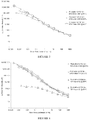
FIG. 1 shows viscosities as a function of shear rate for compositions containing various thickening agents. -
FIG. 2 shows viscosities as a function of shear rate for compositions containing various types of hydrocarbon fluids. -
FIG. 3 shows viscosities as a function of shear rate for compositions containing hydrocarbon fluids having various boiling ranges. -
FIG. 4 shows viscosities as a function of shear rate for compositions containing various types of hydrocarbon fluids. -
FIG. 5 shows yield stress values for compositions containing various types of hydrocarbon fluids. -
FIG. 6 shows viscosities as a function of shear rate for compositions containing isoparaffinic hydrocarbon fluids at various temperatures. -
FIG. 7 shows thermal aging of a viscoelastic fluid composition. -
FIG. 8 shows viscosities as a function of shear rate and temperature for compositions. -
FIG. 9 shows shear stress as a function of shear rate. - In various aspects of the present invention, viscoelastic fluid compositions are provided that have improved properties, in particular viscoelastic fluid compositions that show an improved stability when a solid particulate active ingredient such as a pesticide active ingredient in the form of solid particles, is added thereto to prepare an oil flowable or oil dispersion composition. Methods for forming the viscoelastic fluid compositions and oil flowable or oil dispersion compositions comprising the same are also provided. The viscoelastic fluid compositions and the oil flowable or oil dispersion compositions comprising the same preferably have non-Newtonian behavior, so that the viscosity of the composition at low shear rates is suitable for keeping the solid particles in the form of a stable suspension while also providing a reduced viscosity at higher shear rates (such as a substantially reduced or minimized viscosity) to allow for pumping, tank mixing, and/or distribution of the composition, for instance by spraying.
- In the present disclosure, an "oil flowable composition", also called oil dispersion or oil-based suspension concentrate or OD, is a stable suspension of active ingredient(s) in an organic fluid. Oil flowable or oil dispersion compositions are typically used in agricultural applications where the solid particulate active ingredient is a pesticide active ingredient in the form of solid particles. The oil flowable or oil dispersion composition may contain other dissolved active ingredient(s) and any further suitable additives. The oil flowable or oil dispersion composition is typically intended for dilution with water before use.
- In the present disclosure, the suspension medium of such oil flowable or oil dispersion compositions is a viscoelastic fluid composition. By "viscoelastic fluid composition" is meant a fluid composition for which the relationship between stress and strain depends on time. The viscoelastic fluid compositions and the oil flowable or oil dispersion compositions comprising the same preferably have a non-Newtonian behavior so that the viscosity of the composition decreases when the shear rate increases. As used herein, a composition is considered to be "fluid" at the observation temperature if it flows when the bottle is inclined or tilted at 180°, optionally under or after an applied shear stress. In the present invention, a "fluid composition" is a composition that is nearly incompressible. Solid and gas compositions are not contemplated in the present application.
- The viscoelastic fluid composition of the present invention includes a hydrocarbon fluid and a thickening agent. The combination of the hydrocarbon fluid and the thickening agent can allow the viscoelastic fluid composition of the present invention to behave in a non-Newtonian manner with respect to changes in the viscosity of the composition as a function of shear. The viscoelastic fluid composition can optionally also include other components found in compositions for suspending particles. For example, in applications related to agricultural use, such as using the viscoelastic fluid composition of the present invention to suspend a pesticide active ingredient particle and form an oil flowable or oil dispersion composition, the oil flowable or oil dispersion composition can optionally further include one or more additional thickening agents, one or more surfactants, water, and/or other dissolved active ingredient(s) as well as further suitable additives in addition to the particles comprising the active ingredient(s). In oil and gas applications, such as drilling muds, the viscoelastic fluid compositions may be combined with one or more additional thickening agents, one or more surfactants, water, and/or weighting agents to produce the drilling mud.
- In an agricultural use, such as in an oil flowable or oil dispersion composition comprising the viscoelastic fluid composition as a suspension medium and particles containing a pesticide active ingredient, it can be desirable for the suspension medium to have a sufficient viscosity so that the particles containing the active ingredient remain suspended for a long period of time without settling. For example, it can be desirable to have a sufficient viscosity to allow particles to remain suspended on a time scale of weeks, or possibly even months, without settling to the bottom and/or rising to the top of a container or vessel.
- Active ingredients suitable for inclusion in an oil flowable or oil dispersion composition for instance comprise at least one fungicide, insecticide, herbicide, plant growth regulator, miticide, nematocide, molluscicide, algicide or other pesticide or mixtures thereof in the form of solid particles. By the term "solid particles", it is meant that the particles are partially or fully made of material that is in the solid state. In general, the particles have a melting point greater than 50°C. It is also desirable that the particles have a low solubility in the hydrocarbon fluid, such as less than 1 wt%. The particles may or may not be porous or may or may not have one or more void or cavity, and each void or cavity, if present, may or may not be partially or fully occupied by material that is solid, liquid or gas. The size of the particles in this type of suspension can vary, but typically is on the order of µm. For example, the particles suspended in the suspension medium can have a median particle size of about 0.1 µm to 100 µm, such as a median particle size of about 0.1 µm to 50 µm, or of about 0.5 µm to 20 µm, for instance of about 1 to 15 µm. In the present disclosure, the median particle size is the median value of the largest dimension of the particle, that is, half of the particles, by weight, have a largest dimension that is larger than the median value. The median particle size may be determined by optical microscopy and assessed by eye, possibly with reference to length standards, or alternatively the images may be inspected and assessed by appropriate image analysis methods such as computer programs. In order to maintain a suspension of such particles, the dynamic viscosity of the suspension medium is preferably at least about 1000 cP, or at least about 2500 cP, or at least about 5000 cP at temperatures between about 0°C and about 70°C and at a shear rate of 0.1 s-1, preferably at a shear rate of about 1.0 s-1. The pesticide active ingredient particles are typically added to the oil flowable or oil dispersion composition in an amount from about 5 to about 90 wt% based on the weight of the oil flowable or oil dispersion composition, such as from about 10 to about 80 wt%.
- The present invention therefore also relates to an oil flowable or oil dispersion composition comprising at least the viscoelastic fluid composition of the present invention and a pesticide active ingredient in the form of solid particles. Such an oil flowable or oil dispersion composition, especially an oil flowable or oil dispersion composition having improved stability properties, can be formed by dispersing the pesticide active ingredient particles in the viscoelastic fluid composition of the present invention, optionally in the presence of further suitable additive components.
- In various aspects of the present invention, the viscoelastic fluid composition comprises a hydrocarbon fluid having one or more desirable properties. Hydrocarbons are defined as compounds containing only carbon and hydrogen. In this discussion, the viscoelastic fluid composition typically comprises, prior to mixing with active ingredients (such as agricultural pesticide solid particles) and/or adjuvants different from the hydrocarbon fluid and the thickening agent (such as surfactants), at least about 90 wt%, or at least about 95 wt%, and preferably at least 98 wt%, of a hydrocarbon fluid. The hydrocarbon fluid in the viscoelastic fluid composition can be provided in any convenient manner. For example, the hydrocarbon fluid can correspond to a single (optionally commercially available) hydrocarbon fluid, or the hydrocarbon fluid can correspond to a mixture of hydrocarbons and/or hydrocarbon fluids (i.e., a plurality of hydrocarbon fluids) that are combined to form the hydrocarbon fluid in the viscoelastic fluid composition.
- In the present invention, the hydrocarbon fluid has a total paraffinic hydrocarbon content of at least about 95 wt% relative to the weight of the hydrocarbon fluid . In the present disclosure, the total paraffinic hydrocarbon content is the sum of the n-paraffins, isoparaffins and cycloparaffins contents and can be measured by a method based on ASTM D2425, ASTM D2786 and/or ASTM D2789. The hydrocarbon fluid can be substantially composed of linear or normal paraffins (n-paraffins), branched paraffins (isoparaffins), and/or cycloparaffins. In aspects where two or more of n-paraffins, isoparaffins, and cycloparaffins are present in the hydrocarbon fluid, the two or more of the n-paraffins, isoparaffins, and/or cycloparaffins can be present in any convenient ratio. The one or more desirable properties for a hydrocarbon fluid (or fluids) used to form a viscoelastic fluid composition can include, but are not limited to, a desirable aromatic content, a desirable content of n-paraffins, isoparaffins and/or cycloparaffins, and/or a desirable boiling range.
- The aromatic content may be determined based on method AM-S 140.31, in which the aromatic content of hydrocarbon products in the range 25-340°C is calculated from the baseline absorbance of the peak produced by the sample in the 260 to 280-nm region in a UV spectrophotometer.
- One type of characterization for a hydrocarbon fluid used to form a viscoelastic fluid composition can be based on a boiling range associated with the hydrocarbon fluid. The boiling range for a hydrocarbon fluid can be characterized in any convenient manner. One option for characterizing a boiling range can be based on an initial boiling point and a final boiling point (or end point or alternatively dry point). Boiling ranges are determined according to a method based on ASTM D86. In the present invention, the hydrocarbon fluid has an initial boiling point of 95°C to 280°C and a final boiling point of 100°C to 315°C.
- In addition to initial and final boiling points, a hydrocarbon fluid can also be characterized based on the difference between a lower end of a boiling range, such as an initial boiling point and an upper end of a boiling range, such as a final boiling point or dry point. In various aspects of the present invention, a difference between a lower end of a boiling range (initial boiling point) and an upper end of a boiling range (dry point) is about 60°C or less, preferably about 50°C or less, and more preferably about 40°C or less.
- In one embodiment, the hydrocarbon fluid comprises less than about 50 wt% of isoparaffins relative to the weight of the hydrocarbon fluid, less than about 50 wt% of n-paraffins relative to the weight of the hydrocarbon fluid, and at least about 25 wt% of cycloparaffins relative to the weight of the hydrocarbon fluid. Preferably, the hydrocarbon fluid comprises about 20-30 wt% of isoparaffins relative to the weight of the hydrocarbon fluid, about 20-30 wt% of n-paraffins relative to the weight of the hydrocarbon fluid, and about 40-60 wt% of cycloparaffins relative to the weight of the hydrocarbon fluid. Ideally, the hydrocarbon fluid comprises about 24-26 wt% of isoparaffins relative to the weight of the hydrocarbon fluid, about 24-26 wt% of n-paraffins relative to the weight of the hydrocarbon fluid, and about 45-55 wt% of cycloparaffins relative to the weight of the hydrocarbon fluid. The initial boiling point of such hydrocarbon fluid is preferably about 160°C to about 280°C, more preferably about 190°C to about 250°C, and ideally about 205°C to about 225°C. The final boiling point of such hydrocarbon fluid is preferably about 195°C to about 315°C, more preferably about 210°C to about 270°C, and ideally about 235°C to about 260°C.
- In another embodiment, the hydrocarbon fluid comprises at least about 50 wt% of isoparaffins relative to the weight of the hydrocarbon fluid, less than about 5 wt% of n-paraffins relative to the weight of the hydrocarbon fluid, and less than about 25 wt% of cycloparaffins relative to the weight of the hydrocarbon fluid. Preferably, the hydrocarbon fluid comprises about 80 wt% to about 99 wt% of isoparaffins relative to the weight of the hydrocarbon fluid and about 1 wt% to about 20 wt% of cycloparaffins relative to the weight of the hydrocarbon fluid. More preferably, the hydrocarbon fluid comprises about 82 wt% to about 90 wt% of isoparaffins relative to the weight of the hydrocarbon fluid and about 10 wt% to about 18 wt% of cycloparaffins relative to the weight of the hydrocarbon fluid. Ideally, the hydrocarbon fluid comprises about 85 wt% to about 95 wt% of isoparaffins relative to the weight of the hydrocarbon fluid and about 5 wt% to about 15 wt% of cycloparaffins relative to the weight of the hydrocarbon fluid. The initial boiling point of such hydrocarbon fluid is preferably about 95°C to about 270°C, more preferably about 160°C to about 230°C, even more preferably about 180°C to about 230°C, and ideally about 190°C to about 230°C. The final boiling point of such hydrocarbon fluid is preferably about 100°C to about 310°C, more preferably about 170°C to about 255°C, more preferably about 195°C to about 255°C, and ideally about 205°C to about 255°C.
- In still another embodiment, the hydrocarbon fluid comprises at least about 50 wt% of n-paraffins relative to the weight of the hydrocarbon fluid or at least about 50 wt% of cycloparaffins relative to the weight of the hydrocarbon fluid.
- Another feature for a hydrocarbon fluid for forming a viscoelastic fluid composition as described herein can be to have a reduced or minimized amount of aromatics in the hydrocarbon fluid. In the present invention, the hydrocarbon fluid has an aromatic content of 3.0 wt% or less relative to the weight of the hydrocarbon fluid. In various aspects, the aromatic content of the hydrocarbon fluid can be about 2.0 wt% or less, or about 1.0 wt% or less. Without being bound by any particular theory, a hydrocarbon fluid having a reduced or minimized content of aromatics can be beneficial for achieving non-Newtonian viscosity behavior in the viscoelastic fluid composition after addition of the suitable thickening agent. Additionally or alternately, the hydrocarbon fluid can also have a reduced or minimized content of unsaturated hydrocarbons, such as alkenes and/or alkynes. the hydrocarbon fluid contains less than about 5 wt% of unsaturated hydrocarbons, or less than about 3 wt%, or less than about 2 wt%, or less than about 1 wt%. Hydrocarbons having limited amounts of unsaturation and/or aromatic content can often correspond to compounds that have low toxicity or other interaction with the environment. This can make such (substantially) saturated hydrocarbons suitable as solvents and/or suspension media for delivery of active ingredients in an agricultural setting.
- Examples of suitable hydrocarbon fluids can include, but are not limited to, hydrocarbon fluids available from ExxonMobil Chemical Company, such as Exxsol™ and Escaid™ de-aromatized fluids and Isopar™ isoparaffinic fluids, optionally in combination with other hydrocarbon fluids to provide a combined hydrocarbon fluid having properties as described herein.
- To form the viscoelastic fluid composition of the present invention, in particular a viscoelastic fluid composition non-Newtonian characteristics with respect to viscosity, the hydrocarbon fluid is combined with a thickening agent. In various aspects, the thickening agent is a block copolymer where at least one end block of the copolymer corresponds to polystyrene. The other block(s) of the block copolymer preferably includes at least one block selected from aliphatic polymers. The block copolymers are selected from di- and tri-block copolymers having at least one end block corresponding to polystyrene. Optionally, the copolymer can have only one end block corresponding to an aromatic polymer. More generally, a copolymer having an aromatic polymer block at one end of the polymer, with one or more additional blocks based on aliphatic polymer blocks, can also be suitable. The non-aromatic block(s) within the block copolymer can be based on vinyl monomers such as ethylene, propylene, butylene, other aliphatic monomers, and diene monomers such as butadiene or isoprene (2-methyl-1,3-butadiene), or a combination thereof. Suitable examples of the at least one aliphatic block include ethylene/propylene copolymers, ethylene/butadiene copolymers, polyisoprene, polybutadiene, ethylene/propylene/diene copolymers and the like. Suitable di-block copolymers include, but are not limited to, styrene-ethylene/propylene copolymers, styrene-ethylene/butadiene copolymers, styrene-isoprene copolymers, styrene-butadiene copolymers. Suitable triblock copolymers include, but are not limited to, styrene-ethylene/propylene-styrene copolymers, styrene-ethylene/butadiene-styrene copolymers, styrene-isoprene-styrene copolymers, and styrene-butadiene-styrene copolymers. The above polymers may also be hydrogenated to reduce unsaturation before they are used as thickening agents. The at least one polystyrene end blockcorresponds to 20 wt% to 50 wt% of the weight of the copolymer, or about 30 wt% to about 40 wt%. The peak molecular weight of the block copolymer having at least one polystyrene end block is 10,000 g/mol to 500,000 g/mol, more preferably about 30,000 g/mol to about 300,000 g/mol, and ideally about 50,000 g/mol to about 250,000 g/mol. Peak molecular weight as used herein means the molecular weight of the highest peak as determined by gel permeation chromatography (GPC). Examples of suitable di-block copolymers containing polystyrene as the aromatic polymer end block are available from Kraton® Polymers Group, such as Kraton® G linear di- and tri-block copolymers based on styrene and ethylene/propylene or ethylene/butylene, which includes Kraton® G1701 polymers, for instance Kraton® G1701 E, Kraton® G1701 H, Kraton® G1701 M, or Kraton® G1702 H polymers, Kraton® G1650, Kraton® G1651, Kraton® G1652 or Kraton® G1654 polymers; Kraton® D linear di- and tri-block copolymers based on styrene and butadiene, isoprene or butadiene/isoprene; and Kraton® FG linear tri-block copolymers based on styrene and ethylene/butadiene with maleic anhydride grafted onto the rubber midblock. Other suitable examples of commercially available block copolymers are copolymers sold under the trade name of Vector®, Septon® and Solprene®.
- The amount of thickening agent added to the viscoelastic fluid composition can vary depending on the nature of the hydrocarbon fluid(s) in the composition but is 3.0 wt% to 10.0 wt%, more preferably 3.0 wt% to about 7.5 wt%, and ideally 3.5 wt% to about 7.0 wt%, relative to the weight of the hydrocarbon fluid.
- Without being bound by any particular theory, it is believed that a thickening agent based on a block copolymer including at least one aromatic end block can allow a hydrocarbon fluid as defined herewith to have non-Newtonian behavior with respect to viscosity. When at least about 3.0 wt%%, relative to the weight of the hydrocarbon fluid, of said thickening agent with an aromatic end block is present in the hydrocarbon fluid, or at least about 3.0 wt%, or at least about 4.0 wt%, or at least about 5.0 wt%, the amount of the thickening agent can be sufficient to initiate non-Newtonian behavior. However, as the shear rate is increased, the mechanism(s) causing the non-Newtonian behavior can be disrupted, leading to a substantial reduction in viscosity.
- In addition to the hydrocarbon fluid (or fluids) and the at least one thickening agent, the viscoelastic fluid composition of the present invention and the oil flowable or oil dispersion composition comprising the same can also contain various other components. As already mentioned, the viscoelastic fluid composition of the present invention can typically be combined with particles containing active ingredient(s), in particular pesticide active ingredient particles, to prepare oil flowable or oil dispersion compositions. Said oil flowable or oil dispersion composition for agricultural applications can for instance also optionally include water, one or more surfactants, one or more thickeners different from an aromatic block copolymer thickener, and/or any other components that may typically be found in a composition for delivering active ingredients (such as pesticides) in an agricultural application, for instance colorants such as pigments and dyes, adjuvant surfactants, pH and other chemical stabilizers, defoamers, perfumes, odor masks and further density-adjusting solvents. For additional components (additives) other than water and particles containing active ingredients, the amount of additives can be any convenient amount, such as from about 0.1 wt% to about 20 wt%, relative to the weight of the hydrocarbon fluid.
- Suitable surfactants and surfactant dispersants for the agricultural oil flowable or oil dispersion composition include, but are not limited to, alkanolamides, alkylarylsulfonates, alkoxylated alcohols, alkoxylated alkylphenols, alkoxylated amines, alkoxylated amides, alkoxylated phenols, alkoxylated fatty acids, glycerol esters, phosphate esters, quaternary surfactants, soaps, sorbitan derivatives, sulfates of alcohols, sulfates of alkoxylated alcohols, sulfonates of dodecyl and tridecylbenzenes, sulfosuccinates and derivatives thereof, ethylene oxide-propylene oxide block copolymers, and other amphiphilic compounds. Mixtures or surfactants and/or surfactant dispersants may be used. It is noted that the surfactant can optionally be a surfactant suitable for use with a continuous oil phase, as opposed to a surfactant suitable for use with a continuous water phase.
- With regard to water, prior to application of an active ingredient in an agricultural setting, water is added to the oil flowable or oil dispersion composition containing the particles of the pesticide active ingredient to form a diluted composition such as an emulsion. Such emulsion diluted composition most often contains from 1 wt% water to about 99 wt% of water, or 1 wt% to 99.95 wt%, relative to the total weight of the diluted composition. The diluted composition containing the additional water can then be sprayed or otherwise distributed so as to apply the active ingredient. In this type of diluted composition, the oil-based phase (including the hydrocarbon fluid or fluids) can remain as the continuous phase or can become an emulsified (discontinuous) phase.
- For oil and gas applications, the viscoelastic fluid composition may be combined with water, one or more surfactants, one or more thickeners different from an aromatic block copolymer thickener, and/or any other components that may typically be found in a drilling mud, such weighting agents, filtration control agents, organophilic clays, lime for alkalinity control, and brine for activity control.
- In various aspects of the present invention, the viscoelastic fluid composition including the hydrocarbon fluid or fluids and the thickening agent can be formed by mixing the hydrocarbon fluid and the thickening agent under suitable conditions. One consideration during mixing can be the mixing temperature. In various aspects, the temperature of the hydrocarbon fluid or fluids (and/or any other components already present) during mixing with the thickening agent is preferably about 50°C to about 150°C, more preferably about 50°C to about 100°C, and ideally about 55°C to about 85°C. For some combinations of hydrocarbon fluid and thickening agent, increasing the mixing temperature can improve the clarity of the composition, so that a composition having a cloudy appearance at a lower mixing temperature can have a clear appearance at a higher mixing temperature. However, changing from a cloudy appearance to a clear appearance for a solution does not necessarily correlate with an improvement in the resulting properties of the composition. Regardless of the appearance of the solution, increasing the mixing temperature can improve the rheological properties of the composition for some combinations of hydrocarbon fluid and thickening agent; however, if mixing temperature becomes too high then the properties can begin to degrade.
- With regard to mixing conditions, it is noted that safety considerations can also be a consideration when selecting a mixing temperature. For example, some commercially available hydrocarbon fluids can have a flash point that is less than 150°C, or less than 100°C. While a hydrocarbon fluid could be mixed with a thickening agent at a temperature greater than the flash point for the hydrocarbon fluid so long as appropriate safety precautions are taken, from a safety standpoint it is preferable to mix a hydrocarbon fluid with a thickening agent at a temperature that is below the flash point of the hydrocarbon fluid, and optionally below the flash point, if any, of the thickening agent and/or any other materials present during mixing.
- The mixing performed at the mixing temperature can be performed under high shear conditions, such as a shear rate of at least about 100 s-1. For example, a composition can be mixed in a commercial mixer at about 1000 to about 5000 RPM, such as about 2500 RPM. Depending on the configuration of a commercial mixer, such mixing speeds can correspond to a shear rate of up to about 1000 s-1 or possibly more. The mixing can be performed for a convenient amount of time, such as about 1 minute to about 300 minutes, or about 5 minute to about 60 minutes, or about 10 minutes to about 45 minutes.
- The resulting viscoelastic fluid composition containing at least the one or more hydrocarbon fluids and the thickening agent can have one or more desirable features. For instance, in some aspects, the viscoelastic fluid composition may have a kinematic viscosity greater than 20.5 mm2/s at 40°C. This is especially advantageous as said compositions are outside of the definition for either
Category 1 or Category 2 aspiration toxicity as defined by the Globally Harmonized System of Classification and Labelling of Chemicals (GHS). - In some aspects, the viscoelastic fluid composition can have a yield stress of at least about 0.1 Pa to about 1,000 Pa, or about 0.1 Pa to about 100 Pa, or about 5 Pa to about 50 Pa, or about 10 lbf/100 ft2 to about 25 lbf/100 ft2. The yield stress is the stress level at which the material ceases to behave elastically or the applied stress that must be exceeded to make a structured fluid flow. The yield stress corresponds to the limiting value of the shear stress for the composition as the shear rate approaches zero and can be determined by generating a plot of the shear stress versus the shear rate relationship (such as that shown in
FIG. 5 ) and extrapolating to zero shear rate. - In some aspects, at a shear rate of about 0.1 s-1 or less, the viscoelastic fluid composition can have a dynamic viscosity of at least about 1000 cP at 25°C, or at least about 5000 cP, or at least about 10,000 cP, or at least about 50,000 cP, or at least about 100,000 cP, such as up to about 10,000,000 cP or more. Additionally or alternately, at a shear rate of about 1.0 s-1, the composition can have a dynamic viscosity of at least about 1000 cP at 25°C, or at least about 5000 cP, or at least about 10,000 cP, such as up to about 1,000,000 cP or more. In such aspects, the dynamic viscosity of the composition can optionally correspond to the above values at a range of temperatures. For example, the composition can optionally have a dynamic viscosity of at least about 1000 cP, or at least about 5000 cP, or at least about 10,000 cP, or at least about 50,000 cP, or at least about 100,000 cP at a shear rate of about 0.1 s-1 (and/or about 1.0 s-1) for temperatures ranging from about 0°C to about 70°C, or about 25°C to about 70°C, or about 25°C to about 60°C.
- In an especially preferred embodiment, the viscoelastic fluid composition can also have a reduced viscosity at higher shear rates. At a shear rate of at least about 10 s-1, the viscosity at 25°C can be at least about an order of magnitude lower than the corresponding viscosity at a shear rate of 0.1 s-1, i.e. the viscosity at 25°C at a shear rate of at least about 10 s-1 is at least about ten times lower than the viscosity at 25°C at a shear rate of 0.1 s-1. Another option for characterizing reduced viscosity at higher shear rates can be based on viscosity (such as at 25°C or 50°C) at a shear rate of 100 s-1. At a shear rate of 100 s-1 and at 25°C, the viscosity of the viscoelastic fluid composition can be about 10 cP to about 5000 cP, or about 50 cP to about 5000 cP, or about 100 cP to about 5000 cP, or about 10 cP to about 2000 cP, or about 50 cP to about 2000 cP, or about 100 cP to about 2000 cP, or about 10 cP to about 1000 cP, or about 50 cP to about 1000 cP, or about 100 cP to about 1000 cP, or about 10 cP to about 800 cP, or about 50 cP to about 800 cP, or about 100 cP to about 800 cP.
- The viscosity, yield stress, and thermal stability may be measured by a Dynamic Mechanical Analysis based method on a RheoStress RS6000 rheometer in the shear rate range of 0.001 sec-1 to 1000 sec-1. To determine the viscosity and yield stress of a composition, a Z20 cylindrical spindle with a 0.2 ± 0.01% deflection is used. The shear rate is varied over the range of 0.001 sec-1 to 1000 sec-1 while the temperature is kept constant at 22°C and measurements of the viscosity and/or yield stress are taken, recorded and reported by the machine. To determine the thermal stability of a composition, parallel plates with a 0.2 ± 0.01% deflection at a frequency of 1 Hz are used. The shear rate is kept constant at about 6.283 sec-1 (1 Hz) while the temperature is varied from 22°C to 70°C over 1600 seconds, equating to an average increase of 1.8°C per minute, and measurements of the viscosity and/or yield stress are taken, recorded and reported by the machine. The viscosity may alternatively be measured by a Brookfield Digital Viscometer, Model DV-II according to the procedure specified in the manual for the machine.
- The oil flowable or oil dispersion composition can be formed by any suitable method known in the art, by dispersing the pesticide active ingredient particles in the viscoelastic fluid composition of the present invention. Dispersing the pesticide active ingredient particles in the viscoelastic fluid composition is typically done by stirring or high shear mixing, with or without heating. Other suitable ingredients may be present in the viscoelastic fluid composition or may be added thereto before, at the same time or after the addition of the pesticide active ingredient particles, with or without heating.
- The resulting oil flowable or oil dispersion composition can have one or more desirable features. For instance, in some aspects, the oil flowable or oil dispersion composition may have a kinematic viscosity greater than 20.5 mm2/s at 40°C. This is especially advantageous as said compositions are outside of the definition for either
Category 1 or Category 2 aspiration toxicity as defined by the Globally Harmonized System of Classification and Labelling of Chemicals (GHS). - In some aspects, the oil flowable or oil dispersion composition can have a yield stress of at least about 0.1 Pa to about 1,000 Pa, or about 0.1 Pa to about 100 Pa, or about 5 Pa to about 50 Pa. The yield stress corresponds to the limiting value of the shear stress for the composition as the shear rate approaches zero.
- In some aspects, at a shear rate of about 0.1 s-1 or less, the oil flowable or oil dispersion composition can have a dynamic viscosity of at least about 1000 cP at 25°C, or at least about 5000 cP, or at least about 10,000 cP, or at least about 50,000 cP, or at least about 100,000 cP, such as up to about 10,000,000 cP or more. Additionally or alternately, at a shear rate of about 1.0 s-1, the composition can have a dynamic viscosity of at least about 1000 cP at 25°C, or at least about 5000 cP, or at least about 10,000 cP, such as up to about 1,000,000 cP or more. In such aspects, the dynamic viscosity of the composition can optionally correspond to the above values at a range of temperatures. For example, the composition can optionally have a dynamic viscosity of at least about 1000 cP, or at least about 5000 cP, or at least about 10,000 cP, or at least about 50,000 cP, or at least about 100,000 cP at a shear rate of about 0.1 s-1 (and/or about 1.0 s-1) for temperatures ranging from about 0°C to about 70°C, or from about 25°C to about 70°C, or about 25°C to about 60°C.
- In an especially preferred embodiment, the viscoelastic oil flowable or oil dispersion composition can also have a reduced viscosity at higher shear rates. At a shear rate of at least about 10 s-1, the viscosity at 25°C can be at least about an order of magnitude lower than the corresponding viscosity at a shear rate of 0.1 s-1, i.e. the viscosity at 25°C at a shear rate of at least about 10 s-1 is at least about ten times lower than the viscosity at 25°C at a shear rate of 0.1 s-1. Another option for characterizing reduced viscosity at higher shear rates can be based on viscosity (such as at 25°C or 50°C) at a shear rate of 100 s-1. At a shear rate of 100 s-1 and at 25°C, the viscosity of the oil flowable or oil dispersion composition can be about 10 cP to about 5000 cP, or about 50 cP to about 5000 cP, or about 100 cP to about 5000 cP, or about 10 cP to about 2000 cP, or about 50 cP to about 2000 cP, or about 100 cP to about 2000 cP, or about 10 cP to about 1000 cP, or about 50 cP to about 1000 cP, or about 100 cP to about 1000 cP, or about 10 cP to about 800 cP, or about 50 cP to about 800 cP, or about 100 cP to about 800 cP.
- In this example, various potential thickening agents were mixed with Exxsol™ D80 hydrocarbon fluid, available from ExxonMobil Chemical Company. Exxsol™ D80 hydrocarbon fluid is a hydrotreated hydrocarbon fluid having a total paraffinic content of at least 99 wt%, an aromatic content of less than about 0.5 wt% (typically about 0.2 wt% or less), an isoparaffin content of less than about 30 wt%, a n-paraffin content of less than about 30 wt%, a cycloparaffin content of about 50 wt%, a distillation range of about 207°C to about 237°C, a density of about 0.80 g/cc, and a kinematic viscosity at 25°C of about 2.21 cSt.
- The Exxsol™ D80 fluid was mixed with several types of thickening agents in various quantities. The thickening agents corresponded to several commercially available grades of polyisobutylene (either TPC Group (
TPC 535 or TPC 1285) or BASF Oppanol® B15 or Oppanol® B50); an ethylene propylene diene rubber (Vistalon™ 785); and a block copolymer of polystyrene and ethylene/propylene (Kraton® G1701 M) that contained about 37 wt% polystyrene. The amount of thickening agent added to the Exxsol™ D80 fluid is shown inFIG. 1 for each thickening agent, along with an estimate of the average molecular weight for each thickening agent. - The mixing conditions used to form a substantially uniform composition were dependent on the thickening agent. All thickening agents were mixed at high shear at a mixing temperature of about 60°C. It is noted that the amount of heat that had to be provided to maintain the mixing temperature during the mixing process varied depending on the nature of the thickening agent. The period of mixing ranged from a few minutes for the TPC Group samples to up to two hours or more for the Oppanol® samples. The other thickening agents were mixed for about half an hour or less. The mixing temperatures and times were selected to produce a homogenous solution. Table 1 shows examples of the mixing details for each of the thickening agents shown in
FIG. 1 . For each thickening agent, the weight percent of the thickening agent dissolved under the mixing conditions is also indicated.Table 1 - Mixing Conditions for Thickening Agents in Exxsol™ D80. Kraton® G1701 M (5%) Vistalon™ 785 (6%) TPC 1285 (6%) Oppanol® B15 (6%) Oppanol® B50 (6%) Estimated Dissolving time (minutes) 20 - 30 10 - 15 0-2 30-45 > 120 Mixing Temperature (°C) ∼60 ∼60 ∼60 ∼60 ∼60 Dissolving quality Good Slightly Hazy Good Good Good - As shown in
FIG. 1 , the neat hydrocarbon fluid had a viscosity of about 2 cSt regardless of the shear rate. The Vistalon™ 785 thickening agent at either 4 wt% or 6 wt% resulted in a substantial increase in the viscosity, but the increased viscosity was relatively constant at all measured shear rates. This corresponded to the expected behavior for a thickening agent. - The TPC Group polyisobutylenes (
TPC 535 or TPC 1285) at 6 wt% appeared to provide only a minor amount of thickening effect. More thickening effect was observed for Oppanol® B15 and Oppanol® B50 polyisobutylenes at either 4 wt% or 6 wt%. As shown inFIG. 1 , in addition to generally providing an increased viscosity, a further increase at low shear rates was shown for Oppanol® B15 and Oppanol® B50 polyisobutylenes at 4 wt%. However, the additional modest increases in viscosity at low shear rate appeared to, at best, lead to a viscosity of about 50 cP at a shear rate of 3.75 s-1. - A substantially different type of viscosity behavior appeared to be present when the block copolymer containing a polystyrene end block was added to the hydrocarbon fluid. At both 4 wt% and 5 wt%, the Kraton® G1701 M thickening agent appeared to show order of magnitude increases in viscosity as the shear rate of the resulting fluid composition was reduced. This indicated an unexpected shear thinning behavior, corresponding to a viscoelastic composition, that is especially advantageous for use in a composition comprising suspended particles such as in an oil flowable or oil dispersion composition. Indeed, the high viscosity at low shear rates, such as at shear rates less than 10 s-1, can allow particles to remain in suspension while the suspension is being stored. Shaking or stirring of the suspension can then be used to reduce the viscosity of the composition for pumping or other distribution means, optionally before or after addition of water, surfactants, and/or other potential components of the final formulation. All viscosity measurements shown in
FIG. 1 were performed by a Brookfield viscometer according to the method described above. - The ability of a sample comprising 5 wt% of thickening agent according to the present invention to keep particles in suspension was tested as follows. In a first set of tests, about 7-10 g of copper (I) sulfate crystals (Cu2SO4.5H2O, ranging in size from 0.1-3 mm) were added to 150-200 mL of a fluid corresponding to 95 wt% of the Exxsol™ D80 fluid and 5 wt% of the Kraton® G1701 M thickening agent. After 24 hours, the crystals appeared to remain in roughly the initial locations in the samples. After about 75 days, the crystals still remained substantially in place without settling. In a second set of tests, approximately the same amount of substantially identical copper (I) sulfate crystals were added to 150-200 mL of a fluid corresponding to 5 wt% Kraton® G1701 M thickening agent composition in Exxsol™ D80 fluid, and then the composition was shaken by hand. This resulted in the dispersion of the copper sulfate crystals through the fluid medium. After 75 days, the dispersed crystals appeared to remain substantially in place. Particles of pesticide active ingredients tend to generally lie in the about 1 µm to 15µm size range. Thus, the results obtained with millimeter sized copper (I) sulfate crystals appear to demonstrate the ability of the present 5 wt% thickening agent composition to provide a stable suspension of active ingredient particles.
- As an additional test for the 5 wt% thickening agent sample, two samples of the 5 wt% Kraton® G1701 M thickening agent composition in Exxsol™ D80 fluid were used for a pour test. One of the two samples was poured without prior shaking, while the second sample was shaken by hand and then poured at the same angle. The second sample that was poured shortly after shaking (and therefore exposed to high shear conditions) exhibited a substantially lower viscosity and, as a result, was more easily poured from one container to another. This demonstrates the utility of the 5 wt% thickening agent composition of the present invention for use as a non-aqueous concentrate of pesticide active ingredients when being pumped, sprayed, applied, or otherwise distributed after storage.
- In this example, about 5 wt% of Kraton® G1701 M thickening agent was added to various hydrocarbon fluids. In addition to the Exxsol™ D80 fluid described above, the thickening agent was also added to other Exxsol™ fluids having different boiling ranges, an isoparaffinic fluid, a n-paraffin based fluid, and an aromatic fluid. Additionally, mixtures of a polyalphaolefin with the Exxsol™ D80 fluid were prepared without a thickening agent. The isoparaffinic fluid was Isopar™ M, which is available from ExxonMobil Chemical Company. The Isopar™ M fluid had a total paraffinic content of at least about 99 wt%, an isoparaffin content of at least about 85 wt%, with less than about 1 wt% aromatic content. The boiling range of the Isopar™ M fluid was about 227°C to about 254°C, the density was about 0.79 g/cc at 15.6°C, and the kinematic viscosity was less than about 4 cSt at 25°C. The n-paraffin based fluid was Norpar™ 13, which was previously available from ExxonMobil Chemical Company. The Norpar™ 13 fluid had total paraffinic content of at least 98 wt%, a n-paraffin content of at least about 90 wt%, with less than about 1 wt% aromatic content. The boiling range of the Norpar™ 13 fluid was about 222°C to about 242°C, the density was about 0.76 g/cc at 15.6°C, and the kinematic viscosity was less than about 2.5 cSt at 25°C. The aromatic fluid was Aromatic 200, which is available from ExxonMobil Chemical Company. The Aromatic 200 fluid had an aromatic content of greater than 95 wt% (i.e., substantially composed of aromatics). The boiling range of the Aromatic 200 fluid was about 234°C to about 284°C, the density was about 1.0 g/cc at 15.6°C, and the kinematic viscosity was about 3 cSt at 25°C. The polyalphaolefin fluid ("PAO") was a metallocene PAO, available from ExxonMobil Chemical Company, with an initial boiling point of about 316°C, density of about 0.85 g/cc at 15.6°C, and kinematic viscosity of about 300 cSt at 100°C. Due to the higher viscosity of the polyalphaolefin fluid, tests were performed using hydrocarbon fluid mixtures corresponding to 80 wt% polyalphaolefin to 20 wt% Exxsol™ D80 fluid and 50 wt% polyalphaolefin to 50 wt% Exxsol™ D80 fluid. As noted above, the mixtures of polyalphaolefin fluid and Exxsol™ D80 fluid did not include a thickening agent.
-
FIG. 2 shows the results from mixing 5 wt% of Kraton® G1701 M thickening agent with the various hydrocarbon fluids mentioned above. The sample based on the Isopar™ M fluid (isoparaffinic fluid) appeared to have analogous viscosity properties to the sample based on the Exxsol™ D80 fluid. The sample based on the Aromatic 200 fluid showed some thickening effect, but had a viscosity of less than 100 cP at all shear rates with no shear thinning effect, indicating that a viscoelastic composition was not formed. For the samples including the 4 : 1 ratio of polyalphaolefin to Exxsol™ D80 fluid, the viscosity was about 1000 cP, but without showing any shear-thinning behavior. Reducing the amount of polyalphaolefin to about 1 : 1 ratio also reduced the viscosity to below 100 cP. These results illustrate that the resulting fluid compositions comprising blends of paraffinic fluids with a thickening agent, such as Kraton® G1701 M achieved superior viscosity increase and shear-thinning behavior versus the other blends tested, suggesting that the best rheological behavior is obtained when a thickening agent as claimed is used with a de-aromatized aliphatic hydrocarbon. All viscosity measurements shown inFIG. 2 were performed by a Brookfield viscometer according to the method described above. -
FIG. 3 shows the results from mixing 5 wt% of such as Kraton® G1701 M thickening agent with three Exxsol™ D fluids having different molecular weights and boiling ranges. The Exxsol™ D60 fluid has a boiling range of about 190°C to 211°C, while the Exxsol™ D95 fluid had a boiling range of about 225°C to 256°C. Exxsol™ D60 and Exxsol™ D95 are hydrotreated hydrocarbon fluids having a total paraffinic content of at least 99 wt%, an isoparaffin content of less than about 50 wt%, and an aromatic content of less than about 0.5 wt %. As shown inFIG. 3 , varying the boiling range (roughly proportional to molecular weight) of the hydrocarbon fluid did not have a strong impact on the viscosity versus shear behavior of the resulting fluid composition over most of the shear rate range studied. At very low shear rates, some difference in viscosity could be seen with lower molecular weight samples having lower viscosities than higher molecular weight samples. All viscosity measurements shown inFIG. 3 were performed by a RheoStress RS6000 rheometer according to the method described above. -
FIG. 4 shows the results from mixing 5 wt% of Kraton® G1701 M thickening agent with the Exxsol™ D80 fluid at a mixing temperature of about 60°C, with Norpar™ 13 fluid (n-paraffin based fluid) at a mixing temperature of about 60°C, and Isopar™ M fluid (isoparaffinic fluid) at mixing temperatures of about 60°C and about 80°C. As shown inFIG. 4 , the mixing temperature used when forming the isoparaffinic fluid appeared to have an impact on the properties of the resulting composition. In particular, mixing the isoparaffinic fluid and the thickening agent at 60°C resulted in a composition with a lower viscosity profile having more similarities to a Newtonian fluid. However, mixing said isoparaffinic blend at 80°C resulted in a viscosity versus shear rate profile similar to the other fluid blends tested. These results suggest that a fluid of mostly isoparaffinic structure requires mixing at a higher temperature to achieve a viscosity profile similar to other aliphatic structure types that contain only about 0-25 wt% isoparaffins. All viscosity measurements shown inFIG. 4 were performed by a RheoStress RS6000 rheometer according to the method described above. -
FIG. 5 shows yield stress results for compositions based on 5 wt% of Kraton® G1701 M thickening agent and the fluids described in conjunction withFIGS. 3 and 4 . As shown inFIG. 5 , the compositions based on Exxsol™ D80 fluid, Exxsol™ D95 fluid, Isopar™ M fluid (mixed at 80°C), and Norpar™ 13 fluid compositions all appeared to have yield stress values greater than about 2 Pa, indicating that the fluids were suitable for extended time storage, showing a stable suspension of micron sized particles. For the composition based on Isopar™ M fluid mixed at 60°C, the shear stress of the fluid appeared to decrease as the shear rate decreased, leading to a minimal yield stress value. Similarly, the fluid composition based on Exxsol™ D60 fluid, corresponding to the lowest molecular weight hydrocarbon fluid tested, also had a yield stress value approaching zero. This suggested that while the viscosities of the Isopar™ M based composition (mixed at 60°C) and the Exxsol™ D60 fluid based composition are high enough to prevent rapid settling of the suspended particles, settling would likely occur over time. These results indicate that sufficiently high hydrocarbon fluid molecular weight and/or sufficiently high mixing temperature (depending on the aliphatic structure of the hydrocarbon fluid contemplated) are needed to achieve adequate yield stress for obtaining a stable suspension of micron size particles. All yield stress measurements shown inFIG. 5 were performed by a RheoStress RS6000 rheometer according to the method described above. - To further investigate the properties of fluid compositions based on hydrocarbon fluids with high isoparaffin content, compositions were formed containing 5 wt% of Kraton® G1701 M thickening agent and 95 wt% Isopar™ M fluid at three different mixing temperatures. The mixing temperatures were 60°C, 80°C, and 120°C+.
FIG. 6 shows the dynamic viscosity as a function of shear rate for the compositions formed at the three different mixing temperatures. As shown inFIG. 6 , the viscosity properties of the compositions mixed at 80°C and 120°C+ were similar, except at the very low shear rate range where the sample mixed at 120°C+ had lower viscosity, suggesting that rheological properties may degrade somewhat if mixing temperature becomes too high.FIG. 6 also suggests, without being bound by theory, that the composition formed by mixing at 60°C may have not formed a sufficiently homogenous mixture and/or may not have fully solubilized the thickening agent, leading to a reduced amount of viscoelastic properties for the sample mixed at 60°C. All viscosity measurements shown inFIG. 6 were performed by a RheoStress RS6000 rheometer according to the method described above. - This example shows results from testing related to the stability of compositions containing 5 wt% of Kraton® G1701 M thickening agent and either Exxsol™ D80 fluid or Isopar™ M fluid (isoparaffinic fluid described in Example 2).
-
FIG. 7 shows a thermal aging test for a composition containing Exxsol™ D80 fluid and 5 wt% of Kraton® G1701 M thickening agent. InFIG. 7 , the shear stress versus shear rate is shown for the composition at a temperature of 55°C, either after initial formation or after two weeks of aging at a temperature of 55°C. This stability test corresponds to test MT 46.3, accelerated storage procedure, of CIPAC Handbook J (Analysis of Technical and Formulated Pesticides) that simulates the normal long-term aging of a liquid pesticide formulation by heating. As shown inFIG. 7 , aging the composition at 55°C for two weeks did not appear to have a substantial impact on the shear stress, as indicated by the similarity in shear stress values for the fresh and aged compositions at nearly all points during the test. The deviation where the fresh sample has a slightly higher shear stress than the aged sample is believed to be due to routine experimental variation and/or error. All viscosity measurements shown inFIG. 7 were performed by a RheoStress RS6000 rheometer according to the method described above. -
FIG. 8 shows results from viscosity testing at various temperatures for a composition similar to the composition ofFIG. 8 . InFIG. 8 , the viscosity of the composition versus shear rate was measured at temperatures of 25°C, 55°C, 65°C, and 75°C. As shown inFIG. 7 , the viscosity of the composition is similar at temperatures of 25°C, 55°C, and 65°C. Without being bound by any particular theory, as the temperature is further increased to about 70°C or higher, it is believed that increased temperatures can disrupt the structure of the thickening agent in the composition. This disruption in structure can lead to reduced viscosities, as shown for the sample at 75°C inFIG. 8 . However, as also shown inFIG. 8 , the viscosity of the composition was greater than 100 cP at all shear rates for the four temperatures tested. All viscosity measurements shown inFIG. 8 were performed by a RheoStress RS6000 rheometer according to the method described above. - One of the potential concerns for an oil flowable or oil dispersion composition can be that the composition may pose an aspiration toxicity hazard. Aspiration toxicity includes severe acute effects such as chemical pneumonia, varying degrees of pulmonary injury or death following aspiration. Aspiration is the entry of a liquid or solid directly through the oral or nasal cavity, or indirectly from vomiting, into the trachea and lower respiratory system. Some hydrocarbons (petroleum distillates) have been shown to pose an aspiration hazard in humans.
- Substances and mixtures of this hazard class are assigned to one of two hazard categories of this hazard class on the basis of viscosity.
Category 1, as defined by the Globally Harmonized System of Classification and Labelling of Chemicals (GHS), corresponds to substances that have been shown to pose an aspiration hazard in humans, and that are hydrocarbons that have a kinematic viscosity of less than 20.5 mm2/s at 40°C (or 20.5 cSt as 1 mm2/s = 1 cSt). Category 2, as defined by the Globally Harmonized System of Classification and Labelling of Chemicals (GHS), corresponds to substances that have been shown to pose an aspiration hazard in animals, that have a kinematic viscosity of 14 mm2/s or less at 40°C, and that have certain other surface tension, water solubility, and boiling point properties. Based on the category definitions, a substance or mixture with a kinematic viscosity greater than 20.5 mm2/s at 40°C is outside of the definition for eitherCategory 1 or Category 2 aspiration toxicity. - A fluid composition 97.5 wt% of Exxsol™ D80 fluid and 2.5 wt% of Kraton® G1701 M thickening agent was tested and the kinematic viscosity was about 35.75 mm2/s (35.75 cSt) at 40°C, demonstrating that the kinematic viscosity is greater than 20.5 cSt (mm2/s). The viscosity was determined by an Anton Paar SVM 3000 Stabinger viscometer via ASTM D7042.
- A fluid composition containing 96 wt% of Isopar™ M fluid and 4 wt% of Kraton® G1701 M thickening agent was tested at a shear rate of 750 s-1 and at a temperature of 60°C. Under the test conditions, the viscoelastic composition had a dynamic viscosity of about 31 - 32 cP. Based on the density of Isopar™ M fluid being less than 1 g/cm3, the corresponding kinematic viscosity was greater than 32 cSt (mm2/s). This kinematic viscosity value at 60°C demonstrates that the kinematic viscosity at 40°C would be greater than 20.5 cSt (mm2/s).
- Fluid compositions containing 96 wt% of Exxsol™ D80 fluid and 4 wt% of Kraton® G1701 M thickening agent were tested under several conditions. At a shear rate of 375 s-1 and a temperature of 65°C, the resulting dynamic viscosity was about 60 cP. At a shear rate of 500 s-1 and a temperature of 65°C, the resulting dynamic viscosity was about 66.5 cP. At a shear rate of 375 s-1 and a temperature of 55°C, the resulting dynamic viscosity was about 76.7 cP. Although there were some variation between the tests, the overall results demonstrate that the corresponding kinematic viscosity at 40°C would be greater than 20.5 cSt (mm2/s).
- This example shows results from testing related to the suitability of compositions containing 5 wt% of Kraton® G1701 M thickening agent and either
Escaid™ 110 fluid orEscaid™ 115 fluid (both commercially available from ExxonMobil Chemical Company).Escaid™ 110 fluid is a hydrotreated hydrocarbon fluid having a total paraffinic content of at least 99 wt%, an aromatic content of less than about 0.5 wt% (typically about 0.2 wt% or less), an isoparaffin content of less than about 30 wt%, a n-paraffin content of less than about 30 wt%, a cycloparaffin content of about 50 wt%, a distillation range of about 207°C to about 237°C, a density of about 0.80 g/cc, and a kinematic viscosity at 25°C of about 2.21 cSt.Escaid™ 115 fluid is a hydrotreated hydrocarbon fluid having a total paraffinic content of at least 99 wt%, an aromatic content of less than about 0.5 wt% (typically about 0.2 wt% or less), an isoparaffin content of less than about 30 wt%, a n-paraffin content of less than about 30 wt%, a cycloparaffin content of about 50 wt%, a distillation range of about 225°C to about 256°C, a density of about 0.80 g/cc, and a kinematic viscosity at 25°C of about 2.78 cSt. - For drilling mud applications, the viscoelastic fluid composition should have a yield point of about 10-25 lbf/100 ft2.
FIG. 9 shows the yield stress for two inventive viscoelastic fluid compositions. The results show that either viscoelastic fluid composition is suitable for drilling mud applications as theEscaid™ 110 fluid + 5 wt% of Kraton® G1701 M thickening agent has a yield point of about 15 lbf/100 ft2 and theEscaid™ 115 fluid + 5 wt% of Kraton® G1701 M thickening agent has a yield point of about 12 lbf/100 ft2. - When numerical lower limits and numerical upper limits are listed herein, ranges from any lower limit to any upper limit are contemplated.
Claims (15)
- A viscoelastic fluid composition, comprising:(a) a hydrocarbon fluid having a total paraffinic hydrocarbon content of at least 95 wt% relative to the weight of the hydrocarbon fluid and an aromatic content of 3.0 wt% or less relative to the weight of the hydrocarbon fluid, the hydrocarbon fluid having an initial boiling point of 95°C to 280°C and a final boiling point of 100°C to 315°C; and(b) 3.0 wt% to 10.0 wt%, relative to the weight of the hydrocarbon fluid, of a thickening agent comprising a block copolymer having a peak molecular weight of 10,000 g/mol to 500,000 g/mol, wherein the block copolymer is selected from di- and tri-block copolymers, wherein at least one end block of the block copolymer comprises an aromatic polymer which is polystyrene, wherein the weight of said at least one end block is 20 wt% to 50 wt% of the block copolymer, and wherein the block copolymer comprises at least one aliphatic polymer block, said at least one aliphatic polymer block comprising polyethylene, polypropylene, polybutylene, polyisobutylene, polybutadiene, polyisoprene, a combination thereof, or a copolymer of at least two monomers selected from the group consisting of ethylene, propylene, butylene, isobutylene, and butadiene.
- The composition of claim 1, wherein the hydrocarbon fluid comprises at least 50 wt% n-paraffins, or wherein the hydrocarbon fluid comprises at least 50 wt% cylcoparaffins.
- The composition of claim 1, wherein the hydrocarbon fluid has an isoparaffin content of less than 50 wt% relative to the weight of the hydrocarbon fluid, a n-paraffin content of less than 50 wt% relative to the weight of the hydrocarbon fluid, a cycloparaffin content of at least 25 wt% relative to the weight of the hydrocarbon fluid, and an aromatic content of less than 3 wt% relative to the weight of the hydrocarbon fluid, the hydrocarbon fluid having an initial boiling point of 160°C to 280°C and a final boiling point of 195°C to 315°C; and
wherein the thickening agent has a peak molecular weight of 30,000 g/mol to 300,000 g/mol, in particular 50,000 g/mol to 250,000 g/mol. - The composition of claim 3, wherein the hydrocarbon fluid has an isoparaffin content of 20-30 wt% relative to the weight of the hydrocarbon fluid, a n-paraffin content of 20-30 wt% relative to the weight of the hydrocarbon fluid, a cycloparaffin content of 40-60 wt% relative to the weight of the hydrocarbon fluid, an initial boiling point of 205°C to 225°C, and a final boiling point of 235°C to 260°C.
- The composition of claim 1, wherein the hydrocarbon fluid has an isoparaffin content of at least 50 wt% relative to the weight of the hydrocarbon fluid, and an aromatic content of less than 3 wt% relative to the weight of the hydrocarbon fluid, the hydrocarbon fluid having an initial boiling point of 95°C to 270°C and a final boiling point of 100°C to 310°C; and wherein the thickening agent has a peak molecular weight of 30,000 g/mol to 300,000 g/mol, in particular 50,000 g/mol to 250,000 g/mol.
- The composition of claim 5, wherein the hydrocarbon fluid has an isoparaffin content of 80 wt% to 99 wt% relative to the weight of the hydrocarbon fluid, a cycloparaffin content of 5 wt% to 15 wt% relative to the weight of the hydrocarbon fluid, an initial boiling point of 190°C to 230°C, and a final boiling point of 205°C to 255°C.
- The composition of any one of claims 1-6, wherein the hydrocarbon fluid comprises at least 90 wt% of the viscoelastic fluid composition, preferably wherein the composition comprises 3.5 wt% to 7.0 wt% of the thickening agent.
- The composition of any one of claims 1-7, wherein the aromatic content of the hydrocarbon fluid is 2.0 wt% or less.
- The composition of any one of claims 1-8, wherein the block copolymer comprises only one end block comprising an aromatic polymer, preferably wherein the block copolymer is a di-block copolymer.
- The composition of any one of claims 1-9, wherein the block copolymer comprises at least one aliphatic polymer block, the at least one aliphatic polymer block being selected from ethylene/propylene copolymers, ethylene/butadiene copolymers, polyisoprene, polybutadiene, and ethylene/propylene/diene copolymers.
- The composition of any one of claims 1-10, wherein the difference between the initial boiling point and the final boiling point for the hydrocarbon fluid is 50°C or less.
- The composition of any one of claims 1-11, wherein the composition further comprises at least one of:- one or more surfactants, one or more additional thickening agents, or a combination thereof,- water, the amount of water being 1 wt% to 99.5 wt% by weight of the composition,- a plurality of particles, the plurality of particles optionally comprising a pesticide active ingredient, the median size of the particles being 0.1 µm to 100 µm.
- The composition of any one of claims 1-12, wherein the composition has a kinematic viscosity of at least 20.5 mm2/s at 40°C.
- The composition of any one of claims 1-13, wherein the weight of the at least one end block aromatic polymer is 30 wt% to 40 wt% based on the total weight of the block copolymer or 40 wt% to 50 wt% based on the total weight of the block copolymer.
- An oil flowable or oil dispersion composition comprising the viscoelastic fluid composition of any one of claims 1 to 14 and a solid particulate pesticide active ingredient or one or more additional thickening agents, one or more surfactants, water, and/or weighting agents to produce a drilling mud.
Applications Claiming Priority (3)
| Application Number | Priority Date | Filing Date | Title |
|---|---|---|---|
| US201562211223P | 2015-08-28 | 2015-08-28 | |
| EP15192281 | 2015-10-30 | ||
| PCT/US2016/045961 WO2017039960A1 (en) | 2015-08-28 | 2016-08-08 | Viscoelastic fluid compositions, oil flowable/oil despersion compositions, and drilling fluid compositions |
Publications (2)
| Publication Number | Publication Date |
|---|---|
| EP3340789A1 EP3340789A1 (en) | 2018-07-04 |
| EP3340789B1 true EP3340789B1 (en) | 2020-04-29 |
Family
ID=54601599
Family Applications (1)
| Application Number | Title | Priority Date | Filing Date |
|---|---|---|---|
| EP16754058.2A Active EP3340789B1 (en) | 2015-08-28 | 2016-08-08 | Viscoelastic fluid compositions, oil flowable compositions and oil dispersion compositions |
Country Status (4)
| Country | Link |
|---|---|
| US (1) | US10723930B2 (en) |
| EP (1) | EP3340789B1 (en) |
| BR (1) | BR112018001621B1 (en) |
| WO (1) | WO2017039960A1 (en) |
Cited By (1)
| Publication number | Priority date | Publication date | Assignee | Title |
|---|---|---|---|---|
| CN110426293A (en) * | 2019-06-20 | 2019-11-08 | 中国石油化工股份有限公司 | Viscoelasticity particle anti-shear performance and pore throat compatibility evaluation method |
Families Citing this family (4)
| Publication number | Priority date | Publication date | Assignee | Title |
|---|---|---|---|---|
| US11692048B2 (en) * | 2017-03-10 | 2023-07-04 | Kraton Corporation | Fusible oil gel compositions and methods of making and using same |
| IL320076A (en) | 2018-04-27 | 2025-06-01 | Fresh Inset S A | Compositions and articles comprising complexes of 1-methylcycloproprene and alpha-cyclodextrin |
| CA3170106A1 (en) | 2020-02-03 | 2021-08-12 | Fresh Inset S.A. | Stable 1-methylcyclopropene compositions and uses thereof |
| US11629281B2 (en) * | 2021-01-18 | 2023-04-18 | Scidev Energy Services, Inc. | Methods and systems associated with lubricant for drilling fluids |
Family Cites Families (10)
| Publication number | Priority date | Publication date | Assignee | Title |
|---|---|---|---|---|
| US5639465A (en) * | 1993-07-19 | 1997-06-17 | Zeneca Limited | Stabilized thiocarbamate herbicides |
| JP4631010B2 (en) * | 1999-08-19 | 2011-02-16 | 日産化学工業株式会社 | Liquid pesticide composition |
| US6464996B1 (en) * | 2001-05-17 | 2002-10-15 | Exxonmobil Chemical Patents Inc. | Thickened organic fluid/surfactant compositions and use thereof in pesticidal compositions |
| US7407918B2 (en) * | 2003-12-11 | 2008-08-05 | Afton Chemical Corporation | Lubricating oil compositions |
| WO2006053577A1 (en) * | 2004-11-16 | 2006-05-26 | Degussa Gmbh | Non-aqueous system having viscoelastic properties |
| US7662757B2 (en) * | 2006-06-27 | 2010-02-16 | Exxonmobil Research And Engineering Company | Stable defoamant composition containing GTL fluid and/or hydrodewaxate and/or hydroisomerized/catalytic (and/or solvent) dewaxed fluid as diluent |
| US8728989B2 (en) | 2007-06-19 | 2014-05-20 | Clearwater International | Oil based concentrated slurries and methods for making and using same |
| US9012515B2 (en) | 2007-08-03 | 2015-04-21 | Rohm And Haas Company | Oil formulations with thickeners |
| JP5969600B2 (en) | 2011-06-10 | 2016-08-17 | ハンツマン・コーポレーシヨン・オーストラリア・ピーテイワイ・リミテツド | Surfactants and emulsifiers for agricultural oil formulations |
| US20140305651A1 (en) * | 2012-11-29 | 2014-10-16 | Exxonmobil Chemical Patents Inc. | Hydraulic Fracturing Composition |
-
2016
- 2016-08-08 EP EP16754058.2A patent/EP3340789B1/en active Active
- 2016-08-08 US US15/752,351 patent/US10723930B2/en active Active
- 2016-08-08 BR BR112018001621-7A patent/BR112018001621B1/en active IP Right Grant
- 2016-08-08 WO PCT/US2016/045961 patent/WO2017039960A1/en not_active Ceased
Non-Patent Citations (1)
| Title |
|---|
| None * |
Cited By (2)
| Publication number | Priority date | Publication date | Assignee | Title |
|---|---|---|---|---|
| CN110426293A (en) * | 2019-06-20 | 2019-11-08 | 中国石油化工股份有限公司 | Viscoelasticity particle anti-shear performance and pore throat compatibility evaluation method |
| CN110426293B (en) * | 2019-06-20 | 2022-04-19 | 中国石油化工股份有限公司 | Method for evaluating shear resistance and pore throat compatibility of viscoelastic particles |
Also Published As
| Publication number | Publication date |
|---|---|
| US10723930B2 (en) | 2020-07-28 |
| WO2017039960A1 (en) | 2017-03-09 |
| BR112018001621A2 (en) | 2018-09-18 |
| EP3340789A1 (en) | 2018-07-04 |
| BR112018001621B1 (en) | 2022-04-26 |
| US20190040294A1 (en) | 2019-02-07 |
Similar Documents
| Publication | Publication Date | Title |
|---|---|---|
| US10723930B2 (en) | Viscoelastic fluid compositions, oil flowable/oil dispersion compositions, and drilling fluid compositions | |
| JP6239641B2 (en) | Nematicidal aqueous suspension concentrate composition | |
| US7304019B2 (en) | Concentrated suspensions | |
| CA2162268C (en) | Stable aqueous formulation of benzisothiazolin-3-one and xanthan gum | |
| BR122022001869B1 (en) | AGRICULTURAL MATERIAL COMPOSITION, PEST PREVENTION AND CONTROL AND PLANT GROWTH IMPROVEMENT METHOD, AGRICULTURAL MATERIAL COMPOSITION PREPARATION PROCESS AND USE OF A BLOCK COPOLYMER | |
| US20020098997A1 (en) | Organic emulsion-breaking formula and its use in treating well bores drilled in oil-base mud | |
| JP2017039769A (en) | Composition and method for enhancing the physical stability of agricultural oilbased suspension formulations | |
| JP5525535B2 (en) | High solid dispersion comprising biocide | |
| CN101282648A (en) | Water-suspended agricultural chemical composition | |
| TWI543709B (en) | A novel aqueous suspoemulsion comprising lufenuron and lambda-cyhalothrin | |
| CN111372452A (en) | Herbicidal compositions and methods | |
| US2870058A (en) | Fungicide-oil formulations | |
| BR112019002639A2 (en) | stable aqueous biocide dispersions | |
| JP2559704B2 (en) | Oil-in-water composition of pesticide active ingredient | |
| KR950006924B1 (en) | Stabilized-aqueous pesticidal suspension concentrate | |
| US3773926A (en) | Oil dispersible pesticides employing an n-vinyl-2-pyrrolidinone-alkyl meth-acrylate copolymer dispersant | |
| KR0148363B1 (en) | Complex Suspension Herbicides | |
| EP0332336B1 (en) | Antimicrobial composition | |
| US6464996B1 (en) | Thickened organic fluid/surfactant compositions and use thereof in pesticidal compositions | |
| JP3778527B2 (en) | Stable aqueous suspension composition of 2-amino-3-chloro-1,4-naphthoquinone | |
| JPH01175902A (en) | Suspension-like agricultural chemical composition | |
| FR3070043B1 (en) | FORMULATION CONTAINING AN ASSOCIATIVE POLYMER | |
| TW200939957A (en) | Agricultural compositions | |
| JPS6284002A (en) | Suspension herbicide composition for paddy field | |
| JPS6284003A (en) | Suspension herbicide composition for paddy field |
Legal Events
| Date | Code | Title | Description |
|---|---|---|---|
| STAA | Information on the status of an ep patent application or granted ep patent |
Free format text: STATUS: THE INTERNATIONAL PUBLICATION HAS BEEN MADE |
|
| PUAI | Public reference made under article 153(3) epc to a published international application that has entered the european phase |
Free format text: ORIGINAL CODE: 0009012 |
|
| STAA | Information on the status of an ep patent application or granted ep patent |
Free format text: STATUS: REQUEST FOR EXAMINATION WAS MADE |
|
| 17P | Request for examination filed |
Effective date: 20180316 |
|
| AK | Designated contracting states |
Kind code of ref document: A1 Designated state(s): AL AT BE BG CH CY CZ DE DK EE ES FI FR GB GR HR HU IE IS IT LI LT LU LV MC MK MT NL NO PL PT RO RS SE SI SK SM TR |
|
| AX | Request for extension of the european patent |
Extension state: BA ME |
|
| RIN1 | Information on inventor provided before grant (corrected) |
Inventor name: WRIGHT, SYD, R. Inventor name: HILL, RONALD, R., JR. Inventor name: YANG, YANG |
|
| DAV | Request for validation of the european patent (deleted) | ||
| DAX | Request for extension of the european patent (deleted) | ||
| STAA | Information on the status of an ep patent application or granted ep patent |
Free format text: STATUS: EXAMINATION IS IN PROGRESS |
|
| 17Q | First examination report despatched |
Effective date: 20190516 |
|
| REG | Reference to a national code |
Ref country code: DE Ref legal event code: R079 Ref document number: 602016035122 Country of ref document: DE Free format text: PREVIOUS MAIN CLASS: A01N0025020000 Ipc: A01N0025040000 |
|
| RIC1 | Information provided on ipc code assigned before grant |
Ipc: A01N 25/10 20060101ALI20190919BHEP Ipc: A01N 25/30 20060101ALI20190919BHEP Ipc: A01N 25/04 20060101AFI20190919BHEP Ipc: A01N 27/00 20060101ALI20190919BHEP Ipc: A01N 25/02 20060101ALI20190919BHEP |
|
| GRAP | Despatch of communication of intention to grant a patent |
Free format text: ORIGINAL CODE: EPIDOSNIGR1 |
|
| STAA | Information on the status of an ep patent application or granted ep patent |
Free format text: STATUS: GRANT OF PATENT IS INTENDED |
|
| INTG | Intention to grant announced |
Effective date: 20191104 |
|
| GRAS | Grant fee paid |
Free format text: ORIGINAL CODE: EPIDOSNIGR3 |
|
| GRAJ | Information related to disapproval of communication of intention to grant by the applicant or resumption of examination proceedings by the epo deleted |
Free format text: ORIGINAL CODE: EPIDOSDIGR1 |
|
| GRAL | Information related to payment of fee for publishing/printing deleted |
Free format text: ORIGINAL CODE: EPIDOSDIGR3 |
|
| STAA | Information on the status of an ep patent application or granted ep patent |
Free format text: STATUS: EXAMINATION IS IN PROGRESS |
|
| GRAR | Information related to intention to grant a patent recorded |
Free format text: ORIGINAL CODE: EPIDOSNIGR71 |
|
| STAA | Information on the status of an ep patent application or granted ep patent |
Free format text: STATUS: GRANT OF PATENT IS INTENDED |
|
| GRAA | (expected) grant |
Free format text: ORIGINAL CODE: 0009210 |
|
| STAA | Information on the status of an ep patent application or granted ep patent |
Free format text: STATUS: THE PATENT HAS BEEN GRANTED |
|
| INTC | Intention to grant announced (deleted) | ||
| AK | Designated contracting states |
Kind code of ref document: B1 Designated state(s): AL AT BE BG CH CY CZ DE DK EE ES FI FR GB GR HR HU IE IS IT LI LT LU LV MC MK MT NL NO PL PT RO RS SE SI SK SM TR |
|
| INTG | Intention to grant announced |
Effective date: 20200324 |
|
| REG | Reference to a national code |
Ref country code: GB Ref legal event code: FG4D |
|
| REG | Reference to a national code |
Ref country code: CH Ref legal event code: EP |
|
| REG | Reference to a national code |
Ref country code: AT Ref legal event code: REF Ref document number: 1261953 Country of ref document: AT Kind code of ref document: T Effective date: 20200515 |
|
| REG | Reference to a national code |
Ref country code: DE Ref legal event code: R096 Ref document number: 602016035122 Country of ref document: DE |
|
| REG | Reference to a national code |
Ref country code: IE Ref legal event code: FG4D |
|
| REG | Reference to a national code |
Ref country code: NL Ref legal event code: FP |
|
| REG | Reference to a national code |
Ref country code: LT Ref legal event code: MG4D |
|
| PG25 | Lapsed in a contracting state [announced via postgrant information from national office to epo] |
Ref country code: PT Free format text: LAPSE BECAUSE OF FAILURE TO SUBMIT A TRANSLATION OF THE DESCRIPTION OR TO PAY THE FEE WITHIN THE PRESCRIBED TIME-LIMIT Effective date: 20200831 Ref country code: GR Free format text: LAPSE BECAUSE OF FAILURE TO SUBMIT A TRANSLATION OF THE DESCRIPTION OR TO PAY THE FEE WITHIN THE PRESCRIBED TIME-LIMIT Effective date: 20200730 Ref country code: LT Free format text: LAPSE BECAUSE OF FAILURE TO SUBMIT A TRANSLATION OF THE DESCRIPTION OR TO PAY THE FEE WITHIN THE PRESCRIBED TIME-LIMIT Effective date: 20200429 Ref country code: SE Free format text: LAPSE BECAUSE OF FAILURE TO SUBMIT A TRANSLATION OF THE DESCRIPTION OR TO PAY THE FEE WITHIN THE PRESCRIBED TIME-LIMIT Effective date: 20200429 Ref country code: NO Free format text: LAPSE BECAUSE OF FAILURE TO SUBMIT A TRANSLATION OF THE DESCRIPTION OR TO PAY THE FEE WITHIN THE PRESCRIBED TIME-LIMIT Effective date: 20200729 Ref country code: IS Free format text: LAPSE BECAUSE OF FAILURE TO SUBMIT A TRANSLATION OF THE DESCRIPTION OR TO PAY THE FEE WITHIN THE PRESCRIBED TIME-LIMIT Effective date: 20200829 Ref country code: FI Free format text: LAPSE BECAUSE OF FAILURE TO SUBMIT A TRANSLATION OF THE DESCRIPTION OR TO PAY THE FEE WITHIN THE PRESCRIBED TIME-LIMIT Effective date: 20200429 |
|
| REG | Reference to a national code |
Ref country code: AT Ref legal event code: MK05 Ref document number: 1261953 Country of ref document: AT Kind code of ref document: T Effective date: 20200429 |
|
| PG25 | Lapsed in a contracting state [announced via postgrant information from national office to epo] |
Ref country code: RS Free format text: LAPSE BECAUSE OF FAILURE TO SUBMIT A TRANSLATION OF THE DESCRIPTION OR TO PAY THE FEE WITHIN THE PRESCRIBED TIME-LIMIT Effective date: 20200429 Ref country code: LV Free format text: LAPSE BECAUSE OF FAILURE TO SUBMIT A TRANSLATION OF THE DESCRIPTION OR TO PAY THE FEE WITHIN THE PRESCRIBED TIME-LIMIT Effective date: 20200429 Ref country code: HR Free format text: LAPSE BECAUSE OF FAILURE TO SUBMIT A TRANSLATION OF THE DESCRIPTION OR TO PAY THE FEE WITHIN THE PRESCRIBED TIME-LIMIT Effective date: 20200429 Ref country code: BG Free format text: LAPSE BECAUSE OF FAILURE TO SUBMIT A TRANSLATION OF THE DESCRIPTION OR TO PAY THE FEE WITHIN THE PRESCRIBED TIME-LIMIT Effective date: 20200729 |
|
| PG25 | Lapsed in a contracting state [announced via postgrant information from national office to epo] |
Ref country code: AL Free format text: LAPSE BECAUSE OF FAILURE TO SUBMIT A TRANSLATION OF THE DESCRIPTION OR TO PAY THE FEE WITHIN THE PRESCRIBED TIME-LIMIT Effective date: 20200429 |
|
| PG25 | Lapsed in a contracting state [announced via postgrant information from national office to epo] |
Ref country code: EE Free format text: LAPSE BECAUSE OF FAILURE TO SUBMIT A TRANSLATION OF THE DESCRIPTION OR TO PAY THE FEE WITHIN THE PRESCRIBED TIME-LIMIT Effective date: 20200429 Ref country code: SM Free format text: LAPSE BECAUSE OF FAILURE TO SUBMIT A TRANSLATION OF THE DESCRIPTION OR TO PAY THE FEE WITHIN THE PRESCRIBED TIME-LIMIT Effective date: 20200429 Ref country code: AT Free format text: LAPSE BECAUSE OF FAILURE TO SUBMIT A TRANSLATION OF THE DESCRIPTION OR TO PAY THE FEE WITHIN THE PRESCRIBED TIME-LIMIT Effective date: 20200429 Ref country code: RO Free format text: LAPSE BECAUSE OF FAILURE TO SUBMIT A TRANSLATION OF THE DESCRIPTION OR TO PAY THE FEE WITHIN THE PRESCRIBED TIME-LIMIT Effective date: 20200429 Ref country code: CZ Free format text: LAPSE BECAUSE OF FAILURE TO SUBMIT A TRANSLATION OF THE DESCRIPTION OR TO PAY THE FEE WITHIN THE PRESCRIBED TIME-LIMIT Effective date: 20200429 Ref country code: ES Free format text: LAPSE BECAUSE OF FAILURE TO SUBMIT A TRANSLATION OF THE DESCRIPTION OR TO PAY THE FEE WITHIN THE PRESCRIBED TIME-LIMIT Effective date: 20200429 Ref country code: IT Free format text: LAPSE BECAUSE OF FAILURE TO SUBMIT A TRANSLATION OF THE DESCRIPTION OR TO PAY THE FEE WITHIN THE PRESCRIBED TIME-LIMIT Effective date: 20200429 Ref country code: DK Free format text: LAPSE BECAUSE OF FAILURE TO SUBMIT A TRANSLATION OF THE DESCRIPTION OR TO PAY THE FEE WITHIN THE PRESCRIBED TIME-LIMIT Effective date: 20200429 |
|
| REG | Reference to a national code |
Ref country code: DE Ref legal event code: R097 Ref document number: 602016035122 Country of ref document: DE |
|
| PG25 | Lapsed in a contracting state [announced via postgrant information from national office to epo] |
Ref country code: SK Free format text: LAPSE BECAUSE OF FAILURE TO SUBMIT A TRANSLATION OF THE DESCRIPTION OR TO PAY THE FEE WITHIN THE PRESCRIBED TIME-LIMIT Effective date: 20200429 Ref country code: PL Free format text: LAPSE BECAUSE OF FAILURE TO SUBMIT A TRANSLATION OF THE DESCRIPTION OR TO PAY THE FEE WITHIN THE PRESCRIBED TIME-LIMIT Effective date: 20200429 |
|
| PLBE | No opposition filed within time limit |
Free format text: ORIGINAL CODE: 0009261 |
|
| STAA | Information on the status of an ep patent application or granted ep patent |
Free format text: STATUS: NO OPPOSITION FILED WITHIN TIME LIMIT |
|
| PG25 | Lapsed in a contracting state [announced via postgrant information from national office to epo] |
Ref country code: MC Free format text: LAPSE BECAUSE OF FAILURE TO SUBMIT A TRANSLATION OF THE DESCRIPTION OR TO PAY THE FEE WITHIN THE PRESCRIBED TIME-LIMIT Effective date: 20200429 |
|
| REG | Reference to a national code |
Ref country code: CH Ref legal event code: PL |
|
| 26N | No opposition filed |
Effective date: 20210201 |
|
| GBPC | Gb: european patent ceased through non-payment of renewal fee |
Effective date: 20200808 |
|
| PG25 | Lapsed in a contracting state [announced via postgrant information from national office to epo] |
Ref country code: LU Free format text: LAPSE BECAUSE OF NON-PAYMENT OF DUE FEES Effective date: 20200808 Ref country code: LI Free format text: LAPSE BECAUSE OF NON-PAYMENT OF DUE FEES Effective date: 20200831 Ref country code: CH Free format text: LAPSE BECAUSE OF NON-PAYMENT OF DUE FEES Effective date: 20200831 |
|
| REG | Reference to a national code |
Ref country code: BE Ref legal event code: MM Effective date: 20200831 |
|
| PG25 | Lapsed in a contracting state [announced via postgrant information from national office to epo] |
Ref country code: SI Free format text: LAPSE BECAUSE OF FAILURE TO SUBMIT A TRANSLATION OF THE DESCRIPTION OR TO PAY THE FEE WITHIN THE PRESCRIBED TIME-LIMIT Effective date: 20200429 |
|
| PG25 | Lapsed in a contracting state [announced via postgrant information from national office to epo] |
Ref country code: BE Free format text: LAPSE BECAUSE OF NON-PAYMENT OF DUE FEES Effective date: 20200831 Ref country code: GB Free format text: LAPSE BECAUSE OF NON-PAYMENT OF DUE FEES Effective date: 20200808 Ref country code: IE Free format text: LAPSE BECAUSE OF NON-PAYMENT OF DUE FEES Effective date: 20200808 |
|
| PGFP | Annual fee paid to national office [announced via postgrant information from national office to epo] |
Ref country code: NL Payment date: 20210715 Year of fee payment: 6 |
|
| PGFP | Annual fee paid to national office [announced via postgrant information from national office to epo] |
Ref country code: FR Payment date: 20210728 Year of fee payment: 6 |
|
| PG25 | Lapsed in a contracting state [announced via postgrant information from national office to epo] |
Ref country code: TR Free format text: LAPSE BECAUSE OF FAILURE TO SUBMIT A TRANSLATION OF THE DESCRIPTION OR TO PAY THE FEE WITHIN THE PRESCRIBED TIME-LIMIT Effective date: 20200429 Ref country code: MT Free format text: LAPSE BECAUSE OF FAILURE TO SUBMIT A TRANSLATION OF THE DESCRIPTION OR TO PAY THE FEE WITHIN THE PRESCRIBED TIME-LIMIT Effective date: 20200429 Ref country code: CY Free format text: LAPSE BECAUSE OF FAILURE TO SUBMIT A TRANSLATION OF THE DESCRIPTION OR TO PAY THE FEE WITHIN THE PRESCRIBED TIME-LIMIT Effective date: 20200429 |
|
| PG25 | Lapsed in a contracting state [announced via postgrant information from national office to epo] |
Ref country code: MK Free format text: LAPSE BECAUSE OF FAILURE TO SUBMIT A TRANSLATION OF THE DESCRIPTION OR TO PAY THE FEE WITHIN THE PRESCRIBED TIME-LIMIT Effective date: 20200429 |
|
| PGFP | Annual fee paid to national office [announced via postgrant information from national office to epo] |
Ref country code: DE Payment date: 20220530 Year of fee payment: 7 |
|
| REG | Reference to a national code |
Ref country code: NL Ref legal event code: MM Effective date: 20220901 |
|
| PG25 | Lapsed in a contracting state [announced via postgrant information from national office to epo] |
Ref country code: NL Free format text: LAPSE BECAUSE OF NON-PAYMENT OF DUE FEES Effective date: 20220901 |
|
| PG25 | Lapsed in a contracting state [announced via postgrant information from national office to epo] |
Ref country code: FR Free format text: LAPSE BECAUSE OF NON-PAYMENT OF DUE FEES Effective date: 20220831 |
|
| REG | Reference to a national code |
Ref country code: DE Ref legal event code: R119 Ref document number: 602016035122 Country of ref document: DE |
|
| PG25 | Lapsed in a contracting state [announced via postgrant information from national office to epo] |
Ref country code: DE Free format text: LAPSE BECAUSE OF NON-PAYMENT OF DUE FEES Effective date: 20240301 |