-
The present invention relates to a method of selectively amplifying at least one nucleic acid sequence of at least one microorganism and/or virus in a sample of a subject, wherein k-mers are applied that show a difference in frequency and/or context in the genome of the at least one microorganism and/or virus compared to the genome of the subject.
-
Infections by bacteria, viruses or parasites have always been a threat to humans, and will continue to count for a high number of deaths in the world. The most widely used strategies to fight infections are
- a) prevention (e.g. by vaccination) or
- b) treatment (e.g. by antibiotics or antiviral agents).
-
For both these strategies, diagnostic methods that detect ongoing infections (for treatment) or previous infections (to check if immunity by a previous infection or a vaccination is provided) are needed.
-
Detection of a pathogen infection in a subject can be done in various ways, one of which is the detection of nucleic acid sequences of the pathogen in a sample of the subject.
-
For this purpose, sequencing of the nucleic acid sequences in the sample can be carried out.
-
However, when sequencing nucleic acid sequences in a complex sample of a subject, the direct sequencing of such samples like complex biological biospecimen (e.g. blood, urine etc.) for detection of pathogens (e.g. bacteria, viruses, etc.) is often hampered by the high background level of the nucleic acid sequences of the subject itself, e.g. (human) host DNA. Especially for blood, surplus human DNA dominates extractable DNA pools by as much as 1010. For infectious disease diagnostics, regularly the nucleic acid sequences of the subject, e.g. human DNA, is not of interest. Therefore direct sequencing of highly host-contaminated samples is inefficient and subsequently not cost-effective.
-
Currently, several techniques for host (e.g. human) DNA removal exist, but these are usually costly and often require additional sample preparation steps.
-
Some techniques employ a depletion of human DNA by targeting eukaryotic DNA specialties, e.g. the presence of CpG-methylation sites and histones. These techniques involve a subsequent antibody targeting, as e.g. described for the NEB-Next® Microbiome DNA Enrichment Kit of New England Biolabs® Inc. (https://www.neb.com/products/e2612-nebnext-microbiome-dna-enrichment-kit#pd-references), or in
CN 104152437 .
-
Further, also differences in the cell membrane/wall can be used, leading to a selective lysis approach, as e.g. obtainable using MolYsis™ of Molzym GmbH & Co. KG (http://www.molzym.com/products/dna-isolation-products/pathogen-dna-molysis), or as disclosed in
US 7 893 251 .
-
However, these techniques are not working when the host organism changes and/or the target organisms are closely related organism (eukaryotes), e.g. the human parasites Plasmodium falciparum, an organism also showing methylation and histones.
-
Furthermore, other enrichment techniques like microfluidic multiple displacement amplification (MDA), ultracentrifugation of DNA with histones, and selective lysis of human cells, etc., exist.
-
Recently,
Ge et al., "Preferential Amplification of Pathogenic Sequences", Scientific Reports 5, Article number: 11047, (2015), doi:10.1038/srep11047 proposed a strategy primarily designed for transcriptomes where viral transcripts are to be expected. The principle is based on 8, 9 or 10 mers not matching the 2000 most abundant human transcripts. These "non-human" primers were subsequently used in a reverse transcription reaction to produce cDNA libraries from RNA material.
-
However, a need exists for a further improvement for methods of enriching nucleic acid sequences of microorganisms and/or viruses in a sample of a subject.
Summary of the invention
-
The inventors found that a further improvement in nucleic acid sequence enrichment of microorganisms and/or viruses can be obtained by a technique that uses differences in genomic signatures, herein specific k-mers, for selectively amplifying nucleic acid sequences of the microorganisms and/or viruses, e.g. pathogen DNA. The inventors found that specific k-mers can be used that preferentially amplify the target sequence by selecting k-mers that show differences in frequency and/or context between that target and background. In case of an unbiased amplification of bacterial DNA from blood samples, for example, the target of the selective amplification would correspond to the collection of microbial genome(s), and the subject, which represents the background nucleic acid sequences, to the human genome.
-
According to a first aspect, the present invention relates to a method of selectively amplifying at least one nucleic acid sequence of at least one microorganism and/or virus in a sample of a subject, comprising:
- obtaining or providing a sample of the subject containing at least one nucleic acid sequence of the at least one microorganism and/or virus and at least one nucleic acid sequence of the subject;
- determining at least one k-mer that shows a difference in frequency and/or context in the genome of the at least one microorganism and/or virus compared to the genome of the subject; and
- amplifying the nucleic acid sequences in the sample using the at least one k-mer determined as primer.
-
In addition, a method of selectively amplifying at least one nucleic acid sequence of at least one microorganism and/or virus in a sample of a subject is disclosed in a second aspect, comprising:
- obtaining or providing a sample of the subject containing at least one nucleic acid sequence of the at least one microorganism and/or virus and at least one nucleic acid sequence of the subject; and
- amplifying the nucleic acid sequences in the sample using at least one k-mer that shows a difference in frequency and/or context in the genome of the at least one microorganism and/or virus compared to the genome of the subject as primer.
-
Furthermore disclosed is a data base, comprising a multitude of k-mers that shows a difference in frequency and/or context in the genome of at least one microorganism and/or virus compared to the genome of a subject.
-
In addition, the present invention relates to a method of selectively amplifying at least one nucleic acid sequence of at least one microorganism and/or virus in a sample of a subject, comprising:
- obtaining or providing a sample of the subject containing at least one nucleic acid sequence of the at least one microorganism and/or virus and at least one nucleic acid sequence of the subject; and
- amplifying the nucleic acid sequences in the sample using at least one k-mer having a nucleotide sequence selected from the following groups I, II and/or III as primer:
- group I: CGNNNN (SEQ ID No. 1), NCGNNN (SEQ ID No. 2), NNCGNN (SEQ ID No. 3), NNNCGN (SEQ ID No. 4), NNNNCG (SEQ ID No. 5), CGCGNN (SEQ ID No. 6), CGNCGN (SEQ ID No. 7), CGNNCG (SEQ ID No. 8), NCGCGN (SEQ ID No. 9), NCGNCG (SEQ ID No. 10), NNCGCG (SEQ ID No. 11), CGCGCG (SEQ ID No. 12);
- group II: CGNNNNN (SEQ ID No. 13), NCGNNNN (SEQ ID No. 14), NNCGNNN (SEQ ID No. 15), NNNCGNN (SEQ ID No. 16), NNNNCGN (SEQ ID No. 17), NNNNNCG (SEQ ID No. 18), CGCGNNN (SEQ ID No. 19), CGNCGNN (SEQ ID No. 20), CGNNCGN (SEQ ID No. 21), CGNNNCG (SEQ ID No. 22), NCGCGNN (SEQ ID No. 23), NCGNCGN (SEQ ID No. 24), NCGNNCG (SEQ ID No. 25), NNCGCGN (SEQ ID No. 26), NNCGNCG (SEQ ID No. 27), NNNCGCG (SEQ ID No. 28), CGCGCGN (SEQ ID No. 29), CGCGNCG (SEQ ID No. 30), CGNCGCG (SEQ ID No. 31), NCGCGCG (SEQ ID No. 32);
- group III: CGNNNNNN (SEQ ID No. 33), NCGNNNNN (SEQ ID No. 34), NNCGNNNN (SEQ ID No. 35), NNNCGNNN (SEQ ID No. 36), NNNNCGNN (SEQ ID No. 37), NNNNNCGN (SEQ ID No. 38), NNNNNNCG (SEQ ID No. 39), CGCGNNNN (SEQ ID No. 40), CGNCGNNN (SEQ ID No. 41), CGNNCGNN (SEQ ID No. 42), CGNNNCGN (SEQ ID No. 43), CGNNNNCG (SEQ ID No. 44), NCGCGNNN (SEQ ID No. 45), NCGNCGNN (SEQ ID No. 46), NCGNNCGN (SEQ ID No. 47), NCGNNNCG (SEQ ID No. 48), NNCGCGNN (SEQ ID No. 49), NNCGNCGN (SEQ ID No. 50), NNCGNNCG (SEQ ID No. 51), NNNCGCGN (SEQ ID No. 52), NNNCGNCG (SEQ ID No. 53), NNNNCGCG (SEQ ID No. 54), CGCGCGNN (SEQ ID No. 55), CGCGNCGN (SEQ ID No. 56), CGCGNNCG (SEQ ID No. 57), CGNCGCGN (SEQ ID No. 58), CGNCGNCG (SEQ ID No. 59), CGNNCGCG (SEQ ID No. 60), NCGCGCGN (SEQ ID No. 61), NCGCGNCG (SEQ ID No. 62), NCGNCGCG (SEQ ID No. 63), NNCGCGCG (SEQ ID No. 64), CGCGCGCG (SEQ ID No. 65);
wherein N is any nucleotide, preferably A, T, G, C or U.
-
Also disclosed is a method of selectively amplifying at least one nucleic acid sequence of at least one microorganism and/or virus in a sample of a subject, comprising:
- obtaining or providing a sample of the subject containing at least one nucleic acid sequence of the at least one microorganism and/or virus and at least one nucleic acid sequence of the subject; and
- amplifying the nucleic acid sequences in the sample using at least one k-mer as primer, wherein the k-mer comprises in its sequence at least the sequence CG at any location of the k-mer sequence.
-
Furthermore the present invention provides a kit for DNA amplification, comprising:
- at least one polymerase; and
- at least one k-mer having a nucleotide sequence selected from the following groups I, II and/or III:
- group I: CGNNNN (SEQ ID No. 1), NCGNNN (SEQ ID No. 2), NNCGNN (SEQ ID No. 3), NNNCGN (SEQ ID No. 4), NNNNCG (SEQ ID No. 5), CGCGNN (SEQ ID No. 6), CGNCGN (SEQ ID No. 7), CGNNCG (SEQ ID No. 8), NCGCGN (SEQ ID No. 9), NCGNCG (SEQ ID No. 10), NNCGCG (SEQ ID No. 11), CGCGCG (SEQ ID No. 12);
- group II: CGNNNNN (SEQ ID No. 13), NCGNNNN (SEQ ID No. 14), NNCGNNN (SEQ ID No. 15), NNNCGNN (SEQ ID No. 16), NNNNCGN (SEQ ID No. 17), NNNNNCG (SEQ ID No. 18), CGCGNNN (SEQ ID No. 19), CGNCGNN (SEQ ID No. 20), CGNNCGN (SEQ ID No. 21), CGNNNCG (SEQ ID No. 22), NCGCGNN (SEQ ID No. 23), NCGNCGN (SEQ ID No. 24), NCGNNCG (SEQ ID No. 25), NNCGCGN (SEQ ID No. 26), NNCGNCG (SEQ ID No. 27), NNNCGCG (SEQ ID No. 28), CGCGCGN (SEQ ID No. 29), CGCGNCG (SEQ ID No. 30), CGNCGCG (SEQ ID No. 31), NCGCGCG (SEQ ID No. 32);
- group III: CGNNNNNN (SEQ ID No. 33), NCGNNNNN (SEQ ID No. 34), NNCGNNNN (SEQ ID No. 35), NNNCGNNN (SEQ ID No. 36), NNNNCGNN (SEQ ID No. 37), NNNNNCGN (SEQ ID No. 38), NNNNNNCG (SEQ ID No. 39), CGCGNNNN (SEQ ID No. 40), CGNCGNNN (SEQ ID No. 41), CGNNCGNN (SEQ ID No. 42), CGNNNCGN (SEQ ID No. 43), CGNNNNCG (SEQ ID No. 44), NCGCGNNN (SEQ ID No. 45), NCGNCGNN (SEQ ID No. 46), NCGNNCGN (SEQ ID No. 47), NCGNNNCG (SEQ ID No. 48), NNCGCGNN (SEQ ID No. 49), NNCGNCGN (SEQ ID No. 50), NNCGNNCG (SEQ ID No. 51), NNNCGCGN (SEQ ID No. 52), NNNCGNCG (SEQ ID No. 53), NNNNCGCG (SEQ ID No. 54), CGCGCGNN (SEQ ID No. 55), CGCGNCGN (SEQ ID No. 56), CGCGNNCG (SEQ ID No. 57), CGNCGCGN (SEQ ID No. 58), CGNCGNCG (SEQ ID No. 59), CGNNCGCG (SEQ ID No. 60), NCGCGCGN (SEQ ID No. 61), NCGCGNCG (SEQ ID No. 62), NCGNCGCG (SEQ ID No. 63), NNCGCGCG (SEQ ID No. 64), CGCGCGCG (SEQ ID No. 65)
- wherein N is any nucleotide, preferably A, T, G, C or U; as well as a kit for DNA amplification, comprising:
- at least one polymerase; and
- at least one k-mer comprising in its sequence at least the sequence CG at any location of the k-mer sequence.
-
Further aspects and embodiments of the invention are disclosed in the dependent claims and can be taken from the following description, figures and examples, without being limited thereto.
Figures
-
The enclosed drawings should illustrate embodiments of the present invention and convey a further understanding thereof. In connection with the description they serve as explanation of concepts and principles of the invention. Other embodiments and many of the stated advantages can be derived in relation to the drawings. The elements of the drawings are not necessarily to scale towards each other. Identical, functionally equivalent and acting equal features and components are denoted in the figures of the drawings with the same reference numbers, unless noted otherwise.
- Fig. 1 shows a result of a principle component analysis regarding specific hexamers in an Example of the invention.
- Fig. 2 depicts a heatmap of hexamer frequencies in an Example of the invention.
- Fig. 3 represents a schematic diagram showing a multiple displacement amplification using the method of the present invention.
Detailed description of the invention
Definitions
-
Unless defined otherwise, technical and scientific terms used herein have the same meaning as commonly understood by one of ordinary skill in the art to which this invention belongs.
-
The term "nucleic acid molecule" refers to a polynucleotide molecule having a defined sequence. It comprises DNA molecules, RNA molecules, nucleotide analog molecules and combinations and derivatives thereof, such as DNA molecules or RNA molecules with incorporated nucleotide analogs or cDNA. Similarly, a nucleic acid sequence is the sequence of the polynucleotide, comprising DNA sequences, RNA sequences, sequences of nucleotide analog molecules and combinations and derivatives thereof, such as DNA molecules or RNA molecules with incorporated nucleotide analogs or cDNA. A nucleic acid sequence, also termed nucleotide sequence, is a sequence comprising more than one nucleotide. The nucleotides comprised therein are not particularly limited and can e.g. comprise nucleotides found in nature, e.g. in genetic material, e.g. the nucleotide bases A (adenine), C (cytosine), G (guanine), T (thymine) and/or U (uracil).
-
In the context of the present invention a "sample" of a subject is a sample which comprises at least one nucleic acid sequence of the at least one microorganism and/or virus and at least one nucleic acid sequence of the subject. Examples for samples are: samples of a subject like a patient, e.g. a human patient, e.g. cells, tissue, and/or biopsy specimens, etc.; body fluids such as blood, urine, saliva, sputum, plasma, serum, cell culture supernatant, swab sample and others. Also included are samples taken from a natural and/or artificial surrounding comprising at least one microorganism and/or virus, e.g. soil samples, e.g. with a background of nucleic acid sequences of vertebrates, other animals like insects, etc., and/or of plants, etc.; deposits like fouling, etc.; biofilms, e.g. from waste management or in sanitary appliances, etc., and/or other microbiological consortia. According to certain embodiments, the sample is a patient sample (clinical isolate). Exemplary samples are serum, plasma, and/or whole blood of a patient. With the present methods, also more than one sample can be used at a time.
-
Within the present description the term "microorganism" comprises the term microbe. The type of microorganism is not particularly restricted, unless noted otherwise or obvious, and, for example, comprises bacteria, microscopic fungi, e.g. mold and/or yeast, microscopic algae, protozoa and other protists, other unicellular organisms like amoeba, etc., as well as combinations thereof. A protist is therein any eukaryotic organism that is not an animal, plant or fungus. According to certain embodiments, the at least one microorganism is chosen from archaea, bacteria, protists, and/or fungi.
-
A subject within the present invention can refer to an individual organism or a group of organisms of interest for selectively amplifying at least one nucleic acid sequence of at least one microorganism and/or virus, like e.g. in a microbial consortium. It is therein not excluded that the group of organisms also includes nucleic acid sequences of non-living organisms, like lyzed bacteria, viruses, etc. Thus, it is also possible to enrich the nucleic acid sequences of e.g. a specific archaea and/or bacterium can be selectively amplified in a sample comprising a microbial consortium. The subject can be e.g. an animal like a vertebrate or an invertebrate, a plant, a fungus, a microbial consortium, etc., and is not particularly limited as long as a sample thereof comprises at least one nucleic acid sequence of the at least one microorganism and/or virus and at least one nucleic acid sequence of the subject. According to certain embodiments, the subject is a vertebrate or a microbial consortium.
-
A vertebrate within the present invention refers to animals having a vertebrate, which includes mammals - including humans, birds, reptiles, amphibians and fishes. According to certain embodiments, the subject in the present methods is a vertebrate, more preferably a mammal and most preferred a human, e.g. a patient. In this regard it is especially of advantage to use a sample wherein the subject has a highly conserved genome, e.g. a human. However, also other organisms can be used as subject, e.g. a mouse, used e.g. in a mouse model for medical analysis, a rat, etc.
-
A k-mer within the present invention refers to a nucleic acid sequence with a number k of nucleic acids, k being an integer with a value of 2 or more. According to certain embodiments, the k-mer has a length from 3 to 30 nucleic acids, preferably from 4 to 20 nucleic acids, further preferably from 5 to 15 nucleic acids, e.g. from 5 to 12, 6 to 11 or 6 to 10 nucleic acids, particularly 6 to 8 nucleic acids, e.g. being 6, 7 and/or 8 nucleic acids. The k-mer, which is used as a primer, can be in any shape.
-
A transcriptome refers to a set of nucleic acid sequences containing all messenger RNA molecules in one cell or a population of cells of an organism.
-
In contrast, the genome refers to the whole genetic material of the organism, and includes the genes, i.e. the coding regions, noncoding nucleic acid sequences like noncoding DNA of the whole organism, including the genetic material from mitochondria and/or chloroplasts.
-
A microbial consortium represents a set of two or more microbial groups living symbiotically, an example thereof being a biofilm. It is not excluded within this invention that the microbial consortium contains further organisms, etc., like viruses, plasmodes, amoeba, phages, etc. In microbial consortia, coverage of an organism of interest can be enhanced using the present methods.
-
Isothermal amplification is carried out at constant temperature and differs in this aspect from polymerase chain reaction (PCR). Multiple displacement amplification (MDA) is a nucleic acid sequence, e.g. DNA, amplification technique and uses isothermal amplification. It is usually carried out using a high fidelity enzyme, e.g. Φ29 DNA polymerase, at a constant temperature. Compared with conventional PCR amplification techniques, MDA generally generates larger sized products with a lower error frequency.
-
The present invention relates in a first aspect to a method of selectively amplifying at least one nucleic acid sequence of at least one microorganism and/or virus in a sample of a subject, comprising:
- obtaining or providing a sample of the subject containing at least one nucleic acid sequence of the at least one microorganism and/or virus and at least one nucleic acid sequence of the subject;
- determining at least one k-mer that shows a difference in frequency and/or context in the genome of the at least one microorganism and/or virus compared to the genome of the subject; and
- amplifying the nucleic acid sequences in the sample using the at least one k-mer determined as primer.
-
In this method, the sample can be provided or obtained in any way, preferably non-invasive, and can be e.g. provided as an in vitro sample or prepared as in vitro sample.
-
Also, determining at least one k-mer that shows a difference in frequency and/or context in the genome of the at least one microorganism and/or virus compared to the genome of the subject is not particularly restricted. Thus, k-mers can show a difference in frequency in the genome of the at least one microorganism and/or virus compared to the genome of the subject, a difference in context in the genome of the at least one microorganism and/or virus compared to the genome of the subject, or a difference in frequency and context in the genome of the at least one microorganism and/or virus compared to the genome of the subject.
-
A difference in frequency in the genome of the at least one microorganism and/or virus compared to the genome of the subject is thereby an increased amount of a specific k-mer in the at least one microorganism and/or virus in relation to the genome size of the at least one microorganism and/or virus compared to the amount of the specific k-mer in the subject in relation to the genome of the subject. This means that a specific k-mer is relatively more abundant in its amount (i.e. number of occurrence in the genome) in the at least one microorganism and/or virus per genome size compared to the amount of the specific k-mer per genome size of the subject.
-
A difference in context refers to a difference in nucleic acid sequence, e.g. in pattern, of the k-mer in the at least one microorganism and/or virus compared to genome of the subject, i.e. if a specific k-mer sequence is only found in the at least one microorganism and/or virus.
-
Thus, the determining also encompasses cases wherein a specific k-mer is only found in the at least one microorganism and/or virus, so that no amplification of the genome of the subject takes place in the subsequent amplification step. However, also a selective amplification due to a relatively increased number of amplifications in the genome of the at least one microorganism and/or virus compared to the subject, i.e. a difference in frequency, or a combination of both is covered.
-
According to certain embodiments the determining of the at least one k-mer that shows a difference in frequency and/or context in the genome of the at least one microorganism and/or virus compared to the genome of the subject is carried out using a data base comprising the genome of the subject and the at least one microorganism and/or virus. The data base is not particularly restricted, and genome data can be obtained from e.g. publicly available data bases like at the NCBI, JGI IMG, (JGI) GOLD, MBGD, Ensembl, 1000 Genomes Project, Exome Aggregation Consortium, etc., but also other data bases can be used.
-
The analysis of the data for the occurrence of k-mers with differences in frequency and/or context in the genome of the at least one microorganism and/or virus compared to the genome of the subject is thereby not particularly restricted. It is possible to search for k-mers of a certain length k as well as for k-mers with different lengths k simultaneously, and it is thus also possible to use k-mers with one certain length k or k-mers of several lengths k in the following amplifying step. According to certain embodiments, k-mers having a length from 3 to 30 nucleic acids, preferably from 4 to 20 nucleic acids, further preferably from 5 to 15 nucleic acids, e.g. from 5 to 12, 6 to 11 or 6 to 10 nucleic acids, particularly 6 to 8, e.g. having a length of 6, 7 and/or 8 nucleic acids, are determined.
-
According to certain embodiments, a multitude of k-mers is determined and used as primers in the amplification of the nucleic acid sequences in the sample. This way an unexpected increase in enrichment of nucleic acid sequences of the at least one microorganism and/or virus can be obtained. According to certain embodiments, between 2 - 100000, e.g. between 5 and 100000, preferably between 50 and 30000, further preferably between 80 and 3000, e.g. from 100 to 200 k-mers are determined.
-
The amplifying of the nucleic acid sequences in the sample using the at least one k-mer determined in the step of determining at least one k-mer that shows a difference in frequency and/or context in the genome of the at least one microorganism and/or virus compared to the genome of the subject as primer is also not particularly restricted. As already discussed, it is also possible to use a multitude of k-mers as primers.
-
The amplifying method is not particularly restricted, and can be based on a PCR (polymerase chain reaction)-based and/or isothermal amplification-based technique, as known to the skilled person. According to certain embodiments, amplifying the nucleic acid sequences in the sample using the at least one k-mer determined as primer is carried out using isothermal amplification, preferably multiple displacement amplification. Also polymerases used in the amplification are not particularly restricted, and can be e.g. a BST DNA enzyme, Φ29 DNA polymerase, etc.
-
In a second aspect, the present invention relates to a method of selectively amplifying at least one nucleic acid sequence of at least one microorganism and/or virus in a sample of a subject, comprising:
- obtaining or providing a sample of the subject containing at least one nucleic acid sequence of the at least one microorganism and/or virus and at least one nucleic acid sequence of the subject; and
- amplifying the nucleic acid sequences in the sample using at least one k-mer that shows a difference in frequency and/or context in the genome of the at least one microorganism and/or virus compared to the genome of the subject as primer.
-
In the method of the first aspect, a data base comprising a multitude of k-mers can be generated in determining of the at least one k-mer that shows a difference in frequency and/or context in the genome of the at least one microorganism and/or virus compared to the genome of the subject, wherein all k-mers can be collected that show a difference in frequency and/or context in the genome of the at least one microorganism and/or virus compared to the genome of the subject. The data base that is generated therein can then be specific for all types of a specific at least one microorganism and/or virus, e.g. E. coli, compared to all types of a specific subject, e.g. different humans, and can be used in a further selective amplification when the subject of a sample is again a human and the microorganism of interest is again E. coli, and the determination step of the method of the first aspect does not have to be carried out again, as the data for specific k-mers are already known from the method of the first aspect. This means that for a specific type of microorganism and/or virus and/or more than one of each, and/or mixtures thereof, and a specific type of subject the determination of the at least one k-mer in the determining at least one k-mer that shows a difference in frequency and/or context in the genome of the at least one microorganism and/or virus compared to the genome of the subject only has to be carried out once, resulting in a data base with k-mers that show a difference in frequency and/or context in the genome of a specific at least one microorganism and/or virus compared to the genome of the specific subject.
-
This data base can then be used to suitably select at least one k-mer in a further sample wherein the nucleic acid sequences of the same specific at least one microorganism and/or virus are to be selectively amplified compared to the nucleic acid sequences of the same subject. Such a method is the method of the second aspect of the invention. Accordingly, the obtaining or providing a sample of the subject containing at least one nucleic acid sequence of the at least one microorganism and/or virus and at least one nucleic acid sequence of the subject; and the amplifying the nucleic acid sequences in the sample using at least one k-mer that shows a difference in frequency and/or context in the genome of the at least one microorganism and/or virus compared to the genome of the subject as primer can be carried out as in the method of the first aspect of the present invention, and are likewise not particularly restricted.
-
Also, other embodiments of the first aspect apply also to the method of the second aspect, as far as they are applicable, e.g. regarding the use of multiple k-mers, etc.
-
According to certain embodiments a multitude of k-mers that shows a difference in frequency and/or context in the genome of the at least one microorganism and/or virus compared to the genome of the subject are used as primers in amplifying the nucleic acid sequences in the sample.
-
The present invention also relates - in a third aspect - to a data base, comprising a multitude of k-mers that shows a difference in frequency and/or context in the genome of at least one microorganism and/or virus compared to the genome of a subject. As described above, this data base can be obtained in determining the at least one k-mer that shows a difference in frequency and/or context in the genome of the at least one microorganism and/or virus compared to the genome of the subject in the method of the first aspect, wherein all k-mers that show a difference in frequency and/or context in the genome of the at least one microorganism and/or virus compared to the genome of the subject can be contained in the data base. Further, as discussed above, the data base is then specific for the at least one microorganism and/or virus in a specific subject, and can be used accordingly when the nucleic acid sequences of at least one microorganism and/or virus of the same type of the specific at least one microorganism and/or virus, e.g. another E. coli bacteria, is to be selectively amplified in a sample of a subject of the same type, e.g. another human.
-
According to certain embodiments, the subject for the data base is a vertebrate and/or a microbial consortium, e.g. a vertebrate, particularly a human.
-
The inventors have further found that with particular k-mers, respectively k-mer sets, e.g. hexamers, heptamers and/or octamers, particularly with specific sequences or at least specific sequence parts, a further enrichment of nucleic acid sequence of the at least one microorganism and/or virus in the sample can be achieved.
-
According to certain embodiments, at least one k-mer in the multitude of k-mers of the data base of the third aspect is a k-mer having a nucleotide sequence selected from the following groups I, II and/or III:
- group I: CGNNNN (SEQ ID No. 1), NCGNNN (SEQ ID No. 2), NNCGNN (SEQ ID No. 3), NNNCGN (SEQ ID No. 4), NNNNCG (SEQ ID No. 5), CGCGNN (SEQ ID No. 6), CGNCGN (SEQ ID No. 7), CGNNCG (SEQ ID No. 8), NCGCGN (SEQ ID No. 9), NCGNCG (SEQ ID No. 10), NNCGCG (SEQ ID No. 11), CGCGCG (SEQ ID No. 12);
- group II: CGNNNNN (SEQ ID No. 13), NCGNNNN (SEQ ID No. 14), NNCGNNN (SEQ ID No. 15), NNNCGNN (SEQ ID No. 16), NNNNCGN (SEQ ID No. 17), NNNNNCG (SEQ ID No. 18), CGCGNNN (SEQ ID No. 19), CGNCGNN (SEQ ID No. 20), CGNNCGN (SEQ ID No. 21), CGNNNCG (SEQ ID No. 22), NCGCGNN (SEQ ID No. 23), NCGNCGN (SEQ ID No. 24), NCGNNCG (SEQ ID No. 25), NNCGCGN (SEQ ID No. 26), NNCGNCG (SEQ ID No. 27), NNNCGCG (SEQ ID No. 28), CGCGCGN (SEQ ID No. 29), CGCGNCG (SEQ ID No. 30), CGNCGCG (SEQ ID No. 31), NCGCGCG (SEQ ID No. 32);
- group III: CGNNNNNN (SEQ ID No. 33), NCGNNNNN (SEQ ID No. 34), NNCGNNNN (SEQ ID No. 35), NNNCGNNN (SEQ ID No. 36), NNNNCGNN (SEQ ID No. 37), NNNNNCGN (SEQ ID No. 38), NNNNNNCG (SEQ ID No. 39), CGCGNNNN (SEQ ID No. 40), CGNCGNNN (SEQ ID No. 41), CGNNCGNN (SEQ ID No. 42), CGNNNCGN (SEQ ID No. 43), CGNNNNCG (SEQ ID No. 44), NCGCGNNN (SEQ ID No. 45), NCGNCGNN (SEQ ID No. 46), NCGNNCGN (SEQ ID No. 47), NCGNNNCG (SEQ ID No. 48), NNCGCGNN (SEQ ID No. 49), NNCGNCGN (SEQ ID No. 50), NNCGNNCG (SEQ ID No. 51), NNNCGCGN (SEQ ID No. 52), NNNCGNCG (SEQ ID No. 53), NNNNCGCG (SEQ ID No. 54), CGCGCGNN (SEQ ID No. 55), CGCGNCGN (SEQ ID No. 56), CGCGNNCG (SEQ ID No. 57), CGNCGCGN (SEQ ID No. 58), CGNCGNCG (SEQ ID No. 59), CGNNCGCG (SEQ ID No. 60), NCGCGCGN (SEQ ID No. 61), NCGCGNCG (SEQ ID No. 62), NCGNCGCG (SEQ ID No. 63), NNCGCGCG (SEQ ID No. 64), CGCGCGCG (SEQ ID No. 65);
wherein N is any nucleotide, preferably A, T, G, C or U.
-
Thus, a multitude of sequences is possible for any sequence containing an N, as each N can stand for e.g. A, C, G or T, etc., and NN thus for e.g. AA, AC, AG, AT, CA, CC, CG, CT, GA, GC, GG, GT, TA, TC, TG, TT, etc., and so forth.
-
According to certain embodiments, more than one k-mer having a nucleotide sequence selected from the groups I, II and/or III can be contained in the data base, e.g. 2, 3, 4, 5, 6, 7, 8, 9, 10, 11, 12, 13, 14, 15, 16, 17, 18, 19, 20, 21, 22, 23, 24, 25 or more k-mers.
-
According to certain embodiments, the data base comprises a k-mer or k-mer combination, i.e. a multitude of k-mers, chosen from the following:
- IV: CGNCGN (SEQ ID No. 7), NCGNCG (SEQ ID No. 10), CGCGNN (SEQ ID No. 6), NCGCGN (SEQ ID No. 9), CGNNCG (SEQ ID No. 8), NNCGCG (SEQ ID No. 11), NNGCGC (SEQ ID No. 66), NNCGGC (SEQ ID No. 67), NGCGCN (SEQ ID No. 68), NGCNGC (SEQ ID No. 69), GCCGNN (SEQ ID No. 70), GCGCNN (SEQ ID No. 71), CGNNGC (SEQ ID No. 72), NCGGCN (SEQ ID No. 73), CGGCNN (SEQ ID No. 74), NNGCCG (SEQ ID No. 75), NGCCGN (SEQ ID No. 76), NGCNCG (SEQ ID No. 77), GCNCGN (SEQ ID No. 78), NCGNGC (SEQ ID No. 79), CGNGCN (SEQ ID No. 80), GCNGCN (SEQ ID No. 81), GCNNGC (SEQ ID No. 82), GCNNCG (SEQ ID No. 83);
- V: CGNCGN (SEQ ID No. 7), NCGNCG (SEQ ID No. 10);
- VI: CGNCGN (SEQ ID No. 7);
- VII: CGACGN (SEQ ID No. 84);
- VIII: CGACGC (SEQ ID No. 85);
- IX: CGGCGC (SEQ ID No. 86); i.e. with the 24 k-mers of IV as primers, the 2 k-mers of V as primers, the k-mer of VII as primer, the k-mer of VIII as primer, or the k-mer of IX as primer. According to certain embodiments, the data base comprises the sequence CGGCGC (IX).
-
According to certain embodiments, at least one k-mer in the multitude of k-mers of the data base of the third aspect is a k-mer comprising in its sequence at least the sequence CG at any location of the k-mer sequence. The inventors found that particularly the sequence CG in a k-mer, particularly in hexamers, heptamers and/or octamers, can lead to a further enhancement of the selective amplification.
-
According to certain embodiments of the method of the second aspect, the above data base of the third aspect is used to select the at least one k-mer that shows a difference in frequency and/or context in the genome of the at least one microorganism and/or virus compared to the genome of the subject as primer in the amplification of the nucleic acid sequences in the sample.
-
In a fourth aspect, the present invention relates to a method of selectively amplifying at least one nucleic acid sequence of at least one microorganism and/or virus in a sample of a subject, comprising:
- obtaining or providing a sample of the subject containing at least one nucleic acid sequence of the at least one microorganism and/or virus and at least one nucleic acid sequence of the subject; and
- amplifying the nucleic acid sequences in the sample using at least one k-mer having a nucleotide sequence selected from the following groups I, II and/or III as primer:
- group I: CGNNNN (SEQ ID No. 1), NCGNNN (SEQ ID No. 2), NNCGNN (SEQ ID No. 3), NNNCGN (SEQ ID No. 4), NNNNCG (SEQ ID No. 5), CGCGNN (SEQ ID No. 6), CGNCGN (SEQ ID No. 7), CGNNCG (SEQ ID No. 8), NCGCGN (SEQ ID No. 9), NCGNCG (SEQ ID No. 10), NNCGCG (SEQ ID No. 11), CGCGCG (SEQ ID No. 12);
- group II: CGNNNNN (SEQ ID No. 13), NCGNNNN (SEQ ID No. 14), NNCGNNN (SEQ ID No. 15), NNNCGNN (SEQ ID No. 16), NNNNCGN (SEQ ID No. 17), NNNNNCG (SEQ ID No. 18), CGCGNNN (SEQ ID No. 19), CGNCGNN (SEQ ID No. 20), CGNNCGN (SEQ ID No. 21), CGNNNCG (SEQ ID No. 22), NCGCGNN (SEQ ID No. 23), NCGNCGN (SEQ ID No. 24), NCGNNCG (SEQ ID No. 25), NNCGCGN (SEQ ID No. 26), NNCGNCG (SEQ ID No. 27), NNNCGCG (SEQ ID No. 28), CGCGCGN (SEQ ID No. 29), CGCGNCG (SEQ ID No. 30), CGNCGCG (SEQ ID No. 31), NCGCGCG (SEQ ID No. 32);
- group III: CGNNNNNN (SEQ ID No. 33), NCGNNNNN (SEQ ID No. 34), NNCGNNNN (SEQ ID No. 35), NNNCGNNN (SEQ ID No. 36), NNNNCGNN (SEQ ID No. 37), NNNNNCGN (SEQ ID No. 38), NNNNNNCG (SEQ ID No. 39), CGCGNNNN (SEQ ID No. 40), CGNCGNNN (SEQ ID No. 41), CGNNCGNN (SEQ ID No. 42), CGNNNCGN (SEQ ID No. 43), CGNNNNCG (SEQ ID No. 44), NCGCGNNN (SEQ ID No. 45), NCGNCGNN (SEQ ID No. 46), NCGNNCGN (SEQ ID No. 47), NCGNNNCG (SEQ ID No. 48), NNCGCGNN (SEQ ID No. 49), NNCGNCGN (SEQ ID No. 50), NNCGNNCG (SEQ ID No. 51), NNNCGCGN (SEQ ID No. 52), NNNCGNCG (SEQ ID No. 53), NNNNCGCG (SEQ ID No. 54), CGCGCGNN (SEQ ID No. 55), CGCGNCGN (SEQ ID No. 56), CGCGNNCG (SEQ ID No. 57), CGNCGCGN (SEQ ID No. 58), CGNCGNCG (SEQ ID No. 59), CGNNCGCG (SEQ ID No. 60), NCGCGCGN (SEQ ID No. 61), NCGCGNCG (SEQ ID No. 62), NCGNCGCG (SEQ ID No. 63), NNCGCGCG (SEQ ID No. 64), CGCGCGCG (SEQ ID No. 65);
wherein N is any nucleotide, preferably A, T, G, C or U.
-
According to certain embodiments, more than one nucleotide sequence selected from the following groups I, II and/or III can be used as primer, e.g. 2, 3, 4, 5, 6, 7, 8, 9, 10, 11, 12, 13, 14, 15, 16, 17, 18, 19, 20, 21, 22, 23, 24, 25, 26, 27, 28, 29, 30, 31, 32, 33, 34, 35, 36, 37, 38, 39, 40, 41, 42, 43, 44, 45, 46, 47, 48, 49, 50, 51, 52, 53, 54, 55, 56, 57, 58, 59, 60, 61, 62, 63, 64, 65, or more.
-
According to certain embodiments, the amplification is carried out using at least one k-mer having a nucleotide sequence selected from group I. According to certain embodiments, the amplification is carried out using hexamers as primers.
-
According to certain embodiments, the amplification is carried out using at least one k-mer having a nucleotide sequence selected from group II. According to certain embodiments, the amplification is carried out using heptamers as primers.
-
According to certain embodiments, the amplification is carried out using at least one k-mer having a nucleotide sequence selected from group III. According to certain embodiments, the amplification is carried out using octamers as primers.
-
According to certain embodiments, the amplification is carried out using a k-mer or k-mer combination, i.e. a multitude of k-mers, chosen from the following:
- IV: CGNCGN (SEQ ID No. 7), NCGNCG (SEQ ID No. 10), CGCGNN (SEQ ID No. 6), NCGCGN (SEQ ID No. 9), CGNNCG (SEQ ID No. 8), NNCGCG (SEQ ID No. 11), NNGCGC (SEQ ID No. 66), NNCGGC (SEQ ID No. 67), NGCGCN (SEQ ID No. 68), NGCNGC (SEQ ID No. 69), GCCGNN (SEQ ID No. 70), GCGCNN (SEQ ID No. 71), CGNNGC (SEQ ID No. 72), NCGGCN (SEQ ID No. 73), CGGCNN (SEQ ID No. 74), NNGCCG (SEQ ID No. 75), NGCCGN (SEQ ID No. 76), NGCNCG (SEQ ID No. 77), GCNCGN (SEQ ID No. 78), NCGNGC (SEQ ID No. 79), CGNGCN (SEQ ID No. 80), GCNGCN (SEQ ID No. 81), GCNNGC (SEQ ID No. 82), GCNNCG (SEQ ID No. 83);
- V: CGNCGN (SEQ ID No. 7), NCGNCG (SEQ ID No. 10);
- VI: CGNCGN (SEQ ID No. 7);
- VII: CGACGN (SEQ ID No. 84);
- VIII: CGACGC (SEQ ID No. 85);
- IX: CGGCGC (SEQ ID No. 86); i.e. with the 24 k-mers of IV as primers, the 2 k-mers of V as primers, the k-mer of VII as primer, the k-mer of VIII as primer, or the k-mer of IX as primer. According to certain embodiments, the amplification is carried out in the presence of the k-mer with the sequence CGGCGC (IX) as primer.
-
According to certain embodiments, a random k-mer is further used for amplification in the method of the fourth aspect. According to certain embodiments, the further k-mer has the same length as the at least one k-mer of group I, II and/or III, i.e. is a hexamer, heptamer and/or octamer. According to certain embodiments, the at least one k-mer of group I, II and/or III is added in an amount of 1 µmol L-1 to 1000 µmol L-1, and the further k-mer is added in an amount of 1 pmol L-1 to 100 nmol L-1. Such an addition of a minor amount of a random k-mer, e.g. hexamer, e-g- in the pmol L-1 to nmol L-1 range, can shorten time of reaction in the amplification substantially.
-
According to certain embodiments, the amplification in the method of the fourth aspect is a multiple displacement amplification, e.g. as described above.
-
A fifth aspect of the present invention is directed to a method of selectively amplifying at least one nucleic acid sequence of at least one microorganism and/or virus in a sample of a subject, comprising:
- obtaining or providing a sample of the subject containing at least one nucleic acid sequence of the at least one microorganism and/or virus and at least one nucleic acid sequence of the subject; and
- amplifying the nucleic acid sequences in the sample using at least one k-mer, particularly having a length from 3 to 30 nucleic acids, preferably from 4 to 20 nucleic acids, further preferably from 5 to 15 nucleic acids, e.g. from 5 to 12, 6 to 11 or 6 to 10 nucleic acids, particularly 6 to 8 nucleic acids, e.g. being 6, 7 and/or 8 nucleic acids, as primer, wherein the k-mer comprises in its sequence at least the sequence CG at any location of the k-mer sequence. As already explained above, the inventors found that the presence of the sequence CG in any k-mer sequence can lead to improved results in the enrichment of the nucleic acid sequence of the at least one microorganism and/or virus in a sample of the subject, even better than theoretically expected.
-
As in the fourth aspect, a random k-mer can be further used for amplification as primer in the method of the fifth aspect. The further k-mer can - according to certain embodiments - have the same length as the at least one k-mer comprising in its sequence at least the sequence CG at any location of the k-mer sequence. According to certain embodiments, the at least one k-mer comprising in its sequence at least the sequence CG at any location of the k-mer sequence is added in an amount of 1 µmol L-1 to 1000 µmol L-1, and the further k-mer is added in an amount of 1 pmol L-1 to 100 nmol L-1
-
In a sixth aspect a kit for DNA amplification is disclosed, comprising:
- at least one polymerase; and
- at least one k-mer having a nucleotide sequence selected from the following groups I, II and/or III:
- group I: CGNNNN (SEQ ID No. 1), NCGNNN (SEQ ID No. 2), NNCGNN (SEQ ID No. 3), NNNCGN (SEQ ID No. 4), NNNNCG (SEQ ID No. 5), CGCGNN (SEQ ID No. 6), CGNCGN (SEQ ID No. 7), CGNNCG (SEQ ID No. 8), NCGCGN (SEQ ID No. 9), NCGNCG (SEQ ID No. 10), NNCGCG (SEQ ID No. 11), CGCGCG (SEQ ID No. 12);
- group II: CGNNNNN (SEQ ID No. 13), NCGNNNN (SEQ ID No. 14), NNCGNNN (SEQ ID No. 15), NNNCGNN (SEQ ID No. 16), NNNNCGN (SEQ ID No. 17), NNNNNCG (SEQ ID No. 18), CGCGNNN (SEQ ID No. 19), CGNCGNN (SEQ ID No. 20), CGNNCGN (SEQ ID No. 21), CGNNNCG (SEQ ID No. 22), NCGCGNN (SEQ ID No. 23), NCGNCGN (SEQ ID No. 24), NCGNNCG (SEQ ID No. 25), NNCGCGN (SEQ ID No. 26), NNCGNCG (SEQ ID No. 27), NNNCGCG (SEQ ID No. 28), CGCGCGN (SEQ ID No. 29), CGCGNCG (SEQ ID No. 30), CGNCGCG (SEQ ID No. 31), NCGCGCG (SEQ ID No. 32);
- group III: CGNNNNNN (SEQ ID No. 33), NCGNNNNN (SEQ ID No. 34), NNCGNNNN (SEQ ID No. 35), NNNCGNNN (SEQ ID No. 36), NNNNCGNN (SEQ ID No. 37), NNNNNCGN (SEQ ID No. 38), NNNNNNCG (SEQ ID No. 39), CGCGNNNN (SEQ ID No. 40), CGNCGNNN (SEQ ID No. 41), CGNNCGNN (SEQ ID No. 42), CGNNNCGN (SEQ ID No. 43), CGNNNNCG (SEQ ID No. 44), NCGCGNNN (SEQ ID No. 45), NCGNCGNN (SEQ ID No. 46), NCGNNCGN (SEQ ID No. 47), NCGNNNCG (SEQ ID No. 48), NNCGCGNN (SEQ ID No. 49), NNCGNCGN (SEQ ID No. 50), NNCGNNCG (SEQ ID No. 51), NNNCGCGN (SEQ ID No. 52), NNNCGNCG (SEQ ID No. 53), NNNNCGCG (SEQ ID No. 54), CGCGCGNN (SEQ ID No. 55), CGCGNCGN (SEQ ID No. 56), CGCGNNCG (SEQ ID No. 57), CGNCGCGN (SEQ ID No. 58), CGNCGNCG (SEQ ID No. 59), CGNNCGCG (SEQ ID No. 60), NCGCGCGN (SEQ ID No. 61), NCGCGNCG (SEQ ID No. 62), NCGNCGCG (SEQ ID No. 63), NNCGCGCG (SEQ ID No. 64), CGCGCGCG (SEQ ID No. 65)
wherein N is any nucleotide, preferably A, T, G, C or U.
-
According to certain embodiments, the kit can comprise more than one nucleotide sequence selected from the following groups I, II and/or III, e.g. 2, 3, 4, 5, 6, 7, 8, 9, 10, 11, 12, 13, 14, 15, 16, 17, 18, 19, 20, 21, 22, 23, 24, 25, 26, 27, 28, 29, 30, 31, 32, 33, 34, 35, 36, 37, 38, 39, 40, 41, 42, 43, 44, 45, 46, 47, 48, 49, 50, 51, 52, 53, 54, 55, 56, 57, 58, 59, 60, 61, 62, 63, 64, 65, or more k-mers.
-
According to certain embodiments, the kit comprises a k-mer or k-mer combination, i.e. a multitude of k-mers, chosen from the following:
- IV: CGNCGN (SEQ ID No. 7), NCGNCG (SEQ ID No. 10), CGCGNN (SEQ ID No. 6), NCGCGN (SEQ ID No. 9), CGNNCG (SEQ ID No. 8), NNCGCG (SEQ ID No. 11), NNGCGC (SEQ ID No. 66), NNCGGC (SEQ ID No. 67), NGCGCN (SEQ ID No. 68), NGCNGC (SEQ ID No. 69), GCCGNN (SEQ ID No. 70), GCGCNN (SEQ ID No. 71), CGNNGC (SEQ ID No. 72), NCGGCN (SEQ ID No. 73), CGGCNN (SEQ ID No. 74), NNGCCG (SEQ ID No. 75), NGCCGN (SEQ ID No. 76), NGCNCG (SEQ ID No. 77), GCNCGN (SEQ ID No. 78), NCGNGC (SEQ ID No. 79), CGNGCN (SEQ ID No. 80), GCNGCN (SEQ ID No. 81), GCNNGC (SEQ ID No. 82), GCNNCG (SEQ ID No. 83);
- V: CGNCGN (SEQ ID No. 7), NCGNCG (SEQ ID No. 10);
- VI: CGNCGN (SEQ ID No. 7);
- VII: CGACGN (SEQ ID No. 84);
- VIII: CGACGC (SEQ ID No. 85);
- IX: CGGCGC (SEQ ID No. 86); i.e. with the 24 k-mers of IV as primers, the 2 k-mers of V as primers, the k-mer of VII as primer, the k-mer of VIII as primer, or the k-mer of IX as primer. According to certain embodiments, the kit comprises the sequence CGGCGC (IX) as primer.
-
Furthermore disclosed is in a seventh aspect a kit for DNA amplification, comprising:
- at least one polymerase; and
- at least one k-mer, particularly having a length from 3 to 30 nucleic acids, preferably from 4 to 20 nucleic acids, further preferably from 5 to 15 nucleic acids, e.g. from 5 to 12, 6 to 11 or 6 to 10 nucleic acids, particularly 6 to 8 nucleic acids, e.g. being 6, 7 and/or 8 nucleic acids, comprising in its sequence at least the sequence CG at any location of the k-mer sequence.
-
Both the kits of the sixth and seventh aspect can further comprise a multitude of nucleotides, and both can be used in suitable amplification techniques, e.g. as described above, e.g. MDA. The at least one polymerase in the kits of the sixth and seventh aspect thus can be e.g. Φ29 DNA polymerase.
-
An amplification method, like MDA, with k-mers determined in the method of the first aspect can be included in a standard workflow and subsequently does not require an extra sample preparation step. Further, an amplifying technique, e.g. MDA, with such k-mers enables both a sample enrichment and obtaining a nucleic acid sequence, e.g. DNA, amplification with a nucleic acid, e.g. DNA, sequence amount sufficient for sequencing.
-
With the method of the first aspect, a selection of a specific subset of k-mers is possible after employing a bioinformatic analysis, i.e. a process wherein differences in k-mer signature and/or frequency can be determined, in the determination step, which can e.g. be only necessary once per host, particularly for highly conserved genomes.
-
The above embodiments can be combined arbitrarily, if appropriate. Further possible embodiments and implementations of the invention comprise also combinations of features not explicitly mentioned in the foregoing or in the following with regard to the Examples of the invention. Particularly, a person skilled in the art will also add individual aspects as improvements or additions to the respective basic form of the invention.
Examples
-
The present invention will now be described in detail with reference to several examples thereof. However, these examples are illustrative and do not limit the scope of the invention.
-
A blood sample of a human suffering from sepsis was provided, and an enrichment of the DNA sequences of specific microorganisms and viruses was carried out. The microorganisms and virus as well as the data base for obtaining the respective genome thereof are given in the following Table 1.
Table 1: Oganisms and genome data used | Organism | Full Name | NCBI Acc. No. |
| Escherichia coli | E. coli str. K12 substr. MC4100 | HG738867.1 |
| Staphylococcus aureus | S. aureus subsp. aureus MRSA252 | BX571856.1 |
| Pandoravirus salinus | Pandoravirus salinus | NC 022098.1 |
-
The data base entries are hereby as follows:
- NCBI Acc. No. HG738867.1:
- MYMC4100
Organism name: Escherichia coli str. K-12 substr. MC4100 (E. coli) Infraspecific name: Strain: K-12 substr. MC4100 BioSample: SAMEA3138816 Submitter: EVOECOGENKIEL Date: 2013/11/06 Assembly level: Complete Genome Genome representation: full GenBank assembly accession: GCA_000499485.1 (latest) RefSeq assembly accession: GCF_000499485.1 (latest) RefSeq assembly and GenBank assembly identical: yes
- NCBI Acc. No. BX571856.1:
- ASM1150v1
Organism name: Staphylococcus aureus subsp. aureus MRSA252 (firmicutes) Infraspecific name: Strain: MRSA252 BioSample: SAMEA1705935 Submitter: Sanger Institute Date: 2004/06/25 Assembly level: Complete Genome Genome representation: full GenBank assembly accession: GCA_000011505.1 (latest) RefSeq assembly accession: GCF_000011505.1 (latest) RefSeq assembly and GenBank assembly identical: yes
- NCBI Acc. No. NC_022098.1:
- ViralProj215788
Organism name: Pandoravirus salinus (viruses) Submitter: NCBI RefSeq Genome Project Date: 2013/06/28 Assembly level: Complete Genome Genome representation: full GenBank assembly accession: n/a RefSeq assembly accession: GCF_000911955.1 (latest) RefSeq assembly and GenBank assembly identical: n/a For the human genome, the following was used: Homo sapiens hs37d5, i.e. the reference assembly sequence hs37d5 of the 1000 Genomes Project, available at
ftp://ftp.1000genomes.ebi.ac.uk/voll/ftp/technical/reference/ phase2_reference_assembly_sequence/hs37d5ss.fa.gz
-
The genomes of the microorganisms were compared with the human genome, and several k-mers that were comparatively enriched in respect to the genome size in the microorganisms and virus compared to the human genome were found, as determined by the comparison of the genomes. In brief, the respective genomes were downloaded from NCBI Genbank or via the ftp access of the 1000 genomes project. Next, all occurring k-mers with a range of k=4-11 were determined, counted and divided by the total sum of k-mers occurring within the respective genome. Subsequently, k-mer frequencies of the non-human genomes were divided by k-mer frequencies of the human genome to determine the k-mer enrichment. To account for extreme values especially occuring in higher k-mers, i.e. an 11-mer occurring only once in a bacterium but not in human were rejected due to an anticipated poor performance during an amplification. Hence, a filter was applied to select for k-mer occurring at least 10 times per genome.
-
An example for the best 100 octamers for the three microorganism and virus in relation to the human DNA is found in the following Table 2.
Table 2: Top 100 8-mers and their enrichment (fold) compared to human DNA in three different organisms (compared to human DNA), sorted by mean(E. coli, S. Aureus). | k-mer | Bacteria | | Viruses |
| | E. coli | S. aureus | | Pandoravirus salinus |
| CGACGATA (SEQ ID No. 87) | 170 | 98 | | 168 |
| GCGCGTAA (SEQ ID No. 88) | 255 | 46 | | 117 |
| ATTACGCG (SEQ ID No. 89) | 190 | 61 | | 43 |
| CGTCGATA (SEQ ID No. 90) | 186 | 59 | | 170 |
| CGATAACG (SEQ ID No. 91) | 199 | 49 | | 50 |
| CGCGATAA (SEQ ID No. 92) | 194 | 47 | | 52 |
| CGATACCG (SEQ ID No. 93) | 261 | 34 | | 120 |
| CGCCGATA (SEQ ID No. 94) | 212 | 37 | | 126 |
| TATCGCGA (SEQ ID No. 95) | 152 | 48 | | 61 |
| CGCGTAAA (SEQ ID No. 96) | 172 | 41 | | 98 |
| ATCGTCGC (SEQ ID No. 97) | 137 | 45 | | 393 |
| CGGCGATA (SEQ ID No. 98) | 239 | 26 | | 120 |
| CGATACGC (SEQ ID No. 99) | 197 | 30 | | 159 |
| ATCGCGAT (SEQ ID No. 100) | 170 | 34 | | 116 |
| CGGTACGC (SEQ ID No. 101) | 336 | 16 | | 176 |
| ATTGCGCG (SEQ ID No. 102) | 157 | 33 | | 261 |
| AATCGACG (SEQ ID No. 103) | 102 | 49 | | 115 |
| CGATAGCG (SEQ ID No. 104) | 169 | 28 | | 120 |
| CGTTACGC (SEQ ID No. 105) | 197 | 24 | | 28 |
| ATAACGCG (SEQ ID No. 106) | 143 | 32 | | 19 |
| CGCGATAC (SEQ ID No. 107) | 174 | 26 | | 148 |
| CGCGAATA (SEQ ID No. 108) | 147 | 31 | | 30 |
| TCGCGTAA (SEQ ID No. 109) | 131 | 34 | | 33 |
| AACGCGAT (SEQ ID No. 110) | 105 | 42 | | 31 |
| ATTTCGCG (SEQ ID No. 111) | 119 | 36 | | 53 |
| CGTATCGA (SEQ ID No. 112) | 88 | 49 | | 83 |
| ATCGACGA (SEQ ID No. 113) | 109 | 39 | | 308 |
| CGTACCGA (SEQ ID No. 114) | 160 | 26 | | 88 |
| TCGCGAAA (SEQ ID No. 115) | 117 | 35 | | 99 |
| ATACGCGC (SEQ ID No. 116) | 121 | 34 | | 143 |
| CGATATCG (SEQ ID No. 117) | 114 | 36 | | 63 |
| CGTAAACG (SEQ ID No. 118) | 98 | 41 | | 18 |
| CGACGATC (SEQ ID No. 119) | 134 | 30 | | 475 |
| CGATTACG (SEQ ID No. 120) | 97 | 40 | | 49 |
| AATCGTCG (SEQ ID No. 121) | 82 | 47 | | 149 |
| CGCCGTTA (SEQ ID No. 122) | 162 | 23 | | 37 |
| ATCGACGC (SEQ ID No. 123) | 136 | 28 | | 365 |
| CGGCGTAA (SEQ ID No. 124) | 206 | 18 | | 51 |
| CGTATCGC (SEQ ID No. 125) | 122 | 30 | | 120 |
| ATCGCGAA (SEQ ID No. 126) | 124 | 29 | | 43 |
| TACGACGA (SEQ ID No. 127) | 66 | 55 | | 106 |
| ATATCGCG (SEQ ID No. 128) | 120 | 30 | | 38 |
| ACGCGATA (SEQ ID No. 129) | 96 | 37 | | 61 |
| GCGTCGTA (SEQ ID No. 130) | 85 | 42 | | 153 |
| CGATTGCG (SEQ ID No. 131) | 87 | 40 | | 143 |
| CGGTAACG (SEQ ID No. 132) | 164 | 21 | | 11 |
| ATTCGTCG (SEQ ID No. 133) | 77 | 45 | | 91 |
| CGCGTCGA (SEQ ID No. 134) | 158 | 22 | | 1148 |
| GCGCGATA (SEQ ID No. 135) | 172 | 20 | | 124 |
| CGCGATTA (SEQ ID No. 136) | 110 | 30 | | 30 |
| ACGCGTAA (SEQ ID No. 137) | 91 | 36 | | 20 |
| CGTTACGA (SEQ ID No. 138) | 70 | 47 | | 18 |
| TACGCGCA (SEQ ID No. 139) | 114 | 29 | | 91 |
| CGCGTAAC (SEQ ID No. 140) | 141 | 23 | | 28 |
| CGTACCGC (SEQ ID No. 141) | 163 | 20 | | 112 |
| ATCGCGCG (SEQ ID No. 142) | 177 | 18 | | 528 |
| CGTCGTAA (SEQ ID No. 143) | 63 | 50 | | 45 |
| AATACGCG (SEQ ID No. 144) | 113 | 27 | | 44 |
| ATCGGCGA (SEQ ID No. 145) | 134 | 23 | | 194 |
| CGCGAAAA (SEQ ID No. 146) | 130 | 23 | | 192 |
| TACGCGAA (SEQ ID No. 147) | 86 | 35 | | 23 |
| ACGTATCG (SEQ ID No. 148) | 52 | 58 | | 30 |
| GTACGCGA (SEQ ID No. 149) | 111 | 27 | | 85 |
| ATTCGCGA (SEQ ID No. 150) | 107 | 28 | | 39 |
| ACGACGAT (SEQ ID No. 151) | 56 | 53 | | 231 |
| CGCGAACG (SEQ ID No. 152) | 159 | 19 | | 63 |
| CGCGACGA (SEQ ID No. 153) | 166 | 18 | | 771 |
| CGCGACAA (SEQ ID No. 154) | 107 | 27 | | 307 |
| CGTAACGA (SEQ ID No. 155) | 72 | 40 | | 11 |
| ATTCGCGC (SEQ ID No. 156) | 156 | 18 | | 150 |
| ATCGTCGA (SEQ ID No. 157) | 79 | 36 | | 228 |
| ATCGACGG (SEQ ID No. 158) | 124 | 23 | | 257 |
| CCGCGATA (SEQ ID No. 159) | 136 | 21 | | 54 |
| ACGAATCG (SEQ ID No. 160) | 50 | 57 | | 74 |
| ACGACGCG (SEQ ID No. 161) | 132 | 21 | | 540 |
| CGAATACG (SEQ ID No. 162) | 81 | 35 | | 54 |
| AGCGCGTA (SEQ ID No. 163) | 103 | 27 | | 71 |
| ATCGTTCG (SEQ ID No. 164) | 59 | 47 | | 17 |
| GCGCGTTA (SEQ ID No. 165) | 192 | 14 | | 21 |
| ATGCGACG (SEQ ID No. 166) | 107 | 25 | | 192 |
| GTCGCGTA (SEQ ID No. 167) | 104 | 26 | | 130 |
| ACGCGCAA (SEQ ID No. 168) | 109 | 25 | | 197 |
| ACGATACG (SEQ ID No. 169) | 64 | 41 | | 51 |
| TCGCGCAA (SEQ ID No. 170) | 122 | 22 | | 212 |
| AATGCGCG (SEQ ID No. 171) | 121 | 22 | | 129 |
| CGCGGTAA (SEQ ID No. 172) | 130 | 20 | | 40 |
| CGGTACGA (SEQ ID No. 173) | 88 | 29 | | 108 |
| TACCGCGA (SEQ ID No. 174) | 124 | 21 | | 76 |
| AACGCGTA (SEQ ID No. 175) | 71 | 36 | | 16 |
| ATACGCCG (SEQ ID No. 176) | 120 | 21 | | 98 |
| CGACGGTA (SEQ ID No. 177) | 128 | 20 | | 99 |
| CCGATACG (SEQ ID No. 178) | 85 | 29 | | 102 |
| GCGCGAAA (SEQ ID No. 179) | 167 | 15 | | 211 |
| CGTCGTTA (SEQ ID No. 180) | 74 | 33 | | 17 |
| TGCGCGAA (SEQ ID No. 181) | 166 | 15 | | 91 |
| CGTCAACG (SEQ ID No. 182) | 84 | 29 | | 147 |
| TCGACGAA (SEQ ID No. 183) | 88 | 26 | | 88 |
| CGCGCATA (SEQ ID No. 184) | 94 | 25 | | 169 |
| CGTCGTAC (SEQ ID No. 185) | 59 | 39 | | 179 |
| CGTTGCGA (SEQ ID No. 186) | 71 | 32 | | 119 |
-
Similar results can be obtained for other k-mers.
-
For example, Figs. 1 and 2 depict strong differences in k-mer frequencies between the human genome and the genome of the facultative pathogen Escherichia coli for specific hexamers.
-
Fig. 1 shows global differences in hexamer frequencies visualized by principle component analysis (PCA), with the axes given for specific principle components (PC). The example shows E. coli hexamers in the left bottom of the figure and human DNA on the right. Mitochondrial DNA forms a cluster at x = PC1(53.2%) being about 20 and y = PC2(15.8%) being about -5 to -10.
-
Fig. 2 shows a heatmap of hexamer frequencies between E. coli (top; light gray part of the bar on the left) and Human DNA (bottom). Mitochondrial DNA is marked in a small stripe (white stripe on the left) at the bottom. The heatmap colors is based on a logarithmic scale. Black means low frequency and light gray means high frequency.
-
The best 100 hexamers and heptamers and their average enrichment for the two microorganisms and the virus in relation to the human DNA are found in the following Tables 3 and 4.
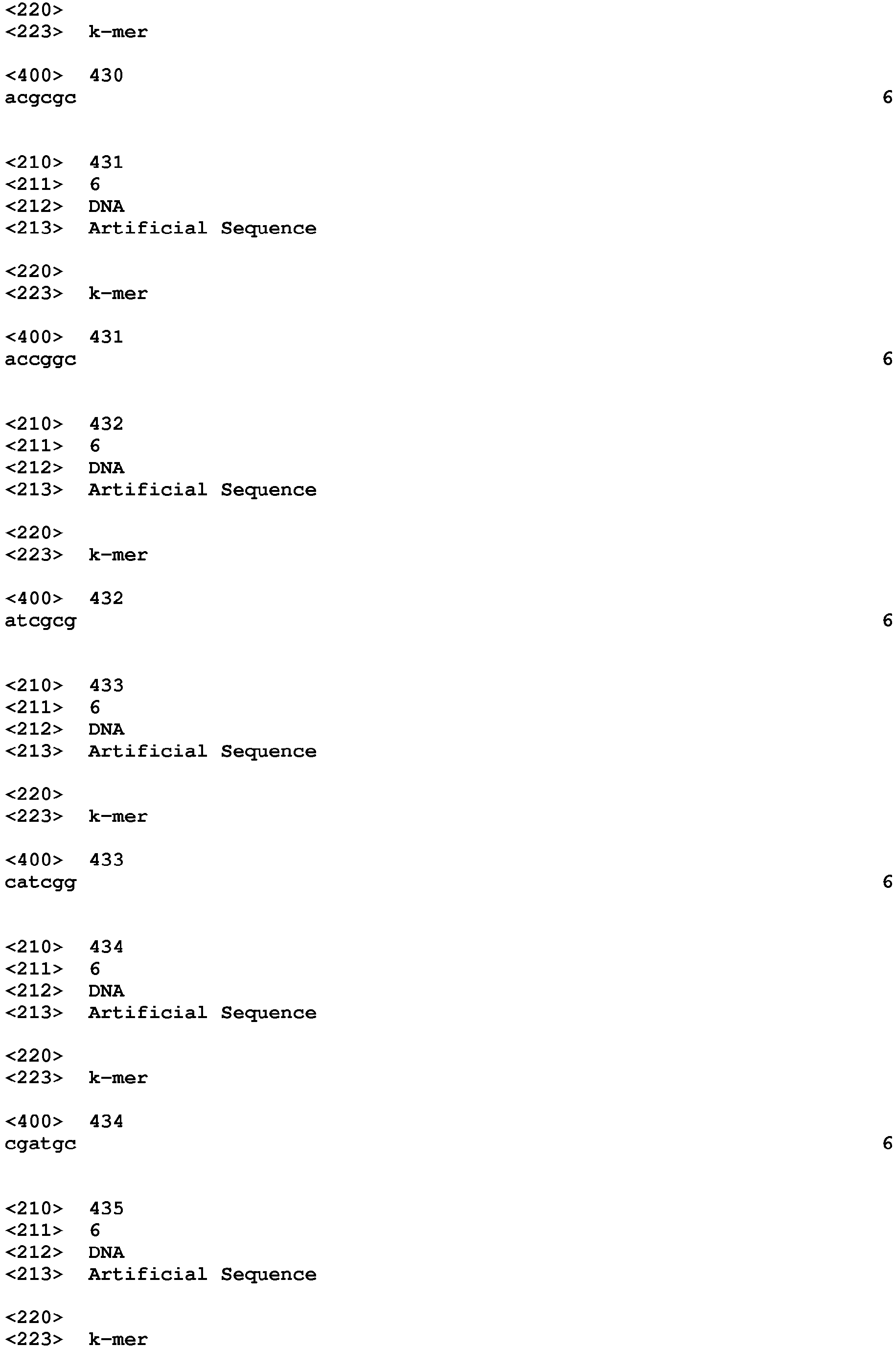
Table 3: Top 100 6-mers and their average enrichment compared to human DNA for three different organisms, i.e. E. coli, S. Aureus and Pandoravirus salinus | k-mer | Enrichment |
| CGTCGA (SEQ ID No. 187) | 133.6 |
| CGACGA (SEQ ID No. 188) | 126.7 |
| CGACGC (SEQ ID No. 189) | 94.1 |
| CGATCG (SEQ ID No. 190) | 91.7 |
| CGTCGC (SEQ ID No. 191) | 82.5 |
| ACGACG (SEQ ID No. 192) | 77.4 |
| CGCGAC (SEQ ID No. 193) | 75.2 |
| CGACCG (SEQ ID No. 194) | 71.6 |
| CGCCGA (SEQ ID No. 195) | 66 |
| ACGTCG (SEQ ID No. 196) | 57.3 |
| TCGCGA (SEQ ID No. 197) | 50.8 |
| ACGCGC (SEQ ID No. 198) | 47.9 |
| CGCGTA (SEQ ID No. 199) | 47.5 |
| GTCGAC (SEQ ID No. 200) | 47.5 |
| ACGCGA (SEQ ID No. 201) | 42.6 |
| CGCGAA (SEQ ID No. 202) | 41.8 |
| AACGCG (SEQ ID No. 203) | 35.3 |
| CGTACG (SEQ ID No. 204) | 33.1 |
| GACGAC (SEQ ID No. 205) | 32.3 |
| ACGCGT (SEQ ID No. 206) | 30.4 |
| CGAACG (SEQ ID No. 207) | 25.8 |
| ATCGAC (SEQ ID No. 208) | 23.6 |
| ATCGCG (SEQ ID No. 209) | 21.5 |
| GCGCAA (SEQ ID No. 210) | 19.1 |
| CGCCAA (SEQ ID No. 211) | 17.8 |
| CGACAA (SEQ ID No. 212) | 17.6 |
| ATGCGC (SEQ ID No. 213) | 16.6 |
| GTCGCA (SEQ ID No. 214) | 16.2 |
| CGATGC (SEQ ID No. 215) | 15.8 |
| GCGTAC (SEQ ID No. 216) | 15.3 |
| ACGACC (SEQ ID No. 217) | 15.1 |
| GCGGTA (SEQ ID No. 218) | 15 |
| CAACGC (SEQ ID No. 219) | 14.9 |
| TGCGCA (SEQ ID No. 220) | 14.6 |
| ATCGTC (SEQ ID No. 221) | 14.3 |
| CGCAAC (SEQ ID No. 222) | 14.3 |
| CATCGC (SEQ ID No. 223) | 14.3 |
| CGATAC (SEQ ID No. 224) | 14.1 |
| CGCATC (SEQ ID No. 225) | 14.1 |
| TCGACA (SEQ ID No. 226) | 14.1 |
| GCGATA (SEQ ID No. 227) | 14 |
| AGCGAC (SEQ ID No. 228) | 12.9 |
| CGATAA (SEQ ID No. 229) | 12.7 |
| CGTTGC (SEQ ID No. 230) | 12.6 |
| GCGTCA (SEQ ID No. 231) | 12.6 |
| GCGAAC (SEQ ID No. 232) | 12.5 |
| AACGCC (SEQ ID No. 233) | 12.4 |
| ATGTCG (SEQ ID No. 234) | 12.2 |
| CGGTAC (SEQ ID No. 235) | 12.1 |
| CAATCG (SEQ ID No. 236) | 12 |
| TATCGA (SEQ ID No. 237) | 12 |
| CGCAAA (SEQ ID No. 238) | 12 |
| ACCGAT (SEQ ID No. 239) | 11.7 |
| AAGCGC (SEQ ID No. 240) | 11.6 |
| GCGCTA (SEQ ID No. 241) | 11.4 |
| GTCGTA (SEQ ID No. 242) | 11.2 |
| CCGATA (SEQ ID No. 243) | 11.1 |
| GCGTAA (SEQ ID No. 244) | 11.1 |
| CATCGA (SEQ ID No. 245) | 11 |
| GGCGTA (SEQ ID No. 246) | 10.9 |
| ATTCGC (SEQ ID No. 247) | 10.8 |
| ATCGAT (SEQ ID No. 248) | 10.7 |
| CGTCAA (SEQ ID No. 249) | 10.7 |
| AACGAC (SEQ ID No. 250) | 10.6 |
| ATATCG (SEQ ID No. 251) | 10.6 |
| ACGACA (SEQ ID No. 252) | 10.5 |
| CGATGA (SEQ ID No. 253) | 10.1 |
| ATACCG (SEQ ID No. 254) | 10.1 |
| CGCTAC (SEQ ID No. 255) | 9.8 |
| AATGCG (SEQ ID No. 256) | 9.7 |
| TCGCAA (SEQ ID No. 257) | 9.6 |
| GTCGAA (SEQ ID No. 258) | 9.5 |
| CAACGA (SEQ ID No. 259) | 9.5 |
| ATTGCG (SEQ ID No. 260) | 9.3 |
| CGTTGA (SEQ ID No. 261) | 9.3 |
| CGATCA (SEQ ID No. 262) | 9.3 |
| TCGTCA (SEQ ID No. 263) | 9.2 |
| GCGAAA (SEQ ID No. 264) | 9.2 |
| ATACGC (SEQ ID No. 265) | 9 |
| TACCGA (SEQ ID No. 266) | 9 |
| ATGCGA (SEQ ID No. 267) | 8.9 |
| CGTACC (SEQ ID No. 268) | 8.8 |
| AAAGCG (SEQ ID No. 269) | 8.7 |
| ATGACG (SEQ ID No. 270) | 8.7 |
| GTACGA (SEQ ID No. 271) | 8.5 |
| CGAAAA (SEQ ID No. 272) | 8.5 |
| ACGATA (SEQ ID No. 273) | 8.5 |
| CGGATA (SEQ ID No. 274) | 8.5 |
| CGGTTA (SEQ ID No. 275) | 8.4 |
| AGTCGA (SEQ ID No. 276) | 8.3 |
| CGACTA (SEQ ID No. 277) | 8.2 |
| CGCATA (SEQ ID No. 278) | 8.1 |
| ACGCAA (SEQ ID No. 279) | 8.1 |
| ATAGCG (SEQ ID No. 280) | 8.1 |
| GACGAA (SEQ ID No. 281) | 8 |
| AACGGT (SEQ ID No. 282) | 8 |
| ACAACG (SEQ ID No. 283) | 7.9 |
| CGATAG (SEQ ID No. 284) | 7.7 |
| ACATCG (SEQ ID No. 285) | 7.7 |
| ACGATG (SEQ ID No. 286) | 7.7 |
Table 4: Top 100 7-mers and their average enrichment compared to human DNA for three different organisms, i.e. E. coli, S. Aureus and Pandoravirus salinus | k-mer | Enrichment |
| CGTCGAC (SEQ ID No. 287) | 258.8 |
| CGACGAC (SEQ ID No. 288) | 236.6 |
| CGCGACG (SEQ ID No. 289) | 184.7 |
| CGACGCG (SEQ ID No. 290) | 172 |
| GCGTCGA (SEQ ID No. 291) | 165.7 |
| TCGACGA (SEQ ID No. 292) | 152.2 |
| CGCGCGA (SEQ ID No. 293) | 142 |
| CGTCGTC (SEQ ID No. 294) | 139.8 |
| GCGACGA (SEQ ID No. 295) | 135.7 |
| CCGTCGA (SEQ ID No. 296) | 135.5 |
| ATCGTCG (SEQ ID No. 297) | 134.7 |
| ATCGACG (SEQ ID No. 298) | 133.3 |
| CGGTCGA (SEQ ID No. 299) | 126.4 |
| CGTCGAG (SEQ ID No. 300) | 119.2 |
| CGCGCAA (SEQ ID No. 301) | 119 |
| ATCGGCG (SEQ ID No. 302) | 115.9 |
| ACGACGA (SEQ ID No. 303) | 115.9 |
| CGATCGA (SEQ ID No. 304) | 115.8 |
| CCGACGA (SEQ ID No. 305) | 112.7 |
| CGATCGC (SEQ ID No. 306) | 103.6 |
| ATCGCCG (SEQ ID No. 307) | 96.6 |
| CGACCGA (SEQ ID No. 308) | 91.1 |
| ACGTCGA (SEQ ID No. 309) | 90.4 |
| CGACGTC (SEQ ID No. 310) | 88.6 |
| ACGACGC (SEQ ID No. 311) | 85.5 |
| CGGTACG (SEQ ID No. 312) | 84.8 |
| ACCGACG (SEQ ID No. 313) | 82.8 |
| CGCGATA (SEQ ID No. 314) | 82.7 |
| CCGATCG (SEQ ID No. 315) | 82.7 |
| ACCGTCG (SEQ ID No. 316) | 82.4 |
| TCGCGCA (SEQ ID No. 317) | 80.4 |
| GCGCGTA (SEQ ID No. 318) | 78.4 |
| CGACGAG (SEQ ID No. 319) | 78.4 |
| ACGCGAC (SEQ ID No. 320) | 78.3 |
| CGACCGC (SEQ ID No. 321) | 77.8 |
| CGCGACA (SEQ ID No. 322) | 76.8 |
| TCGCCGA (SEQ ID No. 323) | 76.8 |
| GTCGCGA (SEQ ID No. 324) | 76.1 |
| CGCGAAA (SEQ ID No. 325) | 75.4 |
| CGGCGTA (SEQ ID No. 326) | 74.6 |
| GACGCGC (SEQ ID No. 327) | 74.1 |
| GCGCCGA (SEQ ID No. 328) | 73.3 |
| CGCAACG (SEQ ID No. 329) | 73 |
| CGCACGA (SEQ ID No. 330) | 72.6 |
| ACGACCG (SEQ ID No. 331) | 71.7 |
| CGCGTAA (SEQ ID No. 332) | 71.2 |
| CGATACG (SEQ ID No. 333) | 70.9 |
| ACGGTCG (SEQ ID No. 334) | 70.5 |
| ATGCGCG (SEQ ID No. 335) | 70.4 |
| CGTCGCA (SEQ ID No. 336) | 69.5 |
| ACGACGG (SEQ ID No. 337) | 68.1 |
| ACGTCGC (SEQ ID No. 338) | 67.5 |
| ACGCCGA (SEQ ID No. 339) | 67.4 |
| ACGATCG (SEQ ID No. 340) | 67 |
| ACGGCGA (SEQ ID No. 341) | 66.1 |
| CGCCGTA (SEQ ID No. 342) | 65 |
| CGACGAA (SEQ ID No. 343) | 64.9 |
| ATCGCGA (SEQ ID No. 344) | 63.3 |
| CGACGCA (SEQ ID No. 345) | 62.5 |
| GCGCGAA (SEQ ID No. 346) | 62.2 |
| CGAACCG (SEQ ID No. 347) | 61.6 |
| CGTCGTA (SEQ ID No. 348) | 58.8 |
| CGACACG (SEQ ID No. 349) | 58.7 |
| AGCGTCG (SEQ ID No. 350) | 58 |
| CGATGCG (SEQ ID No. 351) | 56.4 |
| CGCTACG (SEQ ID No. 352) | 55.8 |
| CGCCGAA (SEQ ID No. 353) | 55 |
| TACGCGA (SEQ ID No. 354) | 53.2 |
| AACGCGC (SEQ ID No. 355) | 52.8 |
| ATTCGCG (SEQ ID No. 356) | 52.3 |
| CGCGTAC (SEQ ID No. 357) | 51.2 |
| AACGGCG (SEQ ID No. 358) | 50.8 |
| ACGCGCT (SEQ ID No. 359) | 50.7 |
| CACGACG (SEQ ID No. 360) | 50.6 |
| TCGCGAA (SEQ ID No. 361) | 50.3 |
| CGTCGAA (SEQ ID No. 362) | 50 |
| CGCTCGA (SEQ ID No. 363) | 49.8 |
| ACGCGCA (SEQ ID No. 364) | 49.7 |
| CGTACGC (SEQ ID No. 365) | 49.4 |
| CATCGCG (SEQ ID No. 366) | 49.1 |
| CGTGCGA (SEQ ID No. 367) | 48.9 |
| CGAATCG (SEQ ID No. 368) | 48.7 |
| CGACTCG (SEQ ID No. 369) | 48.1 |
| AATCGCG (SEQ ID No. 370) | 48 |
| CAACGCG (SEQ ID No. 371) | 47.2 |
| ACGAGCG (SEQ ID No. 372) | 47.2 |
| ATACGCG (SEQ ID No. 373) | 47 |
| AACGACG (SEQ ID No. 374) | 46.9 |
| AAGCGCG (SEQ ID No. 375) | 46.6 |
| ACGCCGT (SEQ ID No. 376) | 46.4 |
| CACGTCG (SEQ ID No. 377) | 46 |
| ATCGCGG (SEQ ID No. 378) | 45.7 |
| AACGTCG (SEQ ID No. 379) | 45.4 |
| CGTAACG (SEQ ID No. 380) | 44.8 |
| CGCGGTA (SEQ ID No. 381) | 44.6 |
| AGCGCGA (SEQ ID No. 382) | 44.6 |
| GACGCGA (SEQ ID No. 383) | 44.1 |
| ACGACGT (SEQ ID No. 384) | 43.5 |
| CGACGTA (SEQ ID No. 385) | 43.2 |
| ACGCGTC (SEQ ID No. 386) | 43.2 |
-
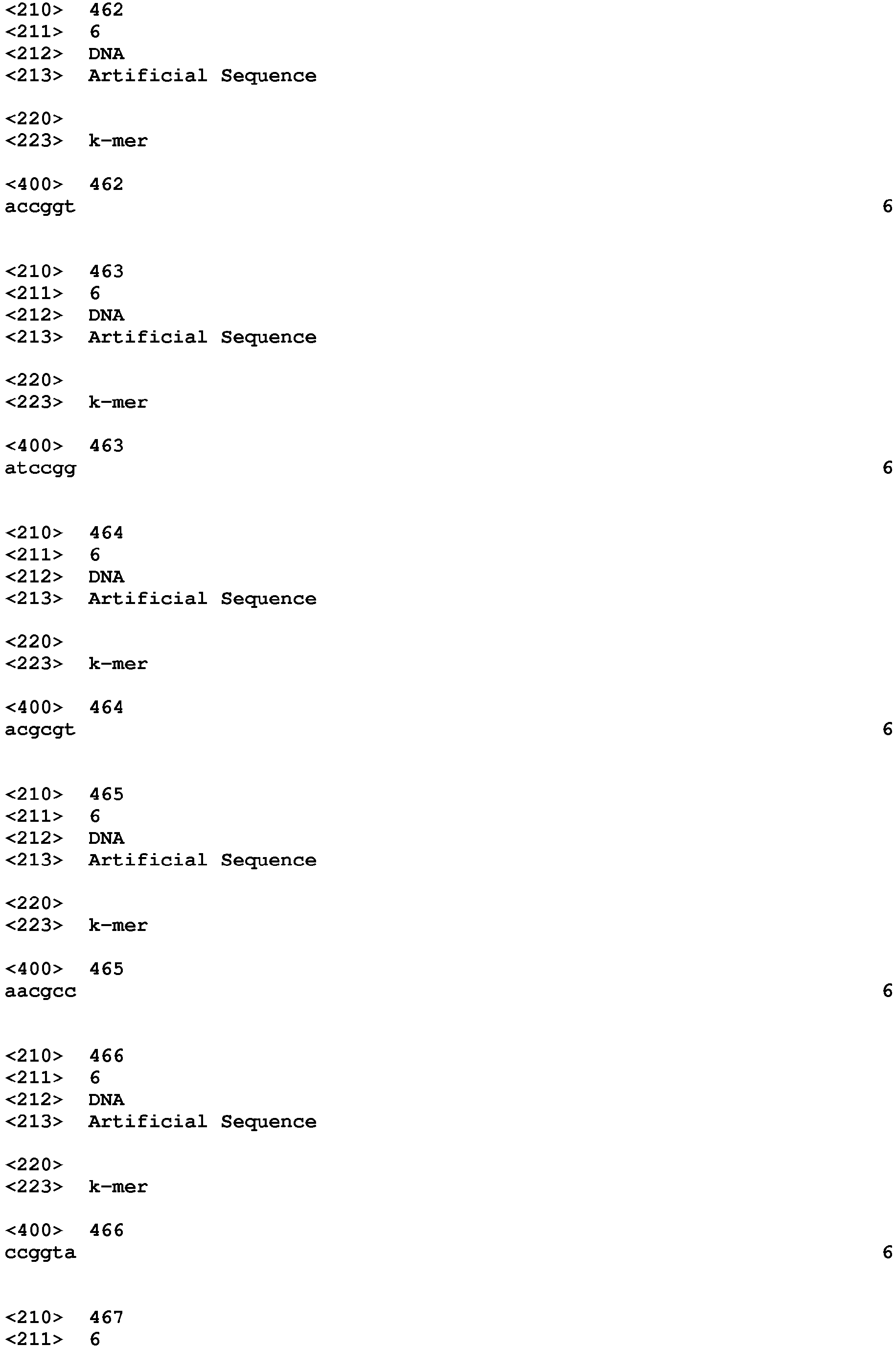
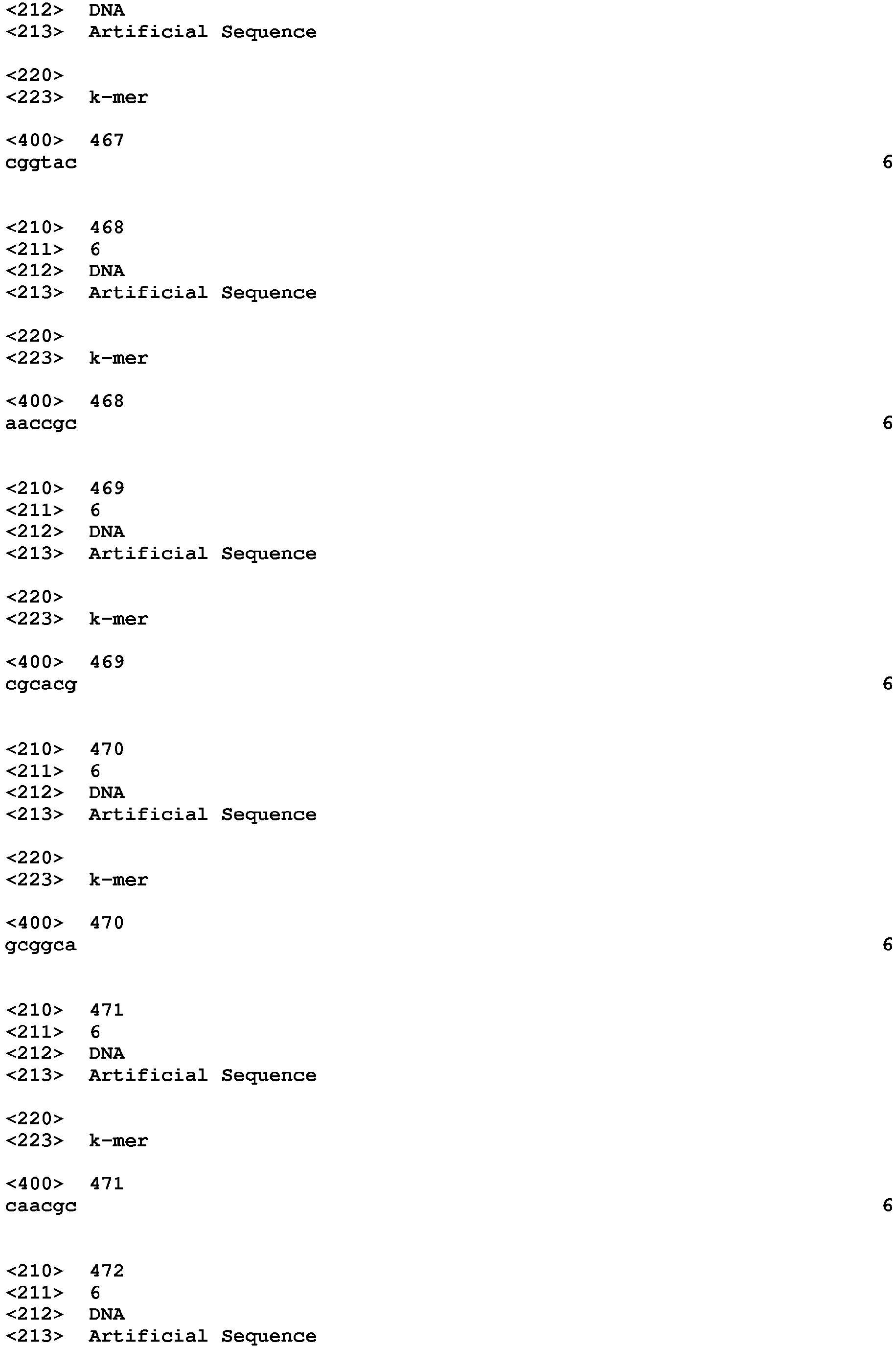
In addition, the best 100 hexamers found for a comparison of all prokaryotic genomes from NCBIGenbank gene and all human genomes from the 1000 genomes project are given in the following Table 5, together with their average enrichment for all bacteria, including archaea, of the NCBIGenbank.
-
Table 5: Top 100 6-mers found for a comparison of all prokaryotic genomes from NCBIGenbank gene and all human genomes from the 1000 genomes project and their average
enrichment
| kmer | Average Enrichment |
| CGTCGA (SEQ ID No. 387) | 49.9 |
| CGACGA (SEQ ID No. 388) | 48.7 |
| CGATCG (SEQ ID No. 389) | 45.4 |
| CGGCGA (SEQ ID No. 390) | 36.6 |
| CGCCGA (SEQ ID No. 391) | 36.6 |
| CGCGAA (SEQ ID No. 392) | 32.2 |
| CGACCG (SEQ ID No. 393) | 30.2 |
| CGAACG (SEQ ID No. 394) | 28.9 |
| TCGCGA (SEQ ID No. 395) | 28.4 |
| ACGACG (SEQ ID No. 396) | 26.8 |
| CCGTCG (SEQ ID No. 397) | 26.0 |
| CGTCGC (SEQ ID No. 398) | 25.2 |
| CGACGC (SEQ ID No. 399) | 24.5 |
| ACGCCG (SEQ ID No. 400) | 23.6 |
| ACGGCG (SEQ ID No. 401) | 23.4 |
| CGCGAC (SEQ ID No. 402) | 23.3 |
| CCGACG (SEQ ID No. 403) | 22.9 |
| CGCGTA (SEQ ID No. 404) | 22.4 |
| ACGTCG (SEQ ID No. 405) | 21.5 |
| AACGCG (SEQ ID No. 406) | 21.3 |
| CCGCGA (SEQ ID No. 407) | 20.8 |
| ACGCGA (SEQ ID No. 408) | 20.5 |
| ATCGGC (SEQ ID No. 409) | 18.6 |
| CGAGCG (SEQ ID No. 410) | 15.9 |
| CCGGCG (SEQ ID No. 411) | 15.7 |
| CGTACG (SEQ ID No. 412) | 15.4 |
| ATCGAC (SEQ ID No. 413) | 15.3 |
| AGCGCG (SEQ ID No. 414) | 14.9 |
| CCGCCG (SEQ ID No. 415) | 14.7 |
| CGCGGA (SEQ ID No. 416) | 14.4 |
| ATCGCC (SEQ ID No. 417) | 13.7 |
| CGGCGC (SEQ ID No. 418) | 13.6 |
| CGCCGC (SEQ ID No. 419) | 13.5 |
| CGCGCA (SEQ ID No. 420) | 13.3 |
| GCGAAC (SEQ ID No. 421) | 13.3 |
| CGCGTC (SEQ ID No. 422) | 13.2 |
| CGGCAA (SEQ ID No. 423) | 13.1 |
| CCGATC (SEQ ID No. 424) | 12.5 |
| CGGACG (SEQ ID No. 425) | 12.5 |
| GCCGAC (SEQ ID No. 426) | 12.4 |
| CGCGAG (SEQ ID No. 427) | 12.3 |
| ACGCGG (SEQ ID No. 428) | 12.1 |
| GCGGTA (SEQ ID No. 429) | 12.1 |
| ACGCGC (SEQ ID No. 430) | 11.9 |
| ACCGGC (SEQ ID No. 431) | 11.9 |
| ATCGCG (SEQ ID No. 432) | 11.8 |
| CATCGG (SEQ ID No. 433) | 11.7 |
| CGATGC (SEQ ID No. 434) | 11.6 |
| ATGCCG (SEQ ID No. 435) | 11.4 |
| TCGGCA (SEQ ID No. 436) | 11.1 |
| GCCGAA (SEQ ID No. 437) | 11.1 |
| CGCGGC (SEQ ID No. 438) | 11.1 |
| CGATGA (SEQ ID No. 439) | 11.1 |
| ATCGTC (SEQ ID No. 440) | 10.9 |
| ACCGAC (SEQ ID No. 441) | 10.9 |
| CCGAAC (SEQ ID No. 442) | 10.8 |
| ACCGCC (SEQ ID No. 443) | 10.8 |
| GTCGAA (SEQ ID No. 444) | 10.6 |
| GCGACC (SEQ ID No. 445) | 10.6 |
| ACCGAT (SEQ ID No. 446) | 10.6 |
| AACGGC (SEQ ID No. 447) | 10.6 |
| CATCGA (SEQ ID No. 448) | 10.6 |
| CATCGC (SEQ ID No. 449) | 10.5 |
| GCCGTA (SEQ ID No. 450) | 10.5 |
| GACGAC (SEQ ID No. 451) | 10.5 |
| CGATAC (SEQ ID No. 452) | 10.5 |
| CGCCAA (SEQ ID No. 453) | 10.5 |
| GTCGAC (SEQ ID No. 454) | 10.4 |
| CCGATA (SEQ ID No. 455) | 10.4 |
| GACCGC (SEQ ID No. 456) | 10.4 |
| GGTCGA (SEQ ID No. 457) | 10.3 |
| CGATCA (SEQ ID No. 458) | 10.2 |
| CGCATC (SEQ ID No. 459) | 10.2 |
| CGACCA (SEQ ID No. 460) | 10.2 |
| GACGGC (SEQ ID No. 461) | 10.2 |
| ACCGGT (SEQ ID No. 462) | 10.2 |
| ATCCGG (SEQ ID No. 463) | 10.1 |
| ACGCGT (SEQ ID No. 464) | 9.9 |
| AACGCC (SEQ ID No. 465) | 9.9 |
| CCGGTA (SEQ ID No. 466) | 9.9 |
| CGGTAC (SEQ ID No. 467) | 9.8 |
| AACCGC (SEQ ID No. 468) | 9.8 |
| CGCACG (SEQ ID No. 469) | 9.8 |
| GCGGCA (SEQ ID No. 470) | 9.5 |
| CAACGC (SEQ ID No. 471) | 9.5 |
| GCGCGA (SEQ ID No. 472) | 9.5 |
| GCGTAC (SEQ ID No. 473) | 9.5 |
| CGAACC (SEQ ID No. 474) | 9.4 |
| GGCGAA (SEQ ID No. 475) | 9.3 |
| GCTCGA (SEQ ID No. 476) | 9.2 |
| ACGACC (SEQ ID No. 477) | 9.1 |
| CGGTCA (SEQ ID No. 478) | 9.1 |
| GCGATA (SEQ ID No. 479) | 9.1 |
| CGCAAC (SEQ ID No. 480) | 9.1 |
| CGAAGC (SEQ ID No. 481) | 9.0 |
| GCCGGA (SEQ ID No. 482) | 8.9 |
| GCGGAA (SEQ ID No. 483) | 8.8 |
| CGACAA (SEQ ID No. 484) | 8.8 |
| CTTCGC (SEQ ID No. 485) | 8.7 |
| CAACCG (SEQ ID No. 486) | 8.7 |
-
A comparison between Table 3 and Table 5 shows that essentially the hexamers found for the three specific microorganisms and virus can be also found in a much broader database comprising a multitude of prokaryotes, showing that the k-mers are well conserved and homogeneous throughout microorganisms and viruses.
-
The obtained specific k-mers can be used to preferentially amplify bacterial, archaeal and/or virus DNA from samples with a high human DNA content, e.g. blood, as specifically shown in Fig. 3.
-
Fig. 3 shows the basic concept of a multiple displacement amplification with the rare hexamers for the microorganisms and virus obtained in the present example - compared to human DNA, which results in a higher amplification for non-human DNA. Human DNA 1 is shown on the left, and the pathogen DNA 2 on the right. The k-mers 3 that are less frequent in the human DNA and obtained in the present method are shown in the middle. They are used in a first step S1 wherein the sample containing both human and pathogen DNA are denatured and hybridized. As shown in the Figure, the k-mers selectively bind more to the pathogen DNA 2. In step S2 MDA, here with Φ29 DNA polymerase takes place, leading to preferred isothermal amplification with the pathogen DNA on the right, i.e. to an enrichment thereof compared to the human DNA.
-
Theoretical enrichment factors obtained in the determination step of the comparison of the genomes for specific k-mers of different length for one, two or three of the microorganisms in the Example are shown in Tables 6 to 9, wherein also the mean numbers of binding sites as well as the number of potential k-mers per k-mer length with difference in frequency and/or context to the human genome are shown. To indicate a potential optimum for subsequent amplification based method, k-mers occurring less than 10 times per non-human genome showing an enrichment of less 4 were filtered. In setting with more than 1 non-human organism these criteria applied to all organisms.
Table 6: k-mer size dependent enrichment with features determining the performance of a designed multiple displacement amplification in a three organisms, i.e. E. coli, S. aureus and Pandoravirus salinus, setting compared to a human background. | k-mer size | Mean binding sites of a single k-mer (per 100 kbp genome) | Mean enrichment of top 20 k-mers (in fold) | Number of qualifying k-mers |
| 4 | 711 | 8 | 8 |
| 5 | 231 | 17 | 31 |
| 6 | 58 | 63 | 132 |
| 7 | 15 | 131 | 616 |
| 8 | 4 | 215 | 2619 |
| 9 | 1 | 187 | 4882 |
| 10 | 1 | 71 | 518 |
| 11 | 1 | 21 | 5 |
Table 7: k-mer size dependent enrichment with features determining the performance of a designed multiple displacement amplification in a two organisms, i.e. E. coli and S. aureus, setting compared to a human background. | k-mer size | Mean binding sites of a single k-mer (per 100 kbp genome) | Mean enrichment of top 20 k-mers (in fold) | Number of qualifying k-mers |
| 4 | 613 | 6 | 23 |
| 5 | 174 | 12 | 89 |
| 6 | 44 | 30 | 386 |
| 7 | 11 | 63 | 1579 |
| 8 | 3 | 121 | 5403 |
| 9 | 1 | 195 | 7931 |
| 10 | 1 | 186 | 2674 |
| 11 | 1 | 48 | 74 |
Table 8: k-mer size dependent enrichment with features determining the performance of a designed multiple displacement amplification in a two organisms, i.e. E. coli and Pandoravirus salinus, setting compared to a human background. | k-mer size | Mean binding sites of a single k-mer (per 100 kbp genome) | Mean enrichment of top 20 k-mers (in fold) | Number of qualifying k-mers |
| 4 | 1103 | 13 | 23 |
| 5 | 329 | 32 | 89 |
| 6 | 83 | 104 | 386 |
| 7 | 22 | 215 | 1592 |
| 8 | 6 | 497 | 6695 |
| 9 | 2 | 1154 | 23852 |
| 10 | 1 | 1464 | 25708 |
| 11 | 1 | 844 | 3653 |
Table 9: k-mer size dependent enrichment with features determining the performance of a designed multiple displacement amplification in a one organism, i.e. E. coli, setting compared to a human background. | k-mer size | Mean binding sites of a single k-mer (per 100 kbp genome) | Mean enrichment of top 20 k-mers (in fold) | Number of qualifying k-mers |
| 4 | 873 | 9 | 23 |
| 5 | 253 | 19 | 99 |
| 6 | 63 | 51 | 474 |
| 7 | 17 | 107 | 2089 |
| 8 | 4 | 207 | 9214 |
| 9 | 1 | 401 | 38893 |
| 10 | 1 | 1022 | 89522 |
| 11 | 1 | 2593 | 38168 |
-
To test the theoretical predictions, sets of hexamers were acquired and tested in a MDA enrichment test. The acquired hexamers are listed in Table 10.
Table 10: Tested hexamers | No. | Hexamer |
| 1 | CGNCGN |
| 2 | NCGNCG |
| 3 | CGCGNN |
| 4 | NCGCGN |
| 5 | CGNNCG |
| 6 | NNCGCG |
| 7 | NNGCGC |
| 8 | NNCGGC |
| 9 | NGCGCN |
| 10 | NGCNGC |
| 11 | GCCGNN |
| 12 | GCGCNN |
| 13 | CGNNGC |
| 14 | NCGGCN |
| 15 | CGGCNN |
| 16 | NNGCCG |
| 17 | NGCCGN |
| 18 | NGCNCG |
| 19 | GCNCGN |
| 20 | NCGNGC |
| 21 | CGNGCN |
| 22 | GCNGCN |
| 23 | GCNNGC |
| 24 | GCNNCG |
-
In Table 8, the IUPAC Ambiguity Codes were applied. Subsequently, N represents A, C, G, T, i.e. each of them, so that accordingly mixtures of different hexamers given in the table with at least one N are obtained.
-
Exemplary tests with specific selected primer sets are shown in the following. A first k-mer set 1 that was tested contained hexamers 1-24 of Table 8, a second k-mer set 2 hexamers 1-2 of Table 8, and a third k-mer set 3 the hexamers of No. 1. Furthermore, a fourth k-mer set 3A contained the hexamers CGACGN, a fifth k-mer set 5A the hexamer CGACGC, and a sixth k-mer set 5G the k-mer CGGCGC.
-
For the test, 6000 copies of Human gDNA (genomic DNA) and S.aureus, or E.coli, respectively - so that the final copy number ratio before the amplification is 1:1 - were mixed and inserted into the subsequent MDA reaction. The reaction was carried out with 1 mM dNTPs, 50 µM of the respective k-mers and 10 units Phi29 Polymerase for 4 hours at 30°C. After reaction, the mix was incubated at 65°C for 10 min to inactivate the reaction. Subsequently, the efficacy of the enrichment was determined by qPCR with the 16S rRNA gene of the respective bacterium and the ESR1 gene for human DNA. As control, the experiment was also once carried out without hexamers. In a comparative example, random hexamers were taken.
-
Selected results are shown in the following Tables 11 and 12.
Table 11: Experiment with E.coli | k-mer Set | Amplification Human (ESR1 gene) | Amplification E. coli (16S rRNA gene) |
| No hexamers | 1.0 | 1.0 |
| Random Hexamers | 76.1 | 6.0 |
| k-mer Set 1 | 2.4 | 3.3 |
| k-mer Set 3 | 18.0 | 111.2 |
| k-mer Set 3a | 29.9 | 548.8 |
| k-mer Set 5a | 7.7 | 8,154.2 |
| k-mer Set 5g | 8.7 | 11,373.1 |
Table 12: Experiment with S.aureus | k-mer Set | Amplification Human (ESR1 gene) | Amplification S. aureus (16S rRNA gene) |
| No hexamers | 1.0 | 1.0 |
| Random Hexamers | 839.5 | 4759.7 |
| k-mer Set 1 | 3.1 | 14.3 |
| k-mer Set 3 | 99.3 | 315,365.8 |
| k-mer Set 3a | 156.5 | 265,190.0 |
| k-mer Set 5a | 41.7 | 57,982.6 |
| K-mer Set 5g | 68.0 | 229,266.6 |
-
As can be seen from Tables 11 and 12, a further improvement of the enrichment of the bacterial DNA could be obtained with specific hexamers or hexamer sets as primers.
-
With the present methods, the distribution of k-mer length and k-mer sequences can be specifically tuned for the intended application based on differences in k-mer frequencies and/or k-mer context in a target nucleic acid from at least one microorganism and/or virus, (e.g. one or more pathogens compared to the unwanted background nucleic acid from a subject, e.g. from human patients.
-
With the present methods, k-mers are selected on genome-level rather than on a weighted and/or tissue dependent transcriptome-level, leading to improved results.
-
Nucleic acid sequence, e.g. DNA, fragment produces by the present approach can match current long-read sequencing, e.g. DNA sequencing, technologies.
-
The present invention enables an improved efficiency in sequence assisted diagnostics, and can particularly lead to higher sensitivity in pathogen detection.