EP3339393A1 - A process for the preparation of a molten salt-based nanofluid - Google Patents
A process for the preparation of a molten salt-based nanofluid Download PDFInfo
- Publication number
- EP3339393A1 EP3339393A1 EP16382630.8A EP16382630A EP3339393A1 EP 3339393 A1 EP3339393 A1 EP 3339393A1 EP 16382630 A EP16382630 A EP 16382630A EP 3339393 A1 EP3339393 A1 EP 3339393A1
- Authority
- EP
- European Patent Office
- Prior art keywords
- nanoparticles
- comprised
- salt
- nanofluid
- molten salt
- Prior art date
- Legal status (The legal status is an assumption and is not a legal conclusion. Google has not performed a legal analysis and makes no representation as to the accuracy of the status listed.)
- Withdrawn
Links
- 150000003839 salts Chemical class 0.000 title claims abstract description 82
- 238000000034 method Methods 0.000 title claims abstract description 60
- 238000002360 preparation method Methods 0.000 title claims abstract description 19
- 239000002105 nanoparticle Substances 0.000 claims abstract description 212
- 239000006185 dispersion Substances 0.000 claims abstract description 42
- 239000000203 mixture Substances 0.000 claims abstract description 38
- 229910017053 inorganic salt Inorganic materials 0.000 claims abstract description 36
- 239000000243 solution Substances 0.000 claims abstract description 33
- 239000007864 aqueous solution Substances 0.000 claims abstract description 29
- XLYOFNOQVPJJNP-UHFFFAOYSA-N water Substances O XLYOFNOQVPJJNP-UHFFFAOYSA-N 0.000 claims abstract description 22
- 238000002844 melting Methods 0.000 claims abstract description 13
- 230000008018 melting Effects 0.000 claims abstract description 13
- 238000001035 drying Methods 0.000 claims abstract description 12
- 229910044991 metal oxide Inorganic materials 0.000 claims abstract description 9
- 150000004706 metal oxides Chemical class 0.000 claims abstract description 9
- 239000004065 semiconductor Substances 0.000 claims abstract description 9
- 238000009835 boiling Methods 0.000 claims abstract description 8
- 239000011232 storage material Substances 0.000 claims abstract description 4
- 239000002245 particle Substances 0.000 claims description 54
- VYPSYNLAJGMNEJ-UHFFFAOYSA-N Silicium dioxide Chemical compound O=[Si]=O VYPSYNLAJGMNEJ-UHFFFAOYSA-N 0.000 claims description 42
- 238000009826 distribution Methods 0.000 claims description 28
- FGIUAXJPYTZDNR-UHFFFAOYSA-N potassium nitrate Chemical compound [K+].[O-][N+]([O-])=O FGIUAXJPYTZDNR-UHFFFAOYSA-N 0.000 claims description 20
- 239000000377 silicon dioxide Substances 0.000 claims description 20
- VWDWKYIASSYTQR-UHFFFAOYSA-N sodium nitrate Chemical compound [Na+].[O-][N+]([O-])=O VWDWKYIASSYTQR-UHFFFAOYSA-N 0.000 claims description 19
- 239000012047 saturated solution Substances 0.000 claims description 16
- PNEYBMLMFCGWSK-UHFFFAOYSA-N aluminium oxide Inorganic materials [O-2].[O-2].[O-2].[Al+3].[Al+3] PNEYBMLMFCGWSK-UHFFFAOYSA-N 0.000 claims description 15
- 229910052681 coesite Inorganic materials 0.000 claims description 15
- 229910052906 cristobalite Inorganic materials 0.000 claims description 15
- 229910052682 stishovite Inorganic materials 0.000 claims description 15
- 229910052905 tridymite Inorganic materials 0.000 claims description 15
- 229910052593 corundum Inorganic materials 0.000 claims description 13
- 229910001845 yogo sapphire Inorganic materials 0.000 claims description 13
- GWEVSGVZZGPLCZ-UHFFFAOYSA-N Titan oxide Chemical compound O=[Ti]=O GWEVSGVZZGPLCZ-UHFFFAOYSA-N 0.000 claims description 12
- MCMNRKCIXSYSNV-UHFFFAOYSA-N Zirconium dioxide Chemical compound O=[Zr]=O MCMNRKCIXSYSNV-UHFFFAOYSA-N 0.000 claims description 12
- 239000003513 alkali Substances 0.000 claims description 12
- 238000002156 mixing Methods 0.000 claims description 11
- SZVJSHCCFOBDDC-UHFFFAOYSA-N ferrosoferric oxide Chemical compound O=[Fe]O[Fe]O[Fe]=O SZVJSHCCFOBDDC-UHFFFAOYSA-N 0.000 claims description 10
- 235000010333 potassium nitrate Nutrition 0.000 claims description 10
- 239000004323 potassium nitrate Substances 0.000 claims description 10
- 235000010344 sodium nitrate Nutrition 0.000 claims description 10
- 239000004317 sodium nitrate Substances 0.000 claims description 10
- 229910052784 alkaline earth metal Inorganic materials 0.000 claims description 9
- -1 alkaline-earth metal carbonate Chemical class 0.000 claims description 6
- 238000003860 storage Methods 0.000 claims description 6
- XOLBLPGZBRYERU-UHFFFAOYSA-N tin dioxide Chemical compound O=[Sn]=O XOLBLPGZBRYERU-UHFFFAOYSA-N 0.000 claims description 6
- 238000012546 transfer Methods 0.000 claims description 6
- 229910001963 alkali metal nitrate Inorganic materials 0.000 claims description 4
- 229910001964 alkaline earth metal nitrate Inorganic materials 0.000 claims description 4
- 239000007900 aqueous suspension Substances 0.000 claims description 4
- 229910001218 Gallium arsenide Inorganic materials 0.000 claims description 3
- UHYPYGJEEGLRJD-UHFFFAOYSA-N cadmium(2+);selenium(2-) Chemical compound [Se-2].[Cd+2] UHYPYGJEEGLRJD-UHFFFAOYSA-N 0.000 claims description 3
- JEIPFZHSYJVQDO-UHFFFAOYSA-N iron(III) oxide Inorganic materials O=[Fe]O[Fe]=O JEIPFZHSYJVQDO-UHFFFAOYSA-N 0.000 claims description 3
- 238000005303 weighing Methods 0.000 claims description 3
- 229910001514 alkali metal chloride Inorganic materials 0.000 claims description 2
- 229910000318 alkali metal phosphate Inorganic materials 0.000 claims description 2
- 229910001617 alkaline earth metal chloride Inorganic materials 0.000 claims description 2
- 229910000316 alkaline earth metal phosphate Inorganic materials 0.000 claims description 2
- 239000013529 heat transfer fluid Substances 0.000 abstract description 7
- 239000000463 material Substances 0.000 description 11
- 239000007787 solid Substances 0.000 description 11
- 230000000052 comparative effect Effects 0.000 description 9
- 239000000523 sample Substances 0.000 description 7
- 238000003756 stirring Methods 0.000 description 6
- 238000004090 dissolution Methods 0.000 description 5
- 239000011521 glass Substances 0.000 description 5
- 238000005259 measurement Methods 0.000 description 5
- 230000005611 electricity Effects 0.000 description 4
- 239000007788 liquid Substances 0.000 description 4
- 239000012266 salt solution Substances 0.000 description 4
- 239000002904 solvent Substances 0.000 description 4
- 238000010561 standard procedure Methods 0.000 description 4
- 238000004458 analytical method Methods 0.000 description 3
- 239000002585 base Substances 0.000 description 3
- 230000015572 biosynthetic process Effects 0.000 description 3
- 239000012153 distilled water Substances 0.000 description 3
- 239000012530 fluid Substances 0.000 description 3
- 229910052739 hydrogen Inorganic materials 0.000 description 3
- 239000001257 hydrogen Substances 0.000 description 3
- 150000002484 inorganic compounds Chemical class 0.000 description 3
- 229910010272 inorganic material Inorganic materials 0.000 description 3
- 239000011858 nanopowder Substances 0.000 description 3
- 150000002823 nitrates Chemical class 0.000 description 3
- 238000013082 photovoltaic technology Methods 0.000 description 3
- 239000000725 suspension Substances 0.000 description 3
- 238000002604 ultrasonography Methods 0.000 description 3
- 230000005653 Brownian motion process Effects 0.000 description 2
- DGAQECJNVWCQMB-PUAWFVPOSA-M Ilexoside XXIX Chemical compound C[C@@H]1CC[C@@]2(CC[C@@]3(C(=CC[C@H]4[C@]3(CC[C@@H]5[C@@]4(CC[C@@H](C5(C)C)OS(=O)(=O)[O-])C)C)[C@@H]2[C@]1(C)O)C)C(=O)O[C@H]6[C@@H]([C@H]([C@@H]([C@H](O6)CO)O)O)O.[Na+] DGAQECJNVWCQMB-PUAWFVPOSA-M 0.000 description 2
- 238000010521 absorption reaction Methods 0.000 description 2
- 238000005537 brownian motion Methods 0.000 description 2
- 239000000919 ceramic Substances 0.000 description 2
- ZUOUZKKEUPVFJK-UHFFFAOYSA-N diphenyl Chemical compound C1=CC=CC=C1C1=CC=CC=C1 ZUOUZKKEUPVFJK-UHFFFAOYSA-N 0.000 description 2
- 230000000694 effects Effects 0.000 description 2
- 238000005516 engineering process Methods 0.000 description 2
- 230000000737 periodic effect Effects 0.000 description 2
- 238000001878 scanning electron micrograph Methods 0.000 description 2
- 238000004062 sedimentation Methods 0.000 description 2
- 238000001370 static light scattering Methods 0.000 description 2
- 238000003786 synthesis reaction Methods 0.000 description 2
- MHCVCKDNQYMGEX-UHFFFAOYSA-N 1,1'-biphenyl;phenoxybenzene Chemical compound C1=CC=CC=C1C1=CC=CC=C1.C=1C=CC=CC=1OC1=CC=CC=C1 MHCVCKDNQYMGEX-UHFFFAOYSA-N 0.000 description 1
- OYPRJOBELJOOCE-UHFFFAOYSA-N Calcium Chemical compound [Ca] OYPRJOBELJOOCE-UHFFFAOYSA-N 0.000 description 1
- UFHFLCQGNIYNRP-UHFFFAOYSA-N Hydrogen Chemical compound [H][H] UFHFLCQGNIYNRP-UHFFFAOYSA-N 0.000 description 1
- WHXSMMKQMYFTQS-UHFFFAOYSA-N Lithium Chemical group [Li] WHXSMMKQMYFTQS-UHFFFAOYSA-N 0.000 description 1
- FYYHWMGAXLPEAU-UHFFFAOYSA-N Magnesium Chemical group [Mg] FYYHWMGAXLPEAU-UHFFFAOYSA-N 0.000 description 1
- GRYLNZFGIOXLOG-UHFFFAOYSA-N Nitric acid Chemical compound O[N+]([O-])=O GRYLNZFGIOXLOG-UHFFFAOYSA-N 0.000 description 1
- ZLMJMSJWJFRBEC-UHFFFAOYSA-N Potassium Chemical compound [K] ZLMJMSJWJFRBEC-UHFFFAOYSA-N 0.000 description 1
- 239000002253 acid Substances 0.000 description 1
- 239000000654 additive Substances 0.000 description 1
- 229910052783 alkali metal Inorganic materials 0.000 description 1
- 150000001340 alkali metals Chemical class 0.000 description 1
- 150000001342 alkaline earth metals Chemical class 0.000 description 1
- 239000000956 alloy Substances 0.000 description 1
- 229910045601 alloy Inorganic materials 0.000 description 1
- 229910052788 barium Inorganic materials 0.000 description 1
- DSAJWYNOEDNPEQ-UHFFFAOYSA-N barium atom Chemical compound [Ba] DSAJWYNOEDNPEQ-UHFFFAOYSA-N 0.000 description 1
- 235000010290 biphenyl Nutrition 0.000 description 1
- 239000004305 biphenyl Substances 0.000 description 1
- 239000007853 buffer solution Substances 0.000 description 1
- 229910052792 caesium Inorganic materials 0.000 description 1
- TVFDJXOCXUVLDH-UHFFFAOYSA-N caesium atom Chemical compound [Cs] TVFDJXOCXUVLDH-UHFFFAOYSA-N 0.000 description 1
- 229910052791 calcium Inorganic materials 0.000 description 1
- 239000011575 calcium Substances 0.000 description 1
- 239000013078 crystal Substances 0.000 description 1
- 230000007423 decrease Effects 0.000 description 1
- 230000003247 decreasing effect Effects 0.000 description 1
- USIUVYZYUHIAEV-UHFFFAOYSA-N diphenyl ether Chemical compound C=1C=CC=CC=1OC1=CC=CC=C1 USIUVYZYUHIAEV-UHFFFAOYSA-N 0.000 description 1
- 238000007599 discharging Methods 0.000 description 1
- 238000002296 dynamic light scattering Methods 0.000 description 1
- 238000005265 energy consumption Methods 0.000 description 1
- 238000004146 energy storage Methods 0.000 description 1
- 238000002474 experimental method Methods 0.000 description 1
- 238000000445 field-emission scanning electron microscopy Methods 0.000 description 1
- 239000002803 fossil fuel Substances 0.000 description 1
- 238000005338 heat storage Methods 0.000 description 1
- XLYOFNOQVPJJNP-UHFFFAOYSA-M hydroxide Chemical compound [OH-] XLYOFNOQVPJJNP-UHFFFAOYSA-M 0.000 description 1
- 229910052744 lithium Inorganic materials 0.000 description 1
- 229910052749 magnesium Inorganic materials 0.000 description 1
- 239000011777 magnesium Substances 0.000 description 1
- 238000004519 manufacturing process Methods 0.000 description 1
- 239000000155 melt Substances 0.000 description 1
- 238000012544 monitoring process Methods 0.000 description 1
- 229910017604 nitric acid Inorganic materials 0.000 description 1
- 239000003921 oil Substances 0.000 description 1
- 238000001139 pH measurement Methods 0.000 description 1
- 229910052700 potassium Inorganic materials 0.000 description 1
- 239000011591 potassium Substances 0.000 description 1
- 238000012545 processing Methods 0.000 description 1
- 230000005855 radiation Effects 0.000 description 1
- 238000005057 refrigeration Methods 0.000 description 1
- 238000012552 review Methods 0.000 description 1
- 229910052701 rubidium Inorganic materials 0.000 description 1
- IGLNJRXAVVLDKE-UHFFFAOYSA-N rubidium atom Chemical compound [Rb] IGLNJRXAVVLDKE-UHFFFAOYSA-N 0.000 description 1
- 238000004513 sizing Methods 0.000 description 1
- 229910052708 sodium Inorganic materials 0.000 description 1
- 239000011734 sodium Substances 0.000 description 1
- 230000003068 static effect Effects 0.000 description 1
- 229910052712 strontium Inorganic materials 0.000 description 1
- CIOAGBVUUVVLOB-UHFFFAOYSA-N strontium atom Chemical compound [Sr] CIOAGBVUUVVLOB-UHFFFAOYSA-N 0.000 description 1
- 239000000126 substance Substances 0.000 description 1
- 238000006467 substitution reaction Methods 0.000 description 1
- 239000002918 waste heat Substances 0.000 description 1
Images

Classifications
-
- C—CHEMISTRY; METALLURGY
- C09—DYES; PAINTS; POLISHES; NATURAL RESINS; ADHESIVES; COMPOSITIONS NOT OTHERWISE PROVIDED FOR; APPLICATIONS OF MATERIALS NOT OTHERWISE PROVIDED FOR
- C09K—MATERIALS FOR MISCELLANEOUS APPLICATIONS, NOT PROVIDED FOR ELSEWHERE
- C09K5/00—Heat-transfer, heat-exchange or heat-storage materials, e.g. refrigerants; Materials for the production of heat or cold by chemical reactions other than by combustion
- C09K5/08—Materials not undergoing a change of physical state when used
- C09K5/10—Liquid materials
- C09K5/12—Molten materials, i.e. materials solid at room temperature, e.g. metals or salts
-
- F—MECHANICAL ENGINEERING; LIGHTING; HEATING; WEAPONS; BLASTING
- F24—HEATING; RANGES; VENTILATING
- F24S—SOLAR HEAT COLLECTORS; SOLAR HEAT SYSTEMS
- F24S21/00—Solar heat collectors not provided for in groups F24S10/00-F24S20/00
-
- F—MECHANICAL ENGINEERING; LIGHTING; HEATING; WEAPONS; BLASTING
- F28—HEAT EXCHANGE IN GENERAL
- F28D—HEAT-EXCHANGE APPARATUS, NOT PROVIDED FOR IN ANOTHER SUBCLASS, IN WHICH THE HEAT-EXCHANGE MEDIA DO NOT COME INTO DIRECT CONTACT
- F28D20/00—Heat storage plants or apparatus in general; Regenerative heat-exchange apparatus not covered by groups F28D17/00 or F28D19/00
- F28D20/0034—Heat storage plants or apparatus in general; Regenerative heat-exchange apparatus not covered by groups F28D17/00 or F28D19/00 using liquid heat storage material
-
- F—MECHANICAL ENGINEERING; LIGHTING; HEATING; WEAPONS; BLASTING
- F28—HEAT EXCHANGE IN GENERAL
- F28D—HEAT-EXCHANGE APPARATUS, NOT PROVIDED FOR IN ANOTHER SUBCLASS, IN WHICH THE HEAT-EXCHANGE MEDIA DO NOT COME INTO DIRECT CONTACT
- F28D20/00—Heat storage plants or apparatus in general; Regenerative heat-exchange apparatus not covered by groups F28D17/00 or F28D19/00
- F28D20/0034—Heat storage plants or apparatus in general; Regenerative heat-exchange apparatus not covered by groups F28D17/00 or F28D19/00 using liquid heat storage material
- F28D2020/0047—Heat storage plants or apparatus in general; Regenerative heat-exchange apparatus not covered by groups F28D17/00 or F28D19/00 using liquid heat storage material using molten salts or liquid metals
-
- Y—GENERAL TAGGING OF NEW TECHNOLOGICAL DEVELOPMENTS; GENERAL TAGGING OF CROSS-SECTIONAL TECHNOLOGIES SPANNING OVER SEVERAL SECTIONS OF THE IPC; TECHNICAL SUBJECTS COVERED BY FORMER USPC CROSS-REFERENCE ART COLLECTIONS [XRACs] AND DIGESTS
- Y02—TECHNOLOGIES OR APPLICATIONS FOR MITIGATION OR ADAPTATION AGAINST CLIMATE CHANGE
- Y02E—REDUCTION OF GREENHOUSE GAS [GHG] EMISSIONS, RELATED TO ENERGY GENERATION, TRANSMISSION OR DISTRIBUTION
- Y02E10/00—Energy generation through renewable energy sources
- Y02E10/40—Solar thermal energy, e.g. solar towers
-
- Y—GENERAL TAGGING OF NEW TECHNOLOGICAL DEVELOPMENTS; GENERAL TAGGING OF CROSS-SECTIONAL TECHNOLOGIES SPANNING OVER SEVERAL SECTIONS OF THE IPC; TECHNICAL SUBJECTS COVERED BY FORMER USPC CROSS-REFERENCE ART COLLECTIONS [XRACs] AND DIGESTS
- Y02—TECHNOLOGIES OR APPLICATIONS FOR MITIGATION OR ADAPTATION AGAINST CLIMATE CHANGE
- Y02E—REDUCTION OF GREENHOUSE GAS [GHG] EMISSIONS, RELATED TO ENERGY GENERATION, TRANSMISSION OR DISTRIBUTION
- Y02E60/00—Enabling technologies; Technologies with a potential or indirect contribution to GHG emissions mitigation
- Y02E60/14—Thermal energy storage
Definitions
- the present invention relates to nanofluids for heat transfer and thermal storage, particularly to a process for the preparation of molten salt-based nanofluids, and the molten salt-based nanofluid obtainable by this process.
- PV PhotoVoltaic
- CSP concentrated solar power technologies
- LCOE Levelized Cost of Energy
- the most common TES system is the named "two tank system” formed by a hot tank and a cold tank. These tanks are filled with a molten salt.
- the principle of work of the "two tank system” is that during the charging step (when there is an income of energy), the molten salt is driven from the cold tank (at about 300 °C) to the hot tank (at about 400 °C) through a heat exchanger (HX). Particularly, the heat is transferred from a Heat Transfer Fluid (HTF) to the TES material (molten salt) in HX. Besides, during the discharging step, the contrary process is performed, and again the heat is transferred in this case to the HTF through HX.
- HTF Heat Transfer Fluid
- HTFs thermal oils (such as a mixture of biphenyl and biphenyl oxide commercially available as Therminol VP) and the TES material is a mixture of sodium and potassium nitrate (60:40 %wt.) with a melting point of 220 °C and a specific heat of 1.5 kJ/kg -1 ⁇ K -1 named "solar salt”.
- molten salt-based nanofluids Several methods for the preparation of molten salt-based nanofluids have been disclosed. Particularly, the most commonly used method involves firstly, the dissolution of an inorganic salt in water at a low concentration (i.e. at a weight ratio salt/water of 1:100 %wt.), the addition of the proper quantity of solid nanoparticles followed by their dispersion by means of ultrasounds; and finally, drying the dispersion thus obtained in a hot plate.
- Inventors have found a more productive process for the preparation of stable molten salt-based nanofluids.
- the process is based on the addition of a stable water-suspension of nanoparticles to a salt solution followed by drying the mixture thus obtained under the specific conditions of temperature and drying surface/volume ratio of the invention.
- this process allows preparing molten salt-based nanofluids with high thermal storage properties wherein the nanoparticles have a particle size comprised from 20 nm to 220 nm and a particle size distribution wherein D90 is comprised from 70 nm to 120 nm.
- the process for preparing molten salt-based nanofluids of the invention is also advantegeous because it is suitable for being used at industrial scale. It is due to the fact that the process avoids the use of ultrasound equipments and also of big amount of solvent (water) without compromising the nanometric sizes of the particles contained inside. Thus, the process of the invention avoids the formation of nanoparticle agglomerates during the preparation process.
- an aspect of the invention relates to a process for the preparation of a molten salt-based nanofluid, which comprises: a) providing an aqueous dispersion of one or more nanoparticles, wherein the dispersion has a pH at which the nanoparticle is stable; b) providing an aqueous solution of an inorganic salt, wherein the solution has a pH at which the nanoparticle is stable; c) adding the dispersion obtained in step a) to the solution obtained in step b); d) drying the resulting mixture obtained in step c) at a temperature below the boiling temperature of the water measured at atmospheric pressure of the mixture obtained in step c) and at a surface/volume ratio comprised from 130 m -1 to 1500 m -1 ; and e) melting the mixture obtained in step d), wherein the nanoparticles are selected from the group consisting of metal oxide nanoparticles and semiconductor nanoparticles.
- the second aspect of the invention relates to a molten salt-based nanofluid comprising nanoparticles of a particle size comprised from 20 nm to 220 nm and a particle size distribution wherein D90 is comprised from 70 nm to 120 nm.
- the third aspect of the invention relates to the use of a molten salt-based nanofluid as defined in the second aspect of the invention as a HTF or TES material.
- the fourth aspect of the invention relates to a system for heat transfer or thermal storage which comprises the molten salt-based nanofluid as defined in the second aspect of the invention.
- any ranges given include both the lower and the upper end-points of the range. Ranges given, such as temperatures, times, and the like, should be considered approximate, unless specifically stated.
- nanofluid refers to a two-phase mixture where the continuous phase is a liquid (called base fluid) and the dispersed phase is composed of nanoparticles.
- nanoparticle refers to a discrete portion of material that has mass and dimension being elements of a suspension having a diameter comprised from 1 nm to 250 nm.
- particle size and “average particle size” have the same meaning and are used interchangeable. They refer to the number average particle size based on the largest linear dimension of the particle (sometimes referred to as “diameter”). Particle size, including average, maximum, and minimum particle sizes, may be determined by an appropriate method of sizing particles such as, for example, Static or Dynamic Light Scattering (SLS or DLS) using a laser light source.
- SLS Static or Dynamic Light Scattering
- the nanoparticles may be monodisperse, where all particles are of the same size with little variation, or polydisperse, where the particles have a range of sizes and are averaged.
- the terms "polydispersion of the particle size of the nanoparticle”, “particle size distribution”, “polydispersity of the particle size” and “PSD” have the same meaning and are used interchangeable. They refer to a value obtained from the square of the standard deviation divided by the mean diameter. They refer to the percentage of the nanoparticles within a certain size range.
- D90 refers to the value of particle size distribution where at least 90% of the nanoparticles have a size less or equal to the given value.
- characteristic values of "D90” are given it is said that these are “approximate” values due to the measurement error. It should be understood that the values are the ones shown in the description and the claims ⁇ 5% measured by DLS.
- the particle size of the nanoparticles of the invention and their polydispersion can be measured by any method disclosed in the state of the art for measuring the particle size of nanoparticles.
- the method used in the present invention for measuring the particle size and the polydispersion in solution is DLS reporting the number average diameter value and the nanoparticle size distribution.
- surface to volume ratio refers to the surface of the container where the mixture of nanoparticles and salt solutions obtained in step c) is dried and the volume of the mentioned mixture.
- alkali metal refers to the elements of the first group (Group IA) of the periodic system, that is lithium, sodium, potassium, rubidium and cesium.
- alkaline-earth metal refers to the elements of the second group (Group IIA) of the periodic system, that is magnesium, calcium, strontium and barium.
- percentage (%) by weight and “percentage (%) wt” have the same meaning and are used interchangeable. They refer to the percentage of each component in relation to the total weight.
- the first aspect of the invention relates to a process for the preparation of stable molten-salt based nanofluid.
- the nanoparticles of the molten salt-based nanofluid have a particle size comprised from 20 nm to 220 nm; preferably having a particle size comprised from 20 nm to 200 nm. In a particular embodiment, the nanoparticles of the molten salt-based nanofluid have a particle size comprised from 70 nm to 100 nm.
- the nanoparticles of the molten salt-based nanofluid have a particle size distribution wherein D90 is comprised from 70 nm to 120nm; preferably having a particle size distribution wherein D90 is comprised from 72 nm to 100 nm; preferably comprised from 74 nm to 98 nm.
- the nanoparticles of the molten salt-based nanofluid have a particle size distribution of 74.5 nm.
- the nanoparticles of the molten salt-based nanofluid have a particle size distribution of 88.5 nm.
- the nanoparticles of the molten salt-based nanofluid have a particle size distribution of 97.9 nm.
- the nanoparticles of the molten salt-based nanofluid have a particle size distribution comprised from 20 nm to 220 nm and a size distribution wherein D90 is comprised from 70 nm to 120 nm. In an embodiment, optionally in combination with one or more features of the various embodiments described above or below, the nanoparticles of the molten salt-based nanofluid have a particle size distribution comprised from 20 nm to 200 nm and a size distribution wherein D90 is comprised from 72 nm to 100 nm.
- the nanoparticles of the molten salt-based nanofluid have a particle size comprised from 70 nm to 100 nm and a particle size distribution wherein D90 is comprised from 74 nm to 98 nm.
- step a) of the process of the invention comprises providing an aqueous dispersion of one or more nanoparticles, wherein the aqueous dispersion has a pH at which the nanoparticle is stable.
- the nanoparticles are metal oxide nanoparticles selected from the group consisting of Fe 3 O 4 nanoparticles, Al 2 O 3 nanoparticles, SiO 2 nanoparticles, ZrO 2 nanoparticles, CuO nanoparticles, TiO 2 nanoparticles; preferably the nanoparticles are Al 2 O 3 nanoparticles, SiO 2 nanoparticles, ZrO 2 nanoparticles and TiO 2 nanoparticles.
- the nanoparticles are Al 2 O 3 nanoparticles or SiO 2 nanoparticles.
- the nanoparticles are semiconductor nanoparticles.
- semiconductor nanoparticle refers to nanoparticles composed of an inorganic semiconductive material, an alloy or a mixture of inorganic semiconductive materials.
- the nanoparticles are semiconductor nanoparticles selected from the group consisting of V 2 O 5 nanoparticles, WO 3 nanoparticles, Fe 2 O 3 nanoparticles, SnO 2 nanoparticles, CdSe nanoparticles, GaAs nanoparticles, GaP nanoparticles, CdS nanoparticles and ZnS nanoparticles.
- the dispersion obtained in step a) is a concentrated nanoparticle dispersion having a concentration of nanoparticles comprised from 5% to 50% by weight of the weight of the dispersion; preferably comprised from 10% to 30% by weight.
- the dispersion obtained in step a) is stable because has a pH at which the nanoparticles are stable because the nanoparticles do not agglomerate.
- the value of the pH at which each nanoparticle is stable is well known in the state of the art through the Z potential concept (cf. Junior, J.A.A. et al. "The Behavior of Zeta Potential of Silica Suspensions”. New Journal of Glass and Ceramics 4, 2014, pp. 29-37 ; and Zetasizer Nano User Manual, Malvern Instruments, MAN0485 Issue 1.1 April 2013, Chapter 13, pp.13-1/13-12 ).
- the Z potential can be measured by any method disclosed in the state of the art. In particular, the method used in the present invention for measuring the Z potential is DLS.
- the nanoparticles are metal oxide nanoparticles selected from the group consisting of Fe 3 O 4 nanoparticles, Al 2 O 3 nanoparticles, SiO 2 nanoparticles, ZrO 2 nanoparticles, CuO nanoparticles and TiO 2 nanoparticles, and the suitable pH for each nanoparticle is shown in the Table below: Nanoparticle pH at which the nanoparticle is stable Fe 3 O 4 nanoparticles pH equal to or lower than 4 and equal to or higher than 9 Al 2 O 3 nanoparticles pH equal to or lower than 4 and equal to or higher than 10 SiO 2 nanoparticles pH equal to or higher than 8 ZrO 2 nanoparticles pH equal to or lower than 5 and equal to or higher than 9 CuO nanoparticles pH equal to or less than 7 TiO 2 nanoparticles pH equal to or lower than 5 and equal to or higher than 9
- the nanoparticle is Al 2 O 3 nanoparticle and the pH of the dispersion of step a) and the solution of step b) is equal to or lower than 4 or higher than 10.
- the nanoparticle is SiO 2 nanoparticle and the pH of the dispersion of step a) and the solution of step b) is equal to or higher than 8.
- the process of the invention comprises: a) providing an aqueous dispersion of one or more nanoparticles, wherein the dispersion has a pH at which the nanoparticle is stable and is obtainable by wet chemical proccesses described in the state of the art for each one of the nanoparticle described in the present invention
- step b) of the process of the invention comprises providing an aqueous solution of an inorganic salt, wherein the solution has a pH at which the nanoparticle is stable, which means that the nanoparticles do not agglomerate.
- the inorganic salt is selected from the group consisting of alkali or alkaline-earth metal carbonate, alkali or alkaline-earth metal sulfate, alkali or alkaline-earth metal phosphate, alkali or alkaline-earth metal chloride, and alkali or alkaline-earth metal nitrate, and mixture thereof; preferably the salt is a mixture of alkali or alkaline-earth metal nitrates.
- the salt is a mixture of sodium nitrate and potassium nitrate; preferably the salt is a mixture of sodium nitrate and potassium nitrate (60:40 %wt.); in a prefered embodiment the salt is solar salt ( Vignarooban, K. et al. "Heat transfer fluids for concentrating solar power systems-a review”. Applied Energy, 2015, vol. 146, pp. 383-396 ; and Bauer, T. et al. "Material aspects of solar salt for sensible heat storage”. 2013. Applied energy, vol.111, pp.1114-1119 ).
- the aqueous solution of the inorganic salt obtained in step b) is selected from the group consisting of a “nearly saturated solution” or a “saturated solution”.
- the aqueous solution of the inorganic salt obtained in step b) is “nearly saturated solution”.
- the term “nearly saturated solution” refers to an aqueous solution of an inorganic salt that is near saturation but has not reached its saturation point.
- the aqueous solution of the inorganic salt obtained in step b) is “nearly saturated solution” comprised from 5% to 10% below the saturation point.
- the aqueous solution of the inorganic salt obtained in step b) is a "saturated solution".
- saturated solution refers to a solution that is so concentrated that no more solute that is added will dissolve in it, that means a solution exactly at its saturation point.
- the saturation point of a solution varies depending on the nature of the solute and the salt.
- the saturation point of the solution of step b) can readily be determined by those skilled in the art according to the type of inorganic salt being used ( Lide, D. R. "Aqueous solubility of inorganic compounds at various temperatures”. CRC Handbook of Chemistry and Physics. 84th Edition. 2004. Section 8: Analytical Chemistry. pp. 8-110 / 8-118 ).
- step a) in relation to pH and nanoparticles also applies for step b) of the process of the first aspect of the invention.
- the process of the invention comprises: b) providing an aqueous solution of an inorganic salt, wherein the solution has a pH at which the nanoparticle is stable and is obtainable by the process which comprises: b') weighing the amount of inorganic salt which are composing the molten salt-based nanofluid; b") adding the appropriate amount of water having the pH at which the nanoparticle is stable until having a saturated solution; and b"') mixing until dissolve completely the inorganic salt.
- the process comprises preparing the aqueous solution of step b) carrying out steps b')-b"') as defined above.
- the process is that wherein: the nanoparticles are metal oxide nanoparticles selected from the group consisting of Fe 3 O 4 nanoparticles, Al 2 O 3 nanoparticles, SiO 2 nanoparticles, ZrO 2 nanoparticles, CuO nanoparticles, TiO 2 nanoparticles; or alternatively the nanoparticles are semiconductor nanoparticles selected from the group consisting of V 2 O 5 nanoparticles, WO 3 nanoparticles, Fe 2 O 3 nanoparticles, SnO 2 nanoparticles, CdSe nanoparticles, GaAs nanoparticles, GaP nanoparticles, CdS nanoparticles and ZnS nanoparticles; the inorganic salt is selected from an alkali or alkaline-earth metal nitrate and mixture thereof; and preferably the aqueous solution of the inorganic salt obtained in step b) is selected from the group consisting of a "
- the process is that wherein: the nanoparticles are metal oxide nanoparticles selected from the group consisting of Al 2 O 3 nanoparticles and SiO 2 nanoparticles; the inorganic salt is a mixture of sodium nitrate and potassium nitrate; preferably solar salt; and preferably the aqueous solution of the inorganic salt obtained in step b) is selected from the group consisting of a "nearly saturated solution” or a "saturated solution”.
- the process of the invention comprises: a) providing an aqueous dispersion of one or more nanoparticles, wherein the aqueous dispersion has a pH at which the nanoparticle is stable; b) providing an aqueous solution of an inorganic salt, wherein the aqueous solution has a pH at which the nanoparticle is stable and is obtainable by the process which comprises: b') weighing the amount of inorganic salt which are composing the molten salt-based nanofluid; b") adding the appropriate amount of water having the pH at which the nanoparticle is stable until having a saturated solution; and b"') mixing until dissolve completely the inorganic salt.
- the process comprises firstly, providing the aqueous suspension of step a) and secondly, preparing the solution of step b) carrying out steps b')-b"') as defined above.
- step c) comprises adding the dispersion obtained in step a) to the solution obtained in step b).
- step c) is carried out at a mixing speed comprised from 60 rpm to 800 rpm; preferably comprised from 100 rpm to 600 rpm.
- step c) is carried out at a temperature comprised from 25 °C to 70 °C; preferably comprised from 25 °C to 50 °C.
- step c) is carried out at a mixing speed comprised from 60 rpm to 800 rpm and at a temperature comprised from 25 °C to 70 °C; preferably step c) is carried out at a mixing speed comprised from 100 rpm to 600 rpm and at a temperature comprised from 25 °C to 50 °C;
- step c) is carried out by dropply adding the dispersion obtained in step a) to the solution obtained in step b).
- the process comprises firstly, providing the aqueous suspension of step a) and secondly, preparing the aqueous solution of step b) carrying out steps b')-b"'); and subsequently carrying out step c).
- step d) comprises drying the resulting mixture obtained in step c) at a temperature below the boiling temperature of the water at atmospheric pressure of the mixture obtained in step c) and at a surface/volume ratio comprised from 130 m -1 to 1500 m -1 .
- step d) is performed at a temperature comprised from 5 °C to 10 °C below the boiling temperature of the water.
- step d) is performed at a temperature below 100 °C, preferably at a temperature comprised from 90 °C to 95 °C.
- step d) is carried out at a surface/volume ratio comprised from 208 m -1 to 1232 m -1 .
- step d) is performed below 100 °C; preferably comprised from 90 °C to 95 °C and at a surface/volume ratio comprised from 130 m -1 to 1500 m -1 ; preferably comprised from 208 m -1 to 1232 m -1 .
- step e) comprises melting the mixture obtained in step d).
- step e) is carried out at a temperature comprised from 50 °C to 100 °C above the melting temperature of the inorganic salt and for an appropriate period of time.
- melting temperature refers to the temperature at which the salt changes from solid to liquid state.
- the value of the melting temperature at which each inorganic salt melts is well known in the state of the art ( Hammond, C. R. "Physical constants of inorganic compounds”. Handbook of Chemistry and Physics, 84th ed., CRC Press, 2004, pp. 39-166 ).
- the second aspect of the invention relates to a molten salt-based nanofluid comprising nanoparticles with a particle size comprised from 20 nm to 220 nm and a particle size distribution wherein D90 is comprised from 70 nm to 120 nm.
- the molten salt-based nanofluid of the second aspect of the invention may be defined by its preparation process as defined above and therefore, molten salt-based nanofluid comprising nanoparticles with a particle size comprised from 20 nm to 220 nm and a particle size distribution wherein D90 is comprised from 70 nm to 120 nm obtainable by the process above is considered part of the invention.
- the invention also relates to a molten salt-based nanofluid comprising nanoparticles with a particle size comprised from 20 nm to 220 nm and a particle size distribution wherein D90 is comprised from 70 nm to 120 nm obtainable by the process as defined in the first aspect of the invention that is a process which comprises: a) providing an aqueous dispersion of one or more nanoparticles, wherein the dispersion has a pH at which the nanoparticle is stable; b) providing an aqueous solution of an inorganic salt, wherein the solution has a pH at which the nanoparticle is stable; c) adding the dispersion obtained in step a) to the solution obtained in step b); d) drying the resulting mixture obtained in step c) at a temperature below the boiling temperature of the water measured at atmospheric pressure of the mixture obtained in step c) and at a surface/volume ratio comprised from 130 m -1 to 1170 m -1 ; and e) melting the
- the third aspect of the invention relates to the use of the molten salt-based nanofluid as defined in the second aspect of the invention as a HTF or thermal storage material.
- the molten salt-based nanofluid is used as a HTF in CSP plant or alternatively in a nuclear plant.
- the molten salt-based nanofluid is used as a thermal storage material in a CSP plant or to recover and reuse waste heat on industry.
- the fourth aspect of the invention relates to a system for heat transfer or thermal storage, which comprises the molten salt-based nanofluid as defined in the second aspect of the invention.
- the system is a HX for being use in CSP plants.
- the system is a refrigeration system of nuclear reactors for being use in nuclear plants.
- the nanoparticle size and their distribution have been measured by means of the DLS technique (ZetaSizer nano ZS, Malvern Instruments, Ltd. Malvern, UK).
- the Zetasizer system determines the size by first measuring the Brownian motion of the particles in a sample using DLS and then interpreting a size from this using established theories.
- the Brownian motion is the random movement of particles in a liquid due to the bombardment by the molecules that surround them.
- An Standard Operating Procedure (SOP) is defined having into account some features both of the nanoparticles (the refractive index and the absorption) and the solvent (the refractive index and the viscosity).
- SOP Standard Operating Procedure
- the material of the present invention needs to be dissolved on distilled water prior to the measurement.
- the minimun and maximum concentration of the nanoparticles on this solution is related to their expected sizes, according to Malvern experts' advices ( Zetasizer Nano User Manual, Malvern Instruments, MAN0485 Issue 1.1 April 2013, Chapter 5, pp. 5-1/5-12 ).
- the samples are dissolved in distilled water just before performing the experiment to avoid any interference on results due to sedimentation of nanoparticles.
- the specific cells of the equipment are filled with a little amount of the sample (around 1 mL) and placed inside the device.
- the data are adquired three times under the SOP defined earlier to evaluate the results accuracy.
- Z-ave Z-average
- PI Polidispersity Index
- the Z-ave is defined as the intensity - weighted mean diameter derived from the cumulants analysis of sizes. In DLS this is the most important and stable number produced by the technique. If the Z-ave is decreasing with successive measurements the sample may be unstable.
- the PI is a dimensionless measure of the broadness of the size distribution calculated from the cumulants analysis. Its value ranges from 0 to 1 being commonly in the range between 0.08 and 0.70. Values lower than 0.08 mean nearly monodisperse sample and greater than 0.70 indicate a very broad distribution of particle sizes.
- the count rate is the number of photons detected and is usually stated in a "per second" basis. This is useful for determining the sample quality, by monitoring its stability as a function of time. If the count rate decreases with successive measurements could be due to particle sedimentation, creaming or dissolution.
- the DLS technique is used to determine the pH of stability for each nanoparticle.
- the Z Potential (ZP) is measured on aqueous nanoparticle suspensions of different pH at the ZetaSizer nano ZS.
- the pH of a solution is a measure of the molar concentration of hydrogen ions in the solution and as such is a measure of the acidity or basicity of the solution.
- the letters pH stand for "power of hydrogen” and the numerical value is defined as the negative base 10 logarithm of the molar concentration of hydrogen ions.
- the ZP is a parameter which is related to the surface charge, a property that all materials possess, or acquire, when suspended in a fluid. A stable dispersion has a ZP lower than -35 mV and higher than 35 mV.
- the Iso Electric Point (IEP) is the pH corresponding to a ZP value of zero.
- the nanoparticles are dispersed on water at pH of 2, 3, 4, 5, 6, 7, 8, 9 and 10 respectively. Then, the special cuvettes for the determination of ZP are carefully filled with these solutions avoiding the presence of air bubbles. The measurement are done under a predefined SOP considering properties of the nanoparticles (the refractive index and the absorption) and the solvent (the refractive index and the viscosity).
- the measurement of pH of solutions is done by a pH electrode (Mettler Toledo Delta 320 pH meter).
- the pH electrode uses a specially formulated, pH sensitive glass in contact with the solution, which develops a potential (voltage) proportional to the pH of the solution.
- the reference electrode is designed to maintain a constant potential at any given temperature, and serves to complete the pH measuring circuit within the solution. It provides a known reference potential for the pH electrode. The difference in the potentials of the pH and reference electrodes provides a millivolt signal proportional to pH. Initially, is necessary to calibrate the electrode by measuring commercial buffer solutions of pH 4 and 7. After this step, the electrode is ready to be used. Distilled water is employed as base solvent. Its pH is around 5.
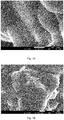
- the SEM images are adquired by a field emission scanning electron microscope (FESEM, JEOL, 7001 F). Specimens are first metallized in a thermal evaporator. Secondary Electrons (SE) and Quadrant Back-Scattering Detector (QBSD) images and digital image processing are used to characterize the nanoparticle clusters in the solid salt. A qualitative information about the nanoparticle size and their homogeneous distribution over the salt crystals can be drawn from them.
- FESEM field emission scanning electron microscope
- the quantitative composition of nanofluids of the invention (nanofluids 1, 2 and 3) and the comparative nanofluids (comparative nanofluids 1 and 2) prepared by a method that comprises the use of an ultrasound equipment falling outside of the scope of the present invention as well as the concentration, particle size, and particle size distribution of the nanoparticles in the nanofluid are disclosed in Tables 1 and 2 below: Table 1 Nanofluid 1 Nanofluid 2 Nanofluid 3 Nanoparticle Aqueous solution of Al 2 O 3 nanoparticles (a) Aqueous solution of Al 2 O 3 nanoparticles (a) Aqueous solution of SiO 2 nanoparticles (c) S a lt Solar Salt (b) Solar Salt (b) Solar Salt (b) Concentration of nanoparticles 1% by weight 1% by weight 1% by weight Particle size nanoparticles 24-164nm 44 - 122 nm 37 - 200 nm Particle size Distribution nanoparticles (D90) 74.5 nm 88.5
- Solar Salt corresponds to the mixture of 60% by weight of sodium nitrate and 40% by weight of potassium nitrate.
- the SiO 2 nanoparticles corresponds to an aqueous dispersion of silica nanoparticles at 30% by weight commercially available as Ludox SM-30.
- Nanofluid of the invention Nanofluid 1
- Nanofluid of the invention Nanofluid 2
- Nanofluid 2 was prepared following the process as defined in section 1.2.1. where in step d) the ratio S/V is 900 m -1 .
- Nanofluid of the invention Nanofluid 3
- Comparative nanofluid 2 was prepared following the process as defined in section 1.2.4. where in step c) the ratio S/V is 150 m -1 .
Landscapes
- Engineering & Computer Science (AREA)
- Chemical & Material Sciences (AREA)
- Thermal Sciences (AREA)
- Physics & Mathematics (AREA)
- Combustion & Propulsion (AREA)
- Mechanical Engineering (AREA)
- General Engineering & Computer Science (AREA)
- Chemical Kinetics & Catalysis (AREA)
- Materials Engineering (AREA)
- Organic Chemistry (AREA)
- Life Sciences & Earth Sciences (AREA)
- Sustainable Development (AREA)
- Sustainable Energy (AREA)
- Compounds Of Alkaline-Earth Elements, Aluminum Or Rare-Earth Metals (AREA)
Abstract
The present invention relates to a process for the preparation of a molten salt-based nanofluid comprising: a) providing an aqueous dispersion of one or more nanoparticles, wherein the dispersion has a pH at which the nanoparticle is stable; b) providing an aqueous solution of an inorganic salt, wherein the solution has a pH at which the nanoparticle is stable; c) adding the dispersion obtained in step a) to the solution obtained in step b); d) drying the resulting mixture obtained in step c) at a temperature below the boiling temperature of the water and at a surface/volume ratio comprised from 130 m-1 to 1500 m-1; and e) melting the mixture obtained in step d), wherein the nanoparticles are selected from the group consisting of metal oxide nanoparticles and semiconductor nanoparticles. It also relates to a molten salt-based nanofluid obtained by this process, as well as its use as a heat transfer fluid or thermal storage material.
Description
- The present invention relates to nanofluids for heat transfer and thermal storage, particularly to a process for the preparation of molten salt-based nanofluids, and the molten salt-based nanofluid obtainable by this process.
- In recent years, the renewable sources of energy, such as solar, wind, waves or tides are increasingly being used in substitution of fossil fuels. The quantity of CO2 in the atmosphere produced by human activities is growing year by year and consequently, the average temperature of the planet is increasing due to the greenhouse effect.
- Solar energy is a good candidate in countries with high irradiation, either using PhotoVoltaic (PV) technologies where solar radiation is directly converted into electric energy or concentrated solar power technologies (CSP) where the energy is concentrated by mirrors to produce heat which is converted then into electricity. Nowadays, the Levelized Cost of Energy (LCOE) of PV technologies is much lower (7 c€/kWh) than in CSP (20 c€/kWh) at the same solar irradiation (2000 kWh/m2year). The most important drawback of the PV technology is that electricity can only be produced during sunny days. Meanwhile, the solar energy captured by CSP technology can either be used to produce electricity or be stored as sensible heat during the day to produce electricity later. This is possible due to the use of Thermal Energy Storage (TES) systems.
- The most common TES system is the named "two tank system" formed by a hot tank and a cold tank. These tanks are filled with a molten salt. The principle of work of the "two tank system" is that during the charging step (when there is an income of energy), the molten salt is driven from the cold tank (at about 300 °C) to the hot tank (at about 400 °C) through a heat exchanger (HX). Particularly, the heat is transferred from a Heat Transfer Fluid (HTF) to the TES material (molten salt) in HX. Besides, during the discharging step, the contrary process is performed, and again the heat is transferred in this case to the HTF through HX. The most common used HTFs are thermal oils (such as a mixture of biphenyl and biphenyl oxide commercially available as Therminol VP) and the TES material is a mixture of sodium and potassium nitrate (60:40 %wt.) with a melting point of 220 °C and a specific heat of 1.5 kJ/kg-1·K-1 named "solar salt".
- In order to achieve enough thermal energy to provide energy during the night (8 hours), huge tanks (of about 14,000 tonnes) must be employed with the consequent high investment costs only due to TES materials. The system could be also improved by using a TES material with enhanced thermal energy transfer properties, mainly higher specific heat. To this aim, nano-enhanced molten salts based on Solar Salt and ceramic nanoparticles (such as for example silica or alumina) are attracting great interest in recent years. The use of these nanofluids allows achieving an enhanced specific heat in the order of 25%.
- Several methods for the preparation of molten salt-based nanofluids have been disclosed. Particularly, the most commonly used method involves firstly, the dissolution of an inorganic salt in water at a low concentration (i.e. at a weight ratio salt/water of 1:100 %wt.), the addition of the proper quantity of solid nanoparticles followed by their dispersion by means of ultrasounds; and finally, drying the dispersion thus obtained in a hot plate.
- This procedure have two critical stages which involves a high energy consumption. By one side, the ultrasonic power required to dispersed the nanoparticles on the aqueous salt solution. On the other side, the thermal energy to remove this huge quantity of water during the drying of the nanofluid. These factors difficult the implementation of this synthesis procedure at industrial scale. Furthermore, another disadvantge is the tendency to create nanoparticle agglomerates during the preparation process of the molten salt-based nanofluids. These nanoparticle agglomerates can hinder the shelf life of the nanofluids and also their thermal storage capability.
- Therefore, from what is known in the art it is derived that there is still the need of providing a more productive process for the preparation of molten salt-based nanofluids at industrial scale having improved thermal properties.
- Inventors have found a more productive process for the preparation of stable molten salt-based nanofluids. Particularly, the process is based on the addition of a stable water-suspension of nanoparticles to a salt solution followed by drying the mixture thus obtained under the specific conditions of temperature and drying surface/volume ratio of the invention. Thus, this process allows preparing molten salt-based nanofluids with high thermal storage properties wherein the nanoparticles have a particle size comprised from 20 nm to 220 nm and a particle size distribution wherein D90 is comprised from 70 nm to 120 nm.
- Furthermore, the process for preparing molten salt-based nanofluids of the invention is also advantegeous because it is suitable for being used at industrial scale. It is due to the fact that the process avoids the use of ultrasound equipments and also of big amount of solvent (water) without compromising the nanometric sizes of the particles contained inside. Thus, the process of the invention avoids the formation of nanoparticle agglomerates during the preparation process.
- Thus, an aspect of the invention relates to a process for the preparation of a molten salt-based nanofluid, which comprises: a) providing an aqueous dispersion of one or more nanoparticles, wherein the dispersion has a pH at which the nanoparticle is stable; b) providing an aqueous solution of an inorganic salt, wherein the solution has a pH at which the nanoparticle is stable; c) adding the dispersion obtained in step a) to the solution obtained in step b); d) drying the resulting mixture obtained in step c) at a temperature below the boiling temperature of the water measured at atmospheric pressure of the mixture obtained in step c) and at a surface/volume ratio comprised from 130 m-1 to 1500 m-1; and e) melting the mixture obtained in step d), wherein the nanoparticles are selected from the group consisting of metal oxide nanoparticles and semiconductor nanoparticles.
- The second aspect of the invention relates to a molten salt-based nanofluid comprising nanoparticles of a particle size comprised from 20 nm to 220 nm and a particle size distribution wherein D90 is comprised from 70 nm to 120 nm.
- The third aspect of the invention relates to the use of a molten salt-based nanofluid as defined in the second aspect of the invention as a HTF or TES material.
- Finally, the fourth aspect of the invention relates to a system for heat transfer or thermal storage which comprises the molten salt-based nanofluid as defined in the second aspect of the invention.
-
-
Figure 1 shows SEM images from the molten salt-based nanofluid of Example Nanofluid 3 of the present invention (Fig. 1A ) and from the molten salt-based nanofluid of Example Nanofluid 2 of the present invention (Fig. 1 B) . -
Figure 2 shows the nanoparticle size distribution in each step of the preparation of the molten salt-based nanofluid of Example Nanofluid 2 of the present invention. The curves obtaining after each synthesis step are depicted: Pointed curve (A) obtained after step (a), dashed-pointed curve (B) obtained after mixing step (c), dashed curve (C) obtained after drying step (d), and solid curve (D) obtained after melting step (d). The graphic indicates the number (N) of nanoparticles expressed in % versus Particle Diameter (PD) expressed in nm. - All terms as used herein in this application, unless otherwise stated, shall be understood in their ordinary meaning as known in the art. Other more specific definitions for certain terms as used in the present application are as set forth below and are intended to apply uniformly through-out the specification and claims unless an otherwise expressly set out definition provides a broader definition.
- For the purposes of the invention, any ranges given include both the lower and the upper end-points of the range. Ranges given, such as temperatures, times, and the like, should be considered approximate, unless specifically stated.
- The term "nanofluid" refers to a two-phase mixture where the continuous phase is a liquid (called base fluid) and the dispersed phase is composed of nanoparticles.
- The term "nanoparticle" refers to a discrete portion of material that has mass and dimension being elements of a suspension having a diameter comprised from 1 nm to 250 nm.
- The terms "particle size" and "average particle size" have the same meaning and are used interchangeable. They refer to the number average particle size based on the largest linear dimension of the particle (sometimes referred to as "diameter"). Particle size, including average, maximum, and minimum particle sizes, may be determined by an appropriate method of sizing particles such as, for example, Static or Dynamic Light Scattering (SLS or DLS) using a laser light source.
- The nanoparticles may be monodisperse, where all particles are of the same size with little variation, or polydisperse, where the particles have a range of sizes and are averaged. The terms "polydispersion of the particle size of the nanoparticle", "particle size distribution", "polydispersity of the particle size" and "PSD" have the same meaning and are used interchangeable. They refer to a value obtained from the square of the standard deviation divided by the mean diameter. They refer to the percentage of the nanoparticles within a certain size range.
- The term "D90" refers to the value of particle size distribution where at least 90% of the nanoparticles have a size less or equal to the given value. When characteristic values of "D90" are given it is said that these are "approximate" values due to the measurement error. It should be understood that the values are the ones shown in the description and the claims ± 5% measured by DLS.
- The particle size of the nanoparticles of the invention and their polydispersion can be measured by any method disclosed in the state of the art for measuring the particle size of nanoparticles. In particular, the method used in the present invention for measuring the particle size and the polydispersion in solution is DLS reporting the number average diameter value and the nanoparticle size distribution.
- The terms "surface to volume ratio", "surface/volume ratio" and "S/V ratio" have the same meaning and are used interchangeable. They refer to the surface of the container where the mixture of nanoparticles and salt solutions obtained in step c) is dried and the volume of the mentioned mixture.
- The term "alkali metal" refers to the elements of the first group (Group IA) of the periodic system, that is lithium, sodium, potassium, rubidium and cesium. The term "alkaline-earth metal" refers to the elements of the second group (Group IIA) of the periodic system, that is magnesium, calcium, strontium and barium.
- The terms "percentage (%) by weight" and "percentage (%) wt" have the same meaning and are used interchangeable. They refer to the percentage of each component in relation to the total weight.
- As it mentioned above, the first aspect of the invention relates to a process for the preparation of stable molten-salt based nanofluid.
- In an embodiment, optionally in combination with one or more features of the various embodiments described above or below, the nanoparticles of the molten salt-based nanofluid have a particle size comprised from 20 nm to 220 nm; preferably having a particle size comprised from 20 nm to 200 nm. In a particular embodiment, the nanoparticles of the molten salt-based nanofluid have a particle size comprised from 70 nm to 100 nm.
- In an embodiment, optionally in combination with one or more features of the various embodiments described above or below, the nanoparticles of the molten salt-based nanofluid have a particle size distribution wherein D90 is comprised from 70 nm to 120nm; preferably having a particle size distribution wherein D90 is comprised from 72 nm to 100 nm; preferably comprised from 74 nm to 98 nm. In a particular embodiment, the nanoparticles of the molten salt-based nanofluid have a particle size distribution of 74.5 nm. In another embodiment, the nanoparticles of the molten salt-based nanofluid have a particle size distribution of 88.5 nm. In another embodiment, the nanoparticles of the molten salt-based nanofluid have a particle size distribution of 97.9 nm.
- In an embodiment, optionally in combination with one or more features of the various embodiments described above or below, the nanoparticles of the molten salt-based nanofluid have a particle size distribution comprised from 20 nm to 220 nm and a size distribution wherein D90 is comprised from 70 nm to 120 nm. In an embodiment, optionally in combination with one or more features of the various embodiments described above or below, the nanoparticles of the molten salt-based nanofluid have a particle size distribution comprised from 20 nm to 200 nm and a size distribution wherein D90 is comprised from 72 nm to 100 nm. In an embodiment, optionally in combination with one or more features of the various embodiments described above or below, the nanoparticles of the molten salt-based nanofluid have a particle size comprised from 70 nm to 100 nm and a particle size distribution wherein D90 is comprised from 74 nm to 98 nm.
- As it is disclosed above, step a) of the process of the invention comprises providing an aqueous dispersion of one or more nanoparticles, wherein the aqueous dispersion has a pH at which the nanoparticle is stable.
- In an embodiment, optionally in combination with one or more features of the various embodiments described above or below, the nanoparticles are metal oxide nanoparticles selected from the group consisting of Fe3O4 nanoparticles, Al2O3 nanoparticles, SiO2 nanoparticles, ZrO2 nanoparticles, CuO nanoparticles, TiO2 nanoparticles; preferably the nanoparticles are Al2O3 nanoparticles, SiO2 nanoparticles, ZrO2 nanoparticles and TiO2 nanoparticles. In a particular embodiment, optionally in combination with one or more features of the various embodiments described above or below, the nanoparticles are Al2O3 nanoparticles or SiO2 nanoparticles.
- In an embodiment, optionally in combination with one or more features of the various embodiments described above or below, the nanoparticles are semiconductor nanoparticles. The term "semiconductor nanoparticle" refers to nanoparticles composed of an inorganic semiconductive material, an alloy or a mixture of inorganic semiconductive materials. In an embodiment, the nanoparticles are semiconductor nanoparticles selected from the group consisting of V2O5 nanoparticles, WO3 nanoparticles, Fe2O3 nanoparticles, SnO2 nanoparticles, CdSe nanoparticles, GaAs nanoparticles, GaP nanoparticles, CdS nanoparticles and ZnS nanoparticles.
- In en embodiment, the dispersion obtained in step a) is a concentrated nanoparticle dispersion having a concentration of nanoparticles comprised from 5% to 50% by weight of the weight of the dispersion; preferably comprised from 10% to 30% by weight.
- The dispersion obtained in step a) is stable because has a pH at which the nanoparticles are stable because the nanoparticles do not agglomerate. The value of the pH at which each nanoparticle is stable is well known in the state of the art through the Z potential concept (cf. Junior, J.A.A. et al. "The Behavior of Zeta Potential of Silica Suspensions". New Journal of Glass and Ceramics 4, 2014, pp. 29-37; and Zetasizer Nano User Manual, Malvern Instruments, MAN0485 Issue 1.1 April 2013, Chapter 13, pp.13-1/13-12).The Z potential can be measured by any method disclosed in the state of the art. In particular, the method used in the present invention for measuring the Z potential is DLS.
- In an embodiment, optionally in combination with one or more features of the various embodiments described above or below, the nanoparticles are metal oxide nanoparticles selected from the group consisting of Fe3O4 nanoparticles, Al2O3 nanoparticles, SiO2 nanoparticles, ZrO2 nanoparticles, CuO nanoparticles and TiO2 nanoparticles, and the suitable pH for each nanoparticle is shown in the Table below:
Nanoparticle pH at which the nanoparticle is stable Fe3O4 nanoparticles pH equal to or lower than 4 and equal to or higher than 9 Al2O3 nanoparticles pH equal to or lower than 4 and equal to or higher than 10 SiO2 nanoparticles pH equal to or higher than 8 ZrO2 nanoparticles pH equal to or lower than 5 and equal to or higher than 9 CuO nanoparticles pH equal to or less than 7 TiO2 nanoparticles pH equal to or lower than 5 and equal to or higher than 9 - In a particular embodiment, optionally in combination with one or more features of the various embodiments described above or below, the nanoparticle is Al2O3 nanoparticle and the pH of the dispersion of step a) and the solution of step b) is equal to or lower than 4 or higher than 10. In a particular embodiment, optionally in combination with one or more features of the various embodiments described above or below, the nanoparticle is SiO2 nanoparticle and the pH of the dispersion of step a) and the solution of step b) is equal to or higher than 8.
- In an embodiment, optionally in combination with one or more features of the various embodiments described above or below, the process of the invention comprises: a) providing an aqueous dispersion of one or more nanoparticles, wherein the dispersion has a pH at which the nanoparticle is stable and is obtainable by wet chemical proccesses described in the state of the art for each one of the nanoparticle described in the present invention
- As it is disclosed above, step b) of the process of the invention comprises providing an aqueous solution of an inorganic salt, wherein the solution has a pH at which the nanoparticle is stable, which means that the nanoparticles do not agglomerate.
- In an embodiment, optionally in combination with one or more features of the various embodiments described above or below, the inorganic salt is selected from the group consisting of alkali or alkaline-earth metal carbonate, alkali or alkaline-earth metal sulfate, alkali or alkaline-earth metal phosphate, alkali or alkaline-earth metal chloride, and alkali or alkaline-earth metal nitrate, and mixture thereof; preferably the salt is a mixture of alkali or alkaline-earth metal nitrates. In an embodiment, the salt is a mixture of sodium nitrate and potassium nitrate; preferably the salt is a mixture of sodium nitrate and potassium nitrate (60:40 %wt.); in a prefered embodiment the salt is solar salt (Vignarooban, K. et al. "Heat transfer fluids for concentrating solar power systems-a review". Applied Energy, 2015, vol. 146, pp. 383-396; and Bauer, T. et al. "Material aspects of solar salt for sensible heat storage". 2013. Applied energy, vol.111, pp.1114-1119).
- In an embodiment, optionally in combination with one or more features of the various embodiments described above or below, the aqueous solution of the inorganic salt obtained in step b) is selected from the group consisting of a "nearly saturated solution" or a "saturated solution".
- In an embodiment, the aqueous solution of the inorganic salt obtained in step b) is "nearly saturated solution". The term "nearly saturated solution" refers to an aqueous solution of an inorganic salt that is near saturation but has not reached its saturation point. In an embodiment, optionally in combination with one or more features of the various embodiments described above or below, the aqueous solution of the inorganic salt obtained in step b) is "nearly saturated solution" comprised from 5% to 10% below the saturation point.
- In an embodiment, the aqueous solution of the inorganic salt obtained in step b) is a "saturated solution". The term "saturated solution" refers to a solution that is so concentrated that no more solute that is added will dissolve in it, that means a solution exactly at its saturation point. The saturation point of a solution varies depending on the nature of the solute and the salt. The saturation point of the solution of step b) can readily be determined by those skilled in the art according to the type of inorganic salt being used (Lide, D. R. "Aqueous solubility of inorganic compounds at various temperatures". CRC Handbook of Chemistry and Physics. 84th Edition. 2004. Section 8: Analytical Chemistry. pp. 8-110 / 8-118).
- All the embodiments disclosed above for step a) in relation to pH and nanoparticles also applies for step b) of the process of the first aspect of the invention.
- In an embodiment, optionally in combination with one or more features of the various embodiments described above or below, the process of the invention comprises: b) providing an aqueous solution of an inorganic salt, wherein the solution has a pH at which the nanoparticle is stable and is obtainable by the process which comprises: b') weighing the amount of inorganic salt which are composing the molten salt-based nanofluid; b") adding the appropriate amount of water having the pH at which the nanoparticle is stable until having a saturated solution; and b"') mixing until dissolve completely the inorganic salt.
- In an embodiment, optionally in combination with one or more features of the various embodiments described above or below, the process comprises preparing the aqueous solution of step b) carrying out steps b')-b"') as defined above.
- In an embodiment, optionally in combination with one or more features of the various embodiments described above or below, the process is that wherein: the nanoparticles are metal oxide nanoparticles selected from the group consisting of Fe3O4 nanoparticles, Al2O3 nanoparticles, SiO2 nanoparticles, ZrO2 nanoparticles, CuO nanoparticles, TiO2 nanoparticles; or alternatively the nanoparticles are semiconductor nanoparticles selected from the group consisting of V2O5 nanoparticles, WO3 nanoparticles, Fe2O3 nanoparticles, SnO2 nanoparticles, CdSe nanoparticles, GaAs nanoparticles, GaP nanoparticles, CdS nanoparticles and ZnS nanoparticles; the inorganic salt is selected from an alkali or alkaline-earth metal nitrate and mixture thereof; and preferably the aqueous solution of the inorganic salt obtained in step b) is selected from the group consisting of a "nearly saturated solution" or a "saturated solution".
- In a particular embodiment, optionally in combination with one or more features of the various embodiments described above or below, the process is that wherein: the nanoparticles are metal oxide nanoparticles selected from the group consisting of Al2O3 nanoparticles and SiO2 nanoparticles; the inorganic salt is a mixture of sodium nitrate and potassium nitrate; preferably solar salt; and preferably the aqueous solution of the inorganic salt obtained in step b) is selected from the group consisting of a "nearly saturated solution" or a "saturated solution".
- In an embodiment, optionally in combination with one or more features of the various embodiments described above or below, the process of the invention comprises: a) providing an aqueous dispersion of one or more nanoparticles, wherein the aqueous dispersion has a pH at which the nanoparticle is stable; b) providing an aqueous solution of an inorganic salt, wherein the aqueous solution has a pH at which the nanoparticle is stable and is obtainable by the process which comprises: b') weighing the amount of inorganic salt which are composing the molten salt-based nanofluid; b") adding the appropriate amount of water having the pH at which the nanoparticle is stable until having a saturated solution; and b"') mixing until dissolve completely the inorganic salt.
- In an embodiment, optionally in combination with one or more features of the various embodiments described above or below, the process comprises firstly, providing the aqueous suspension of step a) and secondly, preparing the solution of step b) carrying out steps b')-b"') as defined above.
- As it is disclosed above, step c) comprises adding the dispersion obtained in step a) to the solution obtained in step b). In an embodiment, optionally in combination with one or more features of the various embodiments described above or below, step c) is carried out at a mixing speed comprised from 60 rpm to 800 rpm; preferably comprised from 100 rpm to 600 rpm.
- In an embodiment, optionally in combination with one or more features of the various embodiments described above or below, step c) is carried out at a temperature comprised from 25 °C to 70 °C; preferably comprised from 25 °C to 50 °C.
- In an embodiment, optionally in combination with one or more features of the various embodiments described above or below, step c) is carried out at a mixing speed comprised from 60 rpm to 800 rpm and at a temperature comprised from 25 °C to 70 °C; preferably step c) is carried out at a mixing speed comprised from 100 rpm to 600 rpm and at a temperature comprised from 25 °C to 50 °C;
- In an embodiment, optionally in combination with one or more features of the various embodiments described above or below, step c) is carried out by dropply adding the dispersion obtained in step a) to the solution obtained in step b).
- In an embodiment, optionally in combination with one or more features of the various embodiments described above or below, the process comprises firstly, providing the aqueous suspension of step a) and secondly, preparing the aqueous solution of step b) carrying out steps b')-b"'); and subsequently carrying out step c).
- As it is disclosed above, step d) comprises drying the resulting mixture obtained in step c) at a temperature below the boiling temperature of the water at atmospheric pressure of the mixture obtained in step c) and at a surface/volume ratio comprised from 130 m-1 to 1500 m-1.
- The term "boiling temperature" refers to the temperature at which the vapor pressure of the aqueous solution equals the pressure surrounding it and then, the aqueous solution changes into a vapor at atmospheric pressure of the mixture obtained in step c). It is well known in the state of the art that the boilling point of aqueous solutions containing dissolved salts increases proportionally to the concentration of the inorganic (cf. P. W. Atkins. Physical Chemistry, 4th Ed., Oxford University Press, Oxford, 1994, pp. 222-225). In an embodiment, optionally in combination with one or more features of the various embodiments described above or below, step d) is performed at a temperature comprised from 5 °C to 10 °C below the boiling temperature of the water. In an embodiment, optionally in combination with one or more features of the various embodiments described above or below, step d) is performed at a temperature below 100 °C, preferably at a temperature comprised from 90 °C to 95 °C.
- In an embodiment, optionally in combination with one or more features of the various embodiments described above or below, step d) is carried out at a surface/volume ratio comprised from 208 m-1 to 1232 m-1.
- In an embodiment, optionally in combination with one or more features of the various embodiments described above or below, step d) is performed below 100 °C; preferably comprised from 90 °C to 95 °C and at a surface/volume ratio comprised from 130 m-1 to 1500 m-1; preferably comprised from 208 m-1 to 1232 m-1.
- As it is disclosed above, step e) comprises melting the mixture obtained in step d). In an embodiment, optionally in combination with one or more features of the various embodiments described above or below, step e) is carried out at a temperature comprised from 50 °C to 100 °C above the melting temperature of the inorganic salt and for an appropriate period of time. The term "melting temperature" refers to the temperature at which the salt changes from solid to liquid state. The value of the melting temperature at which each inorganic salt melts is well known in the state of the art (Hammond, C. R. "Physical constants of inorganic compounds". Handbook of Chemistry and Physics, 84th ed., CRC Press, 2004, pp. 39-166).
- The second aspect of the invention relates to a molten salt-based nanofluid comprising nanoparticles with a particle size comprised from 20 nm to 220 nm and a particle size distribution wherein D90 is comprised from 70 nm to 120 nm. In an embodiment, optionally in combination with one or more features of the various embodiments described above or below, the molten salt-based nanofluid of the second aspect of the invention may be defined by its preparation process as defined above and therefore, molten salt-based nanofluid comprising nanoparticles with a particle size comprised from 20 nm to 220 nm and a particle size distribution wherein D90 is comprised from 70 nm to 120 nm obtainable by the process above is considered part of the invention. Thus, the invention also relates to a molten salt-based nanofluid comprising nanoparticles with a particle size comprised from 20 nm to 220 nm and a particle size distribution wherein D90 is comprised from 70 nm to 120 nm obtainable by the process as defined in the first aspect of the invention that is a process which comprises: a) providing an aqueous dispersion of one or more nanoparticles, wherein the dispersion has a pH at which the nanoparticle is stable; b) providing an aqueous solution of an inorganic salt, wherein the solution has a pH at which the nanoparticle is stable; c) adding the dispersion obtained in step a) to the solution obtained in step b); d) drying the resulting mixture obtained in step c) at a temperature below the boiling temperature of the water measured at atmospheric pressure of the mixture obtained in step c) and at a surface/volume ratio comprised from 130 m-1 to 1170 m-1; and e) melting the mixture obtained in step d), wherein the nanoparticles are selected from the group consisting of metal oxide nanoparticles and semiconductor nanoparticles.
- All the embodiments disclosed above for the process of the first aspect of the invention also applies for the molten salt-based nanofluid of the second aspect of the invention.
- The third aspect of the invention relates to the use of the molten salt-based nanofluid as defined in the second aspect of the invention as a HTF or thermal storage material. In an embodiment, the molten salt-based nanofluid is used as a HTF in CSP plant or alternatively in a nuclear plant. In an embodiment, the molten salt-based nanofluid is used as a thermal storage material in a CSP plant or to recover and reuse waste heat on industry.
- The fourth aspect of the invention relates to a system for heat transfer or thermal storage, which comprises the molten salt-based nanofluid as defined in the second aspect of the invention. In an embodiment, the system is a HX for being use in CSP plants. In an embodiment, the system is a refrigeration system of nuclear reactors for being use in nuclear plants.
- Throughout the description and claims the word "comprise" and variations of the word, are not intended to exclude other technical features, additives, components, or steps. Furthermore, the word "comprise" encompasses the case of "consisting of". Additional objects, advantages and features of the invention will become apparent to those skilled in the art upon examination of the description or may be learned by practice of the invention. The following examples and drawings are provided by way of illustration, and they are not intended to be limiting of the present invention. Reference signs related to drawings and placed in parentheses in a claim, are solely for attempting to increase the intelligibility of the claim, and shall not be construed as limiting the scope of the claim. Furthermore, the present invention covers all possible combinations of particular and preferred embodiments described herein.
- The nanoparticle size and their distribution have been measured by means of the DLS technique (ZetaSizer nano ZS, Malvern Instruments, Ltd. Malvern, UK). The Zetasizer system determines the size by first measuring the Brownian motion of the particles in a sample using DLS and then interpreting a size from this using established theories. The Brownian motion is the random movement of particles in a liquid due to the bombardment by the molecules that surround them. An Standard Operating Procedure (SOP) is defined having into account some features both of the nanoparticles (the refractive index and the absorption) and the solvent (the refractive index and the viscosity). The analysis is done over a liquid sample and at room temperature. Therefore, the material of the present invention needs to be dissolved on distilled water prior to the measurement. The minimun and maximum concentration of the nanoparticles on this solution is related to their expected sizes, according to Malvern experts' advices (Zetasizer Nano User Manual, Malvern Instruments, MAN0485 Issue 1.1 April 2013, ).The samples are dissolved in distilled water just before performing the experiment to avoid any interference on results due to sedimentation of nanoparticles. Then, the specific cells of the equipment are filled with a little amount of the sample (around 1 mL) and placed inside the device. The data are adquired three times under the SOP defined earlier to evaluate the results accuracy. Several parameters such as Z-average (Z-ave), Polidispersity Index (PI), and the count rate are obtained. They are useful to compare and evaluate the nanoparticle results accuracy. The Z-ave is defined as the intensity - weighted mean diameter derived from the cumulants analysis of sizes. In DLS this is the most important and stable number produced by the technique. If the Z-ave is decreasing with successive measurements the sample may be unstable. The PI is a dimensionless measure of the broadness of the size distribution calculated from the cumulants analysis. Its value ranges from 0 to 1 being commonly in the range between 0.08 and 0.70. Values lower than 0.08 mean nearly monodisperse sample and greater than 0.70 indicate a very broad distribution of particle sizes. The count rate is the number of photons detected and is usually stated in a "per second" basis. This is useful for determining the sample quality, by monitoring its stability as a function of time. If the count rate decreases with successive measurements could be due to particle sedimentation, creaming or dissolution.
- In addition, the DLS technique is used to determine the pH of stability for each nanoparticle. With this aim, the Z Potential (ZP) is measured on aqueous nanoparticle suspensions of different pH at the ZetaSizer nano ZS.
- The pH of a solution is a measure of the molar concentration of hydrogen ions in the solution and as such is a measure of the acidity or basicity of the solution. The letters pH stand for "power of hydrogen" and the numerical value is defined as the
negative base 10 logarithm of the molar concentration of hydrogen ions. The ZP is a parameter which is related to the surface charge, a property that all materials possess, or acquire, when suspended in a fluid. A stable dispersion has a ZP lower than -35 mV and higher than 35 mV. The Iso Electric Point (IEP) is the pH corresponding to a ZP value of zero. - First, the nanoparticles are dispersed on water at pH of 2, 3, 4, 5, 6, 7, 8, 9 and 10 respectively. Then, the special cuvettes for the determination of ZP are carefully filled with these solutions avoiding the presence of air bubbles. The measurement are done under a predefined SOP considering properties of the nanoparticles (the refractive index and the absorption) and the solvent (the refractive index and the viscosity).
- The measurement of pH of solutions is done by a pH electrode (Mettler Toledo Delta 320 pH meter). The pH electrode uses a specially formulated, pH sensitive glass in contact with the solution, which develops a potential (voltage) proportional to the pH of the solution. The reference electrode is designed to maintain a constant potential at any given temperature, and serves to complete the pH measuring circuit within the solution. It provides a known reference potential for the pH electrode. The difference in the potentials of the pH and reference electrodes provides a millivolt signal proportional to pH.
Initially, is necessary to calibrate the electrode by measuring commercial buffer solutions of pH 4 and 7. After this step, the electrode is ready to be used. Distilled water is employed as base solvent. Its pH is around 5. To prepare a solution with a lower pH (acid), a certain quantity of dilute nitric acid (1:3) is added drop by drop until the desired pH is reached. The same procedure is folllowed to prepare the solutions with higher pH (basic) but adding a water solution of sodum hydroxide (50% wt.). All the procedures are carried out at room temperature. - The SEM images are adquired by a field emission scanning electron microscope (FESEM, JEOL, 7001 F). Specimens are first metallized in a thermal evaporator. Secondary Electrons (SE) and Quadrant Back-Scattering Detector (QBSD) images and digital image processing are used to characterize the nanoparticle clusters in the solid salt. A qualitative information about the nanoparticle size and their homogeneous distribution over the salt crystals can be drawn from them.
- The quantitative composition of nanofluids of the invention (
nanofluids 1, 2 and 3) and the comparative nanofluids (comparative nanofluids 1 and 2) prepared by a method that comprises the use of an ultrasound equipment falling outside of the scope of the present invention as well as the concentration, particle size, and particle size distribution of the nanoparticles in the nanofluid are disclosed in Tables 1 and 2 below:Table 1 Nanofluid 1Nanofluid 2 Nanofluid 3 Nanoparticle Aqueous solution of Al2O3 nanoparticles(a) Aqueous solution of Al2O3 nanoparticles(a) Aqueous solution of SiO2 nanoparticles(c) Salt Solar Salt(b) Solar Salt(b) Solar Salt(b) Concentration of nanoparticles 1% by weight 1% by weight 1% by weight Particle size nanoparticles 24-164nm 44 - 122 nm 37 - 200 nm Particle size Distribution nanoparticles (D90) 74.5 nm 88.5 nm 97.9 nm (a) the Al2O3 nanoparticles correponds to an aqueous dispersion of alumina nanoparticles at 10% by weight commercially available as Alumisol 10A.
(b) Solar Salt corresponds to the mixture of 60% by weight of sodium nitrate and 40% by weight of potassium nitrate.
(c) the SiO2 nanoparticles corresponds to an aqueous dispersion of silica nanoparticles at 30% by weight commercially available as Ludox SM-30.Table 2 Comparative Nanofluid 1Comparative Nanofluid 2 Nanoparticle SiO2 nanoparticles nanopowder(d) SiO2 nanoparticles nanopowder (d) Salt Solar Salt(b) Solar Salt(b) Concentration of nanoparticles 1% by weight 1% by weight Particle size nanoparticles 400 - 1700 nm 91 - 2300 nm Particle size Distribution nanoparticles (D90) 1020 nm 455 nm (b) Solar Salt corresponds to the mixture of 60% by weight of sodium nitrate and 40% by weight of potassium nitrate.
(d) the SiO2 nanoparticles corresponds to silica crystalline nanopowder commercially available by Sigma Aldrich with a primary size of 12 nm. -
- a) Preparation of the aqueous dispersion of nanoparticles: The aqueous dispersion of the Al2O3 nanoparticles at 10% by weight is commercially available as Alumisol 10A.
- b) Preparation of the aqueous solution of the inorganic salt solar salt): 59.4 g of sodium nitrate and 39.6 g of potassium nitrate were weighed and mixed in solid state. Then, the mixture of nitrates was added to 29.7 g of water with a pH of 2 under stirring and until completely dissolution of the salts.
- c) Mixing step: 10 g of the aqueous dispersion of nanoparticles of step a) was dropply added to the aqueous solution of the inorganic salt (solar salt) obtained in step b) in a hot plate under mild stirring (130 rpm) and at 30 °C (measured in the bulk).
- d) Drying step: The aqueous dispersion obtained in step c) was poured in a glass container and dried in an oven at 100 °C and at a ratio S/V 150 m-1 overnight. Once the nanofluid was solid, then it was scrapped off from the container.
- e) Melting Step: The nanofluid obtained in step d) was melted at 396 °C for 30 minutes to obtain 100 g of
nanofluid 1. - Nanofluid 2 was prepared following the process as defined in section 1.2.1. where in step d) the ratio S/V is 900 m-1.
-
- a) Preparation of the aqueous dispersion of nanoparticles: The aqueous dispersion of the SiO2 nanoparticles at 30% by weight is commercially available as Ludox SM-30.
- b) Preparation of the aqueous solution of the inorganic salt solar salt): 59.4 g of sodium nitrate and 39.6 g of potassium nitrate were weighed and mixed in solid state. Then, the mixture of nitrates was added to 29.7 g of water with a pH of 9 under stirring and until completely dissolution of the salts.
- c) Mixing step: 10 g of the aqueous dispersion of nanoparticles of step a) was dropply added to the aqueous solution of the inorganic salt (solar salt) obtained in step b) in a hot plate under mild stirring (130 rpm) and at 30 °C (measured in the bulk).
- d) Drying step: The aqueous dispersion obtained in step c) was poured in a glass container and dried in an oven at 100 °C and at a ratio S/V 900 m-1 overnight. Once the nanofluid was solid, then it was scrapped off from the container.
- e) Melting Step: The nanofluid obtained in setp d) was melted at 396 °C for 30 minutes to obtain 100 g of nanofluid 3.
-
- a) Preparation of the aqueous solution of the inorganic salt solar salt): 59.4 g of sodium nitrate and 39.6 g of potassium nitrate were weighed and mixed in solid state. Then, 1000 g of water was added to the mixture of nitrates under stirring and until completely dissolution of the salts.
- b) Mixing step: 1 g of solid silica nanoparticles was precisely weighed and added to the salt solution obtained in step a) in a hot plate under mild stirring (130 rpm) and at 30 °C (measured in the bulk). Then, the nanoparticles are dispersed by applying ultrasonic waves by means of an ultrasonic probe for 5 minutes with a power of 70%.
- c) During step: The dispersion obtained in step b) was poured in a glass container and dried in a hot plate at 100 °C and at a ratio S/V 3.5 m-1 overnight. Once the nanofluid was solid, then it was scrapped off from the container.
- Comparative nanofluid 2 was prepared following the process as defined in section 1.2.4. where in step c) the ratio S/V is 150 m-1.
-
- 1. Junior, J.A.A. et al. "The Behavior of Zeta Potential of Silica Suspensions". New Journal of Glass and Ceramics 4, 2014, pp. 29-37.
- 2. P. W. Atkins, Physical Chemistry, 4th Ed., Oxford University Press, Oxford, 1994, pp. 222-225
- 3. Vignarooban, K. et al. "Heat transfer fluids for concentrating solar power systems-a review". Applied Energy, 2015, vol. 146, pp. 383-396.
- 4. Bauer, T. et al. "Material aspects of solar salt for sensible heat storage". 2013. Applied energy, vol.111, pp.1114-1119.
- 5. Lide, D. R. "Aqueous solubility of inorganic compounds at various temperatures". CRC Handbook of Chemistry and Physics. 2004 ).
- 6. Zetasizer Nano User Manual, Malvern Instruments, MAN0485 Issue 1.1 April 2013,
- 7. Zetasizer Nano User Manual, Malvern Instruments, MAN0485 Issue 1.1 April 2013, Chapter 13, pp.13-1/13-12
- 8. Hammond, C. R. "Physical constants of inorganic compounds". Handbook of Chemistry and Physics, 84th ed., CRC Press, 2004, pp. 39-166
- 9. Lide, D. R. "Aqueous solubility of inorganic compounds at various temperatures". CRC Handbook of Chemistry and Physics. 84th Edition. 2004. Section 8: Analytical Chemistry. pp. 8-110/8-118
Claims (15)
- A process for the preparation of a molten salt-based nanofluid, which comprises:a) providing an aqueous dispersion of one or more nanoparticles, wherein the dispersion has a pH at which the nanoparticle is stable;b) providing an aqueous solution of an inorganic salt, wherein the solution has a pH at which the nanoparticle is stable;c) adding the dispersion obtained in step a) to the solution obtained in step b);d) drying the resulting mixture obtained in step c) at a temperature below the boiling temperature of the water measured at atmospheric pressure of the mixture obtained in step c) and at a surface/volume ratio comprised from 130 m-1 to 1500 m-1; ande) melting the mixture obtained in step d); wherein the nanoparticles are selected from the group consisting of metal oxide nanoparticles and semiconductor nanoparticles
- The process according to claim 1, wherein the nanoparticles of the molten salt-based nanofluid have a particle size comprised from 20 nm to 220 nm and a particle size distribution wherein D90 is comprised from 70 nm to 120 nm.
- The process according to claim 2, wherein the aqueous dispersion obtained in step a) has a concentration of nanoparticles comprised from 5% to 50% by weight of the weight of the dispersion.
- The process according to any of the claims 1-3, wherein the nanoparticles are metal oxide nanoparticles selected from the group consisting of Fe3O4 nanoparticles, Al2O3 nanoparticles, SiO2 nanoparticles, ZrO2 nanoparticles, CuO nanoparticles and TiO2 nanoparticles or alternatively the nanoparticles are semiconductor nanoparticles selected from the group consisting of V2O5 nanoparticles, WO3 nanoparticles, Fe2O3 nanoparticles, SnO2 nanoparticles, CdSe nanoparticles, GaAs nanoparticles, GaP nanoparticles, CdS nanoparticles and ZnS nanoparticles
- The process according to any of the claims 1-4, wherein the inorganic salt is selected from the group consiting of alkali or alkaline-earth metal carbonate, alkali or alkaline-earth metal sulfate, alkali or alkaline-earth metal phosphate, alkali or alkaline-earth metal chloride, and alkali or alkaline-earth metal nitrate, and mixture thereof.
- The process according to claim 5, wherein the salt is a mixture of sodium nitrate and potassium nitrate.
- The process according to any of the claims 1-6, wherein the aqueous solution of the inorganic salt obtained in step b) is selected from the group consisting of a nearly saturated solution and a saturated solution of the inorganic salt.
- The process according to any of the claims 1-7, wherein step c) is carried out at a mixing speed comprised from 60 rpm to 800 rpm, and at a temperature comprised from 25 °C to 70 °C.
- The process according to any of the claims 1-8, wherien step d) is carried out at a temperature below the boiling temperature of the water measured at atmospheric pressure of the mixture obtained in step c) and at a surface/volume ratio comprised from 208 m-1 to 1232 m-1.
- The process according to any of the claims 1-9, wherein step e) is carried out at a temperature comprised from 50 °C to 100 °C above the melting temperature of the inorganic salt for an appropriate period of time.
- The process according to any of the claims 1-10, which comprises firstly, providing the aqueous suspension of step a) and secondly, preparing the solution of step b) carrying out the following steps:b') weighing the amount of inorganic salt which are composing the molten salt-based nanofluid;b") adding the appropriate amount of water having the pH at which the nanoparticle is stable until having a saturated solution; andb"') mixing until dissolve completely the inorganic salt;and subsequently carrying out step c).
- A molten salt-based nanofluid comprising nanoparticles of a particle size comprised from 20 nm to 200 nm and a particle size distribution wherein D90 is comprised from 70 to 120 nm.
- The molten salt-based nanofluid according to claim 12, obtainable by the process as defined in any of the claims 1-11.
- Use of a molten salt-based nanofluid as defined in any of the claims 12-13, as a HTF or thermal storage material.
- A system for heat transfer or thermal storage which comprises the molten salt-based nanofluid as defined in any of the claims 12-13.
Priority Applications (1)
| Application Number | Priority Date | Filing Date | Title |
|---|---|---|---|
| EP16382630.8A EP3339393A1 (en) | 2016-12-20 | 2016-12-20 | A process for the preparation of a molten salt-based nanofluid |
Applications Claiming Priority (1)
| Application Number | Priority Date | Filing Date | Title |
|---|---|---|---|
| EP16382630.8A EP3339393A1 (en) | 2016-12-20 | 2016-12-20 | A process for the preparation of a molten salt-based nanofluid |
Publications (1)
| Publication Number | Publication Date |
|---|---|
| EP3339393A1 true EP3339393A1 (en) | 2018-06-27 |
Family
ID=57881935
Family Applications (1)
| Application Number | Title | Priority Date | Filing Date |
|---|---|---|---|
| EP16382630.8A Withdrawn EP3339393A1 (en) | 2016-12-20 | 2016-12-20 | A process for the preparation of a molten salt-based nanofluid |
Country Status (1)
| Country | Link |
|---|---|
| EP (1) | EP3339393A1 (en) |
Cited By (3)
| Publication number | Priority date | Publication date | Assignee | Title |
|---|---|---|---|---|
| CN109777369A (en) * | 2019-03-22 | 2019-05-21 | 中国科学院过程工程研究所 | A two-stage micro-encapsulated composite heat storage material and its preparation method and use |
| CN112209442A (en) * | 2020-10-16 | 2021-01-12 | 成都先进金属材料产业技术研究院有限公司 | Method for preparing M-phase vanadium dioxide nano powder by salt-assisted ultrasonic pyrolysis method |
| CN115673312A (en) * | 2022-11-24 | 2023-02-03 | 哈尔滨工业大学 | Nanoparticle reinforced magnesium-based composite material and preparation method thereof |
-
2016
- 2016-12-20 EP EP16382630.8A patent/EP3339393A1/en not_active Withdrawn
Non-Patent Citations (3)
| Title |
|---|
| DONGHYUN SHIN ET AL: "Effects of silica nanoparticles on enhancing the specific heat capacity of carbonate salt eutectic (work in progress)", INTERNATIONAL JOURNAL OF STRUCTURAL CHANGES IN SOLIDS - MECHANICS AND APPLICATIONS VOLUME, 1 November 2010 (2010-11-01), pages 25 - 31, XP055363239, Retrieved from the Internet <URL:http://db.tamu.edu/publications/journal/DSDB_IJSCS_2_25-31_2010.pdf> [retrieved on 20170410] * |
| DONGHYUN SHIN ET AL: "Experimental Investigation of Molten Salt Nanofluid for Solar Thermal Energy Application", ASME/JSME 2011 8TH THERMAL ENGINEERING JOINT CONFERENCE, 1 March 2011 (2011-03-01), pages T30024 - T30024-6, XP055363424, ISBN: 978-0-7918-3892-1, DOI: 10.1115/AJTEC2011-44375 * |
| SHIN DONGHYUN ET AL: "Specific heat of nanofluids synthesized by dispersing alumina nanoparticles in alkali salt eutectic", INTERNATIONAL JOURNAL OF HEAT AND MASS TRANSFER, vol. 74, 1 July 2014 (2014-07-01), pages 210 - 214, XP028658158, ISSN: 0017-9310, DOI: 10.1016/J.IJHEATMASSTRANSFER.2014.02.066 * |
Cited By (5)
| Publication number | Priority date | Publication date | Assignee | Title |
|---|---|---|---|---|
| CN109777369A (en) * | 2019-03-22 | 2019-05-21 | 中国科学院过程工程研究所 | A two-stage micro-encapsulated composite heat storage material and its preparation method and use |
| CN109777369B (en) * | 2019-03-22 | 2020-09-08 | 中国科学院过程工程研究所 | A two-stage micro-encapsulated composite heat storage material and its preparation method and use |
| CN112209442A (en) * | 2020-10-16 | 2021-01-12 | 成都先进金属材料产业技术研究院有限公司 | Method for preparing M-phase vanadium dioxide nano powder by salt-assisted ultrasonic pyrolysis method |
| CN112209442B (en) * | 2020-10-16 | 2022-07-29 | 成都先进金属材料产业技术研究院股份有限公司 | Method for preparing M-phase vanadium dioxide nano powder by salt-assisted ultrasonic pyrolysis method |
| CN115673312A (en) * | 2022-11-24 | 2023-02-03 | 哈尔滨工业大学 | Nanoparticle reinforced magnesium-based composite material and preparation method thereof |
Similar Documents
| Publication | Publication Date | Title |
|---|---|---|
| Al-Waeli et al. | Comparative study to use nano-(Al2O3, CuO, and SiC) with water to enhance photovoltaic thermal PV/T collectors | |
| Davis et al. | Settling suspensions of colloidal silica: observations and X-ray measurements | |
| Riazi et al. | The effect of nanoparticle morphology on the specific heat of nanosalts | |
| Menbari et al. | Experimental investigation of thermal performance for direct absorption solar parabolic trough collector (DASPTC) based on binary nanofluids | |
| Zhang et al. | Effect of nanoparticle dispersion on enhancing the specific heat capacity of quaternary nitrate for solar thermal energy storage application | |
| Gupta et al. | An experimental investigation of a low temperature Al2O3-H2O nanofluid based direct absorption solar collector | |
| Zhu et al. | Morphological control and luminescent properties of CeF3 nanocrystals | |
| Seo et al. | Size effect of nanoparticle on specific heat in a ternary nitrate (LiNO3–NaNO3–KNO3) salt eutectic for thermal energy storage | |
| Short et al. | Confirmation of Defect Character in Calcium FLUORIDE—YTTRIUM Fluoride Crystalline SOLUTIONS1 | |
| Al‐Naafa et al. | Sedimentation of monodisperse and bidisperse hard‐sphere colloidal suspensions | |
| Minti et al. | Quantum dots of cadmium sulfide in thin glass films prepared by sol—gel technique | |
| Xu et al. | Ammonium sulfate: Equilibrium and metastability phase diagrams from 40 to− 50 C | |
| Mahendran et al. | The efficiency enhancement on the direct flow evacuated tube solar collector using water-based titanium oxide nanofluids | |
| Srivastava | Synthesis and characterization techniques of nanomaterials | |
| CN108715650B (en) | Preparation method of submicron alumina with low specific surface area | |
| Jiao et al. | Controllable synthesis of upconversion nanophosphors toward scale‐up productions | |
| DE10117352A1 (en) | Ceramic giving high brightness, low decay constant scintillators comprises mixed oxide of gadolinium, cerium, aluminum, silicon and gallium | |
| La Lumia et al. | Dense and homogeneous MOX fuel pellets manufactured using the freeze granulation route | |
| Franke et al. | Heterogeneous and homogeneous crystal nucleation in colloidal hard-sphere like microgels at low metastabilities | |
| Anagnostopoulos et al. | Microstructural improvement of solar salt based MgO composites through surface tension/wettability modification with SiO2 nanoparticles | |
| Arora et al. | Gel growth and preliminary characterization of strontium tartrate trihydrate | |
| US3091592A (en) | Hydrous oxide sols | |
| Zhao et al. | Synthesis of BaWO4 hollow structures | |
| Dorrestijn et al. | Correlation between viscoelastic behaviour and small angle X-ray scattering of thermoreversible polyvinyl chloride gels | |
| Chaichan et al. | Thermal conductivity enhancement of Iraqi origin paraffin wax by nano-alumina |
Legal Events
| Date | Code | Title | Description |
|---|---|---|---|
| PUAI | Public reference made under article 153(3) epc to a published international application that has entered the european phase |
Free format text: ORIGINAL CODE: 0009012 |
|
| STAA | Information on the status of an ep patent application or granted ep patent |
Free format text: STATUS: THE APPLICATION HAS BEEN PUBLISHED |
|
| AK | Designated contracting states |
Kind code of ref document: A1 Designated state(s): AL AT BE BG CH CY CZ DE DK EE ES FI FR GB GR HR HU IE IS IT LI LT LU LV MC MK MT NL NO PL PT RO RS SE SI SK SM TR |
|
| AX | Request for extension of the european patent |
Extension state: BA ME |
|
| STAA | Information on the status of an ep patent application or granted ep patent |
Free format text: STATUS: THE APPLICATION IS DEEMED TO BE WITHDRAWN |
|
| 18D | Application deemed to be withdrawn |
Effective date: 20190103 |