EP3339313A1 - Metal organic compounds - Google Patents
Metal organic compounds Download PDFInfo
- Publication number
- EP3339313A1 EP3339313A1 EP16206466.1A EP16206466A EP3339313A1 EP 3339313 A1 EP3339313 A1 EP 3339313A1 EP 16206466 A EP16206466 A EP 16206466A EP 3339313 A1 EP3339313 A1 EP 3339313A1
- Authority
- EP
- European Patent Office
- Prior art keywords
- substituted
- unsubstituted
- hydrogen
- compound
- reaction
- Prior art date
- Legal status (The legal status is an assumption and is not a legal conclusion. Google has not performed a legal analysis and makes no representation as to the accuracy of the status listed.)
- Withdrawn
Links
- 150000002902 organometallic compounds Chemical class 0.000 title abstract 2
- 150000001875 compounds Chemical class 0.000 claims abstract description 41
- 238000000034 method Methods 0.000 claims abstract description 27
- 238000004519 manufacturing process Methods 0.000 claims abstract description 3
- KDLHZDBZIXYQEI-UHFFFAOYSA-N Palladium Chemical compound [Pd] KDLHZDBZIXYQEI-UHFFFAOYSA-N 0.000 claims description 70
- CSCPPACGZOOCGX-UHFFFAOYSA-N Acetone Chemical compound CC(C)=O CSCPPACGZOOCGX-UHFFFAOYSA-N 0.000 claims description 52
- BWHMMNNQKKPAPP-UHFFFAOYSA-L potassium carbonate Chemical compound [K+].[K+].[O-]C([O-])=O BWHMMNNQKKPAPP-UHFFFAOYSA-L 0.000 claims description 50
- 238000006243 chemical reaction Methods 0.000 claims description 39
- 125000002496 methyl group Chemical group [H]C([H])([H])* 0.000 claims description 31
- 239000002904 solvent Substances 0.000 claims description 27
- 239000001257 hydrogen Substances 0.000 claims description 26
- 229910052739 hydrogen Inorganic materials 0.000 claims description 26
- 229910000027 potassium carbonate Inorganic materials 0.000 claims description 25
- RTZKZFJDLAIYFH-UHFFFAOYSA-N Diethyl ether Chemical compound CCOCC RTZKZFJDLAIYFH-UHFFFAOYSA-N 0.000 claims description 19
- 239000003446 ligand Substances 0.000 claims description 19
- 239000000460 chlorine Substances 0.000 claims description 17
- 150000002431 hydrogen Chemical class 0.000 claims description 15
- -1 tetrafluoroborate Chemical compound 0.000 claims description 14
- YXFVVABEGXRONW-UHFFFAOYSA-N Toluene Chemical compound CC1=CC=CC=C1 YXFVVABEGXRONW-UHFFFAOYSA-N 0.000 claims description 12
- 125000001997 phenyl group Chemical group [H]C1=C([H])C([H])=C(*)C([H])=C1[H] 0.000 claims description 11
- LFQSCWFLJHTTHZ-UHFFFAOYSA-N Ethanol Chemical compound CCO LFQSCWFLJHTTHZ-UHFFFAOYSA-N 0.000 claims description 10
- 125000000217 alkyl group Chemical group 0.000 claims description 9
- 125000003118 aryl group Chemical group 0.000 claims description 9
- UFHFLCQGNIYNRP-UHFFFAOYSA-N Hydrogen Chemical compound [H][H] UFHFLCQGNIYNRP-UHFFFAOYSA-N 0.000 claims description 8
- 238000005859 coupling reaction Methods 0.000 claims description 8
- 229910052763 palladium Inorganic materials 0.000 claims description 8
- 125000001624 naphthyl group Chemical group 0.000 claims description 7
- UHOVQNZJYSORNB-UHFFFAOYSA-N Benzene Chemical compound C1=CC=CC=C1 UHOVQNZJYSORNB-UHFFFAOYSA-N 0.000 claims description 6
- KWYUFKZDYYNOTN-UHFFFAOYSA-M Potassium hydroxide Chemical compound [OH-].[K+] KWYUFKZDYYNOTN-UHFFFAOYSA-M 0.000 claims description 6
- HEMHJVSKTPXQMS-UHFFFAOYSA-M Sodium hydroxide Chemical compound [OH-].[Na+] HEMHJVSKTPXQMS-UHFFFAOYSA-M 0.000 claims description 6
- ZMANZCXQSJIPKH-UHFFFAOYSA-N Triethylamine Chemical compound CCN(CC)CC ZMANZCXQSJIPKH-UHFFFAOYSA-N 0.000 claims description 6
- 239000003054 catalyst Substances 0.000 claims description 6
- 125000001072 heteroaryl group Chemical group 0.000 claims description 6
- BZLVMXJERCGZMT-UHFFFAOYSA-N Methyl tert-butyl ether Chemical compound COC(C)(C)C BZLVMXJERCGZMT-UHFFFAOYSA-N 0.000 claims description 5
- 125000003342 alkenyl group Chemical group 0.000 claims description 5
- 125000000129 anionic group Chemical group 0.000 claims description 5
- 125000000484 butyl group Chemical group [H]C([*])([H])C([H])([H])C([H])([H])C([H])([H])[H] 0.000 claims description 5
- 125000001449 isopropyl group Chemical group [H]C([H])([H])C([H])(*)C([H])([H])[H] 0.000 claims description 5
- 238000007341 Heck reaction Methods 0.000 claims description 4
- KFZMGEQAYNKOFK-UHFFFAOYSA-N Isopropanol Chemical compound CC(C)O KFZMGEQAYNKOFK-UHFFFAOYSA-N 0.000 claims description 4
- LRHPLDYGYMQRHN-UHFFFAOYSA-N N-Butanol Chemical compound CCCCO LRHPLDYGYMQRHN-UHFFFAOYSA-N 0.000 claims description 4
- JUJWROOIHBZHMG-UHFFFAOYSA-N Pyridine Chemical compound C1=CC=NC=C1 JUJWROOIHBZHMG-UHFFFAOYSA-N 0.000 claims description 4
- CDBYLPFSWZWCQE-UHFFFAOYSA-L Sodium Carbonate Chemical compound [Na+].[Na+].[O-]C([O-])=O CDBYLPFSWZWCQE-UHFFFAOYSA-L 0.000 claims description 4
- 125000000304 alkynyl group Chemical group 0.000 claims description 4
- 125000004432 carbon atom Chemical group C* 0.000 claims description 4
- 125000001495 ethyl group Chemical group [H]C([H])([H])C([H])([H])* 0.000 claims description 4
- 150000002576 ketones Chemical class 0.000 claims description 4
- 125000000956 methoxy group Chemical group [H]C([H])([H])O* 0.000 claims description 4
- 125000001436 propyl group Chemical group [H]C([*])([H])C([H])([H])C([H])([H])[H] 0.000 claims description 4
- 230000035484 reaction time Effects 0.000 claims description 4
- 238000006443 Buchwald-Hartwig cross coupling reaction Methods 0.000 claims description 3
- 238000006411 Negishi coupling reaction Methods 0.000 claims description 3
- 238000006619 Stille reaction Methods 0.000 claims description 3
- 238000006161 Suzuki-Miyaura coupling reaction Methods 0.000 claims description 3
- WYURNTSHIVDZCO-UHFFFAOYSA-N Tetrahydrofuran Chemical compound C1CCOC1 WYURNTSHIVDZCO-UHFFFAOYSA-N 0.000 claims description 3
- 150000001298 alcohols Chemical class 0.000 claims description 3
- 150000008282 halocarbons Chemical class 0.000 claims description 3
- 229930195733 hydrocarbon Natural products 0.000 claims description 3
- 150000002430 hydrocarbons Chemical class 0.000 claims description 3
- 150000004693 imidazolium salts Chemical class 0.000 claims description 3
- 125000003454 indenyl group Chemical group C1(C=CC2=CC=CC=C12)* 0.000 claims description 3
- 239000002798 polar solvent Substances 0.000 claims description 3
- 125000006702 (C1-C18) alkyl group Chemical group 0.000 claims description 2
- QTBSBXVTEAMEQO-UHFFFAOYSA-M Acetate Chemical compound CC([O-])=O QTBSBXVTEAMEQO-UHFFFAOYSA-M 0.000 claims description 2
- WKBOTKDWSSQWDR-UHFFFAOYSA-N Bromine atom Chemical compound [Br] WKBOTKDWSSQWDR-UHFFFAOYSA-N 0.000 claims description 2
- 125000005915 C6-C14 aryl group Chemical group 0.000 claims description 2
- BVKZGUZCCUSVTD-UHFFFAOYSA-L Carbonate Chemical compound [O-]C([O-])=O BVKZGUZCCUSVTD-UHFFFAOYSA-L 0.000 claims description 2
- ZAMOUSCENKQFHK-UHFFFAOYSA-N Chlorine atom Chemical compound [Cl] ZAMOUSCENKQFHK-UHFFFAOYSA-N 0.000 claims description 2
- 238000003692 Hiyama coupling reaction Methods 0.000 claims description 2
- CTQNGGLPUBDAKN-UHFFFAOYSA-N O-Xylene Chemical compound CC1=CC=CC=C1C CTQNGGLPUBDAKN-UHFFFAOYSA-N 0.000 claims description 2
- CKUAXEQHGKSLHN-UHFFFAOYSA-N [C].[N] Chemical compound [C].[N] CKUAXEQHGKSLHN-UHFFFAOYSA-N 0.000 claims description 2
- 150000001412 amines Chemical class 0.000 claims description 2
- 150000003819 basic metal compounds Chemical class 0.000 claims description 2
- GDTBXPJZTBHREO-UHFFFAOYSA-N bromine Substances BrBr GDTBXPJZTBHREO-UHFFFAOYSA-N 0.000 claims description 2
- 229910052794 bromium Inorganic materials 0.000 claims description 2
- 229910052799 carbon Inorganic materials 0.000 claims description 2
- CREMABGTGYGIQB-UHFFFAOYSA-N carbon carbon Chemical compound C.C CREMABGTGYGIQB-UHFFFAOYSA-N 0.000 claims description 2
- 239000011203 carbon fibre reinforced carbon Substances 0.000 claims description 2
- 229910052801 chlorine Inorganic materials 0.000 claims description 2
- 230000008878 coupling Effects 0.000 claims description 2
- 238000010168 coupling process Methods 0.000 claims description 2
- 229910052736 halogen Inorganic materials 0.000 claims description 2
- 150000002367 halogens Chemical class 0.000 claims description 2
- 125000005842 heteroatom Chemical group 0.000 claims description 2
- 125000000623 heterocyclic group Chemical group 0.000 claims description 2
- 125000000592 heterocycloalkyl group Chemical group 0.000 claims description 2
- XLYOFNOQVPJJNP-UHFFFAOYSA-M hydroxide Chemical compound [OH-] XLYOFNOQVPJJNP-UHFFFAOYSA-M 0.000 claims description 2
- 229910052757 nitrogen Inorganic materials 0.000 claims description 2
- 125000004433 nitrogen atom Chemical group N* 0.000 claims description 2
- 150000007530 organic bases Chemical class 0.000 claims description 2
- 150000002940 palladium Chemical class 0.000 claims description 2
- 239000003880 polar aprotic solvent Substances 0.000 claims description 2
- 239000003586 protic polar solvent Substances 0.000 claims description 2
- UMJSCPRVCHMLSP-UHFFFAOYSA-N pyridine Natural products COC1=CC=CN=C1 UMJSCPRVCHMLSP-UHFFFAOYSA-N 0.000 claims description 2
- 229920006395 saturated elastomer Polymers 0.000 claims description 2
- 229910000029 sodium carbonate Inorganic materials 0.000 claims description 2
- 125000003107 substituted aryl group Chemical group 0.000 claims description 2
- 239000008096 xylene Substances 0.000 claims description 2
- 239000004215 Carbon black (E152) Substances 0.000 claims 1
- 150000001350 alkyl halides Chemical class 0.000 claims 1
- 239000003849 aromatic solvent Substances 0.000 claims 1
- 150000002170 ethers Chemical class 0.000 claims 1
- QEWYKACRFQMRMB-UHFFFAOYSA-N fluoroacetic acid Chemical compound OC(=O)CF QEWYKACRFQMRMB-UHFFFAOYSA-N 0.000 claims 1
- 238000003786 synthesis reaction Methods 0.000 abstract description 17
- HEDRZPFGACZZDS-MICDWDOJSA-N Trichloro(2H)methane Chemical compound [2H]C(Cl)(Cl)Cl HEDRZPFGACZZDS-MICDWDOJSA-N 0.000 description 50
- YMWUJEATGCHHMB-UHFFFAOYSA-N Dichloromethane Chemical compound ClCCl YMWUJEATGCHHMB-UHFFFAOYSA-N 0.000 description 35
- 238000003756 stirring Methods 0.000 description 26
- 238000005160 1H NMR spectroscopy Methods 0.000 description 16
- VYPSYNLAJGMNEJ-UHFFFAOYSA-N Silicium dioxide Chemical compound O=[Si]=O VYPSYNLAJGMNEJ-UHFFFAOYSA-N 0.000 description 16
- 230000015572 biosynthetic process Effects 0.000 description 16
- 239000000203 mixture Substances 0.000 description 16
- 229910006400 μ-Cl Inorganic materials 0.000 description 15
- 238000000921 elemental analysis Methods 0.000 description 12
- VLKZOEOYAKHREP-UHFFFAOYSA-N n-Hexane Chemical compound CCCCCC VLKZOEOYAKHREP-UHFFFAOYSA-N 0.000 description 12
- 238000004983 proton decoupled 13C NMR spectroscopy Methods 0.000 description 12
- OFBQJSOFQDEBGM-UHFFFAOYSA-N Pentane Chemical compound CCCCC OFBQJSOFQDEBGM-UHFFFAOYSA-N 0.000 description 10
- 239000011541 reaction mixture Substances 0.000 description 10
- 239000013080 microcrystalline material Substances 0.000 description 9
- 238000010626 work up procedure Methods 0.000 description 9
- HZVOZRGWRWCICA-UHFFFAOYSA-N methanediyl Chemical compound [CH2] HZVOZRGWRWCICA-UHFFFAOYSA-N 0.000 description 8
- HXITXNWTGFUOAU-UHFFFAOYSA-N phenylboronic acid Chemical compound OB(O)C1=CC=CC=C1 HXITXNWTGFUOAU-UHFFFAOYSA-N 0.000 description 8
- 239000000377 silicon dioxide Substances 0.000 description 8
- 125000003903 2-propenyl group Chemical group [H]C([*])([H])C([H])=C([H])[H] 0.000 description 6
- 239000000843 powder Substances 0.000 description 6
- HEDRZPFGACZZDS-UHFFFAOYSA-N Chloroform Chemical compound ClC(Cl)Cl HEDRZPFGACZZDS-UHFFFAOYSA-N 0.000 description 4
- IMNFDUFMRHMDMM-UHFFFAOYSA-N N-Heptane Chemical compound CCCCCCC IMNFDUFMRHMDMM-UHFFFAOYSA-N 0.000 description 4
- 0 CC(*CC=C)C1C2C(CC(C)C3)CC3(C)C(C)CC12 Chemical compound CC(*CC=C)C1C2C(CC(C)C3)CC3(C)C(C)CC12 0.000 description 3
- KZBUYRJDOAKODT-UHFFFAOYSA-N Chlorine Chemical compound ClCl KZBUYRJDOAKODT-UHFFFAOYSA-N 0.000 description 3
- 239000012535 impurity Substances 0.000 description 3
- 239000012041 precatalyst Substances 0.000 description 3
- 238000001228 spectrum Methods 0.000 description 3
- 239000000126 substance Substances 0.000 description 3
- 238000005406 washing Methods 0.000 description 3
- LSMWOQFDLBIYPM-UHFFFAOYSA-N 1,3-bis(2,4,6-trimethylphenyl)-4,5-dihydro-2h-imidazol-1-ium-2-ide Chemical compound CC1=CC(C)=CC(C)=C1N1[C-]=[N+](C=2C(=CC(C)=CC=2C)C)CC1 LSMWOQFDLBIYPM-UHFFFAOYSA-N 0.000 description 2
- XZDYFCGKKKSOEY-UHFFFAOYSA-N 1,3-bis[2,6-di(propan-2-yl)phenyl]-4,5-dihydro-2h-imidazol-1-ium-2-ide Chemical compound CC(C)C1=CC=CC(C(C)C)=C1N1CCN(C=2C(=CC=CC=2C(C)C)C(C)C)[C]1 XZDYFCGKKKSOEY-UHFFFAOYSA-N 0.000 description 2
- RYHBNJHYFVUHQT-UHFFFAOYSA-N 1,4-Dioxane Chemical compound C1COCCO1 RYHBNJHYFVUHQT-UHFFFAOYSA-N 0.000 description 2
- RHDYQUZYHZWTCI-UHFFFAOYSA-N 1-methoxy-4-phenylbenzene Chemical group C1=CC(OC)=CC=C1C1=CC=CC=C1 RHDYQUZYHZWTCI-UHFFFAOYSA-N 0.000 description 2
- XKRFYHLGVUSROY-UHFFFAOYSA-N Argon Chemical compound [Ar] XKRFYHLGVUSROY-UHFFFAOYSA-N 0.000 description 2
- XDTMQSROBMDMFD-UHFFFAOYSA-N Cyclohexane Chemical compound C1CCCCC1 XDTMQSROBMDMFD-UHFFFAOYSA-N 0.000 description 2
- 238000006555 catalytic reaction Methods 0.000 description 2
- 239000013078 crystal Substances 0.000 description 2
- 150000004292 cyclic ethers Chemical class 0.000 description 2
- 238000009792 diffusion process Methods 0.000 description 2
- 238000001914 filtration Methods 0.000 description 2
- 125000004435 hydrogen atom Chemical group [H]* 0.000 description 2
- 239000000543 intermediate Substances 0.000 description 2
- YBYIRNPNPLQARY-UHFFFAOYSA-N 1H-indene Natural products C1=CC=C2CC=CC2=C1 YBYIRNPNPLQARY-UHFFFAOYSA-N 0.000 description 1
- 125000000590 4-methylphenyl group Chemical group [H]C1=C([H])C(=C([H])C([H])=C1*)C([H])([H])[H] 0.000 description 1
- ADLVDYMTBOSDFE-UHFFFAOYSA-N 5-chloro-6-nitroisoindole-1,3-dione Chemical compound C1=C(Cl)C([N+](=O)[O-])=CC2=C1C(=O)NC2=O ADLVDYMTBOSDFE-UHFFFAOYSA-N 0.000 description 1
- ZNKKYYNWFKHNHZ-UHFFFAOYSA-N CC1C=CC=CC1 Chemical compound CC1C=CC=CC1 ZNKKYYNWFKHNHZ-UHFFFAOYSA-N 0.000 description 1
- YRGAYAGBVIXNAQ-UHFFFAOYSA-N COc(cc1)ccc1Cl Chemical compound COc(cc1)ccc1Cl YRGAYAGBVIXNAQ-UHFFFAOYSA-N 0.000 description 1
- 238000003477 Sonogashira cross-coupling reaction Methods 0.000 description 1
- 238000006069 Suzuki reaction reaction Methods 0.000 description 1
- 125000003545 alkoxy group Chemical group 0.000 description 1
- 238000004458 analytical method Methods 0.000 description 1
- 229910052786 argon Inorganic materials 0.000 description 1
- 238000009835 boiling Methods 0.000 description 1
- 125000000490 cinnamyl group Chemical group C(C=CC1=CC=CC=C1)* 0.000 description 1
- 239000000539 dimer Substances 0.000 description 1
- 238000004821 distillation Methods 0.000 description 1
- QEWYKACRFQMRMB-UHFFFAOYSA-M fluoroacetate Chemical compound [O-]C(=O)CF QEWYKACRFQMRMB-UHFFFAOYSA-M 0.000 description 1
- 238000000655 nuclear magnetic resonance spectrum Methods 0.000 description 1
- 150000002891 organic anions Chemical class 0.000 description 1
- 150000002941 palladium compounds Chemical class 0.000 description 1
- 238000010992 reflux Methods 0.000 description 1
- 150000003839 salts Chemical class 0.000 description 1
- 238000006467 substitution reaction Methods 0.000 description 1
- 229910052723 transition metal Inorganic materials 0.000 description 1
- 150000003624 transition metals Chemical class 0.000 description 1
- XLYOFNOQVPJJNP-UHFFFAOYSA-N water Substances O XLYOFNOQVPJJNP-UHFFFAOYSA-N 0.000 description 1
Classifications
-
- B—PERFORMING OPERATIONS; TRANSPORTING
- B01—PHYSICAL OR CHEMICAL PROCESSES OR APPARATUS IN GENERAL
- B01J—CHEMICAL OR PHYSICAL PROCESSES, e.g. CATALYSIS OR COLLOID CHEMISTRY; THEIR RELEVANT APPARATUS
- B01J31/00—Catalysts comprising hydrides, coordination complexes or organic compounds
- B01J31/16—Catalysts comprising hydrides, coordination complexes or organic compounds containing coordination complexes
- B01J31/22—Organic complexes
- B01J31/2265—Carbenes or carbynes, i.e.(image)
- B01J31/2269—Heterocyclic carbenes
- B01J31/2273—Heterocyclic carbenes with only nitrogen as heteroatomic ring members, e.g. 1,3-diarylimidazoline-2-ylidenes
-
- B—PERFORMING OPERATIONS; TRANSPORTING
- B01—PHYSICAL OR CHEMICAL PROCESSES OR APPARATUS IN GENERAL
- B01J—CHEMICAL OR PHYSICAL PROCESSES, e.g. CATALYSIS OR COLLOID CHEMISTRY; THEIR RELEVANT APPARATUS
- B01J31/00—Catalysts comprising hydrides, coordination complexes or organic compounds
- B01J31/16—Catalysts comprising hydrides, coordination complexes or organic compounds containing coordination complexes
- B01J31/22—Organic complexes
- B01J31/2282—Unsaturated compounds used as ligands
- B01J31/2291—Olefins
-
- C—CHEMISTRY; METALLURGY
- C07—ORGANIC CHEMISTRY
- C07B—GENERAL METHODS OF ORGANIC CHEMISTRY; APPARATUS THEREFOR
- C07B37/00—Reactions without formation or introduction of functional groups containing hetero atoms, involving either the formation of a carbon-to-carbon bond between two carbon atoms not directly linked already or the disconnection of two directly linked carbon atoms
- C07B37/04—Substitution
-
- C—CHEMISTRY; METALLURGY
- C07—ORGANIC CHEMISTRY
- C07F—ACYCLIC, CARBOCYCLIC OR HETEROCYCLIC COMPOUNDS CONTAINING ELEMENTS OTHER THAN CARBON, HYDROGEN, HALOGEN, OXYGEN, NITROGEN, SULFUR, SELENIUM OR TELLURIUM
- C07F15/00—Compounds containing elements of Groups 8, 9, 10 or 18 of the Periodic Table
- C07F15/0006—Compounds containing elements of Groups 8, 9, 10 or 18 of the Periodic Table compounds of the platinum group
- C07F15/006—Palladium compounds
-
- B—PERFORMING OPERATIONS; TRANSPORTING
- B01—PHYSICAL OR CHEMICAL PROCESSES OR APPARATUS IN GENERAL
- B01J—CHEMICAL OR PHYSICAL PROCESSES, e.g. CATALYSIS OR COLLOID CHEMISTRY; THEIR RELEVANT APPARATUS
- B01J2231/00—Catalytic reactions performed with catalysts classified in B01J31/00
- B01J2231/40—Substitution reactions at carbon centres, e.g. C-C or C-X, i.e. carbon-hetero atom, cross-coupling, C-H activation or ring-opening reactions
- B01J2231/42—Catalytic cross-coupling, i.e. connection of previously not connected C-atoms or C- and X-atoms without rearrangement
- B01J2231/4205—C-C cross-coupling, e.g. metal catalyzed or Friedel-Crafts type
- B01J2231/4211—Suzuki-type, i.e. RY + R'B(OR)2, in which R, R' are optionally substituted alkyl, alkenyl, aryl, acyl and Y is the leaving group
- B01J2231/4227—Suzuki-type, i.e. RY + R'B(OR)2, in which R, R' are optionally substituted alkyl, alkenyl, aryl, acyl and Y is the leaving group with Y= Cl
-
- B—PERFORMING OPERATIONS; TRANSPORTING
- B01—PHYSICAL OR CHEMICAL PROCESSES OR APPARATUS IN GENERAL
- B01J—CHEMICAL OR PHYSICAL PROCESSES, e.g. CATALYSIS OR COLLOID CHEMISTRY; THEIR RELEVANT APPARATUS
- B01J2231/00—Catalytic reactions performed with catalysts classified in B01J31/00
- B01J2231/40—Substitution reactions at carbon centres, e.g. C-C or C-X, i.e. carbon-hetero atom, cross-coupling, C-H activation or ring-opening reactions
- B01J2231/42—Catalytic cross-coupling, i.e. connection of previously not connected C-atoms or C- and X-atoms without rearrangement
- B01J2231/4205—C-C cross-coupling, e.g. metal catalyzed or Friedel-Crafts type
- B01J2231/4238—Negishi-type, i.e. RY + R'ZnZ, in which R, R' is optionally substituted alkyl, alkenyl, alkynyl, aryl, Y is the leaving group and Z is halide or R'
-
- B—PERFORMING OPERATIONS; TRANSPORTING
- B01—PHYSICAL OR CHEMICAL PROCESSES OR APPARATUS IN GENERAL
- B01J—CHEMICAL OR PHYSICAL PROCESSES, e.g. CATALYSIS OR COLLOID CHEMISTRY; THEIR RELEVANT APPARATUS
- B01J2231/00—Catalytic reactions performed with catalysts classified in B01J31/00
- B01J2231/40—Substitution reactions at carbon centres, e.g. C-C or C-X, i.e. carbon-hetero atom, cross-coupling, C-H activation or ring-opening reactions
- B01J2231/42—Catalytic cross-coupling, i.e. connection of previously not connected C-atoms or C- and X-atoms without rearrangement
- B01J2231/4205—C-C cross-coupling, e.g. metal catalyzed or Friedel-Crafts type
- B01J2231/4255—Stille-type, i.e. RY + R'3SnR'', in which R is alkenyl, aryl, R' is alkyl and R'' is alkenyl or aryl
-
- B—PERFORMING OPERATIONS; TRANSPORTING
- B01—PHYSICAL OR CHEMICAL PROCESSES OR APPARATUS IN GENERAL
- B01J—CHEMICAL OR PHYSICAL PROCESSES, e.g. CATALYSIS OR COLLOID CHEMISTRY; THEIR RELEVANT APPARATUS
- B01J2231/00—Catalytic reactions performed with catalysts classified in B01J31/00
- B01J2231/40—Substitution reactions at carbon centres, e.g. C-C or C-X, i.e. carbon-hetero atom, cross-coupling, C-H activation or ring-opening reactions
- B01J2231/42—Catalytic cross-coupling, i.e. connection of previously not connected C-atoms or C- and X-atoms without rearrangement
- B01J2231/4205—C-C cross-coupling, e.g. metal catalyzed or Friedel-Crafts type
- B01J2231/4266—Sonogashira-type, i.e. RY + HC-CR' triple bonds, in which R=aryl, alkenyl, alkyl and R'=H, alkyl or aryl
-
- B—PERFORMING OPERATIONS; TRANSPORTING
- B01—PHYSICAL OR CHEMICAL PROCESSES OR APPARATUS IN GENERAL
- B01J—CHEMICAL OR PHYSICAL PROCESSES, e.g. CATALYSIS OR COLLOID CHEMISTRY; THEIR RELEVANT APPARATUS
- B01J2231/00—Catalytic reactions performed with catalysts classified in B01J31/00
- B01J2231/40—Substitution reactions at carbon centres, e.g. C-C or C-X, i.e. carbon-hetero atom, cross-coupling, C-H activation or ring-opening reactions
- B01J2231/42—Catalytic cross-coupling, i.e. connection of previously not connected C-atoms or C- and X-atoms without rearrangement
- B01J2231/4277—C-X Cross-coupling, e.g. nucleophilic aromatic amination, alkoxylation or analogues
- B01J2231/4283—C-X Cross-coupling, e.g. nucleophilic aromatic amination, alkoxylation or analogues using N nucleophiles, e.g. Buchwald-Hartwig amination
-
- B—PERFORMING OPERATIONS; TRANSPORTING
- B01—PHYSICAL OR CHEMICAL PROCESSES OR APPARATUS IN GENERAL
- B01J—CHEMICAL OR PHYSICAL PROCESSES, e.g. CATALYSIS OR COLLOID CHEMISTRY; THEIR RELEVANT APPARATUS
- B01J2531/00—Additional information regarding catalytic systems classified in B01J31/00
- B01J2531/80—Complexes comprising metals of Group VIII as the central metal
- B01J2531/82—Metals of the platinum group
- B01J2531/824—Palladium
Definitions
- Palladium based catalysts have been of increasing interest in the past for various purposes and.
- This complex is an air-stable compound allowing storage and handling under a variety of conditions. It can be converted to a known catalytically active species by conversion with a base.
- the compound of formula can be a compound of formula 1a wherein
- the compounds of formula 1 or 1a may be a compound of formula 2 or 3 wherein R1, R2, R3, R11, R12, R10, R20, X and Y are as defined above.
- X and Y can be the same or different and are anionic ligands.
- Suitable ligands are, for example, halogen, suitable borate anions or organic anions, particularly acetate, fluoroacetate, tetrafluoroborate, tetraphenylborate, chlorine or bromine.
- X and Y are the same.
- R1 and R2 are each independently selected from the group consisting of formula 4 to formula 8 2,4,6-trimethylphenyl 2,6-diisopropylphenyl 2,6-bis(diethylmethyl)-phenyl 2,6-bis(dipropylmethyl)-phenyl or or wherein, in Formula 8, R5 is aryl, in particular phenyl or naphthyl, R6 is hydrogen, alkyl or alkoxy, such as methyl or methoxy and N indicates the nitrogen atom of the heterocyclic ring in formulae 1 to 3 to which the substituted aryl ring selected from the groups listed above is linked.
- R1 and R2 may be selected independently and thus can be different from each other, but it is common if they are the same.
- Formula 8 can be 2,6-bis(diphenylmethyl)-4-methylphenyl, 2,6-bis(diphenylmethyl)-4-methoxyphenyl, 2,6-bis(dinaphthylmethyl)-4-methylphenyl, 2,6-bis(dinaphthylmethyl)-4-methoxyphenyl.
- the palladium (Pd) is also coordinated by a compound that can be described as R3R10-(allyl-R12)-R11R20 that has the structure of formula 9
- R3, R11 and R12 being selected from the group consisting of hydrogen, substituted or unsubstituted alkyl, substituted or unsubstituted alkenyl, substituted or unsubstituted aryl, in particular methyl, ethyl, propyl, isopropyl, butyl, tert.-butyl, sec.-butyl, phenyl, naphthyl or combinations thereof.
- R12 is hydrogen. In another specific embodiment, R11 is hydrogen as well.
- R10 and R20 are forming a five or six-membered unsaturated ring suitable for ⁇ 3 -coordination of the palladium.
- the five or six-membered unsaturated ring can be fused with at least one benzene ring.
- R11 and R12 can be hydrogen and R10 and R20 together may form a five membered unsaturated ring fused with a benzene ring so as to form an indene ring system.
- R3 can be selected from the group consisting of hydrogen, methyl, ethyl, propyl, isopropyl, butyl, tert.-butyl, sec.-butyl, phenyl, naphthyl or combinations thereof.
- the group R3R10-(allyl-R12)-R11R20 thus can be, for example, cinnamyl or allyl. It can also be a substituted or unsubstituted indene, such as a compound of formula 10.
- R40 can be hydrogen, substituted or unsubstituted alkyl as well as substituted or unsubstituted aryl, more specifically phenyl, naphthyl, p-methylphenyl, methyl, ethyl propyl, isopropyl, butyl or tert.-butyl.
- the compounds of formula 1 to 3 can be made by a method wherein a salt of the respective NHC ligand, usually an imidazolium salt, is reacted with the palladium dimer [Pd(R3R10-(allyl-R12)-R11R20)( ⁇ -X)] 2 [Are there other palladium compounds suitable to serve as educt for this reaction?] in a solvent, wherein R3, R10, R11, R12, R20 and X are as defined above.
- Suitable solvents are hydrocarbons, halogenated hydrocarbons, polar solvents, specifically straight-chained or cyclic haloalkyl, ether, ketones or combinations thereof.
- suitable solvents include, but are not limited to, toluene, pentane, hexane, heptane, cyclohexane, petrol ether, dichloromethane, chloroform, diethyl ether, methyl- tert .-butylether (2-methoxy-2-methylpropane), ethyl- tert .-butylether, cyclic ethers such as tetrahydrofurane or dioxane, acetone or combinations thereof.
- the reaction can be easily carried out by providing the palladium educt [Pd(R3R10-(allyl-R12)-R11R20)( ⁇ -X)] 2 , the NHC salt, like an imidazolium salt, and the solvent into a suitable reactor and allow the reaction while stirring at a suitable reaction temperature for a suitable reaction time, which can be in general be selected from a wide range.
- reaction might simply be carried out by refluxing the selected solvent, which would set the reaction temperature to the boiling point of the solvent, such as e.g. 111°C if the solvent used is toluene.
- the reaction temperatures of from 20°C to 111°C, in particular from 40°C to 90°C have proven to be suitable.
- the solvent is removed, e.g. by distillation, and the product, a compound of formula 1, 1a, 2 or 3 is obtained in yields of usually above 90%, often even 98% or 99%.
- the isolated compound of formula 1, 1a, 2 or 3 can be used to prepare a catalytically active compound of the type [Pd(NHC)(R3R10-(allyl-R12)-R11R20)X] having the formula 11 by addition of a base in presence of a solvent.
- the method of making a complex of the type comprises the steps of
- Suitable solvents are hydrocarbons, halogenated hydrocarbons, polar solvents, specifically straight-chained or cyclic haloalkyl, ether, ketones, alcohols or combinations thereof.
- Polar-aprotic or polar-protic solvents have been found to be useful.
- suitable solvents include, but are not limited to, benzene, toluene, xylene, pentane, hexane, heptane, cyclohexane, petrol ether, dichloromethane, chloroform, diethyl ether, methyl- tert .-butylether (2-methoxy-2-methylpropane), ethyl- tert .-butylether, cyclic ethers such as tetrahydrofurane or dioxane, acetone, C2 to C6 alcohols such as ethanol, isopropanol or n-butanol or combinations thereof.
- the base to can be a basic metal compound, such as an alkaline or earth-alkaline oxide, hydroxide or carbonate, or an organic base such as an amine.
- suitable bases are potassium carbonate, sodium carbonate, potassium hydroxide, sodium hydroxide, pyridine or triethylamine.
- the palladium complex of the type [Pd(NHC)(R3R10-(allyl-R12)-R11R20)X] so obtained can be used to catalyze a chemical reaction susceptible to catalysis by a palladium catalyst.
- this method of catalyzing a chemical reaction comprises the steps of
- This method is particularly suitable to carry out a carbon-carbon or carbon-nitrogen coupling reaction in organic chemistry. More specifically, Buchwald-Hartwig coupling reactions, Suzuki-Miyaura coupling reactions, Heck reaction or Stille reaction as well as Negishi, Sonogashira and Hiyama coupling reactions can be carried out in this way.
- IPr•HCl (50.0 mg, 0.117 mmol), [Pd(cin)( ⁇ -Cl)] 2 (25.3 mg, 0.048 mmol), a magnetic stir bar and acetone (0.5 mL) were charged into a vial or roundbottomed flask, followed by K 2 CO 3 (13.5 mg, 0.097 mmol). The mixture was stirred at 60 °C for 5 h. After the reaction was complete, the solvent was removed under vacuum. The residue was re-dissolved in dichloromethane (1 - 2 mL) and filtered through a pad of silica. The silica was washed with DCM (20 mL). The resulting solution was concentrated and dried under vacuum until a powder was obtained. In some cases, washing with pentane (5 mL) was necessary in order to remove the residual DCM. The product was obtained as a microcrystalline material in 98% (60.9 mg) yield.
- IPr•HCl (50.0 mg, 0.117 mmol), [Pd(allyl)( ⁇ -Cl)] 2 (17.8 mg, 0.048 mmol), a magnetic stir bar and acetone (0.5 mL) were charged into a vial or round bottom flask followed by K 2 CO 3 (13.5 mg, 0.097 mmol). The mixture was stirred at 60 °C for 5 h. After the reaction was complete, the solvent was removed under vacuum. The residue was re-dissolved in dichloromethane (1-2 mL) and filtered through a pad of silica. The silica was washed with DCM (20 mL). The resulting solution was concentrated and dried in vacuum until a powder was obtained. In some cases washing with pentane (5 mL) was necessary in order to remove the residual DCM. The product was obtained as microcrystalline material in 85% (47.6 mg) yield.
- IPr*•HCl (3.66 g, 3.86 mmol), [Pd(cin)( ⁇ -Cl]) 2 (1 g, 1.93 mmol) and a magnetic stir bar were charged into a scintillation vial or round bottom flask. Acetone (13 mL) was then added and the reaction was refluxed for 3 h (65 °C). Then, K 2 CO 3 (1.07 g, 7.72 mmol) was added and the reaction mixture refluxed for 30 h. The same general work up as above afforded the product in 98% (4.23 g) yield.
- IPr* 2-Np •BF 4 (171.2 mg, 0.115 mmol), [Pd(cin)( ⁇ -Cl)] 2 (30.0 mg, 0.058 mmol), a magnetic stir bar and acetone (1.1 mL) were charged into a vial or round bottom flask. The reaction was stirred at 60 °C for 1 h. Then K 2 CO 3 (32.0 mg, 0.232 mmol) was added and the mixture was stirred at 60 °C for 24 h. The general work up procedure was followed; affording the product as microcrystalline material in 94% (170 mg) yield.
- IPent.HCl 100 mg, 0.186 mmol
- [Pd(cin)( ⁇ -Cl)] 2 48.2 mg, 0.093 mmol
- a magnetic stir bar and acetone 0.8 mL
- K 2 CO 3 51.4 mg, 0.372 mmol
- the general work up procedure was followed, affording the product as microcrystalline material in 85% (123 mg) yield.
- IPr* OMe •HCl 100 mg, 0.103 mmol
- [Pd(cin)( ⁇ -Cl)] 2 (26.7 mg, 0.051 mmol)
- a magnetic stir bar and acetone 0.5 mL
- K 2 CO 3 28.5 mg, 0.206 mmol
- the general work up procedure was followed, affording the product as microcrystalline material in 85% (107 mg) yield.
- IPr•HCl (82.04 mg, 0.193 mmol), [Pd(cin)( ⁇ -Cl)] 2 (50.0 mg, 0.096 mmol), a magnetic stir bar and acetone (0.8 mL) were charged into a vial. The mixture was stirred at 60 °C for 1 h. The solvent was removed and the product was dried under vacuum. The product was obtained as a dark orange powder in a 99% (132 mg) yield. Single crystals were grown by vapour diffusion of hexane into a solution of the complex in DCM.
- IPr•HCl (82.04 mg, 0.193 mmol), [Pd(allyl)( ⁇ -Cl)] 2 (35.3 mg, 0.0965 mmol), a magnetic stir bar and acetone (0.8 mL) were charged to a vial. The mixture was stirred at 60 °C for 1 h. Then the solvent was removed and dried under vacuum. The product was obtained as a yellow powder in a 99% (117 mg).
- IPr*•HCl (109.9 mg, 0.115 mmol), [Pd(cin)( ⁇ -Cl)] 2 (30.0 mg, 0.058 mmol), a magnetic stir bar and acetone (1.1 mL) were charged to a vial. The mixture was stirred at 60 °C for 5 h. Then, the solvent was removed and dried under vacuum. The product was obtained as a yellow powder in a 99% (139 mg). Single crystals were grown by vapour diffusion of hexane into a solution of the complex in DCM.
- the vial containing the precatalyst was transferred into the glovebox. Inside the glovebox, the vial was charged with a stirring bar, 4-chloroansiole (0.5 mmol), phenylboronic acid (1 equiv.) and K 2 CO 3 (1.1 equiv.). The vial was then sealed with a screw cap fitted with a septum. The reaction mixture was taken outside the glovebox. 1 mL of an ethanol/water (1:1) mixture (degassed) was added and the reaction was left to stir at 80 °C for 4 h.
- the vial containing the precatalyst was transferred into the glovebox. Inside the glovebox, the vial was charged with a stirring bar, 4-chloroansiole (0.5 mmol), phenylboronic acid (1 equiv.) and K 2 CO 3 (1.1 equiv.). The vial was sealed with a screw cap fitted with a septum. The reaction mixture was taken outside the glovebox. 1 mL of ethanol (degassed) was added and the reaction was left to stir at RT for 20 h.
- the vial was charged with a stirring bar, 1a-c (0.3 mol%) and K 2 CO 3 (1.1 equiv.) under argon. the mixture was stirred for; 1 h at 60 °C (C1) or 30 min at 60 °C (C3), then 4-chloroansiole (0.5 mmol) and phenylboronic acid (1 equiv.) were added and the reaction was left stirring at RT for 20 h.
- the vial containing the 1a-c (0.3 mol%) was transferred into the glovebox. Inside the glovebox, the vial was charged with a stirring bar, 4-chloroansiole (0.5 mmol), phenylboronic acid (1 equiv.) and K 2 CO 3 (1.1 equiv.). The vial was sealed with a screw cap fitted with a septum. The reaction mixture was taken outside the glovebox. 1 mL of ethanol (degassed) was added and the reaction was stirred for 1 h at 60 °C, then 20 h at RT.
Landscapes
- Chemical & Material Sciences (AREA)
- Organic Chemistry (AREA)
- Chemical Kinetics & Catalysis (AREA)
- Inorganic Chemistry (AREA)
- Engineering & Computer Science (AREA)
- Materials Engineering (AREA)
- Organic Low-Molecular-Weight Compounds And Preparation Thereof (AREA)
- Catalysts (AREA)
- Low-Molecular Organic Synthesis Reactions Using Catalysts (AREA)
Abstract
Disclosed are novel metal organic compounds, a method for their production and their use to make catalytically active compounds, which can be used in well-established methods of organic synthesis.
Description
- Palladium based catalysts have been of increasing interest in the past for various purposes and.
- Heck reaction (Dieck, H. A.; Heck, R. F. "Organophosphinepalladium complexes as catalysts for vinylic hydrogen substitution reactions". Journal of the American Chemical Society. 1974, 96 (4), 1133), Stille reaction (Kosugi, M.; Sasazawa, K.; Shikizu, Y.; Migita, T. Chem. Lett., 1977, 6, 301-302), Suzuki reaction (Advanced Organic Chemistry, Springer, 2007, 739-747), Negishi coupling (Journal of the Chemical Society Chemical Communications 1977, (19), 683.) and Buchwald-Hartwig amination are well-known examples of reactions making use of such catalysts.
- Various different ligands have been described [Examples for ligands and references needed] that can be employed for many or all of the above reactions.
- For some reaction procedures it is desirable to employ a stable pre-catalyst which can be activated or converted to the catalytically active species in a simple manner. This object is solved by a palladium complex of formula 1
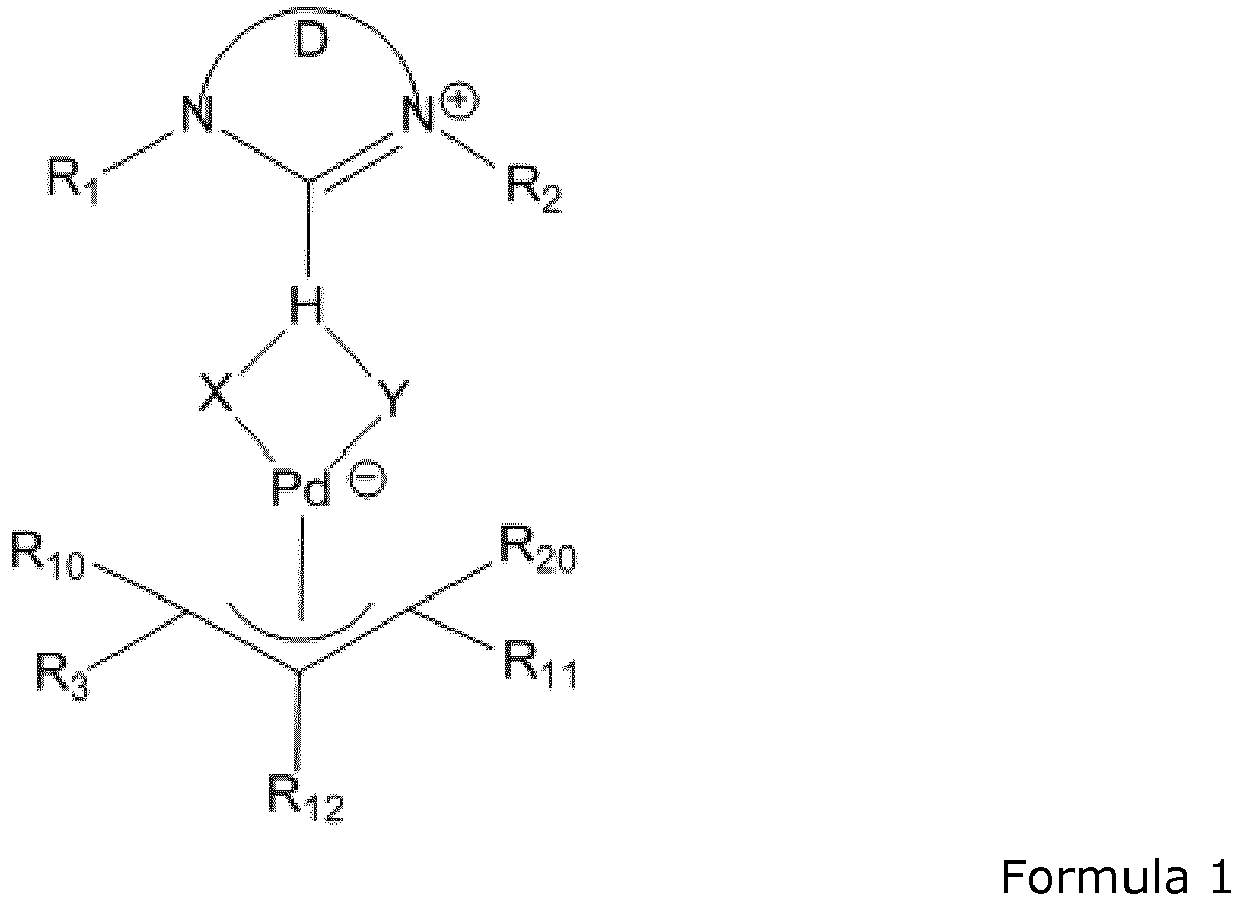
- R1 and R2 are identical or different and are selected from the group consisting of hydrogen, substituted or unsubstituted alkyl, substituted or unsubstituted heterocycloalkyl, substituted or unsubstituted aryl and substituted or unsubstituted heteroaryl;
- D can be part of a C2 to C4 bridge that can be saturated or unsaturated, substituted or unsubstituted, with bridge carbon atoms being able to be replaced by heteroatoms.
- The group carrying R1, R2 and D is, in general terms, known to the artisan as an NHC ligand or N-heterocyclic carbene ligand. They are known in the art and described, for example, in the book "N-Heterocyclic carbenes in transition metal catalysis", Springer Verlag 2007 by Frank Glorius.
- R3, R11 and R12 may be the same or different and can be hydrogen, substituted or unsubstituted aryl, heteroaryl, alkyl, alkenyl, alkynyl or combinations thereof.
- R10 and R20 can be hydrogen or form a substituted or unsubstituted, unsaturated ring, which may be fused with further rings;
- X and Y may be the same or different and are anionic ligands.
- This complex is an air-stable compound allowing storage and handling under a variety of conditions. It can be converted to a known catalytically active species by conversion with a base.
- More specifically, the compound of formula can be a compound of formula 1a

- A and B are carbon atoms;
- Z is a single bond or a double bond;
- R1 and R2 may be the same or different and are selected from the group consisting of hydrogen, substituted or unsubstituted (C1-C18)-alkyl, substituted or unsubstituted (C2-C7)-heterocycloalkyl, substituted or unsubstituted (C6-C14)-aryl, substituted or unsubstituted (C3-C14)-heteroaryl;
- R3, R11 and R12 may be the same or different and can be hydrogen, substituted or unsubstituted aryl, heteroaryl, alkyl, alkenyl, alkynyl or combinations thereof.
- R10 and R20 can be hydrogen or form a substituted or unsubstituted, unsaturated ring, which may be fused with further rings;
- X and Y may be the same or different and are anionic ligands.
- In particular, the compounds of formula 1 or 1a may be a compound of formula 2 or 3

- X and Y can be the same or different and are anionic ligands. Suitable ligands are, for example, halogen, suitable borate anions or organic anions, particularly acetate, fluoroacetate, tetrafluoroborate, tetraphenylborate, chlorine or bromine. Usually, X and Y are the same.
- As for the NHC ligand employed, in general all common NHC ligands can be used for specific purposes. If common ligands of this group of ligands are used, R1 and R2 are each independently selected from the group consisting of formula 4 to formula 8


- In this compound, the palladium (Pd) is also coordinated by a compound that can be described as R3R10-(allyl-R12)-R11R20 that has the structure of formula 9

- In this compound, R3, R11 and R12 being selected from the group consisting of hydrogen, substituted or unsubstituted alkyl, substituted or unsubstituted alkenyl, substituted or unsubstituted aryl, in particular methyl, ethyl, propyl, isopropyl, butyl, tert.-butyl, sec.-butyl, phenyl, naphthyl or combinations thereof.
- In a specific embodiment, R12 is hydrogen. In another specific embodiment, R11 is hydrogen as well.
- In yet another specific embodiment, R10 and R20 are forming a five or six-membered unsaturated ring suitable for η3-coordination of the palladium. In this embodiment, the five or six-membered unsaturated ring can be fused with at least one benzene ring. In this embodiment, R11 and R12 can be hydrogen and R10 and R20 together may form a five membered unsaturated ring fused with a benzene ring so as to form an indene ring system.
- Generally, but also in the specific embodiments with respect to R10, R11, R12 and R20 mentioned above, R3 can be selected from the group consisting of hydrogen, methyl, ethyl, propyl, isopropyl, butyl, tert.-butyl, sec.-butyl, phenyl, naphthyl or combinations thereof.
- The group R3R10-(allyl-R12)-R11R20 thus can be, for example, cinnamyl or allyl. It can also be a substituted or unsubstituted indene, such as a compound of formula 10.

- In this compound of Formula 10, R40 can be hydrogen, substituted or unsubstituted alkyl as well as substituted or unsubstituted aryl, more specifically phenyl, naphthyl, p-methylphenyl, methyl, ethyl propyl, isopropyl, butyl or tert.-butyl.
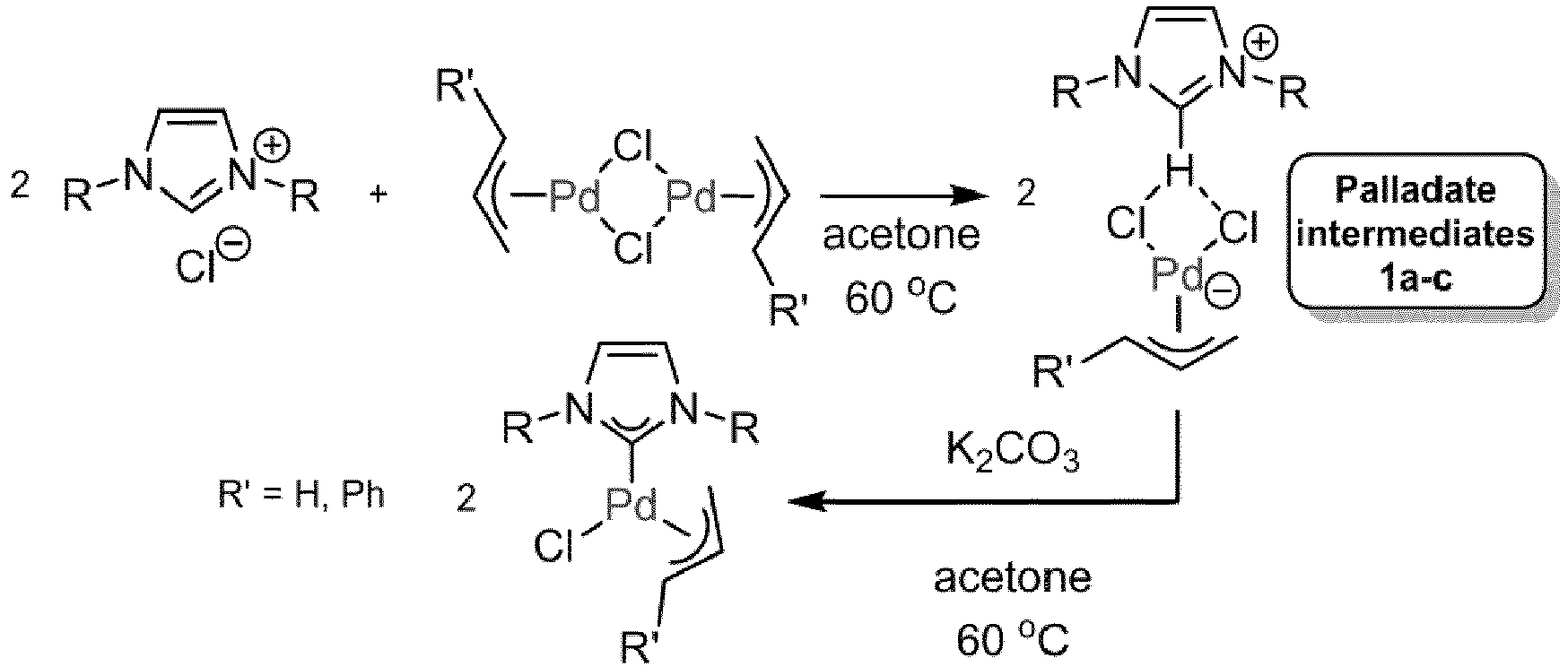
- The compounds of formula 1 to 3 can be made by a method wherein a salt of the respective NHC ligand, usually an imidazolium salt, is reacted with the palladium dimer [Pd(R3R10-(allyl-R12)-R11R20)(µ-X)]2 [Are there other palladium compounds suitable to serve as educt for this reaction?] in a solvent, wherein R3, R10, R11, R12, R20 and X are as defined above.
- This reaction can be illustrated by the following equation:

- The method is rather robust with regard to the solvents used, so a wide variety of solvents can be employed. Suitable solvents are hydrocarbons, halogenated hydrocarbons, polar solvents, specifically straight-chained or cyclic haloalkyl, ether, ketones or combinations thereof. Thus, suitable solvents include, but are not limited to, toluene, pentane, hexane, heptane, cyclohexane, petrol ether, dichloromethane, chloroform, diethyl ether, methyl-tert.-butylether (2-methoxy-2-methylpropane), ethyl-tert.-butylether, cyclic ethers such as tetrahydrofurane or dioxane, acetone or combinations thereof.
- The reaction can be easily carried out by providing the palladium educt [Pd(R3R10-(allyl-R12)-R11R20)(µ-X)]2, the NHC salt, like an imidazolium salt, and the solvent into a suitable reactor and allow the reaction while stirring at a suitable reaction temperature for a suitable reaction time, which can be in general be selected from a wide range.
- For example, the reaction might simply be carried out by refluxing the selected solvent, which would set the reaction temperature to the boiling point of the solvent, such as e.g. 111°C if the solvent used is toluene. In general, reaction temperatures of from 20°C to 111°C, in particular from 40°C to 90°C have proven to be suitable. A reaction time of 30 minutes to 24 hours, in particular of 1 to 5 hours depending on the educts and temperature used, has proven to be sufficient. Afterwards the solvent is removed, e.g. by distillation, and the product, a compound of formula 1, 1a, 2 or 3 is obtained in yields of usually above 90%, often even 98% or 99%.
- The isolated compound of formula 1, 1a, 2 or 3 can be used to prepare a catalytically active compound of the type [Pd(NHC)(R3R10-(allyl-R12)-R11R20)X] having the formula 11

- More specifically, the method of making a complex of the type [Pd(NHC)(R3R10-(allyl-R12)-R11R20)X] comprises the steps of
- providing a compound according to any of formulae 1, 1a, 2 or 3;
- reacting said compound with a base in the presence of a solvent;
- optionally isolating the resulting [Pd(NHC)(R3R10-(allyl-R12)-R11R20)X],
- This method is rather robust with regard to the solvents used, so a wide variety of solvents can be employed. Suitable solvents are hydrocarbons, halogenated hydrocarbons, polar solvents, specifically straight-chained or cyclic haloalkyl, ether, ketones, alcohols or combinations thereof. Polar-aprotic or polar-protic solvents have been found to be useful.
- Thus, suitable solvents include, but are not limited to, benzene, toluene, xylene, pentane, hexane, heptane, cyclohexane, petrol ether, dichloromethane, chloroform, diethyl ether, methyl-tert.-butylether (2-methoxy-2-methylpropane), ethyl-tert.-butylether, cyclic ethers such as tetrahydrofurane or dioxane, acetone, C2 to C6 alcohols such as ethanol, isopropanol or n-butanol or combinations thereof.
- The base to can be a basic metal compound, such as an alkaline or earth-alkaline oxide, hydroxide or carbonate, or an organic base such as an amine. Specifically, suitable bases are potassium carbonate, sodium carbonate, potassium hydroxide, sodium hydroxide, pyridine or triethylamine. [What temperatures and reaction times work best? Same as the reaction to make the Pd intermediate?]
- The palladium complex of the type [Pd(NHC)(R3R10-(allyl-R12)-R11R20)X] so obtained can be used to catalyze a chemical reaction susceptible to catalysis by a palladium catalyst.
- More specifically, this method of catalyzing a chemical reaction comprises the steps of
- Providing a complex of the type [Pd(NHC)(R3R10-(allyl-R12)-R11R20)X] with the method described above, and
- Employing the complex of the type [Pd(NHC)(R3R10-(allyl-R12)-R11R20)X] as catalyst in a chemical reaction, wherein NHC is the corresponding NHC ligand of the compound according to any of formulae 1, 1a, 2 or 3 as defined above.
- This method is particularly suitable to carry out a carbon-carbon or carbon-nitrogen coupling reaction in organic chemistry. More specifically, Buchwald-Hartwig coupling reactions, Suzuki-Miyaura coupling reactions, Heck reaction or Stille reaction as well as Negishi, Sonogashira and Hiyama coupling reactions can be carried out in this way.
- It is possible to add a compound of any of formulae 1, 1a, 2 or 3 as defined above to the reaction mixture of the coupling reaction to be catalyzed, together with a base, and then to carry out the coupling reaction as normally described in literature. In Heck reactions, for example, a base is normally added anyway. It might sometimes be necessary to adapt the amount of base in a few trials to achieve the best results.
- It is also possible to prepare the complex of the type [Pd(NHC)(R3R10-(allyl-R12)-R11R20)X] from a compound of any of formulae 1, 1a, 2 or 3 by the method as described above, which is by addition of a base in presence of a solvent, and then to add the complex of the type [Pd(NHC)(R3R10-(allyl-R12)-R11R20)X] to the reaction mixture. The the complex of the type [Pd(NHC)(R3R10-(allyl-R12)-R11R20)X] can be isolated and then added to the reaction mixture of the coupling reaction or the solution thereof might simply transferred to the reaction mixture of the coupling reaction, as the case may be.
- IPr•HCl (50.0 mg, 0.117 mmol), [Pd(cin)(µ-Cl)]2 (25.3 mg, 0.048 mmol), a magnetic stir bar and acetone (0.5 mL) were charged into a vial or roundbottomed flask, followed by K2CO3 (13.5 mg, 0.097 mmol). The mixture was stirred at 60 °C for 5 h. After the reaction was complete, the solvent was removed under vacuum. The residue was re-dissolved in dichloromethane (1 - 2 mL) and filtered through a pad of silica. The silica was washed with DCM (20 mL). The resulting solution was concentrated and dried under vacuum until a powder was obtained. In some cases, washing with pentane (5 mL) was necessary in order to remove the residual DCM. The product was obtained as a microcrystalline material in 98% (60.9 mg) yield.
- IPr•HCl (1.96 g, 4.63 mmol), [Pd(cin)(µ-Cl)]2 (1 g, 1.93 mmol) and a magnetic stir bar were charged into a scintillation vial or round bottom flask. Acetone (20 mL) was then added, followed by K2CO3 (533 mg, 3.86 mmol) and the reaction mixture was refluxed for 24 h. The same general work up as above afforded the product in 95% (2.33g) yield.
- 1H NMR (400 MHz, CDCl3): δ (ppm) = δ 7.50 (t, J=7.7 Hz, 2H), 7.48-7.28 (d, J=7.7 Hz, 4H), 7.12 (m, 5H), 5.09 (m, 1H), 4.36 (d, J=12.9 Hz, 1H), 3.06 (m, 5H), 1.77(d, J=11.4 Hz, 1H), 1.43-1.36 (m, 12H), 1.16 (d, J=7.1 Hz, 12H).
- 13C {1H} NMR (100 MHz, CDCl3): δ (ppm) = δ 184.8 (C, carbene), 145.9 (C), 137.7 (C), 135.7 (C), 129.7 (CH) 128.0 (CH), 127.9 (CH), 127.1 (CH), 126.5 (CH), 124.0 (CH), 123.6 (CH), 108.6 CH), 90.0 (CH), 46.1 (CH2), 33.9 (CH2), 28.4 (CH), 26.0 (CH3), 22.8 (CH3).
- Elemental Analysis: Expected C = 66.66, H = 7.15, N = 4.32. Found C = 66.73, H = 7.27, N = 4.38.
Table S-1: Optimisation of the synthesis of [Pd(IPr)(cin)Cl] 
Entry IPr•HCl (equiv.) K2CO3 (equiv.) t (h) Yield (%)a 1 1 2 3 94* 2 1.1 2 3 100* 3 1.2 1.1 5 98* 4 1.3 1.1 5 100* 5 1.5 1.1 5 100* 6 1.2 0.9 5 99* 7 1.2 1 5 98 8 1.2 1.3 5 100* 9 1.2 1.5 5 96* 10 1.2 0.6 5 65* 11 1.2 0.4 5 69* 12 1.2 0.2 5 52* 13 1.2 1 5 94*b 14 1.2 1 5 99*c 15 1.2 1 6 99d *1H NMR shows impurities in the spectra.
aIsolated yield. All reactions were carried out in air using technical grade acetone (0.235 M in respect to IPr•HCl).
bConcentration = 0.117 M.
cConcentration = 0.058M.
dIPr•HCl and [Pd(cin)Cl]2 were stirred in acetone for 1 h at 60 °C, then K2CO3 was added and the mixture was left to stir for 5h at 60 °C. - 2. Synthesis and optimisation of [Pd(IPr)(allyl)CI]
- IPr•HCl (50.0 mg, 0.117 mmol), [Pd(allyl)(µ-Cl)]2 (17.8 mg, 0.048 mmol), a magnetic stir bar and acetone (0.5 mL) were charged into a vial or round bottom flask followed by K2CO3 (13.5 mg, 0.097 mmol). The mixture was stirred at 60 °C for 5 h. After the reaction was complete, the solvent was removed under vacuum. The residue was re-dissolved in dichloromethane (1-2 mL) and filtered through a pad of silica. The silica was washed with DCM (20 mL). The resulting solution was concentrated and dried in vacuum until a powder was obtained. In some cases washing with pentane (5 mL) was necessary in order to remove the residual DCM. The product was obtained as microcrystalline material in 85% (47.6 mg) yield.
- IPr•HCl (2.70 g, 6.55 mmol), [Pd(allyl)(µ-Cl)]2 (1 g, 2.73 mmol) and a magnetic stir bar were charged into a scintillation vial or round bottom flask. Acetone (28 mL) was then added followed by K2CO3(755 mg, 5.47 mmol) and the reaction mixture was refluxed for 10 h. The same general work up as above afforded the product in 92% (2.87 g) yield.
- 1H NMR (400 MHz, CDCl3): δ (ppm) = δ 7.42 (t, J = 7.32 Hz, 2H), 7.28 (m, 4H), 7.15 (s, 2H), 4.86-4.76 (m, 1H), 3.91 (dd, J=5.66 Hz, 1H), 3.16-3.03 (m, 2H), 3.04 (d, J=6.31 Hz, 1H), 2.89-2.82 (m, 2H), 2.77 (d, J=13.64 Hz, 1H), 1.59 (d, J=12.09 Hz, 1H), 1.39 (d, J=7.12 Hz, 6H), 1.34 (d, J=6.8 Hz, 6H), 1.18 (d, J=7.05, 6H), 1.09 (d, J=7.12 Hz, 6H).
13C {1H} NMR (100 MHz, CDCl3): δ (ppm) = δ 186.1 (C, carbene), 146.0 (C), 145.8 (C), 135.6 (C), 129.7 (CH), 123.9 (CH), 123.7 (CH), 123.6 (CH), 114.0 (CH), 72.3 (CH2), 49.3 (CH2), 28.4 (CH2), 28.3 (CH2) 26.4 (CH3), 25.6 (CH3), 22.7 (CH3), 22.6 (CH3).
Elemental Analysis: Expected C = 62.93, H = 7.39, N = 4.89, Found C = 63.06, H = 7.55, N = 5.02.Table S-2: Optimisation of the synthesis of [Pd(IPr)(allyl)CI] 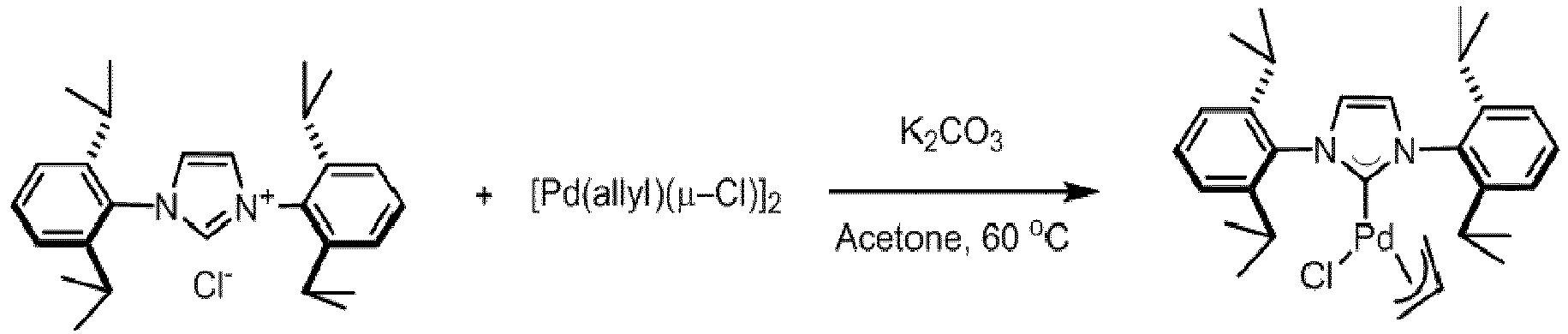
Entry IPr•HCl (equiv.) [Pd(allyl)Cl]2 (equiv.) K2CO3 (equiv.) t (h) Yield (%) 1 1 0.5 2 5 85* 2 1.1 0.5 2 5 75* 3 1 0.55 1.1 5 60* 4 1 0.6 1.1 5 57* 5 1.2 0.5 1 5 85 * 1H NMR shows impurities in the spectra.
aIsolated yield after filtration through silica using DCM. All reactions were carried out in air using technical grade acetone (0.235 M). - IPr*•HCl (110 mg, 0.116 mmol), [Pd(cin)(µ-Cl)]2 (30.0 mg, 0.058 mmol), a magnetic stir bar and acetone (0.5 mL) were charged into a vial or round bottom flask , the reaction was stirred at 60 °C for 1 h. Then K2CO3 (32.0 mg, 0.232 mmol) was added and the mixture was stirred at 60 °C for 24 h. After the reaction was complete, the solvent was removed under vacuum. The residue was re-dissolved in dichloromethane (1-2 mL) and filtered through a pad of silica. The silica was washed with DCM (20 mL). The resulting solution was concentrated and dried in vacuum, until a powder was obtained. In some cases washing with pentane (5 mL) was necessary in order to remove the residual DCM. The product was obtained as microcrystalline material in a 94% (127 mg) yield.
- IPr*•HCl (3.66 g, 3.86 mmol), [Pd(cin)(µ-Cl])2 (1 g, 1.93 mmol) and a magnetic stir bar were charged into a scintillation vial or round bottom flask. Acetone (13 mL) was then added and the reaction was refluxed for 3 h (65 °C). Then, K2CO3 (1.07 g, 7.72 mmol) was added and the reaction mixture refluxed for 30 h. The same general work up as above afforded the product in 98% (4.23 g) yield.
- 1H NMR (400 MHz, CDCl3): δ (ppm) = δ 7.50 (d, J = 7.10 Hz, 2H), 7.41 (t, J = 7.42, 3H), 7.37 (m, 16H), 7.08 (m, 14H), 6.82 (m, 14H), 6.09 (s, 2H), 5.70 (s, 2H), 5.31 (s, 2H), 5.01-4.96 (m, 1H), 4.64 (d, J = 12.8 Hz, 1H), 2.59 (d, J = 5.8 Hz, 1H), 2.23 (s, 6H).
- 13C {1H} NMR (100 MHz, CDCl3): δ (ppm) = δ 182.3 (C, carbene), 144.3 (C), 143.5(C), 143.4 (C) 141.1 (C), 140.3 (C), 138.1 (C), 137.5 (C), 135.6 (C), 130.3 (CH), 130.0 (CH), 129.0 (CH), 128.9 (CH), 128.3 (CH), 128.1 (CH), 127.9 (CH), 127.4 (CH), 126.9 (CH), 126.1 (CH), 126.1 (CH),123.2 (CH) 108.7 (C), 91.0 (C), 53.3 (CH), 47.1 (C), 21.7 (CH3).
- Elemental Analysis: Expected: C 79.85, H 5.67, N 2.39. Found: C 79.64, H 5.81, N 2.36.
Table S-3: Optimisation of the synthesis of [Pd(IPr*)(cin)Cl] 
Entry IPr*•HCl (equiv.) K2CO3 (equiv.) t (h) Yielda (%) Acetone (M) 1 1 2 5 80*b 0.1158 2 1 2 20 81* 0.1158 3 1 2 5 70* 0.1158 4 1.2 1 5 84* 0.105 5 1 2 5 74*c 0.105 6 1 1 5 59* 0.105 7 1 2 5 73*c 0.105 8 1 1 5 60* 0.105 9 1 2 5 78*d 0.105 10 1 2 20 99d 0.105 11 1 2 24 94d 0.2316 12 1 1.5 20 73* 0.2316 13 1 2 24 93 0.105 14 1 2 24 98* 0.0579 * 1H NMR shows impurities in the spectra.
aIsolated yield after filtration through silica using DCM. All reactions were carried out in air using technical grade acetone.
bClean NMR spectrum obtained but difficulties in reproducing it.
cIPr*•HCl and [Pd(cin)Cl]2 in acetone were stirred at 60 °C for 7 min, then K2CO3 was added and left to stir and heat for 5 h.
dIPr*•HCl and [Pd(cin)Cl]2 in acetone were stirred at 60 °C for 1 h, then K2CO3 was added and the mixture was stirred at 60 °C for the indicated time.
eIPr*·HCl and [Pd(cin)Cl]2 in acetone were stirred at 60 °C for 3 h, then K2CO3 was added and the mixture was stirred at 60 °C for 24 h. -

- SIPr•HCl (110 mg, 0.234 mmol), [Pd(cin)(µ-Cl)]2 (49.7 mg, 0.096 mmol) and a magnetic stir bar were charged into a vial or round bottom flask. Acetone (1 mL) was then added, followed by K2CO3(26.9 mg, 0.192 mmol) and the mixture was left to stir for 5 h at 60 °C. The same general work up as above afforded the desired complex as microcrystalline material in 78% (122 mg) yield.
- 1H NMR (400 MHz, CDCl3): δ (ppm) =δ 7.38-7.35 (m, 2H), 7.26 (d, J = 7.52 Hz, 3H), 7.14-7.13 (m, 4H), 5.09-5.01 (m, 1H), 4.33 (d, J = 13.3 Hz, 1H), 4.02 (s, 4H), 3.44 (br. s, 1H), 1.43 (m, 12H), 1.27 (d, J = 6.31 Hz, 12H).
- 13C {1H} NMR (100 MHz, CDCl3): δ (ppm) = δ 212.1 (C), 147.2 (C), 137.7 (C), 136.4 (C), 129.1 (C), 128.3 (CH), 127.4 (CH), 126.8 (CH), 124.3 (CH), 109.2 (CH), 91.7 (CH), 54.1 (CH), 46.0 (CH2), 28.6 (CH3), 26.7 (CH3).
- Elemental analysis: Expected: C 66.76, H 7.72, N 4.21. Found: C 66.63, H 7.64, N 4.27.
-

- SIMes•HCl (100 mg, 0.292 mmol), [Pd(cin)(µ-Cl)]2 (62.9 mg, 0.122 mmol), a magnetic stir bar and acetone (1.2 mL) were charged into a vial or round bottom flask , followed by K2CO3(33.5 mg, 0.243 mmol). The mixture was stirred at 60 °C for 5 h. The general work up procedure was then followed, affording the product as microcrystalline material in 80% (135 mg) yield.
- 1H NMR (400 MHz, CDCl3): δ (ppm) =δ7.12 (m, 3H), 7.06 (m, 2H), 6.96 (d, J = 11.19 Hz, 4H), 5.30 (s, 1H), 5.12-5.04 (m, 1H), 4.27 (d, J = 12.96 Hz, 1H), 3.99 (m, 4H), 3.27 (d, J = 6.86 Hz, 1H), 2.44 (d, J = 15.24 Hz, 10H), 2.31 (s, 6H), 1.93 (m, 1H).
- 13C {1H} NMR (100 MHz, CDCl3): δ (ppm) = δ 210.9 (C, carbene), 138.0 (C), 137.8 (C), 136.3 (C), 135.7 (C), 129.1 (CH), 128.0 (CH), 127.5 (CH), 127.1 (CH), 126.4 (CH), 109.4 (CH), 92.1 (CH), 51.0 (CH2), 46.5 (CH2), 20.9 (CH3).
- Elemental analysis: Expected: C 66.76, H 7.72, N 4.21. Found: C 66.63, H 7.64, N 4.27.
-

- IPr*2-Np•BF4 (171.2 mg, 0.115 mmol), [Pd(cin)(µ-Cl)]2 (30.0 mg, 0.058 mmol), a magnetic stir bar and acetone (1.1 mL) were charged into a vial or round bottom flask. The reaction was stirred at 60 °C for 1 h. Then K2CO3 (32.0 mg, 0.232 mmol) was added and the mixture was stirred at 60 °C for 24 h. The general work up procedure was followed; affording the product as microcrystalline material in 94% (170 mg) yield.
- 1H NMR (400 MHz, CDCl3): δ (ppm) =δ 7.86-7.84 (m, 12H), 7.71 (d, J = 6.95 Hz, 2H), 7.62 (d, J = 7.79 Hz, 4H), 7.67-7.51 (m, 7H), 7.47-7.41 (m, 10H), 7.39-7.29 (m, 9H), 7.26-7.16 (m, 14H), 7.16 (d, J = 15.6 Hz, 4H), 7.12 (s, 4H), 6.94 (d, J = 8 Hz, 2H), 6.60 (d, J = 9.68 Hz, 2H), 5.37 (s, 2H), 5.05 (d, J = 12.94 Hz, 1H), 3.15 (d, J = 7.1 Hz, 1H), 2.24 (s, 6H), 1.94 (d, J = 11.3 Hz, 1H).
- 13C {1H} NMR (100 MHz, CDCl3): δ (ppm) = 5182.0 (C, carbene), 141.2 (C), 138.5 (C), 135.9 (C), 133.0 (C), 132.9(C), 132.0 (CH), 131.8 (CH), 130.7 (CH), 129.2 (CH), 128.9 (CH), 128.6 (CH2), 127.9 (CH2), 127.8 (CH2), 127.7 (CH2), 127.4 (CH2), 127.3 (CH2), 127.0 (CH2), 125.7 (CH2), 125.6(CH2), 125.5 (CH2), 109.6 (CH2), 92.1 (CH2), 51.5 (CH2), 47.1 (CH2), 21.7 (CH2).
- Elemental analysis: Expected: C 84.01, H 5.19, N 1.78. Found: C 83.87, H 5.23, N 1.91.
-

- IPent.HCl (100 mg, 0.186 mmol), [Pd(cin)(µ-Cl)]2 (48.2 mg, 0.093 mmol), a magnetic stir bar and acetone (0.8 mL) were charged into a vial or round bottom flask, the reaction was stirred at 60 °C for 1 h. Then, K2CO3 (51.4 mg, 0.372 mmol) was added and the mixture was stirred at 60 °C for 24 h. The general work up procedure was followed, affording the product as microcrystalline material in 85% (123 mg) yield.
- 1H NMR (400 MHz, CDCl3): δ (ppm) =δ 7.41-7.37 (m, 2H), 7.18-7.09 (m, 11 H), 5.21-5.13 (m, 1H), 4.41 (d, J = 13.4 Hz, 1H), 2.53 (br. m, 4H), 2.11-1.97 (m, 4H), 1.76-1.72 (m, 4H), 1.63 (m, 4H), 1.52-1.43 (m, 4H), 1.01 (m, 12H), 0.77 (m, 12H).
- 13C {1H} NMR (100 MHz, CDCl3): δ (ppm) = δ 181.5 (C, carbene), 143.6 (C), 137.5 (C) 137.5 (C), 128.8 (CH), 128.2 (CH), 127.2 (CH), 126.6 (CH), 124.8 (CH), 124.2 (CH), 108.2 (C), 91.4 (CH), 41.5(CH), 27.9 (CH2), 27.2 (CH2), 12.8 (CH3), 11.2 (CH3).
- Elemental analysis: Expected: C 69.55 H 8.09, N 3.69. Found: C 69.49, H 8.19, N 3.80.
-

- IHept•HCl (100 mg, 0.154 mmol), [Pd(cin)(µ-Cl)]2 (39.8 mg, 0.076 mmol), a magnetic stir bar and acetone (0.7 mL) were charged into a vial or round bottom flask, the reaction was stirred for at 60 °C for 1 h. Then, K2CO3 (42.5 mg, 0.308 mmol) was added and the mixture was stirred at 60 °C for 24 h. The general work up procedure was followed, affording the product as microcrystalline material in 81% (109 mg) yield.
- 1H NMR (400 MHz, CDCl3): δ (ppm) = δ 7.40-7.36 (m, 2H), 7.19-7.13 (m, 9H), 7.06 (s, 2H), 5.18-5.10 (m, 1H), 4.44 (d, J = 13.8 Hz, 1H), 2.61 (br. s, 4H), 1.98-1.91 (m, 4H), 1.56-1.26 (m, 20H), 1.15-1.11 (m, 8H), 0.90 (t, J = 7.12 Hz, 7.28 Hz, 24H).
- 13C {1H} NMR (100 MHz, CDCl3): δ (ppm) = δ 181.4 (C, carbene), 144.2 (C), 137.5 (C), 137.2 (CH2), 128.9 (CH), 128.1 (CH), 127.3 (CH), 126.5 (CH), 124.7 (CH), 124.2 (CH), 108.1 (C), 91.5 (CH), 39.1 (CH3), 39.0 (CH), 37.8 (CH2), 21.4 (CH2), 20.3 (CH2), 14.5 (CH3).
- Elemental analysis: Expected: C 71.62 H 8.90, N 3.21. Found: C 71.5, H 8.75, N 3.30.
-

- IPr*OMe•HCl (100 mg, 0.103 mmol), [Pd(cin)(µ-Cl)]2 (26.7 mg, 0.051 mmol), a magnetic stir bar and acetone (0.5 mL) were charged into a vial or round bottom flask and the reaction was stirred at 60 °C for 1 h. Then, K2CO3 (28.5 mg, 0.206 mmol) was added and heated at 60 °C for 24 h. The general work up procedure was followed, affording the product as microcrystalline material in 85% (107 mg) yield.
- 1H NMR (400 MHz, CDCl3): δ (ppm) =δ 7.49 (d, J = 7.37 Hz, 2H), 7.40 (t, J = 7.09 Hz, 2H), 7.30-7.19 (m, 22H), 7.10-7.09 (m, 11H), 6.85 (d, J = 7.24 Hz, 4H), 6.80 (d, J = 6.57 Hz, 4H), 6.55 (s, 4H), 6.07 (s, 2H), 5.73 (s, 2H), 5.23 (s, 2H), 5.13-5.05 (m, 1H), 4.69-4.66 (m, 1H), 3.57 (s, 6H), 2.67-2.66 (m, 1H).
- 13C {1H} NMR (100 MHz, CDCl3): δ (ppm) = 5182.9 (C, carbene), 158.6 (C), 144.0 C), 130.2 (C), 129.0 (C), 128.9 (C), 128.4 (C), 128.1 (C), 128.0 (CH), 127.4 (CH), 127.0 (CH), 126.3 (CH), 126.1 (CH), 123.3 (CH), 114.8 (CH), 114.7 (CH), 108.7 (C), 91.7 (CH), 54.8 (CH2), 51.4 (CH3), 47.0 (CH3).
- Elemental analysis: Expected: C 77.8, H 5.44 N 2.33 Found: C 77.59 H 5.35 N 2.36.
-
- IPr•HCl (82.04 mg, 0.193 mmol), [Pd(cin)(µ-Cl)]2 (50.0 mg, 0.096 mmol), a magnetic stir bar and acetone (0.8 mL) were charged into a vial. The mixture was stirred at 60 °C for 1 h. The solvent was removed and the product was dried under vacuum. The product was obtained as a dark orange powder in a 99% (132 mg) yield. Single crystals were grown by vapour diffusion of hexane into a solution of the complex in DCM.
1H NMR (400 MHz, CDCl3): δ (ppm) = 9.19 (s, 1H), 8.32 (d, J = 1.60 Hz, 2H), 7.56-7.52 (m, 2H), 7.46 (d, J = 7.44 Hz, 2H), 7.33 (d, J = 7.75 Hz, 4H), 7.21 (m, 3H), 5.66 (s, 1H), 4.46 (s, 1H), 3.83 (s, 1H), 2.90 (s, 1H), 2.48-2.41 (m, 4H), 1.27 (d, J = 6.81 Hz, 12H), 1.19 (d, J = 6.76 Hz, 12H).
13C {1H} NMR (100 MHz, CDCl3): δ (ppm) = δ 144.9 (C), 136.7 (CH), 131.8 (C), 129.7 (C), 128.4 (CH), 127.7 (CH), 127.5 (CH), 124.5 (CH), 105.0 (C), 28.8 (CH3), 24.4 (CH3), 23.7 (CH3).
Elemental analysis: Expected: C 63.02, H 7.05 N 4.08 Found: C 62.92 H 7.14 N 4.15 - IPr•HCl (82.04 mg, 0.193 mmol), [Pd(allyl)(µ-Cl)]2 (35.3 mg, 0.0965 mmol), a magnetic stir bar and acetone (0.8 mL) were charged to a vial. The mixture was stirred at 60 °C for 1 h. Then the solvent was removed and dried under vacuum. The product was obtained as a yellow powder in a 99% (117 mg).
1H NMR (400 MHz, CDCl3): δ (ppm) = 9.16 (s, 1H), 8.28 (d, J = 1.62 Hz, 2H), 7.54-7.50 (m, 2H), 7.32 (d, J = 7.17 Hz, 4H), 5.16-5.10 (m, 1H), 3.76 (s, 2H), 2.67 (d, J = 11.57 Hz, 2H), 2.48-2.44 (m, 4H), 1.27 (d, J = 6.79 Hz, 12H), 1.20 (d, J = 7.20 Hz, 12H).
13C {1H} NMR (100 MHz, CDCl3): δ (ppm) = 5144.9 (C), 136.8 (CH), 131.8 (C), 129.7 (C), 127.3 (CH), 124.4 (CH), 108.9 (C), 60.3 (CH), 28.8 (CH3), 24.4 (CH3), 23.8 (CH3). - Elemental analysis: Expected: C 59.07, H 7.27 N 4.59, Found: C 58.90 H 7.17 N 4.57.
- IPr*•HCl (109.9 mg, 0.115 mmol), [Pd(cin)(µ-Cl)]2 (30.0 mg, 0.058 mmol), a magnetic stir bar and acetone (1.1 mL) were charged to a vial. The mixture was stirred at 60 °C for 5 h. Then, the solvent was removed and dried under vacuum. The product was obtained as a yellow powder in a 99% (139 mg). Single crystals were grown by vapour diffusion of hexane into a solution of the complex in DCM.
- 1H NMR (400 MHz, CDCl3): δ (ppm) = δ 12.52 (s, 1H), 7.31-7.23 (m, 17H), 7.19-7.06 (m, 17H), 6.77-6.75 (m, 10H), 5.87-5.75 (br. m, 1H), 5.41 (s, 4H), 5.33 (s, 2H), 4.68-3.68 (m, 2H), 3.15-2.45 (m, 1H), 2.18 (s, 6H).
13C {1H} NMR (100 MHz, CDCl3): δ (ppm) 142.6 (C), 142.5 (C), 142.1 (C), 140.7 (C), 140.6 (CH), 130.7 (C), 130.2 (CH), 129.1 (C), 128.3 (C), 127.9 (CH), 126.6 (CH), 126.5 (CH), 122.8 (CH), 105.5 (CH), 51.0 (CH3), 21.7(CH3).
Elemental analysis: Expected: C 77.38 H 5.66 N 2.31 Found: C 77.25 H 5.47 N 2.36. -

- The vial containing the precatalyst was transferred into the glovebox. Inside the glovebox, the vial was charged with a stirring bar, 4-chloroansiole (0.5 mmol), phenylboronic acid (1 equiv.) and K2CO3 (1.1 equiv.). The vial was then sealed with a screw cap fitted with a septum. The reaction mixture was taken outside the glovebox. 1 mL of an ethanol/water (1:1) mixture (degassed) was added and the reaction was left to stir at 80 °C for 4 h.
- The vial containing the precatalyst was transferred into the glovebox. Inside the glovebox, the vial was charged with a stirring bar, 4-chloroansiole (0.5 mmol), phenylboronic acid (1 equiv.) and K2CO3 (1.1 equiv.). The vial was sealed with a screw cap fitted with a septum. The reaction mixture was taken outside the glovebox. 1 mL of ethanol (degassed) was added and the reaction was left to stir at RT for 20 h.
- The vial was charged with a stirring bar, 1a-c (0.3 mol%) and K2CO3 (1.1 equiv.) under argon. the mixture was stirred for; 1 h at 60 °C (C1) or 30 min at 60 °C (C3), then 4-chloroansiole (0.5 mmol) and phenylboronic acid (1 equiv.) were added and the reaction was left stirring at RT for 20 h.
- For entries 7-9: Pd dimer (0.15 mol%) and NHC·HCl (0.3 mol%) were used instead of 1a-c.
- The vial containing the 1a-c (0.3 mol%) was transferred into the glovebox. Inside the glovebox, the vial was charged with a stirring bar, 4-chloroansiole (0.5 mmol), phenylboronic acid (1 equiv.) and K2CO3 (1.1 equiv.). The vial was sealed with a screw cap fitted with a septum. The reaction mixture was taken outside the glovebox. 1 mL of ethanol (degassed) was added and the reaction was stirred for 1 h at 60 °C, then 20 h at RT.
- Coupling product: 4-methoxy-1,1'-biphenyl
- 1H NMR (400 MHz, CDCl3): δ (ppm) = 7.59-7.50 (m, 4H), 7.45-7.39 (m, 2H), 7.33-7.28 (m, 1H), 7.02-6.95 (m, 2H), 3.86 (s, 3H).
- Analytical data obtained was in accordance with the reported values.2
Claims (25)
- A compound of formula 1
 R1 and R2 are identical or different and are selected from the group consisting of hydrogen, substituted or unsubstituted alkyl, substituted or unsubstituted heterocycloalkyl, substituted or unsubstituted aryl and substituted or unsubstituted heteroaryl;D can be part of a C2 to C4 bridge that can be saturated or unsaturated, substituted or unsubstituted, with bridge carbon atoms being able to be replaced by heteroatoms;R3, R11 and R12 may be the same or different and can be hydrogen, substituted or unsubstituted aryl, heteroaryl, alkyl, alkenyl, alkynyl or combinations thereof.R10 and R20 can be hydrogen or form a substituted or unsubstituted, unsaturated ring, which may be fused with further rings; or to each other to form a ringX and Y may be the same or different and are anionic ligands.
 - A compound of formula 1a according to claim 1,
 A and B are carbon atoms;Z is a single bond or a double bond;R1 and R2 may be the same or different and are selected from the group consisting of hydrogen, substituted or unsubstituted (C1-C18)-alkyl, substituted or unsubstituted (C2-C7)-heterocycloalkyl, substituted or unsubstituted (C6-C14)-aryl, substituted or unsubstituted (C3-C14)-heteroaryl;R3, R11 and R12 may be the same or different and can be hydrogen, substituted or unsubstituted aryl, heteroaryl, alkyl, alkenyl, alkynyl or combinations thereof.R10 and R20 can be hydrogen or form a substituted or unsubstituted, unsaturated ring, which may be fused with further rings;X and Y may be the same or different and are anionic ligands.
 - A compound of formula 1 as in claim 1 or 2 with the formula 2 or 3

- A compound according to claim 1, 2 or 3, wherein X and Y are the same and are halogen, acetate, fluoroacetate, tetrafluoroborate, in particular chlorine or bromine.
- A compound according to any of claims 1 to 4, wherein R1 and R2 are each independently selected from the group consisting of formula 4 to formula 8

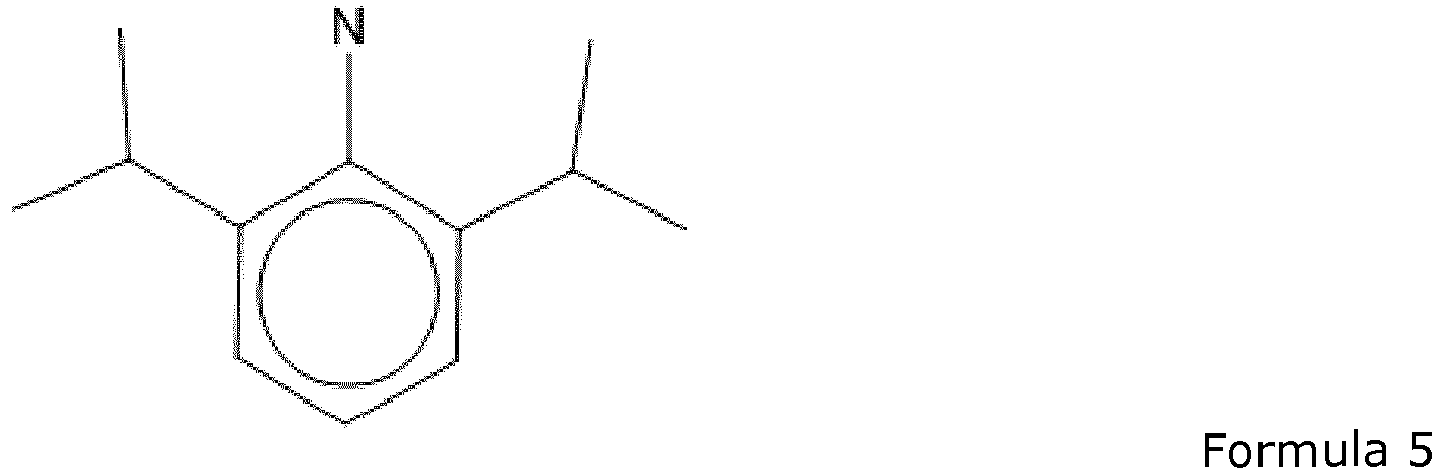
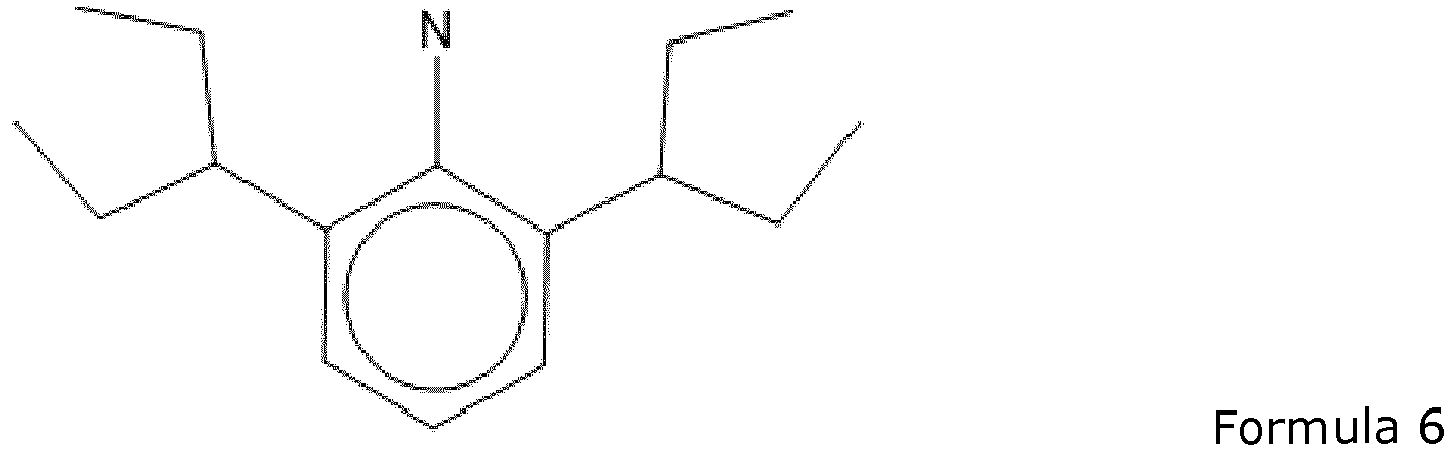

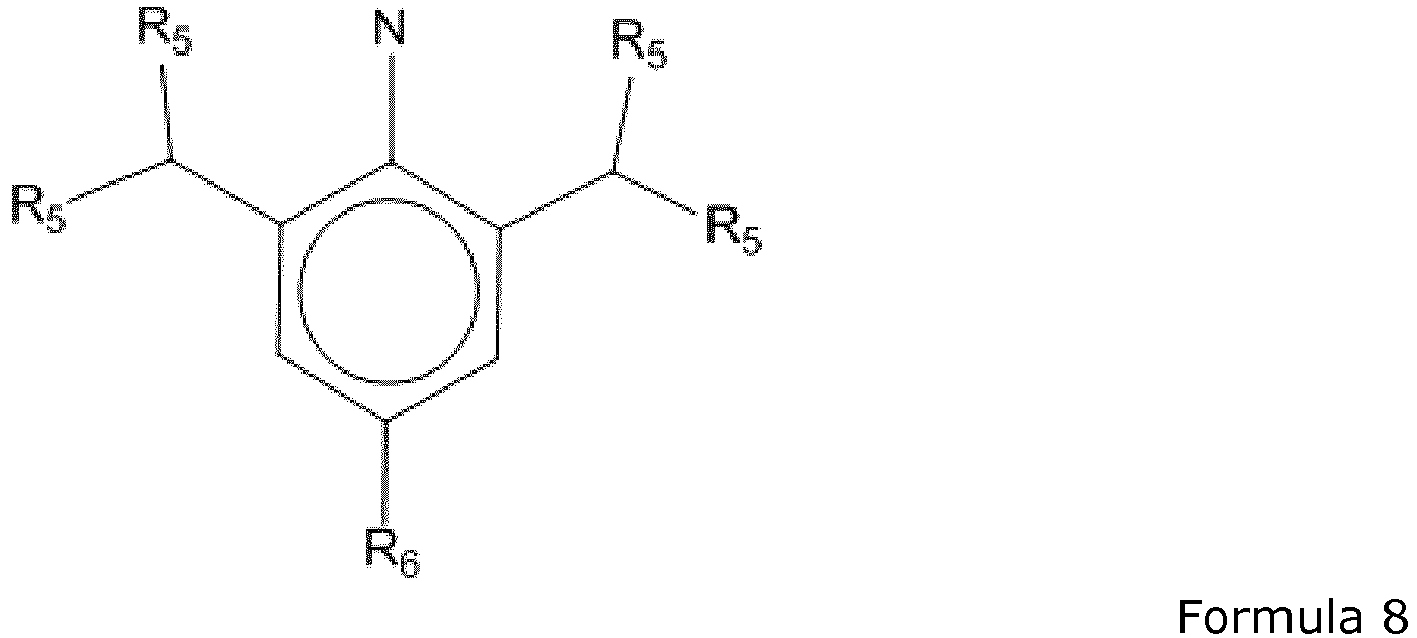
wherein R5 is phenyl, naphthyl, R6 is hydrogen, methyl or methoxy and N indicates the nitrogen atom of the heterocyclic ring in formulae 1 to 3 to which the substituted aryl ring is linked. - A compound according to any of claims 1 to 5, R1 and R2 being the same.
- A compound according to any of claims 1 to 6, R3, R11 and R12 being selected from the group consisting of hydrogen, methyl, ethyl, propyl, isopropyl, butyl, tert.-butyl, sec.-butyl, phenyl, naphthyl or combinations thereof.
- A compound according to any of claims 1 to 7, R12 being hydrogen.
- A compound according to any of claims 1 to 8, R11 being hydrogen.
- A compound according to any of claims 1 to 9, R10 and R20 are forming a five or six-membered unsaturated ring suitable for η3-coordination of the palladium.
- A compound of claim 10, the five or six-membered unsaturated ring being fused with at least one benzene ring.
- A compound according to any of claims 1 to 11, R3 being selected from the group consisting of hydrogen, methyl, ethyl, propyl, isopropyl, butyl, tert.-butyl, sec.-butyl, phenyl, naphthyl or combinations thereof, R11 and R12 being hydrogen and R10 and R20 together form a five membered unsaturated ring fused with a benzene ring so as to form an indene ring system.
- A method for making compounds of any of claims 1 to 12, wherein an imidazolium salt is reacted with the palladium dimer [Pd(R3R10-(allyl-R12)-R11R20)(µ-X)]2 in a solvent, wherein R3 and X are as defined above.
- The method of claim 13, the solvent being a hydrocarbon, halogenated hydrocarbon or polar solvent, specifically straight-chained or cyclic haloalkyl, ether, ketone or combinations thereof.
- The method of claim 13 or 14, wherein the reaction temperature is from 20°C to 111°C, in particular from 40°C to 90°C.
- The method of any of claims 13 to 15, wherein the reaction time is from 30 minutes to 24 hours, in particular from 1 hour to 5 hours.
- The method of any of claims 13 to 16, the compound R3R10-(allyl-R12)-R11R20 being a compound of formula

- A method of making a complex of the type [Pd(NHC)(R3R10-(allyl-R12)-R11R20)X] comprising the steps of- providing a compound according to any of claims 1 to 5;- reacting said compound with a base in the presence of a solvent;- optionally isolating the resulting [Pd(NHC)(R3R10-(allyl-R12)-R11R20)X],wherein NHC is the corresponding NHC ligand of the compound according to any of claims 1 to 5 and X and R3 are defined as above.
- The method of claim 18, wherein the solvent is a polar-aprotic solvent or a polar-protic solvent, in particular a haloalkane, an aromatic solvent such as benzene, toluene or xylene, ethers such as diethyl ether, tetrahydrofurane or MTBE, ketones such as acetone or C2 to C6 alcohols such as ethanol, isopropanol or n-butanol.
- The method of claim 18 or 19, the base being a basic metal compound or an organic base, in particular an alkaline or earth-alkaline compound.
- The method of any of claims 18 to 20, the base being an alkaline or earth-alkaline oxide, hydroxide or carbonate or an amine, in particular potassium carbonate, sodium carbonate, potassium hydroxide, sodium hydroxide, pyridine or triethylamine.
- A method of catalyzing a chemical reaction comprising the steps of- Providing a a complex of the type [Pd(NHC)(R3R10-(allyl-R12)-R11R20)X] with a method of any of claims 13 to 21, and- Employing the complex of the type [Pd(NHC)(R3R10-(allyl-R12)-R11R20)X] as catalyst in a chemical reaction, wherein NHC is the corresponding NHC ligand of the compound according to any of claims 1 to 12 and R3 is defined as above.
- The method of claim 12, the chemical reaction being a carbon-carbon or carbon-nitrogen coupling reaction in organic chemistry.
- The method of claim 12, the chemical reaction being a Buchwald-Hartwig coupling.
- The method of claim 12 or 13, the chemical reaction being a Heck reaction, Stille reaction, a Suzuki-Miyaura coupling, Sonogashira, coupling, a Negishi coupling or a Hiyama coupling.
Priority Applications (6)
| Application Number | Priority Date | Filing Date | Title |
|---|---|---|---|
| EP16206466.1A EP3339313A1 (en) | 2016-12-22 | 2016-12-22 | Metal organic compounds |
| US16/472,290 US20190374933A1 (en) | 2016-12-22 | 2017-12-19 | Metal organic compounds |
| CN201780079381.9A CN110088116B (en) | 2016-12-22 | 2017-12-19 | Metal organic compound |
| EP17821616.4A EP3559012B1 (en) | 2016-12-22 | 2017-12-19 | Metal organic compounds |
| JP2019534275A JP7157058B2 (en) | 2016-12-22 | 2017-12-19 | metal organic compound |
| PCT/EP2017/083666 WO2018115029A1 (en) | 2016-12-22 | 2017-12-19 | Metal organic compounds |
Applications Claiming Priority (1)
| Application Number | Priority Date | Filing Date | Title |
|---|---|---|---|
| EP16206466.1A EP3339313A1 (en) | 2016-12-22 | 2016-12-22 | Metal organic compounds |
Publications (1)
| Publication Number | Publication Date |
|---|---|
| EP3339313A1 true EP3339313A1 (en) | 2018-06-27 |
Family
ID=57906395
Family Applications (2)
| Application Number | Title | Priority Date | Filing Date |
|---|---|---|---|
| EP16206466.1A Withdrawn EP3339313A1 (en) | 2016-12-22 | 2016-12-22 | Metal organic compounds |
| EP17821616.4A Active EP3559012B1 (en) | 2016-12-22 | 2017-12-19 | Metal organic compounds |
Family Applications After (1)
| Application Number | Title | Priority Date | Filing Date |
|---|---|---|---|
| EP17821616.4A Active EP3559012B1 (en) | 2016-12-22 | 2017-12-19 | Metal organic compounds |
Country Status (5)
| Country | Link |
|---|---|
| US (1) | US20190374933A1 (en) |
| EP (2) | EP3339313A1 (en) |
| JP (1) | JP7157058B2 (en) |
| CN (1) | CN110088116B (en) |
| WO (1) | WO2018115029A1 (en) |
Cited By (2)
| Publication number | Priority date | Publication date | Assignee | Title |
|---|---|---|---|---|
| CN113117754A (en) * | 2021-04-14 | 2021-07-16 | 上海理工大学 | Flower-shaped core-shell type magnetic mesoporous microsphere immobilized N-heterocyclic carbene cyclic palladium catalyst and preparation method and application thereof |
| CN115888844A (en) * | 2022-11-22 | 2023-04-04 | 华烁科技股份有限公司 | A kind of palladium catalyst and its preparation method and application, the synthetic method of p-vinylbenzoic acid |
Families Citing this family (5)
| Publication number | Priority date | Publication date | Assignee | Title |
|---|---|---|---|---|
| WO2021142281A1 (en) * | 2020-01-08 | 2021-07-15 | Rutgers, The State University Of New Jersey | Ligands for transition metal catalysts |
| CN113754579B (en) * | 2020-06-01 | 2025-08-01 | 正大天晴药业集团股份有限公司 | Preparation method of pyridine derivative |
| US11192912B1 (en) | 2020-10-15 | 2021-12-07 | King Fahd University Of Petroleum & Minerals | Synthesis of biaryl ketones and biaryl diketones via carbonylative Suzuki-Miyaura coupling reactions catalyzed by bridged bis(N-heterocyclic carbene)palladium(II) catalysts |
| US11691135B2 (en) | 2020-10-15 | 2023-07-04 | King Fahd University Of Petroleum & Minerals | Synthesis of alkynones via carbonylative Sonogashira coupling reactions catalyzed by Pd(II)-N-Heterocyclic carbene-pyridine complexes |
| US11236118B1 (en) | 2020-11-10 | 2022-02-01 | King Fahd University Of Petroleum & Minerals | Selective cyclocarbonylative coupling of 2-iodophenols with terminal alkynes catalyzed by bridged bis(NHC)Pd(II)Br2 catalysts |
Family Cites Families (3)
| Publication number | Priority date | Publication date | Assignee | Title |
|---|---|---|---|---|
| CN102027001A (en) * | 2007-06-20 | 2011-04-20 | 新加坡科技研究局 | N-heterocyclic carbene metallocyclic catalysts and methods |
| CN103418438B (en) * | 2013-08-22 | 2015-08-19 | 上海化工研究院 | A kind of azepine Cabbeen class palladium catalyst and its preparation method and application |
| CN105772094B (en) * | 2016-04-21 | 2018-07-20 | 上海化工研究院有限公司 | A kind of chirality N-heterocyclic carbine class catalyst and its application |
-
2016
- 2016-12-22 EP EP16206466.1A patent/EP3339313A1/en not_active Withdrawn
-
2017
- 2017-12-19 EP EP17821616.4A patent/EP3559012B1/en active Active
- 2017-12-19 JP JP2019534275A patent/JP7157058B2/en active Active
- 2017-12-19 WO PCT/EP2017/083666 patent/WO2018115029A1/en not_active Ceased
- 2017-12-19 US US16/472,290 patent/US20190374933A1/en not_active Abandoned
- 2017-12-19 CN CN201780079381.9A patent/CN110088116B/en not_active Expired - Fee Related
Non-Patent Citations (7)
| Title |
|---|
| "Advanced Organic Chemistry", 2007, SPRINGER, pages: 739 - 747 |
| DIECK, H. A.; HECK, R. F.: "Organophosphinepalladium complexes as catalysts for vinylic hydrogen substitution reactions", JOURNAL OF THE AMERICAN CHEMICAL SOCIETY, vol. 96, no. 4, 1974, pages 1133 |
| FRANK GLORIUS: "N-Heterocyclic carbenes in transition metal catalysis", 2007, SPRINGER VERLAG |
| JOURNAL OF THE CHEMICAL SOCIETY CHEMICAL COMMUNICATIONS, 1977, pages 683 |
| KOSUGI, M.; SASAZAWA, K.; SHIKIZU, Y.; MIGITA, T, CHEM. LETT., vol. 6, 1977, pages 301 - 302 |
| NAVARRO O ET AL: "General and efficient methodology for the Suzuki-Miyaura reaction in technical grade 2-propanol", JOURNAL OF ORGANOMETALLIC CHEMIS, ELSEVIER-SEQUOIA S.A. LAUSANNE, CH, vol. 689, no. 23, 15 November 2004 (2004-11-15), pages 3722 - 3727, XP004629413, ISSN: 0022-328X, DOI: 10.1016/J.JORGANCHEM.2004.04.001 * |
| VICIU M S ET AL: "SYNTHETIC AND STRUCTURAL STUDIES OF (NHC)PD(ALLYL)CL COMPLEXES (NHC = N-HETEROCYCLIC CARBENE)", ORGANOMETALLICS, AMERICAN CHEMICAL SOCIETY, US, vol. 23, no. 7, 29 March 2004 (2004-03-29), pages 1629 - 1635, XP001192655, ISSN: 0276-7333, DOI: 10.1021/OM034319E * |
Cited By (3)
| Publication number | Priority date | Publication date | Assignee | Title |
|---|---|---|---|---|
| CN113117754A (en) * | 2021-04-14 | 2021-07-16 | 上海理工大学 | Flower-shaped core-shell type magnetic mesoporous microsphere immobilized N-heterocyclic carbene cyclic palladium catalyst and preparation method and application thereof |
| CN113117754B (en) * | 2021-04-14 | 2022-10-11 | 上海理工大学 | A flower-shaped core-shell magnetic mesoporous microsphere immobilized nitrogen heterocyclic carbene ring palladium catalyst and its preparation method and application |
| CN115888844A (en) * | 2022-11-22 | 2023-04-04 | 华烁科技股份有限公司 | A kind of palladium catalyst and its preparation method and application, the synthetic method of p-vinylbenzoic acid |
Also Published As
| Publication number | Publication date |
|---|---|
| JP2020502237A (en) | 2020-01-23 |
| JP7157058B2 (en) | 2022-10-19 |
| EP3559012B1 (en) | 2023-11-01 |
| CN110088116A (en) | 2019-08-02 |
| US20190374933A1 (en) | 2019-12-12 |
| WO2018115029A1 (en) | 2018-06-28 |
| CN110088116B (en) | 2023-03-28 |
| EP3559012A1 (en) | 2019-10-30 |
Similar Documents
| Publication | Publication Date | Title |
|---|---|---|
| EP3559012B1 (en) | Metal organic compounds | |
| US9656256B2 (en) | N-heterocyclic carbene type palladium catalyst and its preparation method as well as applications | |
| US9045387B2 (en) | Oxidative homo-coupling reactions of aryl boronic acids using a porous copper metal-organic framework as a highly efficient heterogeneous catalyst | |
| Li et al. | Mechanistic understanding of Rh-catalyzed N-sulfonylaldimine insertion into aryl C–H bonds | |
| Routaboul et al. | New ferrocenyl P, S and S, S ligands for asymmetric catalysis | |
| Sharma et al. | Half-sandwich (η 5-Cp*) Rh (iii) complexes of pyrazolated organo-sulfur/selenium/tellurium ligands: efficient catalysts for base/solvent free C–N coupling of chloroarenes under aerobic conditions | |
| Dubey et al. | Base free N-alkylation of anilines with ArCH 2 OH and transfer hydrogenation of aldehydes/ketones catalyzed by the complexes of η 5-Cp* Ir (III) with chalcogenated Schiff bases of anthracene-9-carbaldehyde | |
| Yang et al. | Synthesis and characterization of novel chiral NHC–palladium complexes and their application in copper-free Sonogashira reactions | |
| Simonini et al. | Novel chiral biheteroaromatic diphosphine oxides for lewis base activation of lewis acids in enantioselective allylation and epoxide opening | |
| Wu et al. | Efficient and phosphine-free bidentate N-heterocyclic carbene/ruthenium catalytic systems for the dehydrogenative amidation of alcohols and amines | |
| Yang et al. | Chelating palladium complexes containing pyridine/pyrimidine hydroxyalkyl di-functionalized N-heterocyclic carbenes: synthesis, structure, and catalytic activity towards C–H activation | |
| CN108690007B (en) | C-H coupling reaction catalyzed by transition metal for efficiently preparing o-cyanoated aromatic ring or unsaturated aliphatic ring compound | |
| CN112675919A (en) | Application of N-heterocyclic carbene-based mixed nickel (II) complex in synthesis of alpha-benzylbenzofuran compounds | |
| Pandiri et al. | Development of (quinolinyl) amido-based pincer palladium complexes: a robust and phosphine-free catalyst system for C–H arylation of benzothiazoles | |
| KR101839877B1 (en) | New organocatalysts and method of manufacturing alkylene carbonates using the same | |
| Radhakrishna et al. | 1, 2, 3-Triazole based ligands with phosphine and pyridine functionalities: synthesis, Pd II and Pt II chemistry and catalytic studies | |
| Pinter et al. | Palladium (II) complexes with electron-poor, 4, 5-disubstituted diimidazol-2-ylidene ligands: synthesis, characterization and catalytic activity | |
| Ren et al. | Pd, Pt, and Ru complexes of a pincer bis (amino) amide ligand | |
| WO2001081274A1 (en) | Process for producing substituted aromatic compound | |
| Tang et al. | The first 4, 4′-imidazolium-tagged C 2-symmetric bis (oxazolines): application in the asymmetric Henry reaction | |
| Singh et al. | Preparation of the Ru 3 (CO) 8-pyridine-alcohol cluster and its use for the selective catalytic transformation of primary to secondary amines | |
| EP1885669A1 (en) | Nucleophilic heterocyclic carbene derivatives of pd(acac)2 for cross-coupling reactions | |
| Wu et al. | Asymmetric organocatalytic Michael addition of anthrone to enone | |
| CN118878543A (en) | Axial chiral cyclopentenyl indole-naphthyl compound and preparation method and application thereof | |
| CN109867701B (en) | A kind of pyridyl bridged bistriazine metal complex and its preparation and application |
Legal Events
| Date | Code | Title | Description |
|---|---|---|---|
| PUAI | Public reference made under article 153(3) epc to a published international application that has entered the european phase |
Free format text: ORIGINAL CODE: 0009012 |
|
| AK | Designated contracting states |
Kind code of ref document: A1 Designated state(s): AL AT BE BG CH CY CZ DE DK EE ES FI FR GB GR HR HU IE IS IT LI LT LU LV MC MK MT NL NO PL PT RO RS SE SI SK SM TR |
|
| AX | Request for extension of the european patent |
Extension state: BA ME |
|
| STAA | Information on the status of an ep patent application or granted ep patent |
Free format text: STATUS: THE APPLICATION IS DEEMED TO BE WITHDRAWN |
|
| 18D | Application deemed to be withdrawn |
Effective date: 20190103 |