EP3337220A1 - A system for evaluating performance of a wireless access point - Google Patents
A system for evaluating performance of a wireless access point Download PDFInfo
- Publication number
- EP3337220A1 EP3337220A1 EP16290235.7A EP16290235A EP3337220A1 EP 3337220 A1 EP3337220 A1 EP 3337220A1 EP 16290235 A EP16290235 A EP 16290235A EP 3337220 A1 EP3337220 A1 EP 3337220A1
- Authority
- EP
- European Patent Office
- Prior art keywords
- access point
- wireless access
- wireless
- score
- simulated
- Prior art date
- Legal status (The legal status is an assumption and is not a legal conclusion. Google has not performed a legal analysis and makes no representation as to the accuracy of the status listed.)
- Granted
Links
Images



Classifications
-
- H—ELECTRICITY
- H04—ELECTRIC COMMUNICATION TECHNIQUE
- H04W—WIRELESS COMMUNICATION NETWORKS
- H04W24/00—Supervisory, monitoring or testing arrangements
- H04W24/02—Arrangements for optimising operational condition
-
- H—ELECTRICITY
- H04—ELECTRIC COMMUNICATION TECHNIQUE
- H04W—WIRELESS COMMUNICATION NETWORKS
- H04W88/00—Devices specially adapted for wireless communication networks, e.g. terminals, base stations or access point devices
- H04W88/08—Access point devices
Definitions
- the present invention relates to the field of home network diagnostic and troubleshooting. More particularly, the present invention relates to the field of performance evaluation of managed wireless access points.
- the evaluation of the performance of managed wireless access points in a home network typically relies on the analysis of both the throughput of all associated users of the home network and of their requested demands.
- in-field speed test measurements are performed by the users or by the operator. Such measurements are described in the scientific publication of A. Vlavianos et al. entitled “Assessing link quality in IEEE 802.11 wireless networks: what is the right metric?" published in the proceedings of the IEEE PIMCR in December 2008 , and in the scientific publication of K. H. Kim et al. entitled “WiSlow: a Wi-Fi network performance troubleshooting tool for end users" published in the proceedings of the IEEE INFOCOM in July 2008 .
- in-field speed test measurements can be done by one or more mobile applications, the manual evaluation of the performance of wireless access points is a burden for both the user and the operator. Indeed, in order to capture different network conditions, in-field speed test measurements must be performed at anticipated locations of users and over long time durations. Additionally, in-field speed test measurements do not account for the application demands of the users and only focus on the physical values that have a direct impact on the throughput, such as for example the received signal strength indication referred to as RSSI and the signal-to-interference-plus-noise ratio referred to as the SINR. In case of high throughput although the demand is higher, focusing on the physical values might result in the indication a false good performance of the access point. On the other hand, a false bad performance might be obtained when the measurements indicate that the throughput is not high although it is sufficient for the low traffic demand.
- RSSI received signal strength indication
- SINR signal-to-interference-plus-noise ratio
- the graph labelled 201 illustrates the SINR labelled 205 in dB for three wireless access points labelled 206.
- a first access point has 2 users, for example 2 STAs
- a second access point has 3 users, for example 3 STAs
- a third access point has 3 users, for example 3 STAs.
- the graph labelled 202 illustrates the throughput labelled 208 in Mbps of to each user of the three access points corresponding to the three wireless access points of the graph labelled 201.
- the measurements of the graphs labelled 201 and 202 were performed for a low traffic load of 2Mbps.
- the SINR labelled 205 in the graph labelled 201 must be higher than a threshold labelled 209 equal to 50dB to be acceptable for a load of 2Mbps, only one user of the second wireless access point and two users of the third access point demonstrate a SINR larger than 50dB on the graph labelled 201.
- all the eight users demonstrate a throughput equal to 2Mbps, i.e. all the users demonstrate a throughput which is high enough to cover the traffic load, i.e. a throughput which is enough to satisfy the demand. Focusing on the SINR would in this case therefore result in the indication of a false bad performance while the throughput is high enough to cover the demand.
- the graph labelled 203 illustrates the RSSI labelled 207 in dB for three wireless access points labelled 206.
- a first access point has 2 users, for example 2 STAs
- a second access point has 3 users, for example 3 STAs
- a third access point has 3 users, for example 3 STAs.
- the graph labelled 204 illustrates the throughput labelled 208 in Mbps of to each user of the three access points corresponding to the three wireless access points of the graph labelled 203.
- the measurements of the graphs labelled 203 and 204 were performed for a high traffic load of 5Mbps.
- the RSSI in the graph labelled 203 must be larger than a threshold labelled 210 equal to -60dB to be acceptable for a load of 5Mbps, two out of the eight users demonstrate a RSSI lower than -60dB on the graph labelled 203.
- some users which demonstrate a RSSI larger than -60dB demonstrate a throughput lower that 5Mbps, i.e. a throughput which is not high enough to cover the demand.
- the above defined objectives are realized by a system for evaluating performance of a wireless access point in a network, the system comprising:
- the system according to the present invention efficiently assesses the performance of a wireless access point of a network as a function of both throughput and demand and without requiring the contribution of a user of the wireless access point.
- the system according to the present invention evaluates the performance quality of a wireless access point as a ratio between throughput and demand determined from remotely accessible access point parameters. Additionally, evaluating the wireless score of the present invention allows the system to accurately detect if a wireless access point suffers from poor performance and if troubleshooting by an operator of the network is required. This saves times and effort when assessing the performance of a wireless access point compared to system which relies on network measurements performed by a user of the wireless access point and/or an operator of the network.
- the system according to the present invention further prevents unnecessary troubleshooting for wireless access points which demonstrate poor measurements although the demand of users of the wireless access points are satisfied.
- the system according to the present invention can be used for proactive optimization of the performance of a wireless access point prior to complaints of a user of the wireless access point.
- a user of a wireless access point is understood as a physical person using the wireless access point.
- a user of a wireless access point is understood as a user device demanding an application rate to the wireless access point.
- the access point parameters collecting unit comprises:
- the satisfaction of a user of an access point is expressed as a function of both the delivered throughput and the demanded application rate.
- the wireless score corresponds to a ratio of a throughput delivered by the wireless access point to an application rate demanded by a user of the wireless access point and the wireless score therefore quantifies the performance of the access point and the degree of satisfaction of user of the wireless access point with the delivered wireless service.
- the wireless score is determined from remotely reported metric values such as the queue length, the retransmission amount, the contention ratio and the activity level.
- the throughput delivered by the wireless access point depends on two main factors: the contention at the wireless access point and the interference or collision at the side of the user. These two factors can be determined from respectively the contention ratio and the retransmission amount which are both remotely available to the operator.
- the application rate demanded by a user of the wireless access point can be estimated from the queue length of each access category and the number of transmitted or received bytes and the transmitted or received rates.
- the queue length of each access category indicates the amount of data packets available at the wireless access point and waiting for transmission to the users once the channel is sensed idle. Small queue indicates either low traffic and/or low contention, while larger queue indicates high traffic and/or high contention. In case of collisions, however, the queue length might be small due to the dropped data packets after exceeding the limit of the retransmission amount. Thus, combining the queue length with the retransmission amount will lead to an indicative quality metric for the overall performance of the wireless access point, i.e. a ratio of the throughput delivered by the wireless access point to the application rate demanded by a user of the wireless access point. Therein, the score has a high value near 1 when both the retransmission amount and the queue length are low, and the score has a low value near 0 when one of the retransmission amount or the queue length has a high value.
- the buffer queue of each access category depends on the application transmission rate, i.e. back-haul and application server. This might lead to misleading low scores when the buffer length is high due to the high transmission from the application server to the wireless access point, for example as in video streaming or file download applications.
- the contention ratio is calculated as the percentage of time, over a certain duration, in which the channel is sensed busy by the wireless access point controlled channel access. The contention ratio therefore models the contention at the wireless access point whole low value indicates a higher chance for occupying the medium.
- the activity level indicates the time fraction used by the wireless access point to serve its users and the activity level is measured as a function of the transmission rate and a reception rate of the wireless access point, a channel bandwidth at the wireless access point and a RTS-CTS configuration standing for Request To Send-Clear To Send at the wireless access point and a total number of transmitted bytes and a total number of received bytes at the wireless access point.
- the transmission rate and a reception rate as well as the channel bandwidth at the wireless access point and a RTS-CTS configuration are used to roughly estimate the throughput of the wireless access point and are then combined with the total number of transmitted bytes and a total number of received bytes at the wireless access point to calculate the activity level of the wireless access point.
- the activity level in essence models the amount of traffic over demand at the wireless access point and thus combining it with the contention ratio indicates whether the wireless access point is able to satisfy all the users or not.
- the retransmission determining module determines a retransmission amount corresponding to a ratio of a number of retransmitted data packets by the wireless access point within a predefined time interval to a number of data packets sent by the wireless access point within the predefined time interval.
- the retransmission amount is defined in the IEEE 802.11 standard described in the IEEE publication entitled "Wireless LAN Medium Access Control (MAC) and Physical Layer (PHY) Specifications" published in 2012 and reported in the TR181 available at this URL: https://www.broadband-forum.org/cwmp/tr-181-2-9-0.html# for each access point of the network.
- the channel utilization evaluating unit determines a contention ratio corresponding to a busy time fraction of the predefined time interval during which the wireless access point senses a channel as busy.
- the contention ratio is defined in the IEEE 802.11 standard described in the IEEE publication entitled “Wireless LAN Medium Access Control (MAC) and Physical Layer (PHY) Specifications” published in 2012.
- network counters such as CCA Busy Fraction can be also used to calculate the contention ratio through the following two parameters:
- the queue length determining module is adapted to determine the queue length by calculating an average of access category queue lengths of each access category, wherein the each access category corresponds to a class of traffic.
- the queue length determining module determines the queue length using the histogram of the queue of each access category that is available in the IEEE 802.11 standard described in the IEEE publication entitled “Wireless LAN Medium Access Control (MAC) and Physical Layer (PHY) Specifications” published in 2012 and reported in the TR181 available at this URL: https://www.broadband-forum.org/cwmp/tr-181-2-9-0.html#.
- the activity level corresponds to a combination of:
- the channel activity evaluating unit determines an activity level corresponding to a time fraction of the predefined time interval during which the wireless access point transmits data packets.
- the simulated score determining unit is further configured to:
- the simulation access point parameters comprise a queue length, a retransmission amount, a contention ratio and an activity level of the simulated wireless access point.
- the simulated score determining unit determines the simulation access point parameters from simulated scenarios or collected measurements with known application rates demanded by a user and the simulated score determining unit measures offline the throughput at different combinations of input simulation access point parameters.
- the simulated score determining unit relies on a general scenario that can be simulated offline to illustrate a wide range of mathematical relations between the simulation access point parameters and a ratio of the throughput to the application rate, i.e. a wide range of relation functions.
- the general scenario simulates a wide range of traffic loads and wireless access point-user distances in order to model the mathematical relations in a single wireless access point scenario. Additionally, the general scenario considers contention problems and hidden node problems between multiple wireless access points in order to consider wider range of utilization and retransmissions, respectively.
- the system of the present invention uses a standard compliant network simulator to simulate the general scenario. From the simulator, six main parameters are exported: the four input access point parameters and the simulated score corresponding to a ratio of a simulated throughput delivered by the simulated wireless access point to a simulated application rate demanded by a user of the simulated wireless access point.
- the general scenario simulates the two key problems in the Wi-Fi that affect the user satisfaction.
- the relation functions comprise trained neural networks and the performance determining engine comprises one or more neural networks configured to determine the wireless score by applying the trained neural networks.
- the relation functions comprise a first intermediate stepwise fitting function and a second intermediate stepwise fitting function and the performance determining engine is configured to determine the wireless score by applying the first intermediate stepwise fitting function and the second intermediate stepwise fitting function.
- Either neural networks are used to determine the wireless score or customized curve fitting is applied to determine the wireless score. Neural networks are preferred when training data is available at the side of an operator of the network. Otherwise, derived curve fitting can be used to determine the wireless score.
- An example of a neural network as understood in the present invention is for example the one reference for general implementation described in the publication "An Introduction to Neural Networks" by James A. Anderson published in March 1995.
- the performance determining engine comprises any supervised learning technique to determine the wireless score.
- the performance determining engine is further configured to:
- the wireless score is a combination of two intermediate wireless scores.
- the first intermediate wireless score is based on the contention ratio, the activity level and the retransmission amount labelled R of equation (1).
- the first coefficient x and the second coefficient y are calculated such that the mean square error between the simulated score from the learning phase and the first intermediate wireless score is minimized.
- the first intermediate wireless score S 1 is insufficient due to the undefined values in a certain region where the first intermediate score decreases while none of the access point parameters are changing. This is avoided by the determination of a second intermediate wireless score S 2 .
- a throughput over demand ratio is exponentially decreasing with the queue length labelled Q of equation (3) while the degree of decaying depends on the retransmission amount labelled R of equation (1).
- the third coefficient a and the fourth coefficient b are calculated such that the mean square error between the simulated score from the learning phase and the second intermediate wireless score is minimized.
- the wireless score is comprised between 0 and 1.
- the first intermediate wireless score determined from the first intermediate stepwise fitting function is equal to 1 when the retransmission amount is lower than a first predefined threshold and a sum of the activity level and the contention ratio is lower than a second predefined threshold. Additionally, the wireless score is equal to 1 when the retransmission amount is lower than a first predefined threshold and the sum of the activity level and the contention ratio is lower than a second predefined threshold.
- a wireless access point in a network comprising the steps of:
- the method according to the present invention efficiently assesses the performance of a wireless access point of a network as a function of both throughput and demand and without requiring the contribution of a user of the wireless access point.
- the method according to the present invention evaluates the performance quality of a wireless access point as a ratio between throughput and demand determined from remotely accessible access point parameters. Additionally, evaluating the wireless score of the present invention allows to accurately detect if a wireless access point suffers from poor performance and if troubleshooting by an operator of the network is required. This saves times and effort when assessing the performance of a wireless access point compared to system which relies on network measurements performed by a user of the wireless access point and/or an operator of the network.
- the method according to the present invention further prevents unnecessary troubleshooting for wireless access points which demonstrate poor measurements although the demand of users of the wireless access points are satisfied.
- the method according to the present invention can be used for proactive optimization of the performance of a wireless access point prior to complaints of a user of the wireless access point.
- the current invention in addition also relates to a computer program comprising software code adapted to perform the method according to the present invention.
- the invention further relates to a computer readable storage medium comprising the computer program according to the present invention.
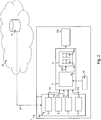
- a system 1 for evaluating performance of a wireless access point 10 in a network 20 comprises a simulated score determining unit 2, an access point parameters collecting unit 3 and a performance determining engine 4.
- the simulated score determining unit 2 determines relation functions 200 for a simulated wireless access point 11 similar to the wireless access point 10, wherein the relation functions 200 correspond to a ratio of a simulated throughput delivered by the simulated wireless access point 11 to a simulated application rate demanded by a user of the simulated wireless access point 11.
- the simulated score determining unit 2 determines a plurality of simulation access point parameters 31 from simulated scenarios or from collected measurements 40 in the network 20.
- the simulated score determining unit 2 simulates a plurality of combinations of the simulation access point parameters 31, determines a throughput for each combination and uses machine learning to determine a mathematical relation between the simulation access point parameters 31 and the throughput delivered by the simulated wireless access point 11, thereby determining relation functions 200 representative for a mathematical relation between the simulation access point parameters 31 and a ratio of the throughput to the application rate.
- the access point parameters collecting unit 3 determines a plurality of access point parameters of the wireless access point 10 in the network 20.
- the performance determining engine 4 uses the relation functions 200 to determine from the access point parameters 30 a wireless score 100 representative of the performance of the wireless access point 10.
- the wireless score 100 corresponds to a ratio of a throughput delivered by the wireless access point 10 to an application rate demanded by a user of the wireless access point 10.
- the access point parameters collecting unit 3 comprises a queue length determining module 5, a retransmission determining module 6, a channel utilization evaluating unit 7 and a channel activity evaluating unit 8.
- the queue length determining module 5 determines a queue length 101 corresponding to a number of non-transmitted data packets available at the wireless access point 10.
- the queue length 101 is determined by calculating an average of access category queue lengths of each access category, wherein each access category corresponds to a class of traffic.
- the retransmission determining module 6 determines a retransmission amount 102 corresponding to a ratio of a number of retransmitted data packets by the wireless access point 10 within a predefined time interval to a number of data packets sent by the wireless access point 10 within the predefined time interval.
- the channel utilization evaluating unit 7 determines a contention ratio 103 corresponding to a busy time fraction of the predefined time interval during which the wireless access point 10 senses a channel as busy.
- the channel activity evaluating unit 7 determines an activity level 104 corresponding to a time fraction of the predefined time interval during which the wireless access point 10 transmits data packets.
- the activity level 104 corresponds to a combination of a transmission rate and a reception rate of the wireless access point 10, a channel bandwidth at the wireless access point 10 and a RTS-CTS configuration at the wireless access point 10 and a total number of transmitted bytes and a total number of received bytes at the wireless access point 10.
- the relation functions 200 comprise one or more trained neural networks.
- the performance determining engine 4 comprises one or more neural networks that determine the wireless score 100 by applying the trained neural networks.
- the relation functions 200 comprise a first intermediate stepwise fitting function 301 and a second intermediate stepwise fitting function 302.
- the performance determining engine 4 determines the wireless score 100 by applying the first intermediate stepwise fitting function 301 and the second intermediate stepwise fitting function 302.
- the wireless score 100 is comprised between 0 and 1, which makes it easy and fast to understand.
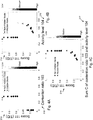
- Fig. 3A illustrates the second intermediate wireless score 112 labelled 211 as a function of the queue length 101 labelled 212 for hidden and non-hidden nodes.
- Fig. 3B illustrates the second intermediate wireless score 112 labelled 211 as a function of the retransmission amount 102 labelled 213 for hidden and non-hidden nodes.
- Fig. 3C illustrates relation between the second intermediate wireless score 112 labelled 211 and the queue length 101 and the retransmission amount 102 for hidden and non-hidden nodes.
- the queue length 101 of each access category indicates the amount of data packets available at the wireless access point and waiting for transmission to the users once the channel is sensed idle.
- the queue length 101 indicates either low traffic and/or low contention, while larger queue indicates high traffic and/or high contention.
- the queue length 101 might be small due to the dropped data packets after exceeding the limit of the retransmission amount 102.
- the score 112 has a high value near 1 when both the retransmission amount 102 and the queue length 101 are low, and the score 112 has a low value near 0 when one of the retransmission amount 102 or the queue length 101 has a high value. From Fig. 3C , one can deduce that the score 112 is exponentially decreasing with the queue length 101 while the degree of decaying depends on the retransmission amount 102.
- Fig. 4A illustrates the first intermediate wireless score 111 labelled 214 as a function of the contention level 103 labelled 215 for hidden and non-hidden nodes.
- Fig. 4B illustrates the first intermediate wireless score 111 labelled 214 as a function of the activity level 104 labelled 216 for hidden and non-hidden nodes.
- Fig. 4C illustrates relation between the first intermediate wireless score 111 labelled 214 and sum of the contention level 103 and the activity level 104 labelled 217 for hidden and non-hidden nodes.
- the buffer queue of each access category depends on the application transmission rate, i.e. back-haul and application server.
- the contention ratio 103 is calculated as the percentage of time, over a certain duration, in which the channel is sensed busy by the wireless access point controlled channel access.
- the contention ratio 103 therefore models the contention at the wireless access point whose low value indicates a higher chance for occupying the medium.
- the activity level 104 indicates the time fraction used by the wireless access point to serve its users arid the activity level 104 is measured as a function of the transmission rate and a reception rate of the wireless access point, a channel bandwidth at the wireless access point and a RTS-CTS configuration at the wireless access point and a total number of transmitted bytes and a total number of received bytes at the wireless access point.
- the transmission rate and a reception rate as well as the channel bandwidth at the wireless access point and a RTS-CTS configuration are used to roughly estimate the throughput of the wireless access point and are then combined with the total number of transmitted bytes and a total number of received bytes at the wireless access point to calculate the activity level 104 of the wireless access point.
- the activity level 104 in essence models the amount of traffic/demand at the wireless access point and thus combining it with the contention ratio 103 indicates whether the wireless access point is able to satisfy all the users of not.
- the first intermediate wireless score 111 labelled 214 is equal to:
- the channel activity evaluating unit determines an activity level corresponding to a time fraction of the predefined time interval during which the wireless access point transmits data packets.
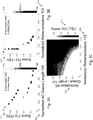
- Fig. 5B compares simulated scores 200 labelled 218 and wireless scores 100 labelled 218 for a home network with 10 wireless access points labelled 220, each wireless access points labelled 220 comprising 2 users.
- the wireless score 100 of Fig. 5B is determined with customized curve fitting.
- Fig. 5B shows how accurate and reliable the determination of the wireless score 100 via remotely accessed access point parameters is.
- Fig. 5C depicts the empirical cumulative distribution function labelled 219 as a function of the absolute mean error Z labelled 221 for wireless scores for a home network with 30 wireless access points.
- the wireless score 100 of Fig. 5C is determined using neural networks in the curve labelled 223, more particularly neural network Bayesian regulation, and using customized curved fitting in the curve labelled 222.
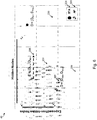
- Fig. 6 schematically illustrates an embodiment of a general scenario 40 used for training in the learning phase.
- This general scenario simulates the two key problems in the Wi-Fi that affect the user satisfaction. These two problems are contention and hidden node between multiple access points.
- This scenario can be used by the simulated score determining unit to train the neural networks or derive the curve fitting relations.
- dots labelled 225 correspond to wireless access points indicated as the dots 0, 1 and 2
- dots labelled 226 correspond to user stations.
- the circle areas labelled 229, 230 and 231 schematically illustrate the wireless coverage region of the wireless access points labelled 225 in the network.
- the expression D labelled 227 correspond to the application rate of the respective user, wherein Dmin corresponds to a minimum application rate and Dmax corresponds to a maximum application rate.
- the arrow labelled 228 schematically indicates that the respective user of the dot labelled 224 moves in the network.
- a wide range of parameters, such as the application rate of the user, the distance from the user to a wireless access point, the position of the wireless access points in a network, etc. are therefore simulated in the general scenario.
- Fig. 7 schematically illustrates the steps of a method according to the present invention for evaluating performance of a wireless access point 10 in a network 20.
- relation functions 200 are determined for a simulated wireless access point 11 similar to the wireless access point 10, the relation functions 200 modelling a mathematical relation between simulation access point parameters 31 of the simulated wireless access point 11 and a ratio of a simulated throughput delivered by the simulated wireless access point 11 to a simulated application rate demanded by a user of the simulated wireless access point 11.
- a plurality of access point parameters 30 of said wireless access point 10 in said network 20 are remotely determined.
- step 506 the relation functions 200 are applied to determine from the access point parameters 30 a wireless score 100 representative of the performance of the wireless access point 10, the wireless score corresponding to a ratio of a throughput delivered by the wireless access point 10 to an application rate demanded by a user of the wireless access point 10.
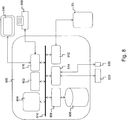
- Fig. 8 shows a suitable computing system 800 for hosting the system 1 of Fig. 2 .
- Computing system 900 may in general be formed as a suitable general purpose computer and comprise a bus 910, a processor 902, a local memory 904, one or more optional input interfaces 914, one or more optional output interfaces 916 a communication interface 912, a storage element interface 506 and one or more storage elements 908.
- Bus 910 may comprise one or more conductors that permit communication among the components of the computing system.
- Processor 902 may include any type of conventional processor or microprocessor that interprets and executes programming instructions.
- Local memory 904 may include a random access memory (RAM) or another type of dynamic storage device that stores information and instructions for execution by processor 902 and/or a read only memory (ROM) or another type of static storage device that stores static information and instructions for use by processor 904.
- Input interface 914 may comprise one or more conventional mechanisms that permit an operator to input information to the computing device 900, such as a keyboard 920, a mouse 930, a pen, voice recognition and/or biometric mechanisms, etc.
- Output interface 916 may comprise one or more conventional mechanisms that output information to the operator, such as a display 940, a printer 950, a speaker, etc.
- Communication interface 912 may comprise any transceiver-like mechanism such as for example two 1Gb Ethernet interfaces that enables computing system 900 to communicate with other devices and/or systems, for example mechanisms for communicating with one or more other computing systems 50.
- the communication interface 912 of computing system 900 may be connected to such another computing system by means of a local area network (LAN) or a wide area network (WAN, such as for example the internet, in which case the other computing system 980 may for example comprise a suitable web server.
- LAN local area network
- WAN wide area network
- the other computing system 980 may for example comprise a suitable web server.
- Storage element interface 906 may comprise a storage interface such as for example a Serial Advanced Technology Attachment (SATA) interface or a Small Computer System Interface (SCSI) for connecting bus 910 to one or more storage elements 908, such as one or more local disks, for example 1TB SATA disk drives, and control the reading and writing of data to and/or from these storage elements 908.
- SATA Serial Advanced Technology Attachment
- SCSI Small Computer System Interface
- the storage elements 908 above is described as a local disk, in general any other suitable computer-readable media such as a removable magnetic disk, optical storage media such as a CD or DVD, -ROM disk, solid state drives, flash memory cards, ... could be used.
- the system 900 described above can also run as a Virtual Machine above the physical hardware.
- the system 1 of Fig. 2 can be implemented as programming instructions stored in local memory 904 of the computing system 900 for execution by its processor 902.
- system 1 of Fig. 2 could be stored on the storage element 908 or be accessible from another computing system 50 through the communication interface 912.
- top, bottom, over, under, and the like are introduced for descriptive purposes and not necessarily to denote relative, positions. It is to be understood that the terms so used are interchangeable under appropriate circumstances and embodiments of the invention are capable of operating according to the present invention in other sequences, or in orientations different from the one(s described or illustrated above.
Landscapes
- Engineering & Computer Science (AREA)
- Computer Networks & Wireless Communication (AREA)
- Signal Processing (AREA)
- Mobile Radio Communication Systems (AREA)
Abstract
- a simulated score determining unit (2) determining relation functions (200) modelling a relation between parameters and a ratio of a throughput to an application demand rate for said simulated wireless access point (11);
- an access point parameters collecting unit (3) remotely determining access point parameters (30) of said wireless access point (10);
- a performance determining engine (4) applying said relation functions (200) to determine from said access point parameters (30) a wireless score (100) representing said performance of said wireless access point (10), said wireless score corresponding to a ratio of a throughput delivered by said wireless access point (10) to an application rate demanded by a user of said wireless access point (10).
Description
- The present invention relates to the field of home network diagnostic and troubleshooting. More particularly, the present invention relates to the field of performance evaluation of managed wireless access points.
- The evaluation of the performance of managed wireless access points in a home network typically relies on the analysis of both the throughput of all associated users of the home network and of their requested demands.
- Typically, in-field speed test measurements are performed by the users or by the operator. Such measurements are described in the scientific publication of A. Vlavianos et al. entitled "Assessing link quality in IEEE 802.11 wireless networks: what is the right metric?" published in the proceedings of the IEEE PIMCR in December 2008, and in the scientific publication of K. H. Kim et al. entitled "WiSlow: a Wi-Fi network performance troubleshooting tool for end users" published in the proceedings of the IEEE INFOCOM in July 2008.
- Although speed test measurements can be done by one or more mobile applications, the manual evaluation of the performance of wireless access points is a burden for both the user and the operator. Indeed, in order to capture different network conditions, in-field speed test measurements must be performed at anticipated locations of users and over long time durations. Additionally, in-field speed test measurements do not account for the application demands of the users and only focus on the physical values that have a direct impact on the throughput, such as for example the received signal strength indication referred to as RSSI and the signal-to-interference-plus-noise ratio referred to as the SINR. In case of high throughput although the demand is higher, focusing on the physical values might result in the indication a false good performance of the access point. On the other hand, a false bad performance might be obtained when the measurements indicate that the throughput is not high although it is sufficient for the low traffic demand.
-
Figure 1 of the patent application illustrates such examples. The graph labelled 201 illustrates the SINR labelled 205 in dB for three wireless access points labelled 206. A first access point has 2 users, for example 2 STAs, a second access point has 3 users, for example 3 STAs, and a third access point has 3 users, for example 3 STAs. The graph labelled 202 illustrates the throughput labelled 208 in Mbps of to each user of the three access points corresponding to the three wireless access points of the graph labelled 201. The measurements of the graphs labelled 201 and 202 were performed for a low traffic load of 2Mbps. If for example the SINR labelled 205 in the graph labelled 201 must be higher than a threshold labelled 209 equal to 50dB to be acceptable for a load of 2Mbps, only one user of the second wireless access point and two users of the third access point demonstrate a SINR larger than 50dB on the graph labelled 201. However, when looking at the throughput of the wireless access points, all the eight users demonstrate a throughput equal to 2Mbps, i.e. all the users demonstrate a throughput which is high enough to cover the traffic load, i.e. a throughput which is enough to satisfy the demand. Focusing on the SINR would in this case therefore result in the indication of a false bad performance while the throughput is high enough to cover the demand. Alternatively, the graph labelled 203 illustrates the RSSI labelled 207 in dB for three wireless access points labelled 206. A first access point has 2 users, for example 2 STAs, a second access point has 3 users, for example 3 STAs, and a third access point has 3 users, for example 3 STAs. The graph labelled 204 illustrates the throughput labelled 208 in Mbps of to each user of the three access points corresponding to the three wireless access points of the graph labelled 203. The measurements of the graphs labelled 203 and 204 were performed for a high traffic load of 5Mbps. If for example the RSSI in the graph labelled 203 must be larger than a threshold labelled 210 equal to -60dB to be acceptable for a load of 5Mbps, two out of the eight users demonstrate a RSSI lower than -60dB on the graph labelled 203. However, when looking at the throughput of the wireless access points, some users which demonstrate a RSSI larger than -60dB demonstrate a throughput lower that 5Mbps, i.e. a throughput which is not high enough to cover the demand. Focusing on the RSSI would in this case therefore result in the indication of a false good performance while the throughput is not high enough to cover the demand._Similarly, some users which demonstrate on the graph labelled 203 a RSSI smaller than -60dB demonstrate a throughout equal to 5Mbps, i.e. a throughput which is enough to cover the demand. Focusing on the RSSI would in this case therefore result in the indication of a false bad performance while the throughput is high enough to cover the demand. - It is an objective to disclose a system and the related method that overcome the above identified shortcomings of existing solutions. More particularly, it is an objective to disclose a system which assesses performance of a wireless access point without relying on measurements collected by a user or an operator, i.e. without user contribution, in a fast and efficient manner. Additionally, it is an objective to disclose a system which avoids unnecessary troubleshooting for wireless access points.
- According to a first aspect of the present invention, the above defined objectives are realized by a system for evaluating performance of a wireless access point in a network, the system comprising:
- a simulated score determining unit configured to determine relation functions for a simulated wireless access point similar to the wireless access point, the relation functions modelling a mathematical relation between simulation access point parameters of the simulated wireless access point and a ratio of a simulated throughput delivered by the simulated wireless access point to a simulated application rate demanded by a user of the simulated wireless access point;
- an access point parameters collecting unit adapted to remotely determine access point parameters of the wireless access point in the network; and
- a performance determining engine configured to apply the relation functions to determine from the access point parameters a wireless score representative of the performance of the wireless access point, the wireless score corresponding to a ratio of a throughput delivered by the wireless access point to an application rate demanded by a user of the wireless access point.
- The system according to the present invention efficiently assesses the performance of a wireless access point of a network as a function of both throughput and demand and without requiring the contribution of a user of the wireless access point. Indeed, the system according to the present invention evaluates the performance quality of a wireless access point as a ratio between throughput and demand determined from remotely accessible access point parameters. Additionally, evaluating the wireless score of the present invention allows the system to accurately detect if a wireless access point suffers from poor performance and if troubleshooting by an operator of the network is required. This saves times and effort when assessing the performance of a wireless access point compared to system which relies on network measurements performed by a user of the wireless access point and/or an operator of the network. The system according to the present invention further prevents unnecessary troubleshooting for wireless access points which demonstrate poor measurements although the demand of users of the wireless access points are satisfied. Finally, the system according to the present invention can be used for proactive optimization of the performance of a wireless access point prior to complaints of a user of the wireless access point.
- A user of a wireless access point is understood as a physical person using the wireless access point. Alternatively, a user of a wireless access point is understood as a user device demanding an application rate to the wireless access point.
- According to an optional aspect of the invention, the access point parameters collecting unit comprises:
- a queue length determining module adapted to determine a queue length corresponding to a number of non-transmitted data packets available at the wireless access point;
- a retransmission determining module adapted to determine a retransmission amount corresponding to a ratio of a number of retransmitted data packets by the wireless access point within a predefined time interval to a number of data packets sent by the wireless access point within the predefined time interval;
- a channel utilization evaluating unit adapted to determine a contention ratio corresponding to a busy time fraction of the predefined time interval during which the wireless access point senses a channel as busy;
- a channel activity evaluating unit adapted to determine an activity level corresponding to a time fraction of the predefined time interval during which the wireless access point transmits data packets.
- The satisfaction of a user of an access point is expressed as a function of both the delivered throughput and the demanded application rate. The wireless score corresponds to a ratio of a throughput delivered by the wireless access point to an application rate demanded by a user of the wireless access point and the wireless score therefore quantifies the performance of the access point and the degree of satisfaction of user of the wireless access point with the delivered wireless service. The wireless score is determined from remotely reported metric values such as the queue length, the retransmission amount, the contention ratio and the activity level. The throughput delivered by the wireless access point depends on two main factors: the contention at the wireless access point and the interference or collision at the side of the user. These two factors can be determined from respectively the contention ratio and the retransmission amount which are both remotely available to the operator. The application rate demanded by a user of the wireless access point can be estimated from the queue length of each access category and the number of transmitted or received bytes and the transmitted or received rates.
- The queue length of each access category indicates the amount of data packets available at the wireless access point and waiting for transmission to the users once the channel is sensed idle. Small queue indicates either low traffic and/or low contention, while larger queue indicates high traffic and/or high contention. In case of collisions, however, the queue length might be small due to the dropped data packets after exceeding the limit of the retransmission amount. Thus, combining the queue length with the retransmission amount will lead to an indicative quality metric for the overall performance of the wireless access point, i.e. a ratio of the throughput delivered by the wireless access point to the application rate demanded by a user of the wireless access point. Therein, the score has a high value near 1 when both the retransmission amount and the queue length are low, and the score has a low value near 0 when one of the retransmission amount or the queue length has a high value.
- The buffer queue of each access category depends on the application transmission rate, i.e. back-haul and application server. This might lead to misleading low scores when the buffer length is high due to the high transmission from the application server to the wireless access point, for example as in video streaming or file download applications. In this case, we have to rely on other parameters to model the contention and the activity level of the wireless access point, in particular on the contention ratio and the activity level. The contention ratio is calculated as the percentage of time, over a certain duration, in which the channel is sensed busy by the wireless access point controlled channel access. The contention ratio therefore models the contention at the wireless access point whole low value indicates a higher chance for occupying the medium. The activity level indicates the time fraction used by the wireless access point to serve its users and the activity level is measured as a function of the transmission rate and a reception rate of the wireless access point, a channel bandwidth at the wireless access point and a RTS-CTS configuration standing for Request To Send-Clear To Send at the wireless access point and a total number of transmitted bytes and a total number of received bytes at the wireless access point. The transmission rate and a reception rate as well as the channel bandwidth at the wireless access point and a RTS-CTS configuration are used to roughly estimate the throughput of the wireless access point and are then combined with the total number of transmitted bytes and a total number of received bytes at the wireless access point to calculate the activity level of the wireless access point. The activity level in essence models the amount of traffic over demand at the wireless access point and thus combining it with the contention ratio indicates whether the wireless access point is able to satisfy all the users or not.
- The retransmission determining module determines a retransmission amount corresponding to a ratio of a number of retransmitted data packets by the wireless access point within a predefined time interval to a number of data packets sent by the wireless access point within the predefined time interval. The retransmission amount is defined in the IEEE 802.11 standard described in the IEEE publication entitled "Wireless LAN Medium Access Control (MAC) and Physical Layer (PHY) Specifications" published in 2012 and reported in the TR181 available at this URL: https://www.broadband-forum.org/cwmp/tr-181-2-9-0.html# for each access point of the network. The retransmission amount is determined using equation (1) defined as R:

- The channel utilization evaluating unit determines a contention ratio corresponding to a busy time fraction of the predefined time interval during which the wireless access point senses a channel as busy. The contention ratio is defined in the IEEE 802.11 standard described in the IEEE publication entitled "Wireless LAN Medium Access Control (MAC) and Physical Layer (PHY) Specifications" published in 2012. The contention ratio is determined using equation (2) defined as U:

- Device. WiFi. Radio, {i}. CCARequest
- Device. WiFi. Radio. {i}. CCAReport
- According to an optional aspect of the invention, the queue length determining module is adapted to determine the queue length by calculating an average of access category queue lengths of each access category, wherein the each access category corresponds to a class of traffic.
- This way, the queue length determining module determines the queue length using the histogram of the queue of each access category that is available in the IEEE 802.11 standard described in the IEEE publication entitled "Wireless LAN Medium Access Control (MAC) and Physical Layer (PHY) Specifications" published in 2012 and reported in the TR181 available at this URL: https://www.broadband-forum.org/cwmp/tr-181-2-9-0.html#. The queue length is determined using equation (3) defined as Q:

- Hi = Device. WiFi. Access. Point. {i}. AC{l}. OutQLenHistogramIntervals
- Hv = Device. WiFi. Access. Point. {i}. AC{l}. Stats. OutQLenHistogram
- t = Device. WiFi. Access. Point, {i}. AC{l}. OutQLenHistogramSampleInterval ⊙ is the dot product between the histogram intervals Hi and their values Hv in order to calculate the average queue size of each access category AC l.
- According to an optional aspect of the invention, the activity level corresponds to a combination of:
- a transmission rate and a reception rate of the wireless access point;
- a channel bandwidth at the wireless access point and a RTS-CTS configuration at the wireless access point; and
- a total number of transmitted bytes and a total number of received bytes at the wireless access point.
- The channel activity evaluating unit determines an activity level corresponding to a time fraction of the predefined time interval during which the wireless access point transmits data packets. The activity level is calculated as function of the following counters to estimate the fraction of time the wireless access point is serving users of the network and is determined using equation (4) defined as A:

- RD [j] = Device. WiFi. Access. Point. {i}. AssociatedDevice. {j}. LastDataDownlinkRate
- RU [j] = Device. WiFi. Access. Point. {i}. AssociatedDevice. {j}. LastDataUplinkRate
- BD [j] = Device. WiFi.Access.Point.{i}.AssociatedDevice.{j}.Stats. BytesSent
- BU [j] = Device. WiFi.Access.Point.{i}.AssociatedDevice. {j}. Stats. BytesReceived
- According to an optional aspect of the invention, the simulated score determining unit is further configured to:
- determine simulation access point parameters from simulated scenarios or from collected measurements in the network;
- simulate a plurality of combinations of said simulation access point parameters;
- determine a throughput for each combination of said simulation access point parameters;
- use machine learning to determine a mathematical relation between the simulation access point parameters and the throughput delivered by the simulated wireless access point, thereby determining the relation functions.
- the simulation access point parameters comprise a queue length, a retransmission amount, a contention ratio and an activity level of the simulated wireless access point. This way, during a learning phase, the simulated score determining unit determines the simulation access point parameters from simulated scenarios or collected measurements with known application rates demanded by a user and the simulated score determining unit measures offline the throughput at different combinations of input simulation access point parameters. The simulated score determining unit relies on a general scenario that can be simulated offline to illustrate a wide range of mathematical relations between the simulation access point parameters and a ratio of the throughput to the application rate, i.e. a wide range of relation functions. The general scenario simulates a wide range of traffic loads and wireless access point-user distances in order to model the mathematical relations in a single wireless access point scenario. Additionally, the general scenario considers contention problems and hidden node problems between multiple wireless access points in order to consider wider range of utilization and retransmissions, respectively. In other words, the system of the present invention uses a standard compliant network simulator to simulate the general scenario. From the simulator, six main parameters are exported: the four input access point parameters and the simulated score corresponding to a ratio of a simulated throughput delivered by the simulated wireless access point to a simulated application rate demanded by a user of the simulated wireless access point. The general scenario simulates the two key problems in the Wi-Fi that affect the user satisfaction. These two problems are contention and hidden node between multiple wireless access points. By changing the locations of users of the wireless access point and/or by changing their demanded application rates, relation functions over a large range of input access point parameters can be determined and applied by the performance determining engine to determine the wireless score.
- According to an optional aspect of the invention, the relation functions comprise trained neural networks and the performance determining engine comprises one or more neural networks configured to determine the wireless score by applying the trained neural networks.
- According to an optional aspect of the invention, the relation functions comprise a first intermediate stepwise fitting function and a second intermediate stepwise fitting function and the performance determining engine is configured to determine the wireless score by applying the first intermediate stepwise fitting function and the second intermediate stepwise fitting function.
- Either neural networks are used to determine the wireless score or customized curve fitting is applied to determine the wireless score. Neural networks are preferred when training data is available at the side of an operator of the network. Otherwise, derived curve fitting can be used to determine the wireless score. An example of a neural network as understood in the present invention is for example the one reference for general implementation described in the publication "An Introduction to Neural Networks" by James A. Anderson published in March 1995. Alternatively, the performance determining engine comprises any supervised learning technique to determine the wireless score.
- According to an optional aspect of the invention, the performance determining engine is further configured to:
- apply said first intermediate stepwise fitting function as a function of the access point parameters such that a first intermediate wireless score is determined from the first intermediate stepwise fitting function and is equal to:
- ∘ a maximum ratio of the throughput to the application rate when the retransmission amount is lower than a first predefined threshold and a sum of the activity level and the contention ratio is lower than a second predefined threshold; or
- ∘ when the retransmission amount is larger than a first predefined threshold and the sum of the activity level and the contention ratio is comprised between a third predefined threshold and a fourth predefined threshold, a product of a first coefficient and a second coefficient at power the sum of the activity level and the contention ratio, wherein the first coefficient and the second coefficient are calculated such that a mean square error between the simulated score and the first intermediate wireless score is minimized;
- apply said second intermediate stepwise fitting function as a function of the access point parameters such that a second intermediate wireless score is determined from the second intermediate stepwise fitting function and is equal to a ratio of an exponential of a product of the opposite of a third coefficient and the queue length to a difference between a fourth coefficient and the retransmission amount, wherein the third coefficient and the fourth coefficient are calculated such that a mean square error between the simulated score and the second intermediate wireless score is minimized;
- a maximum ratio of the throughput to the application rate when the retransmission amount is lower than a first predefined threshold and the sum of the activity level and the contention ratio is lower than a second predefined threshold; or
- when the retransmission amount is larger than a first predefined threshold and the sum of the activity level and the contention ratio is comprised between a third predefined threshold and a fourth predefined threshold, a maximum between the second intermediate wireless score and the product of the first coefficient and the second coefficient at power the sum of the activity level and the contention ratio; or
- the second intermediate wireless score.
- This way, the wireless score is a combination of two intermediate wireless scores. The first intermediate wireless score is based on the contention ratio, the activity level and the retransmission amount labelled R of equation (1). A sum labelled C of the activity level A of equation (4) and the contention ratio U of equation (2) is defined and the first intermediate wireless score labelled S 1 is obtained as follows in equation (5):


The first coefficient x and the second coefficient y are calculated such that the mean square error between the simulated score from the learning phase and the first intermediate wireless score is minimized. - It can be noted that the first intermediate wireless score S 1 is insufficient due to the undefined values in a certain region where the first intermediate score decreases while none of the access point parameters are changing. This is avoided by the determination of a second intermediate wireless score S 2. A throughput over demand ratio is exponentially decreasing with the queue length labelled Q of equation (3) while the degree of decaying depends on the retransmission amount labelled R of equation (1). The second intermediate wireless score labelled S 2 is therefore obtained as follows in equation (7):

The third coefficient a and the fourth coefficient b are calculated such that the mean square error between the simulated score from the learning phase and the second intermediate wireless score is minimized., - The wireless score is finally determined by defining a final scoring function which is a combination of the first intermediate wireless score and the second intermediate wireless score as follows in equation (8):

- According to an optional aspect of the invention, the wireless score is comprised between 0 and 1.
- This way, the first intermediate wireless score determined from the first intermediate stepwise fitting function is equal to 1 when the retransmission amount is lower than a first predefined threshold and a sum of the activity level and the contention ratio is lower than a second predefined threshold. Additionally, the wireless score is equal to 1 when the retransmission amount is lower than a first predefined threshold and the sum of the activity level and the contention ratio is lower than a second predefined threshold.
- According to a second aspect of the invention, there is provided a method for evaluating performance of a wireless access point in a network, the method comprising the steps of:
- determining relation functions for a simulated wireless access point similar to the wireless access point, the relation functions modelling a mathematical relation between simulation access point parameters of the simulated wireless access point and a ratio of a simulated throughput delivered by the simulated wireless access point to a simulated application rate demanded by a user of the simulated wireless access point;
- remotely determining access point parameters of the wireless access point in the network; and
- applying the relation functions to determine from the access point parameters a wireless score representative of the performance of the wireless access point, the wireless score corresponding to a ratio of a throughput delivered by the wireless access point to an application rate demanded by a user of the wireless access point.
- The method according to the present invention efficiently assesses the performance of a wireless access point of a network as a function of both throughput and demand and without requiring the contribution of a user of the wireless access point. Indeed, the method according to the present invention evaluates the performance quality of a wireless access point as a ratio between throughput and demand determined from remotely accessible access point parameters. Additionally, evaluating the wireless score of the present invention allows to accurately detect if a wireless access point suffers from poor performance and if troubleshooting by an operator of the network is required. This saves times and effort when assessing the performance of a wireless access point compared to system which relies on network measurements performed by a user of the wireless access point and/or an operator of the network. The method according to the present invention further prevents unnecessary troubleshooting for wireless access points which demonstrate poor measurements although the demand of users of the wireless access points are satisfied. Finally, the method according to the present invention can be used for proactive optimization of the performance of a wireless access point prior to complaints of a user of the wireless access point.
- The current invention in addition also relates to a computer program comprising software code adapted to perform the method according to the present invention.
- The invention further relates to a computer readable storage medium comprising the computer program according to the present invention.
-
-
Fig. 1 schematically illustrates the limitations of existing measurement and non-demand based access point evaluating techniques. -
Fig. 2 schematically illustrates an embodiment of a system according to the present invention. -
Figs. 3A-3C schematically illustrates an embodiment of the relation between a wireless access point quality metric and both the retransmission amount and the queue length. -
Figs. 4A-4C schematically illustrates an embodiment of a use of the contention ratio and the activity level of a wireless access point to model the wireless access point quality score. -
Fig. 5A schematically illustrates an embodiment of a mapping of maximum theoretical transmission rates to their practical throughputs.Fig. 5B schematically illustrates scores for a home scenario comprising 10 wireless access points using custom curve fitting.Fig. 5C schematically illustrates the distribution of absolute mean error for the calculated score for a home scenario comprising 30 wireless access points using neural networks and custom curve fitting. -
Fig. 6 schematically illustrates an embodiment of a general scenario used for training in the learning phase. -
Fig. 7 schematically illustrates an embodiment of the steps of the method according to the present invention. -
Fig. 8 schematically illustrates a suitable computing system for hosting the system ofFig. 2 . - According to an embodiment shown in
Fig. 2 , asystem 1 for evaluating performance of awireless access point 10 in anetwork 20 comprises a simulatedscore determining unit 2, an access pointparameters collecting unit 3 and aperformance determining engine 4. The simulatedscore determining unit 2 determines relation functions 200 for a simulatedwireless access point 11 similar to thewireless access point 10, wherein the relation functions 200 correspond to a ratio of a simulated throughput delivered by the simulatedwireless access point 11 to a simulated application rate demanded by a user of the simulatedwireless access point 11. The simulatedscore determining unit 2 determines a plurality of simulation access point parameters 31 from simulated scenarios or from collectedmeasurements 40 in thenetwork 20. The simulatedscore determining unit 2 simulates a plurality of combinations of the simulation access point parameters 31, determines a throughput for each combination and uses machine learning to determine a mathematical relation between the simulation access point parameters 31 and the throughput delivered by the simulatedwireless access point 11, thereby determining relation functions 200 representative for a mathematical relation between the simulation access point parameters 31 and a ratio of the throughput to the application rate. The access pointparameters collecting unit 3 determines a plurality of access point parameters of thewireless access point 10 in thenetwork 20. Theperformance determining engine 4 uses the relation functions 200 to determine from the access point parameters 30 awireless score 100 representative of the performance of thewireless access point 10. Thewireless score 100 corresponds to a ratio of a throughput delivered by thewireless access point 10 to an application rate demanded by a user of thewireless access point 10. The access pointparameters collecting unit 3 comprises a queuelength determining module 5, aretransmission determining module 6, a channel utilization evaluating unit 7 and a channelactivity evaluating unit 8. The queuelength determining module 5 determines aqueue length 101 corresponding to a number of non-transmitted data packets available at thewireless access point 10. Thequeue length 101 is determined by calculating an average of access category queue lengths of each access category, wherein each access category corresponds to a class of traffic. Theretransmission determining module 6 determines aretransmission amount 102 corresponding to a ratio of a number of retransmitted data packets by thewireless access point 10 within a predefined time interval to a number of data packets sent by thewireless access point 10 within the predefined time interval. The channel utilization evaluating unit 7 determines acontention ratio 103 corresponding to a busy time fraction of the predefined time interval during which thewireless access point 10 senses a channel as busy. The channel activity evaluating unit 7 determines anactivity level 104 corresponding to a time fraction of the predefined time interval during which thewireless access point 10 transmits data packets. Theactivity level 104 corresponds to a combination of a transmission rate and a reception rate of thewireless access point 10, a channel bandwidth at thewireless access point 10 and a RTS-CTS configuration at thewireless access point 10 and a total number of transmitted bytes and a total number of received bytes at thewireless access point 10. The relation functions 200 comprise one or more trained neural networks. Theperformance determining engine 4 comprises one or more neural networks that determine thewireless score 100 by applying the trained neural networks. According to an alternative embodiment, the relation functions 200 comprise a first intermediate stepwisefitting function 301 and a second intermediate stepwisefitting function 302. Theperformance determining engine 4 then determines thewireless score 100 by applying the first intermediate stepwisefitting function 301 and the second intermediate stepwisefitting function 302. Thewireless score 100 is comprised between 0 and 1, which makes it easy and fast to understand. The performance determining engine 4: - applies the first intermediate stepwise
fitting function 301 as a function of theaccess point parameters 30 such that a firstintermediate wireless score 111 is determined from the first intermediate stepwisefitting function 301 and is equal to:- ∘ a maximum ratio of a throughput to application rate, for example 1, when the
retransmission amount 102 is lower than a first predefined threshold and a sum of theactivity level 104 and thecontention ratio 103 is lower than a second predefined threshold; or - ∘ when the
retransmission amount 102 is larger than a first predefined threshold and the sum of theactivity level 104 and thecontention ratio 103 is comprised between a third predefined threshold and a fourth predefined threshold, a product of a first coefficient and a second coefficient at power the sum of theactivity level 104 and thecontention ratio 103, wherein the first coefficient and the second coefficient are calculated such that a mean square error between thesimulated score 200 and the firstintermediate wireless score 111 is minimized;
- ∘ a maximum ratio of a throughput to application rate, for example 1, when the
- applies the second intermediate stepwise
fitting function 302 as a function of theaccess point parameters 30 such that a secondintermediate wireless score 112 is determined from the second intermediate stepwisefitting function 302 and is equal to a ratio of an exponential of a product of the opposite of a third coefficient and thequeue length 101 to a difference between a fourth coefficient and theretransmission amount 102, wherein the third coefficient and the fourth coefficient are calculated such that a mean square error between thesimulated score 200 and the secondintermediate wireless score 112 is minimized; and determines thewireless score 100 as equal to: - a maximum ratio of a throughput to application rate, for example 1, when the
retransmission amount 102 is lower than a first predefined threshold and the sum of theactivity level 104 and thecontention ratio 103 is lower than a second predefined threshold; or - when the
retransmission amount 102 is larger than a first predefined threshold and the sum of theactivity level 104 and thecontention ratio 103 is comprised between a third predefined threshold and a fourth predefined threshold, a maximum between the secondintermediate wireless score 112 and the product of the first coefficient and the second coefficient at power the sum of theactivity level 104 and thecontention ratio 103; or - the second
intermediate wireless score 112. - According to an embodiment shown in
Figs. 3A-3C, Fig. 3A illustrates the secondintermediate wireless score 112 labelled 211 as a function of thequeue length 101 labelled 212 for hidden and non-hidden nodes.Fig. 3B illustrates the secondintermediate wireless score 112 labelled 211 as a function of theretransmission amount 102 labelled 213 for hidden and non-hidden nodes.Fig. 3C illustrates relation between the secondintermediate wireless score 112 labelled 211 and thequeue length 101 and theretransmission amount 102 for hidden and non-hidden nodes. Thequeue length 101 of each access category indicates the amount of data packets available at the wireless access point and waiting for transmission to the users once the channel is sensed idle. Small queue indicates either low traffic and/or low contention, while larger queue indicates high traffic and/or high contention. In case of collisions, however, thequeue length 101 might be small due to the dropped data packets after exceeding the limit of theretransmission amount 102. Thus, combining thequeue length 101 with theretransmission amount 102 will lead to an indicative quality metric for the overall performance of the wireless access point as illustrated inFig. 3C . Therein, thescore 112 has a high value near 1 when both theretransmission amount 102 and thequeue length 101 are low, and thescore 112 has a low value near 0 when one of theretransmission amount 102 or thequeue length 101 has a high value. FromFig. 3C , one can deduce that thescore 112 is exponentially decreasing with thequeue length 101 while the degree of decaying depends on theretransmission amount 102. - According to an embodiment shown in
Figs. 4A-4C, Fig. 4A illustrates the firstintermediate wireless score 111 labelled 214 as a function of thecontention level 103 labelled 215 for hidden and non-hidden nodes.Fig. 4B illustrates the firstintermediate wireless score 111 labelled 214 as a function of theactivity level 104 labelled 216 for hidden and non-hidden nodes.Fig. 4C illustrates relation between the firstintermediate wireless score 111 labelled 214 and sum of thecontention level 103 and theactivity level 104 labelled 217 for hidden and non-hidden nodes. The buffer queue of each access category depends on the application transmission rate, i.e. back-haul and application server. This might lead to misleading low scores when the buffer length is high due to the high transmission from the application server to the wireless access point, for example as in video streaming or file download applications. In this case, we have to rely on other parameters to model the contention and the activity level of the wireless access point, in particular on thecontention ratio 103 and theactivity level 104. Thecontention ratio 103 is calculated as the percentage of time, over a certain duration, in which the channel is sensed busy by the wireless access point controlled channel access. Thecontention ratio 103 therefore models the contention at the wireless access point whose low value indicates a higher chance for occupying the medium. Theactivity level 104 indicates the time fraction used by the wireless access point to serve its users arid theactivity level 104 is measured as a function of the transmission rate and a reception rate of the wireless access point, a channel bandwidth at the wireless access point and a RTS-CTS configuration at the wireless access point and a total number of transmitted bytes and a total number of received bytes at the wireless access point. The transmission rate and a reception rate as well as the channel bandwidth at the wireless access point and a RTS-CTS configuration are used to roughly estimate the throughput of the wireless access point and are then combined with the total number of transmitted bytes and a total number of received bytes at the wireless access point to calculate theactivity level 104 of the wireless access point. Theactivity level 104 in essence models the amount of traffic/demand at the wireless access point and thus combining it with thecontention ratio 103 indicates whether the wireless access point is able to satisfy all the users of not. - According to the embodiments shown in
Figs. 3A-3C andFigs. 4A-4C , the firstintermediate wireless score 111 labelled 214 is equal to: - 1 when the
retransmission amount 102 is lower than 0.15 and a sum of theactivity level 104 and thecontention ratio 103 is lower than 0.6; or - when the
retransmission amount 102 is larger than 0.15 and the sum of theactivity level 104 and thecontention ratio 103 is comprised between 0.5 and 0.75, a product of a first coefficient and a second coefficient at power the sum of theactivity level 104 and thecontention ratio 103, wherein the first coefficient and the second coefficient are calculated such that a mean square error between thesimulated score 200 and the firstintermediate wireless score 111 is minimized. - 1 when the
retransmission amount 102 is lower than 0.15 and the sum of theactivity level 104 and thecontention ratio 103 is lower than 0.6; or - when the
retransmission amount 102 is larger than 0.15 and the sum of theactivity level 104 and thecontention ratio 103 is comprised between 0.5 and 0.75, a maximum between the secondintermediate wireless score 112 and the product of the first coefficient and the second coefficient at power the sum of theactivity level 104 and thecontention ratio 103; or - the second
intermediate wireless score 112. - According to an embodiment shown in
Fig. 5A , the channel activity evaluating unit determines an activity level corresponding to a time fraction of the predefined time interval during which the wireless access point transmits data packets. The activity level is calculated as function of the following counters to estimate the fraction of time the wireless access point is serving users of the network and is determined using equation (4) defined as A:
- RD [j] = Device. WiFi. Access. Point.{i}. AssociatedDevice. {j}. LastDataDownlinkRate
- RU [j] = Device. WiFi. Access. Point. {i}. AssociatedDevice. {j}. LastDataUplinkRate
- BD [j] = Device. WiFi. Access. Point. {i}. AssociatedDevice. {j}.Stats. BytesSent
- BU [j] = Device. WiFi. Access. Point. {i}. AssociatedDevice. {j}. Stats. BytesReceived
-
Fig. 5B comparessimulated scores 200 labelled 218 andwireless scores 100 labelled 218 for a home network with 10 wireless access points labelled 220, each wireless access points labelled 220 comprising 2 users. Thewireless score 100 ofFig. 5B is determined with customized curve fitting.Fig. 5B shows how accurate and reliable the determination of thewireless score 100 via remotely accessed access point parameters is.Fig. 5C depicts the empirical cumulative distribution function labelled 219 as a function of the absolute mean error Z labelled 221 for wireless scores for a home network with 30 wireless access points. Thewireless score 100 ofFig. 5C is determined using neural networks in the curve labelled 223, more particularly neural network Bayesian regulation, and using customized curved fitting in the curve labelled 222. -
Fig. 6 schematically illustrates an embodiment of ageneral scenario 40 used for training in the learning phase. This general scenario simulates the two key problems in the Wi-Fi that affect the user satisfaction. These two problems are contention and hidden node between multiple access points. By changing the users location and/or their application rates, i.e. demand, a wide range of the input parameters, e.g. retransmission, activity, etc. can be achieved by the simulated users, and thus a wide range of output score can be observed. This scenario can be used by the simulated score determining unit to train the neural networks or derive the curve fitting relations. OnFig. 6 , dots labelled 225 correspond to wireless access points indicated as thedots -
Fig. 7 schematically illustrates the steps of a method according to the present invention for evaluating performance of awireless access point 10 in anetwork 20. Instep 504, relation functions 200 are determined for a simulatedwireless access point 11 similar to thewireless access point 10, the relation functions 200 modelling a mathematical relation between simulation access point parameters 31 of the simulatedwireless access point 11 and a ratio of a simulated throughput delivered by the simulatedwireless access point 11 to a simulated application rate demanded by a user of the simulatedwireless access point 11. Inconsequent step 505, a plurality ofaccess point parameters 30 of saidwireless access point 10 in saidnetwork 20 are remotely determined. Finally, instep 506, the relation functions 200 are applied to determine from the access point parameters 30 awireless score 100 representative of the performance of thewireless access point 10, the wireless score corresponding to a ratio of a throughput delivered by thewireless access point 10 to an application rate demanded by a user of thewireless access point 10. -
Fig. 8 shows a suitable computing system 800 for hosting thesystem 1 ofFig. 2 .Computing system 900 may in general be formed as a suitable general purpose computer and comprise abus 910, aprocessor 902, alocal memory 904, one or more optional input interfaces 914, one or more optional output interfaces 916 acommunication interface 912, astorage element interface 506 and one ormore storage elements 908.Bus 910 may comprise one or more conductors that permit communication among the components of the computing system.Processor 902 may include any type of conventional processor or microprocessor that interprets and executes programming instructions.Local memory 904 may include a random access memory (RAM) or another type of dynamic storage device that stores information and instructions for execution byprocessor 902 and/or a read only memory (ROM) or another type of static storage device that stores static information and instructions for use byprocessor 904.Input interface 914 may comprise one or more conventional mechanisms that permit an operator to input information to thecomputing device 900, such as akeyboard 920, amouse 930, a pen, voice recognition and/or biometric mechanisms, etc.Output interface 916 may comprise one or more conventional mechanisms that output information to the operator, such as adisplay 940, aprinter 950, a speaker, etc.Communication interface 912 may comprise any transceiver-like mechanism such as for example two 1Gb Ethernet interfaces that enablescomputing system 900 to communicate with other devices and/or systems, for example mechanisms for communicating with one or moreother computing systems 50. Thecommunication interface 912 ofcomputing system 900 may be connected to such another computing system by means of a local area network (LAN) or a wide area network (WAN, such as for example the internet, in which case the other computing system 980 may for example comprise a suitable web server.Storage element interface 906 may comprise a storage interface such as for example a Serial Advanced Technology Attachment (SATA) interface or a Small Computer System Interface (SCSI) for connectingbus 910 to one ormore storage elements 908, such as one or more local disks, for example 1TB SATA disk drives, and control the reading and writing of data to and/or from thesestorage elements 908. Although thestorage elements 908 above is described as a local disk, in general any other suitable computer-readable media such as a removable magnetic disk, optical storage media such as a CD or DVD, -ROM disk, solid state drives, flash memory cards, ... could be used. Thesystem 900 described above can also run as a Virtual Machine above the physical hardware. - The
system 1 ofFig. 2 can be implemented as programming instructions stored inlocal memory 904 of thecomputing system 900 for execution by itsprocessor 902. Alternativelysystem 1 ofFig. 2 could be stored on thestorage element 908 or be accessible from anothercomputing system 50 through thecommunication interface 912. - Although the present invention has been illustrated by reference to specific embodiments, it will be apparent to those skilled in the art that the invention is not limited to the details of the foregoing illustrative embodiments, and that the present invention may be embodied with various changes and modifications without departing from the scope thereof. The present embodiments are therefore to be considered in all respects as illustrative and not restrictive, the scope of the invention being indicated by the appended claims rather than by the foregoing description, and all changes which come within the meaning and range of equivalency of the claims are therefore intended to be embraced therein. In other words, it is contemplated to cover any and all modifications, variations or equivalents that fall within the scope of the basic underlying principles and whose essential attributes are claimed in this patent application. It will furthermore be understood by the reader of this patent application that the words "comprising" or "comprise" do not exclude other elements or steps, that the words "a" or "an" do not exclude a plurality, and that a single element, such as a computer system, a processor, or another integrated unit may fulfil the functions of several means recited in the claims. Any reference signs in the claims shall not be construed as limiting the respective claims concerned. The terms "first", "second", third", "a", "b", "c", and the like, when used in the description or in the claims are introduced to distinguish between similar elements or steps and are not necessarily describing a sequential or chronological order. Similarly, the terms "top", "bottom", "over", "under", and the like are introduced for descriptive purposes and not necessarily to denote relative, positions. It is to be understood that the terms so used are interchangeable under appropriate circumstances and embodiments of the invention are capable of operating according to the present invention in other sequences, or in orientations different from the one(s described or illustrated above.
E is the parameter used to map the reported theoretical data rates RD and RU to the practical values rates R'D and R'U that are lower due to the overheads such as for example acknowledgements and Inter Frame Spacing referred to as IFS and to the network configuration such as for example whether Request To Send referred to as RTS or Clear To Send referred to as CTS is enabled. Using measurements or standard compliant simulators, a mapping of the maximum theoretical transmission rates to their practical throughputs can be tabled. Table I of
Claims (12)
- A system (1) for evaluating performance of a wireless access point (10) in a network (20), said system (1) comprising:- a simulated score determining unit (2) configured to determine relation functions (200) for a simulated wireless access point (11) similar to said wireless access point (10), said relation functions (200) modelling a mathematical relation between simulation access point parameters (31) of said simulated wireless access point (11) and a ratio of a simulated throughput delivered by said simulated wireless access point (11) to a simulated application rate demanded by a user of said simulated wireless access point (11);- an access point parameters collecting unit (3) adapted to remotely determine access point parameters (30) of said wireless access point (10) in said network (20); and- a performance determining engine (4) configured to apply said relation functions (200) to determine from said access point parameters (30) a wireless score (100) representative of said performance of said wireless access point (10), said wireless score corresponding to a ratio of a throughput delivered by said wireless access point (10) to an application rate demanded by a user of said wireless access point (10).
- A system (1) according to claim 1, wherein said access point parameters collecting unit (3) comprises:- a queue length determining module (5) adapted to determine a queue length (101) corresponding to a number of non-transmitted data packets available at said wireless access point (10);- a retransmission determining module (6) adapted to determine a retransmission amount (102) corresponding to a ratio of a number of retransmitted data packets by said wireless access point (10) within a predefined time interval to a number of data packets sent by said wireless access point (10) within said predefined time interval;- a channel utilization evaluating unit (7) adapted to determine a contention ratio (103) corresponding to a busy time fraction of said predefined time interval during which said wireless access point (10) senses a channel as busy; and- a channel activity evaluating unit (8) adapted to determine an activity level (104) corresponding to a time fraction of said predefined time interval during which said wireless access point (10) transmits data packets.
- A system (1) according to claim 2, wherein said queue length determining module (5) is adapted to determine said queue length (101) by calculating an average of access category queue lengths of each access category, wherein said each access category corresponds to a class of traffic.
- A system (1) according to claim 2, wherein said activity level (104) corresponds to a combination of:- a transmission rate and a reception rate of said wireless access point (10);- a channel bandwidth at said wireless access point (10) and a RTS-CTS configuration at said wireless access point (10); and- a total number of transmitted bytes and a total number of received bytes at said wireless access point (10).
- A system (1) according to claim 2, wherein said simulated score determining unit (2) is further configured to:- determine simulation access point parameters (31) from simulated scenarios or from collected measurements in said network (20);- simulate a plurality of combinations of said simulation access point parameters (31);- determine a throughput for each combination of said simulation access point parameters (31);- use machine learning to determine a mathematical relation between said simulation access point parameters (31) and said throughput delivered by said simulated wireless access point (11), thereby determining said relation functions (200).
- A system.(1) according to claim 1, wherein said relation functions (200) comprise trained neural networks and wherein said performance determining engine (4) comprises one or more neural networks configured to determine said wireless score (100) by applying said trained neural networks.
- A system (1) according to claim 2 wherein relation functions (200) comprise a first intermediate stepwise fitting function (301) and a second intermediate stepwise fitting function (302) and wherein said performance determining engine (4) is configured to determine said wireless score (100) by applying said first intermediate stepwise fitting function (301) and said second intermediate stepwise fitting function (302).
- A system (1) of claim 7 wherein said performance determining engine (4) is further configured to:- apply said first intermediate stepwise fitting function (301) as a function of said access point parameters (30) such that a first intermediate wireless score (111) is determined from said first intermediate stepwise fitting function (301) and is equal to:∘ a maximum ratio of the throughput to the application rate when said retransmission amount (102) is lower than a first predefined threshold and a sum of said activity level (104) and said contention ratio (103) is lower than a second predefined threshold; or∘ when said retransmission amount (102) is larger than a first predefined threshold and said sum of said activity level (104) and said contention ratio (103) is comprised between a third predefined threshold and a fourth predefined threshold, a product of a first coefficient and a second coefficient at power said sum of said activity level (104) and said contention ratio (103), wherein said first coefficient and said second coefficient are calculated such that a mean square error between said simulated score (200) and said first intermediate wireless score (111) is minimized;- apply said second intermediate stepwise fitting function (302) as a function of said access point parameters (30) such that a second intermediate wireless score (112) is determined from said second intermediate stepwise fitting function (302) and is equal to a ratio of an exponential of a product of the opposite of a third coefficient and said queue length (101) to a difference between a fourth coefficient and said retransmission amount (102), wherein said third coefficient and said fourth coefficient are calculated such that a mean square error between said simulated score (200) and said second intermediate wireless score (112) is minimized;and wherein said performance determining engine (4) is further configured to determine said wireless score (100) as equal to:- a maximum ratio of the throughput to the application rate when said retransmission amount (102) is lower than a first predefined threshold and said sum of said activity level (104) and said contention ratio (103) is lower than a second predefined threshold; or- when said retransmission amount (102) is larger than a first predefined threshold and said sum of said activity level (104) and said contention ratio (103) is comprised between a third predefined threshold and a fourth predefined threshold, a maximum between said second intermediate wireless score (112) and said product of said first coefficient and said second coefficient at power said sum of said activity level (104) and said contention ratio (103); or- said second intermediate wireless score (112).
- A system (1) according to claim 1, wherein said wireless score (100) is comprised between 0 and 1.
- A method for evaluating performance of a wireless access point (10) in a network (20), said method comprising the steps of:- determining relation functions (200) for a simulated wireless access point (11) similar to said wireless access point (10), said relation functions (200) modelling a mathematical relation between simulation access point parameters (31) of said simulated wireless access point (11) and a ratio of a simulated throughput delivered by said simulated wireless access point (11) to a simulated application rate demanded by a user of said simulated wireless access point (11);- remotely determining access point parameters (30) of said wireless access point (10) in said network (20); and- applying said relation functions (200) to determine from said access point parameters (30) a wireless score (100) representative of said performance of said wireless access point (10), said wireless score corresponding to a ratio of a throughput delivered by said wireless access point (10) to an application rate demanded by a user of said wireless access point (10).
- A computer program comprising software code adapted to perform the method according to claim 10.
- A computer readable storage medium comprising computer-executable instructions which, when executed by a computing system, perform a method according to claim 10.
Priority Applications (2)
| Application Number | Priority Date | Filing Date | Title |
|---|---|---|---|
| EP16290235.7A EP3337220B1 (en) | 2016-12-15 | 2016-12-15 | A system for evaluating performance of a wireless access point |
| PCT/EP2017/082303 WO2018108852A1 (en) | 2016-12-15 | 2017-12-12 | A system for evaluating performance of a wireless access point |
Applications Claiming Priority (1)
| Application Number | Priority Date | Filing Date | Title |
|---|---|---|---|
| EP16290235.7A EP3337220B1 (en) | 2016-12-15 | 2016-12-15 | A system for evaluating performance of a wireless access point |
Publications (2)
| Publication Number | Publication Date |
|---|---|
| EP3337220A1 true EP3337220A1 (en) | 2018-06-20 |
| EP3337220B1 EP3337220B1 (en) | 2019-07-24 |
Family
ID=57799504
Family Applications (1)
| Application Number | Title | Priority Date | Filing Date |
|---|---|---|---|
| EP16290235.7A Not-in-force EP3337220B1 (en) | 2016-12-15 | 2016-12-15 | A system for evaluating performance of a wireless access point |
Country Status (2)
| Country | Link |
|---|---|
| EP (1) | EP3337220B1 (en) |
| WO (1) | WO2018108852A1 (en) |
Cited By (1)
| Publication number | Priority date | Publication date | Assignee | Title |
|---|---|---|---|---|
| US20220408263A1 (en) * | 2019-11-28 | 2022-12-22 | Paxton Access Limited | Access control system and method |
Families Citing this family (2)
| Publication number | Priority date | Publication date | Assignee | Title |
|---|---|---|---|---|
| CN112584416B (en) * | 2020-11-27 | 2022-09-02 | 中国联合网络通信集团有限公司 | Method and device for evaluating number of accessible users |
| CN116546546B (en) * | 2023-05-16 | 2026-04-03 | 深圳友讯达科技股份有限公司 | A method for evaluating the load capacity of multi-hop dual-mode communication networks |
Citations (3)
| Publication number | Priority date | Publication date | Assignee | Title |
|---|---|---|---|---|
| US20100165958A1 (en) * | 2008-12-30 | 2010-07-01 | Symbol Technologies, Inc. | System and method for facilitating fair association of client devices with access points in a wireless communication system |
| EP2852204A1 (en) * | 2013-09-20 | 2015-03-25 | Alcatel Lucent | Methods and computer programs for determining information related to a performance of a base station transceiver |
| EP2947910A2 (en) * | 2014-05-23 | 2015-11-25 | Accenture Global Services Limited | Performance optimizations for wireless access points |
-
2016
- 2016-12-15 EP EP16290235.7A patent/EP3337220B1/en not_active Not-in-force
-
2017
- 2017-12-12 WO PCT/EP2017/082303 patent/WO2018108852A1/en not_active Ceased
Patent Citations (3)
| Publication number | Priority date | Publication date | Assignee | Title |
|---|---|---|---|---|
| US20100165958A1 (en) * | 2008-12-30 | 2010-07-01 | Symbol Technologies, Inc. | System and method for facilitating fair association of client devices with access points in a wireless communication system |
| EP2852204A1 (en) * | 2013-09-20 | 2015-03-25 | Alcatel Lucent | Methods and computer programs for determining information related to a performance of a base station transceiver |
| EP2947910A2 (en) * | 2014-05-23 | 2015-11-25 | Accenture Global Services Limited | Performance optimizations for wireless access points |
Non-Patent Citations (2)
| Title |
|---|
| A. VLAVIANOS ET AL.: "Assessing link quality in IEEE 802.11 wireless networks: what is the right metric?", PROCEEDINGS OF THE IEEE PIMCR, December 2008 (2008-12-01) |
| K. H. KIM ET AL.: "WiSlow: a Wi-Fi network performance troubleshooting tool for end users", PROCEEDINGS OF THE IEEE INFOCOM, July 2008 (2008-07-01) |
Cited By (1)
| Publication number | Priority date | Publication date | Assignee | Title |
|---|---|---|---|---|
| US20220408263A1 (en) * | 2019-11-28 | 2022-12-22 | Paxton Access Limited | Access control system and method |
Also Published As
| Publication number | Publication date |
|---|---|
| EP3337220B1 (en) | 2019-07-24 |
| WO2018108852A1 (en) | 2018-06-21 |
Similar Documents
| Publication | Publication Date | Title |
|---|---|---|
| Bakri et al. | Data-driven RAN slicing mechanisms for 5G and beyond | |
| CN109862590B (en) | Network capacity evaluation method and device | |
| CN103581984B (en) | WLAN eats dishes without rice or wine quality monitoring method and device | |
| CN113595664B (en) | A Spectrum Sensing Method for Multi-user Broadband Communication System Based on Deep Learning | |
| US20190312791A1 (en) | Method and system for automating assessment of network quality of experience | |
| US8045471B2 (en) | Method and apparatus to inspect wireless traffic and mitigate packet elimination for wireless saturation avoidance | |
| EP3337220B1 (en) | A system for evaluating performance of a wireless access point | |
| US11134409B2 (en) | Determining whether a flow is to be added to a network | |
| WO2013026350A1 (en) | Method and device for assessing system performance | |
| JP2023537119A (en) | Network data analysis method, network data analysis function network element, communication system, non-transitory computer readable storage medium and computer program | |
| WO2025001067A1 (en) | Adaptive video transmission method and apparatus, electronic device, and storage medium | |
| Pan et al. | Mac revivo: Artificial intelligence paves the way | |
| CN112654063B (en) | Uplink capacity assessment method and device | |
| CN104486806A (en) | Carrying efficiency-based heterogeneous network combined carrying method and device | |
| EP4622333A1 (en) | Link determination method, apparatus, electronic device, and storage medium | |
| EP4496380A1 (en) | Communication apparatus and method | |
| CN118317361A (en) | Resource request control method and device for Internet of Vehicles | |
| CN112752291B (en) | Method and device for evaluating uplink rate | |
| CN109479212A (en) | Manage media access for access points and associated devices in a wireless network | |
| KR20230156630A (en) | Method and electronic apparatus for determining scheduling priority of a terminal | |
| Torabi et al. | Wi-Fi aware radio resource management in 5G NR-U: a learning-based coexistence scheme for C-V2X | |
| CN114760639A (en) | Resource unit allocation method, device, equipment and storage medium | |
| US7386315B2 (en) | Method for scaling the radio interface for GPRS traffic and mixed GPRS and voice GSM traffic | |
| EP3280214A1 (en) | Managing channel access of devices transmitting data to an access point in a wireless network | |
| CN114390710B (en) | Wireless resource scheduling method, and training method and device of active resource scheduling model |
Legal Events
| Date | Code | Title | Description |
|---|---|---|---|
| PUAI | Public reference made under article 153(3) epc to a published international application that has entered the european phase |
Free format text: ORIGINAL CODE: 0009012 |
|
| STAA | Information on the status of an ep patent application or granted ep patent |
Free format text: STATUS: THE APPLICATION HAS BEEN PUBLISHED |
|
| AK | Designated contracting states |
Kind code of ref document: A1 Designated state(s): AL AT BE BG CH CY CZ DE DK EE ES FI FR GB GR HR HU IE IS IT LI LT LU LV MC MK MT NL NO PL PT RO RS SE SI SK SM TR |
|
| AX | Request for extension of the european patent |
Extension state: BA ME |
|
| STAA | Information on the status of an ep patent application or granted ep patent |
Free format text: STATUS: REQUEST FOR EXAMINATION WAS MADE |
|
| 17P | Request for examination filed |
Effective date: 20181220 |
|
| RBV | Designated contracting states (corrected) |
Designated state(s): AL AT BE BG CH CY CZ DE DK EE ES FI FR GB GR HR HU IE IS IT LI LT LU LV MC MK MT NL NO PL PT RO RS SE SI SK SM TR |
|
| GRAP | Despatch of communication of intention to grant a patent |
Free format text: ORIGINAL CODE: EPIDOSNIGR1 |
|
| STAA | Information on the status of an ep patent application or granted ep patent |
Free format text: STATUS: GRANT OF PATENT IS INTENDED |
|
| RIC1 | Information provided on ipc code assigned before grant |
Ipc: H04W 24/02 20090101AFI20190318BHEP Ipc: H04W 88/08 20090101ALN20190318BHEP |
|
| INTG | Intention to grant announced |
Effective date: 20190401 |
|
| GRAS | Grant fee paid |
Free format text: ORIGINAL CODE: EPIDOSNIGR3 |
|
| GRAA | (expected) grant |
Free format text: ORIGINAL CODE: 0009210 |
|
| STAA | Information on the status of an ep patent application or granted ep patent |
Free format text: STATUS: THE PATENT HAS BEEN GRANTED |
|
| AK | Designated contracting states |
Kind code of ref document: B1 Designated state(s): AL AT BE BG CH CY CZ DE DK EE ES FI FR GB GR HR HU IE IS IT LI LT LU LV MC MK MT NL NO PL PT RO RS SE SI SK SM TR |
|
| REG | Reference to a national code |
Ref country code: GB Ref legal event code: FG4D |
|
| REG | Reference to a national code |
Ref country code: CH Ref legal event code: EP |
|
| REG | Reference to a national code |
Ref country code: DE Ref legal event code: R096 Ref document number: 602016017265 Country of ref document: DE |
|
| REG | Reference to a national code |
Ref country code: AT Ref legal event code: REF Ref document number: 1159761 Country of ref document: AT Kind code of ref document: T Effective date: 20190815 |
|
| REG | Reference to a national code |
Ref country code: IE Ref legal event code: FG4D |
|
| REG | Reference to a national code |
Ref country code: NL Ref legal event code: MP Effective date: 20190724 |
|
| REG | Reference to a national code |
Ref country code: LT Ref legal event code: MG4D |
|
| REG | Reference to a national code |
Ref country code: AT Ref legal event code: MK05 Ref document number: 1159761 Country of ref document: AT Kind code of ref document: T Effective date: 20190724 |
|
| PG25 | Lapsed in a contracting state [announced via postgrant information from national office to epo] |
Ref country code: SE Free format text: LAPSE BECAUSE OF FAILURE TO SUBMIT A TRANSLATION OF THE DESCRIPTION OR TO PAY THE FEE WITHIN THE PRESCRIBED TIME-LIMIT Effective date: 20190724 Ref country code: BG Free format text: LAPSE BECAUSE OF FAILURE TO SUBMIT A TRANSLATION OF THE DESCRIPTION OR TO PAY THE FEE WITHIN THE PRESCRIBED TIME-LIMIT Effective date: 20191024 Ref country code: AT Free format text: LAPSE BECAUSE OF FAILURE TO SUBMIT A TRANSLATION OF THE DESCRIPTION OR TO PAY THE FEE WITHIN THE PRESCRIBED TIME-LIMIT Effective date: 20190724 Ref country code: NO Free format text: LAPSE BECAUSE OF FAILURE TO SUBMIT A TRANSLATION OF THE DESCRIPTION OR TO PAY THE FEE WITHIN THE PRESCRIBED TIME-LIMIT Effective date: 20191024 Ref country code: FI Free format text: LAPSE BECAUSE OF FAILURE TO SUBMIT A TRANSLATION OF THE DESCRIPTION OR TO PAY THE FEE WITHIN THE PRESCRIBED TIME-LIMIT Effective date: 20190724 Ref country code: NL Free format text: LAPSE BECAUSE OF FAILURE TO SUBMIT A TRANSLATION OF THE DESCRIPTION OR TO PAY THE FEE WITHIN THE PRESCRIBED TIME-LIMIT Effective date: 20190724 Ref country code: PT Free format text: LAPSE BECAUSE OF FAILURE TO SUBMIT A TRANSLATION OF THE DESCRIPTION OR TO PAY THE FEE WITHIN THE PRESCRIBED TIME-LIMIT Effective date: 20191125 Ref country code: HR Free format text: LAPSE BECAUSE OF FAILURE TO SUBMIT A TRANSLATION OF THE DESCRIPTION OR TO PAY THE FEE WITHIN THE PRESCRIBED TIME-LIMIT Effective date: 20190724 Ref country code: LT Free format text: LAPSE BECAUSE OF FAILURE TO SUBMIT A TRANSLATION OF THE DESCRIPTION OR TO PAY THE FEE WITHIN THE PRESCRIBED TIME-LIMIT Effective date: 20190724 |
|
| PGFP | Annual fee paid to national office [announced via postgrant information from national office to epo] |
Ref country code: DE Payment date: 20191203 Year of fee payment: 4 |
|
| PG25 | Lapsed in a contracting state [announced via postgrant information from national office to epo] |
Ref country code: AL Free format text: LAPSE BECAUSE OF FAILURE TO SUBMIT A TRANSLATION OF THE DESCRIPTION OR TO PAY THE FEE WITHIN THE PRESCRIBED TIME-LIMIT Effective date: 20190724 Ref country code: ES Free format text: LAPSE BECAUSE OF FAILURE TO SUBMIT A TRANSLATION OF THE DESCRIPTION OR TO PAY THE FEE WITHIN THE PRESCRIBED TIME-LIMIT Effective date: 20190724 Ref country code: LV Free format text: LAPSE BECAUSE OF FAILURE TO SUBMIT A TRANSLATION OF THE DESCRIPTION OR TO PAY THE FEE WITHIN THE PRESCRIBED TIME-LIMIT Effective date: 20190724 Ref country code: GR Free format text: LAPSE BECAUSE OF FAILURE TO SUBMIT A TRANSLATION OF THE DESCRIPTION OR TO PAY THE FEE WITHIN THE PRESCRIBED TIME-LIMIT Effective date: 20191025 Ref country code: RS Free format text: LAPSE BECAUSE OF FAILURE TO SUBMIT A TRANSLATION OF THE DESCRIPTION OR TO PAY THE FEE WITHIN THE PRESCRIBED TIME-LIMIT Effective date: 20190724 Ref country code: IS Free format text: LAPSE BECAUSE OF FAILURE TO SUBMIT A TRANSLATION OF THE DESCRIPTION OR TO PAY THE FEE WITHIN THE PRESCRIBED TIME-LIMIT Effective date: 20191124 |
|
| PG25 | Lapsed in a contracting state [announced via postgrant information from national office to epo] |
Ref country code: TR Free format text: LAPSE BECAUSE OF FAILURE TO SUBMIT A TRANSLATION OF THE DESCRIPTION OR TO PAY THE FEE WITHIN THE PRESCRIBED TIME-LIMIT Effective date: 20190724 |
|
| PG25 | Lapsed in a contracting state [announced via postgrant information from national office to epo] |
Ref country code: PL Free format text: LAPSE BECAUSE OF FAILURE TO SUBMIT A TRANSLATION OF THE DESCRIPTION OR TO PAY THE FEE WITHIN THE PRESCRIBED TIME-LIMIT Effective date: 20190724 Ref country code: EE Free format text: LAPSE BECAUSE OF FAILURE TO SUBMIT A TRANSLATION OF THE DESCRIPTION OR TO PAY THE FEE WITHIN THE PRESCRIBED TIME-LIMIT Effective date: 20190724 Ref country code: DK Free format text: LAPSE BECAUSE OF FAILURE TO SUBMIT A TRANSLATION OF THE DESCRIPTION OR TO PAY THE FEE WITHIN THE PRESCRIBED TIME-LIMIT Effective date: 20190724 Ref country code: RO Free format text: LAPSE BECAUSE OF FAILURE TO SUBMIT A TRANSLATION OF THE DESCRIPTION OR TO PAY THE FEE WITHIN THE PRESCRIBED TIME-LIMIT Effective date: 20190724 Ref country code: IT Free format text: LAPSE BECAUSE OF FAILURE TO SUBMIT A TRANSLATION OF THE DESCRIPTION OR TO PAY THE FEE WITHIN THE PRESCRIBED TIME-LIMIT Effective date: 20190724 |
|
| PG25 | Lapsed in a contracting state [announced via postgrant information from national office to epo] |
Ref country code: CZ Free format text: LAPSE BECAUSE OF FAILURE TO SUBMIT A TRANSLATION OF THE DESCRIPTION OR TO PAY THE FEE WITHIN THE PRESCRIBED TIME-LIMIT Effective date: 20190724 Ref country code: SM Free format text: LAPSE BECAUSE OF FAILURE TO SUBMIT A TRANSLATION OF THE DESCRIPTION OR TO PAY THE FEE WITHIN THE PRESCRIBED TIME-LIMIT Effective date: 20190724 Ref country code: SK Free format text: LAPSE BECAUSE OF FAILURE TO SUBMIT A TRANSLATION OF THE DESCRIPTION OR TO PAY THE FEE WITHIN THE PRESCRIBED TIME-LIMIT Effective date: 20190724 Ref country code: IS Free format text: LAPSE BECAUSE OF FAILURE TO SUBMIT A TRANSLATION OF THE DESCRIPTION OR TO PAY THE FEE WITHIN THE PRESCRIBED TIME-LIMIT Effective date: 20200224 |
|
| REG | Reference to a national code |
Ref country code: DE Ref legal event code: R097 Ref document number: 602016017265 Country of ref document: DE |
|
| PLBE | No opposition filed within time limit |
Free format text: ORIGINAL CODE: 0009261 |
|
| STAA | Information on the status of an ep patent application or granted ep patent |
Free format text: STATUS: NO OPPOSITION FILED WITHIN TIME LIMIT |
|
| PG2D | Information on lapse in contracting state deleted |
Ref country code: IS |
|
| REG | Reference to a national code |
Ref country code: CH Ref legal event code: PL |
|
| 26N | No opposition filed |
Effective date: 20200603 |
|
| REG | Reference to a national code |
Ref country code: BE Ref legal event code: MM Effective date: 20191231 |
|
| PG25 | Lapsed in a contracting state [announced via postgrant information from national office to epo] |
Ref country code: SI Free format text: LAPSE BECAUSE OF FAILURE TO SUBMIT A TRANSLATION OF THE DESCRIPTION OR TO PAY THE FEE WITHIN THE PRESCRIBED TIME-LIMIT Effective date: 20190724 Ref country code: MC Free format text: LAPSE BECAUSE OF FAILURE TO SUBMIT A TRANSLATION OF THE DESCRIPTION OR TO PAY THE FEE WITHIN THE PRESCRIBED TIME-LIMIT Effective date: 20190724 |
|
| PG25 | Lapsed in a contracting state [announced via postgrant information from national office to epo] |
Ref country code: IE Free format text: LAPSE BECAUSE OF NON-PAYMENT OF DUE FEES Effective date: 20191215 Ref country code: FR Free format text: LAPSE BECAUSE OF NON-PAYMENT OF DUE FEES Effective date: 20191231 Ref country code: LU Free format text: LAPSE BECAUSE OF NON-PAYMENT OF DUE FEES Effective date: 20191215 |
|
| PG25 | Lapsed in a contracting state [announced via postgrant information from national office to epo] |
Ref country code: CH Free format text: LAPSE BECAUSE OF NON-PAYMENT OF DUE FEES Effective date: 20191231 Ref country code: LI Free format text: LAPSE BECAUSE OF NON-PAYMENT OF DUE FEES Effective date: 20191231 Ref country code: BE Free format text: LAPSE BECAUSE OF NON-PAYMENT OF DUE FEES Effective date: 20191231 |
|
| PG25 | Lapsed in a contracting state [announced via postgrant information from national office to epo] |
Ref country code: CY Free format text: LAPSE BECAUSE OF FAILURE TO SUBMIT A TRANSLATION OF THE DESCRIPTION OR TO PAY THE FEE WITHIN THE PRESCRIBED TIME-LIMIT Effective date: 20190724 |
|
| REG | Reference to a national code |
Ref country code: DE Ref legal event code: R119 Ref document number: 602016017265 Country of ref document: DE |
|
| PG25 | Lapsed in a contracting state [announced via postgrant information from national office to epo] |
Ref country code: HU Free format text: LAPSE BECAUSE OF FAILURE TO SUBMIT A TRANSLATION OF THE DESCRIPTION OR TO PAY THE FEE WITHIN THE PRESCRIBED TIME-LIMIT; INVALID AB INITIO Effective date: 20161215 Ref country code: MT Free format text: LAPSE BECAUSE OF FAILURE TO SUBMIT A TRANSLATION OF THE DESCRIPTION OR TO PAY THE FEE WITHIN THE PRESCRIBED TIME-LIMIT Effective date: 20190724 |
|
| GBPC | Gb: european patent ceased through non-payment of renewal fee |
Effective date: 20201215 |
|
| PG25 | Lapsed in a contracting state [announced via postgrant information from national office to epo] |
Ref country code: GB Free format text: LAPSE BECAUSE OF NON-PAYMENT OF DUE FEES Effective date: 20201215 Ref country code: DE Free format text: LAPSE BECAUSE OF NON-PAYMENT OF DUE FEES Effective date: 20210701 |
|
| PG25 | Lapsed in a contracting state [announced via postgrant information from national office to epo] |
Ref country code: MK Free format text: LAPSE BECAUSE OF FAILURE TO SUBMIT A TRANSLATION OF THE DESCRIPTION OR TO PAY THE FEE WITHIN THE PRESCRIBED TIME-LIMIT Effective date: 20190724 |