EP3336751A1 - Positioning device and method for assisting in positioning persons to be scanned - Google Patents
Positioning device and method for assisting in positioning persons to be scanned Download PDFInfo
- Publication number
- EP3336751A1 EP3336751A1 EP17153289.8A EP17153289A EP3336751A1 EP 3336751 A1 EP3336751 A1 EP 3336751A1 EP 17153289 A EP17153289 A EP 17153289A EP 3336751 A1 EP3336751 A1 EP 3336751A1
- Authority
- EP
- European Patent Office
- Prior art keywords
- posture
- person
- display
- ideal
- determined
- Prior art date
- Legal status (The legal status is an assumption and is not a legal conclusion. Google has not performed a legal analysis and makes no representation as to the accuracy of the status listed.)
- Ceased
Links
Images


Classifications
-
- G—PHYSICS
- G01—MEASURING; TESTING
- G01N—INVESTIGATING OR ANALYSING MATERIALS BY DETERMINING THEIR CHEMICAL OR PHYSICAL PROPERTIES
- G01N21/00—Investigating or analysing materials by the use of optical means, i.e. using sub-millimetre waves, infrared, visible or ultraviolet light
- G01N21/84—Systems specially adapted for particular applications
-
- G—PHYSICS
- G06—COMPUTING OR CALCULATING; COUNTING
- G06F—ELECTRIC DIGITAL DATA PROCESSING
- G06F3/00—Input arrangements for transferring data to be processed into a form capable of being handled by the computer; Output arrangements for transferring data from processing unit to output unit, e.g. interface arrangements
- G06F3/14—Digital output to display device ; Cooperation and interconnection of the display device with other functional units
- G06F3/1415—Digital output to display device ; Cooperation and interconnection of the display device with other functional units with means for detecting differences between the image stored in the host and the images displayed on the displays
-
- A—HUMAN NECESSITIES
- A47—FURNITURE; DOMESTIC ARTICLES OR APPLIANCES; COFFEE MILLS; SPICE MILLS; SUCTION CLEANERS IN GENERAL
- A47G—HOUSEHOLD OR TABLE EQUIPMENT
- A47G1/00—Mirrors; Picture frames or the like, e.g. provided with heating, lighting or ventilating means
- A47G1/02—Mirrors used as equipment
-
- G—PHYSICS
- G01—MEASURING; TESTING
- G01B—MEASURING LENGTH, THICKNESS OR SIMILAR LINEAR DIMENSIONS; MEASURING ANGLES; MEASURING AREAS; MEASURING IRREGULARITIES OF SURFACES OR CONTOURS
- G01B11/00—Measuring arrangements characterised by the use of optical techniques
- G01B11/002—Measuring arrangements characterised by the use of optical techniques for measuring two or more coordinates
-
- G—PHYSICS
- G01—MEASURING; TESTING
- G01V—GEOPHYSICS; GRAVITATIONAL MEASUREMENTS; DETECTING MASSES OR OBJECTS; TAGS
- G01V8/00—Prospecting or detecting by optical means
- G01V8/10—Detecting, e.g. by using light barriers
-
- G—PHYSICS
- G06—COMPUTING OR CALCULATING; COUNTING
- G06F—ELECTRIC DIGITAL DATA PROCESSING
- G06F18/00—Pattern recognition
- G06F18/20—Analysing
- G06F18/22—Matching criteria, e.g. proximity measures
-
- G—PHYSICS
- G06—COMPUTING OR CALCULATING; COUNTING
- G06F—ELECTRIC DIGITAL DATA PROCESSING
- G06F3/00—Input arrangements for transferring data to be processed into a form capable of being handled by the computer; Output arrangements for transferring data from processing unit to output unit, e.g. interface arrangements
- G06F3/14—Digital output to display device ; Cooperation and interconnection of the display device with other functional units
-
- G—PHYSICS
- G06—COMPUTING OR CALCULATING; COUNTING
- G06T—IMAGE DATA PROCESSING OR GENERATION, IN GENERAL
- G06T3/00—Geometric image transformations in the plane of the image
- G06T3/40—Scaling of whole images or parts thereof, e.g. expanding or contracting
-
- G—PHYSICS
- G06—COMPUTING OR CALCULATING; COUNTING
- G06V—IMAGE OR VIDEO RECOGNITION OR UNDERSTANDING
- G06V40/00—Recognition of biometric, human-related or animal-related patterns in image or video data
- G06V40/10—Human or animal bodies, e.g. vehicle occupants or pedestrians; Body parts, e.g. hands
- G06V40/103—Static body considered as a whole, e.g. static pedestrian or occupant recognition
-
- G—PHYSICS
- G09—EDUCATION; CRYPTOGRAPHY; DISPLAY; ADVERTISING; SEALS
- G09G—ARRANGEMENTS OR CIRCUITS FOR CONTROL OF INDICATING DEVICES USING STATIC MEANS TO PRESENT VARIABLE INFORMATION
- G09G5/00—Control arrangements or circuits for visual indicators common to cathode-ray tube indicators and other visual indicators
- G09G5/36—Control arrangements or circuits for visual indicators common to cathode-ray tube indicators and other visual indicators characterised by the display of a graphic pattern, e.g. using an all-points-addressable [APA] memory
- G09G5/37—Details of the operation on graphic patterns
- G09G5/377—Details of the operation on graphic patterns for mixing or overlaying two or more graphic patterns
-
- G—PHYSICS
- G09—EDUCATION; CRYPTOGRAPHY; DISPLAY; ADVERTISING; SEALS
- G09G—ARRANGEMENTS OR CIRCUITS FOR CONTROL OF INDICATING DEVICES USING STATIC MEANS TO PRESENT VARIABLE INFORMATION
- G09G2340/00—Aspects of display data processing
- G09G2340/12—Overlay of images, i.e. displayed pixel being the result of switching between the corresponding input pixels
- G09G2340/125—Overlay of images, i.e. displayed pixel being the result of switching between the corresponding input pixels wherein one of the images is motion video
-
- G—PHYSICS
- G09—EDUCATION; CRYPTOGRAPHY; DISPLAY; ADVERTISING; SEALS
- G09G—ARRANGEMENTS OR CIRCUITS FOR CONTROL OF INDICATING DEVICES USING STATIC MEANS TO PRESENT VARIABLE INFORMATION
- G09G2360/00—Aspects of the architecture of display systems
- G09G2360/10—Display system comprising arrangements, such as a coprocessor, specific for motion video images
Definitions
- the invention relates to positioning persons by technical means, especially positioning persons to be scanned by a body scanner.
- body scanners have been increasingly used at security checkpoints, for example at airports.
- the positioning of the person to be scanned is of great importance.
- specific postures of the person to be scanned it is for example possible to conceal prohibited items. It is therefore very important to make sure that the person to be scanned is scanned in a suitable posture.
- this is assured by a body scanner operator, who instructs the person to be scanned to assume a specific posture. This leads to the necessity of having an operator present and also leads to a long scanning time for each individual person to be scanned. Also, this increases the number of false alarms due to incorrect scanning postures of persons to be scanned.
- a positioning device for positioning a person.
- the positioning device comprises a camera, adapted to record an image of the person, a posture determiner, adapted to determine a posture of the person from the recorded image of the person, a posture comparer, adapted to compare the determined posture of the person to an ideal posture and determine a difference between the determined posture of the person and the ideal posture.
- the positioning device comprises a display, adapted to display the difference between the determined posture and the ideal posture, determined by the posture comparer. The person to be scanned therefore can see if the posture is correct and adjust the posture accordingly. This allows for a very quick positioning of the person in a correct posture and does not require the involvement of operating personnel.
- the positioning device comprises a database which stores a plurality of ideal posture templets for different body shapes.
- the positioning device moreover comprises an ideal posture determiner, which is adapted to compare the posture of the person determined by the posture determiner to the plurality of ideal posture templets stored in the database and determine the ideal posture as the ideal posture templet of the plurality of ideal posture templets best matching the posture of the person determined by the posture determiner. This allows for taking different body shapes of persons into account. Finally, this leads to an increased accuracy of the positioning.
- the positioning device moreover comprises a scaler, which is adapted to, before comparing the posture of the person to the plurality of ideal posture templets, by the ideal posture determiner, scale the posture of the person, determined by the posture determiner to best match the plurality of ideal posture templets or scale the plurality of ideal posture templets to best match the posture of the person, determined by the posture determiner.
- a scaler which is adapted to, before comparing the posture of the person to the plurality of ideal posture templets, by the ideal posture determiner, scale the posture of the person, determined by the posture determiner to best match the plurality of ideal posture templets or scale the plurality of ideal posture templets to best match the posture of the person, determined by the posture determiner.
- the display is a liquid crystal display or a light-emitting diode display or an organic light-emitting diode display or a holographic display or a projected image display. This allows for a simple construction of the positioning device.
- the display is integrated into a semi-transparent mirror, arranged so that the person can see his or her reflection in the semi-transparent mirror while seeing the difference between the determined posture and the ideal posture. This allows for an even more intuitive positioning for the person to be positioned.
- the posture comparer is adapted to determine if the determined difference between the determined posture of the person and the ideal posture is smaller than a threshold or larger than the threshold, determine a posture match, if the determined difference between the determined posture of the person and the ideal posture is smaller than the threshold and determine a posture mismatch if the determined difference between the determined posture of the person and the ideal posture is larger than the threshold. This allows for a very simple determination, if the positioning is complete or not.
- the display is adapted to display a first symbol in case of a posture match and display a second symbol in case of a posture mismatch. This allows for a very simple display, if the positioning is complete.
- the display is adapted to display the recorded image of the person, display the ideal posture, display an outline of the person in the recorded image of the person or an outline of the ideal posture in a first color, preferably green, in case of a posture match, and display an outline of the person in the recorded image of the person or an outline of the ideal posture in a second color, preferably red, in case of a posture mismatch.
- the display is adapted to display an outline of the person in a first color, preferably green, in case of a posture match, and display the difference between the determined posture and the ideal posture determined by the posture comparer in a second color, preferably red, in case of a posture mismatch. This also allows for a very intuitively graspable display if the positioning is complete.
- a body scanning system for scanning a person comprises a body scanner and a positioning device according to the first aspect.
- the positioning device is adapted to position the person to be scanned in a position ideal for scanning by the body scanner.
- the body scanner is adapted to scan the body of the person. This allows for a very simple to operate body scanning system.
- the display is integrated into a scan array of the body scanner. This allows for a very compact construction of the body scanning system.
- the display is a separate positioning display arranged so that this is visible from a position of a person being scanned. This allows for a very simple construction of the body scanning system.
- the body scanner is adapted to instruct the positioning device to successively position the person to be scanned in a number of different postures, and scan the body of the person in each of the postures of the number of postures.
- the positioning device is then adapted to successively position the person in the number of different postures, as instructed by the body scanner, by using different ideal postures for the number of different postures. This allows for a very quick scanning while at the same time achieving a very high accuracy of the scans due to the different scanning postures.
- the display of the positioning device is adapted to display a number of remaining postures of the number of different postures, the body scanner needs to perform scans in. This allows for an increase in cooperation by the person to be scanned and therefore decreases the scanning time, while increasing the scanning accuracy.
- a method for positioning a person comprises recording an image of the person, determining a posture of the person from the recorded image of the person, comparing the determined posture of the person to an ideal posture, determining a difference between the determined posture of the person and the ideal posture, and displaying the difference between the determined posture and the ideal posture.
- the person therefore can see if the posture is correct and adjust the posture accordingly. This allows for a very quick positioning of the person in a correct posture and does not require the involvement of operating personnel.
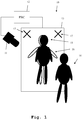
- the positioning device 10 comprises a camera 11, a processing unit 12 and a display 13.
- a person to be positioned 14 is standing opposite to the display 13.
- the camera 11 records an image of the person to be positioned 14 and hands it to the processing unit 12.
- the processing unit 12 determines a posture of the person from the recorded image of the person and compares it to an ideal posture. A difference between the determined posture and the ideal posture is determined. This difference is compared to a threshold. In case the difference is below the threshold, a match is detected. In case the difference is larger than the threshold, a mismatch is detected. In the example shown here, a mismatch is detected. This can clearly be seen since the image of the person 15 and the ideal posture 16 clearly do not match. This is visualized on the display 13 by symbols 17 and the display of the image of the person 15 and the ideal posture 16.
- the difference of the ideal posture to the determined posture of the person to be positioned 14 can be displayed in red.
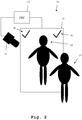
- a different symbol 18, as shown in Fig. 2 can be used. This symbol could then by displayed in green.
- the difference between the determined posture and the ideal posture 16 can be displayed in red in case of a mismatch.
- the ideal posture 16 can be displayed for example in green. Also it is possible to display the image of the person to be positioned 15 in green.
- the display is a liquid crystal display or a light-emitting diode display or an organic light-emitting diode display or a holographic display. Also the use of a projected image is possible, for example using a laser beamer.
- a second embodiment of the positioning device 10 is shown. Only differences to the embodiment of Fig. 1 are explained here.
- the situation of a person to be positioned 14 having assumed a suitable position is shown, here.
- the person to be positioned 14 has assumed a posture, which is close enough to an ideal posture 16 shown in Fig. 1 that the difference between the determined posture and the ideal posture is below the threshold.
- This is shown by use of the symbols 18 and for example by displaying the image of the person to be positioned 15 in green or with a green outline. Also it is possible to display the determined posture with a green outline.
- the positioning device stores a number of different ideal posture templets for different body shapes, for example in a database. After determining the posture of a person to be positioned, before comparing the posture of the person to be positioned to the ideal posture, the ideal posture is first selected from the plurality of ideal posture templets from the database.
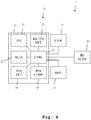
- FIG. 4 a block diagram of an embodiment of the body scanning system 1 according to the second aspect of the invention including an embodiment of the positioning device 10 according to the first aspect of the invention is shown.
- the body scanning system 1 comprises a positioning device 10 and a body scanner 30.
- the positioning device 10 comprises a camera 11, a processing unit 12 and a display 13, as shown in Fig. 1 and Fig. 2 .
- the camera 11, the display 13 and the body scanner 30 are each connected to the processing unit 12.
- the processing unit 12 moreover comprises a controller 20, connected to a database 21, an ideal position determiner 22, a scaler 23, a position determiner 24, and a position comparer 25.
- the database 21, the ideal posture determiner 22 and the scaler 23 are optional components.
- the controller 20 is adapted to control all connected units of the processing unit 12. Moreover, the controller 20 is adapted to control the camera 11 and the display 13.
- the person When performing a scan of a person, the person enters the body scanner 30 or stands in front of it. The body scanner 30 then instructs the positioning device 10 to correctly position the person to be scanned. The person to be scanned therefore is the person to be positioned.
- the controller 20 now instructs the camera 11 to record an image of the person to be positioned. This image is handed from the camera 11 to the controller 20.
- the controller 20 hands the image to the posture determiner 24, which determines a posture of the person to be positioned from the image of the person to be positioned. This determined posture is handed to the posture comparer 25 either through a non-depicted direct connection or through the controller 20.
- the posture comparer 25 compares the determined posture of the person to an ideal posture and determines a difference between the determined posture of the person and the ideal posture. This difference is then displayed by the display 13.
- the display 13 either receives the information directly from the posture comparer 25 or through the controller 20.
- the positioning device 10 has finished positioning the person to be scanned according to the instruction of the body scanner 30.
- the body scanner 30 then performs the body scan of the person to be scanned.
- the processing unit 12 comprises the database 21, which stores a plurality of ideal postures templets, as shown in Fig. 3 .
- the positioning device additionally comprises the ideal posture determiner 22, which compares the posture determined by the posture determiner 24 to the plurality of ideal posture templets stored in the database 21 and determines the ideal posture used by the posture comparer 25 as the ideal posture templet best matching the posture determined by the posture determiner 24.
- the processing unit 12 comprises the scaler 23, which can perform a scaling of the determined posture or the ideal posture templets stored within the database 21 before the ideal posture determiner 22 determines the ideal posture. This allows for an even better match of the determined posture to one of the ideal posture templets. The thereby determined ideal posture is then used by the position comparer 25, as explained before.
- the display 13 advantageously is integrated into the body scanner 30.
- it can be integrated into a scanning array of the body scanner 30.
- a separate positioning display in view of a person to be scanned while in the body scanner 30 can be used.
- the body scanner 30 performs a number of scans of a person to be scanned in different postures. Therefore, after completing a scan of a person in a first posture, the body scanner 30 instructs the positioning device 10 to position the person in a second posture. The body scanner can then perform a second scan. This process can be repeated for as many postures as necessary. The body scanner 30 can also select the number of necessary scans dependent upon the quality of the resulting scans. If the body scanner for example determines that with the presently performed scans it is not possible to determine with sufficient accuracy, if prohibited items are present on the body of the person, the body scanner can instruct additional scans using postures which allow for an accurate scan especially of the so far problematic regions of the body of the person to be scanned.
- the display can also display the number of remaining postures, which need to be scanned. This can for example be done as a number. Also, with a small icon, the different postures to be assumed successively can be displayed.
- a first step 100 an image of a person is recorded.
- a posture of the person is determined from the recorded image of the person.
- the determined posture is compared to an ideal posture.
- a difference between the determined posture of the person and the ideal posture is determined.
- a final fifth step 104 the difference between the determined posture and the ideal posture is displayed.
- the embodiments of the present invention can be implemented by hardware, software, or any combination thereof.
- Various embodiments of the present invention may be implemented by one or more application specific integrated circuits (ASICs), digital signal processors (DSPs), digital signal processing devices (DSPDs), programmable logic devices (PLDs), field programmable gate arrays (FPGAs), processors, controllers, microcontrollers, microprocessors, or the like.
- ASICs application specific integrated circuits
- DSPs digital signal processors
- DSPDs digital signal processing devices
- PLDs programmable logic devices
- FPGAs field programmable gate arrays
- processors controllers, microcontrollers, microprocessors, or the like.
- Various embodiments of the present invention may also be implemented in the form of software modules, processes, functions, or the like which perform the features or operations described above.
- Software code can be stored in a memory unit so that it can be executed by a processor.
- the memory unit may be located inside or outside the processor and can communicate date with the processor through a variety of known means.
- the invention is not limited to the examples and especially not to specific types of body scanners.
- the characteristics of the exemplary embodiments can be used in any advantageous combination.
Landscapes
- Engineering & Computer Science (AREA)
- Theoretical Computer Science (AREA)
- Physics & Mathematics (AREA)
- General Physics & Mathematics (AREA)
- Human Computer Interaction (AREA)
- General Engineering & Computer Science (AREA)
- Life Sciences & Earth Sciences (AREA)
- Computer Hardware Design (AREA)
- Multimedia (AREA)
- Data Mining & Analysis (AREA)
- Immunology (AREA)
- Artificial Intelligence (AREA)
- Biochemistry (AREA)
- General Health & Medical Sciences (AREA)
- Chemical & Material Sciences (AREA)
- Pathology (AREA)
- General Life Sciences & Earth Sciences (AREA)
- Geophysics (AREA)
- Health & Medical Sciences (AREA)
- Analytical Chemistry (AREA)
- Bioinformatics & Cheminformatics (AREA)
- Bioinformatics & Computational Biology (AREA)
- Computer Vision & Pattern Recognition (AREA)
- Evolutionary Biology (AREA)
- Evolutionary Computation (AREA)
- Image Analysis (AREA)
- Length Measuring Devices By Optical Means (AREA)
- Image Processing (AREA)
- Measurement Of The Respiration, Hearing Ability, Form, And Blood Characteristics Of Living Organisms (AREA)
Abstract
Description
- The invention relates to positioning persons by technical means, especially positioning persons to be scanned by a body scanner.
- In recent years, body scanners have been increasingly used at security checkpoints, for example at airports. In such body scanners, the positioning of the person to be scanned is of great importance. With specific postures of the person to be scanned, it is for example possible to conceal prohibited items. It is therefore very important to make sure that the person to be scanned is scanned in a suitable posture. Conventionally, this is assured by a body scanner operator, who instructs the person to be scanned to assume a specific posture. This leads to the necessity of having an operator present and also leads to a long scanning time for each individual person to be scanned. Also, this increases the number of false alarms due to incorrect scanning postures of persons to be scanned.
- For example the US patent application
US 2013/0076487 A1 shows such a body scanner. The system and method shown there exhibit the above-mentioned disadvantages. - There exists a need to provide a positioning device and method for positioning persons without requiring the involvement of operating personnel and requiring only a small amount of time for positioning the person.
- According to a first aspect of the invention, a positioning device for positioning a person is provided. The positioning device comprises a camera, adapted to record an image of the person, a posture determiner, adapted to determine a posture of the person from the recorded image of the person, a posture comparer, adapted to compare the determined posture of the person to an ideal posture and determine a difference between the determined posture of the person and the ideal posture. Finally, the positioning device comprises a display, adapted to display the difference between the determined posture and the ideal posture, determined by the posture comparer. The person to be scanned therefore can see if the posture is correct and adjust the posture accordingly. This allows for a very quick positioning of the person in a correct posture and does not require the involvement of operating personnel.
- According to a preferred implementation form of the first aspect, the positioning device comprises a database which stores a plurality of ideal posture templets for different body shapes. The positioning device moreover comprises an ideal posture determiner, which is adapted to compare the posture of the person determined by the posture determiner to the plurality of ideal posture templets stored in the database and determine the ideal posture as the ideal posture templet of the plurality of ideal posture templets best matching the posture of the person determined by the posture determiner. This allows for taking different body shapes of persons into account. Finally, this leads to an increased accuracy of the positioning.
- According to a further preferred implementation form of the first aspect, the positioning device moreover comprises a scaler, which is adapted to, before comparing the posture of the person to the plurality of ideal posture templets, by the ideal posture determiner, scale the posture of the person, determined by the posture determiner to best match the plurality of ideal posture templets or scale the plurality of ideal posture templets to best match the posture of the person, determined by the posture determiner. This allows for a further increase in positioning accuracy.
- According to a further preferred implementation form of the first aspect, the display is a liquid crystal display or a light-emitting diode display or an organic light-emitting diode display or a holographic display or a projected image display. This allows for a simple construction of the positioning device.
- According to a further preferred implementation form of the first aspect, the display is integrated into a semi-transparent mirror, arranged so that the person can see his or her reflection in the semi-transparent mirror while seeing the difference between the determined posture and the ideal posture. This allows for an even more intuitive positioning for the person to be positioned.
- According to a further preferred implementation form of the first aspect, the posture comparer is adapted to determine if the determined difference between the determined posture of the person and the ideal posture is smaller than a threshold or larger than the threshold, determine a posture match, if the determined difference between the determined posture of the person and the ideal posture is smaller than the threshold and determine a posture mismatch if the determined difference between the determined posture of the person and the ideal posture is larger than the threshold. This allows for a very simple determination, if the positioning is complete or not.
- According to a further preferred implementation form of the first aspect, the display is adapted to display a first symbol in case of a posture match and display a second symbol in case of a posture mismatch. This allows for a very simple display, if the positioning is complete.
- According to a further preferred implementation form of the first aspect, the display is adapted to display the recorded image of the person, display the ideal posture, display an outline of the person in the recorded image of the person or an outline of the ideal posture in a first color, preferably green, in case of a posture match, and display an outline of the person in the recorded image of the person or an outline of the ideal posture in a second color, preferably red, in case of a posture mismatch. This allows for an especially intuitive to grasp display if the positioning is complete.
- According to a further preferred implementation form of the first aspect, the display is adapted to display an outline of the person in a first color, preferably green, in case of a posture match, and display the difference between the determined posture and the ideal posture determined by the posture comparer in a second color, preferably red, in case of a posture mismatch. This also allows for a very intuitively graspable display if the positioning is complete.
- According to a second aspect of the invention, a body scanning system for scanning a person is provided. The body scanning system comprises a body scanner and a positioning device according to the first aspect. The positioning device is adapted to position the person to be scanned in a position ideal for scanning by the body scanner. The body scanner is adapted to scan the body of the person. This allows for a very simple to operate body scanning system.
- According to a preferred implementation form of the second aspect, the display is integrated into a scan array of the body scanner. This allows for a very compact construction of the body scanning system.
- According to a further preferred implementation form of the second aspect, the display is a separate positioning display arranged so that this is visible from a position of a person being scanned. This allows for a very simple construction of the body scanning system.
- According to a further preferred implementation form of the second aspect, the body scanner is adapted to instruct the positioning device to successively position the person to be scanned in a number of different postures, and scan the body of the person in each of the postures of the number of postures. The positioning device is then adapted to successively position the person in the number of different postures, as instructed by the body scanner, by using different ideal postures for the number of different postures. This allows for a very quick scanning while at the same time achieving a very high accuracy of the scans due to the different scanning postures.
- According to a further preferred implementation form of the second aspect, the display of the positioning device is adapted to display a number of remaining postures of the number of different postures, the body scanner needs to perform scans in. This allows for an increase in cooperation by the person to be scanned and therefore decreases the scanning time, while increasing the scanning accuracy.
- According to a third aspect of the invention, a method for positioning a person is provided. The method comprises recording an image of the person, determining a posture of the person from the recorded image of the person, comparing the determined posture of the person to an ideal posture, determining a difference between the determined posture of the person and the ideal posture, and displaying the difference between the determined posture and the ideal posture. The person therefore can see if the posture is correct and adjust the posture accordingly. This allows for a very quick positioning of the person in a correct posture and does not require the involvement of operating personnel.
- An exemplary embodiment of the invention is now further explained by way of example only with respect to the drawings, in which
- Fig. 1
- shows a first embodiment of the positioning device according to the first aspect of the invention;
- Fig. 2
- shows a second embodiment of the positioning device according to the first aspect of the invention;
- Fig. 3
- shows different ideal posture templets as used by a third embodiment of the first aspect of the invention;
- Fig. 4
- shows a first embodiment of the body scanning system according to the second aspect of the invention in a block diagram, and
- Fig. 5
- shows an embodiment of the positioning method according to the third aspect of the invention in a flow diagram.
- First we demonstrate the construction and function of different embodiments of the positioning device along
Fig. 1 - Fig. 3 . AlongFig. 4 , the construction of an embodiment of the body scanning system and of an embodiment of the positioning device are shown in detail. Finally, alongFig. 5 , the function of an embodiment of the positioning method according to the third aspect of the invention is described. Similar entities and reference numbers in different figures have been partially omitted. - Reference will now be made in detail to the preferred embodiments of the present invention, examples of which are illustrated in the accompanying drawings. However, the following embodiments of the present invention may be variously modified and the range of the present invention is not limited by the following embodiments.
- In
Fig. 1 , a first embodiment of thepositioning device 10 of the first aspect of the invention is shown. Thepositioning device 10 comprises acamera 11, aprocessing unit 12 and adisplay 13. - In the example shown here, a person to be positioned 14 is standing opposite to the
display 13. Thecamera 11 records an image of the person to be positioned 14 and hands it to theprocessing unit 12. Theprocessing unit 12 determines a posture of the person from the recorded image of the person and compares it to an ideal posture. A difference between the determined posture and the ideal posture is determined. This difference is compared to a threshold. In case the difference is below the threshold, a match is detected. In case the difference is larger than the threshold, a mismatch is detected. In the example shown here, a mismatch is detected. This can clearly be seen since the image of theperson 15 and theideal posture 16 clearly do not match. This is visualized on thedisplay 13 bysymbols 17 and the display of the image of theperson 15 and theideal posture 16. - Also it is possible to visualize this by merely displaying the difference of the ideal posture to the determined posture of the person to be positioned 14. In order to increase the clarity of the displayed decision, it is possible to use colors. For example, the
symbol 17 can be displayed in red. In case of a match, adifferent symbol 18, as shown inFig. 2 can be used. This symbol could then by displayed in green. Also, in order to increase the clarity of displaying the match or mismatch decision, the difference between the determined posture and theideal posture 16 can be displayed in red in case of a mismatch. In case of a match, theideal posture 16 can be displayed for example in green. Also it is possible to display the image of the person to be positioned 15 in green. - The display is a liquid crystal display or a light-emitting diode display or an organic light-emitting diode display or a holographic display. Also the use of a projected image is possible, for example using a laser beamer.
- In
Fig. 2 , a second embodiment of thepositioning device 10 is shown. Only differences to the embodiment ofFig. 1 are explained here. The situation of a person to be positioned 14 having assumed a suitable position is shown, here. The person to be positioned 14 has assumed a posture, which is close enough to anideal posture 16 shown inFig. 1 that the difference between the determined posture and the ideal posture is below the threshold. This is shown by use of thesymbols 18 and for example by displaying the image of the person to be positioned 15 in green or with a green outline. Also it is possible to display the determined posture with a green outline. - When positioning a large number of different persons, a large plurality of different body shapes can occur. Since the body shapes throughout the population strongly differ, it is difficult to use a single ideal posture for all body types and shapes of the persons to be positioned.
- Therefore, the positioning device stores a number of different ideal posture templets for different body shapes, for example in a database. After determining the posture of a person to be positioned, before comparing the posture of the person to be positioned to the ideal posture, the ideal posture is first selected from the plurality of ideal posture templets from the database.
- This is done by comparing the determined posture of the person to be positioned to all ideal posture templets. Additionally, it is possible to perform a scaling of the determined posture or to perform a scaling of the ideal posture templets before performing the comparison in order to determine the ideal posture. In
Fig. 3 , a number of different ideal postures templets for different body shapes are shown. - In
Fig. 4 , a block diagram of an embodiment of the body scanning system 1 according to the second aspect of the invention including an embodiment of thepositioning device 10 according to the first aspect of the invention is shown. The body scanning system 1 comprises apositioning device 10 and abody scanner 30. Thepositioning device 10 comprises acamera 11, aprocessing unit 12 and adisplay 13, as shown inFig. 1 andFig. 2 . Thecamera 11, thedisplay 13 and thebody scanner 30 are each connected to theprocessing unit 12. - The
processing unit 12 moreover comprises acontroller 20, connected to adatabase 21, anideal position determiner 22, ascaler 23, aposition determiner 24, and aposition comparer 25. Thedatabase 21, theideal posture determiner 22 and thescaler 23 are optional components. - Although in practice there may exist additional direct connections between the units 21 - 25, they are though not displayed here for reasons of clarity.
- The
controller 20 is adapted to control all connected units of theprocessing unit 12. Moreover, thecontroller 20 is adapted to control thecamera 11 and thedisplay 13. - When performing a scan of a person, the person enters the
body scanner 30 or stands in front of it. Thebody scanner 30 then instructs thepositioning device 10 to correctly position the person to be scanned. The person to be scanned therefore is the person to be positioned. Thecontroller 20 now instructs thecamera 11 to record an image of the person to be positioned. This image is handed from thecamera 11 to thecontroller 20. Thecontroller 20 hands the image to theposture determiner 24, which determines a posture of the person to be positioned from the image of the person to be positioned. This determined posture is handed to theposture comparer 25 either through a non-depicted direct connection or through thecontroller 20. Theposture comparer 25 compares the determined posture of the person to an ideal posture and determines a difference between the determined posture of the person and the ideal posture. This difference is then displayed by thedisplay 13. Thedisplay 13 either receives the information directly from theposture comparer 25 or through thecontroller 20. - As long as the posture of the person is not a match to the ideal posture, the positioning continues. As soon as a match is detected though, the
positioning device 10 has finished positioning the person to be scanned according to the instruction of thebody scanner 30. Thebody scanner 30 then performs the body scan of the person to be scanned. - Advantageously, the
processing unit 12 comprises thedatabase 21, which stores a plurality of ideal postures templets, as shown inFig. 3 . In this case, the positioning device additionally comprises theideal posture determiner 22, which compares the posture determined by theposture determiner 24 to the plurality of ideal posture templets stored in thedatabase 21 and determines the ideal posture used by theposture comparer 25 as the ideal posture templet best matching the posture determined by theposture determiner 24. - Moreover advantageously, the
processing unit 12 comprises thescaler 23, which can perform a scaling of the determined posture or the ideal posture templets stored within thedatabase 21 before theideal posture determiner 22 determines the ideal posture. This allows for an even better match of the determined posture to one of the ideal posture templets. The thereby determined ideal posture is then used by theposition comparer 25, as explained before. - The
display 13 advantageously is integrated into thebody scanner 30. For example, it can be integrated into a scanning array of thebody scanner 30. Also a separate positioning display in view of a person to be scanned while in thebody scanner 30 can be used. - Advantageously, the
body scanner 30 performs a number of scans of a person to be scanned in different postures. Therefore, after completing a scan of a person in a first posture, thebody scanner 30 instructs thepositioning device 10 to position the person in a second posture. The body scanner can then perform a second scan. This process can be repeated for as many postures as necessary. Thebody scanner 30 can also select the number of necessary scans dependent upon the quality of the resulting scans. If the body scanner for example determines that with the presently performed scans it is not possible to determine with sufficient accuracy, if prohibited items are present on the body of the person, the body scanner can instruct additional scans using postures which allow for an accurate scan especially of the so far problematic regions of the body of the person to be scanned. - In order to increase the cooperation of the person to be scanned, the display can also display the number of remaining postures, which need to be scanned. This can for example be done as a number. Also, with a small icon, the different postures to be assumed successively can be displayed.
- In
Fig. 5 , an embodiment of the positioning method according to the third aspect of the invention is shown. In afirst step 100, an image of a person is recorded. In asecond step 101, a posture of the person is determined from the recorded image of the person. In athird step 102, the determined posture is compared to an ideal posture. In afourth step 103, a difference between the determined posture of the person and the ideal posture is determined. In a finalfifth step 104, the difference between the determined posture and the ideal posture is displayed. - The embodiments of the present invention can be implemented by hardware, software, or any combination thereof. Various embodiments of the present invention may be implemented by one or more application specific integrated circuits (ASICs), digital signal processors (DSPs), digital signal processing devices (DSPDs), programmable logic devices (PLDs), field programmable gate arrays (FPGAs), processors, controllers, microcontrollers, microprocessors, or the like.
- Various embodiments of the present invention may also be implemented in the form of software modules, processes, functions, or the like which perform the features or operations described above. Software code can be stored in a memory unit so that it can be executed by a processor. The memory unit may be located inside or outside the processor and can communicate date with the processor through a variety of known means.
- The invention is not limited to the examples and especially not to specific types of body scanners. The characteristics of the exemplary embodiments can be used in any advantageous combination.
- Although the present invention and its advantages have been described in detail, it should be understood, that various changes, substitutions and alterations can be made herein without departing from the spirit and scope of the invention as defined by the appended claims.
Claims (15)
- A positioning device for positioning a person, comprising:- a camera, adapted to record an image of the person,- a posture determiner, adapted to determine a posture of the person from the recorded image of the person,- a posture comparer, adapted to compare the determined posture of the person to an ideal posture and determine a difference between the determined posture of the person and the ideal posture, and- a display, adapted to display the difference between the determined posture and the ideal posture, determined by the posture comparer.
- The positioning device according to claim 1,
wherein the positioning device comprises a database, adapted to store a plurality of ideal posture templates for different body shapes,
wherein the positioning device comprises an ideal posture determiner, adapted to- compare the posture of the person determined by the posture determiner to the plurality of ideal posture templates stored in the database, and- determine the ideal posture as the ideal posture template of the plurality of ideal posture templates best matching the posture of the person determined by the posture determiner. - The positioning device according to claim 2,
wherein the positioning device comprises a scaler, adapted to, before comparing the posture of the person to the plurality of ideal posture templates, by the ideal posture determiner,- scale the posture of the person, determined by the posture determiner to best match the plurality of ideal posture templates, or- scale the plurality of ideal posture templates to best match the posture of the person, determined by the posture determiner. - The positioning device according to any of claims 1 to 3,
wherein the display is a liquid crystal display or a light emitting diode display or an organic light emitting diode display or a holographic display or a projected image display. - The positioning device according to any of claims 1 to 4,
wherein the display is integrated into a semi-transparent mirror, arranged so that the person can see his or her reflection in the semi-transparent mirror while seeing the difference between the determined posture and the ideal posture. - The positioning device according to any of claims 1 to 5,
wherein the posture comparer is adapted to- determine if the determined difference between the determined posture of the person and the ideal posture is smaller than a threshold or larger than the threshold,- determine a posture match, if the determined difference between the determined posture of the person and the ideal posture is smaller than the threshold, and- determine a posture mismatch, if the determined difference between the determined posture of the person and the ideal posture is larger than the threshold. - The positioning device according to claim 6,
wherein the display is adapted to- display a first symbol in case of a posture match, and- display a second symbol in case of a posture mismatch. - The positioning device according to claim 6,
wherein the display is adapted to- display the recorded image of the person,- display the ideal posture,- display an outline of the person in the recorded image of the person or an outline of the ideal posture in a first color, preferably green, in case of a posture match, and- display an outline of the person in the recorded image of the person or an outline of the ideal posture in a second color, preferably red, in case of a posture mismatch. - The positioning device according to claim 6,
wherein the display is adapted to- display an outline of the person in a first color, preferably green, in case of a posture match, and- display the difference between the determined posture and the ideal posture, determined by the posture comparer, in a second color, preferably red, in case of a posture mismatch. - A body scanning system for scanning a person, comprising a body scanner and a positioning device according to any of claims 1 to 9,
wherein the positioning device is adapted to position the person to be scanned in a posture ideal for scanning by the body scanner, and
wherein the body scanner is adapted to scan the body of the person. - The body scanning system according to claim 10, wherein the display is integrated into a scan array of the body scanner.
- The body scanning system according to claim 10 or 11, wherein the display is a separate positioning display arranged so that it is visible from a position of a person being scanned.
- The body scanning system according to any of claims 10 to 12,
wherein the body scanner is adapted to- instruct the positioning device to successively position the person to be scanned in a number of different postures, and- scan the body of the person in each of the postures of the number of postures,wherein the positioning device is adapted to successively position the person in the number of different postures, as instructed by the body scanner, by using different ideal postures for the number of different postures. - The body scanning system according to claim 13, wherein the display of the positioning device is adapted to display a number of remaining postures of the number of different postures, the body scanner needs to perform scans in.
- A method for positioning a person, comprising:- recording an image of the person,- determining a posture of the person from the recorded image of the person,- comparing the determined posture of the person to an ideal posture,- determining a difference between the determined posture of the person and the ideal posture, and- displaying the difference between the determined posture and the ideal posture.
Applications Claiming Priority (1)
| Application Number | Priority Date | Filing Date | Title |
|---|---|---|---|
| US15/382,932 US10565441B2 (en) | 2016-12-19 | 2016-12-19 | Positioning device and method for positioning persons to be scanned |
Publications (1)
| Publication Number | Publication Date |
|---|---|
| EP3336751A1 true EP3336751A1 (en) | 2018-06-20 |
Family
ID=58017902
Family Applications (1)
| Application Number | Title | Priority Date | Filing Date |
|---|---|---|---|
| EP17153289.8A Ceased EP3336751A1 (en) | 2016-12-19 | 2017-01-26 | Positioning device and method for assisting in positioning persons to be scanned |
Country Status (3)
| Country | Link |
|---|---|
| US (1) | US10565441B2 (en) |
| EP (1) | EP3336751A1 (en) |
| CN (1) | CN108204974A (en) |
Families Citing this family (3)
| Publication number | Priority date | Publication date | Assignee | Title |
|---|---|---|---|---|
| CN109730493A (en) * | 2019-01-29 | 2019-05-10 | 罗茹 | One kind can shine the subsequent pier glass of human body |
| JP7293741B2 (en) * | 2019-03-12 | 2023-06-20 | オムロンヘルスケア株式会社 | Posture improvement support device, posture improvement support method, and posture improvement support program |
| CN119810252A (en) * | 2024-12-31 | 2025-04-11 | 北京神目科技有限公司 | Method and system for generating designated standing posture prompt diagram and millimeter wave self-service scanning security inspection method and system |
Citations (4)
| Publication number | Priority date | Publication date | Assignee | Title |
|---|---|---|---|---|
| US20100281432A1 (en) * | 2009-05-01 | 2010-11-04 | Kevin Geisner | Show body position |
| EP2546807A2 (en) * | 2011-07-11 | 2013-01-16 | Optex Co., Ltd. | Traffic monitoring device |
| US20130076487A1 (en) | 2010-03-31 | 2013-03-28 | Rohde & Schwarz Gmbh & Co. Kg | Device and a method for the identification of persons |
| US20140198962A1 (en) * | 2013-01-17 | 2014-07-17 | Canon Kabushiki Kaisha | Information processing apparatus, information processing method, and storage medium |
Family Cites Families (4)
| Publication number | Priority date | Publication date | Assignee | Title |
|---|---|---|---|---|
| US20040077975A1 (en) * | 2002-10-22 | 2004-04-22 | Zimmerman Jeffrey C. | Systems and methods for motion analysis and feedback |
| US20050272564A1 (en) * | 2004-06-02 | 2005-12-08 | Johnson Health Tech Co., Ltd. | Exercise apparatus and method for tracking number of steps |
| US20080294012A1 (en) * | 2007-05-22 | 2008-11-27 | Kurtz Andrew F | Monitoring physiological conditions |
| JP6182917B2 (en) * | 2013-03-15 | 2017-08-23 | ノーリツプレシジョン株式会社 | Monitoring device |
-
2016
- 2016-12-19 US US15/382,932 patent/US10565441B2/en active Active
-
2017
- 2017-01-26 EP EP17153289.8A patent/EP3336751A1/en not_active Ceased
- 2017-04-20 CN CN201710262250.6A patent/CN108204974A/en active Pending
Patent Citations (4)
| Publication number | Priority date | Publication date | Assignee | Title |
|---|---|---|---|---|
| US20100281432A1 (en) * | 2009-05-01 | 2010-11-04 | Kevin Geisner | Show body position |
| US20130076487A1 (en) | 2010-03-31 | 2013-03-28 | Rohde & Schwarz Gmbh & Co. Kg | Device and a method for the identification of persons |
| EP2546807A2 (en) * | 2011-07-11 | 2013-01-16 | Optex Co., Ltd. | Traffic monitoring device |
| US20140198962A1 (en) * | 2013-01-17 | 2014-07-17 | Canon Kabushiki Kaisha | Information processing apparatus, information processing method, and storage medium |
Non-Patent Citations (1)
| Title |
|---|
| ALEXANDRU O. BALAN ET AL: "Detailed Human Shape and Pose from Images", 2007 IEEE CONFERENCE ON COMPUTER VISION AND PATTERN RECOGNITION, 1 June 2007 (2007-06-01), pages 1 - 8, XP055197358, ISBN: 978-1-42-441180-1, DOI: 10.1109/CVPR.2007.383340 * |
Also Published As
| Publication number | Publication date |
|---|---|
| CN108204974A (en) | 2018-06-26 |
| US20180173943A1 (en) | 2018-06-21 |
| US10565441B2 (en) | 2020-02-18 |
Similar Documents
| Publication | Publication Date | Title |
|---|---|---|
| US10877155B2 (en) | Survey data processing device, survey data processing method, and survey data processing program | |
| US11776318B2 (en) | Information processing system, information processing method, and storage medium | |
| JPH11244261A (en) | Iris recognition method and device, data conversion method and device | |
| US12205406B2 (en) | Information processing device, information processing system, information processing method, and storage medium | |
| US10565441B2 (en) | Positioning device and method for positioning persons to be scanned | |
| JPH11203478A (en) | Iris data acquisition device | |
| US12326974B2 (en) | Information processing system, information processing method, and storage medium | |
| KR20180011794A (en) | Object visualization method | |
| US20250295390A1 (en) | Ultrasound scanner with display interface | |
| US20180096215A1 (en) | Operator guided inspection system and method of use | |
| US20250209856A1 (en) | Information processing apparatus, information processing system, information processing method, and non-transitory computer-readable medium storing program | |
| CN113614734A (en) | System and method for computer-aided identification of medical procedures | |
| US20210397866A1 (en) | Information processing device, information processing method, and program | |
| US20170178107A1 (en) | Information processing apparatus, information processing method, recording medium and pos terminal apparatus | |
| JPH1124549A (en) | Speed reading support device | |
| EP4645267A1 (en) | Biological information acquisition device | |
| CN117321587B (en) | Component search device, computer-readable recording medium, and component search method | |
| WO2021023361A1 (en) | Mobile phone colorized displays to conceal optical devices | |
| CN117562536A (en) | Palm feature recognition equipment and its calibration method, palm feature recognition method | |
| JP2026019240A (en) | Information processing system, information processing method, and program | |
| JP2015219547A (en) | Device control system, device control program, and device control apparatus |
Legal Events
| Date | Code | Title | Description |
|---|---|---|---|
| PUAI | Public reference made under article 153(3) epc to a published international application that has entered the european phase |
Free format text: ORIGINAL CODE: 0009012 |
|
| STAA | Information on the status of an ep patent application or granted ep patent |
Free format text: STATUS: REQUEST FOR EXAMINATION WAS MADE |
|
| 17P | Request for examination filed |
Effective date: 20170726 |
|
| AK | Designated contracting states |
Kind code of ref document: A1 Designated state(s): AL AT BE BG CH CY CZ DE DK EE ES FI FR GB GR HR HU IE IS IT LI LT LU LV MC MK MT NL NO PL PT RO RS SE SI SK SM TR |
|
| AX | Request for extension of the european patent |
Extension state: BA ME |
|
| STAA | Information on the status of an ep patent application or granted ep patent |
Free format text: STATUS: EXAMINATION IS IN PROGRESS |
|
| 17Q | First examination report despatched |
Effective date: 20180730 |
|
| STAA | Information on the status of an ep patent application or granted ep patent |
Free format text: STATUS: THE APPLICATION HAS BEEN REFUSED |
|
| 18R | Application refused |
Effective date: 20191126 |