EP3336489A1 - Method and system for automatically establishing map indoors by mobile robot - Google Patents
Method and system for automatically establishing map indoors by mobile robot Download PDFInfo
- Publication number
- EP3336489A1 EP3336489A1 EP16836517.9A EP16836517A EP3336489A1 EP 3336489 A1 EP3336489 A1 EP 3336489A1 EP 16836517 A EP16836517 A EP 16836517A EP 3336489 A1 EP3336489 A1 EP 3336489A1
- Authority
- EP
- European Patent Office
- Prior art keywords
- map
- robot
- grid
- value
- information
- Prior art date
- Legal status (The legal status is an assumption and is not a legal conclusion. Google has not performed a legal analysis and makes no representation as to the accuracy of the status listed.)
- Withdrawn
Links
- 238000000034 method Methods 0.000 title claims abstract description 47
- 230000004927 fusion Effects 0.000 claims description 15
- 238000012545 processing Methods 0.000 claims description 15
- 238000001514 detection method Methods 0.000 claims description 8
- 239000003086 colorant Substances 0.000 claims description 6
- 230000008859 change Effects 0.000 claims description 4
- 238000005259 measurement Methods 0.000 claims description 3
- 238000004364 calculation method Methods 0.000 abstract 1
- 238000010586 diagram Methods 0.000 description 11
- 238000005516 engineering process Methods 0.000 description 10
- 238000004590 computer program Methods 0.000 description 7
- 230000004807 localization Effects 0.000 description 6
- 238000011161 development Methods 0.000 description 3
- 230000006870 function Effects 0.000 description 3
- 238000012986 modification Methods 0.000 description 3
- 230000004048 modification Effects 0.000 description 3
- 238000011160 research Methods 0.000 description 3
- 238000010276 construction Methods 0.000 description 2
- 230000008447 perception Effects 0.000 description 2
- 230000004044 response Effects 0.000 description 2
- 238000013473 artificial intelligence Methods 0.000 description 1
- 238000004891 communication Methods 0.000 description 1
- 238000002425 crystallisation Methods 0.000 description 1
- 230000008025 crystallization Effects 0.000 description 1
- 230000007123 defense Effects 0.000 description 1
- 239000000284 extract Substances 0.000 description 1
- 238000000605 extraction Methods 0.000 description 1
- 230000003993 interaction Effects 0.000 description 1
- 238000012423 maintenance Methods 0.000 description 1
- 238000004519 manufacturing process Methods 0.000 description 1
- 239000000463 material Substances 0.000 description 1
- 230000007246 mechanism Effects 0.000 description 1
- 230000003287 optical effect Effects 0.000 description 1
- 238000003909 pattern recognition Methods 0.000 description 1
- 230000000007 visual effect Effects 0.000 description 1
Images




Classifications
-
- G—PHYSICS
- G05—CONTROLLING; REGULATING
- G05D—SYSTEMS FOR CONTROLLING OR REGULATING NON-ELECTRIC VARIABLES
- G05D1/00—Control of position, course, altitude or attitude of land, water, air or space vehicles, e.g. using automatic pilots
- G05D1/02—Control of position or course in two dimensions
- G05D1/021—Control of position or course in two dimensions specially adapted to land vehicles
- G05D1/0268—Control of position or course in two dimensions specially adapted to land vehicles using internal positioning means
- G05D1/0274—Control of position or course in two dimensions specially adapted to land vehicles using internal positioning means using mapping information stored in a memory device
-
- G—PHYSICS
- G01—MEASURING; TESTING
- G01C—MEASURING DISTANCES, LEVELS OR BEARINGS; SURVEYING; NAVIGATION; GYROSCOPIC INSTRUMENTS; PHOTOGRAMMETRY OR VIDEOGRAMMETRY
- G01C21/00—Navigation; Navigational instruments not provided for in groups G01C1/00 - G01C19/00
- G01C21/20—Instruments for performing navigational calculations
-
- G—PHYSICS
- G01—MEASURING; TESTING
- G01C—MEASURING DISTANCES, LEVELS OR BEARINGS; SURVEYING; NAVIGATION; GYROSCOPIC INSTRUMENTS; PHOTOGRAMMETRY OR VIDEOGRAMMETRY
- G01C21/00—Navigation; Navigational instruments not provided for in groups G01C1/00 - G01C19/00
- G01C21/20—Instruments for performing navigational calculations
- G01C21/206—Instruments for performing navigational calculations specially adapted for indoor navigation
-
- G—PHYSICS
- G01—MEASURING; TESTING
- G01C—MEASURING DISTANCES, LEVELS OR BEARINGS; SURVEYING; NAVIGATION; GYROSCOPIC INSTRUMENTS; PHOTOGRAMMETRY OR VIDEOGRAMMETRY
- G01C21/00—Navigation; Navigational instruments not provided for in groups G01C1/00 - G01C19/00
- G01C21/38—Electronic maps specially adapted for navigation; Updating thereof
- G01C21/3804—Creation or updating of map data
- G01C21/3807—Creation or updating of map data characterised by the type of data
- G01C21/383—Indoor data
-
- G—PHYSICS
- G01—MEASURING; TESTING
- G01C—MEASURING DISTANCES, LEVELS OR BEARINGS; SURVEYING; NAVIGATION; GYROSCOPIC INSTRUMENTS; PHOTOGRAMMETRY OR VIDEOGRAMMETRY
- G01C21/00—Navigation; Navigational instruments not provided for in groups G01C1/00 - G01C19/00
- G01C21/38—Electronic maps specially adapted for navigation; Updating thereof
- G01C21/3804—Creation or updating of map data
- G01C21/3833—Creation or updating of map data characterised by the source of data
-
- G—PHYSICS
- G01—MEASURING; TESTING
- G01C—MEASURING DISTANCES, LEVELS OR BEARINGS; SURVEYING; NAVIGATION; GYROSCOPIC INSTRUMENTS; PHOTOGRAMMETRY OR VIDEOGRAMMETRY
- G01C21/00—Navigation; Navigational instruments not provided for in groups G01C1/00 - G01C19/00
- G01C21/38—Electronic maps specially adapted for navigation; Updating thereof
- G01C21/3804—Creation or updating of map data
- G01C21/3833—Creation or updating of map data characterised by the source of data
- G01C21/3837—Data obtained from a single source
-
- G—PHYSICS
- G01—MEASURING; TESTING
- G01C—MEASURING DISTANCES, LEVELS OR BEARINGS; SURVEYING; NAVIGATION; GYROSCOPIC INSTRUMENTS; PHOTOGRAMMETRY OR VIDEOGRAMMETRY
- G01C21/00—Navigation; Navigational instruments not provided for in groups G01C1/00 - G01C19/00
- G01C21/38—Electronic maps specially adapted for navigation; Updating thereof
- G01C21/3863—Structures of map data
- G01C21/387—Organisation of map data, e.g. version management or database structures
- G01C21/3881—Tile-based structures
-
- G—PHYSICS
- G01—MEASURING; TESTING
- G01C—MEASURING DISTANCES, LEVELS OR BEARINGS; SURVEYING; NAVIGATION; GYROSCOPIC INSTRUMENTS; PHOTOGRAMMETRY OR VIDEOGRAMMETRY
- G01C22/00—Measuring distance traversed on the ground by vehicles, persons, animals or other moving solid bodies, e.g. using odometers, using pedometers
-
- G—PHYSICS
- G01—MEASURING; TESTING
- G01S—RADIO DIRECTION-FINDING; RADIO NAVIGATION; DETERMINING DISTANCE OR VELOCITY BY USE OF RADIO WAVES; LOCATING OR PRESENCE-DETECTING BY USE OF THE REFLECTION OR RERADIATION OF RADIO WAVES; ANALOGOUS ARRANGEMENTS USING OTHER WAVES
- G01S15/00—Systems using the reflection or reradiation of acoustic waves, e.g. sonar systems
- G01S15/02—Systems using the reflection or reradiation of acoustic waves, e.g. sonar systems using reflection of acoustic waves
- G01S15/06—Systems determining the position data of a target
- G01S15/08—Systems for measuring distance only
-
- G—PHYSICS
- G05—CONTROLLING; REGULATING
- G05D—SYSTEMS FOR CONTROLLING OR REGULATING NON-ELECTRIC VARIABLES
- G05D1/00—Control of position, course, altitude or attitude of land, water, air or space vehicles, e.g. using automatic pilots
- G05D1/02—Control of position or course in two dimensions
-
- G—PHYSICS
- G05—CONTROLLING; REGULATING
- G05D—SYSTEMS FOR CONTROLLING OR REGULATING NON-ELECTRIC VARIABLES
- G05D1/00—Control of position, course, altitude or attitude of land, water, air or space vehicles, e.g. using automatic pilots
- G05D1/02—Control of position or course in two dimensions
- G05D1/021—Control of position or course in two dimensions specially adapted to land vehicles
- G05D1/0255—Control of position or course in two dimensions specially adapted to land vehicles using acoustic signals, e.g. ultra-sonic singals
Definitions
- the present invention relates to a technical field of automation, and particularly relates to a method and a system for a mobile robot to self-establish a map indoors.
- Robots can be divided into military robots, industrial robots, service robots, etc., in terms of usage, wherein all of these robot types have a huge demand for mobile robots.
- a research scope of mobile robots covers several aspects of system structure, control mechanism, information system, sensing technology, planning strategy and drive system, etc., and involves a plurality of disciplinary fields including mechanical kinematics, artificial intelligence, intelligent control, pattern recognition, image processing, visual technology, sensing technology, computer networks and communications, and biological information technology, etc.
- Mobile robots are not only widely applied in industries such as industry, agriculture, medical care, service, etc. but also well applied in harmful and dangerous situations such as fields of urban safety, national defense and space exploration,etc. Research level on mobile robots is an important indicator of development level of science and technology and comprehensive national strength of a country.
- Robot revolution is expected to become a starting point and an important growth point of the "third industrial revolution", and will affect a configuration of the global manufacturing industry.
- the International Federation of Robotics (IFR) predicts that the "Robot Revolution” will create a market with a scale of trillions of dollars, leading key technologies concerning robots such as new material functional modules, perception acquisition and recognition, intelligent control and navigation,etc. and markets to develop rapidly.
- map construction is a primary problem, and is a core technology to achieve the robot navigation and even higher intelligence, and is a premise to achieve localization.
- map construction involves the following sub-problems: map expression methods, sensors, description and processing of uncertain information, robot localization and map establishment conducted simultaneously.
- the map constructed by indoor robots is mainly a planar map, commonly used methods of which include a grid map, a geometric feature map and a topological map.
- the present technical solutions adopt the grid map.
- the grid map divides a whole working environment into a number of grids of the same size, obtains information about existence of an obstacle in each grid using detectors such as a radar detector, a sonar detector, an ultrasonic detector, etc., and indicates a possibility of existence of the obstacle in each grid.Since the information for each grid directly corresponds to a certain region in a real environment, the grid map is easy to be created, maintained, and understood.
- the grid map uses probability values to represent uncertainty of a grid model and can provide accurate metric information. Because of these advantages, the grid map is largely used in mobile robots. However, when amount of data in the map is large, storage volume and data maintenance workload of the grid map are increased, which will place a heavy burden on real-time processing of a computer.
- the geometric feature map extracts abstract geometric features from environment perception data collected by a robot, and uses relevant geometric features (such as points, lines, surfaces) to represent an environment.
- the method is more compact and convenient for position estimation and target recognition, but extraction of geometric information requires additional processing of the detected information, and thus the method is not applicable to unstructured map structure and accurate modeling can be achieved only if a large quantity of accurately measured data are acquired.
- the topological map represents an indoor environment as a topological structure graph with nodes and associated connecting lines, wherein the nodes indicate important position points (corners, doors, elevators, stairs, etc.) in the environment, and sides indicate connection relationships such as corridors, etc. between the nodes.
- the method occupies a small storage space, can quickly achieve path planning, does not need accurate position information of a robot, and also provides a more natural interface for releasing instructions through human-computer interaction. However, this method ignores detailed information of the environment, and it is difficult to refinedly plan the path of the robot.
- the topological map is difficult to be created and maintained.
- the invention provides a method and a system for a mobile robot to self-establish a map indoors, which obtains path information and obstacle information from a detector in combination with characteristics of indoor movement to realize real-time adjustment and correspondence of an indoor environment and grid information and ensure effectiveness of a map model.
- the grid map is easy to be maintained and is convenient for quick access of map data.
- the present solutions have wide technical adaptability, can realize a rapid response to diversified environments, can quickly creates a dynamic map model reflecting information of a real environment, and can effectively realize localization and navigation of the robot.
- the technical solutions of the present invention provides a method for a mobile robot to self-establish a map indoors, the method comprises the following steps:
- said step of forming an initialized map further comprises:
- the map stores information of a grid in a two-dimensional array
- the two-dimensional array has a data type that is a customized data structure AStarNode defined as follows:
- said step of marking a coordinate origin in the initialized map further comprises:
- said step of causing the robot to travelling throughout indoor accessible regions to record path information and environment information further comprises:
- the robot calculates X and Y coordinate values of a position in which it is located according to a mileometer in the following manner:
- the robot performs fusion measurement by an ultrasonic sensor in two means: a first means is data fusion of different sensors at the same moment, in which the CV value of each grid is estimated according to the Bayesian probability algorithm, and the Bayesian probability algorithm is given as follows:
- the method further comprises:
- the robot self-establishes the map after travelling throughout indoors and positions of doors are artificially revised in the map, and the method further comprises:
- the technical solutions of the present invention also provides a system for a mobile robot to self-establish a map indoors, the system comprises a mileometer, an ultrasonic sensor and a processing unit, wherein the mileometer is used to calculate a distance and an angle of the robot travelling indoors; the ultrasonic sensor is used to detect information of obstacles surrounding the robot at different distances, wherein the robot has one ultrasonic sensor on each of both sides and has one or more ultrasonic sensors on a front side; and the processing unit is used to calculate path information of the travelling robot and grid information of the map and store grid data of the map.
- the technical solutions of the present invention adopt the mileometer to measure a travelling distance in real time, then deduce a position of the robot at any time in any place, and adopt the ultrasonic sensor to detect indoor environment information within a certain distance around the robot.
- the robot combines the deduced position and the detected surrounding indoor environment information to locate information of the surrounding obstacles in the map.
- the present solutions have strong correspondence of the grid map to the actual indoor environment,the map is easy to be maintained and is convenient for quick access of map data, and the solutions have wide technical adaptability, can quickly create a dynamic map model reflecting information of a real environment, and can effectively realize localization and navigation of the robot.
- First embodiment method for mobile Robot to self-establish map indoors.
- Fig. 1 is a flow chart of a method for a mobile robot to self-establish a map indoors in a first embodiment of the present invention. As shown in Fig. 1 , the flow includes the following steps:
- the map is a meshed pattern constituted by a series of square grids; the map marks positions of an indoor environment in form of grids, each grid representing an indoor region with an actual size of 200 mm ⁇ 200 mm; and a user sets a size of the initialized map according to an indoor movable range of the robot.
- the map stores information of a grid in a two-dimensional array, the two-dimensional array has a data type that is a customized data structure AStarNode defined as follows:
- step 102 a coordinate origin is marked in the initialized map.
- a robot charging pile is taken as the coordinate origin of the map; the origin is on an edge of the map, in a central position of the edge of the map; the origin is on the edge of the map; a direction parallel to the edge of the map is an X-axis and a direction perpendicular to the edge of the map is a Y-axis.
- step 103 the robot is caused to travel throughout indoor accessible regions to record path information and environment information.
- the robot starts recording data when it begins to move.
- the robot marks position information of the accessible regions in the map according to measured values of a mileometer.
- step 104 the robot is caused to calculate and mark a CV value of each grid in the map.
- the robot marks the CV value in the map according to values fusion-measured by an ultrasonic sensor.
- step 105 the map is established according to the path information and the CV value.
- the robot self-establishes and forms the map according to the path information and the CV value during it travels indoors.
- Positions of doors are marked in the map and then artificially revised, and the method further comprises:
- Second embodiment method for self-establishing initialized grid map.
- Fig. 2 is a flow chart of a method for self-establishing an initialized grid map in a second embodiment of the present invention. As shown in Fig. 2 , the method flow includes the following steps:
- the map is a meshed pattern constituted by a series of square grids; the map marks positions of an indoor environment in form of grids, each grid representing an indoor region with an actual size of 200 mm ⁇ 200 mm; and a user sets a size of the initialized map according to an indoor movable range of the robot.
- the map stores information of a grid in a two-dimensional array, the two-dimensional array has a data type that is a customized data structure AStarNode defined as follows:
- step 202 CV values are assigned to the grid map.
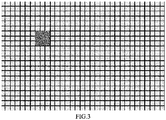
- the s_cv value (the CV value) of each grid is 1, showing that all of grids are occupied by obstacles.
- step 203 a coordinate origin is marked in the initialized map.
- a robot charging pile is taken as the coordinate origin of the map; and an east-west direction is taken as an X-axis and a south-north direction is taken as a Y-axis.
- Third embodiment method for mobile robot to record path indoors.
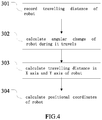
- Fig. 4 is a flowchart of a method for a mobile robot to record a path indoors in a third embodiment of the present invention. As shown in Fig. 4 , the flow includes the following steps:
- step 302 an angular change of the robot during it travels is calculated.
- step 303 travelling distances of the robot in directions of the X and Y axes are calculated.
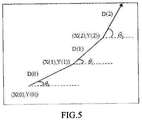
- the travelling distance in the X-axis X k X 0 + ⁇ i ⁇ 1 k ⁇ 1 D i cos ⁇ i
- the travelling distance in the Y-axis Y k Y 0 + ⁇ i ⁇ 1 k ⁇ 1 D i sin ⁇ i X(0)
- Y(0) are a position in which the robot is located at initial moment
- D(i) and ⁇ (i) are a running distance and an orientation angle from a moment (i-1) to another moment (i) of an autonomous carriage respectively.
- step 304 coordinate values of a position where the robot is located are calculated.
- the X coordinate value is X(k) / 200
- the Y coordinate value is Y(k) / 200.
- Fourth embodiment method for robot to estimate CV values of grids.
- Fig. 6 is a flowchart of a method for a robot to estimate CV values of grids in a fourth embodiment of the present invention. As shown in Fig. 6 , the flow includes the following steps:
- the two ultrasonic sensors are located right ahead of the robot side by side.
- step 402 CV values are calculated.
- the robot performs fusion measurement by an ultrasonic sensor in two means: a first means is data fusion of different sensors at the same moment, in which the CV value of each grid is estimated according to the Bayesian probability algorithm, and the Bayesian probability algorithm is given as follows:
- step 403 the CV values are marked in the map.
- a grid with a CV value of 0 to 0.2 that is a fully accessible region is expressed in white; a grid with a CV value of 0.2 to 0.8 that is a region where there may be an obstacle is expressed in gray; and a grid with a CV value of 0.8 to 1 that is a completely non-accessible region is expressed in black.
- Fig. 8 is a flow chart of a method for artificially marking position information of doors in a fifth embodiment of the present invention. As shown in Fig. 8 , the flow includes the following steps:
- the robot uses an ultrasonic sensor on a side to measure a distance from a wall of the robot during the robot travels indoors, and in a state in which a door is opened, it is determined that the door is present by two jumps (getting larger for the first time and getting smaller for the second time) of the readings of the ultrasonic sensor.
- step 502 a middle position of the two jumps is calculated.
- the middle position of the two jumps is the position of the door.
- Step 503 labels for positions where no door exists are artificially eliminated.
- Fig. 9 is a structural diagram of a system for a mobile robot to self-establish a map indoors in the first to fourth embodiments of the present invention.
- the system includes a mileometer 601, an ultrasonic sensor 602 and a processing unit 603,wherein the mileometer is used to calculate a distance and an angle of the robot travelling indoors; the ultrasonic sensor is used to detect information of obstacles surrounding the robot at different distances, wherein the robot has one ultrasonic sensor on each of both sides and has one or more ultrasonic sensors on a front side; and the processing unit is used to calculate path information of the travelling robot and grid information of the map and store grid data of the map.
- the technical solution of the present invention adopt the grid map to record information of the indoor environment and obtain path information and obstacle information from a detector in combination with characteristics of a limited indoor movable range of the robot to realize real-time adjustment and correspondence of an indoor environment and grid information and ensure effectiveness of a map model.
- the grid map is easy to be maintained and is convenient for quick access of map data.
- the present solutions have wide technical adaptability, can realize a rapid response to diversified environments, can quickly creates a dynamic map model reflecting information of a real environment, and can effectively realize localization and navigation of the robot.
- the embodiments of the present invention may be provided as a method, a system, or a computer program product.
- the present invention may take forms of a full hardware embodiment, a full software embodiment, or a combination of software and hardware aspects.
- the present invention may take a form of a computer program product implemented in one or more computer usable storage media (including but not limited to a disk storage and an optical memory, etc.) containing computer usable program codes.
- These computer program instructions may be provided to a processor of a universal computer, a dedicated computer, an embedded handler or other programmable data processing apparatuses to generate a machine such that the instructions executed by a processor of a computer or other programmable data processing apparatuses generate a device for achieving a function specified in one or more flows of a flow chart or one or more blocks in a block diagram.
- These computer program instructions may also be stored in a computer readable memory capable of guiding a computer or other programmable data processing apparatuses to operate in a particular manner such that the instructions stored in the computer readable memory generate a product including a command device that achieves a function specified in one or more flows of a flow chart or one or more blocks in a block diagram.
- These computer program instructions may also be loaded onto a computer or other programmable data processing apparatuses such that a series of operation steps are performed on the computer or other programmable apparatuses to produce processing realized by a computer so that the instructions executed on the computer or other programmable apparatuses provide steps for achieving the functions specified in one or more flows of a flow chart or one or more blocks in a block diagram.
Landscapes
- Engineering & Computer Science (AREA)
- Radar, Positioning & Navigation (AREA)
- Remote Sensing (AREA)
- Physics & Mathematics (AREA)
- General Physics & Mathematics (AREA)
- Automation & Control Theory (AREA)
- Aviation & Aerospace Engineering (AREA)
- Databases & Information Systems (AREA)
- Acoustics & Sound (AREA)
- Computer Networks & Wireless Communication (AREA)
- Control Of Position, Course, Altitude, Or Attitude Of Moving Bodies (AREA)
Abstract
Description
- The present invention relates to a technical field of automation, and particularly relates to a method and a system for a mobile robot to self-establish a map indoors.
- Development of robot technology is common crystallization of comprehensive development of science and technology. Robots can be divided into military robots, industrial robots, service robots, etc., in terms of usage, wherein all of these robot types have a huge demand for mobile robots.
- A research scope of mobile robots covers several aspects of system structure, control mechanism, information system, sensing technology, planning strategy and drive system, etc., and involves a plurality of disciplinary fields including mechanical kinematics, artificial intelligence, intelligent control, pattern recognition, image processing, visual technology, sensing technology, computer networks and communications, and biological information technology, etc. Mobile robots are not only widely applied in industries such as industry, agriculture, medical care, service, etc. but also well applied in harmful and dangerous situations such as fields of urban safety, national defense and space exploration,etc. Research level on mobile robots is an important indicator of development level of science and technology and comprehensive national strength of a country. "Robot revolution" is expected to become a starting point and an important growth point of the "third industrial revolution", and will affect a configuration of the global manufacturing industry. The International Federation of Robotics (IFR) predicts that the "Robot Revolution" will create a market with a scale of trillions of dollars, leading key technologies concerning robots such as new material functional modules, perception acquisition and recognition, intelligent control and navigation,etc. and markets to develop rapidly.
- In research of autonomous mobile robots, robot navigation is a precondition for realizing robot intelligence. There are two key questions in navigation: the first is description of an environment to construct the map;and the second is localization of a position of a robot in the map. Among them, the map construction is a primary problem, and is a core technology to achieve the robot navigation and even higher intelligence, and is a premise to achieve localization. The map construction involves the following sub-problems: map expression methods, sensors, description and processing of uncertain information, robot localization and map establishment conducted simultaneously.
- The map constructed by indoor robots is mainly a planar map, commonly used methods of which include a grid map, a geometric feature map and a topological map. The present technical solutions adopt the grid map.
- The grid map divides a whole working environment into a number of grids of the same size, obtains information about existence of an obstacle in each grid using detectors such as a radar detector, a sonar detector, an ultrasonic detector, etc., and indicates a possibility of existence of the obstacle in each grid.Since the information for each grid directly corresponds to a certain region in a real environment, the grid map is easy to be created, maintained, and understood. The grid map uses probability values to represent uncertainty of a grid model and can provide accurate metric information. Because of these advantages, the grid map is largely used in mobile robots. However, when amount of data in the map is large, storage volume and data maintenance workload of the grid map are increased, which will place a heavy burden on real-time processing of a computer.
- The geometric feature map extracts abstract geometric features from environment perception data collected by a robot, and uses relevant geometric features (such as points, lines, surfaces) to represent an environment. The method is more compact and convenient for position estimation and target recognition, but extraction of geometric information requires additional processing of the detected information, and thus the method is not applicable to unstructured map structure and accurate modeling can be achieved only if a large quantity of accurately measured data are acquired.
- The topological map represents an indoor environment as a topological structure graph with nodes and associated connecting lines, wherein the nodes indicate important position points (corners, doors, elevators, stairs, etc.) in the environment, and sides indicate connection relationships such as corridors, etc. between the nodes. The method occupies a small storage space, can quickly achieve path planning, does not need accurate position information of a robot, and also provides a more natural interface for releasing instructions through human-computer interaction. However, this method ignores detailed information of the environment, and it is difficult to refinedly plan the path of the robot. In addition, when a detection error of a sensor is large, the topological map is difficult to be created and maintained. Moreover, if there are two places similar to each other in the environment, it is difficult to determine whether they are the same point on the map. This brings difficulties in making correct recognition in a wide range environment.
- Expression methods of these three maps have their own advantages and disadvantages, and it is desired to achieve a high-precision map model that is easy to be maintained in connection with application situations of robots while being assisted by other technologies.
- The invention provides a method and a system for a mobile robot to self-establish a map indoors, which obtains path information and obstacle information from a detector in combination with characteristics of indoor movement to realize real-time adjustment and correspondence of an indoor environment and grid information and ensure effectiveness of a map model. Meanwhile, the grid map is easy to be maintained and is convenient for quick access of map data. Also, the present solutions have wide technical adaptability, can realize a rapid response to diversified environments, can quickly creates a dynamic map model reflecting information of a real environment, and can effectively realize localization and navigation of the robot.
- The technical solutions of the present invention provides a method for a mobile robot to self-establish a map indoors, the method comprises the following steps:
- forming an initialized map;
- marking a coordinate origin in the initialized map;
- causing the robot to travel throughout indoor accessible regions to record path information and environment information;
- causing the robot to calculate and mark a CV value of each grid in the map; and
- establishing the map according to the path information and the CV value.
- Furthermore, said step of forming an initialized map further comprises:
- the map is a meshed pattern constituted by a series of square grids;
- the map marks positions of an indoor environment in form of grids, each grid representing an indoor region with an actual size of 200 mm × 200 mm; and
- a user sets a size of the initialized map according to an indoor movable range of the robot.
- Furthermore,the map stores information of a grid in a two-dimensional array, the two-dimensional array has a data type that is a customized data structure AStarNode defined as follows:
                        typedef struct AStarNode
                        {
                          int s_x;
                          int s_y;
                          int s_g;
                          int s_h;
                          int s_cv;
                          struct AStarNode * s_parent;
                          int s_is_in_closetable;
                          int s_is_in_opentable;
                        } AStarNode;
                        AStarNode map_maze [400] [400];
wherein, map_maze is a two-dimensional array of the AstarNode data structure; s_x is position information of horizontal coordinates (X coordinates); s_y is position information of vertical coordinates (Y coordinates); s_cv indicates the CV value of each grid, representing a probability that each grid is occupied by an obstacle and ranging from 0 to 1, 0 showing that the grid is not occupied by any obstacle, 1 showing that the grid is occupied by the obstacle, and a larger CV value means a greater probability that the grid is occupied by the obstacle; in the initialized map, the CV value of each grid is 1, showing that all of grids are occupied by obstacles.
- taking a robot charging pile as the coordinate origin of the map; and
- taking an east-west direction as an X-axis and taking a south-north direction as a Y-axis.
- the robot records data path information and the CV value during it travels indoors;
- the robot marks position information of the accessible regions in the map according to measured values of a mileometer; and
- the robot marks the CV value in the map according to values fusion-measured by an ultrasonic sensor.
- X coordinate value

- Y coordinate value

- angular change

- wherein X(0), Y(0) are a position in which the robot is located at initial moment, and D(i) and ϕ(i) are a running distance and an orientation angle from a moment (i-1) to another moment (i) of an autonomous carriage respectively.
a first means is data fusion of different sensors at the same moment, in which the CV value of each grid is estimated according to the Bayesian probability algorithm, and the Bayesian probability algorithm is given as follows:
- obtaining the CV value by fusion of detected data of two ultrasonic sensors;
- dividing a detection scope of each ultrasonic sensor into three classes including class I meaning non-occupation, class II meaning possible occupation, and class III meaning uncertainty;
- defining a probability that a grid is occupied as P (O), and defining a probability that the grid is not occupied as P (E) = 1 - P (O), then


- R is an ultrasonic detection range, and r is an actually detected distance;
- the CV value of each grid obtained after fusion of detected data of two ultrasonic sensors at the same moment is

- a second means is fusion of measured values of the ultrasonic sensor on the same grid at different time, and the CV value of the same grid at different moments is

- differentiating the CV value of each grid by colors in the map;
- expressing a grid with a CV value of 0 to 0.2 that is a fully accessible region in white;
- expressing a grid with a CV value of 0.2 to 0.8 that is a region where there may be an obstacle in gray; and
- expressing a grid with a CV value of 0.8 to 1 that is a completely non-accessible region in black.
- the robot uses an ultrasonic sensor on a side to measure a distance from a wall of the robot during the robot travels indoors, and in a state in which a door is opened, it is determined that the door is present by two jumps (getting larger for the first time and getting smaller for the second time) of readings of the ultrasonic sensor;
- the robot marks a label of the door according to a middle position of the two jumps; and
- after the establishment of the map is finished, labels for positions where no door exists are artificially eliminated through operating a software and positions where doors are present are labeled with other colors in an interface of the software.
-
Fig. 1 is a flow chart of a method for a mobile robot to self-establish a map indoors in a first embodiment of the present invention; -
Fig. 2 is a flow chart of a method for self-establishing an initialized grid map in a second embodiment of the present invention; -
Fig. 3 is a schematic diagram of the initialized grid map in the second embodiment of the present invention; -
Fig. 4 is a flow chart of a method for a mobile robot to record a path indoors in a third embodiment of the present invention; -
Fig. 5 is a schematic diagram of a principle for a mobile robot to record a path indoors in the third embodiment of the present invention; -
Fig. 6 is a flow chart of a method for a robot to estimate CV values of grids in a fourth embodiment of the present invention; -
Fig. 7 is a schematic diagram of a principle for ultrasonic detection in the fourth embodiment of the present invention; -
Fig. 8 is a flow chart of a method for artificially revising position information of doors in a fifth embodiment of the present invention; and -
Fig. 9 is a structural diagram of a system for a mobile robot to self-establish a map indoors in the first to fourth embodiments of the present invention.
- In
step 101, an initialized map is formed.
the map marks positions of an indoor environment in form of grids, each grid representing an indoor region with an actual size of 200 mm × 200 mm; and
a user sets a size of the initialized map according to an indoor movable range of the robot.
                        typedef struct AStarNode
                        {
                          int s_x;
                          int s_y;
                          int s_g;
                          int s_h;
                          int s_cv;
                          struct AStarNode * s_parent;
                          int s_is_in_closetable;
                          int s_is_in_opentable;
                        } AStarNode;
                        AStarNode map_maze [400] [400];
wherein, map_maze is a two-dimensional array of the AstarNode data structure; s_x is position information of horizontal coordinates (X coordinates); s_y is position information of vertical coordinates (Y coordinates); s_cv indicates the CV value of each grid, representing a probability that each grid is occupied by an obstacle and ranging from 0 to 1, 0 showing that the grid is not occupied by any obstacle, 1 showing that the grid is occupied by the obstacle, and a larger CV value means a greater probability that the grid is occupied by the obstacle; in the initialized map, the CV value of each grid is 1, showing that all of grids are occupied by obstacles.
the origin is on an edge of the map, in a central position of the edge of the map;
the origin is on the edge of the map;
a direction parallel to the edge of the map is an X-axis and a direction perpendicular to the edge of the map is a Y-axis.
- the robot uses an ultrasonic sensor on a side to measure a distance from a wall of the robot during the robot travels indoors, and in a state in which a door is opened, it is determined that the door is present by two jumps (getting larger for the first time and getting smaller for the second time) of readings of the ultrasonic sensor;
- the robot marks a label of the door according to a middle position of the two jumps; and
- after the establishment of the map is finished, labels for positions where no door exists are artificially eliminated through operating a software and positions where doors are present are labeled with other colors in an interface of the software.
- In
step 201, an initialized grid map is formed.
the map marks positions of an indoor environment in form of grids, each grid representing an indoor region with an actual size of 200 mm × 200 mm; and
a user sets a size of the initialized map according to an indoor movable range of the robot.
the map stores information of a grid in a two-dimensional array, the two-dimensional array has a data type that is a customized data structure AStarNode defined as follows:
                        typedef struct AStarNode
                        {
                          Int s_x;
                          Int s_y;
                          Int s_g;
                          Int s_h;
                          Int s_cv;
                          struct AStarNode * s_parent;
                          int s_is_in_closetable;
                          int s_is_in_opentable;
                        } AStarNode;
                        AStarNode map_maze [400] [400];
wherein, map_maze is a two-dimensional array of the AstarNode data structure; s_x is position information of horizontal coordinates (X coordinates); s_y is position information of vertical coordinates (Y coordinates); s_cv indicates the CV value of each grid, representing a probability that each grid is occupied by an obstacle and ranging from 0 to 1, 0 showing that the grid is not occupied by any obstacle, 1 showing that the grid is occupied by the obstacle, and a larger CV value means a greater probability that the grid is occupied by the obstacle.
an east-west direction is taken as an X-axis and a south-north direction is taken as a Y-axis.
- In
step 301, a travelling distance of the robot is recorded by use of a mileometer.
the angular change

the travelling distance in the X-axis


- In
step 401, two ultrasonic sensors are used to detect data.
the robot performs fusion measurement by an ultrasonic sensor in two means:
a first means is data fusion of different sensors at the same moment, in which the CV value of each grid is estimated according to the Bayesian probability algorithm, and the Bayesian probability algorithm is given as follows:
- obtaining the CV value by fusion of detected data of two ultrasonic sensors;
- dividing a detection scope of each ultrasonic sensor into three classes including class I meaning non-occupation, class II meaning possible occupation, and class III meaning uncertainty;
- defining a probability that a grid is occupied as P (O), and defining a probability that the grid is not occupied as P (E) = 1 - P (O), then


- R is an ultrasonic detection range, and r is an actually detected distance;
- the CV value of each grid obtained after fusion of detected data of two ultrasonic sensors at the same moment is

- a second means is fusion of measured values of the ultrasonic sensor on the same grid at different time, and the CV value of the same grid at different moments is

a grid with a CV value of 0.2 to 0.8 that is a region where there may be an obstacle is expressed in gray; and
a grid with a CV value of 0.8 to 1 that is a completely non-accessible region is expressed in black.
- In
step 501, the robot records two jumps of readings of an ultrasonic sensor.
Claims (10)
- A method for a mobile robot to self-establish a map indoors, characterized in that the method comprises the following steps:forming an initialized map;marking a coordinate origin in the initialized map;causing the robot to travel throughout indoor accessible regions to record path information and environment information;causing the robot to calculate and mark a CV value of each grid in the map ; andestablishing the map according to the path information and the CV value.
- The method according to claim 1, characterized in that said step of forming an initialized map further comprises:the map is a meshed pattern constituted by a series of square grids;the map marks positions of an indoor environment in form of grids, each grid representing an indoor region with an actual size of 200 mm × 200 mm; anda user sets a size of the initialized map according to an indoor movable range of the robot.
- The method according to claim 1 or 2, characterized in that the map stores information of a grid in a two-dimensional array, the two-dimensional array has a data type that is a customized data structure AStarNode defined as follows:
                        typedef struct AStarNode
                        {
                          int s_x;
                          int s_y;
                          int s_g;
                          int s_h;
                          int s_cv;
                          struct AStarNode * s_parent;
                          int s_is_in_closetable;
                          int s_is_in_opentable;
                        } AStarNode;
                        AStarNode map_maze [400] [400];
wherein, map_maze is a two-dimensional array of the AstarNode data structure; s_x is position information of horizontal coordinates (X coordinates); s_y is position information of vertical coordinates (Y coordinates); s_cv indicates the CV value of each grid, representing a probability that each grid is occupied by an obstacle and ranging from 0 to 1, 0 showing that the grid is not occupied by any obstacle, 1 showing that the grid is occupied by the obstacle, and a larger CV value means a greater probability that the grid is occupied by the obstacle; in the initialized map, the CV value of each grid is 1, showing that all of grids are occupied by obstacles. - The method according to claim 1, characterized in that said step of marking a coordinate origin in the initialized map further comprises:taking a robot charging pile as the coordinate origin of the map; andtaking an east-west direction as an X-axis and taking a south-north direction as a Y-axis.
- The method according to claim 1, characterized in that said step of causing the robot to travel throughout indoor accessible regions to record path information and environment information further comprises:the robot records data path information and the CV value during it travels indoors;the robot marks position information of the accessible regions in the map according to measured values of a mileometer; andthe robot marks the CV value in the map according to values fusion-measured by an ultrasonic sensor.
- The method according to claim 1 or 5, characterized in that the robot calculates X and Y coordinate values of a position in which it is located according to a mileometer in the following manner:X coordinate value
 Y coordinate value
 angular change
 wherein X(0), Y(0) are a position in which the robot is located at initial moment, and D(i) and ϕ(i) are a running distance and an orientation angle from a moment (i-1) to another moment (i) of an autonomous carriage respectively.
 - The method according to claim 1 or 5, characterized in that the robot performs fusion measurement by an ultrasonic sensor in two means:
a first means is data fusion of different sensors at the same moment, in which the CV value of each grid is estimated according to the Bayesian probability algorithm, and the Bayesian probability algorithm is given as follows:obtaining the CV value by fusion of detected data of two ultrasonic sensors;dividing a detection scope of each ultrasonic sensor into three classes including class I meaning non-occupation, class II meaning possible occupation, and class III meaning uncertainty;defining a probability that a grid is occupied as P (O), and defining a probability that the grid is not occupied as P (E) = 1 - P (O), then

 R is an ultrasonic detection range, and r is an actually detected distance;the CV value of each grid obtained after fusion of detected data of two ultrasonic sensors at the same moment is
 a second means is fusion of measured values of the ultrasonic sensor on the same grid at different time, and the CV value of the same grid at different moments is
- The method according to claim 1 or 7, characterized in that the method further comprises:differentiating the CV value of each grid by colors in the map;expressing a grid with a CV value of 0 to 0.2 that is a fully accessible region in white;expressing a grid with a CV value of 0.2 to 0.8 that is a region where there may be an obstacle in gray; andexpressing a grid with a CV value of 0.8 to 1 that is a completely non-accessible region in black.
- The method according to claim 1 or 7, characterized in that the robot self-establishes the map after travelling throughout indoors and positions of doors are artificially revised in the map, and the method further comprises:the robot uses an ultrasonic sensor on a side to measure a distance from a wall of the robot during the robot travels indoors, and in a state in which a door is opened, it is determined that the door is present by two jumps that get larger for the first time and get smaller for the second time of readings of the ultrasonic sensor;the robot marks a label of the door according to a middle position of the two jumps; andafter the establishment of the map is finished, labels for positions where no door exists are artificially eliminated through operating a software and positions where doors are present are labeled with other colors in an interface of the software.
- A system for a mobile robot to self-establish a map indoors, characterized in that the system comprises a mileometer, an ultrasonic sensor and a processing unit, wherein the mileometer is used to calculate a distance and an angle of the robot travelling indoors; the ultrasonic sensor is used to detect information of obstacles surrounding the robot at different distances, wherein the robot has one ultrasonic sensor on each of both sides and has one or more ultrasonic sensors on a front side; and the processing unit is used to calculate path information of the travelling robot and grid information of the map and store grid data of the map.
Applications Claiming Priority (2)
| Application Number | Priority Date | Filing Date | Title |
|---|---|---|---|
| CN201510502547.6A CN105043396B (en) | 2015-08-14 | 2015-08-14 | The method and system of self-built map in a kind of mobile robot room |
| PCT/CN2016/091033 WO2017028653A1 (en) | 2015-08-14 | 2016-07-22 | Method and system for automatically establishing map indoors by mobile robot |
Publications (2)
| Publication Number | Publication Date |
|---|---|
| EP3336489A1 true EP3336489A1 (en) | 2018-06-20 |
| EP3336489A4 EP3336489A4 (en) | 2019-04-10 |
Family
ID=54450130
Family Applications (1)
| Application Number | Title | Priority Date | Filing Date |
|---|---|---|---|
| EP16836517.9A Withdrawn EP3336489A4 (en) | 2015-08-14 | 2016-07-22 | Method and system for automatically establishing map indoors by mobile robot |
Country Status (4)
| Country | Link |
|---|---|
| US (1) | US20180172451A1 (en) |
| EP (1) | EP3336489A4 (en) |
| CN (1) | CN105043396B (en) |
| WO (1) | WO2017028653A1 (en) |
Cited By (1)
| Publication number | Priority date | Publication date | Assignee | Title |
|---|---|---|---|---|
| WO2021190646A1 (en) * | 2020-03-27 | 2021-09-30 | 杭州海康机器人技术有限公司 | Map switching method and mobile robot |
Families Citing this family (84)
| Publication number | Priority date | Publication date | Assignee | Title |
|---|---|---|---|---|
| CN105043396B (en) * | 2015-08-14 | 2018-02-02 | 北京进化者机器人科技有限公司 | The method and system of self-built map in a kind of mobile robot room |
| CN105425803B (en) * | 2015-12-16 | 2020-05-19 | 纳恩博(北京)科技有限公司 | Autonomous obstacle avoidance method, device and system |
| CN114859915A (en) * | 2016-03-07 | 2022-08-05 | 洋马动力科技有限公司 | Driving area shape registration system |
| CN105652874B (en) * | 2016-03-21 | 2019-04-12 | 北京联合大学 | A kind of mobile robot Real-time Obstacle Avoidance Method based on broad sense wave front algorithm |
| CN107305376A (en) * | 2016-04-19 | 2017-10-31 | 上海慧流云计算科技有限公司 | A kind of automatic drawing robot of indoor map and method for drafting |
| CN107305377A (en) * | 2016-04-19 | 2017-10-31 | 上海慧流云计算科技有限公司 | A kind of automatic drawing robot of indoor map and method for drafting |
| CN107401803A (en) * | 2016-05-19 | 2017-11-28 | 科沃斯机器人股份有限公司 | A kind of control method of assembly robot |
| CN105974928B (en) * | 2016-07-29 | 2018-12-07 | 哈尔滨工大服务机器人有限公司 | A kind of robot navigation's paths planning method |
| CN106484959B (en) * | 2016-09-19 | 2019-12-31 | 上海斐讯数据通信技术有限公司 | House type graph drawing method and drawing equipment |
| CN108225343A (en) * | 2016-12-22 | 2018-06-29 | 沈阳美行科技有限公司 | A kind of cartographic information system, generation and application method and its application |
| CN108225344A (en) * | 2016-12-22 | 2018-06-29 | 沈阳美行科技有限公司 | A kind of map system, generation and application method and its application |
| CN108225342A (en) * | 2016-12-22 | 2018-06-29 | 沈阳美行科技有限公司 | A kind of map datum system, generation and application method and its application |
| CN106919174A (en) * | 2017-04-10 | 2017-07-04 | 江苏东方金钰智能机器人有限公司 | A kind of bootstrap technique of intelligently guiding robot |
| CN107024934B (en) * | 2017-04-21 | 2023-06-02 | 山东大学 | A hospital service robot and method based on cloud platform |
| JP6828579B2 (en) * | 2017-04-27 | 2021-02-10 | トヨタ自動車株式会社 | Environmental maintenance robot and its control program |
| CN108957463B (en) * | 2017-06-30 | 2021-01-22 | 北京猎户星空科技有限公司 | Ultrasonic measuring method and device |
| CN111801717A (en) * | 2017-07-28 | 2020-10-20 | 高通股份有限公司 | Automatic exploration control of robotic vehicles |
| CN107702715B (en) * | 2017-08-23 | 2019-09-20 | 昆山联骥机器人有限公司 | A digital map building method for autonomous navigation of indoor service robots |
| CN107928565A (en) * | 2017-11-17 | 2018-04-20 | 北京奇虎科技有限公司 | Clean method, device and the robot of clean robot |
| CN107966702B (en) * | 2017-11-21 | 2019-12-13 | 北京进化者机器人科技有限公司 | construction method and device of environment map |
| CN109959935B (en) * | 2017-12-14 | 2020-10-23 | 北京欣奕华科技有限公司 | A map building method, map building device and robot |
| CN109974719A (en) * | 2017-12-28 | 2019-07-05 | 周秦娜 | A kind of control method and device of the mobile robot environment sensing based on cloud computing |
| CN110069058A (en) * | 2018-01-24 | 2019-07-30 | 南京机器人研究院有限公司 | Navigation control method in a kind of robot chamber |
| CN108663041B (en) * | 2018-02-09 | 2020-04-24 | 意诺科技有限公司 | Method and device for drawing navigation map |
| CN108803602B (en) * | 2018-06-01 | 2021-07-13 | 浙江亚特电器有限公司 | Obstacle self-learning method and new obstacle self-learning method |
| CN110836668A (en) * | 2018-08-16 | 2020-02-25 | 科沃斯商用机器人有限公司 | Positioning navigation method, device, robot and storage medium |
| CN109002043B (en) * | 2018-08-24 | 2021-06-15 | 湖南超能机器人技术有限公司 | Infrared alignment signal data processing method applied to robot |
| CN109298386B (en) * | 2018-10-17 | 2020-10-23 | 中国航天系统科学与工程研究院 | Three-dimensional unknown area rapid detection method based on multi-agent cooperation |
| CN109376212B (en) * | 2018-11-22 | 2020-12-15 | 上海木木聚枞机器人科技有限公司 | A method and system for generating a map for calculating the probability of pedestrian occurrence |
| CN109556598B (en) * | 2018-11-23 | 2021-01-19 | 西安交通大学 | Autonomous mapping and navigation positioning method based on ultrasonic sensor array |
| CN111380532B (en) * | 2018-12-29 | 2022-06-28 | 深圳市优必选科技有限公司 | Path planning method, device, terminal and computer storage medium |
| US10694053B1 (en) | 2019-01-22 | 2020-06-23 | Xerox Corporation | Wireless location tracking tag for monitoring real time location-tracking apparatus for an electronic device |
| CN111578938B (en) * | 2019-02-19 | 2022-08-02 | 珠海格力电器股份有限公司 | Target object positioning method and device |
| CN109916408A (en) * | 2019-02-28 | 2019-06-21 | 深圳市鑫益嘉科技股份有限公司 | Robot indoor positioning and air navigation aid, device, equipment and storage medium |
| CN109934918B (en) * | 2019-03-08 | 2023-03-28 | 北京精密机电控制设备研究所 | Multi-robot collaborative map reconstruction method based on visual and tactile fusion mechanism |
| WO2020211055A1 (en) * | 2019-04-18 | 2020-10-22 | 深圳市大疆创新科技有限公司 | Mobile platform navigation method and device and a computer-readable storage medium |
| CN112180910B (en) * | 2019-06-18 | 2024-07-19 | 北京京东乾石科技有限公司 | A mobile robot obstacle perception method and device |
| WO2021003959A1 (en) * | 2019-07-09 | 2021-01-14 | 苏州科瓴精密机械科技有限公司 | Method for updating and system for updating raster map |
| CN112212863B (en) * | 2019-07-09 | 2024-08-09 | 苏州科瓴精密机械科技有限公司 | Grid map creation method and system |
| CN110487279B (en) * | 2019-08-27 | 2022-12-13 | 东南大学 | A Path Planning Method Based on Improved A* Algorithm |
| CN110824489A (en) * | 2019-11-06 | 2020-02-21 | 博信矿山科技(徐州)股份有限公司 | Positioning method for improving position precision of indoor robot |
| CN110928972A (en) * | 2019-11-22 | 2020-03-27 | 珠海格力电器股份有限公司 | Semantic map construction method, system, device, storage medium and robot |
| CN111080786B (en) * | 2019-12-19 | 2024-05-28 | 盈嘉互联(北京)科技有限公司 | Indoor map model construction method and device based on BIM |
| CN111061273B (en) * | 2019-12-26 | 2023-06-06 | 航天时代(青岛)海洋装备科技发展有限公司 | Autonomous obstacle avoidance fusion method and system for unmanned ship |
| US11026048B1 (en) * | 2020-03-05 | 2021-06-01 | Xerox Corporation | Indoor positioning system for a mobile electronic device |
| US11244470B2 (en) | 2020-03-05 | 2022-02-08 | Xerox Corporation | Methods and systems for sensing obstacles in an indoor environment |
| CN111272183B (en) * | 2020-03-16 | 2025-08-12 | 达闼机器人股份有限公司 | Map creation method and device, electronic equipment and storage medium |
| CN111307168A (en) * | 2020-03-19 | 2020-06-19 | 苏州艾吉威机器人有限公司 | AGV (automatic guided vehicle) map building method and positioning method and system |
| CN113465614B (en) * | 2020-03-31 | 2023-04-18 | 北京三快在线科技有限公司 | Unmanned aerial vehicle and generation method and device of navigation map thereof |
| CN111486847B (en) * | 2020-04-29 | 2021-10-08 | 华中科技大学 | Method and system for unmanned aerial vehicle navigation |
| CN111753649B (en) * | 2020-05-13 | 2024-05-14 | 上海欧菲智能车联科技有限公司 | Parking space detection method, device, computer equipment and storage medium |
| CN111631639B (en) * | 2020-05-26 | 2021-07-06 | 珠海市一微半导体有限公司 | Map traversal block establishment method, chip and mobile robot for global grid map |
| CN112053415B (en) * | 2020-07-17 | 2023-08-01 | 科沃斯机器人股份有限公司 | Map construction method and self-walking equipment |
| CN111881245B (en) * | 2020-08-04 | 2023-08-08 | 深圳安途智行科技有限公司 | Method, device, equipment and storage medium for generating visibility dynamic map |
| US11356800B2 (en) | 2020-08-27 | 2022-06-07 | Xerox Corporation | Method of estimating indoor location of a device |
| CN114527736B (en) * | 2020-10-30 | 2023-10-13 | 速感科技(北京)有限公司 | Dilemma avoidance method, autonomous mobile device, and storage medium |
| CN112731321B (en) * | 2020-11-27 | 2024-06-04 | 北京理工大学 | Mobile robot obstacle avoidance and map drawing method based on MIMO cognitive radar |
| CN114720978A (en) * | 2021-01-06 | 2022-07-08 | 扬智科技股份有限公司 | Method and mobile platform for simultaneous localization and mapping |
| CN112782706B (en) * | 2021-01-11 | 2022-05-10 | 山东新一代信息产业技术研究院有限公司 | Obstacle detection method and system for robot ultrasonic sensor |
| CN112927322B (en) * | 2021-01-20 | 2024-01-23 | 上海高仙自动化科技发展有限公司 | A positioning initialization method, device and robot |
| CN113203419B (en) * | 2021-04-25 | 2023-11-10 | 重庆大学 | Calibration and positioning method of indoor inspection robot based on neural network |
| CN113311827B (en) * | 2021-05-08 | 2022-07-12 | 东南大学 | Robot indoor map capable of improving storage efficiency and generation method thereof |
| CN113532418A (en) * | 2021-06-11 | 2021-10-22 | 上海追势科技有限公司 | Single-vehicle collection method for map of parking lot |
| CN113607154B (en) * | 2021-06-29 | 2024-05-24 | 广州大学 | A two-dimensional autonomous positioning method, system, device and medium for indoor robots |
| CN113434788B (en) * | 2021-07-07 | 2024-05-07 | 北京经纬恒润科技股份有限公司 | Mapping method, device, electronic equipment and vehicle |
| CN113670296B (en) * | 2021-08-18 | 2023-11-24 | 北京经纬恒润科技股份有限公司 | Method and device for generating environment map based on ultrasonic waves |
| CN115731360B (en) * | 2021-08-31 | 2024-10-15 | 中科南京软件技术研究院 | Man-machine interaction-oriented grid map post-processing representation method |
| CN113989635B (en) * | 2021-09-23 | 2025-07-11 | 深圳市联洲国际技术有限公司 | A multi-sensor collaborative positioning method, device, storage medium and terminal device |
| CN113848961B (en) * | 2021-10-13 | 2023-10-24 | 中国人民解放军国防科技大学 | Safe and concealed path planning method and system for underwater vehicles based on sonar detection probability |
| CN113984057B (en) * | 2021-10-19 | 2024-11-15 | 山东中瑞电气有限公司 | Mobile robot positioning method based on multi-data analysis |
| CN114166227B (en) * | 2021-12-06 | 2024-07-02 | 神思电子技术股份有限公司 | Indoor navigation map drawing method and equipment |
| CN114442627B (en) * | 2022-01-24 | 2023-10-13 | 电子科技大学 | A dynamic desktop pathfinding system and method for smart home mobile devices |
| CN114859891B (en) * | 2022-04-02 | 2024-06-14 | 中国人民解放军国防科技大学 | Multi-robot continuous monitoring method and non-transitory computer readable storage medium |
| CN115049688B (en) * | 2022-08-16 | 2022-11-18 | 之江实验室 | Grid map region division method and device based on reinforcement learning thought |
| CN115096293B (en) * | 2022-08-24 | 2022-11-04 | 北京极光愿景科技有限公司 | Multi-robot cooperation detection map construction method and device and mine sweeping robot |
| CN115268470B (en) * | 2022-09-27 | 2023-08-18 | 深圳市云鼠科技开发有限公司 | Obstacle position marking method, device and medium for cleaning robot |
| CN115736733B (en) * | 2022-10-28 | 2025-10-28 | 广东盈峰智能环卫科技有限公司 | Indoor robot and map construction method and device thereof |
| CN115407344B (en) * | 2022-11-01 | 2023-01-17 | 小米汽车科技有限公司 | Grid map creation method, device, vehicle and readable storage medium |
| CN116872194A (en) * | 2023-03-30 | 2023-10-13 | 深圳银星智能集团股份有限公司 | A robot control method, device, readable storage medium and robot |
| CN116358555B (en) * | 2023-03-31 | 2025-09-19 | 之江实验室 | Autonomous construction and maintenance method and system for indoor environment model |
| CN117288179B (en) * | 2023-09-26 | 2025-07-22 | 华晓精密工业(苏州)有限公司 | Robot map dynamic updating method, system, equipment and medium |
| CN117260744B (en) * | 2023-11-21 | 2024-02-02 | 张家港保税区长江国际港务有限公司 | Manipulator route planning method based on artificial intelligence |
| CN118533182B (en) * | 2024-07-25 | 2024-09-17 | 山东鸿泽自动化技术有限公司 | Visual intelligent navigation method and system for transfer robot |
| CN119160306A (en) * | 2024-08-22 | 2024-12-20 | 蚂蚁侠科技(深圳)有限公司 | Dual-driving mode manned vehicle and dual-driving mode manned vehicle control method |
Family Cites Families (14)
| Publication number | Priority date | Publication date | Assignee | Title |
|---|---|---|---|---|
| US5150452A (en) * | 1989-07-28 | 1992-09-22 | Megamation Incorporated | Method and apparatus for anti-collision and collision protection for multiple robot system |
| CA2436012C (en) * | 2001-01-24 | 2009-04-28 | Televigation, Inc. | Real-time navigation system for mobile environment |
| US7489812B2 (en) * | 2002-06-07 | 2009-02-10 | Dynamic Digital Depth Research Pty Ltd. | Conversion and encoding techniques |
| US7584020B2 (en) * | 2006-07-05 | 2009-09-01 | Battelle Energy Alliance, Llc | Occupancy change detection system and method |
| CN101033971B (en) * | 2007-02-09 | 2011-02-16 | 中国科学院合肥物质科学研究院 | Mobile robot map building system and map building method thereof |
| KR100883520B1 (en) * | 2007-07-23 | 2009-02-13 | 한국전자통신연구원 | Indoor environmental mapping system and method |
| KR101409987B1 (en) * | 2007-12-11 | 2014-06-23 | 삼성전자주식회사 | Method and apparatus for attitude correction of mobile robot |
| CN101619985B (en) * | 2009-08-06 | 2011-05-04 | 上海交通大学 | Service robot autonomous navigation method based on deformable topological map |
| CN102138769B (en) * | 2010-01-28 | 2014-12-24 | 深圳先进技术研究院 | Cleaning robot and cleaning method thereby |
| US8798840B2 (en) * | 2011-09-30 | 2014-08-05 | Irobot Corporation | Adaptive mapping with spatial summaries of sensor data |
| CN204374771U (en) * | 2015-01-14 | 2015-06-03 | 上海物景智能科技有限公司 | Realize device and the sweeping robot of the modeling of sweeping robot map boundary line |
| CN104731101B (en) * | 2015-04-10 | 2017-08-04 | 河海大学常州校区 | Cleaning robot indoor scene map modeling method and robot |
| CN104808671B (en) * | 2015-05-19 | 2017-03-15 | 东南大学 | A kind of robot path planning method under domestic environment |
| CN105043396B (en) * | 2015-08-14 | 2018-02-02 | 北京进化者机器人科技有限公司 | The method and system of self-built map in a kind of mobile robot room |
-
2015
- 2015-08-14 CN CN201510502547.6A patent/CN105043396B/en active Active
-
2016
- 2016-07-22 EP EP16836517.9A patent/EP3336489A4/en not_active Withdrawn
- 2016-07-22 WO PCT/CN2016/091033 patent/WO2017028653A1/en not_active Ceased
- 2016-07-22 US US15/572,312 patent/US20180172451A1/en not_active Abandoned
Cited By (1)
| Publication number | Priority date | Publication date | Assignee | Title |
|---|---|---|---|---|
| WO2021190646A1 (en) * | 2020-03-27 | 2021-09-30 | 杭州海康机器人技术有限公司 | Map switching method and mobile robot |
Also Published As
| Publication number | Publication date |
|---|---|
| US20180172451A1 (en) | 2018-06-21 |
| CN105043396B (en) | 2018-02-02 |
| WO2017028653A1 (en) | 2017-02-23 |
| CN105043396A (en) | 2015-11-11 |
| EP3336489A4 (en) | 2019-04-10 |
Similar Documents
| Publication | Publication Date | Title |
|---|---|---|
| EP3336489A1 (en) | Method and system for automatically establishing map indoors by mobile robot | |
| Kriegman et al. | A mobile robot: Sensing, planning and locomotion | |
| CN103472823B (en) | A kind of grating map creating method of intelligent robot | |
| Xiao et al. | Monocular vehicle self-localization method based on compact semantic map | |
| CN113325837A (en) | Control system and method for multi-information fusion acquisition robot | |
| CN118020038A (en) | Two-wheeled self-balancing robot | |
| CN112518739A (en) | Intelligent self-navigation method for reconnaissance of tracked chassis robot | |
| An et al. | Development of mobile robot SLAM based on ROS | |
| US20240393793A1 (en) | Method for estimating posture of moving object by using big cell grid map, recording medium in which program for implementing same is stored, and computer program stored in medium in order to implement same | |
| WO2023274270A1 (en) | Robot preoperative navigation method and system, storage medium, and computer device | |
| Yee et al. | Autonomous mobile robot navigation using 2D LiDAR and inclined laser rangefinder to avoid a lower object | |
| Gartshore et al. | Incremental map building using an occupancy grid for an autonomous monocular robot | |
| Khan et al. | Sonar-based SLAM using occupancy grid mapping and dead reckoning | |
| Yanyachi et al. | Three-dimensional reconstruction of enclosed environments based on two-dimensional LiDAR: Starting point and future challenges | |
| CN118533165A (en) | An autonomous navigation method for mobile inspection robots based on narrow space perception | |
| Azri et al. | Visual analytics of 3D LiDAR point clouds in robotics operating systems | |
| Blanco et al. | Localization by voronoi diagrams correlation | |
| CN117232514A (en) | An indoor path planning method based on two-dimensional lidar and binocular cameras | |
| CN117570979A (en) | A SLAM and path planning method based on multi-sensor fusion | |
| Wang et al. | Adaptive autonomous navigation system for coal mine inspection robots: overcoming intersection challenges | |
| Wang et al. | Agv navigation based on apriltags2 auxiliary positioning | |
| Kumar | Development of SLAM algorithm for a Pipe Inspection Serpentine Robot | |
| Zhang et al. | Analysis on simultaneous localization and mapping of mobile robot based on two multi-sensor fusion algorithm | |
| Jiménez Serrata et al. | An intelligible implementation of FastSLAM2. 0 on a low-power embedded architecture | |
| Chen et al. | Navigation method of fire-fighting robot based on a commercial electronic map |
Legal Events
| Date | Code | Title | Description |
|---|---|---|---|
| PUAI | Public reference made under article 153(3) epc to a published international application that has entered the european phase |
Free format text: ORIGINAL CODE: 0009012 |
|
| 17P | Request for examination filed |
Effective date: 20171206 |
|
| AK | Designated contracting states |
Kind code of ref document: A1 Designated state(s): AL AT BE BG CH CY CZ DE DK EE ES FI FR GB GR HR HU IE IS IT LI LT LU LV MC MK MT NL NO PL PT RO RS SE SI SK SM TR |
|
| AX | Request for extension of the european patent |
Extension state: BA ME |
|
| DAV | Request for validation of the european patent (deleted) | ||
| DAX | Request for extension of the european patent (deleted) | ||
| A4 | Supplementary search report drawn up and despatched |
Effective date: 20190313 |
|
| RIC1 | Information provided on ipc code assigned before grant |
Ipc: G01C 22/00 20060101ALI20190305BHEP Ipc: G01C 21/32 20060101ALI20190305BHEP Ipc: G01C 21/20 20060101AFI20190305BHEP Ipc: G05D 1/02 20060101ALI20190305BHEP Ipc: G01S 15/08 20060101ALI20190305BHEP |
|
| 17Q | First examination report despatched |
Effective date: 20200520 |
|
| STAA | Information on the status of an ep patent application or granted ep patent |
Free format text: STATUS: THE APPLICATION IS DEEMED TO BE WITHDRAWN |
|
| 18D | Application deemed to be withdrawn |
Effective date: 20200731 |