EP3336162A1 - Lubricating composition - Google Patents
Lubricating composition Download PDFInfo
- Publication number
- EP3336162A1 EP3336162A1 EP16204746.8A EP16204746A EP3336162A1 EP 3336162 A1 EP3336162 A1 EP 3336162A1 EP 16204746 A EP16204746 A EP 16204746A EP 3336162 A1 EP3336162 A1 EP 3336162A1
- Authority
- EP
- European Patent Office
- Prior art keywords
- lubricating composition
- molybdenum
- compounds
- present
- oil
- Prior art date
- Legal status (The legal status is an assumption and is not a legal conclusion. Google has not performed a legal analysis and makes no representation as to the accuracy of the status listed.)
- Withdrawn
Links
Images

Classifications
-
- C—CHEMISTRY; METALLURGY
- C10—PETROLEUM, GAS OR COKE INDUSTRIES; TECHNICAL GASES CONTAINING CARBON MONOXIDE; FUELS; LUBRICANTS; PEAT
- C10M—LUBRICATING COMPOSITIONS; USE OF CHEMICAL SUBSTANCES EITHER ALONE OR AS LUBRICATING INGREDIENTS IN A LUBRICATING COMPOSITION
- C10M135/00—Lubricating compositions characterised by the additive being an organic non-macromolecular compound containing sulfur, selenium or tellurium
- C10M135/12—Thio-acids; Thiocyanates; Derivatives thereof
- C10M135/14—Thio-acids; Thiocyanates; Derivatives thereof having a carbon-to-sulfur double bond
- C10M135/18—Thio-acids; Thiocyanates; Derivatives thereof having a carbon-to-sulfur double bond thiocarbamic type, e.g. containing the groups
-
- C—CHEMISTRY; METALLURGY
- C10—PETROLEUM, GAS OR COKE INDUSTRIES; TECHNICAL GASES CONTAINING CARBON MONOXIDE; FUELS; LUBRICANTS; PEAT
- C10M—LUBRICATING COMPOSITIONS; USE OF CHEMICAL SUBSTANCES EITHER ALONE OR AS LUBRICATING INGREDIENTS IN A LUBRICATING COMPOSITION
- C10M169/00—Lubricating compositions characterised by containing as components a mixture of at least two types of ingredient selected from base-materials, thickeners or additives, covered by the preceding groups, each of these compounds being essential
- C10M169/04—Mixtures of base-materials and additives
-
- C—CHEMISTRY; METALLURGY
- C10—PETROLEUM, GAS OR COKE INDUSTRIES; TECHNICAL GASES CONTAINING CARBON MONOXIDE; FUELS; LUBRICANTS; PEAT
- C10M—LUBRICATING COMPOSITIONS; USE OF CHEMICAL SUBSTANCES EITHER ALONE OR AS LUBRICATING INGREDIENTS IN A LUBRICATING COMPOSITION
- C10M2203/00—Organic non-macromolecular hydrocarbon compounds and hydrocarbon fractions as ingredients in lubricant compositions
- C10M2203/10—Petroleum or coal fractions, e.g. tars, solvents, bitumen
- C10M2203/102—Aliphatic fractions
- C10M2203/1025—Aliphatic fractions used as base material
-
- C—CHEMISTRY; METALLURGY
- C10—PETROLEUM, GAS OR COKE INDUSTRIES; TECHNICAL GASES CONTAINING CARBON MONOXIDE; FUELS; LUBRICANTS; PEAT
- C10M—LUBRICATING COMPOSITIONS; USE OF CHEMICAL SUBSTANCES EITHER ALONE OR AS LUBRICATING INGREDIENTS IN A LUBRICATING COMPOSITION
- C10M2205/00—Organic macromolecular hydrocarbon compounds or fractions, whether or not modified by oxidation as ingredients in lubricant compositions
- C10M2205/17—Fisher Tropsch reaction products
- C10M2205/173—Fisher Tropsch reaction products used as base material
-
- C—CHEMISTRY; METALLURGY
- C10—PETROLEUM, GAS OR COKE INDUSTRIES; TECHNICAL GASES CONTAINING CARBON MONOXIDE; FUELS; LUBRICANTS; PEAT
- C10M—LUBRICATING COMPOSITIONS; USE OF CHEMICAL SUBSTANCES EITHER ALONE OR AS LUBRICATING INGREDIENTS IN A LUBRICATING COMPOSITION
- C10M2207/00—Organic non-macromolecular hydrocarbon compounds containing hydrogen, carbon and oxygen as ingredients in lubricant compositions
- C10M2207/02—Hydroxy compounds
- C10M2207/023—Hydroxy compounds having hydroxy groups bound to carbon atoms of six-membered aromatic rings
- C10M2207/026—Hydroxy compounds having hydroxy groups bound to carbon atoms of six-membered aromatic rings with tertiary alkyl groups
-
- C—CHEMISTRY; METALLURGY
- C10—PETROLEUM, GAS OR COKE INDUSTRIES; TECHNICAL GASES CONTAINING CARBON MONOXIDE; FUELS; LUBRICANTS; PEAT
- C10M—LUBRICATING COMPOSITIONS; USE OF CHEMICAL SUBSTANCES EITHER ALONE OR AS LUBRICATING INGREDIENTS IN A LUBRICATING COMPOSITION
- C10M2215/00—Organic non-macromolecular compounds containing nitrogen as ingredients in lubricant Compositions
- C10M2215/02—Amines, e.g. polyalkylene polyamines; Quaternary amines
- C10M2215/06—Amines, e.g. polyalkylene polyamines; Quaternary amines having amino groups bound to carbon atoms of six-membered aromatic rings
- C10M2215/064—Di- and triaryl amines
-
- C—CHEMISTRY; METALLURGY
- C10—PETROLEUM, GAS OR COKE INDUSTRIES; TECHNICAL GASES CONTAINING CARBON MONOXIDE; FUELS; LUBRICANTS; PEAT
- C10M—LUBRICATING COMPOSITIONS; USE OF CHEMICAL SUBSTANCES EITHER ALONE OR AS LUBRICATING INGREDIENTS IN A LUBRICATING COMPOSITION
- C10M2219/00—Organic non-macromolecular compounds containing sulfur, selenium or tellurium as ingredients in lubricant compositions
- C10M2219/06—Thio-acids; Thiocyanates; Derivatives thereof
- C10M2219/062—Thio-acids; Thiocyanates; Derivatives thereof having carbon-to-sulfur double bonds
- C10M2219/066—Thiocarbamic type compounds
-
- C—CHEMISTRY; METALLURGY
- C10—PETROLEUM, GAS OR COKE INDUSTRIES; TECHNICAL GASES CONTAINING CARBON MONOXIDE; FUELS; LUBRICANTS; PEAT
- C10M—LUBRICATING COMPOSITIONS; USE OF CHEMICAL SUBSTANCES EITHER ALONE OR AS LUBRICATING INGREDIENTS IN A LUBRICATING COMPOSITION
- C10M2219/00—Organic non-macromolecular compounds containing sulfur, selenium or tellurium as ingredients in lubricant compositions
- C10M2219/06—Thio-acids; Thiocyanates; Derivatives thereof
- C10M2219/062—Thio-acids; Thiocyanates; Derivatives thereof having carbon-to-sulfur double bonds
- C10M2219/066—Thiocarbamic type compounds
- C10M2219/068—Thiocarbamate metal salts
-
- C—CHEMISTRY; METALLURGY
- C10—PETROLEUM, GAS OR COKE INDUSTRIES; TECHNICAL GASES CONTAINING CARBON MONOXIDE; FUELS; LUBRICANTS; PEAT
- C10N—INDEXING SCHEME ASSOCIATED WITH SUBCLASS C10M RELATING TO LUBRICATING COMPOSITIONS
- C10N2030/00—Specified physical or chemical properties which is improved by the additive characterising the lubricating composition, e.g. multifunctional additives
- C10N2030/06—Oiliness; Film-strength; Anti-wear; Resistance to extreme pressure
-
- C—CHEMISTRY; METALLURGY
- C10—PETROLEUM, GAS OR COKE INDUSTRIES; TECHNICAL GASES CONTAINING CARBON MONOXIDE; FUELS; LUBRICANTS; PEAT
- C10N—INDEXING SCHEME ASSOCIATED WITH SUBCLASS C10M RELATING TO LUBRICATING COMPOSITIONS
- C10N2030/00—Specified physical or chemical properties which is improved by the additive characterising the lubricating composition, e.g. multifunctional additives
- C10N2030/54—Fuel economy
-
- C—CHEMISTRY; METALLURGY
- C10—PETROLEUM, GAS OR COKE INDUSTRIES; TECHNICAL GASES CONTAINING CARBON MONOXIDE; FUELS; LUBRICANTS; PEAT
- C10N—INDEXING SCHEME ASSOCIATED WITH SUBCLASS C10M RELATING TO LUBRICATING COMPOSITIONS
- C10N2040/00—Specified use or application for which the lubricating composition is intended
- C10N2040/25—Internal-combustion engines
Definitions
- the present invention relates to a lubricating oil composition, in particular to a lubricating oil composition which is suitable for lubricating internal combustion engines and which has improved friction and wear reduction and improved fuel economy.
- Optimising lubricants through the use of high performance base stocks and novel additives represents a flexible solution to a growing challenge.
- Friction-reducing additives (which are also known as friction modifiers) are important lubricant components in reducing fuel consumption and various such additives are already known in the art.
- Friction modifiers can be conveniently divided into two categories, that is to say, metal-containing friction modifiers and ashless (organic) friction modifiers.
- Organo-molybdenum compounds are amongst the most common metal-containing friction modifiers. Typical organo-molybdenum compounds include molybdenum dithiocarbamates (MoDTC), molybdenum dithiophosphates (MoDTP), molybdenum amines, molybdenum alcoholates, and molybdenum alcohol-amides.
- MoDTC molybdenum dithiocarbamates
- MoDTP molybdenum dithiophosphates
- molybdenum amines molybdenum alcoholates
- molybdenum alcohol-amides molybdenum alcohol-amides.
- Ashless (organic) friction modifiers which have been used in the past typically comprise esters of fatty acids and polyhydric alcohols, fatty acid amides, amines derived from fatty acids and organic dithiocarbamate or dithiophosphate compounds.
- organo-molybdenum compounds are useful for providing high levels of friction modification, there are also known limitations with these compounds.
- molybdenum-based friction modifiers can negatively impact seals and the TEOST cleanliness test.
- the present inventors have also shown that MoDTC loses its effectiveness as a friction modifier as the lubricating composition within which it is contained ages. This can be compensated for by increasing the amount of MoDTC used in a lubricating composition.
- the present invention provides a lubricating composition for use in the crankcase of an engine comprising (i) a base oil; (ii) one or more oil-soluble molybdenum compounds in an amount sufficient to provide in the range of from 100 to 1000ppmw of molybdenum; and (iii) one or more alkyl dithiocarbamate compounds.
- FIG. 1 shows the results of the Examples.
- the present inventors have surprisingly found that the friction modifying ability of oil-soluble molybdenum compounds in a lubricating composition can be protected by the addition of one or more alkyl dithiocarbamate compounds to said lubricating composition. This reduces the amount of oil-soluble molybdenum compounds required in a lubricating composition in order to maintain an acceptable level of friction modification.
- Preferred oil-soluble molybdenum compounds include molybdenum dithiocarbamates, molybdenum dithiophosphates and molybdenum amine complexes. More preferably, the one or more oil-soluble molybdenum compounds comprise one or more molybdenum dithiocarbamate (MoDTC) compounds. Most preferably, the one or more oil-soluble molybdenum compounds is/are one or more molybdenum dithiocarbamate (MoDTC) compounds.
- MoDTC molybdenum dithiocarbamate
- Molybdenum dithiocarbamate can be represented by structures I (dinuclear) and II (trinuclear).
- X is oxygen or sulphur.
- R is suitable a linear or branched paraffinic chain containing from 4 to 20 carbon atoms.
- the one or more oil-soluble molybdenum compounds present in the lubricating composition are included at a level sufficient to provide from 100 to 1000 ppmw of molybdenum, preferably at a level sufficient to provide from 100 to 300 ppmw of molybdenum.
- the one or more alkyl dithiocarbamate compounds present may generally be of formula III
- R 1 is H or a C 3 to C 20 straight chain or branched alkyl group.
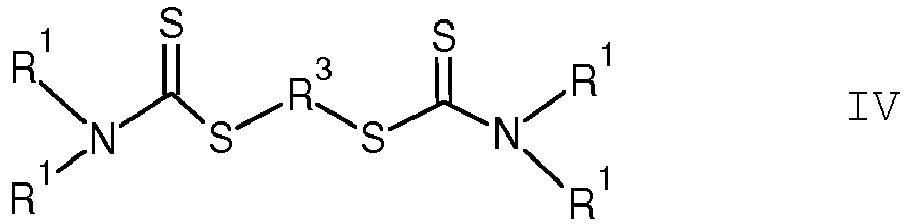
- R 2 is a C 1 to C 20 straight-chain or branched alkyl group or, alternatively, R 2 is such that the alkyl dithiocarbamate compound is of structure IV.
- R 1 is H or a C 3 to C 20 straight chain or branched alkyl group.
- R 3 is a C 1 to C 4 straight-chain or branched alkyl group.
- R 3 is (CH 2 ) n , wherein n is 1, 2 or 3, preferably n is 1.
- the one or more alkyl dithiocarbamate is present in an amount of at least 0.1wt%, preferably at least 0.3wt%, even more preferably at least 0.5wt% based on the total weight of the lubricating oil composition.
- the one or more alkyl dithiocarbamate is present in an amount of at most 4wt%, preferably at most 3wt%, even more preferably at most 2wt% based on the total weight of the lubricating oil composition.
- the total amount of base oil incorporated in the lubricating oil composition of the present invention is preferably present in an amount in the range of from 60 to 92 wt. %, more preferably in an amount in the range of from 75 to 90 wt. % and most preferably in an amount in the range of from 75 to 88 wt. %, with respect to the total weight of the lubricating oil composition.
- base oil used in the present invention there are no particular limitations regarding the base oil used in the present invention, and various conventional known mineral oils and synthetic oils may be conveniently used.
- the base oil used in the present invention may conveniently comprise mixtures of one or more mineral oils and/or one or more synthetic oils; thus, according to the present invention, the term "base oil” may refer to a mixture containing more than one base oil, including Fischer-Tropsch derived base oils.
- Mineral oils include liquid petroleum oils and solvent-treated or acid-treated mineral lubricating oil of the paraffinic, naphthenic, or mixed paraffinic/naphthenic type which may be further refined by hydrofinishing processes and/or dewaxing.
- Mineral oils include liquid petroleum oils and solvent-treated or acid-treated mineral lubricating oils of the paraffinic, naphthenic, or mixed paraffinic/naphthenic type which may be further refined by hydrofinishing processes and/or dewaxing.
- Naphthenic base oils have low viscosity index (VI) (generally 40-80) and a low pour point.
- Such base oils are produced from feed stocks rich in naphthenes and low in wax content and are used mainly for lubricants in which colour and colour stability are important, and VI and oxidation stability are of secondary importance.
- Paraffinic base oils have higher VI (generally >95) and a high pour point. Said base oils are produced from feed stocks rich in paraffins, and are used for lubricants in which VI and oxidation stability are important.
- Fischer-Tropsch derived base oils may be conveniently used as the base oil in the lubricating oil composition of the present invention, for example, the Fischer-Tropsch derived base oils disclosed in EP-A-776959 , EP-A-668342 , WO-A-97/21788 , WO-00/15736 , WO-00/14188 , WO-00/14187 , WO-00/14183 , WO-00/14179 , WO-00/08115 , WO-99/41332 , EP-1029029 , WO-01/18156 and WO-01/57166 .
- the Fischer-Tropsch derived base oils disclosed in EP-A-776959 , EP-A-668342 , WO-A-97/21788 , WO-00/15736 , WO-00/14188 , WO-00/14187 , WO-00/14183 , WO-00/14179 , WO-00/08115 ,
- Synthetic processes enable molecules to be built from simpler substances or to have their structures modified to give the precise properties required.
- Synthetic oils include hydrocarbon oils such as olefin oligomers (PAOs), dibasic acids esters, polyol esters, and dewaxed waxy raffinate. Synthetic hydrocarbon base oils sold by the Royal Dutch/Shell Group of Companies under the designation "XHVI” (trade mark) may be conveniently used.
- PAOs olefin oligomers
- XHVI XHVI
- the base oil comprises mineral oils and/or synthetic oils which contain more than 80 %wt of saturates, preferably more than 90 %wt, as measured according to ASTM D2007.
- the base oil contains less than 1.0 wt%, preferably less than 0.1 wt% of sulphur, calculated as elemental sulphur and measured according to ASTM D2622, ASTM D4294, ASTM D4927 or ASTM D3120.
- the viscosity index of the base oil is more than 80, more preferably more than 120, as measured according to ASTM D2270.
- the lubricating oil composition has a kinematic viscosity in the range of from 2 to 80 mm 2 /s at 100 °C, more preferably of from 3 to 70 mm 2 /s, most preferably of from 4 to 50 mm 2 /s.
- the total amount of phosphorus in the lubricating oil composition of the present invention is preferably in the range of from 0.04 to 0.12 wt%, more preferably in the range of from 0.04 to 0.09 wt% and most preferably in the range of from 0.045 to 0.08 wt%, based on total weight of the lubricating oil composition.
- the lubricating oil composition of the present invention may further comprise additional additives such as anti-oxidants, anti-wear additives, detergents, dispersants, additional friction modifiers, viscosity index improvers, pour point depressants, corrosion inhibitors, defoaming agents and seal fix or seal compatibility agents.
- additional additives such as anti-oxidants, anti-wear additives, detergents, dispersants, additional friction modifiers, viscosity index improvers, pour point depressants, corrosion inhibitors, defoaming agents and seal fix or seal compatibility agents.
- Antioxidants that may be conveniently used include those selected from the group of aminic antioxidants and/or phenolic antioxidants.
- said antioxidants are present in an amount in the range of from 0.1 to 5.0 wt%, more preferably in an amount in the range of from 0.3 to 3.0 wt%, and most preferably in an amount in the range of from 0.5 to 1.5 wt%, based on the total weight of the lubricating oil composition.
- aminic antioxidants which may be conveniently used include alkylated diphenylamines, phenyl- ⁇ -naphthylamines, phenyl- ⁇ -naphthylamines and alkylated ⁇ -naphthylamines.
- Preferred aminic antioxidants include dialkyldiphenylamines such as p,p'-dioctyl-diphenylamine, p,p'-di- ⁇ -methylbenzyl-diphenylamine and N-p-butylphenyl-N-p'-octylphenylamine, monoalkyldiphenylamines such as mono-t-butyldiphenylamine and mono-octyldiphenylamine, bis(dialkylphenyl)amines such as di-(2,4-diethylphenyl)amine and di(2-ethyl-4-nonylphenyl)amine, alkylphenyl-1-naphthylamines such as octylphenyl-1-naphthylamine and n-t-dodecylphenyl-1-naphthylamine, 1-naphthylamine, arylnaph
- Preferred aminic antioxidants include those available under the following trade designations: "Sonoflex OD-3" (ex. Seiko Kagaku Co.), “Irganox L-57” (ex. Ciba Specialty Chemicals Co.) and phenothiazine (ex. Hodogaya Kagaku Co.).
- phenolic antioxidants which may be conveniently used include C 7 -C 9 branched alkyl esters of 3,5-bis(1,1-dimethyl-ethyl)-4-hydroxy-benzenepropanoic acid, 2-t-butylphenol, 2-t-butyl-4-methylphenol, 2-t-butyl-5-methylphenol, 2,4-di-t-butylphenol, 2,4-dimethyl-6-t-butylphenol, 2-t-butyl-4-methoxyphenol, 3-t-butyl-4-methoxyphenol, 2,5-di-t-butylhydroquinone, 2,6-di-t-butyl-4-alkylphenols such as 2,6-di-t-butylphenol, 2,6-di-t-butyl-4-methylphenol and 2,6-di-t-butyl-4-ethylphenol, 2,6-di-t-butyl-4-alkoxyphenols such as 2,6-di-t-but
- Preferred phenolic antioxidants include those available under the following trade designations: "Irganox L-135" (ex. Ciba Specialty Chemicals Co.), “Yoshinox SS” (ex. Yoshitomi Seiyaku Co.), “Antage W-400” (ex. Kawaguchi Kagaku Co.), “Antage W-500” (ex. Kawaguchi Kagaku Co.), “Antage W-300” (ex. Kawaguchi Kagaku Co.), “Irganox L109” (ex. Ciba Speciality Chemicals Co.), “Tominox 917” (ex. Yoshitomi Seiyaku Co.), “Irganox L115" (ex.
- Ciba Speciality Chemicals Co. Ciba Speciality Chemicals Co.
- Sudilizer GA80 Ex. Sumitomo Kagaku
- Antage RC ex. Kawaguchi Kagaku Co.
- Irganox L101 ex. Ciba Speciality Chemicals Co.
- Yoshinox 930 ex. Yoshitomi Seiyaku Co.
- the lubricating oil composition of the present invention may comprise mixtures of one or more phenolic antioxidants with one or more aminic antioxidants.
- the lubricating oil composition may comprise a single zinc dithiophosphate or a combination of two or more zinc dithiophosphates as anti-wear additives, the or each zinc dithiophosphate being selected from zinc dialkyl-, diaryl- or alkylaryldithiophosphates.
- Zinc dithiophosphate is a well-known additive in the art and may be conveniently represented by general formula V: wherein R 4 to R 7 may be the same or different and are each a primary alkyl group containing from 1 to 20 carbon atoms preferably from 3 to 12 carbon atoms, a secondary alkyl group containing from 3 to 20 carbon atoms, preferably from 3 to 12 carbon atoms, an aryl group or an aryl group substituted with an alkyl group, said alkyl substituent containing from 1 to 20 carbon atoms preferably 3 to 18 carbon atoms.
- R 4 to R 7 may be the same or different and are each a primary alkyl group containing from 1 to 20 carbon atoms preferably from 3 to 12 carbon atoms, a secondary alkyl group containing from 3 to 20 carbon atoms, preferably from 3 to 12 carbon atoms, an aryl group or an aryl group substituted with an alkyl group, said alkyl substituent containing from 1 to 20 carbon atom
- Zinc dithiophosphate compounds in which R 4 to R 7 are all different from each other can be used alone or in admixture with zinc dithiophosphate compounds in which R 4 to R 7 are all the same.
- the or each zinc dithiophosphate used in the present invention is a zinc dialkyl dithiophosphate.
- suitable zinc dithiophosphates which are commercially available include those available ex. Lubrizol Corporation under the trade designations “Lz 1097” and “Lz 1395", those available ex. Chevron Oronite under the trade designations “OLOA 267” and “OLOA 269R”, and that available ex. Afton Chemical under the trade designation “HITEC 7197”; zinc dithiophosphates such as those available ex. Lubrizol Corporation under the trade designations "Lz 677A”, “Lz 1095” and “Lz 1371", that available ex. Chevron Oronite under the trade designation “OLOA 262” and that available ex. Afton Chemical under the trade designation "HITEC 7169”; and zinc dithiophosphates such as those available ex. Lubrizol Corporation under the trade designations “Lz 1370” and “Lz 1373” and that available ex. Chevron Oronite under the trade designation "OLOA 260".
- the lubricating oil composition according to the present invention may generally comprise in the range of from 0.4 to 1.2 wt% of zinc dithiophosphate, based on total weight of the lubricating oil composition.
- anti-wear additives may be conveniently used in the composition of the present invention.
- Typical detergents that may be used in the lubricating oil of the present invention include one or more salicylate and/or phenate and/or sulphonate detergents.
- metal organic and inorganic base salts which are used as detergents can contribute to the sulphated ash content of a lubricating oil composition, in a preferred embodiment of the present invention, the amounts of such additives are minimised.
- salicylate detergents can be used.
- the lubricating oil composition of the present invention may comprise one or more salicylate detergents.
- said detergents are preferably used in amounts in the range of 0.05 to 20.0 wt%, more preferably from 1.0 to 10.0 wt% and most preferably in the range of from 2.0 to 5.0 wt%, based on the total weight of the lubricating oil composition.
- said detergents independently, have a TBN (total base number) value in the range of from 10 to 500 mg.KOH/g, more preferably in the range of from 30 to 350 mg.KOH/g and most preferably in the range of from 50 to 300 mg.KOH/g, as measured by ISO 3771.
- TBN total base number
- the lubricating oil compositions of the present invention may additionally contain an ash-free dispersant which is preferably admixed in an amount in the range of from 5 to 15 wt%, based on the total weight of the lubricating oil composition.
- ash-free dispersants examples include the polyalkenyl succinimides and polyalkenyl succininic acid esters disclosed in JP1367796 , JP1667140 , JP1302811 and JP1743435 .
- Preferred dispersants include borated succinimides.
- viscosity index improvers which may be conveniently used in the lubricating oil composition of the present invention include the styrene-butadiene copolymers, styrene-isoprene stellate copolymers and the polymethacrylate copolymer and ethylene-propylene copolymers. Such viscosity index improvers may be conveniently employed in an amount in the range of from 1 to 20 wt%, based on the total weight of the lubricating oil composition.
- Polymethacrylates may be conveniently employed in the lubricating oil compositions of the present invention as effective pour point depressants.
- compounds such as alkenyl succinic acid or ester moieties thereof, benzotriazole-based compounds and thiodiazole-based compounds may be conveniently used in the lubricating oil composition of the present invention as corrosion inhibitors.
- Compounds such as polysiloxanes, dimethyl polycyclohexane and polyacrylates may be conveniently used in the lubricating oil composition of the present invention as defoaming agents.
- seal fix or seal compatibility agents include, for example, commercially available aromatic esters.
- the lubricating compositions of the present invention may be conveniently prepared using conventional formulation techniques by admixing base oil with the organo-molybdenum compound and polymeric friction reducing additive together with and one or more other optional additives at a temperature of 60°C.
- a method of lubricating an internal combustion engine comprising applying a lubricating oil composition as hereinbefore described thereto.
- the present invention further provides the use of a lubricating composition as described herein for reducing friction.
- the present invention further provides the use of a lubricating composition as described herein for reducing wear.
- the present invention further provides the use of a lubricating composition as described herein for improving fuel economy.
- a bench test oil ageing method was developed based on the Ford oil ageing batch reactor test described in De Feo, M., Minfray, C., Bouchet, M.D.B., Thiebaut, B., Le Mogne, T., Vacher, B., Martin, J.M.: Ageing impact on tribological properties of MoDTC-containing base oil, Trib. Intern. 92, 126-135 (2015 ) and used to investigate MoDTC ageing in Graham, J., Jensen R., Spikes, H.A.: The friction-reducing properties of molybdenum dialkyldithiocarbamate additives, Part 2, Durability of friction reducing capability, Trib. Trans. 44, 637-646, (2001 ).
- Oil samples (5 ml) were withdrawn during oil ageing and friction was measured in a high frequency reciprocating rig (HFRR, PCS Instruments, Acton, UK). All HFRR tests were conducted at 1 mm stroke length, 20 Hz stroke frequency, 4 N load and a temperature of 120°C. HFRR test duration was 20 minutes and friction coefficient was averaged over this time to obtain mean values for a test. AISI 52100 steel balls and discs were employed with hardness 810 VPN and 880 VPN respectively. Friction values obtained from the 20 min HFFR tests were averaged and plotted as a function of ageing time.
- HFRR high frequency reciprocating rig
- the test oil was a solution of a commercial Adeka Sakura Lube165 MoDTC (0.3% wt., 135 ppm Mo) in group II base oil.
- Base oil viscosity was 20.1 mPas at 40°C and 4.09 mPas at 100°C with a viscosity index of 102.
- a relatively low MoDTC concentration was chosen in order to limit ageing time at the lower test temperatures.
- Antioxidant 1 was an alkyl DTC (VANLUBE 7723)
- antioxidant 2 was the aminic type (Irganox L57)
- antioxidant 3 was the phenolic type (Irganox L135).
- Table 2 shows that MoDTC alone delivers low friction and maintains this low friction at 30 hrs of testing. However, by 42 hours the friction has significantly increased. In the presence of the aminic AO (AO2), the MoDTC delivered low friction, but the friction levels had increased significantly by 30hours, a shorter time than MoDTC alone.
- the phenolic antioxidant (AO 3) shows a very antagonistic effect, increasing the initial friction from the MoDTC alone baseline and leading to a premature significant increase in friction by just 2 hours into the test.
Landscapes
- Chemical & Material Sciences (AREA)
- Chemical Kinetics & Catalysis (AREA)
- General Chemical & Material Sciences (AREA)
- Oil, Petroleum & Natural Gas (AREA)
- Organic Chemistry (AREA)
- Lubricants (AREA)
Abstract
The present invention provides a lubricating composition for use in the crankcase of an engine comprising (i) a base oil; (ii) one or more oil-soluble molybdenum compounds in an amount sufficient to provide in the range of from 100 to 1000ppmw of molybdenum; and (iii) one or more alkyl dithiocarbamate compounds.
Description
- The present invention relates to a lubricating oil composition, in particular to a lubricating oil composition which is suitable for lubricating internal combustion engines and which has improved friction and wear reduction and improved fuel economy.
- Increasingly severe automobile regulations in respect of emissions and fuel efficiency are placing increasing demands on both engine manufacturers and lubricant formulators to provide effective solutions to improve fuel economy.
- Optimising lubricants through the use of high performance base stocks and novel additives represents a flexible solution to a growing challenge.
- Friction-reducing additives (which are also known as friction modifiers) are important lubricant components in reducing fuel consumption and various such additives are already known in the art.
- Friction modifiers can be conveniently divided into two categories, that is to say, metal-containing friction modifiers and ashless (organic) friction modifiers.
- Organo-molybdenum compounds are amongst the most common metal-containing friction modifiers. Typical organo-molybdenum compounds include molybdenum dithiocarbamates (MoDTC), molybdenum dithiophosphates (MoDTP), molybdenum amines, molybdenum alcoholates, and molybdenum alcohol-amides.
WO-A-98/26030 WO-A-99/31113 WO-A-99/47629 WO-A-99/66013 - However, the trend towards low-ash lubricating oil compositions has resulted in an increased drive to achieve low friction and improved fuel economy using ashless friction modifiers.
- Ashless (organic) friction modifiers which have been used in the past typically comprise esters of fatty acids and polyhydric alcohols, fatty acid amides, amines derived from fatty acids and organic dithiocarbamate or dithiophosphate compounds.
- However, current strategies with regard to friction reduction for fuel economy oils are not sufficient to meet ever increasing fuel economy targets set by Original Equipment Manufacturers (OEMs). While there is a challenge to approach similar levels of friction modification using solely ashless friction modifiers, molybdenum friction modifiers typically outperform ashless friction modifiers in the boundary regime.
- While organo-molybdenum compounds are useful for providing high levels of friction modification, there are also known limitations with these compounds. For example, molybdenum-based friction modifiers can negatively impact seals and the TEOST cleanliness test. The present inventors have also shown that MoDTC loses its effectiveness as a friction modifier as the lubricating composition within which it is contained ages. This can be compensated for by increasing the amount of MoDTC used in a lubricating composition.
- However, given the increasing fuel economy demands placed on engines, there remains a need to further improve the friction reduction and fuel economy of internal combustion engines utilising lower levels of molybdenum-based friction modifiers.
- Accordingly, the present invention provides a lubricating composition for use in the crankcase of an engine comprising (i) a base oil; (ii) one or more oil-soluble molybdenum compounds in an amount sufficient to provide in the range of from 100 to 1000ppmw of molybdenum; and (iii) one or more alkyl dithiocarbamate compounds.
-
Figure 1 shows the results of the Examples. - The present inventors have surprisingly found that the friction modifying ability of oil-soluble molybdenum compounds in a lubricating composition can be protected by the addition of one or more alkyl dithiocarbamate compounds to said lubricating composition. This reduces the amount of oil-soluble molybdenum compounds required in a lubricating composition in order to maintain an acceptable level of friction modification.
- Preferred oil-soluble molybdenum compounds include molybdenum dithiocarbamates, molybdenum dithiophosphates and molybdenum amine complexes. More preferably, the one or more oil-soluble molybdenum compounds comprise one or more molybdenum dithiocarbamate (MoDTC) compounds. Most preferably, the one or more oil-soluble molybdenum compounds is/are one or more molybdenum dithiocarbamate (MoDTC) compounds.
- Molybdenum dithiocarbamate (MoDTC) can be represented by structures I (dinuclear) and II (trinuclear).


- In structure I, X is oxygen or sulphur. In both structure I and structure II, R is suitable a linear or branched paraffinic chain containing from 4 to 20 carbon atoms.
- The one or more oil-soluble molybdenum compounds present in the lubricating composition are included at a level sufficient to provide from 100 to 1000 ppmw of molybdenum, preferably at a level sufficient to provide from 100 to 300 ppmw of molybdenum.
- The one or more alkyl dithiocarbamate compounds present may generally be of formula III

- In structure III, R1 is H or a C3 to C20 straight chain or branched alkyl group. R2 is a C1 to C20 straight-chain or branched alkyl group or, alternatively, R2 is such that the alkyl dithiocarbamate compound is of structure IV.

- In structure IV, R1 is H or a C3 to C20 straight chain or branched alkyl group. R3 is a C1 to C4 straight-chain or branched alkyl group. Preferably, R3 is (CH2)n, wherein n is 1, 2 or 3, preferably n is 1.
- The one or more alkyl dithiocarbamate is present in an amount of at least 0.1wt%, preferably at least 0.3wt%, even more preferably at least 0.5wt% based on the total weight of the lubricating oil composition. The one or more alkyl dithiocarbamate is present in an amount of at most 4wt%, preferably at most 3wt%, even more preferably at most 2wt% based on the total weight of the lubricating oil composition.
- The total amount of base oil incorporated in the lubricating oil composition of the present invention is preferably present in an amount in the range of from 60 to 92 wt. %, more preferably in an amount in the range of from 75 to 90 wt. % and most preferably in an amount in the range of from 75 to 88 wt. %, with respect to the total weight of the lubricating oil composition.
- There are no particular limitations regarding the base oil used in the present invention, and various conventional known mineral oils and synthetic oils may be conveniently used.
- The base oil used in the present invention may conveniently comprise mixtures of one or more mineral oils and/or one or more synthetic oils; thus, according to the present invention, the term "base oil" may refer to a mixture containing more than one base oil, including Fischer-Tropsch derived base oils. Mineral oils include liquid petroleum oils and solvent-treated or acid-treated mineral lubricating oil of the paraffinic, naphthenic, or mixed paraffinic/naphthenic type which may be further refined by hydrofinishing processes and/or dewaxing.
- Mineral oils include liquid petroleum oils and solvent-treated or acid-treated mineral lubricating oils of the paraffinic, naphthenic, or mixed paraffinic/naphthenic type which may be further refined by hydrofinishing processes and/or dewaxing.
- Naphthenic base oils have low viscosity index (VI) (generally 40-80) and a low pour point. Such base oils are produced from feed stocks rich in naphthenes and low in wax content and are used mainly for lubricants in which colour and colour stability are important, and VI and oxidation stability are of secondary importance.
- Paraffinic base oils have higher VI (generally >95) and a high pour point. Said base oils are produced from feed stocks rich in paraffins, and are used for lubricants in which VI and oxidation stability are important.
- Fischer-Tropsch derived base oils may be conveniently used as the base oil in the lubricating oil composition of the present invention, for example, the Fischer-Tropsch derived base oils disclosed in
EP-A-776959 EP-A-668342 WO-A-97/21788 WO-00/15736 WO-00/14188 WO-00/14187 WO-00/14183 WO-00/14179 WO-00/08115 WO-99/41332 EP-1029029 ,WO-01/18156 WO-01/57166 - Synthetic processes enable molecules to be built from simpler substances or to have their structures modified to give the precise properties required.
- Synthetic oils include hydrocarbon oils such as olefin oligomers (PAOs), dibasic acids esters, polyol esters, and dewaxed waxy raffinate. Synthetic hydrocarbon base oils sold by the Royal Dutch/Shell Group of Companies under the designation "XHVI" (trade mark) may be conveniently used.
- Preferably, the base oil comprises mineral oils and/or synthetic oils which contain more than 80 %wt of saturates, preferably more than 90 %wt, as measured according to ASTM D2007.
- It is further preferred that the base oil contains less than 1.0 wt%, preferably less than 0.1 wt% of sulphur, calculated as elemental sulphur and measured according to ASTM D2622, ASTM D4294, ASTM D4927 or ASTM D3120.
- Preferably, the viscosity index of the base oil is more than 80, more preferably more than 120, as measured according to ASTM D2270.
- Preferably, the lubricating oil composition has a kinematic viscosity in the range of from 2 to 80 mm2/s at 100 °C, more preferably of from 3 to 70 mm2/s, most preferably of from 4 to 50 mm2/s.
- The total amount of phosphorus in the lubricating oil composition of the present invention is preferably in the range of from 0.04 to 0.12 wt%, more preferably in the range of from 0.04 to 0.09 wt% and most preferably in the range of from 0.045 to 0.08 wt%, based on total weight of the lubricating oil composition.
- The lubricating oil composition of the present invention may further comprise additional additives such as anti-oxidants, anti-wear additives, detergents, dispersants, additional friction modifiers, viscosity index improvers, pour point depressants, corrosion inhibitors, defoaming agents and seal fix or seal compatibility agents.
- Antioxidants that may be conveniently used include those selected from the group of aminic antioxidants and/or phenolic antioxidants.
- In a preferred embodiment, said antioxidants are present in an amount in the range of from 0.1 to 5.0 wt%, more preferably in an amount in the range of from 0.3 to 3.0 wt%, and most preferably in an amount in the range of from 0.5 to 1.5 wt%, based on the total weight of the lubricating oil composition.
- Examples of aminic antioxidants which may be conveniently used include alkylated diphenylamines, phenyl-α-naphthylamines, phenyl-β-naphthylamines and alkylated α-naphthylamines.
- Preferred aminic antioxidants include dialkyldiphenylamines such as p,p'-dioctyl-diphenylamine, p,p'-di-α-methylbenzyl-diphenylamine and N-p-butylphenyl-N-p'-octylphenylamine, monoalkyldiphenylamines such as mono-t-butyldiphenylamine and mono-octyldiphenylamine, bis(dialkylphenyl)amines such as di-(2,4-diethylphenyl)amine and di(2-ethyl-4-nonylphenyl)amine, alkylphenyl-1-naphthylamines such as octylphenyl-1-naphthylamine and n-t-dodecylphenyl-1-naphthylamine, 1-naphthylamine, arylnaphthylamines such as phenyl-1-naphthylamine, phenyl-2-naphthylamine, N-hexylphenyl-2-naphthylamine and N-octylphenyl-2-naphthylamine, phenylenediamines such as N,N'-diisopropyl-p-phenylenediamine and N,N'-diphenyl-p-phenylenediamine, and phenothiazines such as phenothiazine and 3,7-dioctylphenothiazine.
- Preferred aminic antioxidants include those available under the following trade designations: "Sonoflex OD-3" (ex. Seiko Kagaku Co.), "Irganox L-57" (ex. Ciba Specialty Chemicals Co.) and phenothiazine (ex. Hodogaya Kagaku Co.).
- Examples of phenolic antioxidants which may be conveniently used include C7-C9 branched alkyl esters of 3,5-bis(1,1-dimethyl-ethyl)-4-hydroxy-benzenepropanoic acid, 2-t-butylphenol, 2-t-butyl-4-methylphenol, 2-t-butyl-5-methylphenol, 2,4-di-t-butylphenol, 2,4-dimethyl-6-t-butylphenol, 2-t-butyl-4-methoxyphenol, 3-t-butyl-4-methoxyphenol, 2,5-di-t-butylhydroquinone, 2,6-di-t-butyl-4-alkylphenols such as 2,6-di-t-butylphenol, 2,6-di-t-butyl-4-methylphenol and 2,6-di-t-butyl-4-ethylphenol, 2,6-di-t-butyl-4-alkoxyphenols such as 2,6-di-t-butyl-4-methoxyphenol and 2,6-di-t-butyl-4-ethoxyphenol, 3,5-di-t-butyl-4-hydroxybenzylmercaptooctylacetate, alkyl-3-(3,5-di-t-butyl-4-hydroxyphenyl)propionates such as n-octadecyl-3-(3,5-di-t-butyl-4-hydroxyphenyl)propionate, n-butyl-3-(3,5-di-t-butyl-4-hydroxyphenyl)propionate and 2'-ethylhexyl-3-(3,5-di-t-butyl-4-hydroxyphenyl)propionate, 2,6-d-t-butyl-α-dimethylamino-p-cresol, 2,2'-methylene-bis(4-alkyl-6-t-butylphenol) such as 2,2'-methylenebis(4-methyl-6-t-butylphenol, and 2,2-methylenebis(4-ethyl-6-t-butylphenol), bisphenols such as 4,4'-butylidenebis(3-methyl-6-t-butylphenol, 4,4'-methylenebis(2,6-di-t-butylphenol), 4,4'-bis(2,6-di-t-butylphenol), 2,2-(di-p-hydroxyphenyl)propane, 2,2-bis(3,5-di-t-butyl-4-hydroxyphenyl)propane, 4,4'-cyclohexylidenebis(2,6-t-butylphenol), hexamethyleneglycol-bis[3-(3,5-di-t-butyl-4-hydroxyphenyl)propionate], triethyleneglycolbis[3-(3-t-butyl-4-hydroxy-5-methylphenyl)propionate], 2,2'-thio-[diethyl-3-(3,5-di-t-butyl-4-hydroxyphenyl)propionate], 3,9-bis{1,1-dimethyl-2-[3-(3-t-butyl-4-hydroxy-5-methylphenyl)propionyloxy]ethyl}2,4,8,10-tetraoxaspiro[5,5]undecane, 4,4'-thiobis(3-methyl-6-t-butylphenol) and 2,2'-thiobis(4,6-di-t-butylresorcinol), polyphenols such as tetrakis[methylene-3-(3,5-di-t-butyl-4-hydroxyphenyl)propionate]methane, 1,1,3-tris(2-methyl-4-hydroxy-5-t-butylphenyl)butane, 1,3,5-trimethyl-2,4,6-tris(3,5-di-t-butyl-4-hydroxybenzyl)benzene, bis-[3,3'-bis(4'-hydroxy-3'-t-butylphenyl)butyric acid]glycol ester, 2-(3',5'-di-t-butyl-4-hydroxyphenyl)methyl-4-(2",4"-di-t-butyl-3"-hydroxyphenyl)methyl-6-t-butylphenol and 2,6-bis(2'-hydroxy-3'-t-butyl-5'-methylbenzyl)-4-methylphenol, and p-t-butylphenol - formaldehyde condensates and p-t-butylphenol - acetaldehyde condensates.
- Preferred phenolic antioxidants include those available under the following trade designations: "Irganox L-135" (ex. Ciba Specialty Chemicals Co.), "Yoshinox SS" (ex. Yoshitomi Seiyaku Co.), "Antage W-400" (ex. Kawaguchi Kagaku Co.), "Antage W-500" (ex. Kawaguchi Kagaku Co.), "Antage W-300" (ex. Kawaguchi Kagaku Co.), "Irganox L109" (ex. Ciba Speciality Chemicals Co.), "Tominox 917" (ex. Yoshitomi Seiyaku Co.), "Irganox L115" (ex. Ciba Speciality Chemicals Co.), "Sumilizer GA80" (ex. Sumitomo Kagaku), "Antage RC" (ex. Kawaguchi Kagaku Co.), "Irganox L101" (ex. Ciba Speciality Chemicals Co.), "Yoshinox 930" (ex. Yoshitomi Seiyaku Co.).
- The lubricating oil composition of the present invention may comprise mixtures of one or more phenolic antioxidants with one or more aminic antioxidants.
- In a preferred embodiment, the lubricating oil composition may comprise a single zinc dithiophosphate or a combination of two or more zinc dithiophosphates as anti-wear additives, the or each zinc dithiophosphate being selected from zinc dialkyl-, diaryl- or alkylaryldithiophosphates.
- Zinc dithiophosphate is a well-known additive in the art and may be conveniently represented by general formula V:

- Zinc dithiophosphate compounds in which R4 to R7 are all different from each other can be used alone or in admixture with zinc dithiophosphate compounds in which R4 to R7 are all the same.
- Preferably, the or each zinc dithiophosphate used in the present invention is a zinc dialkyl dithiophosphate.
- Examples of suitable zinc dithiophosphates which are commercially available include those available ex. Lubrizol Corporation under the trade designations "Lz 1097" and "Lz 1395", those available ex. Chevron Oronite under the trade designations "OLOA 267" and "OLOA 269R", and that available ex. Afton Chemical under the trade designation "HITEC 7197"; zinc dithiophosphates such as those available ex. Lubrizol Corporation under the trade designations "Lz 677A", "Lz 1095" and "Lz 1371", that available ex. Chevron Oronite under the trade designation "OLOA 262" and that available ex. Afton Chemical under the trade designation "HITEC 7169"; and zinc dithiophosphates such as those available ex. Lubrizol Corporation under the trade designations "Lz 1370" and "Lz 1373" and that available ex. Chevron Oronite under the trade designation "OLOA 260".
- The lubricating oil composition according to the present invention may generally comprise in the range of from 0.4 to 1.2 wt% of zinc dithiophosphate, based on total weight of the lubricating oil composition.
- Additional or alternative anti-wear additives may be conveniently used in the composition of the present invention.
- Typical detergents that may be used in the lubricating oil of the present invention include one or more salicylate and/or phenate and/or sulphonate detergents.
- However, as metal organic and inorganic base salts which are used as detergents can contribute to the sulphated ash content of a lubricating oil composition, in a preferred embodiment of the present invention, the amounts of such additives are minimised.
- In order to maintain a low sulphur level, salicylate detergents can be used.
- Thus, in one embodiment, the lubricating oil composition of the present invention may comprise one or more salicylate detergents.
- In order to maintain the total sulphated ash content of the lubricating oil composition of the present invention at a level of preferably not greater than 2.0 wt%, more preferably at a level of not greater than 1.0 wt% and most preferably at a level of not greater than 0.8 wt%, based on the total weight of the lubricating oil composition, said detergents are preferably used in amounts in the range of 0.05 to 20.0 wt%, more preferably from 1.0 to 10.0 wt% and most preferably in the range of from 2.0 to 5.0 wt%, based on the total weight of the lubricating oil composition.
- Furthermore, it is preferred that said detergents, independently, have a TBN (total base number) value in the range of from 10 to 500 mg.KOH/g, more preferably in the range of from 30 to 350 mg.KOH/g and most preferably in the range of from 50 to 300 mg.KOH/g, as measured by ISO 3771.
- The lubricating oil compositions of the present invention may additionally contain an ash-free dispersant which is preferably admixed in an amount in the range of from 5 to 15 wt%, based on the total weight of the lubricating oil composition.
- Examples of ash-free dispersants which may be used include the polyalkenyl succinimides and polyalkenyl succininic acid esters disclosed in
JP1367796 JP1667140 JP1302811 JP1743435 - Examples of viscosity index improvers which may be conveniently used in the lubricating oil composition of the present invention include the styrene-butadiene copolymers, styrene-isoprene stellate copolymers and the polymethacrylate copolymer and ethylene-propylene copolymers. Such viscosity index improvers may be conveniently employed in an amount in the range of from 1 to 20 wt%, based on the total weight of the lubricating oil composition.
- Polymethacrylates may be conveniently employed in the lubricating oil compositions of the present invention as effective pour point depressants.
- Furthermore, compounds such as alkenyl succinic acid or ester moieties thereof, benzotriazole-based compounds and thiodiazole-based compounds may be conveniently used in the lubricating oil composition of the present invention as corrosion inhibitors.
- Compounds such as polysiloxanes, dimethyl polycyclohexane and polyacrylates may be conveniently used in the lubricating oil composition of the present invention as defoaming agents.
- Compounds which may be conveniently used in the lubricating oil composition of the present invention as seal fix or seal compatibility agents include, for example, commercially available aromatic esters.
- The lubricating compositions of the present invention may be conveniently prepared using conventional formulation techniques by admixing base oil with the organo-molybdenum compound and polymeric friction reducing additive together with and one or more other optional additives at a temperature of 60°C.
- In another embodiment of the present invention, there is provided a method of lubricating an internal combustion engine comprising applying a lubricating oil composition as hereinbefore described thereto.
- The present invention further provides the use of a lubricating composition as described herein for reducing friction.
- The present invention further provides the use of a lubricating composition as described herein for reducing wear.
- The present invention further provides the use of a lubricating composition as described herein for improving fuel economy.
- The present invention is further described below by reference to the following examples, which are not intended to limit the scope of the present invention in any way.
- A bench test oil ageing method was developed based on the Ford oil ageing batch reactor test described in De Feo, M., Minfray, C., Bouchet, M.D.B., Thiebaut, B., Le Mogne, T., Vacher, B., Martin, J.M.: Ageing impact on tribological properties of MoDTC-containing base oil, Trib. Intern. 92, 126-135 (2015) and used to investigate MoDTC ageing in Graham, J., Jensen R., Spikes, H.A.: The friction-reducing properties of molybdenum dialkyldithiocarbamate additives, Part 2, Durability of friction reducing capability, Trib. Trans. 44, 637-646, (2001). This consists of a multi-necked round-bottomed flask supported in a temperature-controlled magnetic-stirrer heating mantle. Air and a blend of 1000 ppm NOx in air are supplied separately from cylinders via a pair of programmable flow controllers to enable any NOx composition in air up to 1000 ppm to be obtained. The test conditions used in this study are listed in Table 1.
Table 1 - Oil Aging Test Conditions Initial oil volume 500 ml Total gas flow rate 200 cm3/min NOx content of gas flow 0-770 ppm Temperature 120°C Stir speed 350 rpm - Oil samples (5 ml) were withdrawn during oil ageing and friction was measured in a high frequency reciprocating rig (HFRR, PCS Instruments, Acton, UK). All HFRR tests were conducted at 1 mm stroke length, 20 Hz stroke frequency, 4 N load and a temperature of 120°C. HFRR test duration was 20 minutes and friction coefficient was averaged over this time to obtain mean values for a test. AISI 52100 steel balls and discs were employed with hardness 810 VPN and 880 VPN respectively. Friction values obtained from the 20 min HFFR tests were averaged and plotted as a function of ageing time.
- The test oil was a solution of a commercial Adeka Sakura Lube165 MoDTC (0.3% wt., 135 ppm Mo) in group II base oil. Base oil viscosity was 20.1 mPas at 40°C and 4.09 mPas at 100°C with a viscosity index of 102. A relatively low MoDTC concentration was chosen in order to limit ageing time at the lower test temperatures.
- Three antioxidant types were selected and incorporated at 1% wt. Antioxidant 1 was an alkyl DTC (VANLUBE 7723), antioxidant 2 was the aminic type (Irganox L57) and antioxidant 3 was the phenolic type (Irganox L135).
- The results of the Examples are shown in Table 2 and
Figure 1 .Table 2 Test Time (hrs) Friction Coefficient Comparative Ex 1 MoDTC alone Comparative Ex 2 MoDTC + AO 2 Comparative Ex 2 MoDTC + AO 3 Example 1 MoDTC + AO 1 0 0.062 0.069 0.105 0.088 2 - - 0.135 - 16 - - - 0.083 17 - 0.085 0.136 - 30 0.075 0.143 - - 42 0.142 - - 0.089 66 - 0.146 - - 84 - - - 0.079 125 - - - 0.094 - Antioxidants of the aminic and phenolic types, commonly used in lubricant formulations, did not provide a benefit in extending the friction reducing benefits of MoDTC.
- Table 2 shows that MoDTC alone delivers low friction and maintains this low friction at 30 hrs of testing. However, by 42 hours the friction has significantly increased. In the presence of the aminic AO (AO2), the MoDTC delivered low friction, but the friction levels had increased significantly by 30hours, a shorter time than MoDTC alone. The phenolic antioxidant (AO 3) shows a very antagonistic effect, increasing the initial friction from the MoDTC alone baseline and leading to a premature significant increase in friction by just 2 hours into the test.
- Surprisingly, AO1, alkyl DTC, protected the MoDTC to delivering low friction to 84 hours and beyond.
Claims (9)
- A lubricating composition for use in the crankcase of an engine comprising (i) a base oil; (ii) one or more oil-soluble molybdenum compounds in an amount sufficient to provide in the range of from 100 to 1000ppmw of molybdenum; and (iii) one or more alkyl dithiocarbamate compounds.
- A lubricating composition as claimed in claim 1, wherein the one or more oil-soluble molybdenum compounds comprises one or more molybdenum dithiocarbamate compounds.
- A lubricating composition as claimed in claim 2, wherein the molybdenum diothiocarbamate compound or compounds are of structure I:

- A lubricating composition as claimed in any one of claims 1 to 3, wherein the one or more oil-soluble molybdenum compounds present in the lubricating composition are included at a level sufficient to provide from 100 to 300 ppmw of molybdenum based on the total weight of the lubricating composition.
- A lubricating composition as claimed in any one or claims 1 to 4, wherein the one or more alkyl dithiocarbamate compounds present is of formula III

- A lubricating composition as claimed in any one or claims 1 to 4, wherein the one or more alkyl dithiocarbamate compounds present is of formula IV:
- A lubricating composition as claimed in claim 6, wherein R3 is (CH2)n and wherein n is 1, 2 or 3.
- A lubricating composition as claimed in any one of claims 1 to 7, wherein the one or more alkyl dithiocarbamate is present in an amount of at least 0.1wt% and at most 4wt%, based on the total weight of the lubricating oil composition.
- A lubricating composition as claimed in any one of claims 1 to 8, wherein the base oil is a Fischer-Tropsch derived base oil.
Priority Applications (1)
| Application Number | Priority Date | Filing Date | Title |
|---|---|---|---|
| EP16204746.8A EP3336162A1 (en) | 2016-12-16 | 2016-12-16 | Lubricating composition |
Applications Claiming Priority (1)
| Application Number | Priority Date | Filing Date | Title |
|---|---|---|---|
| EP16204746.8A EP3336162A1 (en) | 2016-12-16 | 2016-12-16 | Lubricating composition |
Publications (1)
| Publication Number | Publication Date |
|---|---|
| EP3336162A1 true EP3336162A1 (en) | 2018-06-20 |
Family
ID=57570500
Family Applications (1)
| Application Number | Title | Priority Date | Filing Date |
|---|---|---|---|
| EP16204746.8A Withdrawn EP3336162A1 (en) | 2016-12-16 | 2016-12-16 | Lubricating composition |
Country Status (1)
| Country | Link |
|---|---|
| EP (1) | EP3336162A1 (en) |
Citations (26)
| Publication number | Priority date | Publication date | Assignee | Title |
|---|---|---|---|---|
| JPS6027655B2 (en) | 1976-10-28 | 1985-06-29 | シエル・インタ−ナシヨネイル・リサ−チ・マ−チヤツピイ・ベ−・ウイ | Method for producing esters of hydrocarbon-substituted succinic anhydrides |
| JPS6134442B2 (en) | 1976-10-18 | 1986-08-07 | Sheru Intern Risaachi Maachatsupii Nv | |
| JPH024594B2 (en) | 1979-10-24 | 1990-01-29 | Sheru Intern Risaachi Maachatsupii Bv | |
| JPH0429716B2 (en) | 1982-02-17 | 1992-05-19 | ||
| EP0668342A1 (en) | 1994-02-08 | 1995-08-23 | Shell Internationale Researchmaatschappij B.V. | Lubricating base oil preparation process |
| EP0776959A2 (en) | 1995-11-28 | 1997-06-04 | Shell Internationale Researchmaatschappij B.V. | Process for producing lubricating base oils |
| WO1997021788A1 (en) | 1995-12-08 | 1997-06-19 | Exxon Research And Engineering Company | Biodegradable high performance hydrocarbon base oils |
| WO1998026030A1 (en) | 1996-12-13 | 1998-06-18 | Exxon Research And Engineering Company | Lubricating oil compositions containing organic molybdenum complexes |
| US5895779A (en) * | 1998-03-31 | 1999-04-20 | Exxon Chemical Patents Inc | Lubricating oil having improved fuel economy retention properties |
| WO1999031113A1 (en) | 1997-12-12 | 1999-06-24 | Infineum Usa L.P. | Method for the preparation of trinuclear molybdenum-sulfur compounds and their use as lubricant additives |
| WO1999041332A1 (en) | 1998-02-13 | 1999-08-19 | Exxon Research And Engineering Company | Low viscosity lube basestock |
| WO1999047629A1 (en) | 1998-03-13 | 1999-09-23 | Infineum Usa L.P. | Lubricating oil having improved fuel economy retention properties |
| WO1999066013A1 (en) | 1998-06-17 | 1999-12-23 | Infineum Usa L.P. | Lubricating oil compositions |
| WO2000008115A1 (en) | 1998-08-04 | 2000-02-17 | Exxon Research And Engineering Company | A lubricant base oil having improved oxidative stability |
| WO2000014188A2 (en) | 1998-09-04 | 2000-03-16 | Exxon Research And Engineering Company | Premium wear resistant lubricant |
| WO2000014187A2 (en) | 1998-09-04 | 2000-03-16 | Exxon Research And Engineering Company | Premium synthetic lubricants |
| WO2000014179A1 (en) | 1998-09-04 | 2000-03-16 | Exxon Research And Engineering Company | Premium synthetic lubricant base stock |
| WO2000014183A1 (en) | 1998-09-04 | 2000-03-16 | Exxon Research And Engineering Company | Production on synthetic lubricant and lubricant base stock without dewaxing |
| WO2000015736A2 (en) | 1998-09-11 | 2000-03-23 | Exxon Research And Engineering Company | Wide-cut synthetic isoparaffinic lubricating oils |
| EP1029029A1 (en) | 1997-10-20 | 2000-08-23 | Mobil Oil Corporation | Isoparaffinic lube basestock compositions |
| WO2001018156A1 (en) | 1999-09-08 | 2001-03-15 | Total Raffinage Distribution S.A. | Novel hydrocarbon base oil for lubricants with very high viscosity index |
| WO2001057166A1 (en) | 2000-02-04 | 2001-08-09 | Mobil Oil Corporation | Formulated lubricant oils containing high-performance base oils derived from highly paraffinic hydrocarbons |
| US20030158051A1 (en) * | 2001-09-21 | 2003-08-21 | Karol Thomas J. | Antioxidant additive compositions and lubricating compositions containing the same |
| EP1661967A1 (en) * | 2004-10-20 | 2006-05-31 | Afton Chemical Corporation | Oil-soluble molybdenum derivatives derived from hydroxyethyl-substituted Mannich bases |
| US20110237474A1 (en) * | 2010-03-25 | 2011-09-29 | R.T. Vanderbilt Company, Inc. | Ultra Low Phosphorus Lubricant Compositions |
| US20150133352A1 (en) * | 2012-06-06 | 2015-05-14 | Vanderbilt Chemicals, Llc | Fuel efficient lubricating oils |
-
2016
- 2016-12-16 EP EP16204746.8A patent/EP3336162A1/en not_active Withdrawn
Patent Citations (27)
| Publication number | Priority date | Publication date | Assignee | Title |
|---|---|---|---|---|
| JPS6134442B2 (en) | 1976-10-18 | 1986-08-07 | Sheru Intern Risaachi Maachatsupii Nv | |
| JPS6027655B2 (en) | 1976-10-28 | 1985-06-29 | シエル・インタ−ナシヨネイル・リサ−チ・マ−チヤツピイ・ベ−・ウイ | Method for producing esters of hydrocarbon-substituted succinic anhydrides |
| JPH024594B2 (en) | 1979-10-24 | 1990-01-29 | Sheru Intern Risaachi Maachatsupii Bv | |
| JPH0429716B2 (en) | 1982-02-17 | 1992-05-19 | ||
| EP0668342A1 (en) | 1994-02-08 | 1995-08-23 | Shell Internationale Researchmaatschappij B.V. | Lubricating base oil preparation process |
| EP0776959A2 (en) | 1995-11-28 | 1997-06-04 | Shell Internationale Researchmaatschappij B.V. | Process for producing lubricating base oils |
| WO1997021788A1 (en) | 1995-12-08 | 1997-06-19 | Exxon Research And Engineering Company | Biodegradable high performance hydrocarbon base oils |
| WO1998026030A1 (en) | 1996-12-13 | 1998-06-18 | Exxon Research And Engineering Company | Lubricating oil compositions containing organic molybdenum complexes |
| EP1029029A1 (en) | 1997-10-20 | 2000-08-23 | Mobil Oil Corporation | Isoparaffinic lube basestock compositions |
| WO1999031113A1 (en) | 1997-12-12 | 1999-06-24 | Infineum Usa L.P. | Method for the preparation of trinuclear molybdenum-sulfur compounds and their use as lubricant additives |
| WO1999041332A1 (en) | 1998-02-13 | 1999-08-19 | Exxon Research And Engineering Company | Low viscosity lube basestock |
| WO1999047629A1 (en) | 1998-03-13 | 1999-09-23 | Infineum Usa L.P. | Lubricating oil having improved fuel economy retention properties |
| US5895779A (en) * | 1998-03-31 | 1999-04-20 | Exxon Chemical Patents Inc | Lubricating oil having improved fuel economy retention properties |
| WO1999066013A1 (en) | 1998-06-17 | 1999-12-23 | Infineum Usa L.P. | Lubricating oil compositions |
| WO2000008115A1 (en) | 1998-08-04 | 2000-02-17 | Exxon Research And Engineering Company | A lubricant base oil having improved oxidative stability |
| WO2000014188A2 (en) | 1998-09-04 | 2000-03-16 | Exxon Research And Engineering Company | Premium wear resistant lubricant |
| WO2000014187A2 (en) | 1998-09-04 | 2000-03-16 | Exxon Research And Engineering Company | Premium synthetic lubricants |
| WO2000014179A1 (en) | 1998-09-04 | 2000-03-16 | Exxon Research And Engineering Company | Premium synthetic lubricant base stock |
| WO2000014183A1 (en) | 1998-09-04 | 2000-03-16 | Exxon Research And Engineering Company | Production on synthetic lubricant and lubricant base stock without dewaxing |
| WO2000015736A2 (en) | 1998-09-11 | 2000-03-23 | Exxon Research And Engineering Company | Wide-cut synthetic isoparaffinic lubricating oils |
| WO2001018156A1 (en) | 1999-09-08 | 2001-03-15 | Total Raffinage Distribution S.A. | Novel hydrocarbon base oil for lubricants with very high viscosity index |
| WO2001057166A1 (en) | 2000-02-04 | 2001-08-09 | Mobil Oil Corporation | Formulated lubricant oils containing high-performance base oils derived from highly paraffinic hydrocarbons |
| US20030158051A1 (en) * | 2001-09-21 | 2003-08-21 | Karol Thomas J. | Antioxidant additive compositions and lubricating compositions containing the same |
| EP1661967A1 (en) * | 2004-10-20 | 2006-05-31 | Afton Chemical Corporation | Oil-soluble molybdenum derivatives derived from hydroxyethyl-substituted Mannich bases |
| US20110237474A1 (en) * | 2010-03-25 | 2011-09-29 | R.T. Vanderbilt Company, Inc. | Ultra Low Phosphorus Lubricant Compositions |
| KR20130010112A (en) * | 2010-03-25 | 2013-01-25 | 알.티.반더빌트 컴퍼니, 인코포레이티드 | Ultra low phosphorus lubricant compositions |
| US20150133352A1 (en) * | 2012-06-06 | 2015-05-14 | Vanderbilt Chemicals, Llc | Fuel efficient lubricating oils |
Non-Patent Citations (2)
| Title |
|---|
| FEO, M.; MINFRAY, C.; BOUCHET, M.D.B.; THIEBAUT, B.; LE MOGNE, T.; VACHER, B.; MARTIN, J.M.: "Ageing impact on tribological properties of MoDTC-containing base oil", TRIB. INTERN., vol. 92, 2015, pages 126 - 135 |
| GRAHAM, J.; JENSEN R.; SPIKES, H.A.: "The friction-reducing properties of molybdenum dialkyldithiocarbamate additives, Part 2, Durability of friction reducing capability", TRIB. TRANS., vol. 44, 2001, pages 637 - 646 |
Similar Documents
| Publication | Publication Date | Title |
|---|---|---|
| EP1987117B1 (en) | Lubricating oil composition | |
| EP1838821B1 (en) | Lubricating oil composition | |
| US20170275555A1 (en) | Lubricating composition | |
| EP1789521B1 (en) | Lubricating oil composition | |
| EP1817396B1 (en) | Lubricating oil composition | |
| EP1788068B1 (en) | Use of a magnesium detergent in a lubricating oil composition | |
| EP4263481B1 (en) | Reaction product of an organic amine and glycidol and its use as a friction modifier | |
| EP3197986B1 (en) | Use of an ashless friction modifier | |
| WO2016184842A1 (en) | Lubricating composition | |
| WO2016032782A1 (en) | Methods for lubricating a diamond-like carbon coated surface, associated lubricating oil compositions and associated screening methods | |
| US20070129266A1 (en) | Lubricating Oil Composition | |
| WO2020007945A1 (en) | Lubricating composition | |
| WO2026093453A1 (en) | Antioxidant compositions containing phenolic antioxidants and alkyl alcohols for use in internal combustion engines | |
| US20140315770A1 (en) | Lubricating composition | |
| CN115287111A (en) | Ether-based lubricant compositions, methods and uses |
Legal Events
| Date | Code | Title | Description |
|---|---|---|---|
| PUAI | Public reference made under article 153(3) epc to a published international application that has entered the european phase |
Free format text: ORIGINAL CODE: 0009012 |
|
| STAA | Information on the status of an ep patent application or granted ep patent |
Free format text: STATUS: THE APPLICATION HAS BEEN PUBLISHED |
|
| AK | Designated contracting states |
Kind code of ref document: A1 Designated state(s): AL AT BE BG CH CY CZ DE DK EE ES FI FR GB GR HR HU IE IS IT LI LT LU LV MC MK MT NL NO PL PT RO RS SE SI SK SM TR |
|
| AX | Request for extension of the european patent |
Extension state: BA ME |
|
| STAA | Information on the status of an ep patent application or granted ep patent |
Free format text: STATUS: THE APPLICATION IS DEEMED TO BE WITHDRAWN |
|
| 18D | Application deemed to be withdrawn |
Effective date: 20181221 |