EP3334707B1 - A process for the preparation of the compound n-(3,5-dimethylphenyl)-n'-(2-trifluoromethylphenyl) guanidine - Google Patents
A process for the preparation of the compound n-(3,5-dimethylphenyl)-n'-(2-trifluoromethylphenyl) guanidine Download PDFInfo
- Publication number
- EP3334707B1 EP3334707B1 EP16756641.3A EP16756641A EP3334707B1 EP 3334707 B1 EP3334707 B1 EP 3334707B1 EP 16756641 A EP16756641 A EP 16756641A EP 3334707 B1 EP3334707 B1 EP 3334707B1
- Authority
- EP
- European Patent Office
- Prior art keywords
- compound
- formula
- solid form
- crystalline solid
- dimethylphenyl
- Prior art date
- Legal status (The legal status is an assumption and is not a legal conclusion. Google has not performed a legal analysis and makes no representation as to the accuracy of the status listed.)
- Active
Links
- XOAYHDJRYDSPJZ-UHFFFAOYSA-N Cc1cc(C)cc(NC(N)=S)c1 Chemical compound Cc1cc(C)cc(NC(N)=S)c1 XOAYHDJRYDSPJZ-UHFFFAOYSA-N 0.000 description 1
- DVIJFJSZZNOTLP-UHFFFAOYSA-N Cc1cc(NC(Nc2ccccc2C(F)(F)F)=N)cc(C)c1 Chemical compound Cc1cc(NC(Nc2ccccc2C(F)(F)F)=N)cc(C)c1 DVIJFJSZZNOTLP-UHFFFAOYSA-N 0.000 description 1
Images


Classifications
-
- C—CHEMISTRY; METALLURGY
- C07—ORGANIC CHEMISTRY
- C07C—ACYCLIC OR CARBOCYCLIC COMPOUNDS
- C07C277/00—Preparation of guanidine or its derivatives, i.e. compounds containing the group, the singly-bound nitrogen atoms not being part of nitro or nitroso groups
- C07C277/02—Preparation of guanidine or its derivatives, i.e. compounds containing the group, the singly-bound nitrogen atoms not being part of nitro or nitroso groups of guanidine from cyanamide, calcium cyanamide or dicyandiamides
-
- C—CHEMISTRY; METALLURGY
- C07—ORGANIC CHEMISTRY
- C07C—ACYCLIC OR CARBOCYCLIC COMPOUNDS
- C07C277/00—Preparation of guanidine or its derivatives, i.e. compounds containing the group, the singly-bound nitrogen atoms not being part of nitro or nitroso groups
- C07C277/08—Preparation of guanidine or its derivatives, i.e. compounds containing the group, the singly-bound nitrogen atoms not being part of nitro or nitroso groups of substituted guanidines
-
- A—HUMAN NECESSITIES
- A61—MEDICAL OR VETERINARY SCIENCE; HYGIENE
- A61P—SPECIFIC THERAPEUTIC ACTIVITY OF CHEMICAL COMPOUNDS OR MEDICINAL PREPARATIONS
- A61P35/00—Antineoplastic agents
-
- A—HUMAN NECESSITIES
- A61—MEDICAL OR VETERINARY SCIENCE; HYGIENE
- A61P—SPECIFIC THERAPEUTIC ACTIVITY OF CHEMICAL COMPOUNDS OR MEDICINAL PREPARATIONS
- A61P35/00—Antineoplastic agents
- A61P35/02—Antineoplastic agents specific for leukemia
-
- A—HUMAN NECESSITIES
- A61—MEDICAL OR VETERINARY SCIENCE; HYGIENE
- A61P—SPECIFIC THERAPEUTIC ACTIVITY OF CHEMICAL COMPOUNDS OR MEDICINAL PREPARATIONS
- A61P43/00—Drugs for specific purposes, not provided for in groups A61P1/00-A61P41/00
-
- C—CHEMISTRY; METALLURGY
- C07—ORGANIC CHEMISTRY
- C07C—ACYCLIC OR CARBOCYCLIC COMPOUNDS
- C07C277/00—Preparation of guanidine or its derivatives, i.e. compounds containing the group, the singly-bound nitrogen atoms not being part of nitro or nitroso groups
- C07C277/06—Purification or separation of guanidine
-
- C—CHEMISTRY; METALLURGY
- C07—ORGANIC CHEMISTRY
- C07C—ACYCLIC OR CARBOCYCLIC COMPOUNDS
- C07C279/00—Derivatives of guanidine, i.e. compounds containing the group, the singly-bound nitrogen atoms not being part of nitro or nitroso groups
- C07C279/18—Derivatives of guanidine, i.e. compounds containing the group, the singly-bound nitrogen atoms not being part of nitro or nitroso groups having nitrogen atoms of guanidine groups bound to carbon atoms of six-membered aromatic rings
-
- C—CHEMISTRY; METALLURGY
- C07—ORGANIC CHEMISTRY
- C07B—GENERAL METHODS OF ORGANIC CHEMISTRY; APPARATUS THEREFOR
- C07B2200/00—Indexing scheme relating to specific properties of organic compounds
- C07B2200/13—Crystalline forms, e.g. polymorphs
Definitions
- the present invention relates to a process for the preparation of the compound N-(3,5-dimethylphenyl)-N'-(2-trifluoromethylphenyl) guanidine of formula (I). It also relates to a process for the preparation of a crystalline solid form of the compound of formula (I), particularly to a crystalline solid form A, and to a pharmaceutically composition containing them. It also relates to the crystalline solid form of the compound of formula (I) for use as a medicament, in particular for the treatment of a condition mediated by Rho-GTPase cell proteins.
- Rho family GTPase are molecular switches that control signaling pathways regulating actin cytoskeleton reorganization, gene expression, cell cycle progression, cell survival, and other cellular processes. Among other functions, they participate in cell cycle and cell division regulation, being also involved in secretion, endocytosis, phagocytosis, membrane traffic and apoptosis.
- Rho family proteins constitute one of three major branches of the Ras superfamily. Rho proteins share approximately 30 percent amino acid identity with the Ras proteins. At least 23 mammalian Rho family proteins have been identified thus far, including RhoA, Rac1 and Cdc42.
- Rho-GTPases play an important role in controlling cell morphology and motility.
- a compound capable of specifically inhibiting Rho-GTPases activity offers a specific alternative in cancer therapy.
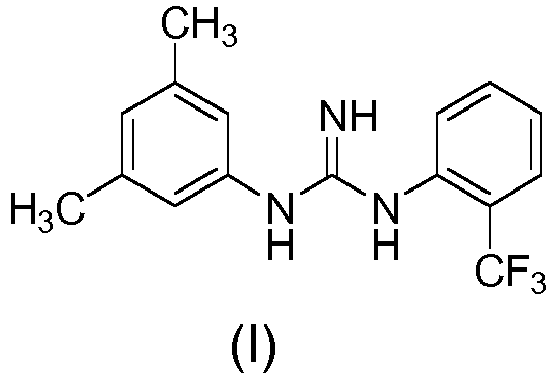
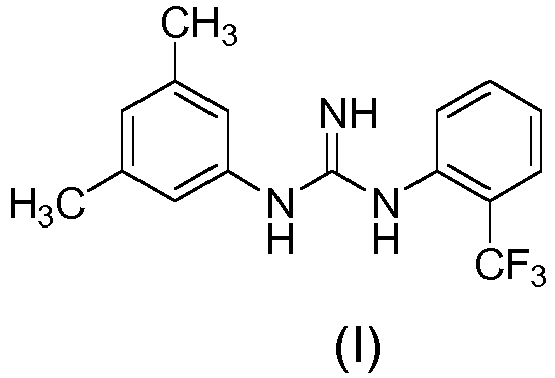
- N-(3,5-dimethylphenyl)-N'-(2-trifluoromethylphenyl) guanidine represented by the structural formula (I) is a potent and selective inhibitor of Rho-GTPase cell proteins:
- the compound of formula (I) can be used to inhibit Rho-related Rac1 GTPase cell protein.
- the compound of formula (I) as an inhibitor of the Rho-related Rac1 GTPase cell protein can be used to treat diseases mediated by mammalian Rac1 cell proteins, particularly for the treatment of any condition mediated by Rho-GTPase cell proteins such as Rac1 cell proteins.
- EP2766342 discloses a process for the preparation of the compound 25 (cf. Example 1) which corresponds to the compound of formula (I) of the present invention.
- the process disclosed in EP2766342 comprises reacting equimolar amounts of a solution of 3,5-dimethylaniline chlorhydrate and N-(2-trifluoromethyl)phenyl)cyanamide in absolute ethanol at a reflux temperature for 15h.
- the crude compound of formula (I) was purified by column chromatography with a mixture of hexane and ethyl acetate in the presence of triethylamine.
- the purified compound of formula (I) was obtained as a white solid compound showing a melting point of 127°C.
- polymorphism is the property of some molecules to assume more than one crystalline form in the solid form.
- a single molecule may give rise to a variety of crystalline forms (also called “polymorphs") having distinct physical properties.
- the existence and physical properties of different crystal forms can be determined by a variety of techniques such as X-ray diffraction spectroscopy, differential scanning calorimetry, infrared spectroscopy and melting point. Differences in the physical properties of different crystalline solid forms result from the orientation and intermolecular interactions of adjacent molecules in the bulk solid. Accordingly, polymorphs are distinct solids sharing the same molecular formula yet having distinct advantageous and/or disadvantageous physical properties compared to other forms in the polymorph family. The existence and physical properties of polymorphs is unpredictable.
- a pharmaceutical compound which can form polymorphs is its solubility in aqueous solution, particularly the solubility in gastric juices of a patient.
- Other important properties relate to stability, bioavailability, ease of formulation, ease of administration, among others. Since some of the crystalline solid forms are more adequate for one type of formulation, and other forms for other different formulations, the development of new crystalline solid forms, such as for example crystalline solid forms (i.e. polymorphs), allows for improving the characteristics of the pharmaceutical formulations comprising them. In addition, depending on the therapeutic indications, one or another pharmaceutical formulation may be preferred.
- a crystalline solid form of the compound of formula (I) form would include: improvement of physicochemical properties in order to facilitate its manufacture or its formulation; to enhance the absorption and/or the bioavailability; being easily obtainable with more constant physicochemical properties; allowing more flexibility while formulating, or facilitating its formulation; having better dispensability properties, thus allowing better dispersion rates, especially if dispersed in an aqueous physiological surrounding, or reducing hygroscopicity; improving stability; and allowing new routes of administration.
- the new crystalline solid form should combine more than one, or even most of these advantages.
- the process of the invention is carried out under reaction conditions that allow obtaining a compound of formula (I) in crude form having an impurity profile which is easily purifiable by recrystallization.
- the process of the invention allows obtaining crude of the compound of formula (I) in crystalline solid form.
- the crystalline solid form A of compound (I) can be obtained as a crystalline solid form A, both by crystallization from the reaction media or by recrystallization in specific conditions. It is advantageous because the crystalline solid form A of compound (I) has the appropriate physical and chemical properties for its use in the pharmaceutical industry.
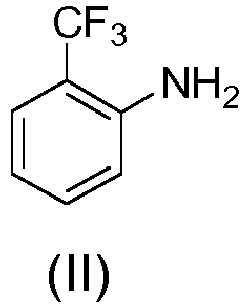
- the first aspect of the present invention relates to a process for the preparation of the compound N-(3,5-dimethylphenyl)-N'-(2-trifluoromethylphenyl) guanidine of formula (I), which comprises reacting a salt of a compound of formula (II) or a mixture of the salt of the compound of formula (II) and a compound of formula (II) with a cyanamide compound of formula (III), in the presence of a polar organic solvent.
- the second aspect of the invention is a crystalline solid form A of the compound N-(3,5-dimethylphenyl)-N'-(2-trifluoromethylphenyl) guanidine of formula (I), which shows a melting point of 131.5°C.
- the third aspect of the invention is a pharmaceutical composition
- a pharmaceutical composition comprising a therapeutically effective amount of a crystalline solid form A of the compound N-(3,5-dimethylphenyl)-N'-(2-trifluoromethylphenyl) guanidine of formula (I) of the present invention, together with one or more pharmaceutically acceptable excipients or carriers.
- the fourth aspect of the invention is the crystalline solid form A of the compound N-(3,5-dimethylphenyl)-N'-(2-trifluoromethylphenyl) guanidine of formula (I) of the present invention, for use as a medicament.
- the fifth aspect of the invention is the crystalline solid form A of the compound N-(3,5-dimethylphenyl)-N'-(2-trifluoromethylphenyl) guanidine of formula (I) of the present invention, for use in the treatment of a condition mediated by Rho-GTPase cell proteins.
- room temperature refers to a temperature comprised from 20°C to 25°C.
- an aspect of the present invention refers to a process for the preparation of the compound of formula (I).
- the process is carried out under such as conditions that allow obtaining a compound of formula (I) in crystallized crude form easily purificable by recrystallization.
- the process comprises reacting a salt of the aniline compound of formula (II) with a cyanamide compound of formula (III) in the presence of a polar organic solvent.
- the process comprises reacting a mixture of the aniline compound of formula (II) and a salt of the aniline compound of formula (II) with a cyanamide compound of formula (III) in the presence of a polar organic solvent.
- the salt of the compound of formula (II) is an inorganic salt; preferably a halohydrate salt selected from the group consisting of chlorhydrate, bromhydrate and iodide hydrate; more preferably the salt of the compound of formula (II) is a chlorhydrate salt.
- the polar organic solvent is selected from a (C 1 -C 3 ) alcohol and a mixture of (C 1 -C 3 ) alcohol and water.
- alcohol refers to a hydrocarbon in which one or more hydrogen atoms have been replaced by one or more -OH group.
- the hydrocarbon contains the number of carbon atoms specified in the description or claims.
- alcohol also includes glycol compounds.
- the polar organic solvent is a (C 1 -C 3 ) alcohol selected form the group consisting of ethanol, 2-propanol (i.e., isopropanol) and n-propanol; preferably ethanol; and most preferably, absolute ethanol.
- the polar organic solvent is a mixture of (C 1 -C 3 ) alcohol and water; preferably ethanol and water.
- the polar organic solvent is a mixture of ethanol and water, wherein the mixture comprises 83% by volume of ethanol and 17% by volume of water.
- the term "% by volume” refers to the percentage of volume of each solvent (i.e. ethanol and water) needed to promote the preparation of the compound of formula (I).
- the starting material in combination with the reaction conditions of the process allows obtaining a crude compound of formula (I) having an appropriate impurity profile for being easily crystalized.
- the crude compound of formula (I) of the present invention has an impurity profile that allows removing the impurities by recrystallization.
- the purified compound of formula (I) is in crystalline form having an impurity profile that complies with the mandatory requirements of the pharmaceutical industry.
- the process of the invention is carried out at a temperature comprised from 60°C to 75°C; preferably from 65°C to 72°C. In an embodiment of the invention, optionally in combination with one or more features of the various embodiments described above or below, the process is carried out at 70°C.
- the process of the invention as defined above further comprises a previous step of reacting a compound 3,5-dimethylphenyl thiourea of formula (IV) under such reaction conditions that lead to a compound of formula (III), using KOH and (CH 3 COO) 2 Pb ⁇ 3H 2 O as shown in the following scheme:
- the starting material (IV) is also commercially available or can be prepared by any method known in the state of the art.
- Crystallization is a process of formation of solid crystals from a homogeneous solution that involves a chemical solid-liquid separation technique, in which mass transfer of a solute from the liquid solution to a pure crystalline solid phase occurs.
- crystal or "crystalline solid” or “crystal solid form” is a solid material whose constituents are arranged in a highly ordered microscopic structure, forming a crystal lattice that extends in all directions.
- macroscopic single crystals are usually identifiable by their geometrical shape, consisting of flat faces with specific, characteristic orientations.
- the preparation of the crystalline solid form of the compound of formula (I) can be carried by any technic known in the state of the art. For example, by forming a solvent solution containing the compound of formula (I) and inducing precipitation of crystalline solid form of the compound of formula (I) by cooling, by adding an anti-solvent or by adding seeds of the compound of formula (I).
- the process comprises crystallizing the crude compound of formula (I) from a mixture of a (C 1 -C 3 ) alcohol and water; preferably the (C 1 -C 3 ) alcohol is ethanol.
- the process comprises crystallizing the crude compound of formula (I) from a mixture of a (C 1 -C 3 ) alcohol and water, wherein the mixture comprises 83% by volume of ethanol and 17% by volume of water.
- % by volume refers to the percentage of volume of each solvent (i.e.
- Crystalline form A can be obtained directly from the reaction media using the conditions specified above or by carrying out a recrystallization in such conditions.
- the second aspect of the invention is a crystalline solid form A of the compound N-(3,5-dimethylphenyl)-N'-(2-trifluoromethylphenyl) guanidine of formula (I) of the present invention, which shows a melting point of 131.5°C.
- the 1 H NMR spectrum, 13 C NMR spectrum, mass spectroscopy and elemental analysis of the crystalline solid form A of the compound of formula (I) of the present invention corresponds to the compound 25 disclosed in the European Patent application number EP2766342 .
- the crystalline solid form A of the compound of formula (I) is that which shows in the differential scanning calorimetry (DSC) a endothermic phenomenon with a pick at 132.42°C having a associated heat of 80.37 J/g.
- the crystalline solid form A is that which has the differential scanning calorimetry diagram showed in FIG. 1 . This curve differs from the curve of the crystalline solid forms of the compound of formula (I) known in the state of the art.
- the crystalline solid form A of the compound of formula (I) also shows an infrared spectrum that comprises characteristic peaks at 3477, 3430, 3416, 3371, 3299, 3084, 2925, 1649, 1615, 1596, 1519, 1503, 1483, 1316, 1123, 1107, 1033, 850, 764.
- the crystalline solid form A is that which has the infrared spectrum showed in FIG. 2 . This spectrum differs from the spectrum of the crystalline solid form of the compound of formula (I) known in the state of the art.
- the crystalline solid form A of the compound of formula (I) may be defined by its preparation process as defined above and therefore, the crystalline solid form A of the compound of formula (I) obtainable by the process of the invention is considered part of the invention.
- the crystalline solid form A of the compound of formula (I) obtainable by the process comprising reacting a salt of a compound of formula (II) or a mixture of the salt of the compound of formula (II) and a compound of formula (II) with a cyanamide compound of formula (III), in the presence of a polar organic solvent, optionally followed by an additional step of recrystallizing the compound of formula (I).
- the expressions "obtainable”, “obtained” and equivalent expressions are used interchangeably, and in any case, the expression “obtainable” encompasses the expression "obtained”.
- the third aspect of the invention relates to a pharmaceutical composition
- a pharmaceutical composition comprising a therapeutically effective amount of a crystalline solid form A of the compound N-(3,5-dimethylphenyl)-N'-(2-trifluoromethylphenyl) guanidine of formula (I) of the present invention, together with one or more pharmaceutically acceptable excipients or carriers.
- therapeutically effective amount refers to the amount of the compound of formula (I) that, when administered, is sufficient to prevent development of, or alleviate to some extent, one or more of the symptoms of the disease which is addressed.
- the particular dose of the compound of formula (I) administered according to this invention will of course be determined by the particular circumstances surrounding the case, including the compound administered, the route of administration, the particular condition being treated, and the similar considerations.
- pharmaceutically acceptable excipients or carriers refers to pharmaceutically acceptable materials, compositions or vehicles. Each component must be pharmaceutically acceptable in the sense of being compatible with the other ingredients of the pharmaceutical composition. It must also be suitable for use in contact with the tissue or organ of humans and animals without excessive toxicity, irritation, allergic response, immunogenicity or other problems or complications commensurate with a reasonable benefit/risk ratio.
- compositions of the present invention can be prepared according to methods well known in the state of the art.
- the appropriate excipients and/or carriers, and their amounts, can readily be determined by those skilled in the art according to the type of formulation being prepared.
- the fourth aspect of the invention is the crystalline solid form A of the compound N-(3,5-dimethylphenyl)-N'-(2-trifluoromethylphenyl) guanidine of formula (I) of the present invention, for use as a medicament.
- This aspect could be also formulated as the use of the pharmaceutical composition as defined above for the preparation of a medicament for the prophylaxis and/or treatment of a condition mediated by Rho-GTPase cell proteins, particularly by Rac1 cell proteins. It also relates to a method for the prophylaxis and/or treatment of a mammal suffering or is susceptible to suffer from a condition mediated by Rho-GTPase cell proteins, particularly by Rac1 cell proteins, the method comprises administering to said mammal an effective amount of the pharmaceutical composition of the present invention.
- treatment is meant eliminating, reducing or ameliorating the cause, the effects or progression of a condition; and includes a reduction in the rate of progress, a halt in the rate of progress, amelioration of the condition, and cure of the condition.
- Treatment as a prophylactic measure e.g., prophylaxis
- treatment includes combination treatments and therapies, in which two or more treatments or therapies are combined, for example, sequentially or simultaneously.
- treatments and therapies include, but are not limited to, chemotherapy (the administration of active agents, including, e.g., drugs, antibodies as in immunotherapy), prodrugs (e.g., as in photodynamic therapy, GDEPT, ADEPT, etc.); surgery; radiation therapy; and gene therapy.
- treatment includes, but is not limited to, alleviation, amelioration or elimination of one or more symptoms of the condition; diminishment of the extent of the condition; stabilized (i.e. not worsening) state of condition; delay or slowing of condition progression; amelioration or palliation of the condition state; and remission of the condition (whether partial or total).
- the compound of formula (I) of the invention is Rho-GTPase cell protein, more specifically Rac1 cell protein, inhibitors, being useful in the treatment of a condition mediated by Rho-GTPase cell protein, preferably a condition mediated by Rac1 cell protein.
- a disease mediated by Rac1 cell protein refers to a condition in which Rac1 cell protein and/or the action of Rac1 is important or necessary, e.g., for the onset, progress, expression, etc. of that condition.
- Rho-GTPases kinases are known to have a central role in the cell cycle, and in particular Rac1, in a preferred embodiment of the present invention the diseases, conditions and/or disorders, which can be prevented, ameliorated or treated with the compounds of the present invention are proliferative diseases.
- a disease is considered to benefit from reduced Rho-GTPase, in particular Rac1 activity, if a reduction of Rac1 activity of at least 10%, preferably of at least 20%, preferably of at least 30%, leads to an improvement of at least one clinical indicator of that disease.
- Examples of such indicators are proliferation rate, which is preferably reduced, cellular differentiation, which is preferably induced etc.
- the proliferative diseases are selected from the group consisting of precancerosis; dysplasia; metaplasia; carcinomas of the gastrointestinal or colorectal tract, liver, pancreas, kidney, bladder, prostate, endometrium, ovary, testes, melanoma, dysplastic oral mucosa, invasive oral cancers, small cell and non-small cell lung carcinomas, hormone-dependent breast cancers, hormone-independent breast cancers, transitional and squamous cell cancers, neurological malignancies including neuroblastoma, gliomas, glioblastoma, astrocytomas, osteosarcomas, soft tissue sarcomas, hemangiomas, endocrinological tumours, hematologic neoplasias including leukemias, lymphomas, and other myeloproliferative and lymphoproliferative diseases, carcinomas in situ, hyperplastic lesions, adenomas, fibromas, histi
- antiproliferative agent refers to a compound which treats a proliferative condition (i.e., a compound which is useful in the treatment of a proliferative condition).
- the subject may be a eukaryote, an animal, a vertebrate animal, a mammal, a rodent (e.g. a guinea pig, a hamster, a rat, a mouse), murine (e.g. a mouse), canine (e.g. a dog), feline (e.g. a cat), equine (e.g. a horse), a primate, simian (e.g. a monkey or ape), a monkey (e.g. marmoset, baboon), an ape (e.g. gorilla, chimpanzee, orangutan, gibbon), or a human.
- the subject is a human.
- the treatment defined hereinbefore may be applied as a sole therapy or may involve, in addition to the compound of formula (I) of the invention, conventional surgery or radiotherapy or chemotherapy.
- Example 1 Crystalline solid form A of the compound N-(3,5-dimethylphenyl)-N'-(2-trifluoromethylphenyl) guanidine of formula (I)
- Solutions A-C were prepared: Solution A was prepared by dissolving 3,5-dimethylphenyl thiourea of formula (IV) (72g; 0.4mol) in water (300ml). Solution B was prepared by dissolving KOH (224g) in water (600ml). Solution C was prepared by dissolving (CH 3 COO) 2 Pb ⁇ 3H 2 O (167g) in water (200ml). Then, solutions A-C were stored at 95°C with stirring.
- the compound of formula (III) was dissolved in hot toluene (200ml). Then, activated carbon was added and the resulting mixture was filtered through a bed of preheated dicalite. After that, 60 ml hot n-hexane was added, and the mixture was cooled and crystalized at 0°C. The crystals were dried with air followed by vacuum to obtain the compound of formula (III) as white crystalline solid form (34g; 58% yield, m.p. 118-120°C).
- Step C Preparation of crystalline solid form A of N-(3,5-dimethylphenyl)-N'-(2-trifluoromethylphenyl) guanidine of formula (I)
- the comparative solid form of the compound of formula (I) was prepared following the process disclosed in Example 1 for compound 25 of the European Patent Application EP2766342 .
- This process comprises reacting equimolar amounts of a solution of 3,5-dimethylaniline chlorhydrate and N-(2-trifluoromethyl)phenyl)cyanamide in absolute ethanol at a reflux temperature for 15h. An aqueous solution of NaOH was added until pH 9. The mixture was extracted with dichloromethane. Organic phases were dried with Na 2 SO 4 and filtered. The solvent was evaporated to obtain the compound of formula (I) in crude solid form.
Landscapes
- Chemical & Material Sciences (AREA)
- Organic Chemistry (AREA)
- Health & Medical Sciences (AREA)
- Life Sciences & Earth Sciences (AREA)
- Veterinary Medicine (AREA)
- General Chemical & Material Sciences (AREA)
- Medicinal Chemistry (AREA)
- Nuclear Medicine, Radiotherapy & Molecular Imaging (AREA)
- Chemical Kinetics & Catalysis (AREA)
- Pharmacology & Pharmacy (AREA)
- Animal Behavior & Ethology (AREA)
- General Health & Medical Sciences (AREA)
- Public Health (AREA)
- Analytical Chemistry (AREA)
- Bioinformatics & Cheminformatics (AREA)
- Hematology (AREA)
- Oncology (AREA)
- Engineering & Computer Science (AREA)
- Organic Low-Molecular-Weight Compounds And Preparation Thereof (AREA)
- Acyclic And Carbocyclic Compounds In Medicinal Compositions (AREA)
Description
- The present invention relates to a process for the preparation of the compound N-(3,5-dimethylphenyl)-N'-(2-trifluoromethylphenyl) guanidine of formula (I). It also relates to a process for the preparation of a crystalline solid form of the compound of formula (I), particularly to a crystalline solid form A, and to a pharmaceutically composition containing them. It also relates to the crystalline solid form of the compound of formula (I) for use as a medicament, in particular for the treatment of a condition mediated by Rho-GTPase cell proteins.
- Rho family GTPase are molecular switches that control signaling pathways regulating actin cytoskeleton reorganization, gene expression, cell cycle progression, cell survival, and other cellular processes. Among other functions, they participate in cell cycle and cell division regulation, being also involved in secretion, endocytosis, phagocytosis, membrane traffic and apoptosis. Rho family proteins constitute one of three major branches of the Ras superfamily. Rho proteins share approximately 30 percent amino acid identity with the Ras proteins. At least 23 mammalian Rho family proteins have been identified thus far, including RhoA, Rac1 and Cdc42.
- Tumor cells, besides presenting proliferation deregulation, they present alterations in their morphological characteristics and, in the case of metastasis, and they get the ability to pass through tissue barriers. Rho-GTPases play an important role in controlling cell morphology and motility. A compound capable of specifically inhibiting Rho-GTPases activity offers a specific alternative in cancer therapy.
- The compound N-(3,5-dimethylphenyl)-N'-(2-trifluoromethylphenyl) guanidine represented by the structural formula (I) is a potent and selective inhibitor of Rho-GTPase cell proteins:

- Particularly, the compound of formula (I) can be used to inhibit Rho-related Rac1 GTPase cell protein. Accordingly, the compound of formula (I) as an inhibitor of the Rho-related Rac1 GTPase cell protein can be used to treat diseases mediated by mammalian Rac1 cell proteins, particularly for the treatment of any condition mediated by Rho-GTPase cell proteins such as Rac1 cell proteins.
- The preparation and the therapeutic use of the compound of formula (I) has been described in the European Patent number
EP2766342 . -
EP2766342 discloses a process for the preparation of the compound 25 (cf. Example 1) which corresponds to the compound of formula (I) of the present invention. The process disclosed inEP2766342 comprises reacting equimolar amounts of a solution of 3,5-dimethylaniline chlorhydrate and N-(2-trifluoromethyl)phenyl)cyanamide in absolute ethanol at a reflux temperature for 15h. The crude compound of formula (I) was purified by column chromatography with a mixture of hexane and ethyl acetate in the presence of triethylamine. The purified compound of formula (I) was obtained as a white solid compound showing a melting point of 127°C. However, the European patentEP2766342 does not disclose a process for preparing a crystalline solid form of the compound of formula (I). Furthermore, the use of extreme reaction conditions for a prolonged period of time and the use of non-scaling purification technics such as chromatography causes considerable difficulties for its industrial scale up. - On the other hand, polymorphism is the property of some molecules to assume more than one crystalline form in the solid form. A single molecule may give rise to a variety of crystalline forms (also called "polymorphs") having distinct physical properties. The existence and physical properties of different crystal forms can be determined by a variety of techniques such as X-ray diffraction spectroscopy, differential scanning calorimetry, infrared spectroscopy and melting point. Differences in the physical properties of different crystalline solid forms result from the orientation and intermolecular interactions of adjacent molecules in the bulk solid. Accordingly, polymorphs are distinct solids sharing the same molecular formula yet having distinct advantageous and/or disadvantageous physical properties compared to other forms in the polymorph family. The existence and physical properties of polymorphs is unpredictable.
- One of the most important physical properties of a pharmaceutical compound which can form polymorphs is its solubility in aqueous solution, particularly the solubility in gastric juices of a patient. Other important properties relate to stability, bioavailability, ease of formulation, ease of administration, among others. Since some of the crystalline solid forms are more adequate for one type of formulation, and other forms for other different formulations, the development of new crystalline solid forms, such as for example crystalline solid forms (i.e. polymorphs), allows for improving the characteristics of the pharmaceutical formulations comprising them. In addition, depending on the therapeutic indications, one or another pharmaceutical formulation may be preferred.
- Especially desirable improvements/advantages of a crystalline solid form of the compound of formula (I) form would include: improvement of physicochemical properties in order to facilitate its manufacture or its formulation; to enhance the absorption and/or the bioavailability; being easily obtainable with more constant physicochemical properties; allowing more flexibility while formulating, or facilitating its formulation; having better dispensability properties, thus allowing better dispersion rates, especially if dispersed in an aqueous physiological surrounding, or reducing hygroscopicity; improving stability; and allowing new routes of administration. Most desirably the new crystalline solid form should combine more than one, or even most of these advantages.
- Thus, there is a need to develop a more economical and more easily industrializable process for the preparation of the compound of formula (I), in particular for the preparation of new crystalline solid form of the compound of formula (I) suitable for use in the pharmaceutical industry and, in particular, for the treatment of a condition mediated by Rho-GTPase cell proteins.
- Inventors have found a new process for the preparation of the compound of formula (I) which comprises reacting a salt of an aniline compound of formula (II) with a cyanamide compound of formula (III) under mild temperature and for a short period of time. It is advantageous because the process comprises the use of commercially available or easily preparable starting materials which allows an easier industrial scaling up.
- Furthermore, the process of the invention is carried out under reaction conditions that allow obtaining a compound of formula (I) in crude form having an impurity profile which is easily purifiable by recrystallization. Particularly, the process of the invention allows obtaining crude of the compound of formula (I) in crystalline solid form.
- Additionally, it can be obtained as a crystalline solid form A, both by crystallization from the reaction media or by recrystallization in specific conditions. It is advantageous because the crystalline solid form A of compound (I) has the appropriate physical and chemical properties for its use in the pharmaceutical industry.
- Thus, the first aspect of the present invention relates to a process for the preparation of the compound N-(3,5-dimethylphenyl)-N'-(2-trifluoromethylphenyl) guanidine of formula (I),


- The second aspect of the invention is a crystalline solid form A of the compound N-(3,5-dimethylphenyl)-N'-(2-trifluoromethylphenyl) guanidine of formula (I), which shows a melting point of 131.5°C.
- The third aspect of the invention is a pharmaceutical composition comprising a therapeutically effective amount of a crystalline solid form A of the compound N-(3,5-dimethylphenyl)-N'-(2-trifluoromethylphenyl) guanidine of formula (I) of the present invention, together with one or more pharmaceutically acceptable excipients or carriers.
- The fourth aspect of the invention is the crystalline solid form A of the compound N-(3,5-dimethylphenyl)-N'-(2-trifluoromethylphenyl) guanidine of formula (I) of the present invention, for use as a medicament.
- The fifth aspect of the invention is the crystalline solid form A of the compound N-(3,5-dimethylphenyl)-N'-(2-trifluoromethylphenyl) guanidine of formula (I) of the present invention, for use in the treatment of a condition mediated by Rho-GTPase cell proteins.
-
-
FIG. 1 shows the DSC curve of the crystalline solid form A of the compound of formula (I) of the present invention. The spectrum expresses the heat flow (W/g) versus temperature (°C). -
FIG. 2 shows the infrared spectrum of the crystalline solid form A of the compound of formula (I) of the present invention. The curve expresses the transmittance (T) versus the wavenumber value (cm-1). -
FIG. 3 shows the DSC curve of the comparative crystalline solid form of the compound of formula (I) known in the state of the art. The spectrum expresses the heat flow (W/g) versus temperature (°C). -
FIG. 4 shows the infrared spectrum of the comparative crystalline solid form of the compound of formula (I) known in the state of the art. The curve expresses the transmittance (T) versus the wavenumber value (cm-1). - All terms as used herein in this application, unless otherwise stated, shall be understood in their ordinary meaning as known in the art. Other more specific definitions for certain terms as used in the present application are as set forth below and are intended to apply uniformly through-out the specification and claims unless an otherwise expressly set out definition provides a broader definition.
- The term "room temperature" refers to a temperature comprised from 20°C to 25°C.
- As mentioned above, an aspect of the present invention refers to a process for the preparation of the compound of formula (I). The process is carried out under such as conditions that allow obtaining a compound of formula (I) in crystallized crude form easily purificable by recrystallization.
- In an embodiment of the invention, optionally in combination with one or more features of the various embodiments described above or below, the process comprises reacting a salt of the aniline compound of formula (II) with a cyanamide compound of formula (III) in the presence of a polar organic solvent.
- In an alternative embodiment of the invention, optionally in combination with one or more features of the various embodiments described above or below, the process comprises reacting a mixture of the aniline compound of formula (II) and a salt of the aniline compound of formula (II) with a cyanamide compound of formula (III) in the presence of a polar organic solvent.
- In an embodiment of the invention, optionally in combination with one or more features of the various embodiments described above or below, the salt of the compound of formula (II) is an inorganic salt; preferably a halohydrate salt selected from the group consisting of chlorhydrate, bromhydrate and iodide hydrate; more preferably the salt of the compound of formula (II) is a chlorhydrate salt.
- In an embodiment of the invention, optionally in combination with one or more features of the various embodiments described above or below, the polar organic solvent is selected from a (C1-C3) alcohol and a mixture of (C1-C3) alcohol and water. The term "alcohol" refers to a hydrocarbon in which one or more hydrogen atoms have been replaced by one or more -OH group. The hydrocarbon contains the number of carbon atoms specified in the description or claims. The term alcohol also includes glycol compounds.
- In an embodiment of the invention, optionally in combination with one or more features of the various embodiments described above or below, the polar organic solvent is a (C1-C3) alcohol selected form the group consisting of ethanol, 2-propanol (i.e., isopropanol) and n-propanol; preferably ethanol; and most preferably, absolute ethanol.
- In an embodiment of the invention, optionally in combination with one or more features of the various embodiments described above or below, the polar organic solvent is a mixture of (C1-C3) alcohol and water; preferably ethanol and water. In an embodiment of the invention, optionally in combination with one or more features of the various embodiments described above or below, the polar organic solvent is a mixture of ethanol and water, wherein the mixture comprises 83% by volume of ethanol and 17% by volume of water. In the context of the invention, the term "% by volume" refers to the percentage of volume of each solvent (i.e. ethanol and water) needed to promote the preparation of the compound of formula (I). The use of a mixture of (C1-C3) alcohol and water as a polar organic solvent is advantageous because it allows reducing the economical cost of the process.
- Advantageously, in comparison with the process disclosed in the state of the art, the starting material in combination with the reaction conditions of the process allows obtaining a crude compound of formula (I) having an appropriate impurity profile for being easily crystalized. Unlike as described in the state of the art, the crude compound of formula (I) of the present invention has an impurity profile that allows removing the impurities by recrystallization. Furthermore, the purified compound of formula (I) is in crystalline form having an impurity profile that complies with the mandatory requirements of the pharmaceutical industry.
- In an embodiment of the invention, optionally in combination with one or more features of the various embodiments described above or below, the process of the invention is carried out at a temperature comprised from 60°C to 75°C; preferably from 65°C to 72°C. In an embodiment of the invention, optionally in combination with one or more features of the various embodiments described above or below, the process is carried out at 70°C.
- The starting materials (II) and (III) are commercially available or can be prepared by any method known in the state of the art. In an embodiment, optionally in combination with one or more features of the various embodiments described above or below, the process of the invention as defined above further comprises a previous step of reacting a compound 3,5-dimethylphenyl thiourea of formula (IV) under such reaction conditions that lead to a compound of formula (III), using KOH and (CH3COO)2Pb·3H2O as shown in the following scheme:

- The starting material (IV) is also commercially available or can be prepared by any method known in the state of the art.
- It is also part of the invention a process for the preparation of the compound N-(3,5-dimethylphenyl)-N'-(2-trifluoromethylphenyl) guanidine of formula (I) as defined above, which further comprises an additional step of crystallizing the compound of formula (I) to obtain a crystalline solid form.
- Crystallization is a process of formation of solid crystals from a homogeneous solution that involves a chemical solid-liquid separation technique, in which mass transfer of a solute from the liquid solution to a pure crystalline solid phase occurs. The term "crystal" or "crystalline solid" or "crystal solid form" is a solid material whose constituents are arranged in a highly ordered microscopic structure, forming a crystal lattice that extends in all directions. In addition, macroscopic single crystals are usually identifiable by their geometrical shape, consisting of flat faces with specific, characteristic orientations.
- The preparation of the crystalline solid form of the compound of formula (I) can be carried by any technic known in the state of the art. For example, by forming a solvent solution containing the compound of formula (I) and inducing precipitation of crystalline solid form of the compound of formula (I) by cooling, by adding an anti-solvent or by adding seeds of the compound of formula (I).
- The selection of the crystallization conditions is crucial for determining the crystalline solid form of the compound of formula (I) and its physical and chemical characteristics.
- In an embodiment of the invention, optionally in combination with one or more features of the various embodiments described above or below, the process comprises crystallizing the crude compound of formula (I) from a mixture of a (C1-C3) alcohol and water; preferably the (C1-C3) alcohol is ethanol. In a preferred embodiment, optionally in combination with one or more features of the various embodiments described above or below, the process comprises crystallizing the crude compound of formula (I) from a mixture of a (C1-C3) alcohol and water, wherein the mixture comprises 83% by volume of ethanol and 17% by volume of water. In the context of the invention, the term "% by volume" refers to the percentage of volume of each solvent (i.e. ethanol and water) needed to promote the preparation of the crystalline form A of the compound of formula (I). In these conditions, the crystalline form obtained is the crystalline form A. Crystalline form A can be obtained directly from the reaction media using the conditions specified above or by carrying out a recrystallization in such conditions.
- The second aspect of the invention is a crystalline solid form A of the compound N-(3,5-dimethylphenyl)-N'-(2-trifluoromethylphenyl) guanidine of formula (I) of the present invention, which shows a melting point of 131.5°C. As it is disclosed in the Examples, the 1H NMR spectrum, 13C NMR spectrum, mass spectroscopy and elemental analysis of the crystalline solid form A of the compound of formula (I) of the present invention corresponds to the
compound 25 disclosed in the European Patent application numberEP2766342 . - The crystalline solid form A of the compound of formula (I) is that which shows in the differential scanning calorimetry (DSC) a endothermic phenomenon with a pick at 132.42°C having a associated heat of 80.37 J/g. The crystalline solid form A is that which has the differential scanning calorimetry diagram showed in
FIG. 1 . This curve differs from the curve of the crystalline solid forms of the compound of formula (I) known in the state of the art. - The crystalline solid form A of the compound of formula (I) also shows an infrared spectrum that comprises characteristic peaks at 3477, 3430, 3416, 3371, 3299, 3084, 2925, 1649, 1615, 1596, 1519, 1503, 1483, 1316, 1123, 1107, 1033, 850, 764. The crystalline solid form A is that which has the infrared spectrum showed in
FIG. 2 . This spectrum differs from the spectrum of the crystalline solid form of the compound of formula (I) known in the state of the art. - In an embodiment of the invention, optionally in combination with one or more features of the various embodiments described above or below, the crystalline solid form A of the compound of formula (I) may be defined by its preparation process as defined above and therefore, the crystalline solid form A of the compound of formula (I) obtainable by the process of the invention is considered part of the invention. Thus, the crystalline solid form A of the compound of formula (I) obtainable by the process comprising reacting a salt of a compound of formula (II) or a mixture of the salt of the compound of formula (II) and a compound of formula (II) with a cyanamide compound of formula (III), in the presence of a polar organic solvent, optionally followed by an additional step of recrystallizing the compound of formula (I). For the purposes of the invention the expressions "obtainable", "obtained" and equivalent expressions are used interchangeably, and in any case, the expression "obtainable" encompasses the expression "obtained".
- The third aspect of the invention relates to a pharmaceutical composition comprising a therapeutically effective amount of a crystalline solid form A of the compound N-(3,5-dimethylphenyl)-N'-(2-trifluoromethylphenyl) guanidine of formula (I) of the present invention, together with one or more pharmaceutically acceptable excipients or carriers.
- The expression "therapeutically effective amount" as used herein, refers to the amount of the compound of formula (I) that, when administered, is sufficient to prevent development of, or alleviate to some extent, one or more of the symptoms of the disease which is addressed. The particular dose of the compound of formula (I) administered according to this invention will of course be determined by the particular circumstances surrounding the case, including the compound administered, the route of administration, the particular condition being treated, and the similar considerations.
- The expression "pharmaceutically acceptable excipients or carriers" refers to pharmaceutically acceptable materials, compositions or vehicles. Each component must be pharmaceutically acceptable in the sense of being compatible with the other ingredients of the pharmaceutical composition. It must also be suitable for use in contact with the tissue or organ of humans and animals without excessive toxicity, irritation, allergic response, immunogenicity or other problems or complications commensurate with a reasonable benefit/risk ratio.
- Compositions of the present invention can be prepared according to methods well known in the state of the art. The appropriate excipients and/or carriers, and their amounts, can readily be determined by those skilled in the art according to the type of formulation being prepared.
- The fourth aspect of the invention is the crystalline solid form A of the compound N-(3,5-dimethylphenyl)-N'-(2-trifluoromethylphenyl) guanidine of formula (I) of the present invention, for use as a medicament.
- In an embodiment, optionally in combination with one or more features of the various embodiments described above or below, the crystalline solid form A of the compound N-(3,5-dimethylphenyl)-N'-(2-trifluoromethylphenyl) guanidine of formula (I) as defined above, for use in the treatment of a condition mediated by Rho-GTPase cell proteins, particularly by Rac1 cell proteins.
- This aspect could be also formulated as the use of the pharmaceutical composition as defined above for the preparation of a medicament for the prophylaxis and/or treatment of a condition mediated by Rho-GTPase cell proteins, particularly by Rac1 cell proteins. It also relates to a method for the prophylaxis and/or treatment of a mammal suffering or is susceptible to suffer from a condition mediated by Rho-GTPase cell proteins, particularly by Rac1 cell proteins, the method comprises administering to said mammal an effective amount of the pharmaceutical composition of the present invention.
- Throughout the present specification, by the term "treatment" is meant eliminating, reducing or ameliorating the cause, the effects or progression of a condition; and includes a reduction in the rate of progress, a halt in the rate of progress, amelioration of the condition, and cure of the condition. Treatment as a prophylactic measure (e.g., prophylaxis) is also included. The term "treatment" includes combination treatments and therapies, in which two or more treatments or therapies are combined, for example, sequentially or simultaneously. Examples of treatments and therapies include, but are not limited to, chemotherapy (the administration of active agents, including, e.g., drugs, antibodies as in immunotherapy), prodrugs (e.g., as in photodynamic therapy, GDEPT, ADEPT, etc.); surgery; radiation therapy; and gene therapy. For purposes of this invention treatment includes, but is not limited to, alleviation, amelioration or elimination of one or more symptoms of the condition; diminishment of the extent of the condition; stabilized (i.e. not worsening) state of condition; delay or slowing of condition progression; amelioration or palliation of the condition state; and remission of the condition (whether partial or total).
- The compound of formula (I) of the invention is Rho-GTPase cell protein, more specifically Rac1 cell protein, inhibitors, being useful in the treatment of a condition mediated by Rho-GTPase cell protein, preferably a condition mediated by Rac1 cell protein.
- The term "a disease mediated by Rac1 cell protein ", as used herein pertains to a condition in which Rac1 cell protein and/or the action of Rac1 is important or necessary, e.g., for the onset, progress, expression, etc. of that condition.
- Since Rho-GTPases kinases are known to have a central role in the cell cycle, and in particular Rac1, in a preferred embodiment of the present invention the diseases, conditions and/or disorders, which can be prevented, ameliorated or treated with the compounds of the present invention are proliferative diseases. A disease is considered to benefit from reduced Rho-GTPase, in particular Rac1 activity, if a reduction of Rac1 activity of at least 10%, preferably of at least 20%, preferably of at least 30%, leads to an improvement of at least one clinical indicator of that disease. Examples of such indicators are proliferation rate, which is preferably reduced, cellular differentiation, which is preferably induced etc.
- It is further preferred that the proliferative diseases are selected from the group consisting of precancerosis; dysplasia; metaplasia; carcinomas of the gastrointestinal or colorectal tract, liver, pancreas, kidney, bladder, prostate, endometrium, ovary, testes, melanoma, dysplastic oral mucosa, invasive oral cancers, small cell and non-small cell lung carcinomas, hormone-dependent breast cancers, hormone-independent breast cancers, transitional and squamous cell cancers, neurological malignancies including neuroblastoma, gliomas, glioblastoma, astrocytomas, osteosarcomas, soft tissue sarcomas, hemangiomas, endocrinological tumours, hematologic neoplasias including leukemias, lymphomas, and other myeloproliferative and lymphoproliferative diseases, carcinomas in situ, hyperplastic lesions, adenomas, fibromas, histiocytosis, chronic inflammatory proliferative diseases, vascular proliferative diseases and virus-induced proliferative diseases, skin diseases characterized by hyperproliferation of keratinocytes and/or T cells. Particular preferred diseases treatable with the compounds of the present invention are glioblastoma; and colorectal, ovarian, prostatic and gastric cancers and adenocarcinomas, more preferably invasive adenocarcinomas.
- Thus, the present invention also provides active compounds which are antiproliferative agents. The term "antiproliferative agent" as used herein, refers to a compound which treats a proliferative condition (i.e., a compound which is useful in the treatment of a proliferative condition).
- The subject may be a eukaryote, an animal, a vertebrate animal, a mammal, a rodent (e.g. a guinea pig, a hamster, a rat, a mouse), murine (e.g. a mouse), canine (e.g. a dog), feline (e.g. a cat), equine (e.g. a horse), a primate, simian (e.g. a monkey or ape), a monkey (e.g. marmoset, baboon), an ape (e.g. gorilla, chimpanzee, orangutan, gibbon), or a human. Preferably, the subject is a human.
- The treatment defined hereinbefore may be applied as a sole therapy or may involve, in addition to the compound of formula (I) of the invention, conventional surgery or radiotherapy or chemotherapy.
- Throughout the description and claims the word "comprises" and variations of the word, are not intended to exclude other technical features, additives, components or steps. Additional objects, advantages and features of the invention will become apparent to those skilled in the art upon examination of the description or may be learned by practice of the invention. The following examples and drawings are provided by way of illustration, and they are not intended to be limiting of the present invention.
- All reagents were commercially available. Melting points were measured with a Buchi mod B-545. 1H and 13C NMR spectra were recorded on a Varian spectrometer VNMRS-500. The elemental analysis was recorded on a LECO CHNS-932. Mass spectroscopy spectra were recorded on Lc/MS DVL agilent technologies using the technic API-ES (Atmospheric Pressure ionization-electrospray) in positive mode. IR spectra were recorded on a Spectrum One FT-IT by potassium bromide discs (2mg/300mg). The DSC spectra were recorded on a TA Instruments Mod. Q20. DSC measurements require that samples (1g and 1.5g) were enclosed in a aluminium pan which is then sealed and heated from 40°C to 250°C at a rate of 10°C/min.
-

- To a mixture of 3,5-dimethyl aniline (V) (Aldrich) (194g) and water (800ml) with stirring, HCI (192g) was slowly added at room temperature. The resulting mixture was stirred for 15 minutes. Then, ammonium thiocyanate (VI) (Biopack) (134g) was added at room temperature. The resulting mixture was heated at 96°C for 15 hours with stirring. After that time, the mixture was cooled with stirring until 25°C and was maintained at a temperature between 20°C and 25°C with stirring overnight. The obtained precipitate was filtered under vacuum, rinsed with water and dried to obtain the crude 3,5-dimethylphenyl thiourea of formula (IV) (235g).
- The crude compound of formula (IV) was dissolved in hot ethanol (96%, 1.4L) and to the resulting mixture, hot toluene (450ml) was added. The precipitate was stirred overnight at 25°C. After that time, the precipitate was filtered, rinsed with cool ethanol (96%), and dried with air followed under vacuum to obtain the compound of formula (IV) as crystalline solid form (156g; m.p. 170-172°C).
-

- Solutions A-C were prepared: Solution A was prepared by dissolving 3,5-dimethylphenyl thiourea of formula (IV) (72g; 0.4mol) in water (300ml). Solution B was prepared by dissolving KOH (224g) in water (600ml). Solution C was prepared by dissolving (CH3COO)2Pb·3H2O (167g) in water (200ml). Then, solutions A-C were stored at 95°C with stirring.
- To the solution A, the solution B at 95°C was added with stirring followed immediately by the addition of solution C at 95°C with stirring. A precipitate was formed and the resulting mixture was heated at reflux temperature for 2 minutes. After that time, the mixture was cooled at 0°C. The mixture was filtered, acidified by the addition of acetic acid (260ml) and rinsed with cool water (x6 portions). Then, the mixture was filtered and dried under vacuum to obtain the compound of formula (III) (53g).
- The compound of formula (III) was dissolved in hot toluene (200ml). Then, activated carbon was added and the resulting mixture was filtered through a bed of preheated dicalite. After that, 60 ml hot n-hexane was added, and the mixture was cooled and crystalized at 0°C. The crystals were dried with air followed by vacuum to obtain the compound of formula (III) as white crystalline solid form (34g; 58% yield, m.p. 118-120°C).
-

- To a mixture of the 2-trifluoromethylaniline chlorhydrate of formula (II-HCl) (Aldrich) (15g, 0.076mol) and 2-trifluoromethylaniline of formula (II) (6g, 0.037mol) (Aldrich) in absolute ethanol (145ml) and water (30ml), 3,5-dimethylphenylcyanamide of formula (III) (3g, 0.0163) was added. The resulting mixture was heated to 60°C with stirring, and 3,5-dimethylphenylcyanamide of formula (III) (10.2g, 0.0556) was slowly added during 1 hour at 60°C with stirring.
- The resulting mixture was heated at 70°C for 1 hour. After that time, the mixture was cooled at 15°C and NaOH 1N (approx. 71g) was added with stirring until
pH 9,0. The mixture with the compound of formula (I) was stored at 0°C for 15 hours. The solid was filtered and dried to obtain the crude crystalline compound of formula (I) (4.8g; 21% yield, ≥98% HPLC). - The crude crystalline compound of formula (I) was recrystallized from a mixture of ethanol/water to obtain the compound of formula (I) as a white crystalline solid form A.
1H NMR (500 MHz, CDCl3) δ 7.61 (d, J= 6.8 Hz, 1H), 7.44.7.41 (m, 1H), 7.07-7.04 (m, 2H), 6.81 (s, 2H), 6.73 (s, 1H), 4.31 (sa, 2H), 2.25 (s, 6H). 13C NMR (500 MHz, CDCl3) 149.3, 147.7, 139.0, 132.8, 126.8 (q, J= 5.3 Hz), 125.8, 125,2 124.3 8q, J= 273 Hz), 123.8 (q, J= 28.7 Hz), 122.0, 120.2 21.2. IR (cm-1) 3477, 3430, 3416, 3371, 3299, 3084, 2925, 1649, 1615, 1596, 1519, 1503, 1483, 1316, 1123, 1107, 1033, 850, 764. EM (u.m.a.) [M+H]+ =308. Anal. Calcd. For C16H16F3N3: %C, 62.53; %H, 5.25; %N, 13.67. Found: %C, 62.36; %H; 5.06; %N, 13.71. m.p.: 131.6-131.7 °C. DSC (Tonset) = 132.42 °C. -
- The comparative solid form of the compound of formula (I) was prepared following the process disclosed in Example 1 for
compound 25 of the European Patent ApplicationEP2766342 . This process comprises reacting equimolar amounts of a solution of 3,5-dimethylaniline chlorhydrate and N-(2-trifluoromethyl)phenyl)cyanamide in absolute ethanol at a reflux temperature for 15h. An aqueous solution of NaOH was added until pH 9. The mixture was extracted with dichloromethane. Organic phases were dried with Na2SO4 and filtered. The solvent was evaporated to obtain the compound of formula (I) in crude solid form. The crude was purified by column chromatography with a hexane:ethyl acetate gradient in presence of triethylamine to obtain pure solid form of the compound of formula (I).
1H NMR (500 MHz, CDCl3) δ 7.61 (d, J= 6.8 Hz, 1H), 7.44.7.41 (m, 1H), 7.07-7.04 (m, 2H), 6.81 (s, 2H), 6.73 (s, 1H), 4.32 (sa, 2H), 2.25 (s, 6H). IR (cm- 1)3486, 3382, 3278, 3228, 3060, 2917, 1651, 1597, 1562, 1483, 1454, 1370, 1320, 1251, 1167, 1117, 1033, 841, 757(showed inFIG. 4 ). EM (u.m.a.)
[M+H]+ =308. Anal. Calcd. For C16H16F3N3: %C, 62.53; %H, 5.25; %N, 13.67. Found: %C, 62.51; %H; 5.08; %N, 13.63. m.p.: 129.4-129.5 °C. DSC (T onset ) = 128.78 °C (showed inFIG. 3 ).
Claims (13)
- A process for the preparation of the compound N-(3,5-dimethylphenyl)-N'-(2-trifluoromethylphenyl) guanidine of formula (I),

- The process according to claim 1, wherein the process is carried out by reacting a mixture of a compound of formula (II) and a salt of a compound of formula (II) with a cyanamide compound of formula (III).
- The process according to any of the claims 1-2, wherein the salt of the compound of formula (II) is the chlorhydrate salt of the compound of formula (II).
- The process according to any of the claims 1-3, wherein the polar organic solvent is a (C1-C3) alcohol.
- The process according to claim 4, wherein the (C1-C3) alcohol is ethanol.
- The process according to any of the claims 1-5, wherein the reaction is carried out at a temperature comprised from 60°C to 75°C.
- The process according to any of the claims 1-6, further comprising an additional step of crystallizing the compound of formula (I).
- The process according to claim 7, wherein the crystallization is carried out in the presence of a mixture of (C1-C3.)alcohol and water.
- A crystalline solid form A of the compound N-(3,5-dimethylphenyl)-N'-(2-trifluoromethylphenyl) guanidine of formula (I) showing a melting point of 131.5°C.
- The crystalline solid form A of formula (I) according to claim 9, showing a DSC of 132.4 °C.
- A pharmaceutical composition comprising a therapeutically effective amount of the crystalline solid form of the compound N-(3,5-dimethylphenyl)-N'-(2-trifluoromethylphenyl) guanidine of formula (I) as defined in any of the claims 9-10, together with one or more pharmaceutically acceptable excipients or carriers.
- The crystalline solid form A of the compound N-(3,5-dimethylphenyl)-N'-(2-trifluoromethylphenyl) guanidine of formula (I) as defined in any of the claims 9-10, for use as a medicament.
- The crystalline solid form A of the compound N-(3,5-dimethylphenyl)-N'-(2-trifluoromethylphenyl) guanidine of formula (I) as defined in any of the claims 9-10, for use in the treatment of a condition mediated by Rho-GTPase cell proteins.
Priority Applications (5)
| Application Number | Priority Date | Filing Date | Title |
|---|---|---|---|
| SM20190747T SMT201900747T1 (en) | 2015-08-11 | 2016-08-10 | A process for the preparation of the compound n-(3,5-dimethylphenyl)-n'-(2-trifluoromethylphenyl) guanidine |
| SI201630561T SI3334707T1 (en) | 2015-08-11 | 2016-08-10 | A process for the preparation of the compound n-(3,5-dimethylphenyl)-n'-(2-trifluoromethylphenyl) guanidine |
| PL16756641T PL3334707T3 (en) | 2015-08-11 | 2016-08-10 | A process for the preparation of the compound n-(3,5-dimethylphenyl)-n'-(2-trifluoromethylphenyl) guanidine |
| RS20191669A RS59759B1 (en) | 2015-08-11 | 2016-08-10 | A process for the preparation of the compound n-(3,5-dimethylphenyl)-n'-(2-trifluoromethylphenyl) guanidine |
| HRP20192301TT HRP20192301T1 (en) | 2015-08-11 | 2016-08-10 | PROCEDURE FOR THE PREPARATION OF THE COMPOUND N- (3,5-DIMETHYLPHENYL) -N '- (2-TRIFLUOROMETHYLPHENYL) GUANIDINE |
Applications Claiming Priority (3)
| Application Number | Priority Date | Filing Date | Title |
|---|---|---|---|
| ARP150102582A AR101498A1 (en) | 2015-08-11 | 2015-08-11 | PROCEDURE FOR THE PREPARATION OF COMPOUND N- (3,5-DIMETHYLPHENYL) -N- (2-TRIFLUOROMETILFENIL) GUANIDINE AND ITS CRYSTALLINE FORM A |
| EP15382424 | 2015-08-11 | ||
| PCT/EP2016/069033 WO2017025560A1 (en) | 2015-08-11 | 2016-08-10 | A process for the preparation of the compound n-(3,5-dimethylphenyl)-n'-(2-trifluoromethylphenyl) guanidine |
Publications (2)
| Publication Number | Publication Date |
|---|---|
| EP3334707A1 EP3334707A1 (en) | 2018-06-20 |
| EP3334707B1 true EP3334707B1 (en) | 2019-10-09 |
Family
ID=56799434
Family Applications (1)
| Application Number | Title | Priority Date | Filing Date |
|---|---|---|---|
| EP16756641.3A Active EP3334707B1 (en) | 2015-08-11 | 2016-08-10 | A process for the preparation of the compound n-(3,5-dimethylphenyl)-n'-(2-trifluoromethylphenyl) guanidine |
Country Status (21)
| Country | Link |
|---|---|
| US (1) | US10343984B2 (en) |
| EP (1) | EP3334707B1 (en) |
| JP (1) | JP6748188B2 (en) |
| CN (1) | CN107922322B (en) |
| AR (1) | AR101498A1 (en) |
| BR (1) | BR112018002614B1 (en) |
| CA (1) | CA2994781A1 (en) |
| CY (1) | CY1122481T1 (en) |
| DK (1) | DK3334707T3 (en) |
| ES (1) | ES2756580T3 (en) |
| HR (1) | HRP20192301T1 (en) |
| HU (1) | HUE046959T2 (en) |
| LT (1) | LT3334707T (en) |
| MX (1) | MX383481B (en) |
| PL (1) | PL3334707T3 (en) |
| PT (1) | PT3334707T (en) |
| RS (1) | RS59759B1 (en) |
| RU (1) | RU2737430C2 (en) |
| SI (1) | SI3334707T1 (en) |
| SM (1) | SMT201900747T1 (en) |
| WO (1) | WO2017025560A1 (en) |
Family Cites Families (4)
| Publication number | Priority date | Publication date | Assignee | Title |
|---|---|---|---|---|
| IN172842B (en) * | 1990-05-17 | 1993-12-11 | Boots Pharmaceuticals Limited | |
| WO1997045111A1 (en) * | 1996-05-24 | 1997-12-04 | Neurosearch A/S | Phenyl derivatives useful as blockers of chloride channels |
| WO2010051129A2 (en) * | 2008-10-03 | 2010-05-06 | The United States Of America, As Represented By The Secretary Of The Army, On Behalf Of U.S. Army Medical Research And Materiel Command | New imidazolidinedione derivatives as antimalarial agents, preparation thereof, and methods of use |
| BR112014008589B1 (en) * | 2011-10-11 | 2022-06-14 | Universidad Nacional De Quilmes | PHENYL-GUANIDINE DERIVED COMPOUNDS, PROCESS FOR THEIR PREPARATION, USE AND PHARMACEUTICAL COMPOSITION |
-
2015
- 2015-08-11 AR ARP150102582A patent/AR101498A1/en not_active Application Discontinuation
-
2016
- 2016-08-10 LT LTEP16756641.3T patent/LT3334707T/en unknown
- 2016-08-10 HR HRP20192301TT patent/HRP20192301T1/en unknown
- 2016-08-10 MX MX2018001548A patent/MX383481B/en unknown
- 2016-08-10 WO PCT/EP2016/069033 patent/WO2017025560A1/en not_active Ceased
- 2016-08-10 RS RS20191669A patent/RS59759B1/en unknown
- 2016-08-10 PT PT167566413T patent/PT3334707T/en unknown
- 2016-08-10 ES ES16756641T patent/ES2756580T3/en active Active
- 2016-08-10 JP JP2018506997A patent/JP6748188B2/en not_active Expired - Fee Related
- 2016-08-10 CN CN201680045772.4A patent/CN107922322B/en not_active Expired - Fee Related
- 2016-08-10 CA CA2994781A patent/CA2994781A1/en active Pending
- 2016-08-10 US US15/751,437 patent/US10343984B2/en active Active
- 2016-08-10 PL PL16756641T patent/PL3334707T3/en unknown
- 2016-08-10 BR BR112018002614-0A patent/BR112018002614B1/en not_active IP Right Cessation
- 2016-08-10 SI SI201630561T patent/SI3334707T1/en unknown
- 2016-08-10 EP EP16756641.3A patent/EP3334707B1/en active Active
- 2016-08-10 SM SM20190747T patent/SMT201900747T1/en unknown
- 2016-08-10 RU RU2018107840A patent/RU2737430C2/en active
- 2016-08-10 HU HUE16756641A patent/HUE046959T2/en unknown
- 2016-08-10 DK DK16756641.3T patent/DK3334707T3/en active
-
2019
- 2019-12-27 CY CY20191101359T patent/CY1122481T1/en unknown
Non-Patent Citations (1)
| Title |
|---|
| None * |
Also Published As
| Publication number | Publication date |
|---|---|
| ES2756580T3 (en) | 2020-04-27 |
| HRP20192301T1 (en) | 2020-03-20 |
| SI3334707T1 (en) | 2020-03-31 |
| DK3334707T3 (en) | 2020-01-06 |
| RU2018107840A3 (en) | 2019-12-18 |
| WO2017025560A1 (en) | 2017-02-16 |
| PL3334707T3 (en) | 2020-05-18 |
| PT3334707T (en) | 2020-01-14 |
| HK1256253A1 (en) | 2019-09-20 |
| LT3334707T (en) | 2020-01-27 |
| MX2018001548A (en) | 2018-06-22 |
| RU2018107840A (en) | 2019-09-12 |
| MX383481B (en) | 2025-03-14 |
| SMT201900747T1 (en) | 2020-03-13 |
| HUE046959T2 (en) | 2020-04-28 |
| RU2737430C2 (en) | 2020-11-30 |
| AR101498A1 (en) | 2016-12-21 |
| CA2994781A1 (en) | 2017-02-16 |
| CN107922322A (en) | 2018-04-17 |
| JP2018525393A (en) | 2018-09-06 |
| JP6748188B2 (en) | 2020-08-26 |
| RS59759B1 (en) | 2020-02-28 |
| CY1122481T1 (en) | 2021-01-27 |
| US20180244608A1 (en) | 2018-08-30 |
| BR112018002614A2 (en) | 2018-10-02 |
| CN107922322B (en) | 2023-11-03 |
| EP3334707A1 (en) | 2018-06-20 |
| US10343984B2 (en) | 2019-07-09 |
| BR112018002614B1 (en) | 2023-04-11 |
Similar Documents
| Publication | Publication Date | Title |
|---|---|---|
| CN102186842B (en) | Hydroxamic acid derivatives | |
| CN100402523C (en) | Heterocyclic compound and antineoplastic drug using it as active ingredient | |
| JP2022529700A (en) | Degrading agent for cyclin-dependent kinase 12 (CDK12) and its use | |
| TWI772424B (en) | Crystalline form of free alkali of benzofuran derivative and preparation method thereof | |
| KR102142797B1 (en) | Crystalline forms of mesylate salts of pyridinylaminopyrimidine derivatives, methods for their preparation, and uses thereof | |
| WO2023061406A1 (en) | Parp inhibitor containing fused tri-cyclic structure, and preparation method therefor and medical use thereof | |
| JP2019501977A (en) | Quinazoline derivatives, preparation methods therefor, pharmaceutical compositions and applications | |
| JP7025555B2 (en) | Inhibition of transient receptor potential A1 ion channels | |
| KR20180085814A (en) | Preparation of Substituted 5,6-dihydro-6-phenylbenzo [f] isoquinolin-2-amine | |
| JP7496440B2 (en) | TRKA inhibitors | |
| EP2766342B1 (en) | Phenyl-guanidine derivatives | |
| WO2022063333A1 (en) | Pyrimidine carboxamide compound and application thereof | |
| US10343984B2 (en) | Process for the preparation of the compound N-(3,5-dimethylphenyl)-N′-(2-trifluoromethylphenyl) guanidine | |
| US11466008B2 (en) | Co-crystals of neflamapimod (VX-745) | |
| WO2025067255A1 (en) | Piperidinedione compound and preparation method therefor, and use | |
| HK1256253B (en) | A process for the preparation of the compound n-(3,5-dimethylphenyl)-n'-(2-trifluoromethylphenyl) guanidine | |
| TW201922690A (en) | Inhibitors of cyclic-AMP response element-binding protein | |
| CN117624161A (en) | A kind of pyridine carboxylic acid amine derivative and its application | |
| EA008444B1 (en) | Acyloxypyrrolidine derivatives and use thereof as ligands of vor both vand vreceptors | |
| TWI853707B (en) | Crystal forms of naphtofuran substituted glutarimide compound, preparation method thereof and application thereof | |
| CN113365980B (en) | Crystal form of deuterium atom substituted indole formamide derivative and preparation method thereof | |
| CN113549046B (en) | Bisbecklonin S derivative and preparation method and application thereof | |
| AU2023418787A1 (en) | Naphthylamide compound, and preparation method therefor and use thereof | |
| WO2017031994A1 (en) | Troxacitabine synthesis and crystal form thereof | |
| KR20260074339A (en) | PARG inhibitors |
Legal Events
| Date | Code | Title | Description |
|---|---|---|---|
| STAA | Information on the status of an ep patent application or granted ep patent |
Free format text: STATUS: THE INTERNATIONAL PUBLICATION HAS BEEN MADE |
|
| PUAI | Public reference made under article 153(3) epc to a published international application that has entered the european phase |
Free format text: ORIGINAL CODE: 0009012 |
|
| STAA | Information on the status of an ep patent application or granted ep patent |
Free format text: STATUS: REQUEST FOR EXAMINATION WAS MADE |
|
| 17P | Request for examination filed |
Effective date: 20180312 |
|
| AK | Designated contracting states |
Kind code of ref document: A1 Designated state(s): AL AT BE BG CH CY CZ DE DK EE ES FI FR GB GR HR HU IE IS IT LI LT LU LV MC MK MT NL NO PL PT RO RS SE SI SK SM TR |
|
| AX | Request for extension of the european patent |
Extension state: BA ME |
|
| DAV | Request for validation of the european patent (deleted) | ||
| DAX | Request for extension of the european patent (deleted) | ||
| GRAP | Despatch of communication of intention to grant a patent |
Free format text: ORIGINAL CODE: EPIDOSNIGR1 |
|
| STAA | Information on the status of an ep patent application or granted ep patent |
Free format text: STATUS: GRANT OF PATENT IS INTENDED |
|
| INTG | Intention to grant announced |
Effective date: 20190528 |
|
| GRAS | Grant fee paid |
Free format text: ORIGINAL CODE: EPIDOSNIGR3 |
|
| GRAA | (expected) grant |
Free format text: ORIGINAL CODE: 0009210 |
|
| STAA | Information on the status of an ep patent application or granted ep patent |
Free format text: STATUS: THE PATENT HAS BEEN GRANTED |
|
| REG | Reference to a national code |
Ref country code: HK Ref legal event code: DE Ref document number: 1256253 Country of ref document: HK |
|
| AK | Designated contracting states |
Kind code of ref document: B1 Designated state(s): AL AT BE BG CH CY CZ DE DK EE ES FI FR GB GR HR HU IE IS IT LI LT LU LV MC MK MT NL NO PL PT RO RS SE SI SK SM TR |
|
| REG | Reference to a national code |
Ref country code: GB Ref legal event code: FG4D |
|
| REG | Reference to a national code |
Ref country code: CH Ref legal event code: EP |
|
| REG | Reference to a national code |
Ref country code: IE Ref legal event code: FG4D |
|
| REG | Reference to a national code |
Ref country code: DE Ref legal event code: R096 Ref document number: 602016022179 Country of ref document: DE |
|
| REG | Reference to a national code |
Ref country code: AT Ref legal event code: REF Ref document number: 1188638 Country of ref document: AT Kind code of ref document: T Effective date: 20191115 |
|
| REG | Reference to a national code |
Ref country code: RO Ref legal event code: EPE |
|
| REG | Reference to a national code |
Ref country code: HR Ref legal event code: TUEP Ref document number: P20192301T Country of ref document: HR |
|
| REG | Reference to a national code |
Ref country code: DK Ref legal event code: T3 Effective date: 20191219 |
|
| REG | Reference to a national code |
Ref country code: PT Ref legal event code: SC4A Ref document number: 3334707 Country of ref document: PT Date of ref document: 20200114 Kind code of ref document: T Free format text: AVAILABILITY OF NATIONAL TRANSLATION Effective date: 20191226 |
|
| REG | Reference to a national code |
Ref country code: SE Ref legal event code: TRGR |
|
| REG | Reference to a national code |
Ref country code: NO Ref legal event code: T2 Effective date: 20191009 |
|
| REG | Reference to a national code |
Ref country code: NL Ref legal event code: FP |
|
| REG | Reference to a national code |
Ref country code: SK Ref legal event code: T3 Ref document number: E 33120 Country of ref document: SK |
|
| REG | Reference to a national code |
Ref country code: CH Ref legal event code: NV Representative=s name: VALIPAT S.A. C/O BOVARD SA NEUCHATEL, CH |
|
| REG | Reference to a national code |
Ref country code: EE Ref legal event code: FG4A Ref document number: E018583 Country of ref document: EE Effective date: 20191227 |
|
| REG | Reference to a national code |
Ref country code: HR Ref legal event code: T1PR Ref document number: P20192301 Country of ref document: HR |
|
| REG | Reference to a national code |
Ref country code: GR Ref legal event code: EP Ref document number: 20190403971 Country of ref document: GR Effective date: 20200318 |
|
| REG | Reference to a national code |
Ref country code: ES Ref legal event code: FG2A Ref document number: 2756580 Country of ref document: ES Kind code of ref document: T3 Effective date: 20200427 |
|
| REG | Reference to a national code |
Ref country code: HU Ref legal event code: AG4A Ref document number: E046959 Country of ref document: HU |
|
| REG | Reference to a national code |
Ref country code: DE Ref legal event code: R097 Ref document number: 602016022179 Country of ref document: DE |
|
| PLBE | No opposition filed within time limit |
Free format text: ORIGINAL CODE: 0009261 |
|
| STAA | Information on the status of an ep patent application or granted ep patent |
Free format text: STATUS: NO OPPOSITION FILED WITHIN TIME LIMIT |
|
| REG | Reference to a national code |
Ref country code: HR Ref legal event code: ODRP Ref document number: P20192301 Country of ref document: HR Payment date: 20200723 Year of fee payment: 5 |
|
| 26N | No opposition filed |
Effective date: 20200710 |
|
| REG | Reference to a national code |
Ref country code: HR Ref legal event code: ODRP Ref document number: P20192301 Country of ref document: HR Payment date: 20210722 Year of fee payment: 6 |
|
| REG | Reference to a national code |
Ref country code: AT Ref legal event code: UEP Ref document number: 1188638 Country of ref document: AT Kind code of ref document: T Effective date: 20191009 |
|
| REG | Reference to a national code |
Ref country code: HR Ref legal event code: ODRP Ref document number: P20192301 Country of ref document: HR Payment date: 20220721 Year of fee payment: 7 |
|
| P01 | Opt-out of the competence of the unified patent court (upc) registered |
Effective date: 20230522 |
|
| REG | Reference to a national code |
Ref country code: HR Ref legal event code: ODRP Ref document number: P20192301 Country of ref document: HR Payment date: 20230718 Year of fee payment: 8 |
|
| PGFP | Annual fee paid to national office [announced via postgrant information from national office to epo] |
Ref country code: NL Payment date: 20230826 Year of fee payment: 8 Ref country code: LU Payment date: 20230828 Year of fee payment: 8 |
|
| PGFP | Annual fee paid to national office [announced via postgrant information from national office to epo] |
Ref country code: TR Payment date: 20230720 Year of fee payment: 8 Ref country code: SM Payment date: 20230727 Year of fee payment: 8 Ref country code: RO Payment date: 20230724 Year of fee payment: 8 Ref country code: NO Payment date: 20230829 Year of fee payment: 8 Ref country code: MC Payment date: 20230720 Year of fee payment: 8 Ref country code: IT Payment date: 20230822 Year of fee payment: 8 Ref country code: IE Payment date: 20230828 Year of fee payment: 8 Ref country code: GB Payment date: 20230828 Year of fee payment: 8 Ref country code: FI Payment date: 20230825 Year of fee payment: 8 Ref country code: ES Payment date: 20230901 Year of fee payment: 8 Ref country code: EE Payment date: 20230721 Year of fee payment: 8 Ref country code: CZ Payment date: 20230721 Year of fee payment: 8 Ref country code: CY Payment date: 20230719 Year of fee payment: 8 Ref country code: CH Payment date: 20230902 Year of fee payment: 8 Ref country code: BG Payment date: 20230810 Year of fee payment: 8 Ref country code: AT Payment date: 20230719 Year of fee payment: 8 |
|
| PGFP | Annual fee paid to national office [announced via postgrant information from national office to epo] |
Ref country code: SK Payment date: 20230718 Year of fee payment: 8 Ref country code: SI Payment date: 20230719 Year of fee payment: 8 Ref country code: SE Payment date: 20230827 Year of fee payment: 8 Ref country code: RS Payment date: 20230719 Year of fee payment: 8 Ref country code: PT Payment date: 20230720 Year of fee payment: 8 Ref country code: PL Payment date: 20230719 Year of fee payment: 8 Ref country code: IS Payment date: 20230718 Year of fee payment: 8 Ref country code: HU Payment date: 20230725 Year of fee payment: 8 Ref country code: HR Payment date: 20230718 Year of fee payment: 8 Ref country code: GR Payment date: 20230829 Year of fee payment: 8 Ref country code: FR Payment date: 20230825 Year of fee payment: 8 Ref country code: DK Payment date: 20230829 Year of fee payment: 8 Ref country code: DE Payment date: 20230829 Year of fee payment: 8 Ref country code: BE Payment date: 20230828 Year of fee payment: 8 |
|
| PGFP | Annual fee paid to national office [announced via postgrant information from national office to epo] |
Ref country code: MT Payment date: 20230718 Year of fee payment: 8 Ref country code: LV Payment date: 20230721 Year of fee payment: 8 Ref country code: LT Payment date: 20230718 Year of fee payment: 8 |
|
| PGFP | Annual fee paid to national office [announced via postgrant information from national office to epo] |
Ref country code: AL Payment date: 20230812 Year of fee payment: 8 |
|
| PGFP | Annual fee paid to national office [announced via postgrant information from national office to epo] |
Ref country code: MK Payment date: 20230719 Year of fee payment: 8 |
|
| REG | Reference to a national code |
Ref country code: HR Ref legal event code: PBON Ref document number: P20192301 Country of ref document: HR Effective date: 20240810 |
|
| REG | Reference to a national code |
Ref country code: DE Ref legal event code: R119 Ref document number: 602016022179 Country of ref document: DE |
|
| REG | Reference to a national code |
Ref country code: LT Ref legal event code: MM4D Effective date: 20240810 |
|
| REG | Reference to a national code |
Ref country code: DK Ref legal event code: EBP Effective date: 20240831 Ref country code: EE Ref legal event code: MM4A Ref document number: E018583 Country of ref document: EE Effective date: 20240831 |
|
| REG | Reference to a national code |
Ref country code: SK Ref legal event code: MM4A Ref document number: E 33120 Country of ref document: SK Effective date: 20240810 |
|
| REG | Reference to a national code |
Ref country code: CH Ref legal event code: PL |
|
| REG | Reference to a national code |
Ref country code: SE Ref legal event code: EUG |
|
| REG | Reference to a national code |
Ref country code: NL Ref legal event code: MM Effective date: 20240901 |
|
| PG25 | Lapsed in a contracting state [announced via postgrant information from national office to epo] |
Ref country code: HR Free format text: LAPSE BECAUSE OF NON-PAYMENT OF DUE FEES Effective date: 20240810 Ref country code: PT Free format text: LAPSE BECAUSE OF NON-PAYMENT OF DUE FEES Effective date: 20250210 |
|
| PG25 | Lapsed in a contracting state [announced via postgrant information from national office to epo] |
Ref country code: LT Free format text: LAPSE BECAUSE OF NON-PAYMENT OF DUE FEES Effective date: 20240810 Ref country code: SM Free format text: LAPSE BECAUSE OF NON-PAYMENT OF DUE FEES Effective date: 20250305 Ref country code: RO Free format text: LAPSE BECAUSE OF NON-PAYMENT OF DUE FEES Effective date: 20240810 Ref country code: FI Free format text: LAPSE BECAUSE OF NON-PAYMENT OF DUE FEES Effective date: 20240810 |
|
| REG | Reference to a national code |
Ref country code: AT Ref legal event code: MM01 Ref document number: 1188638 Country of ref document: AT Kind code of ref document: T Effective date: 20240810 |
|
| PG25 | Lapsed in a contracting state [announced via postgrant information from national office to epo] |
Ref country code: LU Free format text: LAPSE BECAUSE OF NON-PAYMENT OF DUE FEES Effective date: 20240810 Ref country code: BG Free format text: LAPSE BECAUSE OF NON-PAYMENT OF DUE FEES Effective date: 20240810 |
|
| PG25 | Lapsed in a contracting state [announced via postgrant information from national office to epo] |
Ref country code: HU Free format text: LAPSE BECAUSE OF NON-PAYMENT OF DUE FEES Effective date: 20240811 |
|
| GBPC | Gb: european patent ceased through non-payment of renewal fee |
Effective date: 20240810 |
|
| PG25 | Lapsed in a contracting state [announced via postgrant information from national office to epo] |
Ref country code: NO Free format text: LAPSE BECAUSE OF NON-PAYMENT OF DUE FEES Effective date: 20240831 |
|
| PG25 | Lapsed in a contracting state [announced via postgrant information from national office to epo] |
Ref country code: GR Free format text: LAPSE BECAUSE OF NON-PAYMENT OF DUE FEES Effective date: 20250306 Ref country code: CH Free format text: LAPSE BECAUSE OF NON-PAYMENT OF DUE FEES Effective date: 20240831 Ref country code: MC Free format text: LAPSE BECAUSE OF NON-PAYMENT OF DUE FEES Effective date: 20240902 Ref country code: LV Free format text: LAPSE BECAUSE OF NON-PAYMENT OF DUE FEES Effective date: 20240810 Ref country code: AT Free format text: LAPSE BECAUSE OF NON-PAYMENT OF DUE FEES Effective date: 20240810 Ref country code: EE Free format text: LAPSE BECAUSE OF NON-PAYMENT OF DUE FEES Effective date: 20240831 |
|
| PG25 | Lapsed in a contracting state [announced via postgrant information from national office to epo] |
Ref country code: CZ Free format text: LAPSE BECAUSE OF NON-PAYMENT OF DUE FEES Effective date: 20240810 |
|
| PG25 | Lapsed in a contracting state [announced via postgrant information from national office to epo] |
Ref country code: SK Free format text: LAPSE BECAUSE OF NON-PAYMENT OF DUE FEES Effective date: 20240810 Ref country code: CY Free format text: LAPSE BECAUSE OF NON-PAYMENT OF DUE FEES Effective date: 20240810 |
|
| PG25 | Lapsed in a contracting state [announced via postgrant information from national office to epo] |
Ref country code: RS Free format text: LAPSE BECAUSE OF NON-PAYMENT OF DUE FEES Effective date: 20240810 |
|
| PG25 | Lapsed in a contracting state [announced via postgrant information from national office to epo] |
Ref country code: NL Free format text: LAPSE BECAUSE OF NON-PAYMENT OF DUE FEES Effective date: 20240901 |
|
| REG | Reference to a national code |
Ref country code: BE Ref legal event code: MM Effective date: 20240831 |
|
| PG25 | Lapsed in a contracting state [announced via postgrant information from national office to epo] |
Ref country code: DE Free format text: LAPSE BECAUSE OF NON-PAYMENT OF DUE FEES Effective date: 20250301 |
|
| PG25 | Lapsed in a contracting state [announced via postgrant information from national office to epo] |
Ref country code: GB Free format text: LAPSE BECAUSE OF NON-PAYMENT OF DUE FEES Effective date: 20240810 Ref country code: DK Free format text: LAPSE BECAUSE OF NON-PAYMENT OF DUE FEES Effective date: 20240831 |
|
| PG25 | Lapsed in a contracting state [announced via postgrant information from national office to epo] |
Ref country code: BE Free format text: LAPSE BECAUSE OF NON-PAYMENT OF DUE FEES Effective date: 20240831 Ref country code: IT Free format text: LAPSE BECAUSE OF NON-PAYMENT OF DUE FEES Effective date: 20240810 |
|
| PG25 | Lapsed in a contracting state [announced via postgrant information from national office to epo] |
Ref country code: FR Free format text: LAPSE BECAUSE OF NON-PAYMENT OF DUE FEES Effective date: 20240831 |
|
| PG25 | Lapsed in a contracting state [announced via postgrant information from national office to epo] |
Ref country code: IE Free format text: LAPSE BECAUSE OF NON-PAYMENT OF DUE FEES Effective date: 20240810 |
|
| REG | Reference to a national code |
Ref country code: SI Ref legal event code: KO00 Effective date: 20240811 |
|
| REG | Reference to a national code |
Ref country code: ES Ref legal event code: FD2A Effective date: 20250929 |
|
| PG25 | Lapsed in a contracting state [announced via postgrant information from national office to epo] |
Ref country code: ES Free format text: LAPSE BECAUSE OF NON-PAYMENT OF DUE FEES Effective date: 20240811 |
|
| PG25 | Lapsed in a contracting state [announced via postgrant information from national office to epo] |
Ref country code: SE Free format text: LAPSE BECAUSE OF NON-PAYMENT OF DUE FEES Effective date: 20240811 |
|
| PG25 | Lapsed in a contracting state [announced via postgrant information from national office to epo] |
Ref country code: PL Free format text: LAPSE BECAUSE OF NON-PAYMENT OF DUE FEES Effective date: 20240810 |