EP3333959A1 - Solid polymer electrolyte and method for producing same - Google Patents
Solid polymer electrolyte and method for producing same Download PDFInfo
- Publication number
- EP3333959A1 EP3333959A1 EP17775860.4A EP17775860A EP3333959A1 EP 3333959 A1 EP3333959 A1 EP 3333959A1 EP 17775860 A EP17775860 A EP 17775860A EP 3333959 A1 EP3333959 A1 EP 3333959A1
- Authority
- EP
- European Patent Office
- Prior art keywords
- polymer electrolyte
- solid polymer
- lithium
- lithium ion
- ion conductor
- Prior art date
- Legal status (The legal status is an assumption and is not a legal conclusion. Google has not performed a legal analysis and makes no representation as to the accuracy of the status listed.)
- Granted
Links
Images

Classifications
-
- H—ELECTRICITY
- H01—ELECTRIC ELEMENTS
- H01M—PROCESSES OR MEANS, e.g. BATTERIES, FOR THE DIRECT CONVERSION OF CHEMICAL ENERGY INTO ELECTRICAL ENERGY
- H01M10/00—Secondary cells; Manufacture thereof
- H01M10/05—Accumulators with non-aqueous electrolyte
- H01M10/056—Accumulators with non-aqueous electrolyte characterised by the materials used as electrolytes, e.g. mixed inorganic/organic electrolytes
- H01M10/0564—Accumulators with non-aqueous electrolyte characterised by the materials used as electrolytes, e.g. mixed inorganic/organic electrolytes the electrolyte being constituted of organic materials only
- H01M10/0565—Polymeric materials, e.g. gel-type or solid-type
-
- H—ELECTRICITY
- H01—ELECTRIC ELEMENTS
- H01M—PROCESSES OR MEANS, e.g. BATTERIES, FOR THE DIRECT CONVERSION OF CHEMICAL ENERGY INTO ELECTRICAL ENERGY
- H01M10/00—Secondary cells; Manufacture thereof
- H01M10/05—Accumulators with non-aqueous electrolyte
- H01M10/052—Li-accumulators
- H01M10/0525—Rocking-chair batteries, i.e. batteries with lithium insertion or intercalation in both electrodes; Lithium-ion batteries
-
- H—ELECTRICITY
- H01—ELECTRIC ELEMENTS
- H01M—PROCESSES OR MEANS, e.g. BATTERIES, FOR THE DIRECT CONVERSION OF CHEMICAL ENERGY INTO ELECTRICAL ENERGY
- H01M10/00—Secondary cells; Manufacture thereof
- H01M10/05—Accumulators with non-aqueous electrolyte
- H01M10/056—Accumulators with non-aqueous electrolyte characterised by the materials used as electrolytes, e.g. mixed inorganic/organic electrolytes
-
- H—ELECTRICITY
- H01—ELECTRIC ELEMENTS
- H01M—PROCESSES OR MEANS, e.g. BATTERIES, FOR THE DIRECT CONVERSION OF CHEMICAL ENERGY INTO ELECTRICAL ENERGY
- H01M10/00—Secondary cells; Manufacture thereof
- H01M10/05—Accumulators with non-aqueous electrolyte
- H01M10/056—Accumulators with non-aqueous electrolyte characterised by the materials used as electrolytes, e.g. mixed inorganic/organic electrolytes
- H01M10/0561—Accumulators with non-aqueous electrolyte characterised by the materials used as electrolytes, e.g. mixed inorganic/organic electrolytes the electrolyte being constituted of inorganic materials only
- H01M10/0562—Solid materials
-
- H—ELECTRICITY
- H01—ELECTRIC ELEMENTS
- H01M—PROCESSES OR MEANS, e.g. BATTERIES, FOR THE DIRECT CONVERSION OF CHEMICAL ENERGY INTO ELECTRICAL ENERGY
- H01M10/00—Secondary cells; Manufacture thereof
- H01M10/05—Accumulators with non-aqueous electrolyte
- H01M10/056—Accumulators with non-aqueous electrolyte characterised by the materials used as electrolytes, e.g. mixed inorganic/organic electrolytes
- H01M10/0564—Accumulators with non-aqueous electrolyte characterised by the materials used as electrolytes, e.g. mixed inorganic/organic electrolytes the electrolyte being constituted of organic materials only
- H01M10/0566—Liquid materials
- H01M10/0568—Liquid materials characterised by the solutes
-
- H—ELECTRICITY
- H01—ELECTRIC ELEMENTS
- H01M—PROCESSES OR MEANS, e.g. BATTERIES, FOR THE DIRECT CONVERSION OF CHEMICAL ENERGY INTO ELECTRICAL ENERGY
- H01M2300/00—Electrolytes
- H01M2300/0017—Non-aqueous electrolytes
- H01M2300/0065—Solid electrolytes
- H01M2300/0068—Solid electrolytes inorganic
- H01M2300/0071—Oxides
-
- H—ELECTRICITY
- H01—ELECTRIC ELEMENTS
- H01M—PROCESSES OR MEANS, e.g. BATTERIES, FOR THE DIRECT CONVERSION OF CHEMICAL ENERGY INTO ELECTRICAL ENERGY
- H01M2300/00—Electrolytes
- H01M2300/0017—Non-aqueous electrolytes
- H01M2300/0065—Solid electrolytes
- H01M2300/0082—Organic polymers
-
- H—ELECTRICITY
- H01—ELECTRIC ELEMENTS
- H01M—PROCESSES OR MEANS, e.g. BATTERIES, FOR THE DIRECT CONVERSION OF CHEMICAL ENERGY INTO ELECTRICAL ENERGY
- H01M2300/00—Electrolytes
- H01M2300/0085—Immobilising or gelification of electrolyte
-
- H—ELECTRICITY
- H01—ELECTRIC ELEMENTS
- H01M—PROCESSES OR MEANS, e.g. BATTERIES, FOR THE DIRECT CONVERSION OF CHEMICAL ENERGY INTO ELECTRICAL ENERGY
- H01M2300/00—Electrolytes
- H01M2300/0088—Composites
- H01M2300/0091—Composites in the form of mixtures
-
- Y—GENERAL TAGGING OF NEW TECHNOLOGICAL DEVELOPMENTS; GENERAL TAGGING OF CROSS-SECTIONAL TECHNOLOGIES SPANNING OVER SEVERAL SECTIONS OF THE IPC; TECHNICAL SUBJECTS COVERED BY FORMER USPC CROSS-REFERENCE ART COLLECTIONS [XRACs] AND DIGESTS
- Y02—TECHNOLOGIES OR APPLICATIONS FOR MITIGATION OR ADAPTATION AGAINST CLIMATE CHANGE
- Y02E—REDUCTION OF GREENHOUSE GAS [GHG] EMISSIONS, RELATED TO ENERGY GENERATION, TRANSMISSION OR DISTRIBUTION
- Y02E60/00—Enabling technologies; Technologies with a potential or indirect contribution to GHG emissions mitigation
- Y02E60/10—Energy storage using batteries
Definitions
- the present invention relates to a solid polymer electrolyte and a method of preparing the same, and specifically to a solid polymer electrolyte formed of a polymer matrix including a lithium ion conductor, and a method of preparing the same.
- lithium secondary batteries in which a solid polymer electrolyte formed of a polymer and a salt is used are being spotlighted in particular in order to overcome the stability issues of liquid electrolytes.
- a solid polymer electrolyte includes a polymer formed of polyethylene oxide (PEO)-based, polyvinyl acetate (PVA)-based, polyethyleneimine (PEI)-based, polyvinylidene fluoride (PVDF)-based, polyacrylonitrile (PAN)-based, and polymethyl methacrylate (PMMA)-based polymers or copolymers thereof as a main component.
- PEO polyethylene oxide
- PVA polyvinyl acetate
- PEI polyethyleneimine
- PVDF polyvinylidene fluoride
- PAN polyacrylonitrile
- PMMA polymethyl methacrylate
- polyethylene oxide (PEO)-based polymer with a low molecular weight high ion conductivity ( ⁇ ) can be realized at room temperature, but there is a disadvantage in that the polymer is liquefied in the presence of a salt.
- polyethylene oxide with a high molecular weight is required in the preparation of a solid polymer electrolyte.
- ion conductivity is relatively high at 10 -4 S/cm at high temperatures of 60 °C or more but is lowered to 10 -5 S/cm at room temperature.
- the movement of lithium ions in the solid polymer electrolyte is caused by the segmentation movements of the polymer, and in the case of polyethylene oxide with a high molecular weight, ion conductivity is lowered because of restriction of such movement due to high crystallinity.
- an aspect of the present invention provides a solid polymer electrolyte having improved ion conductivity and mechanical properties.
- Another aspect of the present invention provides a method of preparing the solid polymer electrolyte.
- a solid polymer electrolyte including:
- the weight average molecular weight (Mw) of the polymer represented by Formula 1 may be in the range of 50,000 to 1,000,000, specifically 50,000 to 500,000, and more specifically 50,000 to 200,000.
- the polymer represented by Formula 1 may be included in an amount of 5 wt% to 60 wt%, and specifically 20 wt% to 60 wt%, based on the total weight of the solid polymer electrolyte.
- the lithium salt may include Li + as a cation, and include one or more selected from the group consisting of F - , Cl - , Br - , I - , NO 3 - , N(CN) 2 - , BF 4 - , ClO 4 - , AlO 4 - , AlCl 4 - , PF 6 - , SbF 6 - , AsF 6 - , BF 2 C 2 O 4 - , BC 4 O 8 - , (CF 3 ) 2 PF 4 - , (CF 3 ) 3 PF 3 - , (CF 3 ) 4 PF 2 - , (CF 3 ) 5 PF - , (CF 3 ) 6 P - , CF 3 SO 3 - , C 4 F 9 SO 3 - , CF 3 CF 2 SO 3 , (CF 3 SO 2 ) 2 N - , (F 2 SO 2 ) 2 N - , CF 3 CF 2
- the lithium salt may be used alone or in combination of two or more.
- the lithium salt content may be suitably changed to be within a usable range in general, but may be included in an amount of 5 wt% to 20 wt% based on the total weight of the solid polymer electrolyte in order to obtain the optimum effect of forming an anti-corrosive film on an electrode surface.
- the lithium ion conductor may include one or a mixture of two or more selected from the group consisting of a lithium-lanthanum-zirconium oxide (Li 7 La 3 Zr 2 O 12 ; LLZO)-based lithium ion conductor, a lithium-aluminum-germanium-phosphate (Li 1+x Al x Ge 2-x (PO 4 ) 3 (0 ⁇ x ⁇ 1); LAGP)-based lithium ion conductor such as Li 1.5 Al 0.5 Ge 1.5 (PO 4 ) 3 or Li 1.3 Al 0.3 Ge 1.7 (PO 4 ) 3 , and a lithium-aluminum-titanium-phosphate (Li 1+x Al x Ti 2-x (PO 4 ) 3 (0 ⁇ x ⁇ 1); LATP)-based lithium ion conductor such as Li 1.3 Al 0.3 Ti 1.7 (PO 4 ) 3 .
- a lithium-lanthanum-zirconium oxide Li 7 La 3 Zr 2 O 12 ; LLZO
- the lithium ion conductor may be included in an amount of 5 wt% to 70 wt%, and specifically 20 wt% to 70 wt% based on the total weight of the solid polymer electrolyte.
- Ion conductivity ( ⁇ ) of the solid polymer electrolyte of the present invention may be 1 ⁇ 10 -5 S/cm to 1 ⁇ 10 -4 S/cm at room temperature, that is, in a temperature range of 25°C to 40 °C .
- a method of preparing a solid polymer electrolyte which includes preparing a composition for a polymer electrolyte by dissolving the polymer represented by Formula 1, the lithium salt, and the lithium ion conductor in a solvent; coating a film or an electrode surface with the composition for a polymer electrolyte; and drying and curing the composition for a polymer electrolyte.
- the above-described solid polymer electrolyte of the present invention can be molded in the form of a free-standing type film or a coating film and used in an electrochemical device such as a lithium polymer secondary battery or the like.
- crystallinity of the polymer can be controlled to attain a high ionic conductivity and a high electrochemical window (potential window) in a wide temperature range, and a solid polymer electrolyte having improved mechanical strength can also be prepared.
- the above-described solid polymer electrolyte of the present invention is molded in the form of a film and used in an electrochemical device such as a lithium polymer secondary battery or the like, and thereby can improve electrochemical stability.
- various additives are introduced into a conventional polyethylene oxide-based solid polymer electrolyte to control the crystallinity of the polymer.
- crystallinity is controlled when most of the additives are introduced, mechanical properties are degraded or resistance is increased.
- glass transition temperature Tg
- the ion conductivity of the solid polymer electrolyte is determined by the crystallinity and glass transition temperature (Tg). For example, in the case of highly crystalline polymers, ion conductivity decreases due to orientation, and in the case of polymers with a high glass transition temperature, ion conductivity at low temperatures may be further reduced.
- a solid polymer electrolyte including a polymer represented by the following Formula 1; a lithium salt; and a lithium ion conductor.
- n and m represent the number of moles of the repeating unit, and the molar ratio of n:m is in the range of 5:1 to 50:1, and specifically 20:1.
- the polymer represented by Formula 1 is a conductive polymer with polar groups capable of dissociating metal salts, and is coordinated with Li ions to achieve an effect of improving ion conductivity by including an element capable of providing electrons such as oxygen.
- the weight average molecular weight (Mw) of the polymer represented by Formula 1 may be about 50,000 or more, specifically about 50,000 to 1,000,000, more specifically 50,000 to 500,000, and more specifically 50,000 to 200,000.
- the weight average molecular weight of the polymer is within the above-described range, the degree of polymerization of the polymer is controlled to be within a suitable range, and thus it is possible to attain a solid polymer electrolyte not only having improved ion conductivity and lithium cation transference number but also excellent mechanical strength and electrochemical stability.
- Mw weight average molecular weight
- the weight average molecular weight (Mw) of the polymer represented by Formula 1 is 50,000, which is a low molecular weight, the polymer is liquefied in the presence of lithium salts, and thus it may be difficult to prepare a solid polymer electrolyte.
- weight average molecular weight may refer to a conversion value of a standard polyethylene oxide measured by a gel permeation chromatograph (GPC), and unless particularly indicated otherwise, a molecular weight may refer to a weight average molecular weight.
- GPC gel permeation chromatograph
- a measurement may be taken using an Agilent 4 Series for GPC, in which 100 ⁇ l of a sample is injected at a flow rate of 1.0 ml/min at 40 °C using Ultrahydrogel linearX2 columns and a 0.1M NaNO 3 (pH 7.0 phosphate buffer) eluent.
- the polymer represented by Formula 1 may be included in an amount of 5 wt% to 60 wt%, and specifically 20 wt% to 60 wt% based on the total weight of the solid polymer electrolyte.
- the content of the polymer represented by Formula 1 is less than 5 wt%, it is difficult to form a uniformly dispersed solid polymer electrolyte, and when the content is more than 60 wt%, ion conductivity may decrease.
- the solid polymer electrolyte may further include a copolymer as necessary.
- the copolymer may be included in various ways such as grafting, crosslinking, or blending with the polymer represented by Formula 1 in the solid polymer electrolyte based on the polymer represented by Formula 1.
- copolymer examples include one or a mixture of two or more selected from the group consisting of styrene, polyvinylidene fluoride (PVDF), polypropylene oxide (PPO), polyacrylonitrile (PAN), polyvinyl chloride (PVC), polymethyl methacrylate (PMMA), polysiloxane, and polyphosphazene.
- PVDF polyvinylidene fluoride
- PPO polypropylene oxide
- PAN polyacrylonitrile
- PVC polyvinyl chloride
- PMMA polymethyl methacrylate
- polysiloxane polyphosphazene
- the lithium salt may be dissociated by a conductive polymer to form a complex.
- the lithium salt may serve to form a complex with an oxide group contained in the polymer represented by Formula 1 through coordination bonding and to conduct ions.
- the dissociation of lithium salts is increased so that more lithium free ions may be transferred.
- the lithium salt may include Li + as a cation, and include any one selected from the group consisting of F - , Cl - , Br - , I - , NO 3 - , N(CN) 2 - , BF 4 - , ClO 4 - , AlO 4 - , AlCl 4 - , PF 6 - , SbF 6 - , AsF 6 - , BF 2 C 2 O 4 - , BC 4 O 8 - , (CF 3 ) 2 PF 4 - , (CF 3 ) 3 PF 3 - , (CF 3 ) 4 PF 2 - , (CF 3 ) 5 PF - , (CF 3 ) 6 P - , CF 3 SO 3 - , C 4 F 9 SO 3 - , CF 3 CF 2 SO 3 - , (CF 3 SO 2 ) 2 N - , (F 2 SO 2 ) 2 N - ,
- a single lithium salt or a combination of two or more may be used as necessary.
- the content of the lithium salt used may be suitably changed to be within a usable range, but the lithium salt may be included in an amount of 5 wt% to 20 wt%, specifically 10 to 30 wt%, and more specifically 10 wt% to 20 wt% based on the total weight of the solid polymer electrolyte in order to obtain an effect of forming an optimum anti-corrosive film on an electrode surface.
- the content of the lithium salt is less than 5 wt%, conductivity may be reduced due to the lack of lithium ions in the solid polymer electrolyte composition, and when the content is more than 20 wt%, viscosity increases and the ion conductivity decreases, resulting in a problem of cost increase.
- the ion conductivity of the solid polymer electrolyte of the present invention occurs in an amorphous region of the polymer represented by Formula 1. Therefore, in order to increase the ionic conductivity of the solid polymer electrolyte, the intermolecular interaction of the polymer represented by Formula 1, which is a crystalline polymer, needs to be inhibited such that the crystallinity thereof is lowered. To this end, additives may be introduced. However, in the method in which conventional additives are introduced, although the crystallinity of the polymer is controlled to increase ionic conductivity, mechanical properties deteriorate and resistance increases.
- a lithium ion conductor capable of supplement a deficient salt dissociation ability of the polymer represented by Formula 1 and controlling the crystallinity of the solid conductive polymer is introduced as an additive of the solid polymer electrolyte such that sufficient space for moving lithium ions is formed, and thereby it is possible to realize a solid polymer electrolyte in which the ion conductivity is improved and mechanical properties are supplemented. Further, it also becomes possible to improve ion conductivity at low temperatures through a Li transfer channel formed of ceramics existing in the polymer.
- the lithium ion conductor can be used without any particular limitation as long as it has lithium ion conductivity, and specifically, any one or a mixture of two or more of oxide-based, phosphate-based, nitride-based, and sulfide-based lithium ion conductors may be used.
- the lithium ion conductor include one or a mixture of two or more selected from the group consisting of a lithium-lanthanum-zirconium oxide (Li 7 La 3 Zr 2 O 12 ; LLZO)-based lithium ion conductor with high ion conductivity (total 2.2 ⁇ 10 -4 /cm), low reactivity with an electrode material, a wide potential window (0-6V), and the like (where the LLZO may be doped with one or more of Ta, Al, Si, Nb and HF), a lithium-aluminum-germanium-phosphate (Li 1+x Al x Ge 2-x (PO 4 ) 3 (0 ⁇ x ⁇ 1); LAGP)-based lithium ion conductor such as Li 1.5 Al 0.5 Ge 1.5 (PO 4 ) 3 or Li 1.3 Al 0.3 Ge 1.7 (PO 4 ) 3 , and a lithium-aluminum-titanium-phosphate (Li 1+x Al x Ti 2-x (PO 4 ) 3 (0
- the lithium ion conductor may be included in an amount of 5 wt% to 70 wt%, and specifically 20 wt% to 70 wt% based on the total weight of the solid polymer electrolyte.
- the content of the lithium ion conductor is less than 5 wt%, ion conductivity increase is insignificant.
- the content is more than 70 wt%, ion conductivity of the solid polymer electrolyte reaches saturation and does not further increase, and there arises a problem of increased resistance and cost.
- the lithium ion conductor may have an average particle size (D50) of 100 nm or more, and more preferably 200 nm to 700 nm.
- D50 average particle size
- the lithium ion conductors may aggregate, and it may be difficult to ensure mechanical properties of a solid electrolyte film.
- the average particle size is more than 700 nm, interface resistance is greatly increased and the lithium ion conductivity of the solid polymer electrolyte may be lowered due to reduction of specific surface area.
- the average particle size (D50) of the lithium ion conductor may be measured by a laser diffraction scattering method.
- the solid polymer electrolyte may optionally further include a binder polymer to improve the adhesion between the lithium ion conductors or between the solid polymer electrolyte and the electrode.
- the binder polymer may be used without any particular limitation as long as it is electrochemically stable.
- the binder polymer may be polyvinylidene fluoride-hexafluoropropylene, polyvinylidene fluoride-trichlorethylene, polymethyl methacrylate, polyacrylonitrile, polyvinylpyrrolidone, polyvinyl acetate, an ethylene vinyl acetate copolymer, cellulose acetate, cellulose acetate butyrate, cellulose acetate propionate, cyanoethyl polyvinyl alcohol, cyanoethylcellulose, carboxymethylcellulose, an acrylonitrile-styrene-butadiene copolymer, polyimide or the like, and one or a mixture of two or more thereof may be used.
- the solid polymer electrolyte of the present invention may further include, as necessary, other additives to ensure the effect of improving mechanical properties and reactivity, reducing resistance, and the like.
- the additive include inorganic particles having an ability to transfer lithium ions, that is, lithium phosphate (Li 3 PO 4 ), lithium titanium phosphate (Li c Ti d (PO 4 ) 3 , 0 ⁇ c ⁇ 2, 0 ⁇ d ⁇ 3), lithium aluminum titanium phosphate (Li a1 Al b1 Ti c1 (PO 4 ) 3 0 ⁇ al ⁇ 2, 0 ⁇ b1 ⁇ 1, 0 ⁇ c1 ⁇ 3), lithium lanthanum titanate (Li a3 La b3 TiO 3 , 0 ⁇ a3 ⁇ 2, 0 ⁇ b3 ⁇ 3), lithium germanium thiophosphates (Li a4 Ge b4 P c2 S d , 0 ⁇ a4 ⁇ 4, 0 ⁇ b4 ⁇ 1, 0 ⁇ c2 ⁇ 1, 0 ⁇ d ⁇ 5) such as Li 3.25 Ge 0.25 P 0.75 S 4 , lithium nitrides (Li a5 N b5 , 0 ⁇ a5 ⁇ 4, 0 ⁇ b5 ⁇ 2) such as Li
- the average particle size (D50) of the inorganic particles is preferably in the range of about 0.001 to 10 ⁇ m so as to have a suitable porosity in a uniform thickness in the solid polymer electrolyte.
- D50 average particle size
- the average particle size is less than 0.001 ⁇ m, dispersibility may deteriorate.
- the average particle size is more than 10 ⁇ m, not only may the thickness of the porous coating layer increase, but also the inorganic particles may aggregate and be exposed to the outside of the solid polymer electrolyte, resulting in a decrease in mechanical strength.
- Ion conductivity ( ⁇ ) of the solid polymer electrolyte of the present invention may be 1 ⁇ 10 -5 S/cm to 1 ⁇ 10 -4 S/cm at room temperature, that is, in a temperature range of 25 °C to 40 °C .
- the ion conductivity may be measured in a frequency band of 100 MHz to 0.1 Hz after temperature stabilization in a chamber of 25 °C for 30 minutes by using VMP3 Multichannel potentiostat equipment and 4294A (manufactured by Biological Logic Science Instruments).
- the crystallinity of the polymer is reduced and an ion transfer channel is formed through the ceramic to improve ion conductivity at low temperature.
- a decrease in ion conductivity of the lithium ion conductor itself at a low temperature is less than that of the polymer, it is possible to improve lithium ion conductivity at a low temperature through forming a composite.
- the solid polymer electrolyte according to an embodiment of the present invention may be electrochemically stable at a voltage range of 0 to 5.5 V, and specifically 0 to 4.3 V.
- the solid polymer electrolyte according to an embodiment may be used in an electrochemical device operated at a high voltage due to having an electrochemically stable and wide voltage window.
- a method of preparing a solid polymer electrolyte which includes preparing a composition for a polymer electrolyte by dissolving the polymer represented by Formula 1, the lithium salt, and the lithium ion conductor in a solvent; coating a film or an electrode surface with the composition for a polymer electrolyte; and drying and curing the composition for a polymer electrolyte.
- the lithium ion conductor and the lithium salt may be formed in the form of a complex which is uniformly dispersed in a polymer matrix (network) formed by a crosslinking reaction of the polymer represented by Formula 1. Therefore, the solid polymer electrolyte of the present invention can attain low crystallinity and high ion conductivity at a low temperature.
- the solvent is not particularly limited, but organic solvents having high volatility such as THF, acetonitrile, and the like may be used.
- composition for a polymer electrolyte may selectively further include a polymerization initiator to form a polymer matrix.
- the polymerization initiator may include one selected from the group consisting of 1-hydroxy-cyclohexyl-phenyl-ketone, 2-methyl-1-[4-(methylthio) phenyl]-2-morpholinopropane-1-one, 1-hydroxy-2-methyl-1-phenyl-propan-1-one, 2-hydroxy-1-[4-(2-hydroxyethoxy) phenyl]-2-methyl-1-propanone, methyl benzoylformate, ⁇ , ⁇ -dimethoxy-alpha-phenylacetophenone, 2-benzyl-2-(dimethylamino)-1-[4-(4-morpholinyl) phenyl]-1-butanone, 2,2-dimethoxy-2-phenylacetophenone, and benzoin ethyl ether.
- the polymerization initiator may be included in an amount of 0.01 to 5 parts by weight based on 100 parts by weight of the polymer represented by Formula 1.
- known coating methods such as slot die, gravure coating, spin coating, spray coating, roll coating, curtain coating, extrusion, casting, screen printing, inkjet printing, and the like may be used as the coating method.
- a method of curing the composition for a polymer electrolyte may be performed by inducing a crosslinking reaction while irradiating heat, e-beam, gamma ray, or UV (G, H, I-line) radiation or the like to a coated composition for a polymer electrolyte to vaporize a solvent at a temperature of 25 °C or more. That is, when the coated composition is irradiated with the heat, e-beam, gamma ray, or UV radiation or the like, a radical generated from the polymerization initiator acts as a catalyst to cause a crosslinking reaction between the polymers represented by Formula 1 to form a polymer matrix.
- the solid polymer electrolyte may be prepared in the form of a free standing-type film having a thickness of 200 ⁇ m or less, for example 0.1 to 100 ⁇ m or 1 to 40 ⁇ m, and inserted between a positive electrode and a negative electrode, or may be prepared and introduced in the form of a coating film with which an electrode or a porous separator is coated.
- examples of the material of the porous separator include sheets or nonwoven fabrics formed of polyolefin-based polymers such as polyethylene, polypropylene, polytetrafluoroethylene (PTFE), polyvinylidene fluoride (PVDF), polymethyl methacrylate or polyethersulfone having chemical resistance and hydrophobicity, cellulose-based polymers, glass fiber, ceramic metal, etc.
- polyolefin-based polymers such as polyethylene, polypropylene, polytetrafluoroethylene (PTFE), polyvinylidene fluoride (PVDF), polymethyl methacrylate or polyethersulfone having chemical resistance and hydrophobicity, cellulose-based polymers, glass fiber, ceramic metal, etc.
- the pore diameter of the porous separator is generally in the range of 0.01 to 10 ⁇ m and the thickness thereof is preferably in the range of 5 to 300 ⁇ m.
- efficiency may be greatly reduced, and when the pore diameter is more than 10 ⁇ m, the adsorption force of the polymer electrolyte composition increases and a permeation flow rate is reduced.
- the solid polymer electrolyte of the present invention is disposed on at least a part of the negative electrode or the positive electrode, and thereby positive or negative electrode surfaces can become electrochemically stabilized as they become mechanically stabilized.
- the solid polymer electrolyte is completely coated on the surface of the negative electrode or positive electrode to serves as a protective film for preventing direct contact with the electrolyte having high reactivity, thereby enhancing chemical stability.
- the formation of dendrites on the negative electrode surface during charging and discharging of a lithium secondary battery may be suppressed and the interfacial stability between the negative electrode and the electrolyte is improved. Accordingly, cycle characteristics of the lithium secondary battery can be improved.
- the method of the present invention may also include a step of impregnating the lithium ion conductor in the formed polymer electrolyte.
- the polymer electrolyte composition may also include an ion conductive electrolyte as necessary.
- solid polymer electrolyte prepared by the method of the present invention may be used as an electrolyte for a lithium polymer secondary battery.
- a lithium secondary battery may be prepared by sequentially laminating the positive electrode, the solid polymer electrolyte of the present invention, and the negative electrode.
- the negative electrode or positive electrode forming the lithium secondary battery may be produced using conventional methods known in the related field.
- an electrode slurry is prepared by mixing an electrode active material with a solvent, a binder, a conductive material and a dispersant as necessary and stirring, and then is applied onto a metal current collector, pressed, and dried to produce an electrode.
- the positive electrode active material forming the positive electrode a compound which can be applied to normal voltages or a high voltages, and can be capable of reversibly intercalating/deintercalating lithium may be used.
- the positive electrode active material is a compound capable of reversibly intercalating and deintercalating lithium, and specifically, may include a lithium composite metal oxide including lithium and one or more metals such as cobalt, manganese, nickel, or aluminum. More specifically, examples of the lithium composite metal oxide include lithium-manganese-based oxides such as LiMnO 2 , LiMn 2 O 4 and the like, lithium-cobalt-based oxides such as LiCoO 2 , lithium-nickel-based oxides such as LiNiO 2 , lithium-nickel-manganese-based oxides such as LiNi 1-Y Mn Y O 2 (where 0 ⁇ Y ⁇ 1), LiMn 2-z Ni z O 4 (where 0 ⁇ z ⁇ 2) and the like, lithium-nickel-cobalt-based oxides such as LiNi 1-Y1 Co Y1 O 2 (0 ⁇ Y1 ⁇ 1), LiMn 2-z1 Co z1 O 4 (0 ⁇ Z1 ⁇ 2) and the like, lithium-mangane
- the lithium transition metal oxide may be LiCoO 2 , LiMnO 2 , LiNiO 2 , lithium nickel manganese cobalt oxides such as Li(Ni 0.6 Mn 0.2 Co 0.2 )O 2 , Li(Ni 0.5 Mn 0.3 Co 0.2 )O 2 , Li(Ni 0.8 Mn 0.1 Co 0.1 )O 2 , and the like, lithium nickel cobalt aluminum-based oxides such as such as Li(Ni 0.8 Co 0.15 Al 0.05 )O 2 and the like.
- the lithium composite metal oxide may be Li(Ni 0.6 Mn 0.2 Co 0.2 )O 2 , Li(Ni 0.5 Mn 0.3 Co 0.2 )O 2 , Li(Ni 0.7 Mn 0.15 Co 0.15 )O 2 , L(iNi 0.8 Mn 0.1 Co 0.1 )O 2 , or the like, and one or a mixture of two or more thereof may be used.
- the positive electrode active material may be included in an amount of 80 wt% to 99 wt% based on the total weight of solids in the positive electrode slurry.
- the conductive material is generally included in an amount of 1 wt% to 30 wt% based on the total weight of solids in the positive electrode slurry.
- Any conductive material may be used without particular limitation so long as it has suitable conductivity without causing adverse chemical changes in the battery.
- suitable conductive materials include graphite; carbon-based materials such as carbon black, acetylene black, Ketjen black, channel black, furnace black, lamp black, and thermal black; conductive fibers such as carbon fibers and metallic fibers; metallic powders such as carbon fluoride powders, aluminum powders, and nickel powders; conductive whiskers such as zinc oxide and potassium titanate; conductive metal oxides such as titanium oxide; and polyphenylene derivatives.
- conductive materials may include various acetylene black products (available from Chevron Chemical Company), Denka Black (available from Denka Singapore Private Limited), products available from Gulf Oil Company, Ketjen black, the EC series (available from Armak Company), Vulcan XC-72 (available from Cabot Company), Super P (available from Timcal Co., Ltd.), and the like.
- the binder s a component that assists in the binding between the active material and the conductive agent and in the binding with the current collector, and generally included in an amount of 1 to 30 wt% based on the total weight of solids in the positive electrode slurry.
- the binder include polyvinylidene fluoride (PVDF), polyvinyl alcohol, carboxymethylcellulose (CMC), starch, hydroxypropylcellulose, regenerated cellulose, polyvinyl pyrrolidone, tetrafluoroethylene, polyethylene, polypropylene, an ethylene propylene diene polymer (EPDM), a sulfonated EPDM, a styrene butadiene rubber, a fluororubber, various copolymers thereof, etc.
- PVDF polyvinylidene fluoride
- CMC carboxymethylcellulose
- EPDM ethylene propylene diene polymer
- EPDM ethylene propylene diene polymer
- the solvent may include an organic solvent such as N-methyl-2-pyrrolidone (NMP), and may be used in an amount in which a preferable viscosity is obtained when the positive electrode active material, and optionally the binder and the conductive material, are included.
- NMP N-methyl-2-pyrrolidone
- the solvent may be included such that the solid content of the solvent is in the range of 50 wt% to 95 wt%, and preferably 70 wt% to 90 wt%, in a slurry including the positive electrode active material and optionally the binder and the conductive material.
- the negative electrode active material forming the negative electrode may be a conventional negative electrode active material that may be used for a negative electrode of a conventional electrochemical device, and examples thereof are not particularly limited.
- the negative electrode materials that may be used lithium titanium oxide (LTO); carbon such as non-graphitized carbon and graphitized carbon; LixFe 2 O 3 (0 ⁇ x ⁇ 1), Li x WO 2 (0 ⁇ x ⁇ 1), a lithium metal; lithium alloys; silicon-based alloys; tin-based alloys; metal oxides such as SnO, SnO 2 , PbO, PbO 2 , Pb 2 O 3 , Pb 3 O 4 , Sb 2 O 3 , Sb 2 O 4 , Sb 2 O 5 , GeO, GeO 2 , Bi 2 O 3 , Bi 2 O 4 , and Bi 2 O 5 ; conductive polymers such as polyacetylene; Li-Co-Ni based materials; titanium oxides; and the like may be used at the same time.
- a metal oxide such as TiO 2 , SnO 2 , and the like that may intercalate and deintercalate lithium and has a potential less than 2V with respect to lithium may be used, but the present invention is not limited thereto.
- a carbon material such as graphite, a carbon fiber, active carbon, and the like may be preferably used.
- the negative electrode active material may be included in an amount of 80 wt% to 99 wt% based on the total weight of solids in the negative electrode slurry.
- the binder s a component that assists in the binding between the active material and the conductive agent and in the binding with the current collector, and generally included in an amount of 1 to 30 wt% based on the total weight of solids in the negative electrode slurry.
- the binder include polyvinylidene fluoride (PVDF), polyvinyl alcohol, carboxymethylcellulose (CMC), starch, hydroxypropylcellulose, regenerated cellulose, polyvinyl pyrrolidone, tetrafluoroethylene, polyethylene, polypropylene, an ethylene propylene diene terpolymer (EPDM), a sulfonated EPDM, a styrene butadiene rubber, fluororubbers, various copolymers, etc.
- PVDF polyvinylidene fluoride
- CMC carboxymethylcellulose
- EPDM ethylene propylene diene terpolymer
- EPDM ethylene propylene diene terpolymer
- the conductive material is a component for further improving the conductivity of the negative electrode active material, and is commonly added in an amount of 1 to 20 wt% by weight based on the total weight of solids in the negative electrode slurry. Any conductive material may be used without particular limitation as long as suitable conductivity is provided without causing chemical changes in the battery.
- Examples of the conductive material include graphite such as natural or artificial graphite; carbon blacks such as acetylene black, Ketjen black, channel black, furnace black, lamp black, and thermal black; conductive fibers such as carbon fibers and metallic fibers; metallic powders such as carbon fluoride, aluminum, and nickel powders; conductive whiskers such as zinc oxide and potassium titanate whiskers; conductive metal oxides such as titanium oxide; and polyphenylene derivatives.
- the solvent may include water or an organic solvent such as NMP, an alcohol, and the like, and may be used in an amount in which a preferable viscosity is obtained when the negative electrode active material, and optionally the binder and the conductive material, are included.
- the solvent may be included in an amount such that the solid content of the solvent is in the range of 50 wt% to 95 wt%, and preferably 70 wt% to 90 wt%, in a slurry including the negative electrode active material and optionally the binder and the conductive material.
- the current collector is a metal having high conductivity and a metal to which the slurry of the electrode active material may easily adhere. Any metals may be used as long as the metal has no reactivity in a voltage range of a battery.
- examples of a positive electrode collector include aluminum, nickel, or a foil formed by the combination thereof
- non-limiting examples of a negative electrode collector may include copper, gold, nickel, a copper alloy, or a foil formed by the combination thereof.
- a separator may be present between the positive electrode and the negative electrode depending on the type of the lithium secondary battery.
- a conventional porous polymer film that is, polyethylene, polypropylene, polyvinylidene fluoride, or a multilayer film of two or more thereof may be used, and a mixed multilayer film such as a polyethylene/polypropylene double layered separator, a polyethylene/polypropylene/polyethylene triple layered separator, a polypropylene/polyethylene/polypropylene triple layered separator, and the like may be used.
- conventional nonwoven fabrics for example, nonwoven fabrics formed of glass fibers with a high melting point, polyethylene terephthalate fibers, and the like may be used, but the present invention is not limited thereto.
- Li 7 La 3 Zr 2 O 12 lithium-lanthanum-zirconium oxide
- LiTFSI lithium salts
- a film was coated with the composition for a polymer electrolyte, and then the composition was vaporized at 40 °C to form a film and then irradiated with UV to prepare a solid polymer electrolyte film having a thickness of 30 ⁇ m.
- a solid polymer electrolyte film was prepared in the same manner as in Example 1 except that lithium-aluminum-germanium-phosphate (Li 1.3 Al 0.3 Ge 1.7 (PO 4 ) 3 ; LAGP) having an average particle size of 300 nm was mixed instead of LLZO.
- lithium-aluminum-germanium-phosphate Li 1.3 Al 0.3 Ge 1.7 (PO 4 ) 3 ; LAGP
- a solid polymer electrolyte film was prepared in the same manner as in Example 1 except that the lithium ion conductor was not included, and 80 g of the polymer represented by Formula 1 having a weight-average molecular weight of 100,000 and 20 g of the lithium salts (LiTFSI) were mixed.
- the ion conductivity was measured using an alternating current impedance measurement method according to temperature after a gold (Au) electrode in the form of a circle with a 1mm diameter was coated using a sputtering method on the upper parts of the solid electrolyte films prepared in Examples 1 and 2 and Comparative Example 1.
- the ion conductivity was measured using VMP3 and 4294A measuring instrument and at a frequency band of 100 MHz to 0.1 Hz.
- the solid polymer electrolyte film proposed in the present invention has an effect of increasing lithium ion conductivity not only at room temperature but also at low temperature.
- the potential window was measured using a potentiostat after forming a solid polymer electrolyte film and setting Li metal as a reference electrode. The measurement was carried out at a rate of 1 mV/sec at room temperature.
Landscapes
- Chemical & Material Sciences (AREA)
- Engineering & Computer Science (AREA)
- General Chemical & Material Sciences (AREA)
- Manufacturing & Machinery (AREA)
- Chemical Kinetics & Catalysis (AREA)
- Electrochemistry (AREA)
- Inorganic Chemistry (AREA)
- Physics & Mathematics (AREA)
- Condensed Matter Physics & Semiconductors (AREA)
- General Physics & Mathematics (AREA)
- Materials Engineering (AREA)
- Dispersion Chemistry (AREA)
- Secondary Cells (AREA)
- Conductive Materials (AREA)
Abstract
Description
- This application claims priority to and the benefit of Korean Patent Application No.
10-2016-0038570, filed on March 30, 2016 - The present invention relates to a solid polymer electrolyte and a method of preparing the same, and specifically to a solid polymer electrolyte formed of a polymer matrix including a lithium ion conductor, and a method of preparing the same.
- Much research is underway focusing on alternative energy sources and alternative power sources, that is, a method of producing electrochemical energy that can respond to soaring energy consumption and change it into more environmentally friendly consumption. Many studies have been conducted on lithium secondary batteries, which are known to have the best discharge performance in electrochemical energy.
- Among these, lithium secondary batteries in which a solid polymer electrolyte formed of a polymer and a salt is used are being spotlighted in particular in order to overcome the stability issues of liquid electrolytes.
- A solid polymer electrolyte includes a polymer formed of polyethylene oxide (PEO)-based, polyvinyl acetate (PVA)-based, polyethyleneimine (PEI)-based, polyvinylidene fluoride (PVDF)-based, polyacrylonitrile (PAN)-based, and polymethyl methacrylate (PMMA)-based polymers or copolymers thereof as a main component.
- Further, in the case of a polyethylene oxide (PEO)-based polymer with a low molecular weight, high ion conductivity (σ) can be realized at room temperature, but there is a disadvantage in that the polymer is liquefied in the presence of a salt. To address this issue, the use of polyethylene oxide with a high molecular weight is required in the preparation of a solid polymer electrolyte. However, when polyethylene oxide with a high molecular weight is used, ion conductivity is relatively high at 10-4 S/cm at high temperatures of 60 °C or more but is lowered to 10-5 S/cm at room temperature. That is, the movement of lithium ions in the solid polymer electrolyte is caused by the segmentation movements of the polymer, and in the case of polyethylene oxide with a high molecular weight, ion conductivity is lowered because of restriction of such movement due to high crystallinity.
- Accordingly, there is a need for the development of a solid polymer electrolyte through which both high ion conductivity and mechanical strength in a wide temperature range can be realized by suppressing crystallinity when polyethylene oxide is used.
-
- Korea Patent No.
10-1028970 - Korea Patent Application Laid-Open Publication No.
10-2015-0101235 - In order to address the above-described issues, an aspect of the present invention provides a solid polymer electrolyte having improved ion conductivity and mechanical properties.
- Another aspect of the present invention provides a method of preparing the solid polymer electrolyte.
- In order to achieve the above-described objectives, according to an embodiment of the present invention, there is provided a solid polymer electrolyte including:
- a polymer represented by the following
Formula 1; - a lithium salt; and
- a lithium ion conductor.

- In Formula 1,
- n and m represent the number of moles of a repeating unit,
- the molar ratio of n:m is in the range of 5:1 to 50:1, and specifically 20:1.
- The weight average molecular weight (Mw) of the polymer represented by Formula 1 may be in the range of 50,000 to 1,000,000, specifically 50,000 to 500,000, and more specifically 50,000 to 200,000.
- The polymer represented by Formula 1 may be included in an amount of 5 wt% to 60 wt%, and specifically 20 wt% to 60 wt%, based on the total weight of the solid polymer electrolyte.
- The lithium salt may include Li+ as a cation, and include one or more selected from the group consisting of F-, Cl-, Br-, I-, NO3 -, N(CN)2 -, BF4 -, ClO4 -, AlO4 -, AlCl4 -, PF6 -, SbF6 -, AsF6 -, BF2C2O4 -, BC4O8 -, (CF3)2PF4 -, (CF3)3PF3 -, (CF3)4PF2 -, (CF3)5PF-, (CF3)6P-, CF3SO3 -, C4F9SO3 -, CF3CF2SO3, (CF3SO2)2N-, (F2SO2)2N-, CF3CF2(CF3)2CO-, (CF3SO2)2CH-, CF3(CF2)7SO3 -, CF3CO2 -, CH3CO2 -, SCN-, and (CF3CF2SO2)2N- as an anion. The lithium salt may be used alone or in combination of two or more. The lithium salt content may be suitably changed to be within a usable range in general, but may be included in an amount of 5 wt% to 20 wt% based on the total weight of the solid polymer electrolyte in order to obtain the optimum effect of forming an anti-corrosive film on an electrode surface.
- Further, the lithium ion conductor may include one or a mixture of two or more selected from the group consisting of a lithium-lanthanum-zirconium oxide (Li7La3Zr2O12; LLZO)-based lithium ion conductor, a lithium-aluminum-germanium-phosphate (Li1+xAlxGe2-x(PO4)3 (0<x<1); LAGP)-based lithium ion conductor such as Li1.5Al0.5Ge1.5(PO4)3 or Li1.3Al0.3Ge1.7(PO4)3, and a lithium-aluminum-titanium-phosphate (Li1+xAlxTi2-x(PO4)3 (0<x<1); LATP)-based lithium ion conductor such as Li1.3Al0.3Ti1.7(PO4)3.
- The lithium ion conductor may be included in an amount of 5 wt% to 70 wt%, and specifically 20 wt% to 70 wt% based on the total weight of the solid polymer electrolyte.
- Ion conductivity (σ) of the solid polymer electrolyte of the present invention may be 1×10⁻⁵ S/cm to 1×10⁻⁴ S/cm at room temperature, that is, in a temperature range of 25°C to 40 °C .
- Further, according to an embodiment of the present invention, there is provided a method of preparing a solid polymer electrolyte, which includes
preparing a composition for a polymer electrolyte by dissolving the polymer represented by Formula 1, the lithium salt, and the lithium ion conductor in a solvent;
coating a film or an electrode surface with the composition for a polymer electrolyte; and
drying and curing the composition for a polymer electrolyte. - The above-described solid polymer electrolyte of the present invention can be molded in the form of a free-standing type film or a coating film and used in an electrochemical device such as a lithium polymer secondary battery or the like.
- According to the present invention, when a polymer represented by the following Formula 1 and a lithium ion conductor are introduced in the preparation of a solid polymer electrolyte, crystallinity of the polymer can be controlled to attain a high ionic conductivity and a high electrochemical window (potential window) in a wide temperature range, and a solid polymer electrolyte having improved mechanical strength can also be prepared.
- The above-described solid polymer electrolyte of the present invention is molded in the form of a film and used in an electrochemical device such as a lithium polymer secondary battery or the like, and thereby can improve electrochemical stability.
-
-
FIG. 1 is a graph showing a change in ion conductivity of a solid polymer electrolyte according to a change in temperature of Experimental Example 1 of the present invention. -
FIG. 2 is a graph showing potential window characteristics of a solid polymer electrolyte according to Experimental Example 2 of the present invention. - Hereinafter, the present invention will be described in detail in order to facilitate understanding of the present invention.
- It should be understood that the terms used in the specification and the appended claims should not be construed as limited to general and dictionary meanings, but interpreted based on the meanings and concepts corresponding to technical aspects of the present disclosure on the basis of the principle that the inventor is allowed to define terms appropriately for the best explanation.
- In order to improve ionic conductivity at room temperature, various additives are introduced into a conventional polyethylene oxide-based solid polymer electrolyte to control the crystallinity of the polymer. However, while crystallinity is controlled when most of the additives are introduced, mechanical properties are degraded or resistance is increased. In addition, since the size of an additive itself affects chain mobility of a polymer matrix (network), there is a problem in that glass transition temperature (Tg), which is very important for improving ion conductivity at room temperature and low temperatures, may increase. The ion conductivity of the solid polymer electrolyte is determined by the crystallinity and glass transition temperature (Tg). For example, in the case of highly crystalline polymers, ion conductivity decreases due to orientation, and in the case of polymers with a high glass transition temperature, ion conductivity at low temperatures may be further reduced.
- Therefore, in the present invention it was confirmed that, by introducing the polymer represented by Formula 1 and the lithium ion conductor as additives, ion conductivity and potential window of the solid polymer electrolyte at room temperature can be improved without increasing the resistance and glass transition temperature.
- According to an embodiment of the present invention, there is provided a solid polymer electrolyte including a polymer represented by the following Formula 1; a lithium salt; and a lithium ion conductor.
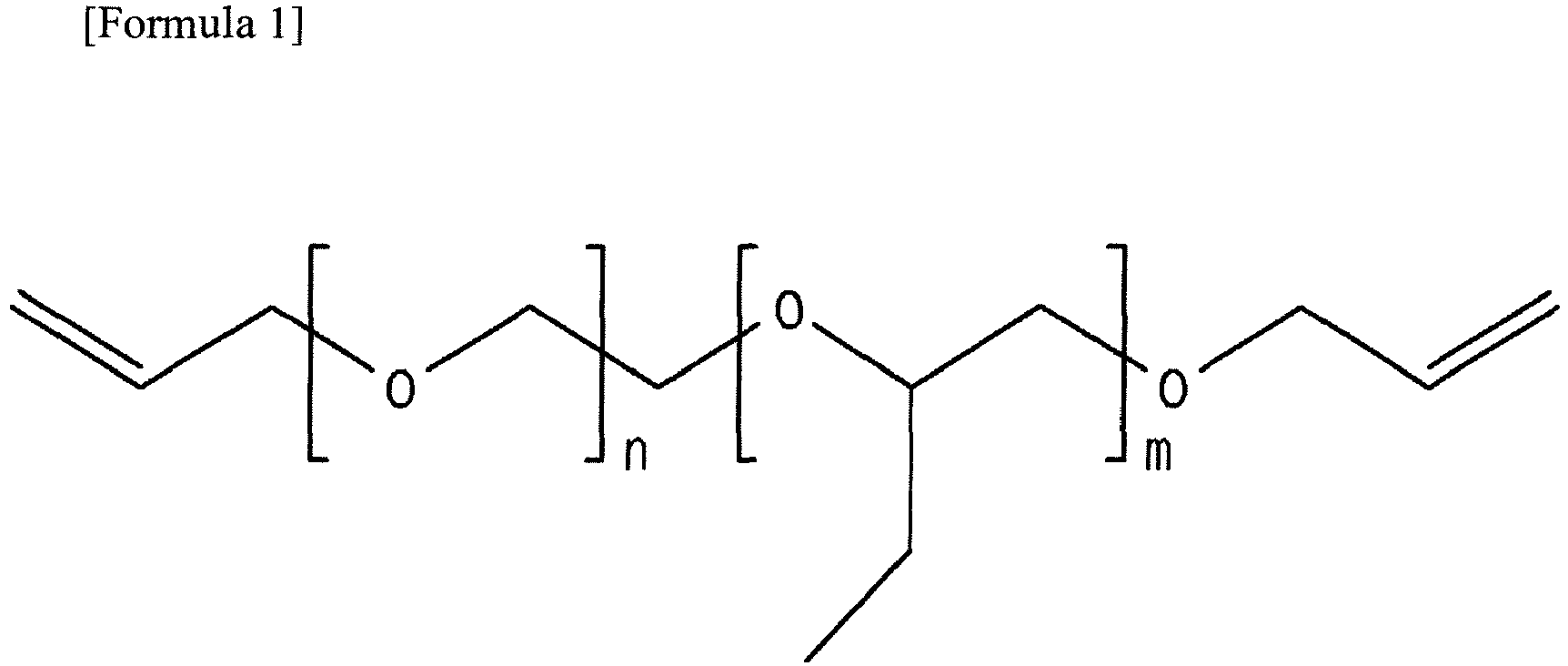
- In Formula 1,
n and m represent the number of moles of the repeating unit, and the molar ratio of n:m is in the range of 5:1 to 50:1, and specifically 20:1. - In the solid polymer electrolyte according to an embodiment of the present invention, the polymer represented by Formula 1 is a conductive polymer with polar groups capable of dissociating metal salts, and is coordinated with Li ions to achieve an effect of improving ion conductivity by including an element capable of providing electrons such as oxygen.
- The weight average molecular weight (Mw) of the polymer represented by Formula 1 may be about 50,000 or more, specifically about 50,000 to 1,000,000, more specifically 50,000 to 500,000, and more specifically 50,000 to 200,000.
- When the weight average molecular weight of the polymer is within the above-described range, the degree of polymerization of the polymer is controlled to be within a suitable range, and thus it is possible to attain a solid polymer electrolyte not only having improved ion conductivity and lithium cation transference number but also excellent mechanical strength and electrochemical stability. When the weight average molecular weight (Mw) of the polymer represented by Formula 1 is 50,000, which is a low molecular weight, the polymer is liquefied in the presence of lithium salts, and thus it may be difficult to prepare a solid polymer electrolyte.
- Here, in the present specification, the term "weight average molecular weight (Mw)" may refer to a conversion value of a standard polyethylene oxide measured by a gel permeation chromatograph (GPC), and unless particularly indicated otherwise, a molecular weight may refer to a weight average molecular weight. For example, in the present invention, a measurement may be taken using an Agilent 4 Series for GPC, in which 100 µl of a sample is injected at a flow rate of 1.0 ml/min at 40 °C using Ultrahydrogel linearX2 columns and a 0.1M NaNO3 (pH 7.0 phosphate buffer) eluent.
- The polymer represented by
Formula 1 may be included in an amount of 5 wt% to 60 wt%, and specifically 20 wt% to 60 wt% based on the total weight of the solid polymer electrolyte. When the content of the polymer represented byFormula 1 is less than 5 wt%, it is difficult to form a uniformly dispersed solid polymer electrolyte, and when the content is more than 60 wt%, ion conductivity may decrease. - Further, the solid polymer electrolyte may further include a copolymer as necessary.
- The copolymer may be included in various ways such as grafting, crosslinking, or blending with the polymer represented by
Formula 1 in the solid polymer electrolyte based on the polymer represented byFormula 1. - Representative examples of the copolymer include one or a mixture of two or more selected from the group consisting of styrene, polyvinylidene fluoride (PVDF), polypropylene oxide (PPO), polyacrylonitrile (PAN), polyvinyl chloride (PVC), polymethyl methacrylate (PMMA), polysiloxane, and polyphosphazene.
- In the solid polymer electrolyte according to an embodiment of the present invention, the lithium salt may be dissociated by a conductive polymer to form a complex. For example, the lithium salt may serve to form a complex with an oxide group contained in the polymer represented by
Formula 1 through coordination bonding and to conduct ions. Here, when the number of repeating units of the ethylene oxide group is increased, more ion conductive sites are supplied, and accordingly, the dissociation of lithium salts is increased so that more lithium free ions may be transferred. - As a representative example, the lithium salt may include Li+ as a cation, and include any one selected from the group consisting of F-, Cl-, Br-, I-, NO3 -, N(CN)2 -, BF4 -, ClO4 -, AlO4 -, AlCl4 -, PF6 -, SbF6 -, AsF6 -, BF2C2O4 -, BC4O8 -, (CF3)2PF4 -, (CF3)3PF3 -, (CF3)4PF2 -, (CF3)5PF-, (CF3)6P-, CF3SO3 -, C4F9SO3 -, CF3CF2SO3 -, (CF3SO2)2N-, (F2SO2)2N-, CF3CF2(CF3)2CO-, (CF3SO2)2CH-, CF3(CF2)7SO3 -, CF3CO2 -, CH3CO2 -, SCN-, and (CF3CF2SO2)2N- as an anion.
- A single lithium salt or a combination of two or more may be used as necessary. The content of the lithium salt used may be suitably changed to be within a usable range, but the lithium salt may be included in an amount of 5 wt% to 20 wt%, specifically 10 to 30 wt%, and more specifically 10 wt% to 20 wt% based on the total weight of the solid polymer electrolyte in order to obtain an effect of forming an optimum anti-corrosive film on an electrode surface.
- When the content of the lithium salt is less than 5 wt%, conductivity may be reduced due to the lack of lithium ions in the solid polymer electrolyte composition, and when the content is more than 20 wt%, viscosity increases and the ion conductivity decreases, resulting in a problem of cost increase.
- Further, the ion conductivity of the solid polymer electrolyte of the present invention occurs in an amorphous region of the polymer represented by
Formula 1. Therefore, in order to increase the ionic conductivity of the solid polymer electrolyte, the intermolecular interaction of the polymer represented byFormula 1, which is a crystalline polymer, needs to be inhibited such that the crystallinity thereof is lowered. To this end, additives may be introduced. However, in the method in which conventional additives are introduced, although the crystallinity of the polymer is controlled to increase ionic conductivity, mechanical properties deteriorate and resistance increases. - Thus, in the present invention, in order to alleviate these disadvantages, a lithium ion conductor capable of supplement a deficient salt dissociation ability of the polymer represented by
Formula 1 and controlling the crystallinity of the solid conductive polymer is introduced as an additive of the solid polymer electrolyte such that sufficient space for moving lithium ions is formed, and thereby it is possible to realize a solid polymer electrolyte in which the ion conductivity is improved and mechanical properties are supplemented. Further, it also becomes possible to improve ion conductivity at low temperatures through a Li transfer channel formed of ceramics existing in the polymer. - The lithium ion conductor can be used without any particular limitation as long as it has lithium ion conductivity, and specifically, any one or a mixture of two or more of oxide-based, phosphate-based, nitride-based, and sulfide-based lithium ion conductors may be used. Representative examples of the lithium ion conductor include one or a mixture of two or more selected from the group consisting of a lithium-lanthanum-zirconium oxide (Li7La3Zr2O12; LLZO)-based lithium ion conductor with high ion conductivity (total 2.2×10⁻⁴/cm), low reactivity with an electrode material, a wide potential window (0-6V), and the like (where the LLZO may be doped with one or more of Ta, Al, Si, Nb and HF), a lithium-aluminum-germanium-phosphate (Li1+xAlxGe2-x(PO4)3 (0<x<1); LAGP)-based lithium ion conductor such as Li1.5Al0.5Ge1.5(PO4)3 or Li1.3Al0.3Ge1.7(PO4)3, and a lithium-aluminum-titanium-phosphate (Li1+xAlxTi2-x(PO4)3 (0<x<1); LATP)-based lithium ion conductor such as Li1.3Al0.3Ti1.7(PO4)3.
- The lithium ion conductor may be included in an amount of 5 wt% to 70 wt%, and specifically 20 wt% to 70 wt% based on the total weight of the solid polymer electrolyte. When the content of the lithium ion conductor is less than 5 wt%, ion conductivity increase is insignificant. When the content is more than 70 wt%, ion conductivity of the solid polymer electrolyte reaches saturation and does not further increase, and there arises a problem of increased resistance and cost.
- The lithium ion conductor may have an average particle size (D50) of 100 nm or more, and more preferably 200 nm to 700 nm. When the average particle size is less than 100 nm, the lithium ion conductors may aggregate, and it may be difficult to ensure mechanical properties of a solid electrolyte film. Further, when the average particle size is more than 700 nm, interface resistance is greatly increased and the lithium ion conductivity of the solid polymer electrolyte may be lowered due to reduction of specific surface area.
- Here, the average particle size (D50) of the lithium ion conductor may be measured by a laser diffraction scattering method.
- Further, the solid polymer electrolyte may optionally further include a binder polymer to improve the adhesion between the lithium ion conductors or between the solid polymer electrolyte and the electrode. The binder polymer may be used without any particular limitation as long as it is electrochemically stable.
- Specifically, the binder polymer may be polyvinylidene fluoride-hexafluoropropylene, polyvinylidene fluoride-trichlorethylene, polymethyl methacrylate, polyacrylonitrile, polyvinylpyrrolidone, polyvinyl acetate, an ethylene vinyl acetate copolymer, cellulose acetate, cellulose acetate butyrate, cellulose acetate propionate, cyanoethyl polyvinyl alcohol, cyanoethylcellulose, carboxymethylcellulose, an acrylonitrile-styrene-butadiene copolymer, polyimide or the like, and one or a mixture of two or more thereof may be used.
- Further, in addition to the lithium ion conductor, the solid polymer electrolyte of the present invention may further include, as necessary, other additives to ensure the effect of improving mechanical properties and reactivity, reducing resistance, and the like.
- Representative examples of the additive include inorganic particles having an ability to transfer lithium ions, that is, lithium phosphate (Li3PO4), lithium titanium phosphate (LicTid(PO4)3, 0<c<2, 0<d<3), lithium aluminum titanium phosphate (Lia1Alb1Tic1(PO4)3 0<al<2, 0<b1<1, 0<c1<3), lithium lanthanum titanate (Lia3Lab3TiO3, 0<a3<2, 0<b3<3), lithium germanium thiophosphates (Lia4Geb4Pc2Sd, 0<a4<4, 0<b4<1, 0<c2<1, 0<d<5) such as Li3.25Ge0.25P0.75S4, lithium nitrides (Lia5Nb5, 0<a5<4, 0<b5<2) such as Li3N, a mixture thereof, etc.
- The average particle size (D50) of the inorganic particles is preferably in the range of about 0.001 to 10 µm so as to have a suitable porosity in a uniform thickness in the solid polymer electrolyte. When the average particle size is less than 0.001 µm, dispersibility may deteriorate. When the average particle size is more than 10 µm, not only may the thickness of the porous coating layer increase, but also the inorganic particles may aggregate and be exposed to the outside of the solid polymer electrolyte, resulting in a decrease in mechanical strength.
- Ion conductivity (σ) of the solid polymer electrolyte of the present invention may be 1×10⁻⁵ S/cm to 1×10⁻⁴ S/cm at room temperature, that is, in a temperature range of 25 °C to 40 °C .
- The ion conductivity may be measured in a frequency band of 100 MHz to 0.1 Hz after temperature stabilization in a chamber of 25 °C for 30 minutes by using VMP3 Multichannel potentiostat equipment and 4294A (manufactured by Biological Logic Science Instruments).
- In the solid polymer electrolyte according to an embodiment of the present invention, by introducing a nanometer-sized lithium ion conductor into the polymer represented by
Formula 1, the crystallinity of the polymer is reduced and an ion transfer channel is formed through the ceramic to improve ion conductivity at low temperature. Particularly, since a decrease in ion conductivity of the lithium ion conductor itself at a low temperature is less than that of the polymer, it is possible to improve lithium ion conductivity at a low temperature through forming a composite. - The solid polymer electrolyte according to an embodiment of the present invention may be electrochemically stable at a voltage range of 0 to 5.5 V, and specifically 0 to 4.3 V. The solid polymer electrolyte according to an embodiment may be used in an electrochemical device operated at a high voltage due to having an electrochemically stable and wide voltage window.
- Further, according to an embodiment of the present invention, there is provided a method of preparing a solid polymer electrolyte, which includes
preparing a composition for a polymer electrolyte by dissolving the polymer represented byFormula 1, the lithium salt, and the lithium ion conductor in a solvent;
coating a film or an electrode surface with the composition for a polymer electrolyte; and
drying and curing the composition for a polymer electrolyte. - According to the method of the present invention, the lithium ion conductor and the lithium salt may be formed in the form of a complex which is uniformly dispersed in a polymer matrix (network) formed by a crosslinking reaction of the polymer represented by
Formula 1. Therefore, the solid polymer electrolyte of the present invention can attain low crystallinity and high ion conductivity at a low temperature. - Further, in the above-described method, the solvent is not particularly limited, but organic solvents having high volatility such as THF, acetonitrile, and the like may be used.
- The composition for a polymer electrolyte may selectively further include a polymerization initiator to form a polymer matrix.
- Specifically, the polymerization initiator may include one selected from the group consisting of 1-hydroxy-cyclohexyl-phenyl-ketone, 2-methyl-1-[4-(methylthio) phenyl]-2-morpholinopropane-1-one, 1-hydroxy-2-methyl-1-phenyl-propan-1-one, 2-hydroxy-1-[4-(2-hydroxyethoxy) phenyl]-2-methyl-1-propanone, methyl benzoylformate, α,α-dimethoxy-alpha-phenylacetophenone, 2-benzyl-2-(dimethylamino)-1-[4-(4-morpholinyl) phenyl]-1-butanone, 2,2-dimethoxy-2-phenylacetophenone, and benzoin ethyl ether.
- The polymerization initiator may be included in an amount of 0.01 to 5 parts by weight based on 100 parts by weight of the polymer represented by
Formula 1. - Further, in the method of the present invention, known coating methods such as slot die, gravure coating, spin coating, spray coating, roll coating, curtain coating, extrusion, casting, screen printing, inkjet printing, and the like may be used as the coating method.
- Further, in the method of the present invention, a method of curing the composition for a polymer electrolyte may be performed by inducing a crosslinking reaction while irradiating heat, e-beam, gamma ray, or UV (G, H, I-line) radiation or the like to a coated composition for a polymer electrolyte to vaporize a solvent at a temperature of 25 °C or more. That is, when the coated composition is irradiated with the heat, e-beam, gamma ray, or UV radiation or the like, a radical generated from the polymerization initiator acts as a catalyst to cause a crosslinking reaction between the polymers represented by
Formula 1 to form a polymer matrix. - According to the method of the present invention, the solid polymer electrolyte may be prepared in the form of a free standing-type film having a thickness of 200 µm or less, for example 0.1 to 100 µm or 1 to 40 µm, and inserted between a positive electrode and a negative electrode, or may be prepared and introduced in the form of a coating film with which an electrode or a porous separator is coated.
- Here, examples of the material of the porous separator include sheets or nonwoven fabrics formed of polyolefin-based polymers such as polyethylene, polypropylene, polytetrafluoroethylene (PTFE), polyvinylidene fluoride (PVDF), polymethyl methacrylate or polyethersulfone having chemical resistance and hydrophobicity, cellulose-based polymers, glass fiber, ceramic metal, etc.
- The pore diameter of the porous separator is generally in the range of 0.01 to 10 µm and the thickness thereof is preferably in the range of 5 to 300 µm. When the pore diameter of the porous separator is less than 0.01 µm, efficiency may be greatly reduced, and when the pore diameter is more than 10 µm, the adsorption force of the polymer electrolyte composition increases and a permeation flow rate is reduced.
- Further, the solid polymer electrolyte of the present invention is disposed on at least a part of the negative electrode or the positive electrode, and thereby positive or negative electrode surfaces can become electrochemically stabilized as they become mechanically stabilized. Particularly, the solid polymer electrolyte is completely coated on the surface of the negative electrode or positive electrode to serves as a protective film for preventing direct contact with the electrolyte having high reactivity, thereby enhancing chemical stability. For example, when the solid polymer electrolyte is formed on the negative electrode surface, the formation of dendrites on the negative electrode surface during charging and discharging of a lithium secondary battery may be suppressed and the interfacial stability between the negative electrode and the electrolyte is improved. Accordingly, cycle characteristics of the lithium secondary battery can be improved.
- Further, the method of the present invention may also include a step of impregnating the lithium ion conductor in the formed polymer electrolyte.
- Further, in the above-described method, the polymer electrolyte composition may also include an ion conductive electrolyte as necessary.
- Further, the solid polymer electrolyte prepared by the method of the present invention may be used as an electrolyte for a lithium polymer secondary battery.
- Specifically, a lithium secondary battery may be prepared by sequentially laminating the positive electrode, the solid polymer electrolyte of the present invention, and the negative electrode.
- Here, the negative electrode or positive electrode forming the lithium secondary battery may be produced using conventional methods known in the related field. For example, an electrode slurry is prepared by mixing an electrode active material with a solvent, a binder, a conductive material and a dispersant as necessary and stirring, and then is applied onto a metal current collector, pressed, and dried to produce an electrode.
- Specifically, as the positive electrode active material forming the positive electrode, a compound which can be applied to normal voltages or a high voltages, and can be capable of reversibly intercalating/deintercalating lithium may be used.
- The positive electrode active material is a compound capable of reversibly intercalating and deintercalating lithium, and specifically, may include a lithium composite metal oxide including lithium and one or more metals such as cobalt, manganese, nickel, or aluminum. More specifically, examples of the lithium composite metal oxide include lithium-manganese-based oxides such as LiMnO2, LiMn2O4 and the like, lithium-cobalt-based oxides such as LiCoO2, lithium-nickel-based oxides such as LiNiO2, lithium-nickel-manganese-based oxides such as LiNi1-YMnYO2 (where 0<Y<1), LiMn2-zNizO4 (where 0<z<2) and the like, lithium-nickel-cobalt-based oxides such as LiNi1-Y1CoY1O2 (0<Y1<1), LiMn2-z1Coz1O4(0 < Z1 < 2) and the like, lithium-manganese-cobalt-based oxides such as LiCo1-Y2MnY2O2 (0<Y2<1), lithium-nickel-manganese-cobalt-based oxides such as Li(NipCoqMnr1)O2 (0<p<1, 0<q<1, 0<r1<1, p+q+r1=1), Li(Nip1Coq1Mnr2)O4 (0<pl<2, 0<ql<2, 0<r2<2, p1+q1+r2=2), and the like, and oxides of lithium-nickel-cobalt-transition metal (M) such as Li(Nip2Coq2Mnr3Ms2)O2 (where M is selected from the group consisting of Al, Fe, V, Cr, Ti, Ta, Mg, and Mo, and p2, q2, r3, and s2 each independently represent atom fractions of elements, 0<p2<1, 0<q2<1, 0<r3<1, 0<s2<1, and p2+q2+r3+s2=1) and the like, and one or a mixture of two or more of these compounds may be included. Among these, in terms of improving the capacity characteristics and stability of the battery, the lithium transition metal oxide may be LiCoO2, LiMnO2, LiNiO2, lithium nickel manganese cobalt oxides such as Li(Ni0.6Mn0.2Co0.2)O2, Li(Ni0.5Mn0.3Co0.2)O2, Li(Ni0.8Mn0.1Co0.1)O2, and the like, lithium nickel cobalt aluminum-based oxides such as such as Li(Ni0.8Co0.15Al0.05)O2 and the like. Considering the remarkable improvement that results from controlling the type and content ratio of the constituent elements forming the lithium composite metal oxide, the lithium composite metal oxide may be Li(Ni0.6Mn0.2Co0.2)O2, Li(Ni0.5Mn0.3Co0.2)O2, Li(Ni0.7Mn0.15Co0.15)O2, L(iNi0.8Mn0.1Co0.1)O2, or the like, and one or a mixture of two or more thereof may be used.
- The positive electrode active material may be included in an amount of 80 wt% to 99 wt% based on the total weight of solids in the positive electrode slurry.
- The conductive material is generally included in an amount of 1 wt% to 30 wt% based on the total weight of solids in the positive electrode slurry.
- Any conductive material may be used without particular limitation so long as it has suitable conductivity without causing adverse chemical changes in the battery. Examples of suitable conductive materials include graphite; carbon-based materials such as carbon black, acetylene black, Ketjen black, channel black, furnace black, lamp black, and thermal black; conductive fibers such as carbon fibers and metallic fibers; metallic powders such as carbon fluoride powders, aluminum powders, and nickel powders; conductive whiskers such as zinc oxide and potassium titanate; conductive metal oxides such as titanium oxide; and polyphenylene derivatives. Specific examples of commercially available conductive materials may include various acetylene black products (available from Chevron Chemical Company), Denka Black (available from Denka Singapore Private Limited), products available from Gulf Oil Company, Ketjen black, the EC series (available from Armak Company), Vulcan XC-72 (available from Cabot Company), Super P (available from Timcal Co., Ltd.), and the like.
- The binder s a component that assists in the binding between the active material and the conductive agent and in the binding with the current collector, and generally included in an amount of 1 to 30 wt% based on the total weight of solids in the positive electrode slurry. Examples of the binder include polyvinylidene fluoride (PVDF), polyvinyl alcohol, carboxymethylcellulose (CMC), starch, hydroxypropylcellulose, regenerated cellulose, polyvinyl pyrrolidone, tetrafluoroethylene, polyethylene, polypropylene, an ethylene propylene diene polymer (EPDM), a sulfonated EPDM, a styrene butadiene rubber, a fluororubber, various copolymers thereof, etc.
- The solvent may include an organic solvent such as N-methyl-2-pyrrolidone (NMP), and may be used in an amount in which a preferable viscosity is obtained when the positive electrode active material, and optionally the binder and the conductive material, are included. For example, the solvent may be included such that the solid content of the solvent is in the range of 50 wt% to 95 wt%, and preferably 70 wt% to 90 wt%, in a slurry including the positive electrode active material and optionally the binder and the conductive material.
- Further, the negative electrode active material forming the negative electrode may be a conventional negative electrode active material that may be used for a negative electrode of a conventional electrochemical device, and examples thereof are not particularly limited. As representative examples of the negative electrode materials that may be used, lithium titanium oxide (LTO); carbon such as non-graphitized carbon and graphitized carbon; LixFe2O3(0≤x≤1), LixWO2(0≤x≤1), a lithium metal; lithium alloys; silicon-based alloys; tin-based alloys; metal oxides such as SnO, SnO2, PbO, PbO2, Pb2O3, Pb3O4, Sb2O3, Sb2O4, Sb2O5, GeO, GeO2, Bi2O3, Bi2O4, and Bi2O5; conductive polymers such as polyacetylene; Li-Co-Ni based materials; titanium oxides; and the like may be used at the same time.
- In addition, a metal oxide such as TiO2, SnO2, and the like that may intercalate and deintercalate lithium and has a potential less than 2V with respect to lithium may be used, but the present invention is not limited thereto. Particularly, a carbon material such as graphite, a carbon fiber, active carbon, and the like may be preferably used.
- The negative electrode active material may be included in an amount of 80 wt% to 99 wt% based on the total weight of solids in the negative electrode slurry.
- The binder s a component that assists in the binding between the active material and the conductive agent and in the binding with the current collector, and generally included in an amount of 1 to 30 wt% based on the total weight of solids in the negative electrode slurry. Examples of the binder include polyvinylidene fluoride (PVDF), polyvinyl alcohol, carboxymethylcellulose (CMC), starch, hydroxypropylcellulose, regenerated cellulose, polyvinyl pyrrolidone, tetrafluoroethylene, polyethylene, polypropylene, an ethylene propylene diene terpolymer (EPDM), a sulfonated EPDM, a styrene butadiene rubber, fluororubbers, various copolymers, etc.
- The conductive material is a component for further improving the conductivity of the negative electrode active material, and is commonly added in an amount of 1 to 20 wt% by weight based on the total weight of solids in the negative electrode slurry. Any conductive material may be used without particular limitation as long as suitable conductivity is provided without causing chemical changes in the battery. Examples of the conductive material include graphite such as natural or artificial graphite; carbon blacks such as acetylene black, Ketjen black, channel black, furnace black, lamp black, and thermal black; conductive fibers such as carbon fibers and metallic fibers; metallic powders such as carbon fluoride, aluminum, and nickel powders; conductive whiskers such as zinc oxide and potassium titanate whiskers; conductive metal oxides such as titanium oxide; and polyphenylene derivatives.
- The solvent may include water or an organic solvent such as NMP, an alcohol, and the like, and may be used in an amount in which a preferable viscosity is obtained when the negative electrode active material, and optionally the binder and the conductive material, are included. For example, the solvent may be included in an amount such that the solid content of the solvent is in the range of 50 wt% to 95 wt%, and preferably 70 wt% to 90 wt%, in a slurry including the negative electrode active material and optionally the binder and the conductive material.
- The current collector is a metal having high conductivity and a metal to which the slurry of the electrode active material may easily adhere. Any metals may be used as long as the metal has no reactivity in a voltage range of a battery. Specifically, examples of a positive electrode collector include aluminum, nickel, or a foil formed by the combination thereof, and non-limiting examples of a negative electrode collector may include copper, gold, nickel, a copper alloy, or a foil formed by the combination thereof.
- Further, a separator may be present between the positive electrode and the negative electrode depending on the type of the lithium secondary battery. As such a separator, a conventional porous polymer film, that is, polyethylene, polypropylene, polyvinylidene fluoride, or a multilayer film of two or more thereof may be used, and a mixed multilayer film such as a polyethylene/polypropylene double layered separator, a polyethylene/polypropylene/polyethylene triple layered separator, a polypropylene/polyethylene/polypropylene triple layered separator, and the like may be used. Further, conventional nonwoven fabrics, for example, nonwoven fabrics formed of glass fibers with a high melting point, polyethylene terephthalate fibers, and the like may be used, but the present invention is not limited thereto.
- Hereinafter, the present invention will be described in detail through specific examples. However, the description proposed herein is just a preferable example for the purpose of illustrations only, not intended to limit the scope of the invention, so it should be understood that the examples are provided for a more definite explanation to an ordinary person skilled in the art.
- 35 g of a polymer represented by
Formula 1 having a weight average molecular weight of 100,000 (the molar ratio of n:m was 20:1), 55 g of lithium-lanthanum-zirconium oxide (Li7La3Zr2O12; LLZO) having an average particle size of 300 nm as a lithium ion conductor, and 10 g of lithium salts (LiTFSI) were dissolved in acetonitrile. 0.7 g of methylbenzoylformate was added thereto as a polymerization initiator to prepare a composition for a polymer electrolyte having a solid content of 40%. - Subsequently, a film was coated with the composition for a polymer electrolyte, and then the composition was vaporized at 40 °C to form a film and then irradiated with UV to prepare a solid polymer electrolyte film having a thickness of 30 µm.
- A solid polymer electrolyte film was prepared in the same manner as in Example 1 except that lithium-aluminum-germanium-phosphate (Li1.3Al0.3Ge1.7(PO4)3; LAGP) having an average particle size of 300 nm was mixed instead of LLZO.
- A solid polymer electrolyte film was prepared in the same manner as in Example 1 except that the lithium ion conductor was not included, and 80 g of the polymer represented by
Formula 1 having a weight-average molecular weight of 100,000 and 20 g of the lithium salts (LiTFSI) were mixed. - The results of measuring ionic conductivity of each of the solid polymer electrolyte films according to Examples 1 and 2 and Comparative Example 1 are shown in
FIG. 1 . - The ion conductivity was measured using an alternating current impedance measurement method according to temperature after a gold (Au) electrode in the form of a circle with a 1mm diameter was coated using a sputtering method on the upper parts of the solid electrolyte films prepared in Examples 1 and 2 and Comparative Example 1. The ion conductivity was measured using VMP3 and 4294A measuring instrument and at a frequency band of 100 MHz to 0.1 Hz.
- Referring to change in ion conductivity according to temperature of the solid polymer electrolyte films prepared in Examples 1 and 2 and Comparative Example 1 as shown in
FIG. 1 , it can be seen that, while the solid polymer electrolyte films prepared in Examples 1 and 2 including lithium ion conductors have an ion conductivity of 1.0×10⁻⁵ S/cm or more in a temperature range of 25 °C or less, the solid polymer electrolyte film prepared in Comparative Example 1 has a low ion conductivity of 5.0×10⁻⁶ S/cm or less in a temperature range of 25 °C or less. - Accordingly, it can be seen from these results that the solid polymer electrolyte film proposed in the present invention has an effect of increasing lithium ion conductivity not only at room temperature but also at low temperature.
- The potential window of the solid polymer electrolyte films prepared according to Examples 1 and 2 and Comparative Example 1 were measured using an LSV method under the same conditions as in Experimental Example 1, and the results are shown in
FIG. 2 . - For example, the potential window was measured using a potentiostat after forming a solid polymer electrolyte film and setting Li metal as a reference electrode. The measurement was carried out at a rate of 1 mV/sec at room temperature.
- As shown in
FIG. 2 , it can be seen that, in the case of the electrolytes of Examples 1 and 2, the redox reaction occurred at 4.0V or higher due to the improvement of the potential window through compounding while the polymer (PEO-based polymer electrolyte) of Comparative Example 1 observed low oxidation stability at 4.0V or less, thereby cannot be used in a battery of 4.0V or more. Therefore, it can be predicted that the electrolytes can be used in a high voltage battery.
Claims (15)
- A solid polymer electrolyte, comprising:a polymer represented by the following Formula 1;a lithium salt; anda lithium ion conductor.
 n and m represent the number of moles of a repeating unit,a molar ratio of n:m is in a range of 5:1 to 50:1.
 - The solid polymer electrolyte according to claim 1, wherein a weight average molecular weight of the polymer is in a range of 50,000 to 5,000,000.
- The solid polymer electrolyte according to claim 1, wherein a weight average molecular weight of the polymer is in a range of 50,000 to 500,000.
- The solid polymer electrolyte according to claim 1, wherein a weight average molecular weight of the polymer is in a range of 50,000 to 200,000.
- The solid polymer electrolyte according to claim 1, wherein the polymer is included in an amount of 5 wt% to 60 wt% based on a total weight of the solid polymer electrolyte.
- The solid polymer electrolyte according to claim 1, wherein the polymer is included in an amount of 20 wt% to 60 wt% based on a total weight of the solid polymer electrolyte.
- The solid polymer electrolyte according to claim 1, wherein the lithium salt includes Li+ as a cation, and include any one selected from the group consisting of F-, Cl-, Br-, I-, NO3 -, N(CN)2 -, BF4 -, ClO4 -, AlO4 -, AlCl4 -, PF6 -, SbF6 -, AsF6 -, BF2C2O4 -, BC4O8 -, (CF3)2PF4 -, (CF3)3PF3 -, (CF3)4PF2 -, (CF3)5PF-, (CF3)6P-, CF3SO3 -, C4F9SO3 -, CF3CF2SO3 -, (CF3SO2)2N-, (F2SO2)2N-, CF3CF2(CF3)2CO-, (CF3SO2)2CH-, CF3(CF2)7SO3 -, CF3CO2 -, CH3CO2 -, SCN-, and (CF3CF2SO2)2N- as an anion.
- The solid polymer electrolyte according to claim 1, wherein the lithium salt is included in an amount of 5 wt% to 20 wt% based on the total weight of the solid polymer electrolyte.
- The solid polymer electrolyte according to claim 1, wherein the lithium ion conductor includes one or a mixture of two or more selected from the group consisting of lithium-lanthanum-zirconium oxide-based, lithium-aluminum-germanium-phosphate-based, and lithium-aluminum-titanium-phosphate-based lithium ion conductors.
- The solid polymer electrolyte according to claim 1, wherein the lithium ion conductor includes one or a mixture of two or more selected from the group consisting of Li7La3Zr2O12 (LLZO), Li1.5Al0.5Ge1.5(PO4)3, Li1.3Al0.3Ge1.7(PO4)3, and Li1.3Al0.3Ti1.7(PO4)3.
- The solid polymer electrolyte according to claim 1, wherein the lithium ion conductor is included in an amount of 5 wt% to 70 wt% based on the total weight of the solid polymer electrolyte.
- The solid polymer electrolyte according to claim 1, wherein the lithium ion conductor is included in an amount of 20 wt% to 70 wt% based on the total weight of the solid polymer electrolyte.
- The solid polymer electrolyte according to claim 1, wherein the solid polymer electrolyte is an electrolyte for a lithium secondary battery.
- A method of preparing the solid polymer electrolyte of claim 1, comprising:preparing a composition for a polymer electrolyte by dissolving a polymer represented by the following Formula 1, a lithium salt, and a lithium ion conductor in a solvent;coating a film or an electrode surface with the composition for a polymer electrolyte; anddrying and curing the composition for a polymer electrolyte.
 n and m represent the number of moles of a repeating unit,a molar ratio of n:m is in a range of 5:1 to 50:1.
 - The method according to claim 14, wherein the solid polymer electrolyte is prepared in the form of a free-standing type film or a coating film.
Applications Claiming Priority (2)
| Application Number | Priority Date | Filing Date | Title |
|---|---|---|---|
| KR20160038570 | 2016-03-30 | ||
| PCT/KR2017/003494 WO2017171436A1 (en) | 2016-03-30 | 2017-03-30 | Solid polymer electrolyte and method for producing same |
Publications (3)
| Publication Number | Publication Date |
|---|---|
| EP3333959A1 true EP3333959A1 (en) | 2018-06-13 |
| EP3333959A4 EP3333959A4 (en) | 2018-06-27 |
| EP3333959B1 EP3333959B1 (en) | 2020-04-29 |
Family
ID=59966188
Family Applications (1)
| Application Number | Title | Priority Date | Filing Date |
|---|---|---|---|
| EP17775860.4A Active EP3333959B1 (en) | 2016-03-30 | 2017-03-30 | Solid polymer electrolyte and method for producing same |
Country Status (5)
| Country | Link |
|---|---|
| US (1) | US10892519B2 (en) |
| EP (1) | EP3333959B1 (en) |
| KR (1) | KR102018755B1 (en) |
| CN (1) | CN108140883B (en) |
| WO (1) | WO2017171436A1 (en) |
Cited By (1)
| Publication number | Priority date | Publication date | Assignee | Title |
|---|---|---|---|---|
| EP4564507A4 (en) * | 2022-10-14 | 2026-01-07 | Lg Energy Solution Ltd | COMPOUND SOLID ELECTROLYTE AND MANUFACTURING METHOD THEREOF |
Families Citing this family (18)
| Publication number | Priority date | Publication date | Assignee | Title |
|---|---|---|---|---|
| US11563234B2 (en) * | 2017-08-31 | 2023-01-24 | Robert Bosch Gmbh | Mixed composite solid state electrolyte for electrochemical cells |
| US11646442B2 (en) | 2018-04-20 | 2023-05-09 | Lg Energy Solution, Ltd. | Electrolyte for lithium secondary battery and lithium secondary battery including same |
| CN108933258A (en) * | 2018-06-27 | 2018-12-04 | 淄博火炬能源有限责任公司 | The preparation method of the all-solid lithium-ion battery of three-dimensional composition metal cathode of lithium |
| JP2022518836A (en) * | 2019-01-30 | 2022-03-16 | ソルベイ スペシャルティ ポリマーズ イタリー エス.ピー.エー. | Solid composite electrolyte |
| KR102210761B1 (en) * | 2019-02-26 | 2021-02-02 | 한국화학연구원 | Composite electrolyte for secondary battery and method of preparing thereof |
| US12355030B2 (en) * | 2019-06-10 | 2025-07-08 | Purdue Research Foundation | High ionic conductivity composite LiLaZrBiO garnet—polymer electrolyte |
| CN113939951A (en) * | 2019-06-13 | 2022-01-14 | 艾姆普斯拉公司 | Solid electrolyte membrane |
| CN110492170A (en) * | 2019-08-30 | 2019-11-22 | 电子科技大学 | A kind of high ionic conductivity composite solid electrolyte and preparation method thereof |
| KR102253763B1 (en) * | 2019-12-17 | 2021-05-18 | 한국화학연구원 | Manufacturing method of solid-state composite electrolyte membrane for secondary battery having compact structure |
| US11637317B2 (en) * | 2020-06-08 | 2023-04-25 | Cmc Materials, Inc. | Solid polymer electrolyte compositions and methods of preparing same |
| US11588176B2 (en) | 2021-01-04 | 2023-02-21 | Bioenno Tech LLC | All solid-state lithium-ion battery incorporating electrolyte-infiltrated composite electrodes |
| US12463245B2 (en) | 2021-01-04 | 2025-11-04 | Solid Energies Inc. | High voltage electrolyte for 5V solid state lithium-ion battery cell |
| KR102633178B1 (en) * | 2021-10-25 | 2024-02-05 | 한국화학연구원 | Organic-inorganic hybrid polymer electrolyte, manufacturing method thereof, and all-solid-state lithium secondary battery comprising same |
| WO2023234710A1 (en) * | 2022-05-31 | 2023-12-07 | 주식회사 엘지에너지솔루션 | Polymer solid electrolyte and method for manufacturing same |
| EP4560765A4 (en) * | 2022-10-14 | 2025-12-31 | Lg Energy Solution Ltd | METHOD FOR THE PREPARATION OF A POLYMER SOLID ELECTROLYTE |
| JP2025529886A (en) * | 2022-10-14 | 2025-09-09 | エルジー エナジー ソリューション リミテッド | Composite solid electrolyte and method for producing the same |
| KR102890301B1 (en) * | 2022-10-14 | 2025-11-25 | 주식회사 엘지에너지솔루션 | Composite solid electrolyte and method for preparing the same |
| EP4560762A4 (en) * | 2022-10-14 | 2025-12-31 | Lg Energy Solution Ltd | METHOD FOR PREPARING A COMPOSITE SOLID ELECTROLYTE AND COMPOSITE SOLID ELECTROLYTE PREPARED SOLELY |
Family Cites Families (17)
| Publication number | Priority date | Publication date | Assignee | Title |
|---|---|---|---|---|
| JPH03171567A (en) * | 1989-11-30 | 1991-07-25 | Ricoh Co Ltd | Secondary battery |
| JPH05198303A (en) | 1992-01-21 | 1993-08-06 | Dai Ichi Kogyo Seiyaku Co Ltd | Battery |
| KR100739337B1 (en) * | 2004-09-02 | 2007-07-12 | 주식회사 엘지화학 | Organic / inorganic composite porous film and electrochemical device using same |
| ES3010715T3 (en) * | 2004-07-07 | 2025-04-04 | Lg Energy Solution Ltd | New organic/inorganic composite porous film and electrochemical device prepared thereby |
| BRPI0620590B1 (en) * | 2005-12-06 | 2019-07-09 | Lg Chem, Ltd. | ORGANIC / INORGANIC COMPOSITE SEPARATOR, METHOD FOR MANUFACTURING AN ORGANIC / INORGANIC COMPOSITE SEPARATOR AND ELECTROCHEMICAL DEVICE |
| EP1840150B1 (en) * | 2006-03-31 | 2010-03-31 | Sony Deutschland Gmbh | A method of producing poly(ethylene oxide - alkylene oxide) copolymers |
| JP4701404B2 (en) * | 2006-11-27 | 2011-06-15 | 国立大学法人三重大学 | High ion conductive polymer solid electrolyte |
| WO2009070600A2 (en) * | 2007-11-27 | 2009-06-04 | Ceramatec, Inc. | Substantially solid, flexible electrolyte for alkili-metal-ion batteries |
| EP2396848B1 (en) * | 2009-02-11 | 2014-11-19 | Dow Global Technologies LLC | Highly conductive polymer electrolytes and secondary batteries including the same |
| JP5554400B2 (en) * | 2010-12-08 | 2014-07-23 | 公益財団法人三重県産業支援センター | Method for producing lithium secondary battery and method for producing laminated battery |
| KR101028970B1 (en) | 2011-01-19 | 2011-04-12 | 한국씰텍주식회사 | Solid polymer electrolyte and preparation method thereof, lithium polymer secondary battery manufactured using same |
| KR102034719B1 (en) * | 2012-12-21 | 2019-10-22 | 삼성전자주식회사 | Protected anode for lithium air battery and lithium air battery including the same |
| EP2973789B1 (en) * | 2013-03-15 | 2019-05-08 | Sion Power Corporation | Protected electrode structures and methods |
| WO2015076461A1 (en) * | 2013-11-25 | 2015-05-28 | 한국화학연구원 | Electrolyte membrane manufactured from resin composition containing ionic electrolyte and polymer formed by branch-bonding of block copolymer comprising polypropylene oxide block and polyethylene oxide block, and usage of same |
| KR101613511B1 (en) | 2014-02-26 | 2016-04-19 | 서강대학교산학협력단 | Solid polymer electrolyte composition and lithium secondary battery including the same |
| CN104466241B (en) * | 2014-09-19 | 2016-06-29 | 中国科学院宁波材料技术与工程研究所 | One can as lithium ion battery New Solid membrane materials for electrolyte and its preparation method and application |
| US10118976B2 (en) * | 2016-01-04 | 2018-11-06 | California Institute Of Technology | Anion-coordinating polymer electrolytes and related compositions, methods and systems |
-
2017
- 2017-03-30 CN CN201780003280.3A patent/CN108140883B/en active Active
- 2017-03-30 US US15/759,650 patent/US10892519B2/en active Active
- 2017-03-30 EP EP17775860.4A patent/EP3333959B1/en active Active
- 2017-03-30 WO PCT/KR2017/003494 patent/WO2017171436A1/en not_active Ceased
- 2017-03-30 KR KR1020170041012A patent/KR102018755B1/en active Active
Cited By (1)
| Publication number | Priority date | Publication date | Assignee | Title |
|---|---|---|---|---|
| EP4564507A4 (en) * | 2022-10-14 | 2026-01-07 | Lg Energy Solution Ltd | COMPOUND SOLID ELECTROLYTE AND MANUFACTURING METHOD THEREOF |
Also Published As
| Publication number | Publication date |
|---|---|
| WO2017171436A1 (en) | 2017-10-05 |
| EP3333959A4 (en) | 2018-06-27 |
| CN108140883B (en) | 2021-01-29 |
| US10892519B2 (en) | 2021-01-12 |
| KR102018755B1 (en) | 2019-09-06 |
| KR20170113417A (en) | 2017-10-12 |
| EP3333959B1 (en) | 2020-04-29 |
| CN108140883A (en) | 2018-06-08 |
| US20180254523A1 (en) | 2018-09-06 |
Similar Documents
| Publication | Publication Date | Title |
|---|---|---|
| EP3333959B1 (en) | Solid polymer electrolyte and method for producing same | |
| JP4717847B2 (en) | Positive electrode active material and lithium secondary battery including the same | |
| EP2843739B1 (en) | Lithium ion secondary battery | |
| KR101607024B1 (en) | Lithium secondary battery | |
| KR102564970B1 (en) | Negative electrode and secondary battery comprising the same | |
| KR102287770B1 (en) | Solid polymer electrolyte and lithium secondary battery comprising the same | |
| CN108028424B (en) | Composition for gel polymer electrolyte and gel polymer electrolyte | |
| CN108140885B (en) | Composition for gel polymer electrolyte and gel polymer electrolyte | |
| KR20210143980A (en) | Secondary battery | |
| JP2018517246A (en) | Negative electrode slurry for secondary battery for improving dispersibility and reducing resistance, and negative electrode including the same | |
| EP4109593A1 (en) | Anode and secondary battery comprising same | |
| CN108780921A (en) | Polymer electrolyte and lithium secondary battery including the polymer electrolyte | |
| CN113646946B (en) | Secondary battery | |
| CN114270571B (en) | Battery system, method of using the same, and battery pack including the same | |
| EP3734727B1 (en) | Binder composition for secondary battery electrode, and electrode mixture | |
| US20200099051A1 (en) | Negative electrode for lithium ion battery and lithium ion battery | |
| KR102337900B1 (en) | Lithium cobalt oxide positive electrode active material and secondary battery using the same | |
| JP7468966B2 (en) | Anode for secondary battery, method for producing same, and lithium secondary battery including same | |
| CN121532855A (en) | A negative electrode for lithium secondary batteries, a method for manufacturing the same, and lithium secondary batteries including the same. | |
| CN121241446A (en) | Positive electrode, method for manufacturing same, and lithium secondary battery |
Legal Events
| Date | Code | Title | Description |
|---|---|---|---|
| STAA | Information on the status of an ep patent application or granted ep patent |
Free format text: STATUS: THE INTERNATIONAL PUBLICATION HAS BEEN MADE |
|
| PUAI | Public reference made under article 153(3) epc to a published international application that has entered the european phase |
Free format text: ORIGINAL CODE: 0009012 |
|
| STAA | Information on the status of an ep patent application or granted ep patent |
Free format text: STATUS: REQUEST FOR EXAMINATION WAS MADE |
|
| 17P | Request for examination filed |
Effective date: 20180308 |
|
| AK | Designated contracting states |
Kind code of ref document: A1 Designated state(s): AL AT BE BG CH CY CZ DE DK EE ES FI FR GB GR HR HU IE IS IT LI LT LU LV MC MK MT NL NO PL PT RO RS SE SI SK SM TR |
|
| AX | Request for extension of the european patent |
Extension state: BA ME |
|
| A4 | Supplementary search report drawn up and despatched |
Effective date: 20180530 |
|
| RIC1 | Information provided on ipc code assigned before grant |
Ipc: H01M 10/0525 20100101ALI20180518BHEP Ipc: H01M 10/0565 20100101ALI20180518BHEP Ipc: H01M 10/0562 20100101ALI20180518BHEP Ipc: H01M 10/0568 20100101ALI20180518BHEP Ipc: H01M 10/056 20100101AFI20180518BHEP |
|
| DAV | Request for validation of the european patent (deleted) | ||
| DAX | Request for extension of the european patent (deleted) | ||
| STAA | Information on the status of an ep patent application or granted ep patent |
Free format text: STATUS: EXAMINATION IS IN PROGRESS |
|
| 17Q | First examination report despatched |
Effective date: 20191016 |
|
| GRAP | Despatch of communication of intention to grant a patent |
Free format text: ORIGINAL CODE: EPIDOSNIGR1 |
|
| STAA | Information on the status of an ep patent application or granted ep patent |
Free format text: STATUS: GRANT OF PATENT IS INTENDED |
|
| INTG | Intention to grant announced |
Effective date: 20200110 |
|
| GRAS | Grant fee paid |
Free format text: ORIGINAL CODE: EPIDOSNIGR3 |
|
| GRAA | (expected) grant |
Free format text: ORIGINAL CODE: 0009210 |
|
| STAA | Information on the status of an ep patent application or granted ep patent |
Free format text: STATUS: THE PATENT HAS BEEN GRANTED |
|
| AK | Designated contracting states |
Kind code of ref document: B1 Designated state(s): AL AT BE BG CH CY CZ DE DK EE ES FI FR GB GR HR HU IE IS IT LI LT LU LV MC MK MT NL NO PL PT RO RS SE SI SK SM TR |
|
| REG | Reference to a national code |
Ref country code: GB Ref legal event code: FG4D |
|
| REG | Reference to a national code |
Ref country code: CH Ref legal event code: EP |
|
| REG | Reference to a national code |
Ref country code: AT Ref legal event code: REF Ref document number: 1264668 Country of ref document: AT Kind code of ref document: T Effective date: 20200515 |
|
| REG | Reference to a national code |
Ref country code: DE Ref legal event code: R096 Ref document number: 602017015838 Country of ref document: DE |
|
| REG | Reference to a national code |
Ref country code: IE Ref legal event code: FG4D |
|
| REG | Reference to a national code |
Ref country code: NL Ref legal event code: MP Effective date: 20200429 |
|
| REG | Reference to a national code |
Ref country code: LT Ref legal event code: MG4D |
|
| PG25 | Lapsed in a contracting state [announced via postgrant information from national office to epo] |
Ref country code: SE Free format text: LAPSE BECAUSE OF FAILURE TO SUBMIT A TRANSLATION OF THE DESCRIPTION OR TO PAY THE FEE WITHIN THE PRESCRIBED TIME-LIMIT Effective date: 20200429 Ref country code: GR Free format text: LAPSE BECAUSE OF FAILURE TO SUBMIT A TRANSLATION OF THE DESCRIPTION OR TO PAY THE FEE WITHIN THE PRESCRIBED TIME-LIMIT Effective date: 20200730 Ref country code: PT Free format text: LAPSE BECAUSE OF FAILURE TO SUBMIT A TRANSLATION OF THE DESCRIPTION OR TO PAY THE FEE WITHIN THE PRESCRIBED TIME-LIMIT Effective date: 20200831 Ref country code: FI Free format text: LAPSE BECAUSE OF FAILURE TO SUBMIT A TRANSLATION OF THE DESCRIPTION OR TO PAY THE FEE WITHIN THE PRESCRIBED TIME-LIMIT Effective date: 20200429 Ref country code: NO Free format text: LAPSE BECAUSE OF FAILURE TO SUBMIT A TRANSLATION OF THE DESCRIPTION OR TO PAY THE FEE WITHIN THE PRESCRIBED TIME-LIMIT Effective date: 20200729 Ref country code: IS Free format text: LAPSE BECAUSE OF FAILURE TO SUBMIT A TRANSLATION OF THE DESCRIPTION OR TO PAY THE FEE WITHIN THE PRESCRIBED TIME-LIMIT Effective date: 20200829 Ref country code: LT Free format text: LAPSE BECAUSE OF FAILURE TO SUBMIT A TRANSLATION OF THE DESCRIPTION OR TO PAY THE FEE WITHIN THE PRESCRIBED TIME-LIMIT Effective date: 20200429 |
|
| REG | Reference to a national code |
Ref country code: AT Ref legal event code: MK05 Ref document number: 1264668 Country of ref document: AT Kind code of ref document: T Effective date: 20200429 |
|
| PG25 | Lapsed in a contracting state [announced via postgrant information from national office to epo] |
Ref country code: LV Free format text: LAPSE BECAUSE OF FAILURE TO SUBMIT A TRANSLATION OF THE DESCRIPTION OR TO PAY THE FEE WITHIN THE PRESCRIBED TIME-LIMIT Effective date: 20200429 Ref country code: RS Free format text: LAPSE BECAUSE OF FAILURE TO SUBMIT A TRANSLATION OF THE DESCRIPTION OR TO PAY THE FEE WITHIN THE PRESCRIBED TIME-LIMIT Effective date: 20200429 Ref country code: BG Free format text: LAPSE BECAUSE OF FAILURE TO SUBMIT A TRANSLATION OF THE DESCRIPTION OR TO PAY THE FEE WITHIN THE PRESCRIBED TIME-LIMIT Effective date: 20200729 Ref country code: HR Free format text: LAPSE BECAUSE OF FAILURE TO SUBMIT A TRANSLATION OF THE DESCRIPTION OR TO PAY THE FEE WITHIN THE PRESCRIBED TIME-LIMIT Effective date: 20200429 |
|
| PG25 | Lapsed in a contracting state [announced via postgrant information from national office to epo] |
Ref country code: NL Free format text: LAPSE BECAUSE OF FAILURE TO SUBMIT A TRANSLATION OF THE DESCRIPTION OR TO PAY THE FEE WITHIN THE PRESCRIBED TIME-LIMIT Effective date: 20200429 Ref country code: AL Free format text: LAPSE BECAUSE OF FAILURE TO SUBMIT A TRANSLATION OF THE DESCRIPTION OR TO PAY THE FEE WITHIN THE PRESCRIBED TIME-LIMIT Effective date: 20200429 |
|
| PG25 | Lapsed in a contracting state [announced via postgrant information from national office to epo] |
Ref country code: IT Free format text: LAPSE BECAUSE OF FAILURE TO SUBMIT A TRANSLATION OF THE DESCRIPTION OR TO PAY THE FEE WITHIN THE PRESCRIBED TIME-LIMIT Effective date: 20200429 Ref country code: RO Free format text: LAPSE BECAUSE OF FAILURE TO SUBMIT A TRANSLATION OF THE DESCRIPTION OR TO PAY THE FEE WITHIN THE PRESCRIBED TIME-LIMIT Effective date: 20200429 Ref country code: SM Free format text: LAPSE BECAUSE OF FAILURE TO SUBMIT A TRANSLATION OF THE DESCRIPTION OR TO PAY THE FEE WITHIN THE PRESCRIBED TIME-LIMIT Effective date: 20200429 Ref country code: EE Free format text: LAPSE BECAUSE OF FAILURE TO SUBMIT A TRANSLATION OF THE DESCRIPTION OR TO PAY THE FEE WITHIN THE PRESCRIBED TIME-LIMIT Effective date: 20200429 Ref country code: DK Free format text: LAPSE BECAUSE OF FAILURE TO SUBMIT A TRANSLATION OF THE DESCRIPTION OR TO PAY THE FEE WITHIN THE PRESCRIBED TIME-LIMIT Effective date: 20200429 Ref country code: AT Free format text: LAPSE BECAUSE OF FAILURE TO SUBMIT A TRANSLATION OF THE DESCRIPTION OR TO PAY THE FEE WITHIN THE PRESCRIBED TIME-LIMIT Effective date: 20200429 Ref country code: CZ Free format text: LAPSE BECAUSE OF FAILURE TO SUBMIT A TRANSLATION OF THE DESCRIPTION OR TO PAY THE FEE WITHIN THE PRESCRIBED TIME-LIMIT Effective date: 20200429 Ref country code: ES Free format text: LAPSE BECAUSE OF FAILURE TO SUBMIT A TRANSLATION OF THE DESCRIPTION OR TO PAY THE FEE WITHIN THE PRESCRIBED TIME-LIMIT Effective date: 20200429 |
|
| REG | Reference to a national code |
Ref country code: DE Ref legal event code: R097 Ref document number: 602017015838 Country of ref document: DE |
|
| PG25 | Lapsed in a contracting state [announced via postgrant information from national office to epo] |
Ref country code: SK Free format text: LAPSE BECAUSE OF FAILURE TO SUBMIT A TRANSLATION OF THE DESCRIPTION OR TO PAY THE FEE WITHIN THE PRESCRIBED TIME-LIMIT Effective date: 20200429 Ref country code: PL Free format text: LAPSE BECAUSE OF FAILURE TO SUBMIT A TRANSLATION OF THE DESCRIPTION OR TO PAY THE FEE WITHIN THE PRESCRIBED TIME-LIMIT Effective date: 20200429 |
|
| PLBE | No opposition filed within time limit |
Free format text: ORIGINAL CODE: 0009261 |
|
| STAA | Information on the status of an ep patent application or granted ep patent |
Free format text: STATUS: NO OPPOSITION FILED WITHIN TIME LIMIT |
|
| 26N | No opposition filed |
Effective date: 20210201 |
|
| PG25 | Lapsed in a contracting state [announced via postgrant information from national office to epo] |
Ref country code: SI Free format text: LAPSE BECAUSE OF FAILURE TO SUBMIT A TRANSLATION OF THE DESCRIPTION OR TO PAY THE FEE WITHIN THE PRESCRIBED TIME-LIMIT Effective date: 20200429 |
|
| PG25 | Lapsed in a contracting state [announced via postgrant information from national office to epo] |
Ref country code: MC Free format text: LAPSE BECAUSE OF FAILURE TO SUBMIT A TRANSLATION OF THE DESCRIPTION OR TO PAY THE FEE WITHIN THE PRESCRIBED TIME-LIMIT Effective date: 20200429 |
|
| REG | Reference to a national code |
Ref country code: CH Ref legal event code: PL |
|
| REG | Reference to a national code |
Ref country code: BE Ref legal event code: MM Effective date: 20210331 |
|
| PG25 | Lapsed in a contracting state [announced via postgrant information from national office to epo] |
Ref country code: IE Free format text: LAPSE BECAUSE OF NON-PAYMENT OF DUE FEES Effective date: 20210330 Ref country code: LI Free format text: LAPSE BECAUSE OF NON-PAYMENT OF DUE FEES Effective date: 20210331 Ref country code: LU Free format text: LAPSE BECAUSE OF NON-PAYMENT OF DUE FEES Effective date: 20210330 Ref country code: CH Free format text: LAPSE BECAUSE OF NON-PAYMENT OF DUE FEES Effective date: 20210331 |
|
| PG25 | Lapsed in a contracting state [announced via postgrant information from national office to epo] |
Ref country code: BE Free format text: LAPSE BECAUSE OF NON-PAYMENT OF DUE FEES Effective date: 20210331 |
|
| REG | Reference to a national code |
Ref country code: DE Ref legal event code: R081 Ref document number: 602017015838 Country of ref document: DE Owner name: LG ENERGY SOLUTION, LTD., KR Free format text: FORMER OWNER: LG CHEM, LTD., SEOUL, KR |
|
| P01 | Opt-out of the competence of the unified patent court (upc) registered |
Effective date: 20230408 |
|
| PG25 | Lapsed in a contracting state [announced via postgrant information from national office to epo] |
Ref country code: CY Free format text: LAPSE BECAUSE OF FAILURE TO SUBMIT A TRANSLATION OF THE DESCRIPTION OR TO PAY THE FEE WITHIN THE PRESCRIBED TIME-LIMIT Effective date: 20200429 |
|
| PG25 | Lapsed in a contracting state [announced via postgrant information from national office to epo] |
Ref country code: HU Free format text: LAPSE BECAUSE OF FAILURE TO SUBMIT A TRANSLATION OF THE DESCRIPTION OR TO PAY THE FEE WITHIN THE PRESCRIBED TIME-LIMIT; INVALID AB INITIO Effective date: 20170330 |
|
| REG | Reference to a national code |
Ref country code: GB Ref legal event code: 732E Free format text: REGISTERED BETWEEN 20230824 AND 20230831 |
|
| PG25 | Lapsed in a contracting state [announced via postgrant information from national office to epo] |
Ref country code: MK Free format text: LAPSE BECAUSE OF FAILURE TO SUBMIT A TRANSLATION OF THE DESCRIPTION OR TO PAY THE FEE WITHIN THE PRESCRIBED TIME-LIMIT Effective date: 20200429 |
|
| PG25 | Lapsed in a contracting state [announced via postgrant information from national office to epo] |
Ref country code: TR Free format text: LAPSE BECAUSE OF FAILURE TO SUBMIT A TRANSLATION OF THE DESCRIPTION OR TO PAY THE FEE WITHIN THE PRESCRIBED TIME-LIMIT Effective date: 20200429 |
|
| PG25 | Lapsed in a contracting state [announced via postgrant information from national office to epo] |
Ref country code: MT Free format text: LAPSE BECAUSE OF FAILURE TO SUBMIT A TRANSLATION OF THE DESCRIPTION OR TO PAY THE FEE WITHIN THE PRESCRIBED TIME-LIMIT Effective date: 20200429 |
|
| PGFP | Annual fee paid to national office [announced via postgrant information from national office to epo] |
Ref country code: GB Payment date: 20260224 Year of fee payment: 10 |
|
| PGFP | Annual fee paid to national office [announced via postgrant information from national office to epo] |
Ref country code: DE Payment date: 20260220 Year of fee payment: 10 |
|
| PGFP | Annual fee paid to national office [announced via postgrant information from national office to epo] |
Ref country code: FR Payment date: 20260224 Year of fee payment: 10 |