EP3333766A1 - Method and apparatus for fingerprint identification - Google Patents
Method and apparatus for fingerprint identification Download PDFInfo
- Publication number
- EP3333766A1 EP3333766A1 EP17205004.9A EP17205004A EP3333766A1 EP 3333766 A1 EP3333766 A1 EP 3333766A1 EP 17205004 A EP17205004 A EP 17205004A EP 3333766 A1 EP3333766 A1 EP 3333766A1
- Authority
- EP
- European Patent Office
- Prior art keywords
- fingerprint
- contact area
- target object
- characteristic
- fingerprint identification
- Prior art date
- Legal status (The legal status is an assumption and is not a legal conclusion. Google has not performed a legal analysis and makes no representation as to the accuracy of the status listed.)
- Withdrawn
Links
Images



Classifications
-
- G—PHYSICS
- G06—COMPUTING OR CALCULATING; COUNTING
- G06V—IMAGE OR VIDEO RECOGNITION OR UNDERSTANDING
- G06V40/00—Recognition of biometric, human-related or animal-related patterns in image or video data
- G06V40/10—Human or animal bodies, e.g. vehicle occupants or pedestrians; Body parts, e.g. hands
- G06V40/12—Fingerprints or palmprints
-
- G—PHYSICS
- G06—COMPUTING OR CALCULATING; COUNTING
- G06F—ELECTRIC DIGITAL DATA PROCESSING
- G06F1/00—Details not covered by groups G06F3/00 - G06F13/00 and G06F21/00
- G06F1/26—Power supply means, e.g. regulation thereof
- G06F1/32—Means for saving power
- G06F1/3203—Power management, i.e. event-based initiation of a power-saving mode
- G06F1/3206—Monitoring of events, devices or parameters that trigger a change in power modality
- G06F1/3231—Monitoring the presence, absence or movement of users
-
- G—PHYSICS
- G06—COMPUTING OR CALCULATING; COUNTING
- G06F—ELECTRIC DIGITAL DATA PROCESSING
- G06F1/00—Details not covered by groups G06F3/00 - G06F13/00 and G06F21/00
- G06F1/26—Power supply means, e.g. regulation thereof
- G06F1/32—Means for saving power
- G06F1/3203—Power management, i.e. event-based initiation of a power-saving mode
- G06F1/3206—Monitoring of events, devices or parameters that trigger a change in power modality
- G06F1/3215—Monitoring of peripheral devices
-
- G—PHYSICS
- G06—COMPUTING OR CALCULATING; COUNTING
- G06F—ELECTRIC DIGITAL DATA PROCESSING
- G06F1/00—Details not covered by groups G06F3/00 - G06F13/00 and G06F21/00
- G06F1/26—Power supply means, e.g. regulation thereof
- G06F1/32—Means for saving power
- G06F1/3203—Power management, i.e. event-based initiation of a power-saving mode
- G06F1/3234—Power saving characterised by the action undertaken
- G06F1/325—Power saving in peripheral device
-
- G—PHYSICS
- G06—COMPUTING OR CALCULATING; COUNTING
- G06F—ELECTRIC DIGITAL DATA PROCESSING
- G06F1/00—Details not covered by groups G06F3/00 - G06F13/00 and G06F21/00
- G06F1/26—Power supply means, e.g. regulation thereof
- G06F1/32—Means for saving power
- G06F1/3203—Power management, i.e. event-based initiation of a power-saving mode
- G06F1/3234—Power saving characterised by the action undertaken
- G06F1/3287—Power saving characterised by the action undertaken by switching off individual functional units in the computer system
-
- G—PHYSICS
- G06—COMPUTING OR CALCULATING; COUNTING
- G06V—IMAGE OR VIDEO RECOGNITION OR UNDERSTANDING
- G06V40/00—Recognition of biometric, human-related or animal-related patterns in image or video data
- G06V40/10—Human or animal bodies, e.g. vehicle occupants or pedestrians; Body parts, e.g. hands
- G06V40/12—Fingerprints or palmprints
- G06V40/13—Sensors therefor
- G06V40/1306—Sensors therefor non-optical, e.g. ultrasonic or capacitive sensing
-
- G—PHYSICS
- G06—COMPUTING OR CALCULATING; COUNTING
- G06V—IMAGE OR VIDEO RECOGNITION OR UNDERSTANDING
- G06V40/00—Recognition of biometric, human-related or animal-related patterns in image or video data
- G06V40/10—Human or animal bodies, e.g. vehicle occupants or pedestrians; Body parts, e.g. hands
- G06V40/12—Fingerprints or palmprints
- G06V40/1347—Preprocessing; Feature extraction
-
- G—PHYSICS
- G06—COMPUTING OR CALCULATING; COUNTING
- G06V—IMAGE OR VIDEO RECOGNITION OR UNDERSTANDING
- G06V40/00—Recognition of biometric, human-related or animal-related patterns in image or video data
- G06V40/10—Human or animal bodies, e.g. vehicle occupants or pedestrians; Body parts, e.g. hands
- G06V40/12—Fingerprints or palmprints
- G06V40/1365—Matching; Classification
-
- G—PHYSICS
- G06—COMPUTING OR CALCULATING; COUNTING
- G06F—ELECTRIC DIGITAL DATA PROCESSING
- G06F3/00—Input arrangements for transferring data to be processed into a form capable of being handled by the computer; Output arrangements for transferring data from processing unit to output unit, e.g. interface arrangements
- G06F3/01—Input arrangements or combined input and output arrangements for interaction between user and computer
- G06F3/03—Arrangements for converting the position or the displacement of a member into a coded form
- G06F3/041—Digitisers, e.g. for touch screens or touch pads, characterised by the transducing means
- G06F3/044—Digitisers, e.g. for touch screens or touch pads, characterised by the transducing means by capacitive means
Definitions
- the present disclosure generally relates to terminal technologies, and more particularly to a method and apparatus for fingerprint identification.
- the fingerprint identification may be implemented by collecting a user's fingerprint and matching it with a pre-stored fingerprint template such that particular functions of a terminal such as unlocking of a screen, decryption of an application, mobile payment and the like, can be implemented based on the result of the match.
- the terminal may start a fingerprint identification function once the terminal detects the user's skin by a fingerprint identification module, then may perform fingerprint collection and fingerprint match, and may perform subsequent function based on the result of the fingerprint match.
- the fingerprint identification function may be started and subsequent steps may be performed once the user's skin is detected, even if the contact is with non-fingerprint skin. As a result, power consumption of the terminal system may be high.
- an embodiment of the present disclosure provides a method for fingerprint identification, including: acquiring, when contact operation of any target object to a fingerprint identification area of a terminal is detected, characteristic information of contact area; determining whether there is a fingerprint on the contact area of the target object based on the characteristic information; starting fingerprint identification function to perform fingerprint identification if there is a fingerprint on the contact area of the target object; and ignoring the contact operation such that the fingerprint identification function is kept in sleep state if there is no fingerprint on the contact area of the target object.
- the contact operation to the fingerprint identification area when the contact operation to the fingerprint identification area is detected, it is first determined whether the target object is a user's finger, that is, whether there is a fingerprint on the contact area of the target object. If the target object is a user's finger, the contact operation is valid, and then the fingerprint identification function would be started to perform fingerprint identification. If the target object is not a user's finger, the fingerprint identification function would not be started. As a result, unnecessary power consumption due to some misoperations can be avoided.
- acquiring the characteristic information of the contact area includes: acquiring section image of the contact area and extracting a characteristic point of the contact area from the section image; or acquiring contour information of the contact area, the contour information indicating edge shape of the contact area.
- determining whether there is a fingerprint on the contact area of the target object based on the characteristic information includes: in the event that the characteristic information is the characteristic point, determining whether the characteristic point is consistent with a fingerprint characteristic, making a determination that there is a fingerprint on the contact area of the target object if the characteristic point is consistent with the fingerprint characteristic, and making a determination that there is no fingerprint on the contact area of the target object if the characteristic point is not consistent with the fingerprint characteristic; or in the event that the characteristic information is the contour information, determining whether the edge shape indicated by the contour information is an oval, making a determination that there is a fingerprint on the contact area of the target object if the edge shape is an oval, and making a determination that there is no fingerprint on the contact area of the target object if the edge shape is not an oval.
- the method further includes: keeping, if a terminal system is in sleep state and it is determined that there is no fingerprint on the contact area of the target object, the terminal system in the sleep state while ignoring the contact operation.
- acquisition of the characteristic information and determination of the contact area is performed by a fingerprint identification circuit integrated circuit (IC) within the fingerprint identification area.
- IC fingerprint identification circuit integrated circuit
- an apparatus for fingerprint identification including: a characteristic information acquisition module configured to acquire, when contact operation of any target object to a fingerprint identification area of a terminal is detected, characteristic information of a contact area; a determination module configured to determine whether there is a fingerprint on the contact area of the target object based on the characteristic information; and a start module configured to start a fingerprint identification function to perform fingerprint identification if there is a fingerprint on the contact area of the target object, and ignore the contact operation such that the fingerprint identification function is kept in sleep state if there is no fingerprint on the contact area of the target object.
- the characteristic information acquisition module includes: a first acquisition sub-module configured to acquire a section image of the contact area and extract a characteristic point of the contact area from the section image; or a second acquisition sub-module configured to acquire contour information of the contact area, the contour information indicating an edge shape of the contact area.
- the determination module includes: a first determination sub-module configured to determine, in the event that the characteristic information is the characteristic point, whether the characteristic point is consistent with a fingerprint characteristic, make a determination that there is a fingerprint on the contact area of the target object if the characteristic point is consistent with the fingerprint characteristic, and make a determination that there is no fingerprint on the contact area of the target object if the characteristic point is not consistent with the fingerprint characteristic; or a second determination sub-module configured to determine, in the event that the characteristic information is the contour information, whether the edge shape indicated by the contour information is an oval, make a determination that there is a fingerprint on the contact area of the target object if the edge shape is an oval, and make a determination that there is no fingerprint on the contact area of the target object if the edge shape is not an oval.
- the start module is further configured to keep, if a terminal system is in sleep state and it is determined that there is no fingerprint on the contact area of the target object, the terminal system in the sleep state while ignoring the contact operation.
- the apparatus is applied to a fingerprint identification circuit IC within the fingerprint identification area.
- an apparatus for fingerprint identification including: a processor and a memory to store processor-executable instructions; wherein the processor is configured to acquire, when contact operation of any target object to a fingerprint identification area of a terminal is detected, characteristic information of contact area; determine whether there is a fingerprint on the contact area of the target object based on the characteristic information; start fingerprint identification function to perform fingerprint identification if there is a fingerprint on the contact area of the target object; and ignore the contact operation such that the fingerprint identification function is kept in a sleep state if there is no fingerprint on the contact area of the target object.
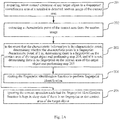
- Fig. 1 is a flow chart illustrating a method for fingerprint identification according to an exemplary embodiment. As shown in Fig. 1 , the method may be applied in a terminal and includes following steps.
- step 101 when contact operation of any target object to a fingerprint identification area of a terminal is detected, characteristic information of the contact area is acquired.
- step 102 it is determined whether there is a fingerprint on the contact area of the target object based on the characteristic information.
- step 103 a fingerprint identification function is started to perform fingerprint identification if there is a fingerprint on the contact area of the target object.
- step 104 the contact operation is ignored such that the fingerprint identification function is kept in a sleep state if there is no fingerprint on the contact area of the target object.
- the contact operation to the fingerprint identification area when the contact operation to the fingerprint identification area is detected, it is first determined whether the target object is a user's finger, that is, whether there is a fingerprint on the contact area of the target object. If the target object is a user's finger, the contact operation is valid, and then the fingerprint identification function would be started to perform fingerprint identification. If the target object is not a user's finger, the fingerprint identification function would not be started. As a result, unnecessary power consumption due to some misoperations can be avoided.
- acquisition of the characteristic information of the contact area may include: acquiring a section image of the contact area and extracting a characteristic point of the contact area from the section image; or acquiring contour information of the contact area, the contour information indicating edge shape of the contact area.
- determining whether there is a fingerprint on the contact area of the target object based on the characteristic information may include: in the event that the characteristic information is the characteristic point, determining whether the characteristic point is consistent with a fingerprint characteristic, making a determination that there is a fingerprint on the contact area of the target object if the characteristic point is consistent with the fingerprint characteristic, and making a determination that there is no fingerprint on the contact area of the target object if the characteristic point is not consistent with the fingerprint characteristic; or in the event that the characteristic information is the contour information, determining whether the edge shape indicated by the contour information is an oval, making a determination that there is a fingerprint on the contact area of the target object if the edge shape is an oval, and making a determination that there is no fingerprint on the contact area of the target object if the edge shape is not an oval.
- the method may further include: if the terminal system is in a sleep state and it is determined that there is no fingerprint on the contact area of the target object, keeping the terminal system in the sleep state while ignoring the contact operation.
- acquisition of the characteristic information and determination of the contact area may be performed by a fingerprint identification circuit integrated circuit (IC) within the fingerprint identification area.
- IC fingerprint identification circuit integrated circuit
- Fig. 2A is a flow chart illustrating a method for fingerprint identification according to an exemplary embodiment. As shown in Fig. 2A , the method may be applied in a terminal and include following steps.
- step 201 when contact operation of any target object to a fingerprint identification area of a terminal is detected, a section image of the contact area is acquired.
- the section image of the contact area where the target object contacts the fingerprint identification area may be acquired by a silicon crystal sensor (e.g., a capacitive fingerprint sensor, a temperature fingerprint sensor, etc.), optical or ultrasonic scanning and so on.
- the section image may reflect some characteristics of the target object to some extent, such that the terminal may determine whether the target object is a fingerprint based on the characteristics.
- animage enhancement process may be performed on the section image.
- the image enhancement process may reduce noise, increase contrast between ridges and valleys, and the like, thus identification resolution of the section image may be improved.
- dpi for sampling may be adjusted to a value that is below a common dpi for sampling (e.g., the sampling used during current fingerprint identification), such that power consumption during this process may be reduced.
- step 202 the characteristic point of the contact area is extracted from the section image.
- coordinates of bifurcations, terminations or rings in the section image may be extracted.
- some points such as center points, triangle points, end points, bifurcate points, bridge nodes, etc. can be extracted.
- auxiliary features such as pattern of the fingerprint, density of the fingerprint, curvature of the fingerprint and so on can be extracted.
- the number of the characteristic points may be adjusted based on requirement for determination precision. If higher determination precision is required, the number of the characteristic points may be set to be a large value. If lower determination precision is required, the number of the characteristic points may be set to be a small value. The lower limit of the number specifically set may be a value which would not affect normal use of the fingerprint identification function. The embodiments of the present disclosure are not limited in this respect.
- steps 201-202 form a possible implementation to acquire the characteristic information of the contact area.
- steps 201-202 may be replaced by following operations: acquiring contour information of the contact area when contact operation of any target object to the fingerprint identification area of the terminal is detected, the contour information indicating the edge shape of the contact area.
- the inventors realize when the user touches the fingerprint identification area by his finger, the touch would lead to change of the shape of the finger. The changed shape generally presents an approximate oval. Thus, it can be determined whether there is a fingerprint on the contact area by determining the edge shape.
- step 203 in the event that the characteristic information is the characteristic point, it is determined whether the characteristic point is consistent with the fingerprint characteristic; if the characteristic point is consistent with the fingerprint characteristic, a determination that there is a fingerprint on the contact area of the target object is made; and if the characteristic point is not consistent with the fingerprint characteristic, a determination that there is no fingerprint on the contact area of the target object is made and then step 205 is performed.
- the inventors realize a fingerprint has some particular detail characteristic points, such as, points formed by interruption, bifurcation or turning in the fingerprint. These detail characteristic points may provide unique confirmation information for the fingerprint.
- Typical detail characteristic points may include end points and bifurcation points and fork points, isolated points, ring points, short lines and so on.
- Ordinary skin and ordinary conductors for capacitive fingerprint identification sensors), reflective objects (for optical and ultrasonic fingerprint sensors) do not have such detail characteristic points, thus it is easy to determine whether the object that is currently contacting the fingerprint identification area is a finger.
- the characteristic points when determining whether the characteristic points are consistent with fingerprint characteristics, it may be determined whether there are characteristic points which are spaced by a preset distance among the characteristic points, or it may be determined whether there is a characteristic point with a preset shape, or it may be determined whether there are bifurcation points, ring points and the like.
- the embodiments of the present disclosure are not limited in this respect.
- steps 202 and 203 above are performed to determine whether the target object is a finger based on characteristic points.
- the contour information of the contact area may also be acquired, the contour information indicating the edge shape of the contact area. That is, in the event that the characteristic information is the contour information, it is determined whether the edge shape indicated by the contour information is an oval. If the edge shape is an oval, there is a fingerprint on the contact area of the target object. If the edge shape is not an oval, there is no fingerprint on the contact area of the target object.
- the above oval merely means the edge shape is an approximate oval without specifying the edge shape as a standard oval. A certain error in the shape is accepted, such that the feasibility of the implementation may be improved.
- step 204 the fingerprint identification function is started to perform fingerprint identification.
- the process of step 204 is a process to start the fingerprint identification function to perform fingerprint identification.
- the identification of the user's fingerprint may be implemented by matching based on a preset fingerprint template.
- the embodiments of the present disclosure are not limited in this respect.
- the section image may firstly be processed in step 204 to improve efficiency of fingerprint identification.
- step 205 if there is no fingerprint on the contact area of the target object, the contact operation is ignored such that the fingerprint identification function is kept in sleep state.
- the contact operation may be not responded. That is, the fingerprint identification function is not started and kept in sleep state, thereby the power consumption due to starting the fingerprint identification function whenever the contact operation occurs can be reduced significantly.
- the acquisition of the characteristic information and determination of the contact area may be performed by a fingerprint identification circuit IC within the fingerprint identification area.
- the contact operation to the fingerprint identification area when the contact operation to the fingerprint identification area is detected, it is first determined whether the target object is a user's finger, that is, whether there is a fingerprint on the contact area of the target object. If the target object is a user's finger, the contact operation is valid, and then the fingerprint identification function would be started to perform fingerprint identification. If the target object is not a user's finger, the fingerprint identification function would not be started. As a result, unnecessary power consumption due to some misoperations can be avoided.
- the above embodiments mainly discuss how to reduce the power consumption of the fingerprint identification function itself, and may be applied in any situation where the fingerprint identification function is used, for example, in and unlock process when the terminal is in lock screen state, or mobile payment from the terminal and the like. Below, how to further reduce the power consumption is discussed based on a particular application situation.
- the inventors realize when the terminal system is in the sleep state, the fingerprint identification process will be started and performed by the terminal system every time the contact operation is detected. The power consumed by the start of the terminal system is high, and there is significant effect on the stand-by time of the terminal if misoperation occurs.
- the characteristic information of the contact area is acquired; it is determined whether there is a fingerprint on the contact area of the target object based on the characteristic information; the terminal system is started and the fingerprint identification function is stared to perform fingerprint identification if there is a fingerprint on the contact area of the target object; and the contact operation is ignored and the terminal system is kept in the sleep state such that the fingerprint identification function is kept in the sleep state if there is no fingerprint on the contact area of the target object.
- Fig. 2B illustrates a specific flow based on the interrupt mechanism.
- Fig. 2C illustrates connection between the CPU and the fingerprint identification IC. If a determination is made that there is a fingerprint on the contact area based on the preliminary collected characteristic information, the fingerprint identification IC may not send interruption signal to the CUP, and the CPU may perform start of the terminal system and subsequent process. If a determination is made that there is no fingerprint on the contact area based on the preliminary collected characteristic information, the fingerprint identification IC may send an interruption signal to the CUP, and the CPU may not perform start of the terminal system and subsequent process after receiving the interruption signal.
- the terminal system in the event that the terminal system is under the sleep state, when the contact operation to the fingerprint identification area is detected, it is first determined whether the target object is a user's finger, that is, whether there is a fingerprint on the contact area of the target object. If the target object is a user's finger, the contact operation is valid, and then the terminal system would be started and the fingerprint identification function would be started to perform fingerprint identification. If the target object is not a user's finger, the terminal system would not be started. As a result, unnecessary power consumption due to some misoperations can be avoided.
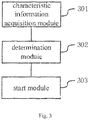
- Fig. 3 is a diagram illustrating an apparatus for fingerprint identification according to an exemplary embodiment.
- the apparatus for fingerprint identification includes a characteristic information acquisition module 301 configured to acquire, when the contact operation of any target object to the fingerprint identification area of the terminal is detected, the characteristic information of the contact area; a determination module 302 configured to determine whether there is a fingerprint on the contact area of the target object based on the characteristic information; and a start module 303 configured to start the fingerprint identification function to perform fingerprint identification if there is a fingerprint on the contact area of the target object, and to ignore the contact operation such that the fingerprint identification function is kept in the sleep state if there is no fingerprint on the contact area of the target object.
- the characteristic information acquisition module 301 includes: a first acquisition sub-module configured to acquire the section image of the contact area and extract a characteristic point of the contact area from the section image; or a second acquisition sub-module configured to acquire the contour information of the contact area, the contour information indicating the edge shape of the contact area.
- the determination module 302 includes: a first determination sub-module configured to determine, in the event that the characteristic information is the characteristic point, whether the characteristic point is consistent with fingerprint characteristic, make a determination that there is a fingerprint on the contact area of the target object if the characteristic point is consistent with the fingerprint characteristic, and make a determination that there is no fingerprint on the contact area of the target object if the characteristic point is not consistent with the fingerprint characteristic; or a second determination sub-module configured to determine, in the event that the characteristic information is the contour information, whether the edge shape indicated by the contour information is an oval, make a determination that there is a fingerprint on the contact area of the target object if the edge shape is an oval, and make a determination that there is no fingerprint on the contact area of the target object if the edge shape is not an oval.
- the start module 303 is further configured to keep, if the terminal system is in the sleep state and it is determined that there is no fingerprint on the contact area of the target object, the terminal system in the sleep state while ignoring the contact operation.
- the apparatus may be applied to a fingerprint identification circuit IC within the fingerprint identification area.
- Fig. 4 is a diagram illustrating an apparatus 400 for fingerprint identification according to an exemplary embodiment.
- the apparatus 400 may be a mobile phone, a computer, a digital broadcast terminal, a messaging device, a gaming console, a tablet, a medical device, exercise equipment, a personal digital assistant, and the like.
- the apparatus 400 may include one or more of the following components: a processing component 402, a memory 404, a power component 406, a multimedia component 408, an audio component 410, an input/output (I/O) interface 412, a sensor component 414, and a communication component 416.
- the processing component 402 typically controls overall operations of the apparatus 400, such as the operations associated with display, telephone calls, data communications, camera operations, and recording operations.
- the processing component 402 may include one or more processors 420 to execute instructions to perform all or part of the steps in the above described methods.
- the processing component 402 may include one or more modules which facilitate the interaction between the processing component 402 and other components.
- the processing component 402 may include a multimedia module to facilitate the interaction between the multimedia component 408 and the processing component 402.
- the memory 404 is configured to store various types of data to support the operation of the apparatus 400. Examples of such data include instructions for any applications or methods operated on the apparatus 400, contact data, phonebook data, messages, pictures, video, etc.
- the memory 404 may be implemented using any type of volatile or non-volatile memory devices, or a combination thereof, such as a static random access memory (SRAM), an electrically erasable programmable read-only memory (EEPROM), an erasable programmable read-only memory (EPROM), a programmable read-only memory (PROM), a read-only memory (ROM), a magnetic memory, a flash memory, a magnetic or optical disk.
- SRAM static random access memory
- EEPROM electrically erasable programmable read-only memory
- EPROM erasable programmable read-only memory
- PROM programmable read-only memory
- ROM read-only memory
- magnetic memory a magnetic memory
- flash memory a flash memory
- magnetic or optical disk a magnetic or optical
- the power component 406 provides power to various components of the apparatus 400.
- the power component 406 may include a power management system, one or more power sources, and any other components associated with the generation, management, and distribution of power for the apparatus 400.
- the multimedia component 408 includes a screen providing an output interface between the apparatus 400 and the user.
- the screen may include a liquid crystal display (LCD) and a touch panel (TP). If the screen includes the touch panel, the screen may be implemented as a touch screen to receive input signals from the user.
- the touch panel includes one or more touch sensors to sense touches, swipes, and gestures on the touch panel. The touch sensors may not only sense a boundary of a touch or swipe action, but also sense a period of time and a pressure associated with the touch or swipe action.
- the multimedia component 408 includes a front camera and/or a rear camera.
- the front camera and the rear camera may receive an external multimedia datum while the apparatus 400 is in an operation mode, such as a photographing mode or a video mode.
- an operation mode such as a photographing mode or a video mode.
- Each of the front camera and the rear camera may be a fixed optical lens system or have optical focusing and zooming capability.
- the audio component 410 is configured to output and/or input audio signals.
- the audio component 410 includes a microphone ("MIC") configured to receive an external audio signal when the apparatus 400 is in an operation mode, such as a call mode, a recording mode, and a voice recognition mode.
- the received audio signal may be further stored in the memory 404 or transmitted via the communication component 416.
- the audio component 410 further includes a speaker to output audio signals.
- the I/O interface 412 provides an interface between the processing component 402 and peripheral interface modules, the peripheral interface modules being, for example, a keyboard, a click wheel, buttons, and the like.
- the buttons may include, but are not limited to, a home button, a volume button, a starting button, and a locking button.
- the sensor component 414 includes one or more sensors to provide status assessments of various aspects of the apparatus 400. For instance, the sensor component 414 may detect an open/closed status of the apparatus 400, relative positioning of components (e.g., the display and the keypad, of the apparatus 400), a change in position of the apparatus 400 or a component of the apparatus 400, a presence or absence of user contact with the apparatus 400, an orientation or an acceleration/deceleration of the apparatus 400, and a change in temperature of the apparatus 400.
- the sensor component 414 may include a proximity sensor configured to detect the presence of a nearby object without any physical contact.
- the sensor component 414 may also include a light sensor, such as a CMOS or CCD image sensor, for use in imaging applications.
- the sensor component 414 may also include an accelerometer sensor, a gyroscope sensor, a magnetic sensor, a pressure sensor, or a temperature sensor.
- the communication component 416 is configured to facilitate communication, wired or wirelessly, between the apparatus 400 and other devices.
- the apparatus 400 can access a wireless network based on a communication standard, such as WiFi, 2G, or 3G, or a combination thereof.
- the communication component 416 receives a broadcast signal or broadcast associated information from an external broadcast management system via a broadcast channel.
- the communication component 416 further includes a near field communication (NFC) module to facilitate short-range communications.
- the NFC module may be implemented based on a radio frequency identification (RFID) technology, an infrared data association (IrDA) technology, an ultra-wideband (UWB) technology, a Bluetooth (BT) technology, and other technologies.
- RFID radio frequency identification
- IrDA infrared data association
- UWB ultra-wideband
- BT Bluetooth
- the apparatus 400 may be implemented with one or more application specific integrated circuits (ASICs), digital signal processors (DSPs), digital signal processing devices (DSPDs), programmable logic devices (PLDs), field programmable gate arrays (FPGAs), controllers, micro-controllers, microprocessors, or other electronic components, for performing the above described methods.
- ASICs application specific integrated circuits
- DSPs digital signal processors
- DSPDs digital signal processing devices
- PLDs programmable logic devices
- FPGAs field programmable gate arrays
- controllers micro-controllers, microprocessors, or other electronic components, for performing the above described methods.
- non-transitory computer-readable storage medium including instructions, such as included in the memory 404, executable by the processor 420 in the apparatus 400, for performing the above-described methods.
- the non-transitory computer-readable storage medium may be a ROM, a Random Access Memory (RAM), a CD-ROM, a magnetic tape, a floppy disc, an optical data storage device, and the like.
- a non-transient computer readable storage media having instructions therein is provided, which when executed by a processor of the mobile terminal cause the mobile terminal to perform the above method for fingerprint identification.
Landscapes
- Engineering & Computer Science (AREA)
- Theoretical Computer Science (AREA)
- Physics & Mathematics (AREA)
- General Physics & Mathematics (AREA)
- Human Computer Interaction (AREA)
- Multimedia (AREA)
- General Engineering & Computer Science (AREA)
- Computer Vision & Pattern Recognition (AREA)
- Computer Hardware Design (AREA)
- Computing Systems (AREA)
- Collating Specific Patterns (AREA)
- Image Input (AREA)
Abstract
Description
- The present disclosure generally relates to terminal technologies, and more particularly to a method and apparatus for fingerprint identification.
- With the development of terminal technologies, a lot of terminals have the capability of fingerprint identification. The fingerprint identification may be implemented by collecting a user's fingerprint and matching it with a pre-stored fingerprint template such that particular functions of a terminal such as unlocking of a screen, decryption of an application, mobile payment and the like, can be implemented based on the result of the match.
- For any fingerprint identification process, the terminal may start a fingerprint identification function once the terminal detects the user's skin by a fingerprint identification module, then may perform fingerprint collection and fingerprint match, and may perform subsequent function based on the result of the fingerprint match. However, during the above process, the fingerprint identification function may be started and subsequent steps may be performed once the user's skin is detected, even if the contact is with non-fingerprint skin. As a result, power consumption of the terminal system may be high.
- In view of the related arts, a method and apparatus for fingerprint identification are provided in the disclosure.
- According to a first aspect, an embodiment of the present disclosure provides a method for fingerprint identification, including: acquiring, when contact operation of any target object to a fingerprint identification area of a terminal is detected, characteristic information of contact area; determining whether there is a fingerprint on the contact area of the target object based on the characteristic information; starting fingerprint identification function to perform fingerprint identification if there is a fingerprint on the contact area of the target object; and ignoring the contact operation such that the fingerprint identification function is kept in sleep state if there is no fingerprint on the contact area of the target object.
- In the method provided in the embodiment of the present disclosure, when the contact operation to the fingerprint identification area is detected, it is first determined whether the target object is a user's finger, that is, whether there is a fingerprint on the contact area of the target object. If the target object is a user's finger, the contact operation is valid, and then the fingerprint identification function would be started to perform fingerprint identification. If the target object is not a user's finger, the fingerprint identification function would not be started. As a result, unnecessary power consumption due to some misoperations can be avoided.
- In an optional implementation, acquiring the characteristic information of the contact area includes: acquiring section image of the contact area and extracting a characteristic point of the contact area from the section image; or acquiring contour information of the contact area, the contour information indicating edge shape of the contact area.
- In an optional implementation, determining whether there is a fingerprint on the contact area of the target object based on the characteristic information includes: in the event that the characteristic information is the characteristic point, determining whether the characteristic point is consistent with a fingerprint characteristic, making a determination that there is a fingerprint on the contact area of the target object if the characteristic point is consistent with the fingerprint characteristic, and making a determination that there is no fingerprint on the contact area of the target object if the characteristic point is not consistent with the fingerprint characteristic; or in the event that the characteristic information is the contour information, determining whether the edge shape indicated by the contour information is an oval, making a determination that there is a fingerprint on the contact area of the target object if the edge shape is an oval, and making a determination that there is no fingerprint on the contact area of the target object if the edge shape is not an oval.
- In an optional implementation, the method further includes: keeping, if a terminal system is in sleep state and it is determined that there is no fingerprint on the contact area of the target object, the terminal system in the sleep state while ignoring the contact operation.
- In an optional implementation, acquisition of the characteristic information and determination of the contact area is performed by a fingerprint identification circuit integrated circuit (IC) within the fingerprint identification area.
- According to a second aspect, an apparatus for fingerprint identification is provided, including: a characteristic information acquisition module configured to acquire, when contact operation of any target object to a fingerprint identification area of a terminal is detected, characteristic information of a contact area; a determination module configured to determine whether there is a fingerprint on the contact area of the target object based on the characteristic information; and a start module configured to start a fingerprint identification function to perform fingerprint identification if there is a fingerprint on the contact area of the target object, and ignore the contact operation such that the fingerprint identification function is kept in sleep state if there is no fingerprint on the contact area of the target object.
- In an optional implementation, the characteristic information acquisition module includes: a first acquisition sub-module configured to acquire a section image of the contact area and extract a characteristic point of the contact area from the section image; or a second acquisition sub-module configured to acquire contour information of the contact area, the contour information indicating an edge shape of the contact area.
- In an optional implementation, the determination module includes: a first determination sub-module configured to determine, in the event that the characteristic information is the characteristic point, whether the characteristic point is consistent with a fingerprint characteristic, make a determination that there is a fingerprint on the contact area of the target object if the characteristic point is consistent with the fingerprint characteristic, and make a determination that there is no fingerprint on the contact area of the target object if the characteristic point is not consistent with the fingerprint characteristic; or a second determination sub-module configured to determine, in the event that the characteristic information is the contour information, whether the edge shape indicated by the contour information is an oval, make a determination that there is a fingerprint on the contact area of the target object if the edge shape is an oval, and make a determination that there is no fingerprint on the contact area of the target object if the edge shape is not an oval.
- In an optional implementation, the start module is further configured to keep, if a terminal system is in sleep state and it is determined that there is no fingerprint on the contact area of the target object, the terminal system in the sleep state while ignoring the contact operation.
- In an optional implementation, the apparatus is applied to a fingerprint identification circuit IC within the fingerprint identification area.
- According to a third aspect, an apparatus for fingerprint identification is provided, including: a processor and a memory to store processor-executable instructions; wherein the processor is configured to acquire, when contact operation of any target object to a fingerprint identification area of a terminal is detected, characteristic information of contact area; determine whether there is a fingerprint on the contact area of the target object based on the characteristic information; start fingerprint identification function to perform fingerprint identification if there is a fingerprint on the contact area of the target object; and ignore the contact operation such that the fingerprint identification function is kept in a sleep state if there is no fingerprint on the contact area of the target object.
- It is to be understood that both the foregoing general description and the following detailed description are exemplary and illustrative only, and will not limit the present disclosure.
- The accompanying drawings, which are incorporated in and constitute a part of this specification, illustrate embodiments consistent with the invention and, together with the description, serve to explain the principles of the invention.
-
Fig. 1 is a flow chart illustrating a method for fingerprint identification according to an exemplary embodiment. -
Fig. 2A is a flow chart illustrating a method for fingerprint identification according to an exemplary embodiment. -
Fig. 2B illustrates a specific flow based on an interrupt mechanism. -
Fig. 2C illustrates connection between a CPU and a fingerprint identification IC. -
Fig. 3 is a diagram illustrating an apparatus for fingerprint identification according to an exemplary embodiment. -
Fig. 4 is a diagram illustrating anapparatus 400 for fingerprint identification according to an exemplary embodiment. - Embodiments of the present disclosure will be further described in detail in conjunction with the figures to make the purposes, technical solutions and advantages of the present disclosure more clear.
- Exemplary embodiments are described in detail herein, examples of which are illustrated in the accompanying drawings. The following description refers to the accompanying drawings in which same numbers in different drawings represent same or similar elements unless otherwise described. The implementations set forth in the following description of exemplary embodiments do not represent all implementations consistent with the invention. Instead, they are merely examples of apparatuses and methods consistent with aspects related to the invention as recited in the appended claims.
-
Fig. 1 is a flow chart illustrating a method for fingerprint identification according to an exemplary embodiment. As shown inFig. 1 , the method may be applied in a terminal and includes following steps. - In
step 101, when contact operation of any target object to a fingerprint identification area of a terminal is detected, characteristic information of the contact area is acquired. - In
step 102, it is determined whether there is a fingerprint on the contact area of the target object based on the characteristic information. - In
step 103, a fingerprint identification function is started to perform fingerprint identification if there is a fingerprint on the contact area of the target object. - In
step 104, the contact operation is ignored such that the fingerprint identification function is kept in a sleep state if there is no fingerprint on the contact area of the target object. - In the method provided in the embodiment of the present disclosure, when the contact operation to the fingerprint identification area is detected, it is first determined whether the target object is a user's finger, that is, whether there is a fingerprint on the contact area of the target object. If the target object is a user's finger, the contact operation is valid, and then the fingerprint identification function would be started to perform fingerprint identification. If the target object is not a user's finger, the fingerprint identification function would not be started. As a result, unnecessary power consumption due to some misoperations can be avoided.
- In an optional implementation, acquisition of the characteristic information of the contact area may include: acquiring a section image of the contact area and extracting a characteristic point of the contact area from the section image; or acquiring contour information of the contact area, the contour information indicating edge shape of the contact area.
- In an optional implementation, determining whether there is a fingerprint on the contact area of the target object based on the characteristic information may include: in the event that the characteristic information is the characteristic point, determining whether the characteristic point is consistent with a fingerprint characteristic, making a determination that there is a fingerprint on the contact area of the target object if the characteristic point is consistent with the fingerprint characteristic, and making a determination that there is no fingerprint on the contact area of the target object if the characteristic point is not consistent with the fingerprint characteristic; or in the event that the characteristic information is the contour information, determining whether the edge shape indicated by the contour information is an oval, making a determination that there is a fingerprint on the contact area of the target object if the edge shape is an oval, and making a determination that there is no fingerprint on the contact area of the target object if the edge shape is not an oval.
- In an optional implementation, the method may further include: if the terminal system is in a sleep state and it is determined that there is no fingerprint on the contact area of the target object, keeping the terminal system in the sleep state while ignoring the contact operation.
- In an optional implementation, acquisition of the characteristic information and determination of the contact area may be performed by a fingerprint identification circuit integrated circuit (IC) within the fingerprint identification area.
- The above optional technical solutions may be combined in any way to form optional embodiments of the present disclosure, which is omitted herein for conciseness.
-
Fig. 2A is a flow chart illustrating a method for fingerprint identification according to an exemplary embodiment. As shown inFig. 2A , the method may be applied in a terminal and include following steps. - In
step 201, when contact operation of any target object to a fingerprint identification area of a terminal is detected, a section image of the contact area is acquired. - For any terminal capable of fingerprint identification function, there is at least one fingerprint identification area within which there is a fingerprint identification circuit IC. The section image of the contact area where the target object contacts the fingerprint identification area may be acquired by a silicon crystal sensor (e.g., a capacitive fingerprint sensor, a temperature fingerprint sensor, etc.), optical or ultrasonic scanning and so on. The section image may reflect some characteristics of the target object to some extent, such that the terminal may determine whether the target object is a fingerprint based on the characteristics.
- In an optional implementation, in order to improve accuracy of fingerprint determination, after acquiring the section image, animage enhancement process may be performed on the section image. The image enhancement process may reduce noise, increase contrast between ridges and valleys, and the like, thus identification resolution of the section image may be improved.
- In an optional implementation, during the acquisition of the section image, dpi for sampling may be adjusted to a value that is below a common dpi for sampling (e.g., the sampling used during current fingerprint identification), such that power consumption during this process may be reduced.
- In
step 202, the characteristic point of the contact area is extracted from the section image. - In the event of extracting the characteristic point of the contact area, coordinates of bifurcations, terminations or rings in the section image may be extracted. Also, some points such as center points, triangle points, end points, bifurcate points, bridge nodes, etc. can be extracted. Furthermore, some auxiliary features, such as pattern of the fingerprint, density of the fingerprint, curvature of the fingerprint and so on can be extracted.
- The number of the characteristic points may be adjusted based on requirement for determination precision. If higher determination precision is required, the number of the characteristic points may be set to be a large value. If lower determination precision is required, the number of the characteristic points may be set to be a small value. The lower limit of the number specifically set may be a value which would not affect normal use of the fingerprint identification function. The embodiments of the present disclosure are not limited in this respect.
- Above steps 201-202 form a possible implementation to acquire the characteristic information of the contact area. In another embodiment, steps 201-202 may be replaced by following operations: acquiring contour information of the contact area when contact operation of any target object to the fingerprint identification area of the terminal is detected, the contour information indicating the edge shape of the contact area. The inventors realize when the user touches the fingerprint identification area by his finger, the touch would lead to change of the shape of the finger. The changed shape generally presents an approximate oval. Thus, it can be determined whether there is a fingerprint on the contact area by determining the edge shape.
- In
step 203, in the event that the characteristic information is the characteristic point, it is determined whether the characteristic point is consistent with the fingerprint characteristic; if the characteristic point is consistent with the fingerprint characteristic, a determination that there is a fingerprint on the contact area of the target object is made; and if the characteristic point is not consistent with the fingerprint characteristic, a determination that there is no fingerprint on the contact area of the target object is made and then step 205 is performed. - The inventors realize a fingerprint has some particular detail characteristic points, such as, points formed by interruption, bifurcation or turning in the fingerprint. These detail characteristic points may provide unique confirmation information for the fingerprint. Typical detail characteristic points may include end points and bifurcation points and fork points, isolated points, ring points, short lines and so on. Ordinary skin and ordinary conductors (for capacitive fingerprint identification sensors), reflective objects (for optical and ultrasonic fingerprint sensors) do not have such detail characteristic points, thus it is easy to determine whether the object that is currently contacting the fingerprint identification area is a finger.
- For example, when determining whether the characteristic points are consistent with fingerprint characteristics, it may be determined whether there are characteristic points which are spaced by a preset distance among the characteristic points, or it may be determined whether there is a characteristic point with a preset shape, or it may be determined whether there are bifurcation points, ring points and the like. The embodiments of the present disclosure are not limited in this respect.
- It is noted that
steps - In
step 204, the fingerprint identification function is started to perform fingerprint identification. - The process of
step 204 is a process to start the fingerprint identification function to perform fingerprint identification. During the process, the identification of the user's fingerprint may be implemented by matching based on a preset fingerprint template. The embodiments of the present disclosure are not limited in this respect. Of course, if there is no image processing such as image enhancement and the like in the above steps, the section image may firstly be processed instep 204 to improve efficiency of fingerprint identification. - In
step 205, if there is no fingerprint on the contact area of the target object, the contact operation is ignored such that the fingerprint identification function is kept in sleep state. - If there is no fingerprint on the contact area, the contact operation may be not responded. That is, the fingerprint identification function is not started and kept in sleep state, thereby the power consumption due to starting the fingerprint identification function whenever the contact operation occurs can be reduced significantly.
- In the embodiments of the present disclosure, the acquisition of the characteristic information and determination of the contact area may be performed by a fingerprint identification circuit IC within the fingerprint identification area.
- In the method provided in the embodiment of the present disclosure, when the contact operation to the fingerprint identification area is detected, it is first determined whether the target object is a user's finger, that is, whether there is a fingerprint on the contact area of the target object. If the target object is a user's finger, the contact operation is valid, and then the fingerprint identification function would be started to perform fingerprint identification. If the target object is not a user's finger, the fingerprint identification function would not be started. As a result, unnecessary power consumption due to some misoperations can be avoided.
- The above embodiments mainly discuss how to reduce the power consumption of the fingerprint identification function itself, and may be applied in any situation where the fingerprint identification function is used, for example, in and unlock process when the terminal is in lock screen state, or mobile payment from the terminal and the like. Below, how to further reduce the power consumption is discussed based on a particular application situation. The inventors realize when the terminal system is in the sleep state, the fingerprint identification process will be started and performed by the terminal system every time the contact operation is detected. The power consumed by the start of the terminal system is high, and there is significant effect on the stand-by time of the terminal if misoperation occurs. As a result, in the event that the terminal system is in the sleep state, when the contact operation of any target object to the fingerprint identification area of the terminal is detected, the characteristic information of the contact area is acquired; it is determined whether there is a fingerprint on the contact area of the target object based on the characteristic information; the terminal system is started and the fingerprint identification function is stared to perform fingerprint identification if there is a fingerprint on the contact area of the target object; and the contact operation is ignored and the terminal system is kept in the sleep state such that the fingerprint identification function is kept in the sleep state if there is no fingerprint on the contact area of the target object.
- The above methods may be specifically implemented by the interruption mechanism between the fingerprint identification IC and a CPU, as shown in
Fig. 2B and 2C. Fig. 2B illustrates a specific flow based on the interrupt mechanism.Fig. 2C illustrates connection between the CPU and the fingerprint identification IC. If a determination is made that there is a fingerprint on the contact area based on the preliminary collected characteristic information, the fingerprint identification IC may not send interruption signal to the CUP, and the CPU may perform start of the terminal system and subsequent process. If a determination is made that there is no fingerprint on the contact area based on the preliminary collected characteristic information, the fingerprint identification IC may send an interruption signal to the CUP, and the CPU may not perform start of the terminal system and subsequent process after receiving the interruption signal. - In the above methods, in the event that the terminal system is under the sleep state, when the contact operation to the fingerprint identification area is detected, it is first determined whether the target object is a user's finger, that is, whether there is a fingerprint on the contact area of the target object. If the target object is a user's finger, the contact operation is valid, and then the terminal system would be started and the fingerprint identification function would be started to perform fingerprint identification. If the target object is not a user's finger, the terminal system would not be started. As a result, unnecessary power consumption due to some misoperations can be avoided.
-
Fig. 3 is a diagram illustrating an apparatus for fingerprint identification according to an exemplary embodiment. As shown inFig. 3 , the apparatus for fingerprint identification includes a characteristicinformation acquisition module 301 configured to acquire, when the contact operation of any target object to the fingerprint identification area of the terminal is detected, the characteristic information of the contact area; adetermination module 302 configured to determine whether there is a fingerprint on the contact area of the target object based on the characteristic information; and astart module 303 configured to start the fingerprint identification function to perform fingerprint identification if there is a fingerprint on the contact area of the target object, and to ignore the contact operation such that the fingerprint identification function is kept in the sleep state if there is no fingerprint on the contact area of the target object. - In an optional implementation, the characteristic
information acquisition module 301 includes: a first acquisition sub-module configured to acquire the section image of the contact area and extract a characteristic point of the contact area from the section image; or a second acquisition sub-module configured to acquire the contour information of the contact area, the contour information indicating the edge shape of the contact area. - In an optional implementation, the
determination module 302 includes: a first determination sub-module configured to determine, in the event that the characteristic information is the characteristic point, whether the characteristic point is consistent with fingerprint characteristic, make a determination that there is a fingerprint on the contact area of the target object if the characteristic point is consistent with the fingerprint characteristic, and make a determination that there is no fingerprint on the contact area of the target object if the characteristic point is not consistent with the fingerprint characteristic; or a second determination sub-module configured to determine, in the event that the characteristic information is the contour information, whether the edge shape indicated by the contour information is an oval, make a determination that there is a fingerprint on the contact area of the target object if the edge shape is an oval, and make a determination that there is no fingerprint on the contact area of the target object if the edge shape is not an oval. - In an optional implementation, the
start module 303 is further configured to keep, if the terminal system is in the sleep state and it is determined that there is no fingerprint on the contact area of the target object, the terminal system in the sleep state while ignoring the contact operation. - In an optional implementation, the apparatus may be applied to a fingerprint identification circuit IC within the fingerprint identification area.
- For the apparatuses in the above embodiments, specific operations performed by each module have been detailed in related method embodiments, and thus detailed description will be omitted here.
-
Fig. 4 is a diagram illustrating anapparatus 400 for fingerprint identification according to an exemplary embodiment. For example, theapparatus 400 may be a mobile phone, a computer, a digital broadcast terminal, a messaging device, a gaming console, a tablet, a medical device, exercise equipment, a personal digital assistant, and the like. - Referring to
Fig. 4 , theapparatus 400 may include one or more of the following components: aprocessing component 402, amemory 404, apower component 406, amultimedia component 408, anaudio component 410, an input/output (I/O)interface 412, asensor component 414, and acommunication component 416. - The
processing component 402 typically controls overall operations of theapparatus 400, such as the operations associated with display, telephone calls, data communications, camera operations, and recording operations. Theprocessing component 402 may include one ormore processors 420 to execute instructions to perform all or part of the steps in the above described methods. Moreover, theprocessing component 402 may include one or more modules which facilitate the interaction between theprocessing component 402 and other components. For instance, theprocessing component 402 may include a multimedia module to facilitate the interaction between themultimedia component 408 and theprocessing component 402. - The
memory 404 is configured to store various types of data to support the operation of theapparatus 400. Examples of such data include instructions for any applications or methods operated on theapparatus 400, contact data, phonebook data, messages, pictures, video, etc. Thememory 404 may be implemented using any type of volatile or non-volatile memory devices, or a combination thereof, such as a static random access memory (SRAM), an electrically erasable programmable read-only memory (EEPROM), an erasable programmable read-only memory (EPROM), a programmable read-only memory (PROM), a read-only memory (ROM), a magnetic memory, a flash memory, a magnetic or optical disk. - The
power component 406 provides power to various components of theapparatus 400. Thepower component 406 may include a power management system, one or more power sources, and any other components associated with the generation, management, and distribution of power for theapparatus 400. - The
multimedia component 408 includes a screen providing an output interface between theapparatus 400 and the user. In some embodiments, the screen may include a liquid crystal display (LCD) and a touch panel (TP). If the screen includes the touch panel, the screen may be implemented as a touch screen to receive input signals from the user. The touch panel includes one or more touch sensors to sense touches, swipes, and gestures on the touch panel. The touch sensors may not only sense a boundary of a touch or swipe action, but also sense a period of time and a pressure associated with the touch or swipe action. In some embodiments, themultimedia component 408 includes a front camera and/or a rear camera. The front camera and the rear camera may receive an external multimedia datum while theapparatus 400 is in an operation mode, such as a photographing mode or a video mode. Each of the front camera and the rear camera may be a fixed optical lens system or have optical focusing and zooming capability. - The
audio component 410 is configured to output and/or input audio signals. For example, theaudio component 410 includes a microphone ("MIC") configured to receive an external audio signal when theapparatus 400 is in an operation mode, such as a call mode, a recording mode, and a voice recognition mode. The received audio signal may be further stored in thememory 404 or transmitted via thecommunication component 416. In some embodiments, theaudio component 410 further includes a speaker to output audio signals. - The I/
O interface 412 provides an interface between theprocessing component 402 and peripheral interface modules, the peripheral interface modules being, for example, a keyboard, a click wheel, buttons, and the like. The buttons may include, but are not limited to, a home button, a volume button, a starting button, and a locking button. - The
sensor component 414 includes one or more sensors to provide status assessments of various aspects of theapparatus 400. For instance, thesensor component 414 may detect an open/closed status of theapparatus 400, relative positioning of components (e.g., the display and the keypad, of the apparatus 400), a change in position of theapparatus 400 or a component of theapparatus 400, a presence or absence of user contact with theapparatus 400, an orientation or an acceleration/deceleration of theapparatus 400, and a change in temperature of theapparatus 400. Thesensor component 414 may include a proximity sensor configured to detect the presence of a nearby object without any physical contact. Thesensor component 414 may also include a light sensor, such as a CMOS or CCD image sensor, for use in imaging applications. In some embodiments, thesensor component 414 may also include an accelerometer sensor, a gyroscope sensor, a magnetic sensor, a pressure sensor, or a temperature sensor. - The
communication component 416 is configured to facilitate communication, wired or wirelessly, between theapparatus 400 and other devices. Theapparatus 400 can access a wireless network based on a communication standard, such as WiFi, 2G, or 3G, or a combination thereof. In an exemplary embodiment, thecommunication component 416 receives a broadcast signal or broadcast associated information from an external broadcast management system via a broadcast channel. In an exemplary embodiment, thecommunication component 416 further includes a near field communication (NFC) module to facilitate short-range communications. For example, the NFC module may be implemented based on a radio frequency identification (RFID) technology, an infrared data association (IrDA) technology, an ultra-wideband (UWB) technology, a Bluetooth (BT) technology, and other technologies. - In exemplary embodiments, the
apparatus 400 may be implemented with one or more application specific integrated circuits (ASICs), digital signal processors (DSPs), digital signal processing devices (DSPDs), programmable logic devices (PLDs), field programmable gate arrays (FPGAs), controllers, micro-controllers, microprocessors, or other electronic components, for performing the above described methods. - In exemplary embodiments, there is also provided a non-transitory computer-readable storage medium including instructions, such as included in the
memory 404, executable by theprocessor 420 in theapparatus 400, for performing the above-described methods. For example, the non-transitory computer-readable storage medium may be a ROM, a Random Access Memory (RAM), a CD-ROM, a magnetic tape, a floppy disc, an optical data storage device, and the like. - In the examplary embodiments, a non-transient computer readable storage media having instructions therein is provided, which when executed by a processor of the mobile terminal cause the mobile terminal to perform the above method for fingerprint identification.
- Other embodiments of the invention will be apparent to those skilled in the art from consideration of the specification and practice of the disclosures herein. This application is intended to cover any variations, uses, or adaptations of the disclosure following the general principles thereof and including such departures from the present disclosure as come within known or customary practice in the art. It is intended that the specification and examples be considered as exemplary only, with a true scope of the invention being indicated by the following claims.
- It will be appreciated that the inventive concept is not limited to the exact construction that has been described above and illustrated in the accompanying drawings, and that various modifications and changes can be made without departing from the scope thereof. It is intended that the scope of the invention only be limited by the appended claims.
Claims (15)
- A method for fingerprint identification, characterized in comprising:acquiring (101), when contact operation of any target object to a fingerprint identification area of a terminal is detected, characteristic information of a contact area;determining (102) whether there is a fingerprint on the contact area of the target object based on the characteristic information;starting (103) a fingerprint identification function to perform fingerprint identification if there is a fingerprint on the contact area of the target object; andignoring (104) the contact operation such that the fingerprint identification function is kept in a sleep state if there is no fingerprint on the contact area of the target object.
- The method of claim 1, wherein the acquiring (101) the characteristic information of the contact area comprises:acquiring (201) a section image of the contact area and extracting (202) a characteristic point of the contact area from the section image; oracquiring contour information of the contact area, the contour information indicating an edge shape of the contact area.
- The method of claim 2, wherein the determining whether there is a fingerprint on the contact area of the target object based on the characteristic information comprises:in the event that the characteristic information is the characteristic point, determining whether the characteristic point is consistent with a fingerprint characteristic, making a determination that there is a fingerprint on the contact area of the target object if the characteristic point is consistent with the fingerprint characteristic, and making a determination that there is no fingerprint on the contact area of the target object if the characteristic point is not consistent with the fingerprint characteristic; orin the event that the characteristic information is the contour information, determining whether the edge shape indicated by the contour information is an oval, making a determination that there is a fingerprint on the contact area of the target object if the edge shape is an oval, and making a determination that there is no fingerprint on the contact area of the target object if the edge shape is not an oval.
- The method of claim 1, further comprising:keeping (205), if a terminal system is in a sleep state and it is determined that there is no fingerprint on the contact area of the target object, the terminal system in the sleep state while ignoring the contact operation.
- The method of claim 1, wherein the acquisition of the characteristic information and the determination of the contact area is performed by a fingerprint identification circuit integrated circuit (IC) within the fingerprint identification area.
- An apparatus for fingerprint identification, characterized in comprising:a characteristic information acquisition module (301) configured to acquire, when contact operation of any target object to a fingerprint identification area of a terminal is detected, characteristic information of a contact area;a determination module (302) configured to determine whether there is a fingerprint on the contact area of the target object based on the characteristic information; anda start module (303) configured to start a fingerprint identification function to perform fingerprint identification if there is a fingerprint on the contact area of the target object, and ignore the contact operation such that the fingerprint identification function is kept in a sleep state if there is no fingerprint on the contact area of the target object.
- The apparatus of claim 6, wherein the characteristic information acquisition module comprises:a first acquisition sub-module configured to acquire a section image of the contact area and extract a characteristic point of the contact area from the section image; ora second acquisition sub-module configured to acquire contour information of the contact area, the contour information indicating an edge shape of the contact area.
- The apparatus of claim 7, wherein the determination module comprises:a first determination sub-module configured to determine, in the event that the characteristic information is the characteristic point, whether the characteristic point is consistent with fingerprint characteristic, make a determination that there is a fingerprint on the contact area of the target object if the characteristic point is consistent with the fingerprint characteristic, and make a determination that there is no fingerprint on the contact area of the target object if the characteristic point is not consistent with the fingerprint characteristic; ora second determination sub-module configured to determine, in the event that the characteristic information is the contour information, whether the edge shape indicated by the contour information is an oval, make a determination that there is a fingerprint on the contact area of the target object if the edge shape is an oval, and make a determination that there is no fingerprint on the contact area of the target object if the edge shape is not an oval.
- The apparatus of claim 6, wherein the start module is further configured to keep, if a terminal system is in sleep state and it is determined that there is no fingerprint on the contact area of the target object, the terminal system in the sleep state while ignoring the contact operation.
- The apparatus of claim 9, wherein the apparatus is applied to a fingerprint identification circuit IC within the fingerprint identification area.
- An apparatus (400) for fingerprint identification, characterized in comprising:a processor (420);a memory (404) to store processor-executable instructions;wherein the processor is configured to:acquire, when contact operation of any target object to a fingerprint identification area of a terminal is detected, characteristic information of a contact area;determine whether there is a fingerprint on the contact area of the target object based on the characteristic information;start a fingerprint identification function to perform fingerprint identification if there is a fingerprint on the contact area of the target object; andignore the contact operation such that the fingerprint identification function is kept in a sleep state if there is no fingerprint on the contact area of the target object.
- The apparatus of claim 11, wherein the processor is configured to:acquire section image of the contact area and extract a characteristic point of the contact area from the section image; oracquire contour information of the contact area, the contour information indicating edge shape of the contact area.
- The apparatus of claim 12, wherein the processor is configured to:determine, in the event that the characteristic information is the characteristic point, whether the characteristic point is consistent with a fingerprint characteristic, make a determination that there is a fingerprint on the contact area of the target object if the characteristic point is consistent with the fingerprint characteristic, and make a determination that there is no fingerprint on the contact area of the target object if the characteristic point is not consistent with the fingerprint characteristic; ordetermine, in the event that the characteristic information is the contour information, whether the edge shape indicated by the contour information is an oval, make a determination that there is a fingerprint on the contact area of the target object if the edge shape is an oval, and make a determination that there is no fingerprint on the contact area of the target object if the edge shape is not an oval.
- The apparatus of claim 11, wherein the processor is configured to keep, if a terminal system is in a sleep state and it is determined that there is no fingerprint on the contact area of the target object, the terminal system in the sleep state while ignoring the contact operation.
- The apparatus of claim 14, wherein the apparatus is applied to a fingerprint identification circuit IC within the fingerprint identification area.
Applications Claiming Priority (1)
| Application Number | Priority Date | Filing Date | Title |
|---|---|---|---|
| CN201611141044.1A CN106774803B (en) | 2016-12-12 | 2016-12-12 | Fingerprint identification method and device |
Publications (1)
| Publication Number | Publication Date |
|---|---|
| EP3333766A1 true EP3333766A1 (en) | 2018-06-13 |
Family
ID=58881107
Family Applications (1)
| Application Number | Title | Priority Date | Filing Date |
|---|---|---|---|
| EP17205004.9A Withdrawn EP3333766A1 (en) | 2016-12-12 | 2017-12-01 | Method and apparatus for fingerprint identification |
Country Status (3)
| Country | Link |
|---|---|
| US (1) | US10552660B2 (en) |
| EP (1) | EP3333766A1 (en) |
| CN (1) | CN106774803B (en) |
Families Citing this family (10)
| Publication number | Priority date | Publication date | Assignee | Title |
|---|---|---|---|---|
| CN107422970B (en) * | 2017-04-20 | 2019-05-17 | 维沃移动通信有限公司 | An unlocking method and mobile terminal |
| EP3637225B1 (en) | 2017-06-05 | 2022-06-08 | Huawei Technologies Co., Ltd. | Display processing method and apparatus |
| CN107506704B (en) * | 2017-08-09 | 2021-06-08 | 深圳天珑无线科技有限公司 | Mobile terminal and fingerprint detection method thereof |
| CN107491677A (en) * | 2017-08-15 | 2017-12-19 | 北京小米移动软件有限公司 | Fingerprint recognition processing method, device, equipment and storage medium |
| EP3721659B1 (en) * | 2017-12-06 | 2022-06-15 | Fingerprint Cards Anacatum IP AB | Method for transitioning a device controller comprised in an electronic device, and an electronic device |
| CN108664888B (en) * | 2018-03-23 | 2020-12-29 | 北京集创北方科技股份有限公司 | Method and apparatus for recognizing images |
| CN109063623B (en) * | 2018-07-26 | 2021-12-14 | 努比亚技术有限公司 | Fingerprint identification method, equipment and computer storage medium |
| CN109144228A (en) * | 2018-10-31 | 2019-01-04 | 维沃移动通信有限公司 | A kind of fingerprint identification method and mobile terminal |
| US20200302151A1 (en) * | 2019-03-19 | 2020-09-24 | Pixart Imaging Inc. | Event detection device |
| CN110378266B (en) * | 2019-07-09 | 2022-02-18 | Oppo广东移动通信有限公司 | Fingerprint identification method and related equipment |
Citations (2)
| Publication number | Priority date | Publication date | Assignee | Title |
|---|---|---|---|---|
| WO2016036456A1 (en) * | 2014-09-06 | 2016-03-10 | Goodix Technology Inc. | Swipe motion registration on a fingerprint sensor |
| WO2016133602A1 (en) * | 2015-02-20 | 2016-08-25 | Qualcomm Incorporated | Interactive touchscreen and sensor array |
Family Cites Families (9)
| Publication number | Priority date | Publication date | Assignee | Title |
|---|---|---|---|---|
| WO2003063054A2 (en) * | 2002-01-17 | 2003-07-31 | Cross Match Technologies, Inc. | Fingerprint workstation and methods |
| US8116540B2 (en) * | 2008-04-04 | 2012-02-14 | Validity Sensors, Inc. | Apparatus and method for reducing noise in fingerprint sensing circuits |
| FR2981769B1 (en) * | 2011-10-25 | 2013-12-27 | Morpho | ANTI-FRAUD DEVICE |
| US9734787B2 (en) * | 2014-12-31 | 2017-08-15 | Htc Corporation | Method for operating mobile electronic device, mobile electronic device, and computer readable medium using the same |
| JP6448795B2 (en) * | 2015-04-21 | 2019-01-09 | 華為技術有限公司Huawei Technologies Co.,Ltd. | Method, apparatus, and terminal device for setting fingerprint sensor interrupt threshold |
| CN107592419B (en) * | 2015-10-19 | 2019-05-14 | Oppo广东移动通信有限公司 | Display screen awakening method, device and mobile terminal based on fingerprint sensor |
| CN105631402B (en) * | 2015-12-18 | 2019-02-19 | 业成科技(成都)有限公司 | Fingerprint identification device and method |
| CN106066685B (en) * | 2016-05-30 | 2018-01-19 | 广东欧珀移动通信有限公司 | One kind solution lock control method and terminal device |
| CN106055957B (en) * | 2016-05-31 | 2019-03-15 | Oppo广东移动通信有限公司 | Fingerprint unlocking method and terminal |
-
2016
- 2016-12-12 CN CN201611141044.1A patent/CN106774803B/en active Active
-
2017
- 2017-11-28 US US15/823,861 patent/US10552660B2/en active Active
- 2017-12-01 EP EP17205004.9A patent/EP3333766A1/en not_active Withdrawn
Patent Citations (2)
| Publication number | Priority date | Publication date | Assignee | Title |
|---|---|---|---|---|
| WO2016036456A1 (en) * | 2014-09-06 | 2016-03-10 | Goodix Technology Inc. | Swipe motion registration on a fingerprint sensor |
| WO2016133602A1 (en) * | 2015-02-20 | 2016-08-25 | Qualcomm Incorporated | Interactive touchscreen and sensor array |
Also Published As
| Publication number | Publication date |
|---|---|
| US20180165507A1 (en) | 2018-06-14 |
| US10552660B2 (en) | 2020-02-04 |
| CN106774803B (en) | 2021-02-09 |
| CN106774803A (en) | 2017-05-31 |
Similar Documents
| Publication | Publication Date | Title |
|---|---|---|
| US10552660B2 (en) | Method, apparatus and computer-readable medium for fingerprint identification | |
| EP3200125B1 (en) | Fingerprint template input method and device | |
| EP3133528B1 (en) | Method and apparatus for fingerprint identification | |
| EP3413549B1 (en) | Method and device for displaying notification information | |
| EP3331226B1 (en) | Method and device for reading messages | |
| EP3258418B1 (en) | Fingerprint entry prompting method and device | |
| US20160283022A1 (en) | Method and Device for Awakening an Element | |
| EP3232299A2 (en) | Physical key component, terminal, and touch response method and device | |
| EP3185160B1 (en) | Screen unlocking method and apparatus, terminal | |
| EP3252638A1 (en) | Method and device for implementing fingerprint unlocking and electronic equipment | |
| EP3163404A1 (en) | Method and device for preventing accidental touch of terminal with touch screen | |
| US10216976B2 (en) | Method, device and medium for fingerprint identification | |
| US9924090B2 (en) | Method and device for acquiring iris image | |
| EP3208742B1 (en) | Method and apparatus for detecting pressure | |
| US20180144176A1 (en) | Fingerprint template acquisition method and device | |
| EP3232314A1 (en) | Method and device for processing an operation | |
| CN107025041B (en) | Fingerprint input method and terminal | |
| EP3232301A1 (en) | Mobile terminal and virtual key processing method | |
| US20180238748A1 (en) | Pressure detection method and apparatus, and storage medium | |
| CN106529253A (en) | Unlocking method and apparatus, and terminal device | |
| CN106469265A (en) | Electronic equipment awakening method, device and electronic equipment | |
| EP3264308B1 (en) | Method and device for fingerprint verification | |
| CN109426712A (en) | Unlocked by fingerprint method, apparatus and electronic equipment | |
| CN106203042A (en) | The method and apparatus determining fingerprint recognition maloperation | |
| CN114418865B (en) | Image processing method, device, equipment and storage medium |
Legal Events
| Date | Code | Title | Description |
|---|---|---|---|
| PUAI | Public reference made under article 153(3) epc to a published international application that has entered the european phase |
Free format text: ORIGINAL CODE: 0009012 |
|
| STAA | Information on the status of an ep patent application or granted ep patent |
Free format text: STATUS: THE APPLICATION HAS BEEN PUBLISHED |
|
| AK | Designated contracting states |
Kind code of ref document: A1 Designated state(s): AL AT BE BG CH CY CZ DE DK EE ES FI FR GB GR HR HU IE IS IT LI LT LU LV MC MK MT NL NO PL PT RO RS SE SI SK SM TR |
|
| AX | Request for extension of the european patent |
Extension state: BA ME |
|
| STAA | Information on the status of an ep patent application or granted ep patent |
Free format text: STATUS: REQUEST FOR EXAMINATION WAS MADE |
|
| 17P | Request for examination filed |
Effective date: 20181213 |
|
| RBV | Designated contracting states (corrected) |
Designated state(s): AL AT BE BG CH CY CZ DE DK EE ES FI FR GB GR HR HU IE IS IT LI LT LU LV MC MK MT NL NO PL PT RO RS SE SI SK SM TR |
|
| STAA | Information on the status of an ep patent application or granted ep patent |
Free format text: STATUS: EXAMINATION IS IN PROGRESS |
|
| 17Q | First examination report despatched |
Effective date: 20190408 |
|
| STAA | Information on the status of an ep patent application or granted ep patent |
Free format text: STATUS: THE APPLICATION HAS BEEN WITHDRAWN |
|
| 18W | Application withdrawn |
Effective date: 20200629 |