EP3333167A1 - Solid forms of venetoclax - Google Patents
Solid forms of venetoclax Download PDFInfo
- Publication number
- EP3333167A1 EP3333167A1 EP16203212.2A EP16203212A EP3333167A1 EP 3333167 A1 EP3333167 A1 EP 3333167A1 EP 16203212 A EP16203212 A EP 16203212A EP 3333167 A1 EP3333167 A1 EP 3333167A1
- Authority
- EP
- European Patent Office
- Prior art keywords
- degrees 2theta
- venetoclax
- crystalline form
- less
- 2theta
- Prior art date
- Legal status (The legal status is an assumption and is not a legal conclusion. Google has not performed a legal analysis and makes no representation as to the accuracy of the status listed.)
- Withdrawn
Links
- LQBVNQSMGBZMKD-UHFFFAOYSA-N venetoclax Chemical compound C=1C=C(Cl)C=CC=1C=1CC(C)(C)CCC=1CN(CC1)CCN1C(C=C1OC=2C=C3C=CNC3=NC=2)=CC=C1C(=O)NS(=O)(=O)C(C=C1[N+]([O-])=O)=CC=C1NCC1CCOCC1 LQBVNQSMGBZMKD-UHFFFAOYSA-N 0.000 title claims abstract description 183
- 229960001183 venetoclax Drugs 0.000 title claims abstract description 175
- 239000007787 solid Substances 0.000 title claims description 17
- 239000008194 pharmaceutical composition Substances 0.000 claims abstract description 65
- 238000000034 method Methods 0.000 claims abstract description 36
- 238000002360 preparation method Methods 0.000 claims abstract description 28
- 201000010099 disease Diseases 0.000 claims abstract description 8
- 208000037265 diseases, disorders, signs and symptoms Diseases 0.000 claims abstract description 8
- 108010090931 Proto-Oncogene Proteins c-bcl-2 Proteins 0.000 claims abstract description 6
- 102000013535 Proto-Oncogene Proteins c-bcl-2 Human genes 0.000 claims abstract description 6
- 230000002424 anti-apoptotic effect Effects 0.000 claims abstract description 6
- 230000001640 apoptogenic effect Effects 0.000 claims abstract description 5
- 230000004064 dysfunction Effects 0.000 claims abstract description 5
- 230000002018 overexpression Effects 0.000 claims abstract description 5
- 238000000634 powder X-ray diffraction Methods 0.000 claims description 36
- XLYOFNOQVPJJNP-UHFFFAOYSA-N water Substances O XLYOFNOQVPJJNP-UHFFFAOYSA-N 0.000 claims description 35
- BZLVMXJERCGZMT-UHFFFAOYSA-N Methyl tert-butyl ether Chemical compound COC(C)(C)C BZLVMXJERCGZMT-UHFFFAOYSA-N 0.000 claims description 31
- 239000007962 solid dispersion Substances 0.000 claims description 21
- 239000003960 organic solvent Substances 0.000 claims description 19
- -1 poly(ethylene glycol) Polymers 0.000 claims description 15
- 230000005855 radiation Effects 0.000 claims description 15
- 238000001035 drying Methods 0.000 claims description 12
- 239000000546 pharmaceutical excipient Substances 0.000 claims description 12
- 235000013855 polyvinylpyrrolidone Nutrition 0.000 claims description 12
- 239000002002 slurry Substances 0.000 claims description 12
- 239000001913 cellulose Substances 0.000 claims description 9
- 239000000725 suspension Substances 0.000 claims description 9
- 229920002678 cellulose Polymers 0.000 claims description 7
- 229920000036 polyvinylpyrrolidone Polymers 0.000 claims description 7
- 239000001267 polyvinylpyrrolidone Substances 0.000 claims description 7
- 238000003756 stirring Methods 0.000 claims description 7
- 238000001914 filtration Methods 0.000 claims description 6
- 229920001223 polyethylene glycol Polymers 0.000 claims description 6
- 229920003171 Poly (ethylene oxide) Polymers 0.000 claims description 5
- 239000004372 Polyvinyl alcohol Substances 0.000 claims description 5
- ZUAAPNNKRHMPKG-UHFFFAOYSA-N acetic acid;butanedioic acid;methanol;propane-1,2-diol Chemical compound OC.CC(O)=O.CC(O)CO.OC(=O)CCC(O)=O ZUAAPNNKRHMPKG-UHFFFAOYSA-N 0.000 claims description 5
- 229920001531 copovidone Polymers 0.000 claims description 5
- 229920000642 polymer Polymers 0.000 claims description 5
- 229920002451 polyvinyl alcohol Polymers 0.000 claims description 5
- 239000011343 solid material Substances 0.000 claims description 5
- 239000000203 mixture Substances 0.000 claims description 4
- 229920002125 Sokalan® Polymers 0.000 claims description 3
- 229920000058 polyacrylate Polymers 0.000 claims description 2
- 239000002904 solvent Substances 0.000 abstract description 32
- 239000000523 sample Substances 0.000 description 19
- HQKMJHAJHXVSDF-UHFFFAOYSA-L magnesium stearate Chemical compound [Mg+2].CCCCCCCCCCCCCCCCCC([O-])=O.CCCCCCCCCCCCCCCCCC([O-])=O HQKMJHAJHXVSDF-UHFFFAOYSA-L 0.000 description 18
- XEKOWRVHYACXOJ-UHFFFAOYSA-N Ethyl acetate Chemical compound CCOC(C)=O XEKOWRVHYACXOJ-UHFFFAOYSA-N 0.000 description 12
- 206010028980 Neoplasm Diseases 0.000 description 11
- 229920000168 Microcrystalline cellulose Polymers 0.000 description 10
- 239000000463 material Substances 0.000 description 10
- 235000019813 microcrystalline cellulose Nutrition 0.000 description 10
- 239000008108 microcrystalline cellulose Substances 0.000 description 10
- 229940016286 microcrystalline cellulose Drugs 0.000 description 10
- 229920001213 Polysorbate 20 Polymers 0.000 description 9
- 235000019359 magnesium stearate Nutrition 0.000 description 9
- 238000002844 melting Methods 0.000 description 9
- 230000008018 melting Effects 0.000 description 9
- 235000010486 polyoxyethylene sorbitan monolaurate Nutrition 0.000 description 9
- 239000000256 polyoxyethylene sorbitan monolaurate Substances 0.000 description 9
- 239000008186 active pharmaceutical agent Substances 0.000 description 8
- 201000011510 cancer Diseases 0.000 description 8
- 229920002472 Starch Polymers 0.000 description 7
- 238000006243 chemical reaction Methods 0.000 description 7
- 238000000113 differential scanning calorimetry Methods 0.000 description 7
- 239000003085 diluting agent Substances 0.000 description 7
- 238000004817 gas chromatography Methods 0.000 description 7
- 239000012453 solvate Substances 0.000 description 7
- 235000019698 starch Nutrition 0.000 description 7
- OKKJLVBELUTLKV-UHFFFAOYSA-N Methanol Chemical compound OC OKKJLVBELUTLKV-UHFFFAOYSA-N 0.000 description 6
- 150000001875 compounds Chemical class 0.000 description 6
- 239000013557 residual solvent Substances 0.000 description 6
- 238000001179 sorption measurement Methods 0.000 description 6
- 229940032147 starch Drugs 0.000 description 6
- 239000008107 starch Substances 0.000 description 6
- 238000002411 thermogravimetry Methods 0.000 description 6
- DPXJVFZANSGRMM-UHFFFAOYSA-N acetic acid;2,3,4,5,6-pentahydroxyhexanal;sodium Chemical compound [Na].CC(O)=O.OCC(O)C(O)C(O)C(O)C=O DPXJVFZANSGRMM-UHFFFAOYSA-N 0.000 description 5
- 229910052782 aluminium Inorganic materials 0.000 description 5
- XAGFODPZIPBFFR-UHFFFAOYSA-N aluminium Chemical compound [Al] XAGFODPZIPBFFR-UHFFFAOYSA-N 0.000 description 5
- FUFJGUQYACFECW-UHFFFAOYSA-L calcium hydrogenphosphate Chemical compound [Ca+2].OP([O-])([O-])=O FUFJGUQYACFECW-UHFFFAOYSA-L 0.000 description 5
- 239000001768 carboxy methyl cellulose Substances 0.000 description 5
- 235000010980 cellulose Nutrition 0.000 description 5
- 239000002552 dosage form Substances 0.000 description 5
- 235000010979 hydroxypropyl methyl cellulose Nutrition 0.000 description 5
- 229920003088 hydroxypropyl methyl cellulose Polymers 0.000 description 5
- 239000001866 hydroxypropyl methyl cellulose Substances 0.000 description 5
- UFVKGYZPFZQRLF-UHFFFAOYSA-N hydroxypropyl methyl cellulose Chemical compound OC1C(O)C(OC)OC(CO)C1OC1C(O)C(O)C(OC2C(C(O)C(OC3C(C(O)C(O)C(CO)O3)O)C(CO)O2)O)C(CO)O1 UFVKGYZPFZQRLF-UHFFFAOYSA-N 0.000 description 5
- 235000002639 sodium chloride Nutrition 0.000 description 5
- 239000000243 solution Substances 0.000 description 5
- 239000000080 wetting agent Substances 0.000 description 5
- WSVLPVUVIUVCRA-KPKNDVKVSA-N Alpha-lactose monohydrate Chemical compound O.O[C@@H]1[C@@H](O)[C@@H](O)[C@@H](CO)O[C@H]1O[C@@H]1[C@@H](CO)O[C@H](O)[C@H](O)[C@H]1O WSVLPVUVIUVCRA-KPKNDVKVSA-N 0.000 description 4
- IJGRMHOSHXDMSA-UHFFFAOYSA-N Atomic nitrogen Chemical compound N#N IJGRMHOSHXDMSA-UHFFFAOYSA-N 0.000 description 4
- WHNWPMSKXPGLAX-UHFFFAOYSA-N N-Vinyl-2-pyrrolidone Chemical compound C=CN1CCCC1=O WHNWPMSKXPGLAX-UHFFFAOYSA-N 0.000 description 4
- 229920003081 Povidone K 30 Polymers 0.000 description 4
- DTQVDTLACAAQTR-UHFFFAOYSA-N Trifluoroacetic acid Chemical compound OC(=O)C(F)(F)F DTQVDTLACAAQTR-UHFFFAOYSA-N 0.000 description 4
- 239000011230 binding agent Substances 0.000 description 4
- 230000000052 comparative effect Effects 0.000 description 4
- 235000019700 dicalcium phosphate Nutrition 0.000 description 4
- 239000007884 disintegrant Substances 0.000 description 4
- 238000001125 extrusion Methods 0.000 description 4
- 230000004927 fusion Effects 0.000 description 4
- 229960001021 lactose monohydrate Drugs 0.000 description 4
- 239000000314 lubricant Substances 0.000 description 4
- 229940068977 polysorbate 20 Drugs 0.000 description 4
- 229920006316 polyvinylpyrrolidine Polymers 0.000 description 4
- 239000000843 powder Substances 0.000 description 4
- 230000008569 process Effects 0.000 description 4
- 229920003109 sodium starch glycolate Polymers 0.000 description 4
- 239000008109 sodium starch glycolate Substances 0.000 description 4
- 229940079832 sodium starch glycolate Drugs 0.000 description 4
- 239000007858 starting material Substances 0.000 description 4
- 239000000126 substance Substances 0.000 description 4
- 239000000454 talc Substances 0.000 description 4
- 235000012222 talc Nutrition 0.000 description 4
- 229910052623 talc Inorganic materials 0.000 description 4
- 229940033134 talc Drugs 0.000 description 4
- WEVYAHXRMPXWCK-UHFFFAOYSA-N Acetonitrile Chemical compound CC#N WEVYAHXRMPXWCK-UHFFFAOYSA-N 0.000 description 3
- 229920002134 Carboxymethyl cellulose Polymers 0.000 description 3
- IAZDPXIOMUYVGZ-UHFFFAOYSA-N Dimethylsulphoxide Chemical compound CS(C)=O IAZDPXIOMUYVGZ-UHFFFAOYSA-N 0.000 description 3
- 229920001479 Hydroxyethyl methyl cellulose Polymers 0.000 description 3
- 229920000881 Modified starch Polymers 0.000 description 3
- DBMJMQXJHONAFJ-UHFFFAOYSA-M Sodium laurylsulphate Chemical compound [Na+].CCCCCCCCCCCCOS([O-])(=O)=O DBMJMQXJHONAFJ-UHFFFAOYSA-M 0.000 description 3
- CZMRCDWAGMRECN-UGDNZRGBSA-N Sucrose Chemical compound O[C@H]1[C@H](O)[C@@H](CO)O[C@@]1(CO)O[C@@H]1[C@H](O)[C@@H](O)[C@H](O)[C@@H](CO)O1 CZMRCDWAGMRECN-UGDNZRGBSA-N 0.000 description 3
- 235000010443 alginic acid Nutrition 0.000 description 3
- 229920000615 alginic acid Polymers 0.000 description 3
- 239000004411 aluminium Substances 0.000 description 3
- 238000004458 analytical method Methods 0.000 description 3
- 238000000498 ball milling Methods 0.000 description 3
- 230000008901 benefit Effects 0.000 description 3
- 210000004027 cell Anatomy 0.000 description 3
- 239000013078 crystal Substances 0.000 description 3
- 230000036210 malignancy Effects 0.000 description 3
- 238000005259 measurement Methods 0.000 description 3
- 239000000155 melt Substances 0.000 description 3
- 230000001613 neoplastic effect Effects 0.000 description 3
- 235000019422 polyvinyl alcohol Nutrition 0.000 description 3
- 238000010926 purge Methods 0.000 description 3
- 150000003839 salts Chemical class 0.000 description 3
- 235000019812 sodium carboxymethyl cellulose Nutrition 0.000 description 3
- 229920001027 sodium carboxymethylcellulose Polymers 0.000 description 3
- 235000019333 sodium laurylsulphate Nutrition 0.000 description 3
- 238000003860 storage Methods 0.000 description 3
- 239000004094 surface-active agent Substances 0.000 description 3
- GUBGYTABKSRVRQ-UHFFFAOYSA-N 2-(hydroxymethyl)-6-[4,5,6-trihydroxy-2-(hydroxymethyl)oxan-3-yl]oxyoxane-3,4,5-triol Chemical compound OCC1OC(OC2C(O)C(O)C(O)OC2CO)C(O)C(O)C1O GUBGYTABKSRVRQ-UHFFFAOYSA-N 0.000 description 2
- 239000005995 Aluminium silicate Substances 0.000 description 2
- VTYYLEPIZMXCLO-UHFFFAOYSA-L Calcium carbonate Chemical compound [Ca+2].[O-]C([O-])=O VTYYLEPIZMXCLO-UHFFFAOYSA-L 0.000 description 2
- 229920000623 Cellulose acetate phthalate Polymers 0.000 description 2
- 229920002261 Corn starch Polymers 0.000 description 2
- 229920002785 Croscarmellose sodium Polymers 0.000 description 2
- FBPFZTCFMRRESA-KVTDHHQDSA-N D-Mannitol Chemical compound OC[C@@H](O)[C@@H](O)[C@H](O)[C@H](O)CO FBPFZTCFMRRESA-KVTDHHQDSA-N 0.000 description 2
- UFHFLCQGNIYNRP-UHFFFAOYSA-N Hydrogen Chemical compound [H][H] UFHFLCQGNIYNRP-UHFFFAOYSA-N 0.000 description 2
- 229920000663 Hydroxyethyl cellulose Polymers 0.000 description 2
- 239000004354 Hydroxyethyl cellulose Substances 0.000 description 2
- 229920002153 Hydroxypropyl cellulose Polymers 0.000 description 2
- 208000031422 Lymphocytic Chronic B-Cell Leukemia Diseases 0.000 description 2
- 229930195725 Mannitol Natural products 0.000 description 2
- 239000004368 Modified starch Substances 0.000 description 2
- 208000015914 Non-Hodgkin lymphomas Diseases 0.000 description 2
- 239000002202 Polyethylene glycol Substances 0.000 description 2
- 208000006664 Precursor Cell Lymphoblastic Leukemia-Lymphoma Diseases 0.000 description 2
- VYPSYNLAJGMNEJ-UHFFFAOYSA-N Silicium dioxide Chemical compound O=[Si]=O VYPSYNLAJGMNEJ-UHFFFAOYSA-N 0.000 description 2
- FAPWRFPIFSIZLT-UHFFFAOYSA-M Sodium chloride Chemical compound [Na+].[Cl-] FAPWRFPIFSIZLT-UHFFFAOYSA-M 0.000 description 2
- 239000004141 Sodium laurylsulphate Substances 0.000 description 2
- 238000002441 X-ray diffraction Methods 0.000 description 2
- 239000004480 active ingredient Substances 0.000 description 2
- 239000013543 active substance Substances 0.000 description 2
- 239000000783 alginic acid Substances 0.000 description 2
- 229960001126 alginic acid Drugs 0.000 description 2
- 150000004781 alginic acids Chemical class 0.000 description 2
- 229910052783 alkali metal Inorganic materials 0.000 description 2
- 229920013820 alkyl cellulose Polymers 0.000 description 2
- 235000012211 aluminium silicate Nutrition 0.000 description 2
- 239000006172 buffering agent Substances 0.000 description 2
- OSGAYBCDTDRGGQ-UHFFFAOYSA-L calcium sulfate Chemical compound [Ca+2].[O-]S([O-])(=O)=O OSGAYBCDTDRGGQ-UHFFFAOYSA-L 0.000 description 2
- 235000010948 carboxy methyl cellulose Nutrition 0.000 description 2
- 229920003090 carboxymethyl hydroxyethyl cellulose Polymers 0.000 description 2
- 229940081734 cellulose acetate phthalate Drugs 0.000 description 2
- 230000008859 change Effects 0.000 description 2
- 208000032852 chronic lymphocytic leukemia Diseases 0.000 description 2
- 229940075614 colloidal silicon dioxide Drugs 0.000 description 2
- 229920001577 copolymer Polymers 0.000 description 2
- 239000008120 corn starch Substances 0.000 description 2
- 229960001681 croscarmellose sodium Drugs 0.000 description 2
- 235000010947 crosslinked sodium carboxy methyl cellulose Nutrition 0.000 description 2
- 238000004807 desolvation Methods 0.000 description 2
- 229940095079 dicalcium phosphate anhydrous Drugs 0.000 description 2
- 238000001938 differential scanning calorimetry curve Methods 0.000 description 2
- 239000011363 dried mixture Substances 0.000 description 2
- 229940088679 drug related substance Drugs 0.000 description 2
- 230000000694 effects Effects 0.000 description 2
- 239000012065 filter cake Substances 0.000 description 2
- 239000000796 flavoring agent Substances 0.000 description 2
- 239000012628 flowing agent Substances 0.000 description 2
- 235000013355 food flavoring agent Nutrition 0.000 description 2
- 235000003599 food sweetener Nutrition 0.000 description 2
- 239000012458 free base Substances 0.000 description 2
- 239000007789 gas Substances 0.000 description 2
- 230000002496 gastric effect Effects 0.000 description 2
- 208000014829 head and neck neoplasm Diseases 0.000 description 2
- 238000004128 high performance liquid chromatography Methods 0.000 description 2
- 229920001477 hydrophilic polymer Polymers 0.000 description 2
- 229920013821 hydroxy alkyl cellulose Polymers 0.000 description 2
- 235000019447 hydroxyethyl cellulose Nutrition 0.000 description 2
- 229920003063 hydroxymethyl cellulose Polymers 0.000 description 2
- 229940031574 hydroxymethyl cellulose Drugs 0.000 description 2
- 235000010977 hydroxypropyl cellulose Nutrition 0.000 description 2
- 239000001863 hydroxypropyl cellulose Substances 0.000 description 2
- 229920003132 hydroxypropyl methylcellulose phthalate Polymers 0.000 description 2
- 229940031704 hydroxypropyl methylcellulose phthalate Drugs 0.000 description 2
- 229920000639 hydroxypropylmethylcellulose acetate succinate Polymers 0.000 description 2
- 239000000594 mannitol Substances 0.000 description 2
- 235000010355 mannitol Nutrition 0.000 description 2
- 229960001855 mannitol Drugs 0.000 description 2
- 229920000609 methyl cellulose Polymers 0.000 description 2
- 239000001923 methylcellulose Substances 0.000 description 2
- 238000003801 milling Methods 0.000 description 2
- 235000019426 modified starch Nutrition 0.000 description 2
- 229910052757 nitrogen Inorganic materials 0.000 description 2
- 239000006186 oral dosage form Substances 0.000 description 2
- 230000000704 physical effect Effects 0.000 description 2
- 238000001907 polarising light microscopy Methods 0.000 description 2
- 235000019814 powdered cellulose Nutrition 0.000 description 2
- 229920003124 powdered cellulose Polymers 0.000 description 2
- 239000003755 preservative agent Substances 0.000 description 2
- 230000004044 response Effects 0.000 description 2
- 239000003765 sweetening agent Substances 0.000 description 2
- 239000002562 thickening agent Substances 0.000 description 2
- 238000004448 titration Methods 0.000 description 2
- FHVDTGUDJYJELY-UHFFFAOYSA-N 6-{[2-carboxy-4,5-dihydroxy-6-(phosphanyloxy)oxan-3-yl]oxy}-4,5-dihydroxy-3-phosphanyloxane-2-carboxylic acid Chemical compound O1C(C(O)=O)C(P)C(O)C(O)C1OC1C(C(O)=O)OC(OP)C(O)C1O FHVDTGUDJYJELY-UHFFFAOYSA-N 0.000 description 1
- 244000215068 Acacia senegal Species 0.000 description 1
- QTBSBXVTEAMEQO-UHFFFAOYSA-M Acetate Chemical compound CC([O-])=O QTBSBXVTEAMEQO-UHFFFAOYSA-M 0.000 description 1
- 206010000830 Acute leukaemia Diseases 0.000 description 1
- 208000024893 Acute lymphoblastic leukemia Diseases 0.000 description 1
- 208000014697 Acute lymphocytic leukaemia Diseases 0.000 description 1
- 208000006468 Adrenal Cortex Neoplasms Diseases 0.000 description 1
- 229920001817 Agar Polymers 0.000 description 1
- 102100021569 Apoptosis regulator Bcl-2 Human genes 0.000 description 1
- 241000416162 Astragalus gummifer Species 0.000 description 1
- 208000023275 Autoimmune disease Diseases 0.000 description 1
- 208000010839 B-cell chronic lymphocytic leukemia Diseases 0.000 description 1
- 208000003950 B-cell lymphoma Diseases 0.000 description 1
- 208000032791 BCR-ABL1 positive chronic myelogenous leukemia Diseases 0.000 description 1
- GUBGYTABKSRVRQ-DCSYEGIMSA-N Beta-Lactose Chemical compound OC[C@H]1O[C@@H](O[C@H]2[C@H](O)[C@@H](O)[C@H](O)O[C@@H]2CO)[C@H](O)[C@@H](O)[C@H]1O GUBGYTABKSRVRQ-DCSYEGIMSA-N 0.000 description 1
- 206010005003 Bladder cancer Diseases 0.000 description 1
- 206010005949 Bone cancer Diseases 0.000 description 1
- 208000018084 Bone neoplasm Diseases 0.000 description 1
- 208000003174 Brain Neoplasms Diseases 0.000 description 1
- 206010006143 Brain stem glioma Diseases 0.000 description 1
- 206010006187 Breast cancer Diseases 0.000 description 1
- 208000026310 Breast neoplasm Diseases 0.000 description 1
- 206010007953 Central nervous system lymphoma Diseases 0.000 description 1
- 229920002101 Chitin Polymers 0.000 description 1
- 229920001661 Chitosan Polymers 0.000 description 1
- 208000010833 Chronic myeloid leukaemia Diseases 0.000 description 1
- 206010009944 Colon cancer Diseases 0.000 description 1
- FBPFZTCFMRRESA-FSIIMWSLSA-N D-Glucitol Natural products OC[C@H](O)[C@H](O)[C@@H](O)[C@H](O)CO FBPFZTCFMRRESA-FSIIMWSLSA-N 0.000 description 1
- FBPFZTCFMRRESA-JGWLITMVSA-N D-glucitol Chemical compound OC[C@H](O)[C@@H](O)[C@H](O)[C@H](O)CO FBPFZTCFMRRESA-JGWLITMVSA-N 0.000 description 1
- 229920001353 Dextrin Polymers 0.000 description 1
- 239000004375 Dextrin Substances 0.000 description 1
- 239000004150 EU approved colour Substances 0.000 description 1
- 208000000461 Esophageal Neoplasms Diseases 0.000 description 1
- 239000001856 Ethyl cellulose Substances 0.000 description 1
- ZZSNKZQZMQGXPY-UHFFFAOYSA-N Ethyl cellulose Chemical compound CCOCC1OC(OC)C(OCC)C(OCC)C1OC1C(O)C(O)C(OC)C(CO)O1 ZZSNKZQZMQGXPY-UHFFFAOYSA-N 0.000 description 1
- IAYPIBMASNFSPL-UHFFFAOYSA-N Ethylene oxide Chemical compound C1CO1 IAYPIBMASNFSPL-UHFFFAOYSA-N 0.000 description 1
- 201000008808 Fibrosarcoma Diseases 0.000 description 1
- 238000001157 Fourier transform infrared spectrum Methods 0.000 description 1
- 239000005715 Fructose Substances 0.000 description 1
- 229930091371 Fructose Natural products 0.000 description 1
- RFSUNEUAIZKAJO-ARQDHWQXSA-N Fructose Chemical compound OC[C@H]1O[C@](O)(CO)[C@@H](O)[C@@H]1O RFSUNEUAIZKAJO-ARQDHWQXSA-N 0.000 description 1
- 229920000926 Galactomannan Polymers 0.000 description 1
- 208000022072 Gallbladder Neoplasms Diseases 0.000 description 1
- 241000206672 Gelidium Species 0.000 description 1
- WQZGKKKJIJFFOK-GASJEMHNSA-N Glucose Natural products OC[C@H]1OC(O)[C@H](O)[C@@H](O)[C@@H]1O WQZGKKKJIJFFOK-GASJEMHNSA-N 0.000 description 1
- 229920002907 Guar gum Polymers 0.000 description 1
- 229920000084 Gum arabic Polymers 0.000 description 1
- HTTJABKRGRZYRN-UHFFFAOYSA-N Heparin Chemical compound OC1C(NC(=O)C)C(O)OC(COS(O)(=O)=O)C1OC1C(OS(O)(=O)=O)C(O)C(OC2C(C(OS(O)(=O)=O)C(OC3C(C(O)C(O)C(O3)C(O)=O)OS(O)(=O)=O)C(CO)O2)NS(O)(=O)=O)C(C(O)=O)O1 HTTJABKRGRZYRN-UHFFFAOYSA-N 0.000 description 1
- 229920001499 Heparinoid Polymers 0.000 description 1
- 208000017604 Hodgkin disease Diseases 0.000 description 1
- 208000010747 Hodgkins lymphoma Diseases 0.000 description 1
- 101000971171 Homo sapiens Apoptosis regulator Bcl-2 Proteins 0.000 description 1
- DGAQECJNVWCQMB-PUAWFVPOSA-M Ilexoside XXIX Chemical compound C[C@@H]1CC[C@@]2(CC[C@@]3(C(=CC[C@H]4[C@]3(CC[C@@H]5[C@@]4(CC[C@@H](C5(C)C)OS(=O)(=O)[O-])C)C)[C@@H]2[C@]1(C)O)C)C(=O)O[C@H]6[C@@H]([C@H]([C@@H]([C@H](O6)CO)O)O)O.[Na+] DGAQECJNVWCQMB-PUAWFVPOSA-M 0.000 description 1
- 206010061252 Intraocular melanoma Diseases 0.000 description 1
- 208000008839 Kidney Neoplasms Diseases 0.000 description 1
- 206010052178 Lymphocytic lymphoma Diseases 0.000 description 1
- FYYHWMGAXLPEAU-UHFFFAOYSA-N Magnesium Chemical compound [Mg] FYYHWMGAXLPEAU-UHFFFAOYSA-N 0.000 description 1
- 206010027406 Mesothelioma Diseases 0.000 description 1
- 208000003445 Mouth Neoplasms Diseases 0.000 description 1
- 208000034578 Multiple myelomas Diseases 0.000 description 1
- 208000033761 Myelogenous Chronic BCR-ABL Positive Leukemia Diseases 0.000 description 1
- 206010029260 Neuroblastoma Diseases 0.000 description 1
- 206010030155 Oesophageal carcinoma Diseases 0.000 description 1
- 206010033128 Ovarian cancer Diseases 0.000 description 1
- 206010061535 Ovarian neoplasm Diseases 0.000 description 1
- 206010061902 Pancreatic neoplasm Diseases 0.000 description 1
- 208000000821 Parathyroid Neoplasms Diseases 0.000 description 1
- 208000002471 Penile Neoplasms Diseases 0.000 description 1
- 208000007913 Pituitary Neoplasms Diseases 0.000 description 1
- 201000005746 Pituitary adenoma Diseases 0.000 description 1
- 206010061538 Pituitary tumour benign Diseases 0.000 description 1
- 206010035226 Plasma cell myeloma Diseases 0.000 description 1
- 229920002845 Poly(methacrylic acid) Polymers 0.000 description 1
- 229920001214 Polysorbate 60 Polymers 0.000 description 1
- GOOHAUXETOMSMM-UHFFFAOYSA-N Propylene oxide Chemical compound CC1CO1 GOOHAUXETOMSMM-UHFFFAOYSA-N 0.000 description 1
- 206010060862 Prostate cancer Diseases 0.000 description 1
- 208000000236 Prostatic Neoplasms Diseases 0.000 description 1
- 208000015634 Rectal Neoplasms Diseases 0.000 description 1
- 208000006265 Renal cell carcinoma Diseases 0.000 description 1
- 201000000582 Retinoblastoma Diseases 0.000 description 1
- 208000000453 Skin Neoplasms Diseases 0.000 description 1
- 206010041067 Small cell lung cancer Diseases 0.000 description 1
- 208000021712 Soft tissue sarcoma Diseases 0.000 description 1
- 208000000277 Splenic Neoplasms Diseases 0.000 description 1
- 235000021355 Stearic acid Nutrition 0.000 description 1
- 208000005718 Stomach Neoplasms Diseases 0.000 description 1
- 229930006000 Sucrose Natural products 0.000 description 1
- 210000001744 T-lymphocyte Anatomy 0.000 description 1
- 208000024313 Testicular Neoplasms Diseases 0.000 description 1
- 206010057644 Testis cancer Diseases 0.000 description 1
- 208000024770 Thyroid neoplasm Diseases 0.000 description 1
- 229920001615 Tragacanth Polymers 0.000 description 1
- 208000023915 Ureteral Neoplasms Diseases 0.000 description 1
- 206010046458 Urethral neoplasms Diseases 0.000 description 1
- 208000007097 Urinary Bladder Neoplasms Diseases 0.000 description 1
- 208000002495 Uterine Neoplasms Diseases 0.000 description 1
- 201000005969 Uveal melanoma Diseases 0.000 description 1
- 201000003761 Vaginal carcinoma Diseases 0.000 description 1
- XTXRWKRVRITETP-UHFFFAOYSA-N Vinyl acetate Chemical compound CC(=O)OC=C XTXRWKRVRITETP-UHFFFAOYSA-N 0.000 description 1
- 235000010489 acacia gum Nutrition 0.000 description 1
- 239000000205 acacia gum Substances 0.000 description 1
- 208000024447 adrenal gland neoplasm Diseases 0.000 description 1
- 235000010419 agar Nutrition 0.000 description 1
- 229940072056 alginate Drugs 0.000 description 1
- 150000001340 alkali metals Chemical class 0.000 description 1
- PZZYQPZGQPZBDN-UHFFFAOYSA-N aluminium silicate Chemical compound O=[Al]O[Si](=O)O[Al]=O PZZYQPZGQPZBDN-UHFFFAOYSA-N 0.000 description 1
- 229910000323 aluminium silicate Inorganic materials 0.000 description 1
- 150000003863 ammonium salts Chemical class 0.000 description 1
- 238000003782 apoptosis assay Methods 0.000 description 1
- 230000006907 apoptotic process Effects 0.000 description 1
- 210000003719 b-lymphocyte Anatomy 0.000 description 1
- 230000009286 beneficial effect Effects 0.000 description 1
- 230000005540 biological transmission Effects 0.000 description 1
- 229960000074 biopharmaceutical Drugs 0.000 description 1
- 230000015572 biosynthetic process Effects 0.000 description 1
- 239000011575 calcium Substances 0.000 description 1
- 229910000019 calcium carbonate Inorganic materials 0.000 description 1
- 229960003563 calcium carbonate Drugs 0.000 description 1
- 235000010216 calcium carbonate Nutrition 0.000 description 1
- XAAHAAMILDNBPS-UHFFFAOYSA-L calcium hydrogenphosphate dihydrate Chemical compound O.O.[Ca+2].OP([O-])([O-])=O XAAHAAMILDNBPS-UHFFFAOYSA-L 0.000 description 1
- CJZGTCYPCWQAJB-UHFFFAOYSA-L calcium stearate Chemical compound [Ca+2].CCCCCCCCCCCCCCCCCC([O-])=O.CCCCCCCCCCCCCCCCCC([O-])=O CJZGTCYPCWQAJB-UHFFFAOYSA-L 0.000 description 1
- 235000013539 calcium stearate Nutrition 0.000 description 1
- 239000008116 calcium stearate Substances 0.000 description 1
- 239000001175 calcium sulphate Substances 0.000 description 1
- 235000011132 calcium sulphate Nutrition 0.000 description 1
- 239000008112 carboxymethyl-cellulose Substances 0.000 description 1
- 229920001525 carrageenan Polymers 0.000 description 1
- 235000010418 carrageenan Nutrition 0.000 description 1
- 210000003169 central nervous system Anatomy 0.000 description 1
- 201000007455 central nervous system cancer Diseases 0.000 description 1
- 208000025997 central nervous system neoplasm Diseases 0.000 description 1
- 208000019065 cervical carcinoma Diseases 0.000 description 1
- 238000012512 characterization method Methods 0.000 description 1
- 229920001429 chelating resin Polymers 0.000 description 1
- 229940045110 chitosan Drugs 0.000 description 1
- 208000006990 cholangiocarcinoma Diseases 0.000 description 1
- 230000001684 chronic effect Effects 0.000 description 1
- 208000024207 chronic leukemia Diseases 0.000 description 1
- 208000029742 colonic neoplasm Diseases 0.000 description 1
- 238000005443 coulometric titration Methods 0.000 description 1
- 238000002425 crystallisation Methods 0.000 description 1
- 230000008025 crystallization Effects 0.000 description 1
- 208000030381 cutaneous melanoma Diseases 0.000 description 1
- 239000008367 deionised water Substances 0.000 description 1
- 230000001419 dependent effect Effects 0.000 description 1
- 238000011161 development Methods 0.000 description 1
- 229940096516 dextrates Drugs 0.000 description 1
- 235000019425 dextrin Nutrition 0.000 description 1
- 239000008121 dextrose Substances 0.000 description 1
- 235000014113 dietary fatty acids Nutrition 0.000 description 1
- 150000004683 dihydrates Chemical class 0.000 description 1
- 235000019329 dioctyl sodium sulphosuccinate Nutrition 0.000 description 1
- YHAIUSTWZPMYGG-UHFFFAOYSA-L disodium;2,2-dioctyl-3-sulfobutanedioate Chemical compound [Na+].[Na+].CCCCCCCCC(C([O-])=O)(C(C([O-])=O)S(O)(=O)=O)CCCCCCCC YHAIUSTWZPMYGG-UHFFFAOYSA-L 0.000 description 1
- 239000006185 dispersion Substances 0.000 description 1
- 238000004090 dissolution Methods 0.000 description 1
- 239000003814 drug Substances 0.000 description 1
- 230000002183 duodenal effect Effects 0.000 description 1
- 210000000750 endocrine system Anatomy 0.000 description 1
- 201000003914 endometrial carcinoma Diseases 0.000 description 1
- 201000004101 esophageal cancer Diseases 0.000 description 1
- 150000002148 esters Chemical class 0.000 description 1
- 235000019325 ethyl cellulose Nutrition 0.000 description 1
- 229920001249 ethyl cellulose Polymers 0.000 description 1
- 238000002474 experimental method Methods 0.000 description 1
- 201000001343 fallopian tube carcinoma Diseases 0.000 description 1
- 239000000194 fatty acid Substances 0.000 description 1
- 229930195729 fatty acid Natural products 0.000 description 1
- 239000000945 filler Substances 0.000 description 1
- 201000003444 follicular lymphoma Diseases 0.000 description 1
- 229960002737 fructose Drugs 0.000 description 1
- 201000010175 gallbladder cancer Diseases 0.000 description 1
- 206010017758 gastric cancer Diseases 0.000 description 1
- 230000014509 gene expression Effects 0.000 description 1
- 235000010417 guar gum Nutrition 0.000 description 1
- 239000000665 guar gum Substances 0.000 description 1
- 229960002154 guar gum Drugs 0.000 description 1
- 239000001307 helium Substances 0.000 description 1
- 229910052734 helium Inorganic materials 0.000 description 1
- SWQJXJOGLNCZEY-UHFFFAOYSA-N helium atom Chemical compound [He] SWQJXJOGLNCZEY-UHFFFAOYSA-N 0.000 description 1
- 229920000669 heparin Polymers 0.000 description 1
- 229960002897 heparin Drugs 0.000 description 1
- 239000002554 heparinoid Substances 0.000 description 1
- 229940025770 heparinoids Drugs 0.000 description 1
- 230000002440 hepatic effect Effects 0.000 description 1
- 208000026278 immune system disease Diseases 0.000 description 1
- 239000004615 ingredient Substances 0.000 description 1
- 239000003112 inhibitor Substances 0.000 description 1
- 238000002347 injection Methods 0.000 description 1
- 239000007924 injection Substances 0.000 description 1
- 229910001867 inorganic solvent Inorganic materials 0.000 description 1
- 239000003049 inorganic solvent Substances 0.000 description 1
- 238000009434 installation Methods 0.000 description 1
- 239000003456 ion exchange resin Substances 0.000 description 1
- 229920003303 ion-exchange polymer Polymers 0.000 description 1
- NLYAJNPCOHFWQQ-UHFFFAOYSA-N kaolin Chemical compound O.O.O=[Al]O[Si](=O)O[Si](=O)O[Al]=O NLYAJNPCOHFWQQ-UHFFFAOYSA-N 0.000 description 1
- 229960000829 kaolin Drugs 0.000 description 1
- 239000000832 lactitol Substances 0.000 description 1
- 235000010448 lactitol Nutrition 0.000 description 1
- 229960003451 lactitol Drugs 0.000 description 1
- VQHSOMBJVWLPSR-JVCRWLNRSA-N lactitol Chemical compound OC[C@H](O)[C@@H](O)[C@@H]([C@H](O)CO)O[C@@H]1O[C@H](CO)[C@H](O)[C@H](O)[C@H]1O VQHSOMBJVWLPSR-JVCRWLNRSA-N 0.000 description 1
- 208000012987 lip and oral cavity carcinoma Diseases 0.000 description 1
- 239000007788 liquid Substances 0.000 description 1
- 208000003747 lymphoid leukemia Diseases 0.000 description 1
- 239000011777 magnesium Substances 0.000 description 1
- 229910052749 magnesium Inorganic materials 0.000 description 1
- 235000001055 magnesium Nutrition 0.000 description 1
- 229940057948 magnesium stearate Drugs 0.000 description 1
- HBNDBUATLJAUQM-UHFFFAOYSA-L magnesium;dodecyl sulfate Chemical compound [Mg+2].CCCCCCCCCCCCOS([O-])(=O)=O.CCCCCCCCCCCCOS([O-])(=O)=O HBNDBUATLJAUQM-UHFFFAOYSA-L 0.000 description 1
- 208000015486 malignant pancreatic neoplasm Diseases 0.000 description 1
- 208000026037 malignant tumor of neck Diseases 0.000 description 1
- 238000004519 manufacturing process Methods 0.000 description 1
- 201000001441 melanoma Diseases 0.000 description 1
- 125000002496 methyl group Chemical group [H]C([H])([H])* 0.000 description 1
- 230000004048 modification Effects 0.000 description 1
- 238000012986 modification Methods 0.000 description 1
- 208000002154 non-small cell lung carcinoma Diseases 0.000 description 1
- QIQXTHQIDYTFRH-UHFFFAOYSA-N octadecanoic acid Chemical compound CCCCCCCCCCCCCCCCCC(O)=O QIQXTHQIDYTFRH-UHFFFAOYSA-N 0.000 description 1
- OQCDKBAXFALNLD-UHFFFAOYSA-N octadecanoic acid Natural products CCCCCCCC(C)CCCCCCCCC(O)=O OQCDKBAXFALNLD-UHFFFAOYSA-N 0.000 description 1
- 201000002575 ocular melanoma Diseases 0.000 description 1
- 229940006093 opthalmologic coloring agent diagnostic Drugs 0.000 description 1
- 238000004806 packaging method and process Methods 0.000 description 1
- 201000002528 pancreatic cancer Diseases 0.000 description 1
- 208000008443 pancreatic carcinoma Diseases 0.000 description 1
- 210000002990 parathyroid gland Anatomy 0.000 description 1
- 239000001814 pectin Substances 0.000 description 1
- 229920001277 pectin Polymers 0.000 description 1
- 235000010987 pectin Nutrition 0.000 description 1
- 230000035699 permeability Effects 0.000 description 1
- 208000021310 pituitary gland adenoma Diseases 0.000 description 1
- 229920001983 poloxamer Polymers 0.000 description 1
- 229920001987 poloxamine Polymers 0.000 description 1
- 229920000233 poly(alkylene oxides) Polymers 0.000 description 1
- 229920005606 polypropylene copolymer Polymers 0.000 description 1
- 229920001451 polypropylene glycol Polymers 0.000 description 1
- 229920001282 polysaccharide Polymers 0.000 description 1
- 239000005017 polysaccharide Substances 0.000 description 1
- 150000004804 polysaccharides Chemical class 0.000 description 1
- 229920000136 polysorbate Polymers 0.000 description 1
- 229920000053 polysorbate 80 Polymers 0.000 description 1
- 238000001556 precipitation Methods 0.000 description 1
- 208000016800 primary central nervous system lymphoma Diseases 0.000 description 1
- 238000012545 processing Methods 0.000 description 1
- 238000003672 processing method Methods 0.000 description 1
- 230000005522 programmed cell death Effects 0.000 description 1
- 230000002035 prolonged effect Effects 0.000 description 1
- 206010038038 rectal cancer Diseases 0.000 description 1
- 201000001275 rectum cancer Diseases 0.000 description 1
- 230000001105 regulatory effect Effects 0.000 description 1
- 201000007444 renal pelvis carcinoma Diseases 0.000 description 1
- 230000035945 sensitivity Effects 0.000 description 1
- 201000000849 skin cancer Diseases 0.000 description 1
- 201000003708 skin melanoma Diseases 0.000 description 1
- 208000000587 small cell lung carcinoma Diseases 0.000 description 1
- 210000000813 small intestine Anatomy 0.000 description 1
- 239000011734 sodium Substances 0.000 description 1
- 229910052708 sodium Inorganic materials 0.000 description 1
- 239000011780 sodium chloride Substances 0.000 description 1
- 229940080313 sodium starch Drugs 0.000 description 1
- 239000000600 sorbitol Substances 0.000 description 1
- 229960002920 sorbitol Drugs 0.000 description 1
- 235000010356 sorbitol Nutrition 0.000 description 1
- 238000002336 sorption--desorption measurement Methods 0.000 description 1
- 201000002471 spleen cancer Diseases 0.000 description 1
- 239000012086 standard solution Substances 0.000 description 1
- 239000008117 stearic acid Substances 0.000 description 1
- 201000011549 stomach cancer Diseases 0.000 description 1
- 239000005720 sucrose Substances 0.000 description 1
- 238000004441 surface measurement Methods 0.000 description 1
- 201000003120 testicular cancer Diseases 0.000 description 1
- 238000012360 testing method Methods 0.000 description 1
- 210000001685 thyroid gland Anatomy 0.000 description 1
- 235000010487 tragacanth Nutrition 0.000 description 1
- 239000000196 tragacanth Substances 0.000 description 1
- 229940116362 tragacanth Drugs 0.000 description 1
- QORWJWZARLRLPR-UHFFFAOYSA-H tricalcium bis(phosphate) Chemical compound [Ca+2].[Ca+2].[Ca+2].[O-]P([O-])([O-])=O.[O-]P([O-])([O-])=O QORWJWZARLRLPR-UHFFFAOYSA-H 0.000 description 1
- 235000019731 tricalcium phosphate Nutrition 0.000 description 1
- 208000029729 tumor suppressor gene on chromosome 11 Diseases 0.000 description 1
- 238000000825 ultraviolet detection Methods 0.000 description 1
- 210000000626 ureter Anatomy 0.000 description 1
- 201000005112 urinary bladder cancer Diseases 0.000 description 1
- 206010046766 uterine cancer Diseases 0.000 description 1
- 239000003039 volatile agent Substances 0.000 description 1
- 208000013013 vulvar carcinoma Diseases 0.000 description 1
- 230000004584 weight gain Effects 0.000 description 1
- 235000019786 weight gain Nutrition 0.000 description 1
- 230000004580 weight loss Effects 0.000 description 1
- 229920001285 xanthan gum Polymers 0.000 description 1
- 235000010493 xanthan gum Nutrition 0.000 description 1
- 239000000230 xanthan gum Substances 0.000 description 1
- 229940082509 xanthan gum Drugs 0.000 description 1
Images




Classifications
-
- C—CHEMISTRY; METALLURGY
- C07—ORGANIC CHEMISTRY
- C07D—HETEROCYCLIC COMPOUNDS
- C07D471/00—Heterocyclic compounds containing nitrogen atoms as the only ring hetero atoms in the condensed system, at least one ring being a six-membered ring with one nitrogen atom, not provided for by groups C07D451/00 - C07D463/00
- C07D471/02—Heterocyclic compounds containing nitrogen atoms as the only ring hetero atoms in the condensed system, at least one ring being a six-membered ring with one nitrogen atom, not provided for by groups C07D451/00 - C07D463/00 in which the condensed system contains two hetero rings
- C07D471/04—Ortho-condensed systems
-
- A—HUMAN NECESSITIES
- A61—MEDICAL OR VETERINARY SCIENCE; HYGIENE
- A61K—PREPARATIONS FOR MEDICAL, DENTAL OR TOILETRY PURPOSES
- A61K9/00—Medicinal preparations characterised by special physical form
- A61K9/20—Pills, tablets, discs, rods
- A61K9/2004—Excipients; Inactive ingredients
- A61K9/2022—Organic macromolecular compounds
- A61K9/205—Polysaccharides, e.g. alginate, gums; Cyclodextrin
- A61K9/2054—Cellulose; Cellulose derivatives, e.g. hydroxypropyl methylcellulose
-
- A—HUMAN NECESSITIES
- A61—MEDICAL OR VETERINARY SCIENCE; HYGIENE
- A61P—SPECIFIC THERAPEUTIC ACTIVITY OF CHEMICAL COMPOUNDS OR MEDICINAL PREPARATIONS
- A61P35/00—Antineoplastic agents
Definitions
- the present invention relates to novel forms of 4-(4- ⁇ [2-(4-chlorophenyl)-4,4-dimethylcyclohex-1 -en- 1 -yl]methyl ⁇ piperazin-1 -yl)-N-( ⁇ 3-nitro-4-[(tetrahydro-2H-pyran-4-ylmethyl)amino]phenyl ⁇ sulfonyl)-2-(1H-pyrrolo[2,3-b]pyridin-5-yloxy)benzamide (also known as venetoclax) as well as to the preparation thereof.
- One novel polymorph is an anhydrous crystalline form of venetoclax (referred to herein as "Form S").
- Another novel polymorph is a crystalline hydrate of venetoclax (referred to herein as "Form Hyd”).
- One further novel form is an amorphous form of venetoclax having a low solvent content.
- the present invention also refers to a pharmaceutical composition comprising said forms of venetoclax.
- the present invention relates to the use of Form Hyd as an intermediate for the preparation of Form S.
- the present invention refers to the novel polymorphs, or the pharmaceutical composition comprising the novel polymorphs of venetoclax or amorphous form of venetoclax, for use in a method of preventing or treating a disease that is characterized by apoptotic dysfunction and/or overexpression of an anti-apoptotic Bcl-2 family protein.
- Venetoclax is represented by the following general Formula I:
- WO 2012/071336 discloses various salts and crystalline forms of venetoclax per se as well as pharmaceutical compositions comprising the same.
- Examples of crystalline forms of venetoclax that are disclosed in WO 2012/071336 are Form A and Form F.
- Polymorphism is a phenomenon relating to the occurrence of different crystalline forms for one molecule. There may be several different crystalline forms for the same molecule with distinct crystal structures and varying in physical properties like melting point, XRPD pattern and FTIR spectrum. These polymorphs are thus distinct solid forms which share the molecular formula of the compound from which the crystals are made up, however they may have distinct advantageous physical properties such as e.g.
- the preparation process of a crystalline form plays an important role in the development of an active pharmaceutical ingredient. It is essential that the crystallization process is robust and reliably produces the desired crystalline form in polymorphically pure form.
- API active pharmaceutical ingredient
- an active pharmaceutical ingredient is preferably non-hygroscopic in order to ensure the chemical and physical quality, e.g., against interconversion to another solid form, during the storage of the active substance itself and during the shelf-life of a solid finished dosage form containing the active substance without the need of special and expensive packaging.
- bioavailability of a compound intended to be administered orally is dependent on the compound's solubility as well as the compound's permeability according to the biopharmaceutical classification system (BCS). Therefore, a drug substance having high solubility which is consequently highly bioavailable is desired.
- BCS biopharmaceutical classification system
- the present invention provides the following aspects, subject-matters and preferred embodiments, which respectively taken alone or in combination, contribute to solving the object of the present invention:
- Form S of venetoclax exhibits improved properties when compared to prior art crystalline forms of venetoclax, e.g. in terms of stability, solvent content, hygroscopicity, and/or processability.
- the present invention further provides a method for the preparation of the crystalline Form S of the present invention, comprising the step:
- Form HyD is comparably easy to desolvate and this is a superior property.
- Form HyD thus exhibits advantageous and beneficial properties such as having a low water/solvent content.
- the present invention further refers to the use of crystalline Form S of the present invention, for the preparation of a pharmaceutical composition, preferably comprising an amorphous form of venetoclax.
- Crystalline Form S exhibits a low solvent content. This low solvent content of Form S is due to the low solvent content of Form HyD on the one hand, and on the other hand, this low solvent content is further passed on the pharmaceutical composition that is prepared by using crystalline Form S.
- the present invention also provides new crystalline Form HyD of venetoclax, represented by Formula I (4-(4- ⁇ [2-(4-chlorophenyl)-4,4-dimethylcyclohex- 1 -en- 1 -yl]methyl ⁇ piperazin-I-yl)-N-( ⁇ 3-nitro-4-[(tetrahydro-2Hpyran-4-ylmethyl)amino]phenyl ⁇ sulfonyl)-2-(IH-pyrrolo[2,3-b]pyridin-5-yloxy)benzamide) characterized by an X-ray powder diffraction pattern with peaks at 2-theta angles of 5.2 ⁇ 0.2 degrees 2theta, 9.2 ⁇ 0.2 degrees 2theta, 15.0 ⁇ 0.2 degrees 2theta, 21.3 ⁇ 0.2 degrees 2theta, 21.8 ⁇ 0.2 degrees 2theta, when using Cu-K ⁇ radiation.
- Formula I (4-(4- ⁇ [2-(4-chlorophenyl)-4,4-dimethylcycl
- the present invention refers to the use of the crystalline Form HyD as defined in the present invention as an intermediate for the preparation of crystalline Form S of the present invention.
- the present invention further refers to amorphous venetoclax being essentially free of organic solvents, preferably free of any solvents (including inorganic solvents and water), and to amorphous venetoclax obtainable or obtained by conversion of crystalline Form S of venetoclax as disclosed herein, wherein the conversion is performed in the absence of solvents; conversion can be performed simply by melting the crystalline Form S.
- the present invention thus also refers to pharmaceutical composition
- pharmaceutical composition comprising an amorphous form of venetoclax as disclosed herein, an amorphous solid dispersion of venetoclax as disclosed herein, the crystalline Form HyD as disclosed herein, or the crystalline Form S as disclosed herein, and one or more pharmaceutically acceptable excipients.
- the present invention relates to Form S, Form HyD, amorphous form of venetoclax (respectively as disclosed herein), and to the pharmaceutical composition of the present invention, for use in a method of preventing or treating a disease that is characterized by apoptotic dysfunction and/or overexpression of an anti-apoptotic Bcl-2 family protein.
- room temperature indicates that the applied temperature is not critical and that no exact temperature value has to be kept. Usually, “room temperature” is understood to mean temperatures of about 15 °C to about 25 °C (see e.g. EU Pharmacopoeia 7.5, 1.2 (2012 )).
- ambient temperature is understood to mean temperatures of about 20 °C to about 25°C.
- solvate as used herein describes a crystalline compound in which solvent molecules are incorporated into the crystal lattice of the compound in a stoichiometric or non-stoichiometric manner. If the solvent molecules are water the term “hydrate” is used herein.
- non-hygroscopic indicates that the increase in mass of a drug substance between about 0% to 80% relative humidity is less than 0.2%.
- forms of venetoclax of the present invention defines the different forms of venetoclax of the present invention, i.e. crystalline Form S and Form HyD, and the amorphous form of venetoclax.
- a pharmaceutical composition or dosage form of the present invention such as a tablet
- venetoclax can be present in any of these forms.
- venetoclax is present in a pharmaceutical composition or dosage from in one form as disclosed in the present invention.
- the tolerance margin of specified or selected XRPD peaks is considered to be, and shall mean herein, 0.2 degrees 2 theta.
- Form S One new crystalline form of venetoclax (referred to herein as "Form S") exhibits a comparably low content of residual solvents.
- This low content of residual solvent is particularly advantageous as, for instance, it passes to the low residual solvent content of an amorphous venetoclax preparation, when Form S is used e.g. as the starting material for preparing a finished dosage form (FDF) comprising an amorphous dispersion comprising venetoclax.
- the crystalline Form S of the present invention may particularly show unexpected advantages and improvements when compared e.g. to the known Form A of venetoclax of WO 2012/071336 A1 .
- Form S exhibits a reduced content (amount) of solvent, i.e. water and organic solvent, when compared to known Form A.
- solvent i.e. water and organic solvent
- Form S of the present invention is especially suitable for the preparation of a pharmaceutical composition such as a solid medicament, or as an intermediate for preparing another low solvent form of venetoclax.
- Form S has a reduced solvent content it is particularly suitable as a starting material for the preparation of a dosage form comprising an amorphous form of venetoclax. This is particularly useful as it is very difficult, if possible at all, to remove residual solvent content of the directly obtained amorphous venetoclax, in order to arrive at a level of residual solvent content that is comparable to the level that is obtained when applying the indirect method according to the present invention. Additionally, a low solvent and/or water content is advantageous when subjecting the respective forms to further processing methods such as melt extrusion.
- anhydrous preferably anhydrous
- thermodynamically stable API has advantages over other thermodynamically less stable forms as it will not convert to other crystalline forms during extended periods of storage.
- Form HyD t-butyl-methyl ether
- Form S and Form HyD of the present application commonly share the property of having a low solvent content. This property is also shared by amorphous venetoclax of the present invention.
- the present invention provides the following aspects, subject-matters and preferred embodiments, which respectively taken alone or in combination, contribute to solving the object of the present invention.
- compositions of the present invention comprising the forms of venetoclax of the present invention may further comprise one or more pharmaceutically acceptable excipients.
- excipients are preferably selected from the group consisting of diluents, sweeteners, buffering agents, glidants, flowing agents, flavouring agents, lubricants, preservatives, surfactants, wetting agents, binders, disintegrants and thickeners.
- Other excipients known in the field of pharmaceutical compositions may also be used.
- the pharmaceutical composition may comprise a combination of two or more excipients also within one of the members of the above mentioned group.
- Suitable wetting agents which can be used for the pharmaceutical compositions of the present invention comprising the forms of venetoclax of the present invention comprise e.g. sodium lauryl sulphate, sodium dioctyl sulfosuccinate, sodium starch glyocolate or wetting agents belonging to the group of the polyethylene glycol sorbitan fatty acid esters, such as wetting agents known as Tween, e.g. Tween 20, 60 and 80.
- Tween e.g. Tween 20, 60 and 80.
- Suitable binders which can be used for the pharmaceutical compositions of the present invention comprising the forms of venetoclax of the present invention further comprise e.g. alkylcelluloses such as methylcellulose, hydroxyalkylcelluloses such as hydroxymethylcellulose, hydroxyethylcellulose, hydroxypropylcellulose and hydroxybutylcellulose, hydroxyalkylalkylcelluloses such as hydroxyethylmethylcellulose and hydroxypropylmethylcellulose, carboxyalkylcelluoses such as carboxymethylcellulose, alkali metal salts of carboxyalkylcelluloses such as sodium carboxymethylcellulose, carboxyalkylalkylcelluloses such as carboxymethylethylcellulose, carboxyalkylcellulose esters, starches such as starch 1551, pectins such as sodium carboxymethylamylopectin, chitin derivatives such as chitosan, heparin and heparinoids, polysaccharides such as alginic acid, alkali metal and ammoni
- Suitable diluents which can be used for the pharmaceutical compositions of the present invention comprising the forms of venetoclax of the present invention further comprise e.g. calcium carbonate, dibasic calcium phosphate, dibasic calcium phosphate dihydrate, tribasic calcium phosphate, calcium sulphate, microcrystalline cellulose including silicified microcrystalline cellulose, powdered cellulose, dextrates, dextrin, dextrose excipient, fructose, kaolin, lactitol, lactose anhydrous, lactose monohydrate, mannitol, sorbitol, starch, modified starch, sodium chloride, sucrose, compressible sugar, confectioner's sugar, a spray-dried mixture of lactose monohydrate and microcrystalline cellulose (75:25), commercially available as Microcelac®, a co-processed spray-dried mixture of microcrystalline cellulose and colloidal silicon dioxide (98:2), commercially available as Prosolv®.
- microcrystalline cellulose
- Suitable glidants which can be used for the pharmaceutical compositions of the present invention comprising the forms of venetoclax of the present invention further comprise e.g. talc, colloidal silicon dioxide, starch, and magnesium stearate.
- Suitable disintegrants which can be used for the pharmaceutical compositions of the present invention comprising the forms of venetoclax of the present invention further comprise e.g. starch, ion exchange resins, e.g. Amberlite, cross-linked polyvinylpyrrolidone, modified cellulose gum, e.g croscarmellose sodium, sodium starch glycolate, sodium carboxymethylcellulose, sodium dodecyl sulphate, modified corn starch, microcrystalline cellulose, magnesium aluminium silicate, alginic acid, alginate and powdered cellulose.
- starch ion exchange resins, e.g. Amberlite, cross-linked polyvinylpyrrolidone, modified cellulose gum, e.g croscarmellose sodium, sodium starch glycolate, sodium carboxymethylcellulose, sodium dodecyl sulphate, modified corn starch, microcrystalline cellulose, magnesium aluminium silicate, alginic acid, alginate and powdered cellulose.
- ion exchange resins
- Suitable lubricants which can also be used for the pharmaceutical compositions of the present invention comprising the forms of venetoclax of the present invention further comprise e.g. magnesium stearate, calcium stearate, stearic acid, talc, polyethylene glycol, sodium lauryl sulphate and magnesium lauryl sulphate.
- compositions of the present invention comprising the forms of venetoclax (crystalline forms and amorphous venetoclax) of the present invention may further comprise other optional excipients such as, for example, colouring agents.
- Another preferred tablet of the present invention comprises the forms of venetoclax of the present invention, lactose monohydrate, silicified microcrystalline cellulose, croscarmellose sodium, polysorbate 20 (Tween 20), polyvinylpyrrolidone K30 (PVP K30), and magnesium stearate.
- a further preferred tablet of the present invention comprises the forms of venetoclax of the present invention, microcrystalline cellulose, polysorbate 20 (Tween 20), polyvinylpyrrolidone K30 (PVP K30), dibasic calcium phosphate (dihydrate or anhydrate e.g. Emcompress ® or anhydrous Emcompress ® ), magnesium stearate, and starch.
- a preferred tablet of the present invention comprises the forms of venetoclax of the present invention, microcrystalline cellulose, lactose monohydrate, polysorbate 20 (Tween 20), polyvinylpyrrolidone K30 (PVP K30), magnesium stearate, and starch.
- Another preferred tablet of the present invention comprises the forms of venetoclax of the present invention, microcrystalline cellulose, modified starch, polysorbate 20 (Tween 20), polyvinylpyrrolidone K30 (PVP K30), and magnesium stearate.
- suitable tablets may be composed as follows - percentages indicated are w/w-%: 3-8% the forms of venetoclax of the present invention 35-45% anhydrous calcium hydrogen phosphate 15-25% corn starch 2-6% copovidone 20-30% microcrystalline cellulose 1-3% sodium starch glycolate 2-6% talc 0.5-2% magnesium stearate
- suitable tablets may be composed as follows - percentages indicated are w/w-%: approximately 5% the forms of venetoclax of the present invention approximately 39% anhydrous calcium hydrogen phosphate approximately 20% corn starch approximately 3% copovidone approximately 25% microcrystalline cellulose approximately 3% sodium starch glycolate approximately 4% talc approximately 1% magnesium stearate
- Venetoclax (1g) was suspended in ethyl acetate (20mL) at room temperature. The suspension was magnetically stirred for 16h and filtered. The damp material was allowed to dry at ambient temperature for 5h and was then analysed by XRD. XRD indicated the predominant phase to be Form F with traces of Form A (incomplete desolvation).
- a representative DSC curve (Method 2) of the obtained Form A of venetoclax is shown in Figure 8 and shows a melting endotherm with an onset temperature of about 134°C, a peak maximum at about 140°C and a heat of fusion of about 20 J/g.
- Step 1-2
- step 1-1 The ball milled venetoclax obtained in step 1-1 (1g) was suspended in t-butyl methyl ether (MTBE) (20mL) and magnetically stirred for c.a. 3 days. The slurry was then filtered; the resulting solid was defined as Form HyD.
- MTBE t-butyl methyl ether
- Form HyD obtained in Step 1-2 of Example 1 was dried at ambient temperature under vacuum for 7h and then for another 17h.
- the XRD analysis on the resulting solid indicated the presence of Form S.
- GC indicated the presence of 1.4% MTBE content.
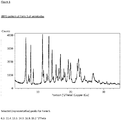
- FIG. 1 The XRPD pattern of Form S of venetoclax, together with selected (representative) peaks, is shown in Figure 1 .
- the lower part of Fig. 1 lists representative but characteristic peaks of Form S.
- the upper part of Fig. 1 shows the XRPD pattern of Form S of venetoclax.
- the corresponding full peak list of Form S of venetoclax is as follows: Full peak list of Form S: Pos. [°2Th.] Rel. Int.
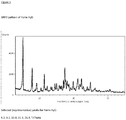
- FIG. 5 The XRPD pattern of Form HyD of venetoclax, together with selected (representative) peaks, is shown in Figure 5 .
- the lower part of Fig. 5 lists representative but characteristic peaks of Form HyD.
- the upper part of Fig. 5 shows the XRPD pattern of Form HyD of venetoclax.
- the corresponding full peak list of Form HyD of venetoclax is shown in Fig. 6 .
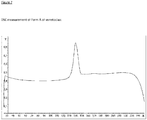
- a representative DSC curve (Method 2) of the obtained Form S of venetoclax is shown in Figure 9 and shows a melting endotherm with an onset temperature of about 152°C, a peak maximum at about 163°C and a heat of fusion of about 42 J/g.
- the X-ray powder diffractograms were obtained with an X'Pert PRO diffractometer (PANalytical, Almelo, The Netherlands) equipped with a theta/theta coupled goniometer in transmission geometry, programmable XYZ stage with well plate holder, Cu-K ⁇ 1,2 radiation source (wavelength 0.15419 nm) and a solid state PIX'cel detector.
- the diffractograms were recorded at a tube voltage of 40 kV, tube current of 40 mA.
- a typical precision of the 2-theta values is in the range of about ⁇ 0.2° 2-theta. Thus a diffraction peak that appears at 5.0° 2-theta can appear between 4.8 and 5.2° 2-theta on most X-ray diffractometers under standard conditions.
- the main characteristics of diffraction line profiles are 2 ⁇ position, peak height, peak area and shape (characterized by, for example, peak width or asymmetry, analytical function, empirical representation).
- an X-ray diffraction experiment also generates a more-or-less uniform background, upon which the peaks are superimposed.
- other factors contribute to the background, for instance the sample holder, diffuse scattering from air and equipment, other instrumental parameters such as detector noise, general radiation from the X-ray tube, etc.
- the peak-to-background ratio can be increased by minimizing background and by choosing prolonged exposure times.
- peak denotes a particular 2 ⁇ position, wherein the signal-to-noise ratio (calculated according to item 2.2.46 of the European Pharmacopoeia) is greater than 3/1.
- Absence of a peak is herein defined as a peak having an intensity of at most 1%, such as 0.5% or 0.2%, of the highest peak in an XRPD of a sample of venetoclax, more preferably no detectable XRPD peak above background signals.
- the water content can be determined as follows: Approximately 20-25 mg of solid material was accurately weighed into a volumetric flask. The solid was then dissolved in ca. 5 mL of anhydrous methanol and manually introduced into the titration cell of a Mettler Toledo C30 Compact Titrator using a syringe. The syringe was back-weighed after the addition of the solid and the weight of the added sample entered on the instrument. The water content was calculated automatically by the instrument as a percentage and the data printed.
- Method 1 Approximately, 5 mg of material was weighed into an aluminium DSC pan and sealed non-hermetically with a pierced aluminium lid. The sample pan was then loaded into a Seiko DSC6200 (equipped with a cooler) cooled and held at 20°C. Once a stable heat-flow response was obtained, the sample and reference were heated to 240 °C at scan rate of 10°C/min and the resulting heat flow response monitored.
- Method 2 Differential scanning calorimetry (DSC) was performed on a Mettler Polymer DSC R instrument. The sample was heated in a 40 microL aluminum pan with pierced aluminum lid from 25 to 250°C at a rate of 10°C/min. Nitrogen (purge rate 50 mL/min) was used as purge gas.
- the TGA instrument used to test a crystalline form was a Seiko Exstar TG/DTA6200. Approximately 5 mg of material was weighed into an open aluminium pan and loaded into a simultaneous thermogravimetric/differential thermal analyser (TG/DTA) and held at room temperature. The sample was then heated at a rate of 10 K/min from 25 °C to 300 °C during which time the change in sample weight was recorded. Nitrogen was used as the purge gas, at a flow rate of 100 cm 3 /min.
- sample was placed into a mesh vapour sorption balance pan and loaded into a DVS-1 dynamic vapour sorption balance by Surface Measurement Systems.
- the sample was subject to a ramping profile from 40 - 90 % relative humidity (RH) at 10 % increments, maintaining the sample at each step until a stable weight had been achieved.
- RH relative humidity
- the sample was dried using the same procedure to 0 % RH and then a second sorption cycle back to 40 % RH was carried out.
- the weight change during the sorption/desorption cycles were plotted, allowing for the hygroscopic nature of the sample to be determined. XRPD analysis was then carried out on the remaining solid.
- the residual organic solvent can be determined by gas chromatography (GC) using the following method] Column: DB-624 30 m ⁇ 0.32 mm, 1.8 film diameter CG/002 Diluent: DMSO GC Helium flow: 30.0 mL/min GC Air flow: 330.0 mL/min Autosampler Temperature: Ambient Flow Rate: 1.500 mL/min Gradient program: Time (minutes) GC Temperature (°C) 0.00 35.0 1.000 35.0 5.167 60.0 18.917 225.0 18.918 35.0
Landscapes
- Health & Medical Sciences (AREA)
- Chemical & Material Sciences (AREA)
- Organic Chemistry (AREA)
- General Health & Medical Sciences (AREA)
- Veterinary Medicine (AREA)
- Medicinal Chemistry (AREA)
- Public Health (AREA)
- Pharmacology & Pharmacy (AREA)
- Life Sciences & Earth Sciences (AREA)
- Animal Behavior & Ethology (AREA)
- Chemical Kinetics & Catalysis (AREA)
- Nuclear Medicine, Radiotherapy & Molecular Imaging (AREA)
- General Chemical & Material Sciences (AREA)
- Epidemiology (AREA)
- Pharmaceuticals Containing Other Organic And Inorganic Compounds (AREA)
Abstract
The present invention relates to novel forms of 4-(4-{[2-(4-chlorophenyl)-4,4-dimethylcyclohex-1 -en- 1 -yl]methyl}piperazin-1 -yl)-N-({3-nitro-4-[(tetrahydro-2H-pyran-4-ylmethyl)amino]phenyl}sulfonyl)-2-(1H-pyrrolo[2,3-b]pyridin-5-yloxy)benzamide (also known as venetoclax) as well as to the preparation thereof. One novel polymorph is an anhydrous crystalline form of venetoclax (referred to herein as "Form S"). Another novel polymorph is a crystalline hydrate of venetoclax (referred to herein as "Form HyD"). The present invention also discloses a novel amorphous form of venetoclax having a low solvent content, and refers to a pharmaceutical composition comprising said novel forms of venetoclax.
Moreover, the present invention relates to the use of Form HyD as an intermediate for the preparation of crystalline Form S.
Finally, the present invention refers to the novel polymorphs, or the pharmaceutical composition comprising the novel polymorphs of venetoclax or amorphous form of venetoclax, for use in a method of preventing or treating a disease that is characterized by apoptotic dysfunction and/or overexpression of an anti-apoptotic Bcl-2 family protein.
Description
- The present invention relates to novel forms of 4-(4-{[2-(4-chlorophenyl)-4,4-dimethylcyclohex-1 -en- 1 -yl]methyl}piperazin-1 -yl)-N-({3-nitro-4-[(tetrahydro-2H-pyran-4-ylmethyl)amino]phenyl}sulfonyl)-2-(1H-pyrrolo[2,3-b]pyridin-5-yloxy)benzamide (also known as venetoclax) as well as to the preparation thereof. One novel polymorph is an anhydrous crystalline form of venetoclax (referred to herein as "Form S"). Another novel polymorph is a crystalline hydrate of venetoclax (referred to herein as "Form Hyd"). One further novel form is an amorphous form of venetoclax having a low solvent content.
- The present invention also refers to a pharmaceutical composition comprising said forms of venetoclax.
- Moreover, the present invention relates to the use of Form Hyd as an intermediate for the preparation of Form S.
- Finally, the present invention refers to the novel polymorphs, or the pharmaceutical composition comprising the novel polymorphs of venetoclax or amorphous form of venetoclax, for use in a method of preventing or treating a disease that is characterized by apoptotic dysfunction and/or overexpression of an anti-apoptotic Bcl-2 family protein.
- 4-(4-{[2-(4-chlorophenyl)-4,4-dimethylcyclohex- 1 -en- 1 -yl]methyl}piperazin-I-yl)-N-({3-nitro-4-[(tetrahydro-2Hpyran-4-ylmethyl)amino]phenyl}sulfonyl)-2-(IH-pyrrolo[2,3-b]pyridin-5-yloxy)benzamide, also known as venetoclax, is a BH3-mimetic and acts as Bcl-2 (B-cell lymphoma-2) inhibitor. It blocks the anti-apoptotic Bcl-2 protein, therefore leading to programmed cell death (apoptosis) of affected cells. Currently, venetoclax is marketed under the trade name Venclexta.
- Venetoclax is represented by the following general Formula I:

-
WO 2012/071336 discloses various salts and crystalline forms of venetoclax per se as well as pharmaceutical compositions comprising the same. Examples of crystalline forms of venetoclax that are disclosed inWO 2012/071336 are Form A and Form F.
Polymorphism is a phenomenon relating to the occurrence of different crystalline forms for one molecule. There may be several different crystalline forms for the same molecule with distinct crystal structures and varying in physical properties like melting point, XRPD pattern and FTIR spectrum. These polymorphs are thus distinct solid forms which share the molecular formula of the compound from which the crystals are made up, however they may have distinct advantageous physical properties such as e.g. chemical stability, physical stability, hygroscopicity, solubility, dissolution rate, morphology or bioavailability. In addition, the preparation process of a crystalline form plays an important role in the development of an active pharmaceutical ingredient. It is essential that the crystallization process is robust and reliably produces the desired crystalline form in polymorphically pure form. - The acceptable amount of solvents in an active pharmaceutical ingredient (API) is strictly regulated e.g. by the ICH guideline for residual solvents. Hence, it is a desire to provide APIs that comprise an amount of solvent as low as possible.
- In addition, an active pharmaceutical ingredient is preferably non-hygroscopic in order to ensure the chemical and physical quality, e.g., against interconversion to another solid form, during the storage of the active substance itself and during the shelf-life of a solid finished dosage form containing the active substance without the need of special and expensive packaging.
- Furthermore, the bioavailability of a compound intended to be administered orally, is dependent on the compound's solubility as well as the compound's permeability according to the biopharmaceutical classification system (BCS). Therefore, a drug substance having high solubility which is consequently highly bioavailable is desired.
- It is thus an object of the present invention to provide improved forms/dosage forms of venetoclax, preferably polymorphs, that are improved with regard to the above described properties.
- The present invention provides the following aspects, subject-matters and preferred embodiments, which respectively taken alone or in combination, contribute to solving the object of the present invention:
- The present invention refers to new crystalline Form S of venetoclax, wherein venetoclax is represented by Formula I (4-(4-{[2-(4-chlorophenyl)-4,4-dimethylcyclohex-1 1 -en- 1-yl]methyl}piperazin-1-yl)-N-({3-nitro-4-[(tetrahydro-2H-pyran-4-ylmethyl)amino]phenyl}sulfonyl)-2-(1 H-pyrrolo[2,3-b]pyridin-5-yloxy)benzamide)

- Form S of venetoclax exhibits improved properties when compared to prior art crystalline forms of venetoclax, e.g. in terms of stability, solvent content, hygroscopicity, and/or processability.
- The present invention further provides a method for the preparation of the crystalline Form S of the present invention, comprising the step:
- (B) drying Form HyD of venetoclax, characterized by an X-ray powder diffraction pattern with peaks at 2-theta angles of 5.2±0.2 degrees 2theta, 9.2±0.2 degrees 2theta, 15.0±0.2 degrees 2theta, 21.3±0.2 degrees 2theta, 21.8±0.2 degrees 2theta, when using Cu-Kα radiation, at a temperature and for a time period suitable to obtain crystalline Form S.
- Form HyD is comparably easy to desolvate and this is a superior property. Form HyD thus exhibits advantageous and beneficial properties such as having a low water/solvent content.
- It is known to a person skilled in the art that venetoclax is very prone to solvate formation. There is thus no reason for a skilled person to anticipate that an MTBE solvate would be unstable and that it would decompose into an intermediate hydrated form which would be easy to desolvate. Already for this reason, the selection of the intermediate Form HyD for the production of Form S is not obvious.
- The present invention further refers to the use of crystalline Form S of the present invention, for the preparation of a pharmaceutical composition, preferably comprising an amorphous form of venetoclax.
Crystalline Form S exhibits a low solvent content. This low solvent content of Form S is due to the low solvent content of Form HyD on the one hand, and on the other hand, this low solvent content is further passed on the pharmaceutical composition that is prepared by using crystalline Form S. - Thus, the present invention also provides new crystalline Form HyD of venetoclax, represented by Formula I (4-(4-{[2-(4-chlorophenyl)-4,4-dimethylcyclohex- 1 -en- 1 -yl]methyl}piperazin-I-yl)-N-({3-nitro-4-[(tetrahydro-2Hpyran-4-ylmethyl)amino]phenyl}sulfonyl)-2-(IH-pyrrolo[2,3-b]pyridin-5-yloxy)benzamide)

- Additionally, the present invention refers to the use of the crystalline Form HyD as defined in the present invention as an intermediate for the preparation of crystalline Form S of the present invention.
- The present invention further refers to amorphous venetoclax being essentially free of organic solvents, preferably free of any solvents (including inorganic solvents and water), and to amorphous venetoclax obtainable or obtained by conversion of crystalline Form S of venetoclax as disclosed herein, wherein the conversion is performed in the absence of solvents; conversion can be performed simply by melting the crystalline Form S.
- The present invention thus also refers to pharmaceutical composition comprising an amorphous form of venetoclax as disclosed herein, an amorphous solid dispersion of venetoclax as disclosed herein, the crystalline Form HyD as disclosed herein, or the crystalline Form S as disclosed herein, and one or more pharmaceutically acceptable excipients.
- Finally, the present invention relates to Form S, Form HyD, amorphous form of venetoclax (respectively as disclosed herein), and to the pharmaceutical composition of the present invention, for use in a method of preventing or treating a disease that is characterized by apoptotic dysfunction and/or overexpression of an anti-apoptotic Bcl-2 family protein.
- As used herein the term "room temperature" indicates that the applied temperature is not critical and that no exact temperature value has to be kept. Usually, "room temperature" is understood to mean temperatures of about 15 °C to about 25 °C (see e.g. EU Pharmacopoeia 7.5, 1.2 (2012)).
- As used herein the term "ambient temperature" is understood to mean temperatures of about 20 °C to about 25°C.
- The term "solvate" as used herein describes a crystalline compound in which solvent molecules are incorporated into the crystal lattice of the compound in a stoichiometric or non-stoichiometric manner. If the solvent molecules are water the term "hydrate" is used herein.
- The term "non-hygroscopic" as used herein indicates that the increase in mass of a drug substance between about 0% to 80% relative humidity is less than 0.2%.
- The term "essentially", "essential", "approximately" and "about" in the context of the present invention denote an interval of accuracy that the person skilled in the art will understand to still ensure the technical effect of the feature in question. The term typically indicates deviation from the indicated numerical value of ±10%, and preferably ±5%.
- The expression "forms of venetoclax of the present invention" defines the different forms of venetoclax of the present invention, i.e. crystalline Form S and Form HyD, and the amorphous form of venetoclax. In a pharmaceutical composition or dosage form of the present invention, such as a tablet, venetoclax can be present in any of these forms. Preferably, venetoclax is present in a pharmaceutical composition or dosage from in one form as disclosed in the present invention.
- The tolerance margin of specified or selected XRPD peaks is considered to be, and shall mean herein, 0.2
degrees 2 theta. -
- Figure 1:
- XRPD pattern of Form S of venetoclax.
- Figure 2:
- DSC measurement (Method 1) of Form S of venetoclax, wherein a single endothermic event is shown at 156°C.
- Figure 3:
- DVS ("Dynamic Vapour Sorption") analysis of Form S of venetoclax, showing a weight gain of 0.3% between 0 and 90% relative humidity. DVS measures the weight increase of a sample at different relative humidities.
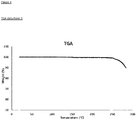
- Figure 4:
- TGA analysis ("Thermogravimetric Analysis") of Form S of venetoclax.
- Figure 5:
- XRPD pattern of Form HyD.
- Figure 6:
- Full peak list of Form HyD.
- Figure 7:
- DSC measurement (Method 2) of Form A of venetoclax, wherein a single endothermic event is shown at 140°C. The X-axis shows the temperature / °C and the Y-axis shows peak heights / Wg-1. Endothermic events are plotted up.
- Figure 8:
- DSC measurement (Method 2) of Form S of venetoclax, wherein a single endothermic event is shown at 163°C. The X-axis shows the temperature / °C and the Y-axis shows peak heights / Wg-1. Endothermic events are plotted up.
- It has unexpectedly been found that it is possible to provide new forms of venetoclax which exhibit desirable properties, in particular regarding their low solvent content. Further benefits of the crystalline forms of the present invention are, for instance, improved stability and processability, as well as the possibility to be obtainable in high yields and purity.
- One new crystalline form of venetoclax (referred to herein as "Form S") exhibits a comparably low content of residual solvents. This low content of residual solvent is particularly advantageous as, for instance, it passes to the low residual solvent content of an amorphous venetoclax preparation, when Form S is used e.g. as the starting material for preparing a finished dosage form (FDF) comprising an amorphous dispersion comprising venetoclax.
- The crystalline Form S of the present invention may particularly show unexpected advantages and improvements when compared e.g. to the known Form A of venetoclax of
WO 2012/071336 A1 . For instance, it is assumed that Form S exhibits a reduced content (amount) of solvent, i.e. water and organic solvent, when compared to known Form A. It is also assumed that it is less hygroscopic. This contributes for instance to improved stability and/or processability. Thus, Form S of the present invention is especially suitable for the preparation of a pharmaceutical composition such as a solid medicament, or as an intermediate for preparing another low solvent form of venetoclax. Since Form S has a reduced solvent content it is particularly suitable as a starting material for the preparation of a dosage form comprising an amorphous form of venetoclax. This is particularly useful as it is very difficult, if possible at all, to remove residual solvent content of the directly obtained amorphous venetoclax, in order to arrive at a level of residual solvent content that is comparable to the level that is obtained when applying the indirect method according to the present invention.
Additionally, a low solvent and/or water content is advantageous when subjecting the respective forms to further processing methods such as melt extrusion. Moreover, the use of essentially anhydrous (preferably anhydrous), non-hygroscopic and low solvent content feed materials such as the forms of venetoclax of the present invention provides for an improved processability as for instance the need for equipment modification e.g. for the removal of volatiles (vent installation) and effects on API-polymer miscibility can be avoided. - Moreover it was found that the melting point of Form S and the heat of fusion are both higher than the corresponding values for Form A. From this it can deduced that A and S are monotropically related and that Form S is thermodynamically more stable than Form A ( Polymorphism in the Pharmaceutical Industry, Rolf Hilfiker Ed., Wiley-VCH Verlag GmbH & Co. 2006, p 31ff). A thermodynamically stable API has advantages over other thermodynamically less stable forms as it will not convert to other crystalline forms during extended periods of storage.
- It was unexpectedly found that slurrying venetoclax in t-butyl-methyl ether (MTBE) produces a MTBE solvate which has been found to be highly metastable. Upon filtration, the solvate desolvates and transforms into another new crystalline form of venetoclax (referred to herein as "Form HyD"). Therein, atmospheric moisture replaces part of the MTBE, thus reducing the organic solvent content.
It has been surprisingly found that Form HyD is comparably easy to desolvate.
Surprisingly, the water in Form HyD can then be removed to provide Form S having reduced organic solvent content and reduced water content. Accordingly, due to the crystalline structure of Form S, water and solvents are 'squeezed out'. The crystalline hydrate, Form HyD, is therefore a valuable intermediate for the preparation of the novel polymorph Form S of venetoclax. - Accordingly, Form S and Form HyD of the present application commonly share the property of having a low solvent content. This property is also shared by amorphous venetoclax of the present invention.
- The present invention provides the following aspects, subject-matters and preferred embodiments, which respectively taken alone or in combination, contribute to solving the object of the present invention.
- 1. Crystalline Form S of venetoclax, wherein venetoclax is represented by Formula I (4-(4-{[2-(4-chlorophenyl)-4,4-dimethylcyclohex-1 -en- 1 -yl]methyl}piperazin-1 -yl)-N-({3-nitro-4-[(tetrahydro-2H-pyran-4-ylmethyl)amino]phenyl}sulfonyl)-2-(1H-pyrrolo[2,3-b]pyridin-5-yloxy)benzamide)

Venetoclax is used herein in its free base form. The crystalline Form S of the present invention is an essentially anhydrous and essentially non-solvated crystalline form. - 2. The crystalline Form S of
item 1, wherein the X-ray powder diffraction pattern has peaks at 2-theta angles of 6.3±0.2 degrees 2theta, 7.1±0.2 degrees 2theta, 7.8±0.2 degrees 2theta, 8.6±0.2 degrees 2theta, 11.4±0.2 degrees 2theta, 11.7±0.2 degrees 2theta, 12.7±0.2 degrees 2theta, 13.3±0.2 degrees 2theta, 14.3±0.2 degrees 2theta, 14.7±0.2 degrees 2theta, 15.5±0.2 degrees 2theta, 16.4±0.2 degrees 2theta, 16.9±0.2 degrees 2theta, 17.9±0.2 degrees 2theta, 18.2±0.2 degrees 2theta, 19.2±0.2 degrees 2theta, 19.9±0.2 degrees 2theta, 22.0±0.2 degrees 2theta, 22.4±0.2 degrees 2theta, 22.9±0.2 degrees 2theta, 24.2±0.2 degrees 2theta, 26.8±0.2 degrees 2theta, 28.6±0.2 degrees 2theta, and 29.8±0.2 degrees 2theta, when using Cu-Kα radiation. - 3. The crystalline Form S according to
item - 4. The crystalline Form S according to any one of the previous items, wherein the amount of residual organic solvents, in particular t-butyl methyl ether, is 5.0 wt.-% or less, preferably 2 wt.-% or less, more preferably 1.5 wt.-% or less, particularly 0.5 wt.-% or less, or 0.1 wt.-% or less.
Forms S contains only small, preferably insignificant or even no detectable amounts of t-butyl methyl ether, and further preferably no detectable amounts of other organic solvents. - 5. The crystalline Form S according to any one of the preceding items, which is essentially polymorphically pure, preferably has an X-ray powder diffraction pattern wherein the peaks defined in
item 1, optionally further the peaks defined initem 2, represent the peaks with higher intensity compared to other detectable peaks, particular preferred, Form S has no detectable amounts of a crystalline form of venetoclax other than Form S. - 6. The crystalline Form S according to any one of the preceding items, which is essentially pure, preferably contains venetoclax in an amount of 99.5 wt.-%, preferably 99.8 wt.-%.
Chemical purity, including solvent content, is determined by high performance liquid chromatography (HPLC) as described herein. - 7. The crystalline Form S according to any one of the preceding items, wherein the peak at the 2-theta angle of 11.4±0.2 degrees 2theta has the highest intensity (100%).
- 8. The crystalline Form S according to any one of the preceding items, showing no event/significant weight loss in the thermogravimetric analysis (TGA) at temperatures of below 250°C.
- 9. Method for the preparation of the crystalline Form S of any one of
items 1 to 8, comprising the step:- (B) drying Form HyD of venetoclax, characterized by an X-ray powder diffraction pattern with peaks at 2-theta angles of 5.2±0.2 degrees 2theta, 9.2±0.2 degrees 2theta, 15.0±0.2 degrees 2theta, 21.3±0.2 degrees 2theta, 21.8±0.2 degrees 2theta, when using Cu-Kα radiation, at a temperature and for a time period suitable to obtain crystalline Form S.
- 10. The method according to item 9, wherein drying of Form HyD takes is performed at a temperature of from 15 to 50°C under vacuum for at least 5 h.
It is possible that the drying step is carried out stepwise, for instance a first drying step is carried out by applying specific conditions e.g. with regard to drying time and temperature, followed by a second drying step that is carried out at different conditions e.g. with regard to drying time and temperature when compared to the respective conditions applied in the first drying step.
In one embodiment, the drying is performed at ambient temperature, i.e. in a range from 20 to 25°C, and the vacuum is 10 to 1000mmHg, preferably 10 to 100mmHg. - 11. The method according to item 9 or
item 10, further comprising the step:- (A) providing crystalline Form HyD by a method comprising the following steps:
- (a) suspending solid venetoclax in t-butyl-methyl ether (MTBE), thereby obtaining a suspension;
- (b) stirring the suspension, thereby obtaining a slurry; and
- (c) filtering the slurry obtained in step (b), thereby obtaining crystalline Form HyD.
The ball milling parameters are preferably 30 to 60 minutes at a frequency of 40 Hz.
Preferably, the ball-milled venetoclax is suspended in MTBE using the ranges of about 5% to about 20% w/v, preferably about 15%w/v.
Upon filtration of the slurry, the solvate desolvates and transforms into the new hydrated form HyD. Atmospheric moisture replaces part of the MTBE in the structure, thus reducing the solvent content. This intermediate form can then be dried to produce Form S.
Prior art Form F is made in a similar fashion, however by slurrying amorphous venetoclax in ethyl acetate. - (A) providing crystalline Form HyD by a method comprising the following steps:
- 12. The method according to item 11, wherein the stirring of step (b) takes place for about 5 h to about 75h at ambient temperature.
Preferably, stirring takes place for about 10 hours. - 13. Use of crystalline Form S of any of
items 1 to 8, for the preparation of a pharmaceutical composition of venetoclax, preferably a pharmaceutical composition comprising an amorphous form of venetoclax. - 14. The use according to item 13, wherein the venetoclax component of said pharmaceutical composition has a water content of less than 1 wt.-%, preferably less than 0.1 wt.-%, more preferably, there is no detectable amount of water present, based on the weight of the venetoclax component, and/or the venetoclax component of said pharmaceutical composition has an amount of residual organic solvents, in particular t-butyl methyl ether, of 5.0 wt.-% or less, preferably 2 wt.-% or less, more preferably 1.5 wt.-% or less, particularly 0.5 wt.-% or less, or 0.1 wt.-% or less, based on the weight of the venetoclax component.
The "venetoclax component" is the amorphous form of venetoclax that is present in the pharmaceutical composition.
In an alternative embodiment, the venetoclax component of said pharmaceutical composition has a water content of less than 1 wt.-%, preferably less than 0.1 wt.-%, more preferably, there is no detectable amount of water present, based on the weight of the pharmaceutical composition, and/or the venetoclax component of said pharmaceutical composition has an amount of residual organic solvents, in particular t-butyl methyl ether, of 5.0 wt.-% or less, preferably 2 wt.-% or less, more preferably 1.5 wt.-% or less, particularly 0.5 wt.-% or less, or 0.1 wt.-% or less, based on the weight of the pharmaceutical composition.
It is also possible that in one embodiment, the venetoclax component of said pharmaceutical composition has a water content of less than 1 wt.-%, preferably less than 0.1 wt.-%, more preferably, there is no detectable amount of water present, based on the weight of the pharmaceutical composition and based on the weight of the venetoclax component, and/or wherein the venetoclax component of said pharmaceutical composition has an amount of residual organic solvents, in particular t-butyl methyl ether, of 5.0 wt.-% or less, preferably 2 wt.-% or less, more preferably 1.5 wt.-% or less, particularly 0.5 wt.-% or less, or 0.1 wt.-% or less, based on the weight of the pharmaceutical composition and based on the weight of the venetoclax component. - 15. The use according to item 13 or 14, wherein the pharmaceutical composition has a water content of less than 1 wt.-%, preferably less than 0.1 wt.-%, more preferably, there is no detectable amount of water present, based on the weight of the pharmaceutical composition, and/or wherein the pharmaceutical composition has an amount of residual organic solvents, in particular t-butyl methyl ether, of 5.0 wt.-% or less, preferably 2 wt.-% or less, more preferably 1.5 wt.-% or less, particularly 0.5 wt.-% or less, or 0.1 wt.-% or less, based on the weight of the pharmaceutical composition.
- 16. The use according to items 13, 14, or 15, wherein the pharmaceutical composition is a solid dispersion of venetoclax, preferably an amorphous solid dispersion.
- 17. Amorphous venetoclax having a water content of less than 1 wt.-%, preferably less than 0.1 wt.-%, more preferably, there is no detectable amount of water present, based on the weight of the amorphous venetoclax, and/or wherein the amorphous venetoclax has an amount of residual organic solvents, in particular t-butyl methyl ether, of 5.0 wt.-% or less, preferably 2 wt.-% or less, more preferably 1.5 wt.-% or less, particularly 0.5 wt.-% or less, or 0.1 wt.-% or less, based on the weight of the amorphous venetoclax.
The amorphous form of venetoclax is amorphous as determined and correspondingly identified by X-ray powder diffraction (XRPD/XRD) analysis. It may also, optionally instead of or in addition to XRPD, be determined and identified as amorphous when subjected to physical observation, for instance by Polarized Light microscopy (PLM). As known to a person skilled in the art, under certain circumstances, amorphous materials can appear to have birefringence under the polarized light. - 18. Amorphous venetoclax obtainable or obtained by conversion of crystalline Form S of venetoclax of any of
items 1 to 8 into an amorphous form of venetoclax, wherein said conversion is performed in the absence of solvents and by applying a method that results in amorphous venetoclax, preferably by melting the crystalline Form S.
Methods that can be applied in order to convert a crystalline form such as crystalline Form S into amorphous venetoclax are known to a person skilled in the art. An example of such a method is melting. Thus, in a preferred embodiment, the conversion of crystalline Form S is carried out by melting the crystalline Form S. The amorphous form of venetoclax can be determined as disclosed elsewhere herein. - 19. Crystalline Form HyD of venetoclax, represented by Formula I (4-(4-{[2-(4-chlorophenyl)-4,4-dimethylcyclohex- 1 -en- 1 -yl]methyl}piperazin-1 -yl)-N-({3-nitro-4-[(tetrahydro-2H-pyran-4-ylmethyl)amino]phenyl}sulfonyl)-2-(1H-pyrrolo[2,3-b]pyridin-5-yloxy)benzamide)

- 20. The crystalline Form HyD of the previous item, wherein the X-ray powder diffraction pattern has peaks at 2-theta angles of 5.2±0.2 degrees 2theta, 7.9±0.2 degrees 2theta, 9.2±0.2 degrees 2theta, 10.5±0.2 degrees 2theta, 11.5±0.2 degrees 2theta, 12.3±0.2 degrees 2theta, 13.7±0.2 degrees 2theta,14.6±0.2 degrees 2theta, 15.0±0.2 degrees 2theta, 15.8±0.2 degrees 2theta, 16.2±0.2 degrees 2theta, 16.5±0.2 degrees 2theta, 17.0±0.2 degrees 2theta, 17.4±0.2 degrees 2theta, 17.7±0.2 degrees 2theta, 18.1±0.2 degrees 2theta, 18.6±0.2 degrees 2theta, 19.9±0.2 degrees 2theta, 21.3±0.2 degrees 2theta, 21.8±0.2 degrees 2theta, 22.3±0.2 degrees 2theta, 22.9±0.2 degrees 2theta, 24.0±0.2 degrees 2theta, 24.9±0.2 degrees 2theta, 26.3±0.2 degrees 2theta, and 30.6±0.2 degrees 2theta, when using Cu-Kα radiation.
- 21. The crystalline Form HyD according to
item 19 or 20, which is essentially polymorphically pure, preferably has an X-ray powder diffraction pattern wherein the peaks defined in item 15 represent the peaks with highest intensity, particularly preferred, Form HyD has no detectable amounts of a crystalline form of venetoclax other than Form HyD. - 22. The crystalline Form HyD according to any one of items 19 to 21, which is essentially pure, preferably contains venetoclax in an amount of at least 99.8 wt.-%, preferably at least 99.9 wt.-% or more preferably >99.9% wt.-%.
- 23. The crystalline Form HyD according to any one of items 19 to 22, having an X-ray powder diffraction pattern comprising the peaks as shown in
Fig. 6 , preferably having an X-ray powder diffraction pattern with peaks and peak intensities as shown inFig. 7 .
The crystalline Form HyD of the present invention (referred to herein also as "Form HyD") is a hydrated, and solvated crystalline form. It shows desirable properties, e.g., when compared to the known Form F of venetoclax ofWO 2012/071336 A1 . For instance, it is assumed that Form HyD exhibits improved desolvation behavior, e.g., when compared to known Form F. This can for instance further contribute to improved processability of Form HyD, thereby making Form HyD especially suitable e.g. for further processing such as for conversion into Form S. - 24. Method for the preparation of the crystalline Form HyD of any one of items 19 to 23, comprising the following steps:
- (a) suspending solid material of Formula I (venetoclax) in t-butyl-methyl ether (MTBE), thereby obtaining a suspension;
- (b) stirring the suspension, thereby obtaining a slurry;
- (c) filtering the slurry obtained in step (b), thereby obtaining crystalline Form HyD.
The solid material of Formula I useful for suspending step (a) preferably is milled, more preferably is ball milled.
The ball milling parameters are preferably 30 to 60 minutes at a frequency of 40 Hz.
Preferably, the ball-milled venetoclax is suspended in MTBE using the ranges of about 5% to about 20% w/v, preferably about 15%w/v. - 25. The method according to item 24, wherein the stirring of step (b) takes place for about 70h to 80h at ambient temperature.
- 26. Use of the crystalline Form HyD as defined in any one of items 19 to 23 as an intermediate for the preparation of crystalline Form S of any one of
items 1 to 8. - 27. Pharmaceutical composition comprising an amorphous form of venetoclax as defined in item 17 or 18, an amorphous solid dispersion of venetoclax, preferably as disclosed herein, the crystalline Form HyD as defined in any one of items 19 to 23, or the crystalline Form S as defined in any one of
items 1 to 8, and one or more pharmaceutically acceptable excipients. - 28. The pharmaceutical composition according to item 27, wherein the one or more pharmaceutically acceptable excipient is selected from the group consisting of fillers, disintegrants, binders, lubricants, and surfactants; preferably, the pharmaceutical composition comprises the amorphous form of venetoclax as the sole pharmaceutically active ingredient.
- 29. The pharmaceutical composition according to item 27 or 28, comprising an amorphous solid dispersion of venetoclax, obtainable or obtained by using the crystalline Form S as defined in any one of
items 1 to 8 as the starting material in a melt extrusion process in the absence of solvents, i.e. without adding solvents.
Since the melt extrusion process is performed in the absence of solvents, the amounts of solvents in the amorphous solid dispersion essentially corresponds to the amounts of solvents present in the starting materials used for preparing the amorphous solid dispersion.
The excipients and venetoclax used for the melt extrusion process are essentially free of solvents, i.e. only contain equilibrium humidity.
Preferably, the amorphous venetoclax that is contained in the amorphous solid dispersion has a water content of less than 1 wt.-%, preferably less than 0.1 wt.-%, more preferably, there is no detectable amount of water present, based on the weight of the amorphous venetoclax, and/or the amorphous venetoclax has an amount of residual organic solvents, in particular t-butyl methyl ether, of 5.0 wt.-% or less, preferably 2 wt.-% or less, more preferably 1.5 wt.-% or less, particularly 0.5 wt.-% or less, or 0.1 wt.-% or less, based on the weight of the amorphous venetoclax.
Preferably, the amorphous solid dispersion comprising the amorphous venetoclax that is contained in the pharmaceutical composition, has a water content of less than 1 wt.-%, preferably less than 0.1 wt.-%, more preferably, there is no detectable amount of water present, based on the weight of the amorphous solid dispersion, and/or the amorphous solid dispersion has an amount of residual organic solvents, in particular t-butyl methyl ether, of 5.0 wt.-% or less, preferably 2 wt.-% or less, more preferably 1.5 wt.-% or less, particularly 0.5 wt.-% or less, or 0.1 wt.--% or less, based on the weight of the amorphous solid dispersion.
Preferably, the pharmaceutical composition comprising the amorphous solid dispersion has a water content of less than 1 wt.-%, preferably less than 0.1 wt.-%, more preferably, there is no detectable amount of water present, based on the weight of the pharmaceutical composition, and/or the pharmaceutical composition has an amount of residual organic solvents, in particular t-butyl methyl ether, of 5.0 wt.-% or less, preferably 2 wt.-% or less, more preferably 1.5 wt.-% or less, particularly 0.5 wt.-% or less, or 0.1 wt.-% or less, based on the weight of the pharmaceutical composition.
Preferably, the minimum content of venetoclax in the amorphous solid dispersion is 10 wt.-%, 20 wt.-%, 30 wt.-%, or 40 wt.-%. Preferably, the maximum content of venetoclax in the amorphous solid dispersion is 70 wt.-%, 60 wt.-%, 50 wt.-%, or 40 wt.-%. For example, the content of venetoclax in the amorphous solid dispersion is between 10 wt.-% and 70 wt.-%, between 20 wt.-% and 70 wt.-%, or between 30 wt.-% and 70 wt.-%. - 30. The pharmaceutical composition according to any one of items 27 to 29, wherein the amorphous solid dispersion is formed with amorphous venetoclax and at least one polymer selected from the group consisting of polyvinyl pyrrolidone (PVP), polyvinyl alcohol (PVA), polyacrylic acid (PAA), poly(ethylene glycol) (PEG), poly(ethylene oxide) (PEO), copovidone, hypromellose acetate succinate (HPMC-AS), polyacrylates, cellulose, cellulose derivatives and mixtures thereof.
Preferably, no further ingredients are used for preparing said amorphous solid dispersion.
Preferably, the polymer is a hydrophilic polymer, preferably cellulose or a cellulose derivative. Hydrophilic polymers include, but are not restricted to, cellulose derivatives selected from the group consisting of alkylcellulose, preferably methylcellulose, ethylcellulose, or propylcellulose; hydroxyalkylcellulose, preferably hydroxymethylcellulose, hydroxyethylcellulose, or hydroxypropylcellulose; hydroxyalkylalkylcellulose, preferably hydroxyethylmethylcellulose (HEMC), or hydroxypropylmethylcellulose (HPMC); carboxyalkylcellulose, preferably carboxymethylcellulose (CMC), carboxymethylhydroxyethylcellulose (CMHEC), hydroxyethylcarboxymethylcellulose (HECMC); sodium carboxymethylcellulose, cellulose acetate phthalate (CAP), hydroxypropylmethylcellulose acetate (HPMCA), hydroxypropylmethylcellulose phthalate (HPMCP), hydroxypropylmethylcellulose acetate succinate (HPMCAS), and a mixture of two or more thereof. - 31. The pharmaceutical composition according to
item 29 or 30, further comprising one or more pharmaceutically acceptable excipients selected from the group consisting of diluents, sweeteners, buffering agents, glidants, flowing agents, flavouring agents, lubricants, preservatives, surfactants, wetting agents, binders, disintegrants, and thickeners.
In a preferred embodiment, the pharmaceutical composition comprises amorphous venetoclax as the sole pharmaceutically active ingredient. - 32. Form S of any one of
items 1 to 8, Form HyD of any one of items 19 to 23, amorphous venetoclax of item 17 or 18, or pharmaceutical composition of any one of items 27 to 31, for use in a method of preventing or treating a disease that is characterized by apoptotic dysfunction and/or overexpression of an anti-apoptotic Bcl-2 family protein. - 33. Form S of any one of
items 1 to 8, Form HyD of any one of items 19 to 23, amorphous venetoclax of item 17 or 18, or pharmaceutical composition of any one of items 27 to 31, for use according to the previous item, wherein the disease is a neoplastic, immune, or autoimmune disease. - 34. Form S of any one of items 1 to 8, Form HyD of any one of items 19 to 23, amorphous venetoclax of item 17 or 18, or pharmaceutical composition of any one of items 27 to 31, for use according to items 32 or 33, wherein the neoplastic disease is selected from the group consisting of cancer, mesothelioma, bladder cancer, pancreatic cancer, skin cancer, cancer of the head or neck, cutaneous or intraocular melanoma, ovarian cancer, breast cancer, uterine cancer, carcinoma of the fallopian tubes, carcinoma of the endometrium, carcinoma of the cervix, carcinoma of the vagina, carcinoma of the vulva, bone cancer, colon cancer, rectal cancer, cancer of the anal region, stomach cancer, gastrointestinal (gastric, colorectal and/or duodenal) cancer, chronic lymphocytic leukemia, esophageal cancer, cancer of the small intestine, cancer of the endocrine system, cancer of the thyroid gland, cancer of the parathyroid gland, cancer of the adrenal gland, sarcoma of soft tissue, cancer of the urethra, cancer of the penis, testicular cancer, hepatocellular (hepatic and/or biliary duct) cancer, primary or secondary central nervous system tumor, primary or secondary brain tumor, Hodgkin's disease, chronic or acute leukemia, chronic myeloid leukemia, lymphocytic lymphoma, lymphoblastic leukemia, follicular lymphoma, lymphoid malignancies of T-cell or B-cell origin, melanoma, multiple myeloma, oral cancer, non-small-cell lung cancer, prostate cancer, small-cell lung cancer, cancer of the kidney and/or ureter, renal cell carcinoma, carcinoma of the renal pelvis, neoplasms of the central nervous system, primary central nervous system lymphoma, non-Hodgkin's lymphoma, spinal axis tumors, brain stem glioma, pituitary adenoma, adrenocortical cancer, gall bladder cancer, cancer of the spleen, cholangiocarcinoma, fibrosarcoma, neuroblastoma, retinoblastoma and combinations thereof.
- 35. Form S of any one of
items 1 to 8, Form HyD of any one of items 19 to 23, amorphous venetoclax of item 17 or 18, or pharmaceutical composition of any one of items 27 to 31, for use according to any one of items 32 to 34, wherein the neoplastic disease is a lymphoid malignancy. - 36. Form S of any one of
items 1 to 8, Form HyD of any one of items 19 to 23, amorphous venetoclax of item 17 or 18, or pharmaceutical composition of any one of items 27 to 31, for use according to any one of items 32 to 35, wherein the lymphoid malignancy is non-Hodgkin's lymphoma, chronic lymphoid leukemia, or acute lymphocytic leukemia. - The pharmaceutical compositions of the present invention comprising the forms of venetoclax of the present invention may further comprise one or more pharmaceutically acceptable excipients. Such excipients are preferably selected from the group consisting of diluents, sweeteners, buffering agents, glidants, flowing agents, flavouring agents, lubricants, preservatives, surfactants, wetting agents, binders, disintegrants and thickeners. Other excipients known in the field of pharmaceutical compositions may also be used. Furthermore the pharmaceutical composition may comprise a combination of two or more excipients also within one of the members of the above mentioned group.
- Suitable wetting agents which can be used for the pharmaceutical compositions of the present invention comprising the forms of venetoclax of the present invention comprise e.g. sodium lauryl sulphate, sodium dioctyl sulfosuccinate, sodium starch glyocolate or wetting agents belonging to the group of the polyethylene glycol sorbitan fatty acid esters, such as wetting agents known as Tween,
e.g. Tween - Suitable binders which can be used for the pharmaceutical compositions of the present invention comprising the forms of venetoclax of the present invention further comprise e.g. alkylcelluloses such as methylcellulose, hydroxyalkylcelluloses such as hydroxymethylcellulose, hydroxyethylcellulose, hydroxypropylcellulose and hydroxybutylcellulose, hydroxyalkylalkylcelluloses such as hydroxyethylmethylcellulose and hydroxypropylmethylcellulose, carboxyalkylcelluoses such as carboxymethylcellulose, alkali metal salts of carboxyalkylcelluloses such as sodium carboxymethylcellulose, carboxyalkylalkylcelluloses such as carboxymethylethylcellulose, carboxyalkylcellulose esters, starches such as starch 1551, pectins such as sodium carboxymethylamylopectin, chitin derivatives such as chitosan, heparin and heparinoids, polysaccharides such as alginic acid, alkali metal and ammonium salts thereof, carrageenans, galactomannans, tragacanth, agar-agar, gum arabic, guar gum and xanthan gum, polyacrylic acids and the salts thereof, polymethacrylic acids and the salts thereof, methacrylate copolymers, polyvinylalcohol, polyvinylpyrrolidone, copolymers of polyvinylpyrrolidone with vinyl acetate, polyalkylene oxides such as polyethylene oxide and polypropylene oxide and copolymers of ethylene oxide and propylene oxide, e.g. poloxamers and poloxamines, copovidone.
- Suitable diluents which can be used for the pharmaceutical compositions of the present invention comprising the forms of venetoclax of the present invention further comprise e.g. calcium carbonate, dibasic calcium phosphate, dibasic calcium phosphate dihydrate, tribasic calcium phosphate, calcium sulphate, microcrystalline cellulose including silicified microcrystalline cellulose, powdered cellulose, dextrates, dextrin, dextrose excipient, fructose, kaolin, lactitol, lactose anhydrous, lactose monohydrate, mannitol, sorbitol, starch, modified starch, sodium chloride, sucrose, compressible sugar, confectioner's sugar, a spray-dried mixture of lactose monohydrate and microcrystalline cellulose (75:25), commercially available as Microcelac®, a co-processed spray-dried mixture of microcrystalline cellulose and colloidal silicon dioxide (98:2), commercially available as Prosolv®.
- Suitable glidants which can be used for the pharmaceutical compositions of the present invention comprising the forms of venetoclax of the present invention further comprise e.g. talc, colloidal silicon dioxide, starch, and magnesium stearate.
- Suitable disintegrants which can be used for the pharmaceutical compositions of the present invention comprising the forms of venetoclax of the present invention further comprise e.g. starch, ion exchange resins, e.g. Amberlite, cross-linked polyvinylpyrrolidone, modified cellulose gum, e.g croscarmellose sodium, sodium starch glycolate, sodium carboxymethylcellulose, sodium dodecyl sulphate, modified corn starch, microcrystalline cellulose, magnesium aluminium silicate, alginic acid, alginate and powdered cellulose.
- Suitable lubricants which can also be used for the pharmaceutical compositions of the present invention comprising the forms of venetoclax of the present invention further comprise e.g. magnesium stearate, calcium stearate, stearic acid, talc, polyethylene glycol, sodium lauryl sulphate and magnesium lauryl sulphate.
- In addition, the pharmaceutical compositions of the present invention comprising the forms of venetoclax (crystalline forms and amorphous venetoclax) of the present invention may further comprise other optional excipients such as, for example, colouring agents.
- In the following, examples of possible oral dosage forms such as tablets are disclosed:
- A preferred tablet of the present invention comprises the forms of venetoclax of the present invention, mannitol, microcrystalline cellulose, sodium starch glycolate, hydroxypropylmethyl cellulose, and magnesium stearate.
- Another preferred tablet of the present invention comprises the forms of venetoclax of the present invention, lactose monohydrate, silicified microcrystalline cellulose, croscarmellose sodium, polysorbate 20 (Tween 20), polyvinylpyrrolidone K30 (PVP K30), and magnesium stearate.
- A further preferred tablet of the present invention comprises the forms of venetoclax of the present invention, microcrystalline cellulose, polysorbate 20 (Tween 20), polyvinylpyrrolidone K30 (PVP K30), dibasic calcium phosphate (dihydrate or anhydrate e.g. Emcompress® or anhydrous Emcompress®), magnesium stearate, and starch.
- In addition a preferred tablet of the present invention comprises the forms of venetoclax of the present invention, microcrystalline cellulose, lactose monohydrate, polysorbate 20 (Tween 20), polyvinylpyrrolidone K30 (PVP K30), magnesium stearate, and starch.
- Another preferred tablet of the present invention comprises the forms of venetoclax of the present invention, microcrystalline cellulose, modified starch, polysorbate 20 (Tween 20), polyvinylpyrrolidone K30 (PVP K30), and magnesium stearate.
- In one embodiment, suitable tablets may be composed as follows - percentages indicated are w/w-%:
3-8% the forms of venetoclax of the present invention 35-45% anhydrous calcium hydrogen phosphate 15-25% corn starch 2-6% copovidone 20-30% microcrystalline cellulose 1-3% sodium starch glycolate 2-6% talc 0.5-2% magnesium stearate - In another embodiment, suitable tablets may be composed as follows - percentages indicated are w/w-%:
approximately 5% the forms of venetoclax of the present invention approximately 39% anhydrous calcium hydrogen phosphate approximately 20% corn starch approximately 3% copovidone approximately 25% microcrystalline cellulose approximately 3% sodium starch glycolate approximately 4% talc approximately 1% magnesium stearate - In the following the present invention will be described in further detail by illustrative, nonlimiting examples.
- Venetoclax (1g) was suspended in ethyl acetate (20mL) at room temperature. The suspension was magnetically stirred for 16h and filtered. The damp material was allowed to dry at ambient temperature for 5h and was then analysed by XRD. XRD indicated the predominant phase to be Form F with traces of Form A (incomplete desolvation).
- The material from Comparative Example 1 was dried for 7h under vacuum at ambient temperature and then for an additional 17h.
- The resulting material was analysed by XRD and found to consist of Form F with traces of Form A. Gas chromatography (GC) indicated an ethyl acetate content of 8.2% after 24h under vacuum.
- 901 mg of ball milled venetoclax were dissolved in ethyl acetate (16.5 mL, added in different aliquots), followed by direct precipitation. The slurry was stirred at room temperature for 19 h and filtered. The filter cake was dried under vacuum (30 mbar) at room temperature for 5 h and then at 40 °C for 7 h, yielding crystalline Form A of venetoclax (817 mg) as a yellow powder.
- A representative DSC curve (Method 2) of the obtained Form A of venetoclax is shown in
Figure 8 and shows a melting endotherm with an onset temperature of about 134°C, a peak maximum at about 140°C and a heat of fusion of about 20 J/g. - Two ball mill jars were filled to 30 % of the volume with venetoclax which was a mixture of Form A and the methanol solvate of venetoclax described in
WO 2012/071336 . To each jar, a milling ball was added and the jars were securely closed. The jars were then tightly screwed into place on the ball mill. The milling was set to take place for 30 minutes at a frequency of 30 Hz. A sample was then taken and analysed by XRPD. This was then repeated to ensure fully amorphous material was produced. A second sample was then analysed by XRPD for amorphous content. - Material produced from the above method (ball milling) was found to be amorphous by XRPD. HPLC purity of the amorphous material was found to be 97.6 %.
- The ball milled venetoclax obtained in step 1-1 (1g) was suspended in t-butyl methyl ether (MTBE) (20mL) and magnetically stirred for c.a. 3 days. The slurry was then filtered; the resulting solid was defined as Form HyD.
- Form HyD obtained in Step 1-2 of Example 1 was dried at ambient temperature under vacuum for 7h and then for another 17h. The XRD analysis on the resulting solid indicated the presence of Form S. GC indicated the presence of 1.4% MTBE content.
- The XRPD pattern of Form S of venetoclax, together with selected (representative) peaks, is shown in
Figure 1 . The lower part ofFig. 1 lists representative but characteristic peaks of Form S. The upper part ofFig. 1 shows the XRPD pattern of Form S of venetoclax. The corresponding full peak list of Form S of venetoclax is as follows:Full peak list of Form S: Pos. [°2Th.] Rel. Int. [%] Height [cts] 6.3 92.2 3535.7 7.1 17.7 677.9 7.8 75.8 2905.7 8.6 29.2 1118.5 11.4 100.0 3834.9 11.7 27.9 1071.3 12.7 20.7 792.8 13.3 96.0 3682.0 14.3 69.1 2649.9 14.7 15.2 583.8 15.5 38.5 1477.6 16.4 31.2 1194.7 16.9 59.3 2273.5 17.9 30.8 1179.1 18.2 24.0 920.1 19.2 49.3 1888.7 19.9 43.0 1648.0 22.0 41.0 1571.5 22.4 47.1 1806.6 22.9 31.7 1214.5 24.2 16.4 627.4 26.8 20.5 787.7 28.6 7.3 281.0 29.8 3.0 116.8 - The XRPD pattern of Form HyD of venetoclax, together with selected (representative) peaks, is shown in
Figure 5 . The lower part ofFig. 5 lists representative but characteristic peaks of Form HyD. The upper part ofFig. 5 shows the XRPD pattern of Form HyD of venetoclax. The corresponding full peak list of Form HyD of venetoclax is shown inFig. 6 . - 902 mg of ball milled venetoclax were suspended in 17 mL MTBE. The slurry was stirred at room temperature for 19 h and filtered. The filter cake was dried under vacuum (30 mbar) at room temperature for 5 h and then at 40 °C for 7 h, yielding crystalline Form S of venetoclax (880 mg) as a yellow powder.
- A representative DSC curve (Method 2) of the obtained Form S of venetoclax is shown in Figure 9 and shows a melting endotherm with an onset temperature of about 152°C, a peak maximum at about 163°C and a heat of fusion of about 42 J/g.
- A comparison of
Figures 7 and8 shows that the melting points and heat of fusions of Form S are both higher than the corresponding values for Form A. This is an indication that Forms A and S are monotropically related and Form S is thermodynamically more stable than Form A at any temperature. This shows that Form S is superior to Form A as regards storage properties. - The X-ray powder diffractograms (XRPD/XRD) were obtained with an X'Pert PRO diffractometer (PANalytical, Almelo, The Netherlands) equipped with a theta/theta coupled goniometer in transmission geometry, programmable XYZ stage with well plate holder, Cu-Kα1,2 radiation source (wavelength 0.15419 nm) and a solid state PIX'cel detector. The diffractograms were recorded at a tube voltage of 40 kV, tube current of 40 mA. A typical precision of the 2-theta values is in the range of about ± 0.2° 2-theta. Thus a diffraction peak that appears at 5.0° 2-theta can appear between 4.8 and 5.2° 2-theta on most X-ray diffractometers under standard conditions.
- The main characteristics of diffraction line profiles are 2θ position, peak height, peak area and shape (characterized by, for example, peak width or asymmetry, analytical function, empirical representation). In addition to the diffraction peaks, an X-ray diffraction experiment also generates a more-or-less uniform background, upon which the peaks are superimposed. Besides specimen preparation, other factors contribute to the background, for instance the sample holder, diffuse scattering from air and equipment, other instrumental parameters such as detector noise, general radiation from the X-ray tube, etc. The peak-to-background ratio can be increased by minimizing background and by choosing prolonged exposure times. In the context of the present invention, the term "peak" denotes a particular 2θ position, wherein the signal-to-noise ratio (calculated according to item 2.2.46 of the European Pharmacopoeia) is greater than 3/1. "Absence of a peak" is herein defined as a peak having an intensity of at most 1%, such as 0.5% or 0.2%, of the highest peak in an XRPD of a sample of venetoclax, more preferably no detectable XRPD peak above background signals.
- The water content can be determined as follows: Approximately 20-25 mg of solid material was accurately weighed into a volumetric flask. The solid was then dissolved in ca. 5 mL of anhydrous methanol and manually introduced into the titration cell of a Mettler Toledo C30 Compact Titrator using a syringe. The syringe was back-weighed after the addition of the solid and the weight of the added sample entered on the instrument. The water content was calculated automatically by the instrument as a percentage and the data printed.
- Separately ca. 25 mg of solid material was accurately weighed into a vial. Ca. 2 mL of the Titrator Coulomat was then removed from the system and added to the vial to dissolve the solid. This was then manually introduced into the introduced into the titration cell of a Mettler Toledo C30 Compact Titrator using a syringe. After the addition of the sample, the weight of the added solid was entered on the instrument. The water content was calculated automatically by the instrument as a percentage and the data printed.
- Accurately weigh 10 mg of standard into a 20 mL volumetric flask and make up to volume with Diluent. This is the working reference standard at ca. 0.5 mg/mL.
- Accurately weigh 10 mg of sample material into a 20 mL volumetric flask and make up to volume with diluent. The final concentration is ca.0.5 mg/mL.
- Prepare an LOQ solution at 0.1% of the nominal standard concentration e.g. accurately pipette 1 mL of standard solution into a 100 mL volumetric flask, make to volume in diluent to give a 1% solution. Further dilute this 1
% solution 1 mL to 10 mL to give a 0.1% LOQ solution.Instrument: Agilent 1100/1200 with UV Detector Column: Ace Excel 3 C18-PFP, 3 µm 75 x4.6 mm (LC/164) Column Temperature: 30 °C ± 2 °C Autosampler Temperature: Ambient UV wavelength: 275 nm Injection Volume: 5 µL Flow Rate: 1.500 mL/min Mobile Phase A: 0.1 % Trifluoroacetic acid in Deionised Water Mobile Phase B: 0.1 % Trifluoroacetic acid in Acetonitrile - Gradient program:
Time (minutes) Solvent B [%] 0.00 5.0 0.50 5.0 10.00 100.0 12.00 100.0 12.10 5.0 15.00 5.0 - Method 1: Approximately, 5 mg of material was weighed into an aluminium DSC pan and sealed non-hermetically with a pierced aluminium lid. The sample pan was then loaded into a Seiko DSC6200 (equipped with a cooler) cooled and held at 20°C. Once a stable heat-flow response was obtained, the sample and reference were heated to 240 °C at scan rate of 10°C/min and the resulting heat flow response monitored.
- Method 2: Differential scanning calorimetry (DSC) was performed on a Mettler Polymer DSC R instrument. The sample was heated in a 40 microL aluminum pan with pierced aluminum lid from 25 to 250°C at a rate of 10°C/min. Nitrogen (purge
rate 50 mL/min) was used as purge gas. - The TGA instrument used to test a crystalline form was a Seiko Exstar TG/DTA6200. Approximately 5 mg of material was weighed into an open aluminium pan and loaded into a simultaneous thermogravimetric/differential thermal analyser (TG/DTA) and held at room temperature. The sample was then heated at a rate of 10 K/min from 25 °C to 300 °C during which time the change in sample weight was recorded. Nitrogen was used as the purge gas, at a flow rate of 100 cm3/min.
- Approximately 20 mg of sample was placed into a mesh vapour sorption balance pan and loaded into a DVS-1 dynamic vapour sorption balance by Surface Measurement Systems. The sample was subject to a ramping profile from 40 - 90 % relative humidity (RH) at 10 % increments, maintaining the sample at each step until a stable weight had been achieved. After completion of the sorption cycle, the sample was dried using the same procedure to 0 % RH and then a second sorption cycle back to 40 % RH was carried out. The weight change during the sorption/desorption cycles were plotted, allowing for the hygroscopic nature of the sample to be determined. XRPD analysis was then carried out on the remaining solid.
- The residual organic solvent can be determined by gas chromatography (GC) using the following method]
Column: DB-624 30 m × 0.32 mm, 1.8 film diameter CG/002 Diluent: DMSO GC Helium flow: 30.0 mL/min GC Air flow: 330.0 mL/min Autosampler Temperature: Ambient Flow Rate: 1.500 mL/min Gradient program: Time (minutes) GC Temperature (°C) 0.00 35.0 1.000 35.0 5.167 60.0 18.917 225.0 18.918 35.0
Claims (15)
- Crystalline Form S of venetoclax, wherein venetoclax is represented by Formula I (4-(4-{[2-(4-chlorophenyl)-4,4-dimethylcyclohex-1 -en- 1 -yl]methyl}piperazin-1 -yl)-N-({3-nitro-4-[(tetrahydro-2H-pyran-4-ylmethyl)amino]phenyl}sulfonyl)-2-(1H-pyrrolo[2,3-b]pyridin-5-yloxy)benzamide)

- The crystalline Form S of claim 1, wherein the X-ray powder diffraction pattern has peaks at 2-theta angles of 6.3±0.2 degrees 2theta, 7.1±0.2 degrees 2theta, 7.8±0.2 degrees 2theta, 8.6±0.2 degrees 2theta, 11.4±0.2 degrees 2theta, 11.7±0.2 degrees 2theta, 12.7±0.2 degrees 2theta, 13.3±0.2 degrees 2theta, 14.3±0.2 degrees 2theta, 14.7±0.2 degrees 2theta, 15.5±0.2 degrees 2theta, 16.4±0.2 degrees 2theta, 16.9±0.2 degrees 2theta, 17.9±0.2 degrees 2theta, 18.2±0.2 degrees 2theta, 19.2±0.2 degrees 2theta, 19.9±0.2 degrees 2theta, 22.0±0.2 degrees 2theta, 22.4±0.2 degrees 2theta, 22.9±0.2 degrees 2theta, 24.2±0.2 degrees 2theta, and 26.8±0.2 degrees 2theta, when using Cu-Kα radiation.
- The crystalline Form S according to claims 1 or 2, having a water content of less than 1 wt.-%, preferably less than 0.1 wt.-%, and more preferably, there is no detectable amount of water present.
- The crystalline Form S according to any one of claims 1 to 3, wherein the amount of residual organic solvents is 5.0 wt.-% or less, preferably 2 wt.-% or less, more preferably 1.5 wt.-% or less, particularly 0.5 wt.-% or less.
- Method for the preparation of the crystalline Form S of any one of claims 1 to 4, comprising the step:(B) drying Form HyD of venetoclax, characterized by an X-ray powder diffraction pattern with peaks at 2-theta angles of 5.2±0.2 degrees 2theta, 9.2±0.2 degrees 2theta, 15.0±0.2 degrees 2theta, 21.3±0.2 degrees 2theta, 21.8±0.2 degrees 2theta, when using Cu-Kα radiation, at a temperature and for a time period suitable to obtain crystalline Form S.
- The method according to claim 5, further comprising the step:(A) providing crystalline Form HyD by a method comprising the following steps:(a) suspending solid venetoclax in t-butyl-methyl ether (MTBE), thereby obtaining a suspension;(b) stirring the suspension, thereby obtaining a slurry; and(c) filtering the slurry obtained in step (b), thereby obtaining crystalline Form HyD.
- Use of crystalline Form S of any of claims 1 to 4, for the preparation of a pharmaceutical composition of venetoclax, preferably a pharmaceutical composition comprising an amorphous form of venetoclax.
- The use according to claim 7, wherein the venetoclax component of said pharmaceutical composition has a water content of less than 1 wt.-%, preferably less than 0.1 wt.-%, and more preferably, there is no detectable amount of water present, based on the weight of the venetoclax component, and/or wherein the venetoclax component of said pharmaceutical composition has an amount of residual organic solvents, in particular t-butyl methyl ether, of 5.0 wt.-% or less, preferably 2 wt.-% or less, more preferably 1.5 wt.-% or less, particularly 0.5 wt.-% or less, or 0.1 wt.-% or less, based on the weight of the venetoclax component.
- Crystalline Form HyD of venetoclax, represented by Formula I (4-(4-{[2-(4-chlorophenyl)-4,4-dimethylcyclohex- 1 -en- 1-yl]methyl}piperazin-1-yl)-N-({3-nitro-4-[(tetrahydro-2H-pyran-4-ylmethyl)amino]phenyl}sulfonyl)-2-(1H-pyrrolo[2,3-b]pyridin-5-yloxy)benzamide)

- The crystalline Form HyD of claim 9, wherein the X-ray powder diffraction pattern has peaks at 2-theta angles of 5.2±0.2 degrees 2theta, 7.9±0.2 degrees 2theta, 9.2±0.2 degrees 2theta, 11.5±0.2 degrees 2theta, 12.3±0.2 degrees 2theta, 14.6±0.2 degrees 2theta, 15.0±0.2 degrees 2theta, 15.8±0.2 degrees 2theta, 16.2±0.2 degrees 2theta, 16.5±0.2 degrees 2theta, 17.0±0.2 degrees 2theta, 17.4±0.2 degrees 2theta, 17.7±0.2 degrees 2theta, 18.1±0.2 degrees 2theta, 18.6±0.2 degrees 2theta, 19.9±0.2 degrees 2theta, 21.3±0.2 degrees 2theta, 21.8±0.2 degrees 2theta, 22.3±0.2 degrees 2theta, and 24.9±0.2 degrees 2theta, when using Cu-Kα radiation.
- Method for the preparation of the crystalline Form HyD of claim 9 or 10, comprising the following steps:(a) suspending solid material of Formula I (venetoclax) in t-butyl-methyl ether (MTBE), thereby obtaining a suspension;(b) stirring the suspension, thereby obtaining a slurry;(c) filtering the slurry obtained in step (b), thereby obtaining crystalline Form HyD.
- Use of the crystalline Form HyD as defined in claim 9 or 10 as an intermediate for the preparation of crystalline Form S of any one of claims 1 to 4.
- Pharmaceutical composition comprising an amorphous solid dispersion of venetoclax, wherein the amorphous venetoclax that is contained in the amorphous solid dispersion has a water content of less than 1 wt.-% based on the weight of the amorphous venetoclax, and/or wherein the amorphous venetoclax has an amount of residual organic solvents of 5.0 wt.-% or less, based on the weight of the amorphous venetoclax; or the crystalline Form HyD as defined in claim 9 or 10; or the crystalline Form S as defined in any one of claims 1 to 4; and one or more pharmaceutically acceptable excipients.
- The pharmaceutical composition according to claim 13, wherein the amorphous solid dispersion is formed with amorphous venetoclax and at least one polymer selected from the group consisting of polyvinyl pyrrolidone (PVP), polyvinyl alcohol (PVA), polyacrylic acid (PAA), poly(ethylene glycol) (PEG), poly(ethylene oxide) (PEO), copovidone, hypromellose acetate succinate (HPMC-AS), polyacrylates, cellulose, cellulose derivatives and mixtures thereof.
- Form S of any one of claims 1 to 4, Form HyD of claim 9 or 10, or pharmaceutical composition of claim 13 or 14, for use in a method of preventing or treating a disease that is characterized by apoptotic dysfunction and/or overexpression of an anti-apoptotic Bcl-2 family protein.
Priority Applications (1)
| Application Number | Priority Date | Filing Date | Title |
|---|---|---|---|
| EP16203212.2A EP3333167A1 (en) | 2016-12-09 | 2016-12-09 | Solid forms of venetoclax |
Applications Claiming Priority (1)
| Application Number | Priority Date | Filing Date | Title |
|---|---|---|---|
| EP16203212.2A EP3333167A1 (en) | 2016-12-09 | 2016-12-09 | Solid forms of venetoclax |
Publications (1)
| Publication Number | Publication Date |
|---|---|
| EP3333167A1 true EP3333167A1 (en) | 2018-06-13 |
Family
ID=57539156
Family Applications (1)
| Application Number | Title | Priority Date | Filing Date |
|---|---|---|---|
| EP16203212.2A Withdrawn EP3333167A1 (en) | 2016-12-09 | 2016-12-09 | Solid forms of venetoclax |
Country Status (1)
| Country | Link |
|---|---|
| EP (1) | EP3333167A1 (en) |
Cited By (7)
| Publication number | Priority date | Publication date | Assignee | Title |
|---|---|---|---|---|
| WO2020127503A1 (en) | 2018-12-18 | 2020-06-25 | Argenx Bvba | Cd70 and venetoclax, a bcl-2 inhibitor, combination therapy for treating acute myeloid leukemia |
| CN113164474A (en) * | 2020-05-14 | 2021-07-23 | 德尔塔菲制药股份有限公司 | Water-soluble polymer derivative of Venetok |
| WO2021173523A1 (en) * | 2020-02-24 | 2021-09-02 | Newave Pharmaceutical Inc. | Hot melt extruded solid dispersions containing a bcl2 inhibitor |
| WO2021207581A1 (en) * | 2020-04-10 | 2021-10-14 | Abbvie Inc. | Crystalline forms of an apoptosis-inducing agent |
| WO2022043538A1 (en) | 2020-08-29 | 2022-03-03 | argenx BV | Method of treatment of patients having reduced sensitivity to a bcl-2 inhibitor |
| WO2022111558A1 (en) * | 2020-11-25 | 2022-06-02 | Ascentage Pharma (Suzhou) Co., Ltd. | Solid dispersion, pharmaceutical preparations, preparation method, and application thereof |
| WO2025114919A1 (en) | 2023-11-28 | 2025-06-05 | Sanofi | Multifunctional natural killer (nk) cell engager combination therapy for treating hematological neoplastic disorders |
Citations (3)
| Publication number | Priority date | Publication date | Assignee | Title |
|---|---|---|---|---|
| US20120108590A1 (en) * | 2010-10-29 | 2012-05-03 | Abbott Laboratories | Melt-extruded solid dispersions containing an apoptosis-inducing agent |
| WO2012071336A1 (en) | 2010-11-23 | 2012-05-31 | Abbott Laboratories | Salts and crystalline forms of an apoptosis-inducing agent |
| US20140275540A1 (en) * | 2013-03-13 | 2014-09-18 | Abbvie Inc. | Processes For The Preparation Of An Apoptosis-Inducing Agent |
-
2016
- 2016-12-09 EP EP16203212.2A patent/EP3333167A1/en not_active Withdrawn
Patent Citations (3)
| Publication number | Priority date | Publication date | Assignee | Title |
|---|---|---|---|---|
| US20120108590A1 (en) * | 2010-10-29 | 2012-05-03 | Abbott Laboratories | Melt-extruded solid dispersions containing an apoptosis-inducing agent |
| WO2012071336A1 (en) | 2010-11-23 | 2012-05-31 | Abbott Laboratories | Salts and crystalline forms of an apoptosis-inducing agent |
| US20140275540A1 (en) * | 2013-03-13 | 2014-09-18 | Abbvie Inc. | Processes For The Preparation Of An Apoptosis-Inducing Agent |
Non-Patent Citations (1)
| Title |
|---|
| "Polymorphism in the Pharmaceutical Industry", 2006, WILEY-VCH VERLAG GMBH & CO, pages: 31 FF |
Cited By (14)
| Publication number | Priority date | Publication date | Assignee | Title |
|---|---|---|---|---|
| EP4218761A1 (en) | 2018-12-18 | 2023-08-02 | Argenx BVBA | Cd70 and venetoclax, a bcl-2 inhibitor, combination therapy for treating acute myeloid leukemia |
| WO2020127503A1 (en) | 2018-12-18 | 2020-06-25 | Argenx Bvba | Cd70 and venetoclax, a bcl-2 inhibitor, combination therapy for treating acute myeloid leukemia |
| CN115484933A (en) * | 2020-02-24 | 2022-12-16 | 广州麓鹏制药有限公司 | Hot-melt extruded solid dispersions containing BCL2 inhibitors |
| WO2021173523A1 (en) * | 2020-02-24 | 2021-09-02 | Newave Pharmaceutical Inc. | Hot melt extruded solid dispersions containing a bcl2 inhibitor |
| WO2021207581A1 (en) * | 2020-04-10 | 2021-10-14 | Abbvie Inc. | Crystalline forms of an apoptosis-inducing agent |
| EP3928835A4 (en) * | 2020-05-14 | 2022-07-13 | Delta-Fly Pharma, Inc. | WATER SOLUBLE POLYMER DERIVATIVE OF VENETOCLAX |
| CN113164474B (en) * | 2020-05-14 | 2022-07-15 | 德尔塔菲制药股份有限公司 | Water-soluble polymer derivatives of venetoclax |
| US11524078B2 (en) | 2020-05-14 | 2022-12-13 | Delta-Fly Pharma, Inc. | Water-soluble macromolecular derivative of Venetoclax |
| CN113164474A (en) * | 2020-05-14 | 2021-07-23 | 德尔塔菲制药股份有限公司 | Water-soluble polymer derivative of Venetok |
| WO2022043538A1 (en) | 2020-08-29 | 2022-03-03 | argenx BV | Method of treatment of patients having reduced sensitivity to a bcl-2 inhibitor |
| WO2022111558A1 (en) * | 2020-11-25 | 2022-06-02 | Ascentage Pharma (Suzhou) Co., Ltd. | Solid dispersion, pharmaceutical preparations, preparation method, and application thereof |
| US20240016747A1 (en) * | 2020-11-25 | 2024-01-18 | Ascentage Pharma (Suzhou) Co., Ltd. | Solid dispersion, pharmaceutical preparations, preparation method, and application thereof |
| EP4251137A4 (en) * | 2020-11-25 | 2024-10-16 | Ascentage Pharma (Suzhou) Co., Ltd. | Solid dispersion, pharmaceutical preparations, preparation method, and application thereof |
| WO2025114919A1 (en) | 2023-11-28 | 2025-06-05 | Sanofi | Multifunctional natural killer (nk) cell engager combination therapy for treating hematological neoplastic disorders |
Similar Documents
| Publication | Publication Date | Title |
|---|---|---|
| WO2023226630A1 (en) | Polymorph of kras inhibitor or salt thereof and preparation of formulation of polymorph | |
| EP2897943B1 (en) | Crystalline form of vortioxetine hydrobromide | |
| JP6211072B2 (en) | Multi-component crystals comprising dasatinib and a selected co-crystal former | |
| JP2025113269A (en) | Solid forms of bermosudil and bermosudil salts | |
| EP3156406A1 (en) | Crystalline forms of ribociclib free base | |
| WO2017212431A1 (en) | Solid forms of venetoclax and processes for the preparation of venetoclax | |
| WO2014076712A2 (en) | Lurasidone hydrochloride solid dispersion | |
| US20220220123A1 (en) | Amorphous and crystalline forms of relugolix | |
| WO2011157450A1 (en) | New polymorphic form of imatinib base and preparation of salts thereof | |
| CZ2016391A3 (en) | A pharmaceutical formula of olaparib | |
| WO2019135254A1 (en) | Apalutamide polymorphs and their preparation thereof | |
| CN106458905B (en) | Betrixaban salt and its preparation method and application | |
| US10774042B2 (en) | Crystalline forms of apremilast | |
| US12612405B2 (en) | Crystalline form of 1-(8-Bromopyrido[2,3-E][1,2,4]triazolo[4,3-a]pyrazin-4-Yl)-Nmethylazetidin-3-amine hydrogen sulfate monohydrate | |
| WO2018078383A1 (en) | Pharmaceutical composition comprising amorphous selexipag | |
| EP2832723B1 (en) | Stabilised amorphous forms of Saxagliptin | |
| WO2013153161A2 (en) | Novel polymorph of rilpivirine hydrochloride | |
| US20240270733A1 (en) | Hydrate form of lazertinib mesylate, preparation method thereof and use thereof | |
| US20260103466A1 (en) | Process for the manufacture of salts and crystalline forms of 1-(8-bromopyrido[2,3-e][1,2,4]triazolo[4,3-a]pyrazin-4-yl)-nmethylazetidin-3-amine and novel crystalline forms | |
| US20190248773A1 (en) | Process for the preparation of pure and stable crystalline raltegravir potassium form 3 | |
| WO2017029408A1 (en) | Solid state forms of sofosbuvir | |
| CN116836132A (en) | A kind of vortioxetine hydrobromide crystal form H and its preparation method and use | |
| US10759798B2 (en) | ABT-199 addition salt and crystal form thereof, preparation method thereof, and pharmaceutical composition thereof | |
| EP4594313A1 (en) | Solid state forms of denifanstat | |
| IL322630A (en) | Solid state form of pirtobrutinib |
Legal Events
| Date | Code | Title | Description |
|---|---|---|---|
| PUAI | Public reference made under article 153(3) epc to a published international application that has entered the european phase |
Free format text: ORIGINAL CODE: 0009012 |
|
| AK | Designated contracting states |
Kind code of ref document: A1 Designated state(s): AL AT BE BG CH CY CZ DE DK EE ES FI FR GB GR HR HU IE IS IT LI LT LU LV MC MK MT NL NO PL PT RO RS SE SI SK SM TR |
|
| AX | Request for extension of the european patent |
Extension state: BA ME |
|
| RIN1 | Information on inventor provided before grant (corrected) |
Inventor name: STEFINOVIC, MARIJAN Inventor name: HAYLEY, REECE |
|
| STAA | Information on the status of an ep patent application or granted ep patent |
Free format text: STATUS: THE APPLICATION IS DEEMED TO BE WITHDRAWN |
|
| 18D | Application deemed to be withdrawn |
Effective date: 20181214 |