EP3333129A1 - Nickel-based active material for lithium secondary battery, preparing method thereof, and lithium secondary battery including positive electrode including the same - Google Patents
Nickel-based active material for lithium secondary battery, preparing method thereof, and lithium secondary battery including positive electrode including the same Download PDFInfo
- Publication number
- EP3333129A1 EP3333129A1 EP17206091.5A EP17206091A EP3333129A1 EP 3333129 A1 EP3333129 A1 EP 3333129A1 EP 17206091 A EP17206091 A EP 17206091A EP 3333129 A1 EP3333129 A1 EP 3333129A1
- Authority
- EP
- European Patent Office
- Prior art keywords
- active material
- based active
- nickel
- secondary battery
- lithium
- Prior art date
- Legal status (The legal status is an assumption and is not a legal conclusion. Google has not performed a legal analysis and makes no representation as to the accuracy of the status listed.)
- Granted
Links
Images




Classifications
-
- H—ELECTRICITY
- H01—ELECTRIC ELEMENTS
- H01M—PROCESSES OR MEANS, e.g. BATTERIES, FOR THE DIRECT CONVERSION OF CHEMICAL ENERGY INTO ELECTRICAL ENERGY
- H01M4/00—Electrodes
- H01M4/02—Electrodes composed of, or comprising, active material
- H01M4/36—Selection of substances as active materials, active masses, active liquids
- H01M4/48—Selection of substances as active materials, active masses, active liquids of inorganic oxides or hydroxides
- H01M4/52—Selection of substances as active materials, active masses, active liquids of inorganic oxides or hydroxides of nickel, cobalt or iron
- H01M4/525—Selection of substances as active materials, active masses, active liquids of inorganic oxides or hydroxides of nickel, cobalt or iron of mixed oxides or hydroxides containing iron, cobalt or nickel for inserting or intercalating light metals, e.g. LiNiO2, LiCoO2 or LiCoOxFy
-
- C—CHEMISTRY; METALLURGY
- C01—INORGANIC CHEMISTRY
- C01G—COMPOUNDS CONTAINING METALS NOT COVERED BY SUBCLASSES C01D OR C01F
- C01G53/00—Compounds of nickel
- C01G53/40—Complex oxides containing nickel and at least one other metal element
- C01G53/42—Complex oxides containing nickel and at least one other metal element containing alkali metals, e.g. LiNiO2
-
- C—CHEMISTRY; METALLURGY
- C01—INORGANIC CHEMISTRY
- C01G—COMPOUNDS CONTAINING METALS NOT COVERED BY SUBCLASSES C01D OR C01F
- C01G53/00—Compounds of nickel
- C01G53/40—Complex oxides containing nickel and at least one other metal element
- C01G53/42—Complex oxides containing nickel and at least one other metal element containing alkali metals, e.g. LiNiO2
- C01G53/44—Complex oxides containing nickel and at least one other metal element containing alkali metals, e.g. LiNiO2 containing manganese
- C01G53/50—Complex oxides containing nickel and at least one other metal element containing alkali metals, e.g. LiNiO2 containing manganese of the type (MnO2)n-, e.g. Li(NixMn1-x)O2 or Li(MyNixMn1-x-y)O2
-
- C—CHEMISTRY; METALLURGY
- C01—INORGANIC CHEMISTRY
- C01G—COMPOUNDS CONTAINING METALS NOT COVERED BY SUBCLASSES C01D OR C01F
- C01G53/00—Compounds of nickel
- C01G53/40—Complex oxides containing nickel and at least one other metal element
- C01G53/66—Complex oxides containing nickel and at least one other metal element containing alkaline earth metals, e.g. SrNiO3 or SrNiO2
-
- H—ELECTRICITY
- H01—ELECTRIC ELEMENTS
- H01M—PROCESSES OR MEANS, e.g. BATTERIES, FOR THE DIRECT CONVERSION OF CHEMICAL ENERGY INTO ELECTRICAL ENERGY
- H01M10/00—Secondary cells; Manufacture thereof
- H01M10/05—Accumulators with non-aqueous electrolyte
- H01M10/052—Li-accumulators
-
- H—ELECTRICITY
- H01—ELECTRIC ELEMENTS
- H01M—PROCESSES OR MEANS, e.g. BATTERIES, FOR THE DIRECT CONVERSION OF CHEMICAL ENERGY INTO ELECTRICAL ENERGY
- H01M4/00—Electrodes
- H01M4/02—Electrodes composed of, or comprising, active material
- H01M4/13—Electrodes for accumulators with non-aqueous electrolyte, e.g. for lithium-accumulators; Processes of manufacture thereof
- H01M4/131—Electrodes based on mixed oxides or hydroxides, or on mixtures of oxides or hydroxides, e.g. LiCoOx
-
- H—ELECTRICITY
- H01—ELECTRIC ELEMENTS
- H01M—PROCESSES OR MEANS, e.g. BATTERIES, FOR THE DIRECT CONVERSION OF CHEMICAL ENERGY INTO ELECTRICAL ENERGY
- H01M4/00—Electrodes
- H01M4/02—Electrodes composed of, or comprising, active material
- H01M4/13—Electrodes for accumulators with non-aqueous electrolyte, e.g. for lithium-accumulators; Processes of manufacture thereof
- H01M4/139—Processes of manufacture
- H01M4/1391—Processes of manufacture of electrodes based on mixed oxides or hydroxides, or on mixtures of oxides or hydroxides, e.g. LiCoOx
-
- H—ELECTRICITY
- H01—ELECTRIC ELEMENTS
- H01M—PROCESSES OR MEANS, e.g. BATTERIES, FOR THE DIRECT CONVERSION OF CHEMICAL ENERGY INTO ELECTRICAL ENERGY
- H01M4/00—Electrodes
- H01M4/02—Electrodes composed of, or comprising, active material
- H01M4/36—Selection of substances as active materials, active masses, active liquids
- H01M4/48—Selection of substances as active materials, active masses, active liquids of inorganic oxides or hydroxides
- H01M4/50—Selection of substances as active materials, active masses, active liquids of inorganic oxides or hydroxides of manganese
- H01M4/505—Selection of substances as active materials, active masses, active liquids of inorganic oxides or hydroxides of manganese of mixed oxides or hydroxides containing manganese for inserting or intercalating light metals, e.g. LiMn2O4 or LiMn2OxFy
-
- H—ELECTRICITY
- H01—ELECTRIC ELEMENTS
- H01M—PROCESSES OR MEANS, e.g. BATTERIES, FOR THE DIRECT CONVERSION OF CHEMICAL ENERGY INTO ELECTRICAL ENERGY
- H01M50/00—Constructional details or processes of manufacture of the non-active parts of electrochemical cells other than fuel cells, e.g. hybrid cells
- H01M50/10—Primary casings; Jackets or wrappings
- H01M50/102—Primary casings; Jackets or wrappings characterised by their shape or physical structure
- H01M50/107—Primary casings; Jackets or wrappings characterised by their shape or physical structure having curved cross-section, e.g. round or elliptic
-
- C—CHEMISTRY; METALLURGY
- C01—INORGANIC CHEMISTRY
- C01P—INDEXING SCHEME RELATING TO STRUCTURAL AND PHYSICAL ASPECTS OF SOLID INORGANIC COMPOUNDS
- C01P2006/00—Physical properties of inorganic compounds
- C01P2006/10—Solid density
-
- C—CHEMISTRY; METALLURGY
- C01—INORGANIC CHEMISTRY
- C01P—INDEXING SCHEME RELATING TO STRUCTURAL AND PHYSICAL ASPECTS OF SOLID INORGANIC COMPOUNDS
- C01P2006/00—Physical properties of inorganic compounds
- C01P2006/16—Pore diameter
-
- H—ELECTRICITY
- H01—ELECTRIC ELEMENTS
- H01M—PROCESSES OR MEANS, e.g. BATTERIES, FOR THE DIRECT CONVERSION OF CHEMICAL ENERGY INTO ELECTRICAL ENERGY
- H01M4/00—Electrodes
- H01M4/02—Electrodes composed of, or comprising, active material
- H01M2004/021—Physical characteristics, e.g. porosity, surface area
-
- H—ELECTRICITY
- H01—ELECTRIC ELEMENTS
- H01M—PROCESSES OR MEANS, e.g. BATTERIES, FOR THE DIRECT CONVERSION OF CHEMICAL ENERGY INTO ELECTRICAL ENERGY
- H01M4/00—Electrodes
- H01M4/02—Electrodes composed of, or comprising, active material
- H01M2004/026—Electrodes composed of, or comprising, active material characterised by the polarity
- H01M2004/028—Positive electrodes
-
- Y—GENERAL TAGGING OF NEW TECHNOLOGICAL DEVELOPMENTS; GENERAL TAGGING OF CROSS-SECTIONAL TECHNOLOGIES SPANNING OVER SEVERAL SECTIONS OF THE IPC; TECHNICAL SUBJECTS COVERED BY FORMER USPC CROSS-REFERENCE ART COLLECTIONS [XRACs] AND DIGESTS
- Y02—TECHNOLOGIES OR APPLICATIONS FOR MITIGATION OR ADAPTATION AGAINST CLIMATE CHANGE
- Y02E—REDUCTION OF GREENHOUSE GAS [GHG] EMISSIONS, RELATED TO ENERGY GENERATION, TRANSMISSION OR DISTRIBUTION
- Y02E60/00—Enabling technologies; Technologies with a potential or indirect contribution to GHG emissions mitigation
- Y02E60/10—Energy storage using batteries
Definitions
- One or more embodiments relate to a nickel (Ni)-based active material for a lithium secondary battery, a method of preparing the same, and a lithium secondary battery including a positive electrode having the Ni-based active material.
- Lithium nickel manganese cobalt composite oxide, lithium cobalt oxide, and the like have been widely used as positive active materials of lithium secondary batteries.
- cracks may occur in primary particle units as a result of repeated charging and discharging so that a lithium secondary battery may have a short long-term lifespan, a high resistance, and an unsatisfactory capacity.
- One or more embodiments include a nickel (Ni)-based active material for a lithium secondary battery in which occurrence of cracks is suppressed by reducing a stress by a volume change during charging and discharging.
- One or more embodiments include a method of preparing the Ni-based active material.
- One or more embodiments include a lithium secondary battery having a long lifespan by including a positive electrode including the Ni-based active material.
- a Ni-based active material for a lithium secondary battery includes a porous inner portion having closed pores and an outer portion, wherein the porous inner portion has a density less than that of the outer portion, and the nickel-based active material has a net density of 4.7 g/cc or less.
- a method of preparing a Ni-based active material for a lithium secondary battery includes preparing the nickel-based active material of claim 1 by subjecting a mixture of a lithium precursor and a metal hydroxide to a primary heat treatment under an oxidizing gas atmosphere at 600 to 800°C.
- the method may further include pretreating the mixture of the lithium precursor and the metal hydroxide under an oxidizing gas atmosphere at 400 to 700°C for 1 to 3 hours before the primary heat treatment.
- a lithium secondary battery includes a positive electrode including the Ni-based active material for a lithium secondary battery.
- Ni-based active material for a lithium secondary battery, a method of preparing the same, and a lithium secondary battery including a positive electrode having the Ni-based active material will be described in detail with reference to the accompanying drawings.
- a Ni-based active material for a lithium secondary battery includes a porous inner portion having closed pores and an outer portion.
- the porous inner portion has a density less than that of the outer portion and the Ni-based active material has a net density of 4.7 g/cc or less.
- the net density of the Ni-based active material is greater than 4.7 g/cc, volume expansion stress may increase during charging and discharging due to small empty spaces in particles and accumulation of the volume expansion stress due to repeated charging and discharging may cause particle cracks, resulting in deterioration of lifespan characteristics.
- pores included in the Ni-based active material are open pores, a contact surface area between the Ni-based active material and an electrolytic solution increases, resulting in deterioration of lifespan characteristics of a lithium secondary battery including the same.
- the Ni-based active material according to an embodiment has a net density of 4.5 to 4.67 g/cc ( e.g . 4.50 to 4.67 g/cc).
- the Ni-based active material includes closed pores, occurrence of cracks caused by volume expansion during charging and discharging may be suppressed.
- the closed pores are independent pores having a structure in which all of the pore walls are closed with no contact with the electrolytic solution and surfaces of secondary particles. These closed pores may buffer a volume change occurring during charging and discharging without increasing the contact area between the Ni-based active material and the electrolytic solution.
- the term "net density” refers to an intrinsic density of an electrode active material, and more particularly, to a density of only a portion completely filled with a substance except for gaps between particles.
- the net density is measured as a value equal to a solid density (theoretical density) in the absence of closed pores.
- the density of the Ni-based active material is a density of a solid having closed pores. Open pores, which are not closed pores, connected to surfaces are not reflected in the net density.
- a density calculated by dividing a weight by a volume may vary according to a method of measuring the volume and the net density is calculated by measuring a volume excluding the open pores (solid + closed pores).
- the net density is measured using the Archimedes principle or by a gas pycnometer.
- the Ni-based active material according to an embodiment has a net density of 4.50 to 4.7 g/cc, for example, 4.5165 to 4.6657 g/cc.
- the “inner portion” and “outer portion” of the active material are defined as follows.
- the terms “inner portion” and “outer portion” refer to an inner region and an outer region when the active material is divided at the same rate in all directions from the center to the surface of an active material, respectively.
- the inner portion refers to a region corresponding to 10 to 90% by volume, for example, 50% by volume from the center, based on a total volume of the active material, and the outer portion refers to the remaining region.
- the term "outer portion” refers to a region corresponding to 30 to 50% by volume, for example, 40% by volume, from the outermost surface based on a total volume of the Ni-based active material from the center to the outermost surface thereof or a region within 2 ⁇ m from the outermost periphery based on a total distance from the center to the surface of the Ni-based active material.
- the term “inner portion” refers to a region of 50 to 70% by volume, for example, 60% by volume, from the center based on the total volume of the Ni-based active material or the remaining region except for the region within 2 ⁇ m from the outermost periphery based on the total distance from the center to the surface of the Ni-based active material.
- pore sizes of the closed pores are in the range of 150 nm to 1 ⁇ m and a porosity is in the range of 3 to 30%.
- the porosity is in the range of 6 to 30%, 10 to 30%, 15 to 30% or 20 to 30%.
- the porosity of the inner portion is about 1.2 times or more, for example, twice or more, greater than that of the outer portion.
- the pore size and porosity of the inner portion are greater and more irregular than those of the outer portion.
- the outer portion of the Ni-based active material has a porosity of 0.1 to 2.5% ( e.g. 0.1 to 2%).
- the porosities of the inner portion and the outer portion used herein refer to porosities of closed pores included in the inner portion and the outer portion.
- the outer portion becomes more densified than the inner portion, so that side reactions with an electrolytic solution at a high temperature may be efficiently suppressed.
- the pore sizes of the inner portion may be in the range of 150 nm to 1 ⁇ m, for example, 200 to 500 nm, and the pore sizes of the outer portion may be less than 150 nm, for example, 100 nm or less, for example, in the range of 20 to 90 nm. Since the pore sizes of the inner portion are greater than those of the outer portion as described above, a lithium diffusion distance is shortened in secondary particles of the same size and the pores buffer a volume change occurring during charging and discharging without being exposed to the electrolytic solution.
- the term "pore size" refers to an average diameter of pores or a width of an opening of a pore when the pore has a spherical or circular shape. When the pore has an oval shape, the pore size refers to a length of a major axis.
- the Ni-based active material includes plate particles whose major axes are radially arranged. In this case, a surface through which lithium may enter and exit (surface perpendicular to (001) crystal plane) is exposed on the surface of the secondary particle.
- the outer portion of the Ni-based active material has exposed pores directed toward the inner portion from the surface and the inner portion has an irregular porous structure. The pores exposed on the surface are exposed pores through which the electrolytic solution pass.
- An "irregular porous structure” refers to a structure having pores having non-uniform and irregular pore sizes and pore shapes.
- the outer portion plate particles include plate particles, and the plate particles may be radially arranged in the outer portion.
- the inner portion having the irregular porous structure includes plate particles in the same manner as in the outer portion. The plate particles are arranged irregularly in the inner portion unlike in the outer portion.
- the Ni-based active material according to an embodiment includes plate particles whose major axes are radially arranged.
- FIG. 1A is a schematic diagram illustrating shapes of the plate particle.
- the plate particle may have a polygonal nano plate shape as shown in (A), a nano disc shape as shown in (B), or a rectangular parallelepiped shape as shown in (C).
- a thickness t of the plate particle is smaller than lengths a and/or b in the plane direction.
- the length a in the plane direction may be longer than or equal to the length b.
- a direction in which the thickness t is defined in the plate particle is referred to as a thickness direction and a direction in which the lengths a and b are arranged is referred to as a plane direction (lengthwise direction).
- radially indicates that a particle is arranged such that the thickness direction t (001 direction) of the plate particle is perpendicular to a direction R toward the center of a secondary particle or aligned to be 85° to 95° a with respect to direction R heading to the center of the secondary particle as shown in FIG. 1B .
- An average thickness of plate particles constituting the outer portion and the inner portion is in the range of 100 to 200 nm, for example, 120 to 180 nm, particularly 130 to 150 nm, and an average length thereof is in the range of 150 to 500 nm, for example, 200 to 380 nm, particularly 290 to 360 nm.
- the average length refers to a mean value of an average length of the major axis of the plate particle and an average length of the minor axis of the plate particle in the plane direction.
- a ratio of the average thickness to the average length is from 1:2 to 1:10, for example, 1:2 to 1:5, 1:2.0 to 1:5, particularly 1:2.3 to 1:2.9.
- the average length, the average thickness, and the ratio of the average thickness to the average length of the plate particles may be determined using SEM.
- the ratio of the average thickness to the average length of the plate particles is within the aforementioned ranges, the sizes of the plate particles are small, and primary particles are radially arranged in the outer portion, a number of paths for diffusion of lithium are formed in a relatively large number of boundaries between particles on regions close to the surface and a large number of crystal surfaces enabling lithium transfer of the outer portion are exposed.
- the degree of diffusion of lithium increases, thereby increasing initial efficiency and capacity.
- pores exposed on the surface also face the center, thereby facilitating diffusion of lithium from the surface. Since the radially arranged primary particles uniformly shrink and expand during intercalation and deintercalation of lithium, pores arranged in the (001) direction, which is a direction where particles expand during deintercalation of lithium, serve as a buffer, and the plate-like primary particles are small in size, the possibility of occurrence of cracks decreases during shrinkage and expansion. In addition, since the pores of the inner portion further decreases a volume change, cracks occurring in the primary particles during charging and discharging decrease, thereby improving lifespan characteristics and reducing resistance.
- Closed pores and/or open pores may be present in the outer portion of the Ni-based active material. While it is difficult for an electrolyte, or the like, to be contained in the inner portion of the Ni-based active material due to the closed pores, the outer portion may contain the electrolyte, or the like, in the case when the outer portion of the Ni-based active material has open pores.
- the Ni-based active material is an active material represented by Formula 1 below.
- Formula 1 Li a (Ni 1-x-y-z Co x Mn y M z )O 2
- M is an element selected from boron (B), magnesium (Mg), calcium (Ca), strontium (Sr), barium (Ba), titanium (Ti), vanadium (V), chromium (Cr), iron (Fe), copper (Cu), zirconium (Zr), and aluminium (Al), 0.95 ⁇ a ⁇ 1.3, x ⁇ (1-x-y-z), y ⁇ (1-x-y-z), z ⁇ (1-x-y-z), 0 ⁇ x ⁇ 1, 0 ⁇ y ⁇ 1, and 0 ⁇ z ⁇ 1.
- the content of nickel is greater than that of cobalt and greater than that of manganese.
- a is from 1 to 1.1
- x is from 0.1 to 0.3
- y is from 0.05 to 0.3 in Formula 1.
- z is 0 in Formula 1.
- M when 0 ⁇ z ⁇ 0.05 in Formula 1, M may be aluminium.
- the content of nickel is greater than that of each of the other transition metals when a total amount of the transition metals is referred to as 1 mol.
- a lithium secondary battery including a positive electrode having the same may have a high degree of diffusion of lithium, high conductivity, and higher capacity at the same voltage, lifespan characteristics may deteriorate due to occurrence of cracks as described above.
- the Ni-based active material may be LiNi 0.6 Co 0.2 Mn 0.2 O 2 , LiNi 0.5 Co 0.2 Mn 0.3 O 2 , LiNi 1/3 Co 1/3 Mn 1/3 O 2 , LiNi 0.8 Co 0.1 Mn 0.1 O 2 , or LiNi 0.85 Co 0.1 Al 0.05 O 2 .
- the Ni-based active material may have an overall porosity of 1 to 8%, for example, 1.5 to 7.3%.
- the outer portion of the Ni-based active material has a lower porosity than that of the inner portion.
- the outer portion has a closed porosity of 0.1 to 2.5%, for example, 0.1 to 2% ( e.g. 0.1 to 2.0%) and the inner portion has a closed porosity of 3 to 30% ( e.g. 6 to 30%, 10 to 30%, 15 to 30% or 20 to 30%).
- closed porosity refers to a fraction of closed pores (pores that the electrolytic solution cannot penetrate) with respect to a total volume of pores.
- Ni-based active material includes radial plate particles, diffusion of lithium increases and stress caused by a volume change during charging and discharging lithium is suppressed, thereby inhibiting occurrence of cracks.
- formation of surface resistant layers is reduced during a manufacturing process and lithium is diffused in more directions on the surface, and thus an active surface area required for diffusion of lithium increases.
- the Ni-based active material may be prepared by mixing a lithium precursor and a metal hydroxide at a predetermined molar ratio and subjecting the mixture to a primary heat treatment at 600 to 800°C.
- the Ni-based active material may have desired net density and density by performing a pretreatment process under an oxidizing gas atmosphere at 400 to 700°C for 1 to 3 hours before performing the primary heat treatment.
- the pretreatment process may be performed at 650°C for 2 hours.
- the metal hydroxide may be a compound represented by Formula 2 below.
- Formula 2 (Ni 1-x-y-z Co x Mn y M z )(OH) 2
- M is an element selected from boron (B), magnesium (Mg), calcium (Ca), strontium (Sr), barium (Ba), titanium (Ti), vanadium (V), chromium (Cr), iron (Fe), copper (Cu), zirconium (Zr), and aluminium, x ⁇ (1-x-y-z), y ⁇ (1-x-y-z), z ⁇ (1-x-y-z), 0 ⁇ x ⁇ 1, 0 ⁇ y ⁇ 1, and 0 ⁇ z ⁇ 1.
- the metal hydroxide of Formula 2 may be Ni 0.6 Co 0.2 Mn 0.2 (OH) 2 , Ni 0.5 Co 0.2 Mn 0.3 (OH) 2 , Ni 1/3 Co 1/3 Mn 1/3 (OH) 2 , or Ni 0.8 Co 0.1 Mn 0.1 (OH) 2 or Ni 0.85 Co 0.1 Al 0.05 (OH) 2 .
- the lithium precursor may be, for example, lithium hydroxide, lithium fluoride, lithium carbonate, or any mixture thereof.
- a mixing ratio of the lithium precursor and the metal hydroxide is stoichiometrically adjusted to prepare the active material of Formula 1.
- the mixing may be dry mixing or performed using a mixer or the like.
- the primary heat treatment is performed under an oxidizing gas atmosphere.
- the oxidizing gas atmosphere is prepared by using oxidizing gases such as oxygen or air.
- the oxidizing gas includes 10 to 20% by volume of oxygen or air and 80 to 90% by volume of an inert gas.
- the primary heat treatment may be carried out at a temperature of a densification temperature or lower as reactions between the lithium precursor and the metal hydroxide progress.
- the densification temperature refers to a temperature at which crystallization may be sufficiently achieved so that the active material may realize a charging capacity.
- the primary heat treatment may be carried out, for example, at 600 to 800°C, particularly, at 700 to 800°C.
- the heat treatment may be carried out, for example, for 3 to 10 hours but may vary depending on a temperature for the primary heat treatment.
- a Ni-based active material including an outer portion having a radially arranged structure and an inner portion having an irregular porous structure may be prepared.
- Particles of the Ni-based active material may have an average thickness of 100 to 250 nm. Due to the average thickness in this range, stress caused by the volume change during charging and discharging may be suppressed.
- the Ni-based active material particles may be subjected to a secondary heat treatment in an oxidizing gas atmosphere.
- the inner oxidizing atmosphere of the reactor is maintained as much as possible to inhibit formation of resistant layers and densify the particles.
- the secondary heat treatment is performed at a higher temperature, for example, at 700 to 900°C, than the primary heat treatment.
- the secondary heat treatment may be carried out, for example, for 3 to 10 hours but may vary depending on a temperature for the secondary heat treatment.
- Secondary particles of the Ni-based active material have an average particle diameter of 2 to 18 ⁇ m, for example, 3 to 15 ⁇ m, 3 ⁇ m to 12 ⁇ m or 8 ⁇ m to 10 ⁇ m.
- the average particle diameter denotes D50.
- the average particle diameter may be measured by particle size analyzer (USA).
- a compound including at least one selected from titanium, zirconium, magnesium, barium, boron, and aluminium may further be added to the secondary heat treatment of the Ni-based active material particles.
- Examples of the compound including at least one selected from titanium, zirconium, magnesium, barium, boron, and aluminium may include titanium oxide, zirconium oxide, magnesium oxide, barium carbonate, boric acid, and aluminium oxide.
- the content of the compound including at least one selected from titanium, zirconium, magnesium, barium, boron, and aluminium may be from 0.0001 to 10 parts by weight , for example, 0.0001 to 1 parts by weight, for example, 0.0005 to 0.01 parts by weight based on 100 parts by weight of the secondary particles of the Ni-based active material.
- the existence and distribution of at least one of the oxides of titanium, zirconium, magnesium, barium, boron, and aluminium may be identified by Electron Probe MicroAnalysis (EPMA).
- a diffusion rate of lithium decreases in the active material at the end of discharging and resistance to infiltration of lithium into the inner portion of the secondary particles of the Ni-based active material increases when the size of the secondary particles of the Ni-based active material is large, a discharge capacity relative to a charge capacity may decrease, thereby reducing the charging/discharging efficiency.
- a diffusion distance to the inner portion decreases due to the porous structure of the inner portion and lithium may be easily inserted into the surface due to the radial arrangement of the outer portion toward the surface.
- the primary particles of the Ni-based active material are small in size, lithium transfer paths may be easily secured between crystal grains.
- the small sizes of the primary particles and pores between the primary particles alleviate the volume change occurring during charging and discharging, thereby reducing the stress caused by the volume change during charging and discharging.
- the volume ratio and the area ratio between the inner portion and the outer portion are observed.
- the inner portion is defined as a region within about 60% from the center, the inner portion may be 20 to 35% by volume, for example, about 22%, based on a total volume of the Ni-based active material.
- a C-plane of the primary particle of the Ni-based active material according to an embodiment is arranged in a radial direction.
- a method of preparing a metal hydroxide having a porous plate particle shape according to an embodiment will be described.
- the method of preparing the metal hydroxide is not particularly limited, for example, a coprecipitation method, a solid phase method, or the like may be used.
- a method of preparing a compound represented by Formula 2 as an example of the metal hydroxide by a coprecipitation method will be described.
- a nickel precursor, a cobalt precursor, a manganese precursor, and a metal M precursor, as raw materials of the Ni-based active material, are mixed with a solvent to prepare a precursor mixture.
- Amounts of the nickel precursor, the cobalt precursor, the manganese precursor, and the metal (M) precursor are stoichiometrically adjusted to prepare the compound of Formula 2 above.
- the solvent may be water, ethanol, propanol, butanol, and the like.
- An amount of the solvent may be in the range of 100 to 2000 parts by weight based on 100 parts by weight of a total weight of the nickel precursor, the cobalt precursor, the manganese precursor, and the metal precursor.
- a complexing agent and a pH adjusting agent are added to the precursor mixture to adjust the pH of the mixture and to obtain a precipitate by a coprecipitation reaction.
- the pH of the mixture is adjusted, for example, to 11 to 13.
- the obtained precipitate is filtered and heat-treated. The heat treatment is carried out at 20 to 160°C to dry a product.
- the complexing agent serves to control a rate of formation of the precipitate in the coprecipitation reaction and may be ammonium hydroxide (NH 4 OH) or citric acid.
- the complexing agent is used in an amount commonly used in the art.
- the pH adjusting agent serves to adjust the pH of a reaction mixture to 6 to 12, and may be ammonium hydroxide, sodium hydroxide (NaOH), sodium carbonate (Na 2 CO 3 ), or sodium oxalate (Na 2 C 2 O 4 ).
- the nickel precursor may be nickel sulfate, nickel chloride, or nickel nitrate.
- the cobalt precursor may be cobalt sulfate, cobalt chloride, or cobalt nitrate.
- the manganese precursor may be manganese sulfate, manganese nitrate, and manganese chloride.
- the metal M precursor may be metal carbonate, metal sulfate, metal nitrate, and metal chloride.
- a method of manufacturing a lithium secondary battery including a positive electrode having the Ni-based active material according to an embodiment, a negative electrode, a lithium salt-containing non-aqueous electrolyte, and a separator will be described.
- the positive electrode and the negative electrode are prepared by applying a positive active material layer forming composition and a negative active material layer forming composition to a current collector, respectively and drying the compositions.
- the positive active material layer forming composition is prepared by mixing a positive active material, a conductive agent, a binder, and a solvent.
- the positive active material according to an embodiment is used as the positive active material.
- the binder assists binding of the active material to the conductive agent and to the current collector and is added to the composition in an amount of 1 to 50 parts by weight based on 100 parts by weight of a total weight of the positive active material.
- the binder include polyvinylidene fluoride, polyvinyl alcohol, carboxymethyl cellulose (CMC), starch, hydroxypropyl cellulose, regenerated cellulose, polyvinyl pyrrolidone, tetrafluoro ethylene, polyethylene, polypropylene, ethylene-propylene-diene terpolymer (EPDM), sulfonated EPDM, styrene butadiene rubber, a fluoride rubber, and various copolymers, without being limited thereto.
- the amount of the binder may be in the range of 2 to 5 parts by weight based on 100 parts by weight of the total weight of the positive active material. When the amount of the binder is within this range, a sufficient binding force of the active material layer to the current collector may be obtained.
- the conductive agent may be any conductive agent that is commonly used in the art and does not cause any chemical change in the fabricated battery.
- the conductive agent may be graphite such as natural graphite and artificial graphite; a carbonaceous material such as carbon black, acetylene black, Ketjen black, channel black, furnace black, lamp black, and thermal black; conductive fiber such as carbon fiber and metal fiber; metal powder such as aluminium powder, and nickel powder; carbon fluoride powder; conductive whisker such as zinc oxide and potassium titanate; conductive metal oxide such as titanium oxide; and conductive materials such as polyphenylene derivatives.
- An amount of the conductive agent may be in the range of 2 to 5 parts by weight based on 100 parts by weight of the total weight of the positive active material. When the amount of the conductive agent is within the range described above, an electrode obtained therefrom has high conductivity.
- the solvent may be N-methylpyrrolidone (NMP), without being limited thereto.
- An amount of the solvent may be in the range of 1 to 10 parts by weight based on 100 parts by weight of the total weight of the positive active material. When the amount of the solvent is within the range described above, a process of forming the positive active material layer is facilitated.
- the positive current collector may have a thickness of about 3 to about 500 ⁇ m and may be any current collector that does not cause any chemical change in a fabricated battery and has high conductivity.
- Examples of the positive current collector include stainless steel, aluminium, nickel, titanium, or calcined carbon or aluminium or stainless steel surface-treated with carbon, nickel, titanium or silver.
- the positive current collector may be processed to have fine irregularities on the surface thereof so as to enhance adhesiveness of the positive current collector to the positive active material, and may be used in any of various forms including films, sheets, foils, nets, porous structures, foams, and non-woven fabrics.
- the negative active material forming composition is prepared by mixing a negative active material, a binder, a conductive agent, and a solvent.
- a material allowing intercalation and deintercalation of lithium ions is used as the negative active material.
- the negative active material include graphite, a carbonaceous material such as carbon, lithium metal, an alloy thereof, and silicon oxide, without being limited thereto. In the present embodiment, silicon oxide is used therefor.
- the binder is added in an amount of 1 to 50 parts by weight based on 100 parts by weight of the total weight of the negative active material.
- the examples of the binder may be the same as those for the positive electrode.
- the conductive agent is used in an amount of 1 to 5 parts by weight based on 100 parts by weight of the total weight of the negative active material.
- an electrode obtained therefrom has high conductivity.
- the solvent may be used in an amount of 1 to 10 parts by weight based on 100 parts by weight of the total weight of the negative active material. When the amount of the solvent is within the range described above, a process of forming the negative active material is facilitated.
- the same conductive agent and solvent as for the positive electrode may be used therefor.
- the negative current collector may have a thickness of about 3 to about 500 ⁇ m and may be any current collector that does not cause any chemical change in a fabricated battery and has conductivity.
- Examples of the negative current collector include copper, stainless steel, aluminium, nickel, titanium, or calcined carbon, copper or stainless steel surface-treated with carbon, nickel, titanium or silver, or an aluminium-cadmium alloy.
- the negative current collector may also be processed to have fine irregularities on the surface thereof so as to enhance adhesiveness of the negative current collector to the negative active material in the same manner as the positive current collector, and may be used in any of various forms including films, sheets, foils, nets, porous structures, foams, and non-woven fabrics.
- the separator is disposed between the positive electrode and the negative electrode prepared according to the above-described process.
- the separator may have a pore diameter of 0.01 to 10 ⁇ m and a thickness of 5 to 300 ⁇ m.
- Examples of the separator may include: an olefin-based polymer such as polypropylene and polyethylene; or a sheet or non-woven fabric formed of glass fiber.
- the electrolyte may also serve as the separator.
- the lithium salt-containing non-aqueous electrolyte includes a non-aqueous electrolytic solution and a lithium salt.
- the non-aqueous electrolytic solution may be a non-aqueous electrolyte, an organic solid electrolyte, an inorganic solid electrolyte, or the like.
- non-aqueous electrolyte examples include any aprotic organic solvent such as N-methyl-2-pyrrolidone, propylene carbonate, ethylene carbonate, butylene carbonate, dimethyl carbonate, diethyl carbonate, gamma-butyro lactone, 1,2-dimethoxy ethane, 2-methyl tetrahydrofuran, dimethylsulfoxide, 1,3-dioxolane, formamide, N,N-dimethylformamide, dioxolane, acetonitrile, nitromethane, methyl formate, methyl acetate, phosphoric acid triester, trimethoxy methane, dioxolane derivatives, sulfolane, methyl sulfolane, 1,3-dimethyl-2-imidazolidinone, propylene carbonate derivatives, tetrahydrofuran derivatives, ether, methyl propionate, and ethyl propionate, without being limited thereto.
- organic solid electrolyte examples include polyethylene derivatives, polyethylene oxide derivatives, polypropylene oxide derivatives, polyvinyl alcohol, and polyvinylidene fluoride, without being limited thereto.
- Examples of the inorganic solid electrolyte include Li 3 N, Lil, Li 5 Nl 2 , Li 3 N-Lil-LiOH, Li 2 SiS 3 , Li 4 SiO 4 , Li 4 SiO 4 -Lil-LiOH, and Li 3 PO 4 -Li 2 S-SiS 2 , without being limited thereto.
- the lithium salt is a material that is readily soluble in the non-aqueous electrolyte, and examples of the lithium salt include LiCI, LiBr, Lil, LiClO 4 , LiBF 4 , LiB 10 Cl 10 , LiPF 6 , LiCF 3 SO 3 , LiCF 3 CO 2 , LiAsF 6 , LiSbF 6 , LiAlCl 4 , CH 3 SO 3 Li, CF 3 SO 3 Li, (CF 3 SO 2 ) 2 NLi, (FSO 2 ) 2 NLi, lithium chloroborate, lower aliphatic lithium carboxylate, lithium tetraphenyl borate, without being limited thereto.
- FIG. 2 is a cross-sectional view illustrating a structure of a lithium secondary battery according to an embodiment.
- a lithium secondary battery 21 includes a positive electrode 23, a negative electrode 22, and a separator 24.
- the positive electrode 23, the negative electrode 22, and the separator 24 are wound or folded into a battery case 25.
- an organic electrolytic solution is injected into the battery 25, and the battery case 25 is sealed by a cap assembly 26, thereby completing the manufacture of the lithium secondary battery 21.
- the battery case 25 may have a cylindrical shape, a rectangular shape, or a thin-film shape.
- the lithium secondary battery 21 may be a large-sized thin film battery.
- the lithium secondary battery may be a lithium ion secondary battery.
- the separator may be interposed between the positive electrode and the negative electrode to form a battery assembly.
- a lithium ion polymer battery When the battery assembly is stacked in a bi-cell structure and impregnated with the organic electrolytic solution and the resultant is inserted into a pouch and sealed, the manufacture of a lithium ion polymer battery is completed. Also, a plurality of battery assemblies may be stacked to form a battery pack, which may be used in various devices that require high capacity and high output, for example, in notebook computers, smart phone, and electric vehicles.
- the lithium secondary battery may be suitable for use as a power source of electric vehicles (EVs) due to high storage stability at high temperature, excellent lifespan characteristics, and high rate properties.
- EVs electric vehicles
- the lithium secondary battery may be used in hybrid vehicles such as plug-in hybrid electric vehicle (PHEVs).
- PHEVs plug-in hybrid electric vehicle
- a composite metal hydroxide (Ni 0.6 Co 0.2 Mn 0.2 (OH) 2 ) as radial and porous plate particles was obtained according to a coprecipitation method which will be described later.
- Ammonia water was added to a reactor and the pH of a mixture was adjusted by using sodium hydroxide added thereto while stoichiometrically adjusting raw materials of a Ni-based active material to obtain a desired product. Next, the mixture was maintained while stirring until a desired particle size was obtained, adding of the raw materials was stopped, and the resultant was dried to obtain a product. This preparation process will be described in more detail.
- NiSO 4 ⁇ 6H 2 O nickel sulfate
- CoSO 4 ⁇ 7H 2 O cobalt sulfate
- MnSO 4 ⁇ H 2 O manganese sulfate
- the slurry solution in the reactor was filtered and washed with high purity distilled water and dried in a hot air oven for 24 hours to obtain powder of a composite metal hydroxide (Ni 0.6 Co 0.2 Mn 0.2 (OH) 2 ).
- a composite metal hydroxide (Ni 0.5 Co 0.2 Mn 0.3 (OH) 2 ) was obtained in the same manner as in Preparation Example 1, except that the amounts of the nickel sulfate, cobalt sulfate, and manganese sulfate were changed so as to obtain the composite metal hydroxide (Ni 0.5 Co 0.2 Mn 0.3 (OH) 2 ) and the mixture was maintained for 25 hours.
- a radial, porous composite metal hydroxide (Ni 0.8 Co 0.1 Mn 0.1 (OH) 2 ) was obtained in the same manner as in Preparation Example 1, except that the amounts of the nickel sulfate, cobalt sulfate, and manganese sulfate were changed so as to obtain the porous composite metal hydroxide (Ni 0.8 Co 0.1 Mn 0.1 (OH) 2 ) and the mixture was maintained for 25 hours.
- a radial, porous composite metal hydroxide (Ni 0.85 Co 0.1 Al 0.05 (OH 2 ) was obtained in the same manner as in Preparation Example 1, except that a mixture of nickel sulfate (NiSO 4 ⁇ 6H 2 O), cobalt sulfate (CoSO 4 ⁇ 7H 2 O), and aluminium nitrate (Al(NO 3 ) 3 ⁇ 9H 2 O) were used as raw materials of the negative active material at a molar ratio of 85:10:5 and the mixture was maintained for 18 hours.
- a composite metal hydroxide (Ni 1/3 Co 1/3 Mn 1/3 (OH) 2 ) having a radial and porous plate particle shape was obtained in the same manner as in Preparation Example 1, except that the amounts of nickel sulfate, cobalt sulfate, and manganese sulfate were changed so as to obtain the porous composite metal hydroxide (Ni 1/3 Co 1/3 Mn 1/3 (OH) 2 ) and the mixture was maintained for 28 hours.
- the radial, porous composite metal hydroxide (Ni 0.6 Co 0.2 Mn 0.2 (OH) 2 ) prepared according to Preparation Example 1 and lithium hydroxide (LiOH) were dry mixed at a molar ratio of 1:1 and the mixture was subjected to a pretreatment at 650°C for about 2 hours.
- an exhaust pipe of a calcination furnace was opened and the mixture was subjected to a primary heat treatment at about 780°C for 8 hours in an atmospheric condition to obtain particles of the Ni-based active material (LiNi 0.6 Co 0.2 Mn 0.2 O 2 ).
- the resultant was subjected to a secondary heat treatment at about 830°C for 6 hours in an oxygen atmosphere to obtain secondary particles of the Ni-based active material (LiNi 0.6 Co 0.2 Mn 0.2 O 2 ).
- the Ni-based active material particles obtained as described above closed pores were observed in an inner portion.
- Ni-based active material particles were obtained in the same manner as in Example 1, except for the primary heat treatment was performed at 750°C for 10 hours and the secondary heat treatment was performed at 850°C for 6 hours.
- a composite metal hydroxide (Ni 0.6 Co 0.2 Mn 0.2 (OH) 2 ) with no pores in an inner portion and not radially arranged and lithium hydroxide (LiOH ⁇ H 2 O) were dry mixed at a molar ratio of 1:1 and the mixture was heat treated at about 870°C for 15 hours under an atmospheric condition.
- a product obtained after a primary heat treatment was subjected to a secondary heat treatment at about 500°C for 6 hours in an oxidizing (e.g., oxygen) atmosphere to obtain secondary particles of the Ni-based active material (LiNi 0.6 Co 0.2 Mn 0.2 O 2 ).
- a composite metal hydroxide (Ni 0.6 Co 0.2 Mn 0.2 (OH) 2 ) with no pores in an inner portion and not radially arranged and lithium hydroxide (LiOH ⁇ H 2 O) were dry mixed at a molar ratio of 1:1 and the mixture was heat treated at about 890°C for 15 hours under an atmospheric condition to obtain secondary particles of the Ni-based active material (LiNi 0.6 Co 0.2 Mn 0.2 O 2 ).
- a composite metal hydroxide (Ni 0.6 Co 0.2 Mn 0.2 (OH) 2 ) radially arranged and having a dense central portion and a porous outer portion and lithium hydroxide (LiO ⁇ H 2 O) were dry mixed at a molar ratio of 1:1 and the mixture was heat treated at about 800°C for 6 hours under an atmospheric condition to obtain particles of the Ni-based active material (LiNi 0.6 Co 0.2 Mn 0.2 O 2 ).
- An inner portion of the Ni-based active material particles obtained as described above had closed pores.
- the outer portion of the Ni-based active material particles had open pores.
- a lithium secondary battery was manufactured as follows by using the secondary particles of the Ni-based active material (LiNi 0.6 Co 0.2 Mn 0.2 O 2 ) prepared according to Example 1 as a positive active material.
- the slurry prepared according to the process described above was coated on an aluminium foil using a doctor blade to form a thin electrode plate which was dried at 135°C for 3 hours or more, followed by rolling and vacuum drying to prepare a positive electrode.
- a 2032 type coin cell was prepared by using the positive electrode and Li metal as a counter electrode.
- a separator formed of a porous polyethylene (PE) film having a thickness of about 16 ⁇ m was interposed between the positive electrode and the Li metal counter electrode and an electrolytic solution was injected thereinto to prepare the 2032 type coin cell.
- the electrolytic solution was prepared by dissolving 1.10 M LiPF 6 in a mixed solvent of ethylene carbonate (EC) and ethylmethyl carbonate (EMC) in a volume ratio of 3:5
- a lithium secondary battery was manufactured in the same manner as in Manufacture Example 1, except that the Ni-based active material prepared according to Example 2 was used instead of the Ni-based active material prepared according to Example 1.
- Lithium secondary batteries were manufactured in the same manner as in Manufacture Example 1, except that the Ni-based active materials prepared according to Comparative Examples 1 to 3 were respectively used instead of the Ni-based active material prepared according to Example 1.
- Ni-based active material particles prepared according to Examples 1 and 2 and Comparative Examples 1 to 3 were analyzed using a scanning electron microscope.
- a Magellan 400L (FEI company) was used as the scanning electron microscope.
- Cross-sections of samples were pretreated by milling at 6 kV and 150 ⁇ A for 4 hours by using a CP2 manufactured by JEOL.
- the SEM image analysis was performed at 350 V.
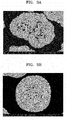
- FIGS. 3A to 3E are SEM images of the Ni-based active materials respectively prepared according to Example 1, Example 2, Comparative Example 1, Comparative Example 2, and Comparative Example 3.
- Ni-based active materials prepared according to Examples 1 and 2 had outer portions denser than inner portions.
- the Ni-based active materials prepared according to Comparative Examples 1 and 2 exhibited almost the same density in inner portions and outer portions and had almost no pores in comparison with those of Examples 1 and 2.
- the Ni-based active material prepared according to Comparative Example 3 includes a dense inner portion and a porous outer portion.
- Porosity and pore size were measured in inner portions and outer portions of the Ni-based active material particles prepared according to Examples 1 and 2 and Comparative Examples 1 and 3.
- the porosity and the pore size were evaluated by using SEM images of cross-sections of the active materials.
- a Magellan 400L (FEI company) was used as the scanning electron microscope.
- Cross-sections of samples were pretreated by milling at 6 kV and 150 ⁇ A for 4 hours by using a CP2 manufactured by JEOL.
- the SEM image analysis was performed at 350 V.
- Table 1 Porosity of inner portion (%) Porosity of outer portion (%) Pore size of inner portion (nm) Pore size of outer portion (nm)
- the inner portion had irregular closed pores distributed therein and the outer portion had less pores and a denser structure than the inner portion in the Ni-based active material prepared according to Example 1 in comparison with the Ni-based active material prepared according to Comparative Example 2. On the contrary, it was confirmed that in the Ni-based active material of Comparative Example 3, the inner portion had a lower porosity and pores were mainly distributed in the outer portion of the particles.
- SEM image analysis was performed on the secondary particles of the Ni-based active material prepared according to Example 1. Cross-sections of samples were pretreated by milling at 6 kV and 150 ⁇ A for 4 hours by using a CP2 manufactured by JEOL. The SEM image analysis was performed at 350 V.
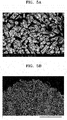
- FIG. 5A is an SEM analysis image of a surface of a secondary particle of a Ni-based active material.
- FIG. 5B is an SEM analysis image of a cross-section thereof.
- most of primary particles of the Ni-based active material in plate shapes are radially arranged and some of the plate particles are not radially arranged as shown in a circle.
- an amount of the plate particles that are not radially arranged is about 3% by weight based on 100 parts by weight of a total weight of the radial plate particles and non-radial plate particles.
- non-radial plate particles refer to plate particles which are not radially arranged.
- Net densities of the Ni-based active materials prepared according to Examples 1 and 2 and Comparative Examples 1 to 3 were evaluated by using a gas pycnometer.
- the inner portions of the Ni-based active materials of Examples 1 and 2 had closed pores and the net densities thereof were less than 4.7 g/cc in comparison with the Ni-based active materials of Comparative Examples 1 and 2 which do not include pores.
- the Ni-based active material of Comparative Example 3 had pores, the pores are open pores. In this case, if the open pores were present in the outer portion, the effect of the open pores on the net density was negligible.
- the coin cells manufactured according to Manufacture Example 1 and Comparative Manufacture Examples 1 to 3 were charged and discharged once at 0.1 C for formation. After formation, the coin cells were charged and discharged once at 0.2 C to confirm initial charging and discharging characteristics and charged and discharged 50 times at 45°C at 1 C to observe charging and discharging characteristics. Charging was set to be initiated at a constant current (CC) mode, changed into a constant voltage (CV) mode, and cut off at 4.3 V and 0.05 C. Discharging was set to be initiated at the CC mode and cut off at 3.0 V.
- CC constant current
- CV constant voltage
- Discharging was set to be initiated at the CC mode and cut off at 3.0 V.
- FIGS. 4A to 4C are SEM images of cross-sections of the positive electrodes of coin cells manufactured according to Manufacture Example 1 and Comparative Manufacture Examples 1 and 2, respectively.
- occurrence of cracks may be suppressed during charging and discharging and the outer portion is densified so that side reactions with the electrolytic solution are suppressed at high temperature. Therefore, a lithium secondary battery having improved lifespan characteristics may be manufactured.
Landscapes
- Chemical & Material Sciences (AREA)
- Chemical Kinetics & Catalysis (AREA)
- Electrochemistry (AREA)
- General Chemical & Material Sciences (AREA)
- Inorganic Chemistry (AREA)
- Organic Chemistry (AREA)
- Engineering & Computer Science (AREA)
- Materials Engineering (AREA)
- Manufacturing & Machinery (AREA)
- Life Sciences & Earth Sciences (AREA)
- General Life Sciences & Earth Sciences (AREA)
- Geology (AREA)
- Battery Electrode And Active Subsutance (AREA)
- Secondary Cells (AREA)
Abstract
Description
- One or more embodiments relate to a nickel (Ni)-based active material for a lithium secondary battery, a method of preparing the same, and a lithium secondary battery including a positive electrode having the Ni-based active material.
- With the development of portable electronic devices and communication devices, there is an increasing need to develop lithium secondary batteries having high energy density.
- Lithium nickel manganese cobalt composite oxide, lithium cobalt oxide, and the like have been widely used as positive active materials of lithium secondary batteries. However, when these positive active materials are used, cracks may occur in primary particle units as a result of repeated charging and discharging so that a lithium secondary battery may have a short long-term lifespan, a high resistance, and an unsatisfactory capacity.
- One or more embodiments include a nickel (Ni)-based active material for a lithium secondary battery in which occurrence of cracks is suppressed by reducing a stress by a volume change during charging and discharging.
- One or more embodiments include a method of preparing the Ni-based active material.
- One or more embodiments include a lithium secondary battery having a long lifespan by including a positive electrode including the Ni-based active material.
- Additional aspects will be set forth in part in the description which follows and, in part, will be apparent from the description, or may be learned by practice of the presented embodiments.
- According to one or more embodiments, a Ni-based active material for a lithium secondary battery includes a porous inner portion having closed pores and an outer portion, wherein the porous inner portion has a density less than that of the outer portion, and the nickel-based active material has a net density of 4.7 g/cc or less.
- According to one or more embodiments, a method of preparing a Ni-based active material for a lithium secondary battery includes preparing the nickel-based active material of claim 1 by subjecting a mixture of a lithium precursor and a metal hydroxide to a primary heat treatment under an oxidizing gas atmosphere at 600 to 800°C.
- The method may further include pretreating the mixture of the lithium precursor and the metal hydroxide under an oxidizing gas atmosphere at 400 to 700°C for 1 to 3 hours before the primary heat treatment.
- According to one or more embodiments, a lithium secondary battery includes a positive electrode including the Ni-based active material for a lithium secondary battery.
- At least some of the above and other features of the present invention are set out in the claims.
- These and/or other aspects will become apparent and more readily appreciated from the following description of the embodiments, taken in conjunction with the accompanying drawings in which:
-
FIG. 1A is a schematic diagram illustrating shapes of a plate particle; -
FIG. 1B is a diagram for describing the definition of radial direction in a secondary particle of a Ni-based active material according to an embodiment; -
FIG. 2 is a cross-sectional view illustrating a structure of a lithium secondary battery according to an embodiment; -
FIGS. 3A to 3E are scanning electron microscopy (SEM) images of Ni-based active materials prepared according to Example 1, Example 2, Comparative Example 1, Comparative Example 2, and Comparative Example 3, respectively; -
FIGS. 4A to 4C are SEM images of cross-sections of positive electrodes of coin cells prepared according to Manufacture Example 1 and Comparative Manufacture Examples 1 and 2, respectively; -
FIG. 5A is an SEM analysis image illustrating lengths of primary particles of a Ni-based active material having plate shapes in a plane direction and a thickness direction on a surface of a secondary particle according to Example 1; and -
FIG. 5B is an SEM analysis image illustrating lengths of primary particles of a Ni-based active material having plate shapes in a plane direction and a thickness direction on a cross-section of a secondary particle according to Example 1. - Reference will now be made in detail to embodiments, examples of which are illustrated in the accompanying drawings, wherein like reference numerals refer to like elements throughout. In this regard, the present embodiments may have different forms and should not be construed as being limited to the descriptions set forth herein. Accordingly, the embodiments are merely described below, by referring to the figures, to explain aspects of the present description. As used herein, the term "and/or" includes any and all combinations of one or more of the associated listed items. Expressions such as "at least one of," when preceding a list of elements, modify the entire list of elements and do not modify the individual elements of the list.
- Hereinafter, a nickel (Ni)-based active material for a lithium secondary battery, a method of preparing the same, and a lithium secondary battery including a positive electrode having the Ni-based active material will be described in detail with reference to the accompanying drawings.
- A Ni-based active material for a lithium secondary battery according to an embodiment includes a porous inner portion having closed pores and an outer portion. The porous inner portion has a density less than that of the outer portion and the Ni-based active material has a net density of 4.7 g/cc or less. When the net density of the Ni-based active material is greater than 4.7 g/cc, volume expansion stress may increase during charging and discharging due to small empty spaces in particles and accumulation of the volume expansion stress due to repeated charging and discharging may cause particle cracks, resulting in deterioration of lifespan characteristics. In this case, since pores included in the Ni-based active material are open pores, a contact surface area between the Ni-based active material and an electrolytic solution increases, resulting in deterioration of lifespan characteristics of a lithium secondary battery including the same.
- The Ni-based active material according to an embodiment has a net density of 4.5 to 4.67 g/cc (e.g. 4.50 to 4.67 g/cc).
- Since the Ni-based active material according to an embodiment includes closed pores, occurrence of cracks caused by volume expansion during charging and discharging may be suppressed. The closed pores are independent pores having a structure in which all of the pore walls are closed with no contact with the electrolytic solution and surfaces of secondary particles. These closed pores may buffer a volume change occurring during charging and discharging without increasing the contact area between the Ni-based active material and the electrolytic solution.
- Throughout the specification, the term "net density" refers to an intrinsic density of an electrode active material, and more particularly, to a density of only a portion completely filled with a substance except for gaps between particles. The net density is measured as a value equal to a solid density (theoretical density) in the absence of closed pores. However, in the case of a Ni-based active material having closed pores, the density decreases due to empty spaces formed therein. Thus, the density of the Ni-based active material is a density of a solid having closed pores. Open pores, which are not closed pores, connected to surfaces are not reflected in the net density. A density calculated by dividing a weight by a volume may vary according to a method of measuring the volume and the net density is calculated by measuring a volume excluding the open pores (solid + closed pores).
- The net density is measured using the Archimedes principle or by a gas pycnometer.
- The Ni-based active material according to an embodiment has a net density of 4.50 to 4.7 g/cc, for example, 4.5165 to 4.6657 g/cc.
- Throughout the specification, the "inner portion" and "outer portion" of the active material are defined as follows.
- According to an embodiment, the terms "inner portion" and "outer portion" refer to an inner region and an outer region when the active material is divided at the same rate in all directions from the center to the surface of an active material, respectively. For example, the inner portion refers to a region corresponding to 10 to 90% by volume, for example, 50% by volume from the center, based on a total volume of the active material, and the outer portion refers to the remaining region.
- According to another embodiment, the term "outer portion" refers to a region corresponding to 30 to 50% by volume, for example, 40% by volume, from the outermost surface based on a total volume of the Ni-based active material from the center to the outermost surface thereof or a region within 2 µm from the outermost periphery based on a total distance from the center to the surface of the Ni-based active material. The term "inner portion" refers to a region of 50 to 70% by volume, for example, 60% by volume, from the center based on the total volume of the Ni-based active material or the remaining region except for the region within 2 µm from the outermost periphery based on the total distance from the center to the surface of the Ni-based active material.
- In the inner portion of the Ni-based active material according to an embodiment, pore sizes of the closed pores are in the range of 150 nm to 1 µm and a porosity is in the range of 3 to 30%. For example, the porosity is in the range of 6 to 30%, 10 to 30%, 15 to 30% or 20 to 30%. The porosity of the inner portion is about 1.2 times or more, for example, twice or more, greater than that of the outer portion.
- The pore size and porosity of the inner portion are greater and more irregular than those of the outer portion.
- For example, the outer portion of the Ni-based active material has a porosity of 0.1 to 2.5% (e.g. 0.1 to 2%). The porosities of the inner portion and the outer portion used herein refer to porosities of closed pores included in the inner portion and the outer portion.
- When the porosities of the inner portion and the outer portion of the Ni-based active material satisfy the aforementioned ranges, the outer portion becomes more densified than the inner portion, so that side reactions with an electrolytic solution at a high temperature may be efficiently suppressed.
- The pore sizes of the inner portion may be in the range of 150 nm to 1 µm, for example, 200 to 500 nm, and the pore sizes of the outer portion may be less than 150 nm, for example, 100 nm or less, for example, in the range of 20 to 90 nm. Since the pore sizes of the inner portion are greater than those of the outer portion as described above, a lithium diffusion distance is shortened in secondary particles of the same size and the pores buffer a volume change occurring during charging and discharging without being exposed to the electrolytic solution. The term "pore size" refers to an average diameter of pores or a width of an opening of a pore when the pore has a spherical or circular shape. When the pore has an oval shape, the pore size refers to a length of a major axis.
- The Ni-based active material includes plate particles whose major axes are radially arranged. In this case, a surface through which lithium may enter and exit (surface perpendicular to (001) crystal plane) is exposed on the surface of the secondary particle. The outer portion of the Ni-based active material has exposed pores directed toward the inner portion from the surface and the inner portion has an irregular porous structure. The pores exposed on the surface are exposed pores through which the electrolytic solution pass. An "irregular porous structure" refers to a structure having pores having non-uniform and irregular pore sizes and pore shapes. The outer portion plate particles include plate particles, and the plate particles may be radially arranged in the outer portion. The inner portion having the irregular porous structure includes plate particles in the same manner as in the outer portion. The plate particles are arranged irregularly in the inner portion unlike in the outer portion.
- The Ni-based active material according to an embodiment includes plate particles whose major axes are radially arranged.
-
FIG. 1A is a schematic diagram illustrating shapes of the plate particle. - Referring to
FIG. 1 , the plate particle may have a polygonal nano plate shape as shown in (A), a nano disc shape as shown in (B), or a rectangular parallelepiped shape as shown in (C). - In
FIG. 1A , a thickness t of the plate particle is smaller than lengths a and/or b in the plane direction. The length a in the plane direction may be longer than or equal to the length b. A direction in which the thickness t is defined in the plate particle is referred to as a thickness direction and a direction in which the lengths a and b are arranged is referred to as a plane direction (lengthwise direction). - As used herein, "radially" indicates that a particle is arranged such that the thickness direction t (001 direction) of the plate particle is perpendicular to a direction R toward the center of a secondary particle or aligned to be 85° to 95° a with respect to direction R heading to the center of the secondary particle as shown in
FIG. 1B . - An average thickness of plate particles constituting the outer portion and the inner portion is in the range of 100 to 200 nm, for example, 120 to 180 nm, particularly 130 to 150 nm, and an average length thereof is in the range of 150 to 500 nm, for example, 200 to 380 nm, particularly 290 to 360 nm. The average length refers to a mean value of an average length of the major axis of the plate particle and an average length of the minor axis of the plate particle in the plane direction.
- A ratio of the average thickness to the average length is from 1:2 to 1:10, for example, 1:2 to 1:5, 1:2.0 to 1:5, particularly 1:2.3 to 1:2.9. The average length, the average thickness, and the ratio of the average thickness to the average length of the plate particles may be determined using SEM. When the ratio of the average thickness to the average length of the plate particles is within the aforementioned ranges, the sizes of the plate particles are small, and primary particles are radially arranged in the outer portion, a number of paths for diffusion of lithium are formed in a relatively large number of boundaries between particles on regions close to the surface and a large number of crystal surfaces enabling lithium transfer of the outer portion are exposed. Thus, the degree of diffusion of lithium increases, thereby increasing initial efficiency and capacity. In addition, when the plate-like primary particles are radially arranged, pores exposed on the surface also face the center, thereby facilitating diffusion of lithium from the surface. Since the radially arranged primary particles uniformly shrink and expand during intercalation and deintercalation of lithium, pores arranged in the (001) direction, which is a direction where particles expand during deintercalation of lithium, serve as a buffer, and the plate-like primary particles are small in size, the possibility of occurrence of cracks decreases during shrinkage and expansion. In addition, since the pores of the inner portion further decreases a volume change, cracks occurring in the primary particles during charging and discharging decrease, thereby improving lifespan characteristics and reducing resistance.
- Closed pores and/or open pores may be present in the outer portion of the Ni-based active material. While it is difficult for an electrolyte, or the like, to be contained in the inner portion of the Ni-based active material due to the closed pores, the outer portion may contain the electrolyte, or the like, in the case when the outer portion of the Ni-based active material has open pores.
- The Ni-based active material is an active material represented by Formula 1 below.
Formula 1 Lia(Ni1-x-y-zCoxMnyMz)O2
- In Formula 1, M is an element selected from boron (B), magnesium (Mg), calcium (Ca), strontium (Sr), barium (Ba), titanium (Ti), vanadium (V), chromium (Cr), iron (Fe), copper (Cu), zirconium (Zr), and aluminium (Al), 0.95≤a≤1.3, x≤(1-x-y-z), y≤(1-x-y-z), z≤(1-x-y-z), 0<x<1, 0≤y<1, and 0≤z<1. In the Ni-based active material of Formula 1, the content of nickel is greater than that of cobalt and greater than that of manganese.
- In an embodiment, in Formula 1, 0.95≤a≤1.3, 0<x≤0.3, 0≤y≤0.5, 0≤z≤0.05, and 0.5≤(1-x-y-z)≤0.95. In an embodiment, in Formula 1, 1.0≤a≤1.3, 0<x≤1/3, 0≤y≤0.5, 0≤z≤0.05, and 1/3≤(1-x-y-z)≤0.95.
- For example, a is from 1 to 1.1, x is from 0.1 to 0.3, and y is from 0.05 to 0.3 in Formula 1.
- According to an embodiment, z is 0 in Formula 1.
- According to another embodiment, when 0<z≤0.05 in Formula 1, M may be aluminium.
- In the Ni-based active material, the content of nickel is greater than that of each of the other transition metals when a total amount of the transition metals is referred to as 1 mol. When the Ni-based active material having a high Ni content is used, a lithium secondary battery including a positive electrode having the same may have a high degree of diffusion of lithium, high conductivity, and higher capacity at the same voltage, lifespan characteristics may deteriorate due to occurrence of cracks as described above.
- The Ni-based active material may be LiNi0.6Co0.2Mn0.2O2, LiNi0.5Co0.2Mn0.3O2, LiNi1/3Co1/3Mn1/3O2, LiNi0.8Co0.1Mn0.1O2, or LiNi0.85Co0.1Al0.05O2.
- The Ni-based active material may have an overall porosity of 1 to 8%, for example, 1.5 to 7.3%. The outer portion of the Ni-based active material has a lower porosity than that of the inner portion. The outer portion has a closed porosity of 0.1 to 2.5%, for example, 0.1 to 2% (e.g. 0.1 to 2.0%) and the inner portion has a closed porosity of 3 to 30% (e.g. 6 to 30%, 10 to 30%, 15 to 30% or 20 to 30%). The term "closed porosity" refers to a fraction of closed pores (pores that the electrolytic solution cannot penetrate) with respect to a total volume of pores.
- Since the Ni-based active material according to an embodiment includes radial plate particles, diffusion of lithium increases and stress caused by a volume change during charging and discharging lithium is suppressed, thereby inhibiting occurrence of cracks. In addition, formation of surface resistant layers is reduced during a manufacturing process and lithium is diffused in more directions on the surface, and thus an active surface area required for diffusion of lithium increases.
- Hereinafter, a method of preparing a Ni-based active material according to an embodiment will be described.
- The Ni-based active material may be prepared by mixing a lithium precursor and a metal hydroxide at a predetermined molar ratio and subjecting the mixture to a primary heat treatment at 600 to 800°C. The Ni-based active material may have desired net density and density by performing a pretreatment process under an oxidizing gas atmosphere at 400 to 700°C for 1 to 3 hours before performing the primary heat treatment. For example, the pretreatment process may be performed at 650°C for 2 hours.
- The metal hydroxide may be a compound represented by Formula 2 below.
Formula 2 (Ni1-x-y-zCoxMnyMz)(OH)2
- In Formula 2, M is an element selected from boron (B), magnesium (Mg), calcium (Ca), strontium (Sr), barium (Ba), titanium (Ti), vanadium (V), chromium (Cr), iron (Fe), copper (Cu), zirconium (Zr), and aluminium, x≤(1-x-y-z), y≤(1-x-y-z), z≤(1-x-y-z), 0<x<1, 0≤y<1, and 0≤z<1.
- In Formula 2, 0<x≤0.3, 0≤y≤0.5, 0≤z≤0.05, and 0.5≤(1-x-y-z)≤0.95.
- The metal hydroxide of Formula 2 may be Ni0.6Co0.2Mn0.2(OH)2, Ni0.5Co0.2Mn0.3(OH)2, Ni1/3Co1/3Mn1/3(OH)2, or Ni0.8Co0.1Mn0.1(OH)2 or Ni0.85Co0.1Al0.05(OH)2.
- The lithium precursor may be, for example, lithium hydroxide, lithium fluoride, lithium carbonate, or any mixture thereof. A mixing ratio of the lithium precursor and the metal hydroxide is stoichiometrically adjusted to prepare the active material of Formula 1.
- The mixing may be dry mixing or performed using a mixer or the like.
- The primary heat treatment is performed under an oxidizing gas atmosphere. The oxidizing gas atmosphere is prepared by using oxidizing gases such as oxygen or air. For example, the oxidizing gas includes 10 to 20% by volume of oxygen or air and 80 to 90% by volume of an inert gas.
- The primary heat treatment may be carried out at a temperature of a densification temperature or lower as reactions between the lithium precursor and the metal hydroxide progress. Here, the densification temperature refers to a temperature at which crystallization may be sufficiently achieved so that the active material may realize a charging capacity.
- The primary heat treatment may be carried out, for example, at 600 to 800°C, particularly, at 700 to 800°C. The heat treatment may be carried out, for example, for 3 to 10 hours but may vary depending on a temperature for the primary heat treatment.
- When the heat treatment is performed under the aforementioned conditions, a Ni-based active material including an outer portion having a radially arranged structure and an inner portion having an irregular porous structure may be prepared. Particles of the Ni-based active material may have an average thickness of 100 to 250 nm. Due to the average thickness in this range, stress caused by the volume change during charging and discharging may be suppressed.
- The Ni-based active material particles may be subjected to a secondary heat treatment in an oxidizing gas atmosphere. During the secondary heat treatment in the preparation of the Ni-based active material particles, the inner oxidizing atmosphere of the reactor is maintained as much as possible to inhibit formation of resistant layers and densify the particles.
- The secondary heat treatment is performed at a higher temperature, for example, at 700 to 900°C, than the primary heat treatment. The secondary heat treatment may be carried out, for example, for 3 to 10 hours but may vary depending on a temperature for the secondary heat treatment. Secondary particles of the Ni-based active material have an average particle diameter of 2 to 18 µm, for example, 3 to 15 µm, 3 µm to 12 µm or 8 µm to 10 µm. The average particle diameter denotes D50. The average particle diameter may be measured by particle size analyzer (USA).
- A compound including at least one selected from titanium, zirconium, magnesium, barium, boron, and aluminium may further be added to the secondary heat treatment of the Ni-based active material particles.
- Examples of the compound including at least one selected from titanium, zirconium, magnesium, barium, boron, and aluminium may include titanium oxide, zirconium oxide, magnesium oxide, barium carbonate, boric acid, and aluminium oxide.
- The content of the compound including at least one selected from titanium, zirconium, magnesium, barium, boron, and aluminium may be from 0.0001 to 10 parts by weight , for example, 0.0001 to 1 parts by weight, for example, 0.0005 to 0.01 parts by weight based on 100 parts by weight of the secondary particles of the Ni-based active material.
- The existence and distribution of at least one of the oxides of titanium, zirconium, magnesium, barium, boron, and aluminium may be identified by Electron Probe MicroAnalysis (EPMA).
- Since a diffusion rate of lithium decreases in the active material at the end of discharging and resistance to infiltration of lithium into the inner portion of the secondary particles of the Ni-based active material increases when the size of the secondary particles of the Ni-based active material is large, a discharge capacity relative to a charge capacity may decrease, thereby reducing the charging/discharging efficiency. However, in the secondary particle of the Ni-based active material according to an embodiment, a diffusion distance to the inner portion decreases due to the porous structure of the inner portion and lithium may be easily inserted into the surface due to the radial arrangement of the outer portion toward the surface. In addition, since the primary particles of the Ni-based active material are small in size, lithium transfer paths may be easily secured between crystal grains. Also, the small sizes of the primary particles and pores between the primary particles alleviate the volume change occurring during charging and discharging, thereby reducing the stress caused by the volume change during charging and discharging.
- After the Ni-based positive active material according to an embodiment is cut in a cross section, the volume ratio and the area ratio between the inner portion and the outer portion are observed. When the inner portion is defined as a region within about 60% from the center, the inner portion may be 20 to 35% by volume, for example, about 22%, based on a total volume of the Ni-based active material.
- A C-plane of the primary particle of the Ni-based active material according to an embodiment is arranged in a radial direction.
- A method of preparing a metal hydroxide having a porous plate particle shape according to an embodiment will be described.
- Although the method of preparing the metal hydroxide is not particularly limited, for example, a coprecipitation method, a solid phase method, or the like may be used. Hereinafter, a method of preparing a compound represented by Formula 2 as an example of the metal hydroxide by a coprecipitation method will be described.
- A nickel precursor, a cobalt precursor, a manganese precursor, and a metal M precursor, as raw materials of the Ni-based active material, are mixed with a solvent to prepare a precursor mixture.
- Amounts of the nickel precursor, the cobalt precursor, the manganese precursor, and the metal (M) precursor are stoichiometrically adjusted to prepare the compound of Formula 2 above.
- The solvent may be water, ethanol, propanol, butanol, and the like. An amount of the solvent may be in the range of 100 to 2000 parts by weight based on 100 parts by weight of a total weight of the nickel precursor, the cobalt precursor, the manganese precursor, and the metal precursor.
- A complexing agent and a pH adjusting agent are added to the precursor mixture to adjust the pH of the mixture and to obtain a precipitate by a coprecipitation reaction. The pH of the mixture is adjusted, for example, to 11 to 13. The obtained precipitate is filtered and heat-treated. The heat treatment is carried out at 20 to 160°C to dry a product.
- The complexing agent serves to control a rate of formation of the precipitate in the coprecipitation reaction and may be ammonium hydroxide (NH4OH) or citric acid. The complexing agent is used in an amount commonly used in the art.
- The pH adjusting agent serves to adjust the pH of a reaction mixture to 6 to 12, and may be ammonium hydroxide, sodium hydroxide (NaOH), sodium carbonate (Na2CO3), or sodium oxalate (Na2C2O4).
- For example, the nickel precursor may be nickel sulfate, nickel chloride, or nickel nitrate. For example, the cobalt precursor may be cobalt sulfate, cobalt chloride, or cobalt nitrate. For example, the manganese precursor may be manganese sulfate, manganese nitrate, and manganese chloride. For example, the metal M precursor may be metal carbonate, metal sulfate, metal nitrate, and metal chloride.
- Hereinafter, a method of manufacturing a lithium secondary battery including a positive electrode having the Ni-based active material according to an embodiment, a negative electrode, a lithium salt-containing non-aqueous electrolyte, and a separator will be described.
- The positive electrode and the negative electrode are prepared by applying a positive active material layer forming composition and a negative active material layer forming composition to a current collector, respectively and drying the compositions.
- The positive active material layer forming composition is prepared by mixing a positive active material, a conductive agent, a binder, and a solvent. The positive active material according to an embodiment is used as the positive active material.
- The binder assists binding of the active material to the conductive agent and to the current collector and is added to the composition in an amount of 1 to 50 parts by weight based on 100 parts by weight of a total weight of the positive active material. Examples of the binder include polyvinylidene fluoride, polyvinyl alcohol, carboxymethyl cellulose (CMC), starch, hydroxypropyl cellulose, regenerated cellulose, polyvinyl pyrrolidone, tetrafluoro ethylene, polyethylene, polypropylene, ethylene-propylene-diene terpolymer (EPDM), sulfonated EPDM, styrene butadiene rubber, a fluoride rubber, and various copolymers, without being limited thereto. The amount of the binder may be in the range of 2 to 5 parts by weight based on 100 parts by weight of the total weight of the positive active material. When the amount of the binder is within this range, a sufficient binding force of the active material layer to the current collector may be obtained.
- The conductive agent may be any conductive agent that is commonly used in the art and does not cause any chemical change in the fabricated battery. For example, the conductive agent may be graphite such as natural graphite and artificial graphite; a carbonaceous material such as carbon black, acetylene black, Ketjen black, channel black, furnace black, lamp black, and thermal black; conductive fiber such as carbon fiber and metal fiber; metal powder such as aluminium powder, and nickel powder; carbon fluoride powder; conductive whisker such as zinc oxide and potassium titanate; conductive metal oxide such as titanium oxide; and conductive materials such as polyphenylene derivatives.
- An amount of the conductive agent may be in the range of 2 to 5 parts by weight based on 100 parts by weight of the total weight of the positive active material. When the amount of the conductive agent is within the range described above, an electrode obtained therefrom has high conductivity.
- The solvent may be N-methylpyrrolidone (NMP), without being limited thereto.
- An amount of the solvent may be in the range of 1 to 10 parts by weight based on 100 parts by weight of the total weight of the positive active material. When the amount of the solvent is within the range described above, a process of forming the positive active material layer is facilitated.
- The positive current collector may have a thickness of about 3 to about 500 µm and may be any current collector that does not cause any chemical change in a fabricated battery and has high conductivity. Examples of the positive current collector include stainless steel, aluminium, nickel, titanium, or calcined carbon or aluminium or stainless steel surface-treated with carbon, nickel, titanium or silver. The positive current collector may be processed to have fine irregularities on the surface thereof so as to enhance adhesiveness of the positive current collector to the positive active material, and may be used in any of various forms including films, sheets, foils, nets, porous structures, foams, and non-woven fabrics.
- Separately, the negative active material forming composition is prepared by mixing a negative active material, a binder, a conductive agent, and a solvent.
- A material allowing intercalation and deintercalation of lithium ions is used as the negative active material. Examples of the negative active material include graphite, a carbonaceous material such as carbon, lithium metal, an alloy thereof, and silicon oxide, without being limited thereto. In the present embodiment, silicon oxide is used therefor.
- The binder is added in an amount of 1 to 50 parts by weight based on 100 parts by weight of the total weight of the negative active material. The examples of the binder may be the same as those for the positive electrode.
- The conductive agent is used in an amount of 1 to 5 parts by weight based on 100 parts by weight of the total weight of the negative active material. When the amount of the conductive agent is within the range described above, an electrode obtained therefrom has high conductivity.
- The solvent may be used in an amount of 1 to 10 parts by weight based on 100 parts by weight of the total weight of the negative active material. When the amount of the solvent is within the range described above, a process of forming the negative active material is facilitated.
- The same conductive agent and solvent as for the positive electrode may be used therefor.
- The negative current collector may have a thickness of about 3 to about 500 µm and may be any current collector that does not cause any chemical change in a fabricated battery and has conductivity. Examples of the negative current collector include copper, stainless steel, aluminium, nickel, titanium, or calcined carbon, copper or stainless steel surface-treated with carbon, nickel, titanium or silver, or an aluminium-cadmium alloy. The negative current collector may also be processed to have fine irregularities on the surface thereof so as to enhance adhesiveness of the negative current collector to the negative active material in the same manner as the positive current collector, and may be used in any of various forms including films, sheets, foils, nets, porous structures, foams, and non-woven fabrics.
- The separator is disposed between the positive electrode and the negative electrode prepared according to the above-described process.
- The separator may have a pore diameter of 0.01 to 10 µm and a thickness of 5 to 300 µm. Examples of the separator may include: an olefin-based polymer such as polypropylene and polyethylene; or a sheet or non-woven fabric formed of glass fiber. When a solid electrolyte such as a polymer is used as the electrolyte, the solid electrolyte may also serve as the separator.
- The lithium salt-containing non-aqueous electrolyte includes a non-aqueous electrolytic solution and a lithium salt. The non-aqueous electrolytic solution may be a non-aqueous electrolyte, an organic solid electrolyte, an inorganic solid electrolyte, or the like.
- Examples of the non-aqueous electrolyte include any aprotic organic solvent such as N-methyl-2-pyrrolidone, propylene carbonate, ethylene carbonate, butylene carbonate, dimethyl carbonate, diethyl carbonate, gamma-butyro lactone, 1,2-dimethoxy ethane, 2-methyl tetrahydrofuran, dimethylsulfoxide, 1,3-dioxolane, formamide, N,N-dimethylformamide, dioxolane, acetonitrile, nitromethane, methyl formate, methyl acetate, phosphoric acid triester, trimethoxy methane, dioxolane derivatives, sulfolane, methyl sulfolane, 1,3-dimethyl-2-imidazolidinone, propylene carbonate derivatives, tetrahydrofuran derivatives, ether, methyl propionate, and ethyl propionate, without being limited thereto.
- Examples of the organic solid electrolyte include polyethylene derivatives, polyethylene oxide derivatives, polypropylene oxide derivatives, polyvinyl alcohol, and polyvinylidene fluoride, without being limited thereto.
- Examples of the inorganic solid electrolyte include Li3N, Lil, Li5Nl2, Li3N-Lil-LiOH, Li2SiS3, Li4SiO4, Li4SiO4-Lil-LiOH, and Li3PO4-Li2S-SiS2, without being limited thereto.
- The lithium salt is a material that is readily soluble in the non-aqueous electrolyte, and examples of the lithium salt include LiCI, LiBr, Lil, LiClO4, LiBF4, LiB10Cl10, LiPF6, LiCF3SO3, LiCF3CO2, LiAsF6, LiSbF6, LiAlCl4, CH3SO3Li, CF3SO3Li, (CF3SO2)2NLi, (FSO2)2NLi, lithium chloroborate, lower aliphatic lithium carboxylate, lithium tetraphenyl borate, without being limited thereto.
-
FIG. 2 is a cross-sectional view illustrating a structure of a lithium secondary battery according to an embodiment. - Referring to
FIG. 2 , a lithiumsecondary battery 21 includes apositive electrode 23, anegative electrode 22, and aseparator 24. Thepositive electrode 23, thenegative electrode 22, and theseparator 24 are wound or folded into abattery case 25. Then, an organic electrolytic solution is injected into thebattery 25, and thebattery case 25 is sealed by acap assembly 26, thereby completing the manufacture of the lithiumsecondary battery 21. Thebattery case 25 may have a cylindrical shape, a rectangular shape, or a thin-film shape. For example, the lithiumsecondary battery 21 may be a large-sized thin film battery. The lithium secondary battery may be a lithium ion secondary battery. The separator may be interposed between the positive electrode and the negative electrode to form a battery assembly. When the battery assembly is stacked in a bi-cell structure and impregnated with the organic electrolytic solution and the resultant is inserted into a pouch and sealed, the manufacture of a lithium ion polymer battery is completed. Also, a plurality of battery assemblies may be stacked to form a battery pack, which may be used in various devices that require high capacity and high output, for example, in notebook computers, smart phone, and electric vehicles. - In addition, the lithium secondary battery may be suitable for use as a power source of electric vehicles (EVs) due to high storage stability at high temperature, excellent lifespan characteristics, and high rate properties. For example, the lithium secondary battery may be used in hybrid vehicles such as plug-in hybrid electric vehicle (PHEVs).
- Hereinafter, one or more example embodiments will be described in detail with reference to the following examples and comparative examples. However, these examples are not intended to limit the purpose and scope of the one or more example embodiments.
- A composite metal hydroxide (Ni0.6Co0.2Mn0.2(OH)2) as radial and porous plate particles was obtained according to a coprecipitation method which will be described later.
- Ammonia water was added to a reactor and the pH of a mixture was adjusted by using sodium hydroxide added thereto while stoichiometrically adjusting raw materials of a Ni-based active material to obtain a desired product. Next, the mixture was maintained while stirring until a desired particle size was obtained, adding of the raw materials was stopped, and the resultant was dried to obtain a product. This preparation process will be described in more detail.
- As raw materials of the Ni-based active material, nickel sulfate (NiSO4·6H2O), cobalt sulfate (CoSO4·7H2O), and manganese sulfate (MnSO4·H2O) were dissolved in distilled water, as a solvent, at a molar ratio of 6:2:2 to prepare a mixed solution. A diluent of ammonium hydroxide (NH4OH) and sodium hydroxide, as a precipitating agent, were prepared for formation of a complex. Next, the mixed solution of metal raw materials, ammonium hydroxide, and sodium hydroxide were continuously added into a reactor. Sodium hydroxide was added thereto by using a pH controller to maintain the pH inside the reactor. The reactor was maintained for about 20 hours while stirring, and then the introduction of the raw materials was stopped.
- The slurry solution in the reactor was filtered and washed with high purity distilled water and dried in a hot air oven for 24 hours to obtain powder of a composite metal hydroxide (Ni0.6Co0.2Mn0.2(OH)2).
- A composite metal hydroxide (Ni0.5Co0.2Mn0.3(OH)2) was obtained in the same manner as in Preparation Example 1, except that the amounts of the nickel sulfate, cobalt sulfate, and manganese sulfate were changed so as to obtain the composite metal hydroxide (Ni0.5Co0.2Mn0.3(OH)2) and the mixture was maintained for 25 hours.
- A radial, porous composite metal hydroxide (Ni0.8Co0.1Mn0.1(OH)2) was obtained in the same manner as in Preparation Example 1, except that the amounts of the nickel sulfate, cobalt sulfate, and manganese sulfate were changed so as to obtain the porous composite metal hydroxide (Ni0.8Co0.1Mn0.1(OH)2) and the mixture was maintained for 25 hours.
- A radial, porous composite metal hydroxide (Ni0.85Co0.1Al0.05(OH2) was obtained in the same manner as in Preparation Example 1, except that a mixture of nickel sulfate (NiSO4·6H2O), cobalt sulfate (CoSO4·7H2O), and aluminium nitrate (Al(NO3)3·9H2O) were used as raw materials of the negative active material at a molar ratio of 85:10:5 and the mixture was maintained for 18 hours.
- A composite metal hydroxide (Ni1/3Co1/3Mn1/3(OH)2) having a radial and porous plate particle shape was obtained in the same manner as in Preparation Example 1, except that the amounts of nickel sulfate, cobalt sulfate, and manganese sulfate were changed so as to obtain the porous composite metal hydroxide (Ni1/3Co1/3Mn1/3(OH)2) and the mixture was maintained for 28 hours.
- The radial, porous composite metal hydroxide (Ni0.6Co0.2Mn0.2(OH)2) prepared according to Preparation Example 1 and lithium hydroxide (LiOH) were dry mixed at a molar ratio of 1:1 and the mixture was subjected to a pretreatment at 650°C for about 2 hours. Next, an exhaust pipe of a calcination furnace was opened and the mixture was subjected to a primary heat treatment at about 780°C for 8 hours in an atmospheric condition to obtain particles of the Ni-based active material (LiNi0.6Co0.2Mn0.2O2).
- Next, the resultant was subjected to a secondary heat treatment at about 830°C for 6 hours in an oxygen atmosphere to obtain secondary particles of the Ni-based active material (LiNi0.6Co0.2Mn0.2O2). In the Ni-based active material particles obtained as described above, closed pores were observed in an inner portion.
- Ni-based active material particles were obtained in the same manner as in Example 1, except for the primary heat treatment was performed at 750°C for 10 hours and the secondary heat treatment was performed at 850°C for 6 hours.
- A composite metal hydroxide (Ni0.6Co0.2Mn0.2(OH)2) with no pores in an inner portion and not radially arranged and lithium hydroxide (LiOH·H2O) were dry mixed at a molar ratio of 1:1 and the mixture was heat treated at about 870°C for 15 hours under an atmospheric condition. A product obtained after a primary heat treatment was subjected to a secondary heat treatment at about 500°C for 6 hours in an oxidizing (e.g., oxygen) atmosphere to obtain secondary particles of the Ni-based active material (LiNi0.6Co0.2Mn0.2O2).
- A composite metal hydroxide (Ni0.6Co0.2Mn0.2(OH)2) with no pores in an inner portion and not radially arranged and lithium hydroxide (LiOH·H2O) were dry mixed at a molar ratio of 1:1 and the mixture was heat treated at about 890°C for 15 hours under an atmospheric condition to obtain secondary particles of the Ni-based active material (LiNi0.6Co0.2Mn0.2O2).
- A composite metal hydroxide (Ni0.6Co0.2Mn0.2(OH)2) radially arranged and having a dense central portion and a porous outer portion and lithium hydroxide (LiO·H2O) were dry mixed at a molar ratio of 1:1 and the mixture was heat treated at about 800°C for 6 hours under an atmospheric condition to obtain particles of the Ni-based active material (LiNi0.6Co0.2Mn0.2O2). An inner portion of the Ni-based active material particles obtained as described above had closed pores. The outer portion of the Ni-based active material particles had open pores.
- A lithium secondary battery was manufactured as follows by using the secondary particles of the Ni-based active material (LiNi0.6Co0.2Mn0.2O2) prepared according to Example 1 as a positive active material.
- 96 g of the secondary particles of the Ni-based active material (LiNi0.6Co0.2Mn0.2O2) obtained according to Example 1, 2 g of polyvinylidene fluoride, 47 g of N-methyl pyrrolidone as a solvent, and 2 g of carbon black as a conductive agent, were mixed using a mixer to remove air bubbles and prepare a uniformly dispersed positive active material layer forming slurry.
- The slurry prepared according to the process described above was coated on an aluminium foil using a doctor blade to form a thin electrode plate which was dried at 135°C for 3 hours or more, followed by rolling and vacuum drying to prepare a positive electrode.
- A 2032 type coin cell was prepared by using the positive electrode and Li metal as a counter electrode. A separator formed of a porous polyethylene (PE) film having a thickness of about 16 µm was interposed between the positive electrode and the Li metal counter electrode and an electrolytic solution was injected thereinto to prepare the 2032 type coin cell. In this case, the electrolytic solution was prepared by dissolving 1.10 M LiPF6 in a mixed solvent of ethylene carbonate (EC) and ethylmethyl carbonate (EMC) in a volume ratio of 3:5
- A lithium secondary battery was manufactured in the same manner as in Manufacture Example 1, except that the Ni-based active material prepared according to Example 2 was used instead of the Ni-based active material prepared according to Example 1.
- Lithium secondary batteries were manufactured in the same manner as in Manufacture Example 1, except that the Ni-based active materials prepared according to Comparative Examples 1 to 3 were respectively used instead of the Ni-based active material prepared according to Example 1.
- The Ni-based active material particles prepared according to Examples 1 and 2 and Comparative Examples 1 to 3 were analyzed using a scanning electron microscope. A Magellan 400L (FEI company) was used as the scanning electron microscope. Cross-sections of samples were pretreated by milling at 6 kV and 150 µA for 4 hours by using a CP2 manufactured by JEOL. The SEM image analysis was performed at 350 V.
- The results of SEM image analysis are shown in
FIGS. 3A to 3E. FIGS. 3A to 3E are SEM images of the Ni-based active materials respectively prepared according to Example 1, Example 2, Comparative Example 1, Comparative Example 2, and Comparative Example 3. - Based on the analysis results, it was confirmed that the Ni-based active materials prepared according to Examples 1 and 2 had outer portions denser than inner portions.
- On the contrary, the Ni-based active materials prepared according to Comparative Examples 1 and 2 exhibited almost the same density in inner portions and outer portions and had almost no pores in comparison with those of Examples 1 and 2. In addition, it was confirmed that the Ni-based active material prepared according to Comparative Example 3 includes a dense inner portion and a porous outer portion.
- Porosity and pore size were measured in inner portions and outer portions of the Ni-based active material particles prepared according to Examples 1 and 2 and Comparative Examples 1 and 3. Here, the porosity and the pore size were evaluated by using SEM images of cross-sections of the active materials. A Magellan 400L (FEI company) was used as the scanning electron microscope. Cross-sections of samples were pretreated by milling at 6 kV and 150 µA for 4 hours by using a CP2 manufactured by JEOL. The SEM image analysis was performed at 350 V.
- The analysis results are shown in Table 1 below.
Table 1 Porosity of inner portion (%) Porosity of outer portion (%) Pore size of inner portion (nm) Pore size of outer portion (nm) Example 1 30 2 500 30 Comparative Example 1 2 2 30 30 Comparative Example 3 2 20 30 30 - Referring to Table 1, it was confirmed that the inner portion had irregular closed pores distributed therein and the outer portion had less pores and a denser structure than the inner portion in the Ni-based active material prepared according to Example 1 in comparison with the Ni-based active material prepared according to Comparative Example 2. On the contrary, it was confirmed that in the Ni-based active material of Comparative Example 3, the inner portion had a lower porosity and pores were mainly distributed in the outer portion of the particles.
- In addition, SEM image analysis was performed on the secondary particles of the Ni-based active material prepared according to Example 1. Cross-sections of samples were pretreated by milling at 6 kV and 150 µA for 4 hours by using a CP2 manufactured by JEOL. The SEM image analysis was performed at 350 V.
-
FIG. 5A is an SEM analysis image of a surface of a secondary particle of a Ni-based active material.FIG. 5B is an SEM analysis image of a cross-section thereof. - Referring to
FIGS. 5A and 5B , most of primary particles of the Ni-based active material in plate shapes are radially arranged and some of the plate particles are not radially arranged as shown in a circle. In this regard, an amount of the plate particles that are not radially arranged is about 3% by weight based on 100 parts by weight of a total weight of the radial plate particles and non-radial plate particles. The term "non-radial plate particles" refer to plate particles which are not radially arranged. - Referring to the states of plate particles of the SEM images illustrated in
FIGS. 5A and 5B , average lengths, average thicknesses, and average ratios (average length/average thickness ratios) were calculated and shown in Table 2 below.Table 2 Surface Cross-section Average length (nm) 290 Average length (nm) 360 Average thickness (nm) 130 Average thickness (nm) 150 Average ratio 2.3 Average ratio 2.9 - Net densities of the Ni-based active materials prepared according to Examples 1 and 2 and Comparative Examples 1 to 3 were evaluated by using a gas pycnometer.
- Evaluation results of the overall net densities of the Ni-based active materials are shown in Table 3 below.
Table 3 Net density (g/cc) Example 1 4.5165 Example 2 4.6657 Comparative Example 1 4.7613 Comparative Example 2 4.7706 Comparative Example 3 4.7501 - Referring to Table 3, it was confirmed that the inner portions of the Ni-based active materials of Examples 1 and 2 had closed pores and the net densities thereof were less than 4.7 g/cc in comparison with the Ni-based active materials of Comparative Examples 1 and 2 which do not include pores. Although the Ni-based active material of Comparative Example 3 had pores, the pores are open pores. In this case, if the open pores were present in the outer portion, the effect of the open pores on the net density was negligible.
- The coin cells manufactured according to Manufacture Example 1 and Comparative Manufacture Examples 1 to 3 were charged and discharged once at 0.1 C for formation. After formation, the coin cells were charged and discharged once at 0.2 C to confirm initial charging and discharging characteristics and charged and discharged 50 times at 45°C at 1 C to observe charging and discharging characteristics. Charging was set to be initiated at a constant current (CC) mode, changed into a constant voltage (CV) mode, and cut off at 4.3 V and 0.05 C. Discharging was set to be initiated at the CC mode and cut off at 3.0 V.
- Lifespan characteristics are shown in Table 4 below and
FIGS. 4A to 4C. FIGS. 4A to 4C are SEM images of cross-sections of the positive electrodes of coin cells manufactured according to Manufacture Example 1 and Comparative Manufacture Examples 1 and 2, respectively.Table 4 Lifespan (@50 times)(%) Manufacture Example 1 98.7 Manufacture Example 2 98.4 Comparative Manufacture Example 1 90.1 Comparative Manufacture Example 2 92.4 Comparative Manufacture Example 3 95.1 - Referring to Table 4, it was confirmed than the coin cells manufactured according to Manufacture Examples 1 and 2 had better lifespan characteristics than the coin cells manufactured according to Comparative Manufacture Examples 1 to 3. Thus, when the positive electrode including the Ni-based active materials according to Examples 1 and 2 which have closed pores only in the inner portion is used, occurrence of cracks is suppressed and thus lifespan characteristics at high temperature are enhanced.
- Referring to
FIGS. 4A to 4C , it was confirmed that cracks are suppressed in the positive electrode of the coin cell according to Manufacture Example 1 in comparison with Comparative Manufacture Examples 1 and 2 after evaluating lifespan characteristics. - When the Ni-based active material for a lithium secondary battery according to an embodiment is used, occurrence of cracks may be suppressed during charging and discharging and the outer portion is densified so that side reactions with the electrolytic solution are suppressed at high temperature. Therefore, a lithium secondary battery having improved lifespan characteristics may be manufactured.
- It should be understood that embodiments described herein should be considered in a descriptive sense only and not for purposes of limitation. Descriptions of features or aspects within each embodiment should typically be considered as available for other similar features or aspects in other embodiments.
- While one or more embodiments have been described with reference to the figures, it will be understood by those of ordinary skill in the art that various changes in form and details may be made therein without departing from the scope as defined by the following claims.
Claims (13)
- A nickel-based active material for a lithium secondary battery comprising a porous inner portion having closed pores and an outer portion,
wherein the porous inner portion has a density less than that of the outer portion, and
the nickel-based active material has a net density of 4.7 g/cc or less. - A nickel-based active material according to claim 1, wherein a size of the closed pore is in the range of 150 nm to 1 µm in the inner portion.
- A nickel-based active material according to claim 1 or claim 2, wherein the inner portion has a porosity of 3 to 30% and the porosity of the inner portion is 1.2 times or more greater than that of the outer portion.
- A nickel-based active material according to any one of claims 1 to 3, wherein the outer portion has a radially arranged structure.
- A nickel-based active material according to any one of claims 1 to 4, wherein the outer portion has a pore size less than 150 nm.
- A nickel-based active material according to any one of claims 1 to 5, wherein the nickel-based active material comprises plate particles,
wherein major axes of the plate particles are radially arranged. - A nickel-based active material according to any one of claims 1 to 6, wherein the nickel-based active material is a compound represented by Formula 1 below:
Formula 1 Lia(Ni1-x-y-zCOxMnyMz)O2
wherein in Formula 1, M is an element selected from boron (B), magnesium (Mg), calcium (Ca), strontium (Sr), barium (Ba), titanium (Ti), vanadium (V), chromium (Cr), iron (Fe), copper (Cu), zirconium (Zr), and aluminium (Al), and0.95≤a≤1.3, x≤(1-x-y-z), y≤(1-x-y-z), z≤(1-x-y-z), 0 <x<1, 0≤y<1, and 0≤z<1. - A nickel-based active material according to claim 7, wherein in Formula 1, 1.0≤a≤1.3, 0<x≤1/3, 0≤y≤0.5, 0≤z≤0.05, and 1/3≤(1-x-y-z)≤0.95.
- A nickel-based active material according to claim 7 or claim 8, wherein the nickel-based active material is LiNi0.6Co0.2Mn0.2O2, LiNi0.5Co0.2Mn0.3O2, LiNi1/3Co1/3Mn1/3O2, LiNi0.8Co0.1M0.1O2, or LiNi0.85Co0.1Al0.05O2.
- A method of preparing a nickel-based active material for a lithium secondary battery, the method comprising:preparing the nickel-based active material of claim 1 by subjecting a mixture of a lithium precursor and a metal hydroxide to a primary heat treatment under an oxidizing gas atmosphere at 600 to 800°C.
- A method according to claim 10, further comprising subjecting the mixture to a secondary heat treatment under an oxidizing gas atmosphere at 700 to 900°C after the primary heat treatment,
wherein the secondary heat treatment is performed at a higher temperature than the primary heat treatment. - A method according to claim 10 or claim 11, further comprising pretreating the mixture of the lithium precursor and the metal hydroxide under an oxidizing gas atmosphere at 400 to 700°C for 1 to 3 hours before the primary heat treatment.
- A lithium secondary battery comprising a positive electrode comprising the nickel-based active material according to any one of claims 1 to 9, a negative electrode, and an electrolyte interposed therebetween.
Priority Applications (1)
| Application Number | Priority Date | Filing Date | Title |
|---|---|---|---|
| PL17206091T PL3333129T3 (en) | 2016-12-08 | 2017-12-08 | Nickel-based active material for lithium secondary battery, preparing method thereof, and lithium secondary battery including positive electrode including the same |
Applications Claiming Priority (2)
| Application Number | Priority Date | Filing Date | Title |
|---|---|---|---|
| KR20160166888 | 2016-12-08 | ||
| KR1020170167526A KR102195729B1 (en) | 2016-12-08 | 2017-12-07 | Nickel-based active material for lithium secondary battery, preparing method thereof, and lithium secondary battery including a positive electrode including the same |
Publications (2)
| Publication Number | Publication Date |
|---|---|
| EP3333129A1 true EP3333129A1 (en) | 2018-06-13 |
| EP3333129B1 EP3333129B1 (en) | 2020-10-21 |
Family
ID=60629557
Family Applications (1)
| Application Number | Title | Priority Date | Filing Date |
|---|---|---|---|
| EP17206091.5A Active EP3333129B1 (en) | 2016-12-08 | 2017-12-08 | Nickel-based active material for lithium secondary battery, preparing method thereof, and lithium secondary battery including positive electrode including the same |
Country Status (5)
| Country | Link |
|---|---|
| US (1) | US11309542B2 (en) |
| EP (1) | EP3333129B1 (en) |
| JP (1) | JP6815977B2 (en) |
| CN (1) | CN108183233B (en) |
| PL (1) | PL3333129T3 (en) |
Cited By (2)
| Publication number | Priority date | Publication date | Assignee | Title |
|---|---|---|---|---|
| EP3575269A1 (en) * | 2018-05-15 | 2019-12-04 | Samsung SDI Co., Ltd. | Cathode active material for lithium secondary battery, and lithium secondary battery comprising cathode including cathode active material |
| EP4199151A4 (en) * | 2020-10-26 | 2024-10-02 | Ecopro Bm Co., Ltd. | CATHODE ACTIVE MATERIAL AND LITHIUM SECONDARY BATTERY |
Families Citing this family (19)
| Publication number | Priority date | Publication date | Assignee | Title |
|---|---|---|---|---|
| KR102473535B1 (en) * | 2020-10-29 | 2022-12-05 | 삼성에스디아이 주식회사 | Nickel-based active material precursor for lithium secondary battery, preparing method thereof, nickel-based active material for lithium secondary battery formed thereof, and lithium secondary battery comprising positive electrode including the nickel-based active material |
| CN111656585A (en) | 2018-01-29 | 2020-09-11 | 三星Sdi株式会社 | Cathode active material for lithium secondary battery and lithium secondary battery including the same |
| KR102327530B1 (en) * | 2018-05-21 | 2021-11-17 | 주식회사 엘지화학 | Positive electrode for secondary battery and secondary battery comprising the same |
| KR102306547B1 (en) * | 2018-09-14 | 2021-09-30 | 주식회사 엘지화학 | Method for preparing of positive electrode active material for lithium secondary battery, positive electrode active material for lithium secondary battery thereby |
| EP3657581B1 (en) | 2018-11-14 | 2025-12-31 | Samsung SDI Co., Ltd. | POSITIVE ACTIVE MATERIAL FOR RECHARGEABLE LITHIUM BATTERY, METHOD FOR PRODUCING IT AND RECHARGEABLE LITHIUM BATTERY USING IT |
| US11757092B2 (en) | 2018-11-15 | 2023-09-12 | Samsung Sdi Co., Ltd. | Positive active material for rechargeable lithium battery, method of preparing the same and rechargeable lithium battery including the same |
| CN111370679A (en) * | 2018-12-25 | 2020-07-03 | 宁德时代新能源科技股份有限公司 | Positive active material precursor, preparation method thereof and positive active material |
| KR102363371B1 (en) | 2019-02-01 | 2022-02-14 | 삼성에스디아이 주식회사 | Positive active material for rechargeable lithium battery, method of preparing the same and rechargeable lithium battery incluidng the same |
| JP7215261B2 (en) * | 2019-03-15 | 2023-01-31 | 株式会社豊田自動織機 | Positive electrode active material showing layered rock salt structure and containing lithium, nickel, cobalt, tungsten, zirconium and oxygen, and method for producing the same |
| JP7215259B2 (en) * | 2019-03-15 | 2023-01-31 | 株式会社豊田自動織機 | Positive electrode active material showing layered rock salt structure and containing lithium, nickel, aluminum, tungsten and oxygen, and method for producing the same |
| JP7215260B2 (en) * | 2019-03-15 | 2023-01-31 | 株式会社豊田自動織機 | Cathode active material showing layered rock salt structure and containing lithium, nickel, cobalt, tungsten, aluminum, zirconium and oxygen, and method for producing the same |
| CN112490409B (en) * | 2019-09-12 | 2022-02-22 | 宁德时代新能源科技股份有限公司 | Positive electrode active material, method for preparing same, and lithium ion secondary battery |
| EP4040527A4 (en) * | 2019-09-30 | 2022-11-09 | Panasonic Intellectual Property Management Co., Ltd. | SECONDARY NON-AQUEOUS ELECTROLYTE BATTERY |
| US12126016B2 (en) * | 2020-03-31 | 2024-10-22 | Ningde Amperex Technology Limited | Positive electrode material, electrochemical device containing same, electronic device, and method for preparing the positive electrode material |
| JP6861870B1 (en) * | 2020-04-14 | 2021-04-21 | 住友化学株式会社 | Positive electrode active material particles for lithium secondary batteries, positive electrodes for lithium secondary batteries and lithium secondary batteries |
| CN115516666A (en) | 2020-06-16 | 2022-12-23 | 巴斯夫欧洲公司 | Method for producing electrode and electrode active material |
| CN114447321A (en) * | 2022-01-24 | 2022-05-06 | 珠海冠宇电池股份有限公司 | Positive electrode material, positive plate comprising same and battery |
| JP2025515726A (en) * | 2022-11-25 | 2025-05-20 | 香港時代新能源科技有限公司 | Secondary battery and power consuming device |
| JP2025518830A (en) * | 2022-11-25 | 2025-06-19 | 香港時代新能源科技有限公司 | Secondary battery and power consuming device |
Citations (5)
| Publication number | Priority date | Publication date | Assignee | Title |
|---|---|---|---|---|
| US20140335417A1 (en) * | 2011-12-05 | 2014-11-13 | Toyota Jidosha Kabushiki Kaisha | Lithium-ion secondary battery |
| US20150093580A1 (en) * | 2012-10-15 | 2015-04-02 | Ngk Insulators, Ltd. | Positive electrode active material for lithium secondary battery and positive electrode including same |
| EP2975680A1 (en) * | 2013-03-15 | 2016-01-20 | Nissan Motor Co., Ltd. | Positive electrode active material, positive electrode material, positive electrode, and nonaqueous electrolyte secondary battery |
| WO2016068594A1 (en) * | 2014-10-28 | 2016-05-06 | 주식회사 엘지화학 | Anode active material for lithium secondary battery, method for manufacturing same, and lithium secondary battery comprising anode active material |
| EP3272710A1 (en) * | 2016-07-20 | 2018-01-24 | Samsung SDI Co., Ltd. | Nickel-based active material for lithium secondary battery, method of preparing the same, and lithium secondary battery including positive electrode including the nickel-based active material |
Family Cites Families (53)
| Publication number | Priority date | Publication date | Assignee | Title |
|---|---|---|---|---|
| JP2001243951A (en) | 2000-02-28 | 2001-09-07 | Sumitomo Metal Mining Co Ltd | Positive electrode active material for non-aqueous electrolyte secondary battery and non-aqueous electrolyte secondary battery using the positive electrode active material |
| GB2412484B (en) | 2004-07-27 | 2006-03-22 | Intellikraft Ltd | Improvements relating to electrode structures in batteries |
| KR101220677B1 (en) | 2005-04-28 | 2013-01-09 | 닛산 지도우샤 가부시키가이샤 | Positive electrode material for lithium ion battery with nonaqueous electrolyte, and battery using the same |
| KR100999109B1 (en) | 2008-06-05 | 2010-12-07 | 한양대학교 산학협력단 | Cathode active material for lithium secondary battery, manufacturing method thereof, and lithium secondary battery comprising same |
| KR20120079125A (en) | 2009-10-09 | 2012-07-11 | 토요잉크Sc홀딩스주식회사 | Positive electrode active material for lithium secondary battery, process for production of same, and lithium secondary battery utilizing same |
| CN106395918A (en) | 2009-10-22 | 2017-02-15 | 户田工业株式会社 | Nickel-cobalt-manganese compound particle powder and method for producing same, lithium composite oxide particle powder and method for producing same, and nonaqueous electrolyte secondary battery |
| JP5175826B2 (en) | 2009-12-02 | 2013-04-03 | トヨタ自動車株式会社 | Active material particles and use thereof |
| US8765007B2 (en) | 2010-01-15 | 2014-07-01 | Toyota Jidosha Kabushiki Kaisha | Method of evaluating positive electrode active material |
| KR101297175B1 (en) | 2011-03-10 | 2013-08-21 | 삼성에스디아이 주식회사 | Positive active material for rechargeable lithium battery, method of manufacturing the same and rechargeable lithium battery using the same |
| US10017875B2 (en) | 2011-03-28 | 2018-07-10 | Sumitomo Metal Mining Co., Ltd. | Nickel manganese composite hydroxide particles and manufacturing method thereof, cathode active material for a non-aqueous electrolyte secondary battery and manufacturing method thereof, and a non-aqueous electrolyte secondary battery |
| US9559351B2 (en) | 2011-03-31 | 2017-01-31 | Sumitomo Metal Mining Co., Ltd. | Nickel composite hydroxide particles and nonaqueous electrolyte secondary battery |
| JP4894969B1 (en) | 2011-06-07 | 2012-03-14 | 住友金属鉱山株式会社 | Nickel-manganese composite hydroxide particles and production method thereof, positive electrode active material for non-aqueous electrolyte secondary battery and production method thereof, and non-aqueous electrolyte secondary battery |
| JP5982932B2 (en) | 2012-03-27 | 2016-08-31 | Tdk株式会社 | Active material, electrode and lithium secondary battery |
| KR101497909B1 (en) | 2012-05-04 | 2015-03-03 | 주식회사 엘지화학 | Precursor for Preparation of Lithium Composite Transition Metal Oxide and Method for Preparation of the Same |
| US10224541B2 (en) | 2012-06-08 | 2019-03-05 | Iucf-Hyu (Industry-University Cooperation Foundation Hanyang University) | Positive electrode active material precursor for lithium secondary battery, positive electrode active material manufactured by using thereof, and lithium secondary battery including the same |
| KR20130138073A (en) | 2012-06-08 | 2013-12-18 | 한양대학교 산학협력단 | Precursor for cathod active material of lithium secondary battery, cathode active materials made by the same, and lithium secondary battery containing the same |
| JP6129853B2 (en) * | 2012-09-04 | 2017-05-17 | 日本碍子株式会社 | Positive electrode active material for lithium secondary battery |
| US20140087265A1 (en) | 2012-09-25 | 2014-03-27 | Ngk Insulators, Ltd. | Cathode active material for a lithium ion secondary battery and a lithium ion secondary battery |
| JP2014067645A (en) * | 2012-09-26 | 2014-04-17 | Ngk Insulators Ltd | Method of manufacturing positive electrode active material for lithium ion battery |
| KR101785266B1 (en) | 2013-01-18 | 2017-11-06 | 삼성에스디아이 주식회사 | composit cathode active material, cathode and lithium battery containing the material, and preparation method thereof |
| WO2014133069A1 (en) | 2013-02-28 | 2014-09-04 | 日産自動車株式会社 | Positive-electrode active substance, positive-electrode material, positive electrode, and nonaqueous-electrolyte secondary cell |
| KR101605254B1 (en) | 2013-07-31 | 2016-03-22 | 한양대학교 산학협력단 | Lithium complex oxide and manufacturing method of the same |
| EP2882015B1 (en) | 2013-08-28 | 2018-10-03 | LG Chem, Ltd. | Cathode active material containing lithium transition metal phosphate particles, preparation method therefor, and lithium secondary battery containing same |
| JP6167822B2 (en) * | 2013-10-03 | 2017-07-26 | 住友金属鉱山株式会社 | Cathode active material for non-aqueous electrolyte secondary battery, method for producing the same, and non-aqueous electrolyte secondary battery using the same |
| JP6196175B2 (en) | 2013-10-11 | 2017-09-13 | 日本碍子株式会社 | Method for producing positive electrode active material for lithium secondary battery and active material precursor powder used therefor |
| EP3060716B1 (en) | 2013-10-24 | 2018-06-27 | Wacker Chemical Corporation | Carpet product and process for the manufacturing of a carpet product |
| JP6467352B2 (en) * | 2014-01-20 | 2019-02-13 | 住友化学株式会社 | Positive electrode active material and method for producing the same |
| KR101589294B1 (en) | 2014-01-29 | 2016-01-28 | 주식회사 포스코 | Positive electrode active material for rechargable lithium battery, method for synthesis the same, and rechargable lithium battery including the same |
| KR20150134259A (en) | 2014-05-21 | 2015-12-01 | 주식회사 에너세라믹 | Lithium metal complex oxide and rechargeable batteries including the same |
| JP6246079B2 (en) * | 2014-06-18 | 2017-12-13 | 日本碍子株式会社 | Method for producing positive electrode active material plate for lithium secondary battery |
| KR101568263B1 (en) | 2014-08-07 | 2015-11-11 | 주식회사 에코프로 | Cathod active material for lithium rechargeable battery and lithium rechargeable battery comprising the same |
| JP2016062683A (en) | 2014-09-16 | 2016-04-25 | 三星電子株式会社Samsung Electronics Co.,Ltd. | Lithium ion secondary battery |
| US20160079597A1 (en) | 2014-09-16 | 2016-03-17 | Samsung Electronics Co., Ltd. | All-solid lithium ion secondary battery |
| KR101593401B1 (en) | 2014-10-14 | 2016-02-12 | 주식회사 이엔에프테크놀로지 | Porous cathod active material for lithium rechargeable battery and preparation method thereof |
| JP6210439B2 (en) | 2014-12-26 | 2017-10-11 | 住友金属鉱山株式会社 | Cathode active material for non-aqueous electrolyte secondary battery, method for producing the same, and non-aqueous electrolyte secondary battery using the cathode active material |
| JP6564064B2 (en) | 2015-04-30 | 2019-08-21 | エルジー・ケム・リミテッド | Positive electrode active material for secondary battery, method for producing the same, and secondary battery including the same |
| WO2016175597A1 (en) * | 2015-04-30 | 2016-11-03 | 주식회사 엘지화학 | Cathode active material for secondary battery, preparation method therefor, and secondary battery comprising same |
| CN105070896B (en) | 2015-07-03 | 2017-09-01 | 湖南杉杉新能源有限公司 | Nickelic polynary positive pole material of secondary lithium batteries and preparation method thereof |
| KR102048343B1 (en) | 2016-05-27 | 2019-11-25 | 주식회사 엘지화학 | Negative electrode active material and lithium secondary battery comprising the same |
| KR102295366B1 (en) | 2016-07-20 | 2021-08-31 | 삼성에스디아이 주식회사 | Nickel-based active material for lithium secondary battery, preparing method thereof, and lithium secondary battery comprising positive electrode including nickel-based active material |
| US11569503B2 (en) | 2016-07-20 | 2023-01-31 | Samsung Sdi Co., Ltd. | Nickel-based active material for lithium secondary battery, method of preparing the same, and lithium secondary battery including positive electrode including the nickel-based active material |
| KR101886514B1 (en) | 2016-10-17 | 2018-08-07 | 현대자동차주식회사 | Manufacturing method of electrode active material having core-shell structure for all-solid cell |
| KR102199714B1 (en) | 2016-12-02 | 2021-01-07 | 삼성에스디아이 주식회사 | Nickel-based active material for lithium secondary battery, preparing method thereof, and lithium secondary battery including the same |
| WO2019040533A1 (en) | 2017-08-22 | 2019-02-28 | A123 Systems Llc | Lithium tetraborate glass coating on cathode materials for improving safety and cycling stability |
| JP7062158B2 (en) | 2017-09-19 | 2022-05-06 | エルジー エナジー ソリューション リミテッド | Positive electrode active material for secondary batteries and lithium secondary batteries containing them |
| US10847781B2 (en) | 2017-12-04 | 2020-11-24 | Samsung Sdi Co., Ltd. | Positive active material for rechargeable lithium battery, preparing method thereof and rechargeable lithium battery comprising positive electrode including positive active material |
| KR102185126B1 (en) | 2017-12-04 | 2020-12-01 | 삼성에스디아이 주식회사 | Positive active material for lithium secondary battery, preparing method thereof, and lithium secondary battery comprising positive electrode including positive active material |
| WO2019132332A1 (en) | 2017-12-26 | 2019-07-04 | 주식회사 포스코 | Cathode active material for lithium secondary battery, production method therefor, and lithium secondary battery comprising same |
| KR102657451B1 (en) | 2018-10-19 | 2024-04-16 | 주식회사 엘지에너지솔루션 | Positive electrode material for secondary battery and lithium secondary battery comprising the same |
| KR102543571B1 (en) | 2018-12-10 | 2023-06-15 | 주식회사 엘지에너지솔루션 | Positive electrode material, producing method thereof, positive electrode and lithium secondary battery comprising the same |
| JP7292574B2 (en) | 2018-12-25 | 2023-06-19 | 住友金属鉱山株式会社 | Positive electrode active material for lithium ion secondary battery, method for producing the same, and lithium ion secondary battery |
| JP6705068B1 (en) | 2020-01-17 | 2020-06-03 | 住友化学株式会社 | Positive electrode active material for all-solid-state lithium-ion battery, electrode and all-solid-state lithium-ion battery |
| KR102220490B1 (en) | 2020-07-23 | 2021-02-24 | 주식회사 포스코 | Positive active material for rechargeable lithium battery, method of preparing the same, and rechargeable lithium battery including the same |
-
2017
- 2017-12-08 US US15/836,311 patent/US11309542B2/en active Active
- 2017-12-08 JP JP2017236042A patent/JP6815977B2/en active Active
- 2017-12-08 PL PL17206091T patent/PL3333129T3/en unknown
- 2017-12-08 CN CN201711293316.4A patent/CN108183233B/en active Active
- 2017-12-08 EP EP17206091.5A patent/EP3333129B1/en active Active
Patent Citations (6)
| Publication number | Priority date | Publication date | Assignee | Title |
|---|---|---|---|---|
| US20140335417A1 (en) * | 2011-12-05 | 2014-11-13 | Toyota Jidosha Kabushiki Kaisha | Lithium-ion secondary battery |
| US20150093580A1 (en) * | 2012-10-15 | 2015-04-02 | Ngk Insulators, Ltd. | Positive electrode active material for lithium secondary battery and positive electrode including same |
| EP2975680A1 (en) * | 2013-03-15 | 2016-01-20 | Nissan Motor Co., Ltd. | Positive electrode active material, positive electrode material, positive electrode, and nonaqueous electrolyte secondary battery |
| WO2016068594A1 (en) * | 2014-10-28 | 2016-05-06 | 주식회사 엘지화학 | Anode active material for lithium secondary battery, method for manufacturing same, and lithium secondary battery comprising anode active material |
| US20170222221A1 (en) * | 2014-10-28 | 2017-08-03 | Lg Chem, Ltd. | Positive electrode active material for lithium secondary battery, method for preparing the same and lithium secondary battery including the same |
| EP3272710A1 (en) * | 2016-07-20 | 2018-01-24 | Samsung SDI Co., Ltd. | Nickel-based active material for lithium secondary battery, method of preparing the same, and lithium secondary battery including positive electrode including the nickel-based active material |
Cited By (4)
| Publication number | Priority date | Publication date | Assignee | Title |
|---|---|---|---|---|
| EP3575269A1 (en) * | 2018-05-15 | 2019-12-04 | Samsung SDI Co., Ltd. | Cathode active material for lithium secondary battery, and lithium secondary battery comprising cathode including cathode active material |
| US11152610B2 (en) | 2018-05-15 | 2021-10-19 | Samsung Sdi Co., Ltd. | Cathode active material for lithium secondary battery, and lithium secondary battery comprising cathode including cathode active material |
| US12080882B2 (en) | 2018-05-15 | 2024-09-03 | Samsung Sdi Co., Ltd. | Cathode active material for lithium secondary battery, and lithium secondary battery comprising cathode including cathode active material |
| EP4199151A4 (en) * | 2020-10-26 | 2024-10-02 | Ecopro Bm Co., Ltd. | CATHODE ACTIVE MATERIAL AND LITHIUM SECONDARY BATTERY |
Also Published As
| Publication number | Publication date |
|---|---|
| CN108183233B (en) | 2021-09-03 |
| JP6815977B2 (en) | 2021-01-20 |
| US11309542B2 (en) | 2022-04-19 |
| US20180166687A1 (en) | 2018-06-14 |
| EP3333129B1 (en) | 2020-10-21 |
| JP2018098205A (en) | 2018-06-21 |
| PL3333129T3 (en) | 2021-03-08 |
| CN108183233A (en) | 2018-06-19 |
Similar Documents
| Publication | Publication Date | Title |
|---|---|---|
| EP3333129B1 (en) | Nickel-based active material for lithium secondary battery, preparing method thereof, and lithium secondary battery including positive electrode including the same | |
| US11843116B2 (en) | Nickel active material precursor for lithium secondary battery, method for producing nickel active material precursor, nickel active material for lithium secondary battery produced by method, and lithium secondary battery having cathode containing nickel active material | |
| US11742482B2 (en) | Nickel-based active material for lithium secondary battery, method of preparing the same, and lithium secondary battery including positive electrode including the nickel-based active material | |
| US12308430B2 (en) | Composite positive electrode active material for lithium secondary battery, preparation method thereof, and lithium secondary battery including positive electrode including the same | |
| US11355745B2 (en) | Nickel active material precursor for lithium secondary battery, method for producing nickel active material precursor, nickel active material for lithium secondary battery produced by method, and lithium secondary battery having cathode containing nickel active material | |
| US11670754B2 (en) | Positive active material for rechargeable lithium battery, preparing method thereof and rechargeable lithium battery comprising positive electrode including positive active material | |
| KR102199714B1 (en) | Nickel-based active material for lithium secondary battery, preparing method thereof, and lithium secondary battery including the same | |
| US11201328B2 (en) | Nickel active material precursor for lithium secondary battery, method for producing nickel active material precursor, nickel active material for lithium secondary battery produced by method, and lithium secondary battery having cathode containing nickel active material | |
| KR102220903B1 (en) | Nickel-based active material precursor for lithium secondary battery, preparing method thereof, nickel-based active material for lithium secondary battery formed thereof, and lithium secondary battery comprising positive electrode including the nickel-based active material | |
| EP3272711A1 (en) | Nickel-based active material for lithium secondary battery, method of preparing the same, and lithium secondary battery including positive electrode including the nickel-based active material | |
| JP2020064849A (en) | Nickel-based active material for lithium secondary battery, method for producing the same, and lithium secondary battery including positive electrode containing the same | |
| EP4002510A1 (en) | Positive active material for rechargeable lithium battery, preparing method thereof and rechargeable lithium battery comprising positive electrode including positive active material | |
| KR102195729B1 (en) | Nickel-based active material for lithium secondary battery, preparing method thereof, and lithium secondary battery including a positive electrode including the same | |
| EP3748743A1 (en) | Cathode active material for lithium secondary battery, cathode including same, and lithium secondary battery including same |
Legal Events
| Date | Code | Title | Description |
|---|---|---|---|
| PUAI | Public reference made under article 153(3) epc to a published international application that has entered the european phase |
Free format text: ORIGINAL CODE: 0009012 |
|
| STAA | Information on the status of an ep patent application or granted ep patent |
Free format text: STATUS: REQUEST FOR EXAMINATION WAS MADE |
|
| 17P | Request for examination filed |
Effective date: 20171208 |
|
| AK | Designated contracting states |
Kind code of ref document: A1 Designated state(s): AL AT BE BG CH CY CZ DE DK EE ES FI FR GB GR HR HU IE IS IT LI LT LU LV MC MK MT NL NO PL PT RO RS SE SI SK SM TR |
|
| AX | Request for extension of the european patent |
Extension state: BA ME |
|
| STAA | Information on the status of an ep patent application or granted ep patent |
Free format text: STATUS: EXAMINATION IS IN PROGRESS |
|
| 17Q | First examination report despatched |
Effective date: 20190618 |
|
| RIC1 | Information provided on ipc code assigned before grant |
Ipc: H01M 4/1391 20100101ALI20200320BHEP Ipc: H01M 4/525 20100101ALI20200320BHEP Ipc: C01G 53/00 20060101AFI20200320BHEP Ipc: H01M 4/131 20100101ALI20200320BHEP Ipc: H01M 4/505 20100101ALI20200320BHEP Ipc: H01M 10/052 20100101ALI20200320BHEP |
|
| GRAP | Despatch of communication of intention to grant a patent |
Free format text: ORIGINAL CODE: EPIDOSNIGR1 |
|
| STAA | Information on the status of an ep patent application or granted ep patent |
Free format text: STATUS: GRANT OF PATENT IS INTENDED |
|
| INTG | Intention to grant announced |
Effective date: 20200514 |
|
| GRAS | Grant fee paid |
Free format text: ORIGINAL CODE: EPIDOSNIGR3 |
|
| GRAA | (expected) grant |
Free format text: ORIGINAL CODE: 0009210 |
|
| STAA | Information on the status of an ep patent application or granted ep patent |
Free format text: STATUS: THE PATENT HAS BEEN GRANTED |
|
| AK | Designated contracting states |
Kind code of ref document: B1 Designated state(s): AL AT BE BG CH CY CZ DE DK EE ES FI FR GB GR HR HU IE IS IT LI LT LU LV MC MK MT NL NO PL PT RO RS SE SI SK SM TR |
|
| REG | Reference to a national code |
Ref country code: GB Ref legal event code: FG4D |
|
| REG | Reference to a national code |
Ref country code: CH Ref legal event code: EP |
|
| REG | Reference to a national code |
Ref country code: IE Ref legal event code: FG4D |
|
| REG | Reference to a national code |
Ref country code: DE Ref legal event code: R096 Ref document number: 602017025773 Country of ref document: DE |
|
| REG | Reference to a national code |
Ref country code: AT Ref legal event code: REF Ref document number: 1325677 Country of ref document: AT Kind code of ref document: T Effective date: 20201115 |
|
| REG | Reference to a national code |
Ref country code: AT Ref legal event code: MK05 Ref document number: 1325677 Country of ref document: AT Kind code of ref document: T Effective date: 20201021 |
|
| REG | Reference to a national code |
Ref country code: NL Ref legal event code: MP Effective date: 20201021 |
|
| PG25 | Lapsed in a contracting state [announced via postgrant information from national office to epo] |
Ref country code: FI Free format text: LAPSE BECAUSE OF FAILURE TO SUBMIT A TRANSLATION OF THE DESCRIPTION OR TO PAY THE FEE WITHIN THE PRESCRIBED TIME-LIMIT Effective date: 20201021 Ref country code: GR Free format text: LAPSE BECAUSE OF FAILURE TO SUBMIT A TRANSLATION OF THE DESCRIPTION OR TO PAY THE FEE WITHIN THE PRESCRIBED TIME-LIMIT Effective date: 20210122 Ref country code: NO Free format text: LAPSE BECAUSE OF FAILURE TO SUBMIT A TRANSLATION OF THE DESCRIPTION OR TO PAY THE FEE WITHIN THE PRESCRIBED TIME-LIMIT Effective date: 20210121 Ref country code: RS Free format text: LAPSE BECAUSE OF FAILURE TO SUBMIT A TRANSLATION OF THE DESCRIPTION OR TO PAY THE FEE WITHIN THE PRESCRIBED TIME-LIMIT Effective date: 20201021 Ref country code: PT Free format text: LAPSE BECAUSE OF FAILURE TO SUBMIT A TRANSLATION OF THE DESCRIPTION OR TO PAY THE FEE WITHIN THE PRESCRIBED TIME-LIMIT Effective date: 20210222 |
|
| REG | Reference to a national code |
Ref country code: LT Ref legal event code: MG4D |
|
| REG | Reference to a national code |
Ref country code: HU Ref legal event code: AG4A Ref document number: E052635 Country of ref document: HU |
|
| PG25 | Lapsed in a contracting state [announced via postgrant information from national office to epo] |
Ref country code: SE Free format text: LAPSE BECAUSE OF FAILURE TO SUBMIT A TRANSLATION OF THE DESCRIPTION OR TO PAY THE FEE WITHIN THE PRESCRIBED TIME-LIMIT Effective date: 20201021 Ref country code: BG Free format text: LAPSE BECAUSE OF FAILURE TO SUBMIT A TRANSLATION OF THE DESCRIPTION OR TO PAY THE FEE WITHIN THE PRESCRIBED TIME-LIMIT Effective date: 20210121 Ref country code: IS Free format text: LAPSE BECAUSE OF FAILURE TO SUBMIT A TRANSLATION OF THE DESCRIPTION OR TO PAY THE FEE WITHIN THE PRESCRIBED TIME-LIMIT Effective date: 20210221 Ref country code: LV Free format text: LAPSE BECAUSE OF FAILURE TO SUBMIT A TRANSLATION OF THE DESCRIPTION OR TO PAY THE FEE WITHIN THE PRESCRIBED TIME-LIMIT Effective date: 20201021 Ref country code: AT Free format text: LAPSE BECAUSE OF FAILURE TO SUBMIT A TRANSLATION OF THE DESCRIPTION OR TO PAY THE FEE WITHIN THE PRESCRIBED TIME-LIMIT Effective date: 20201021 Ref country code: ES Free format text: LAPSE BECAUSE OF FAILURE TO SUBMIT A TRANSLATION OF THE DESCRIPTION OR TO PAY THE FEE WITHIN THE PRESCRIBED TIME-LIMIT Effective date: 20201021 |
|
| PG25 | Lapsed in a contracting state [announced via postgrant information from national office to epo] |
Ref country code: NL Free format text: LAPSE BECAUSE OF FAILURE TO SUBMIT A TRANSLATION OF THE DESCRIPTION OR TO PAY THE FEE WITHIN THE PRESCRIBED TIME-LIMIT Effective date: 20201021 Ref country code: HR Free format text: LAPSE BECAUSE OF FAILURE TO SUBMIT A TRANSLATION OF THE DESCRIPTION OR TO PAY THE FEE WITHIN THE PRESCRIBED TIME-LIMIT Effective date: 20201021 |
|
| REG | Reference to a national code |
Ref country code: DE Ref legal event code: R097 Ref document number: 602017025773 Country of ref document: DE |
|
| PG25 | Lapsed in a contracting state [announced via postgrant information from national office to epo] |
Ref country code: SK Free format text: LAPSE BECAUSE OF FAILURE TO SUBMIT A TRANSLATION OF THE DESCRIPTION OR TO PAY THE FEE WITHIN THE PRESCRIBED TIME-LIMIT Effective date: 20201021 Ref country code: RO Free format text: LAPSE BECAUSE OF FAILURE TO SUBMIT A TRANSLATION OF THE DESCRIPTION OR TO PAY THE FEE WITHIN THE PRESCRIBED TIME-LIMIT Effective date: 20201021 Ref country code: SM Free format text: LAPSE BECAUSE OF FAILURE TO SUBMIT A TRANSLATION OF THE DESCRIPTION OR TO PAY THE FEE WITHIN THE PRESCRIBED TIME-LIMIT Effective date: 20201021 Ref country code: EE Free format text: LAPSE BECAUSE OF FAILURE TO SUBMIT A TRANSLATION OF THE DESCRIPTION OR TO PAY THE FEE WITHIN THE PRESCRIBED TIME-LIMIT Effective date: 20201021 Ref country code: CZ Free format text: LAPSE BECAUSE OF FAILURE TO SUBMIT A TRANSLATION OF THE DESCRIPTION OR TO PAY THE FEE WITHIN THE PRESCRIBED TIME-LIMIT Effective date: 20201021 Ref country code: LT Free format text: LAPSE BECAUSE OF FAILURE TO SUBMIT A TRANSLATION OF THE DESCRIPTION OR TO PAY THE FEE WITHIN THE PRESCRIBED TIME-LIMIT Effective date: 20201021 |
|
| REG | Reference to a national code |
Ref country code: CH Ref legal event code: PL |
|
| PLBE | No opposition filed within time limit |
Free format text: ORIGINAL CODE: 0009261 |
|
| STAA | Information on the status of an ep patent application or granted ep patent |
Free format text: STATUS: NO OPPOSITION FILED WITHIN TIME LIMIT |
|
| PG25 | Lapsed in a contracting state [announced via postgrant information from national office to epo] |
Ref country code: MC Free format text: LAPSE BECAUSE OF FAILURE TO SUBMIT A TRANSLATION OF THE DESCRIPTION OR TO PAY THE FEE WITHIN THE PRESCRIBED TIME-LIMIT Effective date: 20201021 Ref country code: DK Free format text: LAPSE BECAUSE OF FAILURE TO SUBMIT A TRANSLATION OF THE DESCRIPTION OR TO PAY THE FEE WITHIN THE PRESCRIBED TIME-LIMIT Effective date: 20201021 |
|
| REG | Reference to a national code |
Ref country code: BE Ref legal event code: MM Effective date: 20201231 |
|
| 26N | No opposition filed |
Effective date: 20210722 |
|
| PG25 | Lapsed in a contracting state [announced via postgrant information from national office to epo] |
Ref country code: LU Free format text: LAPSE BECAUSE OF NON-PAYMENT OF DUE FEES Effective date: 20201208 Ref country code: IT Free format text: LAPSE BECAUSE OF FAILURE TO SUBMIT A TRANSLATION OF THE DESCRIPTION OR TO PAY THE FEE WITHIN THE PRESCRIBED TIME-LIMIT Effective date: 20201021 Ref country code: IE Free format text: LAPSE BECAUSE OF NON-PAYMENT OF DUE FEES Effective date: 20201208 Ref country code: AL Free format text: LAPSE BECAUSE OF FAILURE TO SUBMIT A TRANSLATION OF THE DESCRIPTION OR TO PAY THE FEE WITHIN THE PRESCRIBED TIME-LIMIT Effective date: 20201021 |
|
| PG25 | Lapsed in a contracting state [announced via postgrant information from national office to epo] |
Ref country code: LI Free format text: LAPSE BECAUSE OF NON-PAYMENT OF DUE FEES Effective date: 20201231 Ref country code: SI Free format text: LAPSE BECAUSE OF FAILURE TO SUBMIT A TRANSLATION OF THE DESCRIPTION OR TO PAY THE FEE WITHIN THE PRESCRIBED TIME-LIMIT Effective date: 20201021 Ref country code: CH Free format text: LAPSE BECAUSE OF NON-PAYMENT OF DUE FEES Effective date: 20201231 |
|
| PG25 | Lapsed in a contracting state [announced via postgrant information from national office to epo] |
Ref country code: IS Free format text: LAPSE BECAUSE OF FAILURE TO SUBMIT A TRANSLATION OF THE DESCRIPTION OR TO PAY THE FEE WITHIN THE PRESCRIBED TIME-LIMIT Effective date: 20210221 Ref country code: TR Free format text: LAPSE BECAUSE OF FAILURE TO SUBMIT A TRANSLATION OF THE DESCRIPTION OR TO PAY THE FEE WITHIN THE PRESCRIBED TIME-LIMIT Effective date: 20201021 Ref country code: MT Free format text: LAPSE BECAUSE OF FAILURE TO SUBMIT A TRANSLATION OF THE DESCRIPTION OR TO PAY THE FEE WITHIN THE PRESCRIBED TIME-LIMIT Effective date: 20201021 Ref country code: CY Free format text: LAPSE BECAUSE OF FAILURE TO SUBMIT A TRANSLATION OF THE DESCRIPTION OR TO PAY THE FEE WITHIN THE PRESCRIBED TIME-LIMIT Effective date: 20201021 |
|
| PG25 | Lapsed in a contracting state [announced via postgrant information from national office to epo] |
Ref country code: MK Free format text: LAPSE BECAUSE OF FAILURE TO SUBMIT A TRANSLATION OF THE DESCRIPTION OR TO PAY THE FEE WITHIN THE PRESCRIBED TIME-LIMIT Effective date: 20201021 |
|
| PG25 | Lapsed in a contracting state [announced via postgrant information from national office to epo] |
Ref country code: BE Free format text: LAPSE BECAUSE OF NON-PAYMENT OF DUE FEES Effective date: 20201231 |
|
| P01 | Opt-out of the competence of the unified patent court (upc) registered |
Effective date: 20230528 |
|
| PGFP | Annual fee paid to national office [announced via postgrant information from national office to epo] |
Ref country code: DE Payment date: 20251126 Year of fee payment: 9 |
|
| PGFP | Annual fee paid to national office [announced via postgrant information from national office to epo] |
Ref country code: GB Payment date: 20251127 Year of fee payment: 9 |
|
| PGFP | Annual fee paid to national office [announced via postgrant information from national office to epo] |
Ref country code: HU Payment date: 20251212 Year of fee payment: 9 Ref country code: FR Payment date: 20251128 Year of fee payment: 9 |
|
| PGFP | Annual fee paid to national office [announced via postgrant information from national office to epo] |
Ref country code: PL Payment date: 20251205 Year of fee payment: 9 |