EP3331826B1 - A new method for producing calcium sulphate hemihydrate with unique properties - Google Patents
A new method for producing calcium sulphate hemihydrate with unique properties Download PDFInfo
- Publication number
- EP3331826B1 EP3331826B1 EP17781521.4A EP17781521A EP3331826B1 EP 3331826 B1 EP3331826 B1 EP 3331826B1 EP 17781521 A EP17781521 A EP 17781521A EP 3331826 B1 EP3331826 B1 EP 3331826B1
- Authority
- EP
- European Patent Office
- Prior art keywords
- calcium sulphate
- present
- preceeding
- anyone
- sulphate hemihydrate
- Prior art date
- Legal status (The legal status is an assumption and is not a legal conclusion. Google has not performed a legal analysis and makes no representation as to the accuracy of the status listed.)
- Active
Links
Images
Classifications
-
- C—CHEMISTRY; METALLURGY
- C01—INORGANIC CHEMISTRY
- C01F—COMPOUNDS OF THE METALS BERYLLIUM, MAGNESIUM, ALUMINIUM, CALCIUM, STRONTIUM, BARIUM, RADIUM, THORIUM, OR OF THE RARE-EARTH METALS
- C01F11/00—Compounds of calcium, strontium, or barium
- C01F11/46—Sulfates
- C01F11/466—Conversion of one form of calcium sulfate to another
-
- A—HUMAN NECESSITIES
- A61—MEDICAL OR VETERINARY SCIENCE; HYGIENE
- A61K—PREPARATIONS FOR MEDICAL, DENTAL OR TOILETRY PURPOSES
- A61K47/00—Medicinal preparations characterised by the non-active ingredients used, e.g. carriers or inert additives; Targeting or modifying agents chemically bound to the active ingredient
- A61K47/02—Inorganic compounds
-
- A—HUMAN NECESSITIES
- A61—MEDICAL OR VETERINARY SCIENCE; HYGIENE
- A61K—PREPARATIONS FOR MEDICAL, DENTAL OR TOILETRY PURPOSES
- A61K8/00—Cosmetics or similar toiletry preparations
- A61K8/18—Cosmetics or similar toiletry preparations characterised by the composition
- A61K8/19—Cosmetics or similar toiletry preparations characterised by the composition containing inorganic ingredients
-
- A—HUMAN NECESSITIES
- A61—MEDICAL OR VETERINARY SCIENCE; HYGIENE
- A61P—SPECIFIC THERAPEUTIC ACTIVITY OF CHEMICAL COMPOUNDS OR MEDICINAL PREPARATIONS
- A61P13/00—Drugs for disorders of the urinary system
- A61P13/08—Drugs for disorders of the urinary system of the prostate
-
- A—HUMAN NECESSITIES
- A61—MEDICAL OR VETERINARY SCIENCE; HYGIENE
- A61P—SPECIFIC THERAPEUTIC ACTIVITY OF CHEMICAL COMPOUNDS OR MEDICINAL PREPARATIONS
- A61P35/00—Antineoplastic agents
-
- A—HUMAN NECESSITIES
- A61—MEDICAL OR VETERINARY SCIENCE; HYGIENE
- A61Q—SPECIFIC USE OF COSMETICS OR SIMILAR TOILETRY PREPARATIONS
- A61Q19/00—Preparations for care of the skin
-
- A—HUMAN NECESSITIES
- A61—MEDICAL OR VETERINARY SCIENCE; HYGIENE
- A61Q—SPECIFIC USE OF COSMETICS OR SIMILAR TOILETRY PREPARATIONS
- A61Q19/00—Preparations for care of the skin
- A61Q19/08—Anti-ageing preparations
-
- C—CHEMISTRY; METALLURGY
- C04—CEMENTS; CONCRETE; ARTIFICIAL STONE; CERAMICS; REFRACTORIES
- C04B—LIME, MAGNESIA; SLAG; CEMENTS; COMPOSITIONS THEREOF, e.g. MORTARS, CONCRETE OR LIKE BUILDING MATERIALS; ARTIFICIAL STONE; CERAMICS; REFRACTORIES; TREATMENT OF NATURAL STONE
- C04B11/00—Calcium sulfate cements
- C04B11/02—Methods and apparatus for dehydrating gypsum
-
- A—HUMAN NECESSITIES
- A61—MEDICAL OR VETERINARY SCIENCE; HYGIENE
- A61K—PREPARATIONS FOR MEDICAL, DENTAL OR TOILETRY PURPOSES
- A61K2800/00—Properties of cosmetic compositions or active ingredients thereof or formulation aids used therein and process related aspects
- A61K2800/10—General cosmetic use
-
- A—HUMAN NECESSITIES
- A61—MEDICAL OR VETERINARY SCIENCE; HYGIENE
- A61K—PREPARATIONS FOR MEDICAL, DENTAL OR TOILETRY PURPOSES
- A61K9/00—Medicinal preparations characterised by special physical form
- A61K9/14—Particulate form, e.g. powders, Processes for size reducing of pure drugs or the resulting products, Pure drug nanoparticles
- A61K9/16—Agglomerates; Granulates; Microbeadlets ; Microspheres; Pellets; Solid products obtained by spray drying, spray freeze drying, spray congealing,(multiple) emulsion solvent evaporation or extraction
- A61K9/1605—Excipients; Inactive ingredients
- A61K9/1611—Inorganic compounds
Definitions
- the present invention relates to a new method for producing a calcium sulphate hemihydrate for use in the cosmetic, therapeutic or pharmaceutical industries.
- Calcium sulphate hemihydrate is a biocompatible and biodegradable inorganic substance and thus suitable as a carrier in pharmaceutical compositions, e.g. a controlled release composition, containing at least one pharmaceutically active ingredient.
- Calcium sulphate may also be used alone as a filler tissue material for either cosmetic or therapeutic applications.
- the present invention relates to a process of producing inorganic compositions suitable as carriers for pharmaceutically active compounds to be administered to human beings or to any other mammal.
- Calcium sulphate is used for a variety of purposes and exists in various forms and states of hydration.
- the calcium sulphate hydrates in particular gypsum (calcium sulphate dihydrate) and the hemi-hydrate, are used in a number of industrial applications for a wide range of purposes, e.g. as an additive for the production of cements, gypsum wallboards, or bone void fillers for orthopaedic and dental applications. Some of these void filler products also contain an active pharmaceutical ingredients whereby a slow release pharmaceutical composition is achieved. In the form of ⁇ -anhydrite (the anhydrous form), calcium sulphate is used as a desiccant.
- Calcium sulphate hemihydrate exists in at least two distinct morphological forms, denoted ⁇ and ⁇ .
- the preparation route is of crucial importance for which of the two forms that is obtained.
- Christensen et al in Dalton Trans., 2010, 39, 2044-2048 suggests that the ⁇ -form can be obtained at hydrothermal conditions, i.e. temperature range of 120 to 160 °C and at pressures up to 8 bar, while the ⁇ -form can be obtained by dry heating in the temperature range 120 to 180°C. At temperatures above 170 °C ⁇ -anhydrite may begin to form, Christensen et al, Chem. Mater. 2008, 20, 2124-2132 GB 2205089 A discloses the preparation of calcium sulfate hemihydrate by heat treatment of calcium sulfate dihydrate.
- the method of manufacturing the calcium sulphate hemihydrate is essential for the dissolution characteristics of a formulation prepared by the hemihydrate, i.e. relevant for the drug release rate into a patient. This is surprisingly the case even if the calcium sulphate hemihydrate has re-crystallized into calcium sulphate dihydrate during the process for preparing the pharmaceutical composition. It is thus important to be able to control the product characteristics of a method for preparing calcium sulphate hemihydrate.
- the present invention relates to a process of producing inorganic compositions suitable as carriers for therapeutically active substances to be administered to the human body or any other mammals.
- the compositions of the invention are based on calcium sulphate and are applicable for several drug delivery purposes; for example, for targeted treatment of specific parts of the body such as diseased organs or for localised treatment of e.g. cancer such as prostate cancer e.g. through targeted and local release of hormonal and anti-hormonal agents.
- calcium sulphate hemihydrate prepared according to the present invention can advantageously be used to prepare pharmaceutical compositions with reproducible and good dissolution characteristics.
- Such pharmaceutical compositions give a controllable drug release rate into serum or body tissue of a patient.
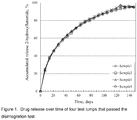
- Figure 1 shows drug release over time of four test lumps that passed the disintegration test.
- One aspect of the present invention is a method for producing calcium sulphate hemihydrate powder comprising the steps of:
- the temperature in method step b is about 150 - 220°C.
- the temperature in method step b is about 180 - 210°C.
- the temperature in method step b is about 185 - 205°C.
- the temperature in method step b is about 190 - 203°C.
- the temperature in method step b is about 200°C.
- the time in method step c is 2-8 hours.
- the time in method step c is 3-5 hours. In one aspect of the present invention the time in method step c is 3.5-4.5 hours.
- the time in method step c is about 4 hours.
- the moist air outflow in method step d is 0.25 - 1 L/s.
- the moist air outflow in method step d is 0.25 L/s and 0.8 L/s.
- the moist air outflow in method step d is 0.3 L/s and 0.7 L/s.
- the moist air outflow in method step d is 0.4 L/s and 0.6 L/s.
- the moist air outflow in method step d is about 0.5 L/s.
- Suitable process temperatures for the method of the present invention are 150, 160, 170, 180, 185, 190, 195, 200, 203, 205, 210, 215 or 220°C.
- Suitable process times for the method of the present invention are 1, 2, 3, 3.5, 4, 4.5, 5, 6, 7, 8, 9, 10, 11 or 12 hours.
- Suitable moist air outflows through the outlet for the method of the present invention are 0.2, 0.25, 0.3, 0.35, 0.4, 0.45, 0.5, 0.55, 0.6, 0.7, 0.8, 0.9, 1 or 1.5 L/s.
- the starting material, calcium sulphate dihydrate is commercially available from several suppliers.
- the total water or moisture content varies between suppliers and batches.
- Total water or moisture content of pharmaceutical products, like calcium sulphate can include both bound water (water of hydration) where water is a part of the crystal structure and free water.
- Calcium sulphate dihydrate contains 2 water molecules of bound water (water of hydration) per molecule of calcium sulphate and about X weight-% of free water.
- Total moisture content can be determinate by various techniques like gravimetric method or Karl Fisher Titration. The distinction and accurate measurement of bound versus free water is thermal gravimetric analysis (TGA) where weight loss as a function of temperature allows estimation of water content in percentage.
- TGA thermal gravimetric analysis
- the calcium sulphate dihydrate is loaded stepwise into the closed cabinet in order to control and maintain the temperature at a correct level and avoiding sudden drop in temperature.
- a volume exchange may be 20/hour and for a larger heating cabinet of approximately 350-600 dm 3 the volume exchange may be 60/hour.
- the volume exchange and cabinet volume correlates approximately linearly. What has been found with the present invention is that the outflow air needs to be in the range of 0.2 - 1.5 L/s irrespective of the cabinet volume in order to have a constant intermediately humid milieu in the cabinet and loading up to about 1.5 kg which corresponds to about 20 g free moist or water.
- the volume exchanges expressed as cabinet volumes per hour corresponding to an air outflow of 0.5 L/s are 12-18 for the smaller cabinet and 3-5 for the larger cabinet.
- the amount of powder loaded at the same time into the cabinet should be in the range of 0.01 to 20 kg/m 3 , preferably about 0.05 to 5 kg/m 3 .
- the present invention relates to a new method for producing a calcium sulphate hemihydrate of high chemical purity, and of high morphological purity.
- the method of the present invention provides calcium sulphate hemihydrate, substantially in the ⁇ -form but with some degree of amorphous content.
- the present invention relates to injectable in vivo solidifying modified-release pharmaceutical compositions comprising drug substance/s and drug carriers manufactured from calcium sulphate.
- the compositions are administered through a needle in a fluid state and are designed to solidify at the site of injection and to deliver the drug substance/s to specific regions where their pharmacological effects are desired.
- the composition is suitable for use in the treatment of localized cancer.
- the method for preparing the solidifying material is unique and unconventional both regarding parameter settings in the pharmaceutical industry and regarding what is currently described for the material behaviour in the field of materials science.
- An in vivo solidifying formulation of calcium sulphate is at least partly composed of calcium sulphate hemihydrates.
- the hemihydrates are produced from calcium sulphate dihydrate by a heat treatment. It has been found that the details of the heat treatment procedure are essential for the properties of the formulation.
- Calcium sulphate hemihydrate prepared according to the present invention can be used as a carrier for pharmaceutically active ingredients in a pharmaceutical composition to be administered to human beings or any other mammal.
- the release rate of the pharmaceutically active ingredient may is influenced by the way the pharmaceutical composition is prepared. It is thus possible to prepare pharmaceutical compositions, comprising calcium sulphate hemihydrate prepared according to the present invention, for immediate, delayed and controlled release or a combination thereof.
- Calcium sulphate hemihydrate, prepared according to the present invention can further be used as a starting material for preparing other forms of calcium sulphate, such as calcium sulphate dihydrate. Calcium sulphate hemihydrate prepared according to the present invention will influence the physical properties of such calcium sulphate dihydrate.
- Calcium sulphate hemihydrate prepared according to the present invention can be conventionally milled to achieve the right particle size distribution of the powder.
- the active pharmaceutical ingredient may be loaded onto the calcium sulphate hemihydrate, prepared according to the present invention, in different ways.
- the calcium sulphate hemihydrate can for example be mixed with the API creating an API-loaded binary mixture. This may be performed by dry mixing. This may also be performed by dissolving the API in a solvent to which the calcium sulphate is inert (such as an alcohol). This leads to a slurry of calcium sulphate powder in a solute of API and solvent. By evaporating the solvent while agitating the slurry a dry powder of API and calcium sulphate is formed.
- the loading of the API can further be done simultaneously as the calcium sulphate hemihydrate, prepared according to the present invention, is converted into other forms of calcium sulphate, such as recrystallized into calcium sulphate dihydrate.
- the API-loaded calcium sulphate dihydrates in such a formulation will have different physical properties and release rates / release profiles depending on how the precursor calcium sulphate hemihydrate was prepared.
- Such binary mixture can further be conventionally compressed in API-loaded dense granules (or bodies).
- the API-loaded dense granules (or bodies) will have different physical properties and release rates / release profiles depending on how it is prepared, for example which pressure that was used in the densifying step. Suitable pressures are 1000 - 5000 bar for about 1-3 hours.
- such API-loaded dense granules are prepared by wetting calcium sulphate hemihydrate, prepared according to the present invention, with enough water to convert it to calcium sulphate dihydrate and simultaneously apply a pressure of about 4000 bar for about 1 hour.
- An isostatic press is a suitable apparatus for applying pressures up to 5000 bar.
- the calcium sulphate hemihydrate prepared according to present invention can be further processed for example by conventional milling into a suitable average particle size distribution.
- a pharmaceutical composition containing the calcium sulphate prepared according to the present invention may contain at least one additional pharmaceutically active ingredient.
- the pharmaceutical composition (drug product), prepared using calcium sulphate hemihydrate prepared according to the present invention, is applicable with any therapeutically, prophylactically and/or diagnostically active substances that may require a controlled release, especially a prolonged controlled release.
- relevant pharmacological classes are e.g. anti-cancer agents.
- anticancer agents i.e. neoplastic agents
- the invention may be used for targeted and controlled local release of hormonal, anti-hormonal, chemotherapeutic and/or other pharmacological agent(s). It may also be used in therapeutic applications without adding an active substance such as a bone filler or as a cosmetic application such as for wrinkles and/or plastic surgery.
- the one or more therapeutically, prophylactically and/or diagnostically active substances are flutamide, hydroxyflutamide, cyproteron, nilutamide or bicalutamide or the like.
- the one or more therapeutically, prophylactically and/or diagnostically active substances in a highly densified calcium sulphate, prepared according to the present invention are suitable for use in prostate related diseases or conditions.
- the active substance is an androgen or a derivative thereof, an anti-androgen or a derivative thereof, an oestrogen or a derivative thereof, an anti-oestrogen or a derivative thereof, a gestagen or a derivative thereof, an anti-gestagen or a derivative thereof, an oligonucleotide, a progestagen or a derivative thereof, a gonadotropin-releasing hormone or an analogue or derivative thereof, a gonadotropin inhibitor or a derivative thereof, an adrenal and/or prostate enzyme inhibitor, a membrane efflux and/or membrane transport protein, an immune system modulator, an angiogenesis inhibitor, or combinations thereof.
- a drug product containing calcium sulphate hemihydrate, prepared according to the present invention may also include any other suitable active substance suitable for application in soft tissues or organs for local or systemic sustained drug release.
- Such drug product can also be explored in other treatments e.g.: pain, neurological diseases (Alzheimer, Parkinson), autoimmune diseases, immunological diseases, and diseases responding to immunological and immunomodulating therapy (hepatitis, MS, tumours), infections, inflammations, metabolic diseases, obesitas, diseases in the urogenital tract, cardiovascular diseases (including blood pressure), hematopoietic, anticoagulant, thrombolytic and antiplatelet diseases, chemotherapy of parasitic infections, microbial diseases and neoplastic diseases, hypercholesterolemia, dyslipidemia, hematopoetic diseases, respiratory diseases (asthma, chronical lung obstruction), diseases of the kidney, gastrointestinal diseases, liver diseases, hormonal disruption, replacement and substitution, vitamins replacement and substitution.
- active substances from various pharmacological classes for the use in drug products containing calcium sulphate hemihydrate, prepared according to the present invention can be used include e.g. antibacterial agents, antihistamines and decongestants, anti-inflammatory agents, antiparasitics, antivirals, local anaesthetics, antifungals, amoebicidals or trichomonocidal agents, analgesics, antianxiety agents, anticlotting agents, antiarthritics, antiasthmatics, anticoagulants, anticonvulsants, antidepressants, antidiabetics, antiglaucoma agents, antimalarials, antimicrobials, antineoplastics, antiobesity agents, antipsychotics, antihypertensives, auto-immune disorder agents, anti-impotence agents, antiParkinsonism agents, anti-Alzheimers agents, antipyretics, anticholinergics, anti-ulcer agents, anorexics, beta-
- the therapeutically, prophylactically and/or diagnostically active drug substance(s) may also be in the form of a pharmaceutically acceptable salt, solvate or complex thereof or in any suitable crystalline or amorphous form or in the form of a pro-drug.
- the active substance is one or more cytostatics such as one or more alkylating agents, one or more antimetabolites, one or more antimitotics, one or more topoisomerase inhibitors, one or more biological cytoregulators, one or more hormone or antihormones and the like.
- cytostatics such as one or more alkylating agents, one or more antimetabolites, one or more antimitotics, one or more topoisomerase inhibitors, one or more biological cytoregulators, one or more hormone or antihormones and the like.
- the one or more active substance may be an alkylating agent like e.g. mephalan, busulfan, carboplatin, cisplatin, cyclophosphamid, dacarbazin, chlorambucil, lomustin, carboplatin, temozolomid, treosulfan; an antimetabolite like e.g. pemetrexed, cytarabin, azathioprin, fludarabinphosphat, fluoruracil, hydroxyurea, cladribin, methotrexat, tegafur, uracil, capecitabin; an antimicotics like e.g.
- an alkylating agent like e.g. mephalan, busulfan, carboplatin, cisplatin, cyclophosphamid, dacarbazin, chlorambucil, lomustin, carboplatin, temozolomid, treosulfan
- an antimetabolite like e.g
- vinorelbin vinkristin, pacitaxel, docetaxel, vinblastin; a topoisomerase inhibitor like e.g. doxorubicin, amsakrin, irinotecan, daunorubicin, epirubicin, etoposid, idarubicin, topotecan, mitomycin, mitoxantron; a biological cytoregulator like e.g. bleomycin; a hormone or antihormone like e.g.
- polyestradiolphosphate polyestradiolphosphate, estradiol, anastrozol, exemestan, fluvestrant, letrozol, tamoxifen, megestrolacetate, medroxyprogesteron acetate, octreotid, triptorelin, leuprorelin, buserelin, goserelin; asparaginase, tyrosinkinase inhibitor like e.g. imatinib other agents like e.g.
- the active substance is suitable for the treatment of prostate related diseases or conditions.
- Drug products containing calcium sulphate hemihydrate, prepared according to the present invention can be applied locally with minimally invasive techniques, and a sustained (controlled) local release profile of the drug over a prolonged period of time can be obtained.
- Such local and sustained delivery of active substances optimises the local concentration-time profile of the active substances and their local pharmacological effects, and minimises the systemic exposure and thus reduces the side-effects, and hence increases the safety and utility of the active substance and the pharmaceutical composition containing the active substance.
- the compliance of the therapy is enhanced.
- the therapeutically, prophylactically and/or diagnostically active substance is an androgen or a derivative thereof, an anti-androgen or a derivative thereof, an oestrogen or a derivative thereof, an anti-o
- the disintegration test was performed by placing three moulded lumps of a solidified test formulation A-G, each weighing about 300 mg, diametrically opposite and near the edge on the bottom of a glass crystallizing dish of 190 mm diameter containing 1 L of a 0.9 % NaCl aqueous solution. The lumps were visually evaluated after 24 hours and thereafter daily.
- the test formulations A-G were marked as pass in Table 1, if the lumps had maintained their original shape after 48 hours, but marked as failed in Table 1 if the lumps had started to disintegrate and thereby lost their original shape after 48 hours.
- test formulation A-G were prepared by suspending a mixed powder consisting of A) 0.45 g unloaded matrix; B) 0.59 g of API-loaded matrix; and C) 0.59 g of API-loaded granules in a syringe together with 1.6 mL 0.25% Na-CMC aqueous solution.
- the syringe content was well mixed so that the mixture forms a paste from which three samples, weighing about 300 mg each, were ejected onto an inert surface and solidified within 30 minutes to what is referred to as moulded lumps, with circular shape and a flat bottom.
- Unloaded matrices were prepared by conventional milling of calcium sulphate hemihydrate, prepared according to the present invention, to an average particle size of 2 ⁇ m.
- API-loaded matrices were prepared from the unloaded matrix.
- the unloaded matrix (75 g) was suspended in a solution, of the drug substance 2-hydroxyflutamide (75 g) in isopropanol.
- the suspension was allowed to dry under stirring to create API-loaded matrices, consisting of calcium sulphate hemihydrate, prepared according to the present invention, and the drug substance 2-hydroxyflutamide.
- API-loaded granules were prepared from the API-loaded matrices.
- the API-loaded matrices 150 g were wetted with water (15 mL) and placed in an isostatic press for 1 hour at a pressure of 4000 bar, whereby the calcium sulphate hemihydrate, prepared according to the present invention, in the API-loaded matrixes recrystallizes into calcium sulphate dihydrate, and forms dense structure of calcium sulphate dihydrate encapsulating the API.
- the present invention also relates to calcium sulphate hemihydrate powder obtainable by any of the processes described herein.
- the calcium sulphate hemihydrate is prepared as follows: Calcium sulphate dihydrate from Carl Roth (article No. 0256.3) is poured into cylindrical glass crystallization dishes with a diameter of 190 mm. 500 g of free flowing powder is distributed evenly in each glass crystallization dish, which generally corresponds to a powder bed thickness of approximately 30-40 mm. An adequate number of crystallization dishes is inserted into the preheated heating cabinet at 200°C with an air outflow of about 0.5 L/s. After four hours heating, the hemihydrate has been produced and is taken out of the cabinet to cool down at room temperature for at least 30 minutes. A representative sample may be removed for further processing and evaluation in the disintegration test.
- Test formulations A-G were prepared using the general procedure above and representative samples were removed and evaluated in the disintegration test. Results from the disintegration test is given in Table 1.
Landscapes
- Health & Medical Sciences (AREA)
- Chemical & Material Sciences (AREA)
- Life Sciences & Earth Sciences (AREA)
- General Health & Medical Sciences (AREA)
- Veterinary Medicine (AREA)
- Public Health (AREA)
- Animal Behavior & Ethology (AREA)
- Inorganic Chemistry (AREA)
- Organic Chemistry (AREA)
- Pharmacology & Pharmacy (AREA)
- Medicinal Chemistry (AREA)
- Epidemiology (AREA)
- Engineering & Computer Science (AREA)
- Bioinformatics & Cheminformatics (AREA)
- Dermatology (AREA)
- Chemical Kinetics & Catalysis (AREA)
- General Chemical & Material Sciences (AREA)
- Nuclear Medicine, Radiotherapy & Molecular Imaging (AREA)
- Geology (AREA)
- Birds (AREA)
- Gerontology & Geriatric Medicine (AREA)
- Ceramic Engineering (AREA)
- Urology & Nephrology (AREA)
- Materials Engineering (AREA)
- Structural Engineering (AREA)
- Pharmaceuticals Containing Other Organic And Inorganic Compounds (AREA)
- Medicinal Preparation (AREA)
- Compounds Of Alkaline-Earth Elements, Aluminum Or Rare-Earth Metals (AREA)
- Medicines That Contain Protein Lipid Enzymes And Other Medicines (AREA)
- Cosmetics (AREA)
- Acyclic And Carbocyclic Compounds In Medicinal Compositions (AREA)
- Coloring Foods And Improving Nutritive Qualities (AREA)
Description
- The present invention relates to a new method for producing a calcium sulphate hemihydrate for use in the cosmetic, therapeutic or pharmaceutical industries. Calcium sulphate hemihydrate is a biocompatible and biodegradable inorganic substance and thus suitable as a carrier in pharmaceutical compositions, e.g. a controlled release composition, containing at least one pharmaceutically active ingredient. Calcium sulphate may also be used alone as a filler tissue material for either cosmetic or therapeutic applications.
- The present invention relates to a process of producing inorganic compositions suitable as carriers for pharmaceutically active compounds to be administered to human beings or to any other mammal.
- Calcium sulphate is used for a variety of purposes and exists in various forms and states of hydration.
- The calcium sulphate hydrates, in particular gypsum (calcium sulphate dihydrate) and the hemi-hydrate, are used in a number of industrial applications for a wide range of purposes, e.g. as an additive for the production of cements, gypsum wallboards, or bone void fillers for orthopaedic and dental applications. Some of these void filler products also contain an active pharmaceutical ingredients whereby a slow release pharmaceutical composition is achieved. In the form of γ-anhydrite (the anhydrous form), calcium sulphate is used as a desiccant.
- Calcium sulphate hemihydrate exists in at least two distinct morphological forms, denoted α and β. The preparation route is of crucial importance for which of the two forms that is obtained. Christensen et al in Dalton Trans., 2010, 39, 2044-2048 suggests that the α-form can be obtained at hydrothermal conditions, i.e. temperature range of 120 to 160 °C and at pressures up to 8 bar, while the β-form can be obtained by dry heating in the
temperature range 120 to 180°C. At temperatures above 170 °C γ-anhydrite may begin to form, Christensen et al, Chem. Mater. 2008, 20, 2124-2132GB 2205089 A - It has been found that the method of manufacturing the calcium sulphate hemihydrate is essential for the dissolution characteristics of a formulation prepared by the hemihydrate, i.e. relevant for the drug release rate into a patient. This is surprisingly the case even if the calcium sulphate hemihydrate has re-crystallized into calcium sulphate dihydrate during the process for preparing the pharmaceutical composition. It is thus important to be able to control the product characteristics of a method for preparing calcium sulphate hemihydrate.
- The present invention relates to a process of producing inorganic compositions suitable as carriers for therapeutically active substances to be administered to the human body or any other mammals. The compositions of the invention are based on calcium sulphate and are applicable for several drug delivery purposes; for example, for targeted treatment of specific parts of the body such as diseased organs or for localised treatment of e.g. cancer such as prostate cancer e.g. through targeted and local release of hormonal and anti-hormonal agents.
- It has been found that, calcium sulphate hemihydrate prepared according to the present invention can advantageously be used to prepare pharmaceutical compositions with reproducible and good dissolution characteristics. Such pharmaceutical compositions give a controllable drug release rate into serum or body tissue of a patient.
-
Figure 1 shows drug release over time of four test lumps that passed the disintegration test. - One aspect of the present invention is a method for producing calcium sulphate hemihydrate powder comprising the steps of:
- a. treating calcium sulphate dihydrate in a closed cabinet with controlled temperature, air circulation in the cabinet and a controlled air outflow from the cabinet;
- b. adjusting the temperature to from above 100 to 220°C;
- c. allowing for a process time of 1 - 12 hours; and
- d. adjusting the moist air outflow from the cabinet to 0.2 - 1.5 L/s.
- In one aspect of the present invention the temperature in method step b is about 150 - 220°C.
- In one aspect of the present invention the temperature in method step b is about 180 - 210°C.
- In one aspect of the present invention the temperature in method step b is about 185 - 205°C.
- In one aspect of the present invention the temperature in method step b is about 190 - 203°C.
- In one aspect of the present invention the temperature in method step b is about 200°C.
- In one aspect of the present invention the time in method step c is 2-8 hours.
- In one aspect of the present invention the time in method step c is 3-5 hours. In one aspect of the present invention the time in method step c is 3.5-4.5 hours.
- In one aspect of the present invention the time in method step c is about 4 hours.
- In one aspect of the present invention the moist air outflow in method step d is 0.25 - 1 L/s.
- In one aspect of the present invention the moist air outflow in method step d is 0.25 L/s and 0.8 L/s.
- In one aspect of the present invention the moist air outflow in method step d is 0.3 L/s and 0.7 L/s.
- In one aspect of the present invention the moist air outflow in method step d is 0.4 L/s and 0.6 L/s.
- In one aspect of the present invention the moist air outflow in method step d is about 0.5 L/s.
- Suitable process temperatures for the method of the present invention are 150, 160, 170, 180, 185, 190, 195, 200, 203, 205, 210, 215 or 220°C.
- Suitable process times for the method of the present invention are 1, 2, 3, 3.5, 4, 4.5, 5, 6, 7, 8, 9, 10, 11 or 12 hours.
- Suitable moist air outflows through the outlet for the method of the present invention are 0.2, 0.25, 0.3, 0.35, 0.4, 0.45, 0.5, 0.55, 0.6, 0.7, 0.8, 0.9, 1 or 1.5 L/s.
- The starting material, calcium sulphate dihydrate, is commercially available from several suppliers. The total water or moisture content varies between suppliers and batches. Total water or moisture content of pharmaceutical products, like calcium sulphate, can include both bound water (water of hydration) where water is a part of the crystal structure and free water. Calcium sulphate dihydrate, contains 2 water molecules of bound water (water of hydration) per molecule of calcium sulphate and about X weight-% of free water. Total moisture content can be determinate by various techniques like gravimetric method or Karl Fisher Titration. The distinction and accurate measurement of bound versus free water is thermal gravimetric analysis (TGA) where weight loss as a function of temperature allows estimation of water content in percentage.
- In another aspect of the present invention the calcium sulphate dihydrate is loaded stepwise into the closed cabinet in order to control and maintain the temperature at a correct level and avoiding sudden drop in temperature.
- Conventional pharmaceutical equipment for heating and/or drying processes of powders can be described with the amount of complete cabinet air volume exchanges per hour. For a smaller heating cabinet of approximately 100-150 dm3, a volume exchange may be 20/hour and for a larger heating cabinet of approximately 350-600 dm3 the volume exchange may be 60/hour. The volume exchange and cabinet volume correlates approximately linearly. What has been found with the present invention is that the outflow air needs to be in the range of 0.2 - 1.5 L/s irrespective of the cabinet volume in order to have a constant intermediately humid milieu in the cabinet and loading up to about 1.5 kg which corresponds to about 20 g free moist or water. The volume exchanges expressed as cabinet volumes per hour corresponding to an air outflow of 0.5 L/s are 12-18 for the smaller cabinet and 3-5 for the larger cabinet.
- The amount of powder loaded at the same time into the cabinet should be in the range of 0.01 to 20 kg/m3, preferably about 0.05 to 5 kg/m3.
- The present invention relates to a new method for producing a calcium sulphate hemihydrate of high chemical purity, and of high morphological purity. The method of the present invention provides calcium sulphate hemihydrate, substantially in the β-form but with some degree of amorphous content.
- In one aspect, the present invention relates to injectable in vivo solidifying modified-release pharmaceutical compositions comprising drug substance/s and drug carriers manufactured from calcium sulphate. The compositions are administered through a needle in a fluid state and are designed to solidify at the site of injection and to deliver the drug substance/s to specific regions where their pharmacological effects are desired. For example, the composition is suitable for use in the treatment of localized cancer. The method for preparing the solidifying material is unique and unconventional both regarding parameter settings in the pharmaceutical industry and regarding what is currently described for the material behaviour in the field of materials science.
- An in vivo solidifying formulation of calcium sulphate is at least partly composed of calcium sulphate hemihydrates. The hemihydrates are produced from calcium sulphate dihydrate by a heat treatment. It has been found that the details of the heat treatment procedure are essential for the properties of the formulation.
- Calcium sulphate hemihydrate prepared according to the present invention can be used as a carrier for pharmaceutically active ingredients in a pharmaceutical composition to be administered to human beings or any other mammal. The release rate of the pharmaceutically active ingredient may is influenced by the way the pharmaceutical composition is prepared. It is thus possible to prepare pharmaceutical compositions, comprising calcium sulphate hemihydrate prepared according to the present invention, for immediate, delayed and controlled release or a combination thereof.
- Calcium sulphate hemihydrate, prepared according to the present invention, can further be used as a starting material for preparing other forms of calcium sulphate, such as calcium sulphate dihydrate. Calcium sulphate hemihydrate prepared according to the present invention will influence the physical properties of such calcium sulphate dihydrate.
- Calcium sulphate hemihydrate prepared according to the present invention can be conventionally milled to achieve the right particle size distribution of the powder.
- The active pharmaceutical ingredient (API) may be loaded onto the calcium sulphate hemihydrate, prepared according to the present invention, in different ways. The calcium sulphate hemihydrate can for example be mixed with the API creating an API-loaded binary mixture. This may be performed by dry mixing. This may also be performed by dissolving the API in a solvent to which the calcium sulphate is inert (such as an alcohol). This leads to a slurry of calcium sulphate powder in a solute of API and solvent. By evaporating the solvent while agitating the slurry a dry powder of API and calcium sulphate is formed.
- The loading of the API can further be done simultaneously as the calcium sulphate hemihydrate, prepared according to the present invention, is converted into other forms of calcium sulphate, such as recrystallized into calcium sulphate dihydrate. The API-loaded calcium sulphate dihydrates in such a formulation will have different physical properties and release rates / release profiles depending on how the precursor calcium sulphate hemihydrate was prepared.
- Such binary mixture can further be conventionally compressed in API-loaded dense granules (or bodies). The API-loaded dense granules (or bodies) will have different physical properties and release rates / release profiles depending on how it is prepared, for example which pressure that was used in the densifying step. Suitable pressures are 1000 - 5000 bar for about 1-3 hours.
- Preferably, such API-loaded dense granules (or bodies) are prepared by wetting calcium sulphate hemihydrate, prepared according to the present invention, with enough water to convert it to calcium sulphate dihydrate and simultaneously apply a pressure of about 4000 bar for about 1 hour.
- An isostatic press is a suitable apparatus for applying pressures up to 5000 bar.
- A method for producing such dense granules is described in
WO2007/104549 . - It is known from technical applications, that calcium sulphate hemihydrate which is mixed with water and left to solidify, and which thereby forms calcium sulphate dihydrate, forms solidified materials of different characteristics, primarily carrying mechanical strengths, depending on the characteristics of the starting powder (e.g. alfa or beta hemi-hydrate).
- The calcium sulphate hemihydrate prepared according to present invention can be further processed for example by conventional milling into a suitable average particle size distribution.
- A pharmaceutical composition containing the calcium sulphate prepared according to the present invention may contain at least one additional pharmaceutically active ingredient.
- The pharmaceutical composition (drug product), prepared using calcium sulphate hemihydrate prepared according to the present invention, is applicable with any therapeutically, prophylactically and/or diagnostically active substances that may require a controlled release, especially a prolonged controlled release. Examples of relevant pharmacological classes are e.g. anti-cancer agents. With regard to anticancer agents, i.e. neoplastic agents, the invention may be used for targeted and controlled local release of hormonal, anti-hormonal, chemotherapeutic and/or other pharmacological agent(s). It may also be used in therapeutic applications without adding an active substance such as a bone filler or as a cosmetic application such as for wrinkles and/or plastic surgery.
- Of particular interest are drug products containing calcium sulphate hemihydrate, prepared according to the present invention, for use in the treatment of prostate diseases, more specifically benign prostatic hyperplasia, prostate cancer and/or prostatite. For the treatment of prostate related diseases is may be especially useful to use anti-cancer agents such specific anti- androgens. More preferably, the one or more therapeutically, prophylactically and/or diagnostically active substances are flutamide, hydroxyflutamide, cyproteron, nilutamide or bicalutamide or the like.
- Additionally, in some cases it may be favourable to use a combination of an anti-androgen and a gonadotropin-releasing hormone or an analogue thereof.
- Preferably, the one or more therapeutically, prophylactically and/or diagnostically active substances in a highly densified calcium sulphate, prepared according to the present invention, are suitable for use in prostate related diseases or conditions. Furthermore, the active substance is an androgen or a derivative thereof, an anti-androgen or a derivative thereof, an oestrogen or a derivative thereof, an anti-oestrogen or a derivative thereof, a gestagen or a derivative thereof, an anti-gestagen or a derivative thereof, an oligonucleotide, a progestagen or a derivative thereof, a gonadotropin-releasing hormone or an analogue or derivative thereof, a gonadotropin inhibitor or a derivative thereof, an adrenal and/or prostate enzyme inhibitor, a membrane efflux and/or membrane transport protein, an immune system modulator, an angiogenesis inhibitor, or combinations thereof.
- A drug product containing calcium sulphate hemihydrate, prepared according to the present invention, may also include any other suitable active substance suitable for application in soft tissues or organs for local or systemic sustained drug release. Such drug product can also be explored in other treatments e.g.: pain, neurological diseases (Alzheimer, Parkinson), autoimmune diseases, immunological diseases, and diseases responding to immunological and immunomodulating therapy (hepatitis, MS, tumours), infections, inflammations, metabolic diseases, obesitas, diseases in the urogenital tract, cardiovascular diseases (including blood pressure), hematopoietic, anticoagulant, thrombolytic and antiplatelet diseases, chemotherapy of parasitic infections, microbial diseases and neoplastic diseases, hypercholesterolemia, dyslipidemia, hematopoetic diseases, respiratory diseases (asthma, chronical lung obstruction), diseases of the kidney, gastrointestinal diseases, liver diseases, hormonal disruption, replacement and substitution, vitamins replacement and substitution.
- Examples of active substances from various pharmacological classes for the use in drug products containing calcium sulphate hemihydrate, prepared according to the present invention, can be used include e.g. antibacterial agents, antihistamines and decongestants, anti-inflammatory agents, antiparasitics, antivirals, local anaesthetics, antifungals, amoebicidals or trichomonocidal agents, analgesics, antianxiety agents, anticlotting agents, antiarthritics, antiasthmatics, anticoagulants, anticonvulsants, antidepressants, antidiabetics, antiglaucoma agents, antimalarials, antimicrobials, antineoplastics, antiobesity agents, antipsychotics, antihypertensives, auto-immune disorder agents, anti-impotence agents, antiParkinsonism agents, anti-Alzheimers agents, antipyretics, anticholinergics, anti-ulcer agents, anorexics, beta-blockers, beta-2 agonists, alpha receptor antagonists and agonists, blood glucose-lowering agents, bronchodilators, agents with effect on the central nervous system, cardiovascular agents, cognitive enhancers, contraceptives, cholesterol-reducing agents, agents against dyslipidemia, cytostatics, diuretics, germicidals, H-2 blockers, hormonal agents, anti-hormonal agents, hypnotic agents, inotropics, muscle relaxants, muscle contractants, physic energizers, sedatives, sympathomimetics, vasodilators, vasoconstrictors, tranquilizers, electrolyte supplements, vitamins, uricosurics, cardiac glycosides, membrane efflux inhibitors, membrane transport protein inhibitors, expectorants, purgatives, contrast materials, radiopharmaceuticals, imaging agents, peptides, enzymes, growth factors, vaccines, mineral trace elements, etc.
- The therapeutically, prophylactically and/or diagnostically active drug substance(s) may also be in the form of a pharmaceutically acceptable salt, solvate or complex thereof or in any suitable crystalline or amorphous form or in the form of a pro-drug.
- In a specific embodiment the active substance is one or more cytostatics such as one or more alkylating agents, one or more antimetabolites, one or more antimitotics, one or more topoisomerase inhibitors, one or more biological cytoregulators, one or more hormone or antihormones and the like.
- More specifically, the one or more active substance may be
an alkylating agent like e.g. mephalan, busulfan, carboplatin, cisplatin, cyclophosphamid, dacarbazin, chlorambucil, lomustin, carboplatin, temozolomid, treosulfan; an antimetabolite like e.g. pemetrexed, cytarabin, azathioprin, fludarabinphosphat, fluoruracil, hydroxyurea, cladribin, methotrexat, tegafur, uracil, capecitabin;
an antimicotics like e.g. vinorelbin, vinkristin, pacitaxel, docetaxel, vinblastin;
a topoisomerase inhibitor like e.g. doxorubicin, amsakrin, irinotecan, daunorubicin, epirubicin, etoposid, idarubicin, topotecan, mitomycin, mitoxantron;
a biological cytoregulator like e.g. bleomycin;
a hormone or antihormone like e.g. polyestradiolphosphate, estradiol, anastrozol, exemestan, fluvestrant, letrozol, tamoxifen, megestrolacetate, medroxyprogesteron acetate, octreotid, triptorelin, leuprorelin, buserelin, goserelin;
asparaginase, tyrosinkinase inhibitor like e.g. imatinib
other agents like e.g. mitotan, celecoxib, lenograstim, interferon γ-1b, interferon α-2b, pegfilgrastim, filgrastim, aldesleukin, bevacizumab, cetuximab, trastuzumab, alemtuzumab, rituximab, bortezomib, temoporfin, methylaminolevulinat, anagrelid, estramustinphosphat. - In a preferred aspect, the active substance is suitable for the treatment of prostate related diseases or conditions.
- Drug products containing calcium sulphate hemihydrate, prepared according to the present invention, can be applied locally with minimally invasive techniques, and a sustained (controlled) local release profile of the drug over a prolonged period of time can be obtained. Such local and sustained delivery of active substances optimises the local concentration-time profile of the active substances and their local pharmacological effects, and minimises the systemic exposure and thus reduces the side-effects, and hence increases the safety and utility of the active substance and the pharmaceutical composition containing the active substance. In addition the compliance of the therapy is enhanced.
- Other preferred drug products containing calcium sulphate hemihydrate, prepared according to the present invention, are those wherein the therapeutically, prophylactically and/or diagnostically active substance is an androgen or a derivative thereof, an anti-androgen or a derivative thereof, an oestrogen or a derivative thereof, an anti-oestrogen or a derivative thereof, a gestagen or a derivative thereof, an anti-gestagen or a derivative thereof, an oligonucleotide, a progestagen or a derivative thereof, a gonadotropin-releasing hormone or an analogue or derivative thereof, a gonadotropin inhibitor or a derivative thereof, an adrenal and/or prostate enzyme inhibitor, a membrane efflux and/or membrane transport protein, an immune system modulator, an angiogenesis inhibitor, or combinations thereof.
- The disintegration test was performed by placing three moulded lumps of a solidified test formulation A-G, each weighing about 300 mg, diametrically opposite and near the edge on the bottom of a glass crystallizing dish of 190 mm diameter containing 1 L of a 0.9 % NaCl aqueous solution. The lumps were visually evaluated after 24 hours and thereafter daily. The test formulations A-G were marked as pass in Table 1, if the lumps had maintained their original shape after 48 hours, but marked as failed in Table 1 if the lumps had started to disintegrate and thereby lost their original shape after 48 hours.
- Each test formulation A-G were prepared by suspending a mixed powder consisting of A) 0.45 g unloaded matrix; B) 0.59 g of API-loaded matrix; and C) 0.59 g of API-loaded granules in a syringe together with 1.6 mL 0.25% Na-CMC aqueous solution. The syringe content was well mixed so that the mixture forms a paste from which three samples, weighing about 300 mg each, were ejected onto an inert surface and solidified within 30 minutes to what is referred to as moulded lumps, with circular shape and a flat bottom.
- Unloaded matrices were prepared by conventional milling of calcium sulphate hemihydrate, prepared according to the present invention, to an average particle size of 2 µm.
- API-loaded matrices were prepared from the unloaded matrix. The unloaded matrix (75 g) was suspended in a solution, of the drug substance 2-hydroxyflutamide (75 g) in isopropanol. The suspension was allowed to dry under stirring to create API-loaded matrices, consisting of calcium sulphate hemihydrate, prepared according to the present invention, and the drug substance 2-hydroxyflutamide.
- API-loaded granules were prepared from the API-loaded matrices. The API-loaded matrices (150 g) were wetted with water (15 mL) and placed in an isostatic press for 1 hour at a pressure of 4000 bar, whereby the calcium sulphate hemihydrate, prepared according to the present invention, in the API-loaded matrixes recrystallizes into calcium sulphate dihydrate, and forms dense structure of calcium sulphate dihydrate encapsulating the API. This creates API-loaded granules consisting of calcium sulphate dihydrate and entrapped drug substance 2-hydroxyflutamide. The API-loaded granules are thereafter, crushed, milled and sieved into a particle size of 125-300 µm to be used in the disintegration test.
Table 1 - Disintegration test Example Loading amount Ca2SO4 · 2H2O Loading container Temp Time Air outflow (L/s) Disintegration test A 6 x 500 g Crystallization dish 200°C 4h >10 Fail Stepwise loading 1000 g x 3 B 2 x 250 g Crystallization dish 200° C 4h 2 Fail C 2 x 250 g Crystallization dish 200° C 4h 0 Fail D 6 x 500 g Crystallization dish 200° C 4h 2 Fail Stepwise loading 1000 g x 3 E 12 x 500 g Crystallization dish 200° C 4h 2 Fail Stepwise loading 1000 g x 6 F 6 x 500 g Crystallization dish 200° C 4h 2 Fail Stepwise loading 1000 g x 3 G 16 x 500 g Crystallization dish 200°C 4h 0.5 Pass Stepwise loading 1000 g x 8 H 16 x 500 g Crystallization dish 200°C 4h 0.2 Pass (borderline) Stepwise loading 1000 g x 8 I 16 x 500 g Crystallization dish 200°C 4h 0.8 Pass Stepwise loading 1000 g x 8 - Drug release over time of four test lumps from the same formulation batch containing the active agent 2-hydroxyflutamide that passed the disintegration test is shown below in
Figure 1 . - It has been shown that a continuous and smooth release curve requires the moulded lumps to dissolve slowly/gradually without decomposition (falling apart/disintegration). If the moulded lump falls apart/disintegrates then the drug release increases strongly. The disintegration test described above is thus a fast way to check the quality of test formulations A-G without analyzing the drug release.
- It is thus essential for a slow and continuous drug release that the formulation forms well cohesive lumps. It has been found that the cohesiveness of the molded lumps is depending on how the calcium sulphate hemihydrates are prepared. Molded lumps prepared from calcium sulphate hemihydrates prepared according to the present invention all passed the disintegration test described above.
- The present invention also relates to calcium sulphate hemihydrate powder obtainable by any of the processes described herein.
- Typically, the calcium sulphate hemihydrate is prepared as follows: Calcium sulphate dihydrate from Carl Roth (article No. 0256.3) is poured into cylindrical glass crystallization dishes with a diameter of 190 mm. 500 g of free flowing powder is distributed evenly in each glass crystallization dish, which generally corresponds to a powder bed thickness of approximately 30-40 mm. An adequate number of crystallization dishes is inserted into the preheated heating cabinet at 200°C with an air outflow of about 0.5 L/s. After four hours heating, the hemihydrate has been produced and is taken out of the cabinet to cool down at room temperature for at least 30 minutes. A representative sample may be removed for further processing and evaluation in the disintegration test.
- Test formulations A-G were prepared using the general procedure above and representative samples were removed and evaluated in the disintegration test. Results from the disintegration test is given in Table 1.
Claims (13)
- A method for producing calcium sulphate hemihydrate powder comprising the steps ofa. treating calcium sulphate dihydrate in a closed cabinet with controlled temperature, air circulation in the cabinet and an adjustable air outflow from the cabinet;b. adjusting the temperature to from above 100 to 220°C;c. allowing for a process time of 1 - 12 hours; andd. adjusting the moist air outflow from the cabinet to 0.2 - 1.5 L/s.
- A method according to claim 1, wherein the temperature in step b is 150 - 220°C.
- A method according to claim 1 or 2, wherein the temperature in step b is 180 - 210°C.
- A method according to anyone of the preceeding claims, wherein the temperature in step b is 185 - 205°C.
- A method according to anyone of the preceeding claims, wherein the temperature in step b is 190 - 203°C.
- A method according to anyone of the preceeding claims, wherein the temperature in step b is 200°C.
- A method according to anyone of the preceeding claims, wherein the time in step c is 2-8 hours.
- A method according to anyone of the preceeding claims, wherein the time in step c is 3-5 hours.
- A method according to anyone of the preceeding claims, wherein the time in step c is 3.5 - 4.5 hours.
- A method according to anyone of the preceeding claims, wherein the outlet in step d is 0.25 - 1 L/s.
- A method according to anyone of the preceeding claims, wherein the outlet in step d is 0.25 - 0.8 L/s.
- A method according to anyone of the preceeding claims, wherein the outlet in step d is 0.3 - 0.7 L/s.
- A method according to anyone of the preceeding claims, wherein the outlet in step d is 0.4 - 0.6 L/s.
Priority Applications (2)
| Application Number | Priority Date | Filing Date | Title |
|---|---|---|---|
| EP19155080.5A EP3498675A1 (en) | 2016-10-17 | 2017-10-16 | A calcium sulphate hemihydrate with unique properties |
| PL17781521T PL3331826T3 (en) | 2016-10-17 | 2017-10-16 | A new method for producing calcium sulphate hemihydrate with unique properties |
Applications Claiming Priority (2)
| Application Number | Priority Date | Filing Date | Title |
|---|---|---|---|
| EP16194209 | 2016-10-17 | ||
| PCT/EP2017/076325 WO2018073165A1 (en) | 2016-10-17 | 2017-10-16 | A new method for producing calcium sulphate hemihydrate with unique properties |
Related Child Applications (1)
| Application Number | Title | Priority Date | Filing Date |
|---|---|---|---|
| EP19155080.5A Division EP3498675A1 (en) | 2016-10-17 | 2017-10-16 | A calcium sulphate hemihydrate with unique properties |
Publications (2)
| Publication Number | Publication Date |
|---|---|
| EP3331826A1 EP3331826A1 (en) | 2018-06-13 |
| EP3331826B1 true EP3331826B1 (en) | 2019-02-27 |
Family
ID=57178277
Family Applications (2)
| Application Number | Title | Priority Date | Filing Date |
|---|---|---|---|
| EP19155080.5A Pending EP3498675A1 (en) | 2016-10-17 | 2017-10-16 | A calcium sulphate hemihydrate with unique properties |
| EP17781521.4A Active EP3331826B1 (en) | 2016-10-17 | 2017-10-16 | A new method for producing calcium sulphate hemihydrate with unique properties |
Family Applications Before (1)
| Application Number | Title | Priority Date | Filing Date |
|---|---|---|---|
| EP19155080.5A Pending EP3498675A1 (en) | 2016-10-17 | 2017-10-16 | A calcium sulphate hemihydrate with unique properties |
Country Status (20)
| Country | Link |
|---|---|
| US (2) | US10351437B2 (en) |
| EP (2) | EP3498675A1 (en) |
| JP (1) | JP7088919B2 (en) |
| KR (1) | KR102408805B1 (en) |
| CN (1) | CN109843807B (en) |
| AU (1) | AU2017344893B2 (en) |
| BR (1) | BR112019007478B1 (en) |
| CA (1) | CA3038699A1 (en) |
| DK (1) | DK3331826T3 (en) |
| ES (1) | ES2778109T3 (en) |
| HK (1) | HK1253356B (en) |
| HU (1) | HUE043269T2 (en) |
| IL (1) | IL266008B (en) |
| MX (1) | MX2019004414A (en) |
| PL (1) | PL3331826T3 (en) |
| RU (1) | RU2753343C2 (en) |
| SG (1) | SG11201902825RA (en) |
| TR (1) | TR201905353T4 (en) |
| WO (1) | WO2018073165A1 (en) |
| ZA (1) | ZA201902949B (en) |
Families Citing this family (2)
| Publication number | Priority date | Publication date | Assignee | Title |
|---|---|---|---|---|
| KR102408805B1 (en) * | 2016-10-17 | 2022-06-14 | 리드스 에이비 | A new method to produce calcium sulfate hemihydrate with unique properties |
| CN118973408A (en) | 2022-03-31 | 2024-11-15 | 日清食品控股株式会社 | Method for producing nutritionally supplemented food and method for providing nutritionally supplemented food |
Family Cites Families (20)
| Publication number | Priority date | Publication date | Assignee | Title |
|---|---|---|---|---|
| US3956456A (en) * | 1971-12-17 | 1976-05-11 | National Gypsum Company | Gypsum calcination |
| DE3141746A1 (en) * | 1981-10-21 | 1983-05-05 | Börgardts-Sachsenstein GmbH, 3425 Walkenried | Cosmetic composition and process for its production |
| GB2205089B (en) * | 1987-05-22 | 1991-03-13 | Rhein Westfael Elect Werk Ag | Process for production of calcium sulphate alpha-hemihydrate |
| US5614206A (en) * | 1995-03-07 | 1997-03-25 | Wright Medical Technology, Inc. | Controlled dissolution pellet containing calcium sulfate |
| DE19620117C1 (en) * | 1996-05-18 | 1997-07-24 | Corimed Kundenorientierte Medi | Preparation of medicinal composition containing calcium sulphate |
| BR0013719A (en) * | 1999-09-02 | 2002-07-23 | Nostrum Pharmaceuticals Inc | Controlled-release oral dosage, suitable for oral administration |
| JP2002249317A (en) | 2001-02-20 | 2002-09-06 | Noritake Co Ltd | Method for manufacturing hemihydrate gypsum |
| CA2644429C (en) | 2006-03-14 | 2014-07-29 | Lidds Ab | Bioresorbable controlled-release composition |
| EA015082B1 (en) * | 2006-12-20 | 2011-04-29 | Дзе Ньюджип Корп. | Calcium sulfate hemihydrate treatment process |
| DE102007024188B3 (en) * | 2007-05-24 | 2008-04-10 | Grenzebach Bsh Gmbh | Production of alpha calcium hemihydrate from calcium dihydrate comprises charging an autoclave with calcium dihydrate, indirectly heating the autoclave, adding water in a controlled manner and mixing and further processing |
| CN101691286B (en) * | 2009-10-12 | 2011-09-07 | 孙恩光 | Alpha-type semi-hydrated gypsum autoclave and production method thereof |
| EP2629600B1 (en) * | 2010-10-19 | 2021-09-15 | Jiin-Huey Chern Lin | Method for preparing a hardened calcium sulfate dihydrate block |
| US8586074B2 (en) * | 2011-02-08 | 2013-11-19 | Orthogen, Llc | Calcium sulfate composite particles including aggregated calcium sulfate nanoparticles and method of use for bone augmentation |
| WO2013152418A1 (en) * | 2012-04-11 | 2013-10-17 | Induce Biologics Inc. | System and method for multiphasic release of growth factors |
| EP2662329A1 (en) * | 2012-05-11 | 2013-11-13 | Creachem SA | Peroxygen release compositions and method for producing them |
| EP2894135A1 (en) | 2014-01-10 | 2015-07-15 | Saint-Gobain Placo SAS | Method of curing a gypsum calcination product |
| US9895354B2 (en) * | 2014-04-04 | 2018-02-20 | University Of Kentucky Research Foundation | Bilayered calcium sulfate/calcium phosphate space-making composites with multiple drug delivery capabilities |
| CN104310830B (en) * | 2014-10-21 | 2017-06-06 | 金正大生态工程集团股份有限公司 | A kind of method that β high purity plaster powder is produced with ardealite |
| KR102408805B1 (en) * | 2016-10-17 | 2022-06-14 | 리드스 에이비 | A new method to produce calcium sulfate hemihydrate with unique properties |
| CN107055586A (en) * | 2016-12-30 | 2017-08-18 | 宁夏东吴农化有限公司 | A kind of preparation method of calcium sulfate |
-
2017
- 2017-10-16 KR KR1020197011910A patent/KR102408805B1/en active Active
- 2017-10-16 JP JP2019520633A patent/JP7088919B2/en active Active
- 2017-10-16 CA CA3038699A patent/CA3038699A1/en active Pending
- 2017-10-16 HU HUE17781521A patent/HUE043269T2/en unknown
- 2017-10-16 IL IL266008A patent/IL266008B/en unknown
- 2017-10-16 HK HK18112651.5A patent/HK1253356B/en not_active IP Right Cessation
- 2017-10-16 RU RU2019112298A patent/RU2753343C2/en active
- 2017-10-16 SG SG11201902825RA patent/SG11201902825RA/en unknown
- 2017-10-16 EP EP19155080.5A patent/EP3498675A1/en active Pending
- 2017-10-16 TR TR2019/05353T patent/TR201905353T4/en unknown
- 2017-10-16 DK DK17781521.4T patent/DK3331826T3/en active
- 2017-10-16 WO PCT/EP2017/076325 patent/WO2018073165A1/en not_active Ceased
- 2017-10-16 CN CN201780063012.0A patent/CN109843807B/en not_active Expired - Fee Related
- 2017-10-16 BR BR112019007478-3A patent/BR112019007478B1/en active IP Right Grant
- 2017-10-16 AU AU2017344893A patent/AU2017344893B2/en not_active Ceased
- 2017-10-16 ES ES17781521T patent/ES2778109T3/en active Active
- 2017-10-16 PL PL17781521T patent/PL3331826T3/en unknown
- 2017-10-16 MX MX2019004414A patent/MX2019004414A/en unknown
- 2017-10-16 US US16/094,784 patent/US10351437B2/en active Active
- 2017-10-16 EP EP17781521.4A patent/EP3331826B1/en active Active
-
2019
- 2019-05-10 ZA ZA2019/02949A patent/ZA201902949B/en unknown
- 2019-06-05 US US16/431,926 patent/US10611646B2/en active Active
Non-Patent Citations (1)
| Title |
|---|
| None * |
Also Published As
Similar Documents
| Publication | Publication Date | Title |
|---|---|---|
| DE60201528T2 (en) | PRODUCTION PROCESS OF BIOFUNCTIONAL HYDROXYLAPATITE COATINGS AND MICROSPHERES FOR IN-SITU ACTIVE INK PROCESSING | |
| KR101378174B1 (en) | Bioresorbable controlled-release composition | |
| Ślósarczyk et al. | The kinetics of pentoxifylline release from drug-loaded hydroxyapatite implants | |
| CN110420357B (en) | Drug-loaded modified mesoporous hydroxyapatite biomedical composite material suitable for 3D printing, and preparation method and application thereof | |
| DE60103638T2 (en) | CALCIUM PHOSPHATE MICRO GRANULES | |
| US10611646B2 (en) | Method for producing calcium sulphate hemihydrate with unique properties | |
| US20080206300A1 (en) | Shaped Article | |
| HK40005883A (en) | A calcium sulphate hemihydrate with unique properties | |
| RU2395476C1 (en) | Method of preparing porous hydroxyapatite granules | |
| Grudén et al. | Cold isostatic pressing of hydrating calcium sulfate as a means to produce parenteral slow-release drug formulations | |
| CN104130560A (en) | Preparation method of polylactic acid composite material by use of oriented distribution of nano-hydroxyapatite for enhancement | |
| HK1129061B (en) | Bioresorbable controlled-release composition |
Legal Events
| Date | Code | Title | Description |
|---|---|---|---|
| STAA | Information on the status of an ep patent application or granted ep patent |
Free format text: STATUS: UNKNOWN |
|
| STAA | Information on the status of an ep patent application or granted ep patent |
Free format text: STATUS: THE INTERNATIONAL PUBLICATION HAS BEEN MADE |
|
| PUAI | Public reference made under article 153(3) epc to a published international application that has entered the european phase |
Free format text: ORIGINAL CODE: 0009012 |
|
| STAA | Information on the status of an ep patent application or granted ep patent |
Free format text: STATUS: EXAMINATION IS IN PROGRESS |
|
| 17P | Request for examination filed |
Effective date: 20171208 |
|
| AK | Designated contracting states |
Kind code of ref document: A1 Designated state(s): AL AT BE BG CH CY CZ DE DK EE ES FI FR GB GR HR HU IE IS IT LI LT LU LV MC MK MT NL NO PL PT RO RS SE SI SK SM TR |
|
| AX | Request for extension of the european patent |
Extension state: BA ME |
|
| GRAP | Despatch of communication of intention to grant a patent |
Free format text: ORIGINAL CODE: EPIDOSNIGR1 |
|
| STAA | Information on the status of an ep patent application or granted ep patent |
Free format text: STATUS: GRANT OF PATENT IS INTENDED |
|
| INTG | Intention to grant announced |
Effective date: 20180918 |
|
| GRAS | Grant fee paid |
Free format text: ORIGINAL CODE: EPIDOSNIGR3 |
|
| GRAA | (expected) grant |
Free format text: ORIGINAL CODE: 0009210 |
|
| STAA | Information on the status of an ep patent application or granted ep patent |
Free format text: STATUS: THE PATENT HAS BEEN GRANTED |
|
| AK | Designated contracting states |
Kind code of ref document: B1 Designated state(s): AL AT BE BG CH CY CZ DE DK EE ES FI FR GB GR HR HU IE IS IT LI LT LU LV MC MK MT NL NO PL PT RO RS SE SI SK SM TR |
|
| DAV | Request for validation of the european patent (deleted) | ||
| DAX | Request for extension of the european patent (deleted) | ||
| REG | Reference to a national code |
Ref country code: GB Ref legal event code: FG4D |
|
| REG | Reference to a national code |
Ref country code: CH Ref legal event code: EP |
|
| REG | Reference to a national code |
Ref country code: AT Ref legal event code: REF Ref document number: 1101029 Country of ref document: AT Kind code of ref document: T Effective date: 20190315 |
|
| REG | Reference to a national code |
Ref country code: IE Ref legal event code: FG4D |
|
| REG | Reference to a national code |
Ref country code: DE Ref legal event code: R096 Ref document number: 602017002395 Country of ref document: DE |
|
| REG | Reference to a national code |
Ref country code: NL Ref legal event code: FP |
|
| REG | Reference to a national code |
Ref country code: DK Ref legal event code: T3 Effective date: 20190520 |
|
| REG | Reference to a national code |
Ref country code: CH Ref legal event code: NV Representative=s name: NOVAGRAAF INTERNATIONAL SA, CH |
|
| REG | Reference to a national code |
Ref country code: SE Ref legal event code: TRGR |
|
| REG | Reference to a national code |
Ref country code: HK Ref legal event code: DE Ref document number: 1253356 Country of ref document: HK |
|
| REG | Reference to a national code |
Ref country code: LT Ref legal event code: MG4D |
|
| REG | Reference to a national code |
Ref country code: NO Ref legal event code: T2 Effective date: 20190227 |
|
| PG25 | Lapsed in a contracting state [announced via postgrant information from national office to epo] |
Ref country code: LT Free format text: LAPSE BECAUSE OF FAILURE TO SUBMIT A TRANSLATION OF THE DESCRIPTION OR TO PAY THE FEE WITHIN THE PRESCRIBED TIME-LIMIT Effective date: 20190227 Ref country code: PT Free format text: LAPSE BECAUSE OF FAILURE TO SUBMIT A TRANSLATION OF THE DESCRIPTION OR TO PAY THE FEE WITHIN THE PRESCRIBED TIME-LIMIT Effective date: 20190627 |
|
| REG | Reference to a national code |
Ref country code: HU Ref legal event code: AG4A Ref document number: E043269 Country of ref document: HU |
|
| PG25 | Lapsed in a contracting state [announced via postgrant information from national office to epo] |
Ref country code: LV Free format text: LAPSE BECAUSE OF FAILURE TO SUBMIT A TRANSLATION OF THE DESCRIPTION OR TO PAY THE FEE WITHIN THE PRESCRIBED TIME-LIMIT Effective date: 20190227 Ref country code: BG Free format text: LAPSE BECAUSE OF FAILURE TO SUBMIT A TRANSLATION OF THE DESCRIPTION OR TO PAY THE FEE WITHIN THE PRESCRIBED TIME-LIMIT Effective date: 20190527 Ref country code: HR Free format text: LAPSE BECAUSE OF FAILURE TO SUBMIT A TRANSLATION OF THE DESCRIPTION OR TO PAY THE FEE WITHIN THE PRESCRIBED TIME-LIMIT Effective date: 20190227 Ref country code: GR Free format text: LAPSE BECAUSE OF FAILURE TO SUBMIT A TRANSLATION OF THE DESCRIPTION OR TO PAY THE FEE WITHIN THE PRESCRIBED TIME-LIMIT Effective date: 20190528 Ref country code: RS Free format text: LAPSE BECAUSE OF FAILURE TO SUBMIT A TRANSLATION OF THE DESCRIPTION OR TO PAY THE FEE WITHIN THE PRESCRIBED TIME-LIMIT Effective date: 20190227 Ref country code: IS Free format text: LAPSE BECAUSE OF FAILURE TO SUBMIT A TRANSLATION OF THE DESCRIPTION OR TO PAY THE FEE WITHIN THE PRESCRIBED TIME-LIMIT Effective date: 20190627 |
|
| PG25 | Lapsed in a contracting state [announced via postgrant information from national office to epo] |
Ref country code: EE Free format text: LAPSE BECAUSE OF FAILURE TO SUBMIT A TRANSLATION OF THE DESCRIPTION OR TO PAY THE FEE WITHIN THE PRESCRIBED TIME-LIMIT Effective date: 20190227 Ref country code: SK Free format text: LAPSE BECAUSE OF FAILURE TO SUBMIT A TRANSLATION OF THE DESCRIPTION OR TO PAY THE FEE WITHIN THE PRESCRIBED TIME-LIMIT Effective date: 20190227 Ref country code: AL Free format text: LAPSE BECAUSE OF FAILURE TO SUBMIT A TRANSLATION OF THE DESCRIPTION OR TO PAY THE FEE WITHIN THE PRESCRIBED TIME-LIMIT Effective date: 20190227 Ref country code: RO Free format text: LAPSE BECAUSE OF FAILURE TO SUBMIT A TRANSLATION OF THE DESCRIPTION OR TO PAY THE FEE WITHIN THE PRESCRIBED TIME-LIMIT Effective date: 20190227 |
|
| REG | Reference to a national code |
Ref country code: DE Ref legal event code: R097 Ref document number: 602017002395 Country of ref document: DE |
|
| PG25 | Lapsed in a contracting state [announced via postgrant information from national office to epo] |
Ref country code: SM Free format text: LAPSE BECAUSE OF FAILURE TO SUBMIT A TRANSLATION OF THE DESCRIPTION OR TO PAY THE FEE WITHIN THE PRESCRIBED TIME-LIMIT Effective date: 20190227 |
|
| PLBE | No opposition filed within time limit |
Free format text: ORIGINAL CODE: 0009261 |
|
| STAA | Information on the status of an ep patent application or granted ep patent |
Free format text: STATUS: NO OPPOSITION FILED WITHIN TIME LIMIT |
|
| 26N | No opposition filed |
Effective date: 20191128 |
|
| PG25 | Lapsed in a contracting state [announced via postgrant information from national office to epo] |
Ref country code: MC Free format text: LAPSE BECAUSE OF FAILURE TO SUBMIT A TRANSLATION OF THE DESCRIPTION OR TO PAY THE FEE WITHIN THE PRESCRIBED TIME-LIMIT Effective date: 20190227 |
|
| PG25 | Lapsed in a contracting state [announced via postgrant information from national office to epo] |
Ref country code: LU Free format text: LAPSE BECAUSE OF NON-PAYMENT OF DUE FEES Effective date: 20191016 |
|
| REG | Reference to a national code |
Ref country code: ES Ref legal event code: FG2A Ref document number: 2778109 Country of ref document: ES Kind code of ref document: T3 Effective date: 20200807 |
|
| REG | Reference to a national code |
Ref country code: BE Ref legal event code: MM Effective date: 20191031 |
|
| PG25 | Lapsed in a contracting state [announced via postgrant information from national office to epo] |
Ref country code: BE Free format text: LAPSE BECAUSE OF NON-PAYMENT OF DUE FEES Effective date: 20191031 |
|
| REG | Reference to a national code |
Ref country code: AT Ref legal event code: UEP Ref document number: 1101029 Country of ref document: AT Kind code of ref document: T Effective date: 20190227 |
|
| PG25 | Lapsed in a contracting state [announced via postgrant information from national office to epo] |
Ref country code: CY Free format text: LAPSE BECAUSE OF FAILURE TO SUBMIT A TRANSLATION OF THE DESCRIPTION OR TO PAY THE FEE WITHIN THE PRESCRIBED TIME-LIMIT Effective date: 20190227 |
|
| PG25 | Lapsed in a contracting state [announced via postgrant information from national office to epo] |
Ref country code: MT Free format text: LAPSE BECAUSE OF FAILURE TO SUBMIT A TRANSLATION OF THE DESCRIPTION OR TO PAY THE FEE WITHIN THE PRESCRIBED TIME-LIMIT Effective date: 20190227 |
|
| PG25 | Lapsed in a contracting state [announced via postgrant information from national office to epo] |
Ref country code: SI Free format text: LAPSE BECAUSE OF FAILURE TO SUBMIT A TRANSLATION OF THE DESCRIPTION OR TO PAY THE FEE WITHIN THE PRESCRIBED TIME-LIMIT Effective date: 20190227 |
|
| PG25 | Lapsed in a contracting state [announced via postgrant information from national office to epo] |
Ref country code: MK Free format text: LAPSE BECAUSE OF FAILURE TO SUBMIT A TRANSLATION OF THE DESCRIPTION OR TO PAY THE FEE WITHIN THE PRESCRIBED TIME-LIMIT Effective date: 20190227 |
|
| PGFP | Annual fee paid to national office [announced via postgrant information from national office to epo] |
Ref country code: NL Payment date: 20241121 Year of fee payment: 8 |
|
| PGFP | Annual fee paid to national office [announced via postgrant information from national office to epo] |
Ref country code: DE Payment date: 20241115 Year of fee payment: 8 |
|
| PGFP | Annual fee paid to national office [announced via postgrant information from national office to epo] |
Ref country code: NO Payment date: 20241115 Year of fee payment: 8 |
|
| PGFP | Annual fee paid to national office [announced via postgrant information from national office to epo] |
Ref country code: DK Payment date: 20241114 Year of fee payment: 8 |
|
| PGFP | Annual fee paid to national office [announced via postgrant information from national office to epo] |
Ref country code: FI Payment date: 20241113 Year of fee payment: 8 |
|
| PGFP | Annual fee paid to national office [announced via postgrant information from national office to epo] |
Ref country code: GB Payment date: 20241114 Year of fee payment: 8 |
|
| PGFP | Annual fee paid to national office [announced via postgrant information from national office to epo] |
Ref country code: FR Payment date: 20241114 Year of fee payment: 8 |
|
| PGFP | Annual fee paid to national office [announced via postgrant information from national office to epo] |
Ref country code: HU Payment date: 20241223 Year of fee payment: 8 Ref country code: AT Payment date: 20241115 Year of fee payment: 8 |
|
| PGFP | Annual fee paid to national office [announced via postgrant information from national office to epo] |
Ref country code: CZ Payment date: 20241205 Year of fee payment: 8 Ref country code: IE Payment date: 20241113 Year of fee payment: 8 |
|
| PGFP | Annual fee paid to national office [announced via postgrant information from national office to epo] |
Ref country code: IT Payment date: 20241118 Year of fee payment: 8 Ref country code: ES Payment date: 20241115 Year of fee payment: 8 |
|
| PGFP | Annual fee paid to national office [announced via postgrant information from national office to epo] |
Ref country code: SE Payment date: 20241113 Year of fee payment: 8 |
|
| PGFP | Annual fee paid to national office [announced via postgrant information from national office to epo] |
Ref country code: CH Payment date: 20241118 Year of fee payment: 8 |
|
| PGFP | Annual fee paid to national office [announced via postgrant information from national office to epo] |
Ref country code: TR Payment date: 20241206 Year of fee payment: 8 |
|
| PGFP | Annual fee paid to national office [announced via postgrant information from national office to epo] |
Ref country code: PL Payment date: 20250903 Year of fee payment: 9 |