EP3328910B1 - Aminobenzoate-terminated materials for laminated adhesives - Google Patents
Aminobenzoate-terminated materials for laminated adhesives Download PDFInfo
- Publication number
- EP3328910B1 EP3328910B1 EP16728809.1A EP16728809A EP3328910B1 EP 3328910 B1 EP3328910 B1 EP 3328910B1 EP 16728809 A EP16728809 A EP 16728809A EP 3328910 B1 EP3328910 B1 EP 3328910B1
- Authority
- EP
- European Patent Office
- Prior art keywords
- isocyanate
- terminated
- aminobenzoate
- aluminum foil
- polyester
- Prior art date
- Legal status (The legal status is an assumption and is not a legal conclusion. Google has not performed a legal analysis and makes no representation as to the accuracy of the status listed.)
- Active
Links
Classifications
-
- C—CHEMISTRY; METALLURGY
- C09—DYES; PAINTS; POLISHES; NATURAL RESINS; ADHESIVES; COMPOSITIONS NOT OTHERWISE PROVIDED FOR; APPLICATIONS OF MATERIALS NOT OTHERWISE PROVIDED FOR
- C09J—ADHESIVES; NON-MECHANICAL ASPECTS OF ADHESIVE PROCESSES IN GENERAL; ADHESIVE PROCESSES NOT PROVIDED FOR ELSEWHERE; USE OF MATERIALS AS ADHESIVES
- C09J175/00—Adhesives based on polyureas or polyurethanes; Adhesives based on derivatives of such polymers
- C09J175/04—Polyurethanes
-
- B—PERFORMING OPERATIONS; TRANSPORTING
- B32—LAYERED PRODUCTS
- B32B—LAYERED PRODUCTS, i.e. PRODUCTS BUILT-UP OF STRATA OF FLAT OR NON-FLAT, e.g. CELLULAR OR HONEYCOMB, FORM
- B32B7/00—Layered products characterised by the relation between layers; Layered products characterised by the relative orientation of features between layers, or by the relative values of a measurable parameter between layers, i.e. products comprising layers having different physical, chemical or physicochemical properties; Layered products characterised by the interconnection of layers
-
- B—PERFORMING OPERATIONS; TRANSPORTING
- B32—LAYERED PRODUCTS
- B32B—LAYERED PRODUCTS, i.e. PRODUCTS BUILT-UP OF STRATA OF FLAT OR NON-FLAT, e.g. CELLULAR OR HONEYCOMB, FORM
- B32B27/00—Layered products comprising a layer of synthetic resin
- B32B27/28—Layered products comprising a layer of synthetic resin comprising synthetic resins not wholly covered by any one of the sub-groups B32B27/30 - B32B27/42
-
- B—PERFORMING OPERATIONS; TRANSPORTING
- B32—LAYERED PRODUCTS
- B32B—LAYERED PRODUCTS, i.e. PRODUCTS BUILT-UP OF STRATA OF FLAT OR NON-FLAT, e.g. CELLULAR OR HONEYCOMB, FORM
- B32B27/00—Layered products comprising a layer of synthetic resin
- B32B27/40—Layered products comprising a layer of synthetic resin comprising polyurethanes
-
- B—PERFORMING OPERATIONS; TRANSPORTING
- B32—LAYERED PRODUCTS
- B32B—LAYERED PRODUCTS, i.e. PRODUCTS BUILT-UP OF STRATA OF FLAT OR NON-FLAT, e.g. CELLULAR OR HONEYCOMB, FORM
- B32B7/00—Layered products characterised by the relation between layers; Layered products characterised by the relative orientation of features between layers, or by the relative values of a measurable parameter between layers, i.e. products comprising layers having different physical, chemical or physicochemical properties; Layered products characterised by the interconnection of layers
- B32B7/04—Interconnection of layers
- B32B7/12—Interconnection of layers using interposed adhesives or interposed materials with bonding properties
-
- B—PERFORMING OPERATIONS; TRANSPORTING
- B65—CONVEYING; PACKING; STORING; HANDLING THIN OR FILAMENTARY MATERIAL
- B65D—CONTAINERS FOR STORAGE OR TRANSPORT OF ARTICLES OR MATERIALS, e.g. BAGS, BARRELS, BOTTLES, BOXES, CANS, CARTONS, CRATES, DRUMS, JARS, TANKS, HOPPERS, FORWARDING CONTAINERS; ACCESSORIES, CLOSURES, OR FITTINGS THEREFOR; PACKAGING ELEMENTS; PACKAGES
- B65D75/00—Packages comprising articles or materials partially or wholly enclosed in strips, sheets, blanks, tubes or webs of flexible sheet material, e.g. in folded wrappers
-
- C—CHEMISTRY; METALLURGY
- C08—ORGANIC MACROMOLECULAR COMPOUNDS; THEIR PREPARATION OR CHEMICAL WORKING-UP; COMPOSITIONS BASED THEREON
- C08G—MACROMOLECULAR COMPOUNDS OBTAINED OTHERWISE THAN BY REACTIONS ONLY INVOLVING UNSATURATED CARBON-TO-CARBON BONDS
- C08G18/00—Polymeric products of isocyanates or isothiocyanates
- C08G18/06—Polymeric products of isocyanates or isothiocyanates with compounds having active hydrogen
- C08G18/28—Polymeric products of isocyanates or isothiocyanates with compounds having active hydrogen characterised by the compounds used containing active hydrogen
- C08G18/30—Low-molecular-weight compounds
- C08G18/32—Polyhydroxy compounds; Polyamines; Hydroxyamines
-
- C—CHEMISTRY; METALLURGY
- C08—ORGANIC MACROMOLECULAR COMPOUNDS; THEIR PREPARATION OR CHEMICAL WORKING-UP; COMPOSITIONS BASED THEREON
- C08G—MACROMOLECULAR COMPOUNDS OBTAINED OTHERWISE THAN BY REACTIONS ONLY INVOLVING UNSATURATED CARBON-TO-CARBON BONDS
- C08G18/00—Polymeric products of isocyanates or isothiocyanates
- C08G18/06—Polymeric products of isocyanates or isothiocyanates with compounds having active hydrogen
- C08G18/28—Polymeric products of isocyanates or isothiocyanates with compounds having active hydrogen characterised by the compounds used containing active hydrogen
- C08G18/30—Low-molecular-weight compounds
- C08G18/32—Polyhydroxy compounds; Polyamines; Hydroxyamines
- C08G18/3225—Polyamines
- C08G18/3237—Polyamines aromatic
- C08G18/3243—Polyamines aromatic containing two or more aromatic rings
-
- C—CHEMISTRY; METALLURGY
- C08—ORGANIC MACROMOLECULAR COMPOUNDS; THEIR PREPARATION OR CHEMICAL WORKING-UP; COMPOSITIONS BASED THEREON
- C08G—MACROMOLECULAR COMPOUNDS OBTAINED OTHERWISE THAN BY REACTIONS ONLY INVOLVING UNSATURATED CARBON-TO-CARBON BONDS
- C08G18/00—Polymeric products of isocyanates or isothiocyanates
- C08G18/06—Polymeric products of isocyanates or isothiocyanates with compounds having active hydrogen
- C08G18/28—Polymeric products of isocyanates or isothiocyanates with compounds having active hydrogen characterised by the compounds used containing active hydrogen
- C08G18/40—High-molecular-weight compounds
- C08G18/4009—Two or more macromolecular compounds not provided for in one single group of groups C08G18/42 - C08G18/64
- C08G18/4018—Mixtures of compounds of group C08G18/42 with compounds of group C08G18/48
-
- C—CHEMISTRY; METALLURGY
- C08—ORGANIC MACROMOLECULAR COMPOUNDS; THEIR PREPARATION OR CHEMICAL WORKING-UP; COMPOSITIONS BASED THEREON
- C08G—MACROMOLECULAR COMPOUNDS OBTAINED OTHERWISE THAN BY REACTIONS ONLY INVOLVING UNSATURATED CARBON-TO-CARBON BONDS
- C08G18/00—Polymeric products of isocyanates or isothiocyanates
- C08G18/06—Polymeric products of isocyanates or isothiocyanates with compounds having active hydrogen
- C08G18/28—Polymeric products of isocyanates or isothiocyanates with compounds having active hydrogen characterised by the compounds used containing active hydrogen
- C08G18/40—High-molecular-weight compounds
- C08G18/48—Polyethers
- C08G18/50—Polyethers having heteroatoms other than oxygen
-
- C—CHEMISTRY; METALLURGY
- C08—ORGANIC MACROMOLECULAR COMPOUNDS; THEIR PREPARATION OR CHEMICAL WORKING-UP; COMPOSITIONS BASED THEREON
- C08G—MACROMOLECULAR COMPOUNDS OBTAINED OTHERWISE THAN BY REACTIONS ONLY INVOLVING UNSATURATED CARBON-TO-CARBON BONDS
- C08G18/00—Polymeric products of isocyanates or isothiocyanates
- C08G18/06—Polymeric products of isocyanates or isothiocyanates with compounds having active hydrogen
- C08G18/28—Polymeric products of isocyanates or isothiocyanates with compounds having active hydrogen characterised by the compounds used containing active hydrogen
- C08G18/40—High-molecular-weight compounds
- C08G18/48—Polyethers
- C08G18/50—Polyethers having heteroatoms other than oxygen
- C08G18/5021—Polyethers having heteroatoms other than oxygen having nitrogen
- C08G18/5024—Polyethers having heteroatoms other than oxygen having nitrogen containing primary and/or secondary amino groups
- C08G18/5027—Polyethers having heteroatoms other than oxygen having nitrogen containing primary and/or secondary amino groups directly linked to carbocyclic groups
-
- C—CHEMISTRY; METALLURGY
- C09—DYES; PAINTS; POLISHES; NATURAL RESINS; ADHESIVES; COMPOSITIONS NOT OTHERWISE PROVIDED FOR; APPLICATIONS OF MATERIALS NOT OTHERWISE PROVIDED FOR
- C09J—ADHESIVES; NON-MECHANICAL ASPECTS OF ADHESIVE PROCESSES IN GENERAL; ADHESIVE PROCESSES NOT PROVIDED FOR ELSEWHERE; USE OF MATERIALS AS ADHESIVES
- C09J175/00—Adhesives based on polyureas or polyurethanes; Adhesives based on derivatives of such polymers
-
- C—CHEMISTRY; METALLURGY
- C09—DYES; PAINTS; POLISHES; NATURAL RESINS; ADHESIVES; COMPOSITIONS NOT OTHERWISE PROVIDED FOR; APPLICATIONS OF MATERIALS NOT OTHERWISE PROVIDED FOR
- C09J—ADHESIVES; NON-MECHANICAL ASPECTS OF ADHESIVE PROCESSES IN GENERAL; ADHESIVE PROCESSES NOT PROVIDED FOR ELSEWHERE; USE OF MATERIALS AS ADHESIVES
- C09J175/00—Adhesives based on polyureas or polyurethanes; Adhesives based on derivatives of such polymers
- C09J175/02—Polyureas
-
- B—PERFORMING OPERATIONS; TRANSPORTING
- B32—LAYERED PRODUCTS
- B32B—LAYERED PRODUCTS, i.e. PRODUCTS BUILT-UP OF STRATA OF FLAT OR NON-FLAT, e.g. CELLULAR OR HONEYCOMB, FORM
- B32B2405/00—Adhesive articles, e.g. adhesive tapes
Definitions
- the present invention is related to adhesives, in particular flexible food packaging adhesives.
- WO93/18074 A1 relates to a polyureaurethane structural adhesive for bonding untreated fiberglass reinforced polyester parts used in the manufacture of cars, trucks and boats.
- US 5405218A relates to a method of repairing existing manholes and similar structures.
- JP 2010 077326 relates to a polyurea adhesive composition.
- WO 2014/003953 A1 relates to an abrasive article useful for finishing painted or clear coated surfaces.
- US 2002/091222 A1 relates to an adhesive usable at ambient temperature to bond together two cross-linked rubber compositions.
- EP 0 538 694 A2 relates to polyurea or polyurea-urethane adhesive for bonding elastomers.
- EP 0449 616 A2 relates to a substantially solvent-free two-part polyurethaneurea composition.
- WO 2008/051229 A1 relates to a polyurea adhesive composition.
- Solventless polyurethane adhesive compositions are preferred in food packaging applications as they are more economical in comparison to solvent-based and water-based adhesives.
- solventless adhesives often suffer from a wide range of performance deficiencies, namely slow bond strength development, inferior final bond strength, high initial primary aromatic amine (PAA) content and isocyanate (NCO) content, and slow PAA and NCO decay.
- PAA primary aromatic amine
- NCO isocyanate
- Speedy NCO decay and bond development in high-performance polyurethane packaging adhesives are particularly desirable due to the use of aliphatic isocyanates in these systems.
- Aliphatic isocyanates are necessary in retort and boil-in-bag applications due to the concern of PAA formation in the hot and wet environment.
- most aliphatic isocyanates have lower reactivity than aromatic isocyanates when reacting with polyols and polyamines.
- high-performance solventless adhesives often suffer from slow NCO decay and bond strength development.
- solventless adhesives in particular high-performance solventless polyurethane adhesives that allow fast bond strength development and speedy PAA and NCO decay are desirable in the market.
- One broad aspect of the present invention is a process for forming a laminate structure for flexible packaging, the process comprising:
- the aminobenzoate-terminated composition has a structure of In the above structure, R and R' are, independent of each other, selected from the group consisting of linear or branched alkylene compounds having 2 to 18 carbon atoms per molecule, diol, triol or tetra alcohol initiated polyols partially or fully capped with aminobenzoates, or wherein the (-R-O-R') group is -R"OOCR′′′-COOR"-; wherein R" is an alkylene compound having 2 to 8 carbon atoms per molecule and R′′′ is an aliphatic or aromatic compound having 2 to 10 carbon atoms per molecule.
- the value of n is from 1 to 1000.
- n can be from 10 to 300, 10 to 150, 20 to 100, or 30 to 60.
- the value of m is from 1 to 5.
- Any and all values between 1 and 5 are included herein and disclosed herein; for example, n can be 1, 2, 3, 4, or 5.
- the isocyanate reactive component does not contain a solvent.
- Suitable aminobenzoate-terminated compounds include but are not limited to aniline functionalized polyethylene glycols, polypropylene glycols, polybutylene oxide polyol, polytetramethylene glycols, and mixtures and/or copolymers thereof.
- Other suitable aminobenzoate-terminated materials include aniline functionalized polyester polyols, polycaprolactone polyols, polycarbonate polyols, bio based polyols, polyacrylic polyols and mixtures and/or copolymers thereof.
- aniline terminated compounds can be further blended with conventional polyether polyols, polyester polyols, diols, triols, polyamines, or mixtures of them to formulate an isocyanate reactive component.
- the aminobenzoate-terminated component generally has an aminobenzoate functionality of from 1 to 20. In various embodiments, the aminobenzoate-terminated component has an aminobenzoate functionality of between 2 to 10 and has an aminobenzoate functionality of between 2 to 3 in various other embodiments.
- the aminobenzoate-terminated component is generally present in the range of from 2 to 100 weight percent, based on the total weight of the isocyanate reactive composition. Any and all ranges between 2 and 100 weight percent are included and disclosed herein, for example, the aminobenzoate-terminated composition can be present in the range of 4 to 90 weight percent, 8 to 70 weight percent, or 10 to 50 weight percent in the isocyanate reactive composition.
- aminobenzoate-terminated compositions can be used as an additive, i.e. as an adhesion promoter or cross-linker.
- This component does not contain a solvent.
- the isocyanate-terminated component can be a polyisocyanate.
- the polyisocyanate can be any aromatic, aliphatic, cycloaliphatic and/or (cyclo)aliphatic di- and/or polyisocyanate.
- the isocyanate-terminated component is an isocyanate-based prepolymer.
- aromatic di- or polyisocyanates include but are not limited to 1,3- and 1,4-phenylene diisocyanate, 1,5-naphthylene diisocyanate, 2,6-toluene diisocyanate, 2,4-toluene diisocyanate (2,4-TDI), 2,4'-diphenylmethane diisocyanate (2,4'-MDI), 4,4'-diphenylmethane diisocyanate, mixtures of them, oligomeric diphenylmethane diisocyanates (polymeric MDI), xylylene diisocyanate, tetramethylxylylene diisocyanate and triisocyanatotoluene.
- 1,3- and 1,4-phenylene diisocyanate 1,5-naphthylene diisocyanate
- 2,6-toluene diisocyanate 2,4-toluene diisocyanate
- 2,4-TDI 2,
- aliphatic di- or polyisocyanates generally have 3 to 16 carbon atoms in the linear or branched alkylene residue, and 4 to 12 carbon atoms in various other embodiments.
- suitable cycloaliphatic or (cyclo)aliphatic diisocyanates generally contain in the cycloalkylene residue from 4 to 18 carbon atoms, and 6 to 15 carbon atoms, in various other embodiments.
- (cyclo)aliphatic diisocyanates simultaneously to mean cyclically and aliphatically bound NCO groups, such as is, for example, the case with isophorone diisocyanate.
- cycloaliphatic diisocyanates are understood to mean those which only have NCO groups directly bound to the cycloaliphatic ring, e.g. H 12 MDI.
- aliphatic isocyanates examples include, but are not limited to cyclohexane diisocyanate, methylcyclohexane diisocyanate, ethylcyclohexane diisocyanate, propylcyclohexane diisocyanate, methyldiethylcyclohexane diisocyanate, propane diisocyanate, butane diisocyanate, pentane diisocyanate, hexane diisocyanate, heptane diisocyanate, octane diisocyanate, nonane diisocyanate, nonane triisocyanate, such as 4-isocyanatomethyl-1,8-octane diisocyanate (TIN), decane di- and triisocyanate, undecane di- and triisocyanate and dodecane di- and triisocyanate.
- TIN 4-isocyanatomethyl-1,8-octane
- IPDI isophorone diisocyanate
- HDI hexamethylene diisocyanate
- H12MDI diisocyanatodicyclohexylmethane
- MPDI 2-methylpentane diisocyanate
- TMDI 2,2,4-trimethylhexamethylene diisocyanate/2,4,4-trimethylhexamethylene diisocyanate
- NBDI norbornane diisocyanate
- XDI xylene diisocyanate
- PDI pentamethylene diisocyanate
- the isocyanate-terminated component can be a polyurethane prepolymer.
- Suitable compounds that can react with polyisocyanates to form polyurethane prepolymers include compounds with hydroxyl groups, amino groups, and thio groups. Examples of the compounds include, but are not limited to polyesters, polycaprolactones, polyethers, polyacrylates, and polycarbonates polyols with an OH number of 5 to 2000 mg KOH/gram, an average molar mass of 62 to 20,000 g/mol, and a functionality between 1.5 to 6.0, and mixtures thereof.
- polyols with an OH number of 14 to 2000 mg KOH/gram, particularly preferably with an OH number of 28 to 1400 mg KOH/gram with functionality between 2.0 to 4.0. It is very particularly preferable to use polyols with an OH number of 38 to 800 mg KOH/gram with functionality between 2.0 to 3.0. Preference is given to polyols with an average molecular weight of 300 to 3000 g/mol, particularly preferably with an average molecular weight of 400 to 1500 g/mol having functionality between 2.0 to 3.0.
- the isocyanate component is generally present in the range of from 8 to 98 weight percent, based on the total weight of the composition. Any and all ranges between 8 and 98 weight percent are included herein and disclosed herein; for example, the isocyanate component can be present in the range of 10 to 95 weight percent, 12 to 90 weight percent, 20 to 88 weight percent, 26 to 80 weight percent, 32 to 72 weight percent, 40 to 65 weight percent, and 45 to 55 weight percent.
- This component also does not contain a solvent.
- the adhesive composition can also contain additional components such as flow aids, leveling agents, adhesion promoters, block resistant agents, defoamers, and catalysts.
- Any substrate suitable for laminating adhesives can be used. Examples include, but are not limited to high density polyethylene, low density polyethylene, linear low density polyethylene, isotactic polypropylene, cast polypropylene, polyamide, nylon, polyesters, copolyesters, metalized plastics, aluminum foils, and combinations thereof.
- the adhesive composition may be applied to the primary substrate by any method known in the art such as, for example by spray coating, roller coating, or casting.
- the primary substrate can be laminated with a secondary substrate by any method known in the art.
- the secondary substrate is a film herein referred to a 'secondary film.
- Laminates of film to film, film to metalized film, and film to foil can be made via hand lamination or machine lamination. Hand lamination often involves applying the adhesive to the primary substrate using a drawdown bar, and then bringing the secondary film to the contact of the primary substrate to form laminates under pressure. Machine lamination can be done via a commercial laminator, such as those available from Nordmeccanica, Comexi, and Bobst.
- the adhesive composition is generally cured at a temperature in the range of from 0°C to 60°C. Any and all ranges between 0°C and 60°C are included herein and disclosed herein, for example, the adhesive composition can be cured at a temperature in the range of from 10°C to 50°C, or from 20°C to 40°C.
- the above formulated adhesives can apply to various package structures, including laminate structures of polyester/aluminum foil, polypropylene/aluminum foil, or polyethylene/aluminum foil, polyimide/ aluminum foil, nylon/ aluminum foil, polyester/polyethylene, nylon/cast polypropylene, polyester/cast polypropylene, and other diplex, triplex, and multi-layer laminates of polymer film to polymer films, polymer film to metalized polymer films, and polymer film to foil.
- These laminate structures are useful in particular for flexible packaging for food, pharmaceutical, and industrial applications, such as window films for building construction and automobiles, flexible packaging for electronics, and photovoltaic devices.
- Adhesives were prepared by mixing components of the isocyanate reactive composition (Part A) first, followed by mixing the Part A with the isocyanate composition (Part B) at the desired stoichiometry ratio (NCO/OH).
- Laminate structures were prepared by applying the mixture (adhesive) first to a primary substrate, and then hand laminating it with a secondary film. The laminate structures were then placed at room temperature or elevated temperature to complete the curing process.
- Potlife of the adhesives was measured by a Brookfield Viscometer at 40oC. Potlife is defined as the time it takes for the viscosity of the adhesive to reach 4500 cps.
- Bond strength (peel strength) of the adhesive was measured by a Thwing-Albert Tensile Tester at 25.4 cm/min (10 inch/min) on a 2.54 cm (1 inch) wide strip of the laminate. At least three specimens were measured. A number of failure modes were observed, where AS stands for adhesive split failure mode and bond strength is reported with the mean value; AT stands for adhesive transfer failure mode and the bond strength is reported with the mean value; FT stands for film tear failure mode and bond strength is reported with the peak value; and FS stands for film stretch failure mode and bond strength is reported with the peak value.
- Retort test was conducted in a retort chamber on pouches at 7.62 cm (3 inches) by 12.7 cm (5 inches) filled with deionized water. The test conditions were 121oC for 1 hour. After the test, bond strips were prepared and bond strength was measured at room temperature by a Thwing-Albert Tensile Tester operated at 25.4 cm/min (10 inch/min). Table 1.
- Example 5 Example 6 Exampl e7
- Example 8 Example 9
- Example 10 Part A Mor Free TM C117 Mor Free TM 225 5.75 5.80 5.75 5.65
- Voranol TM 223-060 LM AT Versalink ® P-1000 17.1 Versalink ® P-650 12.45 0.45 0.55 0.75 Versalink ® P-250 0.30
- Part B Mor Free TM C-33 6.00 6.00 6.00 6.00 6.00 6.00 6.00 6.00 6.00 NCO Index (NCO/OH) 1.20 1.20 1.20 1.20 1.20 1.20 Potlife, Min. 13.0 ⁇ 60 ⁇ 60 Not tested Not tested Not tested Not tested
- Tables 1 and 2 shows composition and potlife of Comparative Examples 1-2 and Example 1-10.
- Use of 5 wt% to 100 wt% of an aminobenzoate-terminated compound in the isocyanate reactive composition can significantly reduce potlife of the adhesive without affecting its processing characteristics.
- Potlife of the adhesives can be optimized to 20-30 minutes at the processing conditions via adjusting the amount of the aminobenzoate-terminated compound in the isocyanate reactive composition.
- Example 1 Structures OPA/GF-19 Prelam AL /808.24 75 SLP /70 SPW OPA/GF-19 Prelam AL /808.24 75 SLP /70 SPW Bond in g/inch & Failure Mode 2 hours 39 g/cm (98 (AS)) 11 g/cm (27 (AS)) 7 g/cm (19 (AS)) 7 g/cm (19 (AS)) 10 g/cm (26 (AS)) 13 g/cm (34 (AS)) 4 hours 43 g/cm (110 (AS)) 30 g/cm (77 (AS)) 32 g/cm (82 (AS)) 61 g/cm (154 (AS)) 36 g/cm (91 (AS)) 67 g/cm (169 (AS)) 6 hours 64 g/cm (163 (AS)) 84 g/cm (212(AS)) 77
- Example 1 Bond strength development of Example 1 was much faster compared to Comparative Example 1. Within 24 hours, bond strength of Example 1 was strong enough to cause film tear or film stretch for all the laminated structures examined. To the contrary, bond strength of Comparative Example 1 was weak in laminates of OPA/GF-19 and Prelam Al/808.24. Table 4.
- Example 2 demonstrated strong bond development at room temperature, as evident by the bond strength and failure mode (FT) in both OPA/GF-19 and 75 SLP/70 SPW laminates on day 3, superior to the bond strength of Comparative Example 2 in the same laminate structures. Table 5.
- Example 7 Structures Prelam Al/CPP Prelam Al/CPP Prelam Al/CPP Prelam Al/CPP Prelam Al/CPP Prelam Al/CPP Prelam Al/CPP Bond in g/inch & Failure Mode 1-day RT 0.4 g/cm (1.0 (AS)) 0.8 g/cm (2.0 (AS)) 0.8 g/cm (2.0 (AS)) 0.8 g/cm (2.0 (AS)) 143.7 g/cm (365.0 (AS)) 155.9 g/cm (396.0 (AS)) 2-day RT 2.4 g/cm (6.0 (AS)) 13.8 g/cm (35.0 (AS)) 7.5 g/cm (19.0 (AS)) 2.7 g/cm (6.9 (AS)) 156.3 g/cm (397.0 (AS)) 139.4 g/
- Table 5 shows bond strength buildup for Comparative Example 2 and Examples 3 to 7. Bond strength buildup is faster in the inventive Examples, and the speed of the bond buildup depends on the amount of the aminobenzoate-terminated compound in the isocyanate reactive composition. The higher the amount of the aminobenzoate-terminated compound is, the faster the bond buildup is, with speed of bond strength buildup maximized at 100% of aminobenzoate-terminated compound in the isocyanate reactive composition. Table 6.
- Example 10 Structure Prelam Al/CPP Prelam Al/CPP Prelam Al/CPP Prelam Al/CPP Prelam Al/CPP Bond in g/inch & Failure Mode 1-day RT, 1-day 45°C 168 g/cm (427 (AT)) 190 g/cm (483 (AT)) 189 g/cm (480 (AT)) 193 g/cm (489 (AT)) 1-day RT, 3-day 45°C 244 g/cm (621 (AT)) 260 g/cm (661 (AT)) 259 g/cm (659 (AT)) 248 g/cm (630 (AT)) 1-day RT, 7-day 45°C 259 g/cm (659 (AT)) 259 g/cm (658 (AT)) 286 g/cm (726 (AT)) 255 g/cm (648 (
- Table 6 shows bond strength buildup in examples containing different level of Versalink P-650.
- the laminate structure was produced via a Labo Combi laminator made by Nordmeccanica. Coat weight of the resulted Prelam aluminum foil/CPP laminate was 1.0 pound/ream.
- the laminate structures were cured at 25° C and 50% humidity for 24 hours followed by curing at 45° C for up to 7 days.
- compositions containing aminobenzoate-terminated compound demonstrated improved bond strength.
- the compositions containing the aminobenzoate-terminated compound showed improved heat and moisture resistance over the Comparative Example 2.
Landscapes
- Chemical & Material Sciences (AREA)
- Organic Chemistry (AREA)
- Health & Medical Sciences (AREA)
- Chemical Kinetics & Catalysis (AREA)
- Medicinal Chemistry (AREA)
- Polymers & Plastics (AREA)
- Engineering & Computer Science (AREA)
- Mechanical Engineering (AREA)
- Adhesives Or Adhesive Processes (AREA)
- Laminated Bodies (AREA)
- Polyurethanes Or Polyureas (AREA)
- Wrappers (AREA)
- Adhesive Tapes (AREA)
Description
- The present application claims the benefit of
U.S. Provisional Application No. 62/199,600, filed on July 31, 2015 - The present invention is related to adhesives, in particular flexible food packaging adhesives.
-
WO93/18074 A1 -
US 5405218A relates to a method of repairing existing manholes and similar structures. -
JP 2010 077326 -
WO 2014/003953 A1 relates to an abrasive article useful for finishing painted or clear coated surfaces. -
US 2002/091222 A1 relates to an adhesive usable at ambient temperature to bond together two cross-linked rubber compositions. -
EP 0 538 694 A2 relates to polyurea or polyurea-urethane adhesive for bonding elastomers. -
EP 0449 616 A2 relates to a substantially solvent-free two-part polyurethaneurea composition. -
WO 2008/051229 A1 relates to a polyurea adhesive composition. - Solventless polyurethane adhesive compositions are preferred in food packaging applications as they are more economical in comparison to solvent-based and water-based adhesives. However, solventless adhesives often suffer from a wide range of performance deficiencies, namely slow bond strength development, inferior final bond strength, high initial primary aromatic amine (PAA) content and isocyanate (NCO) content, and slow PAA and NCO decay. These shortcomings have limited the application of solventless adhesives to low- and medium- performance markets. Speedy NCO decay and bond development in high-performance polyurethane packaging adhesives are particularly desirable due to the use of aliphatic isocyanates in these systems. Aliphatic isocyanates are necessary in retort and boil-in-bag applications due to the concern of PAA formation in the hot and wet environment. However, most aliphatic isocyanates have lower reactivity than aromatic isocyanates when reacting with polyols and polyamines. As a result, high-performance solventless adhesives often suffer from slow NCO decay and bond strength development.
- Therefore, solventless adhesives, in particular high-performance solventless polyurethane adhesives that allow fast bond strength development and speedy PAA and NCO decay are desirable in the market.
- In one broad embodiment of the present invention, there is disclosed a process as defined in claim 1 of the appended claims.
- One broad aspect of the present invention is a process for forming a laminate structure for flexible packaging, the process comprising:
- a) mixing
- i) an isocyanate reactive component that contains from 2 to 100 weight percent of an aminobenzoate-terminated composition having a structure of
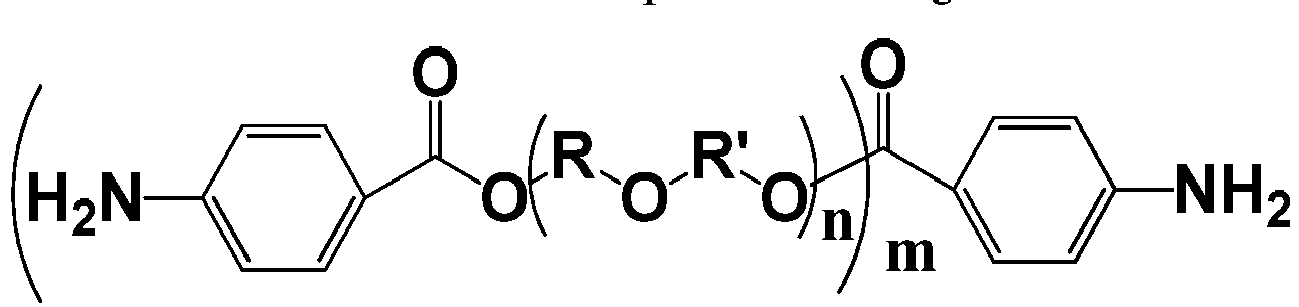
- wherein R and R' are, independent of each other, selected from the group consisting of linear or branched alkylene compounds having 2 to 18 carbon atoms per molecule, diol, triol or tetra alcohol-initiated polyols partially or fully capped with aminobenzoates,
- or wherein the (-R-O-R') group is -R"OOCR‴COOR"-; wherein R" is an alkylene compound having 2 to 8 carbon atoms per molecule and R‴ is an aliphatic or aromatic compound having 2 to 10 carbon atoms per molecule;
- wherein n is from 1 to 1000; and
- wherein m is from 1 to 5;
- wherein the isocyanate reactive component does not contain a solvent; and
- ii) an isocyanate-terminated component having an isocyanate functionality of from 2 to 6 wherein the isocyanate-terminated component does not contain a solvent;
at a stoichiometric ratio of NCO to reactive hydrogen in the range of from 0.9 to 2.5; to form an adhesive composition;
- i) an isocyanate reactive component that contains from 2 to 100 weight percent of an aminobenzoate-terminated composition having a structure of
- b) applying the adhesive composition to a primary substrate; and
- c) laminating the primary substrate with a secondary film to form a laminate structure, wherein the laminate structure is polyester/aluminum foil, polypropylene/aluminum foil, polyethylene/aluminum foil, polyimide/aluminum foil, nylon/aluminum foil, polyester/polyethylene, nylon/cast polypropylene, polyester/cast polypropylene, and other diplex, triplex, and multi-layer laminates of polymer film to polymer films, polymer film to metalized polymer films, or polymer film to foil.
- In some embodiments, the aminobenzoate-terminated composition has a structure of

- The isocyanate reactive component does not contain a solvent.
- Suitable aminobenzoate-terminated compounds include but are not limited to aniline functionalized polyethylene glycols, polypropylene glycols, polybutylene oxide polyol, polytetramethylene glycols, and mixtures and/or copolymers thereof. Other suitable aminobenzoate-terminated materials include aniline functionalized polyester polyols, polycaprolactone polyols, polycarbonate polyols, bio based polyols, polyacrylic polyols and mixtures and/or copolymers thereof. These aniline terminated compounds can be further blended with conventional polyether polyols, polyester polyols, diols, triols, polyamines, or mixtures of them to formulate an isocyanate reactive component.
- The aminobenzoate-terminated component generally has an aminobenzoate functionality of from 1 to 20. In various embodiments, the aminobenzoate-terminated component has an aminobenzoate functionality of between 2 to 10 and has an aminobenzoate functionality of between 2 to 3 in various other embodiments.
- The aminobenzoate-terminated component is generally present in the range of from 2 to 100 weight percent, based on the total weight of the isocyanate reactive composition. Any and all ranges between 2 and 100 weight percent are included and disclosed herein, for example, the aminobenzoate-terminated composition can be present in the range of 4 to 90 weight percent, 8 to 70 weight percent, or 10 to 50 weight percent in the isocyanate reactive composition.
- Additionally, in various embodiments, aminobenzoate-terminated compositions can be used as an additive, i.e. as an adhesion promoter or cross-linker.
- This component does not contain a solvent.
- In various embodiments, the isocyanate-terminated component can be a polyisocyanate. The polyisocyanate can be any aromatic, aliphatic, cycloaliphatic and/or (cyclo)aliphatic di- and/or polyisocyanate. In various other embodiments, the isocyanate-terminated component is an isocyanate-based prepolymer.
- Examples of aromatic di- or polyisocyanates, include but are not limited to 1,3- and 1,4-phenylene diisocyanate, 1,5-naphthylene diisocyanate, 2,6-toluene diisocyanate, 2,4-toluene diisocyanate (2,4-TDI), 2,4'-diphenylmethane diisocyanate (2,4'-MDI), 4,4'-diphenylmethane diisocyanate, mixtures of them, oligomeric diphenylmethane diisocyanates (polymeric MDI), xylylene diisocyanate, tetramethylxylylene diisocyanate and triisocyanatotoluene.
- In various embodiments, aliphatic di- or polyisocyanates generally have 3 to 16 carbon atoms in the linear or branched alkylene residue, and 4 to 12 carbon atoms in various other embodiments.
- In various embodiments, suitable cycloaliphatic or (cyclo)aliphatic diisocyanates generally contain in the cycloalkylene residue from 4 to 18 carbon atoms, and 6 to 15 carbon atoms, in various other embodiments. Those skilled in the art adequately understand (cyclo)aliphatic diisocyanates simultaneously to mean cyclically and aliphatically bound NCO groups, such as is, for example, the case with isophorone diisocyanate. In contrast to this, cycloaliphatic diisocyanates are understood to mean those which only have NCO groups directly bound to the cycloaliphatic ring, e.g. H12MDI.
- Examples of aliphatic isocyanates that can be used include, but are not limited to cyclohexane diisocyanate, methylcyclohexane diisocyanate, ethylcyclohexane diisocyanate, propylcyclohexane diisocyanate, methyldiethylcyclohexane diisocyanate, propane diisocyanate, butane diisocyanate, pentane diisocyanate, hexane diisocyanate, heptane diisocyanate, octane diisocyanate, nonane diisocyanate, nonane triisocyanate, such as 4-isocyanatomethyl-1,8-octane diisocyanate (TIN), decane di- and triisocyanate, undecane di- and triisocyanate and dodecane di- and triisocyanate.
- Additional examples include, but are not limited to isophorone diisocyanate (IPDI), hexamethylene diisocyanate (HDI), diisocyanatodicyclohexylmethane (H12MDI), 2-methylpentane diisocyanate (MPDI), 2,2,4-trimethylhexamethylene diisocyanate/2,4,4-trimethylhexamethylene diisocyanate (TMDI), and norbornane diisocyanate (NBDI), xylene diisocyanate (XDI), 1,3-Bis(1-isocyanato-1-methylethyl)benzene, 1,4-Bis(1-isocyanato-1-methylethyl)benzene,1,4-bis (isocynatomethyl) cyclohexane (1.4-H6 XDI), and 1,5 pentamethylene diisocyanate (PDI). The isocyanurates of IPDI, HDI, XDI, TMDI and/or H12MDI are also usable.
- Also suitable are 4-methyl-cyclohexane 1,3-diisocyanate, 2-butyl-2-ethylpentamethylene diisocyanate, 3(4)-isocyanatomethyl-1-methylcyclohexyl isocyanate, 2-isocyanatopropylcyclohexyl isocyanate, 2,4'-methylenebis(cyclohexyl) diisocyanate and 1,4-diisocyanato-4-methyl-pentane.
- Mixtures of the above isocyanate compounds can also be used.
- In various embodiments, the isocyanate-terminated component can be a polyurethane prepolymer. Suitable compounds that can react with polyisocyanates to form polyurethane prepolymers include compounds with hydroxyl groups, amino groups, and thio groups. Examples of the compounds include, but are not limited to polyesters, polycaprolactones, polyethers, polyacrylates, and polycarbonates polyols with an OH number of 5 to 2000 mg KOH/gram, an average molar mass of 62 to 20,000 g/mol, and a functionality between 1.5 to 6.0, and mixtures thereof. It is preferable to use polyols with an OH number of 14 to 2000 mg KOH/gram, particularly preferably with an OH number of 28 to 1400 mg KOH/gram with functionality between 2.0 to 4.0. It is very particularly preferable to use polyols with an OH number of 38 to 800 mg KOH/gram with functionality between 2.0 to 3.0. Preference is given to polyols with an average molecular weight of 300 to 3000 g/mol, particularly preferably with an average molecular weight of 400 to 1500 g/mol having functionality between 2.0 to 3.0.
- The isocyanate component is generally present in the range of from 8 to 98 weight percent, based on the total weight of the composition. Any and all ranges between 8 and 98 weight percent are included herein and disclosed herein; for example, the isocyanate component can be present in the range of 10 to 95 weight percent, 12 to 90 weight percent, 20 to 88 weight percent, 26 to 80 weight percent, 32 to 72 weight percent, 40 to 65 weight percent, and 45 to 55 weight percent.
- This component also does not contain a solvent.
- The adhesive composition can also contain additional components such as flow aids, leveling agents, adhesion promoters, block resistant agents, defoamers, and catalysts.
- Any substrate suitable for laminating adhesives can be used. Examples include, but are not limited to high density polyethylene, low density polyethylene, linear low density polyethylene, isotactic polypropylene, cast polypropylene, polyamide, nylon, polyesters, copolyesters, metalized plastics, aluminum foils, and combinations thereof.
- The adhesive composition may be applied to the primary substrate by any method known in the art such as, for example by spray coating, roller coating, or casting.
- The primary substrate can be laminated with a secondary substrate by any method known in the art. In various embodiments, the secondary substrate is a film herein referred to a 'secondary film.' Laminates of film to film, film to metalized film, and film to foil can be made via hand lamination or machine lamination. Hand lamination often involves applying the adhesive to the primary substrate using a drawdown bar, and then bringing the secondary film to the contact of the primary substrate to form laminates under pressure. Machine lamination can be done via a commercial laminator, such as those available from Nordmeccanica, Comexi, and Bobst.
- After the secondary film is laminated to the primary substrate, curing can begin. The adhesive composition is generally cured at a temperature in the range of from 0°C to 60°C. Any and all ranges between 0°C and 60°C are included herein and disclosed herein, for example, the adhesive composition can be cured at a temperature in the range of from 10°C to 50°C, or from 20°C to 40°C.
- The above formulated adhesives can apply to various package structures, including laminate structures of polyester/aluminum foil, polypropylene/aluminum foil, or polyethylene/aluminum foil, polyimide/ aluminum foil, nylon/ aluminum foil, polyester/polyethylene, nylon/cast polypropylene, polyester/cast polypropylene, and other diplex, triplex, and multi-layer laminates of polymer film to polymer films, polymer film to metalized polymer films, and polymer film to foil. These laminate structures are useful in particular for flexible packaging for food, pharmaceutical, and industrial applications, such as window films for building construction and automobiles, flexible packaging for electronics, and photovoltaic devices.
-
Material name Type source Mor Free™ 403A Polyaromatic isocyanate Dow Mor Free™ 117 Polyester polyol Dow Voranol™ 223-060 LM AT Aminobenzoate-terminated Voranol 223-060 LM from Benzocaine Lab made experimental material Mor Free™ C-33 Aliphatic polyisocyanate Dow Mor Free™ 225 Polyester polyol Dow Versalink® P-1000 Aminobenzoate-terminated polytetramethylene glycol Air Products Versalink® P-650 Aminobenzoate-terminated polytetramethylene glycol Air Products Versalink® P-250 Aminobenzoate-terminated polytetramethylene glycol Air Products - Adhesives were prepared by mixing components of the isocyanate reactive composition (Part A) first, followed by mixing the Part A with the isocyanate composition (Part B) at the desired stoichiometry ratio (NCO/OH).
Laminate structures were prepared by applying the mixture (adhesive) first to a primary substrate, and then hand laminating it with a secondary film. The laminate structures were then placed at room temperature or elevated temperature to complete the curing process. - Potlife of the adhesives was measured by a Brookfield Viscometer at 40ºC. Potlife is defined as the time it takes for the viscosity of the adhesive to reach 4500 cps. Bond strength (peel strength) of the adhesive was measured by a Thwing-Albert Tensile Tester at 25.4 cm/min (10 inch/min) on a 2.54 cm (1 inch) wide strip of the laminate. At least three specimens were measured. A number of failure modes were observed, where AS stands for adhesive split failure mode and bond strength is reported with the mean value; AT stands for adhesive transfer failure mode and the bond strength is reported with the mean value; FT stands for film tear failure mode and bond strength is reported with the peak value; and FS stands for film stretch failure mode and bond strength is reported with the peak value. Retort test was conducted in a retort chamber on pouches at 7.62 cm (3 inches) by 12.7 cm (5 inches) filled with deionized water. The test conditions were 121ºC for 1 hour. After the test, bond strips were prepared and bond strength was measured at room temperature by a Thwing-Albert Tensile Tester operated at 25.4 cm/min (10 inch/min).
Table 1. Composition and Processing Characteristics of Comparative Examples 1-2 and Examples 1-4 Comparative Example 1 Comparative Example 2 Example 1 Example 2 Example 3 Example 4 Part A Mor Free™ 117 6.00 5.50 Mor Free™ 225 6.00 5.70 5.75 5.75 Voranol™ 223-060 LM AT 1.66 1.35 Versalink® P-1000 0.80 Versalink® P-650 0.55 Part B Mor Free™ 403A 6.00 6.00 Mor Free™ C-33 6.00 6.00 6.00 6.00 NCO Index (NCO/OH) 1.34 1.20 1.34 1.2 1.20 1.20 Potlife, Min. 38 >60 33 29 Table 2. Composition and Processing Characteristics of Examples 5-10 Example 5 Example 6 Exampl e7 Example 8 Example 9 Example 10 Part A Mor Free™ C117 Mor Free™ 225 5.75 5.80 5.75 5.65 Voranol™ 223-060 LM AT Versalink® P-1000 17.1 Versalink® P-650 12.45 0.45 0.55 0.75 Versalink® P-250 0.30 Part B Mor Free™ C-33 6.00 6.00 6.00 6.00 6.00 6.00 NCO Index (NCO/OH) 1.20 1.20 1.20 1.20 1.20 1.20 Potlife, Min. 13.0 ≥ 60 ≥ 60 Not tested Not tested Not tested - Tables 1 and 2 shows composition and potlife of Comparative Examples 1-2 and Example 1-10. Use of 5 wt% to 100 wt% of an aminobenzoate-terminated compound in the isocyanate reactive composition can significantly reduce potlife of the adhesive without affecting its processing characteristics. Potlife of the adhesives can be optimized to 20-30 minutes at the processing conditions via adjusting the amount of the aminobenzoate-terminated compound in the isocyanate reactive composition.
Table 3. Bond Strength Buildup of Comparative Example 1 and Example 1 in Various Structures Examples Comparative Example 1 Example 1 Structures OPA/GF-19 Prelam AL /808.24 75 SLP /70 SPW OPA/GF-19 Prelam AL /808.24 75 SLP /70 SPW Bond in g/inch & Failure Mode 2 hours 39 g/cm (98 (AS)) 11 g/cm (27 (AS)) 7 g/cm (19 (AS)) 7 g/cm (19 (AS)) 10 g/cm (26 (AS)) 13 g/cm (34 (AS)) 4 hours 43 g/cm (110 (AS)) 30 g/cm (77 (AS)) 32 g/cm (82 (AS)) 61 g/cm (154 (AS)) 36 g/cm (91 (AS)) 67 g/cm (169 (AS)) 6 hours 64 g/cm (163 (AS)) 84 g/cm (212(AS)) 77 g/cm (196 (AS)) 119 g/cm (303 (AS)) 123 g/cm (312 (AS)) 158 g/cm (402 (AS)) 24 hours 66 g/cm (167 (AS)) 233 g/cm (592(AS)) 205 g/cm (521 (FT)) 359 g/cm (911 (FT)) 477 g/cm (1211 (FS)) 243 g/cm (616 (FT)) 96 hours 58 g/cm (148 (AS)) 584 g/cm (1483 (FS)) 206 g/cm (522 (FT)) 424 g/cm (1076 (FT)) 397 g/cm (1008 (FS)) 181 g/cm (459 (FT)) 168 hours 58 g/cm (148 (AS)) 484 g/cm (1230 (FS)) 183 g/cm (466 (FT)) 449 g/cm (1140 (FT)) 265 g/cm (672 (FS)) 168 g/cm (427 (FT)) - Bond strength development of Example 1 was much faster compared to Comparative Example 1. Within 24 hours, bond strength of Example 1 was strong enough to cause film tear or film stretch for all the laminated structures examined. To the contrary, bond strength of Comparative Example 1 was weak in laminates of OPA/GF-19 and Prelam Al/808.24.
Table 4. Bond Strength Buildup of Comparative Example 2 and Example 2 in Various Structures Examples Comparative Example 2 Example 2 Structures OPA/GF-19 Prelam AL /808.24 75 SLP /70 SPW OPA/GF-19 Prelam AL /808.24 75 SLP /70 SPW Bond in g/inch & Failure Mode 1-day RT 3.8 g/cm (9.6 (AS)) 2.1 g/cm (5.3 (AS)) 1.7 g/cm (4.3 (AS)) 3.3 g/cm (8.3 (AS)) 15.2 g/cm (38.7 (AS)) 2.2 g/cm (5.7 (AS)) 3-day RT 16.8 g/cm (42.7 (AS)) 36.9 g/cm (93.7 (AS)) 40.3 g/cm (102.3 (AS)) 144.5 g/cm (367.0 (FT)) 83 g/cm (211 (AS)) 121.7 g/cm (309.0 (FT)) - As shown in Table 4, bond strength buildup in aliphatic isocyanate based adhesives can be accelerated by adding small amount of an aminobenzoate-terminated compound. Example 2 demonstrated strong bond development at room temperature, as evident by the bond strength and failure mode (FT) in both OPA/GF-19 and 75 SLP/70 SPW laminates on day 3, superior to the bond strength of Comparative Example 2 in the same laminate structures.
Table 5. Bond Strength Buildup of Comparative Example 2 and Examples 3-7 in Prelam Al/CPP Examples Comparative Example 2 Example 3 Example 4 Example 5 Example 6 Example 7 Structures Prelam Al/CPP Prelam Al/CPP Prelam Al/CPP Prelam Al/CPP Prelam Al/CPP Prelam Al/CPP Bond in g/inch & Failure Mode 1-day RT 0.4 g/cm (1.0 (AS)) 0.8 g/cm (2.0 (AS)) 0.8 g/cm (2.0 (AS)) 0.8 g/cm (2.0 (AS)) 143.7 g/cm (365.0 (AS)) 155.9 g/cm (396.0 (AS)) 2-day RT 2.4 g/cm (6.0 (AS)) 13.8 g/cm (35.0 (AS)) 7.5 g/cm (19.0 (AS)) 2.7 g/cm (6.9 (AS)) 156.3 g/cm (397.0 (AS)) 139.4 g/cm (354.0 (AS)) 3-day RT 78.7 g/cm (200.0 (AS)) 106.3 g/cm (270.0 (AS)) 132.3 g/cm (336.0 (AS)) 90.9 g/cm (231.0 (AS)) 8-day RT 82.3 g/cm (209.0 (AS)) 99.6 g/cm (253.0 (AS)) 9-day RT 108.3 g/cm (275.0 (FT)) 116.5 g/cm (296.0 (FT)) 114.6 g/cm (291.0 (AS)) 121.5 g/cm (308.7 (AS)) - Table 5 shows bond strength buildup for Comparative Example 2 and Examples 3 to 7. Bond strength buildup is faster in the inventive Examples, and the speed of the bond buildup depends on the amount of the aminobenzoate-terminated compound in the isocyanate reactive composition. The higher the amount of the aminobenzoate-terminated compound is, the faster the bond buildup is, with speed of bond strength buildup maximized at 100% of aminobenzoate-terminated compound in the isocyanate reactive composition.
Table 6. Bond Strength Buildup of Comparative Example 2 and Examples 8-10 in Prelam Al/CPP Examples Comparative Example 2 Example 8 Example 9 Example 10 Structure Prelam Al/CPP Prelam Al/CPP Prelam Al/CPP Prelam Al/CPP Bond in g/inch & Failure Mode 1-day RT, 1-day 45°C 168 g/cm (427 (AT)) 190 g/cm (483 (AT)) 189 g/cm (480 (AT)) 193 g/cm (489 (AT)) 1-day RT, 3-day 45°C 244 g/cm (621 (AT)) 260 g/cm (661 (AT)) 259 g/cm (659 (AT)) 248 g/cm (630 (AT)) 1-day RT, 7-day 45°C 259 g/cm (659 (AT)) 259 g/cm (658 (AT)) 286 g/cm (726 (AT)) 255 g/cm (648 (AT)) DI water Retort at 121°C for 1 hour 162 g/cm (412 (AT)) 200 g/cm (507 (AT)) 189 g/cm (480 (AT)) 189 g/cm (481 (AT)) - Table 6 shows bond strength buildup in examples containing different level of Versalink P-650. The laminate structure was produced via a Labo Combi laminator made by Nordmeccanica. Coat weight of the resulted Prelam aluminum foil/CPP laminate was 1.0 pound/ream. The laminate structures were cured at 25° C and 50% humidity for 24 hours followed by curing at 45° C for up to 7 days. In general, compositions containing aminobenzoate-terminated compound demonstrated improved bond strength. Especially, when the laminates were subjected to deionized water retort test at 121ºC for 1 hour, the compositions containing the aminobenzoate-terminated compound showed improved heat and moisture resistance over the Comparative Example 2.
Claims (5)
- A process for forming a laminate structure for flexible packaging, the process comprising:a) mixingi) an isocyanate reactive component that contains from 2 to 100 weight percent of an aminobenzoate-terminated composition having a structure of
 wherein R and R' are, independent of each other, selected from the group consisting of linear or branched alkylene compounds having 2 to 18 carbon atoms per molecule, diol, triol or tetra alcohol-initiated polyols partially or fully capped with aminobenzoates,or wherein the (-R-O-R') group is -R"OOCR‴COOR"-; wherein R" is an alkylene compound having 2 to 8 carbon atoms per molecule and R‴ is an aliphatic or aromatic compound having 2 to 10 carbon atoms per molecule;wherein n is from 1 to 1000; andwherein m is from 1 to 5;wherein the isocyanate reactive component does not contain a solvent; andii) an isocyanate-terminated component having an isocyanate functionality of from 2 to 6 wherein the isocyanate-terminated component does not contain a solvent;
at a stoichiometric ratio of NCO to reactive hydrogen in the range of from 0.9 to 2.5; to form an adhesive composition;b) applying the adhesive composition to a primary substrate; andc) laminating the primary substrate with a secondary film to form a laminate structure, wherein the laminate structure is polyester/aluminum foil, polypropylene/aluminum foil, polyethylene/aluminum foil, polyimide/aluminum foil, nylon/aluminum foil, polyester/polyethylene, nylon/cast polypropylene, polyester/cast polypropylene, and other diplex, triplex, and multi-layer laminates of polymer film to polymer films, polymer film to metalized polymer films, or polymer film to foil. - The process of claim 1, wherein the primary substrate is selected from the group consisting of high density polyethylene, low density polyethylene, linear low density polyethylene, isotactic polypropylene, cast polypropylene, nylon, polyesters, copolyesters, metalized polymer films, aluminum foils, and combinations thereof.
- The process of any one of claims 1 or 2 wherein the aminobenzoate-terminated composition is selected from the group consisting of aniline functionalized polyethylene glycols, aniline functionalized polypropylene glycols, aniline functionalized polybutylene oxide polyol, aniline functionalized polytetramethylene glycols, aniline functionalized poly carbonate, aniline functionalized polycaprolactone, aniline functionalized polyesters, aniline functionalized polyester-polyether copolymers, and mixtures and/or copolymers thereof.
- The process of any one of claims 1-3 wherein the isocyanate-terminated component is selected from the group consisting of aromatic isocyanates, aliphatic isocyanates, and combinations thereof.
- The process of any one of claims 1-4 wherein the isocyanate-terminated component is a polyurethane prepolymer.
Applications Claiming Priority (2)
| Application Number | Priority Date | Filing Date | Title |
|---|---|---|---|
| US201562199600P | 2015-07-31 | 2015-07-31 | |
| PCT/US2016/035013 WO2017023405A1 (en) | 2015-07-31 | 2016-05-31 | Aminobenzoate-terminated materials for laminated adhesives |
Publications (2)
| Publication Number | Publication Date |
|---|---|
| EP3328910A1 EP3328910A1 (en) | 2018-06-06 |
| EP3328910B1 true EP3328910B1 (en) | 2023-12-06 |
Family
ID=56119788
Family Applications (1)
| Application Number | Title | Priority Date | Filing Date |
|---|---|---|---|
| EP16728809.1A Active EP3328910B1 (en) | 2015-07-31 | 2016-05-31 | Aminobenzoate-terminated materials for laminated adhesives |
Country Status (11)
| Country | Link |
|---|---|
| US (1) | US11198803B2 (en) |
| EP (1) | EP3328910B1 (en) |
| JP (3) | JP2018529794A (en) |
| CN (1) | CN107849213A (en) |
| AR (1) | AR105396A1 (en) |
| BR (1) | BR112018001238B1 (en) |
| ES (1) | ES2969060T3 (en) |
| MX (1) | MX2018000977A (en) |
| RU (1) | RU2722721C2 (en) |
| TW (1) | TWI764868B (en) |
| WO (1) | WO2017023405A1 (en) |
Families Citing this family (6)
| Publication number | Priority date | Publication date | Assignee | Title |
|---|---|---|---|---|
| WO2019240922A1 (en) * | 2018-06-11 | 2019-12-19 | Dow Global Technologies Llc | Processes for making coated films and solventless polyurethane precursors that may be used to make coated films |
| AR117147A1 (en) * | 2018-11-28 | 2021-07-14 | Dow Global Technologies Llc | PROCESS TO FORM A LAMINATE WITH SOLVENT-FREE ADHESIVE |
| JP7340364B2 (en) * | 2019-06-25 | 2023-09-07 | 株式会社ダイセル | Polycarbonate polyol derivative |
| JP7576989B2 (en) * | 2021-01-29 | 2024-11-01 | アイカ工業株式会社 | Urethane resin composition |
| EP4377411A4 (en) * | 2021-07-30 | 2025-04-16 | Dow Global Technologies LLC | Solvent-free adhesive compositions and laminate materials made therefrom |
| CN119213050A (en) * | 2022-06-09 | 2024-12-27 | 尤尼吉可株式会社 | Two-component mixed polyurea resin composition manufacturing raw materials and polyurea resin composition |
Family Cites Families (30)
| Publication number | Priority date | Publication date | Assignee | Title |
|---|---|---|---|---|
| US4732959A (en) | 1984-11-22 | 1988-03-22 | Toyo Tire & Rubber Company Limited | Polyesterpolyol derivative and a poly(urethane)ureamide obtained therefrom |
| JP2671208B2 (en) * | 1987-11-05 | 1997-10-29 | イハラケミカル工業株式会社 | Thermosetting adhesive composition |
| CA2038104C (en) * | 1990-03-30 | 2002-07-23 | Thomas S. Reid | Polyurethaneurea composition |
| US5183877A (en) | 1991-10-25 | 1993-02-02 | H. B. Fuller Company | Polyurea or polyurea-urethane adhesive for bonding elastomers |
| DE69332415T2 (en) * | 1992-03-12 | 2003-06-18 | Ashland Oil Inc., Columbus | PRIMER-FREE STRUCTURAL POLYURETHANE PURETHANE ADHESIVE |
| US5405218A (en) | 1992-05-05 | 1995-04-11 | Foamseal Inc | Method for the repair of existing manholes using elastomeric materials |
| JP3484210B2 (en) * | 1993-10-26 | 2004-01-06 | イハラケミカル工業株式会社 | Heat resistant bonding structure between adherend and polyurea elastomer and bonding method thereof |
| JP3455857B2 (en) * | 1993-11-24 | 2003-10-14 | イハラケミカル工業株式会社 | Adhesive composition |
| MX9703702A (en) | 1996-05-22 | 1998-06-30 | Fuller H B Licensing Financ | Improved isocyanate-based laminating adhesives. |
| JP2000007748A (en) * | 1998-04-24 | 2000-01-11 | Dainippon Ink & Chem Inc | Multifunctional polyurethane urea polyol resin composition and adhesive composition for lamination using the same |
| US6111129A (en) | 1998-11-04 | 2000-08-29 | Uniroyal Chemical Company, Inc. | Process for the preparation of alkanediol-diaminobenzoates |
| US6309507B1 (en) * | 1999-03-01 | 2001-10-30 | Nippon Polyurethane Industry Co., Ltd. | Polyisocyanate curing agent for laminate adhesive laminate adhesive comprising the same and its use |
| FR2812653A1 (en) * | 2000-08-03 | 2002-02-08 | Michelin Soc Tech | GLUE FOR RUBBER COMPOSITIONS, PROCESS FOR PREPARING THE SAME, AND ARTICLES COMPRISING THE SAME |
| DE102004018048A1 (en) | 2004-04-08 | 2005-11-10 | Henkel Kgaa | Process for the preparation of polyurethane prepolymers |
| US8933188B2 (en) | 2004-11-12 | 2015-01-13 | Henkel US IP LLC | Low misting laminating adhesives |
| KR100617716B1 (en) | 2005-06-09 | 2006-08-28 | 삼성전자주식회사 | Portable terminal and method for controlling backlight |
| US20070116910A1 (en) * | 2005-11-23 | 2007-05-24 | Polykarpov Alexander Y | Multilayer laminated structures |
| WO2008019215A1 (en) | 2006-08-07 | 2008-02-14 | Henkel Corporation | Two component solventless polyurethane laminating adhesives based on 1,4:3,6 dianhydrohexitols |
| US8168281B2 (en) | 2006-10-27 | 2012-05-01 | Michelin Rechenche er Technique, S.A. | Polyurea adhesive |
| EP2017260A1 (en) * | 2007-07-16 | 2009-01-21 | Sika Technology AG | Aldimines and compounds containing aldimine |
| US7547798B2 (en) | 2007-07-27 | 2009-06-16 | Air Products And Chemicals, Inc. | Process for preparing aminobenzoate esters |
| JP2010077326A (en) | 2008-09-27 | 2010-04-08 | Aica Kogyo Co Ltd | Adhesive composition and laminate |
| ES2358719T3 (en) * | 2008-10-31 | 2011-05-13 | Sika Technology Ag | COMPOSITION OF POLYURETHANE CONTAINING ALFA-SILANO WITH ANISOTROPIC MATERIAL PROPERTIES. |
| DE102008060885A1 (en) | 2008-12-09 | 2010-06-10 | Henkel Ag & Co. Kgaa | PU adhesives for sterilizable composite films |
| CA2782339C (en) * | 2009-12-01 | 2018-05-22 | Kuraray Co., Ltd. | Multilayered structure and method for producing the same |
| JP6092110B2 (en) | 2010-10-22 | 2017-03-08 | ヘンケル アイピー アンド ホールディング ゲゼルシャフト ミット ベシュレンクテル ハフツング | Strong adhesive for laminated flexible packaging |
| BR112013026588A2 (en) | 2011-04-15 | 2016-12-27 | Fuller H B Co | modified diphenylmethane diisocyanate adhesives |
| EP2709842B1 (en) | 2011-05-16 | 2019-03-06 | Ashland Licensing And Intellectual Property, LLC | Two part polyurea-urethane adhesive with elevated high temperature storage modulus |
| EP2866974B1 (en) | 2012-06-27 | 2017-07-26 | 3M Innovative Properties Company | Abrasive article |
| JP6210306B2 (en) * | 2013-12-19 | 2017-10-11 | Dic株式会社 | Solvent-free two-component curable laminate adhesive composition |
-
2016
- 2016-05-31 WO PCT/US2016/035013 patent/WO2017023405A1/en not_active Ceased
- 2016-05-31 RU RU2018105371A patent/RU2722721C2/en active
- 2016-05-31 MX MX2018000977A patent/MX2018000977A/en unknown
- 2016-05-31 BR BR112018001238-6A patent/BR112018001238B1/en active IP Right Grant
- 2016-05-31 JP JP2018503547A patent/JP2018529794A/en active Pending
- 2016-05-31 CN CN201680043521.2A patent/CN107849213A/en active Pending
- 2016-05-31 EP EP16728809.1A patent/EP3328910B1/en active Active
- 2016-05-31 ES ES16728809T patent/ES2969060T3/en active Active
- 2016-05-31 US US15/749,410 patent/US11198803B2/en active Active
- 2016-07-11 TW TW105121829A patent/TWI764868B/en active
- 2016-07-20 AR ARP160102188A patent/AR105396A1/en active IP Right Grant
-
2021
- 2021-04-08 JP JP2021065593A patent/JP2021119223A/en active Pending
-
2023
- 2023-02-13 JP JP2023019900A patent/JP2023078120A/en active Pending
Also Published As
| Publication number | Publication date |
|---|---|
| JP2021119223A (en) | 2021-08-12 |
| AR105396A1 (en) | 2017-09-27 |
| EP3328910A1 (en) | 2018-06-06 |
| BR112018001238A2 (en) | 2018-09-11 |
| JP2018529794A (en) | 2018-10-11 |
| BR112018001238B1 (en) | 2022-06-21 |
| US20180223143A1 (en) | 2018-08-09 |
| TW201704281A (en) | 2017-02-01 |
| CN107849213A (en) | 2018-03-27 |
| ES2969060T3 (en) | 2024-05-16 |
| RU2018105371A (en) | 2019-08-14 |
| MX2018000977A (en) | 2018-06-07 |
| RU2018105371A3 (en) | 2019-08-14 |
| TWI764868B (en) | 2022-05-21 |
| RU2722721C2 (en) | 2020-06-03 |
| WO2017023405A1 (en) | 2017-02-09 |
| US11198803B2 (en) | 2021-12-14 |
| JP2023078120A (en) | 2023-06-06 |
Similar Documents
| Publication | Publication Date | Title |
|---|---|---|
| TWI834602B (en) | Two-component solventless adhesive compositions, laminate structure comprising the same and method for forming the laminate structure | |
| EP3630865B1 (en) | Two-component solventless adhesive compositions | |
| EP3455275B1 (en) | Two-component solventless adhesive compositions comprising an amine-initiated polyol | |
| TWI756219B (en) | Two-component solventless adhesive compositions comprising an amine-initiated polyol | |
| US11198803B2 (en) | Aminobenzoate-terminated materials for laminated adhesives | |
| CN106661416B (en) | Polyurethane adhesive composition | |
| KR20170130462A (en) | Ultra low monomer polyurethane | |
| CN109642005B (en) | Two-component adhesive composition and method for producing the same | |
| JP2021024986A (en) | Gas barrier polyurethane resin composition and laminate | |
| EP3887158A1 (en) | Process for forming a laminate | |
| JP2024501605A (en) | adhesive composition | |
| EP3732226B1 (en) | Two-component solventless adhesive compositions for adhesion to metal and/or metallized substrates |
Legal Events
| Date | Code | Title | Description |
|---|---|---|---|
| STAA | Information on the status of an ep patent application or granted ep patent |
Free format text: STATUS: THE INTERNATIONAL PUBLICATION HAS BEEN MADE |
|
| PUAI | Public reference made under article 153(3) epc to a published international application that has entered the european phase |
Free format text: ORIGINAL CODE: 0009012 |
|
| STAA | Information on the status of an ep patent application or granted ep patent |
Free format text: STATUS: REQUEST FOR EXAMINATION WAS MADE |
|
| 17P | Request for examination filed |
Effective date: 20180223 |
|
| AK | Designated contracting states |
Kind code of ref document: A1 Designated state(s): AL AT BE BG CH CY CZ DE DK EE ES FI FR GB GR HR HU IE IS IT LI LT LU LV MC MK MT NL NO PL PT RO RS SE SI SK SM TR |
|
| AX | Request for extension of the european patent |
Extension state: BA ME |
|
| DAV | Request for validation of the european patent (deleted) | ||
| DAX | Request for extension of the european patent (deleted) | ||
| STAA | Information on the status of an ep patent application or granted ep patent |
Free format text: STATUS: EXAMINATION IS IN PROGRESS |
|
| 17Q | First examination report despatched |
Effective date: 20200225 |
|
| GRAP | Despatch of communication of intention to grant a patent |
Free format text: ORIGINAL CODE: EPIDOSNIGR1 |
|
| STAA | Information on the status of an ep patent application or granted ep patent |
Free format text: STATUS: GRANT OF PATENT IS INTENDED |
|
| INTG | Intention to grant announced |
Effective date: 20230228 |
|
| GRAJ | Information related to disapproval of communication of intention to grant by the applicant or resumption of examination proceedings by the epo deleted |
Free format text: ORIGINAL CODE: EPIDOSDIGR1 |
|
| STAA | Information on the status of an ep patent application or granted ep patent |
Free format text: STATUS: EXAMINATION IS IN PROGRESS |
|
| P01 | Opt-out of the competence of the unified patent court (upc) registered |
Effective date: 20230526 |
|
| GRAP | Despatch of communication of intention to grant a patent |
Free format text: ORIGINAL CODE: EPIDOSNIGR1 |
|
| STAA | Information on the status of an ep patent application or granted ep patent |
Free format text: STATUS: GRANT OF PATENT IS INTENDED |
|
| INTC | Intention to grant announced (deleted) | ||
| INTG | Intention to grant announced |
Effective date: 20230717 |
|
| GRAS | Grant fee paid |
Free format text: ORIGINAL CODE: EPIDOSNIGR3 |
|
| GRAA | (expected) grant |
Free format text: ORIGINAL CODE: 0009210 |
|
| STAA | Information on the status of an ep patent application or granted ep patent |
Free format text: STATUS: THE PATENT HAS BEEN GRANTED |
|
| AK | Designated contracting states |
Kind code of ref document: B1 Designated state(s): AL AT BE BG CH CY CZ DE DK EE ES FI FR GB GR HR HU IE IS IT LI LT LU LV MC MK MT NL NO PL PT RO RS SE SI SK SM TR |
|
| REG | Reference to a national code |
Ref country code: GB Ref legal event code: FG4D |
|
| REG | Reference to a national code |
Ref country code: DE Ref legal event code: R096 Ref document number: 602016084547 Country of ref document: DE |
|
| REG | Reference to a national code |
Ref country code: CH Ref legal event code: EP |
|
| REG | Reference to a national code |
Ref country code: IE Ref legal event code: FG4D |
|
| REG | Reference to a national code |
Ref country code: LT Ref legal event code: MG9D |
|
| PG25 | Lapsed in a contracting state [announced via postgrant information from national office to epo] |
Ref country code: GR Free format text: LAPSE BECAUSE OF FAILURE TO SUBMIT A TRANSLATION OF THE DESCRIPTION OR TO PAY THE FEE WITHIN THE PRESCRIBED TIME-LIMIT Effective date: 20240307 |
|
| REG | Reference to a national code |
Ref country code: NL Ref legal event code: MP Effective date: 20231206 |
|
| PG25 | Lapsed in a contracting state [announced via postgrant information from national office to epo] |
Ref country code: LT Free format text: LAPSE BECAUSE OF FAILURE TO SUBMIT A TRANSLATION OF THE DESCRIPTION OR TO PAY THE FEE WITHIN THE PRESCRIBED TIME-LIMIT Effective date: 20231206 |
|
| PG25 | Lapsed in a contracting state [announced via postgrant information from national office to epo] |
Ref country code: LT Free format text: LAPSE BECAUSE OF FAILURE TO SUBMIT A TRANSLATION OF THE DESCRIPTION OR TO PAY THE FEE WITHIN THE PRESCRIBED TIME-LIMIT Effective date: 20231206 Ref country code: GR Free format text: LAPSE BECAUSE OF FAILURE TO SUBMIT A TRANSLATION OF THE DESCRIPTION OR TO PAY THE FEE WITHIN THE PRESCRIBED TIME-LIMIT Effective date: 20240307 Ref country code: BG Free format text: LAPSE BECAUSE OF FAILURE TO SUBMIT A TRANSLATION OF THE DESCRIPTION OR TO PAY THE FEE WITHIN THE PRESCRIBED TIME-LIMIT Effective date: 20240306 |
|
| REG | Reference to a national code |
Ref country code: AT Ref legal event code: MK05 Ref document number: 1638355 Country of ref document: AT Kind code of ref document: T Effective date: 20231206 |
|
| REG | Reference to a national code |
Ref country code: ES Ref legal event code: FG2A Ref document number: 2969060 Country of ref document: ES Kind code of ref document: T3 Effective date: 20240516 |
|
| PG25 | Lapsed in a contracting state [announced via postgrant information from national office to epo] |
Ref country code: NL Free format text: LAPSE BECAUSE OF FAILURE TO SUBMIT A TRANSLATION OF THE DESCRIPTION OR TO PAY THE FEE WITHIN THE PRESCRIBED TIME-LIMIT Effective date: 20231206 |
|
| PG25 | Lapsed in a contracting state [announced via postgrant information from national office to epo] |
Ref country code: SE Free format text: LAPSE BECAUSE OF FAILURE TO SUBMIT A TRANSLATION OF THE DESCRIPTION OR TO PAY THE FEE WITHIN THE PRESCRIBED TIME-LIMIT Effective date: 20231206 Ref country code: RS Free format text: LAPSE BECAUSE OF FAILURE TO SUBMIT A TRANSLATION OF THE DESCRIPTION OR TO PAY THE FEE WITHIN THE PRESCRIBED TIME-LIMIT Effective date: 20231206 Ref country code: NO Free format text: LAPSE BECAUSE OF FAILURE TO SUBMIT A TRANSLATION OF THE DESCRIPTION OR TO PAY THE FEE WITHIN THE PRESCRIBED TIME-LIMIT Effective date: 20240306 Ref country code: NL Free format text: LAPSE BECAUSE OF FAILURE TO SUBMIT A TRANSLATION OF THE DESCRIPTION OR TO PAY THE FEE WITHIN THE PRESCRIBED TIME-LIMIT Effective date: 20231206 Ref country code: LV Free format text: LAPSE BECAUSE OF FAILURE TO SUBMIT A TRANSLATION OF THE DESCRIPTION OR TO PAY THE FEE WITHIN THE PRESCRIBED TIME-LIMIT Effective date: 20231206 Ref country code: HR Free format text: LAPSE BECAUSE OF FAILURE TO SUBMIT A TRANSLATION OF THE DESCRIPTION OR TO PAY THE FEE WITHIN THE PRESCRIBED TIME-LIMIT Effective date: 20231206 |
|
| PG25 | Lapsed in a contracting state [announced via postgrant information from national office to epo] |
Ref country code: IS Free format text: LAPSE BECAUSE OF FAILURE TO SUBMIT A TRANSLATION OF THE DESCRIPTION OR TO PAY THE FEE WITHIN THE PRESCRIBED TIME-LIMIT Effective date: 20240406 |
|
| PG25 | Lapsed in a contracting state [announced via postgrant information from national office to epo] |
Ref country code: CZ Free format text: LAPSE BECAUSE OF FAILURE TO SUBMIT A TRANSLATION OF THE DESCRIPTION OR TO PAY THE FEE WITHIN THE PRESCRIBED TIME-LIMIT Effective date: 20231206 Ref country code: AT Free format text: LAPSE BECAUSE OF FAILURE TO SUBMIT A TRANSLATION OF THE DESCRIPTION OR TO PAY THE FEE WITHIN THE PRESCRIBED TIME-LIMIT Effective date: 20231206 |
|
| PG25 | Lapsed in a contracting state [announced via postgrant information from national office to epo] |
Ref country code: SK Free format text: LAPSE BECAUSE OF FAILURE TO SUBMIT A TRANSLATION OF THE DESCRIPTION OR TO PAY THE FEE WITHIN THE PRESCRIBED TIME-LIMIT Effective date: 20231206 |
|
| PG25 | Lapsed in a contracting state [announced via postgrant information from national office to epo] |
Ref country code: SM Free format text: LAPSE BECAUSE OF FAILURE TO SUBMIT A TRANSLATION OF THE DESCRIPTION OR TO PAY THE FEE WITHIN THE PRESCRIBED TIME-LIMIT Effective date: 20231206 Ref country code: SK Free format text: LAPSE BECAUSE OF FAILURE TO SUBMIT A TRANSLATION OF THE DESCRIPTION OR TO PAY THE FEE WITHIN THE PRESCRIBED TIME-LIMIT Effective date: 20231206 Ref country code: RO Free format text: LAPSE BECAUSE OF FAILURE TO SUBMIT A TRANSLATION OF THE DESCRIPTION OR TO PAY THE FEE WITHIN THE PRESCRIBED TIME-LIMIT Effective date: 20231206 Ref country code: IS Free format text: LAPSE BECAUSE OF FAILURE TO SUBMIT A TRANSLATION OF THE DESCRIPTION OR TO PAY THE FEE WITHIN THE PRESCRIBED TIME-LIMIT Effective date: 20240406 Ref country code: EE Free format text: LAPSE BECAUSE OF FAILURE TO SUBMIT A TRANSLATION OF THE DESCRIPTION OR TO PAY THE FEE WITHIN THE PRESCRIBED TIME-LIMIT Effective date: 20231206 Ref country code: CZ Free format text: LAPSE BECAUSE OF FAILURE TO SUBMIT A TRANSLATION OF THE DESCRIPTION OR TO PAY THE FEE WITHIN THE PRESCRIBED TIME-LIMIT Effective date: 20231206 Ref country code: AT Free format text: LAPSE BECAUSE OF FAILURE TO SUBMIT A TRANSLATION OF THE DESCRIPTION OR TO PAY THE FEE WITHIN THE PRESCRIBED TIME-LIMIT Effective date: 20231206 |
|
| PG25 | Lapsed in a contracting state [announced via postgrant information from national office to epo] |
Ref country code: PT Free format text: LAPSE BECAUSE OF FAILURE TO SUBMIT A TRANSLATION OF THE DESCRIPTION OR TO PAY THE FEE WITHIN THE PRESCRIBED TIME-LIMIT Effective date: 20240408 Ref country code: PL Free format text: LAPSE BECAUSE OF FAILURE TO SUBMIT A TRANSLATION OF THE DESCRIPTION OR TO PAY THE FEE WITHIN THE PRESCRIBED TIME-LIMIT Effective date: 20231206 |
|
| PG25 | Lapsed in a contracting state [announced via postgrant information from national office to epo] |
Ref country code: PT Free format text: LAPSE BECAUSE OF FAILURE TO SUBMIT A TRANSLATION OF THE DESCRIPTION OR TO PAY THE FEE WITHIN THE PRESCRIBED TIME-LIMIT Effective date: 20240408 Ref country code: PL Free format text: LAPSE BECAUSE OF FAILURE TO SUBMIT A TRANSLATION OF THE DESCRIPTION OR TO PAY THE FEE WITHIN THE PRESCRIBED TIME-LIMIT Effective date: 20231206 |
|
| REG | Reference to a national code |
Ref country code: DE Ref legal event code: R097 Ref document number: 602016084547 Country of ref document: DE |
|
| PG25 | Lapsed in a contracting state [announced via postgrant information from national office to epo] |
Ref country code: DK Free format text: LAPSE BECAUSE OF FAILURE TO SUBMIT A TRANSLATION OF THE DESCRIPTION OR TO PAY THE FEE WITHIN THE PRESCRIBED TIME-LIMIT Effective date: 20231206 |
|
| PLBE | No opposition filed within time limit |
Free format text: ORIGINAL CODE: 0009261 |
|
| STAA | Information on the status of an ep patent application or granted ep patent |
Free format text: STATUS: NO OPPOSITION FILED WITHIN TIME LIMIT |
|
| PG25 | Lapsed in a contracting state [announced via postgrant information from national office to epo] |
Ref country code: SI Free format text: LAPSE BECAUSE OF FAILURE TO SUBMIT A TRANSLATION OF THE DESCRIPTION OR TO PAY THE FEE WITHIN THE PRESCRIBED TIME-LIMIT Effective date: 20231206 |
|
| PG25 | Lapsed in a contracting state [announced via postgrant information from national office to epo] |
Ref country code: SI Free format text: LAPSE BECAUSE OF FAILURE TO SUBMIT A TRANSLATION OF THE DESCRIPTION OR TO PAY THE FEE WITHIN THE PRESCRIBED TIME-LIMIT Effective date: 20231206 Ref country code: DK Free format text: LAPSE BECAUSE OF FAILURE TO SUBMIT A TRANSLATION OF THE DESCRIPTION OR TO PAY THE FEE WITHIN THE PRESCRIBED TIME-LIMIT Effective date: 20231206 |
|
| 26N | No opposition filed |
Effective date: 20240909 |
|
| REG | Reference to a national code |
Ref country code: CH Ref legal event code: PL |
|
| PG25 | Lapsed in a contracting state [announced via postgrant information from national office to epo] |
Ref country code: MC Free format text: LAPSE BECAUSE OF FAILURE TO SUBMIT A TRANSLATION OF THE DESCRIPTION OR TO PAY THE FEE WITHIN THE PRESCRIBED TIME-LIMIT Effective date: 20231206 |
|
| PG25 | Lapsed in a contracting state [announced via postgrant information from national office to epo] |
Ref country code: LU Free format text: LAPSE BECAUSE OF NON-PAYMENT OF DUE FEES Effective date: 20240531 |
|
| GBPC | Gb: european patent ceased through non-payment of renewal fee |
Effective date: 20240531 |
|
| PG25 | Lapsed in a contracting state [announced via postgrant information from national office to epo] |
Ref country code: MC Free format text: LAPSE BECAUSE OF FAILURE TO SUBMIT A TRANSLATION OF THE DESCRIPTION OR TO PAY THE FEE WITHIN THE PRESCRIBED TIME-LIMIT Effective date: 20231206 Ref country code: LU Free format text: LAPSE BECAUSE OF NON-PAYMENT OF DUE FEES Effective date: 20240531 Ref country code: CH Free format text: LAPSE BECAUSE OF NON-PAYMENT OF DUE FEES Effective date: 20240531 |
|
| REG | Reference to a national code |
Ref country code: BE Ref legal event code: MM Effective date: 20240531 |
|
| PG25 | Lapsed in a contracting state [announced via postgrant information from national office to epo] |
Ref country code: IE Free format text: LAPSE BECAUSE OF NON-PAYMENT OF DUE FEES Effective date: 20240531 |
|
| PG25 | Lapsed in a contracting state [announced via postgrant information from national office to epo] |
Ref country code: BE Free format text: LAPSE BECAUSE OF NON-PAYMENT OF DUE FEES Effective date: 20240531 |
|
| PG25 | Lapsed in a contracting state [announced via postgrant information from national office to epo] |
Ref country code: GB Free format text: LAPSE BECAUSE OF NON-PAYMENT OF DUE FEES Effective date: 20240531 |
|
| PGFP | Annual fee paid to national office [announced via postgrant information from national office to epo] |
Ref country code: DE Payment date: 20250402 Year of fee payment: 10 |
|
| PGFP | Annual fee paid to national office [announced via postgrant information from national office to epo] |
Ref country code: ES Payment date: 20250605 Year of fee payment: 10 |
|
| PGFP | Annual fee paid to national office [announced via postgrant information from national office to epo] |
Ref country code: IT Payment date: 20250422 Year of fee payment: 10 |
|
| PGFP | Annual fee paid to national office [announced via postgrant information from national office to epo] |
Ref country code: FR Payment date: 20250401 Year of fee payment: 10 |
|
| PGFP | Annual fee paid to national office [announced via postgrant information from national office to epo] |
Ref country code: TR Payment date: 20250529 Year of fee payment: 10 |
|
| REG | Reference to a national code |
Ref country code: DE Ref legal event code: R081 Ref document number: 602016084547 Country of ref document: DE Owner name: ARKEMA FRANCE, FR Free format text: FORMER OWNER: DOW GLOBAL TECHNOLOGIES LLC, MIDLAND, MI, US |
|
| PG25 | Lapsed in a contracting state [announced via postgrant information from national office to epo] |
Ref country code: CY Free format text: LAPSE BECAUSE OF FAILURE TO SUBMIT A TRANSLATION OF THE DESCRIPTION OR TO PAY THE FEE WITHIN THE PRESCRIBED TIME-LIMIT; INVALID AB INITIO Effective date: 20160531 |
|
| PG25 | Lapsed in a contracting state [announced via postgrant information from national office to epo] |
Ref country code: FI Free format text: LAPSE BECAUSE OF FAILURE TO SUBMIT A TRANSLATION OF THE DESCRIPTION OR TO PAY THE FEE WITHIN THE PRESCRIBED TIME-LIMIT Effective date: 20231207 |
|
| PG25 | Lapsed in a contracting state [announced via postgrant information from national office to epo] |
Ref country code: HU Free format text: LAPSE BECAUSE OF FAILURE TO SUBMIT A TRANSLATION OF THE DESCRIPTION OR TO PAY THE FEE WITHIN THE PRESCRIBED TIME-LIMIT; INVALID AB INITIO Effective date: 20160531 |
|
| REG | Reference to a national code |
Ref country code: ES Ref legal event code: PC2A Owner name: ARKEMA FRANCE Effective date: 20260429 |