EP3328500B1 - Single nucleotide polymorphic alleles of human dp-2 gene for detection of susceptibility to hair growth inhibition by pgd2 antagonists - Google Patents
Single nucleotide polymorphic alleles of human dp-2 gene for detection of susceptibility to hair growth inhibition by pgd2 antagonists Download PDFInfo
- Publication number
- EP3328500B1 EP3328500B1 EP16831347.6A EP16831347A EP3328500B1 EP 3328500 B1 EP3328500 B1 EP 3328500B1 EP 16831347 A EP16831347 A EP 16831347A EP 3328500 B1 EP3328500 B1 EP 3328500B1
- Authority
- EP
- European Patent Office
- Prior art keywords
- antagonist
- subject
- allele
- hair
- loci
- Prior art date
- Legal status (The legal status is an assumption and is not a legal conclusion. Google has not performed a legal analysis and makes no representation as to the accuracy of the status listed.)
- Active
Links
Images


Classifications
-
- A—HUMAN NECESSITIES
- A61—MEDICAL OR VETERINARY SCIENCE; HYGIENE
- A61K—PREPARATIONS FOR MEDICAL, DENTAL OR TOILETRY PURPOSES
- A61K31/00—Medicinal preparations containing organic active ingredients
- A61K31/33—Heterocyclic compounds
- A61K31/395—Heterocyclic compounds having nitrogen as a ring hetero atom, e.g. guanethidine or rifamycins
- A61K31/40—Heterocyclic compounds having nitrogen as a ring hetero atom, e.g. guanethidine or rifamycins having five-membered rings with one nitrogen as the only ring hetero atom, e.g. sulpiride, succinimide, tolmetin, buflomedil
- A61K31/403—Heterocyclic compounds having nitrogen as a ring hetero atom, e.g. guanethidine or rifamycins having five-membered rings with one nitrogen as the only ring hetero atom, e.g. sulpiride, succinimide, tolmetin, buflomedil condensed with carbocyclic rings, e.g. carbazole
- A61K31/404—Indoles, e.g. pindolol
-
- A—HUMAN NECESSITIES
- A61—MEDICAL OR VETERINARY SCIENCE; HYGIENE
- A61K—PREPARATIONS FOR MEDICAL, DENTAL OR TOILETRY PURPOSES
- A61K31/00—Medicinal preparations containing organic active ingredients
- A61K31/33—Heterocyclic compounds
- A61K31/395—Heterocyclic compounds having nitrogen as a ring hetero atom, e.g. guanethidine or rifamycins
- A61K31/435—Heterocyclic compounds having nitrogen as a ring hetero atom, e.g. guanethidine or rifamycins having six-membered rings with one nitrogen as the only ring hetero atom
- A61K31/4353—Heterocyclic compounds having nitrogen as a ring hetero atom, e.g. guanethidine or rifamycins having six-membered rings with one nitrogen as the only ring hetero atom ortho- or peri-condensed with heterocyclic ring systems
- A61K31/437—Heterocyclic compounds having nitrogen as a ring hetero atom, e.g. guanethidine or rifamycins having six-membered rings with one nitrogen as the only ring hetero atom ortho- or peri-condensed with heterocyclic ring systems the heterocyclic ring system containing a five-membered ring having nitrogen as a ring hetero atom, e.g. indolizine, beta-carboline
-
- A—HUMAN NECESSITIES
- A61—MEDICAL OR VETERINARY SCIENCE; HYGIENE
- A61K—PREPARATIONS FOR MEDICAL, DENTAL OR TOILETRY PURPOSES
- A61K31/00—Medicinal preparations containing organic active ingredients
- A61K31/33—Heterocyclic compounds
- A61K31/395—Heterocyclic compounds having nitrogen as a ring hetero atom, e.g. guanethidine or rifamycins
- A61K31/435—Heterocyclic compounds having nitrogen as a ring hetero atom, e.g. guanethidine or rifamycins having six-membered rings with one nitrogen as the only ring hetero atom
- A61K31/47—Quinolines; Isoquinolines
-
- A—HUMAN NECESSITIES
- A61—MEDICAL OR VETERINARY SCIENCE; HYGIENE
- A61K—PREPARATIONS FOR MEDICAL, DENTAL OR TOILETRY PURPOSES
- A61K31/00—Medicinal preparations containing organic active ingredients
- A61K31/33—Heterocyclic compounds
- A61K31/395—Heterocyclic compounds having nitrogen as a ring hetero atom, e.g. guanethidine or rifamycins
- A61K31/435—Heterocyclic compounds having nitrogen as a ring hetero atom, e.g. guanethidine or rifamycins having six-membered rings with one nitrogen as the only ring hetero atom
- A61K31/47—Quinolines; Isoquinolines
- A61K31/473—Quinolines; Isoquinolines ortho- or peri-condensed with carbocyclic ring systems, e.g. acridines, phenanthridines
-
- A—HUMAN NECESSITIES
- A61—MEDICAL OR VETERINARY SCIENCE; HYGIENE
- A61K—PREPARATIONS FOR MEDICAL, DENTAL OR TOILETRY PURPOSES
- A61K31/00—Medicinal preparations containing organic active ingredients
- A61K31/33—Heterocyclic compounds
- A61K31/395—Heterocyclic compounds having nitrogen as a ring hetero atom, e.g. guanethidine or rifamycins
- A61K31/495—Heterocyclic compounds having nitrogen as a ring hetero atom, e.g. guanethidine or rifamycins having six-membered rings with two or more nitrogen atoms as the only ring heteroatoms, e.g. piperazine or tetrazines
- A61K31/505—Pyrimidines; Hydrogenated pyrimidines, e.g. trimethoprim
- A61K31/506—Pyrimidines; Hydrogenated pyrimidines, e.g. trimethoprim not condensed and containing further heterocyclic rings
-
- A—HUMAN NECESSITIES
- A61—MEDICAL OR VETERINARY SCIENCE; HYGIENE
- A61K—PREPARATIONS FOR MEDICAL, DENTAL OR TOILETRY PURPOSES
- A61K8/00—Cosmetics or similar toiletry preparations
- A61K8/18—Cosmetics or similar toiletry preparations characterised by the composition
- A61K8/30—Cosmetics or similar toiletry preparations characterised by the composition containing organic compounds
- A61K8/33—Cosmetics or similar toiletry preparations characterised by the composition containing organic compounds containing oxygen
- A61K8/36—Carboxylic acids; Salts or anhydrides thereof
- A61K8/368—Carboxylic acids; Salts or anhydrides thereof with carboxyl groups directly bound to carbon atoms of aromatic rings
-
- A—HUMAN NECESSITIES
- A61—MEDICAL OR VETERINARY SCIENCE; HYGIENE
- A61K—PREPARATIONS FOR MEDICAL, DENTAL OR TOILETRY PURPOSES
- A61K8/00—Cosmetics or similar toiletry preparations
- A61K8/18—Cosmetics or similar toiletry preparations characterised by the composition
- A61K8/30—Cosmetics or similar toiletry preparations characterised by the composition containing organic compounds
- A61K8/49—Cosmetics or similar toiletry preparations characterised by the composition containing organic compounds containing heterocyclic compounds
- A61K8/4906—Cosmetics or similar toiletry preparations characterised by the composition containing organic compounds containing heterocyclic compounds with one nitrogen as the only hetero atom
- A61K8/4913—Cosmetics or similar toiletry preparations characterised by the composition containing organic compounds containing heterocyclic compounds with one nitrogen as the only hetero atom having five membered rings, e.g. pyrrolidone carboxylic acid
- A61K8/492—Cosmetics or similar toiletry preparations characterised by the composition containing organic compounds containing heterocyclic compounds with one nitrogen as the only hetero atom having five membered rings, e.g. pyrrolidone carboxylic acid having condensed rings, e.g. indol
-
- A—HUMAN NECESSITIES
- A61—MEDICAL OR VETERINARY SCIENCE; HYGIENE
- A61K—PREPARATIONS FOR MEDICAL, DENTAL OR TOILETRY PURPOSES
- A61K8/00—Cosmetics or similar toiletry preparations
- A61K8/18—Cosmetics or similar toiletry preparations characterised by the composition
- A61K8/30—Cosmetics or similar toiletry preparations characterised by the composition containing organic compounds
- A61K8/49—Cosmetics or similar toiletry preparations characterised by the composition containing organic compounds containing heterocyclic compounds
- A61K8/4906—Cosmetics or similar toiletry preparations characterised by the composition containing organic compounds containing heterocyclic compounds with one nitrogen as the only hetero atom
- A61K8/4926—Cosmetics or similar toiletry preparations characterised by the composition containing organic compounds containing heterocyclic compounds with one nitrogen as the only hetero atom having six membered rings
-
- A—HUMAN NECESSITIES
- A61—MEDICAL OR VETERINARY SCIENCE; HYGIENE
- A61K—PREPARATIONS FOR MEDICAL, DENTAL OR TOILETRY PURPOSES
- A61K8/00—Cosmetics or similar toiletry preparations
- A61K8/18—Cosmetics or similar toiletry preparations characterised by the composition
- A61K8/30—Cosmetics or similar toiletry preparations characterised by the composition containing organic compounds
- A61K8/69—Cosmetics or similar toiletry preparations characterised by the composition containing organic compounds containing fluorine
-
- A—HUMAN NECESSITIES
- A61—MEDICAL OR VETERINARY SCIENCE; HYGIENE
- A61K—PREPARATIONS FOR MEDICAL, DENTAL OR TOILETRY PURPOSES
- A61K9/00—Medicinal preparations characterised by special physical form
- A61K9/0012—Galenical forms characterised by the site of application
- A61K9/0014—Skin, i.e. galenical aspects of topical compositions
-
- A—HUMAN NECESSITIES
- A61—MEDICAL OR VETERINARY SCIENCE; HYGIENE
- A61K—PREPARATIONS FOR MEDICAL, DENTAL OR TOILETRY PURPOSES
- A61K9/00—Medicinal preparations characterised by special physical form
- A61K9/0012—Galenical forms characterised by the site of application
- A61K9/0053—Mouth and digestive tract, i.e. intraoral and peroral administration
-
- A—HUMAN NECESSITIES
- A61—MEDICAL OR VETERINARY SCIENCE; HYGIENE
- A61P—SPECIFIC THERAPEUTIC ACTIVITY OF CHEMICAL COMPOUNDS OR MEDICINAL PREPARATIONS
- A61P17/00—Drugs for dermatological disorders
-
- A—HUMAN NECESSITIES
- A61—MEDICAL OR VETERINARY SCIENCE; HYGIENE
- A61P—SPECIFIC THERAPEUTIC ACTIVITY OF CHEMICAL COMPOUNDS OR MEDICINAL PREPARATIONS
- A61P17/00—Drugs for dermatological disorders
- A61P17/14—Drugs for dermatological disorders for baldness or alopecia
-
- A—HUMAN NECESSITIES
- A61—MEDICAL OR VETERINARY SCIENCE; HYGIENE
- A61P—SPECIFIC THERAPEUTIC ACTIVITY OF CHEMICAL COMPOUNDS OR MEDICINAL PREPARATIONS
- A61P43/00—Drugs for specific purposes, not provided for in groups A61P1/00-A61P41/00
-
- A—HUMAN NECESSITIES
- A61—MEDICAL OR VETERINARY SCIENCE; HYGIENE
- A61Q—SPECIFIC USE OF COSMETICS OR SIMILAR TOILETRY PREPARATIONS
- A61Q7/00—Preparations for affecting hair growth
-
- C—CHEMISTRY; METALLURGY
- C12—BIOCHEMISTRY; BEER; SPIRITS; WINE; VINEGAR; MICROBIOLOGY; ENZYMOLOGY; MUTATION OR GENETIC ENGINEERING
- C12Q—MEASURING OR TESTING PROCESSES INVOLVING ENZYMES, NUCLEIC ACIDS OR MICROORGANISMS; COMPOSITIONS OR TEST PAPERS THEREFOR; PROCESSES OF PREPARING SUCH COMPOSITIONS; CONDITION-RESPONSIVE CONTROL IN MICROBIOLOGICAL OR ENZYMOLOGICAL PROCESSES
- C12Q1/00—Measuring or testing processes involving enzymes, nucleic acids or microorganisms; Compositions therefor; Processes of preparing such compositions
- C12Q1/68—Measuring or testing processes involving enzymes, nucleic acids or microorganisms; Compositions therefor; Processes of preparing such compositions involving nucleic acids
-
- C—CHEMISTRY; METALLURGY
- C12—BIOCHEMISTRY; BEER; SPIRITS; WINE; VINEGAR; MICROBIOLOGY; ENZYMOLOGY; MUTATION OR GENETIC ENGINEERING
- C12Q—MEASURING OR TESTING PROCESSES INVOLVING ENZYMES, NUCLEIC ACIDS OR MICROORGANISMS; COMPOSITIONS OR TEST PAPERS THEREFOR; PROCESSES OF PREPARING SUCH COMPOSITIONS; CONDITION-RESPONSIVE CONTROL IN MICROBIOLOGICAL OR ENZYMOLOGICAL PROCESSES
- C12Q1/00—Measuring or testing processes involving enzymes, nucleic acids or microorganisms; Compositions therefor; Processes of preparing such compositions
- C12Q1/68—Measuring or testing processes involving enzymes, nucleic acids or microorganisms; Compositions therefor; Processes of preparing such compositions involving nucleic acids
- C12Q1/6876—Nucleic acid products used in the analysis of nucleic acids, e.g. primers or probes
- C12Q1/6883—Nucleic acid products used in the analysis of nucleic acids, e.g. primers or probes for diseases caused by alterations of genetic material
-
- A—HUMAN NECESSITIES
- A61—MEDICAL OR VETERINARY SCIENCE; HYGIENE
- A61K—PREPARATIONS FOR MEDICAL, DENTAL OR TOILETRY PURPOSES
- A61K2800/00—Properties of cosmetic compositions or active ingredients thereof or formulation aids used therein and process related aspects
- A61K2800/80—Process related aspects concerning the preparation of the cosmetic composition or the storage or application thereof
- A61K2800/92—Oral administration
-
- A—HUMAN NECESSITIES
- A61—MEDICAL OR VETERINARY SCIENCE; HYGIENE
- A61K—PREPARATIONS FOR MEDICAL, DENTAL OR TOILETRY PURPOSES
- A61K38/00—Medicinal preparations containing peptides
-
- C—CHEMISTRY; METALLURGY
- C12—BIOCHEMISTRY; BEER; SPIRITS; WINE; VINEGAR; MICROBIOLOGY; ENZYMOLOGY; MUTATION OR GENETIC ENGINEERING
- C12Q—MEASURING OR TESTING PROCESSES INVOLVING ENZYMES, NUCLEIC ACIDS OR MICROORGANISMS; COMPOSITIONS OR TEST PAPERS THEREFOR; PROCESSES OF PREPARING SUCH COMPOSITIONS; CONDITION-RESPONSIVE CONTROL IN MICROBIOLOGICAL OR ENZYMOLOGICAL PROCESSES
- C12Q2600/00—Oligonucleotides characterized by their use
- C12Q2600/106—Pharmacogenomics, i.e. genetic variability in individual responses to drugs and drug metabolism
-
- C—CHEMISTRY; METALLURGY
- C12—BIOCHEMISTRY; BEER; SPIRITS; WINE; VINEGAR; MICROBIOLOGY; ENZYMOLOGY; MUTATION OR GENETIC ENGINEERING
- C12Q—MEASURING OR TESTING PROCESSES INVOLVING ENZYMES, NUCLEIC ACIDS OR MICROORGANISMS; COMPOSITIONS OR TEST PAPERS THEREFOR; PROCESSES OF PREPARING SUCH COMPOSITIONS; CONDITION-RESPONSIVE CONTROL IN MICROBIOLOGICAL OR ENZYMOLOGICAL PROCESSES
- C12Q2600/00—Oligonucleotides characterized by their use
- C12Q2600/156—Polymorphic or mutational markers
Definitions
- the invention relates to compositions for regulating hair growth. Specifically, the invention relates to identifying subjects, such as those with androgenetic alopecia or baldness or hair loss, responsive to PGD 2 receptor, DP-2 ( aka CRTH2 or GPR44) antagonists to stimulate hair growth.
- identifying subjects such as those with androgenetic alopecia or baldness or hair loss, responsive to PGD 2 receptor, DP-2 ( aka CRTH2 or GPR44) antagonists to stimulate hair growth.
- AGA androgenetic alopecia
- infiltrating lymphocytes and mast cells have been identified around the miniaturizing follicle, especially in the area of the stem cell-rich bulge area. Sebaceous glands, which attach to each follicle, hypertrophy in bald scalp. In balding scalp, the number of hair follicle stem cells remains intact, whereas the number of more actively proliferating progenitor cells markedly decreases. This indicates that balding scalp either lacks an activator or has an inhibitor of hair follicle growth.
- Prostaglandin D 2 (PGDz) and its synthesizing enzyme, PGD 2 synthase, are present at higher levels in balding versus non-balding scalp in men with androgenetic alopecia.
- PGD 2 inhibited hair growth via CRTH2/DP-2, one of two PGD 2 receptors, indicating that DP-2 is the key receptor mediating the hair growth inhibitory activity of PGD 2 in human follicles ( Garza et al. (2012) Sci. Transl. Med. 4, 126ra34 ).
- WO 2015/072963 discloses compositions and methods for regulating hair growth including the use of PD-2 antagonists for the treatment of baldness.
- Garza et al., Science Translational Medicine, 2012, Vol. 4, Issue 126, pp. 126ra34 discloses that PD2 inhibits hair growth and is elevated in bald scalp of men with androgenetic alopecia.
- WO 03/18835 discloses methods for the detection of specific nucleotide polymorphisms.
- compositions for stimulating hair growth as well as methods to identify who would likely to be responsive to them.
- the invention provides a method of identifying whether a subject having androgenetic alopecia, baldness or hair loss is likely to be responsive to administration of a DP-2 antagonist that is selective with respect to DP-1 to stimulate hair growth, comprising:
- the genotyping comprises the step of sequencing the genomic DNA regions that contain the loci, or the steps of amplifying the genomic DNA by PCR and sequencing the amplified genomic DNA regions that contain the loci.
- the genotyping comprises the steps of:
- the subject has hair loss associated with discoid lupus erythematosus, congenital hypotrichosis, lichen planopilaris or scarring alopecia
- the present invention also provides a non-therapeutic method of stimulating hair growth in a subject having one or more alleles indicating that the subject is likely to be responsive to administration of a DP-2 antagonist to stimulate hair growth, comprising: administering to the subject an effective amount of the DP-2 antagonist, wherein the one or more alleles is located at single nucleotide polymorphic loci within or flanking the DP-2 gene, wherein the loci comprise rs545659, rs634681 and rs7167, wherein allele C of rs545659, allele A of rs634681 and allele G of rs7167 indicate that the subject is likely to be responsive, and wherein the DP-2 antagonist is a selective DP-2 antagonist with respect to DP-1.
- the subject has baldness or hair loss.
- the present invention also provides a DP-2 antagonist for use in treating a subject having androgenetic alopecia or hair loss associated with discoid lupus erythematosus, congenital hypotrichosis, lichen planopilaris or scarring alopecia, and having one or more alleles indicating that the subject is likely to be responsive to administration of a DP-2 antagonist to stimulate hair growth, comprising: administering to the subject an effective amount of the DP-2 antagonist, wherein the one or more alleles is located at single nucleotide polymorphic loci within or flanking the DP-2 gene, wherein the loci comprise rs545659, rs634681 and rs7167, wherein allele C of rs545659, allele A of rs634681 and allele G of rs7167 indicate that the subject is likely to be responsive, and wherein the DP-2 antagonist is a selective DP-2 antagonist with respect to DP-1.
- the subject is identified as being likely to be responsive to administration of a DP-2 antagonist to stimulate hair growth by the method of the invention.
- the step of administering is topical or oral administration.
- the invention further comprises administering finasteride or minoxidil to the subject, transplanting hair follicles to the subject, or removing dermis or epidermis from skin in the subject.
- the DP-2 antagonist has a IC 50 for DP-2 of 100 nM or less.
- the DP-2 antagonist is setipiprant, AM211, ramatroban, an indole acetic acid derivative, a phenyl acetic acid derivative or a tetrahyrdroquinoline derivative.
- the invention relates to compositions for regulating hair growth. Specifically, the invention relates to methods for identifying subjects, such as those with androgenetic alopecia or baldness or hair loss, susceptible to hair growth inhibition by prostaglandin D2 (PGD 2 ) and responsive to PGD 2 receptor, DP-2 ( aka CRTH2 or GPR44) antagonists to stimulate hair growth.
- PGD 2 prostaglandin D2
- DP-2 aka CRTH2 or GPR44
- PTGDS prostaglandin D2 synthase
- PGD 2 Protaglandin D2
- a close temporal relationship was shown between elevations in both Ptgds mRNA and PGD2 levels in mice with hair follicle regression during normal hair follicle cycling.
- functional data also showed that PGD 2 and its nonenzymatic metabolite, 15-deoxy-D12,14-prostaglandin J2 (15-dPGJ2), inhibit hair growth in both mouse and human hair follicles.
- mice and humans In mice and humans, the PGD 2 -mediated inhibition of hair growth required the G protein (heterotrimeric guanine nucleotide-binding protein)-coupled receptor 44 (GPR44 or DP-2), but not the prostaglandin D 2 receptor 1 (Ptgdr or DP-1). Additionally, a mouse model (K14-Ptgs2) with elevated PGD 2 levels in the skin phenocopies human AGA. These results demonstrate, among other things, the role of PGD 2 and DP-2 in the pathogenesis of AGA for hair treatment.
- G protein heterotrimeric guanine nucleotide-binding protein
- Ptgdr prostaglandin D 2 receptor 1
- hair follicles from a subset of alopecia patients exhibit no growth inhibition by PGDz, indicating the existence of PGD 2 responding and non-responding individuals.
- SNPs were identified in the CRTH2/DP-2 gene that are associated with sensitivity to PGD 2 inhibition of hair growth. The existence of PGD 2 responding and non-responding individuals with different genotypes in the DP-2 gene indicates that the former group are more responsive to treatment with a DP-2 antagonist to stimulate hair growth and that sensitivity may vary among DP-2 antagonists.
- methods of identifying whether a subject having androgenetic alopecia, baldness or hair loss is likely to be responsive to administration of a DP-2 antagonist that is selective with respect to DP-1 to stimulate hair growth comprising (i) genotyping single nucleotide polymorphic loci within or flanking the DP-2 gene in a genomic DNA sample obtained from the subject; and (ii) determining whether the subject is likely to be responsive to administration of the DP-2 antagonist, based on the genotype detected at each of the loci, wherein the loci comprise rs545659, rs634681 and rs7167, and wherein allele C of rs545659, allele A of rs634681 and allele G of rs7167 indicate that the subject is likely to be responsive.
- the methods comprise the step of amplifying the genomic DNA (e.g. , by PCR).
- the genomic DNA or amplified genomic DNA is genotyped by sequencing DNA regions that contain the loci.
- the genomic DNA or amplified genomic DNA is genotyped by (i) contacting it with detectably labeled oligonucleotides complementary to allele at the loci; and (ii) detecting the presence or absence of (single nucleotide polymorphisms) SNPs at the loci.
- the subject may be treated by administering a therapeutically effective amount of the DP-2 antagonist to the subject.
- the present invention provides a DP-2 antagonist for use in treating a subject having androgenetic alopecia or hair loss associated with discoid lupus erythematosus, congenital hypotrichosis, lichen planopilaris or scarring alopecia, and having one or more alleles indicating that the subject is likely to be responsive to administration of a DP-2 antagonist to stimulate hair growth, comprising: administering to the subject an effective amount of the DP-2 antagonist, wherein the one or more alleles is located at single nucleotide polymorphic loci within or flanking the DP-2 gene, wherein the loci comprise rs545659, rs634681 and rs7167, and wherein allele C of rs545659, allele A of rs634681 and allele G of rs7167 indicate that the subject is likely to be responsive, and wherein the DP-2 antagonist is a selective DP-2 antagonist with respect to DP-1.
- the subject is identified as being likely to be responsive to administration of a DP-2 antagonist to stimulate hair growth by the method of the invention.
- the DP-2 antagonist is administered topically. In some embodiments, the DP-2 antagonist is administered orally.
- the invention further includes administering finasteride or minoxidil to the subject. In some embodiments, the invention further includes transplanting hair follicles to the subject. In some embodiments, the invention further includes removing dermis or epidermis from skin in the subject.
- non-therapeutic i.e., cosmetic methods of stimulating hair growth in a subject having one or more alleles indicating that the subject is likely to be responsive to administration of a DP-2 antagonist to stimulate hair growth, comprising: administering to the subject an effective amount of the DP-2 antagonist, wherein the one or more alleles is located at single nucleotide polymorphic loci within or flanking the DP-2 gene, wherein the loci comprise rs545659, rs634681 and rs7167, wherein allele C of rs545659, allele A of rs634681 and allele G of rs7167 indicate that the subject is likely to be responsive, and wherein the DP-2 antagonist is a selective DP-2 antagonist with respect to DP-1.
- the subject has baldness or hair loss.
- the DP-2 antagonist is administered topically. In some embodiments, the DP-2 antagonist is administered orally. In some embodiments, the methods further include administering finasteride or minoxidil to the subject. In some embodiments, the methods further include transplanting hair follicles to the subject. In some embodiments, the methods further include removing dermis or epidermis from skin in the subject.
- a "DP-2 antagonist” is a molecule that is able to decrease the amount or activity of DP-2, either within a cell or within a physiological system.
- a DP-2 antagonist is a substance that can bind selectively to DP-2 receptor and inhibit the physiological action of the DP-2 receptor.
- DP-2 antagonists are known in the art. Examples of some DP-2 antagonists are shown in Table 1:
- DP-2 antagonists can be divided into a number of classes.
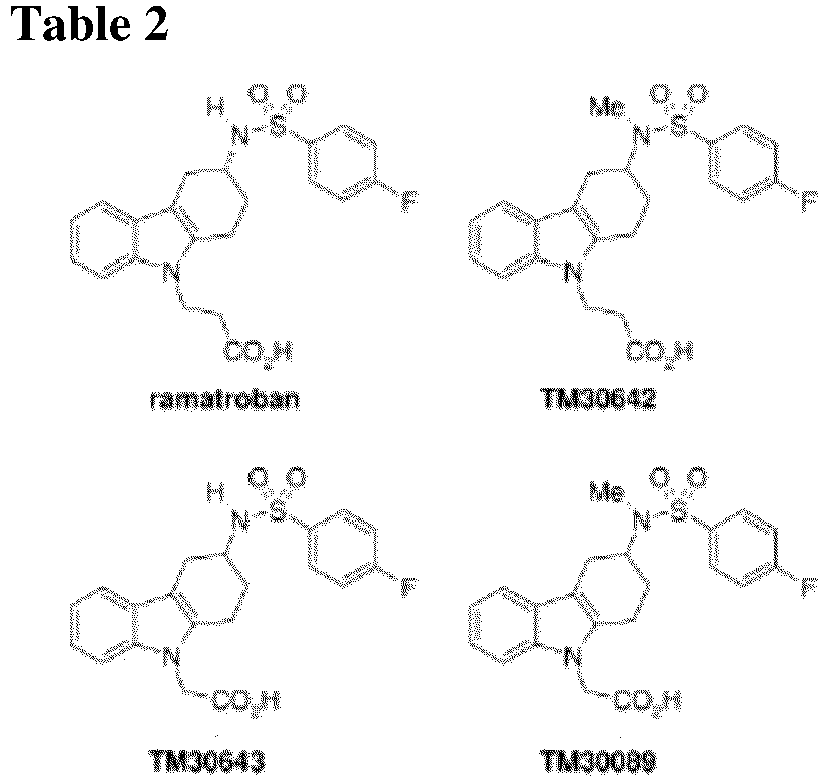
- One class is Ramatroban and its analogs, examples of which are shown in Tables 1 and 2 (TM30642 - 3- ⁇ 3-[(4-fluoro-benzenesulfonyl)-methyl-amino]-1,2,3,4-tetrahydro-carbazol-9-yl ⁇ -propionic acid; TM30643 - [3-(4-fluoro-benzenesulfo-nylamino)-1,2,3,4-tetrahydro-carbazol-9-yl]-acetic acid; TM30089 - ⁇ 3-[(4-fluoro-benzenesulfonyl)-methyl-amino]-1,2,3,4-tetrahydro-carbazol-9-yl ⁇ -acetic acid.
- Another class of DP-2 antagonists are indole acetic acid derivatives. Examples of this class of compounds are compounds 6 - 9 of Table 1.
- Another class of DP-2 antagonists are phenyl acetic acid derivatives.
- An example of this class of compounds, based on fenclofenac is compound 11 of Table 1.
- DP-2 antagonists are tetrahyrdroquinoline derivatives.
- Examples of this class of compounds are compounds 12, K117 and K-104 of Table 1.
- Certain preferred DP-2 antagonists are DP-2 antagonists that have been the subject of at least one clinical trial.
- Examples of DP-2 antagonists that have been the subject of at least one clinical trial include, but are not limited to, those listed in Table 3 below: Table 3 Clinical Stage DP-2 Antagonists Company Compound ID Status Reference a Actelion ACT-129968 (Setipiprant) Phase IIb NCT01225315 Actimis AP768 Phase I Amira AM211 Phase I Amira AM461 Phase I Array BioPharma ARRY-502 Phase I NCT01349725 AstraZeneca AZD1981 Phase II NCT01197794 AstraZeneca AZD8075 Discontinued after Phase I (2010) NCT00787072 AstraZeneca AZD5985 Discontinued after Phase I (2010) NCT00967356 Merck MK-7246) Phase I Novartis QAV680 Phase II completed NCT00814216 Oxagen OC000459 Phase IIb NCT0105
- DP-2 antagonist setipiprant One DP-2 antagonist contemplated for use in accordance with the invention is the DP-2 antagonist setipiprant. Its structure is provided below:
- DP-2 antagonist fevipiprant QAM 039
- One DP-2 antagonist contemplated for use in accordance with the invention is the DP-2 antagonist AM211 whose structure is provided below:
- DP-2 antagonist BI 671800 One DP-2 antagonist contemplated for use in accordance with the invention is the DP-2 antagonist BI 671800. Its structure is provided below:
- DP-2 antagonist Ramatroban One DP-2 antagonist contemplated for use in accordance with the invention is the DP-2 antagonist Ramatroban. Its structure is provided below:
- DP-2 antagonist contemplated for use in accordance with the invention is the DP-2 antagonist whose structure is provided below:
- DP-2 antagonist AZD1981 One DP-2 antagonist contemplated for use in accordance with the invention is the DP-2 antagonist AZD1981. Its structure is provided below:
- DP-2 antagonist contemplated for use in accordance with the invention is the DP-2 antagonist whose structure is provided below:
- DP-2 antagonist contemplated for use in accordance with the invention is the DP-2 antagonist whose structure is provided below:
- Additional DP-2 antagonists can be found in the following publications: EP1,170,594 , EP1,435,356 WO2003/066046 , WO2003/066047 , WO2003/097042 , WO2003/101961 , WO2003/101981 , WO2004/007451 , WO2004/032848 , WO2004/035543 , WO2004/106302 , WO2005/019171 , WO2005/054232 , WO2005/018529 , WO2005/040112 , GB2,407,318 , WO2005/040114 , WO2005/044260 , WO2005/095397 , WO2005/100321 , WO2005/102338 , WO2006/095183 , WO2007/107772 , US7,405,215 .
- compositions described herein may include an "effective amount.”
- An “effective amount” refers to an amount effective, at dosages and for periods of time necessary, to achieve the desired result.
- An effective amount of a molecule may vary according to factors such as the state, age, sex, and weight of the individual, and the ability of the molecule to elicit a desired response in the individual.
- An effective amount is also one in which any toxic or detrimental effects of the molecule are outweighed by the beneficial effects.
- the DP-2 antagonist may be provided as a pharmaceutical composition comprising a DP-2 antagonist and at least one pharmaceutically acceptable excipient or carrier.
- “Pharmaceutically acceptable carriers” include any excipient which is nontoxic to the cell or subject being exposed thereto at the dosages and concentrations employed. Pharmaceutical compositions may also include one or more additional therapeutic agents. Pharmaceutically acceptable carriers include solvents, dispersion media, buffers, coatings, antibacterial and antifungal agents, wetting agents, preservatives, buggers, chelating agents, antioxidants, isotonic agents and absorption delaying agents.
- Pharmaceutically acceptable carriers include water; saline; phosphate buffered saline; dextrose; glycerol; alcohols such as ethanol and isopropanol; phosphate, citrate and other organic acids; ascorbic acid; low molecular weight (less than about 10 residues) polypeptides; proteins, such as serum albumin, gelatin, or immunoglobulins; hydrophilic polymers such as polyvinylpyrrolidone; amino acids such as glycine, glutamine, asparagine, arginine or lysine; monosaccharides, disaccharides, and other carbohydrates including glucose, mannose, or dextrins; EDTA; salt forming counterions such as sodium; and/or nonionic surfactants such as TWEEN, polyethylene glycol (PEG), and PLURONICS; isotonic agents such as sugars, polyalcohols such as mannitol and sorbitol, and sodium chloride; as well as combinations thereof.
- compositions provided herein may be formulated in a variety of ways, including for example, solid, semi-solid (e.g., cream, ointment, and gel), and liquid dosage forms, such as liquid solutions (e.g. , topical lotion or spray), dispersions or suspensions, tablets, pills, powders, liposomes and suppositories.
- the compositions are in the form of injectable or infusible solutions.
- the compositions may be in a form suitable for oral, intravenous, intraarterial, intramuscular, subcutaneous, parenteral, transmucosal, transdermal, or topical administration.
- the compositions are formulated for oral or topical administration.
- the composition may be formulated as an immediate, controlled, extended or delayed release composition.
- compositions suitable for use include sterile aqueous solutions (where water soluble) or dispersions and sterile powders for the extemporaneous preparation of sterile solutions or dispersions. They should be stable under the conditions of manufacture and storage and will preferably be preserved against the contaminating action of microorganisms, such as bacteria and fungi.
- the carrier can be a solvent or dispersion medium containing, for example, water, ethanol, polyol ( e.g., glycerol, propylene glycol, and liquid polyethylene glycol, and the like), and suitable mixtures thereof.
- the proper fluidity can be maintained, for example, by the use of a coating such as lecithin, by the maintenance of the required particle size in the case of dispersion and by the use of surfactants.
- a coating such as lecithin
- surfactants Suitable formulations for use in the therapeutic methods disclosed herein are described in Remington's Pharmaceutical Sciences, Mack Publishing Co., 16th ed. (1980 ).
- compositions may also include isotonic agents, for example, sugars, polyalcohols, such as mannitol, sorbitol, or sodium chloride.
- isotonic agents for example, sugars, polyalcohols, such as mannitol, sorbitol, or sodium chloride.
- Prolonged absorption of injectable compositions can be brought about by including in the composition an agent which delays absorption, for example, aluminum monostearate and gelatin.
- Sterile solutions can be prepared by incorporating the molecule, by itself or in combination with other active agents, in the required amount in an appropriate solvent with one or a combination of ingredients enumerated herein, as required, followed by filtered sterilization.
- dispersions are prepared by incorporating the active compound into a sterile vehicle, which contains a basic dispersion medium and the required other ingredients from those enumerated above.
- sterile powders for the preparation of sterile injectable solutions one method of preparation is vacuum drying and freeze-drying, which yields a powder of an active ingredient plus any additional desired ingredient from a previously sterile-filtered solution thereof.
- the preparations for injections are processed, filled into containers such as ampoules, bags, bottles, syringes or vials, and sealed under aseptic conditions according to methods known in the art. Further, the preparations may be packaged and sold in the form of a kit such as those described in US2002/0102208 . Such articles of manufacture will preferably have labels or package inserts indicating that the associated compositions are useful for treating a subject suffering from, or predisposed to androgenetic alopecia, baldness or hair loss.
- Effective doses of the compositions described herein may vary depending upon many different factors, including the specific antagonist used, the sensitivity of the subject for that antagonist, means of administration, target site, physiological state of the patient, whether the patient is human or an animal, other medications administered, and whether treatment is prophylactic or therapeutic.
- the patient is a human but non-human mammals including transgenic mammals can also be treated.
- Treatment dosages may be titrated using routine methods known to those of skill in the art to optimize safety and efficacy.
- compositions of the invention may include a "therapeutically effective amount.”
- a “therapeutically effective amount” refers to an amount effective, at dosages and for periods of time necessary, to achieve the desired therapeutic result.
- a therapeutically effective amount of a molecule may vary according to factors such as the disease state, age, sex, and weight of the individual, and the ability of the molecule to elicit a desired response in the individual.
- a therapeutically effective amount is also one in which toxic or detrimental effects of the molecule are outweighed by the therapeutically beneficial effects.
- the DP-2 antagonist is a selective DP-2 antagonist with respect to DP-1.
- selective with respect to inhibition means preferential inhibition of a first activity relative to a second activity (e.g., preferential inhibition of one pathway to another pathway; preferential inhibition relative to other receptors; or preferential inhibition of a mutant to a wild-type or vice versa).
- the inhibitor is greater than five times more selective, greater than ten times more selective, greater than fifty times more selective, greater than 100 times more selective, or greater than 1000 times more selective for the desired molecular target or pathway versus an undesired molecular target or pathway.
- an antagonist will inhibit the first activity of the molecular target or pathway by at least 2-fold, at least 5-fold, at least 10-fold, at least 20-fold, at least 50-fold, at least 100-fold relative to the second activity under the same conditions.
- the DP-2 antagonist will be selective with respect to DP-1 by any of the foregoing amounts.
- the activity of a molecular target or pathway may be measured by any reproducible means and may be measured in vitro or in vivo.
- modulating refers to “stimulating” or “inhibiting” an activity of a molecular target or pathway.
- a composition modulates the activity of a molecular target or pathway if it stimulates or inhibits the activity of the molecular target or pathway by at least 10%, by at least about 20%, by at least about 25%, by at least about 30%, by at least about 40%, by at least about 50%, by at least about 60%, by at least about 70%, by at least about 75%, by at least about 80%, by at least about 90%, by at least about 95%, by at least about 98%, or by about 99% or more relative to the activity of the molecular target or pathway under the same conditions but lacking only the presence of the composition.
- a composition modulates the activity of a molecular target or pathway if it stimulates or inhibits the activity of the molecular target or pathway by at least 2-fold, at least 5 -fold, at least 10-fold, at least 20-fold, at least 50-fold, at least 100-fold relative to the activity of the molecular target or pathway under the same conditions but lacking only the presence of the composition.
- the activity of a molecular target or pathway may be measured by any reproducible means.
- the activity of a molecular target or pathway may be measured in vitro or in vivo by an appropriate assay known in the art. Control samples (untreated with the composition) can be assigned a relative activity value of 100%. A change in activity caused by the composition can be measured in the assays.
- an antagonist may have a binding inhibitory activity (IC 50 value) for its desired molecular target (i.e., DP-2) of 1000 ⁇ M or less, 1000 nM or less, 100 nM or less, 10 nM or less, or especially 1 nM or less.
- IC 50 value binding inhibitory activity for its desired molecular target (i.e., DP-2) of 1000 ⁇ M or less, 1000 nM or less, 100 nM or less, 10 nM or less, or especially 1 nM or less.
- the inhibitor has a binding inhibitory activity (IC 50 value) for its desired molecular target of between 1000 ⁇ M and 1 nM, between 1000 ⁇ M and 10 nM, between 1000 ⁇ M and 100 nM, between 1000 ⁇ M and 1000 nM, between 1000 nM and 1 nM, between 1000 nM and 10 nM, between 1000 nM and 100 nM, between 100 nM and 10 nM, between 100 nM and 1 nM, or between 10 nM and 1 nM.
- IC 50 value binding inhibitory activity for its desired molecular target of between 1000 ⁇ M and 1 nM, between 1000 ⁇ M and 10 nM, between 1000 ⁇ M and 100 nM, between 1000 ⁇ M and 1000 nM, between 1000 nM and 1 nM, between 1000 nM and 10 nM, between 1000 nM and 100 nM, between 100 nM and 10 nM, between 100 nM and 1 nM, or between 10
- the antagonists disclosed herein inhibit their molecular targets or pathways by at least about 10%, by at least about 20%, by at least about 25%, by at least about 30%, by at least about 40%, by at least about 50%, by at least about 60%, by at least about 70%, by at least about 75%, by at least about 80%, by at least about 90%, by at least about 95%, by at least about 98%, or by about 99% or more.
- the dose of the antagonist is between about 0.1-1000 mg/day, about 1-1000 mg/day about 5-500 mg/day, about 10-300 mg/day, about 20-200 mg/day, about 40-150 mg/day, about 60-100 mg/day, about 0.1-100 mg/day, about 0.1-50 mg/day, about 0.1-20 mg/day, about 0.1-10 mg/day, about 0.1-5 mg/day, or about 0.5-5 mg/day.
- the terms “treat” and “treatment” refer to therapeutic treatment, including prophylactic or preventative measures, wherein the object is to prevent or slow down (lessen) an undesired physiological change associated with a disease or condition.
- Beneficial or desired clinical results include, but are not limited to, alleviation of symptoms, diminishment of the extent of a disease or condition, stabilization of a disease or condition (i.e., where the disease or condition does not worsen), delay or slowing of the progression of a disease or condition, amelioration or palliation of the disease or condition, and remission (whether partial or total) of the disease or condition, whether detectable or undetectable.
- Treatment can also mean prolonging survival as compared to expected survival if not receiving treatment.
- Those in need of treatment include those already with the disease or condition as well as those prone to having the disease or condition or those in which the disease or condition is to be prevented.
- a "polymorphic locus” is a genomic locus at which two or more alleles have been identified.
- an “allele” is one of two or more existing genetic variants of a specific polymorphic genomic locus.
- a “single nucleotide polymorphism” or “SNP” is a particular base position in the genome where alternative bases are known.
- genotyping refers to an experimental, computational, or observational protocol for distinguishing an individual's genotype at one or more well-defined loci.
- treating hair loss refers to treating a disease or disorder comprising balding. In another embodiment, treating hair loss refers to treating androgenetic alopecia (AGA). In another embodiment, treating hair loss refers to treating a disease or disorder which is male pattern baldness. In another embodiment, treating hair loss refers to treating a disease or disorder which is female pattern baldness. In one embodiment, treating hair loss refers to treating or preventing any type of hair loss in any area of the body, including, but are not limited to, scalp and eyebrow.
- treating hair loss refers to treating a disease or disorder associated with hair loss.
- treating hair loss refers to treating a hair loss disease or disorder associated with a discoid lupus erythematosis.
- treating hair loss refers to treating a hair loss disease or disorder associated with a congenital hypotrichosis.
- treating hair loss refers to treating a hair loss disease or disorder associated with a lichen planopilaris.
- treating hair loss refers to treating a scarring alopecia.
- the DP-2 antagonist may be administered alone, or in combination with one or more other therapeutically effective agents (e.g. , finasteride, minoxidil, or both) or treatments.
- the other therapeutically effective agent may be conjugated to the DP-2 antagonist, incorporated into the same composition as the DP-2 antagonist, or may be administered as a separate composition.
- the other therapeutically agent or treatment may be administered prior to, during and/or after the administration of the DP-2 antagonist.
- DP-2 antagonist is administered independently from the administration of a hair promoting agent.
- DP-2 antagonist is administered first, followed by the administration of a hair promoting agent.
- a hair promoting agent is administered first, followed by the administration of DP-2 antagonist.
- therapeutically effective agents / treatments for a combination therapy to enhance hair growth include, for example, but not limited to, transplantation surgery and removing dermis or epidermis.
- the administration of the DP-2 antagonist with other agents and/or treatments may occur simultaneously, or separately, via the same or different route, at the same or different times. Dosage regimens may be adjusted to provide the optimum desired response (e.g. , a therapeutic or prophylactic response).
- Dosage unit form refers to physically discrete units suited as unitary dosages for treating mammalian subjects. Each unit may contain a predetermined quantity of active compound calculated to produce a desired therapeutic effect. In some embodiments, the dosage unit forms of the invention are dictated by and directly dependent on the unique characteristics of the active compound and the particular therapeutic or prophylactic effect to be achieved.
- compositions described herein may be administered only once, or it may be administered multiple times.
- the composition may be, for example, administered three times a day, twice a day, once a day, once every two days, twice a week, weekly, once every two weeks, or monthly.
- dosage values may vary with the type and severity of the condition to be alleviated. It is to be further understood that for any particular subject, specific dosage regimens should be adjusted over time according to the individual need and the professional judgment of the person administering or supervising the administration of the compositions.
- administering to a subject is not limited to any particular delivery system and may include, without limitation, topical, transdermal, oral (for example, in capsules, suspensions or tablets), parenteral (including subcutaneous, intravenous, intramedullary, intraarticular, intramuscular, or intraperitoneal injection), or rectal.
- Administration to a subject may occur in a single dose or in repeat administrations, and in any of a variety of physiologically acceptable salt forms, and/or with an acceptable pharmaceutical carrier and/or additive as part of a pharmaceutical composition (described earlier).
- physiologically acceptable salt forms and standard pharmaceutical formulation techniques are well known to persons skilled in the art (see, for example, Remington's Pharmaceutical Sciences, Mack Publishing Co .).
- subject includes mammals, e.g., humans, companion animals (e.g., dogs, cats, and the like), farm animals (e.g. , cows, sheep, pigs, horses, and the like) and laboratory animals (e.g. , rats, mice, guinea pigs, and the like).
- subject is a male human or a female human.
- the phrase "pharmaceutically acceptable” refers to those compounds, materials, compositions, carriers, and/or dosage forms which are, within the scope of sound medical judgment, suitable for use in contact with the tissues of human beings and animals without excessive toxicity, irritation, allergic response, or other problem or complication, commensurate with a reasonable benefit/risk ratio.
- “Pharmaceutically acceptable excipient” means an excipient that is useful in preparing a pharmaceutical composition that is generally safe, non-toxic and neither biologically nor otherwise undesirable, and includes an excipient that is acceptable for veterinary use as well as human pharmaceutical use.
- a "pharmaceutically acceptable excipient” as used herein includes both one and more than one such excipient.
- prodrugs can also be prepared as prodrugs, for example pharmaceutically acceptable prodrugs.
- pro-drug and “prodrug” are used interchangeably herein and may refer to any compound which releases an active parent drug in vivo. Since prodrugs are known to enhance numerous desirable qualities of pharmaceuticals (e.g., solubility, bioavailability, manufacturing, etc.) the compounds described herein can be delivered in prodrug form.
- the methods comprise obtaining a genomic DNA sample from a biologic sample obtained from the subject.
- biological samples include, but are not limited to, a bodily fluid (such as urine, saliva, plasma, or serum) or a tissue sample (such as a buccal tissue sample or buccal cell).
- a bodily fluid such as urine, saliva, plasma, or serum
- a tissue sample such as a buccal tissue sample or buccal cell.
- the biologic sample can then be used to obtain or amplify genomic DNA using known methods.
- Nucleic acid mutations can be determined by any of a number of known procedures.
- DNA arrays can be used to analyze at least a portion of the genomic sequence of the individual.
- Exemplary DNA arrays include GeneChip Arrays, GenFlex Tag arrays, and Genome-Wide Human SNP Array 6.0 (available from Affymetrix, Santa Clara, CA).
- whole or partial genome sequence information is.
- sequences can be determined using standard sequencing methods including chain-termination (Sanger dideoxynucleotide), dye-terminator sequencing, and SOLiD TM sequencing (Applied Biosystems).
- Genome sequences can be cut by restriction enzymes or sheared (mechanically) into shorter fragments for sequencing.
- DNA sequences can also be amplified using known methods such as PCR and vector-based cloning methods (e.g., Escherichia coli ).
- At least a portion of an individual's genetic material e.g., DNA, RNA, mRNA, cDNA, other nucleotide bases or derivative thereof
- an individual's genetic material e.g., DNA, RNA, mRNA, cDNA, other nucleotide bases or derivative thereof
- AGA Androgenetic alopecia
- mice suffer progressive miniaturization of hair follicles and hyperplasia of sebaceous glands, both hallmarks of human AGA. These results implicate PGD 2 as playing a causative role in AGA and provide novel targets for pharmacological interventions aimed at preventing hair loss and promoting hair growth.
- Tissue Scalp was obtained from normally discarded human skin samples from CHTN and from men and women undergoing hair transplantation (IRB exempted study Protocol# 818053).
- DP-2 antagonists used: AM211 (Amira), Setipirant (Actelion; data not shown).
- Hair follicle organ culture Hair follicles were microdissected from discarded tissues from hair transplant patients and cultured for seven days as described by Philpott et al. (J. Dermatol. Sci. Suppl: S55-72. (1994 )) in the presence or absence of PGD 2 and/or DP-2 antagonist, with a change of culture medium every two days. Hair follicles were photographed at the beginning and end of the culture period. Hair follicle growth was measured from the photographs using Image J software.
- Immunofluorescence analysis with anti-Ki67 and anti-Caspase-3 was performed on cryosections of cultured hair follicles or whole mount hair follicles fixed in 4% PFA. Images were photographed with Leica fluorescence microscope.
- PGD 2 inhibits growth of human hair follicles in explant culture in a dose dependent manner ( FIG. 1 ). Hair follicles cultured in growth medium for 7 days showed significant growth. But the growth was severely inhibited by addition of PGD 2 (10 ⁇ M) to the culture medium, while the presence of a DP-2 antagonist, AM211, at 10 nM rescued hair follicles from the inhibition by PGD 2 ( Fig. 1A ). B. PGD 2 exerts its inhibitory effect on hair growth in a dose-dependent manner ( Fig. 1B ). Representative histological images of hair follicles harvested after 7-day culture are shown in Fig. 1C . D.
- CRTH2/DP-2 the receptor mediating the effects of PGD 2 and antagonists, is expressed in the epidermis, hair follicle keratinocytes, and sebaceous gland (SG), but not in dermal papilla (DP) ( Fig. 1D ). Its expression level is elevated in the bald scalp ( Fig. 1D , left) relative to the normal one ( Fig. 1D , right).
- AM211 was applied topically at the indicated doses, once per day for two weeks, to the back skin of 6-7 week old mice 8 days after hair depilation ( Fig. 2A ).
- the hair shafts and skins of the treated mice were harvested at day 22 post depilation for length measurement and hair cycle stage analysis, respectively.
- Representative images of the histological sections of skin from treated mice are shown in Fig. 2B . Based on morphological assessment, hair follicles in the sections were classified into one of the hair cycle stages and counted.
- CRTH2/DP-2 SNPs were identified in the human CRTH2/DP-2 gene, which is located on chromosome 11, that correlate with inhibition of hair growth by PGD 2 in explant culture ( Fig 4).
- Figs. 4A and C shows the locations of five (out of 61) human CRTH2/DP-2 SNPs, initially identified as potential candidates for markers of susceptibility to PGD2 activity.
- rs545659 with T as the reference base and with C as a minor allele having a minor allele frequency (MAF) of 0.338 were: (1) rs545659 with T as the reference base and with C as a minor allele having a minor allele frequency (MAF) of 0.338; (2) rs634681 with G as the reference base and with A as a minor allele having a MAF of 0.335; (3) rs7167 with A as the reference base and with G as a minor allele having a MAF of 0.338; (4) rs41465646 with G as the reference base and with A as a minor allele having a MAF of 0.083; and (5) rs41382844 with G as the reference base and with A as a minor allele having a MAF of 0.105 (see Table 7).
- MAF minor allele frequency
- CRTH2/DP-2 antagonists were effective in reversing PGDz's inhibition on both male and female hair follicles. More specifically, in animal models, CRTH2/DP-2 antagonists, when applied during the anagen phase directly to the mouse skin, extend the growth phase and promote longer hair shafts.
- Hair follicles from a subset of alopecia patients exhibited no growth inhibition by PGDz, indicating the existence of PGD 2 responding and non-responding individuals.
- SNPs were identified in the CRTH2/DP-2 gene that are associated with sensitivity to PGD 2 inhibition of hair growth. The existence of PGD 2 responding and non-responding individuals with different genotypes in the DP-2 gene indicates that the former group are more responsive to treatment with a DP-2 antagonist to stimulate hair growth and that sensitivity may vary among DP-2 antagonists.
Landscapes
- Health & Medical Sciences (AREA)
- Life Sciences & Earth Sciences (AREA)
- Chemical & Material Sciences (AREA)
- General Health & Medical Sciences (AREA)
- Animal Behavior & Ethology (AREA)
- Public Health (AREA)
- Veterinary Medicine (AREA)
- Epidemiology (AREA)
- Organic Chemistry (AREA)
- Medicinal Chemistry (AREA)
- Pharmacology & Pharmacy (AREA)
- Engineering & Computer Science (AREA)
- Proteomics, Peptides & Aminoacids (AREA)
- Zoology (AREA)
- Wood Science & Technology (AREA)
- Bioinformatics & Cheminformatics (AREA)
- Analytical Chemistry (AREA)
- Genetics & Genomics (AREA)
- Birds (AREA)
- Dermatology (AREA)
- Molecular Biology (AREA)
- Biochemistry (AREA)
- General Engineering & Computer Science (AREA)
- Physics & Mathematics (AREA)
- Biophysics (AREA)
- Biotechnology (AREA)
- Immunology (AREA)
- Microbiology (AREA)
- Nuclear Medicine, Radiotherapy & Molecular Imaging (AREA)
- Chemical Kinetics & Catalysis (AREA)
- General Chemical & Material Sciences (AREA)
- Pathology (AREA)
- Physiology (AREA)
- Nutrition Science (AREA)
- Emergency Medicine (AREA)
- Medicines That Contain Protein Lipid Enzymes And Other Medicines (AREA)
- Pharmaceuticals Containing Other Organic And Inorganic Compounds (AREA)
- Cosmetics (AREA)
- Acyclic And Carbocyclic Compounds In Medicinal Compositions (AREA)
- Investigating Or Analysing Biological Materials (AREA)
Description
- The invention relates to compositions for regulating hair growth. Specifically, the invention relates to identifying subjects, such as those with androgenetic alopecia or baldness or hair loss, responsive to PGD2 receptor, DP-2 (aka CRTH2 or GPR44) antagonists to stimulate hair growth.
- Eighty percent of Caucasian men experience some degree of androgenetic alopecia (AGA) before age 70. Testosterone is necessary for AGA to develop, and a genetic susceptibility locus in the androgen receptor is present in a minority of men with AGA; however, additional factors contributing to this disorder remain unknown. Studies on AGA have the potential to yield insights into other androgen-mediated diseases, such as benign prostatic hypertrophy and prostate cancer. Current legitimate treatments for AGA include finasteride, minoxidil, and hair transplantation. Finasteride inhibits 5-α reductase 2 (SRD5A2), which converts testosterone to a more potent androgen, dihydrotestosterone. The active targets of minoxidil in AGA therapy have not been conclusively identified.
- In AGA, large "terminal" hair follicles forming thick hair shafts miniaturize over time to small follicles that generate microscopic effete hairs. Follicle miniaturization is accompanied by a decrease in the duration of the growing phase of the follicle (anagen), which normally lasts several years to produce hair more than 1 m long, but which decreases to only days or weeks in AGA. This results in an increase in the percentage of resting (telogen) hair follicles containing microscopic hairs in bald scalp.
- In addition to these intrinsic changes to the hair follicle, infiltrating lymphocytes and mast cells have been identified around the miniaturizing follicle, especially in the area of the stem cell-rich bulge area. Sebaceous glands, which attach to each follicle, hypertrophy in bald scalp. In balding scalp, the number of hair follicle stem cells remains intact, whereas the number of more actively proliferating progenitor cells markedly decreases. This indicates that balding scalp either lacks an activator or has an inhibitor of hair follicle growth.
- Prostaglandin D2 (PGDz) and its synthesizing enzyme, PGD2 synthase, are present at higher levels in balding versus non-balding scalp in men with androgenetic alopecia. In a mouse model, PGD2 inhibited hair growth via CRTH2/DP-2, one of two PGD2 receptors, indicating that DP-2 is the key receptor mediating the hair growth inhibitory activity of PGD2 in human follicles (Garza et al. (2012) Sci. Transl. Med. 4, 126ra34).
-
WO 2015/072963 discloses compositions and methods for regulating hair growth including the use of PD-2 antagonists for the treatment of baldness. - Garza et al., Science Translational Medicine, 2012, Vol. 4, Issue 126, pp. 126ra34 discloses that PD2 inhibits hair growth and is elevated in bald scalp of men with androgenetic alopecia.
-
WO 03/18835 - Campos Alberto et al., Allergy, 2012, Vol. 67, discloses that the loci rs545659 and rs634681 are associated with allergy.
- Accordingly, there exists a need for compositions for stimulating hair growth, as well as methods to identify who would likely to be responsive to them.
- In one aspect, the invention provides a method of identifying whether a subject having androgenetic alopecia, baldness or hair loss is likely to be responsive to administration of a DP-2 antagonist that is selective with respect to DP-1 to stimulate hair growth, comprising:
- (i) genotyping single nucleotide polymorphic loci within or flanking the DP-2 gene in a genomic DNA sample obtained from the subject; and
- (ii) determining whether the subject is likely to be responsive to administration of the DP-2 antagonist, based on the genotype detected at each of the loci,
- In an embodiment, the genotyping comprises the step of sequencing the genomic DNA regions that contain the loci, or the steps of amplifying the genomic DNA by PCR and sequencing the amplified genomic DNA regions that contain the loci.
- In an embodiment, the genotyping comprises the steps of:
- (i) contacting the genomic DNA or the amplified genomic DNA with one or more detectably labeled oligonucleotides complementary to an allele at said loci; and
- (ii) detecting the presence or absence of the allele at said loci.
- In an embodiment, the subject has hair loss associated with discoid lupus erythematosus, congenital hypotrichosis, lichen planopilaris or scarring alopecia
- The present invention also provides a non-therapeutic method of stimulating hair growth in a subject having one or more alleles indicating that the subject is likely to be responsive to administration of a DP-2 antagonist to stimulate hair growth, comprising: administering to the subject an effective amount of the DP-2 antagonist, wherein the one or more alleles is located at single nucleotide polymorphic loci within or flanking the DP-2 gene, wherein the loci comprise rs545659, rs634681 and rs7167, wherein allele C of rs545659, allele A of rs634681 and allele G of rs7167 indicate that the subject is likely to be responsive, and wherein the DP-2 antagonist is a selective DP-2 antagonist with respect to DP-1.
- In an embodiment, the subject has baldness or hair loss.
- The present invention also provides a DP-2 antagonist for use in treating a subject having androgenetic alopecia or hair loss associated with discoid lupus erythematosus, congenital hypotrichosis, lichen planopilaris or scarring alopecia, and having one or more alleles indicating that the subject is likely to be responsive to administration of a DP-2 antagonist to stimulate hair growth, comprising: administering to the subject an effective amount of the DP-2 antagonist, wherein the one or more alleles is located at single nucleotide polymorphic loci within or flanking the DP-2 gene, wherein the loci comprise rs545659, rs634681 and rs7167, wherein allele C of rs545659, allele A of rs634681 and allele G of rs7167 indicate that the subject is likely to be responsive, and wherein the DP-2 antagonist is a selective DP-2 antagonist with respect to DP-1.
- In an embodiment, the subject is identified as being likely to be responsive to administration of a DP-2 antagonist to stimulate hair growth by the method of the invention.
- In an embodiment, the step of administering is topical or oral administration.
- In an embodiment, the invention further comprises administering finasteride or minoxidil to the subject, transplanting hair follicles to the subject, or removing dermis or epidermis from skin in the subject.
- In an embodiment, the DP-2 antagonist has a IC50 for DP-2 of 100 nM or less.
- In an embodiment, the DP-2 antagonist is setipiprant, AM211, ramatroban, an indole acetic acid derivative, a phenyl acetic acid derivative or a tetrahyrdroquinoline derivative.
- Other features and advantages of the present invention will become apparent from the following detailed description examples and figures.
-
-
Figure 1 . PGD2 inhibits growth of human hair follicles in explant culture in a dose dependent manner. A. Hair follicles cultured in growth medium for 7 days showed significant growth. The growth was severely inhibited by addition of PGD2 (10 µM) to the culture medium. The presence of a DP-2 antagonist, AM211, at 10 nM rescued hair follicles from the inhibition by PGD2. B. PGD2 exerts its inhibitory effect on hair growth in a dose-dependent manner. C. Representative histological images of hair follicles harvested after 7-day culture. D. In the human scalp, CRTH2/DP-2, the receptor mediating the effects of PGD2 and antagonists, is expressed in the epidermis, hair follicle keratinocytes, and sebaceous gland (SG), but not in dermal papilla (DP). Its expression level is elevated in the bald scalp (left) relative to the normal one (right). -
Figure 2 . Antagonists of CRTH2/DP-2 extend anagen, the growing phase of the mouse hair cycle, and increase the length of the hair shaft. A. To test the effects on DP-2 antagonists on hair growth in vivo, AM211 was applied topically at the indicated doses, once per day for two weeks, to the back skin of 6-7 weekold mice 8 days after hair depilation. The hair shafts and skins of the treated mice were harvested atday 22 post depilation for length measurement and hair cycle stage analysis, respectively. B. Representative images of the histological sections of skin from treated mice. Based on morphological assessment, hair follicles in the sections were classified into one of the hair cycle stages and counted. C. In the control group (treated with vehicle only), nearly all hair follicles had entered the catagen and telogen phase, while AM211-treated groups showed a dose-dependent delay in hair follicles entering catagen. D & E. As a result of an extended anagen, skins of AM211-treated mice had a larger area with hair follicles continuing to grow and produced longer hair shaft. -
Figure 3 . Antagonists of CRTH2/DP-2 reverse hair follicle growth inhibition by PGD2. A. In explant culture, human male and female hair follicles responded similarly to the inhibitory activity of PGD2 as well as to the anti-PGD2 activity of DP-2 antagonists. The reduction in anti-PGDz effect seen at high doses of AM211 was likely due to an unidentified contaminant in AM211 preparation, which was purified to 95% homogeneity, since the use of a 99.5% pure preparation of AM211 at high doses led to sustained anti-PGD2 activity (see B). *p < 0.001. C. Immunofluorescence staining of cultured hair follicles for markers of proliferation (Ki67, shown in red) and apoptosis (active caspase 3, shown in green) revealed that PGD2 suppressed proliferation and promoted apoptosis of hair follicle keratinocytes. DP-2 antagonist reversed these two PGDz-triggered cellular events in hair follicles. -
Figure 4 . Identification of SNPs in the human CRTH2/DP-2 gene that correlate with inhibition of hair growth by PGD2 in explant culture. A. The locations of human CRTH2/DP-2 SNPs, initially identified as potential candidates for markers of susceptibility to PGD2 activity. Human CRTH2/DP-2 gene is located onchromosome 11. B. Of the 35 patients tested, hair follicles from 21 patients exhibited PGD2-mediated growth inhibition while those from the remaining 14 were not affected in their growth by PGD2. DNA sequencing of CRTH2/DP-2 gene as well as SNP PCR showed that roughly 70% of the PGD2-sentitive individuals carry all three SNPs: rs545659, rs634681, and rs7167 (shown in red). C. Fisher exact test showed that these three SNPs very likely linked to the sensitivity of these patients to PGD2 inhibition. - The invention relates to compositions for regulating hair growth. Specifically, the invention relates to methods for identifying subjects, such as those with androgenetic alopecia or baldness or hair loss, susceptible to hair growth inhibition by prostaglandin D2 (PGD2) and responsive to PGD2 receptor, DP-2 (aka CRTH2 or GPR44) antagonists to stimulate hair growth.
- Elevated levels of prostaglandin D2 synthase (PTGDS) at the message and protein levels was found in balding versus haired scalp from men with AGA. The enzymatic product of PTGDS, prostaglandin D2 (PGD2), was also found to be elevated in bald human scalp tissue. A close temporal relationship was shown between elevations in both Ptgds mRNA and PGD2 levels in mice with hair follicle regression during normal hair follicle cycling. In addition, functional data also showed that PGD2 and its nonenzymatic metabolite, 15-deoxy-D12,14-prostaglandin J2 (15-dPGJ2), inhibit hair growth in both mouse and human hair follicles. In mice and humans, the PGD2-mediated inhibition of hair growth required the G protein (heterotrimeric guanine nucleotide-binding protein)-coupled receptor 44 (GPR44 or DP-2), but not the prostaglandin D2 receptor 1 (Ptgdr or DP-1). Additionally, a mouse model (K14-Ptgs2) with elevated PGD2 levels in the skin phenocopies human AGA. These results demonstrate, among other things, the role of PGD2 and DP-2 in the pathogenesis of AGA for hair treatment.
- Surprisingly, hair follicles from a subset of alopecia patients exhibit no growth inhibition by PGDz, indicating the existence of PGD2 responding and non-responding individuals. In addition, SNPs were identified in the CRTH2/DP-2 gene that are associated with sensitivity to PGD2 inhibition of hair growth. The existence of PGD2 responding and non-responding individuals with different genotypes in the DP-2 gene indicates that the former group are more responsive to treatment with a DP-2 antagonist to stimulate hair growth and that sensitivity may vary among DP-2 antagonists.
- In one aspect, provided herein are methods of identifying whether a subject having androgenetic alopecia, baldness or hair loss is likely to be responsive to administration of a DP-2 antagonist that is selective with respect to DP-1 to stimulate hair growth, comprising (i) genotyping single nucleotide polymorphic loci within or flanking the DP-2 gene in a genomic DNA sample obtained from the subject; and (ii) determining whether the subject is likely to be responsive to administration of the DP-2 antagonist, based on the genotype detected at each of the loci, wherein the loci comprise rs545659, rs634681 and rs7167, and wherein allele C of rs545659, allele A of rs634681 and allele G of rs7167 indicate that the subject is likely to be responsive. In some embodiments, the methods comprise the step of amplifying the genomic DNA (e.g., by PCR). In some embodiments, the genomic DNA or amplified genomic DNA is genotyped by sequencing DNA regions that contain the loci. In some embodiments, the genomic DNA or amplified genomic DNA is genotyped by (i) contacting it with detectably labeled oligonucleotides complementary to allele at the loci; and (ii) detecting the presence or absence of (single nucleotide polymorphisms) SNPs at the loci.
- Once a subject has been identified as being likely to be responsive to administration of a DP-2 antagonist to stimulate hair growth, the subject may be treated by administering a therapeutically effective amount of the DP-2 antagonist to the subject.
- Thus the present invention provides a DP-2 antagonist for use in treating a subject having androgenetic alopecia or hair loss associated with discoid lupus erythematosus, congenital hypotrichosis, lichen planopilaris or scarring alopecia, and having one or more alleles indicating that the subject is likely to be responsive to administration of a DP-2 antagonist to stimulate hair growth, comprising: administering to the subject an effective amount of the DP-2 antagonist, wherein the one or more alleles is located at single nucleotide polymorphic loci within or flanking the DP-2 gene, wherein the loci comprise rs545659, rs634681 and rs7167, and wherein allele C of rs545659, allele A of rs634681 and allele G of rs7167 indicate that the subject is likely to be responsive, and wherein the DP-2 antagonist is a selective DP-2 antagonist with respect to DP-1.
- In an embodiment, the subject is identified as being likely to be responsive to administration of a DP-2 antagonist to stimulate hair growth by the method of the invention.
- In some embodiments, the DP-2 antagonist is administered topically. In some embodiments, the DP-2 antagonist is administered orally.
- In some embodiments, the invention further includes administering finasteride or minoxidil to the subject. In some embodiments, the invention further includes transplanting hair follicles to the subject. In some embodiments, the invention further includes removing dermis or epidermis from skin in the subject.
- In another aspect, provided herein are non-therapeutic (i.e., cosmetic) methods of stimulating hair growth in a subject having one or more alleles indicating that the subject is likely to be responsive to administration of a DP-2 antagonist to stimulate hair growth, comprising: administering to the subject an effective amount of the DP-2 antagonist, wherein the one or more alleles is located at single nucleotide polymorphic loci within or flanking the DP-2 gene, wherein the loci comprise rs545659, rs634681 and rs7167, wherein allele C of rs545659, allele A of rs634681 and allele G of rs7167 indicate that the subject is likely to be responsive, and wherein the DP-2 antagonist is a selective DP-2 antagonist with respect to DP-1.
- In an embodiment of the non-therapeutic methods, the subject has baldness or hair loss.
- In some embodiments, the DP-2 antagonist is administered topically. In some embodiments, the DP-2 antagonist is administered orally. In some embodiments, the methods further include administering finasteride or minoxidil to the subject. In some embodiments, the methods further include transplanting hair follicles to the subject. In some embodiments, the methods further include removing dermis or epidermis from skin in the subject.
- As used herein, a "DP-2 antagonist" is a molecule that is able to decrease the amount or activity of DP-2, either within a cell or within a physiological system. For example, a DP-2 antagonist is a substance that can bind selectively to DP-2 receptor and inhibit the physiological action of the DP-2 receptor.
- DP-2 antagonists are known in the art. Examples of some DP-2 antagonists are shown in Table 1:

- DP-2 antagonists can be divided into a number of classes. One class is Ramatroban and its analogs, examples of which are shown in Tables 1 and 2 (TM30642 - 3-{3-[(4-fluoro-benzenesulfonyl)-methyl-amino]-1,2,3,4-tetrahydro-carbazol-9-yl}-propionic acid; TM30643 - [3-(4-fluoro-benzenesulfo-nylamino)-1,2,3,4-tetrahydro-carbazol-9-yl]-acetic acid; TM30089 - {3-[(4-fluoro-benzenesulfonyl)-methyl-amino]-1,2,3,4-tetrahydro-carbazol-9-yl}-acetic acid.
- Another class of DP-2 antagonists are indole acetic acid derivatives. Examples of this class of compounds are compounds 6 - 9 of Table 1.
- Another class of DP-2 antagonists are phenyl acetic acid derivatives. An example of this class of compounds, based on fenclofenac is
compound 11 of Table 1. - Yet another class of DP-2 antagonists are tetrahyrdroquinoline derivatives. Examples of this class of compounds are
compounds 12, K117 and K-104 of Table 1. - Certain preferred DP-2 antagonists are DP-2 antagonists that have been the subject of at least one clinical trial. Examples of DP-2 antagonists that have been the subject of at least one clinical trial include, but are not limited to, those listed in Table 3 below:
Table 3 Clinical Stage DP-2 Antagonists Company Compound ID Status Reference a Actelion ACT-129968 (Setipiprant) Phase IIb NCT01225315 Actimis AP768 Phase I Amira AM211 Phase I Amira AM461 Phase I Array BioPharma ARRY-502 Phase I NCT01349725 AstraZeneca AZD1981 Phase II NCT01197794 AstraZeneca AZD8075 Discontinued after Phase I (2010) NCT00787072 AstraZeneca AZD5985 Discontinued after Phase I (2010) NCT00967356 Merck MK-7246) Phase I Novartis QAV680 Phase II completed NCT00814216 Oxagen OC000459 Phase IIb NCT01057927 Oxagen OC002417 Back-up candidate Pulmagen ADC3680B Phase I NCT01173770 aNCT numbers can be searched at the website: www.clinicaltrials.gov - One DP-2 antagonist contemplated for use in accordance with the invention is the DP-2 antagonist setipiprant. Its structure is provided below:

- One DP-2 antagonist contemplated for use in accordance with the invention is the DP-2 antagonist fevipiprant (QAW 039). Its structure is provided below:

- One DP-2 antagonist contemplated for use in accordance with the invention is the DP-2 antagonist AM211 whose structure is provided below:

- One DP-2 antagonist contemplated for use in accordance with the invention is the DP-2 antagonist BI 671800. Its structure is provided below:

- One DP-2 antagonist contemplated for use in accordance with the invention is the DP-2 antagonist Ramatroban. Its structure is provided below:

- One DP-2 antagonist contemplated for use in accordance with the invention is the DP-2 antagonist whose structure is provided below:

- One DP-2 antagonist contemplated for use in accordance with the invention is the DP-2 antagonist AZD1981. Its structure is provided below:

- One DP-2 antagonist contemplated for use in accordance with the invention is the DP-2 antagonist whose structure is provided below:

- One DP-2 antagonist contemplated for use in accordance with the invention is the DP-2 antagonist whose structure is provided below:

- Additional DP-2 antagonists can be found in the following publications:
EP1,170,594 ,EP1,435,356 WO2003/066046 ,WO2003/066047 ,WO2003/097042 ,WO2003/101961 ,WO2003/101981 ,WO2004/007451 ,WO2004/032848 ,WO2004/035543 ,WO2004/106302 ,WO2005/019171 ,WO2005/054232 ,WO2005/018529 ,WO2005/040112 ,GB2,407,318 WO2005/040114 ,WO2005/044260 ,WO2005/095397 ,WO2005/100321 ,WO2005/102338 ,WO2006/095183 ,WO2007/107772 ,US7,405,215 . - The compositions described herein may include an "effective amount." An "effective amount" refers to an amount effective, at dosages and for periods of time necessary, to achieve the desired result. An effective amount of a molecule may vary according to factors such as the state, age, sex, and weight of the individual, and the ability of the molecule to elicit a desired response in the individual. An effective amount is also one in which any toxic or detrimental effects of the molecule are outweighed by the beneficial effects.
- The DP-2 antagonist may be provided as a pharmaceutical composition comprising a DP-2 antagonist and at least one pharmaceutically acceptable excipient or carrier.
- "Pharmaceutically acceptable carriers" include any excipient which is nontoxic to the cell or subject being exposed thereto at the dosages and concentrations employed. Pharmaceutical compositions may also include one or more additional therapeutic agents. Pharmaceutically acceptable carriers include solvents, dispersion media, buffers, coatings, antibacterial and antifungal agents, wetting agents, preservatives, buggers, chelating agents, antioxidants, isotonic agents and absorption delaying agents. Pharmaceutically acceptable carriers include water; saline; phosphate buffered saline; dextrose; glycerol; alcohols such as ethanol and isopropanol; phosphate, citrate and other organic acids; ascorbic acid; low molecular weight (less than about 10 residues) polypeptides; proteins, such as serum albumin, gelatin, or immunoglobulins; hydrophilic polymers such as polyvinylpyrrolidone; amino acids such as glycine, glutamine, asparagine, arginine or lysine; monosaccharides, disaccharides, and other carbohydrates including glucose, mannose, or dextrins; EDTA; salt forming counterions such as sodium; and/or nonionic surfactants such as TWEEN, polyethylene glycol (PEG), and PLURONICS; isotonic agents such as sugars, polyalcohols such as mannitol and sorbitol, and sodium chloride; as well as combinations thereof. Antibacterial and antifungal agents include parabens, chlorobutanol, phenol, ascorbic acid, and thimerosal.
- The pharmaceutical compositions provided herein may be formulated in a variety of ways, including for example, solid, semi-solid (e.g., cream, ointment, and gel), and liquid dosage forms, such as liquid solutions (e.g., topical lotion or spray), dispersions or suspensions, tablets, pills, powders, liposomes and suppositories. In some embodiments, the compositions are in the form of injectable or infusible solutions. The compositions may be in a form suitable for oral, intravenous, intraarterial, intramuscular, subcutaneous, parenteral, transmucosal, transdermal, or topical administration. Preferably, the compositions are formulated for oral or topical administration. The composition may be formulated as an immediate, controlled, extended or delayed release composition.
- More particularly, pharmaceutical compositions suitable for use include sterile aqueous solutions (where water soluble) or dispersions and sterile powders for the extemporaneous preparation of sterile solutions or dispersions. They should be stable under the conditions of manufacture and storage and will preferably be preserved against the contaminating action of microorganisms, such as bacteria and fungi. The carrier can be a solvent or dispersion medium containing, for example, water, ethanol, polyol (e.g., glycerol, propylene glycol, and liquid polyethylene glycol, and the like), and suitable mixtures thereof. The proper fluidity can be maintained, for example, by the use of a coating such as lecithin, by the maintenance of the required particle size in the case of dispersion and by the use of surfactants. Suitable formulations for use in the therapeutic methods disclosed herein are described in Remington's Pharmaceutical Sciences, Mack Publishing Co., 16th ed. (1980).
- The compositions may also include isotonic agents, for example, sugars, polyalcohols, such as mannitol, sorbitol, or sodium chloride. Prolonged absorption of injectable compositions can be brought about by including in the composition an agent which delays absorption, for example, aluminum monostearate and gelatin.
- Sterile solutions can be prepared by incorporating the molecule, by itself or in combination with other active agents, in the required amount in an appropriate solvent with one or a combination of ingredients enumerated herein, as required, followed by filtered sterilization. Generally, dispersions are prepared by incorporating the active compound into a sterile vehicle, which contains a basic dispersion medium and the required other ingredients from those enumerated above. In the case of sterile powders for the preparation of sterile injectable solutions, one method of preparation is vacuum drying and freeze-drying, which yields a powder of an active ingredient plus any additional desired ingredient from a previously sterile-filtered solution thereof. The preparations for injections are processed, filled into containers such as ampoules, bags, bottles, syringes or vials, and sealed under aseptic conditions according to methods known in the art. Further, the preparations may be packaged and sold in the form of a kit such as those described in
US2002/0102208 . Such articles of manufacture will preferably have labels or package inserts indicating that the associated compositions are useful for treating a subject suffering from, or predisposed to androgenetic alopecia, baldness or hair loss. - Effective doses of the compositions described herein may vary depending upon many different factors, including the specific antagonist used, the sensitivity of the subject for that antagonist, means of administration, target site, physiological state of the patient, whether the patient is human or an animal, other medications administered, and whether treatment is prophylactic or therapeutic. Usually, the patient is a human but non-human mammals including transgenic mammals can also be treated. Treatment dosages may be titrated using routine methods known to those of skill in the art to optimize safety and efficacy.
- The pharmaceutical compositions of the invention may include a "therapeutically effective amount." A "therapeutically effective amount" refers to an amount effective, at dosages and for periods of time necessary, to achieve the desired therapeutic result. A therapeutically effective amount of a molecule may vary according to factors such as the disease state, age, sex, and weight of the individual, and the ability of the molecule to elicit a desired response in the individual. A therapeutically effective amount is also one in which toxic or detrimental effects of the molecule are outweighed by the therapeutically beneficial effects.
- In this invention, the DP-2 antagonist is a selective DP-2 antagonist with respect to DP-1. As used herein, the term, "selective" with respect to inhibition means preferential inhibition of a first activity relative to a second activity (e.g., preferential inhibition of one pathway to another pathway; preferential inhibition relative to other receptors; or preferential inhibition of a mutant to a wild-type or vice versa). In some embodiments, the inhibitor is greater than five times more selective, greater than ten times more selective, greater than fifty times more selective, greater than 100 times more selective, or greater than 1000 times more selective for the desired molecular target or pathway versus an undesired molecular target or pathway. In some embodiments, an antagonist will inhibit the first activity of the molecular target or pathway by at least 2-fold, at least 5-fold, at least 10-fold, at least 20-fold, at least 50-fold, at least 100-fold relative to the second activity under the same conditions. It will be appreciated that in preferred embodiments, the DP-2 antagonist, will be selective with respect to DP-1 by any of the foregoing amounts. The activity of a molecular target or pathway may be measured by any reproducible means and may be measured in vitro or in vivo.
- As used herein, "modulating" refers to "stimulating" or "inhibiting" an activity of a molecular target or pathway. For example, a composition modulates the activity of a molecular target or pathway if it stimulates or inhibits the activity of the molecular target or pathway by at least 10%, by at least about 20%, by at least about 25%, by at least about 30%, by at least about 40%, by at least about 50%, by at least about 60%, by at least about 70%, by at least about 75%, by at least about 80%, by at least about 90%, by at least about 95%, by at least about 98%, or by about 99% or more relative to the activity of the molecular target or pathway under the same conditions but lacking only the presence of the composition. In another example, a composition modulates the activity of a molecular target or pathway if it stimulates or inhibits the activity of the molecular target or pathway by at least 2-fold, at least 5 -fold, at least 10-fold, at least 20-fold, at least 50-fold, at least 100-fold relative to the activity of the molecular target or pathway under the same conditions but lacking only the presence of the composition. The activity of a molecular target or pathway may be measured by any reproducible means. The activity of a molecular target or pathway may be measured in vitro or in vivo by an appropriate assay known in the art. Control samples (untreated with the composition) can be assigned a relative activity value of 100%. A change in activity caused by the composition can be measured in the assays.
- It will be appreciated that many of the antagonists described herein are strong inhibitors of their targets. For example, an antagonist may have a binding inhibitory activity (IC50 value) for its desired molecular target (i.e., DP-2) of 1000 µM or less, 1000 nM or less, 100 nM or less, 10 nM or less, or especially 1 nM or less. In another example, the inhibitor has a binding inhibitory activity (IC50 value) for its desired molecular target of between 1000 µM and 1 nM, between 1000 µM and 10 nM, between 1000 µM and 100 nM, between 1000 µM and 1000 nM, between 1000 nM and 1 nM, between 1000 nM and 10 nM, between 1000 nM and 100 nM, between 100 nM and 10 nM, between 100 nM and 1 nM, or between 10 nM and 1 nM.
- In some embodiments, the antagonists disclosed herein inhibit their molecular targets or pathways by at least about 10%, by at least about 20%, by at least about 25%, by at least about 30%, by at least about 40%, by at least about 50%, by at least about 60%, by at least about 70%, by at least about 75%, by at least about 80%, by at least about 90%, by at least about 95%, by at least about 98%, or by about 99% or more.
- Various dosage ranges are contemplated and may vary based on the antagonist used and the sensitivity of the subject for that antagonist. For example, the dose of the antagonist is between about 0.1-1000 mg/day, about 1-1000 mg/day about 5-500 mg/day, about 10-300 mg/day, about 20-200 mg/day, about 40-150 mg/day, about 60-100 mg/day, about 0.1-100 mg/day, about 0.1-50 mg/day, about 0.1-20 mg/day, about 0.1-10 mg/day, about 0.1-5 mg/day, or about 0.5-5 mg/day.
- As used herein, the terms "treat" and "treatment" refer to therapeutic treatment, including prophylactic or preventative measures, wherein the object is to prevent or slow down (lessen) an undesired physiological change associated with a disease or condition. Beneficial or desired clinical results include, but are not limited to, alleviation of symptoms, diminishment of the extent of a disease or condition, stabilization of a disease or condition (i.e., where the disease or condition does not worsen), delay or slowing of the progression of a disease or condition, amelioration or palliation of the disease or condition, and remission (whether partial or total) of the disease or condition, whether detectable or undetectable. "Treatment" can also mean prolonging survival as compared to expected survival if not receiving treatment. Those in need of treatment include those already with the disease or condition as well as those prone to having the disease or condition or those in which the disease or condition is to be prevented.
- As used herein, a "polymorphic locus" is a genomic locus at which two or more alleles have been identified. As used herein, an "allele" is one of two or more existing genetic variants of a specific polymorphic genomic locus. As used herein, a "single nucleotide polymorphism" or "SNP" is a particular base position in the genome where alternative bases are known.
- As used herein, "genotype" refers to the diploid combination of alleles at a given genetic locus, or set of related loci, in a given cell or organism. A homozygous subject carries two copies of the same allele and a heterozygous subject carries two distinct alleles. In the simplest case of a locus with two alleles "A" and "a", three genotypes can be formed: A/A, A/a, and a/a. As used herein, "genotyping" refers to an experimental, computational, or observational protocol for distinguishing an individual's genotype at one or more well-defined loci.
- In one embodiment, treating hair loss refers to treating a disease or disorder comprising balding. In another embodiment, treating hair loss refers to treating androgenetic alopecia (AGA). In another embodiment, treating hair loss refers to treating a disease or disorder which is male pattern baldness. In another embodiment, treating hair loss refers to treating a disease or disorder which is female pattern baldness. In one embodiment, treating hair loss refers to treating or preventing any type of hair loss in any area of the body, including, but are not limited to, scalp and eyebrow.
- In another embodiment, treating hair loss refers to treating a disease or disorder associated with hair loss. In another embodiment, treating hair loss refers to treating a hair loss disease or disorder associated with a discoid lupus erythematosis. In another embodiment, treating hair loss refers to treating a hair loss disease or disorder associated with a congenital hypotrichosis. In another embodiment, treating hair loss refers to treating a hair loss disease or disorder associated with a lichen planopilaris. In another embodiment, treating hair loss refers to treating a scarring alopecia.
- The DP-2 antagonist may be administered alone, or in combination with one or more other therapeutically effective agents (e.g., finasteride, minoxidil, or both) or treatments. The other therapeutically effective agent may be conjugated to the DP-2 antagonist, incorporated into the same composition as the DP-2 antagonist, or may be administered as a separate composition. The other therapeutically agent or treatment may be administered prior to, during and/or after the administration of the DP-2 antagonist. In another embodiment, DP-2 antagonist is administered independently from the administration of a hair promoting agent. In one embodiment, DP-2 antagonist is administered first, followed by the administration of a hair promoting agent. In another embodiment, a hair promoting agent is administered first, followed by the administration of DP-2 antagonist.
- Other therapeutically effective agents / treatments for a combination therapy to enhance hair growth include, for example, but not limited to, transplantation surgery and removing dermis or epidermis.
- The administration of the DP-2 antagonist with other agents and/or treatments may occur simultaneously, or separately, via the same or different route, at the same or different times. Dosage regimens may be adjusted to provide the optimum desired response (e.g., a therapeutic or prophylactic response).
- In one example, a single bolus may be administered. In another example, several divided doses may be administered over time. In yet another example, a dose may be proportionally reduced or increased as indicated by the exigencies of the therapeutic situation. Dosage unit form, as used herein, refers to physically discrete units suited as unitary dosages for treating mammalian subjects. Each unit may contain a predetermined quantity of active compound calculated to produce a desired therapeutic effect. In some embodiments, the dosage unit forms of the invention are dictated by and directly dependent on the unique characteristics of the active compound and the particular therapeutic or prophylactic effect to be achieved.
- The compositions described herein may be administered only once, or it may be administered multiple times. For multiple dosages, the composition may be, for example, administered three times a day, twice a day, once a day, once every two days, twice a week, weekly, once every two weeks, or monthly.
- It is to be noted that dosage values may vary with the type and severity of the condition to be alleviated. It is to be further understood that for any particular subject, specific dosage regimens should be adjusted over time according to the individual need and the professional judgment of the person administering or supervising the administration of the compositions.
- "Administration" to a subject is not limited to any particular delivery system and may include, without limitation, topical, transdermal, oral (for example, in capsules, suspensions or tablets), parenteral (including subcutaneous, intravenous, intramedullary, intraarticular, intramuscular, or intraperitoneal injection), or rectal. Administration to a subject may occur in a single dose or in repeat administrations, and in any of a variety of physiologically acceptable salt forms, and/or with an acceptable pharmaceutical carrier and/or additive as part of a pharmaceutical composition (described earlier). Once again, physiologically acceptable salt forms and standard pharmaceutical formulation techniques are well known to persons skilled in the art (see, for example, Remington's Pharmaceutical Sciences, Mack Publishing Co.).
- The term "subject" includes mammals, e.g., humans, companion animals (e.g., dogs, cats, and the like), farm animals (e.g., cows, sheep, pigs, horses, and the like) and laboratory animals (e.g., rats, mice, guinea pigs, and the like). In some embodiments, the subject is a male human or a female human.
- As used herein, the phrase "pharmaceutically acceptable" refers to those compounds, materials, compositions, carriers, and/or dosage forms which are, within the scope of sound medical judgment, suitable for use in contact with the tissues of human beings and animals without excessive toxicity, irritation, allergic response, or other problem or complication, commensurate with a reasonable benefit/risk ratio.
- "Pharmaceutically acceptable excipient" means an excipient that is useful in preparing a pharmaceutical composition that is generally safe, non-toxic and neither biologically nor otherwise undesirable, and includes an excipient that is acceptable for veterinary use as well as human pharmaceutical use. A "pharmaceutically acceptable excipient" as used herein includes both one and more than one such excipient.
- Compounds described herein can also be prepared as prodrugs, for example pharmaceutically acceptable prodrugs. The terms "pro-drug" and "prodrug" are used interchangeably herein and may refer to any compound which releases an active parent drug in vivo. Since prodrugs are known to enhance numerous desirable qualities of pharmaceuticals (e.g., solubility, bioavailability, manufacturing, etc.) the compounds described herein can be delivered in prodrug form.
- The term "about" or "approximately" means within an acceptable error range for the particular value as determined by one of ordinary skill in the art, which will depend in part on how the value is measured or determined.
- In some embodiments, the methods comprise obtaining a genomic DNA sample from a biologic sample obtained from the subject. Such biological samples include, but are not limited to, a bodily fluid (such as urine, saliva, plasma, or serum) or a tissue sample (such as a buccal tissue sample or buccal cell). The biologic sample can then be used to obtain or amplify genomic DNA using known methods.
- Nucleic acid mutations can be determined by any of a number of known procedures. In some embodiments, DNA arrays can be used to analyze at least a portion of the genomic sequence of the individual. Exemplary DNA arrays include GeneChip Arrays, GenFlex Tag arrays, and Genome-Wide Human SNP Array 6.0 (available from Affymetrix, Santa Clara, CA).
- In certain embodiments, whole or partial genome sequence information is. Such sequences can be determined using standard sequencing methods including chain-termination (Sanger dideoxynucleotide), dye-terminator sequencing, and SOLiD™ sequencing (Applied Biosystems). Genome sequences can be cut by restriction enzymes or sheared (mechanically) into shorter fragments for sequencing. DNA sequences can also be amplified using known methods such as PCR and vector-based cloning methods (e.g., Escherichia coli).
- In some embodiments, at least a portion of an individual's genetic material (e.g., DNA, RNA, mRNA, cDNA, other nucleotide bases or derivative thereof) is scanned or sequenced using, e.g., conventional DNA sequencers or chip-based technologies, to identify the presence or absence of one or more SNPs and their corresponding alleles.
- The following examples are presented in order to more fully illustrate the preferred embodiments of the invention.
- Androgenetic alopecia (AGA) is the most common type of hair loss, affecting approximately 50% of men and 30% of women by the age of 50. In addition to testosterone, which is a necessary factor for the development of AGA in men, other contributing factors remain unknown. Blocking the conversion of testosterone to its more potent form, dihydrotestosterone, through administration of the pharmacological agent finasteride (Propecia) benefits patients with early AGA but fails to reverse hair miniaturization completely. This suggests that the development of more effective treatment depends on identifying additional factors that also contribute to the development of AGA.
- Toward this goal we previously used a global gene expression approach to find differentially expressed genes in balding versus non-balding scalp from the same individuals (Garza et al. (2012) Sci. Transl. Med. 4, 126ra34). We found elevated levels of prostaglandin D2 synthase (PTGDS) and its catalytic product, PGD2, in balding scalp from men. We further provided functional data indicating that PGD2 inhibits hair growth and the inhibition was mediated through the DP-2 receptor (aka GPR44, CRTH2) in the Gpr44 knockout mouse. That elevated levels of PGD2 causes hair loss was further validated in a mouse model (K14-Ptgs2) engineered to produce increased PGD2 levels in the skin. These mice suffer progressive miniaturization of hair follicles and hyperplasia of sebaceous glands, both hallmarks of human AGA. These results implicate PGD2 as playing a causative role in AGA and provide novel targets for pharmacological interventions aimed at preventing hair loss and promoting hair growth.
- In this Example, multiple DP-2 antagonists were tested on human hair follicle growth in an organ culture system, and the effect of DP-2 antagonists on the hair cycle in vivo in mice was studied.
- Tissue: Scalp was obtained from normally discarded human skin samples from CHTN and from men and women undergoing hair transplantation (IRB exempted study Protocol# 818053).
- DP-2 antagonists used: AM211 (Amira), Setipirant (Actelion; data not shown).
- Hair follicle organ culture: Hair follicles were microdissected from discarded tissues from hair transplant patients and cultured for seven days as described by Philpott et al. (J. Dermatol. Sci. Suppl: S55-72. (1994)) in the presence or absence of PGD2 and/or DP-2 antagonist, with a change of culture medium every two days. Hair follicles were photographed at the beginning and end of the culture period. Hair follicle growth was measured from the photographs using Image J software.
- Immunostaining: Immunofluorescence analysis with anti-Ki67 and anti-Caspase-3 was performed on cryosections of cultured hair follicles or whole mount hair follicles fixed in 4% PFA. Images were photographed with Leica fluorescence microscope.
- Animal studies: The back skins of C57BL mice at 6-7 week were depilated. DP-2 antagonists were dissolved in 95% EtOH/2% Glycerol/3% PEG. 100 µL of each compound was spread on the shaved back skin once daily for 2 weeks starting from
day 8 post depilation. Atday 22 post depilation hair shafts were plucked for hair length measurement and skins were harvested for histological assessment of hair cycle stages. - SNP analysis: Genomic DNA was extracted from 35 donors (Group 1) including 21 that are sensitive and 14 that are not sensitive to PGD2 inhibition in hair follicle organ culture. Subsequently, 88 new samples were collected, and of these, 65 donors (Group 2) had usable culture data. The entire human DP-2 gene (containing two exons and one intron) as well as 4 kb flanking regions were amplified by multiplex PCR and sequenced by Iron Torrent Sequencing method. The SNP association to PGD2 sensitivity was analyzed by Fisher's Exact Test.
- PGD2 inhibits growth of human hair follicles in explant culture in a dose dependent manner (
Fig. 1 ). Hair follicles cultured in growth medium for 7 days showed significant growth. But the growth was severely inhibited by addition of PGD2 (10 µM) to the culture medium, while the presence of a DP-2 antagonist, AM211, at 10 nM rescued hair follicles from the inhibition by PGD2 (Fig. 1A ). B. PGD2 exerts its inhibitory effect on hair growth in a dose-dependent manner (Fig. 1B ). Representative histological images of hair follicles harvested after 7-day culture are shown inFig. 1C . D. In the human scalp, CRTH2/DP-2, the receptor mediating the effects of PGD2 and antagonists, is expressed in the epidermis, hair follicle keratinocytes, and sebaceous gland (SG), but not in dermal papilla (DP) (Fig. 1D ). Its expression level is elevated in the bald scalp (Fig. 1D , left) relative to the normal one (Fig. 1D , right). - To test the effects on DP-2 antagonists on hair growth in vivo, AM211 was applied topically at the indicated doses, once per day for two weeks, to the back skin of 6-7 week
old mice 8 days after hair depilation (Fig. 2A ). The hair shafts and skins of the treated mice were harvested atday 22 post depilation for length measurement and hair cycle stage analysis, respectively. Representative images of the histological sections of skin from treated mice are shown inFig. 2B . Based on morphological assessment, hair follicles in the sections were classified into one of the hair cycle stages and counted. In the control group (treated with vehicle only), nearly all hair follicles had entered the catagen and telogen phase, while AM211-treated groups showed a dose-dependent delay in hair follicles entering catagen (Fig. 2C ). As a result of an extended anagen, skins of AM211-treated mice had a larger area with hair follicles continuing to grow and produced longer hair shaft (Figs. 2D & 2E). - In explant culture, human male and female hair follicles responded similarly to the inhibitory activity of PGD2 as well as to the anti-PGD2 activity of DP-2 antagonists (
Fig. 3A ). The reduction in anti-PGDz effect seen at high doses of AM211 was likely due to an unidentified contaminant in AM211 preparation, which was purified to 95% homogeneity, since the use of a 99.5% pure preparation of AM211 at high doses led to sustained anti-PGD2 activity (seeFig. 3B ). Immunofluorescence staining of cultured hair follicles for markers of proliferation (Ki67, shown in red) and apoptosis (active caspase 3, shown in green) revealed that PGD2 suppressed proliferation and promoted apoptosis of hair follicle keratinocytes (Fig. 3C ). DP-2 antagonist reversed these two PGDz-triggered cellular events in hair follicles. - SNPs were identified in the human CRTH2/DP-2 gene, which is located on
chromosome 11, that correlate with inhibition of hair growth by PGD2 in explant culture (Fig 4). Figs. 4A and C shows the locations of five (out of 61) human CRTH2/DP-2 SNPs, initially identified as potential candidates for markers of susceptibility to PGD2 activity. Those five potential candidates were: (1) rs545659 with T as the reference base and with C as a minor allele having a minor allele frequency (MAF) of 0.338; (2) rs634681 with G as the reference base and with A as a minor allele having a MAF of 0.335; (3) rs7167 with A as the reference base and with G as a minor allele having a MAF of 0.338; (4) rs41465646 with G as the reference base and with A as a minor allele having a MAF of 0.083; and (5) rs41382844 with G as the reference base and with A as a minor allele having a MAF of 0.105 (see Table 7). - Of the 35 patients initially tested (Group 1), hair follicles from 21 patients exhibited PGD2-mediated growth inhibition while those from the remaining 14 were not affected in their growth by PGD2 (Table 4,
Fig. 4B ). DNA sequencing of the CRTH2/DP-2 gene as well as SNP PCR showed that roughly 70% of the PGD2-sentitive individuals carry all three SNPs: rs545659, rs634681, and rs7167 (shown in red). Fisher's exact test showed that these three SNPs very likely linked to the sensitivity of these patients to PGD2 inhibition (Fig. 4C ). - Subsequently, 88 new samples were collected, and of these, 65 donors (Group 2) had usable culture data. Of the 65 patients tested in
Group 2, hair follicles from 31 patients exhibited PGD2-mediated growth inhibition while those from the remaining 34 were not affected in their growth by PGD2 (Tables 5 and 6). DNA sequencing of the CRTH2/DP-2 gene as well as SNP PCR showed that, inGroup Group Group 2 patients to PGD2 inhibition. - When the results from the 100 samples from both
Groups Table 4: Donor information on tested samples No. Age Gender 21 PGD2 Responders 1 37 M 2 48 M 3 25 M 4 48 M 7 29 M 19 27 M 23 50 M 29 33 M 38 unknown M 44 30 M 45 29 M 43 38 M 49 31 M 54 36 M 57 41 M 58 25 M 59 60 M 60 26 M 62 43 M 66 35 M 67 49 M 14 PGD2 Nonresponders 5 30 M 6 49 M 18 25 M 22 39 F 26 24 M 33 39 M 35 50 F 37 27 M 43 26 F 50 38 M 51 36 M 56 52 M 61 30 M 63 28 M 

Table 7 MINOR ALLELE FREQUENCY IN GENERAL POPULATION VERSUS DONORS SNP UCSC database NCBI database PGD2 sensitive donors PGD2 insensitive donors rs545659 0.3291 0.3419 0.6923 0.25 rs634681 0.3299 0.3403 0.6923 0.25 rs7167 0.3293 0.3415 0.6923 0.25 rs41465646 0.0846 0.0895 0.1923 0.3125 rs41382844 0.1232 0.1232 0.2692 0.3541 - In this Example, we have demonstrated that PGD2 inhibits hair follicle growth in a dose-dependent manner by suppressing proliferation and inducing apoptosis of hair follicle epithelial cells. In addition, CRTH2/DP-2 antagonists were effective in reversing PGDz's inhibition on both male and female hair follicles. More specifically, in animal models, CRTH2/DP-2 antagonists, when applied during the anagen phase directly to the mouse skin, extend the growth phase and promote longer hair shafts.
- Hair follicles from a subset of alopecia patients exhibited no growth inhibition by PGDz, indicating the existence of PGD2 responding and non-responding individuals. SNPs were identified in the CRTH2/DP-2 gene that are associated with sensitivity to PGD2 inhibition of hair growth. The existence of PGD2 responding and non-responding individuals with different genotypes in the DP-2 gene indicates that the former group are more responsive to treatment with a DP-2 antagonist to stimulate hair growth and that sensitivity may vary among DP-2 antagonists.
Claims (13)
- A method of identifying whether a subject having androgenetic alopecia, baldness or hair loss is likely to be responsive to administration of a DP-2 antagonist that is selective with respect to DP-1 to stimulate hair growth, comprising:(i) genotyping single nucleotide polymorphic loci within or flanking the DP-2 gene in a genomic DNA sample obtained from the subject; and(ii) determining whether the subject is likely to be responsive to administration of the DP-2 antagonist, based on the genotype detected at each of the loci,wherein the loci comprise rs545659, rs634681 and rs7167, and wherein allele C of rs545659, allele A of rs634681 and allele G of rs7167 indicate that the subject is likely to be responsive.
- The method of claim 1, wherein genotyping comprises the step of sequencing the genomic DNA regions that contain the loci, or the steps of amplifying the genomic DNA by PCR and sequencing the amplified genomic DNA regions that contain the loci.
- The method of claim 1, wherein genotyping comprises the steps of:(i) contacting the genomic DNA or the amplified genomic DNA with one or more detectably labeled oligonucleotides complementary to an allele at said loci; and(ii) detecting the presence or absence of the allele at said loci.
- The method of any of claims 1-3, wherein the subject has hair loss associated with discoid lupus erythematosus, congenital hypotrichosis, lichen planopilaris or scarring alopecia.
- A non-therapeutic method of stimulating hair growth in a subject having one or more alleles indicating that the subject is likely to be responsive to administration of a DP-2 antagonist to stimulate hair growth, comprising: administering to the subject an effective amount of the DP-2 antagonist, wherein the one or more alleles is located at single nucleotide polymorphic loci within or flanking the DP-2 gene, wherein the loci comprise rs545659, rs634681 and rs7167, wherein allele C of rs545659, allele A of rs634681 and allele G of rs7167 indicate that the subject is likely to be responsive, and wherein the DP-2 antagonist is a selective DP-2 antagonist with respect to DP-1.
- The non-therapeutic method of claim 5, wherein the subject is identified as being likely to be responsive to administration of a DP-2 antagonist to stimulate hair growth by the method of any of claims 1-4.
- The non-therapeutic method of claim 5 or 6, wherein the subject has baldness or hair loss.
- A DP-2 antagonist for use in treating a subject having androgenetic alopecia or hair loss associated with discoid lupus erythematosus, congenital hypotrichosis, lichen planopilaris or scarring alopecia, and having one or more alleles indicating that the subject is likely to be responsive to administration of a DP-2 antagonist to stimulate hair growth, comprising: administering to the subject an effective amount of the DP-2 antagonist, wherein the one or more alleles is located at single nucleotide polymorphic loci within or flanking the DP-2 gene, wherein the loci comprise rs545659, rs634681 and rs7167, wherein allele C of rs545659, allele A of rs634681 and allele G of rs7167 indicate that the subject is likely to be responsive, and wherein the DP-2 antagonist is a selective DP-2 antagonist with respect to DP-1.
- The DP-2 antagonist for use according to claim 8, wherein the subject is identified as being likely to be responsive to administration of the DP-2 antagonist to stimulate hair growth by the method of any of claims 1-4.
- The method of any of claims 5-7 or the DP-2 antagonist for use according to any of claims 8-9, wherein the step of administering is topical or oral administration.
- The method of any of claims 5-7 or 10 or the DP-2 antagonist for use according to any of claims 8-10, further comprising administering finasteride or minoxidil to the subject, transplanting hair follicles to the subject, or removing dermis or epidermis from skin in the subject.
- The method of or the DP-2 antagonist for use according to any of claims 1-11, wherein the DP-2 antagonist has a IC50 for DP-2 of 100 nM or less.
- The method of or the DP-2 antagonist for use according to any of claims 1-11, wherein the DP-2 antagonist is setipiprant, AM211, ramatroban, an indole acetic acid derivative, a phenyl acetic acid derivative or a tetrahyrdroquinoline derivative.
Applications Claiming Priority (2)
| Application Number | Priority Date | Filing Date | Title |
|---|---|---|---|
| US201562198888P | 2015-07-30 | 2015-07-30 | |
| PCT/US2016/044457 WO2017019858A1 (en) | 2015-07-30 | 2016-07-28 | Single nucleotide polymorphic alleles of human dp-2 gene for detection of susceptibility to hair growth inhibition by pgd2 |
Publications (3)
| Publication Number | Publication Date |
|---|---|
| EP3328500A1 EP3328500A1 (en) | 2018-06-06 |
| EP3328500A4 EP3328500A4 (en) | 2019-04-24 |
| EP3328500B1 true EP3328500B1 (en) | 2023-04-12 |
Family
ID=57885480
Family Applications (1)
| Application Number | Title | Priority Date | Filing Date |
|---|---|---|---|
| EP16831347.6A Active EP3328500B1 (en) | 2015-07-30 | 2016-07-28 | Single nucleotide polymorphic alleles of human dp-2 gene for detection of susceptibility to hair growth inhibition by pgd2 antagonists |
Country Status (12)
| Country | Link |
|---|---|
| US (2) | US12201625B2 (en) |
| EP (1) | EP3328500B1 (en) |
| JP (1) | JP2018530995A (en) |
| KR (1) | KR20180031019A (en) |
| CN (1) | CN108472510A (en) |
| AU (1) | AU2016298263A1 (en) |
| BR (1) | BR112018002012A2 (en) |
| CA (1) | CA2993972A1 (en) |
| ES (1) | ES2947824T3 (en) |
| HK (1) | HK1256553A1 (en) |
| MX (1) | MX2018001217A (en) |
| WO (1) | WO2017019858A1 (en) |
Families Citing this family (3)
| Publication number | Priority date | Publication date | Assignee | Title |
|---|---|---|---|---|
| KR101857408B1 (en) * | 2018-02-28 | 2018-05-14 | 경북대학교 산학협력단 | Composition for Preventing or Treating Hair Loss |
| CN109355401A (en) * | 2018-12-14 | 2019-02-19 | 江颖纯 | A kind of relevant gene loci library of hair and its application |
| US20210308030A1 (en) * | 2020-04-02 | 2021-10-07 | Follea International | System, methods and kits for diagnosis and treatment of female pattern hair loss |
Family Cites Families (31)
| Publication number | Priority date | Publication date | Assignee | Title |
|---|---|---|---|---|
| US20020102208A1 (en) | 1999-03-01 | 2002-08-01 | Paul Chinn | Radiolabeling kit and binding assay |
| US6878522B2 (en) | 2000-07-07 | 2005-04-12 | Baiyong Li | Methods for the identification of compounds useful for the treatment of disease states mediated by prostaglandin D2 |
| WO2003018835A2 (en) * | 2001-08-23 | 2003-03-06 | Hvidovre Hospital | Method for rapid detection of haplotypes |
| SE0200356D0 (en) | 2002-02-05 | 2002-02-05 | Astrazeneca Ab | Novel use |
| SE0200411D0 (en) | 2002-02-05 | 2002-02-05 | Astrazeneca Ab | Novel use |
| WO2003097042A1 (en) | 2002-05-16 | 2003-11-27 | Shionogi & Co., Ltd. | Pgd2 receptor antagonist |
| TW200307542A (en) | 2002-05-30 | 2003-12-16 | Astrazeneca Ab | Novel compounds |
| SE0201635D0 (en) | 2002-05-30 | 2002-05-30 | Astrazeneca Ab | Novel compounds |
| SE0202241D0 (en) | 2002-07-17 | 2002-07-17 | Astrazeneca Ab | Novel Compounds |
| PL376156A1 (en) | 2002-10-04 | 2005-12-27 | Millennium Pharmaceuticals, Inc. | Pgd2 receptor antagonists for the treatment of inflammatory diseases |
| CA2500083A1 (en) | 2002-10-21 | 2004-04-29 | Warner-Lambert Company Llc | Tetrahydroquinoline derivatives as crth2 antagonists |
| EP1435356A1 (en) | 2003-01-06 | 2004-07-07 | Warner-Lambert Company LLC | Quinoline derivatives as CRTH2 antagonists |
| SE0301569D0 (en) | 2003-05-27 | 2003-05-27 | Astrazeneca Ab | Novel compounds |
| SE0302232D0 (en) | 2003-08-18 | 2003-08-18 | Astrazeneca Ab | Novel Compounds |
| SA04250253B1 (en) | 2003-08-21 | 2009-11-10 | استرازينيكا ايه بي | Substiuted phenoxacetic as pharmaceutced compunds for treating respiratory diseases such as asthma and copd |
| WO2005040112A1 (en) | 2003-10-14 | 2005-05-06 | Oxagen Limited | Compounds with pgd2 antagonist activity |
| JP2007508363A (en) | 2003-10-14 | 2007-04-05 | オキサジェン リミテッド | Compound having CRTH2 antagonist activity |
| GB0324763D0 (en) | 2003-10-23 | 2003-11-26 | Oxagen Ltd | Use of compounds in therapy |
| GB2407318A (en) | 2003-10-23 | 2005-04-27 | Oxagen Ltd | Substituted Indol-3-yl acetic acid derivatives |
| SE0303180D0 (en) | 2003-11-26 | 2003-11-26 | Astrazeneca Ab | Novel compounds |
| US7714132B2 (en) | 2004-03-11 | 2010-05-11 | Actelion Pharmaceuticals, Ltd. | Tetrahydropyridoindole derivatives |
| CA2561564A1 (en) | 2004-04-07 | 2005-10-27 | Millennium Pharmaceuticals, Inc. | Pgd2 receptor antagonists for the treatment of inflammatory diseases |
| CA2563707A1 (en) | 2004-04-20 | 2005-11-03 | Pfizer Inc. | Method of treating neuropathic pain using a crth2 receptor antagonsit |
| JP2008513512A (en) | 2004-09-21 | 2008-05-01 | アサーシス, インク. | Indoleacetic acid exhibiting CRTH2 receptor antagonism and use thereof |
| GB0505048D0 (en) | 2005-03-11 | 2005-04-20 | Oxagen Ltd | Compounds with PGD antagonist activity |
| GB0605743D0 (en) | 2006-03-22 | 2006-05-03 | Oxagen Ltd | Salts with CRTH2 antagonist activity |
| HUE030850T2 (en) * | 2006-06-16 | 2017-06-28 | Univ Pennsylvania | Prostaglandin d2 receptor antagonists for treating androgenetic alopecia |
| US20150072963A1 (en) | 2006-06-16 | 2015-03-12 | The Trustees Of The University Of Pennsylvania | Compositions and methods for regulating hair growth |
| US20090233954A1 (en) * | 2008-03-12 | 2009-09-17 | Goren Andy Ofer | Methods and systems for prognosis of a patient's response to treatment of androgenetic skin disorders |
| CN104602763B (en) * | 2012-03-21 | 2018-08-21 | 宾夕法尼亚大学理事会 | Compositions and methods for regulating hair growth |
| US9865997B2 (en) | 2013-11-12 | 2018-01-09 | Schneider Electric USA, Inc. | Double shutter shroud and tunnel for MCC bus connections |
-
2016
- 2016-07-28 WO PCT/US2016/044457 patent/WO2017019858A1/en not_active Ceased
- 2016-07-28 CA CA2993972A patent/CA2993972A1/en not_active Abandoned
- 2016-07-28 EP EP16831347.6A patent/EP3328500B1/en active Active
- 2016-07-28 JP JP2018504688A patent/JP2018530995A/en active Pending
- 2016-07-28 MX MX2018001217A patent/MX2018001217A/en unknown
- 2016-07-28 BR BR112018002012A patent/BR112018002012A2/en not_active Application Discontinuation
- 2016-07-28 HK HK18115623.3A patent/HK1256553A1/en unknown
- 2016-07-28 AU AU2016298263A patent/AU2016298263A1/en not_active Abandoned
- 2016-07-28 KR KR1020187004258A patent/KR20180031019A/en not_active Ceased
- 2016-07-28 ES ES16831347T patent/ES2947824T3/en active Active
- 2016-07-28 US US15/748,641 patent/US12201625B2/en active Active
- 2016-07-28 CN CN201680044848.1A patent/CN108472510A/en active Pending
-
2025
- 2025-01-10 US US19/016,918 patent/US20250228844A1/en active Pending
Also Published As
| Publication number | Publication date |
|---|---|
| CN108472510A (en) | 2018-08-31 |
| KR20180031019A (en) | 2018-03-27 |
| BR112018002012A2 (en) | 2018-09-18 |
| US20200078351A1 (en) | 2020-03-12 |
| EP3328500A1 (en) | 2018-06-06 |
| ES2947824T3 (en) | 2023-08-21 |
| MX2018001217A (en) | 2018-09-12 |
| JP2018530995A (en) | 2018-10-25 |
| AU2016298263A1 (en) | 2018-03-01 |
| EP3328500A4 (en) | 2019-04-24 |
| CA2993972A1 (en) | 2017-02-02 |
| WO2017019858A1 (en) | 2017-02-02 |
| US20250228844A1 (en) | 2025-07-17 |
| HK1256553A1 (en) | 2019-09-27 |
| US12201625B2 (en) | 2025-01-21 |
Similar Documents
| Publication | Publication Date | Title |
|---|---|---|
| US20250228844A1 (en) | Single nucleotide polymorphic alleles of human dp-2 gene for detection of susceptibility to hair growth inhibition by pgd2 | |
| JP6193968B2 (en) | Compositions and methods for regulating hair growth | |
| US20170216249A1 (en) | Substituted Phenyl Aziridine Precursor Analogs for Inhibiting Androgen-Independent Prostate Cancer Cell Growth | |
| PL198427B1 (en) | Drugs containing inhibitors of human kinase h-sgk | |
| EP1683509A1 (en) | Method and composition for hair thickening | |
| JP2018530995A6 (en) | Single nucleotide polymorphism allele of human DP-2 gene for detection of sensitivity to hair growth inhibition by PGD2 | |
| KR20070024543A (en) | Antifungal Delivery Method | |
| ES2954733T3 (en) | Composition for the prevention and treatment of hair growth disorders | |
| US20080119558A1 (en) | Drug for Inhibiting Production of Matrix Metalloprotease-9 | |
| WO2021252261A1 (en) | Compositions and methods for hair follicle regeneration | |
| US20240307283A1 (en) | Compositions and methods for decreasing pigmentation | |
| 강영훈 | Canine Hair Cycle Arrest (Alopecia X) | |
| EP3566700A1 (en) | Ambroxol for dna damage repair disease therapies | |
| US20230024910A1 (en) | Method for enhancing hair growth | |
| WO2008109120A2 (en) | P53-mediated skin pigmentation | |
| TWI434681B (en) | Pharmaceutical composition for inhibiting histone gene transcription and expression and uses of the same | |
| JP2005053789A (en) | Medicine or skin care composition for external use comprising matrix metalloprotease-12 inhibitor as skin aging inhibitor | |
| EP1830187A1 (en) | Methods of and compositions for modulating hair growth via p-cadherin modulators | |
| WO2008066707A2 (en) | Targeting prohormone convertase enzymes to suppress pomc-msh processing to induce skin lightening | |
| EA046073B1 (en) | COMPOSITION FOR PREVENTION AND TREATMENT OF HAIR GROWTH DISORDERS | |
| Upton et al. | Session A: Androgenetic Alopecia–Part I |
Legal Events
| Date | Code | Title | Description |
|---|---|---|---|
| STAA | Information on the status of an ep patent application or granted ep patent |
Free format text: STATUS: THE INTERNATIONAL PUBLICATION HAS BEEN MADE |
|
| PUAI | Public reference made under article 153(3) epc to a published international application that has entered the european phase |
Free format text: ORIGINAL CODE: 0009012 |
|
| STAA | Information on the status of an ep patent application or granted ep patent |
Free format text: STATUS: REQUEST FOR EXAMINATION WAS MADE |
|
| 17P | Request for examination filed |
Effective date: 20180221 |
|
| AK | Designated contracting states |
Kind code of ref document: A1 Designated state(s): AL AT BE BG CH CY CZ DE DK EE ES FI FR GB GR HR HU IE IS IT LI LT LU LV MC MK MT NL NO PL PT RO RS SE SI SK SM TR |
|
| AX | Request for extension of the european patent |
Extension state: BA ME |
|
| DAV | Request for validation of the european patent (deleted) | ||
| DAX | Request for extension of the european patent (deleted) | ||
| A4 | Supplementary search report drawn up and despatched |
Effective date: 20190326 |
|
| RIC1 | Information provided on ipc code assigned before grant |
Ipc: A61K 31/506 20060101ALI20190320BHEP Ipc: A61K 8/49 20060101ALI20190320BHEP Ipc: A61Q 7/00 20060101AFI20190320BHEP Ipc: A61K 31/473 20060101ALI20190320BHEP Ipc: A61P 17/14 20060101ALI20190320BHEP Ipc: A61K 38/57 20060101ALI20190320BHEP Ipc: A61K 8/36 20060101ALI20190320BHEP |
|
| REG | Reference to a national code |
Ref country code: HK Ref legal event code: DE Ref document number: 1256553 Country of ref document: HK |
|
| STAA | Information on the status of an ep patent application or granted ep patent |
Free format text: STATUS: EXAMINATION IS IN PROGRESS |
|
| 17Q | First examination report despatched |
Effective date: 20201105 |
|
| RIC1 | Information provided on ipc code assigned before grant |
Ipc: A61K 38/00 20060101ALI20220406BHEP Ipc: A61P 43/00 20060101ALI20220406BHEP Ipc: A61P 17/00 20060101ALI20220406BHEP Ipc: C12Q 1/6883 20180101ALI20220406BHEP Ipc: C12Q 1/68 20180101ALI20220406BHEP Ipc: A61K 8/69 20060101ALI20220406BHEP Ipc: A61K 8/368 20060101ALI20220406BHEP Ipc: A61P 17/14 20060101ALI20220406BHEP Ipc: A61K 38/57 20060101ALI20220406BHEP Ipc: A61K 8/36 20060101ALI20220406BHEP Ipc: A61K 8/49 20060101ALI20220406BHEP Ipc: A61K 31/506 20060101ALI20220406BHEP Ipc: A61K 31/473 20060101ALI20220406BHEP Ipc: A61Q 7/00 20060101AFI20220406BHEP |
|
| GRAP | Despatch of communication of intention to grant a patent |
Free format text: ORIGINAL CODE: EPIDOSNIGR1 |
|
| STAA | Information on the status of an ep patent application or granted ep patent |
Free format text: STATUS: GRANT OF PATENT IS INTENDED |
|
| INTG | Intention to grant announced |
Effective date: 20230104 |
|
| GRAS | Grant fee paid |
Free format text: ORIGINAL CODE: EPIDOSNIGR3 |
|
| GRAA | (expected) grant |
Free format text: ORIGINAL CODE: 0009210 |
|
| STAA | Information on the status of an ep patent application or granted ep patent |
Free format text: STATUS: THE PATENT HAS BEEN GRANTED |
|
| REG | Reference to a national code |
Ref country code: DE Ref legal event code: R083 Ref document number: 602016078822 Country of ref document: DE |
|
| AK | Designated contracting states |
Kind code of ref document: B1 Designated state(s): AL AT BE BG CH CY CZ DE DK EE ES FI FR GB GR HR HU IE IS IT LI LT LU LV MC MK MT NL NO PL PT RO RS SE SI SK SM TR |
|
| REG | Reference to a national code |
Ref country code: GB Ref legal event code: FG4D |
|
| REG | Reference to a national code |
Ref country code: CH Ref legal event code: EP |
|
| REG | Reference to a national code |
Ref country code: DE Ref legal event code: R096 Ref document number: 602016078822 Country of ref document: DE |
|
| RIN2 | Information on inventor provided after grant (corrected) |
Inventor name: HSIEH, JEN-CHIH Inventor name: COLLINS, DAVID W. Inventor name: O'BRIEN, JOAN Inventor name: ZHENG, YING Inventor name: COTSARELIS, GEORGE |
|
| REG | Reference to a national code |
Ref country code: IE Ref legal event code: FG4D |
|
| REG | Reference to a national code |
Ref country code: AT Ref legal event code: REF Ref document number: 1559460 Country of ref document: AT Kind code of ref document: T Effective date: 20230515 |
|
| P01 | Opt-out of the competence of the unified patent court (upc) registered |
Effective date: 20230331 |
|
| REG | Reference to a national code |
Ref country code: LT Ref legal event code: MG9D |
|
| REG | Reference to a national code |
Ref country code: NL Ref legal event code: MP Effective date: 20230412 |
|
| REG | Reference to a national code |
Ref country code: ES Ref legal event code: FG2A Ref document number: 2947824 Country of ref document: ES Kind code of ref document: T3 Effective date: 20230821 |
|
| REG | Reference to a national code |
Ref country code: AT Ref legal event code: MK05 Ref document number: 1559460 Country of ref document: AT Kind code of ref document: T Effective date: 20230412 |
|
| PG25 | Lapsed in a contracting state [announced via postgrant information from national office to epo] |
Ref country code: NL Free format text: LAPSE BECAUSE OF FAILURE TO SUBMIT A TRANSLATION OF THE DESCRIPTION OR TO PAY THE FEE WITHIN THE PRESCRIBED TIME-LIMIT Effective date: 20230412 |
|
| PG25 | Lapsed in a contracting state [announced via postgrant information from national office to epo] |
Ref country code: SE Free format text: LAPSE BECAUSE OF FAILURE TO SUBMIT A TRANSLATION OF THE DESCRIPTION OR TO PAY THE FEE WITHIN THE PRESCRIBED TIME-LIMIT Effective date: 20230412 Ref country code: PT Free format text: LAPSE BECAUSE OF FAILURE TO SUBMIT A TRANSLATION OF THE DESCRIPTION OR TO PAY THE FEE WITHIN THE PRESCRIBED TIME-LIMIT Effective date: 20230814 Ref country code: NO Free format text: LAPSE BECAUSE OF FAILURE TO SUBMIT A TRANSLATION OF THE DESCRIPTION OR TO PAY THE FEE WITHIN THE PRESCRIBED TIME-LIMIT Effective date: 20230712 Ref country code: AT Free format text: LAPSE BECAUSE OF FAILURE TO SUBMIT A TRANSLATION OF THE DESCRIPTION OR TO PAY THE FEE WITHIN THE PRESCRIBED TIME-LIMIT Effective date: 20230412 |
|
| PG25 | Lapsed in a contracting state [announced via postgrant information from national office to epo] |
Ref country code: RS Free format text: LAPSE BECAUSE OF FAILURE TO SUBMIT A TRANSLATION OF THE DESCRIPTION OR TO PAY THE FEE WITHIN THE PRESCRIBED TIME-LIMIT Effective date: 20230412 Ref country code: PL Free format text: LAPSE BECAUSE OF FAILURE TO SUBMIT A TRANSLATION OF THE DESCRIPTION OR TO PAY THE FEE WITHIN THE PRESCRIBED TIME-LIMIT Effective date: 20230412 Ref country code: LV Free format text: LAPSE BECAUSE OF FAILURE TO SUBMIT A TRANSLATION OF THE DESCRIPTION OR TO PAY THE FEE WITHIN THE PRESCRIBED TIME-LIMIT Effective date: 20230412 Ref country code: LT Free format text: LAPSE BECAUSE OF FAILURE TO SUBMIT A TRANSLATION OF THE DESCRIPTION OR TO PAY THE FEE WITHIN THE PRESCRIBED TIME-LIMIT Effective date: 20230412 Ref country code: IS Free format text: LAPSE BECAUSE OF FAILURE TO SUBMIT A TRANSLATION OF THE DESCRIPTION OR TO PAY THE FEE WITHIN THE PRESCRIBED TIME-LIMIT Effective date: 20230812 Ref country code: HR Free format text: LAPSE BECAUSE OF FAILURE TO SUBMIT A TRANSLATION OF THE DESCRIPTION OR TO PAY THE FEE WITHIN THE PRESCRIBED TIME-LIMIT Effective date: 20230412 Ref country code: GR Free format text: LAPSE BECAUSE OF FAILURE TO SUBMIT A TRANSLATION OF THE DESCRIPTION OR TO PAY THE FEE WITHIN THE PRESCRIBED TIME-LIMIT Effective date: 20230713 Ref country code: AL Free format text: LAPSE BECAUSE OF FAILURE TO SUBMIT A TRANSLATION OF THE DESCRIPTION OR TO PAY THE FEE WITHIN THE PRESCRIBED TIME-LIMIT Effective date: 20230412 |
|
| PG25 | Lapsed in a contracting state [announced via postgrant information from national office to epo] |
Ref country code: FI Free format text: LAPSE BECAUSE OF FAILURE TO SUBMIT A TRANSLATION OF THE DESCRIPTION OR TO PAY THE FEE WITHIN THE PRESCRIBED TIME-LIMIT Effective date: 20230412 |
|
| REG | Reference to a national code |
Ref country code: DE Ref legal event code: R097 Ref document number: 602016078822 Country of ref document: DE |
|
| PG25 | Lapsed in a contracting state [announced via postgrant information from national office to epo] |
Ref country code: SK Free format text: LAPSE BECAUSE OF FAILURE TO SUBMIT A TRANSLATION OF THE DESCRIPTION OR TO PAY THE FEE WITHIN THE PRESCRIBED TIME-LIMIT Effective date: 20230412 |
|
| PG25 | Lapsed in a contracting state [announced via postgrant information from national office to epo] |
Ref country code: SM Free format text: LAPSE BECAUSE OF FAILURE TO SUBMIT A TRANSLATION OF THE DESCRIPTION OR TO PAY THE FEE WITHIN THE PRESCRIBED TIME-LIMIT Effective date: 20230412 Ref country code: SK Free format text: LAPSE BECAUSE OF FAILURE TO SUBMIT A TRANSLATION OF THE DESCRIPTION OR TO PAY THE FEE WITHIN THE PRESCRIBED TIME-LIMIT Effective date: 20230412 Ref country code: RO Free format text: LAPSE BECAUSE OF FAILURE TO SUBMIT A TRANSLATION OF THE DESCRIPTION OR TO PAY THE FEE WITHIN THE PRESCRIBED TIME-LIMIT Effective date: 20230412 Ref country code: EE Free format text: LAPSE BECAUSE OF FAILURE TO SUBMIT A TRANSLATION OF THE DESCRIPTION OR TO PAY THE FEE WITHIN THE PRESCRIBED TIME-LIMIT Effective date: 20230412 Ref country code: DK Free format text: LAPSE BECAUSE OF FAILURE TO SUBMIT A TRANSLATION OF THE DESCRIPTION OR TO PAY THE FEE WITHIN THE PRESCRIBED TIME-LIMIT Effective date: 20230412 Ref country code: CZ Free format text: LAPSE BECAUSE OF FAILURE TO SUBMIT A TRANSLATION OF THE DESCRIPTION OR TO PAY THE FEE WITHIN THE PRESCRIBED TIME-LIMIT Effective date: 20230412 |
|
| PLBE | No opposition filed within time limit |
Free format text: ORIGINAL CODE: 0009261 |
|
| STAA | Information on the status of an ep patent application or granted ep patent |
Free format text: STATUS: NO OPPOSITION FILED WITHIN TIME LIMIT |
|
| PG25 | Lapsed in a contracting state [announced via postgrant information from national office to epo] |
Ref country code: MC Free format text: LAPSE BECAUSE OF FAILURE TO SUBMIT A TRANSLATION OF THE DESCRIPTION OR TO PAY THE FEE WITHIN THE PRESCRIBED TIME-LIMIT Effective date: 20230412 |
|
| PG25 | Lapsed in a contracting state [announced via postgrant information from national office to epo] |
Ref country code: MC Free format text: LAPSE BECAUSE OF FAILURE TO SUBMIT A TRANSLATION OF THE DESCRIPTION OR TO PAY THE FEE WITHIN THE PRESCRIBED TIME-LIMIT Effective date: 20230412 |
|
| REG | Reference to a national code |
Ref country code: CH Ref legal event code: PL |
|
| REG | Reference to a national code |
Ref country code: BE Ref legal event code: MM Effective date: 20230731 |
|
| 26N | No opposition filed |
Effective date: 20240115 |
|
| PG25 | Lapsed in a contracting state [announced via postgrant information from national office to epo] |
Ref country code: LU Free format text: LAPSE BECAUSE OF NON-PAYMENT OF DUE FEES Effective date: 20230728 |
|
| PG25 | Lapsed in a contracting state [announced via postgrant information from national office to epo] |
Ref country code: LU Free format text: LAPSE BECAUSE OF NON-PAYMENT OF DUE FEES Effective date: 20230728 |
|
| REG | Reference to a national code |
Ref country code: IE Ref legal event code: MM4A |
|
| PG25 | Lapsed in a contracting state [announced via postgrant information from national office to epo] |
Ref country code: CH Free format text: LAPSE BECAUSE OF NON-PAYMENT OF DUE FEES Effective date: 20230731 |
|
| PG25 | Lapsed in a contracting state [announced via postgrant information from national office to epo] |
Ref country code: SI Free format text: LAPSE BECAUSE OF FAILURE TO SUBMIT A TRANSLATION OF THE DESCRIPTION OR TO PAY THE FEE WITHIN THE PRESCRIBED TIME-LIMIT Effective date: 20230412 |
|
| PG25 | Lapsed in a contracting state [announced via postgrant information from national office to epo] |
Ref country code: SI Free format text: LAPSE BECAUSE OF FAILURE TO SUBMIT A TRANSLATION OF THE DESCRIPTION OR TO PAY THE FEE WITHIN THE PRESCRIBED TIME-LIMIT Effective date: 20230412 Ref country code: BE Free format text: LAPSE BECAUSE OF NON-PAYMENT OF DUE FEES Effective date: 20230731 |
|
| PG25 | Lapsed in a contracting state [announced via postgrant information from national office to epo] |
Ref country code: IE Free format text: LAPSE BECAUSE OF NON-PAYMENT OF DUE FEES Effective date: 20230728 |
|
| PG25 | Lapsed in a contracting state [announced via postgrant information from national office to epo] |
Ref country code: IE Free format text: LAPSE BECAUSE OF NON-PAYMENT OF DUE FEES Effective date: 20230728 |
|
| PG25 | Lapsed in a contracting state [announced via postgrant information from national office to epo] |
Ref country code: BG Free format text: LAPSE BECAUSE OF FAILURE TO SUBMIT A TRANSLATION OF THE DESCRIPTION OR TO PAY THE FEE WITHIN THE PRESCRIBED TIME-LIMIT Effective date: 20230412 |
|
| PG25 | Lapsed in a contracting state [announced via postgrant information from national office to epo] |
Ref country code: BG Free format text: LAPSE BECAUSE OF FAILURE TO SUBMIT A TRANSLATION OF THE DESCRIPTION OR TO PAY THE FEE WITHIN THE PRESCRIBED TIME-LIMIT Effective date: 20230412 |
|
| PGFP | Annual fee paid to national office [announced via postgrant information from national office to epo] |
Ref country code: GB Payment date: 20250605 Year of fee payment: 10 |
|
| PGFP | Annual fee paid to national office [announced via postgrant information from national office to epo] |
Ref country code: FR Payment date: 20250610 Year of fee payment: 10 |
|
| PG25 | Lapsed in a contracting state [announced via postgrant information from national office to epo] |
Ref country code: CY Free format text: LAPSE BECAUSE OF FAILURE TO SUBMIT A TRANSLATION OF THE DESCRIPTION OR TO PAY THE FEE WITHIN THE PRESCRIBED TIME-LIMIT; INVALID AB INITIO Effective date: 20160728 |
|
| PG25 | Lapsed in a contracting state [announced via postgrant information from national office to epo] |
Ref country code: HU Free format text: LAPSE BECAUSE OF FAILURE TO SUBMIT A TRANSLATION OF THE DESCRIPTION OR TO PAY THE FEE WITHIN THE PRESCRIBED TIME-LIMIT; INVALID AB INITIO Effective date: 20160728 |
|
| PGFP | Annual fee paid to national office [announced via postgrant information from national office to epo] |
Ref country code: ES Payment date: 20250807 Year of fee payment: 10 |
|
| PGFP | Annual fee paid to national office [announced via postgrant information from national office to epo] |
Ref country code: DE Payment date: 20250604 Year of fee payment: 10 |
|
| PGFP | Annual fee paid to national office [announced via postgrant information from national office to epo] |
Ref country code: IT Payment date: 20250623 Year of fee payment: 10 |
|
| PG25 | Lapsed in a contracting state [announced via postgrant information from national office to epo] |
Ref country code: TR Free format text: LAPSE BECAUSE OF FAILURE TO SUBMIT A TRANSLATION OF THE DESCRIPTION OR TO PAY THE FEE WITHIN THE PRESCRIBED TIME-LIMIT Effective date: 20230412 |
|
| REG | Reference to a national code |
Ref country code: HK Ref legal event code: WD Ref document number: 1256553 Country of ref document: HK |