EP3328083A1 - Method and apparatus for encoding a video applying adaptive quantisation - Google Patents
Method and apparatus for encoding a video applying adaptive quantisation Download PDFInfo
- Publication number
- EP3328083A1 EP3328083A1 EP16306542.8A EP16306542A EP3328083A1 EP 3328083 A1 EP3328083 A1 EP 3328083A1 EP 16306542 A EP16306542 A EP 16306542A EP 3328083 A1 EP3328083 A1 EP 3328083A1
- Authority
- EP
- European Patent Office
- Prior art keywords
- quantization parameter
- picture
- block
- map
- encoding
- Prior art date
- Legal status (The legal status is an assumption and is not a legal conclusion. Google has not performed a legal analysis and makes no representation as to the accuracy of the status listed.)
- Withdrawn
Links
Images




Classifications
-
- H—ELECTRICITY
- H04—ELECTRIC COMMUNICATION TECHNIQUE
- H04N—PICTORIAL COMMUNICATION, e.g. TELEVISION
- H04N19/00—Methods or arrangements for coding, decoding, compressing or decompressing digital video signals
- H04N19/10—Methods or arrangements for coding, decoding, compressing or decompressing digital video signals using adaptive coding
- H04N19/102—Methods or arrangements for coding, decoding, compressing or decompressing digital video signals using adaptive coding characterised by the element, parameter or selection affected or controlled by the adaptive coding
- H04N19/124—Quantisation
-
- G—PHYSICS
- G06—COMPUTING OR CALCULATING; COUNTING
- G06F—ELECTRIC DIGITAL DATA PROCESSING
- G06F18/00—Pattern recognition
- G06F18/20—Analysing
- G06F18/23—Clustering techniques
- G06F18/232—Non-hierarchical techniques
- G06F18/2321—Non-hierarchical techniques using statistics or function optimisation, e.g. modelling of probability density functions
- G06F18/23213—Non-hierarchical techniques using statistics or function optimisation, e.g. modelling of probability density functions with fixed number of clusters, e.g. K-means clustering
-
- G—PHYSICS
- G06—COMPUTING OR CALCULATING; COUNTING
- G06F—ELECTRIC DIGITAL DATA PROCESSING
- G06F18/00—Pattern recognition
- G06F18/20—Analysing
- G06F18/24—Classification techniques
- G06F18/241—Classification techniques relating to the classification model, e.g. parametric or non-parametric approaches
- G06F18/2413—Classification techniques relating to the classification model, e.g. parametric or non-parametric approaches based on distances to training or reference patterns
- G06F18/24133—Distances to prototypes
- G06F18/24137—Distances to cluster centroïds
-
- H—ELECTRICITY
- H04—ELECTRIC COMMUNICATION TECHNIQUE
- H04N—PICTORIAL COMMUNICATION, e.g. TELEVISION
- H04N19/00—Methods or arrangements for coding, decoding, compressing or decompressing digital video signals
- H04N19/10—Methods or arrangements for coding, decoding, compressing or decompressing digital video signals using adaptive coding
- H04N19/102—Methods or arrangements for coding, decoding, compressing or decompressing digital video signals using adaptive coding characterised by the element, parameter or selection affected or controlled by the adaptive coding
- H04N19/103—Selection of coding mode or of prediction mode
- H04N19/105—Selection of the reference unit for prediction within a chosen coding or prediction mode, e.g. adaptive choice of position and number of pixels used for prediction
-
- H—ELECTRICITY
- H04—ELECTRIC COMMUNICATION TECHNIQUE
- H04N—PICTORIAL COMMUNICATION, e.g. TELEVISION
- H04N19/00—Methods or arrangements for coding, decoding, compressing or decompressing digital video signals
- H04N19/10—Methods or arrangements for coding, decoding, compressing or decompressing digital video signals using adaptive coding
- H04N19/134—Methods or arrangements for coding, decoding, compressing or decompressing digital video signals using adaptive coding characterised by the element, parameter or criterion affecting or controlling the adaptive coding
- H04N19/146—Data rate or code amount at the encoder output
- H04N19/147—Data rate or code amount at the encoder output according to rate distortion criteria
-
- H—ELECTRICITY
- H04—ELECTRIC COMMUNICATION TECHNIQUE
- H04N—PICTORIAL COMMUNICATION, e.g. TELEVISION
- H04N19/00—Methods or arrangements for coding, decoding, compressing or decompressing digital video signals
- H04N19/10—Methods or arrangements for coding, decoding, compressing or decompressing digital video signals using adaptive coding
- H04N19/134—Methods or arrangements for coding, decoding, compressing or decompressing digital video signals using adaptive coding characterised by the element, parameter or criterion affecting or controlling the adaptive coding
- H04N19/154—Measured or subjectively estimated visual quality after decoding, e.g. measurement of distortion
-
- H—ELECTRICITY
- H04—ELECTRIC COMMUNICATION TECHNIQUE
- H04N—PICTORIAL COMMUNICATION, e.g. TELEVISION
- H04N19/00—Methods or arrangements for coding, decoding, compressing or decompressing digital video signals
- H04N19/10—Methods or arrangements for coding, decoding, compressing or decompressing digital video signals using adaptive coding
- H04N19/134—Methods or arrangements for coding, decoding, compressing or decompressing digital video signals using adaptive coding characterised by the element, parameter or criterion affecting or controlling the adaptive coding
- H04N19/157—Assigned coding mode, i.e. the coding mode being predefined or preselected to be further used for selection of another element or parameter
- H04N19/159—Prediction type, e.g. intra-frame, inter-frame or bidirectional frame prediction
-
- H—ELECTRICITY
- H04—ELECTRIC COMMUNICATION TECHNIQUE
- H04N—PICTORIAL COMMUNICATION, e.g. TELEVISION
- H04N19/00—Methods or arrangements for coding, decoding, compressing or decompressing digital video signals
- H04N19/10—Methods or arrangements for coding, decoding, compressing or decompressing digital video signals using adaptive coding
- H04N19/169—Methods or arrangements for coding, decoding, compressing or decompressing digital video signals using adaptive coding characterised by the coding unit, i.e. the structural portion or semantic portion of the video signal being the object or the subject of the adaptive coding
- H04N19/17—Methods or arrangements for coding, decoding, compressing or decompressing digital video signals using adaptive coding characterised by the coding unit, i.e. the structural portion or semantic portion of the video signal being the object or the subject of the adaptive coding the unit being an image region, e.g. an object
- H04N19/176—Methods or arrangements for coding, decoding, compressing or decompressing digital video signals using adaptive coding characterised by the coding unit, i.e. the structural portion or semantic portion of the video signal being the object or the subject of the adaptive coding the unit being an image region, e.g. an object the region being a block, e.g. a macroblock
-
- H—ELECTRICITY
- H04—ELECTRIC COMMUNICATION TECHNIQUE
- H04N—PICTORIAL COMMUNICATION, e.g. TELEVISION
- H04N19/00—Methods or arrangements for coding, decoding, compressing or decompressing digital video signals
- H04N19/10—Methods or arrangements for coding, decoding, compressing or decompressing digital video signals using adaptive coding
- H04N19/189—Methods or arrangements for coding, decoding, compressing or decompressing digital video signals using adaptive coding characterised by the adaptation method, adaptation tool or adaptation type used for the adaptive coding
- H04N19/192—Methods or arrangements for coding, decoding, compressing or decompressing digital video signals using adaptive coding characterised by the adaptation method, adaptation tool or adaptation type used for the adaptive coding the adaptation method, adaptation tool or adaptation type being iterative or recursive
-
- H—ELECTRICITY
- H04—ELECTRIC COMMUNICATION TECHNIQUE
- H04N—PICTORIAL COMMUNICATION, e.g. TELEVISION
- H04N19/00—Methods or arrangements for coding, decoding, compressing or decompressing digital video signals
- H04N19/10—Methods or arrangements for coding, decoding, compressing or decompressing digital video signals using adaptive coding
- H04N19/189—Methods or arrangements for coding, decoding, compressing or decompressing digital video signals using adaptive coding characterised by the adaptation method, adaptation tool or adaptation type used for the adaptive coding
- H04N19/196—Methods or arrangements for coding, decoding, compressing or decompressing digital video signals using adaptive coding characterised by the adaptation method, adaptation tool or adaptation type used for the adaptive coding being specially adapted for the computation of encoding parameters, e.g. by averaging previously computed encoding parameters
-
- H—ELECTRICITY
- H04—ELECTRIC COMMUNICATION TECHNIQUE
- H04N—PICTORIAL COMMUNICATION, e.g. TELEVISION
- H04N19/00—Methods or arrangements for coding, decoding, compressing or decompressing digital video signals
- H04N19/10—Methods or arrangements for coding, decoding, compressing or decompressing digital video signals using adaptive coding
- H04N19/134—Methods or arrangements for coding, decoding, compressing or decompressing digital video signals using adaptive coding characterised by the element, parameter or criterion affecting or controlling the adaptive coding
- H04N19/146—Data rate or code amount at the encoder output
- H04N19/149—Data rate or code amount at the encoder output by estimating the code amount by means of a model, e.g. mathematical model or statistical model
Definitions
- a method and an apparatus for encoding a video into a bitstream are disclosed.
- Digital images and video sequence need a lot of resources for storage and transmission and thus image and video compression techniques are needed for reducing bandwidth and storage space.
- Video coding schemes are already known, such as HEVC ("High Efficiency Video Coding) or VP9.
- HEVC High Efficiency Video Coding
- VP9 Video coding schemes
- a video sequence is coded picture by picture.
- Each picture is decomposed into a set of blocks.
- In order to reduce the number of bits used for coding each block such schemes perform lossy coding using a quantization tool that compresses a range of values to a single quantum value.
- rate/distortion optimization is performed on the encoder side for determining the best compromise between rate and distortion when coding each block of a picture.
- rate/distortion optimization may adapt a quantization parameter at a block level to precisely control the rate and the distortion of a block to encode.
- the distortion is measured at the block level using an objective measure such as PSNR (Peak Signal to Noise Ratio) or MSE (Mean Square Error).
- PSNR Peak Signal to Noise Ratio
- MSE Mel Square Error
- a method for encoding a video comprises:
- the present principle allows determining a quantization parameter for each block to encode based on a target overall distortion for the picture. Therefore, the picture quality of the resulting compressed video is more homogeneous.
- the encoding method further comprises adapting the quantization parameter map according to a coding constraint for coding said quantization parameter map.
- a coding constraint may be a limited number of quantization parameters to be used for the blocks of the picture.
- a VPx encoder allows only 8 different quantization parameters for the quantization parameter map.
- a coding constraint for coding the quantization parameter map may be a coding cost or bitrate allowed for encoding the QP assigned to each block.
- the encoding method further comprises:
- the encoding method further comprises:
- each block of the picture is associated with a second curve representing quantization parameters in function of rate values.
- the encoding method further comprises:
- adapting the quantization parameter map uses a K-mean clustering method for reducing the number of quantization parameters of the map.
- said K-mean clustering comprises quantization parameter classes computing wherein for a quantization parameter assigned to a block, said quantization parameter, said quantization parameter is associated with each quantization parameter class which comprises a centroid on said plateau.
- said K-mean clustering comprises quantization parameter classes centroids computing wherein for a quantization parameter assigned to a block, said quantization parameter belonging to a plateau part of a first curve associated with said block, a value taken into account for computing a class centroid corresponds to a maximum value selected from a first quantization parameter of the plateau part of the first curve to which the quantization parameter belongs or a mean value of quantization parameters of the class which do not belong to the plateau part.
- the quantization parameters of a class which belong to a plateau part of the QP-distortion curve will participate to the centroid of the class computation such as it moves the less possible the average of the class.
- said K-mean clustering comprises error computing of a class wherein for a quantization parameter assigned to a block, said quantization parameter belonging to a plateau part of a first curve associated with said block, error is computing by taking into account a maximum value selected from a difference computed as a first quantization parameter of the plateau part of the first curve to which the quantization parameter belongs minus a value of the centroid of the class or a zero value.
- the number of different quantization parameters of the map depends on a target bitrate for the picture. This embodiment allows adapting the overhead cost for encoding the QP map to the rate allocated to the picture. At low bitrate, the overhead cost for encoding the QP map is to high compared to the gain in perceptual metric.
- the encoding method further comprises, for at least one block of said picture, refining said quantization parameter assigned to said at least one block according to a spatial neighbor block of said at least one block or according to a block co-located with said at least one block in a last encoded frame.
- This embodiment allows reducing the coding cost of the quantization parameters map by taking into account spatial or temporal neighbor of a block used for entropy coding of the QP map.
- said quantization parameter map comprises a number N of different values of quantization parameter
- said quantization parameter map comprises a header assigning an index to each different value of quantization parameter and a map of index wherein an index is assigned to each block of said picture.
- the encoding method further comprises encoding said quantization parameter map comprising:
- said N different values of quantization parameter are set to a same quantization parameter value in the header.
- the data map is still propagated to future pictures so that the data map is available for entropy coding for future pictures. Therefore, no distortion is introduced when the data map is not updated for a picture.
- a skip flag set to a value 1 is assigned to each index of a header of a quantization parameter map of said first picture instead of a quantization parameter value.
- a reference picture coded only for use as a reference picture corresponds to an alt-ref picture of a VPx compression standard
- a first picture co-located to such a reference picture and inter-coded from such a reference picture corresponds to a golden picture of a VPx compression standard.
- the QP map used for coding of the alt-ref picture may have changed when coding the golden picture because of rate-distortion choices made for pictures in-between.
- This embodiment allows preserving the quality of the golden picture by encoding the golden picture as a full skip of blocks resulting in an exact copy of the alt-ref picture to the golden picture.
- an apparatus for encoding a video comprises:
- the different steps of the method for encoding a video as described here above are implemented by one or more software programs or software module programs comprising software instructions intended for execution by a data processor of an apparatus for encoding a video, these software instructions being designed to command the execution of the different steps of the method according to the present principles.
- a computer program is also disclosed that is capable of being executed by a computer or by a data processor, this program comprising instructions to command the execution of the steps of a method for encoding a video as mentioned here above.
- This program can use any programming language whatsoever and be in the form of source code, object code or intermediate code between source code and object code, such as in a partially compiled form or any other desirable form whatsoever.
- the information carrier can be any entity or apparatus whatsoever capable of storing the program.
- the carrier can comprise a storage means such as a ROM, for example a CD ROM or a microelectronic circuit ROM or again a magnetic recording means, for example a floppy disk or a hard disk drive.
- the information carrier can be a transmissible carrier such as an electrical or optical signal, which can be conveyed via an electrical or optical cable, by radio or by other means.
- the program according to the present principles can be especially uploaded to an Internet type network.
- the information carrier can be an integrated circuit into which the program is incorporated, the circuit being adapted to executing or to being used in the execution of the methods in question.
- the methods/apparatus may be implemented by means of software and/or hardware components.
- module or “unit” can correspond in this document equally well to a software component and to a hardware component or to a set of hardware and software components.
- a software component corresponds to one or more computer programs, one or more sub-programs of a program or more generally to any element of a program or a piece of software capable of implementing a function or a set of functions as described here below for the module concerned.
- Such a software component is executed by a data processor of a physical entity (terminal, server, etc) and is capable of accessing hardware resources of this physical entity (memories, recording media, communications buses, input/output electronic boards, user interfaces, etc).
- a hardware component corresponds to any element of a hardware unit capable of implementing a function or a set of functions as described here below for the module concerned. It can be a programmable hardware component or a component with an integrated processor for the execution of software, for example an integrated circuit, a smartcard, a memory card, an electronic board for the execution of firmware, etc.
- RDO Classical rate-distortion optimization
- MSE/PSNR objective metrics
- PSNR does not take into account the properties of the Human Visual System. More coherent bitrate allocation may be performed knowing the sensitivity of human eyes. A higher perceptual/visual quality of the overall content may be achieved by better distributing the compression methods and parameters over the pictures of source video sequences.
- the human visual system is more sensitive to contrast than absolute luminance. Moreover, the sensitivity depends on the spatial frequency of the picture or region of the picture. This sensitivity decreases on high spatial frequencies, i.e. in detailed textures. This phenomenon is also known as contrast sensitivity.
- High frequencies often require a huge amount of bits to be transmitted at a high quality level since they are more difficult to predict.
- these highly detailed regions or blocks will be encoded at a lower level of quality, for instance by using a more severe quantization.
- the subjective quality of the reconstructed picture would not be impacted as the HVS is not able to detect the produced artefacts.
- the preserved bitrate could then be utilized to enhance the quality of low frequency regions for improving the overall perceived quality.
- some methods When solving the problem of perceptual coding, some methods rely on the fact that a particular local "perceptual metric" is available during the encoding stage, allowing the encoder to decide encoding mode (especially the QP of the local block) based on these metrics. Such methods generally rely on a local activity measure to decide the coding mode.
- a problem with these approaches is that the perceptual quality of a block is very difficult to measure locally (i.e. taking into account only the pixels inside the bloc), and the best perceptual metrics (for example VQM, WQA for Wavelet-based Quality Assessment, etc.) use a global approach to obtain the metric of each pixel.
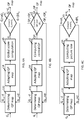
- FIG. 1 illustrates a flow diagram of an exemplary method for encoding a picture according to an embodiment of the present disclosure.
- an offline learning method is performed to compute a set of trajectories curves or D-Q curves.
- a trajectory curve allows representing for a given block of a picture the change in quality function of the quantization parameters.
- Such offline learning method is performed for a test set of video sequences.
- the offline learning method comprises generating learning data (step 101) and generating QP(D) trajectories (step 102). Steps 101 and 102 are further described below in relation respectively with figures 2A and 2B .
- step 11 a picture to encode is partitioned into a set of blocks. Typically, 8x8 pixels or 16x16 pixels may be used, but any other region shape for which the QP can be set constant may be used.
- step 12 each block is classified with the set of trajectories classes ⁇ T k ⁇ N computed in step 10.
- Such a classification allows associating to each block of the picture a given class k of trajectory from the set ⁇ T k ⁇ N
- Such a classification may be performed by performing the steps of the offline learning process to a current block for determining its trajectory curve M b ( QP ) and associating the class k to the current block which comprises the trajectory curve M b ( QP ) of the block.
- each class of trajectories is associated with specific features of blocks, such as textures type, ranges of frequencies, etc. Classification of a current block is then performed by computing the block's features and associating the block to the trajectory class associated with similar features.
- step 13 a quantization parameter is selected for each block of the picture such that the overall distortion of the picture or the overall quality is flattened over the whole picture.
- Known RDO tools aims at minimizing the distortion given a rate constraint at block level.
- the distortion is "equalized" over the whole picture.
- a target overall distortion Go is computed for the picture.
- a same initial quantization parameter QP g is assigned to each block of the picture.
- Such an initial quantization parameter QP g may be for instance a nominal QP assigned to the picture by the encoder.
- the distortion for each block is obtained using the trajectory curve of the class associated with the block for QP g . That is for a block associated with a trajectory class k, the distortion is given by M k ( QP g ).
- the target overall distortion Go is then computed by averaging the distortions M k ( QP g ) of the blocks of the picture.
- a quantization parameter (QP) map is determined for the picture.
- QP map comprises for each block of the picture an assigned QP.
- the target quality Go can be chosen as any metric, as long as it exists an invertible function M representing a relationship between the QP and the distortion.
- M simply as the PSNR. In this case, this method will try to give the same local PSNR as the global PSNR.
- Another metric can be chosen as the WQA score.
- step 16 the picture is then encoded using the QP map determined at step 132.
- the encoding of the picture is further disclosed in relation with figure 10 .
- the QP map before encoding the picture, is further adapted according to coding constraint in an optional step 14.
- Step 14 is further detailed in relation with figure 5 .
- the steps 131, 132 and 14 may be iteratively performed in order to converge to a flattened overall distortion over the whole picture. Embodiments of such iterative methods are disclosed below in relation with figures 4A, 4B and 4C .
- the QP assigned to the blocks of the picture are further refined in an optional step 15, for reducing the coding cost of the QP map.
- Step 15 is further detailed below in relation with figures 7 and 8 .
- the goal of the offline learning is to create a set of classes used to later classify each block of a picture to encode.
- the classification is based on the block trajectory (D-Q curve).
- the trajectory shows the change in quality function of the QP g .
- This function is calculated by fitting a curve to the raw data points ⁇ QP,metric ⁇ obtained in the offline learning method.
- Figure 2A illustrates a flow diagram of an exemplary method for generating learning data (step 101 from figure 1 ).
- step 20 a set of learning pictures is encoded using different values of QP g from a set of learning QPs, ranging for instance from 0 to 255. Encoding of the learning pictures may be performed according to any video compression schemes.
- step 21 the quality of each encoded picture and at each different value of QP g is assessed using a chosen metric.
- the WQA wavelet-based quality assessment
- Such a metric gives a score of the distortion per pixel but it is computed using the whole image.
- step 22 the reconstructed pictures are partitioned into a set of blocks of the same size as in step 11 from figure 1 .
- the metric, WQA in our example is computed for each block of the pictures. For instance, the WQA metric for a block is computed as an average of the WQA metric of the pixels in the block. Note that any other metric giving a score per block may also be suitable here.
- the generating of learning data results in block raw data comprising for each block of a picture from the set of learning pictures a set of QP and associated metric value.
- Figure 2B illustrates a flow diagram of an exemplary method for generating trajectories classes (step 102 from figure 1 ).
- the block raw data are modeled by fitting a curve to the raw data points for each block of the learning pictures.
- the chosen metric relies on a global approach, it may not vary monotonously for each block.
- the monotony can be enforced in several ways:
- step 24 after each block of the test set has been modeled to a trajectory curve, the trajectories need to be clustered into N classes.
- a clustering algorithm like a k-means algorithm, in the trajectories space, for example the polynomial functions here, is performed.
- the final trajectory classes can be refined by recomputing the final class trajectory using the raw data of the previous step. Once a trajectory class has been decided, all associated trajectories samples of the class are used to compute two properties for the class: the rate trajectory and the metric trajectory.
- the bitrate associated with a given QP is known for each block of the learning pictures set. So, for a given trajectory class k, a model fitting using such rate data of the blocks belonging to the class k, can be performed in order to associate a rate for each QP.
- a function R k (QP) is thus obtained which gives the rate of a block of the class k for a given QP.
- the relationship between the QP and the metric is given by the function M k (QP) which gives the metric (or distortion) of a block of the class k for a given QP.
- Such function M k (QP) for the class k is obtained as the centroid trajectory of the class k.
- a set of trajectory classes ⁇ T k ⁇ N comprising two curves M k (QP) and R k (QP) is delivered for later use for block classification when encoding a video sequence.
- Figure 4A illustrates a flow diagram of an exemplary method for generating a quantization parameter map according to an embodiment of present disclosure.
- the QP of each block of a picture to encode is refined iteratively. In this embodiment, it is desired to preserve the target quality of the picture to encode, and thus not to change the target overall distortion G 0 .
- the overall distortion G i for the picture to encode is computed in step 40.
- the overall distortion G i is computed according to the adapted QP map and the trajectory curve associated with each block of the picture. For instance, the overall distortion G i is computed as disclosed with step 131 of figure 1 but using for each block b of the picture, the QP b assigned to the block b in the adapted QP map. That is, the distortion of the block b is thus given by M k ( QP b ) where k is the trajectory class to which the block b belongs and M k is the trajectory of the class k.
- the overall distortion G i and the target overall distortion Go are compared.
- the target overall distortion G 0 is reduced by a change factor d. This results in a small change in the input quality target of the picture. If the overall distortion G i is lower than a second threshold depending on the target overall distortion G 0 , i.e G i ⁇ ⁇ G 0 , then the target overall distortion G 0 is increased by a change factor d. This results in a small change in the input quality target of the picture.
- the target overall distortion G 0 is not changed and the adapted QP map is delivered to the next steps of the method for encoding the picture.
- ⁇ and ⁇ may be set to 0,05 or to any values (e.g. 1) leading to threshold values for which a value of the overall distortion G i being between the two thresholds is an appropriate approximation of the target overall distortion G 0 .
- steps 132, 14, 40 and 41 are iterated until said the overall distortion G i is between the first threshold and the second treshold or until a number of iterations has been reached.
- FIG. 4B illustrates a flow diagram of an exemplary method for generating a quantization parameter map according to another embodiment of present disclosure.
- a central QP (QP c ) of the QP map is computed.
- the central QP of the QP map is the median QP of the N sorted QPs of the QP map.
- the central QP c and the nominal QP g are compared. If the central QP c is higher than the nominal QP g , i.e QP c > QP g , then the target overall distortion Go is reduced by a change factor d. If the central QP c is lower than the nominal QP g , i.e QP c ⁇ QP g , then the target overall distortion Go is increased by a change factor d.
- the target overall distortion Go is not changed and the adapted QP map is delivered to the next steps of the method for encoding the picture.
- the ending condition here is the equality of the central QP c or the oscillation of the central QP c around the nominal QP g in case the nominal QP g is not reachable. If the target overall distortion G 0 is changed at step 41, steps 132, 14, 42 and 43 are iterated until the central QP c equals to the nominal QP g or until a number of iterations has been reached.
- Figure 4C illustrates a flow diagram of an exemplary method for generating a quantization parameter map according to another embodiment of present disclosure.
- the nominal rate is the rate of the picture using the nominal QP g or directly the target rate given by the encoder.
- an overall rate R for the picture according is computed using the adapted QP map and the rate curve R k (QP) associated with each block of the picture.
- the rate R b is given by R k ( QP b ) where k is the trajectory class to which the block b belongs and R k is the rate function of the class k and QP b is the QP assigned to block b in the QP map.
- the rate R of the picture is then given by the sum of the rate R b of all the blocks of the picture.
- the rate R and the nominal rate R t are compared. If the rate R is lower than a first threshold depending on the nominal rate R t , i.e R ⁇ ⁇ R t , then the target overall distortion G 0 is reduced by a change factor d.
- the target overall distortion G 0 is increased by a change factor d. If the rate R is between the first and second thresholds values, i.e ⁇ R t ⁇ R ⁇ ⁇ R t , the target overall distortion Go is not changed and the adapted QP map is delivered to the next steps of the method for encoding the picture. For instance, ⁇ and ⁇ may be set to 0,05 or to any values (e.g. 1) leading to threshold values for which a value of the rate R being between the two thresholds is an appropriate approximation of the nominal rate R t . If the target overall distortion Go is changed at step 41, steps 132, 14, 40 and 41 are iterated until the rate R is between the first threshold and the second treshold or until a number of iterations has been reached.
- Figure 5 illustrates a flow diagram of an exemplary method for adapting a QP map according to an embodiment of he present disclosure.
- the QP map is a QP map obtained from step 13 disclosed with figure 1 .
- An objective of adapting the QP map is to transform a map of arbitrary QPs into a map of N QPs.
- N can be for example in a range 2 to 8 as in a VP9/VP10 coder.
- adapting the QP map is performed by applying a clustering method like a k-means algorithm.
- classical k-means algorithm cannot be used as is for adapting the QP map.
- the QP of each block comes from a particular function M k which may contain a plateau part, as illustrated by figure 3 . Therefore, even if a block b is assigned a particular quantization parameter Q b , if Q b is in the interval [Qpe, 255], then any quantization parameter in the interval [Qpe,255] is suitable for the block b, since all quantization parameters within this interval will provide the same distortion for the block b.
- step 50 N initial centroids are selected wherein each class i has one initial centroid C i .
- the initial centroids are taken at regular interval in the range of QPs from the QP map.
- step 51 the N classes are computed.
- the class computation is done as:
- step 52 the new centroids of each class determined at step 51 is computed.
- C Q P i C k n i.e. the new centroid C n+1 of the class k is the average of all the elements of the class k at previous step n.
- the average is computed in 2 steps.
- the plateau interval considered is the plateau interval of the function associated with the block b to which the QP has been assigned in the QP map. Therefore, from a same value of QP in a class k, the QP value could belong to the plateau part of the function for a first block b 1 and not for a second block b 2 .
- step 53 error for each class i of QPs is computed.
- step 54 the error E k is compared to a threshold. If the error E k is small, that is if the error E k is below the treshold, the clustering method ends, otherwise, the clustering is iterated from step 51 to 54.
- the centroid computation is classically done by averaging the elements of the class. This could result in a centroid value being a non integer value and centroid values very close from each other.
- the number of centroids may be below the target number, of classes.
- a target number may be for instance a hard constraint of N classes equals to 8 in a VP9 encoder.
- the number of centroids may be below the target number for example because of classes merging as disclosed below.
- the clustering method will try to insert a new centroid to well balance the centroids.
- the new class centroid is chosen as an initial guess to minimize the global error, for example by taking the value between the centroids the most apart.
- the number of different quantization parameters of the QP map depends on a target bitrate for the picture. It means that the number of QP classes, and thus the number of centroids, depends on the target bitrate for the picture to encode.
- the maximum number of centroids is adapted so as to adapt to the cost of the QP map to the rate allocated to the picture to encode.
- Such an adaptation can be performed for instance by adapting the number of centroids as a function of the nominal quantization parameter QP g .
- step 15 in order to decrease the coding cost of the QP map, refining of the QP assigned to each block in the QP map is performed at step 15 from figure 1 .
- a step 15 could also be performed in any one of the embodiments disclosed with figures 4A, 4B or 4C .
- the block trajectory i.e the function M k representing the metric (distortion) function of the QP is known, as well as the target overal distortion G 0 .
- dE By setting a maximum metric error dE , it is possible to deduce for each block an admissible range of QP [QP m ,QP M ], as disclosed in figure 6 .
- the QP map is encoded using spatial neighboring for determining a context of an entropy coder.
- Figure 7 illustrates such a spatial neighboring for a current block (represented with thicker lines) of the QP map.
- the QP for each current block should be as similar as possible to the QP of its neighboring blocks.
- a median QP value is computed from the QP values assigned to the neighboring blocks. If the median is inside [QP m ,QP M ] interval of the admissible range of QP, the QP for the current block is set to the median.
- the QP value of the current block is set to the QP value assigned to the neighbor block. Otherwise, the QPvalue of the current block is kept to the original QP 0 value assigned to the block in the QP map.
- the QP map is encoded using temporal encoding, that is using the co-located block in the last frame for the context of the entropic coder. In order to reduce the cost of QP map, the QP assigned to a current block should be set as similar as possible as the QP assigned to the co-located block.
- the QP of the current block is set to the QP value assigned to the co-located block. Otherwise, the QPvalue of the current block is kept to the original QP 0 value assigned to the block in the QP map.
- Figure 9 illustrates a block diagram of an exemplary video encoder according to an embodiment of the present disclosure.
- a video encoder 90 performs the encoding of a set of pictures of a video into a bitstream according to an embodiment of the present principle.
- the video encoder 90 performs the encoding of the pictures according to any video coding standards such as H.266, HEVC/H.265, AVC/H.264, VP9/VP10 or any proprietary video coding system.
- the video encoder 90 may include several modules for block-based video encoding, as illustrated in figure 9 .
- a picture I to be encoded is input to the encoder 90.
- the picture I is first subdivided into a set of blocks by a subdividing module.
- the encoder 90 comprises a mode selection unit for selecting a coding mode for a block of a picture to be coded, e.g. based on a rate/distortion optimization, such a mode selection unit comprising:
- the mode selection unit delivers prediction blocks PRED and the corresponding syntax elements to be coded in the bitstream for performing the same block prediction at the decoder.
- Residual blocks RES are then obtained from the blocks of the picture to be coded and the prediction blocks PRED.
- the residual blocks RES are transformed by a transform processing module delivering transformed residual coefficients TCOEF.
- the transformed residual coefficients are then quantized by a quantization module delivering quantized residual transform coefficients QCOEF.
- the residual blocks RES are quantized after transformation using a quantization parameter QP assigned to the blocks in the QP map as disclosed in any one of the embodiments disclosed above.
- the syntax elements and quantized residual transform coefficients QCOEF are then input to an entropy coding module to deliver coded video data.
- the quantized residual transform coefficients QCOEF are processed by an inverse quantization module and inverse transform module for reconstructing residual blocks RES'. Inverse quantization of coefficients of a block is performed using the quantization parameter QP assigned to the blocks in the QP map as disclosed in any one of the embodiments disclosed above.
- Prediction blocks PRED are added to the reconstructed residual blocks RES' for reconstructing blocks forming reconstructed blocks REC.
- the reconstructed blocks REC are stored in memory for use by a picture reconstruction module.
- the picture reconstruction module performs reconstruction of a decoded version I' of the picture I from the reconstructed blocks REC.
- the reconstructed picture I' is then stored in a reference picture memory for later use as a reference picture for encoding the following pictures of the set of pictures to code or for encoding subsequent blocks of the picture I.
- the determining of the QP map as disclosed in any one of the embodiments disclosed with figures 1 to 7 may be performed in a first coding pass of the encoder, before the mode selection unit performs mode selection for a block to be coded or before the picture I to encode is input to the encoder 90.
- the encoder 90 uses the quantization parameter assigned to the blocks in the QP map when quantizing the coefficients of a current block to encode.
- the QP map for the current picture I determined according to any one of the embodiments disclosed above should be encoded into the bitstream such that a decoder can use the same quantization parameters for decoding the blocks of the picture I as in the encoding stage.
- the QP map comprises a header wherein an index is assigned to each different value of QP in the QP map. That is, if the QP map comprises N classes of QPs, the header comprises N-1 index, index 0 corresponding to the default QP of the frame (QP g ).
- the QP map also comprises a map of index wherein an index is assigned to each block of the QP map.
- the QP map for a picture is then encoded by encoding data representative of the header and encoding data representative of the map of index.
- the map of index is encoded by the entropy coding module by using for each block of the map a spatial prediction from causal neighborhood of the block in the map or a temporal prediction from a co-located block of the index map coded with the last coded picture.
- the index map may be used by the encoder to share other parameters for encoding the block of the index map.
- the header disclosed above is used for assigning to a given index (also knwon as segment-ID in the VP9 encoder) encoding features to the blocks to which the index has been assigned in the index map.
- encoding features may be for example: restrictions on the reference frames that can be used for each index, coefficients skips, quantization parameter, loop filter strength, transform size options.
- an effect of sharing the index for several encoding features is the limitation of the number of different QPs for the picture.
- the elements of the QP map may not all be encoded.
- head, index map may not all be encoded.
- the QP map may be completely refreshed, that is the index value of each block of the map as well as the header are encoded.
- the QP map is unchanged, that is the same QP values are assigned to the same index and the index map is kept unchanged.
- the QP map from the last coded picture is fully reused for the current picture to encode.
- QP map encoding policy in order to improve the balance between rate and perceptual distortion, QP map encoding policy are proposed below according to the type of picture to encode.
- QP map encoding modes that may be chosen are illustrated in table 1, with the effect on rate and distortion associated with each encoding mode, wherein the sign "+” means an increasing effect on the rate or distortion and the sign "-" means a decreasing effect.
- the header and index map of the QP map should always be refreshed, when the adaptive QP tool is enabled at the encoder.
- any one of the choices from table 1 may be valid.
- the index map should be refreshed.
- the QP values assigned to the index in the header of the QP map are not changed. Only the index map is adapted. It means that for this encoding mode of the QP map, in the QP map clustering as disclosed with figure 5 , the value of each centroid of the QP class is known.
- the index map could be propagated without introducing any distortion.
- the additional coding cost of the QP map can be too high, especially for the pictures coded at deep temporal layer.
- the QP map should be disabled.
- the QP map which can be used for temporal coding for the next coded frame is lost.
- keeping the QP map, by using the propagation mode will increase the distortion because the QP map determined for the current picture is not necessarily aligned with the QP map determined and encoded for the previous picture.
- the "Refresh header only" mode is used wherein the index map is propagated, but the QP map is disabled by setting the QP of each index to a same value of QP. By doing so, the index map is still available for entropic coding for future frames but no distortion is introduced by not updating the index map.
- a golden frame is picture which is encoded using a reference to an "alt-ref" picture.
- An alt-ref picture is a picture encoded in the bistream but which is an invisible picture as the alt-ref picture is not intended for display.
- the alt-ref picture is only coded for later use as a reference picture.
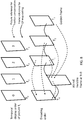
- the alt-ref picture is a picture temporally co-located with the golden frame, as disclosed in figure 8 .
- the rate-distortion choices made to encode the golden frame might be inconsistent with the rate-distortion choices of the alt-ref picture because the QP map has changed in between, as disclosed by figure 8 .
- the index map is not refreshed, that is the index map of the last coded picture is used.
- the header of the QP map is refreshed such as, for each index, instead of encoding a QP value, a skip-flag set to a value of 1 is encoded. By doing so, the whole golden frame is encoded as a full skip of blocks, resulting in the exact copy of the co-located alt-ref picture.
- Figure 10 illustrates the simplified structure of an apparatus (90) for encoding a video according to an embodiment of the present principle.
- Such an apparatus 90 is configured to implement the method for encoding a video according to the present principle according to any embodiments disclosed above.
- the functional units of the encoder apparatus 90 have been disclosed in reference to figure 9 .
- the structural apparatus 90 disclosed below may be configured to implement each of these functional units individually or in combination, and according to any one of the embodiments of the principle disclosed above.
- the structural apparatus 90 may also be configured to implement the method for determining a QP map as disclosed in any one of the embodiments descirbed with figures 1 to 8 .
- the encoder apparatus 90 comprises a processing unit PROC equipped for example with a processor and driven by a computer program PG stored in a memory MEM and implementing the method for encoding a video according to the present principle.
- the code instructions of the computer program PG are for example loaded into a RAM (not shown) and then executed by the processor of the processing unit PROC.
- the processor of the processing unit PROC implements the steps of the method for encoding a video which has been described here above, according to the instructions of the computer program PG.
- the encoder apparatus 90 comprises a communication unit COMOUT to transmit an encoded bitstream STR to a data network.
- the encoder apparatus 90 also comprises an interface COMIN for receiving a picture or a video to encode.
Landscapes
- Engineering & Computer Science (AREA)
- Multimedia (AREA)
- Signal Processing (AREA)
- Theoretical Computer Science (AREA)
- Data Mining & Analysis (AREA)
- Physics & Mathematics (AREA)
- Bioinformatics & Cheminformatics (AREA)
- Artificial Intelligence (AREA)
- Life Sciences & Earth Sciences (AREA)
- Bioinformatics & Computational Biology (AREA)
- Computer Vision & Pattern Recognition (AREA)
- Evolutionary Biology (AREA)
- Evolutionary Computation (AREA)
- General Engineering & Computer Science (AREA)
- General Physics & Mathematics (AREA)
- Computing Systems (AREA)
- Probability & Statistics with Applications (AREA)
- Compression Or Coding Systems Of Tv Signals (AREA)
Abstract
A method and an apparatus for encoding a video are disclosed. A first curve giving quantization parameters in function of distortion values is associated (12) to each block of a picture from said video. A target overall distortion for said picture is computed (131) according to a same initial quantization parameter assigned to each block of the picture and using for each block said associated first curve, and a quantization parameter map for said picture is determined (132) by assigning for each block, a quantization parameter given by said first curve associated with said block for said target overall distortion. The picture is then encoded (16) using the quantization parameter map.
Description
- A method and an apparatus for encoding a video into a bitstream are disclosed.
- Digital images and video sequence need a lot of resources for storage and transmission and thus image and video compression techniques are needed for reducing bandwidth and storage space.
- Video coding schemes are already known, such as HEVC ("High Efficiency Video Coding) or VP9. In such schemes, a video sequence is coded picture by picture. Each picture is decomposed into a set of blocks. In order to reduce the number of bits used for coding each block, such schemes perform lossy coding using a quantization tool that compresses a range of values to a single quantum value.
- In video compression schemes, such as VP8 or VP9 for instance, rate/distortion optimization is performed on the encoder side for determining the best compromise between rate and distortion when coding each block of a picture. Such rate/distortion optimization may adapt a quantization parameter at a block level to precisely control the rate and the distortion of a block to encode. Classically, the distortion is measured at the block level using an objective measure such as PSNR (Peak Signal to Noise Ratio) or MSE (Mean Square Error). However, such measures do not take into account the properties of the Human Visual System, and result in compressed video wherein picture quality is not homogeneous.
- A method for encoding a video is disclosed. Such an encoding method comprises:
- associating to each block of a picture from said video, a first curve giving quantization parameters in function of distortion values,
- computing a target overall distortion for said picture according to a same initial quantization parameter assigned to each block of the picture and using for each block said associated first curve,
- determining a quantization parameter map for said picture comprising:
- assigning for each block, a quantization parameter given by said first curve associated with said block for said target overall distortion,
- encoding said picture using said quantization parameter map.
- The present principle allows determining a quantization parameter for each block to encode based on a target overall distortion for the picture. Therefore, the picture quality of the resulting compressed video is more homogeneous.
- According to an embodiment of the disclosure, the encoding method further comprises adapting the quantization parameter map according to a coding constraint for coding said quantization parameter map. According to this embodiment, compression efficiency is improved since the resulting quantization parameter map (QP map) is adapted according to coding constraint. For instance, a coding constraint may be a limited number of quantization parameters to be used for the blocks of the picture. For instance, a VPx encoder allows only 8 different quantization parameters for the quantization parameter map. According to a variant, a coding constraint for coding the quantization parameter map may be a coding cost or bitrate allowed for encoding the QP assigned to each block.
- According to another embodiment of the disclosure, the encoding method further comprises:
- computing an overall distortion for said picture according to said adapted quantization parameter map and the first curve associated with each block of the picture,
- comparing said overall distortion and said target overall distortion:
- if said overall distortion is higher than a first threshold depending on said target overall distortion, reducing said target overall distortion of a first change factor,
- if said overall distortion is lower than a second threshold depending on said target overall distortion, increasing said target overall distortion of a second change factor,
- iterating said acts of determining a quantization parameter map for said picture, adapting the quantization parameter map according to a coding constraint, computing an overall distortion for said picture and comparing said overall distortion and said target overall distortion, until said overall distortion is between said first threshold and said second threshold or until a number of iterations has been reached.
- According to another embodiment of the disclosure, the encoding method further comprises:
- computing a central quantization parameter from the quantization parameter map,
- comparing said central quantization parameter and said initial quantization parameter:
- if said central quantization parameter is lower than a first threshold depending on said initial quantization parameter, reducing said target overall distortion of a first change factor,
- if said central quantization parameter is higher than a second threshold depending on said initial quantization parameter, increasing said target overall distortion of a second change factor,
- iterating said acts of determining a quantization parameter map for said picture, adapting the quantization parameter map according to a coding constraint, computing a central quantization parameter and comparing said central quantization parameter and said initial quantization parameter, until said central quantization parameter equals said initial quantization parameter or until a number of iterations has been reached.
- According to another embodiment of the disclosure, each block of the picture is associated with a second curve representing quantization parameters in function of rate values. The encoding method further comprises:
- computing an overall rate for said picture according to said adapted quantization parameter map and the second curve associated with each block of the picture,
- comparing said overall rate and a target rate for said picture:
- if said overall rate is lower than a first threshold depending on said target rate, reducing said target overall distortion of a first change factor,
- if said overall rate is higher than a second threshold depending on said target rate, increasing said target overall distortion of a second change factor,
- iterating said acts of determining a quantization parameter map for said picture, adapting the quantization parameter map according to a coding constraint, computing an overall rate for said picture and comparing said overall rate and said target rate, until said overall distortion is between said first threshold and said second threshold or until a number of iterations has been reached.
- According to another embodiment of the disclosure, adapting the quantization parameter map uses a K-mean clustering method for reducing the number of quantization parameters of the map.
- According to another embodiment of the disclosure, said K-mean clustering comprises quantization parameter classes computing wherein for a quantization parameter assigned to a block, said quantization parameter, said quantization parameter is associated with each quantization parameter class which comprises a centroid on said plateau.
- According to another embodiment of the disclosure, said K-mean clustering comprises quantization parameter classes centroids computing wherein for a quantization parameter assigned to a block, said quantization parameter belonging to a plateau part of a first curve associated with said block, a value taken into account for computing a class centroid corresponds to a maximum value selected from a first quantization parameter of the plateau part of the first curve to which the quantization parameter belongs or a mean value of quantization parameters of the class which do not belong to the plateau part.
- According to this embodiment, the quantization parameters of a class which belong to a plateau part of the QP-distortion curve will participate to the centroid of the class computation such as it moves the less possible the average of the class.
- According to another embodiment of the disclosure, said K-mean clustering comprises error computing of a class wherein for a quantization parameter assigned to a block, said quantization parameter belonging to a plateau part of a first curve associated with said block, error is computing by taking into account a maximum value selected from a difference computed as a first quantization parameter of the plateau part of the first curve to which the quantization parameter belongs minus a value of the centroid of the class or a zero value. According to another embodiment of the disclosure, the number of different quantization parameters of the map depends on a target bitrate for the picture. This embodiment allows adapting the overhead cost for encoding the QP map to the rate allocated to the picture. At low bitrate, the overhead cost for encoding the QP map is to high compared to the gain in perceptual metric.
- According to another embodiment of the disclosure, the encoding method further comprises, for at least one block of said picture, refining said quantization parameter assigned to said at least one block according to a spatial neighbor block of said at least one block or according to a block co-located with said at least one block in a last encoded frame. This embodiment allows reducing the coding cost of the quantization parameters map by taking into account spatial or temporal neighbor of a block used for entropy coding of the QP map.
- According to another embodiment of the disclosure, said quantization parameter map comprises a number N of different values of quantization parameter, and said quantization parameter map comprises a header assigning an index to each different value of quantization parameter and a map of index wherein an index is assigned to each block of said picture. The encoding method further comprises encoding said quantization parameter map comprising:
- encoding data representative of said header,
- encoding data representative of said map of index.
- According to another embodiment of the disclosure, for a picture coded at a predetermined temporal layer, said N different values of quantization parameter are set to a same quantization parameter value in the header. According to this embodiment, it is possible to disable the use of the QP map for pictures coded in deep temporal layer by setting a same QP to all index in the data map. For such pictures, the cost of a QP map may be too high. According to this embodiment, even if the QP map is disabled for a deep temporal layer picture, the data map is still propagated to future pictures so that the data map is available for entropy coding for future pictures. Therefore, no distortion is introduced when the data map is not updated for a picture.
- According to another embodiment of the disclosure, for a first picture co-located to a reference picture coded only for use as a reference picture, said first picture being inter-coded from said reference picture, at least one second picture being coded between said reference picture and said first picture, a skip flag set to a
value 1 is assigned to each index of a header of a quantization parameter map of said first picture instead of a quantization parameter value.
For instance, a reference picture coded only for use as a reference picture corresponds to an alt-ref picture of a VPx compression standard, and a first picture co-located to such a reference picture and inter-coded from such a reference picture corresponds to a golden picture of a VPx compression standard. When pictures are coded in the bitstream between an alt-ref picture and a golden picture, the QP map used for coding of the alt-ref picture may have changed when coding the golden picture because of rate-distortion choices made for pictures in-between. This embodiment allows preserving the quality of the golden picture by encoding the golden picture as a full skip of blocks resulting in an exact copy of the alt-ref picture to the golden picture. - According to another aspect of the disclosure, an apparatus for encoding a video is also disclosed. Such an apparatus comprises:
- means for associating to each block of a picture from said video, a first curve giving quantization parameters in function of distortion values,
- means for computing a target overall distortion for said picture according to a same initial quantization parameter assigned to each block of the picture and using for each block said associated first curve,
- means for determining a quantization parameter map for said picture comprising:
- means for assigning for each block, a quantization parameter given by said first curve associated with said block for said target overall distortion,
- means for encoding said picture using said quantization parameter map.
- According to one implementation, the different steps of the method for encoding a video as described here above are implemented by one or more software programs or software module programs comprising software instructions intended for execution by a data processor of an apparatus for encoding a video, these software instructions being designed to command the execution of the different steps of the method according to the present principles.
- A computer program is also disclosed that is capable of being executed by a computer or by a data processor, this program comprising instructions to command the execution of the steps of a method for encoding a video as mentioned here above.
- This program can use any programming language whatsoever and be in the form of source code, object code or intermediate code between source code and object code, such as in a partially compiled form or any other desirable form whatsoever.
- The information carrier can be any entity or apparatus whatsoever capable of storing the program. For example, the carrier can comprise a storage means such as a ROM, for example a CD ROM or a microelectronic circuit ROM or again a magnetic recording means, for example a floppy disk or a hard disk drive.
- Again, the information carrier can be a transmissible carrier such as an electrical or optical signal, which can be conveyed via an electrical or optical cable, by radio or by other means. The program according to the present principles can be especially uploaded to an Internet type network.
- As an alternative, the information carrier can be an integrated circuit into which the program is incorporated, the circuit being adapted to executing or to being used in the execution of the methods in question.
- According to one embodiment, the methods/apparatus may be implemented by means of software and/or hardware components. In this respect, the term "module" or "unit" can correspond in this document equally well to a software component and to a hardware component or to a set of hardware and software components.
- A software component corresponds to one or more computer programs, one or more sub-programs of a program or more generally to any element of a program or a piece of software capable of implementing a function or a set of functions as described here below for the module concerned. Such a software component is executed by a data processor of a physical entity (terminal, server, etc) and is capable of accessing hardware resources of this physical entity (memories, recording media, communications buses, input/output electronic boards, user interfaces, etc).
- In the same way, a hardware component corresponds to any element of a hardware unit capable of implementing a function or a set of functions as described here below for the module concerned. It can be a programmable hardware component or a component with an integrated processor for the execution of software, for example an integrated circuit, a smartcard, a memory card, an electronic board for the execution of firmware, etc.
-
-
Figure 1 illustrates a flow diagram of an exemplary method for encoding a picture according to an embodiment of the present principle, -
Figure 2A illustrates a flow diagram of an exemplary method for generating learning data that may be used in the exemplary method for encoding a picture according to an embodiment of the present disclosure, -
Figure 2B illustrates a flow diagram of an exemplary method for generating trajectory curves that may be used in the exemplary method for encoding a picture according to an embodiment of the present disclosure, -
Figure 3 illustrates a simplified example of a trajectory curve according to an embodiment of the present disclosure, -
Figure 4A illustrates a flow diagram of an exemplary method for generating a quantization parameter map according to an embodiment of present disclosure, -
Figure 4B illustrates a flow diagram of an exemplary method for generating a quantization parameter map according to another embodiment of present disclosure, -
Figure 4C illustrates a flow diagram of an exemplary method for generating a quantization parameter map according to another embodiment of present disclosure, -
Figure 5 illustrates a flow diagram of an exemplary method for adapting a quantization parameter map, -
Figure 6 illustrates a simplified example of an admissible range of QP for a given block trajectory, -
Figure 7 illustrates causal neighbors of a block, -
Figure 8 illustrates an example of picture encoding order and reference picture used, -
Figure 9 illustrates a block diagram of an exemplary encoder according to an embodiment of the present disclosure, -
Figure 10 illustrates an exemplary structure of an encoder that may be used in any one of the embodiments disclosed herein, according to an embodiment of the present disclosure. - Classical rate-distortion optimization (RDO) tools aim at allocating a bit budget at a block level when encoding a picture while optimizing the objective quality of the reconstructed block. Such RDO tools are based on objective metrics such as MSE/PSNR. Therefore, the overall objective quality of a picture to encode is optimized with regards to these metrics. However, PSNR does not take into account the properties of the Human Visual System. More coherent bitrate allocation may be performed knowing the sensitivity of human eyes. A higher perceptual/visual quality of the overall content may be achieved by better distributing the compression methods and parameters over the pictures of source video sequences.
- The human visual system (HVS) is more sensitive to contrast than absolute luminance. Moreover, the sensitivity depends on the spatial frequency of the picture or region of the picture. This sensitivity decreases on high spatial frequencies, i.e. in detailed textures. This phenomenon is also known as contrast sensitivity.
- High frequencies often require a huge amount of bits to be transmitted at a high quality level since they are more difficult to predict. By better distributing the coding parameters when encoding a picture, these highly detailed regions or blocks will be encoded at a lower level of quality, for instance by using a more severe quantization. The subjective quality of the reconstructed picture would not be impacted as the HVS is not able to detect the produced artefacts. The preserved bitrate could then be utilized to enhance the quality of low frequency regions for improving the overall perceived quality.
- When solving the problem of perceptual coding, some methods rely on the fact that a particular local "perceptual metric" is available during the encoding stage, allowing the encoder to decide encoding mode (especially the QP of the local block) based on these metrics. Such methods generally rely on a local activity measure to decide the coding mode. A problem with these approaches is that the perceptual quality of a block is very difficult to measure locally (i.e. taking into account only the pixels inside the bloc), and the best perceptual metrics (for example VQM, WQA for Wavelet-based Quality Assessment, etc.) use a global approach to obtain the metric of each pixel.
In practice, it means that during the encoding stage, one cannot compute these perceptual metrics on-the-fly based on the result of the encoding of the current block (typically during the RDO). An alternative is to perform a so-called "first pass" in order to choose some suitable quantization parameters (QPs) prior to the encoding stage. -
Figure 1 illustrates a flow diagram of an exemplary method for encoding a picture according to an embodiment of the present disclosure.
Instep 10, an offline learning method is performed to compute a set of trajectories curves or D-Q curves. A trajectory curve allows representing for a given block of a picture the change in quality function of the quantization parameters. Such offline learning method is performed for a test set of video sequences. The offline learning method delivers a set of N trajectories classes {Tk } N = {Mk (QP)} N , where Mk (QP) is a representative function of the classe k giving the distortion of a block in function of the QP.
The offline learning method comprises generating learning data (step 101) and generating QP(D) trajectories (step 102).Steps figures 2A and 2B .
Instep 11, a picture to encode is partitioned into a set of blocks. Typically, 8x8 pixels or 16x16 pixels may be used, but any other region shape for which the QP can be set constant may be used.
Instep 12, each block is classified with the set of trajectories classes {Tk } N computed instep 10. Such a classification allows associating to each block of the picture a given class k of trajectory from the set {Tk } N Such a classification may be performed by performing the steps of the offline learning process to a current block for determining its trajectory curve Mb (QP) and associating the class k to the current block which comprises the trajectory curve Mb (QP) of the block.
According to another variant, each class of trajectories is associated with specific features of blocks, such as textures type, ranges of frequencies, etc. Classification of a current block is then performed by computing the block's features and associating the block to the trajectory class associated with similar features. - In
step 13, a quantization parameter is selected for each block of the picture such that the overall distortion of the picture or the overall quality is flattened over the whole picture. Known RDO tools aims at minimizing the distortion given a rate constraint at block level. In contrast, according to the present principle, the distortion is "equalized" over the whole picture. - For this, in
step 131, a target overall distortion Go is computed for the picture. A same initial quantization parameter QPg is assigned to each block of the picture. Such an initial quantization parameter QPg may be for instance a nominal QP assigned to the picture by the encoder. Then, the distortion for each block is obtained using the trajectory curve of the class associated with the block for QPg. That is for a block associated with a trajectory class k, the distortion is given by Mk (QPg ). - According to a variant, the target overall distortion Go is then computed by averaging the distortions Mk (QPg ) of the blocks of the picture.
- According to another variant, for preserving the same global quality as the quality decided by the encoder to encode the current frame, the target overall distortion Go is computed as a combination of a robust absolute perceptual metric and a robust flattening score by:

- Mk_50% is the median distortion score on the picture,
- Mk_99% is the distortion of the 99% quantile on the picture, i.e. the distortion such that 99% of the blocks are below that threshold,
- a is a factor to balance absolute quality and flattening score.
- In
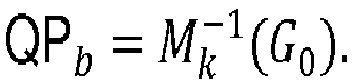
step 132, a quantization parameter (QP) map is determined for the picture. Such QP map comprises for each block of the picture an assigned QP. - As the function Mk(QP) is invertible, for each block b of a trajectory class k, a QPb can be assigned to the block b with
- Note that the target quality Go can be chosen as any metric, as long as it exists an invertible function M representing a relationship between the QP and the distortion. A typical example is to define M simply as the PSNR. In this case, this method will try to give the same local PSNR as the global PSNR. Another metric can be chosen as the WQA score.
- In
step 16, the picture is then encoded using the QP map determined atstep 132. The encoding of the picture is further disclosed in relation withfigure 10 . - According to an embodiment of the present disclosure, before encoding the picture, the QP map is further adapted according to coding constraint in an
optional step 14.Step 14 is further detailed in relation withfigure 5 . When adapting the QP map to coding constraint, the overall distortion G0 of the picture may have changed and may not be flattened over the whole picture. Therefore, thesteps figures 4A, 4B and 4C .
According to an embodiment of the present disclosure, before encoding the picture, the QP assigned to the blocks of the picture (QP map) are further refined in anoptional step 15, for reducing the coding cost of the QP map.Step 15 is further detailed below in relation withfigures 7 and8 . - The goal of the offline learning (
step 10 offigure 1 ) is to create a set of classes used to later classify each block of a picture to encode. The classification is based on the block trajectory (D-Q curve). The trajectory shows the change in quality function of the QPg. This function is calculated by fitting a curve to the raw data points {QP,metric} obtained in the offline learning method.
Figure 2A illustrates a flow diagram of an exemplary method for generating learning data (step 101 fromfigure 1 ).
Instep 20, a set of learning pictures is encoded using different values of QPg from a set of learning QPs, ranging for instance from 0 to 255. Encoding of the learning pictures may be performed according to any video compression schemes.
Instep 21, the quality of each encoded picture and at each different value of QPg is assessed using a chosen metric. For instance, the WQA (wavelet-based quality assessment) metric is chosen. Such a metric gives a score of the distortion per pixel but it is computed using the whole image.
Instep 22, the reconstructed pictures are partitioned into a set of blocks of the same size as instep 11 fromfigure 1 . The metric, WQA in our example, is computed for each block of the pictures. For instance, the WQA metric for a block is computed as an average of the WQA metric of the pixels in the block.
Note that any other metric giving a score per block may also be suitable here.
The generating of learning data results in block raw data comprising for each block of a picture from the set of learning pictures a set of QP and associated metric value.
Figure 2B illustrates a flow diagram of an exemplary method for generating trajectories classes (step 102 fromfigure 1 ).
Instep 23, the block raw data are modeled by fitting a curve to the raw data points for each block of the learning pictures.
As the chosen metric relies on a global approach, it may not vary monotonously for each block. As it is desirable that the function Mk(QP)=wqa is invertible, the monotony of the modeled curve is enforced. The monotony can be enforced in several ways: - "soft monotony": the raw data are made monotonic and the fitting is made normally (for example using a Least Square Fitting of a polynomial function). The resulting trajectory is not necessarily monotonous but the resulting curve is improved.
- "hard monotony": during the fitting, a hard monotony constraint is added (for example using a convex optimization approach).
- After modeling of the block raw data to trajectory, it appears that many block trajectories can be decomposed into two parts, as illustrated on
figure 3 : - an increasing distortion part (fitted part on
figure 3 ) - a "plateau" part where the error is almost stable, in practice, it means all the "texture" of the block has been removed and the block quality is then constant.
- Knowing these properties for coding the picture, the fitting is performed up to the plateau part, and an additional parameter QPe gives the start of the plateau.
Instep 24, after each block of the test set has been modeled to a trajectory curve, the trajectories need to be clustered into N classes. In order to do this, a clustering algorithm, like a k-means algorithm, in the trajectories space, for example the polynomial functions here, is performed. Alternatively, the final trajectory classes can be refined by recomputing the final class trajectory using the raw data of the previous step.
Once a trajectory class has been decided, all associated trajectories samples of the class are used to compute two properties for the class: the rate trajectory and the metric trajectory.
From theencoding step 20, the bitrate associated with a given QP is known for each block of the learning pictures set. So, for a given trajectory class k, a model fitting using such rate data of the blocks belonging to the class k, can be performed in order to associate a rate for each QP. A function Rk(QP) is thus obtained which gives the rate of a block of the class k for a given QP.
For a given class k, the relationship between the QP and the metric is given by the function Mk(QP) which gives the metric (or distortion) of a block of the class k for a given QP. Such function Mk(QP) for the class k is obtained as the centroid trajectory of the class k.
At the end ofstep 102, a set of trajectory classes {Tk } N comprising two curves Mk(QP) and Rk(QP) is delivered for later use for block classification when encoding a video sequence. -
Figure 4A illustrates a flow diagram of an exemplary method for generating a quantization parameter map according to an embodiment of present disclosure.
According to this embodiment, in order to take into account the final QP map, after adaptation atstep 14 fromfigure 1 , the QP of each block of a picture to encode is refined iteratively. In this embodiment, it is desired to preserve the target quality of the picture to encode, and thus not to change the target overall distortion G0. - According to this embodiment, once the QP map has been adapted to coding constraint, the overall distortion Gi for the picture to encode is computed in
step 40. The overall distortion Gi is computed according to the adapted QP map and the trajectory curve associated with each block of the picture. For instance, the overall distortion Gi is computed as disclosed withstep 131 offigure 1 but using for each block b of the picture, the QPb assigned to the block b in the adapted QP map. That is, the distortion of the block b is thus given by Mk (QPb ) where k is the trajectory class to which the block b belongs and Mk is the trajectory of the class k.
Instep 41, the overall distortion Gi and the target overall distortion Go are compared. If the overall distortion Gi is higher than a first threshold depending on the target overall distortion G0, i.e Gi > α×G0 , then the target overall distortion G0 is reduced by a change factor d. This results in a small change in the input quality target of the picture.
If the overall distortion Gi is lower than a second threshold depending on the target overall distortion G0, i.e Gi < β×G 0, then the target overall distortion G0 is increased by a change factor d. This results in a small change in the input quality target of the picture.
If the overall distortion Gi is between the first and second thresholds values, i.e α×G0 > Gi > β×G 0, the target overall distortion G0 is not changed and the adapted QP map is delivered to the next steps of the method for encoding the picture. For instance, α and β may be set to 0,05 or to any values (e.g. 1) leading to threshold values for which a value of the overall distortion Gi being between the two thresholds is an appropriate approximation of the target overall distortion G0.
If the target overall distortion Go is changed atstep 41,steps -
Figure 4B illustrates a flow diagram of an exemplary method for generating a quantization parameter map according to another embodiment of present disclosure. According to this embodiment, it is desired to preserve the nominal QP decided by the encoder to encode the current picture.
Instep 42, a central QP (QPc) of the QP map is computed. For instance, the central QP of the QP map is the median QP of the N sorted QPs of the QP map.
In step 43, the central QPc and the nominal QPg are compared.
If the central QPc is higher than the nominal QPg, i.e QPc > QPg , then the target overall distortion Go is reduced by a change factor d.
If the central QPc is lower than the nominal QPg, i.e QPc < QPg , then the target overall distortion Go is increased by a change factor d. - If the central QPc equals to the nominal QPg, the target overall distortion Go is not changed and the adapted QP map is delivered to the next steps of the method for encoding the picture. Note that the ending condition here is the equality of the central QPc or the oscillation of the central QPc around the nominal QPg in case the nominal QPg is not reachable.
If the target overall distortion G0 is changed atstep 41,steps -
Figure 4C illustrates a flow diagram of an exemplary method for generating a quantization parameter map according to another embodiment of present disclosure. According to this embodiment, it is desired to preserve the nominal rate Rt, wherein the nominal rate is the rate of the picture using the nominal QPg or directly the target rate given by the encoder.
Instep 44, an overall rate R for the picture according is computed using the adapted QP map and the rate curve Rk(QP) associated with each block of the picture. For instance, for each block b of the picture, the rate Rb is given by Rk (QPb ) where k is the trajectory class to which the block b belongs and Rk is the rate function of the class k and QPb is the QP assigned to block b in the QP map. The rate R of the picture is then given by the sum of the rate Rb of all the blocks of the picture.
Instep 45, the rate R and the nominal rate Rt are compared. If the rate R is lower than a first threshold depending on the nominal rate Rt, i.e R < α×Rt , then the target overall distortion G0 is reduced by a change factor d.
If the rate R is higher than a second threshold depending on the nominal rate Rt, i.e R > β×Rt, then the target overall distortion G0 is increased by a change factor d.
If the rate R is between the first and second thresholds values, i.e α×Rt < R < β×Rt , the target overall distortion Go is not changed and the adapted QP map is delivered to the next steps of the method for encoding the picture. For instance, α and β may be set to 0,05 or to any values (e.g. 1) leading to threshold values for which a value of the rate R being between the two thresholds is an appropriate approximation of the nominal rate Rt.
If the target overall distortion Go is changed atstep 41,steps -
Figure 5 illustrates a flow diagram of an exemplary method for adapting a QP map according to an embodiment of he present disclosure. For instance, the QP map is a QP map obtained fromstep 13 disclosed withfigure 1 . - An objective of adapting the QP map is to transform a map of arbitrary QPs into a map of N QPs. N can be for example in a
range 2 to 8 as in a VP9/VP10 coder. - According to this embodiment, adapting the QP map is performed by applying a clustering method like a k-means algorithm. However, according to the present disclosure, classical k-means algorithm cannot be used as is for adapting the QP map.
- According to the present disclosure, it is to be noted that the QP of each block comes from a particular function Mk which may contain a plateau part, as illustrated by
figure 3 . Therefore, even if a block b is assigned a particular quantization parameter Qb, if Qb is in the interval [Qpe, 255], then any quantization parameter in the interval [Qpe,255] is suitable for the block b, since all quantization parameters within this interval will provide the same distortion for the block b. - It is also to be noted that a difference in quality provided between 2 QPs very closed can be cancelled by the overhead due to the coding of the QP map.
- Below, a k-means algorithm taking into account the above contraints is disclosed for adapting the QP map according to coding constraints.
- In
step 50, N initial centroids are selected wherein each class i has one initial centroid Ci. For instance, the initial centroids are taken at regular interval in the range of QPs from the QP map.Step 50 delivers a set of initial centroids {Ci }0 = {QPi } 0 . - In
step 51, the N classes are computed. In a standard k-means algorithm, the class computation is done as: -

- In order to take into account the plateau of the Mk function from the trajectory classes, if a given value QP assigned to a block b in the QP map belongs to the plateau part of the Mk function associated with the block b, the value of QP assigned to a block b is then associated with several centroids if the centroids are in the plateau interval:

- In
step 52, the new centroids of each class determined atstep 51 is computed. In the standard k-means algorithm, the centroid computation is done as:
- In order to take into account the plateau part of the function associated with the blocks, for a given value QP, the average is computed in 2 steps.
- Let's denote by


-

- Then



- Here, when considering if a QP belongs to a plateau interval, it should be understood that the plateau interval considered is the plateau interval of the function associated with the block b to which the QP has been assigned in the QP map. Therefore, from a same value of QP in a class k, the QP value could belong to the plateau part of the function for a first block b1 and not for a second block b2.
- Acording to the present disclosure, it means elements in a plateau part will participate to the centroid computation such as the elements in a plateau part move the less possible the average of the class to which they belong.
- In
step 53, error for each class i of QPs is computed. In the k-means algorithm, the error for a class is computed as:
- Using the same method as above, the error computation is adapted as follows:


- In
step 54, the error Ek is compared to a threshold. If the error Ek is small, that is if the error Ek is below the treshold, the clustering method ends, otherwise, the clustering is iterated fromstep 51 to 54. - According to an embodiment of the present disclosure, in the k-means algorithm, the centroid computation is classically done by averaging the elements of the class. This could result in a centroid value being a non integer value and centroid values very close from each other. In order to avoid this, after the centroid computation, each class are compared to the other one in integer values:

- If the value Tk1,k2 is below a threshold, then the classes are merged. In this case, a new class can be re-inserted at the next iteration.
According to another embodiment of the present disclosure, the number of centroids may be below the target number, of classes. Such a target number may be for instance a hard constraint of N classes equals to 8 in a VP9 encoder. The number of centroids may be below the target number for example because of classes merging as disclosed below. According to this embodiment, the clustering method will try to insert a new centroid to well balance the centroids. The new class centroid is chosen as an initial guess to minimize the global error, for example by taking the value between the centroids the most apart. - According to an embodiment of the present disclosure, the number of different quantization parameters of the QP map depends on a target bitrate for the picture. It means that the number of QP classes, and thus the number of centroids, depends on the target bitrate for the picture to encode.
When the rate allocated for a picture is becoming low, the overhead of the cost for encoding the QP map can become too high, compared to the gain in perceptual metric for the picture. Therefore, when adapting the QP map atstep 14 fromfigure 1 , the maximum number of centroids is adapted so as to adapt to the cost of the QP map to the rate allocated to the picture to encode. Such an adaptation can be performed for instance by adapting the number of centroids as a function of the nominal quantization parameter QPg. For instance, at low QP (high bitrate), 8 classes may be used for the QP map, at high QP (for instance QPg=250), only one class may be used for the whole image, for intermediate QP value, for instance QPg=125, 4 classes may be used for the QP map. - According to an embodiment of the present disclosure, in order to decrease the coding cost of the QP map, refining of the QP assigned to each block in the QP map is performed at
step 15 fromfigure 1 . According to other variants, such astep 15 could also be performed in any one of the embodiments disclosed withfigures 4A, 4B or 4C .
According to this embodiment, for each block, the block trajectory, i.e the function Mk representing the metric (distortion) function of the QP is known, as well as the target overal distortion G0. By setting a maximum metric error dE, it is possible to deduce for each block an admissible range of QP [QPm,QPM], as disclosed infigure 6 .
According to a variant, the QP map is encoded using spatial neighboring for determining a context of an entropy coder.Figure 7 illustrates such a spatial neighboring for a current block (represented with thicker lines) of the QP map. In order to reduce the cost of the QP map, the QP for each current block should be as similar as possible to the QP of its neighboring blocks.
For this, for each block of the QP map, a median QP value is computed from the QP values assigned to the neighboring blocks. If the median is inside [QPm,QPM] interval of the admissible range of QP, the QP for the current block is set to the median.
Otherwise, for each neighbor block of the causal neighboring of the current block, if the QP value assigned to the neighbor block is inside the [QPm,QPM] interval of the admissible range of QPs of the current block, the QP value of the current block is set to the QP value assigned to the neighbor block.
Otherwise, the QPvalue of the current block is kept to the original QP0 value assigned to the block in the QP map.
According to another variant, the QP map is encoded using temporal encoding, that is using the co-located block in the last frame for the context of the entropic coder.
In order to reduce the cost of QP map, the QP assigned to a current block should be set as similar as possible as the QP assigned to the co-located block.
For this, for each of the QP map, if the value of the co-located block is inside the [QPm,QPM] interval of the admissible range of QPs of the current block, the QP of the current block is set to the QP value assigned to the co-located block.
Otherwise, the QPvalue of the current block is kept to the original QP0 value assigned to the block in the QP map. -
Figure 9 illustrates a block diagram of an exemplary video encoder according to an embodiment of the present disclosure. Such avideo encoder 90 performs the encoding of a set of pictures of a video into a bitstream according to an embodiment of the present principle. Thevideo encoder 90 performs the encoding of the pictures according to any video coding standards such as H.266, HEVC/H.265, AVC/H.264, VP9/VP10 or any proprietary video coding system.
Classically, thevideo encoder 90 may include several modules for block-based video encoding, as illustrated infigure 9 . A picture I to be encoded is input to theencoder 90. The picture I is first subdivided into a set of blocks by a subdividing module. Each block BLK of the picture I is then processed for encoding. A block BLK may have size ranging from 4x4 to 128x128 pixels. Usually but not necessarily, the size of a block BLK is a power of 2.
Theencoder 90 comprises a mode selection unit for selecting a coding mode for a block of a picture to be coded, e.g. based on a rate/distortion optimization, such a mode selection unit comprising: - a motion estimation module for estimating motion between one current block of the picture to be coded and reference pictures,
- a motion compensation module for predicting the current block using the estimated motion,
- an intra prediction module for spatially predicting the current block.
- The mode selection unit delivers prediction blocks PRED and the corresponding syntax elements to be coded in the bitstream for performing the same block prediction at the decoder.
- Residual blocks RES are then obtained from the blocks of the picture to be coded and the prediction blocks PRED. The residual blocks RES are transformed by a transform processing module delivering transformed residual coefficients TCOEF. The transformed residual coefficients are then quantized by a quantization module delivering quantized residual transform coefficients QCOEF.
- In the present disclosure, the residual blocks RES are quantized after transformation using a quantization parameter QP assigned to the blocks in the QP map as disclosed in any one of the embodiments disclosed above.
- The syntax elements and quantized residual transform coefficients QCOEF are then input to an entropy coding module to deliver coded video data.
- The quantized residual transform coefficients QCOEF are processed by an inverse quantization module and inverse transform module for reconstructing residual blocks RES'. Inverse quantization of coefficients of a block is performed using the quantization parameter QP assigned to the blocks in the QP map as disclosed in any one of the embodiments disclosed above.
- Prediction blocks PRED are added to the reconstructed residual blocks RES' for reconstructing blocks forming reconstructed blocks REC. The reconstructed blocks REC are stored in memory for use by a picture reconstruction module. The picture reconstruction module performs reconstruction of a decoded version I' of the picture I from the reconstructed blocks REC. The reconstructed picture I' is then stored in a reference picture memory for later use as a reference picture for encoding the following pictures of the set of pictures to code or for encoding subsequent blocks of the picture I.
- The determining of the QP map as disclosed in any one of the embodiments disclosed with
figures 1 to 7 may be performed in a first coding pass of the encoder, before the mode selection unit performs mode selection for a block to be coded or before the picture I to encode is input to theencoder 90. Theencoder 90, then, uses the quantization parameter assigned to the blocks in the QP map when quantizing the coefficients of a current block to encode. - When encoding a current picture I, the QP map for the current picture I determined according to any one of the embodiments disclosed above should be encoded into the bitstream such that a decoder can use the same quantization parameters for decoding the blocks of the picture I as in the encoding stage.
- According to an embodiment of the present disclosure, the QP map comprises a header wherein an index is assigned to each different value of QP in the QP map. That is, if the QP map comprises N classes of QPs, the header comprises N-1 index,
index 0 corresponding to the default QP of the frame (QPg). The QP map also comprises a map of index wherein an index is assigned to each block of the QP map. - The QP map for a picture is then encoded by encoding data representative of the header and encoding data representative of the map of index. The map of index is encoded by the entropy coding module by using for each block of the map a spatial prediction from causal neighborhood of the block in the map or a temporal prediction from a co-located block of the index map coded with the last coded picture.
- The index map may be used by the encoder to share other parameters for encoding the block of the index map. For instance in a VP9 encoder, the header disclosed above is used for assigning to a given index (also knwon as segment-ID in the VP9 encoder) encoding features to the blocks to which the index has been assigned in the index map. Such encoding features may be for example: restrictions on the reference frames that can be used for each index, coefficients skips, quantization parameter, loop filter strength, transform size options.
- In the present disclosure, an effect of sharing the index for several encoding features is the limitation of the number of different QPs for the picture.
- From one picture to another, the elements of the QP map (header, index map) may not all be encoded. Several coding modes for a QP map of a picture are possible.
- The QP map may be completely refreshed, that is the index value of each block of the map as well as the header are encoded.
- Or, only the header of the QP map is refreshed, that is only the QP values assigned to the index are updated, the index assigned to the blocks in the index map are unchanged.
- Or, the QP map is unchanged, that is the same QP values are assigned to the same index and the index map is kept unchanged. In this mode, the QP map from the last coded picture is fully reused for the current picture to encode.
- According to this embodiment, in order to improve the balance between rate and perceptual distortion, QP map encoding policy are proposed below according to the type of picture to encode.
- For each picture to encode, QP map encoding modes that may be chosen are illustrated in table 1, with the effect on rate and distortion associated with each encoding mode, wherein the sign "+" means an increasing effect on the rate or distortion and the sign "-" means a decreasing effect.
Table 1 Effect on rate Effect on distortion Refresh header + refresh map data +++ - Refresh only map data ++ - Refresh only header ∼0 Refresh nothing == propagate 0 +++ Disable QP map 0 ++ - For an intra-coded picture, that is a picture coded only using spatial prediction, the header and index map of the QP map should always be refreshed, when the adaptive QP tool is enabled at the encoder.
- For inter-coded pictures, that is a picture coded by reference to previous coded pictures, any one of the choices from table 1 may be valid.
- Typically, for inter-coded pictures with a high rate, the index map should be refreshed. According to an embodiment of the present disclosure, in order to keep a consistent set of QPs, in the case of inter-coded pictures, the QP values assigned to the index in the header of the QP map are not changed. Only the index map is adapted. It means that for this encoding mode of the QP map, in the QP map clustering as disclosed with
figure 5 , the value of each centroid of the QP class is known. - For inter-coded pictures at low rate, the index map could be propagated without introducing any distortion. For such pictures, the additional coding cost of the QP map can be too high, especially for the pictures coded at deep temporal layer. For this type of pictures, the QP map should be disabled.
- A problem by doing so is that the QP map which can be used for temporal coding for the next coded frame is lost. On the other hand, keeping the QP map, by using the propagation mode, will increase the distortion because the QP map determined for the current picture is not necessarily aligned with the QP map determined and encoded for the previous picture. According to this embodiment, the "Refresh header only" mode is used wherein the index map is propagated, but the QP map is disabled by setting the QP of each index to a same value of QP. By doing so, the index map is still available for entropic coding for future frames but no distortion is introduced by not updating the index map.
- For a particular type of pictures, known as golden frames in a VP9 standard, a special map should be built.
A golden frame is picture which is encoded using a reference to an "alt-ref" picture. An alt-ref picture is a picture encoded in the bistream but which is an invisible picture as the alt-ref picture is not intended for display. The alt-ref picture is only coded for later use as a reference picture.
The alt-ref picture is a picture temporally co-located with the golden frame, as disclosed infigure 8 . For the golden frame, it is desirable to use exactly the block of the co-located alt-ref picture. One problem arising is that the rate-distortion choices made to encode the golden frame might be inconsistent with the rate-distortion choices of the alt-ref picture because the QP map has changed in between, as disclosed byfigure 8 .
In order to preserve the quality of the golden frame, when encoding the QP map for the golden frame, the index map is not refreshed, that is the index map of the last coded picture is used. The header of the QP map is refreshed such as, for each index, instead of encoding a QP value, a skip-flag set to a value of 1 is encoded.
By doing so, the whole golden frame is encoded as a full skip of blocks, resulting in the exact copy of the co-located alt-ref picture. -
Figure 10 illustrates the simplified structure of an apparatus (90) for encoding a video according to an embodiment of the present principle. Such anapparatus 90 is configured to implement the method for encoding a video according to the present principle according to any embodiments disclosed above. The functional units of theencoder apparatus 90 have been disclosed in reference tofigure 9 . Thestructural apparatus 90 disclosed below may be configured to implement each of these functional units individually or in combination, and according to any one of the embodiments of the principle disclosed above.
Thestructural apparatus 90 may also be configured to implement the method for determining a QP map as disclosed in any one of the embodiments descirbed withfigures 1 to 8 . - According to an embodiment, the
encoder apparatus 90 comprises a processing unit PROC equipped for example with a processor and driven by a computer program PG stored in a memory MEM and implementing the method for encoding a video according to the present principle. - At initialization, the code instructions of the computer program PG are for example loaded into a RAM (not shown) and then executed by the processor of the processing unit PROC. The processor of the processing unit PROC implements the steps of the method for encoding a video which has been described here above, according to the instructions of the computer program PG.
- The
encoder apparatus 90 comprises a communication unit COMOUT to transmit an encoded bitstream STR to a data network. - The
encoder apparatus 90 also comprises an interface COMIN for receiving a picture or a video to encode.
Claims (16)
- A method for encoding a video comprising:- associating (12) to each block of a picture from said video, a first curve giving quantization parameters in function of distortion values,- computing (131) a target overall distortion for said picture according to a same initial quantization parameter assigned to each block of the picture and using for each block said associated first curve,- determining (132) a quantization parameter map for said picture comprising:- assigning for each block, a quantization parameter given by said first curve associated with said block for said target overall distortion,- encoding (16) said picture using said quantization parameter map.
- The method for encoding according to claim 1, further comprising:- adapting the quantization parameter map according to a coding constraint for coding said quantization parameter map.
- The method for encoding according to claim 2, further comprising:- computing an overall distortion for said picture according to said adapted quantization parameter map and the first curve associated with each block of the picture,- comparing said overall distortion and said target overall distortion:- if said overall distortion is higher than a first threshold depending on said target overall distortion, reducing said target overall distortion of a first change factor,- if said overall distortion is lower than a second threshold depending on said target overall distortion, increasing said target overall distortion of a second change factor,- iterating determining a quantization parameter map for said picture, adapting the quantization parameter map according to a coding constraint, computing an overall distortion for said picture and comparing said overall distortion and said target overall distortion, until said overall distortion is between said first threshold and said second treshold or until a number of iterations is reached.
- The method for encoding according to claim 2, further comprising:- computing a central quantization parameter from the quantization parameter map,- comparing said central quantization parameter and said initial quantization parameter:- if said central quantization parameter is lower than a first threshold depending on said initial quantization parameter, reducing said target overall distortion of a first change factor,- if said central quantization parameter is higher than a second threshold depending on said initial quantization parameter, increasing said target overall distortion of a second change factor,- iterating said determining a quantization parameter map for said picture, adapting the quantization parameter map according to a coding constraint, computing computing a central quantization parameter and comparing said central quantization parameter and said initial quantization parameter, until said central quantization parameter equals said initial quantization parameter or until a number of iterations is reached.
- The method for encoding according to claim 2, wherein each block of the picture is associated with a second curve representing quantization parameters in function of rate values, said method further comprising:- computing an overall rate for said picture according to said adapted quantization parameter map and the second curve associated with each block of the picture,- comparing said overall rate and a target rate for said picture:- if said overall rate is lower than a first threshold depending on said target rate, reducing said target overall distortion of a first change factor,- if said overall rate is higher than a second threshold depending on said target rate, increasing said target overall distortion of a second change factor,- iterating said acts of determining a quantization parameter map for said picture, adapting the quantization parameter map according to a coding constraint, computing an overall rate for said picture and comparing said overall rate and said target rate, until said overall distortion is between said first threshold and said second treshold or until a number of iterations has been reached.
- The method according to any one of claims 2 to 5, wherein adapting the quantization parameter map uses a K-mean clustering method for reducing the number of quantization parameters of the map.
- The method according to claim 6, wherein said K-mean clustering comprises computing quantization parameter classes wherein for a quantization parameter assigned to a block said quantization parameter is associated with each quantization parameter class which comprises a centroid on said plateau.
- The method according to claim 6 or 7, wherein said K-mean clustering comprises computing quantization parameter classes centroids wherein for a quantization parameter assigned to a block, said quantization parameter belonging to a plateau part of a first curve associated with said block, a value taken into account for computing a class centroid corresponds to a maximum value selected from a first quantization parameter of the plateau part of the first curve to which the quantization parameter belongs or a mean value of quantization parameters of the class which do not belong to the plateau part.
- The method according to any one of claims 6 to 8, wherein said K-mean clustering comprises error computing of a class wherein for a quantization parameter assigned to a block, said quantization parameter belonging to a plateau part of a first curve associated with said block, error is computed by taking into account a maximum value selected from a difference computed as a first quantization parameter of the plateau part of the first curve to which the quantization parameter belongs minus a value of the centroid of the class or a zero value.
- The method according to any one of claims 2 or 6 to 9, wherein the number of different quantization parameters of the map depends on a target bitrate for the picture.
- The method according to any one of claims 2 or 6 to 10, further comprising, for at least one block of said picture, refining said quantization parameter assigned to said at least one block according to a spatial neighbor block of said at least one block or according to a block co-located with said at least one block in a last encoded frame.
- The method according to any one of claims 1 to 11, wherein said quantization parameter map comprises a number N of different values of quantization parameter, and wherein said quantization parameter map comprises a header assigning an index to each different value of quantization parameter and a map of index wherein an index is assigned to each block of said picture, said method further comprising encoding said quantization parameter map comprising:- encoding data representative of said header,- encoding data representative of said map of index.
- The method according to claim 12, wherein for a picture coded in an inter-frame mode, subsequent to said picture, a header of said subsequent picture is a same header as the header of said picture.
- The method according to any one of claims 12 or 13, wherein for a picture coded at a predetermined temporal layer, said N different values of quantization parameter are set to a same quantization parameter value in the header.
- The method according to any one of claims 12 or 14, wherein for a first picture co-located to a reference picture coded only for use as a reference picture, said first picture being inter-coded from said reference picture, at least one second picture being coded between said reference picture and said first picture, a skip flag set to a value 1 is assigned to each index of a header of a quantization parameter map of said first picture instead of a quantization parameter value.
- An apparatus for encoding a video comprising:- means for associating to each block of a picture from said video, a first curve giving quantization parameters in function of distortion values,- means for computing a target overall distortion for said picture according to a same initial quantization parameter assigned to each block of the picture and using for each block said associated first curve,- means for determining a quantization parameter map for said picture comprising:- means for assigning for each block, a quantization parameter given by said first curve associated with said block for said target overall distortion,- means for encoding said picture using said quantization parameter map.
Priority Applications (5)
| Application Number | Priority Date | Filing Date | Title |
|---|---|---|---|
| EP16306542.8A EP3328083A1 (en) | 2016-11-23 | 2016-11-23 | Method and apparatus for encoding a video applying adaptive quantisation |
| CN201780072574.1A CN109997360A (en) | 2016-11-23 | 2017-11-21 | The method and apparatus that video is coded and decoded based on perception measurement classification |
| EP17801041.9A EP3545677A1 (en) | 2016-11-23 | 2017-11-21 | Methods and apparatuses for encoding and decoding video based on perceptual metric classification |
| PCT/EP2017/079867 WO2018095890A1 (en) | 2016-11-23 | 2017-11-21 | Methods and apparatuses for encoding and decoding video based on perceptual metric classification |
| US16/346,826 US20200068200A1 (en) | 2016-11-23 | 2017-11-21 | Methods and apparatuses for encoding and decoding video based on perceptual metric classification |
Applications Claiming Priority (1)
| Application Number | Priority Date | Filing Date | Title |
|---|---|---|---|
| EP16306542.8A EP3328083A1 (en) | 2016-11-23 | 2016-11-23 | Method and apparatus for encoding a video applying adaptive quantisation |
Publications (1)
| Publication Number | Publication Date |
|---|---|
| EP3328083A1 true EP3328083A1 (en) | 2018-05-30 |
Family
ID=57517822
Family Applications (2)
| Application Number | Title | Priority Date | Filing Date |
|---|---|---|---|
| EP16306542.8A Withdrawn EP3328083A1 (en) | 2016-11-23 | 2016-11-23 | Method and apparatus for encoding a video applying adaptive quantisation |
| EP17801041.9A Withdrawn EP3545677A1 (en) | 2016-11-23 | 2017-11-21 | Methods and apparatuses for encoding and decoding video based on perceptual metric classification |
Family Applications After (1)
| Application Number | Title | Priority Date | Filing Date |
|---|---|---|---|
| EP17801041.9A Withdrawn EP3545677A1 (en) | 2016-11-23 | 2017-11-21 | Methods and apparatuses for encoding and decoding video based on perceptual metric classification |
Country Status (4)
| Country | Link |
|---|---|
| US (1) | US20200068200A1 (en) |
| EP (2) | EP3328083A1 (en) |
| CN (1) | CN109997360A (en) |
| WO (1) | WO2018095890A1 (en) |
Cited By (2)
| Publication number | Priority date | Publication date | Assignee | Title |
|---|---|---|---|---|
| CN113422966A (en) * | 2021-05-27 | 2021-09-21 | 绍兴市北大信息技术科创中心 | Multi-model CNN loop filtering method |
| CN113489983A (en) * | 2021-06-11 | 2021-10-08 | 浙江智慧视频安防创新中心有限公司 | Method and device for determining block coding parameters based on correlation comparison |
Families Citing this family (7)
| Publication number | Priority date | Publication date | Assignee | Title |
|---|---|---|---|---|
| WO2019185821A1 (en) * | 2018-03-29 | 2019-10-03 | Fraunhofer-Gesellschaft zur Förderung der angewandten Forschung e.V. | Concept for enhancing parallel coding capabilities |
| JP7075012B2 (en) * | 2018-09-05 | 2022-05-25 | 日本電信電話株式会社 | Image processing device, image processing method and image processing program |
| HUE064367T2 (en) | 2019-06-04 | 2024-03-28 | Huawei Tech Co Ltd | Inter coding in video coding with the support of multiple layers |
| CN110493597B (en) * | 2019-07-11 | 2023-04-28 | 同济大学 | An Efficient Perceptual Video Coding Optimization Method |
| CN121814948A (en) * | 2019-09-20 | 2026-04-07 | 阿里巴巴(中国)有限公司 | Quantization parameter labeling in video processing |
| EP4245030A4 (en) * | 2020-12-18 | 2024-05-29 | Beijing Dajia Internet Information Technology Co., Ltd. | Network based image filtering for video coding |
| MX2023012820A (en) * | 2021-05-01 | 2023-11-08 | Beijing Dajia Internet Information Tech Co Ltd | NETWORK-BASED IMAGE FILTRATION FOR VIDEO CODING. |
Citations (3)
| Publication number | Priority date | Publication date | Assignee | Title |
|---|---|---|---|---|
| US20080260042A1 (en) * | 2007-04-23 | 2008-10-23 | Qualcomm Incorporated | Methods and systems for quality controlled encoding |
| US8126283B1 (en) * | 2005-10-13 | 2012-02-28 | Maxim Integrated Products, Inc. | Video encoding statistics extraction using non-exclusive content categories |
| EP2536144A1 (en) * | 2011-06-17 | 2012-12-19 | Thomson Licensing | Method and device of lossy compress-encoding an image |
Family Cites Families (5)
| Publication number | Priority date | Publication date | Assignee | Title |
|---|---|---|---|---|
| US7418148B2 (en) * | 2003-09-29 | 2008-08-26 | Casio Computer Co., Ltd. | Image compression method and image compression device |
| KR101194518B1 (en) * | 2005-04-05 | 2012-10-24 | 톰슨 라이센싱 | Method for locally adjusting a quantization step |
| EP1768416A1 (en) * | 2005-09-27 | 2007-03-28 | Matsushita Electric Industrial Co., Ltd. | Frequency selective video compression and quantization |
| US20090028239A1 (en) * | 2005-05-03 | 2009-01-29 | Bernhard Schuur | Moving picture encoding method, moving picture decoding method and apparatuses using the methods |
| US20060256857A1 (en) * | 2005-05-16 | 2006-11-16 | Douglas Chin | Method and system for rate control in a video encoder |
-
2016
- 2016-11-23 EP EP16306542.8A patent/EP3328083A1/en not_active Withdrawn
-
2017
- 2017-11-21 WO PCT/EP2017/079867 patent/WO2018095890A1/en not_active Ceased
- 2017-11-21 CN CN201780072574.1A patent/CN109997360A/en active Pending
- 2017-11-21 US US16/346,826 patent/US20200068200A1/en not_active Abandoned
- 2017-11-21 EP EP17801041.9A patent/EP3545677A1/en not_active Withdrawn
Patent Citations (3)
| Publication number | Priority date | Publication date | Assignee | Title |
|---|---|---|---|---|
| US8126283B1 (en) * | 2005-10-13 | 2012-02-28 | Maxim Integrated Products, Inc. | Video encoding statistics extraction using non-exclusive content categories |
| US20080260042A1 (en) * | 2007-04-23 | 2008-10-23 | Qualcomm Incorporated | Methods and systems for quality controlled encoding |
| EP2536144A1 (en) * | 2011-06-17 | 2012-12-19 | Thomson Licensing | Method and device of lossy compress-encoding an image |
Non-Patent Citations (2)
| Title |
|---|
| GUILLOTEL P ET AL: "Perceptual video coding based on MB classification and rate-distortion optimiza", SIGNAL PROCESSING. IMAGE COMMUNICATION, vol. 28, no. 8, 22 July 2012 (2012-07-22), pages 832 - 842, XP028698265, ISSN: 0923-5965, DOI: 10.1016/J.IMAGE.2012.07.003 * |
| HE Z ET AL: "Encoder-based rate smoothing and quality control for low-delay video coding and communication", VISUAL COMMUNICATIONS AND IMAGE PROCESSING; 21-1-2002 - 23-1-2002; SAN JOSE,, 21 January 2002 (2002-01-21), XP030080538 * |
Cited By (3)
| Publication number | Priority date | Publication date | Assignee | Title |
|---|---|---|---|---|
| CN113422966A (en) * | 2021-05-27 | 2021-09-21 | 绍兴市北大信息技术科创中心 | Multi-model CNN loop filtering method |
| CN113422966B (en) * | 2021-05-27 | 2024-05-24 | 绍兴市北大信息技术科创中心 | Multi-model CNN loop filtering method |
| CN113489983A (en) * | 2021-06-11 | 2021-10-08 | 浙江智慧视频安防创新中心有限公司 | Method and device for determining block coding parameters based on correlation comparison |
Also Published As
| Publication number | Publication date |
|---|---|
| WO2018095890A1 (en) | 2018-05-31 |
| CN109997360A (en) | 2019-07-09 |
| US20200068200A1 (en) | 2020-02-27 |
| EP3545677A1 (en) | 2019-10-02 |
Similar Documents
| Publication | Publication Date | Title |
|---|---|---|
| US20200068200A1 (en) | Methods and apparatuses for encoding and decoding video based on perceptual metric classification | |
| Huang et al. | Perceptual rate-distortion optimization using structural similarity index as quality metric | |
| US10567764B2 (en) | Controlling a video content system by adjusting the compression parameters | |
| US6535555B1 (en) | Quantizing method and device for video compression | |
| KR100484148B1 (en) | Advanced method for rate control and apparatus thereof | |
| US10264268B2 (en) | Pre-encoding for high efficiency video coding | |
| US11863758B2 (en) | Method and apparatus for SSIM-based bit allocation | |
| EP1675402A1 (en) | Optimisation of a quantisation matrix for image and video coding | |
| WO1999003279A1 (en) | Apparatus and method for object based rate control in a coding system | |
| TWI394462B (en) | Rate control method of perceptual-based rate-distortion optimized bit allocation | |
| WO2007143876A1 (en) | Method and apparatus for adaptively determining a bit budget for encoding video pictures | |
| Liang et al. | A novel RQ model based rate control scheme in HEVC | |
| US20180048897A1 (en) | Method and apparatus for coding a video into a bitstream | |
| US9955160B1 (en) | Video encoding using adaptive pre-filtering | |
| Sun et al. | Rate distortion modeling and adaptive rate control scheme for high efficiency video coding (HEVC) | |
| CN120751139A (en) | Screen content video coding perception code rate control method and device based on DCT domain JND | |
| EP4418651A1 (en) | Apparatus and method for improving video encoding | |
| Zhao et al. | An SSIM-motivated LCU-level rate control algorithm for HEVC | |
| Ou et al. | A perceptual-based approach to bit allocation for H. 264 encoder | |
| JP4942208B2 (en) | Encoder | |
| EP1940176A2 (en) | Method and device for coding a sequence of digitized images | |
| US20200413105A1 (en) | Metric driven adaptive processing for video encoders | |
| EP2536144A1 (en) | Method and device of lossy compress-encoding an image | |
| Ranjbar et al. | Enhance the efficiency of rate-control in VVC standard using the characteristics of human visual system | |
| Wang et al. | Joint Optimization Algorithm for Adaptive Bit Allocation Based on Temporal-Spatial Information |
Legal Events
| Date | Code | Title | Description |
|---|---|---|---|
| PUAI | Public reference made under article 153(3) epc to a published international application that has entered the european phase |
Free format text: ORIGINAL CODE: 0009012 |
|
| AK | Designated contracting states |
Kind code of ref document: A1 Designated state(s): AL AT BE BG CH CY CZ DE DK EE ES FI FR GB GR HR HU IE IS IT LI LT LU LV MC MK MT NL NO PL PT RO RS SE SI SK SM TR |
|
| AX | Request for extension of the european patent |
Extension state: BA ME |
|
| STAA | Information on the status of an ep patent application or granted ep patent |
Free format text: STATUS: THE APPLICATION IS DEEMED TO BE WITHDRAWN |
|
| 18D | Application deemed to be withdrawn |
Effective date: 20181201 |