EP3328031A1 - Method and system for executing processes in a virtual storage area network - Google Patents
Method and system for executing processes in a virtual storage area network Download PDFInfo
- Publication number
- EP3328031A1 EP3328031A1 EP17159810.5A EP17159810A EP3328031A1 EP 3328031 A1 EP3328031 A1 EP 3328031A1 EP 17159810 A EP17159810 A EP 17159810A EP 3328031 A1 EP3328031 A1 EP 3328031A1
- Authority
- EP
- European Patent Office
- Prior art keywords
- time duration
- execution
- array controller
- received process
- executing
- Prior art date
- Legal status (The legal status is an assumption and is not a legal conclusion. Google has not performed a legal analysis and makes no representation as to the accuracy of the status listed.)
- Withdrawn
Links
Images




Classifications
-
- H—ELECTRICITY
- H04—ELECTRIC COMMUNICATION TECHNIQUE
- H04L—TRANSMISSION OF DIGITAL INFORMATION, e.g. TELEGRAPHIC COMMUNICATION
- H04L67/00—Network arrangements or protocols for supporting network services or applications
- H04L67/01—Protocols
- H04L67/10—Protocols in which an application is distributed across nodes in the network
- H04L67/1001—Protocols in which an application is distributed across nodes in the network for accessing one among a plurality of replicated servers
- H04L67/1004—Server selection for load balancing
- H04L67/1006—Server selection for load balancing with static server selection, e.g. the same server being selected for a specific client
-
- G—PHYSICS
- G06—COMPUTING OR CALCULATING; COUNTING
- G06F—ELECTRIC DIGITAL DATA PROCESSING
- G06F9/00—Arrangements for program control, e.g. control units
- G06F9/06—Arrangements for program control, e.g. control units using stored programs, i.e. using an internal store of processing equipment to receive or retain programs
- G06F9/46—Multiprogramming arrangements
- G06F9/50—Allocation of resources, e.g. of the central processing unit [CPU]
- G06F9/5005—Allocation of resources, e.g. of the central processing unit [CPU] to service a request
- G06F9/5011—Allocation of resources, e.g. of the central processing unit [CPU] to service a request the resources being hardware resources other than CPUs, Servers and Terminals
- G06F9/5016—Allocation of resources, e.g. of the central processing unit [CPU] to service a request the resources being hardware resources other than CPUs, Servers and Terminals the resource being the memory
-
- G—PHYSICS
- G06—COMPUTING OR CALCULATING; COUNTING
- G06F—ELECTRIC DIGITAL DATA PROCESSING
- G06F3/00—Input arrangements for transferring data to be processed into a form capable of being handled by the computer; Output arrangements for transferring data from processing unit to output unit, e.g. interface arrangements
- G06F3/06—Digital input from, or digital output to, record carriers, e.g. RAID, emulated record carriers or networked record carriers
- G06F3/0601—Interfaces specially adapted for storage systems
- G06F3/0602—Interfaces specially adapted for storage systems specifically adapted to achieve a particular effect
- G06F3/061—Improving I/O performance
-
- G—PHYSICS
- G06—COMPUTING OR CALCULATING; COUNTING
- G06F—ELECTRIC DIGITAL DATA PROCESSING
- G06F3/00—Input arrangements for transferring data to be processed into a form capable of being handled by the computer; Output arrangements for transferring data from processing unit to output unit, e.g. interface arrangements
- G06F3/06—Digital input from, or digital output to, record carriers, e.g. RAID, emulated record carriers or networked record carriers
- G06F3/0601—Interfaces specially adapted for storage systems
- G06F3/0628—Interfaces specially adapted for storage systems making use of a particular technique
- G06F3/0629—Configuration or reconfiguration of storage systems
- G06F3/0635—Configuration or reconfiguration of storage systems by changing the path, e.g. traffic rerouting, path reconfiguration
-
- G—PHYSICS
- G06—COMPUTING OR CALCULATING; COUNTING
- G06F—ELECTRIC DIGITAL DATA PROCESSING
- G06F3/00—Input arrangements for transferring data to be processed into a form capable of being handled by the computer; Output arrangements for transferring data from processing unit to output unit, e.g. interface arrangements
- G06F3/06—Digital input from, or digital output to, record carriers, e.g. RAID, emulated record carriers or networked record carriers
- G06F3/0601—Interfaces specially adapted for storage systems
- G06F3/0628—Interfaces specially adapted for storage systems making use of a particular technique
- G06F3/0655—Vertical data movement, i.e. input-output transfer; data movement between one or more hosts and one or more storage devices
- G06F3/0659—Command handling arrangements, e.g. command buffers, queues, command scheduling
-
- G—PHYSICS
- G06—COMPUTING OR CALCULATING; COUNTING
- G06F—ELECTRIC DIGITAL DATA PROCESSING
- G06F3/00—Input arrangements for transferring data to be processed into a form capable of being handled by the computer; Output arrangements for transferring data from processing unit to output unit, e.g. interface arrangements
- G06F3/06—Digital input from, or digital output to, record carriers, e.g. RAID, emulated record carriers or networked record carriers
- G06F3/0601—Interfaces specially adapted for storage systems
- G06F3/0668—Interfaces specially adapted for storage systems adopting a particular infrastructure
- G06F3/067—Distributed or networked storage systems, e.g. storage area networks [SAN], network attached storage [NAS]
-
- H—ELECTRICITY
- H04—ELECTRIC COMMUNICATION TECHNIQUE
- H04L—TRANSMISSION OF DIGITAL INFORMATION, e.g. TELEGRAPHIC COMMUNICATION
- H04L67/00—Network arrangements or protocols for supporting network services or applications
- H04L67/01—Protocols
- H04L67/10—Protocols in which an application is distributed across nodes in the network
- H04L67/1001—Protocols in which an application is distributed across nodes in the network for accessing one among a plurality of replicated servers
- H04L67/1004—Server selection for load balancing
- H04L67/1012—Server selection for load balancing based on compliance of requirements or conditions with available server resources
-
- H—ELECTRICITY
- H04—ELECTRIC COMMUNICATION TECHNIQUE
- H04L—TRANSMISSION OF DIGITAL INFORMATION, e.g. TELEGRAPHIC COMMUNICATION
- H04L67/00—Network arrangements or protocols for supporting network services or applications
- H04L67/01—Protocols
- H04L67/10—Protocols in which an application is distributed across nodes in the network
- H04L67/1097—Protocols in which an application is distributed across nodes in the network for distributed storage of data in networks, e.g. transport arrangements for network file system [NFS], storage area networks [SAN] or network attached storage [NAS]
Definitions
- the present subject matter is related in general to the field of Virtual Storage Area Networks, and more particularly, but not exclusively, to a method and system for executing processes in a Virtual Storage Area Network.
- a Storage Area Network is a dedicated high-speed network which interconnects and presents shared pool of storage devices to multiple servers.
- the SAN technology is primarily used to enhance the performance of the storage devices, as they appear as a single, locally attached device to the servers.
- a Virtual Storage Area Network is a logical partition in the Storage Area Network (SAN).
- a Virtual Storage Area Network allows data traffic to be isolated within specific portions of an SAN so that the system is scaled out and easy to configure.
- the main objective of Virtual Storage Area Network is easy management of users subscribed to the VSAN, who can be added or relocated without the need for changing the physical layout of the storage.
- One of the main objectives of VSAN is to provide data redundancy which minimizes the risk of data loss.
- a SAN In the existing technology, a SAN consists of two storage controllers which receive requests from the users, one Disk Array Enclosure (DAE) which holds multiple Solid State Drives (SSD) for storing the data, and a few backup units. Each of the storage controllers has multi-core Control Processing Units (CPUs) for processing requests. These requests in the existing technology are not executed immediately, but queued in one of the multi-core processors for execution, if other pending processes are under execution by that multi-core CPU. This causes delay in executing the process, which leads to increase in latency for executing the process and overall performance of the SAN gets affected. For example, a user who wishes to store data in SAN may experience latency in the process as the request made may be held up in the queue.
- DAE Disk Array Enclosure
- SSD Solid State Drives
- the present disclosure relates to a method for executing processes in Virtual Storage Area Network (VSAN).
- the method comprises receiving request for executing a process in a Virtual Storage Area Network (VSAN), calculating a time duration for the execution of the received process, comparing the calculated time duration with a predefined time duration.
- the received process is divided into a first part and a second part upon determining the calculated time duration to be greater than the pre-defined time duration.
- the method comprises assigning the second part of the received process to a management server for execution.
- the management server comprises a plurality of processing units dedicated for executing the second part of the received process.
- the present disclosure relates to an array controller for executing processes in VSAN.
- the array controller comprises a processor and a memory communicatively coupled to the processor, wherein the memory stores processor executable instructions, which, on execution, may cause the array controller to receive request for executing a process in a Virtual Storage Area Network (VSAN), calculate a time duration for the execution of the received process, compare the calculated time duration with a predefined time duration.
- the received process is divided into a first part and a second part upon determining the calculated time duration to be greater than the pre-defined time duration.
- the array controller executes the first part of the received process and assigns the second part of the received process to a management server for execution.
- the management server comprises a plurality of processing units dedicated for executing the second part of the received process.
- the present disclosure relates to a method for execution of processes in a Virtual Storage Area Network (VSAN).
- VSAN Virtual Storage Area Network
- the present disclosure provides a plurality of array controllers for executing processes in the Virtual Storage Area Network (VSAN).
- the process execution may be carried out by utilizing an additional plurality of processing units in the VSAN.
- the additional plurality of the processing units may be associated with a management server in the VSAN.
- the plurality of processing units associated with the management server may be dedicated to execute divided parts of a process. Whenever, a time duration calculated for executing the process by an array controller of the plurality of array controllers present in the VSAN exceeds a pre-defined time duration, the process may be divided into two parts.
- the divided two parts of the process are shared for execution between the additional plurality of processing units associated with the management server and the array controller.
- the division of process into the two parts and execution by additional processing units may help in reducing latency in executing the process and hence improves the overall efficiency of the VSAN.
- Fig.1a illustrates an exemplary environment for executing processes in a VSAN in accordance with some embodiments of the present disclosure.
- the environment 100 comprises an array controller 101 1 , an array controller 101 2 , ... , and array controller 101 N (collectively referred as plurality of array controllers 101) connected through a communication network 107 to a user device 105 1 , a user device 105 2 , ..., and a user device 105 N (collectively referred as plurality of user devices 105).
- the plurality of array controllers 101 may be present in the VSAN 102.
- the plurality of user devices 105 may be devices present with users for requesting operations in the VSAN 102.
- the plurality of array controllers 101 executes processes in the VSAN 102.
- the VSAN 102 may comprise the plurality of array controllers 101 and a management server 103.
- the VSAN 102 may also comprise other devices or units for performing functions of VSAN.
- the plurality of array controllers 101 may be utilized for managing disk drives and presenting them as logical units.
- the plurality of array controllers 101 may process and execute requests made by the users.
- the plurality of array controllers 101 in the VSAN 102 may be present in pairs along as shown in Fig.1b.
- Fig.1b comprises the array controller 101 1 and the array controller 101 2 as a pair along with a disk yard 121 1 .
- other pairs of array controllers and corresponding disk yards may be present in the VSAN 102.
- the disk yard may consist of actual disk drives of the array controllers in pair which may store data.
- the processes received for execution in the VSAN 102 may be randomly assigned to the pairs of the array controller.
- the array controllers 101 1 may comprise an I/O interface 109 1 , a memory 111 1 , and a processing unit 113 11 , a processing unit 113 12 , ..., and a processing unit 113 1N as shown in Fig.1 .
- the array controller 101 2 , ..., array controller 101 N comprises respective I/O interface, memory and processing units.
- the processing units of the plurality of array controllers 101 are collectively referred as plurality of processing units 113 of the array controllers 101.
- the plurality of processing units 113 may perform operations associated with the requests made by the users.
- the management server 103 may be core of the VSAN 102 which may manage the plurality of array controllers 101 and overall functioning of data storage and retrieval in the VSAN 102. In some embodiment, the management server 103 may be used for processing storage system management tasks. A person skilled in the art would understand that any other tasks may also be performed by the management server of the present disclosure.
- the management server 103 may comprise an I/O interface 115, a memory 117 and a processing unit 119 1 , a processing unit 119 2 , ..., and a processing unit 119 N (collectively referred to as plurality of processing units 119 of the management server).
- the plurality of processing units 119 of the management server 103 may be used for executing processes assigned by an array controller of the plurality of array controllers 101. Further, for the execution of processes in the VSAN 102, the array controller may initially receive the requests from the users through the plurality of user devices 105.
- the plurality of user devices 105 may include, but are not limited to, a laptop, a desktop computer, a Personal Digital Assistant (PDA), a notebook, a smartphone, a tablet and any other computing devices.
- the request for executing the process may comprise a request for storing data in the VSAN 102 and/or a request for retrieving stored data from the VSAN 102.
- the process associated with the request may be randomly allocated to one array controller of the plurality of array controllers 101.
- the process may be allocated to the array controller based on at least load and/or processing capacity on each of the processing unit of the plurality of processing units 113 of the plurality of array controllers 101.
- the array controller of the plurality of array controllers 101 may calculate a time duration for the execution on the received process.
- the array controller to which the process is allocated may comprise pending processes for execution.
- the time duration calculated for the received process may correspond to the time duration calculated for the execution of the received process and a time duration required for executing the pending processes, if any, by the array controller to which the process may be allocated.
- the array controller may further compare the calculated time duration with a pre-defined time duration. If the calculated time duration exceeds the pre-defined time duration, the array controller of the plurality of array controllers 101 may divide the received process into a first part and a second part. The array controller of the plurality of array controllers 101 may execute the first part of the received process and may assign the second part of the received process to the management server 103 for execution. Otherwise, if the calculated time duration does not exceed the pre-defined time duration, the process may be executed by the array controller completely.
- the plurality of processing units 119 associated with the management server 103 may be dedicated to execute second part of the received process. On execution of the first part and second part of the received process, the array controller may combine a result of the execution for providing to the user.
- the plurality of array controllers 101 comprises a respective I/O Interface, memory and processing units.
- Each of the I/O interfaces may be configured to receive the request from the plurality of user devices 105 for executing the process in the VSAN 102.
- Each of the I/O interfaces may also receive result of the second part of the received process from the management server 103.
- the received information from each of the I/O interfaces is stored in the memory.
- the memory is communicatively coupled to each of the processing units of the plurality of array controllers 101.
- the memory also stores processor instructions which cause the processing units to execute the instructions for the execution of processes in the VSAN 102.
- Fig . 2 shows a detailed block diagram of an array controller in accordance with some embodiments of the present disclosure.
- Data 200 and one or more modules 211 of the array controller 101 1 are described herein in detail.
- the data 200 comprises user request data 201, process allocation data 203, execution time data 205, process execution data 207 and other data 209.
- the user request data 201 may comprise details about the request made by the users to retrieve data from the VSAN 102 and store data in the VSAN 102.
- the request may be for executing the process, which may be a request for storing the data in the VSAN 102 and/or a request for retrieving stored data from the VSAN 102.
- the request may be made by a user to the VSAN 102 through the communication network 107.
- the execution time data 205 may comprise the time duration calculated for the execution of the received process. In some embodiment, the time duration may be calculated in real-time based on the pending processes with the array controller 101 1 .
- the execution time data 205 may also comprise the pre-defined time duration which may be the time duration within which execution of any requested process may be required to be completed by the array controller 101 1 .
- the process execution data 207 may comprise details about the execution of the received process.
- the process execution data 207 may comprise details about the first part which may be executed by the processing unit associated with the array controller 101 1 , and the second part which may be assigned to the management server 103 for execution.
- the other data 209 may store data, including temporary data and temporary files, generated by modules for performing the various functions of the array controller 101 1 .
- the data 200 in the memory 111 are processed by the one or more modules 211 of the array controller 101 1 .
- the term module refers to an application specific integrated circuit (ASIC), an electronic circuit, a field-programmable gate arrays (FPGA), Programmable System-on-Chip (PSoC), a combinational logic circuit, and/or other suitable components that provide the described functionality.
- ASIC application specific integrated circuit
- FPGA field-programmable gate arrays
- PSoC Programmable System-on-Chip
- a combinational logic circuit and/or other suitable components that provide the described functionality.
- the one or more modules 211 may include, but are not limited to, a receiving module 213, a process allocation module 215, a calculation module 217, an actual time determination module 219, a comparison module 221 and a process assigning module 223.
- the one or more modules 211 may also comprise other modules 225 to perform various miscellaneous functionalities of the array controller 101 1 . It will be appreciated that such modules may be represented as a single module or a combination of different modules.
- the receiving module 213 may receive the request from the users through the plurality of user devices 105 for executing the process in the VSAN 102.
- the request for executing the process may include, but is not limited to, the request for storing data in the VSAN 102 and/or the request for retrieving the stored data from the VSAN 102.
- the receiving module 213 may also receive an execution result from the management server 103 for the second part of the received process.
- the result of the execution of the received process may either be from the processing units of the array controller alone or a combined result from the processing unit of the array controller and the processing units of the management server 103.
- the process allocation module 215 may allocate the received process associated with the request made by the users to an array controller of the plurality of array controllers 101.
- the allocation of the received process associated with the request may be performed randomly.
- the received process may be allocated based on at least one of the load and the processing capacity on each of the processing unit of the plurality of processing units 113 associated with the plurality of array controllers 101.
- the received process may be allocated to the array controller 101 1 of the plurality of array controllers 101 which may have either a low load or which comprises a higher processing capacity.
- the calculation module 217 may calculate the time duration required for executing the received process. In some embodiments, the time duration may vary for each individual process based on nature of the process. In some embodiments, the calculation module 217 may calculate the time duration required for the execution by identifying if any processes are pending for execution in the array controller 101 1 . In one case, the array controller 101 1 does not have any pending processes, the execution time duration corresponds to the time duration required for executing the received process.
- the time duration may correspond to the time duration required for the execution of the received process and a time duration required for execution of the pending processes on the array controller 101 1 .
- the comparison module 219 may compare the calculated time duration for completing the execution of the received process with the pre-defined time duration. If the calculated time duration exceeds the pre-defined time duration, the received process may be divided into the first part and the second part. In some embodiments, the pre-defined time duration for execution of the process by the plurality of array controllers 101 may be provided by the users.
- the execution module 221 may execute the first part of the received process in the case that the calculated execution time duration of the received process exceeds the pre-defined time duration. In another case, if the calculated time duration does not exceed the pre-defined time duration, the execution module 221 may execute the entire received process.
- the process assigning module 223 may assign the second part of the received process to the management server 103.
- the second part may be assigned when the calculated time duration exceeds the pre-defined time duration.
- the second part of the received process may be assigned for execution by the management server 103.
- the management server 103 may determine the processing unit from the plurality of processing units 119 for executing the second part of the received process based on load and processing capacity of the plurality of processing units 119.
- the plurality of processing units 119 associated with the management server 103 may be dedicated for executing the second part of the received process.
- the result of the execution from the array controller 101 1 and the result of the execution from the management server 103 may be combined to provide to the users.
- Fig.3 shows an exemplary representation of execution of a process in VSAN in accordance with some embodiment of the present disclosure.
- the environment 300 illustrates a scenario of execution of a process in a VSAN in an exemplary embodiment of the present disclosure.
- the environment 300 illustrates a VSAN 102 connected through the communication network 107 to a user device 105 1 associated with a user as shown in the fig.3 .
- the VSAN 102 may comprise an array controller 101 1 , an array controller 101 2 , an array controller 101 3 and a management server 103.
- a person skilled in the art would understand that fig.3 is an exemplary embodiment and the present disclosure may also include plurality of array controllers.
- the array controller 101 1 may comprise a processing unit 113 1A and a processing unit113 1B .
- each of the array controllers comprises two processing units as shown in the fig.3 .
- the array controllers may also comprise plurality of processing units.
- the management server 103 may comprise a processing unit 119 1 , a processing unit 119 2 and a processing unit 119 3 .
- the user associated with the user device 105 1 makes a request for executing a process P N in the VSAN 102.
- the processing units associated with the array controllers and the management server 103 may comprise a process queue.
- the process queue may comprise all the processes assigned to the respective processing units. Let's assume that process queues of both the processing units associated with the array controller 101 2 and the array controller 101 3 are occupied by pending processes and may not be able to take any other processes.
- the processing unit 113 1A of the array controller 101 1 may be determined to have lesser load than the processing units associated with the array controller 101 2 and the array controller101 3 (not shown explicitly in the fig.3 ).
- the process P N may be assigned to the processing unit 113 1A of the array controller 101 1 . The process P N may be then added to the process queue of the processing unit 113 1A .
- the array controller 101 1 calculates the time duration required for executing the process P N associated with the request.
- the process queue of the processing unit 113 1A may comprise pending processes P 11 , P 12 and P 13 for execution.
- the execution time duration may be a combination of the time duration calculated for the process P N and a time duration required for all the pending processes P 11 , P 12 and P 13 .
- a comparison between the calculated time duration and the pre-defined time duration is performed.
- the pre-defined time duration is the time duration within which the received process may be required to be executed.
- the process P N is divided into two parts P NA and P NB .
- the array controller 101 1 may execute the divided process P NA and may assign the divided process P NB to the processing unit 119 1 of the management server 103.
- Fig.3 shows an updated process queue of the processing unit 113 1A adjacent to the original process queue with the divided process P NA .
- the load and the processing capacity of each of the processing units of the management server 103 may be determined by the management server 103. Based on the determined load and the processing capacity, the processing unit of the management server 103 may be selected for executing divided processes.
- the process P NA may be executed by the processing unit 113 1A of the array controller 101 1 and the process P NB may be executed by the processing unit 119 1 of the management server 103.
- the result of the execution of the divided process P NA and the process P NB are collated and provided to the user as a single executed process.
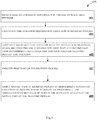
- Fig.4 illustrates a flowchart showing a method for executing processes in Virtual Storage Area Network in accordance with some embodiments of present disclosure.
- the method 400 comprises one or more blocks for executing processes in a Virtual Storage Area Network.
- the method 400 may be described in the general context of computer executable instructions.
- computer executable instructions can include routines, programs, objects, components, data structures, procedures, modules, and functions, which perform particular functions or implement particular abstract data types.
- the array controller of the plurality of array controllers 101 may receive the request for executing the process in the Virtual Storage Area Network.
- the array controller may calculate the time duration for the execution of the received process.
- the array controller may compare the calculated time duration with the predefined time duration. In case, the calculated time duration exceeds the pre-defined time duration, the received process may be divided into the first part and the second part.
- the array controller may execute the first part of the received process.
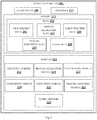
- the array controller may assign the second part of the received process to the management server 103 for execution of the process.
- the plurality of processing units 119 associated with the management server 103 are dedicated to execute the second part of the received process.
- FIG. 5 illustrates a block diagram of an exemplary computer system 500 for implementing embodiments consistent with the present disclosure.
- the computer system 500 is used to implement the Virtual Storage Area Network 102.
- the computer system 500 may comprise a central processing unit ("CPU” or "processor") 502.
- the processor 502 may comprise at least one data processor for executing processes in Virtual Storage Area Network.
- the processor 502 may include specialized processing units such as, integrated system (bus) controllers, memory management control units, floating point units, graphics processing units, digital signal processing units, etc.
- the processor 502 may be disposed in communication with one or more input/output (I/O) devices (not shown) via I/O interface 501.
- the I/O interface 501 may employ communication protocols/methods such as, without limitation, audio, analog, digital, monoaural, RCA, stereo, IEEE-1394, serial bus, universal serial bus (USB), infrared, PS/2, BNC, coaxial, component, composite, digital visual interface (DVI), high-definition multimedia interface (HDMI), RF antennas, S-Video, VGA, IEEE 802.n /b/g/n/x, Bluetooth, cellular (e.g., code-division multiple access (CDMA), high-speed packet access (HSPA+), global system for mobile communications (GSM), long-term evolution (LTE), WiMax, or the like), etc.
- CDMA code-division multiple access
- HSPA+ high-speed packet access
- GSM global system for mobile communications
- LTE long-term evolution
- WiMax wireless wide area network
- the computer system 500 may communicate with one or more I/O devices.
- the input device may be an antenna, keyboard, mouse, joystick, (infrared) remote control, camera, card reader, fax machine, dongle, biometric reader, microphone, touch screen, touchpad, trackball, stylus, scanner, storage device, transceiver, video device/source, etc.
- the output device may be a printer, fax machine, video display (e.g., cathode ray tube (CRT), liquid crystal display (LCD), light-emitting diode (LED), plasma, Plasma display panel (PDP), Organic light-emitting diode display (OLED) or the like), audio speaker, etc.
- CTR cathode ray tube
- LCD liquid crystal display
- LED light-emitting diode
- PDP Plasma display panel
- OLED Organic light-emitting diode display
- the computer system 500 consists of a process execution server 101.
- the processor 502 may be disposed in communication with the communication network 509 via a network interface 503.
- the network interface 503 may communicate with the communication network 509.
- the network interface 503 may employ connection protocols including, without limitation, direct connect, Ethernet (e.g., twisted pair 10/100/1000 Base T), transmission control protocol/internet protocol (TCP/IP), token ring, IEEE 802.11a/b/g/n/x, etc.
- the communication network 509 may include, without limitation, a direct interconnection, local area network (LAN), wide area network (WAN), wireless network (e.g., using Wireless Application Protocol), the Internet, etc.
- the computer system 500 may communicate with a user devices 514 1 , a user device 514 2 , ..., and a user device 514 N (collectively referred as plurality of user devices 514).
- the network interface 503 may employ connection protocols include, but not limited to, direct connect, Ethernet (e.g., twisted pair 10/100/1000 Base T), transmission control protocol/internet protocol (TCP/IP), token ring, IEEE 802.11a/b/g/n/x, etc.
- the communication network 509 includes, but is not limited to, a direct interconnection, an e-commerce network, a peer to peer (P2P) network, local area network (LAN), wide area network (WAN), wireless network (e.g., using Wireless Application Protocol), the Internet, Wi-Fi and such.
- the first network and the second network may either be a dedicated network or a shared network, which represents an association of the different types of networks that use a variety of protocols, for example, Hypertext Transfer Protocol (HTTP), Transmission Control Protocol/Internet Protocol (TCP/IP), Wireless Application Protocol (WAP), etc., to communicate with each other.
- the first network and the second network may include a variety of network devices, including routers, bridges, servers, computing devices, storage devices, etc.
- the processor 502 may be disposed in communication with a memory 505 (e.g., RAM, ROM, etc. not shown in figure 5 ) via a storage interface 504.
- the storage interface 504 may connect to memory 505 including, without limitation, memory drives, removable disc drives, etc., employing connection protocols such as, serial advanced technology attachment (SATA), Integrated Drive Electronics (IDE), IEEE-1394, Universal Serial Bus (USB), fiber channel, Small Computer Systems Interface (SCSI), etc.
- the memory drives may further include a drum, magnetic disc drive, magneto-optical drive, optical drive, Redundant Array of Independent Discs (RAID), solid-state memory devices, solid-state drives, etc.
- the memory 505 may store a collection of program or database components, including, without limitation, user interface 506, an operating system 507etc.
- computer system 500 may store user/application data 506, such as, the data, variables, records, etc., as described in this disclosure.
- databases may be implemented as fault-tolerant, relational, scalable, secure databases such as Oracle or Sybase.
- the operating system 507 may facilitate resource management and operation of the computer system 500.
- Examples of operating systems include, without limitation, Apple Macintosh OS X, Unix, Unix-like system distributions (e.g., Berkeley Software Distribution (BSD), FreeBSD, NetBSD, OpenBSD, etc.), Linux distributions (e.g., Red Hat, Ubuntu, Kubuntu, etc.), IBM OS/2, Microsoft Windows (XP, Vista/7/8, etc.), Apple iOS, Google Android, Blackberry OS, or the like.
- a computer-readable storage medium refers to any type of physical memory on which information or data readable by a processor may be stored.
- a computer-readable storage medium may store instructions for execution by one or more processors, including instructions for causing the processor(s) to perform steps or stages consistent with the embodiments described herein.
- the term "computer-readable medium” may include tangible items and exclude carrier waves and transient signals, i.e., be non-transitory. Examples include Random Access Memory (RAM), Read-Only Memory (ROM), volatile memory, non-volatile memory, hard drives, CD ROMs, DVDs, flash drives, disks, and any other known physical storage media. However, the term “computer-readable medium” may also include carrier waves and transient signals.
- the load on the processing units in the VSAN is shared by utilizing additional processing units for execution and thereby enhancing the processing of the VSAN.
- An embodiment of the present disclosure reduces latency in execution of processes in the VSAN.
- An embodiment of the present disclosure provides dedicated processing units of management server for executing divided parts of processes.
- An embodiment of the present disclosure may facilitate execution of the processes in VSAN quickly and efficiently.
- the described operations may be implemented as a method, system or article of manufacture using standard programming and/or engineering techniques to produce software, firmware, hardware, or any combination thereof.
- the described operations may be implemented as code maintained in a "non-transitory computer readable medium", where a processor may read and execute the code from the computer readable medium.
- the processor is at least one of a microprocessor and a processor capable of processing and executing the queries.
- a non-transitory computer readable medium may comprise media such as magnetic storage medium (e.g., hard disk drives, floppy disks, tape, etc.), optical storage (CD-ROMs, DVDs, optical disks, etc.), volatile and non-volatile memory devices (e.g., EEPROMs, ROMs, PROMs, RAMs, DRAMs, SRAMs, Flash Memory, firmware, programmable logic, etc.), etc.
- non-transitory computer-readable media comprise all computer-readable media except for a transitory.
- the code implementing the described operations may further be implemented in hardware logic (e.g., an integrated circuit chip, Programmable Gate Array (PGA), Application Specific Integrated Circuit (ASIC), etc.).
- the code implementing the described operations may be implemented in "transmission signals", where transmission signals may propagate through space or through a transmission media, such as, an optical fiber, copper wire, etc.
- the transmission signals in which the code or logic is encoded may further comprise a wireless signal, satellite transmission, radio waves, infrared signals, Bluetooth, etc.
- the transmission signals in which the code or logic is encoded is capable of being transmitted by a transmitting station and received by a receiving station, where the code or logic encoded in the transmission signal may be decoded and stored in hardware or a non-transitory computer readable medium at the receiving and transmitting stations or devices.
- An “article of manufacture” comprises non-transitory computer readable medium, hardware logic, and/or transmission signals in which code may be implemented.
- a device in which the code implementing the described embodiments of operations is encoded may comprise a computer readable medium or hardware logic.
- the code implementing the described embodiments of operations may comprise a computer readable medium or hardware logic.
- an embodiment means “one or more (but not all) embodiments of the invention(s)" unless expressly specified otherwise.
Landscapes
- Engineering & Computer Science (AREA)
- Theoretical Computer Science (AREA)
- Physics & Mathematics (AREA)
- General Engineering & Computer Science (AREA)
- General Physics & Mathematics (AREA)
- Computer Networks & Wireless Communication (AREA)
- Human Computer Interaction (AREA)
- Signal Processing (AREA)
- Software Systems (AREA)
- Computer And Data Communications (AREA)
- Debugging And Monitoring (AREA)
Abstract
Description
- The present subject matter is related in general to the field of Virtual Storage Area Networks, and more particularly, but not exclusively, to a method and system for executing processes in a Virtual Storage Area Network.
- In recent years, there has been a great expansion of computers and storage subsystems. With ever increasing computing technologies, demand for storage capacity has grown by several folds. These storage demands are fulfilled to a greater extent with the development of Storage Area Network (SAN) technology. A Storage Area Network (SAN) is a dedicated high-speed network which interconnects and presents shared pool of storage devices to multiple servers. The SAN technology is primarily used to enhance the performance of the storage devices, as they appear as a single, locally attached device to the servers. A Virtual Storage Area Network (VSAN) is a logical partition in the Storage Area Network (SAN). A Virtual Storage Area Network allows data traffic to be isolated within specific portions of an SAN so that the system is scaled out and easy to configure. The main objective of Virtual Storage Area Network is easy management of users subscribed to the VSAN, who can be added or relocated without the need for changing the physical layout of the storage. One of the main objectives of VSAN is to provide data redundancy which minimizes the risk of data loss.
- In the existing technology, a SAN consists of two storage controllers which receive requests from the users, one Disk Array Enclosure (DAE) which holds multiple Solid State Drives (SSD) for storing the data, and a few backup units. Each of the storage controllers has multi-core Control Processing Units (CPUs) for processing requests. These requests in the existing technology are not executed immediately, but queued in one of the multi-core processors for execution, if other pending processes are under execution by that multi-core CPU. This causes delay in executing the process, which leads to increase in latency for executing the process and overall performance of the SAN gets affected. For example, a user who wishes to store data in SAN may experience latency in the process as the request made may be held up in the queue.
- Additionally, if the CPU cores in the existing technique reach complete utilization, a failure to proceed with the execution cycle occurs and all the processes go into a queue. Also, if both the storage controllers in the existing SAN technology are completely utilized, then it may lead to data unavailability and the user fails to access the application.
- The information disclosed in this background of the disclosure section is only for enhancement of understanding of the general background of the invention and should not be taken as an acknowledgement or any form of suggestion that this information forms the prior art already known to a person skilled in the art.
- In an embodiment, the present disclosure relates to a method for executing processes in Virtual Storage Area Network (VSAN). The method comprises receiving request for executing a process in a Virtual Storage Area Network (VSAN), calculating a time duration for the execution of the received process, comparing the calculated time duration with a predefined time duration. The received process is divided into a first part and a second part upon determining the calculated time duration to be greater than the pre-defined time duration. The method comprises assigning the second part of the received process to a management server for execution. The management server comprises a plurality of processing units dedicated for executing the second part of the received process.
- In an embodiment, the present disclosure relates to an array controller for executing processes in VSAN. The array controller comprises a processor and a memory communicatively coupled to the processor, wherein the memory stores processor executable instructions, which, on execution, may cause the array controller to receive request for executing a process in a Virtual Storage Area Network (VSAN), calculate a time duration for the execution of the received process, compare the calculated time duration with a predefined time duration. The received process is divided into a first part and a second part upon determining the calculated time duration to be greater than the pre-defined time duration. The array controller executes the first part of the received process and assigns the second part of the received process to a management server for execution. The management server comprises a plurality of processing units dedicated for executing the second part of the received process.
- The foregoing summary is illustrative only and is not intended to be in any way limiting. In addition to the illustrative aspects, embodiments, and features described above, further aspects, embodiments, and features will become apparent by reference to the drawings and the following detailed description.
- The accompanying drawings, which are incorporated in and constitute a part of this disclosure, illustrate exemplary embodiments and, together with the description, serve to explain the disclosed principles. In the figures, the left-most digit(s) of a reference number identifies the figure in which the reference number first appears. The same numbers are used throughout the figures to reference like features and components. Some embodiments of system and/or methods in accordance with embodiments of the present subject matter are now described, by way of example only, and with reference to the accompanying figures, in which:
-
Fig.1a illustrates an exemplary environment for executing processes in VSAN in accordance with some embodiments of the present disclosure; -
Fig.1b illustrates an exemplary block diagram of plurality of array controllers in VSAN in accordance with some embodiments of the present disclosure; -
Fig.2 shows a detailed block diagram of an array controller in accordance with some embodiments of the present disclosure; -
Fig.3 shows an exemplary representation of execution of a process in a VSAN in accordance with some embodiments of the present disclosure; -
Fig.4 illustrates a flowchart showing a method for executing processes in Virtual Storage Area Network in accordance with some embodiments of present disclosure; and -
Fig.5 illustrates a block diagram of an exemplary computer system for implementing embodiments consistent with the present disclosure. - It should be appreciated by those skilled in the art that any block diagrams herein represent conceptual views of illustrative systems embodying the principles of the present subject matter. Similarly, it will be appreciated that any flow charts, flow diagrams, state transition diagrams, pseudo code, and the like represent various processes which may be substantially represented in computer readable medium and executed by a computer or processor, whether or not such computer or processor is explicitly shown.
- In the present document, the word "exemplary" is used herein to mean "serving as an example, instance, or illustration." Any embodiment or implementation of the present subject matter described herein as "exemplary" is not necessarily to be construed as preferred or advantageous over other embodiments.
- While the disclosure is susceptible to various modifications and alternative forms, specific embodiment thereof has been shown by way of example in the drawings and will be described in detail below. It should be understood, however that it is not intended to limit the disclosure to the particular forms disclosed, but on the contrary, the disclosure is to cover all modifications, equivalents, and alternative falling within the scope of the disclosure.
- The terms "comprises", "comprising", or any other variations thereof, are intended to cover a non-exclusive inclusion, such that a setup, device or method that comprises a list of components or steps does not include only those components or steps but may include other components or steps not expressly listed or inherent to such setup or device or method. In other words, one or more elements in a system or apparatus proceeded by "comprises... a" does not, without more constraints, preclude the existence of other elements or additional elements in the system or method.
- In the following detailed description of the embodiments of the disclosure, reference is made to the accompanying drawings that form a part hereof, and in which are shown by way of illustration specific embodiments in which the disclosure may be practiced. These embodiments are described in sufficient detail to enable those skilled in the art to practice the disclosure, and it is to be understood that other embodiments may be utilized and that changes may be made without departing from the scope of the present disclosure. The following description is, therefore, not to be taken in a limiting sense.
- The present disclosure relates to a method for execution of processes in a Virtual Storage Area Network (VSAN). The present disclosure provides a plurality of array controllers for executing processes in the Virtual Storage Area Network (VSAN). In some embodiments, the process execution may be carried out by utilizing an additional plurality of processing units in the VSAN. The additional plurality of the processing units may be associated with a management server in the VSAN. In an embodiment, the plurality of processing units associated with the management server may be dedicated to execute divided parts of a process. Whenever, a time duration calculated for executing the process by an array controller of the plurality of array controllers present in the VSAN exceeds a pre-defined time duration, the process may be divided into two parts. The divided two parts of the process are shared for execution between the additional plurality of processing units associated with the management server and the array controller. The division of process into the two parts and execution by additional processing units may help in reducing latency in executing the process and hence improves the overall efficiency of the VSAN.
-
Fig.1a illustrates an exemplary environment for executing processes in a VSAN in accordance with some embodiments of the present disclosure. - As shown in
Fig.1a , theenvironment 100 comprises anarray controller 1011, anarray controller 1012, ... , and array controller 101N (collectively referred as plurality of array controllers 101) connected through acommunication network 107 to a user device 1051, a user device 1052, ..., and a user device 105N(collectively referred as plurality of user devices 105). The plurality ofarray controllers 101 may be present in theVSAN 102. In some embodiment, the plurality of user devices 105 may be devices present with users for requesting operations in theVSAN 102. The plurality ofarray controllers 101 executes processes in theVSAN 102. TheVSAN 102 may comprise the plurality ofarray controllers 101 and amanagement server 103. A person skilled in the art would understand that theVSAN 102 may also comprise other devices or units for performing functions of VSAN. In some embodiments, the plurality ofarray controllers 101 may be utilized for managing disk drives and presenting them as logical units. The plurality ofarray controllers 101 may process and execute requests made by the users. In some embodiment, the plurality ofarray controllers 101 in theVSAN 102 may be present in pairs along as shown inFig.1b. Fig.1b comprises thearray controller 1011 and thearray controller 1012 as a pair along with adisk yard 1211. Similarly, other pairs of array controllers and corresponding disk yards may be present in theVSAN 102. The disk yard may consist of actual disk drives of the array controllers in pair which may store data. The processes received for execution in theVSAN 102 may be randomly assigned to the pairs of the array controller. Further, thearray controllers 1011 may comprise an I/O interface 1091, amemory 1111, and aprocessing unit 11311, aprocessing unit 11312, ..., and aprocessing unit 1131N as shown inFig.1 . Similarly, thearray controller 1012, ...,array controller 101N comprises respective I/O interface, memory and processing units. The processing units of the plurality ofarray controllers 101 are collectively referred as plurality ofprocessing units 113 of thearray controllers 101. In some embodiment, the plurality ofprocessing units 113 may perform operations associated with the requests made by the users. In some embodiment, themanagement server 103 may be core of theVSAN 102 which may manage the plurality ofarray controllers 101 and overall functioning of data storage and retrieval in theVSAN 102. In some embodiment, themanagement server 103 may be used for processing storage system management tasks. A person skilled in the art would understand that any other tasks may also be performed by the management server of the present disclosure. Themanagement server 103 may comprise an I/O interface 115, amemory 117 and aprocessing unit 1191, aprocessing unit 1192, ..., and a processing unit 119N (collectively referred to as plurality ofprocessing units 119 of the management server). The plurality ofprocessing units 119 of themanagement server 103 may be used for executing processes assigned by an array controller of the plurality ofarray controllers 101. Further, for the execution of processes in theVSAN 102, the array controller may initially receive the requests from the users through the plurality of user devices 105. In some embodiment, the plurality of user devices 105 may include, but are not limited to, a laptop, a desktop computer, a Personal Digital Assistant (PDA), a notebook, a smartphone, a tablet and any other computing devices. In some embodiment, the request for executing the process may comprise a request for storing data in theVSAN 102 and/or a request for retrieving stored data from theVSAN 102. On receiving the request from the user, the process associated with the request may be randomly allocated to one array controller of the plurality ofarray controllers 101. In some embodiments, the process may be allocated to the array controller based on at least load and/or processing capacity on each of the processing unit of the plurality ofprocessing units 113 of the plurality ofarray controllers 101. A person skilled in the art would understand that any other criterion may also be used to allocate the process in the present disclosure. Further, on receiving the process, the array controller of the plurality ofarray controllers 101 may calculate a time duration for the execution on the received process. In some embodiments, the array controller to which the process is allocated may comprise pending processes for execution. In some embodiment, the time duration calculated for the received process may correspond to the time duration calculated for the execution of the received process and a time duration required for executing the pending processes, if any, by the array controller to which the process may be allocated. The array controller may further compare the calculated time duration with a pre-defined time duration. If the calculated time duration exceeds the pre-defined time duration, the array controller of the plurality ofarray controllers 101 may divide the received process into a first part and a second part. The array controller of the plurality ofarray controllers 101 may execute the first part of the received process and may assign the second part of the received process to themanagement server 103 for execution. Otherwise, if the calculated time duration does not exceed the pre-defined time duration, the process may be executed by the array controller completely. In some embodiments, the plurality ofprocessing units 119 associated with themanagement server 103 may be dedicated to execute second part of the received process. On execution of the first part and second part of the received process, the array controller may combine a result of the execution for providing to the user. - The plurality of
array controllers 101 comprises a respective I/O Interface, memory and processing units. Each of the I/O interfaces may be configured to receive the request from the plurality of user devices 105 for executing the process in theVSAN 102. Each of the I/O interfaces may also receive result of the second part of the received process from themanagement server 103. - The received information from each of the I/O interfaces is stored in the memory. The memory is communicatively coupled to each of the processing units of the plurality of
array controllers 101. The memory also stores processor instructions which cause the processing units to execute the instructions for the execution of processes in theVSAN 102. -
Fig.2 shows a detailed block diagram of an array controller in accordance with some embodiments of the present disclosure. -
Data 200 and one ormore modules 211 of thearray controller 1011 are described herein in detail. In an embodiment, thedata 200 comprises user request data 201,process allocation data 203,execution time data 205,process execution data 207 andother data 209. - The user request data 201 may comprise details about the request made by the users to retrieve data from the
VSAN 102 and store data in theVSAN 102. The request may be for executing the process, which may be a request for storing the data in theVSAN 102 and/or a request for retrieving stored data from theVSAN 102. In some embodiments, the request may be made by a user to theVSAN 102 through thecommunication network 107. - The
execution time data 205 may comprise the time duration calculated for the execution of the received process. In some embodiment, the time duration may be calculated in real-time based on the pending processes with the array controller 1011.Theexecution time data 205 may also comprise the pre-defined time duration which may be the time duration within which execution of any requested process may be required to be completed by thearray controller 1011. - The
process execution data 207 may comprise details about the execution of the received process. When the received process is divided into a first part and a second part, theprocess execution data 207 may comprise details about the first part which may be executed by the processing unit associated with thearray controller 1011, and the second part which may be assigned to themanagement server 103 for execution. - The
other data 209 may store data, including temporary data and temporary files, generated by modules for performing the various functions of thearray controller 1011. - In an embodiment, the
data 200 in thememory 111 are processed by the one ormore modules 211 of thearray controller 1011. As used herein, the term module refers to an application specific integrated circuit (ASIC), an electronic circuit, a field-programmable gate arrays (FPGA), Programmable System-on-Chip (PSoC), a combinational logic circuit, and/or other suitable components that provide the described functionality. The said modules when configured with the functionality defined in the present disclosure will result in a novel hardware. - In one implementation, the one or
more modules 211 may include, but are not limited to, a receivingmodule 213, aprocess allocation module 215, acalculation module 217, an actualtime determination module 219, acomparison module 221 and aprocess assigning module 223. The one ormore modules 211 may also compriseother modules 225 to perform various miscellaneous functionalities of thearray controller 1011. It will be appreciated that such modules may be represented as a single module or a combination of different modules. - The receiving
module 213 may receive the request from the users through the plurality of user devices 105 for executing the process in theVSAN 102. The request for executing the process may include, but is not limited to, the request for storing data in theVSAN 102 and/or the request for retrieving the stored data from theVSAN 102. The receivingmodule 213 may also receive an execution result from themanagement server 103 for the second part of the received process. In some embodiments, the result of the execution of the received process may either be from the processing units of the array controller alone or a combined result from the processing unit of the array controller and the processing units of themanagement server 103. - The
process allocation module 215 may allocate the received process associated with the request made by the users to an array controller of the plurality ofarray controllers 101. The allocation of the received process associated with the request may be performed randomly. In some embodiments, the received process may be allocated based on at least one of the load and the processing capacity on each of the processing unit of the plurality ofprocessing units 113 associated with the plurality ofarray controllers 101. In some embodiments, the received process may be allocated to thearray controller 1011 of the plurality ofarray controllers 101 which may have either a low load or which comprises a higher processing capacity. - Upon allocating the received process to the
array controller 1011 of the plurality ofarray controllers 101, thecalculation module 217 may calculate the time duration required for executing the received process. In some embodiments, the time duration may vary for each individual process based on nature of the process. In some embodiments, thecalculation module 217 may calculate the time duration required for the execution by identifying if any processes are pending for execution in thearray controller 1011. In one case, thearray controller 1011 does not have any pending processes, the execution time duration corresponds to the time duration required for executing the received process. In another case, if thecalculation module 217 determines the presence of pending processes for execution with thearray controller 1011, the time duration may correspond to the time duration required for the execution of the received process and a time duration required for execution of the pending processes on thearray controller 1011. - The
comparison module 219 may compare the calculated time duration for completing the execution of the received process with the pre-defined time duration. If the calculated time duration exceeds the pre-defined time duration, the received process may be divided into the first part and the second part. In some embodiments, the pre-defined time duration for execution of the process by the plurality ofarray controllers 101 may be provided by the users. - The
execution module 221 may execute the first part of the received process in the case that the calculated execution time duration of the received process exceeds the pre-defined time duration. In another case, if the calculated time duration does not exceed the pre-defined time duration, theexecution module 221 may execute the entire received process. - The
process assigning module 223 may assign the second part of the received process to themanagement server 103. The second part may be assigned when the calculated time duration exceeds the pre-defined time duration. The second part of the received process may be assigned for execution by themanagement server 103. In some embodiments, themanagement server 103 may determine the processing unit from the plurality ofprocessing units 119 for executing the second part of the received process based on load and processing capacity of the plurality ofprocessing units 119. In some embodiments, the plurality ofprocessing units 119 associated with themanagement server 103 may be dedicated for executing the second part of the received process. In some embodiments, the result of the execution from thearray controller 1011 and the result of the execution from themanagement server 103 may be combined to provide to the users. -
Fig.3 shows an exemplary representation of execution of a process in VSAN in accordance with some embodiment of the present disclosure. - As shown in
Fig.3 , theenvironment 300 illustrates a scenario of execution of a process in a VSAN in an exemplary embodiment of the present disclosure. Theenvironment 300 illustrates aVSAN 102 connected through thecommunication network 107 to a user device 1051 associated with a user as shown in thefig.3 . TheVSAN 102 may comprise anarray controller 1011, anarray controller 1012, anarray controller 1013 and amanagement server 103. A person skilled in the art would understand thatfig.3 is an exemplary embodiment and the present disclosure may also include plurality of array controllers. Thearray controller 1011 may comprise aprocessing unit 1131A and a processing unit1131B. Likewise, each of the array controllers comprises two processing units as shown in thefig.3 . A person skilled in the art would understand that the array controllers may also comprise plurality of processing units. Further, in a non-limiting embodiment, themanagement server 103 may comprise aprocessing unit 1191, aprocessing unit 1192 and aprocessing unit 1193. Initially, at step (1), the user associated with the user device 1051 makes a request for executing a process PN in theVSAN 102. A person skilled in the art would understand that there may be a plurality of user devices requesting processes in theVSAN 102 simultaneously. As shown infig.3 , each of the processing units associated with the array controllers and themanagement server 103 may comprise a process queue. The process queue may comprise all the processes assigned to the respective processing units. Let's assume that process queues of both the processing units associated with thearray controller 1012 and thearray controller 1013 are occupied by pending processes and may not be able to take any other processes. In some embodiment, theprocessing unit 1131A of thearray controller 1011 may be determined to have lesser load than the processing units associated with thearray controller 1012 and the array controller1013 (not shown explicitly in thefig.3 ). At step (2), the process PN may be assigned to theprocessing unit 1131A of thearray controller 1011. The process PN may be then added to the process queue of theprocessing unit 1131A. Further, on receiving the process PN, thearray controller 1011 calculates the time duration required for executing the process PN associated with the request. As shown infig.3 , the process queue of theprocessing unit 1131A may comprise pending processes P11, P12 and P13 for execution. In such case, the execution time duration may be a combination of the time duration calculated for the process PN and a time duration required for all the pending processes P11, P12 and P13. Further, a comparison between the calculated time duration and the pre-defined time duration is performed. The pre-defined time duration is the time duration within which the received process may be required to be executed. At step (3), on determining the calculated time duration for executing the process PN to be greater than the pre-defined time duration, the process PN is divided into two parts PNA and PNB. At step (4), thearray controller 1011 may execute the divided process PNA and may assign the divided process PNB to theprocessing unit 1191 of themanagement server 103.Fig.3 shows an updated process queue of theprocessing unit 1131A adjacent to the original process queue with the divided process PNA. In some embodiments, the load and the processing capacity of each of the processing units of themanagement server 103 may be determined by themanagement server 103. Based on the determined load and the processing capacity, the processing unit of themanagement server 103 may be selected for executing divided processes. The process PNA may be executed by theprocessing unit 1131A of thearray controller 1011 and the process PNB may be executed by theprocessing unit 1191 of themanagement server 103. The result of the execution of the divided process PNA and the process PNB are collated and provided to the user as a single executed process. -
Fig.4 illustrates a flowchart showing a method for executing processes in Virtual Storage Area Network in accordance with some embodiments of present disclosure. - As illustrated in
Fig.4 , themethod 400 comprises one or more blocks for executing processes in a Virtual Storage Area Network. Themethod 400 may be described in the general context of computer executable instructions. Generally, computer executable instructions can include routines, programs, objects, components, data structures, procedures, modules, and functions, which perform particular functions or implement particular abstract data types. - The order in which the
method 400 is described is not intended to be construed as a limitation, and any number of the described method blocks can be combined in any order to implement the method. Additionally, individual blocks may be deleted from the methods without departing from the scope of the subject matter described herein. Furthermore, the method can be implemented in any suitable hardware, software, firmware, or combination thereof. - At
block 401, the array controller of the plurality ofarray controllers 101 may receive the request for executing the process in the Virtual Storage Area Network. - At
block 403, the array controller may calculate the time duration for the execution of the received process. - At
block 405, the array controller may compare the calculated time duration with the predefined time duration. In case, the calculated time duration exceeds the pre-defined time duration, the received process may be divided into the first part and the second part. - At
block 407, the array controller may execute the first part of the received process. - At
block 409, the array controller may assign the second part of the received process to themanagement server 103 for execution of the process. The plurality ofprocessing units 119 associated with themanagement server 103 are dedicated to execute the second part of the received process. -
Figure 5 illustrates a block diagram of anexemplary computer system 500 for implementing embodiments consistent with the present disclosure. In an embodiment, thecomputer system 500 is used to implement the VirtualStorage Area Network 102. Thecomputer system 500 may comprise a central processing unit ("CPU" or "processor") 502. Theprocessor 502 may comprise at least one data processor for executing processes in Virtual Storage Area Network. Theprocessor 502 may include specialized processing units such as, integrated system (bus) controllers, memory management control units, floating point units, graphics processing units, digital signal processing units, etc. - The
processor 502 may be disposed in communication with one or more input/output (I/O) devices (not shown) via I/O interface 501. The I/O interface 501 may employ communication protocols/methods such as, without limitation, audio, analog, digital, monoaural, RCA, stereo, IEEE-1394, serial bus, universal serial bus (USB), infrared, PS/2, BNC, coaxial, component, composite, digital visual interface (DVI), high-definition multimedia interface (HDMI), RF antennas, S-Video, VGA, IEEE 802.n /b/g/n/x, Bluetooth, cellular (e.g., code-division multiple access (CDMA), high-speed packet access (HSPA+), global system for mobile communications (GSM), long-term evolution (LTE), WiMax, or the like), etc. - Using the I/
O interface 501, thecomputer system 500 may communicate with one or more I/O devices. For example, the input device may be an antenna, keyboard, mouse, joystick, (infrared) remote control, camera, card reader, fax machine, dongle, biometric reader, microphone, touch screen, touchpad, trackball, stylus, scanner, storage device, transceiver, video device/source, etc. The output device may be a printer, fax machine, video display (e.g., cathode ray tube (CRT), liquid crystal display (LCD), light-emitting diode (LED), plasma, Plasma display panel (PDP), Organic light-emitting diode display (OLED) or the like), audio speaker, etc. - In some embodiments, the
computer system 500 consists of aprocess execution server 101. Theprocessor 502 may be disposed in communication with thecommunication network 509 via anetwork interface 503. Thenetwork interface 503 may communicate with thecommunication network 509. Thenetwork interface 503 may employ connection protocols including, without limitation, direct connect, Ethernet (e.g., twisted pair 10/100/1000 Base T), transmission control protocol/internet protocol (TCP/IP), token ring, IEEE 802.11a/b/g/n/x, etc. Thecommunication network 509 may include, without limitation, a direct interconnection, local area network (LAN), wide area network (WAN), wireless network (e.g., using Wireless Application Protocol), the Internet, etc. Using thenetwork interface 503 and thecommunication network 509, thecomputer system 500 may communicate with auser devices 5141, auser device 5142, ..., and a user device 514N (collectively referred as plurality of user devices 514). Thenetwork interface 503 may employ connection protocols include, but not limited to, direct connect, Ethernet (e.g., twisted pair 10/100/1000 Base T), transmission control protocol/internet protocol (TCP/IP), token ring, IEEE 802.11a/b/g/n/x, etc. - The
communication network 509 includes, but is not limited to, a direct interconnection, an e-commerce network, a peer to peer (P2P) network, local area network (LAN), wide area network (WAN), wireless network (e.g., using Wireless Application Protocol), the Internet, Wi-Fi and such. The first network and the second network may either be a dedicated network or a shared network, which represents an association of the different types of networks that use a variety of protocols, for example, Hypertext Transfer Protocol (HTTP), Transmission Control Protocol/Internet Protocol (TCP/IP), Wireless Application Protocol (WAP), etc., to communicate with each other. Further, the first network and the second network may include a variety of network devices, including routers, bridges, servers, computing devices, storage devices, etc. - In some embodiments, the
processor 502 may be disposed in communication with a memory 505 (e.g., RAM, ROM, etc. not shown infigure 5 ) via astorage interface 504. Thestorage interface 504 may connect tomemory 505 including, without limitation, memory drives, removable disc drives, etc., employing connection protocols such as, serial advanced technology attachment (SATA), Integrated Drive Electronics (IDE), IEEE-1394, Universal Serial Bus (USB), fiber channel, Small Computer Systems Interface (SCSI), etc. The memory drives may further include a drum, magnetic disc drive, magneto-optical drive, optical drive, Redundant Array of Independent Discs (RAID), solid-state memory devices, solid-state drives, etc. - The
memory 505 may store a collection of program or database components, including, without limitation, user interface 506, an operating system 507etc. In some embodiments,computer system 500 may store user/application data 506, such as, the data, variables, records, etc., as described in this disclosure. Such databases may be implemented as fault-tolerant, relational, scalable, secure databases such as Oracle or Sybase. - The
operating system 507 may facilitate resource management and operation of thecomputer system 500. Examples of operating systems include, without limitation, Apple Macintosh OS X, Unix, Unix-like system distributions (e.g., Berkeley Software Distribution (BSD), FreeBSD, NetBSD, OpenBSD, etc.), Linux distributions (e.g., Red Hat, Ubuntu, Kubuntu, etc.), IBM OS/2, Microsoft Windows (XP, Vista/7/8, etc.), Apple iOS, Google Android, Blackberry OS, or the like. - Furthermore, one or more computer-readable storage media may be utilized in implementing embodiments consistent with the present disclosure. A computer-readable storage medium refers to any type of physical memory on which information or data readable by a processor may be stored. Thus, a computer-readable storage medium may store instructions for execution by one or more processors, including instructions for causing the processor(s) to perform steps or stages consistent with the embodiments described herein. The term "computer-readable medium" may include tangible items and exclude carrier waves and transient signals, i.e., be non-transitory. Examples include Random Access Memory (RAM), Read-Only Memory (ROM), volatile memory, non-volatile memory, hard drives, CD ROMs, DVDs, flash drives, disks, and any other known physical storage media. However, the term "computer-readable medium" may also include carrier waves and transient signals.
- In an embodiment of the present disclosure, the load on the processing units in the VSAN is shared by utilizing additional processing units for execution and thereby enhancing the processing of the VSAN.
- An embodiment of the present disclosure reduces latency in execution of processes in the VSAN.
- An embodiment of the present disclosure provides dedicated processing units of management server for executing divided parts of processes.
- An embodiment of the present disclosure may facilitate execution of the processes in VSAN quickly and efficiently.
- The described operations may be implemented as a method, system or article of manufacture using standard programming and/or engineering techniques to produce software, firmware, hardware, or any combination thereof. The described operations may be implemented as code maintained in a "non-transitory computer readable medium", where a processor may read and execute the code from the computer readable medium. The processor is at least one of a microprocessor and a processor capable of processing and executing the queries. A non-transitory computer readable medium may comprise media such as magnetic storage medium (e.g., hard disk drives, floppy disks, tape, etc.), optical storage (CD-ROMs, DVDs, optical disks, etc.), volatile and non-volatile memory devices (e.g., EEPROMs, ROMs, PROMs, RAMs, DRAMs, SRAMs, Flash Memory, firmware, programmable logic, etc.), etc. Further, non-transitory computer-readable media comprise all computer-readable media except for a transitory. The code implementing the described operations may further be implemented in hardware logic (e.g., an integrated circuit chip, Programmable Gate Array (PGA), Application Specific Integrated Circuit (ASIC), etc.).
- Still further, the code implementing the described operations may be implemented in "transmission signals", where transmission signals may propagate through space or through a transmission media, such as, an optical fiber, copper wire, etc. The transmission signals in which the code or logic is encoded may further comprise a wireless signal, satellite transmission, radio waves, infrared signals, Bluetooth, etc. The transmission signals in which the code or logic is encoded is capable of being transmitted by a transmitting station and received by a receiving station, where the code or logic encoded in the transmission signal may be decoded and stored in hardware or a non-transitory computer readable medium at the receiving and transmitting stations or devices. An "article of manufacture" comprises non-transitory computer readable medium, hardware logic, and/or transmission signals in which code may be implemented. A device in which the code implementing the described embodiments of operations is encoded may comprise a computer readable medium or hardware logic. Of course, those skilled in the art will recognize that many modifications may be made to this configuration without departing from the scope of the invention, and that the article of manufacture may comprise suitable information bearing medium known in the art.
- The terms "an embodiment", "embodiment", "embodiments", "the embodiment", "the embodiments", "one or more embodiments", "some embodiments", and "one embodiment" mean "one or more (but not all) embodiments of the invention(s)" unless expressly specified otherwise.
- The terms "including", "comprising", "having" and variations thereof mean "including but not limited to", unless expressly specified otherwise.
- The enumerated listing of items does not imply that any or all of the items are mutually exclusive, unless expressly specified otherwise.
- The terms "a", "an" and "the" mean "one or more", unless expressly specified otherwise.
- A description of an embodiment with several components in communication with each other does not imply that all such components are required. On the contrary a variety of optional components are described to illustrate the wide variety of possible embodiments of the invention.
- When a single device or article is described herein, it will be readily apparent that more than one device/article (whether or not they cooperate) may be used in place of a single device/article. Similarly, where more than one device or article is described herein (whether or not they cooperate), it will be readily apparent that a single device/article may be used in place of the more than one device or article or a different number of devices/articles may be used instead of the shown number of devices or programs. The functionality and/or the features of a device may be alternatively embodied by one or more other devices which are not explicitly described as having such functionality/features. Thus, other embodiments of the invention need not include the device itself.
- The illustrated operations of
Figure 4 show certain events occurring in a certain order. In alternative embodiments, certain operations may be performed in a different order, modified or removed. Moreover, steps may be added to the above described logic and still conform to the described embodiments. Further, operations described herein may occur sequentially or certain operations may be processed in parallel. Yet further, operations may be performed by a single processing unit or by distributed processing units. - Finally, the language used in the specification has been principally selected for readability and instructional purposes, and it may not have been selected to delineate or circumscribe the inventive subject matter. It is therefore intended that the scope of the invention be limited not by this detailed description, but rather by any claims that issue on an application based here on. Accordingly, the disclosure of the embodiments of the invention is intended to be illustrative, but not limiting, of the scope of the invention, which is set forth in the following claims.
- While various aspects and embodiments have been disclosed herein, other aspects and embodiments will be apparent to those skilled in the art. The various aspects and embodiments disclosed herein are for purposes of illustration and are not intended to be limiting, with the true scope being indicated by the following claims.
Claims (11)
- A method for executing processes in a Virtual Storage Area Network, the method comprising:receiving, by an array controller, a request for executing a process in a Virtual Storage Area Network;calculating, by the array controller, a time duration for the execution of the received process;comparing, by the array controller, the calculated time duration with a predefined time duration, wherein the received process is divided into a first part and a second part upon determining the calculated time duration to be greater than the pre-defined time duration;executing, by the array controller, the first part of the received process; andassigning, by the array controller, the second part of the received process to a management server for execution, wherein the management server comprises a plurality of processing units dedicated for executing the second part of the received process.
- The method as claimed in claim 1, wherein the request for executing the process comprises at least one of a request for storing data in the Virtual Storage Area Network and a request for retrieving data from the Virtual Storage Area Network.
- The method as claimed in claim 1 or claim 2, further comprising combining result of the execution of the first part and the second part of the received process.
- The method as claimed in any of the preceding claims, wherein calculating the time duration comprises identifying processes pending for execution with the array controller.
- The method as claimed in any of the preceding claims, wherein the time duration for the received process corresponds to the time duration calculated for the execution of the received process and a time duration for execution of pending processes with the array controller.
- An array controller for executing processes in a Virtual Storage Area Network, comprising:a processor; anda memory communicatively coupled to the processor, wherein the memory stores processor instructions, which, on execution, causes the processor to:receive a request for executing a process in a Virtual Storage Area Network;calculate a time duration for the execution of the received process;compare the calculated time duration with a predefined time duration, wherein the received process is divided into a first part and a second part upon determining the calculated time duration to be greater than the pre-defined time duration;execute the first part of the received process; andassign the second part of the received process to a management server for execution, wherein the management server comprises a plurality of processing units dedicated for executing the second part of the received process.
- The array controller as claimed in claim 6, wherein the request for executing the process comprises at least one of a request for storing data in the Virtual Storage Area Network and a request for retrieving data from the Virtual Storage Area Network.
- The array controller as claimed in claim 6 or claim 7, wherein the processor combines result of the execution of the first part and the second part of the received process.
- The array controller as claimed in any of claims 6 to 8, wherein the processor calculates the time duration by identifying processes pending for execution with the array controller.
- The array controller as claimed in any of claims 6 to 9, wherein the time duration for the received process corresponds to the time duration calculated for the execution of the received process and a time duration for execution of pending processes with the array controller.
- A processor-readable comprising instructions which, on execution, cause a processor to perform a method as claimed in any of claims 1 to 5.
Applications Claiming Priority (1)
| Application Number | Priority Date | Filing Date | Title |
|---|---|---|---|
| IN201641040000 | 2016-11-23 |
Publications (1)
| Publication Number | Publication Date |
|---|---|
| EP3328031A1 true EP3328031A1 (en) | 2018-05-30 |
Family
ID=58448275
Family Applications (1)
| Application Number | Title | Priority Date | Filing Date |
|---|---|---|---|
| EP17159810.5A Withdrawn EP3328031A1 (en) | 2016-11-23 | 2017-03-08 | Method and system for executing processes in a virtual storage area network |
Country Status (2)
| Country | Link |
|---|---|
| US (1) | US10534645B2 (en) |
| EP (1) | EP3328031A1 (en) |
Families Citing this family (1)
| Publication number | Priority date | Publication date | Assignee | Title |
|---|---|---|---|---|
| WO2017170134A1 (en) * | 2016-03-31 | 2017-10-05 | 東京応化工業株式会社 | Resist composition and method for forming resist pattern |
Citations (2)
| Publication number | Priority date | Publication date | Assignee | Title |
|---|---|---|---|---|
| US20130031124A1 (en) * | 2011-07-26 | 2013-01-31 | International Business Machines Corporation | Management system for processing streaming data |
| US20140310259A1 (en) * | 2013-04-15 | 2014-10-16 | Vmware, Inc. | Dynamic Load Balancing During Distributed Query Processing Using Query Operator Motion |
Family Cites Families (21)
| Publication number | Priority date | Publication date | Assignee | Title |
|---|---|---|---|---|
| US7093147B2 (en) * | 2003-04-25 | 2006-08-15 | Hewlett-Packard Development Company, L.P. | Dynamically selecting processor cores for overall power efficiency |
| US8056083B2 (en) * | 2006-10-10 | 2011-11-08 | Diskeeper Corporation | Dividing a computer job into micro-jobs for execution |
| US8769048B2 (en) * | 2008-06-18 | 2014-07-01 | Commvault Systems, Inc. | Data protection scheduling, such as providing a flexible backup window in a data protection system |
| US8484351B1 (en) * | 2008-10-08 | 2013-07-09 | Google Inc. | Associating application-specific methods with tables used for data storage |
| US9158579B1 (en) * | 2008-11-10 | 2015-10-13 | Netapp, Inc. | System having operation queues corresponding to operation execution time |
| US8621476B2 (en) * | 2008-12-15 | 2013-12-31 | Korea Advanced Institute Of Science And Technology | Method and apparatus for resource management in grid computing systems |
| EP2341450A1 (en) * | 2009-08-21 | 2011-07-06 | Mikko Kalervo Väänänen | Method and means for data searching and language translation |
| US8768878B2 (en) * | 2011-01-21 | 2014-07-01 | International Business Machines Corporation | Characterizing business intelligence workloads |
| US8996461B1 (en) * | 2011-03-28 | 2015-03-31 | Emc Corporation | Method and apparatus for replicating the punch command |
| US9626446B2 (en) * | 2012-03-07 | 2017-04-18 | Snap Trends, Inc. | Methods and systems of advertising based on aggregated information of social networks within geographical locations via a network |
| US9430285B2 (en) * | 2012-10-31 | 2016-08-30 | Nec Corporation | Dividing and parallel processing record sets using a plurality of sub-tasks executing across different computers |
| US9367357B2 (en) * | 2013-01-18 | 2016-06-14 | Nec Corporation | Simultaneous scheduling of processes and offloading computation on many-core coprocessors |
| US9330076B2 (en) * | 2013-01-28 | 2016-05-03 | Virtual StrongBox | Virtual storage system and file conversion method |
| US9659057B2 (en) * | 2013-04-15 | 2017-05-23 | Vmware, Inc. | Fault tolerant distributed query processing using query operator motion |
| US9128855B1 (en) * | 2013-06-26 | 2015-09-08 | Emc Corporation | Flash cache partitioning |
| JP5620617B1 (en) * | 2014-05-28 | 2014-11-05 | 楽天株式会社 | Information processing system, terminal, server, information processing method, recording medium, and program |
| US20150379083A1 (en) * | 2014-06-25 | 2015-12-31 | Microsoft Corporation | Custom query execution engine |
| US10019480B2 (en) * | 2014-11-14 | 2018-07-10 | International Business Machines Corporation | Query tuning in the cloud |
| US9916353B2 (en) * | 2015-04-01 | 2018-03-13 | International Business Machines Corporation | Generating multiple query access plans for multiple computing environments |
| US10303695B2 (en) * | 2015-10-21 | 2019-05-28 | Oracle International Corporation | Query decomposition for scalability of continuous query processing |
| US10362060B2 (en) * | 2015-12-30 | 2019-07-23 | International Business Machines Corporation | Curtailing search engines from obtaining and controlling information |
-
2017
- 2017-01-18 US US15/408,816 patent/US10534645B2/en active Active
- 2017-03-08 EP EP17159810.5A patent/EP3328031A1/en not_active Withdrawn
Patent Citations (2)
| Publication number | Priority date | Publication date | Assignee | Title |
|---|---|---|---|---|
| US20130031124A1 (en) * | 2011-07-26 | 2013-01-31 | International Business Machines Corporation | Management system for processing streaming data |
| US20140310259A1 (en) * | 2013-04-15 | 2014-10-16 | Vmware, Inc. | Dynamic Load Balancing During Distributed Query Processing Using Query Operator Motion |
Non-Patent Citations (1)
| Title |
|---|
| JEFF RASLEY ET AL: "Efficient queue management for cluster scheduling", PROCEEDINGS OF THE ELEVENTH EUROPEAN CONFERENCE ON COMPUTER SYSTEMS, EUROSYS '16, 1 January 2016 (2016-01-01), New York, New York, USA, pages 1 - 15, XP055394436, ISBN: 978-1-4503-4240-7, DOI: 10.1145/2901318.2901354 * |
Also Published As
| Publication number | Publication date |
|---|---|
| US20180143859A1 (en) | 2018-05-24 |
| US10534645B2 (en) | 2020-01-14 |
Similar Documents
| Publication | Publication Date | Title |
|---|---|---|
| US10678630B2 (en) | Method and system for resolving error in open stack operating system | |
| US10764366B2 (en) | System and method for storing data in data storage unit of virtual storage area network | |
| US10102267B2 (en) | Method and apparatus for access control | |
| US10574755B2 (en) | Method and high performance computing (HPC) switch for optimizing distribution of data packets | |
| US12248694B2 (en) | Device and method for data replication in disaggregated distributed storage system | |
| US20190297144A1 (en) | Method and system for improved distributed data storage amongst multiple computing nodes | |
| US10534645B2 (en) | Method and system for executing processes in a virtual storage area network | |
| US10642859B2 (en) | Database report offload server | |
| US10963413B2 (en) | Method and system for transmitting data using small computer system interface (SCSI) | |
| US11023144B2 (en) | Method and system for dynamically allocating front end ports in a storage device | |
| EP4462261A1 (en) | Method and system for performing read and write operations in cells of a nand memory | |
| CN111475279B (en) | System and method for intelligent data load balancing for backup | |
| US12210772B2 (en) | Method and a host device for accessing data from a data storage device | |
| US10303572B2 (en) | Methods and systems for improving fault tolerance in storage area network | |
| US12260099B2 (en) | Method, distributed controller, and system for managing sequential storage devices in distributed storage environment | |
| US11216488B2 (en) | Method and system for managing applications in an electronic device | |
| US10579758B2 (en) | Method and system for implementation of user logic in a field programmable gate array device | |
| US10242137B2 (en) | Methods and systems for managing memory blocks of semiconductor devices in embedded systems | |
| US10275296B2 (en) | Method and system for resolving one or more errors in an enterprise storage system | |
| US10331489B2 (en) | Apparatus and method for executing maintenance processing on computers coupled via a multidimensional mesh or torus connection in a network | |
| US20250328392A1 (en) | Method and system for reclaiming storage space in disaggregated storage system | |
| US20240330176A1 (en) | Method and data storage device for managing host requests in data storage device | |
| CN121635793A (en) | Method and system for increasing the number of written bytes (TBW) of a NAND-based memory device | |
| Chandrahas | METHOD AND SYSTEM FOR MANAGING DATA FLOW BETWEEN SOURCE SYSTEM AND TARGET SYSTEM | |
| US20200214058A1 (en) | Method and device for providing wireless data communication in datacenters |
Legal Events
| Date | Code | Title | Description |
|---|---|---|---|
| PUAI | Public reference made under article 153(3) epc to a published international application that has entered the european phase |
Free format text: ORIGINAL CODE: 0009012 |
|
| STAA | Information on the status of an ep patent application or granted ep patent |
Free format text: STATUS: THE APPLICATION HAS BEEN PUBLISHED |
|
| AK | Designated contracting states |
Kind code of ref document: A1 Designated state(s): AL AT BE BG CH CY CZ DE DK EE ES FI FR GB GR HR HU IE IS IT LI LT LU LV MC MK MT NL NO PL PT RO RS SE SI SK SM TR |
|
| AX | Request for extension of the european patent |
Extension state: BA ME |
|
| STAA | Information on the status of an ep patent application or granted ep patent |
Free format text: STATUS: REQUEST FOR EXAMINATION WAS MADE |
|
| 17P | Request for examination filed |
Effective date: 20181130 |
|
| RBV | Designated contracting states (corrected) |
Designated state(s): AL AT BE BG CH CY CZ DE DK EE ES FI FR GB GR HR HU IE IS IT LI LT LU LV MC MK MT NL NO PL PT RO RS SE SI SK SM TR |
|
| STAA | Information on the status of an ep patent application or granted ep patent |
Free format text: STATUS: EXAMINATION IS IN PROGRESS |
|
| 17Q | First examination report despatched |
Effective date: 20190423 |
|
| STAA | Information on the status of an ep patent application or granted ep patent |
Free format text: STATUS: THE APPLICATION HAS BEEN WITHDRAWN |
|
| 18W | Application withdrawn |
Effective date: 20190625 |