EP3327604A1 - Method for calculating binding free energy, calculation device, and program - Google Patents
Method for calculating binding free energy, calculation device, and program Download PDFInfo
- Publication number
- EP3327604A1 EP3327604A1 EP15898960.8A EP15898960A EP3327604A1 EP 3327604 A1 EP3327604 A1 EP 3327604A1 EP 15898960 A EP15898960 A EP 15898960A EP 3327604 A1 EP3327604 A1 EP 3327604A1
- Authority
- EP
- European Patent Office
- Prior art keywords
- target molecule
- binding
- free energy
- calculation
- anchor points
- Prior art date
- Legal status (The legal status is an assumption and is not a legal conclusion. Google has not performed a legal analysis and makes no representation as to the accuracy of the status listed.)
- Granted
Links
Images




Classifications
-
- G—PHYSICS
- G16—INFORMATION AND COMMUNICATION TECHNOLOGY [ICT] SPECIALLY ADAPTED FOR SPECIFIC APPLICATION FIELDS
- G16B—BIOINFORMATICS, i.e. INFORMATION AND COMMUNICATION TECHNOLOGY [ICT] SPECIALLY ADAPTED FOR GENETIC OR PROTEIN-RELATED DATA PROCESSING IN COMPUTATIONAL MOLECULAR BIOLOGY
- G16B15/00—ICT specially adapted for analysing two-dimensional [2D] or three-dimensional [3D] molecular structures, e.g. structural or functional relations or structure alignment
-
- G—PHYSICS
- G16—INFORMATION AND COMMUNICATION TECHNOLOGY [ICT] SPECIALLY ADAPTED FOR SPECIFIC APPLICATION FIELDS
- G16B—BIOINFORMATICS, i.e. INFORMATION AND COMMUNICATION TECHNOLOGY [ICT] SPECIALLY ADAPTED FOR GENETIC OR PROTEIN-RELATED DATA PROCESSING IN COMPUTATIONAL MOLECULAR BIOLOGY
- G16B15/00—ICT specially adapted for analysing two-dimensional [2D] or three-dimensional [3D] molecular structures, e.g. structural or functional relations or structure alignment
- G16B15/30—Drug targeting using structural data; Docking or binding prediction
-
- G—PHYSICS
- G16—INFORMATION AND COMMUNICATION TECHNOLOGY [ICT] SPECIALLY ADAPTED FOR SPECIFIC APPLICATION FIELDS
- G16B—BIOINFORMATICS, i.e. INFORMATION AND COMMUNICATION TECHNOLOGY [ICT] SPECIALLY ADAPTED FOR GENETIC OR PROTEIN-RELATED DATA PROCESSING IN COMPUTATIONAL MOLECULAR BIOLOGY
- G16B15/00—ICT specially adapted for analysing two-dimensional [2D] or three-dimensional [3D] molecular structures, e.g. structural or functional relations or structure alignment
- G16B15/20—Protein or domain folding
-
- G—PHYSICS
- G16—INFORMATION AND COMMUNICATION TECHNOLOGY [ICT] SPECIALLY ADAPTED FOR SPECIFIC APPLICATION FIELDS
- G16B—BIOINFORMATICS, i.e. INFORMATION AND COMMUNICATION TECHNOLOGY [ICT] SPECIALLY ADAPTED FOR GENETIC OR PROTEIN-RELATED DATA PROCESSING IN COMPUTATIONAL MOLECULAR BIOLOGY
- G16B5/00—ICT specially adapted for modelling or simulations in systems biology, e.g. gene-regulatory networks, protein interaction networks or metabolic networks
-
- G—PHYSICS
- G16—INFORMATION AND COMMUNICATION TECHNOLOGY [ICT] SPECIALLY ADAPTED FOR SPECIFIC APPLICATION FIELDS
- G16B—BIOINFORMATICS, i.e. INFORMATION AND COMMUNICATION TECHNOLOGY [ICT] SPECIALLY ADAPTED FOR GENETIC OR PROTEIN-RELATED DATA PROCESSING IN COMPUTATIONAL MOLECULAR BIOLOGY
- G16B5/00—ICT specially adapted for modelling or simulations in systems biology, e.g. gene-regulatory networks, protein interaction networks or metabolic networks
- G16B5/30—Dynamic-time models
Definitions
- the embodiments discussed herein relate to a method and device for calculating binding free energy between a target molecule and a binding calculation target molecule, and a program for executing the method.
- the search of a drug candidate molecule is to search a compound (ligand) that strongly interacts with a target molecule associated with a target disease (a targeted disease) as a drug candidate. Screening of a compound based on a target molecular steric structure by means of a computer has been actively performed.
- SBDD structure-based drug design
- a drug candidate molecule to be bound to a target molecule When a drug candidate molecule to be bound to a target molecule is designed using a computer, it is important to quantitatively predict binding activity (binding free energy) of a drug candidate molecule or a fragment of a drug candidate molecule (in the present specification, the drug candidate molecule and the fragment are collectively referred to as a binding calculation target molecule) against a target molecule, in order to efficiently perform feedback to molecular design.
- a binding calculation target molecule In the quantitative prediction of the binding activity, calculation needs to be performed with maintaining a relationship to a standard state in order to directly compare with an experimental value.
- NPL 1 The Process of Structure-Based Drug Design", A.C. Anderson, Chemistry & Biology, 10, 787 (2003 )
- the disclosed embodiments aim to solve the above-described various problems existing in the art, and to achieve the following object.
- the present disclosure has an object to provide a method and device for calculating binding free energy where the method and device can improve calculation accuracy of binding free energy between a target molecule and a binding calculation target molecule, and a program for executing the method.
- the disclosed calculation method of binding free energy includes a plurality of steps each including adding a distance restraint potential between a binding calculation target molecule and a target molecule, wherein the method is a method for calculating binding free energy between the binding calculation target molecule and the target molecule using a computer, and wherein anchor points of the binding calculation target molecule in the plurality of the steps are identical anchor points, and anchor points of the target molecule in the plurality of the steps are different anchor points.
- the disclosed program is a program for causing a computer to execute calculation of binding free energy between a binding calculation target molecule and a target molecule.
- the program includes executing a plurality of steps each including adding a distance restraint potential between the binding calculation target molecule and the target molecule, wherein anchor points of the binding calculation target molecule in the plurality of the steps are identical anchor points, and anchor points of the target molecule in the plurality of the steps are different anchor points.
- the disclosed device for calculating binding free energy is a device for calculating binding free energy between a binding calculation target molecule and a target molecule.
- the device includes an adding unit configured to perform a plurality of steps each including adding a distance restraint potential between the binding calculation target molecule and the target molecule, wherein anchor points of the binding calculation target molecule in the plurality of the steps are identical anchor points, and anchor points of the target molecule in the plurality of the steps are different anchor points.
- the disclosed method for calculating binding free energy can improve calculation accuracy of binding free energy between a binding calculation target molecule and a target molecule.
- the disclosed device for calculating binding free energy can improve calculation accuracy of binding free energy between a binding calculation target molecule and a target molecule.
- the disclosed method for calculating binding free energy is a method for calculating binding free energy between a binding calculation target molecule and a target molecule using a computer.
- the inventors of the disclosed technology have studied about a cause for reduction in calculation accuracy when binding free energy between a binding calculation target molecule and a target molecule is calculated by utilizing addition of a distance restraint potential.
- binding free energy between a target molecule and a binding calculation target molecule was calculated according to the alchemical route calculation method utilizing addition of a distance restraint potential.
- RNA was used as the target molecule.
- a theophylline molecule was used as the binding calculation target molecule.
- 1015 stored in the protein data bank (PDB) was used as a complex structure of the RNA and the theophylline molecule.
- AMBER99/parmbsc0 As a force field of the RNA, AMBER99/parmbsc0 was used. Moreover, a structure of the theophylline molecule was optimized in vacuum using 6-31G* basis, and RESP was used for point charge and general amber force field (GAFF) was used for a force field.
- GFF general amber force field
- a center of gravity of the theophylline molecule was treated as an anchor point of the theophylline molecule.
- An anchor point of the RNA was determined as the coordinates of the atom of U23 C1'.
- the horizontal axis represents simulation time (ns), and each plot represents a binding free energy value from 0.5 ns to the plotted time.
- the plot of 1 ns represents a binding free energy value for the time from 0.5 ns to 1 ns
- the plot of 10 ns represents a binding free energy value for the time from 0.5 ns to 10 ns. It can be conformed from FIG. 1 that the binding free energy value is not stabilized even when the calculation time is elapsed.
- the binding free energy of the above-mentioned system is -8.9 kcal/mol according to the experimental result.
- the binding free energy of the result of FIG. 1 is -7.56 ⁇ 0.47 kcal/mol (the plot of 10 ns).
- the present inventors have speculated that calculation accuracy of binding free energy lowers when a plurality of stable structures (binding pauses) are present in a binding structure between a target molecule and a binding calculation target molecule, in the case where addition of a distance restraint potential is utilized in calculation of the binding free energy.
- P 1 is an anchor point of the target molecule T.
- the present inventors performed researches to support the speculation above.
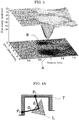
- FIG. 3 depicts a binding free energy landscape.
- FIG. 4A is a schematic diagram of a binding structure between a target molecule T and a binding calculation target molecule L.
- the binding calculation target molecule L is present within a binding site of the target molecule T.
- a distance restraint potential between the target molecule T and the binding calculation target molecule L is determined as P1.
- P 2 is different from P 1
- P2 a distance restraint potential between the target molecule T and the binding calculation target molecule L
- P1 and P2 are respectively determined as di and d 2 .
- schematic diagrams of the binding free energy surface are produced ( FIG. 4B and FIG. 4C ). Note that, the distances d 1 and d 2 are generally not fixed values, and are each within a certain numerical range.
- the sampling space S1 in case of the distance restraint potential P1 includes a stable structure B in a metastable state, in addition to a stable structure A.
- calculation accuracy lowers due to an influence of the stable structure B ( FIG. 1 ).
- the sampling space S2 in case of the distance restraint potential P2 includes a stable structure A, but not a stable structure B in a metastable state. In calculation of binding free energy using the distance restraint potential P2, therefore, excellent calculation accuracy is achieved without being influenced by the stable structure B.
- the calculation results of binding free energy in case of the distance restraint potential P2 are depicted in FIG. 5 .
- the calculation was performed in the same manner as the above-described calculation of binding free energy between the theophylline and the RNA, except that the anchor point of the RNA was changed to the coordinates of the atom of A7C4'.
- the horizontal axis represents simulation time (ns), and each plot represents a binding free energy value from 0.5 ns to the plotted time.
- the plot of 1 ns represents a binding free energy value for the time from 0.5 ns to 1 ns
- the plot of 10 ns represents a binding free energy value for the time from 0.5 ns to 10 ns. It can be conformed from FIG. 5 that the binding free energy value is stabilized regardless of the calculation time.
- the binding free energy of the above-mentioned system is -8.9 kcal/mol according to the experimental result.
- the binding free energy of the result of FIG. 5 is -8.94 ⁇ 0.04 kcal/mol (the plot of 10 ns).
- the calculation of binding free energy using the distance restraint potential P2 can calculate more stable binding free energy (excellent calculation accuracy), compared to the calculation of binding free energy using the distance restraint potential P1.
- the method includes a plurality of steps each including adding a distance restraint potential between a binding calculation target molecule and a target molecule, and anchor points of the binding calculation target molecule in the plurality of the steps are identical anchor points, and anchor points of the target molecule in the plurality of the steps are different anchor points.
- the calculation of the binding free energy is not particularly limited as long as the calculation is a method using a distance restraint potential, and may be appropriately selected depending on the intended purpose.
- the calculation is more preferably performed according to the alchemical route calculation method.
- the alchemical route calculation method is also called as alchemical free energy calculation or alchemical transformation, and is a method for calculating binding free energy using a thermodynamic cycle along a virtual (alchemical) path.
- the alchemical route calculation method is introduced in Adv Protein Chem Struct Biol. 2011; 85: 27-80 .
- Examples of the alchemical route calculation method include a calculation method determined by FIG. 6 and the following equation.
- ⁇ G bind o ⁇ ⁇ G Solv C + ⁇ G Solv LJ + ⁇ G Solv R + ⁇ G Cplx R + ⁇ G Cplx C + ⁇ G Cplx LJ
- the crescent-shaped object is a target molecule (T) and the circular object is a binding calculation target molecule (L).
- C represents electrostatic interaction
- LJ represents Van der Waals interaction
- Solv represents a solvent
- Cplx represents a complex of the target molecule (T) and the binding calculation target molecule (L)
- R represent a spring restraint potential.
- the first, second, fourth, fifth, and sixth items can be evaluated, for example, by the Bennett Acceptance Ratio (BAR) method.
- BAR Bennett Acceptance Ratio
- binding free energy of a binding calculating target molecule and a target molecule is typically binding free energy between the binding calculation target molecule and the target molecule that are in a solvent.
- the solvent is typically water.
- Calculation of binding free energy is performed using a computer.
- the number of the computers used for calculation of the binding free energy may be one, or two or more.
- calculation of the binding free energy may be performed dividedly by a plurality of computers.
- the method for calculating binding free energy includes a plurality of steps each including adding a distance restraint potential between the binding calculation target molecule and the target molecule.
- Anchor points of the binding calculation target molecule in the plurality of the steps are identical anchor points.
- Anchor points of the target molecule in the plurality of the steps are different anchor points. Specifically, in each of a plurality of steps each adding a distance restraint potential, a different anchor point is used as the anchor point of the target molecule.
- the binding calculation target molecule means a drug candidate molecule, or a fragment for designing a drug candidate molecule.
- the fragment is used for fragment-based drug design (FBDD).
- FBDD fragment-based drug design
- the target molecule is not particularly limited and may be appropriately selected depending on the intended purpose.
- Examples of the target molecule include protein, ribonucleic acid (RNA), and deoxyribonucleic acid (DNA).
- the distance restraint potential is not particularly limited as long as the distance restraint potential is a potential for restraining a distance between the binding calculation target molecule and the target molecule, and may be appropriately selected depending on the intended purpose. Examples of the distance restraint potential include restraint potentials by springs.
- the binding force is not particularly limited and may be appropriately selected depending on the intended purpose.
- the distance restraint potential is added between the binding calculation target molecule and the target molecule using an anchor point of the binding calculation target molecule and anchor points of the target molecule.
- a plurality of distance restraint potentials added between one anchor point of the binding calculation target molecule and a plurality of anchor points of the target molecule may be each independently set according to a distance between the two anchor points. For example, a distance restraint potential is determined in a manner that a size of fluctuations of the binding calculation target molecule is within a certain range.
- the distance restriction between the binding calculation target molecule and the target molecule is performed in order to accurately consider a degree of freedom of translational motions of a molecule contributing the most to binding activity.
- a center of gravity of the binding calculation target molecule is set as an anchor point of the binding calculation target molecule.
- m represents a mass
- x represents coordinates of an atom constituting the binding calculation target molecule.
- a center of gravity of the binding calculation target molecule is preferably determined by excluding hydrogen atoms constituting the binding calculation target molecule because the calculation time can be shortened.
- An anchor point of the target molecule is preferably determined using an atom having small fluctuations among atoms in the target molecule.
- the atom is preferably an atom present within a range of 5 ⁇ to 15 ⁇ from an anchor point of the binding calculation target molecule, because the frequency distribution of the distance between the anchor points becomes close to a normal distribution, and further excellent calculation accuracy can be obtained.
- the atom is an atom having small fluctuations.
- the atom having small fluctuations is selected by determining the root mean square fluctuation (RMSF) of atoms in the target molecule, and selecting the atom having small RMSF comparing each of the determined RMSF of the atoms.
- RMSF root mean square fluctuation
- the root mean square fluctuation was determined on all of the atoms in the target molecule, excluding hydrogen atoms, and the atom having RMSF smaller than the arithmetic mean value of RMSF of all the atoms on which RMSF have been determined is selected as an atom having small fluctuations.
- the RMSF of the atom having small fluctuations is preferably 1.0 ⁇ or less.
- Examples of the atom having small fluctuations include atoms in a main chain of the target molecule.
- the main chain means the longest chain in the target molecule.
- the atoms in the main chain have small fluctuations compared to atoms in side chains.
- An anchor point of the target molecule may be a center of gravity of a plurality of atoms having small fluctuations in the target molecule.
- the plurality of atoms are preferably atoms within a range of 5 ⁇ to 15 ⁇ from an anchor point of the binding calculation target molecule.
- atoms of a main chain of the target molecule are not present within a range of 5 ⁇ to 15 ⁇ from an anchor point of the binding calculation target molecule, for example, a plurality of atoms in a side chain that may have larger fluctuations than atoms in the main chain but have relatively small fluctuations among atoms in the target molecule may be used, and a center of gravity of such atoms of the side chain may be determined as an anchor point of the target molecule.
- Examples of the number of atoms in the plurality of atoms include 2.
- Examples of a calculation method of a center of gravity of the plurality of atoms include similar methods for a calculation method of a center of gravity of the binding calculation target molecule.
- the anchor point can be determined by means of a general computer system (e.g., various network servers, work stations, and personal computers) equipped with a central processing unit (CPU), random access memory (RAM), a hard disk, various peripherals, etc.
- a general computer system e.g., various network servers, work stations, and personal computers
- CPU central processing unit
- RAM random access memory
- hard disk e.g., hard disk, various peripherals, etc.
- a plurality of values of binding free energy between the binding calculation target molecule and the target molecule is preferably calculated using each of a plurality of distance restraint potentials added in the plurality of the steps.
- the smallest value of binding free energy among the calculated values of binding free energy is extracted and treated as a calculated result.
- an operation of extraction can be performed by a computer.
- anchor points of the target molecule are set.
- a method for setting anchor points is not particularly limited and may be appropriately selected depending on the intended purpose.
- anchor points can be set in the following manner.
- an anchor point LP of a binding calculation target molecule L is set. Subsequently, one anchor point TP 1 is set at an edge of a binding site of a target molecule T. Subsequently, another anchor point TP n is set the other edge of the binding site T. Then, an angle ⁇ formed between the line segment between the anchor point LP and the anchor point TP 1 and the line segment between the anchor point LP and the anchor point TP n with the anchor point LP as an apex is equally divided into (n-1). Then, an anchor point of the target molecule is added per an angle ⁇ /(n-1) which is given by equally dividing into (n-1).
- binding free energy between the target molecule T and the binding calculation target molecule L is calculated using each of a plurality of distance restraint potentials added between each of the 5 anchor points of the target molecule T and the anchor point LP.
- an anchor point of a binding calculation target molecule L is determined.
- the anchor point is set as a center of gravity of the binding calculation target molecule L.
- anchor points of a target molecule T are determined.
- the number of the anchor points is plural (n).
- the number of the anchor points may be appropriately selected depending on a target molecule that is a subject of calculation, a binding calculation target molecule that is a subject of calculation, calculation time, and a purpose of calculation.
- a method for determining the plurality of anchor points is not particularly limited and may be appropriately selected depending on the intended purpose. Examples of the method include the method described using FIG. 7 .
- calculation of binding free energy is performed using each of distance restraint potentials added between each of n pieces of anchor points of the target molecule T and the anchor point of the binding calculation target molecule L. Accordingly, calculation of binding free energy is performed n times. At the time of calculation, for example, the numbers are given to the n pieces of the anchor points as 1, 2, ... (n-1), and n, and calculation of binding free energy is performed in the order of the number.
- the method for calculating binding free energy can be performed using the molecular orbital method or the molecular dynamics method.
- Examples of molecular orbital calculation according to the molecular orbital method include nonempirical molecular orbital calculation (ab initio molecular orbital calculation), and semiempirical molecular orbital calculation.
- Examples of a methodology of the nonempirical molecular orbital calculation include the Hartree-Fock method, and the electron correlation method.
- Examples of a methodology of the semiempirical molecular orbital calculation include CNDO, INDO, AM1, and PM3.
- Examples of a program of the nonempirical molecular orbital calculation include Gaussian03, GAMESS, ABINIT-MP, and Protein DF.
- Examples of a program of the semiempirical molecular orbital calculation include MOPAC.
- Examples of a program used for the molecular dynamics method include gromacs (gromacs: Groningen Machine for Chemical Simulations), associated model building with energy refinement (amber), charm, tinker, and lammps.
- the method for calculating binding free energy can be performed by using a device for calculating binding free energy described later.
- the disclosed program is a program for allowing calculation of binding free energy between a binding calculation target molecule and a target molecule to be performed.
- anchor points in the binding calculation target molecules in the plurality of the steps are identical anchor points, and anchor points of the target molecules in the plurality of the steps are different anchor points.
- the program is configured to execute the method for calculating binding free energy.
- the program can be created using any of various programing languages known in the art according to a configuration of a computer system for use, a type or version of an operation system for use.
- the program may be recorded on a storage medium, such as an integral hard disk, and an external hard disk, or recorded on a storage medium, such as a compact disc read only memory (CD-ROM), a digital versatile disk read only memory (DVD-ROM), a magneto-optical (MO) disk, and a universal serial bus (USB) memory stick (USB flash drive).
- a storage medium such as a CD-ROM, a DVD-ROM, an MO disk, and an USB memory stick
- the program can be used, as required, directly or by installing a hard disk via a storage medium reader equipped in a computer system.
- the program may be recorded in an external memory region (e.g. another computer) accessible from the computer system via an information and communication network, and the program may be used, as required, by directly from the external memory region or installing into a hard disk from the external memory region via the information and communication network.
- the disclosed computer-readable recording medium includes the disclosed program stored thereon.
- the computer-readable recording medium is not particularly limited and may be appropriately selected depending on the intended purpose.
- Examples of the computer-readable recording medium include integral hard disks, external hard disks, CD-ROMs, DVD-ROMs, MO disks, and USB memory sticks.
- the disclosed device for calculating binding free energy is a device for calculating binding free energy between a binding calculation target molecule and a target molecule.
- the device for calculating binding free energy includes at least an adding unit configured to perform a plurality of steps each including adding a distance restraint potential between the binding calculation target molecule and the target molecule.
- the device may further include other units, according to the necessity.
- anchor points in the binding calculation target molecules in the plurality of the steps are identical anchor points, and anchor points of the target molecules in the plurality of the steps are different anchor points.
- the device for calculating binding free energy is configured to execute the method for calculating binding free energy.
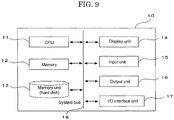
- FIG. 9 A structural example of a hardware of the disclosed device for calculating binding free energy is illustrated in FIG. 9 .
- the device for calculating binding free energy 10 is composed by connecting CPU 11, a memory 12, a memory unit 13, a display unit 14, an input unit 15, an output unit 16, and an I/O interface unit 17 via a system bus 18.
- the central processing unit (CPU) 11 is configured to perform calculation (e.g., four arithmetic operation, and relational operation), and control of operations of hardware and software.
- the memory 12 is a memory, such as a random access memory (RAM), and a read only memory (ROM).
- the RAM is configured to store an operation system (OS) and application programs read from the ROM and the memory unit 13, and function as a main memory and work area of the CPU 11.
- OS operation system
- the memory 12 is a memory, such as a random access memory (RAM), and a read only memory (ROM).
- the RAM is configured to store an operation system (OS) and application programs read from the ROM and the memory unit 13, and function as a main memory and work area of the CPU 11.
- OS operation system
- the memory unit 13 is a device for storing various programs and data.
- the memory unit 13 is a hard disk.
- programs to be executed by the CPU 11, data required for executing the programs, and an OS are stored.
- the program is stored in the memory unit 13, loaded on the RAM (a main memory) of the memory 12, and executed by the CPU 11.
- the display unit 14 is a display device.
- the display unit is a display device, such as a CRT monitor, and a liquid crystal panel.
- the input unit 15 is an input device for various types of data. Examples of the input unit include a key board, and a pointing device (e.g., a mouse).
- the output unit 16 is an output device for various types of data.
- the output unit is a printer.
- the I/O interface unit 17 is an interface for connecting to various external devices.
- the I/O interface unit enables input and output of data of CD-ROMs, DVD-ROMs, MO disks, and USB memory sticks.
Landscapes
- Physics & Mathematics (AREA)
- Life Sciences & Earth Sciences (AREA)
- Spectroscopy & Molecular Physics (AREA)
- Health & Medical Sciences (AREA)
- Engineering & Computer Science (AREA)
- Bioinformatics & Cheminformatics (AREA)
- Medical Informatics (AREA)
- Theoretical Computer Science (AREA)
- Biophysics (AREA)
- General Health & Medical Sciences (AREA)
- Evolutionary Biology (AREA)
- Bioinformatics & Computational Biology (AREA)
- Biotechnology (AREA)
- Chemical & Material Sciences (AREA)
- Crystallography & Structural Chemistry (AREA)
- Molecular Biology (AREA)
- Physiology (AREA)
- Medicinal Chemistry (AREA)
- Pharmacology & Pharmacy (AREA)
- Management, Administration, Business Operations System, And Electronic Commerce (AREA)
- Measuring Or Testing Involving Enzymes Or Micro-Organisms (AREA)
Abstract
Description
- The embodiments discussed herein relate to a method and device for calculating binding free energy between a target molecule and a binding calculation target molecule, and a program for executing the method.
- In recent years, simulations have been performed by various computers in order to reduce enormous costs and efforts spent on experimentally searching drug candidate molecules. The search of a drug candidate molecule is to search a compound (ligand) that strongly interacts with a target molecule associated with a target disease (a targeted disease) as a drug candidate. Screening of a compound based on a target molecular steric structure by means of a computer has been actively performed.
- Particularly frequently used methods include structure-based drug design (SBDD) (see, for example, NPL 1). The above-mentioned method is a molecule design method based on conformation information of a target molecule or a receptor.
- When a drug candidate molecule to be bound to a target molecule is designed using a computer, it is important to quantitatively predict binding activity (binding free energy) of a drug candidate molecule or a fragment of a drug candidate molecule (in the present specification, the drug candidate molecule and the fragment are collectively referred to as a binding calculation target molecule) against a target molecule, in order to efficiently perform feedback to molecular design. In the quantitative prediction of the binding activity, calculation needs to be performed with maintaining a relationship to a standard state in order to directly compare with an experimental value.
- Accordingly, in the art, a potential for restraining a distance between a target molecule and a calculation target molecule has been introduced to limit a structural space the molecules can take.
- However, in the art, there is often a case where calculation accuracy of binding free energy between the target molecule and the binding calculation target is lowered.
- NPL 1: The Process of Structure-Based Drug Design", A.C. Anderson, Chemistry & Biology, 10, 787 (2003)
- The disclosed embodiments aim to solve the above-described various problems existing in the art, and to achieve the following object. Specifically, the present disclosure has an object to provide a method and device for calculating binding free energy where the method and device can improve calculation accuracy of binding free energy between a target molecule and a binding calculation target molecule, and a program for executing the method.
- Means for solving the above-described problems are as follows.
- The disclosed calculation method of binding free energy includes a plurality of steps each including adding a distance restraint potential between a binding calculation target molecule and a target molecule, wherein the method is a method for calculating binding free energy between the binding calculation target molecule and the target molecule using a computer, and wherein anchor points of the binding calculation target molecule in the plurality of the steps are identical anchor points, and anchor points of the target molecule in the plurality of the steps are different anchor points.
- The disclosed program is a program for causing a computer to execute calculation of binding free energy between a binding calculation target molecule and a target molecule. The program includes executing a plurality of steps each including adding a distance restraint potential between the binding calculation target molecule and the target molecule, wherein anchor points of the binding calculation target molecule in the plurality of the steps are identical anchor points, and anchor points of the target molecule in the plurality of the steps are different anchor points.
- The disclosed device for calculating binding free energy is a device for calculating binding free energy between a binding calculation target molecule and a target molecule. The device includes an adding unit configured to perform a plurality of steps each including adding a distance restraint potential between the binding calculation target molecule and the target molecule, wherein anchor points of the binding calculation target molecule in the plurality of the steps are identical anchor points, and anchor points of the target molecule in the plurality of the steps are different anchor points.
- The disclosed method for calculating binding free energy can improve calculation accuracy of binding free energy between a binding calculation target molecule and a target molecule.
- The disclosed device for calculating binding free energy can improve calculation accuracy of binding free energy between a binding calculation target molecule and a target molecule.
-
-
FIG. 1 illustrates one example of results of known calculation of binding free energy. -
FIG. 2A illustrates one example of a stable structure when a distance restraint potential is set. -
FIG. 2B illustrates another example of a stable structure when a distance restraint potential is set. -
FIG. 3 illustrates one example of a binding free energy landscape. -
FIG. 4A is a schematic diagram illustrating a binding structure between a target molecule T and a binding calculation target molecule L. -
FIG. 4B is a schematic diagram illustrating a binding free energy surface. -
FIG. 4C is a schematic diagram illustrating a binding free energy surface. -
FIG. 5 depicts results of calculation of binding free energy in case of a distance restraint potential P2. -
FIG. 6 is a conceptual diagram illustrating one example of the alchemical route calculation method. -
FIG. 7 is a schematic diagram for describing one example of a method for setting a plurality of anchor points of a target molecule. -
FIG. 8 is a flowchart describing one example of the disclosed method for calculating binding free energy. -
FIG. 9 illustrates a structural example of a hardware of the disclosed device for calculating binding free energy. - The disclosed method for calculating binding free energy is a method for calculating binding free energy between a binding calculation target molecule and a target molecule using a computer.
- The inventors of the disclosed technology have studied about a cause for reduction in calculation accuracy when binding free energy between a binding calculation target molecule and a target molecule is calculated by utilizing addition of a distance restraint potential.
- First, binding free energy between a target molecule and a binding calculation target molecule was calculated according to the alchemical route calculation method utilizing addition of a distance restraint potential.
- As the target molecule, RNA was used. As the binding calculation target molecule, a theophylline molecule was used. As a complex structure of the RNA and the theophylline molecule, 1015 stored in the protein data bank (PDB) was used.
- As a force field of the RNA, AMBER99/parmbsc0 was used. Moreover, a structure of the theophylline molecule was optimized in vacuum using 6-31G* basis, and RESP was used for point charge and general amber force field (GAFF) was used for a force field.
- A center of gravity of the theophylline molecule was treated as an anchor point of the theophylline molecule.
- An anchor point of the RNA was determined as the coordinates of the atom of U23 C1'.
- Calculation was performed according to the molecular dynamic method using Gromacs.
- The results are presented in
FIG. 1 . InFIG. 1 , the horizontal axis represents simulation time (ns), and each plot represents a binding free energy value from 0.5 ns to the plotted time. Specifically, the plot of 1 ns represents a binding free energy value for the time from 0.5 ns to 1 ns, and the plot of 10 ns represents a binding free energy value for the time from 0.5 ns to 10 ns. It can be conformed fromFIG. 1 that the binding free energy value is not stabilized even when the calculation time is elapsed. - Moreover, the binding free energy of the above-mentioned system is -8.9 kcal/mol according to the experimental result. On the other hand, the binding free energy of the result of
FIG. 1 is -7.56 ± 0.47 kcal/mol (the plot of 10 ns). - Accordingly, the above calculation has low calculation accuracy.
- The present inventors have speculated the cause as follows.
- The present inventors have speculated that calculation accuracy of binding free energy lowers when a plurality of stable structures (binding pauses) are present in a binding structure between a target molecule and a binding calculation target molecule, in the case where addition of a distance restraint potential is utilized in calculation of the binding free energy.
- Specifically, when one distance restraint potential is set as illustrated in
FIG. 2A and FIG. 2B and there are 2 or more stable structures the target molecule T and the binding calculation target molecule L can take, calculation accuracy of binding free energy lowers. The present inventors have speculated as mentioned above. InFIG. 2A and FIG. 2B , P1 is an anchor point of the target molecule T. - The present inventors performed researches to support the speculation above.
- A structural space of a complex of a theophylline molecule and RNA was searched using metadynamics. The result is presented in
FIG. 3. FIG. 3 depicts a binding free energy landscape. - It can be understood from the binding free energy landscape that there are two stable structures (A and B, where the stable structure B is in a metastable state) having similar sizes. It is desirable that a calculation value according to an abundance ratio between the two stable structures (A and B) is calculated. In actual calculation, however, a calculation value according to the abundance ratio of the two stable structures cannot be calculated because there is a case where the binding free energy is localized to one of the stable structures. Accordingly, calculation accuracy lowers.
- The insight above and the outline of the disclosed technology based on the insight are described with reference to schematic diagrams.
-
FIG. 4A is a schematic diagram of a binding structure between a target molecule T and a binding calculation target molecule L. InFIG. 4A , the binding calculation target molecule L is present within a binding site of the target molecule T. - When an anchor point of the target molecule T is determined as P1, a distance restraint potential between the target molecule T and the binding calculation target molecule L is determined as P1. When an anchor point of the target molecule is determined as P2 (P2 is different from P1), a distance restraint potential between the target molecule T and the binding calculation target molecule L is determined as P2. Then, distances restrained by the distance restraint potentials P1 and P2 are respectively determined as di and d2. In the manner as described, schematic diagrams of the binding free energy surface are produced (
FIG. 4B and FIG. 4C ). Note that, the distances d1 and d2 are generally not fixed values, and are each within a certain numerical range. - As illustrated in
FIG. 4B , the sampling space S1 in case of the distance restraint potential P1 includes a stable structure B in a metastable state, in addition to a stable structure A. In calculation of binding free energy using the distance restraint potential P1, therefore, calculation accuracy lowers due to an influence of the stable structure B (FIG. 1 ). - As illustrated in
FIG. 4C , on the other hand, the sampling space S2 in case of the distance restraint potential P2 includes a stable structure A, but not a stable structure B in a metastable state. In calculation of binding free energy using the distance restraint potential P2, therefore, excellent calculation accuracy is achieved without being influenced by the stable structure B. - The calculation results of binding free energy in case of the distance restraint potential P2 are depicted in
FIG. 5 . The calculation was performed in the same manner as the above-described calculation of binding free energy between the theophylline and the RNA, except that the anchor point of the RNA was changed to the coordinates of the atom of A7C4'. - The results are presented in
FIG. 5 . InFIG. 5 , the horizontal axis represents simulation time (ns), and each plot represents a binding free energy value from 0.5 ns to the plotted time. Specifically, the plot of 1 ns represents a binding free energy value for the time from 0.5 ns to 1 ns, and the plot of 10 ns represents a binding free energy value for the time from 0.5 ns to 10 ns. It can be conformed fromFIG. 5 that the binding free energy value is stabilized regardless of the calculation time. - The binding free energy of the above-mentioned system is -8.9 kcal/mol according to the experimental result. On the other hand, the binding free energy of the result of
FIG. 5 is -8.94 ± 0.04 kcal/mol (the plot of 10 ns). - Specifically, the calculation of binding free energy using the distance restraint potential P2 can calculate more stable binding free energy (excellent calculation accuracy), compared to the calculation of binding free energy using the distance restraint potential P1.
- Accordingly, calculation accuracy of binding free energy can be improved when the method includes a plurality of steps each including adding a distance restraint potential between a binding calculation target molecule and a target molecule, and anchor points of the binding calculation target molecule in the plurality of the steps are identical anchor points, and anchor points of the target molecule in the plurality of the steps are different anchor points..
- The calculation of the binding free energy is not particularly limited as long as the calculation is a method using a distance restraint potential, and may be appropriately selected depending on the intended purpose. The calculation is more preferably performed according to the alchemical route calculation method. The alchemical route calculation method is also called as alchemical free energy calculation or alchemical transformation, and is a method for calculating binding free energy using a thermodynamic cycle along a virtual (alchemical) path.
- For example, the alchemical route calculation method is introduced in Adv Protein Chem Struct Biol. 2011; 85: 27-80.
- Examples of the alchemical route calculation method include a calculation method determined by
FIG. 6 and the following equation.
- In
FIG. 6 , the crescent-shaped object is a target molecule (T) and the circular object is a binding calculation target molecule (L). In the equation above andFIG. 1 , C represents electrostatic interaction, LJ represents Van der Waals interaction, Solv represents a solvent, Cplx represents a complex of the target molecule (T) and the binding calculation target molecule (L), and R represent a spring restraint potential. - In the right side of the equation above, the first, second, fourth, fifth, and sixth items can be evaluated, for example, by the Bennett Acceptance Ratio (BAR) method.
- Note that, binding free energy of a binding calculating target molecule and a target molecule is typically binding free energy between the binding calculation target molecule and the target molecule that are in a solvent. The solvent is typically water.
- Calculation of binding free energy is performed using a computer. The number of the computers used for calculation of the binding free energy may be one, or two or more. For example, calculation of the binding free energy may be performed dividedly by a plurality of computers.
- The method for calculating binding free energy includes a plurality of steps each including adding a distance restraint potential between the binding calculation target molecule and the target molecule.
- Anchor points of the binding calculation target molecule in the plurality of the steps are identical anchor points.
- Anchor points of the target molecule in the plurality of the steps are different anchor points. Specifically, in each of a plurality of steps each adding a distance restraint potential, a different anchor point is used as the anchor point of the target molecule.
- The binding calculation target molecule means a drug candidate molecule, or a fragment for designing a drug candidate molecule.
- For example, the fragment is used for fragment-based drug design (FBDD).
- The target molecule is not particularly limited and may be appropriately selected depending on the intended purpose. Examples of the target molecule include protein, ribonucleic acid (RNA), and deoxyribonucleic acid (DNA).
- The distance restraint potential is not particularly limited as long as the distance restraint potential is a potential for restraining a distance between the binding calculation target molecule and the target molecule, and may be appropriately selected depending on the intended purpose. Examples of the distance restraint potential include restraint potentials by springs. The binding force is not particularly limited and may be appropriately selected depending on the intended purpose.
- The distance restraint potential is added between the binding calculation target molecule and the target molecule using an anchor point of the binding calculation target molecule and anchor points of the target molecule.
- A plurality of distance restraint potentials added between one anchor point of the binding calculation target molecule and a plurality of anchor points of the target molecule may be each independently set according to a distance between the two anchor points. For example, a distance restraint potential is determined in a manner that a size of fluctuations of the binding calculation target molecule is within a certain range.
- The distance restriction between the binding calculation target molecule and the target molecule is performed in order to accurately consider a degree of freedom of translational motions of a molecule contributing the most to binding activity.
- Accordingly, it is logical that a center of gravity of the binding calculation target molecule is set as an anchor point of the binding calculation target molecule. For example, a center of gravity of the binding calculation target molecule can be determined by the following equation.

- In the equation, m represents a mass, and x represents coordinates of an atom constituting the binding calculation target molecule.
- Since a hydrogen atom is light, the hydrogen atom hardly affect a position of a center of gravity determined. Accordingly, a center of gravity of the binding calculation target molecule is preferably determined by excluding hydrogen atoms constituting the binding calculation target molecule because the calculation time can be shortened.
- An anchor point of the target molecule is preferably determined using an atom having small fluctuations among atoms in the target molecule.
- The atom is preferably an atom present within a range of 5 Å to 15 Å from an anchor point of the binding calculation target molecule, because the frequency distribution of the distance between the anchor points becomes close to a normal distribution, and further excellent calculation accuracy can be obtained.
- The atom is an atom having small fluctuations.
- For example, the atom having small fluctuations is selected by determining the root mean square fluctuation (RMSF) of atoms in the target molecule, and selecting the atom having small RMSF comparing each of the determined RMSF of the atoms.
- For example, the root mean square fluctuation (RMSF) was determined on all of the atoms in the target molecule, excluding hydrogen atoms, and the atom having RMSF smaller than the arithmetic mean value of RMSF of all the atoms on which RMSF have been determined is selected as an atom having small fluctuations.
- The RMSF of the atom having small fluctuations is preferably 1.0 Å or less.
- Examples of the atom having small fluctuations include atoms in a main chain of the target molecule. The main chain means the longest chain in the target molecule. The atoms in the main chain have small fluctuations compared to atoms in side chains.
- An anchor point of the target molecule may be a center of gravity of a plurality of atoms having small fluctuations in the target molecule. Note that, the plurality of atoms are preferably atoms within a range of 5 Å to 15 Å from an anchor point of the binding calculation target molecule. When atoms of a main chain of the target molecule are not present within a range of 5 Å to 15 Å from an anchor point of the binding calculation target molecule, for example, a plurality of atoms in a side chain that may have larger fluctuations than atoms in the main chain but have relatively small fluctuations among atoms in the target molecule may be used, and a center of gravity of such atoms of the side chain may be determined as an anchor point of the target molecule.
- Examples of the number of atoms in the plurality of atoms include 2.
- Examples of a calculation method of a center of gravity of the plurality of atoms include similar methods for a calculation method of a center of gravity of the binding calculation target molecule.
- For example, the anchor point can be determined by means of a general computer system (e.g., various network servers, work stations, and personal computers) equipped with a central processing unit (CPU), random access memory (RAM), a hard disk, various peripherals, etc.
- In the method for calculating binding free energy, a plurality of values of binding free energy between the binding calculation target molecule and the target molecule is preferably calculated using each of a plurality of distance restraint potentials added in the plurality of the steps.
- In the method for calculating binding free energy, the smallest value of binding free energy among the calculated values of binding free energy is extracted and treated as a calculated result. For example, an operation of extraction can be performed by a computer.
- In the method for calculating binding free energy, a plurality of anchor points of the target molecule are set. A method for setting anchor points is not particularly limited and may be appropriately selected depending on the intended purpose. For example, anchor points can be set in the following manner.
- As illustrated in
FIG. 7 , an anchor point LP of a binding calculation target molecule L is set. Subsequently, one anchor point TP1 is set at an edge of a binding site of a target molecule T. Subsequently, another anchor point TPn is set the other edge of the binding site T. Then, an angle θ formed between the line segment between the anchor point LP and the anchor point TP1 and the line segment between the anchor point LP and the anchor point TPn with the anchor point LP as an apex is equally divided into (n-1). Then, an anchor point of the target molecule is added per an angle θ/(n-1) which is given by equally dividing into (n-1).FIG. 7 illustrates a case where n = 5, and three anchor points (TP2, TP3, and TP4) are added. - Then, binding free energy between the target molecule T and the binding calculation target molecule L is calculated using each of a plurality of distance restraint potentials added between each of the 5 anchor points of the target molecule T and the anchor point LP.
- One example of the method for calculating binding free energy is described with reference to a flowchart (
FIG. 8 ). - First, an anchor point of a binding calculation target molecule L is determined. For example, the anchor point is set as a center of gravity of the binding calculation target molecule L.
- Next, anchor points of a target molecule T are determined. The number of the anchor points is plural (n). The number of the anchor points may be appropriately selected depending on a target molecule that is a subject of calculation, a binding calculation target molecule that is a subject of calculation, calculation time, and a purpose of calculation. A method for determining the plurality of anchor points is not particularly limited and may be appropriately selected depending on the intended purpose. Examples of the method include the method described using
FIG. 7 . - Next, calculation of binding free energy is performed using each of distance restraint potentials added between each of n pieces of anchor points of the target molecule T and the anchor point of the binding calculation target molecule L. Accordingly, calculation of binding free energy is performed n times. At the time of calculation, for example, the numbers are given to the n pieces of the anchor points as 1, 2, ... (n-1), and n, and calculation of binding free energy is performed in the order of the number.
- Next, the calculation results of the calculation of binding free energy performed n times are compared, and the smallest value of the binding free energy is extracted.
- In the manner as described, one example of the calculation of binding free energy is completed.
- For example, the method for calculating binding free energy can be performed using the molecular orbital method or the molecular dynamics method.
- Examples of molecular orbital calculation according to the molecular orbital method include nonempirical molecular orbital calculation (ab initio molecular orbital calculation), and semiempirical molecular orbital calculation.
- Examples of a methodology of the nonempirical molecular orbital calculation include the Hartree-Fock method, and the electron correlation method.
- Examples of a methodology of the semiempirical molecular orbital calculation include CNDO, INDO, AM1, and PM3.
- Examples of a program of the nonempirical molecular orbital calculation include Gaussian03, GAMESS, ABINIT-MP, and Protein DF.
- Examples of a program of the semiempirical molecular orbital calculation include MOPAC.
- Examples of a program used for the molecular dynamics method include gromacs (gromacs: Groningen Machine for Chemical Simulations), associated model building with energy refinement (amber), charm, tinker, and lammps.
- The method for calculating binding free energy can be performed by using a device for calculating binding free energy described later.
- The disclosed program is a program for allowing calculation of binding free energy between a binding calculation target molecule and a target molecule to be performed.
- With the program, a plurality of steps each including adding a distance restraint potential between the binding calculation target molecule and the target molecule are executed.
- With the program, anchor points in the binding calculation target molecules in the plurality of the steps are identical anchor points, and anchor points of the target molecules in the plurality of the steps are different anchor points.
- The program is configured to execute the method for calculating binding free energy.
- The program can be created using any of various programing languages known in the art according to a configuration of a computer system for use, a type or version of an operation system for use.
- The program may be recorded on a storage medium, such as an integral hard disk, and an external hard disk, or recorded on a storage medium, such as a compact disc read only memory (CD-ROM), a digital versatile disk read only memory (DVD-ROM), a magneto-optical (MO) disk, and a universal serial bus (USB) memory stick (USB flash drive). In the case where the program is recorded on a storage medium, such as a CD-ROM, a DVD-ROM, an MO disk, and an USB memory stick, the program can be used, as required, directly or by installing a hard disk via a storage medium reader equipped in a computer system. Moreover, the program may be recorded in an external memory region (e.g. another computer) accessible from the computer system via an information and communication network, and the program may be used, as required, by directly from the external memory region or installing into a hard disk from the external memory region via the information and communication network.
- The disclosed computer-readable recording medium includes the disclosed program stored thereon.
- The computer-readable recording medium is not particularly limited and may be appropriately selected depending on the intended purpose. Examples of the computer-readable recording medium include integral hard disks, external hard disks, CD-ROMs, DVD-ROMs, MO disks, and USB memory sticks.
- The disclosed device for calculating binding free energy is a device for calculating binding free energy between a binding calculation target molecule and a target molecule.
- The device for calculating binding free energy includes at least an adding unit configured to perform a plurality of steps each including adding a distance restraint potential between the binding calculation target molecule and the target molecule. The device may further include other units, according to the necessity.
- With the device for calculating binding free energy, anchor points in the binding calculation target molecules in the plurality of the steps are identical anchor points, and anchor points of the target molecules in the plurality of the steps are different anchor points.
- The device for calculating binding free energy is configured to execute the method for calculating binding free energy.
- A structural example of a hardware of the disclosed device for calculating binding free energy is illustrated in
FIG. 9 . - For example, the device for calculating binding
free energy 10 is composed by connectingCPU 11, amemory 12, amemory unit 13, adisplay unit 14, aninput unit 15, anoutput unit 16, and an I/O interface unit 17 via asystem bus 18. - The central processing unit (CPU) 11 is configured to perform calculation (e.g., four arithmetic operation, and relational operation), and control of operations of hardware and software.
- The
memory 12 is a memory, such as a random access memory (RAM), and a read only memory (ROM). The RAM is configured to store an operation system (OS) and application programs read from the ROM and thememory unit 13, and function as a main memory and work area of theCPU 11. - The
memory unit 13 is a device for storing various programs and data. For example, thememory unit 13 is a hard disk. In thememory unit 13, programs to be executed by theCPU 11, data required for executing the programs, and an OS are stored. - The program is stored in the
memory unit 13, loaded on the RAM (a main memory) of thememory 12, and executed by theCPU 11. - The
display unit 14 is a display device. For example, the display unit is a display device, such as a CRT monitor, and a liquid crystal panel. - The
input unit 15 is an input device for various types of data. Examples of the input unit include a key board, and a pointing device (e.g., a mouse). - The
output unit 16 is an output device for various types of data. For example, the output unit is a printer. - The I/
O interface unit 17 is an interface for connecting to various external devices. For example, the I/O interface unit enables input and output of data of CD-ROMs, DVD-ROMs, MO disks, and USB memory sticks. -
- 10: calculation device of acid dissociation constant
- 11: CPU
- 12: memory
- 13: memory unit
- 14: display unit
- 15: input unit
- 16: output unit
- 17: I/O interface unit
- 18: system bus
- A: stable structure
- B: stable structure
- L: binding calculation target molecule
- LP: anchor point
- P1: anchor point
- R: spring restraint potential
- S1: sampling space
- S2: sampling space
- T: target molecule
- TP1: anchor point
- TPn: anchor point
Claims (18)
- A method for calculating binding free energy, the method comprising:
a plurality of steps each including adding a distance restraint potential between a binding calculation target molecule and a target molecule,
wherein the method is a method for calculating binding free energy between the binding calculation target molecule and the target molecule using a computer, and
wherein anchor points of the binding calculation target molecule in the plurality of the steps are identical anchor points, and anchor points of the target molecule in the plurality of the steps are different anchor points. - The method according to claim 1,
wherein the anchor point of the binding calculation target molecule is a center of gravity of the binding calculation target molecule. - The method according to claim 1 or 2,
wherein each of the anchor points of the target molecule is determined using atoms having small fluctuations in the target molecule. - The method according to any one of claims 1 to 3, further comprising:
calculating a plurality of values of binding free energy between the binding calculation target molecule and the target molecule using each of a plurality of the distance restraint potentials added by the plurality of the steps. - The method according to claim 4, further comprising:
extracting the smallest value of the binding free energy among the plurality of the values of the binding free energy calculated. - The method according to any one of claims 1 to 5,
wherein the method is performed by an alchemical route calculation method. - A program for causing a computer to execute calculation of binding free energy between a binding calculation target molecule and a target molecule, the program comprising:
executing a plurality of steps each including adding a distance restraint potential between the binding calculation target molecule and the target molecule, wherein anchor points of the binding calculation target molecule in the plurality of the steps are identical anchor points, and anchor points of the target molecule in the plurality of the steps are different anchor points. - The program according to claim 7,
wherein the anchor point of the binding calculation target molecule is a center of gravity of the binding calculation target molecule. - The program according to claim 7 or 8,
wherein each of the anchor points of the target molecule is determined using atoms having small fluctuations in the target molecule. - The program according to any one of claims 7 to 9,
wherein a plurality of values of binding free energy between the binding calculation target molecule and the target molecule are calculated using each of a plurality of the distance restraint potentials added by the plurality of the steps. - The program according to claim 10,
wherein the smallest value of the binding free energy among the plurality of the values of the binding free energy calculated is extracted. - The program according to any one of claims 7 to 11,
wherein the calculation of the binding free energy is performed by an alchemical route calculation method. - A device for calculating binding free energy between a binding calculation target molecule and a target molecule, the device comprising:
an adding unit configured to perform a plurality of steps each including adding a distance restraint potential between the binding calculation target molecule and the target molecule,
wherein anchor points of the binding calculation target molecule in the plurality of the steps are identical anchor points, and anchor points of the target molecule in the plurality of the steps are different anchor points. - The device according to claim 13,
wherein the anchor point of the binding calculation target molecule is a center of gravity of the binding calculation target molecule. - The device according to claim 13 or 14,
wherein each of the anchor points of the target molecule is determined using atoms having small fluctuations in the target molecule. - The device according to any one of claims 13 to 15,
wherein a plurality of values of binding free energy between the binding calculation target molecule and the target molecule are calculated using each of a plurality of the distance restraint potentials added by the plurality of the steps. - The device according to claim 16,
wherein the smallest value of the binding free energy among the plurality of the values of the binding free energy calculated is extracted. - The device according to any one of claims 13 to 17,
wherein the calculation of the binding free energy is performed by an alchemical route calculation method.
Applications Claiming Priority (1)
| Application Number | Priority Date | Filing Date | Title |
|---|---|---|---|
| PCT/JP2015/071031 WO2017013802A1 (en) | 2015-07-23 | 2015-07-23 | Method for calculating binding free energy, calculation device, and program |
Publications (3)
| Publication Number | Publication Date |
|---|---|
| EP3327604A1 true EP3327604A1 (en) | 2018-05-30 |
| EP3327604A4 EP3327604A4 (en) | 2018-08-08 |
| EP3327604B1 EP3327604B1 (en) | 2019-10-16 |
Family
ID=57834293
Family Applications (1)
| Application Number | Title | Priority Date | Filing Date |
|---|---|---|---|
| EP15898960.8A Active EP3327604B1 (en) | 2015-07-23 | 2015-07-23 | Method for calculating binding free energy, calculation device, and program |
Country Status (4)
| Country | Link |
|---|---|
| US (1) | US11501849B2 (en) |
| EP (1) | EP3327604B1 (en) |
| JP (1) | JP6489218B2 (en) |
| WO (1) | WO2017013802A1 (en) |
Cited By (1)
| Publication number | Priority date | Publication date | Assignee | Title |
|---|---|---|---|---|
| EP3614388A1 (en) * | 2018-08-20 | 2020-02-26 | Fujitsu Limited | Method and device for calculating binding free energy, and program |
Families Citing this family (3)
| Publication number | Priority date | Publication date | Assignee | Title |
|---|---|---|---|---|
| US10726946B2 (en) * | 2017-08-22 | 2020-07-28 | Schrödinger, Inc. | Methods and systems for calculating free energy differences using an alchemical restraint potential |
| KR102546870B1 (en) * | 2018-10-31 | 2023-06-22 | 주식회사 엘지화학 | Method of predicting efficiency of organic solar cell and method for manufacturing of organic solar cell |
| CN115579050B (en) * | 2022-12-08 | 2023-03-14 | 香港中文大学(深圳) | Method and system for searching key original set in biomolecule functional dynamics |
Family Cites Families (5)
| Publication number | Priority date | Publication date | Assignee | Title |
|---|---|---|---|---|
| US6178384B1 (en) * | 1997-09-29 | 2001-01-23 | The Trustees Of Columbia University In The City Of New York | Method and apparatus for selecting a molecule based on conformational free energy |
| JP4314128B2 (en) | 2004-02-24 | 2009-08-12 | 株式会社インシリコサイエンス | Ligand search method using protein conformation and induction fit |
| JP2006028038A (en) * | 2004-07-13 | 2006-02-02 | Ishikawajima Harima Heavy Ind Co Ltd | Bond evaluation method for polymer compounds |
| JP5704386B2 (en) | 2010-10-12 | 2015-04-22 | 日本電気株式会社 | Amino acid substitution site selection device, substitution amino acid selection device, amino acid substitution site selection method, substituted amino acid selection method, program and recording medium of protein molecule |
| JP6186785B2 (en) | 2013-03-22 | 2017-08-30 | 富士通株式会社 | Binding free energy calculation method, binding free energy calculation device, program, and compound screening method |
-
2015
- 2015-07-23 WO PCT/JP2015/071031 patent/WO2017013802A1/en not_active Ceased
- 2015-07-23 EP EP15898960.8A patent/EP3327604B1/en active Active
- 2015-07-23 JP JP2017529426A patent/JP6489218B2/en not_active Expired - Fee Related
-
2018
- 2018-01-02 US US15/860,134 patent/US11501849B2/en active Active
Cited By (1)
| Publication number | Priority date | Publication date | Assignee | Title |
|---|---|---|---|---|
| EP3614388A1 (en) * | 2018-08-20 | 2020-02-26 | Fujitsu Limited | Method and device for calculating binding free energy, and program |
Also Published As
| Publication number | Publication date |
|---|---|
| EP3327604A4 (en) | 2018-08-08 |
| US20180121598A1 (en) | 2018-05-03 |
| JPWO2017013802A1 (en) | 2018-04-26 |
| WO2017013802A1 (en) | 2017-01-26 |
| US11501849B2 (en) | 2022-11-15 |
| EP3327604B1 (en) | 2019-10-16 |
| JP6489218B2 (en) | 2019-03-27 |
Similar Documents
| Publication | Publication Date | Title |
|---|---|---|
| Khalak et al. | Chemical space exploration with active learning and alchemical free energies | |
| EP2782033B1 (en) | Calculation method of binding free energy, calculation device of binding free energy, program, screening method of compound | |
| US11501849B2 (en) | Method for calculating binding free energy, calculation device, and program | |
| Li et al. | Designing and benchmarking the MULTICOM protein structure prediction system | |
| US11621054B2 (en) | Method and apparatus for preprocessing of binding free energy calculation, and binding free energy calculation method | |
| Huang et al. | Mean-force scoring functions for protein–ligand binding | |
| JP6610182B2 (en) | Binding free energy calculation pre-processing method, binding free energy calculation method and apparatus, and program | |
| Burger et al. | Quantum mechanics/molecular mechanics strategies for docking pose refinement: distinguishing between binders and decoys in cytochrome C peroxidase | |
| EP3614388B1 (en) | Method and device for calculating binding free energy, and program | |
| Sharma et al. | Approaches, strategies, and advances in computational drug discovery and drug repurposing | |
| Dolezal | Accuracy and precision of binding free energy prediction for a tacrine related lead inhibitor of acetylcholinesterase with an arsenal of supercomputerized molecular modelling methods: a comparative study | |
| Rother et al. | Template-based and template-free modeling of RNA 3D structure: Inspirations from protein structure modeling | |
| US11227671B2 (en) | Methods and apparatus for double-integration orthogonal space tempering | |
| EP3460689A1 (en) | Method and device for calculating binding free energy, and program | |
| CN121096423A (en) | Analysis method and system for revealing hidden binding pocket of drug target | |
| JP2018092414A (en) | Binding free energy calculation method, calculation device, and program | |
| EP3832656A1 (en) | Collective coordinate determination method, determination device, and program | |
| JP6623697B2 (en) | Method and apparatus for calculating interaction energy, and program | |
| Bieniek et al. | TIES 2.0: A dual-topology open source relative binding free energy builder with web portal | |
| US20180052952A9 (en) | Methods and apparatus for double-integration orthogonal space tempering | |
| JP6488728B2 (en) | Anchor point determination method, bond free energy calculation method, calculation device, and program | |
| Bryce | Physics-based scoring of protein–ligand interactions: explicit polarizability, quantum mechanics and free energies | |
| JP6311320B2 (en) | CONNECTION STRUCTURE CALCULATION METHOD, CALCULATION DEVICE, PROGRAM, AND RECORDING MEDIUM | |
| Proctor et al. | Performance analyses of a parallel verlet neighbor list algorithm for GPU-optimized MD simulations | |
| EP3203402B1 (en) | Method for calculating interaction energy, calculation device, program, and recording medium |
Legal Events
| Date | Code | Title | Description |
|---|---|---|---|
| STAA | Information on the status of an ep patent application or granted ep patent |
Free format text: STATUS: THE INTERNATIONAL PUBLICATION HAS BEEN MADE |
|
| PUAI | Public reference made under article 153(3) epc to a published international application that has entered the european phase |
Free format text: ORIGINAL CODE: 0009012 |
|
| STAA | Information on the status of an ep patent application or granted ep patent |
Free format text: STATUS: REQUEST FOR EXAMINATION WAS MADE |
|
| 17P | Request for examination filed |
Effective date: 20171221 |
|
| AK | Designated contracting states |
Kind code of ref document: A1 Designated state(s): AL AT BE BG CH CY CZ DE DK EE ES FI FR GB GR HR HU IE IS IT LI LT LU LV MC MK MT NL NO PL PT RO RS SE SI SK SM TR |
|
| AX | Request for extension of the european patent |
Extension state: BA ME |
|
| A4 | Supplementary search report drawn up and despatched |
Effective date: 20180710 |
|
| RIC1 | Information provided on ipc code assigned before grant |
Ipc: G06F 19/16 20110101AFI20180704BHEP Ipc: G06F 19/12 20110101ALI20180704BHEP |
|
| DAV | Request for validation of the european patent (deleted) | ||
| DAX | Request for extension of the european patent (deleted) | ||
| REG | Reference to a national code |
Ref country code: DE Ref legal event code: R079 Ref document number: 602015040104 Country of ref document: DE Free format text: PREVIOUS MAIN CLASS: G06F0019160000 Ipc: G16B0005000000 |
|
| RIC1 | Information provided on ipc code assigned before grant |
Ipc: G16B 15/00 20190101ALI20190404BHEP Ipc: G16B 5/00 20190101AFI20190404BHEP |
|
| GRAP | Despatch of communication of intention to grant a patent |
Free format text: ORIGINAL CODE: EPIDOSNIGR1 |
|
| STAA | Information on the status of an ep patent application or granted ep patent |
Free format text: STATUS: GRANT OF PATENT IS INTENDED |
|
| INTG | Intention to grant announced |
Effective date: 20190529 |
|
| GRAS | Grant fee paid |
Free format text: ORIGINAL CODE: EPIDOSNIGR3 |
|
| GRAA | (expected) grant |
Free format text: ORIGINAL CODE: 0009210 |
|
| STAA | Information on the status of an ep patent application or granted ep patent |
Free format text: STATUS: THE PATENT HAS BEEN GRANTED |
|
| AK | Designated contracting states |
Kind code of ref document: B1 Designated state(s): AL AT BE BG CH CY CZ DE DK EE ES FI FR GB GR HR HU IE IS IT LI LT LU LV MC MK MT NL NO PL PT RO RS SE SI SK SM TR |
|
| REG | Reference to a national code |
Ref country code: GB Ref legal event code: FG4D |
|
| REG | Reference to a national code |
Ref country code: CH Ref legal event code: EP |
|
| REG | Reference to a national code |
Ref country code: DE Ref legal event code: R096 Ref document number: 602015040104 Country of ref document: DE |
|
| REG | Reference to a national code |
Ref country code: IE Ref legal event code: FG4D |
|
| REG | Reference to a national code |
Ref country code: AT Ref legal event code: REF Ref document number: 1192078 Country of ref document: AT Kind code of ref document: T Effective date: 20191115 |
|
| REG | Reference to a national code |
Ref country code: NL Ref legal event code: MP Effective date: 20191016 |
|
| REG | Reference to a national code |
Ref country code: LT Ref legal event code: MG4D |
|
| REG | Reference to a national code |
Ref country code: AT Ref legal event code: MK05 Ref document number: 1192078 Country of ref document: AT Kind code of ref document: T Effective date: 20191016 |
|
| PG25 | Lapsed in a contracting state [announced via postgrant information from national office to epo] |
Ref country code: LT Free format text: LAPSE BECAUSE OF FAILURE TO SUBMIT A TRANSLATION OF THE DESCRIPTION OR TO PAY THE FEE WITHIN THE PRESCRIBED TIME-LIMIT Effective date: 20191016 Ref country code: PL Free format text: LAPSE BECAUSE OF FAILURE TO SUBMIT A TRANSLATION OF THE DESCRIPTION OR TO PAY THE FEE WITHIN THE PRESCRIBED TIME-LIMIT Effective date: 20191016 Ref country code: GR Free format text: LAPSE BECAUSE OF FAILURE TO SUBMIT A TRANSLATION OF THE DESCRIPTION OR TO PAY THE FEE WITHIN THE PRESCRIBED TIME-LIMIT Effective date: 20200117 Ref country code: AT Free format text: LAPSE BECAUSE OF FAILURE TO SUBMIT A TRANSLATION OF THE DESCRIPTION OR TO PAY THE FEE WITHIN THE PRESCRIBED TIME-LIMIT Effective date: 20191016 Ref country code: NO Free format text: LAPSE BECAUSE OF FAILURE TO SUBMIT A TRANSLATION OF THE DESCRIPTION OR TO PAY THE FEE WITHIN THE PRESCRIBED TIME-LIMIT Effective date: 20200116 Ref country code: NL Free format text: LAPSE BECAUSE OF FAILURE TO SUBMIT A TRANSLATION OF THE DESCRIPTION OR TO PAY THE FEE WITHIN THE PRESCRIBED TIME-LIMIT Effective date: 20191016 Ref country code: SE Free format text: LAPSE BECAUSE OF FAILURE TO SUBMIT A TRANSLATION OF THE DESCRIPTION OR TO PAY THE FEE WITHIN THE PRESCRIBED TIME-LIMIT Effective date: 20191016 Ref country code: LV Free format text: LAPSE BECAUSE OF FAILURE TO SUBMIT A TRANSLATION OF THE DESCRIPTION OR TO PAY THE FEE WITHIN THE PRESCRIBED TIME-LIMIT Effective date: 20191016 Ref country code: FI Free format text: LAPSE BECAUSE OF FAILURE TO SUBMIT A TRANSLATION OF THE DESCRIPTION OR TO PAY THE FEE WITHIN THE PRESCRIBED TIME-LIMIT Effective date: 20191016 Ref country code: BG Free format text: LAPSE BECAUSE OF FAILURE TO SUBMIT A TRANSLATION OF THE DESCRIPTION OR TO PAY THE FEE WITHIN THE PRESCRIBED TIME-LIMIT Effective date: 20200116 Ref country code: PT Free format text: LAPSE BECAUSE OF FAILURE TO SUBMIT A TRANSLATION OF THE DESCRIPTION OR TO PAY THE FEE WITHIN THE PRESCRIBED TIME-LIMIT Effective date: 20200217 |
|
| PG25 | Lapsed in a contracting state [announced via postgrant information from national office to epo] |
Ref country code: IS Free format text: LAPSE BECAUSE OF FAILURE TO SUBMIT A TRANSLATION OF THE DESCRIPTION OR TO PAY THE FEE WITHIN THE PRESCRIBED TIME-LIMIT Effective date: 20200224 Ref country code: RS Free format text: LAPSE BECAUSE OF FAILURE TO SUBMIT A TRANSLATION OF THE DESCRIPTION OR TO PAY THE FEE WITHIN THE PRESCRIBED TIME-LIMIT Effective date: 20191016 Ref country code: HR Free format text: LAPSE BECAUSE OF FAILURE TO SUBMIT A TRANSLATION OF THE DESCRIPTION OR TO PAY THE FEE WITHIN THE PRESCRIBED TIME-LIMIT Effective date: 20191016 |
|
| PG25 | Lapsed in a contracting state [announced via postgrant information from national office to epo] |
Ref country code: AL Free format text: LAPSE BECAUSE OF FAILURE TO SUBMIT A TRANSLATION OF THE DESCRIPTION OR TO PAY THE FEE WITHIN THE PRESCRIBED TIME-LIMIT Effective date: 20191016 |
|
| REG | Reference to a national code |
Ref country code: DE Ref legal event code: R097 Ref document number: 602015040104 Country of ref document: DE |
|
| PG2D | Information on lapse in contracting state deleted |
Ref country code: IS |
|
| PG25 | Lapsed in a contracting state [announced via postgrant information from national office to epo] |
Ref country code: ES Free format text: LAPSE BECAUSE OF FAILURE TO SUBMIT A TRANSLATION OF THE DESCRIPTION OR TO PAY THE FEE WITHIN THE PRESCRIBED TIME-LIMIT Effective date: 20191016 Ref country code: EE Free format text: LAPSE BECAUSE OF FAILURE TO SUBMIT A TRANSLATION OF THE DESCRIPTION OR TO PAY THE FEE WITHIN THE PRESCRIBED TIME-LIMIT Effective date: 20191016 Ref country code: DK Free format text: LAPSE BECAUSE OF FAILURE TO SUBMIT A TRANSLATION OF THE DESCRIPTION OR TO PAY THE FEE WITHIN THE PRESCRIBED TIME-LIMIT Effective date: 20191016 Ref country code: RO Free format text: LAPSE BECAUSE OF FAILURE TO SUBMIT A TRANSLATION OF THE DESCRIPTION OR TO PAY THE FEE WITHIN THE PRESCRIBED TIME-LIMIT Effective date: 20191016 Ref country code: CZ Free format text: LAPSE BECAUSE OF FAILURE TO SUBMIT A TRANSLATION OF THE DESCRIPTION OR TO PAY THE FEE WITHIN THE PRESCRIBED TIME-LIMIT Effective date: 20191016 Ref country code: IS Free format text: LAPSE BECAUSE OF FAILURE TO SUBMIT A TRANSLATION OF THE DESCRIPTION OR TO PAY THE FEE WITHIN THE PRESCRIBED TIME-LIMIT Effective date: 20200216 |
|
| PLBE | No opposition filed within time limit |
Free format text: ORIGINAL CODE: 0009261 |
|
| STAA | Information on the status of an ep patent application or granted ep patent |
Free format text: STATUS: NO OPPOSITION FILED WITHIN TIME LIMIT |
|
| PG25 | Lapsed in a contracting state [announced via postgrant information from national office to epo] |
Ref country code: IT Free format text: LAPSE BECAUSE OF FAILURE TO SUBMIT A TRANSLATION OF THE DESCRIPTION OR TO PAY THE FEE WITHIN THE PRESCRIBED TIME-LIMIT Effective date: 20191016 Ref country code: SK Free format text: LAPSE BECAUSE OF FAILURE TO SUBMIT A TRANSLATION OF THE DESCRIPTION OR TO PAY THE FEE WITHIN THE PRESCRIBED TIME-LIMIT Effective date: 20191016 Ref country code: SM Free format text: LAPSE BECAUSE OF FAILURE TO SUBMIT A TRANSLATION OF THE DESCRIPTION OR TO PAY THE FEE WITHIN THE PRESCRIBED TIME-LIMIT Effective date: 20191016 |
|
| 26N | No opposition filed |
Effective date: 20200717 |
|
| PG25 | Lapsed in a contracting state [announced via postgrant information from national office to epo] |
Ref country code: SI Free format text: LAPSE BECAUSE OF FAILURE TO SUBMIT A TRANSLATION OF THE DESCRIPTION OR TO PAY THE FEE WITHIN THE PRESCRIBED TIME-LIMIT Effective date: 20191016 |
|
| REG | Reference to a national code |
Ref country code: DE Ref legal event code: R082 Ref document number: 602015040104 Country of ref document: DE Representative=s name: HL KEMPNER PATENTANWAELTE, SOLICITORS (ENGLAND, DE Ref country code: DE Ref legal event code: R082 Ref document number: 602015040104 Country of ref document: DE Representative=s name: HL KEMPNER PATENTANWALT, RECHTSANWALT, SOLICIT, DE |
|
| PG25 | Lapsed in a contracting state [announced via postgrant information from national office to epo] |
Ref country code: MC Free format text: LAPSE BECAUSE OF FAILURE TO SUBMIT A TRANSLATION OF THE DESCRIPTION OR TO PAY THE FEE WITHIN THE PRESCRIBED TIME-LIMIT Effective date: 20191016 |
|
| REG | Reference to a national code |
Ref country code: CH Ref legal event code: PL |
|
| REG | Reference to a national code |
Ref country code: BE Ref legal event code: MM Effective date: 20200731 |
|
| PG25 | Lapsed in a contracting state [announced via postgrant information from national office to epo] |
Ref country code: CH Free format text: LAPSE BECAUSE OF NON-PAYMENT OF DUE FEES Effective date: 20200731 Ref country code: LU Free format text: LAPSE BECAUSE OF NON-PAYMENT OF DUE FEES Effective date: 20200723 Ref country code: LI Free format text: LAPSE BECAUSE OF NON-PAYMENT OF DUE FEES Effective date: 20200731 |
|
| PG25 | Lapsed in a contracting state [announced via postgrant information from national office to epo] |
Ref country code: BE Free format text: LAPSE BECAUSE OF NON-PAYMENT OF DUE FEES Effective date: 20200731 |
|
| PG25 | Lapsed in a contracting state [announced via postgrant information from national office to epo] |
Ref country code: IE Free format text: LAPSE BECAUSE OF NON-PAYMENT OF DUE FEES Effective date: 20200723 |
|
| PG25 | Lapsed in a contracting state [announced via postgrant information from national office to epo] |
Ref country code: TR Free format text: LAPSE BECAUSE OF FAILURE TO SUBMIT A TRANSLATION OF THE DESCRIPTION OR TO PAY THE FEE WITHIN THE PRESCRIBED TIME-LIMIT Effective date: 20191016 Ref country code: MT Free format text: LAPSE BECAUSE OF FAILURE TO SUBMIT A TRANSLATION OF THE DESCRIPTION OR TO PAY THE FEE WITHIN THE PRESCRIBED TIME-LIMIT Effective date: 20191016 Ref country code: CY Free format text: LAPSE BECAUSE OF FAILURE TO SUBMIT A TRANSLATION OF THE DESCRIPTION OR TO PAY THE FEE WITHIN THE PRESCRIBED TIME-LIMIT Effective date: 20191016 |
|
| PG25 | Lapsed in a contracting state [announced via postgrant information from national office to epo] |
Ref country code: MK Free format text: LAPSE BECAUSE OF FAILURE TO SUBMIT A TRANSLATION OF THE DESCRIPTION OR TO PAY THE FEE WITHIN THE PRESCRIBED TIME-LIMIT Effective date: 20191016 |
|
| PGFP | Annual fee paid to national office [announced via postgrant information from national office to epo] |
Ref country code: FR Payment date: 20230620 Year of fee payment: 9 |
|
| PGFP | Annual fee paid to national office [announced via postgrant information from national office to epo] |
Ref country code: GB Payment date: 20230601 Year of fee payment: 9 |
|
| PGFP | Annual fee paid to national office [announced via postgrant information from national office to epo] |
Ref country code: DE Payment date: 20230531 Year of fee payment: 9 |
|
| REG | Reference to a national code |
Ref country code: DE Ref legal event code: R119 Ref document number: 602015040104 Country of ref document: DE |
|
| GBPC | Gb: european patent ceased through non-payment of renewal fee |
Effective date: 20240723 |
|
| PG25 | Lapsed in a contracting state [announced via postgrant information from national office to epo] |
Ref country code: DE Free format text: LAPSE BECAUSE OF NON-PAYMENT OF DUE FEES Effective date: 20250201 |
|
| PG25 | Lapsed in a contracting state [announced via postgrant information from national office to epo] |
Ref country code: FR Free format text: LAPSE BECAUSE OF NON-PAYMENT OF DUE FEES Effective date: 20240731 |
|
| PG25 | Lapsed in a contracting state [announced via postgrant information from national office to epo] |
Ref country code: GB Free format text: LAPSE BECAUSE OF NON-PAYMENT OF DUE FEES Effective date: 20240723 |