EP3327041A1 - Process and catalyst composition for producing selectively hydrogenated conjugated diene polymer - Google Patents
Process and catalyst composition for producing selectively hydrogenated conjugated diene polymer Download PDFInfo
- Publication number
- EP3327041A1 EP3327041A1 EP17001946.7A EP17001946A EP3327041A1 EP 3327041 A1 EP3327041 A1 EP 3327041A1 EP 17001946 A EP17001946 A EP 17001946A EP 3327041 A1 EP3327041 A1 EP 3327041A1
- Authority
- EP
- European Patent Office
- Prior art keywords
- conjugated diene
- catalyst composition
- catalyst
- catalyst component
- hydrogenation
- Prior art date
- Legal status (The legal status is an assumption and is not a legal conclusion. Google has not performed a legal analysis and makes no representation as to the accuracy of the status listed.)
- Granted
Links
Images

Classifications
-
- B—PERFORMING OPERATIONS; TRANSPORTING
- B01—PHYSICAL OR CHEMICAL PROCESSES OR APPARATUS IN GENERAL
- B01J—CHEMICAL OR PHYSICAL PROCESSES, e.g. CATALYSIS OR COLLOID CHEMISTRY; THEIR RELEVANT APPARATUS
- B01J31/00—Catalysts comprising hydrides, coordination complexes or organic compounds
- B01J31/02—Catalysts comprising hydrides, coordination complexes or organic compounds containing organic compounds or metal hydrides
- B01J31/06—Catalysts comprising hydrides, coordination complexes or organic compounds containing organic compounds or metal hydrides containing polymers
- B01J31/068—Polyalkylene glycols
-
- C—CHEMISTRY; METALLURGY
- C08—ORGANIC MACROMOLECULAR COMPOUNDS; THEIR PREPARATION OR CHEMICAL WORKING-UP; COMPOSITIONS BASED THEREON
- C08F—MACROMOLECULAR COMPOUNDS OBTAINED BY REACTIONS ONLY INVOLVING CARBON-TO-CARBON UNSATURATED BONDS
- C08F4/00—Polymerisation catalysts
- C08F4/42—Metals; Metal hydrides; Metallo-organic compounds; Use thereof as catalyst precursors
- C08F4/72—Metals; Metal hydrides; Metallo-organic compounds; Use thereof as catalyst precursors selected from metals not provided for in group C08F4/44
- C08F4/74—Metals; Metal hydrides; Metallo-organic compounds; Use thereof as catalyst precursors selected from metals not provided for in group C08F4/44 selected from refractory metals
- C08F4/76—Metals; Metal hydrides; Metallo-organic compounds; Use thereof as catalyst precursors selected from metals not provided for in group C08F4/44 selected from refractory metals selected from titanium, zirconium, hafnium, vanadium, niobium or tantalum
-
- B—PERFORMING OPERATIONS; TRANSPORTING
- B01—PHYSICAL OR CHEMICAL PROCESSES OR APPARATUS IN GENERAL
- B01J—CHEMICAL OR PHYSICAL PROCESSES, e.g. CATALYSIS OR COLLOID CHEMISTRY; THEIR RELEVANT APPARATUS
- B01J31/00—Catalysts comprising hydrides, coordination complexes or organic compounds
- B01J31/02—Catalysts comprising hydrides, coordination complexes or organic compounds containing organic compounds or metal hydrides
- B01J31/06—Catalysts comprising hydrides, coordination complexes or organic compounds containing organic compounds or metal hydrides containing polymers
-
- B—PERFORMING OPERATIONS; TRANSPORTING
- B01—PHYSICAL OR CHEMICAL PROCESSES OR APPARATUS IN GENERAL
- B01J—CHEMICAL OR PHYSICAL PROCESSES, e.g. CATALYSIS OR COLLOID CHEMISTRY; THEIR RELEVANT APPARATUS
- B01J31/00—Catalysts comprising hydrides, coordination complexes or organic compounds
- B01J31/02—Catalysts comprising hydrides, coordination complexes or organic compounds containing organic compounds or metal hydrides
- B01J31/12—Catalysts comprising hydrides, coordination complexes or organic compounds containing organic compounds or metal hydrides containing organo-metallic compounds or metal hydrides
- B01J31/14—Catalysts comprising hydrides, coordination complexes or organic compounds containing organic compounds or metal hydrides containing organo-metallic compounds or metal hydrides of aluminium or boron
- B01J31/143—Catalysts comprising hydrides, coordination complexes or organic compounds containing organic compounds or metal hydrides containing organo-metallic compounds or metal hydrides of aluminium or boron of aluminium
-
- B—PERFORMING OPERATIONS; TRANSPORTING
- B01—PHYSICAL OR CHEMICAL PROCESSES OR APPARATUS IN GENERAL
- B01J—CHEMICAL OR PHYSICAL PROCESSES, e.g. CATALYSIS OR COLLOID CHEMISTRY; THEIR RELEVANT APPARATUS
- B01J31/00—Catalysts comprising hydrides, coordination complexes or organic compounds
- B01J31/16—Catalysts comprising hydrides, coordination complexes or organic compounds containing coordination complexes
- B01J31/22—Organic complexes
- B01J31/2282—Unsaturated compounds used as ligands
- B01J31/2295—Cyclic compounds, e.g. cyclopentadienyls
-
- B—PERFORMING OPERATIONS; TRANSPORTING
- B01—PHYSICAL OR CHEMICAL PROCESSES OR APPARATUS IN GENERAL
- B01J—CHEMICAL OR PHYSICAL PROCESSES, e.g. CATALYSIS OR COLLOID CHEMISTRY; THEIR RELEVANT APPARATUS
- B01J33/00—Protection of catalysts, e.g. by coating
-
- B—PERFORMING OPERATIONS; TRANSPORTING
- B01—PHYSICAL OR CHEMICAL PROCESSES OR APPARATUS IN GENERAL
- B01J—CHEMICAL OR PHYSICAL PROCESSES, e.g. CATALYSIS OR COLLOID CHEMISTRY; THEIR RELEVANT APPARATUS
- B01J35/00—Catalysts, in general, characterised by their form or physical properties
- B01J35/19—Catalysts containing parts with different compositions
-
- C—CHEMISTRY; METALLURGY
- C08—ORGANIC MACROMOLECULAR COMPOUNDS; THEIR PREPARATION OR CHEMICAL WORKING-UP; COMPOSITIONS BASED THEREON
- C08C—TREATMENT OR CHEMICAL MODIFICATION OF RUBBERS
- C08C19/00—Chemical modification of rubber
- C08C19/02—Hydrogenation
-
- C—CHEMISTRY; METALLURGY
- C08—ORGANIC MACROMOLECULAR COMPOUNDS; THEIR PREPARATION OR CHEMICAL WORKING-UP; COMPOSITIONS BASED THEREON
- C08F—MACROMOLECULAR COMPOUNDS OBTAINED BY REACTIONS ONLY INVOLVING CARBON-TO-CARBON UNSATURATED BONDS
- C08F136/00—Homopolymers of compounds having one or more unsaturated aliphatic radicals, at least one having two or more carbon-to-carbon double bonds
- C08F136/02—Homopolymers of compounds having one or more unsaturated aliphatic radicals, at least one having two or more carbon-to-carbon double bonds the radical having only two carbon-to-carbon double bonds
- C08F136/04—Homopolymers of compounds having one or more unsaturated aliphatic radicals, at least one having two or more carbon-to-carbon double bonds the radical having only two carbon-to-carbon double bonds conjugated
-
- C—CHEMISTRY; METALLURGY
- C08—ORGANIC MACROMOLECULAR COMPOUNDS; THEIR PREPARATION OR CHEMICAL WORKING-UP; COMPOSITIONS BASED THEREON
- C08F—MACROMOLECULAR COMPOUNDS OBTAINED BY REACTIONS ONLY INVOLVING CARBON-TO-CARBON UNSATURATED BONDS
- C08F2/00—Processes of polymerisation
- C08F2/01—Processes of polymerisation characterised by special features of the polymerisation apparatus used
-
- C—CHEMISTRY; METALLURGY
- C08—ORGANIC MACROMOLECULAR COMPOUNDS; THEIR PREPARATION OR CHEMICAL WORKING-UP; COMPOSITIONS BASED THEREON
- C08F—MACROMOLECULAR COMPOUNDS OBTAINED BY REACTIONS ONLY INVOLVING CARBON-TO-CARBON UNSATURATED BONDS
- C08F210/00—Copolymers of unsaturated aliphatic hydrocarbons having only one carbon-to-carbon double bond
- C08F210/02—Ethene
-
- C—CHEMISTRY; METALLURGY
- C08—ORGANIC MACROMOLECULAR COMPOUNDS; THEIR PREPARATION OR CHEMICAL WORKING-UP; COMPOSITIONS BASED THEREON
- C08F—MACROMOLECULAR COMPOUNDS OBTAINED BY REACTIONS ONLY INVOLVING CARBON-TO-CARBON UNSATURATED BONDS
- C08F210/00—Copolymers of unsaturated aliphatic hydrocarbons having only one carbon-to-carbon double bond
- C08F210/04—Monomers containing three or four carbon atoms
- C08F210/06—Propene
-
- C—CHEMISTRY; METALLURGY
- C08—ORGANIC MACROMOLECULAR COMPOUNDS; THEIR PREPARATION OR CHEMICAL WORKING-UP; COMPOSITIONS BASED THEREON
- C08F—MACROMOLECULAR COMPOUNDS OBTAINED BY REACTIONS ONLY INVOLVING CARBON-TO-CARBON UNSATURATED BONDS
- C08F236/00—Copolymers of compounds having one or more unsaturated aliphatic radicals, at least one having two or more carbon-to-carbon double bonds
- C08F236/02—Copolymers of compounds having one or more unsaturated aliphatic radicals, at least one having two or more carbon-to-carbon double bonds the radical having only two carbon-to-carbon double bonds
- C08F236/04—Copolymers of compounds having one or more unsaturated aliphatic radicals, at least one having two or more carbon-to-carbon double bonds the radical having only two carbon-to-carbon double bonds conjugated
- C08F236/10—Copolymers of compounds having one or more unsaturated aliphatic radicals, at least one having two or more carbon-to-carbon double bonds the radical having only two carbon-to-carbon double bonds conjugated with vinyl-aromatic monomers
-
- C—CHEMISTRY; METALLURGY
- C08—ORGANIC MACROMOLECULAR COMPOUNDS; THEIR PREPARATION OR CHEMICAL WORKING-UP; COMPOSITIONS BASED THEREON
- C08F—MACROMOLECULAR COMPOUNDS OBTAINED BY REACTIONS ONLY INVOLVING CARBON-TO-CARBON UNSATURATED BONDS
- C08F297/00—Macromolecular compounds obtained by successively polymerising different monomer systems using a catalyst of the ionic or coordination type without deactivating the intermediate polymer
- C08F297/02—Macromolecular compounds obtained by successively polymerising different monomer systems using a catalyst of the ionic or coordination type without deactivating the intermediate polymer using a catalyst of the anionic type
- C08F297/04—Macromolecular compounds obtained by successively polymerising different monomer systems using a catalyst of the ionic or coordination type without deactivating the intermediate polymer using a catalyst of the anionic type polymerising vinyl aromatic monomers and conjugated dienes
-
- C—CHEMISTRY; METALLURGY
- C08—ORGANIC MACROMOLECULAR COMPOUNDS; THEIR PREPARATION OR CHEMICAL WORKING-UP; COMPOSITIONS BASED THEREON
- C08F—MACROMOLECULAR COMPOUNDS OBTAINED BY REACTIONS ONLY INVOLVING CARBON-TO-CARBON UNSATURATED BONDS
- C08F36/00—Homopolymers and copolymers of compounds having one or more unsaturated aliphatic radicals, at least one having two or more carbon-to-carbon double bonds
- C08F36/02—Homopolymers and copolymers of compounds having one or more unsaturated aliphatic radicals, at least one having two or more carbon-to-carbon double bonds the radical having only two carbon-to-carbon double bonds
- C08F36/04—Homopolymers and copolymers of compounds having one or more unsaturated aliphatic radicals, at least one having two or more carbon-to-carbon double bonds the radical having only two carbon-to-carbon double bonds conjugated
- C08F36/06—Butadiene
-
- C—CHEMISTRY; METALLURGY
- C08—ORGANIC MACROMOLECULAR COMPOUNDS; THEIR PREPARATION OR CHEMICAL WORKING-UP; COMPOSITIONS BASED THEREON
- C08F—MACROMOLECULAR COMPOUNDS OBTAINED BY REACTIONS ONLY INVOLVING CARBON-TO-CARBON UNSATURATED BONDS
- C08F36/00—Homopolymers and copolymers of compounds having one or more unsaturated aliphatic radicals, at least one having two or more carbon-to-carbon double bonds
- C08F36/02—Homopolymers and copolymers of compounds having one or more unsaturated aliphatic radicals, at least one having two or more carbon-to-carbon double bonds the radical having only two carbon-to-carbon double bonds
- C08F36/04—Homopolymers and copolymers of compounds having one or more unsaturated aliphatic radicals, at least one having two or more carbon-to-carbon double bonds the radical having only two carbon-to-carbon double bonds conjugated
- C08F36/08—Isoprene
-
- C—CHEMISTRY; METALLURGY
- C08—ORGANIC MACROMOLECULAR COMPOUNDS; THEIR PREPARATION OR CHEMICAL WORKING-UP; COMPOSITIONS BASED THEREON
- C08F—MACROMOLECULAR COMPOUNDS OBTAINED BY REACTIONS ONLY INVOLVING CARBON-TO-CARBON UNSATURATED BONDS
- C08F4/00—Polymerisation catalysts
- C08F4/42—Metals; Metal hydrides; Metallo-organic compounds; Use thereof as catalyst precursors
- C08F4/44—Metals; Metal hydrides; Metallo-organic compounds; Use thereof as catalyst precursors selected from light metals, zinc, cadmium, mercury, copper, silver, gold, boron, gallium, indium, thallium, rare earths or actinides
- C08F4/60—Metals; Metal hydrides; Metallo-organic compounds; Use thereof as catalyst precursors selected from light metals, zinc, cadmium, mercury, copper, silver, gold, boron, gallium, indium, thallium, rare earths or actinides together with refractory metals, iron group metals, platinum group metals, manganese, rhenium technetium or compounds thereof
- C08F4/62—Refractory metals or compounds thereof
- C08F4/64—Titanium, zirconium, hafnium or compounds thereof
- C08F4/646—Catalysts comprising at least two different metals, in metallic form or as compounds thereof, in addition to the component covered by group C08F4/64
- C08F4/6465—Catalysts comprising at least two different metals, in metallic form or as compounds thereof, in addition to the component covered by group C08F4/64 containing silicium
-
- C—CHEMISTRY; METALLURGY
- C08—ORGANIC MACROMOLECULAR COMPOUNDS; THEIR PREPARATION OR CHEMICAL WORKING-UP; COMPOSITIONS BASED THEREON
- C08F—MACROMOLECULAR COMPOUNDS OBTAINED BY REACTIONS ONLY INVOLVING CARBON-TO-CARBON UNSATURATED BONDS
- C08F4/00—Polymerisation catalysts
- C08F4/42—Metals; Metal hydrides; Metallo-organic compounds; Use thereof as catalyst precursors
- C08F4/44—Metals; Metal hydrides; Metallo-organic compounds; Use thereof as catalyst precursors selected from light metals, zinc, cadmium, mercury, copper, silver, gold, boron, gallium, indium, thallium, rare earths or actinides
- C08F4/60—Metals; Metal hydrides; Metallo-organic compounds; Use thereof as catalyst precursors selected from light metals, zinc, cadmium, mercury, copper, silver, gold, boron, gallium, indium, thallium, rare earths or actinides together with refractory metals, iron group metals, platinum group metals, manganese, rhenium technetium or compounds thereof
- C08F4/62—Refractory metals or compounds thereof
- C08F4/64—Titanium, zirconium, hafnium or compounds thereof
- C08F4/647—Catalysts containing a specific non-metal or metal-free compound
- C08F4/649—Catalysts containing a specific non-metal or metal-free compound organic
- C08F4/6494—Catalysts containing a specific non-metal or metal-free compound organic containing oxygen
-
- C—CHEMISTRY; METALLURGY
- C08—ORGANIC MACROMOLECULAR COMPOUNDS; THEIR PREPARATION OR CHEMICAL WORKING-UP; COMPOSITIONS BASED THEREON
- C08F—MACROMOLECULAR COMPOUNDS OBTAINED BY REACTIONS ONLY INVOLVING CARBON-TO-CARBON UNSATURATED BONDS
- C08F4/00—Polymerisation catalysts
- C08F4/42—Metals; Metal hydrides; Metallo-organic compounds; Use thereof as catalyst precursors
- C08F4/44—Metals; Metal hydrides; Metallo-organic compounds; Use thereof as catalyst precursors selected from light metals, zinc, cadmium, mercury, copper, silver, gold, boron, gallium, indium, thallium, rare earths or actinides
- C08F4/60—Metals; Metal hydrides; Metallo-organic compounds; Use thereof as catalyst precursors selected from light metals, zinc, cadmium, mercury, copper, silver, gold, boron, gallium, indium, thallium, rare earths or actinides together with refractory metals, iron group metals, platinum group metals, manganese, rhenium technetium or compounds thereof
- C08F4/62—Refractory metals or compounds thereof
- C08F4/64—Titanium, zirconium, hafnium or compounds thereof
- C08F4/659—Component covered by group C08F4/64 containing a transition metal-carbon bond
- C08F4/6592—Component covered by group C08F4/64 containing a transition metal-carbon bond containing at least one cyclopentadienyl ring, condensed or not, e.g. an indenyl or a fluorenyl ring
-
- C—CHEMISTRY; METALLURGY
- C08—ORGANIC MACROMOLECULAR COMPOUNDS; THEIR PREPARATION OR CHEMICAL WORKING-UP; COMPOSITIONS BASED THEREON
- C08F—MACROMOLECULAR COMPOUNDS OBTAINED BY REACTIONS ONLY INVOLVING CARBON-TO-CARBON UNSATURATED BONDS
- C08F8/00—Chemical modification by after-treatment
- C08F8/04—Reduction, e.g. hydrogenation
-
- C—CHEMISTRY; METALLURGY
- C08—ORGANIC MACROMOLECULAR COMPOUNDS; THEIR PREPARATION OR CHEMICAL WORKING-UP; COMPOSITIONS BASED THEREON
- C08K—Use of inorganic or non-macromolecular organic substances as compounding ingredients
- C08K5/00—Use of organic ingredients
- C08K5/56—Organo-metallic compounds, i.e. organic compounds containing a metal-to-carbon bond
-
- C—CHEMISTRY; METALLURGY
- C08—ORGANIC MACROMOLECULAR COMPOUNDS; THEIR PREPARATION OR CHEMICAL WORKING-UP; COMPOSITIONS BASED THEREON
- C08L—COMPOSITIONS OF MACROMOLECULAR COMPOUNDS
- C08L71/00—Compositions of polyethers obtained by reactions forming an ether link in the main chain; Compositions of derivatives of such polymers
- C08L71/08—Polyethers derived from hydroxy compounds or from their metallic derivatives
-
- C—CHEMISTRY; METALLURGY
- C08—ORGANIC MACROMOLECULAR COMPOUNDS; THEIR PREPARATION OR CHEMICAL WORKING-UP; COMPOSITIONS BASED THEREON
- C08L—COMPOSITIONS OF MACROMOLECULAR COMPOUNDS
- C08L9/00—Compositions of homopolymers or copolymers of conjugated diene hydrocarbons
- C08L9/06—Copolymers with styrene
-
- B—PERFORMING OPERATIONS; TRANSPORTING
- B01—PHYSICAL OR CHEMICAL PROCESSES OR APPARATUS IN GENERAL
- B01J—CHEMICAL OR PHYSICAL PROCESSES, e.g. CATALYSIS OR COLLOID CHEMISTRY; THEIR RELEVANT APPARATUS
- B01J2231/00—Catalytic reactions performed with catalysts classified in B01J31/00
- B01J2231/60—Reduction reactions, e.g. hydrogenation
- B01J2231/64—Reductions in general of organic substrates, e.g. hydride reductions or hydrogenations
- B01J2231/641—Hydrogenation of organic substrates, i.e. H2 or H-transfer hydrogenations, e.g. Fischer-Tropsch processes
- B01J2231/645—Hydrogenation of organic substrates, i.e. H2 or H-transfer hydrogenations, e.g. Fischer-Tropsch processes of C=C or C-C triple bonds
-
- B—PERFORMING OPERATIONS; TRANSPORTING
- B01—PHYSICAL OR CHEMICAL PROCESSES OR APPARATUS IN GENERAL
- B01J—CHEMICAL OR PHYSICAL PROCESSES, e.g. CATALYSIS OR COLLOID CHEMISTRY; THEIR RELEVANT APPARATUS
- B01J2531/00—Additional information regarding catalytic systems classified in B01J31/00
- B01J2531/40—Complexes comprising metals of Group IV (IVA or IVB) as the central metal
- B01J2531/46—Titanium
-
- C—CHEMISTRY; METALLURGY
- C07—ORGANIC CHEMISTRY
- C07F—ACYCLIC, CARBOCYCLIC OR HETEROCYCLIC COMPOUNDS CONTAINING ELEMENTS OTHER THAN CARBON, HYDROGEN, HALOGEN, OXYGEN, NITROGEN, SULFUR, SELENIUM OR TELLURIUM
- C07F1/00—Compounds containing elements of Groups 1 or 11 of the Periodic Table
- C07F1/02—Lithium compounds
-
- C—CHEMISTRY; METALLURGY
- C07—ORGANIC CHEMISTRY
- C07F—ACYCLIC, CARBOCYCLIC OR HETEROCYCLIC COMPOUNDS CONTAINING ELEMENTS OTHER THAN CARBON, HYDROGEN, HALOGEN, OXYGEN, NITROGEN, SULFUR, SELENIUM OR TELLURIUM
- C07F3/00—Compounds containing elements of Groups 2 or 12 of the Periodic Table
- C07F3/02—Magnesium compounds
-
- C—CHEMISTRY; METALLURGY
- C08—ORGANIC MACROMOLECULAR COMPOUNDS; THEIR PREPARATION OR CHEMICAL WORKING-UP; COMPOSITIONS BASED THEREON
- C08F—MACROMOLECULAR COMPOUNDS OBTAINED BY REACTIONS ONLY INVOLVING CARBON-TO-CARBON UNSATURATED BONDS
- C08F10/00—Homopolymers and copolymers of unsaturated aliphatic hydrocarbons having only one carbon-to-carbon double bond
- C08F10/02—Ethene
-
- C—CHEMISTRY; METALLURGY
- C08—ORGANIC MACROMOLECULAR COMPOUNDS; THEIR PREPARATION OR CHEMICAL WORKING-UP; COMPOSITIONS BASED THEREON
- C08F—MACROMOLECULAR COMPOUNDS OBTAINED BY REACTIONS ONLY INVOLVING CARBON-TO-CARBON UNSATURATED BONDS
- C08F212/00—Copolymers of compounds having one or more unsaturated aliphatic radicals, each having only one carbon-to-carbon double bond, and at least one being terminated by an aromatic carbocyclic ring
- C08F212/02—Monomers containing only one unsaturated aliphatic radical
- C08F212/04—Monomers containing only one unsaturated aliphatic radical containing one ring
- C08F212/06—Hydrocarbons
- C08F212/08—Styrene
-
- C—CHEMISTRY; METALLURGY
- C08—ORGANIC MACROMOLECULAR COMPOUNDS; THEIR PREPARATION OR CHEMICAL WORKING-UP; COMPOSITIONS BASED THEREON
- C08F—MACROMOLECULAR COMPOUNDS OBTAINED BY REACTIONS ONLY INVOLVING CARBON-TO-CARBON UNSATURATED BONDS
- C08F2500/00—Characteristics or properties of obtained polyolefins; Use thereof
- C08F2500/01—High molecular weight, e.g. >800,000 Da.
-
- C—CHEMISTRY; METALLURGY
- C08—ORGANIC MACROMOLECULAR COMPOUNDS; THEIR PREPARATION OR CHEMICAL WORKING-UP; COMPOSITIONS BASED THEREON
- C08F—MACROMOLECULAR COMPOUNDS OBTAINED BY REACTIONS ONLY INVOLVING CARBON-TO-CARBON UNSATURATED BONDS
- C08F2500/00—Characteristics or properties of obtained polyolefins; Use thereof
- C08F2500/04—Broad molecular weight distribution, i.e. Mw/Mn > 6
-
- C—CHEMISTRY; METALLURGY
- C08—ORGANIC MACROMOLECULAR COMPOUNDS; THEIR PREPARATION OR CHEMICAL WORKING-UP; COMPOSITIONS BASED THEREON
- C08F—MACROMOLECULAR COMPOUNDS OBTAINED BY REACTIONS ONLY INVOLVING CARBON-TO-CARBON UNSATURATED BONDS
- C08F4/00—Polymerisation catalysts
- C08F4/42—Metals; Metal hydrides; Metallo-organic compounds; Use thereof as catalyst precursors
- C08F4/44—Metals; Metal hydrides; Metallo-organic compounds; Use thereof as catalyst precursors selected from light metals, zinc, cadmium, mercury, copper, silver, gold, boron, gallium, indium, thallium, rare earths or actinides
- C08F4/60—Metals; Metal hydrides; Metallo-organic compounds; Use thereof as catalyst precursors selected from light metals, zinc, cadmium, mercury, copper, silver, gold, boron, gallium, indium, thallium, rare earths or actinides together with refractory metals, iron group metals, platinum group metals, manganese, rhenium technetium or compounds thereof
- C08F4/62—Refractory metals or compounds thereof
- C08F4/64—Titanium, zirconium, hafnium or compounds thereof
- C08F4/659—Component covered by group C08F4/64 containing a transition metal-carbon bond
- C08F4/6592—Component covered by group C08F4/64 containing a transition metal-carbon bond containing at least one cyclopentadienyl ring, condensed or not, e.g. an indenyl or a fluorenyl ring
- C08F4/65922—Component covered by group C08F4/64 containing a transition metal-carbon bond containing at least one cyclopentadienyl ring, condensed or not, e.g. an indenyl or a fluorenyl ring containing at least two cyclopentadienyl rings, fused or not
- C08F4/65925—Component covered by group C08F4/64 containing a transition metal-carbon bond containing at least one cyclopentadienyl ring, condensed or not, e.g. an indenyl or a fluorenyl ring containing at least two cyclopentadienyl rings, fused or not two cyclopentadienyl rings being mutually non-bridged
Definitions
- the present invention relates to a selectively hydrogenated conjugated diene polymer, particularly to the conjugated diene polymer being selectively hydrogenated using a catalyst composition containing a titanium compound.
- non-hydrogenated conjugated diene polymer such as copolymer/homopolymer of butadiene or isoprene or block/non-block copolymer of styrene-butadiene/isoprene are usually advantageously applicable in crosslinking reactions like functionalization, grafting and vulcanization etc.
- non-hydrogenated conjugated diene polymer is very unstable as being prone to degradation due to heat or oxidation in exposed of ultra-violet light or other unfavorable environment.
- catalysts used for hydrogenation of the conjugated diene polymer are classified into two types, heterogeneous catalysts and homogenous catalysts, wherein the homogeneous one has relatively higher activities by which the reaction can be conducted at mild pressure and temperature.
- European Patent Appl. No. 2316862 discloses a method for hydrogenating the conjugated diene polymer in homogenous system using a catalyst composition containing a titanium compound and a fully substituted silane, wherein the fully substituted silane catalyst stabilizes other catalyst components in the catalyst composition and therefore enhances the catalytic activity.
- a catalyst composition containing a titanium compound and a fully substituted silane, wherein the fully substituted silane catalyst stabilizes other catalyst components in the catalyst composition and therefore enhances the catalytic activity.
- Such catalyst composition still has shortcomings in its application. Therefore, there is a need to provide a new catalyst composition to fit the application requirements.
- One aspect of the present invention is to provide a novel homogeneous hydrogenation catalyst composition which is stable to be easily stored and used for selectively hydrogenating a conjugated diene polymer.
- the conjugated diene polymer of the present invention includes homopolymers or copolymers polymerized of monomers containing conjugated diene.
- the so-called “selectively hydrogenated” or “selectively hydrogenating” means that the hydrogenation is mainly directed to the conjugated diene monomer.
- the conjugated diene polymer can be successfully hydrogenated under a lower concentration of the catalyst composition. Therefore, the catalyst composition is very applicable for commercial mass production of the polymer. Due to the lower concentration of the catalyst composition, there is no need to remove the catalyst from the hydrogenated polymer, which greatly enhances economic efficiency. Furthermore, the hydrogenation of the present invention is very rapid and exhibits good reproducibility over a wide range of temperatures and pressures.
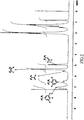
- FIG. 1 shows the 1 H-NMR spectrum of the non-hydrogenated block copolymer in accordance with Example 1 of the present invention.
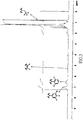
- FIG. 2 shows the 1 H-NMR spectrum of the hydrogenated block copolymer in accordance with Example 1 of the present invention.
- FIG. 3 shows the 1 H-NMR spectrum of the hydrogenated block copolymer in accordance with Example 3 of the present invention.
- the present invention provides a catalyst composition for selectively hydrogenating a conjugated diene polymer in a homogeneous system, wherein the conjugated diene polymer comprises a conjugated diene monomer or a combination of a conjugated diene monomer and a vinyl aromatic monomer, and the catalyst composition includes the catalyst components of (a) a titanium compound; (b) an organometallic compound; and (c) an oligomer containing a polyglycol segment.
- the present invention also provides a hydrogenated polymer produced using the catalyst composition and the method thereof.
- conjugated diene polymer of the present invention includes a homopolymer or a copolymer polymerized of monomers containing conjugated diene, wherein the polymer contains an active radical or a non-active radical at the terminal end of the molecule chain.
- the active radical is carbon free radical, anionic radical of carbon alkali metal ion or carbon cationic radical.
- the copolymer of a conjugated diene could be block, random and taper copolymers of two or more conjugated diene monomers, or block, random and taper copolymers of at least one conjugated diene monomer and at least one vinyl aromatic monomer.
- copolymers of conjugated diene monomer and vinyl aromatic monomer can be one of the styrene-butadiene copolymer, the styrene-isoprene copolymer and the styrene-(butadiene/isoprene) copolymer.
- the weight average molecular weight (Mw) of the conjugated diene polymer is from 40,000 to 500,000, more preferably from 70,000 to 300,000, wherein the block copolymers composed of conjugated diene monomers and vinyl aromatic monomers are even more preferred.
- Conjugated diene monomer suitable for use in the present invention could be a conjugated diene having carbon atoms from 4 to 12.
- Representative examples include 1,3-butadiene, isoprene, 2,3-dimethyl-1,3-butadiene, 1-methylbutadiene, 2-phenyl-1,3-butadiene, 1,3-pentadiene, 2-methyl-1,3-pentadiene, 1,3-hexadiene, 4,5-diethyl-1,3-octadiene, 3-butyl-1,3-octadiene, and a mixture thereof.
- 1,3-butadiene, isoprene and a mixture of butadiene and isoprene are more suitable for use in the present invention.
- Vinyl aromatic monomers suitable for use in the present invention include styrene, tert-butylstyrene, ⁇ -methyl styrene, o-methyl styrene, p-methyl styrene, divinyl benzene, 1,1-diphenyl ethylene, vinyl naphthalene, N,N-dimethyl-p-aminoethylstyrene and N,N-diethyl-p-aminoethylstyrene, any combination thereof, preferably styrene.
- conjugated diene/vinyl aromatic copolymer examples include (1) butadiene/styrene copolymer, (2) isoprene/styrene copolymer and (3) butadiene/isoprene/styrene copolymer.
- conjugated diene polymer prior to hydrogenation, conjugated diene polymer are produced by any of the methods known in the art, such as, anionic polymerization, cationic polymerization, free radical polymerization, complex polymerization, solution polymerization, and emulsion polymerization. It is preferable to use an organic lithium compound to serve as a catalyst initiator, thus obtaining a living polymer.
- the living polymer contains a carbon-lithium ion at the terminal end of the molecule chain. Therefore, when the monomer is added, polymerization could further proceed to lengthen the molecule chain.
- organic lithium compounds examples include n-propyl lithium, iso-propyl lithium, n-butyl lithium, iso-butyl lithium, tert-butyl lithium, n-pentyl lithium, phenyl lithium, tolyl lithium, or a dilithio hydrocarbon selected from the group consisting of 1,4-dilithio-n-butane, 1,5-dilithio-pentane, 1,2-dilithio-diphenyl ethane, 1,4-dilithio-1,1,4,4-tetraphenyl butane, 1,3- or 1,4-bis(1-litho-3-methylpentyl)-benzene.
- dilithio hydrocarbon selected from the group consisting of 1,4-dilithio-n-butane, 1,5-dilithio-pentane, 1,2-dilithio-diphenyl ethane, 1,4-dilithio-1,1,4,4-tetra
- organic lithium compound may be suitably determined depending on the desired molecular weight of the polymer.
- a tertiary amine compound or ether compound could be added to the system for polymerizing the conjugated diene monomers in order to increase the vinyl structure content of the conjugated diene monomers.
- Such compounds suitable for use include general tertiary amine compounds, tetrahydrofuran and diethyl ether.
- One purpose of the present invention is to hydrogenate the conjugated diene polymer as aforementioned using the catalyst composition to be described hereafter.
- Styrene-butadiene copolymer, styrene-isoprene copolymer, and styrene-(butadiene/isoprene) copolymer are suitable examples for hydrogenation, wherein the styrene-butadiene copolymer is hydrogenated into a styrene-ethylene-butylene-styrene (SEBS) block copolymer, the styrene-isoprene copolymer is hydrogenated into a styrene-ethylene-propylene-styrene (SEPS) block copolymer; and the styrene-(butadiene/isoprene) copolymer is hydrogenated into a styrene-ethylene-ethylene-propylene-styrene (SEEPS)
- the catalyst composition of the present invention includes the catalyst components of (a) a titanium compound; (b) an organometallic compound; and (c) an oligomer containing polyglycol segments, which are detailed as below.
- the catalyst component (a) is a titanium compound of a formula (I):
- R 1 and R 2 are identical or different and are ones selected from the group consisting of hydrogen, halogen, C 1 -C 8 alkyl, C 1 -C 8 alkoxy, C 6 -C 12 cycloalkyl, phenyl, phenoxy, C 7 -C 10 arylalkoxy, C 7 -C 10 arylalkyl, carboxy, -CH 2 P(phenyl) 2 , -CH 2 Si(C 1 -C 5 alkyl) 3 and -P(phenyl) 2 ; and A is one selected from the group consisting of cyclopentadienyl, fluorenyl, indenyl and derivatives thereof, wherein A 2 can be two of the same A or different A.
- A could be C 5 R 6 R 7 R 8 R 9 R 10 (cyclopentadienyl and derivatives thereof), wherein R 6 , R 7 , R 8 , R 9 , and R 10 could be the same or different and are ones selected from the group consisting of hydrogen, halogen, alkyl, aryl, carboxy, - CH 2 P(phenyl) 2 , -CH 2 Si(C 1 ⁇ C 5 alkyl) 3 and -P(phenyl) 2 .
- a bis(cyclopentadienyl)titanium halide and a derivative thereof used suitably in the present invention could be bis(cyclopentadienyl)titanium difluorides, bis(cyclopentadienyl)titanium dichlorides, bis[(2,4-diphenylphosphinecyclopentadienyl)]titanium difluorides, bis[(2,4-dimethylphosphinecyclopentadienyl)]titanium difluorides, bis[(2,4-diphenylphosphinecyclopentadienyl)]titanium dichlorides, dimethoxy bis(cyclopentadienyl)titanium dichlorides, bis[(2,4-dimethylphosphinecyclopentadienyl)]titanium dichlorides, bis(cyclopentadienyl)titanium dibro
- an organic carbohydrate of a bis(cyclopentadienyl)titanium and a derivative thereof used suitably in the present invention could be bis(cyclopentadienyl)titanium dimethyl, bis(cyclopentadienyl)titanium dimethoxy, bis(2,4-diphenylphosphinecyclopentadienyl)titanium dimethoxy, bis(2,4-dimethylphosphinecyclopentadienyl)titanium dimethoxy, bis(cyclopentadienyl)titanium diethoxy, bis(2,4-diphenylphosphinecyclopentadienyl)titanium diethoxy, bis(2,4-dimethylphosphinecyclopentadienyl)titanium diethoxy, bis(2,4-diphenylphosphinecyclopentadienyl)titanium di
- a bifluorenyl titanium halide, a biindenyl titanium halide and a derivative thereof used suitably in the present invention could be bis(1-fluorenyl)titanium dichlorides, bis(1-indenyl)titanium dichlorides, bis(dimethoxylfluorenyl)titanium dichlorides, bis(fluorenyl)titanium difluorides, bis(indenyl)titanium difluorides, bis(dimethoxylfluorenyl)titanium difluorides, bis(fluorenyl)titanium dibromides, bis(indenyl)titanium dibromides, bis(dimethoxylfluorenyl)titanium or bis(indenyl)titanium dibromides.
- an organic carbohydrate could be bifluorenyl titanium, biindenyl titanium and a derivative thereof used suitably in the present invention could be bis(fluorenyl)titanium dimethyl, bis(fluorenyl)titanium dimethoxy, bis(indenyl)titanium dimethoxy, bis(dimethoxylfluorenyl)titanium dimethoxy, bis(indenyl)titanium dimethoxy, bis(fluorenyl)titanium dimethanol, bis(indenyl)titanium dimethanol, bis(dimethoxylfluorenyl)titanium dimethanol, bis(indenyl)titanium dimethanol, bis(fluorenyl)titanium diphenoxy, bis(dimethoxylfluorenyl)titanium diphenoxy or bis(indenyl)titanium diphenoxy.
- the derivative here indicates that there is a substituent on the indenyl, fluorenyl, or cyclopentadienyl ring, and the substituent could be one or more from methyl, methoxy, p-tert-butylphenyl, pentafluorophenyl, trifluorophenyl, difluorophenyl, or 3,5-(tert-butyl)-4-methoxyphenyl.
- a preferred example of the catalyst component (a) is bis(cyclopentadienyl)titanium dichloride.
- the catalyst component (b) is an organometallic compound including R 3 Li, R 3 R 4 Mg, or R 3 R 4 R 5 Al, wherein the R 3 is one selected from the group consisting of hydrogen, C 1 -C 12 alkyl, C 1 -C 12 alkoxy, C 6 -C 12 aryl and C 6 -C 12 alkoxy, and the R 4 and R 5 are identical or different and are ones selected from the group consisting of hydrogen, halogen, C 1 -C 12 alkyl, and C 6 -C 12 aryl.
- an example of organic aluminum compound could be tri-methyl aluminum, tri-ethyl aluminum, tri-n-propyl aluminum, tri-isopropyl aluminum, tri-butyl aluminum, tri(sec-butyl)aluminum, tri(isobutyl)aluminum, tri(n-pentyl)aluminum, tri(isopentyl)aluminum, tri(n-hexyl)aluminum, tri(isohexyl)aluminum, tri(1-methylpentyl)aluminum, tri(2,5-dimethyloctyl)aluminum, tri(2,6-dimethyloctyl)aluminum, tri(2-ethylhexyl)aluminum, triphenyl aluminum, diethyl aluminum chloride, ethyl aluminum dichloride, tripropyl aluminum chloride, dibutyl aluminum chloride, diisobutyl
- an example of organic lithium compound could be n-propyl lithium, iso-propyl lithium, n-butyl lithium, iso-butyl lithium, tert-butyl lithium, n-pentyl lithium, phenyl lithium, tolyl lithium and a dilithio hydrocarbon selected from the group consisting of 1,4-dilithio-n-butane, 1,5-dilithio-pentane, 1,2-dilithio-diphenyl ethane, 1,4-dilithio-1,1,4,4-tetraphenyl butane, 1,3- or 1,4-bis(1-litho-3-methylpentyl)-benzene.
- the organic magnesium of the catalyst component (b) is one of Grignard compound and the dialkyl compound of magnesium.
- the organic magnesium of the catalyst component (b) is one of Grignard compound and the dialkyl compound of magnesium.
- bis-n-butyl magnesium bis-tert-butyl magnesium, bis-isobutyl magnesium, bis-n-propyl magnesium, bis-isopropyl magnesium, bisoctyl magnesium, biscyclohexyl magnesium, bis-2-ethylhexyl magnesium, n-butyl-isobutyl magnesium, n-butyloctyl magnesium, n-butyl-2-ethylhexyl magnesium and a combination thereof.
- the catalyst component (c) is an oligomer containing a polyglycol segment. It has been surprisingly discovered that the functional group of polyglycol together with the catalyst components (a) and (b) can form a stable co-catalyst system, particularly in avoiding losing activity of titanium compound catalyst at an early stage, more particularly in providing a more preferable stability when taking the oligomer containing a polyglycol segment as the catalyst component (c).
- the catalyst component (c) examples include, for example, homopolymers composed of polyglycol or block typed or random typed copolymers composed of different units of polyglycol monomers which have a molecular weight in the range of oligomers, or any other oligomers or grafted oligomers containing a polyglycol segment.
- the oligomer according to the preferred examples of the present invention is a polymer with a low number of repeat units, which has a weight average molecular weight (Mw) from 400 to 10,000, more preferred from 400 to 4,000.
- the preferred examples are homopolymer of ethylene glycol or propylene glycol; a block copolymer of ethylene glycol and propylene glycol, such as poly(ethylene glycol)-block-poly(propylene glycol) (PEG-b-PPG) or a poly(ethylene glycol)-block-poly(propylene glycol)-block-poly(ethylene glycol) (PEG-b-PPG-b-PEG) ; a random copolymer of ethylene glycol and propylene glycol (PEG-ran-PPG); and poly(dimethylsiloxane-b-ethylene oxide), methyl terminated (PDMS-PEG).
- PEG-b-PPG poly(ethylene glycol)-block-poly(propylene glycol)
- PEG-b-PPG-b-PEG poly(ethylene glycol)-block-poly(propylene glycol)-block-poly(ethylene glycol)
- PEG-ran-PPG poly(dimethyls
- Preparation of catalyst components (a), (b) and (c) should be conducted in inert gas and low water content.
- the inert gas refers to helium, neon, nitrogen and the like, which will not participate in hydrogenation. Air, oxygen or high water content atmosphere will oxidize or decompose the hydrogenation catalysts, causing reduced activity in catalysts.
- the temperature is preferably ranged from 0° C to 250° C. The activity of catalyst would be reduced at an over higher temperature. The hydrogenating ability would be disappeared at an over lower temperature even though the catalyst does not lose its activity.
- the hydrogenation rate for the unsaturated double bonds in the vinyl aromatic monomers are far less than the hydrogenation rate for the unsaturated double bonds in the conjugated diene monomers when hydrogenating the copolymer composed of the conjugated diene monomer and the vinyl aromatic monomer.
- the hydrogenation rate for the unsaturated double bonds in the conjugated diene monomers is at least 70%, more preferred at least 85%, even more preferred at least 95%; and the hydrogenation rate for the unsaturated double bonds in the vinyl aromatic monomers is less than 5%, more preferred less than 2%.
- the hydrogenation of the present invention involves bringing the conjugated diene polymer in one of an inert organic solvent and an inert organic solvent which includes a portion of ether and amine polar compound into contact with hydrogen in the presence of the hydrogenation catalyst composition of the present invention.
- the unsaturated double bonds in the conjugated diene units of the conjugated diene polymer are selectively hydrogenated.
- gaseous hydrogen is introduced into the conjugated diene polymer.
- stirring is conducted to completely contact the hydrogen and conjugated diene polymer.
- Hydrogenation could be conducted by a batch or continuous methods.
- the hydrogenation reactor of the present invention could be a tank reaction, a loop reactor, a column reactor or a continuously stirred tank reactor (CSTR).
- the hydrogenation catalyst composition of the present invention includes hydrogenation catalyst components (a), (b) and (c) as mentioned above.
- the addition sequence of the hydrogenation catalyst components (a), (b) and (c) is not limited.
- the catalyst component (c) could be first added to the polymer solution whose activity has been terminated, and then a mixed solution of catalyst compositions (a) and (b) are added.
- the catalyst component (c) could be first added to the polymer solution whose activity has not been terminated, followed by a catalyst component (a) solution and a catalyst component (b) solution, respectively. After all the catalyst components are added to the polymer, the polymer is kept at the inert gas atmosphere.
- the catalyst composition still has relatively good activity even after storage for a long time. Therefore, the catalyst composition of the present invention is very suitable for the requirement of industrial mass production.
- the inert organic solvent to dissolve the hydrogenation catalyst composition and the conjugated diene polymer could be a linear or branched hydrocarbon compound such as pentane, hexane, heptane, octane and the like; or a cyclic hydrocarbon compound such as cyclohexane, cycloheptane, and methylheptane. Cyclohexane and n-hexane are the most suitable example.
- the inert organic solvent could be aromatic hydrocarbon such as benzene, toluene, xylene and ethylbenzene.
- the hydrogenation catalyst component (a) is present in an amount of 0.0001 mmole to 50 mmole, preferably 0.002 mmole to 10 mmole, more preferably 0.01mmole to 5 mmole. Over higher usage amount of the catalyst component (a) causes more catalyst residue which increases more side reactions with antioxidant and thus turns the products to yellow, while over lower usage amount of the catalyst component (a) reduces the hydrogenation efficiency.
- the molar ratio of the hydrogenation catalyst component (a) to the hydrogenation catalyst component (b) is 0.01 to 50, more preferably 0.1 to 10, even more preferably 0.2 to 5. If the molar ratio of the hydrogenation catalyst component (a) to the hydrogenation catalyst component (b) is higher than 50, the hydrogenation catalyst component (b) cannot efficiently activate and stable the hydrogenation catalyst component (a), and thus, hydrogenation performance is undesired. If the molar ratio of the hydrogenation catalyst component (a) to the hydrogenation catalyst component (b) is lower than 0.01, the amount of the hydrogenation catalyst component (b) is probably too much and thus the undesired secondary reaction easily occurs, which reduces the hydrogenation efficiency and results in a need to remove the catalyst composition from the product.
- the molar ratio of the hydrogenation catalyst component (c) to the hydrogenation catalyst component (a) is 0.1 to 10, more preferably 0.5 to 5, even more preferably 1 to 4. If the molar ratio of the hydrogenation catalyst component (c) to the hydrogenation catalyst component (a) is less than 0.1, the hydrogenation catalyst component (c) does not reliably stabilize the hydrogenation catalyst system and thus the catalyst composition loses its activity. If the molar ratio of the hydrogenation catalyst component (c) to the hydrogenation catalyst component (a) is higher than 10, the hydrogenation catalyst system is too stable to proceed with hydrogenation.
- the hydrogenation reaction of the present invention could be conducted at a temperature of 0° C to 250° C. If the reaction temperature is lower than 0° C, the hydrogenation reaction cannot happen because it cannot force the catalyst composition to overcome the activation energy. If the reaction temperature is higher than 250° C, the catalyst composition will be decomposed and deactivated, thus decreasing the catalytic activity.
- the hydrogenation could be conducted preferably at a hydrogen pressure from 0.1 kg/cm 2 to 150 kg/cm 2 , more preferably 1 kg/cm 2 to 100 kg/cm 2 , most preferably 1 kg/cm 2 to 50 kg/cm 2 .
- the hydrogen pressure is less than 0.1 kg/cm 2 , the reaction rate may be not obvious.
- the hydrogen pressure is higher than 150 kg/cm 2 , the hydrogenation will rapidly stop.
- the catalyst amount could be decreased by increasing the hydrogen pressure. In order to decrease the catalyst amount, it is preferable to conduct hydrogenation at higher hydrogen pressure.
- the hydrogenation time could be several seconds to 40 hours. Suitable range could be adjusted by the reaction conditions such as the ratio of the catalysts, hydrogen pressure, and hydrogenation temperature.
- the catalyst composition of the present invention has relatively good catalytic selectivity.
- the hydrogenation rate could be measured by 1 H-NMR spectrum analysis as conducted by person skilled in the art, which could be referred to U.S. Pat. No. 5,017,660 .
- the polymer solution obtained from hydrogenation using the hydrogenation catalyst composition of the present invention could be coagulated by adding a polar solvent.
- a polar solvent is a poor solvent for the hydrogenated polymer, such as methanol or acetone.
- the hydrogenated polymer solution could be poured into hot water, stirred, and then distilled for separation. Or, the hydrogenated polymer solution could be directly heated to evaporate the solvent for separation.
- the conjugated diene polymer could be successfully hydrogenated using a small amount of a hydrogenation catalyst composition with relatively high activity. Since the catalyst composition concentration is very low, most catalyst is separated from the polymer or decomposes during the polymer separation procedure. Therefore, there is no need to wash or remove the catalyst from the hydrogenated polymer, greatly enhancing economic efficiency.
- a feature of the catalyst composition of the present invention is that the catalyst component (c) could combine with other catalysts to stabilize other catalyst components and enhance the catalytic activity thereof. Therefore, when the catalyst composition of the present invention is added to the conjugated diene polymer, it could be stored for a period of time in the inert gas atmosphere, generally more than 1 hour, still maintaining good catalytic activity and reproducibility.
- Another feature is that the catalyst composition of the present invention has high hydrogenation activity at a higher temperature. In addition, the catalyst composition of the present invention will not lose the catalytic activity due to high hydrogenation reaction heat. Therefore, it is very suitable for commercial mass production.
- Example 1 shows the 1 H-NMR spectrum of the non-hydrogenated block copolymer in accordance with Example 1 of the present invention.
- 1000 g of the polymer solution of non-hydrogenated SBS tri-block copolymer prepared from Example 1 was transferred to a pressure-resistant hydrogenation vessel and maintained in the nitrogen atmosphere.
- 0.25 mmoles of bis(cyclopentadienyl)titanium dichloride (the catalyst component (a)) and 0.5 mmoles of triisobutyl aluminum (the catalyst component (b) were mixed in 10 ml of cyclohexane.
- the catalyst component (c) is not used.
- FIG. 2 shows the 1 H-NMR spectrum of the hydrogenated block copolymer in accordance with Example 1 of the present invention. In absence of the catalyst component (c), the hydrogenated block copolymer of Example 1 has a hydrogenation rate of only 17% for the unsaturated double bonds of the conjugated diene monomer.
- Examples 2 to 12 exemplify the catalyst compositions of the present invention.
- the above catalyst solution was added into the non-hydrogenated SBS tri-block copolymer wherein the mole ratio of catalyst components (a): (b): (c) is 1:2:1.
- Hydrogen was fed in under a pressure of 25 kg/cm 2 to undergo hydrogenation starting at 80° C and reaching up to around 110° C. After around 60 mins of reaction time, the hydrogenated SBS triblock copolymer was obtained.
- the hydrogenated block copolymer of Example 2 has a hydrogenation rate of 98% for the unsaturated double bonds of the conjugated diene monomer.
- Examples 3 to 6 were conducted under various experimental conditions shown in Table I in the same manner as in Example 2.
- Examples 2-6 mainly demonstrate that under the hydrogen pressure between 25 kg/cm 2 to 35 kg/cm 2 and the molar ratio ranged from 1:2:1 to 1:2:4 of the catalyst components (a):(b):(c), the hydrogenated SBS triblock copolymers having a hydrogenation rate of 95% to 98% for the unsaturated double bonds of the conjugated diene monomer are obtained.
- FIG. 3 shows the 1 H-NMR spectrum of the hydrogenated block copolymer in accordance with Example 3 of the present invention.
- Examples 7 to 8 were conducted under various experimental conditions shown in Table I in the same manner as in Example 2.
- Examples 3, 7-8 mainly demonstrate that hydrogenating the SBS triblock copolymer with weight average molecular weight (Mw) in the range of 75,000 to 260,000 under the same molar ratio 1:2:2 of the catalyst components (a): (b): (c), the hydrogenated SBS triblock copolymers having a hydrogenation rate of 95% to 98% for the unsaturated double bonds of the conjugated diene monomer are obtained.
- Mw weight average molecular weight
- Examples 9 to 11 were conducted under various experimental conditions shown in Table I in the same manner as in Example 2.
- Examples 3, 9-11 mainly demonstrate that under the same molar ratio 1:2:2 of the catalyst components (a): (b): (c) wherein the catalyst component (c) is oligomer PPG (poly propylene glycol) or PEG (poly ethyl glycol) having a weight average molecular weight (Mw) ranged between 400 to 1000, the hydrogenated SBS triblock copolymers having a hydrogenation rate of 97% to 98% for the unsaturated double bonds of the conjugated diene monomer are obtained.
- the catalyst component (c) is oligomer PPG (poly propylene glycol) or PEG (poly ethyl glycol) having a weight average molecular weight (Mw) ranged between 400 to 1000, the hydrogenated SBS triblock copolymers having a hydrogenation rate of 97% to 98% for the unsaturated double bonds of the conjugated diene monomer
- Example 12 was conducted under various experimental conditions shown in Table I in the same manner as in Example 2.
- Example 12 mainly demonstrate that under the molar ratio 1:2:2 of the catalyst components (a):(b):(c) wherein the catalyst component (c) is oligomer PDMS-PEG(Poly(dimethylsiloxane-b-ethylene oxide), methyl terminated) having a weight average molecular weight (Mw) 600, the hydrogenated SBS triblock copolymer having a hydrogenation rate of 97% for the unsaturated double bonds of the conjugated diene monomer is obtained.
- Example 12 shows that the oligomer containing a polyglycol segment is suitable for use in the catalyst component (c) of the present invention.
- FIG. 1 to FIG. 3 shows the 1 H-NMR spectrums of the hydrogenated and non-hydrogenated SBS triblock copolymers for analysis of the detailed structure.
- FIG. 1 indicates that the butadiene group on the SBS triblock copolymer are not hydrogenated
- FIG. 2 indicates that few of the butadiene group on the SBS triblock copolymer are hydrogenated
- FIG .3 indicates that most of the butadiene group on the SBS triblock coppolymer are hydrogenated.
- the adsorption peaks at the range of 6.0 to 7.5 ppm indicates the styrene group on the SBS triblock copolymer. Table I Ex.
Landscapes
- Chemical & Material Sciences (AREA)
- Organic Chemistry (AREA)
- Chemical Kinetics & Catalysis (AREA)
- Health & Medical Sciences (AREA)
- Medicinal Chemistry (AREA)
- Polymers & Plastics (AREA)
- Materials Engineering (AREA)
- Engineering & Computer Science (AREA)
- General Chemical & Material Sciences (AREA)
- Inorganic Chemistry (AREA)
- Crystallography & Structural Chemistry (AREA)
- Emergency Medicine (AREA)
- Addition Polymer Or Copolymer, Post-Treatments, Or Chemical Modifications (AREA)
- Catalysts (AREA)
Abstract
Description
- This application claims the right of priority based on
US Provisional Application No. 62/427,515 - The present invention relates to a selectively hydrogenated conjugated diene polymer, particularly to the conjugated diene polymer being selectively hydrogenated using a catalyst composition containing a titanium compound.
- With great amount of unsaturated double bonds, non-hydrogenated conjugated diene polymer such as copolymer/homopolymer of butadiene or isoprene or block/non-block copolymer of styrene-butadiene/isoprene are usually advantageously applicable in crosslinking reactions like functionalization, grafting and vulcanization etc.. However, non-hydrogenated conjugated diene polymer is very unstable as being prone to degradation due to heat or oxidation in exposed of ultra-violet light or other unfavorable environment. Since that, in practices those non-hydrogenated copolymers are improved by appropriate hydrogenation to largely reduce the amount of the unsaturated double bonds so as to get good properties against unfavorable environment. Conventionally, catalysts used for hydrogenation of the conjugated diene polymer are classified into two types, heterogeneous catalysts and homogenous catalysts, wherein the homogeneous one has relatively higher activities by which the reaction can be conducted at mild pressure and temperature.
- European Patent Appl. No.
2316862 discloses a method for hydrogenating the conjugated diene polymer in homogenous system using a catalyst composition containing a titanium compound and a fully substituted silane, wherein the fully substituted silane catalyst stabilizes other catalyst components in the catalyst composition and therefore enhances the catalytic activity. However, such catalyst composition still has shortcomings in its application. Therefore, there is a need to provide a new catalyst composition to fit the application requirements. - One aspect of the present invention is to provide a novel homogeneous hydrogenation catalyst composition which is stable to be easily stored and used for selectively hydrogenating a conjugated diene polymer. The conjugated diene polymer of the present invention includes homopolymers or copolymers polymerized of monomers containing conjugated diene. The so-called "selectively hydrogenated" or "selectively hydrogenating" means that the hydrogenation is mainly directed to the conjugated diene monomer.
- In accordance with the present invention, the conjugated diene polymer can be successfully hydrogenated under a lower concentration of the catalyst composition. Therefore, the catalyst composition is very applicable for commercial mass production of the polymer. Due to the lower concentration of the catalyst composition, there is no need to remove the catalyst from the hydrogenated polymer, which greatly enhances economic efficiency. Furthermore, the hydrogenation of the present invention is very rapid and exhibits good reproducibility over a wide range of temperatures and pressures.
- Other aspects and various embodiments included in the present invention to solve other problems and combined with the above aspects are disclosed in the following detailed descriptions.
-
FIG. 1 shows the 1H-NMR spectrum of the non-hydrogenated block copolymer in accordance with Example 1 of the present invention. -
FIG. 2 shows the 1H-NMR spectrum of the hydrogenated block copolymer in accordance with Example 1 of the present invention. -
FIG. 3 shows the 1H-NMR spectrum of the hydrogenated block copolymer in accordance with Example 3 of the present invention. - The preferred embodiments of the present invention will now be described in greater details. Descriptions of well-known components, materials and process techniques may be omitted so as to not unnecessarily obscure the embodiments of the invention.
- The present invention provides a catalyst composition for selectively hydrogenating a conjugated diene polymer in a homogeneous system, wherein the conjugated diene polymer comprises a conjugated diene monomer or a combination of a conjugated diene monomer and a vinyl aromatic monomer, and the catalyst composition includes the catalyst components of (a) a titanium compound; (b) an organometallic compound; and (c) an oligomer containing a polyglycol segment. The present invention also provides a hydrogenated polymer produced using the catalyst composition and the method thereof.
- The term "conjugated diene polymer" of the present invention includes a homopolymer or a copolymer polymerized of monomers containing conjugated diene, wherein the polymer contains an active radical or a non-active radical at the terminal end of the molecule chain. The active radical is carbon free radical, anionic radical of carbon alkali metal ion or carbon cationic radical. The copolymer of a conjugated diene could be block, random and taper copolymers of two or more conjugated diene monomers, or block, random and taper copolymers of at least one conjugated diene monomer and at least one vinyl aromatic monomer. For example, copolymers of conjugated diene monomer and vinyl aromatic monomer can be one of the styrene-butadiene copolymer, the styrene-isoprene copolymer and the styrene-(butadiene/isoprene) copolymer. In preferred embodiments of the present invention, the weight average molecular weight (Mw) of the conjugated diene polymer is from 40,000 to 500,000, more preferably from 70,000 to 300,000, wherein the block copolymers composed of conjugated diene monomers and vinyl aromatic monomers are even more preferred.
- Conjugated diene monomer suitable for use in the present invention could be a conjugated diene having carbon atoms from 4 to 12. Representative examples include 1,3-butadiene, isoprene, 2,3-dimethyl-1,3-butadiene, 1-methylbutadiene, 2-phenyl-1,3-butadiene, 1,3-pentadiene, 2-methyl-1,3-pentadiene, 1,3-hexadiene, 4,5-diethyl-1,3-octadiene, 3-butyl-1,3-octadiene, and a mixture thereof. 1,3-butadiene, isoprene and a mixture of butadiene and isoprene are more suitable for use in the present invention.
- Vinyl aromatic monomers suitable for use in the present invention include styrene, tert-butylstyrene, α-methyl styrene, o-methyl styrene, p-methyl styrene, divinyl benzene, 1,1-diphenyl ethylene, vinyl naphthalene, N,N-dimethyl-p-aminoethylstyrene and N,N-diethyl-p-aminoethylstyrene, any combination thereof, preferably styrene. Representative examples of conjugated diene/vinyl aromatic copolymer include (1) butadiene/styrene copolymer, (2) isoprene/styrene copolymer and (3) butadiene/isoprene/styrene copolymer.
- According to the present invention, prior to hydrogenation, conjugated diene polymer are produced by any of the methods known in the art, such as, anionic polymerization, cationic polymerization, free radical polymerization, complex polymerization, solution polymerization, and emulsion polymerization. It is preferable to use an organic lithium compound to serve as a catalyst initiator, thus obtaining a living polymer. The living polymer contains a carbon-lithium ion at the terminal end of the molecule chain. Therefore, when the monomer is added, polymerization could further proceed to lengthen the molecule chain. Examples of such organic lithium compounds are n-propyl lithium, iso-propyl lithium, n-butyl lithium, iso-butyl lithium, tert-butyl lithium, n-pentyl lithium, phenyl lithium, tolyl lithium, or a dilithio hydrocarbon selected from the group consisting of 1,4-dilithio-n-butane, 1,5-dilithio-pentane, 1,2-dilithio-diphenyl ethane, 1,4-dilithio-1,1,4,4-tetraphenyl butane, 1,3- or 1,4-bis(1-litho-3-methylpentyl)-benzene. The amount of such organic lithium compound may be suitably determined depending on the desired molecular weight of the polymer. In addition, a tertiary amine compound or ether compound could be added to the system for polymerizing the conjugated diene monomers in order to increase the vinyl structure content of the conjugated diene monomers. Such compounds suitable for use include general tertiary amine compounds, tetrahydrofuran and diethyl ether.
- One purpose of the present invention is to hydrogenate the conjugated diene polymer as aforementioned using the catalyst composition to be described hereafter. Styrene-butadiene copolymer, styrene-isoprene copolymer, and styrene-(butadiene/isoprene) copolymer are suitable examples for hydrogenation, wherein the styrene-butadiene copolymer is hydrogenated into a styrene-ethylene-butylene-styrene (SEBS) block copolymer, the styrene-isoprene copolymer is hydrogenated into a styrene-ethylene-propylene-styrene (SEPS) block copolymer; and the styrene-(butadiene/isoprene) copolymer is hydrogenated into a styrene-ethylene-ethylene-propylene-styrene (SEEPS) block copolymer.
- As aforementioned, the catalyst composition of the present invention includes the catalyst components of (a) a titanium compound; (b) an organometallic compound; and (c) an oligomer containing polyglycol segments, which are detailed as below.
- According to the preferred embodiments of the present invention, the catalyst component (a) is a titanium compound of a formula (I):

- R1 and R2 are identical or different and are ones selected from the group consisting of hydrogen, halogen, C1-C8 alkyl, C1-C8 alkoxy, C6-C12 cycloalkyl, phenyl, phenoxy, C7-C10 arylalkoxy, C7-C10 arylalkyl, carboxy, -CH2P(phenyl)2, -CH2Si(C1-C5 alkyl)3 and -P(phenyl)2; and A is one selected from the group consisting of cyclopentadienyl, fluorenyl, indenyl and derivatives thereof, wherein A2 can be two of the same A or different A.
- For example, A could be C5R6R7R8R9R10 (cyclopentadienyl and derivatives thereof), wherein R6, R7, R8, R9, and R10 could be the same or different and are ones selected from the group consisting of hydrogen, halogen, alkyl, aryl, carboxy, - CH2P(phenyl)2, -CH2Si(C1∼C5 alkyl)3 and -P(phenyl)2.
- According to the catalyst component (a) of the formula (I), a bis(cyclopentadienyl)titanium halide and a derivative thereof used suitably in the present invention could be bis(cyclopentadienyl)titanium difluorides, bis(cyclopentadienyl)titanium dichlorides, bis[(2,4-diphenylphosphinecyclopentadienyl)]titanium difluorides, bis[(2,4-dimethylphosphinecyclopentadienyl)]titanium difluorides, bis[(2,4-diphenylphosphinecyclopentadienyl)]titanium dichlorides, dimethoxy bis(cyclopentadienyl)titanium dichlorides, bis[(2,4-dimethylphosphinecyclopentadienyl)]titanium dichlorides, bis(cyclopentadienyl)titanium dibromides, bis[(2,4-diphenylphosphinecyclopentadienyl)]titanium dibromides, bis[(2,4-dimethylphosphinecyclopentadienyl)]titanium dibromides, bis(ethyl cyclopentadienyl)titanium dichlorides, bis(n-propylcyclopentadienyl)titanium dichlorides, bis(n-butylcyclopentadienyl)titanium dichlorides, bis(2-ethylhexylcyclopentadienyl)titanium dichlorides, (dimethylsilylene)-bis(η5-2,4-cyclopentadien-1-ylidene) or (ethylene)-bis(η5-2,4-cyclopentadien-1-ylidene).
- According to the catalyst component (a) of the formula (I), an organic carbohydrate of a bis(cyclopentadienyl)titanium and a derivative thereof used suitably in the present invention could be bis(cyclopentadienyl)titanium dimethyl, bis(cyclopentadienyl)titanium dimethoxy, bis(2,4-diphenylphosphinecyclopentadienyl)titanium dimethoxy, bis(2,4-dimethylphosphinecyclopentadienyl)titanium dimethoxy, bis(cyclopentadienyl)titanium diethoxy, bis(2,4-diphenylphosphinecyclopentadienyl)titanium diethoxy, bis(2,4-dimethylphosphinecyclopentadienyl)titanium diethoxy, bis(2,4-diphenylphosphinecyclopentadienyl)titanium diphenoxy or bis(2,4-dimethylphosphinecyclopentadienyl)titanium diphenoxy.
- According to the catalyst component (a) of the formula (I), a bifluorenyl titanium halide, a biindenyl titanium halide and a derivative thereof used suitably in the present invention could be bis(1-fluorenyl)titanium dichlorides, bis(1-indenyl)titanium dichlorides, bis(dimethoxylfluorenyl)titanium dichlorides, bis(fluorenyl)titanium difluorides, bis(indenyl)titanium difluorides, bis(dimethoxylfluorenyl)titanium difluorides, bis(fluorenyl)titanium dibromides, bis(indenyl)titanium dibromides, bis(dimethoxylfluorenyl)titanium or bis(indenyl)titanium dibromides.
- According to the catalyst component (a) of the formula (I), an organic carbohydrate could be bifluorenyl titanium, biindenyl titanium and a derivative thereof used suitably in the present invention could be bis(fluorenyl)titanium dimethyl, bis(fluorenyl)titanium dimethoxy, bis(indenyl)titanium dimethoxy, bis(dimethoxylfluorenyl)titanium dimethoxy, bis(indenyl)titanium dimethoxy, bis(fluorenyl)titanium dimethanol, bis(indenyl)titanium dimethanol, bis(dimethoxylfluorenyl)titanium dimethanol, bis(indenyl)titanium dimethanol, bis(fluorenyl)titanium diphenoxy, bis(dimethoxylfluorenyl)titanium diphenoxy or bis(indenyl)titanium diphenoxy.
- The derivative here indicates that there is a substituent on the indenyl, fluorenyl, or cyclopentadienyl ring, and the substituent could be one or more from methyl, methoxy, p-tert-butylphenyl, pentafluorophenyl, trifluorophenyl, difluorophenyl, or 3,5-(tert-butyl)-4-methoxyphenyl. A preferred example of the catalyst component (a) is bis(cyclopentadienyl)titanium dichloride.
- According to the preferred embodiments of the present invention, the catalyst component (b) is an organometallic compound including R3Li, R3R4Mg, or R3R4R5Al, wherein the R3 is one selected from the group consisting of hydrogen, C1-C12 alkyl, C1-C12 alkoxy, C6-C12 aryl and C6-C12 alkoxy, and the R4 and R5 are identical or different and are ones selected from the group consisting of hydrogen, halogen, C1-C12 alkyl, and C6-C12 aryl.
- According to the catalyst component (b) of present invention, an example of organic aluminum compound could be tri-methyl aluminum, tri-ethyl aluminum, tri-n-propyl aluminum, tri-isopropyl aluminum, tri-butyl aluminum, tri(sec-butyl)aluminum, tri(isobutyl)aluminum, tri(n-pentyl)aluminum, tri(isopentyl)aluminum, tri(n-hexyl)aluminum, tri(isohexyl)aluminum, tri(1-methylpentyl)aluminum, tri(2,5-dimethyloctyl)aluminum, tri(2,6-dimethyloctyl)aluminum, tri(2-ethylhexyl)aluminum, triphenyl aluminum, diethyl aluminum chloride, ethyl aluminum dichloride, tripropyl aluminum chloride, dibutyl aluminum chloride, diisobutyl aluminum chloride, or butyl aluminum dichloride, wherein tri-ethyl aluminum, tri-isopropyl aluminum, tri-butyl aluminum, tri(isobutyl)aluminum, or diethyl aluminum chloride are preferred.
- According to the catalyst component (b) of present invention, an example of organic lithium compound could be n-propyl lithium, iso-propyl lithium, n-butyl lithium, iso-butyl lithium, tert-butyl lithium, n-pentyl lithium, phenyl lithium, tolyl lithium and a dilithio hydrocarbon selected from the group consisting of 1,4-dilithio-n-butane, 1,5-dilithio-pentane, 1,2-dilithio-diphenyl ethane, 1,4-dilithio-1,1,4,4-tetraphenyl butane, 1,3- or 1,4-bis(1-litho-3-methylpentyl)-benzene.
- According to the present invention, the organic magnesium of the catalyst component (b) is one of Grignard compound and the dialkyl compound of magnesium. For commercial application, there are many magnesium compounds existing in a type of using an organic magnesium compound to dissolve in an inert aliphatic hydrocarbon. There are examples including bis-n-butyl magnesium, bis-tert-butyl magnesium, bis-isobutyl magnesium, bis-n-propyl magnesium, bis-isopropyl magnesium, bisoctyl magnesium, biscyclohexyl magnesium, bis-2-ethylhexyl magnesium, n-butyl-isobutyl magnesium, n-butyloctyl magnesium, n-butyl-2-ethylhexyl magnesium and a combination thereof.
- According to the preferred embodiments of the present invention, the catalyst component (c) is an oligomer containing a polyglycol segment. It has been surprisingly discovered that the functional group of polyglycol together with the catalyst components (a) and (b) can form a stable co-catalyst system, particularly in avoiding losing activity of titanium compound catalyst at an early stage, more particularly in providing a more preferable stability when taking the oligomer containing a polyglycol segment as the catalyst component (c). Examples of the catalyst component (c) include, for example, homopolymers composed of polyglycol or block typed or random typed copolymers composed of different units of polyglycol monomers which have a molecular weight in the range of oligomers, or any other oligomers or grafted oligomers containing a polyglycol segment. The oligomer according to the preferred examples of the present invention is a polymer with a low number of repeat units, which has a weight average molecular weight (Mw) from 400 to 10,000, more preferred from 400 to 4,000. The preferred examples are homopolymer of ethylene glycol or propylene glycol; a block copolymer of ethylene glycol and propylene glycol, such as poly(ethylene glycol)-block-poly(propylene glycol) (PEG-b-PPG) or a poly(ethylene glycol)-block-poly(propylene glycol)-block-poly(ethylene glycol) (PEG-b-PPG-b-PEG) ; a random copolymer of ethylene glycol and propylene glycol (PEG-ran-PPG); and poly(dimethylsiloxane-b-ethylene oxide), methyl terminated (PDMS-PEG).
- Preparation of catalyst components (a), (b) and (c) should be conducted in inert gas and low water content. The inert gas refers to helium, neon, nitrogen and the like, which will not participate in hydrogenation. Air, oxygen or high water content atmosphere will oxidize or decompose the hydrogenation catalysts, causing reduced activity in catalysts. In the condition under which the catalyst components are pre-mixed, the temperature is preferably ranged from 0° C to 250° C. The activity of catalyst would be reduced at an over higher temperature. The hydrogenating ability would be disappeared at an over lower temperature even though the catalyst does not lose its activity.
- Since the catalyst composition of the present invention tends to selectively hydrogenate "conjugated diene monomer", the hydrogenation rate for the unsaturated double bonds in the vinyl aromatic monomers are far less than the hydrogenation rate for the unsaturated double bonds in the conjugated diene monomers when hydrogenating the copolymer composed of the conjugated diene monomer and the vinyl aromatic monomer. In preferred embodiments of the present invention, the hydrogenation rate for the unsaturated double bonds in the conjugated diene monomers is at least 70%, more preferred at least 85%, even more preferred at least 95%; and the hydrogenation rate for the unsaturated double bonds in the vinyl aromatic monomers is less than 5%, more preferred less than 2%.
- The hydrogenation of the present invention involves bringing the conjugated diene polymer in one of an inert organic solvent and an inert organic solvent which includes a portion of ether and amine polar compound into contact with hydrogen in the presence of the hydrogenation catalyst composition of the present invention. Thus, the unsaturated double bonds in the conjugated diene units of the conjugated diene polymer are selectively hydrogenated. Specifically, for example, gaseous hydrogen is introduced into the conjugated diene polymer. Then, stirring is conducted to completely contact the hydrogen and conjugated diene polymer. Hydrogenation could be conducted by a batch or continuous methods. The hydrogenation reactor of the present invention could be a tank reaction, a loop reactor, a column reactor or a continuously stirred tank reactor (CSTR).
- The hydrogenation catalyst composition of the present invention includes hydrogenation catalyst components (a), (b) and (c) as mentioned above. The addition sequence of the hydrogenation catalyst components (a), (b) and (c) is not limited. For example, the catalyst component (c) could be first added to the polymer solution whose activity has been terminated, and then a mixed solution of catalyst compositions (a) and (b) are added. Alternatively, the catalyst component (c) could be first added to the polymer solution whose activity has not been terminated, followed by a catalyst component (a) solution and a catalyst component (b) solution, respectively. After all the catalyst components are added to the polymer, the polymer is kept at the inert gas atmosphere. The catalyst composition still has relatively good activity even after storage for a long time. Therefore, the catalyst composition of the present invention is very suitable for the requirement of industrial mass production.
- According to the present invention, the inert organic solvent to dissolve the hydrogenation catalyst composition and the conjugated diene polymer could be a linear or branched hydrocarbon compound such as pentane, hexane, heptane, octane and the like; or a cyclic hydrocarbon compound such as cyclohexane, cycloheptane, and methylheptane. Cyclohexane and n-hexane are the most suitable example. Alternatively, the inert organic solvent could be aromatic hydrocarbon such as benzene, toluene, xylene and ethylbenzene.
- Regarding the usage amount, based on 100 g of the conjugated diene polymer the hydrogenation catalyst component (a) is present in an amount of 0.0001 mmole to 50 mmole, preferably 0.002 mmole to 10 mmole, more preferably 0.01mmole to 5 mmole. Over higher usage amount of the catalyst component (a) causes more catalyst residue which increases more side reactions with antioxidant and thus turns the products to yellow, while over lower usage amount of the catalyst component (a) reduces the hydrogenation efficiency.
- Preferably, the molar ratio of the hydrogenation catalyst component (a) to the hydrogenation catalyst component (b) is 0.01 to 50, more preferably 0.1 to 10, even more preferably 0.2 to 5. If the molar ratio of the hydrogenation catalyst component (a) to the hydrogenation catalyst component (b) is higher than 50, the hydrogenation catalyst component (b) cannot efficiently activate and stable the hydrogenation catalyst component (a), and thus, hydrogenation performance is undesired. If the molar ratio of the hydrogenation catalyst component (a) to the hydrogenation catalyst component (b) is lower than 0.01, the amount of the hydrogenation catalyst component (b) is probably too much and thus the undesired secondary reaction easily occurs, which reduces the hydrogenation efficiency and results in a need to remove the catalyst composition from the product.
- Preferably, the molar ratio of the hydrogenation catalyst component (c) to the hydrogenation catalyst component (a) is 0.1 to 10, more preferably 0.5 to 5, even more preferably 1 to 4. If the molar ratio of the hydrogenation catalyst component (c) to the hydrogenation catalyst component (a) is less than 0.1, the hydrogenation catalyst component (c) does not reliably stabilize the hydrogenation catalyst system and thus the catalyst composition loses its activity. If the molar ratio of the hydrogenation catalyst component (c) to the hydrogenation catalyst component (a) is higher than 10, the hydrogenation catalyst system is too stable to proceed with hydrogenation.
- The hydrogenation reaction of the present invention could be conducted at a temperature of 0° C to 250° C. If the reaction temperature is lower than 0° C, the hydrogenation reaction cannot happen because it cannot force the catalyst composition to overcome the activation energy. If the reaction temperature is higher than 250° C, the catalyst composition will be decomposed and deactivated, thus decreasing the catalytic activity.
- The hydrogenation could be conducted preferably at a hydrogen pressure from 0.1 kg/cm2 to 150 kg/cm2, more preferably 1 kg/cm2 to 100 kg/cm2, most preferably 1 kg/cm2 to 50 kg/cm2. When the hydrogen pressure is less than 0.1 kg/cm2, the reaction rate may be not obvious. When the hydrogen pressure is higher than 150 kg/cm2, the hydrogenation will rapidly stop. The catalyst amount could be decreased by increasing the hydrogen pressure. In order to decrease the catalyst amount, it is preferable to conduct hydrogenation at higher hydrogen pressure.
- According to the present invention, the hydrogenation time could be several seconds to 40 hours. Suitable range could be adjusted by the reaction conditions such as the ratio of the catalysts, hydrogen pressure, and hydrogenation temperature.
- To hydrogenate the conjugated diene/vinyl aromatic copolymer using the catalyst composition of the present invention, at least 70%, more preferably at least 85%, even more preferably at least 95%, of the unsaturated double bonds in the conjugated diene monomers can be hydrogenated. In contrast, lower than 5%, and even lower than 2%, of the double bonds in the vinyl aromatic monomers (aromatic ring such as benzene ring) can are hydrogenated. That is to say, the catalyst composition of the present invention has relatively good catalytic selectivity. The hydrogenation rate could be measured by 1H-NMR spectrum analysis as conducted by person skilled in the art, which could be referred to
U.S. Pat. No. 5,017,660 . - The polymer solution obtained from hydrogenation using the hydrogenation catalyst composition of the present invention could be coagulated by adding a polar solvent. Such polar solvent is a poor solvent for the hydrogenated polymer, such as methanol or acetone. Or, alternatively, the hydrogenated polymer solution could be poured into hot water, stirred, and then distilled for separation. Or, the hydrogenated polymer solution could be directly heated to evaporate the solvent for separation.
- According to the present invention, the conjugated diene polymer could be successfully hydrogenated using a small amount of a hydrogenation catalyst composition with relatively high activity. Since the catalyst composition concentration is very low, most catalyst is separated from the polymer or decomposes during the polymer separation procedure. Therefore, there is no need to wash or remove the catalyst from the hydrogenated polymer, greatly enhancing economic efficiency.
- A feature of the catalyst composition of the present invention is that the catalyst component (c) could combine with other catalysts to stabilize other catalyst components and enhance the catalytic activity thereof. Therefore, when the catalyst composition of the present invention is added to the conjugated diene polymer, it could be stored for a period of time in the inert gas atmosphere, generally more than 1 hour, still maintaining good catalytic activity and reproducibility. Another feature is that the catalyst composition of the present invention has high hydrogenation activity at a higher temperature. In addition, the catalyst composition of the present invention will not lose the catalytic activity due to high hydrogenation reaction heat. Therefore, it is very suitable for commercial mass production.
- Specific preferred embodiments of the present invention have been described in the detailed description below. The description is not intended to limit the invention. Persons skilled in the art should understand the spirit and scope of the invention is as stated in the claims.
- Example 1 (Comparative example without catalyst component (c))
- 4300 g of cyclohexane, 15.6 mmoles of n-butyl lithium and 139 mmoles of tetrahydrofuran (THF) were charged in 10 L of a heater equipped with a stirrer. Then, 93 g of styrene was added and the polymerization was conducted at 45° C. Then, 400 g of 1,3 butadiene and 93 g of styrene were added to the reaction system and the reaction mixture was further polymerized to an SBS (styrene-butadienestyrene) tri-block copolymer (solid content=12%, Mw=75,000), which is non-hydrogenated.
FIG. 1 shows the 1H-NMR spectrum of the non-hydrogenated block copolymer in accordance with Example 1 of the present invention. 1000 g of the polymer solution of non-hydrogenated SBS tri-block copolymer prepared from Example 1 was transferred to a pressure-resistant hydrogenation vessel and maintained in the nitrogen atmosphere. Separately, 0.25 mmoles of bis(cyclopentadienyl)titanium dichloride (the catalyst component (a)) and 0.5 mmoles of triisobutyl aluminum (the catalyst component (b) were mixed in 10 ml of cyclohexane. In the example the catalyst component (c) is not used. The above catalyst solution was added into the non-hydrogenated SBS tri-block copolymer wherein the mole ratio of catalyst components (a): (b): (c) is 1:2:0. Hydrogen was fed in under a pressure of 25 kg/cm2 to undergo hydrogenation starting at 80° C and reaching up to around 90° C. After around 60 mins of reaction time, the hydrogenated SBS triblock copolymer was obtained.FIG. 2 shows the 1H-NMR spectrum of the hydrogenated block copolymer in accordance with Example 1 of the present invention. In absence of the catalyst component (c), the hydrogenated block copolymer of Example 1 has a hydrogenation rate of only 17% for the unsaturated double bonds of the conjugated diene monomer. - Examples 2 to 12 exemplify the catalyst compositions of the present invention.
- 4300 g of cyclohexane, 15.6 mmoles of n-butyl lithium and 139 mmoles of tetrahydrofuran (THF) were charged in 10 L of a heater equipped with a stirrer. Then, 93 g of styrene was added and the polymerization was conducted at 45° C. Then, 400 g of 1, 3 butadiene and 93 g of styrene were added to the reaction system and the reaction mixture was further polymerized to an SBS (styrene-butadienestyrene) tri-block copolymer (solid content=12%, Mw=75,000). 1000 g of the polymer solution of SBS tri-block copolymer was transferred to a pressure-resistant hydrogenation vessel and maintained in the nitrogen atmosphere. 0.25 mmoles of oligomer polypropylene glycol (the catalyst component (c)) having a weight average molecular weight (Mw) 700 was dissolved in 10 ml of cyclohexane at room temperature. Separately, 0.25 mmoles of bis(cyclopentadienyl)titanium dichloride (the catalyst component (a)) and 0.5mmoles of triisobutyl aluminum (the catalyst component (b)) were mixed in 10 ml of cyclohexane. The above catalyst solution was added into the non-hydrogenated SBS tri-block copolymer wherein the mole ratio of catalyst components (a): (b): (c) is 1:2:1. Hydrogen was fed in under a pressure of 25 kg/cm2 to undergo hydrogenation starting at 80° C and reaching up to around 110° C. After around 60 mins of reaction time, the hydrogenated SBS triblock copolymer was obtained. The hydrogenated block copolymer of Example 2 has a hydrogenation rate of 98% for the unsaturated double bonds of the conjugated diene monomer.
- Examples 3 to 6 were conducted under various experimental conditions shown in Table I in the same manner as in Example 2. Examples 2-6 mainly demonstrate that under the hydrogen pressure between 25 kg/cm2 to 35 kg/cm2 and the molar ratio ranged from 1:2:1 to 1:2:4 of the catalyst components (a):(b):(c), the hydrogenated SBS triblock copolymers having a hydrogenation rate of 95% to 98% for the unsaturated double bonds of the conjugated diene monomer are obtained.
FIG. 3 shows the 1H-NMR spectrum of the hydrogenated block copolymer in accordance with Example 3 of the present invention. - Examples 7 to 8 were conducted under various experimental conditions shown in Table I in the same manner as in Example 2. Examples 3, 7-8 mainly demonstrate that hydrogenating the SBS triblock copolymer with weight average molecular weight (Mw) in the range of 75,000 to 260,000 under the same molar ratio 1:2:2 of the catalyst components (a): (b): (c), the hydrogenated SBS triblock copolymers having a hydrogenation rate of 95% to 98% for the unsaturated double bonds of the conjugated diene monomer are obtained.
- Examples 9 to 11 were conducted under various experimental conditions shown in Table I in the same manner as in Example 2. Examples 3, 9-11 mainly demonstrate that under the same molar ratio 1:2:2 of the catalyst components (a): (b): (c) wherein the catalyst component (c) is oligomer PPG (poly propylene glycol) or PEG (poly ethyl glycol) having a weight average molecular weight (Mw) ranged between 400 to 1000, the hydrogenated SBS triblock copolymers having a hydrogenation rate of 97% to 98% for the unsaturated double bonds of the conjugated diene monomer are obtained.
- Example 12 was conducted under various experimental conditions shown in Table I in the same manner as in Example 2. Example 12 mainly demonstrate that under the molar ratio 1:2:2 of the catalyst components (a):(b):(c) wherein the catalyst component (c) is oligomer PDMS-PEG(Poly(dimethylsiloxane-b-ethylene oxide), methyl terminated) having a weight average molecular weight (Mw) 600, the hydrogenated SBS triblock copolymer having a hydrogenation rate of 97% for the unsaturated double bonds of the conjugated diene monomer is obtained. Example 12 shows that the oligomer containing a polyglycol segment is suitable for use in the catalyst component (c) of the present invention.
-
FIG. 1 to FIG. 3 shows the 1H-NMR spectrums of the hydrogenated and non-hydrogenated SBS triblock copolymers for analysis of the detailed structure. By observing the adsorption peaks at the range of 4.5 to 6 ppm in the figures,FIG. 1 indicates that the butadiene group on the SBS triblock copolymer are not hydrogenated;FIG. 2 indicates that few of the butadiene group on the SBS triblock copolymer are hydrogenated; andFIG .3 indicates that most of the butadiene group on the SBS triblock coppolymer are hydrogenated. The adsorption peaks at the range of 6.0 to 7.5 ppm indicates the styrene group on the SBS triblock copolymer.Table I Ex. polymer Catalyst Composition a:b:c mole ratio Start Temp H2 Pressure kg/cm2 Hydrogenation time (min) Hydrogenation rate of conjugated diene monomer Hydrogenation rate of vinyl aromatic monomer 1 SBS (Mw:75,000) (a) bis(cyclopentadienyl)tit anium dichlorides 1:2:0 80°C 25 60 17% <1% (b) triisobutyl aluminum (c) PPG (Mw:700) 2 SBS (Mw:75,000) (a) bis(cyclopentadienyl)tit anium dichlorides 1:2:1 80°C 25 60 98% <1% (b) triisobutyl aluminum (c) PPG (Mw:700) 3 Same as Ex. 2 Same as Ex. 2 1:2:2 80°C 25 60 98% <1% 4 Same as Ex. 2 Same as Ex. 2 1:2:3 80°C 25 60 96% <1% 5 Same as Ex. 2 Same as Ex. 2 1:2:4 80°C 25 60 95% <1% 6 Same as Ex. 2 Same as Ex. 2 1:2:2 80°C 35 40 98% <1% 7 SBS (Mw:95,000) Same as Ex. 2 1:2:2 80°C 25 60 98% <1% 8 SBS (Mw:260,000) Same as Ex. 2 1:2:2 80°C 25 60 95% <1% 9 SBS (Mw:95,000) (a) bis(cyclopentadienyl)tit anium dichlorides 1:2:2 80°C 25 60 98% <1% (b) triisobutyl aluminum (c) PPG (Mw:400) 10 Same as Ex. 9 (a) bis(cyclopentadienyl)tit anium dichlorides 1:2:2 80°C 25 60 97% <1% (b) triisobutyl aluminum (c) PPG (Mw: 1000) 11 Same as Ex. 9 (a) bis(cyclopentadienyl)tit anium dichlorides 1:2:2 80°C 25 60 97% <1% (b) triisobutyl aluminum (c) PEG (Mw:600) 12 Same as Ex. 9 (a) bis(cyclopentadienyl)tit anium dichlorides 1:2:2 80°C 25 60 97% <1% (b) triisobutyl aluminum (c) PDMS-PEG (Mw:600) - While the invention has been described by way of examples and in terms of preferred embodiments, it would be apparent to those skilled in the art to make various equivalent replacements, amendments and modifications in view of specification of the invention. Therefore, the scope of the appended claims should be accorded the broadest interpretation so as to encompass all such replacements, amendments and modifications without departing from the spirit and scope of the invention.
Claims (15)
- A catalyst composition for selectively hydrogenating a conjugated diene polymer comprising a conjugated diene monomer or a combination of a conjugated diene monomer and a vinyl aromatic monomer, the catalyst composition comprising components of:(a) a titanium compound of a formula (I),
 R1 and R2 are identical or different and are ones selected from the group consisting of hydrogen, halogen, C1-C8 alkyl, C1-C8 alkoxy, C6-C12 cycloalkyl, phenyl, phenoxy, C7-C10 arylalkoxy, C7-C10 arylalkyl, carboxy, -CH2P(phenyl)2, -CH2Si(C1-C5 alkyl)3 and -P(phenyl)2; and A is one selected from the group consisting of cyclopentadienyl, fluorenyl, indenyl and derivatives thereof, wherein A2 can be two of the same A or different A;(b) an organometallic compound selected from the group consisting of R3Li, R3R4Mg and R3R4R5Al, wherein said R3 is one selected from the group consisting of hydrogen, C1-C12 alkyl, C1-C12 alkoxy, C6-C12 aryl and C6-C12 alkoxy, and said R4 and R5 are identical or different and are ones selected from the group consisting of hydrogen, halogen, C1-C12 alkyl and C6-C12 aryl; and(c) an oligomer containing a polyglycol segment.
 - The catalyst composition according to claim 1, wherein the catalyst component (c) is a homopolymer of ethylene glycol or propylene glycol, a block copolymer of ethylene glycol and propylene glycol, or a random copolymer of ethylene glycol and propylene glycol.
- The catalyst composition according to claim 2, wherein the catalyst component (c) is a poly(ethylene glycol)-block-poly(propylene glycol) (PEG-b-PPG) or a poly(ethylene glycol)-block-poly(propylene glycol)-block-poly(ethylene glycol) (PEG-b-PPG-b-PEG).
- The catalyst composition according to claim 1, wherein the catalyst component (c) is a poly(dimethylsiloxane-b-ethylene oxide), methyl terminated (PDMS-PEG).
- The catalyst composition according to claim 1, wherein the catalyst component (c) has a weight average molecular weight (Mw) from 400 to 10,000.
- The catalyst composition according to claim 1, wherein a molar ratio of the catalyst component (a) to the catalyst component (b) is from 0.01 to 50.
- The catalyst composition according to claim 1, wherein a molar ratio of the catalyst component (c) to the catalyst component (a) is from 0.1 to 10.
- The catalyst composition according to claim 1, wherein the catalyst component (a) is present in an amount of 0.0001 mmole to 50 mmole based on 100 g of the conjugated diene polymer.
- The catalyst composition according to claim 1, wherein the catalyst composition can hydrogenate the conjugated diene copolymer to achieve a hydrogenation rate of at least 70% for unsaturated double bonds of the conjugated diene monomers; or a hydrogenation rate of at least 70% for unsaturated double bonds of the conjugated diene monomers and a hydrogenation rate of less than 5% for unsaturated double bonds of the vinyl aromatic monomers.
- A method for selectively hydrogenating a conjugated diene polymer, comprising:providing the conjugated diene polymer comprising a conjugated diene monomer or a combination of a conjugated diene monomer and a vinyl aromatic monomer; andhydrogenating the conjugated diene polymer in presence of a catalyst composition according to any one of the claims 1 to 9.
- The method according to claim 10, further comprising conducting the hydrogenation reaction at a temperature of 0° C to 250° C.
- The method according to claim 10, further comprising conducting the hydrogenation reaction at a hydrogen pressure of 0.1 kg/cm2 to 150 kg/cm2.
- The method of claim 10, wherein the conjugated diene polymer has a weight average molecular weight (Mw) from 40,000 to 500,000 or from 70,000 to 300,000.
- The method of claim 10, further comprising using a hydrogenation reactor selected from the group consisting of a tank reaction, a loop reactor, a column reactor or a continuously stirred tank reactor (CSTR).
- A hydrogenated polymer formed by the method according to any one of claims 10 to 14.
Applications Claiming Priority (1)
| Application Number | Priority Date | Filing Date | Title |
|---|---|---|---|
| US201662427515P | 2016-11-29 | 2016-11-29 |
Publications (2)
| Publication Number | Publication Date |
|---|---|
| EP3327041A1 true EP3327041A1 (en) | 2018-05-30 |
| EP3327041B1 EP3327041B1 (en) | 2024-04-10 |
Family
ID=60582357
Family Applications (1)
| Application Number | Title | Priority Date | Filing Date |
|---|---|---|---|
| EP17001946.7A Active EP3327041B1 (en) | 2016-11-29 | 2017-11-28 | Process and catalyst composition for producing selectively hydrogenated conjugated diene polymer |
Country Status (7)
| Country | Link |
|---|---|
| US (2) | US10590209B2 (en) |
| EP (1) | EP3327041B1 (en) |
| JP (1) | JP6568185B2 (en) |
| KR (1) | KR102025479B1 (en) |
| CN (1) | CN108114747B (en) |
| ES (1) | ES2979096T3 (en) |
| TW (1) | TWI665227B (en) |
Cited By (1)
| Publication number | Priority date | Publication date | Assignee | Title |
|---|---|---|---|---|
| EP4190823A1 (en) * | 2021-12-06 | 2023-06-07 | Clariant International Ltd | Process for the preparation of a spherical support for ziegler-natta catalyst |
Families Citing this family (3)
| Publication number | Priority date | Publication date | Assignee | Title |
|---|---|---|---|---|
| KR102778127B1 (en) | 2020-05-29 | 2025-03-10 | 주식회사 엘지화학 | Catalyst composition and method for preparing hydrogenated conjugated diene polymer |
| KR102892145B1 (en) | 2020-09-02 | 2025-11-27 | 주식회사 엘지화학 | Method for preparing hydrogenated conjugated diene polymer and hydrogenated conjugated diene polymer prepared by the method |
| KR20250136245A (en) * | 2024-03-07 | 2025-09-16 | 주식회사 엘지화학 | Modified conjugated diene-based polymer and method for preparing the polymer |
Citations (4)
| Publication number | Priority date | Publication date | Assignee | Title |
|---|---|---|---|---|
| US5017660A (en) | 1987-08-04 | 1991-05-21 | Asahi Kasei Kogyo Kabushiki Kaisha | Selectively, partially hydrogenated polymer and rubber composition and impact resistant styrenic resin containing the same |
| FR2900352A1 (en) * | 2006-04-28 | 2007-11-02 | Tsrc Corp | Catalyst composition for hydrogenating polymer of conjugated diene, has first composition of titanium compound or its mixture, second composition of first and/or second specific compound, and third composition of organic metallic compound |
| EP2316862A1 (en) | 2009-10-30 | 2011-05-04 | TSRC Corporation | Hydrogenation catalyst composition and hydrogenation method thereof |
| EP2716663A1 (en) * | 2011-05-27 | 2014-04-09 | Asahi Kasei Chemicals Corporation | Method for manufacturing hydrogenated conjugated diene copolymer |
Family Cites Families (12)
| Publication number | Priority date | Publication date | Assignee | Title |
|---|---|---|---|---|
| IT1284105B1 (en) * | 1996-07-04 | 1998-05-08 | Enichem Elastomers | PROCEDURE FOR THE PREPARATION OF A CATALYST USEFUL FOR THE HYDROGENATION OF STYRENE-BUTADIENE COPOLYMERS |
| KR19980047573A (en) * | 1996-12-16 | 1998-09-15 | 기타오카 다카시 | Facial Image Imaging Device |
| JP2000154221A (en) | 1998-09-15 | 2000-06-06 | Agency Of Ind Science & Technol | Method for producing conjugated diene-based block copolymer, conjugated diene-based block copolymer, and butadiene-based block copolymer |
| TWI256399B (en) * | 2004-08-19 | 2006-06-11 | Tsrc Corp | Hydrogenation catalyst composition and process for hydrogenation of conjugated diene polymer |
| TW200710097A (en) * | 2005-06-15 | 2007-03-16 | Tsrc Corp | Method for hydrogenating polymer containing conjugated diene unit and the catalyst composition |
| CN100564402C (en) * | 2006-02-10 | 2009-12-02 | 台橡股份有限公司 | Method for hydrogenating polymer containing conjugated diene unit and hydrogenation catalyst composition thereof |
| US7700694B2 (en) | 2006-04-28 | 2010-04-20 | Tsrc Corporation | Catalyst composition and method for hydrogenating a polymer having a conjugated diene |
| CN101768229B (en) * | 2008-12-30 | 2013-04-24 | 台橡股份有限公司 | Process for making highly hydrogenated block copolymers |
| SG174602A1 (en) * | 2009-03-30 | 2011-11-28 | Mitsui Chemicals Inc | Copolymer of olefin and conjugated diene, and process for producing same |
| WO2012013806A1 (en) * | 2010-07-30 | 2012-02-02 | Total Petrochemicals Research Feluy | Process for preparing polyolefins |
| US9738742B2 (en) | 2013-01-16 | 2017-08-22 | Asahi Kasei Chemicals Corporation | Method for producing polymer |
| ES2866041T3 (en) | 2015-11-27 | 2021-10-19 | Asahi Chemical Ind | Composition of catalyst for hydrogenation, process for preparing the same and process for preparing hydrogenated polymer |
-
2017
- 2017-11-28 CN CN201711215806.2A patent/CN108114747B/en active Active
- 2017-11-28 TW TW106141392A patent/TWI665227B/en active
- 2017-11-28 JP JP2017227983A patent/JP6568185B2/en active Active
- 2017-11-28 KR KR1020170160977A patent/KR102025479B1/en active Active
- 2017-11-28 US US15/824,806 patent/US10590209B2/en active Active
- 2017-11-28 EP EP17001946.7A patent/EP3327041B1/en active Active
- 2017-11-28 ES ES17001946T patent/ES2979096T3/en active Active
-
2020
- 2020-02-17 US US16/792,778 patent/US11208505B2/en active Active
Patent Citations (4)
| Publication number | Priority date | Publication date | Assignee | Title |
|---|---|---|---|---|
| US5017660A (en) | 1987-08-04 | 1991-05-21 | Asahi Kasei Kogyo Kabushiki Kaisha | Selectively, partially hydrogenated polymer and rubber composition and impact resistant styrenic resin containing the same |
| FR2900352A1 (en) * | 2006-04-28 | 2007-11-02 | Tsrc Corp | Catalyst composition for hydrogenating polymer of conjugated diene, has first composition of titanium compound or its mixture, second composition of first and/or second specific compound, and third composition of organic metallic compound |
| EP2316862A1 (en) | 2009-10-30 | 2011-05-04 | TSRC Corporation | Hydrogenation catalyst composition and hydrogenation method thereof |
| EP2716663A1 (en) * | 2011-05-27 | 2014-04-09 | Asahi Kasei Chemicals Corporation | Method for manufacturing hydrogenated conjugated diene copolymer |
Cited By (2)
| Publication number | Priority date | Publication date | Assignee | Title |
|---|---|---|---|---|
| EP4190823A1 (en) * | 2021-12-06 | 2023-06-07 | Clariant International Ltd | Process for the preparation of a spherical support for ziegler-natta catalyst |
| WO2023104651A1 (en) * | 2021-12-06 | 2023-06-15 | Clariant International Ltd | Process for the preparation of a spherical support for ziegler-natta catalyst |
Also Published As
| Publication number | Publication date |
|---|---|
| US20180148520A1 (en) | 2018-05-31 |
| TWI665227B (en) | 2019-07-11 |
| CN108114747A (en) | 2018-06-05 |
| EP3327041B1 (en) | 2024-04-10 |
| CN108114747B (en) | 2021-03-05 |
| KR20180061068A (en) | 2018-06-07 |
| US20200223952A1 (en) | 2020-07-16 |
| JP2018108574A (en) | 2018-07-12 |
| US10590209B2 (en) | 2020-03-17 |
| JP6568185B2 (en) | 2019-08-28 |
| US11208505B2 (en) | 2021-12-28 |
| ES2979096T3 (en) | 2024-09-24 |
| KR102025479B1 (en) | 2019-09-25 |
| TW201829478A (en) | 2018-08-16 |
Similar Documents
| Publication | Publication Date | Title |
|---|---|---|
| US11208505B2 (en) | Process and catalyst composition for producing selectively hydrogenated conjugated diene polymer | |
| KR100348761B1 (en) | Method for the selective hydrogenation of the conjugated diene containing polymer | |
| JP4121586B2 (en) | Olefinic double bond selective hydrogenation catalyst composition | |
| EP0532099B1 (en) | Improved process for selective hydrogenation of conjugated diene polymers | |
| US7612148B2 (en) | Hydrogenation catalyst composition and method for hydrogenation of conjugated diene polymer | |
| KR100267080B1 (en) | Method for hydrogenation of conjugated diene polymer | |
| US6881797B2 (en) | Process for hydrogenation of conjugated diene polymer | |
| US7186782B2 (en) | Hydrogenation catalyst composition and process for hydrogenation of conjugated diene polymer | |
| US9181356B2 (en) | Hydrogenation catalyst composition and hydrogenation method thereof | |
| US7700694B2 (en) | Catalyst composition and method for hydrogenating a polymer having a conjugated diene | |
| JP5474274B2 (en) | Selective hydrogenation of unsaturated (co) polymers | |
| JP2720510B2 (en) | Method for hydrogenating olefinically unsaturated polymers | |
| JP2007301449A (en) | Method for hydrogenating conjugated diene polymers | |
| KR19990073833A (en) | Hydrogenation of conjugated diene polymer | |
| JP2629865B2 (en) | Hydrogenation of olefinically unsaturated polymers | |
| KR100295601B1 (en) | Process for selective hydrogenation of conjugated diene polymer | |
| KR100356533B1 (en) | Method for the selective hydrogenation of the conjugated diene polymer | |
| KR100332465B1 (en) | Process for the hydrogenation of unsaturated polymer | |
| TW200829614A (en) | Hydrogenation catalyst composition and its use in hydrogenation of conjugated diene polymer | |
| ITAN20060036A1 (en) | CATALYTIC COMPOSITION AND METHOD TO HYDROGEN A POLYMER WITH A CONJUGATED DIENE |
Legal Events
| Date | Code | Title | Description |
|---|---|---|---|
| PUAI | Public reference made under article 153(3) epc to a published international application that has entered the european phase |
Free format text: ORIGINAL CODE: 0009012 |
|
| STAA | Information on the status of an ep patent application or granted ep patent |
Free format text: STATUS: THE APPLICATION HAS BEEN PUBLISHED |
|
| AK | Designated contracting states |
Kind code of ref document: A1 Designated state(s): AL AT BE BG CH CY CZ DE DK EE ES FI FR GB GR HR HU IE IS IT LI LT LU LV MC MK MT NL NO PL PT RO RS SE SI SK SM TR |
|
| AX | Request for extension of the european patent |
Extension state: BA ME |
|
| STAA | Information on the status of an ep patent application or granted ep patent |
Free format text: STATUS: REQUEST FOR EXAMINATION WAS MADE |
|
| 17P | Request for examination filed |
Effective date: 20181129 |
|
| RBV | Designated contracting states (corrected) |
Designated state(s): AL AT BE BG CH CY CZ DE DK EE ES FI FR GB GR HR HU IE IS IT LI LT LU LV MC MK MT NL NO PL PT RO RS SE SI SK SM TR |
|
| STAA | Information on the status of an ep patent application or granted ep patent |
Free format text: STATUS: EXAMINATION IS IN PROGRESS |
|
| 17Q | First examination report despatched |
Effective date: 20201109 |
|
| GRAP | Despatch of communication of intention to grant a patent |
Free format text: ORIGINAL CODE: EPIDOSNIGR1 |
|
| STAA | Information on the status of an ep patent application or granted ep patent |
Free format text: STATUS: GRANT OF PATENT IS INTENDED |
|
| INTG | Intention to grant announced |
Effective date: 20231107 |
|
| GRAS | Grant fee paid |
Free format text: ORIGINAL CODE: EPIDOSNIGR3 |
|
| GRAA | (expected) grant |
Free format text: ORIGINAL CODE: 0009210 |
|
| STAA | Information on the status of an ep patent application or granted ep patent |
Free format text: STATUS: THE PATENT HAS BEEN GRANTED |
|
| AK | Designated contracting states |
Kind code of ref document: B1 Designated state(s): AL AT BE BG CH CY CZ DE DK EE ES FI FR GB GR HR HU IE IS IT LI LT LU LV MC MK MT NL NO PL PT RO RS SE SI SK SM TR |
|
| P01 | Opt-out of the competence of the unified patent court (upc) registered |
Effective date: 20240304 |
|
| REG | Reference to a national code |
Ref country code: GB Ref legal event code: FG4D |
|
| REG | Reference to a national code |
Ref country code: CH Ref legal event code: EP |
|
| REG | Reference to a national code |
Ref country code: DE Ref legal event code: R096 Ref document number: 602017080773 Country of ref document: DE |
|
| REG | Reference to a national code |
Ref country code: IE Ref legal event code: FG4D |
|
| REG | Reference to a national code |
Ref country code: LT Ref legal event code: MG9D |
|
| REG | Reference to a national code |
Ref country code: NL Ref legal event code: MP Effective date: 20240410 |
|
| REG | Reference to a national code |
Ref country code: AT Ref legal event code: MK05 Ref document number: 1674848 Country of ref document: AT Kind code of ref document: T Effective date: 20240410 |
|
| PG25 | Lapsed in a contracting state [announced via postgrant information from national office to epo] |
Ref country code: NL Free format text: LAPSE BECAUSE OF FAILURE TO SUBMIT A TRANSLATION OF THE DESCRIPTION OR TO PAY THE FEE WITHIN THE PRESCRIBED TIME-LIMIT Effective date: 20240410 |
|
| REG | Reference to a national code |
Ref country code: ES Ref legal event code: FG2A Ref document number: 2979096 Country of ref document: ES Kind code of ref document: T3 Effective date: 20240924 |
|
| PG25 | Lapsed in a contracting state [announced via postgrant information from national office to epo] |
Ref country code: NL Free format text: LAPSE BECAUSE OF FAILURE TO SUBMIT A TRANSLATION OF THE DESCRIPTION OR TO PAY THE FEE WITHIN THE PRESCRIBED TIME-LIMIT Effective date: 20240410 |
|
| PG25 | Lapsed in a contracting state [announced via postgrant information from national office to epo] |
Ref country code: IS Free format text: LAPSE BECAUSE OF FAILURE TO SUBMIT A TRANSLATION OF THE DESCRIPTION OR TO PAY THE FEE WITHIN THE PRESCRIBED TIME-LIMIT Effective date: 20240810 |
|
| PG25 | Lapsed in a contracting state [announced via postgrant information from national office to epo] |
Ref country code: BG Free format text: LAPSE BECAUSE OF FAILURE TO SUBMIT A TRANSLATION OF THE DESCRIPTION OR TO PAY THE FEE WITHIN THE PRESCRIBED TIME-LIMIT Effective date: 20240410 |
|
| PG25 | Lapsed in a contracting state [announced via postgrant information from national office to epo] |
Ref country code: FI Free format text: LAPSE BECAUSE OF FAILURE TO SUBMIT A TRANSLATION OF THE DESCRIPTION OR TO PAY THE FEE WITHIN THE PRESCRIBED TIME-LIMIT Effective date: 20240410 Ref country code: HR Free format text: LAPSE BECAUSE OF FAILURE TO SUBMIT A TRANSLATION OF THE DESCRIPTION OR TO PAY THE FEE WITHIN THE PRESCRIBED TIME-LIMIT Effective date: 20240410 |
|
| PG25 | Lapsed in a contracting state [announced via postgrant information from national office to epo] |
Ref country code: GR Free format text: LAPSE BECAUSE OF FAILURE TO SUBMIT A TRANSLATION OF THE DESCRIPTION OR TO PAY THE FEE WITHIN THE PRESCRIBED TIME-LIMIT Effective date: 20240711 |
|
| PG25 | Lapsed in a contracting state [announced via postgrant information from national office to epo] |
Ref country code: PT Free format text: LAPSE BECAUSE OF FAILURE TO SUBMIT A TRANSLATION OF THE DESCRIPTION OR TO PAY THE FEE WITHIN THE PRESCRIBED TIME-LIMIT Effective date: 20240812 |
|
| PG25 | Lapsed in a contracting state [announced via postgrant information from national office to epo] |
Ref country code: AT Free format text: LAPSE BECAUSE OF FAILURE TO SUBMIT A TRANSLATION OF THE DESCRIPTION OR TO PAY THE FEE WITHIN THE PRESCRIBED TIME-LIMIT Effective date: 20240410 |
|
| PG25 | Lapsed in a contracting state [announced via postgrant information from national office to epo] |
Ref country code: PL Free format text: LAPSE BECAUSE OF FAILURE TO SUBMIT A TRANSLATION OF THE DESCRIPTION OR TO PAY THE FEE WITHIN THE PRESCRIBED TIME-LIMIT Effective date: 20240410 |
|
| PG25 | Lapsed in a contracting state [announced via postgrant information from national office to epo] |
Ref country code: LV Free format text: LAPSE BECAUSE OF FAILURE TO SUBMIT A TRANSLATION OF THE DESCRIPTION OR TO PAY THE FEE WITHIN THE PRESCRIBED TIME-LIMIT Effective date: 20240410 |
|
| PG25 | Lapsed in a contracting state [announced via postgrant information from national office to epo] |
Ref country code: PT Free format text: LAPSE BECAUSE OF FAILURE TO SUBMIT A TRANSLATION OF THE DESCRIPTION OR TO PAY THE FEE WITHIN THE PRESCRIBED TIME-LIMIT Effective date: 20240812 Ref country code: PL Free format text: LAPSE BECAUSE OF FAILURE TO SUBMIT A TRANSLATION OF THE DESCRIPTION OR TO PAY THE FEE WITHIN THE PRESCRIBED TIME-LIMIT Effective date: 20240410 Ref country code: NO Free format text: LAPSE BECAUSE OF FAILURE TO SUBMIT A TRANSLATION OF THE DESCRIPTION OR TO PAY THE FEE WITHIN THE PRESCRIBED TIME-LIMIT Effective date: 20240710 Ref country code: LV Free format text: LAPSE BECAUSE OF FAILURE TO SUBMIT A TRANSLATION OF THE DESCRIPTION OR TO PAY THE FEE WITHIN THE PRESCRIBED TIME-LIMIT Effective date: 20240410 Ref country code: IS Free format text: LAPSE BECAUSE OF FAILURE TO SUBMIT A TRANSLATION OF THE DESCRIPTION OR TO PAY THE FEE WITHIN THE PRESCRIBED TIME-LIMIT Effective date: 20240810 Ref country code: HR Free format text: LAPSE BECAUSE OF FAILURE TO SUBMIT A TRANSLATION OF THE DESCRIPTION OR TO PAY THE FEE WITHIN THE PRESCRIBED TIME-LIMIT Effective date: 20240410 Ref country code: GR Free format text: LAPSE BECAUSE OF FAILURE TO SUBMIT A TRANSLATION OF THE DESCRIPTION OR TO PAY THE FEE WITHIN THE PRESCRIBED TIME-LIMIT Effective date: 20240711 Ref country code: FI Free format text: LAPSE BECAUSE OF FAILURE TO SUBMIT A TRANSLATION OF THE DESCRIPTION OR TO PAY THE FEE WITHIN THE PRESCRIBED TIME-LIMIT Effective date: 20240410 Ref country code: BG Free format text: LAPSE BECAUSE OF FAILURE TO SUBMIT A TRANSLATION OF THE DESCRIPTION OR TO PAY THE FEE WITHIN THE PRESCRIBED TIME-LIMIT Effective date: 20240410 Ref country code: AT Free format text: LAPSE BECAUSE OF FAILURE TO SUBMIT A TRANSLATION OF THE DESCRIPTION OR TO PAY THE FEE WITHIN THE PRESCRIBED TIME-LIMIT Effective date: 20240410 Ref country code: RS Free format text: LAPSE BECAUSE OF FAILURE TO SUBMIT A TRANSLATION OF THE DESCRIPTION OR TO PAY THE FEE WITHIN THE PRESCRIBED TIME-LIMIT Effective date: 20240710 |
|
| REG | Reference to a national code |
Ref country code: DE Ref legal event code: R097 Ref document number: 602017080773 Country of ref document: DE |
|
| PG25 | Lapsed in a contracting state [announced via postgrant information from national office to epo] |
Ref country code: DK Free format text: LAPSE BECAUSE OF FAILURE TO SUBMIT A TRANSLATION OF THE DESCRIPTION OR TO PAY THE FEE WITHIN THE PRESCRIBED TIME-LIMIT Effective date: 20240410 |
|
| PG25 | Lapsed in a contracting state [announced via postgrant information from national office to epo] |
Ref country code: EE Free format text: LAPSE BECAUSE OF FAILURE TO SUBMIT A TRANSLATION OF THE DESCRIPTION OR TO PAY THE FEE WITHIN THE PRESCRIBED TIME-LIMIT Effective date: 20240410 |
|
| PG25 | Lapsed in a contracting state [announced via postgrant information from national office to epo] |
Ref country code: CZ Free format text: LAPSE BECAUSE OF FAILURE TO SUBMIT A TRANSLATION OF THE DESCRIPTION OR TO PAY THE FEE WITHIN THE PRESCRIBED TIME-LIMIT Effective date: 20240410 |
|
| PG25 | Lapsed in a contracting state [announced via postgrant information from national office to epo] |
Ref country code: RO Free format text: LAPSE BECAUSE OF FAILURE TO SUBMIT A TRANSLATION OF THE DESCRIPTION OR TO PAY THE FEE WITHIN THE PRESCRIBED TIME-LIMIT Effective date: 20240410 Ref country code: SK Free format text: LAPSE BECAUSE OF FAILURE TO SUBMIT A TRANSLATION OF THE DESCRIPTION OR TO PAY THE FEE WITHIN THE PRESCRIBED TIME-LIMIT Effective date: 20240410 |
|
| PG25 | Lapsed in a contracting state [announced via postgrant information from national office to epo] |
Ref country code: SM Free format text: LAPSE BECAUSE OF FAILURE TO SUBMIT A TRANSLATION OF THE DESCRIPTION OR TO PAY THE FEE WITHIN THE PRESCRIBED TIME-LIMIT Effective date: 20240410 |
|
| PG25 | Lapsed in a contracting state [announced via postgrant information from national office to epo] |
Ref country code: SM Free format text: LAPSE BECAUSE OF FAILURE TO SUBMIT A TRANSLATION OF THE DESCRIPTION OR TO PAY THE FEE WITHIN THE PRESCRIBED TIME-LIMIT Effective date: 20240410 Ref country code: SK Free format text: LAPSE BECAUSE OF FAILURE TO SUBMIT A TRANSLATION OF THE DESCRIPTION OR TO PAY THE FEE WITHIN THE PRESCRIBED TIME-LIMIT Effective date: 20240410 Ref country code: RO Free format text: LAPSE BECAUSE OF FAILURE TO SUBMIT A TRANSLATION OF THE DESCRIPTION OR TO PAY THE FEE WITHIN THE PRESCRIBED TIME-LIMIT Effective date: 20240410 Ref country code: EE Free format text: LAPSE BECAUSE OF FAILURE TO SUBMIT A TRANSLATION OF THE DESCRIPTION OR TO PAY THE FEE WITHIN THE PRESCRIBED TIME-LIMIT Effective date: 20240410 Ref country code: DK Free format text: LAPSE BECAUSE OF FAILURE TO SUBMIT A TRANSLATION OF THE DESCRIPTION OR TO PAY THE FEE WITHIN THE PRESCRIBED TIME-LIMIT Effective date: 20240410 Ref country code: CZ Free format text: LAPSE BECAUSE OF FAILURE TO SUBMIT A TRANSLATION OF THE DESCRIPTION OR TO PAY THE FEE WITHIN THE PRESCRIBED TIME-LIMIT Effective date: 20240410 |
|
| PLBE | No opposition filed within time limit |
Free format text: ORIGINAL CODE: 0009261 |
|
| STAA | Information on the status of an ep patent application or granted ep patent |
Free format text: STATUS: NO OPPOSITION FILED WITHIN TIME LIMIT |
|
| 26N | No opposition filed |
Effective date: 20250113 |
|
| PG25 | Lapsed in a contracting state [announced via postgrant information from national office to epo] |
Ref country code: SI Free format text: LAPSE BECAUSE OF FAILURE TO SUBMIT A TRANSLATION OF THE DESCRIPTION OR TO PAY THE FEE WITHIN THE PRESCRIBED TIME-LIMIT Effective date: 20240410 |
|
| REG | Reference to a national code |
Ref country code: CH Ref legal event code: PL |
|
| PG25 | Lapsed in a contracting state [announced via postgrant information from national office to epo] |
Ref country code: MC Free format text: LAPSE BECAUSE OF FAILURE TO SUBMIT A TRANSLATION OF THE DESCRIPTION OR TO PAY THE FEE WITHIN THE PRESCRIBED TIME-LIMIT Effective date: 20240410 |
|
| PG25 | Lapsed in a contracting state [announced via postgrant information from national office to epo] |
Ref country code: LU Free format text: LAPSE BECAUSE OF NON-PAYMENT OF DUE FEES Effective date: 20241128 |
|
| REG | Reference to a national code |
Ref country code: CH Ref legal event code: PL |
|
| GBPC | Gb: european patent ceased through non-payment of renewal fee |
Effective date: 20241128 |
|
| PG25 | Lapsed in a contracting state [announced via postgrant information from national office to epo] |
Ref country code: CH Free format text: LAPSE BECAUSE OF NON-PAYMENT OF DUE FEES Effective date: 20241130 |
|
| REG | Reference to a national code |
Ref country code: BE Ref legal event code: MM Effective date: 20241130 |
|
| PG25 | Lapsed in a contracting state [announced via postgrant information from national office to epo] |
Ref country code: SE Free format text: LAPSE BECAUSE OF FAILURE TO SUBMIT A TRANSLATION OF THE DESCRIPTION OR TO PAY THE FEE WITHIN THE PRESCRIBED TIME-LIMIT Effective date: 20240410 |
|
| PG25 | Lapsed in a contracting state [announced via postgrant information from national office to epo] |
Ref country code: BE Free format text: LAPSE BECAUSE OF NON-PAYMENT OF DUE FEES Effective date: 20241130 Ref country code: GB Free format text: LAPSE BECAUSE OF NON-PAYMENT OF DUE FEES Effective date: 20241128 |
|
| PGFP | Annual fee paid to national office [announced via postgrant information from national office to epo] |
Ref country code: FR Payment date: 20250930 Year of fee payment: 9 |
|
| PG25 | Lapsed in a contracting state [announced via postgrant information from national office to epo] |
Ref country code: IE Free format text: LAPSE BECAUSE OF NON-PAYMENT OF DUE FEES Effective date: 20241128 |
|
| PGFP | Annual fee paid to national office [announced via postgrant information from national office to epo] |
Ref country code: DE Payment date: 20250930 Year of fee payment: 9 |
|
| PGFP | Annual fee paid to national office [announced via postgrant information from national office to epo] |
Ref country code: IT Payment date: 20251022 Year of fee payment: 9 |
|
| PGFP | Annual fee paid to national office [announced via postgrant information from national office to epo] |
Ref country code: ES Payment date: 20251212 Year of fee payment: 9 |
|
| PG25 | Lapsed in a contracting state [announced via postgrant information from national office to epo] |
Ref country code: HU Free format text: LAPSE BECAUSE OF FAILURE TO SUBMIT A TRANSLATION OF THE DESCRIPTION OR TO PAY THE FEE WITHIN THE PRESCRIBED TIME-LIMIT; INVALID AB INITIO Effective date: 20171128 |
|
| PG25 | Lapsed in a contracting state [announced via postgrant information from national office to epo] |
Ref country code: CY Free format text: LAPSE BECAUSE OF FAILURE TO SUBMIT A TRANSLATION OF THE DESCRIPTION OR TO PAY THE FEE WITHIN THE PRESCRIBED TIME-LIMIT; INVALID AB INITIO Effective date: 20171128 |