EP3325476B1 - Method for preparation of thiophene-2-carbonyl chlorides - Google Patents
Method for preparation of thiophene-2-carbonyl chlorides Download PDFInfo
- Publication number
- EP3325476B1 EP3325476B1 EP16790589.2A EP16790589A EP3325476B1 EP 3325476 B1 EP3325476 B1 EP 3325476B1 EP 16790589 A EP16790589 A EP 16790589A EP 3325476 B1 EP3325476 B1 EP 3325476B1
- Authority
- EP
- European Patent Office
- Prior art keywords
- compound
- formula
- thiophene
- riva
- done
- Prior art date
- Legal status (The legal status is an assumption and is not a legal conclusion. Google has not performed a legal analysis and makes no representation as to the accuracy of the status listed.)
- Not-in-force
Links
- 238000000034 method Methods 0.000 title claims description 40
- 238000002360 preparation method Methods 0.000 title claims description 20
- QIQITDHWZYEEPA-UHFFFAOYSA-N thiophene-2-carbonyl chloride Chemical class ClC(=O)C1=CC=CS1 QIQITDHWZYEEPA-UHFFFAOYSA-N 0.000 title description 23
- 150000001875 compounds Chemical class 0.000 claims description 83
- CTSLXHKWHWQRSH-UHFFFAOYSA-N oxalyl chloride Chemical compound ClC(=O)C(Cl)=O CTSLXHKWHWQRSH-UHFFFAOYSA-N 0.000 claims description 69
- 238000006243 chemical reaction Methods 0.000 claims description 31
- HXJUTPCZVOIRIF-UHFFFAOYSA-N sulfolane Chemical compound O=S1(=O)CCCC1 HXJUTPCZVOIRIF-UHFFFAOYSA-N 0.000 claims description 10
- 125000004178 (C1-C4) alkyl group Chemical group 0.000 claims description 6
- 125000004169 (C1-C6) alkyl group Chemical group 0.000 claims description 6
- 229910052736 halogen Inorganic materials 0.000 claims description 5
- 150000002367 halogens Chemical class 0.000 claims description 5
- 125000004209 (C1-C8) alkyl group Chemical group 0.000 claims description 2
- 229910052799 carbon Inorganic materials 0.000 claims description 2
- 125000000956 methoxy group Chemical group [H]C([H])([H])O* 0.000 claims description 2
- 125000002496 methyl group Chemical group [H]C([H])([H])* 0.000 claims description 2
- 125000000876 trifluoromethoxy group Chemical group FC(F)(F)O* 0.000 claims description 2
- 125000002023 trifluoromethyl group Chemical group FC(F)(F)* 0.000 claims description 2
- YTPLMLYBLZKORZ-UHFFFAOYSA-N Thiophene Chemical compound C=1C=CSC=1 YTPLMLYBLZKORZ-UHFFFAOYSA-N 0.000 description 60
- 229930192474 thiophene Natural products 0.000 description 36
- 239000000203 mixture Substances 0.000 description 33
- 239000011541 reaction mixture Substances 0.000 description 20
- VSCWAEJMTAWNJL-UHFFFAOYSA-K aluminium trichloride Chemical compound Cl[Al](Cl)Cl VSCWAEJMTAWNJL-UHFFFAOYSA-K 0.000 description 16
- 239000002904 solvent Substances 0.000 description 12
- 239000002585 base Substances 0.000 description 11
- 238000010438 heat treatment Methods 0.000 description 11
- 238000005160 1H NMR spectroscopy Methods 0.000 description 10
- YGYAWVDWMABLBF-UHFFFAOYSA-N Phosgene Chemical compound ClC(Cl)=O YGYAWVDWMABLBF-UHFFFAOYSA-N 0.000 description 9
- KWYUFKZDYYNOTN-UHFFFAOYSA-M Potassium hydroxide Chemical compound [OH-].[K+] KWYUFKZDYYNOTN-UHFFFAOYSA-M 0.000 description 9
- HEMHJVSKTPXQMS-UHFFFAOYSA-M Sodium hydroxide Chemical compound [OH-].[Na+] HEMHJVSKTPXQMS-UHFFFAOYSA-M 0.000 description 9
- ZMANZCXQSJIPKH-UHFFFAOYSA-N Triethylamine Chemical compound CCN(CC)CC ZMANZCXQSJIPKH-UHFFFAOYSA-N 0.000 description 9
- 239000012530 fluid Substances 0.000 description 9
- JUJWROOIHBZHMG-UHFFFAOYSA-N Pyridine Chemical compound C1=CC=NC=C1 JUJWROOIHBZHMG-UHFFFAOYSA-N 0.000 description 8
- CDBYLPFSWZWCQE-UHFFFAOYSA-L Sodium Carbonate Chemical compound [Na+].[Na+].[O-]C([O-])=O CDBYLPFSWZWCQE-UHFFFAOYSA-L 0.000 description 8
- BWHMMNNQKKPAPP-UHFFFAOYSA-L potassium carbonate Chemical compound [K+].[K+].[O-]C([O-])=O BWHMMNNQKKPAPP-UHFFFAOYSA-L 0.000 description 8
- 230000035484 reaction time Effects 0.000 description 8
- 238000004821 distillation Methods 0.000 description 7
- RYHBNJHYFVUHQT-UHFFFAOYSA-N 1,4-Dioxane Chemical compound C1COCCO1 RYHBNJHYFVUHQT-UHFFFAOYSA-N 0.000 description 6
- WEVYAHXRMPXWCK-UHFFFAOYSA-N Acetonitrile Chemical compound CC#N WEVYAHXRMPXWCK-UHFFFAOYSA-N 0.000 description 6
- YMWUJEATGCHHMB-UHFFFAOYSA-N Dichloromethane Chemical compound ClCCl YMWUJEATGCHHMB-UHFFFAOYSA-N 0.000 description 6
- OKKJLVBELUTLKV-UHFFFAOYSA-N Methanol Chemical compound OC OKKJLVBELUTLKV-UHFFFAOYSA-N 0.000 description 6
- YXFVVABEGXRONW-UHFFFAOYSA-N Toluene Chemical compound CC1=CC=CC=C1 YXFVVABEGXRONW-UHFFFAOYSA-N 0.000 description 6
- HEDRZPFGACZZDS-MICDWDOJSA-N Trichloro(2H)methane Chemical compound [2H]C(Cl)(Cl)Cl HEDRZPFGACZZDS-MICDWDOJSA-N 0.000 description 6
- 239000002253 acid Substances 0.000 description 6
- 230000015572 biosynthetic process Effects 0.000 description 6
- VLKZOEOYAKHREP-UHFFFAOYSA-N n-Hexane Chemical compound CCCCCC VLKZOEOYAKHREP-UHFFFAOYSA-N 0.000 description 6
- 238000010992 reflux Methods 0.000 description 6
- 150000003577 thiophenes Chemical class 0.000 description 6
- BMPDCQVRKDNUAP-UHFFFAOYSA-N 5-chlorothiophene-2-carbonyl chloride Chemical compound ClC(=O)C1=CC=C(Cl)S1 BMPDCQVRKDNUAP-UHFFFAOYSA-N 0.000 description 5
- LFQSCWFLJHTTHZ-UHFFFAOYSA-N Ethanol Chemical compound CCO LFQSCWFLJHTTHZ-UHFFFAOYSA-N 0.000 description 5
- XLYOFNOQVPJJNP-UHFFFAOYSA-N water Substances O XLYOFNOQVPJJNP-UHFFFAOYSA-N 0.000 description 5
- GSFNQBFZFXUTBN-UHFFFAOYSA-N 2-chlorothiophene Chemical compound ClC1=CC=CS1 GSFNQBFZFXUTBN-UHFFFAOYSA-N 0.000 description 4
- 101100160781 Arabidopsis thaliana YUC8 gene Proteins 0.000 description 4
- 101000974343 Homo sapiens Nuclear receptor coactivator 4 Proteins 0.000 description 4
- 101100325774 Magnaporthe oryzae (strain 70-15 / ATCC MYA-4617 / FGSC 8958) BAS3 gene Proteins 0.000 description 4
- 101100325775 Magnaporthe oryzae (strain 70-15 / ATCC MYA-4617 / FGSC 8958) BAS4 gene Proteins 0.000 description 4
- 102100022927 Nuclear receptor coactivator 4 Human genes 0.000 description 4
- 238000004458 analytical method Methods 0.000 description 4
- 229910052801 chlorine Inorganic materials 0.000 description 4
- 238000001816 cooling Methods 0.000 description 4
- 239000007788 liquid Substances 0.000 description 4
- 229910000027 potassium carbonate Inorganic materials 0.000 description 4
- 235000011181 potassium carbonates Nutrition 0.000 description 4
- UMJSCPRVCHMLSP-UHFFFAOYSA-N pyridine Natural products COC1=CC=CN=C1 UMJSCPRVCHMLSP-UHFFFAOYSA-N 0.000 description 4
- 229910000029 sodium carbonate Inorganic materials 0.000 description 4
- VDZOOKBUILJEDG-UHFFFAOYSA-M tetrabutylammonium hydroxide Chemical compound [OH-].CCCC[N+](CCCC)(CCCC)CCCC VDZOOKBUILJEDG-UHFFFAOYSA-M 0.000 description 4
- CSCPPACGZOOCGX-UHFFFAOYSA-N Acetone Chemical compound CC(C)=O CSCPPACGZOOCGX-UHFFFAOYSA-N 0.000 description 3
- UHOVQNZJYSORNB-UHFFFAOYSA-N Benzene Chemical compound C1=CC=CC=C1 UHOVQNZJYSORNB-UHFFFAOYSA-N 0.000 description 3
- CKDWPUIZGOQOOM-UHFFFAOYSA-N Carbamyl chloride Chemical compound NC(Cl)=O CKDWPUIZGOQOOM-UHFFFAOYSA-N 0.000 description 3
- 0 Cc1cc(Cl)ccc1C(*O)=* Chemical compound Cc1cc(Cl)ccc1C(*O)=* 0.000 description 3
- RTZKZFJDLAIYFH-UHFFFAOYSA-N Diethyl ether Chemical compound CCOCC RTZKZFJDLAIYFH-UHFFFAOYSA-N 0.000 description 3
- XEKOWRVHYACXOJ-UHFFFAOYSA-N Ethyl acetate Chemical compound CCOC(C)=O XEKOWRVHYACXOJ-UHFFFAOYSA-N 0.000 description 3
- WMFOQBRAJBCJND-UHFFFAOYSA-M Lithium hydroxide Chemical compound [Li+].[OH-] WMFOQBRAJBCJND-UHFFFAOYSA-M 0.000 description 3
- ZMXDDKWLCZADIW-UHFFFAOYSA-N N,N-Dimethylformamide Chemical compound CN(C)C=O ZMXDDKWLCZADIW-UHFFFAOYSA-N 0.000 description 3
- WYURNTSHIVDZCO-UHFFFAOYSA-N Tetrahydrofuran Chemical compound C1CCOC1 WYURNTSHIVDZCO-UHFFFAOYSA-N 0.000 description 3
- 239000008346 aqueous phase Substances 0.000 description 3
- 238000009835 boiling Methods 0.000 description 3
- 229910052794 bromium Inorganic materials 0.000 description 3
- 238000005119 centrifugation Methods 0.000 description 3
- 238000010908 decantation Methods 0.000 description 3
- UAOMVDZJSHZZME-UHFFFAOYSA-N diisopropylamine Chemical compound CC(C)NC(C)C UAOMVDZJSHZZME-UHFFFAOYSA-N 0.000 description 3
- 238000001704 evaporation Methods 0.000 description 3
- 230000008020 evaporation Effects 0.000 description 3
- 238000001914 filtration Methods 0.000 description 3
- 230000007062 hydrolysis Effects 0.000 description 3
- 238000006460 hydrolysis reaction Methods 0.000 description 3
- 239000000543 intermediate Substances 0.000 description 3
- KGFYHTZWPPHNLQ-AWEZNQCLSA-N rivaroxaban Chemical compound S1C(Cl)=CC=C1C(=O)NC[C@@H]1OC(=O)N(C=2C=CC(=CC=2)N2C(COCC2)=O)C1 KGFYHTZWPPHNLQ-AWEZNQCLSA-N 0.000 description 3
- 238000007127 saponification reaction Methods 0.000 description 3
- 238000000926 separation method Methods 0.000 description 3
- IHNSIFFSNUQGQN-UHFFFAOYSA-N tioxazafen Chemical compound C1=CSC(C=2ON=C(N=2)C=2C=CC=CC=2)=C1 IHNSIFFSNUQGQN-UHFFFAOYSA-N 0.000 description 3
- QPFMBZIOSGYJDE-UHFFFAOYSA-N 1,1,2,2-tetrachloroethane Chemical compound ClC(Cl)C(Cl)Cl QPFMBZIOSGYJDE-UHFFFAOYSA-N 0.000 description 2
- JWUJQDFVADABEY-UHFFFAOYSA-N 2-methyltetrahydrofuran Chemical compound CC1CCCO1 JWUJQDFVADABEY-UHFFFAOYSA-N 0.000 description 2
- NLXLAEXVIDQMFP-UHFFFAOYSA-N Ammonia chloride Chemical compound [NH4+].[Cl-] NLXLAEXVIDQMFP-UHFFFAOYSA-N 0.000 description 2
- XKRFYHLGVUSROY-UHFFFAOYSA-N Argon Chemical compound [Ar] XKRFYHLGVUSROY-UHFFFAOYSA-N 0.000 description 2
- IJGRMHOSHXDMSA-UHFFFAOYSA-N Atomic nitrogen Chemical compound N#N IJGRMHOSHXDMSA-UHFFFAOYSA-N 0.000 description 2
- UGFAIRIUMAVXCW-UHFFFAOYSA-N Carbon monoxide Chemical compound [O+]#[C-] UGFAIRIUMAVXCW-UHFFFAOYSA-N 0.000 description 2
- VEXZGXHMUGYJMC-UHFFFAOYSA-N Hydrochloric acid Chemical compound Cl VEXZGXHMUGYJMC-UHFFFAOYSA-N 0.000 description 2
- KFZMGEQAYNKOFK-UHFFFAOYSA-N Isopropanol Chemical compound CC(C)O KFZMGEQAYNKOFK-UHFFFAOYSA-N 0.000 description 2
- BZLVMXJERCGZMT-UHFFFAOYSA-N Methyl tert-butyl ether Chemical compound COC(C)(C)C BZLVMXJERCGZMT-UHFFFAOYSA-N 0.000 description 2
- JGFZNNIVVJXRND-UHFFFAOYSA-N N,N-Diisopropylethylamine (DIPEA) Chemical compound CCN(C(C)C)C(C)C JGFZNNIVVJXRND-UHFFFAOYSA-N 0.000 description 2
- LRHPLDYGYMQRHN-UHFFFAOYSA-N N-Butanol Chemical compound CCCCO LRHPLDYGYMQRHN-UHFFFAOYSA-N 0.000 description 2
- UIIMBOGNXHQVGW-UHFFFAOYSA-M Sodium bicarbonate Chemical compound [Na+].OC([O-])=O UIIMBOGNXHQVGW-UHFFFAOYSA-M 0.000 description 2
- WQDUMFSSJAZKTM-UHFFFAOYSA-N Sodium methoxide Chemical compound [Na+].[O-]C WQDUMFSSJAZKTM-UHFFFAOYSA-N 0.000 description 2
- 101100184148 Xenopus laevis mix-a gene Proteins 0.000 description 2
- 150000007513 acids Chemical class 0.000 description 2
- 150000001298 alcohols Chemical class 0.000 description 2
- 229910000288 alkali metal carbonate Inorganic materials 0.000 description 2
- 150000008041 alkali metal carbonates Chemical class 0.000 description 2
- 150000008044 alkali metal hydroxides Chemical class 0.000 description 2
- 150000001408 amides Chemical class 0.000 description 2
- 150000001412 amines Chemical class 0.000 description 2
- 229910002091 carbon monoxide Inorganic materials 0.000 description 2
- 239000007795 chemical reaction product Substances 0.000 description 2
- 239000003153 chemical reaction reagent Substances 0.000 description 2
- 239000003795 chemical substances by application Substances 0.000 description 2
- 230000000052 comparative effect Effects 0.000 description 2
- 150000002170 ethers Chemical class 0.000 description 2
- 229940052308 general anesthetics halogenated hydrocarbons Drugs 0.000 description 2
- 150000008282 halocarbons Chemical class 0.000 description 2
- 229930195733 hydrocarbon Natural products 0.000 description 2
- 150000002430 hydrocarbons Chemical class 0.000 description 2
- 229910052740 iodine Inorganic materials 0.000 description 2
- ZCSHNCUQKCANBX-UHFFFAOYSA-N lithium diisopropylamide Chemical compound [Li+].CC(C)[N-]C(C)C ZCSHNCUQKCANBX-UHFFFAOYSA-N 0.000 description 2
- 238000004519 manufacturing process Methods 0.000 description 2
- 239000003960 organic solvent Substances 0.000 description 2
- 230000001105 regulatory effect Effects 0.000 description 2
- 229960001148 rivaroxaban Drugs 0.000 description 2
- 150000003839 salts Chemical class 0.000 description 2
- 230000035945 sensitivity Effects 0.000 description 2
- 239000000126 substance Substances 0.000 description 2
- FPGGTKZVZWFYPV-UHFFFAOYSA-M tetrabutylammonium fluoride Chemical compound [F-].CCCC[N+](CCCC)(CCCC)CCCC FPGGTKZVZWFYPV-UHFFFAOYSA-M 0.000 description 2
- VZGDMQKNWNREIO-UHFFFAOYSA-N tetrachloromethane Chemical compound ClC(Cl)(Cl)Cl VZGDMQKNWNREIO-UHFFFAOYSA-N 0.000 description 2
- UKDOTCFNLHHKOF-FGRDZWBJSA-N (z)-1-chloroprop-1-ene;(z)-1,2-dichloroethene Chemical group C\C=C/Cl.Cl\C=C/Cl UKDOTCFNLHHKOF-FGRDZWBJSA-N 0.000 description 1
- UOCLXMDMGBRAIB-UHFFFAOYSA-N 1,1,1-trichloroethane Chemical compound CC(Cl)(Cl)Cl UOCLXMDMGBRAIB-UHFFFAOYSA-N 0.000 description 1
- SCYULBFZEHDVBN-UHFFFAOYSA-N 1,1-Dichloroethane Chemical compound CC(Cl)Cl SCYULBFZEHDVBN-UHFFFAOYSA-N 0.000 description 1
- WSLDOOZREJYCGB-UHFFFAOYSA-N 1,2-Dichloroethane Chemical compound ClCCCl WSLDOOZREJYCGB-UHFFFAOYSA-N 0.000 description 1
- 238000001644 13C nuclear magnetic resonance spectroscopy Methods 0.000 description 1
- NGNBDVOYPDDBFK-UHFFFAOYSA-N 2-[2,4-di(pentan-2-yl)phenoxy]acetyl chloride Chemical compound CCCC(C)C1=CC=C(OCC(Cl)=O)C(C(C)CCC)=C1 NGNBDVOYPDDBFK-UHFFFAOYSA-N 0.000 description 1
- BGNGWHSBYQYVRX-UHFFFAOYSA-N 4-(dimethylamino)benzaldehyde Chemical compound CN(C)C1=CC=C(C=O)C=C1 BGNGWHSBYQYVRX-UHFFFAOYSA-N 0.000 description 1
- QCQCHGYLTSGIGX-GHXANHINSA-N 4-[[(3ar,5ar,5br,7ar,9s,11ar,11br,13as)-5a,5b,8,8,11a-pentamethyl-3a-[(5-methylpyridine-3-carbonyl)amino]-2-oxo-1-propan-2-yl-4,5,6,7,7a,9,10,11,11b,12,13,13a-dodecahydro-3h-cyclopenta[a]chrysen-9-yl]oxy]-2,2-dimethyl-4-oxobutanoic acid Chemical compound N([C@@]12CC[C@@]3(C)[C@]4(C)CC[C@H]5C(C)(C)[C@@H](OC(=O)CC(C)(C)C(O)=O)CC[C@]5(C)[C@H]4CC[C@@H]3C1=C(C(C2)=O)C(C)C)C(=O)C1=CN=CC(C)=C1 QCQCHGYLTSGIGX-GHXANHINSA-N 0.000 description 1
- KGFYHTZWPPHNLQ-UHFFFAOYSA-N 5-chloro-n-[[2-oxo-3-[4-(3-oxomorpholin-4-yl)phenyl]-1,3-oxazolidin-5-yl]methyl]thiophene-2-carboxamide Chemical compound S1C(Cl)=CC=C1C(=O)NCC1OC(=O)N(C=2C=CC(=CC=2)N2C(COCC2)=O)C1 KGFYHTZWPPHNLQ-UHFFFAOYSA-N 0.000 description 1
- DKPFZGUDAPQIHT-UHFFFAOYSA-N Butyl acetate Natural products CCCCOC(C)=O DKPFZGUDAPQIHT-UHFFFAOYSA-N 0.000 description 1
- HEDRZPFGACZZDS-UHFFFAOYSA-N Chloroform Chemical compound ClC(Cl)Cl HEDRZPFGACZZDS-UHFFFAOYSA-N 0.000 description 1
- XDTMQSROBMDMFD-UHFFFAOYSA-N Cyclohexane Chemical compound C1CCCCC1 XDTMQSROBMDMFD-UHFFFAOYSA-N 0.000 description 1
- XTHFKEDIFFGKHM-UHFFFAOYSA-N Dimethoxyethane Chemical compound COCCOC XTHFKEDIFFGKHM-UHFFFAOYSA-N 0.000 description 1
- IAZDPXIOMUYVGZ-UHFFFAOYSA-N Dimethylsulphoxide Chemical compound CS(C)=O IAZDPXIOMUYVGZ-UHFFFAOYSA-N 0.000 description 1
- CTQNGGLPUBDAKN-UHFFFAOYSA-N O-Xylene Chemical compound CC1=CC=CC=C1C CTQNGGLPUBDAKN-UHFFFAOYSA-N 0.000 description 1
- KEAYESYHFKHZAL-UHFFFAOYSA-N Sodium Chemical compound [Na] KEAYESYHFKHZAL-UHFFFAOYSA-N 0.000 description 1
- UIIMBOGNXHQVGW-DEQYMQKBSA-M Sodium bicarbonate-14C Chemical compound [Na+].O[14C]([O-])=O UIIMBOGNXHQVGW-DEQYMQKBSA-M 0.000 description 1
- HRKAMJBPFPHCSD-UHFFFAOYSA-N Tri-isobutylphosphate Chemical compound CC(C)COP(=O)(OCC(C)C)OCC(C)C HRKAMJBPFPHCSD-UHFFFAOYSA-N 0.000 description 1
- XSTXAVWGXDQKEL-UHFFFAOYSA-N Trichloroethylene Chemical group ClC=C(Cl)Cl XSTXAVWGXDQKEL-UHFFFAOYSA-N 0.000 description 1
- 101100345673 Xenopus laevis mix-b gene Proteins 0.000 description 1
- 230000002378 acidificating effect Effects 0.000 description 1
- 239000003905 agrochemical Substances 0.000 description 1
- 235000019270 ammonium chloride Nutrition 0.000 description 1
- 150000008064 anhydrides Chemical class 0.000 description 1
- 239000003146 anticoagulant agent Substances 0.000 description 1
- 229960004676 antithrombotic agent Drugs 0.000 description 1
- 229910052786 argon Inorganic materials 0.000 description 1
- NDKBVBUGCNGSJJ-UHFFFAOYSA-M benzyltrimethylammonium hydroxide Chemical compound [OH-].C[N+](C)(C)CC1=CC=CC=C1 NDKBVBUGCNGSJJ-UHFFFAOYSA-M 0.000 description 1
- PFYXSUNOLOJMDX-UHFFFAOYSA-N bis(2,5-dioxopyrrolidin-1-yl) carbonate Chemical compound O=C1CCC(=O)N1OC(=O)ON1C(=O)CCC1=O PFYXSUNOLOJMDX-UHFFFAOYSA-N 0.000 description 1
- 239000006227 byproduct Substances 0.000 description 1
- AXCZMVOFGPJBDE-UHFFFAOYSA-L calcium dihydroxide Chemical compound [OH-].[OH-].[Ca+2] AXCZMVOFGPJBDE-UHFFFAOYSA-L 0.000 description 1
- 239000000920 calcium hydroxide Substances 0.000 description 1
- 229910001861 calcium hydroxide Inorganic materials 0.000 description 1
- PFKFTWBEEFSNDU-UHFFFAOYSA-N carbonyldiimidazole Chemical group C1=CN=CN1C(=O)N1C=CN=C1 PFKFTWBEEFSNDU-UHFFFAOYSA-N 0.000 description 1
- 229960001701 chloroform Drugs 0.000 description 1
- 239000007859 condensation product Substances 0.000 description 1
- 239000002826 coolant Substances 0.000 description 1
- 150000003983 crown ethers Chemical class 0.000 description 1
- 238000002425 crystallisation Methods 0.000 description 1
- 230000008025 crystallization Effects 0.000 description 1
- SBZXBUIDTXKZTM-UHFFFAOYSA-N diglyme Chemical compound COCCOCCOC SBZXBUIDTXKZTM-UHFFFAOYSA-N 0.000 description 1
- 229940043279 diisopropylamine Drugs 0.000 description 1
- 229960001760 dimethyl sulfoxide Drugs 0.000 description 1
- HCUYBXPSSCRKRF-UHFFFAOYSA-N diphosgene Chemical group ClC(=O)OC(Cl)(Cl)Cl HCUYBXPSSCRKRF-UHFFFAOYSA-N 0.000 description 1
- 239000003814 drug Substances 0.000 description 1
- 229940079593 drug Drugs 0.000 description 1
- 230000000694 effects Effects 0.000 description 1
- 238000005485 electric heating Methods 0.000 description 1
- 238000000605 extraction Methods 0.000 description 1
- 229910052731 fluorine Inorganic materials 0.000 description 1
- 238000004508 fractional distillation Methods 0.000 description 1
- GNOIPBMMFNIUFM-UHFFFAOYSA-N hexamethylphosphoric triamide Chemical compound CN(C)P(=O)(N(C)C)N(C)C GNOIPBMMFNIUFM-UHFFFAOYSA-N 0.000 description 1
- FUZZWVXGSFPDMH-UHFFFAOYSA-N hexanoic acid Chemical compound CCCCCC(O)=O FUZZWVXGSFPDMH-UHFFFAOYSA-N 0.000 description 1
- 239000011261 inert gas Substances 0.000 description 1
- 150000007529 inorganic bases Chemical class 0.000 description 1
- YNESATAKKCNGOF-UHFFFAOYSA-N lithium bis(trimethylsilyl)amide Chemical compound [Li+].C[Si](C)(C)[N-][Si](C)(C)C YNESATAKKCNGOF-UHFFFAOYSA-N 0.000 description 1
- PSHKMPUSSFXUIA-UHFFFAOYSA-N n,n-dimethylpyridin-2-amine Chemical compound CN(C)C1=CC=CC=N1 PSHKMPUSSFXUIA-UHFFFAOYSA-N 0.000 description 1
- 239000005645 nematicide Substances 0.000 description 1
- 229910052757 nitrogen Inorganic materials 0.000 description 1
- 150000007530 organic bases Chemical class 0.000 description 1
- 239000012074 organic phase Substances 0.000 description 1
- 239000003444 phase transfer catalyst Substances 0.000 description 1
- 150000004714 phosphonium salts Chemical class 0.000 description 1
- 239000011736 potassium bicarbonate Substances 0.000 description 1
- 229910000028 potassium bicarbonate Inorganic materials 0.000 description 1
- 235000015497 potassium bicarbonate Nutrition 0.000 description 1
- RPDAUEIUDPHABB-UHFFFAOYSA-N potassium ethoxide Chemical compound [K+].CC[O-] RPDAUEIUDPHABB-UHFFFAOYSA-N 0.000 description 1
- TYJJADVDDVDEDZ-UHFFFAOYSA-M potassium hydrogencarbonate Chemical compound [K+].OC([O-])=O TYJJADVDDVDEDZ-UHFFFAOYSA-M 0.000 description 1
- 235000011118 potassium hydroxide Nutrition 0.000 description 1
- BDAWXSQJJCIFIK-UHFFFAOYSA-N potassium methoxide Chemical compound [K+].[O-]C BDAWXSQJJCIFIK-UHFFFAOYSA-N 0.000 description 1
- LPNYRYFBWFDTMA-UHFFFAOYSA-N potassium tert-butoxide Chemical compound [K+].CC(C)(C)[O-] LPNYRYFBWFDTMA-UHFFFAOYSA-N 0.000 description 1
- 239000002243 precursor Substances 0.000 description 1
- 239000000047 product Substances 0.000 description 1
- BDERNNFJNOPAEC-UHFFFAOYSA-N propan-1-ol Chemical compound CCCO BDERNNFJNOPAEC-UHFFFAOYSA-N 0.000 description 1
- 238000005086 pumping Methods 0.000 description 1
- 150000003242 quaternary ammonium salts Chemical class 0.000 description 1
- 230000009257 reactivity Effects 0.000 description 1
- 238000007363 ring formation reaction Methods 0.000 description 1
- ODZPKZBBUMBTMG-UHFFFAOYSA-N sodium amide Chemical compound [NH2-].[Na+] ODZPKZBBUMBTMG-UHFFFAOYSA-N 0.000 description 1
- 229910000030 sodium bicarbonate Inorganic materials 0.000 description 1
- 235000017557 sodium bicarbonate Nutrition 0.000 description 1
- 235000017550 sodium carbonate Nutrition 0.000 description 1
- QDRKDTQENPPHOJ-UHFFFAOYSA-N sodium ethoxide Chemical compound [Na+].CC[O-] QDRKDTQENPPHOJ-UHFFFAOYSA-N 0.000 description 1
- 239000012312 sodium hydride Substances 0.000 description 1
- 229910000104 sodium hydride Inorganic materials 0.000 description 1
- 235000011121 sodium hydroxide Nutrition 0.000 description 1
- 239000007858 starting material Substances 0.000 description 1
- 239000000725 suspension Substances 0.000 description 1
- 238000003786 synthesis reaction Methods 0.000 description 1
- JRMUNVKIHCOMHV-UHFFFAOYSA-M tetrabutylammonium bromide Chemical compound [Br-].CCCC[N+](CCCC)(CCCC)CCCC JRMUNVKIHCOMHV-UHFFFAOYSA-M 0.000 description 1
- DPKBAXPHAYBPRL-UHFFFAOYSA-M tetrabutylazanium;iodide Chemical compound [I-].CCCC[N+](CCCC)(CCCC)CCCC DPKBAXPHAYBPRL-UHFFFAOYSA-M 0.000 description 1
- RKHXQBLJXBGEKF-UHFFFAOYSA-M tetrabutylphosphanium;bromide Chemical compound [Br-].CCCC[P+](CCCC)(CCCC)CCCC RKHXQBLJXBGEKF-UHFFFAOYSA-M 0.000 description 1
- IBWGNZVCJVLSHB-UHFFFAOYSA-M tetrabutylphosphanium;chloride Chemical compound [Cl-].CCCC[P+](CCCC)(CCCC)CCCC IBWGNZVCJVLSHB-UHFFFAOYSA-M 0.000 description 1
- YLQBMQCUIZJEEH-UHFFFAOYSA-N tetrahydrofuran Natural products C=1C=COC=1 YLQBMQCUIZJEEH-UHFFFAOYSA-N 0.000 description 1
- DENPQNAWGQXKCU-UHFFFAOYSA-N thiophene-2-carboxamide Chemical compound NC(=O)C1=CC=CS1 DENPQNAWGQXKCU-UHFFFAOYSA-N 0.000 description 1
- QERYCTSHXKAMIS-UHFFFAOYSA-N thiophene-2-carboxylic acid Chemical compound OC(=O)C1=CC=CS1 QERYCTSHXKAMIS-UHFFFAOYSA-N 0.000 description 1
- UBOXGVDOUJQMTN-UHFFFAOYSA-N trichloroethylene Natural products ClCC(Cl)Cl UBOXGVDOUJQMTN-UHFFFAOYSA-N 0.000 description 1
- UCPYLLCMEDAXFR-UHFFFAOYSA-N triphosgene Chemical compound ClC(Cl)(Cl)OC(=O)OC(Cl)(Cl)Cl UCPYLLCMEDAXFR-UHFFFAOYSA-N 0.000 description 1
- 239000002699 waste material Substances 0.000 description 1
- 239000008096 xylene Substances 0.000 description 1
Classifications
-
- C—CHEMISTRY; METALLURGY
- C07—ORGANIC CHEMISTRY
- C07D—HETEROCYCLIC COMPOUNDS
- C07D333/00—Heterocyclic compounds containing five-membered rings having one sulfur atom as the only ring hetero atom
- C07D333/02—Heterocyclic compounds containing five-membered rings having one sulfur atom as the only ring hetero atom not condensed with other rings
- C07D333/04—Heterocyclic compounds containing five-membered rings having one sulfur atom as the only ring hetero atom not condensed with other rings not substituted on the ring sulphur atom
- C07D333/26—Heterocyclic compounds containing five-membered rings having one sulfur atom as the only ring hetero atom not condensed with other rings not substituted on the ring sulphur atom with hetero atoms or with carbon atoms having three bonds to hetero atoms with at the most one bond to halogen, e.g. ester or nitrile radicals, directly attached to ring carbon atoms
- C07D333/38—Carbon atoms having three bonds to hetero atoms with at the most one bond to halogen, e.g. ester or nitrile radicals
-
- A—HUMAN NECESSITIES
- A61—MEDICAL OR VETERINARY SCIENCE; HYGIENE
- A61K—PREPARATIONS FOR MEDICAL, DENTAL OR TOILETRY PURPOSES
- A61K31/00—Medicinal preparations containing organic active ingredients
- A61K31/33—Heterocyclic compounds
- A61K31/38—Heterocyclic compounds having sulfur as a ring hetero atom
- A61K31/381—Heterocyclic compounds having sulfur as a ring hetero atom having five-membered rings
-
- A—HUMAN NECESSITIES
- A61—MEDICAL OR VETERINARY SCIENCE; HYGIENE
- A61K—PREPARATIONS FOR MEDICAL, DENTAL OR TOILETRY PURPOSES
- A61K31/00—Medicinal preparations containing organic active ingredients
- A61K31/33—Heterocyclic compounds
- A61K31/395—Heterocyclic compounds having nitrogen as a ring hetero atom, e.g. guanethidine or rifamycins
- A61K31/41—Heterocyclic compounds having nitrogen as a ring hetero atom, e.g. guanethidine or rifamycins having five-membered rings with two or more ring hetero atoms, at least one of which being nitrogen, e.g. tetrazole
- A61K31/4245—Oxadiazoles
-
- A—HUMAN NECESSITIES
- A61—MEDICAL OR VETERINARY SCIENCE; HYGIENE
- A61K—PREPARATIONS FOR MEDICAL, DENTAL OR TOILETRY PURPOSES
- A61K31/00—Medicinal preparations containing organic active ingredients
- A61K31/33—Heterocyclic compounds
- A61K31/395—Heterocyclic compounds having nitrogen as a ring hetero atom, e.g. guanethidine or rifamycins
- A61K31/535—Heterocyclic compounds having nitrogen as a ring hetero atom, e.g. guanethidine or rifamycins having six-membered rings with at least one nitrogen and one oxygen as the ring hetero atoms, e.g. 1,2-oxazines
- A61K31/5375—1,4-Oxazines, e.g. morpholine
- A61K31/5377—1,4-Oxazines, e.g. morpholine not condensed and containing further heterocyclic rings, e.g. timolol
-
- C—CHEMISTRY; METALLURGY
- C07—ORGANIC CHEMISTRY
- C07D—HETEROCYCLIC COMPOUNDS
- C07D413/00—Heterocyclic compounds containing two or more hetero rings, at least one ring having nitrogen and oxygen atoms as the only ring hetero atoms
- C07D413/02—Heterocyclic compounds containing two or more hetero rings, at least one ring having nitrogen and oxygen atoms as the only ring hetero atoms containing two hetero rings
- C07D413/04—Heterocyclic compounds containing two or more hetero rings, at least one ring having nitrogen and oxygen atoms as the only ring hetero atoms containing two hetero rings directly linked by a ring-member-to-ring-member bond
-
- C—CHEMISTRY; METALLURGY
- C07—ORGANIC CHEMISTRY
- C07D—HETEROCYCLIC COMPOUNDS
- C07D413/00—Heterocyclic compounds containing two or more hetero rings, at least one ring having nitrogen and oxygen atoms as the only ring hetero atoms
- C07D413/14—Heterocyclic compounds containing two or more hetero rings, at least one ring having nitrogen and oxygen atoms as the only ring hetero atoms containing three or more hetero rings
Definitions
- the invention discloses a method for the preparation of thiophene-2-carbonyl chlorides starting from thiophenes with oxalyl chloride at elevated temperature with short reaction time.
- Thiophene-2-carbonyl chlorides are important synthetic intermediates, for instance for the synthesis of drugs and agrochemicals. They can be prepared by a number of different routes, each having advantages and disadvantages. Of particular interest are methods that only require inexpensive starting materials and reagents, are easy to perform, and generate only small amounts of waste.
- Thiophene-2-carbonyl chloride is an intermediate for the preparation of Tioxazafen, a nematicide, with CAS 330459-31-9 and with the chemical name 3-phenyl-5-(thiophen-2-yl)-1,2,4-oxadiazole and which is the compound of formula (THIOXA-1).
- WO 2014/008257 A2 discloses the preparation of compound of formula (THIOXA-1).
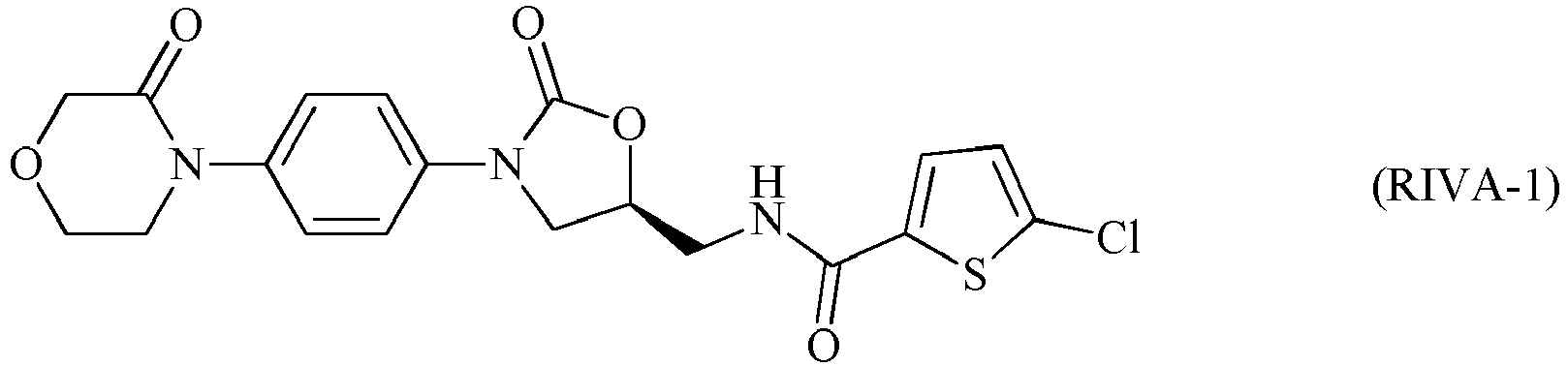
- 5-Chloro-thiophene-2-carbonyl chloride is an intermediate for the preparation of Rivaroxaban, an anti-thrombotic agent, with CAS 366789-02-8 and with the chemical name (S)-5-Chlor-N- ⁇ 2-oxo-3-[4-(3-oxomorpholin-4-yl)phenyl]-1,3-oxazolidin-5-ylmethyl ⁇ thiophen-2-carbamid and which is compound of formula (RIVA-1).
- US 4,321,399 discloses the preparation of thiophene-2-carbonyl chloride by a reaction of thiophene and phosgene in the presence of aluminum chloride and in a specific and inert organic solvent.
- thiophene is added to a premixture of phosgene and aluminum chloride in the solvent.
- the resulting mixture must be hydrolysed immediately by pouring the resulting mixture immediately into iced aqueous hydrochloric acid.
- the disclosure stresses the necessity of fast hydrolysis of the resulting mixture by advising a minimal continued contact of the thiophene with the premixture.
- halogen means F, Cl, Br or I, preferably Cl, Br or I, more preferably Cl or Br; sulfolane CAS 126-33-0 ; if not otherwise stated.
- Subject of the invention is a method for the preparation of compound of formula (III); the method comprises a step ST1; ST1 comprises a reaction REAC1 of compound of formula (II) with oxalyl chloride; REAC1 is done at a temperature TEMPI of 160 to 250°C for a time TIME1 of from 10 sec to 24 h; the molar amount of oxalyl chloride is from 1.5 to 25 times based on the molar amount of compound of formula (II);
- R1 is H or Cl.
- R1 is preferably H.
- the molar amount of oxalyl chloride is from 1.5 to 20 times, more preferably from 1.5 to 15 times, even more preferably from 1.5 to 10 times, especially from 1.5 to 7.5 times, more especially from 1.5 to 6 times, based on the molar amount of compound of formula (II).
- the molar amount of oxalyl chloride is from 1.75 to 25 times, more preferably 1.75 to 20 times, even more preferably from 1.75 to 15 times, especially from 1.75 to 10 times, more especially from 1.75 to 7.5 times, even more especially from 1.75 to 6 times, based on the molar amount of compound of formula (II).
- any excess of oxalyl chloride is recycled.
- TEMPI is from 160 to 240°C, more preferably from 160 to 230°C, even more preferably from 160 to 220°C, especially from 160 to 210°C.
- the pressure PRESS1 of REAC1 is adjusted according to the vapor pressure of the reaction mixture at the chosen TEMPI of REAC1; but PRESS 1 can also be adjusted to a higher pressure than the vapor pressure at the chosen TEMP1.
- a PRESS 1 higher than the vapor pressure of the reaction mixture at the chosen TEMPI can be adjusted for example by applying inert gas such a nitrogen or argon to the reaction vessel.
- TIME1 is from 0.1 h to 24 h, more preferably from 0.1 h to 20 h, even more preferably from 0.1 h to 7.5 h, especially from 0.1 to 6 h, more especially from 0.25 to 6 h, even more especially from 0.25 to 5.5 h.
- TIME1 is from 10 sec to 20 h, more preferably from 10 sec to 7.5 h, even more preferably from 10 sec to 6 h, especially from 10 sec to 6 h, more especially from 10 sec to 5.5 h.
- REAC1 can be done batch wise or continuously.
- DEVICE1 is preferably a tube, microreactor, shell and tube heat exchanger, plate heat exchanger and any common device which purpose is to exchange heat from or into a fluid; more preferably in a tube.
- the mixture REACMIX1 of compound of formula (II) with oxalyl chloride is heated in DEVICE1 to TEMP1.
- REAC1 takes place in DEVICE1.
- TIME1 is the time, where REACMIX1 is exposed to heating to TEMPI, preferably in DEVICE1. During TIME1 REAC1 takes place. TIME1 is therefore preferably a residence time and is preferably the residence time of REACMIX1 in DEVICE1.
- REACMIX1 from DEVICE 1 passes through a device DEVICE3, DEVICE3 is a device for back pressure regulation.
- DEVICE3 is a conventional back pressure regulating device.
- PRESS1 in DEVICE1 is adjusted, controlled and maintained by the DEVICE3.
- PRESS 1 is at least 20 bar, more preferably at least 30 bar, even more preferably at least 40 bar, especially at least 45 bar, more especially at least 50 bar, even more especially at least 55 bar, in particular at least 60 bar, more in particular at least 65 bar, even more in particular at least 70 bar, very even more in particular at least 75 bar, very, very even more in particular at least 80 bar.
- the upper limit of the pressure is mainly determined by the devices and their ability to provide and/or stand the pressure. Purely out of such considerations and without limiting the invention, PRESS 1 is preferably up to 500 bar, more preferably up to 400 bar, even more preferably up to 300 bar, especially up to 200 bar.
- PRESS 1 is from 20 to 500 bar, more preferably from 30 to 500 bar, even more preferably from 40 to 500 bar, especially from 45 to 500 bar, more especially from 50 to 500 bar, even more especially from 55 to 500 bar, in particular from 60 to 500 bar, more in particular from 65 to 500 bar, even more in particular from 70 to 400 bar, very even more in particular from 75 to 300 bar, very, very even more in particular from 80 to 200 bar.
- the feeding of compound of formula (II) and of oxalyl chloride, either separately or in form of a mixture is done by a device DEVICE0.
- DEVICE0 is a pressuring device conventionally used to convey a fluid against pressure, such as a pump.
- DEVICE0 has for each component reagent a respective device: a device DEVICE0-II for conveying the compound of formula (II), and a device DEVICEO-OXALYL for conveying the oxalyl chloride.
- DEVICE0 is the device that builds up PRESS 1 in DEVICE 1 against the DEVICE3.
- compound of formula (II) and oxalyl chloride are premixed and then are fed into DEVICE1.
- REACMIX1 can pass through a device DEVICE2 after leaving DEVICE1 and before entering DEVICE3, DEVICE2 is a device for cooling REACMIX1.
- DEVICE2 is selected from the group consisting of tube, microreactor, shell and tube heat exchanger, plate heat exchanger and any common device which purpose is to exchange heat from a reaction mixture; more preferably it is a tube.
- Any heating, preferably in DEVICE 1, can be done be any known means, preferably it is done by electric heating, microwave heating or by heating with a fluid heat carrier.
- Any cooling preferably in DEVICE2, can be done be any known means, preferably it is done by a fluid cooling medium.
- heating in DEVICE 1 and any cooling in DEVICE2 is realized in form of a tube-in-tube set up, in form of a tube-in-container set up, in form of a shell and tube heat exchanger, plate heat exchanger or any common device which purpose is to exchange heat from a mixture or a reaction mixture; more preferably, heating in DEVICE 1 and any cooling in DEVICE2 is realized in form of a tube-in-tube set up or in form of a tube-in-container set up.
- DEVICE 1 and any DEVICE2 are during operation in permanent fluid connection with each other and are both under PRESS 1.
- any herein mentioned temperature is meant to be average temperature in view of possible hot or cold spots.
- REAC1 can be done in the presence of sulfolane.
- the molar amount of sulfolane is from 2.5 to 25 times, more preferably from 5 to 25 times, even more preferably from 5 to 20 times, especially from 5 to 15 times, based on the molar amount of compound of formula (II).
- compound of formula (III) can be isolated and purified by methods well-known to those skilled in the art. These include, for instance, distillation, preferably fractional distillation, which can be done under reduced pressure, crystallization, extraction, or a combination of these methods.
- the method for preparation of compound of formula (THIOXA) starting from compound of formula (III) has a step ST3; ST3 is done after ST1; ST3 comprises a reaction REAC3, in REAC3 the compound of formula (III) is reacted with a compound of formula (IV).
- ST3 Details for ST3 are disclosed in WO 2014/008257 A2 . Specific embodiments for ST3 are disclosed in the examples 2, 3, 7, 9 and 12 of WO 2014/008257 A2
- compound of formula (IV) is selected from the group consisting of compound of formula (IV-1), compound of formula (IV-2), compound of formula (IV-3), compound of formula (IV-4), compound of formula (IV-5), compound of formula (IV-6) and compound of formula (IV-7); more preferably, compound of formula (IV) is compound of formula (IV-1) or compound of formula (IV-2).
- REAC3 is done in the presence of a solvent SOLV3.
- SOLV3 is a water-immiscible organic solvent.
- SOLV3 solubilizes compound of formula (IV) and compound of formula (THIOXA).
- SOLV3 forms an azeotrope with water.
- SOLV3 is selected from the group consisting of 2-methyltetrahydrofuran and butyl acetate; more preferably, SOLV3 is 2-methyltetrahydrofuran.
- REAC3 is done in the presence of a base BAS3.
- BAS3 is an aqueous base.
- BAS3 is selected from the group consisting of sodium hydroxide, potassium hydroxide, lithium hydroxide, and calcium hydroxide.
- the reaction mixture of REAC3 comprises an organic phase and an aqueous phase.
- the pH of the aqueous phase is greater than 8, more preferably greater than 10.
- the pH of the aqueous phase is increased or maintained by adding additional BAS3 to the reaction mixture or REAC3.
- the temperature of REAC3 is no greater than 85°C; more preferably, the temperature of REAC3 is maintained at from 55 °C to 75 °C.
- REAC3 is done in the presence of a phase transfer catalyst PTC3.
- PTC3 is selected from the group consisting of quaternary ammonium salts, phosphonium salts, and crown ethers; more preferably, PTC3 is selected from the group consisting of tetrabutylammonium hydroxide, tetrabutylammonium bromide, tetrabutylammonium fluoride, tetrabutylammonium iodide, tetrabutylphosphonium bromide, tetrabutylphosphonium chloride, and benzyltrimethylammonium hydroxide; even more preferably, PTC3 is tetrabutylammonium hydroxide.
- compound of formula (IV) is dissolved in SOLV3 prior to adding the compound of formula (III) to form the reaction mixture of REAC3.
- REAC3 is done in the presence of water.
- the method for preparation of compound of formula (RIVA-I) starting from compound of formula (III) has a step ST4; ST4 is done after ST1; ST4 comprises a reaction REAC4, in REAC4 the compound of formula (III) is reacted with a compound of formula (RIVA-Ia); preferably, R1 is Cl; more preferably, R1 is Cl and compound of formula (RIVA-Ia) is compound of formula (RIVA-1a).
- REAC4 is done in a solvent SOLV4,
- SOLV4 is selected from the group consisting of halogenated hydrocarbons, ethers, alcohols, hydrocarbons, dimethylformamide, dimethyl sulphoxide, acetonitrile, pyridine, hexamethylphosphoric triamide, water and mixtures thereof.
- Halogenated hydrocarbons are preferably selected from the group consisting of dichloromethane, trichloromethane, carbon tetrachloride, 1,2-dichloroethane, trichloroethane, tetrachloroethane, 1,2-dichloroethylene and trichloroethylene.
- Ethers are preferably selected from the group consisting of diethyl ether, methyl tert-butyl ether, dioxane, tetrahydrofuran, glycol dimethyl ether and diethylene glycol dimethyl ether.
- Alcohols are preferably selected from the group consisting of methanol, ethanol, propanol, butanol.
- Hydrocarbons are preferably selected from the group consisting of benzene, xylene, toluene, hexane and cyclohexane.
- BAS4 can be any customary inorganic or organic base.
- BAS4 is preferably selected from the group consisting of alkali metal hydroxide, alkali metal carbonate, sodium methoxide, potassium methoxide, sodium ethoxide, potassium ethoxide, potassium-tert-butoxide, amide, amine, and mixtures thereof; alkali metal hydroxide is preferably sodium hydroxide or potassium hydroxide; alkali metal carbonate is preferably sodium carbonate or potassium carbonate; amide is preferably selected from the group consisting of sodium amide, lithium bis-(trimethylsilyl)amide and lithium diisopropylamide; amine is preferably selected from the group consisting of triethylamine, diisopropylethylamine, diisopropylamine, 4-N,N-dimethylaminopyridine and pyridine.
- BAS4 can be employed in an amount of from 1 to 5 mol, preferably from 1 to 2 mol, based on 1 mol of compound of formula (RIVA-Ia).
- REAC4 is done at a reaction temperature of from -78 °C to reflux temperature, more preferably from 0 °C to reflux temperature, with the reflux temperature being the reflux temperature under the respective pressure.
- REAC4 is done at a pressure of from 0.5 to 5 bar, more preferably at atmospheric pressure.
- ST5 is done after ST1;
- ST5 comprises a reaction REAC5, in REAC5 compound of formula (III) with R1 being Cl is reacted with a compound of formula (RIVA-10);
- the reaction product of REAC5 is compound of formula (RIVA-11); preferably, after ST5 a step ST6 is done;
- ST6 comprsies a reaction REAC6, in REAC6 compound of formula (RIVA-11) is reacted with a compound of formula (RIVA-12) in the presence of phosgene or a phosgene equivalent;
- the reaction product of REAC6 is compound of formula (RIVA-13); preferably, after ST6 a step ST7 is done;
- ST7 comprises a reaction REAC7, in REAC7 compound of formula (RIVA-13) is cyclized to obtain compound of formula (RIVA-1).
- the phosgene equivalent is preferably diphosgene or triphosgene or a carbon monoxide equivalent.
- a carbon monoxide equivalent is preferably carbonyldiimidazole or disuccinimidyl carbonate.
- Compound of formula (RIVA-10) can also be used in form of a salt thereof, preferably as a hydrochloride salt.
- Compound of formula (RIVA-10) is a known compound and can be prepared according to known method, e.g. as disclosed in US Patent 6,107,519 or in US 2015/0133657 A1 .
- REAC5 is done in the presence of a base, such as sodium bicarbonate.
- REAC5 is done in a solvent, the solvent can be ethyl acetate, hexane, water, toluene or a mixture thereof.
- the reaction temperature of REAC5 is from 0 to 40 °C.
- the reaction time of REAC5 is from 0.5 to 10 h.
- the compound of formula (RIVA-11) may be isolated from the reaction mixture after REAC5 by methods including layer separation, concentration, distillation, decantation, filtration, evaporation, centrifugation, or a combination thereof, and may further be dried.
- REAC6 is done in a solvent.
- the solvent in REAC6 can be dichloromethane, dichloroethane, or a mixture thereof.
- REAC6 can be done in the presence of a base,
- the base in REAC6 can be pyridine, dimethylaminopyridine, triethylamine, sodium carbonate, potassium carbonate, or a mixture thereof; more preferably pyridine, triethylamine, sodium carbonate, potassium carbonate, or a mixture thereof.
- the reaction time of REAC6 is from 0.5 to 10 h.
- the reaction temperature of REAC6 is from 0 to 35 °C.
- the phosgen or phosgene equivalent is mixed with compound of formula (RIVA-11), optionally also with the base of REAC6, optionally in the solvent of REAC6, thereafter in a second step of REAC6 compound of formula (RIVA-12) is added.
- the reaction time of the first step of REAC6 is from 0.5 to 4 h.
- the reaction temperature of the first step of REAC6 is from 5 to 25 °C.
- the reaction time of the second step of REAC6 is from 0.5 to 6 h.
- the reaction temperature of the second step of REAC6 is from 10 to 35 °C.
- the compound of formula (RIVA-13) may be isolated from the reaction mixture after REAC6 by methods including layer separation, concentration, distillation, decantation, filtration, evaporation, centrifugation, or a combination thereof, and may further be dried.
- the cyclization of REAC7 is done in a solvent.
- the solvent in REAC7 can be acetone, acetonitrile, methanol, ethanol, isopropanol, dioxane, tetrahydofuran, water, or a mixture thereof.
- REAC7 can be done in the presence of a base.
- the base in REAC7 can be potassium carbonate, potassium bicarbonate, potassium hydroxide, sodium hydroxide, sodium carbonate, sodium bicarbonate, sodium hydride, or a mixture thereof.
- the base in REAC7 may be added to the mixture containing the compound of formula (RIVA-13) and the solvent of REAC7 or a mixture containing the compound of formula (RIVA-13) in which it is formed in REAC6.
- the reaction temperature of REAC7 is of from 10 to 40 °C.
- the reaction time of REAC7 is from 2 to 15 h.
- Compound of formula (RIVA-I), compound of formula (RIVA-II) and compound of formula (RIVA-1) may be isolated from any reaction mixture by methods including layer separation, concentration, distillation, decantation, filtration, evaporation, centrifugation, or a combination thereof, and may further be dried.
- Example 12 thiophene-2-carbonyl chloride in a tubular reactor
- a mixture of oxalyl chloride and thiophene with a molar ratio of 2 : 1 was fed by DEVICE0 with a rate of 1.01 mL/min through DEVICE 1 at an average PRESS 1 of 80 bar which was adjusted and held by the means of DEVICE3.
- DEVICE1 was maintained at a temperature of 200°C by means of a heating fluid.
- the residence time TIME1 of the mixture in DEVICE1 was 95.7 min.
- a liquid sample of 325.5 g of the reaction mixture was collected during 6.5 h. Analysis of the reaction mixture by 1 H NMR with the internal standard dioxane showed a conversion of thiophene of 100% and a yield of thiophene-2-carbonyl chloride of 90.5% based on thiophene.
- Example 13 thiophene-2-carbonyl chloride in a tubular reactor
- a mixture of oxalyl chloride and thiophene with a molar ratio of 2 : 1 was fed by DEVICE0 with a rate of 0.05 mL/min through DEVICE 1 at an average PRESS 1 of 80 bar which was adjusted and held by the means of DEVICE3.
- DEVICE1 was maintained at a temperature of 180°C by means of a heating fluid.
- the residence time TIME1 of the mixture in DEVICE 1 was 120 min.
- a liquid sample of the reaction mixture was collected and analyzed by 1 H NMR with the internal standard dioxane, yield of thiophene-2-carbonyl chloride was 79.3 % based on thiophene.
- Example 14 thiophene-2-carbonyl chloride in a tubular reactor
- DEVICE1 was maintained at a temperature of 200°C by means of a heating fluid.
- the residence time TIME1 of the mixture in DEVICE1 was 45 min.
- a liquid sample of the reaction mixture was collected and analyzed by 1 H NMR with the internal standard dioxane, yield of thiophene-2-carbonyl chloride was 93 % based on thiophene.
- Example 15 thiophene-2-carbonyl chloride in a tubular reactor
- a mixture of oxalyl chloride and thiophene with a molar ratio of 2 : 1 was fed by DEVICE0 with a rate of 1.592 mL/min through DEVICE 1 at an average PRESS 1 of 80 bar which was adjusted and held by the means of DEVICE3.
- DEVICE1 was maintained at a temperature of 227°C by means of a heating fluid.
- the residence time TIME1 of the mixture in DEVICE1 was 60.4 min.
- a liquid sample of the reaction mixture was collected and analyzed by 1 H NMR with the internal standard dioxane, yield of thiophene-2-carbonyl chloride was 85.3 % based on thiophene.
Landscapes
- Chemical & Material Sciences (AREA)
- Organic Chemistry (AREA)
- Health & Medical Sciences (AREA)
- Epidemiology (AREA)
- Medicinal Chemistry (AREA)
- Pharmacology & Pharmacy (AREA)
- Life Sciences & Earth Sciences (AREA)
- Animal Behavior & Ethology (AREA)
- General Health & Medical Sciences (AREA)
- Public Health (AREA)
- Veterinary Medicine (AREA)
- Plural Heterocyclic Compounds (AREA)
- Heterocyclic Compounds Containing Sulfur Atoms (AREA)
- Low-Molecular Organic Synthesis Reactions Using Catalysts (AREA)
Description
- The invention discloses a method for the preparation of thiophene-2-carbonyl chlorides starting from thiophenes with oxalyl chloride at elevated temperature with short reaction time.
- Thiophene-2-carbonyl chlorides are important synthetic intermediates, for instance for the synthesis of drugs and agrochemicals. They can be prepared by a number of different routes, each having advantages and disadvantages. Of particular interest are methods that only require inexpensive starting materials and reagents, are easy to perform, and generate only small amounts of waste.
- Thiophene-2-carbonyl chloride is an intermediate for the preparation of Tioxazafen, a nematicide, with CAS 330459-31-9 and with the chemical name 3-phenyl-5-(thiophen-2-yl)-1,2,4-oxadiazole and which is the compound of formula (THIOXA-1).

-
WO 2014/008257 A2 discloses the preparation of compound of formula (THIOXA-1). - 5-Chloro-thiophene-2-carbonyl chloride is an intermediate for the preparation of Rivaroxaban, an anti-thrombotic agent, with CAS 366789-02-8 and with the chemical name (S)-5-Chlor-N-{2-oxo-3-[4-(3-oxomorpholin-4-yl)phenyl]-1,3-oxazolidin-5-ylmethyl}thiophen-2-carbamid and which is compound of formula (RIVA-1).
-
US 2003/0153610 A1 discloses Rivaroxaban and a method for its preparation,US 2015/0133657 A1 discloses another method for its preparation,US Patent 6,107,519 discloses certain precursors used in said preparation. -
US 4,321,399 discloses the preparation of thiophene-2-carbonyl chloride by a reaction of thiophene and phosgene in the presence of aluminum chloride and in a specific and inert organic solvent. In this method thiophene is added to a premixture of phosgene and aluminum chloride in the solvent. After the addition of thiophene the resulting mixture must be hydrolysed immediately by pouring the resulting mixture immediately into iced aqueous hydrochloric acid. The disclosure stresses the necessity of fast hydrolysis of the resulting mixture by advising a minimal continued contact of the thiophene with the premixture. Furthermore also higher concentration of thiophene are stated to have a negative effect on the yield, a content of only 5 to 10% of thiophene in the resulting mixture is advised. Therefore a continuous stream reaction is suggested in order to control these critical parameters, but such a continuous stream reaction is not disclosed. A draw back of a continuous reaction for the disclosed method is the insolubility of aluminum chloride in the solvent, because a suspension is formed which creates difficulties when conveyed by pumping through a continuous reactor set up due to clogging. Obviously when the disclosed reaction needs to be scaled up for production the disclosed "immediate hydrolysis" is no longer feasible, therefore the continuous reactor set up is actually mandatorily needed to ensure the required "immediate hydrolysis". - Edwards et al. in J. Org. Chem. 1966, 31, 1283 to 1285, disclose on page 1284 right coloumn second paragraph, that thiophene is sensitive to acids and polymerizes to tar upon treatment with aluminum chloride: "With thiophene, aluminum chloride, and the same anhydride, tar formation was so great that the results were meaningless".
- Also Geobaldo et al., Phys. Chem. Chem. Phys., 1999, 1, 561 to 569, warns on page 561 right column last paragraph, that thiophene is not stable under acidic conditions and is prone to electrophilic attack with the formation of stable oligomeric compounds.
- Kuehnhanss et al., Journal für Praktische Chemie, 1956, 3, 137 to 145, reports specifically on page 144 a reaction of thiophene with oxalyl chloride at reflux temperature, which is below the boiling point of 61°C for oxalyl chloride and of 84°C for thiophene, followed by distillation and saponification, with a yield of 36.5% of thiophene-2-carboxylic acid. Reported on page 140 is an optimum of 60 h for the conversion, resulting in a yield of ca. 35%. Longer reaction times result in black condensation products, after 90 h no carbonyl chloride can be isolated anymore. The use of oxalyl chloride compared to the use of the carbamoyl chloride shows that oxalyl chloride has lower reactivity resulting in harder reaction conditions and lower yield (page 140), and therefore presents oxalyl chloride as a lesser attractive carboxylating agent than carbamoyl chloride. Carbamoyl chloride as carboxylating agent results in the formation of thiophene-2-carboxamide, which needs saponification with e.g. a base to provide the free acid, which again needs a conversion step to obtain the desired carbonyl chloride.
Comparative example 1 shows that even a molar excess of oxalyl choride of 5 times under the reaction conditions of Kuehnhanss did not improve the yield, but lowered the yield to ca. 9%. - There was a need for a method for preparation of thiophene-2-carbonyl chlorides that has few steps, with high yields, that does not need aluminum chloride or ammonium chloride, that does not create large amounts of salt as aluminum chloride for example would do, and that does not require mandatorily the use of a continuous reactor set up when it is scaled up for production.
- Unexpectedly a method for preparation of thiophene-2-carbonyl chlorides starting from inexpensive thiophenes with oxalyl chloride was found which meets the needs mentioned above. Edwards, Geobaldo and Kuehnhanns stress the sensitivity of thiophenes against acid and its disposition to formation of oligomers and even tar at elevated temperature. Especially Kuehnhanns reports the formation of tar even at a low temperature resulting from the boiling point of oxalyl chloride. These comments discourage any treatment of thiophenes at elevated temperature above the boiling point of oxalyl chloride, especially not in the presence of acid. Contrary to this premonitions significantly higher yields compared to Kuehnhanns can be obtained at significantly higher temperatures than reported by Kuehnhanns. The purities are comparatively high, the reaction time is significantly shorter, no aluminum chloride is required, and the conversion of the thiophenes is complete. Despite the sensitivity of thiophenes towards acids, no significant amounts of byproducts are formed. Not steps such a saponification and conversion of a free acid to the acid chloride is required.
- The following meanings are used,
halogen means F, Cl, Br or I, preferably Cl, Br or I, more preferably Cl or Br; sulfolane CAS 126-33-0; - Subject of the invention is a method for the preparation of compound of formula (III);

ST1 comprises a reaction REAC1 of compound of formula (II) with oxalyl chloride;
REAC1 is done at a temperature TEMPI of 160 to 250°C for a time TIME1 of from 10 sec to 24 h;
the molar amount of oxalyl chloride is from 1.5 to 25 times based on the molar amount of compound of formula (II);
- R1 is H or Cl.
- R1 is preferably H.
- Preferably, the molar amount of oxalyl chloride is from 1.5 to 20 times, more preferably from 1.5 to 15 times, even more preferably from 1.5 to 10 times, especially from 1.5 to 7.5 times, more especially from 1.5 to 6 times, based on the molar amount of compound of formula (II).
- In another preferred embodiment, the molar amount of oxalyl chloride is from 1.75 to 25 times, more preferably 1.75 to 20 times, even more preferably from 1.75 to 15 times, especially from 1.75 to 10 times, more especially from 1.75 to 7.5 times, even more especially from 1.75 to 6 times, based on the molar amount of compound of formula (II).
- Preferably, any excess of oxalyl chloride is recycled.
- Preferably, TEMPI is from 160 to 240°C, more preferably from 160 to 230°C, even more preferably from 160 to 220°C, especially from 160 to 210°C.
- Preferably, the pressure PRESS1 of REAC1 is adjusted according to the vapor pressure of the reaction mixture at the chosen TEMPI of REAC1; but PRESS 1 can also be adjusted to a higher pressure than the vapor pressure at the chosen TEMP1. A PRESS 1 higher than the vapor pressure of the reaction mixture at the chosen TEMPI can be adjusted for example by applying inert gas such a nitrogen or argon to the reaction vessel.
- Preferably, TIME1 is from 0.1 h to 24 h, more preferably from 0.1 h to 20 h, even more preferably from 0.1 h to 7.5 h, especially from 0.1 to 6 h, more especially from 0.25 to 6 h, even more especially from 0.25 to 5.5 h.
In another preferred embodiment, TIME1 is from 10 sec to 20 h, more preferably from 10 sec to 7.5 h, even more preferably from 10 sec to 6 h, especially from 10 sec to 6 h, more especially from 10 sec to 5.5 h. - REAC1 can be done batch wise or continuously.
- In case that REAC1 is done continuously, than preferably REAC1 is done in a device DEVICE1; DEVICE1 is preferably a tube, microreactor, shell and tube heat exchanger, plate heat exchanger and any common device which purpose is to exchange heat from or into a fluid;
more preferably in a tube.
The mixture REACMIX1 of compound of formula (II) with oxalyl chloride is heated in DEVICE1 to TEMP1.
Preferably REAC1 takes place in DEVICE1. - Preferably, TIME1 is the time, where REACMIX1 is exposed to heating to TEMPI, preferably in DEVICE1. During TIME1 REAC1 takes place. TIME1 is therefore preferably a residence time and is preferably the residence time of REACMIX1 in DEVICE1.
- Preferably, REACMIX1 from DEVICE 1 passes through a device DEVICE3, DEVICE3 is a device for back pressure regulation.
Preferably, DEVICE3 is a conventional back pressure regulating device. - PRESS1 in DEVICE1 is adjusted, controlled and maintained by the DEVICE3.
- Conventional back pressure regulating devices, which can be used for DEVICE3, work either continuously or discontinually, i.e. by alternatingly opening and closing they release the product stream while holding the pressure. This leads naturally to variations in the pressure. In view of these possible variations of PRESS 1 any pressure mentioned herein is meant to be an average pressure. Typical variations of the pressure are from +/- 1 to +/- 5 bar.
- Preferably, PRESS 1 is at least 20 bar, more preferably at least 30 bar, even more preferably at least 40 bar, especially at least 45 bar, more especially at least 50 bar, even more especially at least 55 bar, in particular at least 60 bar, more in particular at least 65 bar, even more in particular at least 70 bar, very even more in particular at least 75 bar, very, very even more in particular at least 80 bar.
The upper limit of the pressure is mainly determined by the devices and their ability to provide and/or stand the pressure. Purely out of such considerations and without limiting the invention, PRESS 1 is preferably up to 500 bar, more preferably up to 400 bar, even more preferably up to 300 bar, especially up to 200 bar.
Preferably, PRESS 1 is from 20 to 500 bar, more preferably from 30 to 500 bar, even more preferably from 40 to 500 bar, especially from 45 to 500 bar, more especially from 50 to 500 bar, even more especially from 55 to 500 bar, in particular from 60 to 500 bar, more in particular from 65 to 500 bar, even more in particular from 70 to 400 bar, very even more in particular from 75 to 300 bar, very, very even more in particular from 80 to 200 bar. - Preferably, the feeding of compound of formula (II) and of oxalyl chloride, either separately or in form of a mixture, is done by a device DEVICE0.
- DEVICE0 is a pressuring device conventionally used to convey a fluid against pressure, such as a pump. When compound of formula (II) and oxalyl chloride are fed separately into DEVICE1, then preferably DEVICE0 has for each component reagent a respective device: a device DEVICE0-II for conveying the compound of formula (II), and a device DEVICEO-OXALYL for conveying the oxalyl chloride.
Preferably, DEVICE0 is the device that builds up PRESS 1 in DEVICE 1 against the DEVICE3. - Preferably, compound of formula (II) and oxalyl chloride are premixed and then are fed into DEVICE1.
- REACMIX1 can pass through a device DEVICE2 after leaving DEVICE1 and before entering DEVICE3, DEVICE2 is a device for cooling REACMIX1.
- Preferably, DEVICE2 is selected from the group consisting of tube, microreactor, shell and tube heat exchanger, plate heat exchanger and any common device which purpose is to exchange heat from a reaction mixture;
more preferably it is a tube. - Any heating, preferably in DEVICE 1, can be done be any known means, preferably it is done by electric heating, microwave heating or by heating with a fluid heat carrier.
- Any cooling, preferably in DEVICE2, can be done be any known means, preferably it is done by a fluid cooling medium.
- Preferably, heating in DEVICE 1 and any cooling in DEVICE2 is realized in form of a tube-in-tube set up, in form of a tube-in-container set up, in form of a shell and tube heat exchanger, plate heat exchanger or any common device which purpose is to exchange heat from a mixture or a reaction mixture;
more preferably, heating in DEVICE 1 and any cooling in DEVICE2 is realized in form of a tube-in-tube set up or in form of a tube-in-container set up. - Preferably, DEVICE 1 and any DEVICE2 are during operation in permanent fluid connection with each other and are both under PRESS 1.
- In case of DEVICE 1 being a tube, then due to constructional limitations or due to density fluctuations and the like hot spots or cold spots can occur in spite of efforts to avoid them. Therefore any herein mentioned temperature is meant to be average temperature in view of possible hot or cold spots.
- REAC1 can be done in the presence of sulfolane.
- Preferably, the molar amount of sulfolane is from 2.5 to 25 times, more preferably from 5 to 25 times, even more preferably from 5 to 20 times, especially from 5 to 15 times, based on the molar amount of compound of formula (II).
- After ST1, compound of formula (III) can be isolated and purified by methods well-known to those skilled in the art. These include, for instance, distillation, preferably fractional distillation, which can be done under reduced pressure, crystallization, extraction, or a combination of these methods.
- Further subject of the invention is a method for the preparation of compound of formula (THIOXA);

- R30, R31, R32, R33 and R34 are identical or different and independently from each other selected from the group consisting of H, halogen, CF3, CH3, OCF3, OCH3, CN and C(H)O;
- wherein ST1 and R1 are as defined herein, also with all their embodiments;
- especially wherein R1 is H;
- in another especial embodiment R30, R31, R32, R33 and R34 are H;
- more especially wherein R1, R30, R31, R32, R33 and R34 are H.
- Preferably, the method for preparation of compound of formula (THIOXA) starting from compound of formula (III) has a step ST3;
ST3 is done after ST1;
ST3 comprises a reaction REAC3, in REAC3 the compound of formula (III) is reacted with a compound of formula (IV).
- Details for ST3 are disclosed in
WO 2014/008257 A2 .
Specific embodiments for ST3 are disclosed in the examples 2, 3, 7, 9 and 12 ofWO 2014/008257 A2 - Preferably, compound of formula (IV) is selected from the group consisting of compound of formula (IV-1), compound of formula (IV-2), compound of formula (IV-3), compound of formula (IV-4), compound of formula (IV-5), compound of formula (IV-6) and compound of formula (IV-7);


- When compound of formula (III) is brought into contact with compound of formula (IV) a reaction mixture is formed.
- Preferably, REAC3 is done in the presence of a solvent SOLV3.
Preferably, SOLV3 is a water-immiscible organic solvent.
Preferably, SOLV3 solubilizes compound of formula (IV) and compound of formula (THIOXA).
Preferably, SOLV3 forms an azeotrope with water.
Preferably, SOLV3 is selected from the group consisting of 2-methyltetrahydrofuran and butyl acetate;
more preferably, SOLV3 is 2-methyltetrahydrofuran. - Preferably, REAC3 is done in the presence of a base BAS3.
Preferably, BAS3 is an aqueous base.
Preferably, BAS3 is selected from the group consisting of sodium hydroxide, potassium hydroxide, lithium hydroxide, and calcium hydroxide. - Preferably, the reaction mixture of REAC3 comprises an organic phase and an aqueous phase.
Preferably, the pH of the aqueous phase is greater than 8, more preferably greater than 10.
Preferably, the pH of the aqueous phase is increased or maintained by adding additional BAS3 to the reaction mixture or REAC3. - Preferably, the temperature of REAC3 is no greater than 85°C;
more preferably, the temperature of REAC3 is maintained at from 55 °C to 75 °C. - Preferably, REAC3 is done in the presence of a phase transfer catalyst PTC3.
Preferably, PTC3 is selected from the group consisting of quaternary ammonium salts, phosphonium salts, and crown ethers;
more preferably, PTC3 is selected from the group consisting of tetrabutylammonium hydroxide, tetrabutylammonium bromide, tetrabutylammonium fluoride, tetrabutylammonium iodide, tetrabutylphosphonium bromide, tetrabutylphosphonium chloride, and benzyltrimethylammonium hydroxide;
even more preferably, PTC3 is tetrabutylammonium hydroxide. - Preferably, compound of formula (IV) is dissolved in SOLV3 prior to adding the compound of formula (III) to form the reaction mixture of REAC3.
- Preferably, REAC3 is done in the presence of water.
- Further subject of the invention is a method for the preparation of compound of formula (RIVA-I);
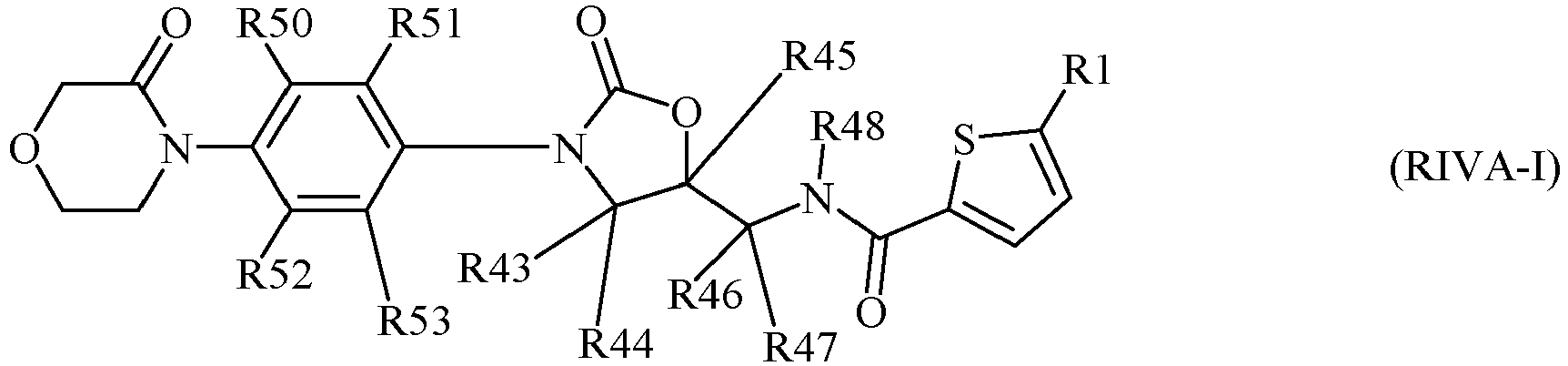
- R50, R51, R52 and R53 are identical or different and independently of one another each is selected from the group consisting of H, halogen, CF3, CN, NO2, C(O)-NH2, C(O)-C1-6 alkyl, O-R60; N(R60)R61 and C1-6 alkyl;
- R60 and R61 are identical or different and independently of one another each is selected from the group consisting of H, C1-4 alkyl and C(O)R63;
- R63 is selected from the group consisting of C1-4 alkyl-NH2, NH2, NH-C1-4 alkyl, N(C1-4 alkyl)C1-4 alkyl and C1-8 alkyl;
- R43, R44, R45, R46, R47 and R48 are identical or different and independently of one another each represents H or C1-6 alkyl;
- wherein the method comprises the step ST1;
- wherein ST1 and R1 are as defined herein, also with all their embodiments; preferably, R1 is Cl;
- especially wherein the compound of formula (RIVA-I) is the compound of formula (RIVA-II);

- wherein R50, R51, R52, R53, R43, R44, R45, R46, R47 and R48 are as defined herein, also with all their embodiments;
- more especially wherein the compound of formula (RIVA-I) is the compound of formula (RIVA-1).
- Preferably, the method for preparation of compound of formula (RIVA-I) starting from compound of formula (III) has a step ST4;
ST4 is done after ST1;
ST4 comprises a reaction REAC4, in REAC4 the compound of formula (III) is reacted with a compound of formula (RIVA-Ia);
more preferably, R1 is Cl and compound of formula (RIVA-Ia) is compound of formula (RIVA-1a).
- Details for ST4 are disclosed in
US 2003/0153610 A1 . - Preferably, REAC4 is done in a solvent SOLV4, SOLV4 is selected from the group consisting of halogenated hydrocarbons, ethers, alcohols, hydrocarbons, dimethylformamide, dimethyl sulphoxide, acetonitrile, pyridine, hexamethylphosphoric triamide, water and mixtures thereof.
- Halogenated hydrocarbons are preferably selected from the group consisting of dichloromethane, trichloromethane, carbon tetrachloride, 1,2-dichloroethane, trichloroethane, tetrachloroethane, 1,2-dichloroethylene and trichloroethylene.
Ethers are preferably selected from the group consisting of diethyl ether, methyl tert-butyl ether, dioxane, tetrahydrofuran, glycol dimethyl ether and diethylene glycol dimethyl ether.
Alcohols are preferably selected from the group consisting of methanol, ethanol, propanol, butanol.
Hydrocarbons are preferably selected from the group consisting of benzene, xylene, toluene, hexane and cyclohexane. - REAC4 can be done in the presence of a base BAS4, BAS4 can be any customary inorganic or organic base.
BAS4 is preferably selected from the group consisting of alkali metal hydroxide, alkali metal carbonate, sodium methoxide, potassium methoxide, sodium ethoxide, potassium ethoxide, potassium-tert-butoxide, amide, amine, and mixtures thereof; alkali metal hydroxide is preferably sodium hydroxide or potassium hydroxide; alkali metal carbonate is preferably sodium carbonate or potassium carbonate; amide is preferably selected from the group consisting of sodium amide, lithium bis-(trimethylsilyl)amide and lithium diisopropylamide;
amine is preferably selected from the group consisting of triethylamine, diisopropylethylamine, diisopropylamine, 4-N,N-dimethylaminopyridine and pyridine. - BAS4 can be employed in an amount of from 1 to 5 mol, preferably from 1 to 2 mol, based on 1 mol of compound of formula (RIVA-Ia).
- Preferably, REAC4 is done at a reaction temperature of from -78 °C to reflux temperature, more preferably from 0 °C to reflux temperature, with the reflux temperature being the reflux temperature under the respective pressure.
Preferably, REAC4 is done at a pressure of from 0.5 to 5 bar, more preferably at atmospheric pressure. - In case that compound of formula (RIVA-I) is compound of formula (RIVA-1) and R1 is Cl, then in another preferred embodiment the preparation of compound of formula (RIVA-1) starting from compound of formula (III) with R1 being Cl has a step ST5;
details for ST5 are disclosed inUS 2015/0133657 A1 ; - ST5 is done after ST1;
ST5 comprises a reaction REAC5, in REAC5 compound of formula (III) with R1 being Cl is reacted with a compound of formula (RIVA-10);

ST6 comprsies a reaction REAC6, in REAC6 compound of formula (RIVA-11) is reacted with a compound of formula (RIVA-12) in the presence of phosgene or a phosgene equivalent;

ST7 comprises a reaction REAC7, in REAC7 compound of formula (RIVA-13) is cyclized to obtain compound of formula (RIVA-1). - The phosgene equivalent is preferably diphosgene or triphosgene or a carbon monoxide equivalent.
A carbon monoxide equivalent is preferably carbonyldiimidazole or disuccinimidyl carbonate. - Compound of formula (RIVA-10) can also be used in form of a salt thereof, preferably as a hydrochloride salt. Compound of formula (RIVA-10) is a known compound and can be prepared according to known method, e.g. as disclosed in
US Patent 6,107,519 or inUS 2015/0133657 A1 . - Preferably, REAC5 is done in the presence of a base, such as sodium bicarbonate.
Preferably, REAC5 is done in a solvent, the solvent can be ethyl acetate, hexane, water, toluene or a mixture thereof.
Preferably, the reaction temperature of REAC5 is from 0 to 40 °C.
Preferably, the reaction time of REAC5 is from 0.5 to 10 h.
The compound of formula (RIVA-11) may be isolated from the reaction mixture after REAC5 by methods including layer separation, concentration, distillation, decantation, filtration, evaporation, centrifugation, or a combination thereof, and may further be dried. - Preferably, REAC6 is done in a solvent. The solvent in REAC6 can be dichloromethane, dichloroethane, or a mixture thereof.
REAC6 can be done in the presence of a base, The base in REAC6 can be pyridine, dimethylaminopyridine, triethylamine, sodium carbonate, potassium carbonate, or a mixture thereof; more preferably pyridine, triethylamine, sodium carbonate, potassium carbonate, or a mixture thereof.
Preferably, the reaction time of REAC6 is from 0.5 to 10 h. - Preferably, the reaction temperature of REAC6 is from 0 to 35 °C.
Preferably, in a first step of REAC6 the phosgen or phosgene equivalent is mixed with compound of formula (RIVA-11), optionally also with the base of REAC6, optionally in the solvent of REAC6, thereafter in a second step of REAC6 compound of formula (RIVA-12) is added.
Preferably, the reaction time of the first step of REAC6 is from 0.5 to 4 h.
Preferably, the reaction temperature of the first step of REAC6 is from 5 to 25 °C.
Preferably, the reaction time of the second step of REAC6 is from 0.5 to 6 h.
Preferably, the reaction temperature of the second step of REAC6 is from 10 to 35 °C.
The compound of formula (RIVA-13) may be isolated from the reaction mixture after REAC6 by methods including layer separation, concentration, distillation, decantation, filtration, evaporation, centrifugation, or a combination thereof, and may further be dried. - Preferably, the cyclization of REAC7 is done in a solvent. The solvent in REAC7 can be acetone, acetonitrile, methanol, ethanol, isopropanol, dioxane, tetrahydofuran, water, or a mixture thereof.
REAC7 can be done in the presence of a base. The base in REAC7 can be potassium carbonate, potassium bicarbonate, potassium hydroxide, sodium hydroxide, sodium carbonate, sodium bicarbonate, sodium hydride, or a mixture thereof.
The base in REAC7 may be added to the mixture containing the compound of formula (RIVA-13) and the solvent of REAC7 or a mixture containing the compound of formula (RIVA-13) in which it is formed in REAC6.
Preferably, the reaction temperature of REAC7 is of from 10 to 40 °C.
Preferably, the reaction time of REAC7 is from 2 to 15 h. - Compound of formula (RIVA-I), compound of formula (RIVA-II) and compound of formula (RIVA-1) may be isolated from any reaction mixture by methods including layer separation, concentration, distillation, decantation, filtration, evaporation, centrifugation, or a combination thereof, and may further be dried.
- Internal standard for 1H NMR: Triisobutyl phosphate, if not otherwise stated
- A mixture of thiophene (11.2 ml, 0.14 mol) and oxalyl chloride (47.6 ml, 0.56 mol) was stirred in an autoclave at 200 °C for 2 h, whereby the pressure increased to 40 bar. Distillation of the resulting mixture under reduced pressure yielded 11.8 g (58% yield) of thiophene-2-carbonyl chloride.
1H NMR (CDCl3, 400 MHz) delta = 7.99 (d, br, J = 4 Hz, 1H), 7.83 (d, br, J = 4 Hz, 1H), 7.20 (t, J = 4 Hz, 1H). - A sample of a mixture of oxalyl chloride and thiophene (2 : 1, molar ratio) was heated in a closed vessel to 200 °C for 2 h. Analysis of the reaction mixture by 1H NMR with an internal standard indicated a conversion of thiophene of 100% and a yield of thiophene-2-carbonyl chloride of 72%.
- 3 mmol thiophene were used in examples 2 to 5, 0.1 mmol thiophene were used in examples 6 to 9.
Example m.r.(1) T [°C] t conv(2) yield(3) 3 5 200 2.0 h 100% 68% 4 5 200 5.0 h 100% 60% 5 2 200 1.0 h 99% 62% 6 2(4) 180 1.5 h 100% 83% 7 2(4) 180 0.5 h 81% 57% 8 2(4) 170 1.5 h 98% 83% 9 2(4) 170 3.0 h 100% 82% (1) m.r.: molar ratio of oxalyl chloride to thiophene
(2) conv: conversion of thiophene
(3) yield of thiophene-2-carbonyl chloride
(4) sulfolane (10 mol% of amount of thiophene) was added to the mixture of oxalyl chloride and thiophene before the heating in the closed vessel - A mixture of oxalyl chloride, 2-chlorothiophene and sulfolane (3 : 1 : 0.33, molar ratio) was heated in a closed vessel to 180 °C for 1 h 40 min. Analysis of the reaction mixture by 1H NMR indicated a conversion of 2-chlorothiophene of 85% and a yield of 5-chlorothiophene-2-carbonyl chloride of 71%.
1H NMR (CDCl3, 400 MHz) delta = 7.79 (d, J = 4 Hz, 1H), 7.04 (d, J = 4 Hz, 1H). 13C NMR (CDCl3, 100 MHz) delta = 158.8, 143.3, 137.6, 135.2, 128.3. - A mixture of oxalyl chloride, 2-chlorothiophene and sulfolane (3 : 1 : 0.33, molar ratio) was heated in a closed vessel to 165 °C for 17.5 h. Analysis of the reaction mixture by 1H NMR indicated a conversion of 2-chlorothiophene of 100% and a yield of 5-chlorothiophene-2-carbonyl chloride of 100%.
- A mixture of oxalyl chloride and thiophene in the molar ratio of 5 : 1 was stirred under reflux for 60 h. Distillation of the reaction mixture yielded 2-thiophenecarbonyl chloride in ca. 9% yield.
-
- DEVICEO: piston pump 260D from ISCO Teledyne
- DEVICE 1: tubular reactor with a length of 6 m, with an internal volume of 96.16 mL and an outer diameter of 0.25 inch
- DEVICE3: pressure control valve Swagelok BPV-SS-07
- A mixture of oxalyl chloride and thiophene with a molar ratio of 2 : 1 was fed by DEVICE0 with a rate of 1.01 mL/min through DEVICE 1 at an average PRESS 1 of 80 bar which was adjusted and held by the means of DEVICE3. DEVICE1 was maintained at a temperature of 200°C by means of a heating fluid. The residence time TIME1 of the mixture in DEVICE1 was 95.7 min. A liquid sample of 325.5 g of the reaction mixture was collected during 6.5 h. Analysis of the reaction mixture by 1H NMR with the internal standard dioxane showed a conversion of thiophene of 100% and a yield of thiophene-2-carbonyl chloride of 90.5% based on thiophene.
-
- DEVICEO: piston pump 260D from ISCO Teledyne
- DEVICE1 : tubular reactor with a length of 6 m, with an internal volume of 5.86 mL and an outer diameter of 0.0625 inch
- DEVICE3: pressure control valve Swagelok BPV-SS-07
- A mixture of oxalyl chloride and thiophene with a molar ratio of 2 : 1 was fed by DEVICE0 with a rate of 0.05 mL/min through DEVICE 1 at an average PRESS 1 of 80 bar which was adjusted and held by the means of DEVICE3. DEVICE1 was maintained at a temperature of 180°C by means of a heating fluid. The residence time TIME1 of the mixture in DEVICE 1 was 120 min. A liquid sample of the reaction mixture was collected and analyzed by 1H NMR with the internal standard dioxane, yield of thiophene-2-carbonyl chloride was 79.3 % based on thiophene.
-
- DEVICEO: piston pump 260D from ISCO Teledyne
- DEVICE 1: tubular reactor with a length of 6 m, with an internal volume of 96.16 mL and an outer diameter of 0.25 inch
- DEVICE3: pressure control valve Swagelok BPV-SS-07
- A mixture MIX1 containing 90 wt% of a mixture MIX2 of oxalyl chloride and thiophene with a molar ratio of 2 : 1, and 10 wt% sulfolane, the wt% being based on the total weight of the MIX1, was fed by DEVICE0 with a rate of 2.14 mL/min through DEVICE1 at an average PRESS1 of 80 bar which was adjusted and held by the means of DEVICE3. DEVICE1 was maintained at a temperature of 200°C by means of a heating fluid. The residence time TIME1 of the mixture in DEVICE1 was 45 min. A liquid sample of the reaction mixture was collected and analyzed by 1H NMR with the internal standard dioxane, yield of thiophene-2-carbonyl chloride was 93 % based on thiophene.
-
- DEVICEO: piston pump 260D from ISCO Teledyne
- DEVICE 1: tubular reactor with a length of 6 m, with an internal volume of 96.16 mL and an outer diameter of 0.25 inch
- DEVICE3: pressure control valve Swagelok BPV-SS-07
- A mixture of oxalyl chloride and thiophene with a molar ratio of 2 : 1 was fed by DEVICE0 with a rate of 1.592 mL/min through DEVICE 1 at an average PRESS 1 of 80 bar which was adjusted and held by the means of DEVICE3. DEVICE1 was maintained at a temperature of 227°C by means of a heating fluid. The residence time TIME1 of the mixture in DEVICE1 was 60.4 min. A liquid sample of the reaction mixture was collected and analyzed by 1H NMR with the internal standard dioxane, yield of thiophene-2-carbonyl chloride was 85.3 % based on thiophene.
Claims (14)
- Method for the preparation of compound of formula (III);

ST1 comprises a reaction REAC1 of compound of formula (II) with oxalyl chloride;
REAC1 is done at a temperature TEMPI of 160 to 250°C for a time TIME1 of from 10 sec to 24 h;
the molar amount of oxalyl chloride is from 1.5 to 25 times based on the molar amount of compound of formula (II);
- Method according to claim 1, wherein
R1 is preferably H. - Method according to claim 1 or 2, wherein
the molar amount of oxalyl chloride is from 1.75 to 25 times based on the molar amount of compound of formula (II). - Method according to one or more of claims 1 to 3, wherein
TEMPI is from 160 to 240°C. - Method according to one or more of claims 1 to 4, wherein
TIME1 is from 10 sec to 20 h. - Method according to one or more of claims 1 to 5, wherein
REAC1 is be done in the presence of sulfolane. - Method according to claim 6, wherein
the molar amount of sulfolane is from 2.5 to 25 times based on the molar amount of compound of formula (II). - Method according to one or more of claims 1 to 7, wherein
REAC1 is done continuously. - Method for the preparation of compound of formula (THIOXA);
 wherein the method comprises the step ST1;R30, R31, R32, R33 and R34 are identical or different and independently from each other selected from the group consisting of H, halogen, CF3, CH3, OCF3, OCH3, CN and C(H)O;wherein ST1 is as defined in one or more of claims 1 to 8;R1 is as defined in claim 1 or 2.
 - Method according to claim 9, wherein
R30, R31, R32, R33 and R34 are H. - Method according to claim 9 or 10, wherein
R1 is H. - Method for the preparation of compound of formula (RIVA-I);
 R50, R51, R52 and R53 are identical or different and independently of one another each is selected from the group consisting of H, halogen, CF3, CN, NO2, C(O)-NH2, C(O)-C1-6 alkyl, O-R60; N(R60)R61 and C1-6 alkyl;R60 and R61 are identical or different and independently of one another each is selected from the group consisting of H, C1-4 alkyl and C(O)R63;R63 is selected from the group consisting of C1-4 alkyl-NH2, NH2, NH-C1-4 alkyl, N(C1-4 alkyl)C1-4 alkyl and C1-8 alkyl;R43, R44, R45, R46, R47 and R48 are identical or different and independently of one another each represents H or C1-6 alkyl;wherein the method comprises the step ST1;wherein ST1 is as defined in one or more of claims 1 to 8;R1 is as defined in claim 1 or 2.
 - Method according to claim 12, wherein
R1 is H. - Method according to claim 12, wherein
the compound of formula (RIVA-I) is the compound of formula (RIVA-1).
Applications Claiming Priority (10)
| Application Number | Priority Date | Filing Date | Title |
|---|---|---|---|
| US201562250587P | 2015-11-04 | 2015-11-04 | |
| EP15192880 | 2015-11-04 | ||
| EP16150309 | 2016-01-06 | ||
| EP16150642 | 2016-01-08 | ||
| EP16150583 | 2016-01-08 | ||
| EP16150854 | 2016-01-12 | ||
| EP16151908 | 2016-01-19 | ||
| EP16156620 | 2016-02-22 | ||
| EP16182376 | 2016-08-02 | ||
| PCT/EP2016/076317 WO2017076844A1 (en) | 2015-11-04 | 2016-11-02 | Method for preparation of thiophene-2-carbonyl chlorides with oxalyl chloride |
Publications (2)
| Publication Number | Publication Date |
|---|---|
| EP3325476A1 EP3325476A1 (en) | 2018-05-30 |
| EP3325476B1 true EP3325476B1 (en) | 2018-09-26 |
Family
ID=58662848
Family Applications (1)
| Application Number | Title | Priority Date | Filing Date |
|---|---|---|---|
| EP16790589.2A Not-in-force EP3325476B1 (en) | 2015-11-04 | 2016-11-02 | Method for preparation of thiophene-2-carbonyl chlorides |
Country Status (7)
| Country | Link |
|---|---|
| US (1) | US10112921B2 (en) |
| EP (1) | EP3325476B1 (en) |
| JP (1) | JP6410989B2 (en) |
| KR (1) | KR101880881B1 (en) |
| CN (1) | CN108290877A (en) |
| TW (1) | TW201720807A (en) |
| WO (1) | WO2017076844A1 (en) |
Families Citing this family (1)
| Publication number | Priority date | Publication date | Assignee | Title |
|---|---|---|---|---|
| CN109400577B (en) * | 2019-01-07 | 2021-01-19 | 石药集团中奇制药技术(石家庄)有限公司 | Rivaroxaban related compound and preparation method and application thereof |
Family Cites Families (5)
| Publication number | Priority date | Publication date | Assignee | Title |
|---|---|---|---|---|
| US4321399A (en) | 1978-06-21 | 1982-03-23 | Smithkline Corporation | Preparation of 2-thiophenecarbonyl chloride |
| CA2304100A1 (en) | 1997-11-07 | 1999-05-20 | Pharmacia & Upjohn Company | Process to produce oxazolidinones |
| DE19962924A1 (en) | 1999-12-24 | 2001-07-05 | Bayer Ag | Substituted oxazolidinones and their use |
| IN2014DN10209A (en) | 2012-05-24 | 2015-08-07 | Ranbaxy Lab Ltd | |
| CA2876215A1 (en) * | 2012-07-02 | 2014-01-09 | Monsanto Technology Llc | Processes for the preparation of 3,5-disubstituted-1,2,4-oxadiazoles |
-
2016
- 2016-11-02 CN CN201680053633.6A patent/CN108290877A/en active Pending
- 2016-11-02 TW TW105135406A patent/TW201720807A/en unknown
- 2016-11-02 EP EP16790589.2A patent/EP3325476B1/en not_active Not-in-force
- 2016-11-02 JP JP2018506382A patent/JP6410989B2/en not_active Expired - Fee Related
- 2016-11-02 US US15/751,957 patent/US10112921B2/en not_active Expired - Fee Related
- 2016-11-02 KR KR1020187008999A patent/KR101880881B1/en not_active Expired - Fee Related
- 2016-11-02 WO PCT/EP2016/076317 patent/WO2017076844A1/en not_active Ceased
Non-Patent Citations (1)
| Title |
|---|
| None * |
Also Published As
| Publication number | Publication date |
|---|---|
| US10112921B2 (en) | 2018-10-30 |
| KR20180037301A (en) | 2018-04-11 |
| KR101880881B1 (en) | 2018-07-20 |
| JP2018530519A (en) | 2018-10-18 |
| CN108290877A (en) | 2018-07-17 |
| EP3325476A1 (en) | 2018-05-30 |
| US20180230121A1 (en) | 2018-08-16 |
| WO2017076844A1 (en) | 2017-05-11 |
| TW201720807A (en) | 2017-06-16 |
| JP6410989B2 (en) | 2018-10-24 |
Similar Documents
| Publication | Publication Date | Title |
|---|---|---|
| US10364219B2 (en) | Method for preparing azetidinone compound and intermediate of azetidinone compound | |
| JP4208512B2 (en) | Process for producing 5- (2'-pyridyl) -2-pyridone derivative | |
| US10329311B1 (en) | Process for the preparation of crisaborole | |
| US10112921B2 (en) | Method for preparation of thiophene-2-carbonyl chlorides with oxalyl chloride | |
| CN104496899B (en) | The synthetic method of the intermediate of Menglusitena | |
| EP0634409A1 (en) | Process of producing 2-cyano-4-oxo-4H-benzopyran compounds | |
| CN104327040A (en) | Synthetic method for 2-thiopheneacetic acid | |
| HK1252355A1 (en) | Method for preparation of thiophene-2-carbonyl chlorides with oxalyl chloride | |
| EP4069680B1 (en) | Process for synthesis of a 2-(5-isoxazolyl)-phenol | |
| JPH11130752A (en) | Production of heteroaryl carboxylic amide and ester | |
| CN114736196A (en) | Vilantelo main chain and side chain coupling post-treatment purification process | |
| WO2016150937A1 (en) | Method for preparation of thiophenecarbonyl chlorides | |
| EP1873145B1 (en) | Method for producing nicotinic acid derivative or salt thereof | |
| EP0627421B1 (en) | Method of preparing 2-chloro-pyridinemethanol | |
| US12516045B2 (en) | Process for synthesis of a 2-thioalkyl pyrimidine | |
| JPH0140832B2 (en) | ||
| WO2016202757A1 (en) | Method for preparation of carboxylic acid chlorides from methyl ketones | |
| WO2019117179A1 (en) | Method for producing quinoline-4(1h)-one derivative | |
| WO2017005606A1 (en) | Method for preparation of carboxylic acid chlorides from methyl ketones with two reagents | |
| Shah | Phase Transfer Catalysis Assisted Thorpe Reaction for the Synthesis of 3‐Aminothiophene‐2‐carboxylates | |
| US9000221B2 (en) | Processes for the preparation of 4′-[3-[4-(6-Fluoro-1 ,2-benzisoxazol-3-yl)piperidino]propoxy]-3′-methoxyacetophenone and intermediates thereof | |
| JP3159405B2 (en) | Method for producing thienyl ether derivative | |
| JP2003171359A (en) | Method for producing (2-nitro-phenyl) acetonitrile derivative and synthetic intermediate thereof | |
| JP2007506671A (en) | Method for producing insulin sensitizer and intermediate compound thereof | |
| CN103664625A (en) | 2,3,4,6-tetrasubstituted phenol derivative and preparation method thereof |
Legal Events
| Date | Code | Title | Description |
|---|---|---|---|
| PUAI | Public reference made under article 153(3) epc to a published international application that has entered the european phase |
Free format text: ORIGINAL CODE: 0009012 |
|
| 17P | Request for examination filed |
Effective date: 20180130 |
|
| AK | Designated contracting states |
Kind code of ref document: A1 Designated state(s): AL AT BE BG CH CY CZ DE DK EE ES FI FR GB GR HR HU IE IS IT LI LT LU LV MC MK MT NL NO PL PT RO RS SE SI SK SM TR |
|
| AX | Request for extension of the european patent |
Extension state: BA ME |
|
| GRAP | Despatch of communication of intention to grant a patent |
Free format text: ORIGINAL CODE: EPIDOSNIGR1 |
|
| DAX | Request for extension of the european patent (deleted) | ||
| DAV | Request for validation of the european patent (deleted) | ||
| INTG | Intention to grant announced |
Effective date: 20180627 |
|
| GRAS | Grant fee paid |
Free format text: ORIGINAL CODE: EPIDOSNIGR3 |
|
| GRAA | (expected) grant |
Free format text: ORIGINAL CODE: 0009210 |
|
| AK | Designated contracting states |
Kind code of ref document: B1 Designated state(s): AL AT BE BG CH CY CZ DE DK EE ES FI FR GB GR HR HU IE IS IT LI LT LU LV MC MK MT NL NO PL PT RO RS SE SI SK SM TR |
|
| REG | Reference to a national code |
Ref country code: GB Ref legal event code: FG4D |
|
| REG | Reference to a national code |
Ref country code: CH Ref legal event code: EP |
|
| REG | Reference to a national code |
Ref country code: AT Ref legal event code: REF Ref document number: 1045887 Country of ref document: AT Kind code of ref document: T Effective date: 20181015 |
|
| REG | Reference to a national code |
Ref country code: IE Ref legal event code: FG4D |
|
| REG | Reference to a national code |
Ref country code: FR Ref legal event code: PLFP Year of fee payment: 3 |
|
| REG | Reference to a national code |
Ref country code: DE Ref legal event code: R096 Ref document number: 602016006102 Country of ref document: DE |
|
| REG | Reference to a national code |
Ref country code: NL Ref legal event code: MP Effective date: 20180926 |
|
| PG25 | Lapsed in a contracting state [announced via postgrant information from national office to epo] |
Ref country code: RS Free format text: LAPSE BECAUSE OF FAILURE TO SUBMIT A TRANSLATION OF THE DESCRIPTION OR TO PAY THE FEE WITHIN THE PRESCRIBED TIME-LIMIT Effective date: 20180926 Ref country code: NO Free format text: LAPSE BECAUSE OF FAILURE TO SUBMIT A TRANSLATION OF THE DESCRIPTION OR TO PAY THE FEE WITHIN THE PRESCRIBED TIME-LIMIT Effective date: 20181226 Ref country code: LT Free format text: LAPSE BECAUSE OF FAILURE TO SUBMIT A TRANSLATION OF THE DESCRIPTION OR TO PAY THE FEE WITHIN THE PRESCRIBED TIME-LIMIT Effective date: 20180926 Ref country code: BG Free format text: LAPSE BECAUSE OF FAILURE TO SUBMIT A TRANSLATION OF THE DESCRIPTION OR TO PAY THE FEE WITHIN THE PRESCRIBED TIME-LIMIT Effective date: 20181226 Ref country code: GR Free format text: LAPSE BECAUSE OF FAILURE TO SUBMIT A TRANSLATION OF THE DESCRIPTION OR TO PAY THE FEE WITHIN THE PRESCRIBED TIME-LIMIT Effective date: 20181227 |
|
| PGFP | Annual fee paid to national office [announced via postgrant information from national office to epo] |
Ref country code: FI Payment date: 20181024 Year of fee payment: 3 Ref country code: DE Payment date: 20181024 Year of fee payment: 3 |
|
| REG | Reference to a national code |
Ref country code: LT Ref legal event code: MG4D |
|
| PG25 | Lapsed in a contracting state [announced via postgrant information from national office to epo] |
Ref country code: LV Free format text: LAPSE BECAUSE OF FAILURE TO SUBMIT A TRANSLATION OF THE DESCRIPTION OR TO PAY THE FEE WITHIN THE PRESCRIBED TIME-LIMIT Effective date: 20180926 Ref country code: AL Free format text: LAPSE BECAUSE OF FAILURE TO SUBMIT A TRANSLATION OF THE DESCRIPTION OR TO PAY THE FEE WITHIN THE PRESCRIBED TIME-LIMIT Effective date: 20180926 Ref country code: HR Free format text: LAPSE BECAUSE OF FAILURE TO SUBMIT A TRANSLATION OF THE DESCRIPTION OR TO PAY THE FEE WITHIN THE PRESCRIBED TIME-LIMIT Effective date: 20180926 |
|
| PGFP | Annual fee paid to national office [announced via postgrant information from national office to epo] |
Ref country code: FR Payment date: 20181024 Year of fee payment: 3 |
|
| PG25 | Lapsed in a contracting state [announced via postgrant information from national office to epo] |
Ref country code: IT Free format text: LAPSE BECAUSE OF FAILURE TO SUBMIT A TRANSLATION OF THE DESCRIPTION OR TO PAY THE FEE WITHIN THE PRESCRIBED TIME-LIMIT Effective date: 20180926 Ref country code: RO Free format text: LAPSE BECAUSE OF FAILURE TO SUBMIT A TRANSLATION OF THE DESCRIPTION OR TO PAY THE FEE WITHIN THE PRESCRIBED TIME-LIMIT Effective date: 20180926 Ref country code: EE Free format text: LAPSE BECAUSE OF FAILURE TO SUBMIT A TRANSLATION OF THE DESCRIPTION OR TO PAY THE FEE WITHIN THE PRESCRIBED TIME-LIMIT Effective date: 20180926 Ref country code: IS Free format text: LAPSE BECAUSE OF FAILURE TO SUBMIT A TRANSLATION OF THE DESCRIPTION OR TO PAY THE FEE WITHIN THE PRESCRIBED TIME-LIMIT Effective date: 20190126 Ref country code: PL Free format text: LAPSE BECAUSE OF FAILURE TO SUBMIT A TRANSLATION OF THE DESCRIPTION OR TO PAY THE FEE WITHIN THE PRESCRIBED TIME-LIMIT Effective date: 20180926 Ref country code: NL Free format text: LAPSE BECAUSE OF FAILURE TO SUBMIT A TRANSLATION OF THE DESCRIPTION OR TO PAY THE FEE WITHIN THE PRESCRIBED TIME-LIMIT Effective date: 20180926 Ref country code: ES Free format text: LAPSE BECAUSE OF FAILURE TO SUBMIT A TRANSLATION OF THE DESCRIPTION OR TO PAY THE FEE WITHIN THE PRESCRIBED TIME-LIMIT Effective date: 20180926 |
|
| PGFP | Annual fee paid to national office [announced via postgrant information from national office to epo] |
Ref country code: CZ Payment date: 20181025 Year of fee payment: 3 |
|
| PG25 | Lapsed in a contracting state [announced via postgrant information from national office to epo] |
Ref country code: SM Free format text: LAPSE BECAUSE OF FAILURE TO SUBMIT A TRANSLATION OF THE DESCRIPTION OR TO PAY THE FEE WITHIN THE PRESCRIBED TIME-LIMIT Effective date: 20180926 Ref country code: PT Free format text: LAPSE BECAUSE OF FAILURE TO SUBMIT A TRANSLATION OF THE DESCRIPTION OR TO PAY THE FEE WITHIN THE PRESCRIBED TIME-LIMIT Effective date: 20190126 Ref country code: SK Free format text: LAPSE BECAUSE OF FAILURE TO SUBMIT A TRANSLATION OF THE DESCRIPTION OR TO PAY THE FEE WITHIN THE PRESCRIBED TIME-LIMIT Effective date: 20180926 |
|
| REG | Reference to a national code |
Ref country code: DE Ref legal event code: R097 Ref document number: 602016006102 Country of ref document: DE |
|
| PG25 | Lapsed in a contracting state [announced via postgrant information from national office to epo] |
Ref country code: DK Free format text: LAPSE BECAUSE OF FAILURE TO SUBMIT A TRANSLATION OF THE DESCRIPTION OR TO PAY THE FEE WITHIN THE PRESCRIBED TIME-LIMIT Effective date: 20180926 Ref country code: MC Free format text: LAPSE BECAUSE OF FAILURE TO SUBMIT A TRANSLATION OF THE DESCRIPTION OR TO PAY THE FEE WITHIN THE PRESCRIBED TIME-LIMIT Effective date: 20180926 Ref country code: LU Free format text: LAPSE BECAUSE OF NON-PAYMENT OF DUE FEES Effective date: 20181102 |
|
| PLBE | No opposition filed within time limit |
Free format text: ORIGINAL CODE: 0009261 |
|
| STAA | Information on the status of an ep patent application or granted ep patent |
Free format text: STATUS: NO OPPOSITION FILED WITHIN TIME LIMIT |
|
| REG | Reference to a national code |
Ref country code: BE Ref legal event code: MM Effective date: 20181130 |
|
| REG | Reference to a national code |
Ref country code: IE Ref legal event code: MM4A |
|
| 26N | No opposition filed |
Effective date: 20190627 |
|
| PG25 | Lapsed in a contracting state [announced via postgrant information from national office to epo] |
Ref country code: IE Free format text: LAPSE BECAUSE OF NON-PAYMENT OF DUE FEES Effective date: 20181102 |
|
| PG25 | Lapsed in a contracting state [announced via postgrant information from national office to epo] |
Ref country code: BE Free format text: LAPSE BECAUSE OF NON-PAYMENT OF DUE FEES Effective date: 20181130 |
|
| PG25 | Lapsed in a contracting state [announced via postgrant information from national office to epo] |
Ref country code: MT Free format text: LAPSE BECAUSE OF NON-PAYMENT OF DUE FEES Effective date: 20181102 |
|
| PG25 | Lapsed in a contracting state [announced via postgrant information from national office to epo] |
Ref country code: TR Free format text: LAPSE BECAUSE OF FAILURE TO SUBMIT A TRANSLATION OF THE DESCRIPTION OR TO PAY THE FEE WITHIN THE PRESCRIBED TIME-LIMIT Effective date: 20180926 |
|
| REG | Reference to a national code |
Ref country code: DE Ref legal event code: R119 Ref document number: 602016006102 Country of ref document: DE |
|
| REG | Reference to a national code |
Ref country code: FI Ref legal event code: MAE |
|
| PG25 | Lapsed in a contracting state [announced via postgrant information from national office to epo] |
Ref country code: CY Free format text: LAPSE BECAUSE OF FAILURE TO SUBMIT A TRANSLATION OF THE DESCRIPTION OR TO PAY THE FEE WITHIN THE PRESCRIBED TIME-LIMIT Effective date: 20180926 Ref country code: SE Free format text: LAPSE BECAUSE OF FAILURE TO SUBMIT A TRANSLATION OF THE DESCRIPTION OR TO PAY THE FEE WITHIN THE PRESCRIBED TIME-LIMIT Effective date: 20180926 Ref country code: HU Free format text: LAPSE BECAUSE OF FAILURE TO SUBMIT A TRANSLATION OF THE DESCRIPTION OR TO PAY THE FEE WITHIN THE PRESCRIBED TIME-LIMIT; INVALID AB INITIO Effective date: 20161102 Ref country code: MK Free format text: LAPSE BECAUSE OF NON-PAYMENT OF DUE FEES Effective date: 20180926 |
|
| REG | Reference to a national code |
Ref country code: CH Ref legal event code: PL |
|
| PG25 | Lapsed in a contracting state [announced via postgrant information from national office to epo] |
Ref country code: LI Free format text: LAPSE BECAUSE OF NON-PAYMENT OF DUE FEES Effective date: 20191130 Ref country code: FI Free format text: LAPSE BECAUSE OF NON-PAYMENT OF DUE FEES Effective date: 20191102 Ref country code: CZ Free format text: LAPSE BECAUSE OF NON-PAYMENT OF DUE FEES Effective date: 20191102 Ref country code: CH Free format text: LAPSE BECAUSE OF NON-PAYMENT OF DUE FEES Effective date: 20191130 |
|
| PG25 | Lapsed in a contracting state [announced via postgrant information from national office to epo] |
Ref country code: FR Free format text: LAPSE BECAUSE OF NON-PAYMENT OF DUE FEES Effective date: 20191130 Ref country code: DE Free format text: LAPSE BECAUSE OF NON-PAYMENT OF DUE FEES Effective date: 20200603 |
|
| PG25 | Lapsed in a contracting state [announced via postgrant information from national office to epo] |
Ref country code: SI Free format text: LAPSE BECAUSE OF NON-PAYMENT OF DUE FEES Effective date: 20181102 |
|
| GBPC | Gb: european patent ceased through non-payment of renewal fee |
Effective date: 20201102 |
|
| PG25 | Lapsed in a contracting state [announced via postgrant information from national office to epo] |
Ref country code: GB Free format text: LAPSE BECAUSE OF NON-PAYMENT OF DUE FEES Effective date: 20201102 |
|
| REG | Reference to a national code |
Ref country code: AT Ref legal event code: UEP Ref document number: 1045887 Country of ref document: AT Kind code of ref document: T Effective date: 20180926 |
|
| REG | Reference to a national code |
Ref country code: AT Ref legal event code: MM01 Ref document number: 1045887 Country of ref document: AT Kind code of ref document: T Effective date: 20211102 |
|
| PG25 | Lapsed in a contracting state [announced via postgrant information from national office to epo] |
Ref country code: AT Free format text: LAPSE BECAUSE OF NON-PAYMENT OF DUE FEES Effective date: 20211102 |