EP3325440B1 - Ph-sensitive linkers for delivering a therapeutic agent - Google Patents
Ph-sensitive linkers for delivering a therapeutic agent Download PDFInfo
- Publication number
- EP3325440B1 EP3325440B1 EP16827259.9A EP16827259A EP3325440B1 EP 3325440 B1 EP3325440 B1 EP 3325440B1 EP 16827259 A EP16827259 A EP 16827259A EP 3325440 B1 EP3325440 B1 EP 3325440B1
- Authority
- EP
- European Patent Office
- Prior art keywords
- dcm
- linker
- reaction
- product
- complex
- Prior art date
- Legal status (The legal status is an assumption and is not a legal conclusion. Google has not performed a legal analysis and makes no representation as to the accuracy of the status listed.)
- Active
Links
- 239000003814 drug Substances 0.000 title claims description 17
- 229940124597 therapeutic agent Drugs 0.000 title claims description 14
- 239000002105 nanoparticle Substances 0.000 claims description 86
- AOJJSUZBOXZQNB-TZSSRYMLSA-N Doxorubicin Chemical compound O([C@H]1C[C@@](O)(CC=2C(O)=C3C(=O)C=4C=CC=C(C=4C(=O)C3=C(O)C=21)OC)C(=O)CO)[C@H]1C[C@H](N)[C@H](O)[C@H](C)O1 AOJJSUZBOXZQNB-TZSSRYMLSA-N 0.000 claims description 31
- 210000004027 cell Anatomy 0.000 claims description 28
- 238000000034 method Methods 0.000 claims description 27
- 239000002246 antineoplastic agent Substances 0.000 claims description 23
- 229940041181 antineoplastic drug Drugs 0.000 claims description 23
- 125000003088 (fluoren-9-ylmethoxy)carbonyl group Chemical group 0.000 claims description 19
- 229960004679 doxorubicin Drugs 0.000 claims description 14
- 230000001225 therapeutic effect Effects 0.000 claims description 14
- 239000000032 diagnostic agent Substances 0.000 claims description 12
- 229940039227 diagnostic agent Drugs 0.000 claims description 12
- 229920001223 polyethylene glycol Polymers 0.000 claims description 12
- 210000004881 tumor cell Anatomy 0.000 claims description 9
- 238000012377 drug delivery Methods 0.000 claims description 8
- 125000000027 (C1-C10) alkoxy group Chemical group 0.000 claims description 3
- 125000003178 carboxy group Chemical group [H]OC(*)=O 0.000 claims description 3
- 239000003937 drug carrier Substances 0.000 claims description 3
- NOWKCMXCCJGMRR-UHFFFAOYSA-N Aziridine Chemical compound C1CN1 NOWKCMXCCJGMRR-UHFFFAOYSA-N 0.000 claims description 2
- KLWPJMFMVPTNCC-UHFFFAOYSA-N Camptothecin Natural products CCC1(O)C(=O)OCC2=C1C=C3C4Nc5ccccc5C=C4CN3C2=O KLWPJMFMVPTNCC-UHFFFAOYSA-N 0.000 claims description 2
- 150000008052 alkyl sulfonates Chemical class 0.000 claims description 2
- 229940100198 alkylating agent Drugs 0.000 claims description 2
- 239000002168 alkylating agent Substances 0.000 claims description 2
- 230000001093 anti-cancer Effects 0.000 claims description 2
- 230000000259 anti-tumor effect Effects 0.000 claims description 2
- 229940127093 camptothecin Drugs 0.000 claims description 2
- VSJKWCGYPAHWDS-FQEVSTJZSA-N camptothecin Chemical compound C1=CC=C2C=C(CN3C4=CC5=C(C3=O)COC(=O)[C@]5(O)CC)C4=NC2=C1 VSJKWCGYPAHWDS-FQEVSTJZSA-N 0.000 claims description 2
- 229960004316 cisplatin Drugs 0.000 claims description 2
- DQLATGHUWYMOKM-UHFFFAOYSA-L cisplatin Chemical compound N[Pt](N)(Cl)Cl DQLATGHUWYMOKM-UHFFFAOYSA-L 0.000 claims description 2
- VSJKWCGYPAHWDS-UHFFFAOYSA-N dl-camptothecin Natural products C1=CC=C2C=C(CN3C4=CC5=C(C3=O)COC(=O)C5(O)CC)C4=NC2=C1 VSJKWCGYPAHWDS-UHFFFAOYSA-N 0.000 claims description 2
- 239000008194 pharmaceutical composition Substances 0.000 claims description 2
- 150000003230 pyrimidines Chemical class 0.000 claims description 2
- 125000000561 purinyl group Chemical class N1=C(N=C2N=CNC2=C1)* 0.000 claims 1
- OKKJLVBELUTLKV-UHFFFAOYSA-N Methanol Chemical compound OC OKKJLVBELUTLKV-UHFFFAOYSA-N 0.000 description 277
- CSNNHWWHGAXBCP-UHFFFAOYSA-L Magnesium sulfate Chemical compound [Mg+2].[O-][S+2]([O-])([O-])[O-] CSNNHWWHGAXBCP-UHFFFAOYSA-L 0.000 description 225
- 238000006243 chemical reaction Methods 0.000 description 174
- ZMANZCXQSJIPKH-UHFFFAOYSA-N Triethylamine Chemical compound CCN(CC)CC ZMANZCXQSJIPKH-UHFFFAOYSA-N 0.000 description 168
- 239000000047 product Substances 0.000 description 150
- 239000010931 gold Substances 0.000 description 143
- 239000000203 mixture Substances 0.000 description 90
- 239000012154 double-distilled water Substances 0.000 description 75
- 229910052943 magnesium sulfate Inorganic materials 0.000 description 75
- 239000012044 organic layer Substances 0.000 description 75
- QOSSAOTZNIDXMA-UHFFFAOYSA-N Dicylcohexylcarbodiimide Chemical compound C1CCCCC1N=C=NC1CCCCC1 QOSSAOTZNIDXMA-UHFFFAOYSA-N 0.000 description 60
- 239000007788 liquid Substances 0.000 description 56
- VHYFNPMBLIVWCW-UHFFFAOYSA-N 4-Dimethylaminopyridine Chemical compound CN(C)C1=CC=NC=C1 VHYFNPMBLIVWCW-UHFFFAOYSA-N 0.000 description 45
- IJGRMHOSHXDMSA-UHFFFAOYSA-N Atomic nitrogen Chemical compound N#N IJGRMHOSHXDMSA-UHFFFAOYSA-N 0.000 description 40
- XEKOWRVHYACXOJ-UHFFFAOYSA-N Ethyl acetate Chemical compound CCOC(C)=O XEKOWRVHYACXOJ-UHFFFAOYSA-N 0.000 description 38
- 238000000746 purification Methods 0.000 description 38
- 239000000243 solution Substances 0.000 description 34
- 229910052737 gold Inorganic materials 0.000 description 32
- PCHJSUWPFVWCPO-UHFFFAOYSA-N gold Chemical compound [Au] PCHJSUWPFVWCPO-UHFFFAOYSA-N 0.000 description 30
- HZAXFHJVJLSVMW-UHFFFAOYSA-N 2-Aminoethan-1-ol Chemical compound NCCO HZAXFHJVJLSVMW-UHFFFAOYSA-N 0.000 description 26
- 238000002360 preparation method Methods 0.000 description 25
- XLYOFNOQVPJJNP-UHFFFAOYSA-N water Chemical compound O XLYOFNOQVPJJNP-UHFFFAOYSA-N 0.000 description 25
- LMDZBCPBFSXMTL-UHFFFAOYSA-N 1-Ethyl-3-(3-dimethylaminopropyl)carbodiimide Substances CCN=C=NCCCN(C)C LMDZBCPBFSXMTL-UHFFFAOYSA-N 0.000 description 24
- NQTADLQHYWFPDB-UHFFFAOYSA-N N-Hydroxysuccinimide Chemical compound ON1C(=O)CCC1=O NQTADLQHYWFPDB-UHFFFAOYSA-N 0.000 description 23
- 239000007787 solid Substances 0.000 description 21
- 229910052757 nitrogen Inorganic materials 0.000 description 20
- NWZSZGALRFJKBT-KNIFDHDWSA-N (2s)-2,6-diaminohexanoic acid;(2s)-2-hydroxybutanedioic acid Chemical compound OC(=O)[C@@H](O)CC(O)=O.NCCCC[C@H](N)C(O)=O NWZSZGALRFJKBT-KNIFDHDWSA-N 0.000 description 19
- NXLNNXIXOYSCMB-UHFFFAOYSA-N (4-nitrophenyl) carbonochloridate Chemical compound [O-][N+](=O)C1=CC=C(OC(Cl)=O)C=C1 NXLNNXIXOYSCMB-UHFFFAOYSA-N 0.000 description 19
- LYCAIKOWRPUZTN-UHFFFAOYSA-N Ethylene glycol Chemical group OCCO LYCAIKOWRPUZTN-UHFFFAOYSA-N 0.000 description 19
- 235000019439 ethyl acetate Nutrition 0.000 description 19
- 239000012467 final product Substances 0.000 description 19
- IKDUDTNKRLTJSI-UHFFFAOYSA-N hydrazine monohydrate Substances O.NN IKDUDTNKRLTJSI-UHFFFAOYSA-N 0.000 description 19
- 206010028980 Neoplasm Diseases 0.000 description 17
- 229960000549 4-dimethylaminophenol Drugs 0.000 description 15
- KDYFGRWQOYBRFD-UHFFFAOYSA-N succinic acid Chemical compound OC(=O)CCC(O)=O KDYFGRWQOYBRFD-UHFFFAOYSA-N 0.000 description 12
- 206010006187 Breast cancer Diseases 0.000 description 11
- 239000011734 sodium Substances 0.000 description 11
- 208000026310 Breast neoplasm Diseases 0.000 description 10
- 230000027455 binding Effects 0.000 description 10
- 201000011510 cancer Diseases 0.000 description 9
- 208000037265 diseases, disorders, signs and symptoms Diseases 0.000 description 9
- 125000003172 aldehyde group Chemical group 0.000 description 8
- -1 poly(ethylene glycol) Polymers 0.000 description 8
- 238000011282 treatment Methods 0.000 description 8
- 108060008682 Tumor Necrosis Factor Proteins 0.000 description 7
- 102000000852 Tumor Necrosis Factor-alpha Human genes 0.000 description 7
- 239000000872 buffer Substances 0.000 description 7
- 201000010099 disease Diseases 0.000 description 7
- 230000008685 targeting Effects 0.000 description 7
- VRPJIFMKZZEXLR-UHFFFAOYSA-N 2-[(2-methylpropan-2-yl)oxycarbonylamino]acetic acid Chemical compound CC(C)(C)OC(=O)NCC(O)=O VRPJIFMKZZEXLR-UHFFFAOYSA-N 0.000 description 6
- ASDQMECUMYIVBG-UHFFFAOYSA-N 2-[2-(2-aminoethoxy)ethoxy]ethanol Chemical compound NCCOCCOCCO ASDQMECUMYIVBG-UHFFFAOYSA-N 0.000 description 6
- PIFIISOIFYMVLS-UHFFFAOYSA-N 6-acetylsulfanylhexanoic acid Chemical compound CC(=O)SCCCCCC(O)=O PIFIISOIFYMVLS-UHFFFAOYSA-N 0.000 description 6
- 102000001301 EGF receptor Human genes 0.000 description 6
- 108060006698 EGF receptor Proteins 0.000 description 6
- DHMQDGOQFOQNFH-UHFFFAOYSA-N Glycine Chemical compound NCC(O)=O DHMQDGOQFOQNFH-UHFFFAOYSA-N 0.000 description 6
- AEMRFAOFKBGASW-UHFFFAOYSA-N Glycolic acid Chemical compound OCC(O)=O AEMRFAOFKBGASW-UHFFFAOYSA-N 0.000 description 6
- 241000699670 Mus sp. Species 0.000 description 6
- 231100000135 cytotoxicity Toxicity 0.000 description 6
- 230000003013 cytotoxicity Effects 0.000 description 6
- AGBQKNBQESQNJD-UHFFFAOYSA-M lipoate Chemical compound [O-]C(=O)CCCCC1CCSS1 AGBQKNBQESQNJD-UHFFFAOYSA-M 0.000 description 6
- 235000019136 lipoic acid Nutrition 0.000 description 6
- 239000001384 succinic acid Substances 0.000 description 6
- 229960002663 thioctic acid Drugs 0.000 description 6
- 0 *C1C=*CC1 Chemical compound *C1C=*CC1 0.000 description 5
- 238000000862 absorption spectrum Methods 0.000 description 5
- 238000012512 characterization method Methods 0.000 description 5
- 239000003795 chemical substances by application Substances 0.000 description 5
- 238000009472 formulation Methods 0.000 description 5
- 238000001105 surface plasmon resonance spectrum Methods 0.000 description 5
- 239000000725 suspension Substances 0.000 description 5
- 102100031277 Calcineurin B homologous protein 1 Human genes 0.000 description 4
- 238000003917 TEM image Methods 0.000 description 4
- 208000009956 adenocarcinoma Diseases 0.000 description 4
- 230000000903 blocking effect Effects 0.000 description 4
- 150000001720 carbohydrates Chemical group 0.000 description 4
- 150000001875 compounds Chemical class 0.000 description 4
- 231100000263 cytotoxicity test Toxicity 0.000 description 4
- BNIILDVGGAEEIG-UHFFFAOYSA-L disodium hydrogen phosphate Chemical compound [Na+].[Na+].OP([O-])([O-])=O BNIILDVGGAEEIG-UHFFFAOYSA-L 0.000 description 4
- 229910000397 disodium phosphate Inorganic materials 0.000 description 4
- 150000004662 dithiols Chemical group 0.000 description 4
- 230000000694 effects Effects 0.000 description 4
- 210000002919 epithelial cell Anatomy 0.000 description 4
- 238000000684 flow cytometry Methods 0.000 description 4
- 238000002347 injection Methods 0.000 description 4
- 239000007924 injection Substances 0.000 description 4
- BASFCYQUMIYNBI-UHFFFAOYSA-N platinum Substances [Pt] BASFCYQUMIYNBI-UHFFFAOYSA-N 0.000 description 4
- 125000006239 protecting group Chemical group 0.000 description 4
- 239000011541 reaction mixture Substances 0.000 description 4
- JQWHASGSAFIOCM-UHFFFAOYSA-M sodium periodate Chemical compound [Na+].[O-]I(=O)(=O)=O JQWHASGSAFIOCM-UHFFFAOYSA-M 0.000 description 4
- 239000012064 sodium phosphate buffer Substances 0.000 description 4
- 239000000126 substance Substances 0.000 description 4
- WYWHKKSPHMUBEB-UHFFFAOYSA-N tioguanine Chemical compound N1C(N)=NC(=S)C2=C1N=CN2 WYWHKKSPHMUBEB-UHFFFAOYSA-N 0.000 description 4
- GHASVSINZRGABV-UHFFFAOYSA-N Fluorouracil Chemical compound FC1=CNC(=O)NC1=O GHASVSINZRGABV-UHFFFAOYSA-N 0.000 description 3
- 239000004471 Glycine Substances 0.000 description 3
- FBOZXECLQNJBKD-ZDUSSCGKSA-N L-methotrexate Chemical compound C=1N=C2N=C(N)N=C(N)C2=NC=1CN(C)C1=CC=C(C(=O)N[C@@H](CCC(O)=O)C(O)=O)C=C1 FBOZXECLQNJBKD-ZDUSSCGKSA-N 0.000 description 3
- HEMHJVSKTPXQMS-UHFFFAOYSA-M Sodium hydroxide Chemical compound [OH-].[Na+] HEMHJVSKTPXQMS-UHFFFAOYSA-M 0.000 description 3
- 230000004071 biological effect Effects 0.000 description 3
- 229930195731 calicheamicin Natural products 0.000 description 3
- HXCHCVDVKSCDHU-LULTVBGHSA-N calicheamicin Chemical compound C1[C@H](OC)[C@@H](NCC)CO[C@H]1O[C@H]1[C@H](O[C@@H]2C\3=C(NC(=O)OC)C(=O)C[C@](C/3=C/CSSSC)(O)C#C\C=C/C#C2)O[C@H](C)[C@@H](NO[C@@H]2O[C@H](C)[C@@H](SC(=O)C=3C(=C(OC)C(O[C@H]4[C@@H]([C@H](OC)[C@@H](O)[C@H](C)O4)O)=C(I)C=3C)OC)[C@@H](O)C2)[C@@H]1O HXCHCVDVKSCDHU-LULTVBGHSA-N 0.000 description 3
- 229960002949 fluorouracil Drugs 0.000 description 3
- 238000011534 incubation Methods 0.000 description 3
- 208000014018 liver neoplasm Diseases 0.000 description 3
- GLVAUDGFNGKCSF-UHFFFAOYSA-N mercaptopurine Chemical compound S=C1NC=NC2=C1NC=N2 GLVAUDGFNGKCSF-UHFFFAOYSA-N 0.000 description 3
- 229960000485 methotrexate Drugs 0.000 description 3
- KKZJGLLVHKMTCM-UHFFFAOYSA-N mitoxantrone Chemical compound O=C1C2=C(O)C=CC(O)=C2C(=O)C2=C1C(NCCNCCO)=CC=C2NCCNCCO KKZJGLLVHKMTCM-UHFFFAOYSA-N 0.000 description 3
- 229910052697 platinum Inorganic materials 0.000 description 3
- 229920000642 polymer Polymers 0.000 description 3
- 230000000069 prophylactic effect Effects 0.000 description 3
- 150000003839 salts Chemical class 0.000 description 3
- 208000024891 symptom Diseases 0.000 description 3
- 238000012360 testing method Methods 0.000 description 3
- 229960000575 trastuzumab Drugs 0.000 description 3
- STQGQHZAVUOBTE-UHFFFAOYSA-N 7-Cyan-hept-2t-en-4,6-diinsaeure Natural products C1=2C(O)=C3C(=O)C=4C(OC)=CC=CC=4C(=O)C3=C(O)C=2CC(O)(C(C)=O)CC1OC1CC(N)C(O)C(C)O1 STQGQHZAVUOBTE-UHFFFAOYSA-N 0.000 description 2
- 239000012109 Alexa Fluor 568 Substances 0.000 description 2
- 201000009030 Carcinoma Diseases 0.000 description 2
- 206010009944 Colon cancer Diseases 0.000 description 2
- UHDGCWIWMRVCDJ-CCXZUQQUSA-N Cytarabine Chemical compound O=C1N=C(N)C=CN1[C@H]1[C@@H](O)[C@H](O)[C@@H](CO)O1 UHDGCWIWMRVCDJ-CCXZUQQUSA-N 0.000 description 2
- 108010092160 Dactinomycin Proteins 0.000 description 2
- 101150029707 ERBB2 gene Proteins 0.000 description 2
- 108010008165 Etanercept Proteins 0.000 description 2
- 241000699660 Mus musculus Species 0.000 description 2
- NWIBSHFKIJFRCO-WUDYKRTCSA-N Mytomycin Chemical compound C1N2C(C(C(C)=C(N)C3=O)=O)=C3[C@@H](COC(N)=O)[C@@]2(OC)[C@@H]2[C@H]1N2 NWIBSHFKIJFRCO-WUDYKRTCSA-N 0.000 description 2
- 229930012538 Paclitaxel Natural products 0.000 description 2
- CYQFCXCEBYINGO-UHFFFAOYSA-N THC Natural products C1=C(C)CCC2C(C)(C)OC3=CC(CCCCC)=CC(O)=C3C21 CYQFCXCEBYINGO-UHFFFAOYSA-N 0.000 description 2
- FOCVUCIESVLUNU-UHFFFAOYSA-N Thiotepa Chemical compound C1CN1P(N1CC1)(=S)N1CC1 FOCVUCIESVLUNU-UHFFFAOYSA-N 0.000 description 2
- 239000002253 acid Substances 0.000 description 2
- RJURFGZVJUQBHK-UHFFFAOYSA-N actinomycin D Natural products CC1OC(=O)C(C(C)C)N(C)C(=O)CN(C)C(=O)C2CCCN2C(=O)C(C(C)C)NC(=O)C1NC(=O)C1=C(N)C(=O)C(C)=C2OC(C(C)=CC=C3C(=O)NC4C(=O)NC(C(N5CCCC5C(=O)N(C)CC(=O)N(C)C(C(C)C)C(=O)OC4C)=O)C(C)C)=C3N=C21 RJURFGZVJUQBHK-UHFFFAOYSA-N 0.000 description 2
- 239000000443 aerosol Substances 0.000 description 2
- 239000003242 anti bacterial agent Substances 0.000 description 2
- 229940088710 antibiotic agent Drugs 0.000 description 2
- 239000000427 antigen Substances 0.000 description 2
- 102000036639 antigens Human genes 0.000 description 2
- 108091007433 antigens Proteins 0.000 description 2
- 230000006907 apoptotic process Effects 0.000 description 2
- 238000003556 assay Methods 0.000 description 2
- QZPQTZZNNJUOLS-UHFFFAOYSA-N beta-lapachone Chemical compound C12=CC=CC=C2C(=O)C(=O)C2=C1OC(C)(C)CC2 QZPQTZZNNJUOLS-UHFFFAOYSA-N 0.000 description 2
- 239000012620 biological material Substances 0.000 description 2
- 230000015572 biosynthetic process Effects 0.000 description 2
- 201000008274 breast adenocarcinoma Diseases 0.000 description 2
- 230000004663 cell proliferation Effects 0.000 description 2
- 230000007541 cellular toxicity Effects 0.000 description 2
- 230000021615 conjugation Effects 0.000 description 2
- 230000001186 cumulative effect Effects 0.000 description 2
- 238000002784 cytotoxicity assay Methods 0.000 description 2
- STQGQHZAVUOBTE-VGBVRHCVSA-N daunorubicin Chemical compound O([C@H]1C[C@@](O)(CC=2C(O)=C3C(=O)C=4C=CC=C(C=4C(=O)C3=C(O)C=21)OC)C(C)=O)[C@H]1C[C@H](N)[C@H](O)[C@H](C)O1 STQGQHZAVUOBTE-VGBVRHCVSA-N 0.000 description 2
- 230000003247 decreasing effect Effects 0.000 description 2
- CYQFCXCEBYINGO-IAGOWNOFSA-N delta1-THC Chemical compound C1=C(C)CC[C@H]2C(C)(C)OC3=CC(CCCCC)=CC(O)=C3[C@@H]21 CYQFCXCEBYINGO-IAGOWNOFSA-N 0.000 description 2
- 229940079593 drug Drugs 0.000 description 2
- 229960000403 etanercept Drugs 0.000 description 2
- 238000002073 fluorescence micrograph Methods 0.000 description 2
- OVBPIULPVIDEAO-LBPRGKRZSA-N folic acid Chemical compound C=1N=C2NC(N)=NC(=O)C2=NC=1CNC1=CC=C(C(=O)N[C@@H](CCC(O)=O)C(O)=O)C=C1 OVBPIULPVIDEAO-LBPRGKRZSA-N 0.000 description 2
- CHPZKNULDCNCBW-UHFFFAOYSA-N gallium nitrate Chemical compound [Ga+3].[O-][N+]([O-])=O.[O-][N+]([O-])=O.[O-][N+]([O-])=O CHPZKNULDCNCBW-UHFFFAOYSA-N 0.000 description 2
- 230000012010 growth Effects 0.000 description 2
- 230000009036 growth inhibition Effects 0.000 description 2
- 206010073071 hepatocellular carcinoma Diseases 0.000 description 2
- 229960001101 ifosfamide Drugs 0.000 description 2
- HOMGKSMUEGBAAB-UHFFFAOYSA-N ifosfamide Chemical compound ClCCNP1(=O)OCCCN1CCCl HOMGKSMUEGBAAB-UHFFFAOYSA-N 0.000 description 2
- UWKQSNNFCGGAFS-XIFFEERXSA-N irinotecan Chemical compound C1=C2C(CC)=C3CN(C(C4=C([C@@](C(=O)OC4)(O)CC)C=4)=O)C=4C3=NC2=CC=C1OC(=O)N(CC1)CCC1N1CCCCC1 UWKQSNNFCGGAFS-XIFFEERXSA-N 0.000 description 2
- 208000032839 leukemia Diseases 0.000 description 2
- 201000007270 liver cancer Diseases 0.000 description 2
- 229960001428 mercaptopurine Drugs 0.000 description 2
- 239000002082 metal nanoparticle Substances 0.000 description 2
- 229960001156 mitoxantrone Drugs 0.000 description 2
- QZGIWPZCWHMVQL-UIYAJPBUSA-N neocarzinostatin chromophore Chemical compound O1[C@H](C)[C@H](O)[C@H](O)[C@@H](NC)[C@H]1O[C@@H]1C/2=C/C#C[C@H]3O[C@@]3([C@@H]3OC(=O)OC3)C#CC\2=C[C@H]1OC(=O)C1=C(O)C=CC2=C(C)C=C(OC)C=C12 QZGIWPZCWHMVQL-UIYAJPBUSA-N 0.000 description 2
- 238000011580 nude mouse model Methods 0.000 description 2
- 229960001756 oxaliplatin Drugs 0.000 description 2
- DWAFYCQODLXJNR-BNTLRKBRSA-L oxaliplatin Chemical compound O1C(=O)C(=O)O[Pt]11N[C@@H]2CCCC[C@H]2N1 DWAFYCQODLXJNR-BNTLRKBRSA-L 0.000 description 2
- 229960001592 paclitaxel Drugs 0.000 description 2
- 229910052763 palladium Inorganic materials 0.000 description 2
- KDLHZDBZIXYQEI-UHFFFAOYSA-N palladium Substances [Pd] KDLHZDBZIXYQEI-UHFFFAOYSA-N 0.000 description 2
- 239000002244 precipitate Substances 0.000 description 2
- 230000008569 process Effects 0.000 description 2
- 230000002062 proliferating effect Effects 0.000 description 2
- RXWNCPJZOCPEPQ-NVWDDTSBSA-N puromycin Chemical compound C1=CC(OC)=CC=C1C[C@H](N)C(=O)N[C@H]1[C@@H](O)[C@H](N2C3=NC=NC(=C3N=C2)N(C)C)O[C@@H]1CO RXWNCPJZOCPEPQ-NVWDDTSBSA-N 0.000 description 2
- 229910052709 silver Inorganic materials 0.000 description 2
- 239000010944 silver (metal) Substances 0.000 description 2
- 206010041823 squamous cell carcinoma Diseases 0.000 description 2
- PVYJZLYGTZKPJE-UHFFFAOYSA-N streptonigrin Chemical compound C=1C=C2C(=O)C(OC)=C(N)C(=O)C2=NC=1C(C=1N)=NC(C(O)=O)=C(C)C=1C1=CC=C(OC)C(OC)=C1O PVYJZLYGTZKPJE-UHFFFAOYSA-N 0.000 description 2
- RCINICONZNJXQF-MZXODVADSA-N taxol Chemical compound O([C@@H]1[C@@]2(C[C@@H](C(C)=C(C2(C)C)[C@H](C([C@]2(C)[C@@H](O)C[C@H]3OC[C@]3([C@H]21)OC(C)=O)=O)OC(=O)C)OC(=O)[C@H](O)[C@@H](NC(=O)C=1C=CC=CC=1)C=1C=CC=CC=1)O)C(=O)C1=CC=CC=C1 RCINICONZNJXQF-MZXODVADSA-N 0.000 description 2
- 238000002560 therapeutic procedure Methods 0.000 description 2
- 229960001196 thiotepa Drugs 0.000 description 2
- 229960003087 tioguanine Drugs 0.000 description 2
- 229960004528 vincristine Drugs 0.000 description 2
- OGWKCGZFUXNPDA-XQKSVPLYSA-N vincristine Chemical compound C([N@]1C[C@@H](C[C@]2(C(=O)OC)C=3C(=CC4=C([C@]56[C@H]([C@@]([C@H](OC(C)=O)[C@]7(CC)C=CCN([C@H]67)CC5)(O)C(=O)OC)N4C=O)C=3)OC)C[C@@](C1)(O)CC)CC1=C2NC2=CC=CC=C12 OGWKCGZFUXNPDA-XQKSVPLYSA-N 0.000 description 2
- OGWKCGZFUXNPDA-UHFFFAOYSA-N vincristine Natural products C1C(CC)(O)CC(CC2(C(=O)OC)C=3C(=CC4=C(C56C(C(C(OC(C)=O)C7(CC)C=CCN(C67)CC5)(O)C(=O)OC)N4C=O)C=3)OC)CN1CCC1=C2NC2=CC=CC=C12 OGWKCGZFUXNPDA-UHFFFAOYSA-N 0.000 description 2
- NNJPGOLRFBJNIW-HNNXBMFYSA-N (-)-demecolcine Chemical compound C1=C(OC)C(=O)C=C2[C@@H](NC)CCC3=CC(OC)=C(OC)C(OC)=C3C2=C1 NNJPGOLRFBJNIW-HNNXBMFYSA-N 0.000 description 1
- YXTKHLHCVFUPPT-YYFJYKOTSA-N (2s)-2-[[4-[(2-amino-5-formyl-4-oxo-1,6,7,8-tetrahydropteridin-6-yl)methylamino]benzoyl]amino]pentanedioic acid;(1r,2r)-1,2-dimethanidylcyclohexane;5-fluoro-1h-pyrimidine-2,4-dione;oxalic acid;platinum(2+) Chemical compound [Pt+2].OC(=O)C(O)=O.[CH2-][C@@H]1CCCC[C@H]1[CH2-].FC1=CNC(=O)NC1=O.C1NC=2NC(N)=NC(=O)C=2N(C=O)C1CNC1=CC=C(C(=O)N[C@@H](CCC(O)=O)C(O)=O)C=C1 YXTKHLHCVFUPPT-YYFJYKOTSA-N 0.000 description 1
- FLWWDYNPWOSLEO-HQVZTVAUSA-N (2s)-2-[[4-[1-(2-amino-4-oxo-1h-pteridin-6-yl)ethyl-methylamino]benzoyl]amino]pentanedioic acid Chemical compound C=1N=C2NC(N)=NC(=O)C2=NC=1C(C)N(C)C1=CC=C(C(=O)N[C@@H](CCC(O)=O)C(O)=O)C=C1 FLWWDYNPWOSLEO-HQVZTVAUSA-N 0.000 description 1
- CGMTUJFWROPELF-YPAAEMCBSA-N (3E,5S)-5-[(2S)-butan-2-yl]-3-(1-hydroxyethylidene)pyrrolidine-2,4-dione Chemical compound CC[C@H](C)[C@@H]1NC(=O)\C(=C(/C)O)C1=O CGMTUJFWROPELF-YPAAEMCBSA-N 0.000 description 1
- TVIRNGFXQVMMGB-OFWIHYRESA-N (3s,6r,10r,13e,16s)-16-[(2r,3r,4s)-4-chloro-3-hydroxy-4-phenylbutan-2-yl]-10-[(3-chloro-4-methoxyphenyl)methyl]-6-methyl-3-(2-methylpropyl)-1,4-dioxa-8,11-diazacyclohexadec-13-ene-2,5,9,12-tetrone Chemical compound C1=C(Cl)C(OC)=CC=C1C[C@@H]1C(=O)NC[C@@H](C)C(=O)O[C@@H](CC(C)C)C(=O)O[C@H]([C@H](C)[C@@H](O)[C@@H](Cl)C=2C=CC=CC=2)C/C=C/C(=O)N1 TVIRNGFXQVMMGB-OFWIHYRESA-N 0.000 description 1
- XRBSKUSTLXISAB-XVVDYKMHSA-N (5r,6r,7r,8r)-8-hydroxy-7-(hydroxymethyl)-5-(3,4,5-trimethoxyphenyl)-5,6,7,8-tetrahydrobenzo[f][1,3]benzodioxole-6-carboxylic acid Chemical compound COC1=C(OC)C(OC)=CC([C@@H]2C3=CC=4OCOC=4C=C3[C@H](O)[C@@H](CO)[C@@H]2C(O)=O)=C1 XRBSKUSTLXISAB-XVVDYKMHSA-N 0.000 description 1
- XRBSKUSTLXISAB-UHFFFAOYSA-N (7R,7'R,8R,8'R)-form-Podophyllic acid Natural products COC1=C(OC)C(OC)=CC(C2C3=CC=4OCOC=4C=C3C(O)C(CO)C2C(O)=O)=C1 XRBSKUSTLXISAB-UHFFFAOYSA-N 0.000 description 1
- AESVUZLWRXEGEX-DKCAWCKPSA-N (7S,9R)-7-[(2S,4R,5R,6R)-4-amino-5-hydroxy-6-methyloxan-2-yl]oxy-6,9,11-trihydroxy-9-(2-hydroxyacetyl)-4-methoxy-8,10-dihydro-7H-tetracene-5,12-dione iron(3+) Chemical compound [Fe+3].COc1cccc2C(=O)c3c(O)c4C[C@@](O)(C[C@H](O[C@@H]5C[C@@H](N)[C@@H](O)[C@@H](C)O5)c4c(O)c3C(=O)c12)C(=O)CO AESVUZLWRXEGEX-DKCAWCKPSA-N 0.000 description 1
- JXVAMODRWBNUSF-KZQKBALLSA-N (7s,9r,10r)-7-[(2r,4s,5s,6s)-5-[[(2s,4as,5as,7s,9s,9ar,10ar)-2,9-dimethyl-3-oxo-4,4a,5a,6,7,9,9a,10a-octahydrodipyrano[4,2-a:4',3'-e][1,4]dioxin-7-yl]oxy]-4-(dimethylamino)-6-methyloxan-2-yl]oxy-10-[(2s,4s,5s,6s)-4-(dimethylamino)-5-hydroxy-6-methyloxan-2 Chemical compound O([C@@H]1C2=C(O)C=3C(=O)C4=CC=CC(O)=C4C(=O)C=3C(O)=C2[C@@H](O[C@@H]2O[C@@H](C)[C@@H](O[C@@H]3O[C@@H](C)[C@H]4O[C@@H]5O[C@@H](C)C(=O)C[C@@H]5O[C@H]4C3)[C@H](C2)N(C)C)C[C@]1(O)CC)[C@H]1C[C@H](N(C)C)[C@H](O)[C@H](C)O1 JXVAMODRWBNUSF-KZQKBALLSA-N 0.000 description 1
- INAUWOVKEZHHDM-PEDBPRJASA-N (7s,9s)-6,9,11-trihydroxy-9-(2-hydroxyacetyl)-7-[(2r,4s,5s,6s)-5-hydroxy-6-methyl-4-morpholin-4-yloxan-2-yl]oxy-4-methoxy-8,10-dihydro-7h-tetracene-5,12-dione;hydrochloride Chemical compound Cl.N1([C@H]2C[C@@H](O[C@@H](C)[C@H]2O)O[C@H]2C[C@@](O)(CC=3C(O)=C4C(=O)C=5C=CC=C(C=5C(=O)C4=C(O)C=32)OC)C(=O)CO)CCOCC1 INAUWOVKEZHHDM-PEDBPRJASA-N 0.000 description 1
- RCFNNLSZHVHCEK-IMHLAKCZSA-N (7s,9s)-7-(4-amino-6-methyloxan-2-yl)oxy-6,9,11-trihydroxy-9-(2-hydroxyacetyl)-4-methoxy-8,10-dihydro-7h-tetracene-5,12-dione;hydrochloride Chemical compound [Cl-].O([C@H]1C[C@@](O)(CC=2C(O)=C3C(=O)C=4C=CC=C(C=4C(=O)C3=C(O)C=21)OC)C(=O)CO)C1CC([NH3+])CC(C)O1 RCFNNLSZHVHCEK-IMHLAKCZSA-N 0.000 description 1
- NOPNWHSMQOXAEI-PUCKCBAPSA-N (7s,9s)-7-[(2r,4s,5s,6s)-4-(2,3-dihydropyrrol-1-yl)-5-hydroxy-6-methyloxan-2-yl]oxy-6,9,11-trihydroxy-9-(2-hydroxyacetyl)-4-methoxy-8,10-dihydro-7h-tetracene-5,12-dione Chemical compound N1([C@H]2C[C@@H](O[C@@H](C)[C@H]2O)O[C@H]2C[C@@](O)(CC=3C(O)=C4C(=O)C=5C=CC=C(C=5C(=O)C4=C(O)C=32)OC)C(=O)CO)CCC=C1 NOPNWHSMQOXAEI-PUCKCBAPSA-N 0.000 description 1
- FPVKHBSQESCIEP-UHFFFAOYSA-N (8S)-3-(2-deoxy-beta-D-erythro-pentofuranosyl)-3,6,7,8-tetrahydroimidazo[4,5-d][1,3]diazepin-8-ol Natural products C1C(O)C(CO)OC1N1C(NC=NCC2O)=C2N=C1 FPVKHBSQESCIEP-UHFFFAOYSA-N 0.000 description 1
- FDKXTQMXEQVLRF-ZHACJKMWSA-N (E)-dacarbazine Chemical compound CN(C)\N=N\c1[nH]cnc1C(N)=O FDKXTQMXEQVLRF-ZHACJKMWSA-N 0.000 description 1
- AGNGYMCLFWQVGX-AGFFZDDWSA-N (e)-1-[(2s)-2-amino-2-carboxyethoxy]-2-diazonioethenolate Chemical compound OC(=O)[C@@H](N)CO\C([O-])=C\[N+]#N AGNGYMCLFWQVGX-AGFFZDDWSA-N 0.000 description 1
- MUZIZEZCKKMZRT-UHFFFAOYSA-N 1,2-dithiolane Chemical group C1CSSC1 MUZIZEZCKKMZRT-UHFFFAOYSA-N 0.000 description 1
- FONKWHRXTPJODV-DNQXCXABSA-N 1,3-bis[2-[(8s)-8-(chloromethyl)-4-hydroxy-1-methyl-7,8-dihydro-3h-pyrrolo[3,2-e]indole-6-carbonyl]-1h-indol-5-yl]urea Chemical compound C1([C@H](CCl)CN2C(=O)C=3NC4=CC=C(C=C4C=3)NC(=O)NC=3C=C4C=C(NC4=CC=3)C(=O)N3C4=CC(O)=C5NC=C(C5=C4[C@H](CCl)C3)C)=C2C=C(O)C2=C1C(C)=CN2 FONKWHRXTPJODV-DNQXCXABSA-N 0.000 description 1
- NHBKXEKEPDILRR-UHFFFAOYSA-N 2,3-bis(butanoylsulfanyl)propyl butanoate Chemical compound CCCC(=O)OCC(SC(=O)CCC)CSC(=O)CCC NHBKXEKEPDILRR-UHFFFAOYSA-N 0.000 description 1
- BTOTXLJHDSNXMW-POYBYMJQSA-N 2,3-dideoxyuridine Chemical compound O1[C@H](CO)CC[C@@H]1N1C(=O)NC(=O)C=C1 BTOTXLJHDSNXMW-POYBYMJQSA-N 0.000 description 1
- BOMZMNZEXMAQQW-UHFFFAOYSA-N 2,5,11-trimethyl-6h-pyrido[4,3-b]carbazol-2-ium-9-ol;acetate Chemical compound CC([O-])=O.C[N+]1=CC=C2C(C)=C(NC=3C4=CC(O)=CC=3)C4=C(C)C2=C1 BOMZMNZEXMAQQW-UHFFFAOYSA-N 0.000 description 1
- QCXJFISCRQIYID-IAEPZHFASA-N 2-amino-1-n-[(3s,6s,7r,10s,16s)-3-[(2s)-butan-2-yl]-7,11,14-trimethyl-2,5,9,12,15-pentaoxo-10-propan-2-yl-8-oxa-1,4,11,14-tetrazabicyclo[14.3.0]nonadecan-6-yl]-4,6-dimethyl-3-oxo-9-n-[(3s,6s,7r,10s,16s)-7,11,14-trimethyl-2,5,9,12,15-pentaoxo-3,10-di(propa Chemical compound C[C@H]1OC(=O)[C@H](C(C)C)N(C)C(=O)CN(C)C(=O)[C@@H]2CCCN2C(=O)[C@H](C(C)C)NC(=O)[C@H]1NC(=O)C1=C(N=C2C(C(=O)N[C@@H]3C(=O)N[C@H](C(N4CCC[C@H]4C(=O)N(C)CC(=O)N(C)[C@@H](C(C)C)C(=O)O[C@@H]3C)=O)[C@@H](C)CC)=C(N)C(=O)C(C)=C2O2)C2=C(C)C=C1 QCXJFISCRQIYID-IAEPZHFASA-N 0.000 description 1
- VNBAOSVONFJBKP-UHFFFAOYSA-N 2-chloro-n,n-bis(2-chloroethyl)propan-1-amine;hydrochloride Chemical compound Cl.CC(Cl)CN(CCCl)CCCl VNBAOSVONFJBKP-UHFFFAOYSA-N 0.000 description 1
- YIMDLWDNDGKDTJ-QLKYHASDSA-N 3'-deamino-3'-(3-cyanomorpholin-4-yl)doxorubicin Chemical compound N1([C@H]2C[C@@H](O[C@@H](C)[C@H]2O)O[C@H]2C[C@@](O)(CC=3C(O)=C4C(=O)C=5C=CC=C(C=5C(=O)C4=C(O)C=32)OC)C(=O)CO)CCOCC1C#N YIMDLWDNDGKDTJ-QLKYHASDSA-N 0.000 description 1
- NDMPLJNOPCLANR-UHFFFAOYSA-N 3,4-dihydroxy-15-(4-hydroxy-18-methoxycarbonyl-5,18-seco-ibogamin-18-yl)-16-methoxy-1-methyl-6,7-didehydro-aspidospermidine-3-carboxylic acid methyl ester Natural products C1C(CC)(O)CC(CC2(C(=O)OC)C=3C(=CC4=C(C56C(C(C(O)C7(CC)C=CCN(C67)CC5)(O)C(=O)OC)N4C)C=3)OC)CN1CCC1=C2NC2=CC=CC=C12 NDMPLJNOPCLANR-UHFFFAOYSA-N 0.000 description 1
- PWMYMKOUNYTVQN-UHFFFAOYSA-N 3-(8,8-diethyl-2-aza-8-germaspiro[4.5]decan-2-yl)-n,n-dimethylpropan-1-amine Chemical compound C1C[Ge](CC)(CC)CCC11CN(CCCN(C)C)CC1 PWMYMKOUNYTVQN-UHFFFAOYSA-N 0.000 description 1
- FPQQSJJWHUJYPU-UHFFFAOYSA-N 3-(dimethylamino)propyliminomethylidene-ethylazanium;chloride Chemical compound Cl.CCN=C=NCCCN(C)C FPQQSJJWHUJYPU-UHFFFAOYSA-N 0.000 description 1
- QGJZLNKBHJESQX-UHFFFAOYSA-N 3-Epi-Betulin-Saeure Natural products C1CC(O)C(C)(C)C2CCC3(C)C4(C)CCC5(C(O)=O)CCC(C(=C)C)C5C4CCC3C21C QGJZLNKBHJESQX-UHFFFAOYSA-N 0.000 description 1
- AYQXANXXZYKTDL-UHFFFAOYSA-N 3-acetylsulfanylpropanoic acid Chemical compound CC(=O)SCCC(O)=O AYQXANXXZYKTDL-UHFFFAOYSA-N 0.000 description 1
- CLOUCVRNYSHRCF-UHFFFAOYSA-N 3beta-Hydroxy-20(29)-Lupen-3,27-oic acid Natural products C1CC(O)C(C)(C)C2CCC3(C)C4(C(O)=O)CCC5(C)CCC(C(=C)C)C5C4CCC3C21C CLOUCVRNYSHRCF-UHFFFAOYSA-N 0.000 description 1
- AOJJSUZBOXZQNB-VTZDEGQISA-N 4'-epidoxorubicin Chemical compound O([C@H]1C[C@@](O)(CC=2C(O)=C3C(=O)C=4C=CC=C(C=4C(=O)C3=C(O)C=21)OC)C(=O)CO)[C@H]1C[C@H](N)[C@@H](O)[C@H](C)O1 AOJJSUZBOXZQNB-VTZDEGQISA-N 0.000 description 1
- APRZHQXAAWPYHS-UHFFFAOYSA-N 4-[5-[3-(carboxymethoxy)phenyl]-3-(4,5-dimethyl-1,3-thiazol-2-yl)tetrazol-3-ium-2-yl]benzenesulfonate Chemical compound S1C(C)=C(C)N=C1[N+]1=NC(C=2C=C(OCC(O)=O)C=CC=2)=NN1C1=CC=C(S([O-])(=O)=O)C=C1 APRZHQXAAWPYHS-UHFFFAOYSA-N 0.000 description 1
- TVZGACDUOSZQKY-LBPRGKRZSA-N 4-aminofolic acid Chemical compound C1=NC2=NC(N)=NC(N)=C2N=C1CNC1=CC=C(C(=O)N[C@@H](CCC(O)=O)C(O)=O)C=C1 TVZGACDUOSZQKY-LBPRGKRZSA-N 0.000 description 1
- IDPUKCWIGUEADI-UHFFFAOYSA-N 5-[bis(2-chloroethyl)amino]uracil Chemical compound ClCCN(CCCl)C1=CNC(=O)NC1=O IDPUKCWIGUEADI-UHFFFAOYSA-N 0.000 description 1
- NMUSYJAQQFHJEW-KVTDHHQDSA-N 5-azacytidine Chemical compound O=C1N=C(N)N=CN1[C@H]1[C@H](O)[C@H](O)[C@@H](CO)O1 NMUSYJAQQFHJEW-KVTDHHQDSA-N 0.000 description 1
- WYXSYVWAUAUWLD-SHUUEZRQSA-N 6-azauridine Chemical compound O[C@@H]1[C@H](O)[C@@H](CO)O[C@H]1N1C(=O)NC(=O)C=N1 WYXSYVWAUAUWLD-SHUUEZRQSA-N 0.000 description 1
- 229960005538 6-diazo-5-oxo-L-norleucine Drugs 0.000 description 1
- YCWQAMGASJSUIP-YFKPBYRVSA-N 6-diazo-5-oxo-L-norleucine Chemical compound OC(=O)[C@@H](N)CCC(=O)C=[N+]=[N-] YCWQAMGASJSUIP-YFKPBYRVSA-N 0.000 description 1
- ZGXJTSGNIOSYLO-UHFFFAOYSA-N 88755TAZ87 Chemical compound NCC(=O)CCC(O)=O ZGXJTSGNIOSYLO-UHFFFAOYSA-N 0.000 description 1
- FUXVKZWTXQUGMW-FQEVSTJZSA-N 9-Aminocamptothecin Chemical compound C1=CC(N)=C2C=C(CN3C4=CC5=C(C3=O)COC(=O)[C@]5(O)CC)C4=NC2=C1 FUXVKZWTXQUGMW-FQEVSTJZSA-N 0.000 description 1
- HDZZVAMISRMYHH-UHFFFAOYSA-N 9beta-Ribofuranosyl-7-deazaadenin Natural products C1=CC=2C(N)=NC=NC=2N1C1OC(CO)C(O)C1O HDZZVAMISRMYHH-UHFFFAOYSA-N 0.000 description 1
- CEIZFXOZIQNICU-UHFFFAOYSA-N Alternaria alternata Crofton-weed toxin Natural products CCC(C)C1NC(=O)C(C(C)=O)=C1O CEIZFXOZIQNICU-UHFFFAOYSA-N 0.000 description 1
- VGGGPCQERPFHOB-MCIONIFRSA-N Bestatin Chemical compound CC(C)C[C@H](C(O)=O)NC(=O)[C@@H](O)[C@H](N)CC1=CC=CC=C1 VGGGPCQERPFHOB-MCIONIFRSA-N 0.000 description 1
- DIZWSDNSTNAYHK-XGWVBXMLSA-N Betulinic acid Natural products CC(=C)[C@@H]1C[C@H]([C@H]2CC[C@]3(C)[C@H](CC[C@@H]4[C@@]5(C)CC[C@H](O)C(C)(C)[C@@H]5CC[C@@]34C)[C@@H]12)C(=O)O DIZWSDNSTNAYHK-XGWVBXMLSA-N 0.000 description 1
- 206010005003 Bladder cancer Diseases 0.000 description 1
- 108010006654 Bleomycin Proteins 0.000 description 1
- MBABCNBNDNGODA-LTGLSHGVSA-N Bullatacin Natural products O=C1C(C[C@H](O)CCCCCCCCCC[C@@H](O)[C@@H]2O[C@@H]([C@@H]3O[C@H]([C@@H](O)CCCCCCCCCC)CC3)CC2)=C[C@H](C)O1 MBABCNBNDNGODA-LTGLSHGVSA-N 0.000 description 1
- KGGVWMAPBXIMEM-JQFCFGFHSA-N Bullatacinone Natural products O=C(C[C@H]1C(=O)O[C@H](CCCCCCCCCC[C@H](O)[C@@H]2O[C@@H]([C@@H]3O[C@@H]([C@@H](O)CCCCCCCCCC)CC3)CC2)C1)C KGGVWMAPBXIMEM-JQFCFGFHSA-N 0.000 description 1
- KGGVWMAPBXIMEM-ZRTAFWODSA-N Bullatacinone Chemical compound O1[C@@H]([C@@H](O)CCCCCCCCCC)CC[C@@H]1[C@@H]1O[C@@H]([C@H](O)CCCCCCCCCC[C@H]2OC(=O)[C@H](CC(C)=O)C2)CC1 KGGVWMAPBXIMEM-ZRTAFWODSA-N 0.000 description 1
- COVZYZSDYWQREU-UHFFFAOYSA-N Busulfan Chemical compound CS(=O)(=O)OCCCCOS(C)(=O)=O COVZYZSDYWQREU-UHFFFAOYSA-N 0.000 description 1
- 101100075829 Caenorhabditis elegans mab-3 gene Proteins 0.000 description 1
- GAGWJHPBXLXJQN-UHFFFAOYSA-N Capecitabine Natural products C1=C(F)C(NC(=O)OCCCCC)=NC(=O)N1C1C(O)C(O)C(C)O1 GAGWJHPBXLXJQN-UHFFFAOYSA-N 0.000 description 1
- GAGWJHPBXLXJQN-UORFTKCHSA-N Capecitabine Chemical compound C1=C(F)C(NC(=O)OCCCCC)=NC(=O)N1[C@H]1[C@H](O)[C@H](O)[C@@H](C)O1 GAGWJHPBXLXJQN-UORFTKCHSA-N 0.000 description 1
- SHHKQEUPHAENFK-UHFFFAOYSA-N Carboquone Chemical compound O=C1C(C)=C(N2CC2)C(=O)C(C(COC(N)=O)OC)=C1N1CC1 SHHKQEUPHAENFK-UHFFFAOYSA-N 0.000 description 1
- AOCCBINRVIKJHY-UHFFFAOYSA-N Carmofur Chemical compound CCCCCCNC(=O)N1C=C(F)C(=O)NC1=O AOCCBINRVIKJHY-UHFFFAOYSA-N 0.000 description 1
- DLGOEMSEDOSKAD-UHFFFAOYSA-N Carmustine Chemical compound ClCCNC(=O)N(N=O)CCCl DLGOEMSEDOSKAD-UHFFFAOYSA-N 0.000 description 1
- 102000020313 Cell-Penetrating Peptides Human genes 0.000 description 1
- 108010051109 Cell-Penetrating Peptides Proteins 0.000 description 1
- 206010008342 Cervix carcinoma Diseases 0.000 description 1
- JWBOIMRXGHLCPP-UHFFFAOYSA-N Chloditan Chemical compound C=1C=CC=C(Cl)C=1C(C(Cl)Cl)C1=CC=C(Cl)C=C1 JWBOIMRXGHLCPP-UHFFFAOYSA-N 0.000 description 1
- XCDXSSFOJZZGQC-UHFFFAOYSA-N Chlornaphazine Chemical compound C1=CC=CC2=CC(N(CCCl)CCCl)=CC=C21 XCDXSSFOJZZGQC-UHFFFAOYSA-N 0.000 description 1
- MKQWTWSXVILIKJ-LXGUWJNJSA-N Chlorozotocin Chemical compound OC[C@@H](O)[C@@H](O)[C@H](O)[C@H](C=O)NC(=O)N(N=O)CCCl MKQWTWSXVILIKJ-LXGUWJNJSA-N 0.000 description 1
- 208000001333 Colorectal Neoplasms Diseases 0.000 description 1
- 229930188224 Cryptophycin Natural products 0.000 description 1
- CMSMOCZEIVJLDB-UHFFFAOYSA-N Cyclophosphamide Chemical compound ClCCN(CCCl)P1(=O)NCCCO1 CMSMOCZEIVJLDB-UHFFFAOYSA-N 0.000 description 1
- WEAHRLBPCANXCN-UHFFFAOYSA-N Daunomycin Natural products CCC1(O)CC(OC2CC(N)C(O)C(C)O2)c3cc4C(=O)c5c(OC)cccc5C(=O)c4c(O)c3C1 WEAHRLBPCANXCN-UHFFFAOYSA-N 0.000 description 1
- XXGMIHXASFDFSM-UHFFFAOYSA-N Delta9-tetrahydrocannabinol Natural products CCCCCc1cc2OC(C)(C)C3CCC(=CC3c2c(O)c1O)C XXGMIHXASFDFSM-UHFFFAOYSA-N 0.000 description 1
- NNJPGOLRFBJNIW-UHFFFAOYSA-N Demecolcine Natural products C1=C(OC)C(=O)C=C2C(NC)CCC3=CC(OC)=C(OC)C(OC)=C3C2=C1 NNJPGOLRFBJNIW-UHFFFAOYSA-N 0.000 description 1
- 108010002156 Depsipeptides Proteins 0.000 description 1
- AUGQEEXBDZWUJY-ZLJUKNTDSA-N Diacetoxyscirpenol Chemical compound C([C@]12[C@]3(C)[C@H](OC(C)=O)[C@@H](O)[C@H]1O[C@@H]1C=C(C)CC[C@@]13COC(=O)C)O2 AUGQEEXBDZWUJY-ZLJUKNTDSA-N 0.000 description 1
- AUGQEEXBDZWUJY-UHFFFAOYSA-N Diacetoxyscirpenol Natural products CC(=O)OCC12CCC(C)=CC1OC1C(O)C(OC(C)=O)C2(C)C11CO1 AUGQEEXBDZWUJY-UHFFFAOYSA-N 0.000 description 1
- CYQFCXCEBYINGO-DLBZAZTESA-N Dronabinol Natural products C1=C(C)CC[C@H]2C(C)(C)OC3=CC(CCCCC)=CC(O)=C3[C@H]21 CYQFCXCEBYINGO-DLBZAZTESA-N 0.000 description 1
- 229930193152 Dynemicin Natural products 0.000 description 1
- 238000002965 ELISA Methods 0.000 description 1
- 238000012286 ELISA Assay Methods 0.000 description 1
- 206010014733 Endometrial cancer Diseases 0.000 description 1
- 206010014759 Endometrial neoplasm Diseases 0.000 description 1
- AFMYMMXSQGUCBK-UHFFFAOYSA-N Endynamicin A Natural products C1#CC=CC#CC2NC(C=3C(=O)C4=C(O)C=CC(O)=C4C(=O)C=3C(O)=C3)=C3C34OC32C(C)C(C(O)=O)=C(OC)C41 AFMYMMXSQGUCBK-UHFFFAOYSA-N 0.000 description 1
- SAMRUMKYXPVKPA-VFKOLLTISA-N Enocitabine Chemical compound O=C1N=C(NC(=O)CCCCCCCCCCCCCCCCCCCCC)C=CN1[C@H]1[C@@H](O)[C@H](O)[C@@H](CO)O1 SAMRUMKYXPVKPA-VFKOLLTISA-N 0.000 description 1
- HTIJFSOGRVMCQR-UHFFFAOYSA-N Epirubicin Natural products COc1cccc2C(=O)c3c(O)c4CC(O)(CC(OC5CC(N)C(=O)C(C)O5)c4c(O)c3C(=O)c12)C(=O)CO HTIJFSOGRVMCQR-UHFFFAOYSA-N 0.000 description 1
- OBMLHUPNRURLOK-XGRAFVIBSA-N Epitiostanol Chemical compound C1[C@@H]2S[C@@H]2C[C@]2(C)[C@H]3CC[C@](C)([C@H](CC4)O)[C@@H]4[C@@H]3CC[C@H]21 OBMLHUPNRURLOK-XGRAFVIBSA-N 0.000 description 1
- 229930189413 Esperamicin Natural products 0.000 description 1
- JOYRKODLDBILNP-UHFFFAOYSA-N Ethyl urethane Chemical compound CCOC(N)=O JOYRKODLDBILNP-UHFFFAOYSA-N 0.000 description 1
- 206010017993 Gastrointestinal neoplasms Diseases 0.000 description 1
- 208000017604 Hodgkin disease Diseases 0.000 description 1
- 208000021519 Hodgkin lymphoma Diseases 0.000 description 1
- 208000010747 Hodgkins lymphoma Diseases 0.000 description 1
- 241000713772 Human immunodeficiency virus 1 Species 0.000 description 1
- VSNHCAURESNICA-UHFFFAOYSA-N Hydroxyurea Chemical compound NC(=O)NO VSNHCAURESNICA-UHFFFAOYSA-N 0.000 description 1
- MPBVHIBUJCELCL-UHFFFAOYSA-N Ibandronate Chemical compound CCCCCN(C)CCC(O)(P(O)(O)=O)P(O)(O)=O MPBVHIBUJCELCL-UHFFFAOYSA-N 0.000 description 1
- XDXDZDZNSLXDNA-TZNDIEGXSA-N Idarubicin Chemical compound C1[C@H](N)[C@H](O)[C@H](C)O[C@H]1O[C@@H]1C2=C(O)C(C(=O)C3=CC=CC=C3C3=O)=C3C(O)=C2C[C@@](O)(C(C)=O)C1 XDXDZDZNSLXDNA-TZNDIEGXSA-N 0.000 description 1
- XDXDZDZNSLXDNA-UHFFFAOYSA-N Idarubicin Natural products C1C(N)C(O)C(C)OC1OC1C2=C(O)C(C(=O)C3=CC=CC=C3C3=O)=C3C(O)=C2CC(O)(C(C)=O)C1 XDXDZDZNSLXDNA-UHFFFAOYSA-N 0.000 description 1
- 108010021625 Immunoglobulin Fragments Proteins 0.000 description 1
- 102000008394 Immunoglobulin Fragments Human genes 0.000 description 1
- 208000008839 Kidney Neoplasms Diseases 0.000 description 1
- 229920001491 Lentinan Polymers 0.000 description 1
- MEPSBMMZQBMKHM-UHFFFAOYSA-N Lomatiol Natural products CC(=C/CC1=C(O)C(=O)c2ccccc2C1=O)CO MEPSBMMZQBMKHM-UHFFFAOYSA-N 0.000 description 1
- GQYIWUVLTXOXAJ-UHFFFAOYSA-N Lomustine Chemical compound ClCCN(N=O)C(=O)NC1CCCCC1 GQYIWUVLTXOXAJ-UHFFFAOYSA-N 0.000 description 1
- 206010025323 Lymphomas Diseases 0.000 description 1
- 208000030289 Lymphoproliferative disease Diseases 0.000 description 1
- 241000124008 Mammalia Species 0.000 description 1
- VJRAUFKOOPNFIQ-UHFFFAOYSA-N Marcellomycin Natural products C12=C(O)C=3C(=O)C4=C(O)C=CC(O)=C4C(=O)C=3C=C2C(C(=O)OC)C(CC)(O)CC1OC(OC1C)CC(N(C)C)C1OC(OC1C)CC(O)C1OC1CC(O)C(O)C(C)O1 VJRAUFKOOPNFIQ-UHFFFAOYSA-N 0.000 description 1
- 229930126263 Maytansine Natural products 0.000 description 1
- IVDYZAAPOLNZKG-KWHRADDSSA-N Mepitiostane Chemical compound O([C@@H]1[C@]2(CC[C@@H]3[C@@]4(C)C[C@H]5S[C@H]5C[C@@H]4CC[C@H]3[C@@H]2CC1)C)C1(OC)CCCC1 IVDYZAAPOLNZKG-KWHRADDSSA-N 0.000 description 1
- 241001465754 Metazoa Species 0.000 description 1
- VFKZTMPDYBFSTM-KVTDHHQDSA-N Mitobronitol Chemical compound BrC[C@@H](O)[C@@H](O)[C@H](O)[C@H](O)CBr VFKZTMPDYBFSTM-KVTDHHQDSA-N 0.000 description 1
- 229930192392 Mitomycin Natural products 0.000 description 1
- OVBPIULPVIDEAO-UHFFFAOYSA-N N-Pteroyl-L-glutaminsaeure Natural products C=1N=C2NC(N)=NC(=O)C2=NC=1CNC1=CC=C(C(=O)NC(CCC(O)=O)C(O)=O)C=C1 OVBPIULPVIDEAO-UHFFFAOYSA-N 0.000 description 1
- SYNHCENRCUAUNM-UHFFFAOYSA-N Nitrogen mustard N-oxide hydrochloride Chemical compound Cl.ClCC[N+]([O-])(C)CCCl SYNHCENRCUAUNM-UHFFFAOYSA-N 0.000 description 1
- KGTDRFCXGRULNK-UHFFFAOYSA-N Nogalamycin Natural products COC1C(OC)(C)C(OC)C(C)OC1OC1C2=C(O)C(C(=O)C3=C(O)C=C4C5(C)OC(C(C(C5O)N(C)C)O)OC4=C3C3=O)=C3C=C2C(C(=O)OC)C(C)(O)C1 KGTDRFCXGRULNK-UHFFFAOYSA-N 0.000 description 1
- 208000015914 Non-Hodgkin lymphomas Diseases 0.000 description 1
- 229930187135 Olivomycin Natural products 0.000 description 1
- 206010033128 Ovarian cancer Diseases 0.000 description 1
- 206010061535 Ovarian neoplasm Diseases 0.000 description 1
- VREZDOWOLGNDPW-ALTGWBOUSA-N Pancratistatin Chemical compound C1=C2[C@H]3[C@@H](O)[C@H](O)[C@@H](O)[C@@H](O)[C@@H]3NC(=O)C2=C(O)C2=C1OCO2 VREZDOWOLGNDPW-ALTGWBOUSA-N 0.000 description 1
- VREZDOWOLGNDPW-MYVCAWNPSA-N Pancratistatin Natural products O=C1N[C@H]2[C@H](O)[C@H](O)[C@H](O)[C@H](O)[C@@H]2c2c1c(O)c1OCOc1c2 VREZDOWOLGNDPW-MYVCAWNPSA-N 0.000 description 1
- 206010061902 Pancreatic neoplasm Diseases 0.000 description 1
- 108010057150 Peplomycin Proteins 0.000 description 1
- KMSKQZKKOZQFFG-HSUXVGOQSA-N Pirarubicin Chemical compound O([C@H]1[C@@H](N)C[C@@H](O[C@H]1C)O[C@H]1C[C@@](O)(CC=2C(O)=C3C(=O)C=4C=CC=C(C=4C(=O)C3=C(O)C=21)OC)C(=O)CO)[C@H]1CCCCO1 KMSKQZKKOZQFFG-HSUXVGOQSA-N 0.000 description 1
- HFVNWDWLWUCIHC-GUPDPFMOSA-N Prednimustine Chemical compound O=C([C@@]1(O)CC[C@H]2[C@H]3[C@@H]([C@]4(C=CC(=O)C=C4CC3)C)[C@@H](O)C[C@@]21C)COC(=O)CCCC1=CC=C(N(CCCl)CCCl)C=C1 HFVNWDWLWUCIHC-GUPDPFMOSA-N 0.000 description 1
- 206010060862 Prostate cancer Diseases 0.000 description 1
- 208000000236 Prostatic Neoplasms Diseases 0.000 description 1
- 206010038389 Renal cancer Diseases 0.000 description 1
- OWPCHSCAPHNHAV-UHFFFAOYSA-N Rhizoxin Natural products C1C(O)C2(C)OC2C=CC(C)C(OC(=O)C2)CC2CC2OC2C(=O)OC1C(C)C(OC)C(C)=CC=CC(C)=CC1=COC(C)=N1 OWPCHSCAPHNHAV-UHFFFAOYSA-N 0.000 description 1
- NSFWWJIQIKBZMJ-YKNYLIOZSA-N Roridin A Chemical compound C([C@]12[C@]3(C)[C@H]4C[C@H]1O[C@@H]1C=C(C)CC[C@@]13COC(=O)[C@@H](O)[C@H](C)CCO[C@H](\C=C\C=C/C(=O)O4)[C@H](O)C)O2 NSFWWJIQIKBZMJ-YKNYLIOZSA-N 0.000 description 1
- CIEYTVIYYGTCCI-UHFFFAOYSA-N SJ000286565 Natural products C1=CC=C2C(=O)C(CC=C(C)C)=C(O)C(=O)C2=C1 CIEYTVIYYGTCCI-UHFFFAOYSA-N 0.000 description 1
- 206010061934 Salivary gland cancer Diseases 0.000 description 1
- 206010039491 Sarcoma Diseases 0.000 description 1
- 206010041067 Small cell lung cancer Diseases 0.000 description 1
- BXFOFFBJRFZBQZ-QYWOHJEZSA-N T-2 toxin Chemical compound C([C@@]12[C@]3(C)[C@H](OC(C)=O)[C@@H](O)[C@H]1O[C@H]1[C@]3(COC(C)=O)C[C@@H](C(=C1)C)OC(=O)CC(C)C)O2 BXFOFFBJRFZBQZ-QYWOHJEZSA-N 0.000 description 1
- CGMTUJFWROPELF-UHFFFAOYSA-N Tenuazonic acid Natural products CCC(C)C1NC(=O)C(=C(C)/O)C1=O CGMTUJFWROPELF-UHFFFAOYSA-N 0.000 description 1
- 208000024770 Thyroid neoplasm Diseases 0.000 description 1
- UMILHIMHKXVDGH-UHFFFAOYSA-N Triethylene glycol diglycidyl ether Chemical compound C1OC1COCCOCCOCCOCC1CO1 UMILHIMHKXVDGH-UHFFFAOYSA-N 0.000 description 1
- 208000007097 Urinary Bladder Neoplasms Diseases 0.000 description 1
- 208000006105 Uterine Cervical Neoplasms Diseases 0.000 description 1
- JXLYSJRDGCGARV-WWYNWVTFSA-N Vinblastine Natural products O=C(O[C@H]1[C@](O)(C(=O)OC)[C@@H]2N(C)c3c(cc(c(OC)c3)[C@]3(C(=O)OC)c4[nH]c5c(c4CCN4C[C@](O)(CC)C[C@H](C3)C4)cccc5)[C@@]32[C@H]2[C@@]1(CC)C=CCN2CC3)C JXLYSJRDGCGARV-WWYNWVTFSA-N 0.000 description 1
- 206010047741 Vulval cancer Diseases 0.000 description 1
- SPJCRMJCFSJKDE-ZWBUGVOYSA-N [(3s,8s,9s,10r,13r,14s,17r)-10,13-dimethyl-17-[(2r)-6-methylheptan-2-yl]-2,3,4,7,8,9,11,12,14,15,16,17-dodecahydro-1h-cyclopenta[a]phenanthren-3-yl] 2-[4-[bis(2-chloroethyl)amino]phenyl]acetate Chemical compound O([C@@H]1CC2=CC[C@H]3[C@@H]4CC[C@@H]([C@]4(CC[C@@H]3[C@@]2(C)CC1)C)[C@H](C)CCCC(C)C)C(=O)CC1=CC=C(N(CCCl)CCCl)C=C1 SPJCRMJCFSJKDE-ZWBUGVOYSA-N 0.000 description 1
- IFJUINDAXYAPTO-UUBSBJJBSA-N [(8r,9s,13s,14s,17s)-17-[2-[4-[4-[bis(2-chloroethyl)amino]phenyl]butanoyloxy]acetyl]oxy-13-methyl-6,7,8,9,11,12,14,15,16,17-decahydrocyclopenta[a]phenanthren-3-yl] benzoate Chemical compound C([C@@H]1[C@@H](C2=CC=3)CC[C@]4([C@H]1CC[C@@H]4OC(=O)COC(=O)CCCC=1C=CC(=CC=1)N(CCCl)CCCl)C)CC2=CC=3OC(=O)C1=CC=CC=C1 IFJUINDAXYAPTO-UUBSBJJBSA-N 0.000 description 1
- XZSRRNFBEIOBDA-CFNBKWCHSA-N [2-[(2s,4s)-4-[(2r,4s,5s,6s)-4-amino-5-hydroxy-6-methyloxan-2-yl]oxy-2,5,12-trihydroxy-7-methoxy-6,11-dioxo-3,4-dihydro-1h-tetracen-2-yl]-2-oxoethyl] 2,2-diethoxyacetate Chemical compound O([C@H]1C[C@](CC2=C(O)C=3C(=O)C4=CC=CC(OC)=C4C(=O)C=3C(O)=C21)(O)C(=O)COC(=O)C(OCC)OCC)[C@H]1C[C@H](N)[C@H](O)[C@H](C)O1 XZSRRNFBEIOBDA-CFNBKWCHSA-N 0.000 description 1
- 238000002835 absorbance Methods 0.000 description 1
- ZOZKYEHVNDEUCO-XUTVFYLZSA-N aceglatone Chemical compound O1C(=O)[C@H](OC(C)=O)[C@@H]2OC(=O)[C@@H](OC(=O)C)[C@@H]21 ZOZKYEHVNDEUCO-XUTVFYLZSA-N 0.000 description 1
- 229950002684 aceglatone Drugs 0.000 description 1
- 230000002378 acidificating effect Effects 0.000 description 1
- 150000007513 acids Chemical class 0.000 description 1
- 229930183665 actinomycin Natural products 0.000 description 1
- RJURFGZVJUQBHK-IIXSONLDSA-N actinomycin D Chemical compound C[C@H]1OC(=O)[C@H](C(C)C)N(C)C(=O)CN(C)C(=O)[C@@H]2CCCN2C(=O)[C@@H](C(C)C)NC(=O)[C@H]1NC(=O)C1=C(N)C(=O)C(C)=C2OC(C(C)=CC=C3C(=O)N[C@@H]4C(=O)N[C@@H](C(N5CCC[C@H]5C(=O)N(C)CC(=O)N(C)[C@@H](C(C)C)C(=O)O[C@@H]4C)=O)C(C)C)=C3N=C21 RJURFGZVJUQBHK-IIXSONLDSA-N 0.000 description 1
- 229950004955 adozelesin Drugs 0.000 description 1
- BYRVKDUQDLJUBX-JJCDCTGGSA-N adozelesin Chemical compound C1=CC=C2OC(C(=O)NC=3C=C4C=C(NC4=CC=3)C(=O)N3C[C@H]4C[C@]44C5=C(C(C=C43)=O)NC=C5C)=CC2=C1 BYRVKDUQDLJUBX-JJCDCTGGSA-N 0.000 description 1
- 229940045714 alkyl sulfonate alkylating agent Drugs 0.000 description 1
- SHGAZHPCJJPHSC-YCNIQYBTSA-N all-trans-retinoic acid Chemical compound OC(=O)\C=C(/C)\C=C\C=C(/C)\C=C\C1=C(C)CCCC1(C)C SHGAZHPCJJPHSC-YCNIQYBTSA-N 0.000 description 1
- 229960000473 altretamine Drugs 0.000 description 1
- 150000001412 amines Chemical class 0.000 description 1
- 229960003437 aminoglutethimide Drugs 0.000 description 1
- ROBVIMPUHSLWNV-UHFFFAOYSA-N aminoglutethimide Chemical compound C=1C=C(N)C=CC=1C1(CC)CCC(=O)NC1=O ROBVIMPUHSLWNV-UHFFFAOYSA-N 0.000 description 1
- 229960002749 aminolevulinic acid Drugs 0.000 description 1
- 229960003896 aminopterin Drugs 0.000 description 1
- 229960001220 amsacrine Drugs 0.000 description 1
- XCPGHVQEEXUHNC-UHFFFAOYSA-N amsacrine Chemical compound COC1=CC(NS(C)(=O)=O)=CC=C1NC1=C(C=CC=C2)C2=NC2=CC=CC=C12 XCPGHVQEEXUHNC-UHFFFAOYSA-N 0.000 description 1
- BBDAGFIXKZCXAH-CCXZUQQUSA-N ancitabine Chemical compound N=C1C=CN2[C@@H]3O[C@H](CO)[C@@H](O)[C@@H]3OC2=N1 BBDAGFIXKZCXAH-CCXZUQQUSA-N 0.000 description 1
- 229950000242 ancitabine Drugs 0.000 description 1
- 239000003098 androgen Substances 0.000 description 1
- 229940030486 androgens Drugs 0.000 description 1
- 230000000340 anti-metabolite Effects 0.000 description 1
- 229940100197 antimetabolite Drugs 0.000 description 1
- 239000002256 antimetabolite Substances 0.000 description 1
- 229940045687 antimetabolites folic acid analogs Drugs 0.000 description 1
- 238000013459 approach Methods 0.000 description 1
- 150000008209 arabinosides Chemical class 0.000 description 1
- 229960002756 azacitidine Drugs 0.000 description 1
- VSRXQHXAPYXROS-UHFFFAOYSA-N azanide;cyclobutane-1,1-dicarboxylic acid;platinum(2+) Chemical compound [NH2-].[NH2-].[Pt+2].OC(=O)C1(C(O)=O)CCC1 VSRXQHXAPYXROS-UHFFFAOYSA-N 0.000 description 1
- 229950011321 azaserine Drugs 0.000 description 1
- 150000001541 aziridines Chemical class 0.000 description 1
- 210000001142 back Anatomy 0.000 description 1
- 230000009286 beneficial effect Effects 0.000 description 1
- QGJZLNKBHJESQX-FZFNOLFKSA-N betulinic acid Chemical compound C1C[C@H](O)C(C)(C)[C@@H]2CC[C@@]3(C)[C@]4(C)CC[C@@]5(C(O)=O)CC[C@@H](C(=C)C)[C@@H]5[C@H]4CC[C@@H]3[C@]21C QGJZLNKBHJESQX-FZFNOLFKSA-N 0.000 description 1
- 229950008548 bisantrene Drugs 0.000 description 1
- 229950006844 bizelesin Drugs 0.000 description 1
- 201000000053 blastoma Diseases 0.000 description 1
- OYVAGSVQBOHSSS-UAPAGMARSA-O bleomycin A2 Chemical class N([C@H](C(=O)N[C@H](C)[C@@H](O)[C@H](C)C(=O)N[C@@H]([C@H](O)C)C(=O)NCCC=1SC=C(N=1)C=1SC=C(N=1)C(=O)NCCC[S+](C)C)[C@@H](O[C@H]1[C@H]([C@@H](O)[C@H](O)[C@H](CO)O1)O[C@@H]1[C@H]([C@@H](OC(N)=O)[C@H](O)[C@@H](CO)O1)O)C=1N=CNC=1)C(=O)C1=NC([C@H](CC(N)=O)NC[C@H](N)C(N)=O)=NC(N)=C1C OYVAGSVQBOHSSS-UAPAGMARSA-O 0.000 description 1
- 229960005520 bryostatin Drugs 0.000 description 1
- MJQUEDHRCUIRLF-TVIXENOKSA-N bryostatin 1 Chemical compound C([C@@H]1CC(/[C@@H]([C@@](C(C)(C)/C=C/2)(O)O1)OC(=O)/C=C/C=C/CCC)=C\C(=O)OC)[C@H]([C@@H](C)O)OC(=O)C[C@H](O)C[C@@H](O1)C[C@H](OC(C)=O)C(C)(C)[C@]1(O)C[C@@H]1C\C(=C\C(=O)OC)C[C@H]\2O1 MJQUEDHRCUIRLF-TVIXENOKSA-N 0.000 description 1
- MUIWQCKLQMOUAT-AKUNNTHJSA-N bryostatin 20 Natural products COC(=O)C=C1C[C@@]2(C)C[C@]3(O)O[C@](C)(C[C@@H](O)CC(=O)O[C@](C)(C[C@@]4(C)O[C@](O)(CC5=CC(=O)O[C@]45C)C(C)(C)C=C[C@@](C)(C1)O2)[C@@H](C)O)C[C@H](OC(=O)C(C)(C)C)C3(C)C MUIWQCKLQMOUAT-AKUNNTHJSA-N 0.000 description 1
- MBABCNBNDNGODA-LUVUIASKSA-N bullatacin Chemical compound O1[C@@H]([C@@H](O)CCCCCCCCCC)CC[C@@H]1[C@@H]1O[C@@H]([C@H](O)CCCCCCCCCC[C@@H](O)CC=2C(O[C@@H](C)C=2)=O)CC1 MBABCNBNDNGODA-LUVUIASKSA-N 0.000 description 1
- 229960002092 busulfan Drugs 0.000 description 1
- 108700002839 cactinomycin Proteins 0.000 description 1
- 229950009908 cactinomycin Drugs 0.000 description 1
- IVFYLRMMHVYGJH-PVPPCFLZSA-N calusterone Chemical compound C1C[C@]2(C)[C@](O)(C)CC[C@H]2[C@@H]2[C@@H](C)CC3=CC(=O)CC[C@]3(C)[C@H]21 IVFYLRMMHVYGJH-PVPPCFLZSA-N 0.000 description 1
- 229950009823 calusterone Drugs 0.000 description 1
- 229960004117 capecitabine Drugs 0.000 description 1
- 229960004562 carboplatin Drugs 0.000 description 1
- 229960002115 carboquone Drugs 0.000 description 1
- 229960003261 carmofur Drugs 0.000 description 1
- 229960005243 carmustine Drugs 0.000 description 1
- BBZDXMBRAFTCAA-AREMUKBSSA-N carzelesin Chemical compound C1=2NC=C(C)C=2C([C@H](CCl)CN2C(=O)C=3NC4=CC=C(C=C4C=3)NC(=O)C3=CC4=CC=C(C=C4O3)N(CC)CC)=C2C=C1OC(=O)NC1=CC=CC=C1 BBZDXMBRAFTCAA-AREMUKBSSA-N 0.000 description 1
- 229950007509 carzelesin Drugs 0.000 description 1
- 108010047060 carzinophilin Proteins 0.000 description 1
- 230000030833 cell death Effects 0.000 description 1
- 230000010261 cell growth Effects 0.000 description 1
- 238000001516 cell proliferation assay Methods 0.000 description 1
- 201000010881 cervical cancer Diseases 0.000 description 1
- 230000008859 change Effects 0.000 description 1
- 239000003153 chemical reaction reagent Substances 0.000 description 1
- 229960004630 chlorambucil Drugs 0.000 description 1
- JCKYGMPEJWAADB-UHFFFAOYSA-N chlorambucil Chemical compound OC(=O)CCCC1=CC=C(N(CCCl)CCCl)C=C1 JCKYGMPEJWAADB-UHFFFAOYSA-N 0.000 description 1
- 229950008249 chlornaphazine Drugs 0.000 description 1
- 229960001480 chlorozotocin Drugs 0.000 description 1
- 208000029742 colonic neoplasm Diseases 0.000 description 1
- 238000002648 combination therapy Methods 0.000 description 1
- 108010089438 cryptophycin 1 Proteins 0.000 description 1
- PSNOPSMXOBPNNV-VVCTWANISA-N cryptophycin 1 Chemical compound C1=C(Cl)C(OC)=CC=C1C[C@@H]1C(=O)NC[C@@H](C)C(=O)O[C@@H](CC(C)C)C(=O)O[C@H]([C@H](C)[C@@H]2[C@H](O2)C=2C=CC=CC=2)C/C=C/C(=O)N1 PSNOPSMXOBPNNV-VVCTWANISA-N 0.000 description 1
- 108010090203 cryptophycin 8 Proteins 0.000 description 1
- PSNOPSMXOBPNNV-UHFFFAOYSA-N cryptophycin-327 Natural products C1=C(Cl)C(OC)=CC=C1CC1C(=O)NCC(C)C(=O)OC(CC(C)C)C(=O)OC(C(C)C2C(O2)C=2C=CC=CC=2)CC=CC(=O)N1 PSNOPSMXOBPNNV-UHFFFAOYSA-N 0.000 description 1
- 229960004397 cyclophosphamide Drugs 0.000 description 1
- 229960000684 cytarabine Drugs 0.000 description 1
- 210000000172 cytosol Anatomy 0.000 description 1
- 229960003901 dacarbazine Drugs 0.000 description 1
- 229960000640 dactinomycin Drugs 0.000 description 1
- 229960000975 daunorubicin Drugs 0.000 description 1
- 229960005052 demecolcine Drugs 0.000 description 1
- 238000013461 design Methods 0.000 description 1
- 229950003913 detorubicin Drugs 0.000 description 1
- 230000001627 detrimental effect Effects 0.000 description 1
- 238000011161 development Methods 0.000 description 1
- WVYXNIXAMZOZFK-UHFFFAOYSA-N diaziquone Chemical compound O=C1C(NC(=O)OCC)=C(N2CC2)C(=O)C(NC(=O)OCC)=C1N1CC1 WVYXNIXAMZOZFK-UHFFFAOYSA-N 0.000 description 1
- 229950002389 diaziquone Drugs 0.000 description 1
- PZXJOHSZQAEJFE-UHFFFAOYSA-N dihydrobetulinic acid Natural products C1CC(O)C(C)(C)C2CCC3(C)C4(C)CCC5(C(O)=O)CCC(C(C)C)C5C4CCC3C21C PZXJOHSZQAEJFE-UHFFFAOYSA-N 0.000 description 1
- 239000003534 dna topoisomerase inhibitor Substances 0.000 description 1
- AMRJKAQTDDKMCE-UHFFFAOYSA-N dolastatin Chemical compound CC(C)C(N(C)C)C(=O)NC(C(C)C)C(=O)N(C)C(C(C)C)C(OC)CC(=O)N1CCCC1C(OC)C(C)C(=O)NC(C=1SC=CN=1)CC1=CC=CC=C1 AMRJKAQTDDKMCE-UHFFFAOYSA-N 0.000 description 1
- 229930188854 dolastatin Natural products 0.000 description 1
- ZWAOHEXOSAUJHY-ZIYNGMLESA-N doxifluridine Chemical compound O[C@@H]1[C@H](O)[C@@H](C)O[C@H]1N1C(=O)NC(=O)C(F)=C1 ZWAOHEXOSAUJHY-ZIYNGMLESA-N 0.000 description 1
- 229950005454 doxifluridine Drugs 0.000 description 1
- NOTIQUSPUUHHEH-UXOVVSIBSA-N dromostanolone propionate Chemical compound C([C@@H]1CC2)C(=O)[C@H](C)C[C@]1(C)[C@@H]1[C@@H]2[C@@H]2CC[C@H](OC(=O)CC)[C@@]2(C)CC1 NOTIQUSPUUHHEH-UXOVVSIBSA-N 0.000 description 1
- 229960004242 dronabinol Drugs 0.000 description 1
- 229950004683 drostanolone propionate Drugs 0.000 description 1
- 238000002651 drug therapy Methods 0.000 description 1
- 229960005501 duocarmycin Drugs 0.000 description 1
- VQNATVDKACXKTF-XELLLNAOSA-N duocarmycin Chemical compound COC1=C(OC)C(OC)=C2NC(C(=O)N3C4=CC(=O)C5=C([C@@]64C[C@@H]6C3)C=C(N5)C(=O)OC)=CC2=C1 VQNATVDKACXKTF-XELLLNAOSA-N 0.000 description 1
- 229930184221 duocarmycin Natural products 0.000 description 1
- AFMYMMXSQGUCBK-AKMKHHNQSA-N dynemicin a Chemical compound C1#C\C=C/C#C[C@@H]2NC(C=3C(=O)C4=C(O)C=CC(O)=C4C(=O)C=3C(O)=C3)=C3[C@@]34O[C@]32[C@@H](C)C(C(O)=O)=C(OC)[C@H]41 AFMYMMXSQGUCBK-AKMKHHNQSA-N 0.000 description 1
- FSIRXIHZBIXHKT-MHTVFEQDSA-N edatrexate Chemical compound C=1N=C2N=C(N)N=C(N)C2=NC=1CC(CC)C1=CC=C(C(=O)N[C@@H](CCC(O)=O)C(O)=O)C=C1 FSIRXIHZBIXHKT-MHTVFEQDSA-N 0.000 description 1
- 229950006700 edatrexate Drugs 0.000 description 1
- VLCYCQAOQCDTCN-UHFFFAOYSA-N eflornithine Chemical compound NCCCC(N)(C(F)F)C(O)=O VLCYCQAOQCDTCN-UHFFFAOYSA-N 0.000 description 1
- XOPYFXBZMVTEJF-UHFFFAOYSA-N eleutherobin Natural products C1=CC2(OC)OC1(C)C(OC(=O)C=CC=1N=CN(C)C=1)CC(C(=CCC1C(C)C)C)C1C=C2COC1OCC(O)C(O)C1OC(C)=O XOPYFXBZMVTEJF-UHFFFAOYSA-N 0.000 description 1
- XOPYFXBZMVTEJF-PDACKIITSA-N eleutherobin Chemical compound C(/[C@H]1[C@H](C(=CC[C@@H]1C(C)C)C)C[C@@H]([C@@]1(C)O[C@@]2(C=C1)OC)OC(=O)\C=C\C=1N=CN(C)C=1)=C2\CO[C@@H]1OC[C@@H](O)[C@@H](O)[C@@H]1OC(C)=O XOPYFXBZMVTEJF-PDACKIITSA-N 0.000 description 1
- 229950000549 elliptinium acetate Drugs 0.000 description 1
- 201000008184 embryoma Diseases 0.000 description 1
- 201000003914 endometrial carcinoma Diseases 0.000 description 1
- 230000002357 endometrial effect Effects 0.000 description 1
- JOZGNYDSEBIJDH-UHFFFAOYSA-N eniluracil Chemical compound O=C1NC=C(C#C)C(=O)N1 JOZGNYDSEBIJDH-UHFFFAOYSA-N 0.000 description 1
- 229950010213 eniluracil Drugs 0.000 description 1
- 229950011487 enocitabine Drugs 0.000 description 1
- YJGVMLPVUAXIQN-UHFFFAOYSA-N epipodophyllotoxin Natural products COC1=C(OC)C(OC)=CC(C2C3=CC=4OCOC=4C=C3C(O)C3C2C(OC3)=O)=C1 YJGVMLPVUAXIQN-UHFFFAOYSA-N 0.000 description 1
- 229960001904 epirubicin Drugs 0.000 description 1
- 229950002973 epitiostanol Drugs 0.000 description 1
- 229930013356 epothilone Natural products 0.000 description 1
- 150000003883 epothilone derivatives Chemical class 0.000 description 1
- 229950002017 esorubicin Drugs 0.000 description 1
- ITSGNOIFAJAQHJ-BMFNZSJVSA-N esorubicin Chemical compound O([C@H]1C[C@@](O)(CC=2C(O)=C3C(=O)C=4C=CC=C(C=4C(=O)C3=C(O)C=21)OC)C(=O)CO)[C@H]1C[C@H](N)C[C@H](C)O1 ITSGNOIFAJAQHJ-BMFNZSJVSA-N 0.000 description 1
- LJQQFQHBKUKHIS-WJHRIEJJSA-N esperamicin Chemical compound O1CC(NC(C)C)C(OC)CC1OC1C(O)C(NOC2OC(C)C(SC)C(O)C2)C(C)OC1OC1C(\C2=C/CSSSC)=C(NC(=O)OC)C(=O)C(OC3OC(C)C(O)C(OC(=O)C=4C(=CC(OC)=C(OC)C=4)NC(=O)C(=C)OC)C3)C2(O)C#C\C=C/C#C1 LJQQFQHBKUKHIS-WJHRIEJJSA-N 0.000 description 1
- 229960001842 estramustine Drugs 0.000 description 1
- FRPJXPJMRWBBIH-RBRWEJTLSA-N estramustine Chemical compound ClCCN(CCCl)C(=O)OC1=CC=C2[C@H]3CC[C@](C)([C@H](CC4)O)[C@@H]4[C@@H]3CCC2=C1 FRPJXPJMRWBBIH-RBRWEJTLSA-N 0.000 description 1
- QSRLNKCNOLVZIR-KRWDZBQOSA-N ethyl (2s)-2-[[2-[4-[bis(2-chloroethyl)amino]phenyl]acetyl]amino]-4-methylsulfanylbutanoate Chemical compound CCOC(=O)[C@H](CCSC)NC(=O)CC1=CC=C(N(CCCl)CCCl)C=C1 QSRLNKCNOLVZIR-KRWDZBQOSA-N 0.000 description 1
- 229960005237 etoglucid Drugs 0.000 description 1
- VJJPUSNTGOMMGY-MRVIYFEKSA-N etoposide Chemical compound COC1=C(O)C(OC)=CC([C@@H]2C3=CC=4OCOC=4C=C3[C@@H](O[C@H]3[C@@H]([C@@H](O)[C@@H]4O[C@H](C)OC[C@H]4O3)O)[C@@H]3[C@@H]2C(OC3)=O)=C1 VJJPUSNTGOMMGY-MRVIYFEKSA-N 0.000 description 1
- 229960000961 floxuridine Drugs 0.000 description 1
- ODKNJVUHOIMIIZ-RRKCRQDMSA-N floxuridine Chemical compound C1[C@H](O)[C@@H](CO)O[C@H]1N1C(=O)NC(=O)C(F)=C1 ODKNJVUHOIMIIZ-RRKCRQDMSA-N 0.000 description 1
- 229960000390 fludarabine Drugs 0.000 description 1
- GIUYCYHIANZCFB-FJFJXFQQSA-N fludarabine phosphate Chemical compound C1=NC=2C(N)=NC(F)=NC=2N1[C@@H]1O[C@H](COP(O)(O)=O)[C@@H](O)[C@@H]1O GIUYCYHIANZCFB-FJFJXFQQSA-N 0.000 description 1
- 229960000304 folic acid Drugs 0.000 description 1
- 235000019152 folic acid Nutrition 0.000 description 1
- 239000011724 folic acid Substances 0.000 description 1
- 150000002224 folic acids Chemical class 0.000 description 1
- 229960004783 fotemustine Drugs 0.000 description 1
- YAKWPXVTIGTRJH-UHFFFAOYSA-N fotemustine Chemical compound CCOP(=O)(OCC)C(C)NC(=O)N(CCCl)N=O YAKWPXVTIGTRJH-UHFFFAOYSA-N 0.000 description 1
- 229940044658 gallium nitrate Drugs 0.000 description 1
- 229960005277 gemcitabine Drugs 0.000 description 1
- SDUQYLNIPVEERB-QPPQHZFASA-N gemcitabine Chemical compound O=C1N=C(N)C=CN1[C@H]1C(F)(F)[C@H](O)[C@@H](CO)O1 SDUQYLNIPVEERB-QPPQHZFASA-N 0.000 description 1
- 208000005017 glioblastoma Diseases 0.000 description 1
- 150000004676 glycans Chemical class 0.000 description 1
- 229930182470 glycoside Natural products 0.000 description 1
- 201000010536 head and neck cancer Diseases 0.000 description 1
- 208000014829 head and neck neoplasm Diseases 0.000 description 1
- 230000002440 hepatic effect Effects 0.000 description 1
- UUVWYPNAQBNQJQ-UHFFFAOYSA-N hexamethylmelamine Chemical compound CN(C)C1=NC(N(C)C)=NC(N(C)C)=N1 UUVWYPNAQBNQJQ-UHFFFAOYSA-N 0.000 description 1
- 229960001330 hydroxycarbamide Drugs 0.000 description 1
- KNOSIOWNDGUGFJ-UHFFFAOYSA-N hydroxysesamone Natural products C1=CC(O)=C2C(=O)C(CC=C(C)C)=C(O)C(=O)C2=C1O KNOSIOWNDGUGFJ-UHFFFAOYSA-N 0.000 description 1
- 229940015872 ibandronate Drugs 0.000 description 1
- 229960000908 idarubicin Drugs 0.000 description 1
- 238000003384 imaging method Methods 0.000 description 1
- 238000003364 immunohistochemistry Methods 0.000 description 1
- DBIGHPPNXATHOF-UHFFFAOYSA-N improsulfan Chemical compound CS(=O)(=O)OCCCNCCCOS(C)(=O)=O DBIGHPPNXATHOF-UHFFFAOYSA-N 0.000 description 1
- 229950008097 improsulfan Drugs 0.000 description 1
- 230000005764 inhibitory process Effects 0.000 description 1
- 230000003993 interaction Effects 0.000 description 1
- 238000007918 intramuscular administration Methods 0.000 description 1
- 238000007912 intraperitoneal administration Methods 0.000 description 1
- 238000007913 intrathecal administration Methods 0.000 description 1
- 238000001990 intravenous administration Methods 0.000 description 1
- 238000007914 intraventricular administration Methods 0.000 description 1
- 229960004768 irinotecan Drugs 0.000 description 1
- 230000007794 irritation Effects 0.000 description 1
- 201000010982 kidney cancer Diseases 0.000 description 1
- SIUGQQMOYSVTAT-UHFFFAOYSA-N lapachol Natural products CC(=CCC1C(O)C(=O)c2ccccc2C1=O)C SIUGQQMOYSVTAT-UHFFFAOYSA-N 0.000 description 1
- CWPGNVFCJOPXFB-UHFFFAOYSA-N lapachol Chemical compound C1=CC=C2C(=O)C(=O)C(CC=C(C)C)=C(O)C2=C1 CWPGNVFCJOPXFB-UHFFFAOYSA-N 0.000 description 1
- 239000010410 layer Substances 0.000 description 1
- 229940115286 lentinan Drugs 0.000 description 1
- 229960002247 lomustine Drugs 0.000 description 1
- YROQEQPFUCPDCP-UHFFFAOYSA-N losoxantrone Chemical compound OCCNCCN1N=C2C3=CC=CC(O)=C3C(=O)C3=C2C1=CC=C3NCCNCCO YROQEQPFUCPDCP-UHFFFAOYSA-N 0.000 description 1
- 229950008745 losoxantrone Drugs 0.000 description 1
- 210000004072 lung Anatomy 0.000 description 1
- 201000005249 lung adenocarcinoma Diseases 0.000 description 1
- 235000019341 magnesium sulphate Nutrition 0.000 description 1
- 230000003211 malignant effect Effects 0.000 description 1
- 208000015486 malignant pancreatic neoplasm Diseases 0.000 description 1
- MQXVYODZCMMZEM-ZYUZMQFOSA-N mannomustine Chemical compound ClCCNC[C@@H](O)[C@@H](O)[C@H](O)[C@H](O)CNCCCl MQXVYODZCMMZEM-ZYUZMQFOSA-N 0.000 description 1
- 229950008612 mannomustine Drugs 0.000 description 1
- 108010082117 matrigel Proteins 0.000 description 1
- WKPWGQKGSOKKOO-RSFHAFMBSA-N maytansine Chemical compound CO[C@@H]([C@@]1(O)C[C@](OC(=O)N1)([C@H]([C@@H]1O[C@@]1(C)[C@@H](OC(=O)[C@H](C)N(C)C(C)=O)CC(=O)N1C)C)[H])\C=C\C=C(C)\CC2=CC(OC)=C(Cl)C1=C2 WKPWGQKGSOKKOO-RSFHAFMBSA-N 0.000 description 1
- 229960004961 mechlorethamine Drugs 0.000 description 1
- HAWPXGHAZFHHAD-UHFFFAOYSA-N mechlorethamine Chemical compound ClCCN(C)CCCl HAWPXGHAZFHHAD-UHFFFAOYSA-N 0.000 description 1
- 229960001924 melphalan Drugs 0.000 description 1
- SGDBTWWWUNNDEQ-LBPRGKRZSA-N melphalan Chemical compound OC(=O)[C@@H](N)CC1=CC=C(N(CCCl)CCCl)C=C1 SGDBTWWWUNNDEQ-LBPRGKRZSA-N 0.000 description 1
- 229950009246 mepitiostane Drugs 0.000 description 1
- VJRAUFKOOPNFIQ-TVEKBUMESA-N methyl (1r,2r,4s)-4-[(2r,4s,5s,6s)-5-[(2s,4s,5s,6s)-5-[(2s,4s,5s,6s)-4,5-dihydroxy-6-methyloxan-2-yl]oxy-4-hydroxy-6-methyloxan-2-yl]oxy-4-(dimethylamino)-6-methyloxan-2-yl]oxy-2-ethyl-2,5,7,10-tetrahydroxy-6,11-dioxo-3,4-dihydro-1h-tetracene-1-carboxylat Chemical compound O([C@H]1[C@@H](O)C[C@@H](O[C@H]1C)O[C@H]1[C@H](C[C@@H](O[C@H]1C)O[C@H]1C[C@]([C@@H](C2=CC=3C(=O)C4=C(O)C=CC(O)=C4C(=O)C=3C(O)=C21)C(=O)OC)(O)CC)N(C)C)[C@H]1C[C@H](O)[C@H](O)[C@H](C)O1 VJRAUFKOOPNFIQ-TVEKBUMESA-N 0.000 description 1
- HPNSFSBZBAHARI-UHFFFAOYSA-N micophenolic acid Natural products OC1=C(CC=C(C)CCC(O)=O)C(OC)=C(C)C2=C1C(=O)OC2 HPNSFSBZBAHARI-UHFFFAOYSA-N 0.000 description 1
- 229960005485 mitobronitol Drugs 0.000 description 1
- 229960003539 mitoguazone Drugs 0.000 description 1
- MXWHMTNPTTVWDM-NXOFHUPFSA-N mitoguazone Chemical compound NC(N)=N\N=C(/C)\C=N\N=C(N)N MXWHMTNPTTVWDM-NXOFHUPFSA-N 0.000 description 1
- VFKZTMPDYBFSTM-GUCUJZIJSA-N mitolactol Chemical compound BrC[C@H](O)[C@@H](O)[C@@H](O)[C@H](O)CBr VFKZTMPDYBFSTM-GUCUJZIJSA-N 0.000 description 1
- 229950010913 mitolactol Drugs 0.000 description 1
- 229960004857 mitomycin Drugs 0.000 description 1
- 229960000350 mitotane Drugs 0.000 description 1
- 229960000951 mycophenolic acid Drugs 0.000 description 1
- HPNSFSBZBAHARI-RUDMXATFSA-N mycophenolic acid Chemical compound OC1=C(C\C=C(/C)CCC(O)=O)C(OC)=C(C)C2=C1C(=O)OC2 HPNSFSBZBAHARI-RUDMXATFSA-N 0.000 description 1
- NJSMWLQOCQIOPE-OCHFTUDZSA-N n-[(e)-[10-[(e)-(4,5-dihydro-1h-imidazol-2-ylhydrazinylidene)methyl]anthracen-9-yl]methylideneamino]-4,5-dihydro-1h-imidazol-2-amine Chemical compound N1CCN=C1N\N=C\C(C1=CC=CC=C11)=C(C=CC=C2)C2=C1\C=N\NC1=NCCN1 NJSMWLQOCQIOPE-OCHFTUDZSA-N 0.000 description 1
- 239000002077 nanosphere Substances 0.000 description 1
- 229930014626 natural product Natural products 0.000 description 1
- 230000017074 necrotic cell death Effects 0.000 description 1
- 239000013642 negative control Substances 0.000 description 1
- 230000009826 neoplastic cell growth Effects 0.000 description 1
- MQYXUWHLBZFQQO-UHFFFAOYSA-N nepehinol Natural products C1CC(O)C(C)(C)C2CCC3(C)C4(C)CCC5(C)CCC(C(=C)C)C5C4CCC3C21C MQYXUWHLBZFQQO-UHFFFAOYSA-N 0.000 description 1
- 229960001420 nimustine Drugs 0.000 description 1
- VFEDRRNHLBGPNN-UHFFFAOYSA-N nimustine Chemical compound CC1=NC=C(CNC(=O)N(CCCl)N=O)C(N)=N1 VFEDRRNHLBGPNN-UHFFFAOYSA-N 0.000 description 1
- 229950009266 nogalamycin Drugs 0.000 description 1
- KGTDRFCXGRULNK-JYOBTZKQSA-N nogalamycin Chemical compound CO[C@@H]1[C@@](OC)(C)[C@@H](OC)[C@H](C)O[C@H]1O[C@@H]1C2=C(O)C(C(=O)C3=C(O)C=C4[C@@]5(C)O[C@H]([C@H]([C@@H]([C@H]5O)N(C)C)O)OC4=C3C3=O)=C3C=C2[C@@H](C(=O)OC)[C@@](C)(O)C1 KGTDRFCXGRULNK-JYOBTZKQSA-N 0.000 description 1
- 208000002154 non-small cell lung carcinoma Diseases 0.000 description 1
- CZDBNBLGZNWKMC-MWQNXGTOSA-N olivomycin Chemical class O([C@@H]1C[C@@H](O[C@H](C)[C@@H]1O)OC=1C=C2C=C3C[C@H]([C@@H](C(=O)C3=C(O)C2=C(O)C=1)O[C@H]1O[C@@H](C)[C@H](O)[C@@H](OC2O[C@@H](C)[C@H](O)[C@@H](O)C2)C1)[C@H](OC)C(=O)[C@@H](O)[C@@H](C)O)[C@H]1C[C@H](O)[C@H](OC)[C@H](C)O1 CZDBNBLGZNWKMC-MWQNXGTOSA-N 0.000 description 1
- 238000011275 oncology therapy Methods 0.000 description 1
- 230000000242 pagocytic effect Effects 0.000 description 1
- VREZDOWOLGNDPW-UHFFFAOYSA-N pancratistatine Natural products C1=C2C3C(O)C(O)C(O)C(O)C3NC(=O)C2=C(O)C2=C1OCO2 VREZDOWOLGNDPW-UHFFFAOYSA-N 0.000 description 1
- 201000002528 pancreatic cancer Diseases 0.000 description 1
- 208000008443 pancreatic carcinoma Diseases 0.000 description 1
- 239000012188 paraffin wax Substances 0.000 description 1
- 238000007911 parenteral administration Methods 0.000 description 1
- 230000006320 pegylation Effects 0.000 description 1
- 229960002340 pentostatin Drugs 0.000 description 1
- FPVKHBSQESCIEP-JQCXWYLXSA-N pentostatin Chemical compound C1[C@H](O)[C@@H](CO)O[C@H]1N1C(N=CNC[C@H]2O)=C2N=C1 FPVKHBSQESCIEP-JQCXWYLXSA-N 0.000 description 1
- QIMGFXOHTOXMQP-GFAGFCTOSA-N peplomycin Chemical compound N([C@H](C(=O)N[C@H](C)[C@@H](O)[C@H](C)C(=O)N[C@@H]([C@H](O)C)C(=O)NCCC=1SC=C(N=1)C=1SC=C(N=1)C(=O)NCCCN[C@@H](C)C=1C=CC=CC=1)[C@@H](O[C@H]1[C@H]([C@@H](O)[C@H](O)[C@H](CO)O1)O[C@@H]1[C@H]([C@@H](OC(N)=O)[C@H](O)[C@@H](CO)O1)O)C=1NC=NC=1)C(=O)C1=NC([C@H](CC(N)=O)NC[C@H](N)C(N)=O)=NC(N)=C1C QIMGFXOHTOXMQP-GFAGFCTOSA-N 0.000 description 1
- 229950003180 peplomycin Drugs 0.000 description 1
- 201000002628 peritoneum cancer Diseases 0.000 description 1
- 230000004962 physiological condition Effects 0.000 description 1
- 229960000952 pipobroman Drugs 0.000 description 1
- NJBFOOCLYDNZJN-UHFFFAOYSA-N pipobroman Chemical compound BrCCC(=O)N1CCN(C(=O)CCBr)CC1 NJBFOOCLYDNZJN-UHFFFAOYSA-N 0.000 description 1
- NUKCGLDCWQXYOQ-UHFFFAOYSA-N piposulfan Chemical compound CS(=O)(=O)OCCC(=O)N1CCN(C(=O)CCOS(C)(=O)=O)CC1 NUKCGLDCWQXYOQ-UHFFFAOYSA-N 0.000 description 1
- 229950001100 piposulfan Drugs 0.000 description 1
- 229960001221 pirarubicin Drugs 0.000 description 1
- 150000003057 platinum Chemical class 0.000 description 1
- 229960001237 podophyllotoxin Drugs 0.000 description 1
- YJGVMLPVUAXIQN-XVVDYKMHSA-N podophyllotoxin Chemical compound COC1=C(OC)C(OC)=CC([C@@H]2C3=CC=4OCOC=4C=C3[C@H](O)[C@@H]3[C@@H]2C(OC3)=O)=C1 YJGVMLPVUAXIQN-XVVDYKMHSA-N 0.000 description 1
- YVCVYCSAAZQOJI-UHFFFAOYSA-N podophyllotoxin Natural products COC1=C(O)C(OC)=CC(C2C3=CC=4OCOC=4C=C3C(O)C3C2C(OC3)=O)=C1 YVCVYCSAAZQOJI-UHFFFAOYSA-N 0.000 description 1
- 229920001282 polysaccharide Polymers 0.000 description 1
- 239000005017 polysaccharide Substances 0.000 description 1
- 239000013641 positive control Substances 0.000 description 1
- 229960004694 prednimustine Drugs 0.000 description 1
- OIGNJSKKLXVSLS-VWUMJDOOSA-N prednisolone Chemical compound O=C1C=C[C@]2(C)[C@H]3[C@@H](O)C[C@](C)([C@@](CC4)(O)C(=O)CO)[C@@H]4[C@@H]3CCC2=C1 OIGNJSKKLXVSLS-VWUMJDOOSA-N 0.000 description 1
- 229960005205 prednisolone Drugs 0.000 description 1
- CPTBDICYNRMXFX-UHFFFAOYSA-N procarbazine Chemical compound CNNCC1=CC=C(C(=O)NC(C)C)C=C1 CPTBDICYNRMXFX-UHFFFAOYSA-N 0.000 description 1
- 229960000624 procarbazine Drugs 0.000 description 1
- WOLQREOUPKZMEX-UHFFFAOYSA-N pteroyltriglutamic acid Chemical compound C=1N=C2NC(N)=NC(=O)C2=NC=1CNC1=CC=C(C(=O)NC(CCC(=O)NC(CCC(=O)NC(CCC(O)=O)C(O)=O)C(O)=O)C(O)=O)C=C1 WOLQREOUPKZMEX-UHFFFAOYSA-N 0.000 description 1
- 150000003212 purines Chemical class 0.000 description 1
- 229950010131 puromycin Drugs 0.000 description 1
- BMKDZUISNHGIBY-UHFFFAOYSA-N razoxane Chemical compound C1C(=O)NC(=O)CN1C(C)CN1CC(=O)NC(=O)C1 BMKDZUISNHGIBY-UHFFFAOYSA-N 0.000 description 1
- 229960000460 razoxane Drugs 0.000 description 1
- 230000004044 response Effects 0.000 description 1
- 229930002330 retinoic acid Natural products 0.000 description 1
- OWPCHSCAPHNHAV-LMONGJCWSA-N rhizoxin Chemical compound C/C([C@H](OC)[C@@H](C)[C@@H]1C[C@H](O)[C@]2(C)O[C@@H]2/C=C/[C@@H](C)[C@]2([H])OC(=O)C[C@@](C2)(C[C@@H]2O[C@H]2C(=O)O1)[H])=C\C=C\C(\C)=C\C1=COC(C)=N1 OWPCHSCAPHNHAV-LMONGJCWSA-N 0.000 description 1
- 238000007152 ring opening metathesis polymerisation reaction Methods 0.000 description 1
- 238000007151 ring opening polymerisation reaction Methods 0.000 description 1
- 229950004892 rodorubicin Drugs 0.000 description 1
- MBABCNBNDNGODA-WPZDJQSSSA-N rolliniastatin 1 Natural products O1[C@@H]([C@@H](O)CCCCCCCCCC)CC[C@H]1[C@H]1O[C@@H]([C@H](O)CCCCCCCCCC[C@@H](O)CC=2C(O[C@@H](C)C=2)=O)CC1 MBABCNBNDNGODA-WPZDJQSSSA-N 0.000 description 1
- IMUQLZLGWJSVMV-UOBFQKKOSA-N roridin A Natural products CC(O)C1OCCC(C)C(O)C(=O)OCC2CC(=CC3OC4CC(OC(=O)C=C/C=C/1)C(C)(C23)C45CO5)C IMUQLZLGWJSVMV-UOBFQKKOSA-N 0.000 description 1
- VHXNKPBCCMUMSW-FQEVSTJZSA-N rubitecan Chemical compound C1=CC([N+]([O-])=O)=C2C=C(CN3C4=CC5=C(C3=O)COC(=O)[C@]5(O)CC)C4=NC2=C1 VHXNKPBCCMUMSW-FQEVSTJZSA-N 0.000 description 1
- 201000003804 salivary gland carcinoma Diseases 0.000 description 1
- 229930182947 sarcodictyin Natural products 0.000 description 1
- 208000000587 small cell lung carcinoma Diseases 0.000 description 1
- 241000894007 species Species 0.000 description 1
- 229950006315 spirogermanium Drugs 0.000 description 1
- ICXJVZHDZFXYQC-UHFFFAOYSA-N spongistatin 1 Natural products OC1C(O2)(O)CC(O)C(C)C2CCCC=CC(O2)CC(O)CC2(O2)CC(OC)CC2CC(=O)C(C)C(OC(C)=O)C(C)C(=C)CC(O2)CC(C)(O)CC2(O2)CC(OC(C)=O)CC2CC(=O)OC2C(O)C(CC(=C)CC(O)C=CC(Cl)=C)OC1C2C ICXJVZHDZFXYQC-UHFFFAOYSA-N 0.000 description 1
- 208000017572 squamous cell neoplasm Diseases 0.000 description 1
- 238000009168 stem cell therapy Methods 0.000 description 1
- 238000009580 stem-cell therapy Methods 0.000 description 1
- 229960001052 streptozocin Drugs 0.000 description 1
- ZSJLQEPLLKMAKR-GKHCUFPYSA-N streptozocin Chemical compound O=NN(C)C(=O)N[C@H]1[C@@H](O)O[C@H](CO)[C@@H](O)[C@@H]1O ZSJLQEPLLKMAKR-GKHCUFPYSA-N 0.000 description 1
- 238000007920 subcutaneous administration Methods 0.000 description 1
- 238000010254 subcutaneous injection Methods 0.000 description 1
- 239000007929 subcutaneous injection Substances 0.000 description 1
- 125000004434 sulfur atom Chemical group 0.000 description 1
- 230000004083 survival effect Effects 0.000 description 1
- NRUKOCRGYNPUPR-QBPJDGROSA-N teniposide Chemical compound COC1=C(O)C(OC)=CC([C@@H]2C3=CC=4OCOC=4C=C3[C@@H](O[C@H]3[C@@H]([C@@H](O)[C@@H]4O[C@@H](OC[C@H]4O3)C=3SC=CC=3)O)[C@@H]3[C@@H]2C(OC3)=O)=C1 NRUKOCRGYNPUPR-QBPJDGROSA-N 0.000 description 1
- 229960001278 teniposide Drugs 0.000 description 1
- BPEWUONYVDABNZ-DZBHQSCQSA-N testolactone Chemical compound O=C1C=C[C@]2(C)[C@H]3CC[C@](C)(OC(=O)CC4)[C@@H]4[C@@H]3CCC2=C1 BPEWUONYVDABNZ-DZBHQSCQSA-N 0.000 description 1
- 229960005353 testolactone Drugs 0.000 description 1
- 201000002510 thyroid cancer Diseases 0.000 description 1
- YFTWHEBLORWGNI-UHFFFAOYSA-N tiamiprine Chemical compound CN1C=NC([N+]([O-])=O)=C1SC1=NC(N)=NC2=C1NC=N2 YFTWHEBLORWGNI-UHFFFAOYSA-N 0.000 description 1
- 229950011457 tiamiprine Drugs 0.000 description 1
- 230000036962 time dependent Effects 0.000 description 1
- 210000001519 tissue Anatomy 0.000 description 1
- 238000011200 topical administration Methods 0.000 description 1
- 230000000699 topical effect Effects 0.000 description 1
- 229940044693 topoisomerase inhibitor Drugs 0.000 description 1
- 229960000303 topotecan Drugs 0.000 description 1
- UCFGDBYHRUNTLO-QHCPKHFHSA-N topotecan Chemical compound C1=C(O)C(CN(C)C)=C2C=C(CN3C4=CC5=C(C3=O)COC(=O)[C@]5(O)CC)C4=NC2=C1 UCFGDBYHRUNTLO-QHCPKHFHSA-N 0.000 description 1
- 231100000331 toxic Toxicity 0.000 description 1
- 230000002588 toxic effect Effects 0.000 description 1
- 230000001988 toxicity Effects 0.000 description 1
- 231100000419 toxicity Toxicity 0.000 description 1
- 238000001890 transfection Methods 0.000 description 1
- 238000011269 treatment regimen Methods 0.000 description 1
- IUCJMVBFZDHPDX-UHFFFAOYSA-N tretamine Chemical compound C1CN1C1=NC(N2CC2)=NC(N2CC2)=N1 IUCJMVBFZDHPDX-UHFFFAOYSA-N 0.000 description 1
- 229950001353 tretamine Drugs 0.000 description 1
- 229960001727 tretinoin Drugs 0.000 description 1
- PXSOHRWMIRDKMP-UHFFFAOYSA-N triaziquone Chemical compound O=C1C(N2CC2)=C(N2CC2)C(=O)C=C1N1CC1 PXSOHRWMIRDKMP-UHFFFAOYSA-N 0.000 description 1
- 229960004560 triaziquone Drugs 0.000 description 1
- 229930013292 trichothecene Natural products 0.000 description 1
- 150000003327 trichothecene derivatives Chemical class 0.000 description 1
- 230000001960 triggered effect Effects 0.000 description 1
- 229960001670 trilostane Drugs 0.000 description 1
- KVJXBPDAXMEYOA-CXANFOAXSA-N trilostane Chemical compound OC1=C(C#N)C[C@]2(C)[C@H]3CC[C@](C)([C@H](CC4)O)[C@@H]4[C@@H]3CC[C@@]32O[C@@H]31 KVJXBPDAXMEYOA-CXANFOAXSA-N 0.000 description 1
- NOYPYLRCIDNJJB-UHFFFAOYSA-N trimetrexate Chemical compound COC1=C(OC)C(OC)=CC(NCC=2C(=C3C(N)=NC(N)=NC3=CC=2)C)=C1 NOYPYLRCIDNJJB-UHFFFAOYSA-N 0.000 description 1
- 229960001099 trimetrexate Drugs 0.000 description 1
- 229960000875 trofosfamide Drugs 0.000 description 1
- UMKFEPPTGMDVMI-UHFFFAOYSA-N trofosfamide Chemical compound ClCCN(CCCl)P1(=O)OCCCN1CCCl UMKFEPPTGMDVMI-UHFFFAOYSA-N 0.000 description 1
- HDZZVAMISRMYHH-LITAXDCLSA-N tubercidin Chemical compound C1=CC=2C(N)=NC=NC=2N1[C@@H]1O[C@@H](CO)[C@H](O)[C@H]1O HDZZVAMISRMYHH-LITAXDCLSA-N 0.000 description 1
- 230000004614 tumor growth Effects 0.000 description 1
- 208000029729 tumor suppressor gene on chromosome 11 Diseases 0.000 description 1
- 229950009811 ubenimex Drugs 0.000 description 1
- 229960001055 uracil mustard Drugs 0.000 description 1
- 201000005112 urinary bladder cancer Diseases 0.000 description 1
- 206010046766 uterine cancer Diseases 0.000 description 1
- 208000012991 uterine carcinoma Diseases 0.000 description 1
- 229960003048 vinblastine Drugs 0.000 description 1
- JXLYSJRDGCGARV-XQKSVPLYSA-N vincaleukoblastine Chemical compound C([C@@H](C[C@]1(C(=O)OC)C=2C(=CC3=C([C@]45[C@H]([C@@]([C@H](OC(C)=O)[C@]6(CC)C=CCN([C@H]56)CC4)(O)C(=O)OC)N3C)C=2)OC)C[C@@](C2)(O)CC)N2CCC2=C1NC1=CC=CC=C21 JXLYSJRDGCGARV-XQKSVPLYSA-N 0.000 description 1
- 229960004355 vindesine Drugs 0.000 description 1
- UGGWPQSBPIFKDZ-KOTLKJBCSA-N vindesine Chemical compound C([C@@H](C[C@]1(C(=O)OC)C=2C(=CC3=C([C@]45[C@H]([C@@]([C@H](O)[C@]6(CC)C=CCN([C@H]56)CC4)(O)C(N)=O)N3C)C=2)OC)C[C@@](C2)(O)CC)N2CCC2=C1N=C1[C]2C=CC=C1 UGGWPQSBPIFKDZ-KOTLKJBCSA-N 0.000 description 1
- GBABOYUKABKIAF-GHYRFKGUSA-N vinorelbine Chemical compound C1N(CC=2C3=CC=CC=C3NC=22)CC(CC)=C[C@H]1C[C@]2(C(=O)OC)C1=CC([C@]23[C@H]([C@]([C@H](OC(C)=O)[C@]4(CC)C=CCN([C@H]34)CC2)(O)C(=O)OC)N2C)=C2C=C1OC GBABOYUKABKIAF-GHYRFKGUSA-N 0.000 description 1
- 229960002066 vinorelbine Drugs 0.000 description 1
- 201000005102 vulva cancer Diseases 0.000 description 1
- 230000003442 weekly effect Effects 0.000 description 1
- 230000004580 weight loss Effects 0.000 description 1
- 230000036642 wellbeing Effects 0.000 description 1
- 229950009268 zinostatin Drugs 0.000 description 1
- 229960000641 zorubicin Drugs 0.000 description 1
- FBTUMDXHSRTGRV-ALTNURHMSA-N zorubicin Chemical compound O([C@H]1C[C@@](O)(CC=2C(O)=C3C(=O)C=4C=CC=C(C=4C(=O)C3=C(O)C=21)OC)C(\C)=N\NC(=O)C=1C=CC=CC=1)[C@H]1C[C@H](N)[C@H](O)[C@H](C)O1 FBTUMDXHSRTGRV-ALTNURHMSA-N 0.000 description 1
Images


Classifications
-
- A—HUMAN NECESSITIES
- A61—MEDICAL OR VETERINARY SCIENCE; HYGIENE
- A61K—PREPARATIONS FOR MEDICAL, DENTAL OR TOILETRY PURPOSES
- A61K9/00—Medicinal preparations characterised by special physical form
- A61K9/14—Particulate form, e.g. powders, Processes for size reducing of pure drugs or the resulting products, Pure drug nanoparticles
- A61K9/141—Intimate drug-carrier mixtures characterised by the carrier, e.g. ordered mixtures, adsorbates, solid solutions, eutectica, co-dried, co-solubilised, co-kneaded, co-milled, co-ground products, co-precipitates, co-evaporates, co-extrudates, co-melts; Drug nanoparticles with adsorbed surface modifiers
- A61K9/143—Intimate drug-carrier mixtures characterised by the carrier, e.g. ordered mixtures, adsorbates, solid solutions, eutectica, co-dried, co-solubilised, co-kneaded, co-milled, co-ground products, co-precipitates, co-evaporates, co-extrudates, co-melts; Drug nanoparticles with adsorbed surface modifiers with inorganic compounds
-
- A—HUMAN NECESSITIES
- A61—MEDICAL OR VETERINARY SCIENCE; HYGIENE
- A61K—PREPARATIONS FOR MEDICAL, DENTAL OR TOILETRY PURPOSES
- A61K47/00—Medicinal preparations characterised by the non-active ingredients used, e.g. carriers or inert additives; Targeting or modifying agents chemically bound to the active ingredient
- A61K47/50—Medicinal preparations characterised by the non-active ingredients used, e.g. carriers or inert additives; Targeting or modifying agents chemically bound to the active ingredient the non-active ingredient being chemically bound to the active ingredient, e.g. polymer-drug conjugates
- A61K47/51—Medicinal preparations characterised by the non-active ingredients used, e.g. carriers or inert additives; Targeting or modifying agents chemically bound to the active ingredient the non-active ingredient being chemically bound to the active ingredient, e.g. polymer-drug conjugates the non-active ingredient being a modifying agent
- A61K47/62—Medicinal preparations characterised by the non-active ingredients used, e.g. carriers or inert additives; Targeting or modifying agents chemically bound to the active ingredient the non-active ingredient being chemically bound to the active ingredient, e.g. polymer-drug conjugates the non-active ingredient being a modifying agent the modifying agent being a protein, peptide or polyamino acid
- A61K47/64—Drug-peptide, drug-protein or drug-polyamino acid conjugates, i.e. the modifying agent being a peptide, protein or polyamino acid which is covalently bonded or complexed to a therapeutically active agent
-
- A—HUMAN NECESSITIES
- A61—MEDICAL OR VETERINARY SCIENCE; HYGIENE
- A61K—PREPARATIONS FOR MEDICAL, DENTAL OR TOILETRY PURPOSES
- A61K33/00—Medicinal preparations containing inorganic active ingredients
- A61K33/24—Heavy metals; Compounds thereof
-
- A—HUMAN NECESSITIES
- A61—MEDICAL OR VETERINARY SCIENCE; HYGIENE
- A61K—PREPARATIONS FOR MEDICAL, DENTAL OR TOILETRY PURPOSES
- A61K33/00—Medicinal preparations containing inorganic active ingredients
- A61K33/24—Heavy metals; Compounds thereof
- A61K33/242—Gold; Compounds thereof
-
- A—HUMAN NECESSITIES
- A61—MEDICAL OR VETERINARY SCIENCE; HYGIENE
- A61K—PREPARATIONS FOR MEDICAL, DENTAL OR TOILETRY PURPOSES
- A61K33/00—Medicinal preparations containing inorganic active ingredients
- A61K33/24—Heavy metals; Compounds thereof
- A61K33/243—Platinum; Compounds thereof
-
- A—HUMAN NECESSITIES
- A61—MEDICAL OR VETERINARY SCIENCE; HYGIENE
- A61K—PREPARATIONS FOR MEDICAL, DENTAL OR TOILETRY PURPOSES
- A61K33/00—Medicinal preparations containing inorganic active ingredients
- A61K33/24—Heavy metals; Compounds thereof
- A61K33/38—Silver; Compounds thereof
-
- A—HUMAN NECESSITIES
- A61—MEDICAL OR VETERINARY SCIENCE; HYGIENE
- A61K—PREPARATIONS FOR MEDICAL, DENTAL OR TOILETRY PURPOSES
- A61K47/00—Medicinal preparations characterised by the non-active ingredients used, e.g. carriers or inert additives; Targeting or modifying agents chemically bound to the active ingredient
- A61K47/06—Organic compounds, e.g. natural or synthetic hydrocarbons, polyolefins, mineral oil, petrolatum or ozokerite
- A61K47/20—Organic compounds, e.g. natural or synthetic hydrocarbons, polyolefins, mineral oil, petrolatum or ozokerite containing sulfur, e.g. dimethyl sulfoxide [DMSO], docusate, sodium lauryl sulfate or aminosulfonic acids
-
- A—HUMAN NECESSITIES
- A61—MEDICAL OR VETERINARY SCIENCE; HYGIENE
- A61K—PREPARATIONS FOR MEDICAL, DENTAL OR TOILETRY PURPOSES
- A61K47/00—Medicinal preparations characterised by the non-active ingredients used, e.g. carriers or inert additives; Targeting or modifying agents chemically bound to the active ingredient
- A61K47/50—Medicinal preparations characterised by the non-active ingredients used, e.g. carriers or inert additives; Targeting or modifying agents chemically bound to the active ingredient the non-active ingredient being chemically bound to the active ingredient, e.g. polymer-drug conjugates
- A61K47/51—Medicinal preparations characterised by the non-active ingredients used, e.g. carriers or inert additives; Targeting or modifying agents chemically bound to the active ingredient the non-active ingredient being chemically bound to the active ingredient, e.g. polymer-drug conjugates the non-active ingredient being a modifying agent
- A61K47/56—Medicinal preparations characterised by the non-active ingredients used, e.g. carriers or inert additives; Targeting or modifying agents chemically bound to the active ingredient the non-active ingredient being chemically bound to the active ingredient, e.g. polymer-drug conjugates the non-active ingredient being a modifying agent the modifying agent being an organic macromolecular compound, e.g. an oligomeric, polymeric or dendrimeric molecule
- A61K47/59—Medicinal preparations characterised by the non-active ingredients used, e.g. carriers or inert additives; Targeting or modifying agents chemically bound to the active ingredient the non-active ingredient being chemically bound to the active ingredient, e.g. polymer-drug conjugates the non-active ingredient being a modifying agent the modifying agent being an organic macromolecular compound, e.g. an oligomeric, polymeric or dendrimeric molecule obtained otherwise than by reactions only involving carbon-to-carbon unsaturated bonds, e.g. polyureas or polyurethanes
- A61K47/60—Medicinal preparations characterised by the non-active ingredients used, e.g. carriers or inert additives; Targeting or modifying agents chemically bound to the active ingredient the non-active ingredient being chemically bound to the active ingredient, e.g. polymer-drug conjugates the non-active ingredient being a modifying agent the modifying agent being an organic macromolecular compound, e.g. an oligomeric, polymeric or dendrimeric molecule obtained otherwise than by reactions only involving carbon-to-carbon unsaturated bonds, e.g. polyureas or polyurethanes the organic macromolecular compound being a polyoxyalkylene oligomer, polymer or dendrimer, e.g. PEG, PPG, PEO or polyglycerol
-
- A—HUMAN NECESSITIES
- A61—MEDICAL OR VETERINARY SCIENCE; HYGIENE
- A61K—PREPARATIONS FOR MEDICAL, DENTAL OR TOILETRY PURPOSES
- A61K47/00—Medicinal preparations characterised by the non-active ingredients used, e.g. carriers or inert additives; Targeting or modifying agents chemically bound to the active ingredient
- A61K47/50—Medicinal preparations characterised by the non-active ingredients used, e.g. carriers or inert additives; Targeting or modifying agents chemically bound to the active ingredient the non-active ingredient being chemically bound to the active ingredient, e.g. polymer-drug conjugates
- A61K47/69—Medicinal preparations characterised by the non-active ingredients used, e.g. carriers or inert additives; Targeting or modifying agents chemically bound to the active ingredient the non-active ingredient being chemically bound to the active ingredient, e.g. polymer-drug conjugates the conjugate being characterised by physical or galenical forms, e.g. emulsion, particle, inclusion complex, stent or kit
- A61K47/6921—Medicinal preparations characterised by the non-active ingredients used, e.g. carriers or inert additives; Targeting or modifying agents chemically bound to the active ingredient the non-active ingredient being chemically bound to the active ingredient, e.g. polymer-drug conjugates the conjugate being characterised by physical or galenical forms, e.g. emulsion, particle, inclusion complex, stent or kit the form being a particulate, a powder, an adsorbate, a bead or a sphere
- A61K47/6923—Medicinal preparations characterised by the non-active ingredients used, e.g. carriers or inert additives; Targeting or modifying agents chemically bound to the active ingredient the non-active ingredient being chemically bound to the active ingredient, e.g. polymer-drug conjugates the conjugate being characterised by physical or galenical forms, e.g. emulsion, particle, inclusion complex, stent or kit the form being a particulate, a powder, an adsorbate, a bead or a sphere the form being an inorganic particle, e.g. ceramic particles, silica particles, ferrite or synsorb
-
- A—HUMAN NECESSITIES
- A61—MEDICAL OR VETERINARY SCIENCE; HYGIENE
- A61K—PREPARATIONS FOR MEDICAL, DENTAL OR TOILETRY PURPOSES
- A61K47/00—Medicinal preparations characterised by the non-active ingredients used, e.g. carriers or inert additives; Targeting or modifying agents chemically bound to the active ingredient
- A61K47/50—Medicinal preparations characterised by the non-active ingredients used, e.g. carriers or inert additives; Targeting or modifying agents chemically bound to the active ingredient the non-active ingredient being chemically bound to the active ingredient, e.g. polymer-drug conjugates
- A61K47/69—Medicinal preparations characterised by the non-active ingredients used, e.g. carriers or inert additives; Targeting or modifying agents chemically bound to the active ingredient the non-active ingredient being chemically bound to the active ingredient, e.g. polymer-drug conjugates the conjugate being characterised by physical or galenical forms, e.g. emulsion, particle, inclusion complex, stent or kit
- A61K47/6921—Medicinal preparations characterised by the non-active ingredients used, e.g. carriers or inert additives; Targeting or modifying agents chemically bound to the active ingredient the non-active ingredient being chemically bound to the active ingredient, e.g. polymer-drug conjugates the conjugate being characterised by physical or galenical forms, e.g. emulsion, particle, inclusion complex, stent or kit the form being a particulate, a powder, an adsorbate, a bead or a sphere
- A61K47/6927—Medicinal preparations characterised by the non-active ingredients used, e.g. carriers or inert additives; Targeting or modifying agents chemically bound to the active ingredient the non-active ingredient being chemically bound to the active ingredient, e.g. polymer-drug conjugates the conjugate being characterised by physical or galenical forms, e.g. emulsion, particle, inclusion complex, stent or kit the form being a particulate, a powder, an adsorbate, a bead or a sphere the form being a solid microparticle having no hollow or gas-filled cores
- A61K47/6929—Medicinal preparations characterised by the non-active ingredients used, e.g. carriers or inert additives; Targeting or modifying agents chemically bound to the active ingredient the non-active ingredient being chemically bound to the active ingredient, e.g. polymer-drug conjugates the conjugate being characterised by physical or galenical forms, e.g. emulsion, particle, inclusion complex, stent or kit the form being a particulate, a powder, an adsorbate, a bead or a sphere the form being a solid microparticle having no hollow or gas-filled cores the form being a nanoparticle, e.g. an immuno-nanoparticle
-
- A—HUMAN NECESSITIES
- A61—MEDICAL OR VETERINARY SCIENCE; HYGIENE
- A61P—SPECIFIC THERAPEUTIC ACTIVITY OF CHEMICAL COMPOUNDS OR MEDICINAL PREPARATIONS
- A61P35/00—Antineoplastic agents
-
- C—CHEMISTRY; METALLURGY
- C07—ORGANIC CHEMISTRY
- C07C—ACYCLIC OR CARBOCYCLIC COMPOUNDS
- C07C243/00—Compounds containing chains of nitrogen atoms singly-bound to each other, e.g. hydrazines, triazanes
- C07C243/24—Hydrazines having nitrogen atoms of hydrazine groups acylated by carboxylic acids
- C07C243/26—Hydrazines having nitrogen atoms of hydrazine groups acylated by carboxylic acids with acylating carboxyl groups bound to hydrogen atoms or to acyclic carbon atoms
-
- C—CHEMISTRY; METALLURGY
- C07—ORGANIC CHEMISTRY
- C07C—ACYCLIC OR CARBOCYCLIC COMPOUNDS
- C07C271/00—Derivatives of carbamic acids, i.e. compounds containing any of the groups, the nitrogen atom not being part of nitro or nitroso groups
- C07C271/06—Esters of carbamic acids
- C07C271/08—Esters of carbamic acids having oxygen atoms of carbamate groups bound to acyclic carbon atoms
- C07C271/10—Esters of carbamic acids having oxygen atoms of carbamate groups bound to acyclic carbon atoms with the nitrogen atoms of the carbamate groups bound to hydrogen atoms or to acyclic carbon atoms
- C07C271/22—Esters of carbamic acids having oxygen atoms of carbamate groups bound to acyclic carbon atoms with the nitrogen atoms of the carbamate groups bound to hydrogen atoms or to acyclic carbon atoms to carbon atoms of hydrocarbon radicals substituted by carboxyl groups
-
- C—CHEMISTRY; METALLURGY
- C07—ORGANIC CHEMISTRY
- C07C—ACYCLIC OR CARBOCYCLIC COMPOUNDS
- C07C323/00—Thiols, sulfides, hydropolysulfides or polysulfides substituted by halogen, oxygen or nitrogen atoms, or by sulfur atoms not being part of thio groups
- C07C323/50—Thiols, sulfides, hydropolysulfides or polysulfides substituted by halogen, oxygen or nitrogen atoms, or by sulfur atoms not being part of thio groups containing thio groups and carboxyl groups bound to the same carbon skeleton
- C07C323/51—Thiols, sulfides, hydropolysulfides or polysulfides substituted by halogen, oxygen or nitrogen atoms, or by sulfur atoms not being part of thio groups containing thio groups and carboxyl groups bound to the same carbon skeleton having the sulfur atoms of the thio groups bound to acyclic carbon atoms of the carbon skeleton
- C07C323/52—Thiols, sulfides, hydropolysulfides or polysulfides substituted by halogen, oxygen or nitrogen atoms, or by sulfur atoms not being part of thio groups containing thio groups and carboxyl groups bound to the same carbon skeleton having the sulfur atoms of the thio groups bound to acyclic carbon atoms of the carbon skeleton the carbon skeleton being acyclic and saturated
-
- C—CHEMISTRY; METALLURGY
- C07—ORGANIC CHEMISTRY
- C07C—ACYCLIC OR CARBOCYCLIC COMPOUNDS
- C07C323/00—Thiols, sulfides, hydropolysulfides or polysulfides substituted by halogen, oxygen or nitrogen atoms, or by sulfur atoms not being part of thio groups
- C07C323/50—Thiols, sulfides, hydropolysulfides or polysulfides substituted by halogen, oxygen or nitrogen atoms, or by sulfur atoms not being part of thio groups containing thio groups and carboxyl groups bound to the same carbon skeleton
- C07C323/51—Thiols, sulfides, hydropolysulfides or polysulfides substituted by halogen, oxygen or nitrogen atoms, or by sulfur atoms not being part of thio groups containing thio groups and carboxyl groups bound to the same carbon skeleton having the sulfur atoms of the thio groups bound to acyclic carbon atoms of the carbon skeleton
- C07C323/60—Thiols, sulfides, hydropolysulfides or polysulfides substituted by halogen, oxygen or nitrogen atoms, or by sulfur atoms not being part of thio groups containing thio groups and carboxyl groups bound to the same carbon skeleton having the sulfur atoms of the thio groups bound to acyclic carbon atoms of the carbon skeleton with the carbon atom of at least one of the carboxyl groups bound to nitrogen atoms
-
- C—CHEMISTRY; METALLURGY
- C07—ORGANIC CHEMISTRY
- C07D—HETEROCYCLIC COMPOUNDS
- C07D339/00—Heterocyclic compounds containing rings having two sulfur atoms as the only ring hetero atoms
- C07D339/02—Five-membered rings
- C07D339/04—Five-membered rings having the hetero atoms in positions 1 and 2, e.g. lipoic acid
-
- C—CHEMISTRY; METALLURGY
- C07—ORGANIC CHEMISTRY
- C07K—PEPTIDES
- C07K5/00—Peptides containing up to four amino acids in a fully defined sequence; Derivatives thereof
- C07K5/04—Peptides containing up to four amino acids in a fully defined sequence; Derivatives thereof containing only normal peptide links
- C07K5/06—Dipeptides
- C07K5/06008—Dipeptides with the first amino acid being neutral
- C07K5/06017—Dipeptides with the first amino acid being neutral and aliphatic
- C07K5/06026—Dipeptides with the first amino acid being neutral and aliphatic the side chain containing 0 or 1 carbon atom, i.e. Gly or Ala
-
- C—CHEMISTRY; METALLURGY
- C07—ORGANIC CHEMISTRY
- C07K—PEPTIDES
- C07K5/00—Peptides containing up to four amino acids in a fully defined sequence; Derivatives thereof
- C07K5/04—Peptides containing up to four amino acids in a fully defined sequence; Derivatives thereof containing only normal peptide links
- C07K5/10—Tetrapeptides
- C07K5/1002—Tetrapeptides with the first amino acid being neutral
- C07K5/1005—Tetrapeptides with the first amino acid being neutral and aliphatic
- C07K5/1008—Tetrapeptides with the first amino acid being neutral and aliphatic the side chain containing 0 or 1 carbon atoms, i.e. Gly, Ala
-
- A—HUMAN NECESSITIES
- A61—MEDICAL OR VETERINARY SCIENCE; HYGIENE
- A61K—PREPARATIONS FOR MEDICAL, DENTAL OR TOILETRY PURPOSES
- A61K2300/00—Mixtures or combinations of active ingredients, wherein at least one active ingredient is fully defined in groups A61K31/00 - A61K41/00
-
- A—HUMAN NECESSITIES
- A61—MEDICAL OR VETERINARY SCIENCE; HYGIENE
- A61K—PREPARATIONS FOR MEDICAL, DENTAL OR TOILETRY PURPOSES
- A61K31/00—Medicinal preparations containing organic active ingredients
- A61K31/33—Heterocyclic compounds
- A61K31/335—Heterocyclic compounds having oxygen as the only ring hetero atom, e.g. fungichromin
- A61K31/35—Heterocyclic compounds having oxygen as the only ring hetero atom, e.g. fungichromin having six-membered rings with one oxygen as the only ring hetero atom
- A61K31/351—Heterocyclic compounds having oxygen as the only ring hetero atom, e.g. fungichromin having six-membered rings with one oxygen as the only ring hetero atom not condensed with another ring
-
- A—HUMAN NECESSITIES
- A61—MEDICAL OR VETERINARY SCIENCE; HYGIENE
- A61K—PREPARATIONS FOR MEDICAL, DENTAL OR TOILETRY PURPOSES
- A61K31/00—Medicinal preparations containing organic active ingredients
- A61K31/33—Heterocyclic compounds
- A61K31/395—Heterocyclic compounds having nitrogen as a ring hetero atom, e.g. guanethidine or rifamycins
- A61K31/435—Heterocyclic compounds having nitrogen as a ring hetero atom, e.g. guanethidine or rifamycins having six-membered rings with one nitrogen as the only ring hetero atom
- A61K31/4353—Heterocyclic compounds having nitrogen as a ring hetero atom, e.g. guanethidine or rifamycins having six-membered rings with one nitrogen as the only ring hetero atom ortho- or peri-condensed with heterocyclic ring systems
- A61K31/437—Heterocyclic compounds having nitrogen as a ring hetero atom, e.g. guanethidine or rifamycins having six-membered rings with one nitrogen as the only ring hetero atom ortho- or peri-condensed with heterocyclic ring systems the heterocyclic ring system containing a five-membered ring having nitrogen as a ring hetero atom, e.g. indolizine, beta-carboline
-
- A—HUMAN NECESSITIES
- A61—MEDICAL OR VETERINARY SCIENCE; HYGIENE
- A61K—PREPARATIONS FOR MEDICAL, DENTAL OR TOILETRY PURPOSES
- A61K47/00—Medicinal preparations characterised by the non-active ingredients used, e.g. carriers or inert additives; Targeting or modifying agents chemically bound to the active ingredient
- A61K47/06—Organic compounds, e.g. natural or synthetic hydrocarbons, polyolefins, mineral oil, petrolatum or ozokerite
- A61K47/22—Heterocyclic compounds, e.g. ascorbic acid, tocopherol or pyrrolidones
Definitions
- the invention relates to a linker that can link with an agent and a nanoparticle.
- the linker of the invention is pH-sensitive and can binds to nanoparticles and same or different species of agents simultaneously.
- US 2013/0331764 relates to a method for delivering an anticancer drug into cancer cells by binding the anticancer drug to pH-sensitive metal nanoparticles so as to be separated from cancer cells.
- WO 2013/139942 provides a nanoparticle comprising a metal nanoparticle and at least one linker.
- Hyejin Park et al, Biomaterials, 35, 10, 2014, 3480-3487 describes the formation of a drug delivery system using gold nanospheres in conjunction with four ⁇ -helical cell penetrating peptides and evaluates its cell-penetrating and cell death activities.
- the linker has the following formula: wherein pp is Boc or Fmoc.
- the invention also provides a metallic nanoparticle complex, comprising a metallic nanoparticle complexed with one or more linkers of the invention, optionally complexed with one or more PEGs.
- the metallic nanoparticle is Au, Pd, Pt or Ag nanoparticle.
- the linker is same or different. More preferably, the metallic nanoparticle complex comprises plural linkers with different molecular length.
- the invention also provides a composition comprising one or more metallic nanoparticle complex linking one or more same of different therapeutic or diagnostic agents and a pharmaceutically acceptable carrier.
- the invention also provides a drug delivery system, comprising one or more metallic nanoparticle complex linking one or more same of different therapeutic or diagnostic agents.
- the invention is based on at least a discovery of a pH-sensitive linker that can simultaneously bind metallic nanoparticles and one or more agents with various molecular sizes.
- the linker of the invention can deliver the agents into cells involved in disease processes or close to cells so that the agents can selectively target and effect on the cells.
- the target delivery provided by the linker of the invention can be used for example for disease sensing, imaging, drug delivery, and therapy.
- antibody is used in the broadest sense and includes monoclonal antibodies (e.g., full length or intact monoclonal antibodies), polyclonal antibodies, monovalent, multivalent antibodies, multispecific antibodies (e.g., bispecific antibodies so long as they exhibit the desired biological activity) and may also include certain antibody fragments (as described in greater detail herein).
- An antibody can be chimeric, human, humanized and/or affinity matured.
- tumor refers to all neoplastic cell growth and proliferation, whether malignant or benign, and all pre-cancerous and cancerous cells and tissues.
- cancer refers to all neoplastic cell growth and proliferation, whether malignant or benign, and all pre-cancerous and cancerous cells and tissues.
- cancer refers to all neoplastic cell growth and proliferation, whether malignant or benign, and all pre-cancerous and cancerous cells and tissues.
- cancer refers to the physiological condition in mammals that is typically characterized by unregulated cell growth/proliferation.
- examples of cancer include, but are not limited to, carcinoma, lymphoma (e.g., Hodgkin's and non-Hodgkin's lymphoma), blastoma, sarcoma, and leukemia, squamous cell cancer, small-cell lung cancer, non-small cell lung cancer, adenocarcinoma of the lung, squamous carcinoma of the lung, cancer of the peritoneum, hepatocellular cancer, gastrointestinal cancer, pancreatic cancer, glioblastoma, cervical cancer, ovarian cancer, liver cancer, bladder cancer, hepatoma, breast cancer, colon cancer, colorectal cancer, endometrial or uterine carcinoma, salivary gland carcinoma, kidney cancer, liver cancer, prostate cancer, vulval cancer, thyroid cancer, hepatic carcinoma, leukemia and other lymphoproliferative disorders, and various types of
- treating do not necessarily mean total cure or abolition of the disease or condition. Any alleviation of any undesired signs or symptoms of a disease or condition, to any extent can be considered treatment and/or therapy. Furthermore, treatment may include acts that may worsen the patient's overall feeling of well-being or appearance.
- an “effective amount” refers to an amount effective, at dosages and for periods of time necessary, to achieve the desired therapeutic or prophylactic result.
- a “therapeutically effective amount” of a substance/molecule of the invention may vary according to factors such as the disease state, age, sex, and weight of the individual, and the ability of the substance/molecule, to elicit a desired response in the individual.
- a therapeutically effective amount is also one in which any toxic or detrimental effects of the substance/molecule are outweighed by the therapeutically beneficial effects.
- a “prophylactically effective amount” refers to an amount effective, at dosages and for periods of time necessary, to achieve the desired prophylactic result. Typically but not necessarily, since a prophylactic dose is used in subjects prior to or at an earlier stage of disease, the prophylactically effective amount would be less than the therapeutically effective amount.
- pharmaceutically acceptable salt refers to a salt of a compound that does not cause significant irritation to an organism to which it is administered and does not abrogate the biological activity and properties of the compound.
- the invention provides a pH-sensitive linker having the following Formula (I), wherein
- the linker of the invention has the following formula: wherein m is 1 to 12.
- Linker I-amide has formula (I) wherein X is n is 4, P is C(O)NH, R is a bond and Q is - R(CH 2 CH 2 O) m -.
- m is an integer of 1 to 6. More preferably, m is an integer of 2.
- linkers of Linker I-amide of the present invention can be prepared using methods known to those skilled in the art in view of this disclosure.
- the preferred linkers of the invention can be prepared as shown in the following scheme.
- the linker of the invention has the following formula: wherein m is 1 to 12.
- Linker I-C(O)O (Linker III) has formula (I) wherein X is n is 4, P is - C(O)O-, R is a bond, Q is -R(CH 2 CH 2 O) m -, and m is 1 to 12. More preferably, m is an integer of 2.
- linkers of Linker I-C(O)O (Linker III) of the present invention can be prepared using methods known to those skilled in the art in view of this disclosure.
- the preferred linkers of the invention can be prepared as shown in the following scheme.
- the linker of the invention has the following formula: wherein m is 1 to 12.
- Linker SH-C 2 -linker-I has formula (I) wherein X is -SH, n is 2, P is -C(O)NH-, R is a bond, Q is -R(CH 2 CH 2 O) m -, and m is 1 to 12. More preferably, m is an integer of 2.
- linkers of SH-C 2 -linker-I of the present invention can be prepared using methods known to those skilled in the art in view of this disclosure.
- the preferred linkers of the invention can be prepared as shown in the following scheme.
- the linker of the invention has the following formula: wherein m is 1 to 12.
- Linker SH-C 5 -linker-I-amide has formula (I) wherein X is -SH, n is 5, P is - C(O)NH-, R is a bond, Q is -R(CH 2 CH 2 O) m -, and m is 1 to 12. More preferably, m is an integer of 2.
- linkers of SH-C 5 -linker-I-amide of the present invention can be prepared using methods known to those skilled in the art in view of this disclosure.
- the preferred linkers of the invention can be prepared as shown in the following scheme.
- the linker of the invention has the following formula: wherein m is 1 to 12.
- SH-C 5 -linker-I-C(O)O-(SH-C 5 -linker-III) has formula (I) wherein X is -SH, n is 5, P is -C(O)O-, R is a bond, Q is -R(CH 2 CH 2 O) m -, and m is 1 to 12.
- m is an integer of 1 to 6. More preferably, m is an integer of 2.
- linkers of SH-C 5 -linker-I-C(O)O-(SH-C 5 -linker-III) of the present invention can be prepared using methods known to those skilled in the art in view of this disclosure.
- the preferred linkers of the invention can be prepared as shown in the following scheme.
- the linker of the invention has the following formula: wherein pp is a protecting group which is Boc or Fmoc; and m is 1 to 12.
- NH 2 -C 1 -linker-I-amide has formula (I) wherein X is pp-NH-; pp is a protecting group which is Boc or Fmoc, n is 1, P is -C(O)NH-, R is a bond, Q is -R(CH 2 CH 2 O) m -, and m is 1 to 12.
- m is an integer of 1 to 6. More preferably, m is an integer of 2.
- linkers of NH 2 -C 1 -linker-I-amide of the present invention can be prepared using methods known to those skilled in the art in view of this disclosure.
- the preferred linkers of the invention can be prepared as shown in the following scheme.
- the linker of the invention has the following formula: wherein
- ppNH-C 1 -linker-I-C(O)O-(ppNH-C 1 -linker-III-C(O)O-) has formula (I) wherein X is pp-NH- (pp is a protection group which is Boc or Fmoc), n is 1, P is -C(O)O-, R is a bond, Q is - R(CH 2 CH 2 O) m -, and m is 1 to 12.
- m is an integer of 1 to 6. More preferably, m is an integer of 2.
- linkers of ppNH-C 1 -linker-I-C(O)O-(ppNH-C 1 -linker-III-C(O)O-) of the present invention can be prepared using methods known to those skilled in the art in view of this disclosure.
- the preferred linkers of the invention can be prepared as shown in the following scheme.
- the linker of the invention has the following formula: wherein z is 1 to 4.
- Linker II-amide has formula (I) wherein X is n is 4, P is -C(O)NH-, R is a bond, Q is R(-CH 2 C(O)NH-)z, and z is 1 to 4. More preferably, z is an integer of 3.
- linkers of Linker II-amide of the present invention can be prepared using methods known to those skilled in the art in view of this disclosure.
- the preferred linkers of the invention can be prepared as shown in the following scheme.
- the linker of the invention has the following formula: wherein z is 1 to 4.
- Linker II-C(O)O- has formula (I) wherein X is n is 4, P is -C(O)O-, R is a bond, Q is R(-CH 2 C(O)NH-)z, and z is 1 to 4. More preferably, z is an integer of 3.
- linkers of Linker II-C(O)O- of the present invention can be prepared using methods known to those skilled in the art in view of this disclosure.
- the preferred linkers of the invention can be prepared as shown in the following scheme.
- the linker of the invention has the following formula: wherein z is 1 to 4.
- SH-C 5 -linker-II-amide has formula (I) wherein X is -SH, n is 5, P is -C(O)NH-, R is a bond, Q is R(-CH 2 C(O)NH-)z, and z is 1 to 4. More preferably, z is an integer of 3.
- n is 2.
- the linkers of SH-C 2-5 -linker-II-amide of the present invention can be prepared using methods known to those skilled in the art in view of this disclosure.
- the preferred linkers of the invention can be prepared as shown in the following scheme.
- the linker of the invention has the following formula: wherein z is 1 to 4.
- SH-C 5 -linker-II-C(O)O- has formula (I) wherein X is CH 3 C(O)S-, n is 5, P is-C(O)O-, R is a bond, Q is R(-CH 2 C(O)NH-)z, and z is 1 to 4. More preferably, z is an integer of 3.
- n is 2.
- the linkers of SH-C 2-5 -linker-II-C(O)O- of the present invention can be prepared using methods known to those skilled in the art in view of this disclosure.
- the preferred linkers of the invention can be prepared as shown in the following scheme.
- the linker of the invention has the following formula:
- ppNH-C 1 -linker-II-amide has formula (I) wherein X is pp-NH-; pp is a protection group (such as Boc or Fmoc), n is 1, P is -C(O)NH-, R is a bond, Q is R(-C(O)NH-)z, and z is 1 to 4. More preferably, z is an integer of 3.
- linkers of ppNH-C 1 -linker-II-amide of the present invention can be prepared using methods known to those skilled in the art in view of this disclosure.
- the preferred linkers of the invention can be prepared as shown in the following scheme.
- the linker of the invention has the following formula:
- ppNH-C 1 -linker-II-C(O)O- has formula (I) wherein X is pp-NH-; pp is a protection group which is Boc or Fmoc, n is 1, P is -C(O)O-, R is a bond, Q is R(-C(O)NH-)z, and z is 1 to 4. More preferably, z is an integer of 3.
- linkers of ppNH-C 1 -linker-II-C(O)O- of the present invention can be prepared using methods known to those skilled in the art in view of this disclosure.
- the preferred linkers of the invention can be prepared as shown in the following scheme.
- the linker of the invention has the following formula: wherein Y is 1 to 12.
- Linker IV-amide has formula (I) wherein X is n is 4, P is -C(O)NH-, R is-CH 2 CH 2 O-, Q is -R[-C(O)CH 2 CH 2 -C(O)NH-(CH 2 CH 2 O) m ] Y , m is 3 and Y is 1 to 12. Preferably, m is 2 and Y is 2.
- linkers of Linker IV-amide of the present invention can be prepared using methods known to those skilled in the art in view of this disclosure.
- the preferred linkers of the invention can be prepared as shown in the following scheme.
- the linker of the invention has the following formula: wherein Y is 1 to 12.
- Linker IV-C(O)O- has formula (I) wherein X is n is 4, P is -C(O)O-, R is-CH 2 CH 2 O-, Q is -R[-C(O)CH2CH2-C(O)NH-(CH 2 CH 2 O) m ] Y , m is 3 and Y is 1 to 12. More preferably, Y is an integer of 2.
- linkers of Linker IV-C(O)O- of the present invention can be prepared using methods known to those skilled in the art in view of this disclosure.
- the preferred linkers of the invention can be prepared as shown in the following scheme.
- the linker of the invention has the following formula: wherein Y is 1 to 12.
- SH-C 5 -linker-IV-amide has formula (I) wherein X is CH 3 C(O)S-, n is 5, P is-C(O)NH-, R is -CH 2 CH 2 O-, Q is -R[-C(O)CH2CH2-C(O)NH-(CH 2 CH 2 O) m ] Y , m is 3 and Y is 1 to 12. More preferably, Y is an integer of 2.
- n is 2 or 5 and m is 1-12.
- the linkers of Linker SH-C 2-5 -linker-IV-amide of the present invention can be prepared using methods known to those skilled in the art in view of this disclosure.
- the preferred linkers of the invention can be prepared as shown in the following scheme.
- the linker of the invention has the following formula: wherein Y is 1 to 12.
- SH-C 5 -linker-IV-C(O)O- has formula (I) wherein X is CH 3 C(O)S-, n is 5, P is-C(O)O-, R is -CH 2 CH 2 O-, Q is -R[-C(O)CH2CH2-C(O)NH-(CH 2 CH 2 O) m ] Y , m is 3 and Y is 1 to 12.
- Y is an integer of 1 to 6. More preferably, Y is an integer of 2.
- n is 2 or 5 and m is 1-12.
- the linkers of HS-C 2-5 -linker-IV-C(O)O- of the present invention can be prepared using methods known to those skilled in the art in view of this disclosure.
- the preferred linkers of the invention can be prepared as shown in the following scheme.
- the linker of the invention has the following formula: wherein pp is a protection group which is Boc or Fmoc; and Y is 1 to 12.
- ppNH-C 1 -linker-IV-amide has formula (I) wherein X is pp-NH-; pp is a protecting group which is Boc or Fmoc, n is 1, P is -C(O)NH-, R is -CH 2 CH 2 O-, Q is -R[-C(O)CH2CH2-C(O)NH-(CH 2 CH 2 O) m ] Y , m is 3 and Y is 1 to 12. More preferably, Y is an integer of 2.
- m is 1-12.
- the linkers of ppNH-C 1 -linker-IV-amide of the present invention can be prepared using methods known to those skilled in the art in view of this disclosure.
- the preferred linkers of the invention can be prepared as shown in the following scheme.
- the linker of the invention has the following formula: wherein pp is a protection group which is Boc or Fmoc; and Y is 1 to 12.
- ppNH-C 1 -linker-IV-C(O)O- has formula (I) wherein X is pp-NH-; pp is a protection group (such as Boc or Fmoc), n is 1, P is -C(O)O-, R is -CH 2 CH 2 O-, Q is -R[-C(O)CH2CH2-C(O)NH-(CH 2 CH 2 O) m ] Y , m is 3 and Y is 1 to 12. More preferably, Y is an integer of 2.
- m is 1-12.
- the linkers of ppNH-C 1 -linker-IV-C(O)O- of the present invention can be prepared using methods known to those skilled in the art in view of this disclosure.
- the preferred linkers of the invention can be prepared as shown in the following scheme.
- the invention provides a metallic nanoparticle complex, comprising a metallic nanoparticle complexed with one or more linkers of the invention, optionally complexed with one or more PEGs.
- the metallic nanoparticle is Au, Pd, Pt or Ag nanoparticle.
- the linker is same or different. More preferably, the metallic nanoparticle complex comprises plural linkers with different molecular length.
- the linkers with different molecular length can bind different therapeutic or diagnostic agent depending on the requirement on a target cell or disease to be treated or diagnosed.
- the linker links to the metallic nanoparticle through the sulfur atoms of 1,2-dithiolane group or -SH group in the linker.
- the molecular weight of PEG used in the invention ranges from 2000 to 20,000 Da; preferably, 2000 to 5000.
- PEGylation may also be used, in some cases, to decrease charge interaction between a linker or a nanoparticle and a biological moiety, e.g., by creating a hydrophilic layer on the surface of the linker or nanoparticle, which may shield the polymer from interacting with the biological moiety.
- the addition of poly(ethylene glycol) repeat units may increase plasma half-life of the polymeric conjugate, for instance, by decreasing the uptake of the polymeric conjugate by the phagocytic system while decreasing transfection/uptake efficiency by cells.
- the metallic nanoparticle is in a size less than 100 nm, preferably, less than 80 nm.
- the metallic nanoparticle complex further links one or more same of different therapeutic or diagnostic agents.
- the therapeutic agent is anti-tumor drug or an antibody.
- the antibody is an antibody targeted to an antigen specific expression in cell surface such as tumor cells; more preferably, the antibody is possessed a targeting, recognizing, and anti-tumor cell antibody.
- the anti-tumor drug is an anti-cancer drug or anti-cancer antibody useful in the treatment of cancer.
- anti-cancer drugs include alkylating agents such as thiotepa and cyclosphosphamide; alkyl sulfonates such as busulfan, improsulfan and piposulfan; aziridines such as benzodopa, carboquone, meturedopa, and uredopa; ethylenimines and methylamelamines including altretamine, triethylenemelamine, trietylenephosphoramide, triethiylenethiophosphoramide and trimethylolomelamine; acetogenins (especially bullatacin and bullatacinone); delta-9-tetrahydrocannabinol (dronabinol,); beta-lapachone; lapachol; colchicines; betulinic acid; a camptothecin (including the synthetic analogue topotecan
- dynemicin including dynemicin A; an esperamicin; as well as neocarzinostatin chromophore and related chromoprotein enediyne antiobiotic chromophores), aclacinomysins, actinomycin, authramycin, azaserine, bleomycins, cactinomycin, carabicin, caminomycin, carzinophilin, chromomycinis, dactinomycin, daunorubicin, detorubicin, 6-diazo-5-oxo-L-norleucine, doxorubicin (including morpholino-doxorubicin, cyanomorpholino-doxorubicin, 2-pyrrolino-doxorubicin and deoxydoxorubicin), epirubicin, esorubicin, idarubicin
- the amount of an anti-cancer drug present in the nanoparticle can vary over a wide range.
- the nanoparticle can include an amount of the anticancer drug in the range of 1% to 50% (weight/weight) based on the mass ratio of the anticancer drug to the nanoparticle.
- the nanoparticle can include an amount of the anticancer drug in the range of 5% to 40% (weight/weight) based on the mass ratio of the anticancer drug to the nanoparticle.
- the nanoparticle can include an amount of the anticancer drug in the range of 10% to 30% (weight/weight).
- the nanoparticle can include an amount of the anticancer drug in the range of 1% to 10% (weight/weight), 1% to 5% (weight/weight), 5% to 10% (weight/weight), 10% to 20% (weight/weight), 15% to 35% (weight/weight), 30% to 40% (weight/weight) and the like, based on the mass ratio of the anticancer drug to the nanoparticle. In some embodiments, the nanoparticle can include an amount of the anticancer drug in 20% (weight/weight) based on the mass ratio of the anticancer drug to the nanoparticle.
- the nanoparticle can include an amount of the anticancer drug of 5% (weight/weight), 10% (weight/weight) 15% (weight/weight), 25% (weight/weight), 30% (weight/weight) and the like based on the mass ratio of the anticancer drug to the nanoparticle.
- compositions that can comprise one or more metallic nanoparticle complex linking one or more same of different therapeutic or diagnostic agents and a pharmaceutically acceptable carrier.
- the pharmaceutical composition facilitates administration of a metallic nanoparticle complex linking one or more same of different therapeutic or diagnostic agents to an organism.
- Multiple techniques of administering a compound exist in the art including, but not limited to, oral, injection, aerosol, parenteral, and topical administration.
- Some embodiment described herein relate to a drug delivery system, comprising one or more metallic nanoparticle complex linking one or more same of different therapeutic or diagnostic agents.
- Multiple techniques of administering a metallic nanoparticle complex linking one or more same of different therapeutic or diagnostic agents exist in the art including, but not limited to, oral, rectal, topical, aerosol, injection and parenteral delivery, including intramuscular, subcutaneous, intravenous, intramedullary injections, intrathecal, direct intraventricular, intraperitoneal, intranasal and intraocular injections.
- 1 H(300MHz) ⁇ 1.30-1.37(2H, m), 1.45-1.57(3H, m), 1.60-1.72(1H, m), 1.80-1.91(1H, m), 2.06(2H, t), 2.35-2.46(1H, m), 3.07-3.23(4H, m), 3.39(2H, t), 3.47-3.65(7H, m), 4.02(2H, s), 4.05-4.08(2H, m), 7.84(1H, t), 8.18(1H, s).
- IC 50 linker concentration which inhibited growth by 50%.
- the summary of IC 50 is showed in Table. 1.
- the IC 50 value were 300 to 700 ⁇ M in linker 1-1 to linker 1-5 and linker II-1.
- the IC 50 value of linker II-2 to II-4 is more than 800 ⁇ M. These data suggesting that the cellular toxicity is low to as a linker for conjugate drug and gold nanoparticles for drug delivery.
- Table. 1 Summary of IC 50 value of linkers cytotoxicity in human brast adenocarcinoma MCF7, MDA-MB-453 and MDA-MB-231 and human mammary epithelial cell H184B5F5/M10 for 72 hrs.
- anti-HIV-1 p24 (HIV-1 p24) (GeneTex, GTX41595) antibody was concentrated using 10 kDa MWCO centrifugal filter (Millipore, UFC501024) and was dissolved in 100 mM Na 2 HPO 4 , pH 7.4 buffer at 1 mg/mL. Then, 5 ⁇ L of 100 mM NaIO 4 in water was added to 50 ⁇ L of antibody solution and the mixture was incubated in dark for 30 minutes. The reaction was quenched by adding 250 ⁇ L of 1 ⁇ PBS. At this point the carbohydrate moieties on the Fc portion of the antibody were oxidized to aldehyde groups.
- the linker has hydrazide and dithiol groups on opposing sites of the molecule.
- the hydrazide moiety interacts with aldehyde groups of the Fc portion of the modified antibody molecules.
- the reaction mixture was incubated at room temperature for 2 hours and then the thiolated antibodies were collected using centrifugal filters and resuspended in 0.1 M sodium phosphate buffer, pH 7.4.
- One hundred microliters of the thiolated antibodies at concentration of 0.1 mg/ml were mixed with 0.5 mL of gold nanoparticles and the suspension was incubated at room temperature for 1hr. Keep the antibody-gold nanoparticles complexes at 4°C for storage for further use.
- the formulation of Au/LKI-1/mAb-p24 complex was analyzed with a UV-Vis spectrophotometer (Beckman, DU 800).
- the surface plasmon resonance spectra recorded showed a 2 nm red shift in the plasmon peak ( ⁇ max ) of the antibody-conjugated gold nanoparticles ( Fig. 1A ).
- Red fluorescence images of Alex Fluor 568 secondary antibodies labeled Au/LKI-1/mAb-p24 complex was measured using an inverted microscope (Nikon, TE2000-U). Each gold nanoparticle showed red fluorescence suggesting that each gold nanoparticle conjugated with anti-HIV-1 P24 antibodies on surface ( Fig. 1B ).
- anti-human EGFR clone H11 (Thermo, MA1-12693) was concentrated using 10 kDa MWCO centrifugal filter (Millipore, UFC501024) and was dissolved in 100 mM Na 2 HPO 4 , pH 7.4 buffer at 1 mg/mL. Then, 5 ⁇ L of 100 mM NaIO 4 in water was added to 50 ⁇ L of antibody solution and the mixture was incubated in dark for 30 minutes. The reaction was quenched by adding 250 ⁇ L of 1 ⁇ PBS. At this point the carbohydrate moieties on the Fc portion of the antibody were oxidized to aldehyde groups.
- the linker has hydrazide and dithiol groups on opposing sites of the molecule.
- the hydrazide moiety interacts with aldehyde groups of the Fc portion of the modified antibody molecules.
- the reaction mixture was incubated at room temperature for 2 hours and then the thiolated antibodies were collected using centrifugal filters and resuspended in 0.1 M sodium phosphate buffer, pH 7.4.
- One hundred microliters of the thiolated antibodies at concentration of 0.1 mg/ml were mixed with 0.5 mL of gold nanoparticles and the suspension was incubated at room temperature for 1 hr. Keep the antibody-gold nanoparticles complexes at 4°C for storage for further use.
- the linker has hydrazide and dithiol groups on opposing sites of the molecule.
- the hydrazide moiety interacts with aldehyde groups of the Fc portion of the modified antibody molecules.
- the reaction mixture was incubated at room temperature for 2 hours and then the thiolated antibodies were collected using centrifugal filters and resuspended in 0.1 M sodium phosphate buffer, pH 7.4.
- One hundred microliters of the thiolated antibodies at concentration of 0.1 mg/ml were mixed with 0.5 mL of gold nanoparticles and the suspension was incubated at room temperature for 1 hr. Keep Au/LKI-1/Tras complex at 4°C for storage for further use.
- Etanercept (ETA) (Mycenax biotech, TuNEX) was concentrated using 10 kDa MWCO centrifugal filter (Millipore, UFC501024) and was dissolved in 100 mM Na 2 HPO 4 , pH 7.4 buffer at 1 mg/mL. Then, 5 ⁇ L of 100 mM NaIO 4 in water was added to 50 ⁇ L of antibody solution and the mixture was incubated in dark for 30 minutes. The reaction was quenched by adding 250 ⁇ L of 1 ⁇ PBS. At this point the carbohydrate moieties on the Fc portion of the antibody were oxidized to aldehyde groups. Then, linker 1-1 was added to the antibody solution.
- ETA Etanercept
- the linker has hydrazide and dithiol groups on opposing sites of the molecule.
- the hydrazide moiety interacts with aldehyde groups of the Fc portion of the modified antibody molecules.
- the reaction mixture was incubated at room temperature for 2 hours and then the thiolated antibodies were collected using centrifugal filters and resuspended in 0.1 M sodium phosphate buffer, pH 7.4.
- One hundred microliters of the thiolated antibodies at concentration of 0.1 mg/ml were mixed with 0.5 mL of gold nanoparticles and the suspension was incubated at room temperature for 1 hr. Keep Au/LKI-1/ETA complex at 4°C for storage for further use.
- the formulation of Au/LKI-1/ETA complex was analyzed with a UV-Vis spectrophotometer (Beckman, DU 800).
- the surface plasmon resonance spectra recorded showed a 2 nm red shift in the plasmon peak ( ⁇ max ) of Au/LKI-1/ETA ( Fig. 4A ).
- Red fluorescence images of Alex Fluor 568 secondary antibodies labeled Au/LKI-1/ETA complex was measured using an inverted microscope (Nikon, TE2000-U). Each gold nanoparticle showed red fluorescence suggesting that each gold nanoparticle conjugated with ETA antibodies on surface ( Fig. 4B ).
- We further examined Au/LKI-1/ETA complex by binding with secondary antibody conjugated with 1-5 nm AuNPs.
- the treated cells were incubated at 37 °C for 72 hours and then the cell numbers were counted by MTS [(3-(4,5-dimethylthiazol-2-yl)-5-(3-carboxymethoxyphenyl)-2-(4-sulfophenyl)-2H-tetrazolium)] assay.
- MTS ((3-(4,5-dimethylthiazol-2-yl)-5-(3-carboxymethoxyphenyl)-2-(4-sulfophenyl)-2H-tetrazolium)] assay.
- the TNF ⁇ blocking ability was observed in both ETA only and Au/LKI-1/ETA complex.
- ETA and Au/LKI-1/ETA complex were used to test their abilities in blocking TNF ⁇ induced MCF-7 cell apoptosis, Table 4.
- Au/LKI-1/ETA complex was showed similar blocking TNF ⁇ ability comparing to ETA Table 4.
- the Au/LKI-1/DOX complex was analyzed with a UV-Vis spectrophotometer (Beckman, DU 800).
- the surface plasmon resonance spectra recorded showed a 3 nm red shift in the plasmon peak ( ⁇ max ) of the Au/LKI-1/Dox complex ( Fig. 5 ).
- the human brast adenocarcinoma MCF7, MDA-MB-453 and MDA-MB-231 and human mammary epithelial cell H184B5F5/M10 were choosed for cytotoxicity test.
- Cells were seeded in 96-well plates and treated 2 ⁇ M doxorubicin (Dox), 20-50 nm gold nanoparticles conjugated with doxorubicin using various linkers as shown in the table below and capped with SH-PEG (Au/LK/Dox, contained 2 ⁇ M doxorubicin) and further incubated for 72 hours at 37°C.
- the CellTiter 96® AQueous One Solution Cell Proliferation Assay (MTS) reagent was purchased from Promega (Madison, WI, USA) and the assay was performed according to the manufacturer's instructions. Absorbance was measured at 490 nm using a microplate reader (Bio-tek, Powerwave X340, Winooski, VT, USA). Growth inhibition was compared with untreated controls to find the Au/LKs/Dox complexes concentration which inhibited growth by 50% (IC 50 ). Table.
- the IC50 value were 0.46-1.93 ⁇ M in Au/LK/Dox complex (LKI-1, LKI-2, LKII-1, LKII-3 and LKIV-2) for cancer cells (MCF-7, MDA-MB-231, MDA-MB-453) similar to Dox.
- M10 the cellular toxicity of complexes are lower than Dox.
- the data suggests that the Au/LKs/Dox complexes are more safety than Dox.
- mice BALB/c-nu/nu mice were purchased from BioLASCO Taiwan. Eight week old male mice were injected unilaterally with 1.0 ⁇ 10 7 MDA-MB-231 breast tumor cells in 200 ⁇ L of 50:50 Matrigel/Leibovitz's (L-15) into the dorsum by subcutaneous injection.
- Vehicle-PBS negative control
- Doxorubicin positive control
- Au/PEG gold/PEG
- Au/LKI-1/Dox complex 5 mg/kg of Dox.
- Treatment was ongoing until clinical symptoms necessitated sacrifice. Mice were weighed a minimum of two times/weekly and were monitored tumor size until clinical symptoms necessitated sacrifice (see Fig. 6A, 6B ).
Landscapes
- Chemical & Material Sciences (AREA)
- Health & Medical Sciences (AREA)
- Organic Chemistry (AREA)
- Life Sciences & Earth Sciences (AREA)
- Medicinal Chemistry (AREA)
- General Health & Medical Sciences (AREA)
- Veterinary Medicine (AREA)
- Pharmacology & Pharmacy (AREA)
- Animal Behavior & Ethology (AREA)
- Public Health (AREA)
- Epidemiology (AREA)
- Engineering & Computer Science (AREA)
- Bioinformatics & Cheminformatics (AREA)
- Inorganic Chemistry (AREA)
- Proteomics, Peptides & Aminoacids (AREA)
- Molecular Biology (AREA)
- Genetics & Genomics (AREA)
- Biochemistry (AREA)
- Biophysics (AREA)
- Chemical Kinetics & Catalysis (AREA)
- General Chemical & Material Sciences (AREA)
- Ceramic Engineering (AREA)
- Immunology (AREA)
- Nanotechnology (AREA)
- Nuclear Medicine, Radiotherapy & Molecular Imaging (AREA)
- Oil, Petroleum & Natural Gas (AREA)
- Medicinal Preparation (AREA)
- Pharmaceuticals Containing Other Organic And Inorganic Compounds (AREA)
- Medicines Containing Antibodies Or Antigens For Use As Internal Diagnostic Agents (AREA)
- Medicines That Contain Protein Lipid Enzymes And Other Medicines (AREA)
- Peptides Or Proteins (AREA)
Description
- The invention relates to a linker that can link with an agent and a nanoparticle. Particularly, the linker of the invention is pH-sensitive and can binds to nanoparticles and same or different species of agents simultaneously.
- Specific, efficient delivery of therapeutic and diagnostic compounds to cells, especially to the cytosol, is a major goal of many pharmaceutical companies. A number of different approaches have been utilized to increase specificity and uptake. For example, nanotechnology has been widely used in the development of new strategies for drug delivery and cancer therapy. PH-sensitive nano-systems have been developed in which drug release is specifically triggered by the acidic tumor environment and such systems can improve the efficiency of cancer treatment. Feng Wnang et al. develop a drug delivery system by tethering doxorubicin onto the surface of AuNPs with a poly(ethylene glycol) space via an acid-labile linkage (American Chemical Society, 2011, Vol. 5, No. 5, pp. 3679-3692 ). Tian-Meng Sun et al., discloses a cancer stem cell therapy using doxorubicin conjugated to gold nanoparticles via hydrazone bonds (Biomaterials 35, 2014, pp. 836-845).
US 2013/0331764 relates to a method for delivering an anticancer drug into cancer cells by binding the anticancer drug to pH-sensitive metal nanoparticles so as to be separated from cancer cells.WO 2013/139942 provides a nanoparticle comprising a metal nanoparticle and at least one linker. - Hyejin Park et al, Biomaterials, 35, 10, 2014, 3480-3487 describes the formation of a drug delivery system using gold nanospheres in conjunction with four α-helical cell penetrating peptides and evaluates its cell-penetrating and cell death activities.
- However, there is still a need to develop a pH-sensitive delivery system having better efficacy.
- The provides a pH-sensitive linker having the following Formula (I),
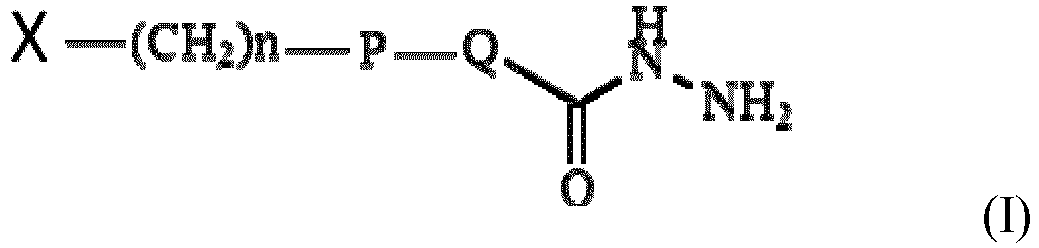
- X is

- n is 1 to 6;
- P is -C(O)NH- or -C(O)O-;
- Q is -R(CH2CH2O)m-, R(-C(O)NH-)z or -R[-C(O)CH2CH2-C(O)NH-(CH2CH2O)m]Y;
- R is a bond,-C1-12alkyl or C1-10alkoxy;
- m is 1 to 12;
- z is 1 to 4; and
- Yis 1 to 12.
- In some embodiments, the linker has the following formula:


- The invention also provides a metallic nanoparticle complex, comprising a metallic nanoparticle complexed with one or more linkers of the invention, optionally complexed with one or more PEGs. In one embodiment, the metallic nanoparticle is Au, Pd, Pt or Ag nanoparticle. In one embodiment, the linker is same or different. More preferably, the metallic nanoparticle complex comprises plural linkers with different molecular length.
- The invention also provides a composition comprising one or more metallic nanoparticle complex linking one or more same of different therapeutic or diagnostic agents and a pharmaceutically acceptable carrier.
- The invention also provides a drug delivery system, comprising one or more metallic nanoparticle complex linking one or more same of different therapeutic or diagnostic agents.
-
-
Figures 1 (A) to (C) show anti-HIV-1 p24 antibody (mAb3) conjugated onto gold nanoparticles (Au/LKI-1/mAb-p24) still showed the binding affinity. (A) The absorption spectrum of Au/LKI-1/mAb-p24 complex and Au. The Au/LKI-1/mAb-p24 complex shows a 2 nm red shift in the plasmon peak. (B) The Au/LKI-1/mAb-p24 complexes showed fluorescence by detected with Alexa Fluor 568 secondary antibodies. (C) The ELISA assay was used to demonstrate the formation of Au/LKI-1/mAb-p24 complex , and the binding activity of p24 antigen to compare with that of mAb-p24. -
Figures 2 (A) to (B) show the absorption spectrum of EGFR (epidermal growth factor receptor) antibodies conjugated onto gold nanoparticles (Au/LKI-1/Ab-EGFR and Au/LKI-5/Ab-EGFR) and Au. (A)The Au/LKI-1/Ab-EGFR complex shows a 1 nm red shift in the plasmon peak. (B)The Au/LKI-5/Ab-EGFR complex shows a 1 nm red shift in the plasmon peak. -
Figures 3 shows the absorption spectrum of Trastuzumab (Tras) antibodies conjugated onto gold nanoparticles (Au/LKI-1/Tras) and Au. The Au/LKI-1/Tras complex shows a 8 nm red shift in the plasmon peak. -
Figure 4 (A) to (C) show Etanecept (ETA) conjugated onto gold nanoparticles (Au/LKI-1/ETA) still showed the binding affinity. (A) The absorption spectrum of Au/LKI-1/ETA complex and Au. The Au/LKI-1/ETA complex shows a 2 nm red shift in the plasmon peak. (B) The Au/LKI-1/ETA complex showed fluorescence by detected with Alexa Fluor 568 secondary antibodies. (C) TEM images of Au/LKI-1/ETA complex, binding of 1-5 nm gold-labeled secondary anti-human IgG antibodies to ETA located on the Au surface was observed. -
Figure 5 shows the absorption spectrum of Au/LKI-1/Dox complex and Au. The UV/vis data, the wavelength, shows a 3 nm red shift in Au/LKI-1/Dox complex. -
Figure 6 (A) to (D) show the treatment of MDA-MB-231 breast tumors. (A) Net animal weight change (g) during the treatment. From the data, doxorubicin and Au/LKI-1/Dox was cause the weight loss over 20% and 3% in nude mice (N=3), respectively. That means Au/LKI-1/Dox complex in comparison with doxorubicin were much less toxicity in nude mice. (B) The inhibition of MDA-MD-231 breast tumor growth (N=3): Dox> Au/LKI-1/Dox >Au/PEG=PBS. (C) TEM images of MDA-MB-231 breast tumor cells treated with Au/LKI-1/Dox complex was easy determined the Au/LKI-1/Dox complex in the tumor in xenograft model. (D) Immunohistochemistry of tumor specimens. Breast tumor specimens were taken from the mice, embedded in paraffin and stained with hematoxylineosin. The more necrosis was observed in tumor from mice treated with doxorubicin than in tumors from mice treated with Au/LKI-1/Dox complex. - The invention is based on at least a discovery of a pH-sensitive linker that can simultaneously bind metallic nanoparticles and one or more agents with various molecular sizes. The linker of the invention can deliver the agents into cells involved in disease processes or close to cells so that the agents can selectively target and effect on the cells. The target delivery provided by the linker of the invention can be used for example for disease sensing, imaging, drug delivery, and therapy.
- Unless defined otherwise, all technical and scientific terms used herein have the same meaning as is commonly understood by one of ordinary skill in the art All patents, applications, published applications and other publications referenced herein are incorporated by reference in their entirety unless stated otherwise. In the event that there are pluralities of definitions for a term herein, those in this section prevail unless stated otherwise.
- The term "antibody" is used in the broadest sense and includes monoclonal antibodies (e.g., full length or intact monoclonal antibodies), polyclonal antibodies, monovalent, multivalent antibodies, multispecific antibodies (e.g., bispecific antibodies so long as they exhibit the desired biological activity) and may also include certain antibody fragments (as described in greater detail herein). An antibody can be chimeric, human, humanized and/or affinity matured.
- The term "tumor," as used herein, refers to all neoplastic cell growth and proliferation, whether malignant or benign, and all pre-cancerous and cancerous cells and tissues. The terms "cancer," "cancerous," "cell proliferative disorder," "proliferative disorder" and "tumor" are not mutually exclusive as referred to herein.
- The term "cancer," as used herein, refers to the physiological condition in mammals that is typically characterized by unregulated cell growth/proliferation. Examples of cancer include, but are not limited to, carcinoma, lymphoma (e.g., Hodgkin's and non-Hodgkin's lymphoma), blastoma, sarcoma, and leukemia, squamous cell cancer, small-cell lung cancer, non-small cell lung cancer, adenocarcinoma of the lung, squamous carcinoma of the lung, cancer of the peritoneum, hepatocellular cancer, gastrointestinal cancer, pancreatic cancer, glioblastoma, cervical cancer, ovarian cancer, liver cancer, bladder cancer, hepatoma, breast cancer, colon cancer, colorectal cancer, endometrial or uterine carcinoma, salivary gland carcinoma, kidney cancer, liver cancer, prostate cancer, vulval cancer, thyroid cancer, hepatic carcinoma, leukemia and other lymphoproliferative disorders, and various types of head and neck cancer.
- As used herein, the terms "treating," "treatment," "therapeutic," or "therapy" do not necessarily mean total cure or abolition of the disease or condition. Any alleviation of any undesired signs or symptoms of a disease or condition, to any extent can be considered treatment and/or therapy. Furthermore, treatment may include acts that may worsen the patient's overall feeling of well-being or appearance.
- An "effective amount" refers to an amount effective, at dosages and for periods of time necessary, to achieve the desired therapeutic or prophylactic result.
- A "therapeutically effective amount" of a substance/molecule of the invention may vary according to factors such as the disease state, age, sex, and weight of the individual, and the ability of the substance/molecule, to elicit a desired response in the individual. A therapeutically effective amount is also one in which any toxic or detrimental effects of the substance/molecule are outweighed by the therapeutically beneficial effects. A "prophylactically effective amount" refers to an amount effective, at dosages and for periods of time necessary, to achieve the desired prophylactic result. Typically but not necessarily, since a prophylactic dose is used in subjects prior to or at an earlier stage of disease, the prophylactically effective amount would be less than the therapeutically effective amount.
- The term "pharmaceutically acceptable salt" refers to a salt of a compound that does not cause significant irritation to an organism to which it is administered and does not abrogate the biological activity and properties of the compound.
- In one aspect, the invention provides a pH-sensitive linker having the following Formula (I),
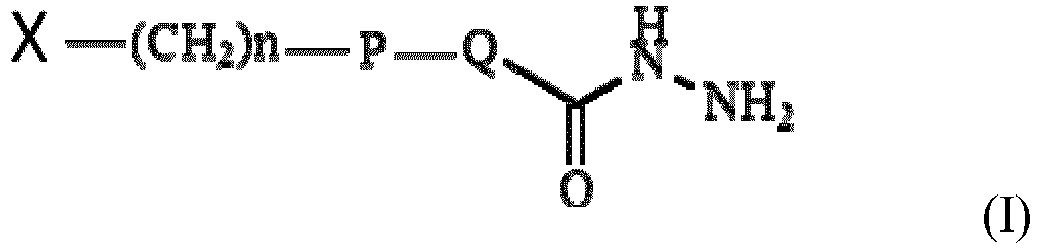
- X is

- n is 1 to 6;
- P is -C(O)NH- or -C(O)O-;
- Q is -R(CH2CH2O)m-, R(-C(O)NH-)z or -R[-C(O)CH2CH2-C(O)NH-(CH2CH2O)m]Y;
- R is a bond,-C1-12alkyl or C1-10alkoxy;
- m is 1 to 12;
- z is 1 to 4; and
-
Yis 1 to 12. - In some embodiments, the linker of the invention has the following formula:

Linker I-amide has formula (I) wherein X is
- The linkers of Linker I-amide of the present invention can be prepared using methods known to those skilled in the art in view of this disclosure. For example, the preferred linkers of the invention can be prepared as shown in the following scheme.

- In some embodiments, the linker of the invention has the following formula:

- Linker I-C(O)O (Linker III) has formula (I) wherein X is

- The linkers of Linker I-C(O)O (Linker III) of the present invention can be prepared using methods known to those skilled in the art in view of this disclosure. For example, the preferred linkers of the invention can be prepared as shown in the following scheme.

- In some embodiments, the linker of the invention has the following formula:

Linker SH-C2-linker-I has formula (I) wherein X is -SH, n is 2, P is -C(O)NH-, R is a bond, Q is -R(CH2CH2O)m-, and m is 1 to 12. More preferably, m is an integer of 2. - The linkers of SH-C2-linker-I of the present invention can be prepared using methods known to those skilled in the art in view of this disclosure. For example, the preferred linkers of the invention can be prepared as shown in the following scheme.

- In some embodiments, the linker of the invention has the following formula:

- Linker SH-C5-linker-I-amide has formula (I) wherein X is -SH, n is 5, P is - C(O)NH-, R is a bond, Q is -R(CH2CH2O)m-, and m is 1 to 12. More preferably, m is an integer of 2.
- The linkers of SH-C5-linker-I-amide of the present invention can be prepared using methods known to those skilled in the art in view of this disclosure. For example, the preferred linkers of the invention can be prepared as shown in the following scheme.

- In some embodiments, the linker of the invention has the following formula:

- SH-C5-linker-I-C(O)O-(SH-C5-linker-III) has formula (I) wherein X is -SH, n is 5, P is -C(O)O-, R is a bond, Q is -R(CH2CH2O)m-, and m is 1 to 12. Preferably, m is an integer of 1 to 6. More preferably, m is an integer of 2.
- The linkers of SH-C5-linker-I-C(O)O-(SH-C5-linker-III) of the present invention can be prepared using methods known to those skilled in the art in view of this disclosure. For example, the preferred linkers of the invention can be prepared as shown in the following scheme.

- In some embodiments, the linker of the invention has the following formula:

- NH2-C1-linker-I-amide has formula (I) wherein X is pp-NH-; pp is a protecting group which is Boc or Fmoc, n is 1, P is -C(O)NH-, R is a bond, Q is -R(CH2CH2O)m-, and m is 1 to 12. Preferably, m is an integer of 1 to 6. More preferably, m is an integer of 2.
- The linkers of NH2-C1-linker-I-amide of the present invention can be prepared using methods known to those skilled in the art in view of this disclosure. For example, the preferred linkers of the invention can be prepared as shown in the following scheme.

- In some embodiments, the linker of the invention has the following formula:

- pp is a protecting group which is Boc or Fmoc; and
- m is 1 to 12.
- ppNH-C1-linker-I-C(O)O-(ppNH-C1-linker-III-C(O)O-) has formula (I) wherein X is pp-NH- (pp is a protection group which is Boc or Fmoc), n is 1, P is -C(O)O-, R is a bond, Q is - R(CH2CH2O)m-, and m is 1 to 12. Preferably, m is an integer of 1 to 6. More preferably, m is an integer of 2.
- The linkers of ppNH-C1-linker-I-C(O)O-(ppNH-C1-linker-III-C(O)O-) of the present invention can be prepared using methods known to those skilled in the art in view of this disclosure. For example, the preferred linkers of the invention can be prepared as shown in the following scheme.
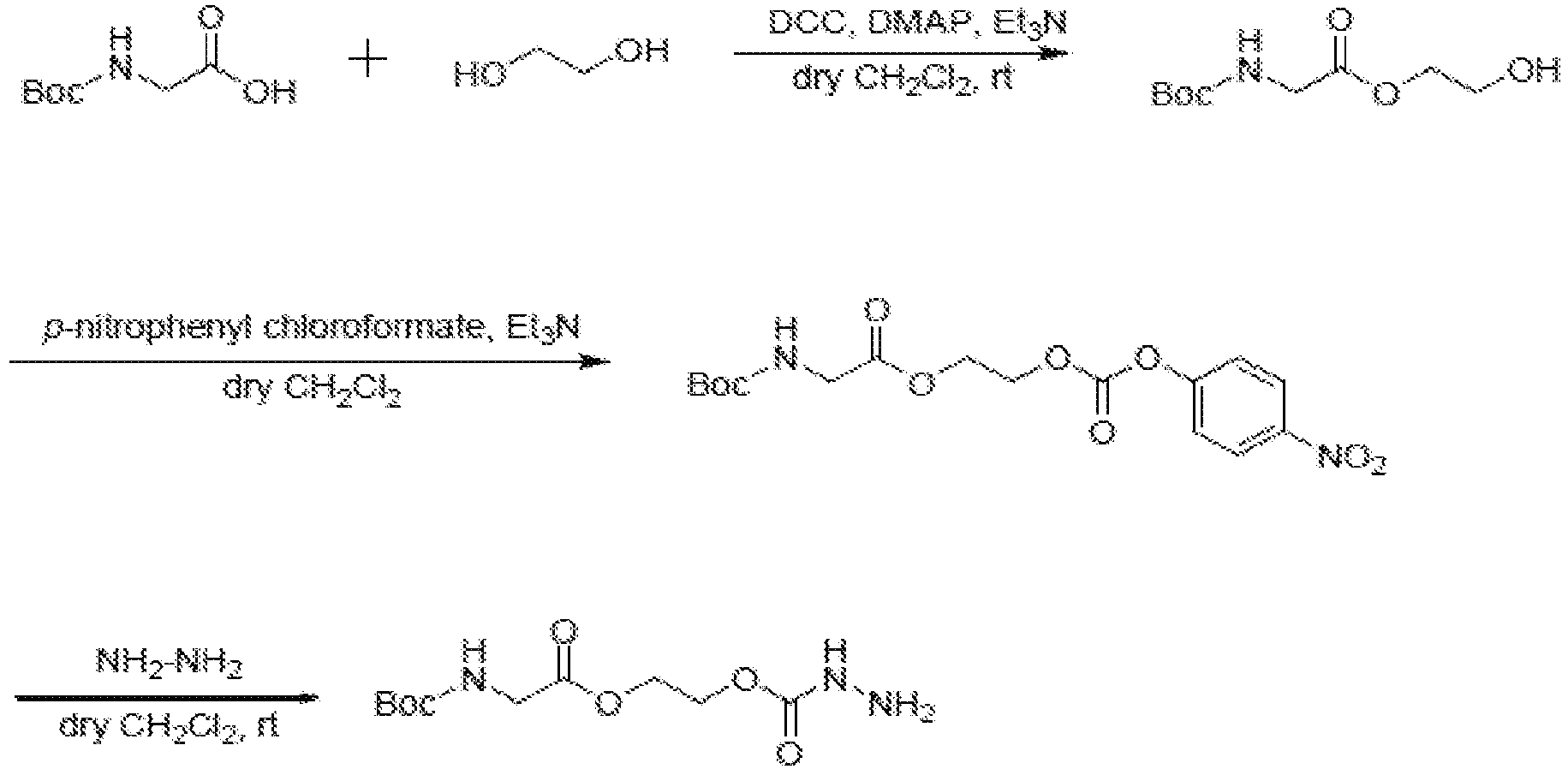
- In some embodiments, the linker of the invention has the following formula:

- Linker II-amide has formula (I) wherein X is

- The linkers of Linker II-amide of the present invention can be prepared using methods known to those skilled in the art in view of this disclosure. For example, the preferred linkers of the invention can be prepared as shown in the following scheme.
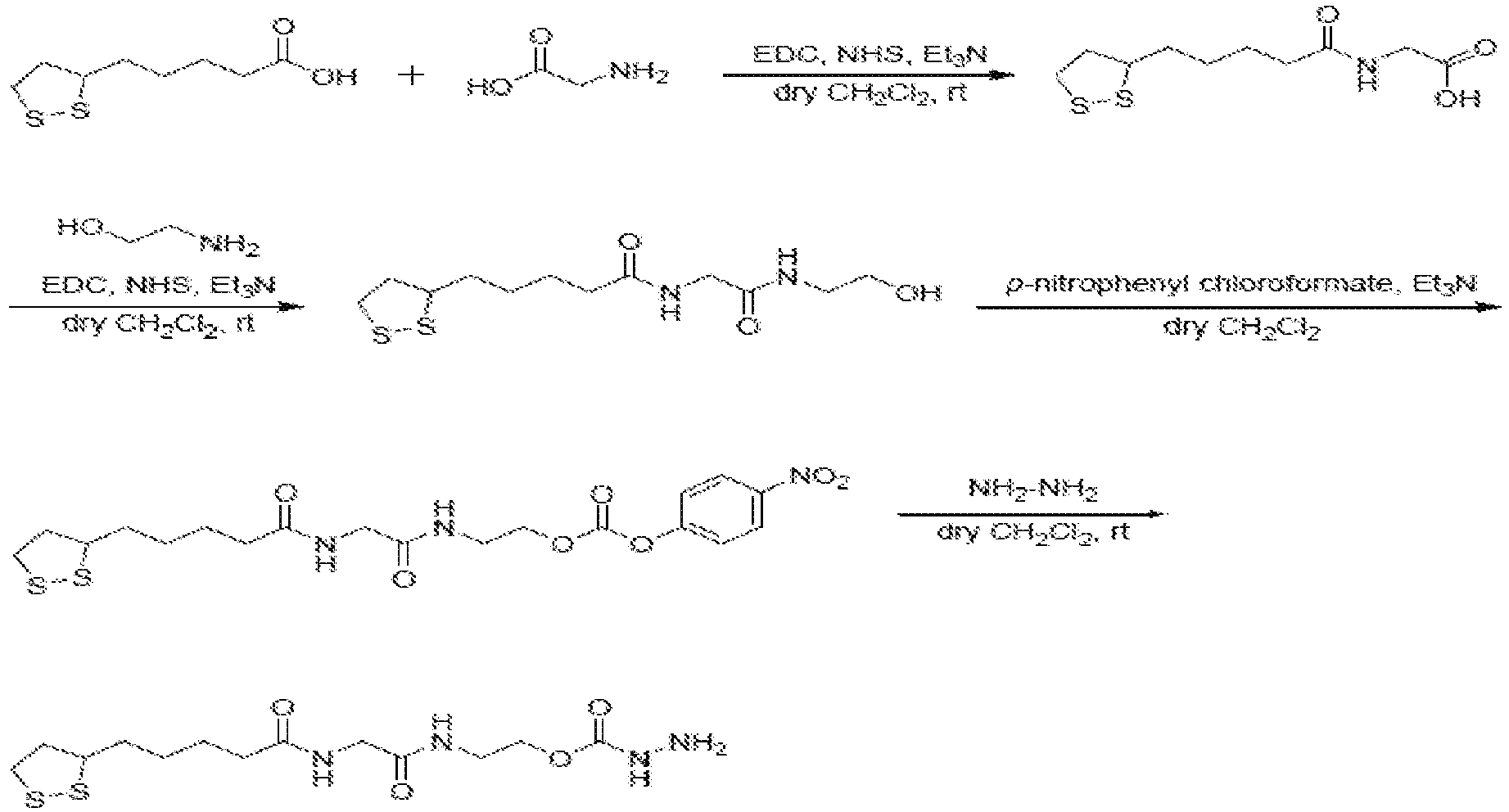
- In some embodiments, the linker of the invention has the following formula:

- Linker II-C(O)O- has formula (I) wherein X is

- The linkers of Linker II-C(O)O- of the present invention can be prepared using methods known to those skilled in the art in view of this disclosure. For example, the preferred linkers of the invention can be prepared as shown in the following scheme.

- In some embodiments, the linker of the invention has the following formula:

- SH-C5-linker-II-amide has formula (I) wherein X is -SH, n is 5, P is -C(O)NH-, R is a bond, Q is R(-CH2C(O)NH-)z, and z is 1 to 4. More preferably, z is an integer of 3.
- In other embodiment, n is 2. The linkers of SH-C2-5-linker-II-amide of the present invention can be prepared using methods known to those skilled in the art in view of this disclosure. For example, the preferred linkers of the invention can be prepared as shown in the following scheme.

- In some embodiments, the linker of the invention has the following formula:

- SH-C5-linker-II-C(O)O- has formula (I) wherein X is CH3C(O)S-, n is 5, P is-C(O)O-, R is a bond, Q is R(-CH2C(O)NH-)z, and z is 1 to 4. More preferably, z is an integer of 3.
- In other embodiment, n is 2. The linkers of SH-C2-5-linker-II-C(O)O- of the present invention can be prepared using methods known to those skilled in the art in view of this disclosure. For example, the preferred linkers of the invention can be prepared as shown in the following scheme.

- In some embodiments, the linker of the invention has the following formula:

- wherein pp is a protection group which is Boc or Fmoc; and
- z is 1 to 4.
- ppNH-C1-linker-II-amide has formula (I) wherein X is pp-NH-; pp is a protection group (such as Boc or Fmoc), n is 1, P is -C(O)NH-, R is a bond, Q is R(-C(O)NH-)z, and z is 1 to 4. More preferably, z is an integer of 3.
- The linkers of ppNH-C1-linker-II-amide of the present invention can be prepared using methods known to those skilled in the art in view of this disclosure. For example, the preferred linkers of the invention can be prepared as shown in the following scheme.

- In some embodiments, the linker of the invention has the following formula:

- wherein pp is a protection group which is Boc or Fmoc; and
- z is 1 to 4.
- ppNH-C1-linker-II-C(O)O- has formula (I) wherein X is pp-NH-; pp is a protection group which is Boc or Fmoc, n is 1, P is -C(O)O-, R is a bond, Q is R(-C(O)NH-)z, and z is 1 to 4. More preferably, z is an integer of 3.
- The linkers of ppNH-C1-linker-II-C(O)O- of the present invention can be prepared using methods known to those skilled in the art in view of this disclosure. For example, the preferred linkers of the invention can be prepared as shown in the following scheme.

- In some embodiments, the linker of the invention has the following formula:

- Linker IV-amide has formula (I) wherein X is

- In other embodiment, m is 1-12. The linkers of Linker IV-amide of the present invention can be prepared using methods known to those skilled in the art in view of this disclosure. For example, the preferred linkers of the invention can be prepared as shown in the following scheme.

- In some embodiments, the linker of the invention has the following formula:

- Linker IV-C(O)O- has formula (I) wherein X is
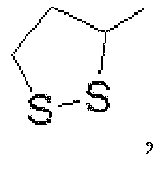
- In other embodiment, m is 1-12. The linkers of Linker IV-C(O)O- of the present invention can be prepared using methods known to those skilled in the art in view of this disclosure. For example, the preferred linkers of the invention can be prepared as shown in the following scheme.

- In some embodiments, the linker of the invention has the following formula:
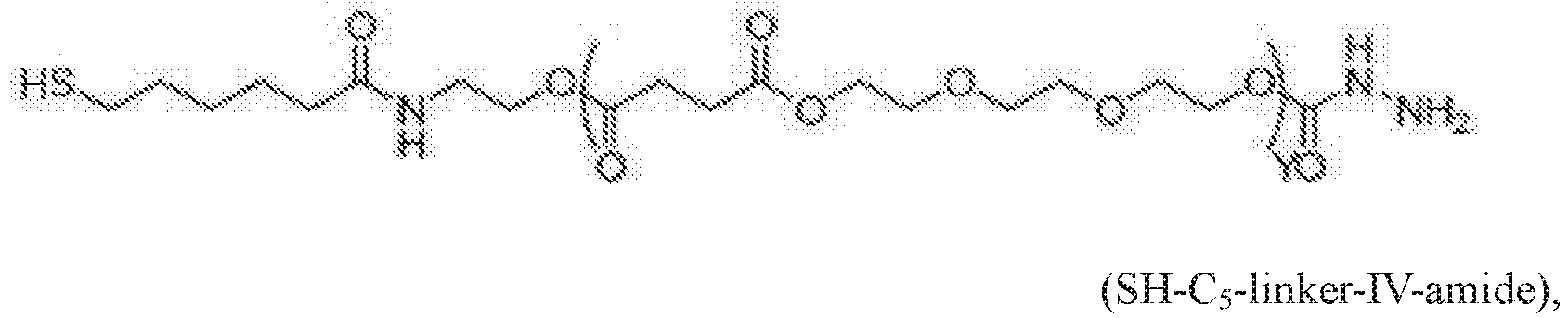
- SH-C5-linker-IV-amide has formula (I) wherein X is CH3C(O)S-, n is 5, P is-C(O)NH-, R is -CH2CH2O-, Q is -R[-C(O)CH2CH2-C(O)NH-(CH2CH2O)m]Y, m is 3 and Y is 1 to 12. More preferably, Y is an integer of 2.
- In other embodiments, n is 2 or 5 and m is 1-12. The linkers of Linker SH-C2-5-linker-IV-amide of the present invention can be prepared using methods known to those skilled in the art in view of this disclosure. For example, the preferred linkers of the invention can be prepared as shown in the following scheme.

- In some embodiments, the linker of the invention has the following formula:

- SH-C5-linker-IV-C(O)O- has formula (I) wherein X is CH3C(O)S-, n is 5, P is-C(O)O-, R is -CH2CH2O-, Q is -R[-C(O)CH2CH2-C(O)NH-(CH2CH2O)m]Y, m is 3 and Y is 1 to 12. Preferably, Y is an integer of 1 to 6. More preferably, Y is an integer of 2.
- In other embodiments, n is 2 or 5 and m is 1-12. The linkers of HS-C2-5-linker-IV-C(O)O- of the present invention can be prepared using methods known to those skilled in the art in view of this disclosure. For example, the preferred linkers of the invention can be prepared as shown in the following scheme.

- In some embodiments, the linker of the invention has the following formula:

- ppNH-C1-linker-IV-amide has formula (I) wherein X is pp-NH-; pp is a protecting group which is Boc or Fmoc, n is 1, P is -C(O)NH-, R is -CH2CH2O-, Q is -R[-C(O)CH2CH2-C(O)NH-(CH2CH2O)m]Y, m is 3 and Y is 1 to 12. More preferably, Y is an integer of 2.
- In other embodiments, m is 1-12. The linkers of ppNH-C1-linker-IV-amide of the present invention can be prepared using methods known to those skilled in the art in view of this disclosure. For example, the preferred linkers of the invention can be prepared as shown in the following scheme.

- In some embodiments, the linker of the invention has the following formula:

- ppNH-C1-linker-IV-C(O)O- has formula (I) wherein X is pp-NH-; pp is a protection group (such as Boc or Fmoc), n is 1, P is -C(O)O-, R is -CH2CH2O-, Q is -R[-C(O)CH2CH2-C(O)NH-(CH2CH2O)m]Y, m is 3 and Y is 1 to 12. More preferably, Y is an integer of 2.
- In other embodiments, m is 1-12. The linkers of ppNH-C1-linker-IV-C(O)O- of the present invention can be prepared using methods known to those skilled in the art in view of this disclosure. For example, the preferred linkers of the invention can be prepared as shown in the following scheme.

- In another aspect, the invention provides a metallic nanoparticle complex, comprising a metallic nanoparticle complexed with one or more linkers of the invention, optionally complexed with one or more PEGs.
- In one embodiment, the metallic nanoparticle is Au, Pd, Pt or Ag nanoparticle.
- In one embodiment, the linker is same or different. More preferably, the metallic nanoparticle complex comprises plural linkers with different molecular length. The linkers with different molecular length can bind different therapeutic or diagnostic agent depending on the requirement on a target cell or disease to be treated or diagnosed. The linker links to the metallic nanoparticle through the sulfur atoms of 1,2-dithiolane group or -SH group in the linker.
- In one embodiment, the molecular weight of PEG used in the invention ranges from 2000 to 20,000 Da; preferably, 2000 to 5000. PEGylation may also be used, in some cases, to decrease charge interaction between a linker or a nanoparticle and a biological moiety, e.g., by creating a hydrophilic layer on the surface of the linker or nanoparticle, which may shield the polymer from interacting with the biological moiety. In some cases, the addition of poly(ethylene glycol) repeat units may increase plasma half-life of the polymeric conjugate, for instance, by decreasing the uptake of the polymeric conjugate by the phagocytic system while decreasing transfection/uptake efficiency by cells. Those of ordinary skill in the art will know of methods and techniques for PEGylating a polymer, for example, by using EDC (1-ethyl-3-(3-dimethylaminopropyl) carbodiimide hydrochloride) and NHS(N-hydroxysuccinimide) to react a polymer to a PEG group terminating in an amine, as discussed in the examples below, by ring opening polymerization techniques (ROMP), or the like.
- In another one embodiment, the metallic nanoparticle is in a size less than 100 nm, preferably, less than 80 nm.
- In some embodiment, the metallic nanoparticle complex further links one or more same of different therapeutic or diagnostic agents. Preferably, the therapeutic agent is anti-tumor drug or an antibody. Preferably, the antibody is an antibody targeted to an antigen specific expression in cell surface such as tumor cells; more preferably, the antibody is possessed a targeting, recognizing, and anti-tumor cell antibody.
- In some embodiments, the anti-tumor drug is an anti-cancer drug or anti-cancer antibody useful in the treatment of cancer. Examples of anti-cancer drugs include alkylating agents such as thiotepa and cyclosphosphamide; alkyl sulfonates such as busulfan, improsulfan and piposulfan; aziridines such as benzodopa, carboquone, meturedopa, and uredopa; ethylenimines and methylamelamines including altretamine, triethylenemelamine, trietylenephosphoramide, triethiylenethiophosphoramide and trimethylolomelamine; acetogenins (especially bullatacin and bullatacinone); delta-9-tetrahydrocannabinol (dronabinol,); beta-lapachone; lapachol; colchicines; betulinic acid; a camptothecin (including the synthetic analogue topotecan, CPT-11 (irinotecan), acetylcamptothecin, scopolectin, and 9-aminocamptothecin); bryostatin; callystatin; CC-1065 (including its adozelesin, carzelesin and bizelesin synthetic analogues); podophyllotoxin; podophyllinic acid; teniposide; cryptophycins (particularly cryptophycin 1 and cryptophycin 8); dolastatin; duocarmycin (including the synthetic analogues, KW-2189 and CB1-TM1); eleutherobin; pancratistatin; a sarcodictyin; spongistatin; nitrogen mustards such as chlorambucil, chlornaphazine, cholophosphamide, estramustine, ifosfamide, mechlorethamine, mechlorethamine oxide hydrochloride, melphalan, novembichin, phenesterine, prednimustine, trofosfamide, uracil mustard; nitrosureas such as carmustine, chlorozotocin, fotemustine, lomustine, nimustine, and ranimnustine; antibiotics such as the enediyne antibiotics (e.g., calicheamicin, especially calicheamicin gammaII and calicheamicin omegaII (see, e.g., Agnew, Chem. Intl. Ed. Engl., 33: 183-186 (1994)); dynemicin, including dynemicin A; an esperamicin; as well as neocarzinostatin chromophore and related chromoprotein enediyne antiobiotic chromophores), aclacinomysins, actinomycin, authramycin, azaserine, bleomycins, cactinomycin, carabicin, caminomycin, carzinophilin, chromomycinis, dactinomycin, daunorubicin, detorubicin, 6-diazo-5-oxo-L-norleucine, doxorubicin (including morpholino-doxorubicin, cyanomorpholino-doxorubicin, 2-pyrrolino-doxorubicin and deoxydoxorubicin), epirubicin, esorubicin, idarubicin, marcellomycin, mitomycins such as mitomycin C, mycophenolic acid, nogalamycin, olivomycins, peplomycin, potfiromycin, puromycin, quelamycin, rodorubicin, streptonigrin, streptozocin, tubercidin, ubenimex, zinostatin, zorubicin; anti-metabolites such as methotrexate and 5-fluorouracil (5-FU); folic acid analogues such as denopterin, methotrexate, pteropterin, trimetrexate; purine analogs such as fludarabine, 6-mercaptopurine, thiamiprine, thioguanine; pyrimidine analogs such as ancitabine, azacitidine, 6-azauridine, carmofur, cytarabine, dideoxyuridine, doxifluridine, enocitabine, floxuridine; androgens such as calusterone, dromostanolone propionate, epitiostanol, mepitiostane, testolactone; anti-adrenals such as aminoglutethimide, mitotane, trilostane; folic acid replenisher such as frolinic acid; aceglatone; aldophosphamide glycoside; aminolevulinic acid; eniluracil; amsacrine; bestrabucil; bisantrene; edatraxate; defofamine; demecolcine; diaziquone; elformithine; elliptinium acetate; an epothilone; etoglucid; gallium nitrate; hydroxyurea; lentinan; lonidainine; maytansinoids such as maytansine and ansamitocins; mitoguazone; mitoxantrone; mopidanmol; nitraerine; pentostatin; phenamet; pirarubicin; losoxantrone; 2-ethylhydrazide; procarbazine; polysaccharide complex (JHS Natural Products, Eugene, Oreg.); razoxane; rhizoxin; sizofuran; spirogermanium; tenuazonic acid; triaziquone; 2,2',2"-trichlorotriethylamine; trichothecenes (especially T-2 toxin, verracurin A, roridin A and anguidine); urethan; vindesine; dacarbazine; mannomustine; mitobronitol; mitolactol; pipobroman; gacytosine; arabinoside ("Ara-C"); thiotepa; taxoids, e.g., paclitaxel (Bristol-Myers Squibb Oncology, Princeton, N.J.), Cremophor-free, albumin-engineered nanoparticle formulation of paclitaxel (American Pharmaceutical Partners, Schaumberg, Ill.), and doxetaxel (Rhone-Poulenc Rorer, Antony, France); chloranbucil; gemcitabine; 6-thioguanine; mercaptopurine; methotrexate; platinum analogs such as cisplatin and carboplatin; vinblastine; platinum; etoposide (VP-16); ifosfamide; mitoxantrone; vincristine; oxaliplatin; leucovovin; vinorelbine; novantrone; edatrexate; daunomycin; aminopterin; ibandronate; topoisomerase inhibitor RFS 2000; difluoromethylornithine (DMFO); retinoids such as retinoic acid; capecitabine; pharmaceutically acceptable salts, acids or derivatives of any of the above; as well as combinations of two or more of the above such as CHOP, an abbreviation for a combined therapy of cyclophosphamide, doxorubicin, vincristine, and prednisolone, and FOLFOX, an abbreviation for a treatment regimen with oxaliplatin combined with 5-FU and leucovovin.
- The amount of an anti-cancer drug present in the nanoparticle can vary over a wide range. In some embodiments, the nanoparticle can include an amount of the anticancer drug in the range of 1% to 50% (weight/weight) based on the mass ratio of the anticancer drug to the nanoparticle. In other embodiments, the nanoparticle can include an amount of the anticancer drug in the range of 5% to 40% (weight/weight) based on the mass ratio of the anticancer drug to the nanoparticle. In still other embodiments, the nanoparticle can include an amount of the anticancer drug in the range of 10% to 30% (weight/weight). In yet still other embodiments, the nanoparticle can include an amount of the anticancer drug in the range of 1% to 10% (weight/weight), 1% to 5% (weight/weight), 5% to 10% (weight/weight), 10% to 20% (weight/weight), 15% to 35% (weight/weight), 30% to 40% (weight/weight) and the like, based on the mass ratio of the anticancer drug to the nanoparticle. In some embodiments, the nanoparticle can include an amount of the anticancer drug in 20% (weight/weight) based on the mass ratio of the anticancer drug to the nanoparticle. In other embodiments, the nanoparticle can include an amount of the anticancer drug of 5% (weight/weight), 10% (weight/weight) 15% (weight/weight), 25% (weight/weight), 30% (weight/weight) and the like based on the mass ratio of the anticancer drug to the nanoparticle.
- Some embodiments described herein relate to a composition that can comprise one or more metallic nanoparticle complex linking one or more same of different therapeutic or diagnostic agents and a pharmaceutically acceptable carrier. The pharmaceutical composition facilitates administration of a metallic nanoparticle complex linking one or more same of different therapeutic or diagnostic agents to an organism. Multiple techniques of administering a compound exist in the art including, but not limited to, oral, injection, aerosol, parenteral, and topical administration.
- Some embodiment described herein relate to a drug delivery system, comprising one or more metallic nanoparticle complex linking one or more same of different therapeutic or diagnostic agents.
- Multiple techniques of administering a metallic nanoparticle complex linking one or more same of different therapeutic or diagnostic agents exist in the art including, but not limited to, oral, rectal, topical, aerosol, injection and parenteral delivery, including intramuscular, subcutaneous, intravenous, intramedullary injections, intrathecal, direct intraventricular, intraperitoneal, intranasal and intraocular injections.
-
-
Step 1. The ethanolamine (1.28 g, 1.05 eq) and Lipoic acid(4.13 g, 1.0eq) were dissolved in 80 mL DCM, and EDC·HCl (4.98g, 1.3 eq), hydroxysuccinimide (NHS)(2.30g, 1.0 eq) and triethylamine (6.4 mL, 2.3 eq) were slowly added. The reaction was carried out at room temperature for at least 5hrs and the reaction was followed by TLC. Subsequently, the mixture was quenched by adding ddH2O, and was extracted 2-3 times with DCM. The organic layer was collected, dried with anhydrous magnesium sulfate, filtered with MgSO4 and then removal of DCM. The extract is purified with the column by using DCM:MeOH = 9.8: 0.2. The product was a pale yellow liquid. Yield: 4.04 g; 81.0 %. -
Step 2. The 4-nitrophenyl chloroformate (3.35 g, 1.15 eq) was placed in two-neck bottle. Under vacuum for 1 hr, the three-way valve was diverted to nitrogen device and 60 mL DCM was added with a syringe. Theweighted Step 1Product 1 was dissolved with 10-15mL DCM, injected into the reaction flask with a syringe, and then slowly added with triethylamine (4.5 mL, 2.3 eq). The reaction was carried out in an ice bath for about 1 hr and then back to room temperature for overnight. After completion of the reaction, the mixture was quenched by adding ddH2O, and was extracted 3 times with DCM. The organic layer was collected, dried with anhydrous magnesium sulfate, filtered with MgSO4 and then removal of DCM The extract is purified with the column by using EtOAc:Hex:MeOH = 1:1: 0.2. The product was a pale yellow liquid. After purification yield: 51.6 %. -
Step 3. Theweighted Step 2 Product 2 (3.5 g, 1.0 eq) was dissolved in 120 mL DCM, and then slowly added with Hydrazine hydrate (6.5 mL, 10.0 eq). The reaction was carried out at room temperature for about 24 hrs. The solution color turned from pale yellow to orange. After completion of the reaction, the mixture was quenched by adding ddH2O, and was extracted 2-3 times with DCM. The organic layer was collected, dried with anhydrous magnesium sulfate, filtered with MgSO4 and then removal of DCM. The extract was purified with the column by using DCM:MeOH = 9.5: 0.5. In this step, the product was stuck in the column and the MeOH can be increased to 5% to elute the final product. The product was a pale yellow sticky solid. After purification yield: 19.5 %.
- Linker I-1 (Linker I-amide, m=2). 1H(400MHz)δ1.23-1.31(2H, m), 1.40-1.51(3H, m), 1.57-1.64(1H, m), 1.78-1.86(1H, m), 2.05(2H, t), 2.32-2.39(1H, m), 3.01-3.18 (4H, m), 3.39(2H, t), 3.52-3.57(3H, m), 4.03-4.19(4H, m), 7.94(1H, s), 8.14(1H, s). 13C(100MHz)δ25.9, 29.0, 34.8, 36.1, 38.9, 39.5, 40.9, 57.2, 64.7, 69.3, 69.6, 159.5, 174.9 ppm. H-Mass (m/z): (M+Na) =374.1171


- Linker I-3(Linker I-amide, m=3). 1H(300MHz)δ1.30-1.37(2H, m), 1.45-1.57(3H, m), 1.60-1.72(1H, m), 1.80-1.91(1H, m), 2.06(2H, t), 2.35-2.46(1H, m), 3.07-3.23(4H, m), 3.39(2H, t), 3.47-3.65(7H, m), 4.02(2H, s), 4.05-4.08(2H, m), 7.84(1H, t), 8.18(1H, s). 13C(100MHz)δ25.7, 28.9, 34.7, 35.9, 38.8, 39.4, 40.7, 60.0, 64.4, 69.4, 69.6, 70.1, 70.3, 159.2, 174.2ppm. H-Mass (m/z): (M+Na) =418.1466.

- Linker 1-4 (Linker I-amide, m=4). 1H(300MHz)δ1.30-1.38(2H, m), 1.45-1.57(3H, m), 1.60-1.72(1H, m), 1.80-1.91(1H, m), 2.06(2H, t), 2.36-2.46(1H, m), 3.07-3.23(4H, m), 3.39(2H, t), 3.49-3.65(11H, m), 4.02(2H, s), 4.05-4.08(2H, m), 7.83(1H, t), 8.18(1H, s). 13C(100MHz)δ25.7, 28.9, 34.7, 35.9, 38.8, 39.4, 40.7, 56.9, 64.4, 69.4, 69.6, 70.2, 70.3, 70.4, 159.2, 174.1ppm. H-Mass (m/z): (M+Na) =440.1875.

- Linker 1-5 (Linker I-amide, m=5). 1H(300MHz)δ1.30-1.38(2H, m), 1.45-1.57(3H, m), 1.60-1.69(1H, m), 1.80-1.91(1H, m), 2.06(2H, t), 2.36-2.46(1H, m), 3.07-3.23(4H, m), 3.39(2H, t), 3.51-3.62(19H, m), 4.02(2H, s), 4.05-4.08(2H, m), 4.83(1H, t), 8.18(1H, s). 13C(100MHz)δ25.9, 29.0, 34.8, 36.1, 39.0, 39.4, 40.9, 57.2, 64.8, 69.5, 69.7, 70.3, 70.4, 70.5, 159.5, 174.8ppm. H-Mass (m/z): (M+Na) =550.2234
-
-
Step 1. The ethylene glycol (1.30 g, 1.05 eq) and Lipoic acid(4.13 g, 1.0 eq) were dissolved in 80 mL DCM, and N,N'-Dicyclohexylcarbodiimide (DCC) (5.36 g, 1.3 eq), 4-(Dimethylamino)pyridine (DMAP) (0.24 g, 0.1 eq) and triethylamine (6.4 mL, 2.3 eq) were slowly added. The reaction was carried out at room temperature for at least 5 hrs and the reaction was followed by TLC. Subsequently, the mixture was quenched by adding ddH2O, and was extracted 2-3 times with DCM. The organic layer was collected, dried with anhydrous magnesium sulfate, filtered with MgSO4 and then removal of DCM. The extract is purified with the column by using DCM:MOH = 9.8: 0.2. The product was a pale yellow liquid. Yield: 4.00 g; 80.5 %. -
Step 2. The 4-nitrophenyl chloroformate (3.35 g, 1.15 eq) was placed in two-neck bottle. Under vacuum for 1 hr, the three-way valve was diverted to nitrogen device and 60 mL DCM was added with a syringe. Theweighted Step 1Product 1 was dissolved with 10-15 mL DCM, injected into the reaction flask with a syringe, and then slowly added with triethylamine (4.5 mL, 2.3 eq). The reaction was carried out in an ice bath for about 1 hr and then back to room temperature for overnight. After completion of the reaction, the mixture was quenched by adding ddH2O, and was extracted 2-3 times with DCM The organic layer was collected, dried with anhydrous magnesium sulfate, filtered with MgSO4 and then removal of DCM. The extract is purified with the column by using EtOAc:Hex:MeOH = 1:1: 0.2. The product was a pale yellow liquid. After purification yield: 50.6 %. -
Step 3. Theweighted Step 2 Product 2 (3.5 g, 1.0 eq) was dissolved in 120 mL DCM, and then slowly added with Hydrazine hydrate (6.5 mL, 10.0 eq). The reaction was carried out at room temperature for about 24 hrs. The solution color turned from pale yellow to orange. After completion of the reaction, the mixture was quenched by adding ddH2O, and extracted 2-3 times with DCM. The organic layer was collected, dried with anhydrous magnesium sulfate, filtered with MgSO4 and then removal of DCM. The extract was purified with the column by using DCM:MeOH = 9.5: 0.5. In this step, the product was stuck in the column and the MeOH can be increased to 5% to elute the final product. The product was a pale yellow sticky solid. After purification yield: 18.5 %. -
-
Step 1. The ethanolamine(1.28 g, 1.05 eq) and 3-(Acetylthio)propionic acid (2.96 g, 1.0 eq) were dissolved in 80 mL DCM, and EDC·HCl (4.98g, 1.3 eq), hydroxysuccinimide (NHS)(2.30g, 1.0 eq) and triethylamine (6.4 mL, 2.3 eq) were slowly added. The reaction was carried out at room temperature for at least 5hrs and the reaction was followed by TLC. Subsequently, the mixture was quenched by adding ddH2O, and was extracted 2-3 times with DCM. The organic layer was collected, dried with anhydrous magnesium sulfate, filtered with MgSO4 and then removal of DCM. The extract is purified with the column by using DCM:MeOH = 9.8: 0.2. The product was a pale yellow liquid. Yield: 4.10 g; 70.0 %. -
Step 2. The 4-nitrophenyl chloroformate (3.35 g, 1.15 eq) was placed in two-neck bottle. Under vacuum for 1 hr, the three-way valve was diverted to nitrogen device and 60 mL DCM was added with a syringe. Theweighted Step 1Product 1 was dissolved with 10-15 mL DCM, injected into the reaction flask with a syringe, and then slowly added with triethylamine (4.5 mL, 2.3 eq). The reaction was carried out in an ice bath for about 1 hr and then back to room temperature for overnight. After completion of the reaction, the mixture was quenched by adding ddH2O, and was extracted 2-3 times with DCM The organic layer was collected, dried with anhydrous magnesium sulfate, filtered with MgSO4 and then removal of DCM. The extract is purified with the column by using EtOAc:Hex:MeOH = 1:1: 0.2. The product was a pale yellow liquid. After purification yield: 48.6 %. -
Step 3. Theweighted Step 2 Product 2 (3.5 g, 1.0 eq) was dissolved in 120 mL DCM, and then slowly added with Hydrazine hydrate (6.5 mL, 10.0 eq). The reaction was carried out at room temperature for about 24 hrs. The solution color turned from pale yellow to orange. After completion of the reaction, the mixture was quenched by adding ddH2O, and extracted 2-3 times with DCM. The organic layer was collected, dried with anhydrous magnesium sulfate, filtered with MgSO4 and then removal of DCM. The extract was purified with the column by using DCM:MeOH = 9.5: 0.5. In this step, the product was stuck in the column and the MeOH can be increased to 5% to elute the final product. The product was a pale yellow sticky solid. After purification yield: 19.0 %. -
-
Step 1. The ethanolamine(1.28 g, 1.05 eq) and 6-Acetylthiohexanoic acid (3.81 g,1.0 eq) were dissolved in 80 mL DCM, and EDC·HCl (4.98g, 1.3 eq), hydroxysuccinimide (NHS)(2.30g, 1.0 eq) and triethylamine (6.4 mL, 2.3 eq) were slowly added. The reaction was carried out at room temperature for at least 5 hrs and the reaction was followed by TLC. Subsequently, the mixture was quenched by adding ddH2O, and was extracted 2-3 times with DCM. The organic layer was collected, dried with anhydrous magnesium sulfate, filtered with MgSO4 and then removal of DCM The extract is purified with the column by using DCM:MOH = 9.8: 0.2. The product was a pale yellow liquid. Yield: 3.85 g; 78.0 %. -
Step 2. The 4-nitrophenyl chloroformate (3.35 g, 1.15 eq) was placed in two-neck bottle. Under vacuum for 1 hr, the three-way valve was diverted to nitrogen device and 60 mL DCM was added with a syringe. Theweighted Step 1Product 1 was dissolved with 10-15 mL DCM, injected into the reaction flask with a syringe, and then slowly added with triethylamine (4.5 mL, 2.3 eq). The reaction was carried out in an ice bath for about 1 hr and then back to room temperature for overnight. After completion of the reaction, the mixture was quenched by adding ddH2O, and was extracted 2-3 times with DCM. The organic layer was collected, dried with anhydrous magnesium sulfate, filtered with MgSO4 and then removal of DCM. The extract is purified with the column by using EtOAc:Hex:MeOH = 1:1: 0.2. The product was a pale yellow liquid. After purification yield: 48.6 %. -
Step 3. Theweighted Step 2 Product 2 (3.5 g, 1.0 eq) was dissolved in 120 mL DCM, and then slowly added with Hydrazine hydrate (6.5 mL, 10.0 eq). The reaction was carried out at room temperature for about 24 hrs. The solution color turned from pale yellow to orange. After completion of the reaction, the mixture was quenched by adding ddH2O, and extracted 2-3 times with DCM. The organic layer was collected, dried with anhydrous magnesium sulfate, filtered with MgSO4 and then removal of DCM. The extract was purified with the column by using DCM:MeOH = 9.5: 0.5. In this step, the product was stuck in the column and the MeOH can be increased to 5% to elute the final product. The product was a pale yellow sticky solid. After purification yield: 17.0 %.

-
-
Step 1. The ethylene glycol (1.30 g, 1.05 eq) and 6-Acetylthiohexanoic acid (3.81 g,1.0 eq) were dissolved in 80 mL DCM, and N,N'-Dicyclohexylcarbodiimide (DCC) (5.36 g, 1.3 eq), 4-(Dimethylamino)pyridine (DMAP) (0.24 g, 0.1 eq) and triethylamine (6.4 mL, 2.3 eq) were slowly added. The reaction was carried out at room temperature for at least 5 hrs and the reaction was followed by TLC. Subsequently, the mixture was quenched by adding ddH2O, and was extracted 2-3 times with DCM. The organic layer was collected, dried with anhydrous magnesium sulfate, filtered with MgSO4 and then removal of DCM. The extract is purified with the column by using DCM:MeOH = 9.8: 0.2. The product was a pale yellow liquid. Yield: 3.88 g; 79.8%. -
Step 2. The 4-nitrophenyl chloroformat (3.35 g, 1.15 eq) was placed in two-neck bottle. Under vacuum for 1 hr, the three-way valve was diverted to nitrogen device and 60 mL DCM was added with a syringe. Theweighted Step 1Product 1 was dissolved with 10-15 mL DCM, injected into the reaction flask with a syringe, and then slowly added with triethylamine (4.5 mL, 2.3 eq). The reaction was carried out in an ice bath for about 1 hr and then back to room temperature for overnight. After completion of the reaction, the mixture was quenched by adding ddH2O, and was extracted 2-3 times with DCM The organic layer was collected, dried with anhydrous magnesium sulfate, filtered with MgSO4 and then removal of DCM The extract is purified with the column by using EA:Hex:MeOH = 1:1: 0.2. The product was a pale yellow liquid. After purification yield: 51.6 %. -
Step 3. Theweighted Step 2 Product 2 (3.5 g, 1.0 eq) was dissolved in 120 mL DCM, and then slowly added with Hydrazine hydrate (6.5 mL, 10.0 eq). The reaction was carried out at room temperature for about 24 hrs. The solution color turned from pale yellow to orange. After completion of the reaction, the mixture was quenched by adding ddH2O, and extracted 2-3 times with DCM. The organic layer was collected, dried with anhydrous magnesium sulfate, filtered with MgSO4 and then removal of DCM. The extract was purified with the column by using DCM:MeOH = 9.5: 0.5. In this step, the product was stuck in the column and the MeOH can be increased to 5% to elute the final product. The product was a pale yellow sticky solid. After purification yield: 19.4 %. -
-
Step 1. The ethanolamine(1.28 g, 1.05 eq) and Boc-glycine (3.50 g,1.0 eq) were dissolved in 80 mL DCM, and EDC·HCl (4.98g, 1.3 eq), hydroxysuccinimide (NHS)(2.30g, 1.0 eq) and triethylamine (6.4 mL, 2.3 eq) were slowly added. The reaction was carried out at room temperature for at least 5 hrs and the reaction was followed by TLC. Subsequently, the mixture was quenched by adding ddH2O, and was extracted 2-3 times with DCM. The organic layer was collected, dried with anhydrous magnesium sulfate, filtered with MgSO4 and then removal of DCM. The extract is purified with the column by using DCM:MeOH = 9.8: 0.2. The product was a pale yellow liquid. Yield: 4.10 g; 81.5 %. -
Step 2. The 4-nitrophenyl chloroformat (3.35 g, 1.15 eq) was placed in two-neck bottle. Under vacuum for 1 hr, the three-way valve was diverted to nitrogen device and 60 mL DCM was added with a syringe. Theweighted Step 1Product 1 was dissolved with 10-15 mL DCM, injected into the reaction flask with a syringe, and then slowly added with triethylamine (4.5 mL, 2.3 eq). The reaction was carried out in an ice bath for about 1 hr and then back to room temperature for overnight. After completion of the reaction, the mixture was quenched by adding ddH2O, and was extracted 2-3 times with DCM The organic layer was collected, dried with anhydrous magnesium sulfate, filtered with MgSO4 and then removal of DCM. The extract is purified with the column by using EtOAc:Hex:MeOH = 1:1: 0.2. The product was a pale yellow liquid. After purification yield: 51.6%. -
Step 3. Theweighted Step 2 Product 2 (3.5 g, 1.0 eq) was dissolved in 120 mL DCM, and then slowly added with Hydrazine hydrate (6.5 mL, 10.0 eq). The reaction was carried out at room temperature for about 24 hrs. The solution color turned from pale yellow to orange. After completion of the reaction, the mixture was quenched by adding ddH2O, and extracted 2-3 times with DCM. The organic layer was collected, dried with anhydrous magnesium sulfate, filtered with MgSO4 and then removal of DCM The extract was purified with the column by using DCM:MeOH = 9.5: 0.5. In this step, the product was stuck in the column and the MeOH can be increased to 5% to elute the final product. The product was a pale yellow sticky solid. After purification yield: 17.9 %. -
-
Step 1. The ethylene glycol (1.30 g, 1.05 eq) and Boc-glycine (3.50 g,1.0 eq) were dissolved in 80 mL DCM, and N,N'-Dicyclohexylcarbodiimide (DCC) (5.36 g, 1.3 eq), 4-(Dimethylamino)pyridine (DMAP) (0.24 g, 0.1 eq) and triethylamine (6.4 mL, 2.3 eq) were slowly added. The reaction was carried out at room temperature for at least 5 hrs and the reaction was followed by TLC. Subsequently, the mixture was quenched by adding ddH2O, and was extracted 2-3 times with DCM. The organic layer was collected, dried with anhydrous magnesium sulfate, filtered with MgSO4 and then removal of DCM The extract is purified with the column by using DCM:MeOH = 9.8: 0.2. The product was a pale yellow liquid. Yield: 3.60 g; 78.0%. -
Step 2. The 4-nitrophenyl chloroformate (3.35 g, 1.15 eq) was placed in two-neck bottle. Under vacuum for 1 hr, the three-way valve was diverted to nitrogen device and 60 mL DCM was added with a syringe. Theweighted Step 1Product 1 was dissolved with 10-15 mL DCM, injected into the reaction flask with a syringe, and then slowly added with triethylamine (4.5 mL, 2.3 eq). The reaction was carried out in an ice bath for about 1 hr and then back to room temperature for overnight. After completion of the reaction, the mixture was quenched by adding ddH2O, and was extracted 2-3 times with DCM. The organic layer was collected, dried with anhydrous magnesium sulfate, filtered with MgSO4 and then removal of DCM. The extract is purified with the column by using EA : Hex:MeOH = 1:1: 0.2. The product was a pale yellow liquid. After purification yield: 49.7 %. -
Step 3. Theweighted Step 2 Product 2 (3.5 g, 1.0 eq) was dissolved in 120 mL DCM, and then slowly added with Hydrazine hydrate (6.5 mL, 10.0 eq). The reaction was carried out at room temperature for about 24 hrs. The solution color turned from pale yellow to orange. After completion of the reaction, the mixture was quenched by adding ddH2O, and extracted 2-3 times with DCM. The organic layer was collected, dried with anhydrous magnesium sulfate, filtered with MgSO4 and then removal of DCM. The extract was purified with the column by using DCM:MeOH = 9.5: 0.5. In this step, the product was stuck in the column and the MeOH can be increased to 5% to elute the final product. The product was a pale yellow sticky solid. After purification yield: 20.0%. -
-
Step 1. The glycine (2.36 g, 1.05 eq) and Lipoic acid(6.19 g,1.0 eq) were dissolved in 80 mL DCM, and EDC·HCl (7.47g, 1.3 eq), hydroxysuccinimide (NHS) (3.45g, 1.0 eq) and triethylamine (9.6 mL, 2.3 eq) were slowly added. The reaction was carried out at room temperature for at least 5 hrs and the reaction was followed by TLC. Subsequently, the mixture was quenched by adding ddH2O, and was extracted 2-3 times with DCM The organic layer was collected, dried with anhydrous magnesium sulfate, filtered with MgSO4 and then removal of DCM. The extract is purified with the column by using DCM:MeOH = 9.5: 0.5. The product was a pale yellow liquid. Yield: 70.0%. -
Step 2. TheStep 1 product (5.26 g, 1.0 eq) and ethanolamine(1.28 g, 1.05 eq) were dissolved in 80 mL DCM, and EDC·HCl (4.98g, 1.3 eq), hydroxysuccinimide (NHS)(2.30g, 1.0 eq) and triethylamine (6.4 mL, 2.3 eq) were slowly added. The reaction was carried out at room temperature for at least 5 hrs and the reaction was followed by TLC. Subsequently, the mixture was quenched by adding ddH2O, and was extracted 2-3 times with DCM The organic layer was collected, dried with anhydrous magnesium sulfate, filtered with MgSO4 and then removal of DCM. The extract is purified with the column by using DCM:MeOH = 9.8: 0.2. The product was a pale yellow liquid. Yield: 81.0%. -
Step 3. The 4-nitrophenyl chloroformat (3.35 g, 1.15 eq) was placed in two-neck bottle. Under vacuum for 1 hr, the three-way valve was diverted to nitrogen device and 60 mL DCM was added with a syringe. Theweighted Step 1Product 1 was dissolved with 10-15 mL DCM, injected into the reaction flask with a syringe, and then slowly added with triethylamine (4.5 mL, 2.3 eq). The reaction was carried out in an ice bath for about 1 hr and then back to room temperature for overnight. After completion of the reaction, the mixture was quenched by adding ddH2O, and was extracted 2-3 times with DCM The organic layer was collected, dried with anhydrous magnesium sulfate, filtered with MgSO4 and then removal of DCM The extract is purified with the column by using EtOAc:Hex:MeOH = 1:2: 0.2. The product was a pale yellow liquid. After purification yield: 51.6 %. - Step 4. The
weighted Step 2 Product 2 (3.5 g, 1.0 eq) was dissolved in 120 mL DCM, and then slowly added with Hydrazine hydrate (6.5 mL, 10.0 eq). The reaction was carried out at room temperature for about 24 hrs. The solution color turned from pale yellow to orange. After completion of the reaction, the mixture was quenched by adding ddH2O, and extracted 2-3 times with DCM. The organic layer was collected, dried with anhydrous magnesium sulfate, filtered with MgSO4 and then removal of DCM. The extract was purified with the column by using DCM:MeOH = 9.5: 0.5. In this step, the product was stuck in the column and the MeOH can be increased to 5% to elute the final product. The product was a pale yellow sticky solid. After purification yield: 30.0 %.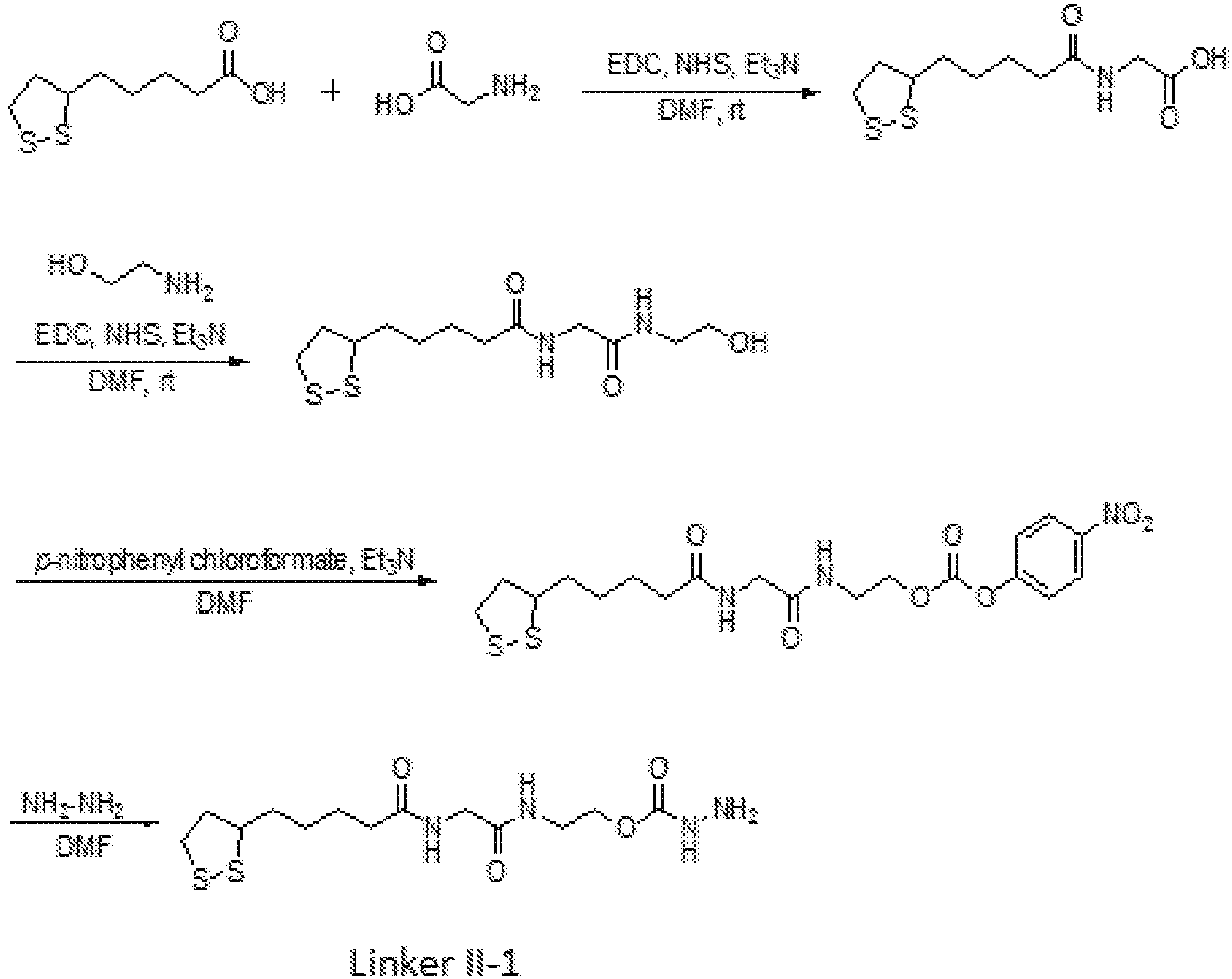
- Linker II-1 (Linker II-amide, z=1). 1H(400MHz)δ1.32-1.39(2H, m), 1.46-1.57(2H, m), 1.63-1.69(1H, m), 1.83-1.91(1H, m), 2.08(1H, s), 2.13(2H, t), 2.36-2.46(1H, m), 3.07-3.19(2H, m), 3.22-3.28(2H, m), 3.62-3.65 (3H, m), 3.95 (3H, t), 7.01(1H, s), 7.91(1H, t), 8.01(1H, t), 8.14(1H, s). 13C(100MHz)δ25.2, 28.8, 34.6, 35.4, 38.6, 38.7, 39.5, 42.4, 56.60, 62.85, 135.63, 169.72, 172.83 ppm. H-Mass (m/z): (M+Na) =387.1102

- Linker II-2 (Linker II-amide, z=2). 1H(300MHz)δ1.32-1.39(2H, m), 1.47-1.57(3H, m), 1.61-1.73(1H, m), 1.81-1.92(1H, m), 2.14(2H, t), 2.35-2.46(2H, m), 3.09-3.21(3H, m), 3.23-3.31(3H, m), 3.65-3.71(4H, m), 3.97 (2H, t), 7.78 (1H, t), 7.89(1H, t), 8.12(2H, t). 13C(100MHz)δ25.3, 28.8, 34.6, 35.4, 38.6, 38.7, 39.5, 42.4, 42.6, 56.6, 60.2, 62.8, 169.4, 169.9, 173.1 ppm. H-Mass (m/z): (M+Na)=444.1345

- Linker II-3(Linker II-amide, z=3). 1H(300MHz)δ1.23(1H, s), 1.32-1.40(2H, m), 1.46-1.57(4H, m), 1.63-1.70(1H, m), 1.80-1.92(2H, t), 1.96(1H, s), 2.04(1H, s), 2.14(3H, t), 3.07-3.19(3H, m), 3.58-3.66 (3H, m), 3.72 (3H, t), 3.96(1H, t), 4.05(1H, s), 7.86(1H, s), 8.10(3H, s). 13C(100MHz)δ25.3, 28.8, 34.6, 35.4, 38.6, 39.5, 39.7, 40.5, 42.4, 42.6, 56.6, 60.2, 62.8, 169.4, 169.6, 170.1, 173.1 ppm. H-Mass (m/z): (M+Na) =501.1606

- Linker II-4(Linker II-amide, z=4). 1H(300MHz)δ1.26(3H, s), 1.35-1.42(2H, m), 1.47-1.70(4H, m), 1.82-1.94(2H, m), 2.03-2.20(8H, m), 2.26-2.33(2H, m), 3.66-3.81(7H, m), 3.95-4.01(1H, m), 7.86-7.94(1H, m), 8.80-8.22(3H, m). 13C(100MHz)δ25.3, 28.8, 29.4, 31.2, 34.6, 35.4, 38.5, 38.6, 42.4, 42.6, 56.6, 66.0, 125.8, 128.7, 129.4, 169.4, 169.8, 170.0, 173.1 ppm. H-Mass (m/z): (M+Na) =558.1768
-
-
Step 1. The glycolic acid (2.40 g, 1.05 eq) and Lipoic acid(6.19 g,1.0 eq) were dissolved in 80 mL DCM, and N,N'-Dicyclohexylcarbodiimide (DCC) (8.05 g, 1.3 eq), 4-(Dimethylamino)pyridine (DMAP) (0.37 g, 0.1 eq) and triethylamine (9.6 mL, 2.3 eq) were slowly added. The reaction was carried out at room temperature for at least 5 hrs and the reaction was followed by TLC. Subsequently, the mixture was quenched by adding ddH2O, and was extracted 2-3 times with DCM. The organic layer was collected, dried with anhydrous magnesium sulfate, filtered with MgSO4 and then removal of DCM. The extract is purified with the column by using DCM:MeOH = 9.5: 0.5. The product was a pale yellow liquid. Yield: 85 %. -
Step 2. TheStep 1 product (5.26 g, 1.0 eq) and ethanolamine(1.28 g, 1.05 eq) were dissolved in 80 mL DCM, and EDC·HCl (4.98g, 1.3 eq), hydroxysuccinimide (NHS)(2.30g, 1.0 eq) and triethylamine (6.4 mL, 2.3 eq) were slowly added. The reaction was carried out at room temperature for at least 5 hrs and the reaction was followed by TLC. Subsequently, the mixture was quenched by adding ddH2O, and was extracted 2-3 times with DCM The organic layer was collected, dried with anhydrous magnesium sulfate, filtered with MgSO4 and then removal of DCM The extract is purified with the column by using DCM:MeOH = 9.8: 0.2. The product was a pale yellow liquid. Yield: 80.5 %. -
Step 3. The 4-nitrophenyl chloroformate (3.35 g, 1.15 eq) was placed in two-neck bottle. Under vacuum for 1 hr, the three-way valve was diverted to nitrogen device and 60 mL DCM was added with a syringe. Theweighted Step 1Product 1 was dissolved with 10-15 mL DCM, injected into the reaction flask with a syringe, and then slowly added with triethylamine (4.5 mL, 2.3 eq). The reaction was carried out in an ice bath for about 1 hr and then back to room temperature for overnight. After completion of the reaction, the mixture was quenched by adding ddH2O, and was extracted 2-3 times with DCM. The organic layer was collected, dried with anhydrous magnesium sulfate, filtered with MgSO4 and then removal of DCM. The extract is purified with the column by using EtOAc:Hex:MeOH = 1:2: 0.2. The product was a pale yellow liquid. After purification yield: 47.8 %. - Step 4. The
weighted Step 2 Product 2 (3.5 g, 1.0 eq) was dissolved in 120 mL DCM, and then slowly added with Hydrazine hydrate (6.5 mL, 10.0 eq). The reaction was carried out at room temperature for about 24 hrs. The solution color turned from pale yellow to orange. After completion of the reaction, the mixture was quenched by adding ddH2O, and extracted 2-3 times with DCM The organic layer was collected, dried with anhydrous magnesium sulfate, filtered with MgSO4 and then removal of DCM. The extract was purified with the column by using DCM:MeOH = 9.5: 0.5. In this step, the product was stuck in the column and the MeOH can be increased to 5% to elute the final product. The product was a pale yellow sticky solid. After purification yield: 19.3 %. -
-
Step 1. The 6-Acetylthiohexanoic acid (5.71 g, 1.0 eq) and glycine (2.36 g,1.05 eq) were dissolved in 80 mL DCM, and EDC·HCl (7.47g, 1.3 eq), hydroxysuccinimide (NHS) (3.45g, 1.0 eq) and triethylamine (9.6 mL, 2.3 eq) were slowly added. The reaction was carried out at room temperature for at least 5 hrs and the reaction was followed by TLC. Subsequently, the mixture was quenched by adding ddH2O, and was extracted 2-3 times with DCM The organic layer was collected, dried with anhydrous magnesium sulfate, filtered with MgSO4 and then removal of DCM. The extract is purified with the column by using DCM:MeOH = 9.5: 0.5. The product was a pale yellow liquid. Yield: 68.8%. -
Step 2. TheStep 1 product (5.26 g, 1.0 eq) and ethanolamine(1.28 g, 1.05 eq) were dissolved in 80 mL DCM, and EDC·HCl (4.98g, 1.3 eq), hydroxysuccinimide (NHS)(2.30g, 1.0 eq) and triethylamine (6.4 mL, 2.3 eq) were slowly added. The reaction was carried out at room temperature for at least 5 hrs and the reaction was followed by TLC. Subsequently, the mixture was quenched by adding ddH2O, and was extracted 2-3 times with DCM The organic layer was collected, dried with anhydrous magnesium sulfate, filtered with MgSO4 and then removal of DCM. The extract is purified with the column by using DCM:MeOH = 9.8: 0.2. The product was a pale yellow liquid. Yield: 80.5 %. -
Step 3. The 4-nitrophenyl chloroformat (3.35 g, 1.15 eq) was placed in two-neck bottle. Under vacuum for 1 hr, the three-way valve was diverted to nitrogen device and 60 mL DCM was added with a syringe. Theweighted Step 1Product 1 was dissolved with 10-15 mL DCM, injected into the reaction flask with a syringe, and then slowly added with triethylamine (4.5 mL, 2.3 eq). The reaction was carried out in an ice bath for about 1 hr and then back to room temperature for overnight. After completion of the reaction, the mixture was quenched by adding ddH2O, and was extracted 2-3 times with DCM The organic layer was collected, dried with anhydrous magnesium sulfate, filtered with MgSO4 and then removal of DCM The extract is purified with the column by using EtOAc:Hex:MeOH = 1:2: 0.2. The product was a pale yellow liquid. After purification yield: 50.6 %. - Step 4. The
weighted Step 2 Product 2 (3.5 g, 1.0 eq) was dissolved in 120 mL DCM, and then slowly added with Hydrazine hydrate (6.5 mL, 10.0 eq). The reaction was carried out at room temperature for about 24 hrs. The solution color turned from pale yellow to orange. After completion of the reaction, the mixture was quenched by adding ddH2O, and extracted 2-3 times with DCM. The organic layer was collected, dried with anhydrous magnesium sulfate, filtered with MgSO4 and then removal of DCM The extract was purified with the column by using DCM:MeOH = 9.5: 0.5. In this step, the product was stuck in the column and the MeOH can be increased to 5% to elute the final product. The product was a pale yellow sticky solid. After purification yield: 18.3 %. -
-
Step 1. The 6-Acetylthiohexanoic acid (5.71 g, 1.0 eq) and glycolic acid (2.40g,1.05 eq) were dissolved in 80 mL DCM, and N,N'-Dicyclohexylcarbodiimide (DCC) (8.05 g, 1.3 eq), 4-(Dimethylamino)pyridine (DMAP) (0.37 g, 0.1 eq) and triethylamine (9.6 mL, 2.3 eq) were slowly added. The reaction was carried out at room temperature for at least 5 hrs and the reaction was followed by TLC. Subsequently, the mixture was quenched by adding ddH2O, and was extracted 2-3 times with DCM. The organic layer was collected, dried with anhydrous magnesium sulfate, filtered with MgSO4 and then removal of DCM. The extract is purified with the column by using DCM:MeOH = 9.5: 0.5. The product was a pale yellow liquid. Yield: 78 %. -
Step 2. TheStep 1 product (5.26 g, 1.0 eq) and ethanolamine(1.28 g, 1.05 eq) were dissolved in 80 mL DCM, and EDC·HCl (4.98g, 1.3 eq), hydroxysuccinimide (NHS)(2.30g, 1.0 eq) and triethylamine (6.4 mL, 2.3 eq) were slowly added. The reaction was carried out at room temperature for at least 5 hrs and the reaction was followed by TLC. Subsequently, the mixture was quenched by adding ddH2O, and was extracted 2-3 times with DCM. The organic layer was collected, dried with anhydrous magnesium sulfate, filtered with MgSO4 and then removal of DCM. The extract is purified with the column by using DCM:MeOH = 9.8: 0.2. The product was a pale yellow liquid. Yield: 80.5 %. -
Step 3. The 4-nitrophenyl chloroformat (3.35 g, 1.15 eq) was placed in two-neck bottle. Under vacuum for 1 hr, the three-way valve was diverted to nitrogen device and 60 mL DCM was added with a syringe. Theweighted Step 1Product 1 was dissolved with 10-15 mL DCM, injected into the reaction flask with a syringe, and then slowly added with triethylamine (4.5 mL, 2.3 eq). The reaction was carried out in an ice bath for about 1 hr and then back to room temperature for overnight. After completion of the reaction, the mixture was quenched by adding ddH2O, and was extracted 2-3 times with DCM The organic layer was collected, dried with anhydrous magnesium sulfate, filtered with MgSO4 and then removal of DCM. The extract is purified with the column by using EtOAc:Hex:MeOH = 1:2: 0.2. The product was a pale yellow liquid. After purification yield: 51.6 %. - Step 4. The
weighted Step 2 Product 2 (3.5 g, 1.0 eq) was dissolved in 120 mL DCM, and then slowly added with Hydrazine hydrate (6.5 mL, 10.0 eq). The reaction was carried out at room temperature for about 24 hrs. The solution color turned from pale yellow to orange. After completion of the reaction, the mixture was quenched by adding ddH2O, and extracted 2-3 times with DCM. The organic layer was collected, dried with anhydrous magnesium sulfate, filtered with MgSO4 and then removal of DCM The extract was purified with the column by using DCM:MeOH = 9.5: 0.5. In this step, the product was stuck in the column and the MeOH can be increased to 5% to elute the final product. The product was a pale yellow sticky solid. After purification yield: 19.0 %. -
-
Step 1. The Boc-glycine (5.26 g, 1.0 eq) and glycine (2.36 g,1.05 eq) were dissolved in 80 mL DCM, and EDC·HCl (7.47g, 1.3 eq), hydroxysuccinimide (NHS) (3.45g, 1.0 eq) and triethylamine (9.6 mL, 2.3 eq) were slowly added. The reaction was carried out at room temperature for at least 5hrs and the reaction was followed by TLC. Subsequently, the mixture was quenched by adding ddH2O, and was extracted 2-3 times with DCM. The organic layer was collected, dried with anhydrous magnesium sulfate, filtered with MgSO4 and then removal of DCM The extract is purified with the column by using DCM:MeOH = 9.5: 0.5. The product was a pale yellow liquid. Yield: 70 %. -
Step 2. TheStep 1 product (5.26 g, 1.0 eq) and ethanolamine(1.28 g, 1.05 eq) were dissolved in 80 mL DCM, and EDC·HCl (4.98g, 1.3 eq), hydroxysuccinimide (NHS)(2.30g, 1.0 eq) and triethylamine (6.4 mL, 2.3 eq) were slowly added. The reaction was carried out at room temperature for at least 5 hrs and the reaction was followed by TLC. Subsequently, the mixture was quenched by adding ddH2O, and was extracted 2-3 times with DCM. The organic layer was collected, dried with anhydrous magnesium sulfate, filtered with MgSO4 and then removal of DCM The extract is purified with the column by using DCM:MeOH = 9.8: 0.2. The product was a pale yellow liquid. Yield: 77.8 %. -
Step 3. The 4-nitrophenyl chloroformat (3.35 g, 1.15 eq) was placed in two-neck bottle. Under vacuum for 1 hr, the three-way valve was diverted to nitrogen device and 60 mL DCM was added with a syringe. Theweighted Step 1Product 1 was dissolved with 10-15 mL DCM, injected into the reaction flask with a syringe, and then slowly added with triethylamine (4.5 mL, 2.3 eq). The reaction was carried out in an ice bath for about 1 hr and then back to room temperature for overnight. After completion of the reaction, the mixture was quenched by adding ddH2O, and was extracted 2-3 times with DCM. The organic layer was collected, dried with anhydrous magnesium sulfate, filtered with MgSO4 and then removal of DCM. The extract is purified with the column by using EtOAc:Hex:MeOH = 1:2: 0.2. The product was a pale yellow liquid. After purification yield: 51.6 %. - Step 4. The
weighted Step 2 Product 2 (3.5 g, 1.0 eq) was dissolved in 120 mL DCM, and then slowly added with Hydrazine hydrate (6.5 mL, 10.0 eq). The reaction was carried out at room temperature for about 24 hrs. The solution color turned from pale yellow to orange. After completion of the reaction, the mixture was quenched by adding ddH2O, and extracted 2-3 times with DCM. The organic layer was collected, dried with anhydrous magnesium sulfate, filtered with MgSO4 and then removal of DCM. The extract was purified with the column by using DCM:MeOH = 9.5: 0.5. In this step, the product was stuck in the column and the MeOH can be increased to 5% to elute the final product. The product was a pale yellow sticky solid. After purification yield: 18.8 %. -
-
Step 1. The Boc-glycine (5.26 g, 1.0 eq) and glycolic acid (2.40g,1.05 eq) were dissolved in 80 mL DCM, and N,N'-Dicyclohexylcarbodiimide (DCC) (8.05 g, 1.3 eq), 4-(Dimethylamino)pyridine (DMAP) (0.37 g, 0.1 eq) and triethylamine (9.6 mL, 2.3 eq) were slowly added. The reaction was carried out at room temperature for at least 5 hrs and the reaction was followed by TLC. Subsequently, the mixture was quenched by adding ddH2O, and was extracted 2-3 times with DCM. The organic layer was collected, dried with anhydrous magnesium sulfate, filtered with MgSO4 and then removal of DCM The extract is purified with the column by using DCM:MOH = 9.5: 0.5. The product was a pale yellow liquid. Yield: 82.0 %. -
Step 2. TheStep 1 product (5.26 g, 1.0 eq) and ethanolamine(1.28 g, 1.05 eq) were dissolved in 80 mL DCM, and EDC·HCl (4.98g, 1.3 eq), hydroxysuccinimide (NHS)(2.30g, 1.0 eq) and triethylamine (6.4 mL, 2.3 eq) were slowly added. The reaction was carried out at room temperature for at least 5hrs and the reaction was followed by TLC. Subsequently, the mixture was quenched by adding ddH2O, and was extracted 2-3 times with DCM. The organic layer was collected, dried with anhydrous magnesium sulfate, filtered with MgSO4 and then removal of DCM The extract is purified with the column by using DCM:MeOH = 9.8: 0.2. The product was a pale yellow liquid. Yield: 78.5 %. -
Step 3. The 4-nitrophenyl chloroformate (3.35 g, 1.15 eq) was placed in two-neck bottle. Under vacuum for 1 hr, the three-way valve was diverted to nitrogen device and 60 mL DCM was added with a syringe. Theweighted Step 1Product 1 was dissolved with 10-15 mL DCM, injected into the reaction flask with a syringe, and then slowly added with triethylamine (4.5 mL, 2.3 eq). The reaction was carried out in an ice bath for about 1 hr and then back to room temperature for overnight. After completion of the reaction, the mixture was quenched by adding ddH2O, and was extracted 2-3 times with DCM. The organic layer was collected, dried with anhydrous magnesium sulfate, filtered with MgSO4 and then removal of DCM. The extract is purified with the column by using EtOAc:Hex:MeOH = 1:2: 0.2. The product was a pale yellow liquid. After purification yield: 51.0 %. - Step 4. The
weighted Step 2 Product (3.5 g, 1.0 eq) was dissolved in 120 mL DCM, and then slowly added with Hydrazine hydrate (6.5 mL, 10.0 eq). The reaction was carried out at room temperature for about 24 hrs. The solution color turned from pale yellow to orange. After completion of the reaction, the mixture was quenched by adding ddH2O, and extracted 2-3 times with DCM The organic layer was collected, dried with anhydrous magnesium sulfate, filtered with MgSO4 and then removal of DCM The extract was purified with the column by using DCM:MeOH = 9.5: 0.5. In this step, the product was stuck in the column and the MeOH can be increased to 5% to elute the final product. The product was a pale yellow sticky solid. After purification yield: 19.5 %. -

-
Step 1. The ethanolamine (1.92 g, 1.05 eq) and Lipoic acid(6.19 g,1.0 eq) were dissolved in 80 mL DCM, and EDC·HCl (7.47g, 1.3 eq), hydroxysuccinimide (NHS) (3.45g, 1.0 eq) and triethylamine (9.6 mL, 2.3 eq) were slowly added. The reaction was carried out at room temperature for at least 5 hrs and the reaction was followed by TLC. Subsequently, the mixture was quenched by adding ddH2O, and was extracted 2-3 times with DCM. The organic layer was collected, dried with anhydrous magnesium sulfate, filtered with MgSO4 and then removal of DCM. The extract is purified with the column by using DCM:MeOH = 9.8: 0.2. The product was a pale yellow liquid. Yield: 66.0 %. -
Step 2. TheStep 1 product (4.98 g, 1.0 eq) and succinic acid (2.48 g, 1.05 eq) were dissolved in 80 mL DCM, and N,N'-Dicyclohexylcarbodiimide (DCC) (5.36 g, 1.3 eq), 4-(Dimethylamino)pyridine (DMAP) (0.24 g, 0.1 eq) and triethylamine (6.4 mL, 2.3 eq) were slowly added. The reaction was carried out at room temperature for at least 5 hrs and the reaction was followed by TLC. Subsequently, the mixture was quenched by adding ddH2O, and was extracted 2-3 times with DCM. The organic layer was collected, dried with anhydrous magnesium sulfate, filtered with MgSO4 and then removal of DCM. The extract is purified with the column by using DCM:MeOH = 9.5: 0.5. The product was a pale yellow liquid. Yield: 80.7 %. -
Step 3. TheStep 2 product (3.49 g, 1.0 eq) and 2-[2-(2-Aminoethoxy)ethoxy]ethanol (1.57 g, 1.05 eq) were dissolved in 80 mL DCM, and EDC·HCl (2.49 g, 1.3 eq), hydroxysuccinimide (NHS) (1.15 g, 1.0 eq) and triethylamine (3.2 mL, 2.3 eq) were slowly added. The reaction was carried out at room temperature for at least 5hrs and the reaction was followed by TLC. Subsequently, the mixture was quenched by adding ddH2O, and was extracted 2-3 times with DCM. The organic layer was collected, dried with anhydrous magnesium sulfate, filtered with MgSO4 and then removal of DCM The extract is purified with the column by using DCM:MeOH = 9.8: 0.2. The product was a pale yellow liquid. Yield: 81.2 %. - Step 4. The 4-nitrophenyl chloroformate (3.35 g, 1.15 eq) was placed in two-neck bottle. Under vacuum for 1 hr, the three-way valve was diverted to nitrogen device and 60 mL DCM was added with a syringe. The
weighted Step 3 Product was dissolved with 10-15 mL DCM, injected into the reaction flask with a syringe, and then slowly added with triethylamine (4.5 mL, 2.3 eq). The reaction was carried out in an ice bath for about 1 hr and then back to room temperature for overnight. After completion of the reaction, the mixture was quenched by adding ddH2O, and was extracted 2-3 times with DCM The organic layer was collected, dried with anhydrous magnesium sulfate, filtered with MgSO4 and then removal of DCM The extract is purified with the column by using EtOAc:Hex:MeOH = 1:2: 0.2. The product was a pale yellow liquid. After purification yield: 48.6 %. -
Step 5. The weighted Step 4 Product (3.5 g, 1.0 eq) was dissolved in 120 mL DCM, and then slowly added with Hydrazine hydrate (6.5 mL, 10.0 eq). The reaction was carried out at room temperature for about 24 hrs. The solution color turned from pale yellow to orange. After completion of the reaction, the mixture was quenched by adding ddH2O, and extracted 2-3 times with DCM. The organic layer was collected, dried with anhydrous magnesium sulfate, filtered with MgSO4 and then removal of DCM. The extract was purified with the column by using DCM:MeOH = 9.5: 0.5. In this step, the product was stuck in the column and the MeOH can be increased to 5% to elute the final product. The product (Linker IV-2) was a pale yellow sticky solid. After purification yield: 30.0 %.
1H(300MHz)δ1.30-1.34(2H, m), 1.47-1.56(3H, m), 1.60-1.67(1H, m), 1.82-1.87(1H, m), 2.23(2H, t), 2.54-2.56(4H, m), 2.63-2.2.66(4H, m), 3.07-3.25(2H, m), 3.33-3.39(3H, m), 3.40-3.43(2H, m), 3.46-3.50(5H, m), 3.54-3.58(5H, m), 4.03-4.05(2H, m), 4.07-4.10(2H, m), 4.13-4.15(2H, m)
13C(100MHz)δ24.5, 24.6, 27.5, 33.7, 34.7, 38.1, 41.0, 55.7, 55.8, 59.6, 59.7, 59.8, 65.7, 65.8, 65.9, 71.5, 71.7, 171.7, 171.9, 172.0, 177.1, 177.2, 177.3 -
-
Step 1. The ethylene glycol (1.96 g, 1.05 eq) and Lipoic acid(6.19 g,1.0 eq) were dissolved in 80 mL DCM, and N,N'-Dicyclohexylcarbodiimide (DCC) (8.04 g, 1.3 eq), 4-(Dimethylamino)pyridine (DMAP) (0.37 g, 0.1 eq) and triethylamine (9.6 mL, 2.3 eq) were slowly added. The reaction was carried out at room temperature for at least 5hrs and the reaction was followed by TLC. Subsequently, the mixture was quenched by adding ddH2O, and was extracted 2-3 times with DCM. The organic layer was collected, dried with anhydrous magnesium sulfate, filtered with MgSO4 and then removal of DCM. The extract is purified with the column by using DCM:MeOH = 9.8: 0.2. The product was a pale yellow liquid. Yield: 66.0 %. -
Step 2. TheStep 1 product (4.98 g, 1.0 eq) and succinic acid (2.48 g, 1.05 eq) were dissolved in 80 mL DCM, and N,N'-Dicyclohexylcarbodiimide (DCC) (5.36 g, 1.3 eq), 4-(Dimethylamino)pyridine (DMAP) (0.24 g, 0.1 eq) and triethylamine (6.4 mL, 2.3 eq) were slowly added. The reaction was carried out at room temperature for at least 5 hrs and the reaction was followed by TLC. Subsequently, the mixture was quenched by adding ddH2O, and was extracted 2-3 times with DCM. The organic layer was collected, dried with anhydrous magnesium sulfate, filtered with MgSO4 and then removal of DCM The extract is purified with the column by using DCM:MeOH = 9.5: 0.5. The product was a pale yellow liquid. Yield: 81.2 %. -
Step 3. TheStep 2 product (3.49 g, 1.0 eq) and 2-[2-(2-Aminoethoxy)ethoxy]ethanol (1.57 g, 1.05 eq) were dissolved in 80 mL DCM, and EDC·HCl (2.49 g, 1.3 eq), hydroxysuccinimide (NHS) (1.15 g, 1.0 eq) and triethylamine (3.2 mL, 2.3 eq) were slowly added. The reaction was carried out at room temperature for at least 5 hrs and the reaction was followed by TLC. Subsequently, the mixture was quenched by adding ddH2O, and was extracted 2-3 times with DCM. The organic layer was collected, dried with anhydrous magnesium sulfate, filtered with MgSO4 and then removal of DCM The extract is purified with the column by using DCM:MeOH = 9.8: 0.2. The product was a pale yellow liquid. Yield: 80.5 %. - Step 4. The 4-nitrophenyl chloroformat (3.35 g, 1.15 eq) was placed in two-neck bottle. Under vacuum for 1 hr, the three-way valve was diverted to nitrogen device and 60 mL DCM was added with a syringe. The
weighted Step 3 Product was dissolved with 10-15 mL DCM, injected into the reaction flask with a syringe, and then slowly added with triethylamine (4.5 mL, 2.3 eq). The reaction was carried out in an ice bath for about 1 hr and then back to room temperature for overnight After completion of the reaction, the mixture was quenched by adding ddH2O, and was extracted 2-3 times with DCM The organic layer was collected, dried with anhydrous magnesium sulfate, filtered with MgSO4 and then removal of DCM The extract is purified with the column by using EtOAc:Hex:MeOH = 1:2: 0.2. The product was a pale yellow liquid. After purification yield: 50.3%. -
Step 5. The weighted Step 4 Product (3.5 g, 1.0 eq) was dissolved in 120 mL DCM, and then slowly added with Hydrazine hydrate (6.5 mL, 10.0 eq). The reaction was carried out at room temperature for about 24 hrs. The solution color turned from pale yellow to orange. After completion of the reaction, the mixture was quenched by adding ddH2O, and extracted 2-3 times with DCM The organic layer was collected, dried with anhydrous magnesium sulfate, filtered with MgSO4 and then removal of DCM The extract was purified with the column by using DCM:MeOH = 9.5: 0.5. In this step, the product was stuck in the column and the MeOH can be increased to 5% to elute the final product. The product was a pale yellow sticky solid. After purification yield: 31.0 %. -
-
Step 1. The ethanolamine (1.92 g, 1.05 eq) and 6-Acetylthiohexanoic acid (5.71 g, 1.0 eq) were dissolved in 80 mL DCM, and EDC·HCl (7.47g, 1.3 eq), hydroxysuccinimide (NHS) (3.45g, 1.0 eq) and triethylamine (9.6 mL, 2.3 eq) were slowly added. The reaction was carried out at room temperature for at least 5 hrs and the reaction was followed by TLC. Subsequently, the mixture was quenched by adding ddH2O, and was extracted 2-3 times with DCM. The organic layer was collected, dried with anhydrous magnesium sulfate, filtered with MgSO4 and then removal of DCM. The extract is purified with the column by using DCM:MeOH = 9.8: 0.2. The product was a pale yellow liquid. Yield: 74.0 %. -
Step 2. TheStep 1 product (4.98 g, 1.0 eq) and succinic acid (2.48 g, 1.05 eq) were dissolved in 80 mL DCM, and N,N'-Dicyclohexylcarbodiimide (DCC) (5.36 g, 1.3 eq), 4-(Dimethylamino)pyridine (DMAP) (0.24 g, 0.1 eq) and triethylamine (6.4 mL, 2.3 eq) were slowly added. The reaction was carried out at room temperature for at least 5 hrs and the reaction was followed by TLC. Subsequently, the mixture was quenched by adding ddH2O, and was extracted 2-3 times with DCM. The organic layer was collected, dried with anhydrous magnesium sulfate, filtered with MgSO4 and then removal of DCM The extract is purified with the column by using DCM:MeOH = 9.5: 0.5. The product was a pale yellow liquid. Yield: 80.2 %. -
Step 3. TheStep 2 product (3.49 g, 1.0 eq) and 2-[2-(2-Aminoethoxy)ethoxy]ethanol (1.57 g, 1.05 eq) were dissolved in 80 mL DCM, and EDC·HCl (2.49 g, 1.3 eq), hydroxysuccinimide (NHS) (1.15 g, 1.0 eq) and triethylamine (3.2 mL, 2.3 eq) were slowly added. The reaction was carried out at room temperature for at least 5 hrs and the reaction was followed by TLC. Subsequently, the mixture was quenched by adding ddH2O, and was extracted 2-3 times with DCM. The organic layer was collected, dried with anhydrous magnesium sulfate, filtered with MgSO4 and then removal of DCM The extract is purified with the column by using DCM:MeOH = 9.8: 0.2. The product was a pale yellow liquid. Yield: 80.0 %. - Step 4. The 4-nitrophenyl chloroformate (3.35 g, 1.15 eq) was placed in two-neck bottle. Under vacuum for 1 hr, the three-way valve was diverted to nitrogen device and 60 mL DCM was added with a syringe. The
weighted Step 3 Product was dissolved with 10-15 mL DCM, injected into the reaction flask with a syringe, and then slowly added with triethylamine (4.5 mL, 2.3 eq). The reaction was carried out in an ice bath for about 1 hr and then back to room temperature for overnight. After completion of the reaction, the mixture was quenched by adding ddH2O, and was extracted 2-3 times with DCM The organic layer was collected, dried with anhydrous magnesium sulfate, filtered with MgSO4 and then removal of DCM The extract is purified with the column by using EtOAc:Hex:MeOH = 1:2: 0.2. The product was a pale yellow liquid. After purification yield: 51.1 %. -
Step 5. The weighted Step 4 Product (3.5 g, 1.0 eq) was dissolved in 120 mL DCM, and then slowly added with Hydrazine hydrate (6.5 mL, 10.0 eq). The reaction was carried out at room temperature for about 24 hrs. The solution color turned from pale yellow to orange. After completion of the reaction, the mixture was quenched by adding ddH2O, and extracted 2-3 times with DCM The organic layer was collected, dried with anhydrous magnesium sulfate, filtered with MgSO4 and then removal of DCM The extract was purified with the column by using DCM:MeOH = 9.5: 0.5. In this step, the product was stuck in the column and the MeOH can be increased to 5% to elute the final product. The product was a pale yellow sticky solid. After purification yield: 28.0 %. -
-
Step 1. The ethylene glycol (1.96 g, 1.05 eq) and 6-Acetylthiohexanoic acid (5.71 g, 1.0 eq) were dissolved in 80 mL DCM, and N,N'-Dicyclohexylcarbodiimide (DCC) (8.04 g, 1.3 eq), 4-(Dimethylamino)pyridine (DMAP) (0.37 g, 0.1 eq) and triethylamine (9.6 mL, 2.3 eq) were slowly added. The reaction was carried out at room temperature for at least 5 hrs and the reaction was followed by TLC. Subsequently, the mixture was quenched by adding ddH2O, and was extracted 2-3 times with DCM. The organic layer was collected, dried with anhydrous magnesium sulfate, filtered with MgSO4 and then removal of DCM. The extract is purified with the column by using DCM:MeOH = 9.8: 0.2. The product was a pale yellow liquid. Yield: 71.5 %. -
Step 2. TheStep 1 product (4.98 g, 1.0 eq) and succinic acid (2.48 g, 1.05 eq) were dissolved in 80 mL DCM, and N,N'-Dicyclohexylcarbodiimide (DCC) (5.36 g, 1.3 eq), 4-(Dimethylamino)pyridine (DMAP) (0.24 g, 0.1 eq) and triethylamine (6.4 mL, 2.3 eq) were slowly added. The reaction was carried out at room temperature for at least 5 hrs and the reaction was followed by TLC. Subsequently, the mixture was quenched by adding ddH2O, and was extracted 2-3 times with DCM. The organic layer was collected, dried with anhydrous magnesium sulfate, filtered with MgSO4 and then removal of DCM The extract is purified with the column by using DCM:MeOH = 9.5: 0.5. The product was a pale yellow liquid. Yield: 81.4 %. -
Step 3. TheStep 2 product (3.49 g, 1.0 eq) and 2-[2-(2-Aminoethoxy)ethoxy]ethanol (1.57 g, 1.05 eq) were dissolved in 80 mL DCM, and EDC·HCl (2.49 g, 1.3 eq), hydroxysuccinimide (NHS) (1.15 g, 1.0 eq) and triethylamine (3.2 mL, 2.3 eq) were slowly added. The reaction was carried out at room temperature for at least 5 hrs and the reaction was followed by TLC. Subsequently, the mixture was quenched by adding ddH2O, and was extracted 2-3 times with DCM. The organic layer was collected, dried with anhydrous magnesium sulfate, filtered with MgSO4 and then removal of DCM The extract is purified with the column by using DCM:MOH = 9.8: 0.2. The product was a pale yellow liquid. Yield: 78.8 %. - Step 4. The 4-nitrophenyl chloroformate (3.35 g, 1.15 eq) was placed in two-neck bottle. Under vacuum for 1 hr, the three-way valve was diverted to nitrogen device and 60 mL DCM was added with a syringe. The
weighted Step 3 Product was dissolved with 10-15 mL DCM, injected into the reaction flask with a syringe, and then slowly added with triethylamine (4.5 mL, 2.3 eq). The reaction was carried out in an ice bath for about 1 hr and then back to room temperature for overnight. After completion of the reaction, the mixture was quenched by adding ddH2O, and was extracted 2-3 times with DCM The organic layer was collected, dried with anhydrous magnesium sulfate, filtered with MgSO4 and then removal of DCM. The extract is purified with the column by using EtOAc:Hex:MeOH = 1:2: 0.2. The product was a pale yellow liquid. After purification yield: 51.1 %. -
Step 5. The weighted Step 4 Product (3.5 g, 1.0 eq) was dissolved in 120 mL DCM, and then slowly added with Hydrazine hydrate (6.5 mL, 10.0 eq). The reaction was carried out at room temperature for about 24 hrs. The solution color turned from pale yellow to orange. After completion of the reaction, the mixture was quenched by adding ddH2O, and extracted 2-3 times with DCM The organic layer was collected, dried with anhydrous magnesium sulfate, filtered with MgSO4 and then removal of DCM The extract was purified with the column by using DCM:MeOH = 9.5: 0.5. In this step, the product was stuck in the column and the MeOH can be increased to 5% to elute the final product. The product was a pale yellow sticky solid. After purification yield: 27.8 %. -
-
Step 1. The ethanolamine (1.92 g, 1.05 eq) and Boc-glycine (5.26 g, 1.0 eq) were dissolved in 80 mL DCM, and EDC·HCl (7.47g, 1.3 eq), hydroxysuccinimide (NHS) (3.45g, 1.0 eq) and triethylamine (9.6 mL, 2.3 eq) were slowly added. The reaction was carried out at room temperature for at least 5 hrs and the reaction was followed by TLC. Subsequently, the mixture was quenched by adding ddH2O, and was extracted 2-3 times with DCM The organic layer was collected, dried with anhydrous magnesium sulfate, filtered with MgSO4 and then removal of DCM. The extract is purified with the column by using DCM:MeOH = 9.8: 0.2. The product was a pale yellow liquid. Yield: 62.0 %. -
Step 2. TheStep 1 product (4.98 g, 1.0 eq) and succinic acid (2.48 g, 1.05 eq) were dissolved in 80 mL DCM, and N,N'-Dicyclohexylcarbodiimide (DCC) (5.36 g, 1.3 eq), 4-(Dimethylamino)pyridine (DMAP) (0.24 g, 0.1 eq) and triethylamine (6.4 mL, 2.3 eq) were slowly added. The reaction was carried out at room temperature for at least 5 hrs and the reaction was followed by TLC. Subsequently, the mixture was quenched by adding ddH2O, and was extracted 2-3 times with DCM. The organic layer was collected, dried with anhydrous magnesium sulfate, filtered with MgSO4 and then removal of DCM The extract is purified with the column by using DCM:MeOH = 9.5: 0.5. The product was a pale yellow liquid. Yield: 80.4 %. -
Step 3. TheStep 2 product (3.49 g, 1.0 eq) and 2-[2-(2-Aminoethoxy)ethoxy]ethanol (1.57 g, 1.05 eq) were dissolved in 80 mL DCM, and EDC·HCl (2.49 g, 1.3 eq), hydroxysuccinimide (NHS) (1.15 g, 1.0 eq) and triethylamine (3.2 mL, 2.3 eq) were slowly added. The reaction was carried out at room temperature for at least 5hrs and the reaction was followed by TLC. Subsequently, the mixture was quenched by adding ddH2O, and was extracted 2-3 times with DCM. The organic layer was collected, dried with anhydrous magnesium sulfate, filtered with MgSO4 and then removal of DCM. The extract is purified with the column by using DCM:MeOH = 9.8: 0.2. The product was a pale yellow liquid. Yield: 71.0 %. - Step 4. The 4-nitrophenyl chloroformat (3.35 g, 1.15 eq) was placed in two-neck bottle. Under vacuum for 1 hr, the three-way valve was diverted to nitrogen device and 60 mL DCM was added with a syringe. The
weighted Step 3 Product was dissolved with 10-15 mL DCM, injected into the reaction flask with a syringe, and then slowly added with triethylamine (4.5 mL, 2.3 eq). The reaction was carried out in an ice bath for about 1 hr and then back to room temperature for overnight. After completion of the reaction, the mixture was quenched by adding ddH2O, and was extracted 2-3 times with DCM The organic layer was collected, dried with anhydrous magnesium sulfate, filtered with MgSO4 and then removal of DCM The extract is purified with the column by using EtOAc:Hex:MeOH = 1:2: 0.2. The product was a pale yellow liquid. After purification yield: 51.9 %. -
Step 5. The weighted Step 4 Product (3.5 g, 1.0 eq) was dissolved in 120 mL DCM, and then slowly added with Hydrazine hydrate (6.5 mL, 10.0 eq). The reaction was carried out at room temperature for about 24 hrs. The solution color turned from pale yellow to orange. After completion of the reaction, the mixture was quenched by adding ddH2O, and extracted 2-3 times with DCM The organic layer was collected, dried with anhydrous magnesium sulfate, filtered with MgSO4 and then removal of DCM The extract was purified with the column by using DCM:MeOH = 9.5: 0.5. In this step, the product was stuck in the column and the MeOH can be increased to 5% to elute the final product. The product was a pale yellow sticky solid. After purification yield: 29.0 %. -
-
Step 1. The ethylene glycol (1.96 g, 1.05 eq) and Boc-glycine (5.26 g, 1.0 eq) were dissolved in 80 mL DCM, and N,N'-Dicyclohexylcarbodiimide (DCC) (8.04 g, 1.3 eq), 4-(Dimethylamino)pyridine (DMAP) (0.37 g, 0.1 eq) and triethylamine (9.6 mL, 2.3 eq) were slowly added. The reaction was carried out at room temperature for at least 5 hrs and the reaction was followed by TLC. Subsequently, the mixture was quenched by adding ddH2O, and was extracted 2-3 times with DCM. The organic layer was collected, dried with anhydrous magnesium sulfate, filtered with MgSO4 and then removal of DCM. The extract is purified with the column by using DCM:MeOH = 9.8: 0.2. The product was a pale yellow liquid. Yield: 75.0 %. -
Step 2. TheStep 1 product (4.98 g, 1.0 eq) and succinic acid (2.48 g, 1.05 eq) were dissolved in 80 mL DCM, and N,N'-Dicyclohexylcarbodiimide (DCC) (5.36 g, 1.3 eq), 4-(Dimethylamino)pyridine (DMAP) (0.24 g, 0.1 eq) and triethylamine (6.4 mL, 2.3 eq) were slowly added. The reaction was carried out at room temperature for at least 5 hrs and the reaction was followed by TLC. Subsequently, the mixture was quenched by adding ddH2O, and was extracted 2-3 times with DCM. The organic layer was collected, dried with anhydrous magnesium sulfate, filtered with MgSO4 and then removal of DCM The extract is purified with the column by using DCM:MeOH = 9.5: 0.5. The product was a pale yellow liquid. Yield: 80.5 %. -
Step 3. TheStep 2 product (3.49 g, 1.0 eq) and 2-[2-(2-Aminoethoxy)ethoxy]ethanol (1.57 g, 1.05 eq) were dissolved in 80 mL DCM, and EDC·HCl (2.49 g, 1.3 eq), hydroxysuccinimide (NHS) (1.15 g, 1.0 eq) and triethylamine (3.2 mL, 2.3 eq) were slowly added. The reaction was carried out at room temperature for at least 5 hrs and the reaction was followed by TLC. Subsequently, the mixture was quenched by adding ddH2O, and was extracted 2-3 times with DCM. The organic layer was collected, dried with anhydrous magnesium sulfate, filtered with MgSO4 and then removal of DCM. The extract is purified with the column by using DCM:MeOH = 9.8: 0.2. The product was a pale yellow liquid. Yield: 81.0%. - Step 4. The 4-nitrophenyl chloroformat (3.35 g, 1.15 eq) was placed in two-neck bottle. Under vacuum for 1 hr, the three-way valve was diverted to nitrogen device and 60 mL DCM was added with a syringe. The
weighted Step 3 Product was dissolved with 10-15 mL DCM, injected into the reaction flask with a syringe, and then slowly added with triethylamine (4.5 mL, 2.3 eq). The reaction was carried out in an ice bath for about 1 hr and then back to room temperature for overnight. After completion of the reaction, the mixture was quenched by adding ddH2O, and was extracted 2-3 times with DCM The organic layer was collected, dried with anhydrous magnesium sulfate, filtered with MgSO4 and then removal of DCM The extract is purified with the column by using EtOAc:Hex:MeOH = 1:2: 0.2. The product was a pale yellow liquid. After purification yield: 50.6 %. -
Step 5. The weighted Step 4 Product (3.5 g, 1.0 eq) was dissolved in 120 mL DCM, and then slowly added with Hydrazine hydrate (6.5 mL, 10.0 eq). The reaction was carried out at room temperature for about 24 hrs. The solution color turned from pale yellow to orange. After completion of the reaction, the mixture was quenched by adding ddH2O, and extracted 2-3 times with DCM The organic layer was collected, dried with anhydrous magnesium sulfate, filtered with MgSO4 and then removal of DCM The extract was purified with the column by using DCM:MeOH = 9.5: 0.5. In this step, the product was stuck in the column and the MeOH can be increased to 5% to elute the final product. The product was a pale yellow sticky solid. After purification yield: 31.2 %. - We examined the cytotoxicity of 9 linkers and the IC50 value for each linker was calculated. The human brast adenocarcinoma MCF7, MDA-MB-453 and MDA-MB-231 and human mammary epithelial cell H184B5F5/M10 were choosed for cytotoxicity test. Cells were seeded in 6-well plates and treated Linker 1-1 (Linker I-amide, m=2), Linker 1-2 (Linker I-amide, m=1), Linker 1-3 (Linker I-amide, m=3), Linker 1-4 (Linker I-amide, m=4), Linker 1-5 (Linker I-amide, m=5), Linker II-1 (Linker II-amide, z=1), Linker II-2 (Linker II-amide, z=2), Linker II-3 (Linker II-amide, z=3), and Linker II-4 (Linker II-amide, z=4), and further incubated for 72 hours at 37°C. After took photos, cells were counted by using hemocytometer. Growth inhibition was compared with untreated controls to find the linker concentration which inhibited growth by 50% (IC50). The summary of IC50 is showed in Table. 1. The IC50 value were 300 to 700 µM in linker 1-1 to linker 1-5 and linker II-1. The IC50 value of linker II-2 to II-4 is more than 800 µM. These data suggesting that the cellular toxicity is low to as a linker for conjugate drug and gold nanoparticles for drug delivery.
Table. 1 Summary of IC50 value of linkers cytotoxicity in human brast adenocarcinoma MCF7, MDA-MB-453 and MDA-MB-231 and human mammary epithelial cell H184B5F5/M10 for 72 hrs. IC50 value for linker cytotoxicity (µM) MCF7 MDA-MB-231 M10 MDA-MB-453 Linker I-1 692.0 ± 51.9 528.9 ± 52.1 584.4 ± 62.7 298.6 ± 23 Linker I-2 730 ± 36.7 535.6 ± 21.6 685.7 ± 105.5 432.5 ± 96.6 Linker I-3 538.2 ± 39.6 453.7 ± 141.7 555 ± 33.5 332.9 ± 9.8 Linker I-4 569.2 ± 14.1 575.6 ± 81.9 560 ± 45.1 342.3 ± 11 Linker I-5 418.9 ± 23.8 484.3 ± 64.6 569.3 ± 54.7 460 ± 87.9 Linker II-1 500.8 474.3 500.4 > 800 Linker II-2 > 800 > 800 > 800 > 800 Linker II-3 > 800 428.3 ± 116.2 585.3 ± 132.2 > 800 Linker II-4 > 800 > 800 > 800 > 800 Linker IV-2 > 800 655.5 > 800 708.4 ± 35.3 Linker SHI-1 >800 558.9 ±23.3 >800 128.3 ± 15.1 Linker SHI-4 >800 532.7 ± 63.9 >800 129.7 ± 13.4 - To conjugate antibody onto gold nanoparticles, anti-HIV-1 p24 (HIV-1 p24) (GeneTex, GTX41595) antibody was concentrated using 10 kDa MWCO centrifugal filter (Millipore, UFC501024) and was dissolved in 100 mM Na2HPO4, pH 7.4 buffer at 1 mg/mL. Then, 5 µL of 100 mM NaIO4 in water was added to 50 µL of antibody solution and the mixture was incubated in dark for 30 minutes. The reaction was quenched by adding 250 µL of 1 × PBS. At this point the carbohydrate moieties on the Fc portion of the antibody were oxidized to aldehyde groups. Then, Linker 1-1 (Linker I-amide, m=2) was added to the antibody solution. The linker has hydrazide and dithiol groups on opposing sites of the molecule. The hydrazide moiety interacts with aldehyde groups of the Fc portion of the modified antibody molecules. The reaction mixture was incubated at room temperature for 2 hours and then the thiolated antibodies were collected using centrifugal filters and resuspended in 0.1 M sodium phosphate buffer, pH 7.4. One hundred microliters of the thiolated antibodies at concentration of 0.1 mg/ml were mixed with 0.5 mL of gold nanoparticles and the suspension was incubated at room temperature for 1hr. Keep the antibody-gold nanoparticles complexes at 4°C for storage for further use.
- The formulation of Au/LKI-1/mAb-p24 complex was analyzed with a UV-Vis spectrophotometer (Beckman, DU 800). The surface plasmon resonance spectra recorded showed a 2 nm red shift in the plasmon peak (λmax) of the antibody-conjugated gold nanoparticles (
Fig. 1A ). Red fluorescence images ofAlex Fluor 568 secondary antibodies labeled Au/LKI-1/mAb-p24 complex was measured using an inverted microscope (Nikon, TE2000-U). Each gold nanoparticle showed red fluorescence suggesting that each gold nanoparticle conjugated with anti-HIV-1 P24 antibodies on surface (Fig. 1B ). Furthermore, we investigated the binding affinity of anti-HIV-1 P24 antibodies on gold nanoparticles. From ELISA, we could confirm the binding affinity of Au/LKI-1/mAb-p24 complexes to anti-HIV-1 P24 proteins (Fig. 1C ). - To conjugate antibody onto gold nanoparticles, anti-human EGFR clone H11 (Thermo, MA1-12693) was concentrated using 10 kDa MWCO centrifugal filter (Millipore, UFC501024) and was dissolved in 100 mM Na2HPO4, pH 7.4 buffer at 1 mg/mL. Then, 5 µL of 100 mM NaIO4 in water was added to 50 µL of antibody solution and the mixture was incubated in dark for 30 minutes. The reaction was quenched by adding 250 µL of 1 × PBS. At this point the carbohydrate moieties on the Fc portion of the antibody were oxidized to aldehyde groups. Then, Linker 1-1 (Linker I-amide, m=2) or Linker 1-5 (Linker I-amide, m=5) was added to the antibody solution. The linker has hydrazide and dithiol groups on opposing sites of the molecule. The hydrazide moiety interacts with aldehyde groups of the Fc portion of the modified antibody molecules. The reaction mixture was incubated at room temperature for 2 hours and then the thiolated antibodies were collected using centrifugal filters and resuspended in 0.1 M sodium phosphate buffer, pH 7.4. One hundred microliters of the thiolated antibodies at concentration of 0.1 mg/ml were mixed with 0.5 mL of gold nanoparticles and the suspension was incubated at room temperature for 1 hr. Keep the antibody-gold nanoparticles complexes at 4°C for storage for further use.
- The formulation of Au/LKI-1/ Ab-EGFR complex or Au/ LK I-5/ Ab-EGFR complex was analyzed with a UV-Vis spectrophotometer (Beckman, DU 800). The surface plasmon resonance spectra recorded showed a 2 nm red shift in the plasmon peak (λmax) of the antibody-conjugated gold nanoparticles (
Fig. 2 ). We examined two linkers, Linker 1-1 (Linker I-amide (m=2)) and linker I-5 (Linker I-amide (m=5)), for EGFR antibody and gold nanoparticles conjugation. Flow cytometry analysis of Au/LKI-1/ Ab-EGFR complex and Au/LKI-5/ Ab-EGFR complex were demonstrated targeting affinity on human breast adenocarcinoma MCF-7 cells. Both Au/LKI-1/ Ab-EGFR complex and Au/LKI-5/ Ab-EGFR complex were showed similar targeting ability comparing to EGFR antibody (Table.2). These data were suggested that linker is suitable for antibody and gold nanoparticles conjugation and keep the binding affinity for antibody.Table. 2 Flow cytometric analysis of the targeting effect of Ab-EGFR, Au/LKI-1/Ab-EGFR complex and Au/LKI-5/Ab-EGFR complex on EFGR of the surface in MCF-7 breast tumor cells. Ab-EGFR Au/LKI-1/Ab-EGFR complex Au/LKI-5/Ab-EGFR complex % EGFR to target on cell surface (cell line: MCF-7) 71.5 68 67 - To conjugate antibody onto gold nanoparticles, Tras (JHL biotech, JHL1188) antibody was concentrated using 10 kDa MWCO centrifugal filter (Millipore, UFC501024) and was dissolved in 100 mM Na2HPO4, pH 7.4 buffer at 1 mg/mL. Then, 5 µL of 100 mM NaIO4 in water was added to 50 µL of antibody solution and the mixture was incubated in dark for 30 minutes. The reaction was quenched by adding 250 µL of 1 × PBS. At this point the carbohydrate moieties on the Fc portion of the antibody were oxidized to aldehyde groups. Then, Linker 1-1 (Linker I-amide (m=2)) were added to the antibody solution. The linker has hydrazide and dithiol groups on opposing sites of the molecule. The hydrazide moiety interacts with aldehyde groups of the Fc portion of the modified antibody molecules. The reaction mixture was incubated at room temperature for 2 hours and then the thiolated antibodies were collected using centrifugal filters and resuspended in 0.1 M sodium phosphate buffer, pH 7.4. One hundred microliters of the thiolated antibodies at concentration of 0.1 mg/ml were mixed with 0.5 mL of gold nanoparticles and the suspension was incubated at room temperature for 1 hr. Keep Au/LKI-1/Tras complex at 4°C for storage for further use.
- The formulation of Au/LKI-1/Tras complex was analyzed with a UV-Vis spectrophotometer (Beckman, DU 800). The surface plasmon resonance spectra recorded showed a 8 nm red shift in the plasmon peak (λmax) of the antibody-conjugated gold nanoparticles (
Fig.3 ). We examined Au/LKI-1/Tras complex. Flow cytometry analysis of Au/LKI-1/Tras complex were demonstrated targeting affinity on human breast adenocarcinoma cells. Au/LKI-1/Tras complex were showed similar targeting ability comparing to Trastuzumab (Table.3).Table 3. Flow cytometric analysis of the targeting effect of Tras and Au/LKI-1/Tras complex on Her2/neu of the surface in MDA-MB-453 breast tumor cells. Ab-EGFR Au/LKI-1/Ab-EGFR complex % Trastuzumab to Her2/neu on cell surface (cell line: MDA-MB-453) 99.89 99.98 - To conjugate antibody onto gold nanoparticles, Etanercept (ETA) (Mycenax biotech, TuNEX) was concentrated using 10 kDa MWCO centrifugal filter (Millipore, UFC501024) and was dissolved in 100 mM Na2HPO4, pH 7.4 buffer at 1 mg/mL. Then, 5 µL of 100 mM NaIO4 in water was added to 50 µL of antibody solution and the mixture was incubated in dark for 30 minutes. The reaction was quenched by adding 250 µL of 1× PBS. At this point the carbohydrate moieties on the Fc portion of the antibody were oxidized to aldehyde groups. Then, linker 1-1 was added to the antibody solution. The linker has hydrazide and dithiol groups on opposing sites of the molecule. The hydrazide moiety interacts with aldehyde groups of the Fc portion of the modified antibody molecules. The reaction mixture was incubated at room temperature for 2 hours and then the thiolated antibodies were collected using centrifugal filters and resuspended in 0.1 M sodium phosphate buffer, pH 7.4. One hundred microliters of the thiolated antibodies at concentration of 0.1 mg/ml were mixed with 0.5 mL of gold nanoparticles and the suspension was incubated at room temperature for 1 hr. Keep Au/LKI-1/ETA complex at 4°C for storage for further use.
- The formulation of Au/LKI-1/ETA complex was analyzed with a UV-Vis spectrophotometer (Beckman, DU 800). The surface plasmon resonance spectra recorded showed a 2 nm red shift in the plasmon peak (λmax) of Au/LKI-1/ETA (
Fig. 4A ). Red fluorescence images ofAlex Fluor 568 secondary antibodies labeled Au/LKI-1/ETA complex was measured using an inverted microscope (Nikon, TE2000-U). Each gold nanoparticle showed red fluorescence suggesting that each gold nanoparticle conjugated with ETA antibodies on surface (Fig. 4B ). We further examined Au/LKI-1/ETA complex by binding with secondary antibody conjugated with 1-5 nm AuNPs. In TEM images of Au/LKI-1/ETA complex, binding of 1-5 nm gold-labeled secondary anti-human IgG antibodies to ETA located on the AuNP surface was observed (Fig. 4C ). We further investigated the TNFα blocking ability of ETA and Au/LKI-1/ETA. MCF-7 cells (5x10⁵) were treated with the mixtures of 12.5 ng/mL TNFα and 62.5, 125, 250, 500 ng/mL ETA or Au/LKI-1/ETA complex for 2 hours, respectively. The treated cells were incubated at 37 °C for 72 hours and then the cell numbers were counted by MTS [(3-(4,5-dimethylthiazol-2-yl)-5-(3-carboxymethoxyphenyl)-2-(4-sulfophenyl)-2H-tetrazolium)] assay. The TNFα blocking ability was observed in both ETA only and Au/LKI-1/ETA complex. ETA and Au/LKI-1/ETA complex were used to test their abilities in blocking TNFα induced MCF-7 cell apoptosis, Table 4. Au/LKI-1/ETA complex was showed similar blocking TNFα ability comparing to ETATable 4. The ability of Au/LKI-1/ETA complex to block TNFα-induced MCF-7 cell apoptosis TNFα 12.5 ng/mL Relative cell survival % Dose (ng/mL) ETA Au/LKI-1/ETA Complex 62.5 36.7 ± 1.4 35.6 ± 4.9 125 68.5 ± 2.3 54.9 ± 3.1 250 82.1 ± 6.5 67.2 ± 2.2 500 103.3 ± 0.9 100.9 ± 5.4 - 1 eq. doxorubicin and 2 eq. linker I-1 (Linker I-amide (m=2) were added to dry MeOH and mixed at room temperature. TFA (1.3eq.) was added to the resulting mixture for reaction overnight. The resulting mixture was filtered to obtain clear solution. The clear solution was added to a flask with 50 mL EtOAc by dropper, stirred for 20 minutes and filtered to obtain Dox-Linker-1 solid. The resulting solid was wash with EtOAc and then dried. 400 µL Dox/LKI-1 (2000 ppm) and 2 µL NaOH were added to 1 mL AuNPs (50 ppm) and then mixed for 21 hours. The mixture was centrifuged at 1400 rpm for 20 minutes. The resulting precipitate was washed by DI water and the resulting precipitate was resuspended in DI water. PEGs (2K, 2000 Da) were added to the suspension and mixed for overnight to obtain Au/LKI-1/Dox complex.
- The Au/LKI-1/DOX complex was analyzed with a UV-Vis spectrophotometer (Beckman, DU 800). The surface plasmon resonance spectra recorded showed a 3 nm red shift in the plasmon peak (λmax) of the Au/LKI-1/Dox complex (
Fig. 5 ). - Others linkers, 1-2, 1-3, 1-4, 1-5, II-1, II-2, II-3, II-4, IV-2, SHI-1 and SHI-4, were used to conjugate DOX and gold nanoparticles to obtain various complexes according to the above-mentioned process.
- We examined the cytotoxicity of Au/LKs/Dox complexes and the IC50 value was calculated. The human brast adenocarcinoma MCF7, MDA-MB-453 and MDA-MB-231 and human mammary epithelial cell H184B5F5/M10 were choosed for cytotoxicity test. Cells were seeded in 96-well plates and treated 2 µM doxorubicin (Dox), 20-50 nm gold nanoparticles conjugated with doxorubicin using various linkers as shown in the table below and capped with SH-PEG (Au/LK/Dox, contained 2 µM doxorubicin) and further incubated for 72 hours at 37°C. The CellTiter 96® AQueous One Solution Cell Proliferation Assay (MTS) reagent was purchased from Promega (Madison, WI, USA) and the assay was performed according to the manufacturer's instructions. Absorbance was measured at 490 nm using a microplate reader (Bio-tek, Powerwave X340, Winooski, VT, USA). Growth inhibition was compared with untreated controls to find the Au/LKs/Dox complexes concentration which inhibited growth by 50% (IC50).
Table. 5 Summary of IC50 value of Au/LKs/Dox complexes cytotoxicity in human brast adenocarcinoma MCF7, MDA-MB-453 and MDA-MB-231 and human mammary epithelial cell H184B5F5/M10 for 72 hrs. IC50 value for complex cytotoxicity (µM) MCF7 MDA-MB-231 MDA-MB-453 M10 Au/Linker I-1/Dox 0.54 ± 0.03 0.5 ± 0.082 1.93 ± 0.2 0.49 ± 0.0138 Au/Linker I-2/Dox 0.7 ± 0.0096 0.86 ± 0.056 0.7 ± 0.05 0.46 ± 0.058 Au/Linker I-3/Dox > 2.0 > 2.0 > 2.0 > 2.0 Au/Linker I-4/Dox > 2.0 > 2.0 > 2.0 > 2.0 Au/Linker I-5/Dox > 2.0 > 2.0 > 2.0 > 2.0 Au/Linker II-1/Dox 0.65 ± 0.037 0.83 ± 0.027 0.69 ± 0.026 0.56 ± 0.015 Au/Linker II-2/Dox > 2.0 0.98 ± 0.26 > 2.0 0.67 ± 0.1 Au/Linker II-3/Dox 0.76 ± 0.03 0.46 ± 0.035 0.85 ± 0.319 0.19 ± 0.03 Au/Linker II-4/Dox > 2.0 > 2.0 1.9 ± 0.12 0.7 ± 0.137 Au/Linker IV-2/Dox 0.77 ± 0.02 0.57 ± 0.048 0.73 ± 0.073 0.49 ± 0.031 Au/Linker SHI-1/Dox 0.82 ± 0.09 >2.0 >2.0 >2.0 Au/Linker SHI-4/Dox 0.75 ± 0.15 >2.0 >2.0 >2.0 Dox 0.41 ± 0.055 0.67 ± 0.088 0.65 ± 0.072 0.14 ± 0.034 - The IC50 value were 0.46-1.93 µM in Au/LK/Dox complex (LKI-1, LKI-2, LKII-1, LKII-3 and LKIV-2) for cancer cells (MCF-7, MDA-MB-231, MDA-MB-453) similar to Dox. For the normal cell, M10, the cellular toxicity of complexes are lower than Dox. The data suggests that the Au/LKs/Dox complexes are more safety than Dox.
- 1 mL of Au/LKI-1/Dox complex solution was centrifuged at 14000 rpm for 20 minutes. The supernant was dicarded and a buffer with pH 5.5 or a buffer with pH 7.4 was added therto. After different time points, the complex solution was centrifuged at 14000 rpm for 20 minutes and then the supernant was taken to subjecte to fluorescence scan at 557.6 nm (F-4500 FL Spectrophotometer) to obtain OD values. The Dox amounts realeased from the complex can be obtained by interpolating from a Dox standard curve (X hours Dox release amount).
- 1 mL of Au/LKI-1/Dox complex solution was centrifuged at 14000 rpm for 20 minutes. The supernant was dicarded and a buffer with pH 1.0 was added therto. After one hour, the complex solution was centrifuged at 14000 rpm for 20 minutes and then the supernant was taken to subjecte to fluorescence scan at 557.6 nm (F-4500 FL Spectrophotometer) to obtain OD values. The
Dox 100% release can be obtained by interpolating from a Dox standard curve (pH=1 incubation 1h Dox release amount). The Dox cumulative release percentage is calculated according to the following formula. -

- The data shows LKI-1 could release more Dox at pH5.5 than at pH 7.4. In Au/LKI-1/Dox, Dox was more and more released in time-dependent
- BALB/c-nu/nu mice were purchased from BioLASCO Taiwan. Eight week old male mice were injected unilaterally with 1.0×10⁷ MDA-MB-231 breast tumor cells in 200 µL of 50:50 Matrigel/Leibovitz's (L-15) into the dorsum by subcutaneous injection.(I) Vehicle-PBS (negative control), (2) Doxorubicin (positive control), 5 mg/kg, (3) Au/PEG, (4) Au/LKI-1/Dox complex, 5 mg/kg of Dox. Treatment was ongoing until clinical symptoms necessitated sacrifice. Mice were weighed a minimum of two times/weekly and were monitored tumor size until clinical symptoms necessitated sacrifice (see
Fig. 6A, 6B ). TEM images of MDA-MB-231 breast tumor cells treated with Au/LKI-1/Dox complex in xenograft model. The arrows in the figure show that the Au/LKI-1/Dox complex exist inside the MDA-MB-231 breast tumor cells. (seeFig. 6C ) H&E stain of MDA-MB-231 tumor cells treated with Au/LKI-1/Dox complex in xenograft model. (seeFig. 6D )
| Incubation time (h) | Dox release of Au/LKI-1/Dox, (%) | |
| pH=5.5 | pH=7.4 | |
| 1 | 23.40 | 6.12 |
| 3 | 27.87 | 7.30 |
| 5 | 27.80 | 7.39 |
| 7 | 32.11 | 7.54 |
| 12 | 37.16 | 7.51 |
| 24 | 46.01 | 7.91 |
| 48 | 55.39 | 8.96 |
| 72 | 70.45 | 8.88 |
Claims (14)
- A pH-sensitive linker having the following Formula (I),
 X is
X is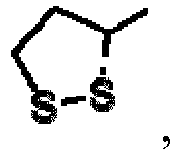 n is 1 to 6;P is -C(O)NH- or -C(O)O-;Q is -R(CH2CH2O)m-, R(-C(O)NH-)z or -R[-C(O)CH2CH2-C(O)NH-(CH2CH2O)m]Y;R is a bond,-C1-12alkyl or C1-10alkoxy;m is 1 to 12;z is 1 to 4; andY is 1 to 12.
 - The pH-sensitive linker of Claim 1, which has a formula selected from:


z is 1 to 4;.
z is 1 to 4.


- The pH-sensitive linker of Claim 1, which has the following formula:

- The pH-sensitive linker of Claim 1, which has the following formula:

- The pH-sensitive linker of Claim 1, which has the following formula:
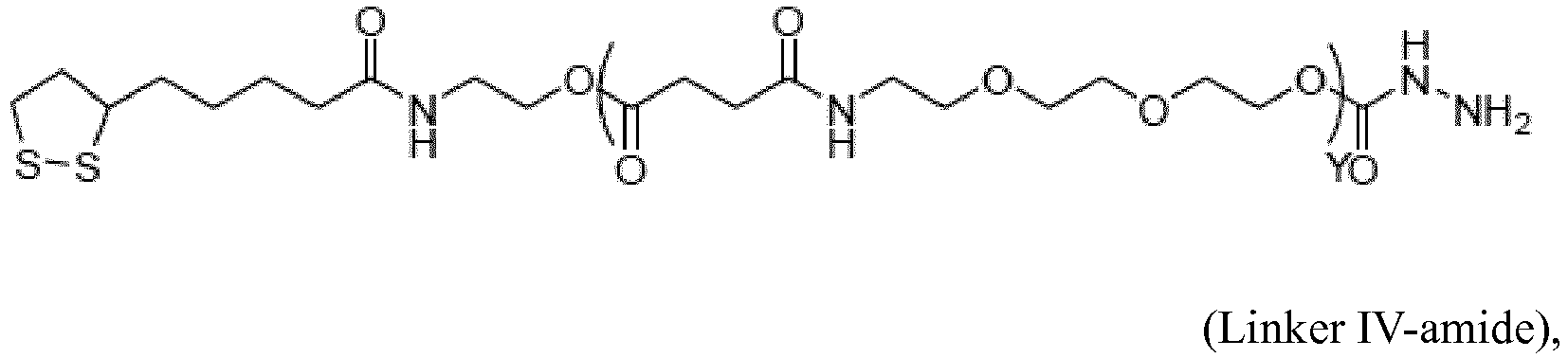
- A metallic nanoparticle complex, comprising a metallic nanoparticle complexed with one or more linkers of any of Claims 1 to 5, optionally complexed with one or more PEGs.
- The metallic nanoparticle complex of Claim 6, wherein: (a) the metallic nanoparticle is Au nanoparticle, Pd nanoparticle, Pt nanoparticle or Ag nanoparticle; and/or (b) the more linkers are same or different; and/or (c) the metallic nanoparticle complex comprises plural linkers with different molecular length; and/or (d) the molecular weight of PEG used in the invention ranges from 2000 to 20,000 Da; and/or (e) wherein the metallic nanoparticle is in a size less than 80 nm.
- The metallic nanoparticle complex of Claim 6, wherein the metallic nanoparticle complex further links one or more same or different therapeutic or diagnostic agents.
- The metallic nanoparticle complex of Claim 8, wherein the therapeutic agent is anti-tumor drug or an antibody; preferably, the antibody is an antibody targeted to a specific cell such as tumor cell or an anti-tumor antibody.
- The metallic nanoparticle complex of Claim 9, wherein the anti-tumor drug is an anti-cancer drug, and, optionally, wherein: (a) the anti-cancer drug is an alkylating agent, an alkyl sulfonate, an aziridine, a purine analog, a pyrimidine analog, camptothecin or doxorubicin, cisplatin; and/or (b) the amount of the anticancer accounts for 1% to 50% (weight/weight) of the metallic nanoparticle complex.
- A pharmaceutical composition, comprising one or more metallic nanoparticle complex linking one or more same of different therapeutic or diagnostic agents and a pharmaceutically acceptable carrier.
- The metallic nanoparticle complex of Claim 8 for use as a medicament.
- A method of delivering a diagnostic agent to a subject, comprising administering the metallic nanoparticle complex of Claim 8 to the subject.
- A drug delivery system, comprising one or more metallic nanoparticle complex of any of Claims 1 to 5 linking one or more same or different therapeutic or diagnostic agents.
Applications Claiming Priority (2)
| Application Number | Priority Date | Filing Date | Title |
|---|---|---|---|
| US201562195654P | 2015-07-22 | 2015-07-22 | |
| PCT/CN2016/090893 WO2017012568A1 (en) | 2015-07-22 | 2016-07-21 | Ph-sensitive linkers for delivering a therapeutic agent |
Publications (3)
| Publication Number | Publication Date |
|---|---|
| EP3325440A1 EP3325440A1 (en) | 2018-05-30 |
| EP3325440A4 EP3325440A4 (en) | 2019-01-23 |
| EP3325440B1 true EP3325440B1 (en) | 2020-04-08 |
Family
ID=57833804
Family Applications (1)
| Application Number | Title | Priority Date | Filing Date |
|---|---|---|---|
| EP16827259.9A Active EP3325440B1 (en) | 2015-07-22 | 2016-07-21 | Ph-sensitive linkers for delivering a therapeutic agent |
Country Status (10)
| Country | Link |
|---|---|
| US (1) | US10688193B2 (en) |
| EP (1) | EP3325440B1 (en) |
| JP (1) | JP6875371B2 (en) |
| KR (1) | KR102187410B1 (en) |
| CN (2) | CN107848957B (en) |
| AU (1) | AU2016295602B2 (en) |
| ES (1) | ES2797923T3 (en) |
| HK (1) | HK1246773A1 (en) |
| TW (2) | TW201713365A (en) |
| WO (2) | WO2017012568A1 (en) |
Families Citing this family (9)
| Publication number | Priority date | Publication date | Assignee | Title |
|---|---|---|---|---|
| US10688193B2 (en) | 2015-07-22 | 2020-06-23 | Gnt Biotech & Medicals Corporation | PH-sensitive linkers for delivering a therapeutic agent |
| CN106831853B (en) * | 2017-02-15 | 2019-02-22 | 浙江海正药业股份有限公司 | Preparation technology of 7-ethyl-10-O-tert-butyldiphenylsilylcamptothecin-20-O-glycine hydrochloride |
| GB201819430D0 (en) | 2018-11-29 | 2019-01-16 | Midatech Ltd | Therapeutic compounds, nanoparticles and uses thereof |
| EP3900704B1 (en) * | 2018-12-17 | 2023-11-01 | GI Cell, Inc. | Block copolymer comprising hydrophilic first block, hydrophobic second block, and functional group capable of specifically binding to thiol |
| KR20200087335A (en) | 2018-12-31 | 2020-07-21 | 강원대학교산학협력단 | An image processing method by using a convolution neural network and an apparatus thereof |
| CN115835860B (en) * | 2020-06-12 | 2026-03-24 | 树顶分子生技股份有限公司 | Pterostilbene amino acid analogues containing carbonates for the treatment of non-alcoholic fatty liver disease and non-alcoholic steatohepatitis. |
| CZ309422B6 (en) * | 2020-09-29 | 2022-12-28 | Ústav organické chemie a biochemie AV ČR, v. v. i. | Surface modified particles |
| CN114377126A (en) * | 2021-12-16 | 2022-04-22 | 天津市泌尿外科研究所 | Nano-palladium sheet-loaded tobuzumab nanocomposite, preparation method and application thereof in preparation of medicines for treating inflammation-related anemia |
| GB202305212D0 (en) * | 2023-04-06 | 2023-05-24 | Elixa Mediscience Ltd | Compounds |
Family Cites Families (6)
| Publication number | Priority date | Publication date | Assignee | Title |
|---|---|---|---|---|
| US20110077581A1 (en) * | 2009-09-25 | 2011-03-31 | Georgia Tech Research Corporation | Targeted cellular delivery of nanoparticles |
| KR101196667B1 (en) * | 2010-04-15 | 2012-11-02 | 포항공과대학교 산학협력단 | A DELEVERY SYSTEM OF ANTI-CANCER AGENT USING pH SENSITIVE METAL NANOPARTICLE |
| JP5492658B2 (en) * | 2010-05-24 | 2014-05-14 | 株式会社タムロン | High magnification zoom lens |
| US8697129B2 (en) * | 2011-03-02 | 2014-04-15 | Imra America, Inc. | Stable colloidal gold nanoparticles with controllable surface modification and functionalization |
| US8717746B2 (en) | 2012-03-22 | 2014-05-06 | Abb Technology Ag | Cooling apparatus for switchgear with enhanced busbar joint cooling |
| US10688193B2 (en) | 2015-07-22 | 2020-06-23 | Gnt Biotech & Medicals Corporation | PH-sensitive linkers for delivering a therapeutic agent |
-
2016
- 2016-07-21 US US15/746,544 patent/US10688193B2/en not_active Expired - Fee Related
- 2016-07-21 JP JP2018502821A patent/JP6875371B2/en not_active Expired - Fee Related
- 2016-07-21 KR KR1020187004773A patent/KR102187410B1/en not_active Expired - Fee Related
- 2016-07-21 CN CN201680042754.0A patent/CN107848957B/en not_active Expired - Fee Related
- 2016-07-21 WO PCT/CN2016/090893 patent/WO2017012568A1/en not_active Ceased
- 2016-07-21 HK HK18106124.6A patent/HK1246773A1/en unknown
- 2016-07-21 ES ES16827259T patent/ES2797923T3/en active Active
- 2016-07-21 EP EP16827259.9A patent/EP3325440B1/en active Active
- 2016-07-21 TW TW105123126A patent/TW201713365A/en unknown
- 2016-07-21 AU AU2016295602A patent/AU2016295602B2/en not_active Ceased
- 2016-07-22 CN CN201680042509.XA patent/CN108348599A/en active Pending
- 2016-07-22 TW TW105123349A patent/TW201718021A/en unknown
- 2016-07-22 WO PCT/CN2016/091075 patent/WO2017012591A1/en not_active Ceased
Non-Patent Citations (1)
| Title |
|---|
| None * |
Also Published As
| Publication number | Publication date |
|---|---|
| JP6875371B2 (en) | 2021-05-26 |
| CN107848957A (en) | 2018-03-27 |
| HK1246773A1 (en) | 2018-09-14 |
| US20180221498A1 (en) | 2018-08-09 |
| CN107848957B (en) | 2021-05-11 |
| WO2017012591A1 (en) | 2017-01-26 |
| ES2797923T3 (en) | 2020-12-04 |
| AU2016295602A1 (en) | 2018-02-15 |
| KR102187410B1 (en) | 2020-12-07 |
| TW201718021A (en) | 2017-06-01 |
| EP3325440A4 (en) | 2019-01-23 |
| US10688193B2 (en) | 2020-06-23 |
| WO2017012568A1 (en) | 2017-01-26 |
| JP2018524389A (en) | 2018-08-30 |
| EP3325440A1 (en) | 2018-05-30 |
| KR20180033533A (en) | 2018-04-03 |
| AU2016295602B2 (en) | 2019-11-14 |
| TW201713365A (en) | 2017-04-16 |
| CN108348599A (en) | 2018-07-31 |
Similar Documents
| Publication | Publication Date | Title |
|---|---|---|
| US10688193B2 (en) | PH-sensitive linkers for delivering a therapeutic agent | |
| TWI787153B (en) | Compositions and methods related to anti-egfr antibody drug conjugates | |
| WO2017051249A1 (en) | Compositions and methods related to anti-cd19 antibody drug conjugates | |
| WO2021228044A1 (en) | Drug conjugates containing alpha-enolase antibodies and uses thereof | |
| AU2015274334B2 (en) | Compositions and methods for treating cancers | |
| JP2022530482A (en) | Ligand-drug complex containing a linker with a Tris structure | |
| EP4545097A1 (en) | Novel linker compound and ligand-drug conjugate therefor | |
| US20250082769A1 (en) | Cellular uptake peptide-therapeutic payload compositions and methods of use | |
| AU2020343037B2 (en) | Nucleic acid-mediated delivery of therapeutics | |
| KR20200127891A (en) | Ligand-drug conjugate comprising linker having tris structure | |
| WO2026050587A1 (en) | Novel anti-nectin-4 antibodies, conjugated biological molecules, pharmaceutical compositions and uses thereof | |
| WO2025259928A1 (en) | Improved trop2 conjugated biological molecules, pharmaceutical compositions and applications thereof | |
| TW202608929A (en) | Improved linker-payloads for antibody conjugation, pharmaceutical compositions and applications thereof | |
| WO2025230926A1 (en) | Improved linker-payloads for antibody conjugation, pharmaceutical compositions and applications thereof | |
| TW202530216A (en) | Improved linker-payloads for antibody conjugation, pharmaceutical compositions and applications thereof | |
| KR20230142733A (en) | Compositions and methods for treating cancer | |
| HK40129204A (en) | Linker for antibody-drug conjugates, and antibody-drug conjugate | |
| HK40126569A (en) | Improved linker-payloads for antibody conjugation, pharmaceutical compositions and applications thereof | |
| WO2019185586A1 (en) | Ligands for enhanced imaging and drug delivery to neuroblastoma cells |
Legal Events
| Date | Code | Title | Description |
|---|---|---|---|
| STAA | Information on the status of an ep patent application or granted ep patent |
Free format text: STATUS: THE INTERNATIONAL PUBLICATION HAS BEEN MADE |
|
| PUAI | Public reference made under article 153(3) epc to a published international application that has entered the european phase |
Free format text: ORIGINAL CODE: 0009012 |
|
| STAA | Information on the status of an ep patent application or granted ep patent |
Free format text: STATUS: REQUEST FOR EXAMINATION WAS MADE |
|
| 17P | Request for examination filed |
Effective date: 20180124 |
|
| AK | Designated contracting states |
Kind code of ref document: A1 Designated state(s): AL AT BE BG CH CY CZ DE DK EE ES FI FR GB GR HR HU IE IS IT LI LT LU LV MC MK MT NL NO PL PT RO RS SE SI SK SM TR |
|
| AX | Request for extension of the european patent |
Extension state: BA ME |
|
| DAV | Request for validation of the european patent (deleted) | ||
| DAX | Request for extension of the european patent (deleted) | ||
| A4 | Supplementary search report drawn up and despatched |
Effective date: 20181221 |
|
| RIC1 | Information provided on ipc code assigned before grant |
Ipc: A61K 33/24 20060101ALI20181217BHEP Ipc: A61K 31/437 20060101ALI20181217BHEP Ipc: A61K 47/60 20170101ALI20181217BHEP Ipc: A61K 31/351 20060101ALI20181217BHEP Ipc: A61P 35/00 20060101ALI20181217BHEP Ipc: A61K 47/69 20170101ALI20181217BHEP Ipc: C07C 271/22 20060101ALI20181217BHEP Ipc: C07C 243/26 20060101AFI20181217BHEP Ipc: C07C 323/60 20060101ALI20181217BHEP Ipc: C07C 323/52 20060101ALI20181217BHEP Ipc: C07K 5/06 20060101ALI20181217BHEP Ipc: C07K 5/10 20060101ALI20181217BHEP Ipc: C07D 339/04 20060101ALI20181217BHEP Ipc: A61K 9/14 20060101ALI20181217BHEP |
|
| GRAP | Despatch of communication of intention to grant a patent |
Free format text: ORIGINAL CODE: EPIDOSNIGR1 |
|
| STAA | Information on the status of an ep patent application or granted ep patent |
Free format text: STATUS: GRANT OF PATENT IS INTENDED |
|
| INTG | Intention to grant announced |
Effective date: 20191217 |
|
| GRAS | Grant fee paid |
Free format text: ORIGINAL CODE: EPIDOSNIGR3 |
|
| GRAA | (expected) grant |
Free format text: ORIGINAL CODE: 0009210 |
|
| STAA | Information on the status of an ep patent application or granted ep patent |
Free format text: STATUS: THE PATENT HAS BEEN GRANTED |
|
| AK | Designated contracting states |
Kind code of ref document: B1 Designated state(s): AL AT BE BG CH CY CZ DE DK EE ES FI FR GB GR HR HU IE IS IT LI LT LU LV MC MK MT NL NO PL PT RO RS SE SI SK SM TR |
|
| REG | Reference to a national code |
Ref country code: CH Ref legal event code: EP Ref country code: AT Ref legal event code: REF Ref document number: 1254198 Country of ref document: AT Kind code of ref document: T Effective date: 20200415 |
|
| REG | Reference to a national code |
Ref country code: DE Ref legal event code: R096 Ref document number: 602016033791 Country of ref document: DE |
|
| REG | Reference to a national code |
Ref country code: IE Ref legal event code: FG4D |
|
| PGFP | Annual fee paid to national office [announced via postgrant information from national office to epo] |
Ref country code: FR Payment date: 20200619 Year of fee payment: 5 |
|
| PGFP | Annual fee paid to national office [announced via postgrant information from national office to epo] |
Ref country code: GB Payment date: 20200617 Year of fee payment: 5 |
|
| REG | Reference to a national code |
Ref country code: NL Ref legal event code: MP Effective date: 20200408 |
|
| REG | Reference to a national code |
Ref country code: LT Ref legal event code: MG4D |
|
| PG25 | Lapsed in a contracting state [announced via postgrant information from national office to epo] |
Ref country code: NL Free format text: LAPSE BECAUSE OF FAILURE TO SUBMIT A TRANSLATION OF THE DESCRIPTION OR TO PAY THE FEE WITHIN THE PRESCRIBED TIME-LIMIT Effective date: 20200408 Ref country code: LT Free format text: LAPSE BECAUSE OF FAILURE TO SUBMIT A TRANSLATION OF THE DESCRIPTION OR TO PAY THE FEE WITHIN THE PRESCRIBED TIME-LIMIT Effective date: 20200408 Ref country code: GR Free format text: LAPSE BECAUSE OF FAILURE TO SUBMIT A TRANSLATION OF THE DESCRIPTION OR TO PAY THE FEE WITHIN THE PRESCRIBED TIME-LIMIT Effective date: 20200709 Ref country code: FI Free format text: LAPSE BECAUSE OF FAILURE TO SUBMIT A TRANSLATION OF THE DESCRIPTION OR TO PAY THE FEE WITHIN THE PRESCRIBED TIME-LIMIT Effective date: 20200408 Ref country code: NO Free format text: LAPSE BECAUSE OF FAILURE TO SUBMIT A TRANSLATION OF THE DESCRIPTION OR TO PAY THE FEE WITHIN THE PRESCRIBED TIME-LIMIT Effective date: 20200708 Ref country code: SE Free format text: LAPSE BECAUSE OF FAILURE TO SUBMIT A TRANSLATION OF THE DESCRIPTION OR TO PAY THE FEE WITHIN THE PRESCRIBED TIME-LIMIT Effective date: 20200408 Ref country code: IS Free format text: LAPSE BECAUSE OF FAILURE TO SUBMIT A TRANSLATION OF THE DESCRIPTION OR TO PAY THE FEE WITHIN THE PRESCRIBED TIME-LIMIT Effective date: 20200808 Ref country code: PT Free format text: LAPSE BECAUSE OF FAILURE TO SUBMIT A TRANSLATION OF THE DESCRIPTION OR TO PAY THE FEE WITHIN THE PRESCRIBED TIME-LIMIT Effective date: 20200817 |
|
| PGFP | Annual fee paid to national office [announced via postgrant information from national office to epo] |
Ref country code: ES Payment date: 20200804 Year of fee payment: 5 Ref country code: DE Payment date: 20200630 Year of fee payment: 5 |
|
| REG | Reference to a national code |
Ref country code: AT Ref legal event code: MK05 Ref document number: 1254198 Country of ref document: AT Kind code of ref document: T Effective date: 20200408 |
|
| PG25 | Lapsed in a contracting state [announced via postgrant information from national office to epo] |
Ref country code: RS Free format text: LAPSE BECAUSE OF FAILURE TO SUBMIT A TRANSLATION OF THE DESCRIPTION OR TO PAY THE FEE WITHIN THE PRESCRIBED TIME-LIMIT Effective date: 20200408 Ref country code: HR Free format text: LAPSE BECAUSE OF FAILURE TO SUBMIT A TRANSLATION OF THE DESCRIPTION OR TO PAY THE FEE WITHIN THE PRESCRIBED TIME-LIMIT Effective date: 20200408 Ref country code: LV Free format text: LAPSE BECAUSE OF FAILURE TO SUBMIT A TRANSLATION OF THE DESCRIPTION OR TO PAY THE FEE WITHIN THE PRESCRIBED TIME-LIMIT Effective date: 20200408 Ref country code: BG Free format text: LAPSE BECAUSE OF FAILURE TO SUBMIT A TRANSLATION OF THE DESCRIPTION OR TO PAY THE FEE WITHIN THE PRESCRIBED TIME-LIMIT Effective date: 20200708 |
|
| PGFP | Annual fee paid to national office [announced via postgrant information from national office to epo] |
Ref country code: IT Payment date: 20200710 Year of fee payment: 5 |
|
| REG | Reference to a national code |
Ref country code: ES Ref legal event code: FG2A Ref document number: 2797923 Country of ref document: ES Kind code of ref document: T3 Effective date: 20201204 |
|
| PG25 | Lapsed in a contracting state [announced via postgrant information from national office to epo] |
Ref country code: AL Free format text: LAPSE BECAUSE OF FAILURE TO SUBMIT A TRANSLATION OF THE DESCRIPTION OR TO PAY THE FEE WITHIN THE PRESCRIBED TIME-LIMIT Effective date: 20200408 |
|
| REG | Reference to a national code |
Ref country code: DE Ref legal event code: R097 Ref document number: 602016033791 Country of ref document: DE |
|
| PG25 | Lapsed in a contracting state [announced via postgrant information from national office to epo] |
Ref country code: AT Free format text: LAPSE BECAUSE OF FAILURE TO SUBMIT A TRANSLATION OF THE DESCRIPTION OR TO PAY THE FEE WITHIN THE PRESCRIBED TIME-LIMIT Effective date: 20200408 Ref country code: DK Free format text: LAPSE BECAUSE OF FAILURE TO SUBMIT A TRANSLATION OF THE DESCRIPTION OR TO PAY THE FEE WITHIN THE PRESCRIBED TIME-LIMIT Effective date: 20200408 Ref country code: EE Free format text: LAPSE BECAUSE OF FAILURE TO SUBMIT A TRANSLATION OF THE DESCRIPTION OR TO PAY THE FEE WITHIN THE PRESCRIBED TIME-LIMIT Effective date: 20200408 Ref country code: SM Free format text: LAPSE BECAUSE OF FAILURE TO SUBMIT A TRANSLATION OF THE DESCRIPTION OR TO PAY THE FEE WITHIN THE PRESCRIBED TIME-LIMIT Effective date: 20200408 Ref country code: RO Free format text: LAPSE BECAUSE OF FAILURE TO SUBMIT A TRANSLATION OF THE DESCRIPTION OR TO PAY THE FEE WITHIN THE PRESCRIBED TIME-LIMIT Effective date: 20200408 Ref country code: CZ Free format text: LAPSE BECAUSE OF FAILURE TO SUBMIT A TRANSLATION OF THE DESCRIPTION OR TO PAY THE FEE WITHIN THE PRESCRIBED TIME-LIMIT Effective date: 20200408 |
|
| PLBE | No opposition filed within time limit |
Free format text: ORIGINAL CODE: 0009261 |
|
| STAA | Information on the status of an ep patent application or granted ep patent |
Free format text: STATUS: NO OPPOSITION FILED WITHIN TIME LIMIT |
|
| PG25 | Lapsed in a contracting state [announced via postgrant information from national office to epo] |
Ref country code: SK Free format text: LAPSE BECAUSE OF FAILURE TO SUBMIT A TRANSLATION OF THE DESCRIPTION OR TO PAY THE FEE WITHIN THE PRESCRIBED TIME-LIMIT Effective date: 20200408 Ref country code: PL Free format text: LAPSE BECAUSE OF FAILURE TO SUBMIT A TRANSLATION OF THE DESCRIPTION OR TO PAY THE FEE WITHIN THE PRESCRIBED TIME-LIMIT Effective date: 20200408 Ref country code: MC Free format text: LAPSE BECAUSE OF FAILURE TO SUBMIT A TRANSLATION OF THE DESCRIPTION OR TO PAY THE FEE WITHIN THE PRESCRIBED TIME-LIMIT Effective date: 20200408 |
|
| REG | Reference to a national code |
Ref country code: CH Ref legal event code: PL |
|
| 26N | No opposition filed |
Effective date: 20210112 |
|
| REG | Reference to a national code |
Ref country code: BE Ref legal event code: MM Effective date: 20200731 |
|
| PG25 | Lapsed in a contracting state [announced via postgrant information from national office to epo] |
Ref country code: CH Free format text: LAPSE BECAUSE OF NON-PAYMENT OF DUE FEES Effective date: 20200731 Ref country code: LI Free format text: LAPSE BECAUSE OF NON-PAYMENT OF DUE FEES Effective date: 20200731 Ref country code: LU Free format text: LAPSE BECAUSE OF NON-PAYMENT OF DUE FEES Effective date: 20200721 |
|
| PG25 | Lapsed in a contracting state [announced via postgrant information from national office to epo] |
Ref country code: BE Free format text: LAPSE BECAUSE OF NON-PAYMENT OF DUE FEES Effective date: 20200731 Ref country code: SI Free format text: LAPSE BECAUSE OF FAILURE TO SUBMIT A TRANSLATION OF THE DESCRIPTION OR TO PAY THE FEE WITHIN THE PRESCRIBED TIME-LIMIT Effective date: 20200408 |
|
| PG25 | Lapsed in a contracting state [announced via postgrant information from national office to epo] |
Ref country code: IE Free format text: LAPSE BECAUSE OF NON-PAYMENT OF DUE FEES Effective date: 20200721 |
|
| REG | Reference to a national code |
Ref country code: DE Ref legal event code: R119 Ref document number: 602016033791 Country of ref document: DE |
|
| GBPC | Gb: european patent ceased through non-payment of renewal fee |
Effective date: 20210721 |
|
| PG25 | Lapsed in a contracting state [announced via postgrant information from national office to epo] |
Ref country code: GB Free format text: LAPSE BECAUSE OF NON-PAYMENT OF DUE FEES Effective date: 20210721 Ref country code: DE Free format text: LAPSE BECAUSE OF NON-PAYMENT OF DUE FEES Effective date: 20220201 |
|
| PG25 | Lapsed in a contracting state [announced via postgrant information from national office to epo] |
Ref country code: TR Free format text: LAPSE BECAUSE OF FAILURE TO SUBMIT A TRANSLATION OF THE DESCRIPTION OR TO PAY THE FEE WITHIN THE PRESCRIBED TIME-LIMIT Effective date: 20200408 Ref country code: MT Free format text: LAPSE BECAUSE OF FAILURE TO SUBMIT A TRANSLATION OF THE DESCRIPTION OR TO PAY THE FEE WITHIN THE PRESCRIBED TIME-LIMIT Effective date: 20200408 Ref country code: FR Free format text: LAPSE BECAUSE OF NON-PAYMENT OF DUE FEES Effective date: 20210731 Ref country code: CY Free format text: LAPSE BECAUSE OF FAILURE TO SUBMIT A TRANSLATION OF THE DESCRIPTION OR TO PAY THE FEE WITHIN THE PRESCRIBED TIME-LIMIT Effective date: 20200408 |
|
| PG25 | Lapsed in a contracting state [announced via postgrant information from national office to epo] |
Ref country code: MK Free format text: LAPSE BECAUSE OF FAILURE TO SUBMIT A TRANSLATION OF THE DESCRIPTION OR TO PAY THE FEE WITHIN THE PRESCRIBED TIME-LIMIT Effective date: 20200408 |
|
| PG25 | Lapsed in a contracting state [announced via postgrant information from national office to epo] |
Ref country code: IT Free format text: LAPSE BECAUSE OF NON-PAYMENT OF DUE FEES Effective date: 20210721 |
|
| REG | Reference to a national code |
Ref country code: ES Ref legal event code: FD2A Effective date: 20220831 |
|
| PG25 | Lapsed in a contracting state [announced via postgrant information from national office to epo] |
Ref country code: ES Free format text: LAPSE BECAUSE OF NON-PAYMENT OF DUE FEES Effective date: 20210722 |