EP3325022B1 - Water-based fragrance composition, fragrance delivery device, and method of providing a long-lasting scent - Google Patents
Water-based fragrance composition, fragrance delivery device, and method of providing a long-lasting scent Download PDFInfo
- Publication number
- EP3325022B1 EP3325022B1 EP16747661.3A EP16747661A EP3325022B1 EP 3325022 B1 EP3325022 B1 EP 3325022B1 EP 16747661 A EP16747661 A EP 16747661A EP 3325022 B1 EP3325022 B1 EP 3325022B1
- Authority
- EP
- European Patent Office
- Prior art keywords
- water
- fragrance
- organic solvent
- fragrance composition
- solubility
- Prior art date
- Legal status (The legal status is an assumption and is not a legal conclusion. Google has not performed a legal analysis and makes no representation as to the accuracy of the status listed.)
- Active
Links
Images

Classifications
-
- A—HUMAN NECESSITIES
- A61—MEDICAL OR VETERINARY SCIENCE; HYGIENE
- A61L—METHODS OR APPARATUS FOR STERILISING MATERIALS OR OBJECTS IN GENERAL; DISINFECTION, STERILISATION OR DEODORISATION OF AIR; CHEMICAL ASPECTS OF BANDAGES, DRESSINGS, ABSORBENT PADS OR SURGICAL ARTICLES; MATERIALS FOR BANDAGES, DRESSINGS, ABSORBENT PADS OR SURGICAL ARTICLES
- A61L9/00—Disinfection, sterilisation or deodorisation of air
- A61L9/01—Deodorant compositions
-
- A—HUMAN NECESSITIES
- A61—MEDICAL OR VETERINARY SCIENCE; HYGIENE
- A61L—METHODS OR APPARATUS FOR STERILISING MATERIALS OR OBJECTS IN GENERAL; DISINFECTION, STERILISATION OR DEODORISATION OF AIR; CHEMICAL ASPECTS OF BANDAGES, DRESSINGS, ABSORBENT PADS OR SURGICAL ARTICLES; MATERIALS FOR BANDAGES, DRESSINGS, ABSORBENT PADS OR SURGICAL ARTICLES
- A61L9/00—Disinfection, sterilisation or deodorisation of air
- A61L9/015—Disinfection, sterilisation or deodorisation of air using gaseous or vaporous substances, e.g. ozone
- A61L9/04—Disinfection, sterilisation or deodorisation of air using gaseous or vaporous substances, e.g. ozone using substances evaporated in the air without heating
- A61L9/12—Apparatus, e.g. holders, therefor
- A61L9/127—Apparatus, e.g. holders, therefor comprising a wick
-
- A—HUMAN NECESSITIES
- A61—MEDICAL OR VETERINARY SCIENCE; HYGIENE
- A61L—METHODS OR APPARATUS FOR STERILISING MATERIALS OR OBJECTS IN GENERAL; DISINFECTION, STERILISATION OR DEODORISATION OF AIR; CHEMICAL ASPECTS OF BANDAGES, DRESSINGS, ABSORBENT PADS OR SURGICAL ARTICLES; MATERIALS FOR BANDAGES, DRESSINGS, ABSORBENT PADS OR SURGICAL ARTICLES
- A61L9/00—Disinfection, sterilisation or deodorisation of air
- A61L9/14—Disinfection, sterilisation or deodorisation of air using sprayed or atomised substances including air-liquid contact processes
-
- A—HUMAN NECESSITIES
- A61—MEDICAL OR VETERINARY SCIENCE; HYGIENE
- A61L—METHODS OR APPARATUS FOR STERILISING MATERIALS OR OBJECTS IN GENERAL; DISINFECTION, STERILISATION OR DEODORISATION OF AIR; CHEMICAL ASPECTS OF BANDAGES, DRESSINGS, ABSORBENT PADS OR SURGICAL ARTICLES; MATERIALS FOR BANDAGES, DRESSINGS, ABSORBENT PADS OR SURGICAL ARTICLES
- A61L2209/00—Aspects relating to disinfection, sterilisation or deodorisation of air
- A61L2209/10—Apparatus features
- A61L2209/13—Dispensing or storing means for active compounds
- A61L2209/134—Distributing means, e.g. baffles, valves, manifolds, nozzles
-
- A—HUMAN NECESSITIES
- A61—MEDICAL OR VETERINARY SCIENCE; HYGIENE
- A61L—METHODS OR APPARATUS FOR STERILISING MATERIALS OR OBJECTS IN GENERAL; DISINFECTION, STERILISATION OR DEODORISATION OF AIR; CHEMICAL ASPECTS OF BANDAGES, DRESSINGS, ABSORBENT PADS OR SURGICAL ARTICLES; MATERIALS FOR BANDAGES, DRESSINGS, ABSORBENT PADS OR SURGICAL ARTICLES
- A61L2209/00—Aspects relating to disinfection, sterilisation or deodorisation of air
- A61L2209/20—Method-related aspects
- A61L2209/21—Use of chemical compounds for treating air or the like
-
- A—HUMAN NECESSITIES
- A61—MEDICAL OR VETERINARY SCIENCE; HYGIENE
- A61L—METHODS OR APPARATUS FOR STERILISING MATERIALS OR OBJECTS IN GENERAL; DISINFECTION, STERILISATION OR DEODORISATION OF AIR; CHEMICAL ASPECTS OF BANDAGES, DRESSINGS, ABSORBENT PADS OR SURGICAL ARTICLES; MATERIALS FOR BANDAGES, DRESSINGS, ABSORBENT PADS OR SURGICAL ARTICLES
- A61L9/00—Disinfection, sterilisation or deodorisation of air
- A61L9/015—Disinfection, sterilisation or deodorisation of air using gaseous or vaporous substances, e.g. ozone
- A61L9/02—Disinfection, sterilisation or deodorisation of air using gaseous or vaporous substances, e.g. ozone using substances evaporated in the air by heating or combustion
- A61L9/03—Apparatus therefor
- A61L9/032—Apparatus therefor comprising a fan
-
- A—HUMAN NECESSITIES
- A61—MEDICAL OR VETERINARY SCIENCE; HYGIENE
- A61L—METHODS OR APPARATUS FOR STERILISING MATERIALS OR OBJECTS IN GENERAL; DISINFECTION, STERILISATION OR DEODORISATION OF AIR; CHEMICAL ASPECTS OF BANDAGES, DRESSINGS, ABSORBENT PADS OR SURGICAL ARTICLES; MATERIALS FOR BANDAGES, DRESSINGS, ABSORBENT PADS OR SURGICAL ARTICLES
- A61L9/00—Disinfection, sterilisation or deodorisation of air
- A61L9/015—Disinfection, sterilisation or deodorisation of air using gaseous or vaporous substances, e.g. ozone
- A61L9/02—Disinfection, sterilisation or deodorisation of air using gaseous or vaporous substances, e.g. ozone using substances evaporated in the air by heating or combustion
- A61L9/03—Apparatus therefor
- A61L9/037—Apparatus therefor comprising a wick
-
- A—HUMAN NECESSITIES
- A61—MEDICAL OR VETERINARY SCIENCE; HYGIENE
- A61L—METHODS OR APPARATUS FOR STERILISING MATERIALS OR OBJECTS IN GENERAL; DISINFECTION, STERILISATION OR DEODORISATION OF AIR; CHEMICAL ASPECTS OF BANDAGES, DRESSINGS, ABSORBENT PADS OR SURGICAL ARTICLES; MATERIALS FOR BANDAGES, DRESSINGS, ABSORBENT PADS OR SURGICAL ARTICLES
- A61L9/00—Disinfection, sterilisation or deodorisation of air
- A61L9/015—Disinfection, sterilisation or deodorisation of air using gaseous or vaporous substances, e.g. ozone
- A61L9/04—Disinfection, sterilisation or deodorisation of air using gaseous or vaporous substances, e.g. ozone using substances evaporated in the air without heating
- A61L9/12—Apparatus, e.g. holders, therefor
- A61L9/122—Apparatus, e.g. holders, therefor comprising a fan
Definitions
- the present disclosure relates generally to volatile material dispensers and, more particularly, to water-based fragrance compositions, volatile material dispensers for emission of water-based fragrance compositions, and methods for emitting long-lasting scent.
- Such volatile material dispensers generally include a housing with a refill inserted therein.
- the refill generally includes a container for holding a volatile material, wherein the volatile material may include various components including aroma chemicals, water, solvents, surfactants, alcohols, and other components.
- Some refills include a wick in contact with the volatile material and extending out of the refill to carry the volatile material out of the refill.
- Other refills include a gel-like substance that emits fragrance through a semi-permeable membrane.
- a refill may be inserted into a volatile material dispenser having a heater, a piezoelectric element, an aerosol actuator, a pump, or any other diffusion element that may assist in delivering the volatile material (or no diffusion element may be utilized).
- the water-based fragrance composition may be further diluted for use with some delivery systems. Regardless of the type of refill, consumers desire a longer lasting, more noticeable, and more consistent scent experience.
- a water-based fragrance composition according to independent claim 1.
- a fragrance delivery device according to independent claim 10.
- a water-based fragrance composition comprises at least about 67 wt% water and between about 5 and about 17 wt% of a first organic solvent, wherein the first organic solvent comprises one or more relatively volatile, water soluble, low molecular weight organic compound(s) having a boiling point less than about 100 °C, wherein the relatively volatile, water soluble, low molecular weight organic compound(s) is selected from the group consisting of ethanol, isopropanol, acetone, or combinations thereof.
- the water-based fragrance composition further includes about 5 wt% or less of at least one fragrance formulation and up to about 22 wt% of a second organic solvent, wherein the second organic solvent comprises one or more moderately volatile, water soluble organic compound(s) having a boiling point greater than or equal to about 100 °C and less than or equal to about 300 °C.
- the moderately volatile water soluble organic compound(s) is selected from the group consisting ofdipropylene glycol methyl ether; propylene glycol methyl ether; dipropylene glycol; propylene glycol; pentylene glycol; caprylyl glycol; 1,2-hexanediol; propylene glycol methyl ether acetate; dipropylene glycol methyl ether acetate; propylene glycol monopropyl ether; ethylene glycol mono n-propyl ether; propylene glycol monoethyl ether; diethylene glycol monobutyl ether; ethylene glycol monohexyl ether; dimethoxymethane; dimethylsulfoxide, acetonitrile; and combinations thereof.
- the water-based fragrance composition and fragrance formulation ingredients are free of any material with a boiling point greater than about 300 C.
- the second organic solvent may or may not be a volatile organic compound (VOC), or be VOC-exempt.
- VOC volatile organic compound
- the water, the fragrance formulation, the first organic solvent, and the second organic solvent may form a homogenous liquid phase.
- the water-based fragrance composition may consist of between about 0.05 and about 3 wt% of at least one fragrance formulation.
- the water-based fragrance composition may consist of between about 10 and about 17 wt% of the first organic solvent.
- the first organic solvent comprises ethanol and the second organic solvent may comprise dipropylene glycol methyl ether and dipropylene glycol.
- the water-based fragrance composition may consist of about 70 wt% water, about 11 wt% ethanol, about 3 wt% fragrance formulation, about 6 wt% dipropylene glycol methyl ether, and about 10 wt% dipropylene glycol.
- the first organic solvent may comprise ethanol and the second organic solvent may comprise dipropylene glycol methyl ether and 1,2-hexanediol.
- the water-based fragrance composition may comprise between about 4 wt% and about 9 wt% 1,2-hexanediol.
- the water-based fragrance composition may comprise between about 4 wt% and about 9 wt % 1,2-hexanediol for a formula delivery or output rate of about 1 gram per hour. The amount of 1,2-hexanediol is adjusted accordingly if the delivery or output rate is changed.
- a fragrance delivery device comprises a reservoir for holding a liquid water-based fragrance composition, a wick extending into the reservoir and having a first end in contact with the liquid water-based fragrance composition, and a vibrating mesh nebulizer in contact with a second end of the wick.
- the wick delivers the liquid water-based fragrance composition from the reservoir to the vibrating mesh nebulizer.
- the liquid water-based fragrance composition is a water-based fragrance composition as described above.
- the nebulizer may convert the liquid water-based fragrance composition to droplets.
- up to about 1 gram per hour of the water-based fragrance composition in the form of droplets may be delivered into the air by the vibrating mesh nebulizer.
- up to about 2 grams per hour of the water-based fragrance composition in the form of droplets may be delivered into the air by the vibrating mesh nebulizer.
- a method of providing a long-lasting scent comprises the step of delivering boluses of droplets into air, wherein a vibrating mesh nebulizer converts a liquid water-based fragrance composition into the droplets.
- the liquid water-based fragrance composition is a composition as described above.
- the water-based fragrance composition may be dispensed into the air by a volatile material dispenser.
- the volatile material dispenser may include a heater, a fan, a nebulizer, a trigger sprayer, or an aerosol dispenser.
- the water-based fragrance composition may be free of antimicrobials.
- the water-based fragrance composition may have a pH of between about 3 and about 10.
- the water-based fragrance composition may include one or more pH adjuster.
- the present disclosure is directed to water-based fragrance compositions, devices for emission of water-based fragrance compositions, and methods for emitting long-lasting scent. While the present disclosure may be embodied in many different forms, several specific embodiments are discussed herein with the understanding that the present disclosure is to be considered only as an exemplification of the principles of the disclosure, and it is not intended to limit the disclosure to the embodiments illustrated.
- FIGS. 1 and 2 depict a volatile material dispenser 50.
- the dispenser 50 may be adapted to accommodate a refill 52 ( FIG. 2 ) and dispense a volatile material in the form of a water-based fragrance composition from the refill 52.
- the refill 52 may generally include a container 54 for holding the volatile material therein, wherein the container 54 is adapted to be retained within the dispenser 50.
- the container 54 may include a body 58 for holding the volatile material and a neck 60 extending outwardly from the body 58 and providing an opening into the container 54.
- a retaining mechanism 62 may be disposed within the neck 60 for holding a wick 64 with a first end of the wick 64 in contact with the volatile material and a second end of the wick 64 extending out of the container 54 through the neck 60.
- the dispenser 50 includes a housing 100 having an outlet channel 132 for volatilized water-based fragrance composition.
- the housing 100 encloses the refill 52 and electronic components of the dispenser 50.
- a printed circuit board (PCB) 160 or other control circuitry is supported within the housing 100 and a number of batteries 161 may be enclosed within a housing 100 and may be electrically connected to the PCB 160 for providing electrical power to the PCB 160 and/or other electrical components of the dispenser 50.
- PCB printed circuit board
- the dispenser 50 may include one or more switches and/or buttons 172 operatively connected to the PCB 160 for turning the dispenser 50 on and off or altering any function of the dispenser 50, for example, an air flow generator speed, a volatile material emission rate, a boost of fragrance, or another other suitable function.
- An optional air flow generator 200 may also be disposed within the housing 100 and electrically connected to the PCB 160 such that the PCB 160 may control operation of the air flow generator 200.
- a nebulizer assembly 248 may also be disposed within the housing 100 and may include a nebulizer.
- the nebulizer includes a piezoelectric element, which, in use, is positioned adjacent the wick 64 or other absorbent material extending from the refill 52 and in contact with the water-based fragrance composition to volatilize the water-based fragrance composition.
- the nebulizer is actuated, either continuously or intermittently, to dispense the water-based fragrance composition. More particularly, an oscillating electric field is applied to the piezoelectric element, which causes expansion and contraction of the piezoelectric element in a radial direction. The expansion and contraction causes the orifice plate to vibrate in an axial direction (along a longitudinal axis of the dispenser 50), forcing the water-based fragrance composition retained within the orifices of the orifice plate away from the nebulizer and into the outlet manifold 130.
- the air flow generator 200 may also be actuated, either continuously or intermittently, the actuation of which may be coordinated in any suitable manner with operation of the nebulizer.
- the dispenser 50 is described in more detail in co-pending U.S. Application Serial No 61/992027, filed on May 12, 2014 , and entitled "Volatile Material Dispenser with Nebulizer and Nebulizer Assembly". While a particular volatile material dispenser is described and depicted herein, the water-based fragrance compositions may be dispensed from other volatile material dispensers using other actuation mechanisms (i.e. a heater, a fan, a nebulizer, an aerosol, a trigger sprayer, or any other suitable active or passive actuation mechanism) without departing from the scope of the present disclosure.
- actuation mechanisms i.e. a heater, a fan, a nebulizer, an aerosol, a trigger sprayer, or any other suitable active or passive actuation mechanism
- the volatile material disposed in the container 54 may be a water-based fragrance composition.
- the water-based fragrance composition includes water, first and second organic solvents, and one or more fragrance formulations.
- the water-based fragrance composition includes at least about 67 wt% water, between about 5 and about 17 wt% of the first organic solvent, between about 0 and about 22 wt% of the second organic solvent, and about 5 wt% or less of the one or more fragrances.
- the components of the water-based fragrance composition form a homogenous liquid phase.
- Fragrances may be purchased from commercial vendors. Fragrances include one or more components. The components in fragrance may include one or more fragrance oils, surfactants, solvents, water, dyes, chlorophyll, stabilizers, emulsifiers, UV inhibitors, antioxidants, other additives, and/or any other suitable components. Fragrances, also called fragrance formulations herein, may have any of a wide variety of particular scents.
- the first organic solvent is a component of the water-based fragrance composition that includes a relatively volatile, water soluble, low molecular weight organic compound or multiple such compounds.
- a compound is considered "water soluble” if a saturated solution of water includes at least 0.5 wt% of the compound.
- all of the relatively volatile, water soluble, low molecular weight organic compound or compounds present in the water-based fragrance composition are considered part of the first organic solvent.
- each of the relatively volatile, water soluble, low molecular weight organic compounds of the first organic solvent are defined as relatively volatile because each compound has a boiling point less than about 100 °C.
- the first organic solvent may or may not be volatile organic compounds (VOCs), as defined by California's Regulation for Consumer Products.
- VOCs volatile organic compounds
- An official version of the Regulation for Consumer Products may be found at ⁇ http://www.arb.ca.gov/consprod/regs/2015/article_1_final_1-22-15.pdf >, definition (138).
- An official version may be found at ⁇ http://www.oal.ca.gov/CCR.htm >.
- VOC Volatile Organic Compound
- the water-based fragrance composition includes between about 5 and about 17 wt% of the first organic solvent.
- the water-based fragrance composition may include between about 10 and about 17 wt% of the first organic solvent.
- the output rate of the water-based fragrance composition is about 1 gram per hour
- the first organic solvent is ethanol
- the water-based fragrance composition may include between about 10 and about 11 wt% ethanol.
- the output rate of the water-based fragrance composition is about 1 gram per hour
- the first organic solvent is isopropanol
- the water-based fragrance composition may include about 5 wt% isopropanol.
- the output rate of the water-based fragrance composition is about 1 gram per hour
- the first organic solvent is acetone
- the water-based fragrance composition may include about 5 wt% acetone.
- the output rate of the water-based fragrance composition may alternatively be up to about 2 grams per hour.
- the second organic solvent is a component of the water-based fragrance composition that includes a moderately volatile water soluble organic compound or multiple such compounds.
- a moderately volatile water soluble organic compound or multiple such compounds When calculating desirable ranges for the water-based fragrance composition, all of the moderately volatile water soluble organic compound or compounds present in the water-based fragrance composition are considered part of the second organic solvent.
- each of the moderately volatile water soluble organic compounds of the second organic solvent are defined as moderately volatile because each compound has a boiling point greater than or equal to about 100 °C and less than or equal to about 300 °C.
- the second organic solvent may not be a VOC.
- the second organic solvent includes one or more of dipropylene glycol; propylene glycol; 1,2-hexanediol; dipropylene glycol methyl ether acetate; propylene glycol monopropyl ether; diethylene glycol monobutyl ether; or ethylene glycol monohexyl ether.
- the second solvent may be a VOC, a non-VOC, or combinations thereof.
- Non-limiting examples of VOCs that are moderately volatile water soluble organic compounds include dipropylene glycol methyl ether; propylene glycol methyl ether; pentylene glycol; caprylyl glycol; propylene glycol methyl ether acetate; ethylene glycol mono n-propyl ether; propylene glycol monoethyl ether; dimethoxymethane; acetonitrile; dimethylsulfoxide; and combinations thereof.
- the current status of a solvent to determine whether or not it is a VOC should be checked and confirmed, as VOC lists change periodically, and no guarantees are made for the accuracy of the current VOC status as set by the California Environmental Protection Agency's Air Resources Board.
- the water-based fragrance composition includes between about 0 and about 22 wt% of the second organic solvent. In further illustrative embodiments, the water-based fragrance compositions includes between about 0 and about 17 wt% of the second organic solvent.
- the water-based fragrance composition does not include a material with a boiling point greater than about 300 °C.
- Solvents may be selected to solubilize 5 wt% or less of one or more fragrance without the inclusion of a material with a boiling point greater than about 300 °C.
- the total weight percentage of all fragrances is 5 wt% or less.
- the solvents may be selected to solubilize 3 wt% or less of one or more fragrance formulations without the inclusion of any material with a boiling point greater than about 300 °C.
- the total weight percentage of all the fragrance is about 3 wt% or less.
- the components of the water-based fragrance composition may be selected with one or more of several goals in mind.
- the components may be selected for solubility.
- the water-based fragrance composition appears clear when a single, homogeneous phase is formed. When the water-based fragrance composition appears hazy or separates, the water-based fragrance composition did not fully solubilize the fragrance formulation.
- the clarity of the water-based fragrance composition may be checked at room temperature, or approximately 20 °C.
- the clarity of the water-based fragrance composition may further be checked at 5 °C or -18 °C.
- the components of the water-based fragrance composition may be selected for low surface tension to generate small droplets.
- the components of the water-based fragrance composition may additionally or alternatively be selected to achieve a higher flash point.
- the flashpoint may be greater than about 37.78 °C (100 °F).
- the components of the water-based fragrance composition may additionally or alternatively be selected to have a more mild or pleasant odor.
- the first and second organic solvents may be selected to minimize the presence of volatile organic compounds. For a given desired maximum output rate, the first and second organic solvents may be selected to meet the standards of California's Regulation for Consumer Products for the presence of specific volatile organic compounds.
- the volatile material dispenser 50 nebulizes the water-based fragrance composition, delivering high intensity or noticeability of the fragrance formulation(s).
- a water-based fragrance composition with a low surface tension droplet size is minimized.
- smaller droplets prevent fallout or liquid accumulation of the volatile material around the volatile material dispenser 50.
- the resulting small droplets may be retained in the air for a longer period of time, thereby increasing noticeably and continuously filling a desired space with the water-based fragrance composition.
- the volatile material dispenser 50 may be precisely controlled, for example, through the use of intensity controls, allowing a user to vary the amount of volatile material with high specificity.
- a user may change, for example, a frequency at which the nebulizer is activated, a period of time during which the nebulizer is activated, a period of time between periods of activation (or dwell period), a speed of a fan (if present), one or more features or characteristics of the piezoelectric element and/or nebulizer, and/or any other suitable characteristics that would change emission of the nebulizer or other activation element (e.g., a fan).
- an output rate of the water-based fragrance composition may be about 1 gram per hour or up to about 1 gram per hour. In other illustrative embodiments, the output rate of the water-based fragrance composition may be about 2 grams per hour or up to about 2 grams per hour.
- the water-based fragrance composition comprises 11 wt % ethanol for the first organic solvent.
- Ethanol may be selected because it has a mild, agreeable odor, it may provide a fragrance lift, and it dissolves fragrance formulation components well by itself. Ethanol has a high volatility. While including ethanol may lower the flash point, blending ethanol in the first organic solvent with, for example, dipropylene glycol methyl ether or propylene glycol methyl ether in the second organic solvent provides a synergy with a flash point higher than 37.78 °C (100 °F), a low solvent odor, and an optimal fragrance solubility up to about 5%.
- the second organic solvent comprises dipropylene glycol (DPG).
- DPG is characterized as odorless, has a low volatility, is not classified as a VOC, and aids in the solubility of fragrance formulation ingredients.
- the water-based fragrance composition may comprise between about 0 wt% and about 10 wt% of DPG. In other illustrative embodiments, the water-based fragrance composition may comprise between about 9 wt% and about 11 wt% of DPG. In a non-limiting, illustrative embodiment, the water-based fragrance composition comprises about 10 wt% of DPG.
- the second organic solvent comprises propylene glycol (PG).
- PG is characterized as odorless, has a low volatility, is not classified as a VOC, and aids in the solubility of fragrance formulations.
- the water-based fragrance composition may comprise between about 0 wt% and about 6 wt% of PG. In other illustrative embodiments, the water-based fragrance composition may comprise between about 2 wt% and about 6 wt% of PG. In a non-limiting, illustrative embodiment, the water-based fragrance composition comprises about 6 wt% of PG. In another non-limiting, illustrative embodiment, the water-based fragrance composition comprises about 4 wt% of PG. In yet another non-limiting, illustrative embodiment, the water-based fragrance composition comprises about 2 wt% of PG.
- the second organic solvent comprises 1,2-hexanediol.
- 1,2-hexanediol is characterized as odorless, has a low volatility, and is not classified as a VOC.
- the neighboring hydroxyl groups of 1,2-hexanediol create a head-tail polarity in the molecule. Consequently, 1,2-hexanediol has surfactant-like properties useful in the water-based fragrance composition.
- 1,2-hexanediol is an excellent co-solvent and can dissolve many fragrance formulations that other solvents cannot.
- the water-based fragrance composition may comprise between about 4 wt% and about 17 wt% 1,2-hexanediol.
- the water-based fragrance composition may comprise between about 4 wt% and about 9 wt% 1,2-hexanediol. In still other embodiments, the water-based fragrance composition may comprise between about 5 wt% and about 7 wt% 1,2-hexanediol. In a non-limiting, illustrative embodiment, the water-based fragrance composition comprises about 9 wt% of 1,2-hexanediol.
- the second organic solvent comprises dipropylene glycol methyl ether acetate (DPMA).
- DPMA has a mild solvent odor, has a low volatility, is not classified as a VOC, and does not solubilize fragrance formulations on its own as well as in combination with DPG or PG.
- the water-based fragrance composition may comprise between about 0 wt% and about 6 wt% of DPMA.
- the water-based fragrance composition may comprise between about 2 wt% and about 6 wt% of DPMA.
- the water-based fragrance composition comprises about 6 wt% of DPMA.
- the water-based fragrance composition comprises about 4 wt% of DPMA
- the water-based fragrance composition comprises about 2 wt% of DPMA
- the second organic solvent comprises propylene glycol methyl ether acetate (PMA).
- PMA has a chemical odor, is moderately volatile, and is classified as a VOC.
- a water-based fragrance composition that comprises ethanol and PMA has a slightly higher flashpoint than a water-based fragrance composition with ethanol alone (where the ethanol has the same total amount as the combination of ethanol and PMA) and has a high fragrance formulation solubility. Test data show that 3 wt% fragrance is soluble in a mixture of ethanol and PMA.
- a water-based fragrance composition comprises water, one or more fragrance formulations, a first organic solvent comprising ethanol, and a second organic solvent comprising PMA and 1,2-hexanediol.
- the water-based fragrance composition may comprise between about 0 wt% and about 6 wt% of PMA.
- the water-based fragrance composition may comprise between about 2 wt% and about 6 wt% of PMA.
- the water-based fragrance composition comprises about 6 wt% of PMA.
- the water-based fragrance composition comprises about 4 wt% of PMA
- the water-based fragrance composition comprises about 2 wt% of PMA
- the second organic solvent comprises propylene glycol methyl ether (PM).
- PM is moderately volatile and is classified as a VOC.
- PM at about 17 wt% of a water-based fragrance composition does not dissolve fragrance formulations as well as fragrance compositions with ethanol alone or a blend of PMA and ethanol.
- a water-based fragrance composition that comprises ethanol and PM has a higher flashpoint than a water-based fragrance composition with ethanol alone (where the ethanol has the same total amount as the combination of ethanol and PM) and has a high fragrance formulation solubility.
- a water-based fragrance composition comprises water, one or more fragrance formulation components, a first organic solvent comprising ethanol, and a second organic solvent comprising PM, wherein a concentration of ethanol is higher than a concentration of PM.
- the water-based fragrance composition may comprise between about 0 wt% and about 6 wt% of PM.
- the water-based fragrance composition may comprise between about 2 wt% and about 6 wt% of PM.
- the water-based fragrance composition comprises about 6 wt% of PM.
- the water-based fragrance composition comprises about 4 wt% of PM.
- the water-based fragrance composition comprises about 2 wt% of PM.
- the second organic solvent comprises dipropylene glycol methyl ether (DPM).
- DPM is moderately volatile and is classified as a VOC.
- DPM at about 17 wt% of a water-based fragrance composition does not dissolve fragrance formulations as well as fragrance compositions containing ethanol alone or a blend of PMA and ethanol.
- a water-based fragrance composition that comprises ethanol and DPM has a higher flashpoint than a water-based fragrance composition with ethanol alone (where the ethanol has the same total amount as the combination of ethanol and DPM) and has a high fragrance formulation solubility.
- a water-based fragrance composition comprises water, one or more fragrance formulation components (up to about 5% fragrance formulation), a first organic solvent comprising ethanol, and a second organic solvent comprising DPM, wherein a concentration of ethanol is higher than a concentration of DPM.
- the water-based fragrance composition may comprise between about 0 wt% and about 6 wt% of DPM.
- the water-based fragrance composition may comprise between about 2 wt% and about 6 wt% of DPM.
- the water-based fragrance composition comprises about 2 wt% of DPM.
- the water-based fragrance composition comprises about 4 wt% of DPM. In yet another non-limiting, illustrative embodiment, the water-based fragrance composition comprises about 2 wt% of DPM. In a non-limiting, illustrative embodiment, the water-based fragrance composition comprises about 6 wt% of DPM. In another non-limiting, illustrative embodiment, the water-based fragrance composition comprises between about 2 and about 6 wt% of DPM and about 9 wt% of 1,2-hexanediol. In another non-limiting, illustrative embodiment, the water-based fragrance composition comprises about 6 wt% of DPM and about 10 wt% of DPG.
- the water-based fragrance formulations include at least one fragrance formulation component.
- a fragrance formulation may include, without limitation, at least twenty to fifty fragrance formulation components or perfume raw materials (PRM) and approximately 50% solvent system.
- PRM perfume raw materials
- the solvent system is free of surfactants or materials with a boiling point of greater than about 300 degrees C.
- At least one fragrance formulation may be selected based on certain properties, including without limitation, the estimated LogP of the components of that fragrance formulation, the range of chemistries and solubilities of the components of that fragrance formulation, the percent solids (using a residue of evaporations test or ROE), and the surface tension of one or more fragrance formulation components.
- the estimated LogP may be determined in terms of P OW (octanol-water) and P HW (hexane-water).
- the LogP OW and LogP HW may be calculated for the individual fragrance formulation component or perfume raw material (PRM).
- the LogP OW is a standard quantity that is typically measured by pouring water and octanol together, putting some solute inside and determining the solute concentration in both phases. As the amount of solute is small, the concentrations of octanol and water are virtually unchanged. Therefore, LogP is generally a quantity which is always measured with the same two phases.
- LogP is a property of each PRM, but the whole mixture of PRMs (as in a fragrance formulation) will only dissolve if all PRMs are fully dissolved.
- the LogP of an individual PRM should not be the only factor used to get a fragrance property.
- the individual PRM LogP may be used to estimate the overall water solubility behavior of the fragrance, as well as the overall partitioning (or LogP) behavior of the fragrance. Determining the estimated LogP includes a partitioning that requires a two phase system, for example, the composition for the LogP OW may include a water phase of nearly 100% water and an octanol phase of 27.4 mol % water and 72.6 mol % octanol.
- the composition for the LogP HW may include a water phase of nearly 100% water and a hexane phase of nearly 100% hexane.
- at least one fragrance formulation includes one or more fragrance formulation components having an estimated LogP with a LogP OW of less than 2.0 and a LogP HW of less than 1.0, and may include a solubility of greater than 5%.
- the LogP and solubility values were estimated using COSMOtherm version 1501, parameterization BP_TZVPD_FINE_C30_1501. The molecules were calculated with TURBOMOLE 6.6 and COSMOconf 3.0.
- the water-based fragrance composition may include at least one fragrance formulation that includes at least one fragrance formulation component with an estimated LogP with a LogP OW of less than 2.0 and a LogP HW of less than 1.0, a solubility greater than 5%, and is clear at approximately 20°C.
- Fragrance formulation components with such properties may include, without limitation, coumarin, ethyl vanillin, cinnamic alcohol, cinnamic aldehyde, phenylethyl alcohol, vanillin, fructone and gamma-hexalactone.
- the LogP values listed below would be the same for all solvent formulas and examples listed in this art, but the specific solubility values would change for different formulas.
- Table 1 below is a list of exemplary fragrance formulation components and properties of those components, wherein each of the fragrance formulation components has a LogP OW of less than 2.0 and a LogP HW of less than 1.0.
- TABLE 1 Perfume Raw Material CAS LogP OW LogP HW Solubility Solubility in % COUMARIN 91-64-5 1.29 0.11 0.05399 5.39876 ETHYL VANILLIN 121-32-4 1.70 0.19 0.05578 5.57779 CINNAMIC ALCOHOL CINNAMIC 104-54-1 1.93 0.23 0.05695 5.69483 ALDEHYDE 104-55-2 1.49 0.44 0.06415 6.41523 PHENYLETHYL ALCOHOL 60-12-8 1.61 -0.06 0.08916 8.91553 VANILLIN 121-33-5 1.19 -0.65 0.12157 12.15747 FRUCTONE 6413-10-1 1.19 0.51 0.12853 12.85252 GAMMA-HEXALACTONE 695-06-7 0.53 -0.61
- water-based fragrance compositions are described in the following examples. The examples are meant to be illustrative and not to be limiting. Each example includes the composition of the water-based fragrance composition separated by component. Each example also includes some of the properties of the water-based fragrance composition when measured
- Examples 1-22 include the flashpoint, VOC content, and Refractive Index @ 20 °C for the example water-based fragrance composition. Each of these examples further includes a visual test of the water-based fragrance composition at room temperature and 5 °C. The water-based fragrance composition fully solubilized the fragrance formulation if it appears clear.
- the VOC content in all of the following charts refers to the VOC content without the inclusion of VOC's within the fragrance, which may be about 1% VOC additional to the water-based fragrance formulation.
- Examples 22-81 include a visual test of the water-based fragrance composition at room temperature and 5 °C. The water-based fragrance composition fully solubilized the fragrance formulation if it appears clear.
- Sample 6-134 Water DI water 79.5 wt% Fragrance formulation Fragrance #1 1.5 wt% First Organic Solvent Ethanol 9 wt% Second Organic Solvent Ethylene Glycol Mono n-Propyl Ether 5 wt% Propylene Glycol n-Propyl Ether 5 wt% Properties VOC Content (wt%) (without fragrance) 14 wt% Solubility, RT Clear Solubility, 5 °C Clear Solubility, -18 °C Clear
- Sample SCJ1 Mod PG1 Water DI water 70 wt% Fragrance formulation Fragrance #1 3 wt% First Organic Solvent Ethanol 11 wt% Second Organic Solvent Propylene Glycol 6 wt% Dipropylene Glycol 10 wt% Properties VOC Content (wt%) (without fragrance) 11 wt% Solubility, RT Clear Solubility, 5 °C Clear Flashpoint (°F) 104 °F Refractive Index @ 20 °C 1.36
- Sample SCJ1 Mod PG1 Water DI water 70 wt% Fragrance formulation Fragrance #3 3 wt% First Organic Solvent Ethanol 11 wt% Second Organic Solvent Propylene Glycol 6 wt% Dipropylene Glycol 10 wt% Properties VOC Content (wt%) (without fragrance) 11 wt% Solubility, RT Clear Solubility, 5 °C Clear Flashpoint (°F) 104 °F Refractive Index @ 20 °C 1.36
- Sample SCJ1 Mod PG1 Water DI water 70 wt% Fragrance formulation Fragrance #4 3 wt% First Organic Solvent Ethanol 11 wt% Second Organic Solvent Propylene Glycol 6 wt% Dipropylene Glycol 10 wt% Properties VOC Content (wt%) (without fragrance) 11 wt% Solubility, RT Clear Solubility, 5 °C Clear Flashpoint (°F) 107.6 °F Refractive Index @ 20 °C 1.36
- Sample SCJ1 Mod PG1 Water DI water 70 wt% Fragrance formulation Fragrance #6 3 wt% First Organic Solvent Ethanol 11 wt% Second Organic Solvent Propylene Glycol 6 wt% Dipropylene Glycol 10 wt% Properties VOC Content (wt%) (without fragrance) 11 wt% Solubility, RT Clear Solubility, 5 °C Clear Flashpoint (°F) 104 °F Refractive Index @ 20 °C 1.36
- Sample SCJ1 Mod DPG1 Water DI water 76 wt% Fragrance formulation Fragrance #1 3 wt% First Organic Solvent Ethanol 11 wt% Second Organic Solvent Dipropylene Glycol 10 wt% Properties VOC Content (wt%) (without fragrance) 11 wt% Solubility, RT Clear Solubility, 5 °C Clear Flashpoint (°F) 122 °F Refractive Index @ 20 °C 1.36
- Sample SCJ1 Mod DPG2 Water DI water 71 wt% Fragrance formulation Fragrance #1 3 wt% First Organic Solvent Ethanol 11 wt% Second Organic Solvent Dipropylene Glycol 15 wt% Properties VOC Content (wt%) (without fragrance) 11 wt% Solubility, RT Clear Solubility, 5 °C Clear Flashpoint (°F) 104 °F Refractive Index @ 20 °C 1.36
- Sample SCJ1 Mod DPG1 Water DI water 76 wt% Fragrance formulation Fragrance #3 3 wt% First Organic Solvent Ethanol 11 wt% Second Organic Solvent Dipropylene Glycol 10 wt% Properties VOC Content (wt%) (without fragrance) 11 wt% Solubility, RT Clear Solubility, 5 °C Clear Flashpoint (°F) 122 °F Refractive Index @ 20 °C 1.36
- Sample SCJ1 Mod DPG1 Water DI water 76 wt% Fragrance formulation Fragrance #4 3 wt% First Organic Solvent Ethanol 11 wt% Second Organic Solvent Dipropylene Glycol 10 wt% Properties VOC Content (wt%) (without fragrance) 11 wt% Solubility, RT Clear Solubility, 5 °C Clear Flashpoint (°F) 122 °F Refractive Index @ 20 °C 1.36
- Sample SCJ1 Mod DPG1 Water DI water 76 wt% Fragrance formulation Fragrance #6 3 wt% First Organic Solvent Ethanol 11 wt% Second Organic Solvent Dipropylene Glycol 10 wt% Properties VOC Content (wt%) (without fragrance) 11 wt% Solubility, RT Clear Solubility, 5 °C Clear Flashpoint (°F) 122 °F Refractive Index @ 20 °C 1.36
- the present disclosure provides water-based fragrance compositions, devices for emission of water-based fragrance compositions, and methods for emitting long-lasting scent.
- the water-based fragrance compositions generally include an increased amount of water, which allows for continuous emission, if desired.
- the water-based fragrance compositions are also free of materials with a boiling point greater than about 300 degrees C.
Landscapes
- Health & Medical Sciences (AREA)
- Epidemiology (AREA)
- Life Sciences & Earth Sciences (AREA)
- Animal Behavior & Ethology (AREA)
- General Health & Medical Sciences (AREA)
- Public Health (AREA)
- Veterinary Medicine (AREA)
- Fats And Perfumes (AREA)
- Disinfection, Sterilisation Or Deodorisation Of Air (AREA)
- Cosmetics (AREA)
Description
- The present disclosure relates generally to volatile material dispensers and, more particularly, to water-based fragrance compositions, volatile material dispensers for emission of water-based fragrance compositions, and methods for emitting long-lasting scent. 2. Description of the Background
- Various volatile material dispensers are known in the prior art, most of which deliver fragrance to the air by a number of different mechanisms, including, for example: (1) the fragrance is sprayed into the air or (2) the fragrance is evaporated into the air. Such volatile material dispensers generally include a housing with a refill inserted therein. The refill generally includes a container for holding a volatile material, wherein the volatile material may include various components including aroma chemicals, water, solvents, surfactants, alcohols, and other components. Some refills include a wick in contact with the volatile material and extending out of the refill to carry the volatile material out of the refill. Other refills include a gel-like substance that emits fragrance through a semi-permeable membrane. A refill may be inserted into a volatile material dispenser having a heater, a piezoelectric element, an aerosol actuator, a pump, or any other diffusion element that may assist in delivering the volatile material (or no diffusion element may be utilized). The water-based fragrance composition may be further diluted for use with some delivery systems. Regardless of the type of refill, consumers desire a longer lasting, more noticeable, and more consistent scent experience.
- In accordance with the present invention, there is provided a water-based fragrance composition according to independent claim 1. There is also provided a fragrance delivery device according to independent claim 10. Further, there is provided a method of providing a long-lasting scent according to independent claim 12.
- According to one embodiment, a water-based fragrance composition comprises at least about 67 wt% water and between about 5 and about 17 wt% of a first organic solvent, wherein the first organic solvent comprises one or more relatively volatile, water soluble, low molecular weight organic compound(s) having a boiling point less than about 100 °C, wherein the relatively volatile, water soluble, low molecular weight organic compound(s) is selected from the group consisting of ethanol, isopropanol, acetone, or combinations thereof. The water-based fragrance composition further includes about 5 wt% or less of at least one fragrance formulation and up to about 22 wt% of a second organic solvent, wherein the second organic solvent comprises one or more moderately volatile, water soluble organic compound(s) having a boiling point greater than or equal to about 100 °C and less than or equal to about 300 °C. The moderately volatile water soluble organic compound(s) is selected from the group consisting ofdipropylene glycol methyl ether; propylene glycol methyl ether; dipropylene glycol; propylene glycol; pentylene glycol; caprylyl glycol; 1,2-hexanediol; propylene glycol methyl ether acetate; dipropylene glycol methyl ether acetate; propylene glycol monopropyl ether; ethylene glycol mono n-propyl ether; propylene glycol monoethyl ether; diethylene glycol monobutyl ether; ethylene glycol monohexyl ether; dimethoxymethane; dimethylsulfoxide, acetonitrile; and combinations thereof.
- The water-based fragrance composition and fragrance formulation ingredients are free of any material with a boiling point greater than about 300 C.
- In illustrative embodiments, the second organic solvent may or may not be a volatile organic compound (VOC), or be VOC-exempt.
- In illustrative embodiments, the water, the fragrance formulation, the first organic solvent, and the second organic solvent may form a homogenous liquid phase.
- In illustrative embodiments, the water-based fragrance composition may consist of between about 0.05 and about 3 wt% of at least one fragrance formulation.
- In illustrative embodiments, the water-based fragrance composition may consist of between about 10 and about 17 wt% of the first organic solvent.
- In illustrative embodiments, the first organic solvent comprises ethanol and the second organic solvent may comprise dipropylene glycol methyl ether and dipropylene glycol.
- In illustrative embodiments, the water-based fragrance composition may consist of about 70 wt% water, about 11 wt% ethanol, about 3 wt% fragrance formulation, about 6 wt% dipropylene glycol methyl ether, and about 10 wt% dipropylene glycol.
- In illustrative embodiments, the first organic solvent may comprise ethanol and the second organic solvent may comprise dipropylene glycol methyl ether and 1,2-hexanediol.
- In illustrative embodiments, the water-based fragrance composition may comprise between about 4 wt% and about 9 wt% 1,2-hexanediol.
- In illustrative embodiments, the water-based fragrance composition may comprise between about 4 wt% and about 9 wt % 1,2-hexanediol for a formula delivery or output rate of about 1 gram per hour. The amount of 1,2-hexanediol is adjusted accordingly if the delivery or output rate is changed.
- According to another embodiment, a fragrance delivery device comprises a reservoir for holding a liquid water-based fragrance composition, a wick extending into the reservoir and having a first end in contact with the liquid water-based fragrance composition, and a vibrating mesh nebulizer in contact with a second end of the wick. The wick delivers the liquid water-based fragrance composition from the reservoir to the vibrating mesh nebulizer. The liquid water-based fragrance composition is a water-based fragrance composition as described above.
- In illustrative embodiments, the nebulizer may convert the liquid water-based fragrance composition to droplets.
- In illustrative embodiments, up to about 1 gram per hour of the water-based fragrance composition in the form of droplets may be delivered into the air by the vibrating mesh nebulizer.
- In illustrative embodiments, up to about 2 grams per hour of the water-based fragrance composition in the form of droplets may be delivered into the air by the vibrating mesh nebulizer.
- According to a further embodiment, a method of providing a long-lasting scent comprises the step of delivering boluses of droplets into air, wherein a vibrating mesh nebulizer converts a liquid water-based fragrance composition into the droplets. The liquid water-based fragrance composition is a composition as described above.
- In illustrative embodiments, the water-based fragrance composition may be dispensed into the air by a volatile material dispenser. The volatile material dispenser may include a heater, a fan, a nebulizer, a trigger sprayer, or an aerosol dispenser.
- In illustrative embodiments, the water-based fragrance composition may be free of antimicrobials.
- In illustrative embodiments, the water-based fragrance composition may have a pH of between about 3 and about 10.
- In illustrative embodiments, the water-based fragrance composition may include one or more pH adjuster.
-
-
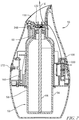
FIG. 1 is a top and front perspective view of an exemplary volatile material dispenser that may embody the principles of the present disclosure; and -
FIG. 2 is a cross-sectional view taken generally along the lines 2-2 ofFIG. 1 . - Other aspects and advantages of the present disclosure will become apparent upon consideration of the following detailed description, wherein similar structures have like or similar reference numerals.
- The present disclosure is directed to water-based fragrance compositions, devices for emission of water-based fragrance compositions, and methods for emitting long-lasting scent. While the present disclosure may be embodied in many different forms, several specific embodiments are discussed herein with the understanding that the present disclosure is to be considered only as an exemplification of the principles of the disclosure, and it is not intended to limit the disclosure to the embodiments illustrated.
- Referring to the drawings,
FIGS. 1 and2 depict avolatile material dispenser 50. Thedispenser 50 may be adapted to accommodate a refill 52 (FIG. 2 ) and dispense a volatile material in the form of a water-based fragrance composition from therefill 52. Therefill 52 may generally include acontainer 54 for holding the volatile material therein, wherein thecontainer 54 is adapted to be retained within thedispenser 50. Thecontainer 54 may include abody 58 for holding the volatile material and aneck 60 extending outwardly from thebody 58 and providing an opening into thecontainer 54. A retaining mechanism 62 may be disposed within theneck 60 for holding awick 64 with a first end of thewick 64 in contact with the volatile material and a second end of thewick 64 extending out of thecontainer 54 through theneck 60. Although aparticular dispenser 50 and aparticular refill 52 are shown and described, it is contemplated that any type of dispenser and/or refill may be used with variations of the compositions described herein. - Referring to
FIGS. 1 and2 , thedispenser 50 includes ahousing 100 having anoutlet channel 132 for volatilized water-based fragrance composition. Thehousing 100 encloses therefill 52 and electronic components of thedispenser 50. As best seen inFIG. 2 , a printed circuit board (PCB) 160 or other control circuitry is supported within thehousing 100 and a number of batteries 161 may be enclosed within ahousing 100 and may be electrically connected to thePCB 160 for providing electrical power to thePCB 160 and/or other electrical components of thedispenser 50. Thedispenser 50 may include one or more switches and/orbuttons 172 operatively connected to the PCB 160 for turning thedispenser 50 on and off or altering any function of thedispenser 50, for example, an air flow generator speed, a volatile material emission rate, a boost of fragrance, or another other suitable function. - An optional
air flow generator 200 may also be disposed within thehousing 100 and electrically connected to thePCB 160 such that the PCB 160 may control operation of theair flow generator 200. Anebulizer assembly 248 may also be disposed within thehousing 100 and may include a nebulizer. The nebulizer includes a piezoelectric element, which, in use, is positioned adjacent thewick 64 or other absorbent material extending from therefill 52 and in contact with the water-based fragrance composition to volatilize the water-based fragrance composition. - During operation, the nebulizer is actuated, either continuously or intermittently, to dispense the water-based fragrance composition. More particularly, an oscillating electric field is applied to the piezoelectric element, which causes expansion and contraction of the piezoelectric element in a radial direction. The expansion and contraction causes the orifice plate to vibrate in an axial direction (along a longitudinal axis of the dispenser 50), forcing the water-based fragrance composition retained within the orifices of the orifice plate away from the nebulizer and into the
outlet manifold 130. Theair flow generator 200 may also be actuated, either continuously or intermittently, the actuation of which may be coordinated in any suitable manner with operation of the nebulizer. Thedispenser 50 is described in more detail in co-pendingU.S. Application Serial No 61/992027, filed on May 12, 2014 - The volatile material disposed in the
container 54 may be a water-based fragrance composition. The water-based fragrance composition includes water, first and second organic solvents, and one or more fragrance formulations. The water-based fragrance composition includes at least about 67 wt% water, between about 5 and about 17 wt% of the first organic solvent, between about 0 and about 22 wt% of the second organic solvent, and about 5 wt% or less of the one or more fragrances. In illustrative embodiments, the components of the water-based fragrance composition form a homogenous liquid phase. - Fragrances may be purchased from commercial vendors. Fragrances include one or more components. The components in fragrance may include one or more fragrance oils, surfactants, solvents, water, dyes, chlorophyll, stabilizers, emulsifiers, UV inhibitors, antioxidants, other additives, and/or any other suitable components. Fragrances, also called fragrance formulations herein, may have any of a wide variety of particular scents.
- The first organic solvent is a component of the water-based fragrance composition that includes a relatively volatile, water soluble, low molecular weight organic compound or multiple such compounds. A compound is considered "water soluble" if a saturated solution of water includes at least 0.5 wt% of the compound. When calculating desirable ranges for the water-based fragrance composition, all of the relatively volatile, water soluble, low molecular weight organic compound or compounds present in the water-based fragrance composition are considered part of the first organic solvent. Additionally, each of the relatively volatile, water soluble, low molecular weight organic compounds of the first organic solvent are defined as relatively volatile because each compound has a boiling point less than about 100 °C.
- In illustrative embodiments, the first organic solvent may or may not be volatile organic compounds (VOCs), as defined by California's Regulation for Consumer Products. As of this writing, an unofficial version of the Regulation for Consumer Products may be found at <http://www.arb.ca.gov/consprod/regs/2015/article_1_final_1-22-15.pdf>, definition (138). An official version may be found at <http://www.oal.ca.gov/CCR.htm>. The Regulation for Consumer Products defines a VOC as follows:
"Volatile Organic Compound (VOC)" means any compound containing at least one atom of carbon, excluding carbon monoxide, carbon dioxide, carbonic acid, metallic carbides or carbonates, and ammonium carbonate, and excluding the following: - (A) methane,
methylene chloride (dichloromethane),
1,1,1-trichloroethane (methyl chloroform),
trichlorofluoromethane (CFC-11),
dichlorodifluoromethane (CFC-12),
1,1,2-trichloro-1,2,2-trifluoroethane (CFC-113),
1,2-dichloro-1,1,2,2-tetrafluoroethane (CFC-114),
chloropentafluoroethane (CFC-115),
chlorodifluoromethane (HCFC-22),
1,1,1-trifluoro-2,2-dichloroethane (HCFC-123),
1,1-dichloro-1-fluoroethane (HCFC-141b),
1-chloro-1,1-difluoroethane (HCFC-142b),
2-chloro-1,1,1,2-tetrafluoroethane (HCFC-124),
trifluoromethane (HFC-23),
1,1,2,2-tetrafluoroethane (HFC-134),
1,1,1,2-tetrafluoroethane (HFC-134a),
pentafluoroethane (HFC-125),
1,1,1-trifluoroethane (HFC-143a),
1,1-difluoroethane (HFC-152a),
ethoxy-nonafluorobutane (HFE 7200),
trans-1,3,3,3-tetrafluoropropene (HFO-1234ze),
cyclic, branched, or linear completely methylated siloxanes,
the following classes of perfluorocarbons:- 1. cyclic, branched, or linear, completely fluorinated alkanes;
- 2. cyclic, branched, or linear, completely fluorinated ethers with no unsaturations;
- 3. cyclic, branched, or linear, completely fluorinated tertiary amines with no unsaturations; and
- 4. sulfur-containing perfluorocarbons with no unsaturations and with the sulfur bonds to carbon and fluorine, and
- (B) the following low-reactive organic compounds which have been exempted by the U.S. EPA:
- acetone,
- ethane,
- methyl acetate,
- parachlorobenzotrifluoride (1-chloro-4-trifluoromethyl benzene),
- perchloroethylene (tetrachloroethylene).
- The water-based fragrance composition includes between about 5 and about 17 wt% of the first organic solvent. In illustrative embodiments, the water-based fragrance composition may include between about 10 and about 17 wt% of the first organic solvent. In other illustrative embodiments, the output rate of the water-based fragrance composition is about 1 gram per hour, the first organic solvent is ethanol, and the water-based fragrance composition may include between about 10 and about 11 wt% ethanol. In other illustrative embodiments, the output rate of the water-based fragrance composition is about 1 gram per hour, the first organic solvent is isopropanol, and the water-based fragrance composition may include about 5 wt% isopropanol. In other illustrative embodiments, the output rate of the water-based fragrance composition is about 1 gram per hour, the first organic solvent is acetone, and the water-based fragrance composition may include about 5 wt% acetone. In any of the preceding embodiments, the output rate of the water-based fragrance composition may alternatively be up to about 2 grams per hour.
- The second organic solvent is a component of the water-based fragrance composition that includes a moderately volatile water soluble organic compound or multiple such compounds. When calculating desirable ranges for the water-based fragrance composition, all of the moderately volatile water soluble organic compound or compounds present in the water-based fragrance composition are considered part of the second organic solvent. Additionally, each of the moderately volatile water soluble organic compounds of the second organic solvent are defined as moderately volatile because each compound has a boiling point greater than or equal to about 100 °C and less than or equal to about 300 °C.
- In illustrative embodiments, the second organic solvent may not be a VOC. The second organic solvent includes one or more of dipropylene glycol; propylene glycol; 1,2-hexanediol; dipropylene glycol methyl ether acetate; propylene glycol monopropyl ether; diethylene glycol monobutyl ether; or ethylene glycol monohexyl ether. In other illustrative embodiments, the second solvent may be a VOC, a non-VOC, or combinations thereof. Non-limiting examples of VOCs that are moderately volatile water soluble organic compounds include dipropylene glycol methyl ether; propylene glycol methyl ether; pentylene glycol; caprylyl glycol; propylene glycol methyl ether acetate; ethylene glycol mono n-propyl ether; propylene glycol monoethyl ether; dimethoxymethane; acetonitrile; dimethylsulfoxide; and combinations thereof. The current status of a solvent to determine whether or not it is a VOC should be checked and confirmed, as VOC lists change periodically, and no guarantees are made for the accuracy of the current VOC status as set by the California Environmental Protection Agency's Air Resources Board. The water-based fragrance composition includes between about 0 and about 22 wt% of the second organic solvent. In further illustrative embodiments, the water-based fragrance compositions includes between about 0 and about 17 wt% of the second organic solvent.
- The water-based fragrance composition does not include a material with a boiling point greater than about 300 °C. Solvents may be selected to solubilize 5 wt% or less of one or more fragrance without the inclusion of a material with a boiling point greater than about 300 °C. In such embodiments, if the water-based fragrance composition includes more than one fragrance formulation, the total weight percentage of all fragrances is 5 wt% or less. In other illustrative embodiments, the solvents may be selected to solubilize 3 wt% or less of one or more fragrance formulations without the inclusion of any material with a boiling point greater than about 300 °C. In such embodiments, if the water-based fragrance composition includes more than one fragrance, the total weight percentage of all the fragrance is about 3 wt% or less.
- The components of the water-based fragrance composition may be selected with one or more of several goals in mind. The components may be selected for solubility. The water-based fragrance composition appears clear when a single, homogeneous phase is formed. When the water-based fragrance composition appears hazy or separates, the water-based fragrance composition did not fully solubilize the fragrance formulation. The clarity of the water-based fragrance composition may be checked at room temperature, or approximately 20 °C. The clarity of the water-based fragrance composition may further be checked at 5 °C or -18 °C. The components of the water-based fragrance composition may be selected for low surface tension to generate small droplets. The components of the water-based fragrance composition may additionally or alternatively be selected to achieve a higher flash point. In illustrative embodiments, the flashpoint may be greater than about 37.78 °C (100 °F). The components of the water-based fragrance composition may additionally or alternatively be selected to have a more mild or pleasant odor. The first and second organic solvents may be selected to minimize the presence of volatile organic compounds. For a given desired maximum output rate, the first and second organic solvents may be selected to meet the standards of California's Regulation for Consumer Products for the presence of specific volatile organic compounds.
- The
volatile material dispenser 50 nebulizes the water-based fragrance composition, delivering high intensity or noticeability of the fragrance formulation(s). By selecting a water-based fragrance composition with a low surface tension, droplet size is minimized. Further, smaller droplets prevent fallout or liquid accumulation of the volatile material around thevolatile material dispenser 50. The resulting small droplets may be retained in the air for a longer period of time, thereby increasing noticeably and continuously filling a desired space with the water-based fragrance composition. Further, thevolatile material dispenser 50 may be precisely controlled, for example, through the use of intensity controls, allowing a user to vary the amount of volatile material with high specificity. More particularly, a user may change, for example, a frequency at which the nebulizer is activated, a period of time during which the nebulizer is activated, a period of time between periods of activation (or dwell period), a speed of a fan (if present), one or more features or characteristics of the piezoelectric element and/or nebulizer, and/or any other suitable characteristics that would change emission of the nebulizer or other activation element (e.g., a fan). In illustrative embodiments, an output rate of the water-based fragrance composition may be about 1 gram per hour or up to about 1 gram per hour. In other illustrative embodiments, the output rate of the water-based fragrance composition may be about 2 grams per hour or up to about 2 grams per hour. - In an illustrative embodiment, the water-based fragrance composition comprises 11 wt % ethanol for the first organic solvent. Ethanol may be selected because it has a mild, agreeable odor, it may provide a fragrance lift, and it dissolves fragrance formulation components well by itself. Ethanol has a high volatility. While including ethanol may lower the flash point, blending ethanol in the first organic solvent with, for example, dipropylene glycol methyl ether or propylene glycol methyl ether in the second organic solvent provides a synergy with a flash point higher than 37.78 °C (100 °F), a low solvent odor, and an optimal fragrance solubility up to about 5%.
- In an illustrative embodiment, the second organic solvent comprises dipropylene glycol (DPG). DPG is characterized as odorless, has a low volatility, is not classified as a VOC, and aids in the solubility of fragrance formulation ingredients. In illustrative embodiments, the water-based fragrance composition may comprise between about 0 wt% and about 10 wt% of DPG. In other illustrative embodiments, the water-based fragrance composition may comprise between about 9 wt% and about 11 wt% of DPG. In a non-limiting, illustrative embodiment, the water-based fragrance composition comprises about 10 wt% of DPG.
- In an illustrative embodiment, the second organic solvent comprises propylene glycol (PG). PG is characterized as odorless, has a low volatility, is not classified as a VOC, and aids in the solubility of fragrance formulations. In illustrative embodiments, the water-based fragrance composition may comprise between about 0 wt% and about 6 wt% of PG. In other illustrative embodiments, the water-based fragrance composition may comprise between about 2 wt% and about 6 wt% of PG. In a non-limiting, illustrative embodiment, the water-based fragrance composition comprises about 6 wt% of PG. In another non-limiting, illustrative embodiment, the water-based fragrance composition comprises about 4 wt% of PG. In yet another non-limiting, illustrative embodiment, the water-based fragrance composition comprises about 2 wt% of PG.
- In another illustrative embodiment, the second organic solvent comprises 1,2-hexanediol. 1,2-hexanediol is characterized as odorless, has a low volatility, and is not classified as a VOC. The neighboring hydroxyl groups of 1,2-hexanediol create a head-tail polarity in the molecule. Consequently, 1,2-hexanediol has surfactant-like properties useful in the water-based fragrance composition. 1,2-hexanediol is an excellent co-solvent and can dissolve many fragrance formulations that other solvents cannot. In illustrative embodiments, the water-based fragrance composition may comprise between about 4 wt% and about 17 wt% 1,2-hexanediol. In other illustrative embodiments, the water-based fragrance composition may comprise between about 4 wt% and about 9 wt% 1,2-hexanediol. In still other embodiments, the water-based fragrance composition may comprise between about 5 wt% and about 7 wt% 1,2-hexanediol. In a non-limiting, illustrative embodiment, the water-based fragrance composition comprises about 9 wt% of 1,2-hexanediol.
- In another illustrative embodiment, the second organic solvent comprises dipropylene glycol methyl ether acetate (DPMA). DPMA has a mild solvent odor, has a low volatility, is not classified as a VOC, and does not solubilize fragrance formulations on its own as well as in combination with DPG or PG. In illustrative embodiments, the water-based fragrance composition may comprise between about 0 wt% and about 6 wt% of DPMA. In other illustrative embodiments, the water-based fragrance composition may comprise between about 2 wt% and about 6 wt% of DPMA. In a non-limiting, illustrative embodiment, the water-based fragrance composition comprises about 6 wt% of DPMA. In another non-limiting, illustrative embodiment, the water-based fragrance composition comprises about 4 wt% of DPMA In yet another non-limiting, illustrative embodiment, the water-based fragrance composition comprises about 2 wt% of DPMA
- In a further illustrative embodiment, the second organic solvent comprises propylene glycol methyl ether acetate (PMA). PMA has a chemical odor, is moderately volatile, and is classified as a VOC. A water-based fragrance composition that comprises ethanol and PMA has a slightly higher flashpoint than a water-based fragrance composition with ethanol alone (where the ethanol has the same total amount as the combination of ethanol and PMA) and has a high fragrance formulation solubility. Test data show that 3 wt% fragrance is soluble in a mixture of ethanol and PMA. In an illustrative embodiment, a water-based fragrance composition comprises water, one or more fragrance formulations, a first organic solvent comprising ethanol, and a second organic solvent comprising PMA and 1,2-hexanediol. In illustrative embodiments, the water-based fragrance composition may comprise between about 0 wt% and about 6 wt% of PMA. In other illustrative embodiments, the water-based fragrance composition may comprise between about 2 wt% and about 6 wt% of PMA. In a non-limiting, illustrative embodiment, the water-based fragrance composition comprises about 6 wt% of PMA. In another non-limiting, illustrative embodiment, the water-based fragrance composition comprises about 4 wt% of PMA In yet another non-limiting, illustrative embodiment, the water-based fragrance composition comprises about 2 wt% of PMA
- In an illustrative embodiment, the second organic solvent comprises propylene glycol methyl ether (PM). PM is moderately volatile and is classified as a VOC. PM at about 17 wt% of a water-based fragrance composition does not dissolve fragrance formulations as well as fragrance compositions with ethanol alone or a blend of PMA and ethanol. A water-based fragrance composition that comprises ethanol and PM has a higher flashpoint than a water-based fragrance composition with ethanol alone (where the ethanol has the same total amount as the combination of ethanol and PM) and has a high fragrance formulation solubility. In an illustrative embodiment, a water-based fragrance composition comprises water, one or more fragrance formulation components, a first organic solvent comprising ethanol, and a second organic solvent comprising PM, wherein a concentration of ethanol is higher than a concentration of PM. In illustrative embodiments, the water-based fragrance composition may comprise between about 0 wt% and about 6 wt% of PM. In other illustrative embodiments, the water-based fragrance composition may comprise between about 2 wt% and about 6 wt% of PM. In a non-limiting, illustrative embodiment, the water-based fragrance composition comprises about 6 wt% of PM. In another non-limiting, illustrative embodiment, the water-based fragrance composition comprises about 4 wt% of PM. In yet another non-limiting, illustrative embodiment, the water-based fragrance composition comprises about 2 wt% of PM.
- In an illustrative embodiment, the second organic solvent comprises dipropylene glycol methyl ether (DPM). DPM is moderately volatile and is classified as a VOC. DPM at about 17 wt% of a water-based fragrance composition does not dissolve fragrance formulations as well as fragrance compositions containing ethanol alone or a blend of PMA and ethanol. A water-based fragrance composition that comprises ethanol and DPM has a higher flashpoint than a water-based fragrance composition with ethanol alone (where the ethanol has the same total amount as the combination of ethanol and DPM) and has a high fragrance formulation solubility. In an illustrative embodiment, a water-based fragrance composition comprises water, one or more fragrance formulation components (up to about 5% fragrance formulation), a first organic solvent comprising ethanol, and a second organic solvent comprising DPM, wherein a concentration of ethanol is higher than a concentration of DPM. In illustrative embodiments, the water-based fragrance composition may comprise between about 0 wt% and about 6 wt% of DPM. In other illustrative embodiments, the water-based fragrance composition may comprise between about 2 wt% and about 6 wt% of DPM. In a non-limiting, illustrative embodiment, the water-based fragrance composition comprises about 2 wt% of DPM. In another non-limiting, illustrative embodiment, the water-based fragrance composition comprises about 4 wt% of DPM. In yet another non-limiting, illustrative embodiment, the water-based fragrance composition comprises about 2 wt% of DPM. In a non-limiting, illustrative embodiment, the water-based fragrance composition comprises about 6 wt% of DPM. In another non-limiting, illustrative embodiment, the water-based fragrance composition comprises between about 2 and about 6 wt% of DPM and about 9 wt% of 1,2-hexanediol. In another non-limiting, illustrative embodiment, the water-based fragrance composition comprises about 6 wt% of DPM and about 10 wt% of DPG.
- The water-based fragrance formulations include at least one fragrance formulation component. A fragrance formulation may include, without limitation, at least twenty to fifty fragrance formulation components or perfume raw materials (PRM) and approximately 50% solvent system. In this art, the solvent system is free of surfactants or materials with a boiling point of greater than about 300 degrees C. At least one fragrance formulation may be selected based on certain properties, including without limitation, the estimated LogP of the components of that fragrance formulation, the range of chemistries and solubilities of the components of that fragrance formulation, the percent solids (using a residue of evaporations test or ROE), and the surface tension of one or more fragrance formulation components.
- When the fragrance formulation is selected based on the estimated LogP of the components of that fragrance formulation, the estimated LogP may be determined in terms of POW (octanol-water) and PHW (hexane-water). The LogPOW and LogPHW may be calculated for the individual fragrance formulation component or perfume raw material (PRM). The LogPOW is a standard quantity that is typically measured by pouring water and octanol together, putting some solute inside and determining the solute concentration in both phases. As the amount of solute is small, the concentrations of octanol and water are virtually unchanged. Therefore, LogP is generally a quantity which is always measured with the same two phases. LogP is a property of each PRM, but the whole mixture of PRMs (as in a fragrance formulation) will only dissolve if all PRMs are fully dissolved. The LogP of an individual PRM should not be the only factor used to get a fragrance property. The individual PRM LogP may be used to estimate the overall water solubility behavior of the fragrance, as well as the overall partitioning (or LogP) behavior of the fragrance. Determining the estimated LogP includes a partitioning that requires a two phase system, for example, the composition for the LogPOW may include a water phase of nearly 100% water and an octanol phase of 27.4 mol % water and 72.6 mol % octanol. The composition for the LogPHW may include a water phase of nearly 100% water and a hexane phase of nearly 100% hexane. In one embodiment, at least one fragrance formulation includes one or more fragrance formulation components having an estimated LogP with a LogPOW of less than 2.0 and a LogPHW of less than 1.0, and may include a solubility of greater than 5%. The LogP and solubility values were estimated using COSMOtherm version 1501, parameterization BP_TZVPD_FINE_C30_1501. The molecules were calculated with TURBOMOLE 6.6 and COSMOconf 3.0.
- In one embodiment, the water-based fragrance composition may include at least one fragrance formulation that includes at least one fragrance formulation component with an estimated LogP with a LogPOW of less than 2.0 and a LogPHW of less than 1.0, a solubility greater than 5%, and is clear at approximately 20°C. Fragrance formulation components with such properties may include, without limitation, coumarin, ethyl vanillin, cinnamic alcohol, cinnamic aldehyde, phenylethyl alcohol, vanillin, fructone and gamma-hexalactone. The LogP values listed below would be the same for all solvent formulas and examples listed in this art, but the specific solubility values would change for different formulas. However, the LogP and solubilities will generally correlate as long as the formula is water dominated. The correlation will break down for other solvents (ethanol, propylene glycol) The solubilities listed in the example below are specific to Example 5. The LogP and solubility values listed in the table below were estimated from COSMOtherm version 1501, parameterization BP_TZVPD_FINE_C30_1501. The molecules were calculated with TURBOMOLE 6.6 and COSMOconf 3.0.
- Table 1 below is a list of exemplary fragrance formulation components and properties of those components, wherein each of the fragrance formulation components has a LogPOW of less than 2.0 and a LogPHW of less than 1.0.
TABLE 1 Perfume Raw Material CAS LogPOW LogPHW Solubility Solubility in % COUMARIN 91-64-5 1.29 0.11 0.05399 5.39876 ETHYL VANILLIN 121-32-4 1.70 0.19 0.05578 5.57779 CINNAMIC ALCOHOL CINNAMIC 104-54-1 1.93 0.23 0.05695 5.69483 ALDEHYDE 104-55-2 1.49 0.44 0.06415 6.41523 PHENYLETHYL ALCOHOL 60-12-8 1.61 -0.06 0.08916 8.91553 VANILLIN 121-33-5 1.19 -0.65 0.12157 12.15747 FRUCTONE 6413-10-1 1.19 0.51 0.12853 12.85252 GAMMA-HEXALACTONE 695-06-7 0.53 -0.61 0.32566 32.56558 - Additional embodiments of water-based fragrance compositions are described in the following examples. The examples are meant to be illustrative and not to be limiting. Each example includes the composition of the water-based fragrance composition separated by component. Each example also includes some of the properties of the water-based fragrance composition when measured
- Examples 1-22 include the flashpoint, VOC content, and Refractive Index @ 20 °C for the example water-based fragrance composition. Each of these examples further includes a visual test of the water-based fragrance composition at room temperature and 5 °C. The water-based fragrance composition fully solubilized the fragrance formulation if it appears clear. The VOC content in all of the following charts refers to the VOC content without the inclusion of VOC's within the fragrance, which may be about 1% VOC additional to the water-based fragrance formulation.
-
SCJ1 52874 Water Deionized (DI) water 70 wt% Fragrance formulation Fragrance #1 3 wt% First Organic Solvent Ethanol 17 wt% Second Organic Solvent Dipropylene glycol 10 wt% Properties Flashpoint (°F) 91.4 °F VOC Content (wt%) (without fragrance) 17 wt% Refractive Index @ 20 °C 1.36 Solubility, RT Clear Solubility, 5 °C Clear -
SCJ1 Mod PMA1 Water DI water 70 wt% Fragrance formulation Fragrance #1 3 wt% First Organic Solvent Ethanol 11 wt% Second Organic Solvent Propylene Glycol Methyl Ether Acetate 6 wt% Dipropylene glycol 10 wt% Properties Flashpoint (°F) 100.4 °F VOC Content (wt%) (without fragrance) 17 wt% Refractive Index @ 20 °C 1.36 Solubility, RT Clear Solubility, 5 °C Clear -
SCJ1 Mod PMA2 Water DI water 70 wt% Fragrance formulation Fragrance #1 3 wt% First Organic Solvent Ethanol 13 wt% Second Organic Solvent Propylene Glycol Methyl Ether Acetate 4 wt% Dipropylene glycol 10 wt% Properties Flashpoint (°F) 96.8 °F VOC Content (wt%) (without fragrance) 17 wt% Refractive Index @ 20 °C 1.36 Solubility, RT Clear Solubility, 5 °C Clear -
SCJ1 Mod PMA3 Water DI water 70 wt% Fragrance formulation Fragrance #1 3 wt% First Organic Solvent Ethanol 15 wt% Second Organic Solvent Propylene Glycol Methyl Ether Acetate 2 wt% Dipropylene glycol 10 wt% Properties Flashpoint (°F) 96.8 °F VOC Content (wt%) (without fragrance) 17 wt% Refractive Index @ 20 °C 1.36 Solubility, RT Clear Solubility, 5 °C Clear -
SCJ1 Mod DPM1 Water DI water 70 wt% Fragrance formulation Fragrance #1 3 wt% First Organic Solvent Ethanol 11 wt% Second Organic Solvent DiPropylene Glycol Methyl Ether 6 wt% Dipropylene glycol 10 wt% Properties Flashpoint (°F) 104 °F VOC Content (wt%) (without fragrance) 17 wt% Refractive Index @ 20 °C 1.36 Solubility, RT Clear Solubility, 5 °C Clear -
SCJ1 Mod DPM2 Water DI water 70 wt% Fragrance formulation Fragrance #1 3 wt% First Organic Solvent Ethanol 13 wt% Second Organic Solvent DiPropylene Glycol Methyl Ether 4 wt% Dipropylene glycol 10 wt% Properties Flashpoint (°F) 96.8 °F VOC Content (wt%) (without fragrance) 17 wt% Refractive Index @ 20 °C 1.36 Solubility, RT Clear Solubility, 5 °C Clear -
SCJ1 Mod DPM3 Water DI water 70 wt% Fragrance formulation Fragrance #1 3 wt% First Organic Solvent Ethanol 15 wt% Second Organic Solvent DiPropylene Glycol Methyl Ether 2 wt% Dipropylene glycol 10 wt% Properties Flashpoint (°F) 96.8 °F VOC Content (wt%) (without fragrance) 17 wt% Refractive Index @ 20 °C 1.36 Solubility, RT Clear Solubility, 5 °C Clear -
SCJ1 Mod PM1 Water DI water 70 wt% Fragrance formulation Fragrance #1 3 wt% First Organic Solvent Ethanol 11 wt% Second Organic Solvent Propylene Glycol Methyl Ether 6 wt% Dipropylene glycol 10 wt% Properties Flashpoint (°F) 104 °F VOC Content (wt%) (without fragrance) 17 wt% Refractive Index @ 20 °C 1.36 Solubility, RT Clear Solubility, 5 °C Clear -
SCJ1 Mod PM2 Water DI water 70 wt% Fragrance formulation Fragrance #1 3 wt% First Organic Solvent Ethanol 13 wt% Second Organic Solvent Propylene Glycol Methyl Ether 4 wt% Dipropylene glycol 10 wt% Properties Flashpoint (°F) 100.4 °F VOC Content (wt%) (without fragrance) 17 wt% Refractive Index @ 20 °C 1.36 Solubility, RT Clear Solubility, 5 °C Clear -
SCJ1 Mod PM3 Water DI water 70 wt% Fragrance formulation Fragrance #1 3 wt% First Organic Solvent Ethanol 15 wt% Second Organic Solvent Propylene Glycol Methyl Ether 2 wt% Dipropylene glycol 10 wt% Properties Flashpoint (°F) 96.8 °F VOC Content (wt%) (without fragrance) 17 wt% Refractive Index @ 20 °C 1.36 Solubility, RT Clear Solubility, 5 °C Clear -
SCJ3 Mod PMA1 Water DI water 71 wt% Fragrance formulation Fragrance #1 3 wt% First Organic Solvent Ethanol 11 wt% Second Organic Solvent Propylene Glycol Methyl Ether Acetate 6 wt% 1,2-hexanediol 9 wt% Properties Flashpoint (°F) 107.6 °F VOC Content (wt%) (without fragrance) 17 wt% Refractive Index @ 20 °C 1.36 Solubility, RT Clear Solubility, 5 °C Clear -
SCJ3 Mod PMA2 Water DI water 71 wt% Fragrance formulation Fragrance #1 3 wt% First Organic Solvent Ethanol 13 wt% Second Organic Solvent Propylene Glycol Methyl Ether Acetate 4 wt% 1,2-hexanediol 9 wt% Properties Flashpoint (°F) 104 °F VOC Content (wt%) (without fragrance) 17 wt% Refractive Index @ 20 °C 1.36 Solubility, RT Clear Solubility, 5 °C Clear -
SCJ3 Mod PMA3 Water DI water 71 wt% Fragrance formulation Fragrance #1 3 wt% First Organic Solvent Ethanol 15 wt% Second Organic Solvent Propylene Glycol Methyl Ether Acetate 2 wt% 1,2-hexanediol 9 wt% Properties Flashpoint (°F) 100.4 °F VOC Content (wt%) (without fragrance) 17 wt% Refractive Index @ 20 °C 1.36 Solubility, RT Clear Solubility, 5 °C Clear -
SCJ3 Mod DPM1 Water DI water 71 wt% Fragrance formulation Fragrance #1 3 wt% First Organic Solvent Ethanol 11 wt% Second Organic Solvent DiPropylene Glycol Methyl Ether 6 wt% 1,2-hexanediol 9 wt% Properties Flashpoint (°F) 111.2 °F VOC Content (wt%) (without fragrance) 17 wt% Refractive Index @ 20 °C 1.36 Solubility, RT Clear Solubility, 5 °C Clear -
SCJ3 Mod DPM2 Water DI water 71 wt% Fragrance formulation Fragrance #1 3 wt% First Organic Solvent Ethanol 13 wt% Second Organic Solvent DiPropylene Glycol Methyl Ether 4 wt% 1,2-hexanediol 9 wt% Properties Flashpoint (°F) 107.6 °F VOC Content (wt%) (without fragrance) 17 wt% Refractive Index @ 20 °C 1.36 Solubility, RT Clear Solubility, 5 °C Clear -
SCJ3 Mod DPM3 Water DI water 71 wt% Fragrance formulation Fragrance #1 3 wt% First Organic Solvent Ethanol 15 wt% Second Organic Solvent DiPropylene Glycol Methyl Ether 2 wt% 1,2-hexanediol 9 wt% Properties Flashpoint (°F) 104 °F VOC Content (wt%) (without fragrance) 17 wt% Refractive Index @ 20 °C 1.36 Solubility, RT Clear Solubility, 5 °C Clear -
SCJ3 Mod hexl Water DI water 77 wt% Fragrance formulation Fragrance #1 3 wt% First Organic Solvent Ethanol 13 wt% Second Organic Solvent 1,2-hexanediol 7 wt% Properties Flashpoint (°F) 104 °F VOC Content (wt%) (without fragrance) 13 wt% Refractive Index @ 20 °C 1.35 Solubility, RT Clear Solubility, 5 °C Clear -
SCJ3 Mod hex2 Water DI water 79 wt% Fragrance formulation Fragrance #1 3 wt% First Organic Solvent Ethanol 13 wt% Second Organic Solvent 1,2-hexanediol 5 wt% Properties Flashpoint (°F) 104 °F VOC Content (wt%) (without fragrance) 13 wt% Refractive Index @ 20 °C 1.35 Solubility, RT Clear Solubility, 5 °C Clear -
SCJ3 Mod PM1 Water DI water 71 wt% Fragrance formulation Fragrance #1 3 wt% First Organic Solvent Ethanol 11 wt% Second Organic Solvent PM 6 wt% 1,2-hexanediol 9 wt% Properties Flashpoint (°F) 111.2 °F VOC Content (wt%) (without fragrance) 17 wt% Refractive Index @ 20 °C 1.36 Solubility, RT Clear Solubility, 5 °C Clear -
SCJ3 Mod PM2 Water DI water 71 wt% Fragrance formulation Fragrance #1 3 wt% First Organic Solvent Ethanol 13 wt% Second Organic Solvent Propylene Glycol Methyl Ether 4 wt% 1,2-hexanediol 9 wt% Properties Flashpoint (°F) 107.6 °F VOC Content (wt%) (without fragrance) 17 wt% Refractive Index @ 20 °C 1.36 Solubility, RT Clear Solubility, 5 °C Clear -
SCJ3 Mod PM3 Water DI water 71 wt% Fragrance formulation Fragrance #1 3 wt% First Organic Solvent Ethanol 15 wt% Second Organic Solvent Propylene Glycol Methyl Ether 2 wt% 1,2-hexanediol 9 wt% Properties Flashpoint (°F) 104 °F VOC Content (wt%) (without fragrance) 17 wt% Refractive Index @ 20 °C 1.36 Solubility, RT Clear Solubility, 5 °C Clear - Examples 22-81 include a visual test of the water-based fragrance composition at room temperature and 5 °C. The water-based fragrance composition fully solubilized the fragrance formulation if it appears clear.
-
SCJ1 - Fragrance # 2Water Deionized (DI) water 70 wt% Fragrance formulation Fragrance # 2 3 wt% First Organic Solvent Ethanol 17 wt% Second Organic Solvent Dipropylene glycol 10 wt% Properties VOC Content (wt%) (without fragrance) 17 wt% Solubility, RT Clear Solubility, 5 °C Clear -
SCJ1 Mod PMA1 Water DI water 70 wt% Fragrance formulation Fragrance # 2 3 wt% First Organic Solvent Ethanol 11 wt% Second Organic Solvent Propylene Glycol Methyl Ether Acetate 6 wt% Dipropylene glycol 10 wt% Properties VOC Content (wt%) (without fragrance) 17 wt% Solubility, RT Clear Solubility, 5 °C Clear -
SCJ1 Mod DPM1 Water DI water 70 wt% Fragrance formulation Fragrance # 2 3 wt% First Organic Solvent Ethanol 11 wt% Second Organic Solvent DiPropylene Glycol Methyl Ether 6 wt% Dipropylene glycol 10 wt% Properties VOC Content (wt%) (without fragrance) 17 wt% Solubility, RT Clear Solubility, 5 °C Clear -
SCJ1 Mod PM1 Water DI water 70 wt% Fragrance formulation Fragrance # 2 3 wt% First Organic Solvent Ethanol 11 wt% Second Organic Solvent Propylene Glycol Methyl Ether 6 wt% Dipropylene glycol 10 wt% Properties VOC Content (wt%) (without fragrance) 17 wt% Solubility, RT Clear Solubility, 5 °C Clear -
SCJ3 Mod PMA1 Water DI water 71 wt% Fragrance formulation Fragrance # 2 3 wt% First Organic Solvent Ethanol 11 wt% Second Organic Solvent Propylene Glycol Methyl Ether Acetate 6 wt% 1,2-hexanediol 9 wt% Properties VOC Content (wt%) (without fragrance) 17 wt% Solubility, RT Clear Solubility, 5 °C Clear -
SCJ3 Mod DPM1 Water DI water 71 wt% Fragrance formulation Fragrance # 2 3 wt% First Organic Solvent Ethanol 11 wt% Second Organic Solvent DiPropylene Glycol Methyl Ether 6 wt% 1,2-hexanediol 9 wt% Properties VOC Content (wt%) (without fragrance) 17 wt% Solubility, RT Clear Solubility, 5 °C Clear -
SCJ3 Mod hexl Water DI water 77 wt% Fragrance formulation Fragrance # 2 3 wt% First Organic Solvent Ethanol 13 wt% Second Organic Solvent 1,2-hexanediol 7 wt% Properties VOC Content (wt%) (without fragrance) 13 wt% Solubility, RT Clear Solubility, 5 °C Clear -
SCJ3 Mod hex2 Water DI water 79 wt% Fragrance formulation Fragrance # 2 3 wt% First Organic Solvent Ethanol 13 wt% Second Organic Solvent 1,2-hexanediol 5 wt% Properties VOC Content (wt%) (without fragrance) 13 wt% Solubility, RT Clear Solubility, 5 °C Clear -
SCJ3 Mod PM1 Water DI water 71 wt% Fragrance formulation Fragrance # 2 3 wt% First Organic Solvent Ethanol 11 wt% Second Organic Solvent Propylene Glycol Methyl Ether 6 wt% 1,2-hexanediol 9 wt% Properties VOC Content (wt%) (without fragrance) 17 wt% Solubility, RT Clear Solubility, 5 °C Clear -
SCJ1 - Fragrance #3 Water Deionized (DI) water 70 wt% Fragrance formulation Fragrance #3 3 wt% First Organic Solvent Ethanol 17 wt% Second Organic Solvent Dipropylene glycol 10 wt% Properties VOC Content (wt%) (without fragrance) 17 wt% Solubility, RT Clear Solubility, 5 °C Clear -
SCJ1 Mod PMA1 Water DI water 70 wt% Fragrance formulation Fragrance #3 3 wt% First Organic Solvent Ethanol 11 wt% Second Organic Solvent Propylene Glycol Methyl Ether Acetate 6 wt% Dipropylene glycol 10 wt% Properties VOC Content (wt%) (without fragrance) 17 wt% Solubility, RT Clear Solubility, 5 °C Clear -
SCJ1 Mod DPM1 Water DI water 70 wt% Fragrance formulation Fragrance #3 3 wt% First Organic Solvent Ethanol 11 wt% Second Organic Solvent DiPropylene Glycol Methyl Ether 6 wt% Dipropylene glycol 10 wt% Properties VOC Content (wt%) (without fragrance) 17 wt% Solubility, RT Clear Solubility, 5 °C Clear -
SCJ1 Mod PM1 Water DI water 70 wt% Fragrance formulation Fragrance #3 3 wt% First Organic Solvent Ethanol 11 wt% Second Organic Solvent Propylene Glycol Methyl Ether 6 wt% Dipropylene glycol 10 wt% Properties VOC Content (wt%) (without fragrance) 17 wt% Solubility, RT Clear Solubility, 5 °C Clear -
SCJ3 Mod PMA1 Water DI water 71 wt% Fragrance formulation Fragrance #3 3 wt% First Organic Solvent Ethanol 11 wt% Second Organic Solvent Propylene Glycol Methyl Ether Acetate 6 wt% 1,2-hexanediol 9 wt% Properties VOC Content (wt%) (without fragrance) 17 wt% Solubility, RT Clear Solubility, 5 °C Clear -
SCJ3 Mod DPM1 Water DI water 71 wt% Fragrance formulation Fragrance #3 3 wt% First Organic Solvent Ethanol 11 wt% Second Organic Solvent DiPropylene Glycol Methyl Ether 6 wt% 1,2-hexanediol 9 wt% Properties VOC Content (wt%) (without fragrance) 17 wt% Solubility, RT Clear Solubility, 5 °C Clear -
SCJ3 Mod hex1 Water DI water 77 wt% Fragrance formulation Fragrance #3 3 wt% First Organic Solvent Ethanol 13 wt% Second Organic Solvent 1,2-hexanediol 7 wt% Properties VOC Content (wt%) (without fragrance) 13 wt% Solubility, RT Clear Solubility, 5 °C Clear -
SCJ3 Mod hex2 Water DI water 79 wt% Fragrance formulation Fragrance #3 3 wt% First Organic Solvent Ethanol 13 wt% Second Organic Solvent 1,2-hexanediol 5 wt% Properties VOC Content (wt%) (without fragrance) 13 wt% Solubility, RT Clear Solubility, 5 °C Clear -
SCJ3 Mod PM1 Water DI water 71 wt% Fragrance formulation Fragrance #3 3 wt% First Organic Solvent Ethanol 11 wt% Second Organic Solvent Propylene Glycol Methyl Ether 6 wt% 1,2-hexanediol 9 wt% Properties VOC Content (wt%) (without fragrance) 17 wt% Solubility, RT Clear Solubility, 5 °C Clear -
SCJ1 - Fragrance #4 Water Deionized (DI) water 70 wt% Fragrance formulation Fragrance #4 3 wt% First Organic Solvent Ethanol 17 wt% Second Organic Solvent Dipropylene glycol 10 wt% Properties VOC Content (wt%) (without fragrance) 17 wt% Solubility, RT Clear Solubility, 5 °C Clear -
SCJ1 Mod DPM1 Water DI water 70 wt% Fragrance formulation Fragrance #4 3 wt% First Organic Solvent Ethanol 11 wt% Second Organic Solvent DiPropylene Glycol Methyl Ether 6 wt% Dipropylene glycol 10 wt% Properties VOC Content (wt%) (without fragrance) 17 wt% Solubility, RT Clear Solubility, 5 °C Clear -
SCJ1 Mod PM1 Water DI water 70 wt% Fragrance formulation Fragrance #4 3 wt% First Organic Solvent Ethanol 11 wt% Second Organic Solvent Propylene Glycol Methyl Ether 6 wt% Dipropylene glycol 10 wt% Properties VOC Content (wt%) (without fragrance) 17 wt% Solubility, RT Clear Solubility, 5 °C Clear -
SCJ3 Mod PMA1 Water DI water 71 wt% Fragrance formulation Fragrance #4 3 wt% First Organic Solvent Ethanol 11 wt% Second Organic Solvent Propylene Glycol Methyl Ether Acetate 6 wt% 1,2-hexanediol 9 wt% Properties VOC Content (wt%) (without fragrance) 17 wt% Solubility, RT Clear Solubility, 5 °C Clear -
SCJ3 Mod DPM1 Water DI water 71 wt% Fragrance formulation Fragrance #4 3 wt% First Organic Solvent Ethanol 11 wt% Second Organic Solvent DiPropylene Glycol Methyl Ether 6 wt% 1,2-hexanediol 9 wt% Properties VOC Content (wt%) (without fragrance) 17 wt% Solubility, RT Clear Solubility, 5 °C Clear -
SCJ3 Mod hex1 Water DI water 77 wt% Fragrance formulation Fragrance #4 3 wt% First Organic Solvent Ethanol 13 wt% Second Organic Solvent 1,2-hexanediol 7 wt% Properties VOC Content (wt%) (without fragrance) 13 wt% Solubility, RT Clear Solubility, 5 °C Clear -
SCJ3 Mod hex2 Water DI water 79 wt% Fragrance formulation Fragrance #4 3 wt% First Organic Solvent Ethanol 13 wt% Second Organic Solvent 1,2-hexanediol 5 wt% Properties VOC Content (wt%) (without fragrance) 13 wt% Solubility, RT Clear Solubility, 5 °C Clear -
SCJ3 Mod PM1 Water DI water 71 wt% Fragrance formulation Fragrance #4 3 wt% First Organic Solvent Ethanol 11 wt% Second Organic Solvent Propylene Glycol Methyl Ether 6 wt% 1,2-hexanediol 9 wt% Properties VOC Content (wt%) (without fragrance) 17 wt% Solubility, RT Clear Solubility, 5 °C Clear -
SCJ3 Mod PMA1 Water DI water 71 wt% Fragrance formulation Fragrance #5 3 wt% First Organic Solvent Ethanol 11 wt% Second Organic Solvent Propylene Glycol Methyl Ether Acetate 6 wt% 1,2-hexanediol 9 wt% Properties VOC Content (wt%) (without fragrance) 17 wt% Solubility, RT Clear Solubility, 5 °C Clear -
SCJ3 Mod DPM1 Water DI water 71 wt% Fragrance formulation Fragrance #5 3 wt% First Organic Solvent Ethanol 11 wt% Second Organic Solvent DiPropylene Glycol Methyl Ether 6 wt% 1,2-hexanediol 9 wt% Properties VOC Content (wt%) (without fragrance) 17 wt% Solubility, RT Clear Solubility, 5 °C Clear -
SCJ3 Mod hexl Water DI water 77 wt% Fragrance formulation Fragrance #5 3 wt% First Organic Solvent Ethanol 13 wt% Second Organic Solvent 1,2-hexanediol 7 wt% Properties VOC Content (wt%) (without fragrance) 13 wt% Solubility, RT Clear Solubility, 5 °C Hazy -
SCJ3 Mod hex2 Water DI water 79 wt% Fragrance formulation Fragrance #5 3 wt% First Organic Solvent Ethanol 13 wt% Second Organic Solvent 1,2-hexanediol 5 wt% Properties VOC Content (wt%) (without fragrance) 13 wt% Solubility, RT Clear Solubility, 5 °C Hazy -
SCJ3 Mod PM1 Water DI water 71 wt% Fragrance formulation Fragrance #5 3 wt% First Organic Solvent Ethanol 11 wt% Second Organic Solvent Propylene Glycol Methyl Ether 6 wt% 1,2-hexanediol 9 wt% Properties VOC Content (wt%) (without fragrance) 17 wt% Solubility, RT Clear Solubility, 5 °C Clear -
SCJ1 - Fragrance #6 Water Deionized (DI) water 70 wt% Fragrance formulation Fragrance #6 3 wt% First Organic Solvent Ethanol 17 wt% Second Organic Solvent Dipropylene glycol 10 wt% Properties VOC Content (wt%) (without fragrance) 17 wt% Solubility, RT Clear Solubility, 5 °C Clear -
SCJ1 Mod DPM1 Water DI water 70 wt% Fragrance formulation Fragrance #6 3 wt% First Organic Solvent Ethanol 11 wt% Second Organic Solvent DiPropylene Glycol Methyl Ether 6 wt% Dipropylene glycol 10 wt% Properties VOC Content (wt%) (without fragrance) 17 wt% Solubility, RT Clear Solubility, 5 °C Clear -
SCJ1 Mod PM1 Water DI water 70 wt% Fragrance formulation Fragrance #6 3 wt% First Organic Solvent Ethanol 11 wt% Second Organic Solvent Propylene Glycol Methyl Ether 6 wt% Dipropylene glycol 10 wt% Properties VOC Content (wt%) (without fragrance) 17 wt% Solubility, RT Clear Solubility, 5 °C Clear -
SCJ3 Mod PMA1 Water DI water 71 wt% Fragrance formulation Fragrance #6 3 wt% First Organic Solvent Ethanol 11 wt% Second Organic Solvent Propylene Glycol Methyl Ether Acetate 6 wt% 1,2-hexanediol 9 wt% Properties VOC Content (wt%) (without fragrance) 17 wt% Solubility, RT Clear Solubility, 5 °C Clear -
SCJ3 Mod DPM1 Water DI water 71 wt% Fragrance formulation Fragrance #6 3 wt% First Organic Solvent Ethanol 11 wt% Second Organic Solvent DiPropylene Glycol Methyl Ether 6 wt% 1,2-hexanediol 9 wt% Properties VOC Content (wt%) (without fragrance) 17 wt% Solubility, RT Clear Solubility, 5 °C Clear -
SCJ3 Mod hexl Water DI water 77 wt% Fragrance formulation Fragrance #6 3 wt% First Organic Solvent Ethanol 13 wt% Second Organic Solvent 1,2-hexanediol 7 wt% Properties VOC Content (wt%) (without fragrance) 13 wt% Solubility, RT Clear Solubility, 5 °C Clear -
SCJ3 Mod hex2 Water DI water 79 wt% Fragrance formulation Fragrance #6 3 wt% First Organic Solvent Ethanol 13 wt% Second Organic Solvent 1,2-hexanediol 5 wt% Properties VOC Content (wt%) (without fragrance) 13 wt% Solubility, RT Clear Solubility, 5 °C Clear -
SCJ3 Mod PM1 Water DI water 71 wt% Fragrance formulation Fragrance #6 3 wt% First Organic Solvent Ethanol 11 wt% Second Organic Solvent Propylene Glycol Methyl Ether 6 wt% 1,2-hexanediol 9 wt% Properties VOC Content (wt%) (without fragrance) 17 wt% Solubility, RT Clear Solubility, 5 °C Clear -
Sample 5-017 Water DI water 79 wt% Fragrance formulation Fragrance #1 3 wt% First Organic Solvent Acetone 5 wt% Second Organic Solvent Dimethoxymethane 8 wt% Propylene glycol 5 wt% Properties VOC Content (wt%) (without fragrance) 8 wt% Solubility, RT Clear Solubility, 5 °C Clear Solubility, -18 °C Clear -
Sample 5-032 Water DI water 75.5 wt% Fragrance formulation Fragrance #1 1.5 wt% First Organic Solvent Acetone 5 wt% Second Organic Solvent Propylene glycol monoethyl ether 8 wt% 1,2-hexanediol 10 wt% Properties VOC Content (wt%) (without fragrance) 8 wt% Solubility, RT Clear Solubility, 5 °C Clear Solubility, -18 °C Clear -
Sample 5-063 Water DI water 71.5 wt% Fragrance formulation Fragrance #1 1.5 wt% First Organic Solvent Acetone 5 wt% Second Organic Solvent Acetonitrile 12 wt% Propylene Glycol n-Propyl Ether 10 wt% Properties VOC Content (wt%) (without fragrance) 12 wt% Solubility, RT Clear Solubility, 5 °C Clear Solubility, -18 °C Clear -
Sample 5-64 Water DI water 75 wt% Fragrance formulation Fragrance #1 3 wt% First Organic Solvent Isopropanol 5 wt% Second Organic Solvent Propylene Glycol Methyl Ether Acetate 12 wt% 1,2-hexanediol 5 wt% Properties VOC Content (wt%) (without fragrance) 17 wt% Solubility, RT Clear Solubility, 5 °C Clear Solubility, -18 °C Clear -
Sample 5-144 Water DI water 76.5 wt% Fragrance formulation Fragrance #1 1.5 wt% First Organic Solvent Isopropanol 5 wt% Second Organic Solvent Propylene glycol monoethyl ether 12 wt% Propylene Glycol n-Propyl Ether 5 wt% Properties VOC Content (wt%) (without fragrance) 17 wt% Solubility, RT Clear Solubility, 5 °C Clear Solubility, -18 °C Clear -
Sample 6-028 Water DI water 77 wt% Fragrance formulation Fragrance #1 3 wt% First Organic Solvent Ethanol 5 wt% Second Organic Solvent Propylene glycol monoethyl ether 5 wt% 1,2-hexanediol 10 wt% Properties VOC Content (wt%) (without fragrance) 10 wt% Solubility, RT Clear Solubility, 5 °C Clear Solubility, -18 °C Clear -
Sample 6-134 Water DI water 79.5 wt% Fragrance formulation Fragrance #1 1.5 wt% First Organic Solvent Ethanol 9 wt% Second Organic Solvent Ethylene Glycol Mono n-Propyl Ether 5 wt% Propylene Glycol n-Propyl Ether 5 wt% Properties VOC Content (wt%) (without fragrance) 14 wt% Solubility, RT Clear Solubility, 5 °C Clear Solubility, -18 °C Clear -
Sample SCJ1 Mod PG1 Water DI water 70 wt% Fragrance formulation Fragrance #1 3 wt% First Organic Solvent Ethanol 11 wt% Second Organic Solvent Propylene Glycol 6 wt% Dipropylene Glycol 10 wt% Properties VOC Content (wt%) (without fragrance) 11 wt% Solubility, RT Clear Solubility, 5 °C Clear Flashpoint (°F) 104 °F Refractive Index @ 20 °C 1.36 -
Sample SCJ1 Mod PG1 Water DI water 70 wt% Fragrance formulation Fragrance #3 3 wt% First Organic Solvent Ethanol 11 wt% Second Organic Solvent Propylene Glycol 6 wt% Dipropylene Glycol 10 wt% Properties VOC Content (wt%) (without fragrance) 11 wt% Solubility, RT Clear Solubility, 5 °C Clear Flashpoint (°F) 104 °F Refractive Index @ 20 °C 1.36 -
Sample SCJ1 Mod PG1 Water DI water 70 wt% Fragrance formulation Fragrance #4 3 wt% First Organic Solvent Ethanol 11 wt% Second Organic Solvent Propylene Glycol 6 wt% Dipropylene Glycol 10 wt% Properties VOC Content (wt%) (without fragrance) 11 wt% Solubility, RT Clear Solubility, 5 °C Clear Flashpoint (°F) 107.6 °F Refractive Index @ 20 °C 1.36 -
Sample SCJ1 Mod PG1 Water DI water 70 wt% Fragrance formulation Fragrance #6 3 wt% First Organic Solvent Ethanol 11 wt% Second Organic Solvent Propylene Glycol 6 wt% Dipropylene Glycol 10 wt% Properties VOC Content (wt%) (without fragrance) 11 wt% Solubility, RT Clear Solubility, 5 °C Clear Flashpoint (°F) 104 °F Refractive Index @ 20 °C 1.36 -
Sample SCJ1 Mod DPG1 Water DI water 76 wt% Fragrance formulation Fragrance #1 3 wt% First Organic Solvent Ethanol 11 wt% Second Organic Solvent Dipropylene Glycol 10 wt% Properties VOC Content (wt%) (without fragrance) 11 wt% Solubility, RT Clear Solubility, 5 °C Clear Flashpoint (°F) 122 °F Refractive Index @ 20 °C 1.36 -
Sample SCJ1 Mod DPG2 Water DI water 71 wt% Fragrance formulation Fragrance #1 3 wt% First Organic Solvent Ethanol 11 wt% Second Organic Solvent Dipropylene Glycol 15 wt% Properties VOC Content (wt%) (without fragrance) 11 wt% Solubility, RT Clear Solubility, 5 °C Clear Flashpoint (°F) 104 °F Refractive Index @ 20 °C 1.36 -
Sample SCJ1 Mod EtOH-2 Water DI water 74 wt% Fragrance formulation Fragrance #1 3 wt% First Organic Solvent Ethanol 13 wt% Second Organic Solvent Dipropylene Glycol 10 wt% Properties VOC Content (wt%) (without fragrance) 13 wt% Solubility, RT Clear Solubility, 5 °C Clear Flashpoint (°F) 98.6 °F Refractive Index @ 20 °C 1.36 -
Sample SCJ1 Mod EtOH-3 Water DI water 72 wt% Fragrance formulation Fragrance #1 3 wt% First Organic Solvent Ethanol 15 wt% Second Organic Solvent Dipropylene Glycol 10 wt% Properties VOC Content (wt%) (without fragrance) 15 wt% Solubility, RT Clear Solubility, 5 °C Clear Flashpoint (°F) 97 °F Refractive Index @ 20 °C 1.36 -
Sample SCJ1 Mod DPG1 Water DI water 76 wt% Fragrance formulation Fragrance #3 3 wt% First Organic Solvent Ethanol 11 wt% Second Organic Solvent Dipropylene Glycol 10 wt% Properties VOC Content (wt%) (without fragrance) 11 wt% Solubility, RT Clear Solubility, 5 °C Clear Flashpoint (°F) 122 °F Refractive Index @ 20 °C 1.36 -
Sample SCJ1 Mod DPG1 Water DI water 76 wt% Fragrance formulation Fragrance #4 3 wt% First Organic Solvent Ethanol 11 wt% Second Organic Solvent Dipropylene Glycol 10 wt% Properties VOC Content (wt%) (without fragrance) 11 wt% Solubility, RT Clear Solubility, 5 °C Clear Flashpoint (°F) 122 °F Refractive Index @ 20 °C 1.36 -
Sample SCJ1 Mod DPG1 Water DI water 76 wt% Fragrance formulation Fragrance #6 3 wt% First Organic Solvent Ethanol 11 wt% Second Organic Solvent Dipropylene Glycol 10 wt% Properties VOC Content (wt%) (without fragrance) 11 wt% Solubility, RT Clear Solubility, 5 °C Clear Flashpoint (°F) 122 °F Refractive Index @ 20 °C 1.36 -
Sample SCJ1 Mod EtOH-2 Water DI water 74 wt% Fragrance formulation Fragrance #3 3 wt% First Organic Solvent Ethanol 13 wt% Second Organic Solvent Dipropylene Glycol 10 wt% Properties VOC Content (wt%) (without fragrance) 13 wt% Solubility, RT Clear Solubility, 5 °C Clear Flashpoint (°F) 98.6 °F Refractive Index @ 20 °C 1.36 -
Sample SCJ1 Mod EtOH-2 Water DI water 74 wt% Fragrance formulation Fragrance #4 3 wt% First Organic Solvent Ethanol 13 wt% Second Organic Solvent Dipropylene Glycol 10 wt% Properties VOC Content (wt%) (without fragrance) 13 wt% Solubility, RT Clear Solubility, 5 °C Clear Flashpoint (°F) 102 °F Refractive Index @ 20 °C 1.36 -
Sample SCJ1 Mod EtOH-2 Water DI water 74 wt% Fragrance formulation Fragrance #6 3 wt% First Organic Solvent Ethanol 13 wt% Second Organic Solvent Dipropylene Glycol 10 wt% Properties VOC Content (wt%) (without fragrance) 13 wt% Solubility, RT Clear Solubility, 5 °C Clear Flashpoint (°F) 100 °F Refractive Index @ 20 °C 1.36 - Any of the embodiments described herein may be modified to include any of the structures or methodologies disclosed in connection with other embodiments.
- All documents cited in the Detailed Description are not to be construed as an admission that it is prior art with respect to the present invention.
- The present disclosure provides water-based fragrance compositions, devices for emission of water-based fragrance compositions, and methods for emitting long-lasting scent. The water-based fragrance compositions generally include an increased amount of water, which allows for continuous emission, if desired. The water-based fragrance compositions are also free of materials with a boiling point greater than about 300 degrees C.
Claims (14)
- A water-based fragrance composition consisting of:a) at least 67 wt% water;b) between 5 and 17 wt% of a first organic solvent, wherein the first organic solvent comprises one or more relatively volatile, water soluble, low molecular weight organic compound(s) having a boiling point less than 100 °C, wherein the relatively volatile, water soluble, low molecular weight organic compound(s) is selected from the group consisting of: ethanol, isopropanol, acetone, or combinations thereof;c) 5 wt% or less of at least one fragrance formulation;d) up to 22 wt% of a second organic solvent, wherein the second organic solvent comprises one or more moderately volatile, water soluble organic compound(s) having a boiling point greater than or equal to 100 °C and less than or equal to 300 °C, wherein the moderately volatile water soluble organic compound(s) is selected from the group consisting of dipropylene glycol methyl ether; propylene glycol methyl ether; dipropylene glycol; propylene glycol; pentylene glycol; caprylyl glycol; 1,2-hexanediol; propylene glycol methyl ether acetate; dipropylene glycol methyl ether acetate; propylene glycol monopropyl ether; ethylene glycol mono n-propyl ether; propylene glycol monoethyl ether; diethylene glycol monobutyl ether; ethylene glycol monohexyl ether; dimethoxymethane; dimethylsulfoxide, acetonitrile; and combinations thereof; ande) optionally one or more pH adjuster;wherein the composition is free of any material with a boiling point greater than 300 °C.
- The water-based fragrance composition of claim 1, wherein the second solvent may be free of volatile organic compounds.
- The water-based fragrance composition of any of the preceding claims, wherein the water, the fragrance formulation, the first organic solvent, and the second organic solvent form a homogenous liquid phase.
- The water-based fragrance composition of any of the preceding claims, wherein the water-based fragrance composition consists of between 0.05 and 3 wt% of the at least one fragrance formulation.
- The water-based fragrance composition of any of the preceding claims, wherein the water-based fragrance composition consists of between 10 and 17 wt% of the first organic solvent.
- The water-based fragrance composition of any of the preceding claims, wherein the first organic solvent comprises ethanol and the second organic solvent comprises dipropylene glycol methyl ether and dipropylene glycol.
- The water-based fragrance composition of any of the preceding claims, wherein the water-based fragrance composition consists of 70 wt% water, 11 wt% ethanol, 3 wt% of at least one fragrance formulation, 6 wt% dipropylene glycol methyl ether, and 10 wt% dipropylene glycol.
- The water-based fragrance composition of any of claims 1 - 5, wherein the first organic solvent comprises ethanol and the second organic solvent comprises dipropylene glycol methyl ether and 1,2-hexanediol.
- The water-based fragrance composition of any of the preceding claims, wherein the water-based fragrance composition comprises between 4 wt% and 9 wt % 1,2-hexanediol.
- A fragrance delivery device comprising:a reservoir for holding a liquid water-based fragrance composition;a wick extending into the reservoir and having a first end in contact with the liquid water-based fragrance composition, anda vibrating mesh nebulizer in contact with a second end of the wick,wherein the wick delivers the liquid water-based fragrance composition from the reservoir to the vibrating mesh nebulizer,wherein the liquid water-based fragrance composition is a water-based fragrance composition according to any one of claims 1 - 9.
- The fragrance delivery device of claim 10, wherein up to 2 grams per hour of the water-based fragrance composition in the form of droplets is delivered into the air by the vibrating mesh nebulizer.
- A method of providing a long-lasting scent comprising
delivering boluses of droplets into air,
wherein a vibrating mesh nebulizer converts a liquid water-based fragrance composition into the droplets, and
wherein the liquid water-based fragrance composition is a water-based fragrance according to any one of claims 1 - 9. - The method of claim 12, wherein the water-based fragrance composition is free of antimicrobials.
- The method of claim 12 or claim 13, wherein the water-based fragrance composition has a pH between 3 and 10.
Applications Claiming Priority (2)
| Application Number | Priority Date | Filing Date | Title |
|---|---|---|---|
| US201562194653P | 2015-07-20 | 2015-07-20 | |
| PCT/US2016/042935 WO2017015273A1 (en) | 2015-07-20 | 2016-07-19 | Water-based fragrance composition, fragrance delivery device, and method of providing a long-lasting scent |
Publications (2)
| Publication Number | Publication Date |
|---|---|
| EP3325022A1 EP3325022A1 (en) | 2018-05-30 |
| EP3325022B1 true EP3325022B1 (en) | 2021-06-30 |
Family
ID=56567680
Family Applications (1)
| Application Number | Title | Priority Date | Filing Date |
|---|---|---|---|
| EP16747661.3A Active EP3325022B1 (en) | 2015-07-20 | 2016-07-19 | Water-based fragrance composition, fragrance delivery device, and method of providing a long-lasting scent |
Country Status (10)
| Country | Link |
|---|---|
| US (1) | US10610611B2 (en) |
| EP (1) | EP3325022B1 (en) |
| JP (1) | JP6767471B2 (en) |
| KR (1) | KR102084660B1 (en) |
| CN (1) | CN108025097B (en) |
| AU (1) | AU2016295399A1 (en) |
| BR (1) | BR112018001213A2 (en) |
| ES (1) | ES2882086T3 (en) |
| MX (1) | MX376204B (en) |
| WO (1) | WO2017015273A1 (en) |
Families Citing this family (13)
| Publication number | Priority date | Publication date | Assignee | Title |
|---|---|---|---|---|
| US11517642B2 (en) * | 2017-12-21 | 2022-12-06 | S. C. Johnson & Son, Inc. | Piezoelectric active emitting device with improved air flow output |
| USD872346S1 (en) * | 2018-03-29 | 2020-01-07 | Shenzhen Qiaohua Industries Limited | Laser light |
| US11806448B2 (en) * | 2018-07-31 | 2023-11-07 | Arylessence, Inc. | Freshening compositions comprising controlled release modulators |
| US12496370B2 (en) | 2018-07-31 | 2025-12-16 | Arylessence, Inc. | Freshening compositions comprising controlled release modulators |
| JP7003089B2 (en) * | 2019-05-28 | 2022-02-04 | 花王株式会社 | Fragrance composition for piezo jet type fragrance device |
| US11219583B2 (en) * | 2019-05-30 | 2022-01-11 | L'oreal | Compositions comprising alcohol-rich mixtures of alcohol and propylene glycol methyl ethers |
| JP6937342B2 (en) * | 2019-07-31 | 2021-09-22 | 花王株式会社 | Aqueous liquid fragrance composition |
| US11407000B2 (en) | 2019-09-23 | 2022-08-09 | S. C. Johnson & Son, Inc. | Volatile material dispenser |
| GB2589310A (en) * | 2019-11-05 | 2021-06-02 | Reckitt & Colman Overseas Hygiene Home Ltd | Composition |
| CA3214658A1 (en) * | 2021-04-06 | 2022-10-13 | John Hainze | Solvent for insect repellent active ingredient and insect repellent system using same |
| US12478750B2 (en) | 2021-05-31 | 2025-11-25 | ResMed Pty Ltd | Vents for patient interfaces |
| KR102620606B1 (en) * | 2023-02-23 | 2024-01-03 | 주식회사 아트앤퍼퓸 | Diffuser composition with improved fragrance persistence |
| WO2026110958A1 (en) * | 2024-11-21 | 2026-05-28 | 진봉석 | Composition for preventing or ameliorating hair loss |
Citations (2)
| Publication number | Priority date | Publication date | Assignee | Title |
|---|---|---|---|---|
| EP0194017A1 (en) | 1985-01-31 | 1986-09-10 | BUSH BOAKE ALLEN Limited | Liquid air fresheners |
| WO2007075821A2 (en) | 2005-12-20 | 2007-07-05 | S. C. Johnson & Son, Inc. | Odor elimination composition for use on soft surfaces |
Family Cites Families (30)
| Publication number | Priority date | Publication date | Assignee | Title |
|---|---|---|---|---|
| DE29612780U1 (en) * | 1996-07-23 | 1996-10-02 | Azupharma GmbH, 70839 Gerlingen | Means for masking undesirable odors |
| US5968489A (en) * | 1998-05-01 | 1999-10-19 | The Procter & Gamble Company | Antiperspirant composition containing 1,2-hexanediol |
| US6013248A (en) * | 1998-05-01 | 2000-01-11 | The Procter & Gamble Company | Deodorant compositions containing 1,2-hexanediol |
| WO2001007002A1 (en) * | 1999-07-26 | 2001-02-01 | Kao Corporation | Deodorants |
| JP3853577B2 (en) * | 1999-07-26 | 2006-12-06 | 花王株式会社 | Deodorants |
| KR20020026004A (en) * | 1999-09-02 | 2002-04-04 | 데이비드 엠 모이어 | Improved methods, compositions and articles for odor control |
| WO2001016266A2 (en) | 1999-09-02 | 2001-03-08 | The Procter & Gamble Company | Method of deodorizing and/or cleaning carpet using a composition comprising odor control agent |
| US6454876B1 (en) * | 1999-12-22 | 2002-09-24 | The Clorox Company | Method for eliminating malodors |
| ATE340844T1 (en) * | 2000-02-14 | 2006-10-15 | Procter & Gamble | STABLE, AQUEOUS COMPOSITIONS FOR THE TREATMENT OF SURFACES, IN PARTICULAR TISSUES |
| AU2001287650B2 (en) * | 2000-07-28 | 2005-11-10 | Unilever Plc | Ironing aid composition |
| DE10126921A1 (en) * | 2001-06-01 | 2002-12-19 | Henkel Kgaa | Perfume oil composition, used in aqueous textile perfuming agent, preferably ironing water for application by spraying or in steam, contains perfume, solubilizer and fixative |
| US20040223943A1 (en) * | 2003-05-05 | 2004-11-11 | The Procter & Gamble Company | Air freshener |
| EP1865999B1 (en) * | 2005-03-23 | 2011-12-21 | Firmenich Sa | Air freshener device comprising a specific liquid composition |
| US8474732B2 (en) * | 2005-03-23 | 2013-07-02 | Firmenich Sa | Air freshener device comprising a specific liquid composition |
| WO2006131689A1 (en) * | 2005-06-07 | 2006-12-14 | Reckitt Benckiser Inc | Improvements in or related to organic compositions |
| US8022026B2 (en) * | 2005-12-20 | 2011-09-20 | S.C. Johnson & Son, Inc. | Odor elimination composition comprising triethylene glycol for use on soft surfaces |
| US20080069780A1 (en) * | 2006-04-05 | 2008-03-20 | S.C. Johnson & Son, Inc. | High Concentration Single Phase Gycol Aerosol Air Sanitizer with Dimethyl Ether Propellant/Solvent |
| US20080003193A1 (en) * | 2006-06-28 | 2008-01-03 | S.C. Johnson & Son, Inc. | Odor elimination and air sanitizing composition |
| US7550416B2 (en) * | 2007-06-27 | 2009-06-23 | The Procter & Gamble Company | Perfumed household products and methods for preserving perfume integrity and extending fragrance life |
| CN101455194A (en) * | 2007-12-10 | 2009-06-17 | S.C.约翰逊父子公司 | Transparent aqueous pesticide combination |
| US20120046167A1 (en) * | 2009-04-27 | 2012-02-23 | Basf Se | Composition containing pesticide, preservative agent and unbranched 1,2-alkanodiol |
| US7963460B2 (en) * | 2009-09-02 | 2011-06-21 | Ming Jen Hsiao | Detachable aromatic nebulizing diffuser |
| US20110150817A1 (en) * | 2009-12-17 | 2011-06-23 | Ricky Ah-Man Woo | Freshening compositions comprising malodor binding polymers and malodor control components |
| US20120301421A1 (en) * | 2009-09-28 | 2012-11-29 | Robert Joseph Hecking | Deodorizer Composition and Method |
| GB2480103B (en) * | 2010-05-07 | 2012-10-10 | Reckitt & Colman Overseas | Aerosol compositions |
| CN103269727B (en) * | 2010-10-22 | 2017-03-29 | 阿吉莱克斯香料和香水公司 | Water-based air freshener compositions, systems, and methods of use |
| AR087008A1 (en) * | 2011-06-22 | 2014-02-05 | Syngenta Participations Ag | DERIVATIVES OF N-OXI-PIRAZOLO-TRIAZEPINA-DIONA |
| JP5981194B2 (en) * | 2012-03-30 | 2016-08-31 | 住友化学株式会社 | Atomizer |
| US20150104348A1 (en) * | 2013-10-10 | 2015-04-16 | The Iams Company | Pet Deodorizing Composition |
| EP3023090B1 (en) * | 2014-11-21 | 2019-08-07 | Symrise AG | Compositions |
-
2016
- 2016-07-19 KR KR1020187004238A patent/KR102084660B1/en active Active
- 2016-07-19 JP JP2018502724A patent/JP6767471B2/en active Active
- 2016-07-19 CN CN201680053235.4A patent/CN108025097B/en active Active
- 2016-07-19 US US15/745,952 patent/US10610611B2/en active Active
- 2016-07-19 BR BR112018001213A patent/BR112018001213A2/en not_active Application Discontinuation
- 2016-07-19 MX MX2018000894A patent/MX376204B/en active IP Right Grant
- 2016-07-19 WO PCT/US2016/042935 patent/WO2017015273A1/en not_active Ceased
- 2016-07-19 ES ES16747661T patent/ES2882086T3/en active Active
- 2016-07-19 AU AU2016295399A patent/AU2016295399A1/en not_active Abandoned
- 2016-07-19 EP EP16747661.3A patent/EP3325022B1/en active Active
Patent Citations (2)
| Publication number | Priority date | Publication date | Assignee | Title |
|---|---|---|---|---|
| EP0194017A1 (en) | 1985-01-31 | 1986-09-10 | BUSH BOAKE ALLEN Limited | Liquid air fresheners |
| WO2007075821A2 (en) | 2005-12-20 | 2007-07-05 | S. C. Johnson & Son, Inc. | Odor elimination composition for use on soft surfaces |
Also Published As
| Publication number | Publication date |
|---|---|
| BR112018001213A2 (en) | 2018-09-11 |
| US10610611B2 (en) | 2020-04-07 |
| JP6767471B2 (en) | 2020-10-14 |
| MX376204B (en) | 2025-03-07 |
| KR102084660B1 (en) | 2020-04-20 |
| EP3325022A1 (en) | 2018-05-30 |
| JP2018522014A (en) | 2018-08-09 |
| MX2018000894A (en) | 2018-05-15 |
| AU2016295399A1 (en) | 2018-02-01 |
| WO2017015273A1 (en) | 2017-01-26 |
| ES2882086T3 (en) | 2021-12-01 |
| CN108025097B (en) | 2021-08-03 |
| US20180207309A1 (en) | 2018-07-26 |
| CN108025097A (en) | 2018-05-11 |
| KR20180032589A (en) | 2018-03-30 |
Similar Documents
| Publication | Publication Date | Title |
|---|---|---|
| US10610611B2 (en) | Water-based fragrance composition, fragrance delivery device, and method of providing a long-lasting scent | |
| US20230102436A1 (en) | Piezoelectric active emitting device with improved air flow output | |
| KR101305930B1 (en) | Perfume compositions comprising functional perfume components | |
| CN103037908B (en) | For the method and composition to delivering active ingredients in air, and application | |
| JP5678188B2 (en) | Composition comprising functional fragrance ingredient mixture | |
| EP3829659A1 (en) | Freshening compositions comprising controlled release modulators | |
| JP2015521058A (en) | Delivery system comprising an improved volatile composition | |
| JP5660834B2 (en) | Chemical solution transpiration method and chemical transpiration device | |
| TW200934536A (en) | Concentrated fragrance composition provided in metered aerosol spray | |
| JP2009520873A (en) | Odor removal composition for use on soft surfaces | |
| US6506723B1 (en) | Single phase aqueous surfactant-free nontoxic air freshening composition and wick-containing air freshening device using said composition | |
| JP7003089B2 (en) | Fragrance composition for piezo jet type fragrance device | |
| WO2024263952A1 (en) | Formulations with improved spray characteristics | |
| JPH09241688A (en) | Cleaning composition and cleaning method | |
| JPH08151600A (en) | Mixed washing solvent | |
| JP2000178580A (en) | Flavor improver | |
| JPH0557004A (en) | Perfume to be sprayed in space and method for spraying perfume in space | |
| JP2000026896A (en) | Cleaning solvent and spray container containing same sealed therein |
Legal Events
| Date | Code | Title | Description |
|---|---|---|---|
| STAA | Information on the status of an ep patent application or granted ep patent |
Free format text: STATUS: THE INTERNATIONAL PUBLICATION HAS BEEN MADE |
|
| PUAI | Public reference made under article 153(3) epc to a published international application that has entered the european phase |
Free format text: ORIGINAL CODE: 0009012 |
|
| STAA | Information on the status of an ep patent application or granted ep patent |
Free format text: STATUS: REQUEST FOR EXAMINATION WAS MADE |
|
| 17P | Request for examination filed |
Effective date: 20180110 |
|
| AK | Designated contracting states |
Kind code of ref document: A1 Designated state(s): AL AT BE BG CH CY CZ DE DK EE ES FI FR GB GR HR HU IE IS IT LI LT LU LV MC MK MT NL NO PL PT RO RS SE SI SK SM TR |
|
| AX | Request for extension of the european patent |
Extension state: BA ME |
|
| DAV | Request for validation of the european patent (deleted) | ||
| DAX | Request for extension of the european patent (deleted) | ||
| STAA | Information on the status of an ep patent application or granted ep patent |
Free format text: STATUS: EXAMINATION IS IN PROGRESS |
|
| 17Q | First examination report despatched |
Effective date: 20190621 |
|
| GRAP | Despatch of communication of intention to grant a patent |
Free format text: ORIGINAL CODE: EPIDOSNIGR1 |
|
| RIC1 | Information provided on ipc code assigned before grant |
Ipc: A61L 9/12 20060101ALI20201216BHEP Ipc: A61L 9/01 20060101AFI20201216BHEP Ipc: A61L 9/03 20060101ALI20201216BHEP Ipc: A61L 9/14 20060101ALI20201216BHEP |
|
| STAA | Information on the status of an ep patent application or granted ep patent |
Free format text: STATUS: GRANT OF PATENT IS INTENDED |
|
| INTG | Intention to grant announced |
Effective date: 20210121 |
|
| GRAS | Grant fee paid |
Free format text: ORIGINAL CODE: EPIDOSNIGR3 |
|
| GRAA | (expected) grant |
Free format text: ORIGINAL CODE: 0009210 |
|
| STAA | Information on the status of an ep patent application or granted ep patent |
Free format text: STATUS: THE PATENT HAS BEEN GRANTED |
|
| AK | Designated contracting states |
Kind code of ref document: B1 Designated state(s): AL AT BE BG CH CY CZ DE DK EE ES FI FR GB GR HR HU IE IS IT LI LT LU LV MC MK MT NL NO PL PT RO RS SE SI SK SM TR |
|
| REG | Reference to a national code |
Ref country code: CH Ref legal event code: EP |
|
| REG | Reference to a national code |
Ref country code: DE Ref legal event code: R096 Ref document number: 602016059986 Country of ref document: DE Ref country code: AT Ref legal event code: REF Ref document number: 1405741 Country of ref document: AT Kind code of ref document: T Effective date: 20210715 |
|
| REG | Reference to a national code |
Ref country code: IE Ref legal event code: FG4D |
|
| REG | Reference to a national code |
Ref country code: LT Ref legal event code: MG9D |
|
| PG25 | Lapsed in a contracting state [announced via postgrant information from national office to epo] |
Ref country code: FI Free format text: LAPSE BECAUSE OF FAILURE TO SUBMIT A TRANSLATION OF THE DESCRIPTION OR TO PAY THE FEE WITHIN THE PRESCRIBED TIME-LIMIT Effective date: 20210630 Ref country code: HR Free format text: LAPSE BECAUSE OF FAILURE TO SUBMIT A TRANSLATION OF THE DESCRIPTION OR TO PAY THE FEE WITHIN THE PRESCRIBED TIME-LIMIT Effective date: 20210630 Ref country code: BG Free format text: LAPSE BECAUSE OF FAILURE TO SUBMIT A TRANSLATION OF THE DESCRIPTION OR TO PAY THE FEE WITHIN THE PRESCRIBED TIME-LIMIT Effective date: 20210930 |
|
| REG | Reference to a national code |
Ref country code: NL Ref legal event code: MP Effective date: 20210630 |
|
| REG | Reference to a national code |
Ref country code: AT Ref legal event code: MK05 Ref document number: 1405741 Country of ref document: AT Kind code of ref document: T Effective date: 20210630 |
|
| PG25 | Lapsed in a contracting state [announced via postgrant information from national office to epo] |
Ref country code: LV Free format text: LAPSE BECAUSE OF FAILURE TO SUBMIT A TRANSLATION OF THE DESCRIPTION OR TO PAY THE FEE WITHIN THE PRESCRIBED TIME-LIMIT Effective date: 20210630 Ref country code: GR Free format text: LAPSE BECAUSE OF FAILURE TO SUBMIT A TRANSLATION OF THE DESCRIPTION OR TO PAY THE FEE WITHIN THE PRESCRIBED TIME-LIMIT Effective date: 20211001 Ref country code: NO Free format text: LAPSE BECAUSE OF FAILURE TO SUBMIT A TRANSLATION OF THE DESCRIPTION OR TO PAY THE FEE WITHIN THE PRESCRIBED TIME-LIMIT Effective date: 20210930 Ref country code: RS Free format text: LAPSE BECAUSE OF FAILURE TO SUBMIT A TRANSLATION OF THE DESCRIPTION OR TO PAY THE FEE WITHIN THE PRESCRIBED TIME-LIMIT Effective date: 20210630 Ref country code: SE Free format text: LAPSE BECAUSE OF FAILURE TO SUBMIT A TRANSLATION OF THE DESCRIPTION OR TO PAY THE FEE WITHIN THE PRESCRIBED TIME-LIMIT Effective date: 20210630 |
|
| REG | Reference to a national code |
Ref country code: ES Ref legal event code: FG2A Ref document number: 2882086 Country of ref document: ES Kind code of ref document: T3 Effective date: 20211201 |
|
| PG25 | Lapsed in a contracting state [announced via postgrant information from national office to epo] |
Ref country code: CZ Free format text: LAPSE BECAUSE OF FAILURE TO SUBMIT A TRANSLATION OF THE DESCRIPTION OR TO PAY THE FEE WITHIN THE PRESCRIBED TIME-LIMIT Effective date: 20210630 Ref country code: EE Free format text: LAPSE BECAUSE OF FAILURE TO SUBMIT A TRANSLATION OF THE DESCRIPTION OR TO PAY THE FEE WITHIN THE PRESCRIBED TIME-LIMIT Effective date: 20210630 Ref country code: SK Free format text: LAPSE BECAUSE OF FAILURE TO SUBMIT A TRANSLATION OF THE DESCRIPTION OR TO PAY THE FEE WITHIN THE PRESCRIBED TIME-LIMIT Effective date: 20210630 Ref country code: SM Free format text: LAPSE BECAUSE OF FAILURE TO SUBMIT A TRANSLATION OF THE DESCRIPTION OR TO PAY THE FEE WITHIN THE PRESCRIBED TIME-LIMIT Effective date: 20210630 Ref country code: NL Free format text: LAPSE BECAUSE OF FAILURE TO SUBMIT A TRANSLATION OF THE DESCRIPTION OR TO PAY THE FEE WITHIN THE PRESCRIBED TIME-LIMIT Effective date: 20210630 Ref country code: PT Free format text: LAPSE BECAUSE OF FAILURE TO SUBMIT A TRANSLATION OF THE DESCRIPTION OR TO PAY THE FEE WITHIN THE PRESCRIBED TIME-LIMIT Effective date: 20211102 Ref country code: RO Free format text: LAPSE BECAUSE OF FAILURE TO SUBMIT A TRANSLATION OF THE DESCRIPTION OR TO PAY THE FEE WITHIN THE PRESCRIBED TIME-LIMIT Effective date: 20210630 Ref country code: AT Free format text: LAPSE BECAUSE OF FAILURE TO SUBMIT A TRANSLATION OF THE DESCRIPTION OR TO PAY THE FEE WITHIN THE PRESCRIBED TIME-LIMIT Effective date: 20210630 |
|
| PG25 | Lapsed in a contracting state [announced via postgrant information from national office to epo] |
Ref country code: PL Free format text: LAPSE BECAUSE OF FAILURE TO SUBMIT A TRANSLATION OF THE DESCRIPTION OR TO PAY THE FEE WITHIN THE PRESCRIBED TIME-LIMIT Effective date: 20210630 |
|
| REG | Reference to a national code |
Ref country code: CH Ref legal event code: PL |
|
| REG | Reference to a national code |
Ref country code: DE Ref legal event code: R026 Ref document number: 602016059986 Country of ref document: DE |
|
| PLBI | Opposition filed |
Free format text: ORIGINAL CODE: 0009260 |
|
| PG25 | Lapsed in a contracting state [announced via postgrant information from national office to epo] |
Ref country code: MC Free format text: LAPSE BECAUSE OF FAILURE TO SUBMIT A TRANSLATION OF THE DESCRIPTION OR TO PAY THE FEE WITHIN THE PRESCRIBED TIME-LIMIT Effective date: 20210630 |
|
| REG | Reference to a national code |
Ref country code: BE Ref legal event code: MM Effective date: 20210731 |
|
| PLAX | Notice of opposition and request to file observation + time limit sent |
Free format text: ORIGINAL CODE: EPIDOSNOBS2 |
|
| PG25 | Lapsed in a contracting state [announced via postgrant information from national office to epo] |
Ref country code: LI Free format text: LAPSE BECAUSE OF NON-PAYMENT OF DUE FEES Effective date: 20210731 Ref country code: DK Free format text: LAPSE BECAUSE OF FAILURE TO SUBMIT A TRANSLATION OF THE DESCRIPTION OR TO PAY THE FEE WITHIN THE PRESCRIBED TIME-LIMIT Effective date: 20210630 Ref country code: CH Free format text: LAPSE BECAUSE OF NON-PAYMENT OF DUE FEES Effective date: 20210731 |
|
| 26 | Opposition filed |
Opponent name: RECKITT & COLMAN (OVERSEAS) HYGIENE HOME LIMITED Effective date: 20220329 |
|
| PG25 | Lapsed in a contracting state [announced via postgrant information from national office to epo] |
Ref country code: LU Free format text: LAPSE BECAUSE OF NON-PAYMENT OF DUE FEES Effective date: 20210719 Ref country code: AL Free format text: LAPSE BECAUSE OF FAILURE TO SUBMIT A TRANSLATION OF THE DESCRIPTION OR TO PAY THE FEE WITHIN THE PRESCRIBED TIME-LIMIT Effective date: 20210630 |
|
| PG25 | Lapsed in a contracting state [announced via postgrant information from national office to epo] |
Ref country code: IE Free format text: LAPSE BECAUSE OF NON-PAYMENT OF DUE FEES Effective date: 20210719 Ref country code: BE Free format text: LAPSE BECAUSE OF NON-PAYMENT OF DUE FEES Effective date: 20210731 |
|
| PLBB | Reply of patent proprietor to notice(s) of opposition received |
Free format text: ORIGINAL CODE: EPIDOSNOBS3 |
|
| PG25 | Lapsed in a contracting state [announced via postgrant information from national office to epo] |
Ref country code: LT Free format text: LAPSE BECAUSE OF FAILURE TO SUBMIT A TRANSLATION OF THE DESCRIPTION OR TO PAY THE FEE WITHIN THE PRESCRIBED TIME-LIMIT Effective date: 20210630 |
|
| PG25 | Lapsed in a contracting state [announced via postgrant information from national office to epo] |
Ref country code: HU Free format text: LAPSE BECAUSE OF FAILURE TO SUBMIT A TRANSLATION OF THE DESCRIPTION OR TO PAY THE FEE WITHIN THE PRESCRIBED TIME-LIMIT; INVALID AB INITIO Effective date: 20160719 |
|
| PLCK | Communication despatched that opposition was rejected |
Free format text: ORIGINAL CODE: EPIDOSNREJ1 |
|
| PG25 | Lapsed in a contracting state [announced via postgrant information from national office to epo] |
Ref country code: CY Free format text: LAPSE BECAUSE OF FAILURE TO SUBMIT A TRANSLATION OF THE DESCRIPTION OR TO PAY THE FEE WITHIN THE PRESCRIBED TIME-LIMIT Effective date: 20210630 |
|
| P01 | Opt-out of the competence of the unified patent court (upc) registered |
Effective date: 20230528 |
|
| APBM | Appeal reference recorded |
Free format text: ORIGINAL CODE: EPIDOSNREFNO |
|
| APBP | Date of receipt of notice of appeal recorded |
Free format text: ORIGINAL CODE: EPIDOSNNOA2O |
|
| APAH | Appeal reference modified |
Free format text: ORIGINAL CODE: EPIDOSCREFNO |
|
| APBQ | Date of receipt of statement of grounds of appeal recorded |
Free format text: ORIGINAL CODE: EPIDOSNNOA3O |
|
| PLAB | Opposition data, opponent's data or that of the opponent's representative modified |
Free format text: ORIGINAL CODE: 0009299OPPO |
|
| R26 | Opposition filed (corrected) |
Opponent name: RECKITT & COLMAN (OVERSEAS) HYGIENE HOME LIMITED Effective date: 20220329 |
|
| APAH | Appeal reference modified |
Free format text: ORIGINAL CODE: EPIDOSCREFNO |
|
| PG25 | Lapsed in a contracting state [announced via postgrant information from national office to epo] |
Ref country code: MK Free format text: LAPSE BECAUSE OF FAILURE TO SUBMIT A TRANSLATION OF THE DESCRIPTION OR TO PAY THE FEE WITHIN THE PRESCRIBED TIME-LIMIT Effective date: 20210630 |
|
| PG25 | Lapsed in a contracting state [announced via postgrant information from national office to epo] |
Ref country code: MT Free format text: LAPSE BECAUSE OF FAILURE TO SUBMIT A TRANSLATION OF THE DESCRIPTION OR TO PAY THE FEE WITHIN THE PRESCRIBED TIME-LIMIT Effective date: 20210630 |
|
| PGFP | Annual fee paid to national office [announced via postgrant information from national office to epo] |
Ref country code: ES Payment date: 20250801 Year of fee payment: 10 |
|
| PGFP | Annual fee paid to national office [announced via postgrant information from national office to epo] |
Ref country code: DE Payment date: 20250620 Year of fee payment: 10 |
|
| REG | Reference to a national code |
Ref country code: DE Ref legal event code: R100 Ref document number: 602016059986 Country of ref document: DE |
|
| APBU | Appeal procedure closed |
Free format text: ORIGINAL CODE: EPIDOSNNOA9O |
|
| PG25 | Lapsed in a contracting state [announced via postgrant information from national office to epo] |
Ref country code: TR Free format text: LAPSE BECAUSE OF FAILURE TO SUBMIT A TRANSLATION OF THE DESCRIPTION OR TO PAY THE FEE WITHIN THE PRESCRIBED TIME-LIMIT Effective date: 20210630 |
|
| PLBN | Opposition rejected |
Free format text: ORIGINAL CODE: 0009273 |
|
| STAA | Information on the status of an ep patent application or granted ep patent |
Free format text: STATUS: OPPOSITION REJECTED |
|
| 27O | Opposition rejected |
Effective date: 20251030 |
|
| PGFP | Annual fee paid to national office [announced via postgrant information from national office to epo] |
Ref country code: GB Payment date: 20260618 Year of fee payment: 11 |
|
| PGFP | Annual fee paid to national office [announced via postgrant information from national office to epo] |
Ref country code: IT Payment date: 20260618 Year of fee payment: 11 |
|
| PGFP | Annual fee paid to national office [announced via postgrant information from national office to epo] |
Ref country code: FR Payment date: 20260619 Year of fee payment: 11 |