EP3324618A1 - Moving object tracking device, display device and moving object tracking method - Google Patents
Moving object tracking device, display device and moving object tracking method Download PDFInfo
- Publication number
- EP3324618A1 EP3324618A1 EP17187720.2A EP17187720A EP3324618A1 EP 3324618 A1 EP3324618 A1 EP 3324618A1 EP 17187720 A EP17187720 A EP 17187720A EP 3324618 A1 EP3324618 A1 EP 3324618A1
- Authority
- EP
- European Patent Office
- Prior art keywords
- moving object
- tracking
- information
- tracking information
- images
- Prior art date
- Legal status (The legal status is an assumption and is not a legal conclusion. Google has not performed a legal analysis and makes no representation as to the accuracy of the status listed.)
- Granted
Links
Images






Classifications
-
- H—ELECTRICITY
- H04—ELECTRIC COMMUNICATION TECHNIQUE
- H04N—PICTORIAL COMMUNICATION, e.g. TELEVISION
- H04N7/00—Television systems
- H04N7/18—Closed-circuit television [CCTV] systems, i.e. systems in which the video signal is not broadcast
- H04N7/181—Closed-circuit television [CCTV] systems, i.e. systems in which the video signal is not broadcast for receiving images from a plurality of remote sources
-
- G—PHYSICS
- G06—COMPUTING OR CALCULATING; COUNTING
- G06T—IMAGE DATA PROCESSING OR GENERATION, IN GENERAL
- G06T7/00—Image analysis
- G06T7/20—Analysis of motion
- G06T7/223—Analysis of motion using block-matching
-
- G—PHYSICS
- G06—COMPUTING OR CALCULATING; COUNTING
- G06V—IMAGE OR VIDEO RECOGNITION OR UNDERSTANDING
- G06V20/00—Scenes; Scene-specific elements
- G06V20/50—Context or environment of the image
- G06V20/52—Surveillance or monitoring of activities, e.g. for recognising suspicious objects
-
- G—PHYSICS
- G06—COMPUTING OR CALCULATING; COUNTING
- G06V—IMAGE OR VIDEO RECOGNITION OR UNDERSTANDING
- G06V40/00—Recognition of biometric, human-related or animal-related patterns in image or video data
- G06V40/10—Human or animal bodies, e.g. vehicle occupants or pedestrians; Body parts, e.g. hands
- G06V40/103—Static body considered as a whole, e.g. static pedestrian or occupant recognition
-
- G—PHYSICS
- G06—COMPUTING OR CALCULATING; COUNTING
- G06V—IMAGE OR VIDEO RECOGNITION OR UNDERSTANDING
- G06V40/00—Recognition of biometric, human-related or animal-related patterns in image or video data
- G06V40/10—Human or animal bodies, e.g. vehicle occupants or pedestrians; Body parts, e.g. hands
- G06V40/16—Human faces, e.g. facial parts, sketches or expressions
- G06V40/172—Classification, e.g. identification
-
- G—PHYSICS
- G06—COMPUTING OR CALCULATING; COUNTING
- G06V—IMAGE OR VIDEO RECOGNITION OR UNDERSTANDING
- G06V40/00—Recognition of biometric, human-related or animal-related patterns in image or video data
- G06V40/10—Human or animal bodies, e.g. vehicle occupants or pedestrians; Body parts, e.g. hands
- G06V40/16—Human faces, e.g. facial parts, sketches or expressions
- G06V40/172—Classification, e.g. identification
- G06V40/173—Classification, e.g. identification face re-identification, e.g. recognising unknown faces across different face tracks
-
- G—PHYSICS
- G06—COMPUTING OR CALCULATING; COUNTING
- G06T—IMAGE DATA PROCESSING OR GENERATION, IN GENERAL
- G06T2207/00—Indexing scheme for image analysis or image enhancement
- G06T2207/30—Subject of image; Context of image processing
- G06T2207/30196—Human being; Person
-
- G—PHYSICS
- G06—COMPUTING OR CALCULATING; COUNTING
- G06T—IMAGE DATA PROCESSING OR GENERATION, IN GENERAL
- G06T2207/00—Indexing scheme for image analysis or image enhancement
- G06T2207/30—Subject of image; Context of image processing
- G06T2207/30241—Trajectory
Definitions
- Arrangements described herein relate generally to a moving object tracking device, a display device, and a moving object tracking method.
- a moving object tracking device that tracks a moving object, detected from a plurality of camera videos, across cameras has been known.
- conventional moving object tracking devices a configuration in which whether or not moving objects reflected in each image are the same is determined based on appearance of the moving object in the image to obtain each tracking result of the moving objects has been known.
- the moving objects reflected in the respective images are associated with each other (tracking information is generated) based on the appearance of the moving object, and thus, it is difficult to cope with a change in clothing when the moving object is a pedestrian, for example.
- a moving object tracking device includes a memory having computer executable components stored therein; and a processor communicatively coupled to the memory.
- the processor is configured to perform acquiring a plurality of images; generating a plurality of pieces of tracking information indicating information obtained by tracking a moving object included in the images; generating first associated tracking information obtained by first association targeting the plurality of pieces of tracking information having a mutual time difference equal to or smaller than a threshold; generating second associated tracking information obtained by second association targeting the first associated tracking information and the tracking information, not associated by the first association, based on authentication information for identifying the moving object; and outputting the second associated tracking information.
- FIG. 1 is a diagram illustrating an example of a schematic configuration of a moving object tracking system 1 according to the present arrangement.
- the moving object tracking system 1 includes two cameras 10A and 10B and a moving object tracking device 20.
- the cameras 10A and 10B will be simply referred to as a "camera 10" when not distinguished from each other.
- the arrangement is not limited thereto, but may be provided in a form of including three or more cameras 10 or a form of including a single camera 10.
- Each of the cameras 10 and the moving object tracking device 20 are connected to each other in a wireless or wired manner.
- FIG. 2 is a diagram illustrating an example of a hardware configuration of the moving object tracking device 20.
- the moving object tracking device 20 includes a CPU 201, a ROM 202, a RAM 203, an I/F unit 204, an operation unit 205, and a display 206.
- the CPU 201 comprehensively controls an operation of the moving object tracking device 20.
- the CPU 201 executes various control programs recorded in the ROM 202 using a predetermined area of the RAM 203 as a work area to implement various functions provided in the moving object tracking device 20. Detailed content of the functions provided in the moving object tracking device 20 will be described later.
- the ROM 202 is a non-volatile memory (non-rewritable memory) that stores programs, various kinds of setting information, and the like which relate to the moving object tracking device 20.
- the RAM 203 is a storage, for example, an SDRAM or the like, functions as the work area of the CPU 201 and serves a role as a buffer or the like.
- the I/F unit 204 is an interface configured for connection with an external device such as the camera 10.
- the operation unit 205 is a device configured to receive an operation of a user, and is configured using a mouse, a keyboard, or the like.
- the display 206 is a device that displays various kinds of information relating to the moving object tracking device 20, and is configured using, for example, a liquid crystal display or the like.
- the operation unit 205 and the display 206 may be a form of being configured in an integrated manner (for example, configured as a touch panel).
- FIG. 3 is a diagram illustrating an example of the functions provided in the moving object tracking device 20.
- the moving object tracking device 20 includes an acquirer 211, a tracker 212, a first associator 213, a second associator 214, and an output unit 215.
- the functions relating to the present arrangement are mainly illustrated in the example of FIG. 3 , but the functions provided in the moving object tracking device 20 are not limited thereto.
- the respective functions of the acquirer 211, the tracker 212, the first associator 213, the second associator 214, and the output unit 215 are implemented by the CPU 201 when executing the programs stored in the ROM 202 or the like, but the arrangement is not limited thereto.
- at least a part of the functions may be implemented by a dedicated hardware circuit (a semiconductor integrated circuit or the like).
- the moving object tracking device 20 may be provided in a form of being partially or entirely present in a server.
- the acquirer 211 acquires a plurality of images. More specifically, the acquirer 211 acquires a plurality of images (a plurality of temporally consecutive images) captured by the camera 10 from each of the cameras 10. For example, the acquirer 211 may be provided for each of the plurality of cameras 10 (the plurality of acquirers 211 corresponding to the plurality of cameras 10 on a one-to-one basis may be provided), or the single acquirer 211 that acquires the images from the respective cameras 10 may be provided.
- the tracker 212 generates a plurality of pieces of tracking information indicating information obtained by tracking a moving object (reflected) included in the image acquired by the acquirer 211.
- the tracker 212 detects and tracks the moving objects reflected in the respective images with respect to an image group acquired by the acquirer 211, and generates the tracking information.
- the tracker 212 generates the tracking information corresponding to each of the image groups captured by the respective cameras 10. In other words, it may be considered that one or more pieces of tracking information are generated for each of the cameras 10.
- the moving object is assumed to be a person (pedestrian) in this example, but may be, for example, a vehicle or the like without being limited thereto.
- the tracking information may be considered as information which indicates a position of the moving object in each of the plurality of images (the plurality of temporally consecutive images) from which the same moving object is detected and which have a mutual time difference (a difference in imaged time) equal to or smaller than a predetermined value, and the imaged time.
- the moving object is no longer detected from the image when the moving object is out of an imaging range, for example, so that the tracking information is interrupted at this point in time.
- the first associator 213 generates first associated tracking information obtained by association targeting a plurality of pieces of tracking information having the mutual time difference equal to or smaller than the threshold. Specifically, the first associator 213 collects the plurality of pieces of tracking information corresponding to the same moving object into one piece of information, and this collected result is referred to as the "first associated tracking information". The first associator 213 generates one or more pieces of the first associated tracking information.
- two pieces of tracking information, as targets has a difference in imaged time (difference in imaged timing) equal to or larger than a certain value, appearance is highly likely to greatly vary therebetween, and thus, such information is excluded from targets of association by the first associator 213.
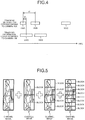
- tracking information 100A, 100B, and 100C are generated as tracking information corresponding to the camera 10A
- tracking information 100D and 100E are generated as tracking information corresponding to the camera 10B.
- a time difference t1 between the tracking information 100A and 100B is equal to or smaller than the threshold.
- these two pieces of the tracking information 100 become targets of association by the first associator 213, and are associated with each other when a degree of similarity therebetween is equal to or larger than a reference value.
- a description will be given by exemplifying a case where a difference between average values of the respective times included in the tracking information is taken as the time difference between the pieces of tracking information, but the arrangement is not limited thereto.
- a difference between time of an end point of one tracking information and time of a start point of the other tracking time may be used.
- a time difference t2 between the tracking information 100A and 100D is equal to or smaller than the threshold in this example.
- these two pieces of the tracking information 100 become targets of association by the first associator 213, and are associated with each other when similarity therebetween is equal to or larger than a reference value.
- the tracking information 100B and 100D, the tracking information 100B and 100E, and the tracking information 100D and 100E become targets of association in this example.
- a time difference between the tracking information 100C and each of the other tracking information 100A, 100B, 100D and 100E exceeds the threshold, and thus, any combination of the tracking information 100C and the other tracking information 100A, 100B, 100D or 100E does not become a target of association by the first associator 213.
- the first associator 213 generates the first associated tracking information for each group of the cameras 10 set in advance.
- the first associator 213 associates the trace information and the trace information having the similarity equal to or higher than a threshold.
- the similarity between the pieces of tracking information as targets of association by the first associator 213 is defined using similarity in appearance, a time difference, a distance between the cameras 10, and the like, and an authentication result using biometric information is also added when the biometric information such as a facial image or a fingerprint image is acquired from both the tracking information.
- biometric information such as a facial image or a fingerprint image is acquired from both the tracking information.
- personal information of a person (pedestrian) such as an ID card is acquired in conjunction with a camera video at a passage gate or the like, these pieces of information can be also used.
- the similarity in appearance of the pedestrian is calculated by, for example, multi-channelizing a person image (an area in which a person is reflected in an image) using a plurality of color spaces having tolerance to variation in environmental light, such as a YCbCr color space, an HSV color space, and a Color Names color space, performing Multi-Layer Block division of dividing each channel image into blocks with different number of divisions in a Y direction, calculating each of a histogram of values and a histogram of binary codes based on a difference value between adjacent pixels from each block, and performing extraction of a feature normalizing and concatenating all the blocks.
- the similarity may be calculated using similarity in an identification space in which the same person learned by metric learning in advance is mapped to be close and another person is mapped to be distant.
- a person image acquired by three channels of RGB is converted into a plurality of color spaces so as to be multi-channelized.
- the channel is expanded into seventeen channels in total including three channels in the YCbCr color space, three channels in the HSV color space, and eleven channels in the Color Names descriptor*.
- This expansion aims to absorb individual differences of cameras and variation in color information and luminance information of the acquired images caused by environmental variation, and it is known that variation on the color space are reduced with respect to the above-described variation (see Non-Patent Document " J. Van, Learning Color Names for Real-World Applications, TIP, 18(7): 1512-1523, 2009 )".
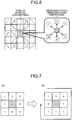
- FIG. 5 is an image view of hierarchical division, and defines the plurality of areas called blocks, step by step, in four stages for one channel image.
- the histogram information is extracted from the respective defined areas (blocks).
- the histogram to be extracted normalizes and concatenates a histogram feature, which indicates a frequency of occurrence of each value, and a feature which makes a histogram using binary codes, allocated based on values of a pixel of interest and a peripheral pixel, that is called a local binary pattern to obtain the histogram of a frequency of occurrence in a gradient direction with a peripheral value.
- a luminance value of the pixel of interest and an average luminance value of pixels present in a direction are compared for each direction from the pixel of interest (center point), and coding is performed upon performing weighting depending on a result.
- a luminance pattern illustrated in (A) of FIG. 7 is converted into a bit string in the direction indicated in (B) of FIG. 7 .
- a luminance value of a peripheral pixel is converted to "0" when the luminance value of the peripheral pixel is lower than a luminance value of a center pixel
- a luminance value of a peripheral pixel is converted to "1" when the luminance value of the peripheral pixel is higher than a luminance value of a center pixel, but the arrangement is not limited thereto (the conversion may be performed in the opposite manner).
- the features in the number of dimensions, obtained by combining a bin number of the histogram of values and a bin number of the histogram of the LBP, is obtained from the respective blocks (areas).
- features corresponding to the number of channels ⁇ the number of blocks, extracted from the respective blocks, are normalized and concatenated to extract a high-order feature vector.
- Metric learning is performed to perform conversion, in advance, into a feature space in which the same moving object becomes close and a different moving object becomes distant, and the acquired conversion matrix is used to take a feature vector (d-dimension) obtained by converting the high-order feature vector (D-dimension) as a feature vector of each person image.
- Several methods are proposed for the metric learning, and in general, only a conversion matrix in a dimension corresponding to the number of categories, which are desirably obtained by division, is calculated in most methods. However, it is possible to calculate a conversion matrix in an arbitrary number of dimensions when REMetric* is used, for example (see “T. Kozakaya, Random Ensemble Metrics for Object Recognition, International Conference on Computer Vision (ICCV), 2011").
- the similarity between the respective person images can be defined by normalized cross-correlation between the above-described two feature vectors.
- the tracking information has a plurality of person images, and thus, it is possible to define the similarity between a plurality of images and a plurality of images. A maximum value among all combinations may be used as the similarity between the pieces of tracking information or an average value thereof may be used as the similarity between the pieces of tracking information.
- principal component analysis is performed on a plurality of feature vector sequences obtained relating to each piece of tracking information to calculate a subspace.
- This subspace is a space that expresses each moving object expressing variation in appearance, and thus, similarity between the respective subspaces among the pieces of tracking information is calculated by a mutual subspace method and taken as the similarity between the tracking information. Further, the first associator 213 associates the tracking information and the tracking information having the similarity equal to or higher than the reference value, and generates one or more pieces of the first associated tracking information.
- the second associator 214 generates second associated tracking information obtained by association targeting the first associated tracking information and tracking information, which has not been associated by the first associator 213, based on authentication information for identifying the moving object.
- the authentication information includes biometric information. More specifically, the biometric information includes a facial image or a fingerprint image. In addition, the authentication information may include personal information of a person (pedestrian) such as an ID card.
- the second associator 214 extracts facial images, respectively, for the first associated tracking information and the tracking information, which are the targets of association, and generates the second associated tracking information by associating the first associated tracking information and the first associated tracking information, the first associated tracking information and the tracking information, or the tracking information and the tracking information which have the extracted faces images matching each other. Accordingly, the tracking information 100C that has not been associated by the first associator 213 is also associated (collected as one piece of tracking information) with the first associated tracking information (or tracking information that has not been associated by the first associator 213) including the facial image extracted from the tracking information 100C in FIG. 4 , for example.
- the invention is not limited thereto, and may be provided in a form of performing association by performing the similar authentication using a fingerprint image.
- the second associator 214 may be provided in a form of performing association using these kinds of information.
- the second associated tracking information is obtained for each moving object reflected in the image.
- recognition performance for facial recognition is improved by performing authentication using a set of facial images acquired from the same person at a plurality of angles and under a plurality of illumination environments.
- the facial image obtained from the tracking information which is an analysis result from a single camera video
- the facial image obtained from the above-described first associated tracking information which is an analysis result from a plurality of camera videos
- the facial recognition performance is further improved when the first associated tracking information is used.
- similarity between two facial images may be defined using a predetermined feature vector and a maximum value among all combinations may be defined as similarity between sets, or similarity may be calculated using mutual subspaces, which is similar to the above-described calculation of similarity between the person images.
- the output unit 215 outputs the second associated tracking information.
- the output unit 215 can also perform control to display a movement trajectory 300 corresponding to the second associated tracking information on the display 206.
- one or more pieces of the first associated tracking information obtained by association targeting a plurality of pieces of tracking information having the mutual time difference equal to or smaller than the threshold, are generated, and then, the second associated tracking information, obtained by association targeting the one or more pieces of first associated tracking information and tracking information, which has not been associated as the first associated tracking information, based on the authentication information for identifying the moving object, is generated and output in the present arrangement.
- the function of the tracker 212 may be a form of being provided in the camera 10, for example.
- the moving object tracking device 20 is provided in a form of having a function of acquiring a tracking information group instead of the acquirer 211 and the tracker 212.
- the moving object tracking system 1 may be provided in a form of including the acquirer 211, the tracker 212, the first associator 213, the second associator 214, and the output unit 215.
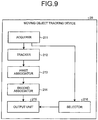
- FIG. 9 is a diagram illustrating an example of functions provided in the moving object tracking device 20 according to the second arrangement.
- the moving object tracking device 20 further includes a selector 216, which is different from the above-described first arrangement.
- the selector 216 selects any moving object included in a plurality of temporally consecutive images.
- a selection method is arbitrary.
- the selector 216 can select a pedestrian reflected in an image in accordance with a touch operation or a mouse operation with respect to the image acquired by the acquirer 211, or may select any pedestrian in accordance with a touch operation or a mouse operation among pedestrians (people), reflected in images, retrieved with a facial image as a query, and then, displayed in the descending order of similarity.
- person images (pedestrians) cut out from the images may be displayed in an aligned manner, and any person image (pedestrian) may be selected in accordance with a touch operation or a mouse operation.
- the output unit 215 performs control to display a movement trajectory of a pedestrian (an example of a moving object), selected by the selector 216 (a movement trajectory corresponding to the second associated tracking information of the pedestrian), and one or more images, which correspond to one or more points (may be fixed or may be arbitrarily changeable in accordance with designation by a user) on the movement trajectory, in an aligned manner.
- a movement trajectory of a pedestrian an example of a moving object
- the selector 216 a movement trajectory corresponding to the second associated tracking information of the pedestrian
- images which correspond to one or more points (may be fixed or may be arbitrarily changeable in accordance with designation by a user) on the movement trajectory, in an aligned manner.
- FIG. 10 it is possible to display the movement trajectory 300, an image 401, which corresponds to a point corresponding to the latest time in the movement trajectory 300, and an image 402, which corresponds to a point corresponding to an arbitrary time in the past, in an aligned manner.
- the function of the output unit 215 and the function of the selector 216 among the functions illustrated in FIG. 9 may be extracted and mounted to another device.
- the other device functions as the "display device".
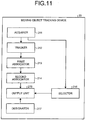
- FIG. 11 is a diagram illustrating an example of functions provided in the moving object tracking device (display device) 20 according to a modified example of the second arrangement.
- the moving object tracking device 20 further includes a designator 217.
- the designator 217 designates a period.
- a method of designating the period is arbitrary. For example, when a calendar image 500 illustrated in FIG. 12 is displayed and a touch operation or a mouse operation with respect to any date inside the calendar image 500 is received, the designator 217 can designate a period (one day) corresponding to the date.
- the output unit 215 performs control to display a movement trajectory, which corresponds to a period designated by the designator 217, of a pedestrian selected by the selector 216 and one or more images corresponding to one or more points on the movement trajectory in an aligned manner. For example, when a date of "October 5, 2016" in the calendar image 500 of FIG. 12 is designated, the output unit 215 can also display the movement trajectory 300, which corresponds to the designated date, of the pedestrian selected by the selector 216, an image 501, which corresponds to a point corresponding to the latest time in the movement trajectory 300, and an image 502, which corresponds to a point corresponding to an arbitrary time in the past, in an aligned manner as illustrated in FIG. 13 . In the example of FIG. 13 , icons of pedestrians are displayed together with the images.
- the designator 217 can also designate a plurality of periods.
- the output unit 215 performs control to display a movement trajectory of a pedestrian selected by the selector 216 and one or more images corresponding to one or more points on the movement trajectory, in an aligned manner, for each of the plurality of periods designated by the designator 217. For example, assumed is a case where the date of "October 5, 2016" and a date "October 15, 2016" in the calendar image 500 of FIG. 12 are designated.
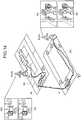
- the output unit 215 can display a movement trajectory 301, which corresponds to "October 5, 2016", of the pedestrian selected by the selector 216, an image 601, which corresponds to a point corresponding to the latest time in the movement trajectory 301, and an image 602, which corresponds to a point corresponding to an arbitrary time in the past, in an aligned manner, and display a movement trajectory 302, which corresponds to "October 15, 2016", an image 701, which corresponds to a point corresponding to the latest time in the movement trajectory 302, and an image 702, which corresponds to a point corresponding to an arbitrary time in the past, in an aligned manner as illustrated in FIG. 14 .
- the program executed by the moving object tracking device 20 according to the respective arrangements and modified examples described above is stored in a computer connected to the network such as the Internet and is provided through download via the network.
- the program executed by the moving object tracking device 20 according to the respective arrangements and modified examples described above is provided or distributed via the network such as the Internet.
- the program executed by the moving object tracking device 20 according to the respective arrangements and modified examples described above is provided in the state of being incorporated in a non-volatile recording medium such as a ROM in advance.
- a moving object tracking device includes an acquirer, a tracker, a first associator, a second associator, and an output unit.
- the acquirer is configured to acquire a plurality of images.
- the tracker is configured to generate a plurality of pieces of tracking information indicating information obtained by tracking a moving object included in the images.
- the first associator is configured to generate first associated tracking information obtained by first association targeting the plurality of pieces of tracking information having a mutual time difference equal to or smaller than a threshold.
- the second associator is configured to generate second associated tracking information obtained by second association targeting the first associated tracking information and the tracking information, not associated by the first association, based on authentication information for identifying the moving object.
- the output unit is configured to output the second associated tracking information.
- Example 2 In the moving object tracking device according to Example 1, the acquirer acquires the plurality of images captured by a camera for each of a plurality of cameras. The first associator generates the first associated tracking information for each predetermined set of the cameras.
- Example 3 In the moving object tracking device according to Example 1 or 2, the moving object is a person, and the authentication information includes biometric information.
- the biometric information includes a facial image or a fingerprint image.
- Example 5 In the moving object tracking device) according to any one of Examples 1 to 4, the moving object is a person, and the authentication information includes personal information of the person.
- Example 6 In the moving object tracking device according to any one of Examples 1 to 5, the first association associates the tracking information and the tracking information having similarity equal to or higher than a threshold.
- a display device includes a selector and a display controller.
- the selector is configured to select a moving object from moving objects included in a plurality of images.
- the display controller is configured to display a movement trajectory of the moving object selected and one or more of the images corresponding to one or more points on the movement trajectory in an aligned manner.
- Example 8 The display device according to Example 7, further includes a designator configured to designate a period.
- the display controller performs control to display the movement trajectory of the moving object selected and one or more of the images corresponding to one or more points on the movement trajectory in an aligned manner, the movement trajectory to be displayed corresponding to a period designated by the designator.
- a moving object tracking method includes: acquiring a plurality of images; generating a plurality of pieces of tracking information indicating information obtained by tracking a moving object included in the images; generating first associated tracking information obtained by first associating the tracking information and the tracking information targeting the plurality of pieces of tracking information having a mutual time difference equal to or smaller than a threshold; generating second associated tracking information obtained by second associating the first associated tracking information and the first associated tracking information based on authentication information for identifying the object; and outputting the second associated tracking information.
- Example 10 In the moving object tracking method according to Example 9, the acquiring acquires the plurality of images captured by a camera for each of a plurality of cameras, and the generating first associated tracking information generates the first associated tracking information for each predetermined set of the cameras.
- Example 11 In the moving object tracking method according to Example 9 or 10, the moving object is a person, and the authentication information includes biometric information.
- the biometric information includes a facial image or a fingerprint image.
- Example 13 In the moving object tracking method according to any one of Examples 9 to 12, the moving object is a person, and the authentication information includes personal information of the person.
- Example 14 In the moving object tracking method according to any one of Examples 9 to 13, the first associating associates the tracking information and the tracking information having similarity equal to or higher than a threshold.
Landscapes
- Engineering & Computer Science (AREA)
- Multimedia (AREA)
- Physics & Mathematics (AREA)
- General Physics & Mathematics (AREA)
- Theoretical Computer Science (AREA)
- Human Computer Interaction (AREA)
- Oral & Maxillofacial Surgery (AREA)
- Health & Medical Sciences (AREA)
- General Health & Medical Sciences (AREA)
- Signal Processing (AREA)
- Computer Vision & Pattern Recognition (AREA)
- Image Analysis (AREA)
- Closed-Circuit Television Systems (AREA)
Abstract
Description
- Arrangements described herein relate generally to a moving object tracking device, a display device, and a moving object tracking method.
- A moving object tracking device that tracks a moving object, detected from a plurality of camera videos, across cameras has been known. Among conventional moving object tracking devices, a configuration in which whether or not moving objects reflected in each image are the same is determined based on appearance of the moving object in the image to obtain each tracking result of the moving objects has been known.
- In the conventional moving object tracking devices, however, the moving objects reflected in the respective images are associated with each other (tracking information is generated) based on the appearance of the moving object, and thus, it is difficult to cope with a change in clothing when the moving object is a pedestrian, for example. In addition, in the case of limiting to pedestrians, it is possible to associate the moving objects reflected in the respective images with each other using results obtained by recognizing a face even if the appearance varies due to different kinds of clothing and environmental change, but such association is possible only for sections where the face can be seen. It is difficult to track the moving object over a long period of time in the above conventional tracking device.
-
-
FIG. 1 is a diagram illustrating a configuration of a moving object tracking system according to a first arrangement; -
FIG. 2 is a diagram illustrating a hardware configuration of the moving object tracking device according to the first arrangement; -
FIG. 3 is a diagram illustrating a function provided in the moving object tracking device according to the first arrangement; -
FIG. 4 is a view for describing association between pieces of tracking information according to the first arrangement; -
FIG. 5 is a view for describing a block of a channel image according to the first arrangement; -
FIG. 6 is a view for describing an LBP according to the first arrangement; -
FIG. 7 is a view for describing the LBP according to the first arrangement; -
FIG. 8 is a view illustrating an example of output according to the first arrangement; -
FIG. 9 is a diagram illustrating a function provided in a moving object tracking device according to a second arrangement; -
FIG. 10 is a view illustrating an example of a display mode according to the second arrangement; -
FIG. 11 is a diagram illustrating functions provided in a moving object tracking device according to a modified example of the second arrangement; -
FIG. 12 is a view illustrating an example of a calendar image according to the second arrangement; -
FIG. 13 is a view illustrating an example of a display mode according to the modified example of the second arrangement; and -
FIG. 14 is a view illustrating an example of the display mode according to the modified example of the second arrangement. - According to an arrangement, a moving object tracking device includes a memory having computer executable components stored therein; and a processor communicatively coupled to the memory. The processor is configured to perform acquiring a plurality of images; generating a plurality of pieces of tracking information indicating information obtained by tracking a moving object included in the images; generating first associated tracking information obtained by first association targeting the plurality of pieces of tracking information having a mutual time difference equal to or smaller than a threshold; generating second associated tracking information obtained by second association targeting the first associated tracking information and the tracking information, not associated by the first association, based on authentication information for identifying the moving object; and outputting the second associated tracking information.
- Hereinafter, arrangements of a moving object tracking device, a display device, and a moving object tracking method according to the arrangement will be described in detail with reference to the accompanying drawings.
-
FIG. 1 is a diagram illustrating an example of a schematic configuration of a movingobject tracking system 1 according to the present arrangement. As illustrated inFIG. 1 , the movingobject tracking system 1 includes twocameras 10A and 10B and a movingobject tracking device 20. In the following description, when thecameras 10A and 10B will be simply referred to as a "camera 10" when not distinguished from each other. Although the number ofcameras 10 included in the movingobject tracking system 1 is two in the example ofFIG. 1 , the arrangement is not limited thereto, but may be provided in a form of including three ormore cameras 10 or a form of including asingle camera 10. Each of thecameras 10 and the movingobject tracking device 20 are connected to each other in a wireless or wired manner. -
FIG. 2 is a diagram illustrating an example of a hardware configuration of the movingobject tracking device 20. As illustrated inFIG. 2 , the movingobject tracking device 20 includes a CPU 201, aROM 202, aRAM 203, an I/F unit 204, anoperation unit 205, and adisplay 206. - The CPU 201 comprehensively controls an operation of the moving
object tracking device 20. The CPU 201 executes various control programs recorded in theROM 202 using a predetermined area of theRAM 203 as a work area to implement various functions provided in the movingobject tracking device 20. Detailed content of the functions provided in the movingobject tracking device 20 will be described later. - The
ROM 202 is a non-volatile memory (non-rewritable memory) that stores programs, various kinds of setting information, and the like which relate to the movingobject tracking device 20. - The
RAM 203 is a storage, for example, an SDRAM or the like, functions as the work area of the CPU 201 and serves a role as a buffer or the like. - The I/F unit 204 is an interface configured for connection with an external device such as the
camera 10. Theoperation unit 205 is a device configured to receive an operation of a user, and is configured using a mouse, a keyboard, or the like. Thedisplay 206 is a device that displays various kinds of information relating to the movingobject tracking device 20, and is configured using, for example, a liquid crystal display or the like. Theoperation unit 205 and thedisplay 206 may be a form of being configured in an integrated manner (for example, configured as a touch panel). -
FIG. 3 is a diagram illustrating an example of the functions provided in the movingobject tracking device 20. As illustrated inFIG. 3 , the movingobject tracking device 20 includes anacquirer 211, atracker 212, afirst associator 213, asecond associator 214, and anoutput unit 215. The functions relating to the present arrangement are mainly illustrated in the example ofFIG. 3 , but the functions provided in the movingobject tracking device 20 are not limited thereto. In the present arrangement, the respective functions of theacquirer 211, thetracker 212, thefirst associator 213, thesecond associator 214, and theoutput unit 215 are implemented by the CPU 201 when executing the programs stored in theROM 202 or the like, but the arrangement is not limited thereto. For example, at least a part of the functions may be implemented by a dedicated hardware circuit (a semiconductor integrated circuit or the like). In addition, the movingobject tracking device 20 may be provided in a form of being partially or entirely present in a server. - The
acquirer 211 acquires a plurality of images. More specifically, theacquirer 211 acquires a plurality of images (a plurality of temporally consecutive images) captured by thecamera 10 from each of thecameras 10. For example, theacquirer 211 may be provided for each of the plurality of cameras 10 (the plurality ofacquirers 211 corresponding to the plurality ofcameras 10 on a one-to-one basis may be provided), or thesingle acquirer 211 that acquires the images from therespective cameras 10 may be provided. - The
tracker 212 generates a plurality of pieces of tracking information indicating information obtained by tracking a moving object (reflected) included in the image acquired by theacquirer 211. Thetracker 212 detects and tracks the moving objects reflected in the respective images with respect to an image group acquired by theacquirer 211, and generates the tracking information. Here, thetracker 212 generates the tracking information corresponding to each of the image groups captured by therespective cameras 10. In other words, it may be considered that one or more pieces of tracking information are generated for each of thecameras 10. In addition, the moving object is assumed to be a person (pedestrian) in this example, but may be, for example, a vehicle or the like without being limited thereto. Various known techniques can be used as a method of detecting and tracking the moving object among the images, and for example, a technique disclosed in Japanese Patent Application Laid-open No.2014-186547 - The
first associator 213 generates first associated tracking information obtained by association targeting a plurality of pieces of tracking information having the mutual time difference equal to or smaller than the threshold. Specifically, thefirst associator 213 collects the plurality of pieces of tracking information corresponding to the same moving object into one piece of information, and this collected result is referred to as the "first associated tracking information". Thefirst associator 213 generates one or more pieces of the first associated tracking information. Here, when two pieces of tracking information, as targets, has a difference in imaged time (difference in imaged timing) equal to or larger than a certain value, appearance is highly likely to greatly vary therebetween, and thus, such information is excluded from targets of association by thefirst associator 213. - For example, as illustrated in
FIG. 4 , assumed is a case where trackinginformation information camera 10B. In this example, a time difference t1 between the trackinginformation first associator 213, and are associated with each other when a degree of similarity therebetween is equal to or larger than a reference value. Here, a description will be given by exemplifying a case where a difference between average values of the respective times included in the tracking information is taken as the time difference between the pieces of tracking information, but the arrangement is not limited thereto. For example, a difference between time of an end point of one tracking information and time of a start point of the other tracking time may be used. - In addition, when focusing on the tracking
information 100A and the trackinginformation 100D, a time difference t2 between the trackinginformation first associator 213, and are associated with each other when similarity therebetween is equal to or larger than a reference value. Similarly, the trackinginformation information information information 100C and each of theother tracking information information 100C and theother tracking information first associator 213. - In addition, it is conceivable that clothing changes such as putting on or off of an outer garment in a group of the
cameras 10 under different environments. Thus, such a group is excluded, in advance, from targets of association by thefirst associator 213. In short, thefirst associator 213 generates the first associated tracking information for each group of thecameras 10 set in advance. - The
first associator 213 associates the trace information and the trace information having the similarity equal to or higher than a threshold. Here, the similarity between the pieces of tracking information as targets of association by thefirst associator 213 is defined using similarity in appearance, a time difference, a distance between thecameras 10, and the like, and an authentication result using biometric information is also added when the biometric information such as a facial image or a fingerprint image is acquired from both the tracking information. In addition, when personal information of a person (pedestrian) such as an ID card is acquired in conjunction with a camera video at a passage gate or the like, these pieces of information can be also used. - In addition, the similarity in appearance of the pedestrian is calculated by, for example, multi-channelizing a person image (an area in which a person is reflected in an image) using a plurality of color spaces having tolerance to variation in environmental light, such as a YCbCr color space, an HSV color space, and a Color Names color space, performing Multi-Layer Block division of dividing each channel image into blocks with different number of divisions in a Y direction, calculating each of a histogram of values and a histogram of binary codes based on a difference value between adjacent pixels from each block, and performing extraction of a feature normalizing and concatenating all the blocks. Then, the similarity may be calculated using similarity in an identification space in which the same person learned by metric learning in advance is mapped to be close and another person is mapped to be distant.
- Here, a person image acquired by three channels of RGB is converted into a plurality of color spaces so as to be multi-channelized. For example, the channel is expanded into seventeen channels in total including three channels in the YCbCr color space, three channels in the HSV color space, and eleven channels in the Color Names descriptor*. This expansion aims to absorb individual differences of cameras and variation in color information and luminance information of the acquired images caused by environmental variation, and it is known that variation on the color space are reduced with respect to the above-described variation (see Non-Patent Document "J. Van, Learning Color Names for Real-World Applications, TIP, 18(7): 1512-1523, 2009)".
- Next, block division is performed with a plurality of layers for each channel image. Although the histogram information is acquired from each block at the subsequent stage, it is possible to use position information when the division is performed in detail while influence caused by a positional deviation of a person rectangle is great, thereby increasing identifiability. Thus, division is performed step by step from detailed division to broad division. The division can be performed to be divided in the y-axis direction and the x-axis direction, but may be divided only in any one direction therebetween. Specifically, a plurality of areas called blocks are defined from the respective channel images for each person image.
FIG. 5 is an image view of hierarchical division, and defines the plurality of areas called blocks, step by step, in four stages for one channel image. - Next, the histogram information is extracted from the respective defined areas (blocks). The histogram to be extracted normalizes and concatenates a histogram feature, which indicates a frequency of occurrence of each value, and a feature which makes a histogram using binary codes, allocated based on values of a pixel of interest and a peripheral pixel, that is called a local binary pattern to obtain the histogram of a frequency of occurrence in a gradient direction with a peripheral value. As illustrated in
FIG. 6 , a luminance value of the pixel of interest and an average luminance value of pixels present in a direction are compared for each direction from the pixel of interest (center point), and coding is performed upon performing weighting depending on a result. For example, a luminance pattern illustrated in (A) ofFIG. 7 is converted into a bit string in the direction indicated in (B) ofFIG. 7 . In this example, a luminance value of a peripheral pixel is converted to "0" when the luminance value of the peripheral pixel is lower than a luminance value of a center pixel, and a luminance value of a peripheral pixel is converted to "1" when the luminance value of the peripheral pixel is higher than a luminance value of a center pixel, but the arrangement is not limited thereto (the conversion may be performed in the opposite manner). The features in the number of dimensions, obtained by combining a bin number of the histogram of values and a bin number of the histogram of the LBP, is obtained from the respective blocks (areas). - Next, features corresponding to the number of channels × the number of blocks, extracted from the respective blocks, are normalized and concatenated to extract a high-order feature vector. Metric learning is performed to perform conversion, in advance, into a feature space in which the same moving object becomes close and a different moving object becomes distant, and the acquired conversion matrix is used to take a feature vector (d-dimension) obtained by converting the high-order feature vector (D-dimension) as a feature vector of each person image. Several methods are proposed for the metric learning, and in general, only a conversion matrix in a dimension corresponding to the number of categories, which are desirably obtained by division, is calculated in most methods. However, it is possible to calculate a conversion matrix in an arbitrary number of dimensions when REMetric* is used, for example (see "T. Kozakaya, Random Ensemble Metrics for Object Recognition, International Conference on Computer Vision (ICCV), 2011").
- The similarity between the respective person images can be defined by normalized cross-correlation between the above-described two feature vectors. In general, the tracking information has a plurality of person images, and thus, it is possible to define the similarity between a plurality of images and a plurality of images. A maximum value among all combinations may be used as the similarity between the pieces of tracking information or an average value thereof may be used as the similarity between the pieces of tracking information. Alternatively, principal component analysis is performed on a plurality of feature vector sequences obtained relating to each piece of tracking information to calculate a subspace. This subspace is a space that expresses each moving object expressing variation in appearance, and thus, similarity between the respective subspaces among the pieces of tracking information is calculated by a mutual subspace method and taken as the similarity between the tracking information. Further, the
first associator 213 associates the tracking information and the tracking information having the similarity equal to or higher than the reference value, and generates one or more pieces of the first associated tracking information. - The
second associator 214 generates second associated tracking information obtained by association targeting the first associated tracking information and tracking information, which has not been associated by thefirst associator 213, based on authentication information for identifying the moving object. The authentication information includes biometric information. More specifically, the biometric information includes a facial image or a fingerprint image. In addition, the authentication information may include personal information of a person (pedestrian) such as an ID card. - In this example, the
second associator 214 extracts facial images, respectively, for the first associated tracking information and the tracking information, which are the targets of association, and generates the second associated tracking information by associating the first associated tracking information and the first associated tracking information, the first associated tracking information and the tracking information, or the tracking information and the tracking information which have the extracted faces images matching each other. Accordingly, the trackinginformation 100C that has not been associated by thefirst associator 213 is also associated (collected as one piece of tracking information) with the first associated tracking information (or tracking information that has not been associated by the first associator 213) including the facial image extracted from the trackinginformation 100C inFIG. 4 , for example. The invention is not limited thereto, and may be provided in a form of performing association by performing the similar authentication using a fingerprint image. In addition, when personal information of a person such as an ID card is acquired in conjunction with an image imaged by thecamera 10 at a pass gate or the like, thesecond associator 214 may be provided in a form of performing association using these kinds of information. In the above-described manner, the second associated tracking information is obtained for each moving object reflected in the image. Here, it is known recognition performance for facial recognition is improved by performing authentication using a set of facial images acquired from the same person at a plurality of angles and under a plurality of illumination environments. While a facial image obtained from the tracking information, which is an analysis result from a single camera video, has little variation, the facial image obtained from the above-described first associated tracking information, which is an analysis result from a plurality of camera videos, is a facial image that has greater variation. Thus, the facial recognition performance is further improved when the first associated tracking information is used. As for calculation of similarity in the facial recognition, similarity between two facial images may be defined using a predetermined feature vector and a maximum value among all combinations may be defined as similarity between sets, or similarity may be calculated using mutual subspaces, which is similar to the above-described calculation of similarity between the person images. - The
output unit 215 outputs the second associated tracking information. For example, as illustrated inFIG. 8 , theoutput unit 215 can also perform control to display amovement trajectory 300 corresponding to the second associated tracking information on thedisplay 206. - As described above, one or more pieces of the first associated tracking information, obtained by association targeting a plurality of pieces of tracking information having the mutual time difference equal to or smaller than the threshold, are generated, and then, the second associated tracking information, obtained by association targeting the one or more pieces of first associated tracking information and tracking information, which has not been associated as the first associated tracking information, based on the authentication information for identifying the moving object, is generated and output in the present arrangement. In other words, it is possible to obtain tracking results over a longer period of time by creating one or more first associated tracking information, obtained by associating short-term tracking information and short-term tracking information on the same moving object, and generating the second associated tracking information, obtained by association based on the authentication information, relating to the first associated tracking information and the first associated tracking information which have not been associated due to the time difference therebetween, and the tracking information (tracking information missed from association by the first associator 213) which have not been associated as the first associated tracking information. Therefore, it is possible to achieve an advantageous effect that tracking of a moving object over a long period of time becomes possible according to the present arrangement.
- The function of the
tracker 212 may be a form of being provided in thecamera 10, for example. In this case, the movingobject tracking device 20 is provided in a form of having a function of acquiring a tracking information group instead of theacquirer 211 and thetracker 212. In short, the movingobject tracking system 1 may be provided in a form of including theacquirer 211, thetracker 212, thefirst associator 213, thesecond associator 214, and theoutput unit 215. - Next, a second arrangement will be described. A description on common parts as the above-described first arrangement will be suitably omitted. In the present arrangement,
FIG. 9 is a diagram illustrating an example of functions provided in the movingobject tracking device 20 according to the second arrangement. As illustrated inFIG. 9 , the movingobject tracking device 20 further includes a selector 216, which is different from the above-described first arrangement. The selector 216 selects any moving object included in a plurality of temporally consecutive images. A selection method is arbitrary. For example, the selector 216 can select a pedestrian reflected in an image in accordance with a touch operation or a mouse operation with respect to the image acquired by theacquirer 211, or may select any pedestrian in accordance with a touch operation or a mouse operation among pedestrians (people), reflected in images, retrieved with a facial image as a query, and then, displayed in the descending order of similarity. In addition, for example, person images (pedestrians) cut out from the images may be displayed in an aligned manner, and any person image (pedestrian) may be selected in accordance with a touch operation or a mouse operation. - The
output unit 215 according to the present arrangement performs control to display a movement trajectory of a pedestrian (an example of a moving object), selected by the selector 216 (a movement trajectory corresponding to the second associated tracking information of the pedestrian), and one or more images, which correspond to one or more points (may be fixed or may be arbitrarily changeable in accordance with designation by a user) on the movement trajectory, in an aligned manner. For example, as illustrated inFIG. 10 , it is possible to display themovement trajectory 300, animage 401, which corresponds to a point corresponding to the latest time in themovement trajectory 300, and animage 402, which corresponds to a point corresponding to an arbitrary time in the past, in an aligned manner. In the example ofFIG. 10 , icons of pedestrians are displayed together with the images. Here, theoutput unit 215 functions as a "display controller". Further, the movingobject tracking device 20 corresponds to a "display device". - The function of the
output unit 215 and the function of the selector 216 among the functions illustrated inFIG. 9 , for example, may be extracted and mounted to another device. In this case, the other device functions as the "display device". -
FIG. 11 is a diagram illustrating an example of functions provided in the moving object tracking device (display device) 20 according to a modified example of the second arrangement. As illustrated inFIG. 11 , the movingobject tracking device 20 further includes adesignator 217. Thedesignator 217 designates a period. A method of designating the period is arbitrary. For example, when acalendar image 500 illustrated inFIG. 12 is displayed and a touch operation or a mouse operation with respect to any date inside thecalendar image 500 is received, thedesignator 217 can designate a period (one day) corresponding to the date. - The
output unit 215 performs control to display a movement trajectory, which corresponds to a period designated by thedesignator 217, of a pedestrian selected by the selector 216 and one or more images corresponding to one or more points on the movement trajectory in an aligned manner. For example, when a date of "October 5, 2016" in thecalendar image 500 ofFIG. 12 is designated, theoutput unit 215 can also display themovement trajectory 300, which corresponds to the designated date, of the pedestrian selected by the selector 216, animage 501, which corresponds to a point corresponding to the latest time in themovement trajectory 300, and animage 502, which corresponds to a point corresponding to an arbitrary time in the past, in an aligned manner as illustrated inFIG. 13 . In the example ofFIG. 13 , icons of pedestrians are displayed together with the images. - In addition, the
designator 217 can also designate a plurality of periods. In this case, theoutput unit 215 performs control to display a movement trajectory of a pedestrian selected by the selector 216 and one or more images corresponding to one or more points on the movement trajectory, in an aligned manner, for each of the plurality of periods designated by thedesignator 217. For example, assumed is a case where the date of "October 5, 2016" and a date "October 15, 2016" in thecalendar image 500 ofFIG. 12 are designated. In this case, theoutput unit 215 can display amovement trajectory 301, which corresponds to "October 5, 2016", of the pedestrian selected by the selector 216, animage 601, which corresponds to a point corresponding to the latest time in themovement trajectory 301, and animage 602, which corresponds to a point corresponding to an arbitrary time in the past, in an aligned manner, and display amovement trajectory 302, which corresponds to "October 15, 2016", animage 701, which corresponds to a point corresponding to the latest time in themovement trajectory 302, and animage 702, which corresponds to a point corresponding to an arbitrary time in the past, in an aligned manner as illustrated inFIG. 14 . - In addition, it may be configured such that the program executed by the moving
object tracking device 20 according to the respective arrangements and modified examples described above is stored in a computer connected to the network such as the Internet and is provided through download via the network. In addition, it may be configured such that the program executed by the movingobject tracking device 20 according to the respective arrangements and modified examples described above is provided or distributed via the network such as the Internet. In addition, it may be configured such that the program executed by the movingobject tracking device 20 according to the respective arrangements and modified examples described above is provided in the state of being incorporated in a non-volatile recording medium such as a ROM in advance. - Further, the respective arrangements and modified examples described above can be combined in an arbitrary manner.
- While certain arrangements have been described, these arrangements have been presented by way of example only, and are not intended to limit the scope of the claims. Indeed, the novel devices described herein may be embodied in a variety of other forms; furthermore various omissions, substitutions and changes in the form of the devices described herein may be made.
- Example 1. A moving object tracking device includes an acquirer, a tracker, a first associator, a second associator, and an output unit. The acquirer is configured to acquire a plurality of images. The tracker is configured to generate a plurality of pieces of tracking information indicating information obtained by tracking a moving object included in the images. The first associator is configured to generate first associated tracking information obtained by first association targeting the plurality of pieces of tracking information having a mutual time difference equal to or smaller than a threshold. The second associator is configured to generate second associated tracking information obtained by second association targeting the first associated tracking information and the tracking information, not associated by the first association, based on authentication information for identifying the moving object. The output unit is configured to output the second associated tracking information.
- Example 2. In the moving object tracking device according to Example 1, the acquirer acquires the plurality of images captured by a camera for each of a plurality of cameras. The first associator generates the first associated tracking information for each predetermined set of the cameras.
- Example 3. In the moving object tracking device according to Example 1 or 2, the moving object is a person, and the authentication information includes biometric information.
- Example 4. In the moving object tracking device according to Example 3, the biometric information includes a facial image or a fingerprint image.
- Example 5. In the moving object tracking device) according to any one of Examples 1 to 4, the moving object is a person, and the authentication information includes personal information of the person.
- Example 6. In the moving object tracking device according to any one of Examples 1 to 5, the first association associates the tracking information and the tracking information having similarity equal to or higher than a threshold.
- Example 7. A display device includes a selector and a display controller. The selector is configured to select a moving object from moving objects included in a plurality of images. The display controller is configured to display a movement trajectory of the moving object selected and one or more of the images corresponding to one or more points on the movement trajectory in an aligned manner.
- Example 8. The display device according to Example 7, further includes a designator configured to designate a period. The display controller performs control to display the movement trajectory of the moving object selected and one or more of the images corresponding to one or more points on the movement trajectory in an aligned manner, the movement trajectory to be displayed corresponding to a period designated by the designator.
- Example 9. A moving object tracking method includes: acquiring a plurality of images; generating a plurality of pieces of tracking information indicating information obtained by tracking a moving object included in the images; generating first associated tracking information obtained by first associating the tracking information and the tracking information targeting the plurality of pieces of tracking information having a mutual time difference equal to or smaller than a threshold; generating second associated tracking information obtained by second associating the first associated tracking information and the first associated tracking information based on authentication information for identifying the object; and outputting the second associated tracking information.
- Example 10. In the moving object tracking method according to Example 9, the acquiring acquires the plurality of images captured by a camera for each of a plurality of cameras, and the generating first associated tracking information generates the first associated tracking information for each predetermined set of the cameras.
- Example 11. In the moving object tracking method according to Example 9 or 10, the moving object is a person, and the authentication information includes biometric information.
- Example 12. In the moving object tracking method according to Example 11, the biometric information includes a facial image or a fingerprint image.
- Example 13. In the moving object tracking method according to any one of Examples 9 to 12, the moving object is a person, and the authentication information includes personal information of the person.
- Example 14. In the moving object tracking method according to any one of Examples 9 to 13, the first associating associates the tracking information and the tracking information having similarity equal to or higher than a threshold.
Claims (14)
- A moving object tracking device (20) comprising:an acquirer (211) configured to acquire a plurality of images;a tracker (212) configured to generate a plurality of pieces of tracking information indicating information obtained by tracking a moving object included in the images;a first associator (213) configured to generate first associated tracking information obtained by first association targeting the plurality of pieces of tracking information having a mutual time difference equal to or smaller than a threshold;a second associator (214) configured to generate second associated tracking information obtained by second association targeting the first associated tracking information and the tracking information, not associated by the first association, based on authentication information for identifying the moving object; andan output unit (215) configured to output the second associated tracking information.
- The moving object tracking device (20) according to claim 1, wherein
the acquirer (211) acquires the plurality of images captured by a camera (10A, 10B) for each of a plurality of cameras (10A, 10B), and
the first associator (213) generates the first associated tracking information for each predetermined set of the cameras (10A, 10B). - The moving object tracking device (20) according to claim 1 or 2, wherein
the moving object is a person, and
the authentication information includes biometric information. - The moving object tracking device (20) according to claim 3, wherein the biometric information includes a facial image or a fingerprint image.
- The moving object tracking device (20) according to any one of claims 1 to 4, wherein
the moving object is a person, and
the authentication information includes personal information of the person. - The moving object tracking device (20) according to any one of claims 1 to 5, wherein the first association associates the tracking information and the tracking information having similarity equal to or higher than a threshold.
- A display device (20) comprising:a selector (216) configured to select a moving object from moving objects included in a plurality of images; anda display controller (215) configured to display a movement trajectory of the moving object selected and one or more of the images corresponding to one or more points on the movement trajectory in an aligned manner.
- The display device (20) according to claim 7, further comprising
a designator (217) configured to designate a period, wherein
the display controller (215) performs control to display the movement trajectory of the moving object selected and one or more of the images corresponding to one or more points on the movement trajectory in an aligned manner, the movement trajectory to be displayed corresponding to a period designated by the designator (217). - A moving object tracking method comprising:acquiring a plurality of images;generating a plurality of pieces of tracking information indicating information obtained by tracking a moving object included in the images;generating first associated tracking information obtained by first associating the tracking information and the tracking information targeting the plurality of pieces of tracking information having a mutual time difference equal to or smaller than a threshold;generating second associated tracking information obtained by second associating the first associated tracking information and the first associated tracking information based on authentication information for identifying the object; andoutputting the second associated tracking information.
- The moving object tracking method according to claim 9, wherein
the acquiring acquires the plurality of images captured by a camera for each of a plurality of cameras, and
the generating first associated tracking information generates the first associated tracking information for each predetermined set of the cameras. - The moving object tracking method according to claim 9 or 10, wherein
the moving object is a person, and
the authentication information includes biometric information. - The moving object tracking method according to claim 11, wherein the biometric information includes a facial image or a fingerprint image.
- The moving object tracking method according to any one of claims 9 to 12, wherein
the moving object is a person, and
the authentication information includes personal information of the person. - The moving object tracking method according to any one of claims 9 to 13, wherein the first associating associates the tracking information and the tracking information having similarity equal to or higher than a threshold.
Applications Claiming Priority (1)
| Application Number | Priority Date | Filing Date | Title |
|---|---|---|---|
| JP2016225527A JP6659524B2 (en) | 2016-11-18 | 2016-11-18 | Moving object tracking device, display device, and moving object tracking method |
Publications (2)
| Publication Number | Publication Date |
|---|---|
| EP3324618A1 true EP3324618A1 (en) | 2018-05-23 |
| EP3324618B1 EP3324618B1 (en) | 2024-09-11 |
Family
ID=59886993
Family Applications (1)
| Application Number | Title | Priority Date | Filing Date |
|---|---|---|---|
| EP17187720.2A Active EP3324618B1 (en) | 2016-11-18 | 2017-08-24 | Moving object tracking device, display device and moving object tracking method |
Country Status (3)
| Country | Link |
|---|---|
| US (1) | US10672133B2 (en) |
| EP (1) | EP3324618B1 (en) |
| JP (1) | JP6659524B2 (en) |
Cited By (1)
| Publication number | Priority date | Publication date | Assignee | Title |
|---|---|---|---|---|
| CN111436941A (en) * | 2020-03-23 | 2020-07-24 | 广东艾诗凯奇智能科技有限公司 | Reminding system and method for potential disease prevention and server |
Families Citing this family (12)
| Publication number | Priority date | Publication date | Assignee | Title |
|---|---|---|---|---|
| US20190190550A1 (en) * | 2016-10-14 | 2019-06-20 | NanoThings, Inc. | Item status tracking system and method |
| JP6741079B2 (en) * | 2016-11-21 | 2020-08-19 | 日本電気株式会社 | Flow line synthesizer, flow line synthesis method and program |
| JP6648769B2 (en) * | 2018-01-12 | 2020-02-14 | 日本電気株式会社 | Face recognition device |
| SG10201807675TA (en) * | 2018-09-06 | 2020-04-29 | Nec Asia Pacific Pte Ltd | Duration and Potential Region of Interest for Suspicious Activities |
| CN110060276B (en) * | 2019-04-18 | 2023-05-16 | 腾讯科技(深圳)有限公司 | Object tracking method, tracking processing method, corresponding device and electronic equipment |
| TWI719591B (en) * | 2019-08-16 | 2021-02-21 | 緯創資通股份有限公司 | Method and computer system for object tracking |
| US10909392B1 (en) * | 2019-12-27 | 2021-02-02 | Lyft, Inc. | Systems and methods for computer-based labeling of sensor data captured by a vehicle |
| CN111784730B (en) * | 2020-07-01 | 2024-05-03 | 杭州海康威视数字技术股份有限公司 | Object tracking method and device, electronic equipment and storage medium |
| US11640671B2 (en) | 2021-03-09 | 2023-05-02 | Motorola Solutions, Inc. | Monitoring system and method for identifying an object of interest after the object of interest has undergone a change in appearance |
| CN113377977A (en) * | 2021-06-17 | 2021-09-10 | 深圳市睿联技术股份有限公司 | Video information generation method, device, system and storage medium |
| JP7675617B2 (en) | 2021-10-27 | 2025-05-13 | 株式会社東芝 | Search processing device, search processing method and program |
| CN115019241B (en) * | 2022-08-05 | 2022-11-01 | 江西中业智能科技有限公司 | Pedestrian identification and tracking method and device, readable storage medium and equipment |
Citations (3)
| Publication number | Priority date | Publication date | Assignee | Title |
|---|---|---|---|---|
| WO2002086831A2 (en) * | 2001-04-19 | 2002-10-31 | Honeywell International Inc. | Method and apparatus for tracking with identification |
| JP2014186547A (en) | 2013-03-22 | 2014-10-02 | Toshiba Corp | Moving object tracking system, method and program |
| US20160063731A1 (en) * | 2013-03-27 | 2016-03-03 | Panasonic Intellectual Property Management Co., Ltd. | Tracking processing device and tracking processing system provided with same, and tracking processing method |
Family Cites Families (27)
| Publication number | Priority date | Publication date | Assignee | Title |
|---|---|---|---|---|
| JPS476535Y1 (en) | 1968-03-21 | 1972-03-07 | ||
| US4893182A (en) * | 1988-03-18 | 1990-01-09 | Micronyx, Inc. | Video tracking and display system |
| US5892554A (en) * | 1995-11-28 | 1999-04-06 | Princeton Video Image, Inc. | System and method for inserting static and dynamic images into a live video broadcast |
| JP4195991B2 (en) * | 2003-06-18 | 2008-12-17 | パナソニック株式会社 | Surveillance video monitoring system, surveillance video generation method, and surveillance video monitoring server |
| JP4650669B2 (en) * | 2004-11-04 | 2011-03-16 | 富士ゼロックス株式会社 | Motion recognition device |
| JP2006236255A (en) * | 2005-02-28 | 2006-09-07 | Mitsubishi Electric Corp | Person tracking device and person tracking system |
| JP4706535B2 (en) | 2006-03-30 | 2011-06-22 | 株式会社日立製作所 | Moving object monitoring device using multiple cameras |
| JP2008035301A (en) | 2006-07-31 | 2008-02-14 | Hitachi Ltd | Mobile tracking device |
| JP2009110408A (en) * | 2007-10-31 | 2009-05-21 | Toshiba Tec Corp | Flow line editing apparatus and flow line editing program |
| JP5634266B2 (en) * | 2008-10-17 | 2014-12-03 | パナソニック株式会社 | Flow line creation system, flow line creation apparatus and flow line creation method |
| WO2010113929A1 (en) * | 2009-03-31 | 2010-10-07 | 日本電気株式会社 | Tracking judgment device, tracking judgment method, and tracking judgment program |
| US9430923B2 (en) * | 2009-11-30 | 2016-08-30 | Innovative Signal Analysis, Inc. | Moving object detection, tracking, and displaying systems |
| JP5476955B2 (en) * | 2009-12-04 | 2014-04-23 | ソニー株式会社 | Image processing apparatus, image processing method, and program |
| US8620070B2 (en) * | 2011-05-31 | 2013-12-31 | Korean Electronics Technology Institute | Corresponding image processing method for compensating colour |
| US10095954B1 (en) * | 2012-01-17 | 2018-10-09 | Verint Systems Ltd. | Trajectory matching across disjointed video views |
| EP2806634B1 (en) * | 2012-01-17 | 2020-08-12 | Sony Corporation | Information processing device and method, and program |
| US8724919B2 (en) * | 2012-09-21 | 2014-05-13 | Eastman Kodak Company | Adjusting the sharpness of a digital image |
| US8928772B2 (en) * | 2012-09-21 | 2015-01-06 | Eastman Kodak Company | Controlling the sharpness of a digital image |
| JP6206804B2 (en) * | 2013-09-27 | 2017-10-04 | パナソニックIpマネジメント株式会社 | Mobile object tracking device, mobile object tracking system, and mobile object tracking method |
| JP6344953B2 (en) * | 2014-04-07 | 2018-06-20 | パナソニック株式会社 | Trajectory analysis apparatus and trajectory analysis method |
| JP6163466B2 (en) * | 2014-08-21 | 2017-07-12 | セコム株式会社 | Authentication device |
| JP6500374B2 (en) | 2014-09-11 | 2019-04-17 | 富士ゼロックス株式会社 | Image processing apparatus and image processing program |
| JP6377533B2 (en) * | 2015-01-06 | 2018-08-22 | Kddi株式会社 | Apparatus, program and method for tracking an object using a special classifier when occlusion occurs |
| JP5999394B2 (en) * | 2015-02-20 | 2016-09-28 | パナソニックIpマネジメント株式会社 | Tracking support device, tracking support system, and tracking support method |
| JP6495705B2 (en) | 2015-03-23 | 2019-04-03 | 株式会社東芝 | Image processing apparatus, image processing method, image processing program, and image processing system |
| US9607509B2 (en) * | 2015-04-08 | 2017-03-28 | Sap Se | Identification of vehicle parking using data from vehicle sensor network |
| JP6412998B1 (en) * | 2017-09-29 | 2018-10-24 | 株式会社Qoncept | Moving object tracking device, moving object tracking method, moving object tracking program |
-
2016
- 2016-11-18 JP JP2016225527A patent/JP6659524B2/en active Active
-
2017
- 2017-08-03 US US15/668,114 patent/US10672133B2/en active Active
- 2017-08-24 EP EP17187720.2A patent/EP3324618B1/en active Active
Patent Citations (3)
| Publication number | Priority date | Publication date | Assignee | Title |
|---|---|---|---|---|
| WO2002086831A2 (en) * | 2001-04-19 | 2002-10-31 | Honeywell International Inc. | Method and apparatus for tracking with identification |
| JP2014186547A (en) | 2013-03-22 | 2014-10-02 | Toshiba Corp | Moving object tracking system, method and program |
| US20160063731A1 (en) * | 2013-03-27 | 2016-03-03 | Panasonic Intellectual Property Management Co., Ltd. | Tracking processing device and tracking processing system provided with same, and tracking processing method |
Non-Patent Citations (2)
| Title |
|---|
| J. VAN: "Learning Color Names for Real-World Applications", TIP, vol. 18, no. 7, 2009, pages 1512 - 1523, XP011269153, DOI: doi:10.1109/TIP.2009.2019809 |
| T. KOZAKAYA: "Random Ensemble Metrics for Object Recognition", INTERNATIONAL CONFERENCE ON COMPUTER VISION (ICCV, 2011 |
Cited By (1)
| Publication number | Priority date | Publication date | Assignee | Title |
|---|---|---|---|---|
| CN111436941A (en) * | 2020-03-23 | 2020-07-24 | 广东艾诗凯奇智能科技有限公司 | Reminding system and method for potential disease prevention and server |
Also Published As
| Publication number | Publication date |
|---|---|
| JP2018082408A (en) | 2018-05-24 |
| US20180144481A1 (en) | 2018-05-24 |
| JP6659524B2 (en) | 2020-03-04 |
| EP3324618B1 (en) | 2024-09-11 |
| US10672133B2 (en) | 2020-06-02 |
Similar Documents
| Publication | Publication Date | Title |
|---|---|---|
| US10672133B2 (en) | Moving object tracking device, display device, and moving object tracking method | |
| AU2022252799B2 (en) | System and method for appearance search | |
| US10846554B2 (en) | Hash-based appearance search | |
| Pu et al. | Facial expression recognition from image sequences using twofold random forest classifier | |
| US9036917B2 (en) | Image recognition based on patterns of local regions | |
| Martinel et al. | Re-identification in the function space of feature warps | |
| Hartanto et al. | Face recognition for attendance system detection | |
| US10430457B2 (en) | Image processing apparatus, image processing method, search apparatus, search method, and non-transitory computer-readable storage medium | |
| US10891740B2 (en) | Moving object tracking apparatus, moving object tracking method, and computer program product | |
| Sajid et al. | VSig: Hand-gestured signature recognition and authentication with wearable camera | |
| JP2013232060A (en) | Image recognition device, control method and control program of the same, and imaging device and display device | |
| EP3807782B1 (en) | Hash-based appearance search | |
| KR101621157B1 (en) | Apparatus for recongnizing face using mct and method thereof | |
| JP4994174B2 (en) | Data processing apparatus and data processing method | |
| Kang et al. | A quantitative attribute-based benchmark methodology for single-target visual tracking | |
| Xu et al. | Fast visual object tracking via correlation filter and binary descriptors | |
| KR101748795B1 (en) | Method and System of Iris recognition based on dynamic warping | |
| Shen et al. | Face recognition with directional local binary patterns | |
| Ali et al. | Combined geometric and texture features for face recognition | |
| Schwartz | Looking at people using partial least squares | |
| Abdelwahab et al. | Face and gesture recognition for human computer interaction employing 2DHoG |
Legal Events
| Date | Code | Title | Description |
|---|---|---|---|
| PUAI | Public reference made under article 153(3) epc to a published international application that has entered the european phase |
Free format text: ORIGINAL CODE: 0009012 |
|
| STAA | Information on the status of an ep patent application or granted ep patent |
Free format text: STATUS: REQUEST FOR EXAMINATION WAS MADE |
|
| 17P | Request for examination filed |
Effective date: 20170824 |
|
| AK | Designated contracting states |
Kind code of ref document: A1 Designated state(s): AL AT BE BG CH CY CZ DE DK EE ES FI FR GB GR HR HU IE IS IT LI LT LU LV MC MK MT NL NO PL PT RO RS SE SI SK SM TR |
|
| AX | Request for extension of the european patent |
Extension state: BA ME |
|
| STAA | Information on the status of an ep patent application or granted ep patent |
Free format text: STATUS: EXAMINATION IS IN PROGRESS |
|
| 17Q | First examination report despatched |
Effective date: 20210329 |
|
| GRAP | Despatch of communication of intention to grant a patent |
Free format text: ORIGINAL CODE: EPIDOSNIGR1 |
|
| STAA | Information on the status of an ep patent application or granted ep patent |
Free format text: STATUS: GRANT OF PATENT IS INTENDED |
|
| RIC1 | Information provided on ipc code assigned before grant |
Ipc: G06V 40/16 20220101ALI20240306BHEP Ipc: G06V 40/10 20220101ALI20240306BHEP Ipc: G06V 20/52 20220101ALI20240306BHEP Ipc: H04N 7/18 20060101AFI20240306BHEP |
|
| INTG | Intention to grant announced |
Effective date: 20240404 |
|
| GRAS | Grant fee paid |
Free format text: ORIGINAL CODE: EPIDOSNIGR3 |
|
| GRAA | (expected) grant |
Free format text: ORIGINAL CODE: 0009210 |
|
| STAA | Information on the status of an ep patent application or granted ep patent |
Free format text: STATUS: THE PATENT HAS BEEN GRANTED |
|
| AK | Designated contracting states |
Kind code of ref document: B1 Designated state(s): AL AT BE BG CH CY CZ DE DK EE ES FI FR GB GR HR HU IE IS IT LI LT LU LV MC MK MT NL NO PL PT RO RS SE SI SK SM TR |
|
| REG | Reference to a national code |
Ref country code: GB Ref legal event code: FG4D |
|
| REG | Reference to a national code |
Ref country code: CH Ref legal event code: EP |
|
| REG | Reference to a national code |
Ref country code: DE Ref legal event code: R096 Ref document number: 602017084765 Country of ref document: DE |
|
| REG | Reference to a national code |
Ref country code: IE Ref legal event code: FG4D |
|
| REG | Reference to a national code |
Ref country code: LT Ref legal event code: MG9D |
|
| PG25 | Lapsed in a contracting state [announced via postgrant information from national office to epo] |
Ref country code: NO Free format text: LAPSE BECAUSE OF FAILURE TO SUBMIT A TRANSLATION OF THE DESCRIPTION OR TO PAY THE FEE WITHIN THE PRESCRIBED TIME-LIMIT Effective date: 20241211 |
|
| REG | Reference to a national code |
Ref country code: NL Ref legal event code: MP Effective date: 20240911 |
|
| PG25 | Lapsed in a contracting state [announced via postgrant information from national office to epo] |
Ref country code: GR Free format text: LAPSE BECAUSE OF FAILURE TO SUBMIT A TRANSLATION OF THE DESCRIPTION OR TO PAY THE FEE WITHIN THE PRESCRIBED TIME-LIMIT Effective date: 20241212 Ref country code: FI Free format text: LAPSE BECAUSE OF FAILURE TO SUBMIT A TRANSLATION OF THE DESCRIPTION OR TO PAY THE FEE WITHIN THE PRESCRIBED TIME-LIMIT Effective date: 20240911 |
|
| PG25 | Lapsed in a contracting state [announced via postgrant information from national office to epo] |
Ref country code: BG Free format text: LAPSE BECAUSE OF FAILURE TO SUBMIT A TRANSLATION OF THE DESCRIPTION OR TO PAY THE FEE WITHIN THE PRESCRIBED TIME-LIMIT Effective date: 20240911 |
|
| PG25 | Lapsed in a contracting state [announced via postgrant information from national office to epo] |
Ref country code: LV Free format text: LAPSE BECAUSE OF FAILURE TO SUBMIT A TRANSLATION OF THE DESCRIPTION OR TO PAY THE FEE WITHIN THE PRESCRIBED TIME-LIMIT Effective date: 20240911 |
|
| PG25 | Lapsed in a contracting state [announced via postgrant information from national office to epo] |
Ref country code: HR Free format text: LAPSE BECAUSE OF FAILURE TO SUBMIT A TRANSLATION OF THE DESCRIPTION OR TO PAY THE FEE WITHIN THE PRESCRIBED TIME-LIMIT Effective date: 20240911 |
|
| PG25 | Lapsed in a contracting state [announced via postgrant information from national office to epo] |
Ref country code: RS Free format text: LAPSE BECAUSE OF FAILURE TO SUBMIT A TRANSLATION OF THE DESCRIPTION OR TO PAY THE FEE WITHIN THE PRESCRIBED TIME-LIMIT Effective date: 20241211 Ref country code: ES Free format text: LAPSE BECAUSE OF FAILURE TO SUBMIT A TRANSLATION OF THE DESCRIPTION OR TO PAY THE FEE WITHIN THE PRESCRIBED TIME-LIMIT Effective date: 20240911 |
|
| PG25 | Lapsed in a contracting state [announced via postgrant information from national office to epo] |
Ref country code: RS Free format text: LAPSE BECAUSE OF FAILURE TO SUBMIT A TRANSLATION OF THE DESCRIPTION OR TO PAY THE FEE WITHIN THE PRESCRIBED TIME-LIMIT Effective date: 20241211 Ref country code: NO Free format text: LAPSE BECAUSE OF FAILURE TO SUBMIT A TRANSLATION OF THE DESCRIPTION OR TO PAY THE FEE WITHIN THE PRESCRIBED TIME-LIMIT Effective date: 20241211 Ref country code: LV Free format text: LAPSE BECAUSE OF FAILURE TO SUBMIT A TRANSLATION OF THE DESCRIPTION OR TO PAY THE FEE WITHIN THE PRESCRIBED TIME-LIMIT Effective date: 20240911 Ref country code: HR Free format text: LAPSE BECAUSE OF FAILURE TO SUBMIT A TRANSLATION OF THE DESCRIPTION OR TO PAY THE FEE WITHIN THE PRESCRIBED TIME-LIMIT Effective date: 20240911 Ref country code: GR Free format text: LAPSE BECAUSE OF FAILURE TO SUBMIT A TRANSLATION OF THE DESCRIPTION OR TO PAY THE FEE WITHIN THE PRESCRIBED TIME-LIMIT Effective date: 20241212 Ref country code: FI Free format text: LAPSE BECAUSE OF FAILURE TO SUBMIT A TRANSLATION OF THE DESCRIPTION OR TO PAY THE FEE WITHIN THE PRESCRIBED TIME-LIMIT Effective date: 20240911 Ref country code: ES Free format text: LAPSE BECAUSE OF FAILURE TO SUBMIT A TRANSLATION OF THE DESCRIPTION OR TO PAY THE FEE WITHIN THE PRESCRIBED TIME-LIMIT Effective date: 20240911 Ref country code: BG Free format text: LAPSE BECAUSE OF FAILURE TO SUBMIT A TRANSLATION OF THE DESCRIPTION OR TO PAY THE FEE WITHIN THE PRESCRIBED TIME-LIMIT Effective date: 20240911 |
|
| REG | Reference to a national code |
Ref country code: AT Ref legal event code: MK05 Ref document number: 1723706 Country of ref document: AT Kind code of ref document: T Effective date: 20240911 |
|
| PG25 | Lapsed in a contracting state [announced via postgrant information from national office to epo] |
Ref country code: NL Free format text: LAPSE BECAUSE OF FAILURE TO SUBMIT A TRANSLATION OF THE DESCRIPTION OR TO PAY THE FEE WITHIN THE PRESCRIBED TIME-LIMIT Effective date: 20240911 |
|
| PG25 | Lapsed in a contracting state [announced via postgrant information from national office to epo] |
Ref country code: IS Free format text: LAPSE BECAUSE OF FAILURE TO SUBMIT A TRANSLATION OF THE DESCRIPTION OR TO PAY THE FEE WITHIN THE PRESCRIBED TIME-LIMIT Effective date: 20250111 Ref country code: PT Free format text: LAPSE BECAUSE OF FAILURE TO SUBMIT A TRANSLATION OF THE DESCRIPTION OR TO PAY THE FEE WITHIN THE PRESCRIBED TIME-LIMIT Effective date: 20250113 |
|
| PG25 | Lapsed in a contracting state [announced via postgrant information from national office to epo] |
Ref country code: RO Free format text: LAPSE BECAUSE OF FAILURE TO SUBMIT A TRANSLATION OF THE DESCRIPTION OR TO PAY THE FEE WITHIN THE PRESCRIBED TIME-LIMIT Effective date: 20240911 Ref country code: SM Free format text: LAPSE BECAUSE OF FAILURE TO SUBMIT A TRANSLATION OF THE DESCRIPTION OR TO PAY THE FEE WITHIN THE PRESCRIBED TIME-LIMIT Effective date: 20240911 |
|
| PG25 | Lapsed in a contracting state [announced via postgrant information from national office to epo] |
Ref country code: EE Free format text: LAPSE BECAUSE OF FAILURE TO SUBMIT A TRANSLATION OF THE DESCRIPTION OR TO PAY THE FEE WITHIN THE PRESCRIBED TIME-LIMIT Effective date: 20240911 Ref country code: AT Free format text: LAPSE BECAUSE OF FAILURE TO SUBMIT A TRANSLATION OF THE DESCRIPTION OR TO PAY THE FEE WITHIN THE PRESCRIBED TIME-LIMIT Effective date: 20240911 |
|
| PG25 | Lapsed in a contracting state [announced via postgrant information from national office to epo] |
Ref country code: CZ Free format text: LAPSE BECAUSE OF FAILURE TO SUBMIT A TRANSLATION OF THE DESCRIPTION OR TO PAY THE FEE WITHIN THE PRESCRIBED TIME-LIMIT Effective date: 20240911 Ref country code: PL Free format text: LAPSE BECAUSE OF FAILURE TO SUBMIT A TRANSLATION OF THE DESCRIPTION OR TO PAY THE FEE WITHIN THE PRESCRIBED TIME-LIMIT Effective date: 20240911 |
|
| PG25 | Lapsed in a contracting state [announced via postgrant information from national office to epo] |
Ref country code: SK Free format text: LAPSE BECAUSE OF FAILURE TO SUBMIT A TRANSLATION OF THE DESCRIPTION OR TO PAY THE FEE WITHIN THE PRESCRIBED TIME-LIMIT Effective date: 20240911 Ref country code: IT Free format text: LAPSE BECAUSE OF FAILURE TO SUBMIT A TRANSLATION OF THE DESCRIPTION OR TO PAY THE FEE WITHIN THE PRESCRIBED TIME-LIMIT Effective date: 20240911 |
|
| REG | Reference to a national code |
Ref country code: DE Ref legal event code: R097 Ref document number: 602017084765 Country of ref document: DE |
|
| PG25 | Lapsed in a contracting state [announced via postgrant information from national office to epo] |
Ref country code: DK Free format text: LAPSE BECAUSE OF FAILURE TO SUBMIT A TRANSLATION OF THE DESCRIPTION OR TO PAY THE FEE WITHIN THE PRESCRIBED TIME-LIMIT Effective date: 20240911 |
|
| PLBE | No opposition filed within time limit |
Free format text: ORIGINAL CODE: 0009261 |
|
| STAA | Information on the status of an ep patent application or granted ep patent |
Free format text: STATUS: NO OPPOSITION FILED WITHIN TIME LIMIT |
|
| 26N | No opposition filed |
Effective date: 20250612 |
|
| PG25 | Lapsed in a contracting state [announced via postgrant information from national office to epo] |
Ref country code: SE Free format text: LAPSE BECAUSE OF FAILURE TO SUBMIT A TRANSLATION OF THE DESCRIPTION OR TO PAY THE FEE WITHIN THE PRESCRIBED TIME-LIMIT Effective date: 20240911 |
|
| PGFP | Annual fee paid to national office [announced via postgrant information from national office to epo] |
Ref country code: DE Payment date: 20250702 Year of fee payment: 9 |
|
| PGFP | Annual fee paid to national office [announced via postgrant information from national office to epo] |
Ref country code: GB Payment date: 20250703 Year of fee payment: 9 |
|
| PGFP | Annual fee paid to national office [announced via postgrant information from national office to epo] |
Ref country code: FR Payment date: 20250703 Year of fee payment: 9 |
|
| REG | Reference to a national code |
Ref country code: CH Ref legal event code: H13 Free format text: ST27 STATUS EVENT CODE: U-0-0-H10-H13 (AS PROVIDED BY THE NATIONAL OFFICE) Effective date: 20260324 |
|
| PG25 | Lapsed in a contracting state [announced via postgrant information from national office to epo] |
Ref country code: MC Free format text: LAPSE BECAUSE OF FAILURE TO SUBMIT A TRANSLATION OF THE DESCRIPTION OR TO PAY THE FEE WITHIN THE PRESCRIBED TIME-LIMIT Effective date: 20240911 |
|
| PG25 | Lapsed in a contracting state [announced via postgrant information from national office to epo] |
Ref country code: LU Free format text: LAPSE BECAUSE OF NON-PAYMENT OF DUE FEES Effective date: 20250824 |
|
| PG25 | Lapsed in a contracting state [announced via postgrant information from national office to epo] |
Ref country code: CH Free format text: LAPSE BECAUSE OF NON-PAYMENT OF DUE FEES Effective date: 20250831 |