EP3324510A1 - Smart charging method - Google Patents
Smart charging method Download PDFInfo
- Publication number
- EP3324510A1 EP3324510A1 EP17171266.4A EP17171266A EP3324510A1 EP 3324510 A1 EP3324510 A1 EP 3324510A1 EP 17171266 A EP17171266 A EP 17171266A EP 3324510 A1 EP3324510 A1 EP 3324510A1
- Authority
- EP
- European Patent Office
- Prior art keywords
- charging
- battery
- current
- constant
- smart
- Prior art date
- Legal status (The legal status is an assumption and is not a legal conclusion. Google has not performed a legal analysis and makes no representation as to the accuracy of the status listed.)
- Withdrawn
Links
Images





Classifications
-
- H—ELECTRICITY
- H02—GENERATION; CONVERSION OR DISTRIBUTION OF ELECTRIC POWER
- H02J—ELECTRIC POWER NETWORKS; CIRCUIT ARRANGEMENTS OR SYSTEMS FOR SUPPLYING OR DISTRIBUTING ELECTRIC POWER; SYSTEMS FOR STORING ELECTRIC ENERGY
- H02J7/00—Circuit arrangements for charging or discharging batteries or for supplying loads from batteries
- H02J7/02—Circuit arrangements for charging or discharging batteries or for supplying loads from batteries for charging batteries from AC mains by converters
- H02J7/04—Regulation of charging current or voltage
-
- G—PHYSICS
- G01—MEASURING; TESTING
- G01R—MEASURING ELECTRIC VARIABLES; MEASURING MAGNETIC VARIABLES
- G01R31/00—Arrangements for testing electric properties; Arrangements for locating electric faults; Arrangements for electrical testing characterised by what is being tested not provided for elsewhere
- G01R31/36—Arrangements for testing, measuring or monitoring the electrical condition of accumulators or electric batteries, e.g. capacity or state of charge [SoC]
- G01R31/382—Arrangements for monitoring battery or accumulator variables, e.g. SoC
- G01R31/3835—Arrangements for monitoring battery or accumulator variables, e.g. SoC involving only voltage measurements
-
- H—ELECTRICITY
- H02—GENERATION; CONVERSION OR DISTRIBUTION OF ELECTRIC POWER
- H02J—ELECTRIC POWER NETWORKS; CIRCUIT ARRANGEMENTS OR SYSTEMS FOR SUPPLYING OR DISTRIBUTING ELECTRIC POWER; SYSTEMS FOR STORING ELECTRIC ENERGY
- H02J7/00—Circuit arrangements for charging or discharging batteries or for supplying loads from batteries
- H02J7/90—Regulation of charging or discharging current or voltage
-
- H—ELECTRICITY
- H02—GENERATION; CONVERSION OR DISTRIBUTION OF ELECTRIC POWER
- H02J—ELECTRIC POWER NETWORKS; CIRCUIT ARRANGEMENTS OR SYSTEMS FOR SUPPLYING OR DISTRIBUTING ELECTRIC POWER; SYSTEMS FOR STORING ELECTRIC ENERGY
- H02J7/00—Circuit arrangements for charging or discharging batteries or for supplying loads from batteries
- H02J7/90—Regulation of charging or discharging current or voltage
- H02J7/92—Regulation of charging or discharging current or voltage with prioritisation of loads or sources
Definitions
- the disclosure relates in general to a smart charging method.
- the studies related to the rechargeable battery include the charging method and the material.
- a suitable charging method of the rechargeable battery should be selected according to the material of the rechargeable battery.
- the charging rate of the battery is too slow, then the applications of this battery are limited.
- how to improve the charging rate of the battery is also an important issue.
- the disclosure is directed to a smart charging method.
- a smart charging method comprises the following steps: A battery is charged under a constant charging current. Whether a measured voltage of the battery is higher than a predetermined voltage value is determined. The constant charging current is increased if the measured voltage is higher than the predetermined voltage value.
- a smart charging method comprises the following steps: A battery is charged under a constant charging current. Whether a measured voltage gradient of the battery is lower than a predetermined voltage gradient is determined. The constant charging current is increased if the measured voltage gradient is lower than the predetermined voltage gradient.
- a smart charging method comprises the following steps: A battery is charged under a constant charging current. Whether a measured voltage gradient of the battery is reduced is determined. The constant charging current is increased if the measured voltage gradient is reduced.
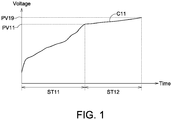
- Fig. 1 shows a measured voltage curve C11 of an aluminum ion battery during a charging operation.
- the charging/discharging reaction of the aluminum ion battery comprises a positive reaction illustrated as the equation (1) and a negative reaction illustrated as the equation (2).
- the constant current charging operation of the aluminum ion battery comprises a stage ST11 and a stage ST12.
- the reactions of the aluminum ion battery comprise an ion intercalation reaction and an ionic liquid reaction, so the charging rate is high; in the stage ST12, the reactions of the aluminum ion battery comprise the ionic liquid reaction only, so the charging rate is low.
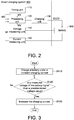
- the smart charging system 100 can improve the charging rate of a battery 900 via a multi-stage charging method.
- the smart charging system 100 comprises a timing unit 110, a processing unit 120, a charging unit 130, a voltage measuring unit 140 and a current measuring unit 150.
- the smart charging system 100 is used for charging the battery 900.
- the battery 900 has a multi-stage reaction.
- the battery 900 is the aluminum ion battery described above.
- the timing unit 110 is used for counting time.
- the processing unit 120 is used for performing various determining procedures, various calculating procedures and various controlling procedures. Each of the timing unit 110 and the processing unit 120 may be circuit, a circuit board, a chip or a storage device storing a plurality of program codes.
- the charging unit 130 is used for charging the battery 900.
- the voltage measuring unit 140 is used for measuring a measured voltage of the battery 900.
- the current measuring unit 150 is used for measuring a measured current of the battery 900.
- Each of the charging unit 130, the voltage measuring unit 140 and the current measuring unit 150 may be a circuit, a circuit board, a chip or a Microelectromechanical Systems (MEMS).
- MEMS Microelectromechanical Systems
- Fig. 3 is a flowchart of a smart charging method according to one embodiment.
- the processing unit 120 controls the charging unit 130 to charge the battery under a constant charging current CI. That is to say, a constant current mode is applied by the processing unit 120.
- the voltage measuring unit 140 measures the measured voltage MV of the battery 900, and the processing unit 120 determines whether the measured voltage MV of the battery 900 is higher than a predetermined voltage value PV11 (shown in Fig. 1 ).
- the predetermined voltage value PV11 is at the transition point between the stage ST11 and the stage ST12. If the measured voltage MV of the battery 900 is higher than the predetermined voltage value PV11, then the charging operation of the battery 900 enters the stage ST12 from the stage ST11.
- the processing unit 120 controls the charging unit 130 to increase the constant charging current CI.
- the constant charging current CI may be added to a predetermined increment.
- the predetermined increment is 0.2 ampere, 0.4 ampere or 0.6 ampere.
- the constant charging current CI may be multiplied by a predetermined magnification.
- the predetermined magnification is 110%, 120% or 130%.
- the processing unit 120 controls the charging unit 130 to charge the battery 900 under the constant current mode.
- the constant charging current CI used in the stage ST12 is increased, the charging rate of the stage ST12 can be improved, and the overall charging time can be reduced.
- Fig. 4 is a flowchart of a smart charging method according to another embodiment.
- the smart charging method of the Fig. 4 further comprises the steps S170, S180, S190, and other similarities with the Fig. 3 will not be repeated here.
- the processing unit 120 determines whether measured voltage MV is higher than a threshold voltage value PV19 (shown in the Fig. 1 ).
- the threshold voltage value PV19 is at the end of the constant current mode.
- step S180 the processing unit 120 controls the charging unit 130 to charge the battery 900 under a constant charging voltage CV. That is to say, a constant voltage mode is applied by the processing unit 120.
- the current measuring unit 150 measures a measured current Ml of the battery 900, and the processing unit 120 determines whether the measured current MI of the battery 900 is lower than a threshold current value (not shown). If the measured current MI is lower than the threshold current value, then the battery 900 is full of electricity and the process is terminated.
- the charging rate can be improved; in the constant voltage mode, the battery 900 can be fully charged.
- Fig. 5 is a flowchart of a smart charging method according to another embodiment.
- the smart charging method of the Fig. 5 further comprises the step S140, and other similarities with the Fig. 4 will not be repeated here.
- the processing unit 120 determines whether a cumulative time MT obtained from the timing unit 110 reaches a predetermined time interval. For example, the predetermined time interval is 10 seconds or 30 seconds. If the cumulative time MT reaches the predetermined time interval, then the process returns to the step S130, for increasing the constant charging current CIagain.
- the constant charging current Cl is increased every predetermined time interval. If the constant charging current CI is increased by being added to the predetermined increment in the step S130, the constant charging current CI may be 4 ampere, 4.2 ampere, 4.4 ampere, 4.6 ampere, and so on. If the constant charging current CI is increased by being multiplied by the predetermined magnification, the constant charging current CI may be 4 ampere, 4.4 ampere, 4.84 ampere, 5.324 ampere, and so on.
- the charging rate in the stage ST12 can be improved by repeatedly performing the step S130.
- the charging operation of another battery may have more than two stages.
- Fig. 6 is another measured voltage curve C12 of another battery during a charging operation.
- the charging operation of this battery has a stage ST21, a stage ST22 and a stage ST23.
- the charging rate in the stage ST22 is lower than the charging rate in the stage ST21
- the charging rate in the stage ST23 is lower than the charging rate in the stage ST22.
- the measured voltage curve of another battery whose charging operation has more than four stages is similar to the measured voltage curve C12 in the Fig. 6 , and the similarities will not be repeated here.
- Fig. 7 is a flowchart of a smart charging method according to another embodiment.
- the smart charging method of the Fig. 7 further comprises the steps S150, S160, and other similarities with the Fig. 4 will not be repeated here.
- the smart charging method of the Fig. 7 is used for the battery in Fig. 6 whose charging operation has three stages ST21, ST22, ST23.
- the processing unit 120 determines whether the measured voltage MV is higher than a predetermined voltage value PV21 (shown in the Fig. 6 ). If the measured voltage MV is higher than the predetermined voltage value PV21, the process proceeds to the step S130 for increasing the constant charging current CI.
- the processing unit 120 determines whether the measured voltage MV is higher than another predetermined voltage value PV22 (shown in the Fig. 6 ). If the measured voltage MV is higher than the predetermined voltage value PV22, the process proceeds to the step S160, for increasing the constant charging current CI again. The charging operation is kept at the constant current mode. After the determination of the step S170 is that the measured voltage MV is higher than a threshold voltage value PV29 (shown in the Fig. 6 ), the charging operation enters to the constant voltage mode.
- the smart charging method may comprise more steps of determining whether the measured voltage is higher than another predetermined voltage value, and the constant charging current CI is increased accordingly.
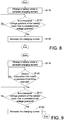
- Fig. 8 is a flowchart of a smart charging method according to another embodiment.
- the difference between the Fig. 3 and the Fig. 8 is in the step S121 of the smart charging method of Fig. 8 , and other similarities will not be repeated here.
- the voltage measuring unit 140 measures the measured voltage MV
- the processing unit 120 calculates a measured voltage gradient MG.
- the measured voltage gradient MG is the change of the measured voltage MV per unit time.
- the processing unit 120 determines whether the measured voltage gradient MG of the battery 900 is lower than a predetermined voltage gradient.
- the predetermined voltage gradient is 0.01 V/min.
- the charging operation of the battery 900 enters the stage ST12 from the stage ST11 and the process proceeds to the step S130 for increasing the constant charging current CI.
- the battery 900 may decay with time, so the transition point between the stage ST11 and the stage ST12 is shifted and the predetermined voltage value PV11 cannot be known in advance.
- the step S121 can be performed without knowing the predetermined voltage value PV11.
- Fig. 9 is a flowchart of a smart charging method according to another embodiment.
- the smart charging method of the Fig. 9 further comprises the step S140, and other similarities with the Fig. 8 will not be repeated here.
- the processing unit 120 determines whether the cumulative time MT provided from the timing unit 110 reaches the predetermined time interval. For example, the predetermined time interval is 10 seconds or 30 seconds. Whether the measured voltage gradient MG is lower than the predetermined voltage gradient is determined in the step S121 every predetermined time interval. If the measured voltage gradient MG is lower than the predetermined voltage gradient, then the constant charging current CI is increased.
- the constant charging current CI may be increasing by being added to the predetermined increment, so the constant charging current CI may be 4 ampere, 4.2 ampere, 4.4 ampere, 4.6 ampere, and so on. Or, the constant charging current CI may be increased by being multiplied by the predetermined magnification, so the constant charging current CI may be 4 ampere, 4.4 ampere, 4.84 ampere, 5.324 ampere, and so on.
- the charging rate of the battery 900 can be improved by repeatedly performing the step S121 and the S130.
- Fig. 10 is a flowchart of a smart charging method according to another embodiment.
- the smart charging method of Fig. 10 further comprises the step S170, the step S180 and the step S190.
- the illustrations of the step S170, the step S180 and the step S190 is similar to that of the Fig. 4 , and the similarities will not be repeated here.
- Fig. 11 is a flowchart of a smart charging method according to another embodiment.
- the difference between the Fig. 8 and the Fig. 11 is in the step S122 of the smart charging method of the Fig. 11 , and other similarities will not be repeated here.
- the processing unit 120 determines whether the measured voltage gradient MG of the battery 900 is reduced. If the measured voltage gradient MG of the battery 900 is reduced, then the process proceeds to the step S130 for increasing the constant charging current CI.
- the constant charging current CI can be increased for improving the charging rate when the measured voltage gradient MG is reduced.
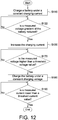
- Fig. 12 is a flowchart of a smart charging method according to another embodiment.
- the smart charging method of the Fig. 12 further comprises the S170, the S180 and the S190.
- the illustrations of the step S170, the step S180 and the step S190 are similar to that of the Fig. 4 , and the similarities will not be repeated here.
- Fig. 13 shows a charging current curve C23 and a measured voltage curve C13 according to the embodiment of Fig. 5 .
- the constant charging current CI is increased every predetermined time interval, so the charging current curve C23 has a ladder-like shape in the stage ST32.
- the measured voltage curve C13 shows that the charging rate in the stage ST32 can be kept without slowing down.
- the charging operation of this embodiment spends 41.23 minutes.
- the charging operation which is applied the constant current mode overall spends 47.35 minutes.
- the charging operation of this embodiment saves 6.12 minutes (increases 12.93%) comparing to the charging operation which is applied the constant current mode overall.
- Fig. 14 shows a charging current curve C24 and a measured voltage curve C14 according to the embodiment of the Fig. 9 .
- the constant charging current CI is increased.
- the measured voltage gradient MG may be reduced again and again.
- the measured voltage gradient MG may be lower than the predetermined voltage gradient at several time points, so the charging current curve C24 has a non-equal length ladder-like shape.
- the measured voltage curve C14 shows that the charging rate can be kept without slowing down.
- the charging operation of this embodiment spends 35.48 minutes.
- the charging operation which is applied the constant current mode overall spends 47.35 minutes.
- the charging operation of this embodiment saves 11.87 minutes (increases 25.07%) comparing to the charging operation which is applied the constant current mode overall.
Landscapes
- Engineering & Computer Science (AREA)
- Power Engineering (AREA)
- Physics & Mathematics (AREA)
- General Physics & Mathematics (AREA)
- Secondary Cells (AREA)
- Charge And Discharge Circuits For Batteries Or The Like (AREA)
Abstract
Description
- The disclosure relates in general to a smart charging method.
- In recent years, governments are actively engaged in the development of new energy and new materials to achieve the purpose of saving carbon. Applications such as consumer electronics, electric vehicles, renewable energy, wireless base stations, UPS, emergency lighting, etc., utilize rechargeable batteries to provide effective and stable primary or partial power sources. Several studies are related to the rechargeable battery.
- In general, the studies related to the rechargeable battery include the charging method and the material. For extending the battery life and maximizing the cycle of charging efficiency, a suitable charging method of the rechargeable battery should be selected according to the material of the rechargeable battery. Besides, if the charging rate of the battery is too slow, then the applications of this battery are limited. Thus, how to improve the charging rate of the battery is also an important issue.
- The disclosure is directed to a smart charging method.
- According to one embodiment, a smart charging method is provided. The smart charging method comprises the following steps: A battery is charged under a constant charging current. Whether a measured voltage of the battery is higher than a predetermined voltage value is determined. The constant charging current is increased if the measured voltage is higher than the predetermined voltage value.
- According to another embodiment, a smart charging method is provided. The smart charging method comprises the following steps: A battery is charged under a constant charging current. Whether a measured voltage gradient of the battery is lower than a predetermined voltage gradient is determined. The constant charging current is increased if the measured voltage gradient is lower than the predetermined voltage gradient.
- According to an alternative embodiment, a smart charging method is provided. The smart charging method comprises the following steps: A battery is charged under a constant charging current. Whether a measured voltage gradient of the battery is reduced is determined. The constant charging current is increased if the measured voltage gradient is reduced.
-
-
Fig. 1 shows a measured voltage curve of an aluminum ion battery during a charging operation. -
Fig. 2 shows a smart charging system according to one embodiment. -
Fig. 3 is a flowchart of a smart charging method according to one embodiment. -
Fig. 4 is a flowchart of a smart charging method according to another embodiment. -
Fig. 5 is a flowchart of a smart charging method according to another embodiment. -
Fig. 6 shows a measured voltage curve of another battery during a charging operation. -
Fig. 7 is a flowchart of a smart charging method according to another embodiment. -
Fig. 8 is a flowchart of a smart charging method according to another embodiment. -
Fig. 9 is a flowchart of a smart charging method according to another embodiment. -
Fig. 10 is flowchart of a smart charging method according to another embodiment. -
Fig. 11 is a flowchart of a smart charging method according to another embodiment. -
Fig. 12 is a flowchart of a smart charging method according to another embodiment. -
Fig. 13 shows a charging current curve and a measured voltage curve according to the embodiment ofFig. 5 . -
Fig. 14 shows a charging current curve and a measured voltage curve according to the embodiment of theFig. 9 . - In the following detailed description, for purposes of explanation, numerous specific details are set forth in order to provide a thorough understanding of the disclosed embodiments. It will be apparent, however, that one or more embodiments may be practiced without these specific details. In other instances, well-known structures and devices are schematically shown in order to simplify the drawing.
- Please refer to
Fig. 1 , which shows a measured voltage curve C11 of an aluminum ion battery during a charging operation. The charging/discharging reaction of the aluminum ion battery comprises a positive reaction illustrated as the equation (1) and a negative reaction illustrated as the equation (2). The constant current charging operation of the aluminum ion battery comprises a stage ST11 and a stage ST12. In the stage ST11, the reactions of the aluminum ion battery comprise an ion intercalation reaction and an ionic liquid reaction, so the charging rate is high; in the stage ST12, the reactions of the aluminum ion battery comprise the ionic liquid reaction only, so the charging rate is low.

- Please refer to
Fig. 2 , which shows asmart charging system 100 according to one embodiment. Thesmart charging system 100 can improve the charging rate of abattery 900 via a multi-stage charging method. Thesmart charging system 100 comprises atiming unit 110, aprocessing unit 120, acharging unit 130, avoltage measuring unit 140 and acurrent measuring unit 150. Thesmart charging system 100 is used for charging thebattery 900. Thebattery 900 has a multi-stage reaction. For example, thebattery 900 is the aluminum ion battery described above. - The
timing unit 110 is used for counting time. Theprocessing unit 120 is used for performing various determining procedures, various calculating procedures and various controlling procedures. Each of thetiming unit 110 and theprocessing unit 120 may be circuit, a circuit board, a chip or a storage device storing a plurality of program codes. Thecharging unit 130 is used for charging thebattery 900. Thevoltage measuring unit 140 is used for measuring a measured voltage of thebattery 900. Thecurrent measuring unit 150 is used for measuring a measured current of thebattery 900. Each of thecharging unit 130, thevoltage measuring unit 140 and thecurrent measuring unit 150 may be a circuit, a circuit board, a chip or a Microelectromechanical Systems (MEMS). - Several embodiments of the smart charging method are illustrated by some flowcharts. Please refer to
Fig. 3 , which is a flowchart of a smart charging method according to one embodiment. In the step S110, theprocessing unit 120 controls thecharging unit 130 to charge the battery under a constant charging current CI. That is to say, a constant current mode is applied by theprocessing unit 120. - Next, in the step S120, the
voltage measuring unit 140 measures the measured voltage MV of thebattery 900, and theprocessing unit 120 determines whether the measured voltage MV of thebattery 900 is higher than a predetermined voltage value PV11 (shown inFig. 1 ). The predetermined voltage value PV11 is at the transition point between the stage ST11 and the stage ST12. If the measured voltage MV of thebattery 900 is higher than the predetermined voltage value PV11, then the charging operation of thebattery 900 enters the stage ST12 from the stage ST11. - If the measured voltage MV is higher than the predetermined voltage value PV11, then the process proceeds to the step S130. In the step S130, the
processing unit 120 controls the chargingunit 130 to increase the constant charging current CI. In one embodiment, the constant charging current CI may be added to a predetermined increment. For example, the predetermined increment is 0.2 ampere, 0.4 ampere or 0.6 ampere. In another embodiment, the constant charging current CI may be multiplied by a predetermined magnification. For example, the predetermined magnification is 110%, 120% or 130%. - Afterwards, the
processing unit 120 controls the chargingunit 130 to charge thebattery 900 under the constant current mode. - Since the constant charging current CI used in the stage ST12 is increased, the charging rate of the stage ST12 can be improved, and the overall charging time can be reduced.
- Please refer to
Fig. 4 , which is a flowchart of a smart charging method according to another embodiment. The smart charging method of theFig. 4 further comprises the steps S170, S180, S190, and other similarities with theFig. 3 will not be repeated here. In the step S170, theprocessing unit 120 determines whether measured voltage MV is higher than a threshold voltage value PV19 (shown in theFig. 1 ). The threshold voltage value PV19 is at the end of the constant current mode. - If the measured voltage MV is higher than the threshold voltage value PV19, then the process proceeds to the step S180. In the step S180, the
processing unit 120 controls the chargingunit 130 to charge thebattery 900 under a constant charging voltage CV. That is to say, a constant voltage mode is applied by theprocessing unit 120. - Then, the
current measuring unit 150 measures a measured current Ml of thebattery 900, and theprocessing unit 120 determines whether the measured current MI of thebattery 900 is lower than a threshold current value (not shown). If the measured current MI is lower than the threshold current value, then thebattery 900 is full of electricity and the process is terminated. - By performing the smart charging method of
Fig. 4 , in the constant current mode, the charging rate can be improved; in the constant voltage mode, thebattery 900 can be fully charged. - Please refer to
Fig. 5 , which is a flowchart of a smart charging method according to another embodiment. The smart charging method of theFig. 5 further comprises the step S140, and other similarities with theFig. 4 will not be repeated here. In the step S140, theprocessing unit 120 determines whether a cumulative time MT obtained from thetiming unit 110 reaches a predetermined time interval. For example, the predetermined time interval is 10 seconds or 30 seconds. If the cumulative time MT reaches the predetermined time interval, then the process returns to the step S130, for increasing the constant charging current CIagain. - In the embodiment of
Fig. 5 , when the charging operation of thebattery 900 enters the stage ST12, the constant charging current Cl is increased every predetermined time interval. If the constant charging current CI is increased by being added to the predetermined increment in the step S130, the constant charging current CI may be 4 ampere, 4.2 ampere, 4.4 ampere, 4.6 ampere, and so on. If the constant charging current CI is increased by being multiplied by the predetermined magnification, the constant charging current CI may be 4 ampere, 4.4 ampere, 4.84 ampere, 5.324 ampere, and so on. - By performing the smart charging method of the
Fig. 5 , even if the charging rate of thebattery 900 in the stage ST12 is reduced with time, the charging rate in the stage ST12 can be improved by repeatedly performing the step S130. - In another embodiment, the charging operation of another battery may have more than two stages. Please refer to
Fig. 6 , which is another measured voltage curve C12 of another battery during a charging operation. The charging operation of this battery has a stage ST21, a stage ST22 and a stage ST23. The charging rate in the stage ST22 is lower than the charging rate in the stage ST21, and the charging rate in the stage ST23 is lower than the charging rate in the stage ST22. The measured voltage curve of another battery whose charging operation has more than four stages is similar to the measured voltage curve C12 in theFig. 6 , and the similarities will not be repeated here. - Please refer to
Fig. 7 , which is a flowchart of a smart charging method according to another embodiment. The smart charging method of theFig. 7 further comprises the steps S150, S160, and other similarities with theFig. 4 will not be repeated here. The smart charging method of theFig. 7 is used for the battery inFig. 6 whose charging operation has three stages ST21, ST22, ST23. - In the step S120, the
processing unit 120 determines whether the measured voltage MV is higher than a predetermined voltage value PV21 (shown in theFig. 6 ). If the measured voltage MV is higher than the predetermined voltage value PV21, the process proceeds to the step S130 for increasing the constant charging current CI. - In the step S150, the
processing unit 120 determines whether the measured voltage MV is higher than another predetermined voltage value PV22 (shown in theFig. 6 ). If the measured voltage MV is higher than the predetermined voltage value PV22, the process proceeds to the step S160, for increasing the constant charging current CI again. The charging operation is kept at the constant current mode. After the determination of the step S170 is that the measured voltage MV is higher than a threshold voltage value PV29 (shown in theFig. 6 ), the charging operation enters to the constant voltage mode. - Similarly, for the battery whose charging operation has more than three stages, the smart charging method may comprise more steps of determining whether the measured voltage is higher than another predetermined voltage value, and the constant charging current CI is increased accordingly.
- Please refer to
Fig. 8 , which is a flowchart of a smart charging method according to another embodiment. The difference between theFig. 3 and theFig. 8 is in the step S121 of the smart charging method ofFig. 8 , and other similarities will not be repeated here. In the step S121, thevoltage measuring unit 140 measures the measured voltage MV, and theprocessing unit 120 calculates a measured voltage gradient MG. The measured voltage gradient MG is the change of the measured voltage MV per unit time. Theprocessing unit 120 determines whether the measured voltage gradient MG of thebattery 900 is lower than a predetermined voltage gradient. For example, the predetermined voltage gradient is 0.01 V/min. - If the measured voltage gradient MG is lower than the predetermined voltage gradient, then the charging operation of the
battery 900 enters the stage ST12 from the stage ST11 and the process proceeds to the step S130 for increasing the constant charging current CI. - In one embodiment, the
battery 900 may decay with time, so the transition point between the stage ST11 and the stage ST12 is shifted and the predetermined voltage value PV11 cannot be known in advance. According to the smart charging method ofFig. 8 , after setting the predetermined voltage gradient, the step S121 can be performed without knowing the predetermined voltage value PV11. - Please refer to
Fig. 9 , which is a flowchart of a smart charging method according to another embodiment. The smart charging method of theFig. 9 further comprises the step S140, and other similarities with theFig. 8 will not be repeated here. In the step S140, theprocessing unit 120 determines whether the cumulative time MT provided from thetiming unit 110 reaches the predetermined time interval. For example, the predetermined time interval is 10 seconds or 30 seconds. Whether the measured voltage gradient MG is lower than the predetermined voltage gradient is determined in the step S121 every predetermined time interval. If the measured voltage gradient MG is lower than the predetermined voltage gradient, then the constant charging current CI is increased. - In the embodiment of
Fig. 9 , the constant charging current CI may be increasing by being added to the predetermined increment, so the constant charging current CI may be 4 ampere, 4.2 ampere, 4.4 ampere, 4.6 ampere, and so on. Or, the constant charging current CI may be increased by being multiplied by the predetermined magnification, so the constant charging current CI may be 4 ampere, 4.4 ampere, 4.84 ampere, 5.324 ampere, and so on. - According to the smart charging method of the
Fig. 9 , even if the charging rate of thebattery 900 is reduced with time, the charging rate can be improved by repeatedly performing the step S121 and the S130. - Please refer to
Fig. 10 , which is a flowchart of a smart charging method according to another embodiment. The smart charging method ofFig. 10 further comprises the step S170, the step S180 and the step S190. The illustrations of the step S170, the step S180 and the step S190 is similar to that of theFig. 4 , and the similarities will not be repeated here. By performing the smart charging method ofFig. 10 , in the constant current mode, the charging rate can be improved; in the constant voltage mode, thebattery 900 can be fully charged. - Please refer to
Fig. 11 , which is a flowchart of a smart charging method according to another embodiment. The difference between theFig. 8 and theFig. 11 is in the step S122 of the smart charging method of theFig. 11 , and other similarities will not be repeated here. In the step S122, after thevoltage measuring unit 140 measures the measured voltage MV and theprocessing unit 120 calculates the measured voltage gradient MG, theprocessing unit 120 determines whether the measured voltage gradient MG of thebattery 900 is reduced. If the measured voltage gradient MG of thebattery 900 is reduced, then the process proceeds to the step S130 for increasing the constant charging current CI. - In the embodiment of the
Fig 11 , it is no needed to set the predetermined voltage gradient. Without setting the predetermined voltage gradient, the constant charging current CI can be increased for improving the charging rate when the measured voltage gradient MG is reduced. - Please refer to
Fig. 12 , which is a flowchart of a smart charging method according to another embodiment. The difference between theFig. 11 and theFig. 12 is in that the smart charging method of theFig. 12 further comprises the S170, the S180 and the S190. The illustrations of the step S170, the step S180 and the step S190 are similar to that of theFig. 4 , and the similarities will not be repeated here. By performing the smart charging method ofFig. 12 , in the constant current mode, the charging rate can be improved; in the constant voltage mode, thebattery 900 can be fully charged. - Please refer to
Fig. 13 , which shows a charging current curve C23 and a measured voltage curve C13 according to the embodiment ofFig. 5 . As shown inFig. 13 , after the charging operation of thebattery 900 enters the stage ST32 from the stage ST31 at the time point T1, the constant charging current CI is increased every predetermined time interval, so the charging current curve C23 has a ladder-like shape in the stage ST32. The measured voltage curve C13 shows that the charging rate in the stage ST32 can be kept without slowing down. The charging operation of this embodiment spends 41.23 minutes. The charging operation which is applied the constant current mode overall spends 47.35 minutes. The charging operation of this embodiment saves 6.12 minutes (increases 12.93%) comparing to the charging operation which is applied the constant current mode overall. - Please refer to
Fig. 14 , which shows a charging current curve C24 and a measured voltage curve C14 according to the embodiment of theFig. 9 . As shown in theFig. 14 , when the measured voltage gradient MG is lower than the predetermined voltage gradient, the constant charging current CI is increased. The measured voltage gradient MG may be reduced again and again. The measured voltage gradient MG may be lower than the predetermined voltage gradient at several time points, so the charging current curve C24 has a non-equal length ladder-like shape. The measured voltage curve C14 shows that the charging rate can be kept without slowing down. The charging operation of this embodiment spends 35.48 minutes. The charging operation which is applied the constant current mode overall spends 47.35 minutes. The charging operation of this embodiment saves 11.87 minutes (increases 25.07%) comparing to the charging operation which is applied the constant current mode overall. - It will be apparent to those skilled in the art that various modifications and variations can be made to the disclosed embodiments. It is intended that the specification and examples be considered as exemplary only, with a true scope of the disclosure being indicated by the following claims and their equivalents.
Claims (15)
- A smart charging method, wherein the smart charging method comprises:charging a battery (900) under a constant charging current (CI);determining whether a measured voltage (MV) of the battery (900) is higher than a predetermined voltage value (PV11, PV21, PV22); andincreasing the constant charging current (CI) if the measured voltage (MV) is higher than the predetermined voltage value (PV11, PV21, PV22).
- The smart charging method according to claim 1,wherein in the step of increasing the constant charging current, the constant charging current is added to a predetermined increment and/orwherein in the step of increasing the constant charging current, the constant charging current is multiplied by a predetermined magnification and/orwherein the step of increasing the constant charging current is performed every predetermined time interval.
- The smart charging method according to claim 1 or 2, further comprising:determining whether the measured voltage is higher than a threshold voltage value; andcharging the battery under a constant charging voltage if the measured voltage is higher than the threshold voltage value.
- The smart charging method according to anyone of the claims 1 to 3, further comprising:determining whether a measured current is lower than a threshold current value; andstopping charging the battery if the measured current is lower than the threshold current value.
- A smart charging method, wherein the smart charging method comprises:charging a battery (900) under a constant charging current (CI);determining whether a measured voltage gradient (MG) of the battery (900) is lower than a predetermined voltage gradient; andincreasing the constant charging current (CI) if the measured voltage gradient (MG) is lower than the predetermined voltage gradient.
- The smart charging method according to claim 5, wherein in the step of increasing the constant charging current, the constant charging current is added to a predetermined increment and/or the constant charging current is multiplied by a predetermined magnification.
- The smart charging method according to claim 5 or 6, wherein the step of determining whether the measured voltage gradient is lower than the predetermined voltage gradient is performed every predetermined time interval.
- The smart charging method according to anyone of the claims 5 to 7, further comprising:determining whether a measured voltage of the battery is higher than a threshold voltage value; andcharging the battery under a constant charging voltage if the measured voltage is higher than the threshold voltage value.
- The smart charging method according to anyone of the claims 5 to 8, further comprising:determining whether a measured current is lower than a threshold current value; andstopping charging the battery if the measured current is lower than the threshold current value.
- A smart charging method, wherein the smart charging method comprises:charging a battery (900) under a constant charging current (CI);determining whether a measured voltage gradient (MG) of the battery (900) is reduced; andincreasing the constant charging current (CI) if the measured voltage gradient (MG) is reduced.
- The smart charging method according to claim 10, wherein in step of increasing the constant charging current, the constant charging current is added to a predetermined increment and/or the constant charging current is multiplied by a predetermined magnification.
- The smart charging method according to claim 10 or 11, wherein the step of determining whether the measured voltage gradient is reduced is performed every predetermined time interval.
- The smart charging method according to anyone of the claims 10 to 12, further comprising:determining whether a measured voltage of the battery is higher than a threshold voltage value; andcharging the battery under a constant charging voltage if the measured voltage is higher than the threshold voltage value.
- The smart charging method according to anyone of the claims 10 to 13, further comprising:determining whether a measured current is lower than a threshold current value; andstopping charging the battery if the measured current is lower than the threshold current value.
- The smart charging method according to anyone of the claims 1 to 14, wherein the battery is an aluminum ion battery.
Applications Claiming Priority (1)
| Application Number | Priority Date | Filing Date | Title |
|---|---|---|---|
| TW105137887A TWI625915B (en) | 2016-11-18 | 2016-11-18 | Smart charging method |
Publications (1)
| Publication Number | Publication Date |
|---|---|
| EP3324510A1 true EP3324510A1 (en) | 2018-05-23 |
Family
ID=58714960
Family Applications (1)
| Application Number | Title | Priority Date | Filing Date |
|---|---|---|---|
| EP17171266.4A Withdrawn EP3324510A1 (en) | 2016-11-18 | 2017-05-16 | Smart charging method |
Country Status (4)
| Country | Link |
|---|---|
| US (1) | US20180145515A1 (en) |
| EP (1) | EP3324510A1 (en) |
| CN (1) | CN108075534A (en) |
| TW (1) | TWI625915B (en) |
Cited By (1)
| Publication number | Priority date | Publication date | Assignee | Title |
|---|---|---|---|---|
| CN108688504A (en) * | 2018-06-26 | 2018-10-23 | 北京新能源汽车股份有限公司 | Battery charging control method and device, automobile and computing equipment |
Citations (4)
| Publication number | Priority date | Publication date | Assignee | Title |
|---|---|---|---|---|
| US20070108945A1 (en) * | 2005-11-17 | 2007-05-17 | Matsushita Electric Works, Ltd. | Charging method, charging circuit, and charging device |
| US20110006731A1 (en) * | 2008-06-12 | 2011-01-13 | Wang Shaolan | Vehicle electronic systems with battery management functions |
| TWM454634U (en) * | 2012-07-23 | 2013-06-01 | Go Tech Energy Co Ltd | Charging device with battery management system |
| US20140084848A1 (en) * | 2012-09-26 | 2014-03-27 | Energy Pass Incorporation | Temperature-Controlled Power Supply System and Method |
Family Cites Families (75)
| Publication number | Priority date | Publication date | Assignee | Title |
|---|---|---|---|---|
| GB1578332A (en) * | 1976-03-09 | 1980-11-05 | Chloride Group Ltd | Automatic electric battery charging apparatus |
| US4163934A (en) * | 1977-07-06 | 1979-08-07 | Francis Lawn | Methods and apparatus for charging batteries |
| US5686815A (en) * | 1991-02-14 | 1997-11-11 | Chartec Laboratories A/S | Method and apparatus for controlling the charging of a rechargeable battery to ensure that full charge is achieved without damaging the battery |
| US5166596A (en) * | 1991-08-29 | 1992-11-24 | Motorola, Inc. | Battery charger having variable-magnitude charging current source |
| US5365160A (en) * | 1991-09-06 | 1994-11-15 | Telxon Corporation | Apparatus and method for charging batteries |
| US20010000212A1 (en) * | 1992-08-14 | 2001-04-12 | John Reipur | Battery system providing indicia of a charging parameter |
| KR960016372B1 (en) * | 1992-11-27 | 1996-12-09 | 삼성전자 주식회사 | Charging device and method for performing battery activation |
| US5367244A (en) * | 1993-01-19 | 1994-11-22 | Premier Engineered Products, Inc. | Battery charging method with stepped current profile and associated charger |
| US5633576A (en) * | 1993-01-19 | 1997-05-27 | Premier Engineered Products, Inc. | Battery charging method with stepped current profile with operating parameter compensation and associated charger |
| US5864220A (en) * | 1993-09-16 | 1999-01-26 | Chartec Laboratories A/S | Method and apparatus for controlling the charging of a rechargeable battery to ensure that full charge is achieved without damaging the battery |
| US5550453A (en) * | 1994-01-24 | 1996-08-27 | Motorola, Inc. | Battery charging method and apparatus |
| KR950025448A (en) * | 1994-02-28 | 1995-09-15 | 김무 | Battery remaining capacity measuring device and measuring method |
| WO1997006591A1 (en) * | 1995-08-10 | 1997-02-20 | Sony Corporation | Charging method, charging device and integrated circuit |
| JP3620118B2 (en) * | 1995-10-24 | 2005-02-16 | 松下電器産業株式会社 | Constant current / constant voltage charger |
| US5729116A (en) * | 1996-12-20 | 1998-03-17 | Total Battery Management, Inc. | Shunt recognition in lithium batteries |
| US6008628A (en) * | 1997-08-20 | 1999-12-28 | Black & Decker Inc. | Method for charging batteries |
| US6242886B1 (en) * | 1999-04-12 | 2001-06-05 | Alliedsignal Inc. | Apparatus and method for automatic recovery of sulfated lead acid batteries |
| US6333619B1 (en) * | 2000-03-15 | 2001-12-25 | Jaime H Chavez | Cyclical battery charger with incremental and decremental current and a method of operation thereof |
| US6586130B1 (en) * | 2000-11-22 | 2003-07-01 | Honeywell International Inc. | Method and apparatus for determining the state of charge of a lithium-ion battery |
| JP4340020B2 (en) * | 2001-04-10 | 2009-10-07 | パナソニック株式会社 | Charge control method for secondary battery for automatic guided vehicle |
| US6791300B2 (en) * | 2002-02-28 | 2004-09-14 | Black & Decker Inc. | Battery charger and charging method |
| KR20040048221A (en) * | 2002-12-02 | 2004-06-07 | 엘지전자 주식회사 | Method for charging the many of battery |
| US20050194933A1 (en) * | 2004-03-02 | 2005-09-08 | Arnold Edward H. | Method of charging a battery |
| US7400911B2 (en) * | 2005-01-31 | 2008-07-15 | Eaton Corporation | Wireless node and method of powering a wireless node employing ambient light to charge an energy store |
| US7642748B2 (en) * | 2005-10-19 | 2010-01-05 | General Electric Company | Battery charging system and method of operating same |
| US7656131B2 (en) * | 2005-10-31 | 2010-02-02 | Black & Decker Inc. | Methods of charging battery packs for cordless power tool systems |
| US7376020B2 (en) * | 2005-12-13 | 2008-05-20 | Microchip Technology Incorporated | Memory using a single-node data, address and control bus |
| US7880445B2 (en) * | 2006-02-16 | 2011-02-01 | Summit Microelectronics, Inc. | System and method of charging a battery using a switching regulator |
| US7528574B1 (en) * | 2006-02-16 | 2009-05-05 | Summit Microelectronics, Inc. | Systems and methods of programming voltage and current in a battery charger |
| US7834591B2 (en) * | 2006-02-16 | 2010-11-16 | Summit Microelectronics, Inc. | Switching battery charging systems and methods |
| US7656127B1 (en) * | 2006-02-27 | 2010-02-02 | Cypress Semiconductor Corporation | Method and apparatus for using an external resistor for charging applications |
| JP5020530B2 (en) * | 2006-04-14 | 2012-09-05 | パナソニック株式会社 | Charging method, battery pack and charger thereof |
| JP2007288982A (en) * | 2006-04-20 | 2007-11-01 | Nec Saitama Ltd | Charging circuit and charging method thereof |
| WO2008078552A1 (en) * | 2006-12-26 | 2008-07-03 | Panasonic Corporation | Non-aqueous electrolyte secondary battery charging method, electronic device, battery pack, and charging device |
| US20080191667A1 (en) * | 2007-02-12 | 2008-08-14 | Fyrestorm, Inc. | Method for charging a battery using a constant current adapted to provide a constant rate of change of open circuit battery voltage |
| JP2008206259A (en) * | 2007-02-19 | 2008-09-04 | Matsushita Electric Ind Co Ltd | Charging system, charging device, and battery pack |
| US9013139B2 (en) * | 2007-03-26 | 2015-04-21 | The Gillette Company | Adaptive charger device and method |
| US8222869B2 (en) * | 2007-07-05 | 2012-07-17 | O2Micro, Inc | System and method for battery charging |
| US8476890B2 (en) * | 2008-02-05 | 2013-07-02 | Qualcomm Incorporated | Circuits and methods for controlling a switching regulator based on a derived input current |
| US20090243553A1 (en) * | 2008-03-25 | 2009-10-01 | John Walley | Method and system for power and charging control in a bluetooth headset |
| WO2009150773A1 (en) * | 2008-06-12 | 2009-12-17 | パナソニック株式会社 | Charging method and discharging method of lithium ion secondary battery |
| JP4855444B2 (en) * | 2008-06-25 | 2012-01-18 | レノボ・シンガポール・プライベート・リミテッド | Charging control system and control method |
| US7888913B1 (en) * | 2009-09-08 | 2011-02-15 | Intermec Ip Corp. | Smart battery charger |
| AP2012006150A0 (en) * | 2009-09-12 | 2012-04-30 | Fenix Internat Inc | Method and apparatus for charging a battery. |
| WO2011065009A1 (en) * | 2009-11-27 | 2011-06-03 | パナソニック株式会社 | Method for charging lithium-ion secondary battery and battery pack |
| CN102473969B (en) * | 2009-12-14 | 2014-07-02 | 松下电器产业株式会社 | Method of charging non-aqueous electrolyte secondary battery, and battery pack |
| JP5537992B2 (en) * | 2010-02-24 | 2014-07-02 | 三洋電機株式会社 | Secondary battery charging method, secondary battery charging control device, and battery pack |
| WO2011112862A1 (en) * | 2010-03-11 | 2011-09-15 | Greensmith Energy Management Systems, Llc | Battery management system for a distributed energy storage system, and applications thereof |
| JP2012009819A (en) * | 2010-05-28 | 2012-01-12 | Sony Corp | Photovoltaic power generation device |
| KR101723998B1 (en) * | 2011-05-06 | 2017-04-06 | 삼성전자주식회사 | Apparatus and method for controlling charging currnet in device using recargable battery |
| TWI423557B (en) * | 2011-05-11 | 2014-01-11 | 廣達電腦股份有限公司 | Electronic product using rechargeable battery and battery state control method thereof |
| JP5879557B2 (en) * | 2011-09-12 | 2016-03-08 | パナソニックIpマネジメント株式会社 | Charger |
| US20140242457A1 (en) * | 2011-09-26 | 2014-08-28 | Cornell University | Aluminum ion battery including metal sulfide or monocrystalline vanadium oxide cathode and ionic liquid based electrolyte |
| US20130181683A1 (en) * | 2012-01-17 | 2013-07-18 | Richtek Technology Corporation, R.O.C. | Battery Charging Circuit and Reference Signal Generator |
| CN103326078A (en) * | 2012-03-23 | 2013-09-25 | 深圳富泰宏精密工业有限公司 | Mobile device charging method and system |
| JP5912758B2 (en) * | 2012-03-29 | 2016-04-27 | 本田技研工業株式会社 | Electric vehicle charging control device |
| US9291682B2 (en) * | 2012-03-30 | 2016-03-22 | Panasonic Intellectual Property Management Co., Ltd. | Degradation state estimating method and degradation state estimating apparatus |
| CN103367823B (en) * | 2012-04-09 | 2017-02-22 | 华为终端有限公司 | Charging method of battery and mobile terminal |
| US9190854B2 (en) * | 2012-06-15 | 2015-11-17 | Broadcom Corporation | Charger external power device gain sampling |
| KR102146707B1 (en) * | 2012-08-09 | 2020-08-21 | 삼성전자주식회사 | Method of controlling load current, load current control device, and mobile device having the same |
| AT513335B1 (en) * | 2012-09-13 | 2017-10-15 | Fronius Int Gmbh | Method and device for charging batteries |
| JP6574382B2 (en) * | 2012-09-26 | 2019-09-11 | プレジデント アンド フェローズ オブ ハーバード カレッジ | Low molecular organic compound based flow battery |
| CN102946131B (en) * | 2012-11-30 | 2014-11-26 | 矽力杰半导体技术(杭州)有限公司 | Adaptive input power charger and method for controlling input current of charger |
| US9263912B2 (en) * | 2013-02-05 | 2016-02-16 | Dell Products, L.P. | Mitigating premature wear out of a rechargeable battery |
| US9270140B2 (en) * | 2013-05-14 | 2016-02-23 | Stored Energy Systems | Dynamic boost battery chargers |
| EP2860842B1 (en) * | 2013-10-11 | 2019-04-24 | Dialog Semiconductor GmbH | Method for charging a battery |
| EP3065258B1 (en) * | 2013-11-01 | 2018-07-18 | Nec Corporation | Charging apparatus, electricity storage system |
| TWI511405B (en) * | 2013-11-18 | 2015-12-01 | 新普科技股份有限公司 | Method for charging a power device of a portable device using a current-adaptive process and power device thereof |
| CN104754855B (en) * | 2013-12-31 | 2018-01-30 | 鹏鼎控股(深圳)股份有限公司 | Flexible PCB and preparation method thereof |
| US9923400B2 (en) * | 2014-06-12 | 2018-03-20 | Stmicroelectronics S.R.L. | Method of operating a battery-charger device, and corresponding device |
| TWI512647B (en) * | 2014-09-10 | 2015-12-11 | Ind Tech Res Inst | Battery charging method |
| US9728995B2 (en) * | 2015-04-08 | 2017-08-08 | Intel Corporation | Systems, methods and devices for adaptable battery charging |
| CN106410303B (en) * | 2015-07-27 | 2019-02-19 | 小米科技有限责任公司 | Charging method and device |
| US9748788B2 (en) * | 2015-09-17 | 2017-08-29 | Qualcomm Incorporated | Systems and methods for charging a battery |
| CN108155689B (en) * | 2017-12-29 | 2021-04-13 | 成都芯源系统有限公司 | Battery charging circuit and control method thereof |
-
2016
- 2016-11-18 TW TW105137887A patent/TWI625915B/en active
-
2017
- 2017-01-16 CN CN201710028006.3A patent/CN108075534A/en active Pending
- 2017-04-03 US US15/477,785 patent/US20180145515A1/en not_active Abandoned
- 2017-05-16 EP EP17171266.4A patent/EP3324510A1/en not_active Withdrawn
Patent Citations (4)
| Publication number | Priority date | Publication date | Assignee | Title |
|---|---|---|---|---|
| US20070108945A1 (en) * | 2005-11-17 | 2007-05-17 | Matsushita Electric Works, Ltd. | Charging method, charging circuit, and charging device |
| US20110006731A1 (en) * | 2008-06-12 | 2011-01-13 | Wang Shaolan | Vehicle electronic systems with battery management functions |
| TWM454634U (en) * | 2012-07-23 | 2013-06-01 | Go Tech Energy Co Ltd | Charging device with battery management system |
| US20140084848A1 (en) * | 2012-09-26 | 2014-03-27 | Energy Pass Incorporation | Temperature-Controlled Power Supply System and Method |
Cited By (1)
| Publication number | Priority date | Publication date | Assignee | Title |
|---|---|---|---|---|
| CN108688504A (en) * | 2018-06-26 | 2018-10-23 | 北京新能源汽车股份有限公司 | Battery charging control method and device, automobile and computing equipment |
Also Published As
| Publication number | Publication date |
|---|---|
| TWI625915B (en) | 2018-06-01 |
| CN108075534A (en) | 2018-05-25 |
| TW201820739A (en) | 2018-06-01 |
| US20180145515A1 (en) | 2018-05-24 |
Similar Documents
| Publication | Publication Date | Title |
|---|---|---|
| EP3410138B1 (en) | Battery system in vehicle and aging deterioration estimation method for battery | |
| EP3352289B1 (en) | Storage battery control device | |
| EP3829024B1 (en) | Apparatus and method for controlling step charging of secondary battery | |
| US11394219B2 (en) | Battery management system and method | |
| US10254346B2 (en) | SOC estimation device for secondary battery | |
| EP4012427A1 (en) | Battery management device and method | |
| US10090686B2 (en) | Electrical storage system | |
| EP2559095B1 (en) | Degradation determination device and degradation determination method for lithium ion secondary battery | |
| EP2921870B1 (en) | Apparatus and method for estimating state of charge of battery | |
| US9108524B2 (en) | Battery SOC estimation with automatic correction | |
| EP3641095A1 (en) | Battery charge management device and method | |
| EP2728368B1 (en) | Condition estimation device and method for battery | |
| CN104051810B (en) | A kind of lithium-ion energy storage battery system SOC estimates rapid correction method | |
| WO2019054020A1 (en) | Battery management device, battery system, and battery management method | |
| EP3018753A1 (en) | Battery control method based on ageing-adaptive operation window | |
| EP3141919B1 (en) | Apparatus and method for estimating open circuit voltage | |
| KR20170023583A (en) | Detection method of Li plating, method and apparatus for charging secondary battery and secondary battery system using the same | |
| WO2015083372A1 (en) | State-of-charge estimating device, state-of-charge determining method, and state-of-charge determining program | |
| US20180261889A1 (en) | Battery state estimating device and power supply device | |
| EP3324510A1 (en) | Smart charging method | |
| KR20160049604A (en) | System for predicting soc of the battery and method for thereof | |
| KR101438937B1 (en) | Method for measuring residual capacity of lithium sulfur battery | |
| CN116368658A (en) | Battery, electrical device, battery charging method and device | |
| CN114114014B (en) | Method for determining the capacity of a lithium-ion cell by using significant points | |
| Czibere et al. | State of health estimation of lead acid batteries in case of safety critical systems |
Legal Events
| Date | Code | Title | Description |
|---|---|---|---|
| PUAI | Public reference made under article 153(3) epc to a published international application that has entered the european phase |
Free format text: ORIGINAL CODE: 0009012 |
|
| STAA | Information on the status of an ep patent application or granted ep patent |
Free format text: STATUS: THE APPLICATION HAS BEEN PUBLISHED |
|
| AK | Designated contracting states |
Kind code of ref document: A1 Designated state(s): AL AT BE BG CH CY CZ DE DK EE ES FI FR GB GR HR HU IE IS IT LI LT LU LV MC MK MT NL NO PL PT RO RS SE SI SK SM TR |
|
| AX | Request for extension of the european patent |
Extension state: BA ME |
|
| STAA | Information on the status of an ep patent application or granted ep patent |
Free format text: STATUS: REQUEST FOR EXAMINATION WAS MADE |
|
| 17P | Request for examination filed |
Effective date: 20181121 |
|
| RBV | Designated contracting states (corrected) |
Designated state(s): AL AT BE BG CH CY CZ DE DK EE ES FI FR GB GR HR HU IE IS IT LI LT LU LV MC MK MT NL NO PL PT RO RS SE SI SK SM TR |
|
| STAA | Information on the status of an ep patent application or granted ep patent |
Free format text: STATUS: EXAMINATION IS IN PROGRESS |
|
| 17Q | First examination report despatched |
Effective date: 20210504 |
|
| STAA | Information on the status of an ep patent application or granted ep patent |
Free format text: STATUS: THE APPLICATION IS DEEMED TO BE WITHDRAWN |
|
| 18D | Application deemed to be withdrawn |
Effective date: 20241203 |