EP3324307A1 - Retrieval device, retrieval method, and computer-readable medium - Google Patents
Retrieval device, retrieval method, and computer-readable medium Download PDFInfo
- Publication number
- EP3324307A1 EP3324307A1 EP17188017.2A EP17188017A EP3324307A1 EP 3324307 A1 EP3324307 A1 EP 3324307A1 EP 17188017 A EP17188017 A EP 17188017A EP 3324307 A1 EP3324307 A1 EP 3324307A1
- Authority
- EP
- European Patent Office
- Prior art keywords
- situation
- retrieval
- images
- trajectory
- time
- Prior art date
- Legal status (The legal status is an assumption and is not a legal conclusion. Google has not performed a legal analysis and makes no representation as to the accuracy of the status listed.)
- Granted
Links
Images




Classifications
-
- G—PHYSICS
- G06—COMPUTING OR CALCULATING; COUNTING
- G06F—ELECTRIC DIGITAL DATA PROCESSING
- G06F16/00—Information retrieval; Database structures therefor; File system structures therefor
- G06F16/70—Information retrieval; Database structures therefor; File system structures therefor of video data
- G06F16/78—Retrieval characterised by using metadata, e.g. metadata not derived from the content or metadata generated manually
- G06F16/783—Retrieval characterised by using metadata, e.g. metadata not derived from the content or metadata generated manually using metadata automatically derived from the content
- G06F16/7837—Retrieval characterised by using metadata, e.g. metadata not derived from the content or metadata generated manually using metadata automatically derived from the content using objects detected or recognised in the video content
- G06F16/784—Retrieval characterised by using metadata, e.g. metadata not derived from the content or metadata generated manually using metadata automatically derived from the content using objects detected or recognised in the video content the detected or recognised objects being people
-
- G—PHYSICS
- G06—COMPUTING OR CALCULATING; COUNTING
- G06T—IMAGE DATA PROCESSING OR GENERATION, IN GENERAL
- G06T7/00—Image analysis
- G06T7/20—Analysis of motion
-
- G—PHYSICS
- G06—COMPUTING OR CALCULATING; COUNTING
- G06F—ELECTRIC DIGITAL DATA PROCESSING
- G06F16/00—Information retrieval; Database structures therefor; File system structures therefor
- G06F16/40—Information retrieval; Database structures therefor; File system structures therefor of multimedia data, e.g. slideshows comprising image and additional audio data
- G06F16/43—Querying
- G06F16/432—Query formulation
- G06F16/434—Query formulation using image data, e.g. images, photos, pictures taken by a user
-
- G—PHYSICS
- G06—COMPUTING OR CALCULATING; COUNTING
- G06F—ELECTRIC DIGITAL DATA PROCESSING
- G06F16/00—Information retrieval; Database structures therefor; File system structures therefor
- G06F16/50—Information retrieval; Database structures therefor; File system structures therefor of still image data
- G06F16/58—Retrieval characterised by using metadata, e.g. metadata not derived from the content or metadata generated manually
- G06F16/5866—Retrieval characterised by using metadata, e.g. metadata not derived from the content or metadata generated manually using information manually generated, e.g. tags, keywords, comments, manually generated location and time information
-
- G—PHYSICS
- G06—COMPUTING OR CALCULATING; COUNTING
- G06F—ELECTRIC DIGITAL DATA PROCESSING
- G06F16/00—Information retrieval; Database structures therefor; File system structures therefor
- G06F16/70—Information retrieval; Database structures therefor; File system structures therefor of video data
- G06F16/78—Retrieval characterised by using metadata, e.g. metadata not derived from the content or metadata generated manually
- G06F16/783—Retrieval characterised by using metadata, e.g. metadata not derived from the content or metadata generated manually using metadata automatically derived from the content
- G06F16/7834—Retrieval characterised by using metadata, e.g. metadata not derived from the content or metadata generated manually using metadata automatically derived from the content using audio features
-
- G—PHYSICS
- G06—COMPUTING OR CALCULATING; COUNTING
- G06F—ELECTRIC DIGITAL DATA PROCESSING
- G06F16/00—Information retrieval; Database structures therefor; File system structures therefor
- G06F16/70—Information retrieval; Database structures therefor; File system structures therefor of video data
- G06F16/78—Retrieval characterised by using metadata, e.g. metadata not derived from the content or metadata generated manually
- G06F16/783—Retrieval characterised by using metadata, e.g. metadata not derived from the content or metadata generated manually using metadata automatically derived from the content
- G06F16/7837—Retrieval characterised by using metadata, e.g. metadata not derived from the content or metadata generated manually using metadata automatically derived from the content using objects detected or recognised in the video content
-
- G—PHYSICS
- G06—COMPUTING OR CALCULATING; COUNTING
- G06F—ELECTRIC DIGITAL DATA PROCESSING
- G06F16/00—Information retrieval; Database structures therefor; File system structures therefor
- G06F16/70—Information retrieval; Database structures therefor; File system structures therefor of video data
- G06F16/78—Retrieval characterised by using metadata, e.g. metadata not derived from the content or metadata generated manually
- G06F16/783—Retrieval characterised by using metadata, e.g. metadata not derived from the content or metadata generated manually using metadata automatically derived from the content
- G06F16/7847—Retrieval characterised by using metadata, e.g. metadata not derived from the content or metadata generated manually using metadata automatically derived from the content using low-level visual features of the video content
- G06F16/786—Retrieval characterised by using metadata, e.g. metadata not derived from the content or metadata generated manually using metadata automatically derived from the content using low-level visual features of the video content using motion, e.g. object motion or camera motion
-
- G—PHYSICS
- G06—COMPUTING OR CALCULATING; COUNTING
- G06V—IMAGE OR VIDEO RECOGNITION OR UNDERSTANDING
- G06V20/00—Scenes; Scene-specific elements
- G06V20/50—Context or environment of the image
- G06V20/52—Surveillance or monitoring of activities, e.g. for recognising suspicious objects
Definitions
- the present disclosure relates to a retrieval device, a retrieval method, and a computer-readable medium.
- a scene in a specific time band is retrieved from monitoring images shot by a monitoring camera in a station, a building, or the like to be used for inspection in safety management or criminal investigation.
- a specific scene is retrieved from a video image of a sport game to be used for analysis in order to strengthen a team.
- tags of "try”, “scrum”, and the like are attached to a video image of a game and a try scene and the like are retrieved on the basis of the tags and a technique in which a scene is intuitively retrieved on the basis of movement trajectories of objects (ball, players, and the like) have been known. Furthermore, a technique in which the objects are detected from a video image of a game to analyze play has been known.
- the conventional techniques cannot however retrieve desired scenes appropriately in some cases. Scenes in accordance with situations cannot be retrieved, for example, only on the basis of the movement trajectories in some cases.
- a retrieval device includes a trajectory acquisition unit, a situation acquisition unit, a query acquisition unit, and a retrieval unit.
- the trajectory acquisition unit acquires trajectory information indicating a movement trajectory of a target in time-series images.
- the situation acquisition unit acquires situation information indicating a peripheral situation of the target in the time-series images.
- the query acquisition unit acquires a retrieval query containing a movement trajectory and a peripheral situation.
- the retrieval unit retrieves an image matching with the retrieval query among images contained in the time-series images based on the trajectory information and the situation information.
- the retrieval device in the arrangement retrieves a desired image (scene) from time-series images using, as a retrieval query, a movement trajectory of a target (object) and a peripheral situation (offense and defense situation, position of a crowded region, or the like) of the target that are contained in the time-series images.
- the time-series images are a plurality of images aligned in time series.
- the time-series images are, for example, a moving image (video image) containing frame images shot with predetermined time intervals.
- a video image provided by shooting a game of a sport, monitoring images shot by a monitoring camera, and the like can be the time-series images.
- the time-series images are not limited thereto.
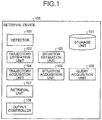
- FIG. 1 is a block diagram illustrating an example of the configuration of a retrieval device 100 in the arrangement.
- the retrieval device 100 includes a detector 101, a trajectory estimation unit 102, a situation estimation unit 103, a trajectory acquisition unit 104, a situation acquisition unit 105, a query acquisition unit 106, a retrieval unit 107, an output controller 108, and a storage unit 121.
- the detector 101 detects object and positions of the object from the time-series images.
- the detector 101 detects the object from the images by, for example, comparing the learned feature of the object and the feature acquired from the images.
- a method for detecting the object from the images is not limited thereto and various detection methods that have been conventionally used can be applied.
- the detector 101 may detect the object and the positions of the object from the images using, for example, a method described in WO No. 2015/190071 .
- the object to be detected is appropriately determined in accordance with applications.
- a person, a gathering of a plurality of persons, a region in which a plurality of persons gather, or the like can be detected as the object.
- a person such as a player of each team and a referee and a region in which a plurality of persons gather, such as a maul in rugby, can be detected as the object.
- the trajectory estimation unit 102 estimates the movement trajectory of the object in the time-series images on the basis of the detected positions.
- the method for estimating the movement trajectory various methods that have been conventionally used can be applied.
- the trajectory estimation unit 102 can estimate the movement trajectory of the object by, for example, a method for estimating the movement trajectory on the basis of the detected time-series positions of the object or a method using optical flow as described in WO No. 2015/190071 .
- the trajectory estimation unit 102 outputs trajectory information indicating the estimated movement trajectory.
- the trajectory information contains, for example, information (object identification information) for identifying the object the movement trajectory of which has been estimated, pieces of information (image identification information) for identifying images from which the object has been detected among the time-series images, pieces of information indicating the positions of the object, and information indicating the position of the movement trajectory.
- the pieces of information for identifying the images are, for example, information for specifying the movement start time and information for specifying the movement end time.
- the data structure of the trajectory information is not limited thereto.
- the situation estimation unit 103 estimates the peripheral situations of the object from the time-series images.
- the situation estimation unit 103 estimates, as the peripheral situation, the presence of another object that is different from the object the movement trajectory of which is estimated, a position of another object, or the like.
- the position of another object, or the like can be estimated by the same method as that by the detector 101.
- the peripheral situation is not limited thereto.
- the situation estimation unit 103 may estimate, as the peripheral situation, a team holding a ball, a type of play (skill) that is executed in the ball game, or the like from the video image provided by shooting the ball game.
- the situation estimation unit 103 may recognize the peripheral situation by recognizing a sound environment corresponding to the time-series images.
- the sound environment is provided by, for example, analyzing sound contained in the video image and sound acquired independently of the video image.
- As the analysis method a method in which the volume thereof is simply detected, a method in which sound types are classified using machine learning, or the like can be applied.
- information related to sound such as noisiness, quietness, cheering, blowing of a whistle, and speech by a specific person, can be estimated as the peripheral situation.
- the peripheral situation may be estimated from text information provided as a result of speech recognition.
- the situation estimation unit 103 stores a relation between sound analysis results and the images in the storage unit 121 or the like.
- the situation estimation unit 103 may estimate information related to a place at which the target is present as the peripheral situation.
- the situation estimation unit 103 may estimate that the peripheral situation of the object is unknown.
- the situation estimation unit 103 may estimate that, for example, the team holding the ball is any one of "team A”, “team B”, and "unknown”.
- a state of the ball contained in an image is classified into a case where the ball is fully visible, a case where the ball is hidden when a person holds the ball, and a case where the ball is hidden in a crowded region.
- the ball can be detected by a well-known object detection method.
- the ball cannot be detected, it is determined that the ball is hidden by a person or in a crowded region. In this case, it is considered that a person or a crowded region in the vicinity of the ball in a previous frame hides the ball, and the person or the crowded region is traced. The state of the ball in an image of each frame can be thus estimated.
- the team holding the ball cannot be determined only from the image in which the ball alone is fully visible during passing, kicking, or the like. The same holds true for the case in which the ball is hidden in the crowded region. In these cases, the ball holding team is set to "unknown".
- the team holding the ball can be identified on the basis of similarities between color information in the vicinity of the detection position of the person and colors of uniforms of the respective teams.
- the ball holding team can be estimated to be "team A” or "team B".
- the state of the ball holding team is unknown in frames in which the players are away from the ball when, for example, a player of team A passes the ball to another player of team A, when the player of team A kicks the ball and the player of team A holds the ball, and so on, and it is therefore determined that the state of the ball holding team is set to "team A" -> "unknown” -> ⁇ "team A”.
- the situation estimation unit 103 may estimate that a peripheral situation of at least one of images before or after the image corresponds to the peripheral situation of the image.
- the situation estimation unit 103 may, for example, replace the ball holding team by "team A” or “team B” in a time band in which the ball holding team is "unknown", in consideration of time-series relations.
- the situation estimation unit 103 may estimate that the team holds the ball also in the time band of "unknown" between the states.
- "unknown” may be replaced by the state before "unknown” or the state after "unknown”.
- the situation estimation unit 103 outputs pieces of situation information indicating the estimated peripheral situations.
- the situation information contains, for example, information (situation identification information) for identifying the estimated peripheral situation and information (image identification information) for identifying an image from which the peripheral situation has been detected among the time-series images.
- the data structure of the situation information is not limited thereto.
- a device other than the retrieval device 100 may estimate the movement trajectory and the peripheral situation.
- the movement trajectory and the peripheral situation may be, for example, analyzed in advance and stored in the storage unit 121, or pieces of information that have been added manually may be used as the information indicating the movement trajectory and the information indicating the peripheral situation.
- the detector 101, the trajectory estimation unit 102, and the situation estimation unit 103 are not required to be included in the retrieval device 100.
- the trajectory acquisition unit 104 acquires the trajectory information output from the trajectory estimation unit 102.
- the trajectory acquisition unit 104 may acquire the trajectory information from another device.
- the situation acquisition unit 105 acquires the situation information output from the situation estimation unit 103.
- the situation acquisition unit 105 may acquire the situation information from another device.
- the query acquisition unit 106 acquires the retrieval query containing the movement trajectory and the peripheral situation.
- the query acquisition unit 106 acquires the retrieval query input through an input device such as a keyboard, a mouse, a touch panel, and a microphone.
- the retrieval query can be input in any format such as a character string, a symbol, and a sound.
- the query acquisition unit 106 may recognize a sound generated by a user as a character string and acquire the recognized character string as the retrieval query.
- the query acquisition unit 106 may input, as the retrieval query, the sound that is retrieved as it is through the microphone.
- a method for acquiring the retrieval query is not limited thereto and any method can be applied.
- the query acquisition unit 106 may acquire a retrieval query transmitted from another device through a network or the like.
- the retrieval unit 107 retrieves an image that matches with the retrieval query among the images contained in the time-series images on the basis of the retrieval query, the trajectory information, and the situation information.
- the retrieval unit 107 retrieves an image having the movement trajectory indicated by the trajectory information that matches with the movement trajectory contained in the retrieval query and the peripheral situation indicated by the situation information that matches with the peripheral situation contained in the retrieval query from the images at the respective time points that are contained in the time-series images.
- the retrieval unit 107 retrieves a matching image by, for example, comparing the sound input as the retrieval query and the sound contained in the video image with each other.
- a match of the movement trajectories may include not only the case in which the movement trajectories completely match with each other but also the case in which the matching degree (similarity) between the movement trajectories is equal to or higher than a threshold and the case in which a part in the movement trajectory matches with the movement trajectory contained in the retrieval query. Whether the movement trajectories match with each other can be determined using the following methods.
- a match of the peripheral situations may include not only the case in which the situations are completely identical to each other but also the case in which a plurality of situations are similar to each other and the case in which one of the situations encompasses the other thereof.
- the retrieval unit 107 may first narrow down the retrieval target images through one of the movement trajectory and the peripheral situation contained in the retrieval query, and then, retrieve a further matching image through the other thereof. For example, the retrieval unit 107 may retrieve an image having the movement trajectory indicated by the corresponding trajectory information that matches with the movement trajectory contained in the retrieval query from images (first images) having the peripheral situations indicated by the pieces of corresponding situation information that match with the peripheral situation contained in the retrieval query among the images contained in the time-series images.
- the output controller 108 controls output of results of various pieces of processing that the retrieval device 100 executes.
- the output controller 108 outputs a retrieval result by the retrieval unit 107 to a display device such as a display.
- the display device may be included in the retrieval device 100 or in a device other than the retrieval device 100.
- An output method is not limited to the method in which the retrieval result is displayed on the display device, and a method in which it is transmitted through a network or the like, a method in which it is output to a recording medium, or another method may be applied.
- the storage unit 121 stores therein the various pieces of information that the retrieval device 100 uses for executing the various pieces of processing.
- the storage unit 121 stores therein, for example, the video image as the retrieval target, the estimated trajectory information and situation information, the trajectory information and situation information transmitted from another device, and the like.
- the storage unit 121 can be configured by various storage media that are commonly used, such as a hard disk drive (HDD), an optical disk, a memory card, and a random access memory (RAM).
- the detector 101, the trajectory estimation unit 102, the situation estimation unit 103, the trajectory acquisition unit 104, the situation acquisition unit 105, the query acquisition unit 106, the retrieval unit 107, and the output controller 108 may be implemented by causing one or more processing devices (processors) such as a central processing unit (CPU) to execute a computer program, that is, by software, by hardware (processor) such as one or more integrated circuits (IC), or by combining software and hardware, for example.
- processors such as a central processing unit (CPU)
- CPU central processing unit
- processor such as one or more integrated circuits (IC)
- IC integrated circuits
- the retrieval device 100 can be configured by, for example, a single device such as a common personal computer.
- the retrieval device 100 may be implemented as a server device that executes retrieval processing in response to a retrieval request from a terminal device such as a personal computer and a mobile terminal.
- the server device may be physically configured by one device or may be implemented by a virtual device on a cloud computing environment.
- FIG. 2 is a flowchart illustrating an example of the retrieval processing in the arrangement.
- the detector 101 detects positions of an object such as a ball and a person from time-series images (step S101).
- the time-series images may be acquired in advance and stored in the storage unit 121 or the like, or may be input in real time by broadcasting, streaming, or the like.
- the trajectory estimation unit 102 estimates a movement trajectory of the object on the basis of the positions detected by the detector 101 (step S102).
- the situation estimation unit 103 estimates peripheral situations of the object from the time-series images (step S103). Trajectory information indicating the estimated movement trajectory and situation information indicating the estimated peripheral situations may be stored in the storage unit 121 or the like.
- step S101 to step S103 may be executed in another device.
- the trajectory acquisition unit 104 acquires the trajectory information and the situation acquisition unit 105 acquires the situation information (step S104).
- the query acquisition unit 106 acquires a retrieval query (step S105). It is sufficient that the retrieval query is acquired before execution of retrieval.
- the query acquisition unit 106 may acquire the retrieval query, for example, before the start of the processing at step S101.
- the retrieval unit 107 executes retrieval with the retrieval query (step S106).
- the output controller 108 outputs a retrieval result by the retrieval unit 107 (step S107).
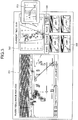
- FIG. 3 is a diagram illustrating an example of a retrieval screen for executing the retrieval processing.
- FIG. 3 illustrates an example in which a video image provided by shooting a rugby game is analyzed and displayed.
- the retrieval processing may be applied to analysis of video images of ball games other than rugby and sports other than ball games.
- the retrieval screen contains a reproduction region 301, an object display region 302, a thumbnail display region 303, and a trajectory button 304.
- the reproduction region 301 is a region in which the video image is reproduced and displayed.
- the object display region 302 is a region in which detected objects are displayed.
- the object display region 302 is used for indicating positions of the objects on a two-dimensional plane (field for the rugby).
- the detector 101 may be configured, for example, so as to detect the positions of the objects on a predetermined plane.
- the object display region 302 may be configured so as to indicate the positions of the objects in a three-dimensional space.
- the output controller 108 for example, synthesizes the objects such as players of respective teams, a ball, and a crowded region, and the position of a movement trajectory of the ball from the past time a predetermined time before the current time with the video image displayed in the reproduction region 301 and displays it in the object display region 302.
- the output controller 108 may change a display mode of the respective objects and the peripheral situations in accordance with types of the objects and the peripheral situations for display.
- the output controller 108 may display the players belonging to the same teams in states of being surrounded by rectangles of the same colors in the reproduction region 301, and may display the players belonging to the same teams with icons of the same colors in the object display region 302.
- the output controller 108 may display the ball in a state of being surrounded by a rectangle of the color corresponding to the ball holding team.
- the thumbnail display region 303 is a region in which thumbnails of partial scenes (images) of the video image are displayed. For example, the thumbnails of the images retrieved by the retrieval processing are displayed in the thumbnail display region 303.
- the output controller 108 may display candidates of scenes (images) matching with the play corresponding to the pressed button in the thumbnail display region 303.
- the trajectory button 304 is used for executing retrieval with the movement trajectory and the like specified as the retrieval query.
- an input screen 305 for inputting the retrieval query is displayed.
- the input screen 305 may be displayed, for example, instead of the object display region 302 or in a superimposed manner on the object display region 302.
- icons and the like indicating the objects displayed in the object display region 302 are not displayed, the retrieval query such as an arrow indicating the movement trajectory and character strings indicating the object and the peripheral situation can be input on the field (two-dimensional plane).
- An image that matches with the retrieval query input as described above may be displayed in the thumbnail display region 303.
- the image may be displayed in the thumbnail display region 303.
- an image corresponding to the selected thumbnail may be displayed in the reproduction region 301.
- FIG. 4 to FIG. 19 are diagrams illustrating an example of the retrieval query input method.
- FIG. 4 illustrates an example in which a retrieval query for retrieving a "scene with movement of a ball along a specified trajectory while team A attacks" is input.
- the object the movement trajectory of which is retrieved is the "ball” and the peripheral situation is a situation of "team A holds the ball”.
- FIG. 5 illustrates an example in which a retrieval query for retrieving a "scene with movement of a player along a specified trajectory while a maul is located at a specified position" is input.
- the object the movement trajectory of which is retrieved is the "person” and the peripheral situation is a situation of the "maul is located at the specified position”.
- FIG. 6 illustrates an example in which the object such as the "ball” and the "person” is selected with the icon and the movement trajectory is specified by handwritten input.
- a situation indicating movement of the player may be capable of being specified with an arrow.
- the team to which the player belongs may be capable of being specified by specifying color for the arrow.
- a plurality of movement trajectories may be input. That is to say, a retrieval query for retrieval with the plurality of movement trajectories may be used.
- Retrieval may be executed with both of a retrieval query indicating a combination of the "ball” as the object and the "person” as the peripheral situation and a retrieval query indicating a combination of the "person” as the object and the "ball” as the peripheral situation.
- FIG. 7 to FIG. 9 illustrate examples of an input method where the "ball holding team” is input as the peripheral situation.
- FIG. 7 to FIG. 9 illustrate examples in which the "ball holding team” is selected with a button ("A" or "B"). Instead of the button, the "ball holding team” may be input by a pen color or handwriting.
- FIG. 7 is an example in which a retrieval query for retrieving a "scene with movement of a ball along a specified trajectory while team A attacks" is input.
- the object the movement trajectory of which is retrieved is the "ball” and the peripheral situation is a situation of "team A holds the ball”.
- FIG. 8 is an example in which a retrieval query for retrieving a "scene with movement of a player of team B along a specified trajectory while team A attacks" is input.
- the object the movement trajectory of which is retrieved is the "player of team B” and the peripheral situation is a situation of "team A holds the ball”.
- FIG. 9 is an example in which a retrieval query for retrieving a "scene with movement of a player line along a specified trajectory while team B attacks" is input.
- the object the movement trajectory of which is retrieved is the "player line” and the peripheral situation is a situation of "team B holds the ball”.
- FIG. 10 to FIG. 12 illustrate examples of an input method where a "play type” is input as the peripheral situation.
- FIG. 10 to FIG. 12 illustrate examples in which the "play type” is selected with a button ("try”, “pass”, “tackle”, and the like). Instead of the button, the "play type” may be input by a pen color or handwriting.
- FIG. 10 illustrates an example in which a retrieval query for retrieving a "try scene with movement of a player of team A along a specified trajectory" is input.
- the object the movement trajectory of which is retrieved is the "player of team A” and the peripheral situation is a situation of "try play”.
- FIG. 11 illustrates an example in which a retrieval query for retrieving a "scene with movement of a ball along a specified trajectory by linkage of passes" is input.
- the object the movement trajectory of which is retrieved is the "ball” and the peripheral situation is a situation of the "pass play”.
- FIG. 12 illustrates an example in which a retrieval query for retrieving a "scene with movement of a player line along a specified trajectory in passing" is input.
- the object the movement trajectory of which is retrieved is the "player line” and the peripheral situation is a situation of the "pass play”.
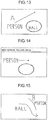
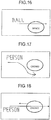
- FIG. 13 to FIG. 16 illustrate examples of an input method where a "position of another object” is input as the peripheral situation.
- FIG. 13 to FIG. 16 illustrate examples in which the "position of another object” is input by a pen color or handwriting. It should be noted that as illustrated in FIG. 16 , a "space" can be input as another object.
- FIG. 13 illustrates an example in which a retrieval query for retrieving a "scene with movement of a player of team A along a specified trajectory when a ball is located at a specified position" is input.
- the object the movement trajectory of which is retrieved is the "player of team A” and the peripheral situation is a situation of the "ball is located at the specified position”.
- FIG. 14 illustrates an example in which a retrieval query for retrieving a "scene with movement of a player along a specified trajectory when a maul is located at a specified position" is input. It is assumed that a circular query in FIG. 14 is drawn with a yellow line. In this case, the object the movement trajectory of which is retrieved is the "player” and the peripheral situation is a situation of the "maul is located at the specified position".
- FIG. 15 illustrates an example in which a retrieval query for retrieving a "scene with movement of a ball along a specified trajectory when a player line of team B is located at a specified position" is input.
- the object the movement trajectory of which is retrieved is the "ball” and the peripheral situation is a situation of the "player line of team B is located at the specified position”.
- FIG. 16 illustrates an example in which a retrieval query for retrieving a "scene with movement of a ball along a specified trajectory when a space is located at a specified position" is input.
- the object the movement trajectory of which is retrieved is the "ball” and the peripheral situation is a situation of the "space is located at the specified position”.
- FIG. 17 to FIG. 19 illustrate examples of the input method when it is applied to analysis of a video image other than a video image of a sport.
- FIG. 17 to FIG. 19 illustrate examples when the flow of a person in the video image is analyzed.
- FIG. 17 illustrates an example in which a retrieval query for retrieving a "scene of avoidance of a person along a specified trajectory when there is a crowd at a specified position" is input.
- the object the movement trajectory of which is retrieved is the "person” and the peripheral situation is a situation of the "crowd is at the specified position.
- FIG. 18 illustrates an example in which a retrieval query for retrieving a "scene of movement of a person in the reverse direction to the flow direction of a crowd" is input.
- the object the movement trajectory of which is retrieved is the "person” and the peripheral situation is a situation of the "crowd is located at the specified position and moves in the specified direction”.
- FIG. 19 illustrates an example in which a retrieval query for retrieving a "scene of oblique crossing of a person in a red light" is input.
- the object the movement trajectory of which is retrieved is the "person” and the peripheral situation is a situation of the "red light".
- the peripheral situation may be specified by a sound situation of, for example, "generation of a signal switching sound”.
- the situation estimation unit 103 estimates the situation of ambient sound of the object from sound contained in the video image, for example.
- FIG. 20 is a diagram for explaining an example of a peripheral situation matching method.
- the retrieval unit 107 may retrieve an image having the matching movement trajectory from images including an image having the matching peripheral situation and at least one of images before or after the image in the range.
- the retrieval unit 107 retrieves an image having the matching movement trajectory from a range 1701 containing the situations of "unknown” before and after the situation 2.
- the retrieval unit 107 retrieves an image having the matching movement trajectory from a range 1702 containing the situations of "unknown” before and after the situation 3.
- a desired image can be retrieved from the time-series images using, as the retrieval query, the movement trajectory of the target and the peripheral situation of the target. With this, the desired image can be retrieved more appropriately.
- FIG. 21 is a descriptive diagram for explaining an example of the hardware configuration of the retrieval device according to the arrangement.
- the retrieval device includes a control device such as a central processing unit (CPU) 51, storage devices such as a read only memory (ROM) 52 and a random access memory (RAM) 53, a communication interface (I/F) 54 connected to a network for communication, and a bus 61 connecting respective units.
- a control device such as a central processing unit (CPU) 51
- storage devices such as a read only memory (ROM) 52 and a random access memory (RAM) 53
- I/F communication interface
- the computer program that is executed by the retrieval device according to the arrangement is embedded and provided in the ROM 52 or the like.
- the computer program that is executed by the retrieval device according to the arrangement may be recorded and provided as a computer program product on a computer-readable recording medium such as a compact disc read only memory (CD-ROM), a flexible disk (FD), a compact disc recordable (CD-R), and a digital versatile disc (DVD), as an installable or executable file.
- a computer-readable recording medium such as a compact disc read only memory (CD-ROM), a flexible disk (FD), a compact disc recordable (CD-R), and a digital versatile disc (DVD), as an installable or executable file.
- the computer program that is executed by the retrieval device according to the arrangement may be stored in a computer connected to a network such as the Internet and provided by being downloaded via the network. Furthermore, the computer program that is executed by the retrieval device according to the arrangement may be provided or distributed via a network such as the Internet.
- the computer program that is executed by the retrieval device according to the arrangement can cause a computer to function as the respective units of the above-mentioned retrieval device.
- the computer can execute the computer program by reading, by the CPU 51, on a main storage device from the computer-readable storage medium.
- a retrieval device includes a trajectory acquisition unit configured to acquire trajectory information indicating a movement trajectory of a target in time-series images; a situation acquisition unit configured to acquire situation information indicating a peripheral situation of the target in the time-series images; a query acquisition unit configured to acquire a retrieval query containing a movement trajectory and a peripheral situation; and a retrieval unit configured to retrieve an image matching with the retrieval query among images contained in the time-series images based on the trajectory information and the situation information.
- Example 2 In the retrieval device according to Example 1, wherein the retrieval unit retrieves an image from first images among the images contained in the time-series images, the trajectory information of the image matching with the movement trajectory contained in the retrieval query, pieces of situation information of the first images matching with the peripheral situation contained in the retrieval query.
- Example 3 In the retrieval device according to Example 2, wherein the situation information includes information indicating that the peripheral situation of the target is unknown, and the retrieval unit retrieves an image among the first images and at least one of images before or after each of the first images, the trajectory information of the image matching with the movement trajectory contained in the retrieval query, the situation information of the at least one of images indicating that the peripheral situation of the target is unknown.
- Example 4 In the retrieval device according to Example 1, further comprising: a detector configured to detect a position of the target from the time-series images; and a trajectory estimation unit configured to estimate the movement trajectory based on the detected position, wherein the trajectory acquisition unit acquires the trajectory information indicating the estimated movement trajectory.
- Example 5 In the retrieval device according to Example 1, further comprising a situation estimation unit configured to estimate the peripheral situation from the time-series images, and the situation acquisition unit acquires the situation information indicating the estimated peripheral situation.
- Example 6 In the retrieval device according to Example 5, wherein when a peripheral situation of a second image contained in the time-series images is unknown, the situation acquisition unit estimates that a peripheral situation of at least one of images before or after the second image is the peripheral situation of the second image.
- Example 7 In the retrieval device according to Example 1, wherein the target includes at least one of a person, a gathering of a plurality of persons, or a region in which a plurality of persons gather.
- Example 8 In the retrieval device according to Example 1, wherein the peripheral situation is a position of another target that is different from the target.
- Example 9 In the retrieval device according to Example 1, wherein the target is a ball that is used in a ball game, and the peripheral situation includes at least one of a team holding the ball or a type of play that is executed in the ball game.
- a retrieval method includes acquiring trajectory information indicating a movement trajectory of a target in time-series images; acquiring situation information indicating a peripheral situation of the target in the time-series images; acquiring a retrieval query containing a movement trajectory and a peripheral situation; and retrieving an image matching with the retrieval query among images contained in the time-series images based on the trajectory information and the situation information.
- Example 11 The retrieval method according to Example 10, wherein the retrieving includes retrieving an image from first images among the images contained in the time-series images, the trajectory information of the image matching with the movement trajectory contained in the retrieval query, pieces of situation information of the first images matching with the peripheral situation contained in the retrieval query.
- Example 12 In the retrieval method according to Example 11, wherein the situation information includes information indicating that the peripheral situation of the target is unknown, and the retrieving includes retrieving an image among the first images and at least one of images before or after each of the first images, the trajectory information of the image matching with the movement trajectory contained in the retrieval query, the situation information of the at least one of images indicating that the peripheral situation of the target is unknown.
- Example 13 In the retrieval method according to Example 10, further includes detecting a position of the target from the time-series images; and estimating the movement trajectory based on the detected position, wherein the trajectory information indicating the estimated movement trajectory is acquired.
- Example 14 In the retrieval method according to Example 10, further includes estimating the peripheral situation from the time-series images, wherein the situation information indicating the estimated peripheral situation is acquired.
- Example 15 In the retrieval method according to Example 14, wherein the estimating includes, when a peripheral situation of a second image contained in the time-series images is unknown, estimating that a peripheral situation of at least one of images before or after the second image is the peripheral situation of the second image.
- Example 16 In the retrieval method according to Example 10, wherein the target includes at least one of a person, a gathering of a plurality of persons, or a region in which a plurality of persons gather.
- Example 17 In the retrieval method according to Example 10, wherein the peripheral situation is a position of another target that is different from the target.
- Example 18 In the retrieval method according to Example 10, wherein the target is a ball that is used in a ball game, and the peripheral situation includes at least one of a team holding the ball or a type of play that is executed in the ball game.
- Example 19 A computer readable medium comprising instructions that cause a computer to execute: acquiring trajectory information indicating a movement trajectory of a target in time-series images; acquiring situation information indicating a peripheral situation of the target in the time-series images; acquiring a retrieval query containing a movement trajectory and a peripheral situation; and retrieving an image matching with the retrieval query among images contained in the time-series images based on the trajectory information and the situation information.
- Example 20 In the computer readable medium according to Example 19, wherein the retrieving includes retrieving an image from first images among the images contained in the time-series images, the trajectory information of the image matching with the movement trajectory contained in the retrieval query, pieces of situation information of the first images matching with the peripheral situation contained in the retrieval query.
Landscapes
- Engineering & Computer Science (AREA)
- Theoretical Computer Science (AREA)
- Multimedia (AREA)
- Library & Information Science (AREA)
- Physics & Mathematics (AREA)
- General Physics & Mathematics (AREA)
- Data Mining & Analysis (AREA)
- Databases & Information Systems (AREA)
- General Engineering & Computer Science (AREA)
- Computer Vision & Pattern Recognition (AREA)
- Mathematical Physics (AREA)
- Information Retrieval, Db Structures And Fs Structures Therefor (AREA)
Abstract
Description
- The present disclosure relates to a retrieval device, a retrieval method, and a computer-readable medium.
- There are needs for retrieval of a scene in a specific time band from a video image. For example, a scene in a specific time band is retrieved from monitoring images shot by a monitoring camera in a station, a building, or the like to be used for inspection in safety management or criminal investigation. As another example, a specific scene is retrieved from a video image of a sport game to be used for analysis in order to strengthen a team.
- For example, a technique in which tags of "try", "scrum", and the like are attached to a video image of a game and a try scene and the like are retrieved on the basis of the tags and a technique in which a scene is intuitively retrieved on the basis of movement trajectories of objects (ball, players, and the like) have been known. Furthermore, a technique in which the objects are detected from a video image of a game to analyze play has been known.
- The conventional techniques cannot however retrieve desired scenes appropriately in some cases. Scenes in accordance with situations cannot be retrieved, for example, only on the basis of the movement trajectories in some cases.
-
-
FIG. 1 is a block diagram of a retrieval device according to an arrangement; -
FIG. 2 is a flowchart of retrieval processing in the arrangement; -
FIG. 3 is a diagram illustrating an example of a retrieval screen for executing the retrieval processing; -
FIG. 4 is a diagram illustrating an example of a retrieval query input method; -
FIG. 5 is a diagram illustrating another example of the retrieval query input method; -
FIG. 6 is a diagram illustrating still another example of the retrieval query input method; -
FIG. 7 is a diagram illustrating still another example of the retrieval query input method; -
FIG. 8 is a diagram illustrating still another example of the retrieval query input method; -
FIG. 9 is a diagram illustrating still another example of the retrieval query input method; -
FIG. 10 is a diagram illustrating still another example of the retrieval query input method; -
FIG. 11 is a diagram illustrating still another example of the retrieval query input method; -
FIG. 12 is a diagram illustrating still another example of the retrieval query input method; -
FIG. 13 is a diagram illustrating still another example of the retrieval query input method; -
FIG. 14 is a diagram illustrating still another example of the retrieval query input method; -
FIG. 15 is a diagram illustrating still another example of the retrieval query input method; -
FIG. 16 is a diagram illustrating still another example of the retrieval query input method; -
FIG. 17 is a diagram illustrating still another example of the retrieval query input method; -
FIG. 18 is a diagram illustrating still another example of the retrieval query input method; -
FIG. 19 is a diagram illustrating still another example of the retrieval query input method; -
FIG. 20 is a diagram for explaining an example of a peripheral situation matching method; and -
FIG. 21 is a diagram illustrating the hardware configuration of the retrieval device. - According to one arrangement, a retrieval device includes a trajectory acquisition unit, a situation acquisition unit, a query acquisition unit, and a retrieval unit. The trajectory acquisition unit acquires trajectory information indicating a movement trajectory of a target in time-series images. The situation acquisition unit acquires situation information indicating a peripheral situation of the target in the time-series images. The query acquisition unit acquires a retrieval query containing a movement trajectory and a peripheral situation. The retrieval unit retrieves an image matching with the retrieval query among images contained in the time-series images based on the trajectory information and the situation information.
- Hereinafter, a preferable arrangement of a retrieval device according to the present invention will be described in detail with reference to the accompanying drawings.
- The retrieval device in the arrangement retrieves a desired image (scene) from time-series images using, as a retrieval query, a movement trajectory of a target (object) and a peripheral situation (offense and defense situation, position of a crowded region, or the like) of the target that are contained in the time-series images.
- The time-series images are a plurality of images aligned in time series. The time-series images are, for example, a moving image (video image) containing frame images shot with predetermined time intervals. As described above, a video image provided by shooting a game of a sport, monitoring images shot by a monitoring camera, and the like can be the time-series images. The time-series images are not limited thereto.
-
FIG. 1 is a block diagram illustrating an example of the configuration of aretrieval device 100 in the arrangement. As illustrated inFIG. 1 , theretrieval device 100 includes a detector 101, atrajectory estimation unit 102, asituation estimation unit 103, atrajectory acquisition unit 104, asituation acquisition unit 105, aquery acquisition unit 106, aretrieval unit 107, anoutput controller 108, and astorage unit 121. - The detector 101 detects object and positions of the object from the time-series images. The detector 101 detects the object from the images by, for example, comparing the learned feature of the object and the feature acquired from the images. A method for detecting the object from the images is not limited thereto and various detection methods that have been conventionally used can be applied. The detector 101 may detect the object and the positions of the object from the images using, for example, a method described in
WO No. 2015/190071 . - It is sufficient that the object to be detected is appropriately determined in accordance with applications. For example, a person, a gathering of a plurality of persons, a region in which a plurality of persons gather, or the like can be detected as the object. From a video image provided by shooting a ball game, a person such as a player of each team and a referee and a region in which a plurality of persons gather, such as a maul in rugby, can be detected as the object.
- The
trajectory estimation unit 102 estimates the movement trajectory of the object in the time-series images on the basis of the detected positions. As the method for estimating the movement trajectory, various methods that have been conventionally used can be applied. Thetrajectory estimation unit 102 can estimate the movement trajectory of the object by, for example, a method for estimating the movement trajectory on the basis of the detected time-series positions of the object or a method using optical flow as described inWO No. 2015/190071 . - The
trajectory estimation unit 102 outputs trajectory information indicating the estimated movement trajectory. The trajectory information contains, for example, information (object identification information) for identifying the object the movement trajectory of which has been estimated, pieces of information (image identification information) for identifying images from which the object has been detected among the time-series images, pieces of information indicating the positions of the object, and information indicating the position of the movement trajectory. The pieces of information for identifying the images are, for example, information for specifying the movement start time and information for specifying the movement end time. The data structure of the trajectory information is not limited thereto. - The
situation estimation unit 103 estimates the peripheral situations of the object from the time-series images. Thesituation estimation unit 103 estimates, as the peripheral situation, the presence of another object that is different from the object the movement trajectory of which is estimated, a position of another object, or the like. The position of another object, or the like, can be estimated by the same method as that by the detector 101. The peripheral situation is not limited thereto. Thesituation estimation unit 103 may estimate, as the peripheral situation, a team holding a ball, a type of play (skill) that is executed in the ball game, or the like from the video image provided by shooting the ball game. - The
situation estimation unit 103 may recognize the peripheral situation by recognizing a sound environment corresponding to the time-series images. The sound environment is provided by, for example, analyzing sound contained in the video image and sound acquired independently of the video image. As the analysis method, a method in which the volume thereof is simply detected, a method in which sound types are classified using machine learning, or the like can be applied. For example, information related to sound, such as noisiness, quietness, cheering, blowing of a whistle, and speech by a specific person, can be estimated as the peripheral situation. Alternatively, the peripheral situation may be estimated from text information provided as a result of speech recognition. Thesituation estimation unit 103 stores a relation between sound analysis results and the images in thestorage unit 121 or the like. - The
situation estimation unit 103 may estimate information related to a place at which the target is present as the peripheral situation. - It should be noted that when the ball is hidden in a region in which the players crowd and so on, the position of the ball cannot be detected and the team holding the ball cannot be estimated in some cases. In such a case, the
situation estimation unit 103 may estimate that the peripheral situation of the object is unknown. Thesituation estimation unit 103 may estimate that, for example, the team holding the ball is any one of "team A", "team B", and "unknown". - It is assumed that a state of the ball contained in an image is classified into a case where the ball is fully visible, a case where the ball is hidden when a person holds the ball, and a case where the ball is hidden in a crowded region. When the ball is fully visible, the ball can be detected by a well-known object detection method. When the ball cannot be detected, it is determined that the ball is hidden by a person or in a crowded region. In this case, it is considered that a person or a crowded region in the vicinity of the ball in a previous frame hides the ball, and the person or the crowded region is traced. The state of the ball in an image of each frame can be thus estimated.
- In consideration of these premises, a method for estimating the ball holding team is described. The team holding the ball cannot be determined only from the image in which the ball alone is fully visible during passing, kicking, or the like. The same holds true for the case in which the ball is hidden in the crowded region. In these cases, the ball holding team is set to "unknown".
- On the other hand, when a person holds the ball, the team holding the ball can be identified on the basis of similarities between color information in the vicinity of the detection position of the person and colors of uniforms of the respective teams. In this case, the ball holding team can be estimated to be "team A" or "team B".
- The state of the ball holding team is unknown in frames in which the players are away from the ball when, for example, a player of team A passes the ball to another player of team A, when the player of team A kicks the ball and the player of team A holds the ball, and so on, and it is therefore determined that the state of the ball holding team is set to "team A" -> "unknown" ->→ "team A".
- When the peripheral situation of a certain image is unknown, the
situation estimation unit 103 may estimate that a peripheral situation of at least one of images before or after the image corresponds to the peripheral situation of the image. Thesituation estimation unit 103 may, for example, replace the ball holding team by "team A" or "team B" in a time band in which the ball holding team is "unknown", in consideration of time-series relations. When, for example, the states before and after "unknown" are the same team, thesituation estimation unit 103 may estimate that the team holds the ball also in the time band of "unknown" between the states. Alternatively, "unknown" may be replaced by the state before "unknown" or the state after "unknown". - The
situation estimation unit 103 outputs pieces of situation information indicating the estimated peripheral situations. The situation information contains, for example, information (situation identification information) for identifying the estimated peripheral situation and information (image identification information) for identifying an image from which the peripheral situation has been detected among the time-series images. The data structure of the situation information is not limited thereto. - It should be noted that a device other than the
retrieval device 100 may estimate the movement trajectory and the peripheral situation. The movement trajectory and the peripheral situation may be, for example, analyzed in advance and stored in thestorage unit 121, or pieces of information that have been added manually may be used as the information indicating the movement trajectory and the information indicating the peripheral situation. In this case, the detector 101, thetrajectory estimation unit 102, and thesituation estimation unit 103 are not required to be included in theretrieval device 100. - The
trajectory acquisition unit 104 acquires the trajectory information output from thetrajectory estimation unit 102. Thetrajectory acquisition unit 104 may acquire the trajectory information from another device. - The
situation acquisition unit 105 acquires the situation information output from thesituation estimation unit 103. Thesituation acquisition unit 105 may acquire the situation information from another device. - The
query acquisition unit 106 acquires the retrieval query containing the movement trajectory and the peripheral situation. Thequery acquisition unit 106 acquires the retrieval query input through an input device such as a keyboard, a mouse, a touch panel, and a microphone. Thus, the retrieval query can be input in any format such as a character string, a symbol, and a sound. When the retrieval query is input with the sound, thequery acquisition unit 106 may recognize a sound generated by a user as a character string and acquire the recognized character string as the retrieval query. When, for example, a mode of "retrieval of ambient sound" is specified, thequery acquisition unit 106 may input, as the retrieval query, the sound that is retrieved as it is through the microphone. A method for acquiring the retrieval query is not limited thereto and any method can be applied. Thequery acquisition unit 106 may acquire a retrieval query transmitted from another device through a network or the like. - The
retrieval unit 107 retrieves an image that matches with the retrieval query among the images contained in the time-series images on the basis of the retrieval query, the trajectory information, and the situation information. Theretrieval unit 107 retrieves an image having the movement trajectory indicated by the trajectory information that matches with the movement trajectory contained in the retrieval query and the peripheral situation indicated by the situation information that matches with the peripheral situation contained in the retrieval query from the images at the respective time points that are contained in the time-series images. When the sound is used as the retrieval query, theretrieval unit 107 retrieves a matching image by, for example, comparing the sound input as the retrieval query and the sound contained in the video image with each other. - A match of the movement trajectories may include not only the case in which the movement trajectories completely match with each other but also the case in which the matching degree (similarity) between the movement trajectories is equal to or higher than a threshold and the case in which a part in the movement trajectory matches with the movement trajectory contained in the retrieval query. Whether the movement trajectories match with each other can be determined using the following methods.
- (1) Sampling points (two or more points including a start point and an end point) are set at a predetermined interval on the movement trajectory and a histogram is created on the basis of sub movement trajectory directions (for example, approximate to any of up, down, left, and right directions) between the adjacent sampling points. For example, values of "up", "down", "left", and "right" in the histogram may be calculated by totalizing distances of the sub movement trajectories determined to be in the respective directions. The movement trajectories may be determined to match with each other when a Bhattacharyya distance between the histograms thereof is equal to or lower than a predetermined threshold.
- (2) A drawing area (that may be identical to a court region) set in advance is divided into a plurality of blocks (for example, two blocks in the longitudinal direction x four blocks in the transverse direction), and the movement trajectory passing through blocks the order of which is identical to the order of blocks through which the movement trajectory contained in the retrieval query passes may be extracted.
- (3) The histograms that are the same as that in the above-mentioned (1) are created for the respective blocks through which the movement trajectories pass in the above-mentioned (2). Then, the movement trajectories passing through the same blocks and having the distance between the histograms for the blocks that is equal to or less than the predetermined threshold may be determined to match with each other.
- A match of the peripheral situations may include not only the case in which the situations are completely identical to each other but also the case in which a plurality of situations are similar to each other and the case in which one of the situations encompasses the other thereof.
- The
retrieval unit 107 may first narrow down the retrieval target images through one of the movement trajectory and the peripheral situation contained in the retrieval query, and then, retrieve a further matching image through the other thereof. For example, theretrieval unit 107 may retrieve an image having the movement trajectory indicated by the corresponding trajectory information that matches with the movement trajectory contained in the retrieval query from images (first images) having the peripheral situations indicated by the pieces of corresponding situation information that match with the peripheral situation contained in the retrieval query among the images contained in the time-series images. - The
output controller 108 controls output of results of various pieces of processing that theretrieval device 100 executes. For example, theoutput controller 108 outputs a retrieval result by theretrieval unit 107 to a display device such as a display. The display device may be included in theretrieval device 100 or in a device other than theretrieval device 100. An output method is not limited to the method in which the retrieval result is displayed on the display device, and a method in which it is transmitted through a network or the like, a method in which it is output to a recording medium, or another method may be applied. - The
storage unit 121 stores therein the various pieces of information that theretrieval device 100 uses for executing the various pieces of processing. Thestorage unit 121 stores therein, for example, the video image as the retrieval target, the estimated trajectory information and situation information, the trajectory information and situation information transmitted from another device, and the like. Thestorage unit 121 can be configured by various storage media that are commonly used, such as a hard disk drive (HDD), an optical disk, a memory card, and a random access memory (RAM). - The detector 101, the
trajectory estimation unit 102, thesituation estimation unit 103, thetrajectory acquisition unit 104, thesituation acquisition unit 105, thequery acquisition unit 106, theretrieval unit 107, and theoutput controller 108 may be implemented by causing one or more processing devices (processors) such as a central processing unit (CPU) to execute a computer program, that is, by software, by hardware (processor) such as one or more integrated circuits (IC), or by combining software and hardware, for example. - The
retrieval device 100 can be configured by, for example, a single device such as a common personal computer. Theretrieval device 100 may be implemented as a server device that executes retrieval processing in response to a retrieval request from a terminal device such as a personal computer and a mobile terminal. The server device may be physically configured by one device or may be implemented by a virtual device on a cloud computing environment. - Next, the retrieval processing by the
retrieval device 100 in the arrangement that is configured as described above will be described with reference toFIG. 2. FIG. 2 is a flowchart illustrating an example of the retrieval processing in the arrangement. - The detector 101 detects positions of an object such as a ball and a person from time-series images (step S101). The time-series images may be acquired in advance and stored in the
storage unit 121 or the like, or may be input in real time by broadcasting, streaming, or the like. - The
trajectory estimation unit 102 estimates a movement trajectory of the object on the basis of the positions detected by the detector 101 (step S102). Thesituation estimation unit 103 estimates peripheral situations of the object from the time-series images (step S103). Trajectory information indicating the estimated movement trajectory and situation information indicating the estimated peripheral situations may be stored in thestorage unit 121 or the like. - When a device other than the
retrieval device 100 estimates the movement trajectory and the like, the pieces of processing from step S101 to step S103 may be executed in another device. - Then, the
trajectory acquisition unit 104 acquires the trajectory information and thesituation acquisition unit 105 acquires the situation information (step S104). Thequery acquisition unit 106 acquires a retrieval query (step S105). It is sufficient that the retrieval query is acquired before execution of retrieval. Thequery acquisition unit 106 may acquire the retrieval query, for example, before the start of the processing at step S101. - The
retrieval unit 107 executes retrieval with the retrieval query (step S106). Theoutput controller 108 outputs a retrieval result by the retrieval unit 107 (step S107). - Next, a specific example of the retrieval processing by the
retrieval device 100 is described.FIG. 3 is a diagram illustrating an example of a retrieval screen for executing the retrieval processing.FIG. 3 illustrates an example in which a video image provided by shooting a rugby game is analyzed and displayed. The retrieval processing may be applied to analysis of video images of ball games other than rugby and sports other than ball games. - As illustrated in
FIG. 3 , the retrieval screen contains areproduction region 301, anobject display region 302, athumbnail display region 303, and atrajectory button 304. - The
reproduction region 301 is a region in which the video image is reproduced and displayed. Theobject display region 302 is a region in which detected objects are displayed. In the example ofFIG. 3 , theobject display region 302 is used for indicating positions of the objects on a two-dimensional plane (field for the rugby). In this case, the detector 101 may be configured, for example, so as to detect the positions of the objects on a predetermined plane. Theobject display region 302 may be configured so as to indicate the positions of the objects in a three-dimensional space. - The
output controller 108, for example, synthesizes the objects such as players of respective teams, a ball, and a crowded region, and the position of a movement trajectory of the ball from the past time a predetermined time before the current time with the video image displayed in thereproduction region 301 and displays it in theobject display region 302. - The
output controller 108 may change a display mode of the respective objects and the peripheral situations in accordance with types of the objects and the peripheral situations for display. Theoutput controller 108, for example, may display the players belonging to the same teams in states of being surrounded by rectangles of the same colors in thereproduction region 301, and may display the players belonging to the same teams with icons of the same colors in theobject display region 302. When the ball is fully visible, theoutput controller 108 may display the ball in a state of being surrounded by a rectangle of the color corresponding to the ball holding team. - The
thumbnail display region 303 is a region in which thumbnails of partial scenes (images) of the video image are displayed. For example, the thumbnails of the images retrieved by the retrieval processing are displayed in thethumbnail display region 303. When, for example, a button corresponding to a play type such as "pass", "scrum", and "ruck" is pressed, theoutput controller 108 may display candidates of scenes (images) matching with the play corresponding to the pressed button in thethumbnail display region 303. - The
trajectory button 304 is used for executing retrieval with the movement trajectory and the like specified as the retrieval query. When thetrajectory button 304 is pressed, for example, aninput screen 305 for inputting the retrieval query is displayed. Theinput screen 305 may be displayed, for example, instead of theobject display region 302 or in a superimposed manner on theobject display region 302. On theinput screen 305, icons and the like indicating the objects displayed in theobject display region 302 are not displayed, the retrieval query such as an arrow indicating the movement trajectory and character strings indicating the object and the peripheral situation can be input on the field (two-dimensional plane). - An image that matches with the retrieval query input as described above may be displayed in the
thumbnail display region 303. In the case in which the video image is input in real time, when the image that matches with the retrieval query input in advance is input, the image may be displayed in thethumbnail display region 303. When a thumbnail is selected in thethumbnail display region 303, an image corresponding to the selected thumbnail may be displayed in thereproduction region 301. - Next, specific examples of a retrieval query input method are described.
FIG. 4 to FIG. 19 are diagrams illustrating an example of the retrieval query input method. -
FIG. 4 illustrates an example in which a retrieval query for retrieving a "scene with movement of a ball along a specified trajectory while team A attacks" is input. In this case, the object the movement trajectory of which is retrieved is the "ball" and the peripheral situation is a situation of "team A holds the ball". -
FIG. 5 illustrates an example in which a retrieval query for retrieving a "scene with movement of a player along a specified trajectory while a maul is located at a specified position" is input. In this case, the object the movement trajectory of which is retrieved is the "person" and the peripheral situation is a situation of the "maul is located at the specified position". - As a method for specifying the object and the peripheral situation, any method such as handwritten input, pen colors, icons, and buttons can be applied.
FIG. 6 illustrates an example in which the object such as the "ball" and the "person" is selected with the icon and the movement trajectory is specified by handwritten input. As illustrated in a lower portion inFIG. 6 , a situation indicating movement of the player (person) may be capable of being specified with an arrow. The team to which the player belongs may be capable of being specified by specifying color for the arrow. A plurality of movement trajectories may be input. That is to say, a retrieval query for retrieval with the plurality of movement trajectories may be used. - When both of the object and the peripheral situation are input by the same method, whether each input is input for specifying the object or input for specifying the peripheral situation may be determined. In the example of
FIG. 4 , the "ball" input to a position close to the movement trajectory may be determined to be the object and "A" input to a position that is farther from the movement trajectory relative to the "ball" may be determined to be the peripheral situation. - Retrieval may be executed with both of a retrieval query indicating a combination of the "ball" as the object and the "person" as the peripheral situation and a retrieval query indicating a combination of the "person" as the object and the "ball" as the peripheral situation.
-
FIG. 7 to FIG. 9 illustrate examples of an input method where the "ball holding team" is input as the peripheral situation.FIG. 7 to FIG. 9 illustrate examples in which the "ball holding team" is selected with a button ("A" or "B"). Instead of the button, the "ball holding team" may be input by a pen color or handwriting. -
FIG. 7 is an example in which a retrieval query for retrieving a "scene with movement of a ball along a specified trajectory while team A attacks" is input. In this case, the object the movement trajectory of which is retrieved is the "ball" and the peripheral situation is a situation of "team A holds the ball". -
FIG. 8 is an example in which a retrieval query for retrieving a "scene with movement of a player of team B along a specified trajectory while team A attacks" is input. In this case, the object the movement trajectory of which is retrieved is the "player of team B" and the peripheral situation is a situation of "team A holds the ball". -
FIG. 9 is an example in which a retrieval query for retrieving a "scene with movement of a player line along a specified trajectory while team B attacks" is input. In this case, the object the movement trajectory of which is retrieved is the "player line" and the peripheral situation is a situation of "team B holds the ball". -
FIG. 10 to FIG. 12 illustrate examples of an input method where a "play type" is input as the peripheral situation.FIG. 10 to FIG. 12 illustrate examples in which the "play type" is selected with a button ("try", "pass", "tackle", and the like). Instead of the button, the "play type" may be input by a pen color or handwriting. -
FIG. 10 illustrates an example in which a retrieval query for retrieving a "try scene with movement of a player of team A along a specified trajectory" is input. In this case, the object the movement trajectory of which is retrieved is the "player of team A" and the peripheral situation is a situation of "try play". -
FIG. 11 illustrates an example in which a retrieval query for retrieving a "scene with movement of a ball along a specified trajectory by linkage of passes" is input. In this case, the object the movement trajectory of which is retrieved is the "ball" and the peripheral situation is a situation of the "pass play". -
FIG. 12 illustrates an example in which a retrieval query for retrieving a "scene with movement of a player line along a specified trajectory in passing" is input. In this case, the object the movement trajectory of which is retrieved is the "player line" and the peripheral situation is a situation of the "pass play". -
FIG. 13 to FIG. 16 illustrate examples of an input method where a "position of another object" is input as the peripheral situation.FIG. 13 to FIG. 16 illustrate examples in which the "position of another object" is input by a pen color or handwriting. It should be noted that as illustrated inFIG. 16 , a "space" can be input as another object. -
FIG. 13 illustrates an example in which a retrieval query for retrieving a "scene with movement of a player of team A along a specified trajectory when a ball is located at a specified position" is input. In this case, the object the movement trajectory of which is retrieved is the "player of team A" and the peripheral situation is a situation of the "ball is located at the specified position". -
FIG. 14 illustrates an example in which a retrieval query for retrieving a "scene with movement of a player along a specified trajectory when a maul is located at a specified position" is input. It is assumed that a circular query inFIG. 14 is drawn with a yellow line. In this case, the object the movement trajectory of which is retrieved is the "player" and the peripheral situation is a situation of the "maul is located at the specified position". -
FIG. 15 illustrates an example in which a retrieval query for retrieving a "scene with movement of a ball along a specified trajectory when a player line of team B is located at a specified position" is input. In this case, the object the movement trajectory of which is retrieved is the "ball" and the peripheral situation is a situation of the "player line of team B is located at the specified position". -
FIG. 16 illustrates an example in which a retrieval query for retrieving a "scene with movement of a ball along a specified trajectory when a space is located at a specified position" is input. In this case, the object the movement trajectory of which is retrieved is the "ball" and the peripheral situation is a situation of the "space is located at the specified position". -
FIG. 17 to FIG. 19 illustrate examples of the input method when it is applied to analysis of a video image other than a video image of a sport.FIG. 17 to FIG. 19 illustrate examples when the flow of a person in the video image is analyzed. -
FIG. 17 illustrates an example in which a retrieval query for retrieving a "scene of avoidance of a person along a specified trajectory when there is a crowd at a specified position" is input. In this case, the object the movement trajectory of which is retrieved is the "person" and the peripheral situation is a situation of the "crowd is at the specified position". -
FIG. 18 illustrates an example in which a retrieval query for retrieving a "scene of movement of a person in the reverse direction to the flow direction of a crowd" is input. In this case, the object the movement trajectory of which is retrieved is the "person" and the peripheral situation is a situation of the "crowd is located at the specified position and moves in the specified direction". -
FIG. 19 illustrates an example in which a retrieval query for retrieving a "scene of oblique crossing of a person in a red light" is input. In this case, the object the movement trajectory of which is retrieved is the "person" and the peripheral situation is a situation of the "red light". The peripheral situation may be specified by a sound situation of, for example, "generation of a signal switching sound". In this case, it is sufficient that thesituation estimation unit 103 estimates the situation of ambient sound of the object from sound contained in the video image, for example. -
FIG. 20 is a diagram for explaining an example of a peripheral situation matching method. As mentioned above, it is estimated that the peripheral situation of the object is unknown in some cases. In this case, theretrieval unit 107 may retrieve an image having the matching movement trajectory from images including an image having the matching peripheral situation and at least one of images before or after the image in the range. - When, for example, the retrieval query contains a "
situation 2" as the peripheral situation, theretrieval unit 107 retrieves an image having the matching movement trajectory from arange 1701 containing the situations of "unknown" before and after thesituation 2. When, for example, the retrieval query contains a "situation 3" as the peripheral situation, theretrieval unit 107 retrieves an image having the matching movement trajectory from arange 1702 containing the situations of "unknown" before and after thesituation 3. - As described above, according to the arrangement, a desired image can be retrieved from the time-series images using, as the retrieval query, the movement trajectory of the target and the peripheral situation of the target. With this, the desired image can be retrieved more appropriately.
- Next, the hardware configuration of the retrieval device according to the arrangement will be described with reference to
FIG. 21. FIG. 21 is a descriptive diagram for explaining an example of the hardware configuration of the retrieval device according to the arrangement. - The retrieval device according to the arrangement includes a control device such as a central processing unit (CPU) 51, storage devices such as a read only memory (ROM) 52 and a random access memory (RAM) 53, a communication interface (I/F) 54 connected to a network for communication, and a bus 61 connecting respective units.
- The computer program that is executed by the retrieval device according to the arrangement is embedded and provided in the ROM 52 or the like.
- The computer program that is executed by the retrieval device according to the arrangement may be recorded and provided as a computer program product on a computer-readable recording medium such as a compact disc read only memory (CD-ROM), a flexible disk (FD), a compact disc recordable (CD-R), and a digital versatile disc (DVD), as an installable or executable file.
- The computer program that is executed by the retrieval device according to the arrangement may be stored in a computer connected to a network such as the Internet and provided by being downloaded via the network. Furthermore, the computer program that is executed by the retrieval device according to the arrangement may be provided or distributed via a network such as the Internet.
- The computer program that is executed by the retrieval device according to the arrangement can cause a computer to function as the respective units of the above-mentioned retrieval device. The computer can execute the computer program by reading, by the CPU 51, on a main storage device from the computer-readable storage medium.
- While certain arrangements have been described, these arrangements have been presented by way of example only, and are not intended to limit the scope of the claims. Indeed, the devices described herein may be embodied in a variety of other forms; furthermore, various omissions, substitutions and changes in the form of the devices described herein may be made.
- Example 1. A retrieval device includes a trajectory acquisition unit configured to acquire trajectory information indicating a movement trajectory of a target in time-series images; a situation acquisition unit configured to acquire situation information indicating a peripheral situation of the target in the time-series images; a query acquisition unit configured to acquire a retrieval query containing a movement trajectory and a peripheral situation; and a retrieval unit configured to retrieve an image matching with the retrieval query among images contained in the time-series images based on the trajectory information and the situation information.
- Example 2. In the retrieval device according to Example 1, wherein the retrieval unit retrieves an image from first images among the images contained in the time-series images, the trajectory information of the image matching with the movement trajectory contained in the retrieval query, pieces of situation information of the first images matching with the peripheral situation contained in the retrieval query.
- Example 3. In the retrieval device according to Example 2, wherein the situation information includes information indicating that the peripheral situation of the target is unknown, and the retrieval unit retrieves an image among the first images and at least one of images before or after each of the first images, the trajectory information of the image matching with the movement trajectory contained in the retrieval query, the situation information of the at least one of images indicating that the peripheral situation of the target is unknown.
- Example 4. In the retrieval device according to Example 1, further comprising: a detector configured to detect a position of the target from the time-series images; and a trajectory estimation unit configured to estimate the movement trajectory based on the detected position, wherein the trajectory acquisition unit acquires the trajectory information indicating the estimated movement trajectory.
- Example 5. In the retrieval device according to Example 1, further comprising a situation estimation unit configured to estimate the peripheral situation from the time-series images, and the situation acquisition unit acquires the situation information indicating the estimated peripheral situation.
- Example 6. In the retrieval device according to Example 5, wherein when a peripheral situation of a second image contained in the time-series images is unknown, the situation acquisition unit estimates that a peripheral situation of at least one of images before or after the second image is the peripheral situation of the second image.
- Example 7. In the retrieval device according to Example 1, wherein the target includes at least one of a person, a gathering of a plurality of persons, or a region in which a plurality of persons gather.
- Example 8. In the retrieval device according to Example 1, wherein the peripheral situation is a position of another target that is different from the target.
- Example 9. In the retrieval device according to Example 1, wherein the target is a ball that is used in a ball game, and the peripheral situation includes at least one of a team holding the ball or a type of play that is executed in the ball game.
- Example 10. A retrieval method includes acquiring trajectory information indicating a movement trajectory of a target in time-series images; acquiring situation information indicating a peripheral situation of the target in the time-series images; acquiring a retrieval query containing a movement trajectory and a peripheral situation; and retrieving an image matching with the retrieval query among images contained in the time-series images based on the trajectory information and the situation information.
- Example 11. The retrieval method according to Example 10, wherein the retrieving includes retrieving an image from first images among the images contained in the time-series images, the trajectory information of the image matching with the movement trajectory contained in the retrieval query, pieces of situation information of the first images matching with the peripheral situation contained in the retrieval query.
- Example 12. In the retrieval method according to Example 11, wherein the situation information includes information indicating that the peripheral situation of the target is unknown, and the retrieving includes retrieving an image among the first images and at least one of images before or after each of the first images, the trajectory information of the image matching with the movement trajectory contained in the retrieval query, the situation information of the at least one of images indicating that the peripheral situation of the target is unknown.
- Example 13. In the retrieval method according to Example 10, further includes detecting a position of the target from the time-series images; and estimating the movement trajectory based on the detected position, wherein the trajectory information indicating the estimated movement trajectory is acquired.
- Example 14. In the retrieval method according to Example 10, further includes estimating the peripheral situation from the time-series images, wherein the situation information indicating the estimated peripheral situation is acquired.
- Example 15. In the retrieval method according to Example 14, wherein the estimating includes, when a peripheral situation of a second image contained in the time-series images is unknown, estimating that a peripheral situation of at least one of images before or after the second image is the peripheral situation of the second image.
- Example 16. In the retrieval method according to Example 10, wherein the target includes at least one of a person, a gathering of a plurality of persons, or a region in which a plurality of persons gather.
- Example 17. In the retrieval method according to Example 10, wherein the peripheral situation is a position of another target that is different from the target.
- Example 18. In the retrieval method according to Example 10, wherein the target is a ball that is used in a ball game, and the peripheral situation includes at least one of a team holding the ball or a type of play that is executed in the ball game.
- Example 19. A computer readable medium comprising instructions that cause a computer to execute: acquiring trajectory information indicating a movement trajectory of a target in time-series images; acquiring situation information indicating a peripheral situation of the target in the time-series images; acquiring a retrieval query containing a movement trajectory and a peripheral situation; and retrieving an image matching with the retrieval query among images contained in the time-series images based on the trajectory information and the situation information.
- Example 20. In the computer readable medium according to Example 19, wherein the retrieving includes retrieving an image from first images among the images contained in the time-series images, the trajectory information of the image matching with the movement trajectory contained in the retrieval query, pieces of situation information of the first images matching with the peripheral situation contained in the retrieval query.
Claims (15)
- A retrieval device (100) comprising:a trajectory acquisition unit (104) configured to acquire trajectory information indicating a movement trajectory of a target in time-series images;a situation acquisition unit (105) configured to acquire situation information indicating a peripheral situation of the target in the time-series images;a query acquisition unit (106) configured to acquire a retrieval query containing a movement trajectory and a peripheral situation; anda retrieval unit (107) configured to retrieve an image matching with the retrieval query among images contained in the time-series images based on the trajectory information and the situation information.
- The retrieval device (100) according to claim 1, wherein the retrieval unit (107) retrieves an image from first images among the images contained in the time-series images, the trajectory information of the image matching with the movement trajectory contained in the retrieval query, pieces of situation information of the first images matching with the peripheral situation contained in the retrieval query.
- The retrieval device (100) according to claim 2, wherein
the situation information includes information indicating that the peripheral situation of the target is unknown, and
the retrieval unit (107) retrieves an image among the first images and at least one of images before or after each of the first images, the trajectory information of the image matching with the movement trajectory contained in the retrieval query, the situation information of the at least one of images indicating that the peripheral situation of the target is unknown. - The retrieval device (100) according to any one of claims 1 to 3, further comprising:a detector configured to detect a position of the target from the time-series images; anda trajectory estimation unit configured to estimate the movement trajectory based on the detected position, whereinthe trajectory acquisition unit (104) acquires the trajectory information indicating the estimated movement trajectory.
- The retrieval device (100) according to any one of claims 1 to 4, further comprising a situation estimation unit (103) configured to estimate the peripheral situation from the time-series images, and
the situation acquisition unit (105) acquires the situation information indicating the estimated peripheral situation. - The retrieval device (100) according to claim 5, wherein when a peripheral situation of a second image contained in the time-series images is unknown, the situation acquisition unit (105) estimates that a peripheral situation of at least one of images before or after the second image is the peripheral situation of the second image.
- The retrieval device (100) according to any one of claims 1 to 6, wherein the target includes at least one of a person, a gathering of a plurality of persons, or a region in which a plurality of persons gather.
- The retrieval device (100) according to any one of claims 1 to 7, wherein the peripheral situation is a position of another target that is different from the target.
- The retrieval device (100) according to any one of claims 1 to 8, wherein
the target is a ball that is used in a ball game, and
the peripheral situation includes at least one of a team holding the ball or a type of play that is executed in the ball game. - A retrieval method comprising:acquiring trajectory information indicating a movement trajectory of a target in time-series images (S104);acquiring situation information indicating a peripheral situation of the target in the time-series images (S104);acquiring a retrieval query containing a movement trajectory and a peripheral situation (S105); andretrieving an image matching with the retrieval query among images contained in the time-series images based on the trajectory information and the situation information (S106).
- The retrieval method according to claim 10, wherein the retrieving includes retrieving an image from first images among the images contained in the time-series images, the trajectory information of the image matching with the movement trajectory contained in the retrieval query, pieces of situation information of the first images matching with the peripheral situation contained in the retrieval query.
- The retrieval method according to claim 11, wherein
the situation information includes information indicating that the peripheral situation of the target is unknown, and
the retrieving includes retrieving an image among the first images and at least one of images before or after each of the first images, the trajectory information of the image matching with the movement trajectory contained in the retrieval query, the situation information of the at least one of images indicating that the peripheral situation of the target is unknown. - The retrieval method according to any one of claims 10 to 12, further comprising:detecting a position of the target from the time-series images; andestimating the movement trajectory based on the detected position, whereinthe trajectory information indicating the estimated movement trajectory is acquired.
- The retrieval method according to any one of claims 10 to 13, further comprising:estimating the peripheral situation from the time-series images, whereinthe situation information indicating the estimated peripheral situation is acquired.
- A computer readable medium comprising instructions that cause a computer (100) to execute:acquiring trajectory information indicating a movement trajectory of a target in time-series images (S104);acquiring situation information indicating a peripheral situation of the target in the time-series images (S104);acquiring a retrieval query containing a movement trajectory and a peripheral situation (S105); andretrieving an image matching with the retrieval query among images contained in the time-series images based on the trajectory information and the situation information (S106).
Applications Claiming Priority (1)
| Application Number | Priority Date | Filing Date | Title |
|---|---|---|---|
| JP2016225214A JP6649231B2 (en) | 2016-11-18 | 2016-11-18 | Search device, search method and program |
Publications (2)
| Publication Number | Publication Date |
|---|---|
| EP3324307A1 true EP3324307A1 (en) | 2018-05-23 |
| EP3324307B1 EP3324307B1 (en) | 2021-03-17 |
Family
ID=59738202
Family Applications (1)
| Application Number | Title | Priority Date | Filing Date |
|---|---|---|---|
| EP17188017.2A Active EP3324307B1 (en) | 2016-11-18 | 2017-08-25 | Retrieval device, retrieval method, and computer-readable medium |
Country Status (3)
| Country | Link |
|---|---|
| US (1) | US11189035B2 (en) |
| EP (1) | EP3324307B1 (en) |
| JP (1) | JP6649231B2 (en) |
Families Citing this family (7)
| Publication number | Priority date | Publication date | Assignee | Title |
|---|---|---|---|---|
| JP6822906B2 (en) | 2017-06-23 | 2021-01-27 | 株式会社東芝 | Transformation matrix calculation device, position estimation device, transformation matrix calculation method and position estimation method |
| CN110800313B (en) * | 2017-07-21 | 2022-12-06 | 索尼公司 | Information processing device and information processing method |
| US10678845B2 (en) * | 2018-04-02 | 2020-06-09 | International Business Machines Corporation | Juxtaposing contextually similar cross-generation images |
| JP7277085B2 (en) | 2018-07-04 | 2023-05-18 | キヤノン株式会社 | Information processing device, information processing method and program |
| US11050927B2 (en) | 2019-02-14 | 2021-06-29 | Gopro, Inc. | Temporal information synchronization of imaging devices |
| WO2021016902A1 (en) * | 2019-07-31 | 2021-02-04 | Intel Corporation | Game status detection and trajectory fusion |
| JP2023161439A (en) * | 2022-04-25 | 2023-11-07 | キヤノン株式会社 | Video processing device and its control method and program |
Citations (4)
| Publication number | Priority date | Publication date | Assignee | Title |
|---|---|---|---|---|
| EP0805405A2 (en) * | 1996-02-05 | 1997-11-05 | Texas Instruments Incorporated | Motion event detection for video indexing |
| WO2013166456A2 (en) * | 2012-05-04 | 2013-11-07 | Mocap Analytics, Inc. | Methods, systems and software programs for enhanced sports analytics and applications |
| WO2015122163A1 (en) * | 2014-02-14 | 2015-08-20 | 日本電気株式会社 | Video processing system |
| WO2015190071A1 (en) | 2014-06-10 | 2015-12-17 | パナソニック株式会社 | Video processing method, and video processing device |
Family Cites Families (9)
| Publication number | Priority date | Publication date | Assignee | Title |
|---|---|---|---|---|
| JPH06101018B2 (en) * | 1991-08-29 | 1994-12-12 | インターナショナル・ビジネス・マシーンズ・コーポレイション | Search of moving image database |
| US6446060B1 (en) * | 1999-01-26 | 2002-09-03 | International Business Machines Corporation | System and method for sequential processing for content-based retrieval of composite objects |
| JP4112889B2 (en) * | 2002-04-12 | 2008-07-02 | 株式会社リコー | Method for matching event in video and program for computer to execute the method |
| JP2006012012A (en) * | 2004-06-29 | 2006-01-12 | Matsushita Electric Ind Co Ltd | Event extraction apparatus and method and program thereof |
| JP4895340B2 (en) * | 2005-03-31 | 2012-03-14 | キヤノン株式会社 | Information processing apparatus and method |
| US8326775B2 (en) * | 2005-10-26 | 2012-12-04 | Cortica Ltd. | Signature generation for multimedia deep-content-classification by a large-scale matching system and method thereof |
| JP5047102B2 (en) * | 2008-09-01 | 2012-10-10 | エヌ・ティ・ティ・コムウェア株式会社 | Three-dimensional moving image reproduction apparatus, additional information retrieval method and program |
| JP6225039B2 (en) * | 2014-01-31 | 2017-11-01 | 株式会社日立製作所 | Image search system, image search apparatus, and image search method |
| JP6853528B2 (en) | 2016-10-25 | 2021-03-31 | 東芝デジタルソリューションズ株式会社 | Video processing programs, video processing methods, and video processing equipment |
-
2016
- 2016-11-18 JP JP2016225214A patent/JP6649231B2/en active Active
-
2017
- 2017-07-12 US US15/647,312 patent/US11189035B2/en active Active
- 2017-08-25 EP EP17188017.2A patent/EP3324307B1/en active Active
Patent Citations (5)
| Publication number | Priority date | Publication date | Assignee | Title |
|---|---|---|---|---|
| EP0805405A2 (en) * | 1996-02-05 | 1997-11-05 | Texas Instruments Incorporated | Motion event detection for video indexing |
| WO2013166456A2 (en) * | 2012-05-04 | 2013-11-07 | Mocap Analytics, Inc. | Methods, systems and software programs for enhanced sports analytics and applications |
| WO2015122163A1 (en) * | 2014-02-14 | 2015-08-20 | 日本電気株式会社 | Video processing system |
| US20170013230A1 (en) * | 2014-02-14 | 2017-01-12 | Nec Corporation | Video processing system |
| WO2015190071A1 (en) | 2014-06-10 | 2015-12-17 | パナソニック株式会社 | Video processing method, and video processing device |
Non-Patent Citations (2)
| Title |
|---|
| AKIHIRO SEKURA ET AL: "Video Retrieval System Using Handwriting Sketch", MVA2009 IAPR CONFERENCE ON MACHINE VISION APPLICATIONS, MAY 20-22, 2009, YOKOHAMA, JAPAN 283, 22 May 2009 (2009-05-22), XP055441115 * |
| ALBERS A H R ET AL: "Smart Search & Retrieval on Video Databases", CONSUMER ELECTRONICS, 2006. ICCE '06. 2006 DIGEST OF TECHNICAL PAPERS. INTERNATIONAL CONFERENCE ON LAS VEGAS, NV, USA 07-11 JAN. 2006, PISCATAWAY, NJ, USA,IEEE, PISCATAWAY, NJ, USA, 7 January 2006 (2006-01-07), pages 475 - 476, XP010896711, ISBN: 978-0-7803-9459-9, DOI: 10.1109/ICCE.2006.1598517 * |
Also Published As
| Publication number | Publication date |
|---|---|
| EP3324307B1 (en) | 2021-03-17 |
| JP2018081630A (en) | 2018-05-24 |
| US20180144479A1 (en) | 2018-05-24 |
| JP6649231B2 (en) | 2020-02-19 |
| US11189035B2 (en) | 2021-11-30 |
Similar Documents
| Publication | Publication Date | Title |
|---|---|---|
| US11189035B2 (en) | Retrieval device, retrieval method, and computer program product | |
| JP6148480B2 (en) | Image processing apparatus and image processing method | |
| Merler et al. | Automatic curation of sports highlights using multimodal excitement features | |
| US10965886B2 (en) | System and method of generating a composite frame | |
| US10719712B2 (en) | Classify actions in video segments using play state information | |
| Bloom et al. | G3D: A gaming action dataset and real time action recognition evaluation framework | |
| US9449230B2 (en) | Fast object tracking framework for sports video recognition | |
| CN110381366B (en) | Automatic event reporting method, system, server and storage medium | |
| CN113574866A (en) | System and method for calibrating a mobile camera for capturing broadcast video | |
| US20110128374A1 (en) | Detection of abnormal behaviour in video objects | |
| Chen et al. | Recognizing tactic patterns in broadcast basketball video using player trajectory | |
| CN103200463A (en) | Method and device for generating video summary | |
| WO2018187252A1 (en) | Explicit prediction of adversary movements with canonical correlation analysis | |
| JP2010009425A (en) | Image processor, image processing method, and computer program | |
| RU2609071C2 (en) | Video navigation through object location | |
| Jiang et al. | Deep learning application in broadcast tennis video annotation | |
| EP2982132B1 (en) | Video processing system and method | |
| KR102624650B1 (en) | A method for detecting sports events and system performing the same | |
| Liu et al. | Automated player identification and indexing using two-stage deep learning network | |
| US9767564B2 (en) | Monitoring of object impressions and viewing patterns | |
| JP5552946B2 (en) | Face image sample collection device, face image sample collection method, program | |
| CN119559583B (en) | Basketball game out-of-bounds detection method and system based on computer vision | |
| Mahasseni et al. | Detecting the moment of snap in real-world football videos | |
| Kim et al. | Extracting semantic information from basketball video based on audio-visual features | |
| Chen et al. | Recognizing jump patterns with physics-based validation in human moving trajectory |
Legal Events
| Date | Code | Title | Description |
|---|---|---|---|
| PUAI | Public reference made under article 153(3) epc to a published international application that has entered the european phase |
Free format text: ORIGINAL CODE: 0009012 |
|
| STAA | Information on the status of an ep patent application or granted ep patent |
Free format text: STATUS: REQUEST FOR EXAMINATION WAS MADE |
|
| 17P | Request for examination filed |
Effective date: 20170825 |
|
| AK | Designated contracting states |
Kind code of ref document: A1 Designated state(s): AL AT BE BG CH CY CZ DE DK EE ES FI FR GB GR HR HU IE IS IT LI LT LU LV MC MK MT NL NO PL PT RO RS SE SI SK SM TR |
|
| AX | Request for extension of the european patent |
Extension state: BA ME |
|
| STAA | Information on the status of an ep patent application or granted ep patent |
Free format text: STATUS: EXAMINATION IS IN PROGRESS |
|
| 17Q | First examination report despatched |
Effective date: 20190627 |
|
| REG | Reference to a national code |
Ref country code: DE Ref legal event code: R079 Ref document number: 602017034646 Country of ref document: DE Free format text: PREVIOUS MAIN CLASS: G06F0017300000 Ipc: G06F0016783000 |
|
| GRAP | Despatch of communication of intention to grant a patent |
Free format text: ORIGINAL CODE: EPIDOSNIGR1 |
|
| STAA | Information on the status of an ep patent application or granted ep patent |
Free format text: STATUS: GRANT OF PATENT IS INTENDED |
|
| RIC1 | Information provided on ipc code assigned before grant |
Ipc: G06F 16/783 20190101AFI20200831BHEP |
|
| INTG | Intention to grant announced |
Effective date: 20201002 |
|
| GRAS | Grant fee paid |
Free format text: ORIGINAL CODE: EPIDOSNIGR3 |
|
| GRAA | (expected) grant |
Free format text: ORIGINAL CODE: 0009210 |
|
| STAA | Information on the status of an ep patent application or granted ep patent |
Free format text: STATUS: THE PATENT HAS BEEN GRANTED |
|
| RIN1 | Information on inventor provided before grant (corrected) |
Inventor name: NAKASU, TOSHIAKI Inventor name: KOBAYASHI, DAISUKE Inventor name: OUCHI, KAZUSHIGE |
|
| AK | Designated contracting states |
Kind code of ref document: B1 Designated state(s): AL AT BE BG CH CY CZ DE DK EE ES FI FR GB GR HR HU IE IS IT LI LT LU LV MC MK MT NL NO PL PT RO RS SE SI SK SM TR |
|
| REG | Reference to a national code |
Ref country code: GB Ref legal event code: FG4D |
|
| REG | Reference to a national code |
Ref country code: CH Ref legal event code: EP |
|
| REG | Reference to a national code |
Ref country code: DE Ref legal event code: R096 Ref document number: 602017034646 Country of ref document: DE |
|
| REG | Reference to a national code |
Ref country code: IE Ref legal event code: FG4D |
|
| REG | Reference to a national code |
Ref country code: AT Ref legal event code: REF Ref document number: 1372890 Country of ref document: AT Kind code of ref document: T Effective date: 20210415 |
|
| REG | Reference to a national code |
Ref country code: LT Ref legal event code: MG9D |
|
| PG25 | Lapsed in a contracting state [announced via postgrant information from national office to epo] |
Ref country code: FI Free format text: LAPSE BECAUSE OF FAILURE TO SUBMIT A TRANSLATION OF THE DESCRIPTION OR TO PAY THE FEE WITHIN THE PRESCRIBED TIME-LIMIT Effective date: 20210317 Ref country code: GR Free format text: LAPSE BECAUSE OF FAILURE TO SUBMIT A TRANSLATION OF THE DESCRIPTION OR TO PAY THE FEE WITHIN THE PRESCRIBED TIME-LIMIT Effective date: 20210618 Ref country code: HR Free format text: LAPSE BECAUSE OF FAILURE TO SUBMIT A TRANSLATION OF THE DESCRIPTION OR TO PAY THE FEE WITHIN THE PRESCRIBED TIME-LIMIT Effective date: 20210317 Ref country code: NO Free format text: LAPSE BECAUSE OF FAILURE TO SUBMIT A TRANSLATION OF THE DESCRIPTION OR TO PAY THE FEE WITHIN THE PRESCRIBED TIME-LIMIT Effective date: 20210617 Ref country code: BG Free format text: LAPSE BECAUSE OF FAILURE TO SUBMIT A TRANSLATION OF THE DESCRIPTION OR TO PAY THE FEE WITHIN THE PRESCRIBED TIME-LIMIT Effective date: 20210617 |
|
| REG | Reference to a national code |
Ref country code: AT Ref legal event code: MK05 Ref document number: 1372890 Country of ref document: AT Kind code of ref document: T Effective date: 20210317 |
|
| REG | Reference to a national code |
Ref country code: NL Ref legal event code: MP Effective date: 20210317 |
|
| PG25 | Lapsed in a contracting state [announced via postgrant information from national office to epo] |
Ref country code: SE Free format text: LAPSE BECAUSE OF FAILURE TO SUBMIT A TRANSLATION OF THE DESCRIPTION OR TO PAY THE FEE WITHIN THE PRESCRIBED TIME-LIMIT Effective date: 20210317 Ref country code: RS Free format text: LAPSE BECAUSE OF FAILURE TO SUBMIT A TRANSLATION OF THE DESCRIPTION OR TO PAY THE FEE WITHIN THE PRESCRIBED TIME-LIMIT Effective date: 20210317 Ref country code: LV Free format text: LAPSE BECAUSE OF FAILURE TO SUBMIT A TRANSLATION OF THE DESCRIPTION OR TO PAY THE FEE WITHIN THE PRESCRIBED TIME-LIMIT Effective date: 20210317 |
|
| PG25 | Lapsed in a contracting state [announced via postgrant information from national office to epo] |
Ref country code: NL Free format text: LAPSE BECAUSE OF FAILURE TO SUBMIT A TRANSLATION OF THE DESCRIPTION OR TO PAY THE FEE WITHIN THE PRESCRIBED TIME-LIMIT Effective date: 20210317 |
|
| PG25 | Lapsed in a contracting state [announced via postgrant information from national office to epo] |
Ref country code: EE Free format text: LAPSE BECAUSE OF FAILURE TO SUBMIT A TRANSLATION OF THE DESCRIPTION OR TO PAY THE FEE WITHIN THE PRESCRIBED TIME-LIMIT Effective date: 20210317 Ref country code: CZ Free format text: LAPSE BECAUSE OF FAILURE TO SUBMIT A TRANSLATION OF THE DESCRIPTION OR TO PAY THE FEE WITHIN THE PRESCRIBED TIME-LIMIT Effective date: 20210317 Ref country code: LT Free format text: LAPSE BECAUSE OF FAILURE TO SUBMIT A TRANSLATION OF THE DESCRIPTION OR TO PAY THE FEE WITHIN THE PRESCRIBED TIME-LIMIT Effective date: 20210317 Ref country code: AT Free format text: LAPSE BECAUSE OF FAILURE TO SUBMIT A TRANSLATION OF THE DESCRIPTION OR TO PAY THE FEE WITHIN THE PRESCRIBED TIME-LIMIT Effective date: 20210317 Ref country code: SM Free format text: LAPSE BECAUSE OF FAILURE TO SUBMIT A TRANSLATION OF THE DESCRIPTION OR TO PAY THE FEE WITHIN THE PRESCRIBED TIME-LIMIT Effective date: 20210317 |
|
| PG25 | Lapsed in a contracting state [announced via postgrant information from national office to epo] |
Ref country code: IS Free format text: LAPSE BECAUSE OF FAILURE TO SUBMIT A TRANSLATION OF THE DESCRIPTION OR TO PAY THE FEE WITHIN THE PRESCRIBED TIME-LIMIT Effective date: 20210717 Ref country code: PT Free format text: LAPSE BECAUSE OF FAILURE TO SUBMIT A TRANSLATION OF THE DESCRIPTION OR TO PAY THE FEE WITHIN THE PRESCRIBED TIME-LIMIT Effective date: 20210719 Ref country code: PL Free format text: LAPSE BECAUSE OF FAILURE TO SUBMIT A TRANSLATION OF THE DESCRIPTION OR TO PAY THE FEE WITHIN THE PRESCRIBED TIME-LIMIT Effective date: 20210317 Ref country code: RO Free format text: LAPSE BECAUSE OF FAILURE TO SUBMIT A TRANSLATION OF THE DESCRIPTION OR TO PAY THE FEE WITHIN THE PRESCRIBED TIME-LIMIT Effective date: 20210317 Ref country code: SK Free format text: LAPSE BECAUSE OF FAILURE TO SUBMIT A TRANSLATION OF THE DESCRIPTION OR TO PAY THE FEE WITHIN THE PRESCRIBED TIME-LIMIT Effective date: 20210317 |
|
| REG | Reference to a national code |
Ref country code: DE Ref legal event code: R097 Ref document number: 602017034646 Country of ref document: DE |
|
| PLBE | No opposition filed within time limit |
Free format text: ORIGINAL CODE: 0009261 |
|
| STAA | Information on the status of an ep patent application or granted ep patent |
Free format text: STATUS: NO OPPOSITION FILED WITHIN TIME LIMIT |
|
| PG25 | Lapsed in a contracting state [announced via postgrant information from national office to epo] |
Ref country code: DK Free format text: LAPSE BECAUSE OF FAILURE TO SUBMIT A TRANSLATION OF THE DESCRIPTION OR TO PAY THE FEE WITHIN THE PRESCRIBED TIME-LIMIT Effective date: 20210317 Ref country code: AL Free format text: LAPSE BECAUSE OF FAILURE TO SUBMIT A TRANSLATION OF THE DESCRIPTION OR TO PAY THE FEE WITHIN THE PRESCRIBED TIME-LIMIT Effective date: 20210317 Ref country code: ES Free format text: LAPSE BECAUSE OF FAILURE TO SUBMIT A TRANSLATION OF THE DESCRIPTION OR TO PAY THE FEE WITHIN THE PRESCRIBED TIME-LIMIT Effective date: 20210317 |
|
| 26N | No opposition filed |
Effective date: 20211220 |
|
| PG25 | Lapsed in a contracting state [announced via postgrant information from national office to epo] |
Ref country code: SI Free format text: LAPSE BECAUSE OF FAILURE TO SUBMIT A TRANSLATION OF THE DESCRIPTION OR TO PAY THE FEE WITHIN THE PRESCRIBED TIME-LIMIT Effective date: 20210317 |
|
| REG | Reference to a national code |
Ref country code: CH Ref legal event code: PL |
|
| PG25 | Lapsed in a contracting state [announced via postgrant information from national office to epo] |
Ref country code: MC Free format text: LAPSE BECAUSE OF FAILURE TO SUBMIT A TRANSLATION OF THE DESCRIPTION OR TO PAY THE FEE WITHIN THE PRESCRIBED TIME-LIMIT Effective date: 20210317 |
|
| REG | Reference to a national code |
Ref country code: BE Ref legal event code: MM Effective date: 20210831 |
|
| PG25 | Lapsed in a contracting state [announced via postgrant information from national office to epo] |
Ref country code: LI Free format text: LAPSE BECAUSE OF NON-PAYMENT OF DUE FEES Effective date: 20210831 Ref country code: IT Free format text: LAPSE BECAUSE OF FAILURE TO SUBMIT A TRANSLATION OF THE DESCRIPTION OR TO PAY THE FEE WITHIN THE PRESCRIBED TIME-LIMIT Effective date: 20210317 Ref country code: CH Free format text: LAPSE BECAUSE OF NON-PAYMENT OF DUE FEES Effective date: 20210831 |
|
| PG25 | Lapsed in a contracting state [announced via postgrant information from national office to epo] |
Ref country code: IS Free format text: LAPSE BECAUSE OF FAILURE TO SUBMIT A TRANSLATION OF THE DESCRIPTION OR TO PAY THE FEE WITHIN THE PRESCRIBED TIME-LIMIT Effective date: 20210717 Ref country code: LU Free format text: LAPSE BECAUSE OF NON-PAYMENT OF DUE FEES Effective date: 20210825 |
|
| PG25 | Lapsed in a contracting state [announced via postgrant information from national office to epo] |
Ref country code: IE Free format text: LAPSE BECAUSE OF NON-PAYMENT OF DUE FEES Effective date: 20210825 Ref country code: BE Free format text: LAPSE BECAUSE OF NON-PAYMENT OF DUE FEES Effective date: 20210831 |
|
| PG25 | Lapsed in a contracting state [announced via postgrant information from national office to epo] |
Ref country code: HU Free format text: LAPSE BECAUSE OF FAILURE TO SUBMIT A TRANSLATION OF THE DESCRIPTION OR TO PAY THE FEE WITHIN THE PRESCRIBED TIME-LIMIT; INVALID AB INITIO Effective date: 20170825 |
|
| PG25 | Lapsed in a contracting state [announced via postgrant information from national office to epo] |
Ref country code: CY Free format text: LAPSE BECAUSE OF FAILURE TO SUBMIT A TRANSLATION OF THE DESCRIPTION OR TO PAY THE FEE WITHIN THE PRESCRIBED TIME-LIMIT Effective date: 20210317 |
|
| PG25 | Lapsed in a contracting state [announced via postgrant information from national office to epo] |
Ref country code: MK Free format text: LAPSE BECAUSE OF FAILURE TO SUBMIT A TRANSLATION OF THE DESCRIPTION OR TO PAY THE FEE WITHIN THE PRESCRIBED TIME-LIMIT Effective date: 20210317 |
|
| PG25 | Lapsed in a contracting state [announced via postgrant information from national office to epo] |
Ref country code: TR Free format text: LAPSE BECAUSE OF FAILURE TO SUBMIT A TRANSLATION OF THE DESCRIPTION OR TO PAY THE FEE WITHIN THE PRESCRIBED TIME-LIMIT Effective date: 20210317 |
|
| PG25 | Lapsed in a contracting state [announced via postgrant information from national office to epo] |
Ref country code: MT Free format text: LAPSE BECAUSE OF FAILURE TO SUBMIT A TRANSLATION OF THE DESCRIPTION OR TO PAY THE FEE WITHIN THE PRESCRIBED TIME-LIMIT Effective date: 20210317 |
|
| PGFP | Annual fee paid to national office [announced via postgrant information from national office to epo] |
Ref country code: DE Payment date: 20250702 Year of fee payment: 9 |
|
| PGFP | Annual fee paid to national office [announced via postgrant information from national office to epo] |
Ref country code: GB Payment date: 20250703 Year of fee payment: 9 |
|
| PGFP | Annual fee paid to national office [announced via postgrant information from national office to epo] |
Ref country code: FR Payment date: 20250703 Year of fee payment: 9 |