EP3323802A1 - Novel use of arylphosphoric acid derivatives as catalyst - Google Patents
Novel use of arylphosphoric acid derivatives as catalyst Download PDFInfo
- Publication number
- EP3323802A1 EP3323802A1 EP16199439.7A EP16199439A EP3323802A1 EP 3323802 A1 EP3323802 A1 EP 3323802A1 EP 16199439 A EP16199439 A EP 16199439A EP 3323802 A1 EP3323802 A1 EP 3323802A1
- Authority
- EP
- European Patent Office
- Prior art keywords
- methyl
- group
- phenyl
- formula
- independently
- Prior art date
- Legal status (The legal status is an assumption and is not a legal conclusion. Google has not performed a legal analysis and makes no representation as to the accuracy of the status listed.)
- Withdrawn
Links
- 239000003054 catalyst Substances 0.000 title claims abstract description 38
- 239000002253 acid Substances 0.000 title 1
- -1 isopropenyl alkyl ether Chemical class 0.000 claims abstract description 72
- 125000002496 methyl group Chemical group [H]C([H])([H])* 0.000 claims abstract description 40
- 150000001875 compounds Chemical class 0.000 claims abstract description 23
- 125000001495 ethyl group Chemical group [H]C([H])([H])C([H])([H])* 0.000 claims abstract description 21
- XXROGKLTLUQVRX-UHFFFAOYSA-N allyl alcohol Chemical group OCC=C XXROGKLTLUQVRX-UHFFFAOYSA-N 0.000 claims abstract description 18
- 239000001257 hydrogen Substances 0.000 claims abstract description 18
- 229910052739 hydrogen Inorganic materials 0.000 claims abstract description 18
- 238000000034 method Methods 0.000 claims abstract description 13
- 239000011541 reaction mixture Substances 0.000 claims abstract description 12
- 125000003118 aryl group Chemical group 0.000 claims abstract description 11
- 125000004199 4-trifluoromethylphenyl group Chemical group [H]C1=C([H])C(=C([H])C([H])=C1*)C(F)(F)F 0.000 claims abstract description 9
- UFHFLCQGNIYNRP-UHFFFAOYSA-N Hydrogen Chemical compound [H][H] UFHFLCQGNIYNRP-UHFFFAOYSA-N 0.000 claims abstract description 9
- 125000000956 methoxy group Chemical group [H]C([H])([H])O* 0.000 claims abstract description 9
- 125000000636 p-nitrophenyl group Chemical group [H]C1=C([H])C(=C([H])C([H])=C1*)[N+]([O-])=O 0.000 claims abstract description 9
- 125000001997 phenyl group Chemical group [H]C1=C([H])C([H])=C(*)C([H])=C1[H] 0.000 claims abstract description 9
- 125000004435 hydrogen atom Chemical group [H]* 0.000 claims abstract description 7
- 238000004519 manufacturing process Methods 0.000 claims abstract description 7
- 150000002576 ketones Chemical class 0.000 claims abstract description 6
- 238000006243 chemical reaction Methods 0.000 claims description 17
- UHEPJGULSIKKTP-UHFFFAOYSA-N sulcatone Chemical compound CC(C)=CCCC(C)=O UHEPJGULSIKKTP-UHFFFAOYSA-N 0.000 claims description 8
- HNZUNIKWNYHEJJ-UHFFFAOYSA-N geranyl acetone Natural products CC(C)=CCCC(C)=CCCC(C)=O HNZUNIKWNYHEJJ-UHFFFAOYSA-N 0.000 claims description 4
- OHEFFKYYKJVVOX-UHFFFAOYSA-N sulcatol Natural products CC(O)CCC=C(C)C OHEFFKYYKJVVOX-UHFFFAOYSA-N 0.000 claims description 4
- SAXWRVSDVXCTEL-SOFGYWHQSA-N (e)-6-methyloct-5-en-2-one Chemical compound CC\C(C)=C\CCC(C)=O SAXWRVSDVXCTEL-SOFGYWHQSA-N 0.000 claims description 3
- YNXICDMQCQPQEW-UHFFFAOYSA-N 1-naphthyl dihydrogen phosphate Chemical compound C1=CC=C2C(OP(O)(=O)O)=CC=CC2=C1 YNXICDMQCQPQEW-UHFFFAOYSA-N 0.000 claims description 3
- LTUMRKDLVGQMJU-UHFFFAOYSA-N famesylacetone Natural products CC(C)=CCCC(C)=CCCC(C)=CCCC(C)=O LTUMRKDLVGQMJU-UHFFFAOYSA-N 0.000 claims description 3
- LTUMRKDLVGQMJU-IUBLYSDUSA-N farnesyl acetone Chemical compound CC(C)=CCC\C(C)=C\CC\C(C)=C\CCC(C)=O LTUMRKDLVGQMJU-IUBLYSDUSA-N 0.000 claims description 3
- HNZUNIKWNYHEJJ-FMIVXFBMSA-N geranyl acetone Chemical compound CC(C)=CCC\C(C)=C\CCC(C)=O HNZUNIKWNYHEJJ-FMIVXFBMSA-N 0.000 claims description 3
- 150000002431 hydrogen Chemical group 0.000 claims description 2
- JEHUZVBIUCAMRZ-UHFFFAOYSA-N 1,1'-binaphthyl-2,2'-diyl hydrogenphosphate Chemical compound O1P(O)(=O)OC2=CC=C(C=CC=C3)C3=C2C2=C1C=CC1=CC=CC=C21 JEHUZVBIUCAMRZ-UHFFFAOYSA-N 0.000 claims 1
- 239000000203 mixture Substances 0.000 abstract 1
- 239000007858 starting material Substances 0.000 description 11
- 239000003960 organic solvent Substances 0.000 description 8
- CSCPPACGZOOCGX-UHFFFAOYSA-N Acetone Chemical compound CC(C)=O CSCPPACGZOOCGX-UHFFFAOYSA-N 0.000 description 4
- CDOSHBSSFJOMGT-UHFFFAOYSA-N linalool Chemical compound CC(C)=CCCC(C)(O)C=C CDOSHBSSFJOMGT-UHFFFAOYSA-N 0.000 description 4
- 239000002904 solvent Substances 0.000 description 3
- FQTLCLSUCSAZDY-UHFFFAOYSA-N (+) E(S) nerolidol Natural products CC(C)=CCCC(C)=CCCC(C)(O)C=C FQTLCLSUCSAZDY-UHFFFAOYSA-N 0.000 description 2
- 125000001637 1-naphthyl group Chemical group [H]C1=C([H])C([H])=C2C(*)=C([H])C([H])=C([H])C2=C1[H] 0.000 description 2
- YOWQWFMSQCOSBA-UHFFFAOYSA-N 2-methoxypropene Chemical compound COC(C)=C YOWQWFMSQCOSBA-UHFFFAOYSA-N 0.000 description 2
- 125000001622 2-naphthyl group Chemical group [H]C1=C([H])C([H])=C2C([H])=C(*)C([H])=C([H])C2=C1[H] 0.000 description 2
- HNVRRHSXBLFLIG-UHFFFAOYSA-N 3-hydroxy-3-methylbut-1-ene Chemical compound CC(C)(O)C=C HNVRRHSXBLFLIG-UHFFFAOYSA-N 0.000 description 2
- IJGRMHOSHXDMSA-UHFFFAOYSA-N Atomic nitrogen Chemical compound N#N IJGRMHOSHXDMSA-UHFFFAOYSA-N 0.000 description 2
- 239000001490 (3R)-3,7-dimethylocta-1,6-dien-3-ol Substances 0.000 description 1
- FQTLCLSUCSAZDY-KAMYIIQDSA-N (6Z)-nerolidol Chemical compound CC(C)=CCC\C(C)=C/CCC(C)(O)C=C FQTLCLSUCSAZDY-KAMYIIQDSA-N 0.000 description 1
- FQTLCLSUCSAZDY-SZGZABIGSA-N (E)-Nerolidol Natural products CC(C)=CCC\C(C)=C/CC[C@@](C)(O)C=C FQTLCLSUCSAZDY-SZGZABIGSA-N 0.000 description 1
- CDOSHBSSFJOMGT-JTQLQIEISA-N (R)-linalool Natural products CC(C)=CCC[C@@](C)(O)C=C CDOSHBSSFJOMGT-JTQLQIEISA-N 0.000 description 1
- BZAZNULYLRVMSW-UHFFFAOYSA-N 2-Methyl-2-buten-3-ol Natural products CC(C)=C(C)O BZAZNULYLRVMSW-UHFFFAOYSA-N 0.000 description 1
- SKIIKRJAQOSWFT-UHFFFAOYSA-N 2-[3-[1-(2,2-difluoroethyl)piperidin-4-yl]oxy-4-[2-(2,3-dihydro-1H-inden-2-ylamino)pyrimidin-5-yl]pyrazol-1-yl]-1-(2,4,6,7-tetrahydrotriazolo[4,5-c]pyridin-5-yl)ethanone Chemical compound FC(CN1CCC(CC1)OC1=NN(C=C1C=1C=NC(=NC=1)NC1CC2=CC=CC=C2C1)CC(=O)N1CC2=C(CC1)NN=N2)F SKIIKRJAQOSWFT-UHFFFAOYSA-N 0.000 description 1
- FSGHEPDRMHVUCQ-UHFFFAOYSA-N 2-ethoxyprop-1-ene Chemical compound CCOC(C)=C FSGHEPDRMHVUCQ-UHFFFAOYSA-N 0.000 description 1
- HFYAEUXHCMTPOL-UHFFFAOYSA-N 3-Methyl-1-penten-3-ol Chemical compound CCC(C)(O)C=C HFYAEUXHCMTPOL-UHFFFAOYSA-N 0.000 description 1
- AFCARXCZXQIEQB-UHFFFAOYSA-N N-[3-oxo-3-(2,4,6,7-tetrahydrotriazolo[4,5-c]pyridin-5-yl)propyl]-2-[[3-(trifluoromethoxy)phenyl]methylamino]pyrimidine-5-carboxamide Chemical compound O=C(CCNC(=O)C=1C=NC(=NC=1)NCC1=CC(=CC=C1)OC(F)(F)F)N1CC2=C(CC1)NN=N2 AFCARXCZXQIEQB-UHFFFAOYSA-N 0.000 description 1
- VMHLLURERBWHNL-UHFFFAOYSA-M Sodium acetate Chemical compound [Na+].CC([O-])=O VMHLLURERBWHNL-UHFFFAOYSA-M 0.000 description 1
- 238000002474 experimental method Methods 0.000 description 1
- 238000004817 gas chromatography Methods 0.000 description 1
- HNZUNIKWNYHEJJ-XFXZXTDPSA-N geranylacetone Chemical compound CC(C)=CCC\C(C)=C/CCC(C)=O HNZUNIKWNYHEJJ-XFXZXTDPSA-N 0.000 description 1
- 229930007744 linalool Natural products 0.000 description 1
- 239000000463 material Substances 0.000 description 1
- 229910052757 nitrogen Inorganic materials 0.000 description 1
- 230000035484 reaction time Effects 0.000 description 1
- 235000017281 sodium acetate Nutrition 0.000 description 1
- 239000001632 sodium acetate Substances 0.000 description 1
- 239000007787 solid Substances 0.000 description 1
Images

Classifications
-
- C—CHEMISTRY; METALLURGY
- C07—ORGANIC CHEMISTRY
- C07C—ACYCLIC OR CARBOCYCLIC COMPOUNDS
- C07C45/00—Preparation of compounds having >C = O groups bound only to carbon or hydrogen atoms; Preparation of chelates of such compounds
- C07C45/51—Preparation of compounds having >C = O groups bound only to carbon or hydrogen atoms; Preparation of chelates of such compounds by pyrolysis, rearrangement or decomposition
- C07C45/511—Preparation of compounds having >C = O groups bound only to carbon or hydrogen atoms; Preparation of chelates of such compounds by pyrolysis, rearrangement or decomposition involving transformation of singly bound oxygen functional groups to >C = O groups
-
- C—CHEMISTRY; METALLURGY
- C07—ORGANIC CHEMISTRY
- C07C—ACYCLIC OR CARBOCYCLIC COMPOUNDS
- C07C45/00—Preparation of compounds having >C = O groups bound only to carbon or hydrogen atoms; Preparation of chelates of such compounds
- C07C45/51—Preparation of compounds having >C = O groups bound only to carbon or hydrogen atoms; Preparation of chelates of such compounds by pyrolysis, rearrangement or decomposition
Definitions
- the present invention is directed towards an industrial sustainable process for the manufacture of gamma,delta-unsaturated ketones of formula (III) in the presence of novel catalysts of formula (IV), wherein R 1 is methyl or ethyl, R 3 is methyl,
- Aryl is preferably selected from the group consisting of 1-naphthyl and 2-naphthyl.
- MH 6-methyl-5-hepten-2-one
- EH 6-methyl-5-octen-2-one
- NA nerylacetone
- the preferred catalysts according to the present invention are "1-NDHP” (1-naphthyl dihydrogen phosphate) and "BNHP” (( RS )-1,1'-binaphthyl-2,2'-diyl hydrogen phosphate).
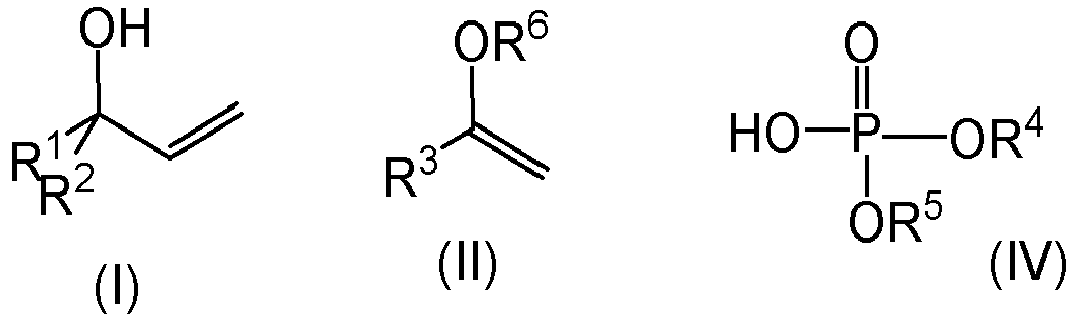
- the present invention is directed towards a process for the manufacture of gamma,delta-unsaturated ketones of the general formula (III) by reacting a tertiary vinyl carbinol of the general formula (I) with an isopropenyl alkyl ether of the general formula (II) in the presence of a catalyst of the general formula (IV),
- R 1 is either methyl or ethyl
- R 2 is selected from the group consisting of methyl, ethyl, homoprenyl, homogeranyl, homoneryl, homofarnesyl, and homosolanesyl, as listed in the table 1 below.
- R 1 is methyl and R 2 is either methyl, ethyl, homoprenyl, or homogeranyl.
- the compound of formula (I) is MBE or EBE, even more preferred is MBE.
- the molar ratio of the tertiary vinyl carbinol of the general formula (I) to the isopropenyl alkyl ether of the general formula (II) is preferably ranging from 1:7 to 1:1, more preferably ranging from 1:5 to 1:1.5, most preferably ranging from 1:3.5 to 1:2.
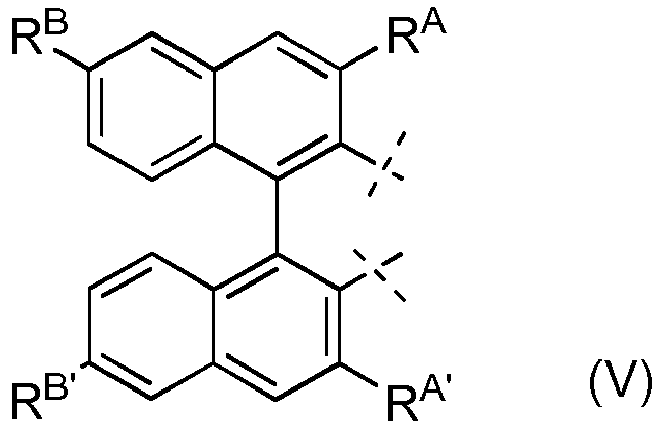
- R 4 and R 5 are independently from each other selected from the group consisting of hydrogen and aryl, or R 4 and R 5 form together 1,1'-binaphthyl-2,2'-diyl or mono-, di-, tri- or tetra-substituted 1,1'-binaphthyl-2,2'-diyl of formula V, whereby R A and R A' are independently from each other selected from the group consisting of methyl, phenyl, 4-nitrophenyl, 4-trifluoromethylphenyl, 3,5-bis(trifluoromethyl)phenyl, 9-anthracenyl and 2,4,6-trimethylphenyl, and R B and R B' are independently from each other selected from the group consisting of bromo, iodo, nitro, phenyl, methoxy and 3,5-bis(trifluoromethyl)phenyl, with the proviso that at least one of R 4 and R 5 is not hydrogen "Aryl" is preferably selected from
- the preferred catalysts according to the present invention are "1-NDHP” (1-naphthyl dihydrogen phosphate) and "BNHP” (( RS )-1,1'-binaphthyl-2,2'-diyl hydrogen phosphate).
- the amount of the catalyst of formula (IV) is preferably ranging from 0.01 - 0.3 mol-%, more preferably ranging from 0.01-0.1 mol-%, most preferably ranging from 0.02-0.07 mol-%, based on the amount of the tertiary vinyl carbinol of the general formula (I).
- the catalysts of formula (IV) are used as such, i.e. in solid form, and not as solution in an organic solvent such as aliphatic ketones as e.g. acetone.
- the reaction is preferably carried out at a temperature ranging from 100 to 170°C, more preferably at a temperature ranging from 110 to 160°C, most preferably at a temperature ranging from 120 to 150°C.
- the reaction is preferably carried out at a pressure ranging from 5 to 15 bar, more preferably at a pressure ranging from 8 to 12 bar.
- the reaction can be carried out without solvent or in the presence of an organic solvent. Preferably the reaction is carried out without solvent.
- the starting materials, the compounds of formula (I) and (II), as well as the catalyst of formula (IV) may still be provided in an organic solvent.
- an amount of organic solvent present up to 10 weight-%, preferably up to 5 weight-%, more preferably up to 3 weight-%, based on the total weight of the reaction mixture.
- polar aprotic organic solvents such as aliphatic ketones as e.g. acetone are preferred.
- the reaction mixture itself is also an object of the present invention.
- the present invention is directed towards a reaction mixture comprising a compound of formula (I), a compound of formula (II) and a catalyst of formula (IV), as well as towards a reaction mixture consisting essentially of a compound of formula (I), a compound of formula (II) and a catalyst of formula (IV) "consisting essentially of” in this context means that the total amount of the compound of formula (I), the compound of formula (II) and the catalyst of formula (IV) sum up to an amount of at least 90 weight-%, preferably at least 95 weight-%, more preferably at least 97 weight-%, based on the total amount of the reaction mixture.
- the present invention is also directed towards the use of a catalyst of the formula (IV) wherein R 4 and R 5 are independently from each other selected from the group consisting of hydrogen and aryl, or R 4 and R 5 form together 1,1'-binaphthyl-2,2'-diyl or mono-, di-, tri- or tetra-substituted 1,1'-binaphthyl-2,2'-diyl of formula V, whereby R A and R A' are independently from each other selected from the group consisting of methyl, phenyl, 4-nitrophenyl, 4-trifluoromethylphenyl, 3,5-bis(trifluoromethyl)phenyl, 9-anthracenyl and 2,4,6-trimethylphenyl, and R B and R B' are independently from each other selected from the group consisting of bromo, iodo, nitro, phenyl, methoxy and 3,5-bis(trifluoromethyl)phenyl, with the proviso that
- the powdery catalyst (either 1-NDHP or BNHP in the amounts as given in the tables below) is filled into the reactor as such.
- 144 g of the starting material either MBE, EBE, LL or E-NL as given in the tables below
- the amount of IPM (eq.” refers to the molar ratio relative to the other starting material, the compound of formula (I)) as given in the tables below are mixed and poured into the reactor.
- the closed reactor is then evacuated and released with nitrogen three times.
- the reaction mixture is stirred and heated up to the temperature as given in the tables below.
- the experiment is then carried out at isothermal conditions. After the reaction time given in the tables, the reaction mixture is cooled down to 20°C.
Landscapes
- Chemical & Material Sciences (AREA)
- Organic Chemistry (AREA)
- Organic Low-Molecular-Weight Compounds And Preparation Thereof (AREA)
Abstract
The present invention is directed towards a process for the manufacture of gamma,delta-unsaturated ketones of the general formula (III)

by reacting a tertiary vinyl carbinol of the general formula (I) with an isopropenyl alkyl ether of the general formula (II) in the presence of a catalyst of the general formula (IV),

wherein R1 and R6 are independently from each other either methyl or ethyl, R3 is methyl,
R2 is selected from the group consisting of methyl, ethyl, homoprenyl, homogeranyl, homoneryl, homofarnesyl, and homosolanesyl, and R4 and R5 are independently from each other selected from the group consisting of hydrogen and aryl, or R4 and R5 form together 1,1'-binaphthyl-2,2'-diyl or mono-, di-, tri- or tetra-substituted 1,1'-binaphthyl-2,2'-diyl of formula V, whereby RA and RA' are independently from each other selected from the group consisting of methyl, phenyl, 4-nitrophenyl, 4-trifluoromethylphenyl, 3,5-bis(trifluoromethyl)phenyl, 9-anthracenyl and 2,4,6-trimethylphenyl, and RB and RB' are independently from each other selected from the group consisting of bromo, iodo, nitro, phenyl, methoxy and 3,5-bis(trifluoromethyl)phenyl, 
with the proviso that at least one of R4 and R5 is not hydrogen.
R2 is selected from the group consisting of methyl, ethyl, homoprenyl, homogeranyl, homoneryl, homofarnesyl, and homosolanesyl, and R4 and R5 are independently from each other selected from the group consisting of hydrogen and aryl, or R4 and R5 form together 1,1'-binaphthyl-2,2'-diyl or mono-, di-, tri- or tetra-substituted 1,1'-binaphthyl-2,2'-diyl of formula V, whereby RA and RA' are independently from each other selected from the group consisting of methyl, phenyl, 4-nitrophenyl, 4-trifluoromethylphenyl, 3,5-bis(trifluoromethyl)phenyl, 9-anthracenyl and 2,4,6-trimethylphenyl, and RB and RB' are independently from each other selected from the group consisting of bromo, iodo, nitro, phenyl, methoxy and 3,5-bis(trifluoromethyl)phenyl,
The present invention is also directed towards the reaction mixture as such, i.e. the mixture of the compound of formula (I), the compound of formula (II) and the catalyst of formula (IV).
Description
- The present invention is directed towards an industrial sustainable process for the manufacture of gamma,delta-unsaturated ketones of formula (III) in the presence of novel catalysts of formula (IV),

- R2 is selected from the group consisting of methyl, ethyl, homoprenyl (= "-CH2-prenyl"), homogeranyl (="-CH2-geranyl"), homoneryl (="-CH2-neryl"), homofarnesyl (= "-CH2-farnesyl"), and homosolanesyl ("-CH2-solanesyl"),
- R4 and R5 are independently from each other selected from the group consisting of hydrogen and aryl, or R4 and R5 form together 1,1'-binaphthyl-2,2'-diyl or mono-, di-, tri- or tetra-substituted 1,1'-binaphthyl-2,2'-diyl of formula V, whereby RA and RA' are independently from each other selected from the group consisting of methyl, phenyl, 4-nitrophenyl, 4-trifluoromethylphenyl, 3,5-bis(trifluoromethyl)phenyl, 9-anthracenyl and 2,4,6-trimethylphenyl, and RB and RB' are independently from each other selected from the group consisting of bromo, iodo, nitro, phenyl, methoxy and 3,5-bis(trifluoromethyl)phenyl,
- "Aryl" is preferably selected from the group consisting of 1-naphthyl and 2-naphthyl.
- The present invention is especially directed towards an industrial sustainable process for the manufacture of 6-methyl-5-hepten-2-one ("MH"; see
Fig. 2 ), 6-methyl-5-octen-2-one ("EH"; seeFig. 3 ), 6,10-dimethyl-5,9-undecadien-2-one (= geranylacetone ("GA") or "nerylacetone" ("NA"), respectively; seeFig. 4 ), and 6,10,14-trimethyl-5,9,13-pentadeca-trien-2-one (= farnesylacetone; "FA"; seeFig. 5 ). - The preferred catalysts according to the present invention are "1-NDHP" (1-naphthyl dihydrogen phosphate) and "BNHP" ((RS)-1,1'-binaphthyl-2,2'-diyl hydrogen phosphate).

- The present invention is directed towards a process for the manufacture of gamma,delta-unsaturated ketones of the general formula (III)


- wherein R1 and R6 are independently from each other either methyl or ethyl, R3 is methyl,
- R2 is selected from the group consisting of methyl, ethyl, homoprenyl, homogeranyl, homoneryl, homofarnesyl, and homosolanesyl,
- R4 and R5 are independently from each other selected from the group consisting of hydrogen and aryl, or R4 and R5 form together 1,1'-binaphthyl-2,2'-diyl or mono-, di-, tri- or tetra-substituted 1,1'-binaphthyl-2,2'-diyl of formula V, whereby RA and RA' are independently from each other selected from the group consisting of methyl, phenyl, 4-nitrophenyl, 4-trifluoromethylphenyl, 3,5-bis(trifluoromethyl)phenyl, 9-anthracenyl and 2,4,6-trimethylphenyl, and RB and RB' are independently from each other selected from the group consisting of bromo, iodo, nitro, phenyl, methoxy and 3,5-bis(trifluoromethyl)phenyl,
-

- R1 is either methyl or ethyl, and R2 is selected from the group consisting of methyl, ethyl, homoprenyl, homogeranyl, homoneryl, homofarnesyl, and homosolanesyl, as listed in the table 1 below.
Table 1: R2 methyl CH3 ethyl CH2CH3 CH2-prenyl = "homoprenyl" 
CH2-geranyl/CH 2-neryl = "homogeranyl"/" homoneryl" 
CH2-farnesyl = "homofarnesyl" 
CH2-solanesyl = "homosolanesyl" 
- Preferably R1 is methyl and R2 is either methyl, ethyl, homoprenyl, or homogeranyl.
- Thus, the compound of the general formula (I) is preferably selected from the group consisting of 2-methyl-3-buten-2-ol ("MBE"), 3-methyl-4-penten-3-ol ("EBE"), 3,7-dimethyl-1,6-octadien-3-ol (= linalool, "LL"), and (6E/6Z)-3,7,11-trimethyl-1,6,10-dodecatrien-3-ol (= E/Z-nerolidol, "E/Z-NL").
- More preferably, the compound of formula (I) is MBE or EBE, even more preferred is MBE.
-

- The compound of formula (II) is preferably either isopropenyl methyl ether ("IPM"; R3 = methyl) or isopropenyl ethyl ether ("IPE"; R3 = ethyl), whereby isopropenyl methyl ether is more preferred.
- The molar ratio of the tertiary vinyl carbinol of the general formula (I) to the isopropenyl alkyl ether of the general formula (II) is preferably ranging from 1:7 to 1:1, more preferably ranging from 1:5 to 1:1.5, most preferably ranging from 1:3.5 to 1:2.
-

- R4 and R5 are independently from each other selected from the group consisting of hydrogen and aryl, or R4 and R5 form together 1,1'-binaphthyl-2,2'-diyl or mono-, di-, tri- or tetra-substituted 1,1'-binaphthyl-2,2'-diyl of formula V, whereby RA and RA' are independently from each other selected from the group consisting of methyl, phenyl, 4-nitrophenyl, 4-trifluoromethylphenyl, 3,5-bis(trifluoromethyl)phenyl, 9-anthracenyl and 2,4,6-trimethylphenyl, and RB and RB' are independently from each other selected from the group consisting of bromo, iodo, nitro, phenyl, methoxy and 3,5-bis(trifluoromethyl)phenyl,

"Aryl" is preferably selected from the group consisting of 1-naphthyl and 2-naphthyl. - The preferred catalysts according to the present invention are "1-NDHP" (1-naphthyl dihydrogen phosphate) and "BNHP" ((RS)-1,1'-binaphthyl-2,2'-diyl hydrogen phosphate).

- The amount of the catalyst of formula (IV) is preferably ranging from 0.01 - 0.3 mol-%, more preferably ranging from 0.01-0.1 mol-%, most preferably ranging from 0.02-0.07 mol-%, based on the amount of the tertiary vinyl carbinol of the general formula (I).
- Advantageously the catalysts of formula (IV) are used as such, i.e. in solid form, and not as solution in an organic solvent such as aliphatic ketones as e.g. acetone.
- The reaction is preferably carried out at a temperature ranging from 100 to 170°C, more preferably at a temperature ranging from 110 to 160°C, most preferably at a temperature ranging from 120 to 150°C.
- The reaction is preferably carried out at a pressure ranging from 5 to 15 bar, more preferably at a pressure ranging from 8 to 12 bar.
- The reaction can be carried out without solvent or in the presence of an organic solvent. Preferably the reaction is carried out without solvent.
- Even if the reaction is carried out in the absence of an organic solvent, the starting materials, the compounds of formula (I) and (II), as well as the catalyst of formula (IV) may still be provided in an organic solvent. Thus, in the reaction mixture there may be an amount of organic solvent present up to 10 weight-%, preferably up to 5 weight-%, more preferably up to 3 weight-%, based on the total weight of the reaction mixture.
- If the reaction is carried out in an organic solvent, polar aprotic organic solvents such as aliphatic ketones as e.g. acetone are preferred.
- The reaction mixture itself, with or without an organic solvent, is also an object of the present invention. Thus, the present invention is directed towards a reaction mixture comprising a compound of formula (I), a compound of formula (II) and a catalyst of formula (IV), as well as towards a reaction mixture consisting essentially of a compound of formula (I), a compound of formula (II) and a catalyst of formula (IV)
- The present invention is also directed towards the use of a catalyst of the formula (IV)


for the manufacture of gamma,delta-unsaturated ketones of the general formula (III)

R2 is selected from the group consisting of methyl, ethyl, homoprenyl, homogeranyl, homoneryl, homofarnesyl, and homosolanesyl, whereby the preferences as given above also apply. - The present invention is now further illustrated by the following nonlimiting examples.
- The powdery catalyst (either 1-NDHP or BNHP in the amounts as given in the tables below) is filled into the reactor as such. 144 g of the starting material (either MBE, EBE, LL or E-NL as given in the tables below) and the amount of IPM ("eq." refers to the molar ratio relative to the other starting material, the compound of formula (I)) as given in the tables below are mixed and poured into the reactor. The closed reactor is then evacuated and released with nitrogen three times. The reaction mixture is stirred and heated up to the temperature as given in the tables below. The experiment is then carried out at isothermal conditions. After the reaction time given in the tables, the reaction mixture is cooled down to 20°C. A sample of the reaction mixture is collected and directly neutralized with sodium acetate. The sample is then analyzed by gas chromatography.
Table 2: Conditions: 2.1 eq. IPM, catalyst = 1-NDHP, starting material: MBE, product: MH Example 1 2 Amount of catalyst [mol-%] 0.03 0.06 Temperature [°C] 150 120 Conversion MBE [%] 96.99 91.14 Yield MH [%] 94.80 89.90 Selectivity 0.977 0.986 Table 3: Conditions: 2.1 eq. IPM; catalyst = 1-NDHP, starting material: EBE, product: EH Example 3 Amount of catalyst [mol-%] 0.03 Temperature [°C] 150 Conversion EBE [%] 92.9 Yield EH [%] 92.0 Selectivity 0.99 Table 4: Conditions: 3.8 eq. IPM, catalyst = 1-NDHP, starting material = LL, product = GA Example 4 Amount of catalyst [mol-%] 0.1 Temperature [°C] 160 Conversion LL [%] 96.7 Yield GA [%] 91.6 Selectivity 0.95 Table 5: Conditions: 3.8 eq. IPM, catalyst = 1-NDHP, starting material = E-NL, product = FA Example 5 Amount of catalyst [mol-%] 0.1 Temperature [°C] 160 Conversion E-NL [%] 99.2 Yield FA [%] 93.4 Selectivity 0.94 Table 6: Conditions: 2.1 eq. IPM, catalyst = BNHP, starting material: MBE, product: MH Example 6 7 8 Amount of catalyst [mol-%] 0.03 0.03 0.01 Temperature [°C] 120 120 120 Conversion MBE [%] 98.86 97.50 95.83 Yield MH [%] 89.43 89.81 91.67 Selectivity 0.905 0.921 0.957 Table 7: Conditions: 2.1 eq. IPM, catalyst = BNHP, starting material = EBE, product = EH Example 9 Amount of catalyst [mol-%] 0.03 Temperature [°C] 120 Conversion EBE [%] 97.7 Yield EH [%] 93.0 Selectivity 0.95 Table 8: Catalyst = BNHP, starting material = LL, product = GA Example 10 11 12 Amount of IPM [eq.] 2.5 2.5 3.8 Amount of catalyst [mol-%] 0.05 0.1 0.1 Temperature [°C] 160 160 160 Conversion LL [%] 94.2 99.5 99.2 Yield GA [%] 89.1 85.2 92.7 Selectivity 0.95 0.86 0.93 Table 9: Catalyst = BNHP, starting material = E-NL, product = FA Example 13 Amount of IPM [eq.] 3.8 Amount of catalyst [mol-%] 0.1 Temperature [°C] 160 Conversion E-NL [%] 99.1 Yield FA [%] 92.5 Selectivity 0.93


Claims (11)
- A process for the manufacture of gamma,delta-unsaturated ketones of the general formula (III)

 wherein R1 and R6 are independently from each other either methyl or ethyl, R3 is methyl,R2 is selected from the group consisting of methyl, ethyl, homoprenyl, homogeranyl, homoneryl, homofarnesyl, and homosolanesyl, andR4 and R5 are independently from each other selected from the group consisting of hydrogen and aryl, or R4 and R5 form together 1,1'-binaphthyl-2,2'-diyl or mono-, di-, tri- or tetra-substituted 1,1'-binaphthyl-2,2'-diyl of formula V, whereby RA and RA' are independently from each other selected from the group consisting of methyl, phenyl, 4-nitrophenyl, 4-trifluoromethylphenyl, 3,5-bis(trifluoromethyl)phenyl, 9-anthracenyl and 2,4,6-trimethylphenyl, and RB and RB' are independently from each other selected from the group consisting of bromo, iodo, nitro, phenyl, methoxy and 3,5-bis(trifluoromethyl)phenyl,
- The process according to claim 1, wherein the catalyst of the formula (IV) is either 1-naphthyl dihydrogen phosphate or 1,1'-binaphthyl-2,2'-diyl hydrogen phosphate.
- The process according to claim 1 and/or 2, wherein R1 is methyl and R2 is selected from the group consisting of methyl, ethyl, homoprenyl, and homogeranyl.
- The process according to any one or more of the preceding claims, wherein the reaction is carried out at a temperature ranging from 100 to 170°C, preferably at a temperature ranging from 110 to 160°C, more preferably at a temperature ranging from 120 to 150°C.
- The process according to any one or more of the preceding claims, wherein the reaction is carried out at a pressure ranging from 5 to 15 bar, preferably at a pressure ranging from 8 to 12 bar.
- The process according to any one or more of the preceding claims, wherein the molar ratio of the tertiary vinyl carbinol of the general formula (I) to the isopropenyl alkyl ether of the general formula (II) is ranging from 1:7 to 1:1, preferably ranging from 1:5 to 1:1.5, more preferably ranging from 1:3.5 to 1:2.
- The process according to any one or more of the preceding claims, wherein the amount of the catalyst is ranging from 0.01-0.3 mol-%, preferred ranging from 0.01-0.1 mol-%, more preferred ranging from 0.02-0.07 mol-%, based on the amount of the tertiary vinyl carbinol of the general formula (I).
- The process according to any one or more of the preceding claims, wherein the compound of the general formula (III) is selected from the group consisting of 6-methyl-5-hepten-2-one, 6-methyl-5-octen-2-one, 6,10-dimethyl-5,9-undecadien-2-one and 6,10,14-trimethyl-5,9,13-pentadeca-trien-2-one, preferably wherein the compound of the general formula (III) is 6-methyl-5-hepten-2-one or 6-methyl-5-octen-2-one, more preferably wherein the compound of the general formula (III) is 6-methyl-5-hepten-2-one.
- Use of a catalyst of the formula (IV)

for the manufacture of gamma,delta-unsaturated ketones of the general formula (III)

- A reaction mixture comprising a compound of formula (I), a compound of formula (II) and a catalyst of formula (IV)
 wherein R1 and R6 are independently from each other either methyl or ethyl, R3 is methyl, andR2 is selected from the group consisting of methyl, ethyl, homoprenyl, homogeranyl, homoneryl, homofarnesyl, and homosolanesyl, andR4 and R5 are independently from each other selected from the group consisting of hydrogen and aryl, or R4 and R5 form together 1,1'-binaphthyl-2,2'-diyl or mono-, di-, tri- or tetra-substituted 1,1'-binaphthyl-2,2'-diyl of formula V, whereby RA and RA' are independently from each other selected from the group consisting of methyl, phenyl, 4-nitrophenyl, 4-trifluoromethylphenyl, 3,5-bis(trifluoromethyl)phenyl, 9-anthracenyl and 2,4,6-trimethylphenyl, and RB and RB' are independently from each other selected from the group consisting of bromo, iodo, nitro, phenyl, methoxy and 3,5-bis(trifluoromethyl)phenyl,
- A reaction mixture consisting essentially of a compound of formula (I), a compound of formula (II) and a catalyst of formula (IV)
 wherein R1 and R6 are independently from each other either methyl or ethyl, R3 is methyl, and R2 is selected from the group consisting of methyl, ethyl, homoprenyl, homogeranyl, homoneryl, homofarnesyl, and homosolanesyl, andR4 and R5 are independently from each other selected from the group consisting of hydrogen and aryl, or R4 and R5 form together 1,1'-binaphthyl-2,2'-diyl or mono-, di-, tri- or tetra-substituted 1,1'-binaphthyl-2,2'-diyl of formula V, whereby RA and RA' are independently from each other selected from the group consisting of methyl, phenyl, 4-nitrophenyl, 4-trifluoromethylphenyl, 3,5-bis(trifluoromethyl)phenyl, 9-anthracenyl and 2,4,6-trimethylphenyl, and RB and RB' are independently from each other selected from the group consisting of bromo, iodo, nitro, phenyl, methoxy and 3,5-bis(trifluoromethyl)phenyl,
Priority Applications (1)
| Application Number | Priority Date | Filing Date | Title |
|---|---|---|---|
| EP16199439.7A EP3323802A1 (en) | 2016-11-18 | 2016-11-18 | Novel use of arylphosphoric acid derivatives as catalyst |
Applications Claiming Priority (1)
| Application Number | Priority Date | Filing Date | Title |
|---|---|---|---|
| EP16199439.7A EP3323802A1 (en) | 2016-11-18 | 2016-11-18 | Novel use of arylphosphoric acid derivatives as catalyst |
Publications (1)
| Publication Number | Publication Date |
|---|---|
| EP3323802A1 true EP3323802A1 (en) | 2018-05-23 |
Family
ID=57354182
Family Applications (1)
| Application Number | Title | Priority Date | Filing Date |
|---|---|---|---|
| EP16199439.7A Withdrawn EP3323802A1 (en) | 2016-11-18 | 2016-11-18 | Novel use of arylphosphoric acid derivatives as catalyst |
Country Status (1)
| Country | Link |
|---|---|
| EP (1) | EP3323802A1 (en) |
Cited By (2)
| Publication number | Priority date | Publication date | Assignee | Title |
|---|---|---|---|---|
| CN113979847A (en) * | 2021-11-30 | 2022-01-28 | 万华化学集团股份有限公司 | Method for synthesizing 6-methyl-5-octen-2-one by carbonyl-ene reaction |
| CN113999096A (en) * | 2021-11-29 | 2022-02-01 | 万华化学集团股份有限公司 | Method for synthesizing 6-methyl-5-octen-2-one by condensation hydrogenation |
Citations (1)
| Publication number | Priority date | Publication date | Assignee | Title |
|---|---|---|---|---|
| WO1998023570A1 (en) * | 1996-11-29 | 1998-06-04 | Basf Aktiengesellschaft | METHOD FOR THE PRODUCTION OF η, δ-UNSATURATED KETONES BY REACTING TERTIARY ALLYL ALCOHOLS WITH ALKENYL ALKYL ETHERS |
-
2016
- 2016-11-18 EP EP16199439.7A patent/EP3323802A1/en not_active Withdrawn
Patent Citations (1)
| Publication number | Priority date | Publication date | Assignee | Title |
|---|---|---|---|---|
| WO1998023570A1 (en) * | 1996-11-29 | 1998-06-04 | Basf Aktiengesellschaft | METHOD FOR THE PRODUCTION OF η, δ-UNSATURATED KETONES BY REACTING TERTIARY ALLYL ALCOHOLS WITH ALKENYL ALKYL ETHERS |
Cited By (4)
| Publication number | Priority date | Publication date | Assignee | Title |
|---|---|---|---|---|
| CN113999096A (en) * | 2021-11-29 | 2022-02-01 | 万华化学集团股份有限公司 | Method for synthesizing 6-methyl-5-octen-2-one by condensation hydrogenation |
| CN113999096B (en) * | 2021-11-29 | 2023-05-30 | 万华化学集团股份有限公司 | Method for synthesizing 6-methyl-5-octene-2-ketone by condensation hydrogenation |
| CN113979847A (en) * | 2021-11-30 | 2022-01-28 | 万华化学集团股份有限公司 | Method for synthesizing 6-methyl-5-octen-2-one by carbonyl-ene reaction |
| CN113979847B (en) * | 2021-11-30 | 2023-01-17 | 万华化学集团股份有限公司 | Method for synthesizing 6-methyl-5-octen-2-one by carbonyl-ene reaction |
Similar Documents
| Publication | Publication Date | Title |
|---|---|---|
| EP3541776B1 (en) | Novel process for the manufacture of gamma, delta-unsaturated ketones | |
| Young et al. | Gold (I)-catalysed direct allylic etherification of unactivated alcohols | |
| CN107129499B (en) | Condensed heterocyclic compound containing imidazole ring and preparation method and application thereof | |
| EP3323802A1 (en) | Novel use of arylphosphoric acid derivatives as catalyst | |
| Zhang et al. | N-Heterocyclic carbene copper-catalyzed carboxylation of C--B and C--H bonds with carbon dioxide. | |
| EP3330246B1 (en) | Method for directly preparing glycol dimethyl ether and co-producing ethylene glycol from ethylene glycol monomethyl ether | |
| EP3541774B1 (en) | Novel use of phenyl phosphinic acid | |
| Tsui et al. | Thermal. alpha.-deoxysilylation of N, O-bis (trimethylsilyl)-N-phenylhydroxylamine | |
| EP3541775B1 (en) | Novel process for the manufacture of gamma,delta-unsaturated ketones | |
| US8859791B2 (en) | Process for producing an alkylene oxide by olefin epoxidation | |
| Ren et al. | Facile protection of carbonyl compounds as oxathiolanes and thioacetals promoted by PEG1000-based dicationic acidic ionic liquid as chemoselective and recyclable catalyst | |
| Khusnutdinova et al. | Synthesis of lupane mono-and bis-C19-(1, 2, 3-triazolyl)-triterpenoids by “Click” reaction | |
| TW201708189A (en) | Coupling of two arenes with selenium dioxide to give a selenobiaryl ether | |
| CN102764673B (en) | Catalyst for preparing diphenyl oxide compound and preparation method and application of catalyst | |
| US2888464A (en) | Methoximinopenteneones | |
| Mori et al. | InCl3-catalyzed reductive coupling of aromatic carbonyl compounds in the presence of magnesium and chlorotrimethylsilane | |
| CN105061154A (en) | Method for continuously preparing thymol | |
| CN103896848B (en) | A kind of preparation method of large sterically hindered diacetylenic compound with imidazole ring structure | |
| CN109553535B (en) | Method for preparing 4-chloro-2' -nitrobiphenyl by one-pot method | |
| EP3645484B1 (en) | Method for preparation of alkylated or fluoro, chloro and fluorochloro alkylated compounds by heterogeneous cobalt catalysis | |
| Rubina et al. | Synthesis of Isopropyl and Tert-butyl Pyridyl Ketones by Alkylation of Acetylpyridines with Methyl Iodide Using Phase Transfer Catalysis | |
| Maegawa et al. | Direct conversion of acetals to esters with high regioselectivity via O, P-acetals | |
| CN108503595B (en) | A kind of method for preparing quinazolinone compounds | |
| US20240308948A1 (en) | Organic tertiary or quaternary ammonium salts as catalysts in the formation of gamma, delta-unsaturated ketones | |
| Liu et al. | Reductive coupling of carbonyl compounds using silole and germole dianions |
Legal Events
| Date | Code | Title | Description |
|---|---|---|---|
| PUAI | Public reference made under article 153(3) epc to a published international application that has entered the european phase |
Free format text: ORIGINAL CODE: 0009012 |
|
| STAA | Information on the status of an ep patent application or granted ep patent |
Free format text: STATUS: THE APPLICATION HAS BEEN PUBLISHED |
|
| AK | Designated contracting states |
Kind code of ref document: A1 Designated state(s): AL AT BE BG CH CY CZ DE DK EE ES FI FR GB GR HR HU IE IS IT LI LT LU LV MC MK MT NL NO PL PT RO RS SE SI SK SM TR |
|
| AX | Request for extension of the european patent |
Extension state: BA ME |
|
| STAA | Information on the status of an ep patent application or granted ep patent |
Free format text: STATUS: THE APPLICATION IS DEEMED TO BE WITHDRAWN |
|
| 18D | Application deemed to be withdrawn |
Effective date: 20181124 |