EP3323730A1 - Airplane with angle-mounted turboprop engine - Google Patents
Airplane with angle-mounted turboprop engine Download PDFInfo
- Publication number
- EP3323730A1 EP3323730A1 EP17199663.0A EP17199663A EP3323730A1 EP 3323730 A1 EP3323730 A1 EP 3323730A1 EP 17199663 A EP17199663 A EP 17199663A EP 3323730 A1 EP3323730 A1 EP 3323730A1
- Authority
- EP
- European Patent Office
- Prior art keywords
- gas turbine
- turbine engine
- nacelle
- engine
- exhaust
- Prior art date
- Legal status (The legal status is an assumption and is not a legal conclusion. Google has not performed a legal analysis and makes no representation as to the accuracy of the status listed.)
- Granted
Links
Images
Classifications
-
- B—PERFORMING OPERATIONS; TRANSPORTING
- B64—AIRCRAFT; AVIATION; COSMONAUTICS
- B64D—EQUIPMENT FOR FITTING IN OR TO AIRCRAFT; FLIGHT SUITS; PARACHUTES; ARRANGEMENT OR MOUNTING OF POWER PLANTS OR PROPULSION TRANSMISSIONS IN AIRCRAFT
- B64D27/00—Arrangement or mounting of power plants in aircraft; Aircraft characterised by the type or position of power plants
- B64D27/02—Aircraft characterised by the type or position of power plants
- B64D27/10—Aircraft characterised by the type or position of power plants of gas-turbine type
- B64D27/12—Aircraft characterised by the type or position of power plants of gas-turbine type within, or attached to, wings
-
- B—PERFORMING OPERATIONS; TRANSPORTING
- B64—AIRCRAFT; AVIATION; COSMONAUTICS
- B64D—EQUIPMENT FOR FITTING IN OR TO AIRCRAFT; FLIGHT SUITS; PARACHUTES; ARRANGEMENT OR MOUNTING OF POWER PLANTS OR PROPULSION TRANSMISSIONS IN AIRCRAFT
- B64D29/00—Power-plant nacelles, fairings or cowlings
- B64D29/02—Power-plant nacelles, fairings or cowlings associated with wings
-
- B—PERFORMING OPERATIONS; TRANSPORTING
- B64—AIRCRAFT; AVIATION; COSMONAUTICS
- B64D—EQUIPMENT FOR FITTING IN OR TO AIRCRAFT; FLIGHT SUITS; PARACHUTES; ARRANGEMENT OR MOUNTING OF POWER PLANTS OR PROPULSION TRANSMISSIONS IN AIRCRAFT
- B64D33/00—Arrangement in aircraft of power plant parts or auxiliaries not otherwise provided for
- B64D33/04—Arrangement in aircraft of power plant parts or auxiliaries not otherwise provided for of exhaust outlets or jet pipes
-
- B—PERFORMING OPERATIONS; TRANSPORTING
- B64—AIRCRAFT; AVIATION; COSMONAUTICS
- B64D—EQUIPMENT FOR FITTING IN OR TO AIRCRAFT; FLIGHT SUITS; PARACHUTES; ARRANGEMENT OR MOUNTING OF POWER PLANTS OR PROPULSION TRANSMISSIONS IN AIRCRAFT
- B64D33/00—Arrangement in aircraft of power plant parts or auxiliaries not otherwise provided for
- B64D33/08—Arrangement in aircraft of power plant parts or auxiliaries not otherwise provided for of power plant cooling systems
-
- B—PERFORMING OPERATIONS; TRANSPORTING
- B64—AIRCRAFT; AVIATION; COSMONAUTICS
- B64D—EQUIPMENT FOR FITTING IN OR TO AIRCRAFT; FLIGHT SUITS; PARACHUTES; ARRANGEMENT OR MOUNTING OF POWER PLANTS OR PROPULSION TRANSMISSIONS IN AIRCRAFT
- B64D35/00—Transmitting power from power plants to propellers or rotors; Arrangements of transmissions
- B64D35/02—Transmitting power from power plants to propellers or rotors; Arrangements of transmissions specially adapted for specific power plants
-
- F—MECHANICAL ENGINEERING; LIGHTING; HEATING; WEAPONS; BLASTING
- F01—MACHINES OR ENGINES IN GENERAL; ENGINE PLANTS IN GENERAL; STEAM ENGINES
- F01D—NON-POSITIVE DISPLACEMENT MACHINES OR ENGINES, e.g. STEAM TURBINES
- F01D15/00—Adaptations of machines or engines for special use; Combinations of engines with devices driven thereby
- F01D15/12—Combinations with mechanical gearing
-
- F—MECHANICAL ENGINEERING; LIGHTING; HEATING; WEAPONS; BLASTING
- F01—MACHINES OR ENGINES IN GENERAL; ENGINE PLANTS IN GENERAL; STEAM ENGINES
- F01D—NON-POSITIVE DISPLACEMENT MACHINES OR ENGINES, e.g. STEAM TURBINES
- F01D25/00—Component parts, details, or accessories, not provided for in, or of interest apart from, other groups
- F01D25/24—Casings; Casing parts, e.g. diaphragms, casing fastenings
-
- F—MECHANICAL ENGINEERING; LIGHTING; HEATING; WEAPONS; BLASTING
- F01—MACHINES OR ENGINES IN GENERAL; ENGINE PLANTS IN GENERAL; STEAM ENGINES
- F01D—NON-POSITIVE DISPLACEMENT MACHINES OR ENGINES, e.g. STEAM TURBINES
- F01D25/00—Component parts, details, or accessories, not provided for in, or of interest apart from, other groups
- F01D25/30—Exhaust heads, chambers, or the like
-
- F—MECHANICAL ENGINEERING; LIGHTING; HEATING; WEAPONS; BLASTING
- F02—COMBUSTION ENGINES; HOT-GAS OR COMBUSTION-PRODUCT ENGINE PLANTS
- F02C—GAS-TURBINE PLANTS; AIR INTAKES FOR JET-PROPULSION PLANTS; CONTROLLING FUEL SUPPLY IN AIR-BREATHING JET-PROPULSION PLANTS
- F02C7/00—Features, components parts, details or accessories, not provided for in, or of interest apart form groups F02C1/00 - F02C6/00; Air intakes for jet-propulsion plants
- F02C7/04—Air intakes for gas-turbine plants or jet-propulsion plants
-
- B—PERFORMING OPERATIONS; TRANSPORTING
- B64—AIRCRAFT; AVIATION; COSMONAUTICS
- B64D—EQUIPMENT FOR FITTING IN OR TO AIRCRAFT; FLIGHT SUITS; PARACHUTES; ARRANGEMENT OR MOUNTING OF POWER PLANTS OR PROPULSION TRANSMISSIONS IN AIRCRAFT
- B64D33/00—Arrangement in aircraft of power plant parts or auxiliaries not otherwise provided for
- B64D33/04—Arrangement in aircraft of power plant parts or auxiliaries not otherwise provided for of exhaust outlets or jet pipes
- B64D2033/045—Arrangement in aircraft of power plant parts or auxiliaries not otherwise provided for of exhaust outlets or jet pipes comprising infrared suppressors
-
- F—MECHANICAL ENGINEERING; LIGHTING; HEATING; WEAPONS; BLASTING
- F05—INDEXING SCHEMES RELATING TO ENGINES OR PUMPS IN VARIOUS SUBCLASSES OF CLASSES F01-F04
- F05D—INDEXING SCHEME FOR ASPECTS RELATING TO NON-POSITIVE-DISPLACEMENT MACHINES OR ENGINES, GAS-TURBINES OR JET-PROPULSION PLANTS
- F05D2220/00—Application
- F05D2220/30—Application in turbines
- F05D2220/32—Application in turbines in gas turbines
- F05D2220/323—Application in turbines in gas turbines for aircraft propulsion, e.g. jet engines
-
- Y—GENERAL TAGGING OF NEW TECHNOLOGICAL DEVELOPMENTS; GENERAL TAGGING OF CROSS-SECTIONAL TECHNOLOGIES SPANNING OVER SEVERAL SECTIONS OF THE IPC; TECHNICAL SUBJECTS COVERED BY FORMER USPC CROSS-REFERENCE ART COLLECTIONS [XRACs] AND DIGESTS
- Y02—TECHNOLOGIES OR APPLICATIONS FOR MITIGATION OR ADAPTATION AGAINST CLIMATE CHANGE
- Y02T—CLIMATE CHANGE MITIGATION TECHNOLOGIES RELATED TO TRANSPORTATION
- Y02T50/00—Aeronautics or air transport
- Y02T50/40—Weight reduction
Definitions
- the present disclosure relates generally to airplanes powered by gas turbine engines, and more specifically to airplanes powered by turboprop engines. Additionally disclosed is an improved infrared suppression system for reducing the heat signature of gas turbine engines used in airplanes.
- Airplanes are sometimes powered by gas turbine engines.
- gas turbine engines incorporated into airplanes can be used to independently provide thrust from pressurized exhaust gasses discharged from the engines themselves.
- gas turbine engines incorporated into airplanes can be used to drive shrouded fans used to provide thrust from discharged air moved through ducts.
- gas turbine engines incorporated into airplanes can be used to drive unshrouded propellers used to provide thrust from air accelerated by the propellers.
- turboprop The combination of a gas turbine engine and a propeller used in an airplane is sometimes called a turboprop or a turboprop engine.
- Turboprops sometimes include a gearbox coupled between the gas turbine engine and the propeller to adjust the speed of the propeller relative to the speed of the gas turbine engine.
- the packaging of such gas turbine engines, propellers, and optional gearboxes can present packaging and aerodynamic design challenges. Accordingly, there are opportunities to improve these designs over the prior art.
- the present disclosure may comprise one or more of the following features and combinations thereof.
- a turboprop propulsion system adapted for use in an airplane, the system comprising a propeller mounted for rotation about a propeller axis, a gas turbine engine mounted to establish an engine axis of rotation different from the propeller axis to form an offset angle therebetween, and a gearbox coupled between the propeller and the gas turbine engine and configured to accommodate the offset angle between the propeller axis and the engine axis of rotation.
- the offset angle may be between 10 degrees and 15 degrees.
- the propulsion system may include a nacelle that houses the gas turbine engine.
- the nacelle may include an inlet duct.
- the inlet duct may be shaped to provide a direct line of sight from an inlet of the gas turbine engine to an engine-air-entry aperture of the nacelle.
- the nacelle may include an exhaust duct.
- the exhaust duct may be shaped to provide a direct line of sight from an exhaust discharge outlet of the gas turbine engine to an exhaust-outlet aperture of the nacelle.
- the nacelle may include an infrared suppressor.
- the infrared suppressor may be coupled to the gas turbine engine and configured to conduct exhaust gasses at least part way from the exhaust discharge outlet of the gas turbine engine to the exhaust-outlet aperture of the nacelle.
- the infrared suppressor may have a direct line of sight from the exhaust discharge outlet of the gas turbine engine to the exhaust-outlet aperture of the nacelle.
- the inlet duct has a Y-shape that extends to two engine-air-entry apertures. Direct lines of sight are provided from the inlet of the gas turbine engine to both of the engine-air-entry apertures.
- an airplane comprising an airframe including a fuselage and a wing coupled to the fuselage, and a turboprop propulsion system coupled to the wing to provide thrust for the airplane, the turboprop propulsion system including a propeller mounted for rotation about a propeller axis and a gas turbine engine coupled to the propeller to drive the propeller about the propeller axis, wherein the gas turbine engine is mounted to establish an engine axis of rotation different from the propeller axis and form an offset angle between the propeller axis and the engine axis of rotation.
- the gas turbine engine may be coupled to the propeller to drive the propeller about the propeller axis.
- the gas turbine engine may be mounted such that a vector of exhaust gasses discharged from the gas turbine engine during use has a downward component that provides lift to the airplane relative to the ground when the plane is landed on the ground when the turboprop propulsion system is in use.
- the offset angle between the propeller axis and the engine axis of rotation may be between 10 degrees and 15 degrees.
- the turboprop propulsion system may include a gearbox.
- the gearbox may be coupled between the propeller and the gas turbine engine and configured to accommodate the offset angle between the propeller axis and the engine axis of rotation.
- the gearbox may be coupled to the propeller mounted for rotation about the propeller axis and to an output shaft of the gas turbine engine adapted to rotate about the engine axis of rotation.
- the airplane may include a nacelle.
- the nacelle may house the gas turbine engine and at least part of the gearbox.
- the nacelle may include an inlet duct.
- the inlet duct may be shaped to provide a direct line of sight from an inlet of the gas turbine engine to an engine-air-entry aperture of the nacelle.
- the nacelle may include an exhaust duct.
- the exhaust duct may be shaped to provide a direct line of sight from an exhaust discharge outlet of the gas turbine engine to an exhaust-outlet aperture of the nacelle.
- the nacelle may include an infrared suppressor.
- the infrared suppressor may be coupled to the gas turbine engine and configured to conduct exhaust gasses at least part way from the exhaust discharge outlet of the gas turbine engine to the exhaust-outlet aperture of the nacelle.
- the infrared suppressor may have a direct line of sight from the exhaust discharge outlet of the gas turbine engine to the exhaust-outlet aperture of the nacelle.
- the nacelle may include a suppressor-air aperture configured to conduct air to the infrared suppressor during use of the turboprop propulsion system.
- the suppressor-air aperture may be spaced apart from the engine-air-entry aperture.
- the nacelle may include a heat exchanger and a cooling-air aperture.
- the heat exchanger may receive air flow from the cooling-air aperture during use of the turboprop propulsion system.
- the cooling-air aperture may be spaced apart from the engine-air-entry aperture of the nacelle.
- the heat exchanger may be arranged below the gas turbine engine when the plane is landed on the ground.
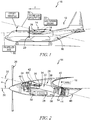
- Fig. 1 is a side elevation view of an airplane including an airframe and a turboprop propulsion system showing that the turboprop propulsion system includes a propeller mounted for rotation about a propeller axis, a gas turbine engine mounted to establish an engine axis of rotation, and a nacelle in which the gas turbine engine is housed and showing that the engine axis of rotation is different from the propeller axis forming an offset angle ⁇ such that exhaust discharged from the gas turbine engine provides some lift to the airplane when the gas turbine engine is in use;
- Fig. 2 is a detail view of the turboprop propulsion system of Fig. 1 with a portion of the nacelle broken away to show a gearbox coupled between the propeller and the gas turbine engine to accommodate the offset angle ⁇ and showing that an air-cooled oil cooler (A.C.O.C.) included in the turboprop propulsion system is also housed in the nacelle;
- A.C.O.C. air-cooled oil cooler
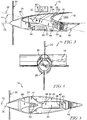
- Fig. 3 is a view similar to Fig. 2 showing that inlet ducts included in the nacelle form a direct line of sight from an inlet of the gas turbine engine to an engine-air-entry aperture of the nacelle such that pressure losses through the inlet ducts is controlled;
- Fig. 4 is a front elevation view of the turboprop propulsion system of Figs. 1-3 showing the turboprop propulsion system mounted to a wing included in the airframe of the airplane;
- Fig. 5 is a top plan view of the turboprop propulsion system of Figs. 1-4 with portions of the nacelle removed to show the inlet ducts of the nacelle;
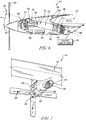
- Fig. 6 is a view similar to Figs. 2 and 3 showing that an exhaust duct included in the nacelle form a direct line of sight from an exhaust discharge outlet of the gas turbine engine to an exhaust-outlet aperture of the nacelle such that pressure losses through the exhaust duct is controlled and showing that an infrared suppressor coupled to the gas turbine engine also has a direct line of sight from the exhaust discharge outlet of the gas turbine engine so that hot spots associated with bends in the infrared suppressor are avoided; and
- Fig. 7 is an aft perspective view of the turboprop propulsion system of Figs. 1-6 showing the turboprop propulsion system mounted to the wing of the airframe included in the airplane.
- An airplane 10 includes an airframe 12 and a turboprop propulsion system 14 as shown in Fig. 1 .
- the airframe 12 includes a fuselage 16 and wings 18 coupled to the fuselage 16 to generate lift for the airplane 10 when the airplane 10 moves in a forward direction F.
- the turboprop propulsion system 14 includes a propeller 20 that provides thrust to move the airplane 10 in the forward direction F when rotated, a gas turbine engine 22 that powers rotation of the propeller 20, and a gearbox 24 that interconnects the propeller 20 and the gas turbine engine 22 as shown in Fig. 2 .
- the propeller 20 is mounted for rotation about a propeller axis 30 as shown in Figs. 1 and 2 .
- the gas turbine engine 22 is mounted to establish an engine axis of rotation 32 that is different from the propeller axis 30.
- An offset angle ⁇ greater than 0 degrees is formed between the propeller axis 30 and the engine axis of rotation 32. Because of the engine axis of rotation 32 and the offset angle ⁇ , exhaust gasses output from the gas turbine engine 22 form a vector having a downward directional component that provides lift to the airplane 10 relative to the ground when the turboprop propulsion system 14 is in use and the airplane 10 is on the ground.
- the offset angle ⁇ may be between 10 degrees and 15 degrees or may form another suitable non-zero angle. More particularly, in the illustrative embodiment, the offset angle ⁇ is about, or precisely, 13 degrees. Given the relative length of the gas turbine engine 22 and other components in the illustrative embodiment, a 10-15 degree angle optimizes the front facing area of the overall assembly while providing a clear direct line of sight from atmosphere to an inlet 38 of the gas turbine engine 22 as discussed herein. Angles of less than 10 degrees could require designing an inlet airflow path that curves and creates additional forward facing drag. Angles of greater than 15 degrees could result in a larger percentage of the engine cross section to the front facing area (e.g., for illustrative purposes give an example where a 90 degree orientation would require a front facing area equal to the entire length of the engine).
- the gas turbine engine 22 illustratively includes a compressor 34, a combustor 36, a turbine 40, and an output shaft 60 as shown in Fig. 2 .
- the compressor 34 receives air from an inlet 38 and compresses the air before delivering it to the combustor 36.
- the combustor 36 adds and ignites fuel in the compressed air provided by the compressor 34. Hot, high-pressure combustion products then pass from the combustor 36 into the turbine 40 where the combustion products are used to turn turbine wheels coupled to the compressor 34 and to the output shaft 60 causing them to rotate. Hot exhaust products are discharged out of the turbine 40 through an outlet 41.
- the gearbox 24 is configured to accommodate the offset angle ⁇ established between the output shaft 60 of the gas turbine engine 22 and the propeller 20 as shown in Fig. 2 .
- the gear box 24 is configured to step down the speed of the output shaft 60 so that the propeller 20 is rotated more slowly than the output shaft 60 of the gas turbine engine 22.
- the turboprop propulsion system 14 of the illustrative embodiment also includes a nacelle 26 that houses the gas turbine engine 22 and at least a portion of the gearbox 24 as shown in Fig. 2 .
- the nacelle 26 is integrated into the airframe 12 and supports the propeller 20, the gas turbine engine 22, and the gearbox 24 relative to the rest of the airframe 12.
- the nacelle 26 includes an inlet duct 42 forming an engine-air-entry aperture 46 and an exhaust duct 44 forming an exhaust-outlet aperture 48 as shown in Figs. 3-5 .
- the inlet duct 42 conducts air to the inlet 38 of the gas turbine engine 22 and is shaped to provide a direct inlet line of sight 50 from the inlet 38 of the gas turbine engine 22 to the engine-air-entry aperture 46 as shown in Fig. 3 .
- the exhaust duct 44 is positioned on the engine axis of rotation 32 and coupled between the outlet 41 of the gas turbine engine 22 and the exhaust-outlet aperture 48 to conduct the flow of exhaust gasses to the exhaust-outlet aperture 48.
- the exhaust duct 44 is shaped to provide a direct exhaust line of sight 52 from the outlet 41 of the gas turbine engine 22 to the exhaust-outlet aperture 48 as shown in Fig. 6 .
- the inlet duct 42 has a Y-shape that extends to two engine-air-entry apertures 46 as shown in Fig. 5 . Direct lines of sight are provided from the inlet 38 of the gas turbine engine 22 to both of the engine-air-entry apertures 46. Accordingly, pressure drop to the inlet 38 of the gas turbine engine 22 is minimized.
- the turboprop propulsion system 14 disclosed includes an optional infrared suppressor 54 adapted to cool exhaust gasses discharged from the gas turbine engine 22 reducing engine heat signature as suggested in Fig. 2 .
- the infrared suppressor 54 is coupled to the turbine 40 of the gas turbine engine 22 and positioned on the engine axis of rotation 32.
- the infrared suppressor 54 is configured to conduct exhaust gasses away from the outlet 41 of the gas turbine engine 22 toward the exhaust-outlet aperture 48 of the nacelle 22 to facilitate the movement of high temperature exhaust gasses away from the propulsion system 14.
- the infrared suppressor 54 is positioned to have a direct exhaust line of sight 52 from the exhaust outlet 40 of the gas turbine engine 22 to the exhaust-outlet aperture 48 of the nacelle 26. Accordingly, redirecting the flow of high temperature exhaust gasses via curved walls of the nacelle or other structures susceptible to increased heat signature characteristics is not necessary when the turboprop propulsion system 14 is used in the airplane 10.
- the nacelle 26 is formed to include a suppressor-air aperture 56 through which cooling air is passed to the infrared suppressor 54 as shown in Figs. 6 and 7 .
- the suppressor-air aperture 56 is arranged forward of the infrared suppressor 54 relative to a forward direction F of the airplane 10, as shown in Fig. 1 .
- the suppressor-air aperture 56 is spaced apart from the engine-air-entry aperture 46 of the nacelle 22.
- the turboprop propulsion system 14 of the present disclosure includes a heat exchanger 28 housed in the nacelle 26 and positioned below the gas turbine engine 22 when the airplane 10 is landed on the ground as shown in Figs. 1 and 2 .
- the heat exchanger 28 is illustratively an air-cooled oil cooler for use in cooling oil used in the gas turbine engine 22.
- the nacelle 26 is formed to include a cooling-air aperture 58 arranged forward of the heat exchanger 28 relative to a forward direction F of the airplane 10, as shown in Fig. 1 .
- the cooling-air aperture 58 is configured to conduct air to the heat exchanger 28 during use of the turboprop propulsion system 14.
- the cooling-air aperture 58 is spaced apart from the engine-air-entry aperture 46 of the nacelle 22.
- the propulsion system 14 of the present disclosure includes an engine 22 angled nose up to permit a reduced frontal area, an improved fineness ratio, a reduction in wetted area of the nacelle 26, a corresponding weight reduction, and improved engine installation characteristics.
- the angled engine design of the present disclosure allows for reduced backpressure, improved inlet performance, and better use of volume within the nacelle 26.
- the angled engine design of the present disclosure may also permit a more shallow aft body reducing boat-tail drag and reducing or eliminating wing and flap exhaust heating, which allows for improved infrared signature characteristics.
- the available space leaves enough volume for other critical subsystems including the air cooled oil cooler accessories (i.e. heat exchanger 28), the infrared suppressor 54, and a power unit accessory drive.
- the characteristics mentioned above allow for a lesser weight, lesser drag, and lesser cost for a vehicle that desires an optimized turboprop installation.
- the present disclosure may be said to relate to
Landscapes
- Engineering & Computer Science (AREA)
- Mechanical Engineering (AREA)
- Aviation & Aerospace Engineering (AREA)
- Chemical & Material Sciences (AREA)
- Combustion & Propulsion (AREA)
- General Engineering & Computer Science (AREA)
- Engine Equipment That Uses Special Cycles (AREA)
- Structures Of Non-Positive Displacement Pumps (AREA)
Abstract
Description
- The present disclosure relates generally to airplanes powered by gas turbine engines, and more specifically to airplanes powered by turboprop engines. Additionally disclosed is an improved infrared suppression system for reducing the heat signature of gas turbine engines used in airplanes.
- Airplanes are sometimes powered by gas turbine engines. In some applications, gas turbine engines incorporated into airplanes can be used to independently provide thrust from pressurized exhaust gasses discharged from the engines themselves. In other applications, gas turbine engines incorporated into airplanes can be used to drive shrouded fans used to provide thrust from discharged air moved through ducts. In still other applications, gas turbine engines incorporated into airplanes can be used to drive unshrouded propellers used to provide thrust from air accelerated by the propellers.
- The combination of a gas turbine engine and a propeller used in an airplane is sometimes called a turboprop or a turboprop engine. Turboprops sometimes include a gearbox coupled between the gas turbine engine and the propeller to adjust the speed of the propeller relative to the speed of the gas turbine engine. The packaging of such gas turbine engines, propellers, and optional gearboxes can present packaging and aerodynamic design challenges. Accordingly, there are opportunities to improve these designs over the prior art.
- The present disclosure may comprise one or more of the following features and combinations thereof.
- According to one aspect of the present disclosure, there is provided a turboprop propulsion system adapted for use in an airplane, the system comprising a propeller mounted for rotation about a propeller axis, a gas turbine engine mounted to establish an engine axis of rotation different from the propeller axis to form an offset angle therebetween, and a gearbox coupled between the propeller and the gas turbine engine and configured to accommodate the offset angle between the propeller axis and the engine axis of rotation.
- In some embodiments, the offset angle may be between 10 degrees and 15 degrees.
- In some embodiments, the propulsion system may include a nacelle that houses the gas turbine engine. The nacelle may include an inlet duct. The inlet duct may be shaped to provide a direct line of sight from an inlet of the gas turbine engine to an engine-air-entry aperture of the nacelle. In some embodiments, the nacelle may include an exhaust duct. The exhaust duct may be shaped to provide a direct line of sight from an exhaust discharge outlet of the gas turbine engine to an exhaust-outlet aperture of the nacelle.
- In some embodiments, the nacelle may include an infrared suppressor. The infrared suppressor may be coupled to the gas turbine engine and configured to conduct exhaust gasses at least part way from the exhaust discharge outlet of the gas turbine engine to the exhaust-outlet aperture of the nacelle. The infrared suppressor may have a direct line of sight from the exhaust discharge outlet of the gas turbine engine to the exhaust-outlet aperture of the nacelle.
- In some embodiments, the inlet duct has a Y-shape that extends to two engine-air-entry apertures. Direct lines of sight are provided from the inlet of the gas turbine engine to both of the engine-air-entry apertures.
- According to another aspect of the present disclosure, there is provided an airplane comprising an airframe including a fuselage and a wing coupled to the fuselage, and a turboprop propulsion system coupled to the wing to provide thrust for the airplane, the turboprop propulsion system including a propeller mounted for rotation about a propeller axis and a gas turbine engine coupled to the propeller to drive the propeller about the propeller axis, wherein the gas turbine engine is mounted to establish an engine axis of rotation different from the propeller axis and form an offset angle between the propeller axis and the engine axis of rotation. The gas turbine engine may be coupled to the propeller to drive the propeller about the propeller axis.
- In some embodiments, the gas turbine engine may be mounted such that a vector of exhaust gasses discharged from the gas turbine engine during use has a downward component that provides lift to the airplane relative to the ground when the plane is landed on the ground when the turboprop propulsion system is in use. In some embodiments, the offset angle between the propeller axis and the engine axis of rotation may be between 10 degrees and 15 degrees.
- In some embodiments, the turboprop propulsion system may include a gearbox. The gearbox may be coupled between the propeller and the gas turbine engine and configured to accommodate the offset angle between the propeller axis and the engine axis of rotation. The gearbox may be coupled to the propeller mounted for rotation about the propeller axis and to an output shaft of the gas turbine engine adapted to rotate about the engine axis of rotation.
- In some embodiments, the airplane may include a nacelle. The nacelle may house the gas turbine engine and at least part of the gearbox. In some embodiments, the nacelle may include an inlet duct. The inlet duct may be shaped to provide a direct line of sight from an inlet of the gas turbine engine to an engine-air-entry aperture of the nacelle. In some embodiments, the nacelle may include an exhaust duct. The exhaust duct may be shaped to provide a direct line of sight from an exhaust discharge outlet of the gas turbine engine to an exhaust-outlet aperture of the nacelle.
- In some embodiments, the nacelle may include an infrared suppressor. The infrared suppressor may be coupled to the gas turbine engine and configured to conduct exhaust gasses at least part way from the exhaust discharge outlet of the gas turbine engine to the exhaust-outlet aperture of the nacelle. The infrared suppressor may have a direct line of sight from the exhaust discharge outlet of the gas turbine engine to the exhaust-outlet aperture of the nacelle. In some embodiments, the nacelle may include a suppressor-air aperture configured to conduct air to the infrared suppressor during use of the turboprop propulsion system. The suppressor-air aperture may be spaced apart from the engine-air-entry aperture.
- In some embodiments, the nacelle may include a heat exchanger and a cooling-air aperture. The heat exchanger may receive air flow from the cooling-air aperture during use of the turboprop propulsion system. The cooling-air aperture may be spaced apart from the engine-air-entry aperture of the nacelle. The heat exchanger may be arranged below the gas turbine engine when the plane is landed on the ground.
- These and other features of the present disclosure will become more apparent from the following description of the illustrative embodiments.
-
Fig. 1 is a side elevation view of an airplane including an airframe and a turboprop propulsion system showing that the turboprop propulsion system includes a propeller mounted for rotation about a propeller axis, a gas turbine engine mounted to establish an engine axis of rotation, and a nacelle in which the gas turbine engine is housed and showing that the engine axis of rotation is different from the propeller axis forming an offset angle α such that exhaust discharged from the gas turbine engine provides some lift to the airplane when the gas turbine engine is in use; -
Fig. 2 is a detail view of the turboprop propulsion system ofFig. 1 with a portion of the nacelle broken away to show a gearbox coupled between the propeller and the gas turbine engine to accommodate the offset angle α and showing that an air-cooled oil cooler (A.C.O.C.) included in the turboprop propulsion system is also housed in the nacelle; -
Fig. 3 is a view similar toFig. 2 showing that inlet ducts included in the nacelle form a direct line of sight from an inlet of the gas turbine engine to an engine-air-entry aperture of the nacelle such that pressure losses through the inlet ducts is controlled; -
Fig. 4 is a front elevation view of the turboprop propulsion system ofFigs. 1-3 showing the turboprop propulsion system mounted to a wing included in the airframe of the airplane; -
Fig. 5 is a top plan view of the turboprop propulsion system ofFigs. 1-4 with portions of the nacelle removed to show the inlet ducts of the nacelle; -
Fig. 6 is a view similar toFigs. 2 and3 showing that an exhaust duct included in the nacelle form a direct line of sight from an exhaust discharge outlet of the gas turbine engine to an exhaust-outlet aperture of the nacelle such that pressure losses through the exhaust duct is controlled and showing that an infrared suppressor coupled to the gas turbine engine also has a direct line of sight from the exhaust discharge outlet of the gas turbine engine so that hot spots associated with bends in the infrared suppressor are avoided; and -
Fig. 7 is an aft perspective view of the turboprop propulsion system ofFigs. 1-6 showing the turboprop propulsion system mounted to the wing of the airframe included in the airplane. - For the purposes of promoting an understanding of the principles of the disclosure, reference will now be made to a number of illustrative embodiments illustrated in the drawings and specific language will be used to describe the same.
- An
airplane 10 includes anairframe 12 and aturboprop propulsion system 14 as shown inFig. 1 . Theairframe 12 includes afuselage 16 andwings 18 coupled to thefuselage 16 to generate lift for theairplane 10 when theairplane 10 moves in a forward direction F. Theturboprop propulsion system 14 includes apropeller 20 that provides thrust to move theairplane 10 in the forward direction F when rotated, agas turbine engine 22 that powers rotation of thepropeller 20, and agearbox 24 that interconnects thepropeller 20 and thegas turbine engine 22 as shown inFig. 2 . - In the illustrative embodiment, the
propeller 20 is mounted for rotation about apropeller axis 30 as shown inFigs. 1 and 2 . Thegas turbine engine 22 is mounted to establish an engine axis ofrotation 32 that is different from thepropeller axis 30. An offset angle α greater than 0 degrees is formed between thepropeller axis 30 and the engine axis ofrotation 32. Because of the engine axis ofrotation 32 and the offset angle α, exhaust gasses output from thegas turbine engine 22 form a vector having a downward directional component that provides lift to theairplane 10 relative to the ground when theturboprop propulsion system 14 is in use and theairplane 10 is on the ground. - In the illustrative embodiment, the offset angle α may be between 10 degrees and 15 degrees or may form another suitable non-zero angle. More particularly, in the illustrative embodiment, the offset angle α is about, or precisely, 13 degrees. Given the relative length of the
gas turbine engine 22 and other components in the illustrative embodiment, a 10-15 degree angle optimizes the front facing area of the overall assembly while providing a clear direct line of sight from atmosphere to aninlet 38 of thegas turbine engine 22 as discussed herein. Angles of less than 10 degrees could require designing an inlet airflow path that curves and creates additional forward facing drag. Angles of greater than 15 degrees could result in a larger percentage of the engine cross section to the front facing area (e.g., for illustrative purposes give an example where a 90 degree orientation would require a front facing area equal to the entire length of the engine). - The
gas turbine engine 22 illustratively includes acompressor 34, acombustor 36, aturbine 40, and anoutput shaft 60 as shown inFig. 2 . Thecompressor 34 receives air from aninlet 38 and compresses the air before delivering it to thecombustor 36. Thecombustor 36 adds and ignites fuel in the compressed air provided by thecompressor 34. Hot, high-pressure combustion products then pass from thecombustor 36 into theturbine 40 where the combustion products are used to turn turbine wheels coupled to thecompressor 34 and to theoutput shaft 60 causing them to rotate. Hot exhaust products are discharged out of theturbine 40 through anoutlet 41. - The
gearbox 24 is configured to accommodate the offset angle α established between theoutput shaft 60 of thegas turbine engine 22 and thepropeller 20 as shown inFig. 2 . In the illustrative embodiment, thegear box 24 is configured to step down the speed of theoutput shaft 60 so that thepropeller 20 is rotated more slowly than theoutput shaft 60 of thegas turbine engine 22. - The
turboprop propulsion system 14 of the illustrative embodiment also includes anacelle 26 that houses thegas turbine engine 22 and at least a portion of thegearbox 24 as shown inFig. 2 . Thenacelle 26 is integrated into theairframe 12 and supports thepropeller 20, thegas turbine engine 22, and thegearbox 24 relative to the rest of theairframe 12. - The
nacelle 26 includes aninlet duct 42 forming an engine-air-entry aperture 46 and anexhaust duct 44 forming an exhaust-outlet aperture 48 as shown inFigs. 3-5 . Theinlet duct 42 conducts air to theinlet 38 of thegas turbine engine 22 and is shaped to provide a direct inlet line ofsight 50 from theinlet 38 of thegas turbine engine 22 to the engine-air-entry aperture 46 as shown inFig. 3 . Theexhaust duct 44 is positioned on the engine axis ofrotation 32 and coupled between theoutlet 41 of thegas turbine engine 22 and the exhaust-outlet aperture 48 to conduct the flow of exhaust gasses to the exhaust-outlet aperture 48. Theexhaust duct 44 is shaped to provide a direct exhaust line ofsight 52 from theoutlet 41 of thegas turbine engine 22 to the exhaust-outlet aperture 48 as shown inFig. 6 . - In the illustrative embodiment, the
inlet duct 42 has a Y-shape that extends to two engine-air-entry apertures 46 as shown inFig. 5 . Direct lines of sight are provided from theinlet 38 of thegas turbine engine 22 to both of the engine-air-entry apertures 46. Accordingly, pressure drop to theinlet 38 of thegas turbine engine 22 is minimized. - The
turboprop propulsion system 14 disclosed includes an optionalinfrared suppressor 54 adapted to cool exhaust gasses discharged from thegas turbine engine 22 reducing engine heat signature as suggested inFig. 2 . Theinfrared suppressor 54 is coupled to theturbine 40 of thegas turbine engine 22 and positioned on the engine axis ofrotation 32. Theinfrared suppressor 54 is configured to conduct exhaust gasses away from theoutlet 41 of thegas turbine engine 22 toward the exhaust-outlet aperture 48 of thenacelle 22 to facilitate the movement of high temperature exhaust gasses away from thepropulsion system 14. Theinfrared suppressor 54 is positioned to have a direct exhaust line ofsight 52 from theexhaust outlet 40 of thegas turbine engine 22 to the exhaust-outlet aperture 48 of thenacelle 26. Accordingly, redirecting the flow of high temperature exhaust gasses via curved walls of the nacelle or other structures susceptible to increased heat signature characteristics is not necessary when theturboprop propulsion system 14 is used in theairplane 10. - The
nacelle 26 is formed to include a suppressor-air aperture 56 through which cooling air is passed to theinfrared suppressor 54 as shown inFigs. 6 and 7 . The suppressor-air aperture 56 is arranged forward of theinfrared suppressor 54 relative to a forward direction F of theairplane 10, as shown inFig. 1 . The suppressor-air aperture 56 is spaced apart from the engine-air-entry aperture 46 of thenacelle 22. - The
turboprop propulsion system 14 of the present disclosure includes aheat exchanger 28 housed in thenacelle 26 and positioned below thegas turbine engine 22 when theairplane 10 is landed on the ground as shown inFigs. 1 and 2 . Theheat exchanger 28 is illustratively an air-cooled oil cooler for use in cooling oil used in thegas turbine engine 22. Thenacelle 26 is formed to include a cooling-air aperture 58 arranged forward of theheat exchanger 28 relative to a forward direction F of theairplane 10, as shown inFig. 1 . The cooling-air aperture 58 is configured to conduct air to theheat exchanger 28 during use of theturboprop propulsion system 14. The cooling-air aperture 58 is spaced apart from the engine-air-entry aperture 46 of thenacelle 22. - The
propulsion system 14 of the present disclosure includes anengine 22 angled nose up to permit a reduced frontal area, an improved fineness ratio, a reduction in wetted area of thenacelle 26, a corresponding weight reduction, and improved engine installation characteristics. In some implementations the angled engine design of the present disclosure allows for reduced backpressure, improved inlet performance, and better use of volume within thenacelle 26. The angled engine design of the present disclosure may also permit a more shallow aft body reducing boat-tail drag and reducing or eliminating wing and flap exhaust heating, which allows for improved infrared signature characteristics. The available space leaves enough volume for other critical subsystems including the air cooled oil cooler accessories (i.e. heat exchanger 28), theinfrared suppressor 54, and a power unit accessory drive. The characteristics mentioned above allow for a lesser weight, lesser drag, and lesser cost for a vehicle that desires an optimized turboprop installation. - While the disclosure has been illustrated and described in detail in the foregoing drawings and description, the same is to be considered as exemplary and not restrictive in character, it being understood that only illustrative embodiments thereof have been shown and described.
- The present disclosure may be said to relate to
- 1. A turboprop propulsion system adapted for use in an airplane, the system comprising
a propeller mounted for rotation about a propeller axis,
a gas turbine engine mounted to establish an engine axis of rotation different from the propeller axis to form an offset angle therebetween, and
a gearbox coupled between the propeller and the gas turbine engine and configured to accommodate the offset angle between the propeller axis and the engine axis of rotation. - 2. The system of
point 1, wherein the offset angle is between 10 degrees and 15 degrees. - 3. The system of
point 1, further comprising a nacelle that houses the gas turbine engine, wherein the nacelle includes an inlet duct shaped to provide a direct line of sight from an inlet of the gas turbine engine to an engine-air-entry aperture of the nacelle. - 4. The system of
point 1, further comprising a nacelle that houses the gas turbine engine, the nacelle including an exhaust duct shaped to provide a direct line of sight from an exhaust discharge outlet of the gas turbine engine to an exhaust-outlet aperture of the nacelle. - 5. The system of point 4, further comprising an infrared suppressor coupled to the gas turbine engine and configured to conduct exhaust gasses at least part way from the exhaust discharge outlet of the gas turbine engine to the exhaust-outlet aperture of the nacelle, wherein the infrared suppressor has a direct line of sight from the exhaust discharge outlet of the gas turbine engine to the exhaust-outlet aperture of the nacelle.
- 6. The system of point 4, wherein the nacelle includes an inlet duct shaped to provide a direct line of sight from an inlet of the gas turbine engine to an engine-air-entry aperture of the nacelle.
- 7. The system of point 6, wherein the inlet duct has a Y-shape that extends to two engine-air-entry apertures and direct lines of sight are provided from the inlet of the gas turbine engine to both of the engine-air-entry apertures.
- 8. An airplane comprising
an airframe including a fuselage and a wing coupled to the fuselage, and
a turboprop propulsion system coupled to the wing to provide thrust for the airplane, the turboprop propulsion system including a propeller mounted for rotation about a propeller axis and a gas turbine engine coupled to the propeller to drive the propeller about the propeller axis,
wherein the gas turbine engine is mounted to establish an engine axis of rotation different from the propeller axis and form an offset angle between the propeller axis and the engine axis of rotation. - 9. The airplane of point 8, wherein the gas turbine engine is mounted such that a vector of exhaust gasses discharged from the gas turbine engine during use has a downward component that provides lift to the airplane relative to the ground when the plane is landed on the ground when the turboprop propulsion system is in use.
- 10. The airplane of point 9, wherein the offset angle is between 10 degrees and 15 degrees.
- 11. The airplane of point 8, wherein the turboprop propulsion system includes a gearbox coupled between the propeller and the gas turbine engine and configured to accommodate the offset angle between the propeller axis and the engine axis of rotation by coupling to the propeller mounted for rotation about the propeller axis and to an output shaft of the gas turbine engine adapted to rotate about the engine axis of rotation.
- 12. The airplane of point 11, further comprising a nacelle that houses the gas turbine engine and at least part of the gearbox.
- 13. The airplane of point 8, wherein the turboprop propulsion system includes a nacelle that houses the gas turbine engine, wherein the nacelle includes an inlet duct shaped to provide a direct line of sight from an inlet of the gas turbine engine to an engine-air-entry aperture of the nacelle.
- 14. The airplane of point 8, wherein the turboprop propulsion system includes a nacelle that houses the gas turbine engine, the nacelle including an exhaust duct shaped to provide a direct line of sight from an exhaust discharge outlet of the gas turbine engine to an exhaust-outlet aperture of the nacelle.
- 15. The airplane of
point 14, wherein the turboprop propulsion system includes an infrared suppressor coupled to the gas turbine engine and configured to conduct exhaust gasses at least part way from the exhaust discharge outlet of the gas turbine engine to the exhaust-outlet aperture of the nacelle, wherein the infrared suppressor has a direct line of sight from the exhaust discharge outlet of the gas turbine engine to the exhaust-outlet aperture of the nacelle. - 16. The airplane of
point 14, wherein the nacelle includes an inlet duct shaped to provide a direct line of sight from an inlet of the gas turbine engine to an engine-air-entry aperture of the nacelle. - 17. The airplane of
point 16, wherein the turboprop propulsion system includes a heat exchanger housed in the nacelle and the nacelle is formed to include a cooling-air aperture through which air flows to the heat exchanger during use of the turboprop propulsion system and the cooling-air aperture is spaced apart from the engine-air-entry aperture of the nacelle. - 18. The airplane of point 17, wherein the heat exchange is arranged below the gas turbine engine when the plane is landed on the ground.
- 19. The airplane of
point 18, wherein the turboprop propulsion system includes a nacelle that houses the gas turbine engine and an infrared suppressor coupled to the gas turbine engine, the infrared suppressor is configured to conduct exhaust gasses at least part way from an exhaust discharge outlet of the gas turbine engine to an exhaust-outlet aperture of the nacelle, and the infrared suppressor has a direct line of sight from the exhaust discharge outlet of the gas turbine engine to an exhaust-outlet aperture of the nacelle. - 20. The airplane of point 19, wherein the nacelle is formed to include a suppressor-air aperture configured to conduct air to the infrared suppressor during use of the turboprop propulsion system and an engine-air-entry aperture configured to conduct air to the gas turbine engine during use of the turboprop propulsion system, and wherein the suppressor-air aperture is spaced apart from an engine-air-entry aperture.
Claims (15)
- A turboprop propulsion system adapted for use in an airplane, the system comprising
a propeller mounted for rotation about a propeller axis,
a gas turbine engine mounted to establish an engine axis of rotation different from the propeller axis to form an offset angle therebetween, and
a gearbox coupled between the propeller and the gas turbine engine and configured to accommodate the offset angle between the propeller axis and the engine axis of rotation. - The system of claim 1, wherein the offset angle is between 10 degrees and 15 degrees.
- The system of claim 1 or 2, further comprising a nacelle that houses the gas turbine engine, wherein the nacelle includes an inlet duct shaped to provide a direct line of sight from an inlet of the gas turbine engine to an engine-air-entry aperture of the nacelle.
- The system of claim 1 or 2, further comprising a nacelle that houses the gas turbine engine, the nacelle including an exhaust duct shaped to provide a direct line of sight from an exhaust discharge outlet of the gas turbine engine to an exhaust-outlet aperture of the nacelle.
- The system of claim 4, further comprising an infrared suppressor coupled to the gas turbine engine and configured to conduct exhaust gasses at least part way from the exhaust discharge outlet of the gas turbine engine to the exhaust-outlet aperture of the nacelle, wherein the infrared suppressor has a direct line of sight from the exhaust discharge outlet of the gas turbine engine to the exhaust-outlet aperture of the nacelle.
- The system of claim 4 or 5, wherein the nacelle includes an inlet duct shaped to provide a direct line of sight from an inlet of the gas turbine engine to an engine-air-entry aperture of the nacelle.
- The system of any one of claims 3 to 6, wherein the inlet duct has a Y-shape that extends to two engine-air-entry apertures and direct lines of sight are provided from the inlet of the gas turbine engine to both of the engine-air-entry apertures.
- An airplane comprising
an airframe including a fuselage and a wing coupled to the fuselage, and
a turboprop propulsion system coupled to the wing to provide thrust for the airplane, the turboprop propulsion system including a propeller mounted for rotation about a propeller axis and a gas turbine engine coupled to the propeller to drive the propeller about the propeller axis,
wherein the gas turbine engine is mounted to establish an engine axis of rotation different from the propeller axis and form an offset angle between the propeller axis and the engine axis of rotation. - The airplane of claim 8, wherein the gas turbine engine is mounted such that a vector of exhaust gasses discharged from the gas turbine engine during use has a downward component that provides lift to the airplane relative to the ground when the plane is landed on the ground when the turboprop propulsion system is in use.
- The airplane of claim 8 or 9, wherein the offset angle is between 10 degrees and 15 degrees.
- The airplane of any one of claims 8 to 10, wherein the turboprop propulsion system includes a gearbox coupled between the propeller and the gas turbine engine and configured to accommodate the offset angle between the propeller axis and the engine axis of rotation by coupling to the propeller mounted for rotation about the propeller axis and to an output shaft of the gas turbine engine adapted to rotate about the engine axis of rotation.
- The airplane of claim 11, further comprising a nacelle that houses the gas turbine engine and at least part of the gearbox.
- The airplane of any one of claims 8 to 11, wherein the turboprop propulsion system includes a nacelle that houses the gas turbine engine, wherein the nacelle includes an inlet duct shaped to provide a direct line of sight from an inlet of the gas turbine engine to an engine-air-entry aperture of the nacelle.
- The airplane of claim any one of claims 8 to 11, wherein the turboprop propulsion system includes a nacelle that houses the gas turbine engine, the nacelle including an exhaust duct shaped to provide a direct line of sight from an exhaust discharge outlet of the gas turbine engine to an exhaust-outlet aperture of the nacelle.
- The airplane of claim 14, wherein the turboprop propulsion system includes an infrared suppressor coupled to the gas turbine engine and configured to conduct exhaust gasses at least part way from the exhaust discharge outlet of the gas turbine engine to the exhaust-outlet aperture of the nacelle, wherein the infrared suppressor has a direct line of sight from the exhaust discharge outlet of the gas turbine engine to the exhaust-outlet aperture of the nacelle.
Applications Claiming Priority (1)
| Application Number | Priority Date | Filing Date | Title |
|---|---|---|---|
| US15/359,188 US10507930B2 (en) | 2016-11-22 | 2016-11-22 | Airplane with angled-mounted turboprop engine |
Publications (2)
| Publication Number | Publication Date |
|---|---|
| EP3323730A1 true EP3323730A1 (en) | 2018-05-23 |
| EP3323730B1 EP3323730B1 (en) | 2020-02-19 |
Family
ID=60201933
Family Applications (1)
| Application Number | Title | Priority Date | Filing Date |
|---|---|---|---|
| EP17199663.0A Active EP3323730B1 (en) | 2016-11-22 | 2017-11-02 | Airplane with angle-mounted turboprop engine |
Country Status (3)
| Country | Link |
|---|---|
| US (1) | US10507930B2 (en) |
| EP (1) | EP3323730B1 (en) |
| CA (1) | CA2981898A1 (en) |
Families Citing this family (12)
| Publication number | Priority date | Publication date | Assignee | Title |
|---|---|---|---|---|
| US10794280B2 (en) * | 2017-05-15 | 2020-10-06 | Pratt & Whitney Canada Corp. | Air intake for gas turbine engine |
| CN112607039B (en) * | 2020-12-29 | 2023-05-23 | 中国航空工业集团公司西安飞机设计研究所 | Propeller plane gap ventilation structure |
| US20230021836A1 (en) * | 2021-07-22 | 2023-01-26 | General Electric Company | Unducted thrust producing system |
| USD1090401S1 (en) | 2022-01-06 | 2025-08-26 | REGENT Craft Inc. | Winged vehicle, toy, and/or replica model thereof |
| USD1118768S1 (en) | 2022-01-06 | 2026-03-17 | REGENT Craft Inc. | Winged vehicle |
| US12420924B2 (en) * | 2022-08-10 | 2025-09-23 | Regent Craft, Inc. | Hydrofoil takeoff and landing with multiple hydrofoils |
| US20240208663A1 (en) * | 2022-12-23 | 2024-06-27 | Pratt & Whitney Canada Corp. | Hybrid aircraft propulsion system with remotely located electric machine |
| US12116898B2 (en) * | 2023-01-26 | 2024-10-15 | Pratt & Whitney Canada Corp. | Ram air driven blade tip clearance control system for turboprop engines |
| US12570395B2 (en) | 2023-03-31 | 2026-03-10 | REGENT Craft Inc. | Winglet control surfaces and methods for use therewith |
| US12180910B1 (en) | 2023-09-22 | 2024-12-31 | Rolls-Royce North American Technologies Inc. | Compact infrared suppressors with ring vanes for gas turbine engines |
| US12503255B2 (en) | 2023-10-30 | 2025-12-23 | REGENT Craft Inc. | Loitering craft |
| WO2025128383A1 (en) * | 2023-12-12 | 2025-06-19 | REGENT Craft Inc. | Craft with improved motor pod |
Citations (4)
| Publication number | Priority date | Publication date | Assignee | Title |
|---|---|---|---|---|
| US20120199699A1 (en) * | 2011-02-04 | 2012-08-09 | Bell Helicopter Textron Inc. | Tilt Rotor Aircraft with Fixed Engine Arrangement |
| EP2774852A2 (en) * | 2013-03-05 | 2014-09-10 | Rolls-Royce plc | Gas turbine engine installation |
| EP2778063A1 (en) * | 2013-03-12 | 2014-09-17 | Bell Helicopter Textron Inc. | Tiltrotor aircraft with inboard wing mounted fixed engine arrangement |
| US20160146104A1 (en) * | 2013-07-08 | 2016-05-26 | United Technologies Corporation | Angled Core Engine |
Family Cites Families (12)
| Publication number | Priority date | Publication date | Assignee | Title |
|---|---|---|---|---|
| US4930725A (en) * | 1988-12-16 | 1990-06-05 | Allied-Signal Inc. | Pusher propeller installation for turboprop engines |
| IT1308096B1 (en) * | 1999-06-02 | 2001-11-29 | Finmeccanica Spa | TILTROTOR |
| US6990798B2 (en) | 2004-04-14 | 2006-01-31 | Pratt & Whitney Corp. | Hybrid inlet |
| EP1690790B1 (en) | 2005-02-11 | 2008-03-05 | ROLLS-ROYCE plc | Turbine engine arrangements |
| US9249731B2 (en) | 2012-06-05 | 2016-02-02 | United Technologies Corporation | Nacelle bifurcation for gas turbine engine |
| US20140252160A1 (en) | 2013-03-07 | 2014-09-11 | United Technologies Corporation | Reverse flow gas turbine engine removable core |
| US9174731B2 (en) | 2013-08-14 | 2015-11-03 | Bell Helicopter Textron Inc. | Fixed engine and rotating proprotor arrangement for a tiltrotor aircraft |
| US10676186B2 (en) * | 2014-05-23 | 2020-06-09 | Sikorksy Aircraft Corporation | Compliant engine nacelle for aircraft |
| US10457409B2 (en) * | 2015-04-02 | 2019-10-29 | Bell Helicopter Textron Inc. | Adaptive engine exhaust signature suppressor |
| FR3043653B1 (en) * | 2015-11-13 | 2018-11-09 | Safran Aircraft Engines | PROPELLER ASSEMBLY OF AN AIRCRAFT COMPRISING A GAS GENERATOR AND TWO BLOWERS DEPORTEES |
| US10183745B2 (en) * | 2015-12-07 | 2019-01-22 | Bell Helicopter Textron Inc. | Tiltrotor with inboard engines |
| US10384790B2 (en) * | 2016-02-01 | 2019-08-20 | Bell Textron Inc. | Engine mount assemblies for aircraft |
-
2016
- 2016-11-22 US US15/359,188 patent/US10507930B2/en active Active
-
2017
- 2017-10-10 CA CA2981898A patent/CA2981898A1/en active Pending
- 2017-11-02 EP EP17199663.0A patent/EP3323730B1/en active Active
Patent Citations (4)
| Publication number | Priority date | Publication date | Assignee | Title |
|---|---|---|---|---|
| US20120199699A1 (en) * | 2011-02-04 | 2012-08-09 | Bell Helicopter Textron Inc. | Tilt Rotor Aircraft with Fixed Engine Arrangement |
| EP2774852A2 (en) * | 2013-03-05 | 2014-09-10 | Rolls-Royce plc | Gas turbine engine installation |
| EP2778063A1 (en) * | 2013-03-12 | 2014-09-17 | Bell Helicopter Textron Inc. | Tiltrotor aircraft with inboard wing mounted fixed engine arrangement |
| US20160146104A1 (en) * | 2013-07-08 | 2016-05-26 | United Technologies Corporation | Angled Core Engine |
Also Published As
| Publication number | Publication date |
|---|---|
| EP3323730B1 (en) | 2020-02-19 |
| US20180141670A1 (en) | 2018-05-24 |
| CA2981898A1 (en) | 2018-05-22 |
| US10507930B2 (en) | 2019-12-17 |
Similar Documents
| Publication | Publication Date | Title |
|---|---|---|
| US10507930B2 (en) | Airplane with angled-mounted turboprop engine | |
| US4892269A (en) | Spinner ducted exhaust for pusher turboprop engines | |
| US20160115864A1 (en) | Conformal surface heat exchanger for aircraft | |
| US20210171209A1 (en) | Efficient low-noise aircraft propulsion system | |
| CN107757926A (en) | Heat management system for electric propulsion engine | |
| EP2998225B1 (en) | Aircraft environmental control system air duct arrangement | |
| US10336449B2 (en) | Engine installation of vertical take-off and landing (VTOL) aircraft | |
| CN107013268B (en) | Compression fairing for jet engine exhaust | |
| EP2932068B1 (en) | Gas turbine engine with cooling scheme for drive gear system and pitch control | |
| CN102139764A (en) | Aircraft propulsion unit with a cooler installed at engine nacelle | |
| CA2618661A1 (en) | Infrared suppression system | |
| US10773813B2 (en) | Aircraft with a propulsion unit comprising a fan at the rear of the fuselage | |
| JP6950971B2 (en) | Configuration of vertical takeoff and landing system for aircraft | |
| IL322120A (en) | Fluidic propulsive system | |
| EP4282765B1 (en) | Auxiliary power unit system of an aircraft | |
| US10875654B2 (en) | Drive device for an aircraft | |
| EP3306067B1 (en) | System and method for reduction of turbine exhaust gas impingement on adjacent aircraft structure | |
| US20200070994A1 (en) | Engine Exhaust Suppressor | |
| US20200024983A1 (en) | Vortex generators for turbine engine exhaust | |
| EP3459845B1 (en) | Rotorcraft with exhaust manifold for combining system exhaust plume | |
| WO1989010300A1 (en) | Spinner ducted exhaust for pusher turboprop engines | |
| EP2935835B1 (en) | Thermal management for gas turbine engine | |
| US20110182723A1 (en) | Turbomachine aircraft propeller | |
| US20260062137A1 (en) | Thermal management system for open rotor aircraft propulsion system | |
| KR20050016643A (en) | Ducted air power plant |
Legal Events
| Date | Code | Title | Description |
|---|---|---|---|
| PUAI | Public reference made under article 153(3) epc to a published international application that has entered the european phase |
Free format text: ORIGINAL CODE: 0009012 |
|
| STAA | Information on the status of an ep patent application or granted ep patent |
Free format text: STATUS: THE APPLICATION HAS BEEN PUBLISHED |
|
| AK | Designated contracting states |
Kind code of ref document: A1 Designated state(s): AL AT BE BG CH CY CZ DE DK EE ES FI FR GB GR HR HU IE IS IT LI LT LU LV MC MK MT NL NO PL PT RO RS SE SI SK SM TR |
|
| AX | Request for extension of the european patent |
Extension state: BA ME |
|
| STAA | Information on the status of an ep patent application or granted ep patent |
Free format text: STATUS: REQUEST FOR EXAMINATION WAS MADE |
|
| 17P | Request for examination filed |
Effective date: 20181107 |
|
| RBV | Designated contracting states (corrected) |
Designated state(s): AL AT BE BG CH CY CZ DE DK EE ES FI FR GB GR HR HU IE IS IT LI LT LU LV MC MK MT NL NO PL PT RO RS SE SI SK SM TR |
|
| STAA | Information on the status of an ep patent application or granted ep patent |
Free format text: STATUS: EXAMINATION IS IN PROGRESS |
|
| 17Q | First examination report despatched |
Effective date: 20190221 |
|
| GRAP | Despatch of communication of intention to grant a patent |
Free format text: ORIGINAL CODE: EPIDOSNIGR1 |
|
| STAA | Information on the status of an ep patent application or granted ep patent |
Free format text: STATUS: GRANT OF PATENT IS INTENDED |
|
| INTG | Intention to grant announced |
Effective date: 20191108 |
|
| RIN1 | Information on inventor provided before grant (corrected) |
Inventor name: KELLER, RICHARD |
|
| GRAS | Grant fee paid |
Free format text: ORIGINAL CODE: EPIDOSNIGR3 |
|
| GRAA | (expected) grant |
Free format text: ORIGINAL CODE: 0009210 |
|
| STAA | Information on the status of an ep patent application or granted ep patent |
Free format text: STATUS: THE PATENT HAS BEEN GRANTED |
|
| AK | Designated contracting states |
Kind code of ref document: B1 Designated state(s): AL AT BE BG CH CY CZ DE DK EE ES FI FR GB GR HR HU IE IS IT LI LT LU LV MC MK MT NL NO PL PT RO RS SE SI SK SM TR |
|
| REG | Reference to a national code |
Ref country code: CH Ref legal event code: EP |
|
| REG | Reference to a national code |
Ref country code: DE Ref legal event code: R096 Ref document number: 602017011918 Country of ref document: DE |
|
| REG | Reference to a national code |
Ref country code: AT Ref legal event code: REF Ref document number: 1234690 Country of ref document: AT Kind code of ref document: T Effective date: 20200315 |
|
| REG | Reference to a national code |
Ref country code: IE Ref legal event code: FG4D |
|
| REG | Reference to a national code |
Ref country code: NL Ref legal event code: MP Effective date: 20200219 |
|
| PG25 | Lapsed in a contracting state [announced via postgrant information from national office to epo] |
Ref country code: RS Free format text: LAPSE BECAUSE OF FAILURE TO SUBMIT A TRANSLATION OF THE DESCRIPTION OR TO PAY THE FEE WITHIN THE PRESCRIBED TIME-LIMIT Effective date: 20200219 Ref country code: FI Free format text: LAPSE BECAUSE OF FAILURE TO SUBMIT A TRANSLATION OF THE DESCRIPTION OR TO PAY THE FEE WITHIN THE PRESCRIBED TIME-LIMIT Effective date: 20200219 Ref country code: NO Free format text: LAPSE BECAUSE OF FAILURE TO SUBMIT A TRANSLATION OF THE DESCRIPTION OR TO PAY THE FEE WITHIN THE PRESCRIBED TIME-LIMIT Effective date: 20200519 |
|
| REG | Reference to a national code |
Ref country code: LT Ref legal event code: MG4D |
|
| PG25 | Lapsed in a contracting state [announced via postgrant information from national office to epo] |
Ref country code: LV Free format text: LAPSE BECAUSE OF FAILURE TO SUBMIT A TRANSLATION OF THE DESCRIPTION OR TO PAY THE FEE WITHIN THE PRESCRIBED TIME-LIMIT Effective date: 20200219 Ref country code: SE Free format text: LAPSE BECAUSE OF FAILURE TO SUBMIT A TRANSLATION OF THE DESCRIPTION OR TO PAY THE FEE WITHIN THE PRESCRIBED TIME-LIMIT Effective date: 20200219 Ref country code: GR Free format text: LAPSE BECAUSE OF FAILURE TO SUBMIT A TRANSLATION OF THE DESCRIPTION OR TO PAY THE FEE WITHIN THE PRESCRIBED TIME-LIMIT Effective date: 20200520 Ref country code: BG Free format text: LAPSE BECAUSE OF FAILURE TO SUBMIT A TRANSLATION OF THE DESCRIPTION OR TO PAY THE FEE WITHIN THE PRESCRIBED TIME-LIMIT Effective date: 20200519 Ref country code: IS Free format text: LAPSE BECAUSE OF FAILURE TO SUBMIT A TRANSLATION OF THE DESCRIPTION OR TO PAY THE FEE WITHIN THE PRESCRIBED TIME-LIMIT Effective date: 20200619 Ref country code: HR Free format text: LAPSE BECAUSE OF FAILURE TO SUBMIT A TRANSLATION OF THE DESCRIPTION OR TO PAY THE FEE WITHIN THE PRESCRIBED TIME-LIMIT Effective date: 20200219 |
|
| PG25 | Lapsed in a contracting state [announced via postgrant information from national office to epo] |
Ref country code: NL Free format text: LAPSE BECAUSE OF FAILURE TO SUBMIT A TRANSLATION OF THE DESCRIPTION OR TO PAY THE FEE WITHIN THE PRESCRIBED TIME-LIMIT Effective date: 20200219 |
|
| PG25 | Lapsed in a contracting state [announced via postgrant information from national office to epo] |
Ref country code: PT Free format text: LAPSE BECAUSE OF FAILURE TO SUBMIT A TRANSLATION OF THE DESCRIPTION OR TO PAY THE FEE WITHIN THE PRESCRIBED TIME-LIMIT Effective date: 20200712 Ref country code: SK Free format text: LAPSE BECAUSE OF FAILURE TO SUBMIT A TRANSLATION OF THE DESCRIPTION OR TO PAY THE FEE WITHIN THE PRESCRIBED TIME-LIMIT Effective date: 20200219 Ref country code: RO Free format text: LAPSE BECAUSE OF FAILURE TO SUBMIT A TRANSLATION OF THE DESCRIPTION OR TO PAY THE FEE WITHIN THE PRESCRIBED TIME-LIMIT Effective date: 20200219 Ref country code: SM Free format text: LAPSE BECAUSE OF FAILURE TO SUBMIT A TRANSLATION OF THE DESCRIPTION OR TO PAY THE FEE WITHIN THE PRESCRIBED TIME-LIMIT Effective date: 20200219 Ref country code: EE Free format text: LAPSE BECAUSE OF FAILURE TO SUBMIT A TRANSLATION OF THE DESCRIPTION OR TO PAY THE FEE WITHIN THE PRESCRIBED TIME-LIMIT Effective date: 20200219 Ref country code: DK Free format text: LAPSE BECAUSE OF FAILURE TO SUBMIT A TRANSLATION OF THE DESCRIPTION OR TO PAY THE FEE WITHIN THE PRESCRIBED TIME-LIMIT Effective date: 20200219 Ref country code: CZ Free format text: LAPSE BECAUSE OF FAILURE TO SUBMIT A TRANSLATION OF THE DESCRIPTION OR TO PAY THE FEE WITHIN THE PRESCRIBED TIME-LIMIT Effective date: 20200219 Ref country code: ES Free format text: LAPSE BECAUSE OF FAILURE TO SUBMIT A TRANSLATION OF THE DESCRIPTION OR TO PAY THE FEE WITHIN THE PRESCRIBED TIME-LIMIT Effective date: 20200219 Ref country code: LT Free format text: LAPSE BECAUSE OF FAILURE TO SUBMIT A TRANSLATION OF THE DESCRIPTION OR TO PAY THE FEE WITHIN THE PRESCRIBED TIME-LIMIT Effective date: 20200219 |
|
| REG | Reference to a national code |
Ref country code: AT Ref legal event code: MK05 Ref document number: 1234690 Country of ref document: AT Kind code of ref document: T Effective date: 20200219 |
|
| REG | Reference to a national code |
Ref country code: DE Ref legal event code: R097 Ref document number: 602017011918 Country of ref document: DE |
|
| PLBE | No opposition filed within time limit |
Free format text: ORIGINAL CODE: 0009261 |
|
| STAA | Information on the status of an ep patent application or granted ep patent |
Free format text: STATUS: NO OPPOSITION FILED WITHIN TIME LIMIT |
|
| 26N | No opposition filed |
Effective date: 20201120 |
|
| PG25 | Lapsed in a contracting state [announced via postgrant information from national office to epo] |
Ref country code: AT Free format text: LAPSE BECAUSE OF FAILURE TO SUBMIT A TRANSLATION OF THE DESCRIPTION OR TO PAY THE FEE WITHIN THE PRESCRIBED TIME-LIMIT Effective date: 20200219 Ref country code: IT Free format text: LAPSE BECAUSE OF FAILURE TO SUBMIT A TRANSLATION OF THE DESCRIPTION OR TO PAY THE FEE WITHIN THE PRESCRIBED TIME-LIMIT Effective date: 20200219 |
|
| PG25 | Lapsed in a contracting state [announced via postgrant information from national office to epo] |
Ref country code: SI Free format text: LAPSE BECAUSE OF FAILURE TO SUBMIT A TRANSLATION OF THE DESCRIPTION OR TO PAY THE FEE WITHIN THE PRESCRIBED TIME-LIMIT Effective date: 20200219 Ref country code: PL Free format text: LAPSE BECAUSE OF FAILURE TO SUBMIT A TRANSLATION OF THE DESCRIPTION OR TO PAY THE FEE WITHIN THE PRESCRIBED TIME-LIMIT Effective date: 20200219 |
|
| REG | Reference to a national code |
Ref country code: DE Ref legal event code: R119 Ref document number: 602017011918 Country of ref document: DE |
|
| PG25 | Lapsed in a contracting state [announced via postgrant information from national office to epo] |
Ref country code: MC Free format text: LAPSE BECAUSE OF FAILURE TO SUBMIT A TRANSLATION OF THE DESCRIPTION OR TO PAY THE FEE WITHIN THE PRESCRIBED TIME-LIMIT Effective date: 20200219 |
|
| REG | Reference to a national code |
Ref country code: CH Ref legal event code: PL |
|
| PG25 | Lapsed in a contracting state [announced via postgrant information from national office to epo] |
Ref country code: LU Free format text: LAPSE BECAUSE OF NON-PAYMENT OF DUE FEES Effective date: 20201102 |
|
| REG | Reference to a national code |
Ref country code: BE Ref legal event code: MM Effective date: 20201130 |
|
| PG25 | Lapsed in a contracting state [announced via postgrant information from national office to epo] |
Ref country code: LI Free format text: LAPSE BECAUSE OF NON-PAYMENT OF DUE FEES Effective date: 20201130 Ref country code: CH Free format text: LAPSE BECAUSE OF NON-PAYMENT OF DUE FEES Effective date: 20201130 |
|
| PG25 | Lapsed in a contracting state [announced via postgrant information from national office to epo] |
Ref country code: IE Free format text: LAPSE BECAUSE OF NON-PAYMENT OF DUE FEES Effective date: 20201102 |
|
| PG25 | Lapsed in a contracting state [announced via postgrant information from national office to epo] |
Ref country code: DE Free format text: LAPSE BECAUSE OF NON-PAYMENT OF DUE FEES Effective date: 20210601 |
|
| PG25 | Lapsed in a contracting state [announced via postgrant information from national office to epo] |
Ref country code: TR Free format text: LAPSE BECAUSE OF FAILURE TO SUBMIT A TRANSLATION OF THE DESCRIPTION OR TO PAY THE FEE WITHIN THE PRESCRIBED TIME-LIMIT Effective date: 20200219 Ref country code: MT Free format text: LAPSE BECAUSE OF FAILURE TO SUBMIT A TRANSLATION OF THE DESCRIPTION OR TO PAY THE FEE WITHIN THE PRESCRIBED TIME-LIMIT Effective date: 20200219 Ref country code: CY Free format text: LAPSE BECAUSE OF FAILURE TO SUBMIT A TRANSLATION OF THE DESCRIPTION OR TO PAY THE FEE WITHIN THE PRESCRIBED TIME-LIMIT Effective date: 20200219 |
|
| PG25 | Lapsed in a contracting state [announced via postgrant information from national office to epo] |
Ref country code: MK Free format text: LAPSE BECAUSE OF FAILURE TO SUBMIT A TRANSLATION OF THE DESCRIPTION OR TO PAY THE FEE WITHIN THE PRESCRIBED TIME-LIMIT Effective date: 20200219 Ref country code: AL Free format text: LAPSE BECAUSE OF FAILURE TO SUBMIT A TRANSLATION OF THE DESCRIPTION OR TO PAY THE FEE WITHIN THE PRESCRIBED TIME-LIMIT Effective date: 20200219 |
|
| GBPC | Gb: european patent ceased through non-payment of renewal fee |
Effective date: 20211102 |
|
| PG25 | Lapsed in a contracting state [announced via postgrant information from national office to epo] |
Ref country code: BE Free format text: LAPSE BECAUSE OF NON-PAYMENT OF DUE FEES Effective date: 20201130 |
|
| PG25 | Lapsed in a contracting state [announced via postgrant information from national office to epo] |
Ref country code: GB Free format text: LAPSE BECAUSE OF NON-PAYMENT OF DUE FEES Effective date: 20211102 |
|
| P01 | Opt-out of the competence of the unified patent court (upc) registered |
Effective date: 20230528 |
|
| PGFP | Annual fee paid to national office [announced via postgrant information from national office to epo] |
Ref country code: FR Payment date: 20251124 Year of fee payment: 9 |