EP3323688A1 - Start control device and start control method - Google Patents
Start control device and start control method Download PDFInfo
- Publication number
- EP3323688A1 EP3323688A1 EP15898253.8A EP15898253A EP3323688A1 EP 3323688 A1 EP3323688 A1 EP 3323688A1 EP 15898253 A EP15898253 A EP 15898253A EP 3323688 A1 EP3323688 A1 EP 3323688A1
- Authority
- EP
- European Patent Office
- Prior art keywords
- starting
- starting request
- host vehicle
- permission period
- start permission
- Prior art date
- Legal status (The legal status is an assumption and is not a legal conclusion. Google has not performed a legal analysis and makes no representation as to the accuracy of the status listed.)
- Granted
Links
Images




Classifications
-
- B—PERFORMING OPERATIONS; TRANSPORTING
- B60—VEHICLES IN GENERAL
- B60W—CONJOINT CONTROL OF VEHICLE SUB-UNITS OF DIFFERENT TYPE OR DIFFERENT FUNCTION; CONTROL SYSTEMS SPECIALLY ADAPTED FOR HYBRID VEHICLES; ROAD VEHICLE DRIVE CONTROL SYSTEMS FOR PURPOSES NOT RELATED TO THE CONTROL OF A PARTICULAR SUB-UNIT
- B60W30/00—Purposes of road vehicle drive control systems not related to the control of a particular sub-unit, e.g. of systems using conjoint control of vehicle sub-units
- B60W30/14—Adaptive cruise control
- B60W30/16—Control of distance between vehicles, e.g. keeping a distance to preceding vehicle
- B60W30/17—Control of distance between vehicles, e.g. keeping a distance to preceding vehicle with provision for special action when the preceding vehicle comes to a halt, e.g. stop and go
-
- B—PERFORMING OPERATIONS; TRANSPORTING
- B60—VEHICLES IN GENERAL
- B60K—ARRANGEMENT OR MOUNTING OF PROPULSION UNITS OR OF TRANSMISSIONS IN VEHICLES; ARRANGEMENT OR MOUNTING OF PLURAL DIVERSE PRIME-MOVERS IN VEHICLES; AUXILIARY DRIVES FOR VEHICLES; INSTRUMENTATION OR DASHBOARDS FOR VEHICLES; ARRANGEMENTS IN CONNECTION WITH COOLING, AIR INTAKE, GAS EXHAUST OR FUEL SUPPLY OF PROPULSION UNITS IN VEHICLES
- B60K31/00—Vehicle fittings, acting on a single sub-unit only, for automatically controlling vehicle speed, i.e. preventing speed from exceeding an arbitrarily established velocity or maintaining speed at a particular velocity, as selected by the vehicle operator
-
- B—PERFORMING OPERATIONS; TRANSPORTING
- B60—VEHICLES IN GENERAL
- B60W—CONJOINT CONTROL OF VEHICLE SUB-UNITS OF DIFFERENT TYPE OR DIFFERENT FUNCTION; CONTROL SYSTEMS SPECIALLY ADAPTED FOR HYBRID VEHICLES; ROAD VEHICLE DRIVE CONTROL SYSTEMS FOR PURPOSES NOT RELATED TO THE CONTROL OF A PARTICULAR SUB-UNIT
- B60W30/00—Purposes of road vehicle drive control systems not related to the control of a particular sub-unit, e.g. of systems using conjoint control of vehicle sub-units
- B60W30/14—Adaptive cruise control
-
- B—PERFORMING OPERATIONS; TRANSPORTING
- B60—VEHICLES IN GENERAL
- B60W—CONJOINT CONTROL OF VEHICLE SUB-UNITS OF DIFFERENT TYPE OR DIFFERENT FUNCTION; CONTROL SYSTEMS SPECIALLY ADAPTED FOR HYBRID VEHICLES; ROAD VEHICLE DRIVE CONTROL SYSTEMS FOR PURPOSES NOT RELATED TO THE CONTROL OF A PARTICULAR SUB-UNIT
- B60W40/00—Estimation or calculation of non-directly measurable driving parameters for road vehicle drive control systems not related to the control of a particular sub unit, e.g. by using mathematical models
- B60W40/02—Estimation or calculation of non-directly measurable driving parameters for road vehicle drive control systems not related to the control of a particular sub unit, e.g. by using mathematical models related to ambient conditions
-
- B—PERFORMING OPERATIONS; TRANSPORTING
- B60—VEHICLES IN GENERAL
- B60W—CONJOINT CONTROL OF VEHICLE SUB-UNITS OF DIFFERENT TYPE OR DIFFERENT FUNCTION; CONTROL SYSTEMS SPECIALLY ADAPTED FOR HYBRID VEHICLES; ROAD VEHICLE DRIVE CONTROL SYSTEMS FOR PURPOSES NOT RELATED TO THE CONTROL OF A PARTICULAR SUB-UNIT
- B60W50/00—Details of control systems for road vehicle drive control not related to the control of a particular sub-unit, e.g. process diagnostic or vehicle driver interfaces
- B60W50/08—Interaction between the driver and the control system
-
- B—PERFORMING OPERATIONS; TRANSPORTING
- B60—VEHICLES IN GENERAL
- B60W—CONJOINT CONTROL OF VEHICLE SUB-UNITS OF DIFFERENT TYPE OR DIFFERENT FUNCTION; CONTROL SYSTEMS SPECIALLY ADAPTED FOR HYBRID VEHICLES; ROAD VEHICLE DRIVE CONTROL SYSTEMS FOR PURPOSES NOT RELATED TO THE CONTROL OF A PARTICULAR SUB-UNIT
- B60W50/00—Details of control systems for road vehicle drive control not related to the control of a particular sub-unit, e.g. process diagnostic or vehicle driver interfaces
- B60W2050/0001—Details of the control system
- B60W2050/0002—Automatic control, details of type of controller or control system architecture
- B60W2050/0014—Adaptive controllers
-
- B—PERFORMING OPERATIONS; TRANSPORTING
- B60—VEHICLES IN GENERAL
- B60W—CONJOINT CONTROL OF VEHICLE SUB-UNITS OF DIFFERENT TYPE OR DIFFERENT FUNCTION; CONTROL SYSTEMS SPECIALLY ADAPTED FOR HYBRID VEHICLES; ROAD VEHICLE DRIVE CONTROL SYSTEMS FOR PURPOSES NOT RELATED TO THE CONTROL OF A PARTICULAR SUB-UNIT
- B60W50/00—Details of control systems for road vehicle drive control not related to the control of a particular sub-unit, e.g. process diagnostic or vehicle driver interfaces
- B60W2050/0062—Adapting control system settings
- B60W2050/0075—Automatic parameter input, automatic initialising or calibrating means
- B60W2050/0082—Automatic parameter input, automatic initialising or calibrating means for initialising the control system
-
- B—PERFORMING OPERATIONS; TRANSPORTING
- B60—VEHICLES IN GENERAL
- B60W—CONJOINT CONTROL OF VEHICLE SUB-UNITS OF DIFFERENT TYPE OR DIFFERENT FUNCTION; CONTROL SYSTEMS SPECIALLY ADAPTED FOR HYBRID VEHICLES; ROAD VEHICLE DRIVE CONTROL SYSTEMS FOR PURPOSES NOT RELATED TO THE CONTROL OF A PARTICULAR SUB-UNIT
- B60W50/00—Details of control systems for road vehicle drive control not related to the control of a particular sub-unit, e.g. process diagnostic or vehicle driver interfaces
- B60W50/08—Interaction between the driver and the control system
- B60W50/14—Means for informing the driver, warning the driver or prompting a driver intervention
- B60W2050/143—Alarm means
-
- B—PERFORMING OPERATIONS; TRANSPORTING
- B60—VEHICLES IN GENERAL
- B60W—CONJOINT CONTROL OF VEHICLE SUB-UNITS OF DIFFERENT TYPE OR DIFFERENT FUNCTION; CONTROL SYSTEMS SPECIALLY ADAPTED FOR HYBRID VEHICLES; ROAD VEHICLE DRIVE CONTROL SYSTEMS FOR PURPOSES NOT RELATED TO THE CONTROL OF A PARTICULAR SUB-UNIT
- B60W2540/00—Input parameters relating to occupants
- B60W2540/10—Accelerator pedal position
-
- B—PERFORMING OPERATIONS; TRANSPORTING
- B60—VEHICLES IN GENERAL
- B60W—CONJOINT CONTROL OF VEHICLE SUB-UNITS OF DIFFERENT TYPE OR DIFFERENT FUNCTION; CONTROL SYSTEMS SPECIALLY ADAPTED FOR HYBRID VEHICLES; ROAD VEHICLE DRIVE CONTROL SYSTEMS FOR PURPOSES NOT RELATED TO THE CONTROL OF A PARTICULAR SUB-UNIT
- B60W2540/00—Input parameters relating to occupants
- B60W2540/215—Selection or confirmation of options
-
- B—PERFORMING OPERATIONS; TRANSPORTING
- B60—VEHICLES IN GENERAL
- B60W—CONJOINT CONTROL OF VEHICLE SUB-UNITS OF DIFFERENT TYPE OR DIFFERENT FUNCTION; CONTROL SYSTEMS SPECIALLY ADAPTED FOR HYBRID VEHICLES; ROAD VEHICLE DRIVE CONTROL SYSTEMS FOR PURPOSES NOT RELATED TO THE CONTROL OF A PARTICULAR SUB-UNIT
- B60W2554/00—Input parameters relating to objects
- B60W2554/80—Spatial relation or speed relative to objects
- B60W2554/801—Lateral distance
-
- B—PERFORMING OPERATIONS; TRANSPORTING
- B60—VEHICLES IN GENERAL
- B60W—CONJOINT CONTROL OF VEHICLE SUB-UNITS OF DIFFERENT TYPE OR DIFFERENT FUNCTION; CONTROL SYSTEMS SPECIALLY ADAPTED FOR HYBRID VEHICLES; ROAD VEHICLE DRIVE CONTROL SYSTEMS FOR PURPOSES NOT RELATED TO THE CONTROL OF A PARTICULAR SUB-UNIT
- B60W2554/00—Input parameters relating to objects
- B60W2554/80—Spatial relation or speed relative to objects
- B60W2554/804—Relative longitudinal speed
-
- B—PERFORMING OPERATIONS; TRANSPORTING
- B60—VEHICLES IN GENERAL
- B60W—CONJOINT CONTROL OF VEHICLE SUB-UNITS OF DIFFERENT TYPE OR DIFFERENT FUNCTION; CONTROL SYSTEMS SPECIALLY ADAPTED FOR HYBRID VEHICLES; ROAD VEHICLE DRIVE CONTROL SYSTEMS FOR PURPOSES NOT RELATED TO THE CONTROL OF A PARTICULAR SUB-UNIT
- B60W2754/00—Output or target parameters relating to objects
- B60W2754/10—Spatial relation or speed relative to objects
-
- B—PERFORMING OPERATIONS; TRANSPORTING
- B60—VEHICLES IN GENERAL
- B60W—CONJOINT CONTROL OF VEHICLE SUB-UNITS OF DIFFERENT TYPE OR DIFFERENT FUNCTION; CONTROL SYSTEMS SPECIALLY ADAPTED FOR HYBRID VEHICLES; ROAD VEHICLE DRIVE CONTROL SYSTEMS FOR PURPOSES NOT RELATED TO THE CONTROL OF A PARTICULAR SUB-UNIT
- B60W2754/00—Output or target parameters relating to objects
- B60W2754/10—Spatial relation or speed relative to objects
- B60W2754/30—Longitudinal distance
-
- B—PERFORMING OPERATIONS; TRANSPORTING
- B60—VEHICLES IN GENERAL
- B60W—CONJOINT CONTROL OF VEHICLE SUB-UNITS OF DIFFERENT TYPE OR DIFFERENT FUNCTION; CONTROL SYSTEMS SPECIALLY ADAPTED FOR HYBRID VEHICLES; ROAD VEHICLE DRIVE CONTROL SYSTEMS FOR PURPOSES NOT RELATED TO THE CONTROL OF A PARTICULAR SUB-UNIT
- B60W2754/00—Output or target parameters relating to objects
- B60W2754/10—Spatial relation or speed relative to objects
- B60W2754/50—Relative longitudinal speed
Definitions
- the present invention relates to a starting control device and a starting control method for starting a host vehicle following a preceding vehicle that is stopped in front of the host vehicle.
- Patent Document 1 discloses a conventional following travel control device that sets a preceding vehicle for a host vehicle to follow and carries out a following travel control.
- the following travel control device disclosed in Patent Document 1 if a starting request by the driver is stored while the vehicle is stopped in a signal waiting state or on a congested road, a following travel control is initiated when a start of the preceding vehicle is detected. On the other hand, if a start of the preceding vehicle is not detected within a predetermined time after the starting request is stored, the stored starting request is erased.
- Patent Document 1 Japanese Patent No. 4230385
- an object of the present invention is to provide a starting control device and a method thereof to prevent inconvenience to the driver, by taking into account the history of the driver's starting requests.
- the starting control device and method detects a preceding vehicle that is stopped in front of a host vehicle, acquires the relative speed and the inter-vehicular distance between the detected preceding vehicle and the host vehicle, and detects a starting request input by the driver of the host vehicle. Then, the number of times that a starting request has been detected after the host vehicle has stopped is detected, and a start permission period is set according to the detected number of times of starting requests.
- the host vehicle is permitted to start and follow the preceding vehicle when a standby period, which is the period from when the starting request is detected to when at least one of the relative speed and the inter-vehicular distance satisfies a preset start condition, is shorter than the start permission period.
- a standby period which is the period from when the starting request is detected to when at least one of the relative speed and the inter-vehicular distance satisfies a preset start condition, is shorter than the start permission period.
- a start is suppressed when the standby period is greater than or equal to the start permission period.
- a start permission period is set taking into consideration the number of times of starting requests, it is possible to reflect the intention of the driver to request a start, and to prevent inconvenience to the driver.
- FIG. 1 is a block diagram illustrating the configuration of a following control system equipped with the starting control device according to the present embodiment.
- the following control system 100 according to the present embodiment comprises a start switch 1, a cancel switch 2, an inter-vehicular space setting switch 3, an inter-vehicular distance/relative speed sensor 4, a host vehicle speed sensor 5, an accelerator pedal sensor 6, and a brake pedal sensor 8, as illustrated in Figure 1 .
- the following control system 100 comprises a following control controller 10, a display device 11, a speaker 12, an engine control controller 13, a brake control controller 14, and an electric parking brake controller 15.
- the following control controller 10 comprises a starting control device 30.
- the following control system 100 comprises a low-speed following function and is mounted in a vehicle.
- the preset vehicle speed (set vehicle speed) is set as the upper limit.
- a vehicle speed control is carried out such that the vehicle travels at a constant speed at the set vehicle speed.
- an inter-vehicular distance control is carried out such that the inter-vehicular distance becomes an inter-vehicular distance corresponding to the host vehicle speed, with 40 km/h being the upper limit. Then, when a preceding vehicle is no longer detected, the inter-vehicular distance control is canceled.
- an electric parking brake is actuated after the host vehicle is stopped to carry out a stop holding control, and when the preceding vehicle starts and a predetermined automatic starting operation member is operated, an automatic starting control is carried out.
- the preceding vehicle following control is not limited to the control described above.
- the preceding vehicle following control is not limited as long as a control is carried out at least from vehicle speed zero, a stop holding control is carried out after the host vehicle is stopped when the preceding vehicle stops, and an automatic starting control is carried out if the preceding vehicle starts when a predetermined automatic starting operation member is operated.
- the start switch 1 is an automatic starting operation member that is operated in order to start an automatic starting control when the preceding vehicle starts while in a stop holding state. If the start switch 1 is operated during a stop holding control, the operation becomes a starting request by the driver. In the present embodiment, the presence/absence of a starting request, the number of times of starting requests, and the time from the previous starting request are detected based on an output signal from the start switch 1, and a starting request is set.
- This start switch 1 is installed in a center pad portion 19a of the steering wheel 19, as illustrated in Figure 2 .
- the cancel switch 2 is an operation member for canceling the automatic starting control and the preceding vehicle following control and is installed in the center pad portion 19a of the steering wheel 19, as illustrated in Figure 2 .
- the inter-vehicular space setting switch 3 is an operation member for setting a target inter-vehicular space (inter-vehicular time or inter-vehicular distance), and the target inter-vehicular space is toggled in the order of long, medium, and short, each time the switch is operated.
- This inter-vehicular space setting switch 3 is also installed in the center pad portion 19a of the steering wheel 19, as illustrated in Figure 2 .
- the inter-vehicular distance/relative speed sensor 4 measures the inter-vehicular distance between the host vehicle and the preceding vehicle and calculates the relative speed by differentiating this measured value.
- Various sensors such as a laser radar or a millimeter wave radar, can be used for the inter-vehicular distance/relative speed sensor 4.
- the host vehicle speed sensor 5 measures the travel speed of the host vehicle from the wheel speed.
- the accelerator pedal sensor 6 outputs a signal corresponding to the depression amount (operation amount) of the accelerator pedal 7.
- the accelerator pedal 7 is an automatic starting operation member that is operated in order to start an automatic starting control when the preceding vehicle starts while in a stop holding state, in the same manner as the start switch 1 described above. If the accelerator pedal 7 is operated during a stop holding control, the operation becomes a starting request by the driver. In the present embodiment, the presence/absence of a starting request, the number of times of starting requests, and the time from the previous starting request are detected based on an output signal from the accelerator pedal sensor 6, and a starting request is set.
- the brake pedal sensor 8 detects a depression of the brake pedal 9. When a depression of the brake pedal 9 is detected, the automatic starting control and the preceding vehicle following control are canceled.
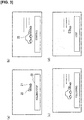
- the display device 11 is installed in the instrument panel and displays the states of the automatic starting control and the preceding vehicle following control, as well as the state of the inter-vehicular space setting, as illustrated in Figure 3.
- Figure 3(a) is a display example during a stop hold.
- Reference symbol 20 in Figure 3(a) indicates the inter-vehicular space setting state; one bar indicates "short,” two bars indicate “medium,” and three bars indicate "long.”
- Reference symbol 21 is a host vehicle mark.
- Reference symbol 22 is a control state display window, which displays messages indicating the stop holding state and the preceding vehicle following control state.
- Figure 3(b) is a display example during a starting control.
- Reference symbol 23 is a preceding vehicle mark to be displayed during an automatic starting control and during a preceding vehicle following control.
- Figure 3(c) is a display example during a preceding vehicle following control
- Figure 3(d) is a display example immediately after the preceding vehicle has been lost.
- the speaker 12 outputs voice representing various control states, and outputs an alarm when necessary. For example, a voice guidance "holding stop” is given when starting a stop holding control, “starting” is given when starting a starting control, and “preceding vehicle lost” is given when the preceding vehicle has been lost. In addition, when the driver operates one of the start switch 1, the cancel switch 2, and the inter-vehicular space setting switch 3, a beep sound confirming the operation is sounded.
- the engine control controller 13 controls the engine output according to an acceleration command from the following control controller 10, and the brake control controller 14 controls the deceleration force of the engine brake and the hydraulic brake according to a deceleration command from the following control controller 10.
- the electric parking brake controller 15 actuates the electric parking brake according to a stop holding command from the following control controller 10.
- the following control controller 10 comprises a CPU 10a, a memory 10b, and the like, and carries out stop holding control, automatic starting control, preceding vehicle following control, display control, and the like based on operation signals from switches 1-3 and detection signals from the various sensors 4-6, and 8.
- the following control controller 10 controls the display device 11, the speaker 12, the engine control controller 13, the brake control controller 14, and the electric parking brake controller 15.
- the memory 10b stores the operation record and the number of times of starting requests of the start switch 1 and the accelerator pedal 7, which are automatic starting operation members, the acceleration command values and the duration of the acceleration command, which are the result of various control calculations, and the like.
- the following control controller 10 comprises a starting control device 30.
- the starting control device 30 is used to carry out a control to start the host vehicle that follows a preceding vehicle that is stopped in front of the host vehicle and comprises a preceding vehicle detection unit 32, a preceding vehicle information acquisition unit 34, a starting request detection unit 35, a starting request frequency detection unit 36, a start permission period setting unit 38, and a start permission unit 40.
- the preceding vehicle detection unit 32 detects a preceding vehicle traveling in front of the host vehicle and a preceding vehicle stopped in front of the host vehicle by executing the preceding vehicle following control provided to the host vehicle.
- the preceding vehicle information acquisition unit 34 acquires information relating to the preceding vehicle detected by the preceding vehicle detection unit 32 as preceding vehicle information. Specifically, the preceding vehicle information acquisition unit 34 acquires the inter-vehicular distance and the relative speed between the preceding vehicle and the host vehicle from the inter-vehicular distance/relative speed sensor 4 and stores the same in the memory 10b.
- the starting request detection unit 35 detects a starting request that is input by the driver of the host vehicle during a stop control of the host vehicle. Specifically, when the start switch 1, which is an automatic starting operation member, is operated, the starting request detection unit 35 detects the presence/absence of a starting request, the number of times of starting requests, and the time from the previous starting request, based on an output signal of the start switch 1. Similarly, when the accelerator pedal 7, which is an automatic starting operation member, is operated, the starting request detection unit 35 detects the presence/absence of a starting request, the number of times of starting requests, and the time from the previous starting request, based on an output signal from the accelerator pedal sensor 6. Additionally, the starting request detection unit 35 outputs a starting request detection signal when acquiring a starting request.
- the starting request frequency detection unit 36 detects the number of times a starting request has been detected after the host vehicle is stopped. Specifically, the starting request frequency detection unit 36 accesses the memory 10b and acquires the starting requests that have been detected from when the host vehicle is stopped to the present, to detect the number of times thereof.
- the starting request detection unit 35 outputs a starting request detection signal when acquiring a starting request
- the start permission period setting unit 38 described below, outputs a start suppression signal for suppressing a starting of the host vehicle when a start permission period has elapsed. Therefore, if a start suppression signal is not being output and only a starting request detection signal is being output, the starting request frequency detection unit 36 determines that it is the first starting request. On the other hand, if both a starting request detection signal and a start suppression signal are being output, it is determined to be the second or subsequent starting request.
- the start permission period setting unit 38 sets a start permission period from when a starting request is input until the starting of the host vehicle is suppressed, in accordance with the number of times of starting requests detected by the starting request frequency detection unit 36. In the present embodiment, the start permission period is changed depending on whether it is the first starting request or a second or subsequent starting request. In addition, the start permission period setting unit 38 outputs a start suppression signal for suppressing the starting of the host vehicle when a start permission period has elapsed and stops the start suppression signal when the next starting request is input.
- the start permission unit 40 calculates the length of the standby period, which is the period from when a starting request is detected until at least one of the inter-vehicular distance and the relative speed, acquired by the preceding vehicle information acquisition unit 34, satisfies a preset start condition. Then, the host vehicle is permitted to start following the preceding vehicle if this standby period is shorter than the length of the start permission period, which is a preset period, and starting is suppressed if the standby period is greater than or equal to the start permission period.
- the start permission unit 40 may allow the host vehicle to start following the preceding vehicle, if at least one of the inter-vehicular distance and the relative speed, acquired by the preceding vehicle information acquisition unit 34, satisfies a preset start condition, within the start permission period set by the start permission period setting unit 38.
- the starting control device 30 is configured from a general-purpose electronic circuit that includes a microcomputer, a microprocessor, and a CPU, and peripheral devices such as a memory. Then, by executing a specific program, the starting control device operates as the preceding vehicle detection unit 32, the preceding vehicle information acquisition unit 34, the starting request detection unit 35, the starting request frequency detection unit 36, the start permission period setting unit 38, and the start permission unit 40 described above.
- the starting request detection unit 35 determines whether or not a starting request, which becomes a starting initiator, has been input from the driver in Step S20, as illustrated in Figure 4 .
- a starting request is input by the driver operating the start switch 1 or the accelerator pedal 7, which are automatic starting operation members. If a starting request has not been input, the process returns to Step S10 and the stop holding control state is maintained.
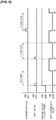
- the starting request detection unit 35 acquires the starting request that has been input and outputs a starting request detection signal, and the process proceeds to Step S30. For example, if the start switch 1 is operated at time t1, the starting request detection unit 35 changes the starting request detection signal from OFF to ON, and outputs the same, as illustrated in Figure 5 . This starting request detection signal is continuously output until the host vehicle is started.
- Step S30 the preceding vehicle detection unit 32 searches for the presence of a preceding vehicle by actuating the inter-vehicular distance/relative speed sensor 4 and detects a preceding vehicle that is stopped in front of the host vehicle.
- the laser radar is stopped while the vehicle is stopped and is operated when confirming the presence of a preceding vehicle. Then, if a preceding vehicle could not be detected, the process proceeds to Step S40, and if a preceding vehicle could be detected, the process proceeds to Step S60.
- Step S40 the starting request detection unit 35 determines whether or not the starting request was input by an operation of the start switch 1.
- a warning "cannot start because there is no preceding vehicle" is issued by the display device 11 and the speaker 12, and the process returns to Step S10 to continue the stop holding control.
- the process proceeds to Step S50.
- Step S50 the following control controller 10 determinations that the driver intends to start even if there is no preceding vehicle, cancels the stop holding control, manually starts the vehicle, and ends the starting control process according to the present embodiment.
- Step S60 the preceding vehicle information acquisition unit 34 acquires the inter-vehicular distance and the relative speed between the preceding vehicle and the host vehicle from the inter-vehicular distance/relative speed sensor 4 as preceding vehicle information.
- Step S70 the starting request frequency detection unit 36 detects the number of times of starting requests.
- the starting request frequency detection unit 36 uses the start suppression signal and the starting request detection signal, described below, and determines whether or not it is the first starting request, or a second or subsequent starting request.
- the starting request detection signal is continuously output from when the first starting request is input until the host vehicle is started, as illustrated in Figure 5 .
- a start suppression signal is output when a start permission period has elapsed. Therefore, if both a starting request detection signal and a start suppression signal are being output when the starting request is input, it can be determined that it is a second or subsequent starting request.
- Step S80 the start permission period setting unit 38 sets a start permission period according to the number of times of starting requests detected in Step S70.
- the start permission period is the period from when a starting request is input until the starting of the host vehicle is suppressed.
- the start permission period is changed depending on whether it is the first starting request or a second or subsequent starting request. For example, if it is the first starting request, the start permission period (t1-t2) is set to 3 seconds, and if it is a second or subsequent starting request, the start permission period (t3-t4, etc.) is set to 3 + ⁇ seconds, as illustrated in Figure 5 .
- the start permission period is set to 3 + ⁇ seconds, in the same manner as the second starting request. Since the intention of the driver to start the host vehicle is greater when inputting a second or subsequent starting request, compared to when inputting the first starting request, the start permission period is set longer for a second and later starting request to reflect said intention.
- Step S90 the start permission period setting unit 38 determines whether or not the start permission period set in Step S80 has elapsed. Then, for example, if the start permission period has not elapsed, such as during times t1-t2 in Figure 5 , the process proceeds to Step S100.
- the start permission period setting unit 38 outputs a start suppression signal for suppressing the starting of the host vehicle as a start prohibition flag, and the process returns to Step S10 to continue the stop holding control.
- the start suppression signal that has been output is stopped when the next starting request is input at time t3 in Figure 5 .
- the host vehicle is suppressed from starting and following the preceding vehicle by outputting a start suppression signal; however, the starting of the host vehicle may be suppressed by stopping the starting request detection signal. For example, at time t2 in Figure 5 , the starting request detection signal may be stopped instead of outputting a start suppression signal.
- Step S100 the start permission unit 40 determines whether or not a start condition has been satisfied. Specifically, the start permission unit 40 determines whether or not at least one of the inter-vehicular distance and the relative speed, acquired in Step S60, satisfies a preset start condition. If the start condition is satisfied, the process proceeds to Step S110, and if the start condition is not satisfied, the process returns to Step S90 to determine whether or not the start permission period has elapsed.
- Step S105 the start permission unit 40 calculates the length of the standby period, which is the period from when a starting request is detected until the start condition is satisfied. Then, the host vehicle is permitted to start following the preceding vehicle if this standby period is shorter than the length of the start permission period, and the process proceeds to Step S110. On the other hand, a start is suppressed when the standby period is greater than or equal to the start permission period, and the process returns to Step S10.
- Step S110 the following control controller 10 executes a preceding vehicle following control to start the host vehicle following the preceding vehicle, and ends the starting control process according to the present embodiment.
- a start permission period is set according to the number of times of starting requests, and the host vehicle is permitted to start and follow the preceding vehicle when the standby period is shorter than the start permission period.
- a start is suppressed when the standby period is greater than or equal to the start permission period. Since a start permission period is thereby set taking into account the number of times of starting requests, it is possible to reflect the intention of the driver to request a start and to prevent inconvenience to the driver.
- the starting control device 30 it is determined whether a starting request is the first starting request or a second or subsequent starting request, and the start permission period is changed depending on whether it is the first starting request or a second or subsequent starting request. Since it is thereby possible to set a start permission period specifically reflecting the intention of the driver to request a start, it is possible to prevent inconvenience to the driver.
- a starting request detection signal is output when a starting request is detected, and a start suppression signal is output when a start permission period has elapsed. Then, if only a starting request detection signal is being output, it is determined that the starting request is the first starting request, and if both a starting request detection signal and a start suppression signal are being output, it is determined to be the second or subsequent starting request. Since it is thereby possible specifically to determine whether a starting request is the first starting request, or a second or subsequent starting request, it is possible set a start permission period reflecting the intention of the driver to request a start and to prevent inconvenience to the driver.
- the starting control device according to the second embodiment of the present invention will be described with reference to the drawings. Since the configuration of the following control system according to the present embodiment is the same as in the first embodiment, a detailed description thereof is omitted.
- the start permission period is changed depending on whether it is the first starting request or a second or subsequent starting request; however, in the present embodiment, the start permission period is changed as the number of times of starting requests increases.
- the starting request detection unit 35 of the present embodiment detects a starting request and stores the same in the memory 10b. Then, the starting request frequency detection unit 36 accesses the memory 10b and counts how many times a starting request has been made including the current starting request to detect the number of times of starting requests. Then, the start permission period setting unit 38 changes the start permission period as the counted number of times of starting requests increases.
- the start permission period is set to 3 seconds, if it is the second starting request, the start permission period is set to 3 + ⁇ seconds, and if it is the third starting request, the start permission period is set to 3 + ⁇ seconds, as illustrated in Figure 6 . Thereafter, the start permission period is gradually increased as the number of times of starting requests increases. At this time, the start permission period may be set with, for example, 10 seconds being the upper limit. Since the intention of the driver to start the host vehicle can be considered to become greater as the number of times that a starting request is input increases, the start permission period is set to be longer as the number of times of starting requests increases to reflect said intention.
- the number of times of starting requests is counted, and the start permission period is changed as the counted number of times of starting requests increases. Since it is thereby possible to set a start permission period specifically reflecting the intention of the driver to request a start, it is possible to prevent inconvenience to the driver.
- the starting control device according to the third embodiment of the present invention will be described, with reference to the drawings. Since the configuration of the following control system according to the present embodiment is the same as in the first embodiment, a detailed description thereof is omitted.
- the present embodiment is different from the above-described embodiments in that the start permission period is changed according to the interval at which starting requests are input.
- the starting request detection unit 35 of the present embodiment detects a starting request, compares the starting request with the previous starting request stored in the memory 10b, and detects the interval between the previous starting request and the current starting request. Then, the start permission period setting unit 38 changes the start permission period according to the interval at which the starting requests are input.
- the start permission period is set to be short when the interval between the starting requests is long, and the start permission period is set to become longer as the interval between the starting requests becomes shorter, as illustrated in Figure 7 . Since the intention of the driver to start the host vehicle can be considered to be strong if the interval between starting requests is short, that is, when starting requests are being frequently input, the start permission period is set to be longer as the interval between the starting requests becomes shorter to reflect said intention.
- the interval at which the driver of the host vehicle inputs starting requests is detected, and the start permission period is changed according to the interval at which starting requests are input. Since it is thereby possible to set a start permission period specifically reflecting the intention of the driver to request a start, it is possible to prevent inconvenience to the driver.
Landscapes
- Engineering & Computer Science (AREA)
- Transportation (AREA)
- Mechanical Engineering (AREA)
- Automation & Control Theory (AREA)
- Chemical & Material Sciences (AREA)
- Combustion & Propulsion (AREA)
- Human Computer Interaction (AREA)
- Mathematical Physics (AREA)
- Physics & Mathematics (AREA)
- Control Of Driving Devices And Active Controlling Of Vehicle (AREA)
- Control Of Vehicle Engines Or Engines For Specific Uses (AREA)
- Controls For Constant Speed Travelling (AREA)
- Traffic Control Systems (AREA)
Abstract
Description
- The present invention relates to a starting control device and a starting control method for starting a host vehicle following a preceding vehicle that is stopped in front of the host vehicle.
- Patent Document 1 discloses a conventional following travel control device that sets a preceding vehicle for a host vehicle to follow and carries out a following travel control. In the following travel control device disclosed in Patent Document 1, if a starting request by the driver is stored while the vehicle is stopped in a signal waiting state or on a congested road, a following travel control is initiated when a start of the preceding vehicle is detected. On the other hand, if a start of the preceding vehicle is not detected within a predetermined time after the starting request is stored, the stored starting request is erased.
- Patent Document 1: Japanese Patent No.
4230385 - However, in the conventional following travel control device described above, the number of times that the driver made a starting request while the vehicle is stopped is not considered. Consequently, there is the problem that if the preceding vehicle does not start in a timely manner, it is necessary for the driver to make a starting request many times in order to resume following the preceding vehicle, which inconveniences the driver.
- Therefore, in view of the circumstances described above, an object of the present invention is to provide a starting control device and a method thereof to prevent inconvenience to the driver, by taking into account the history of the driver's starting requests.
- In order to achieve the object described above, the starting control device and method according to one embodiment of the present invention detects a preceding vehicle that is stopped in front of a host vehicle, acquires the relative speed and the inter-vehicular distance between the detected preceding vehicle and the host vehicle, and detects a starting request input by the driver of the host vehicle. Then, the number of times that a starting request has been detected after the host vehicle has stopped is detected, and a start permission period is set according to the detected number of times of starting requests. Thereafter, the host vehicle is permitted to start and follow the preceding vehicle when a standby period, which is the period from when the starting request is detected to when at least one of the relative speed and the inter-vehicular distance satisfies a preset start condition, is shorter than the start permission period. In addition, a start is suppressed when the standby period is greater than or equal to the start permission period.
- According to the present invention, since a start permission period is set taking into consideration the number of times of starting requests, it is possible to reflect the intention of the driver to request a start, and to prevent inconvenience to the driver.
-
- [
Figure 1] Figure 1 is a block diagram illustrating the configuration of a following control system according to the first embodiment of the present invention. - [
Figure 2] Figure 2 shows the schematic arrangement of switches of the following control system according to the first embodiment of the present invention. - [
Figure 3] Figure 3 is a view illustrating one example of a display by the following control system according to the first embodiment of the present invention. - [
Figure 4] Figure 4 is a flowchart illustrating the processing procedure of a starting control process by the starting control device according to the first embodiment of the present invention. - [
Figure 5] Figure 5 is a view for explaining the method of setting the start permission period by the starting control device according to the first embodiment of the present invention. - [
Figure 6] Figure 6 is a view for explaining the method of setting the start permission period by the starting control device according to the second embodiment of the present invention. - [
Figure 7] Figure 7 is a view for explaining the method of setting the start permission period by the starting control device according to the third embodiment of the present invention. - The first to the third embodiments to which the present invention is applied are described below with reference to the drawings. In all the embodiments, the same components have been assigned the same numbers, and detailed descriptions thereof are omitted.
-
Figure 1 is a block diagram illustrating the configuration of a following control system equipped with the starting control device according to the present embodiment. The followingcontrol system 100 according to the present embodiment comprises a start switch 1, acancel switch 2, an inter-vehicularspace setting switch 3, an inter-vehicular distance/relative speed sensor 4, a hostvehicle speed sensor 5, anaccelerator pedal sensor 6, and abrake pedal sensor 8, as illustrated inFigure 1 . In addition, the followingcontrol system 100 comprises a followingcontrol controller 10, adisplay device 11, aspeaker 12, anengine control controller 13, abrake control controller 14, and an electricparking brake controller 15. The followingcontrol controller 10 comprises astarting control device 30. - The following
control system 100 comprises a low-speed following function and is mounted in a vehicle. In the present embodiment, if a preceding vehicle is detected in a host vehicle lane when the host vehicle speed is in the range of, for example, 40-100 km/h, an inter-vehicular space control is carried out such that an inter-vehicular time (= inter-vehicular distance/relative speed) to the preceding vehicle becomes a preset value for following the preceding vehicle. At this time, the preset vehicle speed (set vehicle speed) is set as the upper limit. On the other hand, if a preceding vehicle is not detected in the host vehicle lane, a vehicle speed control is carried out such that the vehicle travels at a constant speed at the set vehicle speed. - In addition, in the low-speed following function, if a preceding vehicle is detected in a host vehicle lane when the host vehicle speed is in the range of, for example, 0-40 km/h, an inter-vehicular distance control is carried out such that the inter-vehicular distance becomes an inter-vehicular distance corresponding to the host vehicle speed, with 40 km/h being the upper limit. Then, when a preceding vehicle is no longer detected, the inter-vehicular distance control is canceled. In addition, when the preceding vehicle stops, an electric parking brake is actuated after the host vehicle is stopped to carry out a stop holding control, and when the preceding vehicle starts and a predetermined automatic starting operation member is operated, an automatic starting control is carried out.
- However, the preceding vehicle following control is not limited to the control described above. The preceding vehicle following control is not limited as long as a control is carried out at least from vehicle speed zero, a stop holding control is carried out after the host vehicle is stopped when the preceding vehicle stops, and an automatic starting control is carried out if the preceding vehicle starts when a predetermined automatic starting operation member is operated.
- The start switch 1 is an automatic starting operation member that is operated in order to start an automatic starting control when the preceding vehicle starts while in a stop holding state. If the start switch 1 is operated during a stop holding control, the operation becomes a starting request by the driver. In the present embodiment, the presence/absence of a starting request, the number of times of starting requests, and the time from the previous starting request are detected based on an output signal from the start switch 1, and a starting request is set. This start switch 1 is installed in a
center pad portion 19a of thesteering wheel 19, as illustrated inFigure 2 . - The
cancel switch 2 is an operation member for canceling the automatic starting control and the preceding vehicle following control and is installed in thecenter pad portion 19a of thesteering wheel 19, as illustrated inFigure 2 . The inter-vehicularspace setting switch 3 is an operation member for setting a target inter-vehicular space (inter-vehicular time or inter-vehicular distance), and the target inter-vehicular space is toggled in the order of long, medium, and short, each time the switch is operated. This inter-vehicularspace setting switch 3 is also installed in thecenter pad portion 19a of thesteering wheel 19, as illustrated inFigure 2 . - The inter-vehicular distance/
relative speed sensor 4 measures the inter-vehicular distance between the host vehicle and the preceding vehicle and calculates the relative speed by differentiating this measured value. Various sensors, such as a laser radar or a millimeter wave radar, can be used for the inter-vehicular distance/relative speed sensor 4. The hostvehicle speed sensor 5 measures the travel speed of the host vehicle from the wheel speed. - The
accelerator pedal sensor 6 outputs a signal corresponding to the depression amount (operation amount) of theaccelerator pedal 7. Theaccelerator pedal 7 is an automatic starting operation member that is operated in order to start an automatic starting control when the preceding vehicle starts while in a stop holding state, in the same manner as the start switch 1 described above. If theaccelerator pedal 7 is operated during a stop holding control, the operation becomes a starting request by the driver. In the present embodiment, the presence/absence of a starting request, the number of times of starting requests, and the time from the previous starting request are detected based on an output signal from theaccelerator pedal sensor 6, and a starting request is set. - The
brake pedal sensor 8 detects a depression of thebrake pedal 9. When a depression of thebrake pedal 9 is detected, the automatic starting control and the preceding vehicle following control are canceled. - The
display device 11 is installed in the instrument panel and displays the states of the automatic starting control and the preceding vehicle following control, as well as the state of the inter-vehicular space setting, as illustrated inFigure 3. Figure 3(a) is a display example during a stop hold.Reference symbol 20 inFigure 3(a) indicates the inter-vehicular space setting state; one bar indicates "short," two bars indicate "medium," and three bars indicate "long."Reference symbol 21 is a host vehicle mark.Reference symbol 22 is a control state display window, which displays messages indicating the stop holding state and the preceding vehicle following control state.Figure 3(b) is a display example during a starting control.Reference symbol 23 is a preceding vehicle mark to be displayed during an automatic starting control and during a preceding vehicle following control.Figure 3(c) is a display example during a preceding vehicle following control, andFigure 3(d) is a display example immediately after the preceding vehicle has been lost. - The
speaker 12 outputs voice representing various control states, and outputs an alarm when necessary. For example, a voice guidance "holding stop" is given when starting a stop holding control, "starting" is given when starting a starting control, and "preceding vehicle lost" is given when the preceding vehicle has been lost. In addition, when the driver operates one of the start switch 1, the cancelswitch 2, and the inter-vehicularspace setting switch 3, a beep sound confirming the operation is sounded. - The
engine control controller 13 controls the engine output according to an acceleration command from the followingcontrol controller 10, and thebrake control controller 14 controls the deceleration force of the engine brake and the hydraulic brake according to a deceleration command from the followingcontrol controller 10. The electricparking brake controller 15 actuates the electric parking brake according to a stop holding command from the followingcontrol controller 10. - The following
control controller 10 comprises aCPU 10a, amemory 10b, and the like, and carries out stop holding control, automatic starting control, preceding vehicle following control, display control, and the like based on operation signals from switches 1-3 and detection signals from the various sensors 4-6, and 8. In addition, the followingcontrol controller 10 controls thedisplay device 11, thespeaker 12, theengine control controller 13, thebrake control controller 14, and the electricparking brake controller 15. Thememory 10b stores the operation record and the number of times of starting requests of the start switch 1 and theaccelerator pedal 7, which are automatic starting operation members, the acceleration command values and the duration of the acceleration command, which are the result of various control calculations, and the like. Then, the followingcontrol controller 10 comprises a startingcontrol device 30. - The starting
control device 30 is used to carry out a control to start the host vehicle that follows a preceding vehicle that is stopped in front of the host vehicle and comprises a precedingvehicle detection unit 32, a preceding vehicleinformation acquisition unit 34, a startingrequest detection unit 35, a starting requestfrequency detection unit 36, a start permissionperiod setting unit 38, and astart permission unit 40. - The preceding
vehicle detection unit 32 detects a preceding vehicle traveling in front of the host vehicle and a preceding vehicle stopped in front of the host vehicle by executing the preceding vehicle following control provided to the host vehicle. - The preceding vehicle
information acquisition unit 34 acquires information relating to the preceding vehicle detected by the precedingvehicle detection unit 32 as preceding vehicle information. Specifically, the preceding vehicleinformation acquisition unit 34 acquires the inter-vehicular distance and the relative speed between the preceding vehicle and the host vehicle from the inter-vehicular distance/relative speed sensor 4 and stores the same in thememory 10b. - The starting
request detection unit 35 detects a starting request that is input by the driver of the host vehicle during a stop control of the host vehicle. Specifically, when the start switch 1, which is an automatic starting operation member, is operated, the startingrequest detection unit 35 detects the presence/absence of a starting request, the number of times of starting requests, and the time from the previous starting request, based on an output signal of the start switch 1. Similarly, when theaccelerator pedal 7, which is an automatic starting operation member, is operated, the startingrequest detection unit 35 detects the presence/absence of a starting request, the number of times of starting requests, and the time from the previous starting request, based on an output signal from theaccelerator pedal sensor 6. Additionally, the startingrequest detection unit 35 outputs a starting request detection signal when acquiring a starting request. - The starting request
frequency detection unit 36 detects the number of times a starting request has been detected after the host vehicle is stopped. Specifically, the starting requestfrequency detection unit 36 accesses thememory 10b and acquires the starting requests that have been detected from when the host vehicle is stopped to the present, to detect the number of times thereof. - In addition, the starting
request detection unit 35 outputs a starting request detection signal when acquiring a starting request, and the start permissionperiod setting unit 38, described below, outputs a start suppression signal for suppressing a starting of the host vehicle when a start permission period has elapsed. Therefore, if a start suppression signal is not being output and only a starting request detection signal is being output, the starting requestfrequency detection unit 36 determines that it is the first starting request. On the other hand, if both a starting request detection signal and a start suppression signal are being output, it is determined to be the second or subsequent starting request. - The start permission
period setting unit 38 sets a start permission period from when a starting request is input until the starting of the host vehicle is suppressed, in accordance with the number of times of starting requests detected by the starting requestfrequency detection unit 36. In the present embodiment, the start permission period is changed depending on whether it is the first starting request or a second or subsequent starting request. In addition, the start permissionperiod setting unit 38 outputs a start suppression signal for suppressing the starting of the host vehicle when a start permission period has elapsed and stops the start suppression signal when the next starting request is input. - The
start permission unit 40 calculates the length of the standby period, which is the period from when a starting request is detected until at least one of the inter-vehicular distance and the relative speed, acquired by the preceding vehicleinformation acquisition unit 34, satisfies a preset start condition. Then, the host vehicle is permitted to start following the preceding vehicle if this standby period is shorter than the length of the start permission period, which is a preset period, and starting is suppressed if the standby period is greater than or equal to the start permission period. Additionally, thestart permission unit 40 may allow the host vehicle to start following the preceding vehicle, if at least one of the inter-vehicular distance and the relative speed, acquired by the preceding vehicleinformation acquisition unit 34, satisfies a preset start condition, within the start permission period set by the start permissionperiod setting unit 38. - The starting
control device 30 is configured from a general-purpose electronic circuit that includes a microcomputer, a microprocessor, and a CPU, and peripheral devices such as a memory. Then, by executing a specific program, the starting control device operates as the precedingvehicle detection unit 32, the preceding vehicleinformation acquisition unit 34, the startingrequest detection unit 35, the starting requestfrequency detection unit 36, the start permissionperiod setting unit 38, and thestart permission unit 40 described above. - Next, the procedure of the starting control process by the starting
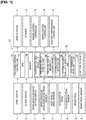
control device 30 according to the present embodiment will be described with reference to the flowchart ofFigure 4 . InFigure 4 , an operation from the stop holding control state will be described. - When the host vehicle enters a stop holding control state in Step S10, the starting
request detection unit 35 determines whether or not a starting request, which becomes a starting initiator, has been input from the driver in Step S20, as illustrated inFigure 4 . A starting request is input by the driver operating the start switch 1 or theaccelerator pedal 7, which are automatic starting operation members. If a starting request has not been input, the process returns to Step S10 and the stop holding control state is maintained. On the other hand, if a starting request has been input, the startingrequest detection unit 35 acquires the starting request that has been input and outputs a starting request detection signal, and the process proceeds to Step S30. For example, if the start switch 1 is operated at time t1, the startingrequest detection unit 35 changes the starting request detection signal from OFF to ON, and outputs the same, as illustrated inFigure 5 . This starting request detection signal is continuously output until the host vehicle is started. - In Step S30, the preceding
vehicle detection unit 32 searches for the presence of a preceding vehicle by actuating the inter-vehicular distance/relative speed sensor 4 and detects a preceding vehicle that is stopped in front of the host vehicle. At this time, if laser radar is used, in order to avoid laser light from being irradiated onto a pedestrian, the laser radar is stopped while the vehicle is stopped and is operated when confirming the presence of a preceding vehicle. Then, if a preceding vehicle could not be detected, the process proceeds to Step S40, and if a preceding vehicle could be detected, the process proceeds to Step S60. - In Step S40, the starting
request detection unit 35 determines whether or not the starting request was input by an operation of the start switch 1. Here, if the starting request was input by an operation of the start switch 1, a warning "cannot start because there is no preceding vehicle" is issued by thedisplay device 11 and thespeaker 12, and the process returns to Step S10 to continue the stop holding control. On the other hand, if the starting request was input not by the start switch 1 but by an operation of theaccelerator pedal 7, the process proceeds to Step S50. - In Step S50, the following
control controller 10 determinations that the driver intends to start even if there is no preceding vehicle, cancels the stop holding control, manually starts the vehicle, and ends the starting control process according to the present embodiment. - In Step S60, the preceding vehicle
information acquisition unit 34 acquires the inter-vehicular distance and the relative speed between the preceding vehicle and the host vehicle from the inter-vehicular distance/relative speed sensor 4 as preceding vehicle information. - In Step S70, the starting request
frequency detection unit 36 detects the number of times of starting requests. In the present embodiment, the starting requestfrequency detection unit 36 uses the start suppression signal and the starting request detection signal, described below, and determines whether or not it is the first starting request, or a second or subsequent starting request. - For example, at time t1, only a starting request detection signal is output, and a start suppression signal is OFF and not output, as illustrated in
Figure 5 ; therefore, it is determined that the starting request at time t1 is the first starting request. In addition, at time t3, since both a starting request detection signal and a start suppression signal are being output, it is determined that the starting request at time t3 is a second or subsequent starting request. - The starting request detection signal is continuously output from when the first starting request is input until the host vehicle is started, as illustrated in
Figure 5 . In addition, a start suppression signal is output when a start permission period has elapsed. Therefore, if both a starting request detection signal and a start suppression signal are being output when the starting request is input, it can be determined that it is a second or subsequent starting request. - In Step S80, the start permission
period setting unit 38 sets a start permission period according to the number of times of starting requests detected in Step S70. The start permission period is the period from when a starting request is input until the starting of the host vehicle is suppressed. In the present embodiment, the start permission period is changed depending on whether it is the first starting request or a second or subsequent starting request. For example, if it is the first starting request, the start permission period (t1-t2) is set to 3 seconds, and if it is a second or subsequent starting request, the start permission period (t3-t4, etc.) is set to 3 + α seconds, as illustrated inFigure 5 . Even when it is the third or fourth starting request, the start permission period is set to 3 + α seconds, in the same manner as the second starting request. Since the intention of the driver to start the host vehicle is greater when inputting a second or subsequent starting request, compared to when inputting the first starting request, the start permission period is set longer for a second and later starting request to reflect said intention. - In Step S90, the start permission
period setting unit 38 determines whether or not the start permission period set in Step S80 has elapsed. Then, for example, if the start permission period has not elapsed, such as during times t1-t2 inFigure 5 , the process proceeds to Step S100. - On the other hand, if the time is after time t2 in
Figure 5 and the start permission period has elapsed, the start permissionperiod setting unit 38 outputs a start suppression signal for suppressing the starting of the host vehicle as a start prohibition flag, and the process returns to Step S10 to continue the stop holding control. The start suppression signal that has been output is stopped when the next starting request is input at time t3 inFigure 5 . - In addition, in the present embodiment, the host vehicle is suppressed from starting and following the preceding vehicle by outputting a start suppression signal; however, the starting of the host vehicle may be suppressed by stopping the starting request detection signal. For example, at time t2 in
Figure 5 , the starting request detection signal may be stopped instead of outputting a start suppression signal. - In Step S100, the
start permission unit 40 determines whether or not a start condition has been satisfied. Specifically, thestart permission unit 40 determines whether or not at least one of the inter-vehicular distance and the relative speed, acquired in Step S60, satisfies a preset start condition. If the start condition is satisfied, the process proceeds to Step S110, and if the start condition is not satisfied, the process returns to Step S90 to determine whether or not the start permission period has elapsed. - In Step S105, the
start permission unit 40 calculates the length of the standby period, which is the period from when a starting request is detected until the start condition is satisfied. Then, the host vehicle is permitted to start following the preceding vehicle if this standby period is shorter than the length of the start permission period, and the process proceeds to Step S110. On the other hand, a start is suppressed when the standby period is greater than or equal to the start permission period, and the process returns to Step S10. - In Step S110, the following
control controller 10 executes a preceding vehicle following control to start the host vehicle following the preceding vehicle, and ends the starting control process according to the present embodiment. - As described above in detail, in the starting
control device 30 according to the present embodiment, a start permission period is set according to the number of times of starting requests, and the host vehicle is permitted to start and follow the preceding vehicle when the standby period is shorter than the start permission period. In addition, a start is suppressed when the standby period is greater than or equal to the start permission period. Since a start permission period is thereby set taking into account the number of times of starting requests, it is possible to reflect the intention of the driver to request a start and to prevent inconvenience to the driver. - In addition, in the starting
control device 30 according to the present embodiment, it is determined whether a starting request is the first starting request or a second or subsequent starting request, and the start permission period is changed depending on whether it is the first starting request or a second or subsequent starting request. Since it is thereby possible to set a start permission period specifically reflecting the intention of the driver to request a start, it is possible to prevent inconvenience to the driver. - Additionally, in the starting
control device 30 according to the present embodiment, a starting request detection signal is output when a starting request is detected, and a start suppression signal is output when a start permission period has elapsed. Then, if only a starting request detection signal is being output, it is determined that the starting request is the first starting request, and if both a starting request detection signal and a start suppression signal are being output, it is determined to be the second or subsequent starting request. Since it is thereby possible specifically to determine whether a starting request is the first starting request, or a second or subsequent starting request, it is possible set a start permission period reflecting the intention of the driver to request a start and to prevent inconvenience to the driver. - Next, the starting control device according to the second embodiment of the present invention will be described with reference to the drawings. Since the configuration of the following control system according to the present embodiment is the same as in the first embodiment, a detailed description thereof is omitted. In the first embodiment, the start permission period is changed depending on whether it is the first starting request or a second or subsequent starting request; however, in the present embodiment, the start permission period is changed as the number of times of starting requests increases.
- When the start switch 1 or the
accelerator pedal 7, which are automatic starting operation members, is operated, the startingrequest detection unit 35 of the present embodiment detects a starting request and stores the same in thememory 10b. Then, the starting requestfrequency detection unit 36 accesses thememory 10b and counts how many times a starting request has been made including the current starting request to detect the number of times of starting requests. Then, the start permissionperiod setting unit 38 changes the start permission period as the counted number of times of starting requests increases. - For example, if it is the first starting request, the start permission period is set to 3 seconds, if it is the second starting request, the start permission period is set to 3 + α seconds, and if it is the third starting request, the start permission period is set to 3 + β seconds, as illustrated in
Figure 6 . Thereafter, the start permission period is gradually increased as the number of times of starting requests increases. At this time, the start permission period may be set with, for example, 10 seconds being the upper limit. Since the intention of the driver to start the host vehicle can be considered to become greater as the number of times that a starting request is input increases, the start permission period is set to be longer as the number of times of starting requests increases to reflect said intention. - As described above in detail, in the starting
control device 30 according to the present embodiment, the number of times of starting requests is counted, and the start permission period is changed as the counted number of times of starting requests increases. Since it is thereby possible to set a start permission period specifically reflecting the intention of the driver to request a start, it is possible to prevent inconvenience to the driver. - Next, the starting control device according to the third embodiment of the present invention will be described, with reference to the drawings. Since the configuration of the following control system according to the present embodiment is the same as in the first embodiment, a detailed description thereof is omitted. The present embodiment is different from the above-described embodiments in that the start permission period is changed according to the interval at which starting requests are input.
- When the start switch 1 or the
accelerator pedal 7, which are automatic starting operation members, is operated, the startingrequest detection unit 35 of the present embodiment detects a starting request, compares the starting request with the previous starting request stored in thememory 10b, and detects the interval between the previous starting request and the current starting request. Then, the start permissionperiod setting unit 38 changes the start permission period according to the interval at which the starting requests are input. - For example, the start permission period is set to be short when the interval between the starting requests is long, and the start permission period is set to become longer as the interval between the starting requests becomes shorter, as illustrated in
Figure 7 . Since the intention of the driver to start the host vehicle can be considered to be strong if the interval between starting requests is short, that is, when starting requests are being frequently input, the start permission period is set to be longer as the interval between the starting requests becomes shorter to reflect said intention. - As described above in detail, in the starting
control device 30 according to the present embodiment, the interval at which the driver of the host vehicle inputs starting requests is detected, and the start permission period is changed according to the interval at which starting requests are input. Since it is thereby possible to set a start permission period specifically reflecting the intention of the driver to request a start, it is possible to prevent inconvenience to the driver. - The above-described embodiments are examples of the present invention. Accordingly, the present invention is not limited to the embodiments described above, and various modifications may be made in other forms besides those of the foregoing embodiments insofar as such changes are not outside the technical scope of the present invention.
-
- 1
- Start switch
- 2
- Cancel switch
- 3
- Inter-vehicular space setting switch
- 4
- Inter-vehicular distance/relative speed sensor
- 5
- Host vehicle speed sensor
- 6
- Accelerator pedal sensor
- 7
- Accelerator pedal
- 8
- Brake pedal sensor
- 9
- Brake pedal
- 10
- Following control controller
- 11
- Display device
- 12
- Speaker
- 13
- Engine control controller
- 14
- Brake control controller
- 15
- Electric parking brake controller
- 30
- Starting control device
- 32
- Preceding vehicle detection unit
- 34
- Preceding vehicle information acquisition unit
- 35
- Starting request detection unit
- 36
- Starting request frequency detection unit
- 38
- Start permission period setting unit
- 40
- Start permission unit
- 100
- Following control system
Claims (6)
- A starting control device for starting a host vehicle following a preceding vehicle that is stopped in front of the host vehicle, comprising:a preceding vehicle detection unit that detects a preceding vehicle that is stopped in front of the host vehicle;a preceding vehicle information acquisition unit that acquires an inter-vehicular distance and a relative speed between the host vehicle and the preceding vehicle detected by the preceding vehicle detection unit;a starting request detection unit that detects a starting request that is input by a driver of the host vehicle;a start permission unit that permits the host vehicle to start following a preceding vehicle when a standby period, which is a period from when the starting request is detected to when at least one of the relative speed and the inter-vehicular distance acquired by the preceding vehicle information acquisition unit satisfies a preset start condition, is shorter than a start permission period that is set in advance, and that suppresses a start when the standby period is greater than or equal to the start permission period;a starting request frequency detection unit that detects a number of times that the starting request has been detected after the host vehicle is stopped; anda start permission period setting unit that sets the start permission period according to the number of times of the starting requests detected by the starting request frequency detection unit.
- The starting control device as recited in claim 1, wherein
the starting request frequency detection unit determines whether or not a starting request is the first starting request or a second or subsequent starting request, and
the start permission period setting unit changes the start permission period depending on whether the starting request is a first starting request or a second or subsequent starting request. - The starting control device as recited in claim 2, wherein
the starting request detection unit outputs a starting request detection signal upon detecting the starting request,
the start permission period setting unit outputs a start suppression signal for suppressing the starting of the host vehicle when the start permission period has elapsed, and
the starting request frequency detection unit determines that the starting request is the first starting request if only the starting request detection signal is being outputted, and determines that the starting request is the second or subsequent starting request if both the starting request detection signal and the start suppression signal are being outputted. - The starting control device as recited in claim 1, wherein
the starting request frequency detection unit counts a number of times of the starting requests, and
the start permission period setting unit changes the start permission period as a counted number of times of the starting requests increases. - The starting control device as recited in claim 1, wherein
the starting request detection unit detects an interval at which a driver of the host vehicle inputs the starting requests, and
the start permission period setting unit changes the start permission period according to the interval at which the starting requests are inputted. - A starting control method to start a host vehicle following a preceding vehicle that is stopped in front of the host vehicle using a starting control device, the starting control method comprising:detecting the preceding vehicle is stopped in the front of the host vehicle;acquiring an inter-vehicular distance and a relative speed between the host vehicle and the preceding vehicle that is detected;detecting a starting request that is input by a driver of the host vehicle;permitting the host vehicle to start following a preceding vehicle when a standby period, which is the period from when the starting request is detected to when at least one of the relative speed and the inter-vehicular distance satisfies a preset start condition, is shorter than a start permission period that is set in advance, and suppressing a start when the standby period is greater than or equal to the start permission period;detecting a number of times that the starting request has been detected after the host vehicle has stopped; andsettings the start permission period according to the number of times of the starting requests has been detected.
Applications Claiming Priority (1)
| Application Number | Priority Date | Filing Date | Title |
|---|---|---|---|
| PCT/JP2015/070098 WO2017009940A1 (en) | 2015-07-14 | 2015-07-14 | Start control device and start control method |
Publications (3)
| Publication Number | Publication Date |
|---|---|
| EP3323688A1 true EP3323688A1 (en) | 2018-05-23 |
| EP3323688A4 EP3323688A4 (en) | 2018-08-15 |
| EP3323688B1 EP3323688B1 (en) | 2022-02-23 |
Family
ID=57757116
Family Applications (1)
| Application Number | Title | Priority Date | Filing Date |
|---|---|---|---|
| EP15898253.8A Active EP3323688B1 (en) | 2015-07-14 | 2015-07-14 | Start control device and start control method |
Country Status (9)
| Country | Link |
|---|---|
| US (1) | US10059340B2 (en) |
| EP (1) | EP3323688B1 (en) |
| JP (1) | JP6388079B2 (en) |
| KR (1) | KR101921874B1 (en) |
| CN (1) | CN107848535B (en) |
| CA (1) | CA2992399C (en) |
| MX (1) | MX364628B (en) |
| RU (1) | RU2664028C1 (en) |
| WO (1) | WO2017009940A1 (en) |
Cited By (2)
| Publication number | Priority date | Publication date | Assignee | Title |
|---|---|---|---|---|
| EP4212400A4 (en) * | 2020-08-28 | 2024-01-10 | Nissan Motor Co., Ltd. | Driving assistance method and driving assistance device |
| FR3151269A1 (en) * | 2023-07-21 | 2025-01-24 | Psa Automobiles Sa | Method and device for controlling an adaptive cruise control system on board a vehicle via steering wheel paddles |
Families Citing this family (8)
| Publication number | Priority date | Publication date | Assignee | Title |
|---|---|---|---|---|
| CN109866770A (en) * | 2019-02-28 | 2019-06-11 | 重庆长安汽车股份有限公司 | A kind of adaptive cruise control method, apparatus, system and automobile |
| JP7151566B2 (en) | 2019-03-14 | 2022-10-12 | トヨタ自動車株式会社 | Vehicle running control device |
| JP7012693B2 (en) * | 2019-09-24 | 2022-01-28 | 本田技研工業株式会社 | Information processing equipment, vehicle systems, information processing methods, and programs |
| JP7259778B2 (en) | 2020-01-31 | 2023-04-18 | トヨタ自動車株式会社 | Vehicles and automated driving systems |
| JP7413842B2 (en) * | 2020-02-28 | 2024-01-16 | いすゞ自動車株式会社 | Driving support device and driving support method |
| US12157467B2 (en) | 2020-08-28 | 2024-12-03 | Nissan Motor Co., Ltd. | Driving assist method and driving assist device for detecting cut-in vehicle when host vehicle is stopped |
| WO2022044253A1 (en) | 2020-08-28 | 2022-03-03 | 日産自動車株式会社 | Driving assistance method and driving assistance device |
| US12179727B2 (en) * | 2022-10-17 | 2024-12-31 | Ford Global Technologies, Llc | Vehicle brake control |
Family Cites Families (13)
| Publication number | Priority date | Publication date | Assignee | Title |
|---|---|---|---|---|
| JP2722656B2 (en) * | 1989-04-29 | 1998-03-04 | 日産自動車株式会社 | Vehicle air conditioner |
| JPH0459449A (en) * | 1990-06-27 | 1992-02-26 | A C Ii:Kk | Automotive alarm device for warning of automobile ahead |
| DE69322349T3 (en) * | 1992-09-30 | 2004-06-09 | Hitachi, Ltd. | Information system for the driver of a vehicle |
| JP2003260957A (en) * | 2002-03-11 | 2003-09-16 | Hitachi Ltd | Headway control system |
| JP2005231491A (en) | 2004-02-19 | 2005-09-02 | Honda Motor Co Ltd | Follow-up control device |
| JP4230385B2 (en) * | 2004-03-05 | 2009-02-25 | 本田技研工業株式会社 | Follow-up control device |
| JP2007069729A (en) * | 2005-09-07 | 2007-03-22 | Nissan Motor Co Ltd | Travel control device |
| RU2431577C2 (en) * | 2007-04-20 | 2011-10-20 | Вольво Ластвагнар Аб | Method of increasing transport facility automatic free running interval |
| US8615352B2 (en) * | 2010-03-30 | 2013-12-24 | Fuji Jukogyo Kabushiki Kaisha | Driving support apparatus for vehicle |
| JP5273110B2 (en) * | 2010-09-08 | 2013-08-28 | 株式会社デンソー | Start control device |
| JP5545243B2 (en) * | 2011-02-28 | 2014-07-09 | 株式会社デンソー | Accelerator pedal misoperation device and program for accelerator pedal misoperation device |
| JP5939130B2 (en) * | 2012-10-31 | 2016-06-22 | トヨタ自動車株式会社 | Driving assistance device |
| CN106321259B (en) * | 2016-11-24 | 2019-03-15 | 安徽江淮汽车集团股份有限公司 | A kind of engine control and system |
-
2015
- 2015-07-14 JP JP2017528044A patent/JP6388079B2/en active Active
- 2015-07-14 RU RU2018105183A patent/RU2664028C1/en active
- 2015-07-14 MX MX2018000439A patent/MX364628B/en active IP Right Grant
- 2015-07-14 KR KR1020187001805A patent/KR101921874B1/en not_active Expired - Fee Related
- 2015-07-14 CA CA2992399A patent/CA2992399C/en active Active
- 2015-07-14 CN CN201580081676.0A patent/CN107848535B/en active Active
- 2015-07-14 WO PCT/JP2015/070098 patent/WO2017009940A1/en not_active Ceased
- 2015-07-14 US US15/580,734 patent/US10059340B2/en active Active
- 2015-07-14 EP EP15898253.8A patent/EP3323688B1/en active Active
Cited By (2)
| Publication number | Priority date | Publication date | Assignee | Title |
|---|---|---|---|---|
| EP4212400A4 (en) * | 2020-08-28 | 2024-01-10 | Nissan Motor Co., Ltd. | Driving assistance method and driving assistance device |
| FR3151269A1 (en) * | 2023-07-21 | 2025-01-24 | Psa Automobiles Sa | Method and device for controlling an adaptive cruise control system on board a vehicle via steering wheel paddles |
Also Published As
| Publication number | Publication date |
|---|---|
| CA2992399A1 (en) | 2017-01-19 |
| CN107848535B (en) | 2019-08-20 |
| RU2664028C1 (en) | 2018-08-14 |
| JP6388079B2 (en) | 2018-09-12 |
| BR112018000737A2 (en) | 2018-09-04 |
| US10059340B2 (en) | 2018-08-28 |
| CA2992399C (en) | 2018-06-05 |
| JPWO2017009940A1 (en) | 2018-04-12 |
| EP3323688B1 (en) | 2022-02-23 |
| KR101921874B1 (en) | 2018-11-23 |
| MX364628B (en) | 2019-05-03 |
| EP3323688A4 (en) | 2018-08-15 |
| WO2017009940A1 (en) | 2017-01-19 |
| MX2018000439A (en) | 2018-05-17 |
| CN107848535A (en) | 2018-03-27 |
| US20180141551A1 (en) | 2018-05-24 |
| KR20180011341A (en) | 2018-01-31 |
Similar Documents
| Publication | Publication Date | Title |
|---|---|---|
| EP3323688B1 (en) | Start control device and start control method | |
| JP6611085B2 (en) | Vehicle control device | |
| KR101719527B1 (en) | Emergency brake assistance system for supporting a driver of a vehicle while staring | |
| US9079571B2 (en) | Method for operating a brake assist device and brake assist device for a vehicle | |
| CN103477378B (en) | Drive assistance device | |
| WO2018116619A1 (en) | Driver state determination device for vehicle | |
| JP2008245268A (en) | Vehicle communication apparatus and vehicle communication method | |
| JP2002163798A (en) | Inter-vehicle distance warning device and display device | |
| JP5642761B2 (en) | Driving assistance device | |
| CN104802797A (en) | Distance Information System and Method for a Motor Vehicle | |
| JP5446306B2 (en) | Driving assistance device | |
| JP5683652B2 (en) | Driving assistance device | |
| JP5906895B2 (en) | Tracking control device | |
| CN108382393B (en) | Driving assistance apparatus and driving assistance system | |
| JP3334326B2 (en) | Stopper distance alarm | |
| JP2009176221A (en) | Driving assistance device | |
| JP6604368B2 (en) | Vehicle control device | |
| JPH10151964A (en) | Vehicle cruise control system | |
| JP2001076299A (en) | Preceding vehicle start detection device | |
| JP4356473B2 (en) | Driver state estimation device and alarm control device | |
| CN116513040A (en) | Automatic control method, system, equipment and storage medium for vehicle whistle | |
| JP2007069729A (en) | Travel control device | |
| KR102286474B1 (en) | Autonomous emergency acceleration system | |
| JP2001071788A (en) | Vehicle alarm system | |
| JP2000215399A (en) | In-vehicle equipment |
Legal Events
| Date | Code | Title | Description |
|---|---|---|---|
| STAA | Information on the status of an ep patent application or granted ep patent |
Free format text: STATUS: THE INTERNATIONAL PUBLICATION HAS BEEN MADE |
|
| PUAI | Public reference made under article 153(3) epc to a published international application that has entered the european phase |
Free format text: ORIGINAL CODE: 0009012 |
|
| STAA | Information on the status of an ep patent application or granted ep patent |
Free format text: STATUS: REQUEST FOR EXAMINATION WAS MADE |
|
| 17P | Request for examination filed |
Effective date: 20180209 |
|
| AK | Designated contracting states |
Kind code of ref document: A1 Designated state(s): AL AT BE BG CH CY CZ DE DK EE ES FI FR GB GR HR HU IE IS IT LI LT LU LV MC MK MT NL NO PL PT RO RS SE SI SK SM TR |
|
| AX | Request for extension of the european patent |
Extension state: BA ME |
|
| A4 | Supplementary search report drawn up and despatched |
Effective date: 20180712 |
|
| RIC1 | Information provided on ipc code assigned before grant |
Ipc: B60K 31/00 20060101ALI20180706BHEP Ipc: B60W 30/14 20060101ALI20180706BHEP Ipc: B60W 30/17 20120101AFI20180706BHEP |
|
| DAV | Request for validation of the european patent (deleted) | ||
| DAX | Request for extension of the european patent (deleted) | ||
| STAA | Information on the status of an ep patent application or granted ep patent |
Free format text: STATUS: EXAMINATION IS IN PROGRESS |
|
| 17Q | First examination report despatched |
Effective date: 20190611 |
|
| APBK | Appeal reference recorded |
Free format text: ORIGINAL CODE: EPIDOSNREFNE |
|
| APBN | Date of receipt of notice of appeal recorded |
Free format text: ORIGINAL CODE: EPIDOSNNOA2E |
|
| APBR | Date of receipt of statement of grounds of appeal recorded |
Free format text: ORIGINAL CODE: EPIDOSNNOA3E |
|
| APBV | Interlocutory revision of appeal recorded |
Free format text: ORIGINAL CODE: EPIDOSNIRAPE |
|
| GRAP | Despatch of communication of intention to grant a patent |
Free format text: ORIGINAL CODE: EPIDOSNIGR1 |
|
| STAA | Information on the status of an ep patent application or granted ep patent |
Free format text: STATUS: GRANT OF PATENT IS INTENDED |
|
| GRAJ | Information related to disapproval of communication of intention to grant by the applicant or resumption of examination proceedings by the epo deleted |
Free format text: ORIGINAL CODE: EPIDOSDIGR1 |
|
| GRAP | Despatch of communication of intention to grant a patent |
Free format text: ORIGINAL CODE: EPIDOSNIGR1 |
|
| INTG | Intention to grant announced |
Effective date: 20211011 |
|
| INTG | Intention to grant announced |
Effective date: 20211026 |
|
| GRAS | Grant fee paid |
Free format text: ORIGINAL CODE: EPIDOSNIGR3 |
|
| GRAA | (expected) grant |
Free format text: ORIGINAL CODE: 0009210 |
|
| STAA | Information on the status of an ep patent application or granted ep patent |
Free format text: STATUS: THE PATENT HAS BEEN GRANTED |
|
| AK | Designated contracting states |
Kind code of ref document: B1 Designated state(s): AL AT BE BG CH CY CZ DE DK EE ES FI FR GB GR HR HU IE IS IT LI LT LU LV MC MK MT NL NO PL PT RO RS SE SI SK SM TR |
|
| REG | Reference to a national code |
Ref country code: GB Ref legal event code: FG4D |
|
| REG | Reference to a national code |
Ref country code: CH Ref legal event code: EP |
|
| REG | Reference to a national code |
Ref country code: AT Ref legal event code: REF Ref document number: 1470245 Country of ref document: AT Kind code of ref document: T Effective date: 20220315 |
|
| REG | Reference to a national code |
Ref country code: IE Ref legal event code: FG4D |
|
| REG | Reference to a national code |
Ref country code: DE Ref legal event code: R096 Ref document number: 602015077169 Country of ref document: DE |
|
| REG | Reference to a national code |
Ref country code: LT Ref legal event code: MG9D |
|
| REG | Reference to a national code |
Ref country code: NL Ref legal event code: MP Effective date: 20220223 |
|
| REG | Reference to a national code |
Ref country code: AT Ref legal event code: MK05 Ref document number: 1470245 Country of ref document: AT Kind code of ref document: T Effective date: 20220223 |
|
| PG25 | Lapsed in a contracting state [announced via postgrant information from national office to epo] |
Ref country code: SE Free format text: LAPSE BECAUSE OF FAILURE TO SUBMIT A TRANSLATION OF THE DESCRIPTION OR TO PAY THE FEE WITHIN THE PRESCRIBED TIME-LIMIT Effective date: 20220223 Ref country code: RS Free format text: LAPSE BECAUSE OF FAILURE TO SUBMIT A TRANSLATION OF THE DESCRIPTION OR TO PAY THE FEE WITHIN THE PRESCRIBED TIME-LIMIT Effective date: 20220223 Ref country code: PT Free format text: LAPSE BECAUSE OF FAILURE TO SUBMIT A TRANSLATION OF THE DESCRIPTION OR TO PAY THE FEE WITHIN THE PRESCRIBED TIME-LIMIT Effective date: 20220623 Ref country code: NO Free format text: LAPSE BECAUSE OF FAILURE TO SUBMIT A TRANSLATION OF THE DESCRIPTION OR TO PAY THE FEE WITHIN THE PRESCRIBED TIME-LIMIT Effective date: 20220523 Ref country code: NL Free format text: LAPSE BECAUSE OF FAILURE TO SUBMIT A TRANSLATION OF THE DESCRIPTION OR TO PAY THE FEE WITHIN THE PRESCRIBED TIME-LIMIT Effective date: 20220223 Ref country code: LT Free format text: LAPSE BECAUSE OF FAILURE TO SUBMIT A TRANSLATION OF THE DESCRIPTION OR TO PAY THE FEE WITHIN THE PRESCRIBED TIME-LIMIT Effective date: 20220223 Ref country code: HR Free format text: LAPSE BECAUSE OF FAILURE TO SUBMIT A TRANSLATION OF THE DESCRIPTION OR TO PAY THE FEE WITHIN THE PRESCRIBED TIME-LIMIT Effective date: 20220223 Ref country code: ES Free format text: LAPSE BECAUSE OF FAILURE TO SUBMIT A TRANSLATION OF THE DESCRIPTION OR TO PAY THE FEE WITHIN THE PRESCRIBED TIME-LIMIT Effective date: 20220223 Ref country code: BG Free format text: LAPSE BECAUSE OF FAILURE TO SUBMIT A TRANSLATION OF THE DESCRIPTION OR TO PAY THE FEE WITHIN THE PRESCRIBED TIME-LIMIT Effective date: 20220523 |
|
| PG25 | Lapsed in a contracting state [announced via postgrant information from national office to epo] |
Ref country code: PL Free format text: LAPSE BECAUSE OF FAILURE TO SUBMIT A TRANSLATION OF THE DESCRIPTION OR TO PAY THE FEE WITHIN THE PRESCRIBED TIME-LIMIT Effective date: 20220223 Ref country code: LV Free format text: LAPSE BECAUSE OF FAILURE TO SUBMIT A TRANSLATION OF THE DESCRIPTION OR TO PAY THE FEE WITHIN THE PRESCRIBED TIME-LIMIT Effective date: 20220223 Ref country code: GR Free format text: LAPSE BECAUSE OF FAILURE TO SUBMIT A TRANSLATION OF THE DESCRIPTION OR TO PAY THE FEE WITHIN THE PRESCRIBED TIME-LIMIT Effective date: 20220524 Ref country code: FI Free format text: LAPSE BECAUSE OF FAILURE TO SUBMIT A TRANSLATION OF THE DESCRIPTION OR TO PAY THE FEE WITHIN THE PRESCRIBED TIME-LIMIT Effective date: 20220223 Ref country code: AT Free format text: LAPSE BECAUSE OF FAILURE TO SUBMIT A TRANSLATION OF THE DESCRIPTION OR TO PAY THE FEE WITHIN THE PRESCRIBED TIME-LIMIT Effective date: 20220223 |
|
| PG25 | Lapsed in a contracting state [announced via postgrant information from national office to epo] |
Ref country code: IS Free format text: LAPSE BECAUSE OF FAILURE TO SUBMIT A TRANSLATION OF THE DESCRIPTION OR TO PAY THE FEE WITHIN THE PRESCRIBED TIME-LIMIT Effective date: 20220623 |
|
| PG25 | Lapsed in a contracting state [announced via postgrant information from national office to epo] |
Ref country code: SM Free format text: LAPSE BECAUSE OF FAILURE TO SUBMIT A TRANSLATION OF THE DESCRIPTION OR TO PAY THE FEE WITHIN THE PRESCRIBED TIME-LIMIT Effective date: 20220223 Ref country code: SK Free format text: LAPSE BECAUSE OF FAILURE TO SUBMIT A TRANSLATION OF THE DESCRIPTION OR TO PAY THE FEE WITHIN THE PRESCRIBED TIME-LIMIT Effective date: 20220223 Ref country code: RO Free format text: LAPSE BECAUSE OF FAILURE TO SUBMIT A TRANSLATION OF THE DESCRIPTION OR TO PAY THE FEE WITHIN THE PRESCRIBED TIME-LIMIT Effective date: 20220223 Ref country code: EE Free format text: LAPSE BECAUSE OF FAILURE TO SUBMIT A TRANSLATION OF THE DESCRIPTION OR TO PAY THE FEE WITHIN THE PRESCRIBED TIME-LIMIT Effective date: 20220223 Ref country code: DK Free format text: LAPSE BECAUSE OF FAILURE TO SUBMIT A TRANSLATION OF THE DESCRIPTION OR TO PAY THE FEE WITHIN THE PRESCRIBED TIME-LIMIT Effective date: 20220223 Ref country code: CZ Free format text: LAPSE BECAUSE OF FAILURE TO SUBMIT A TRANSLATION OF THE DESCRIPTION OR TO PAY THE FEE WITHIN THE PRESCRIBED TIME-LIMIT Effective date: 20220223 |
|
| REG | Reference to a national code |
Ref country code: DE Ref legal event code: R097 Ref document number: 602015077169 Country of ref document: DE |
|
| PG25 | Lapsed in a contracting state [announced via postgrant information from national office to epo] |
Ref country code: AL Free format text: LAPSE BECAUSE OF FAILURE TO SUBMIT A TRANSLATION OF THE DESCRIPTION OR TO PAY THE FEE WITHIN THE PRESCRIBED TIME-LIMIT Effective date: 20220223 |
|
| PLBE | No opposition filed within time limit |
Free format text: ORIGINAL CODE: 0009261 |
|
| STAA | Information on the status of an ep patent application or granted ep patent |
Free format text: STATUS: NO OPPOSITION FILED WITHIN TIME LIMIT |
|
| 26N | No opposition filed |
Effective date: 20221124 |
|
| PG25 | Lapsed in a contracting state [announced via postgrant information from national office to epo] |
Ref country code: SI Free format text: LAPSE BECAUSE OF FAILURE TO SUBMIT A TRANSLATION OF THE DESCRIPTION OR TO PAY THE FEE WITHIN THE PRESCRIBED TIME-LIMIT Effective date: 20220223 Ref country code: MC Free format text: LAPSE BECAUSE OF FAILURE TO SUBMIT A TRANSLATION OF THE DESCRIPTION OR TO PAY THE FEE WITHIN THE PRESCRIBED TIME-LIMIT Effective date: 20220223 |
|
| REG | Reference to a national code |
Ref country code: CH Ref legal event code: PL |
|
| REG | Reference to a national code |
Ref country code: BE Ref legal event code: MM Effective date: 20220731 |
|
| PG25 | Lapsed in a contracting state [announced via postgrant information from national office to epo] |
Ref country code: LU Free format text: LAPSE BECAUSE OF NON-PAYMENT OF DUE FEES Effective date: 20220714 Ref country code: LI Free format text: LAPSE BECAUSE OF NON-PAYMENT OF DUE FEES Effective date: 20220731 Ref country code: CH Free format text: LAPSE BECAUSE OF NON-PAYMENT OF DUE FEES Effective date: 20220731 |
|
| PG25 | Lapsed in a contracting state [announced via postgrant information from national office to epo] |
Ref country code: BE Free format text: LAPSE BECAUSE OF NON-PAYMENT OF DUE FEES Effective date: 20220731 |
|
| PG25 | Lapsed in a contracting state [announced via postgrant information from national office to epo] |
Ref country code: IT Free format text: LAPSE BECAUSE OF FAILURE TO SUBMIT A TRANSLATION OF THE DESCRIPTION OR TO PAY THE FEE WITHIN THE PRESCRIBED TIME-LIMIT Effective date: 20220223 Ref country code: IE Free format text: LAPSE BECAUSE OF NON-PAYMENT OF DUE FEES Effective date: 20220714 |
|
| PG25 | Lapsed in a contracting state [announced via postgrant information from national office to epo] |
Ref country code: HU Free format text: LAPSE BECAUSE OF FAILURE TO SUBMIT A TRANSLATION OF THE DESCRIPTION OR TO PAY THE FEE WITHIN THE PRESCRIBED TIME-LIMIT; INVALID AB INITIO Effective date: 20150714 |
|
| PG25 | Lapsed in a contracting state [announced via postgrant information from national office to epo] |
Ref country code: MK Free format text: LAPSE BECAUSE OF FAILURE TO SUBMIT A TRANSLATION OF THE DESCRIPTION OR TO PAY THE FEE WITHIN THE PRESCRIBED TIME-LIMIT Effective date: 20220223 Ref country code: CY Free format text: LAPSE BECAUSE OF FAILURE TO SUBMIT A TRANSLATION OF THE DESCRIPTION OR TO PAY THE FEE WITHIN THE PRESCRIBED TIME-LIMIT Effective date: 20220223 |
|
| PG25 | Lapsed in a contracting state [announced via postgrant information from national office to epo] |
Ref country code: MT Free format text: LAPSE BECAUSE OF FAILURE TO SUBMIT A TRANSLATION OF THE DESCRIPTION OR TO PAY THE FEE WITHIN THE PRESCRIBED TIME-LIMIT Effective date: 20220223 |
|
| PGFP | Annual fee paid to national office [announced via postgrant information from national office to epo] |
Ref country code: GB Payment date: 20250619 Year of fee payment: 11 |
|
| PGFP | Annual fee paid to national office [announced via postgrant information from national office to epo] |
Ref country code: FR Payment date: 20250619 Year of fee payment: 11 |
|
| PGFP | Annual fee paid to national office [announced via postgrant information from national office to epo] |
Ref country code: DE Payment date: 20250620 Year of fee payment: 11 |
|
| PG25 | Lapsed in a contracting state [announced via postgrant information from national office to epo] |
Ref country code: TR Free format text: LAPSE BECAUSE OF FAILURE TO SUBMIT A TRANSLATION OF THE DESCRIPTION OR TO PAY THE FEE WITHIN THE PRESCRIBED TIME-LIMIT Effective date: 20220223 |