EP3322145A1 - Method, server side and system for computing bandwidth of network transmission of streaming media - Google Patents
Method, server side and system for computing bandwidth of network transmission of streaming media Download PDFInfo
- Publication number
- EP3322145A1 EP3322145A1 EP16820706.6A EP16820706A EP3322145A1 EP 3322145 A1 EP3322145 A1 EP 3322145A1 EP 16820706 A EP16820706 A EP 16820706A EP 3322145 A1 EP3322145 A1 EP 3322145A1
- Authority
- EP
- European Patent Office
- Prior art keywords
- video frame
- sub
- client
- serial number
- sending
- Prior art date
- Legal status (The legal status is an assumption and is not a legal conclusion. Google has not performed a legal analysis and makes no representation as to the accuracy of the status listed.)
- Granted
Links
Images




Classifications
-
- H—ELECTRICITY
- H04—ELECTRIC COMMUNICATION TECHNIQUE
- H04L—TRANSMISSION OF DIGITAL INFORMATION, e.g. TELEGRAPHIC COMMUNICATION
- H04L65/00—Network arrangements, protocols or services for supporting real-time applications in data packet communication
- H04L65/80—Responding to QoS
-
- H—ELECTRICITY
- H04—ELECTRIC COMMUNICATION TECHNIQUE
- H04N—PICTORIAL COMMUNICATION, e.g. TELEVISION
- H04N21/00—Selective content distribution, e.g. interactive television or video on demand [VOD]
- H04N21/60—Network structure or processes for video distribution between server and client or between remote clients; Control signalling between clients, server and network components; Transmission of management data between server and client, e.g. sending from server to client commands for recording incoming content stream; Communication details between server and client
- H04N21/63—Control signaling related to video distribution between client, server and network components; Network processes for video distribution between server and clients or between remote clients, e.g. transmitting basic layer and enhancement layers over different transmission paths, setting up a peer-to-peer communication via Internet between remote STB's; Communication protocols; Addressing
- H04N21/643—Communication protocols
- H04N21/6437—Real-time Transport Protocol [RTP]
-
- H—ELECTRICITY
- H04—ELECTRIC COMMUNICATION TECHNIQUE
- H04L—TRANSMISSION OF DIGITAL INFORMATION, e.g. TELEGRAPHIC COMMUNICATION
- H04L1/00—Arrangements for detecting or preventing errors in the information received
- H04L1/0001—Systems modifying transmission characteristics according to link quality, e.g. power backoff
- H04L1/0002—Systems modifying transmission characteristics according to link quality, e.g. power backoff by adapting the transmission rate
-
- H—ELECTRICITY
- H04—ELECTRIC COMMUNICATION TECHNIQUE
- H04L—TRANSMISSION OF DIGITAL INFORMATION, e.g. TELEGRAPHIC COMMUNICATION
- H04L1/00—Arrangements for detecting or preventing errors in the information received
- H04L1/0001—Systems modifying transmission characteristics according to link quality, e.g. power backoff
- H04L1/0009—Systems modifying transmission characteristics according to link quality, e.g. power backoff by adapting the channel coding
-
- H—ELECTRICITY
- H04—ELECTRIC COMMUNICATION TECHNIQUE
- H04L—TRANSMISSION OF DIGITAL INFORMATION, e.g. TELEGRAPHIC COMMUNICATION
- H04L1/00—Arrangements for detecting or preventing errors in the information received
- H04L1/0001—Systems modifying transmission characteristics according to link quality, e.g. power backoff
- H04L1/0014—Systems modifying transmission characteristics according to link quality, e.g. power backoff by adapting the source coding
-
- H—ELECTRICITY
- H04—ELECTRIC COMMUNICATION TECHNIQUE
- H04L—TRANSMISSION OF DIGITAL INFORMATION, e.g. TELEGRAPHIC COMMUNICATION
- H04L1/00—Arrangements for detecting or preventing errors in the information received
- H04L1/0001—Systems modifying transmission characteristics according to link quality, e.g. power backoff
- H04L1/0015—Systems modifying transmission characteristics according to link quality, e.g. power backoff characterised by the adaptation strategy
-
- H—ELECTRICITY
- H04—ELECTRIC COMMUNICATION TECHNIQUE
- H04L—TRANSMISSION OF DIGITAL INFORMATION, e.g. TELEGRAPHIC COMMUNICATION
- H04L1/00—Arrangements for detecting or preventing errors in the information received
- H04L1/0001—Systems modifying transmission characteristics according to link quality, e.g. power backoff
- H04L1/0033—Systems modifying transmission characteristics according to link quality, e.g. power backoff arrangements specific to the transmitter
- H04L1/0034—Systems modifying transmission characteristics according to link quality, e.g. power backoff arrangements specific to the transmitter where the transmitter decides based on inferences, e.g. use of implicit signalling
-
- H—ELECTRICITY
- H04—ELECTRIC COMMUNICATION TECHNIQUE
- H04L—TRANSMISSION OF DIGITAL INFORMATION, e.g. TELEGRAPHIC COMMUNICATION
- H04L65/00—Network arrangements, protocols or services for supporting real-time applications in data packet communication
- H04L65/60—Network streaming of media packets
- H04L65/70—Media network packetisation
-
- H—ELECTRICITY
- H04—ELECTRIC COMMUNICATION TECHNIQUE
- H04L—TRANSMISSION OF DIGITAL INFORMATION, e.g. TELEGRAPHIC COMMUNICATION
- H04L65/00—Network arrangements, protocols or services for supporting real-time applications in data packet communication
- H04L65/60—Network streaming of media packets
- H04L65/75—Media network packet handling
- H04L65/762—Media network packet handling at the source
-
- H—ELECTRICITY
- H04—ELECTRIC COMMUNICATION TECHNIQUE
- H04L—TRANSMISSION OF DIGITAL INFORMATION, e.g. TELEGRAPHIC COMMUNICATION
- H04L69/00—Network arrangements, protocols or services independent of the application payload and not provided for in the other groups of this subclass
- H04L69/16—Implementation or adaptation of Internet protocol [IP], of transmission control protocol [TCP] or of user datagram protocol [UDP]
- H04L69/164—Adaptation or special uses of UDP protocol
-
- H—ELECTRICITY
- H04—ELECTRIC COMMUNICATION TECHNIQUE
- H04N—PICTORIAL COMMUNICATION, e.g. TELEVISION
- H04N21/00—Selective content distribution, e.g. interactive television or video on demand [VOD]
- H04N21/20—Servers specifically adapted for the distribution of content, e.g. VOD servers; Operations thereof
- H04N21/23—Processing of content or additional data; Elementary server operations; Server middleware
- H04N21/238—Interfacing the downstream path of the transmission network, e.g. adapting the transmission rate of a video stream to network bandwidth; Processing of multiplex streams
-
- H—ELECTRICITY
- H04—ELECTRIC COMMUNICATION TECHNIQUE
- H04N—PICTORIAL COMMUNICATION, e.g. TELEVISION
- H04N21/00—Selective content distribution, e.g. interactive television or video on demand [VOD]
- H04N21/60—Network structure or processes for video distribution between server and client or between remote clients; Control signalling between clients, server and network components; Transmission of management data between server and client, e.g. sending from server to client commands for recording incoming content stream; Communication details between server and client
- H04N21/63—Control signaling related to video distribution between client, server and network components; Network processes for video distribution between server and clients or between remote clients, e.g. transmitting basic layer and enhancement layers over different transmission paths, setting up a peer-to-peer communication via Internet between remote STB's; Communication protocols; Addressing
- H04N21/647—Control signaling between network components and server or clients; Network processes for video distribution between server and clients, e.g. controlling the quality of the video stream, by dropping packets, protecting content from unauthorised alteration within the network, monitoring of network load, bridging between two different networks, e.g. between IP and wireless
- H04N21/64723—Monitoring of network processes or resources, e.g. monitoring of network load
-
- H—ELECTRICITY
- H04—ELECTRIC COMMUNICATION TECHNIQUE
- H04N—PICTORIAL COMMUNICATION, e.g. TELEVISION
- H04N21/00—Selective content distribution, e.g. interactive television or video on demand [VOD]
- H04N21/60—Network structure or processes for video distribution between server and client or between remote clients; Control signalling between clients, server and network components; Transmission of management data between server and client, e.g. sending from server to client commands for recording incoming content stream; Communication details between server and client
- H04N21/63—Control signaling related to video distribution between client, server and network components; Network processes for video distribution between server and clients or between remote clients, e.g. transmitting basic layer and enhancement layers over different transmission paths, setting up a peer-to-peer communication via Internet between remote STB's; Communication protocols; Addressing
- H04N21/647—Control signaling between network components and server or clients; Network processes for video distribution between server and clients, e.g. controlling the quality of the video stream, by dropping packets, protecting content from unauthorised alteration within the network, monitoring of network load, bridging between two different networks, e.g. between IP and wireless
- H04N21/64746—Control signals issued by the network directed to the server or the client
- H04N21/64761—Control signals issued by the network directed to the server or the client directed to the server
- H04N21/64769—Control signals issued by the network directed to the server or the client directed to the server for rate control
-
- H—ELECTRICITY
- H04—ELECTRIC COMMUNICATION TECHNIQUE
- H04N—PICTORIAL COMMUNICATION, e.g. TELEVISION
- H04N21/00—Selective content distribution, e.g. interactive television or video on demand [VOD]
- H04N21/60—Network structure or processes for video distribution between server and client or between remote clients; Control signalling between clients, server and network components; Transmission of management data between server and client, e.g. sending from server to client commands for recording incoming content stream; Communication details between server and client
- H04N21/63—Control signaling related to video distribution between client, server and network components; Network processes for video distribution between server and clients or between remote clients, e.g. transmitting basic layer and enhancement layers over different transmission paths, setting up a peer-to-peer communication via Internet between remote STB's; Communication protocols; Addressing
- H04N21/647—Control signaling between network components and server or clients; Network processes for video distribution between server and clients, e.g. controlling the quality of the video stream, by dropping packets, protecting content from unauthorised alteration within the network, monitoring of network load, bridging between two different networks, e.g. between IP and wireless
- H04N21/64784—Data processing by the network
- H04N21/64792—Controlling the complexity of the content stream, e.g. by dropping packets
Definitions
- the present application relates to the technical field of streaming media, and particularly to a method, a server and a system for calculating bandwidth of UDP-based streaming media network transmission.
- Streaming media is a continuous time-based media using streaming transmission technology in the Internet, such as audio, video or multimedia files. Streaming media does not download the whole file before playing, only store beginning partial contents into a RAM. Data streams of the streaming media can be transmitted at any time and then broadcast at any time, and only a certain delay exists at the beginning. Streaming transmission technology is the key technology for the implementation of streaming media.
- HD video transmission using streaming transmission technology is becoming more and more popular in the field of real-time video surveillance.
- a larger network bandwidth and a more stable network transmission environment are often required.
- the network environment is dynamically changed.
- the realization of HD video transmission requires to timely reduce the encoding rate of transmission in case of an insufficient bandwidth, to timely return to the previous encoding rate during normal transmission when the bandwidth is recovered, to quickly perform retransmission in case of packet loss, and to reduce transmission rate jitter in case of network delay jitter.
- TCP Transmission Control Protocol
- UDP User Datagram Protocol
- An objective of the present application is to provide a method, server and system for calculating bandwidth of UDP-based streaming media network transmission, which can accurately calculate the actual bandwidth of the current network, and provides a basis for the self-adaption of the encoding rate.
- embodiments of the present application provide a method for calculating bandwidth of UDP-based streaming media network transmission, which is applicable to a server, wherein the method includes:
- Extracting the first serial number and the second serial number from the response message, sending a sub-video frame packet corresponding to the first serial number to the client includes:
- the method further includes:
- Sending the sub-video frame packet corresponding to the first serial number associated with the retransmission count to the client if the retransmission count is greater than a preset retransmission threshold includes:
- the preset strategy includes: selecting, from the sending buffer, a sub-video frame packet with the smallest serial number in sub-video frame packets whose retransmission counts are greater than the preset retransmission threshold.
- Calculating network bandwidth includes:
- the method further includes: adjusting an encoding rate of the transmission of the video frame data according to the network bandwidth.
- embodiments of the present application provide a server for UDP-based streaming media network transmission, which establishes network connection with the client, wherein the server includes:
- Extracting the first serial number and the second serial number from the response message, sending a sub-video frame packet corresponding to the first serial number to the client includes:
- the server further includes:
- Sending the sub-video frame packet corresponding to the first serial number associated with the retransmission count to the client if the retransmission count is greater than a preset retransmission threshold includes:
- the preset strategy includes: selecting, from the sending buffer, a sub-video frame packet with the smallest serial number in sub-video frame packets whose retransmission counts are greater than the preset retransmission threshold.
- Calculating network bandwidth includes:
- the server further includes: an adjustment unit configured to adjust an encoding rate of the transmission of the video frame data according to the network bandwidth.
- embodiments of the present application provide a system for UDP-based streaming media network transmission, wherein the system includes a client and a server for UDP-based streaming media network transmission according to the second aspect of the present application, and the server establishes network connection with the client.
- embodiments of the present application provide a storage medium, wherein the storage medium is configured to store an application program that is configured to implement the method for calculating bandwidth of UDP-based streaming media network transmission in the present application when being executed.
- embodiments of the present application provide an application program which is configured to implement the method for calculating bandwidth of UDP-based streaming media network transmission when being executed.
- embodiments of the present application provide a computing device, which includes a processor, a memory, a communication interface and a bus, wherein the processor, the memory and the communication interface are connected and communicated with each other via the bus; the memory stores executable program codes; the processor executes the program corresponding to the executable program codes stored in the memory by reading the executable program codes, to:
- one or more embodiments of the above solutions may have the following advantages or beneficial effects.
- the present application provides a method, server and system for calculating bandwidth of UDP-based streaming media network transmission.
- the method includes: dividing video frame data to be sent into a plurality of sub-video frame packets; sending a sub-video frame packet with a preset serial number to a client, and receiving a response message sent by the client, wherein the response message includes a first serial number corresponding to at least one sub-video frame packet that the client requires the server to send and a second serial number for the received sub-video frame packet; sending a sub-video frame packet corresponding to the first serial number to the client, and determining whether the client has received all sub-video frame packets of the video frame data, based on the first serial number and the second serial number; if the client has received all sub-video frame packets of the video frame data, calculating network bandwidth based on the sending start time of the first sub-video frame packet of the video frame data, the sending end time of the last sub-video frame packet of the video frame data and the size of the video frame data.
- Fig. 1 is a flowchart of a method for calculating bandwidth of UDP-based streaming media network transmission according to a first embodiment of the present application.
- the method for calculating bandwidth of UDP-based streaming media network transmission according to the first embodiment of the present application is applicable to a server, and includes S101-S105.
- the preset serial number is an Arabic numeral number, such as 1, 2, 3 and so forth.
- Video frame data is the data unit in communication transmission based on the UDP protocol.
- video frame data needs to be divided into a plurality of sub-video frame data units, each of which is encapsulated into a sub-video frame packet.
- Each sub-video frame packet includes both sender and receiver address information.
- Different sub-video frame packets are transmitted in one or more switching networks along identical or different paths, and recombined at the destination to form the original video frame data.
- the video frame data is applicable to HD video transmission in the field of real-time video surveillance.
- Fig. 2 is a diagram illustrating transmission law of video frame data in UDP-based streaming media network transmission according to the first embodiment of the present application.
- data encoding has a frame rate, that is, one frame of data is generated at a regular interval, and the transmission time of each frame depends on the actual bandwidth.
- frame rate that is, one frame of data is generated at a regular interval
- the transmission time of each frame depends on the actual bandwidth.
- real-time video surveillance field requires these video frame data to be sent out immediately, so that the law of video transmission is as shown in Figure 2 , in which 25 frames per second is taken as an example.
- the actual bandwidth is 4 Mbps and the length of one frame of data generated at 0 ms is 100 Kb
- this frame of data can be transmitted completely for about 25 ms, and the remaining 15 ms is idle.
- a relatively accurate network bandwidth can be obtained if transmission rate of the data packet is obtained through statistics in frames instead of unit time.
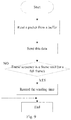
- Fig. 3 is a flowchart of dividing and encapsulating a packet in UDP-based streaming media network transmission according to the first embodiment of the present application.
- the processing procedure of video frame data obtained from an encoding layer is as shown in Fig. 3 .
- one frame of data cannot be sent with one UDP, otherwise the video frame data may be too large.
- one frame of data is generally divided into several UDP sub-video frame packets smaller than or equal to MTU (Maximum Transmission Unit, which is the size of the largest packet that can pass a certain layer in a communication protocol), and if one frame of data is transmitted by using one UDP video frame packet, the transmission failure occurs due to the fact that the UDP video frame packet is too large.
- MTU Maximum Transmission Unit
- the corresponding transmission rate can be calculated. Further, since packet loss and delay jitter may occur in the Internet, it is possible to calculate the sum of sending rates for all video frame packets within unit time, then calculate the average of the sum and finally obtain network bandwidth. After the network bandwidth is obtained, the encoding rate can be adjusted according to the obtained network bandwidth.
- An index can be established for each sub-video frame packet, and the index includes:
- S102 Send sub-video frame packets with preset serial numbers to a client, and record sending start time.
- the response message is generated based on a sub-video frame packet received by the client, and includes a first serial number corresponding to at least one sub-video frame packet that the client requires the server to send and a second serial number for the received sub-video frame packet.
- the UDP protocol is the same as the TCP protocol for processing packets, and is a connectionless protocol. In the OSI model, it is located in the fourth layer, i.e., the transport layer, which is one layer above the IP protocol.
- the method for calculating bandwidth of UDP-based streaming media network transmission according to the first embodiment of the present application solves the problem of reliably transmitting video frame data in a dynamically changing network environment by using the UDP protocol. First, each sub-video frame packet to be transmitted is numbered by a server.
- a client after receiving this sub-video frame packet, returns a response message (corresponding to ACK (acknowledgment) as mentioned hereinafter) to the server so as to acknowledge the server that the sub-video frame packet corresponding to the serial number has been received. Finally, if packet loss occurs, the client will inform the server to retransmit the lost sub-video frame packet.
- ACK acknowledgeledgment
- the first serial number corresponding to a serial number of a sub-video frame packet that the client wishes the server to subsequently send includes: a serial number of the subsequent sub-video frame packet according to a normal sequence, and a serial number of the sub-video frame packet that the client wishes the server to send again when network packet loss occurs.
- the second serial number is a serial number of the sub-video frame packet which is sent by a server and received by a client.
- the first serial number contained in a response message sent to the server by the client each time may be more than one.
- the client obtains the situation of the existing sub-video frame packets in a receiving buffer area of the client, and sends at a time a plurality of pieces of serial number information of sub-video frame packets that are required to be sent by the server, according to the serial numbers of the existing sub-video frame packets, i.e., one first serial number contains a plurality of pieces of serial number information, to ensure the timeliness of network transmission.
- Fig. 4 is a network transmission sequence diagram applying the method for calculating bandwidth of UDP-based streaming media network transmission according to the first embodiment of the present application.
- the n in the figure represents the total number of sub-video frame packets sent by the server before it does not receive ACK.
- the first serial number contained in ACK is equivalent to the serial number of subsequent sub-video frame packet that the client wishes the server to send.
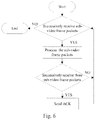
- Figs. 5 and 6 are schematic diagrams illustrating a first occasion and a second occasion when a response message is sent in UDP-based streaming media network transmission according to the first embodiment of the present application respectively.
- the occasions when a response message is sent in UDP-based streaming media network transmission includes: the first occasion and the second occasion.
- the first occasion is a time when the client has not received a sub-video frame packet within a preset duration. At this time, the client generates a response message based on the received sub-video frame packets and sends the response message.
- the second occasion is a time when the number of sub-video frame packets successively received by the client reaches a preset number. At this time, the client generates a response message based on the received sub-video frame packets and then sends the response message.
- the preset number is three, and the preset duration is 5 ms.
- the client sends ACK to the server in the following cases: first, when a timer does not receive a sub-video frame packet for 5 ms and the sub-video frame packet is sent over time, corresponding to Fig. 5 ; second, when three sub-video frame packets are successively received, corresponding to Fig. 6 .
- a sending mechanism may generate redundant data, it also can ensure that the ACK can reach the server in time even when there is packet loss in both transmission directions.
- the transmission pressure of sub-video frame packets is generally concentrated in the direction from the server to the client, redundant data generated in the direction from the client to the server substantially has no influence on network transmission.
- the method for calculating bandwidth of UDP-based streaming media network transmission includes: dividing video frame data to be sent into a plurality of sub-video frame packets, sending a sub-video frame packet with a preset serial number to a client, and receiving a response message sent by the client, wherein the response message includes a first serial number corresponding to at least one sub-video frame packet that the client requires the server to send and a second serial number for the received sub-video frame packet; sending a sub-video frame packet corresponding to the first serial number to the client, and determining whether the client has received all sub-video frame packets of the video frame data, based on the first serial number and the second serial number; if the client has received all sub-video frame packets of the video frame data, calculating the current actual network bandwidth based on the sending start time of the first sub-video frame packet of the video frame data, the sending end time of the last sub-video frame packet of the video frame data and the size of the video frame data.
- the method can accurately calculate the
- Fig. 7 is a flowchart of a method for calculating bandwidth of UDP-based streaming media network transmission according to a second embodiment of the present application.
- the specific description of retransmission of a sub-video frame packet when network packet loss occurs is added in the second embodiment, on the basis of the first embodiment of the method for calculating bandwidth of UDP-based streaming media network transmission.
- the method for calculating bandwidth of UDP-based streaming media network transmission according to the second embodiment of the present application includes S201-S207.
- S202 Send sub-video frame packets with preset serial numbers to a client, and record sending start time.
- the response message is generated based on a sub-video frame packet received by the client, and includes a first serial number corresponding to at least one sub-video frame packet that the client requires the server to send and a second serial number for the received sub-video frame packet.
- S205 Determine whether the number of sub-video frame packets which have been sent to the client but for which response messages comprising second serial numbers have not been received reaches a preset number threshold.
- a maximum value (corresponding to the preset number threshold) can be set for the total number of sub-video frame packets that have been sent but not acknowledged (i.e., for which response messages comprising second serial numbers have not been received).
- the server When this preset number threshold is exceeded, the server only retransmits the sub-video frame packets and does not send new sub-video frame packets, so as to avoid unnecessary packet loss.
- the preset number threshold is in direct proportion to the size of the receiving buffer of the client, and can be set according to actual situations, which will not be described in detail here.
- the preset retransmission threshold is 3 or 5.
- the accumulated retransmission count of a sub-video frame packet is greater than the preset retransmission threshold, a case is generally excluded in which the sub-video frame packet reaches the client late due to network delay and the server mistakes it for packet loss. The rest is the lost sub-video frame packet (a sub-video frame data packet whose retransmission count accumulated is greater than the preset retransmission threshold), and the sub-video frame packet really need to be retransmitted through network.
- This setting reduces the two-way pressure when the server retransmits the sub-video frame packet and the client receives the retransmitted sub-video frame packet.
- the server After receiving the ACK, the server adds 1 to the retransmission count of the sub-video frame packet of a serial number corresponding to the ACK, and then accumulates incrementally. When the accumulated retransmission count exceeds the preset retransmission threshold, the server immediately starts the retransmission of the sub-video frame packet, which ensures the timeliness of the retransmission of the sub-video frame packet.
- the preset strategy includes: selecting, from the sending buffer, a sub-video frame packet with the smallest serial number in sub-video frame packets whose retransmission counts are greater than the preset retransmission threshold.
- the preset strategy can include: selecting, from the sending buffer, the first several sub-video frame packets with smaller serial numbers in the sub-video frame packets whose retransmission counts are greater than the preset retransmission threshold. It can be specifically set according to the network bandwidth and the size of the buffer, which will not be described in detail here.
- the method for calculating bandwidth of UDP-based streaming media network transmission forms a new and reliable transmission protocol. It not only ensures the reliability of network transmission, but also ensures the timeliness of video frame data transmission. When packet loss occurs in the network, the transmission rate will not be greatly reduced and transmission rate jitter is smaller, which ensures the timeliness and fluency of real-time video transmission.
- the method for calculating bandwidth of UDP-based streaming media network transmission not only accurately calculates the actual bandwidth of the current network, but also ensures the timeliness of sub-video frame packet retransmission.
- the sending rate will not be greatly reduced when the lost sub-video frame packets need to be retransmitted, which satisfies the real-time requirement of real-time video surveillance.
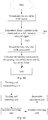
- Fig. 8 is a flowchart of a method for calculating bandwidth of UDP-based streaming media network transmission according to the third embodiment of the present application.
- the specific description of the calculation procedure of the actual bandwidth of the current network and the adjustment procedure of the encoding rate based on the network bandwidth is added in the third embodiment on the basis of the method for calculating bandwidth of UDP-based streaming media network transmission according to the first embodiment.
- the method for calculating bandwidth of UDP-based streaming media network transmission according to the third embodiment of the present application includes S301-S307.
- the response message is generated based on a sub-video frame packet received by the client, and includes a first serial number corresponding to at least one sub-video frame packet that the client requires the server to send and a second serial number for the received sub-video frame packet.
- S306a Calculate a sending rate of a network based on the sending start time, the sending end time and the size of the video frame data, the sending rate being B/T; calculate the sum of sending rates for all video frame data sent within preset unit time, and calculate the average of the sum to obtain the network bandwidth.
- B is equal to the sum of the size of the video frame data and the sizes of all sub-video frame packets corresponding to the first serial number sent during the sending of the video frame data.
- T is equal to the time interval between the sending start time and the sending end time.
- Figs. 9 and 10 are flowcharts of sending and receiving data in UDP-based streaming media network transmission applying the third embodiment of the present application respectively.
- the time interval can be calculated. It is considered that the sending rate within this time interval is the sending rate of this video frame data, that is, the network bandwidth (in seconds). In the real network, there are network fluctuations. In order to obtain more accurate network bandwidth, the sum of the sending rates of all video frame data within preset unit time, preferably one second, can be calculated and the average of the sum can be calculated.
- S306b Decrease the count of sub-video frame packets which have been sent to the client but for which response messages comprising second serial numbers have not been received according to the number of the deleted sub-video frame packets.
- Real-time cleaning from the sending buffer of the server, sub-video frame packets which have been sent to the client and for which response messages have been received, and correspondingly adjusting the count of sub-video frame packets which have been sent to the client but for which response messages have not been received facilitate the transmission of sub-video frame packets and make the transmission of sub-video frame packets smoother.
- step S305a there is no sequential relationship between step S305a and step S305b, which are implemented alternatively or in parallel.
- step S306a There is no sequential relationship between step S306b, which are implemented alternatively or in parallel.
- a network bandwidth prediction method is provided based on the UDP protocol in conjunction with the periodic characteristics of real-time video encoding. By statistically obtaining the actual transmission time of each video frame packet, the actual bandwidth of the current network can be accurately calculated, which provides a basis for the self-adaption of the encoding rate.
- An embodiment of a server for UDP-based streaming media network transmission provided by an embodiment of the present application is as follows.
- the embodiment of a server for UDP-based streaming media network transmission belongs to the same concept as the embodiment of the method for calculating bandwidth of UDP-based streaming media network transmission.
- Fig. 11 is a structural block diagram of the server for UDP-based streaming media network transmission according to the fourth embodiment of the present application.
- the server is used to send real-time video data in network communication, which can be regarded as a video monitoring device herein.
- the client that establishes network connection with the server is used to receive real-time video frame data in network communication, which can be regarded as a device network software development kit (SDK) herein.
- SDK device network software development kit
- the fourth embodiment of the present application provides a server for UDP-based streaming media network transmission, which establishes network connection with the client and includes a dividing and encapsulating unit, a sending and recording unit, a response receiving unit, a serial number extracting unit and a bandwidth calculation unit.
- the dividing and encapsulating unit is configured to divide video frame data to be sent into a plurality of sub-video frame data units, and encapsulate each sub-video frame data unit into a sub-video frame packet with a preset serial number.
- the sending and recording unit is configured to send sub-video frame packets with preset serial numbers to a client, and record sending start time.
- the response receiving unit is configured to receive a response message sent by the client, wherein the response message is generated based on a sub-video frame packet received by the client, and includes a first serial number corresponding to at least one sub-video frame packet that the client requires the server to send and a second serial number for the received sub-video frame packet.
- the serial number extracting unit is configured to extract the first serial number and the second serial number from the response message, send a sub-video frame packet corresponding to the first serial number to the client, and determine whether the client has received all sub-video frame packets of the video frame data based on the second serial number.
- the bandwidth calculation unit is configured to, if a determination result from the serial number extracting unit is YES, record sending end time of the last sub-video frame packet of the video frame data, and calculate network bandwidth based on the sending start time, the sending end time and the size of the video frame data.
- the server for calculating bandwidth of UDP-based streaming media network transmission is used for: dividing video frame data to be sent into a plurality of sub-video frame packets, sending a sub-video frame packet with a preset serial number to a client, and receiving a response message sent by the client, wherein the response message includes a first serial number corresponding to at least one sub-video frame packet that the client requires the server to send and a second serial number for the received sub-video frame packet; sending a sub-video frame packet corresponding to the first serial number to the client, and determining whether the client has received all sub-video frame packets of the video frame data, based on the first serial number and the second serial number; if the client has received all sub-video frame packets of the video frame data, calculating the actual bandwidth of the current network based on the sending start time of the first sub-video frame packet of the video frame data, the sending end time of the last sub-video frame packet of the video frame data and the size of the video frame data, which provides
- Fig. 12 is a structural block diagram of a server for UDP-based streaming media network transmission according to the fifth embodiment of the present application. Based on the fourth embodiment of the server for UDP-based streaming media network transmission, in the fifth embodiment, the server further includes a deletion unit, a decrease unit and an adjustment unit.
- the fifth embodiment of the present application provides a server for UDP-based streaming media network transmission, which establishes network connection with the client and includes a dividing and encapsulating unit, a sending and recording unit, a response receiving unit, a serial number extracting unit and a bandwidth calculation unit.
- the dividing and encapsulating unit is configured to divide video frame data to be sent into a plurality of sub-video frame data units, and encapsulate each sub-video frame data unit into a sub-video frame packet with a preset serial number.
- the sending and recording unit is configured to send sub-video frame packet with preset serial numbers to a client, and record sending start time.
- the response receiving unit is configured to receive a response message sent by the client, wherein the response message is generated based on a sub-video frame packet received by the client, and includes a first serial number corresponding to at least one sub-video frame packet that the client requires the server to send and a second serial number for the received sub-video frame packet.
- the serial number extracting unit is configured to extract the first serial number and the second serial number from the response message, send a sub-video frame packet corresponding to the first serial number to the client, and determine whether the client has received all sub-video frame packets of the video frame data based on the second serial number.
- the bandwidth calculation unit is configured to, if a determination result from the serial number extracting unit is YES, record sending end time of the last sub-video frame packet of the video frame data, and calculate network bandwidth based on the sending start time, the sending end time and the size of the video frame data.
- Extracting the first serial number and the second serial number from the response message, sending a sub-video frame packet corresponding to the first serial number to the client includes:
- the server further includes a deletion unit and a decrease unit.
- the deletion unit is configured to delete, from a sending buffer, sub-video frame packets with serial numbers that are smaller than the smallest serial number in the first serial numbers.
- the decrease unit is configured to decrease the count of sub-video frame packets which have been sent to the client but for which response messages comprising second serial numbers have not been received according to the number of the deleted sub-video frame packets.
- Sending the sub-video frame packet corresponding to the first serial number associated with the retransmission count to the client if the retransmission count is greater than a preset retransmission threshold includes:
- the preset strategy includes: selecting, from the sending buffer, a sub-video frame packet with the smallest serial number in sub-video frame packets whose retransmission counts are greater than the preset retransmission threshold.
- Calculating network bandwidth includes:
- the server further includes an adjustment unit.
- the adjustment unit is configured to adjust the encoding rate of the transmission of the video frame data according to the network bandwidth.
- a network bandwidth prediction method is provided based on the UDP protocol in conjunction with the periodic characteristics of real-time video encoding. By statistically obtaining the actual transmission time of each video frame packet, the actual bandwidth of the current network can be accurately calculated, which provides a basis for the self-adaption of the encoding rate.
- An embodiment of a system for UDP-based streaming media network transmission provided by an embodiment of the present application is as follows.
- the embodiment of a system for UDP-based streaming media network transmission belongs to the same concept as the embodiment of the method for calculating bandwidth of UDP-based streaming media network transmission.
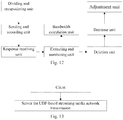
- Fig. 13 is a structural block diagram of a system for UDP-based streaming media network transmission according to the sixth embodiment of the present application.
- a system for UDP-based streaming media network transmission includes a client and a server for UDP-based streaming media network transmission described above.
- the server establishes network connection with the client.
- the system for UDP-based streaming media network transmission is used for: dividing video frame data to be sent into a plurality of sub-video frame packets, sending a sub-video frame packet with a preset serial number to a client, and receiving a response message sent by the client, wherein the response message includes a first serial number corresponding to at least one sub-video frame packet that the client requires the server to send and a second serial number for the received sub-video frame packet; sending a sub-video frame packet corresponding to the first serial number to the client, and determining whether the client has received all sub-video frame packets of the video frame data, based on the first serial number and the second serial number; if the client has received all sub-video frame packets of the video frame data, calculating the actual bandwidth of the current network based on the sending start time of the first sub-video frame packet of the video frame data, the sending end time of the last sub-video frame packet of the video frame data and the size of the video frame data, which provides a basis for the
- the present application aims to claim a method, server and system for calculating bandwidth of UDP-based streaming media network transmission, which can accurately calculate the actual bandwidth of the current network, and provides a basis for the self-adaption of the encoding rate.
- embodiments of the present application further provide a storage medium, wherein the storage medium is configured to store an application program for performing a method for calculating bandwidth of UDP-based streaming media network transmission in the present application when being executed.
- the method for calculating bandwidth of UDP-based streaming media network transmission in the present application includes:
- embodiments of the present application further provide an application program, wherein, the application program is configured to implement the method for calculating bandwidth of UDP-based streaming media network transmission in the present application when being executed.
- the method for calculating bandwidth of UDP-based streaming media network transmission in the present application includes:
- embodiments of the present application further provide a computing device, which includes a processor, a memory, a communication interface and a bus; the processor, the memory and the communication interface are connected and communicated with each other via the bus; the memory stores executable program codes; the processor executes the program corresponding to the executable program codes stored in the memory by reading the executable program codes, for:
Landscapes
- Engineering & Computer Science (AREA)
- Signal Processing (AREA)
- Computer Networks & Wireless Communication (AREA)
- Multimedia (AREA)
- Quality & Reliability (AREA)
- Computer Security & Cryptography (AREA)
- Data Exchanges In Wide-Area Networks (AREA)
- Two-Way Televisions, Distribution Of Moving Picture Or The Like (AREA)
Abstract
Description
- The present application claims the priority to a Chinese Patent Application No.
201510401565.5 - The present application relates to the technical field of streaming media, and particularly to a method, a server and a system for calculating bandwidth of UDP-based streaming media network transmission.
- Streaming media is a continuous time-based media using streaming transmission technology in the Internet, such as audio, video or multimedia files. Streaming media does not download the whole file before playing, only store beginning partial contents into a RAM. Data streams of the streaming media can be transmitted at any time and then broadcast at any time, and only a certain delay exists at the beginning. Streaming transmission technology is the key technology for the implementation of streaming media.
- Nowadays, high definition (HD) video transmission using streaming transmission technology is becoming more and more popular in the field of real-time video surveillance. To ensure the transmission of HD videos, a larger network bandwidth and a more stable network transmission environment are often required. However, in a public network environment, especially in a mobile wireless network, the network environment is dynamically changed. In a dynamically changing network environment, the realization of HD video transmission requires to timely reduce the encoding rate of transmission in case of an insufficient bandwidth, to timely return to the previous encoding rate during normal transmission when the bandwidth is recovered, to quickly perform retransmission in case of packet loss, and to reduce transmission rate jitter in case of network delay jitter. To sum up, in a dynamically changing network environment, it is necessary to meet the requirements of transmission control and network bandwidth self-adaption to achieve HD video transmission.
- In the aspect of transmission control, few references are available in the prior art. As everyone knows, in an IP-based network transmission mode, selectable transport layer protocols are only TCP (Transmission Control Protocol, which is a transport layer protocol in the framework of the TCP/IP protocol, and provides reliable connection-oriented transmission) and UDP (User Datagram Protocol, which is a transport layer protocol in the framework of the TCP/IP protocol, and provides unreliable transmission), but which transmission protocol to be used is rarely mentioned in the prior art. If the TCP protocol is used, the transmission rate will be reduced rapidly when packet loss occurs in the network, which has a great impact on surveillance video applications which require real-time transmission. Even if the transmission rate can be quickly recovered using an improved algorithm for the TCP protocol, the increase and decrease of the bit stream transmission rate will occur inevitably, affecting video playing effect. If UDP protocol is used, it is necessary to guarantee the reliability of network transmission.
- In the aspect of network bandwidth self-adaption, two kinds of solutions are mainly included in the prior art. One solution is based on the change of a sending buffer: when the network bandwidth becomes smaller, the sending buffer is also getting smaller, and then the encoding rate is reduced. However, after the encoding rate is reduced, the size of the sending buffer will theoretically be close to zero. If the network bandwidth increases again over time, such methods cannot determine the appropriate time to correspondingly increase the encoding rate. Moreover, in a public network, especially in a wireless network, delay jitter or even packet loss occurs very often, which will have a significant impact on the sending buffer. For example, for an encoding rate of 4 Mbps and a sending buffer of 4 Mb, a sporadic delay of one second in a network can make the sending buffer full, and it is obviously inappropriate to further reduce the encoding rate at this time. The other solution is to adjust the encoding rate according to the change of the network bandwidth. However, how to evaluate the current network bandwidth is not disclosed explicitly in the prior art.
- In existing network technologies for transmitting real-time videos, it is not inconceivable to adjust the encoding rate according to the change of the network bandwidth. When the network bandwidth is less than the encoding rate, it is easy to get the conclusion that the encoding rate should be reduced, according to the actual amount of transmission. However, after the reduction, if the network bandwidth is getting better, it is hard to figure out what the current network bandwidth actually is after the network bandwidth becomes better because the encoding rate is constant. If the encoding rate is gradually increased in a tentative manner, the network bandwidth must oscillate back and forth around a critical network bandwidth, which leads to a poor display effect finally presented to users. Therefore, how to calculate the actual network bandwidth according to the characteristics of real-time packet generation and transmission is a technical problem required to be solved.
- An objective of the present application is to provide a method, server and system for calculating bandwidth of UDP-based streaming media network transmission, which can accurately calculate the actual bandwidth of the current network, and provides a basis for the self-adaption of the encoding rate.
- In a first aspect, embodiments of the present application provide a method for calculating bandwidth of UDP-based streaming media network transmission, which is applicable to a server, wherein the method includes:
- dividing video frame data to be sent into a plurality of sub-video frame data units, and encapsulating each sub-video frame data unit into a sub-video frame packet with a preset serial number;
- sending sub-video frame packets with preset serial numbers to a client, and recording sending start time;
- receiving a response message sent by the client, wherein the response message is generated based on a sub-video frame packet received by the client, and includes a first serial number corresponding to at least one sub-video frame packet that the client requires the server to send and a second serial number for the received sub-video frame packet;
- extracting the first serial number and the second serial number from the response message, sending a sub-video frame packet corresponding to the first serial number to the client, and determining whether the client has received all sub-video frame packets of the video frame data based on the second serial number;
- if the client has received all sub-video frame packets of the video frame data, recording sending end time of the last sub-video frame packet of the video frame data, and calculating network bandwidth based on the sending start time, the sending end time and the size of the video frame data.
- Extracting the first serial number and the second serial number from the response message, sending a sub-video frame packet corresponding to the first serial number to the client, includes:
- extracting the first serial number and the second serial number from the response message, and accumulating a retransmission count of the sub-video frame packet corresponding to the first serial number;
- sending the sub-video frame packet corresponding to the first serial number associated with the retransmission count to the client if the retransmission count is greater than a preset retransmission threshold.
- After extracting the first serial number and the second serial number from the response message, the method further includes:
- deleting, from a sending buffer, sub-video frame packets with serial numbers that are smaller than the smallest serial number in the first serial numbers;
- decreasing the count of sub-video frame packets which have been sent to the client but for which response messages comprising second serial numbers have not been received according to the number of the deleted sub-video frame packets.
- Sending the sub-video frame packet corresponding to the first serial number associated with the retransmission count to the client if the retransmission count is greater than a preset retransmission threshold, includes:
- determining whether the number of sub-video frame packets which have been sent to the client but for which response messages comprising second serial numbers have not been received reaches a preset number threshold;
- if the number of sub-video frame packets which have been sent to the client but for which response messages comprising second serial numbers have not been received reaches the preset number threshold, selecting, from a sending buffer, a sub-video frame packet whose retransmission count is greater than the preset retransmission threshold according to a preset strategy, and sending the sub-video frame packet to the client;
- if the number of sub-video frame packets which have been sent to the client but for which response messages comprising second serial numbers have not been received does not reach the preset number threshold, sending a sub-video frame packet, selected from the sending buffer, whose retransmission count is greater than the preset retransmission threshold, and sending new sub-video frame packets and accumulating the count of sub-video frame packets which have been sent to the client but for which response messages comprising second serial numbers have not been received based on the number of the new sub-video frame packets.
- The preset strategy includes: selecting, from the sending buffer, a sub-video frame packet with the smallest serial number in sub-video frame packets whose retransmission counts are greater than the preset retransmission threshold.
- Calculating network bandwidth, includes:
- calculating a sending rate of a network, the sending rate being B/T; calculating the sum of sending rates for all video frame data sent within preset unit time, and calculating the average of the sum to obtain the network bandwidth;
- wherein, B is equal to the sum of the size of the video frame data and the sizes of all sub-video frame packets corresponding to the first serial number sent during the sending of the video frame data, and T is equal to the time interval between the sending start time and the sending end time.
- After obtaining the network bandwidth, the method further includes:
adjusting an encoding rate of the transmission of the video frame data according to the network bandwidth. - In a second aspect, embodiments of the present application provide a server for UDP-based streaming media network transmission, which establishes network connection with the client, wherein the server includes:
- a dividing and encapsulating unit configured to divide video frame data to be sent into a plurality of sub-video frame data units, and encapsulate each sub-video frame data unit into a sub-video frame packet with a preset serial number;
- a sending and recording unit configured to send sub-video frame packets with preset serial numbers to a client, and record sending start time;
- a response receiving unit configured to receive a response message sent by the client, wherein the response message is generated based on a sub-video frame packet received by the client, and includes a first serial number corresponding to at least one sub-video frame packet that the client requires the server to send and a second serial number for the received sub-video frame packet;
- a serial number extracting unit configured to extract the first serial number and the second serial number from the response message, send a sub-video frame packet corresponding to the first serial number to the client, and determine whether the client has received all sub-video frame packets of the video frame data based on the second serial number;
- a bandwidth calculation unit configured to, if a determination result from the serial number extracting unit is YES, record sending end time of the last sub-video frame packet of the video frame data, and calculate network bandwidth based on the sending start time, the sending end time and the size of the video frame data.
- Extracting the first serial number and the second serial number from the response message, sending a sub-video frame packet corresponding to the first serial number to the client, includes:
- extracting the first serial number and the second serial number from the response message, and accumulating a retransmission count of the sub-video frame packet corresponding to the first serial number;
- sending the sub-video frame packet corresponding to the first serial number associated with the retransmission count to the client if the retransmission count is greater than a preset retransmission threshold.
- The server further includes:
- a deletion unit configured to delete, from a sending buffer, sub-video frame packets with serial numbers that are smaller than the smallest serial number in the first serial numbers;
- a decrease unit configured to decrease the count of sub-video frame packets which have been sent to the client but for which response messages comprising second serial numbers have not been received according to the number of the deleted sub-video frame packets.
- Sending the sub-video frame packet corresponding to the first serial number associated with the retransmission count to the client if the retransmission count is greater than a preset retransmission threshold, includes:
- determining whether the number of sub-video frame packets which have been sent to the client but for which response messages comprising second serial numbers have not been received reaches a preset number threshold;
- if the number of sub-video frame packets which have been sent to the client but for which response messages comprising second serial numbers have not been received reaches the preset number threshold, selecting, from the sending buffer, a sub-video frame packet whose retransmission count is greater than the preset retransmission threshold according to a preset strategy, and sending the sub-video frame packet to the client;
- if the number of sub-video frame packets which have been sent to the client but for which response messages comprising second serial numbers have not been received does not reach the preset number threshold, sending a sub-video frame packet, selected from the sending buffer, whose retransmission count is greater than the preset retransmission threshold, and sending new sub-video frame packets and accumulating the count of sub-video frame packets which have been sent to the client but for which response messages comprising second serial numbers have not been received based on the number of the new sub-video frame packets.
- The preset strategy includes: selecting, from the sending buffer, a sub-video frame packet with the smallest serial number in sub-video frame packets whose retransmission counts are greater than the preset retransmission threshold.
- Calculating network bandwidth, includes:
- calculating a sending rate of a network, the sending rate being B/T; calculating the sum of sending rates for all video frame data sent within preset unit time, and calculating the average of the sum to obtain the network bandwidth;
- wherein, B is equal to the sum of the size of the video frame data and the sizes of all sub-video frame packets corresponding to the first serial number sent during the sending of the video frame data, and T is equal to the time interval between the sending start time and the sending end time.
- The server further includes:
an adjustment unit configured to adjust an encoding rate of the transmission of the video frame data according to the network bandwidth. - In a third aspect, embodiments of the present application provide a system for UDP-based streaming media network transmission, wherein the system includes a client and a server for UDP-based streaming media network transmission according to the second aspect of the present application, and the server establishes network connection with the client.
- In a fourth aspect, embodiments of the present application provide a storage medium, wherein the storage medium is configured to store an application program that is configured to implement the method for calculating bandwidth of UDP-based streaming media network transmission in the present application when being executed.
- In a fifth aspect, embodiments of the present application provide an application program which is configured to implement the method for calculating bandwidth of UDP-based streaming media network transmission when being executed.
- In a sixth aspect, embodiments of the present application provide a computing device, which includes a processor, a memory, a communication interface and a bus, wherein
the processor, the memory and the communication interface are connected and communicated with each other via the bus;
the memory stores executable program codes;
the processor executes the program corresponding to the executable program codes stored in the memory by reading the executable program codes, to: - divide video frame data to be sent into a plurality of sub-video frame data units, and encapsulate each sub-video frame data unit into a sub-video frame packet with a preset serial number;
- send sub-video frame packets with preset serial numbers to a client, and record sending start time;
- receive a response message sent by the client, wherein the response message is generated based on a sub-video frame packet received by the client, and includes a first serial number corresponding to at least one sub-video frame packet that the client requires the server to send and a second serial number for the received sub-video frame packet;
- extract the first serial number and the second serial number from the response message, send a sub-video frame packet corresponding to the first serial number to the client, and determine whether the client has received all sub-video frame packets of the video frame data based on the second serial number;
- if the client has received all sub-video frame packets of the video frame data, record sending end time of the last sub-video frame packet of the video frame data, and calculate network bandwidth based on the sending start time, the sending end time and the size of the video frame data.
- Compared to the prior art, one or more embodiments of the above solutions may have the following advantages or beneficial effects.
- The present application provides a method, server and system for calculating bandwidth of UDP-based streaming media network transmission. The method includes: dividing video frame data to be sent into a plurality of sub-video frame packets; sending a sub-video frame packet with a preset serial number to a client, and receiving a response message sent by the client, wherein the response message includes a first serial number corresponding to at least one sub-video frame packet that the client requires the server to send and a second serial number for the received sub-video frame packet; sending a sub-video frame packet corresponding to the first serial number to the client, and determining whether the client has received all sub-video frame packets of the video frame data, based on the first serial number and the second serial number; if the client has received all sub-video frame packets of the video frame data, calculating network bandwidth based on the sending start time of the first sub-video frame packet of the video frame data, the sending end time of the last sub-video frame packet of the video frame data and the size of the video frame data. From above, the method, server and system for calculating bandwidth of UDP-based streaming media network transmission can accurately calculate the actual bandwidth of the current network, and provides a basis for the self-adaption of the encoding rate.
- Other features and advantages of the present application will be explained in the following description, and partially become apparent from the description, or are understood through the technical solutions of the present application. The objectives and other advantages of the present application can be achieved and obtained through the structures and/or processes specified in the description, claims and accompanying drawings.
- In order to describe the technical solutions in the embodiments of the present application and the prior art more clearly, drawings required for embodiments of the present application and the prior art will be described briefly below. It is obvious that the drawings below are for only some embodiments of the present application and those skilled in the art can also obtain further drawings based on these drawings without any creative efforts.
-
Fig. 1 is a flowchart of a method for calculating bandwidth of UDP-based streaming media network transmission according to a first embodiment of the present application; -
Fig. 2 is a diagram illustrating transmission law of video frame data in UDP-based streaming media network transmission according to the first embodiment of the present application; -
Fig. 3 is a flowchart of dividing and encapsulating a packet in UDP-based streaming media network transmission according to the first embodiment of the present application; -
Fig. 4 is a sequence diagram of network transmission applying the method for calculating bandwidth of UDP-based streaming media network transmission according to the first embodiment of the present application; -
Fig. 5 is a schematic diagram illustrating a first occasion when a response message is sent in UDP-based streaming media network transmission according to the first embodiment of the present application; -
Fig. 6 is a schematic diagram illustrating a second occasion when a response message is sent in UDP-based streaming media network transmission according to the first embodiment of the present application; -
Fig. 7 is a flowchart of a method for calculating bandwidth of UDP-based streaming media network transmission according to a second embodiment of the present application; -
Fig. 8 is a flowchart of a method for calculating bandwidth of UDP-based streaming media network transmission according to a third embodiment of the present application; -
Fig. 9 is a flowchart of a data sending thread in UDP-based streaming media network transmission according to the third embodiment of the present application; -
Fig. 10 is a flowchart of a data receiving thread in UDP-based streaming media network transmission according to the third embodiment of the present application; -
Fig. 11 is a structural block diagram of a server for UDP-based streaming media network transmission according to a fourth embodiment of the present application; -
Fig. 12 is a structural block diagram of a server for UDP-based streaming media network transmission according to a fifth embodiment of the present application; -
Fig. 13 is a structural block diagram of a system for UDP-based streaming media network transmission according to a sixth embodiment of the present application. - In order to make the objections, technical solutions as well as advantages of the present application more apparent and understandable, the present application will be described in more detail below with reference to the appended drawings and embodiments. It should be understood that these descriptions are only illustrative and not intended to limit the scope of the present application. In addition, in the following description, the description of known structures and technologies is omitted to avoid unnecessarily confusing the concept of the present application.
-
Fig. 1 is a flowchart of a method for calculating bandwidth of UDP-based streaming media network transmission according to a first embodiment of the present application. - The method for calculating bandwidth of UDP-based streaming media network transmission according to the first embodiment of the present application is applicable to a server, and includes S101-S105.
- S101. Divide video frame data to be sent into a plurality of sub-video frame data units, and encapsulate each sub-video frame data unit into a sub-video frame packet with a preset serial number.
- Preferably, the preset serial number is an Arabic numeral number, such as 1, 2, 3 and so forth.
- Video frame data is the data unit in communication transmission based on the UDP protocol. In a data switching network, video frame data needs to be divided into a plurality of sub-video frame data units, each of which is encapsulated into a sub-video frame packet. Each sub-video frame packet includes both sender and receiver address information. Different sub-video frame packets are transmitted in one or more switching networks along identical or different paths, and recombined at the destination to form the original video frame data.
- Preferably, the video frame data is applicable to HD video transmission in the field of real-time video surveillance.
-
Fig. 2 is a diagram illustrating transmission law of video frame data in UDP-based streaming media network transmission according to the first embodiment of the present application. - Generally, data encoding has a frame rate, that is, one frame of data is generated at a regular interval, and the transmission time of each frame depends on the actual bandwidth. For real-time display, real-time video surveillance field requires these video frame data to be sent out immediately, so that the law of video transmission is as shown in
Figure 2 , in which 25 frames per second is taken as an example. Assuming that the actual bandwidth is 4 Mbps and the length of one frame of data generated at 0 ms is 100 Kb, this frame of data can be transmitted completely for about 25 ms, and the remaining 15 ms is idle. This is the real-time video surveillance data transmission characteristics. A relatively accurate network bandwidth can be obtained if transmission rate of the data packet is obtained through statistics in frames instead of unit time. -
Fig. 3 is a flowchart of dividing and encapsulating a packet in UDP-based streaming media network transmission according to the first embodiment of the present application. - The processing procedure of video frame data obtained from an encoding layer is as shown in
Fig. 3 . In the actual sending process, one frame of data cannot be sent with one UDP, otherwise the video frame data may be too large. In the actual video frame data transmission process, one frame of data is generally divided into several UDP sub-video frame packets smaller than or equal to MTU (Maximum Transmission Unit, which is the size of the largest packet that can pass a certain layer in a communication protocol), and if one frame of data is transmitted by using one UDP video frame packet, the transmission failure occurs due to the fact that the UDP video frame packet is too large. By statistically obtaining time intervals experienced by all sub-video frame packets included in each video frame data from being sent and then receiving a corresponding ACK until being deleted from the buffer, the corresponding transmission rate can be calculated. Further, since packet loss and delay jitter may occur in the Internet, it is possible to calculate the sum of sending rates for all video frame packets within unit time, then calculate the average of the sum and finally obtain network bandwidth. After the network bandwidth is obtained, the encoding rate can be adjusted according to the obtained network bandwidth. - An index can be established for each sub-video frame packet, and the index includes:
- total data length represented by 2 bytes;
- data type represented by 1 byte, i.e., video data;
- frame sequence represented by 1 byte, wherein the frame sequence includes
frame start 0, frame intermediate 1-0xfe, frame end 0xff and full frame 0xff; if the data of one frame is relatively large, and when the data should be divided according to the MTU, it is required to perform type value assignment according to the frame type to facilitate recording the time when video frame data starts to be sent during the sending of data; here, the frame sequence is represented by one byte; if the maximum frame size is more than MTU*256, the frame sequence can be expanded to be represented by two bytes; and - frame serial number represented by 4 bytes, i.e., the preset serial number, wherein all frame data is uniformly numbered, from 0, increasing by one each time.
- S102. Send sub-video frame packets with preset serial numbers to a client, and record sending start time.
- S103. Receive a response message sent by the client.
- The response message is generated based on a sub-video frame packet received by the client, and includes a first serial number corresponding to at least one sub-video frame packet that the client requires the server to send and a second serial number for the received sub-video frame packet.
- In the network, the UDP protocol is the same as the TCP protocol for processing packets, and is a connectionless protocol. In the OSI model, it is located in the fourth layer, i.e., the transport layer, which is one layer above the IP protocol. The method for calculating bandwidth of UDP-based streaming media network transmission according to the first embodiment of the present application solves the problem of reliably transmitting video frame data in a dynamically changing network environment by using the UDP protocol. First, each sub-video frame packet to be transmitted is numbered by a server. Then, a client, after receiving this sub-video frame packet, returns a response message (corresponding to ACK (acknowledgment) as mentioned hereinafter) to the server so as to acknowledge the server that the sub-video frame packet corresponding to the serial number has been received. Finally, if packet loss occurs, the client will inform the server to retransmit the lost sub-video frame packet.
- The first serial number corresponding to a serial number of a sub-video frame packet that the client wishes the server to subsequently send includes: a serial number of the subsequent sub-video frame packet according to a normal sequence, and a serial number of the sub-video frame packet that the client wishes the server to send again when network packet loss occurs. The second serial number is a serial number of the sub-video frame packet which is sent by a server and received by a client.
- In order to ensure the number of sub-video frame packets sent under the conditions of network delay and certain packet loss rate, the first serial number contained in a response message sent to the server by the client each time may be more than one. The client obtains the situation of the existing sub-video frame packets in a receiving buffer area of the client, and sends at a time a plurality of pieces of serial number information of sub-video frame packets that are required to be sent by the server, according to the serial numbers of the existing sub-video frame packets, i.e., one first serial number contains a plurality of pieces of serial number information, to ensure the timeliness of network transmission.
-
Fig. 4 is a network transmission sequence diagram applying the method for calculating bandwidth of UDP-based streaming media network transmission according to the first embodiment of the present application. The n in the figure represents the total number of sub-video frame packets sent by the server before it does not receive ACK. The first serial number contained in ACK is equivalent to the serial number of subsequent sub-video frame packet that the client wishes the server to send. -
Figs. 5 and6 are schematic diagrams illustrating a first occasion and a second occasion when a response message is sent in UDP-based streaming media network transmission according to the first embodiment of the present application respectively. - The occasions when a response message is sent in UDP-based streaming media network transmission includes: the first occasion and the second occasion.
- The first occasion is a time when the client has not received a sub-video frame packet within a preset duration. At this time, the client generates a response message based on the received sub-video frame packets and sends the response message.
- The second occasion is a time when the number of sub-video frame packets successively received by the client reaches a preset number. At this time, the client generates a response message based on the received sub-video frame packets and then sends the response message.
- Preferably, the preset number is three, and the preset duration is 5 ms.
- The client sends ACK to the server in the following cases: first, when a timer does not receive a sub-video frame packet for 5 ms and the sub-video frame packet is sent over time, corresponding to
Fig. 5 ; second, when three sub-video frame packets are successively received, corresponding toFig. 6 . Although such a sending mechanism may generate redundant data, it also can ensure that the ACK can reach the server in time even when there is packet loss in both transmission directions. The transmission pressure of sub-video frame packets is generally concentrated in the direction from the server to the client, redundant data generated in the direction from the client to the server substantially has no influence on network transmission. - S104. Extract the first serial number and the second serial number from the response message, send a sub-video frame packet corresponding to the first serial number to the client, and determine whether the client has received all sub-video frame packets of the video frame data based on the second serial number.
- S105. If the client has received all sub-video frame packets of the video frame data, record the sending end time of the last sub-video frame packet of the video frame data, and calculate network bandwidth based on the sending start time, the sending end time and the size of the video frame data.
- The method for calculating bandwidth of UDP-based streaming media network transmission provided by the first embodiment of the present application includes: dividing video frame data to be sent into a plurality of sub-video frame packets, sending a sub-video frame packet with a preset serial number to a client, and receiving a response message sent by the client, wherein the response message includes a first serial number corresponding to at least one sub-video frame packet that the client requires the server to send and a second serial number for the received sub-video frame packet; sending a sub-video frame packet corresponding to the first serial number to the client, and determining whether the client has received all sub-video frame packets of the video frame data, based on the first serial number and the second serial number; if the client has received all sub-video frame packets of the video frame data, calculating the current actual network bandwidth based on the sending start time of the first sub-video frame packet of the video frame data, the sending end time of the last sub-video frame packet of the video frame data and the size of the video frame data. The method can accurately calculate the actual bandwidth of the current network and provides a basis for the self-adaption of the encoding rate.
-
Fig. 7 is a flowchart of a method for calculating bandwidth of UDP-based streaming media network transmission according to a second embodiment of the present application. The specific description of retransmission of a sub-video frame packet when network packet loss occurs is added in the second embodiment, on the basis of the first embodiment of the method for calculating bandwidth of UDP-based streaming media network transmission. - The method for calculating bandwidth of UDP-based streaming media network transmission according to the second embodiment of the present application includes S201-S207.
- S201. Divide video frame data to be sent into a plurality of sub-video frame data units, and encapsulate each sub-video frame data unit into a sub-video frame packet with a preset serial number.
- S202. Send sub-video frame packets with preset serial numbers to a client, and record sending start time.
- S203. Receive a response message sent by the client.
- The response message is generated based on a sub-video frame packet received by the client, and includes a first serial number corresponding to at least one sub-video frame packet that the client requires the server to send and a second serial number for the received sub-video frame packet.
- S204. Extract the first serial number and the second serial number from the response message, accumulate a retransmission count of a sub-video frame packet corresponding to the first serial number, and determine whether the client has received all sub-video frame packets of the video frame data based on the second serial number.
- S205. Determine whether the number of sub-video frame packets which have been sent to the client but for which response messages comprising second serial numbers have not been received reaches a preset number threshold.
- In order to avoid that too many sub-video frame packets are sent by the sever at one time which leads to unnecessary packet loss, a maximum value (corresponding to the preset number threshold) can be set for the total number of sub-video frame packets that have been sent but not acknowledged (i.e., for which response messages comprising second serial numbers have not been received). When this preset number threshold is exceeded, the server only retransmits the sub-video frame packets and does not send new sub-video frame packets, so as to avoid unnecessary packet loss. The preset number threshold is in direct proportion to the size of the receiving buffer of the client, and can be set according to actual situations, which will not be described in detail here.
- S206a. If the number of sub-video frame packets which have been sent to the client but for which response messages comprising second serial numbers have not been received reaches the preset number threshold, select, from the sending buffer, a sub-video frame packet whose retransmission count is greater than a preset retransmission threshold according to a preset strategy, and send the sub-video frame packet to the client;
- S206b. If the number of sub-video frame packets which have been sent to the client but for which response messages comprising second serial numbers have not been received does not reach the preset number threshold, send a sub-video frame packet, selected from the sending buffer, whose retransmission count is greater than the preset retransmission threshold, and send new sub-video frame packets and accumulate the count of sub-video frame packets which have been sent to the client but for which response messages comprising second serial numbers have not been received based on the number of new sub-video frame packets.
- Preferably, the preset retransmission threshold is 3 or 5. When the accumulated retransmission count of a sub-video frame packet is greater than the preset retransmission threshold, a case is generally excluded in which the sub-video frame packet reaches the client late due to network delay and the server mistakes it for packet loss. The rest is the lost sub-video frame packet (a sub-video frame data packet whose retransmission count accumulated is greater than the preset retransmission threshold), and the sub-video frame packet really need to be retransmitted through network. This setting reduces the two-way pressure when the server retransmits the sub-video frame packet and the client receives the retransmitted sub-video frame packet.
- After receiving the ACK, the server adds 1 to the retransmission count of the sub-video frame packet of a serial number corresponding to the ACK, and then accumulates incrementally. When the accumulated retransmission count exceeds the preset retransmission threshold, the server immediately starts the retransmission of the sub-video frame packet, which ensures the timeliness of the retransmission of the sub-video frame packet.
- Preferably, the preset strategy includes: selecting, from the sending buffer, a sub-video frame packet with the smallest serial number in sub-video frame packets whose retransmission counts are greater than the preset retransmission threshold.
- Of course, the preset strategy can include: selecting, from the sending buffer, the first several sub-video frame packets with smaller serial numbers in the sub-video frame packets whose retransmission counts are greater than the preset retransmission threshold. It can be specifically set according to the network bandwidth and the size of the buffer, which will not be described in detail here.
- S207. If the client has received all sub-video frame packets of the video frame data, recording sending end time of the last sub-video frame packet of the video frame data, and calculating network bandwidth based on the sending start time, the sending end time and the size of the video frame data.
- The method for calculating bandwidth of UDP-based streaming media network transmission provided by the second embodiment of the present application forms a new and reliable transmission protocol. It not only ensures the reliability of network transmission, but also ensures the timeliness of video frame data transmission. When packet loss occurs in the network, the transmission rate will not be greatly reduced and transmission rate jitter is smaller, which ensures the timeliness and fluency of real-time video transmission.
- The method for calculating bandwidth of UDP-based streaming media network transmission provided by the second embodiment of the present application not only accurately calculates the actual bandwidth of the current network, but also ensures the timeliness of sub-video frame packet retransmission. When packet loss appears in the network, the sending rate will not be greatly reduced when the lost sub-video frame packets need to be retransmitted, which satisfies the real-time requirement of real-time video surveillance.
-
Fig. 8 is a flowchart of a method for calculating bandwidth of UDP-based streaming media network transmission according to the third embodiment of the present application. The specific description of the calculation procedure of the actual bandwidth of the current network and the adjustment procedure of the encoding rate based on the network bandwidth is added in the third embodiment on the basis of the method for calculating bandwidth of UDP-based streaming media network transmission according to the first embodiment. - The method for calculating bandwidth of UDP-based streaming media network transmission according to the third embodiment of the present application includes S301-S307.
- S301. Divide video frame data to be sent into a plurality of sub-video frame data units, and encapsulate each sub-video frame data unit into a sub-video frame packet with a preset serial number.
- S302. Send sub-video frame packets with preset serial numbers to a client, and record sending start time.
- S303. Receive a response message sent by the client.
- Wherein the response message is generated based on a sub-video frame packet received by the client, and includes a first serial number corresponding to at least one sub-video frame packet that the client requires the server to send and a second serial number for the received sub-video frame packet.
- S304. Extract the first serial number and the second serial number from the response message, send a sub-video frame packet corresponding to the first serial number to the client, and determine whether the client has received all sub-video frame packets of the video frame data based on the second serial number.
- S305a. If the client has received all sub-video frame packets of the video frame data, record sending end time of the last sub-video frame packet of the video frame data.
- S305b. Delete, from a sending buffer, a sub-video frame packet with a serial number that is smaller than the smallest serial number in the first serial numbers.
- S306a. Calculate a sending rate of a network based on the sending start time, the sending end time and the size of the video frame data, the sending rate being B/T; calculate the sum of sending rates for all video frame data sent within preset unit time, and calculate the average of the sum to obtain the network bandwidth.
- B is equal to the sum of the size of the video frame data and the sizes of all sub-video frame packets corresponding to the first serial number sent during the sending of the video frame data. T is equal to the time interval between the sending start time and the sending end time.
-
Figs. 9 and10 are flowcharts of sending and receiving data in UDP-based streaming media network transmission applying the third embodiment of the present application respectively. - Since video frame data are sent in an order that sub-video frame packets are sent one after another, and the response message is acknowledged in an order that sub-video frame packets are acknowledged one after another, when information indicating that all sub-video frame packets are sent is received, which certainly corresponds to the recorded sending start time of the first sub-video frame packet, the time interval can be calculated. It is considered that the sending rate within this time interval is the sending rate of this video frame data, that is, the network bandwidth (in seconds). In the real network, there are network fluctuations. In order to obtain more accurate network bandwidth, the sum of the sending rates of all video frame data within preset unit time, preferably one second, can be calculated and the average of the sum can be calculated.
- S306b. Decrease the count of sub-video frame packets which have been sent to the client but for which response messages comprising second serial numbers have not been received according to the number of the deleted sub-video frame packets.
- Real-time cleaning, from the sending buffer of the server, sub-video frame packets which have been sent to the client and for which response messages have been received, and correspondingly adjusting the count of sub-video frame packets which have been sent to the client but for which response messages have not been received facilitate the transmission of sub-video frame packets and make the transmission of sub-video frame packets smoother.
- It should be noted that, there is no sequential relationship between step S305a and step S305b, which are implemented alternatively or in parallel. There is no sequential relationship between step S306a and step S306b, which are implemented alternatively or in parallel.
- S307. Adjust the encoding rate of the transmission of the video frame data according to the network bandwidth.
- In the method for calculating bandwidth of UDP-based streaming media network transmission provided by the third embodiment of the present application, a network bandwidth prediction method is provided based on the UDP protocol in conjunction with the periodic characteristics of real-time video encoding. By statistically obtaining the actual transmission time of each video frame packet, the actual bandwidth of the current network can be accurately calculated, which provides a basis for the self-adaption of the encoding rate.
- An embodiment of a server for UDP-based streaming media network transmission provided by an embodiment of the present application is as follows. The embodiment of a server for UDP-based streaming media network transmission belongs to the same concept as the embodiment of the method for calculating bandwidth of UDP-based streaming media network transmission. For the content that is not described in detail in the embodiment of a server for UDP-based streaming media network transmission, reference can be made to the embodiments of the method for calculating bandwidth of UDP-based streaming media network transmission.
-
Fig. 11 is a structural block diagram of the server for UDP-based streaming media network transmission according to the fourth embodiment of the present application. The server is used to send real-time video data in network communication, which can be regarded as a video monitoring device herein. The client that establishes network connection with the server is used to receive real-time video frame data in network communication, which can be regarded as a device network software development kit (SDK) herein. - The fourth embodiment of the present application provides a server for UDP-based streaming media network transmission, which establishes network connection with the client and includes a dividing and encapsulating unit, a sending and recording unit, a response receiving unit, a serial number extracting unit and a bandwidth calculation unit.
- The dividing and encapsulating unit is configured to divide video frame data to be sent into a plurality of sub-video frame data units, and encapsulate each sub-video frame data unit into a sub-video frame packet with a preset serial number.
- The sending and recording unit is configured to send sub-video frame packets with preset serial numbers to a client, and record sending start time.
- The response receiving unit is configured to receive a response message sent by the client, wherein the response message is generated based on a sub-video frame packet received by the client, and includes a first serial number corresponding to at least one sub-video frame packet that the client requires the server to send and a second serial number for the received sub-video frame packet.
- The serial number extracting unit is configured to extract the first serial number and the second serial number from the response message, send a sub-video frame packet corresponding to the first serial number to the client, and determine whether the client has received all sub-video frame packets of the video frame data based on the second serial number.
- The bandwidth calculation unit is configured to, if a determination result from the serial number extracting unit is YES, record sending end time of the last sub-video frame packet of the video frame data, and calculate network bandwidth based on the sending start time, the sending end time and the size of the video frame data.
- The server for calculating bandwidth of UDP-based streaming media network transmission provided by the fourth embodiment of the present application is used for: dividing video frame data to be sent into a plurality of sub-video frame packets, sending a sub-video frame packet with a preset serial number to a client, and receiving a response message sent by the client, wherein the response message includes a first serial number corresponding to at least one sub-video frame packet that the client requires the server to send and a second serial number for the received sub-video frame packet; sending a sub-video frame packet corresponding to the first serial number to the client, and determining whether the client has received all sub-video frame packets of the video frame data, based on the first serial number and the second serial number; if the client has received all sub-video frame packets of the video frame data, calculating the actual bandwidth of the current network based on the sending start time of the first sub-video frame packet of the video frame data, the sending end time of the last sub-video frame packet of the video frame data and the size of the video frame data, which provides a basis for the self-adaption of the encoding rate.
-
Fig. 12 is a structural block diagram of a server for UDP-based streaming media network transmission according to the fifth embodiment of the present application. Based on the fourth embodiment of the server for UDP-based streaming media network transmission, in the fifth embodiment, the server further includes a deletion unit, a decrease unit and an adjustment unit. - The fifth embodiment of the present application provides a server for UDP-based streaming media network transmission, which establishes network connection with the client and includes a dividing and encapsulating unit, a sending and recording unit, a response receiving unit, a serial number extracting unit and a bandwidth calculation unit.
- The dividing and encapsulating unit is configured to divide video frame data to be sent into a plurality of sub-video frame data units, and encapsulate each sub-video frame data unit into a sub-video frame packet with a preset serial number.
- The sending and recording unit is configured to send sub-video frame packet with preset serial numbers to a client, and record sending start time.
- The response receiving unit is configured to receive a response message sent by the client, wherein the response message is generated based on a sub-video frame packet received by the client, and includes a first serial number corresponding to at least one sub-video frame packet that the client requires the server to send and a second serial number for the received sub-video frame packet.
- The serial number extracting unit is configured to extract the first serial number and the second serial number from the response message, send a sub-video frame packet corresponding to the first serial number to the client, and determine whether the client has received all sub-video frame packets of the video frame data based on the second serial number.
- The bandwidth calculation unit is configured to, if a determination result from the serial number extracting unit is YES, record sending end time of the last sub-video frame packet of the video frame data, and calculate network bandwidth based on the sending start time, the sending end time and the size of the video frame data.
- Extracting the first serial number and the second serial number from the response message, sending a sub-video frame packet corresponding to the first serial number to the client, includes:
- extracting the first serial number and the second serial number from the response message, and accumulating a retransmission count of the sub-video frame packet corresponding to the first serial number; and
- sending the sub-video frame packet corresponding to the first serial number associated with the retransmission count to the client if the retransmission count is greater than a preset retransmission threshold.
- The server further includes a deletion unit and a decrease unit.
- The deletion unit is configured to delete, from a sending buffer, sub-video frame packets with serial numbers that are smaller than the smallest serial number in the first serial numbers.
- The decrease unit is configured to decrease the count of sub-video frame packets which have been sent to the client but for which response messages comprising second serial numbers have not been received according to the number of the deleted sub-video frame packets.
- Sending the sub-video frame packet corresponding to the first serial number associated with the retransmission count to the client if the retransmission count is greater than a preset retransmission threshold includes:
- determining whether the number of sub-video frame packets which have been sent to the client but for which response messages comprising second serial numbers have not been received reaches a preset number threshold;
- if the number of sub-video frame packets which have been sent to the client but for which response messages comprising second serial numbers have not been received reaches the preset number threshold, selecting, from the sending buffer, a sub-video frame packet whose retransmission count is greater than a preset retransmission threshold according to a preset strategy, and sending the sub-video frame packet to the client;
- if the number of sub-video frame packets which have been sent to the client but for which response messages comprising second serial numbers have not been received does not reach the preset number threshold, sending a sub-video frame packet, selected from the sending buffer, whose retransmission count is greater than the preset retransmission threshold, and sending new sub-video frame packets and accumulating the count of sub-video frame packets which have been sent to the client but for which response messages comprising second serial numbers have not been received based on the number of the new sub-video frame packets.
- The preset strategy includes: selecting, from the sending buffer, a sub-video frame packet with the smallest serial number in sub-video frame packets whose retransmission counts are greater than the preset retransmission threshold.
- Calculating network bandwidth, includes:
- calculating a sending rate of a network, the sending rate being B/T; calculating the sum of sending rates for all video frame data sent within preset unit time, and calculating the average of the sum to obtain the network bandwidth;
- wherein, B is equal to the sum of the size of the video frame data and the sizes of all sub-video frame packets corresponding to the first serial number sent during the sending of the video frame data, and T is equal to the time interval between the sending start time and the sending end time.
- The server further includes an adjustment unit.
- The adjustment unit is configured to adjust the encoding rate of the transmission of the video frame data according to the network bandwidth.
- For the server for calculating bandwidth of UDP-based streaming media network transmission provided by the fifth embodiment of the present application, a network bandwidth prediction method is provided based on the UDP protocol in conjunction with the periodic characteristics of real-time video encoding. By statistically obtaining the actual transmission time of each video frame packet, the actual bandwidth of the current network can be accurately calculated, which provides a basis for the self-adaption of the encoding rate.
- An embodiment of a system for UDP-based streaming media network transmission provided by an embodiment of the present application is as follows. The embodiment of a system for UDP-based streaming media network transmission belongs to the same concept as the embodiment of the method for calculating bandwidth of UDP-based streaming media network transmission. For the content that is not described in detail in the embodiment of a system for UDP-based streaming media network transmission, reference can be made to the embodiments of the method for calculating bandwidth of UDP-based streaming media network transmission.
-
Fig. 13 is a structural block diagram of a system for UDP-based streaming media network transmission according to the sixth embodiment of the present application. - A system for UDP-based streaming media network transmission according to the sixth embodiment of the present application includes a client and a server for UDP-based streaming media network transmission described above. The server establishes network connection with the client.
- The system for UDP-based streaming media network transmission provided by embodiments of the present application is used for: dividing video frame data to be sent into a plurality of sub-video frame packets, sending a sub-video frame packet with a preset serial number to a client, and receiving a response message sent by the client, wherein the response message includes a first serial number corresponding to at least one sub-video frame packet that the client requires the server to send and a second serial number for the received sub-video frame packet; sending a sub-video frame packet corresponding to the first serial number to the client, and determining whether the client has received all sub-video frame packets of the video frame data, based on the first serial number and the second serial number; if the client has received all sub-video frame packets of the video frame data, calculating the actual bandwidth of the current network based on the sending start time of the first sub-video frame packet of the video frame data, the sending end time of the last sub-video frame packet of the video frame data and the size of the video frame data, which provides a basis for the self-adaption of the encoding rate.
- The present application aims to claim a method, server and system for calculating bandwidth of UDP-based streaming media network transmission, which can accurately calculate the actual bandwidth of the current network, and provides a basis for the self-adaption of the encoding rate.
- It can be understood by a person skilled in the art that all or a part of steps in the above embodiments can be carried out by hardware or by related hardware being instructed by a program, which can be stored in computer readable storage media, including a memory, a disk, an optical disk and the like.
- It should be understood that the above specific embodiments of the present application are only for illustration or explanation of the principle of the present application, and are not intended to limit the present application. Thus, any modifications, alternatives, improvements or the like without departing from the spirit and scope of the present application shall be included in the protection scope of the present application. Moreover, the accompanying claims of the present application are intended to contain all such changes and modifications falling within the scope and limits of the appended claims or the equivalents of such range and limits.
- To achieve the above objectives, embodiments of the present application further provide a storage medium, wherein the storage medium is configured to store an application program for performing a method for calculating bandwidth of UDP-based streaming media network transmission in the present application when being executed. The method for calculating bandwidth of UDP-based streaming media network transmission in the present application includes:
- dividing video frame data to be sent into a plurality of sub-video frame data units, and encapsulating each sub-video frame data unit into a sub-video frame packet within a preset serial number;
- sending sub-video frame packets with preset serial numbers to a client, and recording sending start time;
- receiving a response message sent by the client, wherein the response message is generated based on a sub-video frame packet received by the client, and includes a first serial number corresponding to at least one sub-video frame packet that the client requires the server to send and a second serial number for the received sub-video frame packet;
- extracting the first serial number and the second serial number from the response message, sending a sub-video frame packet corresponding to the first serial number to the client, and determining whether the client has received all sub-video frame packets of the video frame data based on the second serial number;
- if the client has received all sub-video frame packets of the video frame data, recording sending end time of the last sub-video frame packet of the video frame data, and calculating network bandwidth based on the sending start time, the sending end time and the size of the video frame data.
- To achieve the above objectives, embodiments of the present application further provide an application program, wherein, the application program is configured to implement the method for calculating bandwidth of UDP-based streaming media network transmission in the present application when being executed. The method for calculating bandwidth of UDP-based streaming media network transmission in the present application includes:
- dividing video frame data to be sent into a plurality of sub-video frame data units, and encapsulating each sub-video frame data unit into a sub-video frame packet with a preset serial number;
- sending sub-video frame packets with preset serial numbers to a client, and recording sending start time;
- receiving a response message sent by the client, wherein the response message is generated based on a sub-video frame packet received by the client, and includes a first serial number corresponding to at least one sub-video frame packet that the client requires the server to send and a second serial number for the received sub-video frame packet;
- extracting the first serial number and the second serial number from the response message, sending a sub-video frame packet corresponding to the first serial number to the client, and determining whether the client has received all sub-video frame packets of the video frame data based on the second serial number;
- if the client has received all sub-video frame packets of the video frame data, recording sending end time of the last sub-video frame packet of the video frame data, and calculating network bandwidth based on the sending start time, the sending end time and the size of the video frame data.
- To achieve the above objectives, embodiments of the present application further provide a computing device, which includes a processor, a memory, a communication interface and a bus;
the processor, the memory and the communication interface are connected and communicated with each other via the bus;
the memory stores executable program codes;
the processor executes the program corresponding to the executable program codes stored in the memory by reading the executable program codes, for: - dividing video frame data to be sent into a plurality of sub-video frame data units, and encapsulating each sub-video frame data unit into a sub-video frame packet with a preset serial number;
- sending sub-video frame packets with preset serial numbers to a client, and recording sending start time;
- receiving a response message sent by the client, wherein the response message is generated based on a sub-video frame packet received by the client, and includes a first serial number corresponding to at least one sub-video frame packet that the client requires the server to send and a second serial number for the received sub-video frame packet;
- extracting the first serial number and the second serial number from the response message, sending a sub-video frame packet corresponding to the first serial number to the client, and determining whether the client has received all sub-video frame packets of the video frame data based on the second serial number;
- if the client has received all sub-video frame packets of the video frame data, recording sending end time of the last sub-video frame packet of the video frame data, and calculating network bandwidth based on the sending start time, the sending end time and the size of the video frame data.
- It should be noted that the relationship terms in the description and claims of the present application such as "first", "second" and the like are only used to distinguish one entity or operation from another entity or operation, but do not necessarily require or imply that there is actual relationship or order between these entities or operations. Moreover, the terms "include", "comprise" or any variants thereof are intended to cover a non-exclusive inclusion, such that processes, methods, articles or devices comprising a series of elements comprise not only those elements listed, but also other elements not specifically listed or the elements intrinsic to these processes, methods, articles, or devices. Without further limitations, elements limited by the wording "comprise(s) a/an..." and "include(s) a/an..." do not exclude that there are additional identical elements in the processes, methods, articles, or devices which comprise the listed elements.
- Although the embodiments disclosed in the present application are described as above, the contents mentioned above are merely embodiments adopted to facilitate understanding of the technical solution of the present application, and not intended for limiting the present application. Any modification and variation in the form and detail of implementation can be made by any person skilled in the art to which the present application belongs without departing from the spirit and scope of the present application. However, the protection scope of the present application should be determined by the scope defined by the attached claims.
Claims (18)
- A method for calculating bandwidth of UDP-based streaming media network transmission, which is applicable to a server, wherein the method comprises:dividing video frame data to be sent into a plurality of sub-video frame data units, and encapsulating each sub-video frame data unit into a sub-video frame packet with a preset serial number;sending sub-video frame packets with preset serial numbers to a client, and recording sending start time;receiving a response message sent by the client, wherein the response message is generated based on a sub-video frame packet received by the client, and comprises a first serial number corresponding to at least one sub-video frame packet that the client requires the server to send and a second serial number for the received sub-video frame packet;extracting the first serial number and the second serial number from the response message, sending a sub-video frame packet corresponding to the first serial number to the client, and determining whether the client has received all sub-video frame packets of the video frame data based on the second serial number;if the client has received all sub-video frame packets of the video frame data, recording sending end time of the last sub-video frame packet of the video frame data, and calculating network bandwidth based on the sending start time, the sending end time and the size of the video frame data.
- The method for calculating bandwidth of UDP-based streaming media network transmission of claim 1, wherein extracting the first serial number and the second serial number from the response message, sending a sub-video frame packet corresponding to the first serial number to the client, comprises:extracting the first serial number and the second serial number from the response message, and accumulating a retransmission count of the sub-video frame packet corresponding to the first serial number;sending the sub-video frame packet corresponding to the first serial number associated with the retransmission count to the client if the retransmission count is greater than a preset retransmission threshold.
- The method for calculating bandwidth of UDP-based streaming media network transmission of claim 2, wherein after extracting the first serial number and the second serial number from the response message, the method further comprises:deleting, from a sending buffer, sub-video frame packets with serial numbers that are smaller than the smallest serial number in the first serial numbers;decreasing the count of sub-video frame packets which have been sent to the client but for which response messages comprising second serial numbers have not been received according to the number of the deleted sub-video frame packets.
- The method for calculating bandwidth of UDP-based streaming media network transmission of claim 2, wherein sending the sub-video frame packet corresponding to the first serial number associated with the retransmission count to the client if the retransmission count is greater than a preset retransmission threshold, comprises:determining whether the number of sub-video frame packets which have been sent to the client but for which response messages comprising second serial numbers have not been received reaches a preset number threshold;if the number of sub-video frame packets which have been sent to the client but for which response messages comprising second serial numbers have not been received reaches the preset number threshold, selecting, from a sending buffer, a sub-video frame packet whose retransmission count is greater than the preset retransmission threshold according to a preset strategy, and sending the sub-video frame packet to the client;if the number of sub-video frame packets which have been sent to the client but for which response messages comprising second serial numbers have not been received does not reach the preset number threshold, sending a sub-video frame packet, selected from the sending buffer, whose retransmission count is greater than the preset retransmission threshold, and sending new sub-video frame packets and accumulating the count of sub-video frame packets which have been sent to the client but for which response messages comprising second serial numbers have not been received based on the number of the new sub-video frame packets.
- The method for calculating bandwidth of UDP-based streaming media network transmission of claim 4, wherein the preset strategy comprises: selecting, from the sending buffer, a sub-video frame packet with the smallest serial number in sub-video frame packets whose retransmission counts are greater than the preset retransmission threshold.
- The method for calculating bandwidth of UDP-based streaming media network transmission of claim 1, wherein calculating network bandwidth comprises:calculating a sending rate of a network, the sending rate being B/T; calculating the sum of sending rates for all video frame data sent within preset unit time, and calculating the average of the sum to obtain the network bandwidth;wherein, B is equal to the sum of the size of the video frame data and the sizes of all sub-video frame packets corresponding to the first serial number sent during the sending of the video frame data, and T is equal to the time interval between the sending start time and the sending end time.
- The method for calculating bandwidth of UDP-based streaming media network transmission of claim 6, wherein after obtaining the network bandwidth, the method further comprises:
adjusting an encoding rate of the transmission of the video frame data according to the network bandwidth. - A server for UDP-based streaming media network transmission, which establishes network connection with a client, wherein the server comprises:a dividing and encapsulating unit configured to divide video frame data to be sent into a plurality of sub-video frame data units, and encapsulate each sub-video frame data unit into a sub-video frame packet with a preset serial number;a sending and recording unit configured to send sub-video frame packets with preset serial numbers to a client, and record sending start time;a response receiving unit configured to receive a response message sent by the client, wherein the response message is generated based on a sub-video frame packet received by the client, and comprises a first serial number corresponding to at least one sub-video frame packet that the client requires the server to send and a second serial number for the received sub-video frame packet;a serial number extracting unit configured to extract the first serial number and the second serial number from the response message, send a sub-video frame packet corresponding to the first serial number to the client, and determine whether the client has received all sub-video frame packets of the video frame data based on the second serial number; anda bandwidth calculation unit configured to, if a determination result from the serial number extracting unit is YES, record sending end time of the last sub-video frame packet of the video frame data, and calculate network bandwidth based on the sending start time, the sending end time and the size of the video frame data.
- The server for UDP-based streaming media network transmission of claim 8, wherein extracting the first serial number and the second serial number from the response message, sending a sub-video frame packet corresponding to the first serial number to the client, comprises:extracting the first serial number and the second serial number from the response message, and accumulating a retransmission count of the sub-video frame packet corresponding to the first serial number; andsending the sub-video frame packet corresponding to the first serial number associated with the retransmission count to the client if the retransmission count is greater than a preset retransmission threshold.
- The server for UDP-based streaming media network transmission of claim 9, wherein the server further comprises:a deletion unit configured to delete, from a sending buffer, sub-video frame packets with serial numbers that are smaller than the smallest serial number in the first serial numbers; anda decrease unit configured to decrease the count of sub-video frame packets which have been sent to the client but for which response messages comprising second serial numbers have not been received according to the number of the deleted sub-video frame packets.
- The server for UDP-based streaming media network transmission of claim 9, wherein, sending the sub-video frame packet corresponding to the first serial number associated with the retransmission count to the client if the retransmission count is greater than a preset retransmission threshold, comprises:determining whether the number of sub-video frame packets which have been sent to the client but for which response messages comprising second serial numbers have not been received reaches a preset number threshold;if the number of sub-video frame packets which have been sent to the client but for which response messages comprising second serial numbers have not been received reaches the preset number threshold, selecting, from a sending buffer, a sub-video frame packet whose retransmission count is greater than the preset retransmission threshold according to a preset strategy, and sending the sub-video frame packet to the client;if the number of sub-video frame packets which have been sent to the client but for which response messages comprising second serial numbers have not been received does not reach the preset number threshold, sending a sub-video frame packet, selected from the sending buffer, whose retransmission count is greater than the preset retransmission threshold, and sending new sub-video frame packets and accumulating the count of the sub-video frame packets which have been sent to the client but for which response messages comprising second serial numbers have not been received based on the number of the new sub-video frame packets.
- The server for UDP-based streaming media network transmission of claim 11, wherein the preset strategy comprises: selecting, from the sending buffer, a sub-video frame packet with the smallest serial number in sub-video frame packets whose retransmission counts are greater than the preset retransmission threshold.
- The server for UDP-based streaming media network transmission of claim 8, wherein calculating network bandwidth, comprises:calculating a sending rate of a network, the sending rate being B/T; calculating the sum of sending rates for all video frame data sent within preset unit time, and calculating the average of the sum to obtain the network bandwidth;wherein, B is equal to the sum of the size of the video frame data and the sizes of all sub-video frame packets corresponding to the first serial number sent during the sending of the video frame data, and T is equal to the time interval between the sending start time and the sending end time.
- The server for UDP-based streaming media network transmission of claim 13, wherein the server further comprises:
an adjustment unit configured to adjust an encoding rate of the transmission of the video frame data according to the network bandwidth. - A system for UDP-based streaming media network transmission, wherein the system comprises a client and a server for UDP-based streaming media network transmission of any one of claims 8 to 14, and the server establishes network connection with the client.
- A storage medium, wherein the storage medium is configured to store an application program that is configured to perform the following steps when being executed:dividing video frame data to be sent into a plurality of sub-video frame data units, and encapsulating each sub-video frame data unit into a sub-video frame packet with a preset serial number;sending sub-video frame packets with preset serial numbers to a client, and recording sending start time;receiving a response message sent by the client, wherein the response message is generated based on a sub-video frame packet received by the client, and comprises a first serial number corresponding to at least one sub-video frame packet that the client requires a server to send and a second serial number for the received sub-video frame packet;extracting the first serial number and the second serial number from the response message, sending a sub-video frame packet corresponding to the first serial number to the client, and determining whether the client has received all sub-video frame packets of the video frame data based on the second serial number;if the client has received all sub-video frame packets of the video frame data, recording sending end time of the last sub-video frame packet of the video frame data, and calculating network bandwidth based on the sending start time, the sending end time and the size of the video frame data.
- An application program, which is configured to perform the following steps when being executed:dividing video frame data to be sent into a plurality of sub-video frame data units, and encapsulating each sub-video frame data unit into a sub-video frame packet with a preset serial number;sending sub-video frame packets with preset serial numbers to a client, and recording sending start time;receiving a response message sent by the client, wherein the response message is generated based on a sub-video frame packet received by the client, and comprises a first serial number corresponding to at least one sub-video frame packet that the client requires a server to send and a second serial number for the received sub-video frame packet;extracting the first serial number and the second serial number from the response message, sending a sub-video frame packet corresponding to the first serial number to the client, and determining whether the client has received all sub-video frame packets of the video frame data based on the second serial number;if the client has received all sub-video frame packets of the video frame data, recording sending end time of the last sub-video frame packet of the video frame data, and calculating network bandwidth based on the sending start time, the sending end time and the size of the video frame data.
- A computing device, comprising a processor, a memory, a communication interface and a bus, wherein
the processor, the memory and the communication interface are connected and communicated with each other via the bus;
the memory stores executable program codes;
the processor executes a program corresponding to the executable program codes stored in the memory by reading the executable program codes, to:divide video frame data to be sent into a plurality of sub-video frame data units, and encapsulate each sub-video frame data unit into a sub-video frame packet with a preset serial number;send sub-video frame packets with preset serial numbers to a client, and record sending start time;receive a response message sent by the client, wherein the response message is generated based on a sub-video frame packet received by the client, and comprises a first serial number corresponding to at least one sub-video frame packet that the client requires a server to send and a second serial number for the received sub-video frame packet;extract the first serial number and the second serial number from the response message, send a sub-video frame packet corresponding to the first serial number to the client, and determine whether the client has received all sub-video frame packets of the video frame data based on the second serial number;if the client has received all sub-video frame packets of the video frame data, record sending end time of the last sub-video frame packet of the video frame data, and calculate network bandwidth based on the sending start time, the sending end time and the size of the video frame data.
Applications Claiming Priority (2)
| Application Number | Priority Date | Filing Date | Title |
|---|---|---|---|
| CN201510401565.5A CN106341738B (en) | 2015-07-08 | 2015-07-08 | Bandwidth calculation method, server side and system for streaming media network transmission |
| PCT/CN2016/082439 WO2017005055A1 (en) | 2015-07-08 | 2016-05-18 | Method, server side and system for computing bandwidth of network transmission of streaming media |
Publications (3)
| Publication Number | Publication Date |
|---|---|
| EP3322145A1 true EP3322145A1 (en) | 2018-05-16 |
| EP3322145A4 EP3322145A4 (en) | 2019-02-20 |
| EP3322145B1 EP3322145B1 (en) | 2020-10-14 |
Family
ID=57684662
Family Applications (1)
| Application Number | Title | Priority Date | Filing Date |
|---|---|---|---|
| EP16820706.6A Active EP3322145B1 (en) | 2015-07-08 | 2016-05-18 | Method, server side and system for computing bandwidth of network transmission of streaming media |
Country Status (4)
| Country | Link |
|---|---|
| US (1) | US10542064B2 (en) |
| EP (1) | EP3322145B1 (en) |
| CN (1) | CN106341738B (en) |
| WO (1) | WO2017005055A1 (en) |
Families Citing this family (26)
| Publication number | Priority date | Publication date | Assignee | Title |
|---|---|---|---|---|
| WO2017169293A1 (en) * | 2016-03-28 | 2017-10-05 | パナソニックIpマネジメント株式会社 | Video processing device, video processing system, video processing method, and video output device |
| CN108696773B (en) * | 2017-04-11 | 2021-03-09 | 苏州谦问万答吧教育科技有限公司 | Real-time video transmission method and device |
| CN108696772B (en) * | 2017-04-11 | 2021-07-16 | 苏州谦问万答吧教育科技有限公司 | Real-time video transmission method and device |
| CN107071567A (en) * | 2017-05-18 | 2017-08-18 | 深圳算云微豆投资中心(有限合伙) | A monitoring method and system for multimedia data transmission process |
| CN107172181B (en) * | 2017-06-07 | 2020-12-04 | 河南辉煌城轨科技有限公司 | File transmission method based on double threads |
| US10382517B2 (en) * | 2017-06-09 | 2019-08-13 | At&T Intellectual Property I, L.P. | Estimating network data encoding rate |
| CN108632559B (en) * | 2017-09-18 | 2019-06-11 | 视联动力信息技术股份有限公司 | A kind of video data handling procedure and device |
| CN108270647B (en) * | 2018-01-24 | 2020-11-03 | 北京奇艺世纪科技有限公司 | Bandwidth calculation method and device |
| WO2019182605A1 (en) * | 2018-03-23 | 2019-09-26 | Nokia Technologies Oy | Allocating radio access network resources based on predicted video encoding rates |
| CN110213206B (en) * | 2018-04-26 | 2022-06-21 | 腾讯科技(深圳)有限公司 | Stream data processing method, server, and computer-readable storage medium |
| CN109739712B (en) * | 2019-01-08 | 2022-02-18 | 郑州云海信息技术有限公司 | FPGA accelerator card transmission performance test method, device, equipment and medium |
| EP3949284B1 (en) * | 2019-03-26 | 2025-02-26 | Lenovo (Singapore) Pte. Ltd. | Extracting ethercat datagrams from an ethercat frame |
| CN110351595B (en) * | 2019-07-17 | 2023-08-18 | 北京百度网讯科技有限公司 | Buffer processing method, device, equipment and computer storage medium |
| WO2021046674A1 (en) * | 2019-09-09 | 2021-03-18 | 北京小米移动软件有限公司 | Data processing method and apparatus, and electronic device and computer readable storage medium |
| CN111405327B (en) * | 2020-04-03 | 2022-12-09 | 广州市百果园信息技术有限公司 | Network bandwidth prediction model training method, video data playing method and device |
| CN111682980A (en) * | 2020-05-28 | 2020-09-18 | 西安万像电子科技有限公司 | A kind of image coding method and device |
| CN113014586B (en) * | 2021-03-04 | 2022-09-13 | 即时匹配(上海)网络科技有限公司 | RTP data packet out-of-order processing and framing method and system |
| CN113709582B (en) * | 2021-08-25 | 2024-02-06 | 三星电子(中国)研发中心 | Bandwidth measurement method and device |
| CN114024914B (en) * | 2021-10-27 | 2024-03-01 | 杭州海康威视数字技术股份有限公司 | Video data transmission method, device and electronic equipment |
| CN115189809B (en) * | 2022-07-07 | 2024-03-19 | 福州大学 | QOE-based ARQ and FEC mode selection method for real-time video transmission in heterogeneous networks |
| CN115297364B (en) * | 2022-07-27 | 2024-01-23 | 北京奇艺世纪科技有限公司 | Cloud game video transmission time delay determining method, cloud game video transmission time delay determining system and electronic equipment |
| CN115913462B (en) * | 2022-11-09 | 2023-08-08 | 中国人民解放军32039部队 | A network data sending method and data sending module based on prior planning |
| CN116112697B (en) * | 2022-11-28 | 2023-08-11 | 长沙千视电子科技有限公司 | NDI-based real-time video recording method |
| CN116233533A (en) * | 2022-12-19 | 2023-06-06 | 广州安思创信息技术有限公司 | Audio and video playback method, device, equipment, storage medium and program product |
| CN116647306A (en) * | 2023-04-26 | 2023-08-25 | 深圳市正浩创新科技股份有限公司 | Data transmission method, data transmission device, communication device and storage medium |
| CN116916071B (en) * | 2023-06-12 | 2024-11-26 | 广州开得联软件技术有限公司 | Video screen display method, system, device, electronic device and storage medium |
Family Cites Families (30)
| Publication number | Priority date | Publication date | Assignee | Title |
|---|---|---|---|---|
| US6438603B1 (en) * | 1999-04-30 | 2002-08-20 | Microsoft Corporation | Methods and protocol for simultaneous tuning of reliable and non-reliable channels of a single network communication link |
| US6748447B1 (en) * | 2000-04-07 | 2004-06-08 | Network Appliance, Inc. | Method and apparatus for scalable distribution of information in a distributed network |
| US6993587B1 (en) * | 2000-04-07 | 2006-01-31 | Network Appliance Inc. | Method and apparatus for election of group leaders in a distributed network |
| US7418515B2 (en) * | 2001-04-27 | 2008-08-26 | International Business Machines Corporation | Data communication method, data communication system and program |
| KR100377852B1 (en) * | 2001-06-15 | 2003-03-29 | 주식회사 미라콤아이앤씨 | Message transmission method and system capable of balancing load |
| US6996624B1 (en) * | 2001-09-27 | 2006-02-07 | Apple Computer, Inc. | Reliable real-time transport protocol |
| US7218610B2 (en) * | 2001-09-27 | 2007-05-15 | Eg Technology, Inc. | Communication system and techniques for transmission from source to destination |
| US20050152397A1 (en) * | 2001-09-27 | 2005-07-14 | Junfeng Bai | Communication system and techniques for transmission from source to destination |
| JP4116470B2 (en) | 2002-03-06 | 2008-07-09 | ヒューレット・パッカード・カンパニー | Media streaming distribution system |
| JP2004056393A (en) * | 2002-07-18 | 2004-02-19 | Fujitsu Ltd | Restoration system for playback data storage results |
| CN100458747C (en) | 2003-10-31 | 2009-02-04 | 索尼株式会社 | Method for determining connection speed of computer |
| US20070097987A1 (en) * | 2003-11-24 | 2007-05-03 | Rey Jose L | Feedback provision using general nack report blocks and loss rle report blocks |
| CN1881916B (en) * | 2005-06-17 | 2012-07-04 | 腾讯科技(深圳)有限公司 | Method and apparatus for realizing communication between communication equipments |
| CN101184052B (en) * | 2007-12-25 | 2011-07-27 | 北京广视通达网络技术有限公司 | Congestion control method of implementing reliable UDP transmission |
| CN101262321A (en) | 2008-02-03 | 2008-09-10 | 杭州华三通信技术有限公司 | Media data processing method, coding device and media platform |
| WO2009109069A1 (en) * | 2008-03-07 | 2009-09-11 | Arcsoft (Shanghai) Technology Company, Ltd. | Implementing a high quality voip device |
| KR101065972B1 (en) * | 2008-08-26 | 2011-09-19 | 에스케이 텔레콤주식회사 | Transmission Bandwidth Measurement System and Method for Media Streaming |
| US8122140B2 (en) * | 2009-03-27 | 2012-02-21 | Wyse Technology Inc. | Apparatus and method for accelerating streams through use of transparent proxy architecture |
| US8156235B2 (en) * | 2009-03-27 | 2012-04-10 | Wyse Technology Inc. | Apparatus and method for determining modes and directing streams in remote communication |
| GB2477515B (en) | 2010-02-03 | 2012-09-26 | Orbital Multi Media Holdings Corp | Data flow control method and apparatus |
| CN102404187A (en) * | 2010-09-13 | 2012-04-04 | 华为技术有限公司 | Congestion control method and system as well as network equipment |
| JP2012094950A (en) * | 2010-10-25 | 2012-05-17 | Sony Corp | Transmission device, transmission method and communication system |
| JP5544430B2 (en) * | 2010-11-16 | 2014-07-09 | 株式会社日立製作所 | Communication apparatus and communication system |
| RU2446457C1 (en) * | 2010-12-30 | 2012-03-27 | Закрытое акционерное общество "Лаборатория Касперского" | System and method for remote administration of personal computers within network |
| JP5672063B2 (en) * | 2011-02-24 | 2015-02-18 | 富士通株式会社 | Transmission control program, communication apparatus, and transmission control method |
| CN102123303B (en) * | 2011-03-25 | 2012-10-24 | 天脉聚源(北京)传媒科技有限公司 | Audio/video file playing method and system as well as transmission control device |
| EP2506507A1 (en) | 2011-03-31 | 2012-10-03 | Alcatel Lucent | A method for controlling the throughput of a data transmitter as a function of the bandwidth of a data packet transmission link |
| US9106887B1 (en) * | 2014-03-13 | 2015-08-11 | Wowza Media Systems, LLC | Adjusting encoding parameters at a mobile device based on a change in available network bandwidth |
| CN103905272A (en) * | 2014-03-19 | 2014-07-02 | 珠海世纪鼎利通信科技股份有限公司 | Available bandwidth measuring method and system of wireless network |
| CN104283605B (en) | 2014-09-26 | 2018-04-06 | 东软集团股份有限公司 | Satellite network data transmission method and device based on UDP protocol |
-
2015
- 2015-07-08 CN CN201510401565.5A patent/CN106341738B/en active Active
-
2016
- 2016-05-18 WO PCT/CN2016/082439 patent/WO2017005055A1/en not_active Ceased
- 2016-05-18 EP EP16820706.6A patent/EP3322145B1/en active Active
- 2016-05-18 US US15/742,136 patent/US10542064B2/en active Active
Also Published As
| Publication number | Publication date |
|---|---|
| EP3322145B1 (en) | 2020-10-14 |
| US20180205779A1 (en) | 2018-07-19 |
| US10542064B2 (en) | 2020-01-21 |
| CN106341738A (en) | 2017-01-18 |
| EP3322145A4 (en) | 2019-02-20 |
| CN106341738B (en) | 2021-02-02 |
| WO2017005055A1 (en) | 2017-01-12 |
Similar Documents
| Publication | Publication Date | Title |
|---|---|---|
| US10542064B2 (en) | Method, server side and system for computing bandwidth of network transmission of streaming media | |
| JP7664407B2 (en) | Data retransmission processing method, device, computer device and computer program | |
| CN113271316B (en) | Multimedia data transmission control method and device, storage medium and electronic equipment | |
| US9191297B2 (en) | Providing feedback to media senders over real time transport protocol (RTP) | |
| CN109729439B (en) | Real-time video transmission method | |
| US9794311B2 (en) | Transport accelerator implementing extended transmission control functionality | |
| CN101924603B (en) | Self-adaption adjusting method, device and system of data transmission rate | |
| TWI559717B (en) | A transport protocol for interactive real-time media | |
| US20100005178A1 (en) | Method and system for firewall friendly real-time communication | |
| US20160323062A1 (en) | Packet recovery in interactive real-time media protocol | |
| CN110192394B (en) | Method and server for transmitting media content through network | |
| CN106792262A (en) | Method of transmitting video data and device | |
| CN104768081B (en) | A kind of packet loss repeating method for realizing flow control | |
| CN106612284B (en) | Streaming data transmission method and device | |
| CN107342848A (en) | A kind of adaptive code stream transmission method, device and equipment | |
| CN115037416A (en) | Data forward error correction processing method, device, electronic equipment and storage medium | |
| KR20230002784A (en) | Methods and servers for transmitting audio and/or video content | |
| EP1687955B1 (en) | Feedback provision using general nack report blocks and loss rle report blocks | |
| WO2024244337A1 (en) | Media data transmission method and apparatus, and electronic device, storage medium and program product | |
| CN113726817B (en) | Streaming media data transmission method, device and medium | |
| CN115086285A (en) | Data processing method and device, storage medium and electronic equipment | |
| US11438275B2 (en) | Congestion response | |
| HK40050673B (en) | Multimedia data transmission control method and device, storage medium and electronic equipment | |
| HK40050673A (en) | Multimedia data transmission control method and device, storage medium and electronic equipment |
Legal Events
| Date | Code | Title | Description |
|---|---|---|---|
| STAA | Information on the status of an ep patent application or granted ep patent |
Free format text: STATUS: THE INTERNATIONAL PUBLICATION HAS BEEN MADE |
|
| PUAI | Public reference made under article 153(3) epc to a published international application that has entered the european phase |
Free format text: ORIGINAL CODE: 0009012 |
|
| STAA | Information on the status of an ep patent application or granted ep patent |
Free format text: STATUS: REQUEST FOR EXAMINATION WAS MADE |
|
| 17P | Request for examination filed |
Effective date: 20180206 |
|
| AK | Designated contracting states |
Kind code of ref document: A1 Designated state(s): AL AT BE BG CH CY CZ DE DK EE ES FI FR GB GR HR HU IE IS IT LI LT LU LV MC MK MT NL NO PL PT RO RS SE SI SK SM TR |
|
| AX | Request for extension of the european patent |
Extension state: BA ME |
|
| DAV | Request for validation of the european patent (deleted) | ||
| DAX | Request for extension of the european patent (deleted) | ||
| A4 | Supplementary search report drawn up and despatched |
Effective date: 20190122 |
|
| RIC1 | Information provided on ipc code assigned before grant |
Ipc: H04L 29/06 20060101AFI20190117BHEP Ipc: H04L 1/00 20060101ALI20190117BHEP Ipc: H04N 21/238 20110101ALI20190117BHEP |
|
| GRAP | Despatch of communication of intention to grant a patent |
Free format text: ORIGINAL CODE: EPIDOSNIGR1 |
|
| STAA | Information on the status of an ep patent application or granted ep patent |
Free format text: STATUS: GRANT OF PATENT IS INTENDED |
|
| INTG | Intention to grant announced |
Effective date: 20200623 |
|
| GRAS | Grant fee paid |
Free format text: ORIGINAL CODE: EPIDOSNIGR3 |
|
| GRAA | (expected) grant |
Free format text: ORIGINAL CODE: 0009210 |
|
| STAA | Information on the status of an ep patent application or granted ep patent |
Free format text: STATUS: THE PATENT HAS BEEN GRANTED |
|
| AK | Designated contracting states |
Kind code of ref document: B1 Designated state(s): AL AT BE BG CH CY CZ DE DK EE ES FI FR GB GR HR HU IE IS IT LI LT LU LV MC MK MT NL NO PL PT RO RS SE SI SK SM TR |
|
| REG | Reference to a national code |
Ref country code: GB Ref legal event code: FG4D |
|
| REG | Reference to a national code |
Ref country code: AT Ref legal event code: REF Ref document number: 1324671 Country of ref document: AT Kind code of ref document: T Effective date: 20201015 Ref country code: CH Ref legal event code: EP |
|
| REG | Reference to a national code |
Ref country code: DE Ref legal event code: R096 Ref document number: 602016045958 Country of ref document: DE |
|
| REG | Reference to a national code |
Ref country code: IE Ref legal event code: FG4D |
|
| REG | Reference to a national code |
Ref country code: NL Ref legal event code: FP |
|
| REG | Reference to a national code |
Ref country code: AT Ref legal event code: MK05 Ref document number: 1324671 Country of ref document: AT Kind code of ref document: T Effective date: 20201014 |
|
| PG25 | Lapsed in a contracting state [announced via postgrant information from national office to epo] |
Ref country code: NO Free format text: LAPSE BECAUSE OF FAILURE TO SUBMIT A TRANSLATION OF THE DESCRIPTION OR TO PAY THE FEE WITHIN THE PRESCRIBED TIME-LIMIT Effective date: 20210114 Ref country code: PT Free format text: LAPSE BECAUSE OF FAILURE TO SUBMIT A TRANSLATION OF THE DESCRIPTION OR TO PAY THE FEE WITHIN THE PRESCRIBED TIME-LIMIT Effective date: 20210215 Ref country code: RS Free format text: LAPSE BECAUSE OF FAILURE TO SUBMIT A TRANSLATION OF THE DESCRIPTION OR TO PAY THE FEE WITHIN THE PRESCRIBED TIME-LIMIT Effective date: 20201014 Ref country code: FI Free format text: LAPSE BECAUSE OF FAILURE TO SUBMIT A TRANSLATION OF THE DESCRIPTION OR TO PAY THE FEE WITHIN THE PRESCRIBED TIME-LIMIT Effective date: 20201014 Ref country code: GR Free format text: LAPSE BECAUSE OF FAILURE TO SUBMIT A TRANSLATION OF THE DESCRIPTION OR TO PAY THE FEE WITHIN THE PRESCRIBED TIME-LIMIT Effective date: 20210115 |
|
| REG | Reference to a national code |
Ref country code: LT Ref legal event code: MG4D |
|
| PG25 | Lapsed in a contracting state [announced via postgrant information from national office to epo] |
Ref country code: SE Free format text: LAPSE BECAUSE OF FAILURE TO SUBMIT A TRANSLATION OF THE DESCRIPTION OR TO PAY THE FEE WITHIN THE PRESCRIBED TIME-LIMIT Effective date: 20201014 Ref country code: BG Free format text: LAPSE BECAUSE OF FAILURE TO SUBMIT A TRANSLATION OF THE DESCRIPTION OR TO PAY THE FEE WITHIN THE PRESCRIBED TIME-LIMIT Effective date: 20210114 Ref country code: IS Free format text: LAPSE BECAUSE OF FAILURE TO SUBMIT A TRANSLATION OF THE DESCRIPTION OR TO PAY THE FEE WITHIN THE PRESCRIBED TIME-LIMIT Effective date: 20210214 Ref country code: LV Free format text: LAPSE BECAUSE OF FAILURE TO SUBMIT A TRANSLATION OF THE DESCRIPTION OR TO PAY THE FEE WITHIN THE PRESCRIBED TIME-LIMIT Effective date: 20201014 Ref country code: PL Free format text: LAPSE BECAUSE OF FAILURE TO SUBMIT A TRANSLATION OF THE DESCRIPTION OR TO PAY THE FEE WITHIN THE PRESCRIBED TIME-LIMIT Effective date: 20201014 Ref country code: ES Free format text: LAPSE BECAUSE OF FAILURE TO SUBMIT A TRANSLATION OF THE DESCRIPTION OR TO PAY THE FEE WITHIN THE PRESCRIBED TIME-LIMIT Effective date: 20201014 Ref country code: AT Free format text: LAPSE BECAUSE OF FAILURE TO SUBMIT A TRANSLATION OF THE DESCRIPTION OR TO PAY THE FEE WITHIN THE PRESCRIBED TIME-LIMIT Effective date: 20201014 |
|
| PG25 | Lapsed in a contracting state [announced via postgrant information from national office to epo] |
Ref country code: HR Free format text: LAPSE BECAUSE OF FAILURE TO SUBMIT A TRANSLATION OF THE DESCRIPTION OR TO PAY THE FEE WITHIN THE PRESCRIBED TIME-LIMIT Effective date: 20201014 |
|
| REG | Reference to a national code |
Ref country code: DE Ref legal event code: R097 Ref document number: 602016045958 Country of ref document: DE |
|
| PG25 | Lapsed in a contracting state [announced via postgrant information from national office to epo] |
Ref country code: SM Free format text: LAPSE BECAUSE OF FAILURE TO SUBMIT A TRANSLATION OF THE DESCRIPTION OR TO PAY THE FEE WITHIN THE PRESCRIBED TIME-LIMIT Effective date: 20201014 Ref country code: LT Free format text: LAPSE BECAUSE OF FAILURE TO SUBMIT A TRANSLATION OF THE DESCRIPTION OR TO PAY THE FEE WITHIN THE PRESCRIBED TIME-LIMIT Effective date: 20201014 Ref country code: CZ Free format text: LAPSE BECAUSE OF FAILURE TO SUBMIT A TRANSLATION OF THE DESCRIPTION OR TO PAY THE FEE WITHIN THE PRESCRIBED TIME-LIMIT Effective date: 20201014 Ref country code: EE Free format text: LAPSE BECAUSE OF FAILURE TO SUBMIT A TRANSLATION OF THE DESCRIPTION OR TO PAY THE FEE WITHIN THE PRESCRIBED TIME-LIMIT Effective date: 20201014 Ref country code: RO Free format text: LAPSE BECAUSE OF FAILURE TO SUBMIT A TRANSLATION OF THE DESCRIPTION OR TO PAY THE FEE WITHIN THE PRESCRIBED TIME-LIMIT Effective date: 20201014 Ref country code: SK Free format text: LAPSE BECAUSE OF FAILURE TO SUBMIT A TRANSLATION OF THE DESCRIPTION OR TO PAY THE FEE WITHIN THE PRESCRIBED TIME-LIMIT Effective date: 20201014 |
|
| PLBE | No opposition filed within time limit |
Free format text: ORIGINAL CODE: 0009261 |
|
| STAA | Information on the status of an ep patent application or granted ep patent |
Free format text: STATUS: NO OPPOSITION FILED WITHIN TIME LIMIT |
|
| PG25 | Lapsed in a contracting state [announced via postgrant information from national office to epo] |
Ref country code: DK Free format text: LAPSE BECAUSE OF FAILURE TO SUBMIT A TRANSLATION OF THE DESCRIPTION OR TO PAY THE FEE WITHIN THE PRESCRIBED TIME-LIMIT Effective date: 20201014 |
|
| 26N | No opposition filed |
Effective date: 20210715 |
|
| PG25 | Lapsed in a contracting state [announced via postgrant information from national office to epo] |
Ref country code: IT Free format text: LAPSE BECAUSE OF FAILURE TO SUBMIT A TRANSLATION OF THE DESCRIPTION OR TO PAY THE FEE WITHIN THE PRESCRIBED TIME-LIMIT Effective date: 20201014 Ref country code: AL Free format text: LAPSE BECAUSE OF FAILURE TO SUBMIT A TRANSLATION OF THE DESCRIPTION OR TO PAY THE FEE WITHIN THE PRESCRIBED TIME-LIMIT Effective date: 20201014 |
|
| REG | Reference to a national code |
Ref country code: DE Ref legal event code: R079 Ref document number: 602016045958 Country of ref document: DE Free format text: PREVIOUS MAIN CLASS: H04L0029060000 Ipc: H04L0065000000 |
|
| PG25 | Lapsed in a contracting state [announced via postgrant information from national office to epo] |
Ref country code: SI Free format text: LAPSE BECAUSE OF FAILURE TO SUBMIT A TRANSLATION OF THE DESCRIPTION OR TO PAY THE FEE WITHIN THE PRESCRIBED TIME-LIMIT Effective date: 20201014 |
|
| REG | Reference to a national code |
Ref country code: CH Ref legal event code: PL |
|
| PG25 | Lapsed in a contracting state [announced via postgrant information from national office to epo] |
Ref country code: MC Free format text: LAPSE BECAUSE OF FAILURE TO SUBMIT A TRANSLATION OF THE DESCRIPTION OR TO PAY THE FEE WITHIN THE PRESCRIBED TIME-LIMIT Effective date: 20201014 Ref country code: LU Free format text: LAPSE BECAUSE OF NON-PAYMENT OF DUE FEES Effective date: 20210518 Ref country code: LI Free format text: LAPSE BECAUSE OF NON-PAYMENT OF DUE FEES Effective date: 20210531 Ref country code: CH Free format text: LAPSE BECAUSE OF NON-PAYMENT OF DUE FEES Effective date: 20210531 |
|
| REG | Reference to a national code |
Ref country code: BE Ref legal event code: MM Effective date: 20210531 |
|
| PG25 | Lapsed in a contracting state [announced via postgrant information from national office to epo] |
Ref country code: IE Free format text: LAPSE BECAUSE OF NON-PAYMENT OF DUE FEES Effective date: 20210518 |
|
| PG25 | Lapsed in a contracting state [announced via postgrant information from national office to epo] |
Ref country code: IS Free format text: LAPSE BECAUSE OF FAILURE TO SUBMIT A TRANSLATION OF THE DESCRIPTION OR TO PAY THE FEE WITHIN THE PRESCRIBED TIME-LIMIT Effective date: 20210214 |
|
| PG25 | Lapsed in a contracting state [announced via postgrant information from national office to epo] |
Ref country code: BE Free format text: LAPSE BECAUSE OF NON-PAYMENT OF DUE FEES Effective date: 20210531 |
|
| P01 | Opt-out of the competence of the unified patent court (upc) registered |
Effective date: 20230424 |
|
| PG25 | Lapsed in a contracting state [announced via postgrant information from national office to epo] |
Ref country code: CY Free format text: LAPSE BECAUSE OF FAILURE TO SUBMIT A TRANSLATION OF THE DESCRIPTION OR TO PAY THE FEE WITHIN THE PRESCRIBED TIME-LIMIT Effective date: 20201014 |
|
| PG25 | Lapsed in a contracting state [announced via postgrant information from national office to epo] |
Ref country code: HU Free format text: LAPSE BECAUSE OF FAILURE TO SUBMIT A TRANSLATION OF THE DESCRIPTION OR TO PAY THE FEE WITHIN THE PRESCRIBED TIME-LIMIT; INVALID AB INITIO Effective date: 20160518 |
|
| PG25 | Lapsed in a contracting state [announced via postgrant information from national office to epo] |
Ref country code: MK Free format text: LAPSE BECAUSE OF FAILURE TO SUBMIT A TRANSLATION OF THE DESCRIPTION OR TO PAY THE FEE WITHIN THE PRESCRIBED TIME-LIMIT Effective date: 20201014 |
|
| PG25 | Lapsed in a contracting state [announced via postgrant information from national office to epo] |
Ref country code: MT Free format text: LAPSE BECAUSE OF FAILURE TO SUBMIT A TRANSLATION OF THE DESCRIPTION OR TO PAY THE FEE WITHIN THE PRESCRIBED TIME-LIMIT Effective date: 20201014 |
|
| PGFP | Annual fee paid to national office [announced via postgrant information from national office to epo] |
Ref country code: NL Payment date: 20250429 Year of fee payment: 10 |
|
| PGFP | Annual fee paid to national office [announced via postgrant information from national office to epo] |
Ref country code: DE Payment date: 20250513 Year of fee payment: 10 |
|
| PGFP | Annual fee paid to national office [announced via postgrant information from national office to epo] |
Ref country code: GB Payment date: 20250521 Year of fee payment: 10 |
|
| PGFP | Annual fee paid to national office [announced via postgrant information from national office to epo] |
Ref country code: FR Payment date: 20250530 Year of fee payment: 10 |
|
| PG25 | Lapsed in a contracting state [announced via postgrant information from national office to epo] |
Ref country code: TR Free format text: LAPSE BECAUSE OF FAILURE TO SUBMIT A TRANSLATION OF THE DESCRIPTION OR TO PAY THE FEE WITHIN THE PRESCRIBED TIME-LIMIT Effective date: 20201014 |