EP3317811B1 - Fingerprint authentication with template updating - Google Patents
Fingerprint authentication with template updating Download PDFInfo
- Publication number
- EP3317811B1 EP3317811B1 EP16818340.8A EP16818340A EP3317811B1 EP 3317811 B1 EP3317811 B1 EP 3317811B1 EP 16818340 A EP16818340 A EP 16818340A EP 3317811 B1 EP3317811 B1 EP 3317811B1
- Authority
- EP
- European Patent Office
- Prior art keywords
- template
- stored
- partial candidate
- candidate fingerprint
- representation
- Prior art date
- Legal status (The legal status is an assumption and is not a legal conclusion. Google has not performed a legal analysis and makes no representation as to the accuracy of the status listed.)
- Active
Links
Images



Classifications
-
- G—PHYSICS
- G06—COMPUTING OR CALCULATING; COUNTING
- G06F—ELECTRIC DIGITAL DATA PROCESSING
- G06F21/00—Security arrangements for protecting computers, components thereof, programs or data against unauthorised activity
- G06F21/30—Authentication, i.e. establishing the identity or authorisation of security principals
- G06F21/31—User authentication
- G06F21/32—User authentication using biometric data, e.g. fingerprints, iris scans or voiceprints
-
- G—PHYSICS
- G06—COMPUTING OR CALCULATING; COUNTING
- G06V—IMAGE OR VIDEO RECOGNITION OR UNDERSTANDING
- G06V40/00—Recognition of biometric, human-related or animal-related patterns in image or video data
- G06V40/10—Human or animal bodies, e.g. vehicle occupants or pedestrians; Body parts, e.g. hands
- G06V40/12—Fingerprints or palmprints
- G06V40/1335—Combining adjacent partial images (e.g. slices) to create a composite input or reference pattern; Tracking a sweeping finger movement
-
- G—PHYSICS
- G06—COMPUTING OR CALCULATING; COUNTING
- G06F—ELECTRIC DIGITAL DATA PROCESSING
- G06F18/00—Pattern recognition
- G06F18/20—Analysing
- G06F18/28—Determining representative reference patterns, e.g. by averaging or distorting; Generating dictionaries
-
- G—PHYSICS
- G06—COMPUTING OR CALCULATING; COUNTING
- G06V—IMAGE OR VIDEO RECOGNITION OR UNDERSTANDING
- G06V10/00—Arrangements for image or video recognition or understanding
- G06V10/70—Arrangements for image or video recognition or understanding using pattern recognition or machine learning
- G06V10/77—Processing image or video features in feature spaces; using data integration or data reduction, e.g. principal component analysis [PCA] or independent component analysis [ICA] or self-organising maps [SOM]; Blind source separation
- G06V10/772—Determining representative reference patterns, e.g. averaging or distorting patterns; Generating dictionaries
-
- G—PHYSICS
- G06—COMPUTING OR CALCULATING; COUNTING
- G06V—IMAGE OR VIDEO RECOGNITION OR UNDERSTANDING
- G06V40/00—Recognition of biometric, human-related or animal-related patterns in image or video data
- G06V40/10—Human or animal bodies, e.g. vehicle occupants or pedestrians; Body parts, e.g. hands
- G06V40/12—Fingerprints or palmprints
- G06V40/1365—Matching; Classification
-
- G—PHYSICS
- G06—COMPUTING OR CALCULATING; COUNTING
- G06V—IMAGE OR VIDEO RECOGNITION OR UNDERSTANDING
- G06V40/00—Recognition of biometric, human-related or animal-related patterns in image or video data
- G06V40/50—Maintenance of biometric data or enrolment thereof
Definitions
- the present invention relates to a method of authenticating a finger of a user, and to a fingerprint authentication system.
- biometric systems are used more and more in order to provide for increased security and/or enhanced user convenience.
- fingerprint sensing systems have been adopted in, for example, consumer electronic devices, thanks to their small form factor, high performance, and user acceptance.
- One way of achieving satisfactory biometric performance with a small fingerprint sensor is to provide a so-called swipe sensor or strip sensor. By instructing the user to swipe his finger across the sensor surface and capturing image slices during the swiping motion sufficient fingerprint information can be collected.
- swiping the finger across the sensor may not be considered to be sufficiently intuitive and simple to the user.
- fingerprint sensing systems employing small sensors for stationary finger placement have been proposed.
- the user may be authenticated against a stored template based on a single partial fingerprint image from the sensor.
- the stored template corresponds to a considerably larger portion of the user's fingerprint than the partial fingerprint image captured in connection with an authentication attempt.
- One way of achieving such a larger template is to enroll users on a larger fingerprint sensor. This approach is, however, not suitable for many applications where enrollment and authentication should be carried out using the same electronic device, such as a mobile communication device.
- US2013/0259330 discloses a method and system for continuously updating and expanding an enrolled template using later acquired partial fingerprint images that match with the stored template.
- the stored template may be any representation of a fingerprint usable as a basis for authenticating a representation of a present partial candidate fingerprint image.
- the stored template may be a composite fingerprint template formed through assembly of partial fingerprint images or assembly of partial templates, each being based on an acquired partial fingerprint image.
- the stored template may be formed by a plurality of partial templates, each being based on an acquired partial fingerprint image.
- a "representation" of a fingerprint image may be any information extracted from the fingerprint image, which is useful for assessing the similarity between fingerprint images acquired at different times.
- the representation of the fingerprint image may comprise descriptions of fingerprint features (such as so-called minutiae) and information about the positional relationship between the fingerprint features.
- the representation of the fingerprint image may be the image itself, or a compressed version of the image.
- the image may be binarized and/or skeletonized.
- first and second template updating requirements which may be predefined and stored in memory, may be identical or mutually different.
- the template updating requirements may, for example, be embodied in the form of threshold matching scores that may indicate a minimum similarity between fingerprint images required for template updating to take place.
- the template updating requirements may indicate at least a required number of corresponding fingerprint features.
- other properties may also be used, alone or in combination with a requirement on the number of corresponding fingerprint features.
- the positional relationship between the fingerprint features may be used.
- the template update requirements may be the same or similar as the requirements for determining if an authentication attempt is successful. According to various embodiments, however, the template update requirements may be stricter than an authentication requirement.
- a fingerprint authentication system may be comprised in a stand-alone electronic device, such as a mobile communication device, or may be formed by interconnected devices, such as a computer and a fingerprint acquisition device connected to the computer.
- the fingerprint sensor may, for example, be a capacitive fingerprint sensor detecting a measure indicative of the capacitive coupling between each sensing element in an array of sensing elements and a finger surface touching the sensor surface. Sensing elements at locations corresponding to ridges in the fingerprint will exhibit a stronger capacitive coupling to the finger than sensing elements at locations corresponding to valleys in the fingerprint.
- the various embodiments of the present invention are not limited to a particular fingerprint sensing technology, but are equally applicable to, for instance, optical, thermal or piezo-electric fingerprint sensors etc.
- the steps of the methods according to various embodiments of the present invention need not necessarily be performed in any particular order.
- the above-mentioned second match can be evaluated before the above-mentioned first match and/or the signal indicating a successful authentication may be provided at any time after it has been determined that the first match fulfills the first template updating requirement.
- the present invention is based upon the realization that a stored template can be expanded faster by saving representations of previous partial fingerprint images acquired in connection with failed authentications attempts, and expanding the stored template with one or several such previous partial fingerprint images when a present partial fingerprint image is determined to be sufficiently similar to the fingerprint image represented by the stored template and also sufficiently similar to the one or several previous partial fingerprint images.
- a faster expansion of the stored template provides for a faster improvement in the performance of the fingerprint authentication system and/or allows for a simpler and faster enrolment procedure, making the fingerprint authentication system according to embodiments of the present invention more user-friendly without compromising the performance.
- a limited and known number of matches between partial fingerprint images may be carried out in connection with a successful authentication, which provides for a fast and predictable authentication and template expansion procedure.
- the method according to the present invention may further comprise the step of forming, when it is determined that the first match fulfills the first predefined template updating requirement, an updated template based on the stored template and the present candidate fingerprint image, wherein it is determined if the second match fulfills the second template updating requirement by comparing the stored representation of the at least first previous partial candidate fingerprint image and the updated template.
- first and second template updating requirements may be identical or at least very similar, which may facilitate implementation of the fingerprint authentication method.
- Further expansion of the stored template in connection with a successful authentication may be achieved by determining if a third match between a stored representation of a second previous partial candidate fingerprint image and the first expanded template fulfills a third template updating requirement; and when it is determined that the third match fulfills the third template updating requirement: forming a second expanded template based on the first expanded template and the second previous candidate fingerprint image.
- the stored template can only be expanded when the first match (between the representation of the present partial fingerprint image and the stored template) fulfills the first template updating requirement.
- an updated template can be formed by expanding the stored template with at least the present partial candidate fingerprint image. If, on the other hand, the first match fails to fulfill the first template updating requirement, the representation of the present partial candidate fingerprint image is added to the enrolment representation as a representation of a previous partial fingerprint image, thereby forming an updated enrolment representation.
- the method of the present invention may therefore further comprise the step of evaluating at least one image property of the present partial candidate fingerprint image in respect of an image property criterion, wherein the representation of the present partial candidate fingerprint image may only be added to the stored enrolment representation when the at least one image property fulfills the image property criterion.
- Such an image property criterion may, for instance be indicative of a threshold image quality, to reduce the risk of including partial fingerprint images with poor image quality (blurry images, images with insufficient contrast, images with saturated portions etc) in the enrolment representation for the user.
- the image property criterion may be indicative of a likelihood that the present partial candidate fingerprint image is an image of a finger of the user.
- different users may have fingerprints exhibiting distinctly different general characteristics, such as average distance between adjacent fingerprint ridges etc.
- the method of the present invention may additionally provide for a procedure for removing representations of previous partial candidate fingerprint images from the memory of the fingerprint authentication system based on an evaluation of at least one property of each of the stored previous partial candidate fingerprint images.
- the at least one property may be selected from a group comprising image quality, image age, similarity to other previous partial candidate fingerprint images etc.
- a fingerprint authentication system as defined by claim 10.
- the processing circuitry may be provided in the form of one or several processors, which may also control other functions of the electronic device in which the fingerprint authentication system may be comprised.
- the present invention relates to a method of authenticating a finger against a stored template and expanding the stored template.
- the method comprises acquiring a present fingerprint image; retrieving a stored enrolment representation, comprising said stored template, and a representation of at least a first previous fingerprint image acquired in connection with a previous failed authentication attempt; and determining if the stored template should be expanded.
- a signal indicating a successful authentication is provided; and a first expanded template is formed based on said stored template, said present fingerprint image and said at least first previous fingerprint image.
- the fingerprint sensor may have any other shape.
- the fingerprint sensor may be provided as an elongated rectangle.
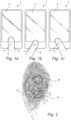
- figs 1a-c schematically show three different exemplary authentication attempts using a small fingerprint sensor.
- an electronic device here in the form of mobile phone 1, comprises a touch display 2 and a fingerprint sensor 3.
- the touch display 2 comprises a touch sensor for touch-based control of the mobile phone 1 and a display acting as a user interface.
- the user of the mobile phone 1 makes a first authentication attempt by placing his finger 5 on the fingerprint sensor 3.
- Fig 1b and fig 1c illustrate second and third authentication attempts in which the user places his finger 5 on the fingerprint sensor 3.
- a user will typically not place his finger in exactly the same way on the fingerprint sensor 3 in connection with different authentication attempts. However, the user will expect the authentication attempts to succeed in at least all of the cases shown in figs 1a-c to be motivated to continue to use fingerprint authentication.
- fig 2 the different portions of the user's fingerprint imaged in the different partial fingerprint images acquired in connection with the authentication attempts in figs 1a-c are indicated on an illustration of the total fingerprint of the finger 5.
- the first fingerprint portion 7a corresponds to the authentication attempt in fig 1a
- the second 7b and third 7c fingerprint portions correspond to figs 1b and 1c , respectively.
- the stored fingerprint template used for authentication based on the partial fingerprint images should correspond to a considerably larger portion of the user's fingerprint than each of the fingerprint portions 7a-c imaged by the partial fingerprint images. It is also easy to understand that an enrolment procedure resulting in a template covering a sufficiently large portion of the user's fingerprint may require a large number of finger placements.
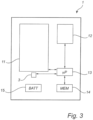
- the electronic device (mobile phone) 1 in fig 1 comprises, in addition to the fingerprint sensor 3, a touch sensor 11, a display 12, processing circuitry here in the form of microprocessor 13, a memory 14 and a battery 15 for providing electrical energy to the various components of the electronic device 1.
- processing circuitry is schematically indicated in fig 3 as a single microprocessor, it should be noted that this is a simplified illustration, and that the processing circuitry may comprise several processors.
- the processing circuitry may comprise a fingerprint processor dedicated for acquisition and processing of fingerprint images, template generation and/or authentication.
- the processing circuitry may comprise a display driver for control of the display 12 etc.
- a first step 100 in response to an authentication request, the fingerprint sensor 3 is controlled by the processing circuitry 13 to acquire a present partial candidate fingerprint image.
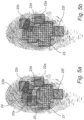
- the acquired present partial candidate fingerprint image 20 is represented by the unfilled square in fig 5a .
- a stored enrolment representation for the user is retrieved by the processor 13 from the memory 14.
- the stored enrolment representation comprises a stored template 21 (indicated as an area with a squared pattern in fig 5a ), and a plurality of previous partial candidate fingerprint images 22a-f (indicated as hatched squares in fig 5a ).
- the illustration of the enrolment representation in fig 5a is only intended to indicate an exemplary coverage of the enrolment representation in relation to the user's fingerprint.
- the stored template 21 and/or the previous partial candidate fingerprint images 22a-f may be stored in any suitable form, for instance as a table of fingerprint feature descriptors and their respective absolute or relative positions.
- a representation of the present partial candidate fingerprint image 20 is compared with the stored template 21 to evaluate a first match between the present partial candidate fingerprint image 20 and the stored template 21.
- the first match can be evaluated by comparing fingerprint features extracted from the present partial candidate fingerprint image 20 with fingerprint features of the stored template 21. Based on the comparison between the representation of the present partial candidate fingerprint image 20 and the stored template 21, a first match score S 1 can be determined.
- This first match score S 1 is evaluated in relation to a first template updating requirement, here a first threshold match score S 1,th in step 103.
- step 104 the method proceeds to step 104 and the processor 13 provides a signal indicating a failed authentication.
- the signal provided by the processor 13 may be used to indicate to the user, for example via the display 12, that the authentication attempt failed.
- step 105 the present partial candidate fingerprint image 20 is stored in the memory 14 and added to the enrolment representation as a previous partial candidate fingerprint image.
- the present partial candidate fingerprint image 20 may be matched with the already stored previous partial candidate fingerprint images 22a-f to determine if one or several cluster(s) can be formed including the present partial candidate fingerprint image 20.
- the match between a cluster including the partial candidate fingerprint image 20 and the stored template 21 may fulfill the requirements for updating the stored template 21.
- the method may therefore optionally further include evaluating a match between newly formed clusters and the stored template 21.
- step 103 When, on the other hand, it is determined in step 103 that the first match fulfills the first template updating requirement, the method proceeds to step 107 and the processor 13 provides a signal indicating authentication success.
- the signal provided by the processor 13 may be used to indicate to the user, for example via the display 12, that the authentication attempt succeeded.
- the above-mentioned representation of the present partial candidate fingerprint image 20 is compared with a representation of at least a first of the stored previous partial candidate fingerprint images 22a-f to evaluate a second match between the present partial candidate fingerprint image 20 and the at least first previous partial candidate fingerprint image 22a-f.
- the representation of the present partial candidate fingerprint image 20 may be successively compared with each of the stored previous partial candidate fingerprint images 22a-f, and for each comparison, a match score S 2,n may be determined.
- This second match score S 2,n for each of the above-mentioned comparisons is evaluated in relation to a second template updating requirement, here a second threshold match score S 2,th in step 109.
- step 109 When it is determined in step 109 that the none of the comparisons between the representation of the present partial candidate fingerprint image 20 and each representation of the previous partial candidate fingerprint images 22a-f results in a second match score S 2,n that exceeds the second threshold match score S 2,th , the method proceeds to step 110.
- step 110 an expanded template is formed by the processor 13 by expanding the stored template with the present partial candidate fingerprint image 20, and the expanded template is stored in the memory 14.
- step 109 When it is instead determined in step 109 that the one or several of the comparisons between the representation of the present partial candidate fingerprint image 20 and each representation of the previous partial candidate fingerprint images 22a-f results in a second match score S 2,n that exceeds the second threshold match score S 2,th , the method proceeds to step 111.
- an expanded template is formed by the processor 13 by expanding the stored template with the present partial candidate fingerprint image 20 and the previous partial candidate fingerprint image(s) for which the second match score S 2,n exceeds the second threshold match score S 2,th , and the expanded template is stored in the memory 14.
- the only one of the previous partial candidate fingerprint images 22a-f that matches sufficiently well with the present partial candidate fingerprint image 20 is the previous partial candidate fingerprint image 22a with the largest overlap.
- the two mutually overlapping previous partial candidate fingerprint images 22a and 22b have previously been matched with each other and form a cluster 24.
- the expanded template, which is indicated as 25 in fig 5b is thus formed based on the present partial candidate fingerprint image 20, the stored template 21, and the above-mentioned cluster 24 of previous partial candidate fingerprint images.
- a first step 200 in response to an authentication request, the fingerprint sensor 3 is controlled by the processing circuitry 13 to acquire a present partial candidate fingerprint image.
- the acquired present partial candidate fingerprint image 20 is represented by the unfilled square in fig 7a .
- a stored enrolment representation for the user is retrieved by the processor 13 from the memory 14.
- the stored enrolment representation comprises a stored template 21 (indicated as an area with a squared pattern in fig 7a ), and a plurality of previous partial candidate fingerprint images 22a-f (indicated as hatched squares in fig 7a ).
- a representation of the present partial candidate fingerprint image 20 is compared with the stored template 21 to evaluate a first match between the present partial candidate fingerprint image 20 and the stored template. Based on the comparison between the representation of the present partial candidate fingerprint image 20 and the stored template 21, a first match score S 1 can be determined.
- This first match score S 1 is evaluated in relation to a first template updating requirement, here a first threshold match score S 1,th in step 203.
- step 203 When it is determined in step 203 that the first match score S 1 does not exceed the first threshold match score S 1,th , the method proceeds to step 204 and the processor 13 provides a signal indicating a failed authentication.
- the signal provided by the processor 13 may be used to indicate to the user, for example via the display 12, that the authentication attempt failed.
- step 205 the present partial candidate fingerprint image 20 is stored in the memory 14 and added to the enrolment representation as a previous failed partial candidate fingerprint image.
- the present partial candidate fingerprint image 20 may be matched with the already stored previous partial candidate fingerprint images 22a-f to determine if one or several cluster(s) can be formed including the present partial candidate fingerprint image 20.
- the match between a cluster including the partial candidate fingerprint image 20 and the stored template 21 may fulfill the requirements for updating the stored template 21.
- the method may therefore optionally further include evaluating a match between newly formed clusters and the stored template 21.
- step 203 When, on the other hand, it is determined in step 203 that the first match fulfills the first template updating requirement, the method proceeds to step 207 and the processor 13 provides a signal indicating authentication success.
- the signal provided by the processor 13 may be used to indicate to the user, for example via the display 12, that the authentication attempt succeeded.
- an updated template is formed by the processor 13 by expanding the stored template 21 with the present partial candidate fingerprint image 20, and the updated template is stored in the memory 14.
- the updated template is indicated by reference numeral 28 in fig 7b .
- step 209 a representation of the n th previous partial candidate fingerprint image, for example starting with the first previous partial candidate fingerprint image 22a, is compared with the updated template 28. As described above, the comparison may result in a third match score S 3,n .
- This third match score S 3,n is evaluated in relation to a third template updating requirement, here a third threshold match score S 3,th in step 210.
- step 210 When it is determined in step 210 that the third match score S 3,n for a comparison between the updated template 28 and the n th previous partial candidate fingerprint image exceeds the third threshold match score S 3,th , the method proceeds to step 211, in which the processor 13 forms a new updated template by expanding the currently stored updated template with the n th previous partial candidate fingerprint image, and the counter n is reset. Since the counter n is reset, it will not matter in which order the previous partial candidate fingerprint images are evaluated.
- the first previous partial candidate fingerprint image 22a matches sufficiently well with the updated stored template 28 to fulfill the template update requirement, and the stored template is therefore expanded by expanding the stored template (updated template 28) with the first previous partial candidate fingerprint image 22a.
- the resulting new updated template is indicated by reference numeral 30 in fig 7c .
- step 211 the method proceeds to step 213. Since the counter n was reset in step 211, the method will directly proceed to step 214 where the counter is incremented before the method returns to step 209. If the evaluated previous partial candidate fingerprint image is the last, the method terminates.
- step 210 when it is determined that the match score S 3,n does not exceed the threshold match score S 3,th , the method goes to step 213 and proceeds as described above.
- the stored template 21 will be expanded five times in succession before the method terminates.
- the stored template will be expanded with the present partial candidate fingerprint image 20, and then with the first 22a, second 22b, fourth 22d, and third 22c previous partial candidate fingerprint images in succession. Only the first iterations are shown in figs 7a-c .
- the successive template enlargement of this second embodiment of the invention allows addition of the fourth 22d (and the third 22c) previous partial candidate fingerprint image even though neither the match between the present partial candidate fingerprint image 20 and the fourth previous partial candidate fingerprint image 22d, nor the match between the second previous partial candidate fingerprint image 22b and the fourth partial candidate fingerprint image 22d fulfills the matching requirement on its own.
- the match between the template and the fourth previous partial candidate fingerprint image 22d will, however, fulfill the matching requirement for template expansion. This provides for a very efficient and fast template expansion.
- the stored template 21 may be expanded three times in succession, first with the present partial candidate fingerprint image 20, then with a cluster comprising the first 22a and second 22b previous partial candidate fingerprint images, and thereafter with a cluster comprising the third 22c and fourth 22d previous partial candidate fingerprint images as described above in connection with the flow-chart in fig 4 .
- the word “comprising” does not exclude other elements or steps, and the indefinite article “a” or “an” does not exclude a plurality.
- a single processor or other unit may fulfill the functions of several items recited in the claims.
- a computer program may be stored/distributed on a suitable medium, such as an optical storage medium or a solid-state medium supplied together with or as part of other hardware, but may also be distributed in other forms, such as via the Internet or other wired or wireless telecommunication systems. Any reference signs in the claims should not be construed as limiting the scope.
Landscapes
- Engineering & Computer Science (AREA)
- Theoretical Computer Science (AREA)
- General Physics & Mathematics (AREA)
- Physics & Mathematics (AREA)
- Multimedia (AREA)
- Human Computer Interaction (AREA)
- Evolutionary Computation (AREA)
- Computer Vision & Pattern Recognition (AREA)
- Artificial Intelligence (AREA)
- Data Mining & Analysis (AREA)
- Software Systems (AREA)
- General Engineering & Computer Science (AREA)
- Computer Security & Cryptography (AREA)
- Databases & Information Systems (AREA)
- Computing Systems (AREA)
- Life Sciences & Earth Sciences (AREA)
- Bioinformatics & Cheminformatics (AREA)
- Bioinformatics & Computational Biology (AREA)
- Evolutionary Biology (AREA)
- General Health & Medical Sciences (AREA)
- Health & Medical Sciences (AREA)
- Medical Informatics (AREA)
- Computer Hardware Design (AREA)
- Collating Specific Patterns (AREA)
- Image Input (AREA)
Description
- The present invention relates to a method of authenticating a finger of a user, and to a fingerprint authentication system.
- Various types of biometric systems are used more and more in order to provide for increased security and/or enhanced user convenience.
- In particular, fingerprint sensing systems have been adopted in, for example, consumer electronic devices, thanks to their small form factor, high performance, and user acceptance.
- To save cost and valuable surface space, there is an effort towards smaller and smaller fingerprint sensors, which may be substantially smaller than the user's fingerprint.
- One way of achieving satisfactory biometric performance with a small fingerprint sensor is to provide a so-called swipe sensor or strip sensor. By instructing the user to swipe his finger across the sensor surface and capturing image slices during the swiping motion sufficient fingerprint information can be collected.
- For some applications, however, swiping the finger across the sensor may not be considered to be sufficiently intuitive and simple to the user.
- For such and other applications, fingerprint sensing systems employing small sensors for stationary finger placement have been proposed. In such fingerprint sensing systems, the user may be authenticated against a stored template based on a single partial fingerprint image from the sensor.
- For achieving the desired satisfactory biometric performance when authenticating based on a single partial fingerprint image from a small fingerprint sensor, it may be necessary that the stored template corresponds to a considerably larger portion of the user's fingerprint than the partial fingerprint image captured in connection with an authentication attempt.
- One way of achieving such a larger template is to enroll users on a larger fingerprint sensor. This approach is, however, not suitable for many applications where enrollment and authentication should be carried out using the same electronic device, such as a mobile communication device.
- It has therefore been proposed to require the user to place his/her finger on the small fingerprint sensor several times during enrolment and then combine data from several partial images to form the template. Depending on, for example, the variation in finger placement and the size of the fingerprint (the size of the finger), it may be difficult to determine if or when sufficient fingerprint data has been acquired based on a given number of finger placements. Alternatively, to ensure that sufficient fingerprint data is always acquired, the enrolment procedure may require a very large number of finger placements upon enrolment. This approach, however, would lead to a time-consuming enrolment procedure, which may result in the user deciding not to use the fingerprint-based authentication system at all.
- In view of this,
US2013/0259330 discloses a method and system for continuously updating and expanding an enrolled template using later acquired partial fingerprint images that match with the stored template. - However, there appears to still be room for improvement. In particular, it would be desirable to provide for a faster expansion of the enrolled template.
- In view of the above-mentioned and other drawbacks of the prior art, it is an object of the present invention to provide for improved fingerprint authentication, in particular to provide for a faster expansion of a stored template.
- According to a first aspect of the present invention, it is therefore provided a method as defined by
claim 1. - According to a second aspect of the present invention, it is provided a method as defined by
claim 3. - The stored template may be any representation of a fingerprint usable as a basis for authenticating a representation of a present partial candidate fingerprint image.
- For example, the stored template may be a composite fingerprint template formed through assembly of partial fingerprint images or assembly of partial templates, each being based on an acquired partial fingerprint image.
- Alternatively, the stored template may be formed by a plurality of partial templates, each being based on an acquired partial fingerprint image.
- In the context of the present application, a "representation" of a fingerprint image may be any information extracted from the fingerprint image, which is useful for assessing the similarity between fingerprint images acquired at different times. For instance, the representation of the fingerprint image may comprise descriptions of fingerprint features (such as so-called minutiae) and information about the positional relationship between the fingerprint features. Alternatively, the representation of the fingerprint image may be the image itself, or a compressed version of the image. For example, the image may be binarized and/or skeletonized.
- The above-mentioned first and second template updating requirements, which may be predefined and stored in memory, may be identical or mutually different.
- The template updating requirements may, for example, be embodied in the form of threshold matching scores that may indicate a minimum similarity between fingerprint images required for template updating to take place.
- In various embodiments, the template updating requirements may indicate at least a required number of corresponding fingerprint features. However, other properties may also be used, alone or in combination with a requirement on the number of corresponding fingerprint features. For instance, the positional relationship between the fingerprint features may be used.
- The template update requirements may be the same or similar as the requirements for determining if an authentication attempt is successful. According to various embodiments, however, the template update requirements may be stricter than an authentication requirement.
- It should be noted that a fingerprint authentication system may be comprised in a stand-alone electronic device, such as a mobile communication device, or may be formed by interconnected devices, such as a computer and a fingerprint acquisition device connected to the computer.
- The fingerprint sensor may, for example, be a capacitive fingerprint sensor detecting a measure indicative of the capacitive coupling between each sensing element in an array of sensing elements and a finger surface touching the sensor surface. Sensing elements at locations corresponding to ridges in the fingerprint will exhibit a stronger capacitive coupling to the finger than sensing elements at locations corresponding to valleys in the fingerprint.
- However, the various embodiments of the present invention are not limited to a particular fingerprint sensing technology, but are equally applicable to, for instance, optical, thermal or piezo-electric fingerprint sensors etc.
- The steps of the methods according to various embodiments of the present invention need not necessarily be performed in any particular order. For instance, the above-mentioned second match can be evaluated before the above-mentioned first match and/or the signal indicating a successful authentication may be provided at any time after it has been determined that the first match fulfills the first template updating requirement.
- The present invention is based upon the realization that a stored template can be expanded faster by saving representations of previous partial fingerprint images acquired in connection with failed authentications attempts, and expanding the stored template with one or several such previous partial fingerprint images when a present partial fingerprint image is determined to be sufficiently similar to the fingerprint image represented by the stored template and also sufficiently similar to the one or several previous partial fingerprint images.
- A faster expansion of the stored template provides for a faster improvement in the performance of the fingerprint authentication system and/or allows for a simpler and faster enrolment procedure, making the fingerprint authentication system according to embodiments of the present invention more user-friendly without compromising the performance.
- According to various embodiments, it may be determined if the second match fulfills the second template updating requirement by comparing the stored representation of the at least first previous partial candidate fingerprint image and the representation of the present partial candidate fingerprint image.
- In these embodiments, a limited and known number of matches between partial fingerprint images may be carried out in connection with a successful authentication, which provides for a fast and predictable authentication and template expansion procedure.
- In other embodiments, the method according to the present invention may further comprise the step of forming, when it is determined that the first match fulfills the first predefined template updating requirement, an updated template based on the stored template and the present candidate fingerprint image, wherein it is determined if the second match fulfills the second template updating requirement by comparing the stored representation of the at least first previous partial candidate fingerprint image and the updated template.
- These embodiments may provide for an even faster expansion of the stored template. Furthermore, the first and second template updating requirements may be identical or at least very similar, which may facilitate implementation of the fingerprint authentication method.
- Further expansion of the stored template in connection with a successful authentication may be achieved by determining if a third match between a stored representation of a second previous partial candidate fingerprint image and the first expanded template fulfills a third template updating requirement; and when it is determined that the third match fulfills the third template updating requirement: forming a second expanded template based on the first expanded template and the second previous candidate fingerprint image.
- The stored template can only be expanded when the first match (between the representation of the present partial fingerprint image and the stored template) fulfills the first template updating requirement. In this case, an updated template can be formed by expanding the stored template with at least the present partial candidate fingerprint image. If, on the other hand, the first match fails to fulfill the first template updating requirement, the representation of the present partial candidate fingerprint image is added to the enrolment representation as a representation of a previous partial fingerprint image, thereby forming an updated enrolment representation.
- It may be desirable to somehow qualify partial fingerprint images acquired in connection with failed authentication attempts, to make better use of the available memory space.
- According to one embodiment, the method of the present invention may therefore further comprise the step of evaluating at least one image property of the present partial candidate fingerprint image in respect of an image property criterion, wherein the representation of the present partial candidate fingerprint image may only be added to the stored enrolment representation when the at least one image property fulfills the image property criterion.
- Such an image property criterion may, for instance be indicative of a threshold image quality, to reduce the risk of including partial fingerprint images with poor image quality (blurry images, images with insufficient contrast, images with saturated portions etc) in the enrolment representation for the user.
- Alternatively, or in combination, the image property criterion may be indicative of a likelihood that the present partial candidate fingerprint image is an image of a finger of the user.
- For instance, different users may have fingerprints exhibiting distinctly different general characteristics, such as average distance between adjacent fingerprint ridges etc.
- According to various embodiments, the method of the present invention may additionally provide for a procedure for removing representations of previous partial candidate fingerprint images from the memory of the fingerprint authentication system based on an evaluation of at least one property of each of the stored previous partial candidate fingerprint images. The at least one property may be selected from a group comprising image quality, image age, similarity to other previous partial candidate fingerprint images etc.
- According to a third aspect of the present invention, there is provided a fingerprint authentication system as defined by claim 10.
- The processing circuitry may be provided in the form of one or several processors, which may also control other functions of the electronic device in which the fingerprint authentication system may be comprised.
- Further embodiments of, and effects obtained through this third aspect of the present invention are largely analogous to those described above for the first and second aspects of the invention.
- In summary, the present invention relates to a method of authenticating a finger against a stored template and expanding the stored template. The method comprises acquiring a present fingerprint image; retrieving a stored enrolment representation, comprising said stored template, and a representation of at least a first previous fingerprint image acquired in connection with a previous failed authentication attempt; and determining if the stored template should be expanded. When it is determined that a first match between a present fingerprint image representation and the stored template fulfills a first template updating requirement and a second match between the present fingerprint image representation and said at least first previous fingerprint image representation fulfills said second template updating requirement, a signal indicating a successful authentication is provided; and a first expanded template is formed based on said stored template, said present fingerprint image and said at least first previous fingerprint image.
- These and other aspects of the present invention will now be described in more detail, with reference to the appended drawings showing an example embodiment of the invention, wherein:
-
Figs 1a-c schematically show three different exemplary authentication attempts using a small fingerprint sensor; -
Fig 2 schematically illustrates the partial fingerprint images acquired infigs 1a-c in relation to the user's fingerprint; -
Fig 3 is a block diagram of an example embodiment of the fingerprint authentication system according to the present invention; -
Fig 4 is a flow-chart schematically illustrating a method according to the first aspect of the present invention; -
Fig 5a-b schematically illustrates an example of an enrolment representation and the present partial candidate fingerprint image in relation to the user's fingerprint at different stages of the method infig 4 ; -
Fig 6 is a flow-chart schematically illustrating a method according to the second aspect of the present invention; and -
Figs 7a-c schematically illustrates an example of an enrolment representation and the present partial candidate fingerprint image in relation to the user's fingerprint at different stages of the method infig 6 . - In the present detailed description, various embodiments of the method and electronic device according to the present invention are mainly described with reference to a substantially square fingerprint sensor arranged adjacent to the touch display of a mobile phone.
- It should be noted that this by no means limits the scope of the present invention, which equally well includes, for example, other electronic devices such as tablets, computers or watches. Furthermore, the fingerprint sensor may have any other shape. For instance, the fingerprint sensor may be provided as an elongated rectangle.
- For the purpose of providing an introduction to the challenges involved in using a small fingerprint sensor,
figs 1a-c schematically show three different exemplary authentication attempts using a small fingerprint sensor. - Referring first to
fig 1a , an electronic device, here in the form ofmobile phone 1, comprises a touch display 2 and afingerprint sensor 3. The touch display 2 comprises a touch sensor for touch-based control of themobile phone 1 and a display acting as a user interface. - In
fig 1a , the user of themobile phone 1 makes a first authentication attempt by placing hisfinger 5 on thefingerprint sensor 3. -
Fig 1b and fig 1c illustrate second and third authentication attempts in which the user places hisfinger 5 on thefingerprint sensor 3. - As is indicated in
figs 1a-c , a user will typically not place his finger in exactly the same way on thefingerprint sensor 3 in connection with different authentication attempts. However, the user will expect the authentication attempts to succeed in at least all of the cases shown infigs 1a-c to be motivated to continue to use fingerprint authentication. - In
fig 2 , the different portions of the user's fingerprint imaged in the different partial fingerprint images acquired in connection with the authentication attempts infigs 1a-c are indicated on an illustration of the total fingerprint of thefinger 5. Infig 2 , thefirst fingerprint portion 7a corresponds to the authentication attempt infig 1a , while the second 7b and third 7c fingerprint portions correspond tofigs 1b and 1c , respectively. - Considering the illustration in
fig 2 , it is easy to understand that, for all of the authentication attempts infigs 1a-c to be successful, the stored fingerprint template used for authentication based on the partial fingerprint images should correspond to a considerably larger portion of the user's fingerprint than each of thefingerprint portions 7a-c imaged by the partial fingerprint images. It is also easy to understand that an enrolment procedure resulting in a template covering a sufficiently large portion of the user's fingerprint may require a large number of finger placements. - Having now briefly explained the need for a fingerprint template corresponding to a relatively large portion of the user's fingerprint, various embodiments of the present invention providing for such a fingerprint template will be described in the following.
- Referring to the block diagram in
fig 3 , the electronic device (mobile phone) 1 infig 1 comprises, in addition to thefingerprint sensor 3, atouch sensor 11, adisplay 12, processing circuitry here in the form ofmicroprocessor 13, amemory 14 and abattery 15 for providing electrical energy to the various components of theelectronic device 1. Although the processing circuitry is schematically indicated infig 3 as a single microprocessor, it should be noted that this is a simplified illustration, and that the processing circuitry may comprise several processors. For instance, the processing circuitry may comprise a fingerprint processor dedicated for acquisition and processing of fingerprint images, template generation and/or authentication. Moreover, the processing circuitry may comprise a display driver for control of thedisplay 12 etc. - A method according to the first aspect of the present invention will now be described with reference to the flow-chart in
fig 4 together with the illustrations infig 3 , andfigs 5a-b . - In a
first step 100, in response to an authentication request, thefingerprint sensor 3 is controlled by theprocessing circuitry 13 to acquire a present partial candidate fingerprint image. The acquired present partialcandidate fingerprint image 20 is represented by the unfilled square infig 5a . - In the
subsequent step 101, a stored enrolment representation for the user is retrieved by theprocessor 13 from thememory 14. As is schematically indicated infig 5a , the stored enrolment representation comprises a stored template 21 (indicated as an area with a squared pattern infig 5a ), and a plurality of previous partialcandidate fingerprint images 22a-f (indicated as hatched squares infig 5a ). - In this context it should be noted that the illustration of the enrolment representation in
fig 5a is only intended to indicate an exemplary coverage of the enrolment representation in relation to the user's fingerprint. The storedtemplate 21 and/or the previous partialcandidate fingerprint images 22a-f may be stored in any suitable form, for instance as a table of fingerprint feature descriptors and their respective absolute or relative positions. - In the next step 102, a representation of the present partial
candidate fingerprint image 20 is compared with the storedtemplate 21 to evaluate a first match between the present partialcandidate fingerprint image 20 and the storedtemplate 21. For instance, the first match can be evaluated by comparing fingerprint features extracted from the present partialcandidate fingerprint image 20 with fingerprint features of the storedtemplate 21. Based on the comparison between the representation of the present partialcandidate fingerprint image 20 and the storedtemplate 21, a first match score S1 can be determined. - This first match score S1 is evaluated in relation to a first template updating requirement, here a first threshold match score S1,th in
step 103. - When it is determined in
step 103 that the first match score S1 does not exceed the first threshold match score S1,th, the method proceeds to step 104 and theprocessor 13 provides a signal indicating a failed authentication. The signal provided by theprocessor 13 may be used to indicate to the user, for example via thedisplay 12, that the authentication attempt failed. Instep 105, the present partialcandidate fingerprint image 20 is stored in thememory 14 and added to the enrolment representation as a previous partial candidate fingerprint image. In connection with this, the present partialcandidate fingerprint image 20 may be matched with the already stored previous partialcandidate fingerprint images 22a-f to determine if one or several cluster(s) can be formed including the present partialcandidate fingerprint image 20. It should be noted the match between a cluster including the partialcandidate fingerprint image 20 and the storedtemplate 21 may fulfill the requirements for updating the storedtemplate 21. The method may therefore optionally further include evaluating a match between newly formed clusters and the storedtemplate 21. - When, on the other hand, it is determined in
step 103 that the first match fulfills the first template updating requirement, the method proceeds to step 107 and theprocessor 13 provides a signal indicating authentication success. The signal provided by theprocessor 13 may be used to indicate to the user, for example via thedisplay 12, that the authentication attempt succeeded. - In the
next step 108, the above-mentioned representation of the present partialcandidate fingerprint image 20 is compared with a representation of at least a first of the stored previous partialcandidate fingerprint images 22a-f to evaluate a second match between the present partialcandidate fingerprint image 20 and the at least first previous partialcandidate fingerprint image 22a-f. For example, the representation of the present partialcandidate fingerprint image 20 may be successively compared with each of the stored previous partialcandidate fingerprint images 22a-f, and for each comparison, a match score S2,n may be determined. - This second match score S2,n for each of the above-mentioned comparisons is evaluated in relation to a second template updating requirement, here a second threshold match score S2,th in
step 109. - When it is determined in
step 109 that the none of the comparisons between the representation of the present partialcandidate fingerprint image 20 and each representation of the previous partialcandidate fingerprint images 22a-f results in a second match score S2,n that exceeds the second threshold match score S2,th, the method proceeds to step 110. - In
step 110, an expanded template is formed by theprocessor 13 by expanding the stored template with the present partialcandidate fingerprint image 20, and the expanded template is stored in thememory 14. - When it is instead determined in
step 109 that the one or several of the comparisons between the representation of the present partialcandidate fingerprint image 20 and each representation of the previous partialcandidate fingerprint images 22a-f results in a second match score S2,n that exceeds the second threshold match score S2,th, the method proceeds to step 111. - In
step 111, an expanded template is formed by theprocessor 13 by expanding the stored template with the present partialcandidate fingerprint image 20 and the previous partial candidate fingerprint image(s) for which the second match score S2,n exceeds the second threshold match score S2,th, and the expanded template is stored in thememory 14. - In the example illustrated in
fig 5a , the only one of the previous partialcandidate fingerprint images 22a-f that matches sufficiently well with the present partialcandidate fingerprint image 20 is the previous partialcandidate fingerprint image 22a with the largest overlap. However, the two mutually overlapping previous partialcandidate fingerprint images cluster 24. The expanded template, which is indicated as 25 infig 5b is thus formed based on the present partialcandidate fingerprint image 20, the storedtemplate 21, and the above-mentionedcluster 24 of previous partial candidate fingerprint images. - A method according to the second aspect of the present invention will now be described with reference to the flow-chart in
fig 6 together with the illustrations infig 3 , andfigs 7a-c . - In a
first step 200, in response to an authentication request, thefingerprint sensor 3 is controlled by theprocessing circuitry 13 to acquire a present partial candidate fingerprint image. The acquired present partialcandidate fingerprint image 20 is represented by the unfilled square infig 7a . - In the
subsequent step 201, a stored enrolment representation for the user is retrieved by theprocessor 13 from thememory 14. As is schematically indicated infig 7a , the stored enrolment representation comprises a stored template 21 (indicated as an area with a squared pattern infig 7a ), and a plurality of previous partialcandidate fingerprint images 22a-f (indicated as hatched squares infig 7a ). - In the
next step 202, a representation of the present partialcandidate fingerprint image 20 is compared with the storedtemplate 21 to evaluate a first match between the present partialcandidate fingerprint image 20 and the stored template. Based on the comparison between the representation of the present partialcandidate fingerprint image 20 and the storedtemplate 21, a first match score S1 can be determined. - This first match score S1 is evaluated in relation to a first template updating requirement, here a first threshold match score S1,th in
step 203. - When it is determined in
step 203 that the first match score S1 does not exceed the first threshold match score S1,th, the method proceeds to step 204 and theprocessor 13 provides a signal indicating a failed authentication. The signal provided by theprocessor 13 may be used to indicate to the user, for example via thedisplay 12, that the authentication attempt failed. Instep 205, the present partialcandidate fingerprint image 20 is stored in thememory 14 and added to the enrolment representation as a previous failed partial candidate fingerprint image. In connection with this, the present partialcandidate fingerprint image 20 may be matched with the already stored previous partialcandidate fingerprint images 22a-f to determine if one or several cluster(s) can be formed including the present partialcandidate fingerprint image 20. It should be noted the match between a cluster including the partialcandidate fingerprint image 20 and the storedtemplate 21 may fulfill the requirements for updating the storedtemplate 21. The method may therefore optionally further include evaluating a match between newly formed clusters and the storedtemplate 21. - When, on the other hand, it is determined in
step 203 that the first match fulfills the first template updating requirement, the method proceeds to step 207 and theprocessor 13 provides a signal indicating authentication success. The signal provided by theprocessor 13 may be used to indicate to the user, for example via thedisplay 12, that the authentication attempt succeeded. - In the
next step 208, an updated template is formed by theprocessor 13 by expanding the storedtemplate 21 with the present partialcandidate fingerprint image 20, and the updated template is stored in thememory 14. The updated template is indicated byreference numeral 28 infig 7b . - Subsequently, in
step 209, a representation of the nth previous partial candidate fingerprint image, for example starting with the first previous partialcandidate fingerprint image 22a, is compared with the updatedtemplate 28. As described above, the comparison may result in a third match score S3,n. - This third match score S3,n is evaluated in relation to a third template updating requirement, here a third threshold match score S3,th in
step 210. - When it is determined in
step 210 that the third match score S3,n for a comparison between the updatedtemplate 28 and the nth previous partial candidate fingerprint image exceeds the third threshold match score S3,th, the method proceeds to step 211, in which theprocessor 13 forms a new updated template by expanding the currently stored updated template with the nth previous partial candidate fingerprint image, and the counter n is reset. Since the counter n is reset, it will not matter in which order the previous partial candidate fingerprint images are evaluated. - In the presently illustrated example, the first previous partial
candidate fingerprint image 22a matches sufficiently well with the updated storedtemplate 28 to fulfill the template update requirement, and the stored template is therefore expanded by expanding the stored template (updated template 28) with the first previous partialcandidate fingerprint image 22a. The resulting new updated template is indicated byreference numeral 30 infig 7c . - Following
step 211, the method proceeds to step 213. Since the counter n was reset instep 211, the method will directly proceed to step 214 where the counter is incremented before the method returns to step 209. If the evaluated previous partial candidate fingerprint image is the last, the method terminates. - Returning to step 210, when it is determined that the match score S3,n does not exceed the threshold match score S3,th, the method goes to step 213 and proceeds as described above.
- In the present example, the stored
template 21 will be expanded five times in succession before the method terminates. First, the stored template will be expanded with the present partialcandidate fingerprint image 20, and then with the first 22a, second 22b, fourth 22d, and third 22c previous partial candidate fingerprint images in succession. Only the first iterations are shown infigs 7a-c . - Regarding the fourth previous partial
candidate fingerprint image 22d, it should be noted that the successive template enlargement of this second embodiment of the invention allows addition of the fourth 22d (and the third 22c) previous partial candidate fingerprint image even though neither the match between the present partialcandidate fingerprint image 20 and the fourth previous partialcandidate fingerprint image 22d, nor the match between the second previous partialcandidate fingerprint image 22b and the fourth partialcandidate fingerprint image 22d fulfills the matching requirement on its own. After expanding the template with the second previous partialcandidate fingerprint image 22b (in the step following the situation shown infig 7c ), the match between the template and the fourth previous partialcandidate fingerprint image 22d will, however, fulfill the matching requirement for template expansion. This provides for a very efficient and fast template expansion. - Alternatively, the stored
template 21 may be expanded three times in succession, first with the present partialcandidate fingerprint image 20, then with a cluster comprising the first 22a and second 22b previous partial candidate fingerprint images, and thereafter with a cluster comprising the third 22c and fourth 22d previous partial candidate fingerprint images as described above in connection with the flow-chart infig 4 . - The person skilled in the art realizes that the present invention by no means is limited to the preferred embodiments described above. On the contrary, many modifications and variations are possible within the scope of the appended claims.
- In the claims, the word "comprising" does not exclude other elements or steps, and the indefinite article "a" or "an" does not exclude a plurality. A single processor or other unit may fulfill the functions of several items recited in the claims. A computer program may be stored/distributed on a suitable medium, such as an optical storage medium or a solid-state medium supplied together with or as part of other hardware, but may also be distributed in other forms, such as via the Internet or other wired or wireless telecommunication systems. Any reference signs in the claims should not be construed as limiting the scope.
Claims (13)
- A method of authenticating a finger (5) of a user against a stored template (21) and expanding the stored template, comprising the steps of:acquiring (100) a present partial candidate fingerprint image (20);retrieving (101) a stored enrolment representation for said user, the stored enrolment representation comprising said stored template (21), and stored representations of a plurality of previous partial candidate fingerprint images (22a-f) acquired in connection with previous failed authentication attempts for said user;determining if a first match between a representation of the present partial candidate fingerprint image (20) and said stored template (21) fulfills a first template updating requirement indicating that the present partial fingerprint image (20) is sufficiently similar to the fingerprint image represented by the stored template (20) for template updating to take place and that authentication can be considered successful;determining if a second match between said representation of the present partial candidate fingerprint image (20) and at least one of said stored representations of the plurality of previous partial candidate fingerprint images (22a-f) fulfills a second template updating requirement;when it is determined that said first match fulfills said first template updating requirement and said second match fails to fulfill said second template updating requirement:providing (107) a signal indicating a successful authentication; andforming (110) a first expanded template (25) by expanding said stored template (21) with said present partial candidate fingerprint image (20);when it is determined that said first match fulfills said first template updating requirement and said second match fulfills said second template updating requirement:providing (107) a signal indicating a successful authentication; andforming (111) a first expanded template (25) by expanding said stored template (21) with said present partial candidate image (20) and said at least one stored representation of the plurality of previous partial candidate fingerprint images (22a-f); andwhen it is determined that said first match fails to fulfill said first template updating requirement:providing (104) a signal indicating failed authentication; andforming (105) an updated enrolment representation by adding said representation of the present partial candidate fingerprint image (20) to said stored enrolment representation as a previous partial candidate fingerprint image.
- The method according to claim 1, wherein it is determined if said second match fulfills said second template updating requirement by comparing each of said stored representations of the plurality of previous partial candidate fingerprint images (22a-f) and said representation of the present partial candidate fingerprint image (20).
- A method of authenticating a finger (5) of a user against a stored template (21) and expanding the stored template, comprising the steps of:acquiring (200) a present partial candidate fingerprint image (20);retrieving (201) a stored enrolment representation for said user, the stored enrolment representation comprising said stored template (21), and stored representations of a plurality of previous partial candidate fingerprint images (22a-f) acquired in connection with previous failed authentication attempts for said user;determining if a first match between a representation of the present partial candidate fingerprint image (20) and said stored template (21) fulfills a first template updating requirement indicating that the present partial fingerprint image (20) is sufficiently similar to the fingerprint image represented by the stored template (21) for template updating to take place and that authentication can be considered successful;when it is determined that said first match fulfills said first template updating requirement:providing (207) a signal indicating a successful authentication;forming (208) an updated template (28) by expanding said stored template (21) with said present partial candidate fingerprint image (20); anddetermining if a second match between said representation of the present partial candidate fingerprint image (20) and a first one of said stored representations of the plurality of previous partial candidate fingerprint images (22a-f) fulfills a second template updating requirement by comparing said first one of the stored representations and said updated template (28);when it is determined that said second match fulfills said second template updating requirement:
forming a first expanded template (30) by expanding said updated template (28) with said first one of the stored representations of the plurality of previous partial candidate fingerprint images (22a-f); andwhen it is determined that said first match fails to fulfill said first template updating requirement:providing (204) a signal indicating failed authentication; andforming (205) an updated enrolment representation by adding said representation of the present partial candidate fingerprint image (20) to said stored enrolment representation as a previous failed partial candidate fingerprint image. - The method according to claim 3, further comprising the steps of:determining if a third match between a second one of said stored representations of the plurality of previous partial candidate fingerprint images (22a-f) and said first expanded template (30) fulfills a third template updating requirement; andwhen it is determined that said third match fulfills said third template updating requirement:
forming a second expanded template by expanding said first expanded template (30) with said second one of the stored representations of the plurality of previous partial candidate fingerprint images (22a-f). - The method according to any one of the preceding claims, further comprising the step of:evaluating at least one image property of said present partial candidate fingerprint image (20) in respect of an image property criterion,wherein said representation of the present partial candidate fingerprint image (20) is only added to said stored enrolment representation when said at least one image property fulfills said image property criterion.
- The method according to claim 5, wherein said image property criterion is indicative of a threshold image quality.
- The method according to claim 5 or 6, wherein said image property criterion is indicative of a likelihood that said present partial candidate fingerprint image is an image of a finger (5) of said user.
- The method according to claim 7, wherein said image property criterion is indicative of a threshold spatial frequency of fingerprint ridges or valleys.
- The method according to any one of the preceding claims, further comprising the steps of:evaluating at least one property of each previous partial candidate fingerprint image in said plurality of previous partial candidate fingerprint images (22a-f); andremoving at least one of said previous partial candidate fingerprint images (22a-f) from said stored enrolment representation based on said evaluation.
- A fingerprint authentication system for authenticating a user, comprising:a fingerprint sensor;a memory; andprocessing circuitry connected to said fingerprint sensor, and to said memory for:controlling said fingerprint sensor to acquire a present partial candidate fingerprint image of a candidate fingerprint to be authenticated;retrieving, from said memory, a stored enrolment representation for said user, the stored enrolment representation comprising a stored template, and stored representations of a plurality of previous partial candidate fingerprint images acquired in connection with previous failed authentication attempts for said user;determining if a first match between a representation of the present partial candidate fingerprint image and said stored template fulfills a first template updating requirement indicating that the present partial fingerprint image is sufficiently similar to the fingerprint image represented by the stored template for template updating to take place and that authentication can be considered successful;determining if a second match between said representation of the present partial candidate fingerprint image and at least one of said stored representations of the plurality of previous partial candidate fingerprint images fulfills a second template updating requirement;when it is determined that said first match fulfills said first template updating requirement and said second match fails to fulfill said second template updating requirement:providing a signal indicating a successful authentication; andforming a first expanded template by expanding said stored template with said present partial candidate fingerprint image;when it is determined that said first match fulfills said first template updating requirement and said second match fulfills said second template updating requirement:providing a signal indicating a successful authentication; andforming a first expanded template by expanding said stored template with said present partial candidate fingerprint image and said at least one stored representation of the plurality of previous partial candidate fingerprint images; andwhen it is determined that said first match fails to fulfill said first template updating requirement:providing a signal indicating failed authentication; andforming an updated enrolment representation by adding said representation of the present partial candidate fingerprint image to said stored enrolment representation as a previous partial candidate fingerprint image.
- The fingerprint authentication system according to claim 10, wherein said processing circuitry is configured to determine if said second match fulfills said second template updating requirement by comparing each of said stored representations of the plurality of previous partial candidate fingerprint images and said representation of the present partial candidate fingerprint image.
- A fingerprint authentication system for authenticating a user, comprising:a fingerprint sensor (3);a memory (14); andprocessing circuitry (13) connected to said fingerprint sensor (3), and to said memory (14) for:acquiring a present partial candidate fingerprint image (20);retrieving a stored enrolment representation for said user, the stored enrolment representation comprising a stored template (21), and stored representations of a plurality of previous partial candidate fingerprint images (22a-f) acquired in connection with previous failed authentication attempts for said user;determining if a first match between a representation of the present partial candidate fingerprint image (20) and said stored template (21) fulfills a first template updating requirement indicating that the present partial fingerprint image (20) is sufficiently similar to the fingerprint image represented by the stored template (21) for template updating to take place and that authentication can be considered successful;when it is determined that said first match fulfills said first template updating requirement:providing a signal indicating a successful authentication;forming an updated template (28) by expanding said stored template (21) with said present partial candidate fingerprint image (20); anddetermining if a second match between said representation of the present partial candidate fingerprint image (20) and a first one of said stored representations of the plurality of previous partial candidate fingerprint images (22a-f) fulfills a second template updating requirement by comparing said first one of the stored representations and said updated template (28);when it is determined that said second match fulfills said second template updating requirement:
forming a first expanded template by expanding said updated template (28) with said first one of the stored representations of the plurality of previous partial candidate fingerprint images (22a-f); andwhen it is determined that said first match fails to fulfill said first template updating requirement:providing a signal indicating failed authentication; andforming an updated enrolment representation by adding said representation of the present partial candidate fingerprint image to said stored enrolment representation as a previous failed partial candidate fingerprint image. - An electronic device (1) comprising;a fingerprint authentication system according to claim 10 or 12; anda processing unit configured to control said fingerprint authentication system to carry out a fingerprint authentication of a user, and to perform at least one user-requested process only if said user is verified using said fingerprint authentication system.
Applications Claiming Priority (2)
| Application Number | Priority Date | Filing Date | Title |
|---|---|---|---|
| SE1550931 | 2015-07-01 | ||
| PCT/SE2016/050636 WO2017003356A1 (en) | 2015-07-01 | 2016-06-27 | Fingerprint authentication with template updating |
Publications (3)
| Publication Number | Publication Date |
|---|---|
| EP3317811A1 EP3317811A1 (en) | 2018-05-09 |
| EP3317811A4 EP3317811A4 (en) | 2019-02-27 |
| EP3317811B1 true EP3317811B1 (en) | 2024-04-03 |
Family
ID=57120862
Family Applications (1)
| Application Number | Title | Priority Date | Filing Date |
|---|---|---|---|
| EP16818340.8A Active EP3317811B1 (en) | 2015-07-01 | 2016-06-27 | Fingerprint authentication with template updating |
Country Status (6)
| Country | Link |
|---|---|
| US (1) | US9471765B1 (en) |
| EP (1) | EP3317811B1 (en) |
| JP (1) | JP6717859B2 (en) |
| KR (1) | KR101898636B1 (en) |
| CN (1) | CN106716446B (en) |
| WO (1) | WO2017003356A1 (en) |
Families Citing this family (32)
| Publication number | Priority date | Publication date | Assignee | Title |
|---|---|---|---|---|
| US10713466B2 (en) | 2014-03-07 | 2020-07-14 | Egis Technology Inc. | Fingerprint recognition method and electronic device using the same |
| KR102255351B1 (en) * | 2014-09-11 | 2021-05-24 | 삼성전자주식회사 | Method and apparatus for iris recognition |
| EP3232369B1 (en) * | 2016-04-15 | 2021-06-16 | Nxp B.V. | Fingerprint authentication system and method |
| CN106055956B (en) * | 2016-05-30 | 2017-10-31 | 广东欧珀移动通信有限公司 | An unlocking control method and mobile terminal |
| US10395129B2 (en) * | 2016-09-14 | 2019-08-27 | Idex Asa | Dynamic registration seed |
| CN106897595B (en) * | 2017-01-20 | 2020-04-03 | 北京安云世纪科技有限公司 | Mobile terminal |
| US10528791B1 (en) * | 2017-03-02 | 2020-01-07 | Synaptics Incorporated | Biometric template updating systems and methods |
| US10691919B1 (en) | 2017-03-09 | 2020-06-23 | Idex Asa | Dynamic registration using multiple match enrollment |
| US11366887B2 (en) * | 2017-03-09 | 2022-06-21 | Fingerprint Cards Anacatum Ip Ab | Biometric authentication |
| KR102316278B1 (en) * | 2017-04-07 | 2021-10-22 | 삼성전자 주식회사 | Electronic device and method for controlling fingerprint information |
| IL251670A0 (en) * | 2017-04-09 | 2017-06-29 | Fst21 Ltd | System and method for updating a repository of images for identifying users |
| CN109214152B (en) * | 2017-06-30 | 2021-04-13 | 中国电信股份有限公司 | Fingerprint authentication method, fingerprint authentication device and storage medium |
| TWI676911B (en) * | 2017-10-12 | 2019-11-11 | 神盾股份有限公司 | Fingerprint recognition method and electronic device using the same |
| TWI678634B (en) * | 2017-11-28 | 2019-12-01 | 宏碁股份有限公司 | Fingerprint authentication method and electronic device |
| CN109960911A (en) * | 2017-12-14 | 2019-07-02 | 宏碁股份有限公司 | Fingerprint verification method and electronic device |
| KR20190074782A (en) | 2017-12-20 | 2019-06-28 | 삼성전자주식회사 | Fingerprint verification method and electronic device performing thereof |
| CN108288050B (en) | 2018-02-13 | 2022-03-01 | 北京小米移动软件有限公司 | Method and device for updating fingerprint template and electronic equipment |
| CN108573038A (en) * | 2018-04-04 | 2018-09-25 | 北京市商汤科技开发有限公司 | Image processing, authentication method, device, electronic device and storage medium |
| US11216541B2 (en) | 2018-09-07 | 2022-01-04 | Qualcomm Incorporated | User adaptation for biometric authentication |
| WO2020113429A1 (en) * | 2018-12-04 | 2020-06-11 | 深圳市汇顶科技股份有限公司 | Fingerprint registration method, terminal and computer-readable storage medium |
| CN109934114B (en) * | 2019-02-15 | 2023-05-12 | 重庆工商大学 | Finger vein template generation and updating algorithm and system |
| KR102561689B1 (en) * | 2019-05-29 | 2023-08-01 | 삼성에스디에스 주식회사 | Apparatus and method for registering biometric information, apparatus and method for biometric authentication |
| US11983589B2 (en) | 2019-11-01 | 2024-05-14 | Fingerprint Cards Anacatum Ip Ab | Method for amending a fingerprint template of a smart card |
| KR102822927B1 (en) | 2020-06-22 | 2025-06-23 | 삼성디스플레이 주식회사 | Fingerprint authentication device, display device including the same, and method of authenticatiing fingerprint |
| CN113918908A (en) | 2020-07-07 | 2022-01-11 | 三星电子株式会社 | Method and apparatus for fingerprint verification |
| US11983965B2 (en) | 2020-11-05 | 2024-05-14 | Samsung Electronics Co., Ltd. | Electronic device for biometric authentication and method for operating the same |
| KR102751475B1 (en) * | 2020-11-05 | 2025-01-10 | 삼성전자주식회사 | Electronic device for biometric authentication and method for operating thereof |
| CN115131838B (en) * | 2021-03-23 | 2025-06-27 | 上海耕岩智能科技有限公司 | Fingerprint imaging module, fingerprint collection method and electronic device |
| CN115098846B (en) * | 2022-04-26 | 2026-05-08 | 天津极豪科技有限公司 | Unlocking methods, electronic devices, storage media, and computer program products |
| CN116310763B (en) * | 2023-05-10 | 2023-07-21 | 合肥英特灵达信息技术有限公司 | Template image generation method and device, electronic equipment and storage medium |
| CN117671741A (en) * | 2023-11-09 | 2024-03-08 | 三星(中国)半导体有限公司 | Fingerprint template update method and device |
| CN117671744B (en) * | 2023-12-20 | 2025-10-03 | 杭州海康威视数字技术股份有限公司 | Fingerprint template updating method across acquisition devices, storage medium, and electronic device |
Family Cites Families (19)
| Publication number | Priority date | Publication date | Assignee | Title |
|---|---|---|---|---|
| JPH08185519A (en) * | 1994-12-27 | 1996-07-16 | Hamamatsu Photonics Kk | Method and device for collating figure |
| JP3780830B2 (en) | 2000-07-28 | 2006-05-31 | 日本電気株式会社 | Fingerprint identification method and apparatus |
| AU2002328437A1 (en) * | 2002-09-17 | 2004-04-08 | Fujitsu Limited | Biological information acquiring apparatus and authentication apparatus using biological information |
| KR100622245B1 (en) * | 2004-06-04 | 2006-09-08 | 주식회사 팬택 | Apparatus and method for fingerprint authentication in a mobile communication terminal |
| JP2008065572A (en) * | 2006-09-07 | 2008-03-21 | Konica Minolta Business Technologies Inc | Method for updating biometric information used in biometric authentication system, and biometric authentication system |
| JP4403426B2 (en) * | 2007-01-09 | 2010-01-27 | サイレックス・テクノロジー株式会社 | Biometric authentication device and biometric authentication program |
| GB2450479A (en) * | 2007-06-22 | 2008-12-31 | Warwick Warp Ltd | Fingerprint recognition including preprocessing an image by justification and segmentation before plotting ridge characteristics in feature space |
| JP2010049357A (en) * | 2008-08-19 | 2010-03-04 | Fujitsu Ltd | Authentication device, authentication system, and authentication method |
| FR2935508B1 (en) * | 2008-09-01 | 2010-09-17 | Sagem Securite | METHOD FOR DETERMINING A PSEUDO-IDENTITY FROM MINUTE CHARACTERISTICS AND ASSOCIATED DEVICE |
| JP5245971B2 (en) | 2009-03-26 | 2013-07-24 | 富士通株式会社 | Biological information processing apparatus and method |
| KR101252454B1 (en) * | 2011-04-07 | 2013-04-16 | 주식회사 슈프리마 | Apparatus and method for selecting representative fingerprint template |
| US9268991B2 (en) | 2012-03-27 | 2016-02-23 | Synaptics Incorporated | Method of and system for enrolling and matching biometric data |
| CN102708360A (en) * | 2012-05-09 | 2012-10-03 | 深圳市亚略特生物识别科技有限公司 | Method for generating and automatically updating fingerprint template |
| CN102693420B (en) * | 2012-05-25 | 2014-09-17 | 深圳市亚略特生物识别科技有限公司 | Automatic updating method for fingerprint template |
| US9152842B2 (en) * | 2012-06-29 | 2015-10-06 | Apple Inc. | Navigation assisted fingerprint enrollment |
| JP6229352B2 (en) * | 2013-07-26 | 2017-11-15 | 富士通株式会社 | Image processing apparatus, image processing method, and program |
| US9135494B2 (en) * | 2013-09-09 | 2015-09-15 | Apple Inc. | Finger biometric sensor for flagging as sufficient enrollment finger biometric data sets and related methods |
| KR102217858B1 (en) * | 2013-11-13 | 2021-02-19 | 삼성전자주식회사 | Method for fingerprint authentication, fingerprint authentication device, and mobile terminal performing thereof |
| US20160125223A1 (en) * | 2014-10-30 | 2016-05-05 | Apple Inc. | Electronic device including multiple speed and multiple accuracy finger biometric matching and related methods |
-
2016
- 2016-03-10 US US15/066,219 patent/US9471765B1/en active Active
- 2016-06-27 KR KR1020177036549A patent/KR101898636B1/en active Active
- 2016-06-27 CN CN201680002357.0A patent/CN106716446B/en active Active
- 2016-06-27 EP EP16818340.8A patent/EP3317811B1/en active Active
- 2016-06-27 WO PCT/SE2016/050636 patent/WO2017003356A1/en not_active Ceased
- 2016-06-27 JP JP2017566066A patent/JP6717859B2/en not_active Expired - Fee Related
Also Published As
| Publication number | Publication date |
|---|---|
| JP6717859B2 (en) | 2020-07-08 |
| KR101898636B1 (en) | 2018-09-13 |
| US9471765B1 (en) | 2016-10-18 |
| WO2017003356A1 (en) | 2017-01-05 |
| CN106716446A (en) | 2017-05-24 |
| JP2018519600A (en) | 2018-07-19 |
| CN106716446B (en) | 2018-11-09 |
| KR20180012283A (en) | 2018-02-05 |
| EP3317811A1 (en) | 2018-05-09 |
| EP3317811A4 (en) | 2019-02-27 |
Similar Documents
| Publication | Publication Date | Title |
|---|---|---|
| US9471765B1 (en) | Fingerprint authentication with template updating | |
| EP3234863B1 (en) | Fingerprint enrollment using touch sensor data | |
| US11216546B2 (en) | Method for fingerprint authentication using force value | |
| US9521314B2 (en) | Fingerprint enrollment using elongated fingerprint sensor | |
| US20170344782A1 (en) | Fingerprint sensor with force sensor | |
| CN105981045B (en) | Use the finger print identifying of touch sensor data | |
| CN107251052B (en) | Method for forming fingerprint image and fingerprint sensing system | |
| US9971925B2 (en) | Method and fingerprint sensing system for acquiring a fingerprint image | |
| CN105981048A (en) | Create a template for fingerprint authentication | |
| CN105264536A (en) | Method of controlling an electronic device | |
| CN106796660A (en) | Method and fingerprint sensing system for forming fingerprint representation | |
| CN110073354A (en) | Electronic devices for biometric authentication of users | |
| US20180089519A1 (en) | Multi-modal user authentication | |
| CN112567380A (en) | Method for multi-finger registration for a user | |
| CN107004131A (en) | The method and device of fingerprint recognition | |
| CN107408208B (en) | Method and fingerprint sensing system for analyzing a biometric of a user | |
| WO2018226140A1 (en) | Fingerprint authentication method and system for rejecting spoof attempts | |
| US20210209391A1 (en) | Method of authenticating a user | |
| KR20190028187A (en) | Method for processing fingerprint information |
Legal Events
| Date | Code | Title | Description |
|---|---|---|---|
| STAA | Information on the status of an ep patent application or granted ep patent |
Free format text: STATUS: THE INTERNATIONAL PUBLICATION HAS BEEN MADE |
|
| PUAI | Public reference made under article 153(3) epc to a published international application that has entered the european phase |
Free format text: ORIGINAL CODE: 0009012 |
|
| STAA | Information on the status of an ep patent application or granted ep patent |
Free format text: STATUS: REQUEST FOR EXAMINATION WAS MADE |
|
| 17P | Request for examination filed |
Effective date: 20171213 |
|
| AK | Designated contracting states |
Kind code of ref document: A1 Designated state(s): AL AT BE BG CH CY CZ DE DK EE ES FI FR GB GR HR HU IE IS IT LI LT LU LV MC MK MT NL NO PL PT RO RS SE SI SK SM TR |
|
| AX | Request for extension of the european patent |
Extension state: BA ME |
|
| DAV | Request for validation of the european patent (deleted) | ||
| DAX | Request for extension of the european patent (deleted) | ||
| A4 | Supplementary search report drawn up and despatched |
Effective date: 20190124 |
|
| RIC1 | Information provided on ipc code assigned before grant |
Ipc: G06K 9/00 20060101AFI20190118BHEP Ipc: G06K 9/03 20060101ALI20190118BHEP |
|
| STAA | Information on the status of an ep patent application or granted ep patent |
Free format text: STATUS: EXAMINATION IS IN PROGRESS |
|
| 17Q | First examination report despatched |
Effective date: 20210210 |
|
| RAP1 | Party data changed (applicant data changed or rights of an application transferred) |
Owner name: FINGERPRINT CARDS ANACATUM IP AB |
|
| REG | Reference to a national code |
Ref country code: DE Ref legal event code: R079 Free format text: PREVIOUS MAIN CLASS: G06K0009000000 Ipc: G06V0040120000 Ref country code: DE Ref legal event code: R079 Ref document number: 602016086707 Country of ref document: DE Free format text: PREVIOUS MAIN CLASS: G06K0009000000 Ipc: G06V0040120000 |
|
| GRAP | Despatch of communication of intention to grant a patent |
Free format text: ORIGINAL CODE: EPIDOSNIGR1 |
|
| STAA | Information on the status of an ep patent application or granted ep patent |
Free format text: STATUS: GRANT OF PATENT IS INTENDED |
|
| RIC1 | Information provided on ipc code assigned before grant |
Ipc: G06V 10/772 20220101ALI20231023BHEP Ipc: G06V 40/50 20220101ALI20231023BHEP Ipc: G06V 40/12 20220101AFI20231023BHEP |
|
| INTG | Intention to grant announced |
Effective date: 20231115 |
|
| GRAS | Grant fee paid |
Free format text: ORIGINAL CODE: EPIDOSNIGR3 |
|
| GRAA | (expected) grant |
Free format text: ORIGINAL CODE: 0009210 |
|
| STAA | Information on the status of an ep patent application or granted ep patent |
Free format text: STATUS: THE PATENT HAS BEEN GRANTED |
|
| AK | Designated contracting states |
Kind code of ref document: B1 Designated state(s): AL AT BE BG CH CY CZ DE DK EE ES FI FR GB GR HR HU IE IS IT LI LT LU LV MC MK MT NL NO PL PT RO RS SE SI SK SM TR |
|
| REG | Reference to a national code |
Ref country code: GB Ref legal event code: FG4D |
|
| REG | Reference to a national code |
Ref country code: CH Ref legal event code: EP |
|
| REG | Reference to a national code |
Ref country code: IE Ref legal event code: FG4D |
|
| REG | Reference to a national code |
Ref country code: DE Ref legal event code: R096 Ref document number: 602016086707 Country of ref document: DE |
|
| REG | Reference to a national code |
Ref country code: LT Ref legal event code: MG9D |
|
| REG | Reference to a national code |
Ref country code: NL Ref legal event code: MP Effective date: 20240403 |
|
| REG | Reference to a national code |
Ref country code: AT Ref legal event code: MK05 Ref document number: 1673223 Country of ref document: AT Kind code of ref document: T Effective date: 20240403 |
|
| PG25 | Lapsed in a contracting state [announced via postgrant information from national office to epo] |
Ref country code: NL Free format text: LAPSE BECAUSE OF FAILURE TO SUBMIT A TRANSLATION OF THE DESCRIPTION OR TO PAY THE FEE WITHIN THE PRESCRIBED TIME-LIMIT Effective date: 20240403 |
|
| PG25 | Lapsed in a contracting state [announced via postgrant information from national office to epo] |
Ref country code: NL Free format text: LAPSE BECAUSE OF FAILURE TO SUBMIT A TRANSLATION OF THE DESCRIPTION OR TO PAY THE FEE WITHIN THE PRESCRIBED TIME-LIMIT Effective date: 20240403 |
|
| PG25 | Lapsed in a contracting state [announced via postgrant information from national office to epo] |
Ref country code: IS Free format text: LAPSE BECAUSE OF FAILURE TO SUBMIT A TRANSLATION OF THE DESCRIPTION OR TO PAY THE FEE WITHIN THE PRESCRIBED TIME-LIMIT Effective date: 20240803 |
|
| PG25 | Lapsed in a contracting state [announced via postgrant information from national office to epo] |
Ref country code: BG Free format text: LAPSE BECAUSE OF FAILURE TO SUBMIT A TRANSLATION OF THE DESCRIPTION OR TO PAY THE FEE WITHIN THE PRESCRIBED TIME-LIMIT Effective date: 20240403 |
|
| PG25 | Lapsed in a contracting state [announced via postgrant information from national office to epo] |
Ref country code: FI Free format text: LAPSE BECAUSE OF FAILURE TO SUBMIT A TRANSLATION OF THE DESCRIPTION OR TO PAY THE FEE WITHIN THE PRESCRIBED TIME-LIMIT Effective date: 20240403 Ref country code: HR Free format text: LAPSE BECAUSE OF FAILURE TO SUBMIT A TRANSLATION OF THE DESCRIPTION OR TO PAY THE FEE WITHIN THE PRESCRIBED TIME-LIMIT Effective date: 20240403 |
|
| PG25 | Lapsed in a contracting state [announced via postgrant information from national office to epo] |
Ref country code: GR Free format text: LAPSE BECAUSE OF FAILURE TO SUBMIT A TRANSLATION OF THE DESCRIPTION OR TO PAY THE FEE WITHIN THE PRESCRIBED TIME-LIMIT Effective date: 20240704 |
|
| PG25 | Lapsed in a contracting state [announced via postgrant information from national office to epo] |
Ref country code: PT Free format text: LAPSE BECAUSE OF FAILURE TO SUBMIT A TRANSLATION OF THE DESCRIPTION OR TO PAY THE FEE WITHIN THE PRESCRIBED TIME-LIMIT Effective date: 20240805 |
|
| PG25 | Lapsed in a contracting state [announced via postgrant information from national office to epo] |
Ref country code: ES Free format text: LAPSE BECAUSE OF FAILURE TO SUBMIT A TRANSLATION OF THE DESCRIPTION OR TO PAY THE FEE WITHIN THE PRESCRIBED TIME-LIMIT Effective date: 20240403 |
|
| PG25 | Lapsed in a contracting state [announced via postgrant information from national office to epo] |
Ref country code: CZ Free format text: LAPSE BECAUSE OF FAILURE TO SUBMIT A TRANSLATION OF THE DESCRIPTION OR TO PAY THE FEE WITHIN THE PRESCRIBED TIME-LIMIT Effective date: 20240403 |
|
| PG25 | Lapsed in a contracting state [announced via postgrant information from national office to epo] |
Ref country code: AT Free format text: LAPSE BECAUSE OF FAILURE TO SUBMIT A TRANSLATION OF THE DESCRIPTION OR TO PAY THE FEE WITHIN THE PRESCRIBED TIME-LIMIT Effective date: 20240403 |
|
| PG25 | Lapsed in a contracting state [announced via postgrant information from national office to epo] |
Ref country code: PL Free format text: LAPSE BECAUSE OF FAILURE TO SUBMIT A TRANSLATION OF THE DESCRIPTION OR TO PAY THE FEE WITHIN THE PRESCRIBED TIME-LIMIT Effective date: 20240403 |
|
| PG25 | Lapsed in a contracting state [announced via postgrant information from national office to epo] |
Ref country code: LV Free format text: LAPSE BECAUSE OF FAILURE TO SUBMIT A TRANSLATION OF THE DESCRIPTION OR TO PAY THE FEE WITHIN THE PRESCRIBED TIME-LIMIT Effective date: 20240403 |
|
| PG25 | Lapsed in a contracting state [announced via postgrant information from national office to epo] |
Ref country code: PT Free format text: LAPSE BECAUSE OF FAILURE TO SUBMIT A TRANSLATION OF THE DESCRIPTION OR TO PAY THE FEE WITHIN THE PRESCRIBED TIME-LIMIT Effective date: 20240805 Ref country code: PL Free format text: LAPSE BECAUSE OF FAILURE TO SUBMIT A TRANSLATION OF THE DESCRIPTION OR TO PAY THE FEE WITHIN THE PRESCRIBED TIME-LIMIT Effective date: 20240403 Ref country code: NO Free format text: LAPSE BECAUSE OF FAILURE TO SUBMIT A TRANSLATION OF THE DESCRIPTION OR TO PAY THE FEE WITHIN THE PRESCRIBED TIME-LIMIT Effective date: 20240703 Ref country code: LV Free format text: LAPSE BECAUSE OF FAILURE TO SUBMIT A TRANSLATION OF THE DESCRIPTION OR TO PAY THE FEE WITHIN THE PRESCRIBED TIME-LIMIT Effective date: 20240403 Ref country code: IS Free format text: LAPSE BECAUSE OF FAILURE TO SUBMIT A TRANSLATION OF THE DESCRIPTION OR TO PAY THE FEE WITHIN THE PRESCRIBED TIME-LIMIT Effective date: 20240803 Ref country code: HR Free format text: LAPSE BECAUSE OF FAILURE TO SUBMIT A TRANSLATION OF THE DESCRIPTION OR TO PAY THE FEE WITHIN THE PRESCRIBED TIME-LIMIT Effective date: 20240403 Ref country code: GR Free format text: LAPSE BECAUSE OF FAILURE TO SUBMIT A TRANSLATION OF THE DESCRIPTION OR TO PAY THE FEE WITHIN THE PRESCRIBED TIME-LIMIT Effective date: 20240704 Ref country code: FI Free format text: LAPSE BECAUSE OF FAILURE TO SUBMIT A TRANSLATION OF THE DESCRIPTION OR TO PAY THE FEE WITHIN THE PRESCRIBED TIME-LIMIT Effective date: 20240403 Ref country code: ES Free format text: LAPSE BECAUSE OF FAILURE TO SUBMIT A TRANSLATION OF THE DESCRIPTION OR TO PAY THE FEE WITHIN THE PRESCRIBED TIME-LIMIT Effective date: 20240403 Ref country code: CZ Free format text: LAPSE BECAUSE OF FAILURE TO SUBMIT A TRANSLATION OF THE DESCRIPTION OR TO PAY THE FEE WITHIN THE PRESCRIBED TIME-LIMIT Effective date: 20240403 Ref country code: BG Free format text: LAPSE BECAUSE OF FAILURE TO SUBMIT A TRANSLATION OF THE DESCRIPTION OR TO PAY THE FEE WITHIN THE PRESCRIBED TIME-LIMIT Effective date: 20240403 Ref country code: AT Free format text: LAPSE BECAUSE OF FAILURE TO SUBMIT A TRANSLATION OF THE DESCRIPTION OR TO PAY THE FEE WITHIN THE PRESCRIBED TIME-LIMIT Effective date: 20240403 Ref country code: RS Free format text: LAPSE BECAUSE OF FAILURE TO SUBMIT A TRANSLATION OF THE DESCRIPTION OR TO PAY THE FEE WITHIN THE PRESCRIBED TIME-LIMIT Effective date: 20240703 |
|
| REG | Reference to a national code |
Ref country code: DE Ref legal event code: R097 Ref document number: 602016086707 Country of ref document: DE |
|
| PG25 | Lapsed in a contracting state [announced via postgrant information from national office to epo] |
Ref country code: DK Free format text: LAPSE BECAUSE OF FAILURE TO SUBMIT A TRANSLATION OF THE DESCRIPTION OR TO PAY THE FEE WITHIN THE PRESCRIBED TIME-LIMIT Effective date: 20240403 |
|
| PG25 | Lapsed in a contracting state [announced via postgrant information from national office to epo] |
Ref country code: EE Free format text: LAPSE BECAUSE OF FAILURE TO SUBMIT A TRANSLATION OF THE DESCRIPTION OR TO PAY THE FEE WITHIN THE PRESCRIBED TIME-LIMIT Effective date: 20240403 |
|
| PG25 | Lapsed in a contracting state [announced via postgrant information from national office to epo] |
Ref country code: SK Free format text: LAPSE BECAUSE OF FAILURE TO SUBMIT A TRANSLATION OF THE DESCRIPTION OR TO PAY THE FEE WITHIN THE PRESCRIBED TIME-LIMIT Effective date: 20240403 Ref country code: RO Free format text: LAPSE BECAUSE OF FAILURE TO SUBMIT A TRANSLATION OF THE DESCRIPTION OR TO PAY THE FEE WITHIN THE PRESCRIBED TIME-LIMIT Effective date: 20240403 |
|
| PG25 | Lapsed in a contracting state [announced via postgrant information from national office to epo] |
Ref country code: SM Free format text: LAPSE BECAUSE OF FAILURE TO SUBMIT A TRANSLATION OF THE DESCRIPTION OR TO PAY THE FEE WITHIN THE PRESCRIBED TIME-LIMIT Effective date: 20240403 |
|
| PG25 | Lapsed in a contracting state [announced via postgrant information from national office to epo] |
Ref country code: SM Free format text: LAPSE BECAUSE OF FAILURE TO SUBMIT A TRANSLATION OF THE DESCRIPTION OR TO PAY THE FEE WITHIN THE PRESCRIBED TIME-LIMIT Effective date: 20240403 Ref country code: SK Free format text: LAPSE BECAUSE OF FAILURE TO SUBMIT A TRANSLATION OF THE DESCRIPTION OR TO PAY THE FEE WITHIN THE PRESCRIBED TIME-LIMIT Effective date: 20240403 Ref country code: RO Free format text: LAPSE BECAUSE OF FAILURE TO SUBMIT A TRANSLATION OF THE DESCRIPTION OR TO PAY THE FEE WITHIN THE PRESCRIBED TIME-LIMIT Effective date: 20240403 Ref country code: EE Free format text: LAPSE BECAUSE OF FAILURE TO SUBMIT A TRANSLATION OF THE DESCRIPTION OR TO PAY THE FEE WITHIN THE PRESCRIBED TIME-LIMIT Effective date: 20240403 Ref country code: DK Free format text: LAPSE BECAUSE OF FAILURE TO SUBMIT A TRANSLATION OF THE DESCRIPTION OR TO PAY THE FEE WITHIN THE PRESCRIBED TIME-LIMIT Effective date: 20240403 Ref country code: MC Free format text: LAPSE BECAUSE OF FAILURE TO SUBMIT A TRANSLATION OF THE DESCRIPTION OR TO PAY THE FEE WITHIN THE PRESCRIBED TIME-LIMIT Effective date: 20240403 |
|
| REG | Reference to a national code |
Ref country code: CH Ref legal event code: PL |
|
| PLBE | No opposition filed within time limit |
Free format text: ORIGINAL CODE: 0009261 |
|
| STAA | Information on the status of an ep patent application or granted ep patent |
Free format text: STATUS: NO OPPOSITION FILED WITHIN TIME LIMIT |
|
| PG25 | Lapsed in a contracting state [announced via postgrant information from national office to epo] |
Ref country code: LU Free format text: LAPSE BECAUSE OF NON-PAYMENT OF DUE FEES Effective date: 20240627 |
|
| 26N | No opposition filed |
Effective date: 20250106 |
|
| PG25 | Lapsed in a contracting state [announced via postgrant information from national office to epo] |
Ref country code: IE Free format text: LAPSE BECAUSE OF NON-PAYMENT OF DUE FEES Effective date: 20240627 |
|
| PG25 | Lapsed in a contracting state [announced via postgrant information from national office to epo] |
Ref country code: SI Free format text: LAPSE BECAUSE OF FAILURE TO SUBMIT A TRANSLATION OF THE DESCRIPTION OR TO PAY THE FEE WITHIN THE PRESCRIBED TIME-LIMIT Effective date: 20240403 Ref country code: CH Free format text: LAPSE BECAUSE OF NON-PAYMENT OF DUE FEES Effective date: 20240630 Ref country code: BE Free format text: LAPSE BECAUSE OF NON-PAYMENT OF DUE FEES Effective date: 20240630 |
|
| REG | Reference to a national code |
Ref country code: BE Ref legal event code: MM Effective date: 20240630 |
|
| PGFP | Annual fee paid to national office [announced via postgrant information from national office to epo] |
Ref country code: DE Payment date: 20250627 Year of fee payment: 10 |
|
| PGFP | Annual fee paid to national office [announced via postgrant information from national office to epo] |
Ref country code: GB Payment date: 20250627 Year of fee payment: 10 |
|
| PGFP | Annual fee paid to national office [announced via postgrant information from national office to epo] |
Ref country code: FR Payment date: 20250625 Year of fee payment: 10 |
|
| PG25 | Lapsed in a contracting state [announced via postgrant information from national office to epo] |
Ref country code: SE Free format text: LAPSE BECAUSE OF FAILURE TO SUBMIT A TRANSLATION OF THE DESCRIPTION OR TO PAY THE FEE WITHIN THE PRESCRIBED TIME-LIMIT Effective date: 20240403 |
|
| PG25 | Lapsed in a contracting state [announced via postgrant information from national office to epo] |
Ref country code: CY Free format text: LAPSE BECAUSE OF FAILURE TO SUBMIT A TRANSLATION OF THE DESCRIPTION OR TO PAY THE FEE WITHIN THE PRESCRIBED TIME-LIMIT; INVALID AB INITIO Effective date: 20160627 |
|
| PG25 | Lapsed in a contracting state [announced via postgrant information from national office to epo] |
Ref country code: IT Free format text: LAPSE BECAUSE OF FAILURE TO SUBMIT A TRANSLATION OF THE DESCRIPTION OR TO PAY THE FEE WITHIN THE PRESCRIBED TIME-LIMIT Effective date: 20240403 |
|
| PG25 | Lapsed in a contracting state [announced via postgrant information from national office to epo] |
Ref country code: HU Free format text: LAPSE BECAUSE OF FAILURE TO SUBMIT A TRANSLATION OF THE DESCRIPTION OR TO PAY THE FEE WITHIN THE PRESCRIBED TIME-LIMIT; INVALID AB INITIO Effective date: 20160627 |