EP3316594A1 - Audio device and audio device control method - Google Patents
Audio device and audio device control method Download PDFInfo
- Publication number
- EP3316594A1 EP3316594A1 EP16836888.4A EP16836888A EP3316594A1 EP 3316594 A1 EP3316594 A1 EP 3316594A1 EP 16836888 A EP16836888 A EP 16836888A EP 3316594 A1 EP3316594 A1 EP 3316594A1
- Authority
- EP
- European Patent Office
- Prior art keywords
- unit
- input
- signal
- audio
- reception unit
- Prior art date
- Legal status (The legal status is an assumption and is not a legal conclusion. Google has not performed a legal analysis and makes no representation as to the accuracy of the status listed.)
- Granted
Links
Images




Classifications
-
- H—ELECTRICITY
- H04—ELECTRIC COMMUNICATION TECHNIQUE
- H04R—LOUDSPEAKERS, MICROPHONES, GRAMOPHONE PICK-UPS OR LIKE ACOUSTIC ELECTROMECHANICAL TRANSDUCERS; ELECTRIC HEARING AIDS; PUBLIC ADDRESS SYSTEMS
- H04R3/00—Circuits for transducers
-
- G—PHYSICS
- G06—COMPUTING OR CALCULATING; COUNTING
- G06F—ELECTRIC DIGITAL DATA PROCESSING
- G06F3/00—Input arrangements for transferring data to be processed into a form capable of being handled by the computer; Output arrangements for transferring data from processing unit to output unit, e.g. interface arrangements
- G06F3/16—Sound input; Sound output
- G06F3/165—Management of the audio stream, e.g. setting of volume, audio stream path
-
- H—ELECTRICITY
- H04—ELECTRIC COMMUNICATION TECHNIQUE
- H04B—TRANSMISSION
- H04B1/00—Details of transmission systems, not covered by a single one of groups H04B3/00 - H04B13/00; Details of transmission systems not characterised by the medium used for transmission
- H04B1/38—Transceivers, i.e. devices in which transmitter and receiver form a structural unit and in which at least one part is used for functions of transmitting and receiving
- H04B1/40—Circuits
-
- H—ELECTRICITY
- H04—ELECTRIC COMMUNICATION TECHNIQUE
- H04W—WIRELESS COMMUNICATION NETWORKS
- H04W4/00—Services specially adapted for wireless communication networks; Facilities therefor
- H04W4/80—Services using short range communication, e.g. near-field communication [NFC], radio-frequency identification [RFID] or low energy communication
-
- H—ELECTRICITY
- H04—ELECTRIC COMMUNICATION TECHNIQUE
- H04R—LOUDSPEAKERS, MICROPHONES, GRAMOPHONE PICK-UPS OR LIKE ACOUSTIC ELECTROMECHANICAL TRANSDUCERS; ELECTRIC HEARING AIDS; PUBLIC ADDRESS SYSTEMS
- H04R2420/00—Details of connection covered by H04R, not provided for in its groups
- H04R2420/01—Input selection or mixing for amplifiers or loudspeakers
-
- H—ELECTRICITY
- H04—ELECTRIC COMMUNICATION TECHNIQUE
- H04R—LOUDSPEAKERS, MICROPHONES, GRAMOPHONE PICK-UPS OR LIKE ACOUSTIC ELECTROMECHANICAL TRANSDUCERS; ELECTRIC HEARING AIDS; PUBLIC ADDRESS SYSTEMS
- H04R2420/00—Details of connection covered by H04R, not provided for in its groups
- H04R2420/07—Applications of wireless loudspeakers or wireless microphones
Definitions
- the present invention relates to an audio device having functions of receiving and transmitting an audio signal, for example, via wireless communication, and to a method of controlling an audio device.
- Bluetooth trademark
- an audio device including a plurality of signal input units each configured to receive an audio signal in order to enable reception of audio signals from a plurality of input source devices including an input source device configured to transmit an audio signal in a wireless manner.
- a speaker apparatus including a signal input unit that supports Bluetooth and LINE input.
- communication via Bluetooth is based on a device having a function (Bluetooth sink) of receiving a signal and a function (Bluetooth source) of transmitting a signal.
- the device having the function (Bluetooth source) of transmitting a signal and the device having the function (Bluetooth sink) of receiving a signal establish communication (pairing), to thereby enable transmission of an audio signal.
- Bluetooth can be used to perform both transmission and reception of an audio signal.
- the reception function and transmission function of Bluetooth cannot be operated at the same time.
- the audio device has the functions of receiving and transmitting an audio signal, the reception function and the transmission function need to be switched.
- the setting may become complicated and usability of both of the functions may deteriorate.
- the present invention has an object to provide an audio device having functions of receiving and transmitting an audio signal, for example, via wireless communication, and enabling switching between both of the functions easily, and to provide a method of controlling an audio device.
- an audio device including : an audio signal communication unit including a reception unit configured to receive an audio signal via wireless communication and a transmission unit configured to transmit an audio signal via wireless communication; a plurality of signal input units including the reception unit; an input selection unit configured to select one signal input unit from among the plurality of signal input units; a control unit configured to control switching of the input selection unit; and a signal processing unit, in which the control unit is configured to: switch, when the input selection unit has selected a signal input unit other than the reception unit, the input selection unit to the selected signal input unit and input an audio signal, which is input from the selected signal input unit, into the signal processing unit; and switch, when the reception unit has received an audio signal via wireless communication, the input selection unit from the selected signal input unit to the reception unit and input the received audio signal into the signal processing unit.
- a method of controlling an audio device including: an audio signal communication unit including a reception unit configured to receive an audio signal via wireless communication and a transmission unit configured to transmit an audio signal via wireless communication; a plurality of signal input units including the reception unit; an input selection unit configured to select one signal input unit from among the plurality of signal input units; a control unit configured to control switching of the input selection unit; and a signal processing unit, the method including: switching, by the controller, when the input selection unit has selected a signal input unit other than the reception unit, the input selection unit to the selected signal input unit and inputting an audio signal, which is input from the selected signal input unit, into the signal processing unit; and switching, by the controller, when the reception unit has received an audio signal via wireless communication, the input selection unit from the selected signal input unit to the reception unit and inputting the received audio signal into the signal processing unit.
- an audio device including: an audio signal communication unit including a reception unit configured to receive an audio signal via wireless communication and a transmission unit configured to transmit an audio signal via wireless communication, the reception unit and the transmission unit each being capable of being switchedon/off; a plurality of signal input units including the reception unit; an input selection unit configured to select one signal input unit from among the plurality of signal input units; a transmission function switch unit configured to receive an instruction to switch on/off of the transmission unit; a control unit configured to control switching of on/off of each of the reception unit and the transmission unit and switching of the input selection unit; and a signal processing unit, in which the control unit is configured to: switch, when the input selection unit has selected a signal input unit other than the reception unit and the transmission function switch unit has received an instruction to set the transmission unit off, the input selection unit to the selected signal input unit and input an audio signal, which is input from the selected signal input unit, into the signal processing unit; and set the reception unit on, switch, when the reception unit has received an audio signal
- control unit may be configured to set, when the input selection unit has selected the reception unit, the reception unit on irrespective of whether or not the transmission function switch unit has received an instruction to set the transmission unit on/off, and input an audio signal received by the reception unit into the signal processing unit.
- control unit may be configured to set, when the input selection unit has selected a signal input unit other than the reception unit and the transmission function switch unit has been operated to set the transmission unit on, the transmission unit on, switch the input selection unit to the selected signal input unit, input an audio signal, which is input from the selected signal input unit, into the signal processing unit, and input the audio signal into the transmission unit, and the transmission unit may be configured to transmit the audio signal via wireless communication.
- the signal processing unit may include a speaker, and may be configured to emit a sound of an input audio signal using the speaker.
- the transmission function switch unit may be configured to receive the instruction to set the transmission unit on/off from a control terminal via wireless communication.
- the present invention for example, it is possible to provide both an audio signal receiving function via wireless communication and a transmitting function via wireless communication in an audio device, and it is possible to easily switch between both functions.
- FIG. 1 is a block diagram of the speaker apparatus 100.
- the speaker apparatus 100 includes left and right speaker units 210L and 210R and an electronic circuit 15.
- the electronic circuit 15 includes a control unit 50, a signal processing unit 201, a speaker driving unit 202, an input selection unit 53, and a plurality of signal input units 54.
- the signal input units 54 are each configured to receive an audio signal from an external input source device.
- the signal input units 54 include a Bluetooth (hereinafter sometimes abbreviated as BT) communication circuit 55, a LINE input unit 56, and a Wi-Fi communication circuit 57.
- BT Bluetooth
- LINE input unit 56 a LINE input unit
- Wi-Fi Wi-Fi
- the LINE input unit 56 includes a connector, for example, an audio mini jack, and an A/D conversion circuit. The terminal of an audio cable connected to an output terminal of another audio device is plugged into the connector.
- the LINE input unit 56 is configured to convert an audio signal, which is input from outside via an audio cable, into a digital signal using the A/D conversion circuit, and then input this signal into the input selection unit 53.
- the connector is a digital connector, for example, an optical fiber, the A/D conversion circuit is unnecessary.
- the Bluetooth communication circuit 55 has functions of transmitting and receiving an audio signal via Bluetooth wireless communication.
- the Bluetooth communication circuit 55 includes a transmission unit 55T and a reception unit 55R as its functions.
- the transmission unit 55T and the reception unit 55R of the Bluetooth communication circuit 55 can each be switched on/off, but both of those units cannot be switched on at the same time.
- the Bluetooth communication circuit 55 corresponds to an audio signal communication unit of the present invention.
- the Bluetooth communication circuit 55 (reception unit 55R thereof) and the LINE input unit 56 are connected to the input selection unit 53.
- the input selection unit 53 is configured to select any one of the Bluetooth communication circuit 55 and the LINE input unit 56 through a selection signal input from the control unit 50. Then, the input selection unit 53 outputs an audio signal, which is input from the selected Bluetooth communication circuit 55 or LINE input unit 56, to the signal processing unit 201.
- the control unit 50 is formed of a microcomputer.
- the Wi-Fi communication circuit 57 is connected to the control unit 50.
- the Wi-Fi communication circuit 57 is configured to receive a command from a device, for example, a mobile terminal (e.g., multifunctional mobile phone (smartphone) and tablet computer) having a remote controller function, and input the command into the control unit 50.
- the control unit 50 is configured to set the signal processing unit 201 or perform switching of the input selection unit 53 based on a command input from the Wi-Fi communication circuit 57.
- the control unit 50 is configured to switch on/off of the reception unit 55R of the Bluetooth communication circuit 55 and switch on/off of the transmission unit 55T of the Bluetooth communication circuit 55 based on the command input from the Wi-Fi communication circuit 57.
- the control unit 50 may be configured to acquire a command based on an instruction input by the user via, for example, a button or a touch panel included in the speaker apparatus 100.
- the signal processing unit 201 is configured to adjust a sound quality of the audio signal input from the input selection unit 53, and output it to the speaker driving unit 202 as an audio signal.
- the speaker driving unit 202 includes an amplifier, and is configured to amplify the audio signal input from the signal processing unit 201 and output the amplified signal to each of the speaker units 210L and 210R.
- FIG. 2 is a block diagram for illustrating a multifunctional mobile phone (hereinafter simply referred to as "mobile phone") that functions as a remote controller of the speaker apparatus 100.
- a mobile phone 300 includes an audio device controller application program 350. When the audio device controller application program 350 is executed, the mobile phone 300 communicates to/from the speaker apparatus 100 via Wi-Fi, and performs setting of the speaker apparatus 100.
- the mobile phone 300 includes, on a bus 326, a control unit 320, an operation unit 330, a media interface 331, a 3G/4G communication circuit 332, a Bluetooth communication circuit 333, and a Wi-Fi communication circuit 334.
- the control unit 320 includes a CPU 321, a ROM (flash memory) 322, a RAM 323, an image processor 324, and a voice processor 325.
- a video RAM (VRAM) 340 is connected to the image processor 324, and a display unit 341 is connected to the VRAM 340.
- the display unit 341 contains a liquid crystal display, and is configured to display, for example, a standby screen or a phone number. Further, the screen (refer to FIG. 3 ) of the audio device controller is also displayed on the display unit 341.
- An amplifier 342 including a D/A converter is connected to the voice processor 325, and a speaker 316 is connected to the amplifier 342.
- the image processor 324 includes a graphics processing unit (GPU) configured to generate various kinds of images such as a standby screen or a phone number.
- the image processor 324 When the audio device controller application program 350 is activated, the image processor 324 generates an image of the audio device controller as illustrated in FIG. 3 in accordance with an instruction from the CPU 321, and places the image on the VRAM 340. The image placed on the VRAM 340 is displayed on the display unit 341.
- the voice processor 325 includes a digital signal processor configured to encode/decode a telephone voice.
- the voice processor 325 outputs the decoded/generated voice to the amplifier 342.
- the amplifier 342 amplifies the voice signal for output to the speaker 316.
- the ROM 322 or the memory card 315 stores an audio file (e.g., mp3) of music.
- the voice processor 325 reads, decodes, and reproduces this file.
- the amplifier 342 amplifies the reproduced music (audio signal) and the speaker 316 emits the sound of the music. In other cases, the sound is transmitted to a communication partner device (e.g., speaker apparatus 100) by the Bluetooth communication circuit 333.
- the 3G/4G communication circuit 332 is configured to perform a voice call and data communication via a mobile phone communication network.
- An application program for example, an audio device controller, is downloaded through data communication. Acquisition of an application program is not limited to downloading through 3G/4G communication, and may be performed via an interface such as Wi-Fi communication and USB.
- the Bluetooth communication circuit 333 is configured to communicate to/from a (paired) device that is selected and set as a partner apparatus. For example, the Bluetooth communication circuit 333 transmits an audio signal of music stored in a memory of the mobile phone 300 to the audio device, for example, the speaker apparatus 100.
- the Wi-Fi communication circuit 334 is configured to communicateto/fromawirelessaccesspoint (notshown) inawireless manner based on the IEEE 802.11g standard.
- the Wi-Fi communication circuit 334 communicates to/from the speaker apparatus 100 via the wireless access point.
- the mobile phone 300 functions as an audio device controller in cooperation with the audio device controller application program 350. Specifically, the mobile phone 300 communicates to/from the speaker apparatus 100, and transmits a command signal relating to the setting of the speaker apparatus 100 and an audio signal of music.
- the operation unit 330 contains a touch panel formed on the display unit 341, and is configured to detect a touch operation and a flick operation on the touch panel.
- the memory card 315 is connected to the media interface 331.
- the memory card 315 is, for example, a micro SD card.
- An application program is downloaded from a server by the 3G/4G communication circuit 332, and then stored into the memory card 315 or the ROM 322.
- the audio device controller application program 350 is stored in the memory card 315.
- the audio device controller application program 350 contains data necessary for execution of the program in addition to the program itself.
- a basic program for executing a telephone call or an application program of the mobile phone 300 is stored in the ROM 322. Further, the ROM 322 is a flashmemory, and can store downloaded application programs and other pieces of data in addition to the basic program. A work area to be used when the CPU 320 executes the audio device controller application program 350 is set in the RAM 323.
- the mobile phone 300 forms an audio device controller in cooperation with the audio device controller application program 350 stored in the memory card 315, and transmits a message to the speaker apparatus 100 via Wi-Fi, to thereby control the speaker apparatus 100.
- FIG. 3 is a diagram for illustrating a reproduction screen 520 to be displayed on the display unit 341 of the mobile phone 300 that functions as an audio device controller.
- an audio source selection button 571 an on/off switch button 572 for the transmission unit 55T of the Bluetooth communication circuit 55, a music selection button 573, a reproduction button 574, a volume setting slider 575, and a back button 576 are displayed.
- the audio source selection button 571 is an operator for selecting Bluetooth or LINE input as an input source (signal input unit that receives an audio signal). Icons of Bluetooth and LINE input are displayed in the audio source selection button 571 as selectable input sources. When the user taps the icon of Bluetooth or LINE input, a command message for indicating a selection of an input source corresponding to the tapped icon is transmitted to the speaker apparatus 100, and the tapped icon is displayed in such a manner that the icon is selected and active. In FIG. 3 , LINE input is selected as the input source. When another input, for example, Wi-Fi, can be selected as the input source, an icon corresponding to the input may be displayed.
- the on/off switch button 572 is an operator for switching on/off of the transmission unit 55T of the Bluetooth communication circuit 55.
- a command message to the effect that the transmission unit 55T of the Bluetooth communication circuit 55 needs to be set on is transmitted to the speaker apparatus 100.
- a command message to the effect that the transmission unit 55T of the Bluetooth communication circuit 55 needs to be set off is transmitted to the speaker apparatus 100.
- the on/off switch button 572 corresponds to a transmission function switch unit of the present invention.
- the number of a song input through LINE input is displayed on the music selection button 573.
- the reproduction button 574 contains an operator for reproducing music or temporarily stopping reproduction of the music, an operator for skipping the reproduced music to a next music, and an operator for skipping to the start of the reproduced music.
- the volume setting slider 575 is an operator for setting a volume value (Vol) of a sound emitted by the speaker apparatus 100.
- the content set at that time (e.g., state of LINE input being selected as signal input unit 54, on/off state of Bluetooth transmission function, and value of volume setting slider 575) is stored, and the screen formed on the display unit 341 is returned to a top screen.
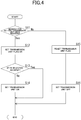
- FIG. 4 is a flow chart for illustrating an operation of selecting on/off of the transmission unit 55T of the Bluetooth communication circuit 55.
- FIG. 5 is a flow chart for illustrating a switching operation performed by the input selection unit 53, namely, an operation of selecting the signal input unit 54. Now, an operation of selecting Bluetooth or LINE input as the signal input unit 54 and an operation of selecting on/off of the transmission unit 55T of the Bluetooth communication circuit 55 are described with reference to the flow charts of FIG. 4 and FIG. 5 .
- the control unit 50 of the speaker apparatus 100 regularly confirms a command message from the mobile phone 300 (audio device controller), and when the control unit 50 receives a command message to the effect that the transmission unit 55T of the Bluetooth communication circuit 55 needs to be set on/off, the control unit 50 executes a processing operation of FIG. 4 .
- the control unit 50 receives a message for setting the transmission unit 55T on (YES in Step S11)
- the control unit 50 sets a transmission unit flag on to indicate the fact that a command to set the transmission unit 55T on is received (Step S12), and determines whether or not the input selection unit 53 has selected Bluetooth as the signal input unit 54 (Step S13).
- the control unit 50 instructs the Bluetooth communication circuit 55 to set the transmission unit 55T on (Step S14) and ends this processing operation.
- the selected signal input unit 54 is Bluetooth (YES in Step S13)
- the selected signal input unit 54 ends this processing operation immediately (without setting transmission unit 55T on).
- control unit 50 when the control unit 50 receives a message for setting the transmission unit 55T off (NO in Step S11), the control unit 50 resets the transmission unit flag (Step S15), and instructs the Bluetooth communication circuit 55 to set the transmission unit 55T off (Step S16) to end this processing operation.
- control unit 50 when the control unit 50 receives a switch command for the input selection unit 53 from the mobile phone 300 (audio device controller), the control unit 50 executes a processing operation of FIG. 5 .
- the control unit 50 receives a command to select Bluetooth as the signal input unit 54 (YES in Step S21)
- the control unit 50 instructs the input selection unit 53 to set the signal input unit 54 to Bluetooth (Step S22), and determines whether or not the transmission unit 55T of the Bluetooth communication circuit 55 is on (Step S23).
- the control unit 50 instructs the Bluetooth communication circuit 55 to set the transmission unit 55T off (Step S24), and ends this processing operation.
- the transmission unit 55T is off (NO in Step S23)
- the transmission unit 55T is off and the control unit 50 ends this processing operation immediately.
- control unit 50 when the control unit 50 receives a command to select LINE input as the signal input unit 54 (NO in Step S21), the control unit 50 instructs the input selection unit 53 to set the signal input unit 54 to LINE input (Step S25), and determines whether or not the transmission unit flag is set on (Step S26).
- the control unit 50 instructs the Bluetooth communication circuit 55 to set the transmission unit 55T on (Step S27), and ends this processing operation immediately.
- the transmission unit flag isnotseton (NOinStepS26)
- the control unit 50 ends this processing operation immediately.
- FIG. 6 is a flow chart for illustrating an operation of the control unit 50 of the speaker apparatus 100 in a state in which LINE input is selected as the signal input unit 54 and the transmission unit 55T of the Bluetooth communication circuit 55 issettooff.
- LINE input is selected, and thus the speaker apparatus 100 emits the sound of an audio signal input from the LINE input unit 56 using the speakers 210L and 210R.
- the Bluetooth communication circuit 55 is waiting and ready to receive an audio signal via Bluetooth. This operation is executed repeatedly every short period of time (e.g., 20 milliseconds).
- the control unit 50 confirms whether or not an audio signal is input via Bluetooth (Step S31), and determines whether or not an audio signal is input via Bluetooth (Step S32).
- the control unit 50 instructs the input selection unit 53 to switch the signal input unit 54 from LINE input to Bluetooth (Step S33).
- the speaker units 210L and 210R emit the sound of an audio signal via Bluetooth.
- the control unit 50 ends this processing operation immediately.
- the positive determination may be made not only based simply on reception of an audio signal via Bluetooth, but also based on a condition that the audio signal has a sound volume of a predetermined level or more.
- the speaker apparatus 100 monitors input via Bluetooth even when LINE input is selected, and when there is input of an audio signal via Bluetooth, the speaker apparatus 100 switches the input selection unit 53 from LINE input to Bluetooth, and emits the sound of the audio signal thereof. That is, Bluetooth is prioritized over LINE input.
- the speaker apparatus 100 including the speaker 210 is illustrated as an audio device, but the audio device according to the present invention is not limited thereto. It suffices that a plurality of audio sources including Bluetooth are selectable in the audio device. Further, the selectable audio sources are not limited to Bluetooth and LINE input.
- the Wi-Fi communication circuit 57 may be one of the selectable audio sources. Further, the audio device may also have a tuner or a media player function.
- the instruction reception unit in the appended claims corresponds to, for example, the Wi-Fi communication circuit 57.
Landscapes
- Engineering & Computer Science (AREA)
- Signal Processing (AREA)
- Theoretical Computer Science (AREA)
- Physics & Mathematics (AREA)
- Computer Networks & Wireless Communication (AREA)
- Acoustics & Sound (AREA)
- Health & Medical Sciences (AREA)
- Audiology, Speech & Language Pathology (AREA)
- General Health & Medical Sciences (AREA)
- Human Computer Interaction (AREA)
- General Engineering & Computer Science (AREA)
- General Physics & Mathematics (AREA)
- Multimedia (AREA)
- Circuit For Audible Band Transducer (AREA)
- Transceivers (AREA)
- Telephone Function (AREA)
- Selective Calling Equipment (AREA)
Abstract
Description
- The present invention relates to an audio device having functions of receiving and transmitting an audio signal, for example, via wireless communication, and to a method of controlling an audio device.
- Hitherto, various kinds of wireless communication standards, for example, Bluetooth (trademark), have been developed. Besides, there is known an audio device including a plurality of signal input units each configured to receive an audio signal in order to enable reception of audio signals from a plurality of input source devices including an input source device configured to transmit an audio signal in a wireless manner. For example, in
Patent Literature 1, there is disclosed a speaker apparatus including a signal input unit that supports Bluetooth and LINE input. - [PTL 1]
JP 2015-053550 A - Meanwhile, communication via Bluetooth is based on a device having a function (Bluetooth sink) of receiving a signal and a function (Bluetooth source) of transmitting a signal. The device having the function (Bluetooth source) of transmitting a signal and the device having the function (Bluetooth sink) of receiving a signal establish communication (pairing), to thereby enable transmission of an audio signal.
- When one audio device includes both of the reception function and the transmission function of Bluetooth, Bluetooth can be used to perform both transmission and reception of an audio signal. However, the reception function and transmission function of Bluetooth cannot be operated at the same time. Thus, when the audio device has the functions of receiving and transmitting an audio signal, the reception function and the transmission function need to be switched.
- When the user is required to complete all the setting for switching between the functions of receiving and transmitting an audio signal, the setting may become complicated and usability of both of the functions may deteriorate.
- The present invention has an object to provide an audio device having functions of receiving and transmitting an audio signal, for example, via wireless communication, and enabling switching between both of the functions easily, and to provide a method of controlling an audio device.
- According to one embodiment of the present invention, there is provided an audio device including : an audio signal communication unit including a reception unit configured to receive an audio signal via wireless communication and a transmission unit configured to transmit an audio signal via wireless communication; a plurality of signal input units including the reception unit; an input selection unit configured to select one signal input unit from among the plurality of signal input units; a control unit configured to control switching of the input selection unit; and a signal processing unit, in which the control unit is configured to: switch, when the input selection unit has selected a signal input unit other than the reception unit, the input selection unit to the selected signal input unit and input an audio signal, which is input from the selected signal input unit, into the signal processing unit; and switch, when the reception unit has received an audio signal via wireless communication, the input selection unit from the selected signal input unit to the reception unit and input the received audio signal into the signal processing unit.
- According to one embodiment of the present invention, there is provided a method of controlling an audio device, the audio device including: an audio signal communication unit including a reception unit configured to receive an audio signal via wireless communication and a transmission unit configured to transmit an audio signal via wireless communication; a plurality of signal input units including the reception unit; an input selection unit configured to select one signal input unit from among the plurality of signal input units; a control unit configured to control switching of the input selection unit; and a signal processing unit, the method including: switching, by the controller, when the input selection unit has selected a signal input unit other than the reception unit, the input selection unit to the selected signal input unit and inputting an audio signal, which is input from the selected signal input unit, into the signal processing unit; and switching, by the controller, when the reception unit has received an audio signal via wireless communication, the input selection unit from the selected signal input unit to the reception unit and inputting the received audio signal into the signal processing unit.
- According to another embodiment of the present invention, there is provided an audio device including: an audio signal communication unit including a reception unit configured to receive an audio signal via wireless communication and a transmission unit configured to transmit an audio signal via wireless communication, the reception unit and the transmission unit each being capable of being switchedon/off; a plurality of signal input units including the reception unit; an input selection unit configured to select one signal input unit from among the plurality of signal input units; a transmission function switch unit configured to receive an instruction to switch on/off of the transmission unit; a control unit configured to control switching of on/off of each of the reception unit and the transmission unit and switching of the input selection unit; and a signal processing unit, in which the control unit is configured to: switch, when the input selection unit has selected a signal input unit other than the reception unit and the transmission function switch unit has received an instruction to set the transmission unit off, the input selection unit to the selected signal input unit and input an audio signal, which is input from the selected signal input unit, into the signal processing unit; and set the reception unit on, switch, when the reception unit has received an audio signal via wireless communication, the input selection unit from the selected signal input unit to the reception unit, and input the received audio signal into the signal processing unit.
- In the above-mentioned invention, the control unit may be configured to set, when the input selection unit has selected the reception unit, the reception unit on irrespective of whether or not the transmission function switch unit has received an instruction to set the transmission unit on/off, and input an audio signal received by the reception unit into the signal processing unit.
- In the above-mentioned invention, the control unit may be configured to set, when the input selection unit has selected a signal input unit other than the reception unit and the transmission function switch unit has been operated to set the transmission unit on, the transmission unit on, switch the input selection unit to the selected signal input unit, input an audio signal, which is input from the selected signal input unit, into the signal processing unit, and input the audio signal into the transmission unit, and the transmission unit may be configured to transmit the audio signal via wireless communication.
- In the above-mentioned invention, the signal processing unit may include a speaker, and may be configured to emit a sound of an input audio signal using the speaker.
- In the above-mentioned invention, the transmission function switch unit may be configured to receive the instruction to set the transmission unit on/off from a control terminal via wireless communication.
- According to the present invention, for example, it is possible to provide both an audio signal receiving function via wireless communication and a transmitting function via wireless communication in an audio device, and it is possible to easily switch between both functions.
-
-
FIG. 1 is a block diagram for illustrating a speaker apparatus. -
FIG. 2 is a block diagram for illustrating a multifunctional mobile phone that functions as a remote controller of the speaker apparatus. -
FIG. 3 is a diagram for illustrating a reproduction screen to be displayed on a display unit of the mobile phone that functions as an audio device controller. -
FIG. 4 is a flow chart for illustrating an operation of selecting on/off of a transmission unit of a Bluetooth communication circuit. -
FIG. 5 is a flow chart for illustrating a switching operation performed by an input selection unit, namely, an operation of selecting a signal input unit. -
FIG. 6 is a flow chart for illustrating an operation of the speaker apparatus in a state in which LINE input is selected as the signal input unit and the transmission unit of the Bluetooth communication circuit is set to off. - Now, a description is given of a
speaker apparatus 100 according to an embodiment of the present invention with reference to the drawings.FIG. 1 is a block diagram of thespeaker apparatus 100. Thespeaker apparatus 100 includes left andright speaker units electronic circuit 15. Theelectronic circuit 15 includes acontrol unit 50, asignal processing unit 201, aspeaker driving unit 202, aninput selection unit 53, and a plurality ofsignal input units 54. - The
signal input units 54 are each configured to receive an audio signal from an external input source device. In this embodiment, thesignal input units 54 include a Bluetooth (hereinafter sometimes abbreviated as BT)communication circuit 55, aLINE input unit 56, and a Wi-Fi communication circuit 57. - The
LINE input unit 56 includes a connector, for example, an audio mini jack, and an A/D conversion circuit. The terminal of an audio cable connected to an output terminal of another audio device is plugged into the connector. TheLINE input unit 56 is configured to convert an audio signal, which is input from outside via an audio cable, into a digital signal using the A/D conversion circuit, and then input this signal into theinput selection unit 53. When the connector is a digital connector, for example, an optical fiber, the A/D conversion circuit is unnecessary. - The Bluetooth
communication circuit 55 has functions of transmitting and receiving an audio signal via Bluetooth wireless communication. Specifically, the Bluetoothcommunication circuit 55 includes atransmission unit 55T and areception unit 55R as its functions. Thetransmission unit 55T and thereception unit 55R of the Bluetoothcommunication circuit 55 can each be switched on/off, but both of those units cannot be switched on at the same time. The Bluetoothcommunication circuit 55 corresponds to an audio signal communication unit of the present invention. - The Bluetooth communication circuit 55 (
reception unit 55R thereof) and theLINE input unit 56 are connected to theinput selection unit 53. Theinput selection unit 53 is configured to select any one of the Bluetoothcommunication circuit 55 and theLINE input unit 56 through a selection signal input from thecontrol unit 50. Then, theinput selection unit 53 outputs an audio signal, which is input from the selected Bluetoothcommunication circuit 55 orLINE input unit 56, to thesignal processing unit 201. - The
control unit 50 is formed of a microcomputer. The Wi-Fi communication circuit 57 is connected to thecontrol unit 50. The Wi-Fi communication circuit 57 is configured to receive a command from a device, for example, a mobile terminal (e.g., multifunctional mobile phone (smartphone) and tablet computer) having a remote controller function, and input the command into thecontrol unit 50. Thecontrol unit 50 is configured to set thesignal processing unit 201 or perform switching of theinput selection unit 53 based on a command input from the Wi-Fi communication circuit 57. Further, thecontrol unit 50 is configured to switch on/off of thereception unit 55R of the Bluetoothcommunication circuit 55 and switch on/off of thetransmission unit 55T of the Bluetoothcommunication circuit 55 based on the command input from the Wi-Fi communication circuit 57. Instead, thecontrol unit 50 may be configured to acquire a command based on an instruction input by the user via, for example, a button or a touch panel included in thespeaker apparatus 100. - The
signal processing unit 201 is configured to adjust a sound quality of the audio signal input from theinput selection unit 53, and output it to thespeaker driving unit 202 as an audio signal. Thespeaker driving unit 202 includes an amplifier, and is configured to amplify the audio signal input from thesignal processing unit 201 and output the amplified signal to each of thespeaker units -
FIG. 2 is a block diagram for illustrating a multifunctional mobile phone (hereinafter simply referred to as "mobile phone") that functions as a remote controller of thespeaker apparatus 100. Amobile phone 300 includes an audio devicecontroller application program 350. When the audio devicecontroller application program 350 is executed, themobile phone 300 communicates to/from thespeaker apparatus 100 via Wi-Fi, and performs setting of thespeaker apparatus 100. Themobile phone 300, in which the audio devicecontroller application program 350 is being executed, forms an audio device controller from the functional point of view. - As illustrated in
FIG. 2 , themobile phone 300 includes, on abus 326, acontrol unit 320, anoperation unit 330, amedia interface 331, a 3G/4G communication circuit 332, a Bluetoothcommunication circuit 333, and a Wi-Fi communication circuit 334. Thecontrol unit 320 includes aCPU 321, a ROM (flash memory) 322, aRAM 323, animage processor 324, and avoice processor 325. A video RAM (VRAM) 340 is connected to theimage processor 324, and adisplay unit 341 is connected to theVRAM 340. Thedisplay unit 341 contains a liquid crystal display, and is configured to display, for example, a standby screen or a phone number. Further, the screen (refer toFIG. 3 ) of the audio device controller is also displayed on thedisplay unit 341. Anamplifier 342 including a D/A converter is connected to thevoice processor 325, and aspeaker 316 is connected to theamplifier 342. - The
image processor 324 includes a graphics processing unit (GPU) configured to generate various kinds of images such as a standby screen or a phone number. When the audio devicecontroller application program 350 is activated, theimage processor 324 generates an image of the audio device controller as illustrated inFIG. 3 in accordance with an instruction from theCPU 321, and places the image on theVRAM 340. The image placed on theVRAM 340 is displayed on thedisplay unit 341. - The
voice processor 325 includes a digital signal processor configured to encode/decode a telephone voice. Thevoice processor 325 outputs the decoded/generated voice to theamplifier 342. Theamplifier 342 amplifies the voice signal for output to thespeaker 316. - The
ROM 322 or thememory card 315 stores an audio file (e.g., mp3) of music. Thevoice processor 325 reads, decodes, and reproduces this file. Theamplifier 342 amplifies the reproduced music (audio signal) and thespeaker 316 emits the sound of the music. In other cases, the sound is transmitted to a communication partner device (e.g., speaker apparatus 100) by theBluetooth communication circuit 333. - The 3G/
4G communication circuit 332 is configured to perform a voice call and data communication via a mobile phone communication network. An application program, for example, an audio device controller, is downloaded through data communication. Acquisition of an application program is not limited to downloading through 3G/4G communication, and may be performed via an interface such as Wi-Fi communication and USB. - The
Bluetooth communication circuit 333 is configured to communicate to/from a (paired) device that is selected and set as a partner apparatus. For example, theBluetooth communication circuit 333 transmits an audio signal of music stored in a memory of themobile phone 300 to the audio device, for example, thespeaker apparatus 100. - The Wi-
Fi communication circuit 334 is configured to communicateto/fromawirelessaccesspoint (notshown) inawireless manner based on the IEEE 802.11g standard. The Wi-Fi communication circuit 334 communicates to/from thespeaker apparatus 100 via the wireless access point. Themobile phone 300 functions as an audio device controller in cooperation with the audio devicecontroller application program 350. Specifically, themobile phone 300 communicates to/from thespeaker apparatus 100, and transmits a command signal relating to the setting of thespeaker apparatus 100 and an audio signal of music. - The
operation unit 330 contains a touch panel formed on thedisplay unit 341, and is configured to detect a touch operation and a flick operation on the touch panel. Thememory card 315 is connected to themedia interface 331. Thememory card 315 is, for example, a micro SD card. An application program is downloaded from a server by the 3G/4G communication circuit 332, and then stored into thememory card 315 or theROM 322. In thismobile phone 300, the audio devicecontroller application program 350 is stored in thememory card 315. The audio devicecontroller application program 350 contains data necessary for execution of the program in addition to the program itself. - A basic program for executing a telephone call or an application program of the
mobile phone 300 is stored in theROM 322. Further, theROM 322 is a flashmemory, and can store downloaded application programs and other pieces of data in addition to the basic program. A work area to be used when theCPU 320 executes the audio devicecontroller application program 350 is set in theRAM 323. - The
mobile phone 300 forms an audio device controller in cooperation with the audio devicecontroller application program 350 stored in thememory card 315, and transmits a message to thespeaker apparatus 100 via Wi-Fi, to thereby control thespeaker apparatus 100. -
FIG. 3 is a diagram for illustrating areproduction screen 520 to be displayed on thedisplay unit 341 of themobile phone 300 that functions as an audio device controller. In thereproduction screen 520, an audiosource selection button 571, an on/offswitch button 572 for thetransmission unit 55T of theBluetooth communication circuit 55, amusic selection button 573, areproduction button 574, avolume setting slider 575, and aback button 576 are displayed. - The audio
source selection button 571 is an operator for selecting Bluetooth or LINE input as an input source (signal input unit that receives an audio signal). Icons of Bluetooth and LINE input are displayed in the audiosource selection button 571 as selectable input sources. When the user taps the icon of Bluetooth or LINE input, a command message for indicating a selection of an input source corresponding to the tapped icon is transmitted to thespeaker apparatus 100, and the tapped icon is displayed in such a manner that the icon is selected and active. InFIG. 3 , LINE input is selected as the input source. When another input, for example, Wi-Fi, can be selected as the input source, an icon corresponding to the input may be displayed. - The on/off
switch button 572 is an operator for switching on/off of thetransmission unit 55T of theBluetooth communication circuit 55. When a slider is moved rightward, a command message to the effect that thetransmission unit 55T of theBluetooth communication circuit 55 needs to be set on is transmitted to thespeaker apparatus 100. When the slider is moved leftward, a command message to the effect that thetransmission unit 55T of theBluetooth communication circuit 55 needs to be set off is transmitted to thespeaker apparatus 100. The on/offswitch button 572 corresponds to a transmission function switch unit of the present invention. - When LINE input is selected as the input source and the
transmission unit 55T of theBluetooth communication circuit 55 is set on as illustrated inFIG. 3 , an audio signal input through LINE input is transmitted to another audio device via Bluetooth. - The number of a song input through LINE input is displayed on the
music selection button 573. - The
reproduction button 574 contains an operator for reproducing music or temporarily stopping reproduction of the music, an operator for skipping the reproduced music to a next music, and an operator for skipping to the start of the reproduced music. - The
volume setting slider 575 is an operator for setting a volume value (Vol) of a sound emitted by thespeaker apparatus 100. - When the
back button 576 is tapped, the content set at that time (e.g., state of LINE input being selected assignal input unit 54, on/off state of Bluetooth transmission function, and value of volume setting slider 575) is stored, and the screen formed on thedisplay unit 341 is returned to a top screen. -
FIG. 4 is a flow chart for illustrating an operation of selecting on/off of thetransmission unit 55T of theBluetooth communication circuit 55.FIG. 5 is a flow chart for illustrating a switching operation performed by theinput selection unit 53, namely, an operation of selecting thesignal input unit 54. Now, an operation of selecting Bluetooth or LINE input as thesignal input unit 54 and an operation of selecting on/off of thetransmission unit 55T of theBluetooth communication circuit 55 are described with reference to the flow charts ofFIG. 4 andFIG. 5 . - The
control unit 50 of thespeaker apparatus 100 regularly confirms a command message from the mobile phone 300 (audio device controller), and when thecontrol unit 50 receives a command message to the effect that thetransmission unit 55T of theBluetooth communication circuit 55 needs to be set on/off, thecontrol unit 50 executes a processing operation ofFIG. 4 . When thecontrol unit 50 receives a message for setting thetransmission unit 55T on (YES in Step S11), thecontrol unit 50 sets a transmission unit flag on to indicate the fact that a command to set thetransmission unit 55T on is received (Step S12), and determines whether or not theinput selection unit 53 has selected Bluetooth as the signal input unit 54 (Step S13). - When the selected
signal input unit 54 is not Bluetooth (NO in Step S13), thecontrol unit 50 instructs theBluetooth communication circuit 55 to set thetransmission unit 55T on (Step S14) and ends this processing operation. When the selectedsignal input unit 54 is Bluetooth (YES in Step S13), the selectedsignal input unit 54 ends this processing operation immediately (without settingtransmission unit 55T on). - On the contrary, when the
control unit 50 receives a message for setting thetransmission unit 55T off (NO in Step S11), thecontrol unit 50 resets the transmission unit flag (Step S15), and instructs theBluetooth communication circuit 55 to set thetransmission unit 55T off (Step S16) to end this processing operation. - Further, when the
control unit 50 receives a switch command for theinput selection unit 53 from the mobile phone 300 (audio device controller), thecontrol unit 50 executes a processing operation ofFIG. 5 . When thecontrol unit 50 receives a command to select Bluetooth as the signal input unit 54 (YES in Step S21), thecontrol unit 50 instructs theinput selection unit 53 to set thesignal input unit 54 to Bluetooth (Step S22), and determines whether or not thetransmission unit 55T of theBluetooth communication circuit 55 is on (Step S23). When thetransmission unit 55T is on (YES in Step S23), thecontrol unit 50 instructs theBluetooth communication circuit 55 to set thetransmission unit 55T off (Step S24), and ends this processing operation. When thetransmission unit 55T is off (NO in Step S23), thetransmission unit 55T is off and thecontrol unit 50 ends this processing operation immediately. - On the contrary, when the
control unit 50 receives a command to select LINE input as the signal input unit 54 (NO in Step S21), thecontrol unit 50 instructs theinput selection unit 53 to set thesignal input unit 54 to LINE input (Step S25), and determines whether or not the transmission unit flag is set on (Step S26). When the transmission unit flag is set on (YES in Step S26), thecontrol unit 50 instructs theBluetooth communication circuit 55 to set thetransmission unit 55T on (Step S27), and ends this processing operation immediately. When the transmission unit flag isnotseton (NOinStepS26), thecontrol unit 50 ends this processing operation immediately. -
FIG. 6 is a flow chart for illustrating an operation of thecontrol unit 50 of thespeaker apparatus 100 in a state in which LINE input is selected as thesignal input unit 54 and thetransmission unit 55T of theBluetooth communication circuit 55 issettooff. LINE input is selected, and thus thespeaker apparatus 100 emits the sound of an audio signal input from theLINE input unit 56 using thespeakers Bluetooth communication circuit 55 is waiting and ready to receive an audio signal via Bluetooth. This operation is executed repeatedly every short period of time (e.g., 20 milliseconds). - The
control unit 50 confirms whether or not an audio signal is input via Bluetooth (Step S31), and determines whether or not an audio signal is input via Bluetooth (Step S32). When thereception unit 55R of theBluetooth communication circuit 55 receives an audio signal (YES in Step S32), thecontrol unit 50 instructs theinput selection unit 53 to switch thesignal input unit 54 from LINE input to Bluetooth (Step S33). With this, thespeaker units reception unit 55R of theBluetooth communication circuit 55 does not receive an audio signal (NO in Step S32), thecontrol unit 50 ends this processing operation immediately. In Step S32, the positive determination may be made not only based simply on reception of an audio signal via Bluetooth, but also based on a condition that the audio signal has a sound volume of a predetermined level or more. - In short, the
speaker apparatus 100 monitors input via Bluetooth even when LINE input is selected, and when there is input of an audio signal via Bluetooth, thespeaker apparatus 100 switches theinput selection unit 53 from LINE input to Bluetooth, and emits the sound of the audio signal thereof. That is, Bluetooth is prioritized over LINE input. - In this embodiment, the
speaker apparatus 100 including the speaker 210 is illustrated as an audio device, but the audio device according to the present invention is not limited thereto. It suffices that a plurality of audio sources including Bluetooth are selectable in the audio device. Further, the selectable audio sources are not limited to Bluetooth and LINE input. The Wi-Fi communication circuit 57 may be one of the selectable audio sources. Further, the audio device may also have a tuner or a media player function. The instruction reception unit in the appended claims corresponds to, for example, the Wi-Fi communication circuit 57.
Claims (13)
- An audio device, comprising:an audio signal communication unit comprising a reception unit configured to receive an audio signal via wireless communication and a transmission unit configured to transmit an audio signal via wireless communication;a plurality of signal input units comprising the reception unit;an input selection unit configured to select one signal input unit from among the plurality of signal input units;a control unit configured to control switching of the input selection unit; anda signal processing unit,wherein the control unit is configured to:switch, when the input selection unit has selected a signal input unit other than the reception unit, the input selection unit to the selected signal input unit and input an audio signal, which is input from the selected signal input unit, into the signal processing unit; andswitch, when the reception unit has received an audio signal via wireless communication, the input selection unit from the selected signal input unit to the reception unit and input the received audio signal into the signal processing unit.
- The audio device according to claim 1, further comprising an instruction reception unit configured to receive an instruction to set the transmission unit on/off,
wherein the reception unit and the transmission unit are each capable of being switched on/off, and
wherein the control unit is configured to:control switching of on/off of each of the reception unit and the transmission unit;switch, when the input selection unit has selected a signal input unit other than the reception unit and the instruction reception unit is instructed to set the transmission unit off, the input selection unit to the selected signal input unit, input an audio signal, which is input from the selected signal input unit, into the signal processing unit, and set the reception unit on; andswitch, when the reception unit has received an audio signal via wireless communication and the reception unit is on, the input selection unit from the selected signal input unit to the reception unit and input the received audio signal into the signal processing unit. - The audio device according to claim 2, wherein the control unit is configured to set, when the input selection unit has selected the reception unit, the reception unit on irrespective of whether or not the instruction reception unit is instructed to set the transmission unit on/off, and input an audio signal received by the reception unit into the signal processing unit.
- The audio device according to claim 2,
wherein the control unit is configured to set, when the input selection unit has selected a signal input unit other than the reception unit and the instruction reception unit has received an instruction to set the transmission unit on, the transmission unit on, switch the input selection unit to the selected signal input unit, input an audio signal, which is input from the selected signal input unit, into the signal processing unit, and input the audio signal into the transmission unit, and
wherein the transmission unit is configured to transmit the audio signal via wireless communication. - The audio device according to claim 1, further comprising a speaker,
wherein the audio device is configured to emit a sound of an input audio signal using the speaker. - The audio device according to claim 2, wherein the instruction reception unit is configured to receive the instruction to set the transmission unit on/off from a control terminal via wireless communication.
- The audio device according to claim 2, wherein on/off states of the reception unit and the transmission unit comprise states other than a state of both of the reception unit and the transmission unit being on.
- A method of controlling an audio device,
the audio device comprising:an audio signal communication unit comprising a reception unit configured to receive an audio signal via wireless communication and a transmission unit configured to transmit an audio signal via wireless communication;a plurality of signal input units comprising the reception unit;an input selection unit configured to select one signal input unit from among the plurality of signal input units;a control unit configured to control switching of the input selection unit; anda signal processing unit,the method comprising:switching, by the controller, when the input selection unit has selected a signal input unit other than the reception unit, the input selection unit to the selected signal input unit and inputting an audio signal, which is input from the selected signal input unit, into the signal processing unit; andswitching, by the controller, when the reception unit has received an audio signal via wireless communication, the input selection unit from the selected signal input unit to the reception unit and inputting the received audio signal into the signal processing unit. - The method of controlling an audio device according to claim 8,
wherein the audio device further comprises an instruction reception unit configured to receive an instruction to set the transmission unit on/off,
wherein the reception unit and the transmission unit are each capable of being switched on/off, and
wherein the method further comprises:controlling, by the controller, switching of on/off of each of the reception unit and the transmission unit;switching, by the controller, when the input selection unit has selected a signal input unit other than the reception unit and the instruction reception unit is instructed to set the transmission unit off, the input selection unit to the selected signal input unit, inputting an audio signal, which is input from the selected signal input unit, into the signal processing unit, and setting the reception unit on; andswitching, by the controller, when the reception unit has received an audio signal via wireless communication and the reception unit is on, the input selection unit from the selected signal input unit to the reception unit and inputting the received audio signal into the signal processing unit. - The method of controlling an audio device according to claim 9, further comprising setting, by the control unit, when the input selection unit has selected the reception unit, the reception unit on irrespective of whether or not the instruction reception unit is instructed to set the transmission unit on/off, and inputting an audio signal received by the reception unit into the signal processing unit.
- The method of controlling an audio device according to claim 9, further comprising:setting, by the control unit, when the input selection unit has selected a signal input unit other than the reception unit and the instruction reception unit has received an instruction to set the transmission unit on, the transmission unit on, switching the input selection unit to the selected signal input unit, inputting an audio signal, which is input from the selected signal input unit, into the signal processing unit, and inputting the audio signal into the transmission unit; andtransmitting, by the transmission unit, the audio signal via wireless communication.
- The method of controlling an audio device according to claim 8,
wherein the audio device further comprises a speaker, and
wherein the method further comprises emitting, by the audio device, a sound of an input audio signal using the speaker. - The method of controlling an audio device according to claim 9, further comprising receiving, by the instruction reception unit, the instruction to set the transmission unit on or off from a control terminal via wireless communication.
Applications Claiming Priority (2)
| Application Number | Priority Date | Filing Date | Title |
|---|---|---|---|
| JP2015162330A JP6589458B2 (en) | 2015-08-19 | 2015-08-19 | Audio equipment |
| PCT/JP2016/069693 WO2017029896A1 (en) | 2015-08-19 | 2016-07-01 | Audio device and audio device control method |
Publications (3)
| Publication Number | Publication Date |
|---|---|
| EP3316594A1 true EP3316594A1 (en) | 2018-05-02 |
| EP3316594A4 EP3316594A4 (en) | 2019-03-13 |
| EP3316594B1 EP3316594B1 (en) | 2021-06-02 |
Family
ID=58051678
Family Applications (1)
| Application Number | Title | Priority Date | Filing Date |
|---|---|---|---|
| EP16836888.4A Active EP3316594B1 (en) | 2015-08-19 | 2016-07-01 | Audio device and audio device control method |
Country Status (4)
| Country | Link |
|---|---|
| US (1) | US10397698B2 (en) |
| EP (1) | EP3316594B1 (en) |
| JP (1) | JP6589458B2 (en) |
| WO (1) | WO2017029896A1 (en) |
Cited By (1)
| Publication number | Priority date | Publication date | Assignee | Title |
|---|---|---|---|---|
| WO2023146787A1 (en) * | 2022-01-25 | 2023-08-03 | Bose Corporation | Portable speaker with integrated wireless transmitter |
Families Citing this family (2)
| Publication number | Priority date | Publication date | Assignee | Title |
|---|---|---|---|---|
| JP6787486B2 (en) * | 2017-04-12 | 2020-11-18 | ヤマハ株式会社 | Information processing equipment, information processing methods, and programs |
| CN108399917B (en) * | 2018-01-26 | 2023-08-04 | 百度在线网络技术(北京)有限公司 | Speech processing method, apparatus and computer readable storage medium |
Family Cites Families (7)
| Publication number | Priority date | Publication date | Assignee | Title |
|---|---|---|---|---|
| US8482488B2 (en) * | 2004-12-22 | 2013-07-09 | Oakley, Inc. | Data input management system for wearable electronically enabled interface |
| JP4485093B2 (en) * | 2001-03-29 | 2010-06-16 | クラリオン株式会社 | Data reproduction apparatus and data reproduction system |
| JP5049652B2 (en) | 2006-09-07 | 2012-10-17 | キヤノン株式会社 | Communication system, data reproduction control method, controller, controller control method, adapter, adapter control method, and program |
| WO2011027004A2 (en) * | 2010-12-20 | 2011-03-10 | Phonak Ag | Method for operating a hearing device and a hearing device |
| JP2013062580A (en) * | 2011-09-12 | 2013-04-04 | Sony Corp | Sound reproduction device and sound reproduction method |
| US9674587B2 (en) * | 2012-06-26 | 2017-06-06 | Sonos, Inc. | Systems and methods for networked music playback including remote add to queue |
| JP6004190B2 (en) | 2013-09-05 | 2016-10-05 | ヤマハ株式会社 | Speaker device |
-
2015
- 2015-08-19 JP JP2015162330A patent/JP6589458B2/en active Active
-
2016
- 2016-07-01 WO PCT/JP2016/069693 patent/WO2017029896A1/en not_active Ceased
- 2016-07-01 EP EP16836888.4A patent/EP3316594B1/en active Active
-
2017
- 2017-07-18 US US15/652,294 patent/US10397698B2/en active Active
Cited By (3)
| Publication number | Priority date | Publication date | Assignee | Title |
|---|---|---|---|---|
| WO2023146787A1 (en) * | 2022-01-25 | 2023-08-03 | Bose Corporation | Portable speaker with integrated wireless transmitter |
| US11902751B2 (en) | 2022-01-25 | 2024-02-13 | Bose Corporation | Portable speaker with integrated wireless transmitter |
| US12328553B2 (en) | 2022-01-25 | 2025-06-10 | Bose Corporation | Portable speaker with integrated wireless transmitter |
Also Published As
| Publication number | Publication date |
|---|---|
| JP2017041759A (en) | 2017-02-23 |
| EP3316594A4 (en) | 2019-03-13 |
| WO2017029896A1 (en) | 2017-02-23 |
| US20170318386A1 (en) | 2017-11-02 |
| JP6589458B2 (en) | 2019-10-16 |
| US10397698B2 (en) | 2019-08-27 |
| EP3316594B1 (en) | 2021-06-02 |
Similar Documents
| Publication | Publication Date | Title |
|---|---|---|
| AU2010327452B2 (en) | Mobile device and control method thereof | |
| US9569166B2 (en) | Music reproducing apparatus | |
| KR101594874B1 (en) | Electronic apparatus, external apparatus and method for controlling a power supply of external apparatus | |
| KR102378440B1 (en) | Electronic device and audio ouputting method thereof | |
| JP2009232301A (en) | Monitor control system | |
| US10397698B2 (en) | Audio device and method of controlling audio device | |
| US10652657B2 (en) | System, terminal apparatus, main apparatus, and method | |
| JP2014195226A (en) | Headset and smart device | |
| KR101633484B1 (en) | Selective Booting Method And Broadcast Receiving Apparatus Using The Same | |
| KR100881218B1 (en) | Mobile communication terminal that drives multiple applications simultaneously | |
| JP2014149610A (en) | Information processor, remote control operation support method and program | |
| JP2016004415A (en) | Portable device, program and control program update system | |
| JP5900739B2 (en) | Audio power control system, audio device, audio device control program, and mobile phone | |
| JP2009232302A (en) | Parameter control system and monitor control system | |
| CN107204793B (en) | Electronic apparatus and connection control method for electronic apparatus | |
| US11467985B2 (en) | System, target apparatus, terminal, program, and method | |
| KR101500345B1 (en) | Method for controlling mute function and system performing the same | |
| JP2016005126A (en) | Portable apparatus, program, and internal information transmission system | |
| KR100688176B1 (en) | Mobile communication terminal with external input / output function and its operation method | |
| KR20210117491A (en) | Electronic device providing bluetooth communication and the method of operating the same | |
| KR20080029091A (en) | How to scroll the list on your mobile device | |
| KR20120104756A (en) | Wireless transmit module for audio and system and method using the same | |
| JP2013176122A (en) | Acoustic processing device | |
| KR20070054990A (en) | Mobile communication terminal with multi-function interlocking control function and method thereof | |
| EP3611937A1 (en) | Information processing device, information processing method, and program |
Legal Events
| Date | Code | Title | Description |
|---|---|---|---|
| STAA | Information on the status of an ep patent application or granted ep patent |
Free format text: STATUS: THE INTERNATIONAL PUBLICATION HAS BEEN MADE |
|
| PUAI | Public reference made under article 153(3) epc to a published international application that has entered the european phase |
Free format text: ORIGINAL CODE: 0009012 |
|
| STAA | Information on the status of an ep patent application or granted ep patent |
Free format text: STATUS: REQUEST FOR EXAMINATION WAS MADE |
|
| 17P | Request for examination filed |
Effective date: 20180123 |
|
| AK | Designated contracting states |
Kind code of ref document: A1 Designated state(s): AL AT BE BG CH CY CZ DE DK EE ES FI FR GB GR HR HU IE IS IT LI LT LU LV MC MK MT NL NO PL PT RO RS SE SI SK SM TR |
|
| AX | Request for extension of the european patent |
Extension state: BA ME |
|
| DAV | Request for validation of the european patent (deleted) | ||
| DAX | Request for extension of the european patent (deleted) | ||
| A4 | Supplementary search report drawn up and despatched |
Effective date: 20190212 |
|
| RIC1 | Information provided on ipc code assigned before grant |
Ipc: H04R 3/00 20060101ALI20190206BHEP Ipc: H04B 1/40 20150101ALI20190206BHEP Ipc: H04R 1/06 20060101AFI20190206BHEP |
|
| GRAP | Despatch of communication of intention to grant a patent |
Free format text: ORIGINAL CODE: EPIDOSNIGR1 |
|
| STAA | Information on the status of an ep patent application or granted ep patent |
Free format text: STATUS: GRANT OF PATENT IS INTENDED |
|
| INTG | Intention to grant announced |
Effective date: 20210202 |
|
| GRAS | Grant fee paid |
Free format text: ORIGINAL CODE: EPIDOSNIGR3 |
|
| GRAA | (expected) grant |
Free format text: ORIGINAL CODE: 0009210 |
|
| STAA | Information on the status of an ep patent application or granted ep patent |
Free format text: STATUS: THE PATENT HAS BEEN GRANTED |
|
| REG | Reference to a national code |
Ref country code: CH Ref legal event code: EP |
|
| AK | Designated contracting states |
Kind code of ref document: B1 Designated state(s): AL AT BE BG CH CY CZ DE DK EE ES FI FR GB GR HR HU IE IS IT LI LT LU LV MC MK MT NL NO PL PT RO RS SE SI SK SM TR |
|
| REG | Reference to a national code |
Ref country code: GB Ref legal event code: FG4D |
|
| REG | Reference to a national code |
Ref country code: AT Ref legal event code: REF Ref document number: 1399565 Country of ref document: AT Kind code of ref document: T Effective date: 20210615 |
|
| REG | Reference to a national code |
Ref country code: IE Ref legal event code: FG4D |
|
| REG | Reference to a national code |
Ref country code: DE Ref legal event code: R096 Ref document number: 602016058930 Country of ref document: DE |
|
| REG | Reference to a national code |
Ref country code: LT Ref legal event code: MG9D |
|
| PG25 | Lapsed in a contracting state [announced via postgrant information from national office to epo] |
Ref country code: LT Free format text: LAPSE BECAUSE OF FAILURE TO SUBMIT A TRANSLATION OF THE DESCRIPTION OR TO PAY THE FEE WITHIN THE PRESCRIBED TIME-LIMIT Effective date: 20210602 Ref country code: FI Free format text: LAPSE BECAUSE OF FAILURE TO SUBMIT A TRANSLATION OF THE DESCRIPTION OR TO PAY THE FEE WITHIN THE PRESCRIBED TIME-LIMIT Effective date: 20210602 Ref country code: HR Free format text: LAPSE BECAUSE OF FAILURE TO SUBMIT A TRANSLATION OF THE DESCRIPTION OR TO PAY THE FEE WITHIN THE PRESCRIBED TIME-LIMIT Effective date: 20210602 Ref country code: BG Free format text: LAPSE BECAUSE OF FAILURE TO SUBMIT A TRANSLATION OF THE DESCRIPTION OR TO PAY THE FEE WITHIN THE PRESCRIBED TIME-LIMIT Effective date: 20210902 |
|
| REG | Reference to a national code |
Ref country code: NL Ref legal event code: MP Effective date: 20210602 |
|
| REG | Reference to a national code |
Ref country code: AT Ref legal event code: MK05 Ref document number: 1399565 Country of ref document: AT Kind code of ref document: T Effective date: 20210602 |
|
| PG25 | Lapsed in a contracting state [announced via postgrant information from national office to epo] |
Ref country code: RS Free format text: LAPSE BECAUSE OF FAILURE TO SUBMIT A TRANSLATION OF THE DESCRIPTION OR TO PAY THE FEE WITHIN THE PRESCRIBED TIME-LIMIT Effective date: 20210602 Ref country code: SE Free format text: LAPSE BECAUSE OF FAILURE TO SUBMIT A TRANSLATION OF THE DESCRIPTION OR TO PAY THE FEE WITHIN THE PRESCRIBED TIME-LIMIT Effective date: 20210602 Ref country code: PL Free format text: LAPSE BECAUSE OF FAILURE TO SUBMIT A TRANSLATION OF THE DESCRIPTION OR TO PAY THE FEE WITHIN THE PRESCRIBED TIME-LIMIT Effective date: 20210602 Ref country code: NO Free format text: LAPSE BECAUSE OF FAILURE TO SUBMIT A TRANSLATION OF THE DESCRIPTION OR TO PAY THE FEE WITHIN THE PRESCRIBED TIME-LIMIT Effective date: 20210902 Ref country code: GR Free format text: LAPSE BECAUSE OF FAILURE TO SUBMIT A TRANSLATION OF THE DESCRIPTION OR TO PAY THE FEE WITHIN THE PRESCRIBED TIME-LIMIT Effective date: 20210903 Ref country code: LV Free format text: LAPSE BECAUSE OF FAILURE TO SUBMIT A TRANSLATION OF THE DESCRIPTION OR TO PAY THE FEE WITHIN THE PRESCRIBED TIME-LIMIT Effective date: 20210602 |
|
| PG25 | Lapsed in a contracting state [announced via postgrant information from national office to epo] |
Ref country code: SM Free format text: LAPSE BECAUSE OF FAILURE TO SUBMIT A TRANSLATION OF THE DESCRIPTION OR TO PAY THE FEE WITHIN THE PRESCRIBED TIME-LIMIT Effective date: 20210602 Ref country code: SK Free format text: LAPSE BECAUSE OF FAILURE TO SUBMIT A TRANSLATION OF THE DESCRIPTION OR TO PAY THE FEE WITHIN THE PRESCRIBED TIME-LIMIT Effective date: 20210602 Ref country code: RO Free format text: LAPSE BECAUSE OF FAILURE TO SUBMIT A TRANSLATION OF THE DESCRIPTION OR TO PAY THE FEE WITHIN THE PRESCRIBED TIME-LIMIT Effective date: 20210602 Ref country code: PT Free format text: LAPSE BECAUSE OF FAILURE TO SUBMIT A TRANSLATION OF THE DESCRIPTION OR TO PAY THE FEE WITHIN THE PRESCRIBED TIME-LIMIT Effective date: 20211004 Ref country code: NL Free format text: LAPSE BECAUSE OF FAILURE TO SUBMIT A TRANSLATION OF THE DESCRIPTION OR TO PAY THE FEE WITHIN THE PRESCRIBED TIME-LIMIT Effective date: 20210602 Ref country code: ES Free format text: LAPSE BECAUSE OF FAILURE TO SUBMIT A TRANSLATION OF THE DESCRIPTION OR TO PAY THE FEE WITHIN THE PRESCRIBED TIME-LIMIT Effective date: 20210602 Ref country code: AT Free format text: LAPSE BECAUSE OF FAILURE TO SUBMIT A TRANSLATION OF THE DESCRIPTION OR TO PAY THE FEE WITHIN THE PRESCRIBED TIME-LIMIT Effective date: 20210602 Ref country code: EE Free format text: LAPSE BECAUSE OF FAILURE TO SUBMIT A TRANSLATION OF THE DESCRIPTION OR TO PAY THE FEE WITHIN THE PRESCRIBED TIME-LIMIT Effective date: 20210602 Ref country code: CZ Free format text: LAPSE BECAUSE OF FAILURE TO SUBMIT A TRANSLATION OF THE DESCRIPTION OR TO PAY THE FEE WITHIN THE PRESCRIBED TIME-LIMIT Effective date: 20210602 |
|
| REG | Reference to a national code |
Ref country code: CH Ref legal event code: PL |
|
| REG | Reference to a national code |
Ref country code: DE Ref legal event code: R097 Ref document number: 602016058930 Country of ref document: DE |
|
| PG25 | Lapsed in a contracting state [announced via postgrant information from national office to epo] |
Ref country code: MC Free format text: LAPSE BECAUSE OF FAILURE TO SUBMIT A TRANSLATION OF THE DESCRIPTION OR TO PAY THE FEE WITHIN THE PRESCRIBED TIME-LIMIT Effective date: 20210602 |
|
| REG | Reference to a national code |
Ref country code: BE Ref legal event code: MM Effective date: 20210731 |
|
| PLBE | No opposition filed within time limit |
Free format text: ORIGINAL CODE: 0009261 |
|
| STAA | Information on the status of an ep patent application or granted ep patent |
Free format text: STATUS: NO OPPOSITION FILED WITHIN TIME LIMIT |
|
| PG25 | Lapsed in a contracting state [announced via postgrant information from national office to epo] |
Ref country code: LI Free format text: LAPSE BECAUSE OF NON-PAYMENT OF DUE FEES Effective date: 20210731 Ref country code: DK Free format text: LAPSE BECAUSE OF FAILURE TO SUBMIT A TRANSLATION OF THE DESCRIPTION OR TO PAY THE FEE WITHIN THE PRESCRIBED TIME-LIMIT Effective date: 20210602 Ref country code: CH Free format text: LAPSE BECAUSE OF NON-PAYMENT OF DUE FEES Effective date: 20210731 |
|
| 26N | No opposition filed |
Effective date: 20220303 |
|
| GBPC | Gb: european patent ceased through non-payment of renewal fee |
Effective date: 20210902 |
|
| PG25 | Lapsed in a contracting state [announced via postgrant information from national office to epo] |
Ref country code: LU Free format text: LAPSE BECAUSE OF NON-PAYMENT OF DUE FEES Effective date: 20210701 Ref country code: FR Free format text: LAPSE BECAUSE OF NON-PAYMENT OF DUE FEES Effective date: 20210802 Ref country code: AL Free format text: LAPSE BECAUSE OF FAILURE TO SUBMIT A TRANSLATION OF THE DESCRIPTION OR TO PAY THE FEE WITHIN THE PRESCRIBED TIME-LIMIT Effective date: 20210602 |
|
| PG25 | Lapsed in a contracting state [announced via postgrant information from national office to epo] |
Ref country code: IT Free format text: LAPSE BECAUSE OF FAILURE TO SUBMIT A TRANSLATION OF THE DESCRIPTION OR TO PAY THE FEE WITHIN THE PRESCRIBED TIME-LIMIT Effective date: 20210602 Ref country code: IE Free format text: LAPSE BECAUSE OF NON-PAYMENT OF DUE FEES Effective date: 20210701 Ref country code: GB Free format text: LAPSE BECAUSE OF NON-PAYMENT OF DUE FEES Effective date: 20210902 Ref country code: BE Free format text: LAPSE BECAUSE OF NON-PAYMENT OF DUE FEES Effective date: 20210731 |
|
| PG25 | Lapsed in a contracting state [announced via postgrant information from national office to epo] |
Ref country code: HU Free format text: LAPSE BECAUSE OF FAILURE TO SUBMIT A TRANSLATION OF THE DESCRIPTION OR TO PAY THE FEE WITHIN THE PRESCRIBED TIME-LIMIT; INVALID AB INITIO Effective date: 20160701 |
|
| PG25 | Lapsed in a contracting state [announced via postgrant information from national office to epo] |
Ref country code: CY Free format text: LAPSE BECAUSE OF FAILURE TO SUBMIT A TRANSLATION OF THE DESCRIPTION OR TO PAY THE FEE WITHIN THE PRESCRIBED TIME-LIMIT Effective date: 20210602 |
|
| PG25 | Lapsed in a contracting state [announced via postgrant information from national office to epo] |
Ref country code: MK Free format text: LAPSE BECAUSE OF FAILURE TO SUBMIT A TRANSLATION OF THE DESCRIPTION OR TO PAY THE FEE WITHIN THE PRESCRIBED TIME-LIMIT Effective date: 20210602 |
|
| PG25 | Lapsed in a contracting state [announced via postgrant information from national office to epo] |
Ref country code: MT Free format text: LAPSE BECAUSE OF FAILURE TO SUBMIT A TRANSLATION OF THE DESCRIPTION OR TO PAY THE FEE WITHIN THE PRESCRIBED TIME-LIMIT Effective date: 20210602 |
|
| PGFP | Annual fee paid to national office [announced via postgrant information from national office to epo] |
Ref country code: DE Payment date: 20250722 Year of fee payment: 10 |
|
| PG25 | Lapsed in a contracting state [announced via postgrant information from national office to epo] |
Ref country code: TR Free format text: LAPSE BECAUSE OF FAILURE TO SUBMIT A TRANSLATION OF THE DESCRIPTION OR TO PAY THE FEE WITHIN THE PRESCRIBED TIME-LIMIT Effective date: 20210602 |