EP3315560B1 - Polyphenyl ether resin composition and use thereof in high-frequency circuit substrate - Google Patents
Polyphenyl ether resin composition and use thereof in high-frequency circuit substrate Download PDFInfo
- Publication number
- EP3315560B1 EP3315560B1 EP16856571.1A EP16856571A EP3315560B1 EP 3315560 B1 EP3315560 B1 EP 3315560B1 EP 16856571 A EP16856571 A EP 16856571A EP 3315560 B1 EP3315560 B1 EP 3315560B1
- Authority
- EP
- European Patent Office
- Prior art keywords
- weight
- unit
- parts
- substituted
- unsubstituted
- Prior art date
- Legal status (The legal status is an assumption and is not a legal conclusion. Google has not performed a legal analysis and makes no representation as to the accuracy of the status listed.)
- Active
Links
- 239000000758 substrate Substances 0.000 title claims description 81
- 239000011342 resin composition Substances 0.000 title claims description 31
- 229920013636 polyphenyl ether polymer Polymers 0.000 title description 2
- 229920005989 resin Polymers 0.000 claims description 200
- 239000011347 resin Substances 0.000 claims description 200
- -1 siloxane unit Chemical group 0.000 claims description 151
- 229920001955 polyphenylene ether Polymers 0.000 claims description 89
- 239000000243 solution Substances 0.000 claims description 57
- 239000000203 mixture Substances 0.000 claims description 55
- 238000009833 condensation Methods 0.000 claims description 51
- 230000005494 condensation Effects 0.000 claims description 51
- 230000003301 hydrolyzing effect Effects 0.000 claims description 51
- RNFJDJUURJAICM-UHFFFAOYSA-N 2,2,4,4,6,6-hexaphenoxy-1,3,5-triaza-2$l^{5},4$l^{5},6$l^{5}-triphosphacyclohexa-1,3,5-triene Chemical compound N=1P(OC=2C=CC=CC=2)(OC=2C=CC=CC=2)=NP(OC=2C=CC=CC=2)(OC=2C=CC=CC=2)=NP=1(OC=1C=CC=CC=1)OC1=CC=CC=C1 RNFJDJUURJAICM-UHFFFAOYSA-N 0.000 claims description 49
- 125000001997 phenyl group Chemical group [H]C1=C([H])C([H])=C(*)C([H])=C1[H] 0.000 claims description 45
- 239000003063 flame retardant Substances 0.000 claims description 43
- 239000000843 powder Substances 0.000 claims description 42
- XMNIXWIUMCBBBL-UHFFFAOYSA-N 2-(2-phenylpropan-2-ylperoxy)propan-2-ylbenzene Chemical compound C=1C=CC=CC=1C(C)(C)OOC(C)(C)C1=CC=CC=C1 XMNIXWIUMCBBBL-UHFFFAOYSA-N 0.000 claims description 34
- 239000003999 initiator Substances 0.000 claims description 33
- 150000003254 radicals Chemical class 0.000 claims description 33
- 239000003365 glass fiber Substances 0.000 claims description 32
- 239000003292 glue Substances 0.000 claims description 30
- VYPSYNLAJGMNEJ-UHFFFAOYSA-N Silicium dioxide Chemical compound O=[Si]=O VYPSYNLAJGMNEJ-UHFFFAOYSA-N 0.000 claims description 29
- 125000000217 alkyl group Chemical group 0.000 claims description 26
- 239000000945 filler Substances 0.000 claims description 22
- 239000002904 solvent Substances 0.000 claims description 20
- 235000019400 benzoyl peroxide Nutrition 0.000 claims description 19
- DYIZJUDNMOIZQO-UHFFFAOYSA-N 4,5,6,7-tetrabromo-2-[2-(4,5,6,7-tetrabromo-1,3-dioxoisoindol-2-yl)ethyl]isoindole-1,3-dione Chemical compound O=C1C(C(=C(Br)C(Br)=C2Br)Br)=C2C(=O)N1CCN1C(=O)C2=C(Br)C(Br)=C(Br)C(Br)=C2C1=O DYIZJUDNMOIZQO-UHFFFAOYSA-N 0.000 claims description 12
- IJGRMHOSHXDMSA-UHFFFAOYSA-N Atomic nitrogen Chemical compound N#N IJGRMHOSHXDMSA-UHFFFAOYSA-N 0.000 claims description 12
- OMPJBNCRMGITSC-UHFFFAOYSA-N Benzoylperoxide Chemical compound C=1C=CC=CC=1C(=O)OOC(=O)C1=CC=CC=C1 OMPJBNCRMGITSC-UHFFFAOYSA-N 0.000 claims description 12
- 229910020388 SiO1/2 Inorganic materials 0.000 claims description 12
- 229910020487 SiO3/2 Inorganic materials 0.000 claims description 10
- 239000004342 Benzoyl peroxide Substances 0.000 claims description 9
- 238000001035 drying Methods 0.000 claims description 9
- OAICVXFJPJFONN-UHFFFAOYSA-N Phosphorus Chemical compound [P] OAICVXFJPJFONN-UHFFFAOYSA-N 0.000 claims description 8
- WHHGLZMJPXIBIX-UHFFFAOYSA-N decabromodiphenyl ether Chemical compound BrC1=C(Br)C(Br)=C(Br)C(Br)=C1OC1=C(Br)C(Br)=C(Br)C(Br)=C1Br WHHGLZMJPXIBIX-UHFFFAOYSA-N 0.000 claims description 8
- 229910052698 phosphorus Inorganic materials 0.000 claims description 8
- 239000011574 phosphorus Substances 0.000 claims description 8
- 229920000877 Melamine resin Polymers 0.000 claims description 7
- GWEVSGVZZGPLCZ-UHFFFAOYSA-N Titan oxide Chemical compound O=[Ti]=O GWEVSGVZZGPLCZ-UHFFFAOYSA-N 0.000 claims description 6
- BXIQXYOPGBXIEM-UHFFFAOYSA-N butyl 4,4-bis(tert-butylperoxy)pentanoate Chemical compound CCCCOC(=O)CCC(C)(OOC(C)(C)C)OOC(C)(C)C BXIQXYOPGBXIEM-UHFFFAOYSA-N 0.000 claims description 6
- JDSHMPZPIAZGSV-UHFFFAOYSA-N melamine Chemical compound NC1=NC(N)=NC(N)=N1 JDSHMPZPIAZGSV-UHFFFAOYSA-N 0.000 claims description 6
- 229910052757 nitrogen Inorganic materials 0.000 claims description 6
- 239000012779 reinforcing material Substances 0.000 claims description 6
- YYRHIWOOLJRQOA-UHFFFAOYSA-N (2,6-dimethylphenyl)-[3-(2,6-dimethylphenyl)phosphanylphenyl]phosphane Chemical compound CC1=CC=CC(C)=C1PC1=CC=CC(PC=2C(=CC=CC=2C)C)=C1 YYRHIWOOLJRQOA-UHFFFAOYSA-N 0.000 claims description 5
- BZQKBFHEWDPQHD-UHFFFAOYSA-N 1,2,3,4,5-pentabromo-6-[2-(2,3,4,5,6-pentabromophenyl)ethyl]benzene Chemical compound BrC1=C(Br)C(Br)=C(Br)C(Br)=C1CCC1=C(Br)C(Br)=C(Br)C(Br)=C1Br BZQKBFHEWDPQHD-UHFFFAOYSA-N 0.000 claims description 5
- GXIPHHIBYMWSMN-UHFFFAOYSA-N 6-phenylbenzo[c][2,1]benzoxaphosphinine 6-oxide Chemical compound O1C2=CC=CC=C2C2=CC=CC=C2P1(=O)C1=CC=CC=C1 GXIPHHIBYMWSMN-UHFFFAOYSA-N 0.000 claims description 5
- CEDDGDWODCGBFQ-UHFFFAOYSA-N carbamimidoylazanium;hydron;phosphate Chemical compound NC(N)=N.OP(O)(O)=O CEDDGDWODCGBFQ-UHFFFAOYSA-N 0.000 claims description 5
- LNEUSAPFBRDCPM-UHFFFAOYSA-N carbamimidoylazanium;sulfamate Chemical compound NC(N)=N.NS(O)(=O)=O LNEUSAPFBRDCPM-UHFFFAOYSA-N 0.000 claims description 5
- CAYGQBVSOZLICD-UHFFFAOYSA-N hexabromobenzene Chemical compound BrC1=C(Br)C(Br)=C(Br)C(Br)=C1Br CAYGQBVSOZLICD-UHFFFAOYSA-N 0.000 claims description 5
- XFZRQAZGUOTJCS-UHFFFAOYSA-N phosphoric acid;1,3,5-triazine-2,4,6-triamine Chemical compound OP(O)(O)=O.NC1=NC(N)=NC(N)=N1 XFZRQAZGUOTJCS-UHFFFAOYSA-N 0.000 claims description 5
- 229910010271 silicon carbide Inorganic materials 0.000 claims description 5
- HBMJWWWQQXIZIP-UHFFFAOYSA-N silicon carbide Chemical compound [Si+]#[C-] HBMJWWWQQXIZIP-UHFFFAOYSA-N 0.000 claims description 5
- GJBRNHKUVLOCEB-UHFFFAOYSA-N tert-butyl benzenecarboperoxoate Chemical compound CC(C)(C)OOC(=O)C1=CC=CC=C1 GJBRNHKUVLOCEB-UHFFFAOYSA-N 0.000 claims description 5
- RERMPCBBVZEPBS-UHFFFAOYSA-N tris(2,6-dimethylphenyl)phosphane Chemical compound CC1=CC=CC(C)=C1P(C=1C(=CC=CC=1C)C)C1=C(C)C=CC=C1C RERMPCBBVZEPBS-UHFFFAOYSA-N 0.000 claims description 5
- KMRIWYPVRWEWRG-UHFFFAOYSA-N 2-(6-oxobenzo[c][2,1]benzoxaphosphinin-6-yl)benzene-1,4-diol Chemical compound OC1=CC=C(O)C(P2(=O)C3=CC=CC=C3C3=CC=CC=C3O2)=C1 KMRIWYPVRWEWRG-UHFFFAOYSA-N 0.000 claims description 4
- 229910052582 BN Inorganic materials 0.000 claims description 4
- PZNSFCLAULLKQX-UHFFFAOYSA-N Boron nitride Chemical compound N#B PZNSFCLAULLKQX-UHFFFAOYSA-N 0.000 claims description 4
- 229910020447 SiO2/2 Inorganic materials 0.000 claims description 4
- 229910020485 SiO4/2 Inorganic materials 0.000 claims description 4
- PNEYBMLMFCGWSK-UHFFFAOYSA-N aluminium oxide Inorganic materials [O-2].[O-2].[O-2].[Al+3].[Al+3] PNEYBMLMFCGWSK-UHFFFAOYSA-N 0.000 claims description 4
- STIAPHVBRDNOAJ-UHFFFAOYSA-N carbamimidoylazanium;carbonate Chemical compound NC(N)=N.NC(N)=N.OC(O)=O STIAPHVBRDNOAJ-UHFFFAOYSA-N 0.000 claims description 4
- 125000004432 carbon atom Chemical group C* 0.000 claims description 4
- PMHQVHHXPFUNSP-UHFFFAOYSA-M copper(1+);methylsulfanylmethane;bromide Chemical compound Br[Cu].CSC PMHQVHHXPFUNSP-UHFFFAOYSA-M 0.000 claims description 4
- 229910002026 crystalline silica Inorganic materials 0.000 claims description 4
- 125000004435 hydrogen atom Chemical group [H]* 0.000 claims description 4
- 235000012239 silicon dioxide Nutrition 0.000 claims description 4
- 229910002113 barium titanate Inorganic materials 0.000 claims description 3
- JRPBQTZRNDNNOP-UHFFFAOYSA-N barium titanate Chemical compound [Ba+2].[Ba+2].[O-][Ti]([O-])([O-])[O-] JRPBQTZRNDNNOP-UHFFFAOYSA-N 0.000 claims description 3
- 239000005350 fused silica glass Substances 0.000 claims description 3
- VEALVRVVWBQVSL-UHFFFAOYSA-N strontium titanate Chemical compound [Sr+2].[O-][Ti]([O-])=O VEALVRVVWBQVSL-UHFFFAOYSA-N 0.000 claims description 3
- 125000002947 alkylene group Chemical group 0.000 claims description 2
- 125000000732 arylene group Chemical group 0.000 claims description 2
- 229910052454 barium strontium titanate Inorganic materials 0.000 claims description 2
- 125000002915 carbonyl group Chemical group [*:2]C([*:1])=O 0.000 claims description 2
- 239000012934 organic peroxide initiator Substances 0.000 claims description 2
- YXFVVABEGXRONW-UHFFFAOYSA-N Toluene Chemical compound CC1=CC=CC=C1 YXFVVABEGXRONW-UHFFFAOYSA-N 0.000 description 70
- 238000001723 curing Methods 0.000 description 49
- 125000000391 vinyl group Chemical group [H]C([*])=C([H])[H] 0.000 description 36
- 229920002554 vinyl polymer Polymers 0.000 description 34
- 239000004744 fabric Substances 0.000 description 29
- XLYOFNOQVPJJNP-UHFFFAOYSA-N water Substances O XLYOFNOQVPJJNP-UHFFFAOYSA-N 0.000 description 28
- 239000011889 copper foil Substances 0.000 description 26
- RYGMFSIKBFXOCR-UHFFFAOYSA-N Copper Chemical compound [Cu] RYGMFSIKBFXOCR-UHFFFAOYSA-N 0.000 description 25
- 239000003431 cross linking reagent Substances 0.000 description 16
- LFQSCWFLJHTTHZ-UHFFFAOYSA-N Ethanol Chemical compound CCO LFQSCWFLJHTTHZ-UHFFFAOYSA-N 0.000 description 13
- 238000010521 absorption reaction Methods 0.000 description 13
- 239000000853 adhesive Substances 0.000 description 13
- 230000001070 adhesive effect Effects 0.000 description 13
- 239000011229 interlayer Substances 0.000 description 13
- 125000002496 methyl group Chemical group [H]C([H])([H])* 0.000 description 13
- ZWEHNKRNPOVVGH-UHFFFAOYSA-N 2-Butanone Chemical compound CCC(C)=O ZWEHNKRNPOVVGH-UHFFFAOYSA-N 0.000 description 12
- 238000005452 bending Methods 0.000 description 11
- 230000000052 comparative effect Effects 0.000 description 11
- 230000009477 glass transition Effects 0.000 description 11
- 238000000034 method Methods 0.000 description 11
- 229920001187 thermosetting polymer Polymers 0.000 description 11
- VEXZGXHMUGYJMC-UHFFFAOYSA-N Hydrochloric acid Chemical compound Cl VEXZGXHMUGYJMC-UHFFFAOYSA-N 0.000 description 10
- 239000010410 layer Substances 0.000 description 10
- 150000003961 organosilicon compounds Chemical class 0.000 description 9
- 238000002360 preparation method Methods 0.000 description 9
- 239000000377 silicon dioxide Substances 0.000 description 9
- 238000005979 thermal decomposition reaction Methods 0.000 description 8
- 238000010438 heat treatment Methods 0.000 description 7
- CSCPPACGZOOCGX-UHFFFAOYSA-N Acetone Chemical compound CC(C)=O CSCPPACGZOOCGX-UHFFFAOYSA-N 0.000 description 6
- WKBOTKDWSSQWDR-UHFFFAOYSA-N Bromine atom Chemical compound [Br] WKBOTKDWSSQWDR-UHFFFAOYSA-N 0.000 description 6
- 239000007875 V-40 Substances 0.000 description 6
- GDTBXPJZTBHREO-UHFFFAOYSA-N bromine Substances BrBr GDTBXPJZTBHREO-UHFFFAOYSA-N 0.000 description 6
- 229910052794 bromium Inorganic materials 0.000 description 6
- 238000006243 chemical reaction Methods 0.000 description 6
- 238000003756 stirring Methods 0.000 description 6
- 125000003944 tolyl group Chemical group 0.000 description 6
- 238000004132 cross linking Methods 0.000 description 5
- 239000008367 deionised water Substances 0.000 description 5
- 229910021641 deionized water Inorganic materials 0.000 description 5
- 230000032798 delamination Effects 0.000 description 5
- 239000003995 emulsifying agent Substances 0.000 description 5
- 238000000605 extraction Methods 0.000 description 5
- 230000007062 hydrolysis Effects 0.000 description 5
- 238000006460 hydrolysis reaction Methods 0.000 description 5
- 230000007935 neutral effect Effects 0.000 description 5
- 239000003921 oil Substances 0.000 description 5
- 238000010992 reflux Methods 0.000 description 5
- 239000000126 substance Substances 0.000 description 5
- FSIJKGMIQTVTNP-UHFFFAOYSA-N bis(ethenyl)-methyl-trimethylsilyloxysilane Chemical compound C[Si](C)(C)O[Si](C)(C=C)C=C FSIJKGMIQTVTNP-UHFFFAOYSA-N 0.000 description 4
- JHIVVAPYMSGYDF-UHFFFAOYSA-N cyclohexanone Chemical compound O=C1CCCCC1 JHIVVAPYMSGYDF-UHFFFAOYSA-N 0.000 description 4
- 238000007598 dipping method Methods 0.000 description 4
- 239000000463 material Substances 0.000 description 4
- 238000004513 sizing Methods 0.000 description 4
- 229910000679 solder Inorganic materials 0.000 description 4
- WEHSMFCDAIHNOW-UHFFFAOYSA-N triethyl phenyl silicate Chemical compound CCO[Si](OCC)(OCC)OC1=CC=CC=C1 WEHSMFCDAIHNOW-UHFFFAOYSA-N 0.000 description 4
- 0 CC(C)(*C(C)(C)c(c(*)c1I)c(*)c(C)c1O*)c(c(C)c1*)c(C)c(*)c1O* Chemical compound CC(C)(*C(C)(C)c(c(*)c1I)c(*)c(C)c1O*)c(c(C)c1*)c(C)c(*)c1O* 0.000 description 3
- XEKOWRVHYACXOJ-UHFFFAOYSA-N Ethyl acetate Chemical compound CCOC(C)=O XEKOWRVHYACXOJ-UHFFFAOYSA-N 0.000 description 3
- OKKJLVBELUTLKV-UHFFFAOYSA-N Methanol Chemical compound OC OKKJLVBELUTLKV-UHFFFAOYSA-N 0.000 description 3
- ZMXDDKWLCZADIW-UHFFFAOYSA-N N,N-Dimethylformamide Chemical compound CN(C)C=O ZMXDDKWLCZADIW-UHFFFAOYSA-N 0.000 description 3
- 239000000654 additive Substances 0.000 description 3
- YYLGKUPAFFKGRQ-UHFFFAOYSA-N dimethyldiethoxysilane Chemical compound CCO[Si](C)(C)OCC YYLGKUPAFFKGRQ-UHFFFAOYSA-N 0.000 description 3
- 238000004945 emulsification Methods 0.000 description 3
- 238000003475 lamination Methods 0.000 description 3
- 239000011259 mixed solution Substances 0.000 description 3
- 238000000465 moulding Methods 0.000 description 3
- 230000008054 signal transmission Effects 0.000 description 3
- NTIZESTWPVYFNL-UHFFFAOYSA-N Methyl isobutyl ketone Chemical compound CC(C)CC(C)=O NTIZESTWPVYFNL-UHFFFAOYSA-N 0.000 description 2
- UIHCLUNTQKBZGK-UHFFFAOYSA-N Methyl isobutyl ketone Natural products CCC(C)C(C)=O UIHCLUNTQKBZGK-UHFFFAOYSA-N 0.000 description 2
- LRHPLDYGYMQRHN-UHFFFAOYSA-N N-Butanol Chemical compound CCCCO LRHPLDYGYMQRHN-UHFFFAOYSA-N 0.000 description 2
- SECXISVLQFMRJM-UHFFFAOYSA-N N-Methylpyrrolidone Chemical compound CN1CCCC1=O SECXISVLQFMRJM-UHFFFAOYSA-N 0.000 description 2
- CTQNGGLPUBDAKN-UHFFFAOYSA-N O-Xylene Chemical compound CC1=CC=CC=C1C CTQNGGLPUBDAKN-UHFFFAOYSA-N 0.000 description 2
- BOTDANWDWHJENH-UHFFFAOYSA-N Tetraethyl orthosilicate Chemical compound CCO[Si](OCC)(OCC)OCC BOTDANWDWHJENH-UHFFFAOYSA-N 0.000 description 2
- 150000004945 aromatic hydrocarbons Chemical class 0.000 description 2
- 238000010586 diagram Methods 0.000 description 2
- 239000011810 insulating material Substances 0.000 description 2
- AUHZEENZYGFFBQ-UHFFFAOYSA-N mesitylene Substances CC1=CC(C)=CC(C)=C1 AUHZEENZYGFFBQ-UHFFFAOYSA-N 0.000 description 2
- 125000001827 mesitylenyl group Chemical group [H]C1=C(C(*)=C(C([H])=C1C([H])([H])[H])C([H])([H])[H])C([H])([H])[H] 0.000 description 2
- 238000002156 mixing Methods 0.000 description 2
- 239000002245 particle Substances 0.000 description 2
- 239000002994 raw material Substances 0.000 description 2
- 239000008096 xylene Substances 0.000 description 2
- OAYXUHPQHDHDDZ-UHFFFAOYSA-N 2-(2-butoxyethoxy)ethanol Chemical compound CCCCOCCOCCO OAYXUHPQHDHDDZ-UHFFFAOYSA-N 0.000 description 1
- SBASXUCJHJRPEV-UHFFFAOYSA-N 2-(2-methoxyethoxy)ethanol Chemical compound COCCOCCO SBASXUCJHJRPEV-UHFFFAOYSA-N 0.000 description 1
- XNWFRZJHXBZDAG-UHFFFAOYSA-N 2-METHOXYETHANOL Chemical compound COCCO XNWFRZJHXBZDAG-UHFFFAOYSA-N 0.000 description 1
- POAOYUHQDCAZBD-UHFFFAOYSA-N 2-butoxyethanol Chemical compound CCCCOCCO POAOYUHQDCAZBD-UHFFFAOYSA-N 0.000 description 1
- ZNQVEEAIQZEUHB-UHFFFAOYSA-N 2-ethoxyethanol Chemical compound CCOCCO ZNQVEEAIQZEUHB-UHFFFAOYSA-N 0.000 description 1
- SVONRAPFKPVNKG-UHFFFAOYSA-N 2-ethoxyethyl acetate Chemical compound CCOCCOC(C)=O SVONRAPFKPVNKG-UHFFFAOYSA-N 0.000 description 1
- KXGFMDJXCMQABM-UHFFFAOYSA-N 2-methoxy-6-methylphenol Chemical compound [CH]OC1=CC=CC([CH])=C1O KXGFMDJXCMQABM-UHFFFAOYSA-N 0.000 description 1
- 239000004971 Cross linker Substances 0.000 description 1
- 239000004640 Melamine resin Substances 0.000 description 1
- FXHOOIRPVKKKFG-UHFFFAOYSA-N N,N-Dimethylacetamide Chemical compound CN(C)C(C)=O FXHOOIRPVKKKFG-UHFFFAOYSA-N 0.000 description 1
- 239000006087 Silane Coupling Agent Substances 0.000 description 1
- OUUQCZGPVNCOIJ-UHFFFAOYSA-M Superoxide Chemical compound [O-][O] OUUQCZGPVNCOIJ-UHFFFAOYSA-M 0.000 description 1
- RTAQQCXQSZGOHL-UHFFFAOYSA-N Titanium Chemical compound [Ti] RTAQQCXQSZGOHL-UHFFFAOYSA-N 0.000 description 1
- 150000001298 alcohols Chemical class 0.000 description 1
- 239000003963 antioxidant agent Substances 0.000 description 1
- 230000003078 antioxidant effect Effects 0.000 description 1
- 239000002216 antistatic agent Substances 0.000 description 1
- 239000003795 chemical substances by application Substances 0.000 description 1
- 239000003086 colorant Substances 0.000 description 1
- 238000013329 compounding Methods 0.000 description 1
- 239000007822 coupling agent Substances 0.000 description 1
- 239000004643 cyanate ester Substances 0.000 description 1
- 238000000280 densification Methods 0.000 description 1
- 239000006185 dispersion Substances 0.000 description 1
- 239000000839 emulsion Substances 0.000 description 1
- 238000005516 engineering process Methods 0.000 description 1
- 239000003822 epoxy resin Substances 0.000 description 1
- 150000002148 esters Chemical class 0.000 description 1
- 150000002170 ethers Chemical class 0.000 description 1
- 239000012760 heat stabilizer Substances 0.000 description 1
- 239000004615 ingredient Substances 0.000 description 1
- 230000000977 initiatory effect Effects 0.000 description 1
- 239000011256 inorganic filler Substances 0.000 description 1
- 229910003475 inorganic filler Inorganic materials 0.000 description 1
- 238000009434 installation Methods 0.000 description 1
- 239000005453 ketone based solvent Substances 0.000 description 1
- 150000002576 ketones Chemical class 0.000 description 1
- 239000000314 lubricant Substances 0.000 description 1
- 238000002844 melting Methods 0.000 description 1
- 230000008018 melting Effects 0.000 description 1
- 239000012046 mixed solvent Substances 0.000 description 1
- QJGQUHMNIGDVPM-UHFFFAOYSA-N nitrogen group Chemical group [N] QJGQUHMNIGDVPM-UHFFFAOYSA-N 0.000 description 1
- 229920001568 phenolic resin Polymers 0.000 description 1
- 239000005011 phenolic resin Substances 0.000 description 1
- 230000000704 physical effect Effects 0.000 description 1
- 239000000049 pigment Substances 0.000 description 1
- 229920000647 polyepoxide Polymers 0.000 description 1
- 229920000642 polymer Polymers 0.000 description 1
- 238000006116 polymerization reaction Methods 0.000 description 1
- 229920001296 polysiloxane Polymers 0.000 description 1
- 229920005749 polyurethane resin Polymers 0.000 description 1
- 238000010526 radical polymerization reaction Methods 0.000 description 1
- 239000007787 solid Substances 0.000 description 1
- 230000002195 synergetic effect Effects 0.000 description 1
- 229920005992 thermoplastic resin Polymers 0.000 description 1
- 239000006097 ultraviolet radiation absorber Substances 0.000 description 1
- 125000002348 vinylic group Chemical group 0.000 description 1
Images

Classifications
-
- H—ELECTRICITY
- H05—ELECTRIC TECHNIQUES NOT OTHERWISE PROVIDED FOR
- H05K—PRINTED CIRCUITS; CASINGS OR CONSTRUCTIONAL DETAILS OF ELECTRIC APPARATUS; MANUFACTURE OF ASSEMBLAGES OF ELECTRICAL COMPONENTS
- H05K1/00—Printed circuits
- H05K1/02—Details
- H05K1/03—Use of materials for the substrate
- H05K1/0313—Organic insulating material
- H05K1/0353—Organic insulating material consisting of two or more materials, e.g. two or more polymers, polymer + filler, + reinforcement
- H05K1/0373—Organic insulating material consisting of two or more materials, e.g. two or more polymers, polymer + filler, + reinforcement containing additives, e.g. fillers
-
- C—CHEMISTRY; METALLURGY
- C08—ORGANIC MACROMOLECULAR COMPOUNDS; THEIR PREPARATION OR CHEMICAL WORKING-UP; COMPOSITIONS BASED THEREON
- C08G—MACROMOLECULAR COMPOUNDS OBTAINED OTHERWISE THAN BY REACTIONS ONLY INVOLVING UNSATURATED CARBON-TO-CARBON BONDS
- C08G65/00—Macromolecular compounds obtained by reactions forming an ether link in the main chain of the macromolecule
- C08G65/34—Macromolecular compounds obtained by reactions forming an ether link in the main chain of the macromolecule from hydroxy compounds or their metallic derivatives
- C08G65/38—Macromolecular compounds obtained by reactions forming an ether link in the main chain of the macromolecule from hydroxy compounds or their metallic derivatives derived from phenols
- C08G65/44—Macromolecular compounds obtained by reactions forming an ether link in the main chain of the macromolecule from hydroxy compounds or their metallic derivatives derived from phenols by oxidation of phenols
-
- C—CHEMISTRY; METALLURGY
- C08—ORGANIC MACROMOLECULAR COMPOUNDS; THEIR PREPARATION OR CHEMICAL WORKING-UP; COMPOSITIONS BASED THEREON
- C08G—MACROMOLECULAR COMPOUNDS OBTAINED OTHERWISE THAN BY REACTIONS ONLY INVOLVING UNSATURATED CARBON-TO-CARBON BONDS
- C08G65/00—Macromolecular compounds obtained by reactions forming an ether link in the main chain of the macromolecule
- C08G65/34—Macromolecular compounds obtained by reactions forming an ether link in the main chain of the macromolecule from hydroxy compounds or their metallic derivatives
- C08G65/48—Polymers modified by chemical after-treatment
- C08G65/485—Polyphenylene oxides
-
- C—CHEMISTRY; METALLURGY
- C08—ORGANIC MACROMOLECULAR COMPOUNDS; THEIR PREPARATION OR CHEMICAL WORKING-UP; COMPOSITIONS BASED THEREON
- C08K—Use of inorganic or non-macromolecular organic substances as compounding ingredients
- C08K5/00—Use of organic ingredients
- C08K5/0008—Organic ingredients according to more than one of the "one dot" groups of C08K5/01 - C08K5/59
- C08K5/0066—Flame-proofing or flame-retarding additives
-
- C—CHEMISTRY; METALLURGY
- C08—ORGANIC MACROMOLECULAR COMPOUNDS; THEIR PREPARATION OR CHEMICAL WORKING-UP; COMPOSITIONS BASED THEREON
- C08K—Use of inorganic or non-macromolecular organic substances as compounding ingredients
- C08K5/00—Use of organic ingredients
- C08K5/49—Phosphorus-containing compounds
- C08K5/51—Phosphorus bound to oxygen
- C08K5/53—Phosphorus bound to oxygen bound to oxygen and to carbon only
- C08K5/5313—Phosphinic compounds, e.g. R2=P(:O)OR'
-
- C—CHEMISTRY; METALLURGY
- C08—ORGANIC MACROMOLECULAR COMPOUNDS; THEIR PREPARATION OR CHEMICAL WORKING-UP; COMPOSITIONS BASED THEREON
- C08L—COMPOSITIONS OF MACROMOLECULAR COMPOUNDS
- C08L71/00—Compositions of polyethers obtained by reactions forming an ether link in the main chain; Compositions of derivatives of such polymers
- C08L71/08—Polyethers derived from hydroxy compounds or from their metallic derivatives
- C08L71/10—Polyethers derived from hydroxy compounds or from their metallic derivatives from phenols
- C08L71/12—Polyphenylene oxides
-
- C—CHEMISTRY; METALLURGY
- C08—ORGANIC MACROMOLECULAR COMPOUNDS; THEIR PREPARATION OR CHEMICAL WORKING-UP; COMPOSITIONS BASED THEREON
- C08L—COMPOSITIONS OF MACROMOLECULAR COMPOUNDS
- C08L71/00—Compositions of polyethers obtained by reactions forming an ether link in the main chain; Compositions of derivatives of such polymers
- C08L71/08—Polyethers derived from hydroxy compounds or from their metallic derivatives
- C08L71/10—Polyethers derived from hydroxy compounds or from their metallic derivatives from phenols
- C08L71/12—Polyphenylene oxides
- C08L71/126—Polyphenylene oxides modified by chemical after-treatment
-
- C—CHEMISTRY; METALLURGY
- C08—ORGANIC MACROMOLECULAR COMPOUNDS; THEIR PREPARATION OR CHEMICAL WORKING-UP; COMPOSITIONS BASED THEREON
- C08L—COMPOSITIONS OF MACROMOLECULAR COMPOUNDS
- C08L83/00—Compositions of macromolecular compounds obtained by reactions forming in the main chain of the macromolecule a linkage containing silicon with or without sulfur, nitrogen, oxygen or carbon only; Compositions of derivatives of such polymers
- C08L83/04—Polysiloxanes
-
- H—ELECTRICITY
- H05—ELECTRIC TECHNIQUES NOT OTHERWISE PROVIDED FOR
- H05K—PRINTED CIRCUITS; CASINGS OR CONSTRUCTIONAL DETAILS OF ELECTRIC APPARATUS; MANUFACTURE OF ASSEMBLAGES OF ELECTRICAL COMPONENTS
- H05K1/00—Printed circuits
- H05K1/02—Details
- H05K1/03—Use of materials for the substrate
-
- C—CHEMISTRY; METALLURGY
- C08—ORGANIC MACROMOLECULAR COMPOUNDS; THEIR PREPARATION OR CHEMICAL WORKING-UP; COMPOSITIONS BASED THEREON
- C08G—MACROMOLECULAR COMPOUNDS OBTAINED OTHERWISE THAN BY REACTIONS ONLY INVOLVING UNSATURATED CARBON-TO-CARBON BONDS
- C08G77/00—Macromolecular compounds obtained by reactions forming a linkage containing silicon with or without sulfur, nitrogen, oxygen or carbon in the main chain of the macromolecule
- C08G77/04—Polysiloxanes
- C08G77/20—Polysiloxanes containing silicon bound to unsaturated aliphatic groups
-
- C—CHEMISTRY; METALLURGY
- C08—ORGANIC MACROMOLECULAR COMPOUNDS; THEIR PREPARATION OR CHEMICAL WORKING-UP; COMPOSITIONS BASED THEREON
- C08L—COMPOSITIONS OF MACROMOLECULAR COMPOUNDS
- C08L2203/00—Applications
- C08L2203/20—Applications use in electrical or conductive gadgets
Definitions
- the present invention relates to a polyphenylene ether resin composition.
- the present invention relates to a polyphenylene ether resin composition and a use thereof in a high-frequency circuit substrate.
- the relationship between signal transmission rate and dielectric constant Dk of insulating material in high-speed circuit is that: the lower the dielectric constant Dk of insulating material is, the faster the signal transmission rate is. Therefore, in order to achieve high frequency of signal transmission rate, substrates having low dielectric constant must be developed. As the signal frequency becomes high, the loss of signal in the substrate can no longer be ignored.
- the relationship among signal loss and frequency, dielectric constant Dk and dielectric loss Df is that: the smaller the dielectric constant Dk of a substrate is, and the smaller the dielectric loss Df is, the smaller the signal loss is. Therefore, the development of a high-frequency circuit substrate having low dielectric constant Dk, low dielectric loss Df and good heat resistance becomes a research direction commonly focused by CCL manufacturers.
- Polyphenylene ether resin contains a large number of benzene ring structures in its molecular structure, and no strong polar group, giving excellent performances to polyphenylene ether resin, such as high glass transition temperature, good dimensional stability, low linear expansion coefficient and low water absorption, especially excellent low dielectric constant and low dielectric loss.
- polyphenylene ether resin has disadvantages of high melting point, poor processability, poor solvent resistance and others. Since polyphenylene ether has excellent physical properties, heat resistance, chemical properties and electrical properties, etc., major companies in the world are attracted to modify it and have made some achievements.
- a reactive group such as vinyl group
- the resin has excellent overall properties of heat resistance, low dielectric constant and low dielectric loss and others after curing, and becomes an ideal material for the preparation of high-frequency circuit substrate.
- An organosilicon compound containing unsaturated double bonds is used as a crosslinking agent for vinyl active group-modified thermosetting polyphenylene ether to prepare a high-frequency electronic circuit substrate.
- CN 102993683 utilizes an organosilicon compound containing unsaturated double bonds as a crosslinking agent for modified polyphenylene ether.
- the prepared high-frequency circuit substrate has high glass transition temperature, high thermal decomposition temperature, high interlayer adhesive force, low dielectric constant and low dielectric loss.
- the organosilicon compound containing unsaturated double bonds adopted in this prior art has a structure of linear or cyclic organosilicon compound.
- the linear organosilicon compound containing unsaturated double bonds has good flexibility, and the high-frequency circuit substrate prepared therefrom has low bending strength.
- the prepared high-frequency circuit substrate by use of cyclic organosilicon compound containing unsaturated double bonds has good overall properties, but there is a problem of volatilization during the sizing and baking process due to its small molecular weight.
- CN104650574A utilizes a composition comprising polyphenylene ether, polyperfluoroethylene emulsion, organosilicon resin and inorganic filler to prepare a high-frequency electronic circuit substrate.
- the prepared substrate has advantages of low dielectric constant, low dielectric loss, good processability and the like.
- the organosilicon resin used in this prior art is methylphenyl DQ organosilicon resin, which does not contain active groups and cannot be used as a crosslinking agent for vinyl-modified thermosetting polyphenylene ether.
- EP2927281 discloses a composition comprising a vinyl-modified polyphenylene ether resin and a vinylic organosilicon oligomer or polymer, the latter functioning as a crosslinker for the PPE resin in peroxide radical initiated cure.
- the composition is used for prepregs for electronic applications.
- the first object of the present invention is to provide a polyphenylene ether resin composition having low dielectric constant Dk, low dielectric loss Df, as well as excellent heat resistance and interlayer adhesive force, which meets the requirements of the high-frequency circuit substrate on properties of dielectric constant, dielectric loss, heat resistance, adhesive force and others and can be used for the preparation of high-frequency circuit substrate.
- the present invention utilizes the following technical solution.
- a polyphenylene ether resin composition comprising a vinyl-modified polyphenylene ether resin and an organosilicon resin containing unsaturated double bonds and having a three-dimensional network structure, wherein the organosilicon resin containing unsaturated double bonds and having a three-dimensional network structure is any one selected from the group consisting of MT organosilicon resin containing unsaturated double bonds and having a three-dimensional network structure and formed by hydrolytic condensation of monofunctional siloxane unit (M unit) and trifunctional siloxane unit (T unit); MTQ organosilicon resin containing unsaturated double bonds and having a three-dimensional network structure and formed by hydrolytic condensation of monofunctional siloxane unit (M unit), trifunctional siloxane unit (T unit) and tetrafunctional siloxane unit (Q unit); MDT organosilicon resin containing unsaturated double bonds and having a three-dimensional network structure and formed by hydrolytic condensation of monofunctional siloxane unit (M unit), difunctional siloxane unit (D unit
- Typical but non-limiting organosilicon resin containing unsaturated double bonds and having a three-dimensional network structure is MT organosilicon resin, MTQ organosilicon resin, MDT organosilicon resin, MDQ organosilicon resin, a combination of MT and MTQ organosilicon resins, a combination of MT and MDT organosilicon resins, a combination of MT and MDQ organosilicon resins, a combination of MT, MTQ and MDT organosilicon resins, a combination of MTQ, MDT and MDQ organosilicon resins, a combination of MT, MTQ, MDT and MDQ organosilicon resins.
- the vinyl-modified polyphenylene ether resin is a powdery solid thermosetting resin at room temperature, which contains active unsaturated double bonds at the two ends and can conduct a radical polymerization curing in the presence of a curing initiator to produce a thermosetting resin that has excellent overall properties such as heat resistance, dimensional stability, low water absorption, low dielectric constant and low dielectric loss, etc.
- the crosslinking density of the polyphenylene ether resin composition is high after curing, which can provide a high glass transition temperature for the high-frequency circuit substrate.
- the organosilicon resin containing unsaturated double bonds and having a three-dimensional network structure does not contain polar groups, which can guarantee low water absorption, low dielectric constant and low dielectric loss of the high-frequency circuit substrate.
- the organosilicon resin containing unsaturated double bonds and having a three-dimensional network structure has high thermal decomposition temperature, which can provide excellent heat resistance for the high-frequency circuit substrate.
- the prepared high-frequency circuit substrate has high interlayer adhesive force and bending strength, which can improve the reliability of the substrate.
- the vinyl-modified polyphenylene ether resin has excellent properties such as low dielectric constant and low dielectric loss.
- the organosilicon resin containing unsaturated double bonds and having a three-dimensional network structure is used as the crosslinking agent for the modified polyphenylene ether resin
- the prepared high-frequency circuit substrate has excellent overall properties such as low dielectric constant, low dielectric loss, low water absorption, high heat resistance, high interlayer adhesive force and high bending strength.
- the substrate Compared to using linear organosilicon compound containing unsaturated double bonds as the crosslinking agent, the substrate has higher bending strength.
- the organosilicon resin containing unsaturated double bonds and having a three-dimensional network structure does not have a problem of volatilization during the sizing and baking process.
- the vinyl-modified polyphenylene ether resin has the following structure: wherein 0 ⁇ x ⁇ 100, 0 ⁇ y ⁇ 100, 2 ⁇ +y ⁇ 100.
- 0 ⁇ x ⁇ 100, 0 ⁇ y ⁇ 100, 2 ⁇ +y ⁇ 100 15 ⁇ x+y ⁇ 30, 25 ⁇ x+y ⁇ 40, 30 ⁇ x+y ⁇ 55, 60 ⁇ x+y ⁇ 85, 80 ⁇ x+y ⁇ 98, 10 ⁇ x+y ⁇ 20, 35 ⁇ x+y ⁇ 45, 65 ⁇ x+y ⁇ 75, 85 ⁇ x+y ⁇ 95, etc.
- M is selected from or
- N is any one selected from the group consisting of -O-, -CO-, -SO-, -SC-, -SO 2 - and -C(CH 3 ) 2 -, or a combination of at least two of them.
- R 2 , R 4 , R 6 , R 8 , R 11 , R 13 , R 15 and R 17 are each any one independently selected from the group consisting of substituted or unsubstituted C1-C8 (for example C2, C3, C4, C5, C6 or C7) linear alkyl, substituted or unsubstituted C1-C8 (for example C2, C3, C4, C5, C6 or C7) branched alkyl, and substituted or unsubstituted phenyl, or a combination of at least two of them.
- R 1 , R 3 , R 5 , R 7 , R 10 , R 12 , R 14 and R 16 are each any one independently selected from the group consisting of hydrogen atom, substituted or unsubstituted C1-C8 (for example C2, C3, C4, C5, C6 or C7) linear alkyl, substituted or unsubstituted C1-C8 (for example C2, C3, C4, C5, C6 or C7) branched alkyl, and substituted or unsubstituted phenyl, or a combination of at least two of them.
- R 9 is selected from or wherein A is arylene, carbonyl, or alkylene having 1-10 (for example 2, 3, 4, 5, 6, 7, 8 or 9) carbon atoms; Z is an integer of 0-10, for example 0, 1, 2, 3, 4, 5, 6, 7, 8, 9 or 10; R 21 , R 22 and R 23 are each independently selected from hydrogen atom or alkyl having 1-10 (for example 2, 3, 4, 5, 6, 7, 8 or 9) carbon atoms.
- the vinyl-modified polyphenylene ether resin has a number average molecular weight of 500-10,000 g/mol, preferably 800-8,000 g/mol, more preferably 1,000-4,000 g/mol.
- the MT organosilicon resin containing unsaturated double bonds and having a three-dimensional network structure and formed by hydrolytic condensation of monofunctional siloxane unit (M unit) and trifunctional siloxane unit (T unit) has the following structure: (R 24 R 25 R 26 SiO 1/2 ) x1 (R 27 SiO 3/2 ) y1 wherein 3 ⁇ x1 ⁇ 100, 1 ⁇ y1 ⁇ 100, 4 ⁇ x1+y1 ⁇ 200, for example 10 ⁇ x1+y1 ⁇ 180, 20 ⁇ x1+y1 ⁇ 160, 40 ⁇ x1+y1 ⁇ 140, 50 ⁇ x1+y1 ⁇ 150, 60 ⁇ x1+y1 ⁇ 120, 50 ⁇ x1+y1 ⁇ 100, 80 ⁇ x1+y1 ⁇ 120 or 100 ⁇ x1+y1 ⁇ 200, and 0.03 ⁇ x1/y ⁇ 10, for example 1 ⁇ x1/y1 ⁇ 10, 2 ⁇ x1/y1 ⁇ 9, 3 ⁇ x1/y1 ⁇ 8, 4 ⁇ x1/y1 ⁇ 7, 5 ⁇ sx1/y1 ⁇ 10
- the MTQ organosilicon resin containing unsaturated double bonds and having a three-dimensional network structure and formed by hydrolytic condensation of monofunctional siloxane unit (M unit), trifunctional siloxane unit (T unit) and tetrafunctional siloxane unit (Q unit) has the following structure: (R 28 R 29 R 30 SiO 1/2 ) a (R 31 SiO 3/2 ) b (SiO 4/2 ) c wherein 5 ⁇ a ⁇ 100, 1 ⁇ b ⁇ 100, 1 ⁇ c ⁇ 100, and 7 ⁇ a+b+c ⁇ 100, for example 10 ⁇ a+b+c ⁇ 100, 20 ⁇ a+b+c ⁇ 100, 30 ⁇ a+b+c ⁇ 100, 40 ⁇ a+b+c ⁇ 100, 10 ⁇ a+b+c ⁇ 90, 20 ⁇ a+b+c ⁇ 80, 30 ⁇ a+b+c ⁇ 70, 50 ⁇ a+b+c ⁇ 100, 60 ⁇ a+b+c ⁇ 100 or 70 ⁇ a+b+c ⁇ 100.
- M unit monofunctional siloxane
- substituted or unsubstituted C1-C8 for example C2, C3, C4, C5, C6
- the MDT organosilicon resin containing unsaturated double bonds and having a three-dimensional network structure and formed by hydrolytic condensation of monofunctional siloxane unit (M unit), difunctional siloxane unit (D unit) and trifunctional siloxane unit (T unit) has the following structure: (R 32 R 33 R 34 SiO 1/2 ) d (R 35 R 36 SiO 2/2 ) e (R 37 SiO 3/2 ) f wherein 3 ⁇ d ⁇ 100, 3 ⁇ e ⁇ 100, 1 ⁇ f ⁇ 100, and 7 ⁇ d+e+f ⁇ 100, for example 10 ⁇ d+e+f ⁇ 100, 20 ⁇ d+e+f ⁇ 100, 30 ⁇ d+e+f ⁇ 100, 40 ⁇ d+e+f ⁇ 100, 10 ⁇ d+e+f ⁇ 90, 20 ⁇ d+e+f ⁇ 80, 30 ⁇ d+e+f ⁇ 70, 50 ⁇ d+e+f ⁇ 100, 60 ⁇ d+e+f ⁇ 100 or 70 ⁇ d+e+f ⁇ 100; R 32 , R 33 ,
- the MDQ organosilicon resin containing unsaturated double bonds and having a three-dimensional network structure and formed by hydrolytic condensation of monofunctional siloxane unit (M unit), difunctional siloxane unit (D unit) and tetrafunctional siloxane unit (Q unit) has the following structure: (R 38 R 39 R 40 SiO 1/2 ) m (R 41 R 42 SiO 2/2 ) n (SiO 4/2 ) w wherein 4 ⁇ m ⁇ 100, 4 ⁇ n ⁇ 100, 1 ⁇ w ⁇ 100, and 9 ⁇ m+n+w ⁇ 100, for example 10 ⁇ m+n+w ⁇ 100, 20 ⁇ m+n+w ⁇ 100, 30 ⁇ m+n+w ⁇ 100, 40 ⁇ m+n+w ⁇ 100, 10 ⁇ m+n+w ⁇ 90, 20 ⁇ m+n+w ⁇ 80, 30 ⁇ m+n+w ⁇ 70, 50 ⁇ m+n+w ⁇ 100, 60 ⁇ m+n+w ⁇ 100 or 70 ⁇ m+n+w ⁇ 100; R 38 , R 40 SiO
- the weight of the organosilicon resin containing unsaturated double bonds and having a three-dimensional network structure is 10-90 parts by weight, for example 15 parts by weight, 20 parts by weight, 25 parts by weight, 30 parts by weight, 35 parts by weight, 40 parts by weight, 45 parts by weight, 50 parts by weight, 55 parts by weight, 60 parts by weight, 65 parts by weight, 70 parts by weight, 75 parts by weight, 80 parts by weight or 85 parts by weight, preferably 25-90 parts by weight, based on 100 parts by weight of the vinyl-modified polyphenylene ether resin.
- the resin system will have a better glass transition temperature after curing and crosslinking.
- the polyphenylene ether resin composition of the present invention further comprises a free radical initiator.
- the free radical initiator plays a role in initiating the polymerization, crosslinking, and curing of the resin system. Upon heating, the free radical initiator decomposes to generate radicals, which initiate the crosslinking among the active groups of the resin system to form a crosslinked network structure with a spatial three dimensional structure.
- the weight of the free radical initiator is 1-3 parts by weight.
- the weight of the free radical initiator is 1.2 parts by weight, 1.4 parts by weight, 1.6 parts by weight, 1.8 parts by weight, 2.0 parts by weight, 2.2 parts by weight, 2.4 parts by weight, 2.6 parts by weight, 2.8 parts by weight or 2.9 parts by weight.
- the free radical initiator is selected from organic peroxide initiators, and further preferably any one selected from the group consisting of dicumyl peroxide, dibenzoyl peroxide, benzoyl peroxide, tert-butyl peroxybenzoate and butyl 4,4-di(tert-butylperoxy)valerate, or a mixture of at least two of them.
- Said mixture is, for example, a mixture of butyl 4,4-di(tert-butylperoxy)valerate and tert-butyl peroxybenzoate, a mixture of dibenzoyl peroxide and dicumyl peroxide, a mixture of butyl 4,4-di(tert-butylperoxy)valerate and dibenzoyl peroxide, a mixture of tert-butyl peroxybenzoate and dicumyl peroxide, a mixture of butyl 4,4-di(tert-butylperoxy)valerate, tert-butyl peroxybenzoate and dibenzoyl peroxide.
- the free radical initiators can be used alone or in combination, and a better synergistic effect can be achieved when used in combination.
- the polyphenylene ether resin composition of the present invention further comprises a flame retardant.
- the weight of the flame retardant is 0-40 parts by weight, preferably 0-40 parts by weight excluding 0.
- the weight of the flame retardant is 1 parts by weight, 3 parts by weight, 7 parts by weight, 11 parts by weight, 15 parts by weight, 19 parts by weight, 23 parts by weight, 27 parts by weight, 31 parts by weight, 35 parts by weight, 38 parts by weight or 39 parts by weight.
- 0 parts by weight of the flame retardant means that there is no flame retardant in the resin composition. The heat resistance and the interlayer adhesive force will be reduced if the content of the flame retardant is too high.
- the flame retardant of the present invention is any one selected from the group consisting of halogenated flame retardant, phosphorus flame retardant, and nitrogen flame retardant, or a mixture of at least two of them, and preferably any one selected from the group consisting of brominated flame retardant, phosphorus flame retardant and nitrogen flame retardant, or a mixture of at least two of them.
- the brominated flame retardant is any one selected from the group consisting of decabromodiphenyl oxide, hexabromobenzene, decabromodiphenyl ethane, and ethylene bis(tetrabromophthalimide), or a mixture of at least two of them.
- Said mixture is, for example, a mixture of decabromodiphenyl ethane and hexabromobenzene, a mixture of decabromodiphenyl oxide and ethylene bis(tetrabromophthalimide), a mixture of decabromodiphenyl ethane, hexabromobenzene and decabromodiphenyl oxide, and a mixture of ethylene bis(tetrabromophthalimide), decabromodiphenyl ethane, hexabromobenzene and decabromodiphenyl oxide.
- the phosphorus flame retardant is any one selected from the group consisting of tris(2,6-dimethylphenyl)phosphine, 10-(2,5-dihydroxyphenyl)-9,10-dihydro-9-oxa-10-phosphaphenanthrene-10-oxide, 2,6-bis(2,6-dimethylphenyl)phosphinobenzene and 10-phenyl-9,10-dihydro-9-oxa-10-phosphaphenanthrene-10-oxide, or a mixture of at least two of them.
- Said mixture is, for example, a mixture of 10-phenyl-9,10-dihydro-9-oxa-10-phosphaphenanthrene-10-oxide and 2,6-bis(2,6-dimethylphenyl)phosphinobenzene, a mixture of 10-(2,5-dihydroxyphenyl)-9,10-dihydro-9-oxa-10-phosphaphenanthrene-10-oxide and tris(2,6-dimethylphenyl)phosphine, a mixture of 10-phenyl-9,10-dihydro-9-oxa-10-phosphaphenanthrene-10-oxide, 2,6-bis(2,6-dimethylphenyl)phosphinobenzene and 10-(2,5-dihydroxyphenyl)-9,10-dihydro-9-oxa-10-phosphaphenanthrene-10-oxide, and a mixture of tris(2,6-dimethylphenyl)phosphine, 10-phenyl-9,10
- the nitrogen flame retardant is any one selected from the group consisting of melamine, melamine phosphate, guanidine phosphate, guanidine carbonate, and guanidine sulfamate, or a mixture of at least two of them.
- Said mixture is, for example, a mixture of guanidine sulfamate and guanidine carbonate, a mixture of guanidine phosphate and melamine phosphate, a mixture of melamine and guanidine sulfamate, a mixture of guanidine carbonate, guanidine phosphate and melamine, and a mixture of melamine phosphate, guanidine sulfamate, melamine and guanidine phosphate, preferably melamine or/and melamine phosphate.
- the polyphenylene ether resin composition of the present invention further comprises a powder filler.
- the powder filler is any one selected from the group consisting of crystalline silica, amorphous silica, spherical silica, fused silica, titania, silicon carbide, glass fiber, alumina, aluminum nitride, boron nitride, barium titanate and strontium titanate, or a mixture of at least two of them.
- Said mixture is, for example, a mixture of crystalline silica and amorphous silica, a mixture of spherical silica and titania, a mixture of silicon carbide and glass fiber, a mixture of alumina and aluminum nitride, a mixture of boron nitride and barium titanate, a mixture of strontium titanate and silicon carbide, and a mixture of spherical silica, crystalline silica and amorphous silica.
- the powder filler plays a role in improving dimensional stability, lowering coefficient of thermal expansion, and reducing cost of the system and so on.
- the present invention does not restrict the shape and diameter of the powder filler.
- the normally used powder fillers have a particle size of 0.2-10 ⁇ m, for example, 0.5 ⁇ m, 1 ⁇ m, 2 ⁇ m, 3 ⁇ m, 5 ⁇ m, 8 ⁇ m, or 9 ⁇ m.
- spherical silica having a particle size of 0.2-10 ⁇ m can be selected.
- the weight of the powder filler is 0-150 parts by weight, preferably 0-150 parts by weight excluding 0, based on 100 parts by weight of the total weight of the vinyl-modified polyphenylene ether resin, the organosilicon resin containing unsaturated double bonds and having a three-dimensional network structure and the flame retardant.
- the weight of the powder filler is 5 parts by weight, 15 parts by weight, 25 parts by weight, 35 parts by weight, 45 parts by weight, 55 parts by weight, 75 parts by weight, 90 parts by weight, 100 parts by weight, 110 parts by weight, 120 parts by weight, 130 parts by weight, 140 parts by weight or 145 parts by weight.
- 0 parts by weight of the powder filler means that there is no powder filler in the resin composition.
- the polyphenylene ether resin composition of the present invention may comprise a thermosetting resin, for example, epoxy resin, cyanate ester resin, phenolic resin, polyurethane resin, melamine resin, etc., and the curing agent and/or curing accelerator of these thermosetting resin may be also added.
- a thermosetting resin for example, epoxy resin, cyanate ester resin, phenolic resin, polyurethane resin, melamine resin, etc.
- the curing agent and/or curing accelerator of these thermosetting resin may be also added.
- polyphenylene ether resin composition may further comprise various additives, for example, silane coupling agent, titanate coupling agent, antioxidant, heat stabilizer, antistatic agent, ultraviolet absorber, pigment, colorant and lubricant, etc.
- additives for example, silane coupling agent, titanate coupling agent, antioxidant, heat stabilizer, antistatic agent, ultraviolet absorber, pigment, colorant and lubricant, etc.
- the resin composition of the present invention may be prepared by compounding, stirring and mixing of the vinyl-modified polyphenylene ether resin, organosilicon resin containing unsaturated double bonds and having a three-dimensional network structure, free radical initiator, flame retardant, powder filler, various thermosetting resins and various additives according to a well-known method.
- the second object of the present invention is to provide a resin glue solution, which is obtained by dissolving or dispersing the polyphenylene ether resin composition described above in a solvent.
- the solvent in the present invention has no particular restrictions, and specific examples thereof include alcohols such as methanol, ethanol and butanol; ethers such as ethyl cellosolve, butyl cellosolve, ethylene glycol-methyl ether, carbitol and butyl carbitol; ketones such as acetone, butanone, methyl ethyl ketone, methyl isobutyl ketone and cyclohexanone; aromatic hydrocarbons such as toluene, xylene and mesitylene; esters such as ethoxyethyl acetate and ethyl acetate; nitrogen-containing solvents such as N,N-dimethylformamide, N,N-dimethylacetamide and N-methyl-2-pyrrolidone.
- alcohols such as methanol, ethanol and butanol
- ethers such as ethyl cellosolve, butyl cellosolve, ethylene glycol-methyl
- solvents can be used alone or used in a combination of two or more thereof, and preferably, in a combination of aromatic hydrocarbon solvents such as toluene, xylene and mesitylene and ketone solvents such as acetone, butanone, methyl ethyl ketone, methyl isobutyl ketone and cyclohexanone.
- aromatic hydrocarbon solvents such as toluene, xylene and mesitylene and ketone solvents
- ketone solvents such as acetone, butanone, methyl ethyl ketone, methyl isobutyl ketone and cyclohexanone.
- the usage amount of the solvent can be selected by those skilled in the art according to their experience for the purpose of getting proper viscosity of the resin glue solution which is suitable for use.
- an emulsifier may be added.
- the powder filler and others may be dispersed evenly in the glue solution through dispersing by means of the emulsifier.
- the third object of the present invention is to provide a prepreg, which is prepared by impregnating a reinforcing material such as a glass fiber cloth with the above resin glue solution and then drying it.
- the glass fiber cloth is a reinforcing material, which improves strength, improves dimensional stability and reduces shrinkage of the thermosetting resin when curing.
- Different types of glass fiber cloth may be chosen depending on the different requirements such as the thickness of the plate. Specific examples of the glass fiber cloth include 7628 glass fiber cloth and 2116 glass fiber cloth.
- the weight of the reinforcing material such as a glass fiber cloth is 50-230 parts by weight, for example, 70 parts by weight, 90 parts by weight, 110 parts by weight, 150 parts by weight, 180 parts by weight, 200 parts by weight, 210 parts by weight or 220 parts by weight.
- the drying temperature is 80-220°C, for example 90°C, 110°C, 150°C, 170°C, 190°C or 200°C.
- the drying time is 1-30 min, for example 5 min, 8 min, 13 min, 17 min, 21 min, 24 min or 28 min.
- the fourth object of the present invention is to provide a high-frequency circuit substrate prepared from the prepreg as described above.
- Exemplary method for preparing the high-frequency circuit substrate comprises: overlapping at least one sheet of the above prepregs, placing copper foils on the upper and lower sides of the overlapped prepregs, and then laminate molding them.
- a high-frequency circuit substrate having low dielectric constant property, low dielectric loss, high heat resistance, low water absorption, high interlayer adhesive force, and high bending strength can be prepared by using the method of the present invention.
- automatic stacking operation is used for the overlapping process to simplify the technical operation.
- the laminate molding uses vacuum laminate molding, which can be achieved by a vacuum laminator.
- the lamination time is 70-120 min, for example 75 min, 80 min, 85 min, 90 min, 95 min, 100 min, 105 min, 110 min, or 115 min.
- the lamination temperature is 180-220°C, for example 185°C, 190°C, 195°C, 200°C, 205°C, 210°C or 215°C.
- the lamination pressure is 40-60 kg/cm 2 , for example 45 kg/cm 2 , 50 kg/cm 2 , 55 kg/cm 2 or 58 kg/cm 2 .
- a typical but non-limiting preparation method of the high-frequency circuit substrate of the present invention is as follows:
- high-frequency means that the frequency is higher than 1 MHz.
- the present invention has the following advantages:
- the high-frequency circuit substrate prepared by using the vinyl-modified polyphenylene ether resin and organosilicon compound containing unsaturated double bonds and having a three-dimensional network structure has high glass transition temperature ( ⁇ 180°C), good heat resistance (thermal decomposition temperature ⁇ 430°C), low water absorption (water absorption ⁇ 0.08%), high interlayer adhesive force ( ⁇ 1N/mm), high bending strength ( ⁇ 450MPa), low dielectric constant (10GHz, ⁇ 3.85) and low dielectric loss (10GHz, ⁇ 0.0070), and thus is very suitable for preparing circuit substrates of high-frequency electronic devices.
- Figure 1 shows a schematic diagram of the high-frequency circuit substrate according to the present invention.
- Figure 1 is a schematic diagram of the high-frequency circuit substrate according to the present invention, wherein "2" represents a copper foil, and the copper foil is preferably high peeling inverted copper foil, low profile copper foil and ultra-low profile copper foil.
- the number of prepregs is nine. In the practice, the number of prepregs, the type of glass fiber cloth, and the weight fraction of the glass fiber cloth and the resin composition are decided by the requirements such as the thickness of the high-frequency circuit substrate for actual application.
- the water layer was removed, and the oil layer was washed with water until being neutral, and the solvent toluene was removed by distilling and drying, and then a vinylphenyl MT organosilicon resin V-10 containing unsaturated double bonds and having a three-dimensional network structure and formed by hydrolytic condensation of monofunctional vinyl-containing siloxane unit (M unit) and trifunctional phenyl-containing siloxane unit (T unit) was obtained.
- the vinylphenyl MT organosilicon resin V-10 has a molecular weight Mn of 2000.
- the water layer was removed, and the oil layer was washed with water until being neutral, and the solvent toluene was removed by distilling and drying, and then a vinylphenyl MTQ organosilicon resin V-20 containing unsaturated double bonds and having a three-dimensional network structure and formed by hydrolytic condensation of monofunctional vinyl-containing siloxane unit (M unit), trifunctional phenyl-containing siloxane unit (T unit) and tetrafunctional siloxane unit (Q unit) was obtained.
- M unit monofunctional vinyl-containing siloxane unit
- T unit trifunctional phenyl-containing siloxane unit
- Q unit tetrafunctional siloxane unit
- the water layer was removed, and the oil layer was washed with water until being neutral, and the solvent toluene was removed by distilling and drying, and then a vinylphenyl MDT organosilicon resin V-30 containing unsaturated double bonds and having a three-dimensional network structure and formed by hydrolytic condensation of monofunctional vinyl-containing siloxane unit (M unit), difunctional methyl-containing siloxane unit (D unit) and trifunctional phenyl-containing siloxane unit (T unit) was obtained.
- the vinylphenyl MDT organosilicon resin V-30 has a molecular weight Mn of 1800.
- the water layer was removed, and the oil layer was washed with water until being neutral, and the solvent toluene was removed by distilling and drying, and then a vinylphenyl MDQ organosilicon resin V-40 containing unsaturated double bonds and having a three-dimensional network structure and formed by hydrolytic condensation of monofunctional vinyl-containing siloxane unit (M unit), difunctional methyl-containing siloxane unit (D unit) and tetrafunctional siloxane unit (Q unit) was obtained.
- the vinylphenyl MDQ organosilicon resin V-40 has a molecular weight Mn of 1900.
- a methylphenyl DT organosilicon resin V-00 formed by hydrolytic condensation of difunctional methyl-containing siloxane unit (D unit) and trifunctional phenyl-containing siloxane unit (T unit) was obtained.
- the methylphenyl DT organosilicon resin V-00 has a molecular weight Mn of 2000.
- a 2116 glass fiber cloth was impregnated with the resulting resin glue solution and was controlled to a suitable weight by a clamp shaft, and was dried in an oven to remove the toluene solvent, and then a 2116 prepreg was obtained.
- Four sheets of 2116 prepregs were superimposed, with copper foils having a thickness of 1OZ overlaid at the upper and lower surfaces of the superimposed prepregs respectively, and then they were laminated and cured in a press machine in vacuum for 90 min with a curing pressure of 50 kg/cm 2 and a curing temperature of 200°C to obtain a high-frequency circuit substrate.
- Overall properties of the substrate are shown in Table 2.
- a 2116 glass fiber cloth was impregnated with the resulting resin glue solution and was controlled to a suitable weight by a clamp shaft, and was dried in an oven to remove the toluene solvent, and then a 2116 prepreg was obtained.
- Four sheets of 2116 prepregs were superimposed, with copper foils having a thickness of 1OZ overlaid at the upper and lower surfaces of the superimposed prepregs respectively, and then they were laminated and cured in a press machine in vacuum for 90 min with a curing pressure of 50 kg/cm 2 and a curing temperature of 200°C to obtain a high-frequency circuit substrate.
- Overall properties of the substrate are shown in Table 2.
- a 2116 glass fiber cloth was impregnated with the resulting resin glue solution and was controlled to a suitable weight by a clamp shaft, and was dried in an oven to remove the toluene solvent, and then a 2116 prepreg was obtained.
- Four sheets of 2116 prepregs were superimposed, with copper foils having a thickness of 1OZ overlaid at the upper and lower surfaces of the superimposed prepregs respectively, and then they were laminated and cured in a press machine in vacuum for 90 min with a curing pressure of 50 kg/cm 2 and a curing temperature of 200°C to obtain a high-frequency circuit substrate.
- Overall properties of the substrate are shown in Table 2.
- a 2116 glass fiber cloth was impregnated with the resulting resin glue solution and was controlled to a suitable weight by a clamp shaft, and was dried in an oven to remove the toluene solvent, and then a 2116 prepreg was obtained.
- Four sheets of 2116 prepregs were superimposed, with copper foils having a thickness of 1OZ overlaid at the upper and lower surfaces of the superimposed prepregs respectively, and then they were laminated and cured in a press machine in vacuum for 90 min with a curing pressure of 50 kg/cm 2 and a curing temperature of 200°C to obtain a high-frequency circuit substrate.
- Overall properties of the substrate are shown in Table 2.
- a 2116 glass fiber cloth was impregnated with the resulting resin glue solution and was controlled to a suitable weight by a clamp shaft, and was dried in an oven to remove the toluene solvent, and then a 2116 prepreg was obtained.
- Four sheets of 2116 prepregs were superimposed, with copper foils having a thickness of 1OZ overlaid at the upper and lower surfaces of the superimposed prepregs respectively, and then they were laminated and cured in a press machine in vacuum for 90 min with a curing pressure of 50 kg/cm 2 and a curing temperature of 200°C to obtain a high-frequency circuit substrate.
- Overall properties of the substrate are shown in Table 2.
- a 2116 glass fiber cloth was impregnated with the resulting resin glue solution and was controlled to a suitable weight by a clamp shaft, and was dried in an oven to remove the toluene solvent, and then a 2116 prepreg was obtained.
- Four sheets of 2116 prepregs were superimposed, with copper foils having a thickness of 1OZ overlaid at the upper and lower surfaces of the superimposed prepregs respectively, and then they were laminated and cured in a press machine in vacuum for 90 min with a curing pressure of 50 kg/cm 2 and a curing temperature of 200°C to obtain a high-frequency circuit substrate.
- Overall properties of the substrate are shown in Table 2.
- a 2116 glass fiber cloth was impregnated with the resulting resin glue solution and was controlled to a suitable weight by a clamp shaft, and was dried in an oven to remove the toluene solvent, and then a 2116 prepreg was obtained.
- Four sheets of 2116 prepregs were superimposed, with copper foils having a thickness of 1OZ overlaid at the upper and lower surfaces of the superimposed prepregs respectively, and then they were laminated and cured in a press machine in vacuum for 90 min with a curing pressure of 50 kg/cm 2 and a curing temperature of 200°C to obtain a high-frequency circuit substrate.
- Overall properties of the substrate are shown in Table 2.
- a 2116 glass fiber cloth was impregnated with the resulting resin glue solution and was controlled to a suitable weight by a clamp shaft, and was dried in an oven to remove the toluene solvent, and then a 2116 prepreg was obtained.
- Four sheets of 2116 prepregs were superimposed, with copper foils having a thickness of 1OZ overlaid at the upper and lower surfaces of the superimposed prepregs respectively, and then they were laminated and cured in a press machine in vacuum for 90 min with a curing pressure of 50 kg/cm 2 and a curing temperature of 200°C to obtain a high-frequency circuit substrate.
- Overall properties of the substrate are shown in Table 2.
- a 2116 glass fiber cloth was impregnated with the resulting resin glue solution and was controlled to a suitable weight by a clamp shaft, and was dried in an oven to remove the toluene solvent, and then a 2116 prepreg was obtained.
- Four sheets of 2116 prepregs were superimposed, with copper foils having a thickness of 1OZ overlaid at the upper and lower surfaces of the superimposed prepregs respectively, and then they were laminated and cured in a press machine in vacuum for 90 min with a curing pressure of 50 kg/cm 2 and a curing temperature of 200°C to obtain a high-frequency circuit substrate.
- Overall properties of the substrate are shown in Table 3.
- a 2116 glass fiber cloth was impregnated with the resulting resin glue solution and was controlled to a suitable weight by a clamp shaft, and was dried in an oven to remove the toluene solvent, and then a 2116 prepreg was obtained.
- Four sheets of 2116 prepregs were superimposed, with copper foils having a thickness of 1OZ overlaid at the upper and lower surfaces of the superimposed prepregs respectively, and then they were laminated and cured in a press machine in vacuum for 90 min with a curing pressure of 50 kg/cm 2 and a curing temperature of 200°C to obtain a high-frequency circuit substrate.
- Overall properties of the substrate are shown in Table 3.
- a 2116 glass fiber cloth was impregnated with the resulting resin glue solution and was controlled to a suitable weight by a clamp shaft, and was dried in an oven to remove the toluene solvent, and then a 2116 prepreg was obtained.
- Four sheets of 2116 prepregs were superimposed, with copper foils having a thickness of 1OZ overlaid at the upper and lower surfaces of the superimposed prepregs respectively, and then they were laminated and cured in a press machine in vacuum for 90 min with a curing pressure of 50 kg/cm 2 and a curing temperature of 200°C to obtain a high-frequency circuit substrate.
- Overall properties of the substrate are shown in Table 3.
- a 2116 glass fiber cloth was impregnated with the resulting resin glue solution and was controlled to a suitable weight by a clamp shaft, and was dried in an oven to remove the toluene solvent, and then a 2116 prepreg was obtained.
- Four sheets of 2116 prepregs were superimposed, with copper foils having a thickness of 1OZ overlaid at the upper and lower surfaces of the superimposed prepregs respectively, and then they were laminated and cured in a press machine in vacuum for 90 min with a curing pressure of 50 kg/cm 2 and a curing temperature of 200°C to obtain a high-frequency circuit substrate.
- Overall properties of the substrate are shown in Table 3.
- a 2116 glass fiber cloth was impregnated with the resulting resin glue solution and was controlled to a suitable weight by a clamp shaft, and was dried in an oven to remove the toluene solvent, and then a 2116 prepreg was obtained.
- Four sheets of 2116 prepregs were superimposed, with copper foils having a thickness of 1OZ overlaid at the upper and lower surfaces of the superimposed prepregs respectively, and then they were laminated and cured in a press machine in vacuum for 90 min with a curing pressure of 50 kg/cm 2 and a curing temperature of 200°C to obtain a high-frequency circuit substrate.
- Overall properties of the substrate are shown in Table 3.
- a 2116 glass fiber cloth was impregnated with the resulting resin glue solution and was controlled to a suitable weight by a clamp shaft, and was dried in an oven to remove the toluene solvent, and then a 2116 prepreg was obtained.
- Four sheets of 2116 prepregs were superimposed, with copper foils having a thickness of 1OZ overlaid at the upper and lower surfaces of the superimposed prepregs respectively, and then they were laminated and cured in a press machine in vacuum for 90 min with a curing pressure of 50 kg/cm 2 and a curing temperature of 200°C to obtain a high-frequency circuit substrate.
- Overall properties of the substrate are shown in Table 3.
- This example is the same as Example 7, except that the vinylphenyl MT organosilicon resin V-10 containing unsaturated double bonds and having a three-dimensional network structure and formed by hydrolytic condensation of monofunctional vinyl-containing siloxane unit (M unit) and trifunctional phenyl-containing siloxane unit (T unit) is replaced with linear organosilicon compound containing unsaturated double bonds RH-Vi306.
- M unit monofunctional vinyl-containing siloxane unit
- T unit trifunctional phenyl-containing siloxane unit
- This example is the same as Example 7, except that the vinylphenyl MT organosilicon resin V-10 containing unsaturated double bonds and having a three-dimensional network structure and formed by hydrolytic condensation of monofunctional vinyl-containing siloxane unit (M unit) and trifunctional phenyl-containing siloxane unit (T unit) is replaced with cyclic organosilicon compound containing unsaturated double bonds WD-V4.
- M unit monofunctional vinyl-containing siloxane unit
- T unit trifunctional phenyl-containing siloxane unit
- This example is the same as Example 7, except that the vinylphenyl MT organosilicon resin V-10 containing unsaturated double bonds and having a three-dimensional network structure and formed by hydrolytic condensation of monofunctional vinyl-containing siloxane unit (M unit) and trifunctional phenyl-containing siloxane unit (T unit) is replaced with methylphenyl DT organosilicon resin V-00.
- M unit monofunctional vinyl-containing siloxane unit
- T unit trifunctional phenyl-containing siloxane unit
- Example 2 Example 3
- Example 4 Example 6
- Example 6 Example 7
- SA9000 100 100 100 100 100 100 0 0 0 0 0 0 0 V-30 0 0 0 0 0 0 0 V-40 0 0 0 0 0 0 0 0 0 V-00 0 0 0 0 0 0 0 0 0 0 0 RH-Vi306 0 0 0 0 0 0 0 0 0 0 0 DCP 3 3 3 3 3 3 3 BPO 0 0 0 0 0 0 0 0 525 0 0 0 0 0 0 0 0
- the high-frequency circuit substrate prepared by using an organosilicon resin containing unsaturated double bonds and having a three-dimensional network structure as a crosslinking agent has a higher blending strength compared to that prepared by using linear organosilicon compound RH-Vi306 containing unsaturated double bonds as a crosslinking agent.
- the organosilicon resin containing unsaturated double bonds and having a three-dimensional network structure as a crosslinking agent does not have a problem of volatilization during the sizing and baking process, compared to cyclic organosilicon compound WD-V4 containing unsaturated double bonds.
- the high-frequency circuit substrate prepared by using an organosilicon resin containing unsaturated double bonds and having a three-dimensional network structure as a crosslinking agent has high glass transition temperature, high thermal decomposition temperature, low water absorption, high interlayer adhesion, high bending strength, low dielectric constant and low dielectric loss. Therefore, the organosilicon resin containing unsaturated double bonds and having a three-dimensional network structure is a crosslinking agent with excellent overall properties, and thus can be used in the preparation of high-frequency circuit substrates.
- the methacrylate-modified polyphenylene ether has a structural formula of: wherein 15 ⁇ x ⁇ 50, 15 ⁇ y ⁇ 50, 15 ⁇ x+y ⁇ 100; and the molecular weight of the methacrylate-modified polyphenylene ether is 8000 g/mol.
- An emulsifier was used for emulsification, so that the powder filler and the flame retardant and others were uniformly dispersed in the mixed solution to obtain a resin glue solution.
- 500.0 parts by weight of 2116 glass fiber cloth was impregnated with the resin glue solution and was controlled to a suitable weight by a clamp shaft, and was dried in an oven to remove solvent, and then a 2116 prepreg was obtained.
- the methacrylate-modified polyphenylene ether has a structural formula of: 50 ⁇ x ⁇ 100, and the molecular weight of the methacrylate-modified polyphenylene ether resin is 8000 g/mol.
- emulsifier was used for emulsification, so that the powder filler and the flame retardant were uniformly dispersed in the mixed solution to obtain a resin glue solution.
- 230.0 parts by weight of 2116 glass fiber cloth was impregnated with the resin glue solution and was controlled to a suitable weight by a clamp shaft, and was dried in an oven to remove solvent, and then a 2116 prepreg was obtained.
- the styryl-modified polyphenylene ether resin has a structural formula of: 5 ⁇ y ⁇ 15, and the molecular weight of the styryl-modified polyphenylene ether resin is 1000 g/mol.
- emulsifier was used for emulsification, so that the powder filler and the flame retardant were uniformly dispersed in the mixed solution to obtain a resin glue solution.
- 450.0 parts by weight of 2116 glass fiber cloth was impregnated with the resin glue solution and was controlled to a suitable weight by a clamp shaft, and was dried in an oven to remove solvent, and then a 2116 prepreg was obtained.
- the styryl-modified polyphenylene ether resin has a structural formula of: 50 ⁇ x ⁇ 60, 25 ⁇ y ⁇ 45, 75 ⁇ x+y ⁇ 100, and the molecular weight of the styryl-modified polyphenylene ether is 9500 g/mol.
- Table 4 shows test results of performances of high-frequency circuit substrates of Examples 15-18. Table 4 Performances Example 15 Example 16 Example 17 Example 18 Glass transition temperature (°C) 205.0 210.0 215.0 225.0 Thermal decomposition temperature (°C) 450.0 430. 435.0 435.0 Solder dipping resistance 288 °C (s) >300 >300 >300 >300 Water absorption (%) 0.08 0.08 0.08 0.08 Interlayer adhesive force (N/mm) 1.06-1.98 1.11-1.90 1.27-2.12 0.09-1.61 Dielectric constant (10 GHz) 3.85 3.90 4.10 3.95 Dielectric loss tangent (10 GHz) 0.0055 0.0056 0.0053 0.0055
Landscapes
- Chemical & Material Sciences (AREA)
- Health & Medical Sciences (AREA)
- Chemical Kinetics & Catalysis (AREA)
- Medicinal Chemistry (AREA)
- Polymers & Plastics (AREA)
- Organic Chemistry (AREA)
- General Chemical & Material Sciences (AREA)
- Engineering & Computer Science (AREA)
- Microelectronics & Electronic Packaging (AREA)
- Compositions Of Macromolecular Compounds (AREA)
- Reinforced Plastic Materials (AREA)
Description
- The present invention relates to a polyphenylene ether resin composition. In particular, the present invention relates to a polyphenylene ether resin composition and a use thereof in a high-frequency circuit substrate.
- In recent years, with the development of electronic information technology, the miniaturization and densification of electronic device installation and high volume and frequency of information, there is a higher demand for overall properties of the circuit substrate including heat resistance, water absorption, chemical resistance, mechanical properties, dimensional stability, dielectric constant and dielectric loss, etc.
- In terms of dielectric constant property, the relationship between signal transmission rate and dielectric constant Dk of insulating material in high-speed circuit is that: the lower the dielectric constant Dk of insulating material is, the faster the signal transmission rate is. Therefore, in order to achieve high frequency of signal transmission rate, substrates having low dielectric constant must be developed. As the signal frequency becomes high, the loss of signal in the substrate can no longer be ignored. The relationship among signal loss and frequency, dielectric constant Dk and dielectric loss Df is that: the smaller the dielectric constant Dk of a substrate is, and the smaller the dielectric loss Df is, the smaller the signal loss is. Therefore, the development of a high-frequency circuit substrate having low dielectric constant Dk, low dielectric loss Df and good heat resistance becomes a research direction commonly focused by CCL manufacturers.
- Polyphenylene ether resin contains a large number of benzene ring structures in its molecular structure, and no strong polar group, giving excellent performances to polyphenylene ether resin, such as high glass transition temperature, good dimensional stability, low linear expansion coefficient and low water absorption, especially excellent low dielectric constant and low dielectric loss. However, as a thermoplastic resin, polyphenylene ether has disadvantages of high melting point, poor processability, poor solvent resistance and others. Since polyphenylene ether has excellent physical properties, heat resistance, chemical properties and electrical properties, etc., major companies in the world are attracted to modify it and have made some achievements. For example, a reactive group (such as vinyl group) is introduced to the end or side of the chain of the polyphenylene ether molecule to make it become a thermosetting resin. The resin has excellent overall properties of heat resistance, low dielectric constant and low dielectric loss and others after curing, and becomes an ideal material for the preparation of high-frequency circuit substrate.
- An organosilicon compound containing unsaturated double bonds is used as a crosslinking agent for vinyl active group-modified thermosetting polyphenylene ether to prepare a high-frequency electronic circuit substrate.
-
CN 102993683 utilizes an organosilicon compound containing unsaturated double bonds as a crosslinking agent for modified polyphenylene ether. The prepared high-frequency circuit substrate has high glass transition temperature, high thermal decomposition temperature, high interlayer adhesive force, low dielectric constant and low dielectric loss. However, the organosilicon compound containing unsaturated double bonds adopted in this prior art has a structure of linear or cyclic organosilicon compound. The linear organosilicon compound containing unsaturated double bonds has good flexibility, and the high-frequency circuit substrate prepared therefrom has low bending strength. The prepared high-frequency circuit substrate by use of cyclic organosilicon compound containing unsaturated double bonds has good overall properties, but there is a problem of volatilization during the sizing and baking process due to its small molecular weight. -
CN104650574A utilizes a composition comprising polyphenylene ether, polyperfluoroethylene emulsion, organosilicon resin and inorganic filler to prepare a high-frequency electronic circuit substrate. The prepared substrate has advantages of low dielectric constant, low dielectric loss, good processability and the like. However, the organosilicon resin used in this prior art is methylphenyl DQ organosilicon resin, which does not contain active groups and cannot be used as a crosslinking agent for vinyl-modified thermosetting polyphenylene ether. -
EP2927281 discloses a composition comprising a vinyl-modified polyphenylene ether resin and a vinylic organosilicon oligomer or polymer, the latter functioning as a crosslinker for the PPE resin in peroxide radical initiated cure. The composition is used for prepregs for electronic applications. - In view of the problems existing in the prior art, the first object of the present invention is to provide a polyphenylene ether resin composition having low dielectric constant Dk, low dielectric loss Df, as well as excellent heat resistance and interlayer adhesive force, which meets the requirements of the high-frequency circuit substrate on properties of dielectric constant, dielectric loss, heat resistance, adhesive force and others and can be used for the preparation of high-frequency circuit substrate.
- In order to achieve the above purpose, the present invention utilizes the following technical solution.
- A polyphenylene ether resin composition, comprising a vinyl-modified polyphenylene ether resin and an organosilicon resin containing unsaturated double bonds and having a three-dimensional network structure, wherein the organosilicon resin containing unsaturated double bonds and having a three-dimensional network structure is any one selected from the group consisting of MT organosilicon resin containing unsaturated double bonds and having a three-dimensional network structure and formed by hydrolytic condensation of monofunctional siloxane unit (M unit) and trifunctional siloxane unit (T unit); MTQ organosilicon resin containing unsaturated double bonds and having a three-dimensional network structure and formed by hydrolytic condensation of monofunctional siloxane unit (M unit), trifunctional siloxane unit (T unit) and tetrafunctional siloxane unit (Q unit); MDT organosilicon resin containing unsaturated double bonds and having a three-dimensional network structure and formed by hydrolytic condensation of monofunctional siloxane unit (M unit), difunctional siloxane unit (D unit) and trifunctional siloxane unit (T unit); and MDQ organosilicon resin containing unsaturated double bonds and having a three-dimensional network structure and formed by hydrolytic condensation of monofunctional siloxane unit (M unit), difunctional siloxane unit (D unit) and tetrafunctional siloxane unit (Q unit); or a mixture of at least two of them.
- Typical but non-limiting organosilicon resin containing unsaturated double bonds and having a three-dimensional network structure is MT organosilicon resin, MTQ organosilicon resin, MDT organosilicon resin, MDQ organosilicon resin, a combination of MT and MTQ organosilicon resins, a combination of MT and MDT organosilicon resins, a combination of MT and MDQ organosilicon resins, a combination of MT, MTQ and MDT organosilicon resins, a combination of MTQ, MDT and MDQ organosilicon resins, a combination of MT, MTQ, MDT and MDQ organosilicon resins.
- The vinyl-modified polyphenylene ether resin is a powdery solid thermosetting resin at room temperature, which contains active unsaturated double bonds at the two ends and can conduct a radical polymerization curing in the presence of a curing initiator to produce a thermosetting resin that has excellent overall properties such as heat resistance, dimensional stability, low water absorption, low dielectric constant and low dielectric loss, etc.
- When the organosilicon resin containing unsaturated double bonds and having a three-dimensional network structure is used as a crosslinking agent for the vinyl-modified polyphenylene ether, the crosslinking density of the polyphenylene ether resin composition is high after curing, which can provide a high glass transition temperature for the high-frequency circuit substrate. Meanwhile, the organosilicon resin containing unsaturated double bonds and having a three-dimensional network structure does not contain polar groups, which can guarantee low water absorption, low dielectric constant and low dielectric loss of the high-frequency circuit substrate. The organosilicon resin containing unsaturated double bonds and having a three-dimensional network structure has high thermal decomposition temperature, which can provide excellent heat resistance for the high-frequency circuit substrate. In addition, the prepared high-frequency circuit substrate has high interlayer adhesive force and bending strength, which can improve the reliability of the substrate.
- The vinyl-modified polyphenylene ether resin has excellent properties such as low dielectric constant and low dielectric loss. When the organosilicon resin containing unsaturated double bonds and having a three-dimensional network structure is used as the crosslinking agent for the modified polyphenylene ether resin, the prepared high-frequency circuit substrate has excellent overall properties such as low dielectric constant, low dielectric loss, low water absorption, high heat resistance, high interlayer adhesive force and high bending strength. Compared to using linear organosilicon compound containing unsaturated double bonds as the crosslinking agent, the substrate has higher bending strength. Compared to cyclic organosilicon compound containing unsaturated double bonds as the crosslinking agent, the organosilicon resin containing unsaturated double bonds and having a three-dimensional network structure does not have a problem of volatilization during the sizing and baking process.
- Preferably, the vinyl-modified polyphenylene ether resin has the following structure:

- M is selected from


- N is any one selected from the group consisting of -O-, -CO-, -SO-, -SC-, -SO2- and -C(CH3)2-, or a combination of at least two of them.
- R2, R4, R6, R8, R11, R13, R15 and R17 are each any one independently selected from the group consisting of substituted or unsubstituted C1-C8 (for example C2, C3, C4, C5, C6 or C7) linear alkyl, substituted or unsubstituted C1-C8 (for example C2, C3, C4, C5, C6 or C7) branched alkyl, and substituted or unsubstituted phenyl, or a combination of at least two of them.
- R1, R3, R5, R7, R10, R12, R14 and R16 are each any one independently selected from the group consisting of hydrogen atom, substituted or unsubstituted C1-C8 (for example C2, C3, C4, C5, C6 or C7) linear alkyl, substituted or unsubstituted C1-C8 (for example C2, C3, C4, C5, C6 or C7) branched alkyl, and substituted or unsubstituted phenyl, or a combination of at least two of them.
- R9 is selected from


- Preferably, the vinyl-modified polyphenylene ether resin has a number average molecular weight of 500-10,000 g/mol, preferably 800-8,000 g/mol, more preferably 1,000-4,000 g/mol.
- Preferably, the MT organosilicon resin containing unsaturated double bonds and having a three-dimensional network structure and formed by hydrolytic condensation of monofunctional siloxane unit (M unit) and trifunctional siloxane unit (T unit) has the following structure:
(R24R25R26SiO1/2)x1(R27SiO3/2)y1
wherein 3≤x1≤100, 1≤y1≤100, 4≤x1+y1≤200, for example 10≤x1+y1≤180, 20≤x1+y1≤160, 40≤x1+y1≤140, 50≤x1+y1≤150, 60≤x1+y1≤120, 50≤ x1+y1≤100, 80≤x1+y1≤120 or 100≤x1+y1≤200, and 0.03≤x1/y≤10, for example 1≤x1/y1≤10, 2≤x1/y1≤9, 3≤x1/y1≤8, 4≤x1/y1≤7, 5≤sx1/y1≤10, 3 ≤x1/y1≤10, 4≤x1/y1≤10, 5≤x1/y1≤9 or 6≤x1/y1≤10;
R24, R25, R26 and R27 are each any one independently selected from the group consisting of substituted or unsubstituted C1-C8 (for example C2, C3, C4, C5, C6 or C7) linear alkyl, substituted or unsubstituted C1-C8 (for example C2, C3, C4, C5, C6 or C7) branched alkyl, substituted or unsubstituted phenyl, and substituted or unsubstituted C2-C10 (for example C2, C3, C4, C5, C6, C7, C8 or C9) C=C-containing group, or a combination of at least two of them, and at least one of R24, R25, R26 and R27 is a substituted or unsubstituted C2-C10 (for example C2, C3, C4, C5, C6, C7, C8 or C9) C=C-containing group. - Perferably, the MTQ organosilicon resin containing unsaturated double bonds and having a three-dimensional network structure and formed by hydrolytic condensation of monofunctional siloxane unit (M unit), trifunctional siloxane unit (T unit) and tetrafunctional siloxane unit (Q unit) has the following structure:
(R28R29R30SiO1/2)a(R31SiO3/2)b(SiO4/2)c
wherein 5≤a≤100, 1≤b≤100, 1≤c≤100, and 7≤a+b+c≤ 100, for example 10≤ a+b+c≤100, 20≤a+b+c≤100, 30≤a+b+c≤100, 40≤a+b+c≤100, 10≤a+b+c≤90, 20≤a+b+c≤80, 30≤a+b+c≤70, 50≤a+b+c≤100, 60≤a+b+c≤100 or 70≤a+b+c ≤100. - R28, R29, R30 and R31 are each any one independently selected from the group consisting of substituted or unsubstituted C1-C8 (for example C2, C3, C4, C5, C6 or C7) linear alkyl, substituted or unsubstituted C1-C8 (for example C2, C3, C4, C5, C6 or C7) branched alkyl, substituted or unsubstituted phenyl, and substituted or unsubstituted C2-C10 (for example C2, C3, C4, C5, C6, C7, C8 or C9) C=C-containing group, or a combination of at least two of them, and at least one of R28, R29, R30 and R31 is a substituted or unsubstituted C2-C10 (for example C2, C3, C4, C5, C6, C7, C8 or C9) C=C-containing group.
- Preferably, the MDT organosilicon resin containing unsaturated double bonds and having a three-dimensional network structure and formed by hydrolytic condensation of monofunctional siloxane unit (M unit), difunctional siloxane unit (D unit) and trifunctional siloxane unit (T unit) has the following structure:
(R32R33R34SiO1/2)d(R35R36SiO2/2)e(R37SiO3/2)f
wherein 3≤d≤100, 3≤e≤100, 1≤f≤100, and 7≤d+e+f≤100, for example 10≤ d+e+f≤100, 20≤d+e+f≤100, 30≤d+e+f≤100, 40≤d+e+f≤100, 10≤d+e+f≤90, 20≤d+e+f≤80, 30≤d+e+f≤70, 50≤d+e+f≤100, 60≤d+e+f≤100 or 70≤d+e+f ≤100;
R32, R33, R34, R35, R36 and R37 are each any one independently selected from the group consisting of substituted or unsubstituted C1-C8 (for example C2, C3, C4, C5, C6 or C7) linear alkyl, substituted or unsubstituted C1-C8 (for example C2, C3, C4, C5, C6 or C7) branched alkyl, substituted or unsubstituted phenyl, and substituted or unsubstituted C2-C10 (for example C2, C3, C4, C5, C6, C7, C8 or C9) C=C-containing group, or a combination of at least two of them, and at least one of R32, R33, R34, R35, R36 and R37 is a substituted or unsubstituted C2-C10 (for example C2, C3, C4, C5, C6, C7, C8 or C9) C=C-containing group. - Preferably, the MDQ organosilicon resin containing unsaturated double bonds and having a three-dimensional network structure and formed by hydrolytic condensation of monofunctional siloxane unit (M unit), difunctional siloxane unit (D unit) and tetrafunctional siloxane unit (Q unit) has the following structure:
(R38R39R40SiO1/2)m(R41R42SiO2/2)n(SiO4/2)w
wherein 4≤m≤100, 4≤n≤100, 1≤w≤100, and 9≤m+n+w≤ 100, for example 10 ≤m+n+w≤100, 20≤m+n+w≤100, 30≤m+n+w≤100, 40≤m+n+w≤ 100, 10≤ m+n+w≤90, 20≤m+n+w≤80, 30≤m+n+w≤70, 50≤m+n+w≤100, 60≤m+n+w ≤100 or 70≤m+n+w≤100;
R38, R39, R40, R41 and R42 are each any one independently selected from the group consisting of substituted or unsubstituted C1-C8 (for example C2, C3, C4, C5, C6 or C7) linear alkyl, substituted or unsubstituted C1-C8 (for example C2, C3, C4, C5, C6 or C7) branched alkyl, substituted or unsubstituted phenyl, and substituted or unsubstituted C2-C10 (for example C2, C3, C4, C5, C6, C7, C8 or C9) C=C-containing group, or a combination of at least two of them, and at least one of R38, R39, R40, R41 and R42 is a substituted or unsubstituted C2-C10 (for example C2, C3, C4, C5, C6, C7, C8 or C9) C=C-containing group. - In the present invention, preferably, the weight of the organosilicon resin containing unsaturated double bonds and having a three-dimensional network structure is 10-90 parts by weight, for example 15 parts by weight, 20 parts by weight, 25 parts by weight, 30 parts by weight, 35 parts by weight, 40 parts by weight, 45 parts by weight, 50 parts by weight, 55 parts by weight, 60 parts by weight, 65 parts by weight, 70 parts by weight, 75 parts by weight, 80 parts by weight or 85 parts by weight, preferably 25-90 parts by weight, based on 100 parts by weight of the vinyl-modified polyphenylene ether resin. By selecting the above preferable range, the resin system will have a better glass transition temperature after curing and crosslinking.
- Preferably, the polyphenylene ether resin composition of the present invention further comprises a free radical initiator. The free radical initiator plays a role in initiating the polymerization, crosslinking, and curing of the resin system. Upon heating, the free radical initiator decomposes to generate radicals, which initiate the crosslinking among the active groups of the resin system to form a crosslinked network structure with a spatial three dimensional structure.
- Preferably, based on 100 parts by weight of the total weight of the vinyl-modified polyphenylene ether resin and the organosilicon resin containing unsaturated double bonds and having a three-dimensional network structure, the weight of the free radical initiator is 1-3 parts by weight. For example, the weight of the free radical initiator is 1.2 parts by weight, 1.4 parts by weight, 1.6 parts by weight, 1.8 parts by weight, 2.0 parts by weight, 2.2 parts by weight, 2.4 parts by weight, 2.6 parts by weight, 2.8 parts by weight or 2.9 parts by weight. By selecting the content of the free radical initiator described in the present invention, an appropriate reaction rate can be obtained in the curing process, and excellent curing property can be obtained in the curing process when preparing a prepreg or a high-frequency circuit substrate.
- Preferably, the free radical initiator is selected from organic peroxide initiators, and further preferably any one selected from the group consisting of dicumyl peroxide, dibenzoyl peroxide, benzoyl peroxide, tert-butyl peroxybenzoate and butyl 4,4-di(tert-butylperoxy)valerate, or a mixture of at least two of them. Said mixture is, for example, a mixture of butyl 4,4-di(tert-butylperoxy)valerate and tert-butyl peroxybenzoate, a mixture of dibenzoyl peroxide and dicumyl peroxide, a mixture of butyl 4,4-di(tert-butylperoxy)valerate and dibenzoyl peroxide, a mixture of tert-butyl peroxybenzoate and dicumyl peroxide, a mixture of butyl 4,4-di(tert-butylperoxy)valerate, tert-butyl peroxybenzoate and dibenzoyl peroxide. The free radical initiators can be used alone or in combination, and a better synergistic effect can be achieved when used in combination.
- Preferably, the polyphenylene ether resin composition of the present invention further comprises a flame retardant.
- Preferably, based on 100 parts by weight of the total weight of the vinyl-modified polyphenylene ether resin and the organosilicon resin containing unsaturated double bonds and having a three-dimensional network structure, the weight of the flame retardant is 0-40 parts by weight, preferably 0-40 parts by weight excluding 0. For example, the weight of the flame retardant is 1 parts by weight, 3 parts by weight, 7 parts by weight, 11 parts by weight, 15 parts by weight, 19 parts by weight, 23 parts by weight, 27 parts by weight, 31 parts by weight, 35 parts by weight, 38 parts by weight or 39 parts by weight. 0 parts by weight of the flame retardant means that there is no flame retardant in the resin composition. The heat resistance and the interlayer adhesive force will be reduced if the content of the flame retardant is too high.
- Preferably, the flame retardant of the present invention is any one selected from the group consisting of halogenated flame retardant, phosphorus flame retardant, and nitrogen flame retardant, or a mixture of at least two of them, and preferably any one selected from the group consisting of brominated flame retardant, phosphorus flame retardant and nitrogen flame retardant, or a mixture of at least two of them. Preferably, the brominated flame retardant is any one selected from the group consisting of decabromodiphenyl oxide, hexabromobenzene, decabromodiphenyl ethane, and ethylene bis(tetrabromophthalimide), or a mixture of at least two of them. Said mixture is, for example, a mixture of decabromodiphenyl ethane and hexabromobenzene, a mixture of decabromodiphenyl oxide and ethylene bis(tetrabromophthalimide), a mixture of decabromodiphenyl ethane, hexabromobenzene and decabromodiphenyl oxide, and a mixture of ethylene bis(tetrabromophthalimide), decabromodiphenyl ethane, hexabromobenzene and decabromodiphenyl oxide.
- Preferably, the phosphorus flame retardant is any one selected from the group consisting of tris(2,6-dimethylphenyl)phosphine, 10-(2,5-dihydroxyphenyl)-9,10-dihydro-9-oxa-10-phosphaphenanthrene-10-oxide, 2,6-bis(2,6-dimethylphenyl)phosphinobenzene and 10-phenyl-9,10-dihydro-9-oxa-10-phosphaphenanthrene-10-oxide, or a mixture of at least two of them. Said mixture is, for example, a mixture of 10-phenyl-9,10-dihydro-9-oxa-10-phosphaphenanthrene-10-oxide and 2,6-bis(2,6-dimethylphenyl)phosphinobenzene, a mixture of 10-(2,5-dihydroxyphenyl)-9,10-dihydro-9-oxa-10-phosphaphenanthrene-10-oxide and tris(2,6-dimethylphenyl)phosphine, a mixture of 10-phenyl-9,10-dihydro-9-oxa-10-phosphaphenanthrene-10-oxide, 2,6-bis(2,6-dimethylphenyl)phosphinobenzene and 10-(2,5-dihydroxyphenyl)-9,10-dihydro-9-oxa-10-phosphaphenanthrene-10-oxide, and a mixture of tris(2,6-dimethylphenyl)phosphine, 10-phenyl-9,10-dihydro-9-oxa-10-phosphaphenanthrene-10-oxide and 2,6-bis(2,6-dimethylphenyl)phosphinobenzene.
- Preferably, the nitrogen flame retardant is any one selected from the group consisting of melamine, melamine phosphate, guanidine phosphate, guanidine carbonate, and guanidine sulfamate, or a mixture of at least two of them. Said mixture is, for example, a mixture of guanidine sulfamate and guanidine carbonate, a mixture of guanidine phosphate and melamine phosphate, a mixture of melamine and guanidine sulfamate, a mixture of guanidine carbonate, guanidine phosphate and melamine, and a mixture of melamine phosphate, guanidine sulfamate, melamine and guanidine phosphate, preferably melamine or/and melamine phosphate.
- Preferably, the polyphenylene ether resin composition of the present invention further comprises a powder filler. Preferably, the powder filler is any one selected from the group consisting of crystalline silica, amorphous silica, spherical silica, fused silica, titania, silicon carbide, glass fiber, alumina, aluminum nitride, boron nitride, barium titanate and strontium titanate, or a mixture of at least two of them. Said mixture is, for example, a mixture of crystalline silica and amorphous silica, a mixture of spherical silica and titania, a mixture of silicon carbide and glass fiber, a mixture of alumina and aluminum nitride, a mixture of boron nitride and barium titanate, a mixture of strontium titanate and silicon carbide, and a mixture of spherical silica, crystalline silica and amorphous silica.
- In the polyphenylene ether resin composition of the present invention, the powder filler plays a role in improving dimensional stability, lowering coefficient of thermal expansion, and reducing cost of the system and so on. The present invention does not restrict the shape and diameter of the powder filler. The normally used powder fillers have a particle size of 0.2-10 µm, for example, 0.5 µm, 1 µm, 2 µm, 3 µm, 5 µm, 8 µm, or 9 µm. For example, spherical silica having a particle size of 0.2-10 µm can be selected.
- Preferably, the weight of the powder filler is 0-150 parts by weight, preferably 0-150 parts by weight excluding 0, based on 100 parts by weight of the total weight of the vinyl-modified polyphenylene ether resin, the organosilicon resin containing unsaturated double bonds and having a three-dimensional network structure and the flame retardant.
- For example, the weight of the powder filler is 5 parts by weight, 15 parts by weight, 25 parts by weight, 35 parts by weight, 45 parts by weight, 55 parts by weight, 75 parts by weight, 90 parts by weight, 100 parts by weight, 110 parts by weight, 120 parts by weight, 130 parts by weight, 140 parts by weight or 145 parts by weight. 0 parts by weight of the powder filler means that there is no powder filler in the resin composition.
- The terms "comprise(s)", "comprising", "include(s)", "including" as used herein mean that, in addition to the described components, other components which impart different properties to the resin composition may be included. In addition, the terms "comprise(s)", "comprising", "include(s)", "including" described in the present invention may also be replaced by closed "is/are" or "consisting of/consist(s) of".
- For example, the polyphenylene ether resin composition of the present invention may comprise a thermosetting resin, for example, epoxy resin, cyanate ester resin, phenolic resin, polyurethane resin, melamine resin, etc., and the curing agent and/or curing accelerator of these thermosetting resin may be also added.
- Further, the polyphenylene ether resin composition may further comprise various additives, for example, silane coupling agent, titanate coupling agent, antioxidant, heat stabilizer, antistatic agent, ultraviolet absorber, pigment, colorant and lubricant, etc. These thermosetting resins and various additives can be used alone, or used in a combination of two or more thereof.
- The resin composition of the present invention may be prepared by compounding, stirring and mixing of the vinyl-modified polyphenylene ether resin, organosilicon resin containing unsaturated double bonds and having a three-dimensional network structure, free radical initiator, flame retardant, powder filler, various thermosetting resins and various additives according to a well-known method.
- The second object of the present invention is to provide a resin glue solution, which is obtained by dissolving or dispersing the polyphenylene ether resin composition described above in a solvent.
- The solvent in the present invention has no particular restrictions, and specific examples thereof include alcohols such as methanol, ethanol and butanol; ethers such as ethyl cellosolve, butyl cellosolve, ethylene glycol-methyl ether, carbitol and butyl carbitol; ketones such as acetone, butanone, methyl ethyl ketone, methyl isobutyl ketone and cyclohexanone; aromatic hydrocarbons such as toluene, xylene and mesitylene; esters such as ethoxyethyl acetate and ethyl acetate; nitrogen-containing solvents such as N,N-dimethylformamide, N,N-dimethylacetamide and N-methyl-2-pyrrolidone. These solvents can be used alone or used in a combination of two or more thereof, and preferably, in a combination of aromatic hydrocarbon solvents such as toluene, xylene and mesitylene and ketone solvents such as acetone, butanone, methyl ethyl ketone, methyl isobutyl ketone and cyclohexanone. The usage amount of the solvent can be selected by those skilled in the art according to their experience for the purpose of getting proper viscosity of the resin glue solution which is suitable for use.
- During the dissolving and dispersing process of the above resin composition in the solvent, an emulsifier may be added. The powder filler and others may be dispersed evenly in the glue solution through dispersing by means of the emulsifier.
- The third object of the present invention is to provide a prepreg, which is prepared by impregnating a reinforcing material such as a glass fiber cloth with the above resin glue solution and then drying it.
- In the present invention, the glass fiber cloth is a reinforcing material, which improves strength, improves dimensional stability and reduces shrinkage of the thermosetting resin when curing. Different types of glass fiber cloth may be chosen depending on the different requirements such as the thickness of the plate. Specific examples of the glass fiber cloth include 7628 glass fiber cloth and 2116 glass fiber cloth.
- Preferably, based on 100 parts by weight of the total weight of the vinyl-modified polyphenylene ether resin, the organosilicon resin containing unsaturated double bonds and having a three-dimensional network structure, the flame retardant and the powder filler, the weight of the reinforcing material such as a glass fiber cloth is 50-230 parts by weight, for example, 70 parts by weight, 90 parts by weight, 110 parts by weight, 150 parts by weight, 180 parts by weight, 200 parts by weight, 210 parts by weight or 220 parts by weight.
- The drying temperature is 80-220°C, for example 90°C, 110°C, 150°C, 170°C, 190°C or 200°C. The drying time is 1-30 min, for example 5 min, 8 min, 13 min, 17 min, 21 min, 24 min or 28 min.
- The fourth object of the present invention is to provide a high-frequency circuit substrate prepared from the prepreg as described above.
- Exemplary method for preparing the high-frequency circuit substrate comprises: overlapping at least one sheet of the above prepregs, placing copper foils on the upper and lower sides of the overlapped prepregs, and then laminate molding them. A high-frequency circuit substrate having low dielectric constant property, low dielectric loss, high heat resistance, low water absorption, high interlayer adhesive force, and high bending strength can be prepared by using the method of the present invention.
- Preferably, automatic stacking operation is used for the overlapping process to simplify the technical operation.
- Preferably, the laminate molding uses vacuum laminate molding, which can be achieved by a vacuum laminator. The lamination time is 70-120 min, for example 75 min, 80 min, 85 min, 90 min, 95 min, 100 min, 105 min, 110 min, or 115 min. The lamination temperature is 180-220°C, for example 185°C, 190°C, 195°C, 200°C, 205°C, 210°C or 215°C. The lamination pressure is 40-60 kg/cm2, for example 45 kg/cm2, 50 kg/cm2, 55 kg/cm2 or 58 kg/cm2.
- A typical but non-limiting preparation method of the high-frequency circuit substrate of the present invention is as follows:
- (1) Each ingredient is weighed according to the formula of the above resin composition: based on 100 parts by weight of the vinyl-modified polyphenylene ether resin, the weight of the organosilicon resin containing unsaturated double bonds and having a three-dimensional network structure is 10-90 parts by weight; based on 100 parts by weight of the total weight of the vinyl-modified polyphenylene ether resin and the organosilicon resin containing unsaturated double bonds and having a three-dimensional network structure, the weight of the free radical initiator is 1-3 parts by weight, and the weight of the flame retardant is 0-40 parts by weight; based on 100 parts by weight of the total weight of the vinyl-modified polyphenylene ether resin, the organosilicon resin containing unsaturated double bonds and having a three-dimensional network structure and the flame retardant, the weight of the powder filler is 0-150 parts by weight;
- (2) The vinyl-modified polyphenylene ether resin, organosilicon resin containing unsaturated double bonds and having a three-dimensional network structure, free radical initiator, powder filler and flame retardant are mixed, and then an appropriate amount of a solvent is added. The mixture is stirred for even dispersion, so that the powder filler and flame retardant are uniformly dispersed in the resin glue solution. A reinforcing material such as a glass fiber cloth is impregnated with the prepared glue solution, and then dried by heating to get rid of the solvent to get a prepreg;
- (3) At least one sheet of the above prepregs is/are overlapped, and copper foils are placed on both sides of the prepregs, and then they were laminated and cured in a vacuum laminator to get a high-frequency circuit substrate.
- In the present invention, "high-frequency" means that the frequency is higher than 1 MHz.
- Compared with the prior art, the present invention has the following advantages:
- (1) By using the organosilicon resin containing unsaturated double bonds and having a three-dimensional network structure as a crosslinking agent for the vinyl-modified polyphenylene ether, the resin composition has a high crosslinking density after curing, which can provide a high glass transition temperature for the high-frequency circuit substrate;
- (2) The organosilicon resin containing unsaturated double bonds and having a three-dimensional network structure does not contain polar groups, which can guarantee low water absorption, low dielectric constant and dielectric loss for the high-frequency circuit substrate;
- (3) The organosilicon resin containing unsaturated double bonds and having a three-dimensional network structure has high thermal decomposition temperature, which can provide excellent heat resistance for the high-frequency circuit substrate;
- (4) By using the organosilicon resin containing unsaturated double bonds and having a three-dimensional network structure as a crosslinking agent for the vinyl-modified polyphenylene ether, the prepared high-frequency circuit substrate has high interlayer adhesive force and high bending strength, which can improve the reliability of the substrate;
- (5) The organosilicon resin containing unsaturated double bonds and having a three-dimensional network structure is not volatile, and thus does not have a problem of volatilization during the sizing and baking process.
- In brief, the high-frequency circuit substrate prepared by using the vinyl-modified polyphenylene ether resin and organosilicon compound containing unsaturated double bonds and having a three-dimensional network structure has high glass transition temperature (≥180°C), good heat resistance (thermal decomposition temperature≥ 430°C), low water absorption (water absorption≤0.08%), high interlayer adhesive force (≥1N/mm), high bending strength (≥450MPa), low dielectric constant (10GHz, ≤3.85) and low dielectric loss (10GHz, ≤0.0070), and thus is very suitable for preparing circuit substrates of high-frequency electronic devices.
- The technical solutions of the present invention are further explained below by specific embodiments in combination with the drawing.
-
Figure 1 shows a schematic diagram of the high-frequency circuit substrate according to the present invention. - Reference numbers in the drawing of the present specification are as follows: 1-prepreg; 2-copper foil.
- To better illustrate the present invention and facilitate understanding of the technical solutions of the present invention, typical but non-limiting examples of the present invention are shown as follows.
-
Figure 1 is a schematic diagram of the high-frequency circuit substrate according to the present invention, wherein "2" represents a copper foil, and the copper foil is preferably high peeling inverted copper foil, low profile copper foil and ultra-low profile copper foil. In the figure, the number of prepregs is nine. In the practice, the number of prepregs, the type of glass fiber cloth, and the weight fraction of the glass fiber cloth and the resin composition are decided by the requirements such as the thickness of the high-frequency circuit substrate for actual application. - A mixture of divinyltetramethyl disiloxane, concentrated hydrochloric acid, deionized water and ethanol was added into a three-necked flask, and a mechanical stirrer was started, and then triethyl phenyl silicate was added dropwise rapidly under rapid stirring and heating reflux for hydrolytic condensation. After hydrolysis for a certain period of time, toluene was added for extraction, and then the reaction solution was poured into a separatory funnel and allowed to stand for delamination. The water layer was removed, and the oil layer was washed with water until being neutral, and the solvent toluene was removed by distilling and drying, and then a vinylphenyl MT organosilicon resin V-10 containing unsaturated double bonds and having a three-dimensional network structure and formed by hydrolytic condensation of monofunctional vinyl-containing siloxane unit (M unit) and trifunctional phenyl-containing siloxane unit (T unit) was obtained. The vinylphenyl MT organosilicon resin V-10 has a molecular weight Mn of 2000.
- A mixture of divinyltetramethyl disiloxane, concentrated hydrochloric acid, deionized water and ethanol was added into a three-necked flask, and a mechanical stirrer was started, and then triethyl phenyl silicate and tetraethyl orthosilicate were added dropwise rapidly under rapid stirring and heating reflux for hydrolytic condensation. After hydrolysis for a certain period of time, toluene was added for extraction, and then the reaction solution was poured into a separatory funnel and allowed to stand for delamination. The water layer was removed, and the oil layer was washed with water until being neutral, and the solvent toluene was removed by distilling and drying, and then a vinylphenyl MTQ organosilicon resin V-20 containing unsaturated double bonds and having a three-dimensional network structure and formed by hydrolytic condensation of monofunctional vinyl-containing siloxane unit (M unit), trifunctional phenyl-containing siloxane unit (T unit) and tetrafunctional siloxane unit (Q unit) was obtained. The vinylphenyl MTQ organosilicon resin V-20 has a molecular weight Mn of 1900.
- A mixture of divinyltetramethyl disiloxane, concentrated hydrochloric acid, deionized water and ethanol was added into a three-necked flask, and a mechanical stirrer was started, and then triethyl phenyl silicate and dimethyldiethoxyl silane were added dropwise rapidly under rapid stirring and heating reflux for hydrolytic condensation. After hydrolysis for a certain period of time, toluene was added for extraction, and then the reaction solution was poured into a separatory funnel and allowed to stand for delamination. The water layer was removed, and the oil layer was washed with water until being neutral, and the solvent toluene was removed by distilling and drying, and then a vinylphenyl MDT organosilicon resin V-30 containing unsaturated double bonds and having a three-dimensional network structure and formed by hydrolytic condensation of monofunctional vinyl-containing siloxane unit (M unit), difunctional methyl-containing siloxane unit (D unit) and trifunctional phenyl-containing siloxane unit (T unit) was obtained. The vinylphenyl MDT organosilicon resin V-30 has a molecular weight Mn of 1800.
- A mixture of divinyltetramethyl disiloxane, concentrated hydrochloric acid, deionized water and ethanol was added into a three-necked flask, and a mechanical stirrer was started, and then dimethyldiethoxyl silane and tetraethyl orthosilicate were added dropwise rapidly under rapid stirring and heating reflux for hydrolytic condensation. After hydrolysis for a certain period of time, toluene was added for extraction, and then the reaction solution was poured into a separatory funnel and allowed to stand for delamination. The water layer was removed, and the oil layer was washed with water until being neutral, and the solvent toluene was removed by distilling and drying, and then a vinylphenyl MDQ organosilicon resin V-40 containing unsaturated double bonds and having a three-dimensional network structure and formed by hydrolytic condensation of monofunctional vinyl-containing siloxane unit (M unit), difunctional methyl-containing siloxane unit (D unit) and tetrafunctional siloxane unit (Q unit) was obtained. The vinylphenyl MDQ organosilicon resin V-40 has a molecular weight Mn of 1900.
- A mixture of concentrated hydrochloric acid, deionized water and ethanol was added into a three-necked flask, and a mechanical stirrer was started, and then triethyl phenyl silicate and dimethyldiethoxyl silane were added dropwise rapidly under rapid stirring and heating reflux for hydrolytic condensation. After hydrolysis for a certain period of time, toluene was added for extraction, and then the reaction solution was poured into a separatory funnel and allowed to stand for delamination. The water layer was removed, and the oil layer was washed with water until being neutral, and the solvent toluene was removed by distilling and drying, and then a methylphenyl DT organosilicon resin V-00 formed by hydrolytic condensation of difunctional methyl-containing siloxane unit (D unit) and trifunctional phenyl-containing siloxane unit (T unit) was obtained. The methylphenyl DT organosilicon resin V-00 has a molecular weight Mn of 2000.
- To better illustrate the present invention and facilitate understanding of the technical solutions of the present invention, typical but non-limiting examples of the present invention are shown as follows.
- Raw materials used in Examples and Comparative Examples are shown in Table 1.
Table 1 Raw materials used in Examples and Comparative Examples Manufacturers Product names or trademarks Descriptions for Materials Sabic SA9000 Methacrylate-modified polyphenylene ether resin Mitsubishi Chemical Corporation St-PPE-1 Vinylbenzylether-modified polyphenylene ether resin Runhe Chemical RH-Vi306 Linear organosilicon compound containing unsaturated double bonds WD Silicone WD-V4 Cyclic organosilicon compound containing unsaturated double bonds Self-made V-00 Methylphenyl DT organosilicon resin Self-made V-10 Vinylphenyl MT organosilicon resin Self-made V-20 Vinylphenyl MTQ organosilicon resin Self-made V-30 Vinylphenyl MDT organosilicon resin Self-made V-40 Vinylphenyl MDQ organosilicon resin Shanghai Gaoqiao DCP Dicumyl peroxide Dongguan Xinwei Chemical BPO Dibenzoyl peroxide Sibelco 525 Fused silica Albemarle, U.S. XP-7866 Phosphorus flame retardant Albemarle, U.S. XP-7866 Phosphorus flame retardant Shanghai Honghe 2116 Glass fiber cloth - 100.0 parts by weight of methacrylate-modified polyphenylene ether resin powder SA9000, 10.0 parts by weight of vinylphenyl MT organosilicon resin V-10 containing unsaturated double bonds and having a three-dimensional network structure and formed by hydrolytic condensation of monofunctional vinyl-containing siloxane unit (M unit) and trifunctional phenyl-containing siloxane unit (T unit) and 3.0 parts by weight of a free radical initiator dicumyl peroxide (DCP) were dissolved in a toluene solvent and the solution was adjusted to a suitable viscosity. A 2116 glass fiber cloth was impregnated with the resulting resin glue solution and was controlled to a suitable weight by a clamp shaft, and was dried in an oven to remove the toluene solvent, and then a 2116 prepreg was obtained. Four sheets of 2116 prepregs were superimposed, with copper foils having a thickness of 1OZ overlaid at the upper and lower surfaces of the superimposed prepregs respectively, and then they were laminated and cured in a press machine in vacuum for 90 min with a curing pressure of 50 kg/cm2 and a curing temperature of 200°C to obtain a high-frequency circuit substrate. Overall properties of the substrate are shown in Table 2.
- 100.0 parts by weight of methacrylate-modified polyphenylene ether resin powder SA9000, 25.0 parts by weight of vinylphenyl MT organosilicon resin V-10 containing unsaturated double bonds and having a three-dimensional network structure and formed by hydrolytic condensation of monofunctional vinyl-containing siloxane unit (M unit) and trifunctional phenyl-containing siloxane unit (T unit) and 3.0 parts by weight of a free radical initiator dicumyl peroxide (DCP) were dissolved in a toluene solvent and the solution was adjusted to a suitable viscosity. A 2116 glass fiber cloth was impregnated with the resulting resin glue solution and was controlled to a suitable weight by a clamp shaft, and was dried in an oven to remove the toluene solvent, and then a 2116 prepreg was obtained. Four sheets of 2116 prepregs were superimposed, with copper foils having a thickness of 1OZ overlaid at the upper and lower surfaces of the superimposed prepregs respectively, and then they were laminated and cured in a press machine in vacuum for 90 min with a curing pressure of 50 kg/cm2 and a curing temperature of 200°C to obtain a high-frequency circuit substrate. Overall properties of the substrate are shown in Table 2.
- 100.0 parts by weight of methacrylate-modified polyphenylene ether resin powder SA9000, 30.0 parts by weight of vinylphenyl MT organosilicon resin V-10 containing unsaturated double bonds and having a three-dimensional network structure and formed by hydrolytic condensation of monofunctional vinyl-containing siloxane unit (M unit) and trifunctional phenyl-containing siloxane unit (T unit) and 3.0 parts by weight of a free radical initiator dicumyl peroxide (DCP) were dissolved in a toluene solvent and the solution was adjusted to a suitable viscosity. A 2116 glass fiber cloth was impregnated with the resulting resin glue solution and was controlled to a suitable weight by a clamp shaft, and was dried in an oven to remove the toluene solvent, and then a 2116 prepreg was obtained. Four sheets of 2116 prepregs were superimposed, with copper foils having a thickness of 1OZ overlaid at the upper and lower surfaces of the superimposed prepregs respectively, and then they were laminated and cured in a press machine in vacuum for 90 min with a curing pressure of 50 kg/cm2 and a curing temperature of 200°C to obtain a high-frequency circuit substrate. Overall properties of the substrate are shown in Table 2.
- 100.0 parts by weight of methacrylate-modified polyphenylene ether resin powder SA9000, 40.0 parts by weight of vinylphenyl MT organosilicon resin V-10 containing unsaturated double bonds and having a three-dimensional network structure and formed by hydrolytic condensation of monofunctional vinyl-containing siloxane unit (M unit) and trifunctional phenyl-containing siloxane unit (T unit) and 3.0 parts by weight of a free radical initiator dicumyl peroxide (DCP) were dissolved in a toluene solvent and the solution was adjusted to a suitable viscosity. A 2116 glass fiber cloth was impregnated with the resulting resin glue solution and was controlled to a suitable weight by a clamp shaft, and was dried in an oven to remove the toluene solvent, and then a 2116 prepreg was obtained. Four sheets of 2116 prepregs were superimposed, with copper foils having a thickness of 1OZ overlaid at the upper and lower surfaces of the superimposed prepregs respectively, and then they were laminated and cured in a press machine in vacuum for 90 min with a curing pressure of 50 kg/cm2 and a curing temperature of 200°C to obtain a high-frequency circuit substrate. Overall properties of the substrate are shown in Table 2.
- 100.0 parts by weight of methacrylate-modified polyphenylene ether resin powder SA9000, 90.0 parts by weight of vinylphenyl MT organosilicon resin V-10 containing unsaturated double bonds and having a three-dimensional network structure and formed by hydrolytic condensation of monofunctional vinyl-containing siloxane unit (M unit) and trifunctional phenyl-containing siloxane unit (T unit) and 3.0 parts by weight of a free radical initiator dicumyl peroxide (DCP) were dissolved in a toluene solvent and the solution was adjusted to a suitable viscosity. A 2116 glass fiber cloth was impregnated with the resulting resin glue solution and was controlled to a suitable weight by a clamp shaft, and was dried in an oven to remove the toluene solvent, and then a 2116 prepreg was obtained. Four sheets of 2116 prepregs were superimposed, with copper foils having a thickness of 1OZ overlaid at the upper and lower surfaces of the superimposed prepregs respectively, and then they were laminated and cured in a press machine in vacuum for 90 min with a curing pressure of 50 kg/cm2 and a curing temperature of 200°C to obtain a high-frequency circuit substrate. Overall properties of the substrate are shown in Table 2.
- 100.0 parts by weight of styryl-modified polyphenylene ether resin powder St-PPE-1, 10.0 parts by weight of vinylphenyl MT organosilicon resin V-10 containing unsaturated double bonds and having a three-dimensional network structure and formed by hydrolytic condensation of monofunctional vinyl-containing siloxane unit (M unit) and trifunctional phenyl-containing siloxane unit (T unit) and 3.0 parts by weight of a free radical initiator dicumyl peroxide (DCP) were dissolved in a toluene solvent and the solution was adjusted to a suitable viscosity. A 2116 glass fiber cloth was impregnated with the resulting resin glue solution and was controlled to a suitable weight by a clamp shaft, and was dried in an oven to remove the toluene solvent, and then a 2116 prepreg was obtained. Four sheets of 2116 prepregs were superimposed, with copper foils having a thickness of 1OZ overlaid at the upper and lower surfaces of the superimposed prepregs respectively, and then they were laminated and cured in a press machine in vacuum for 90 min with a curing pressure of 50 kg/cm2 and a curing temperature of 200°C to obtain a high-frequency circuit substrate. Overall properties of the substrate are shown in Table 2.
- 100.0 parts by weight of styryl-modified polyphenylene ether resin powder St-PPE-1, 40.0 parts by weight of vinylphenyl MT organosilicon resin V-10 containing unsaturated double bonds and having a three-dimensional network structure and formed by hydrolytic condensation of monofunctional vinyl-containing siloxane unit (M unit) and trifunctional phenyl-containing siloxane unit (T unit) and 3.0 parts by weight of a free radical initiator dicumyl peroxide (DCP) were dissolved in a toluene solvent and the solution was adjusted to a suitable viscosity. A 2116 glass fiber cloth was impregnated with the resulting resin glue solution and was controlled to a suitable weight by a clamp shaft, and was dried in an oven to remove the toluene solvent, and then a 2116 prepreg was obtained. Four sheets of 2116 prepregs were superimposed, with copper foils having a thickness of 1OZ overlaid at the upper and lower surfaces of the superimposed prepregs respectively, and then they were laminated and cured in a press machine in vacuum for 90 min with a curing pressure of 50 kg/cm2 and a curing temperature of 200°C to obtain a high-frequency circuit substrate. Overall properties of the substrate are shown in Table 2.
- 100.0 parts by weight of styryl-modified polyphenylene ether resin powder St-PPE-1, 90.0 parts by weight of vinylphenyl MT organosilicon resin V-10 containing unsaturated double bonds and having a three-dimensional network structure and formed by hydrolytic condensation of monofunctional vinyl-containing siloxane unit (M unit) and trifunctional phenyl-containing siloxane unit (T unit) and 3.0 parts by weight of a free radical initiator dicumyl peroxide (DCP) were dissolved in a toluene solvent and the solution was adjusted to a suitable viscosity. A 2116 glass fiber cloth was impregnated with the resulting resin glue solution and was controlled to a suitable weight by a clamp shaft, and was dried in an oven to remove the toluene solvent, and then a 2116 prepreg was obtained. Four sheets of 2116 prepregs were superimposed, with copper foils having a thickness of 1OZ overlaid at the upper and lower surfaces of the superimposed prepregs respectively, and then they were laminated and cured in a press machine in vacuum for 90 min with a curing pressure of 50 kg/cm2 and a curing temperature of 200°C to obtain a high-frequency circuit substrate. Overall properties of the substrate are shown in Table 2.
- 100.0 parts by weight of methacrylate-modified polyphenylene ether resin powder SA9000, 40.0 parts by weight of vinylphenyl MT organosilicon resin V-10 containing unsaturated double bonds and having a three-dimensional network structure and formed by hydrolytic condensation of monofunctional vinyl-containing siloxane unit (M unit) and trifunctional phenyl-containing siloxane unit (T unit), 3.0 parts by weight of a free radical initiator dicumyl peroxide (DCP), 60.0 parts by weight of silica powder 525 and 30.0 parts by weight of a bromine-containing flame retardant BT-93W were dissolved and dispersed in a toluene solvent and the solution was adjusted to a suitable viscosity. A 2116 glass fiber cloth was impregnated with the resulting resin glue solution and was controlled to a suitable weight by a clamp shaft, and was dried in an oven to remove the toluene solvent, and then a 2116 prepreg was obtained. Four sheets of 2116 prepregs were superimposed, with copper foils having a thickness of 1OZ overlaid at the upper and lower surfaces of the superimposed prepregs respectively, and then they were laminated and cured in a press machine in vacuum for 90 min with a curing pressure of 50 kg/cm2 and a curing temperature of 200°C to obtain a high-frequency circuit substrate. Overall properties of the substrate are shown in Table 3.
- 100.0 parts by weight of methacrylate-modified polyphenylene ether resin powder SA9000, 40.0 parts by weight of vinylphenyl MTQ organosilicon resin V-20 containing unsaturated double bonds and having a three-dimensional network structure and formed by hydrolytic condensation of monofunctional vinyl-containing siloxane unit (M unit), trifunctional phenyl-containing siloxane unit (T unit) and tetrafunctional siloxane unit (Q unit), 3.0 parts by weight of a free radical initiator dicumyl peroxide (DCP), 60.0 parts by weight of silica powder 525 and 30.0 parts by weight of a bromine-containing flame retardant BT-93W were dissolved and dispersed in a toluene solvent and the solution was adjusted to a suitable viscosity. A 2116 glass fiber cloth was impregnated with the resulting resin glue solution and was controlled to a suitable weight by a clamp shaft, and was dried in an oven to remove the toluene solvent, and then a 2116 prepreg was obtained. Four sheets of 2116 prepregs were superimposed, with copper foils having a thickness of 1OZ overlaid at the upper and lower surfaces of the superimposed prepregs respectively, and then they were laminated and cured in a press machine in vacuum for 90 min with a curing pressure of 50 kg/cm2 and a curing temperature of 200°C to obtain a high-frequency circuit substrate. Overall properties of the substrate are shown in Table 3.
- 100.0 parts by weight of methacrylate-modified polyphenylene ether resin powder SA9000, 40.0 parts by weight of vinylphenyl MDT organosilicon resin V-30 containing unsaturated double bonds and having a three-dimensional network structure and formed by hydrolytic condensation of monofunctional vinyl-containing siloxane unit (M unit), difunctional methyl-containing siloxane unit (D unit) and trifunctional phenyl-containing siloxane unit (T unit), 3.0 parts by weight of a free radical initiator dicumyl peroxide (DCP), 60.0 parts by weight of silica powder 525 and 30.0 parts by weight of a bromine-containing flame retardant BT-93W were dissolved and dispersed in a toluene solvent and the solution was adjusted to a suitable viscosity. A 2116 glass fiber cloth was impregnated with the resulting resin glue solution and was controlled to a suitable weight by a clamp shaft, and was dried in an oven to remove the toluene solvent, and then a 2116 prepreg was obtained. Four sheets of 2116 prepregs were superimposed, with copper foils having a thickness of 1OZ overlaid at the upper and lower surfaces of the superimposed prepregs respectively, and then they were laminated and cured in a press machine in vacuum for 90 min with a curing pressure of 50 kg/cm2 and a curing temperature of 200°C to obtain a high-frequency circuit substrate. Overall properties of the substrate are shown in Table 3.
- 100.0 parts by weight of methacrylate-modified polyphenylene ether resin powder SA9000, 40.0 parts by weight of vinylphenyl MDQ organosilicon resin V-40 containing unsaturated double bonds and having a three-dimensional network structure and formed by hydrolytic condensation of monofunctional vinyl-containing siloxane unit (M unit), difunctional methyl-containing siloxane unit (D unit) and tetrafunctional siloxane unit (Q unit), 3.0 parts by weight of a free radical initiator dicumyl peroxide (DCP), 60.0 parts by weight of silica powder 525 and 30.0 parts by weight of a bromine-containing flame retardant BT-93W were dissolved and dispersed in a toluene solvent and the solution was adjusted to a suitable viscosity. A 2116 glass fiber cloth was impregnated with the resulting resin glue solution and was controlled to a suitable weight by a clamp shaft, and was dried in an oven to remove the toluene solvent, and then a 2116 prepreg was obtained. Four sheets of 2116 prepregs were superimposed, with copper foils having a thickness of 1OZ overlaid at the upper and lower surfaces of the superimposed prepregs respectively, and then they were laminated and cured in a press machine in vacuum for 90 min with a curing pressure of 50 kg/cm2 and a curing temperature of 200°C to obtain a high-frequency circuit substrate. Overall properties of the substrate are shown in Table 3.
- 100.0 parts by weight of methacrylate-modified polyphenylene ether resin powder SA9000, 40.0 parts by weight of vinylphenyl MT organosilicon resin V-10 containing unsaturated double bonds and having a three-dimensional network structure and formed by hydrolytic condensation of monofunctional vinyl-containing siloxane unit (M unit) and trifunctional phenyl-containing siloxane unit (T unit), 3.0 parts by weight of a free radical initiator dibenzoyl peroxide (BPO), 60.0 parts by weight of silica powder 525 and 30.0 parts by weight of a bromine-containing flame retardant BT-93W were dissolved and dispersed in a toluene solvent and the solution was adjusted to a suitable viscosity. A 2116 glass fiber cloth was impregnated with the resulting resin glue solution and was controlled to a suitable weight by a clamp shaft, and was dried in an oven to remove the toluene solvent, and then a 2116 prepreg was obtained. Four sheets of 2116 prepregs were superimposed, with copper foils having a thickness of 1OZ overlaid at the upper and lower surfaces of the superimposed prepregs respectively, and then they were laminated and cured in a press machine in vacuum for 90 min with a curing pressure of 50 kg/cm2 and a curing temperature of 200°C to obtain a high-frequency circuit substrate. Overall properties of the substrate are shown in Table 3.
- 100.0 parts by weight of styryl-modified polyphenylene ether resin powder St-PPE-1, 40.0 parts by weight of vinylphenyl MT organosilicon resin V-10 containing unsaturated double bonds and having a three-dimensional network structure and formed by hydrolytic condensation of monofunctional vinyl-containing siloxane unit (M unit) and trifunctional phenyl-containing siloxane unit (T unit), 3.0 parts by weight of a free radical initiator dicumyl peroxide (DCP), 60.0 parts by weight of silica powder 525 and 30.0 parts by weight of a bromine-containing flame retardant BT-93W were dissolved and dispersed in a toluene solvent and the solution was adjusted to a suitable viscosity. A 2116 glass fiber cloth was impregnated with the resulting resin glue solution and was controlled to a suitable weight by a clamp shaft, and was dried in an oven to remove the toluene solvent, and then a 2116 prepreg was obtained. Four sheets of 2116 prepregs were superimposed, with copper foils having a thickness of 1OZ overlaid at the upper and lower surfaces of the superimposed prepregs respectively, and then they were laminated and cured in a press machine in vacuum for 90 min with a curing pressure of 50 kg/cm2 and a curing temperature of 200°C to obtain a high-frequency circuit substrate. Overall properties of the substrate are shown in Table 3.
- This example is the same as Example 7, except that the vinylphenyl MT organosilicon resin V-10 containing unsaturated double bonds and having a three-dimensional network structure and formed by hydrolytic condensation of monofunctional vinyl-containing siloxane unit (M unit) and trifunctional phenyl-containing siloxane unit (T unit) is replaced with linear organosilicon compound containing unsaturated double bonds RH-Vi306. Overall properties of the obtained substrate are shown in Table 3.
- This example is the same as Example 7, except that the vinylphenyl MT organosilicon resin V-10 containing unsaturated double bonds and having a three-dimensional network structure and formed by hydrolytic condensation of monofunctional vinyl-containing siloxane unit (M unit) and trifunctional phenyl-containing siloxane unit (T unit) is replaced with cyclic organosilicon compound containing unsaturated double bonds WD-V4. Overall properties of the obtained substrate are shown in Table 3.
- This example is the same as Example 7, except that the vinylphenyl MT organosilicon resin V-10 containing unsaturated double bonds and having a three-dimensional network structure and formed by hydrolytic condensation of monofunctional vinyl-containing siloxane unit (M unit) and trifunctional phenyl-containing siloxane unit (T unit) is replaced with methylphenyl DT organosilicon resin V-00. Overall properties of the obtained substrate are shown in Table 3.
Table 2 Materials and properties Example 1 Example 2 Example 3 Example 4 Example 6 Example 6 Example 7 Example 8 SA9000 100 100 100 100 100 0 0 0 St-PPE-1 0 0 0 0 0 100 100 100 V-10 10 25 30 40 90 10 40 90 V-20 0 0 0 0 0 0 0 0 V-30 0 0 0 0 0 0 0 0 V-40 0 0 0 0 0 0 0 0 V-00 0 0 0 0 0 0 0 0 RH-Vi306 0 0 0 0 0 0 0 0 WD-V4 0 0 0 0 0 0 0 0 DCP 3 3 3 3 3 3 3 3 BPO 0 0 0 0 0 0 0 0 525 0 0 0 0 0 0 0 0 BT-93W 0 0 0 0 0 0 0 0 XP-7866 0 0 0 0 0 0 0 0 2116 80 80 80 80 155 155 155 80 Whether the organosilicon resin crosslinking agent is volatile No No No No No No No No Glass transition temperature (°C) 180.0 190.0 210.0 210.0 210.0 200.0 210.0 210.0 Thermal decomposition temperature (°C) 450.0 450.0 460.0 460.0 460.0 455.0 465.0 465.0 Solder dipping resistance 288°C (s) >300 >300 >300 >300 >300 >300 >300 >300 Water absorption (%) 0.08 0.08 0.08 0.08 0.08 0.08 0.08 0.07 Interlayer adhesive force (N/mm) 1.06-2.21 1.02-2.10 1.01-2.20 1.26-2.25 1.15-1.99 1.14-2.06 1.13-1.98 1.45-1.95 Bending strength (MPa) 456 456 460 460 460 450 465 465 Dielectric constant (10 GHz) 3.65 3.65 3.65 3.65 3.65 3.65 3.65 3.65 Dielectric loss (10 GHz) 0.0070 0.0065 0.006 0.0055 0.0045 0.0070 0.0055 0.0045 Table 3 Materials and properties Example 9 Example 10 Example 11 Example 12 Example 13 Example 14 Comparative Example 1 Comparative Example 2 Comparative Example 3 SA9000 100 100 100 100 100 0 100 100 100 St-PPE-1 0 0 0 0 0 100 0 0 0 V-10 40 0 0 0 40 40 0 0 0 V-20 0 40 0 0 0 0 0 0 0 V-30 0 0 40 0 0 0 0 0 0 V-40 0 0 0 40 0 0 0 0 0 V-00 0 0 0 0 0 0 0 0 40 RH-Vi306 0 0 0 0 0 0 40 0 0 WD-V4 0 0 0 0 0 0 0 40 0 DCP 3 3 3 3 0 3 3 3 3 BPO 0 0 0 0 3 0 0 0 0 525 60 60 60 60 60 60 60 60 60 BT-93W 30 30 30 30 0 0 30 30 30 XP-7866 0 0 0 0 30 30 0 0 0 2116 155 155 155 155 155 155 155 155 155 Whether the organosilicon resin crosslinking agent is volatile No No No No No No No Yes No Glass transition temperature (°C) 210.0 210.0 210.0 210.0 210.0 210.0 210.0 210.0 160.0 Thermal decomposition temperature (°C) 430.0 430.0 430.0 430.0 430.0 435.0 430.0 430.0 380.0 Solder dipping resistance 288°C (s) >300 >300 >300 >300 >300 >300 >300 >300 1 Water absorption (%) 0.08 0.08 0.08 0.08 0.08 0.08 0.08 0.08 0.10 Interlayer adhesive force (N/mm) 1.26-2.25 1.26-2.25 1.26-2.25 1.26-2.25 1.26-2.25 1.13-1.98 1.26-2.25 1.26-2.25 0.2-0.5 Bending strength (MPa) 460 460 460 460 460 465 340 460 100 Dielectric constant (10 GHz) 3.85 3.85 3.85 3.85 3.85 3.85 3.85 3.90 3.90 Dielectric loss (10 GHz) 0.0055 0.0055 0.0055 0.0055 0.0055 0.0055 0.0055 0.0065 0.0070 - As can be seen from comparisons of Comparative Example 1 with Example 9, Example 10, Example 11 and Example 12, the high-frequency circuit substrate prepared by using an organosilicon resin containing unsaturated double bonds and having a three-dimensional network structure as a crosslinking agent has a higher blending strength compared to that prepared by using linear organosilicon compound RH-Vi306 containing unsaturated double bonds as a crosslinking agent. As can be seen from comparisons of Comparative Example 2 with Example 9, Example 10, Example 11 and Example 12, the organosilicon resin containing unsaturated double bonds and having a three-dimensional network structure as a crosslinking agent does not have a problem of volatilization during the sizing and baking process, compared to cyclic organosilicon compound WD-V4 containing unsaturated double bonds. The high-frequency circuit substrate prepared by using an organosilicon resin containing unsaturated double bonds and having a three-dimensional network structure as a crosslinking agent has high glass transition temperature, high thermal decomposition temperature, low water absorption, high interlayer adhesion, high bending strength, low dielectric constant and low dielectric loss. Therefore, the organosilicon resin containing unsaturated double bonds and having a three-dimensional network structure is a crosslinking agent with excellent overall properties, and thus can be used in the preparation of high-frequency circuit substrates.
- As can be seen from comparisons of Comparative Example 3 with Example 9, Example 10, Example 11 and Example 12, since methylphenyl DT organosilicon resin does not contain active vinyl groups, it cannot make a vinyl-modified thermosetting polyphenylene ether cured, and thus the prepared substrate has poor overall properties such as glass transition temperature, solder dipping resistance, interlayer adhesive force, bending strength, which cannot meet requirements on overall properties of high-frequency electronic circuit substrates by the terminals.
- 100.0 parts by weight of methacrylate-modified polyphenylene ether resin, 40.0 parts by weight of vinylphenyl MT organosilicon resin containing unsaturated double bonds and having a three-dimensional network structure and formed by hydrolytic condensation of monofunctional vinyl-containing siloxane unit (M unit) and trifunctional phenyl-containing siloxane unit (T unit), 3.0 parts by weight of a free radical initiator butyl 4,4-di(tert-butylperoxy)valerate, 50.0 parts by weight of silicon carbide and 40.0 parts by weight of a flame retardant tris(2,6-dimethylphenyl) phosphine were dissolved in a mixed solvent of toluene and butanone and the solution was adjusted to a suitable viscosity to obtain a resin glue solution. 120.0 parts by weight of 7628 glass fiber cloth was impregnated with the resin glue solution and was controlled to a suitable weight by a clamp shaft, and was dried in an oven to remove solvent, and then a 7628 prepreg was obtained. Four sheets of 7628 prepregs were superimposed, with copper foils having a thickness of 1OZ overlaid at the upper and lower surfaces of the superimposed prepregs respectively, and then they were laminated and cured in a press machine in vacuum for 90 min with a curing pressure of 50 kg/cm2 and a curing temperature of 200°C to obtain a high-frequency circuit substrate.
- The methacrylate-modified polyphenylene ether has a structural formula of:

- The vinylphenyl MT organosilicon resin containing unsaturated double bonds and having a three-dimensional network structure and formed by hydrolytic condensation of monofunctional vinyl-containing siloxane unit (M unit) and trifunctional phenyl-containing siloxane unit (T unit) has a structural formula of:
(R1R2R3SiO1/2)x1(R4SiO3/2)y1
wherein 3≤x1≤100, 1≤y1≤100, 4≤x1+y1≤200, and x1/y1=0.5; and
R1, R2, R3 and R4 are respectively vinyl, methyl, methyl and unsubstituted phenyl. - 100.0 parts by weight of methacrylate-modified polyphenylene ether resin, 40.0 parts by weight of vinylphenyl MT organosilicon resin containing unsaturated double bonds and having a three-dimensional network structure and formed by hydrolytic condensation of monofunctional vinyl-containing siloxane unit (M unit) and trifunctional phenyl-containing siloxane unit (T unit), 1.5 parts by weight of a free radical initiator dibenzoyl peroxide (BPO), 125.0 parts by weight of aluminum nitride and 25.0 parts by weight of decabromodiphenyl ether were dissolved and dispersed in a toluene solvent and the solution was adjusted to a suitable viscosity. An emulsifier was used for emulsification, so that the powder filler and the flame retardant and others were uniformly dispersed in the mixed solution to obtain a resin glue solution. 500.0 parts by weight of 2116 glass fiber cloth was impregnated with the resin glue solution and was controlled to a suitable weight by a clamp shaft, and was dried in an oven to remove solvent, and then a 2116 prepreg was obtained. Four sheets of 2116 prepregs were superimposed, with copper foils having a thickness of 1OZ overlaid at the upper and lower surfaces of the superimposed prepregs respectively, and then they were laminated and cured in a press machine in vacuum for 90 min with a curing pressure of 50 kg/cm2 and a curing temperature of 200°C to obtain a high-frequency circuit substrate.
- The methacrylate-modified polyphenylene ether has a structural formula of:

- The vinylphenyl MT organosilicon resin containing unsaturated double bonds and having a three-dimensional network structure and formed by hydrolytic condensation of monofunctional vinyl-containing siloxane unit (M unit) and trifunctional phenyl-containing siloxane unit (T unit) has a structural formula of:
(R1R2R3SiO1/2)x1(R4SiO3/2)y1
wherein 3≤x1≤100, 1≤y1≤100, 4≤x1+y1≤200, and x1/y1=1.0; and
R1, R2, R3 and R4 are respectively vinyl, methyl, methyl and unsubstituted phenyl. - 100.0 parts by weight of styryl-modified polyphenylene ether resin, 50.0 parts by weight of vinylphenyl MT organosilicon resin containing unsaturated double bonds and having a three-dimensional network structure and formed by hydrolytic condensation of monofunctional vinyl-containing siloxane unit (M unit) and trifunctional phenyl-containing siloxane unit (T unit), 1.0 part by weight of a free radical initiator dibenzoyl peroxide (BPO), 100.0 parts by weight of alumina and 30.0 parts by weight of decabromodiphenyl ether were dissolved in a toluene solvent and the solution was adjusted to a suitable viscosity. An emulsifier was used for emulsification, so that the powder filler and the flame retardant were uniformly dispersed in the mixed solution to obtain a resin glue solution. 230.0 parts by weight of 2116 glass fiber cloth was impregnated with the resin glue solution and was controlled to a suitable weight by a clamp shaft, and was dried in an oven to remove solvent, and then a 2116 prepreg was obtained. Four sheets of 2116 prepregs were superimposed, with copper foils having a thickness of 1OZ overlaid at the upper and lower surfaces of the superimposed prepregs respectively, and then they were laminated and cured in a press machine in vacuum for 120 min with a curing pressure of 40 kg/cm2 and a curing temperature of 180°C to obtain a high-frequency circuit substrate.
- The styryl-modified polyphenylene ether resin has a structural formula of:

- The vinylphenyl MT organosilicon resin containing unsaturated double bonds and having a three-dimensional network structure and formed by hydrolytic condensation of monofunctional vinyl-containing siloxane unit (M unit) and trifunctional phenyl-containing siloxane unit (T unit) has a structural formula of:
(R1R2R3SiO1/2)x1(R4SiO3/2)y1
wherein 3≤x1≤100, 1≤y1≤100, 4≤x1+y1≤200, and x1/y1=2.0; and
R1, R2, R3 and R4 are respectively vinyl, methyl, methyl and unsubstituted phenyl. - 100.0 parts by weight of styryl-modified polyphenylene ether resin, 50.0 parts by weight of vinylphenyl MT organosilicon resin containing unsaturated double bonds and having a three-dimensional network structure and formed by hydrolytic condensation of monofunctional vinyl-containing siloxane unit (M unit) and trifunctional phenyl-containing siloxane unit (T unit), 1.5 parts by weight of a free radical initiator dibenzoyl peroxide (BPO), 125.0 parts by weight of boron nitride and 25.0 parts by weight of decabromodiphenyl ether were dissolved in a toluene solvent and the solution was adjusted to a suitable viscosity. An emulsifier was used for emulsification, so that the powder filler and the flame retardant were uniformly dispersed in the mixed solution to obtain a resin glue solution. 450.0 parts by weight of 2116 glass fiber cloth was impregnated with the resin glue solution and was controlled to a suitable weight by a clamp shaft, and was dried in an oven to remove solvent, and then a 2116 prepreg was obtained. Four sheets of 2116 prepregs were superimposed, with copper foils having a thickness of 1OZ overlaid at the upper and lower surfaces of the superimposed prepregs respectively, and then they were laminated and cured in a press machine in vacuum for 70 min with a curing pressure of 60 kg/cm2 and a curing temperature of 220°C to obtain a high-frequency circuit substrate.
- The styryl-modified polyphenylene ether resin has a structural formula of:

- The vinylphenyl MT organosilicon resin containing unsaturated double bonds and having a three-dimensional network structure and formed by hydrolytic condensation of monofunctional vinyl-containing siloxane unit (M unit) and trifunctional phenyl-containing siloxane unit (T unit) has a structural formula of:
(R1R2R3SiO1/2)x1(R4SiO3/2)y1
wherein 3≤x1≤100, 1≤y1≤100, 4≤x1+y1≤200, and x1/y1=3.0; and
R1, R2, R3 and R4 are respectively vinyl, methyl, methyl and unsubstituted phenyl. - Table 4 shows test results of performances of high-frequency circuit substrates of Examples 15-18.
Table 4 Performances Example 15 Example 16 Example 17 Example 18 Glass transition temperature (°C) 205.0 210.0 215.0 225.0 Thermal decomposition temperature (°C) 450.0 430. 435.0 435.0 Solder dipping resistance 288 °C (s) >300 >300 >300 >300 Water absorption (%) 0.08 0.08 0.08 0.08 Interlayer adhesive force (N/mm) 1.06-1.98 1.11-1.90 1.27-2.12 0.09-1.61 Dielectric constant (10 GHz) 3.85 3.90 4.10 3.95 Dielectric loss tangent (10 GHz) 0.0055 0.0056 0.0053 0.0055
Claims (10)
- A polyphenylene ether resin composition, comprising a vinyl-modified polyphenylene ether resin and an organosilicon resin containing unsaturated double bonds and having a three-dimensional network structure, wherein the organosilicon resin containing unsaturated double bonds and having a three-dimensional network structure is any one selected from the group consisting of MT organosilicon resin containing unsaturated double bonds and having a three-dimensional network structure and formed by hydrolytic condensation of monofunctional siloxane unit (M unit) and trifunctional siloxane unit (T unit); MTQ organosilicon resin containing unsaturated double bonds and having a three-dimensional network structure and formed by hydrolytic condensation of monofunctional siloxane unit (M unit), trifunctional siloxane unit (T unit) and tetrafunctional siloxane unit (Q unit); MDT organosilicon resin containing unsaturated double bonds and having a three-dimensional network structure and formed by hydrolytic condensation of monofunctional siloxane unit (M unit), difunctional siloxane unit (D unit) and trifunctional siloxane unit (T unit); and MDQ organosilicon resin containing unsaturated double bonds and having a three-dimensional network structure and formed by hydrolytic condensation of monofunctional siloxane unit (M unit), difunctional siloxane unit (D unit) and tetrafunctional siloxane unit (Q unit); or a mixture of at least two of them.
- The polyphenylene ether resin composition of claim 1, characterized in that the vinyl-modified polyphenylene ether resin has the following structure:
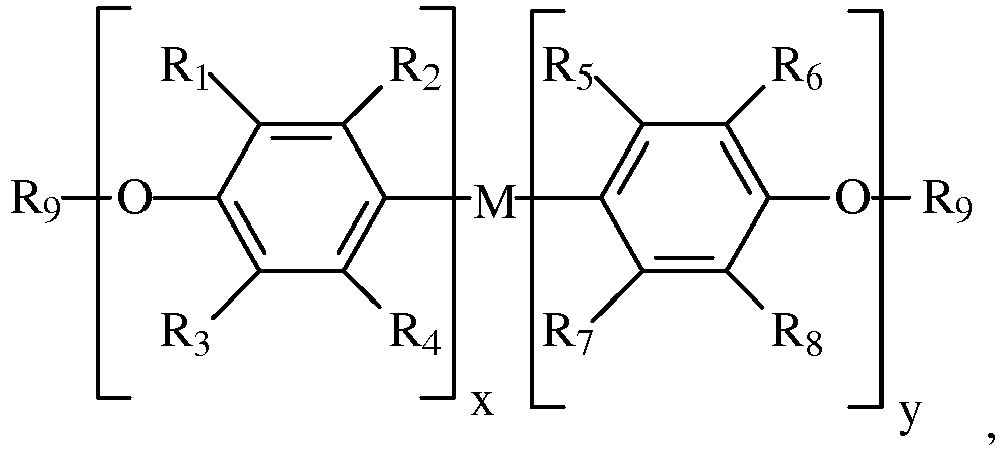
M is selected from
 N is any one selected from the group consisting of -O-, -CO-, -SO-, -SC-, -SO2- and -C(CH3)2-, or a combination of at least two of them;R2, R4, R6, R8, R11, R13, R15 and R17 are each any one independently selected from the group consisting of substituted or unsubstituted C1-C8 linear alkyl, substituted or unsubstituted C1-C8 branched alkyl, and substituted or unsubstituted phenyl, or a combination of at least two of them;R1, R3, R5, R7, R10, R12, R14 and R16 are each any one independently selected from the group consisting of hydrogen atom, substituted or unsubstituted C1-C8 linear alkyl, substituted or unsubstituted C1-C8 branched alkyl, and substituted or unsubstituted phenyl, or a combination of at least two of them;R9 is selected from

- The polyphenylene ether resin composition of claim 1 or 2, characterized in that: the MT organosilicon resin containing unsaturated double bonds and having a three-dimensional network structure and formed by hydrolytic condensation of monofunctional siloxane unit (M unit) and trifunctional siloxane unit (T unit) has the following structure:
(R24R25R26SiO1/2)x1(R27SiO3/2)y1
wherein 3≤x1≤100, 1≤y1≤100, 4≤x1+y1≤200, and 0.03≤x1/y1≤10;
R24, R25, R26 and R27 are each any one independently selected from the group consisting of substituted or unsubstituted C1-C8 linear alkyl, substituted or unsubstituted C1-C8 branched alkyl, substituted or unsubstituted phenyl, and substituted or unsubstituted C2-C10 C=C-containing group, or a combination of at least two of them, and at least one of R24, R25, R26 and R27 is a substituted or unsubstituted C2-C10 C=C-containing group;
preferably, the MTQ organosilicon resin containing unsaturated double bonds and having a three-dimensional network structure and formed by hydrolytic condensation of monofunctional siloxane unit (M unit), trifunctional siloxane unit (T unit) and tetrafunctional siloxane unit (Q unit) has the following structure:
(R28R29R30SiO1/2)a(R31SiO3/2)b(SiO4/2)c
wherein 5≤a≤100, 1≤b≤100, 1≤c≤100, and 7≤a+b+c≤100;
R28, R29, R30 and R31 are each any one independently selected from the group consisting of substituted or unsubstituted C1-C8 linear alkyl, substituted or unsubstituted C1-C8 branched alkyl, substituted or unsubstituted phenyl, and substituted or unsubstituted C2-C10 C=C-containing group, or a combination of at least two of them, and at least one of R28, R29, R30 and R31 is a substituted or unsubstituted C2-C10 C=C-containing group;
preferably, the MDT organosilicon resin containing unsaturated double bonds and having a three-dimensional network structure and formed by hydrolytic condensation of monofunctional siloxane unit (M unit), difunctional siloxane unit (D unit) and trifunctional siloxane unit (T unit) has the following structure:
(R32R33R34SiO1/2)d(R35R36SiO2/2)e(R37SiO3/2)f
wherein 3≤d≤100, 3≤e≤100, 1≤f≤100, and 7≤d+e+f≤100;
R32, R33, R34, R35, R36 and R37 are each any one independently selected from the group consisting of substituted or unsubstituted C1-C8 linear alkyl, substituted or unsubstituted C1-C8 branched alkyl, substituted or unsubstituted phenyl, and substituted or unsubstituted C2-C10 C=C-containing group, or a combination of at least two of them, and at least one of R32, R33, R34, R35, R36 and R37 is a substituted or unsubstituted C2-C10 C=C-containing group;
preferably, the MDQ organosilicon resin containing unsaturated double bonds and having a three-dimensional network structure and formed by hydrolytic condensation of monofunctional siloxane unit (M unit), difunctional siloxane unit (D unit) and tetrafunctional siloxane unit (Q unit) has the following structure:
(R38R39R40SiO1/2)m(R41R42SiO2/2)n(SiO4/2)w
wherein 4≤m≤100, 4≤n≤100, 1≤w≤00, and 9≤m+n+w≤100;
R38, R39, R40, R41 and R42 are each any one independently selected from the group consisting of substituted or unsubstituted C1-C8 linear alkyl, substituted or unsubstituted C1-C8 branched alkyl, substituted or unsubstituted phenyl, and substituted or unsubstituted C2-C10 C=C-containing group, or a combination of at least two of them, and at least one of R38, R39, R40, R41 and R42 is a substituted or unsubstituted C2-C10 C=C-containing group. - The polyphenylene ether resin composition of any one of claims 1-3, characterized in that the weight of the organosilicon resin containing unsaturated double bonds and having a three-dimensional network structure is 10-90 parts by weight, preferably 25-90 parts by weight, based on 100 parts by weight of the vinyl-modified polyphenylene ether resin.
- The polyphenylene ether resin composition of any one of claims 1-4, characterized in that the polyphenylene ether resin composition further comprises a free radical initiator;
preferably, the weight of the free radical initiator is 1-3 parts by weight, based on 100 parts by weight of the total weight of the vinyl-modified polyphenylene ether resin and the organosilicon resin containing unsaturated double bonds and having a three-dimensional network structure;
preferably, the free radical initiator is selected from organic peroxide initiators, and further preferably any one selected from the group consisting of dicumyl peroxide, dibenzoyl peroxide, benzoyl peroxide, tert-butyl peroxybenzoate and butyl 4,4-di(tert-butylperoxy)valerate, or a mixture of at least two of them. - The polyphenylene ether resin composition of any one of claims 1-5, characterized in that the polyphenylene ether resin composition further comprises a flame retardant;
preferably, the weight of the flame retardant is 0-40 parts by weight, preferably 0-40 parts by weight excluding 0, based on 100 parts by weight of the total weight of the vinyl-modified polyphenylene ether resin and the organosilicon resin containing unsaturated double bonds and having a three-dimensional network structure;
preferably, the flame retardant is any one selected from the group consisting of halogenated flame retardant, phosphorus flame retardant, and nitrogen flame retardant, or a mixture of at least two of them, and preferably any one selected from the group consisting of brominated flame retardant, phosphorus flame retardant and nitrogen flame retardant, or a mixture of at least two of them;
preferably, the brominated flame retardant is any one selected from the group consisting of decabromodiphenyl oxide, hexabromobenzene, decabromodiphenyl ethane, and ethylene bis(tetrabromophthalimide), or a mixture of at least two of them;
preferably, the phosphorus flame retardant is any one selected from the group consisting of tris(2,6-dimethylphenyl)phosphine, 10-(2,5-dihydroxyphenyl)-9,10-dihydro-9-oxa-10-phosphaphenanthrene-10-oxide, 2,6-bis(2,6-dimethylphenyl)phosphinobenzene and 10-phenyl-9,10-dihydro-9-oxa-10-phosphaphenanthrene-10-oxide, or a mixture of at least two of them;
preferably, the nitrogen flame retardant is any one selected from the group consisting of melamine, melamine phosphate, guanidine phosphate, guanidine carbonate, and guanidine sulfamate, or a mixture of at least two of them;
preferably, the polyphenylene ether resin composition further comprises a powder filler;
preferably, the powder filler is any one selected from the group consisting of crystalline silica, amorphous silica, spherical silica, fused silica, titania, silicon carbide, glass fiber, alumina, aluminum nitride, boron nitride, barium titanate and strontium titanate, or a mixture of at least two of them;
preferably, the weight of the powder filler is 0-150 parts by weight, preferably 0-150 parts by weight excluding 0, based on 100 parts by weight of the total weight of the vinyl-modified polyphenylene ether resin, the organosilicon resin containing unsaturated double bonds and having a three-dimensional network structure and the flame retardant. - A resin glue solution obtained by dissolving or dispersing the polyphenylene ether resin composition of any one of claims 1-6 in a solvent.
- A prepreg prepared by impregnating a reinforcing material with the resin glue solution of claim 7 and then drying it.
- The prepreg of claim 8, characterized in that the weight of the reinforcing material is 50-230 parts by weight, based on 100 parts by weight of the total weight of the vinyl-modified polyphenylene ether resin, the organosilicon resin containing unsaturated double bonds and having a three-dimensional network structure, the flame retardant and the powder filler.
- A high-frequency circuit substrate prepared from at least one sheet of the prepreg of claim 8 or 9.
Applications Claiming Priority (2)
| Application Number | Priority Date | Filing Date | Title |
|---|---|---|---|
| CN201510689070.7A CN106609039B (en) | 2015-10-21 | 2015-10-21 | A kind of polyphenylene ether resin composition and its application in high frequency circuit substrate |
| PCT/CN2016/075323 WO2017067124A1 (en) | 2015-10-21 | 2016-03-02 | Polyphenyl ether resin composition and use thereof in high-frequency circuit substrate |
Publications (3)
| Publication Number | Publication Date |
|---|---|
| EP3315560A1 EP3315560A1 (en) | 2018-05-02 |
| EP3315560A4 EP3315560A4 (en) | 2019-01-09 |
| EP3315560B1 true EP3315560B1 (en) | 2020-02-19 |
Family
ID=58556569
Family Applications (1)
| Application Number | Title | Priority Date | Filing Date |
|---|---|---|---|
| EP16856571.1A Active EP3315560B1 (en) | 2015-10-21 | 2016-03-02 | Polyphenyl ether resin composition and use thereof in high-frequency circuit substrate |
Country Status (6)
| Country | Link |
|---|---|
| US (1) | US10645806B2 (en) |
| EP (1) | EP3315560B1 (en) |
| JP (1) | JP6912467B2 (en) |
| CN (1) | CN106609039B (en) |
| TW (1) | TWI615439B (en) |
| WO (1) | WO2017067124A1 (en) |
Families Citing this family (21)
| Publication number | Priority date | Publication date | Assignee | Title |
|---|---|---|---|---|
| CN108727827B (en) * | 2017-04-17 | 2021-06-04 | 广东生益科技股份有限公司 | Thermosetting vinyl silicone resin composition and application thereof in high-frequency circuit board |
| CN109082020A (en) * | 2017-06-13 | 2018-12-25 | 广东生益科技股份有限公司 | Polymer resin composition and application thereof in high-frequency circuit board |
| CN109082019B (en) * | 2017-06-13 | 2020-04-14 | 广东生益科技股份有限公司 | A kind of polymer resin and its application in high frequency circuit board |
| CN109385020A (en) * | 2017-08-04 | 2019-02-26 | 广东生益科技股份有限公司 | A kind of compositions of thermosetting resin and prepreg and metal-clad laminate using its production |
| CN111406444A (en) * | 2017-11-28 | 2020-07-10 | 住友电工印刷电路株式会社 | Method of manufacturing flexible printed circuit board and flexible printed circuit board |
| CN111655794A (en) | 2017-12-06 | 2020-09-11 | 爱思乐-艾博美国有限公司 | Phosphorus-containing polysiloxane compound additive for thermosetting resin, flame retardant composition comprising same, and articles made therefrom |
| CN111819247A (en) * | 2019-02-22 | 2020-10-23 | 浙江三时纪新材科技有限公司 | A kind of preparation method of spherical or angular powder filler, spherical or angular powder filler obtained thereby and application thereof |
| US12129341B2 (en) | 2019-02-22 | 2024-10-29 | Zhejiang Third Age Material Technology Co., Ltd. | Preparation method for polysiloxane powder filler, polysiloxane powder filler obtained thereby and application thereof |
| CN111909483A (en) * | 2020-08-17 | 2020-11-10 | 上海材料研究所 | High-thermal-conductivity silicon-containing flame-retardant resin composition and application thereof |
| CN112795169B (en) * | 2020-12-31 | 2022-07-19 | 广东生益科技股份有限公司 | Resin composition, resin film containing resin composition, prepreg, laminated board, copper-clad plate and printed circuit board |
| TWI732733B (en) * | 2021-01-13 | 2021-07-01 | 穗曄實業股份有限公司 | Slurry composition and preparation method thereof |
| WO2022151042A1 (en) | 2021-01-13 | 2022-07-21 | 穗晔实业股份有限公司 | Slurry composition and preparation method therefor |
| JP2024520759A (en) | 2021-06-07 | 2024-05-24 | ワッカー ケミー アクチエンゲゼルシャフト | Composition containing polyorganosiloxane having polyphenylene ether groups |
| KR102903565B1 (en) | 2021-09-14 | 2025-12-26 | 한국과학기술원 | Curable siloxane resin composition |
| WO2023051912A1 (en) | 2021-09-29 | 2023-04-06 | Wacker Chemie Ag | Method for preparing low-silanol polyorganosiloxanes |
| CN113969503A (en) * | 2021-11-03 | 2022-01-25 | 宏和电子材料科技股份有限公司 | A kind of electronic grade glass fiber cloth surface treatment agent for high frequency and high speed board and preparation method thereof |
| EP4479479B1 (en) | 2022-05-17 | 2025-08-13 | Wacker Chemie AG | Silphenylene polymers |
| JP2024070465A (en) * | 2022-11-11 | 2024-05-23 | パナソニックIpマネジメント株式会社 | Resin composition, prepreg, resin-coated film, resin-coated metal foil, metal-clad laminate, and wiring board |
| JPWO2024241960A1 (en) | 2023-05-19 | 2024-11-28 | ||
| WO2024241961A1 (en) * | 2023-05-19 | 2024-11-28 | ダウ・東レ株式会社 | Thermosetting composition, curing method for same, prepreg including same, and high-frequency circuit board |
| WO2026011278A1 (en) * | 2024-07-08 | 2026-01-15 | Wacker Chemie Ag | A resin composition |
Family Cites Families (13)
| Publication number | Priority date | Publication date | Assignee | Title |
|---|---|---|---|---|
| JPS5895538A (en) * | 1981-11-30 | 1983-06-07 | Mitsubishi Chem Ind Ltd | gas separation membrane |
| JPH01113426A (en) * | 1987-10-27 | 1989-05-02 | Asahi Chem Ind Co Ltd | Curable polyphenylene ether containing double bond and its preparation |
| US6414091B2 (en) * | 1999-12-15 | 2002-07-02 | Sumitomo Chemical Company, Limited | Thermoplastic resin, process for producing same and thermoplastic resin composition |
| JP2003012820A (en) * | 2001-06-28 | 2003-01-15 | Asahi Kasei Corp | Crosslinkable composite material and laminate thereof |
| US7413791B2 (en) | 2003-01-28 | 2008-08-19 | Matsushita Electric Works, Ltd. | Poly (phenylene ether) resin composition, prepreg, and laminated sheet |
| CN100547033C (en) * | 2003-01-28 | 2009-10-07 | 松下电工株式会社 | Polyphenylene ether resin composition, prepreg and laminate |
| DE10321555A1 (en) | 2003-05-14 | 2004-12-02 | Degussa Ag | Transparent masterbatches for thermoplastic materials |
| US7192651B2 (en) * | 2003-08-20 | 2007-03-20 | Mitsubishi Gas Chemical Company, Inc. | Resin composition and prepreg for laminate and metal-clad laminate |
| JP2013082835A (en) * | 2011-10-12 | 2013-05-09 | Kaneka Corp | Curable composition |
| CN102993683B (en) * | 2012-11-27 | 2015-04-15 | 广东生益科技股份有限公司 | Resin composition and use thereof |
| CN103102484B (en) | 2013-01-22 | 2015-06-17 | 广东生益科技股份有限公司 | Crosslinkable polyphenyl ether resin, preparation method and use thereof |
| CN105086417B (en) * | 2014-05-06 | 2017-09-12 | 广东生益科技股份有限公司 | A kind of resin combination and its application in high-frequency circuit board |
| CN104650574B (en) * | 2015-02-10 | 2017-02-22 | 郴州功田电子陶瓷技术有限公司 | Polyphenyl ether copper-clad laminate composition |
-
2015
- 2015-10-21 CN CN201510689070.7A patent/CN106609039B/en active Active
-
2016
- 2016-03-02 WO PCT/CN2016/075323 patent/WO2017067124A1/en not_active Ceased
- 2016-03-02 JP JP2018522837A patent/JP6912467B2/en not_active Expired - Fee Related
- 2016-03-02 EP EP16856571.1A patent/EP3315560B1/en active Active
- 2016-03-02 US US15/744,244 patent/US10645806B2/en active Active
- 2016-08-31 TW TW105128103A patent/TWI615439B/en active
Non-Patent Citations (1)
| Title |
|---|
| None * |
Also Published As
| Publication number | Publication date |
|---|---|
| US10645806B2 (en) | 2020-05-05 |
| US20180220530A1 (en) | 2018-08-02 |
| WO2017067124A1 (en) | 2017-04-27 |
| EP3315560A1 (en) | 2018-05-02 |
| CN106609039B (en) | 2019-09-13 |
| TW201716507A (en) | 2017-05-16 |
| EP3315560A4 (en) | 2019-01-09 |
| CN106609039A (en) | 2017-05-03 |
| JP2018521211A (en) | 2018-08-02 |
| TWI615439B (en) | 2018-02-21 |
| JP6912467B2 (en) | 2021-08-04 |
Similar Documents
| Publication | Publication Date | Title |
|---|---|---|
| EP3315555A1 (en) | Polyphenyl ether resin composition and use thereof in high-frequency circuit substrate | |
| EP3315560A1 (en) | Polyphenyl ether resin composition and use thereof in high-frequency circuit substrate | |
| JP6216043B2 (en) | Resin composition and its application to high-frequency circuit boards | |
| JP7316569B2 (en) | Prepregs, metal-clad laminates, and wiring boards | |
| CN109912958B (en) | Thermosetting resin composition, prepreg, laminate, and printed circuit board | |
| CN106660322B (en) | Metal-clad laminate and method for producing the same, resin-adhered metal foil, and printed circuit board | |
| EP2927281B1 (en) | Resin composition and use thereof | |
| KR102198168B1 (en) | Thermosetting resin composition, prepreg, laminate, and printed circuit board | |
| CN106574111B (en) | Curable composition, prepreg, resin-coated metal foil, metal-clad laminate, and printed wiring board | |
| WO2018159080A1 (en) | Resin composition, prepreg, resin-coated film, resin-coated metal foil, metal-clad laminate, and wiring board | |
| US12581593B2 (en) | Prepreg, and metal-clad laminated board and wiring substrate obtained using same | |
| CN108727828B (en) | Thermosetting vinyl organic silicon resin composition and application thereof in high-frequency circuit board | |
| TWI644984B (en) | Thermosetting vinyl organic resin composition and its application in high frequency circuit boards |
Legal Events
| Date | Code | Title | Description |
|---|---|---|---|
| STAA | Information on the status of an ep patent application or granted ep patent |
Free format text: STATUS: THE INTERNATIONAL PUBLICATION HAS BEEN MADE |
|
| PUAI | Public reference made under article 153(3) epc to a published international application that has entered the european phase |
Free format text: ORIGINAL CODE: 0009012 |
|
| STAA | Information on the status of an ep patent application or granted ep patent |
Free format text: STATUS: REQUEST FOR EXAMINATION WAS MADE |
|
| 17P | Request for examination filed |
Effective date: 20180126 |
|
| AK | Designated contracting states |
Kind code of ref document: A1 Designated state(s): AL AT BE BG CH CY CZ DE DK EE ES FI FR GB GR HR HU IE IS IT LI LT LU LV MC MK MT NL NO PL PT RO RS SE SI SK SM TR |
|
| AX | Request for extension of the european patent |
Extension state: BA ME |
|
| RIC1 | Information provided on ipc code assigned before grant |
Ipc: C08L 71/12 20060101ALI20181129BHEP Ipc: C08L 83/07 20060101AFI20181129BHEP Ipc: H05K 1/03 20060101ALI20181129BHEP |
|
| A4 | Supplementary search report drawn up and despatched |
Effective date: 20181206 |
|
| DAV | Request for validation of the european patent (deleted) | ||
| DAX | Request for extension of the european patent (deleted) | ||
| GRAP | Despatch of communication of intention to grant a patent |
Free format text: ORIGINAL CODE: EPIDOSNIGR1 |
|
| STAA | Information on the status of an ep patent application or granted ep patent |
Free format text: STATUS: GRANT OF PATENT IS INTENDED |
|
| INTG | Intention to grant announced |
Effective date: 20191030 |
|
| GRAS | Grant fee paid |
Free format text: ORIGINAL CODE: EPIDOSNIGR3 |
|
| GRAA | (expected) grant |
Free format text: ORIGINAL CODE: 0009210 |
|
| STAA | Information on the status of an ep patent application or granted ep patent |
Free format text: STATUS: THE PATENT HAS BEEN GRANTED |
|
| AK | Designated contracting states |
Kind code of ref document: B1 Designated state(s): AL AT BE BG CH CY CZ DE DK EE ES FI FR GB GR HR HU IE IS IT LI LT LU LV MC MK MT NL NO PL PT RO RS SE SI SK SM TR |
|
| REG | Reference to a national code |
Ref country code: CH Ref legal event code: EP |
|
| REG | Reference to a national code |
Ref country code: DE Ref legal event code: R096 Ref document number: 602016030315 Country of ref document: DE |
|
| REG | Reference to a national code |
Ref country code: AT Ref legal event code: REF Ref document number: 1234934 Country of ref document: AT Kind code of ref document: T Effective date: 20200315 |
|
| REG | Reference to a national code |
Ref country code: IE Ref legal event code: FG4D |
|
| REG | Reference to a national code |
Ref country code: FI Ref legal event code: FGE |
|
| REG | Reference to a national code |
Ref country code: SE Ref legal event code: TRGR |
|
| REG | Reference to a national code |
Ref country code: NL Ref legal event code: MP Effective date: 20200219 |
|
| PG25 | Lapsed in a contracting state [announced via postgrant information from national office to epo] |
Ref country code: NO Free format text: LAPSE BECAUSE OF FAILURE TO SUBMIT A TRANSLATION OF THE DESCRIPTION OR TO PAY THE FEE WITHIN THE PRESCRIBED TIME-LIMIT Effective date: 20200519 Ref country code: RS Free format text: LAPSE BECAUSE OF FAILURE TO SUBMIT A TRANSLATION OF THE DESCRIPTION OR TO PAY THE FEE WITHIN THE PRESCRIBED TIME-LIMIT Effective date: 20200219 |
|
| REG | Reference to a national code |
Ref country code: LT Ref legal event code: MG4D |
|
| PG25 | Lapsed in a contracting state [announced via postgrant information from national office to epo] |
Ref country code: BG Free format text: LAPSE BECAUSE OF FAILURE TO SUBMIT A TRANSLATION OF THE DESCRIPTION OR TO PAY THE FEE WITHIN THE PRESCRIBED TIME-LIMIT Effective date: 20200519 Ref country code: IS Free format text: LAPSE BECAUSE OF FAILURE TO SUBMIT A TRANSLATION OF THE DESCRIPTION OR TO PAY THE FEE WITHIN THE PRESCRIBED TIME-LIMIT Effective date: 20200619 Ref country code: LV Free format text: LAPSE BECAUSE OF FAILURE TO SUBMIT A TRANSLATION OF THE DESCRIPTION OR TO PAY THE FEE WITHIN THE PRESCRIBED TIME-LIMIT Effective date: 20200219 Ref country code: HR Free format text: LAPSE BECAUSE OF FAILURE TO SUBMIT A TRANSLATION OF THE DESCRIPTION OR TO PAY THE FEE WITHIN THE PRESCRIBED TIME-LIMIT Effective date: 20200219 Ref country code: GR Free format text: LAPSE BECAUSE OF FAILURE TO SUBMIT A TRANSLATION OF THE DESCRIPTION OR TO PAY THE FEE WITHIN THE PRESCRIBED TIME-LIMIT Effective date: 20200520 |
|
| PG25 | Lapsed in a contracting state [announced via postgrant information from national office to epo] |
Ref country code: NL Free format text: LAPSE BECAUSE OF FAILURE TO SUBMIT A TRANSLATION OF THE DESCRIPTION OR TO PAY THE FEE WITHIN THE PRESCRIBED TIME-LIMIT Effective date: 20200219 |
|
| PG25 | Lapsed in a contracting state [announced via postgrant information from national office to epo] |
Ref country code: ES Free format text: LAPSE BECAUSE OF FAILURE TO SUBMIT A TRANSLATION OF THE DESCRIPTION OR TO PAY THE FEE WITHIN THE PRESCRIBED TIME-LIMIT Effective date: 20200219 Ref country code: SK Free format text: LAPSE BECAUSE OF FAILURE TO SUBMIT A TRANSLATION OF THE DESCRIPTION OR TO PAY THE FEE WITHIN THE PRESCRIBED TIME-LIMIT Effective date: 20200219 Ref country code: RO Free format text: LAPSE BECAUSE OF FAILURE TO SUBMIT A TRANSLATION OF THE DESCRIPTION OR TO PAY THE FEE WITHIN THE PRESCRIBED TIME-LIMIT Effective date: 20200219 Ref country code: CZ Free format text: LAPSE BECAUSE OF FAILURE TO SUBMIT A TRANSLATION OF THE DESCRIPTION OR TO PAY THE FEE WITHIN THE PRESCRIBED TIME-LIMIT Effective date: 20200219 Ref country code: LT Free format text: LAPSE BECAUSE OF FAILURE TO SUBMIT A TRANSLATION OF THE DESCRIPTION OR TO PAY THE FEE WITHIN THE PRESCRIBED TIME-LIMIT Effective date: 20200219 Ref country code: PT Free format text: LAPSE BECAUSE OF FAILURE TO SUBMIT A TRANSLATION OF THE DESCRIPTION OR TO PAY THE FEE WITHIN THE PRESCRIBED TIME-LIMIT Effective date: 20200712 Ref country code: DK Free format text: LAPSE BECAUSE OF FAILURE TO SUBMIT A TRANSLATION OF THE DESCRIPTION OR TO PAY THE FEE WITHIN THE PRESCRIBED TIME-LIMIT Effective date: 20200219 Ref country code: SM Free format text: LAPSE BECAUSE OF FAILURE TO SUBMIT A TRANSLATION OF THE DESCRIPTION OR TO PAY THE FEE WITHIN THE PRESCRIBED TIME-LIMIT Effective date: 20200219 Ref country code: EE Free format text: LAPSE BECAUSE OF FAILURE TO SUBMIT A TRANSLATION OF THE DESCRIPTION OR TO PAY THE FEE WITHIN THE PRESCRIBED TIME-LIMIT Effective date: 20200219 |
|
| REG | Reference to a national code |
Ref country code: CH Ref legal event code: PL |
|
| REG | Reference to a national code |
Ref country code: AT Ref legal event code: MK05 Ref document number: 1234934 Country of ref document: AT Kind code of ref document: T Effective date: 20200219 |
|
| REG | Reference to a national code |
Ref country code: DE Ref legal event code: R097 Ref document number: 602016030315 Country of ref document: DE |
|
| PG25 | Lapsed in a contracting state [announced via postgrant information from national office to epo] |
Ref country code: MC Free format text: LAPSE BECAUSE OF FAILURE TO SUBMIT A TRANSLATION OF THE DESCRIPTION OR TO PAY THE FEE WITHIN THE PRESCRIBED TIME-LIMIT Effective date: 20200219 |
|
| REG | Reference to a national code |
Ref country code: BE Ref legal event code: MM Effective date: 20200331 |
|
| PLBE | No opposition filed within time limit |
Free format text: ORIGINAL CODE: 0009261 |
|
| STAA | Information on the status of an ep patent application or granted ep patent |
Free format text: STATUS: NO OPPOSITION FILED WITHIN TIME LIMIT |
|
| PG25 | Lapsed in a contracting state [announced via postgrant information from national office to epo] |
Ref country code: LU Free format text: LAPSE BECAUSE OF NON-PAYMENT OF DUE FEES Effective date: 20200302 |
|
| 26N | No opposition filed |
Effective date: 20201120 |
|
| PG25 | Lapsed in a contracting state [announced via postgrant information from national office to epo] |
Ref country code: IT Free format text: LAPSE BECAUSE OF FAILURE TO SUBMIT A TRANSLATION OF THE DESCRIPTION OR TO PAY THE FEE WITHIN THE PRESCRIBED TIME-LIMIT Effective date: 20200219 Ref country code: FR Free format text: LAPSE BECAUSE OF NON-PAYMENT OF DUE FEES Effective date: 20200419 Ref country code: LI Free format text: LAPSE BECAUSE OF NON-PAYMENT OF DUE FEES Effective date: 20200331 Ref country code: CH Free format text: LAPSE BECAUSE OF NON-PAYMENT OF DUE FEES Effective date: 20200331 Ref country code: AT Free format text: LAPSE BECAUSE OF FAILURE TO SUBMIT A TRANSLATION OF THE DESCRIPTION OR TO PAY THE FEE WITHIN THE PRESCRIBED TIME-LIMIT Effective date: 20200219 Ref country code: IE Free format text: LAPSE BECAUSE OF NON-PAYMENT OF DUE FEES Effective date: 20200302 |
|
| PG25 | Lapsed in a contracting state [announced via postgrant information from national office to epo] |
Ref country code: PL Free format text: LAPSE BECAUSE OF FAILURE TO SUBMIT A TRANSLATION OF THE DESCRIPTION OR TO PAY THE FEE WITHIN THE PRESCRIBED TIME-LIMIT Effective date: 20200219 Ref country code: BE Free format text: LAPSE BECAUSE OF NON-PAYMENT OF DUE FEES Effective date: 20200331 Ref country code: SI Free format text: LAPSE BECAUSE OF FAILURE TO SUBMIT A TRANSLATION OF THE DESCRIPTION OR TO PAY THE FEE WITHIN THE PRESCRIBED TIME-LIMIT Effective date: 20200219 |
|
| GBPC | Gb: european patent ceased through non-payment of renewal fee |
Effective date: 20200519 |
|
| PG25 | Lapsed in a contracting state [announced via postgrant information from national office to epo] |
Ref country code: GB Free format text: LAPSE BECAUSE OF NON-PAYMENT OF DUE FEES Effective date: 20200519 |
|
| PG25 | Lapsed in a contracting state [announced via postgrant information from national office to epo] |
Ref country code: TR Free format text: LAPSE BECAUSE OF FAILURE TO SUBMIT A TRANSLATION OF THE DESCRIPTION OR TO PAY THE FEE WITHIN THE PRESCRIBED TIME-LIMIT Effective date: 20200219 Ref country code: MT Free format text: LAPSE BECAUSE OF FAILURE TO SUBMIT A TRANSLATION OF THE DESCRIPTION OR TO PAY THE FEE WITHIN THE PRESCRIBED TIME-LIMIT Effective date: 20200219 Ref country code: CY Free format text: LAPSE BECAUSE OF FAILURE TO SUBMIT A TRANSLATION OF THE DESCRIPTION OR TO PAY THE FEE WITHIN THE PRESCRIBED TIME-LIMIT Effective date: 20200219 |
|
| PG25 | Lapsed in a contracting state [announced via postgrant information from national office to epo] |
Ref country code: MK Free format text: LAPSE BECAUSE OF FAILURE TO SUBMIT A TRANSLATION OF THE DESCRIPTION OR TO PAY THE FEE WITHIN THE PRESCRIBED TIME-LIMIT Effective date: 20200219 Ref country code: AL Free format text: LAPSE BECAUSE OF FAILURE TO SUBMIT A TRANSLATION OF THE DESCRIPTION OR TO PAY THE FEE WITHIN THE PRESCRIBED TIME-LIMIT Effective date: 20200219 |
|
| PGFP | Annual fee paid to national office [announced via postgrant information from national office to epo] |
Ref country code: SE Payment date: 20250314 Year of fee payment: 10 |
|
| PGFP | Annual fee paid to national office [announced via postgrant information from national office to epo] |
Ref country code: DE Payment date: 20250313 Year of fee payment: 10 |
|
| PGFP | Annual fee paid to national office [announced via postgrant information from national office to epo] |
Ref country code: FI Payment date: 20250224 Year of fee payment: 10 |