EP3315502A1 - C,o-spiro aryl glycoside compounds, preparation therefor and use thereof - Google Patents
C,o-spiro aryl glycoside compounds, preparation therefor and use thereof Download PDFInfo
- Publication number
- EP3315502A1 EP3315502A1 EP16813720.6A EP16813720A EP3315502A1 EP 3315502 A1 EP3315502 A1 EP 3315502A1 EP 16813720 A EP16813720 A EP 16813720A EP 3315502 A1 EP3315502 A1 EP 3315502A1
- Authority
- EP
- European Patent Office
- Prior art keywords
- methyl
- pyran
- group
- bromo
- spiro
- Prior art date
- Legal status (The legal status is an assumption and is not a legal conclusion. Google has not performed a legal analysis and makes no representation as to the accuracy of the status listed.)
- Granted
Links
- 0 C[C@]([C@]([C@]([C@@]1*)O)O)O[C@]11OCc2c1cc(Cc1ccc(-c3ccccn3)[s]1)cc2 Chemical compound C[C@]([C@]([C@]([C@@]1*)O)O)O[C@]11OCc2c1cc(Cc1ccc(-c3ccccn3)[s]1)cc2 0.000 description 2
- OWPHHPNZOJVIMA-YGQJEARZSA-N CCCc1ccc(Cc(cc([C@]([C@@H]([C@H]2C)O)(OC3)O[C@H](C)[C@H]2O)c3c2)c2Cl)[s]1 Chemical compound CCCc1ccc(Cc(cc([C@]([C@@H]([C@H]2C)O)(OC3)O[C@H](C)[C@H]2O)c3c2)c2Cl)[s]1 OWPHHPNZOJVIMA-YGQJEARZSA-N 0.000 description 1
- LQHFUEREUVTQTP-XVWUQHIZSA-N CCNC(c1ccc(Cc(cc([C@]([C@@H]([C@H]2O)O)(OC3)O[C@H](C)[C@H]2O)c3c2)c2Cl)[s]1)=O Chemical compound CCNC(c1ccc(Cc(cc([C@]([C@@H]([C@H]2O)O)(OC3)O[C@H](C)[C@H]2O)c3c2)c2Cl)[s]1)=O LQHFUEREUVTQTP-XVWUQHIZSA-N 0.000 description 1
- SXYICTAASLTABQ-NHOMLLKZSA-N CCc1ccc(C(c2cc([C@]([C@@H]([C@H]3O)O)(OC4)O[C@H](C)[C@H]3O)c4cc2Cl)=O)[s]1 Chemical compound CCc1ccc(C(c2cc([C@]([C@@H]([C@H]3O)O)(OC4)O[C@H](C)[C@H]3O)c4cc2Cl)=O)[s]1 SXYICTAASLTABQ-NHOMLLKZSA-N 0.000 description 1
- WOHURPOSIGWLSO-BCBSPLPZSA-N C[C@H](C[C@@H](C1O)O)[O-2][C@]11OCc2cc(C#N)c(Cc3ccc(C)cc3)cc12 Chemical compound C[C@H](C[C@@H](C1O)O)[O-2][C@]11OCc2cc(C#N)c(Cc3ccc(C)cc3)cc12 WOHURPOSIGWLSO-BCBSPLPZSA-N 0.000 description 1
- ABJUAQKKMXKHOA-ZTNKVBRBSA-N C[C@H](C[C@@H]([C@H]1O)O)O[C@]11OCc2c1cc(Cc1ccc(-c3ccc(C)cc3)[s]1)c(C)c2 Chemical compound C[C@H](C[C@@H]([C@H]1O)O)O[C@]11OCc2c1cc(Cc1ccc(-c3ccc(C)cc3)[s]1)c(C)c2 ABJUAQKKMXKHOA-ZTNKVBRBSA-N 0.000 description 1
- HCYMRYNSLLTEOI-YNIFWWRNSA-N C[C@H]([C@H]([C@@H]([C@H]1O)O)O)O[C@]11OCc2c1cc(C(c1ccc(C(F)(F)F)c(F)c1)=O)c(Cl)c2 Chemical compound C[C@H]([C@H]([C@@H]([C@H]1O)O)O)O[C@]11OCc2c1cc(C(c1ccc(C(F)(F)F)c(F)c1)=O)c(Cl)c2 HCYMRYNSLLTEOI-YNIFWWRNSA-N 0.000 description 1
- BDVURBMTGGKNAL-NEPQHZLESA-N C[C@H]([C@H]([C@@H]([C@H]1O)O)O)O[C@]11OCc2c1cc(Cc1ccc(C(OC)=O)[s]1)c(Cl)c2 Chemical compound C[C@H]([C@H]([C@@H]([C@H]1O)O)O)O[C@]11OCc2c1cc(Cc1ccc(C(OC)=O)[s]1)c(Cl)c2 BDVURBMTGGKNAL-NEPQHZLESA-N 0.000 description 1
- HZQUWGXLLOXRMI-LTYVRRJOSA-N C[C@H]([C@H]([C@@H]([C@H]1O)O)O)O[C@]11OCc2c1cc(Cc1ccc(CC(N3CCCC3)=O)[s]1)c(Cl)c2 Chemical compound C[C@H]([C@H]([C@@H]([C@H]1O)O)O)O[C@]11OCc2c1cc(Cc1ccc(CC(N3CCCC3)=O)[s]1)c(Cl)c2 HZQUWGXLLOXRMI-LTYVRRJOSA-N 0.000 description 1
- DNEHQSOKOHNNGV-UVICMKTJSA-N C[C@H]([C@H]([C@@H]([C@H]1O)O)O)O[C@]11OCc2c1cc(Cc1ccc(CO)[s]1)c(Cl)c2 Chemical compound C[C@H]([C@H]([C@@H]([C@H]1O)O)O)O[C@]11OCc2c1cc(Cc1ccc(CO)[s]1)c(Cl)c2 DNEHQSOKOHNNGV-UVICMKTJSA-N 0.000 description 1
- XUKBRGGZCGXDLZ-LTYVRRJOSA-N C[C@H]([C@H]([C@@H]([C@H]1O)O)O)O[C@]11OCc2cc(Cl)c(Cc3ccc(CC(N4CCOCC4)=O)[s]3)cc12 Chemical compound C[C@H]([C@H]([C@@H]([C@H]1O)O)O)O[C@]11OCc2cc(Cl)c(Cc3ccc(CC(N4CCOCC4)=O)[s]3)cc12 XUKBRGGZCGXDLZ-LTYVRRJOSA-N 0.000 description 1
- UEYHMUVTRUMNID-FJITVDBRSA-N C[C@H]([C@H]([C@@H]([C@H]1O)O)O)[O-3][C@]11OCc2c1cc(Cc1ccc(OC)[s]1)c(C)c2 Chemical compound C[C@H]([C@H]([C@@H]([C@H]1O)O)O)[O-3][C@]11OCc2c1cc(Cc1ccc(OC)[s]1)c(C)c2 UEYHMUVTRUMNID-FJITVDBRSA-N 0.000 description 1
- FOGZCXGNKVZZIP-LTYVRRJOSA-N C[C@H]([C@H]([C@@H]([C@H]1O)O)O)[O](C)[C@]11OCc2c1cc(Cc1ncc(-c(cc3)ccc3F)[s]1)cc2 Chemical compound C[C@H]([C@H]([C@@H]([C@H]1O)O)O)[O](C)[C@]11OCc2c1cc(Cc1ncc(-c(cc3)ccc3F)[s]1)cc2 FOGZCXGNKVZZIP-LTYVRRJOSA-N 0.000 description 1
- PAAPKXKWBMPUPI-WCIQWLHISA-N Cc1c(C)[s]c(Cc2cc([C@]([C@@H]([C@H]([C@@H]3O)O)O)(OC4)OC3=C)c4cc2Cl)c1 Chemical compound Cc1c(C)[s]c(Cc2cc([C@]([C@@H]([C@H]([C@@H]3O)O)O)(OC4)OC3=C)c4cc2Cl)c1 PAAPKXKWBMPUPI-WCIQWLHISA-N 0.000 description 1
Images

Classifications
-
- C—CHEMISTRY; METALLURGY
- C07—ORGANIC CHEMISTRY
- C07H—SUGARS; DERIVATIVES THEREOF; NUCLEOSIDES; NUCLEOTIDES; NUCLEIC ACIDS
- C07H19/00—Compounds containing a hetero ring sharing one ring hetero atom with a saccharide radical; Nucleosides; Mononucleotides; Anhydro-derivatives thereof
- C07H19/01—Compounds containing a hetero ring sharing one ring hetero atom with a saccharide radical; Nucleosides; Mononucleotides; Anhydro-derivatives thereof sharing oxygen
-
- A—HUMAN NECESSITIES
- A61—MEDICAL OR VETERINARY SCIENCE; HYGIENE
- A61K—PREPARATIONS FOR MEDICAL, DENTAL OR TOILETRY PURPOSES
- A61K31/00—Medicinal preparations containing organic active ingredients
- A61K31/33—Heterocyclic compounds
- A61K31/335—Heterocyclic compounds having oxygen as the only ring hetero atom, e.g. fungichromin
- A61K31/35—Heterocyclic compounds having oxygen as the only ring hetero atom, e.g. fungichromin having six-membered rings with one oxygen as the only ring hetero atom
-
- A—HUMAN NECESSITIES
- A61—MEDICAL OR VETERINARY SCIENCE; HYGIENE
- A61K—PREPARATIONS FOR MEDICAL, DENTAL OR TOILETRY PURPOSES
- A61K31/00—Medicinal preparations containing organic active ingredients
- A61K31/33—Heterocyclic compounds
- A61K31/38—Heterocyclic compounds having sulfur as a ring hetero atom
- A61K31/381—Heterocyclic compounds having sulfur as a ring hetero atom having five-membered rings
-
- A—HUMAN NECESSITIES
- A61—MEDICAL OR VETERINARY SCIENCE; HYGIENE
- A61K—PREPARATIONS FOR MEDICAL, DENTAL OR TOILETRY PURPOSES
- A61K31/00—Medicinal preparations containing organic active ingredients
- A61K31/33—Heterocyclic compounds
- A61K31/395—Heterocyclic compounds having nitrogen as a ring hetero atom, e.g. guanethidine or rifamycins
- A61K31/41—Heterocyclic compounds having nitrogen as a ring hetero atom, e.g. guanethidine or rifamycins having five-membered rings with two or more ring hetero atoms, at least one of which being nitrogen, e.g. tetrazole
- A61K31/425—Thiazoles
- A61K31/427—Thiazoles not condensed and containing further heterocyclic rings
-
- A—HUMAN NECESSITIES
- A61—MEDICAL OR VETERINARY SCIENCE; HYGIENE
- A61K—PREPARATIONS FOR MEDICAL, DENTAL OR TOILETRY PURPOSES
- A61K31/00—Medicinal preparations containing organic active ingredients
- A61K31/33—Heterocyclic compounds
- A61K31/395—Heterocyclic compounds having nitrogen as a ring hetero atom, e.g. guanethidine or rifamycins
- A61K31/435—Heterocyclic compounds having nitrogen as a ring hetero atom, e.g. guanethidine or rifamycins having six-membered rings with one nitrogen as the only ring hetero atom
- A61K31/44—Non condensed pyridines; Hydrogenated derivatives thereof
- A61K31/4427—Non condensed pyridines; Hydrogenated derivatives thereof containing further heterocyclic ring systems
- A61K31/4436—Non condensed pyridines; Hydrogenated derivatives thereof containing further heterocyclic ring systems containing a heterocyclic ring having sulfur as a ring hetero atom
-
- A—HUMAN NECESSITIES
- A61—MEDICAL OR VETERINARY SCIENCE; HYGIENE
- A61P—SPECIFIC THERAPEUTIC ACTIVITY OF CHEMICAL COMPOUNDS OR MEDICINAL PREPARATIONS
- A61P3/00—Drugs for disorders of the metabolism
-
- A—HUMAN NECESSITIES
- A61—MEDICAL OR VETERINARY SCIENCE; HYGIENE
- A61P—SPECIFIC THERAPEUTIC ACTIVITY OF CHEMICAL COMPOUNDS OR MEDICINAL PREPARATIONS
- A61P3/00—Drugs for disorders of the metabolism
- A61P3/04—Anorexiants; Antiobesity agents
-
- A—HUMAN NECESSITIES
- A61—MEDICAL OR VETERINARY SCIENCE; HYGIENE
- A61P—SPECIFIC THERAPEUTIC ACTIVITY OF CHEMICAL COMPOUNDS OR MEDICINAL PREPARATIONS
- A61P3/00—Drugs for disorders of the metabolism
- A61P3/08—Drugs for disorders of the metabolism for glucose homeostasis
-
- A—HUMAN NECESSITIES
- A61—MEDICAL OR VETERINARY SCIENCE; HYGIENE
- A61P—SPECIFIC THERAPEUTIC ACTIVITY OF CHEMICAL COMPOUNDS OR MEDICINAL PREPARATIONS
- A61P3/00—Drugs for disorders of the metabolism
- A61P3/08—Drugs for disorders of the metabolism for glucose homeostasis
- A61P3/10—Drugs for disorders of the metabolism for glucose homeostasis for hyperglycaemia, e.g. antidiabetics
-
- A—HUMAN NECESSITIES
- A61—MEDICAL OR VETERINARY SCIENCE; HYGIENE
- A61P—SPECIFIC THERAPEUTIC ACTIVITY OF CHEMICAL COMPOUNDS OR MEDICINAL PREPARATIONS
- A61P9/00—Drugs for disorders of the cardiovascular system
- A61P9/10—Drugs for disorders of the cardiovascular system for treating ischaemic or atherosclerotic diseases, e.g. antianginal drugs, coronary vasodilators, drugs for myocardial infarction, retinopathy, cerebrovascula insufficiency, renal arteriosclerosis
-
- C—CHEMISTRY; METALLURGY
- C07—ORGANIC CHEMISTRY
- C07D—HETEROCYCLIC COMPOUNDS
- C07D493/00—Heterocyclic compounds containing oxygen atoms as the only ring hetero atoms in the condensed system
- C07D493/02—Heterocyclic compounds containing oxygen atoms as the only ring hetero atoms in the condensed system in which the condensed system contains two hetero rings
- C07D493/10—Spiro-condensed systems
Definitions
- the present invention relates to the field of pharmaceutical chemistry and pharmacotherapy, in particular to a class of C , O -spiro aryl glycoside compounds, the preparation thereof, pharmaceutical compositions comprising such compounds and their use as sodium-glucose cotransporter 2 inhibitors, in particular, for the preparation of medicaments for the treatment of metabolic diseases such as diabetes, atherosclerosis and obesity.
- Diabetes Mellitus is a chronic, systemic and metabolic disease caused by long-term interaction between genetic and environmental factors and characterized by increased plasma glucose levels, and is a disease that affect the normal physiological activity mainly due to sugar, fat, protein metabolism disorders caused by insufficient insulin secretion or dysfunction in the body (insulin resistance) .
- Diabetic complications can be divided into acute and chronic complications, in which the acute complications comprises diabetic ketoacidosis, hyperosmolar diabetic coma, various acute infections and lactic acidosis,
- hypoglycemia which occurs during the course of diabetes treatment is also one of the most common acute complications; chronic complications include diabetic eye disease, diabetic nephropathy, diabetic neuropathy, diabetic cardiovascular and cerebrovascular diseases, diabetic foot and skin lesions, etc.
- the main clinical manifestations of diabetes are polydipsia, polyuria, polyphagia and weight loss.
- Diabetes is divided into insulin-dependent diabetes mellitus (IDDM, i.e., type I diabetes) and noninsulin-dependent diabetes mellitus (NIDDM, i.e., type II diabetes), of which type II diabetes is most common, accounting for more than 90% of diabetic patients.
- IDDM insulin-dependent diabetes mellitus
- NIDDM noninsulin-dependent diabetes mellitus
- type II diabetes is most common, accounting for more than 90% of diabetic patients.
- IDDM insulin-dependent diabetes mellitus
- NIDDM noninsulin-dependent diabetes mellitus
- Type II diabetes is a group of metabolic syndromes that fail to control blood glucose levels in the body and are characterized primarily by hyperglycemia, insulin resistance, and lack of insulin secretion.
- the cause of type II diabetes is mainly due to insulin resistance which makes the body unable to effectively use insulin, or the reduced insulin secretion can not meet the needs of the body, etc. Since those diabetes patients can secrete insulin, generally, insulin treatment is not necessary and blood sugar can be controlled by diet adjustment or oral hypoglycemic agents.
- the number of diabetic patients in the world reached 387 million in 2014 and is expected to reach 592 million by 2035, wherein 77% of them are in low and middle income countries.
- the survey 4.9 million people died of diabetes in 2014, which means that there is one person dies of diabetes almost every 7 seconds, and up to 61.2 billion U.S. dollars are spent for the treatment of diabetes.
- about a half of patients do not know they already have diabetes, which presents great difficulties and inconveniences to diabetes prevention and treatment worldwide.
- the drugs suitable for the treatment of type II diabetes mainly include insulin and its analogues, sulfonylureas, biguanides, ⁇ -glucosidase inhibitors, thiazole diketones, Glucagon- like peptide-1 (GLP-1) analogs, Dipeptidyl peptidase IV (DPP IV) inhibitors, etc.
- GLP-1 Glucagon- like peptide-1
- DPP IV Dipeptidyl peptidase IV
- SGLT2 Sodium-glucose cotransporter 2
- inhibition of SGLT2 activity can block renal reabsorption of glucose, the excess glucose is excreted in the form of urinary sugars to lower blood sugar without the risk of weight gain and hypoglycemia, and selective inhibition of SGLT2 activity does not interfere with the physiological effects of SGLT1 in the gastrointestinal tract, and does not lead to glucose-galactose malabsorption and other adverse reactions. Therefore, the selective SGLT2 inhibitors become a hot research topic.
- SGLT2 inhibitors Compared with other antidiabetic drugs, SGLT2 inhibitors mainly have the following advantages: (1) reduce the energy retention of sodium and water, and reduce the risk of causing cardiovascular diseases; (2) not easy to cause hypoglycemia, and can improve ⁇ cell function as well as insulin resistance; (3) a wider use range, especially for the improvement of blood glucose in patients with renal diabetes; (4) reduce the body weight of diabetic patients by excreting glucose from urine to provide negative energy balance; (5) SGLT2 mainly distributed in the kidney, the selective SGLT2 inhibitors may not affect other body tissues and organs, with fewer adverse reactions.
- SGLT2 inhibitors have made major breakthroughs in research, there are already six compounds marketed for the treatment of type II diabetes, many compounds are in clinical research stage, but the development of novel SGLT2 inhibitors to increase their selectivity is still an urgent problem to be solved. Therefore, the research on SGLT2 inhibitors remains a big challenge.
- An object of the present invention is to provide a C , O -spiro aryl glycoside compound of formula I, pharmaceutically acceptable salts, racemates, R-isomers and S-isomers thereof, or mixtures thereof.
- Another object of the present invention is to provide a method for preparing the C , O -spiro aryl glycoside compound represented by the above formula I.
- Still another object of the present invention is to provide a pharmaceutical composition
- a pharmaceutical composition comprising a therapeutically effective amount of a C , O -spiro aryl glycoside selected from the group consisting of formula I, pharmaceutically acceptable salts, racemates, R-isomer, S-isomer thereof, or mixtures thereof.
- Still another object of the present invention is to provide an SGLT2 inhibitor comprising one or more selected from the group consisting of C , O -spiro aryl glycoside compounds of formula I, pharmaceutically acceptable salts, racemates, R - isomers, S-isomers thereof or mixtures thereof.
- Still another object of the present invention is to provide C , O -spiro aryl glycoside compounds of formula I, pharmaceutically acceptable salts, racemates, R-isomers and S-isomers thereof, or mixtures thereof for the preparation of a medicine for use in the treatment of metabolic diseases associated with the glucagon receptor such as diabetes, atherosclerosis, obesity and the like.
- Still another object of the present invention is to provide a method for treating metabolic diseases associated with SGLT2, such as diabetes, atherosclerosis and obesity, which comprises administering to a patient in need one or more selected from the group consisting of a C , O -spiro aryl glycoside compound of formula I, pharmaceutically acceptable salts, racemates, R-isomers, S-isomers thereof, or mixtures thereof .
- Ar is a substituted or unsubstituted group selected from the group consisting of phenyl, furanyl, thiophenyl, pyrrolyl, pyrazolyl, triazolyl, isoxazolyl, oxazolyl, thiazolyl, isothiazolyl, oxadiazolyl, pyridinyl, pyridazinyl, pyrimidinyl, pyrazinyl, triazinyl, benzofuranyl, isobenzofuranyl, benzothiophenyl, isobenzothiophenyl, imidazolyl, benzoimidazolyl, indolyl, isoindolyl, quinolinyl, isoquinolinyl, cinnolinyl, quinazolinyl, naphthyridinyl, pyridopyridinyl, quinoxalinyl, phthalazinyl, and
- R 1 is a hydrogen, halogen, or substituted or unsubstituted group selected from the group consisting of C 1 -C 6 alkyl, C 2 -C 6 alkenyl, , C 1 -C 6 alkoxy, C 2 -C 6 alkynyl, C 3 -C 10 cycloalkyl, C 3 -C 10 cycloalkenyl, (C 2-10 ) alkoxycarbonyl, (C 3-12 ) cycloalkyl, hetero (C 3-12 ) cycloalkyl, carbonyl (C 1-3 ) alkyl, thiocarbonyl (C 1-3 ) alkyl, sulfonyl (C 1-3 ) alkyl, sulfinyl (C 1-3 ) alkyl , cyano, C 6 -C 12 aryl, 3-12 membered heteroaryl , hydroxy, hydrocarbyloxy, C 6 -C 12 aryloxy, 3
- R 1 is a hydrogen, halogen, or a substituted or unsubstituted group selected from the group consisting of methyl, methoxy, ethyl, ethylenyl, amino, hydroxy, cyano, nitro, ester group, amide, acetyl, carboxamido, carbamoyl, formyloxy, methoxycarbonyl, trifluoromethyl and trifluoromethoxy; and / or said Ar is a substituted or unsubstituted group selected from the group consisting of phenyl, furanyl, thiophenyl, pyrrolyl, thiazolyl, isothiazolyl, pyridinyl, pyridazinyl, pyrimidinyl, benzofuranyl, isobenzofuranyl, benzothiophenyl, isobenzothiophenyl, imidazolyl, benzoimidazolyl, indolyl
- R 1 is a hydrogen, halogen, or a substituted or unsubstituted group selected from the group consisting of methyl, methoxy, ethyl, ethylenyl, amino, hydroxy, cyano, nitro, ester, amide, acetyl, carboxamido, trifluoromethyl and trifluoromethoxy; and / or said Ar is a substituted or unsubstituted group selected from the group consisting of phenyl, furanyl, thiophenyl, pyrrolyl, thiazolyl, isothiazolyl, benzofuranyl, or benzothiophenyl.
- the R 1 is selected from the group consisting of hydrogen, halogen, methyl, ethyl; and/or said Ar is a substituted or unsubstituted group selected from the group consisting of phenyl, thiophenyl, benzofuranyl, and benzothiophenyl; wherein the substitution means that one or more hydrogen atoms on the group are replaced by a group selected from the group consisting of halogen, and C 1 -C 4 alkyl, phenyl unsubstituted or substituted by 1-3 halogen atoms.
- any of R 1 and Ar is the corresponding group in the specific compound described in Table 1 respectively.
- the compound of formula (I) is the specific compound described in Table 1.
- step (a) comprises the steps:
- the inert solvent is tetrahydrofuran.
- the mixed solvent is tetrahydrofuran-methanol.
- the reaction temperature is -100 to -50°C.
- the reaction temperature is 10 to 40°C.
- the compound of formula 6 is prepared by the following method:
- the acid is sulfuric acid.
- the reaction temperature is 60-95°C.
- the reaction temperature is 10 to 40°C.
- a pharmaceutical composition comprising a therapeutically effective amount of compound of formula (I) according to the first aspect of the present invention, or a pharmaceutically acceptable salt, racemates, R-isomer, S-isomer thereof, or a mixture thereof, and optionally a pharmaceutically acceptable carrier, vehicle, adjuvant, excipient and/or diluent is provided.
- a sodium-glucose cotransporter 2 inhibitor comprising: an effective inhibitory amount of compound of formula (I) according to the first aspect of the present invention, or a pharmaceutically acceptable salt, racemates, R-isomer, S-isomer thereof, or a mixture thereof, and optionally a pharmaceutically acceptable carrier, vehicle, adjuvant, excipient and/or diluent.
- the inhibition is selective inhibition.
- the selective inhibition is selective inhibition of SGLT2 but not inhibition of SGLT1.
- uses of a compound of formula (I) according to the first aspect of the present invention comprise one or more uses selected from the group consisting of (i) treating or preventing metabolic disorders associated with sodium-glucose cotransporter 2; (ii) inhibiting the activity of sodium-glucose cotransporter 2, or decreasing the expression quantity of sodium-glucose cotransporter 2; (iii) preparing a pharmaceutical composition for the treatment or prevention of metabolic system diseases associated with sodium-glucose cotransporter 2; (iv) preparing a sodium-glucose cotransporter 2 inhibitor.
- the disease is selected from the group consisting of diabetes, atherosclerosis, and obesity.
- a method for treating or preventing a metabolic system disorder associated with sodium-glucose cotransporter 2 comprising: administering to a subject a compound of formula (I), or the pharmaceutically acceptable salt, racemate, R-isomer, S-isomer thereof, or a mixture thereof.
- C 1 -C 6 alkyl refers to a linear or branched alkyl having 1 to 6 carbon atoms, including, but not limited to methyl, ethyl, propyl, isopropyl, butyl, isobutyl, sec-butyl, tert-butyl, pentyl and hexyl, and the like; preferably ethyl, propyl, isopropyl, butyl, isobutyl, sec-butyl and tert-butyl.
- C 1 -C 6 alkoxy refers to a liner or branched alkoxy group having 1 to 6 carbon atoms, including, but not limited to methoxy, ethoxy, propoxy, isopropoxyand butoxy, iso-butoxy, and the like.
- C 2 -C 6 alkenyl refers to a liner or branched alkenyl having one double bond and having 2 to 6 carbon atoms, including, but not limited to ethenyl, propenyl, butenyl, isobutenyl, pentenyl, hexenyl and the like.
- C 2 -C 6 alkynyl refers to a linear or branched alkynyl having one triple bond and having 2 to 6 carbon atoms, including but not limited to ethynyl, propynyl, butynyl, isobutynyl, pentynyl and hexynyl and the like.
- C 3 -C 10 cycloalkyl refers to a cyclic alkyl group having 3 to 10 carbon atoms on the ring, including, but not limited to cyclopropyl, cyclobutyl, cyclopentyl, cyclohexyl , cycloheptyl, cyclooctyl and cyclodecyl and the like.
- C 3 -C 8 cycloalkyl “C 3 -C 7 cycloalkyl”
- C 3 -C 6 cycloalkyl have similar meanings.
- C 3 -C 10 cycloalkenyl refers to a cyclic alkenyl group having from 3 to 10 carbon atoms on the ring including, but not limited to, cyclopropenyl, cyclobutenyl, cyclopentenyl, cyclohexenyl, cycloheptenyl, cyclooctenyl, cyclodecanylene and the like.
- C3-C7 cycloalkenyl has a similar meaning.
- C 6 -C 12 aryl refers to aryl groups having 6 to 12 carbon atoms which do not comprise heteroatoms on the ring, such as phenyl, naphthyl and the like.
- C 6 -C 10 aryl has a similar meaning.
- 3-12 membered heterocyclyl refers to a saturated or unsaturated 3-12 membered ring group having 1 to 3 heteroatoms selected from oxygen, sulfur and nitrogen on the ring, such as oxepanyl and the like.
- 3-7 membered heterocyclyl has a similar meaning.
- the present invention provides a C , O -spiro aryl glycoside compound having the structure of the following formula I or II, and racemates, R-isomers, S-isomers, pharmaceutically acceptable salts thereof, or mixtures thereof:
- any of R 1 and Ar is the corresponding group in the specific compound described in table 1 respectively.
- the compound of formula I is a compound selected from the table 1.
- the halogen is F, Cl, Br or I.
- the compounds of general formula I of the present invention are preferably specific compounds as follows: Table 1 Specific compounds No. Name Structure A1 (1 S ,3' R ,4' S ,5' S ,6' R )-6'- methyl -6-(4- methylb enzyl) -3' , 4',5',6'- tetrahydro- 3 H - spiro[isoben zofuran -1,2'- pyran ]-3',4',5'- triol A2 (1 S ,3' R ,4' S ,5' S ,6' R )-6' -methyl -6-(4- ethylben zyl) -3',4',5',6'- tetrahydro -3 H - spiro[isobenzof uran -1,2'- pyran] -3',4',5'- triol A3 (1S,3' R ,4' S ,5
- the compounds of the present invention have asymmetric centers, chiral axises, and chiral planes, and may exist as racemates, R-isomers, or S-isomers.
- One skilled in the art can obtain R-isomers and / or S-isomers from racemates using conventional techniques.
- the present invention provides a pharmaceutically acceptable salt of a compound of formula I, in particular a conventional pharmaceutically acceptable salt formed by the reaction of a compound of formula I with an inorganic or organic acid.
- conventional pharmaceutically acceptable salts may be prepared by reacting a compound of formula I with an inorganic acid, such as hydrochloric acid, hydrobromic acid, sulfuric acid, nitric acid, aminosulfonic acid and phosphoric acid, and the like, and organic acids include citric acid, tartaric acid, lactic acid, pyruvic acid, acetic acid, benzenesulfonic acid, p-toluenesulfonic acid, methanesulfonic acid, naphthalenesulfonic acid, ethanesulfonic acid, naphthalene disulfonic acid, maleic acid, malic acid, malonic acid, fumaric acid, succinic acid, propionic acid, oxalic acid, trifluoroacetic acid, stearic
- the invention also provides a method for preparing the compound represented by the general formula I, and the preparation method is as the scheme 1.
- R 1 and Ar have the same definitions as in formula I above.
- Steps a, b and c Methyl ⁇ -D-pyran glucosidase 1 and imidazole are dissolved in DMF, and TIPSCl is slowly added dropwise under an ice bath. After the addition is completed, the mixture is stirred at room temperature for 1 to 2 days. TLC monitors (alkaline potassium permanganate color) that the reaction is completed, then the reaction solution is added an appropriate amount of water, extracted with dichloromethane, the organic layer is combined, washed with saturated sodium chloride solution twice, dried over anhydrous sodium sulfate, concentrated, and the crude product is directly used in the next reaction.
- TLC monitors alkaline potassium permanganate color
- Step d Compound 2 is dissolved in tetrahydrofuran, Ph 3 P and CBr 4 were added at 0-20 °C, and the mixture was stirred in an ice bath for 1-5 hours after the addition was completed. TLC monitored (UV color) that the reaction was completed, then the filtrate was suction filtered and the filtrate was concentrated. The crude product was isolated and purified by silica gel column chromatography (petroleum ether / ethylacetate) to give colorless syrup 3 in 98% -100% yield.
- Step e Compound 3 was dissolved in anhydrous toluene and Bu 3 SnH and AIBN were added at room temperature. After the addition was completed, the temperature was raised to 40-120 °C and stirred for 2-8 hours. TLC monitored (UV color) that the reaction was completed, then the reaction was cooled to room temperature and concentrated. The crude product was isolated and purified by silica gel column chromatography (petroleum ether / ethylacetate) to give colorless syrup 4 in 80-95% yield.
- Step f Compound 4 was dissolved in glacial acetic acid and 3 M of sulfuric acid solution was added at room temperature. After the addition was completed, the mixture was stirred at 60-95 °C for 1-5 hours. TLC monitored (UV color) that the reaction was completed, then the reaction was cooled to room temperature and saturated sodium bicarbonate solution was slowly added until no bubbles formed. The mixture was extracted with methylene chloride. The combined organic layers were washed twice with saturated sodium chloride solution and dried over anhydrous sodium sulfate and concentrated. The crude product was isolated and purified by silica gel column chromatography (petroleum ether / ethylacetate) to give white solid 5 in 85-95% yield.
- Step g Compound 5 was dissolved in DMSO and acetic anhydride was added at room temperature. After the addition was complete, it was stirred at room temperature overnight. TLC monitored (UV color) that the reaction was completed, then saturated sodium bicarbonate solution was slowly added until no bubbles were formed. The mixture was extracted with ethylacetate. The combined organic layers were washed twice with saturated sodium chloride solution, dried over anhydrous sodium sulfate and concentrated. The crude product was purified by silica gel column chromatography (petroleum ether / ethylacetate) to provide white solid 6 in 85-100% yield.
- Step h Compound 7 was dissolved in anhydrous tetrahydrofuran and borane dimethylsulfide complex was added under ice-cooling. After addition was completed, the mixture was stirred at 40-100 °C for 2-8 hours. TLC monitored (UV color) that the reaction was completed, then the reaction was cooled to room temperature, slowly poured into ice-water, extracted with ethylacetate and the combined organic layers were washed twice with saturated sodium chloride solution, dried over anhydrous sodium sulfate and concentrated to give an off-white solid 8, yield 85-95%.
- Step i Compound 8 was dissolved in anhydrous tetrahydrofuran and 4-methylbenzenesulfonate pyridine and 2-methoxypropylene were added under ice-cooling. After the addition was completed, the mixture was stirred in an ice bath for 1 to 5 hours. TLC monitored (UV color) that the reaction was completed, then saturated sodium bicarbonate solution was added and extracted with ethylacetate-triethylamine. The combined organic layers were washed twice with saturated sodium chloride solution, dried over anhydrous sodium sulfate and concentrated. The crude product was isolated and purified by silica gel column chromatography (petroleum ether / ethylacetate) to give colorless oily liquid 9, yield 65-85%.
- Step j, k Compound 9 was dissolved in anhydrous tetrahydrofuran and n-butyllithium was added dropwise at -78 °C under nitrogen. After the addition was completed and the mixture was stirred at -78 °C for 0.5-4 hours, a solution of compound 6 in anhydrous tetrahydrofuran was added and the mixture was stirred for 1 to 5 hours at -78 °C. TLC monitored (UV color) that the reaction was completed, then the reaction was transferred to room temperature and an appropriate amount of water was added. After the reaction was warmed to room temperature, the mixture was extracted with ethylacetate, washed twice with saturated sodium chloride solution, dried over anhydrous sodium sulfate and concentrated. The crude product was directly used in the next reaction.
- the crude product of the previous step was dissolved in tetrahydrofuran-methanol and p-toluenesulfonic acid was added at room temperature. After the addition was completed, the mixture was stirred at room temperature for 10 to 24 hours. TLC monitored (UV color) that the reaction was completed, then the reaction solution was concentrated to remove most of the methanol and extracted with ethylacetate. The combined organic layer was washed twice with saturated sodium bicarbonate solution, washed twice with saturated sodium chloride solution, dried over anhydrous sodium sulfate. After concentration, the crude product was isolated and purified by silica gel column chromatography (petroleum ether / ethylacetate) to give 10 as a colorless oil in 50-60% yield (two consecutive steps).
- Step 1 Compound 10 was dissolved in methylene chloride and PCC and silica gel were added at room temperature. After the addition was completed, the mixture was stirred at room temperature for 2-7 hours. TLC monitored (UV color) that the reaction was completed, then the reaction mixture was concentrated and the crude product was isolated and purified by silica gel column chromatography (petroleum ether / ethylacetate) to give white solid 11 in 80-90% yield.
- Step m Bromobenzotoluene was dissolved in anhydrous tetrahydrofuran and n-butyllithium was added dropwise at -78 °C under nitrogen. After the addition was completed and the mixture was stirred at -78 °C for 0.5-4 hours, a solution of compound 11 in anhydrous tetrahydrofuran was added and the mixture was stirred for 2 hours at -78 °C. TLC monitored (UV color) that the reaction was completed, then the reaction was transferred to room temperature, and an appropriate amount of water was added. Extracted with ethylacetate after the reaction was warmed to room temperature, and the combined organic layers were washed twice with saturated sodium chloride solution and dried over anhydrous sodium sulfate. After concentration, the crude product was isolated and purified by silica gel column chromatography (petroleum ether / ethylacetate) to give colorless oil 12, yield 90-95%.
- Step n Compound 12 was dissolved in dichloromethane, Et 3 SiH and BF 3 .OEt2 were added at -20 to -40 °C under nitrogen atmosphere. After addition, the mixture was stirred at -20 to -40 °C for 0.5 to 4 hours. TLC monitored (UV color) that the reaction was completed, then the reaction was transferred to room temperature, and an appropriate amount of water was added. Extracted with dichloromethane after the reaction was warmed to room temperature, and the combined organic layers were washed twice with saturated sodium chloride solution and dried over anhydrous sodium sulfate. After concentration, the crude product was isolated and purified by silica gel column chromatography (petroleum ether / ethylacetate) to give colorless oil 13, yield 90-95%.
- Step o Compound 13 and pentamethylbenzene were dissolved in methylene chloride and boron trichloride was added at -78 °C under nitrogen. After the addition was complete, the mixture was stirred overnight at -78 °C. TLC monitored (UV color) that the reaction was completed, then methanol was added and the reaction was transferred to room temperature. After that, the residue was concentrated and the crude product was isolated and purified by silica gel column chromatography (methylene chloride / methanol) to obtain white solid A in 50-85% yield.
- a pharmaceutical composition which comprises one or more in a therapeutically effective amount selected from the group consisting of the compounds of formula (I), their pharmaceutically acceptable salts, enantiomers, diastereomers or racemates, and optionally one or more pharmaceutically acceptable carriers, excipients, adjuvants, ingredients and / or diluents.
- the ingredients comprises, for example, odorants, fragrances, sweeteners, etc.
- the pharmaceutical composition provided by the present invention preferably comprises 1-99% of the active ingredient by weight, the preferred ratio is that the compound of formula I as the active ingredient in a total amount of 65% -99% by weight, and the rest is pharmaceutically acceptable carriers, diluents, solutions or salt solutions.
- the compounds and pharmaceutical compositions provided herein can be in a variety of forms such as tablets, capsules, powders, syrups, solutions, suspensions, aerosols and the like, and can be presented in suitable solid or liquid carriers or diluents, and in suitable disinfecting equipment for injection or infusion.
- the unit dose of the formulation contains from 0.05 to 200 mg of a compound of formula I, preferably from 0.1 mg to 100 mg of a compound of formula I in unit dose of the formulation.
- the compounds and pharmaceutical compositions of this invention may be used clinically in mammals, including humans and animals, via routes of administration such as mouth, nose, skin, lungs or gastrointestinal tract. Most preferably oral.
- the most preferred daily dose is 0.01-200 mg / kg body weight, taken once, or 0.01-100 mg / kg body weight, used in multiple times.
- the optimal dose for the individual should depend on the particular treatment. Usually, it starts with a small dose and gradually increases the dose until the most suitable dose is found.
- a sodium-glucose cotransporter 2 inhibitor which comprises one or more compounds selected from the group consisting of the compound of formula I, pharmaceutically acceptable salts, racemates, R-isomers , S-isomers thereof or mixtures thereof, and optionally one or more pharmaceutically acceptable carriers, excipients, adjuvants, ingredients and / or diluents.
- the compounds and compositions of the present invention are useful for the treatment and prevention of metabolic system disorders associated with sodium-glucose cotransporter 2 including, but not limited to, diseases such as diabetes, atherosclerosis, obesity, etc.
- a compound of formula I a pharmaceutically acceptable salt, racemate, R-isomer, S-isomer thereof or a mixture thereof in the preparation of medicine for the treatment of metabolic system diseases associated with sodium-glucose cotransporter 2 (such as diabetes, atherosclerosis, and obesity) is provided.
- a method for treating metabolic diseases associated with sodium-glucose cotransporter 2 such as diabetes, atherosclerosis and obesity and the like is to provided, which comprises administering to a patient in need one or more compounds selected from the group consisting of compound of formula I, pharmaceutically acceptable salts, racemates, R-isomers, S-isomers thereof, or mixtures thereof .
- the compound of formula I is used for lowering the blood glucose level of a subject.
- the compound of formula I is used to increase the glucose tolerance of a patient suffering from diabetes or to improve their glucose-stimulated insulin release.
- Methyl ⁇ -D-pyran glucoside 1-1 (20.00 g, 103.00 mmol) and imidazole (21.04 g, 308.99 mmol) were dissolved in 180 mL of DMF and TIPSCl (24.27 mL, 113.30 mmol)was slowly added dropwise under ice-cooling for about 1 hour. After the addition was completed, the mixture was stirred at room temperature for 24 hours.
- 2-bromoterephthalic acid 1-7 (15.00 g, 61.22 mmol) was dissolved in 200 mL of anhydrous tetrahydrofuran, and borane dimethylsulfide complex (2.0 M tetrahydrofuran solution) (91.83 mL , 183.65 mmol) was added in ice-bath. Stirred at 70 °C for 4 hours after the addition was completed.
- the crude product of the previous step was dissolved in 150mL of tetrahydrofuran-methanol (tetrahydrofuran/methanol 2/1, v/v) and p-toluenesulfonic acid (5.24 g, 30.45 mmol) was added at room temperature. After the addition was completed, the mixture was stirred at room temperature for 15 hours. TLC monitored (UV color) that the reaction was completed, then the reaction solution was concentrated to remove most of the methanol and extracted with ethylacetate. The combined organic layer was washed twice with saturated sodium bicarbonate solution, twice with saturated sodium chloride solution, dried over anhydrous sodium sulfate.
- the target compound A2 was synthesized according to the synthetic method of A1, wherein p-bromomethylbenzene was replaced by p-bromoethylbenzene.
- LRMS (ESI, m / z ): 371 [M+H] + .
- the target compound A3 was synthesized according to the synthetic method of A1, wherein p-bromomethylbenzene was replaced by 1-bromo-4-propylbenzene.
- LRMS (ESI, m / z ): 385 [M+H] + .
- the target compound A4 was synthesized according to the synthetic method of A1, wherein p-bromomethylbenzene was replaced by 1-bromo-4-isopropylbenzene.
- 1 H NMR 400 MHz, Methanol- d 4 ) ⁇ 7.25 - 7.18 (m, 2H), 7.17 (s, 1H), 7.13 (s, 4H), 5.14 - 5.05 (m, 2H), 3.97 (s, 2H), 3.91 - 3.82 (m, 1H), 3.78 - 3.67 (m, 2H), 3.18 - 3.10 (m, 1H), 2.91 - 2.80 (m, 1H), 1.24 - 1.18 (m, 9H).
- LRMS (ESI, m / z ): 385 [M+H] + .
- the target compound A5 was synthesized according to the synthetic method of A1, wherein p-bromomethylbenzene was replaced by 1-bromo-4-methoxybenzene.
- LRMS (ESI, m / z ): 373 [M+H] + .
- the target compound A6 was synthesized according to the synthetic method of A1, wherein p-bromomethylbenzene was replaced by 1-bromo-4-ethoxybenzene.
- LRMS (ESI, m / z ): 387 [M+H] + .
- the target compound A7 was synthesized according to the synthetic method of A1, wherein p-bromomethylbenzene was replaced by 2-methylthiophene.
- LRMS (ESI, m / z ): 363 [M+H] + .
- the target compound A8 was synthesized according to the synthetic method of A1, wherein p-bromomethylbenzene was replaced by 2-ethylthiophene.
- LRMS (ESI, m / z ): 377 [M+H] + .
- the target compound A9 was synthesized according to the synthetic method of A1, wherein p-bromomethylbenzene was replaced by 2-(n-propyl)thiophene.
- LRMS (ESI, m / z ): 391 [M+H
- the target compound A10 was synthesized according to the synthetic method of A1, wherein p-bromomethylbenzene was replaced by 2-chlorothiophene.
- LRMS (ESI, m / z ): 383 [M+H] + .
- the target compound A11 was synthesized according to the synthetic method of A1, wherein p-bromomethylbenzene was replaced by 2-(4-fluorophenyl)thiophene.
- Example 12 (1 S , 3' R, 4' S, 5' S, 6' R )-6'-methyl-6-((5-phenylthiophene -2-yl)methyl)-3', 4', 5', 6'-tetrahydro-3 H -spiro[isobenzofuran-1,2'-pyran]-3', 4', 5'-triol (A12)
- the target compound A12 was synthesized according to the synthetic method of A1, wherein p-bromomethylbenzene was replaced by 2-phenylthiophene.
- LRMS (ESI, m / z ): 425 [M+H] + .
- the target compound A13 was synthesized according to the synthetic method of A1, wherein p-bromomethylbenzene was replaced by 2-(2-thiophene)pyridine.
- the target compound A14 was synthesized according to the synthetic method of A1, wherein p-bromomethylbenzene was replaced by 2-bromonaphthalene.
- LRMS (ESI, m / z ): 393 [M+H] + .
- the target compound A15 was synthesized according to the synthetic method of A1, wherein p-bromomethylbenzene was replaced by benzothiophene.
- LRMS (ESI, m / z ): 399 [M+H] + .
- the target compound A16 was synthesized according to the synthetic method of A1, wherein p-bromomethylbenzene was replaced by 2,3-benzofuran.
- LRMS (ESI, m / z ): 383 [M+H] + .
- the target compound A17 was synthesized according to the synthetic method of A1, wherein p-bromomethylbenzene was replaced by 5-(furan-2-yl)thiazole.
- the target compound A18 was synthesized according to the synthetic method of A1, wherein p-bromomethylbenzene was replaced by 5-(thiophene-2-yl)thiazole.
- the target compound A19 was synthesized according to the synthetic method of A1, wherein p-bromomethylbenzene was replaced by 5-(4-fluorophenyl)thiazole.
- the target compound A20 was synthesized according to the synthetic method of A1, wherein p-bromomethylbenzene was replaced by 5-phenylthiazole.
- the target compound A21 was synthesized according to the synthetic method of A1, wherein 2-bromo-1,4-bis(((2-methoxy-propan-2-yl)oxy)methyl)benzene ( 1 - 9 ) was replaced by 1-bromo-4-chloro-2,5-bis(((2-methoxypropane-2-yl)oxy)methyl)benzene.
- the target compound A22 was synthesized according to the synthetic method of A1, wherein 2-bromo-1,4-bis(((2-methoxy-propan-2-yl)oxy)methyl)benzene ( 1 - 9 ) and p-bromomethylbenzene were replaced by 1-bromo-4-chloro-2,5-bis (((2-methoxypropane-2-yl)oxy)methyl)benzene and p-bromoethylbenzene.
- the target compound A23 was synthesized according to the synthetic method of A1, wherein 2-bromo-1,4-bis(((2-methoxy-propan-2-yl)oxy)methyl)benzene ( 1 - 9 ) and p-bromomethylbenzene were replaced by 1-bromo-4-chloro-2,5-bis (((2-methoxypropane-2-yl)oxy)methyl)benzene and 1-bromo-4-propylbenzene.
- the target compound A24 was synthesized according to the synthetic method of A1, wherein 2-bromo-1,4-bis(((2-methoxy-propan-2-yl)oxy)methyl)benzene ( 1 - 9 ) and p-bromomethylbenzene were replaced by 1-bromo-4-chloro-2,5-bis (((2-methoxypropane-2-yl)oxy)methyl)benzene and 1-bromo-4-isopropylbenzene.
- the target compound A25 was synthesized according to the synthetic method of A1, wherein 2-bromo-1,4-bis(((2-methoxy-propan-2-yl)oxy)methyl)benzene ( 1 - 9 ) and p-bromomethylbenzene were replaced by 1-bromo-4-chloro-2,5-bis (((2-methoxypropane-2-yl)oxy)methyl)benzene and 1-bromo-4-methoxybenzene.
- the target compound A26 was synthesized according to the synthetic method of A1, wherein 2-bromo-1,4-bis(((2-methoxy-propan-2-yl)oxy)methyl)benzene ( 1 - 9 ) and p-bromomethylbenzene were replaced by 1-bromo-4-chloro-2,5-bis (((2-methoxypropane-2-yl)oxy)methyl)benzene and 1-bromo-4-ethoxybenzene.
- the target compound A27 was synthesized according to the synthetic method of A1, wherein 2-bromo-1,4-bis(((2-methoxy-propan-2-yl)oxy)methyl)benzene ( 1 - 9 ) and p-bromomethylbenzene were replaced by 1-bromo-4-chloro-2,5-bis (((2-methoxypropane-2-yl)oxy)methyl)benzene and 2-methylthiophene.
- Example 28 (1 S , 3' R , 4' S, 5' S, 6' R )-6'-methyl-6-((5-ethylthienyl)-2-methyl)-5-chloro-3',4',5',6'-tetrahydro-3 H -spiro[is Beingzofuran-1,2'-pyran]-3',4',5'-triol (A28)
- the target compound A28 was synthesized according to the synthetic method of A1, wherein 2-bromo-1,4-bis(((2-methoxy-propan-2-yl)oxy)methyl)benzene ( 1 - 9 ) and p-bromomethylbenzene were replaced by 1-bromo-4-chloro-2,5-bis (((2-methoxypropane-2-yl)oxy)methyl)benzene and 2-ethylthiophene.
- the target compound A29 was synthesized according to the synthetic method of A1, wherein 2-bromo-1,4-bis(((2-methoxy-propan-2-yl)oxy)methyl)benzene ( 1 - 9 ) and p-bromomethylbenzene were replaced by 1-bromo-4-chloro-2,5-bis (((2-methoxypropane-2-yl)oxy)methyl)benzene and 2-propylthiophene.
- Example 30 (1 S , 3' R , 4 'S, 5 'S, 6' R )-6'-methyl-6-((5-chlorothienyl)-2-methyl)-5-chloro-3',4',5',6'-tetrahydro-3 H -spiro[i sobenzofuran-1,2'-pyran]-3',4',5'-triol (A30)
- the target compound A30 was synthesized according to the synthetic method of A1, wherein 2-bromo-1,4-bis(((2-methoxy-propan-2-yl)oxy)methyl)benzene ( 1 - 9 ) and p-bromomethylbenzene were replaced by 1-bromo-4-chloro-2,5-bis (((2-methoxypropane-2-yl)oxy)methyl)benzene and 2-chlorothiophene.
- the target compound A31 was synthesized according to the synthetic method of A1, wherein 2-bromo-1,4-bis(((2-methoxy-propan-2-yl)oxy)methyl)benzene ( 1 - 9 ) and p-bromomethylbenzene were replaced by 1-bromo-4-chloro-2,5-bis (((2-methoxypropane-2-yl)oxy)methyl)benzene and 2-(4-fluorophenyl)thiophene.
- the target compound A32 was synthesized according to the synthetic method of A1, wherein 2-bromo-1,4-bis(((2-methoxy-propan-2-yl)oxy)methyl)benzene ( 1 - 9 ) and p-bromomethylbenzene were replaced by 1-bromo-4-chloro-2,5-bis (((2-methoxypropane-2-yl)oxy)methyl)benzene and 2-phenylthiophene.
- the target compound A33 was synthesized according to the synthetic method of A1, wherein 2-bromo-1,4-bis(((2-methoxy-propan-2-yl)oxy)methyl)benzene ( 1 - 9 ) and p-bromomethylbenzene were replaced by 1-bromo-4-chloro-2,5-bis (((2-methoxypropane-2-yl)oxy)methyl)benzene and 2-(thiophene-2-yl)pyridine.
- the target compound A34 was synthesized according to the synthetic method of A1, wherein 2-bromo-1,4-bis(((2-methoxy-propan-2-yl)oxy)methyl)benzene ( 1 - 9 ) and p-bromomethylbenzene were replaced by 1-bromo-4-chloro-2,5-bis (((2-methoxypropane-2-yl)oxy)methyl)benzene and 2-bromonaphthalene.
- the target compound A35 was synthesized according to the synthetic method of A1, wherein 2-bromo-1,4-bis(((2-methoxypropan-2-yl)oxy)methyl)benzene ( 1 - 9 ) and p-bromomethylbenzene were replaced by 1-bromo-4-chloro-2,5-bis (((2-methoxypropane-2-yl)oxy)methyl)benzene and benzothiophene.
- Example 36 (1 S , 3' R , 4 'S, 5 'S, 6' R )-6'-methyl-6-(benzo[b]furan-2-methyl)-5-chloro-3',4',5',6'-tetrahydro-3 H -spiro[iso benzofuran-1,2'-pyran]-3',4',5'-triol (A36)
- the target compound A36 was synthesized according to the synthetic method of A1, wherein 2-bromo-1,4-bis(((2-methoxypropan-2-yl)oxy)methyl)benzene ( 1 - 9 ) and p-bromomethylbenzene were replaced by 1-bromo-4-chloro-2,5-bis (((2-methoxypropane-2-yl)oxy)methyl)benzene and 2,3-benzofuran.
- the target compound A37 was synthesized according to the synthetic method of A1, wherein 2-bromo-1,4-bis(((2-methoxypropan-2-yl)oxy)methyl)benzene ( 1 - 9 ) and p-bromomethylbenzene were replaced by 1-bromo-4-chloro-2,5-bis (((2-methoxypropane-2-yl)oxy)methyl)benzene and 5-(furan-2-yl)thiazole.
- the target compound A38 was synthesized according to the synthetic method of A1, wherein 2-bromo-1,4-bis(((2-methoxypropan-2-yl)oxy)methyl)benzene ( 1 - 9 ) was replaced by 1-bromo-4-fluoro-2,5-bis(((2-methoxypropane-2-yl)oxy)methyl)benzene.
- the target compound A39 was synthesized according to the synthetic method of A1, wherein 2-bromo-1,4-bis(((2-methoxypropan-2-yl)oxy)methyl)benzene ( 1 - 9 ) and p-bromomethylbenzene were replaced by 1-bromo-4-fluoro-2,5-bis (((2-methoxypropane-2-yl)oxy)methyl)benzene and 1-bromo-4-methoxybenzene.
- Example 40 (1 S , 3'R, 4 'S, 5 'S, 6'R) -6'-methyl-6-(4-ethoxybenzyl)-5-fluoro-3', 4', 5', 6'-tetrahydro-3 H -spiro[isobenzofuran-1,2'-pyran]-3', 4', 5'-triol (A40)
- the target compound A40 was synthesized according to the synthetic method of A1, wherein 2-bromo-1,4-bis(((2-methoxypropan-2-yl)oxy)methyl)benzene ( 1 - 9 ) and p-bromomethylbenzene were replaced by 1-bromo-4-fluoro-2,5-bis (((2-methoxypropane-2-yl)oxy)methyl)benzene and 1-bromo-4-ethoxybenzene.
- the target compound A41 was synthesized according to the synthetic method of A1, wherein 2-bromo-1,4-bis(((2-methoxypropan-2-yl)oxy)methyl)benzene ( 1 - 9 ) and p-bromomethylbenzene were replaced by 1-bromo-4-fluoro-2,5-bis (((2-methoxypropane-2-yl)oxy)methyl)benzene and 2-methylthiophene.
- Example 42 (1 S , 3' R , 4 'S, 5 'S, 6' R )-6'-methyl-6-((5-ethylthienyl)-2-methyl)-5-fluoro-3',4',5',6'-tetrahydro-3 H -spiro[iso benzofuran-1,2'-pyran]-3',4',5'-triol (A42)
- the target compound A42 was synthesized according to the synthetic method of A1, wherein 2-bromo-1,4-bis(((2-methoxypropan-2-yl)oxy)methyl)benzene ( 1 - 9 ) and p-bromomethylbenzene were replaced by 1-bromo-4-fluoro-2,5-bis (((2-methoxypropane-2-yl)oxy)methyl)benzene and 2-ethylthiophene.
- the target compound A43 was synthesized according to the synthetic method of A1, wherein 2-bromo-1,4-bis(((2-methoxypropan-2-yl)oxy)methyl)benzene ( 1 - 9 ) and p-bromomethylbenzene were replaced by 1-bromo-4-fluoro-2,5-bis (((2-methoxypropane-2-yl)oxy)methyl)benzene and 2-chlorothiophene.
- the target compound A44 was synthesized according to the synthetic method of A1, wherein 2-bromo-1,4-bis(((2-methoxy-propan-2-yl)oxy)methyl)benzene ( 1 - 9 ) and p-bromomethylbenzene were replaced by 1-bromo-4-fluoro-2,5-bis (((2-methoxypropane-2-yl)oxy)methyl)benzene and 2-(4-fluorophenyl)thiophene.
- the target compound A45 was synthesized according to the synthetic method of A1, wherein 2-bromo-1,4-bis(((2-methoxypropan-2-yl)oxy)methyl)benzene ( 1 - 9 ) and p-bromomethylbenzene were replaced by 1-bromo-4-fluoro-2,5-bis (((2-methoxypropane-2-yl)oxy)methyl)benzene and 2-phenylthiophene.
- Example 46 (1 S , 3' R , 4 'S, 5 'S, 6' R )-6'-methyl-6-((5-(2-pyridyl)thienyl)-2-methyl)-5-fluoro-3',4',5',6'-tetrahydro-3 H -spi ro[isobenzofuran-1,2'-pyran]- 3',4',5'-triol (A46)
- the target compound A46 was synthesized according to the synthetic method of A1, wherein 2-bromo-1,4-bis(((2-methoxy-propan-2-yl)oxy)methyl)benzene ( 1 - 9 ) and p-bromomethylbenzene were replaced by 1-bromo-4-fluoro-2,5-bis (((2-methoxypropane-2-yl)oxy)methyl)benzene and 2-(thiophene-2-yl)pyridine.
- the target compound A47 was synthesized according to the synthetic method of A1, wherein 2-bromo-1,4-bis(((2-methoxypropan-2-yl)oxy)methyl)benzene ( 1 - 9 ) and p-bromomethylbenzene were replaced by 1-bromo-4-fluoro-2,5-bis (((2-methoxypropane-2-yl)oxy)methyl)benzene and benzothiophene.
- the target compound A48 was synthesized according to the synthetic method of A1, wherein 2-bromo-1,4-bis(((2-methoxypropan-2-yl)oxy)methyl)benzene ( 1 - 9 ) and p-bromomethylbenzene were replaced by 1-bromo-4-fluoro-2,5-bis (((2-methoxypropane-2-yl)oxy)methyl)benzene and 2,3-benzofuran.
- the target compound A49 was synthesized according to the synthetic method of A1, wherein 2-bromo-1,4-bis(((2-methoxypropan-2-yl)oxy)methyl)benzene ( 1 - 9 ) and p-bromomethylbenzene were replaced by 1-bromo-4-fluoro-2,5-bis (((2-methoxypropane-2-yl)oxy)methyl)benzene and 5-(furan-2-yl)thiazole.
- the target compound A50 was synthesized according to the synthetic method of A1, wherein 2-bromo-1,4-bis(((2-methoxypropan-2-yl)oxy)methyl)benzene ( 1 - 9 ) was replaced by 1-bromo-2,5-bis(((2-methoxypropane-2-yl)oxy)methyl)-4-methylbenzene.
- the target compound A51 was synthesized according to the synthetic method of A1, wherein 2-bromo-1,4-bis(((2-methoxypropan-2-yl)oxy)methyl)benzene ( 1 - 9 ) and p-bromomethylbenzene was replaced by 1-bromo-2,5-bis(((2-methoxypropane-2-yl)oxy)methyl)-4-methylbenzene and p-bromoethylbenzene.
- the target compound A52 was synthesized according to the synthetic method of A1, wherein 2-bromo-1,4-bis(((2-methoxypropan-2-yl)oxy)methyl)benzene ( 1 - 9 ) and p-bromomethylbenzene was replaced by 1-bromo-2,5-bis(((2-methoxypropane-2-yl)oxy)methyl)-4-methylbenzene and 1-bromo-4-propylbenzene.
- the target compound A53 was synthesized according to the synthetic method of A1, wherein 2-bromo-1,4-bis(((2-methoxypropan-2-yl)oxy)methyl)benzene ( 1 - 9 ) and p-bromomethylbenzene were replaced by 1-bromo-2,5-bis (((2-methoxypropane-2-yl)oxy)methyl)-4-methylbenzene and 1-bromo-4-isopropylbenzene.
- the target compound A54 was synthesized according to the synthetic method of A1, wherein 2-bromo-1,4-bis(((2-methoxypropan-2-yl)oxy)methyl)benzene ( 1 - 9 ) and p-bromomethylbenzene were replaced by 1-bromo-2,5-bis (((2-methoxypropane-2-yl)oxy)methyl)-4-methylbenzene and 1-bromo-4-methoxybenzene.
- the target compound A55 was synthesized according to the synthetic method of A1, wherein 2-bromo-1,4-bis(((2-methoxypropan-2-yl)oxy)methyl)benzene ( 1 - 9 ) and p-bromomethylbenzene were replaced by 1-bromo-2,5-bis (((2-methoxypropane-2-yl)oxy)methyl)-4-methylbenzene and 1-bromo-4-ethoxybenzene.
- the target compound A56 was synthesized according to the synthetic method of A1, wherein 2-bromo-1,4-bis(((2-methoxypropan-2-yl)oxy)methyl)benzene ( 1 - 9 ) and p-bromomethylbenzene were replaced by 1-bromo-2,5-bis (((2-methoxypropane-2-yl)oxy)methyl)-4-methylbenzene and 2-methylthiophene.
- the target compound A57 was synthesized according to the synthetic method of A1, wherein 2-bromo-1,4-bis(((2-methoxypropan-2-yl)oxy)methyl)benzene (1-9) and p-bromomethylbenzene were replaced by 1-bromo-2,5-bis (((2-methoxypropane-2-yl)oxy)methyl)-4-methylbenzene and 2-ethylthiophene.
- the target compound A58 was synthesized according to the synthetic method of A1, wherein 2-bromo-1,4-bis(((2-methoxypropan-2-yl)oxy)methyl)benzene (1-9) and p-bromomethylbenzene were replaced by 1-bromo-2,5-bis (((2-methoxypropane-2-yl)oxy)methyl)-4-methylbenzene and 2-(n-propyl)thiophene.
- the target compound A59 was synthesized according to the synthetic method of A1, wherein 2-bromo-1,4-bis(((2-methoxypropan-2-yl)oxy)methyl)benzene ( 1-9 ) and p-bromomethylbenzene were replaced by 1-bromo-2,5-bis (((2-methoxypropane-2-yl)oxy)methyl)-4-methylbenzene and 2-chlorothiophene.
- Example 60 (1 S , 3' R , 4' S, 5' S, 6' R )-5,6'-dimethyl-6-((5-(4-fluorophenyl)thienyl-2-methyl)-5-chloro-3',4',5',6'-tetrahyd ro- 3H -spiro[isobenzofuran-1,2'-pyran]-3',4',5'-triol (A60)
- the target compound A60 was synthesized according to the synthetic method of A1, wherein 2-bromo-1,4-bis(((2-methoxy-propan-2-yl)oxy)methyl)benzene ( 1-9 ) and p-bromomethylbenzene were replaced by 1-bromo-2,5-bis (((2-methoxypropane-2-yl)oxy)methyl)-4-methylbenzene and 2-(4-fluorophenyl)thiophene.
- the target compound A61 was synthesized according to the synthetic method of A1, wherein 2-bromo-1,4-bis(((2-methoxypropan-2-yl)oxy)methyl)benzene ( 1-9 ) and p-bromomethylbenzene were replaced by 1-bromo-2,5-bis (((2-methoxypropane-2-yl)oxy)methyl)-4-methylbenzene and 2-phenylthiophene.
- the target compound A62 was synthesized according to the synthetic method of A1 , wherein 2-bromo-1,4-bis(((2-methoxy-propan-2-yl)oxy)methyl)benzene ( 1-9 ) and p-bromomethylbenzene were replaced by 1-bromo-2,5-bis (((2-methoxypropane-2-yl)oxy)methyl)-4-methylbenzene and 2-(thiophene-2-yl)pyridine.
- the target compound A63 was synthesized according to the synthetic method of A1 , wherein 2-bromo-1,4-bis(((2-methoxypropan-2-yl)oxy)methyl)benzene ( 1-9 ) and p-bromomethylbenzene was replaced by 1-bromo-2,5-bis(((2-methoxypropane-2-yl)oxy)methyl)-4-methylbenzene and 2-bromonaphthalene.
- the target compound A64 was synthesized according to the synthetic method of A1 , wherein 2-bromo-1,4-bis(((2-methoxypropan-2-yl)oxy)methyl)benzene ( 1-9 ) and p-bromomethylbenzene were replaced by 1-bromo-2,5-bis (((2-methoxypropane-2-yl)oxy)methyl)-4-methylbenzene and benzothiophene.
- the target compound A65 was synthesized according to the synthetic method of A1 , wherein 2-bromo-1,4-bis(((2-methoxypropan-2-yl)oxy)methyl)benzene (1-9) and p-bromomethylbenzene were replaced by 1-bromo-2,5-bis (((2-methoxypropane-2-yl)oxy)methyl)-4-methylbenzene and 2,3-benzofuran.
- the target compound A66 was synthesized according to the synthetic method of A1 , wherein 2-bromo-1,4-bis(((2-methoxypropan-2-yl)oxy)methyl)benzene ( 1-9 ) and p-bromomethylbenzene were replaced by 1-bromo-2,5-bis (((2-methoxypropane-2-yl)oxy)methyl)-4-methylbenzene and 5-(furan-2-yl)thiazole.
- the target compound A67 was synthesized according to the synthetic method of A1 , wherein 2-bromo-1,4-bis(((2-methoxypropan-2-yl)oxy)methyl)benzene ( 1-9 ) and p-bromomethylbenzene were replaced by 1-bromo-2,5-bis (((2-methoxypropane-2-yl)oxy)methyl)-4-methylbenzene and 5-(thiophene-2-yl)thiazole.
- the target compound A68 was synthesized according to the synthetic method of A1 , wherein 2-bromo-1,4-bis(((2-methoxy-propan-2-yl)oxy)methyl)benzene ( 1-9 ) and p-bromomethylbenzene were replaced by 1-bromo-2,5-bis (((2-methoxypropane-2-yl)oxy)methyl)-4-methylbenzene and 5-(4-fluorophenyl)thiazole.
- the target compound A69 was synthesized according to the synthetic method of A1 , wherein 2-bromo-1,4-bis(((2-methoxypropan-2-yl)oxy)methyl)benzene ( 1-9 ) and p-bromomethylbenzene were replaced by 1-bromo-2,5-bis (((2-methoxypropane-2-yl)oxy)methyl)-4-methylbenzene and 5-phenylthiophene.
- Example 70 (1 S , 3' R , 4' S , 5' S , 6' R )-5,6'-dimethyl-6-((5-(4-trifluoromethyl) phenyl) thienyl)-2-methyl)-5-chloro-3',4',5',6'-tetrahydro- 3H -spiro[isobenzofuran-1,2'-pyran]-3 ',4',5'-triol (A70)
- the target compound A70 was synthesized according to the synthetic method of A1 , wherein 2-bromo-1,4-bis(((2-methoxy-propan-2-yl)oxy)methyl)benzene ( 1-9 ) and p-bromomethylbenzene were replaced by 1-bromo-2,5-bis (((2-methoxypropane-2-yl)oxy)methyl)-4-methylbenzene and 2-(4-(trifluoromethyl)phenyl)thiophene.
- the target compound A71 was synthesized according to the synthetic method of A1 , wherein 2-bromo-1,4-bis(((2-methoxypropan-2-yl)oxy)methyl)benzene ( 1-9 ) and p-bromomethylbenzene were replaced by 1-bromo-2,5-bis (((2-methoxypropane-2-yl)oxy)methyl)-4-methylbenzene and 2-(4-methylphenyl)thiophene.
- Example 72 (1 S , 3' R , 4' S , 5' S , 6' R )-5,6'-dimethyl-6-((5-(3-fluorophenyl)thienyl-2-methyl)-5-chloro-3',3',5',6'-tetrahyd ro- 3H -spiro[isobenzofuran-1,2'-pyran]-3',4',5'-triol (A72)
- the target compound A72 was synthesized according to the synthetic method of A1 , wherein 2-bromo-1,4-bis(((2-methoxy-propan-2-yl)oxy)methyl)benzene (1-9) and p-bromomethylbenzene were replaced by 1-bromo-2,5-bis (((2-methoxypropane-2-yl)oxy)methyl)-4-methylbenzene and 2-(3-fluorophenyl)thiophene.
- the target compound A73 was synthesized according to the synthetic method of A1 , wherein 2-bromo-1,4-bis(((2-methoxy-propan-2-yl)oxy)methyl)benzene (1-9) and p-bromomethylbenzene were replaced by 1-bromo-2,5-bis (((2-methoxypropane-2-yl)oxy)methyl)-4-methylbenzene and 2-(2,4-fluorophenyl)thiophene.
- the target compound A74 was synthesized according to the synthetic method of A1 , wherein 2-bromo-1,4-bis(((2-methoxy-propan-2-yl)oxy)methyl)benzene ( 1-9 ) and p-bromomethylbenzene were replaced by 1-bromo-2,5-bis (((2-methoxypropane-2-yl)oxy)methyl)-4-methylbenzene and 2-(2-fluorophenyl)thiophene.
- the target compound A75 was synthesized according to the synthetic method of A1 , wherein 2-bromo-1,4-bis(((2-methoxy-propan-2-yl)oxy)methyl)benzene ( 1-9 ) and p-bromomethylbenzene were replaced by 1-bromo-2,5-bis (((2-methoxypropane-2-yl)oxy)methyl)-4-methylbenzene and 2-(4-methoxyphenyl)thiophene.
- the target compound A76 was synthesized according to the synthetic method of A1 , wherein 2-bromo-1,4-bis(((2-methoxypropan-2-yl)oxy)methyl)benzene ( 1-9 ) and p-bromomethylbenzene were replaced by 1-bromo-2,5-bis (((2-methoxypropane-2-yl)oxy)methyl)-4-methylbenzene and 2-methoxythiophene.
- Example 77 (1 S , 3' R , 4' S, 5' S, 6' R ) -5,6'-dimethyl-6-((5-trifluoromethylthienyl)-2-methyl)-3',4',5',6'-tetrahydro- 3H -spiro[is Beingzofuran-1,2'-pyran]-3',4',5'-triol (A77)
- the target compound A77 was synthesized according to the synthetic method of A1 , wherein 2-bromo-1,4-bis(((2-methoxypropan-2-yl)oxy)methyl)benzene ( 1-9 ) and p-bromomethylbenzene were replaced by 1-bromo-2,5-bis (((2-methoxypropane-2-yl)oxy)methyl)-4-methylbenzene and 2-trifluoromethylthiophene.
- the target compound A78 was synthesized according to the synthetic method of A1 , wherein 2-bromo-1,4-bis(((2-methoxypropan-2-yl)oxy)methyl)benzene ( 1-9 ) and p-bromomethylbenzene were replaced by 1-bromo-2,5-bis (((2-methoxypropane-2-yl)oxy)methyl)-4-methylbenzene and thiophene-2-cyano.
- the target compound A79 was synthesized according to the synthetic method of A1 , wherein 2-bromo-1,4-bis(((2-methoxypropan-2-yl)oxy)methyl)benzene ( 1-9 ) and p-bromomethylbenzene were replaced by 1-bromo-2,5-bis (((2-methoxypropane-2-yl)oxy)methyl)-4-methylbenzene and thiophene-2-methyl ester.
- the target compound A80 was synthesized according to the synthetic method of A1 , wherein 2-bromo-1,4-bis(((2-methoxypropan-2-yl)oxy)methyl)benzene ( 1-9 ) and p-bromomethylbenzene were replaced by 1-bromo-2,5-bis (((2-methoxypropane-2-yl)oxy)methyl)-4-methylbenzene and thiophene-2-phenyl ester.
- the target compound A81 was synthesized according to the synthetic method of A1 , wherein 2-bromo-1,4-bis(((2-methoxy-propan-2-yl)oxy)methyl)benzene ( 1-9 ) and p-bromomethylbenzene were replaced by 1-bromo-2,5-bis (((2-methoxypropane-2-yl)oxy)methyl)-4-methylbenzene and N-methylthiophene-2-formamide.
- the target compound A82 was synthesized according to the synthetic method of A1 , wherein 2-bromo-1,4-bis(((2-methoxy-propan-2-yl)oxy)methyl)benzene ( 1-9 ) was replaced by 1-bromo-4-ethynyl-2,5-bis(((2-methoxypropane-2-yl)oxy)methyl)benzene.
- the target compound A83 was synthesized according to the synthetic method of A1 , wherein 2-bromo-1,4-bis(((2-methoxypropan-2-yl)oxy)methyl)benzene ( 1-9 ) and p-bromomethylbenzene were replaced by 1-bromo-4-ethynyl-2,5-bis (((2-methoxypropane-2-yl)oxy)methyl)benzene and 2-(4-fluorophenyl)thiophene.
- the target compound A84 was synthesized according to the synthetic method of A1 , wherein 2-bromo-1,4-bis(((2-methoxypropan-2-yl)oxy)methyl)benzene ( 1-9 ) and p-bromomethylbenzene were replaced by 1-bromo-4-ethynyl-2,5-bis (((2-methoxypropane-2-yl)oxy)methyl)benzene and 5-(furan-2-yl)thiazole.
- Example 85 (1 S , 3' R , 4' S, 5' S, 6' R )-5-ethynyl-6'-methyl-6-((5-ethylthienyl)-2-methyl)-3',4',5',6'-tetrahydro- 3H -spiro[is Beingzofuran-1,2'-pyran]-3',4',5'-triol (A85)
- the target compound A85 was synthesized according to the synthetic method of A1 , wherein 2-bromo-1,4-bis(((2-methoxypropan-2-yl)oxy)methyl)benzene ( 1-9 ) and p-bromomethylbenzene were replaced by 1-bromo-4-ethynyl-2,5-bis (((2-methoxypropane-2-yl)oxy)methyl)benzene and 2-ethylthiophene.
- the target compound A86 was synthesized according to the synthetic method of A1 , wherein 2-bromo-1,4-bis(((2-methoxy-propan-2-yl)oxy)methyl)benzene ( 1-9 ) and p-bromomethylbenzene were replaced by 1-bromo-4-ethynyl-2,5-bis (((2-methoxypropane-2-yl)oxy)methyl)benzene and 1-bromo-4-methoxybenzene.
- the target compound A87 was synthesized according to the synthetic method of A1 , wherein 2-bromo-1,4-bis(((2-methoxy-propan-2-yl)oxy)methyl)benzene ( 1-9 ) and p-bromomethylbenzene were replaced by 1-bromo-4-ethynyl-2,5-bis (((2-methoxypropane-2-yl)oxy)methyl)benzene and 1-bromo-4-ethoxybenzene.
- the target compound A88 was synthesized according to the synthetic method of A1 , wherein 2-bromo-1,4-bis(((2-methoxypropan-2-yl)oxy)methyl)benzene ( 1-9 ) was replaced by 4-bromo-2,5-bis(((2-methoxypropane-2-yl)oxy)methyl) benzonitrile.
- the target compound A89 was synthesized according to the synthetic method of A1 , wherein 2-bromo-1,4-bis(((2-methoxy-propan-2-yl)oxy)methyl)benzene ( 1-9 ) and p-bromomethylbenzene were replaced by 4-bromo-2,5-bis (((2-methoxypropane-2-yl)oxy)methyl)benzonitrile and 2-(4-fluorophenyl)thiophene.
- Example 90 (1 S , 3' R , 4' S, 5' S, 6' R )-6-((5-(2-furyl)thiazolyl)-2-methyl)-3',2',5'-trihydroxy-6'-methyl-3',4',5',6'-tetrahy dro-3 H -spiro[isobenzofuran-1,2'-pyran]-5-nitrile (A90)
- the target compound A90 was synthesized according to the synthetic method of A1 , wherein 2-bromo-1,4-bis(((2-methoxypropan-2-yl)oxy)methyl)benzene ( 1-9 ) and p-bromomethylbenzene were replaced by 4-bromo-2,5-bis (((2-methoxypropane-2-yl)oxy)methyl) benzonitrile and 5-(furan-2-yl)thiazole.
- the target compound A91 was synthesized according to the synthetic method of A1 , wherein 2-bromo-1,4-bis(((2-methoxypropan-2-yl)oxy)methyl)benzene ( 1-9 ) and p-bromomethylbenzene were replaced by 4-bromo-2,5-bis (((2-methoxypropane-2-yl)oxy)methyl)benzonitrile and 2-ethylthiophene.
- the target compound A92 was synthesized according to the synthetic method of A1 , wherein 2-bromo-1,4-bis(((2-methoxypropan-2-yl)oxy)methyl)benzene ( 1-9 ) and p-bromomethylbenzene were replaced by 4-bromo-2,5-bis (((2-methoxypropane-2-yl)oxy)methyl)benzonitrile and 1-bromo-4-methoxybenzene.
- the target compound A93 was synthesized according to the synthetic method of A1 , wherein 2-bromo-1,4-bis(((2-methoxypropan-2-yl)oxy)methyl)benzene ( 1-9 ) and p-bromomethylbenzene were replaced by 4-bromo-2,5-bis (((2-methoxypropane-2-yl)oxy)methyl)benzonitrile and 1-bromo-4-ethoxybenzene.
- the target compound A94 was synthesized according to the synthetic method of A1 , wherein 2-bromo-1,4-bis(((2-methoxypropan-2-yl)oxy)methyl)benzene ( 1-9 ) was replaced by 1,4-dibromo-2,5-bis(((2-methoxypropane-2-yl)oxy)methyl)benzene.
- the target compound A95 was synthesized according to the synthetic method of A1 , wherein 2-bromo-1,4-bis(((2-methoxy-propan-2-yl)oxy)methyl)benzene ( 1-9 ) and p-bromomethylbenzene were replaced by 1,4-dibromo-2,5-bis (((2-methoxypropane-2-yl)oxy)methyl)benzene and 2-(4-fluorophenyl)thiophene.
- the target compound A96 was synthesized according to the synthetic method of A1 , wherein 2-bromo-1,4-bis(((2-methoxypropan-2-yl)oxy)methyl)benzene ( 1-9 ) and p-bromomethylbenzene were replaced by 1,4-dibromo-2,5-bis (((2-methoxypropane-2-yl)oxy)methyl)benzene and 5-(furan-2-yl)thiazole.
- the target compound A97 was synthesized according to the synthetic method of A1 , wherein 2-bromo-1,4-bis(((2-methoxypropan-2-yl)oxy)methyl)benzene ( 1-9 ) and p-bromomethylbenzene were replaced by 1,4-dibromo-2,5-bis (((2-methoxypropane-2-yl)oxy)methyl)benzene and 2-ethylthiophene.
- the target compound A98 was synthesized according to the synthetic method of A1 , wherein 2-bromo-1,4-bis(((2-methoxypropan-2-yl)oxy)methyl)benzene ( 1-9 ) and p-bromomethylbenzene were replaced by 1,4-dibromo-2,5-bis (((2-methoxypropane-2-yl)oxy)methyl)benzene and 1-bromo-4-methoxybenzene.
- the target compound A99 was synthesized according to the synthetic method of A1 , wherein 2-bromo-1,4-bis(((2-methoxypropan-2-yl)oxy)methyl)benzene ( 1-9 ) and p-bromomethylbenzene were replaced by 1,4-dibromo-2,5-bis (((2-methoxypropane-2-yl)oxy)methyl)benzene and 1-bromo-4-ethoxybenzene.
- Example 100 (1 S , 3 'R, 4' S, 5' S, 6' R )-5-methoxy-6'-methyl-6- (4-methylbenzyl)-3', 4', 5', 6'-tetrahydro- 3H -spiro[isobenzofuran-1,2'-pyran] -3', 4', 5'-triol (A100)
- the target compound A100 was synthesized according to the synthetic method of A1 , wherein 2-bromo-1,4-bis(((2-methoxypropan-2-yl)oxy)methyl)benzene ( 1-9 ) was replaced by 1-bromo-4-methoxy-2,5-bis(((2-methoxypropane-2-yl)oxy)methyl)benzene.
- Example 101 (1 S , 3 'R, 4' S, 5' S, 6' R )-6-((5-(4-fluorophenyl) thienyl)-2-methyl)-5-methoxy-6'-methyl-3',4',5',6'-tetrahydro-3 H -spiro[isobenzofuran-1,2'-pyran]-3',4',5'-triol (A101)
- the target compound A101 was synthesized according to the synthetic method of A1 , wherein 2-bromo-1,4-bis(((2-methoxypropan-2-yl)oxy)methyl)benzene ( 1-9 ) and p-bromomethylbenzene were replaced by 1-bromo-4-methoxy-2,5-bis (((2-methoxypropane-2-yl)oxy)methyl)benzene and 2-(4-fluorophenyl)thiophene.
- Example 102 (1 S , 3 'R, 4' S, 5' S, 6' R )-6-((5-(2-furyl) thiazolyl)-2-methyl)-5-methoxy-6' -methyl-3' ,4',5' ,6' -tetrahydro-3 H -spiro[isobenzofuran -1,2'-pyran]-3',4',5'-triol (A102)
- the target compound A102 was synthesized according to the synthetic method of A1 , wherein 2-bromo-1,4-bis(((2-methoxypropan-2-yl)oxy)methyl)benzene ( 1-9 ) and p-bromomethylbenzene were replaced by 1-bromo-4-methoxy-2,5-bis (((2-methoxypropane-2-yl)oxy)methyl)benzene and 5-(furan-2-yl)thiazole.
- Example 103 (1 S , 3 'R, 4' S, 5' S, 6' R )-6-((5-ethylthienyl)-2-methyl)-5-methoxy-6'-methyl-3',4',5 ',6'-tetrahydro-3 H -spiro[ isobenzofuran-1,2'-pyran]-3',4',5'-triol (A103)
- the target compound A103 was synthesized according to the synthetic method of A1 , wherein 2-bromo-1,4-bis(((2-methoxypropan-2-yl)oxy)methyl)benzene ( 1-9 ) and p-bromomethylbenzene were replaced by 1-bromo-4-methoxy-2,5-bis (((2-methoxypropane-2-yl)oxy)methyl)benzene and 2-ethylthiophene.
- Example 104 (1 S , 3' R, 4' S, 5' S, 6' R )-5-methoxy-6-((4-methoxyphenyl)-6'-methyl)-3',4',5',6'-tetrahydro-3 H -spiro[isoben zofuran-1,2'-pyran] -3',4',5'-triol (A104)
- the target compound A104 was synthesized according to the synthetic method of A1 , wherein 2-bromo-1,4-bis(((2-methoxy-propan-2-yl)oxy)methyl)benzene ( 1-9 ) and p-bromomethylbenzene were replaced by 1-bromo-4-methoxy-2,5-bis (((2-methoxypropane-2-yl)oxy)methyl)benzene and 1-bromo-4-methoxybenzene.
- Example 105 (1 S , 3' R, 4' S, 5' S, 6' R ) -5-methoxy-6-(4-ethoxyphenyl)-6'-methyl)-3',4',5',6'-tetrahydro- 3H -spiro[isobenzofuran -1,2'-pyran] -3',4',5'-triol (A105)
- the target compound A105 was synthesized according to the synthetic method of A1 , wherein 2-bromo-1,4-bis(((2-methoxy-propan-2-yl)oxy)methyl)benzene ( 1-9 ) and p-bromomethylbenzene were replaced by 1-bromo-4-methoxy-2,5-bis (((2-methoxypropane-2-yl)oxy)methyl)benzene and 1-bromo-4-ethoxybenzene.
- Example 106 (1 S , 3' R, 4' S, 5' S, 6' R )-6-(benzofuran-5-ylmethyl) -5-chloro-6'-methyl-3', 4', 5 ', 6'-tetrahydro - 3H -spiro[isobenzofuran-1,2'-pyran] -3', 4', 5'-triol (A106)
- the target compound A106 was synthesized according to the synthetic method of A1 , wherein 2-bromo-1,4-bis(((2-methoxypropan-2-yl)oxy)methyl)benzene ( 1-9 ) and p-bromomethylbenzene were replaced by 1-bromo-4-chloro-2,5-bis (((2-methoxypropane-2-yl)oxy)methyl)benzene and 5-bromobenzofuran.
- Example 107 (1 S , 3' R, 4' S, 5' S, 6' R )-5-chloro-6-(4-ethyoxyl-3-fluorophenyl)-6'-methyl-3',4',5',6'-tetrahydro-3 H -spiro[is Beingzofuran-1,2'-pyran]-3',4',5'-triol (A107)
- the target compound A107 was synthesized according to the synthetic method of A1 , wherein 2-bromo-1,4-bis(((2-methoxypropan-2-yl)oxy)methyl)benzene ( 1-9 ) and p-bromomethylbenzene were replaced by 1-bromo-4-chloro-2,5-bis (((2-methoxypropane-2-yl)oxy)methyl)benzene and 4-bromo-2-fluorophenetole.
- Example 108 1-(4-(((1 S , 3' R, 4' S, 5' S, 6' R )-5-chloro-3',4',5'-trihydroxy-6'-methyl-3',4',5',6'-tetrahydro- 3H -spiro [isobenzofuran-1,2' - pyran]-6-yl)methyl)phenyl)cyclopropane-1-formoni trile (A108)
- the target compound A108 was synthesized according to the synthetic method of A1 , wherein 2-bromo-1,4-bis(((2-methoxypropan-2-yl)oxy)methyl)benzene ( 1-9 ) and p-bromomethylbenzene were replaced by 1-bromo-4-chloro-2,5-bis (((2-methoxypropane-2-yl)oxy)methyl)benzene and 1-(4-bromophenyl)cyclopropanecarbonitrile.
- Example 109 1-(5-(((1 S , 3' R, 4' S , 5' S , 6' R )-5-chloro-3',4',5'-trihydroxy-6'-methyl-3',4',5',6'-tetrahydro- 3H -spiro[isobenzofuran-1,2'-pyran]-6-yl)methyl)thiophene-2-yl)c yclopropane-1-formonitrile (A109)
- the target compound A109 was synthesized according to the synthetic method of A1 , wherein 2-bromo-1,4-bis(((2-methoxy-propan-2-yl)oxy)methyl)benzene ( 1-9 ) and p-bromomethylbenzene were replaced by 1-bromo-4-chloro-2,5-bis (((2-methoxypropane-2-yl)oxy)methyl)benzene and 1-thiophene-2-ylcyclopropaneformonitrile.
- Example 110 (1 S , 3' R, 4' S , 5' S , 6' R ) -5-chloro-6'-methyl-6-(4-trifluoromethylphenyl)-3',4',5',6'-tetrahydro-3 H -spiro[isobenzofuran-1,2'-pyran]-3',4',5'-triol (A110)
- the target compound A110 was synthesized according to the synthetic method of A1 , wherein 2-bromo-1,4-bis(((2-methoxypropan-2-yl)oxy)methyl)benzene ( 1-9 ) and p-bromomethylbenzene were replaced by 1-bromo-4-chloro-2,5-bis (((2-methoxypropane-2-yl)oxy)methyl)benzene and 4-bromotrifluorotoluene.
- Example 111 ((1 S , 3' R , 4' S , 5' S , 6' R )-5-chloro-3',4',5'-trihydroxy-6'-methyl-3',4',5',6'-tetrahydro-3H-spiro [isobenzofuran-1,2'-pyran]-6-yl)(4-(trifluoromethyl)phenyl)ketone (A111)
- the target compound A111 was synthesized according to the synthetic method of A1 , wherein 2-bromo-1,4-bis(((2-methoxypropan-2-yl)oxy)methyl)benzene ( 1-9 ) and p-bromomethylbenzene were replaced by 1-bromo-4-chloro-2,5-bis (((2-methoxypropane-2-yl)oxy)methyl)benzene and 4-bromotrifluorotoluene.
- Example 112 ((1 S , 3' R , 4' S , 5' S , 6' R )-5-chloro-3',4',5'-trihydroxy-6'-methyl-3',4',5',6'-tetrahydro- 3H -spiro [isobenzofuran-1,2'-pyran]-6-yl)(3-fluoro-4-(trifluoromethyl)phenyl)ketone (A112)
- the target compound A112 was synthesized according to the synthetic method of A1 , wherein 2-bromo-1,4-bis(((2-methoxypropan-2-yl)oxy)methyl)benzene ( 1-9 ) and p-bromomethylbenzene were replaced by 1-bromo-4-chloro-2,5-bis (((2-methoxypropane-2-yl)oxy)methyl)benzene and 4-bromo-2-fluorotrifluorotoluene.
- Example 113 ((1 S , 3' R , 4' S , 5' S , 6' R )-5-chloro-3',4',5'-trihydroxy-6'-methyl-3',4',5',6'-tetrahydro- 3H -spiro [isobenzofuran-1,2'-pyran]-6-yl)(5-ethylthiophene-2-yl)ketone (A113)
- the target compound A113 was synthesized according to the synthetic method of A1, wherein 2-bromo-1,4-bis(((2-methoxy-propan-2-yl)oxy)methyl)benzene (1-9) and p-bromomethylbenzene were replaced by 1-bromo-4-chloro-2,5-bis (((2-methoxypropane-2-yl)oxy)methyl)benzene and 2-ethylthiophene.
- the target compound A114 was synthesized according to the synthetic method of A1 , wherein 2-bromo-1,4-bis(((2-methoxy-propan-2-yl)oxy)methyl)benzene ( 1-9 ) and p-bromomethylbenzene were replaced by 1-bromo-4-chloro-2,5-bis (((2-methoxypropane-2-yl)oxy)methyl)benzene and 2-(2-methoxyethyl)thiophene.
- the target compound A115 was synthesized according to the synthetic method of A1 , wherein 2-bromo-1,4-bis(((2-methoxy-propan-2-yl)oxy)methyl)benzene ( 1-9 ) and p-bromomethylbenzene were replaced by 1-bromo-4-chloro-2,5-bis (((2-methoxypropane-2-yl)oxy)methyl)benzene and 2-(2-ethoxyethyl)thiophene.
- the target compound A116 was synthesized according to the synthetic method of A1 , wherein 2-bromo-1,4-bis(((2-methoxy-propan-2-yl)oxy)methyl)benzene ( 1-9 ) and p-bromomethylbenzene were replaced by 1-bromo-4-chloro-2,5-bis (((2-methoxypropane-2-yl)oxy)methyl)benzene and 2-(2-propoxyethyl)thiophene.
- the target compound A117 was synthesized according to the synthetic method of A1 , wherein 2-bromo-1,4-bis(((2-methoxy-propan-2-yl)oxy)methyl)benzene ( 1-9 ) and p-bromomethylbenzene were replaced by 1-bromo-4-chloro-2,5-bis (((2-methoxypropane-2-yl)oxy)methyl)benzene and 2-acetylthiophene.
- the target compound A118 was synthesized according to the synthetic method of A1 , wherein 2-bromo-1,4-bis(((2-methoxy-propan-2-yl)oxy)methyl)benzene ( 1-9 ) and p-bromomethylbenzene were replaced by 1-bromo-4-chloro-2,5-bis (((2-methoxypropane-2-yl)oxy)methyl)benzene and 1-(thiophene-2-yl)-1-ethanol.
- the target compound A119 was synthesized according to the synthetic method of A1 , wherein 2-bromo-1,4-bis(((2-methoxy-propan-2-yl)oxy)methyl)benzene ( 1-9 ) and p-bromomethylbenzene were replaced by 1-bromo-4-chloro-2,5-bis (((2-methoxypropane-2-yl)oxy)methyl)benzene and 2-thiopheneethanol.
- Example 120 (1 S , 3' R , 4' S , 5' S , 6' R )-5-chloro-6-((5-ethylthiophene-2-yl)(hydroxymethyl)-6'-methyl-3',4',5',6'-tetrahydr o- 3H -spiro[isobenzofuran-1,2'-pyran]-3',4',5'-triol (A120)
- the target compound A120 was synthesized according to the synthetic method of A1 , wherein 2-bromo-1,4-bis(((2-methoxy-propan-2-yl)oxy)methyl)benzene ( 1-9 ) and p-bromomethylbenzene were replaced by 1-bromo-4-chloro-2,5-bis (((2-methoxypropane-2-yl)oxy)methyl)benzene and 2-ethylthiophene.
- the target compound A121 was synthesized according to the synthetic method of A1 , wherein 2-bromo-1,4-bis(((2-methoxypropan-2-yl)oxy)methyl)benzene ( 1-9 ) and p-bromomethylbenzene were replaced by 1-bromo-4-chloro-2,5-bis (((2-methoxypropane-2-yl)oxy)methyl)benzene and 2-thiopheneacetic acid.
- the target compound A122 was synthesized according to the synthetic method of A1 , wherein 2-bromo-1,4-bis(((2-methoxypropan-2-yl)oxy)methyl)benzene ( 1-9 ) and p-bromomethylbenzene were replaced by 1-bromo-4-chloro-2,5-bis (((2-methoxypropane-2-yl)oxy)methyl)benzene and 2-thiophenemethylacetate.
- the target compound A123 was synthesized according to the synthetic method of A1 , wherein 2-bromo-1,4-bis(((2-methoxypropan-2-yl)oxy)methyl)benzene ( 1-9 ) and p-bromomethylbenzene were replaced by 1-bromo-4-chloro-2,5-bis (((2-methoxypropane-2-yl)oxy)methyl)benzene and 2-thiopheneethylacetate.
- the target compound A124 was synthesized according to the synthetic method of A1 , wherein 2-bromo-1,4-bis(((2-methoxy-propan-2-yl)oxy)methyl)benzene ( 1-9 ) and p-bromomethylbenzene were replaced by 1-bromo-4-chloro-2,5-bis (((2-methoxypropane-2-yl)oxy)methyl)benzene and N -methyl-2-thiopheneacetamide.
- the target compound A125 was synthesized according to the synthetic method of A1 , wherein 2-bromo-1,4-bis(((2-methoxypropan-2-yl)oxy)methyl)benzene ( 1-9 ) and p-bromomethylbenzene were replaced by 1-bromo-4-chloro-2,5-bis (((2-methoxypropane-2-yl)oxy)methyl)benzene and N -ethyl-2-thiopheneacetamide.
- the target compound A126 was synthesized according to the synthetic method of A1 , wherein 2-bromo-1,4-bis(((2-methoxypropan-2-yl)oxy)methyl)benzene ( 1-9 ) and p-bromomethylbenzene were replaced by 1-bromo-4-chloro-2,5-bis (((2-methoxypropane-2-yl)oxy)methyl)benzene and N,N -dimethyl-2-thiopheneacetamide.
- the target compound A127 was synthesized according to the synthetic method of A1 , wherein 2-bromo-1,4-bis(((2-methoxy-propan-2-yl)oxy)methyl)benzene ( 1-9 ) and p-bromomethylbenzene were replaced by 1-bromo-4-chloro-2,5-bis (((2-methoxypropane-2-yl)oxy)methyl)benzene and 1-(pyrrole-1-yl)-2-thiopheneethylketone.
- Example 128 2-(5-(((1 S , 3'R, 4' S , 5' S , 6' R )-5-chloro-3',4',5'-trihydroxy-6'-methyl-3',4',5',6'-tetrahydro- 3H -spiro[isobenzofuran-1,2'-pyran]-6-yl)methyl)thiophene-2-yl)-1 -morpholine-ethyl-1-one (A128)
- the target compound A128 was synthesized according to the synthetic method of A1 , wherein 2-bromo-1,4-bis(((2-methoxy-propan-2-yl)oxy)methyl)benzene ( 1-9 ) and p-bromomethylbenzene were replaced by 1-bromo-4-chloro-2,5-bis (((2-methoxypropane-2-yl)oxy)methyl)benzene and 1-(morpholine-1-yl)-2-thiophene-ethylketone.
- the target compound A129 was synthesized according to the synthetic method of A1 , wherein 2-bromo-1,4-bis(((2-methoxypropan-2-yl)oxy)methyl)benzene ( 1-9 ) and p-bromomethylbenzene were replaced by 1-bromo-4-chloro-2,5-bis (((2-methoxypropane-2-yl)oxy)methyl)benzene and 2-thiophenecarboxaldehyde.
- Example 130 (1 S , 3'R, 4' S , 5' S , 6' R )-5-chloro-6-((5-(hydroxymethyl)thiophene-2-yl)methyl)-6'-methyl-3',4',5',6'-tetrahydro-3 H -spiro[isobe nzofuran-1,2'-pyran]-3',4',5'-triol (A130)
- the target compound A130 was synthesized according to the synthetic method of A1 , wherein 2-bromo-1,4-bis(((2-methoxy-propan-2-yl)oxy)methyl)benzene ( 1-9 ) and p-bromomethylbenzene were replaced by 1-bromo-4-chloro-2,5-bis (((2-methoxypropane-2-yl)oxy)methyl)benzene and 2-thiophenemethanol.
- the target compound A131 was synthesized according to the synthetic method of A1 , wherein 2-bromo-1,4-bis(((2-methoxy-propan-2-yl)oxy)methyl)benzene ( 1-9 ) and p-bromomethylbenzene were replaced by 1-bromo-4-chloro-2,5-bis (((2-methoxypropane-2-yl)oxy)methyl)benzene and 2-difluoromethylthiophene.
- Example 132 (1 S , 3' R , 4' S , 5' S , 6' R )-5-chloro-6'-methyl-6-((5-(pyrrolidine-1-ylmethyl)thiophene-2-yl)methyl)-3',4',5',6' -tetrahydro- 3H -spiro[isobenzofuran-1,2'-pyran]-3',4',5'-triol (A132)
- the target compound A132 was synthesized according to the synthetic method of A1 , wherein 2-bromo-1,4-bis(((2-methoxy-propan-2-yl)oxy)methyl)benzene ( 1-9 ) and p-bromomethylbenzene were replaced by 1-bromo-4-chloro-2,5-bis (((2-methoxypropane-2-yl)oxy)methyl)benzene and 1-(thiophene-2-yl)-methylpyrrole.
- the target compound A133 was synthesized according to the synthetic method of A1 , wherein 2-bromo-1,4-bis(((2-methoxy-propan-2-yl)oxy)methyl)benzene ( 1-9 ) and p-bromomethylbenzene were replaced by 1-bromo-4-chloro-2,5-bis (((2-methoxypropane-2-yl)oxy)methyl)benzene and 4-(thiophene-2-yl)-methylmorpholine.
- the target compound A134 was synthesized according to the synthetic method of A1 , wherein 2-bromo-1,4-bis(((2-methoxy-propan-2-yl)oxy)methyl)benzene ( 1-9 ) and p-bromomethylbenzene were replaced by 1-bromo-4-chloro-2,5-bis (((2-methoxypropane-2-yl)oxy)methyl)benzene and 2-thiophenemethylformate.
- Example 135 2-(5-(((1 S , 3' R, 4' S , 5' S , 6' R )-5-chloro-3',4',5'-trihydroxy-6'-methyl-3',4',5',6'-tetrahydro- 3H -spiro [isobenzofuran-1,2'-pyran]-6-yl)methyl)thiophene-2-ethylformate (A135)
- the target compound A135 was synthesized according to the synthetic method of A1 , wherein 2-bromo-1,4-bis(((2-methoxy-propan-2-yl)oxy)methyl)benzene ( 1-9 ) and p-bromomethylbenzene were replaced by 1-bromo-4-chloro-2,5-bis (((2-methoxypropane-2-yl)oxy)methyl)benzene and 2-thiopheneethylformate.
- Example 136 (5-(((1 S , 3'R, 4' S , 5' S , 6' R )-5-chloro-3',4',5'-trihydroxy-6'-methyl-3',4',5',6'-tetrahydro- 3H -spiro[isobenzofuran-1,2'-pyran]-6-yl)methyl)thiophene-2-yl)(p yrrolidine-1-yl)ketone (A136)
- the target compound A136 was synthesized according to the synthetic method of A1 , wherein 2-bromo-1,4-bis(((2-methoxy-propan-2-yl)oxy)methyl)benzene ( 1-9 ) and p-bromomethylbenzene were replaced by 1-bromo-4-chloro-2,5-bis (((2-methoxypropane-2-yl)oxy)methyl)benzene and (1-pyrrole)(2-thiophene)ketone.
- Example 137 (5-(((1 S , 3'R, 4' S , 5' S , 6' R )-5-chloro-3',4',5'-trihydroxy-6'-methyl-3',4',5',6'-tetrahydro- 3H -spiro[isobenzofuran-1,2'-pyran]-6-yl)methyl)thiophene-2-yl)( morpholinyl)ketone (A137)
- the target compound A137 was synthesized according to the synthetic method of A1 , wherein 2-bromo-1,4-bis(((2-methoxy-propan-2-yl)oxy)methyl)benzene ( 1-9 ) and p-bromomethylbenzene were replaced by 1-bromo-4-chloro-2,5-bis (((2-methoxypropane-2-yl)oxy)methyl)benzene and morpholine(2-thiophene)ketone.
- Example 138 (5-(((1 S , 3' R , 4' S , 5' S , 6' R )-5-chloro-3',4',5'-trihydroxy-6'-methyl-3',4',5',6'-tetrahydro- 3H -spiro[isobenzofura n-1,2'-pyran]-6-yl)methyl)- N -methylthiophene-2-formamide (A138)
- the target compound A138 was synthesized according to the synthetic method of A1 , wherein 2-bromo-1,4-bis(((2-methoxypropan-2-yl)oxy)methyl)benzene ( 1-9 ) and p-bromomethylbenzene were replaced by 1-bromo-4-chloro-2,5-bis (((2-methoxypropane-2-yl)oxy)methyl)benzene and N -methyl-2-thiopheneformamide.
- Example 139 (5-(((1 S , 3' R , 4' S , 5' S , 6' R )-5-chloro-3',4',5'-trihydroxy-6'-methyl-3',4',5',6'-tetrahydro- 3H -spiro[isobenzofura n-1,2'-pyran]-6-yl)methyl)- N -ethylthiophene-2-formamide (A139)
- the target compound A139 was synthesized according to the synthetic method of A1 , wherein 2-bromo-1,4-bis(((2-methoxypropan-2-yl)oxy)methyl)benzene ( 1-9 ) and p-bromomethylbenzene were replaced by 1-bromo-4-chloro-2,5-bis (((2-methoxypropane-2-yl)oxy)methyl)benzene and N -ethyl-2-thiopheneformamide.
- Example 140 (5-(((1 S , 3' R , 4' S , 5' S , 6' R )-5-chloro-3',4',5'-trihydroxy-6'-methyl-3',4',5',6'-tetrahydro- 3H -spiro[isobenzofura n-1,2'-pyran]-6-yl)methyl)- N,N -dimethylthiophene-2-formamide (A140)
- the target compound A140 was synthesized according to the synthetic method of A1 , wherein 2-bromo-1,4-bis(((2-methoxypropan-2-yl)oxy)methyl)benzene ( 1-9 ) and p-bromomethylbenzene were replaced by 1-bromo-4-chloro-2,5-bis (((2-methoxypropane-2-yl)oxy)methyl)benzene and N,N -dimethyl-2-thiopheneformamide.
- the target compound A141 was synthesized according to the synthetic method of A1 , wherein 2-bromo-1,4-bis(((2-methoxy-propan-2-yl)oxy)methyl)benzene ( 1-9 ) and p-bromomethylbenzene were replaced by 1-bromo-4-chloro-2,5-bis (((2-methoxypropane-2-yl)oxy)methyl)benzene and 2-ethyl-3-methylthiophene.
- Example 142 (1 S , 3' R, 4' S, 5' S, 6' R )-5-chloro-6-((5-(2-hydroxyethyl)-4-methylthiophene-2-yl)methyl)-6'-methyl-3',4',5',6'-tetrahydro-3 H -s piro[isobenzofuran-1,2'-pyran]-3',4',5'-triol (A142)
- the target compound A142 was synthesized according to the synthetic method of A1 , wherein 2-bromo-1,4-bis(((2-methoxy-propan-2-yl)oxy)methyl)benzene ( 1-9 ) and p-bromomethylbenzene were replaced by 1-bromo-4-chloro-2,5-bis (((2-methoxypropane-2-yl)oxy)methyl)benzene and 2-hydroxyethyl-3-methylthiophene.
- the target compound A143 was synthesized according to the synthetic method of A1 , wherein 2-bromo-1,4-bis(((2-methoxy-propan-2-yl)oxy)methyl)benzene ( 1-9 ) and p-bromomethylbenzene were replaced by 1-bromo-4-chloro-2,5-bis (((2-methoxypropane-2-yl)oxy)methyl)benzene and 2-ethyl-3-fluorothiophene.
- the target compound A144 was synthesized according to the synthetic method of A1 , wherein 2-bromo-1,4-bis(((2-methoxy-propan-2-yl)oxy)methyl)benzene ( 1-9 ) and p-bromomethylbenzene were replaced by 1-bromo-4-chloro-2,5-bis (((2-methoxypropane-2-yl)oxy)methyl)benzene and 2-(3-fluorothiophene-2-yl)ethanol.
- the target compound A145 was synthesized according to the synthetic method of A1 , wherein 2-bromo-1,4-bis(((2-methoxy-propan-2-yl)oxy)methyl)benzene ( 1-9 ) and p-bromomethylbenzene were replaced by 1-bromo-4-chloro-2,5-bis (((2-methoxypropane-2-yl)oxy)methyl)benzene and 2,3-dimethylthiophene.
- the target compound A146 was synthesized according to the synthetic method of A1 , wherein 2-bromo-1,4-bis(((2-methoxy-propan-2-yl)oxy)methyl)benzene ( 1-9 ) and p-bromomethylbenzene were replaced by 1-bromo-4-chloro-2,5-bis (((2-methoxypropane-2-yl)oxy)methyl)benzene and 2-chloro-3-methylthiophene.
- the target compound A147 was synthesized according to the synthetic method of A1 , wherein 2-bromo-1,4-bis(((2-methoxy-propan-2-yl)oxy)methyl)benzene ( 1-9 ) and p-bromomethylbenzene were replaced by 1-bromo-4-chloro-2,5-bis (((2-methoxypropane-2-yl)oxy)methyl)benzene and 2-fluoro-3-methylthiophene.
- the target compound A148 was synthesized according to the synthetic method of A1 , wherein 2-bromo-1,4-bis(((2-methoxy-propan-2-yl)oxy)methyl)benzene ( 1-9 ) and p-bromomethylbenzene were replaced by 1-bromo-4-chloro-2,5-bis (((2-methoxypropane-2-yl)oxy)methyl)benzene and ( R )-1-(thiophene-2-yl)-1-ethanol.
- the target compound A149 was synthesized according to the synthetic method of A1 , wherein 2-bromo-1,4-bis(((2-methoxy-propan-2-yl)oxy)methyl)benzene ( 1-9 ) and p-bromomethylbenzene were replaced by 1-bromo-4-chloro-2,5-bis (((2-methoxypropane-2-yl)oxy)methyl)benzene and (S)-1-(thiophene-2-yl)-1-ethanol.
- Example 150 (1 S, 3' R, 4' S, 5' S, 6' R )-5-chloro-6-((S)-(5-ethylthiophene-2-yl)(hydroxy)methyl)-6'-methyl-3',5',5',6'-tetrahydro-3 H -spiro[isobenz ofuran-1,2'-pyran]-3',4',5'-triol (A150)
- the target compound A150 was synthesized according to the synthetic method of A1 , wherein 2-bromo-1,4-bis(((2-methoxy-propan-2-yl)oxy)methyl)benzene ( 1-9 ) and p-bromomethylbenzene were replaced by 1-bromo-4-chloro-2,5-bis (((2-methoxypropane-2-yl)oxy)methyl)benzene and 2-ethylthiophene.
- Example 151 (1 S, 3' R , 4' S , 5' S , 6' R )-5-chloro-6-((R)-(5-ethylthiophene-2-yl)(hydroxy)methyl)-6'-methyl-3',5',5',6'-tetra hydro- 3H -spiro[isobenzofuran-1,2'-pyran]-3',4',5'-triol (A151)
- the target compound A151 was synthesized according to the synthetic method of A1 , wherein 2-bromo-1,4-bis(((2-methoxy-propan-2-yl)oxy)methyl)benzene ( 1-9 ) and p-bromomethylbenzene were replaced by 1-bromo-4-chloro-2,5-bis (((2-methoxypropane-2-yl)oxy)methyl)benzene and 2-ethylthiophene.
- test concentration gradients of the compounds and the replicate wells were set according to the requirements of the primary screening and IC 50 test.
- SGLT2 transports D-glucose at 1: 1 sodium-glucose ratio, glucose is replaced by the non-metabolic and isotope labeled methyl-aD-[U- 14 C] glucopyranoside and methyl-aD-glucopyranoside, and the amount of isotope transferred into the cells was determined.
- the y value is the activity or inhibition percent
- the x value is the concentration of the corresponding compound, top (the maximum y value of the curve), bottom (the minimum y value of the curve).
- Table 1 Results of in vitro SGLT2 inhibition rate test Compound % Inhibition rate ⁇ SD Compound % Inhibition rate ⁇ SD 100 nM 10 nM 100 nM 10 nM A1 26.9 ⁇ 9.1 21.2 ⁇ 14.4 A36 102.8 ⁇ 3.7 24.4 ⁇ 8.8 A2 62.6 ⁇ 2.0 51.4 ⁇ 2.1 A42 103.5 ⁇ 2.8 62.4 ⁇ 11.8 A3 31.0 ⁇ 9.7 23.1 ⁇ 18.5 A46 63.6 ⁇ 2.4 16.0 ⁇ 14.8 A4 42.2 ⁇ 3.5 34.1 ⁇ 23.6 A47 50.2 ⁇ 10.8 19.4 ⁇ 0.5 A5 28.9 ⁇ 7.2 26.0 ⁇ 14.0 A48 33.2 ⁇ 10.1 13.1 ⁇ 8.4 A6 27.6 ⁇ 3.1 27.0 ⁇ 15.7 A57 95.4 ⁇ 2.8 31.1 ⁇ 7.4 A7 27.9 ⁇ 1.9 15.7 ⁇ 25.2 A85
- Glucose levels in urine are measured by the glucose assay kit.
- Three rats were intravenously administrated with 2 mg/kg of test compound A28, and 3 rats were orally administered with 10 mg/kg of test compound A28.
- Blood was collected from the orbital venous plexus of rats before administration, at 15 min, 30 min, 1 hour, 2 hours, 4 hours, 8 hours, 24 hours after administration , respectively. Blood sample were taken from three rats at each time point for each dose, and the plasma was immediately centrifuged.
- Rats were intragastrically administered 10 mg/kg A28 , average plasma concentration peak time T max was 1.67 h, maximal concentration C max was 272.7 ng/ml; area under the curve AUC 0-t was 1348.7 ng ⁇ h/ml; terminal elimination half-life t 1/2 is 1.69 h.
- the AUC 0-t was 251.9 ng ⁇ h / ml; the absolute bioavailability after intragastric administration of 10 mg / kg A28 in rats was 107% after dose normalization. Table 5.
- test compound A28 significantly promoted the urine glucose excretion of C57BL / 6J mice in a dose-dependent manner, of which the effective dose was 0.3 mg / kg or less. At the same dose, the urinary exclusion effect of A28 was equal to or stronger than positive control Dapagliflozin.
- mice model control group, two positive groups (1 mg/kg and 3 mg/kg of Dapagliflozin), and the test group at 4 doses (0.3, 1, 3 and 10 mg / kg of A28)) in experimental example 8 were orally gavaged, and another group of normal mice (WT) of db/db mice from the same brood were used as normal control.
- WT normal mice
- Oral gavage administrated daily dose volume was 10 mL / kg, administered once daily. Administration time was 9: 00-10: 00 daily, and the administration period was 5 weeks.
- mice in the normal control group, model control group, test substance administration group and positive control group were determined on the 7th, 14th, 21st, 28th day (9: 00-10: 00) every week after the first administration, and food was removed and after 6 hours of starvation, the fasting blood glucose in each group was measured. Free drinking during the hunger process.
- Random weights were determined before daily administration. Random weight and fasting weight of mice in each group were measured before determination of random blood glucose and fasting blood glucose.
- BG 0 , BG 15 , BG 30 , BG 60 and BG 120 represent the blood glucose levels before the sugar administration, and at 15, 30, 60, and 120 min after the sugar administration, respectively.
- mice were starved for 6 hours after morning administration and were orally administrated with glucose (1.5 g / kg), and blood was collected from the tail (10 ⁇ L EDTA + 20 ⁇ L tail blood). Centrifuged and the supernatant was taken, stored at -20 °C for insulin test.
- mice of normal control group, model control group, test substance group and positive control group were placed in metabolic cages in batches 5 weeks after administration, 24 h urine was collected, and mice took food and water freely.
- Glucose oxidase method kit was used to assay 24 h urinary glucose content of animals in each group, and the total amount of urinary glucose excretion of mice in each groupwas calculated.
- the orbital blood was taken from animals of each group and dividied into two tubes, one was centrifuged to take blood cells for the determination of glycated hemoglobin content, the other tube was added with 25 ⁇ L EDTA in advance, centrifuged and the supernatant was taken to determine the indexes such as triglyceride (TG), total cholesterol (TC), total protein (TP), albumin, low density lipoprotein (LDL), high density lipoprotein (HDL), non-esterified fatty acid (NEFA) and so on.
- TG triglyceride
- TC total cholesterol
- TP total protein
- albumin low density lipoprotein
- HDL high density lipoprotein
- NEFA non-esterified fatty acid
- mice were dislocate executed after taken blood, and tissues such as liver, kidney, pancreas, subcutaneous fat, epididymal fat and perirenal fat were weighed and of which the ratio to body weight was calculated. Tissues such as blood, liver, kidney, pancreas, subcutaneous fat, epididymal fat and perirenal fat were weighed and of which the ratio to body weight was calculated.
- the content of triglyceride, total cholesterol, total protein, albumin, low density lipoprotein and high density lipoprotein in serum were measured by biochemical analyzer.
- the uric acid and other indexes were measured manually with kit.
- A28 After 3 weeks of chronic administration, A28 has siginficantly improved the oral glucose tolerance of db/db mice in a dose-dependent manner, and the effect was stronger than that of Dapagliflozin of the same dose. After four weeks of chronic administration , 0.3 mg / kg and 1 mg / kg dose of A28 has significantly improved glucose-stimulated insulin release in db/db mice in a dose-dependent manner.
Landscapes
- Health & Medical Sciences (AREA)
- Chemical & Material Sciences (AREA)
- Organic Chemistry (AREA)
- Life Sciences & Earth Sciences (AREA)
- General Health & Medical Sciences (AREA)
- Medicinal Chemistry (AREA)
- Animal Behavior & Ethology (AREA)
- Pharmacology & Pharmacy (AREA)
- Public Health (AREA)
- Veterinary Medicine (AREA)
- Epidemiology (AREA)
- Engineering & Computer Science (AREA)
- Diabetes (AREA)
- Bioinformatics & Cheminformatics (AREA)
- Chemical Kinetics & Catalysis (AREA)
- General Chemical & Material Sciences (AREA)
- Nuclear Medicine, Radiotherapy & Molecular Imaging (AREA)
- Obesity (AREA)
- Hematology (AREA)
- Emergency Medicine (AREA)
- Endocrinology (AREA)
- Biochemistry (AREA)
- Biotechnology (AREA)
- Genetics & Genomics (AREA)
- Molecular Biology (AREA)
- Urology & Nephrology (AREA)
- Vascular Medicine (AREA)
- Cardiology (AREA)
- Heart & Thoracic Surgery (AREA)
- Child & Adolescent Psychology (AREA)
- Pharmaceuticals Containing Other Organic And Inorganic Compounds (AREA)
- Saccharide Compounds (AREA)
- Heterocyclic Carbon Compounds Containing A Hetero Ring Having Oxygen Or Sulfur (AREA)
- Plural Heterocyclic Compounds (AREA)
- Nitrogen Condensed Heterocyclic Rings (AREA)
Abstract
Description
- The present invention relates to the field of pharmaceutical chemistry and pharmacotherapy, in particular to a class of C, O-spiro aryl glycoside compounds, the preparation thereof, pharmaceutical compositions comprising such compounds and their use as sodium-glucose cotransporter 2 inhibitors, in particular, for the preparation of medicaments for the treatment of metabolic diseases such as diabetes, atherosclerosis and obesity.
- Diabetes Mellitus (DM) is a chronic, systemic and metabolic disease caused by long-term interaction between genetic and environmental factors and characterized by increased plasma glucose levels, and is a disease that affect the normal physiological activity mainly due to sugar, fat, protein metabolism disorders caused by insufficient insulin secretion or dysfunction in the body (insulin resistance) . Diabetic complications can be divided into acute and chronic complications, in which the acute complications comprises diabetic ketoacidosis, hyperosmolar diabetic coma, various acute infections and lactic acidosis, In addition, hypoglycemia which occurs during the course of diabetes treatment is also one of the most common acute complications; chronic complications include diabetic eye disease, diabetic nephropathy, diabetic neuropathy, diabetic cardiovascular and cerebrovascular diseases, diabetic foot and skin lesions, etc. The main clinical manifestations of diabetes are polydipsia, polyuria, polyphagia and weight loss.
- Diabetes is divided into insulin-dependent diabetes mellitus (IDDM, i.e., type I diabetes) and noninsulin-dependent diabetes mellitus (NIDDM, i.e., type II diabetes), of which type II diabetes is most common, accounting for more than 90% of diabetic patients. The exact etiopathogenesis and pathogenesis of type I diabetes is not fully understood. Its etiology is involved by both genetic and environmental factors . It is mainly due to the in vivo β-cell injury that leads to the inability to produce insulin in the body. Patients need daily injections of insulin to control their blood insulin levels. Type II diabetes is a group of metabolic syndromes that fail to control blood glucose levels in the body and are characterized primarily by hyperglycemia, insulin resistance, and lack of insulin secretion. The cause of type II diabetes is mainly due to insulin resistance which makes the body unable to effectively use insulin, or the reduced insulin secretion can not meet the needs of the body, etc. Since those diabetes patients can secrete insulin, generally, insulin treatment is not necessary and blood sugar can be controlled by diet adjustment or oral hypoglycemic agents.
- According to figures released by the International Diabetes Federation (IDF), the number of diabetic patients in the world reached 387 million in 2014 and is expected to reach 592 million by 2035, wherein 77% of them are in low and middle income countries. According to the survey, 4.9 million people died of diabetes in 2014, which means that there is one person dies of diabetes almost every 7 seconds, and up to 61.2 billion U.S. dollars are spent for the treatment of diabetes. In addition, about a half of patients do not know they already have diabetes, which presents great difficulties and inconveniences to diabetes prevention and treatment worldwide.
- At present, the drugs suitable for the treatment of type II diabetes mainly include insulin and its analogues, sulfonylureas, biguanides, α-glucosidase inhibitors, thiazole diketones, Glucagon- like peptide-1 (GLP-1) analogs, Dipeptidyl peptidase IV (DPP IV) inhibitors, etc. Although existing drugs can control blood sugar levels and reduce the incidence of complications, most of them have serious side effects such as gastrointestinal toxicity, weight gain, edema and hypoglycemia, etc. Therefore, the treatment of type II diabetes remains a difficult problem. It is a hot issue to find and develop therapeutic drugs with new action mechanism and little toxic side effects that both academia and industry have paid close attention to.
- Sodium-glucose cotransporter 2 (SGLT2) was first proposed in the 1990s and its importance was confirmed by familial renal glycation. Mutations in SGLT2 cause only familial renal diabetes. Long-term observation of these populations has no other abnormalities and blood glucose levels is in the normal range except for increased glucose excretion in the urine, with good health and normal life expectancy. In addition, animal experiments also showed that in addition to showing obvious urinary sugars, SGLT2 knockout mice has no significant health changes, and after oral glucose test, its glucose tolerance has been found to be enhanced. In contrast, SGLT1 gene defects can cause glucose-galactose malabsorption syndrome, causing severe diarrhea and even life-threatening. Therefore, inhibition of SGLT2 activity can block renal reabsorption of glucose, the excess glucose is excreted in the form of urinary sugars to lower blood sugar without the risk of weight gain and hypoglycemia, and selective inhibition of SGLT2 activity does not interfere with the physiological effects of SGLT1 in the gastrointestinal tract, and does not lead to glucose-galactose malabsorption and other adverse reactions. Therefore, the selective SGLT2 inhibitors become a hot research topic.
- Compared with other antidiabetic drugs, SGLT2 inhibitors mainly have the following advantages: (1) reduce the energy retention of sodium and water, and reduce the risk of causing cardiovascular diseases; (2) not easy to cause hypoglycemia, and can improve β cell function as well as insulin resistance; (3) a wider use range, especially for the improvement of blood glucose in patients with renal diabetes; (4) reduce the body weight of diabetic patients by excreting glucose from urine to provide negative energy balance; (5) SGLT2 mainly distributed in the kidney, the selective SGLT2 inhibitors may not affect other body tissues and organs, with fewer adverse reactions.
- SGLT2 inhibitors have made major breakthroughs in research, there are already six compounds marketed for the treatment of type II diabetes, many compounds are in clinical research stage, but the development of novel SGLT2 inhibitors to increase their selectivity is still an urgent problem to be solved. Therefore, the research on SGLT2 inhibitors remains a big challenge.
- In summary, there is a lack of novel SGLT2 inhibitors with better selectivity in this field.
- An object of the present invention is to provide a C, O-spiro aryl glycoside compound of formula I, pharmaceutically acceptable salts, racemates, R-isomers and S-isomers thereof, or mixtures thereof.
- Another object of the present invention is to provide a method for preparing the C, O-spiro aryl glycoside compound represented by the above formula I.
- Still another object of the present invention is to provide a pharmaceutical composition comprising a therapeutically effective amount of a C, O-spiro aryl glycoside selected from the group consisting of formula I, pharmaceutically acceptable salts, racemates, R-isomer, S-isomer thereof, or mixtures thereof.
- Still another object of the present invention is to provide an SGLT2 inhibitor comprising one or more selected from the group consisting of C, O-spiro aryl glycoside compounds of formula I, pharmaceutically acceptable salts, racemates, R - isomers, S-isomers thereof or mixtures thereof.
- Still another object of the present invention is to provide C, O-spiro aryl glycoside compounds of formula I, pharmaceutically acceptable salts, racemates, R-isomers and S-isomers thereof, or mixtures thereof for the preparation of a medicine for use in the treatment of metabolic diseases associated with the glucagon receptor such as diabetes, atherosclerosis, obesity and the like.
- Still another object of the present invention is to provide a method for treating metabolic diseases associated with SGLT2, such as diabetes, atherosclerosis and obesity, which comprises administering to a patient in need one or more selected from the group consisting of a C, O-spiro aryl glycoside compound of formula I, pharmaceutically acceptable salts, racemates, R-isomers, S-isomers thereof, or mixtures thereof .
- In the first aspect of the present invention, a compound of formula (I) or (II) is provided:

- R1 is a hydrogen, halogen, or a substituted or unsubstituted group selected from the group consisting of C1-C6 alkyl, C2-C6 alkenyl, C1-C6 alkoxy, C2-C6 alkynyl, C3-C10 cycloalkyl, C3-C10 cycloalkenyl, (C2-10) alkoxycarbonyl, (C3-12) cycloalkyl, hetero (C3-12) cycloalkyl, aryl (C1-10) alkyl, (C9-12) bicycloaryl, hetero (C4-12) bicycloaryl, carbonyl (C1-3) alkyl, thiocarbonyl (C1-3) alkyl, sulfonyl (C1-3) alkyl, sulfinyl (C1-3) alkyl, imino (C1-3) alkyl, amino, cyano, C6-C12 aryl, 3-12 membered heteroaryl, hydroxy, hydrocarbyloxy, C6-C12 aryloxy, 3-12 membered heteroaryloxy, sulfonyl, and sulfinyl;
- Ar is a group selected from the group consisting of substituted or unsubstituted C6-C12 aryl, and substituted or unsubstituted 3-12 membered heterocyclic group;
- wherein said substitution means that one or more hydrogen atoms on the group are replaced by a substituent selected from the group consisting of cyano, C1-C6 alkyl, C1-C6 alkoxy, halogen, C1-C6 haloalkyl, carbonyl (C2-10) alkoxy, carbonyl (C7-10) aryloxy, acylamino (C2-10) alkyl, C6-C12 aryl or 3-12 membered heterocyclic group unsubstituted or substituted by 1 to 3 substituents selected from the group consisting of: halogen, unsubstituted or halogenated C1-C6 alkyl, C1-C6 alkoxy;

- R1 is a hydrogen, halogen, or a substituted or unsubstituted group selected from the group consisting of C1-C6 alkyl, C2-C6 alkenyl, C1-C6 alkoxy, C2-C6 alkynyl, C3-C10 cycloalkyl, C3-C10 cycloalkenyl , (C2-10) alkoxycarbonyl, (C3-12) cycloalkyl, hetero (C3-12) cycloalkyl, aryl (C1-10) alkyl, (C9-12) bicycloaryl, hetero (C4-12) bicycloaryl, carbonyl (C1-3) alkyl, thiocarbonyl (C1-3) alkyl, sulfonyl (C1-3) alkyl, sulfinyl (C1-3) alkyl, imino (C1-3) alkyl, amino, cyano, C6-C12 aryl, 3-12 membered heteroaryl, hydroxy, hydrocarbyloxy, C6-C12 aryloxy, 3-12 membered heteroaryloxy, sulfonyl, or sulfinyl;
- X is selected from the group consisting of -CH2-, -C(=O)-, -CH(-OH)-;
- Ar is a group selected from the group consisting of substituted or unsubstituted C6-C12 aryl , and substituted or unsubstituted 3-12 membered heterocyclic group;
- wherein the substitution means that one or more hydrogen atoms on the group are substituted with a substituent selected from the group consisting of cyano, C1-C6 alkyl, C1-C6 alkoxy, C2-C10 ether group, C2-C10 ester group, C1-C10 hydroxy alkyl, C1-C10 carboxyalkyl, C2-C6 acyl, C3-C10 ester-alkyl, C1-C4 alkyl-3to 12 membered heterocyclic group, halogen, C1-C6 haloalkyl, carbonyl (C2-10) alkoxy, carbonyl (C7-10) aryloxy, carbonyl (C7-10) heterocyclic group, amido (C2-10) alkyl, acyl (C2-10) 3-12 membered heterocyclic group, C3-C6 cycloalkyl, C6-C12 aryl, or 3-12 membered heterocyclic group; wherein said C3-C6 cycloalkyl, C6-C12 aryl or 3-12 membered heterocyclic group are unsubstituted or substituted with 1 to 3 substituents selected from the group consisting of halogen, cyano, unsubstituted or halogenated C1-C6 alkyl, C1-C6 haloalkyl, and C1-C6 alkoxy.
- In another preferred embodiment, Ar is a substituted or unsubstituted group selected from the group consisting of phenyl, furanyl, thiophenyl, pyrrolyl, pyrazolyl, triazolyl, isoxazolyl, oxazolyl, thiazolyl, isothiazolyl, oxadiazolyl, pyridinyl, pyridazinyl, pyrimidinyl, pyrazinyl, triazinyl, benzofuranyl, isobenzofuranyl, benzothiophenyl, isobenzothiophenyl, imidazolyl, benzoimidazolyl, indolyl, isoindolyl, quinolinyl, isoquinolinyl, cinnolinyl, quinazolinyl, naphthyridinyl, pyridopyridinyl, quinoxalinyl, phthalazinyl, and benzothiazolyl.
- In another preferred embodiment, R1 is a hydrogen, halogen, or substituted or unsubstituted group selected from the group consisting of C1-C6 alkyl, C2-C6 alkenyl, , C1-C6 alkoxy, C2-C6 alkynyl, C3-C10 cycloalkyl, C3-C10 cycloalkenyl, (C2-10) alkoxycarbonyl, (C3-12) cycloalkyl, hetero (C3-12) cycloalkyl, carbonyl (C1-3) alkyl, thiocarbonyl (C1-3) alkyl, sulfonyl (C1-3) alkyl, sulfinyl (C1-3) alkyl , cyano, C6-C12 aryl, 3-12 membered heteroaryl , hydroxy, hydrocarbyloxy, C6-C12 aryloxy, 3-12 membered heteroaryloxy, imino, sulfonyl, or sulfinyl; and/or
said Ar is a substituted or unsubstituted group selected from the group consisting of phenyl, furanyl, thiophenyl, pyrrolyl, pyrazolyl, triazolyl, isoxazolyl, oxazolyl, thiazolyl, isothiazolyl, oxadiazolyl, pyridinyl, pyridazinyl, pyrimidinyl, benzofuranyl, isobenzofuranyl, benzothiophenyl, isobenzothiophenyl, imidazolyl, benzoimidazolyl, indolyl, isoindolyl, quinolinyl, isoquinolinyl, naphthyridinyl, pyridopyridinyl, or benzothiazolyl. - In another preferred embodiment, R1 is a hydrogen, halogen, or a substituted or unsubstituted group selected from the group consisting of methyl, methoxy, ethyl, ethylenyl, amino, hydroxy, cyano, nitro, ester group, amide, acetyl, carboxamido, carbamoyl, formyloxy, methoxycarbonyl, trifluoromethyl and trifluoromethoxy; and / or
said Ar is a substituted or unsubstituted group selected from the group consisting of phenyl, furanyl, thiophenyl, pyrrolyl, thiazolyl, isothiazolyl, pyridinyl, pyridazinyl, pyrimidinyl, benzofuranyl, isobenzofuranyl, benzothiophenyl, isobenzothiophenyl, imidazolyl, benzoimidazolyl, indolyl, isoindolyl, quinolinyl, isoquinolinyl, naphthyridinyl, pyridopyridinyl, or benzothiazolyl. - In another preferred embodiment, R1 is a hydrogen, halogen, or a substituted or unsubstituted group selected from the group consisting of methyl, methoxy, ethyl, ethylenyl, amino, hydroxy, cyano, nitro, ester, amide, acetyl, carboxamido, trifluoromethyl and trifluoromethoxy; and / or
said Ar is a substituted or unsubstituted group selected from the group consisting of phenyl, furanyl, thiophenyl, pyrrolyl, thiazolyl, isothiazolyl, benzofuranyl, or benzothiophenyl. - In another preferred embodiment, the R1 is selected from the group consisting of hydrogen, halogen, methyl, ethyl; and/or
said Ar is a substituted or unsubstituted group selected from the group consisting of phenyl, thiophenyl, benzofuranyl, and benzothiophenyl; wherein the substitution means that one or more hydrogen atoms on the group are replaced by a group selected from the group consisting of halogen, and C1-C4 alkyl, phenyl unsubstituted or substituted by 1-3 halogen atoms. - In another preferred embodiment, in the compound, any of R1 and Ar is the corresponding group in the specific compound described in Table 1 respectively.
- In another preferred embodiment, the compound of formula (I) is the specific compound described in Table 1.
- In the second aspect of the present invention, a preparation method of compound of formula (I) of the first aspect of the present invention is provided, which comprises the following steps:

- (a) in an inert solvent, reacting compound of formula 6 with compound of formula 9, thus obtaining compound of
formula 10; and
preparing compound of formula (I) using compound offormula 10. - In another preferred embodiment, the step (a) comprises the steps:
- (a1) in an inert solvent, in the presence of alkyllithium reagent (preferably n-butyllithium), reacting the compound of formula 6 with compound of formula 9 to give a reaction mixture;
- (a2) in a mixed solvent, in the presence of p-toluenesulfonic acid, further reacting the above reaction mixture to provide the compound of
formula 10. - In another preferred embodiment, in the step (a1), the inert solvent is tetrahydrofuran.
- In another preferred embodiment, in the step (a2), the mixed solvent is tetrahydrofuran-methanol.
- In another preferred embodiment, in the step (a1), the reaction temperature is -100 to -50°C.
- In another preferred embodiment, in the step (a2), the reaction temperature is 10 to 40°C.
- In another preferred embodiment, the compound of formula 6 is prepared by the following method:

- (b1) in an inert solvent, in the presence of acid, reacting compound of formula 4 to give compound of
formula 5; - (b2) in an inert solvent, in the presence of acetic anhydride, reacting compound of
formula 5 to give compound of formula 6. - In another preferred embodiment, in the step (b1), the acid is sulfuric acid.
- In another preferred embodiment, in the step (b1), the reaction temperature is 60-95°C.
- In another preferred embodiment, in the step (b2), the reaction temperature is 10 to 40°C.
- In the third aspect of the present invention, a pharmaceutical composition comprising a therapeutically effective amount of compound of formula (I) according to the first aspect of the present invention, or a pharmaceutically acceptable salt, racemates, R-isomer, S-isomer thereof, or a mixture thereof, and optionally a pharmaceutically acceptable carrier, vehicle, adjuvant, excipient and/or diluent is provided.
- In the fourth aspect of the present invention, a sodium-glucose cotransporter 2 inhibitor is provided, which comprising: an effective inhibitory amount of compound of formula (I) according to the first aspect of the present invention, or a pharmaceutically acceptable salt, racemates, R-isomer, S-isomer thereof, or a mixture thereof, and optionally a pharmaceutically acceptable carrier, vehicle, adjuvant, excipient and/or diluent.
- In another preferred embodiment, the inhibition is selective inhibition.
- In another preferred embodiment, the selective inhibition is selective inhibition of SGLT2 but not inhibition of SGLT1.
- In the fifth aspect of the invention, uses of a compound of formula (I) according to the first aspect of the present invention are provided, wherein the uses comprise one or more uses selected from the group consisting of (i) treating or preventing metabolic disorders associated with sodium-glucose cotransporter 2; (ii) inhibiting the activity of sodium-glucose cotransporter 2, or decreasing the expression quantity of sodium-glucose cotransporter 2; (iii) preparing a pharmaceutical composition for the treatment or prevention of metabolic system diseases associated with sodium-glucose cotransporter 2; (iv) preparing a sodium-glucose cotransporter 2 inhibitor.
- In another preferred embodiment, the disease is selected from the group consisting of diabetes, atherosclerosis, and obesity.
- In the sixth aspect of the present invention, a method for treating or preventing a metabolic system disorder associated with sodium-glucose cotransporter 2 is provided, which comprising: administering to a subject a compound of formula (I), or the pharmaceutically acceptable salt, racemate, R-isomer, S-isomer thereof, or a mixture thereof.
- It should be understood that, in the present invention, each of the technical features specifically described above and below (such as those in the Examples) can be combined with each other, thereby constituting new or preferred technical solutions which need not be specified again herein.
-
-
Figure 1 . Effect of single administration of test substance on each index in urine of SD rats; note: *: p <0.05; **, p <0.01; ***, p <0.001, compared with the blank control; -
Figure 2 . Effect of single administration of test substance on each index in urine of SD rats; note: *: p <0.05; **, p <0.01; ***, p <0.001, compared with the blank control. - After a long and deep research, the inventors designed and prepared a series of novel C, O-spiro aryl glycoside compounds. The compounds can selectively inhibit SGLT2 and show superior properties over the existing compounds in the art in in-vivo experiments and pharmacokinetic experiments. The present invention is completed on this basis.
- As used herein, the term "C1-C6 alkyl" refers to a linear or branched alkyl having 1 to 6 carbon atoms, including, but not limited to methyl, ethyl, propyl, isopropyl, butyl, isobutyl, sec-butyl, tert-butyl, pentyl and hexyl, and the like; preferably ethyl, propyl, isopropyl, butyl, isobutyl, sec-butyl and tert-butyl.
- The term "C1-C6 alkoxy" refers to a liner or branched alkoxy group having 1 to 6 carbon atoms, including, but not limited to methoxy, ethoxy, propoxy, isopropoxyand butoxy, iso-butoxy, and the like.
- The term "C2-C6 alkenyl" refers to a liner or branched alkenyl having one double bond and having 2 to 6 carbon atoms, including, but not limited to ethenyl, propenyl, butenyl, isobutenyl, pentenyl, hexenyl and the like.
- The term "C2-C6 alkynyl" refers to a linear or branched alkynyl having one triple bond and having 2 to 6 carbon atoms, including but not limited to ethynyl, propynyl, butynyl, isobutynyl, pentynyl and hexynyl and the like.
- The term "C3-C10 cycloalkyl" refers to a cyclic alkyl group having 3 to 10 carbon atoms on the ring, including, but not limited to cyclopropyl, cyclobutyl, cyclopentyl, cyclohexyl , cycloheptyl, cyclooctyl and cyclodecyl and the like. The terms "C3-C8 cycloalkyl", "C3-C7 cycloalkyl", and "C3-C6 cycloalkyl" have similar meanings.
- The term "C3-C10 cycloalkenyl" refers to a cyclic alkenyl group having from 3 to 10 carbon atoms on the ring including, but not limited to, cyclopropenyl, cyclobutenyl, cyclopentenyl, cyclohexenyl, cycloheptenyl, cyclooctenyl, cyclodecanylene and the like. The term "C3-C7 cycloalkenyl" has a similar meaning.
- The term "C6-C12 aryl" refers to aryl groups having 6 to 12 carbon atoms which do not comprise heteroatoms on the ring, such as phenyl, naphthyl and the like. The term "C6-C10 aryl" has a similar meaning.
- The term "3-12 membered heterocyclyl" refers to a saturated or unsaturated 3-12 membered ring group having 1 to 3 heteroatoms selected from oxygen, sulfur and nitrogen on the ring, such as oxepanyl and the like. The term "3-7 membered heterocyclyl" has a similar meaning.
- Based on the above object, the present invention provides a C, O-spiro aryl glycoside compound having the structure of the following formula I or II, and racemates, R-isomers, S-isomers, pharmaceutically acceptable salts thereof, or mixtures thereof:


- In another preferred embodiment, in the compound, any of R1 and Ar is the corresponding group in the specific compound described in table 1 respectively.
- In another preferred embodiment, the compound of formula I is a compound selected from the table 1.
- In the present invention, the halogen is F, Cl, Br or I.
- In the present invention, unless otherwise specified, the terms used have the general meaning known by those skilled in the art.
- In a more preferred embodiment of the present invention, the compounds of general formula I of the present invention are preferably specific compounds as follows:
Table 1 Specific compounds No. Name Structure A1 (1S,3'R,4'S,5'S,6'R)-6'-methyl-6-(4-methylb enzyl)-3',4',5',6'-tetrahydro-3H-spiro[isoben zofuran-1,2'-pyran]-3',4',5'-triol 
A2 (1S,3'R,4'S,5'S,6'R)-6'-methyl-6-(4-ethylben zyl)-3',4',5',6'-tetrahydro-3H-spiro[isobenzof uran-1,2'-pyran]-3',4',5'-triol 
A3 (1S,3'R,4'S,5'S,6'R)-6'-methyl-6-(4-propylbe nzyl)-3',4',5',6'-tetrahydro-3H-spiro[isobenz ofuran-1,2'-pyran]-3',4',5'-triol 
A4 (1S,3'R,4'S,5'S,6'R)-6'-methyl-6-(4-isopropy lbenzyl)-3',4',5',6'-tetrahydro-3H-spiro[isobe nzofuran-1,2'-pyran]-3',4',5'-triol 
A5 (1S,3'R,4'S,5'S,6'R)-6'-methyl-6-(4-methoxy benzyl)-3',4',5',6'-tetrahydro-3H -spiro[isobe nzofuran-1,2'-pyran]-3',4',5'-triol 
A6 (1S,3'R,4'S,5'S,6'R)-6'-methyl-6-(4-ethyoxyl benzyl)-3',4',5',6'-tetrahydro-3H-spiro[isobe nzofuran-1,2'-pyran]-3',4',5'-triol 
A7 (1S,3'R,4'S,5'S,6'R)-6'-methyl-6-((5-methylt hienyl)-2-methyl)-3',4',5',6'-tetrahydro-3H-s piro[isobenzofuran-1,2'-pyran]-3',4',5'-triol 
A8 (1S,3'R,4'S,5'S,6'R)-6'-methyl-6-((5-ethylthi enyl)-2-methyl)-3',4',5',6'-tetrahydro-3H-spir o[isobenzofuran-1,2'-pyran]-3',4',5'-triol 
A9 (1S,3'R,4'S,5'S,6'R)-6'-methyl-6-((5-propylt hienyl)-2-methyl)-3',4',5',6'-tetrahydro-3H-s piro[isobenzofuran-1,2'-pyran]-3',4',5'-triol 
A10 (1S,3'R,4'S,5'S,6'R)-6'-methyl-6-((5-chlorot hienyl)-2-methyl)-3',4',5',6'-tetrahydro-3H-s piro[isobenzofuran-1,2'-pyran]-3',4',5'-triol 
A11 (1S,3'R,4'S,5'S,6'R)-6'-methyl-6-((5-(4-fluor ophenyl)thienyl)-2-methyl)-3',4',5',6'-tetrahy dro-3H -spiro[isobenzofuran-1,2'-pyran]-3',4',5'-triol 
A12 (1S,3'R,4'S,5'S,6'R)-6'-methyl-6-((5-phenylt hienyl)-2-methyl)-3',4',5',6'-tetrahydro-3H-s piro[isobenzofuran-1,2'-pyran]-3',4',5'-triol 
A13 (1S,3'R,4'S,5'S,6'R)-6'-methyl-6-((5-(2-pyri dyl)thienyl)-2-methyl)-3',4',5',6'-tetrahydro-3H-spiro[isobenzofuran-1,2'-pyran]-3',4',5'-triol 
A14 (1S,3'R,4'S,5'S,6'R)-6'-methyl-6-(naphthyl-2 -methyl)-3',4',5',6'-tetrahydro-3H-spiro[isob enzofuran-1,2'-pyran]-3',4',5'-triol 
A15 (1S,3'R,4'S,5'S,6'R)-6'-methyl-6-(benzo[b]th iophene-2-methyl)-3',4',5',6'-tetrahydro-3H-s piro[isobenzofuran-1,2'-pyran]-3',4',5'-triol 
A16 (1S,3'R,4'S,5'S,6'R)-6'-methyl-6-(benzo[b]fu ran-2-methyl)-3',4',5',6'-tetrahydro-3H-spiro [isobenzofuran-1,2'-pyran]-3',4',5'-triol 
A17 (1S,3'R,4'S,5'S,6'R)-6'-methyl-6-((5-(2-furyl )thiazolyl)-2-methyl)-3',4',5',6'-tetrahydro-3 H-spiro[isobenzofuran-1,2'-pyran]-3',4',5'-triol 
A18 (1S,3'R,4'S,5'S,6'R)-6'-methyl-6-((5-(2-thien yl)thiazolyl)-2-methyl)-3',4',5',6'-tetrahydro-3H-spiro[isobenzofuran-1,2'-pyran]-3',4',5'-triol 
A19 (1S,3'R,4'S,5'S,6'R)-6'-methyl-6-((5-(4-fluor ophenyl)thiazolyl)-2-methyl)-3',4',5',6'-tetra hydro-3H-spiro[isobenzofuran-1,2'-pyran]-3',4',5'-triol 
A20 (1S,3'R,4'S,5'S,6'R)-6'-methyl-6-((5-phenylt hiazolyl)-2-methyl)-3',4',5',6'-tetrahydro-3H- spiro[isobenzofuran-1,2'-pyran]-3',4',5'-triol 
A21 (1S,3'R,4'S,5'S,6'R)-6'-methyl-6-(4-methylb enzyl)-5-chloro-3',4',5',6'-tetrahydro-3H-spir o[isobenzofuran-1,2'-pyran]-3',4',5'-triol 
A22 (1S,3'R,4'S,5'S,6'R)-6'-methyl-6-(4-ethylben zyl)-5-chloro-3',4',5',6'-tetrahydro-3H-spiro[ isobenzofuran-1,2'-pyran]-3',4',5'-triol 
A23 (1S,3'R,4'S,5'S,6'R)-6'-methyl-6-(4-propylbe nzyl)-5-chloro-3',4',5',6'-tetrahydro-3H -spiro [isobenzofuran-1,2'-pyran]-3',4',5'-triol 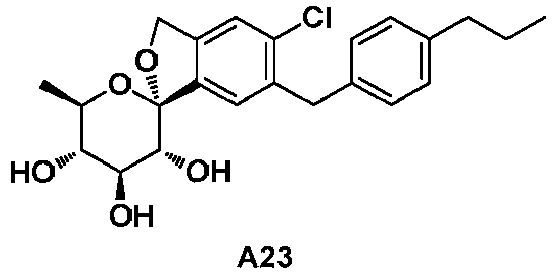
A24 (1S,3'R,4'S,5'S,6'R)-6'-methyl-6-(4-isopropy lbenzyl)-5-chloro-3',4',5',6'-tetrahydro-3H-s piro[isobenzofuran-1,2'-pyran]-3',4',5'-triol 
A25 (1S,3'R,4'S,5'S,6'R)-6'-methyl-6-(4-methoxy benzyl)-5-chloro-3',4',5',6'-tetrahydro-3H-sp iro[isobenzofuran-1,2'-pyran]-3',4',5'-triol 
A26 (1S,3'R,4'S,5'S,6'R)-6'-methyl-6-(4-ethyoxyl benzyl)-5-chloro-3',4',5',6'-tetrahydro-3H-sp iro[isobenzofuran-1,2'-pyran]-3',4',5'-triol 
A27 (1S,3'R,4'S,5'S,6'R)-6'-methyl-6-((5-methylt hienyl)-2-methyl)-5-chloro-3',4',5',6'-tetrahy dro-3H-spiro[isobenzofuran-1,2'-pyran]-3',4',5'-triol 
A28 (1S,3'R,4'S,5'S,6'R)-6'-methyl-6-((5-ethylthi enyl)-2-methyl)-5-chloro-3',4',5',6'-tetrahydr o-3H -spiro[isobenzofuran-1,2'-pyran]-3',4',5'-triol 
A29 (1S,3'R,4'S,5'S,6'R)-6'-methyl-6-((5-propylt hienyl)-2-methyl)-5-chloro-3',4',5',6'-tetrahy dro-3H-spiro[isobenzofuran-1,2'-pyran]-3',4',5'-triol 
A30 (1S,3'R,4'S,5'S,6'R)-6'-methyl-6-((5-chlorot hienyl)-2-methyl)-5-chloro-3',4',5',6'-tetrahy dro-3H-spiro[isobenzofuran-1,2'-pyran]-3',4',5'-triol 
A31 (1S,3'R,4'S,5'S,6'R)-6'-methyl-6-((5-(4-fluor ophenyl)thienyl)-2-methyl)-5-chloro-3',4',5', 6'-tetrahydro-3H-spiro[isobenzofuran-1,2'-py ran]-3',4',5'-triol 
A32 (1S,3'R,4'S,5'S,6'R)-6'-methyl-6-((5-phenylt hienyl)-2-methyl)-5-chloro-3',4',5',6'-tetrahy dro-3H-spiro[isobenzofuran-1,2'-pyran]-3',4',5'-triol 
A33 (1S,3'R,4'S,5'S,6'R)-6'-methyl-6-((5-(2-pyri dyl)thienyl)-2-methyl)-5-chloro-3',4',5',6'-tet rahydro-3H-spiro[isobenzofuran-1,2'-pyran]-3',4',5'-triol 
A34 (1S,3'R,4'S,5'S,6'R)-6'-methyl-6-(naphthyl-2 -methyl)-5-chloro-3',4',5',6'-tetrahydro-3H-s piro[isobenzofuran-1,2'-pyran]-3',4',5'-triol 
A35 (1S,3'R,4'S,5'S,6'R)-6'-methyl-6-(benzo[b]th iophene-2-methyl)-5-chloro-3',4',5',6'-tetrah ydro-3H-spiro[isobenzofuran-1,2'-pyran]-3',4',5'-triol 
A36 (1S,3'R,4'S,5'S,6'R)-6'-methyl-6-(benzo[b]fu ran-2-methyl)-5-chloro-3',4',5',6'-tetrahydro-3H-spiro[isobenzofuran-1,2'-pyran]-3',4',5'-triol 
A37 (1S,3'R,4'S,5'S,6'R)-6'-methyl-6-((5-(2-furyl )thiazolyl)-2-methyl)-5-chloro-3',4',5',6'-tetr ahydro-3H-spiro[isobenzofuran-1,2'-pyran]-3',4',5'-triol 
A38 (1S,3'R,4'S,5'S,6'R)-6'-methyl-6-(4-methylb enzyl)-5-fluoro-3',4',5',6'-tetrahydro-3H-spir o[isobenzofuran-1,2'-pyran]-3',4',5'-triol 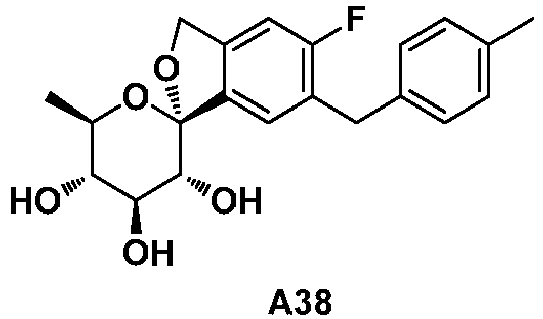
A39 (1S,3'R,4'S,5'S,6'R)-6'-methyl-6-(4-methoxy benzyl)-5-fluoro-3',4',5',6'-tetrahydro-3H-spi ro[isobenzofuran-1,2'-pyran]-3',4',5'-triol 
A40 (1S,3'R,4'S,5'S,6'R)-6'-methyl-6-(4-ethyoxyl benzyl)-5-fluoro-3',4',5',6'-tetrahydro-3H -spi ro[isobenzofuran-1,2'-pyran]-3',4',5'-triol 
A41 (1S,3'R,4'S,5'S,6'R)-6'-methyl-6-((5-methylt hienyl)-2-methyl)-5-fluoro-3',4',5',6'-tetrahy dro-3H-spiro[isobenzofuran-1,2'-pyran]-3',4',5'-triol 
A42 (1S,3'R,4'S,5'S,6'R)-6'-methyl-6-((5-ethylthi enyl)-2-methyl)-5-fluoro-3',4',5',6'-tetrahydr o-3H -spiro[isobenzofuran-1,2'-pyran]-3',4',5'-triol 
A43 (1S,3'R,4'S,5'S,6'R)-6'-methyl-6-((5-chlorot hienyl)-2-methyl)-5-fluoro-3',4',5',6'-tetrahy dro-3H-spiro[isobenzofuran-1,2'-pyran]-3',4',5'-triol 
A44 (1S,3'R,4'S,5'S,6'R)-6'-methyl-6-((5-(4-fluor ophenyl)thienyl)-2-methyl)-5-fluoro-3',4',5',6 '-tetrahydro-3H-spiro[isobenzofuran-1,2'-pyr an]-3',4',5'-triol 
A45 (1S,3'R,4'S,5'S,6'R)-6'-methyl-6-((5-phenylt hienyl)-2-methyl)-5-fluoro-3',4',5',6'-tetrahy dro-3H-spiro[isobenzofuran-1,2'-pyran]-3',4',5'-triol 
A46 (1S,3'R,4'S,5'S,6'R)-6'-methyl-6-((5-(2-pyri dyl)thienyl)-2-methyl)-5-fluoro-3',4',5',6'-tet rahydro-3H-spiro[isobenzofuran-1,2'-pyran]-3',4',5'-triol 
A47 (1S,3'R,4'S,5'S,6'R)-6'-methyl-6-(benzo[b]th iophene-2-methyl)-5-fluoro-3',4',5',6'-tetrahy dro-3H-spiro[isobenzofuran-1,2'-pyran]-3',4',5'-triol 
A48 (1S,3'R,4'S,5'S,6'R)-6'-methyl-6-(benzo[b]fu ran-2-methyl)-5-fluoro-3',4',5',6'-tetrahydro-3H-spiro[isobenzofuran-1,2'-pyran]-3',4',5'-triol 
A49 (1S,3'R,4'S,5'S,6'R)-6'-methyl-6-((5-(2-furyl )thiazolyl)-2-methyl)-5-fluoro-3',4',5',6'-tetra hydro-3H -spiro[isobenzofuran-1,2'-pyran]-3',4',5'-triol 
A50 (1S,3'R,4'S,5'S,6'R)-5,6'-dimethyl -6-(4-meth ylbenzyl)-3',4',5',6'-tetrahydro-3H-spiro[isob enzofuran-1,2'-pyran]-3',4',5'-triol 
A51 (1S,3'R,4'S,5'S,6'R)-5,6'-dimethyl-6-(4-ethyl benzyl)-3',4',5',6'-tetrahydro-3H-spiro[isobe nzofuran-1,2'-pyran]-3',4',5'-triol 
A52 (1S,3'R,4'S,5'S,6'R)-5,6'-dimethyl-6-(4-prop ylbenzyl)-3',4',5',6'-tetrahydro-3H-spiro[isob enzofuran-1,2'-pyran]-3',4',5'-triol 
A53 (1S,3'R,4'S,5'S,6'R)-5,6'-dimethyl-6-(4-isopr opylbenzyl)-3',4',5',6'-tetrahydro-3H-spiro[is obenzofuran-1,2'-pyran]-3',4',5'-triol 
A54 (1S,3'R,4'S,5'S,6'R)-5,6'-dimethyl-6-(4-meth oxybenzyl)-3',4',5',6'-tetrahydro-3H-spiro[is obenzofuran-1,2'-pyran]-3',4',5'-triol 
A55 (1S,3'R,4'S,5'S,6'R)-5,6'-dimethyl-6-(4-ethy oxylbenzyl)-3',4',5',6'-tetrahydro-3H-spiro[is obenzofuran-1,2'-pyran]-3',4',5'-triol 
A56 (1S,3'R,4'S,5'S,6'R)-5,6'-dimethyl-6-((5-met hylthienyl)-2-methyl)-3',4',5',6'-tetrahydro-3 H-spiro [isobenzofuran -1,2'-pyran]-3',4',5'-triol 
A57 (1S,3'R,4'S,5'S,6'R)-5,6'-dimethyl-6-((5-eth ylthienyl)-2-methyl)-3',4',5',6'-tetrahydro-3H -spiro[isobenzofuran-1,2'-pyran]-3',4',5'-triol 
A58 (1S,3'R,4'S,5'S,6'R)-5,6'-dimethyl-6-((5-pro pylthienyl)-2-methyl)-3',4',5',6'-tetrahydro-3 H-spiro[isobenzofuran-1,2'-pyran]-3',4',5'-triol 
A59 (1S,3'R,4'S,5'S,6'R)-5,6'-dimethyl-6-((5-chl orothienyl)-2-methyl)-3',4',5',6'-tetrahydro-3 H-spiro[isobenzofuran-1,2'-pyran]-3',4',5'-triol 
A60 (1S,3'R,4'S,5'S,6'R)-5,6'-dimethyl-6-((5-(4-f luorophenyl)thienyl)-2-methyl)-5-chloro-3',4' ,5',6'-tetrahydro-3H-spiro[isobenzofuran-1,2' -pyran]-3',4',5'-triol 
A61 (1S,3'R,4'S,5'S,6'R)-5,6'-dimethyl-6-((5-phe nylthienyl)-2-methyl)-3',4',5',6'-tetrahydro-3 H-spiro[isobenzofuran-1,2'-pyran]-3',4',5'-triol 
A62 (1S,3'R,4'S,5'S,6'R)-5,6'-dimethyl-6-((5-(2-p yridyl)thienyl)-2-methyl)-3',4',5',6'-tetrahydr o-3H-spiro[isobenzofuran-1,2'-pyran]-3',4',5'-triol 
A63 (1S,3'R,4'S,5'S,6'R)-5,6'-dimethyl-6-(naphth yl-2-methyl)-3',4',5',6'-tetrahydro-3H-spiro[i sobenzofuran-1,2'-pyran]-3',4',5'-triol 
A64 (1S,3'R,4'S,5'S,6'R)-5,6'-dimethyl-6-(benzo[ b]thiophene-2-methyl)-3',4',5',6'-tetrahydro-3H -spiro[isobenzofuran-1,2'-pyran]-3',4',5'-triol 
A65 (1S,3'R,4'S,5'S,6'R)-5,6'-dimethyl-6-(benzo[ b]furan-2-methyl)-3',4',5',6'-tetrahydro-3H-s piro[isobenzofuran-1,2'-pyran]-3',4',5'-triol 
A66 (1S,3'R,4'S,5'S,6'R)-5,6'-dimethyl-6-((5-(2-f uryl)thiazolyl)-2-methyl)-3',4',5',6'-tetrahydr o-3H-spiro[isobenzofuran-1,2'-pyran]-3',4',5'-triol 
A67 (1S,3'R,4'S,5'S,6'R)-5,6'-dimethyl-6-((5-(2-t hienyl)thiazolyl)-2-methyl)-3',4',5',6'-tetrahy dro-3H -spiro[isobenzofuran-1,2'-pyran]-3',4',5'-triol 
A68 (1S,3'R,4'S,5'S,6'R)-5,6'-dimethyl-6-((5-(4-f luorophenyl)thiazolyl)-2-methyl)-3',4',5',6'-t etrahydro-3H-spiro[isobenzofuran-1,2'-pyran] - 3',4',5'-triol 
A69 (1S,3'R,4'S,5'S,6'R)-5,6'-dimethyl-6-((5-phe nylthiazolyl)-2-methyl)-3',4',5',6'-tetrahydro-3H -spiro[isobenzofuran-1,2'-pyran]-3',4',5'-triol 
A70 (1S,3'R,4'S,5'S,6'R)-5,6'-dimethyl-6-((5-(4-t rifluoromethyl)phenyl)thienyl)-2-methyl)-5-c hloro-3',4',5',6'-tetrahydro-3H-spiro[isobenz ofuran-1,2'-pyran]-3',4',5'-triol 
A71 (1S,3'R,4'S,5'S,6'R)-5,6'-dimethyl-6-((5-(4-methyl)phenyl)thienyl)-2-methyl)-5-chloro-3' ,4',5',6'-tetrahydro-3H -spiro[isobenzofuran-1 ,2'-pyran]-3',4',5'-triol 
A72 (1S,3'R,4'S,5'S,6'R)-5,6'-dimethyl-6-((5-(3-f luorophenyl)thienyl)-2-methyl)-5-chloro-3',4' ,5',6'-tetrahydro-3H -spiro[isobenzofuran-1,2' -pyran]-3',4',5'-triol 
A73 (1S,3'R,4'S,5'S,6'R)-5,6'-dimethyl-6-((5-(2,4 -difluorophenyl)thienyl)-2-methyl)-5-chloro-3 ',4',5',6'-tetrahydro-3H-spiro[isobenzofuran-1,2'-pyran]-3',4',5'-triol 
A74 (1S,3'R,4'S,5'S,6'R)-5,6'-dimethyl-6-((5-(2-f luorophenyl)thienyl)-2-methyl)-5-chloro-3',4' ,5',6'-tetrahydro-3H -spiro[isobenzofuran-1,2' -pyran]- 3',4',5'-triol 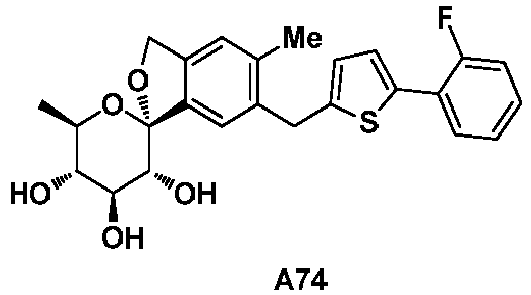
A75 (1S,3'R,4'S,5'S,6'R)-5,6'-dimethyl-6-((5-(4-methoxyphenyl)thienyl)-2-methyl)-5-chloro-3 ',4',5',6'-tetrahydro-3H -spiro[isobenzofuran-1,2'-pyran]-3',4',5'-triol 
A76 (1S,3'R,4'S,5'S,6'R)-5,6'-dimethyl-6-((5-met hoxythienyl)-2-methyl)-3',4',5',6'-tetrahydro-3H -spiro[isobenzofuran-1,2'-pyran]-3',4',5'-triol 
A77 (1S,3'R,4'S,5'S,6'R)-5,6'-dimethyl-6-((5-trifl uoromethylthienyl)-2-methyl)-3',4',5',6'-tetra hydro-3H-spiro [isobenzofuran-1,2'-pyran]-3',4',5'-triol 
A78 5-(((1S,3'R,4'S,5'S,6'R)-3',4',5'-trihydroxy-5, 6'-dimethyl-3',4',5',6'-tetrahydro-3H-spiro[is obenzofuran-1,2'-pyran]yl)-6-methyl)thiophe ne-2-nitrile 
A79 5-(((1S,3'R,4'S,5'S,6'R )-3',4',5'-trihydroxy-5, 6'-dimethyl--3',4',5',6'-tetrahydro-3H-spiro[i sobenzofuran-1,2'-pyran]yl)-6-methyl)thiophe ne-2-methyl formate 
A80 5-(((1S,3'R,4'S,5'S,6'R)-3',4',5'-trihydroxy-5, 6'-dimethyl-3',4',5',6'-tetrahydro-3H-spiro[is obenzofuran-1,2'-pyran]yl)-6-methyl)thiophe ne-2-phenyl formate 
A81 N-methyl-5-(((1S,3'R,4'S,5'S,6'R)-3',4',5'-tr ihydroxy-5, 6'-dimethyl--3',4',5',6'-tetrahydro-3H-spiro[i sobenzofuran-1,2'-pyran]yl)-6-methyl)thiophe ne-2-formamide 
A82 (1S,3'R,4'S,5'S,6'R)-5-ethynyl-6'-methyl-6-( 4-methylbenzyl)-3',4',5',6'-tetrahydro-3H-spi ro[isobenzofuran-1,2'-pyran]-3',4',5'-triol 
A83 (1S,3'R,4'S,5'S,6'R)-5-ethynyl-6'-methyl-6-( (5-(4-fluorophenyl)thienyl)-2-methyl)-3',4',5' ,6'-tetrahydro-3H-spiro[isobenzofuran-1,2'-p yran]-3',4',5'-triol 
A84 (1S,3'R,4'S,5'S,6'R)-5-ethynyl-6'-methyl-6-( (5-(2-furyl)thiazolyl)-2-methyl)-3',4',5',6'-tet rahydro-3H-spiro[isobenzofuran-1,2'-pyran]-3',4',5'-triol 
A85 (1S,3'R,4'S,5'S,6'R)-5-ethynyl-6'-methyl-6-( (5-ethylthienyl)-2-methyl)-3',4',5',6'-tetrahyd ro-3H-spiro[isobenzofuran-1,2'-pyran]-3',4',5'-triol 
A86 (1S,3'R,4'S,5'S,6'R)-5-ethynyl-6'-methyl-6-( 4-methoxybenzyl)-3',4',5',6'-tetrahydro-3H-s piro[isobenzofuran-1,2'-pyran]-3',4',5'-triol 
A87 (1S,3'R,4'S,5'S,6'R)-5-ethynyl-6'-methyl-6-( 4-ethyoxylbenzyl)-3',4',5',6'-tetrahydro-3H -s piro[isobenzofuran-1,2'-pyran]-3',4',5'-triol 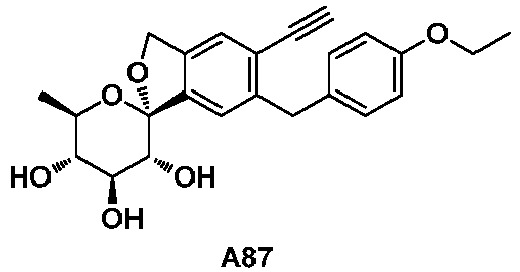
A88 (1S,3'R,4'S,5'S,6'R)-3',4',5'-trihydroxy-6'-m ethyl-6-(4-methylphenyl)-3',4',5',6'-tetrahydr o-3H -spiro[isobenzofuran-1,2'-pyran]-5-nitril e 
A89 (1S,3'R,4'S,5'S,6'R)-6-((5-(4-fluorophenyl)th ienyl)-2-methyl)-3',4',5'-trihydroxy-6'-methy l-3',4',5',6'-tetrahydro-3H-spiro[isobenzofura n-1,2'-pyran]-5-nitrile 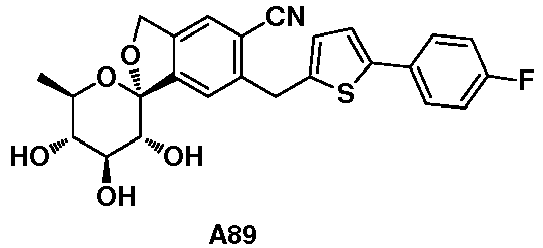
A90 (1S,3'R,4'S,5'S,6'R)-6-((5-(2-furyl)thiazolyl) -2-methyl)-3',4',5'-trihydroxy-6'-methyl-3',4 ',5',6'-tetrahydro-3H-spiro[isobenzofuran-1,2 '-pyran]-5-nitrile 
A91 (1S,3'R,4'S,5'S,6'R)-6-((5-ethylthienyl)-2-me thyl)-3',4',5'-trihydroxy-6'-methyl-3',4',5',6' -tetrahydro-3H-spiro[isobenzofuran-1,2'-pyra n]-5-nitrile 
A92 (1S,3'R,4'S,5'S,6'R)-3',4',5'-trihydroxy-6-(4 -methoxyphenyl)-6'-methyl-3',4',5'-trihydrox y-6'-methyl-3',4',5',6'-tetrahydro-3H-spiro[is obenzofuran-1,2'-pyran]-5-nitrile 
A93 (1S,3'R,4'S,5'S,6'R)-3',4',5'-trihydroxy-6-(4 -ethyoxylphenyl)-6'-methyl-3',4',5'-trihydrox y-6'-methyl-3',4',5',6'-tetrahydro-3H -spiro[is obenzofuran-1,2'-pyran]-5-nitrile 
A94 (1S,3'R,4'S,5'S,6'R)-6'-methyl-6-(4-methylb enzyl)-5-bromo-3',4',5',6'-tetrahydro-3H-spir o[isobenzofuran-1,2'-pyran]-3',4',5'-triol 
A95 (1S,3'R,4'S,5'S,6'R)-6'-methyl-6-((5-(4-fluor ophenyl)thienyl)-2-methyl)-5-bromo-3',4',5', 6'-tetrahydro-3H-spiro[isobenzofuran-1,2'-py ran]-3',4',5'-triol 
A96 (1S,3'R,4'S,5'S,6'R)-6'-methyl-6-((5-(2-furyl )thiazolyl)-2-methyl)-5-bromo-3',4',5',6'-tetr ahydro-3H-spiro[isobenzofuran-1,2'-pyran]-3',4',5'-triol 
A97 (1S,3'R,4'S,5'S,6'R)-6'-methyl-6-((5-ethylthi enyl)-2-methyl)-5-fluoro-3',4',5',6'-tetrahydr o-3H-spiro[isobenzofuran-1,2'-pyran]-3',4',5'-triol 
A98 (1S,3'R,4'S,5'S,6'R)-6'-methyl-6-(4-methoxy benzyl)-5-bromo-3',4',5' ,6' -tetrahydro-3H- sp iro[isobenzofuran-1,2'-pyran]-3',4',5'-triol 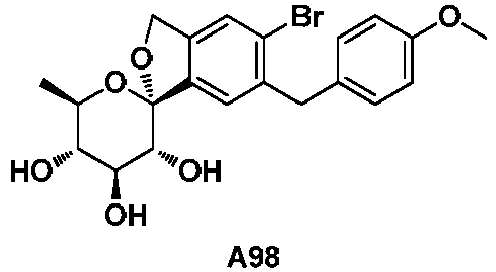
A99 (1S,3'R,4'S,5'S,6'R)-6'-methyl-6-(4-ethyoxyl benzyl)-5-bromo-3',4',5' ,6' -tetrahydro-3H- sp iro[isobenzofuran-1,2'-pyran]-3',4',5'-triol 
A100 (1S,3' R,4'S,5'S,6'R)-5-methoxy-6'-methyl-6-(4-methylbenzyl)-3',4',5',6'-tetrahydro-3H-sp iro[isobenzofuran-1,2'-pyran]-3',4',5'-triol 
A101 (1S,3'R,4'S,5'S,6'R)-6-((5-(4-fluorophenyl)thienyl)-2-methyl)-5-m ethoxy-6'-methyl-3',4',5',6'-tetrahydro-3H-s piro[isobenzofuran-1,2'-pyran]-3',4',5'-triol 
A102 (1S,3'R,4'S,5'S,6'R)-6-((5-(2-furyl)thiazolyl)-2-methyl)-5-methoxy -6'-methyl-3',4',5',6'-tetrahydro-3H-spiro[iso benzofuran-1,2'-pyran]-3',4',5'-triol 
A103 (1S,3'R,4'S,5'S,6'R)-6-((5-ethylthienyl)-2-methyl)-5-methoxy-6'-m ethyl-3',4',5',6'-tetrahydro-3H-spiro[isobenz ofuran-1,2'-pyran]-3',4',5'-triol 
A104 (1S,3'R,4'S,5'S,6'R)-5-methoxy-6-(4-methox yphenyl)-6'-methyl-3',4',5',6'-tetrahydro-3H-spiro[iso benzofuran-1,2' -pyran] -3',4',5' -triol 
A105 (1S,3'R,4'S,5'S,6'R)-5-methoxy-6-(4-ethyoxy lphenyl)-6'-methyl-3',4',5',6'-tetrahydro-3H-spiro[iso benzofuran-1,2'-pyran]-3',4',5'-triol 
A106 (1S,3' R,4'S,5'S,6'R)-6-(benzofuran-5-ylmeth yl)-5-chloro-6'-methyl-3',4',5',6'-tetrahydro-3H -spiro[isobenzofuran-1,2'-pyran]-3',4',5'-t riol 
A107 (1S,3'R,4'S,5'S,6'R)-5-chloro-6-(4-ethyoxyl-3-fluorophenyl)-6'-methyl-3',4',5' ,6'-tetrahyd ro-3H-spiro[isobenzofuran-1,2'-pyran]-3',4',5 '-triol 
A108 1-(4-(((1S,3'R,4'S,5'S,6'R)-5-chloro-3',4',5'-trihydroxy-6' -methyl-3',4',5' ,6' -tetrahydro-3 H -spiro [isobenzofuran-1,2'-pyran]-6-yl)meth yl)phenyl)cyclopropane-1-formonitrile 
A109 1-(5-(((1S,3'R,4'S,5'S,6'R)-5-chloro-3',4',5'-trihydroxy-6' -methyl-3',4',5' ,6' -tetrahydro-3 H -spiro [isobenzofuran-1,2'-pyran]-6-yl)meth yl)thiophene-2-yl)cyclopropane-1-formonitril e 
A110 (1S,3'R,4'S,5'S,6'R)-5-chloro-6'-methyl-6-(4 -trifluoromethylphenyl)-3',4',5',6'-tetrahydro-3H-spiro[isobenzofuran -1,2'-pyran]-3',4',5'-triol 
A111 ((1S,3'R,4'S,5'S,6'R)-5-chloro-3',4',5'-trihyd roxy-6'-methyl-3',4',5',6'-tetrahydro-3H-spir o [isobenzofuran-1,2'-pyran]-6-yl) (4-(trifluoromethyl)phenyl)ketone 
A112 ((1S,3'R,4'S,5'S,6'R)-5-chloro-3',4',5'-trihyd roxy-6'-methyl-3',4',5',6'-tetrahydro-3H-spir o[isobenzofuran-1,2'-pyran]-6-yl) (3-fluoro-4-(trifluoromethyl)phenyl)ketone 
A113 ((1S,3'R,4'S,5'S,6'R)-5-chloro-3',4',5'-trihyd roxy-6'-methyl-3',4',5',6'-tetrahydro-3H-spir o[isobenzofuran-1,2'-pyran]-6-yl) (5-ethylthiophene-2-yl)ketone 
A114 (1S,3'R,4'S,5'S,6'R)-5-chloro-6-((5-(2-metho xyethyl)thiophene-2-yl)methyl)-6'-methyl-3', 4',5',6'-tetrahydro-3H-spiro[isobenzofuran-1, 2'-pyran]-3',4',5'-triol 
A115 (1S,3'R,4'S,5'S,6'R)-5-chloro-6-((5-(2-ethyo xylethyl)thiophene-2-yl)methyl)-6'-methyl-3', 4',5',6'-tetrahydro-3H-spiro[isobenzofuran-1, 2'-pyran]-3',4',5'-triol 
A116 (1S,3' R,4'S,5'S,6'R)-5-chloro-6-((5-(2-propoxyethyl)thiophene-2-yl)methyl)-6'-meth yl-3',4',5',6'-tetrahydro-3H -spiro[isobenzofur an-1,2'-pyran]- 3',4',5'-triol 
A117 1-(5-(((1S,3'R,4'S,5'S,6'R)-5-chloro-3',4',5'-trihydroxy-6'-methyl-3',4',5',6'-tetrahydro-3 H -spiro[isobenzofuran-1,2'-pyran]-6-yl)meth yl)thiophene-2-yl)ethanone 
A118 (1S,3'R,4'S,5'S,6'R)-5-chloro-6-((5-(1-hydro xyethyl) thiophene-2-yl)methyl)-6'-methyl-3',4',5',6'-t etrahydro-3H -spiro[isobenzofuran-1,2'-pyran] -3',4',5'-triol 
A119 (1S,3'R,4'S,5'S,6'R)-5-chloro-6-((5-(2-hydro xyethyl) thiophene-2-yl)methyl)-6'-methyl-3',4',5',6'-t etrahydro-3H -spiro[isobenzofuran-1,2'-pyran] -3',4',5'-triol 
A120 (1S,3'R,4'S,5'S,6'R)-5-chloro-6-((5-ethylthio phene-2-yl)(hydroxymethyl)-6'-methyl-3',4', 5',6'-tetrahydro-3H -spiro[isobenzofuran-1,2'-pyran]-3',4',5'-triol 
A121 2-(5-(((1S,3'R,4'S,5'S,6'R)-5-chloro-3',4',5'-trihydroxy-6'-methyl-3',4',5',6'-tetrahydro-3 H -spiro[isobenzofuran-1,2'-pyran]-6-yl)meth yl)thiophene-2-yl) acetic acid 
A122 2-(5-(((1S,3'R,4'S,5'S,6'R)-5-chloro-3',4',5'-trihydroxy-6'-methyl-3',4',5',6'-tetrahydro-3 H -spiro[isobenzofuran-1,2'-pyran]-6-yl)meth yl)thiophene-2-yl)methyl acetate 
A123 2-(5-(((1S,3'R,4'S,5'S,6'R )-5-chloro-3',4',5'-trihydroxy-6'-methyl-3',4',5',6'-tetrahydro-3 H -spiro[isobenzofuran-1,2'-pyran]-6-yl)meth yl)thiophene-2-yl)ethyl acetate 
A124 2-(5-(((1S,3'R,4'S,5'S,6'R )-5-chloro-3',4',5'-trihydroxy-6'-methyl-3',4',5',6'-tetrahydro-3 H -spiro[isobenzofuran-1,2'-pyran]-6-yl)meth yl)thiophene-2-yl)- N -methylacetamide 
A125 2-(5-(((1S,3'R,4'S,5'S,6'R )-5-chloro-3',4',5'-trihydroxy-6'-methyl-3',4',5',6'-tetrahydro-3 H -spiro[isobenzofuran-1,2'-pyran]-6-yl)meth yl)thiophene-2-yl)- N -ethylacetamide 
A126 2-(5-(((1S,3'R,4'S,5'S,6'R )-5-chloro-3',4',5'-trihydroxy-6'-methyl-3',4',5',6'-tetrahydro-3 H -spiro[isobenzofuran-1,2'-pyran]-6-yl)meth yl)thiophene-2-yl)- N,N -dimethylacetamide 
A127 2-(5-(((1S,3'R,4'S,5'S,6'R)-5-chloro-3',4',5'-trihydroxy-6'-methyl-3',4',5',6'-tetrahydro-3 H -spiro[isobenzofuran-1,2'-pyran]-6-yl)meth yl)thiophene-2-yl)-1-(pyrrolidine-1-yl)ethyl-1 -one 
A128 2-(5-(((1S,3'R,4'S,5'S,6'R)-5-chloro-3',4',5'-trihydroxy-6' -methyl-3',4',5' ,6' -tetrahydro-3 H -spiro[isobenzofuran-1,2'-pyran]-6-yl)meth yl)thiophene-2-yl)-1-morpholineethyl-1-one 
A129 5-(((1S,3'R,4'S,5'S,6'R)-5-chloro-3',4',5'-tri hydroxy-6'-methyl-3',4',5',6'-tetrahydro-3H- spiro[isobenzofuran-1,2'-pyran]-6-yl)methyl)t hiophene-2-formaldehyde 
A130 (1S,3'R,4'S,5'S,6'R)-5-chloro-6-((5-(hydroxy methyl)thiophene-2-yl)methyl)-6'-methyl-3',4 ',5',6'-tetrahydro-3H -spiro[isobenzofuran-1,2 '-pyran]-3',4',5'-triol 
A131 (1S,3'R,4'S,5'S,6'R)-5-chloro-6-((5-(difluoro methyl)thiophene-2-yl)methyl)-6'-methyl-3',4 ',5',6'-tetrahydro-3H -spiro[isobenzofuran-1,2 '-pyran]-3',4',5'-triol 
A132 (1S,3'R,4'S,5'S,6'R )-5-chloro-6'-methyl-6-(( 5-(pyrrolidine-1-ylmethyl)thiophene-2-yl)met hyl)-3',4',5',6'-tetrahydro-3H -spiro[isobenzofuran -1,2'-pyran]-3',4',5'-triol 
A133 (1S,3'R,4'S,5'S,6'R)-5-chloro-6'-methyl-6-(( 5-morpholinemethyl)thiophene-2-yl)methyl)-3',4',5',6'-tetrahydro-3H-spiro[isobenzofuran -1,2'-pyran]-3',4',5'-triol 
A134 2-(5-(((1S,3'R,4'S,5'S,6'R)-5-chloro-3',4',5'-trihydroxy-6'-methyl-3',4',5',6'-tetrahydro-3 H -spiro[isobenzofuran-1,2'-pyran]-6-yl)meth yl)thiophene-2-methyl formate 
A135 2-(5-(((1S,3'R,4'S,5'S,6'R)-5-chloro-3',4',5'-trihydroxy-6'-methyl-3',4',5',6'-tetrahydro-3 H -spiro[isobenzofuran-1,2'-pyran]-6-yl)meth yl)thiophene-2-ethyl formate 
A136 (5-(((1S,3'R,4'S,5'S,6'R)-5-chloro-3',4',5'-tri hydroxy-6'-methyl-3',4',5',6'-tetrahydro-3H- spiro[isobenzofuran-1,2'-pyran]-6-yl)methyl)t hiophene-2-yl)(pyrrolidine-1-yl)ketone 
A137 (5-(((1S,3'R,4'S,5'S,6'R)-5-chloro-3',4',5'-tri hydroxy-6'-methyl-3',4',5',6'-tetrahydro-3H- spiro[isobenzofuran-1,2'-pyran]-6-yl)methyl)t hiophene-2-yl) (morpholineyl)ketone 
A138 (5-(((1S ,3'R ,4'S ,5'S ,6'R )-5-chloro-3',4',5'-tri hydroxy-6'-methyl-3',4',5',6'-tetrahydro-3H- spiro[isobenzofuran-1,2'-pyran]-6-yl)methyl)- N -methylthiophene-2-formamide 
A139 (5-(((1S,3'R,4'S,5'S,6'R)-5-chloro-3',4',5'-tri hydroxy-6'-methyl-3',4',5',6'-tetrahydro-3H- spiro[isobenzofuran-1,2'-pyran]-6-yl)methyl)- N -ethylthiophene-2-formamide 
A140 (5-(((1S,3'R,4'S,5'S,6'R)-5-chloro-3',4',5'-tri hydroxy-6'-methyl-3',4',5',6'-tetrahydro-3H- spiro[isobenzofuran-1,2'-pyran]-6-yl)methyl)- N,N -dimethylthiophene-2-formamide 
A141 (1S ,3'R ,4'1S ,5'S ,6'R )-5-chloro-6-((5-ethyl-4-methylthiophene-2-yl)methyl)-6'-methyl-3',4' ,5',6'-tetrahydro-3H -spiro[isobenzofuran-1,2' -pyran]-3',4',5'-triol 
A142 (1S ,3'R,4'S,5'S,6'R )-5-chloro-6-((5-(2-hydro xyethyl)-4-methylthiophene-2-yl)methyl)-6'-methyl-3', 4',5',6'-tetrahydro-3H -spiro[isobenzofuran-1, 2'-pyran]-3',4',5'-triol 
A143 (1S ,3'R,4'S,5'S,6'R )-5-chloro-6-((5-ethyl-4-f luorothiophene-2-yl)methyl)-6'-methyl-3',4', 5',6'-tetrahydro-3H -spiro[isobenzofuran-1,2'-pyran]-3',4',5'-triol 
A144 (1S,3'R,4'S,5'S,6'R)-5-chloro-6-((4-fluoro-5-(2-hydroxyethyl)thiophene-2-yl)methyl)-6'-m ethyl-3',4',5',6'-tetrahydro-3H -spiro[isobenz ofuran-1,2'-pyran]-3',4',5'-triol 
A145 (1S ,3'R ,4'S ,5'S ,6'R )-5-chloro-6-((4,5-dimeth ylthiophene-2-yl)methyl)-6'-methyl-3',4',5',6 '-tetrahydro-3H -spiro[isobenzofuran-1,2'-pyr an]-3',4',5'-triol 
A146 (1S ,3'R,4'S,5'S,6'R )-5-chloro-6-((5-chloro-4-methylthiophene-2-yl)methyl)-6'-methyl-3',4' ,5',6'-tetrahydro-3H -spiro[isobenzofuran-1,2' -pyran]-3',4',5'-triol 
A147 (1S ,3'R,4'S,5'S,6'R )-5-chloro-6-((5-fluoro-4-methylthiophene-2-yl)methyl)-6'-methyl-3',4' ,5',6'-tetrahydro-3H -spiro[isobenzofuran-1,2' -pyran]-3',4',5'-triol 
A148 (1S ,3'R,4'S,5'S,6'R )-5-chloro-6-((5-(( R )-1-h ydroxyethyl)thiophene-2-yl)methyl)-6'-methy l-3',4',5',6'-tetrahydro-3H-spiro[isobenzofura n-1,2'-pyran]-3',4',5'-triol 
A149 (1S ,3'R,4'S,5'S,6'R)-5-chloro-6-((5-((S)-1-hy droxyethyl)thiophene-2-yl)methyl)-6'-methyl-3',4',5',6'-tetrahydro-3H-spiro[isobenzofuran -1,2'-pyran]-3',4',5'-triol 
A150 (1S,3'R,4'S,5'S,6'R)-5-chloro-6-((S)-(5-ethylthiophene-2-yl)(hydroxyl)methyl) - 6'-methyl-3',4',5',6'-tetrahydro-3H -spiro[iso benzofuran-1,2'-pyran]-3',4',5'-triol 
A151 (1S,3'R ,4'S ,5'S,6'R)-5-chloro-6-((R)-(5-ethylthiophene-2-yl)(hydroxyl)methyl )-6'-methyl-3',4',5',6'-tetrahydro-3H -spiro[iso benzofuran-1,2'-pyran]-3',4',5'-triol 
- The compounds of the present invention have asymmetric centers, chiral axises, and chiral planes, and may exist as racemates, R-isomers, or S-isomers. One skilled in the art can obtain R-isomers and / or S-isomers from racemates using conventional techniques.
- The present invention provides a pharmaceutically acceptable salt of a compound of formula I, in particular a conventional pharmaceutically acceptable salt formed by the reaction of a compound of formula I with an inorganic or organic acid. For example, conventional pharmaceutically acceptable salts may be prepared by reacting a compound of formula I with an inorganic acid, such as hydrochloric acid, hydrobromic acid, sulfuric acid, nitric acid, aminosulfonic acid and phosphoric acid, and the like, and organic acids include citric acid, tartaric acid, lactic acid, pyruvic acid, acetic acid, benzenesulfonic acid, p-toluenesulfonic acid, methanesulfonic acid, naphthalenesulfonic acid, ethanesulfonic acid, naphthalene disulfonic acid, maleic acid, malic acid, malonic acid, fumaric acid, succinic acid, propionic acid, oxalic acid, trifluoroacetic acid, stearic acid, pamoic acid, hydroxymaleic acid, phenylacetic acid, benzoic acid, salicylic acid, glutamic acid, ascorbic acid, p-anilinesulfonic acid, 2-acetoxybenzoic acid and isethionic acid and the like; or sodium, potassium, calcium, aluminum or ammonium salts of the compound of formula I with an inorganic base; or a salt formed by compound of formula I with an organic base, such as methanamine salt, ethylamine salt or ethanolamine salt.
- The invention also provides a method for preparing the compound represented by the general formula I, and the preparation method is as the
scheme 1. -

- Steps a, b and c: Methyl α-D-
pyran glucosidase 1 and imidazole are dissolved in DMF, and TIPSCl is slowly added dropwise under an ice bath. After the addition is completed, the mixture is stirred at room temperature for 1 to 2 days. TLC monitors (alkaline potassium permanganate color) that the reaction is completed, then the reaction solution is added an appropriate amount of water, extracted with dichloromethane, the organic layer is combined, washed with saturated sodium chloride solution twice, dried over anhydrous sodium sulfate, concentrated, and the crude product is directly used in the next reaction. - The crude product of the previous step and benzyl bromide are dissolved in DMF. After sodium hydride is added in portions under ice-cooling, the mixture is slowly warmed to room temperature and stirred at room temperature for 6-18 hours. TLC monitors (alkaline potassium permanganate color) that the reaction is completed, then the reaction solution is slowly added an appropriate amount of water to quench, extracted with ethylacetate, the organic layer is combined, washed with saturated sodium chloride solution for twice, dried over anhydrous sodium sulfate, concentrated, and the crude product is directly used in the next reaction.
- The crude product of the previous step and TBAF are dissolved in tetrahydrofuran and stirred for 6-18 hours at room temperature. TLC monitors (UV color) that the reaction is completed, then the reaction solution is slowly added an appropriate amount of water to quench, extracted with ethylacetate, the organic layer is combined, washed with saturated sodium chloride solution twice, dried over anhydrous sodium sulfate, concentrated, and the crude product is isolated and purified by silica gel column to provide colorless syrup 2, yield 70-90% (three consecutive steps).
- Step d: Compound 2 is dissolved in tetrahydrofuran, Ph3P and CBr4 were added at 0-20 °C, and the mixture was stirred in an ice bath for 1-5 hours after the addition was completed. TLC monitored (UV color) that the reaction was completed, then the filtrate was suction filtered and the filtrate was concentrated. The crude product was isolated and purified by silica gel column chromatography (petroleum ether / ethylacetate) to give colorless syrup 3 in 98% -100% yield.
- Step e: Compound 3 was dissolved in anhydrous toluene and Bu3SnH and AIBN were added at room temperature. After the addition was completed, the temperature was raised to 40-120 °C and stirred for 2-8 hours. TLC monitored (UV color) that the reaction was completed, then the reaction was cooled to room temperature and concentrated. The crude product was isolated and purified by silica gel column chromatography (petroleum ether / ethylacetate) to give colorless syrup 4 in 80-95% yield.
- Step f: Compound 4 was dissolved in glacial acetic acid and 3 M of sulfuric acid solution was added at room temperature. After the addition was completed, the mixture was stirred at 60-95 °C for 1-5 hours. TLC monitored (UV color) that the reaction was completed, then the reaction was cooled to room temperature and saturated sodium bicarbonate solution was slowly added until no bubbles formed. The mixture was extracted with methylene chloride. The combined organic layers were washed twice with saturated sodium chloride solution and dried over anhydrous sodium sulfate and concentrated. The crude product was isolated and purified by silica gel column chromatography (petroleum ether / ethylacetate) to give white solid 5 in 85-95% yield.
- Step g:
Compound 5 was dissolved in DMSO and acetic anhydride was added at room temperature. After the addition was complete, it was stirred at room temperature overnight. TLC monitored (UV color) that the reaction was completed, then saturated sodium bicarbonate solution was slowly added until no bubbles were formed. The mixture was extracted with ethylacetate. The combined organic layers were washed twice with saturated sodium chloride solution, dried over anhydrous sodium sulfate and concentrated. The crude product was purified by silica gel column chromatography (petroleum ether / ethylacetate) to provide white solid 6 in 85-100% yield. - Step h: Compound 7 was dissolved in anhydrous tetrahydrofuran and borane dimethylsulfide complex was added under ice-cooling. After addition was completed, the mixture was stirred at 40-100 °C for 2-8 hours. TLC monitored (UV color) that the reaction was completed, then the reaction was cooled to room temperature, slowly poured into ice-water, extracted with ethylacetate and the combined organic layers were washed twice with saturated sodium chloride solution, dried over anhydrous sodium sulfate and concentrated to give an off-white solid 8, yield 85-95%.
- Step i: Compound 8 was dissolved in anhydrous tetrahydrofuran and 4-methylbenzenesulfonate pyridine and 2-methoxypropylene were added under ice-cooling. After the addition was completed, the mixture was stirred in an ice bath for 1 to 5 hours. TLC monitored (UV color) that the reaction was completed, then saturated sodium bicarbonate solution was added and extracted with ethylacetate-triethylamine. The combined organic layers were washed twice with saturated sodium chloride solution, dried over anhydrous sodium sulfate and concentrated. The crude product was isolated and purified by silica gel column chromatography (petroleum ether / ethylacetate) to give colorless oily liquid 9, yield 65-85%.
- Step j, k: Compound 9 was dissolved in anhydrous tetrahydrofuran and n-butyllithium was added dropwise at -78 °C under nitrogen. After the addition was completed and the mixture was stirred at -78 °C for 0.5-4 hours, a solution of compound 6 in anhydrous tetrahydrofuran was added and the mixture was stirred for 1 to 5 hours at -78 °C. TLC monitored (UV color) that the reaction was completed, then the reaction was transferred to room temperature and an appropriate amount of water was added. After the reaction was warmed to room temperature, the mixture was extracted with ethylacetate, washed twice with saturated sodium chloride solution, dried over anhydrous sodium sulfate and concentrated. The crude product was directly used in the next reaction.
- The crude product of the previous step was dissolved in tetrahydrofuran-methanol and p-toluenesulfonic acid was added at room temperature. After the addition was completed, the mixture was stirred at room temperature for 10 to 24 hours. TLC monitored (UV color) that the reaction was completed, then the reaction solution was concentrated to remove most of the methanol and extracted with ethylacetate. The combined organic layer was washed twice with saturated sodium bicarbonate solution, washed twice with saturated sodium chloride solution, dried over anhydrous sodium sulfate. After concentration, the crude product was isolated and purified by silica gel column chromatography (petroleum ether / ethylacetate) to give 10 as a colorless oil in 50-60% yield (two consecutive steps).
- Step 1:
Compound 10 was dissolved in methylene chloride and PCC and silica gel were added at room temperature. After the addition was completed, the mixture was stirred at room temperature for 2-7 hours. TLC monitored (UV color) that the reaction was completed, then the reaction mixture was concentrated and the crude product was isolated and purified by silica gel column chromatography (petroleum ether / ethylacetate) to give white solid 11 in 80-90% yield. - Step m: Bromobenzotoluene was dissolved in anhydrous tetrahydrofuran and n-butyllithium was added dropwise at -78 °C under nitrogen. After the addition was completed and the mixture was stirred at -78 °C for 0.5-4 hours, a solution of compound 11 in anhydrous tetrahydrofuran was added and the mixture was stirred for 2 hours at -78 °C. TLC monitored (UV color) that the reaction was completed, then the reaction was transferred to room temperature, and an appropriate amount of water was added. Extracted with ethylacetate after the reaction was warmed to room temperature, and the combined organic layers were washed twice with saturated sodium chloride solution and dried over anhydrous sodium sulfate. After concentration, the crude product was isolated and purified by silica gel column chromatography (petroleum ether / ethylacetate) to give colorless oil 12, yield 90-95%.
- Step n: Compound 12 was dissolved in dichloromethane, Et3SiH and BF3.OEt2 were added at -20 to -40 °C under nitrogen atmosphere. After addition, the mixture was stirred at -20 to -40 °C for 0.5 to 4 hours. TLC monitored (UV color) that the reaction was completed, then the reaction was transferred to room temperature, and an appropriate amount of water was added. Extracted with dichloromethane after the reaction was warmed to room temperature, and the combined organic layers were washed twice with saturated sodium chloride solution and dried over anhydrous sodium sulfate. After concentration, the crude product was isolated and purified by silica gel column chromatography (petroleum ether / ethylacetate) to give colorless oil 13, yield 90-95%.
- Step o: Compound 13 and pentamethylbenzene were dissolved in methylene chloride and boron trichloride was added at -78 °C under nitrogen. After the addition was complete, the mixture was stirred overnight at -78 °C. TLC monitored (UV color) that the reaction was completed, then methanol was added and the reaction was transferred to room temperature. After that, the residue was concentrated and the crude product was isolated and purified by silica gel column chromatography (methylene chloride / methanol) to obtain white solid A in 50-85% yield.
- In another aspect of the present invention, a pharmaceutical composition is provided, which comprises one or more in a therapeutically effective amount selected from the group consisting of the compounds of formula (I), their pharmaceutically acceptable salts, enantiomers, diastereomers or racemates, and optionally one or more pharmaceutically acceptable carriers, excipients, adjuvants, ingredients and / or diluents. The ingredients comprises, for example, odorants, fragrances, sweeteners, etc.
- The pharmaceutical composition provided by the present invention preferably comprises 1-99% of the active ingredient by weight, the preferred ratio is that the compound of formula I as the active ingredient in a total amount of 65% -99% by weight, and the rest is pharmaceutically acceptable carriers, diluents, solutions or salt solutions.
- The compounds and pharmaceutical compositions provided herein can be in a variety of forms such as tablets, capsules, powders, syrups, solutions, suspensions, aerosols and the like, and can be presented in suitable solid or liquid carriers or diluents, and in suitable disinfecting equipment for injection or infusion.
- Various dosage forms of the pharmaceutical composition of the present invention can be prepared by conventional preparation methods in pharmacy field. The unit dose of the formulation contains from 0.05 to 200 mg of a compound of formula I, preferably from 0.1 mg to 100 mg of a compound of formula I in unit dose of the formulation.
- The compounds and pharmaceutical compositions of this invention may be used clinically in mammals, including humans and animals, via routes of administration such as mouth, nose, skin, lungs or gastrointestinal tract. Most preferably oral. The most preferred daily dose is 0.01-200 mg / kg body weight, taken once, or 0.01-100 mg / kg body weight, used in multiple times. Regardless of the method of administration, the optimal dose for the individual should depend on the particular treatment. Usually, it starts with a small dose and gradually increases the dose until the most suitable dose is found.
- In a further aspect of the present invention, a sodium-glucose cotransporter 2 inhibitor is provided, which comprises one or more compounds selected from the group consisting of the compound of formula I, pharmaceutically acceptable salts, racemates, R-isomers , S-isomers thereof or mixtures thereof, and optionally one or more pharmaceutically acceptable carriers, excipients, adjuvants, ingredients and / or diluents.
- The compounds and compositions of the present invention are useful for the treatment and prevention of metabolic system disorders associated with sodium-glucose cotransporter 2 including, but not limited to, diseases such as diabetes, atherosclerosis, obesity, etc.
- Therefore, according to a further aspect of the present invention, the use of a compound of formula I, a pharmaceutically acceptable salt, racemate, R-isomer, S-isomer thereof or a mixture thereof in the preparation of medicine for the treatment of metabolic system diseases associated with sodium-glucose cotransporter 2 (such as diabetes, atherosclerosis, and obesity) is provided.
- Still in another aspect of the present invention, a method for treating metabolic diseases associated with sodium-glucose cotransporter 2, such as diabetes, atherosclerosis and obesity and the like is to provided, which comprises administering to a patient in need one or more compounds selected from the group consisting of compound of formula I, pharmaceutically acceptable salts, racemates, R-isomers, S-isomers thereof, or mixtures thereof .
- In a preferred embodiment of the invention, the compound of formula I is used for lowering the blood glucose level of a subject.
- In a preferred embodiment of the invention, the compound of formula I is used to increase the glucose tolerance of a patient suffering from diabetes or to improve their glucose-stimulated insulin release.
- The present invention will be further illustrated below with reference to the specific examples. It should be understood that these examples are only to illustrate the invention but not to limit the scope of the invention. The experimental methods with no specific conditions described in the following examples are generally performed under the conventional conditions, or according to the manufacturer's instructions. Unless indicated otherwise, parts and percentage are calculated by weight.
-

-


- Methyl α-D-pyran glucoside 1-1 (20.00 g, 103.00 mmol) and imidazole (21.04 g, 308.99 mmol) were dissolved in 180 mL of DMF and TIPSCl (24.27 mL, 113.30 mmol)was slowly added dropwise under ice-cooling for about 1 hour. After the addition was completed, the mixture was stirred at room temperature for 24 hours. TLC monitored (alkaline potassium permanganate color) that the reaction was completed, then the reaction solution was added an appropriate amount of water, extracted with dichloromethane, the organic layer was combined, washed with saturated sodium chloride solution twice, dried over anhydrous sodium sulfate, concentrated, and the crude product was directly used in the next reaction.
- The crude product of the previous step and benzyl bromide (61.17 mL, 514.98 mmol) were dissolved in 350 mL of DMF and sodium hydride (60% dispersion in mineral oil) (20.60 g, 514.98 mmol) was added in portions under ice-cooling. After that, the mixture was slowly warmed to room temperature and stirred at room temperature for 12 hours. TLC monitored (alkaline potassium permanganate color) that the reaction was completed, then the reaction solution was slowly added an appropriate amount of water to quench, extracted with ethylacetate, the organic layer was combined, washed with saturated sodium chloride solution twice, dried over anhydrous sodium sulfate, concentrated, and the crude product was directly used in the next reaction.
- The crude product of the previous step and TBAF (53.86 g, 205.99 mmol) were dissolved in 350 mL of tetrahydrofuran and stirred for 12 hours at room temperature. TLC monitored (UV color) that the reaction was completed, then the reaction solution was slowly added an appropriate amount of water to quench, extracted with ethylacetate, the organic layer was combined, washed with saturated sodium chloride solution twice, dried over anhydrous sodium sulfate, concentrated, and the crude product was isolated and purified by silica gel column (petroleum ether/ethylacetate 2/1, v/v) to provide 37.50 g colorless syrup 1-2, yield 78% (three consecutive steps).
1H NMR (400 MHz, Chloroform-d) δ 7.40 - 7.27 (m, 15H), 4.99 (d, J = 10.9 Hz, 1H), 4.92 - 4.77 (m, 3H), 4.70 - 4.61 (m, 2H), 4.56 (d, J = 3.6 Hz, 1H), 4.01 (t, J = 9.3 Hz, 1H), 3.81 - 3.61 (m, 3H), 3.58 - 3.45 (m, 2H), 3.37 (s, 3H).
LRMS (ESI, m/z): 487 [M+Na]+. - Compound 1-2 (30.00 g, 64.58 mmol) was dissolved in 300 mL of tetrahydrofuran, Ph3P (25.41 g, 96.87 mmol) and CBr4 (32.12 g, 96.87 mmol) were added under ice-cooling. After that, the mixture was stirred in ice bath for 1 hour. TLC monitored (UV color) that the reaction was completed, then the filtrate was suction filtered and the filtrate was concentrated. The crude product was isolated and purified by silica gel column chromatography (petroleum ether /
ethylacetate 10/1, v/v) to give 33.70g colorless syrup 1-3 in 99% yield.
LRMS (ESI, m/z): 549 [M+Na]+. - Compound 1-3 (31.89 g, 60.46 mmol) was dissolved in 250 mL of anhydrous toluene, Bu3SnH (19.45 mL, 72.55 mmol) and AIBN (992.82 mg, 6.05 mmol) were added at room temperature, and then stirred under 80 °C for 4 hours. TLC monitored (UV color) that the reaction was completed, then the reaction was cooled to room temperature and concentrated. The crude product was isolated and purified by silica gel column chromatography (petroleum ether /
ethylacetate 10/1, v/v) to give 23.59g colorless syrup 1-4 in 87% yield.
1H NMR (400 MHz, Chloroform-d) δ 7.42 - 7.22 (m, 15H), 4.98 (d, J = 10.9 Hz, 1H), 4.90 (d, J = 10.9 Hz, 1H), 4.86 - 4.76 (m, 2H), 4.72 - 4.60 (m, 2H), 4.53 (d, J = 3.6 Hz, 1H), 3.95 (t, J = 9.3 Hz, 1H), 3.79 - 3.66 (m, 1H), 3.52 (dd, J = 9.7, 3.6 Hz, 1H), 3.37 (s, 3H), 3.13 (t, J = 9.3 Hz, 1H), 1.24 (d, J = 6.3 Hz, 3H).
LRMS (ESI, m/z): 471 [M+Na]+. - Compound 1-4 (15.10 g, 33.66 mmol) was dissolved in 300mL of glacial acetic acid and 3 M sulfuric acid solution (33.66 mL, 100.99 mmol) was added at room temperature. After the addition was completed, the mixture was stirred at 85 °C for 2.5 hours. TLC monitored (UV color) that the reaction was completed, then the reaction was cooled to room temperature and saturated sodium bicarbonate solution was slowly added until no bubbles formed. The mixture was extracted with methylene chloride. The combined organic layers were washed twice with saturated sodium chloride solution and dried over anhydrous sodium sulfate and concentrated. The crude product was isolated and purified by silica gel column chromatography (petroleum ether / ethylacetate 2/1, v/v) to give 13.01g white solid 1-5 in 89% yield.
LRMS (ESI, m/z): 457 [M+Na]+. - Compound 1-5 (25.20 g, 57.99 mmol) was dissolved in 200 mL of DMSO, 50 mL of acetic anhydride was added at room temperature. After the addition was completed, stirred at room temperature overnight. TLC monitored (UV color) that the reaction was completed, then saturated sodium bicarbonate solution was slowly added until no bubbles were formed. The mixture was extracted with ethylacetate. The combined organic layers were washed twice with saturated sodium chloride solution, dried over anhydrous sodium sulfate and concentrated. The crude product was purified by silica gel column chromatography (petroleum ether /
ethylacetate 10/1, v/v) to provide 24.70g white solid 1-6 in 98% yield.
1H NMR (400 MHz, Chloroform-d) δ 7.48 - 7.19 (m, 15H), 4.95 (d, J = 11.5 Hz, 1H), 4.74 - 4.61 (m, 3H), 4.61 - 4.48 (m, 3H), 4.12 (d, J = 5.0 Hz, 1H), 3.97 - 3.87 (m, 1H), 3.46 (dd, J = 8.8, 5.7 Hz, 1H), 1.41 (d, J = 6.4 Hz, 3H).
LRMS (ESI, m/z): 433 [M+H]+. - 2-bromoterephthalic acid 1-7 (15.00 g, 61.22 mmol) was dissolved in 200 mL of anhydrous tetrahydrofuran, and borane dimethylsulfide complex (2.0 M tetrahydrofuran solution) (91.83 mL , 183.65 mmol) was added in ice-bath. Stirred at 70 °C for 4 hours after the addition was completed. TLC monitored (UV color) that the reaction was completed, then the reaction was cooled to room temperature, slowly poured into ice-water, extracted with ethylacetate and the combined organic layers were washed twice with saturated sodium chloride solution, dried over anhydrous sodium sulfate and concentrated to give 11.90g off-white solid 1-8, yield 89%.
- Compound 1-8 (11.90 g, 54.82 mmol) was dissolved in 200mL of anhydrous tetrahydrofuran and 4-methylbenzenesulfonate pyridine (275.55 mg, 1.10 mmol) and 2-methoxypropylene (51.61 mL, 548.24 mmol) were added under ice-cooling. After the addition was completed, the mixture was stirred in an ice bath for 2 hours. TLC monitored (UV color) that the reaction was completed, then saturated sodium bicarbonate solution was added and extracted with ethylacetate-triethylamine (ethylacetate/triethylamine 320/1, v/v). The combined organic layers were washed twice with saturated sodium chloride solution, dried over anhydrous sodium sulfate and concentrated. The crude product was isolated and purified by silica gel column chromatography (petroleum ether /
ethylacetate 20/1, v/v) to give 13.62g colorless oily liquid 1-9, yield 69%.
1H NMR (400 MHz, Chloroform-d) δ 7.54 (d, J = 1.3 Hz, 1H), 7.50 (d, J = 7.9 Hz, 1H), 7.28 (dd, J = 7.9, 1.6 Hz, 1H), 4.53 (s, 2H), 4.44 (s, 2H), 3.24 (s, 3H), 3.23 (s, 3H), 1.45 (s, 6H), 1.42 (s, 6H). - Compound 1-9 (10.00 g, 27.68 mmol)was dissolved in anhydrous tetrahydrofuran and n-butyllithium (2.4 M in hexane) (12.69 mL, 30.45 mmol) was added dropwise at -78 °C under nitrogen. After the addition was completed and the mixture was stirred at -78 °C for 1 hours, a solution of compound 1-6 (10.54 g, 24.36 mmol) in anhydrous tetrahydrofuran was added and the mixture was stirred for 2 hours at -78 °C. TLC monitored (UV color) that the reaction was completed, then the reaction was transferred to room temperature and an appropriate amount of water was added. After the reaction was warmed to room temperature, the mixture was extracted with ethylacetate, washed twice with saturated sodium chloride solution, dried over anhydrous sodium sulfate and concentrated. The crude product was directly used in the next reaction.
- The crude product of the previous step was dissolved in 150mL of tetrahydrofuran-methanol (tetrahydrofuran/methanol 2/1, v/v) and p-toluenesulfonic acid (5.24 g, 30.45 mmol) was added at room temperature. After the addition was completed, the mixture was stirred at room temperature for 15 hours. TLC monitored (UV color) that the reaction was completed, then the reaction solution was concentrated to remove most of the methanol and extracted with ethylacetate. The combined organic layer was washed twice with saturated sodium bicarbonate solution, twice with saturated sodium chloride solution, dried over anhydrous sodium sulfate. After concentration, the crude product was isolated and purified by silica gel column chromatography (petroleum ether / ethylacetate 4/1, v/v) to give 7.67g 1-10 as a colorless oil in 57% yield (two consecutive steps).
LRMS (ESI, m/z): 553 [M+H]+. - Compound 1-10 (11.20 g, 20.27 mmol) was dissolved in 120mL of methylene chloride, PCC (6.55 g, 30.40 mmol) and 200-300 mesh silica gel (15.00g) were added at room temperature. After the addition was completed, the mixture was stirred at room temperature for 4 hours. TLC monitored (UV color) that the reaction was completed, then the reaction mixture was concentrated and the crude product was isolated and purified by silica gel column chromatography (petroleum ether /
ethylacetate 10/1, v/v) to give 9.00g white solid 1-11 in 81% yield.
1H NMR (400 MHz, Chloroform-d) δ 9.86 (s, 1H), 7.88 (d, J = 7.7 Hz, 1H), 7.50 (s, 1H), 7.41 (d, J = 7.8 Hz, 1H), 7.38 - 7.27 (m, 10H), 7.13 (t, J = 7.2 Hz, 1H), 7.07 (t, J = 7.3 Hz, 2H), 6.77 (d, J = 7.3 Hz, 2H), 5.24 (s, 2H), 4.97 (d, J = 11.1 Hz, 3H), 4.73 (d, J = 10.9 Hz, 1H), 4.65 (d, J = 11.4 Hz, 1H), 4.25 (d, J = 11.2 Hz, 1H), 4.15 (t, J = 9.3 Hz, 1H), 4.11 - 4.01 (m, 1H), 3.92 (d, J = 9.5 Hz, 1H), 3.36 (t, J = 9.3 Hz, 1H), 1.26 (d, J = 6.2 Hz, 3H).
LRMS (ESI, m/z): 573 [M+Na]+. - Parabromotoluene (1.00 g, 5.85 mmol) was dissolved in 30mL anhydrous tetrahydrofuran and n-butyllithium (2.4 M in hexane) (2.44 mL, 5.85 mmol) was added dropwise at -78 °C under nitrogen. After the addition was completed and the mixture was stirred at -78 °C for 1 hours, a solution of compound 1-11 (321.95 mg, 0.58 mmol) in anhydrous tetrahydrofuran was added and the mixture was stirred for 2 hours at -78 °C. TLC monitored (UV color) that the reaction was completed, then the reaction was transferred to room temperature, and an appropriate amount of water was added. Extracted with ethylacetate after the reaction was warmed to room temperature, and the combined organic layers were washed twice with saturated sodium chloride solution and dried over anhydrous sodium sulfate. After concentration, the crude product was isolated and purified by silica gel column chromatography (petroleum ether / ethylacetate 4/1, v/v) to give 338.45mg colorless oil 1-12a, yield 90%.
- Compound 1-12a (338.00 mg, 0.53 mmol) was dissolved in 30mL of dichloromethane, Et3SiH (0.42 mL, 2.63 mmol) and BF3.OEt2 (0.071 mL, 0.58 mmol) were added at -40 °C under nitrogen atmosphere. After addition, the mixture was stirred at -40 °C for 1 hour. TLC monitored (UV color) that the reaction was completed, then the reaction was transferred to room temperature, and an appropriate amount of water was added. Extracted with dichloromethane after the reaction was warmed to room temperature, and the combined organic layers were washed twice with saturated sodium chloride solution and dried over anhydrous sodium sulfate. After concentration, the crude product was isolated and purified by silica gel column chromatography (petroleum ether /
ethylacetate 10/1, v/v) to give 310.00 mg colorless oil 1-13a, yield 94%.
1H NMR (400 MHz, Chloroform-d) δ 7.36 - 7.27 (m, 10H), 7.25 - 7.09 (m, 6H), 6.99 (s, 4H), 6.76 - 6.70 (m, 2H), 5.18 (q, J = 12.5 Hz, 2H), 4.99 - 4.83 (m, 3H), 4.72 (d, J = 11.0 Hz, 1H), 4.46 (d, J = 10.7 Hz, 1H), 4.14 - 4.03 (m, 2H), 3.98 (d, J = 12.8 Hz, 3H), 3.83 (d, J = 9.6 Hz, 1H), 3.32 (t, J = 9.4 Hz, 1H), 2.27 (s, 3H), 1.28 (d, J = 6.3 Hz, 3H). - Compound 1-13a (310.00 g, 0.49 mmol) and pentamethylbenzene (733.21 mg, 4.95 mmol) were dissolved in 30 mL of dichloromethane and boron trichloride (1.0 M toluene solution) (4.95 mL, 4.95 mmol) was added at -78 °C under nitrogen. Stirred at -78 °C overnight after the addition was completed. TLC monitored (UV color) that the reaction was completed, then 15 mL of methanol was added and the reaction was transferred to room temperature. After that, the residue was concentrated and the crude product was isolated and purified by silica gel column chromatography (methylene chloride /
methanol 20/1, v/v) to obtain 100.00mg white solid A1 in 57% yield.
1H NMR (400 MHz, Methanol-d 4) δ 7.24 - 7.18 (m, 2H), 7.16 - 7.12 (m, 1H), 7.12 - 7.05 (m, 4H), 5.15 - 5.04 (m, 2H), 3.96 (s, 2H), 3.91 - 3.81 (m, 1H), 3.77 - 3.66 (m, 2H), 3.18 - 3.10 (m, 1H), 2.29 (s, 3H), 1.20 (d, J = 6.3 Hz, 3H).
LRMS (ESI, m/z): 357 [M+H]+. - The target compound A2 was synthesized according to the synthetic method of A1, wherein p-bromomethylbenzene was replaced by p-bromoethylbenzene.
1H NMR (400 MHz, Methanol-d 4) δ 7.24 - 7.17 (m, 2H), 7.16 (s, 1H), 7.11 (d, J = 1.8 Hz, 4H), 5.16 - 5.03 (m, 2H), 3.97 (s, 2H), 3.91 - 3.81 (m, 1H), 3.77 - 3.66 (m, 2H), 3.18 - 3.10 (m, 1H), 2.59 (q, J = 7.6 Hz, 2H), 1.24 - 1.16 (m, 6H).
LRMS (ESI, m/z): 371 [M+H]+. - The target compound A3 was synthesized according to the synthetic method of A1, wherein p-bromomethylbenzene was replaced by 1-bromo-4-propylbenzene.
1H NMR (400 MHz, Methanol-d 4) δ 7.25 - 7.18 (m, 2H), 7.17 (s, 1H), 7.10 (q, J = 8.2 Hz, 4H), 5.14 - 5.05 (m, 2H), 3.97 (s, 2H), 3.92 - 3.80 (m, 1H), 3.77 - 3.67 (m, 2H), 3.19 - 3.10 (m, 1H), 2.60 - 2.48 (m, 2H), 1.69 - 1.54 (m, 2H), 1.20 (d, J = 6.3 Hz, 3H), 0.92 (t, J = 7.4 Hz, 3H).
LRMS (ESI, m/z): 385 [M+H]+. - The target compound A4 was synthesized according to the synthetic method of A1, wherein p-bromomethylbenzene was replaced by 1-bromo-4-isopropylbenzene.
1H NMR (400 MHz, Methanol-d 4) δ 7.25 - 7.18 (m, 2H), 7.17 (s, 1H), 7.13 (s, 4H), 5.14 - 5.05 (m, 2H), 3.97 (s, 2H), 3.91 - 3.82 (m, 1H), 3.78 - 3.67 (m, 2H), 3.18 - 3.10 (m, 1H), 2.91 - 2.80 (m, 1H), 1.24 - 1.18 (m, 9H).
LRMS (ESI, m/z): 385 [M+H]+. - The target compound A5 was synthesized according to the synthetic method of A1, wherein p-bromomethylbenzene was replaced by 1-bromo-4-methoxybenzene.
1H NMR (400 MHz, Methanol-d 4) δ 7.24 - 7.18 (m, 2H), 7.16 - 7.09 (m, 3H), 6.86 - 6.79 (m, 2H), 5.14 - 5.05 (m, 2H), 3.95 (s, 2H), 3.91 - 3.82 (m, 1H), 3.75 (s, 3H), 3.74 - 3.68 (m, 2H), 3.18 - 3.10 (m, 1H), 1.20 (d, J = 6.3 Hz, 3H).
LRMS (ESI, m/z): 373 [M+H]+. - The target compound A6 was synthesized according to the synthetic method of A1, wherein p-bromomethylbenzene was replaced by 1-bromo-4-ethoxybenzene.
1H NMR (400 MHz, Methanol-d 4) δ 7.25 - 7.17 (m, 2H), 7.17 - 7.07 (m, 3H), 6.85 - 6.78 (m, 2H), 5.16 - 5.04 (m, 2H), 3.99 (q, J = 7.0 Hz, 2H), 3.94 (s, 2H), 3.91 - 3.81 (m, 1H), 3.77 - 3.66 (m, 2H), 3.14 (t, J = 8.9 Hz, 1H), 1.36 (t, J = 7.0 Hz, 3H), 1.20 (d, J = 6.3 Hz, 3H).
LRMS (ESI, m/z): 387 [M+H]+. - The target compound A7 was synthesized according to the synthetic method of A1, wherein p-bromomethylbenzene was replaced by 2-methylthiophene.
1H NMR (400 MHz, Methanol-d 4) δ 7.27 (dd, J = 7.8, 1.3 Hz, 1H), 7.24 - 7.18 (m, 2H), 6.60 (d, J = 3.3 Hz, 1H), 6.57 - 6.54 (m, 1H), 5.16 - 5.05 (m, 2H), 4.10 (s, 2H), 3.92 - 3.82 (m, 1H), 3.78 - 3.67 (m, 2H), 3.19 - 3.11 (m, 1H), 2.43 - 2.35 (m, 3H), 1.21 (d, J = 6.3 Hz, 3H).
LRMS (ESI, m/z): 363 [M+H]+. - The target compound A8 was synthesized according to the synthetic method of A1, wherein p-bromomethylbenzene was replaced by 2-ethylthiophene.
1H NMR (500 MHz, Methanol-d 4) δ 7.29 - 7.25 (m, 1H), 7.22 (d, J = 8.5 Hz, 2H), 6.62 (d, J = 3.3 Hz, 1H), 6.58 (d, J = 3.4 Hz, 1H), 5.17 - 5.04 (m, 2H), 4.11 (s, 2H), 3.95 - 3.82 (m, 1H), 3.81 - 3.63 (m, 2H), 3.26 - 3.08 (m, 1H), 2.75 (q, J = 7.5 Hz, 2H), 1.32 - 1.15 (m, 6H).
LRMS (ESI, m/z): 377 [M+H]+. - The target compound A9 was synthesized according to the synthetic method of A1, wherein p-bromomethylbenzene was replaced by 2-(n-propyl)thiophene.
1H NMR (400 MHz, Methanol-d 4) δ 7.25 (dd, J = 20.4, 9.3 Hz, 3H), 6.62 (d, J = 3.2 Hz, 1H), 6.58 (d, J = 3.1 Hz, 1H), 5.21 - 5.03 (m, 2H), 4.12 (s, 2H), 3.96 - 3.82 (m, 1H), 3.81 - 3.65 (m, 2H), 3.15 (t, J = 9.0 Hz, 1H), 2.70 (t, J = 7.4 Hz, 2H), 1.70 - 1.56 (m, 2H), 1.21 (d, J = 6.3 Hz, 3H), 0.94 (t, J = 7.3 Hz, 3H).
LRMS (ESI, m/z): 391 [M+H]+. - The target compound A10 was synthesized according to the synthetic method of A1, wherein p-bromomethylbenzene was replaced by 2-chlorothiophene.
1H NMR (400 MHz, Methanol-d 4) δ 7.33 - 7.18 (m, 3H), 6.77 (d, J = 3.7 Hz, 1H), 6.68 (d, J = 3.7 Hz, 1H), 5.18 - 5.05 (m, 2H), 4.13 (s, 2H), 3.93 - 3.82 (m, 1H), 3.80 - 3.66 (m, 2H), 3.21 - 3.10 (m, 1H), 1.21 (d, J = 6.3 Hz, 3H).
LRMS (ESI, m/z): 383 [M+H]+. - The target compound A11 was synthesized according to the synthetic method of A1, wherein p-bromomethylbenzene was replaced by 2-(4-fluorophenyl)thiophene.
1H NMR (400 MHz, Methanol-d 4) δ 7.54 (dd, J = 8.7, 5.3 Hz, 2H), 7.32 (d, J = 8.1 Hz, 1H), 7.25 (d, J = 7.8 Hz, 2H), 7.13 (d, J = 3.5 Hz, 1H), 7.07 (t, J = 8.7 Hz, 2H), 6.82 (d, J = 3.5 Hz, 1H), 5.17 - 5.06 (m, 2H), 4.19 (s, 2H), 3.96 - 3.83 (m, 1H), 3.82 - 3.65 (m, 2H), 3.16 (t, J = 9.1 Hz, 1H), 1.21 (d, J = 6.2 Hz, 3H).
13C NMR (125 MHz, Methanol-d 4) δ 163.48 (d, J = 243.6 Hz), 145.03, 142.95, 141.45, 140.50, 140.34, 132.43, 132.40, 130.88, 128.18 (d, J = 8.0 Hz), 127.59, 124.03, 123.26, 122.06, 116.63 (d, J = 21.9 Hz), 111.53, 77.38, 76.11, 75.26, 73.47, 71.48, 36.81, 18.20.
LRMS (ESI, m/z): 443 [M+H]+. - The target compound A12 was synthesized according to the synthetic method of A1, wherein p-bromomethylbenzene was replaced by 2-phenylthiophene.
1H NMR (500 MHz, Methanol-d 4) δ 7.53 (d, J = 7.5 Hz, 2H), 7.36 - 7.28 (m, 3H), 7.28 - 7.19 (m, 3H), 7.18 (d, J = 3.6 Hz, 1H), 6.82 (d, J = 3.5 Hz, 1H), 5.16 - 5.07 (m, 2H), 4.19 (s, 2H), 3.95 - 3.84 (m, 1H), 3.78 (d, J = 9.6 Hz, 1H), 3.72 (t, J = 9.2 Hz, 1H), 3.17 (t, J = 9.2 Hz, 1H), 1.22 (d, J = 6.2 Hz, 3H).
LRMS (ESI, m/z): 425 [M+H]+. - The target compound A13 was synthesized according to the synthetic method of A1, wherein p-bromomethylbenzene was replaced by 2-(2-thiophene)pyridine.
1H NMR (400 MHz, Methanol-d 4) δ 8.65 - 8.58 (m, 1H), 8.45 (td, J = 8.3, 1.5 Hz, 1H), 8.19 (d, J = 8.3 Hz, 1H), 7.89 (d, J = 3.9 Hz, 1H), 7.82 - 7.74 (m, 1H), 7.41 - 7.34 (m, 1H), 7.30 (d, J = 7.5 Hz, 2H), 7.16 (d, J = 3.9 Hz, 1H), 5.13 (d, J = 2.7 Hz, 2H), 4.35 (s, 2H), 3.93 - 3.83 (m, 1H), 3.79 - 3.68 (m, 2H), 3.19 - 3.11 (m, 1H), 1.21 (d, J = 6.3 Hz, 3H).
LRMS (ESI, m/z): 426 [M+H]+. - The target compound A14 was synthesized according to the synthetic method of A1, wherein p-bromomethylbenzene was replaced by 2-bromonaphthalene.
1H NMR (500 MHz, Methanol-d 4) δ 7.82 - 7.72 (m, 3H), 7.67 (s, 1H), 7.46 - 7.37 (m, 2H), 7.34 (dd, J = 8.4, 1.6 Hz, 1H), 7.31 - 7.26 (m, 1H), 7.22 (d, J = 8.6 Hz, 2H), 5.20 - 5.02 (m, 2H), 4.17 (s, 2H), 3.94 - 3.82 (m, 1H), 3.79 - 3.64 (m, 2H), 3.20 - 3.07 (m, 1H), 1.20 (d, J = 6.2 Hz, 3H).
LRMS (ESI, m/z): 393 [M+H]+. - The target compound A15 was synthesized according to the synthetic method of A1, wherein p-bromomethylbenzene was replaced by benzothiophene.
1H NMR (400 MHz, Methanol-d 4) δ 7.73 (d, J = 7.8 Hz, 1H), 7.67 (d, J = 7.5 Hz, 1H), 7.36 (dd, J = 7.7, 1.5 Hz, 1H), 7.32 - 7.19 (m, 4H), 7.09 (s, 1H), 5.19 - 5.06 (m, 2H), 4.29 (s, 2H), 3.87 (dd, J = 9.6, 6.3 Hz, 1H), 3.80 - 3.64 (m, 2H), 3.20 - 3.09 (m, 1H), 1.21 (d, J = 6.3 Hz, 3H).
LRMS (ESI, m/z): 399 [M+H]+. - The target compound A16 was synthesized according to the synthetic method of A1, wherein p-bromomethylbenzene was replaced by 2,3-benzofuran.
1H NMR (400 MHz, Methanol-d 4) δ 7.51 - 7.44 (m, 1H), 7.36 (d, J = 7.4 Hz, 2H), 7.33 - 7.24 (m, 2H), 7.23 - 7.11 (m, 2H), 6.54 - 6.44 (m, 1H), 5.18 - 5.07 (m, 2H), 4.17 (s, 2H), 3.93 - 3.82 (m, 1H), 3.80 - 3.67 (m, 2H), 3.20 - 3.10 (m, 1H), 1.21 (d, J = 6.3 Hz, 3H).
LRMS (ESI, m/z): 383 [M+H]+. - The target compound A17 was synthesized according to the synthetic method of A1, wherein p-bromomethylbenzene was replaced by 5-(furan-2-yl)thiazole.
1H NMR (400 MHz, DMSO-d 6) δ 7.66 (dd, J = 7.5, 1.4 Hz, 1H), 7.60 (s, 2H), 7.53 (s, 1H), 7.44 - 7.37 (m, 1H), 6.87 (dd, J = 7.5, 1.5 Hz, 1H), 6.63 (t, J = 7.5 Hz, 1H), 4.98 (d, J = 5.0 Hz, 1H), 4.80 (d, J = 5.0 Hz, 1H), 4.73 - 4.64 (m, 2H), 4.58 (dd, J = 8.1, 1.0 Hz, 1H), 4.50 (d, J = 5.0 Hz, 1H), 4.23 (dd, J = 6.9, 5.0 Hz, 1H), 4.10 (dt, J = 12.4, 1.2 Hz, 1H), 3.70 (p, J = 6.9 Hz, 1H), 3.55 (td, J = 7.0, 5.0 Hz, 1H), 3.31 (td, J = 7.0, 5.0 Hz, 1H), 1.11 (d, J = 6.8 Hz, 3H).
LRMS (ESI, m/z): 416 [M+H]+. - The target compound A18 was synthesized according to the synthetic method of A1, wherein p-bromomethylbenzene was replaced by 5-(thiophene-2-yl)thiazole.
1H NMR (400 MHz, DMSO-d 6) δ 7.72 (s, 1H), 7.64 - 7.55 (m, 2H), 7.51 - 7.37 (m, 3H), 7.03 (t, J = 7.5 Hz, 1H), 4.98 (d, J = 5.0 Hz, 1H), 4.80 (d, J = 5.0 Hz, 1H), 4.73 - 4.65 (m, 2H), 4.58 (dd, J = 8.1, 1.0 Hz, 1H), 4.50 (d, J = 5.0 Hz, 1H), 4.23 (dd, J = 7.0, 5.0 Hz, 1H), 4.12 (dt, J = 12.4, 1.2 Hz, 1H), 3.70 (p, J = 6.9 Hz, 1H), 3.55 (td, J = 7.0, 5.0 Hz, 1H), 3.32 (td, J = 7.0, 5.0 Hz, 1H), 1.11 (d, J = 6.8 Hz, 3H).
LRMS (ESI, m/z): 432 [M+H]+. - The target compound A19 was synthesized according to the synthetic method of A1, wherein p-bromomethylbenzene was replaced by 5-(4-fluorophenyl)thiazole.
1H NMR (400 MHz, DMSO-d 6) δ 7.74 - 7.63 (m, 6H), 7.51 (dt, J = 2.0, 1.1 Hz, 1H), 7.51 - 7.46 (m, 3H), 7.41 (dt, J = 7.6, 1.0 Hz, 2H), 7.32 - 7.21 (m, 4H), 4.93 (d, J = 5.0 Hz, 2H), 4.74 (dt, J = 12.5, 1.2 Hz, 2H), 4.68 (dd, J = 7.9, 1.0 Hz, 2H), 4.58 (dd, J = 8.1, 1.0 Hz, 2H), 4.51 (dd, J = 7.5, 5.0 Hz, 4H), 4.26 (dd, J = 7.0, 5.0 Hz, 2H), 4.09 (dt, J = 12.5, 1.2 Hz, 2H), 3.70 (p, J = 6.9 Hz, 2H), 3.55 (td, J = 7.0, 5.0 Hz, 2H), 3.31 (td, J = 7.0, 5.0 Hz, 2H), 1.11 (d, J = 6.7 Hz, 6H).
LRMS (ESI, m/z): 444 [M+H]+. - The target compound A20 was synthesized according to the synthetic method of A1, wherein p-bromomethylbenzene was replaced by 5-phenylthiazole.
1H NMR (400 MHz, DMSO-d 6) δ 7.93 - 7.84 (m, 2H), 7.67 (p, J = 0.9 Hz, 1H), 7.58 - 7.53 (m, 1H), 7.53 - 7.36 (m, 5H), 4.98 (d, J = 5.0 Hz, 1H), 4.79 (d, J = 5.0 Hz, 1H), 4.76 - 4.64 (m, 2H), 4.58 (dd, J = 8.1, 1.0 Hz, 1H), 4.50 (d, J = 5.0 Hz, 1H), 4.24 (dd, J = 7.0, 5.0 Hz, 1H), 4.09 (dt, J = 12.5, 1.0 Hz, 1H), 3.70 (p, J = 6.9 Hz, 1H), 3.55 (td, J = 7.0, 5.0 Hz, 1H), 3.32 (td, J = 7.0, 5.0 Hz, 1H), 1.11 (d, J = 6.8 Hz, 3H).
LRMS (ESI, m/z): 426 [M+H]+. - The target compound A21 was synthesized according to the synthetic method of A1, wherein 2-bromo-1,4-bis(((2-methoxy-propan-2-yl)oxy)methyl)benzene (1-9) was replaced by 1-bromo-4-chloro-2,5-bis(((2-methoxypropane-2-yl)oxy)methyl)benzene.
1H NMR (400 MHz, DMSO-d 6) δ 7.67 (d, J = 1.2 Hz, 1H), 7.47 (d, J = 1.2 Hz, 1H), 7.37 - 7.28 (m, 2H), 7.13 (dq, J = 7.4, 1.2 Hz, 2H), 4.96 (d, J = 5.0 Hz, 1H), 4.78 - 4.64 (m, 2H), 4.58 (dd, J = 8.1, 1.0 Hz, 1H), 4.50 (d, J = 5.0 Hz, 1H), 4.32 - 4.23 (m, 1H), 4.12 (dd, J = 6.9, 5.0 Hz, 1H), 3.76 - 3.64 (m, 2H), 3.51 (td, J = 7.0, 5.0 Hz, 1H), 3.28 (td, J = 7.0, 5.0 Hz, 1H), 2.21 (d, J = 1.2 Hz, 3H), 1.09 (d, J = 6.7 Hz, 3H).
LRMS (ESI, m/z): 391 [M+H]+. - The target compound A22 was synthesized according to the synthetic method of A1, wherein 2-bromo-1,4-bis(((2-methoxy-propan-2-yl)oxy)methyl)benzene (1-9) and p-bromomethylbenzene were replaced by 1-bromo-4-chloro-2,5-bis (((2-methoxypropane-2-yl)oxy)methyl)benzene and p-bromoethylbenzene.
1H NMR (400 MHz, DMSO-d 6) δ 7.67 (s, 1H), 7.47 (d, J = 1.3 Hz, 1H), 7.40 - 7.31 (m, 2H), 7.15 (dt, J = 7.4, 1.1 Hz, 2H), 4.96 (d, J = 5.0 Hz, 1H), 4.78 - 4.64 (m, 2H), 4.58 (dd, J = 8.1, 1.0 Hz, 1H), 4.50 (d, J = 5.0 Hz, 1H), 4.28 (dq, J = 12.5, 1.1 Hz, 1H), 4.12 (dd, J = 7.0, 5.0 Hz, 1H), 3.76 - 3.64 (m, 2H), 3.51 (td, J = 7.0, 5.0 Hz, 1H), 3.28 (td, J = 7.0, 5.0 Hz, 1H), 2.69 - 2.56 (m, 2H), 1.19 (t, J = 8.0 Hz, 3H), 1.09 (d, J = 6.7 Hz, 3H).
LRMS (ESI, m/z): 405 [M+H]+. - The target compound A23 was synthesized according to the synthetic method of A1, wherein 2-bromo-1,4-bis(((2-methoxy-propan-2-yl)oxy)methyl)benzene (1-9) and p-bromomethylbenzene were replaced by 1-bromo-4-chloro-2,5-bis (((2-methoxypropane-2-yl)oxy)methyl)benzene and 1-bromo-4-propylbenzene.
1H NMR (400 MHz, DMSO-d 6) δ 7.68 (s, 1H), 7.39 - 7.31 (m, 2H), 7.17 - 7.10 (m, 2H), 4.91 (d, J = 5.0 Hz, 1H), 4.68 (dd, J = 7.9, 1.0 Hz, 1H), 4.58 (dd, J = 8.1, 1.0 Hz, 1H), 4.53 - 4.34 (m, 3H), 4.11 (dd, J = 7.0, 5.0 Hz, 1H), 3.70 (p, J = 6.9 Hz, 1H), 3.61 - 3.47 (m, 2H), 3.27 (td, J = 7.0, 5.0 Hz, 1H), 2.67 - 2.52 (m, 2H), 1.61 - 1.44 (m, 2H), 1.11 (d, J = 6.8 Hz, 3H), 0.94 (t, J = 8.0 Hz, 3H).
LRMS (ESI, m/z): 419 [M+H]+. - The target compound A24 was synthesized according to the synthetic method of A1, wherein 2-bromo-1,4-bis(((2-methoxy-propan-2-yl)oxy)methyl)benzene (1-9) and p-bromomethylbenzene were replaced by 1-bromo-4-chloro-2,5-bis (((2-methoxypropane-2-yl)oxy)methyl)benzene and 1-bromo-4-isopropylbenzene.
1H NMR (400 MHz, DMSO-d 6) δ 7.68 (d, J = 1.1 Hz, 1H), 7.55 (d, J = 1.1 Hz, 1H), 7.42 - 7.34 (m, 2H), 7.24 - 7.16 (m, 2H), 4.96 (d, J = 5.0 Hz, 1H), 4.75 (d, J = 5.0 Hz, 1H), 4.68 (dd, J = 7.9, 1.0 Hz, 1H), 4.58 (dd, J = 8.1, 1.0 Hz, 1H), 4.50 (d, J = 5.0 Hz, 1H), 4.39 - 4.31 (m, 1H), 4.15 (dd, J = 6.9, 5.0 Hz, 1H), 3.70 (p, J = 6.9 Hz, 1H), 3.60 - 3.47 (m, 2H), 3.30 (td, J = 7.0, 5.0 Hz, 1H), 2.94 - 2.78 (m, 1H), 1.20 (dd, J = 19.9, 6.8 Hz, 6H), 1.10 (d, J = 6.9 Hz, 3H).
LRMS (ESI, m/z): 419 [M+H]+. - The target compound A25 was synthesized according to the synthetic method of A1, wherein 2-bromo-1,4-bis(((2-methoxy-propan-2-yl)oxy)methyl)benzene (1-9) and p-bromomethylbenzene were replaced by 1-bromo-4-chloro-2,5-bis (((2-methoxypropane-2-yl)oxy)methyl)benzene and 1-bromo-4-methoxybenzene.
1H NMR (400 MHz, DMSO-d 6) δ 7.67 (s, 1H), 7.59 (t, J = 1.1 Hz, 1H), 7.09 (dt, J = 7.5, 1.1 Hz, 2H), 6.90 - 6.82 (m, 2H), 4.91 (d, J = 5.0 Hz, 1H), 4.68 (dd, J = 7.9, 1.0 Hz, 1H), 4.58 (dd, J = 8.1, 1.0 Hz, 1H), 4.49 (dd, J = 10.3, 5.0 Hz, 2H), 4.32 - 4.23 (m, 1H), 4.15 (dd, J = 6.9, 5.0 Hz, 1H), 3.79 (s, 3H), 3.70 (p, J = 6.9 Hz, 1H), 3.64 - 3.57 (m, 1H), 3.54 (td, J = 7.0, 5.0 Hz, 1H), 3.29 (td, J = 7.0, 5.0 Hz, 1H), 1.12 (d, J = 6.7 Hz, 3H).
LRMS (ESI, m/z): 407 [M+H]+. - The target compound A26 was synthesized according to the synthetic method of A1, wherein 2-bromo-1,4-bis(((2-methoxy-propan-2-yl)oxy)methyl)benzene (1-9) and p-bromomethylbenzene were replaced by 1-bromo-4-chloro-2,5-bis (((2-methoxypropane-2-yl)oxy)methyl)benzene and 1-bromo-4-ethoxybenzene.
1H NMR (400 MHz, DMSO-d 6) δ 7.66 (s, 1H), 7.59 (d, J = 1.0 Hz, 1H), 7.13 - 7.05 (m, 2H), 6.89 - 6.81 (m, 2H), 4.97 (d, J = 5.0 Hz, 1H), 4.78 (d, J = 5.0 Hz, 1H), 4.68 (dd, J = 7.9, 1.0 Hz, 1H), 4.58 (dd, J = 8.1, 1.0 Hz, 1H), 4.50 (d, J = 5.0 Hz, 1H), 4.25 - 4.08 (m, 4H), 3.76 - 3.58 (m, 2H), 3.54 (td, J = 7.0, 5.0 Hz, 1H), 3.31 (td, J = 7.0, 5.0 Hz, 1H), 1.34 (t, J = 8.0 Hz, 3H), 1.11 (d, J = 6.7 Hz, 3H).
LRMS (ESI, m/z): 421 [M+H]+. - The target compound A27 was synthesized according to the synthetic method of A1, wherein 2-bromo-1,4-bis(((2-methoxy-propan-2-yl)oxy)methyl)benzene (1-9) and p-bromomethylbenzene were replaced by 1-bromo-4-chloro-2,5-bis (((2-methoxypropane-2-yl)oxy)methyl)benzene and 2-methylthiophene.
1H NMR (400 MHz, DMSO-d 6) δ 7.60 (s, 1H), 7.55 (d, J = 1.1 Hz, 1H), 6.52 (s, 2H), 4.98 (d, J = 5.0 Hz, 1H), 4.79 (d, J = 5.0 Hz, 1H), 4.68 (dd, J = 7.9, 1.0 Hz, 1H), 4.65 - 4.54 (m, 2H), 4.50 (d, J = 5.0 Hz, 1H), 4.22 (dd, J = 6.9, 5.0 Hz, 1H), 3.82 (dd, J = 12.5, 1.0 Hz, 1H), 3.70 (p, J = 6.9 Hz, 1H), 3.54 (td, J = 6.9, 5.0 Hz, 1H), 3.31 (td, J = 7.0, 5.0 Hz, 1H), 2.37 (s, 3H), 1.11 (d, J = 6.9 Hz, 3H).
LRMS (ESI, m/z): 397 [M+H]+. - The target compound A28 was synthesized according to the synthetic method of A1, wherein 2-bromo-1,4-bis(((2-methoxy-propan-2-yl)oxy)methyl)benzene (1-9) and p-bromomethylbenzene were replaced by 1-bromo-4-chloro-2,5-bis (((2-methoxypropane-2-yl)oxy)methyl)benzene and 2-ethylthiophene.
1H NMR (400 MHz, DMSO-d 6) δ 7.61 (d, J = 1.1 Hz, 1H), 6.80 (dd, J = 7.5, 0.9 Hz, 1H), 6.73 (d, J = 7.5 Hz, 1H), 4.98 (d, J = 5.0 Hz, 1H), 4.79 (d, J = 5.0 Hz, 1H), 4.68 (dd, J = 7.9, 1.0 Hz, 1H), 4.62 - 4.52 (m, 2H), 4.50 (d, J = 5.0 Hz, 1H), 4.21 (dd, J = 7.0, 5.1 Hz, 1H), 3.84 (dd, J = 12.5, 1.0 Hz, 1H), 3.70 (p, J = 6.9 Hz, 1H), 3.54 (td, J = 7.0, 5.0 Hz, 1H), 3.31 (td, J = 7.0, 5.0 Hz, 1H), 2.96 (dq, J = 12.3, 8.0 Hz, 1H), 2.82 (dq, J = 12.3, 8.0 Hz, 1H), 1.30 (t, J = 8.0 Hz, 3H), 1.11 (d, J = 6.9 Hz, 3H).
LRMS (ESI, m/z): 411 [M+H]+. - The target compound A29 was synthesized according to the synthetic method of A1, wherein 2-bromo-1,4-bis(((2-methoxy-propan-2-yl)oxy)methyl)benzene (1-9) and p-bromomethylbenzene were replaced by 1-bromo-4-chloro-2,5-bis (((2-methoxypropane-2-yl)oxy)methyl)benzene and 2-propylthiophene.
1H NMR (400 MHz, DMSO-d 6) δ 7.58 (dt, J = 21.1, 1.0 Hz, 2H), 6.86 (d, J = 7.5 Hz, 1H), 6.73 (d, J = 7.5 Hz, 1H), 4.85 (d, J = 5.0 Hz, 1H), 4.72 - 4.54 (m, 4H), 4.50 (d, J = 5.0 Hz, 1H), 4.22 (dd, J = 6.9, 5.0 Hz, 1H), 3.87 - 3.79 (m, 1H), 3.70 (p, J = 6.9 Hz, 1H), 3.54 (td, J = 6.9, 5.0 Hz, 1H), 3.31 (td, J = 7.0, 5.0 Hz, 1H), 2.93 (td, J = 12.7, 3.0 Hz, 1H), 2.81 (td, J = 12.5, 2.8 Hz, 1H), 1.90 (ddtd, J = 20.6, 12.6, 8.0, 2.9 Hz, 1H), 1.81 - 1.63 (m, 1H), 1.11 (d, J = 6.8 Hz, 3H), 0.96 (t, J = 8.0 Hz, 3H).
LRMS (ESI, m/z): 424 [M+H]+. - The target compound A30 was synthesized according to the synthetic method of A1, wherein 2-bromo-1,4-bis(((2-methoxy-propan-2-yl)oxy)methyl)benzene (1-9) and p-bromomethylbenzene were replaced by 1-bromo-4-chloro-2,5-bis (((2-methoxypropane-2-yl)oxy)methyl)benzene and 2-chlorothiophene.
1H NMR (400 MHz, DMSO-d 6) δ7.64 - 7.55 (m, 2H), 6.99 - 6.92 (m, 1H), 6.75 (d, J = 7.5 Hz, 1H), 4.93 (d, J = 5.0 Hz, 1H), 4.72 - 4.54 (m, 3H), 4.50 (dd, J = 5.0, 3.5 Hz, 2H), 4.22 (dd, J = 7.0, 5.0 Hz, 1H), 3.86 (dd, J = 12.5, 1.0 Hz, 1H), 3.70 (p, J = 6.9 Hz, 1H), 3.55 (td, J = 6.9, 5.0 Hz, 1H), 3.30 (td, J = 7.0, 5.0 Hz, 1H), 1.11 (d, J = 6.7 Hz, 3H).
LRMS (ESI, m/z): 417 [M+H]+. - The target compound A31 was synthesized according to the synthetic method of A1, wherein 2-bromo-1,4-bis(((2-methoxy-propan-2-yl)oxy)methyl)benzene (1-9) and p-bromomethylbenzene were replaced by 1-bromo-4-chloro-2,5-bis (((2-methoxypropane-2-yl)oxy)methyl)benzene and 2-(4-fluorophenyl)thiophene.
1H NMR (400 MHz, DMSO-d 6) δ 7.73 - 7.62 (m, 4H), 7.34 - 7.21 (m, 3H), 7.12 (dd, J = 7.5, 1.2 Hz, 1H), 4.93 (d, J = 5.0 Hz, 1H), 4.76 - 4.64 (m, 2H), 4.58 (dd, J = 8.1, 1.0 Hz, 1H), 4.51 (dd, J = 8.9, 5.0 Hz, 2H), 4.25 (dd, J = 6.9, 5.0 Hz, 1H), 3.99 (dd, J = 12.3, 1.0 Hz, 1H), 3.70 (p, J = 6.9 Hz, 1H), 3.57 (td, J = 7.0, 5.0 Hz, 1H), 3.32 (td, J = 7.0, 5.0 Hz, 1H), 1.12 (d, J = 6.7 Hz, 3H).
LRMS (ESI, m/z): 477 [M+H]+. - The target compound A32 was synthesized according to the synthetic method of A1, wherein 2-bromo-1,4-bis(((2-methoxy-propan-2-yl)oxy)methyl)benzene (1-9) and p-bromomethylbenzene were replaced by 1-bromo-4-chloro-2,5-bis (((2-methoxypropane-2-yl)oxy)methyl)benzene and 2-phenylthiophene.
1H NMR (400 MHz, DMSO-d 6) δ 7.87 - 7.77 (m, 2H), 7.67 (dt, J = 18.1, 1.0 Hz, 2H), 7.48 (pd, J = 3.9, 2.0 Hz, 3H), 7.35 (d, J = 7.4 Hz, 1H), 7.15 (dd, J = 7.5, 1.0 Hz, 1H), 4.98 (d, J = 5.0 Hz, 1H), 4.80 (d, J = 5.0 Hz, 1H), 4.77 - 4.64 (m, 2H), 4.58 (dd, J = 8.1, 1.0 Hz, 1H), 4.50 (d, J = 5.0 Hz, 1H), 4.24 (dd, J = 7.0, 5.0 Hz, 1H), 3.95 (dd, J = 12.3, 1.0 Hz, 1H), 3.70 (p, J = 6.9 Hz, 1H), 3.55 (td, J = 7.0, 5.0 Hz, 1H), 3.32 (td, J = 7.0, 5.0 Hz, 1H), 1.11 (d, J = 6.7 Hz, 3H).
LRMS (ESI, m/z): 459 [M+H]+. - The target compound A33 was synthesized according to the synthetic method of A1, wherein 2-bromo-1,4-bis(((2-methoxy-propan-2-yl)oxy)methyl)benzene (1-9) and p-bromomethylbenzene were replaced by 1-bromo-4-chloro-2,5-bis (((2-methoxypropane-2-yl)oxy)methyl)benzene and 2-(thiophene-2-yl)pyridine.
1H NMR (400 MHz, DMSO-d 6) δ 8.47 (d, J = 5.0 Hz, 1H), 7.86 - 7.76 (m, 2H), 7.74 - 7.61 (m, 3H), 7.39 - 7.32 (m, 1H), 7.17 (h, J = 4.4 Hz, 1H), 4.93 (d, J = 5.1 Hz, 1H), 4.76 - 4.64 (m, 2H), 4.58 (dd, J = 8.1, 1.0 Hz, 1H), 4.51 (dd, J = 7.6, 5.0 Hz, 2H), 4.26 (dd, J = 7.0, 5.1 Hz, 1H), 3.98 (dt, J = 12.2, 0.9 Hz, 1H), 3.70 (p, J = 6.9 Hz, 1H), 3.55 (td, J = 7.0, 5.0 Hz, 1H), 3.33 (td, J = 7.0, 5.0 Hz, 1H), 1.13 (d, J = 6.8 Hz, 3H).
LRMS (ESI, m/z): 460 [M+H]+. - The target compound A34 was synthesized according to the synthetic method of A1, wherein 2-bromo-1,4-bis(((2-methoxy-propan-2-yl)oxy)methyl)benzene (1-9) and p-bromomethylbenzene were replaced by 1-bromo-4-chloro-2,5-bis (((2-methoxypropane-2-yl)oxy)methyl)benzene and 2-bromonaphthalene.
1H NMR (400 MHz, DMSO-d 6) δ 7.99 - 7.87 (m, 2H), 7.87 - 7.79 (m, 2H), 7.76 - 7.66 (m, 2H), 7.63 - 7.47 (m, 3H), 4.96 (d, J = 5.0 Hz, 1H), 4.76 - 4.64 (m, 2H), 4.58 (dd, J = 8.1, 1.0 Hz, 1H), 4.53 - 4.45 (m, 2H), 4.15 (dd, J = 7.0, 5.0 Hz, 1H), 3.76 - 3.64 (m, 2H), 3.51 (td, J = 7.0, 5.0 Hz, 1H), 3.30 (td, J = 7.0, 5.0 Hz, 1H), 1.11 (d, J = 6.7 Hz, 3H).
LRMS (ESI, m/z): 427 [M+H]+. - The target compound A35 was synthesized according to the synthetic method of A1, wherein 2-bromo-1,4-bis(((2-methoxypropan-2-yl)oxy)methyl)benzene (1-9) and p-bromomethylbenzene were replaced by 1-bromo-4-chloro-2,5-bis (((2-methoxypropane-2-yl)oxy)methyl)benzene and benzothiophene.
1H NMR (400 MHz, DMSO-d 6) δ 7.78 (dd, J = 7.6, 1.5 Hz, 1H), 7.67 (dt, J = 7.5, 1.6 Hz, 1H), 7.57 - 7.43 (m, 3H), 7.32 (td, J = 7.5, 1.5 Hz, 1H), 7.22 (t, J = 1.2 Hz, 1H), 4.97 (d, J = 5.0 Hz, 1H), 4.78 (d, J = 5.0 Hz, 1H), 4.68 (dd, J = 7.9, 1.0 Hz, 1H), 4.62 - 4.47 (m, 3H), 4.20 (dd, J = 7.0, 5.1 Hz, 1H), 4.02 (dd, J = 12.4, 1.0 Hz, 1H), 3.70 (p, J = 6.9 Hz, 1H), 3.53 (td, J = 7.0, 5.0 Hz, 1H), 3.30 (td, J = 7.0, 5.0 Hz, 1H), 1.10 (d, J = 6.8 Hz, 3H).
LRMS (ESI, m/z): 433 [M+H]+. - The target compound A36 was synthesized according to the synthetic method of A1, wherein 2-bromo-1,4-bis(((2-methoxypropan-2-yl)oxy)methyl)benzene (1-9) and p-bromomethylbenzene were replaced by 1-bromo-4-chloro-2,5-bis (((2-methoxypropane-2-yl)oxy)methyl)benzene and 2,3-benzofuran.
1H NMR (400 MHz, DMSO-d 6) δ 7.57 - 7.43 (m, 4H), 7.40 (td, J = 7.5, 1.5 Hz, 1H), 7.19 (td, J = 7.4, 1.6 Hz, 1H), 6.81 - 6.75 (m, 1H), 4.96 (d, J = 5.0 Hz, 1H), 4.77 (d, J = 5.0 Hz, 1H), 4.68 (dd, J = 7.9, 1.0 Hz, 1H), 4.58 (dd, J = 8.1, 1.0 Hz, 1H), 4.53 - 4.45 (m, 2H), 4.18 (dd, J = 6.9, 5.0 Hz, 1H), 3.95 - 3.87 (m, 1H), 3.70 (p, J = 6.9 Hz, 1H), 3.52 (td, J = 7.0, 5.0 Hz, 1H), 3.29 (td, J = 7.0, 5.0 Hz, 1H), 1.10 (d, J = 6.7 Hz, 3H).
LRMS (ESI, m/z): 417 [M+H]+. - The target compound A37 was synthesized according to the synthetic method of A1, wherein 2-bromo-1,4-bis(((2-methoxypropan-2-yl)oxy)methyl)benzene (1-9) and p-bromomethylbenzene were replaced by 1-bromo-4-chloro-2,5-bis (((2-methoxypropane-2-yl)oxy)methyl)benzene and 5-(furan-2-yl)thiazole.
1H NMR (400 MHz, DMSO-d 6) δ 7.73 - 7.63 (m, 2H), 7.61 (d, J = 1.3 Hz, 1H), 7.53 (s, 1H), 6.85 (dd, J = 7.6, 1.6 Hz, 1H), 6.62 (t, J = 7.5 Hz, 1H), 5.04 (dd, J = 12.4, 1.0 Hz, 1H), 4.92 (d, J = 5.0 Hz, 1H), 4.68 (dd, J = 7.9, 1.0 Hz, 1H), 4.58 (dd, J = 8.1, 1.0 Hz, 1H), 4.51 (t, J = 5.3 Hz, 2H), 4.27 - 4.13 (m, 2H), 3.70 (p, J = 6.9 Hz, 1H), 3.56 (td, J = 7.0, 5.0 Hz, 1H), 3.31 (td, J = 7.0, 5.0 Hz, 1H), 1.12 (d, J = 6.7 Hz, 3H).
LRMS (ESI, m/z): 450 [M+H]+. - The target compound A38 was synthesized according to the synthetic method of A1, wherein 2-bromo-1,4-bis(((2-methoxypropan-2-yl)oxy)methyl)benzene (1-9) was replaced by 1-bromo-4-fluoro-2,5-bis(((2-methoxypropane-2-yl)oxy)methyl)benzene.
1H NMR (400 MHz, DMSO-d 6) δ 7.59 - 7.52 (m, 1H), 7.37 - 7.29 (m, 2H), 7.21 (dt, J = 8.7, 1.1 Hz, 1H), 7.11 (dq, J = 7.5, 1.2 Hz, 2H), 4.97 (d, J = 5.0 Hz, 1H), 4.76 (d, J = 5.0 Hz, 1H), 4.68 (dd, J = 7.9, 1.0 Hz, 1H), 4.58 (dd, J = 8.1, 1.0 Hz, 1H), 4.50 (d, J = 5.0 Hz, 1H), 4.17 (dd, J = 7.0, 5.0 Hz, 1H), 4.01 - 3.92 (m, 1H), 3.76 - 3.61 (m, 2H), 3.53 (td, J = 7.0, 5.0 Hz, 1H), 3.30 (td, J = 7.0, 5.0 Hz, 1H), 2.21 (d, J = 1.2 Hz, 3H), 1.10 (d, J = 6.7 Hz, 3H).
LRMS (ESI, m/z): 375 [M+H]+. - The target compound A39 was synthesized according to the synthetic method of A1, wherein 2-bromo-1,4-bis(((2-methoxypropan-2-yl)oxy)methyl)benzene (1-9) and p-bromomethylbenzene were replaced by 1-bromo-4-fluoro-2,5-bis (((2-methoxypropane-2-yl)oxy)methyl)benzene and 1-bromo-4-methoxybenzene.
1H NMR (400 MHz, DMSO-d 6) δ 7.46 (d, J = 5.7 Hz, 1H), 7.23 (d, J = 8.9 Hz, 1H), 7.13 - 7.05 (m, 2H), 6.92 - 6.84 (m, 2H), 4.90 (d, J = 5.0 Hz, 1H), 4.68 (d, J = 8.1 Hz, 1H), 4.58 (d, J = 7.9 Hz, 1H), 4.47 (dd, J = 22.1, 5.0 Hz, 2H), 4.14 - 4.02 (m, 2H), 3.78 (d, J = 10.3 Hz, 4H), 3.71 (dd, J = 13.4, 6.7 Hz, 2H), 3.52 (td, J = 7.0, 5.0 Hz, 1H), 3.25 (td, J = 7.0, 5.0 Hz, 1H), 1.09 (d, J = 6.7 Hz, 3H).
LRMS (ESI, m/z): 391 [M+H]+. - The target compound A40 was synthesized according to the synthetic method of A1, wherein 2-bromo-1,4-bis(((2-methoxypropan-2-yl)oxy)methyl)benzene (1-9) and p-bromomethylbenzene were replaced by 1-bromo-4-fluoro-2,5-bis (((2-methoxypropane-2-yl)oxy)methyl)benzene and 1-bromo-4-ethoxybenzene.
1H NMR (400 MHz, DMSO-d 6) δ 7.56 (d, J = 5.7 Hz, 1H), 7.21 (d, J = 8.9 Hz, 1H), 7.13 - 7.05 (m, 2H), 6.89 - 6.81 (m, 2H), 4.97 (d, J = 5.0 Hz, 1H), 4.76 (d, J = 5.0 Hz, 1H), 4.68 (d, J = 8.1 Hz, 1H), 4.58 (d, J = 7.9 Hz, 1H), 4.50 (d, J = 5.0 Hz, 1H), 4.23 - 4.04 (m, 3H), 3.96 (d, J = 12.5 Hz, 1H), 3.76 - 3.62 (m, 2H), 3.53 (td, J = 6.9, 5.0 Hz, 1H), 3.30 (td, J = 7.0, 5.0 Hz, 1H), 1.34 (t, J = 8.0 Hz, 3H), 1.10 (d, J = 6.9 Hz, 3H).
LRMS (ESI, m/z): 405 [M+H]+. - The target compound A41 was synthesized according to the synthetic method of A1, wherein 2-bromo-1,4-bis(((2-methoxypropan-2-yl)oxy)methyl)benzene (1-9) and p-bromomethylbenzene were replaced by 1-bromo-4-fluoro-2,5-bis (((2-methoxypropane-2-yl)oxy)methyl)benzene and 2-methylthiophene.
1H NMR (400 MHz, DMSO-d 6) δ 7.55 (dt, J = 5.7, 1.1 Hz, 1H), 7.15 (dt, J = 8.9, 1.2 Hz, 1H), 6.52 (s, 2H), 4.98 (d, J = 5.0 Hz, 1H), 4.79 (d, J = 5.0 Hz, 1H), 4.68 (dd, J = 7.9, 1.0 Hz, 1H), 4.58 (dd, J = 8.1, 1.0 Hz, 1H), 4.50 (d, J = 5.0 Hz, 1H), 4.29 (dd, J = 12.3, 1.0 Hz, 1H), 4.21 (dd, J = 7.0, 5.0 Hz, 1H), 3.96 - 3.88 (m, 1H), 3.70 (p, J = 6.9 Hz, 1H), 3.54 (td, J = 7.0, 5.0 Hz, 1H), 3.31 (td, J = 7.0, 5.0 Hz, 1H), 2.37 (s, 3H), 1.11 (d, J = 6.9 Hz, 3H).
LRMS (ESI, m/z): 381 [M+H]+. - The target compound A42 was synthesized according to the synthetic method of A1, wherein 2-bromo-1,4-bis(((2-methoxypropan-2-yl)oxy)methyl)benzene (1-9) and p-bromomethylbenzene were replaced by 1-bromo-4-fluoro-2,5-bis (((2-methoxypropane-2-yl)oxy)methyl)benzene and 2-ethylthiophene.
1H NMR (400 MHz, DMSO-d 6) δ 7.60 (dt, J = 5.7, 1.1 Hz, 1H), 7.15 (dt, J = 8.9, 1.1 Hz, 1H), 6.83 - 6.70 (m, 2H), 4.98 (d, J = 5.0 Hz, 1H), 4.79 (d, J = 5.0 Hz, 1H), 4.68 (dd, J = 7.9, 1.0 Hz, 1H), 4.58 (dd, J = 8.1, 1.0 Hz, 1H), 4.50 (d, J = 5.0 Hz, 1H), 4.31 (dd, J = 12.5, 1.0 Hz, 1H), 4.22 (dd, J = 7.0, 5.0 Hz, 1H), 4.06 - 3.98 (m, 1H), 3.70 (p, J = 6.9 Hz, 1H), 3.54 (td, J = 7.0, 5.0 Hz, 1H), 3.31 (td, J = 7.0, 5.0 Hz, 1H), 2.97 (dq, J = 12.4, 8.0 Hz, 1H), 2.83 (dq, J = 12.5, 8.0 Hz, 1H), 1.30 (t, J = 8.0 Hz, 3H), 1.11 (d, J = 6.7 Hz, 3H).
LRMS (ESI, m/z): 395 [M+H]+. - The target compound A43 was synthesized according to the synthetic method of A1, wherein 2-bromo-1,4-bis(((2-methoxypropan-2-yl)oxy)methyl)benzene (1-9) and p-bromomethylbenzene were replaced by 1-bromo-4-fluoro-2,5-bis (((2-methoxypropane-2-yl)oxy)methyl)benzene and 2-chlorothiophene.
1H NMR (400 MHz, DMSO-d 6) δ 7.57 (dt, J = 5.8, 1.1 Hz, 1H), 7.16 (dt, J = 9.0, 1.1 Hz, 1H), 6.94 - 6.87 (m, 1H), 6.74 (d, J = 7.5 Hz, 1H), 4.93 (d, J = 5.0 Hz, 1H), 4.68 (dd, J = 7.9, 1.0 Hz, 1H), 4.58 (dd, J = 8.1, 1.0 Hz, 1H), 4.50 (dd, J = 5.0, 2.5 Hz, 2H), 4.31 (dd, J = 12.5, 1.0 Hz, 1H), 4.22 (dd, J = 7.0, 5.0 Hz, 1H), 4.00 - 3.91 (m, 1H), 3.70 (p, J = 6.9 Hz, 1H), 3.55 (td, J = 7.0, 5.0 Hz, 1H), 3.30 (td, J = 6.9, 5.0 Hz, 1H), 1.11 (d, J = 6.8 Hz, 3H).
LRMS (ESI, m/z): 401 [M+H]+. - The target compound A44 was synthesized according to the synthetic method of A1, wherein 2-bromo-1,4-bis(((2-methoxy-propan-2-yl)oxy)methyl)benzene (1-9) and p-bromomethylbenzene were replaced by 1-bromo-4-fluoro-2,5-bis (((2-methoxypropane-2-yl)oxy)methyl)benzene and 2-(4-fluorophenyl)thiophene.
1H NMR (400 MHz, DMSO-d 6) δ 7.76 - 7.64 (m, 3H), 7.35 - 7.20 (m, 4H), 7.08 (dd, J = 7.6, 1.0 Hz, 1H), 4.92 (d, J = 5.0 Hz, 1H), 4.68 (dd, J = 7.9, 1.0 Hz, 1H), 4.58 (dd, J = 8.1, 1.0 Hz, 1H), 4.50 (d, J = 5.0 Hz, 2H), 4.42 (dd, J = 12.5, 1.0 Hz, 1H), 4.23 (dd, J = 7.0, 5.0 Hz, 1H), 4.16 (dt, J = 12.5, 1.1 Hz, 1H), 3.70 (p, J = 6.9 Hz, 1H), 3.56 (td, J = 7.0, 5.0 Hz, 1H), 3.31 (td, J = 7.0, 5.0 Hz, 1H), 1.12 (d, J = 6.7 Hz, 3H).
LRMS (ESI, m/z): 461 [M+H]+. - The target compound A45 was synthesized according to the synthetic method of A1, wherein 2-bromo-1,4-bis(((2-methoxypropan-2-yl)oxy)methyl)benzene (1-9) and p-bromomethylbenzene were replaced by 1-bromo-4-fluoro-2,5-bis (((2-methoxypropane-2-yl)oxy)methyl)benzene and 2-phenylthiophene.
1H NMR (400 MHz, DMSO-d 6) δ 7.87 -7.77 (m, 2H), 7.65 (dd, J = 5.7, 1.1 Hz, 1H), 7.48 (pd, J = 3.9, 2.0 Hz, 3H), 7.33 (d, J = 7.5 Hz, 1H), 7.24 (dt, J = 8.9, 1.1 Hz, 1H), 7.10 (d, J = 7.7 Hz, 1H), 4.98 (d, J = 5.0 Hz, 1H), 4.79 (d, J = 5.0 Hz, 1H), 4.68 (dd, J = 7.9, 1.0 Hz, 1H), 4.58 (dd, J = 8.1, 1.0 Hz, 1H), 4.50 (d, J = 5.0 Hz, 1H), 4.41 (dd, J = 12.5, 1.0 Hz, 1H), 4.24 (dd, J = 7.0, 5.0 Hz, 1H), 4.08 - 4.00 (m, 1H), 3.70 (p, J = 6.9 Hz, 1H), 3.55 (td, J = 7.0, 5.0 Hz, 1H), 3.32 (td, J = 7.0, 5.0 Hz, 1H), 1.11 (d, J = 6.8 Hz, 3H).
LRMS (ESI, m/z): 443 [M+H]+. - The target compound A46 was synthesized according to the synthetic method of A1, wherein 2-bromo-1,4-bis(((2-methoxy-propan-2-yl)oxy)methyl)benzene (1-9) and p-bromomethylbenzene were replaced by 1-bromo-4-fluoro-2,5-bis (((2-methoxypropane-2-yl)oxy)methyl)benzene and 2-(thiophene-2-yl)pyridine.
1H NMR (400 MHz, DMSO-d 6) δ 8.47 (d, J = 5.0 Hz, 1H), 7.86 - 7.76 (m, 2H), 7.71 (dt, J = 5.8, 1.1 Hz, 1H), 7.64 (d, J = 7.4 Hz, 1H), 7.33 - 7.22 (m, 2H), 7.22 - 7.12 (m, 1H), 4.93 (d, J = 5.0 Hz, 1H), 4.68 (dd, J = 7.9, 1.0 Hz, 1H), 4.58 (dd, J = 8.1, 1.0 Hz, 1H), 4.51 (t, J = 4.7 Hz, 2H), 4.39 (dd, J = 12.5, 1.0 Hz, 1H), 4.25 (dd, J = 7.0, 5.0 Hz, 1H), 4.08 (dt, J = 12.6, 1.2 Hz, 1H), 3.70 (p, J = 6.9 Hz, 1H), 3.55 (td, J = 7.0, 5.0 Hz, 1H), 3.32 (td, J = 7.0, 5.0 Hz, 1H), 1.12 (d, J = 6.7 Hz, 3H).
LRMS (ESI, m/z): 444 [M+H]+. - The target compound A47 was synthesized according to the synthetic method of A1, wherein 2-bromo-1,4-bis(((2-methoxypropan-2-yl)oxy)methyl)benzene (1-9) and p-bromomethylbenzene were replaced by 1-bromo-4-fluoro-2,5-bis (((2-methoxypropane-2-yl)oxy)methyl)benzene and benzothiophene.
1H NMR (400 MHz, DMSO-d 6) δ 7.78 (dd, J = 7.5, 1.7 Hz, 1H), 7.66 (dt, J = 7.6, 1.6 Hz, 1H), 7.56 - 7.43 (m, 2H), 7.32 (td, J = 7.5, 1.5 Hz, 1H), 7.19 (d, J = 1.3 Hz, 1H), 7.09 (dt, J = 8.9, 1.0 Hz, 1H), 4.97 (d, J = 5.0 Hz, 1H), 4.77 (d, J = 5.0 Hz, 1H), 4.68 (dd, J = 7.9, 1.0 Hz, 1H), 4.58 (dd, J = 8.1, 1.0 Hz, 1H), 4.50 (d, J = 5.0 Hz, 1H), 4.29 (dd, J = 12.5, 1.0 Hz, 1H), 4.19 (dd, J = 7.0, 5.0 Hz, 1H), 3.99 (dt, J = 12.2, 0.9 Hz, 1H), 3.70 (p, J = 6.9 Hz, 1H), 3.53 (td, J = 7.0, 5.0 Hz, 1H), 3.30 (td, J = 7.0, 5.0 Hz, 1H), 1.10 (d, J = 6.8 Hz, 3H).
LRMS (ESI, m/z): 417 [M+H]+. - The target compound A48 was synthesized according to the synthetic method of A1, wherein 2-bromo-1,4-bis(((2-methoxypropan-2-yl)oxy)methyl)benzene (1-9) and p-bromomethylbenzene were replaced by 1-bromo-4-fluoro-2,5-bis (((2-methoxypropane-2-yl)oxy)methyl)benzene and 2,3-benzofuran.
1H NMR (400 MHz, DMSO-d 6) δ 7.53 - 7.43 (m, 3H), 7.40 (td, J = 7.5, 1.5 Hz, 1H), 7.19 (td, J = 7.4, 1.7 Hz, 1H), 7.09 (dd, J = 9.0, 1.2 Hz, 1H), 6.74 (t, J = 1.2 Hz, 1H), 4.97 (d, J = 5.0 Hz, 1H), 4.76 (d, J = 5.0 Hz, 1H), 4.68 (dd, J = 7.9, 1.0 Hz, 1H), 4.58 (dd, J = 8.1, 1.0 Hz, 1H), 4.50 (d, J = 5.0 Hz, 1H), 4.22 - 4.14 (m, 2H), 3.88 (dd, J = 12.4, 1.0 Hz, 1H), 3.70 (p, J = 6.9 Hz, 1H), 3.52 (td, J = 7.0, 5.0 Hz, 1H), 3.31 (td, J = 7.0, 5.0 Hz, 1H), 1.11 (d, J = 6.9 Hz, 3H).
LRMS (ESI, m/z): 401 [M+H]+. - The target compound A49 was synthesized according to the synthetic method of A1, wherein 2-bromo-1,4-bis(((2-methoxypropan-2-yl)oxy)methyl)benzene (1-9) and p-bromomethylbenzene were replaced by 1-bromo-4-fluoro-2,5-bis (((2-methoxypropane-2-yl)oxy)methyl)benzene and 5-(furan-2-yl)thiazole.
1H NMR (400 MHz, DMSO-d 6) δ 7.75 - 7.62 (m, 2H), 7.53 (s, 1H), 7.24 (dt, J = 9.0, 1.1 Hz, 1H), 6.88 (dd, J = 7.6, 1.6 Hz, 1H), 6.63 (t, J = 7.5 Hz, 1H), 4.93 (d, J = 5.0 Hz, 1H), 4.68 (dd, J = 7.9, 1.0 Hz, 1H), 4.62 - 4.54 (m, 2H), 4.51 (dd, J = 7.8, 5.0 Hz, 2H), 4.35 - 4.21 (m, 2H), 3.70 (p, J = 6.9 Hz, 1H), 3.55 (td, J = 7.0, 5.0 Hz, 1H), 3.32 (td, J = 7.0, 5.0 Hz, 1H), 1.12 (d, J = 6.8 Hz, 3H).
LRMS (ESI, m/z): 434 [M+H]+. - The target compound A50 was synthesized according to the synthetic method of A1, wherein 2-bromo-1,4-bis(((2-methoxypropan-2-yl)oxy)methyl)benzene (1-9) was replaced by 1-bromo-2,5-bis(((2-methoxypropane-2-yl)oxy)methyl)-4-methylbenzene.
1H NMR (400 MHz, DMSO-d 6) δ 7.27 -7.17 (m, 3H), 7.11 (dd, J = 7.5, 1.2 Hz, 2H), 4.91 (d, J = 5.0 Hz, 1H), 4.68 (dd, J = 7.9, 1.0 Hz, 1H), 4.58 (dd, J = 8.1, 1.0 Hz, 1H), 4.49 (dd, J = 12.1, 5.0 Hz, 2H), 4.24 - 4.11 (m, 2H), 3.70 (p, J = 6.9 Hz, 1H), 3.59 - 3.48 (m, 2H), 3.28 (td, J = 7.0, 5.0 Hz, 1H), 2.29 (d, J = 1.2 Hz, 3H), 2.21 (d, J = 1.2 Hz, 3H), 1.11 (d, J = 6.9 Hz, 3H).
LRMS (ESI, m/z): 371 [M+H]+. - The target compound A51 was synthesized according to the synthetic method of A1, wherein 2-bromo-1,4-bis(((2-methoxypropan-2-yl)oxy)methyl)benzene (1-9) and p-bromomethylbenzene was replaced by 1-bromo-2,5-bis(((2-methoxypropane-2-yl)oxy)methyl)-4-methylbenzene and p-bromoethylbenzene.
1H NMR (400 MHz, DMSO-d 6) δ 7.45 (t, J = 0.9 Hz, 1H), 7.30 - 7.17 (m, 3H), 7.16 - 7.09 (m, 2H), 4.91 (d, J = 5.0 Hz, 1H), 4.68 (dd, J = 7.9, 1.0 Hz, 1H), 4.58 (dd, J = 8.1, 1.0 Hz, 1H), 4.48 (dd, J = 14.1, 5.0 Hz, 2H), 4.23 (dp, J = 12.2, 1.1 Hz, 1H), 4.14 (dd, J = 7.0, 5.0 Hz, 1H), 3.70 (p, J = 6.9 Hz, 1H), 3.58 - 3.48 (m, 2H), 3.27 (td, J = 7.0, 5.0 Hz, 1H), 2.67 - 2.55 (m, 2H), 2.32 - 2.27 (m, 3H), 1.19 (t, J = 8.0 Hz, 3H), 1.10 (d, J = 6.8 Hz, 3H).
LRMS (ESI, m/z): 385 [M+H]+. - The target compound A52 was synthesized according to the synthetic method of A1, wherein 2-bromo-1,4-bis(((2-methoxypropan-2-yl)oxy)methyl)benzene (1-9) and p-bromomethylbenzene was replaced by 1-bromo-2,5-bis(((2-methoxypropane-2-yl)oxy)methyl)-4-methylbenzene and 1-bromo-4-propylbenzene.
1H NMR (400 MHz, DMSO-d 6) δ 7.26 (dt, J = 7.4, 1.1 Hz, 2H), 7.22 - 7.09 (m, 3H), 4.97 (d, J = 5.0 Hz, 1H), 4.77 (d, J = 5.0 Hz, 1H), 4.68 (dd, J = 7.9, 1.0 Hz, 1H), 4.58 (dd, J = 8.1, 1.0 Hz, 1H), 4.50 (d, J = 5.0 Hz, 1H), 4.22 - 4.06 (m, 2H), 3.70 (p, J = 6.9 Hz, 1H), 3.61 - 3.49 (m, 2H), 3.30 (td, J = 7.0, 5.0 Hz, 1H), 2.64 - 2.54 (m, 2H), 2.29 - 2.24 (m, 3H), 1.55 (dddd, J = 16.0, 8.0, 4.0, 2.8 Hz, 2H), 1.10 (d, J = 6.7 Hz, 3H), 0.94 (t, J = 8.0 Hz, 3H).
LRMS (ESI, m/z): 399 [M+H]+. - The target compound A53 was synthesized according to the synthetic method of A1, wherein 2-bromo-1,4-bis(((2-methoxypropan-2-yl)oxy)methyl)benzene (1-9) and p-bromomethylbenzene were replaced by 1-bromo-2,5-bis (((2-methoxypropane-2-yl)oxy)methyl)-4-methylbenzene and 1-bromo-4-isopropylbenzene.
1H NMR (400 MHz, DMSO-d 6) δ7.28 - 7.15 (m, 5H), 4.79 (dd, J = 8.8, 5.0 Hz, 2H), 4.68 (dd, J = 7.9, 1.0 Hz, 1H), 4.58 (dd, J = 8.1, 1.0 Hz, 1H), 4.50 (d, J = 5.0 Hz, 1H), 4.22 (dd, J = 7.0, 5.0 Hz, 1H), 3.95 (dt, J = 12.4, 1.1 Hz, 1H), 3.76 - 3.62 (m, 2H), 3.56 (td, J = 6.9, 5.0 Hz, 1H), 3.31 (td, J = 7.0, 5.0 Hz, 1H), 2.94 - 2.78 (m, 1H), 2.21 (d, J = 1.5 Hz, 3H), 1.26 - 1.08 (m, 9H).
LRMS (ESI, m/z): 399 [M+H]+. - The target compound A54 was synthesized according to the synthetic method of A1, wherein 2-bromo-1,4-bis(((2-methoxypropan-2-yl)oxy)methyl)benzene (1-9) and p-bromomethylbenzene were replaced by 1-bromo-2,5-bis (((2-methoxypropane-2-yl)oxy)methyl)-4-methylbenzene and 1-bromo-4-methoxybenzene.
1H NMR (400 MHz, DMSO-d 6) δ 7.19 (q, J = 1.1 Hz, 1H), 7.09 (dt, J = 7.5, 1.1 Hz, 2H), 6.86 (d, J = 7.5 Hz, 2H), 4.97 (d, J = 5.0 Hz, 1H), 4.77 (d, J = 5.0 Hz, 1H), 4.68 (dd, J = 7.9, 1.0 Hz, 1H), 4.58 (dd, J = 8.1, 1.0 Hz, 1H), 4.50 (d, J = 5.0 Hz, 1H), 4.22-4.06 (m, 2H), 3.79 (s, 3H), 3.70 (p, J = 6.9 Hz, 1H), 3.63 - 3.49 (m, 2H), 3.30 (td, J = 7.0, 5.0 Hz, 1H), 2.29 - 2.23 (m, 3H), 1.10 (d, J = 6.7 Hz, 3H).
LRMS (ESI, m/z): 387 [M+H]+. - The target compound A55 was synthesized according to the synthetic method of A1, wherein 2-bromo-1,4-bis(((2-methoxypropan-2-yl)oxy)methyl)benzene (1-9) and p-bromomethylbenzene were replaced by 1-bromo-2,5-bis (((2-methoxypropane-2-yl)oxy)methyl)-4-methylbenzene and 1-bromo-4-ethoxybenzene.
1H NMR (400 MHz, DMSO-d 6) δ 7.20 (q, J = 1.1 Hz, 1H), 7.09 (dt, J = 7.4, 1.1 Hz, 2H), 6.85 (d, J = 7.6 Hz, 2H), 4.91 (d, J = 5.0 Hz, 1H), 4.68 (dd, J = 7.9, 1.0 Hz, 1H), 4.58 (dd, J = 8.1, 1.0 Hz, 1H), 4.48 (dd, J = 13.0, 5.0 Hz, 2H), 4.27 - 4.21 (m, 1H), 4.21 - 4.03 (m, 4H), 3.70 (p, J = 6.9 Hz, 1H), 3.59 - 3.48 (m, 2H), 3.28 (td, J = 7.0, 5.0 Hz, 1H), 2.29 (q, J = 1.0 Hz, 3H), 1.34 (t, J = 8.0 Hz, 3H), 1.11 (d, J = 6.7 Hz, 3H).
LRMS (ESI, m/z): 401 [M+H]+. - The target compound A56 was synthesized according to the synthetic method of A1, wherein 2-bromo-1,4-bis(((2-methoxypropan-2-yl)oxy)methyl)benzene (1-9) and p-bromomethylbenzene were replaced by 1-bromo-2,5-bis (((2-methoxypropane-2-yl)oxy)methyl)-4-methylbenzene and 2-methylthiophene.
1H NMR (400 MHz, DMSO-d 6) δ 7.14 (q, J = 1.1 Hz, 1H), 6.52 (d, J = 1.0 Hz, 2H), 4.79 (dd, J = 7.0, 5.0 Hz, 2H), 4.68 (dd, J = 7.9, 1.0 Hz, 1H), 4.58 (dd, J = 8.1, 1.0 Hz, 1H), 4.53 - 4.39 (m, 2H), 4.20 (dd, J = 6.9, 5.0 Hz, 1H), 3.86 (dp, J = 12.5, 1.1 Hz, 1H), 3.70 (p, J = 6.9 Hz, 1H), 3.55 (td, J = 7.0, 5.0 Hz, 1H), 3.30 (td, J = 7.0, 5.0 Hz, 1H), 2.40 - 2.31 (m, 6H), 1.11 (d, J = 6.7 Hz, 3H).
LRMS (ESI, m/z): 377 [M+H]+. - The target compound A57 was synthesized according to the synthetic method of A1, wherein 2-bromo-1,4-bis(((2-methoxypropan-2-yl)oxy)methyl)benzene (1-9) and p-bromomethylbenzene were replaced by 1-bromo-2,5-bis (((2-methoxypropane-2-yl)oxy)methyl)-4-methylbenzene and 2-ethylthiophene.
1H NMR (400 MHz, DMSO-d 6) δ 7.42 (d, J = 1.3 Hz, 1H), 7.13 (q, J = 1.2 Hz, 1H), 6.75 (s, 2H), 4.98 (d, J = 5.0 Hz, 1H), 4.80 (d, J = 5.0 Hz, 1H), 4.68 (dd, J = 7.9, 1.0 Hz, 1H), 4.58 (dd, J = 8.1, 1.0 Hz, 1H), 4.53 - 4.41 (m, 2H), 4.21 (dd, J = 6.9, 5.0 Hz, 1H), 3.81 - 3.64 (m, 2H), 3.54 (td, J = 7.0, 5.0 Hz, 1H), 3.31 (td, J = 7.0, 5.0 Hz, 1H), 2.95 (dq, J = 12.4, 8.0 Hz, 1H), 2.80 (dq, J = 12.4, 8.0 Hz, 1H), 2.37 - 2.31 (m, 3H), 1.30 (t, J = 8.0 Hz, 3H), 1.10 (d, J = 6.8 Hz, 3H).
LRMS (ESI, m/z): 391 [M+H]+. - The target compound A58 was synthesized according to the synthetic method of A1, wherein 2-bromo-1,4-bis(((2-methoxypropan-2-yl)oxy)methyl)benzene (1-9) and p-bromomethylbenzene were replaced by 1-bromo-2,5-bis (((2-methoxypropane-2-yl)oxy)methyl)-4-methylbenzene and 2-(n-propyl)thiophene.
1H NMR (400 MHz, DMSO-d 6) δ 7.13 (q, J = 1.1 Hz, 1H), 6.75 - 6.61 (m, 2H), 4.97 (d, J = 5.0 Hz, 1H), 4.79 (d, J = 5.0 Hz, 1H), 4.68 (dd, J = 7.9, 1.0 Hz, 1H), 4.58 (dd, J = 8.1, 1.0 Hz, 1H), 4.50 (d, J = 5.0 Hz, 1H), 4.35 (ddt, J = 12.5, 2.5, 1.1 Hz, 1H), 4.20 (dd, J = 6.9, 5.0 Hz, 1H), 3.84-3.64 (m, 2H), 3.54 (td, J = 7.0, 5.0 Hz, 1H), 3.30 (td, J = 7.0, 5.0 Hz, 1H), 3.00 (td, J = 12.5, 2.9 Hz, 1H), 2.82 (td, J = 12.6, 3.0 Hz, 1H), 2.35 (d, J = 1.2 Hz, 3H), 1.88 - 1.64 (m, 2H), 1.10 (d, J = 6.8 Hz, 3H), 0.96 (t, J = 8.0 Hz, 3H).
LRMS (ESI, m/z): 405 [M+H]+. - The target compound A59 was synthesized according to the synthetic method of A1, wherein 2-bromo-1,4-bis(((2-methoxypropan-2-yl)oxy)methyl)benzene (1-9) and p-bromomethylbenzene were replaced by 1-bromo-2,5-bis (((2-methoxypropane-2-yl)oxy)methyl)-4-methylbenzene and 2-chlorothiophene.
1H NMR (400 MHz, DMSO-d 6) δ 7.42 (s, 1H), 7.14 (q, J = 1.2 Hz, 1H), 6.73 (d, J = 1.2 Hz, 2H), 4.97 (d, J = 5.0 Hz, 1H), 4.79 (d, J = 5.0 Hz, 1H), 4.68 (dd, J = 7.9, 1.0 Hz, 1H), 4.58 (dd, J = 8.1, 1.0 Hz, 1H), 4.50 (d, J = 5.0 Hz, 1H), 4.39 (dp, J = 12.4, 1.1 Hz, 1H), 4.20 (dd, J = 7.0, 5.0 Hz, 1H), 3.81 (dt, J = 12.4, 1.0 Hz, 1H), 3.70 (p, J = 6.9 Hz, 1H), 3.54 (td, J = 7.0, 5.0 Hz, 1H), 3.30 (td, J = 7.0, 5.0 Hz, 1H), 2.38 - 2.32 (m, 3H), 1.10 (d, J = 6.8 Hz, 3H).
LRMS (ESI, m/z): 397 [M+H]+. - The target compound A60 was synthesized according to the synthetic method of A1, wherein 2-bromo-1,4-bis(((2-methoxy-propan-2-yl)oxy)methyl)benzene (1-9) and p-bromomethylbenzene were replaced by 1-bromo-2,5-bis (((2-methoxypropane-2-yl)oxy)methyl)-4-methylbenzene and 2-(4-fluorophenyl)thiophene.
1H NMR (400 MHz, DMSO-d 6) δ 7.74 - 7.64 (m, 2H), 7.32 - 7.20 (m, 4H), 6.93 (dd, J = 7.5, 2.5 Hz, 1H), 4.98 (d, J = 5.0 Hz, 1H), 4.80 (d, J = 5.0 Hz, 1H), 4.68 (dd, J = 7.9, 1.0 Hz, 1H), 4.62 - 4.46 (m, 3H), 4.23 (dd, J = 6.9, 5.0 Hz, 1H), 3.94 (ddt, J = 12.5, 2.5, 1.1 Hz, 1H), 3.70 (p, J = 6.9 Hz, 1H), 3.55 (td, J = 7.0, 5.0 Hz, 1H), 3.32 (td, J = 7.0, 5.0 Hz, 1H), 2.42 - 2.37 (m, 3H), 1.11 (d, J = 6.7 Hz, 3H).
LRMS (ESI, m/z): 457 [M+H]+. - The target compound A61 was synthesized according to the synthetic method of A1, wherein 2-bromo-1,4-bis(((2-methoxypropan-2-yl)oxy)methyl)benzene (1-9) and p-bromomethylbenzene were replaced by 1-bromo-2,5-bis (((2-methoxypropane-2-yl)oxy)methyl)-4-methylbenzene and 2-phenylthiophene.
1H NMR (400 MHz, DMSO-d 6) δ 7.87 - 7.77 (m, 2H), 7.54 - 7.44 (m, 4H), 7.32 (d, J = 7.5 Hz, 1H), 7.22 (q, J = 1.1 Hz, 1H), 6.92 (dd, J = 7.5, 2.5 Hz, 1H), 4.98 (d, J = 5.0 Hz, 1H), 4.79 (d, J = 5.1 Hz, 1H), 4.68 (dd, J = 7.9, 1.0 Hz, 1H), 4.58 (dd, J = 8.1, 1.0 Hz, 1H), 4.53 - 4.42 (m, 2H), 4.22 (dd, J = 7.0, 5.0 Hz, 1H), 3.92 (dt, J = 12.5, 1.1 Hz, 1H), 3.70 (p, J = 6.9 Hz, 1H), 3.55 (td, J = 6.9, 5.0 Hz, 1H), 3.32 (td, J = 7.0, 5.0 Hz, 1H), 2.39 (d, J = 1.1 Hz, 3H), 1.12 (d, J = 6.9 Hz, 3H).
LRMS (ESI, m/z): 439 [M+H]+. - The target compound A62 was synthesized according to the synthetic method of A1, wherein 2-bromo-1,4-bis(((2-methoxy-propan-2-yl)oxy)methyl)benzene (1-9) and p-bromomethylbenzene were replaced by 1-bromo-2,5-bis (((2-methoxypropane-2-yl)oxy)methyl)-4-methylbenzene and 2-(thiophene-2-yl)pyridine.
1H NMR (400 MHz, DMSO-d 6) δ 8.47 (d, J = 5.0 Hz, 1H), 7.86 - 7.76 (m, 2H), 7.62 (d, J = 7.5 Hz, 1H), 7.51 (s, 1H), 7.25 - 7.09 (m, 3H), 4.98 (d, J = 5.0 Hz, 1H), 4.80 (d, J = 5.1 Hz, 1H), 4.68 (dd, J = 7.9, 1.0 Hz, 1H), 4.58 (dd, J = 8.1, 1.0 Hz, 1H), 4.53 - 4.44 (m, 2H), 4.22 (dd, J = 7.0, 5.0 Hz, 1H), 3.90 (ddt, J = 12.4, 2.5, 1.1 Hz, 1H), 3.70 (p, J = 6.9 Hz, 1H), 3.55 (td, J = 7.0, 5.0 Hz, 1H), 3.32 (td, J = 7.0, 5.0 Hz, 1H), 2.40 - 2.35 (m, 3H), 1.11 (d, J = 6.7 Hz, 3H).
LRMS (ESI, m/z): 440 [M+H]+. - The target compound A63 was synthesized according to the synthetic method of A1, wherein 2-bromo-1,4-bis(((2-methoxypropan-2-yl)oxy)methyl)benzene (1-9) and p-bromomethylbenzene was replaced by 1-bromo-2,5-bis(((2-methoxypropane-2-yl)oxy)methyl)-4-methylbenzene and 2-bromonaphthalene.
1H NMR (400 MHz, DMSO-d 6) δ 7.94 (ddt, J = 21.4, 7.3, 1.7 Hz, 2H), 7.90 - 7.77 (m, 2H), 7.61 - 7.49 (m, 3H), 7.23 (q, J = 1.1 Hz, 1H), 4.80 - 4.64 (m, 3H), 4.62 - 4.46 (m, 3H), 4.08 (dd, J = 7.0, 5.1 Hz, 1H), 3.76 - 3.60 (m, 2H), 3.51 (td, J = 7.0, 5.0 Hz, 1H), 3.24 (td, J = 7.0, 5.0 Hz, 1H), 2.36 (d, J = 1.3 Hz, 3H), 1.10 (d, J = 6.7 Hz, 3H).
LRMS (ESI, m/z): 407 [M+H]+. - The target compound A64 was synthesized according to the synthetic method of A1, wherein 2-bromo-1,4-bis(((2-methoxypropan-2-yl)oxy)methyl)benzene (1-9) and p-bromomethylbenzene were replaced by 1-bromo-2,5-bis (((2-methoxypropane-2-yl)oxy)methyl)-4-methylbenzene and benzothiophene.
1H NMR (400 MHz, DMSO-d 6) δ 7.78 (dd, J = 7.5, 1.4 Hz, 1H), 7.63 (dt, J = 7.5, 1.6 Hz, 1H), 7.48 (td, J = 7.5, 1.5 Hz, 1H), 7.41 - 7.27 (m, 2H), 7.06 (dq, J = 14.8, 1.3 Hz, 2H), 4.93 (d, J = 5.0 Hz, 1H), 4.68 (dd, J = 7.9, 1.0 Hz, 1H), 4.58 (dd, J = 8.1, 1.0 Hz, 1H), 4.50 (dd, J = 5.0, 2.5 Hz, 2H), 4.42 (dq, J = 12.3, 1.0 Hz, 1H), 4.21 (dd, J = 7.0, 5.1 Hz, 1H), 3.79 - 3.64 (m, 2H), 3.55 (td, J = 7.0, 5.0 Hz, 1H), 3.29 (td, J = 7.0, 5.0 Hz, 1H), 2.33 (d, J = 1.3 Hz, 3H), 1.11 (d, J = 6.7 Hz, 3H).
LRMS (ESI, m/z): 413 [M+H]+. - The target compound A65 was synthesized according to the synthetic method of A1, wherein 2-bromo-1,4-bis(((2-methoxypropan-2-yl)oxy)methyl)benzene (1-9) and p-bromomethylbenzene were replaced by 1-bromo-2,5-bis (((2-methoxypropane-2-yl)oxy)methyl)-4-methylbenzene and 2,3-benzofuran.
1H NMR (400 MHz, DMSO-d 6) δ 7.52 - 7.35 (m, 4H), 7.19 (td, J = 7.4, 1.6 Hz, 1H), 7.08 (q, J = 1.1 Hz, 1H), 6.60 (d, J = 1.6 Hz, 1H), 4.92 (d, J = 5.0 Hz, 1H), 4.68 (dd, J = 7.9, 1.0 Hz, 1H), 4.58 (dd, J = 8.1, 1.0 Hz, 1H), 4.50 (dd, J = 5.0, 1.0 Hz, 2H), 4.38 - 4.29 (m, 1H), 4.20 (dd, J = 7.0, 5.0 Hz, 1H), 3.76 - 3.61 (m, 2H), 3.55 (td, J = 6.9, 5.0 Hz, 1H), 3.29 (td, J = 7.0, 5.0 Hz, 1H), 2.30 (d, J = 1.3 Hz, 3H), 1.11 (d, J = 6.9 Hz, 3H).
LRMS (ESI, m/z): 397 [M+H]+. - The target compound A66 was synthesized according to the synthetic method of A1, wherein 2-bromo-1,4-bis(((2-methoxypropan-2-yl)oxy)methyl)benzene (1-9) and p-bromomethylbenzene were replaced by 1-bromo-2,5-bis (((2-methoxypropane-2-yl)oxy)methyl)-4-methylbenzene and 5-(furan-2-yl)thiazole.
1H NMR (400 MHz, DMSO-d 6) δ 7.66 (dd, J = 7.5, 1.5 Hz, 1H), 7.55 - 7.47 (m, 2H), 7.22 (q, J = 1.1 Hz, 1H), 6.87 (dd, J = 7.4, 1.6 Hz, 1H), 6.63 (t, J = 7.5 Hz, 1H), 5.01 - 4.89 (m, 2H), 4.80 (d, J = 5.0 Hz, 1H), 4.68 (dd, J = 7.9, 1.0 Hz, 1H), 4.58 (dd, J = 8.1, 1.0 Hz, 1H), 4.50 (d, J = 5.0 Hz, 1H), 4.23 (dd, J = 7.0, 5.0 Hz, 1H), 3.94 (dt, J = 12.4, 1.1 Hz, 1H), 3.70 (p, J = 6.9 Hz, 1H), 3.55 (td, J = 7.0, 5.0 Hz, 1H), 3.32 (td, J = 7.0, 5.0 Hz, 1H), 2.43 - 2.38 (m, 3H), 1.11 (d, J = 6.7 Hz, 3H).
LRMS (ESI, m/z): 430 [M+H]+. - The target compound A67 was synthesized according to the synthetic method of A1, wherein 2-bromo-1,4-bis(((2-methoxypropan-2-yl)oxy)methyl)benzene (1-9) and p-bromomethylbenzene were replaced by 1-bromo-2,5-bis (((2-methoxypropane-2-yl)oxy)methyl)-4-methylbenzene and 5-(thiophene-2-yl)thiazole.
1H NMR (400 MHz, DMSO-d 6) δ 7.72 (s, 1H), 7.53 - 7.44 (m, 2H), 7.42 (dd, J = 7.5, 1.5 Hz, 1H), 7.22 (q, J = 1.0 Hz, 1H), 7.03 (t, J = 7.5 Hz, 1H), 5.01 - 4.90 (m, 2H), 4.80 (d, J = 5.0 Hz, 1H), 4.68 (dd, J = 7.9, 1.0 Hz, 1H), 4.58 (dd, J = 8.1, 1.0 Hz, 1H), 4.50 (d, J = 5.0 Hz, 1H), 4.23 (dd, J = 7.0, 5.0 Hz, 1H), 3.95 (dt, J = 12.4, 1.1 Hz, 1H), 3.70 (p, J = 6.9 Hz, 1H), 3.56 (td, J = 7.0, 5.0 Hz, 1H), 3.32 (td, J = 7.0, 5.0 Hz, 1H), 2.43 - 2.38 (m, 3H), 1.11 (d, J = 6.8 Hz, 3H).
LRMS (ESI, m/z): 446 [M+H]+. - The target compound A68 was synthesized according to the synthetic method of A1, wherein 2-bromo-1,4-bis(((2-methoxy-propan-2-yl)oxy)methyl)benzene (1-9) and p-bromomethylbenzene were replaced by 1-bromo-2,5-bis (((2-methoxypropane-2-yl)oxy)methyl)-4-methylbenzene and 5-(4-fluorophenyl)thiazole.
1H NMR (400 MHz, DMSO-d 6) δ 7.73 - 7.60 (m, 3H), 7.48 (s, 1H), 7.32 - 7.18 (m, 3H), 4.98 (d, J = 5.0 Hz, 1H), 4.80 (d, J = 5.0 Hz, 1H), 4.68 (dd, J = 8.0, 1.1 Hz, 2H), 4.64 - 4.54 (m, 2H), 4.50 (d, J = 5.0 Hz, 1H), 4.41 (dt, J = 12.4, 1.1 Hz, 1H), 4.26 (dd, J = 6.9, 5.0 Hz, 1H), 3.70 (p, J = 6.9 Hz, 1H), 3.55 (td, J = 7.0, 5.0 Hz, 1H), 3.33 (td, J = 7.0, 5.0 Hz, 1H), 2.38 - 2.33 (m, 3H), 1.11 (d, J = 6.8 Hz, 3H).
LRMS (ESI, m/z): 458 [M+H]+. - The target compound A69 was synthesized according to the synthetic method of A1, wherein 2-bromo-1,4-bis(((2-methoxypropan-2-yl)oxy)methyl)benzene (1-9) and p-bromomethylbenzene were replaced by 1-bromo-2,5-bis (((2-methoxypropane-2-yl)oxy)methyl)-4-methylbenzene and 5-phenylthiophene.
1H NMR (400 MHz, DMSO-d 6) δ 7.93 -7.84 (m, 2H), 7.55 - 7.37 (m, 5H), 7.22 (q, J = 1.1 Hz, 1H), 5.01 - 4.90 (m, 2H), 4.79 (d, J = 5.0 Hz, 1H), 4.68 (dd, J = 7.9, 1.0 Hz, 1H), 4.58 (dd, J = 8.1, 1.0 Hz, 1H), 4.50 (d, J = 5.0 Hz, 1H), 4.23 (dd, J = 7.0, 5.0 Hz, 1H), 3.96 (dt, J = 12.4, 1.0 Hz, 1H), 3.70 (p, J = 6.9 Hz, 1H), 3.55 (td, J = 7.0, 5.0 Hz, 1H), 3.31 (td, J = 7.0, 5.0 Hz, 1H), 2.41 (d, J = 1.2 Hz, 3H), 1.11 (d, J = 6.8 Hz, 3H).
LRMS (ESI, m/z): 440 [M+H]+. - The target compound A70 was synthesized according to the synthetic method of A1, wherein 2-bromo-1,4-bis(((2-methoxy-propan-2-yl)oxy)methyl)benzene (1-9) and p-bromomethylbenzene were replaced by 1-bromo-2,5-bis (((2-methoxypropane-2-yl)oxy)methyl)-4-methylbenzene and 2-(4-(trifluoromethyl)phenyl)thiophene.
1H NMR (400 MHz, DMSO-d 6) δ 7.74 (s, 4H), 7.51 (d, J = 1.2 Hz, 1H), 7.33 (d, J = 7.6 Hz, 1H), 7.22 (q, J = 1.1 Hz, 1H), 6.92 (dd, J = 7.6, 2.5 Hz, 1H), 4.98 (d, J = 5.0 Hz, 1H), 4.80 (d, J = 5.0 Hz, 1H), 4.68 (dd, J = 7.9, 1.0 Hz, 1H), 4.58 (dd, J = 8.1, 1.0 Hz, 1H), 4.54 - 4.45 (m, 2H), 4.23 (dd, J = 6.9, 5.0 Hz, 1H), 3.92 (dt, J = 12.5, 1.1 Hz, 1H), 3.70 (p, J = 6.9 Hz, 1H), 3.56 (td, J = 7.0, 5.0 Hz, 1H), 3.32 (td, J = 6.9, 5.0 Hz, 1H), 2.40 (d, J = 1.5 Hz, 3H), 1.11 (d, J = 6.8 Hz, 3H).
LRMS (ESI, m/z): 507 [M+H]+. - The target compound A71 was synthesized according to the synthetic method of A1, wherein 2-bromo-1,4-bis(((2-methoxypropan-2-yl)oxy)methyl)benzene (1-9) and p-bromomethylbenzene were replaced by 1-bromo-2,5-bis (((2-methoxypropane-2-yl)oxy)methyl)-4-methylbenzene and 2-(4-methylphenyl)thiophene.
1H NMR (400 MHz, DMSO-d 6) δ 7.66 - 7.59 (m, 2H), 7.33 (d, J = 7.6 Hz, 1H), 7.28 - 7.19 (m, 3H), 7.03 (dd, J = 7.5, 1.6 Hz, 1H), 4.98 (d, J = 5.0 Hz, 1H), 4.83 (d, J = 5.0 Hz, 1H), 4.72-4.60 (m, 2H), 4.60 - 4.54 (m, 1H), 4.50 (d, J = 5.0 Hz, 1H), 4.25 (dd, J = 6.9, 5.0 Hz, 1H), 3.93 - 3.84 (m, 1H), 3.70 (p, J = 6.9 Hz, 1H), 3.56 (td, J = 7.0, 5.0 Hz, 1H), 3.31 (td, J = 6.9, 5.0 Hz, 1H), 2.41- 2.30 (m, 6H), 1.11 (d, J = 6.9 Hz, 3H).
LRMS (ESI, m/z): 453 [M+H]+. - The target compound A72 was synthesized according to the synthetic method of A1, wherein 2-bromo-1,4-bis(((2-methoxy-propan-2-yl)oxy)methyl)benzene (1-9) and p-bromomethylbenzene were replaced by 1-bromo-2,5-bis (((2-methoxypropane-2-yl)oxy)methyl)-4-methylbenzene and 2-(3-fluorophenyl)thiophene.
1H NMR (400 MHz, DMSO-d 6) δ 7.59 - 7.43 (m, 4H), 7.37 - 7.19 (m, 3H), 6.93 (dd, J = 7.5, 2.5 Hz, 1H), 4.98 (d, J = 5.0 Hz, 1H), 4.80 (d, J = 5.0 Hz, 1H), 4.68 (dd, J = 7.9, 1.0 Hz, 1H), 4.58 (dd, J = 8.1, 1.0 Hz, 1H), 4.53 - 4.44 (m, 2H), 4.23 (dd, J = 7.0, 5.0 Hz, 1H), 3.97 - 3.88 (m, 1H), 3.70 (p, J = 6.9 Hz, 1H), 3.55 (td, J = 7.0, 5.0 Hz, 1H), 3.32 (td, J = 6.9, 5.0 Hz, 1H), 2.40 (d, J = 1.4 Hz, 3H), 1.11 (d, J = 6.8 Hz, 3H).
LRMS (ESI, m/z): 457 [M+H]+. - The target compound A73 was synthesized according to the synthetic method of A1, wherein 2-bromo-1,4-bis(((2-methoxy-propan-2-yl)oxy)methyl)benzene (1-9) and p-bromomethylbenzene were replaced by 1-bromo-2,5-bis (((2-methoxypropane-2-yl)oxy)methyl)-4-methylbenzene and 2-(2,4-fluorophenyl)thiophene.
1H NMR (400 MHz, DMSO-d 6) δ 7.71 (dt, J = 7.5, 5.7 Hz, 1H), 7.28 - 7.20 (m, 2H), 7.16 - 7.00 (m, 2H), 6.88 (dd, J = 7.5, 2.5 Hz, 1H), 4.75 (dd, J = 8.8, 5.0 Hz, 2H), 4.68 (dd, J = 7.9, 1.0 Hz, 1H), 4.58 (dd, J = 8.1, 1.0 Hz, 1H), 4.53 - 4.44 (m, 2H), 4.22 (dd, J = 6.9, 5.0 Hz, 1H), 3.91 (dt, J = 12.5, 1.0 Hz, 1H), 3.70 (p, J = 6.9 Hz, 1H), 3.56 (td, J = 7.0, 5.0 Hz, 1H), 3.30 (td, J = 7.0, 5.0 Hz, 1H), 2.42 - 2.37 (m, 3H), 1.12 (d, J = 6.8 Hz, 3H).
LRMS (ESI, m/z): 475 [M+H]+. - The target compound A74 was synthesized according to the synthetic method of A1, wherein 2-bromo-1,4-bis(((2-methoxy-propan-2-yl)oxy)methyl)benzene (1-9) and p-bromomethylbenzene were replaced by 1-bromo-2,5-bis (((2-methoxypropane-2-yl)oxy)methyl)-4-methylbenzene and 2-(2-fluorophenyl)thiophene.
1H NMR (400 MHz, DMSO-d 6) δ 7.70 (ddd, J = 7.6, 5.7, 2.1 Hz, 1H), 7.46 - 7.19 (m, 5H), 6.93 (dd, J = 7.6, 2.4 Hz, 1H), 4.98 (d, J = 5.0 Hz, 1H), 4.80 (d, J = 5.0 Hz, 1H), 4.68 (dd, J = 7.9, 1.0 Hz, 1H), 4.62 - 4.46 (m, 3H), 4.23 (dd, J = 7.0, 5.0 Hz, 1H), 3.94 (dt, J = 12.4, 1.1 Hz, 1H), 3.70 (p, J = 6.9 Hz, 1H), 3.55 (td, J = 6.9, 5.0 Hz, 1H), 3.32 (td, J = 7.0, 5.0 Hz, 1H), 2.42 - 2.36 (m, 3H), 1.11 (d, J = 6.7 Hz, 3H).
LRMS (ESI, m/z): 457 [M+H]+. - The target compound A75 was synthesized according to the synthetic method of A1, wherein 2-bromo-1,4-bis(((2-methoxy-propan-2-yl)oxy)methyl)benzene (1-9) and p-bromomethylbenzene were replaced by 1-bromo-2,5-bis (((2-methoxypropane-2-yl)oxy)methyl)-4-methylbenzene and 2-(4-methoxyphenyl)thiophene.
1H NMR (400 MHz, DMSO-d 6) δ 7.73 - 7.67 (m, 2H), 7.32 - 7.19 (m, 2H), 7.08 - 7.02 (m, 2H), 6.93 (dd, J = 7.6, 2.5 Hz, 1H), 4.98 (d, J = 5.0 Hz, 1H), 4.80 (d, J = 5.0 Hz, 1H), 4.68 (dd, J = 7.9, 1.0 Hz, 1H), 4.62 - 4.50 (m, 2H), 4.50 (d, J = 3.1 Hz, 1H), 4.23 (dd, J = 7.0, 5.0 Hz, 1H), 3.90 (dt, J = 12.4, 1.1 Hz, 1H), 3.79 (s, 3H), 3.70 (p, J = 6.9 Hz, 1H), 3.56 (td, J = 7.0, 5.0 Hz, 1H), 3.32 (td, J = 7.0, 5.0 Hz, 1H), 2.43 - 2.37 (m, 3H), 1.11 (d, J = 6.7 Hz, 3H).
LRMS (ESI, m/z): 469 [M+H]+. - The target compound A76 was synthesized according to the synthetic method of A1, wherein 2-bromo-1,4-bis(((2-methoxypropan-2-yl)oxy)methyl)benzene (1-9) and p-bromomethylbenzene were replaced by 1-bromo-2,5-bis (((2-methoxypropane-2-yl)oxy)methyl)-4-methylbenzene and 2-methoxythiophene.
1H NMR (400 MHz, DMSO-d 6) δ 7.13 (q, J = 1.0 Hz, 1H), 6.62 (dd, J = 7.5, 2.5 Hz, 1H), 5.99 (d, J = 7.5 Hz, 1H), 4.97 (d, J = 5.0 Hz, 1H), 4.79 (d, J = 5.0 Hz, 1H), 4.68 (dd, J = 7.9, 1.0 Hz, 1H), 4.58 (dd, J = 8.1, 1.0 Hz, 1H), 4.50 (d, J = 5.0 Hz, 1H), 4.39 (ddt, J = 12.3, 2.4, 1.1 Hz, 1H), 4.20 (dd, J = 7.0, 5.0 Hz, 1H), 3.85 - 3.77 (m, 4H), 3.70 (p, J = 6.9 Hz, 1H), 3.54 (td, J = 7.0, 5.0 Hz, 1H), 3.31 (td, J = 6.9, 5.0 Hz, 1H), 2.38 - 2.32 (m, 3H), 1.10 (d, J = 6.8 Hz, 3H).
LRMS (ESI, m/z): 393 [M+H]+. - The target compound A77 was synthesized according to the synthetic method of A1, wherein 2-bromo-1,4-bis(((2-methoxypropan-2-yl)oxy)methyl)benzene (1-9) and p-bromomethylbenzene were replaced by 1-bromo-2,5-bis (((2-methoxypropane-2-yl)oxy)methyl)-4-methylbenzene and 2-trifluoromethylthiophene.
1H NMR (400 MHz, DMSO-d 6) δ 7.42 (s, 1H), 7.13 (q, J = 1.1 Hz, 1H), 7.05 (d, J = 7.4 Hz, 1H), 6.85 (dd, J = 7.6, 1.8 Hz, 1H), 4.98 (d, J = 5.0 Hz, 1H), 4.79 (d, J = 5.0 Hz, 1H), 4.68 (dd, J = 7.9, 1.0 Hz, 1H), 4.58 (dd, J = 8.1, 1.0 Hz, 1H), 4.54 - 4.45 (m, 2H), 4.20 (dd, J = 7.0, 5.0 Hz, 1H), 3.79 (dt, J = 12.5, 1.1 Hz, 1H), 3.70 (p, J = 6.9 Hz, 1H), 3.54 (td, J = 7.0, 5.0 Hz, 1H), 3.31 (td, J = 6.9, 5.0 Hz, 1H), 2.37 - 2.32 (m, 3H), 1.10 (d, J = 6.8 Hz, 3H).
LRMS (ESI, m/z): 431 [M+H]+. - The target compound A78 was synthesized according to the synthetic method of A1, wherein 2-bromo-1,4-bis(((2-methoxypropan-2-yl)oxy)methyl)benzene (1-9) and p-bromomethylbenzene were replaced by 1-bromo-2,5-bis (((2-methoxypropane-2-yl)oxy)methyl)-4-methylbenzene and thiophene-2-cyano.
1H NMR (400 MHz, DMSO-d 6) δ 7.50 - 7.40 (m, 2H), 7.14 (q, J = 1.1 Hz, 1H), 7.02 (dd, J = 7.5, 2.5 Hz, 1H), 4.97 (d, J = 5.0 Hz, 1H), 4.78 (d, J = 5.0 Hz, 1H), 4.68 (dd, J = 7.9, 1.0 Hz, 1H), 4.58 (dd, J = 8.1, 1.0 Hz, 1H), 4.50 (d, J = 5.0 Hz, 1H), 4.44 (ddt, J = 12.4, 2.4, 1.2 Hz, 1H), 4.20 (dd, J = 7.0, 5.0 Hz, 1H), 3.86 (dt, J = 12.5, 1.1 Hz, 1H), 3.70 (p, J = 6.9 Hz, 1H), 3.55 (td, J = 7.0, 5.0 Hz, 1H), 3.30 (td, J = 7.0, 5.0 Hz, 1H), 2.37 - 2.31 (m, 3H), 1.11 (d, J = 6.8 Hz, 3H).
LRMS (ESI, m/z): 388 [M+H]+. - The target compound A79 was synthesized according to the synthetic method of A1, wherein 2-bromo-1,4-bis(((2-methoxypropan-2-yl)oxy)methyl)benzene (1-9) and p-bromomethylbenzene were replaced by 1-bromo-2,5-bis (((2-methoxypropane-2-yl)oxy)methyl)-4-methylbenzene and thiophene-2-methyl ester.
1H NMR (400 MHz, DMSO-d 6) δ 7.81 (d, J = 7.5 Hz, 1H), 7.45 (d, J = 1.1 Hz, 1H), 7.16 - 7.03 (m, 2H), 4.98 (d, J = 5.1 Hz, 1H), 4.80 (d, J = 5.0 Hz, 1H), 4.68 (dd, J = 7.9, 1.0 Hz, 1H), 4.62 - 4.47 (m, 3H), 4.22 (dd, J = 7.0, 5.0 Hz, 1H), 3.87 (s, 3H), 3.82 (dt, J = 12.3, 1.0 Hz, 1H), 3.70 (p, J = 6.9 Hz, 1H), 3.55 (td, J = 7.0, 5.0 Hz, 1H), 3.31 (td, J = 7.0, 5.0 Hz, 1H), 2.34 (q, J = 1.1 Hz, 3H), 1.11 (d, J = 6.9 Hz, 3H).
LRMS (ESI, m/z): 421 [M+H]+. - The target compound A80 was synthesized according to the synthetic method of A1, wherein 2-bromo-1,4-bis(((2-methoxypropan-2-yl)oxy)methyl)benzene (1-9) and p-bromomethylbenzene were replaced by 1-bromo-2,5-bis (((2-methoxypropane-2-yl)oxy)methyl)-4-methylbenzene and thiophene-2-phenyl ester.
1H NMR (400 MHz, DMSO-d 6) δ 7.94 (d, J = 7.5 Hz, 1H), 7.40 (t, J = 7.4 Hz, 2H), 7.34 - 7.16 (m, 5H), 4.98 (d, J = 5.0 Hz, 1H), 4.82 (d, J = 5.0 Hz, 1H), 4.72 - 4.54 (m, 3H), 4.50 (d, J = 5.0 Hz, 1H), 4.25 (dd, J = 7.0, 5.0 Hz, 1H), 3.91 (dt, J = 12.3, 1.2 Hz, 1H), 3.70 (p, J = 6.9 Hz, 1H), 3.56 (td, J = 7.0, 5.0 Hz, 1H), 3.31 (td, J = 7.0, 5.0 Hz, 1H), 2.38 (d, J = 1.9 Hz, 3H), 1.11 (d, J = 6.9 Hz, 3H).
LRMS (ESI, m/z): 483 [M+H]+. - The target compound A81 was synthesized according to the synthetic method of A1, wherein 2-bromo-1,4-bis(((2-methoxy-propan-2-yl)oxy)methyl)benzene (1-9) and p-bromomethylbenzene were replaced by 1-bromo-2,5-bis (((2-methoxypropane-2-yl)oxy)methyl)-4-methylbenzene and N-methylthiophene-2-formamide.
1H NMR (400 MHz, DMSO-d 6) δ 8.46 (s, 1H), 8.21 (d, J = 7.5 Hz, 1H), 7.43 (d, J = 1.1 Hz, 1H), 7.18 -7.11 (m, 2H), 4.98 (d, J = 5.0 Hz, 1H), 4.79 (d, J = 5.0 Hz, 1H), 4.68 (dd, J = 7.9, 1.0 Hz, 1H), 4.62 - 4.47 (m, 3H), 4.21 (dd, J = 6.9, 5.0 Hz, 1H), 3.81 (dt, J = 12.3, 1.0 Hz, 1H), 3.70 (p, J = 6.9 Hz, 1H), 3.55 (td, J = 7.0, 5.0 Hz, 1H), 3.31 (td, J = 7.0, 5.0 Hz, 1H), 2.86 (s, 3H), 2.35 (q, J = 1.1 Hz, 3H), 1.11 (d, J = 6.8 Hz, 3H).
LRMS (ESI, m/z): 420 [M+H]+. - The target compound A82 was synthesized according to the synthetic method of A1, wherein 2-bromo-1,4-bis(((2-methoxy-propan-2-yl)oxy)methyl)benzene (1-9) was replaced by 1-bromo-4-ethynyl-2,5-bis(((2-methoxypropane-2-yl)oxy)methyl)benzene.
1H NMR (400 MHz, DMSO-d 6) δ 7.82 (s, 1H), 7.52 (s, 1H), 7.30 (dt, J = 7.5, 1.1 Hz, 2H), 7.16 - 7.08 (m, 2H), 4.90 (d, J = 5.0 Hz, 1H), 4.68 (dd, J = 7.9, 1.0 Hz, 1H), 4.58 (dd, J = 8.1, 1.0 Hz, 1H), 4.47 (dd, J = 20.3, 5.0 Hz, 2H), 4.40 (s, 1H), 4.26 (dq, J = 12.2, 1.0 Hz, 1H), 4.10 (dd, J = 7.0, 5.0 Hz, 1H), 3.87 - 3.78 (m, 1H), 3.70 (p, J = 6.9 Hz, 1H), 3.51 (td, J = 7.0, 5.0 Hz, 1H), 3.26 (td, J = 7.0, 5.0 Hz, 1H), 2.21 (d, J = 1.2 Hz, 3H), 1.09 (d, J = 6.7 Hz, 3H).
LRMS (ESI, m/z): 381 [M+H]+. - The target compound A83 was synthesized according to the synthetic method of A1, wherein 2-bromo-1,4-bis(((2-methoxypropan-2-yl)oxy)methyl)benzene (1-9) and p-bromomethylbenzene were replaced by 1-bromo-4-ethynyl-2,5-bis (((2-methoxypropane-2-yl)oxy)methyl)benzene and 2-(4-fluorophenyl)thiophene.
1H NMR (400 MHz, DMSO-d 6) δ 7.84 (s, 1H), 7.73 - 7.63 (m, 3H), 7.34 - 7.21 (m, 3H), 7.17 (d, J = 7.5 Hz, 1H), 4.97 (d, J = 5.0 Hz, 1H), 4.79 (d, J = 5.0 Hz, 1H), 4.72 - 4.62 (m, 2H), 4.58 (dd, J = 8.1, 1.0 Hz, 1H), 4.50 (d, J = 5.0 Hz, 1H), 4.31 (s, 1H), 4.26 - 4.11 (m, 2H), 3.70 (p, J = 6.9 Hz, 1H), 3.54 (td, J = 7.0, 5.0 Hz, 1H), 3.31 (td, J = 7.0, 5.0 Hz, 1H), 1.10 (d, J = 6.9 Hz, 3H).
LRMS (ESI, m/z): 467 [M+H]+. - The target compound A84 was synthesized according to the synthetic method of A1, wherein 2-bromo-1,4-bis(((2-methoxypropan-2-yl)oxy)methyl)benzene (1-9) and p-bromomethylbenzene were replaced by 1-bromo-4-ethynyl-2,5-bis (((2-methoxypropane-2-yl)oxy)methyl)benzene and 5-(furan-2-yl)thiazole.
1H NMR (400 MHz, DMSO-d 6) δ 7.83 (s, 1H), 7.70 - 7.62 (m, 2H), 7.53 (s, 1H), 6.89 (dd, J = 7.5, 1.5 Hz, 1H), 6.63 (t, J = 7.5 Hz, 1H), 4.98 (d, J = 5.0 Hz, 1H), 4.82 - 4.64 (m, 3H), 4.58 (dd, J = 8.1, 1.0 Hz, 1H), 4.54 - 4.46 (m, 2H), 4.33 (s, 1H), 4.23 (dd, J = 6.9, 5.0 Hz, 1H), 3.70 (p, J = 6.9 Hz, 1H), 3.54 (td, J = 7.0, 5.0 Hz, 1H), 3.32 (td, J = 7.0, 5.0 Hz, 1H), 1.10 (d, J = 6.8 Hz, 3H).
LRMS (ESI, m/z): 440 [M+H]+. - The target compound A85 was synthesized according to the synthetic method of A1, wherein 2-bromo-1,4-bis(((2-methoxypropan-2-yl)oxy)methyl)benzene (1-9) and p-bromomethylbenzene were replaced by 1-bromo-4-ethynyl-2,5-bis (((2-methoxypropane-2-yl)oxy)methyl)benzene and 2-ethylthiophene.
1H NMR (400 MHz, DMSO-d 6) δ 7.76 (d, J = 1.3 Hz, 1H), 7.58 (d, J = 1.3 Hz, 1H), 6.88 (dd, J = 7.5, 1.3 Hz, 1H), 6.73 (d, J = 7.5 Hz, 1H), 4.92 (d, J = 5.0 Hz, 1H), 4.68 (dd, J = 7.9, 1.0 Hz, 1H), 4.62 - 4.46 (m, 4H), 4.28 (s, 1H), 4.19 (dd, J = 6.9, 5.0 Hz, 1H), 4.06 (dt, J = 12.5, 1.2 Hz, 1H), 3.70 (p, J = 6.9 Hz, 1H), 3.54 (td, J = 7.0, 5.0 Hz, 1H), 3.30 (td, J = 6.9, 5.0 Hz, 1H), 2.96 (dq, J = 12.3, 8.0 Hz, 1H), 2.83 (dq, J = 12.4, 8.0 Hz, 1H), 1.30 (t, J = 8.0 Hz, 3H), 1.11 (d, J = 6.7 Hz, 3H).
LRMS (ESI, m/z): 401 [M+H]+. - The target compound A86 was synthesized according to the synthetic method of A1, wherein 2-bromo-1,4-bis(((2-methoxy-propan-2-yl)oxy)methyl)benzene (1-9) and p-bromomethylbenzene were replaced by 1-bromo-4-ethynyl-2,5-bis (((2-methoxypropane-2-yl)oxy)methyl)benzene and 1-bromo-4-methoxybenzene.
1H NMR (400 MHz, DMSO-d 6) δ 7.81 (d, J = 1.1 Hz, 1H), 7.55 (d, J = 1.3 Hz, 1H), 7.13 - 7.05 (m, 2H), 6.91 - 6.83 (m, 2H), 4.96 (d, J = 5.0 Hz, 1H), 4.76 (d, J = 5.0 Hz, 1H), 4.68 (dd, J = 7.9, 1.0 Hz, 1H), 4.58 (dd, J = 8.1, 1.0 Hz, 1H), 4.50 (d, J = 5.0 Hz, 1H), 4.27 (s, 1H), 4.23 - 4.11 (m, 2H), 3.83 - 3.75 (m, 4H), 3.70 (p, J = 6.9 Hz, 1H), 3.52 (td, J = 7.0, 5.0 Hz, 1H), 3.29 (td, J = 7.0, 5.0 Hz, 1H), 1.10 (d, J = 6.9 Hz, 3H).
LRMS (ESI, m/z): 397 [M+H]+. - The target compound A87 was synthesized according to the synthetic method of A1, wherein 2-bromo-1,4-bis(((2-methoxy-propan-2-yl)oxy)methyl)benzene (1-9) and p-bromomethylbenzene were replaced by 1-bromo-4-ethynyl-2,5-bis (((2-methoxypropane-2-yl)oxy)methyl)benzene and 1-bromo-4-ethoxybenzene.
1H NMR (400 MHz, DMSO-d 6) δ 7.82 (d, J = 1.3 Hz, 1H), 7.09 (dt, J = 7.5, 1.1 Hz, 2H), 6.89 - 6.81 (m, 2H), 4.97 (d, J = 5.0 Hz, 1H), 4.79 (d, J = 5.0 Hz, 1H), 4.68 (dd, J = 7.9, 1.0 Hz, 1H), 4.58 (dd, J = 8.1, 1.0 Hz, 1H), 4.50 (d, J = 5.0 Hz, 1H), 4.25 - 3.99 (m, 5H), 3.88 - 3.79 (m, 1H), 3.70 (p, J = 6.9 Hz, 1H), 3.54 (td, J = 6.9, 5.0 Hz, 1H), 3.31 (td, J = 6.9, 5.0 Hz, 1H), 1.34 (t, J = 8.0 Hz, 3H), 1.10 (d, J = 6.7 Hz, 3H).
LRMS (ESI, m/z): 411 [M+H]+. - The target compound A88 was synthesized according to the synthetic method of A1, wherein 2-bromo-1,4-bis(((2-methoxypropan-2-yl)oxy)methyl)benzene (1-9) was replaced by 4-bromo-2,5-bis(((2-methoxypropane-2-yl)oxy)methyl) benzonitrile.
1H NMR (400 MHz, DMSO-d 6) δ 7.86 - 7.77 (m, 2H), 7.40 - 7.31 (m, 2H), 7.16 - 7.09 (m, 2H), 4.98 (d, J = 5.0 Hz, 1H), 4.79 (d, J = 5.1 Hz, 1H), 4.68 (dd, J = 7.9, 1.0 Hz, 1H), 4.58 (dd, J = 8.1, 1.0 Hz, 1H), 4.50 (d, J = 5.0 Hz, 1H), 4.22 (dd, J = 7.0, 5.0 Hz, 1H), 4.07 (dd, J = 12.5, 1.0 Hz, 1H), 4.01 - 3.93 (m, 1H), 3.70 (p, J = 6.9 Hz, 1H), 3.55 (td, J = 7.0, 5.0 Hz, 1H), 3.32 (td, J = 6.9, 5.0 Hz, 1H), 2.21 (d, J = 1.2 Hz, 3H), 1.11 (d, J = 6.8 Hz, 3H).
LRMS (ESI, m/z): 382 [M+H]+. - The target compound A89 was synthesized according to the synthetic method of A1, wherein 2-bromo-1,4-bis(((2-methoxy-propan-2-yl)oxy)methyl)benzene (1-9) and p-bromomethylbenzene were replaced by 4-bromo-2,5-bis (((2-methoxypropane-2-yl)oxy)methyl)benzonitrile and 2-(4-fluorophenyl)thiophene.
1H NMR (400 MHz, DMSO-d 6) δ 7.88 (s, 1H), 7.82 (s, 1H), 7.73 - 7.63 (m, 2H), 7.33 (d, J= 7.5 Hz, 1H), 7.31 - 7.18 (m, 3H), 4.98 (d, J = 5.0 Hz, 1H), 4.78 (d, J = 5.1 Hz, 1H), 4.72 - 4.60 (m, 2H), 4.58 (dd, J = 8.1, 1.0 Hz, 1H), 4.50 (d, J = 5.0 Hz, 1H), 4.31 - 4.19 (m, 2H), 3.70 (p, J = 6.9 Hz, 1H), 3.55 (td, J = 7.0, 5.0 Hz, 1H), 3.32 (td, J = 7.0, 5.0 Hz, 1H), 1.11 (d, J = 6.8 Hz, 3H).
LRMS (ESI, m/z): 468 [M+H]+. - The target compound A90 was synthesized according to the synthetic method of A1, wherein 2-bromo-1,4-bis(((2-methoxypropan-2-yl)oxy)methyl)benzene (1-9) and p-bromomethylbenzene were replaced by 4-bromo-2,5-bis (((2-methoxypropane-2-yl)oxy)methyl) benzonitrile and 5-(furan-2-yl)thiazole.
1H NMR (400 MHz, DMSO-d 6) δ 7.95 - 7.88 (m, 2H), 7.66 (dd, J = 7.5, 1.5 Hz, 1H), 7.53 (s, 1H), 6.90 (dd, J = 7.5, 1.4 Hz, 1H), 6.63 (t, J = 7.5 Hz, 1H), 4.84 (dd, J = 12.5, 1.0 Hz, 1H), 4.75 (dd, J = 17.3, 5.0 Hz, 2H), 4.68 (dd, J = 7.9, 1.0 Hz, 1H), 4.58 (dd, J = 8.1, 1.0 Hz, 1H), 4.54 - 4.47 (m, 2H), 4.25 (dd, J = 7.0, 5.0 Hz, 1H), 3.70 (p, J = 6.9 Hz, 1H), 3.56 (td, J = 7.0, 5.0 Hz, 1H), 3.32 (td, J = 7.0, 5.0 Hz, 1H), 1.12 (d, J = 6.7 Hz, 3H).
LRMS (ESI, m/z): 441 [M+H]+. - The target compound A91 was synthesized according to the synthetic method of A1, wherein 2-bromo-1,4-bis(((2-methoxypropan-2-yl)oxy)methyl)benzene (1-9) and p-bromomethylbenzene were replaced by 4-bromo-2,5-bis (((2-methoxypropane-2-yl)oxy)methyl)benzonitrile and 2-ethylthiophene.
1H NMR (400 MHz, DMSO-d 6) δ 7.79 (s, 1H), 7.72 (d, J = 1.3 Hz, 1H), 6.90 (dd, J = 7.5, 1.1 Hz, 1H), 6.75 (d, J = 7.5 Hz, 1H), 4.98 (d, J = 5.0 Hz, 1H), 4.79 (d, J = 5.0 Hz, 1H), 4.68 (dd, J = 7.9, 1.0 Hz, 1H), 4.58 (dd, J = 8.1, 1.0 Hz, 1H), 4.54 - 4.45 (m, 2H), 4.21 (dd, J = 6.9, 5.0 Hz, 1H), 4.15 (dd, J = 12.5, 1.0 Hz, 1H), 3.70 (p, J = 6.9 Hz, 1H), 3.55 (td, J = 7.0, 5.0 Hz, 1H), 3.31 (td, J = 7.0, 5.0 Hz, 1H), 2.97 (dq, J = 12.4, 8.0 Hz, 1H), 2.82 (dq, J = 12.5, 8.0 Hz, 1H), 1.30 (t, J = 8.0 Hz, 3H), 1.11 (d, J = 6.8 Hz, 3H).
LRMS (ESI, m/z): 402 [M+H]+. - The target compound A92 was synthesized according to the synthetic method of A1, wherein 2-bromo-1,4-bis(((2-methoxypropan-2-yl)oxy)methyl)benzene (1-9) and p-bromomethylbenzene were replaced by 4-bromo-2,5-bis (((2-methoxypropane-2-yl)oxy)methyl)benzonitrile and 1-bromo-4-methoxybenzene.
1H NMR (400 MHz, DMSO-d 6) δ 7.82 (dt, J = 13.3, 1.2 Hz, 2H), 7.13 - 7.05 (m, 2H), 6.92 - 6.84 (m, 2H), 4.98 (d, J = 5.0 Hz, 1H), 4.79 (d, J = 5.0 Hz, 1H), 4.68 (dd, J = 7.9, 1.0 Hz, 1H), 4.58 (dd, J = 8.1, 1.0 Hz, 1H), 4.50 (d, J = 5.0 Hz, 1H), 4.22 (dd, J = 6.9, 5.0 Hz, 1H), 4.07 (dd, J = 12.4, 1.0 Hz, 1H), 4.01 - 3.93 (m, 1H), 3.79 (s, 3H), 3.70 (p, J = 6.9 Hz, 1H), 3.55 (td, J = 7.0, 5.0 Hz, 1H), 3.32 (td, J = 7.0, 5.0 Hz, 1H), 1.11 (d, J = 6.7 Hz, 3H).
LRMS (ESI, m/z): 398 [M+H]+. - The target compound A93 was synthesized according to the synthetic method of A1, wherein 2-bromo-1,4-bis(((2-methoxypropan-2-yl)oxy)methyl)benzene (1-9) and p-bromomethylbenzene were replaced by 4-bromo-2,5-bis (((2-methoxypropane-2-yl)oxy)methyl)benzonitrile and 1-bromo-4-ethoxybenzene.
1H NMR (400 MHz, DMSO-d 6) δ 7.82 (dt, J = 14.2, 1.1 Hz, 2H), 7.13 - 7.05 (m, 2H), 6.89 - 6.81 (m, 2H), 4.98 (d, J = 5.0 Hz, 1H), 4.79 (d, J = 5.0 Hz, 1H), 4.68 (dd, J = 7.9, 1.0 Hz, 1H), 4.58 (dd, J = 8.1, 1.0 Hz, 1H), 4.50 (d, J = 5.0 Hz, 1H), 4.22 (dd, J = 6.9, 5.0 Hz, 1H), 4.18 - 4.01 (m, 3H), 4.01 - 3.93 (m, 1H), 3.70 (p, J = 6.9 Hz, 1H), 3.55 (td, J = 6.9, 5.0 Hz, 1H), 3.32 (td, J = 7.0, 5.0 Hz, 1H), 1.34 (t, J = 8.0 Hz, 3H), 1.11 (d, J = 6.8 Hz, 3H).
LRMS (ESI, m/z): 412 [M+H]+. - The target compound A94 was synthesized according to the synthetic method of A1, wherein 2-bromo-1,4-bis(((2-methoxypropan-2-yl)oxy)methyl)benzene (1-9) was replaced by 1,4-dibromo-2,5-bis(((2-methoxypropane-2-yl)oxy)methyl)benzene.
1H NMR (400 MHz, DMSO-d 6) δ 7.60 (d, J = 1.0 Hz, 1H), 7.43 (s, 1H), 7.36 - 7.28 (m, 2H), 7.17 - 7.10 (m, 2H), 4.95 (d, J = 5.0 Hz, 1H), 4.77 - 4.64 (m, 2H), 4.58 (dd, J = 8.1, 1.0 Hz, 1H), 4.50 (d, J = 5.0 Hz, 1H), 4.31 - 4.22 (m, 1H), 4.10 (dd, J = 6.9, 5.0 Hz, 1H), 3.83 (dd, J = 12.5, 1.0 Hz, 1H), 3.70 (p, J = 6.9 Hz, 1H), 3.51 (td, J = 7.0, 5.0 Hz, 1H), 3.27 (td, J = 7.0, 5.0 Hz, 1H), 2.21 (d, J = 1.2 Hz, 3H), 1.09 (d, J = 6.7 Hz, 3H).
LRMS (ESI, m/z): 435 [M+H]+. - The target compound A95 was synthesized according to the synthetic method of A1, wherein 2-bromo-1,4-bis(((2-methoxy-propan-2-yl)oxy)methyl)benzene (1-9) and p-bromomethylbenzene were replaced by 1,4-dibromo-2,5-bis (((2-methoxypropane-2-yl)oxy)methyl)benzene and 2-(4-fluorophenyl)thiophene.
1H NMR (400 MHz, DMSO-d 6) δ 7.73 - 7.64 (m, 2H), 7.62 (dt, J = 7.0, 1.1 Hz, 2H), 7.34 - 7.21 (m, 3H), 7.02 (dd, J = 7.4, 1.5 Hz, 1H), 4.93 (d, J = 5.0 Hz, 1H), 4.72 - 4.55 (m, 3H), 4.51 (dd, J = 7.3, 5.0 Hz, 2H), 4.25 (dd, J = 7.0, 5.0 Hz, 1H), 4.04 (dd, J = 12.3, 1.0 Hz, 1H), 3.70 (p, J = 6.9 Hz, 1H), 3.56 (td, J = 7.0, 5.0 Hz, 1H), 3.30 (td, J = 7.0, 5.0 Hz, 1H), 1.11 (d, J = 6.7 Hz, 3H).
LRMS (ESI, m/z): 521 [M+H]+. - The target compound A96 was synthesized according to the synthetic method of A1, wherein 2-bromo-1,4-bis(((2-methoxypropan-2-yl)oxy)methyl)benzene (1-9) and p-bromomethylbenzene were replaced by 1,4-dibromo-2,5-bis (((2-methoxypropane-2-yl)oxy)methyl)benzene and 5-(furan-2-yl)thiazole.
1H NMR (400 MHz, DMSO-d 6) δ 7.70 - 7.57 (m, 3H), 7.54 (s, 1H), 6.86 (dd, J = 7.5, 1.5 Hz, 1H), 6.63 (t, J = 7.5 Hz, 1H), 5.02 (dd, J = 12.5, 1.0 Hz, 1H), 4.92 (d, J = 5.1 Hz, 1H), 4.68 (dd, J = 7.9, 1.0 Hz, 1H), 4.58 (dd, J = 8.1, 1.0 Hz, 1H), 4.51 (t, J = 4.8 Hz, 2H), 4.27 - 4.16 (m, 2H), 3.70 (p, J = 6.9 Hz, 1H), 3.56 (td, J = 7.0, 5.0 Hz, 1H), 3.31 (td, J = 7.0, 5.0 Hz, 1H), 1.12 (d, J = 6.8 Hz, 3H).
LRMS (ESI, m/z): 494 [M+H]+. - The target compound A97 was synthesized according to the synthetic method of A1, wherein 2-bromo-1,4-bis(((2-methoxypropan-2-yl)oxy)methyl)benzene (1-9) and p-bromomethylbenzene were replaced by 1,4-dibromo-2,5-bis (((2-methoxypropane-2-yl)oxy)methyl)benzene and 2-ethylthiophene.
1H NMR (400 MHz, DMSO-d 6) δ 7.55 - 7.47 (m, 2H), 6.81 - 6.70 (m, 2H), 4.97 (d, J = 5.0 Hz, 1H), 4.79 (d, J = 5.0 Hz, 1H), 4.68 (dd, J = 7.9, 1.0 Hz, 1H), 4.58 (dd, J = 8.1, 1.0 Hz, 1H), 4.54 - 4.46 (m, 2H), 4.20 (dd, J = 6.9, 5.0 Hz, 1H), 3.92 (dd, J = 12.5, 1.0 Hz, 1H), 3.70 (p, J = 6.9 Hz, 1H), 3.54 (td, J = 7.0, 5.0 Hz, 1H), 3.30 (td, J = 7.0, 5.0 Hz, 1H), 2.97 (dq, J = 12.5, 8.0 Hz, 1H), 2.83 (dq, J = 12.3, 8.0 Hz, 1H), 1.30 (t, J = 8.0 Hz, 3H), 1.10 (d, J = 6.8 Hz, 3H).
LRMS (ESI, m/z): 455 [M+H]+. - The target compound A98 was synthesized according to the synthetic method of A1, wherein 2-bromo-1,4-bis(((2-methoxypropan-2-yl)oxy)methyl)benzene (1-9) and p-bromomethylbenzene were replaced by 1,4-dibromo-2,5-bis (((2-methoxypropane-2-yl)oxy)methyl)benzene and 1-bromo-4-methoxybenzene.
1H NMR (400 MHz, DMSO-d 6) δ 7.58 (dt, J = 15.5, 1.1 Hz, 2H), 7.09 (dt, J = 7.5, 1.1 Hz, 2H), 6.90 - 6.82 (m, 2H), 4.91 (d, J = 5.0 Hz, 1H), 4.68 (dd, J = 7.9, 1.0 Hz, 1H), 4.58 (dd, J = 8.1, 1.0 Hz, 1H), 4.49 (dd, J = 11.1, 5.0 Hz, 2H), 4.30 - 4.22 (m, 1H), 4.15 (dd, J = 7.0, 5.0 Hz, 1H), 3.79 (s, 3H), 3.76 - 3.64 (m, 2H), 3.54 (td, J = 7.0, 5.0 Hz, 1H), 3.28 (td, J = 7.0, 5.0 Hz, 1H), 1.11 (d, J = 6.9 Hz, 3H).
LRMS (ESI, m/z): 451 [M+H]+. - The target compound A99 was synthesized according to the synthetic method of A1, wherein 2-bromo-1,4-bis(((2-methoxypropan-2-yl)oxy)methyl)benzene (1-9) and p-bromomethylbenzene were replaced by 1,4-dibromo-2,5-bis (((2-methoxypropane-2-yl)oxy)methyl)benzene and 1-bromo-4-ethoxybenzene.
1H NMR (400 MHz, DMSO-d 6) δ 7.57 (dt, J = 4.8, 1.1 Hz, 2H), 7.09 (dt, J = 7.5, 1.1 Hz, 2H), 6.89 - 6.81 (m, 2H), 4.97 (d, J = 5.0 Hz, 1H), 4.77 (d, J = 5.0 Hz, 1H), 4.68 (dd, J = 7.9, 1.0 Hz, 1H), 4.58 (dd, J = 8.1, 1.0 Hz, 1H), 4.50 (d, J = 5.0 Hz, 1H), 4.23 - 4.10 (m, 4H), 3.77 - 3.64 (m, 2H), 3.54 (td, J = 7.0, 5.0 Hz, 1H), 3.30 (td, J = 7.0, 5.0 Hz, 1H), 1.34 (t, J = 8.0 Hz, 3H), 1.10 (d, J = 6.8 Hz, 3H).
LRMS (ESI, m/z): 465 [M+H]+. - The target compound A100 was synthesized according to the synthetic method of A1, wherein 2-bromo-1,4-bis(((2-methoxypropan-2-yl)oxy)methyl)benzene (1-9) was replaced by 1-bromo-4-methoxy-2,5-bis(((2-methoxypropane-2-yl)oxy)methyl)benzene.
1H NMR (400 MHz, DMSO-d 6) δ 7.35 - 7.27 (m, 2H), 7.10 (dt, J = 7.4, 1.1 Hz, 2H), 6.95 (s, 1H), 4.97 (d, J = 5.0 Hz, 1H), 4.77 (d, J = 5.0 Hz, 1H), 4.68 (dd, J = 7.9, 1.0 Hz, 1H), 4.58 (dd, J = 8.1, 1.0 Hz, 1H), 4.50 (d, J = 5.0 Hz, 1H), 4.17 (dd, J = 7.0, 5.0 Hz, 1H), 3.74 (s, 3H), 3.72 - 3.64 (m, 1H), 3.62 - 3.47 (m, 2H), 3.40 (dd, J = 12.4, 1.0 Hz, 1H), 3.29 (td, J = 6.9, 5.0 Hz, 1H), 2.21 (d, J = 1.2 Hz, 3H), 1.08 (d, J = 6.8 Hz, 3H).
LRMS (ESI, m/z): 387 [M+H]+. - The target compound A101 was synthesized according to the synthetic method of A1, wherein 2-bromo-1,4-bis(((2-methoxypropan-2-yl)oxy)methyl)benzene (1-9) and p-bromomethylbenzene were replaced by 1-bromo-4-methoxy-2,5-bis (((2-methoxypropane-2-yl)oxy)methyl)benzene and 2-(4-fluorophenyl)thiophene.
1H NMR (400 MHz, DMSO-d 6) δ 7.73 - 7.63 (m, 2H), 7.61 (t, J = 1.1 Hz, 1H), 7.32 - 7.21 (m, 3H), 7.07 (dd, J = 7.5, 1.1 Hz, 1H), 6.98 (d, J = 1.3 Hz, 1H), 4.97 (d, J = 5.0 Hz, 1H), 4.78 (d, J = 5.0 Hz, 1H), 4.68 (dd, J = 7.9, 1.0 Hz, 1H), 4.58 (dd, J = 8.1, 1.0 Hz, 1H), 4.50 (d, J = 5.0 Hz, 1H), 4.22 (dd, J = 7.0, 5.0 Hz, 1H), 3.99 (dd, J = 12.3, 1.0 Hz, 1H), 3.82 (dt, J = 12.5, 1.2 Hz, 1H), 3.74 (s, 3H), 3.72 - 3.64 (m, 1H), 3.54 (td, J = 7.0, 5.0 Hz, 1H), 3.31 (td, J = 7.0, 5.0 Hz, 1H), 1.10 (d, J = 6.9 Hz, 3H).
LRMS (ESI, m/z): 473 [M+H]+. - The target compound A102 was synthesized according to the synthetic method of A1, wherein 2-bromo-1,4-bis(((2-methoxypropan-2-yl)oxy)methyl)benzene (1-9) and p-bromomethylbenzene were replaced by 1-bromo-4-methoxy-2,5-bis (((2-methoxypropane-2-yl)oxy)methyl)benzene and 5-(furan-2-yl)thiazole.
1H NMR (400 MHz, DMSO-d 6) δ 7.66 (dd, J = 7.6, 1.6 Hz, 1H), 7.57 - 7.50 (m, 2H), 6.98 (t, J = 1.1 Hz, 1H), 6.86 (dd, J = 7.5, 1.5 Hz, 1H), 6.62 (t, J = 7.5 Hz, 1H), 4.98 (d, J = 5.0 Hz, 1H), 4.79 (d, J = 5.0 Hz, 1H), 4.68 (dd, J = 7.9, 1.0 Hz, 1H), 4.58 (dd, J = 8.1, 1.0 Hz, 1H), 4.50 (d, J = 5.0 Hz, 1H), 4.33 (dd, J = 12.4, 1.0 Hz, 1H), 4.22 (dd, J = 7.0, 5.0 Hz, 1H), 4.04 (dd, J = 12.5, 1.0 Hz, 1H), 3.74 (s, 3H), 3.69 (q, J = 6.8 Hz, 2H), 3.55 (td, J = 7.0, 5.0 Hz, 1H), 3.32 (td, J = 7.0, 5.0 Hz, 1H), 1.12 (d, J = 6.7 Hz, 3H).
LRMS (ESI, m/z): 446 [M+H]+. - The target compound A103 was synthesized according to the synthetic method of A1, wherein 2-bromo-1,4-bis(((2-methoxypropan-2-yl)oxy)methyl)benzene (1-9) and p-bromomethylbenzene were replaced by 1-bromo-4-methoxy-2,5-bis (((2-methoxypropane-2-yl)oxy)methyl)benzene and 2-ethylthiophene.
1H NMR (400 MHz, DMSO-d 6) δ 7.52 (d, J = 1.1 Hz, 1H), 6.89 (t, J = 1.1 Hz, 1H), 6.79 (dd, J = 7.5, 1.0 Hz, 1H), 6.72 (d, J = 7.5 Hz, 1H), 4.98 (d, J = 5.0 Hz, 1H), 4.80 (d, J = 5.0 Hz, 1H), 4.68 (dd, J = 7.9, 1.0 Hz, 1H), 4.58 (dd, J = 8.1, 1.0 Hz, 1H), 4.50 (d, J = 5.0 Hz, 1H), 4.22 (dd, J = 7.0, 5.0 Hz, 1H), 3.86 (dd, J = 12.4, 1.0 Hz, 1H), 3.76 - 3.64 (m, 5H), 3.54 (td, J = 7.0, 5.0 Hz, 1H), 3.31 (td, J = 7.0, 5.0 Hz, 1H), 2.96 (dq, J = 12.4, 8.0 Hz, 1H), 2.83 (dq, J = 12.3, 8.0 Hz, 1H), 1.30 (t, J = 8.0 Hz, 3H), 1.11 (d, J = 6.8 Hz, 3H).
LRMS (ESI, m/z): 407 [M+H]+. - The target compound A104 was synthesized according to the synthetic method of A1, wherein 2-bromo-1,4-bis(((2-methoxy-propan-2-yl)oxy)methyl)benzene (1-9) and p-bromomethylbenzene were replaced by 1-bromo-4-methoxy-2,5-bis (((2-methoxypropane-2-yl)oxy)methyl)benzene and 1-bromo-4-methoxybenzene.
1H NMR (400 MHz, DMSO-d 6) δ 7.49 (d, J = 1.0 Hz, 1H), 7.13 - 7.05 (m, 2H), 6.96 (s, 1H), 6.89 - 6.81 (m, 2H), 4.96 (d, J = 5.0 Hz, 1H), 4.77 (d, J = 5.0 Hz, 1H), 4.68 (dd, J = 7.9, 1.0 Hz, 1H), 4.58 (dd, J = 8.1, 1.0 Hz, 1H), 4.50 (d, J = 5.0 Hz, 1H), 4.15 (dd, J = 6.9, 5.0 Hz, 1H), 3.79 (s, 3H), 3.74 (s, 3H), 3.69 (q, J = 6.8 Hz, 1H), 3.63 - 3.47 (m, 2H), 3.39 (dd, J = 12.4, 1.0 Hz, 1H), 3.29 (td, J = 7.0, 5.0 Hz, 1H), 1.10 (d, J = 6.7 Hz, 3H).
LRMS (ESI, m/z): 403 [M+H]+. - The target compound A105 was synthesized according to the synthetic method of A1, wherein 2-bromo-1,4-bis(((2-methoxy-propan-2-yl)oxy)methyl)benzene (1-9) and p-bromomethylbenzene were replaced by 1-bromo-4-methoxy-2,5-bis (((2-methoxypropane-2-yl)oxy)methyl)benzene and 1-bromo-4-ethoxybenzene.
1H NMR (400 MHz, DMSO-d 6) δ 7.51 (t, J = 1.1 Hz, 1H), 7.09 (dd, J= 7.4, 1.2 Hz, 2H), 6.95 (d, J = 1.1 Hz, 1H), 6.88 - 6.82 (m, 2H), 4.97 (d, J = 5.0 Hz, 1H), 4.77 (d, J = 5.0 Hz, 1H), 4.68 (dd, J = 7.9, 1.0 Hz, 1H), 4.58 (dd, J = 8.1, 1.0 Hz, 1H), 4.50 (d, J = 5.0 Hz, 1H), 4.22 - 4.04 (m, 3H), 3.74 (s, 3H), 3.69 (q, J = 6.8 Hz, 1H), 3.61 - 3.48 (m, 2H), 3.45 - 3.36 (m, 1H), 3.29 (td, J = 7.0, 5.0 Hz, 1H), 1.34 (t, J = 8.0 Hz, 3H), 1.08 (d, J = 6.7 Hz, 3H).
LRMS (ESI, m/z): 417 [M+H]+. - The target compound A106 was synthesized according to the synthetic method of A1, wherein 2-bromo-1,4-bis(((2-methoxypropan-2-yl)oxy)methyl)benzene (1-9) and p-bromomethylbenzene were replaced by 1-bromo-4-chloro-2,5-bis (((2-methoxypropane-2-yl)oxy)methyl)benzene and 5-bromobenzofuran.
1H NMR (400 MHz, DMSO-d 6) δ 7.49 - 7.31 (m, 4H), 7.17 (m, 2H), 6.43 (t, J = 1.1 Hz, 1H), 5.11 (d, J = 2.7 Hz, 2H), 4.29 (s, 2H), 3.85 (dq, J = 9.8, 6.2 Hz, 1H), 3.73 - 3.65 (m, 2H), 3.12 (m, 1H), 1.20 (d, J = 6.3 Hz, 3H).
LRMS (ESI, m/z): 417 [M+H]+. - The target compound A107 was synthesized according to the synthetic method of A1, wherein 2-bromo-1,4-bis(((2-methoxypropan-2-yl)oxy)methyl)benzene (1-9) and p-bromomethylbenzene were replaced by 1-bromo-4-chloro-2,5-bis (((2-methoxypropane-2-yl)oxy)methyl)benzene and 4-bromo-2-fluorophenetole.
1H NMR (400 MHz, DMSO-d 6) δ 7.38 (d, J = 3.7 Hz, 1H), 7.23 (s, 1H), 7.02 - 6.90 (m, 3H), 5.16 - 5.06 (m, 2H), 4.07 (m, 4H), 3.88 (ddd, J = 8.7, 6.2, 2.1 Hz, 1H), 3.77 - 3.68 (m, 2H), 3.16 (ddd, J = 9.6, 6.4, 2.9 Hz, 1H), 1.40 (td, J = 7.0, 2.7 Hz, 3H), 1.23 (d, J = 6.2 Hz, 3H).
LRMS (ESI, m/z): 439 [M+H]+. - The target compound A108 was synthesized according to the synthetic method of A1, wherein 2-bromo-1,4-bis(((2-methoxypropan-2-yl)oxy)methyl)benzene (1-9) and p-bromomethylbenzene were replaced by 1-bromo-4-chloro-2,5-bis (((2-methoxypropane-2-yl)oxy)methyl)benzene and 1-(4-bromophenyl)cyclopropanecarbonitrile.
1H NMR (400 MHz, DMSO-d 6) δ 7.39 (s, 1H), 7.29 - 7.21 (m, 5H), 5.16 - 5.07 (m, 2H), 4.15 (s, 2H), 3.92 - 3.83 (m, 1H), 3.76 - 3.67 (m, 2H), 3.20 - 3.11 (m, 1H), 1.70 (m, 2H), 1.49 - 1.43 (m, 2H), 1.22 (d, J = 6.2 Hz, 3H).
LRMS (ESI, m/z): 442 [M+H]+. - The target compound A109 was synthesized according to the synthetic method of A1, wherein 2-bromo-1,4-bis(((2-methoxy-propan-2-yl)oxy)methyl)benzene (1-9) and p-bromomethylbenzene were replaced by 1-bromo-4-chloro-2,5-bis (((2-methoxypropane-2-yl)oxy)methyl)benzene and 1-thiophene-2-ylcyclopropaneformonitrile.
1H NMR (400 MHz, DMSO-d 6) δ 7.40 (s, 1H), 7.33 (s, 1H), 6.88 (d, J = 3.5 Hz, 1H), 6.72 (d, J = 3.6 Hz, 1H), 5.11 (d, J = 2.5 Hz, 2H), 4.27 (d, J = 2.2 Hz, 2H), 3.88 (dd, J = 9.7, 6.3 Hz, 1H), 3.78 - 3.67 (m, 2H), 3.17 (ddd, J = 9.3, 7.9, 1.1 Hz, 1H), 1.74 - 1.68 (m, 2H), 1.46 - 1.41 (m, 2H), 1.23 (d, J = 6.2 Hz, 3H).
LRMS (ESI, m/z): 448 [M+H]+. - The target compound A110 was synthesized according to the synthetic method of A1, wherein 2-bromo-1,4-bis(((2-methoxypropan-2-yl)oxy)methyl)benzene (1-9) and p-bromomethylbenzene were replaced by 1-bromo-4-chloro-2,5-bis (((2-methoxypropane-2-yl)oxy)methyl)benzene and 4-bromotrifluorotoluene.
1H NMR (600 MHz, DMSO-d 6) δ 7.58 (d, J = 8.1 Hz, 2H), 7.41 (s, 1H), 7.40 (s, 2H), 7.31 (s, 1H), 5.16 - 5.09 (m, 2H), 4.25 (s, 2H), 3.89 (dd, J = 9.6, 6.3 Hz, 1H), 3.77 - 3.70 (m, 2H), 3.16 (ddd, J = 9.3, 7.9, 1.1 Hz, 1H), 1.23 (d, J = 6.3 Hz, 3H).
LRMS (ESI, m/z): 445 [M+H]+. - The target compound A111 was synthesized according to the synthetic method of A1, wherein 2-bromo-1,4-bis(((2-methoxypropan-2-yl)oxy)methyl)benzene (1-9) and p-bromomethylbenzene were replaced by 1-bromo-4-chloro-2,5-bis (((2-methoxypropane-2-yl)oxy)methyl)benzene and 4-bromotrifluorotoluene.
1H NMR (400 MHz, DMSO-d 6) δ 8.00 (d, J = 8.2 Hz, 1H), 7.86 (d, J = 8.0 Hz, 2H), 7.56 (s, 1H), 7.49 (s, 1H), 5.23 (t, J = 1.4 Hz, 2H), 3.91 (dq, J = 9.6, 6.2 Hz, 1H), 3.83 - 3.70 (m, 2H), 3.17 (dd, J = 9.6, 8.5 Hz, 1H), 1.25 (d, J = 6.2 Hz, 3H).
LRMS (ESI, m/z): 459 [M+H]+. - The target compound A112 was synthesized according to the synthetic method of A1, wherein 2-bromo-1,4-bis(((2-methoxypropan-2-yl)oxy)methyl)benzene (1-9) and p-bromomethylbenzene were replaced by 1-bromo-4-chloro-2,5-bis (((2-methoxypropane-2-yl)oxy)methyl)benzene and 4-bromo-2-fluorotrifluorotoluene.
1H NMR (400 MHz, DMSO-d 6) δ 7.93 - 7.83 (m, 2H), 7.80 (d, J = 1.1 Hz, 1H), 7.71 - 7.62 (m, 1H), 7.57 (dd, J = 7.5, 2.0 Hz, 1H), 5.03 (d, J = 5.0 Hz, 1H), 4.80 (d, J = 5.0 Hz, 1H), 4.73 - 4.53 (m, 3H), 4.50 (d, J = 5.0 Hz, 1H), 3.79 - 3.64 (m, 2H), 3.36 (td, J = 7.0, 5.0 Hz, 1H), 1.10 (d, J = 6.8 Hz, 3H).
LRMS (ESI, m/z): 477 [M+H]+. - The target compound A113 was synthesized according to the synthetic method of A1, wherein 2-bromo-1,4-bis(((2-methoxy-propan-2-yl)oxy)methyl)benzene (1-9) and p-bromomethylbenzene were replaced by 1-bromo-4-chloro-2,5-bis (((2-methoxypropane-2-yl)oxy)methyl)benzene and 2-ethylthiophene.
1H NMR (400 MHz, DMSO-d 6) δ 7.53 (s, 1H), 7.45 (s, 1H), 7.33 (d, J = 3.8 Hz, 1H), 6.96 (d, J = 3.9 Hz, 1H), 5.21 (dd, J = 2.2, 1.0 Hz, 2H), 3.90 (dq, J = 9.6, 6.2 Hz, 1H), 3.82 - 3.71 (m, 2H), 3.17 (dd, J = 9.7, 8.5 Hz, 1H), 2.97 (qd, J = 7.5, 0.9 Hz, 2H), 1.37 (t, J = 7.5 Hz, 4H), 1.25 (d, J = 6.3 Hz, 3H).
LRMS (ESI, m/z): 425 [M+H]+. - The target compound A114 was synthesized according to the synthetic method of A1, wherein 2-bromo-1,4-bis(((2-methoxy-propan-2-yl)oxy)methyl)benzene (1-9) and p-bromomethylbenzene were replaced by 1-bromo-4-chloro-2,5-bis (((2-methoxypropane-2-yl)oxy)methyl)benzene and 2-(2-methoxyethyl)thiophene.
1H NMR (400 MHz, DMSO-d 6) δ 7.35 (s, 1H), 7.26 (s, 1H), 6.68 - 6.60 (m, 2H), 5.08 (d, J = 2.2 Hz, 2H), 4.21 (d, J = 3.7 Hz, 2H), 3.85 (dq, J = 9.7, 6.2 Hz, 1H), 3.73 - 3.65 (m, 2H), 3.56 (t, J = 6.6 Hz, 2H), 3.32 (s, 3H), 3.14 (ddd, J = 9.3, 6.7, 2.3 Hz, 1H), 2.96 (t, J = 6.6 Hz, 2H), 1.20 (d, J = 6.3 Hz, 3H).
LRMS (ESI, m/z): 441 [M+H]+. - The target compound A115 was synthesized according to the synthetic method of A1, wherein 2-bromo-1,4-bis(((2-methoxy-propan-2-yl)oxy)methyl)benzene (1-9) and p-bromomethylbenzene were replaced by 1-bromo-4-chloro-2,5-bis (((2-methoxypropane-2-yl)oxy)methyl)benzene and 2-(2-ethoxyethyl)thiophene.
1H NMR (400 MHz, DMSO-d 6) δ 7.38 (s, 1H), 7.29 (s, 1H), 6.70 - 6.63 (m, 2H), 5.11 (d, J = 2.6 Hz, 2H), 4.25 (d, J = 5.2 Hz, 2H), 3.87 (dd, J = 9.6, 6.3 Hz, 1H), 3.75 - 3.67 (m, 2H), 3.63 (t, J = 6.7 Hz, 2H), 3.52 (q, J = 7.0 Hz, 2H), 3.16 (ddd, J = 9.2, 6.4, 2.5 Hz, 1H), 3.03 - 2.95 (m, 2H), 1.23 (d, J = 6.2 Hz, 3H), 1.19 (t, J = 7.0 Hz, 3H).
LRMS (ESI, m/z): 455 [M+H]+. - The target compound A116 was synthesized according to the synthetic method of A1, wherein 2-bromo-1,4-bis(((2-methoxy-propan-2-yl)oxy)methyl)benzene (1-9) and p-bromomethylbenzene were replaced by 1-bromo-4-chloro-2,5-bis (((2-methoxypropane-2-yl)oxy)methyl)benzene and 2-(2-propoxyethyl)thiophene.
1H NMR (400 MHz, DMSO-d 6) δ 7.38 (s, 1H), 7.29 (s, 1H), 6.66 (d, J = 4.4 Hz, 2H), 5.11 (d, J = 2.8 Hz, 2H), 4.25 (d, J = 6.2 Hz, 2H), 3.94 - 3.83 (m, 1H), 3.76 - 3.67 (m, 2H), 3.62 (t, J = 6.6 Hz, 2H), 3.43 (t, J = 6.6 Hz, 2H), 3.16 (ddd, J = 9.3, 6.5, 2.4 Hz, 1H), 3.00 (t, J = 6.6 Hz, 2H), 1.59 (h, J = 7.1 Hz, 2H), 1.23 (d, J = 6.2 Hz, 3H), 0.93 (t, J = 7.4 Hz, 3H).
LRMS (ESI, m/z): 469 [M+H]+. - The target compound A117 was synthesized according to the synthetic method of A1, wherein 2-bromo-1,4-bis(((2-methoxy-propan-2-yl)oxy)methyl)benzene (1-9) and p-bromomethylbenzene were replaced by 1-bromo-4-chloro-2,5-bis (((2-methoxypropane-2-yl)oxy)methyl)benzene and 2-acetylthiophene.
1H NMR (400 MHz, DMSO-d 6) δ 7.68 (d, J = 3.8 Hz, 1H), 7.39 (s, 1H), 7.34 (s, 1H), 6.96 - 6.89 (m, 1H), 5.10 (d, J = 2.6 Hz, 2H), 4.34 (t, J = 1.3 Hz, 2H), 3.85 (dq, J = 9.6, 6.2 Hz, 1H), 3.76 - 3.65 (m, 2H), 3.18 - 3.10 (m, 1H), 2.48 (s, 3H), 1.20 (d, J = 6.2 Hz, 3H).
LRMS (ESI, m/z): 425 [M+H]+. - The target compound A118 was synthesized according to the synthetic method of A1, wherein 2-bromo-1,4-bis(((2-methoxy-propan-2-yl)oxy)methyl)benzene (1-9) and p-bromomethylbenzene were replaced by 1-bromo-4-chloro-2,5-bis (((2-methoxypropane-2-yl)oxy)methyl)benzene and 1-(thiophene-2-yl)-1-ethanol.
1H NMR (400 MHz, DMSO-d 6) δ 7.37 (s, 1H), 7.29 (s, 1H), 6.67 (s, 2H), 5.10 (d, J = 2.3 Hz, 2H), 4.24 (d, J = 3.6 Hz, 2H), 3.88 (dq, J = 9.4, 6.2 Hz, 1H), 3.79 - 3.67 (m, 4H), 3.17 (ddd, J = 9.3, 6.8, 2.1 Hz, 1H), 2.95 (t, J = 6.8 Hz, 2H), 1.23 (d, J = 6.2 Hz, 3H).
LRMS (ESI, m/z): 427 [M+H]+ - The target compound A119 was synthesized according to the synthetic method of A1, wherein 2-bromo-1,4-bis(((2-methoxy-propan-2-yl)oxy)methyl)benzene (1-9) and p-bromomethylbenzene were replaced by 1-bromo-4-chloro-2,5-bis (((2-methoxypropane-2-yl)oxy)methyl)benzene and 2-thiopheneethanol.
1H NMR (400 MHz, DMSO-d 6) δ 7.35 (s, 1H), 7.27 (s, 1H), 6.76 (d, J = 3.5 Hz, 1H), 6.66 (dd, J = 3.5, 1.0 Hz, 1H), 5.08 (d, J = 2.4 Hz, 2H), 4.32 - 4.14 (m, 2H), 3.85 (dd, J = 9.6, 6.2 Hz, 1H), 3.76 - 3.62 (m, 2H), 3.13 (ddd, J = 9.3, 6.5, 2.4 Hz, 1H), 1.47 (d, J = 6.5 Hz, 3H), 1.20 (d, J = 6.3 Hz, 3H).
LRMS (ESI, m/z): 427 [M+H]+ - The target compound A120 was synthesized according to the synthetic method of A1, wherein 2-bromo-1,4-bis(((2-methoxy-propan-2-yl)oxy)methyl)benzene (1-9) and p-bromomethylbenzene were replaced by 1-bromo-4-chloro-2,5-bis (((2-methoxypropane-2-yl)oxy)methyl)benzene and 2-ethylthiophene.
1H NMR (400 MHz, DMSO-d 6) δ 7.72 (s, 1H), 7.36 (s, 1H), 6.62 (dd, J = 3.5, 0.8 Hz, 1H), 6.61 - 6.58 (m, 1H), 6.28 (s, 1H), 5.14 (s, 2H), 3.92 - 3.85 (m, 1H), 3.81 - 3.70 (m, 2H), 3.19 (t, J = 9.2 Hz, 1H), 2.79 (qd, J = 7.5, 1.0 Hz, 2H), 1.27 (t, J = 7.5 Hz, 3H), 1.23 (d, J = 6.3 Hz, 3H).
LRMS (ESI, m/z): 427 [M+H]+. - The target compound A121 was synthesized according to the synthetic method of A1, wherein 2-bromo-1,4-bis(((2-methoxypropan-2-yl)oxy)methyl)benzene (1-9) and p-bromomethylbenzene were replaced by 1-bromo-4-chloro-2,5-bis (((2-methoxypropane-2-yl)oxy)methyl)benzene and 2-thiopheneacetic acid.
1H NMR (400 MHz, DMSO-d 6) δ 11.25 (s, 1H), 7.62 (dt, J = 11.5, 1.1 Hz, 2H), 6.91 - 6.79 (m, 2H), 5.08 (d, J = 5.1 Hz, 1H), 4.80 (d, J = 5.1 Hz, 1H), 4.68 (dd, J = 18.2, 1.1 Hz, 1H), 4.64 - 4.53 (m, 3H), 4.50 (d, J = 4.9 Hz, 1H), 4.07 (d, J = 12.5 Hz, 1H), 3.94 (d, J = 12.3 Hz, 1H), 3.85 (dt, J = 12.4, 1.1 Hz, 1H), 3.80 - 3.64 (m, 2H), 3.35 (td, J = 7.0, 5.0 Hz, 1H), 1.09 (d, J = 6.8 Hz, 3H).
LRMS (ESI, m/z): 441 [M+H]+ - The target compound A122 was synthesized according to the synthetic method of A1, wherein 2-bromo-1,4-bis(((2-methoxypropan-2-yl)oxy)methyl)benzene (1-9) and p-bromomethylbenzene were replaced by 1-bromo-4-chloro-2,5-bis (((2-methoxypropane-2-yl)oxy)methyl)benzene and 2-thiophenemethylacetate.
1H NMR (400 MHz, DMSO-d 6) δ 7.76 (d, J = 1.0 Hz, 1H), 7.60 (d, J = 1.0 Hz, 1H), 6.81 - 6.70 (m, 2H), 5.23 (d, J = 4.9 Hz, 1H), 4.88 (d, J = 5.1 Hz, 1H), 4.69 (dd, J = 18.2, 1.0 Hz, 1H), 4.65 - 4.53 (m, 2H), 4.53 - 4.43 (m, 2H), 4.36 (dd, J = 12.5, 1.0 Hz, 1H), 4.27 (d, J = 12.4 Hz, 1H), 3.94 (dd, J = 12.3, 2.1 Hz, 1H), 3.81 - 3.64 (m, 2H), 3.61 - 3.49 (m, 4H), 1.11 (d, J = 6.8 Hz, 3H).
LRMS (ESI, m/z): 455 [M+H]+ - The target compound A123 was synthesized according to the synthetic method of A1, wherein 2-bromo-1,4-bis(((2-methoxypropan-2-yl)oxy)methyl)benzene (1-9) and p-bromomethylbenzene were replaced by 1-bromo-4-chloro-2,5-bis (((2-methoxypropane-2-yl)oxy)methyl)benzene and 2-thiopheneethylacetate.
1H NMR (400 MHz, DMSO-d 6) δ 7.74 (t, J = 1.0 Hz, 1H), 7.61 (s, 1H), 6.77 (dd, J = 7.5, 1.3 Hz, 1H), 6.69 (dd, J = 7.5, 2.0 Hz, 1H), 5.08 (d, J = 5.1 Hz, 1H), 4.91 - 4.77 (m, 2H), 4.73 - 4.53 (m, 4H), 4.49 (qd, J = 8.7, 8.0, 6.2 Hz, 2H), 4.25 (d, J = 12.3 Hz, 1H), 3.95 (ddd, J = 16.6, 12.3, 1.5 Hz, 2H), 3.79 (td, J = 7.0, 5.0 Hz, 1H), 3.70 (p, J = 6.8 Hz, 1H), 3.36 (td, J = 7.0, 5.0 Hz, 1H), 1.20 (t, J = 7.9 Hz, 3H), 1.10 (d, J = 6.8 Hz, 3H).
LRMS (ESI, m/z): 469 [M+H]+. - The target compound A124 was synthesized according to the synthetic method of A1, wherein 2-bromo-1,4-bis(((2-methoxy-propan-2-yl)oxy)methyl)benzene (1-9) and p-bromomethylbenzene were replaced by 1-bromo-4-chloro-2,5-bis (((2-methoxypropane-2-yl)oxy)methyl)benzene and N-methyl-2-thiopheneacetamide.
1H NMR (400 MHz, DMSO-d 6) δ 7.78 (s, 1H), 7.60 (s, 1H), 6.85 - 6.71 (m, 2H), 6.20 (s, 1H), 5.22 (d, J = 5.1 Hz, 1H), 4.89 (d, J = 5.1 Hz, 1H), 4.69 (dd, J = 18.2, 1.0 Hz, 1H), 4.66 - 4.53 (m, 2H), 4.53 - 4.42 (m, 2H), 4.34 (dd, J = 12.5, 1.0 Hz, 1H), 4.09 (d, J = 12.4 Hz, 1H), 3.81 - 3.64 (m, 3H), 3.55 (td, J = 7.0, 5.0 Hz, 1H), 2.79 (s, 3H), 1.11 (d, J = 6.8 Hz, 3H).
LRMS (ESI, m/z): 454 [M+H]+ - The target compound A125 was synthesized according to the synthetic method of A1, wherein 2-bromo-1,4-bis(((2-methoxypropan-2-yl)oxy)methyl)benzene (1-9) and p-bromomethylbenzene were replaced by 1-bromo-4-chloro-2,5-bis (((2-methoxypropane-2-yl)oxy)methyl)benzene and N-ethyl-2-thiopheneacetamide.
1H NMR (400 MHz, DMSO-d 6) δ 8.15 (s, 1H), 7.63 (dt, J = 10.2, 1.1 Hz, 2H), 6.84 (dd, J = 7.4, 1.1 Hz, 1H), 6.77 (dd, J = 7.4, 1.0 Hz, 1H), 5.25 (d, J = 4.9 Hz, 1H), 4.87 (d, J = 5.1 Hz, 1H), 4.73 - 4.53 (m, 4H), 4.50 (d, J = 4.9 Hz, 1H), 3.93 - 3.62 (m, 5H), 3.52 (td, J = 6.9, 5.0 Hz, 1H), 3.32 (dq, J = 12.5, 8.1 Hz, 1H), 2.92 (dq, J = 12.3, 7.9 Hz, 1H), 1.12 (d, J = 6.8 Hz, 3H), 0.99 (t, J = 8.0 Hz, 3H).
LRMS (ESI, m/z): 468 [M+H]+. - The target compound A126 was synthesized according to the synthetic method of A1, wherein 2-bromo-1,4-bis(((2-methoxypropan-2-yl)oxy)methyl)benzene (1-9) and p-bromomethylbenzene were replaced by 1-bromo-4-chloro-2,5-bis (((2-methoxypropane-2-yl)oxy)methyl)benzene and N,N-dimethyl-2-thiopheneacetamide.
1H NMR (400 MHz, DMSO-d 6) δ 7.67 (d, J = 1.1 Hz, 1H), 7.60 (d, J = 1.1 Hz, 1H), 6.87 - 6.76 (m, 2H), 4.93 (dd, J = 11.0, 5.0 Hz, 2H), 4.68 (dd, J = 18.4, 1.0 Hz, 1H), 4.62 - 4.52 (m, 2H), 4.50 (d, J = 4.9 Hz, 1H), 4.26 (dd, J = 6.9, 5.0 Hz, 1H), 4.08 - 3.96 (m, 2H), 3.76 - 3.60 (m, 3H), 3.38 (td, J = 6.9, 5.0 Hz, 1H), 2.94 (s, 6H), 1.10 (d, J = 6.8 Hz, 3H).
LRMS (ESI, m/z): 468 [M+H]+. - The target compound A127 was synthesized according to the synthetic method of A1, wherein 2-bromo-1,4-bis(((2-methoxy-propan-2-yl)oxy)methyl)benzene (1-9) and p-bromomethylbenzene were replaced by 1-bromo-4-chloro-2,5-bis (((2-methoxypropane-2-yl)oxy)methyl)benzene and 1-(pyrrole-1-yl)-2-thiopheneethylketone.
1H NMR (400 MHz, DMSO-d 6) δ 7.62 (d, J = 16.6 Hz, 6H), 6.86 - 6.74 (m, 6H), 5.34 (d, J = 4.9 Hz, 3H), 4.87 (d, J = 4.9 Hz, 3H), 4.73 - 4.58 (m, 11H), 4.58 - 4.47 (m, 4H), 4.35 (d, J = 12.4 Hz, 3H), 3.89 - 3.81 (m, 8H), 3.81 (s, 1H), 3.80 - 3.64 (m, 7H), 3.61 - 3.48 (m, 6H), 3.11 - 3.01 (m, 6H), 1.86 - 1.61 (m, 12H), 1.12 (d, J = 6.7 Hz, 9H).
LRMS (ESI, m/z): 494 [M+H]+. - The target compound A128 was synthesized according to the synthetic method of A1, wherein 2-bromo-1,4-bis(((2-methoxy-propan-2-yl)oxy)methyl)benzene (1-9) and p-bromomethylbenzene were replaced by 1-bromo-4-chloro-2,5-bis (((2-methoxypropane-2-yl)oxy)methyl)benzene and 1-(morpholine-1-yl)-2-thiophene-ethylketone.
1H NMR (400 MHz, DMSO-d 6) δ 7.66 (s, 1H), 7.60 (s, 1H), 6.83 - 6.71 (m, 2H), 4.96 (d, J = 5.1 Hz, 1H), 4.89 (d, J = 5.1 Hz, 1H), 4.73 - 4.61 (m, 2H), 4.57 (dd, J = 18.4, 1.0 Hz, 1H), 4.50 (d, J = 4.9 Hz, 1H), 4.37 - 4.23 (m, 2H), 4.22 - 3.93 (m, 6H), 3.87 (dd, J = 12.3, 1.0 Hz, 1H), 3.76 - 3.57 (m, 3H), 3.39 (td, J = 7.0, 5.0 Hz, 1H), 3.27 - 3.15 (m, 2H), 1.11 (d, J = 6.7 Hz, 3H).
LRMS (ESI, m/z): 510 [M+H]+ - The target compound A129 was synthesized according to the synthetic method of A1, wherein 2-bromo-1,4-bis(((2-methoxypropan-2-yl)oxy)methyl)benzene (1-9) and p-bromomethylbenzene were replaced by 1-bromo-4-chloro-2,5-bis (((2-methoxypropane-2-yl)oxy)methyl)benzene and 2-thiophenecarboxaldehyde.
1H NMR (400 MHz, DMSO-d 6) δ 9.79 (s, 1H), 7.77 (d, J = 3.8 Hz, 1H), 7.41 (d, J = 16.2 Hz, 2H), 7.05 (d, J = 3.8 Hz, 1H), 5.13 (d, J = 2.7 Hz, 2H), 4.42 (s, 2H), 3.94 - 3.83 (m, 1H), 3.80 - 3.66 (m, 2H), 3.17 (t, J = 8.9 Hz, 1H), 1.23 (d, J = 6.3 Hz, 3H).
LRMS (ESI, m/z): 411 [M+H]+ - The target compound A130 was synthesized according to the synthetic method of A1, wherein 2-bromo-1,4-bis(((2-methoxy-propan-2-yl)oxy)methyl)benzene (1-9) and p-bromomethylbenzene were replaced by 1-bromo-4-chloro-2,5-bis (((2-methoxypropane-2-yl)oxy)methyl)benzene and 2-thiophenemethanol.
1H NMR (400 MHz, DMSO-d 6) δ 7.62 (dd, J = 2.6, 1.2 Hz, 2H), 7.02 (dt, J = 7.6, 1.8 Hz, 1H), 6.74 (dd, J = 7.5, 2.2 Hz, 1H), 5.15 (t, J = 5.5 Hz, 1H), 5.01 (dd, J = 5.0, 3.0 Hz, 2H), 4.91 - 4.77 (m, 2H), 4.73 - 4.53 (m, 3H), 4.50 (d, J = 4.9 Hz, 1H), 4.44 (dd, J = 12.3, 1.0 Hz, 1H), 3.91 (ddd, J = 12.3, 2.2, 1.0 Hz, 1H), 3.78 - 3.64 (m, 2H), 3.36 (td, J = 6.9, 5.0 Hz, 1H), 1.09 (d, J = 6.8 Hz, 3H).
LRMS (ESI, m/z): 413 [M+H]+ - The target compound A131 was synthesized according to the synthetic method of A1, wherein 2-bromo-1,4-bis(((2-methoxy-propan-2-yl)oxy)methyl)benzene (1-9) and p-bromomethylbenzene were replaced by 1-bromo-4-chloro-2,5-bis (((2-methoxypropane-2-yl)oxy)methyl)benzene and 2-difluoromethylthiophene.
1H NMR (400 MHz, DMSO-d 6) δ 7.72 (t, J = 1.0 Hz, 1H), 7.61 (s, 1H), 7.12 (d, J = 7.6 Hz, 1H), 6.83 (d, J = 7.6 Hz, 1H), 4.95 (dd, J = 7.0, 5.1 Hz, 2H), 4.69 (dd, J = 19.2, 1.0 Hz, 1H), 4.57 (dd, J = 18.9, 1.0 Hz, 1H), 4.50 (d, J = 4.9 Hz, 1H), 4.41 (d, J = 1.2 Hz, 2H), 4.31 (dd, J = 6.9, 5.0 Hz, 1H), 3.76 - 3.60 (m, 2H), 3.40 (td, J = 7.0, 5.1 Hz, 1H), 1.12 (d, J = 6.8 Hz, 3H).
LRMS (ESI, m/z): 433 [M+H]+ - The target compound A132 was synthesized according to the synthetic method of A1, wherein 2-bromo-1,4-bis(((2-methoxy-propan-2-yl)oxy)methyl)benzene (1-9) and p-bromomethylbenzene were replaced by 1-bromo-4-chloro-2,5-bis (((2-methoxypropane-2-yl)oxy)methyl)benzene and 1-(thiophene-2-yl)-methylpyrrole.
1H NMR (400 MHz, DMSO-d 6) δ 7.76 (t, J = 0.9 Hz, 1H), 6.79 (qd, J = 7.4, 1.3 Hz, 2H), 5.48 (d, J = 5.1 Hz, 1H), 4.97 (d, J = 5.1 Hz, 1H), 4.69 (dd, J = 18.5, 1.0 Hz, 1H), 4.62 - 4.40 (m, 4H), 4.29 (ddd, J = 16.5, 12.5, 1.3 Hz, 2H), 3.82 - 3.64 (m, 2H), 3.43 - 3.24 (m, 4H), 1.99 (td, J = 9.6, 7.2 Hz, 2H), 1.92 - 1.78 (m, 2H), 1.67 (dhept, J = 13.3, 3.3 Hz, 2H), 1.10 (d, J = 6.8 Hz, 3H).
LRMS (ESI, m/z): 466 [M+H]+ - The target compound A133 was synthesized according to the synthetic method of A1, wherein 2-bromo-1,4-bis(((2-methoxy-propan-2-yl)oxy)methyl)benzene (1-9) and p-bromomethylbenzene were replaced by 1-bromo-4-chloro-2,5-bis (((2-methoxypropane-2-yl)oxy)methyl)benzene and 4-(thiophene-2-yl)-methylmorpholine.
1H NMR (400 MHz, DMSO-d 6) δ 7.62 (d, J = 11.3 Hz, 1H), 6.72 (s, 1H), 4.80 - 4.64 (m, 2H), 4.62 - 4.40 (m, 2H), 4.35 - 4.17 (m, 2H), 4.00 - 3.86 (m, 3H), 3.76 - 3.61 (m, 1H), 2.76 (ddd, J = 12.5, 8.8, 6.4 Hz, 1H), 2.52 (dt, J = 12.5, 2.0 Hz, 1H), 1.10 (d, J = 6.6 Hz, 2H).
LRMS (ESI, m/z): 482 [M+H]+ - The target compound A134 was synthesized according to the synthetic method of A1, wherein 2-bromo-1,4-bis(((2-methoxy-propan-2-yl)oxy)methyl)benzene (1-9) and p-bromomethylbenzene were replaced by 1-bromo-4-chloro-2,5-bis (((2-methoxypropane-2-yl)oxy)methyl)benzene and 2-thiophenemethylformate.
1H NMR (400 MHz, DMSO-d 6) δ 7.82 (d, J = 7.6 Hz, 1H), 7.63 (dt, J = 10.1, 1.1 Hz, 2H), 7.14 (d, J = 7.4 Hz, 1H), 5.24 (d, J = 4.9 Hz, 1H), 4.86 (d, J = 4.9 Hz, 1H), 4.69 (dd, J = 18.2, 1.0 Hz, 1H), 4.66 - 4.47 (m, 4H), 4.01 (d, J = 12.4 Hz, 1H), 3.87 (s, 3H), 3.82 - 3.64 (m, 2H), 3.51 (td, J = 6.9, 5.0 Hz, 1H), 1.11 (d, J = 6.8 Hz, 3H).
LRMS (ESI, m/z): 441 [M+H]+ - The target compound A135 was synthesized according to the synthetic method of A1, wherein 2-bromo-1,4-bis(((2-methoxy-propan-2-yl)oxy)methyl)benzene (1-9) and p-bromomethylbenzene were replaced by 1-bromo-4-chloro-2,5-bis (((2-methoxypropane-2-yl)oxy)methyl)benzene and 2-thiopheneethylformate.
1H NMR (400 MHz, DMSO-d 6) δ 7.85 (d, J = 7.4 Hz, 1H), 7.73 (s, 1H), 7.61 (d, J = 1.2 Hz, 1H), 7.12 (d, J = 7.4 Hz, 1H), 5.21 (d, J = 5.1 Hz, 1H), 4.86 (d, J = 5.1 Hz, 1H), 4.68 (dd, J = 18.2, 1.0 Hz, 1H), 4.65 - 4.53 (m, 2H), 4.53 - 4.45 (m, 2H), 4.37 - 4.22 (m, 2H), 4.08 (dq, J = 12.3, 8.0 Hz, 1H), 3.80 - 3.64 (m, 2H), 3.52 (td, J = 7.0, 5.0 Hz, 1H), 1.33 (t, J = 8.0 Hz, 3H), 1.11 (d, J = 6.8 Hz, 3H).
LRMS (ESI, m/z): 455 [M+H]+ - The target compound A136 was synthesized according to the synthetic method of A1, wherein 2-bromo-1,4-bis(((2-methoxy-propan-2-yl)oxy)methyl)benzene (1-9) and p-bromomethylbenzene were replaced by 1-bromo-4-chloro-2,5-bis (((2-methoxypropane-2-yl)oxy)methyl)benzene and (1-pyrrole)(2-thiophene)ketone.
1H NMR (400 MHz, DMSO-d 6) δ 7.87 (d, J = 7.4 Hz, 1H), 7.63 (dt, J = 16.5, 1.1 Hz, 2H), 7.14 (dd, J = 7.4, 1.8 Hz, 1H), 5.09 (d, J = 4.9 Hz, 1H), 4.81 (d, J = 4.9 Hz, 1H), 4.73 - 4.64 (m, 1H), 4.64 - 4.50 (m, 3H), 4.49 (d, J = 1.3 Hz, 1H), 3.96 (dt, J = 12.3, 1.3 Hz, 1H), 3.82 - 3.64 (m, 2H), 3.54 (ddd, J = 10.8, 9.3, 5.9 Hz, 2H), 3.36 (td, J = 6.9, 5.0 Hz, 1H), 3.15 (dd, J = 9.4, 6.7 Hz, 2H), 1.77 (tdd, J = 11.3, 6.1, 2.7 Hz, 2H), 1.64 - 1.55 (m, 2H), 1.10 (d, J = 6.6 Hz, 3H).
LRMS (ESI, m/z): 480 [M+H]+. - The target compound A137 was synthesized according to the synthetic method of A1, wherein 2-bromo-1,4-bis(((2-methoxy-propan-2-yl)oxy)methyl)benzene (1-9) and p-bromomethylbenzene were replaced by 1-bromo-4-chloro-2,5-bis (((2-methoxypropane-2-yl)oxy)methyl)benzene and morpholine(2-thiophene)ketone.
1H NMR (400 MHz, DMSO-d 6) δ 7.90 (d, J = 7.4 Hz, 1H), 7.64 (dt, J = 20.5, 1.1 Hz, 2H), 7.23 (d, J = 7.4 Hz, 1H), 5.16 (d, J = 5.1 Hz, 1H), 4.87 (d, J = 5.1 Hz, 1H), 4.73 - 4.53 (m, 4H), 4.50 (d, J = 4.9 Hz, 1H), 4.13 - 4.02 (m, 2H), 3.95 - 3.82 (m, 3H), 3.80 - 3.64 (m, 4H), 3.54 (td, J = 7.0, 5.0 Hz, 1H), 3.11 (ddd, J = 12.5, 2.6, 1.1 Hz, 2H), 1.10 (d, J = 6.8 Hz, 3H).
LRMS (ESI, m/z): 496 [M+H]+. - The target compound A138 was synthesized according to the synthetic method of A1, wherein 2-bromo-1,4-bis(((2-methoxypropan-2-yl)oxy)methyl)benzene (1-9) and p-bromomethylbenzene were replaced by 1-bromo-4-chloro-2,5-bis (((2-methoxypropane-2-yl)oxy)methyl)benzene and N-methyl-2-thiopheneformamide.
1H NMR (400 MHz, DMSO-d 6) δ 8.17 (s, 1H), 7.86 (d, J = 7.6 Hz, 1H), 7.63 (dt, J = 9.7, 1.1 Hz, 2H), 7.21 (d, J = 7.6 Hz, 1H), 5.24 (d, J = 4.9 Hz, 1H), 4.76 (d, J = 4.9 Hz, 1H), 4.69 (dd, J = 18.2, 1.0 Hz, 1H), 4.64 - 4.53 (m, 3H), 4.50 (d, J = 4.9 Hz, 1H), 3.99 (d, J = 12.5 Hz, 1H), 3.82 - 3.64 (m, 2H), 3.50 (td, J = 7.0, 5.0 Hz, 1H), 2.86 (s, 3H), 1.12 (d, J = 6.8 Hz, 3H).
LRMS (ESI, m/z): 440 [M+H]+. - The target compound A139 was synthesized according to the synthetic method of A1, wherein 2-bromo-1,4-bis(((2-methoxypropan-2-yl)oxy)methyl)benzene (1-9) and p-bromomethylbenzene were replaced by 1-bromo-4-chloro-2,5-bis (((2-methoxypropane-2-yl)oxy)methyl)benzene and N-ethyl-2-thiopheneformamide.
1H NMR (400 MHz, DMSO-d 6) δ 8.40 (s, 1H), 7.84 (d, J = 7.6 Hz, 1H), 7.71 (s, 1H), 7.61 (s, 1H), 7.24 (dd, J = 7.5, 1.1 Hz, 1H), 4.88 (d, J = 4.9 Hz, 1H), 4.76 (d, J = 5.0 Hz, 1H), 4.73 - 4.53 (m, 4H), 4.50 (d, J = 4.9 Hz, 1H), 3.91 (dd, J = 12.3, 1.0 Hz, 1H), 3.80 - 3.64 (m, 2H), 3.59 (td, J = 6.9, 4.9 Hz, 1H), 3.34 (dq, J = 12.5, 8.0 Hz, 1H), 2.83 (dq, J = 12.3, 8.0 Hz, 1H), 1.11 (d, J = 6.8 Hz, 3H), 1.03 (t, J = 8.0 Hz, 3H).
LRMS (ESI, m/z): 454 [M+H]+ - The target compound A140 was synthesized according to the synthetic method of A1, wherein 2-bromo-1,4-bis(((2-methoxypropan-2-yl)oxy)methyl)benzene (1-9) and p-bromomethylbenzene were replaced by 1-bromo-4-chloro-2,5-bis (((2-methoxypropane-2-yl)oxy)methyl)benzene and N,N-dimethyl-2-thiopheneformamide.
1H NMR (400 MHz, DMSO-d 6) δ 7.92 (d, J = 7.4 Hz, 4H), 7.62 (dt, J = 6.5, 1.1 Hz, 8H), 7.18 (d, J = 7.5 Hz, 4H), 5.25 (d, J = 5.1 Hz, 4H), 4.86 (d, J = 4.9 Hz, 4H), 4.68 (dd, J = 18.2, 1.0 Hz, 4H), 4.63 (s, 1H), 4.62 - 4.53 (m, 10H), 4.53 - 4.47 (m, 5H), 4.04 - 3.95 (m, 4H), 3.81 - 3.64 (m, 8H), 3.51 (td, J = 6.9, 5.0 Hz, 4H), 2.89 (s, 23H), 1.11 (d, J = 6.8 Hz, 12H).
LRMS (ESI, m/z): 454 [M+H]+ Example 141 (1S, 3'R, 4'S, 5'S, - The target compound A141 was synthesized according to the synthetic method of A1, wherein 2-bromo-1,4-bis(((2-methoxy-propan-2-yl)oxy)methyl)benzene (1-9) and p-bromomethylbenzene were replaced by 1-bromo-4-chloro-2,5-bis (((2-methoxypropane-2-yl)oxy)methyl)benzene and 2-ethyl-3-methylthiophene.
1H NMR (400 MHz, DMSO-d 6) δ 7.70 (s, 1H), 7.60 (s, 1H), 6.78 (s, 1H), 5.23 (d, J = 4.9 Hz, 1H), 4.87 (d, J = 5.0 Hz, 1H), 4.68 (dd, J = 8.0, 1.0 Hz, 1H), 4.65 - 4.55 (m, 2H), 4.55 - 4.46 (m, 2H), 4.17 (dd, J = 12.2, 1.1 Hz, 1H), 3.81 - 3.64 (m, 2H), 3.53 (td, J = 6.9, 5.0 Hz, 1H), 3.16 (dqd, J = 12.4, 7.9, 1.1 Hz, 1H), 2.62 (dqd, J = 12.5, 8.0, 1.1 Hz, 1H), 2.22 (d, J = 1.2 Hz, 3H), 1.30 (t, J = 7.9 Hz, 3H), 1.11 (d, J = 6.8 Hz, 3H).
LRMS (ESI, m/z): 425 [M+H]+ - The target compound A142 was synthesized according to the synthetic method of A1, wherein 2-bromo-1,4-bis(((2-methoxy-propan-2-yl)oxy)methyl)benzene (1-9) and p-bromomethylbenzene were replaced by 1-bromo-4-chloro-2,5-bis (((2-methoxypropane-2-yl)oxy)methyl)benzene and 2-hydroxyethyl-3-methylthiophene.
1H NMR (400 MHz, DMSO-d 6) δ 7.68 (s, 1H), 6.79 (s, 1H), 5.23 (d, J = 5.1 Hz, 1H), 4.87 (d, J = 4.9 Hz, 1H), 4.68 (dd, J = 8.0, 1.0 Hz, 1H), 4.65 - 4.54 (m, 3H), 4.54 - 4.46 (m, 2H), 4.11 (dd, J = 12.3, 1.0 Hz, 1H), 4.11 - 3.92 (m, 2H), 3.81 - 3.64 (m, 2H), 3.52 (td, J = 7.0, 5.0 Hz, 1H), 3.28 - 3.16 (m, 1H), 2.72 (dddd, J = 12.4, 11.0, 3.9, 1.0 Hz, 1H), 2.21 (d, J = 2.1 Hz, 1H), 2.21 (s, 2H), 1.11 (d, J = 6.8 Hz, 3H).
LRMS (ESI, m/z): 441 [M+H]+ - The target compound A143 was synthesized according to the synthetic method of A1, wherein 2-bromo-1,4-bis(((2-methoxy-propan-2-yl)oxy)methyl)benzene (1-9) and p-bromomethylbenzene were replaced by 1-bromo-4-chloro-2,5-bis (((2-methoxypropane-2-yl)oxy)methyl)benzene and 2-ethyl-3-fluorothiophene.
1H NMR (400 MHz, DMSO-d 6) δ 7.83 (d, J = 1.3 Hz, 1H), 7.33 (d, J = 1.3 Hz, 1H), 6.44 (d, J = 8.0 Hz, 1H), 4.91 (d, J = 4.9 Hz, 1H), 4.68 (dd, J = 8.0, 1.0 Hz, 1H), 4.62 - 4.51 (m, 2H), 4.50 (d, J = 4.9 Hz, 1H), 4.45 (dd, J = 3.0, 0.9 Hz, 2H), 4.28 (dd, J = 6.9, 5.0 Hz, 1H), 3.70 (tt, J = 6.9, 2.6 Hz, 2H), 3.60 (td, J = 7.0, 5.0 Hz, 1H), 2.87 (q, J = 8.1 Hz, 2H), 1.30 (t, J = 8.0 Hz, 3H), 1.14 (d, J = 6.8 Hz, 3H).
LRMS (ESI, m/z): 429 [M+H]+ - The target compound A144 was synthesized according to the synthetic method of A1, wherein 2-bromo-1,4-bis(((2-methoxy-propan-2-yl)oxy)methyl)benzene (1-9) and p-bromomethylbenzene were replaced by 1-bromo-4-chloro-2,5-bis (((2-methoxypropane-2-yl)oxy)methyl)benzene and 2-(3-fluorothiophene-2-yl)ethanol.
1H NMR (400 MHz, DMSO-d 6) δ 7.83 (s, 1H), 7.33 (s, 1H), 6.46 (d, J = 8.0 Hz, 1H), 4.91 (d, J = 4.9 Hz, 1H), 4.72 - 4.59 (m, 2H), 4.62 - 4.51 (m, 2H), 4.50 (d, J = 4.9 Hz, 1H), 4.45 (dd, J = 3.0, 1.0 Hz, 2H), 4.28 (dd, J = 6.9, 5.0 Hz, 1H), 3.70 (tt, J = 6.9, 2.6 Hz, 2H), 3.60 (td, J = 7.2, 5.6 Hz, 3H), 3.01 (t, J = 7.1 Hz, 2H), 1.14 (d, J = 6.8 Hz, 3H).
LRMS (ESI, m/z): 445 [M+H]+ - The target compound A145 was synthesized according to the synthetic method of A1, wherein 2-bromo-1,4-bis(((2-methoxy-propan-2-yl)oxy)methyl)benzene (1-9) and p-bromomethylbenzene were replaced by 1-bromo-4-chloro-2,5-bis (((2-methoxypropane-2-yl)oxy)methyl)benzene and 2,3-dimethylthiophene.
1H NMR (400 MHz, DMSO-d 6) δ 7.73 (s, 1H), 7.60 (s, 1H), 6.74 (d, J = 0.8 Hz, 1H), 4.96 (dd, J = 5.1, 1.4 Hz, 2H), 4.68 (dd, J = 8.0, 1.0 Hz, 1H), 4.58 (dd, J = 8.0, 1.0 Hz, 1H), 4.50 (d, J = 4.9 Hz, 1H), 4.44 (dd, J = 12.3, 1.0 Hz, 1H), 4.42 - 4.33 (m, 1H), 4.31 (dd, J = 7.0, 4.9 Hz, 1H), 3.76 - 3.60 (m, 2H), 3.40 (td, J = 6.9, 5.0 Hz, 1H), 2.41 (s, 3H), 2.24 (s, 3H), 1.12 (d, J = 6.8 Hz, 3H).
LRMS (ESI, m/z): 411 [M+H]+ - The target compound A146 was synthesized according to the synthetic method of A1, wherein 2-bromo-1,4-bis(((2-methoxy-propan-2-yl)oxy)methyl)benzene (1-9) and p-bromomethylbenzene were replaced by 1-bromo-4-chloro-2,5-bis (((2-methoxypropane-2-yl)oxy)methyl)benzene and 2-chloro-3-methylthiophene.
1H NMR (400 MHz, DMSO-d 6) δ 7.62 (dt, J = 9.6, 1.1 Hz, 2H), 6.76 (s, 1H), 5.25 (d, J = 5.1 Hz, 1H), 4.86 (d, J = 4.9 Hz, 1H), 4.68 (dd, J = 8.0, 1.0 Hz, 1H), 4.65 - 4.47 (m, 4H), 4.00 (dd, J = 12.4, 1.1 Hz, 1H), 3.81 - 3.64 (m, 2H), 3.50 (td, J = 7.0, 5.0 Hz, 1H), 2.19 (s, 3H), 1.11 (d, J = 6.8 Hz, 3H).
LRMS (ESI, m/z): 431 [M+H]+ - The target compound A147 was synthesized according to the synthetic method of A1, wherein 2-bromo-1,4-bis(((2-methoxy-propan-2-yl)oxy)methyl)benzene (1-9) and p-bromomethylbenzene were replaced by 1-bromo-4-chloro-2,5-bis (((2-methoxypropane-2-yl)oxy)methyl)benzene and 2-fluoro-3-methylthiophene.
1H NMR (400 MHz, DMSO-d 6) δ 7.83 (d, J = 1.2 Hz, 1H), 7.33 (d, J = 1.3 Hz, 1H), 6.25 (d, J = 5.1 Hz, 1H), 4.91 (d, J = 4.9 Hz, 1H), 4.68 (dd, J = 8.0, 1.0 Hz, 1H), 4.62 - 4.51 (m, 2H), 4.50 (d, J = 4.9 Hz, 1H), 4.45 (dd, J = 3.0, 1.0 Hz, 2H), 4.28 (dd, J = 6.9, 5.0 Hz, 1H), 3.70 (tt, J = 6.9, 2.6 Hz, 2H), 3.60 (td, J = 7.0, 5.0 Hz, 1H), 2.26 (s, 3H), 1.14 (d, J = 6.8 Hz, 3H).
LRMS (ESI, m/z): 415 [M+H]+ - The target compound A148 was synthesized according to the synthetic method of A1, wherein 2-bromo-1,4-bis(((2-methoxy-propan-2-yl)oxy)methyl)benzene (1-9) and p-bromomethylbenzene were replaced by 1-bromo-4-chloro-2,5-bis (((2-methoxypropane-2-yl)oxy)methyl)benzene and (R)-1-(thiophene-2-yl)-1-ethanol.
1H NMR (400 MHz, DMSO-d 6) δ 7.37 (s, 1H), 7.29 (s, 1H), 6.67 (s, 2H), 5.10 (d, J = 2.3 Hz, 2H), 4.24 (d, J = 3.6 Hz, 2H), 3.88 (dq, J = 9.4, 6.2 Hz, 1H), 3.79 - 3.67 (m, 4H), 3.17 (ddd, J = 9.3, 6.8, 2.1 Hz, 1H), 2.95 (t, J = 6.8 Hz, 2H), 1.23 (d, J = 6.2 Hz, 3H).
LRMS (ESI, m/z): 427 [M+H]+ - The target compound A149 was synthesized according to the synthetic method of A1, wherein 2-bromo-1,4-bis(((2-methoxy-propan-2-yl)oxy)methyl)benzene (1-9) and p-bromomethylbenzene were replaced by 1-bromo-4-chloro-2,5-bis (((2-methoxypropane-2-yl)oxy)methyl)benzene and (S)-1-(thiophene-2-yl)-1-ethanol.
1H NMR (400 MHz, DMSO-d 6) δ 7.37 (s, 1H), 7.29 (s, 1H), 6.67 (s, 2H), 5.10 (d, J = 2.3 Hz, 2H), 4.24 (d, J = 3.6 Hz, 2H), 3.88 (dq, J = 9.4, 6.2 Hz, 1H), 3.79 - 3.67 (m, 4H), 3.17 (ddd, J = 9.3, 6.8, 2.1 Hz, 1H), 2.95 (t, J = 6.8 Hz, 2H), 1.23 (d, J = 6.2 Hz, 3H).
LRMS (ESI, m/z): 427 [M+H]+ - The target compound A150 was synthesized according to the synthetic method of A1, wherein 2-bromo-1,4-bis(((2-methoxy-propan-2-yl)oxy)methyl)benzene (1-9) and p-bromomethylbenzene were replaced by 1-bromo-4-chloro-2,5-bis (((2-methoxypropane-2-yl)oxy)methyl)benzene and 2-ethylthiophene.
1H NMR (400 MHz, DMSO-d 6) δ 7.72 (s, 1H), 7.36 (s, 1H), 6.62 (dd, J = 3.5, 0.8 Hz, 1H), 6.61 - 6.58 (m, 1H), 6.28 (s, 1H), 5.14 (s, 2H), 3.92 - 3.85 (m, 1H), 3.81 - 3.70 (m, 2H), 3.19 (t, J = 9.2 Hz, 1H), 2.79 (qd, J = 7.5, 1.0 Hz, 2H), 1.27 (t, J = 7.5 Hz, 3H), 1.23 (d, J = 6.3 Hz, 3H).
LRMS (ESI, m/z): 427 [M+H]+. - The target compound A151 was synthesized according to the synthetic method of A1, wherein 2-bromo-1,4-bis(((2-methoxy-propan-2-yl)oxy)methyl)benzene (1-9) and p-bromomethylbenzene were replaced by 1-bromo-4-chloro-2,5-bis (((2-methoxypropane-2-yl)oxy)methyl)benzene and 2-ethylthiophene.
1H NMR (400 MHz, DMSO-d 6) δ 7.72 (s, 1H), 7.36 (s, 1H), 6.62 (dd, J = 3.5, 0.8 Hz, 1H), 6.61 - 6.58 (m, 1H), 6.28 (s, 1H), 5.14 (s, 2H), 3.92 - 3.85 (m, 1H), 3.81 - 3.70 (m, 2H), 3.19 (t, J = 9.2 Hz, 1H), 2.79 (qd, J = 7.5, 1.0 Hz, 2H), 1.27 (t, J = 7.5 Hz, 3H), 1.23 (d, J = 6.3 Hz, 3H).
LRMS (ESI, m/z): 427 [M+H]+. -
Table 1 physicochemical properties of the compounds No. Chemical properties LogP CLogP tPSA A1 3.13 3.083 79.15 A2 3.55 3.612 79.15 A3 3.97 4.141 79.15 A4 3.55 3.612 79.15 A5 2.52 2.503 88.38 A6 2.86 3.032 88.38 A7 2.82 2.729 79.15 A8 3.31 3.258 79.15 A9 3.73 3.787 79.15 A10 2.86 2.985 79.15 A11 4.38 4.4794 79.15 A12 4.22 4.328 79.15 A13 3.31 3.08 91.51 A14 3.64 3.758 79.15 A15 3.18 2.954 79.15 A16 2.17 3.144 88.38 A17 2.07 2.412 100.74 A18 3.43 2.9174 91.51 A19 3.61 3.17576 91.51 A20 3.45 3.026 91.51 A21 3.69 3.796 79.15 A22 4.11 4.325 79.15 A23 4.52 4.854 79.15 A24 4.44 4.724 79.15 A25 3.08 3.216 88.38 A26 3.41 3.745 88.38 A27 3.38 3.442 79.15 A28 3.87 3.971 79.15 A29 4.29 4.5 79.15 A30 3.42 3.698 79.15 A31 4.94 5.1924 79.15 A32 4.78 5.041 79.15 A33 3.86 3.793 91.51 A34 4.2 4.471 79.15 A35 4.1 4.327 79.15 A36 2.73 3.857 88.38 A37 2.63 3.125 100.74 A38 3.29 3.226 79.15 A39 2.68 2.646 88.38 A40 3.01 3.175 88.38 A41 2.98 2.872 79.15 A42 3.47 3.401 79.15 A43 3.02 3.128 79.15 A44 4.54 4.6224 79.15 A45 4.38 4.471 79.15 A46 3.46 3.223 91.51 A47 3.7 3.757 79.15 A48 2.33 3.287 88.38 A49 2.23 2.555 100.74 A50 3.62 3.532 79.15 A51 4.04 4.061 79.15 A52 4.45 4.59 79.15 A53 4.37 4.46 79.15 A54 3 2.952 88.38 A55 3.34 3.481 88.38 A56 3.31 3.178 79.15 A57 3.8 3.707 79.15 A58 4.21 4.236 79.15 A59 3.35 3.434 79.15 A60 4.86 4.9284 79.15 A61 4.71 4.777 79.15 A62 3.79 3.529 91.51 A63 4.13 4.207 79.15 A64 4.03 4.063 79.15 A65 2.66 3.593 88.38 A66 2.56 2.861 100.74 A67 3.92 3.3664 91.51 A68 4.1 3.62476 91.51 A69 3.94 3.475 91.51 A70 5.63 5.6747 79.15 A71 5.19 5.276 79.15 A72 4.86 4.9284 79.15 A73 5.02 5.07434 79.15 A74 4.86 4.9284 79.15 A75 4.58 4.7211 88.38 A76 3.04 2.7235 88.38 A77 3.95 3.6355 79.15 A78 3.06 2.2095 102.94 A79 2.85 2.7245 105.45 A80 4.51 4.2335 105.45 A81 2.17 1.59 108.25 A82 3.29 3.353 79.15 A83 4.54 4.7494 79.15 A84 2.23 2.682 100.74 A85 3.47 3.528 79.15 A86 2.68 2.773 88.38 A87 3.01 3.302 88.38 A88 3.16 2.656 102.94 A89 4.41 4.0524 102.94 A90 2.1 1.985 124.53 A91 3.34 2.831 102.94 A92 2.55 2.076 112.17 A93 2.89 2.605 112.17 A94 3.96 3.946 79.15 A95 5.21 5.3424 79.15 A96 2.9 3.275 100.74 A97 4.14 4.121 79.15 A98 3.35 3.366 88.38 A99 3.68 3.895 88.38 A100 3 3.002 88.38 A101 4.25 4.3984 88.38 A102 1.94 2.331 109.97 A103 3.18 3.177 88.38 A104 2.39 2.422 97.61 A105 2.73 2.951 97.61 A106 2.81 3.857 88.38 A107 3.57 3.828 88.38 A108 3.95 3.063 102.94 A109 3.85 2.709 102.94 A110 4.12 4.18 79.15 A111 3.24 3.04976 96.22 A112 3.4 3.20202 96.22 A113 3.12 2.853 96.22 A114 2.99 2.85 88.38 A115 3.33 3.239 88.38 A116 3.82 3.768 88.38 A117 2.41 2.5125 96.22 A118 2.85 2.214 99.38 A119 2.63 2.134 99.38 A120 3.05 2.214 99.38 A121 2.6 2.215 116.45 A122 2.87 2.621 105.45 A123 3.2 3.15 105.45 A124 2.19 1.491 108.25 A125 2.53 2.02 108.25 A126 2.42 1.767 99.46 A127 2.74 2.491 99.46 A128 2.02 2.046 108.69 A129 2.85 2.471 96.22 A130 2.53 1.905 99.38 A131 3.37 3.138 79.15 A132 3.36 3.411 82.39 A133 2.64 2.69 91.62 A134 2.92 2.9885 105.45 A135 3.26 3.5175 105.45 A136 2.8 2.1725 99.46 A137 2.08 1.7035 108.69 A138 2.24 1.854 108.25 A139 2.58 2.383 108.25 A140 2.48 1.5385 99.46 A141 4.36 4.42 79.15 A142 3.12 2.583 99.38 A143 4.03 4.156 79.15 A144 2.79 2.319 99.38 A145 3.87 3.891 79.15 A146 3.91 4.197 79.15 A147 3.63 3.627 79.15 A148 2.85 2.214 99.38 A149 2.85 2.214 99.38 A150 3.05 2.214 99.38 A151 3.05 2.214 99.38 dapagliflozin 2.27 3.3687 99.38 Note: The physicochemical properties of compounds (LogP, CLogP, and tPSA values are the Chemdraw software forecasts in the ChemOffice package.) "-" refers to none
Conclusion: The physicochemical properties of these compounds (LogP, CLogP and tPSA, etc.) are comparable to those of positive drugs (dapagliflozin), and also have good druggability. - Inhibition of the compounds of formula I against human sodium-glucose cotransporter 2 (SGLT2) was determined experimentally and the experimental procedures were carried out as references1. The experimental data is shown in Table 1.
-
- Main reagents: Methyl-a-D-[U-14C] glucopyranoside (Perkin Elmer) Dimethylsulfoxide (Genebase, Prod No: 0231)
- Main instrument: Perkin Elmer 1450-023
- The test concentration gradients of the compounds and the replicate wells were set according to the requirements of the primary screening and IC50 test.
-
- (1) Primary screening of hSGLT2 are conducted with two concentrations, 100 nM and 10 nM;
- (2) The concentrations of all tested compounds of hSGLT2 IC50 test were started from 100 nM, and diluted by 3-fold in increments at 6 concentrations and 3 replicate wells were set for each concentration; hSGLT1 test concentrations for all test compounds were started from 100 uM, and diluted by 3-fold in increments at 6 concentrations and 3 replicate wells were set for each concentration.
- SGLT2 transports D-glucose at 1: 1 sodium-glucose ratio, glucose is replaced by the non-metabolic and isotope labeled methyl-aD-[U-14C] glucopyranoside and methyl-aD-glucopyranoside, and the amount of isotope transferred into the cells was determined.
-
- 1) 0.2% gelatin in a 96-well plate was put in a 37°C incubator for further use;
- 2) NIH3T3-hSGLT2 cells were injected into 96-well plates, 40000 / well, and 100 µL culture medium per well;
- 3) the fluid was changed in the next day, and sodium butyrate was added into medium at a final concentration of 2 mM;
- 4) wash the cells with 100 µL of KRH-Na+ for 3 times and incubate cells with 50 µL for 30 minutes. Cells were changed to 50 µL of compound in KRH-Na+, uptake buffer (KRH-Na+ and methyl-a-D-[U-14C]glucopyranoside and 1/6 mM methyl-a-D-glucopyranoside at 10 µL per well) was added; KRH-acetylcholine solution was used as background control instead of KRH-Na+
- 5) washed with 100 µL PBS for 3 times, dried, 50 µL lysate and 150 µL scintillation fluid were added, the membrane was covered and flattened, shaked on a shaker to mix thoroughly, centrifuged at 1500 rpm at 4°C for 3 min, taken out and read;
- 6) the results were analysised.
- The inhibition rate (% Inhibiton) of each sample at each concentration was calculated by dividing the value of the compound well value minus the background value by the value of the DMSO control well value minus the background value.

- IC50 is calculated as follows:

- The y value is the activity or inhibition percent, the x value is the concentration of the corresponding compound, top (the maximum y value of the curve), bottom (the minimum y value of the curve).
Table 1 Results of in vitro SGLT2 inhibition rate test Compound % Inhibition rate ± SD Compound % Inhibition rate ± SD 100 nM 10 nM 100 nM 10 nM A1 26.9±9.1 21.2±14.4 A36 102.8±3.7 24.4±8.8 A2 62.6±2.0 51.4±2.1 A42 103.5±2.8 62.4±11.8 A3 31.0±9.7 23.1±18.5 A46 63.6±2.4 16.0±14.8 A4 42.2±3.5 34.1±23.6 A47 50.2±10.8 19.4±0.5 A5 28.9±7.2 26.0±14.0 A48 33.2±10.1 13.1±8.4 A6 27.6±3.1 27.0±15.7 A57 95.4±2.8 31.1±7.4 A7 27.9±1.9 15.7±25.2 A85 50.4±16.9 33.9±14.1 A8 59.1±5.3 30.4±4.8 A106 50.8±7.5 4.8±3.9 A9 52.8±15.5 34.7±24.0 A107 72.7±3.3 93.0±1.8 A10 45.8±10.2 28.1±25.8 A108 96.2±3.4 100.4±0.9 A11 31.4±8.1 29.4±11.1 A109 62.6±7.2 86.8±1.6 A12 49.1±20.0 20.4±28.4 A110 71.5±7.2 93.0±5.9 A13 46.9±8.6 31.0±30.5 A111 39.9±10.8 46.2±11.1 A14 55.8±13.2 25.8±15.0 A112 44.3±15.6 34.9±23.0 A15 50.8±4.4 46.9±4.0 A113 22.5±10.7 20.9±16.3 A16 39.0±16.1 27.5±19.6 A114 71.4±2.8 18.3±2.2 A22 79.8±8.5 25.0±3.1 A115 53.8±5.5 78.1±5.1 A25 100.7±2.2 91.8±5.1 A116 62.3±6.0 89.4±1.5 A26 90.5±4.1 51.5±10.7 A117 22.6±8.3 30.1±1.0 A28 86.1±2.4 67.0±4.9 A118 91.8±3.5 22.1±3.0 A31 91.5±11.7 67.5±5.7 A119 80.0±2.7 22.0±3.1 A33 20.7±7.5 25.0±9.3 A120 22.8±8.1 4.0±9.2 A35 95.7±2.0 22.4±7.5 dapagliflozin 103.3±2.8 59.6±11.3 Table 2 Results of in vitro SGLT2 inhibitory activity and selectivity test IC50 ± SD (nM) Compound SGLT2 SGLT1 Selectivity a A2 63.5±7.1 22340±4260 351 A8 285.1±116.7 NDb NDb A22 29.7±18.4 410±50 13 A26 15.7±2.1 920±90 58 A28 1.42±0.20 2060±210 1450 A31 3.6±0.7 70140±7900 19483 A35 24.0±2.4 1950±130 81 A36 32.4±8.2 5400±660 166 A42 26.2±2.0 25900±4290 988 A57 8.4±0.7 1930±160 229 A114 43.5±11.3 3.6±0.26 83 A118 43.4±12.9 7.2±0.6 166 A119 3.6±0.8 0.6±0.08 167 dapagliflozin 7.1±0.4 10.8±0.6 1521 a Selectivity is calculated by IC50 SGLT1/IC50 SGLT2; bND is not tested. - Thirty-eight male normal SD rats were selected and randomly divided into 5 groups according to body weight and blood glucose, 6-8 in each group. Under normal conditions, the rats were orally administered with positive drug of
dapagliflozin 1 mg / kg, andtest compound 1 mg / kg respectively, and the blank control group was orally administered with 0.5% MC solution. After oral gavage, the rats were placed in rats metabolic cages, and urine was collected after 24 h, and the urine volume was recorded, the urine sugar concentration was determined, and urinary sugar content was calculated according to the following formula.
- Glucose levels in urine are measured by the glucose assay kit.
- Data were expressed as mean ± standard deviation (
x ± s), and Student's t test was used for statistical analysis of the data, p < 0.05 was considered statistically significant. - The experimental results are as shown in the following table and
Figure 1 ,Figure 2 :Table 3. Influence of single administration of test substance on each index in urine of SD rats Group Dose (mg / kg) Number of animals After 24h administration Urine glucose concentration Urine volume The total amount of glucose excreted Blank control group 0.5%M C 8 0.99±0.56 19.63±4.96 3.72±2.83 A28 1 8 76.29±71.20* 24±6.63 337.10±313.7* A31 1 8 1.50±0.60 33.13±9.99* 9.41±6.18*** dapagliflozin 1 8 251.92±52.98 *** 40.75±8.60*** 1860.61±575.28*** Note: **, p value < 0.01; ***, p value < 0.001; compared with the blank control group Table 4. Influence of single administration of test substance on each index in urine of SD rats Group Dose (mg / kg) Numb er of anima ls After 24h administration Urine glucose concentration Urine volume The total amount of glucose excreted Blank control group 0.5%MC 6 0.78±1.50 14.67±3.61 1.40±2.31 A42 1 6 0.82±0.73 18.5:1:3.51* 2.56±2.37 A57 1 6 232.39±50.5*** 19.17+2.71* 786.39±96.43*** dapagliflozin 1 6 382.41±35.64*** 26.67±3.01*** 1822.21±112.97*** Note: **, p value < 0.01; ***, p value < 0.001; compared with the blank control group - Six healthy rats were randomly divided into two groups, three for each group. A28 was administered orally and intravenously, and the drug was grounded and dissolved in 0.5% MC. Fasted for 8 h before testing.
- Three rats were intravenously administrated with 2 mg/kg of test compound A28, and 3 rats were orally administered with 10 mg/kg of test compound A28. Blood was collected from the orbital venous plexus of rats before administration, at 15 min, 30 min, 1 hour, 2 hours, 4 hours, 8 hours, 24 hours after administration , respectively. Blood sample were taken from three rats at each time point for each dose, and the plasma was immediately centrifuged.
- After intravenous injection and intragastric administration of A28 in rats, the mean pharmacokinetic parameters are shown in Table 5.
- Rats were intragastrically administered 10 mg/kg A28, average plasma concentration peak time Tmax was 1.67 h, maximal concentration Cmax was 272.7 ng/ml; area under the curve AUC0-t was 1348.7 ng · h/ml; terminal elimination half-life t1/2 is 1.69 h. After intravenous injection of 2 mg / kg A28, the AUC0-t was 251.9 ng · h / ml; the absolute bioavailability after intragastric administration of 10 mg / kg A28 in rats was 107% after dose normalization.
Table 5. Mean pharmacokinetic parameters of rats after intragastric and intravenous administration of A28 administration route dose mg/kg Tmax h Cmax ng/mL AUC0-t ng/mL*h AUC0-∞ ng/mL*h MRT h t1 / 2 h CLz L/h/kg F % vein 2 0.25 201.3 251.9 251.9 0.982 1.53 8.03 / Gavage 10 1.67 272.7 1348.7 1349.7 3.785 1.69 / 107 - Compared with the existing drug dapagliflozin, the absolute bioavailability of compound A28 of the present invention (107%) is superior to that of dapagliflozin (84%), which indicates that the compound has good pharmacokinetic properties and can be used in the following development.
-
- (1) 72 normal male SD rats were selected and randomly divided into 9 groups according to body weight and blood glucose, 8 in each group. Under normal conditions, the rats were orally administered with
positive drug Dapagliflozin 1 and 3 mg / kg, and 0.3, 1, 3 and 10 mg/kg of compound A28 respectively, and the solvent control group was orally administered with 0.5% MC solution. After oral gavage, the rats were placed in rats metabolic cages, and urine was collected after 24 h, and the urine volume was recorded, then preserved under -20°C. Rats take food and water freely during the experimental period. - (2) Index Determination: Glucose levels in urine are measured by the glucose assay kit.
- Acute administration of A28 at multiple doses to observe its effect on glucose tolerance of SD rats
-
- (1) 80 SD rats were selected and starved overnight, took water freely, then randomly divided into 10 groups according to body weight and random blood glucose, 8 rats in each group. The rats were orally administered with
positive drug Dapagliflozin 1 and 3 mg / kg, 0.3, 1, 3 and 10 mg/kg of compound A28 respectively, and the blank control group and solvent control group were orally administered with 0.5% MC solution. 1 h after oral gavage, 3 g/kg of glucose was orally administered to each group except blank control group, and the blood glucose level was monitored before the sugar administration, and at 15, 30, 60, 90 and 120 minutes after the sugar administration. - (2) Determination of blood glucose: the blood glucose levels before sugar administration, and at 15, 30, 60, 90 and 120 minutes after sugar administration were determined, and the area under the blood glucose curve (AUC) within 120 minutes was calculated: AUC(mmol/L·h)=(BG0 +BG15)×0.2512+(BG15 +BG30)×0.2512+(BG30 +BG60)×0.5/2 + (BG60 +BG120)×1.0/2
Note: BG0, BG15, BG30, BG60 and BG120 represent the blood glucose levels before the sugar administration, and at 15, 30, 60, and 120 min after sugar administration, respectively.
-
- (1) 90 normal male C57BL/6J mice were selected and randomly divided into 9 groups according to body weight and blood glucose, 10 in each group. Under normal conditions, the mice were orally administered with
positive drug Dapagliflozin 1 and 3 mg / kg, and 0.3, 1, 3 and 10 mg/kg of compound A28 respectively, and the solvent control group was orally administered with 0.5% MC solution. After oral gavage, the mice were placed in rats (mice) metabolic cages, after oral gavage, the mice were placed in mice metabolic cages, and urine was collected after 24 h, and the urine volume was recorded, then preserved under -20°C. Rats take food and water freely during the experimental period. - (2) Index Determination: Glucose levels in urine are measured by the glucose assay kit.
- Results analysis: Within 24 hours of a single oral administration of 0.3, 1, 3 and 10 mg/kg dose, test compound A28 significantly promoted the urine glucose excretion of C57BL / 6J mice in a dose-dependent manner, of which the effective dose was 0.3 mg / kg or less. At the same dose, the urinary exclusion effect of A28 was equal to or stronger than positive control Dapagliflozin.
-
- (1) Experimental Methods: 56 C57BL / 6J mice were selected and starved for 6 h, took water freely, then randomly divided into 7 groups according to body weight and random blood glucose, 8 rats in each group. The mice were orally administered with 0.3, 1 and 3 mg/kg of compound A28, and 0.1, 1 and 3 mg/kg of positive Dapagliflozin, respectively, and the solvent control group was orally administered with 0.5% MC solution. 1 h after oral gavage, 3 g/kg of glucose was orally administered to each group, and the blood glucose level was monitored before the sugar administration, and at 15, 30, 60, 90 and 120 minutes after the sugar administration.
- (2) Determination of blood glucose: the blood glucose levels before sugar administration, and at 15, 30, 60, 90 and 120 minutes after sugar administration were determined, and the area under the blood glucose curve (AUC) within 120 minutes was calculated:


-
- (1) 127 db/db mice (half male and half female) entered the animal laboratory of the institute at 7 weeks of age and were grouped at 10 weeks of age. Random blood glucose and random body weight of all db / db mice were determined at 9:00 am, and then fasted for 6 hours (free drinking). Fasting blood glucose and fasting body weight were determined, and blood was collected (10 µl EDTA+20 µl tail blood, centrifugated to collect supernatant) to determine the insulin content. 80 mice with random blood glucose over 11.1mmol/l were selected and divided into 7 groups according to the random blood glucose, random body weight, fasting blood glucose, fasting body weight and insulin content, 10 in each group (half male and half female): model control group, two positive groups (1 mg / kg and 3 mg / kg of Dapagliflozin) and test group at four doses (0.3, 1, 3 and 10 mg/kg of A28), another group of normal mice (wild type, WT) of db/db mice from the same brood as a normal control. The db / db mice were once orally administered at a dose of 10 mL / kg. Blood glucose levels were measured before administration, and at 1 h, 2 h, 3 h, 4 h, 6 h after administration, and the administration times and body weights were recorded. Mice took food and water freely during the experiment.
- (2) Calculate the area under the blood glucose curve (AUC) within 360 min:


- Chronic administration of compound at multiple doses to observe its effect on the blood glucose and the like in db/db mice
- Grouped db/db mice (model control group, two positive groups (1 mg/kg and 3 mg/kg of Dapagliflozin), and the test group at 4 doses (0.3, 1, 3 and 10 mg / kg of A28)) in experimental example 8 were orally gavaged, and another group of normal mice (WT) of db/db mice from the same brood were used as normal control.
- Oral gavage administrated, daily dose volume was 10 mL / kg, administered once daily. Administration time was 9: 00-10: 00 daily, and the administration period was 5 weeks.
- The random blood glucose of mice in the normal control group, model control group, test substance administration group and positive control group were determined on the 7th, 14th, 21st, 28th day (9: 00-10: 00) every week after the first administration, and food was removed and after 6 hours of starvation, the fasting blood glucose in each group was measured. Free drinking during the hunger process. The rate of decrease of blood glucose was calculated according to the following formula: Average hypoglycemic rate% = (Blood glucose of model control group - Blood glucose of administration group) / Model control group × 100%
- Random weights were determined before daily administration. Random weight and fasting weight of mice in each group were measured before determination of random blood glucose and fasting blood glucose.
- (4) Food intake: The food intake of each mouse was determined every day.
- (5) oral glucose tolerance
- The glucose tolerance of mice of normal control group, model control group, test substance group and positive control group were determined 3 weeks after administration of drug, oral administrated with 1.5 g/kg of glucose, and taken 2 µL of blood on the tail. 4 µL of normal saline was added to 96 well sharp bottom plate to dilute evenly, and then the blood glucose was measured. The blood glucose levels before the sugar administration and at 15, 30, 60, 90 and 120 min after the sugar administration were measured. The true blood glucose level was calculated and the area under the blood glucose curve within 120 min was calculated by the following formula:


- The fourth week after administration, the mice were starved for 6 hours after morning administration and were orally administrated with glucose (1.5 g / kg), and blood was collected from the tail (10 µL EDTA + 20 µL tail blood). Centrifuged and the supernatant was taken, stored at -20 °C for insulin test.
- The mice of normal control group, model control group, test substance group and positive control group were placed in metabolic cages in
batches 5 weeks after administration, 24 h urine was collected, and mice took food and water freely. Glucose oxidase method kit was used to assay 24 h urinary glucose content of animals in each group, and the total amount of urinary glucose excretion of mice in each groupwas calculated. - In the end of the above experiment, the orbital blood was taken from animals of each group and dividied into two tubes, one was centrifuged to take blood cells for the determination of glycated hemoglobin content, the other tube was added with 25 µL EDTA in advance, centrifuged and the supernatant was taken to determine the indexes such as triglyceride (TG), total cholesterol (TC), total protein (TP), albumin, low density lipoprotein (LDL), high density lipoprotein (HDL), non-esterified fatty acid (NEFA) and so on.
- Mice were dislocate executed after taken blood, and tissues such as liver, kidney, pancreas, subcutaneous fat, epididymal fat and perirenal fat were weighed and of which the ratio to body weight was calculated. Tissues such as blood, liver, kidney, pancreas, subcutaneous fat, epididymal fat and perirenal fat were weighed and of which the ratio to body weight was calculated.
- The content of triglyceride, total cholesterol, total protein, albumin, low density lipoprotein and high density lipoprotein in serum were measured by biochemical analyzer. The uric acid and other indexes were measured manually with kit.
-
(1) Chronic administration of compound A28 at multiple doses to observe its effect on the fasting blood-lucose in db/db miceGroup Dose mg / kg After administration (weeks) / fasting blood glucose (mmol / L) Hypoglycemic rate% Pre 1 2 3 4 1 2 3 4 Vehicle -- 13.2±1.4 13.5±1.0 22.0±1.9** 17.8±1.0 16.0±1.2 -- -- -- -- A28 0.3 13.2±0.7 10.6±0.9** 10.5±0.8** 12.3±0.9** 12.6±1.2** 21.4 52.3 30.6 21.1 1 13.2±1.3 8.7±0.6** 9.4±0.9** 10.4±1.0** 10.0±0.7** 35.0 57.2 41.5 37.8 3 13.5±1.5 8.6±0.5** 6.8±0.6** 8.1±0.5** 8.5±0.6** 36.2 69.2 54.2 46.8 10 13.8±1.2 7.6±0.6** 6.9±0.5** 7.2±0.6** 7.3±0.5** 43.2 68.9 59.5 54.5 Dapa 1 14.0±1.0 9.4±0.6** 9.0±0.6** 10.0±1.0** 9.7±0.7** 30.3 59.0 43.9 39.5 3 13.8±1.2 8.1±0.6** 7.7±0.6** 8.6±0.4** 7.8±0.4** 39.8 65.1 51.6 51.0 WT -- 7.0±0.4 6.4±0.6 7.2±0.4 7.7±0.3 7.4±0.4 -- -- -- --
(2) Chronic administration of compound A28 at multiple doses to observe its effect on the random blood-glucose in db/db miceGroup Dose mg / kg After administration (weeks) / random blood glucose (mmol / L) Hypoglycemic rate% Pre 1 2 3 4 1 2 3 4 Vehicle -- 19.4±0.9 19.6±0.6 19.4±1.3 20.3±1.2 20.7±1.7 -- -- -- -- A28 0.3 17.9±1.4 16.9±1.3 15.7±1.3* 16.7±1.5 19.1±1.6 14.0 19.1 18.0 7.8 1 16.8±1.2 16.1±1.0* 16.3±1.2 15.9±1.1* 15.1±1.4* 17.9 16.0 21.8 27.0 3 18.7±1.2 14.7±0.9** 13.0±0.8** 12.4±1.0** 13.2±0.9** 25.4 33.1 39.0 36.6 10 18.3±1.6 12.9±0.6** 10.6±0.5** 9.1±0.4** 9.7±0.7** 34.3 45.3 55.3 53.1 Dapaglifloz in 1 19.3±1.2 14.9±0.9** 14.9±1.1* 14.9±1.0** 14.4±1.1** 24.0 23.6 26.4 30.5 3 17.5±1.2 13.4±0.8** 14.1±0.8** 15.2±1.2** 11.7±1.0** 32.0 27.7 25.4 43.8 WT -- 7.0±0.2 7.3±0.5 7.1±0.3 7.4±0.4 6.9±0.3 -- -- -- --
(3) Chronic administration of compound A28 at multiple doses to observe its effect on the level of glycosylated hemoglobin in db/db miceGroup Dose (mg/kg) Number of animals HbA1c (%) Decline rate% Vehicle -- 10 7.59±0.25 -- A28 0.3 10 5.83±0.36** 23.2 1 10 6.02±0.30** 20.7 3 10 4.95±0.37** 34.8 10 10 4.50±0.27** 40.7 Dapa 1 10 5.79±0.32** 23.7 3 10 5.32±0.26** 29.9 WT -- 10 3.09±0.13** --
(4) Chronic administration of compound A28 at multiple doses to observe its effect on glucose tolerance in db/db miceGrou p Dose mg/kg Blood glucose (mmol/L) AUC0.2h AUC0-2h reducti on rate (%) 0 min 15 min 30 min 60 min 90 min 120 min Veh -- 17.8±1.0 33.7±1.3 33.1±1.1 23.4±1.0 22.6±1.7 16.8±1.6 14.7±1.6 -- 0.3 12.3±0.9** 22.7±1.4** 21.4±1.1** 13.5±0.7** 12.5±0.9* * 10.9±1.0* * 6.3±1.3** 57.2 A28 1 10.4±1.0** 16.9±0.8** 18.7±0.7** 11.1±0.5** 10.4±0.6* * 8.7±0.5** 4.7±1.9** 68.2 3 8.1±1.0** 16.1±2.4** 17.4±2.6** 9.1±1.0** 8.9±0.8** 6.9±0.8** 6.1±0.9** 58.9 10 7.2±0.6** 11.3±0.6** 12.3±1.0** 7.1±0.5** 6.5±0.3** 6.2±0.5** 2.3±0.8** 84.6 Dapa 1 10.0±1.0** 19.9±1.0** 20.3±1.1** 11.1±0.5** 10.8±0.4* * 11.8±0.5* * 7.9±1.7** 48.9 3 8.6±0.4** 19.0±1.2** 20.2±1.8** 12.0±1.4** 9.9±0.8** 9.1±0.6** 9.4±1.7* 36.1 WT -- 7.7±0.3** 12.0±0.5** 9.8±0.6** 8.3±0.4** 6.5±0.3** 7.8±0.4** 1.5±0.7** --
(5) Chronic administration of compound A28 at multiple doses to observe its effect on glucose-stimulated insulin release in db/db miceGroup Dose mg/kg Numb er of anima ls Insulin (ng/ml) AUC pre 0 min 15 min 30 min 60 min vehicle -- 10 7.96±0.88 10.90±1.14 28.37±2.86 29.32±6.47 23.71±2.25 25.38±3.47 A28 0.3 10 7.68±0.79 21.58±2.48** 51.67±7.86** 46.22±8.10 43.61±4.85** 43.85±5.69** 1 10 7.86±0.94 17.47±2.20** 41.94±8.42 40.07±7.01 32.89±3.69* 35.92±5.00* 3 10 7.92±1.60 17.57±4.54** 38.42±8.58* 36.06±8.77 28.68±8.81 32.49±5.92 10 10 7.45±1.00 9.02±0.59 16.70±2.42** 13.42±1.94* 27.45±4.43 17.20±1.59 Dapa 1 10 8.05±1.10 12.92±1.17 35.99±5.34 29.85±4.97 24.33±2.90 27.89±3.63 3 10 8.15±0.91 8.41±1.07 21.29±3.11 22.60±3.22 31.36±5.44 22.69±2.89 WT -- 10 -1.24±0.07*** 1.54±0.07*** 1.75±0.07*** 0.36±0.12*** 0.02±0.06*** 0.78±0.06*** Results analysis: Four weeks after chronic administration of A28, the fasting blood glucose, random blood glucose and HbAlc levels were significantly and dose-dependently reduced in db/db mice with an effective dose of 0.3 mg/kg, which was comparable to that of Dapagliflozin at the same dose. After 3 weeks of chronic administration, A28 has siginficantly improved the oral glucose tolerance of db/db mice in a dose-dependent manner, and the effect was stronger than that of Dapagliflozin of the same dose. After four weeks of chronic administration , 0.3 mg / kg and 1 mg / kg dose of A28 has significantly improved glucose-stimulated insulin release in db/db mice in a dose-dependent manner. - All literatures mentioned in the present application are incorporated herein by reference, as though each one is individually incorporated by reference. Additionally, it should be understood that after reading the above teachings, those skilled in the art can make various changes and modifications to the present invention. These equivalents also fall within the scope defined by the appended claims.
| Group | Dose (mg/kg) | Num ber of anim als | Within 24h after administration | ||
| Urine concentration (mmol/L) | Urine volume (ml) | Total sugar excretion (mg/100g) | |||
| Vehicle | 0.5%MC | 8 | 0.45±0.18 | 17.63±1.22 | 0.58±0.26 |
| A28 | 0.3 | 8 | 8.70±1.98** | 16.25±1.50 | 10.55±10.05* |
| 1 | 8 | 105.56±0.00** | 19.25±0.00 | 149.08±0.00** | |
| 3 | 8 | 257.69±32.96** | 25.00±2.06** | 441.27±50.75** | |
| 10 | 8 | 359.48±29.43** | 39.75±1.57** | 1028.20±83.93** | |
| |
1 | 8 | 313.13±16.92** | 31.38±1.99** | 706.69±39.98** |
| 3 | 8 | 327.16±24.63** | 36.88±1.55** | 859.30±41.55** | |
| Results: After orally administering a single dose of 0.3, 1, 3 and 10 mg/kg of compound A28, the urine glucose excretion in SD rats was significantly promoted in a dose-dependent manner within 24h. |
| Group | Dose (mg / kg) | Blood glucose level (mmol / L) | AUC0-2h | Average hypoglyce mic rate% (0-2 h) | |||||
| 0 | 15 min | 30 min | 60 min | 90 min | 120 min | ||||
| Vehicle | 0.5%MC | 5.1±0.4 | 8.7±1.5 | 12.0±0.9 | 11.5±1.8 | 10.2±1.1 | 8.3±1.3 | 20.2±1.2 | - |
| A28 | 0.3 | 5.0±0.7 | 7.6±0.8 | 10.1±1.6* | 11.1±1.3 | 10.5±0.8 | 8.1±1.3 | 19.1±1.77 | 10.3 |
| 1 | 4.4±0.3** | 5.4±0.9** | 6.5±1.1** | 8.4±0.6** | 9.6±1.2 | 9.0±1.3 | 15.6±0.9** | 45.0 | |
| 3 | 3.7±0.4 | 3.6±0.5** | 4.3±0.3** | 5.6±0.7** | 7.4±0.6** | 8.4±1.6 | 11.6±0.9** | 83.7 | |
| 10 | 3.1±0.4** | 3.0±0.4** | 3.4±0.4** | 4.3±1.8** | 4.2±0.4** | 3.7±0.9** | 7.6±0.9** | 122.4 | |
| Dapa | 1 | 4.9±0.4 | 6.6±0.7** | 7.8±0.9** | 9.4±1.1* | 9.5±1.0 | 7.9±1.3 | 16.6±1.2** | 35.1 |
| 3 | 4.0±0.6** | 4.7±0.2** | 6.9±1.0** | 8.6±1.0** | 8.6±1.3* | 8.3±1.2 | 14.9±1.0** | 51.5 | |
| Results: After orally administering a single dose of 0.3, 1, 3 and 10 mg/kg of A28, the 2h blood glucose levels in SD rats of each administration group were significantly reduced except the low dose of 0.3mg/kg. And the A28 has shown equivalent 2 h hypoglycemic effect to positive Dapagliflozin. |
| Group | Dose (mg / kg) | Number of animals | Urine concentration (mmol/L) | Urine volume (mL) | Total sugar excretion (mg/100g) |
| Vehicle | 0.5 |
10 | 0.07±0.02 | 2.0±0.6 | 0.11±0.04 |
| A28 | 0.3 | 10 | 7.91±2.50** | 2.1±0.7 | 10.31±3.26** |
| 1 | 10 | 133.28±42.18** | 1.8±0.6 | 175.49±55.53** | |
| 3 | 10 | 265.71±84.09** | 2.1±0.7 | 440.02±139.25** | |
| 10 | 10 | 344.07±108.88** | 2.5±0.8 | 712.00±225.32** | |
| |
1 | 10 | 142.82±45.20** | 2.3±0.7 | 258.20±81.71** |
| 3 | 10 | 177.86±56.29** | 2.3±0.7 | 315.49±99.84** |
| Group | dose (mg/kg) | Blood glucose level (mmol / L) | AUC0-2h | Average hypoglyc emic rate% (0-2 h) | |||||
| 0 | 15 min | 30 min | 60 min | 90 min | 120 min | ||||
| Vehcile | 0.5%MC | 6.9±0.6 | 15.6±1.3 | 13.7±1.4 | 10.8±1.1 | 9.1±0.5 | 8.7±0.9 | 22.0±1.3 | - |
| A28 | 0.3 | 7.5±0.4 | 14.2±2.1 | 13.0±1.7 | 11.2±0.8 | 9.1±1.0 | 8.3±1.0 | 21.6±1.5 | 2.0 |
| 1 | 7.1±0.6 | 12.5±1.6** | 12.0±0.8* | 9.9±0.9 | 8.7±0.7 | 7.9±0.7* | 19.8±1.0** | 10.0 | |
| 3 | 6.4±0.7** | 10.4±1.0** | 11.3±1.1* | 9.5±0.7* | 8.4±0.7* | 7.4±0.6** | 18-5±0-6** | 16.2 | |
| Dapa | 0.3 | 7.1±0.4 | 13.4±2.3* | 12.1±1.0* | 10.6±1.0 | 9.3±1.1 | 8.8±0.8 | 20.9±1.6 | 4.9 |
| 1 | 6.5±0.9 | 12.3±1.1** | 12.0±1.1* | 9.1±1.1* | 8.4±0.9 | 8.5±0.9** | 19.3±1.3** | 12.4 | |
| 3 | 6.1±1.0* | 11.6±0.9** | 11.6±1.1** | 8.9±1.4* | 7.9±1.1* | 7.0±0.6** | 18.2±1.6** | 17.5 | |
| Results analysis: After once administrated, compound A28 dose-dependently reduced the area under the curve of blood glucose level (AUC) of C57BL/6J mice within 2h after sugar administration, of which the effective dose was 1 mg/kg, equal to the acute hypoglycemic effect of Dapagliflozin at 0.3-3 mg/kg. |
| Group | dose mg/kg | Blood glucose level (mmol / L) | AUCO-6h | |||||
| 0 h | 1 h | 2 h | 3 h | 4 h | 6 h | |||
| Vehicle | 0.5%MC | 19.4±1.0 | 16.8±2.4 | 18.8±1.6 | 16.0±2.5 | 15.8±2.9 | 15.0±2.1 | 100.0±12.5 |
| A28 | 0.3 | 17.9±1.5 | 19.4±1.2 | 18.0±0.9 | 17.2±1.5 | 16.5±1.5 | 15.4±1.7 | 103.7±7.7 |
| 1 | 16.8±1.2 | 15.9±0.7 | 13.7±0.6** | 14.6±0.9 | 14.9±1.1 | 12.3±0.9 | 87.3±4.8 | |
| 3 | 18.7±1.2 | 11.2±1.2* | 9.1±0.5** | 10.2±0.7* | 8.7±0.6* | 9.7±0.8* | 62.7±3.3** | |
| 10 | 18.3±1.7 | 8.2±0.4** | 6.0±0.6** | 7.1±0.5** | 7.2±0.6** | 6.1±0.4** | 47.2±1.7** | |
| Dapa | 1 | 19.3±1.3 | 13.0±0.7 | 11.4±0.6** | 10.2±0.6* | 9.8±0.7* | 8.8±0.6* | 67.8±2.5* |
| 3 | 17.5±1.3 | 11.8±0.5* | 8.5±0.4** | 8.6±0.5** | 8.5±0.3* | 9.4±0.7* | 59.7±1.7** | |
| WT | 0.5%MC | 7.0±0.2 | 8.8±0.3 | 7.0±0.3 | 7.8±0.3 | 8.9±0.3 | 7.8±0.5 | 48.3±1.3 |
| Results analysis: There was no significant effect on db/db blood glucose within 6 h after single administration of 0.3 mg/kg of A28, and the blood glucose level at 2 h after a single administration of 1 mg/kg was significantly reduced. A single administration of 3 mg/kg and 10 mg/kg significantly decreased blood glucose levels at each time point, therefore, single administration of compound A28 also reduced blood glucose levels in db/db mice in a dose-dependent manner, of which the effective dose was 3 mg/kg. At 1 mg / kg, the hypoglycemic effect of A28 within 6 h was weaker than that of positive control Dapagliflozin, while the hypoglycemic effect of 3 mg / kg of A28 within 6 h was equivalent to the positive control Dapagliflozin. Therefore, dose-dependency of A28 is stronger than Dapagliflozin. |
Claims (11)
- A compound of formula (I):
 R1 is a hydrogen, halogen, or a substituted or unsubstituted group selected from the group consisting of C1-C6 alkyl, C2-C6 alkenyl, C1-C6 alkoxy, C2-C6 alkynyl, C3-C10 cycloalkyl, C3-C10 cycloalkenyl, (C2-10) alkoxycarbonyl, (C3-12) cycloalkyl, hetero (C3-12) cycloalkyl, aryl (C1-10) alkyl, (C9-12) bicycloaryl, hetero (C4-12) bicycloaryl, carbonyl (C1-3) alkyl, thiocarbonyl (C1-3) alkyl, sulfonyl (C1-3) alkyl, sulfinyl (C1-3) alkyl, imino (C1-3) alkyl, amino, cyano, C6-C12 aryl, 3-12 membered heteroaryl, hydroxy, hydrocarbyloxy, C6-C12 aryloxy, 3-12 membered heteroaryloxy, sulfonyl, or sulfinyl;Ar is a group selected from the group consisting of substituted or unsubstituted C6-C12 aryl, and substituted or unsubstituted 3-12 membered heterocyclic group;wherein the substitution means that one or more hydrogen atoms on the group are substituted by a substituent selected from the group consisting of cyano, C1-C6 alkyl, C1-C6 alkoxy, halogen, C1-C6 haloalkyl, carbonyl (C2-10) alkoxy, carbonyl (C7-10) aryloxy, acylamino (C2-10) alkyl, and C6-C12 aryl or 3-12 membered heterocyclic group unsubstituted or substituted by 1 to 3 substituents selected from the group consisting of halogen, unsubstituted or halogenated C1-C6 alkyl, and C1-C6 alkoxy.
 - A compound of formula (I):
 R1 is a hydrogen, halogen, or a substituted or unsubstituted group selected from the group consisting of C1-C6 alkyl, C2-C6 alkenyl, C1-C6 alkoxy, C2-C6 alkynyl, C3-C10 cycloalkyl, C3-C10 cycloalkenyl, (C2-10) alkoxycarbonyl, (C3-12) cycloalkyl, hetero (C3-12) cycloalkyl, aryl (C1-10) alkyl, (C9-12) bicycloaryl, hetero (C4-12) bicycloaryl, carbonyl (C1-3) alkyl, thiocarbonyl (C1-3) alkyl, sulfonyl (C1-3) alkyl, sulfinyl (C1-3) alkyl, imino (C1-3) alkyl, amino, cyano, C6-C12 aryl, 3-12 membered heteroaryl, hydroxy, hydrocarbyloxy, C6-C12 aryloxy, 3-12 membered heteroaryloxy, sulfonyl, and sulfinyl;X is selected from the group consisting of -CH2-, -C(=O)-, and -CH(-OH)-;Ar is a group selected from the group consisting of substituted or unsubstituted C6-C12 aryl, and substituted or unsubstituted 3-12 membered heterocyclic group;wherein the substitution means that one or more hydrogen atoms on the group are substituted with a substituent selected from the group consisting of cyano, C1-C6 alkyl, C1-C6 alkoxy, C2-C10 ether group, C2-C10 ester group, C1-Cl0 hydroxyalkyl, C1-C10 carboxyalkyl, C2-C6 acyl, C3-C10 ester-alkyl, C1-C4 alkyl-3-12 membered heterocyclic group, halogen, C1-C6 haloalkyl, carbonyl (C2-10) alkoxy, carbonyl (C7-10) aryloxy, carbonyl (C7-10) heterocyclic group, amido (C2-10) alkyl, acyl (C2-10) 3-12 membered heterocyclic group, C3-C6 cycloalkyl, C6-C12 aryl, or 3-12 membered heterocyclic group; wherein the C3-C6 cycloalkyl, C6-C12 aryl or 3-12 membered heterocyclic group are unsubstituted or substituted by 1 to 3 substituents selected from the group consisting of halogen, cyano, unsubstituted or halogenated C1-C6 alkyl, C1-C6 haloalkyl, and C1-C6 alkoxy.
 - The compound according to claim 1 or 2, wherein R1 is a hydrogen, halogen, or a substituted or unsubstituted group selected from the group consisting of C1-C6 alkyl, C2-C6 alkenyl, C1-C6 alkoxy, C2-C6 alkynyl, C3-C10 cycloalkyl, C3-C10 cycloalkenyl, (C2-10) alkoxycarbonyl, (C3-12) cycloalkyl, hetero (C3-12) cycloalkyl, carbonyl (C1-3) alkyl, thiocarbonyl (C1-3) alkyl, sulfonyl (C1-3) alkyl, sulfinyl (C1-3) alkyl, cyano, C6-C12 aryl, 3-12 membered heteroaryl, hydroxy, hydrocarbyloxy, C6-C12 aryloxy, 3-12 membered heteroaryloxy, imino, sulfonyl, or sulfinyl; and/or
Ar is a substituted or unsubstituted group selected from the group consisting of phenyl, furanyl, thiophenyl, pyrrolyl, pyrazolyl, triazolyl, isoxazolyl, oxazolyl, thiazolyl, isothiazolyl, oxadiazolyl, pyridinyl, pyridazinyl, pyrimidinyl, benzofuranyl, isobenzofuranyl, benzothiophenyl, isobenzothiophenyl, imidazolyl, benzoimidazolyl, indolyl, isoindolyl, quinolinyl, isoquinolinyl, naphthyridinyl, pyridopyridinyl, or benzothiazolyl. - The compound according to claim 1 or 2, wherein R1 is a hydrogen, halogen, or a substituted or unsubstituted group selected from the group consisting of methyl, methoxy, ethyl, ethylenyl, amino, hydroxy, cyano, nitro, ester group, amide, acetyl, carboxamido, carbamoyl, formyloxy, methoxycarbonyl, trifluoromethyl and trifluoromethoxy; and / or
Ar is a substituted or unsubstituted group selected from the group consisting of phenyl, furanyl, thiophenyl, pyrrolyl, thiazolyl, isothiazolyl, pyridinyl, pyridazinyl, pyrimidinyl, benzofuranyl, isobenzofuranyl, benzothiophenyl, isobenzothiophenyl, imidazolyl, benzoimidazolyl, indolyl, isoindolyl, quinolinyl, isoquinolinyl, naphthyridinyl, pyridopyridinyl, or benzothiazolyl. - The compound according to claim 1 or 2, wherein R1 is a hydrogen, halogen, or a substituted or unsubstituted group selected from the group consisting of methyl, methoxy, ethyl, ethylenyl, amino, hydroxy, cyano, nitro, ester group, amide, acetyl, carboxamido, trifluoromethyl and trifluoromethoxy; and / or
Ar is a substituted or unsubstituted group selected from the group consisting of phenyl, furanyl, thiophenyl, pyrrolyl, thiazolyl, isothiazolyl, benzofuranyl, or benzothiophenyl. - The compound of claim 1 or 2, wherein the R1 is selected from the group consisting of hydrogen, halogen, methyl, and ethyl; and / or
Ar is a substituted or unsubstituted group selected from the group consisting of phenyl, thiophenyl, benzofuranyl, or benzothiophenyl; wherein the substitution means that one or more hydrogen atoms on the group are substituted by a substituent selected from the group consisting of halogen, C1-C4 alkyl, phenyl unsubstituted or substituted by 1-3 halogen atoms. - A method for preparing a compound of claim 1 or 2, wherein it comprises the following steps:
 (a) in an inert solvent, reacting compound of formula 6 with compound of formula 9, thus obtaining compound of formula 10; and
preparing compound of formula (I) using compound of formula 10. - The method of claim 6, wherein the compound of formula 6 is prepared by the following method:
 (b1) in an inert solvent and in the presence of acid, reacting compound of formula 4 to form compound of formula 5;(b2) in an inert solvent and in the presence of acetic anhydride, reacting compound of formula 5 to form compound of formula 6.
 - A pharmaceutical composition comprising: a therapeutically effective amount of compound of formula (I) of claim 1 or 2, or a pharmaceutically acceptable salt, racemate, R-isomer, S-isomer thereof, or a mixture thereof, and optionally a pharmaceutically acceptable carrier, vehicle, adjuvant, excipient and / or diluent.
- A sodium-glucose cotransporter 2 inhibitor, wherein it comprises an effective inhibitory amount of compound of formula (I) according to claim 1 or 2, or a pharmaceutically acceptable salt, racemate, R-isomer, S-isomer thereof or a mixture thereof, and optionally a pharmaceutically acceptable carrier, vehicle, adjuvant, excipient and/or diluent.
- Uses of a compound of formula (I) according to claim 1 or 2, wherein the uses comprise one or more uses selected from the group consisting of (i) treating or preventing a metabolic disorder associated with sodium-glucose cotransporter 2; (ii) inhibiting the activity of sodium-glucose cotransporter 2, or decreasing the expression quantity of sodium-glucose cotransporter 2; (iii) preparing a pharmaceutical composition for the treatment or prevention of a metabolic system disease associated with sodium-glucose cotransporter 2; (iv) preparing a sodium-glucose cotransporter 2 inhibitor.
Applications Claiming Priority (2)
| Application Number | Priority Date | Filing Date | Title |
|---|---|---|---|
| CN201510353843.4A CN106317068A (en) | 2015-06-23 | 2015-06-23 | C, O-spiro aryl glycoside compound and preparation and application thereof |
| PCT/CN2016/086892 WO2016206604A1 (en) | 2015-06-23 | 2016-06-23 | C,o-spiro aryl glycoside compounds, preparation therefor and use thereof |
Publications (3)
| Publication Number | Publication Date |
|---|---|
| EP3315502A1 true EP3315502A1 (en) | 2018-05-02 |
| EP3315502A4 EP3315502A4 (en) | 2019-03-20 |
| EP3315502B1 EP3315502B1 (en) | 2024-07-31 |
Family
ID=57584713
Family Applications (1)
| Application Number | Title | Priority Date | Filing Date |
|---|---|---|---|
| EP16813720.6A Active EP3315502B1 (en) | 2015-06-23 | 2016-06-23 | C,o-spiro aryl glycoside compounds, preparation therefor and use thereof |
Country Status (11)
| Country | Link |
|---|---|
| US (1) | US10550143B2 (en) |
| EP (1) | EP3315502B1 (en) |
| JP (1) | JP6644814B2 (en) |
| KR (1) | KR102130155B1 (en) |
| CN (2) | CN106317068A (en) |
| AU (1) | AU2016282151B2 (en) |
| BR (1) | BR112017027762A2 (en) |
| CA (1) | CA3002878C (en) |
| HK (1) | HK1249898A1 (en) |
| RU (1) | RU2746858C2 (en) |
| WO (1) | WO2016206604A1 (en) |
Families Citing this family (6)
| Publication number | Priority date | Publication date | Assignee | Title |
|---|---|---|---|---|
| CN112661736B (en) * | 2021-01-12 | 2021-09-28 | 广州市力鑫药业有限公司 | Synthetic method of tylosin intermediate |
| CN112645915B (en) * | 2021-01-13 | 2021-10-08 | 广州安岩仁医药科技有限公司 | Synthetic method of SGLT2 inhibitor intermediate |
| CN113429379A (en) * | 2021-06-28 | 2021-09-24 | 江苏法安德医药科技有限公司 | LH-1801 intermediate and preparation method and application thereof |
| WO2024078370A1 (en) * | 2022-10-13 | 2024-04-18 | 中国科学院上海药物研究所 | Small molecular compound having substituted phenylspiro[indoline-3,3'-pyrrolidine] structure |
| CN115819398B (en) * | 2022-10-31 | 2024-06-14 | 江苏联环药业股份有限公司 | Key intermediate of SGLT2 inhibitor, and preparation method and application thereof |
| CN117050126A (en) * | 2023-08-15 | 2023-11-14 | 南京华威医药科技集团有限公司 | Novel preparation method of key isomer of tolagliflozin |
Family Cites Families (7)
| Publication number | Priority date | Publication date | Assignee | Title |
|---|---|---|---|---|
| US6515117B2 (en) * | 1999-10-12 | 2003-02-04 | Bristol-Myers Squibb Company | C-aryl glucoside SGLT2 inhibitors and method |
| PH12000002657B1 (en) * | 1999-10-12 | 2006-02-21 | Bristol Myers Squibb Co | C-aryl glucoside SGLT2 inhibitors |
| ZA200706022B (en) * | 2005-01-28 | 2008-11-26 | Chugai Pharmaceutical Co Ltd | Spiroketal derivatives and use thereof as diabetic medicine |
| TW200637869A (en) * | 2005-01-28 | 2006-11-01 | Chugai Pharmaceutical Co Ltd | The spiroketal derivatives and the use as therapeutical agent for diabetes of the same |
| US7803778B2 (en) * | 2006-05-23 | 2010-09-28 | Theracos, Inc. | Glucose transport inhibitors and methods of use |
| TWI403516B (en) * | 2006-07-27 | 2013-08-01 | Chugai Pharmaceutical Co Ltd | To replace spirocyclic alcohol derivatives, and its use as a therapeutic agent for diabetes |
| CN101812043A (en) * | 2009-02-19 | 2010-08-25 | 上海恒瑞医药有限公司 | C-aryl glucoside derivative, preparation method thereof and application thereof in medicine |
-
2015
- 2015-06-23 CN CN201510353843.4A patent/CN106317068A/en active Pending
-
2016
- 2016-06-23 EP EP16813720.6A patent/EP3315502B1/en active Active
- 2016-06-23 BR BR112017027762-0A patent/BR112017027762A2/en active Search and Examination
- 2016-06-23 WO PCT/CN2016/086892 patent/WO2016206604A1/en not_active Ceased
- 2016-06-23 HK HK18109276.6A patent/HK1249898A1/en unknown
- 2016-06-23 CA CA3002878A patent/CA3002878C/en active Active
- 2016-06-23 JP JP2017566825A patent/JP6644814B2/en active Active
- 2016-06-23 RU RU2018102590A patent/RU2746858C2/en active
- 2016-06-23 US US15/738,675 patent/US10550143B2/en active Active
- 2016-06-23 CN CN201680037415.3A patent/CN107709332B/en active Active
- 2016-06-23 KR KR1020187002180A patent/KR102130155B1/en active Active
- 2016-06-23 AU AU2016282151A patent/AU2016282151B2/en not_active Ceased
Also Published As
| Publication number | Publication date |
|---|---|
| RU2746858C2 (en) | 2021-04-21 |
| JP2018520141A (en) | 2018-07-26 |
| AU2016282151B2 (en) | 2019-07-11 |
| AU2016282151A1 (en) | 2018-02-15 |
| KR20180020276A (en) | 2018-02-27 |
| US10550143B2 (en) | 2020-02-04 |
| RU2018102590A3 (en) | 2019-07-24 |
| CN106317068A (en) | 2017-01-11 |
| JP6644814B2 (en) | 2020-02-12 |
| CN107709332B (en) | 2019-12-20 |
| EP3315502A4 (en) | 2019-03-20 |
| US20180305390A1 (en) | 2018-10-25 |
| CA3002878A1 (en) | 2016-12-29 |
| EP3315502B1 (en) | 2024-07-31 |
| RU2018102590A (en) | 2019-07-23 |
| CA3002878C (en) | 2020-08-04 |
| WO2016206604A1 (en) | 2016-12-29 |
| KR102130155B1 (en) | 2020-07-03 |
| BR112017027762A2 (en) | 2018-11-06 |
| HK1249898A1 (en) | 2018-11-16 |
| CN107709332A (en) | 2018-02-16 |
Similar Documents
| Publication | Publication Date | Title |
|---|---|---|
| EP3315502B1 (en) | C,o-spiro aryl glycoside compounds, preparation therefor and use thereof | |
| KR101730920B1 (en) | Process for the preparation of compounds useful as inhibitors of sglt2 | |
| EP2070926A1 (en) | 13,13a-DIHYDROBERBERINE DERIVATIVES, THEIR PHARMACEUTICAL COMPOSITION AND USE | |
| JP2003511450A (en) | t-Butyl- (7-methyl-imidazo [1,2-a] pyridin-3-yl) -amine derivative | |
| DE602004008959T2 (en) | BENZOÄBÜÄ1,4ÜDIOXEPINDERIVATE | |
| CN102482290A (en) | C-aryl glucoside derivatives, preparation rpocess and pharmaceutical use thereof | |
| EP3103802B1 (en) | Novel pyrrolopyrimidine compound or salt thereof, pharmaceutical composition containing same, especially agent for prevention and/or treatment of tumors etc based on nae inhibitory effect | |
| EP3441389A1 (en) | Pyrazole-oxazolidinone compound for anti-hepatitis b virus | |
| EP3994138B1 (en) | Estrogen-related receptor alpha (erralpha) modulators | |
| JP2025165936A (en) | Pentacyclic triterpenoid C-glycosides, their preparation and use | |
| EP4119550B1 (en) | Aryl glucoside derivative and use thereof in drug | |
| CN111662239B (en) | 1,2,4-triazole compound and its preparation method and medicinal use | |
| RU2833479C1 (en) | Pentacyclic triterpene glycoside compound, method for production and use thereof | |
| CN112204018B (en) | Acrylic compound, preparation method, pharmaceutical composition and application thereof | |
| CN108623555B (en) | A kind of benzoxane compound, its preparation method and pharmaceutical composition and use | |
| AU2015260082A1 (en) | Bicyclic derivatives and pharmaceutical composition including the same | |
| CN121591637A (en) | 5-(benzylcarbamoyl)-indole compounds and their application in the preparation of drugs for the prevention and treatment of diabetic cardiomyopathy | |
| CN102875567B (en) | Piperazine compound and preparation and usage thereof | |
| EP4721737A1 (en) | Use of pharmaceutical composition comprising compound having bis(azanylylidene) sulfonyl structure for treating anemia-related diseases | |
| WO2025177150A1 (en) | Compound as parp1 inhibitor and pharmaceutical composition comprising the same | |
| HK40085931A (en) | Bi- and monocyclic nucleoside analogs for treatment of hepatitis e | |
| HK40069843A (en) | Estrogen-related receptor alpha (erralpha) modulators | |
| HK40069843B (en) | Estrogen-related receptor alpha (erralpha) modulators | |
| CN113861178A (en) | Oxadiazole compound and preparation method, pharmaceutical composition and application thereof | |
| CN110551088A (en) | deuterium-modified benzyl-4-chlorophenyl C-glycoside derivatives |
Legal Events
| Date | Code | Title | Description |
|---|---|---|---|
| STAA | Information on the status of an ep patent application or granted ep patent |
Free format text: STATUS: THE INTERNATIONAL PUBLICATION HAS BEEN MADE |
|
| PUAI | Public reference made under article 153(3) epc to a published international application that has entered the european phase |
Free format text: ORIGINAL CODE: 0009012 |
|
| STAA | Information on the status of an ep patent application or granted ep patent |
Free format text: STATUS: REQUEST FOR EXAMINATION WAS MADE |
|
| 17P | Request for examination filed |
Effective date: 20180119 |
|
| AK | Designated contracting states |
Kind code of ref document: A1 Designated state(s): AL AT BE BG CH CY CZ DE DK EE ES FI FR GB GR HR HU IE IS IT LI LT LU LV MC MK MT NL NO PL PT RO RS SE SI SK SM TR |
|
| AX | Request for extension of the european patent |
Extension state: BA ME |
|
| DAV | Request for validation of the european patent (deleted) | ||
| DAX | Request for extension of the european patent (deleted) | ||
| A4 | Supplementary search report drawn up and despatched |
Effective date: 20190219 |
|
| RIC1 | Information provided on ipc code assigned before grant |
Ipc: A61K 31/4436 20060101ALI20190213BHEP Ipc: A61P 3/04 20060101ALI20190213BHEP Ipc: A61P 9/10 20060101ALI20190213BHEP Ipc: A61P 3/10 20060101ALI20190213BHEP Ipc: A61K 31/427 20060101ALI20190213BHEP Ipc: A61K 31/381 20060101ALI20190213BHEP Ipc: A61K 31/35 20060101ALI20190213BHEP Ipc: C07D 493/10 20060101AFI20190213BHEP |
|
| STAA | Information on the status of an ep patent application or granted ep patent |
Free format text: STATUS: EXAMINATION IS IN PROGRESS |
|
| 17Q | First examination report despatched |
Effective date: 20200929 |
|
| GRAP | Despatch of communication of intention to grant a patent |
Free format text: ORIGINAL CODE: EPIDOSNIGR1 |
|
| STAA | Information on the status of an ep patent application or granted ep patent |
Free format text: STATUS: GRANT OF PATENT IS INTENDED |
|
| INTG | Intention to grant announced |
Effective date: 20231109 |
|
| GRAS | Grant fee paid |
Free format text: ORIGINAL CODE: EPIDOSNIGR3 |
|
| GRAA | (expected) grant |
Free format text: ORIGINAL CODE: 0009210 |
|
| STAA | Information on the status of an ep patent application or granted ep patent |
Free format text: STATUS: THE PATENT HAS BEEN GRANTED |
|
| AK | Designated contracting states |
Kind code of ref document: B1 Designated state(s): AL AT BE BG CH CY CZ DE DK EE ES FI FR GB GR HR HU IE IS IT LI LT LU LV MC MK MT NL NO PL PT RO RS SE SI SK SM TR |
|
| REG | Reference to a national code |
Ref country code: CH Ref legal event code: EP Ref country code: GB Ref legal event code: FG4D |
|
| REG | Reference to a national code |
Ref country code: DE Ref legal event code: R096 Ref document number: 602016088684 Country of ref document: DE |
|
| REG | Reference to a national code |
Ref country code: IE Ref legal event code: FG4D |
|
| REG | Reference to a national code |
Ref country code: LT Ref legal event code: MG9D |
|
| REG | Reference to a national code |
Ref country code: NL Ref legal event code: MP Effective date: 20240731 |
|
| PG25 | Lapsed in a contracting state [announced via postgrant information from national office to epo] |
Ref country code: PT Free format text: LAPSE BECAUSE OF FAILURE TO SUBMIT A TRANSLATION OF THE DESCRIPTION OR TO PAY THE FEE WITHIN THE PRESCRIBED TIME-LIMIT Effective date: 20241202 |
|
| REG | Reference to a national code |
Ref country code: AT Ref legal event code: MK05 Ref document number: 1708393 Country of ref document: AT Kind code of ref document: T Effective date: 20240731 |
|
| PG25 | Lapsed in a contracting state [announced via postgrant information from national office to epo] |
Ref country code: PT Free format text: LAPSE BECAUSE OF FAILURE TO SUBMIT A TRANSLATION OF THE DESCRIPTION OR TO PAY THE FEE WITHIN THE PRESCRIBED TIME-LIMIT Effective date: 20241202 |
|
| PG25 | Lapsed in a contracting state [announced via postgrant information from national office to epo] |
Ref country code: NO Free format text: LAPSE BECAUSE OF FAILURE TO SUBMIT A TRANSLATION OF THE DESCRIPTION OR TO PAY THE FEE WITHIN THE PRESCRIBED TIME-LIMIT Effective date: 20241031 |
|
| PG25 | Lapsed in a contracting state [announced via postgrant information from national office to epo] |
Ref country code: PL Free format text: LAPSE BECAUSE OF FAILURE TO SUBMIT A TRANSLATION OF THE DESCRIPTION OR TO PAY THE FEE WITHIN THE PRESCRIBED TIME-LIMIT Effective date: 20240731 Ref country code: FI Free format text: LAPSE BECAUSE OF FAILURE TO SUBMIT A TRANSLATION OF THE DESCRIPTION OR TO PAY THE FEE WITHIN THE PRESCRIBED TIME-LIMIT Effective date: 20240731 Ref country code: NL Free format text: LAPSE BECAUSE OF FAILURE TO SUBMIT A TRANSLATION OF THE DESCRIPTION OR TO PAY THE FEE WITHIN THE PRESCRIBED TIME-LIMIT Effective date: 20240731 Ref country code: GR Free format text: LAPSE BECAUSE OF FAILURE TO SUBMIT A TRANSLATION OF THE DESCRIPTION OR TO PAY THE FEE WITHIN THE PRESCRIBED TIME-LIMIT Effective date: 20241101 |
|
| PG25 | Lapsed in a contracting state [announced via postgrant information from national office to epo] |
Ref country code: BG Free format text: LAPSE BECAUSE OF FAILURE TO SUBMIT A TRANSLATION OF THE DESCRIPTION OR TO PAY THE FEE WITHIN THE PRESCRIBED TIME-LIMIT Effective date: 20240731 |
|
| PG25 | Lapsed in a contracting state [announced via postgrant information from national office to epo] |
Ref country code: LV Free format text: LAPSE BECAUSE OF FAILURE TO SUBMIT A TRANSLATION OF THE DESCRIPTION OR TO PAY THE FEE WITHIN THE PRESCRIBED TIME-LIMIT Effective date: 20240731 |
|
| PG25 | Lapsed in a contracting state [announced via postgrant information from national office to epo] |
Ref country code: IS Free format text: LAPSE BECAUSE OF FAILURE TO SUBMIT A TRANSLATION OF THE DESCRIPTION OR TO PAY THE FEE WITHIN THE PRESCRIBED TIME-LIMIT Effective date: 20241130 Ref country code: AT Free format text: LAPSE BECAUSE OF FAILURE TO SUBMIT A TRANSLATION OF THE DESCRIPTION OR TO PAY THE FEE WITHIN THE PRESCRIBED TIME-LIMIT Effective date: 20240731 |
|
| PG25 | Lapsed in a contracting state [announced via postgrant information from national office to epo] |
Ref country code: HR Free format text: LAPSE BECAUSE OF FAILURE TO SUBMIT A TRANSLATION OF THE DESCRIPTION OR TO PAY THE FEE WITHIN THE PRESCRIBED TIME-LIMIT Effective date: 20240731 |
|
| PG25 | Lapsed in a contracting state [announced via postgrant information from national office to epo] |
Ref country code: ES Free format text: LAPSE BECAUSE OF FAILURE TO SUBMIT A TRANSLATION OF THE DESCRIPTION OR TO PAY THE FEE WITHIN THE PRESCRIBED TIME-LIMIT Effective date: 20240731 Ref country code: RS Free format text: LAPSE BECAUSE OF FAILURE TO SUBMIT A TRANSLATION OF THE DESCRIPTION OR TO PAY THE FEE WITHIN THE PRESCRIBED TIME-LIMIT Effective date: 20241031 |
|
| PG25 | Lapsed in a contracting state [announced via postgrant information from national office to epo] |
Ref country code: RS Free format text: LAPSE BECAUSE OF FAILURE TO SUBMIT A TRANSLATION OF THE DESCRIPTION OR TO PAY THE FEE WITHIN THE PRESCRIBED TIME-LIMIT Effective date: 20241031 Ref country code: PL Free format text: LAPSE BECAUSE OF FAILURE TO SUBMIT A TRANSLATION OF THE DESCRIPTION OR TO PAY THE FEE WITHIN THE PRESCRIBED TIME-LIMIT Effective date: 20240731 Ref country code: NO Free format text: LAPSE BECAUSE OF FAILURE TO SUBMIT A TRANSLATION OF THE DESCRIPTION OR TO PAY THE FEE WITHIN THE PRESCRIBED TIME-LIMIT Effective date: 20241031 Ref country code: NL Free format text: LAPSE BECAUSE OF FAILURE TO SUBMIT A TRANSLATION OF THE DESCRIPTION OR TO PAY THE FEE WITHIN THE PRESCRIBED TIME-LIMIT Effective date: 20240731 Ref country code: LV Free format text: LAPSE BECAUSE OF FAILURE TO SUBMIT A TRANSLATION OF THE DESCRIPTION OR TO PAY THE FEE WITHIN THE PRESCRIBED TIME-LIMIT Effective date: 20240731 Ref country code: IS Free format text: LAPSE BECAUSE OF FAILURE TO SUBMIT A TRANSLATION OF THE DESCRIPTION OR TO PAY THE FEE WITHIN THE PRESCRIBED TIME-LIMIT Effective date: 20241130 Ref country code: HR Free format text: LAPSE BECAUSE OF FAILURE TO SUBMIT A TRANSLATION OF THE DESCRIPTION OR TO PAY THE FEE WITHIN THE PRESCRIBED TIME-LIMIT Effective date: 20240731 Ref country code: GR Free format text: LAPSE BECAUSE OF FAILURE TO SUBMIT A TRANSLATION OF THE DESCRIPTION OR TO PAY THE FEE WITHIN THE PRESCRIBED TIME-LIMIT Effective date: 20241101 Ref country code: FI Free format text: LAPSE BECAUSE OF FAILURE TO SUBMIT A TRANSLATION OF THE DESCRIPTION OR TO PAY THE FEE WITHIN THE PRESCRIBED TIME-LIMIT Effective date: 20240731 Ref country code: ES Free format text: LAPSE BECAUSE OF FAILURE TO SUBMIT A TRANSLATION OF THE DESCRIPTION OR TO PAY THE FEE WITHIN THE PRESCRIBED TIME-LIMIT Effective date: 20240731 Ref country code: BG Free format text: LAPSE BECAUSE OF FAILURE TO SUBMIT A TRANSLATION OF THE DESCRIPTION OR TO PAY THE FEE WITHIN THE PRESCRIBED TIME-LIMIT Effective date: 20240731 Ref country code: AT Free format text: LAPSE BECAUSE OF FAILURE TO SUBMIT A TRANSLATION OF THE DESCRIPTION OR TO PAY THE FEE WITHIN THE PRESCRIBED TIME-LIMIT Effective date: 20240731 |
|
| PG25 | Lapsed in a contracting state [announced via postgrant information from national office to epo] |
Ref country code: DK Free format text: LAPSE BECAUSE OF FAILURE TO SUBMIT A TRANSLATION OF THE DESCRIPTION OR TO PAY THE FEE WITHIN THE PRESCRIBED TIME-LIMIT Effective date: 20240731 Ref country code: RO Free format text: LAPSE BECAUSE OF FAILURE TO SUBMIT A TRANSLATION OF THE DESCRIPTION OR TO PAY THE FEE WITHIN THE PRESCRIBED TIME-LIMIT Effective date: 20240731 Ref country code: SM Free format text: LAPSE BECAUSE OF FAILURE TO SUBMIT A TRANSLATION OF THE DESCRIPTION OR TO PAY THE FEE WITHIN THE PRESCRIBED TIME-LIMIT Effective date: 20240731 |
|
| PG25 | Lapsed in a contracting state [announced via postgrant information from national office to epo] |
Ref country code: EE Free format text: LAPSE BECAUSE OF FAILURE TO SUBMIT A TRANSLATION OF THE DESCRIPTION OR TO PAY THE FEE WITHIN THE PRESCRIBED TIME-LIMIT Effective date: 20240731 |
|
| PG25 | Lapsed in a contracting state [announced via postgrant information from national office to epo] |
Ref country code: CZ Free format text: LAPSE BECAUSE OF FAILURE TO SUBMIT A TRANSLATION OF THE DESCRIPTION OR TO PAY THE FEE WITHIN THE PRESCRIBED TIME-LIMIT Effective date: 20240731 |
|
| PG25 | Lapsed in a contracting state [announced via postgrant information from national office to epo] |
Ref country code: SK Free format text: LAPSE BECAUSE OF FAILURE TO SUBMIT A TRANSLATION OF THE DESCRIPTION OR TO PAY THE FEE WITHIN THE PRESCRIBED TIME-LIMIT Effective date: 20240731 |
|
| REG | Reference to a national code |
Ref country code: DE Ref legal event code: R097 Ref document number: 602016088684 Country of ref document: DE |
|
| PLBE | No opposition filed within time limit |
Free format text: ORIGINAL CODE: 0009261 |
|
| STAA | Information on the status of an ep patent application or granted ep patent |
Free format text: STATUS: NO OPPOSITION FILED WITHIN TIME LIMIT |
|
| 26N | No opposition filed |
Effective date: 20250501 |
|
| PGFP | Annual fee paid to national office [announced via postgrant information from national office to epo] |
Ref country code: DE Payment date: 20250618 Year of fee payment: 10 |
|
| PGFP | Annual fee paid to national office [announced via postgrant information from national office to epo] |
Ref country code: GB Payment date: 20250618 Year of fee payment: 10 |
|
| PGFP | Annual fee paid to national office [announced via postgrant information from national office to epo] |
Ref country code: FR Payment date: 20250625 Year of fee payment: 10 |
|
| PG25 | Lapsed in a contracting state [announced via postgrant information from national office to epo] |
Ref country code: SE Free format text: LAPSE BECAUSE OF FAILURE TO SUBMIT A TRANSLATION OF THE DESCRIPTION OR TO PAY THE FEE WITHIN THE PRESCRIBED TIME-LIMIT Effective date: 20240731 |
|
| PGFP | Annual fee paid to national office [announced via postgrant information from national office to epo] |
Ref country code: IT Payment date: 20250624 Year of fee payment: 10 |
|
| REG | Reference to a national code |
Ref country code: CH Ref legal event code: H13 Free format text: ST27 STATUS EVENT CODE: U-0-0-H10-H13 (AS PROVIDED BY THE NATIONAL OFFICE) Effective date: 20260127 |
|
| PG25 | Lapsed in a contracting state [announced via postgrant information from national office to epo] |
Ref country code: MC Free format text: LAPSE BECAUSE OF FAILURE TO SUBMIT A TRANSLATION OF THE DESCRIPTION OR TO PAY THE FEE WITHIN THE PRESCRIBED TIME-LIMIT Effective date: 20240731 |
|
| PG25 | Lapsed in a contracting state [announced via postgrant information from national office to epo] |
Ref country code: LU Free format text: LAPSE BECAUSE OF NON-PAYMENT OF DUE FEES Effective date: 20250623 |
|
| REG | Reference to a national code |
Ref country code: BE Ref legal event code: MM Effective date: 20250630 |
|
| PG25 | Lapsed in a contracting state [announced via postgrant information from national office to epo] |
Ref country code: IE Free format text: LAPSE BECAUSE OF NON-PAYMENT OF DUE FEES Effective date: 20250623 |
|
| PG25 | Lapsed in a contracting state [announced via postgrant information from national office to epo] |
Ref country code: BE Free format text: LAPSE BECAUSE OF NON-PAYMENT OF DUE FEES Effective date: 20250630 |
|
| PG25 | Lapsed in a contracting state [announced via postgrant information from national office to epo] |
Ref country code: CH Free format text: LAPSE BECAUSE OF NON-PAYMENT OF DUE FEES Effective date: 20250630 |