EP3313349B1 - Large lightweight coffin and method for its manufacture - Google Patents
Large lightweight coffin and method for its manufacture Download PDFInfo
- Publication number
- EP3313349B1 EP3313349B1 EP16814818.7A EP16814818A EP3313349B1 EP 3313349 B1 EP3313349 B1 EP 3313349B1 EP 16814818 A EP16814818 A EP 16814818A EP 3313349 B1 EP3313349 B1 EP 3313349B1
- Authority
- EP
- European Patent Office
- Prior art keywords
- pulp
- coffin
- shell
- molded
- spacer
- Prior art date
- Legal status (The legal status is an assumption and is not a legal conclusion. Google has not performed a legal analysis and makes no representation as to the accuracy of the status listed.)
- Active
Links
Images

Classifications
-
- B—PERFORMING OPERATIONS; TRANSPORTING
- B32—LAYERED PRODUCTS
- B32B—LAYERED PRODUCTS, i.e. PRODUCTS BUILT-UP OF STRATA OF FLAT OR NON-FLAT, e.g. CELLULAR OR HONEYCOMB, FORM
- B32B29/00—Layered products comprising a layer of paper or cardboard
-
- A—HUMAN NECESSITIES
- A61—MEDICAL OR VETERINARY SCIENCE; HYGIENE
- A61G—TRANSPORT, PERSONAL CONVEYANCES OR ACCOMMODATION SPECIALLY ADAPTED FOR PATIENTS OR DISABLED PERSONS; OPERATING TABLES OR CHAIRS; CHAIRS FOR DENTISTRY; FUNERAL DEVICES
- A61G17/00—Coffins; Funeral wrappings; Funeral urns
- A61G17/007—Coffins; Funeral wrappings; Funeral urns characterised by the construction material used, e.g. biodegradable material; Use of several materials
-
- B—PERFORMING OPERATIONS; TRANSPORTING
- B32—LAYERED PRODUCTS
- B32B—LAYERED PRODUCTS, i.e. PRODUCTS BUILT-UP OF STRATA OF FLAT OR NON-FLAT, e.g. CELLULAR OR HONEYCOMB, FORM
- B32B1/00—Layered products having a non-planar shape
-
- A—HUMAN NECESSITIES
- A61—MEDICAL OR VETERINARY SCIENCE; HYGIENE
- A61G—TRANSPORT, PERSONAL CONVEYANCES OR ACCOMMODATION SPECIALLY ADAPTED FOR PATIENTS OR DISABLED PERSONS; OPERATING TABLES OR CHAIRS; CHAIRS FOR DENTISTRY; FUNERAL DEVICES
- A61G17/00—Coffins; Funeral wrappings; Funeral urns
- A61G17/004—Coffins; Funeral wrappings; Funeral urns specially adapted to be cremated
-
- A—HUMAN NECESSITIES
- A61—MEDICAL OR VETERINARY SCIENCE; HYGIENE
- A61G—TRANSPORT, PERSONAL CONVEYANCES OR ACCOMMODATION SPECIALLY ADAPTED FOR PATIENTS OR DISABLED PERSONS; OPERATING TABLES OR CHAIRS; CHAIRS FOR DENTISTRY; FUNERAL DEVICES
- A61G17/00—Coffins; Funeral wrappings; Funeral urns
- A61G17/007—Coffins; Funeral wrappings; Funeral urns characterised by the construction material used, e.g. biodegradable material; Use of several materials
- A61G17/0073—Cardboard
-
- B—PERFORMING OPERATIONS; TRANSPORTING
- B32—LAYERED PRODUCTS
- B32B—LAYERED PRODUCTS, i.e. PRODUCTS BUILT-UP OF STRATA OF FLAT OR NON-FLAT, e.g. CELLULAR OR HONEYCOMB, FORM
- B32B29/00—Layered products comprising a layer of paper or cardboard
- B32B29/002—Layered products comprising a layer of paper or cardboard as the main or only constituent of a layer, which is next to another layer of the same or of a different material
- B32B29/005—Layered products comprising a layer of paper or cardboard as the main or only constituent of a layer, which is next to another layer of the same or of a different material next to another layer of paper or cardboard layer
-
- B—PERFORMING OPERATIONS; TRANSPORTING
- B32—LAYERED PRODUCTS
- B32B—LAYERED PRODUCTS, i.e. PRODUCTS BUILT-UP OF STRATA OF FLAT OR NON-FLAT, e.g. CELLULAR OR HONEYCOMB, FORM
- B32B29/00—Layered products comprising a layer of paper or cardboard
- B32B29/08—Corrugated paper or cardboard
-
- B—PERFORMING OPERATIONS; TRANSPORTING
- B32—LAYERED PRODUCTS
- B32B—LAYERED PRODUCTS, i.e. PRODUCTS BUILT-UP OF STRATA OF FLAT OR NON-FLAT, e.g. CELLULAR OR HONEYCOMB, FORM
- B32B3/00—Layered products comprising a layer with external or internal discontinuities or unevennesses, or a layer of non-planar shape; Layered products comprising a layer having particular features of form
- B32B3/10—Layered products comprising a layer with external or internal discontinuities or unevennesses, or a layer of non-planar shape; Layered products comprising a layer having particular features of form characterised by a discontinuous layer, i.e. formed of separate pieces of material
- B32B3/12—Layered products comprising a layer with external or internal discontinuities or unevennesses, or a layer of non-planar shape; Layered products comprising a layer having particular features of form characterised by a discontinuous layer, i.e. formed of separate pieces of material characterised by a layer of regularly- arranged cells, e.g. a honeycomb structure
-
- B—PERFORMING OPERATIONS; TRANSPORTING
- B32—LAYERED PRODUCTS
- B32B—LAYERED PRODUCTS, i.e. PRODUCTS BUILT-UP OF STRATA OF FLAT OR NON-FLAT, e.g. CELLULAR OR HONEYCOMB, FORM
- B32B3/00—Layered products comprising a layer with external or internal discontinuities or unevennesses, or a layer of non-planar shape; Layered products comprising a layer having particular features of form
- B32B3/26—Layered products comprising a layer with external or internal discontinuities or unevennesses, or a layer of non-planar shape; Layered products comprising a layer having particular features of form characterised by a particular shape of the outline of the cross-section of a continuous layer; characterised by a layer with cavities or internal voids ; characterised by an apertured layer
- B32B3/28—Layered products comprising a layer with external or internal discontinuities or unevennesses, or a layer of non-planar shape; Layered products comprising a layer having particular features of form characterised by a particular shape of the outline of the cross-section of a continuous layer; characterised by a layer with cavities or internal voids ; characterised by an apertured layer characterised by a layer comprising a deformed thin sheet, i.e. the layer having its entire thickness deformed out of the plane, e.g. corrugated, crumpled
-
- B—PERFORMING OPERATIONS; TRANSPORTING
- B32—LAYERED PRODUCTS
- B32B—LAYERED PRODUCTS, i.e. PRODUCTS BUILT-UP OF STRATA OF FLAT OR NON-FLAT, e.g. CELLULAR OR HONEYCOMB, FORM
- B32B37/00—Methods or apparatus for laminating, e.g. by curing or by ultrasonic bonding
- B32B37/12—Methods or apparatus for laminating, e.g. by curing or by ultrasonic bonding characterised by using adhesives
- B32B37/1284—Application of adhesive
-
- B—PERFORMING OPERATIONS; TRANSPORTING
- B32—LAYERED PRODUCTS
- B32B—LAYERED PRODUCTS, i.e. PRODUCTS BUILT-UP OF STRATA OF FLAT OR NON-FLAT, e.g. CELLULAR OR HONEYCOMB, FORM
- B32B37/00—Methods or apparatus for laminating, e.g. by curing or by ultrasonic bonding
- B32B37/14—Methods or apparatus for laminating, e.g. by curing or by ultrasonic bonding characterised by the properties of the layers
- B32B37/16—Methods or apparatus for laminating, e.g. by curing or by ultrasonic bonding characterised by the properties of the layers with all layers existing as coherent layers before laminating
- B32B37/18—Methods or apparatus for laminating, e.g. by curing or by ultrasonic bonding characterised by the properties of the layers with all layers existing as coherent layers before laminating involving the assembly of discrete sheets or panels only
-
- B—PERFORMING OPERATIONS; TRANSPORTING
- B32—LAYERED PRODUCTS
- B32B—LAYERED PRODUCTS, i.e. PRODUCTS BUILT-UP OF STRATA OF FLAT OR NON-FLAT, e.g. CELLULAR OR HONEYCOMB, FORM
- B32B7/00—Layered products characterised by the relation between layers; Layered products characterised by the relative orientation of features between layers, or by the relative values of a measurable parameter between layers, i.e. products comprising layers having different physical, chemical or physicochemical properties; Layered products characterised by the interconnection of layers
- B32B7/04—Interconnection of layers
- B32B7/12—Interconnection of layers using interposed adhesives or interposed materials with bonding properties
-
- D—TEXTILES; PAPER
- D21—PAPER-MAKING; PRODUCTION OF CELLULOSE
- D21J—FIBREBOARD; MANUFACTURE OF ARTICLES FROM CELLULOSIC FIBROUS SUSPENSIONS OR FROM PAPIER-MACHE
- D21J3/00—Manufacture of articles by pressing wet fibre pulp, or papier-mâché, between moulds
-
- D—TEXTILES; PAPER
- D21—PAPER-MAKING; PRODUCTION OF CELLULOSE
- D21J—FIBREBOARD; MANUFACTURE OF ARTICLES FROM CELLULOSIC FIBROUS SUSPENSIONS OR FROM PAPIER-MACHE
- D21J7/00—Manufacture of hollow articles from fibre suspensions or papier-mâché by deposition of fibres in or on a wire-net mould
-
- B—PERFORMING OPERATIONS; TRANSPORTING
- B32—LAYERED PRODUCTS
- B32B—LAYERED PRODUCTS, i.e. PRODUCTS BUILT-UP OF STRATA OF FLAT OR NON-FLAT, e.g. CELLULAR OR HONEYCOMB, FORM
- B32B2250/00—Layers arrangement
- B32B2250/03—3 layers
-
- B—PERFORMING OPERATIONS; TRANSPORTING
- B32—LAYERED PRODUCTS
- B32B—LAYERED PRODUCTS, i.e. PRODUCTS BUILT-UP OF STRATA OF FLAT OR NON-FLAT, e.g. CELLULAR OR HONEYCOMB, FORM
- B32B2250/00—Layers arrangement
- B32B2250/26—All layers being made of paper or paperboard
-
- B—PERFORMING OPERATIONS; TRANSPORTING
- B32—LAYERED PRODUCTS
- B32B—LAYERED PRODUCTS, i.e. PRODUCTS BUILT-UP OF STRATA OF FLAT OR NON-FLAT, e.g. CELLULAR OR HONEYCOMB, FORM
- B32B2255/00—Coating on the layer surface
- B32B2255/12—Coating on the layer surface on paper layer
-
- B—PERFORMING OPERATIONS; TRANSPORTING
- B32—LAYERED PRODUCTS
- B32B—LAYERED PRODUCTS, i.e. PRODUCTS BUILT-UP OF STRATA OF FLAT OR NON-FLAT, e.g. CELLULAR OR HONEYCOMB, FORM
- B32B2262/00—Composition or structural features of fibres which form a fibrous or filamentary layer or are present as additives
- B32B2262/02—Synthetic macromolecular fibres
- B32B2262/0276—Polyester fibres
-
- B—PERFORMING OPERATIONS; TRANSPORTING
- B32—LAYERED PRODUCTS
- B32B—LAYERED PRODUCTS, i.e. PRODUCTS BUILT-UP OF STRATA OF FLAT OR NON-FLAT, e.g. CELLULAR OR HONEYCOMB, FORM
- B32B2262/00—Composition or structural features of fibres which form a fibrous or filamentary layer or are present as additives
- B32B2262/04—Cellulosic plastic fibres, e.g. rayon
-
- B—PERFORMING OPERATIONS; TRANSPORTING
- B32—LAYERED PRODUCTS
- B32B—LAYERED PRODUCTS, i.e. PRODUCTS BUILT-UP OF STRATA OF FLAT OR NON-FLAT, e.g. CELLULAR OR HONEYCOMB, FORM
- B32B2262/00—Composition or structural features of fibres which form a fibrous or filamentary layer or are present as additives
- B32B2262/06—Vegetal fibres
- B32B2262/062—Cellulose fibres, e.g. cotton
- B32B2262/067—Wood fibres
-
- B—PERFORMING OPERATIONS; TRANSPORTING
- B32—LAYERED PRODUCTS
- B32B—LAYERED PRODUCTS, i.e. PRODUCTS BUILT-UP OF STRATA OF FLAT OR NON-FLAT, e.g. CELLULAR OR HONEYCOMB, FORM
- B32B2305/00—Condition, form or state of the layers or laminate
- B32B2305/02—Cellular or porous
- B32B2305/024—Honeycomb
-
- B—PERFORMING OPERATIONS; TRANSPORTING
- B32—LAYERED PRODUCTS
- B32B—LAYERED PRODUCTS, i.e. PRODUCTS BUILT-UP OF STRATA OF FLAT OR NON-FLAT, e.g. CELLULAR OR HONEYCOMB, FORM
- B32B2307/00—Properties of the layers or laminate
- B32B2307/30—Properties of the layers or laminate having particular thermal properties
- B32B2307/306—Resistant to heat
- B32B2307/3065—Flame resistant or retardant, fire resistant or retardant
-
- B—PERFORMING OPERATIONS; TRANSPORTING
- B32—LAYERED PRODUCTS
- B32B—LAYERED PRODUCTS, i.e. PRODUCTS BUILT-UP OF STRATA OF FLAT OR NON-FLAT, e.g. CELLULAR OR HONEYCOMB, FORM
- B32B2307/00—Properties of the layers or laminate
- B32B2307/50—Properties of the layers or laminate having particular mechanical properties
- B32B2307/546—Flexural strength; Flexion stiffness
-
- B—PERFORMING OPERATIONS; TRANSPORTING
- B32—LAYERED PRODUCTS
- B32B—LAYERED PRODUCTS, i.e. PRODUCTS BUILT-UP OF STRATA OF FLAT OR NON-FLAT, e.g. CELLULAR OR HONEYCOMB, FORM
- B32B2307/00—Properties of the layers or laminate
- B32B2307/70—Other properties
- B32B2307/73—Hydrophobic
-
- B—PERFORMING OPERATIONS; TRANSPORTING
- B32—LAYERED PRODUCTS
- B32B—LAYERED PRODUCTS, i.e. PRODUCTS BUILT-UP OF STRATA OF FLAT OR NON-FLAT, e.g. CELLULAR OR HONEYCOMB, FORM
- B32B2307/00—Properties of the layers or laminate
- B32B2307/70—Other properties
- B32B2307/732—Dimensional properties
-
- B—PERFORMING OPERATIONS; TRANSPORTING
- B32—LAYERED PRODUCTS
- B32B—LAYERED PRODUCTS, i.e. PRODUCTS BUILT-UP OF STRATA OF FLAT OR NON-FLAT, e.g. CELLULAR OR HONEYCOMB, FORM
- B32B2439/00—Containers; Receptacles
-
- Y—GENERAL TAGGING OF NEW TECHNOLOGICAL DEVELOPMENTS; GENERAL TAGGING OF CROSS-SECTIONAL TECHNOLOGIES SPANNING OVER SEVERAL SECTIONS OF THE IPC; TECHNICAL SUBJECTS COVERED BY FORMER USPC CROSS-REFERENCE ART COLLECTIONS [XRACs] AND DIGESTS
- Y02—TECHNOLOGIES OR APPLICATIONS FOR MITIGATION OR ADAPTATION AGAINST CLIMATE CHANGE
- Y02W—CLIMATE CHANGE MITIGATION TECHNOLOGIES RELATED TO WASTEWATER TREATMENT OR WASTE MANAGEMENT
- Y02W90/00—Enabling technologies or technologies with a potential or indirect contribution to greenhouse gas [GHG] emissions mitigation
- Y02W90/10—Bio-packaging, e.g. packing containers made from renewable resources or bio-plastics
Definitions
- embodiments herein relate to large lightweight coffins, and to methods of making such molded containers.
- Pulp molding is known in the art for producing small packages such as egg cartons, disposable food dishes, box inserts and other protective packing materials etc.
- JPH09117480 relates to a coffin cover.
- the known coffin cover aims to rationalize by dispensing the working of wooden curved surfaces, saving labor, enabling mass production and thereby reducing cost.
- a coffin cover comprising a main body 2 of the cover and a window part 3 provided on the front side of the main body is presented. These parts are composed of a core member with the surface and rear paper glued on the core member in between, which is composed of base materials that are odorless and smokeless in combustion such as polyethylene and polypropylene foamed materials.
- the surface paper 5 and the rear paper 6 are made of 100% pure pulp reinforced paper.
- GB2563311A1 relates to the manufacture of burial caskets and is intended to produce an article of manufacture, sale and use, possessing qualities not possible to he attained by either wood or metal, and certain other qualities especially desirable for this purpose not attainable within the same reasonable limits of cost in any other material.
- the known disclosure describes the manufacture of burial caskets from so-called "paper-pulp" material; preference being given to pulp ⁇ made of straw.
- US 6 245 199 describes a method of pulp molding trays where the starting material is a suspension containing cellulose fibers.
- the male mold half is dipped in a bath of the suspension, and the mold halves are then pressed together under heat and pressure.
- SE 529 897 C2 describes the pulp molding of a tray where a dewatering receptacle is used to shape a tray of pulp which is then transferred to a compression tool where the tray is subjected to pressure and heat. It involves a transfer step and is not readily usable for large containers.
- EP 0466653 describes a coffin made of molded pulp without any reinforcing spacer lining.
- Upper and lower coffin halves are pulp molded with integral ribs 44, 46 for reinforcement. These prevent a finished smooth surface and do not permit forming into a classic attractive coffin shape, with gently curved smooth walls.
- US 4 162 935 also describes a coffin made of dewatered paper pulp.
- the mold also provides integral ribs 20, for reinforcement, which prevent having a finished smooth surface and a classic coffin shape.
- WO06016072 describes boards or panels consisting of honeycomb layers with paper sheet faces and possibly polyurethane coating.
- One possible mentioned use of this honeycomb board is for constructing a lightweight and inexpensive coffin.
- GB-2448592 describes a coffin made of sandwich honeycomb paperboard panels, which can be covered with veneer or other material to give the appearance of wood.
- Embodiments herein intends to solve a complex of difficult-to-reconcile interrelated problems still present in the designs of the prior art: It has been very difficult to use existing pulp molding methods to produce very large objects. This is due partially to the problem of thermal expansion and contraction of the two metal mold halves used in the compression of the pulp in the press. If the dimensions of the mold halves change, due to unavoidably becoming cooler and hotter during the compression process, the strength of the container will be compromised and the surface will not be smooth and even. This is not a problem if the surface quality and the strength of the finished object is of no great importance, such as for packaging materials or disposable dishes, but where the strength and surface finish of the finished molded product is of great importance then this is a problem. In general it is difficult to achieve uniformity of strength and surface in pulp molded products, particularly in such products which are thin.
- a large lightweight molded coffin comprising an outer shell of molded slurried pulp and a core material used as a reinforcing spacer material conforming to and adhering to the interior of the shell, and an inner shell made of molded pulp or a flexible paper based material adhering to the core spacer material is provided.
- the spacer material may be a paper based honeycomb sheet of hexagonal cells.
- the core spacer material is made of a spacer structure of molded pulp.
- the reinforcing spacer material may be made of Re-board®.
- the Re-board® ⁇ spacer material may have only a single interior cover sheet.
- the reinforcing spacer material may comprise hollow cells separated by walls substantially perpendicular to the shell.
- the outer shell may be molded of pulp with a fire-retardant additive.
- a coffin cover may also comprise an outer shell of molded pulp and a reinforcing spacer material.
- a method of producing a molded coffin comprising
- methods may comprise admixing a measured amount of fire retardant to the slurried pulp and/or spraying a fire retardant to the surface of the shells.
- methods may comprise admixing a measured amount of dry- and wet strength additive to the slurried pulp.
- methods may comprise admixing a measured amount of hydrophobizing additive in the slurried pulp.
- methods may comprise surface treating the outer layer of the coffin material with a hydrophobizing coating by spray or coating.
- methods may comprise spraying an adhesive on the inner side of the shell in order to glue the spacer material to the shell.
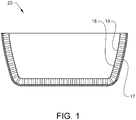
- Fig. 1 The lower receptacle portion of a large lightweight molded coffin according to embodiments herein is shown in cross section in Fig. 1 and in perspective in Fig. 2(a) .
- Fig. 2b The complete coffin with a lid made in a similar manner of molded pulp is shown in Fig. 2b .
- the lightweight material used in the coffin is built up as a sandwich construction by three different parts comprising:
- complex 3D-shaped designed coffins can be made while at the same time obtain a high strength material.
- the outer shell 17 of the coffin is made of slurried molded pulp and is lined in the embodiment shown with Re-board®with only a single linerboard, on its exposed interior surface 19.
- the Re-board®then composes both the core structure ii) above) and the inner shell (iii) above).
- the Re-board® 18 can be bent, without breaking, to conform to the inside of the molded pulp shell 17 before being glued to the shell, which will then replace the missing linerboard of the reinforcing Re-board® spacer structure.
- honeycomb structure having walls extending perpendicular to the surface of the shell is also one possible spacer material, as well as the corrugated core used in corrugated board, or pulp molded spacer material as described above, thereafter covered with another inner shell made of molded pulp of a paper based material in order to create a strong light weight material.
- a cardboard/reboard coffin can be expected to have exceptionally fast combustion.
- a measured amount of fire retardant is mixed into the slurry for making the molded pulp shell and/or sprayed on the surface of the molded shell(s) and the core spacer material.
- dry strength additives are added to the pulp and in order to have enough wet strength enabling storage in a freezer, wet strength additives are added to the pulp in sufficient amount.
- a hydrophobization additive is added to the pulp slurry.
- the hydrophobization may be even more increased by adding a hydrophobizing surface coating by using spray or a coating machine.
- There may also be adhesives sprayed on the inner surface(s) of the shell(s), which will make the core spacer material adhere to the shell(s) and become securely glued thereto.
- the molded 3-D shaped material 17 has an even and smooth surface and good mechanical properties.
- the density of the molded materials needs to be at least 100 kg / m 3 in order to obtain proper stiffness but may be even higher depending on the pressure used during the molding process.
- the molded material may be made of pulp from various fibers such as virgin wood fibers (e.g. chemothermo-mechanical pulp, chemical pulp or mechanical pulp), recycled wood fibers, textile fibers made of viscose, cotton or other cellulosic fibers, but may also be made of pulp comprising fibers mixed with thermoplastic fibers such as polylactic acid (as described in e.g. patent no EP2171154 A1 ) in order to create composite materials.
- Fig. 2a shows the lower receptacle portion 17 of a coffin according to embodiments herein, provided with an inner spacer structure and an inner shell 19.
- Fig. 2b shows a complete closed coffin according to embodiments herein with the lid 21 in place on the bottom portion of the coffin 20.
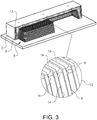
- Fig. 3 shows in longitudinal cutaway view a pair of mold halves used for manufacturing shells 17 for the reinforced coffins of embodiments herein.
- the male mold half 5 is made of hollow aluminum and is coated with an elastomer 6 which is ca 30 mm thick. This elastomer is preferably sprayed onto the aluminum mold half. It is also possible to cast the elastomer onto the aluminum mold half.
- a typical elastomer 6 should be hydrophobic but not be subject to hydrolysis.
- An advantageous hardness, particularly for a sprayed-on elastomer is 70 A-Shore, to provide optimal elastic properties.
- the female mold-half 3 is made of aluminum and has in this example a weight of 700 kg. It is heated to ca. 200 degrees C., for example by means of heating rods embedded in the material of the female mold-half 3. This is the most energy effective method of heating the female mold-half. Its inner surface will create the outer surface of the product.
- the two mold halves can be made of porous aluminum to increase strength over sintered material and to increase heat conductivity.
- the male mold-half 5 after being dipped in the slurry bath dewaters the slurry through vacuum to approximately 20% dryness (80% water) and the male mold-half 5 is then pressed into the female mold-half 3 down to a gap of ca. 1 mm between the two mold halves. It can vary for this particular product between ca. 0.8 and ca. 1.2 mm without detrimental effects.
- the material is then dried under pressure at an elevated temperature (>100 degrees, preferably 150 degrees). Due to absorbing coolness from the male mold-half 3 (temp of ca. 25°C), the hot aluminum female mold-half 5 (initially ca. 200°C) will in turn drop ca. 13 degrees C during the compression process.
- This temperature change causes the female mold-half to shrink over its length approximately 7-8 mm with corresponding contractions in its width (2.5 mm) and height (1.5 mm). This is compensated for by the elastomer layer 6.
- the temperatures in both the female and male mold-halves will vary up and down during the compression process thus repeatedly changing slightly the dimensions on the molds. In conventional pulp molding processes, these dimensional variations would cause stresses and unevenness in the finished product, possibly even ruptures.
- the temperature of the female mold-half must be rather precise, i.e. in this example between ca. 195° and 204°C. This precision is difficult to achieve and maintain in an industrial process of this type.
- Embodiments herein was developed inter alia in order to produce shells for coffins with very few rejects and no necessity of precisely monitoring and continually adjusting the temperatures of the two mold-halves. Since the elastomer is used to absorb much of the dimensional variation of the male and female mold-halves, they can be made much lighter and thinner than otherwise since they will not require a large mass to prevent temperature variations. For instance, in this example the female mold-half weighs ca. 750 kg. If it had to maintain a more constant temperature it might have to have a mass of several tons, requiring more energy to heat such a large mass and maintain the heat.
- a coffin has in general curved sides, something which is expensive to produce in plywood or with wood planks. According to embodiments herein it is possible to produce shells of ca. 1-2 mm in thickness, which provides the maximum stiffness. Thicknesses greater or less than this thickness (1-2 mm) provide less stiffness
- the shell mounts the stationary mold half (in this case the female mold half) to be slightly horizontally moveable (+- 25 mm) to make sure that any heating expansion will not prevent a correct horizontal alignment between the male and female mold halves during the pressing operation.
- the male mold half is provided with troughs 14 and large holes 8 beneath the elastomer layer in order to prevent any reduction of the vacuum which holds the pulp slurry and dewaters it on the surface of the wire mesh.
Landscapes
- Health & Medical Sciences (AREA)
- Life Sciences & Earth Sciences (AREA)
- Animal Behavior & Ethology (AREA)
- General Health & Medical Sciences (AREA)
- Public Health (AREA)
- Veterinary Medicine (AREA)
- Engineering & Computer Science (AREA)
- Manufacturing & Machinery (AREA)
- Mechanical Engineering (AREA)
- Paper (AREA)
- Laminated Bodies (AREA)
- Dry Formation Of Fiberboard And The Like (AREA)
- Securing Of Glass Panes Or The Like (AREA)
Description
- Generally, embodiments herein relate to large lightweight coffins, and to methods of making such molded containers.
- Pulp molding is known in the art for producing small packages such as egg cartons, disposable food dishes, box inserts and other protective packing materials etc.
- JPH09117480 relates to a coffin cover. The known coffin cover aims to rationalize by dispensing the working of wooden curved surfaces, saving labor, enabling mass production and thereby reducing cost. A coffin cover comprising a main body 2 of the cover and a
window part 3 provided on the front side of the main body is presented. These parts are composed of a core member with the surface and rear paper glued on the core member in between, which is composed of base materials that are odorless and smokeless in combustion such as polyethylene and polypropylene foamed materials. In addition, thesurface paper 5 and therear paper 6 are made of 100% pure pulp reinforced paper. -
GB2563311A1 -
US 6 245 199 describes a method of pulp molding trays where the starting material is a suspension containing cellulose fibers. The male mold half is dipped in a bath of the suspension, and the mold halves are then pressed together under heat and pressure. -
SE 529 897 C2 - Large containers with smooth surfaces and strong, lightweight structure have been very difficult to pulp mold. And a complex of difficult to solve problems have prevented widespread use of pulp molding to produce lightweight coffins.
-
EP 0466653 , for example, describes a coffin made of molded pulp without any reinforcing spacer lining. Upper and lower coffin halves are pulp molded with integral ribs 44, 46 for reinforcement. These prevent a finished smooth surface and do not permit forming into a classic attractive coffin shape, with gently curved smooth walls. -
US 4 162 935 also describes a coffin made of dewatered paper pulp. The mold also providesintegral ribs 20, for reinforcement, which prevent having a finished smooth surface and a classic coffin shape. -
WO06016072 -
GB-2448592 - However, none of the related art discloses or hints at how to achieve the solutions provided by embodiments herein.
- Embodiments herein intends to solve a complex of difficult-to-reconcile interrelated problems still present in the designs of the prior art:
It has been very difficult to use existing pulp molding methods to produce very large objects. This is due partially to the problem of thermal expansion and contraction of the two metal mold halves used in the compression of the pulp in the press. If the dimensions of the mold halves change, due to unavoidably becoming cooler and hotter during the compression process, the strength of the container will be compromised and the surface will not be smooth and even. This is not a problem if the surface quality and the strength of the finished object is of no great importance, such as for packaging materials or disposable dishes, but where the strength and surface finish of the finished molded product is of great importance then this is a problem. In general it is difficult to achieve uniformity of strength and surface in pulp molded products, particularly in such products which are thin. - It is now possible to make a large volume lightweight shell of molded pulp with improved strength and smoothness using the mold halves and apparatus described and claimed in our co-pending patent application No.
1550864-1
and with the lightweight 3-D shaped material described in our co-pending patent application No.1550866-6 - Providing a coffin, which is lightweight, very strong, with smooth and even outer surface and above all is easy and inexpensive to manufacture has hitherto proved very difficult.
- This entire complex of problems listed above finds its solution in embodiments herein as defined in the appended main patent claims.
- According to embodiments, a large lightweight molded coffin comprising an outer shell of molded slurried pulp and a core material used as a reinforcing spacer material conforming to and adhering to the interior of the shell, and an inner shell made of molded pulp or a flexible paper based material adhering to the core spacer material is provided.
- In embodiments, the spacer material may be a paper based honeycomb sheet of hexagonal cells.
- In embodiments, the core spacer material is made of a spacer structure of molded pulp.
- In embodiments, the reinforcing spacer material may be made of Re-board®.
- In embodiments, the Re-board®© spacer material may have only a single interior cover sheet.
- In embodiments, the reinforcing spacer material may comprise hollow cells separated by walls substantially perpendicular to the shell.
- In embodiments, the outer shell may be molded of pulp with a fire-retardant additive.
- In embodiments, a coffin cover may also comprise an outer shell of molded pulp and a reinforcing spacer material.
- In another aspect, a method of producing a molded coffin comprising
- a. Pressing slurried pulp between a first male mold half covered with elastomeric material and a second female mold half, and drying the material at elevated temperature under pressure, to form the molded pulp shell,
- b. providing a core spacer structure and gluing the reinforcing spacer structure to the interior of the molded pulp shell.
- c. provide an inner shell made of molded pulp or another flexible paper based material and gluing it to the core spacer structure is provided.
- In embodiments, methods may comprise admixing a measured amount of fire retardant to the slurried pulp and/or spraying a fire retardant to the surface of the shells.
- In embodiments, methods may comprise admixing a measured amount of dry- and wet strength additive to the slurried pulp.
- In embodiments, methods may comprise admixing a measured amount of hydrophobizing additive in the slurried pulp.
- In embodiments, methods may comprise surface treating the outer layer of the coffin material with a hydrophobizing coating by spray or coating.
- In embodiments, methods may comprise spraying an adhesive on the inner side of the shell in order to glue the spacer material to the shell.
- Embodiments herein will now be described in more detail with reference to the appended drawings, wherein:
-
Fig. 1 shows a cross sectional view of a lower portion of a coffin according to embodiments herein. -
Fig. 2a shows a perspective view of the lower portion of the coffin shown inFig. 1 andFig. 2b shows a perspective view of the coffin provided with a lid. -
Fig. 3 shows schematically the pair of mold halves used in a method which can be used to manufacture the shells for a coffin according to embodiments herein. - The lower receptacle portion of a large lightweight molded coffin according to embodiments herein is shown in cross section in
Fig. 1 and in perspective inFig. 2(a) . The complete coffin with a lid made in a similar manner of molded pulp is shown inFig. 2b . - The lightweight material used in the coffin is built up as a sandwich construction by three different parts comprising:
- i) An
outer shell 17 made of 3-D shaped molded pulp. [This is the surface of the material and will have a smooth and even surface and make possible complex 3-D shaped designs , produced, for example, by using the novel method for producing large molded pulp objects described in our co-pending Patent Application No.1550864-1 - ii) A
core 18 composed of a flexible spacer structure that may have, but is not limited to having, a core of Re-board®, a paper honeycomb structure, a molded core structure (as described in e.g. International Patent Application NoWO2010138066 A1 ), or the corrugated core structure made by fluting used in corrugated boards. - iii) An
inner shell 19 made of molded pulp or a flexible paper based material such as a linerboard or paperboard. - By using a sandwich construction as described above, complex 3D-shaped designed coffins can be made while at the same time obtain a high strength material.
- In one of embodiments herein, the
outer shell 17 of the coffin is made of slurried molded pulp and is lined in the embodiment shown with Re-board®with only a single linerboard, on its exposedinterior surface 19. The Re-board®then composes both the core structure ii) above) and the inner shell (iii) above). As one of the linerboards has been removed from a normal Re-board®material, theRe-board® 18 can be bent, without breaking, to conform to the inside of the moldedpulp shell 17 before being glued to the shell, which will then replace the missing linerboard of the reinforcing Re-board® spacer structure. - It is of course also possible to use other core materials used as spacers to line the outer molded pulp shell of the coffin that are able to conform to the interior curvature of the molded pulp shell. A honeycomb structure, having walls extending perpendicular to the surface of the shell is also one possible spacer material, as well as the corrugated core used in corrugated board, or pulp molded spacer material as described above, thereafter covered with another inner shell made of molded pulp of a paper based material in order to create a strong light weight material.
- A number of special functional characteristics apply to coffins, in particular if they are intended for cremation. The specifications of a normal coffin are:
- i) Have enough mechanical strength for carry a body weight of 120 kg.
- ii) Have a dimensional stability and wet strength that enables storage in a freezer.
- iii) Have water repellent properties to withstand rainy weather.
- iv) If used in cremation, withstand the heat in a cremation oven (ca 900 °C) for at least 15 sec. without catching fire.
- A cardboard/reboard coffin can be expected to have exceptionally fast combustion. For safety of the crematorium workers and for optimum cremation of the body, according to one embodiment of embodiments herein, a measured amount of fire retardant is mixed into the slurry for making the molded pulp shell and/or sprayed on the surface of the molded shell(s) and the core spacer material. In order to make the molded shells stiff enough, dry strength additives are added to the pulp and in order to have enough wet strength enabling storage in a freezer, wet strength additives are added to the pulp in sufficient amount. To achieve enough water repellent properties on the outer shell, a hydrophobization additive is added to the pulp slurry. The hydrophobization may be even more increased by adding a hydrophobizing surface coating by using spray or a coating machine. There may also be adhesives sprayed on the inner surface(s) of the shell(s), which will make the core spacer material adhere to the shell(s) and become securely glued thereto.
- The molded 3-D shaped
material 17 has an even and smooth surface and good mechanical properties. The density of the molded materials needs to be at least 100 kg / m3 in order to obtain proper stiffness but may be even higher depending on the pressure used during the molding process. - The molded material may be made of pulp from various fibers such as virgin wood fibers (e.g. chemothermo-mechanical pulp, chemical pulp or mechanical pulp), recycled wood fibers, textile fibers made of viscose, cotton or other cellulosic fibers, but may also be made of pulp comprising fibers mixed with thermoplastic fibers such as polylactic acid (as described in e.g. patent no
EP2171154 A1 ) in order to create composite materials.Fig. 2a shows thelower receptacle portion 17 of a coffin according to embodiments herein, provided with an inner spacer structure and aninner shell 19.Fig. 2b shows a complete closed coffin according to embodiments herein with thelid 21 in place on the bottom portion of thecoffin 20. -
Fig. 3 shows in longitudinal cutaway view a pair of mold halves used for manufacturingshells 17 for the reinforced coffins of embodiments herein. Themale mold half 5 is made of hollow aluminum and is coated with anelastomer 6 which is ca 30 mm thick. This elastomer is preferably sprayed onto the aluminum mold half. It is also possible to cast the elastomer onto the aluminum mold half. Atypical elastomer 6 should be hydrophobic but not be subject to hydrolysis. An advantageous hardness, particularly for a sprayed-on elastomer is 70 A-Shore, to provide optimal elastic properties. 5mm diameter through-holes spaced 15 mm from each other cover the elastomer layer and connect to through-holes 8 in the aluminum body of themale mold half 5. Within the male mold half there is generated a vacuum of 0.5-0.9 bar. On top of the elastomer layer there is a wire mesh. In this case it is a 100 mesh (i.e. 100 threads per inch) and is approximately 1 mm thick. The wire mesh can also be laid in multiple layers which will further contribute to distributing the vacuum forces more evenly. The female mold-half 3 is made of aluminum and has in this example a weight of 700 kg. It is heated to ca. 200 degrees C., for example by means of heating rods embedded in the material of the female mold-half 3. This is the most energy effective method of heating the female mold-half. Its inner surface will create the outer surface of the product. The two mold halves can be made of porous aluminum to increase strength over sintered material and to increase heat conductivity. - The male mold-
half 5 after being dipped in the slurry bath dewaters the slurry through vacuum to approximately 20% dryness (80% water) and the male mold-half 5 is then pressed into the female mold-half 3 down to a gap of ca. 1 mm between the two mold halves. It can vary for this particular product between ca. 0.8 and ca. 1.2 mm without detrimental effects. The material is then dried under pressure at an elevated temperature (>100 degrees, preferably 150 degrees). Due to absorbing coolness from the male mold-half 3 (temp of ca. 25°C), the hot aluminum female mold-half 5 (initially ca. 200°C) will in turn drop ca. 13 degrees C during the compression process. This temperature change causes the female mold-half to shrink over its length approximately 7-8 mm with corresponding contractions in its width (2.5 mm) and height (1.5 mm). This is compensated for by theelastomer layer 6. The temperatures in both the female and male mold-halves will vary up and down during the compression process thus repeatedly changing slightly the dimensions on the molds. In conventional pulp molding processes, these dimensional variations would cause stresses and unevenness in the finished product, possibly even ruptures. In this particular exemplary product, without an elastomer layer, the temperature of the female mold-half must be rather precise, i.e. in this example between ca. 195° and 204°C. This precision is difficult to achieve and maintain in an industrial process of this type. These problems have been experienced even in the manufacture of relatively small pulp molded products, and require precise adjustment of the temperature to avoid them. Most pulp molded products, such as egg cartons, are several millimeters thick and are thus more porous and it makes no difference whether such products have a rough surface. A product with a rough surface cannot be used in many applications. For a large product, the problems of dimensional heat expansion/contraction will be greatly increased. These problems have hitherto made it impossible to manufacture large pulp molded products with reasonable reject rates and with a smooth surface. - Embodiments herein was developed inter alia in order to produce shells for coffins with very few rejects and no necessity of precisely monitoring and continually adjusting the temperatures of the two mold-halves. Since the elastomer is used to absorb much of the dimensional variation of the male and female mold-halves, they can be made much lighter and thinner than otherwise since they will not require a large mass to prevent temperature variations. For instance, in this example the female mold-half weighs ca. 750 kg. If it had to maintain a more constant temperature it might have to have a mass of several tons, requiring more energy to heat such a large mass and maintain the heat.
- A coffin has in general curved sides, something which is expensive to produce in plywood or with wood planks. According to embodiments herein it is possible to produce shells of ca. 1-2 mm in thickness, which provides the maximum stiffness. Thicknesses greater or less than this thickness (1-2 mm) provide less stiffness
- These problems are solved by coating the surface of the male mold-half with an elastomeric material, onto which the wire mesh or meshes is/are then applied. This elastomeric material continually compensates for the varying dimensions of the two mold-halves during the compression/heating process.
- It is also advantageous for molding the shell to mount the stationary mold half (in this case the female mold half) to be slightly horizontally moveable (+- 25 mm) to make sure that any heating expansion will not prevent a correct horizontal alignment between the male and female mold halves during the pressing operation.
- As can be seen in
Fig. 3 , the male mold half is provided withtroughs 14 andlarge holes 8 beneath the elastomer layer in order to prevent any reduction of the vacuum which holds the pulp slurry and dewaters it on the surface of the wire mesh. - Other embodiments herein further describe a method to produce the molded lightweight coffin described above. The steps to produce the coffin comprises:
- i) Provide a 3-D shaped molded material according to the design of the specific coffin by using the apparatus described above with or without addition of functional additives which will be used as
outer shell 17 of the coffin - ii) Provide a spacer material used as
core 18 in the coffin material, and glue said core spacer material to the outer 3-D shaped molded shell - iii) Provide an
inner shell 19 made of a 3-D shaped molded material or a flexible paper based material which will adhere to thespacer material 18.
Claims (12)
- A large lightweight coffin comprising:
A curved outer shell (17) of molded pulp anda flexible core material used as a reinforcing flexible spacer (18), wherein said flexible core material is conforming to and adhering to the interior of said shell, andan inner shell (19) made of molded pulp or a flexible paper based material adhering to said core spacer material, andcharacterized in that said reinforcing flexible spacer is made of a spacer structure of molded pulp, andsaid curved outer shell (17) is formed by slurried pulp whereby a smooth and even surface is provided. - Coffin according to Claim 1, characterized in that the said reinforcing flexible spacer is a paper based honeycomb sheet of hexagonal cells.
- A coffin according to any of Claim 1 or 2, characterized in that said reinforcing flexible spacer is a corrugated core structure.
- Coffin according to any of Claims 1-3, characterized in that said reinforcing flexible spacer comprises hollow cells separated by walls substantially perpendicular to said shell.
- Coffin according to any of Claims 1-4, characterized in that said outer shell is molded of slurried pulp with a fire-retardant additive.
- Coffin according to any of Claims 1-5, characterized by a coffin cover (12) also comprising an outer shell of molded slurried pulp and a reinforcing spacer material.
- Method of producing a coffin, characterized by:Pressing slurried pulp between a first male metal mold half (5) spray coated or cast with elastomeric material (6) and a second female metal mold half (3), and drying the pulp slurry at elevated temperature under pressure, to form a curved molded pulp shell (17),providing a flexible spacer structure and gluing it as said reinforcing flexible spacer (18) to the interior of said curved molded pulp shell (17),providing an inner shell made of molded pulp or another flexible paper based material and gluing it to said reinforcing flexible spacer.
- Method of producing a coffin according to Claim 7 also characterized by: admixing a measured amount of fire retardant to the slurried pulp and/or spraying a fire retardant to the surface of the shells.
- Method of producing a coffin according to any one of Claims 7-8, also characterized by: admixing a measured amount of dry- and wet strength additive to the slurried pulp.
- Method of producing a coffin according to any one of Claims 7-8, also characterized by: admixing a measured amount of hydrophobizing additive in the slurried pulp.
- Method of producing a coffin according to any one of Claims 7-10, characterized by surface treating the outer layer of the coffin material with a hydrophobizing coating by spray or coating.
- Method of producing a coffin according to any one of Claims 7-11, also characterized by spraying an adhesive on the inner side of the shell in order to glue the flexible reinforcing spacer to the shell.
Priority Applications (1)
| Application Number | Priority Date | Filing Date | Title |
|---|---|---|---|
| PL16814818T PL3313349T3 (en) | 2015-06-23 | 2016-06-23 | Large lightweight coffin and method for its manufacture |
Applications Claiming Priority (2)
| Application Number | Priority Date | Filing Date | Title |
|---|---|---|---|
| SE1550867A SE539867C2 (en) | 2015-06-23 | 2015-06-23 | Large Lightweight Coffin and Method for its Manufacture |
| PCT/SE2016/050628 WO2016209158A1 (en) | 2015-06-23 | 2016-06-23 | Large lightweight coffin and method for its manufacture |
Publications (3)
| Publication Number | Publication Date |
|---|---|
| EP3313349A1 EP3313349A1 (en) | 2018-05-02 |
| EP3313349A4 EP3313349A4 (en) | 2019-01-30 |
| EP3313349B1 true EP3313349B1 (en) | 2021-01-06 |
Family
ID=57605302
Family Applications (1)
| Application Number | Title | Priority Date | Filing Date |
|---|---|---|---|
| EP16814818.7A Active EP3313349B1 (en) | 2015-06-23 | 2016-06-23 | Large lightweight coffin and method for its manufacture |
Country Status (12)
| Country | Link |
|---|---|
| US (1) | US10974490B2 (en) |
| EP (1) | EP3313349B1 (en) |
| JP (1) | JP6795141B2 (en) |
| CN (1) | CN107847386A (en) |
| AU (1) | AU2016281466B2 (en) |
| CA (1) | CA2990059A1 (en) |
| DK (1) | DK3313349T3 (en) |
| ES (1) | ES2863240T3 (en) |
| PL (1) | PL3313349T3 (en) |
| RU (1) | RU2697237C2 (en) |
| SE (1) | SE539867C2 (en) |
| WO (1) | WO2016209158A1 (en) |
Families Citing this family (4)
| Publication number | Priority date | Publication date | Assignee | Title |
|---|---|---|---|---|
| US9763844B2 (en) * | 2015-06-17 | 2017-09-19 | Lynn Krinsky | Reinforced core cardboard casket |
| SE539866C2 (en) * | 2015-06-23 | 2017-12-27 | Organoclick Ab | Pulp Molding Apparatus and Molds for Use Therein |
| SE539867C2 (en) | 2015-06-23 | 2017-12-27 | Organoclick Ab | Large Lightweight Coffin and Method for its Manufacture |
| SE539902C2 (en) * | 2015-06-23 | 2018-01-09 | Organoclick Ab | Large Lightweight Three Dimensional Object and Method for Producing the Object |
Family Cites Families (54)
| Publication number | Priority date | Publication date | Assignee | Title |
|---|---|---|---|---|
| US293220A (en) | 1884-02-12 | bodge | ||
| US528612A (en) * | 1894-11-06 | Pulp burial-casket and process of making same | ||
| GB189410669A (en) * | 1894-06-01 | 1894-07-07 | George Edwin Shaw | Improvements in or relating to the Manufacture of Burial Caskets or Coffins. |
| GB191410669A (en) | 1914-04-30 | 1915-03-11 | John Shanks | Improvements in Ball Cocks. |
| US1551257A (en) | 1919-06-11 | 1925-08-25 | Little Inc A | Method of and apparatus for molding pulp articles |
| GB253179A (en) | 1925-03-09 | 1926-06-09 | Richard Ellis Hall | Process and apparatus for producing seamless fibrous containers and products thereof from pulp |
| US2518164A (en) | 1946-07-02 | 1950-08-08 | Leonard S Meyer | Apparatus for producing composite sheet material |
| US3250668A (en) | 1963-09-27 | 1966-05-10 | Beloit Corp | Pulp molding assembly including pressing bladder |
| US4014739A (en) | 1974-05-09 | 1977-03-29 | International Paper Company | Mold construction having removable base member |
| US4034447A (en) | 1975-10-02 | 1977-07-12 | Idra Ag | Papier-mache coffin |
| US4730370A (en) * | 1983-10-03 | 1988-03-15 | Vandor Corporation | Casket and method of manufacture |
| DE59104750D1 (en) | 1990-07-11 | 1995-04-06 | Alois Koch | Method of making a coffin from molded pulp. |
| US5272852A (en) | 1991-03-01 | 1993-12-28 | Cascades Inc. | Fluff-type organic insulating pulp and method of fabrication and application |
| US5656135A (en) | 1993-02-16 | 1997-08-12 | Moulded Fibre Technology, Inc. | Molded product manufacturing apparatus and methods |
| JP3173706B2 (en) | 1994-12-27 | 2001-06-04 | 新東工業株式会社 | Pulp Mold Mold |
| JPH09117480A (en) * | 1995-10-25 | 1997-05-06 | Zentaro Kojima | Coffin lid, casket lid molding die device, and method for manufacturing casket lid |
| JPH09195200A (en) | 1996-01-25 | 1997-07-29 | Noritake Co Ltd | Papermaking mold for pulp fiber molding, method for molding pulp fiber molding, and pulp fiber molding |
| US5771549A (en) * | 1996-06-24 | 1998-06-30 | Batesville Casket Company, Inc. | Casket shell structures |
| GB9619139D0 (en) | 1996-09-13 | 1996-10-23 | Unilever Plc | Process for stamping detergent bars |
| GB9722547D0 (en) | 1997-10-25 | 1997-12-24 | Pinco 976 Limited | Improvements relating to forming machines |
| TW368413B (en) * | 1999-02-11 | 1999-09-01 | chuan-ren Xie | Manufacturing method for paper bier in cremation |
| US6576089B1 (en) * | 1999-03-26 | 2003-06-10 | Kao Corporation | Paper making mold for pulp mold molding production and method and device for producing pulp mold molding |
| US6149845A (en) * | 1999-03-29 | 2000-11-21 | Ren; Shieh Chwan | Method of manufacturing paper coffin for use in cremation |
| CN1107144C (en) | 1999-05-12 | 2003-04-30 | 高玲 | Automatic production line for moulding paper pulp |
| DE19922785A1 (en) | 1999-05-18 | 2000-11-23 | Hsieh Chuan Ren | Coffin for use in crematoria is of recycled waste paper materials shaped by vacuum drawing and stabilized in a press to be dried and painted |
| US20010001409A1 (en) | 1999-06-08 | 2001-05-24 | Terry Weight | Method and apparatus for forming composite honeycomb core |
| EP1085127A3 (en) | 1999-09-17 | 2001-08-29 | Nisshinbo Industries, Inc. | Tray for growing plants |
| US6245199B1 (en) | 1999-09-23 | 2001-06-12 | Vincent Lee | Automatic pulp-forming mold-releasing machine |
| CN1255302C (en) * | 2000-04-26 | 2006-05-10 | 花王株式会社 | Insulated container |
| JP3415584B2 (en) | 2000-12-11 | 2003-06-09 | 花王株式会社 | Pulp molded article manufacturing equipment |
| JP4039879B2 (en) | 2001-04-06 | 2008-01-30 | 花王株式会社 | Manufacturing method of paper-molded molded body with flange |
| US6964725B2 (en) * | 2002-11-06 | 2005-11-15 | Kimberly-Clark Worldwide, Inc. | Soft tissue products containing selectively treated fibers |
| JP4465214B2 (en) * | 2004-03-30 | 2010-05-19 | 前澤工業株式会社 | Compressed fiber panel iron |
| WO2006016072A2 (en) | 2004-07-19 | 2006-02-16 | Jonathan Jauneau | Coffin in particular for cremation and applications thereof |
| CN100480040C (en) | 2005-03-02 | 2009-04-22 | 李士才 | Paper-mold hollow honeycombed package products and method for manufacturing the same |
| SE529897C2 (en) | 2006-03-27 | 2007-12-27 | Rottneros Ab | Molded trough |
| US8389427B2 (en) * | 2006-11-29 | 2013-03-05 | Sca Hygiene Products Ab | Hydroentangled nonwoven material |
| GB0707539D0 (en) | 2007-04-19 | 2007-05-30 | Joseph A Hey & Son Ltd | Improvements to coffins |
| KR20080103694A (en) * | 2007-05-25 | 2008-11-28 | 박동균 | Branch pipe and its manufacturing method |
| RU68831U1 (en) | 2007-06-08 | 2007-11-27 | Государственное научное учреждение "Научно-исследовательский институт перспективных материалов и технологий Московского государственного института электроники и математики (технического университета)" | DEVICE FOR THERMAL PROCESSING OF SHEET DIELECTRIC MATERIALS |
| WO2009008822A1 (en) | 2007-07-12 | 2009-01-15 | Stfi-Packforsk Ab | Method for manufacturing a composite material having reduced mechanosorptive creep, the composite material, use of the method and the composite material |
| US20100009104A1 (en) | 2008-07-11 | 2010-01-14 | Composite America, LLC | Laminate with Natural Fiber Composite |
| SE533787C2 (en) | 2009-05-26 | 2011-01-11 | Ecopals Ab | Construction element according to the sandwich principle |
| JP2011110125A (en) * | 2009-11-25 | 2011-06-09 | Tokushu Maetel Kk | Casket for pet |
| DK201000076U4 (en) | 2010-04-29 | 2011-08-26 | Beco Consult Aps | Coffin in environmentally friendly material |
| CN103140625B (en) * | 2010-07-23 | 2015-01-28 | 王子控股株式会社 | Papermaking wire of microfibrous cellulose-containing sheet and method for producing microfibrous cellulose-containing sheet |
| US8151421B2 (en) * | 2010-08-17 | 2012-04-10 | Liang Le Hsu | Foldable paper coffin |
| JP3178946U (en) * | 2012-07-17 | 2012-10-11 | 株式会社アットマン | coffin |
| SE539867C2 (en) | 2015-06-23 | 2017-12-27 | Organoclick Ab | Large Lightweight Coffin and Method for its Manufacture |
| SE539866C2 (en) | 2015-06-23 | 2017-12-27 | Organoclick Ab | Pulp Molding Apparatus and Molds for Use Therein |
| SE539902C2 (en) * | 2015-06-23 | 2018-01-09 | Organoclick Ab | Large Lightweight Three Dimensional Object and Method for Producing the Object |
| GB201612889D0 (en) | 2016-07-26 | 2016-09-07 | Natural Resources (2000) Ltd | Moulding of articles |
| GR1009985B (en) * | 2016-08-24 | 2021-04-22 | Φωτιος Κωνσταντινου Κουτροπουλος | Method for the construction of assemblable coffin surfaces with compressed wood pulp casting |
| GB2563311B (en) | 2018-03-08 | 2020-03-04 | O2Micro Inc | Circuits, systems and methods for protecting batteries |
-
2015
- 2015-06-23 SE SE1550867A patent/SE539867C2/en unknown
-
2016
- 2016-06-23 RU RU2017144293A patent/RU2697237C2/en active
- 2016-06-23 CA CA2990059A patent/CA2990059A1/en not_active Abandoned
- 2016-06-23 JP JP2017564683A patent/JP6795141B2/en not_active Expired - Fee Related
- 2016-06-23 DK DK16814818.7T patent/DK3313349T3/en active
- 2016-06-23 EP EP16814818.7A patent/EP3313349B1/en active Active
- 2016-06-23 PL PL16814818T patent/PL3313349T3/en unknown
- 2016-06-23 ES ES16814818T patent/ES2863240T3/en active Active
- 2016-06-23 CN CN201680036613.8A patent/CN107847386A/en active Pending
- 2016-06-23 US US15/738,873 patent/US10974490B2/en not_active Expired - Fee Related
- 2016-06-23 WO PCT/SE2016/050628 patent/WO2016209158A1/en not_active Ceased
- 2016-06-23 AU AU2016281466A patent/AU2016281466B2/en not_active Ceased
Non-Patent Citations (1)
| Title |
|---|
| None * |
Also Published As
| Publication number | Publication date |
|---|---|
| PL3313349T3 (en) | 2021-07-05 |
| JP6795141B2 (en) | 2020-12-02 |
| AU2016281466B2 (en) | 2020-10-22 |
| US10974490B2 (en) | 2021-04-13 |
| CA2990059A1 (en) | 2016-12-29 |
| SE539867C2 (en) | 2017-12-27 |
| DK3313349T3 (en) | 2021-03-22 |
| AU2016281466A1 (en) | 2018-02-01 |
| WO2016209158A1 (en) | 2016-12-29 |
| EP3313349A1 (en) | 2018-05-02 |
| ES2863240T3 (en) | 2021-10-11 |
| JP2018519901A (en) | 2018-07-26 |
| US20180177661A1 (en) | 2018-06-28 |
| RU2017144293A (en) | 2019-07-25 |
| SE1550867A1 (en) | 2016-12-24 |
| EP3313349A4 (en) | 2019-01-30 |
| RU2017144293A3 (en) | 2019-07-25 |
| CN107847386A (en) | 2018-03-27 |
| RU2697237C2 (en) | 2019-08-13 |
Similar Documents
| Publication | Publication Date | Title |
|---|---|---|
| AU2016281463B2 (en) | Large lightweight molded material and method for its manufacture | |
| EP3313637B1 (en) | Pulp molding apparatus and molds for use therein | |
| US10974490B2 (en) | Large lightweight coffin and method for its manufacture | |
| RS62828B1 (en) | Method for manufacturing a cellulose product, cellulose product forming apparatus and cellulose product | |
| US20040045690A1 (en) | Molded pulp product, and method and apparatus for production thereof | |
| EP1439264B1 (en) | Pulp molded article and method and apparatus for producing pulp molded article | |
| US3758357A (en) | Making molded fiber board | |
| JP7838285B2 (en) | Pulp molded products | |
| CN113044356A (en) | High-tensile high-strength tearing-resistant molding packaging product and manufacturing method thereof | |
| SE2350655A1 (en) | Method for dry-forming a cellulose product from cellulose fibres in a product forming unit and a product forming unit | |
| JP2003020599A (en) | Male mold for producing fibrous holding | |
| JPH11241300A (en) | Method of manufacturing pulp molded product |
Legal Events
| Date | Code | Title | Description |
|---|---|---|---|
| STAA | Information on the status of an ep patent application or granted ep patent |
Free format text: STATUS: THE INTERNATIONAL PUBLICATION HAS BEEN MADE |
|
| PUAI | Public reference made under article 153(3) epc to a published international application that has entered the european phase |
Free format text: ORIGINAL CODE: 0009012 |
|
| STAA | Information on the status of an ep patent application or granted ep patent |
Free format text: STATUS: REQUEST FOR EXAMINATION WAS MADE |
|
| 17P | Request for examination filed |
Effective date: 20171218 |
|
| AK | Designated contracting states |
Kind code of ref document: A1 Designated state(s): AL AT BE BG CH CY CZ DE DK EE ES FI FR GB GR HR HU IE IS IT LI LT LU LV MC MK MT NL NO PL PT RO RS SE SI SK SM TR |
|
| AX | Request for extension of the european patent |
Extension state: BA ME |
|
| DAV | Request for validation of the european patent (deleted) | ||
| DAX | Request for extension of the european patent (deleted) | ||
| A4 | Supplementary search report drawn up and despatched |
Effective date: 20190107 |
|
| RIC1 | Information provided on ipc code assigned before grant |
Ipc: D21J 7/00 20060101ALI20181221BHEP Ipc: B32B 3/12 20060101ALI20181221BHEP Ipc: B32B 3/28 20060101ALI20181221BHEP Ipc: A61G 17/007 20060101AFI20181221BHEP Ipc: B65D 88/00 20060101ALI20181221BHEP Ipc: D21J 3/00 20060101ALI20181221BHEP Ipc: B65D 90/00 20060101ALI20181221BHEP Ipc: B32B 29/00 20060101ALI20181221BHEP Ipc: B32B 1/02 20060101ALI20181221BHEP |
|
| STAA | Information on the status of an ep patent application or granted ep patent |
Free format text: STATUS: EXAMINATION IS IN PROGRESS |
|
| 17Q | First examination report despatched |
Effective date: 20191218 |
|
| GRAP | Despatch of communication of intention to grant a patent |
Free format text: ORIGINAL CODE: EPIDOSNIGR1 |
|
| STAA | Information on the status of an ep patent application or granted ep patent |
Free format text: STATUS: GRANT OF PATENT IS INTENDED |
|
| INTG | Intention to grant announced |
Effective date: 20200922 |
|
| GRAS | Grant fee paid |
Free format text: ORIGINAL CODE: EPIDOSNIGR3 |
|
| GRAA | (expected) grant |
Free format text: ORIGINAL CODE: 0009210 |
|
| STAA | Information on the status of an ep patent application or granted ep patent |
Free format text: STATUS: THE PATENT HAS BEEN GRANTED |
|
| AK | Designated contracting states |
Kind code of ref document: B1 Designated state(s): AL AT BE BG CH CY CZ DE DK EE ES FI FR GB GR HR HU IE IS IT LI LT LU LV MC MK MT NL NO PL PT RO RS SE SI SK SM TR |
|
| REG | Reference to a national code |
Ref country code: GB Ref legal event code: FG4D |
|
| REG | Reference to a national code |
Ref country code: AT Ref legal event code: REF Ref document number: 1351548 Country of ref document: AT Kind code of ref document: T Effective date: 20210115 Ref country code: CH Ref legal event code: EP |
|
| REG | Reference to a national code |
Ref country code: DE Ref legal event code: R096 Ref document number: 602016051131 Country of ref document: DE |
|
| REG | Reference to a national code |
Ref country code: IE Ref legal event code: FG4D |
|
| REG | Reference to a national code |
Ref country code: DK Ref legal event code: T3 Effective date: 20210318 |
|
| REG | Reference to a national code |
Ref country code: NL Ref legal event code: FP |
|
| REG | Reference to a national code |
Ref country code: FI Ref legal event code: FGE |
|
| REG | Reference to a national code |
Ref country code: SE Ref legal event code: TRGR |
|
| REG | Reference to a national code |
Ref country code: NO Ref legal event code: T2 Effective date: 20210106 |
|
| REG | Reference to a national code |
Ref country code: LT Ref legal event code: MG9D |
|
| PG25 | Lapsed in a contracting state [announced via postgrant information from national office to epo] |
Ref country code: GR Free format text: LAPSE BECAUSE OF FAILURE TO SUBMIT A TRANSLATION OF THE DESCRIPTION OR TO PAY THE FEE WITHIN THE PRESCRIBED TIME-LIMIT Effective date: 20210407 Ref country code: HR Free format text: LAPSE BECAUSE OF FAILURE TO SUBMIT A TRANSLATION OF THE DESCRIPTION OR TO PAY THE FEE WITHIN THE PRESCRIBED TIME-LIMIT Effective date: 20210106 Ref country code: PT Free format text: LAPSE BECAUSE OF FAILURE TO SUBMIT A TRANSLATION OF THE DESCRIPTION OR TO PAY THE FEE WITHIN THE PRESCRIBED TIME-LIMIT Effective date: 20210506 Ref country code: LT Free format text: LAPSE BECAUSE OF FAILURE TO SUBMIT A TRANSLATION OF THE DESCRIPTION OR TO PAY THE FEE WITHIN THE PRESCRIBED TIME-LIMIT Effective date: 20210106 Ref country code: BG Free format text: LAPSE BECAUSE OF FAILURE TO SUBMIT A TRANSLATION OF THE DESCRIPTION OR TO PAY THE FEE WITHIN THE PRESCRIBED TIME-LIMIT Effective date: 20210406 |
|
| PGFP | Annual fee paid to national office [announced via postgrant information from national office to epo] |
Ref country code: IT Payment date: 20210615 Year of fee payment: 6 |
|
| PG25 | Lapsed in a contracting state [announced via postgrant information from national office to epo] |
Ref country code: RS Free format text: LAPSE BECAUSE OF FAILURE TO SUBMIT A TRANSLATION OF THE DESCRIPTION OR TO PAY THE FEE WITHIN THE PRESCRIBED TIME-LIMIT Effective date: 20210106 Ref country code: LV Free format text: LAPSE BECAUSE OF FAILURE TO SUBMIT A TRANSLATION OF THE DESCRIPTION OR TO PAY THE FEE WITHIN THE PRESCRIBED TIME-LIMIT Effective date: 20210106 |
|
| PGFP | Annual fee paid to national office [announced via postgrant information from national office to epo] |
Ref country code: AT Payment date: 20210623 Year of fee payment: 6 Ref country code: SE Payment date: 20210617 Year of fee payment: 6 Ref country code: CH Payment date: 20210617 Year of fee payment: 6 Ref country code: BE Payment date: 20210624 Year of fee payment: 6 |
|
| PG25 | Lapsed in a contracting state [announced via postgrant information from national office to epo] |
Ref country code: IS Free format text: LAPSE BECAUSE OF FAILURE TO SUBMIT A TRANSLATION OF THE DESCRIPTION OR TO PAY THE FEE WITHIN THE PRESCRIBED TIME-LIMIT Effective date: 20210506 |
|
| REG | Reference to a national code |
Ref country code: DE Ref legal event code: R097 Ref document number: 602016051131 Country of ref document: DE |
|
| REG | Reference to a national code |
Ref country code: ES Ref legal event code: FG2A Ref document number: 2863240 Country of ref document: ES Kind code of ref document: T3 Effective date: 20211011 |
|
| PG25 | Lapsed in a contracting state [announced via postgrant information from national office to epo] |
Ref country code: EE Free format text: LAPSE BECAUSE OF FAILURE TO SUBMIT A TRANSLATION OF THE DESCRIPTION OR TO PAY THE FEE WITHIN THE PRESCRIBED TIME-LIMIT Effective date: 20210106 Ref country code: CZ Free format text: LAPSE BECAUSE OF FAILURE TO SUBMIT A TRANSLATION OF THE DESCRIPTION OR TO PAY THE FEE WITHIN THE PRESCRIBED TIME-LIMIT Effective date: 20210106 Ref country code: SM Free format text: LAPSE BECAUSE OF FAILURE TO SUBMIT A TRANSLATION OF THE DESCRIPTION OR TO PAY THE FEE WITHIN THE PRESCRIBED TIME-LIMIT Effective date: 20210106 |
|
| PLBE | No opposition filed within time limit |
Free format text: ORIGINAL CODE: 0009261 |
|
| STAA | Information on the status of an ep patent application or granted ep patent |
Free format text: STATUS: NO OPPOSITION FILED WITHIN TIME LIMIT |
|
| PG25 | Lapsed in a contracting state [announced via postgrant information from national office to epo] |
Ref country code: RO Free format text: LAPSE BECAUSE OF FAILURE TO SUBMIT A TRANSLATION OF THE DESCRIPTION OR TO PAY THE FEE WITHIN THE PRESCRIBED TIME-LIMIT Effective date: 20210106 Ref country code: SK Free format text: LAPSE BECAUSE OF FAILURE TO SUBMIT A TRANSLATION OF THE DESCRIPTION OR TO PAY THE FEE WITHIN THE PRESCRIBED TIME-LIMIT Effective date: 20210106 |
|
| 26N | No opposition filed |
Effective date: 20211007 |
|
| PG25 | Lapsed in a contracting state [announced via postgrant information from national office to epo] |
Ref country code: AL Free format text: LAPSE BECAUSE OF FAILURE TO SUBMIT A TRANSLATION OF THE DESCRIPTION OR TO PAY THE FEE WITHIN THE PRESCRIBED TIME-LIMIT Effective date: 20210106 Ref country code: MC Free format text: LAPSE BECAUSE OF FAILURE TO SUBMIT A TRANSLATION OF THE DESCRIPTION OR TO PAY THE FEE WITHIN THE PRESCRIBED TIME-LIMIT Effective date: 20210106 |
|
| PG25 | Lapsed in a contracting state [announced via postgrant information from national office to epo] |
Ref country code: SI Free format text: LAPSE BECAUSE OF FAILURE TO SUBMIT A TRANSLATION OF THE DESCRIPTION OR TO PAY THE FEE WITHIN THE PRESCRIBED TIME-LIMIT Effective date: 20210106 |
|
| PG25 | Lapsed in a contracting state [announced via postgrant information from national office to epo] |
Ref country code: LU Free format text: LAPSE BECAUSE OF NON-PAYMENT OF DUE FEES Effective date: 20210623 |
|
| PG25 | Lapsed in a contracting state [announced via postgrant information from national office to epo] |
Ref country code: IE Free format text: LAPSE BECAUSE OF NON-PAYMENT OF DUE FEES Effective date: 20210623 |
|
| PG25 | Lapsed in a contracting state [announced via postgrant information from national office to epo] |
Ref country code: IS Free format text: LAPSE BECAUSE OF FAILURE TO SUBMIT A TRANSLATION OF THE DESCRIPTION OR TO PAY THE FEE WITHIN THE PRESCRIBED TIME-LIMIT Effective date: 20210506 |
|
| REG | Reference to a national code |
Ref country code: AT Ref legal event code: UEP Ref document number: 1351548 Country of ref document: AT Kind code of ref document: T Effective date: 20210106 |
|
| REG | Reference to a national code |
Ref country code: CH Ref legal event code: PL Ref country code: SE Ref legal event code: EUG |
|
| REG | Reference to a national code |
Ref country code: AT Ref legal event code: MM01 Ref document number: 1351548 Country of ref document: AT Kind code of ref document: T Effective date: 20220623 |
|
| REG | Reference to a national code |
Ref country code: BE Ref legal event code: MM Effective date: 20220630 |
|
| PG25 | Lapsed in a contracting state [announced via postgrant information from national office to epo] |
Ref country code: SE Free format text: LAPSE BECAUSE OF NON-PAYMENT OF DUE FEES Effective date: 20220624 Ref country code: LI Free format text: LAPSE BECAUSE OF NON-PAYMENT OF DUE FEES Effective date: 20220630 Ref country code: CH Free format text: LAPSE BECAUSE OF NON-PAYMENT OF DUE FEES Effective date: 20220630 Ref country code: AT Free format text: LAPSE BECAUSE OF NON-PAYMENT OF DUE FEES Effective date: 20220623 |
|
| PG25 | Lapsed in a contracting state [announced via postgrant information from national office to epo] |
Ref country code: BE Free format text: LAPSE BECAUSE OF NON-PAYMENT OF DUE FEES Effective date: 20220630 |
|
| PG25 | Lapsed in a contracting state [announced via postgrant information from national office to epo] |
Ref country code: CY Free format text: LAPSE BECAUSE OF FAILURE TO SUBMIT A TRANSLATION OF THE DESCRIPTION OR TO PAY THE FEE WITHIN THE PRESCRIBED TIME-LIMIT Effective date: 20210106 |
|
| PG25 | Lapsed in a contracting state [announced via postgrant information from national office to epo] |
Ref country code: IT Free format text: LAPSE BECAUSE OF NON-PAYMENT OF DUE FEES Effective date: 20220623 Ref country code: HU Free format text: LAPSE BECAUSE OF FAILURE TO SUBMIT A TRANSLATION OF THE DESCRIPTION OR TO PAY THE FEE WITHIN THE PRESCRIBED TIME-LIMIT; INVALID AB INITIO Effective date: 20160623 |
|
| PGFP | Annual fee paid to national office [announced via postgrant information from national office to epo] |
Ref country code: ES Payment date: 20230703 Year of fee payment: 8 |
|
| PG25 | Lapsed in a contracting state [announced via postgrant information from national office to epo] |
Ref country code: MK Free format text: LAPSE BECAUSE OF FAILURE TO SUBMIT A TRANSLATION OF THE DESCRIPTION OR TO PAY THE FEE WITHIN THE PRESCRIBED TIME-LIMIT Effective date: 20210106 |
|
| PGFP | Annual fee paid to national office [announced via postgrant information from national office to epo] |
Ref country code: GB Payment date: 20240618 Year of fee payment: 9 |
|
| PGFP | Annual fee paid to national office [announced via postgrant information from national office to epo] |
Ref country code: NL Payment date: 20240617 Year of fee payment: 9 |
|
| PGFP | Annual fee paid to national office [announced via postgrant information from national office to epo] |
Ref country code: NO Payment date: 20240619 Year of fee payment: 9 Ref country code: FR Payment date: 20240618 Year of fee payment: 9 Ref country code: FI Payment date: 20240617 Year of fee payment: 9 |
|
| PGFP | Annual fee paid to national office [announced via postgrant information from national office to epo] |
Ref country code: PL Payment date: 20240524 Year of fee payment: 9 |
|
| PG25 | Lapsed in a contracting state [announced via postgrant information from national office to epo] |
Ref country code: MT Free format text: LAPSE BECAUSE OF FAILURE TO SUBMIT A TRANSLATION OF THE DESCRIPTION OR TO PAY THE FEE WITHIN THE PRESCRIBED TIME-LIMIT Effective date: 20210106 |
|
| PGFP | Annual fee paid to national office [announced via postgrant information from national office to epo] |
Ref country code: DE Payment date: 20250618 Year of fee payment: 10 |
|
| PGFP | Annual fee paid to national office [announced via postgrant information from national office to epo] |
Ref country code: DK Payment date: 20250618 Year of fee payment: 10 |
|
| REG | Reference to a national code |
Ref country code: ES Ref legal event code: FD2A Effective date: 20250801 |
|
| PG25 | Lapsed in a contracting state [announced via postgrant information from national office to epo] |
Ref country code: ES Free format text: LAPSE BECAUSE OF NON-PAYMENT OF DUE FEES Effective date: 20240624 |
|
| PG25 | Lapsed in a contracting state [announced via postgrant information from national office to epo] |
Ref country code: TR Free format text: LAPSE BECAUSE OF FAILURE TO SUBMIT A TRANSLATION OF THE DESCRIPTION OR TO PAY THE FEE WITHIN THE PRESCRIBED TIME-LIMIT Effective date: 20210106 |
|
| PG25 | Lapsed in a contracting state [announced via postgrant information from national office to epo] |
Ref country code: FI Free format text: LAPSE BECAUSE OF NON-PAYMENT OF DUE FEES Effective date: 20250623 |
|
| REG | Reference to a national code |
Ref country code: NL Ref legal event code: MM Effective date: 20250701 |
|
| GBPC | Gb: european patent ceased through non-payment of renewal fee |
Effective date: 20250623 |
|
| PG25 | Lapsed in a contracting state [announced via postgrant information from national office to epo] |
Ref country code: NL Free format text: LAPSE BECAUSE OF NON-PAYMENT OF DUE FEES Effective date: 20250701 |
|
| PG25 | Lapsed in a contracting state [announced via postgrant information from national office to epo] |
Ref country code: GB Free format text: LAPSE BECAUSE OF NON-PAYMENT OF DUE FEES Effective date: 20250623 |
|
| PG25 | Lapsed in a contracting state [announced via postgrant information from national office to epo] |
Ref country code: NO Free format text: LAPSE BECAUSE OF NON-PAYMENT OF DUE FEES Effective date: 20250630 |
|
| PG25 | Lapsed in a contracting state [announced via postgrant information from national office to epo] |
Ref country code: FR Free format text: LAPSE BECAUSE OF NON-PAYMENT OF DUE FEES Effective date: 20250630 |